“FIBRE REINFORCED CONCRETE” 
by 
MAYAKUNTLA PRASANNAKUMAR 
VENKATESHA A
What is Fibre? 
• Fibre is a small piece of reinforcing material 
which increases structural integrity. 
Why Fibre ? 
Concrete: 
• Weak in tension 
• Brittle
What is fibre reinforced concrete 
• FRC is a Portland cement reinforced with 
more or less randomly distributed fibres .
Types of fibres 
1. Steel fibre:
2. Glass fibre:
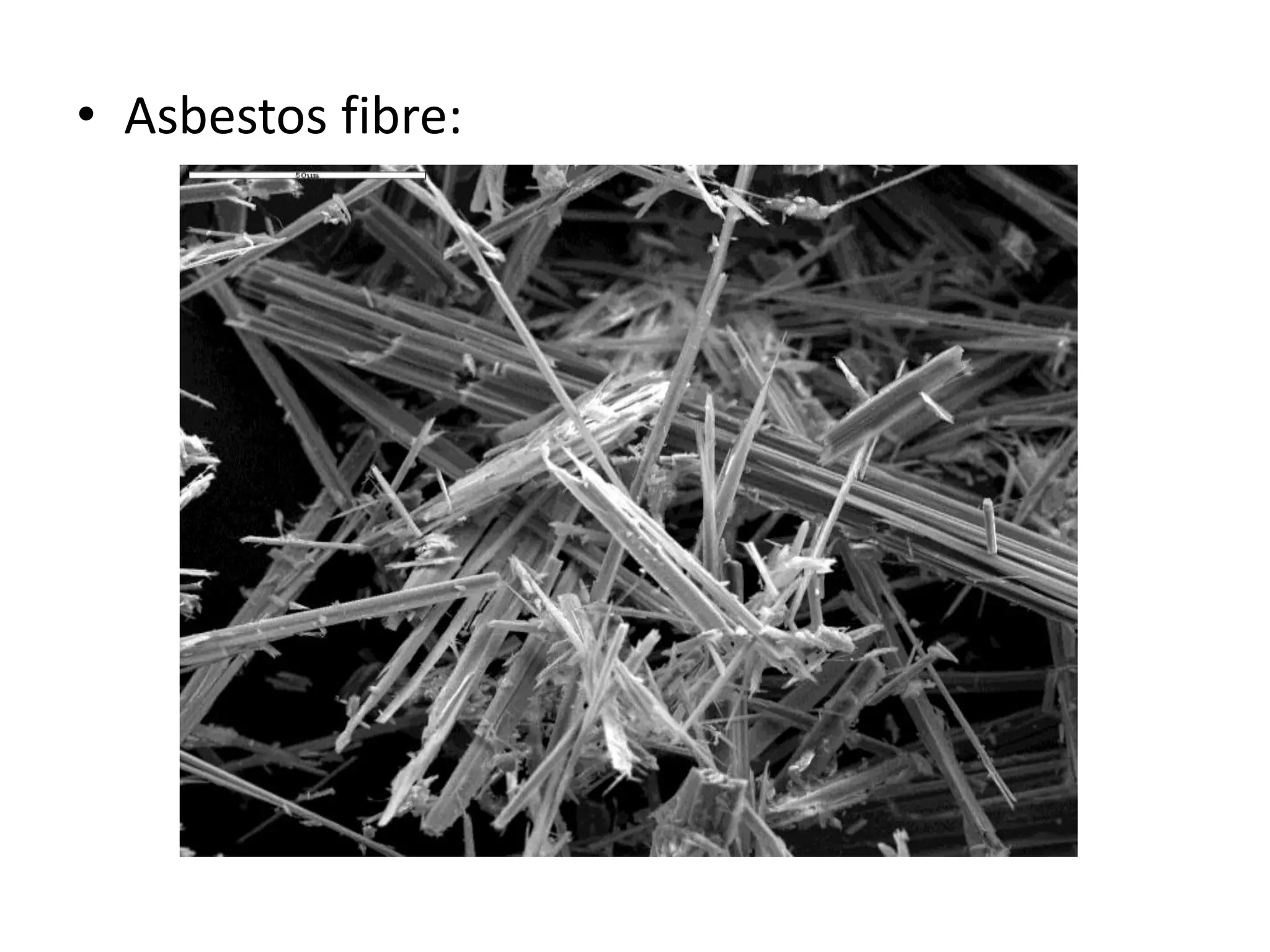
• Asbestos fibre:
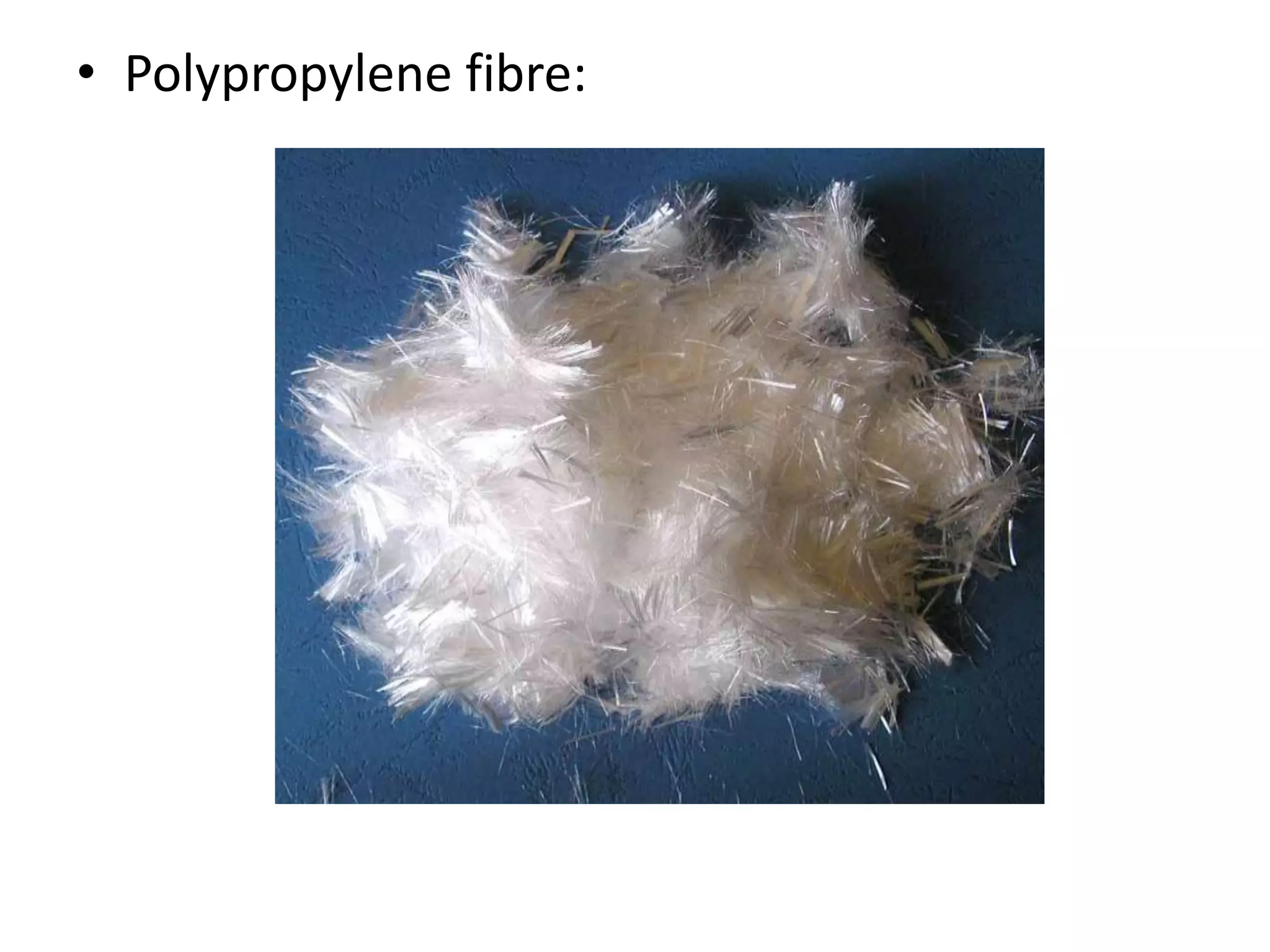
• Polypropylene fibre:
• Carbon fibre:
• Aramid fibre:
Source: Santa Kumar
Factors effecting the properties of FRC 
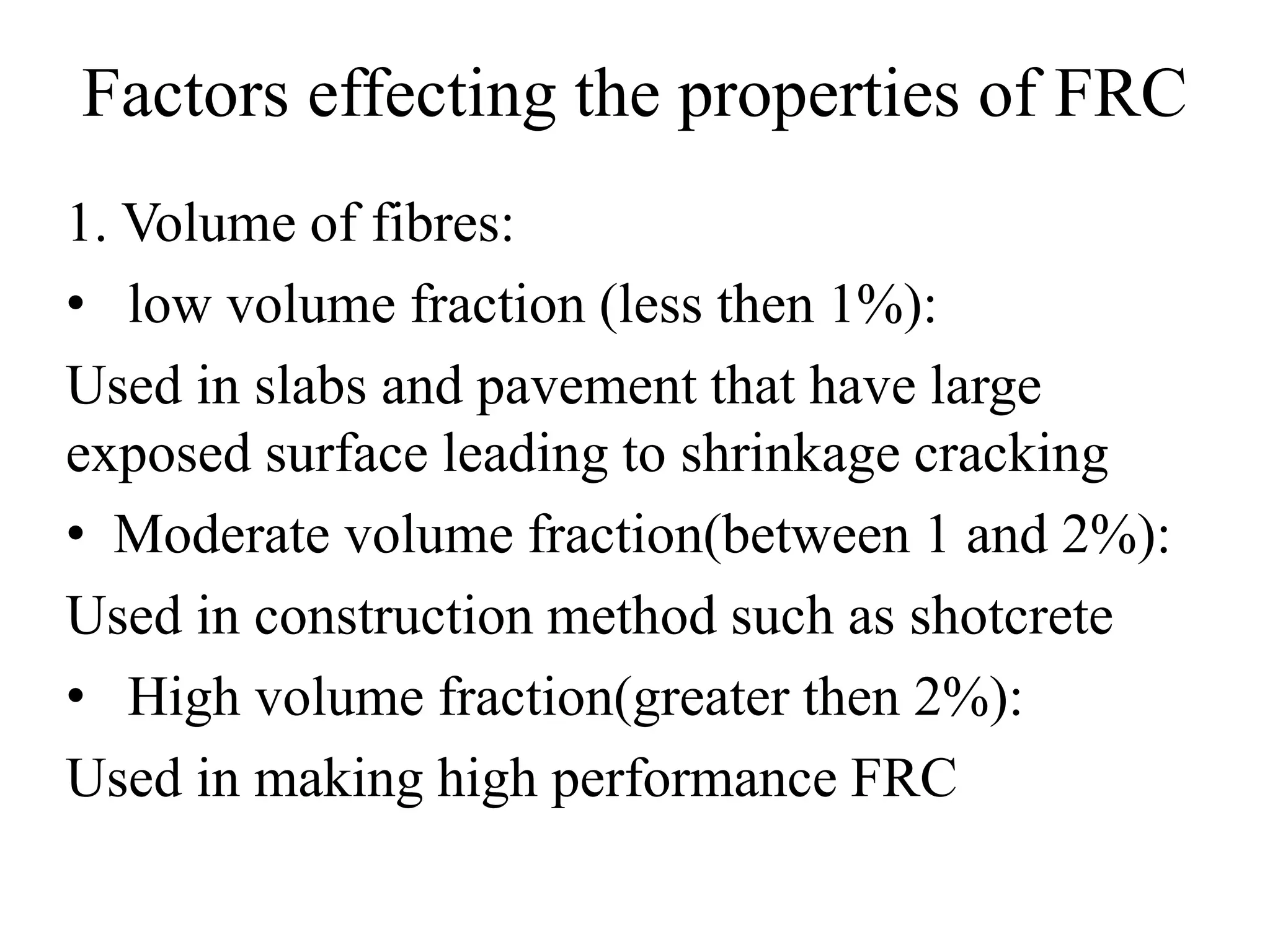
1. Volume of fibres: 
• low volume fraction (less then 1%): 
Used in slabs and pavement that have large 
exposed surface leading to shrinkage cracking 
• Moderate volume fraction(between 1 and 2%): 
Used in construction method such as shotcrete 
• High volume fraction(greater then 2%): 
Used in making high performance FRC
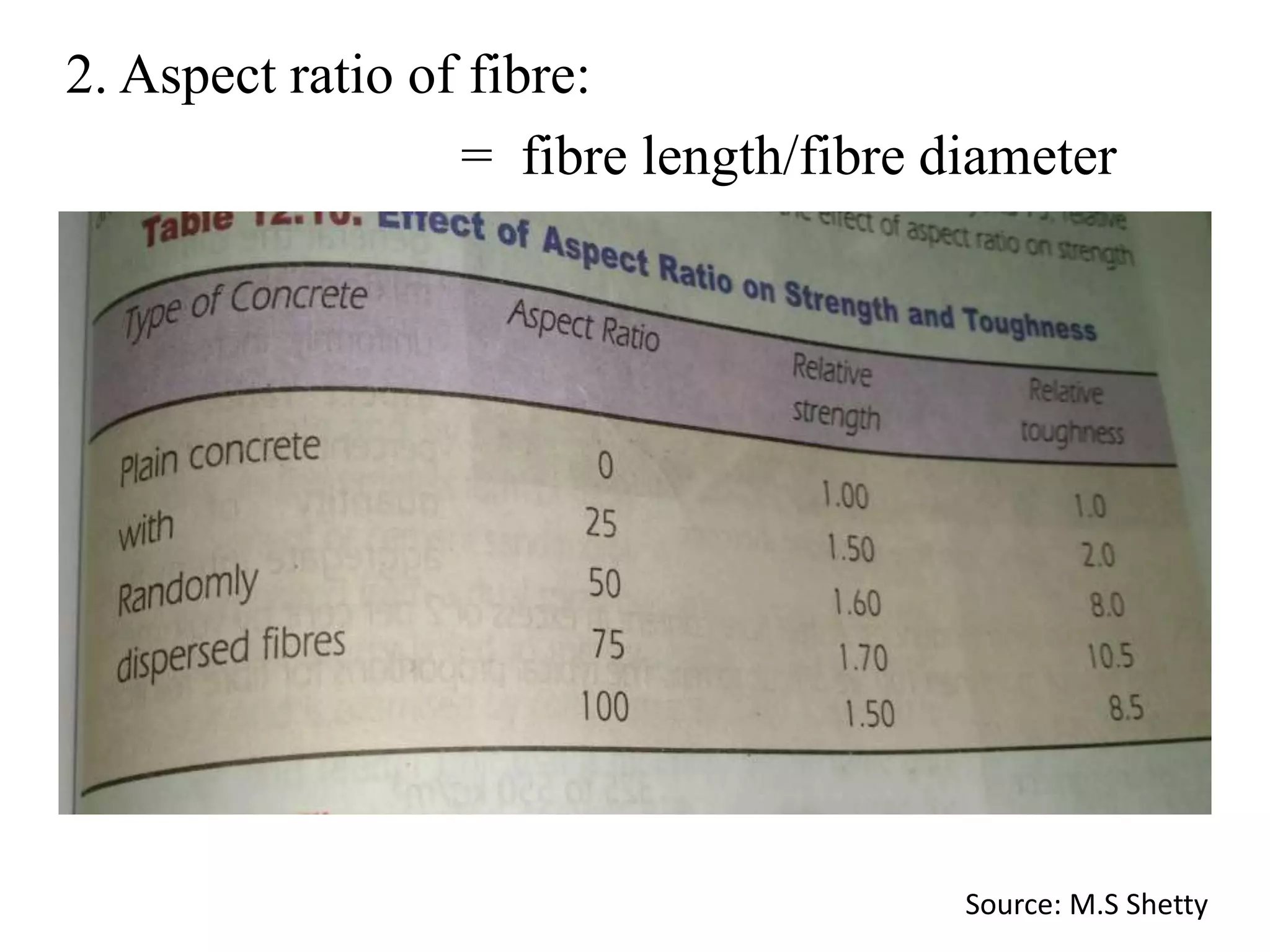
2. Aspect ratio of fibre: 
= fibre length/fibre diameter 
Source: M.S Shetty
3. Orientation of fibres: 
• Aligned in the direction of load 
• Aligned in the direction perpendicular to load 
• Randomly distribution of fibers
4. Relative fibre matrix: 
• Fibre should be significantly stiffer than matrix 
• Low modulus of fibres imparts more energy 
absorption while high modulus of fibres imparts 
strength and stiffness. 
• Low modulus fibres e.g. nylon, polypropylene 
• High modulus of elasticity e.g. steel, glass and 
carbon fibres.
5. Workability and compaction of concrete: 
• Usage of steel fibres , higher aspect ratio and 
non-uniform distribution of fibres will reduce 
workability 
• Prolonged external vibration fails to compact the 
concrete 
• These properties can be improved by increasing 
water/cement ratio or by using water reducing 
admixtures
6.Size of coarse aggregate: 
• Restricted to 10mm 
• Friction between fibres and between fibres and 
aggregates controls orientation and distribution. 
7. Mixing: 
• Mixing of FRC needs careful precautions to 
avoid balling effect and segregation 
• Increase in aspect ratio, volume percentage and 
size of coarse aggregate will increase the 
difficulties.
Developments in FRC 
1.High fibre volume micro fibre system: 
• length – 3mm 
• Diameter – 25 microns 
• Specific surface > 200 cm2/gram 
• Mixing of FRC needs careful conditions to avoid balling 
effect 
• Sand particles of size not exceeding 1mm 
• Low sand to cement ratio. 
• Requires large dosage of super plasticizers 
• Omni mixer is used for mixing
Omni mixer used in 
high volume FRC
2. Slurry infiltrated fibre concrete(SIFCON): 
• Invented by lankard in 1979 
• Pre-placing the dry fibres and cement slurry 
is infiltrated. 
• Volume of fibres can be increased to 20% 
• increase in flexural capacity and toughness. 
• used in blast resistant structures 
• better suited for three dimensional application 
such as zones of reinforcing bars anchorages
3. Slurry infiltrated mat concrete (SIMCON): 
• Infiltrating continuous steel fibre mats with a 
specially designed cement based slurry. 
• Mats are made up of stainless steel. 
• Fibre volume is less than that required for 
SIFCON, but same flexural strength and energy 
absorption. 
• Aspect ratio exceeding 500 can be used. 
• Since mat is predefined configuration, handling 
is minimized and balling effect is reduced
• Cracks are small and discontinuous and 
possibility of water seepage is low . 
• Concrete slurry uses very little water to pack 
the mat very tight some of the cement remains 
unhydrated.
Applications of SFRC 
• Highway and airfield pavements
• Hydraulic structures
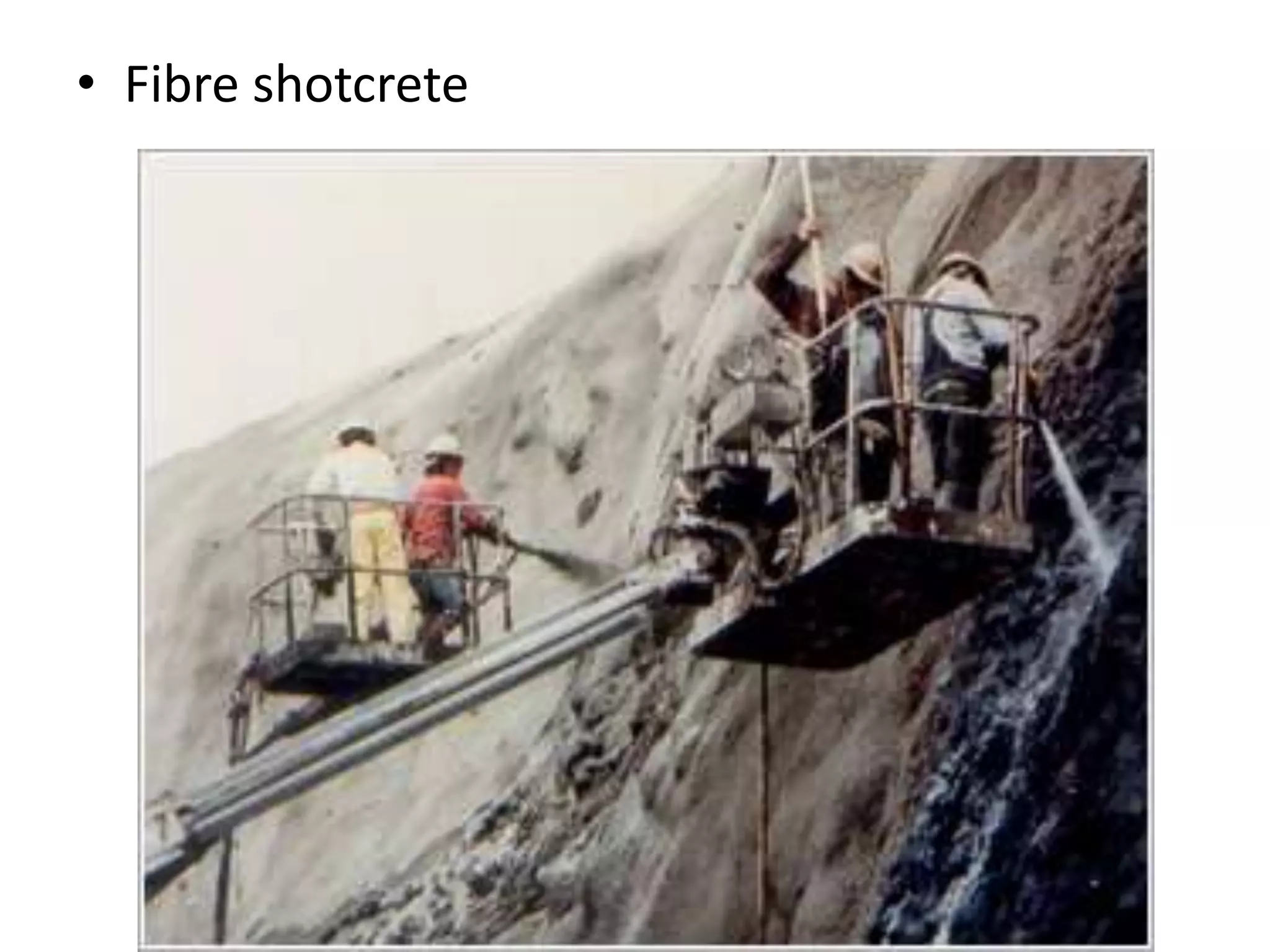
• Fibre shotcrete
• Precast applications
• Structural applications
Behaviour of SFRC in Tension 
• Effect of incorporating fibres – delay and control tensile cracking 
• Fibres (ductile) + matrix (brittle) composite (ductile) 
• Sharing of tensile load (most predominant feature of FRC) 
 until the matrix cracks ( fibre & matrix) 
 once matrix cracks (fibres) 
 this mechanism gives rise to favourable dynamic properties 
1. Energy absorption 
2. Fracture toughness
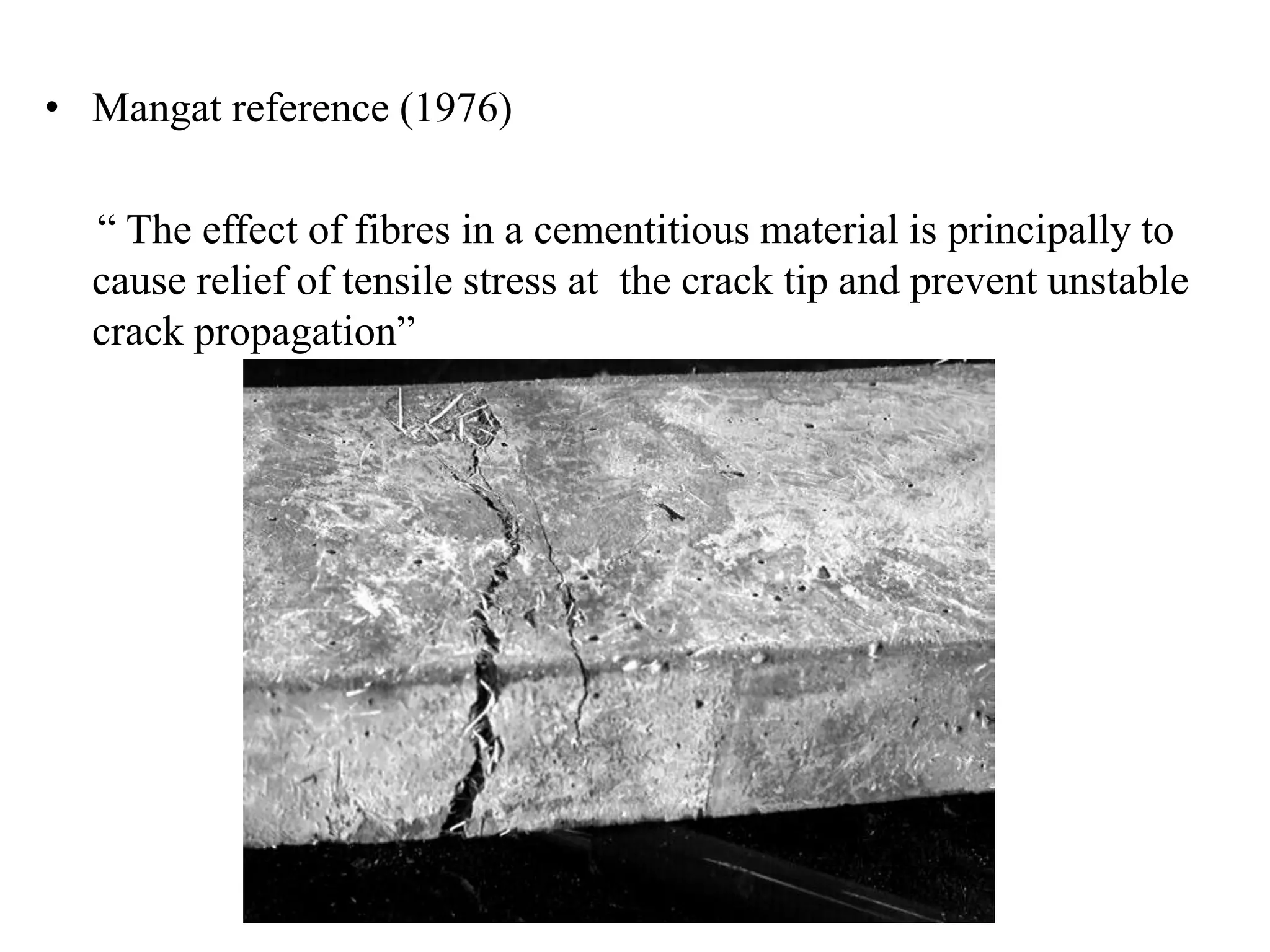
• Mangat reference (1976) 
“ The effect of fibres in a cementitious material is principally to 
cause relief of tensile stress at the crack tip and prevent unstable 
crack propagation”
 Kelly (1970) 
• Investigated the mechanism of pull-out. 
• Load-elongation curve of fibres in tension depends on volume 
fraction of fibres. 
• Response in tension (based on FRC or SIFCON) 
stage1: before cracking the composite elastic- (elastic stage) 
stage2: after cracking –fibres tend to pull out – sudden change in 
load elongation curve. 
- if maximum post cracking stress › cracking stress – (multiple 
cracking stage) 
stage 3: beyond the peak point - failure and/or pull out of fibres 
across single critical crack. 
• Note : the post cracking strength increases with increase in bond 
strength, aspect ratio and volume fraction of fibres.
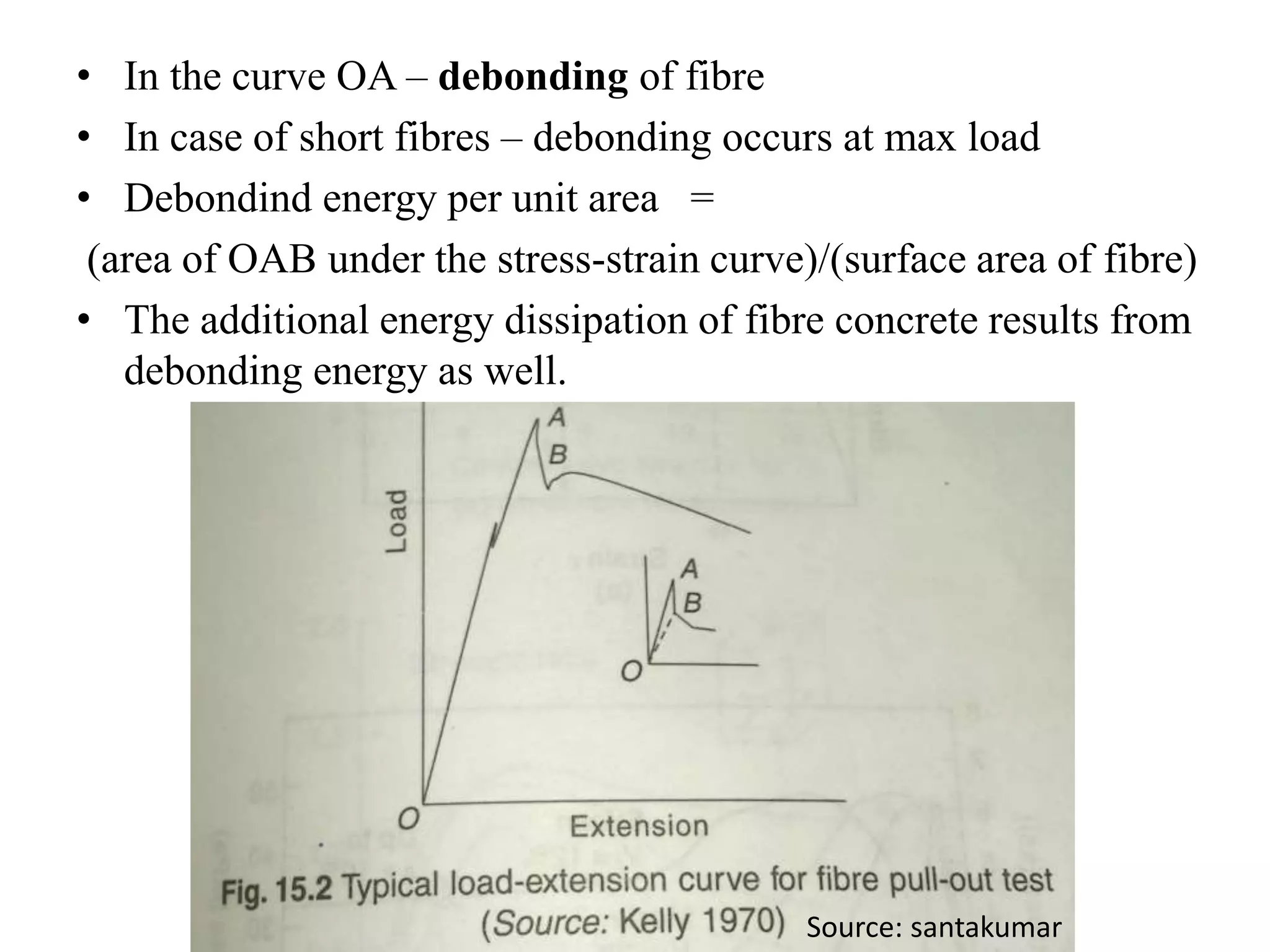
• In the curve OA – debonding of fibre 
• In case of short fibres – debonding occurs at max load 
• Debondind energy per unit area = 
(area of OAB under the stress-strain curve)/(surface area of fibre) 
• The additional energy dissipation of fibre concrete results from 
debonding energy as well. 
Source: santakumar
Source: M.S Shetty
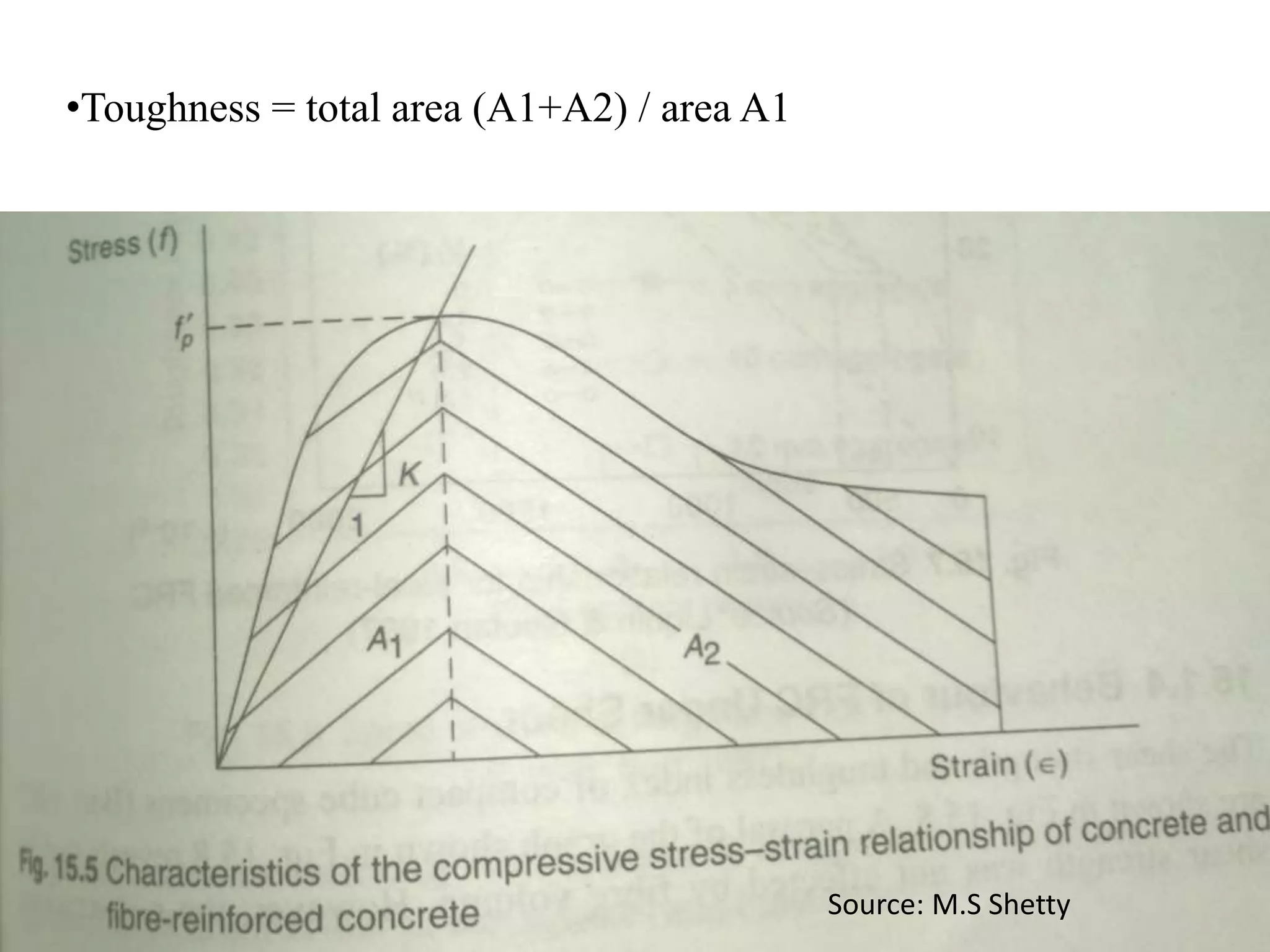
Behaviour of FRC in Compression 
• Increase in compressive strength of FRC is marginal and ranges 
from 0% to 20%. 
• However, post cracking compressive stress-strain response 
changes substantially. 
• Change is due to Increase in strain at peak load & ductility 
beyond ultimate load – higher toughness 
• Higher toughness – prevents sudden & catastrophic failures 
(especially in case of EQ & blast type of loads)
•Toughness = total area (A1+A2) / area A1 
Source: M.S Shetty
Behaviour of FRC in Flexure 
• There are 3 stages of response in flexure 
stage1: process zone 
- more or less linear response up to elastic limit. 
- transfer stress from matrix to the fibres by interfacial shear 
- imposed stress is shared between matrix and fibre until 
first crack. 
stage2: pseudo-plastic zone 
- it is the non-linear portion between the elastic point and 
max load capacity point. 
- stress in matrix is progressively transferred to the fibres. 
- fibres pull-out from the matrix (non-linear load-deflection) 
- results in multiple cracking
stage3: stress free zone 
- descending portion following peak strength until strain 
limit. 
- load-deflection curve represents ability of the fibre 
composite to absorb large amounts of energy before failure. 
- fibres are completely pulled-out 
• Flexural strength of fibre composite is 
fc = ultimate strength of fibre composite 
fm = max strength of plain matrix (concrete) 
C and D are constants determined experimentally 
for plain concrete C=1 and D=0 
for FRC ultimate strength C=0.95,D=4.95 
for FRC first cracking strength C= 0.85, D= 4.95
Source: M.S Shetty
Crack Arresting 
• Crack resistance is lower than the ultimate stress 
• Once cracking is subjected to coupling impact of increased loads, 
material ageing, structure fatigue – increase microcracks 
• Microcracks – upward shifting of N-A, tension area of concrete is 
lost – decrease of structural rigidity – deterioration of structural 
durability. 
• Propogation of micropcracks – emergency situation 
• Fracture mechanics – stress singularities at crack tips 
• Stress intensity factor › critical stress intensity factor of FRC – 
Propagation of cracks - functional obsoleteness & structural 
failure
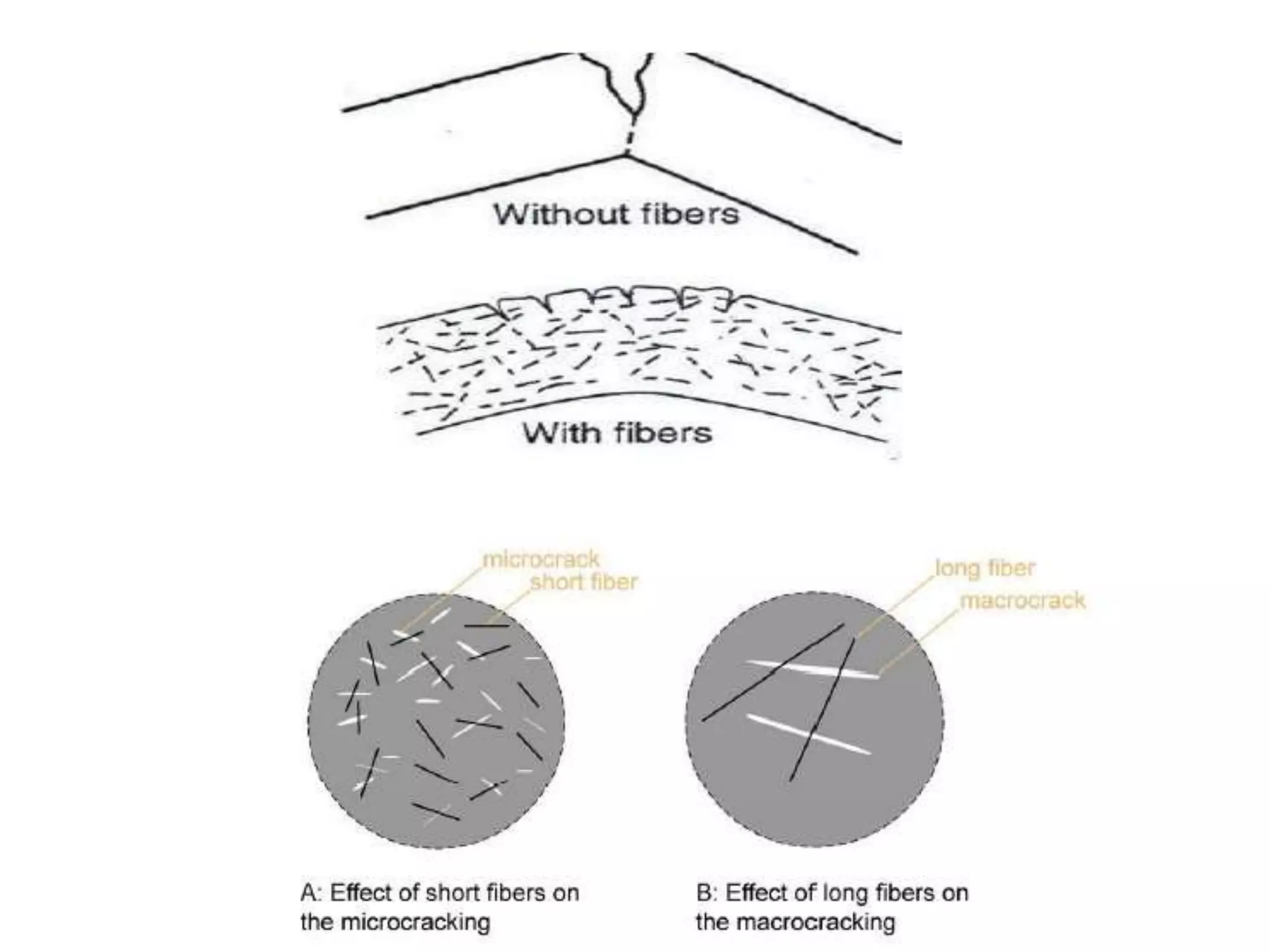
Bridging action of steel fibres
CASE STUDY 
• Research program is funded by National Basic Research 
Program of china 
• Published in 15 may 2013 in JESTR
Case study to arrest cracks 
Crack arresting and strengthening
• Supposing unilateral crack under pure bending 
• Stress concentration factor of edge crack is more than central 
penetrated crack under same loading – unstable propagation 
• HFRP is bonded to the surface – resists stress concentration of 
crack at crack tip– edge crack in to internal eccentric crack 
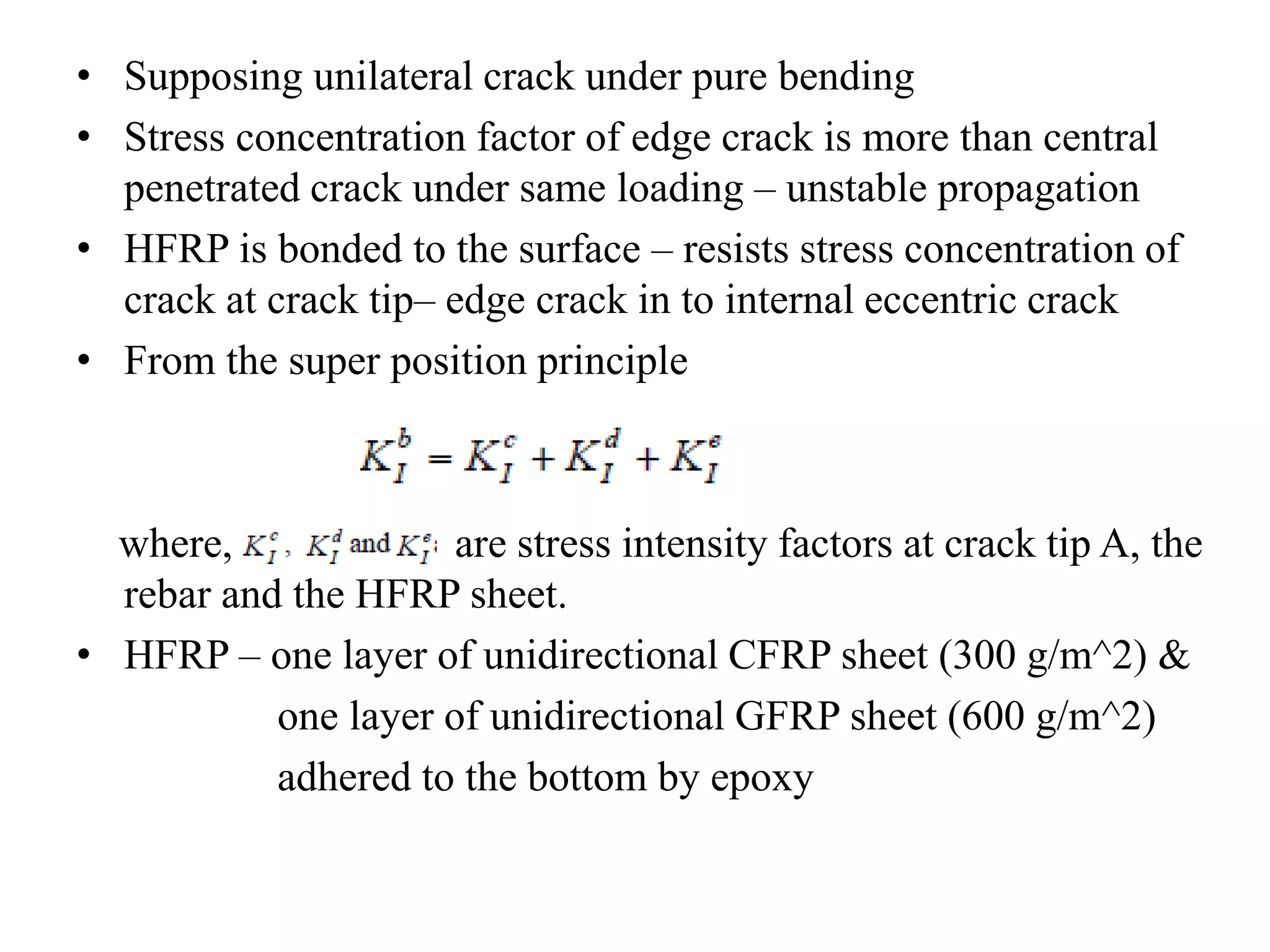
• From the super position principle 
where, are stress intensity factors at crack tip A, the 
rebar and the HFRP sheet. 
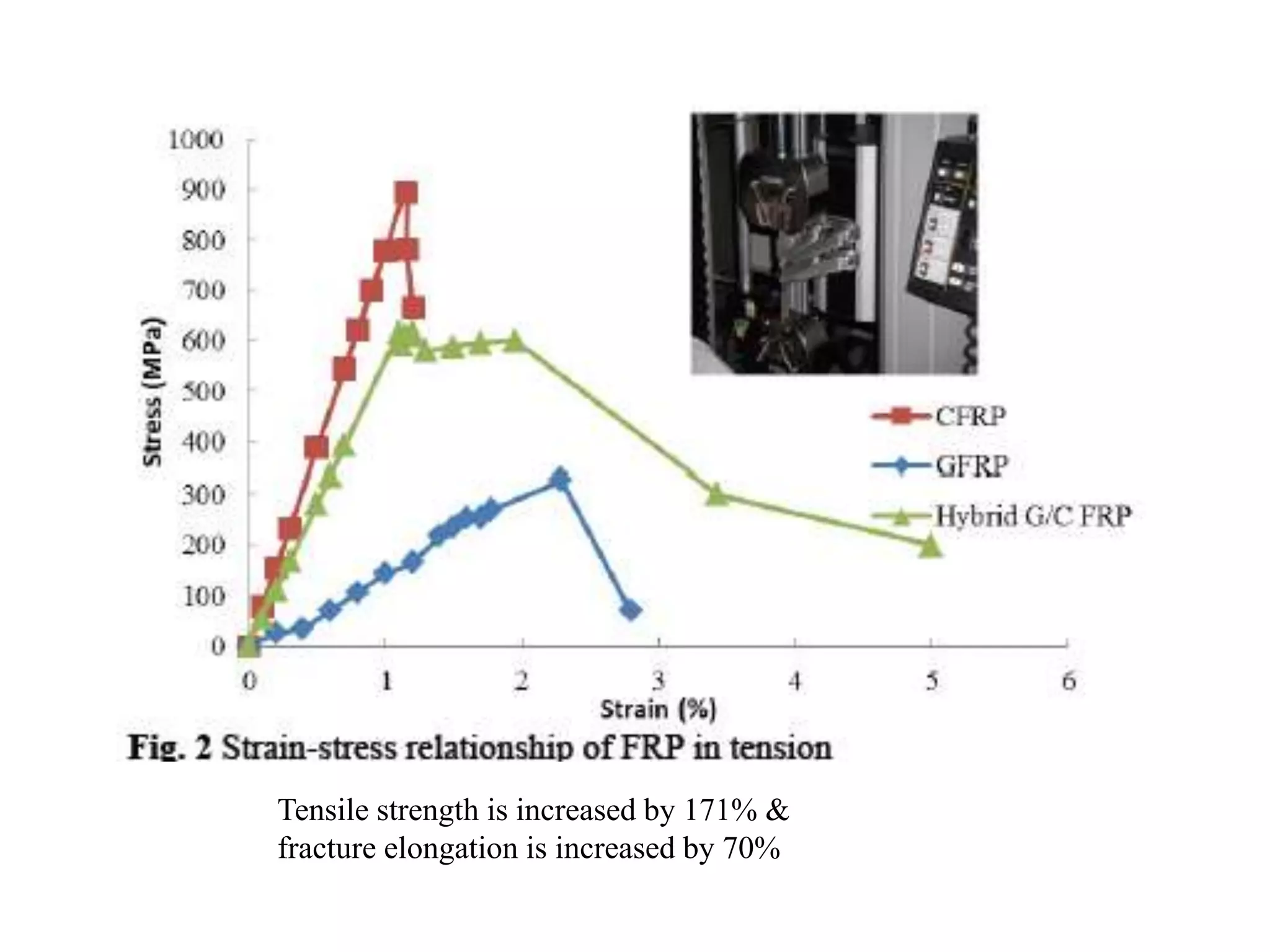
• HFRP – one layer of unidirectional CFRP sheet (300 g/m^2) & 
one layer of unidirectional GFRP sheet (600 g/m^2) 
adhered to the bottom by epoxy
Tensile strength is increased by 171% & 
fracture elongation is increased by 70%
2 no. of specimens, 8mm dia bars, 3% of nylon (tensile- 6 Mpa)
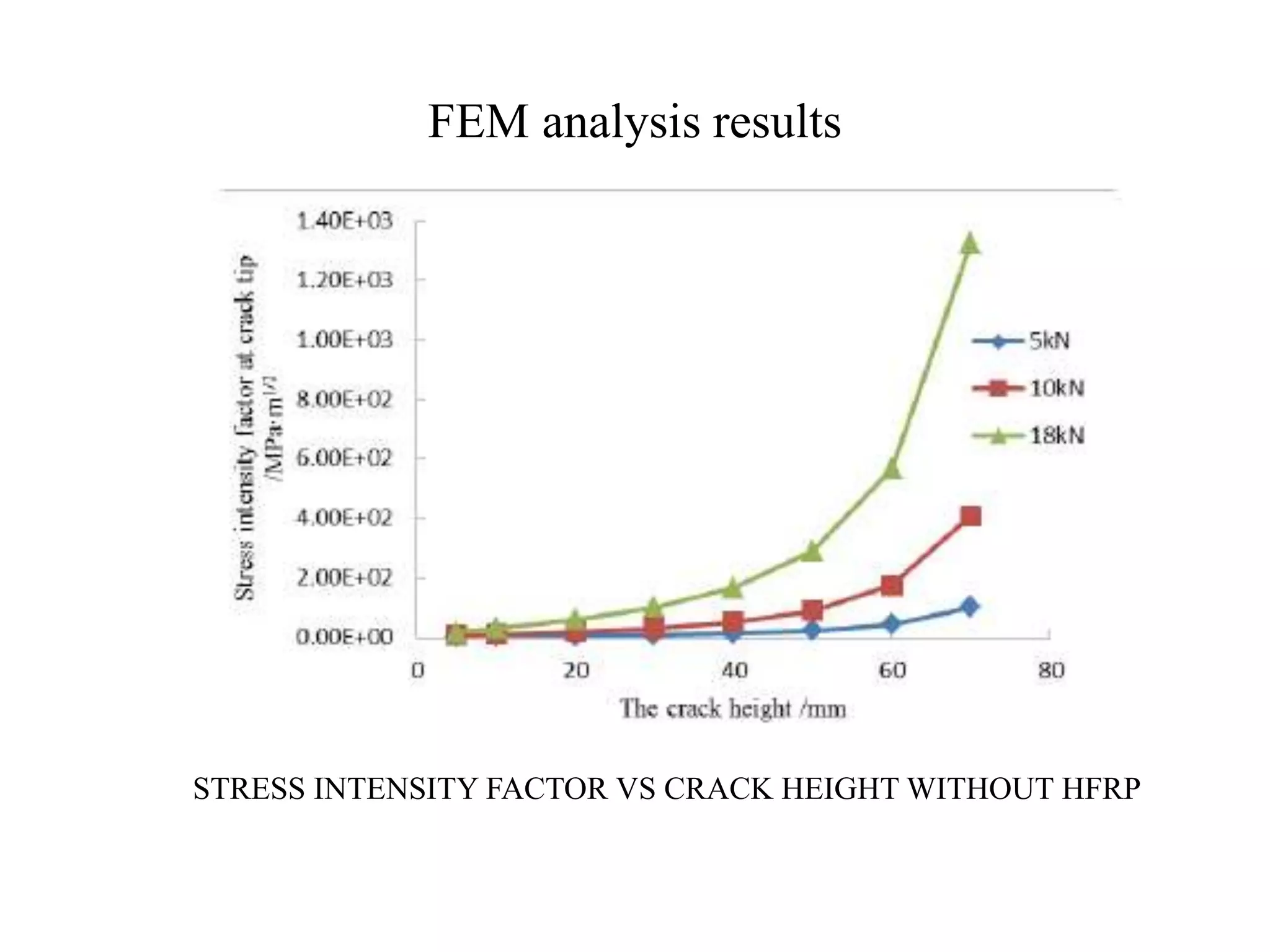
FEM analysis results 
STRESS INTENSITY FACTOR VS CRACK HEIGHT WITHOUT HFRP
STRESS INTENSITY FACTOR VS CRACK HEIGHT WITH HFRP 
•HFRP increases ductility separately by 36% and 106%
Mix Design Procedure 
• Corresponding to required 28-day field flexural strength of 
SFRC – design strength of laboratory mix is determined. 
• For known geometry, stipulated volume fraction- w/c ratio is 
selected between 0.45 and 0.60 
• Depending on max size of agg. & fibre concentration – cement 
paste content is determined by mass 
• Ratio of FA to CA varies from 1:1 to 1:3, ratio of 1:1.5 is a good 
start for volume % of fibre up to 1.5 and length of fibre up to 
40mm.
• From w/c ratio & paste content – cement & water content 
• Fibre content is obtained by taking density of fibres as 7850 
kg/m^3 
• Total quantity of agg. Is determined as 
wt. of agg. = wt. of FRC – ( wt. of water, cement & fibre) 
• Quantities of FA &CA are determined by ratio of FA:CA= 1:1.5 
• Trial mix is checked for workability by appropriate test.
Applications in India and abroad 
• More than 400 tones of Shakti man Steel Fibers have been used recently in 
the construction of a road overlay for a project at Mathura (UP).
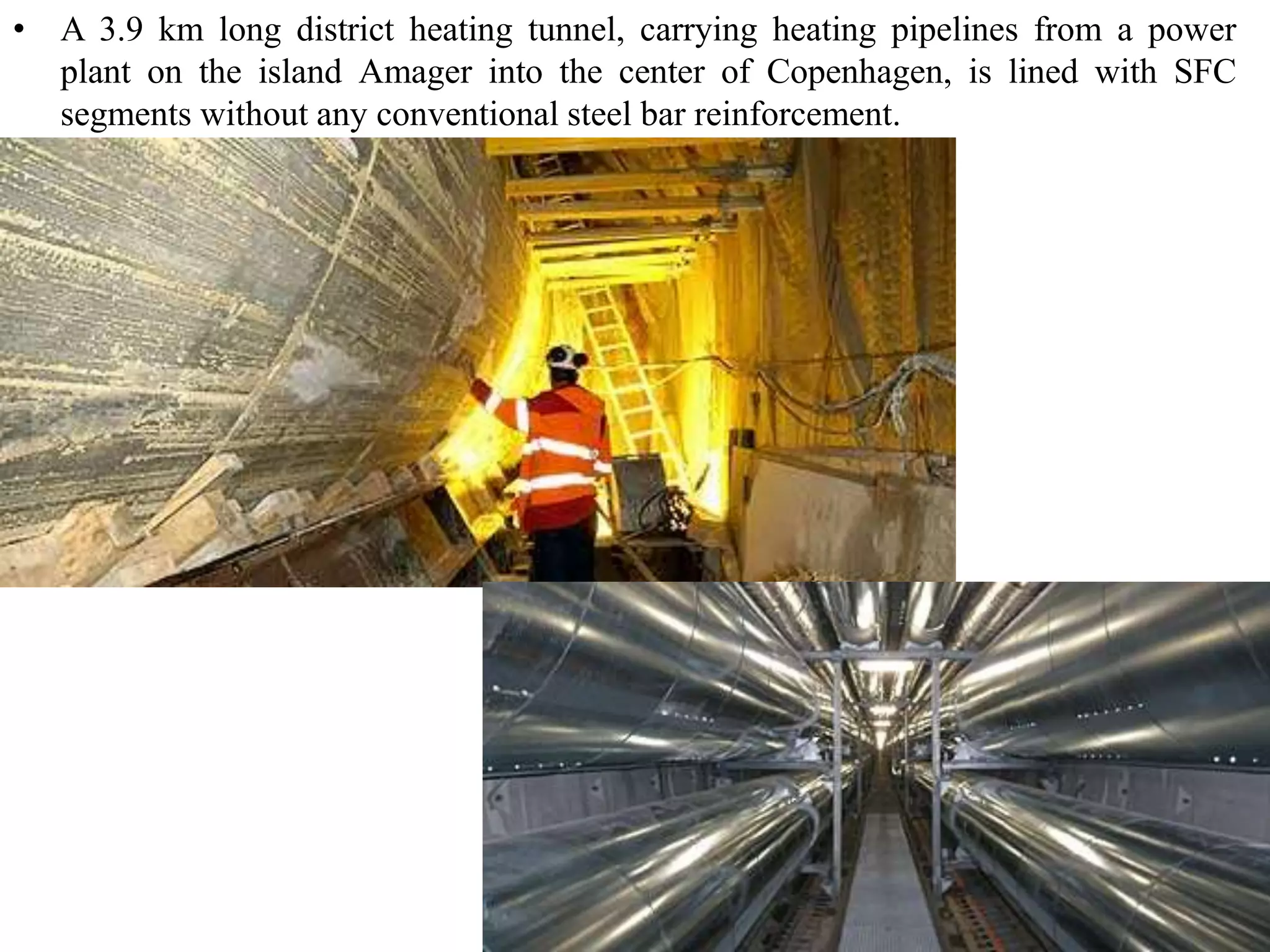
• A 3.9 km long district heating tunnel, carrying heating pipelines from a power 
plant on the island Amager into the center of Copenhagen, is lined with SFC 
segments without any conventional steel bar reinforcement.
• Steel fibers are used without rebars to carry flexural loads is a 
parking garage at Heathrow Airport. It is a structure with 10 cm 
thick slab.
Conclusions 
• The total energy absorbed in fiber i.e., area under the load-deflection 
curve is at least 10 to 40 times higher for fiber-reinforced 
concrete than that of plain concrete. 
• Addition of fiber to conventionally reinforced beams increased the 
fatigue life and decreased the crack width under fatigue loading. 
• At elevated temperature SFRC have more strength both in 
compression and tension. 
• Cost savings of 10% - 30% over conventional concrete flooring 
systems.
fibre reinforced concrete

fibre reinforced concrete

  • 1.
    “FIBRE REINFORCED CONCRETE” by MAYAKUNTLA PRASANNAKUMAR VENKATESHA A
  • 2.
    What is Fibre? • Fibre is a small piece of reinforcing material which increases structural integrity. Why Fibre ? Concrete: • Weak in tension • Brittle
  • 3.
    What is fibrereinforced concrete • FRC is a Portland cement reinforced with more or less randomly distributed fibres .
  • 4.
    Types of fibres 1. Steel fibre:
  • 5.
  • 6.
  • 7.
  • 8.
  • 9.
  • 10.
  • 11.
    Factors effecting theproperties of FRC 1. Volume of fibres: • low volume fraction (less then 1%): Used in slabs and pavement that have large exposed surface leading to shrinkage cracking • Moderate volume fraction(between 1 and 2%): Used in construction method such as shotcrete • High volume fraction(greater then 2%): Used in making high performance FRC
  • 12.
    2. Aspect ratioof fibre: = fibre length/fibre diameter Source: M.S Shetty
  • 13.
    3. Orientation offibres: • Aligned in the direction of load • Aligned in the direction perpendicular to load • Randomly distribution of fibers
  • 14.
    4. Relative fibrematrix: • Fibre should be significantly stiffer than matrix • Low modulus of fibres imparts more energy absorption while high modulus of fibres imparts strength and stiffness. • Low modulus fibres e.g. nylon, polypropylene • High modulus of elasticity e.g. steel, glass and carbon fibres.
  • 15.
    5. Workability andcompaction of concrete: • Usage of steel fibres , higher aspect ratio and non-uniform distribution of fibres will reduce workability • Prolonged external vibration fails to compact the concrete • These properties can be improved by increasing water/cement ratio or by using water reducing admixtures
  • 16.
    6.Size of coarseaggregate: • Restricted to 10mm • Friction between fibres and between fibres and aggregates controls orientation and distribution. 7. Mixing: • Mixing of FRC needs careful precautions to avoid balling effect and segregation • Increase in aspect ratio, volume percentage and size of coarse aggregate will increase the difficulties.
  • 17.
    Developments in FRC 1.High fibre volume micro fibre system: • length – 3mm • Diameter – 25 microns • Specific surface > 200 cm2/gram • Mixing of FRC needs careful conditions to avoid balling effect • Sand particles of size not exceeding 1mm • Low sand to cement ratio. • Requires large dosage of super plasticizers • Omni mixer is used for mixing
  • 18.
    Omni mixer usedin high volume FRC
  • 19.
    2. Slurry infiltratedfibre concrete(SIFCON): • Invented by lankard in 1979 • Pre-placing the dry fibres and cement slurry is infiltrated. • Volume of fibres can be increased to 20% • increase in flexural capacity and toughness. • used in blast resistant structures • better suited for three dimensional application such as zones of reinforcing bars anchorages
  • 20.
    3. Slurry infiltratedmat concrete (SIMCON): • Infiltrating continuous steel fibre mats with a specially designed cement based slurry. • Mats are made up of stainless steel. • Fibre volume is less than that required for SIFCON, but same flexural strength and energy absorption. • Aspect ratio exceeding 500 can be used. • Since mat is predefined configuration, handling is minimized and balling effect is reduced
  • 21.
    • Cracks aresmall and discontinuous and possibility of water seepage is low . • Concrete slurry uses very little water to pack the mat very tight some of the cement remains unhydrated.
  • 22.
    Applications of SFRC • Highway and airfield pavements
  • 23.
  • 24.
  • 25.
  • 26.
  • 27.
    Behaviour of SFRCin Tension • Effect of incorporating fibres – delay and control tensile cracking • Fibres (ductile) + matrix (brittle) composite (ductile) • Sharing of tensile load (most predominant feature of FRC)  until the matrix cracks ( fibre & matrix)  once matrix cracks (fibres)  this mechanism gives rise to favourable dynamic properties 1. Energy absorption 2. Fracture toughness
  • 28.
    • Mangat reference(1976) “ The effect of fibres in a cementitious material is principally to cause relief of tensile stress at the crack tip and prevent unstable crack propagation”
  • 29.
     Kelly (1970) • Investigated the mechanism of pull-out. • Load-elongation curve of fibres in tension depends on volume fraction of fibres. • Response in tension (based on FRC or SIFCON) stage1: before cracking the composite elastic- (elastic stage) stage2: after cracking –fibres tend to pull out – sudden change in load elongation curve. - if maximum post cracking stress › cracking stress – (multiple cracking stage) stage 3: beyond the peak point - failure and/or pull out of fibres across single critical crack. • Note : the post cracking strength increases with increase in bond strength, aspect ratio and volume fraction of fibres.
  • 30.
    • In thecurve OA – debonding of fibre • In case of short fibres – debonding occurs at max load • Debondind energy per unit area = (area of OAB under the stress-strain curve)/(surface area of fibre) • The additional energy dissipation of fibre concrete results from debonding energy as well. Source: santakumar
  • 31.
  • 32.
    Behaviour of FRCin Compression • Increase in compressive strength of FRC is marginal and ranges from 0% to 20%. • However, post cracking compressive stress-strain response changes substantially. • Change is due to Increase in strain at peak load & ductility beyond ultimate load – higher toughness • Higher toughness – prevents sudden & catastrophic failures (especially in case of EQ & blast type of loads)
  • 33.
    •Toughness = totalarea (A1+A2) / area A1 Source: M.S Shetty
  • 34.
    Behaviour of FRCin Flexure • There are 3 stages of response in flexure stage1: process zone - more or less linear response up to elastic limit. - transfer stress from matrix to the fibres by interfacial shear - imposed stress is shared between matrix and fibre until first crack. stage2: pseudo-plastic zone - it is the non-linear portion between the elastic point and max load capacity point. - stress in matrix is progressively transferred to the fibres. - fibres pull-out from the matrix (non-linear load-deflection) - results in multiple cracking
  • 35.
    stage3: stress freezone - descending portion following peak strength until strain limit. - load-deflection curve represents ability of the fibre composite to absorb large amounts of energy before failure. - fibres are completely pulled-out • Flexural strength of fibre composite is fc = ultimate strength of fibre composite fm = max strength of plain matrix (concrete) C and D are constants determined experimentally for plain concrete C=1 and D=0 for FRC ultimate strength C=0.95,D=4.95 for FRC first cracking strength C= 0.85, D= 4.95
  • 36.
  • 37.
    Crack Arresting •Crack resistance is lower than the ultimate stress • Once cracking is subjected to coupling impact of increased loads, material ageing, structure fatigue – increase microcracks • Microcracks – upward shifting of N-A, tension area of concrete is lost – decrease of structural rigidity – deterioration of structural durability. • Propogation of micropcracks – emergency situation • Fracture mechanics – stress singularities at crack tips • Stress intensity factor › critical stress intensity factor of FRC – Propagation of cracks - functional obsoleteness & structural failure
  • 39.
    Bridging action ofsteel fibres
  • 40.
    CASE STUDY •Research program is funded by National Basic Research Program of china • Published in 15 may 2013 in JESTR
  • 41.
    Case study toarrest cracks Crack arresting and strengthening
  • 42.
    • Supposing unilateralcrack under pure bending • Stress concentration factor of edge crack is more than central penetrated crack under same loading – unstable propagation • HFRP is bonded to the surface – resists stress concentration of crack at crack tip– edge crack in to internal eccentric crack • From the super position principle where, are stress intensity factors at crack tip A, the rebar and the HFRP sheet. • HFRP – one layer of unidirectional CFRP sheet (300 g/m^2) & one layer of unidirectional GFRP sheet (600 g/m^2) adhered to the bottom by epoxy
  • 43.
    Tensile strength isincreased by 171% & fracture elongation is increased by 70%
  • 45.
    2 no. ofspecimens, 8mm dia bars, 3% of nylon (tensile- 6 Mpa)
  • 46.
    FEM analysis results STRESS INTENSITY FACTOR VS CRACK HEIGHT WITHOUT HFRP
  • 47.
    STRESS INTENSITY FACTORVS CRACK HEIGHT WITH HFRP •HFRP increases ductility separately by 36% and 106%
  • 48.
    Mix Design Procedure • Corresponding to required 28-day field flexural strength of SFRC – design strength of laboratory mix is determined. • For known geometry, stipulated volume fraction- w/c ratio is selected between 0.45 and 0.60 • Depending on max size of agg. & fibre concentration – cement paste content is determined by mass • Ratio of FA to CA varies from 1:1 to 1:3, ratio of 1:1.5 is a good start for volume % of fibre up to 1.5 and length of fibre up to 40mm.
  • 49.
    • From w/cratio & paste content – cement & water content • Fibre content is obtained by taking density of fibres as 7850 kg/m^3 • Total quantity of agg. Is determined as wt. of agg. = wt. of FRC – ( wt. of water, cement & fibre) • Quantities of FA &CA are determined by ratio of FA:CA= 1:1.5 • Trial mix is checked for workability by appropriate test.
  • 50.
    Applications in Indiaand abroad • More than 400 tones of Shakti man Steel Fibers have been used recently in the construction of a road overlay for a project at Mathura (UP).
  • 51.
    • A 3.9km long district heating tunnel, carrying heating pipelines from a power plant on the island Amager into the center of Copenhagen, is lined with SFC segments without any conventional steel bar reinforcement.
  • 52.
    • Steel fibersare used without rebars to carry flexural loads is a parking garage at Heathrow Airport. It is a structure with 10 cm thick slab.
  • 53.
    Conclusions • Thetotal energy absorbed in fiber i.e., area under the load-deflection curve is at least 10 to 40 times higher for fiber-reinforced concrete than that of plain concrete. • Addition of fiber to conventionally reinforced beams increased the fatigue life and decreased the crack width under fatigue loading. • At elevated temperature SFRC have more strength both in compression and tension. • Cost savings of 10% - 30% over conventional concrete flooring systems.