Motivational AdaptivePhysical Activity Programme(MAPAP) for fall prevention among the community-
dwelling elderlypopulation of NewZealand
PRESENTED BY- MR. PANDURANG GOPALRAO CHAVAN
PROGRAM- POST GRADUATE DIPLOMA IN HEALTH SCIENCES
COURSE-HEALTH PROMOTION 2020"
 Elderly people are adults over the age of 65 years.
 Globally it is predicted that by 2050, the elderly population to reach 2 billion
from 900 million in 2015.
 Currently, 125 million people are 80-year-old or over.
(World Health Organization [WHO], 2018).
 In New Zealand (NZ) the rate of elderly population is growing swiftly
 This extended life span is seen as a victory of medical advances
 However, it has increased the load on healthcare services due to health issues
associated with old age. (Ministry of Health (MOH), 2019; WHO, 2018).
15
22
6
12
2 4
0
5
10
15
20
25
2015/16 2035/36
Growing
rate
in
percentage
Elderly population growing rate in NZ
(MOH, 2018)
65 years 75 years 85 years
Prevalence
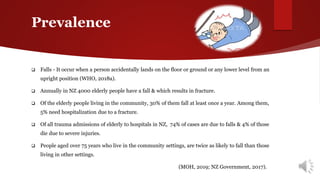
 Falls - It occur when a person accidentally lands on the floor or ground or any lower level from an
upright position (WHO, 2018a).
 Annually in NZ 4000 elderly people have a fall & which results in fracture.
 Of the elderly people living in the community, 30% of them fall at least once a year. Among them,
5% need hospitalization due to a fracture.
 Of all trauma admissions of elderly to hospitals in NZ, 74% of cases are due to falls & 4% of those
die due to severe injuries.
 People aged over 75 years who live in the community settings, are twice as likely to fall than those
living in other settings.
 (MOH, 2019; NZ Government, 2017).
Impact of Falls
Physical injuries including fractures and head injuries
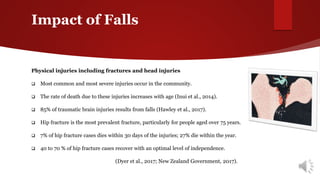
 Most common and most severe injuries occur in the community.
 The rate of death due to these injuries increases with age (Inui et al., 2014).
 85% of traumatic brain injuries results from falls (Hawley et al., 2017).
 Hip fracture is the most prevalent fracture, particularly for people aged over 75 years.
 7% of hip fracture cases dies within 30 days of the injuries; 27% die within the year.
 40 to 70 % of hip fracture cases recover with an optimal level of independence.
(Dyer et al., 2017; New Zealand Government, 2017).
Psychological impact
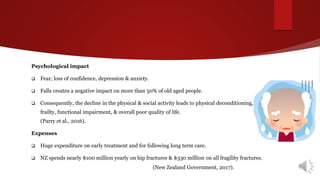
 Fear, loss of confidence, depression & anxiety.
 Falls creates a negative impact on more than 50% of old aged people.
 Consequently, the decline in the physical & social activity leads to physical deconditioning,
frailty, functional impairment, & overall poor quality of life.
(Parry et al., 2016).
Expenses
 Huge expenditure on early treatment and for following long term care.
 NZ spends nearly $100 million yearly on hip fractures & $330 million on all fragility fractures.
(New Zealand Government, 2017).
Risk Factors
 Frailty- Increase chances of fall by 1.84 times (Hubbard & Ng, 2015).
 Cognitive impairment- Dementia causes 90% of falls in hospitalized cases (Harvey et al.,
2016).
 Health conditions- Arthritis, diabetes mellitus, postural hypotension & dizziness (Paliwal
et al., 2017).
 Age-related physiological changes- Eyesight, hearing, cognitive & functional status
impairment (Amarya et al., 2018).
 Living Environment- 10% of falls occur due to uneven surfaces (Timsina et al., 2017).
Reason for the Programme
Saving elderly people from falls and related physical injuries
 Gives good return on healthcare investment
 Minimize hospital admissions & age-related residential care
 Reduces cost related to falls & falls-related injuries
 keep independent
 Maintain a good quality of life
 Psychological stability
 Respectful end of life (MOH, 2019; New Zealand Government, 2017).
Existing
Programmes in
New Zealand
 National falls preventing program
 The Health Quality & Safety Commission
 Healthy Ageing Strategy
(MOH, 2019; HQSC, 2019).
 It is an innovative & comprehensive long-term community-based health promotional program.
 Based on a behavioral change model of health promotion.
 Primarily aiming to provide quality of life to old aged people by lowering the rate of falls & falls-
related injuries.
Aim
 Prevent the elderly population from falls & fall-related injuries in the community settings.
Objective
 Motivate elderly people to follow a fall prevention programme.
 Motivate the community to participate in implementing the programme.
 Reduce the excessive burden on healthcare services.
Health Promotional Theory
Behavioral Change Model
 Behavioral change is a significant component of any health promotion activity.
 Motivating people means directing their behavior towards the goal.
 In the motivation process, all the brain processes and energies including desire, impulses and
reflex activities creates the sets of driving forces which directs the change in the behavior.
(Avgerinou et al., 2019).
Utilization
The execution of MAPAP can play an important role
 Promoting health and well‐being.
 By lowering the rates of falls & fall-related injuries & associated cost.
 It can be cost-effective for extensive execution into routine care.
 It can also be utilized along with the local and national level of support services with the help
of joint resources.
Methodology
Set up
 Community space/center/ (senior community center) or recreational activity space in a group setting.
 Delivered with the help of local community organizations, local governing body and DHBs.
 Through organizing a meeting.
Inclusion criteria
 Age- over 65
 Independent in walking with or without walking aid
 Mini-Mental score- over 24
Duration of program
 9 months
Frequency of intervention
 Twice in first three months and once in a month after three months.
 Advise will be given for regular physical activity at least five times weekly.
 Leaflet will be provided
 Monthly support will be provided on phone calls.
Duration of intervention- based on individuals’ needs and capability
Barriers
 Participants dropouts
 Cognitive impairment
 Funding issues
 Other medical complications
 Family and community non-co-operation
 Participants dropouts- Keeping regular contact
 Funding issues - Through national funding & private
medical insurance
 Other medical complications- Regular health check-up
by the local District Health Board (DHBs) & advising on
good nutritious food.
 Family and community non-co-operation- Arranging
sessions with subsidized rates &taking help from
community leaders.
Stakeholders  Elderly people
 Family members
 Community members
 Physiotherapist
 Local Government
 DHBs
Intervention
Procedure
It is divided in three-stages:
PRE-INTERVENTION STAGE – 1 (ASSESMENT)
 All prospective participants will be called at set up location.
 Recruitment will be done according to inclusion criteria
 Detailed information will be provided.
 Written consent will be taken
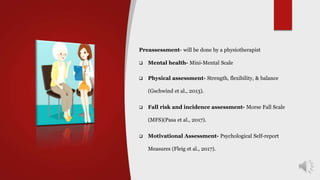
Preassessment- will be done by a physiotherapist
 Mental health- Mini-Mental Scale
 Physical assessment- Strength, flexibility, & balance
(Gschwind et al., 2013).
 Fall risk and incidence assessment- Morse Fall Scale
(MFS)(Pasa et al., 2017).
 Motivational Assessment- Psychological Self-report
Measures (Fleig et al., 2017).
INTERVENTION STAGE - 2
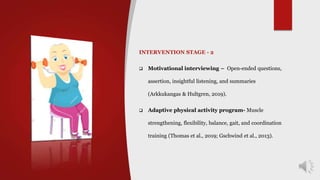
 Motivational interviewing – Open-ended questions,
assertion, insightful listening, and summaries
(Arkkukangas & Hultgren, 2019).
 Adaptive physical activity program- Muscle
strengthening, flexibility, balance, gait, and coordination
training (Thomas et al., 2019; Gschwind et al., 2013).
Advise to be given for Environmental modifications
 Home modifications
 Neighborhood/activity area modifications
 Assistive devices recommendation
(Timsina et all., 2017).
POST-INTERVENTION STAGE- 3 (EVALUATION)
Short-term
 Every three months
 Physical assessment- Strength, flexibility, and balance
 Fall risk and incidence assessment- Morse Fall Scale
 Motivational Assessment- Psychological Self-report
Measures
Long-term
 Lon after nine months.
 All assessment measures will be evaluated
 Cost calculation
 Feedback questionnaire
 MAPAP is a community-based
 Targets elderly people
 Easy to execute
 Have a potential to successfully achieve behavioral changes
 Can give acceptable and promising results
 Can be more effective and encouraging than other existing
national programmes and initiatives.
 Aidemark, J., & Askenäs, L. (2018). Motivation for adopting fall prevention measures: A literature review searching for technology acceptance factors. Procedia Computer Science, 138, 3-11. https://doi.org/10.1016/j.procs.2018.10.002
 Avgerinou, C., Gardner, B., Kharicha, K., Frost, R., Liljas, A., Elaswarapu, R., Manthorpe, J., Drennan, V. M., Goodman, C., Iliffe, S., & Walters, K. (2019). Health promotion for mild frailty based on behaviour change: Perceptions of older people and service
providers. Health & Social Care in the Community, 27(5), 1333-1343. https://doi.org/10.1111/hsc.12781
 Arkkukangas, M., & Hultgren, S. (2019). Implementation of motivational interviewing in a fall prevention exercise program: experiences from a randomized controlled trial. BMC research notes, 12(1), 270. https://doi.org/10.1186/s13104-019-4309-x
 Amarya, S., Singh, K., & Sabharwal, M. (2018). Ageing process and physiological changes. Gerontology. https://doi.org/10.5772/intechopen.76249
 Dyer, S., Crotty, M., Fairhall, N., Magaziner, J., Beaupre, L., Cameron, I., & Sherrington, C. (2017). A critical review of the long-term disability outcomes following hip fracture. Innovation in Aging, 1(suppl_1), 736-
736. https://doi.org/10.1093/geroni/igx004.2656
 Fleig, L., McAllister, M. M., Chen, P., Iverson, J., Milne, K., McKay, H. A., Clemson, L., & Ashe, M. C. (2016). Health behaviour change theory meets falls prevention: Feasibility of a habit-based balance and strength exercise intervention for older
adults. Psychology of Sport and Exercise, 22, 114-122. https://doi.org/10.1016/j.psychsport.2015.07.002
 Gschwind, Y. J., Kressig, R. W., Lacroix, A., Muehlbauer, T., Pfenninger, B., & Granacher, U. (2013). A best practice fall prevention exercise program to improve balance, strength / power, and psychosocial health in older adults: study protocol for a
randomized controlled trial. BMC geriatrics, 13, 105. https://doi.org/10.1186/1471-2318-13-105
 Health Quality and Safety Commission New Zealand. (2019). Falls in people aged 50 and over. https://www.hqsc.govt.nz/our-programmes/health-quality-evaluation/projects/atlas-of-healthcare-variation/falls/
 Hubbard, R., & Ng, K. (2015). Australian and New Zealand Society for Geriatric Medicine: position statement-frailty in older people. Australasian Journal on Ageing, 34(1), 68-73.
 Harvey, L., Mitchell, R., Brodaty, H., Draper, B., & Close, J. (2016). The influence of dementia on injury-related hospitalisations and outcomes in older adults. Injury, 47(1), 226-234. https://doi.org/10.1016/j.injury.2015.09.021
 Hawley, C., Sakr, M., Scapinello, S., Salvo, J., & Wrenn, P. (2017). Traumatic brain injuries in older adults—6 years of data for one UK trauma centre: Retrospective analysis of prospectively collected data. Emergency Medicine Journal, 34(8), 509-
516. https://doi.org/10.1136/emermed-2016-206506
 Inui, T. S., Parina, R., Chang, D. C., Inui, T. S., & Coimbra, R. (2014). Mortality after ground-level fall in the elderly patient taking oral anticoagulation for atrial fibrillation/flutter. Journal of Trauma and Acute Care Surgery, 76(3), 642-
650. https://doi.org/10.1097/ta.0000000000000138
 Ministry of Health. (2020). Needs Assessment and Service Coordination services. https://www.health.govt.nz/your-health/services-and-support/disability-services/getting-support-disability/needs-assessment-and-service-coordination-services
 Ministry of Health. (2018). Older people’s health data and stats. https://www.health.govt.nz/nz-health-statistics/health-statistics-and-data-sets/older-peoples-health-data-and-stats
 Ministry of Health. (2019). Healthy Ageing Strategy: update. https://www.health.govt.nz/our-work/life-stages/health-older-people/healthy-ageing-strategy-update
 New Zealand Government. (2017). Falls in older people: the impacts. https://www.hqsc.govt.nz/assets/Falls/10-Topics/2017_Topic_1_-_Falls_in_older_people_-_the_impacts.pdf
 Pasa, T. S., Magnago, T., Urbanetto, J. S., Baratto, M., Morais, B. X., & Carollo, J. B. (2017). Risk assessment and incidence of falls in adult hospitalized patients. Revista latino-americana de enfermagem, 25, e2862. https://doi.org/10.1590/1518-
8345.1551.2862
 Paliwal, Y., Slattum, P. W., & Ratliff, S. M. (2017). Chronic Health Conditions as a Risk Factor for Falls among the Community-Dwelling US Older Adults: A Zero-Inflated Regression Modeling Approach. BioMed research international, 2017, 5146378.
https://doi.org/10.1155/2017/5146378
 Parry, S. W., Bamford, C., Deary, V., Finch, T. L., Gray, J., MacDonald, C., McMeekin, P., Sabin, N. J., Steen, I. N., Whitney, S. L., & McColl, E. M. (2016). Cognitive–behavioural therapy-based intervention to reduce fear of falling in older people: Therapy
development and randomised controlled trial – the strategies for increasing independence, confidence and energy (STRIDE) study. Health Technology Assessment, 20(56), 1-206. https://doi.org/10.3310/hta20560
 Thomas, E., Battaglia, G., Patti, A., Brusa, J., Leonardi, V., Palma, A., & Bellafiore, M. (2019). Physical activity programs for balance and fall prevention in elderly: A systematic review. Medicine, 98(27), e16218. https://doi.org/10.1097/MD.0000000000016218
 Timsina, L. R., Willetts, J. L., Brennan, M. J., Marucci-Wellman, H., Lombardi, D. A., Courtney, T. K., & Verma, S. K. (2017). Circumstances of fall-related injuries by age and gender among community-dwelling adults in the United States. PLOS ONE, 12(5),
e0176561. https://doi.org/10.1371/journal.pone.0176561
 World Health Organisation. (2018). Ageing and health. https://www.who.int/news-room/fact-sheets/detail/ageing-and-health
 World Health Organisation. (2018a). Falls. https://www.who.int/news-room/fact-sheets/detail/falls

fall prevention (Motivational physical activity program (MPAP) for fall prevention )2020

  • 1.
    Motivational AdaptivePhysical ActivityProgramme(MAPAP) for fall prevention among the community- dwelling elderlypopulation of NewZealand PRESENTED BY- MR. PANDURANG GOPALRAO CHAVAN PROGRAM- POST GRADUATE DIPLOMA IN HEALTH SCIENCES COURSE-HEALTH PROMOTION 2020"
  • 2.
     Elderly peopleare adults over the age of 65 years.  Globally it is predicted that by 2050, the elderly population to reach 2 billion from 900 million in 2015.  Currently, 125 million people are 80-year-old or over. (World Health Organization [WHO], 2018).  In New Zealand (NZ) the rate of elderly population is growing swiftly  This extended life span is seen as a victory of medical advances  However, it has increased the load on healthcare services due to health issues associated with old age. (Ministry of Health (MOH), 2019; WHO, 2018). 15 22 6 12 2 4 0 5 10 15 20 25 2015/16 2035/36 Growing rate in percentage Elderly population growing rate in NZ (MOH, 2018) 65 years 75 years 85 years
  • 3.
    Prevalence  Falls -It occur when a person accidentally lands on the floor or ground or any lower level from an upright position (WHO, 2018a).  Annually in NZ 4000 elderly people have a fall & which results in fracture.  Of the elderly people living in the community, 30% of them fall at least once a year. Among them, 5% need hospitalization due to a fracture.  Of all trauma admissions of elderly to hospitals in NZ, 74% of cases are due to falls & 4% of those die due to severe injuries.  People aged over 75 years who live in the community settings, are twice as likely to fall than those living in other settings.  (MOH, 2019; NZ Government, 2017).
  • 4.
    Impact of Falls Physicalinjuries including fractures and head injuries  Most common and most severe injuries occur in the community.  The rate of death due to these injuries increases with age (Inui et al., 2014).  85% of traumatic brain injuries results from falls (Hawley et al., 2017).  Hip fracture is the most prevalent fracture, particularly for people aged over 75 years.  7% of hip fracture cases dies within 30 days of the injuries; 27% die within the year.  40 to 70 % of hip fracture cases recover with an optimal level of independence. (Dyer et al., 2017; New Zealand Government, 2017).
  • 5.
    Psychological impact  Fear,loss of confidence, depression & anxiety.  Falls creates a negative impact on more than 50% of old aged people.  Consequently, the decline in the physical & social activity leads to physical deconditioning, frailty, functional impairment, & overall poor quality of life. (Parry et al., 2016). Expenses  Huge expenditure on early treatment and for following long term care.  NZ spends nearly $100 million yearly on hip fractures & $330 million on all fragility fractures. (New Zealand Government, 2017).
  • 6.
    Risk Factors  Frailty-Increase chances of fall by 1.84 times (Hubbard & Ng, 2015).  Cognitive impairment- Dementia causes 90% of falls in hospitalized cases (Harvey et al., 2016).  Health conditions- Arthritis, diabetes mellitus, postural hypotension & dizziness (Paliwal et al., 2017).  Age-related physiological changes- Eyesight, hearing, cognitive & functional status impairment (Amarya et al., 2018).  Living Environment- 10% of falls occur due to uneven surfaces (Timsina et al., 2017).
  • 7.
    Reason for theProgramme Saving elderly people from falls and related physical injuries  Gives good return on healthcare investment  Minimize hospital admissions & age-related residential care  Reduces cost related to falls & falls-related injuries  keep independent  Maintain a good quality of life  Psychological stability  Respectful end of life (MOH, 2019; New Zealand Government, 2017).
  • 8.
    Existing Programmes in New Zealand National falls preventing program  The Health Quality & Safety Commission  Healthy Ageing Strategy (MOH, 2019; HQSC, 2019).
  • 9.
     It isan innovative & comprehensive long-term community-based health promotional program.  Based on a behavioral change model of health promotion.  Primarily aiming to provide quality of life to old aged people by lowering the rate of falls & falls- related injuries. Aim  Prevent the elderly population from falls & fall-related injuries in the community settings. Objective  Motivate elderly people to follow a fall prevention programme.  Motivate the community to participate in implementing the programme.  Reduce the excessive burden on healthcare services.
  • 10.
    Health Promotional Theory BehavioralChange Model  Behavioral change is a significant component of any health promotion activity.  Motivating people means directing their behavior towards the goal.  In the motivation process, all the brain processes and energies including desire, impulses and reflex activities creates the sets of driving forces which directs the change in the behavior. (Avgerinou et al., 2019).
  • 11.
    Utilization The execution ofMAPAP can play an important role  Promoting health and well‐being.  By lowering the rates of falls & fall-related injuries & associated cost.  It can be cost-effective for extensive execution into routine care.  It can also be utilized along with the local and national level of support services with the help of joint resources.
  • 12.
    Methodology Set up  Communityspace/center/ (senior community center) or recreational activity space in a group setting.  Delivered with the help of local community organizations, local governing body and DHBs.  Through organizing a meeting. Inclusion criteria  Age- over 65  Independent in walking with or without walking aid  Mini-Mental score- over 24
  • 13.
    Duration of program 9 months Frequency of intervention  Twice in first three months and once in a month after three months.  Advise will be given for regular physical activity at least five times weekly.  Leaflet will be provided  Monthly support will be provided on phone calls. Duration of intervention- based on individuals’ needs and capability
  • 14.
    Barriers  Participants dropouts Cognitive impairment  Funding issues  Other medical complications  Family and community non-co-operation
  • 15.
     Participants dropouts-Keeping regular contact  Funding issues - Through national funding & private medical insurance  Other medical complications- Regular health check-up by the local District Health Board (DHBs) & advising on good nutritious food.  Family and community non-co-operation- Arranging sessions with subsidized rates &taking help from community leaders.
  • 16.
    Stakeholders  Elderlypeople  Family members  Community members  Physiotherapist  Local Government  DHBs
  • 17.
    Intervention Procedure It is dividedin three-stages: PRE-INTERVENTION STAGE – 1 (ASSESMENT)  All prospective participants will be called at set up location.  Recruitment will be done according to inclusion criteria  Detailed information will be provided.  Written consent will be taken
  • 18.
    Preassessment- will bedone by a physiotherapist  Mental health- Mini-Mental Scale  Physical assessment- Strength, flexibility, & balance (Gschwind et al., 2013).  Fall risk and incidence assessment- Morse Fall Scale (MFS)(Pasa et al., 2017).  Motivational Assessment- Psychological Self-report Measures (Fleig et al., 2017).
  • 19.
    INTERVENTION STAGE -2  Motivational interviewing – Open-ended questions, assertion, insightful listening, and summaries (Arkkukangas & Hultgren, 2019).  Adaptive physical activity program- Muscle strengthening, flexibility, balance, gait, and coordination training (Thomas et al., 2019; Gschwind et al., 2013).
  • 20.
    Advise to begiven for Environmental modifications  Home modifications  Neighborhood/activity area modifications  Assistive devices recommendation (Timsina et all., 2017).
  • 21.
    POST-INTERVENTION STAGE- 3(EVALUATION) Short-term  Every three months  Physical assessment- Strength, flexibility, and balance  Fall risk and incidence assessment- Morse Fall Scale  Motivational Assessment- Psychological Self-report Measures
  • 22.
    Long-term  Lon afternine months.  All assessment measures will be evaluated  Cost calculation  Feedback questionnaire
  • 23.
     MAPAP isa community-based  Targets elderly people  Easy to execute  Have a potential to successfully achieve behavioral changes  Can give acceptable and promising results  Can be more effective and encouraging than other existing national programmes and initiatives.
  • 24.
     Aidemark, J.,& Askenäs, L. (2018). Motivation for adopting fall prevention measures: A literature review searching for technology acceptance factors. Procedia Computer Science, 138, 3-11. https://doi.org/10.1016/j.procs.2018.10.002  Avgerinou, C., Gardner, B., Kharicha, K., Frost, R., Liljas, A., Elaswarapu, R., Manthorpe, J., Drennan, V. M., Goodman, C., Iliffe, S., & Walters, K. (2019). Health promotion for mild frailty based on behaviour change: Perceptions of older people and service providers. Health & Social Care in the Community, 27(5), 1333-1343. https://doi.org/10.1111/hsc.12781  Arkkukangas, M., & Hultgren, S. (2019). Implementation of motivational interviewing in a fall prevention exercise program: experiences from a randomized controlled trial. BMC research notes, 12(1), 270. https://doi.org/10.1186/s13104-019-4309-x  Amarya, S., Singh, K., & Sabharwal, M. (2018). Ageing process and physiological changes. Gerontology. https://doi.org/10.5772/intechopen.76249  Dyer, S., Crotty, M., Fairhall, N., Magaziner, J., Beaupre, L., Cameron, I., & Sherrington, C. (2017). A critical review of the long-term disability outcomes following hip fracture. Innovation in Aging, 1(suppl_1), 736- 736. https://doi.org/10.1093/geroni/igx004.2656  Fleig, L., McAllister, M. M., Chen, P., Iverson, J., Milne, K., McKay, H. A., Clemson, L., & Ashe, M. C. (2016). Health behaviour change theory meets falls prevention: Feasibility of a habit-based balance and strength exercise intervention for older adults. Psychology of Sport and Exercise, 22, 114-122. https://doi.org/10.1016/j.psychsport.2015.07.002  Gschwind, Y. J., Kressig, R. W., Lacroix, A., Muehlbauer, T., Pfenninger, B., & Granacher, U. (2013). A best practice fall prevention exercise program to improve balance, strength / power, and psychosocial health in older adults: study protocol for a randomized controlled trial. BMC geriatrics, 13, 105. https://doi.org/10.1186/1471-2318-13-105  Health Quality and Safety Commission New Zealand. (2019). Falls in people aged 50 and over. https://www.hqsc.govt.nz/our-programmes/health-quality-evaluation/projects/atlas-of-healthcare-variation/falls/  Hubbard, R., & Ng, K. (2015). Australian and New Zealand Society for Geriatric Medicine: position statement-frailty in older people. Australasian Journal on Ageing, 34(1), 68-73.  Harvey, L., Mitchell, R., Brodaty, H., Draper, B., & Close, J. (2016). The influence of dementia on injury-related hospitalisations and outcomes in older adults. Injury, 47(1), 226-234. https://doi.org/10.1016/j.injury.2015.09.021  Hawley, C., Sakr, M., Scapinello, S., Salvo, J., & Wrenn, P. (2017). Traumatic brain injuries in older adults—6 years of data for one UK trauma centre: Retrospective analysis of prospectively collected data. Emergency Medicine Journal, 34(8), 509- 516. https://doi.org/10.1136/emermed-2016-206506
  • 25.
     Inui, T.S., Parina, R., Chang, D. C., Inui, T. S., & Coimbra, R. (2014). Mortality after ground-level fall in the elderly patient taking oral anticoagulation for atrial fibrillation/flutter. Journal of Trauma and Acute Care Surgery, 76(3), 642- 650. https://doi.org/10.1097/ta.0000000000000138  Ministry of Health. (2020). Needs Assessment and Service Coordination services. https://www.health.govt.nz/your-health/services-and-support/disability-services/getting-support-disability/needs-assessment-and-service-coordination-services  Ministry of Health. (2018). Older people’s health data and stats. https://www.health.govt.nz/nz-health-statistics/health-statistics-and-data-sets/older-peoples-health-data-and-stats  Ministry of Health. (2019). Healthy Ageing Strategy: update. https://www.health.govt.nz/our-work/life-stages/health-older-people/healthy-ageing-strategy-update  New Zealand Government. (2017). Falls in older people: the impacts. https://www.hqsc.govt.nz/assets/Falls/10-Topics/2017_Topic_1_-_Falls_in_older_people_-_the_impacts.pdf  Pasa, T. S., Magnago, T., Urbanetto, J. S., Baratto, M., Morais, B. X., & Carollo, J. B. (2017). Risk assessment and incidence of falls in adult hospitalized patients. Revista latino-americana de enfermagem, 25, e2862. https://doi.org/10.1590/1518- 8345.1551.2862  Paliwal, Y., Slattum, P. W., & Ratliff, S. M. (2017). Chronic Health Conditions as a Risk Factor for Falls among the Community-Dwelling US Older Adults: A Zero-Inflated Regression Modeling Approach. BioMed research international, 2017, 5146378. https://doi.org/10.1155/2017/5146378  Parry, S. W., Bamford, C., Deary, V., Finch, T. L., Gray, J., MacDonald, C., McMeekin, P., Sabin, N. J., Steen, I. N., Whitney, S. L., & McColl, E. M. (2016). Cognitive–behavioural therapy-based intervention to reduce fear of falling in older people: Therapy development and randomised controlled trial – the strategies for increasing independence, confidence and energy (STRIDE) study. Health Technology Assessment, 20(56), 1-206. https://doi.org/10.3310/hta20560  Thomas, E., Battaglia, G., Patti, A., Brusa, J., Leonardi, V., Palma, A., & Bellafiore, M. (2019). Physical activity programs for balance and fall prevention in elderly: A systematic review. Medicine, 98(27), e16218. https://doi.org/10.1097/MD.0000000000016218  Timsina, L. R., Willetts, J. L., Brennan, M. J., Marucci-Wellman, H., Lombardi, D. A., Courtney, T. K., & Verma, S. K. (2017). Circumstances of fall-related injuries by age and gender among community-dwelling adults in the United States. PLOS ONE, 12(5), e0176561. https://doi.org/10.1371/journal.pone.0176561  World Health Organisation. (2018). Ageing and health. https://www.who.int/news-room/fact-sheets/detail/ageing-and-health  World Health Organisation. (2018a). Falls. https://www.who.int/news-room/fact-sheets/detail/falls