Faculty + Tutor
Leaders +
Collaboration =
Success
ACTLA 2018 – San Diego
Tanin Hooshmand
Eddie Tchertchian
LA Pierce College
Introduction
Tanin Hooshmand
Math Tutor Leader
Eddie Tchertchian
CAS Math Specialist
Who we are
• Math Tutor Leader at LA Pierce College Center for
Academic Success (CAS)
o Paid at a slightly higher rate
o Go through tutor training first semester + “advanced” option.
o Work with faculty on contributing tutor training curriculum, and facilitate activities
during general training sessions and subject-specific breakouts
o Work with faculty on various projects: present workshops, record curriculum
videos, create learning materials, etc.
• Math Specialist at CAS
o Hire, supervise training of, and evaluate all math tutors at the center.
o Create math-related curriculum to help improve math tutoring experience at the
CAS
o Work closely with CAS Director & other faculty on various projects
Why, How, What
• WHY
o Improve the tutoring experience
at CAS & in turn increase student
success in classes
• HOW
o Collaboration between math
specialist, faculty, tutor leaders,
and tutors
• WHAT
o Work done through various
projects affecting the scope of
student success campus-wide
Outline/Projects
• Video project
• Math workshops
• Math handouts
• In-class tutoring-related activities
• Virtual tutoring
• Tutor training
• Tutor mentoring
Video Project
• Created 10-15 minute math videos for Pierce College
• Videos focused on refresher topics, as well as key
concepts from algebra and calculus
• Available on CAS YouTube Channel
https://youtu.be/j-oC-lxvUcU
Video Project
• Writing “scripts”  organizing a short
presentation on a math topic – what do I
say? How do I do it?!
• Using technology
o Video cameras
o Editing software & work with YouTube
o Dropbox for scripts
o Email communication with faculty
• New appreciation for coming up with
math examples – how do teachers do it?!
Video Project
• Helpful for own teaching – breaking
topics down in great detail one-on-
one
• “Teaching 101”
• Use videos as resources campus-
wide
o Assign them as extra credit
o Use them when students are absent
o Use them as review material based on
exam/performance on assignment
Math Workshops
Math Workshops
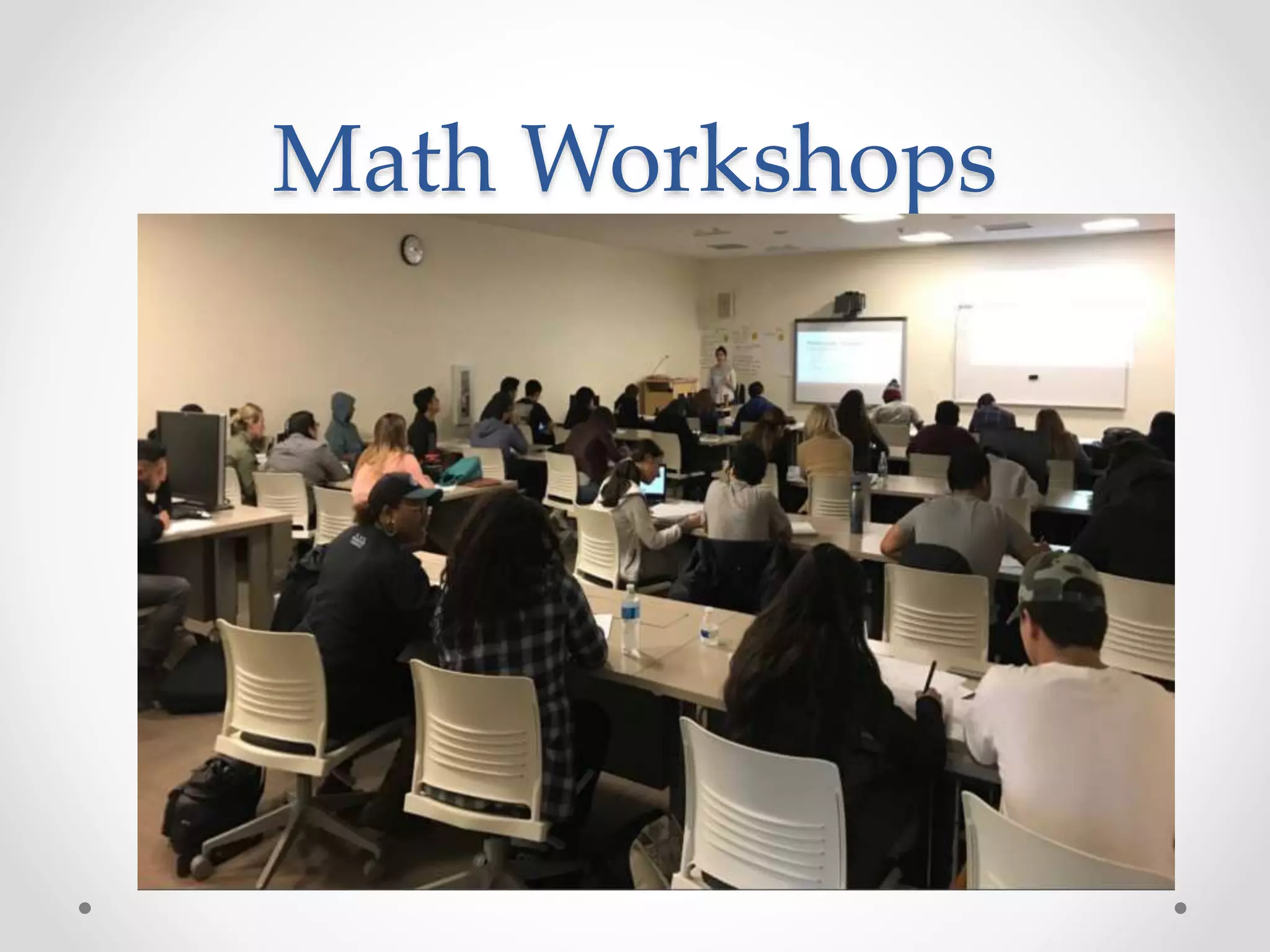
• One-hour workshops
focused around:
o Key math concepts from all levels
• Refreshers from pre-requisite
course
• Additional support for current
material
o Technology-based presentations
• How to use your TI Calculator
• Math homework software
• Mathematica
• Scheduled to align with
courses
Math Workshops
• Lesson planning
• Using different resources
• Classroom dynamics
• Confidence in classroom setting
• Work with diverse student body
Math Workshops
• Peer-to-peer learning
• NOT an extension of lecture
• Very interactive/hands-on
• Makes students more comfortable
with tutors & CAS as a learning
environment
• Use it as extra credit/assignments
• Visit workshops & Provide
feedback – “tricks of the trade”
Math Handouts
Math Handouts
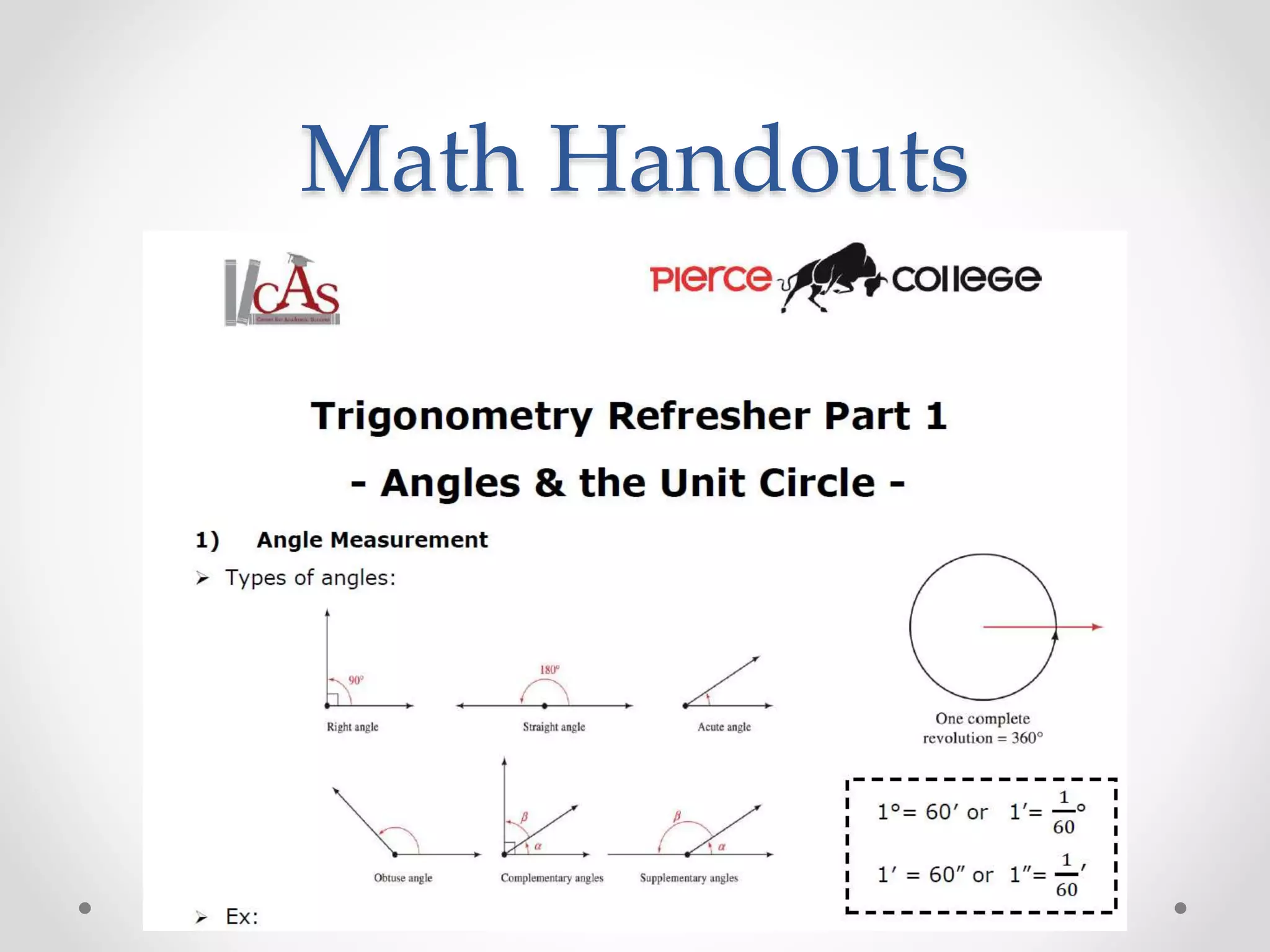
• Summarize notes on key math
topics presented in math
workshops
• Feature more practice/sample
problems and additional notes
there wasn’t enough time to
address
• Available to everyone at all
times – good workshop ads
• Used by tutors during tutoring
sessions
Math Handouts
• Putting workshop presentations together = Writing
lesson plans
• Improve tutoring by picking up on subject-specific
roadblocks/topics students find confusing
• Helps organize future tutoring sessions and
workshops better
Math Handouts
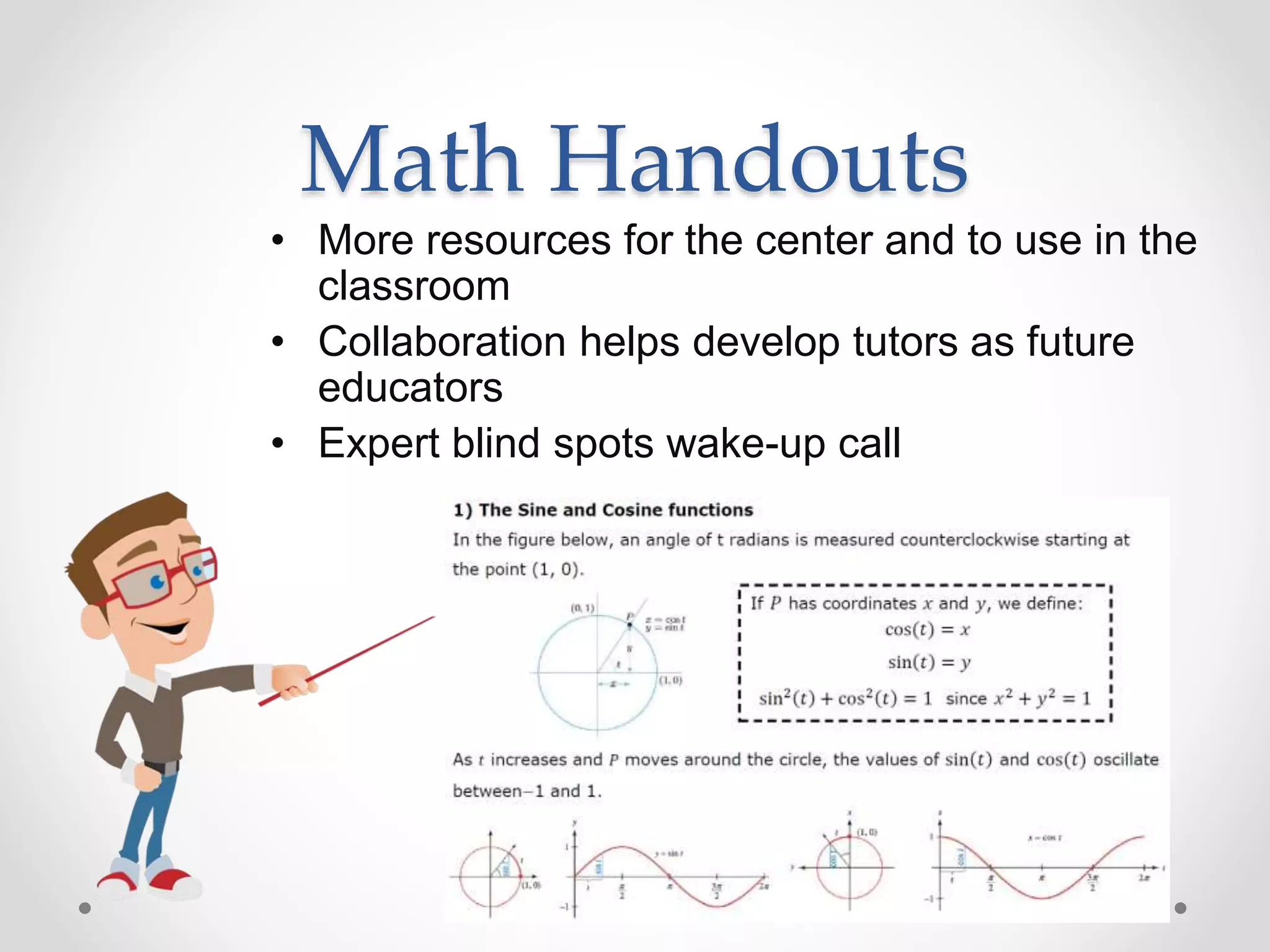
• More resources for the center and to use in the
classroom
• Collaboration helps develop tutors as future
educators
• Expert blind spots wake-up call
In-class tutoring-related
activities
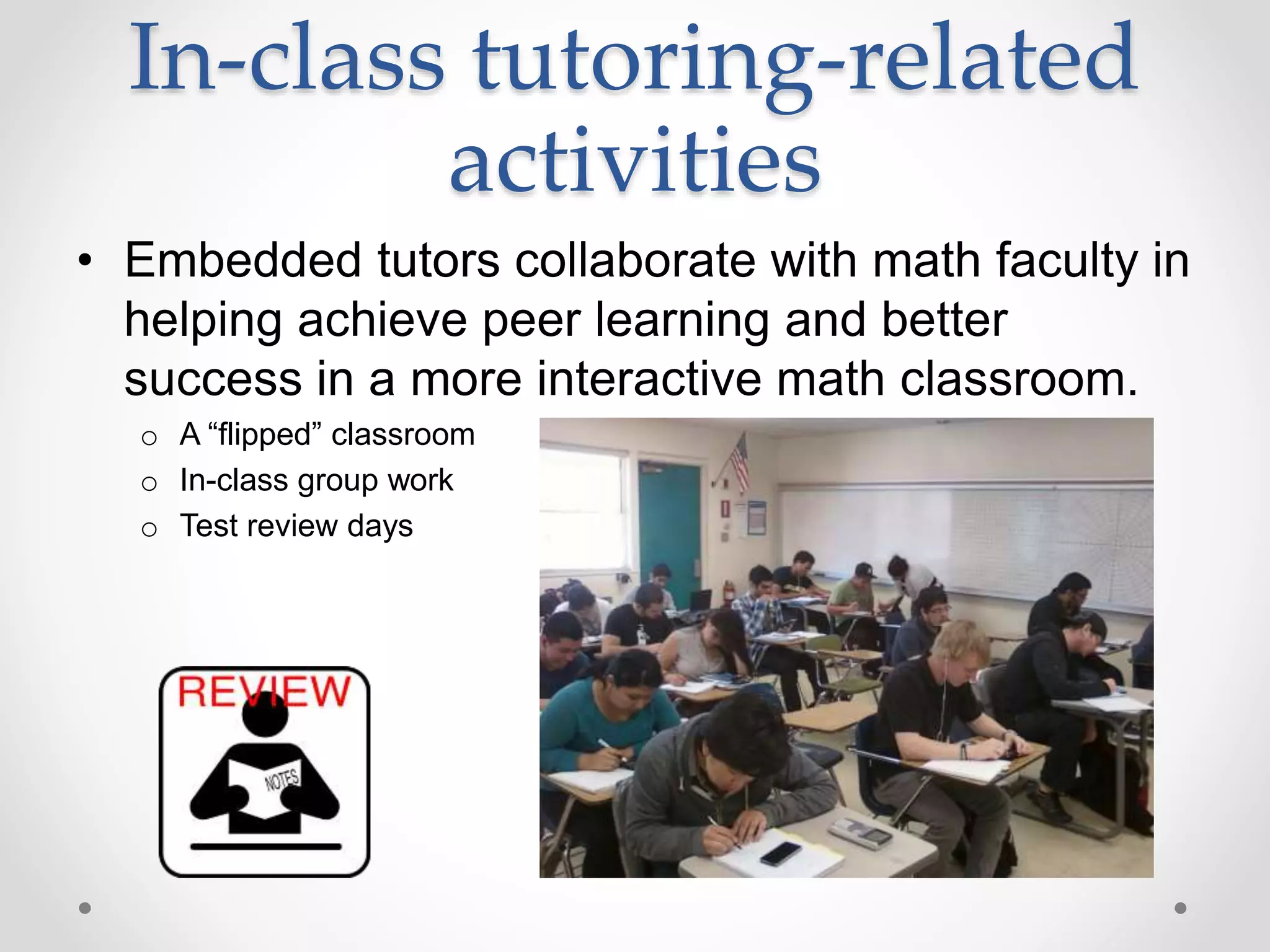
• Embedded tutors collaborate with math faculty in
helping achieve peer learning and better
success in a more interactive math classroom.
o A “flipped” classroom
o In-class group work
o Test review days
In-class tutoring-related
activities
• Already familiar with the curriculum, but now
seeing another side of it
• Becoming aware of expert blind spots as a tutor =
helps with planning/organizing tutoring session
later
• Forming a bond with the students = increases
participation/tutoring attendance
• Creates a professional relationship with the
instructor = results in learning how to be an
educator
In-class tutoring-related
activities
• An extra body in the room to help
students
• Creates a sense of community in
the classroom, stressing team
work and togetherness as students
bond with their tutor and instructor
• More feedback on students’
progress from a reliable source
Virtual Tutoring
• Use of Canvas in tutoring
o Discussion boards
o Announcements
o Scheduling
• Use of facebook/social media in classroom
o Set-up or add-in to instructor’s facebook group with their
knowledge
o Homework help
o Polling
Virtual Tutoring
• My experience with Facebook groups
o Instructor adds tutor = initial trust
o Post announcements = keeping tutees updated
o Poll students about my schedule (what days/hours are good) =
optimizing my hours and reflecting on what works throughout the
semester
o Guide homework questions discussion = direct tutoring + success
o Share resources (workshops, handouts, review sessions) =
participation + attendance boost at CAS
Virtual Tutoring
• Benefits of “going virtual” = game-
changer culturally
• Availability = no longer bound to
OFFICE hours times.
• Team work emphasis = virtual
show and tell
• Real-time notifications & posts =
instant feedback
Tutor Training
Tutor Training
• 4 tutor training sessions per semester
• 3.5 hours each = 2 hours general session + 1.5
hours subject-specific breakouts, all focused
around these four major topics:
o 1. Basic Tutoring Techniques & Professional Norms
o 2. Growth Mindset & Reading Apprenticeship
o 3. Culturally Responsive Student Leadership (Conference)
o 4. Habits of Mind
• Mandatory for all new tutors
• “Advanced” tutor training option
Tutor Training
• Relate general session topic to math tutoring
(planning + practice!)
• Run activities in general session/facilitate entire
math breakout = Public speaking
o General session = 180+ tutors
o Math breakout = 35-40 math tutors
• Meet with math liaison to plan breakout; with
other tutor leaders and staff to plan general
session activities, revise/update previous
trainings, and discuss feedback = Lesson
planning
Tutor Training
• Addresses “growing pains” – from
20 tutors to 180+
• Crucial to have students keep you
in check – never fall in love with
the “norm”
• Revisit teaching techniques
• Peer-to-peer learning
Tutor Mentoring
Tutor Mentoring
• 45-minute sessions facilitated by a tutor leader
with 6-8 participating tutors per session;
• Not subject-specific; no faculty in the room
• New tutors must attend two sessions per
semester; returning tutors come to one
• Discussion around outreach & collaboration;
tutoring strategies; logistics; and reflections.
• NOT an extension of tutor training!
Tutor Mentoring
• Having different voices in the room helps build a
community of practice and a friendlier work
environment where tutors can freely seek help &
communicate with one another
• Learn from others’ experiences; share yours
• “I feel more confident and empowered
troubleshooting challenges at work. I also
understand better when to report things to my
boss!” – Anonymous Math Tutor Leader
Tutor Mentoring
• Good to step back and not have
faculty in room
• Better + Friendlier tutors/center =
more tutees, hence more student
success
• With a growing number of tutors,
mentoring is key!
THANK YOU!

Faculty + Tutor Leaders + Collaboration = Success

  • 1.
    Faculty + Tutor Leaders+ Collaboration = Success ACTLA 2018 – San Diego Tanin Hooshmand Eddie Tchertchian LA Pierce College
  • 2.
    Introduction Tanin Hooshmand Math TutorLeader Eddie Tchertchian CAS Math Specialist
  • 3.
    Who we are •Math Tutor Leader at LA Pierce College Center for Academic Success (CAS) o Paid at a slightly higher rate o Go through tutor training first semester + “advanced” option. o Work with faculty on contributing tutor training curriculum, and facilitate activities during general training sessions and subject-specific breakouts o Work with faculty on various projects: present workshops, record curriculum videos, create learning materials, etc. • Math Specialist at CAS o Hire, supervise training of, and evaluate all math tutors at the center. o Create math-related curriculum to help improve math tutoring experience at the CAS o Work closely with CAS Director & other faculty on various projects
  • 4.
    Why, How, What •WHY o Improve the tutoring experience at CAS & in turn increase student success in classes • HOW o Collaboration between math specialist, faculty, tutor leaders, and tutors • WHAT o Work done through various projects affecting the scope of student success campus-wide
  • 5.
    Outline/Projects • Video project •Math workshops • Math handouts • In-class tutoring-related activities • Virtual tutoring • Tutor training • Tutor mentoring
  • 6.
    Video Project • Created10-15 minute math videos for Pierce College • Videos focused on refresher topics, as well as key concepts from algebra and calculus • Available on CAS YouTube Channel https://youtu.be/j-oC-lxvUcU
  • 7.
    Video Project • Writing“scripts”  organizing a short presentation on a math topic – what do I say? How do I do it?! • Using technology o Video cameras o Editing software & work with YouTube o Dropbox for scripts o Email communication with faculty • New appreciation for coming up with math examples – how do teachers do it?!
  • 8.
    Video Project • Helpfulfor own teaching – breaking topics down in great detail one-on- one • “Teaching 101” • Use videos as resources campus- wide o Assign them as extra credit o Use them when students are absent o Use them as review material based on exam/performance on assignment
  • 9.
  • 10.
    Math Workshops • One-hourworkshops focused around: o Key math concepts from all levels • Refreshers from pre-requisite course • Additional support for current material o Technology-based presentations • How to use your TI Calculator • Math homework software • Mathematica • Scheduled to align with courses
  • 11.
    Math Workshops • Lessonplanning • Using different resources • Classroom dynamics • Confidence in classroom setting • Work with diverse student body
  • 12.
    Math Workshops • Peer-to-peerlearning • NOT an extension of lecture • Very interactive/hands-on • Makes students more comfortable with tutors & CAS as a learning environment • Use it as extra credit/assignments • Visit workshops & Provide feedback – “tricks of the trade”
  • 13.
  • 14.
    Math Handouts • Summarizenotes on key math topics presented in math workshops • Feature more practice/sample problems and additional notes there wasn’t enough time to address • Available to everyone at all times – good workshop ads • Used by tutors during tutoring sessions
  • 15.
    Math Handouts • Puttingworkshop presentations together = Writing lesson plans • Improve tutoring by picking up on subject-specific roadblocks/topics students find confusing • Helps organize future tutoring sessions and workshops better
  • 16.
    Math Handouts • Moreresources for the center and to use in the classroom • Collaboration helps develop tutors as future educators • Expert blind spots wake-up call
  • 17.
    In-class tutoring-related activities • Embeddedtutors collaborate with math faculty in helping achieve peer learning and better success in a more interactive math classroom. o A “flipped” classroom o In-class group work o Test review days
  • 18.
    In-class tutoring-related activities • Alreadyfamiliar with the curriculum, but now seeing another side of it • Becoming aware of expert blind spots as a tutor = helps with planning/organizing tutoring session later • Forming a bond with the students = increases participation/tutoring attendance • Creates a professional relationship with the instructor = results in learning how to be an educator
  • 19.
    In-class tutoring-related activities • Anextra body in the room to help students • Creates a sense of community in the classroom, stressing team work and togetherness as students bond with their tutor and instructor • More feedback on students’ progress from a reliable source
  • 20.
    Virtual Tutoring • Useof Canvas in tutoring o Discussion boards o Announcements o Scheduling • Use of facebook/social media in classroom o Set-up or add-in to instructor’s facebook group with their knowledge o Homework help o Polling
  • 21.
    Virtual Tutoring • Myexperience with Facebook groups o Instructor adds tutor = initial trust o Post announcements = keeping tutees updated o Poll students about my schedule (what days/hours are good) = optimizing my hours and reflecting on what works throughout the semester o Guide homework questions discussion = direct tutoring + success o Share resources (workshops, handouts, review sessions) = participation + attendance boost at CAS
  • 23.
    Virtual Tutoring • Benefitsof “going virtual” = game- changer culturally • Availability = no longer bound to OFFICE hours times. • Team work emphasis = virtual show and tell • Real-time notifications & posts = instant feedback
  • 24.
  • 25.
    Tutor Training • 4tutor training sessions per semester • 3.5 hours each = 2 hours general session + 1.5 hours subject-specific breakouts, all focused around these four major topics: o 1. Basic Tutoring Techniques & Professional Norms o 2. Growth Mindset & Reading Apprenticeship o 3. Culturally Responsive Student Leadership (Conference) o 4. Habits of Mind • Mandatory for all new tutors • “Advanced” tutor training option
  • 26.
    Tutor Training • Relategeneral session topic to math tutoring (planning + practice!) • Run activities in general session/facilitate entire math breakout = Public speaking o General session = 180+ tutors o Math breakout = 35-40 math tutors • Meet with math liaison to plan breakout; with other tutor leaders and staff to plan general session activities, revise/update previous trainings, and discuss feedback = Lesson planning
  • 27.
    Tutor Training • Addresses“growing pains” – from 20 tutors to 180+ • Crucial to have students keep you in check – never fall in love with the “norm” • Revisit teaching techniques • Peer-to-peer learning
  • 28.
  • 29.
    Tutor Mentoring • 45-minutesessions facilitated by a tutor leader with 6-8 participating tutors per session; • Not subject-specific; no faculty in the room • New tutors must attend two sessions per semester; returning tutors come to one • Discussion around outreach & collaboration; tutoring strategies; logistics; and reflections. • NOT an extension of tutor training!
  • 30.
    Tutor Mentoring • Havingdifferent voices in the room helps build a community of practice and a friendlier work environment where tutors can freely seek help & communicate with one another • Learn from others’ experiences; share yours • “I feel more confident and empowered troubleshooting challenges at work. I also understand better when to report things to my boss!” – Anonymous Math Tutor Leader
  • 31.
    Tutor Mentoring • Goodto step back and not have faculty in room • Better + Friendlier tutors/center = more tutees, hence more student success • With a growing number of tutors, mentoring is key!
  • 32.

Editor's Notes