AEROBIC COMPOSTING
decomposing oforganic materials using
microorganisms that require oxygen. It requires
the introduction of oxygen to the compost pile to
allow aerobic microbes to thrive. Aerobic
composting needs to be turned very few days to
allow for proper air circulation. This composting
process is best used outside and can be used with
a large amount of materials.
10.
AGRICULTURAL WASTE
is unwantedor unsalable materials produced
wholly
from agricultural operations directly related to the
growing of crops or raising
of animals for the primary purpose of making a
profit or for a livelihood.
11.
ANAEROBIC COMPOSTING
decomposes wastewithout oxygen. Organic
materials are piled up and breakdown naturally.
This process does not need any type of
maintenance and do not need to
be turned.
12.
COMPOST
is used toimprove the soil fertility in
gardens, landscaping, horticulture, agriculture and
organic farming.
13.
COMPOSTING -
the naturalprocess of recycling
organic matter, such as leaves and food scraps, into
a valuable fertilizer that can enrich soil and plants.
14.
WASTE
is any substancewhich is discarded after primary
use or in other
words, there is no further use for the product. We
generate a huge amount
of wastes in our everyday life.
15.
WASTE MANAGEMENT
refers tothe various ways of managing and
disposing
of wastes. It can be by discarding, destroying,
processing, recycling, reusing,
or controlling wastes.
16.
WASTE PROCESSING –
isa way of applying operations using facilities on
how
to change solid wastes into chemical, physical, or
biological properties to
make it easier to dispose of, recover a resource, or
transfer solid waste
materials.
PRODUCTION
is the functionof the amount and nature of agricultural
waste generated by an agricultural enterprise. The waste requires
management if the quantity produced is sufficient enough to become a
resource concern. A complete analysis of production includes the kind,
consistency, volume, location, and timing of the waste produced.
20.
COLLECTION
- refers tothe initial capture and gathering of the waste from
the point of origin or deposition to a collection point. The method of
collection, location of the collection points, scheduling of the collection,
labor requirements, necessary equipment or structural facilities,
management and installation costs of the components, and the impact
that collection has on the consistency of the waste should be identified.
21.
TRANSFER
refers to themovement and transportation of the waste
throughout the system. It includes the transfer of the waste from the
collection point to the storage facility, to the treatment facility, and to the
utilization site.
22.
STORAGE
is the temporarycontainment of the waste. The storage facility
of a waste management system is the tool that gives the manager control
over the scheduling and timing of the system functions.
23.
TREATMENT
is another functiondesigned to reduce the pollution
potential or modify the physical characteristics of the waste, such as
moisture and total solid (TS) content, to facilitate more efficient and
effective handling. Manure treatment is comprised of physical, biological,
and chemical unit processes. It also includes activities that are sometimes
considered pretreatment, such as the separation of solids.
24.
UTILIZATION
Utilization includes reusingand/or recycling of waste
products. Agricultural wastes may be used as a source of energy,
bedding, mulch, organic matter, or plant nutrients. When properly
treated, they can be marketable.
LIQUID WASTE
is commonlyfound in households as
well as in industries.
This waste includes dirty water,
organic liquids, wash water, waste
detergents and even rainwater.
30.
SOLID RUBBISH
- Solidrubbish can include various
items found in your
household, along with commercial
and industrial locations. Solid rubbish
is commonly broken down into the
following types:
31.
a. Plastic waste
consistsof plastic bags, containers, jars, bottles and other
products that can be found at home. Plastic is not biodegradable, other
types of plastic can be recycled. Take note that plastic should not be
mixed in with your regular waste; it should be sorted and placed in your
recycling bin.
b.Paper/card waste
includes packaging materials, old newspapers, used
cardboard and other products. Paper can easily be recycled and reused,
so place them in your recycling bin and think of the best way how you
can use those as your materials in creating something saleable out of it.
32.
c. Tins andmetals
can be found in various forms throughout your home.
Most metals can be recycled. It can be recycled and used in making some
display materials at home like creating flower vase, small lampshade etc.
d. Ceramics and glass
These items can easily be recycled. Look for
special glass and bottles and can create them into something useful like
sugar, coffee, and cream containers.
33.
ORGANIC WASTE
Organic wasteis another common
household. All food
waste, garden waste, manure and rotten
meat are classified as organic
waste. Over time, organic waste is turned
into manure by microorganisms.
34.
RECYCLABLE RUBBISH
Recyclable rubbishincludes all waste items
that can
be converted into products that can be
used again. Solid items such as
paper, metals, furniture and organic waste
can all be recycled.
35.
HAZARDOUS WASTE
includes alltypes of flammables, toxic,
corrosive and reactive rubbish. It also includes
radioactive waste and chemical wastes.
Example: paints, batteries, light bulbs,
fluorescent tubes, pesticides,
weed killers, gas bottles, chemical fertilizers,
etc.
36.
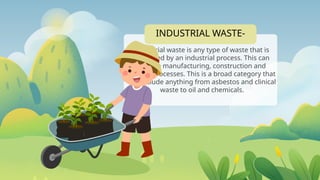
INDUSTRIAL WASTE-
Industrial wasteis any type of waste that is
produced by an industrial process. This can
include manufacturing, construction and
mining processes. This is a broad category that
can include anything from asbestos and clinical
waste to oil and chemicals.
Explicitation
1. What arethe materials needed in making a basket compost at home?
2. How do we pile the waste materials in a basket for composting?
3. Why do we need to try making our own basket composting?
40.
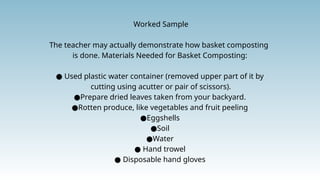
Worked Sample
The teachermay actually demonstrate how basket composting
is done. Materials Needed for Basket Composting:
● Used plastic water container (removed upper part of it by
cutting using acutter or pair of scissors).
●Prepare dried leaves taken from your backyard.
●Rotten produce, like vegetables and fruit peeling
●Eggshells
●Soil
●Water
● Hand trowel
● Disposable hand gloves
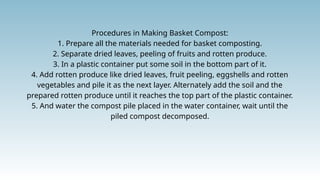
41.
Procedures in MakingBasket Compost:
1. Prepare all the materials needed for basket composting.
2. Separate dried leaves, peeling of fruits and rotten produce.
3. In a plastic container put some soil in the bottom part of it.
4. Add rotten produce like dried leaves, fruit peeling, eggshells and rotten
vegetables and pile it as the next layer. Alternately add the soil and the
prepared rotten produce until it reaches the top part of the plastic container.
5. And water the compost pile placed in the water container, wait until the
piled compost decomposed.
42.
LESSON ACTIVITY
After theteacher were able to
demonstrate how to make basket
composting,
student will then perform their
individualized basket compost.
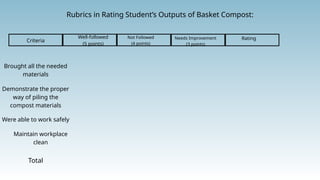
43.
Rubrics in RatingStudent’s Outputs of Basket Compost:
Criteria
Well-followed
(5 points)
Not Followed
(4 points)
Needs Improvement
(3 points)
Rating
Total
Brought all the needed
materials
Demonstrate the proper
way of piling the
compost materials
Were able to work safely
Maintain workplace
clean
Explicitation
1. What arethe materials needed in making fermented foliar fertilizer in school
or at home?
2. How do we properly make fermented foliar fertilizer?
3. Why do we need to try making a fermented foliar fertilizer?
46.
Worked Example
The studentswill watch videos on how to make a fermented foliar fertilizer.
After watching the videos, students may now proceed with their individual
outputs.
The Millennial Farmer PH. (2020, August). How to make a foliar fertilizer? | Let’s
go organic! | The Millennial Farmer PH [Video]. YouTube.
https://www.youtube.com/watch?v=Sz9TlLOjsDM (10 min.).
47.
Materials needed inmaking a fermented foliar fertilizer
• 1 ripe banana (lakatan)
• 1 apple
• few pieces of grapes (optional)
• 1⁄4 kilos or 250 grams brown sugar
• 1 spoon for mixing the mixtures
• Plastic container with cover
• Clean chopping board
• Knife
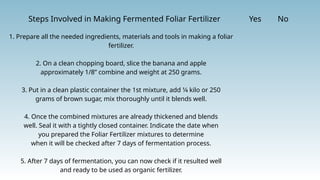
1. Prepare allthe needed ingredients, materials and tools in making a foliar fertilizer.
2. On a clean chopping board, slice the banana and apple approximately
1/8”combine and weight at 250 grams.
3. Put in a clean plastic container the 1st mixture and add 1⁄4 kilo or 250
grams of brown sugar. Combine 1st mixtures and sugar, must be 1:1
ratio, mix thoroughly, repeat mixing the 1st combined mixtures with
sugar several times until it blends well.
4. Once the combined mixtures are already thickened and blends well. Seal
it with a tightly closed container and do not forget to indicate the date when
you actually prepared the sliced fruits and sugar, so that you will be able
to determine when it will achieve 7 days or weeklong fermentation required
days.
50.
5. After 7days of fermentation, you can now check if it resulted well and ready
to be used as organic fertilizer to your flowering plants or other form of plants or crops.
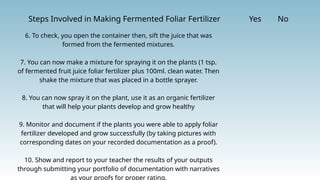
6. To check, you open the container then, sift the juice that was formed from the
fermented mixtures.
7. You can now make a mixture for spraying it on the plants (1 tsp. of
fermented fruit juice foliar fertilizer plus 100ml. clean water. Then shake
the mixture that was placed in a bottle sprayer.
8. You can now spray it on the plant, use it as an organic fertilizer that will
help your plants develop and grow healthy.
51.
9. Monitor anddocument if the plants you were able to apply foliar fertilizer
developed and grow successfully (by taking pictures with corresponding
dates on your recorded documentation as a proof).
10. Show and report to your teacher the results of your outputs through
submitting your portfolio of documentation with narratives as your proofs
for proper rating.
52.
LESSON ACTIVITY
Checklist ofhow fermented foliar fertilizer is done.
Directions: Put a check (/) if you were able to correctly follow its proper sequence
or the steps that was mentioned above. Put an (/) on the part of NO if you forgot or
was not able to follow the procedures correctly. Please refer to
the table below.
53.
Steps Involved inMaking Fermented Foliar Fertilizer Yes No
1. Prepare all the needed ingredients, materials and tools in making a foliar
fertilizer.
2. On a clean chopping board, slice the banana and apple
approximately 1/8” combine and weight at 250 grams.
3. Put in a clean plastic container the 1st mixture, add 1⁄4 kilo or 250
grams of brown sugar, mix thoroughly until it blends well.
4. Once the combined mixtures are already thickened and blends
well. Seal it with a tightly closed container. Indicate the date when
you prepared the Foliar Fertilizer mixtures to determine
when it will be checked after 7 days of fermentation process.
5. After 7 days of fermentation, you can now check if it resulted well
and ready to be used as organic fertilizer.
54.
Steps Involved inMaking Fermented Foliar Fertilizer Yes No
6. To check, you open the container then, sift the juice that was
formed from the fermented mixtures.
7. You can now make a mixture for spraying it on the plants (1 tsp.
of fermented fruit juice foliar fertilizer plus 100ml. clean water. Then
shake the mixture that was placed in a bottle sprayer.
8. You can now spray it on the plant, use it as an organic fertilizer
that will help your plants develop and grow healthy
9. Monitor and document if the plants you were able to apply foliar
fertilizer developed and grow successfully (by taking pictures with
corresponding dates on your recorded documentation as a proof).
10. Show and report to your teacher the results of your outputs
through submitting your portfolio of documentation with narratives
as your proofs for proper rating.
1. WHY DOWE NEED TO PROPERLY
MANAGE OUR HOME AND FARM
WASTES?
2. Why it is best advice to use organic
fertilizer on our plants or crops?
57.
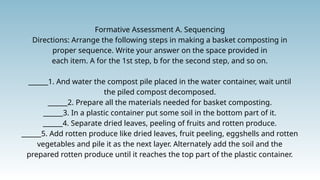
Formative Assessment A.Sequencing
Directions: Arrange the following steps in making a basket composting in
proper sequence. Write your answer on the space provided in
each item. A for the 1st step, b for the second step, and so on.
______1. And water the compost pile placed in the water container, wait until
the piled compost decomposed.
______2. Prepare all the materials needed for basket composting.
______3. In a plastic container put some soil in the bottom part of it.
______4. Separate dried leaves, peeling of fruits and rotten produce.
______5. Add rotten produce like dried leaves, fruit peeling, eggshells and rotten
vegetables and pile it as the next layer. Alternately add the soil and the
prepared rotten produce until it reaches the top part of the plastic container.
58.
B. ESSAY
Answer thequestion intelligently. (5pts)
1. Why do you think you have the responsibility as individuals,
to reduce waste in your home, school and community?








![Worked Example
The students will watch videos on how to make a fermented foliar fertilizer.
After watching the videos, students may now proceed with their individual
outputs.
The Millennial Farmer PH. (2020, August). How to make a foliar fertilizer? | Let’s
go organic! | The Millennial Farmer PH [Video]. YouTube.
https://www.youtube.com/watch?v=Sz9TlLOjsDM (10 min.).](https://image.slidesharecdn.com/lesson5-250914230509-665d38a9/85/FA-LESSON-9-WEEK-5-QUARTER-2-GRADE-7pptx-46-320.jpg)



![AGRICULTURAL WASTE MANAGEMENT Unit 1 introduction [autosaved]](https://cdn.slidesharecdn.com/ss_thumbnails/unit1introductionautosaved-210916033213-thumbnail.jpg?width=640&height=640&fit=bounds)


