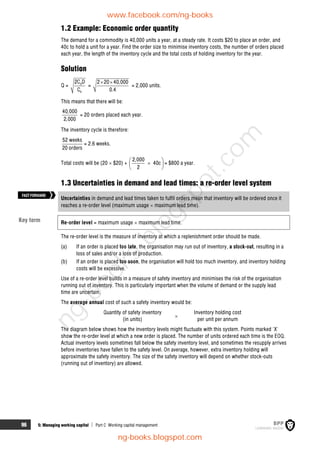
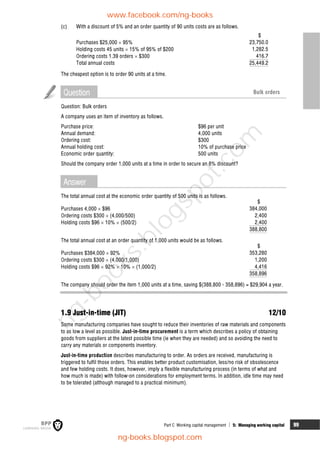
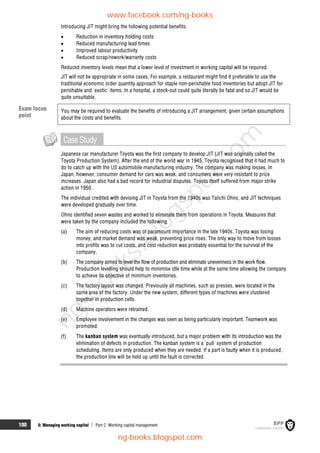
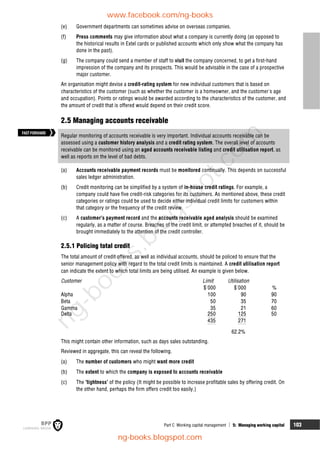
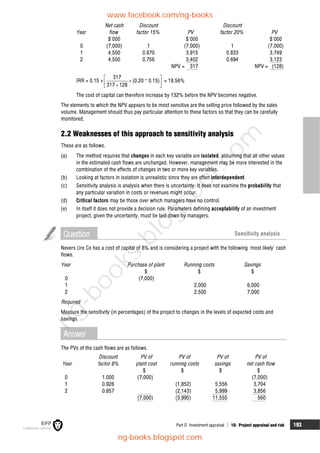
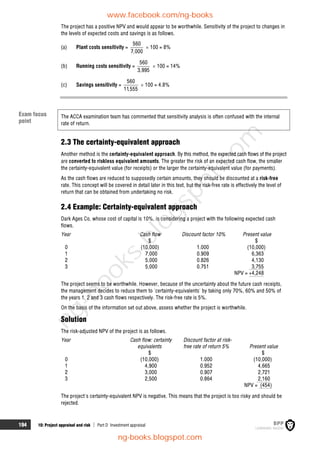
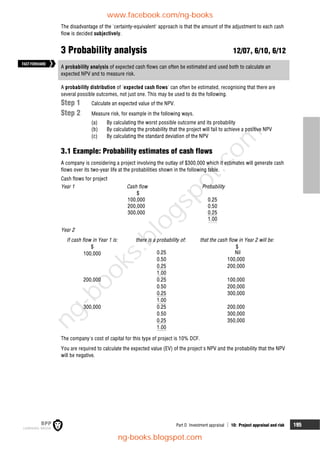
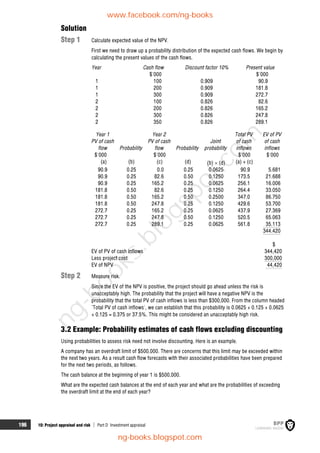
Visit www.ng-books.blogspot.com
to download study materials for all
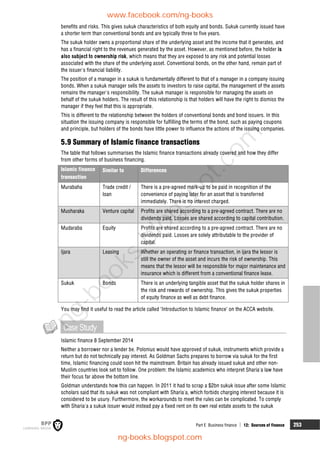
ACCA Papers (F1 – P7)
n
g
-
b
o
o
k
s
.
b
l
o
g
s
p
o
t
.
c
o
m
ACCA APPROVED
CONTENT PROVIDER
Valid for both
paper and
computer based
exams
Contact us
BPP House
142-144 Uxbridge Road
London W12 8AA
United Kingdom
T 0845 075 1100 (UK)
T +44 (0)20 8740 2211 (Overseas)
E Learningmedia@bpp.com
bpp.com/learningmedia
February 2016
£32.00
Paper F9
Financial Management
This ACCA Study Text for Paper F9 Financial
Management has been comprehensively reviewed by
the ACCA examining team. This review guarantees
appropriate depth and breadth of content and
comprehensive syllabus coverage.
In addition to ACCA examining team reviewed
material you get:
• A user-friendly format for easy navigation
• Exam focus points describing what the examining
team will want you to do
• Regular Fast Forward summaries emphasising the 	
key points in each chapter
• Questions and quick quizzes to test your 		
understanding
• A practice question bank containing exam- 	
standard questions with answers
• A full index
• All you need in one book
ACCA approved content provider
BPP Learning Media is dedicated to supporting aspiring business professionals
with top-quality learning material as they study for demanding professional
exams, often whilst working full time. BPP Learning Media’s commitment
to student success is shown by our record of quality, innovation and market
leadership in paper-based and e-learning materials. BPP Learning Media’s study
materials are written by professionally qualified specialists who know from
personal experience the importance of top-quality materials for exam success.
Financial
Management
Study
Text
ACCA
F9
For
exams
in
September
2016,
December
2016,
March
2017
and
June
2017
Paper F9
Financial Management
For exams in September 2016, December
2016, March 2017 and June 2017
ACCA Approved
Study Text
ACF9ST16 (RICOH).indd 1-3 05/02/2016 16:13
www.facebook.com/ng-books
ng-books.blogspot.com
n
g
-
b
o
o
k
s
.
b
l
o
g
s
p
o
t
.
c
o
m
ACCA APPROVED CONTENT PROVIDER
To access the BPP ACCA Exam Success site for this material
please go to:
www.bpp.com/ExamSuccessSite
n Create a user account if you don’t already have one.
Make sure you reply to the confirmation email.
n Log in using your registered username and password.
Select the paper you wish to access.
n Enter the code you received when prompted. You will only
have to do this once for each paper you are studying.
As the first accredited publisher of ACCA materials, BPP Learning Media has set the benchmark for
producing exceptional study materials for students and tutors alike.
Our Study Texts, Practice & Revision Kits and i-Passes (for exams on demand) are reviewed by the ACCA
examining team and are written by our in-house authors with industry and teaching experience who
understand what is required for exam success.
EXAM SUCCESS SITE
To help maximise your chances of succeeding in your exams, we’ve put together a suite of exclusive ACCA
resources. Our Exam Success site provides you with access to a free digital version of this publication, as
well as extra resources designed to focus your efforts on exams and study methods.
To access the Exam Success site, please email learningmedia@bpp.com with the subject line “Access to Exam
Success site - eBook”, including your order reference number and the name of the book you’ve bought (ie
ACCA F5 Study Text) for your access code. Once you have received your code, please follow the instructions
below:
www.facebook.com/ng-books
ng-books.blogspot.com
n
g
-
b
o
o
k
s
.
b
l
o
g
s
p
o
t
.
c
o
m
S
T
U
D
Y
T
E
X
T
PAPER F9
FINANCIAL MANAGEMENT
BPP Learning Media is an ACCA Approved Content Provider. This means we work
closely with ACCA to ensure this Study Text contains the information you need to pass
your exam.
In this Study Text, which has been reviewed by the ACCA examination team, we:
 Highlight the most important elements in the syllabus and the key skills you need
 Signpost how each chapter links to the syllabus and the study guide
 Provide lots of exam focus points demonstrating what is expected of you in the exam
 Emphasise key points in regular fast forward summaries
 Test your knowledge in quick quizzes
 Examine your understanding in our practice question bank
 Reference all the important topics in our full index
BPP's Practice & Revision Kit also supports this paper.
FOR EXAMS FROM IN SEPTEMBER 2016,
DECEMBER 2016, MARCH 2017 AND JUNE 2017
www.facebook.com/ng-books
ng-books.blogspot.com
n
g
-
b
o
o
k
s
.
b
l
o
g
s
p
o
t
.
c
o
m
ii
First edition 2007
Ninth edition February 2016
ISBN 9781 4727 4426 5
(Previous ISBN 9781 4727 2678 0)
e-ISBN 9781 4727 4668 9
British Library Cataloguing-in-Publication Data
A catalogue record for this book
is available from the British Library
Published by
BPP Learning Media Ltd
BPP House, Aldine Place
London W12 8AA
www.bpp.com/learningmedia
Printed in the United Kingdom by
RICOH UK Limited
Unit 2
Wells Place
Merstham
RH1 3LG
Your learning materials, published by BPP Learning
Media Ltd, are printed on paper obtained from traceable
sustainable Media Ltd, are printed on paper obtained
from traceable sustainable sources.
All rights reserved. No part of this publication may be
reproduced, stored in a retrieval system or transmitted,
in any form or by any means, electronic, mechanical,
photocopying, recording or otherwise, without the prior
written permission of BPP Learning Media Ltd.
We are grateful to the Association of Chartered Certified
Accountants for permission to reproduce past
examination questions. The suggested solutions in the
practice answer bank have been prepared by BPP
Learning Media Ltd, unless otherwise stated.
©
BPP Learning Media Ltd
2016
A note about copyright
Dear Customer
What does the title © mean and why does it matter?
Your market-leading BPP books, course materials and e-
learning materials do not write and update themselves.
People write them on their own behalf or as employees of
an organisations that invests in this activity. Copyright
law protects their livelihoods. It does so by creating
rights over the use of the content.
Breach of copyright is a form of theft – as well as being a
criminal offence in some jurisdictions, it is potentially a
serious breach of professional ethics.
With current technology, things might seem a bit hazy
but, basically, without the express permission of BPP
Learning Media:
 Photocopying our materials is a breach of
copyright
 Scanning, ripcasting or conversion of our digital
materials into different file formats, uploading
them to facebook or e-mailing them to your friends
is a breach of copyright
You can, of course, sell your books, in the form in which
you have bought them – once you have finished with
them. (Is this fair to your fellow students? We update for
a reason.) Please note the e-products are sold on a single
user licence basis: we do not supply 'unlock' codes to
people who have bought them secondhand.
And what about outside the UK? BPP Learning Media
strives to make our materials available at prices students
can afford by local printing arrangements, pricing
policies and partnerships which are clearly listed on our
website. A tiny minority ignore this and indulge in
criminal activity by illegally photocopying our material or
supporting organisations that do. If they act illegally and
unethically in one area, can your really trust them?
www.facebook.com/ng-books
ng-books.blogspot.com
n
g
-
b
o
o
k
s
.
b
l
o
g
s
p
o
t
.
c
o
m
Contents iii
Contents Page
Introduction
Helping you to pass v
Studying F9 vii
The exam paper and exam formulae ix
Syllabus and study guide xi
Part A Financial management function
1 Financial management and financial objectives 3
Part B Financial management environment
2 The economic environment for business 37
3 Financial markets, money markets and institutions 57
Part C Working capital management
4 Working capital 79
5 Managing working capital 93
6 Working capital finance 119
Part D Investment appraisal
7 Investment decisions 143
8 Investment appraisal using DCF methods 159
9 Allowing for inflation and taxation 177
10 Project appraisal and risk 189
11 Specific investment decisions 205
Part E Business finance
12 Sources of finance 225
13 Dividend policy 259
14 Gearing and capital structure 269
15 The cost of capital 291
16 Capital structure 317
Part F Business valuations
17 Business valuations 337
18 Market efficiency 361
Part G Risk management
19 Foreign currency risk 373
20 Interest rate risk 401
Appendix – Mathematical tables 415
Practice question bank 419
Practice answer bank 455
Index 507
Review form
www.facebook.com/ng-books
ng-books.blogspot.com
n
g
-
b
o
o
k
s
.
b
l
o
g
s
p
o
t
.
c
o
m
iv Introduction
www.facebook.com/ng-books
ng-books.blogspot.com
n
g
-
b
o
o
k
s
.
b
l
o
g
s
p
o
t
.
c
o
m
Introduction v
Helping you to pass
BPP Learning Media – ACCA Approved Content Provider
As ACCA's Approved Content Provider, BPP Learning Media gives you the opportunity to use study
materials reviewed by the ACCA examination team. By incorporating the examination team's comments
and suggestions regarding the depth and breadth of syllabus coverage, the BPP Learning Media Study
Text provides excellent, ACCA-approved support for your studies.
The PER alert
Before you can qualify as an ACCA member, you not only have to pass all your exams but also fulfil a three
year practical experience requirement (PER). To help you to recognise areas of the syllabus that you
might be able to apply in the workplace to achieve different performance objectives, we have introduced
the 'PER alert' feature. You will find this feature throughout the Study Text to remind you that what you
are learning to pass your ACCA exams is equally useful to the fulfilment of the PER requirement.
Your achievement of the PER should now be recorded in your online My Experience record.
Tackling studying
Studying can be a daunting prospect, particularly when you have lots of other commitments. The different
features of the Study Text, the purposes of which are explained fully on the Chapter features page, will
help you whilst studying and improve your chances of exam success.
Developing exam awareness
Our Study Texts are completely focused on helping you pass your exam.
Our advice on Studying F9 outlines the content of the paper, the necessary skills you are expected to be
able to demonstrate and any brought forward knowledge you are expected to have.
Exam focus points are included within the chapters to highlight when and how specific topics were
examined, or how they might be examined in the future.
Using the syllabus and study guide
You can find the syllabus and study guide on pages xi–xxi of this Study Text.
Testing what you can do
Testing yourself helps you develop the skills you need to pass the exam and also confirms that you can
recall what you have learnt.
We include Questions – lots of them – both within chapters and in the Practice Question Bank, as well as
Quick Quizzes at the end of each chapter to test your knowledge of the chapter content.
www.facebook.com/ng-books
ng-books.blogspot.com
n
g
-
b
o
o
k
s
.
b
l
o
g
s
p
o
t
.
c
o
m
vi Introduction
Chapter features
Each chapter contains a number of helpful features to guide you through each topic.
Topic list
Topic list Syllabusreference What you will be studying in this chapter and the relevant
section numbers, together with ACCA syllabus references.
Introduction
Puts the chapter content in the context of the syllabus as
a whole.
Study Guide Links the chapter content with ACCA guidance.
Exam Guide
Highlights how examinable the chapter content is likely to
be and the ways in which it could be examined.
Knowledge brought forward from earlier studies What you are assumed to know from previous
studies/exams.
Summarises the content of main chapter headings,
allowing you to preview and review each section easily.
Examples
Demonstrate how to apply key knowledge and
techniques.
Key terms
Definitions of important concepts that can often earn you
easy marks in exams.
Exam focus points
When and how specific topics were examined, or how
they may be examined in the future.
Formula to learn
Formulae that are not given in the exam but which have to
be learnt.
Gives you a useful indication of syllabus areas that
closely relate to performance objectives in your Practical
Experience Requirement (PER).
Question
Gives you essential practice of techniques covered in the
chapter.
CaseStudy Real world examples of theories and techniques.
Chapter Roundup A full list of the Fast Forwards included in the chapter,
providing an easy source of review.
Quick Quiz A quick test of your knowledge of the main topics in the
chapter.
Practice Question Bank
Found at the back of the Study Text with more
comprehensive chapter questions. Cross referenced for
easy navigation.
FASTFORWARD
www.facebook.com/ng-books
ng-books.blogspot.com
n
g
-
b
o
o
k
s
.
b
l
o
g
s
p
o
t
.
c
o
m
Introduction vii
Studying F9
This paper examines a wide range of financial management topics, many of which will be completely new
to you. You will need to be competent at a range of quite tricky calculations as well as being able to
explain and discuss financial management techniques and issues.
The F9 examination team
The ACCA examination team expects you to be able to perform and comment on calculations, exercise
critical abilities, clearly demonstrate understanding of the syllabus and use question information.
Syllabus update
The F9 syllabus has been updated for the September 2016 sitting onwards. The syllabus changes are
summarised below.
Summary of changes to F9
There have been no amendments to the F9 syllabus since the last 2015-2016 syllabus. However, the
format of the exam has changed. See page ix.
www.facebook.com/ng-books
ng-books.blogspot.com
n
g
-
b
o
o
k
s
.
b
l
o
g
s
p
o
t
.
c
o
m
viii Introduction
1 What F9 is about
The aim of this syllabus is to develop the knowledge and skills expected of a finance manager in relation to
investment, financing and dividend policy decisions.
F9 is a middle level paper in the ACCA qualification structure. There are some links to material you have
covered in F2, particularly short-term decision-making techniques. The paper with a direct link following
F9 is P4 which thinks strategically and considers wider environmental factors. F9 requires you to be able
to apply techniques and think about their impact on the organisation.
2 What skills are required?
 You are expected to have a core of management accounting knowledge from Paper F2.
 You will be required to carry out calculations, with clear workings and a logical structure.
 You will be required to interpret data.
 You will be required to explain management accounting techniques and discuss whether they are
appropriate for a particular organisation.
 You must be able to apply your skills in a practical context.
3 How to improve your chances of passing
 There is no choice in this paper; all questions have to be answered. You must therefore study the
entire syllabus; there are no shortcuts.
 The first section of the paper consists of 15 multiple choice questions, worth two marks each.
These will inevitably cover a wide range of the syllabus.
 Practising questions under timed conditions is essential. BPP's Practice & Revision Kit contains 2
mark, 10 mark and 20 mark questions to help you practise this.
 Questions in Sections B and C will be based on simple scenarios and answers to Section C
questions must be focused and specific to the organisation.
 Answer plans in Section C will help you to focus on the requirements of the question and enable
you to manage your time effectively.
 Answer all parts of the questions in Section C. Even if you cannot do all of the calculation
elements, you will still be able to gain marks in the discussion parts.
 Make sure your answers focus on practical applications of management accounting, common
sense is essential!
 Keep an eye out for articles, as the examination team will use the articles to communicate with
students.
 Read journals etc to pick up on ways in which real organisations apply management accounting
and think about your own organisation if that is relevant.
4 Brought forward knowledge
You will need to have a good working knowledge of certain management accounting techniques from F2.
In particular, you will need to be familiar with the capital budgeting process, and be able to apply the
concepts of interest and discounting. This includes being able to calculate annuities and perpetuities, and
to use the discount and annuity tables to calculate net present values.
This Study Text revises these topics and brought forward knowledge is identified. If you struggle with the
examples and questions used, you must go back and revisit your previous work. The ACCA examination
team will assume you know this material and it may form part of an exam question.
www.facebook.com/ng-books
ng-books.blogspot.com
n
g
-
b
o
o
k
s
.
b
l
o
g
s
p
o
t
.
c
o
m
Introduction ix
The exam paper and exam formulae
Format of the paper
From September 2016, the exam will be 3 hours and 15 minutes in duration. The exam paper is divided
into three sections.
Section A consists of 15 multiple choice questions of two marks each. These questions can be on any part
of the syllabus.
Section B consists of 15 mini scenario based multiple choice questions of two marks each. These
questions can be on any part of the syllabus.
Section C consists of 2 constructive response questions of 20 marks, and answers to the questions will
require a mixture of calculations and discussion. The 20 mark questions will cover Parts C, D and E of the
syllabus.
All questions are compulsory.
The exam will cover as much of the syllabus as possible.
Computer Based Examination
ACCA have announced that they intend to commence the launch of computer-based exams (CBEs) for F5–
F9 towards the end of 2016. At the time of going to print the exact details had not been confirmed. Paper-
based examinations will be run in parallel while the CBEs are phased in and BPP materials have been
designed to support you, whichever exam option you choose.
Exam formulae
Set out below are the formulae you will be given in the exam. If you are not sure what the symbols
mean, or how the formulae are used, you should refer to the appropriate chapter in this Study Text.
Chapter in
Study Text
Economic order quantity 5
= 0
2C D
Ch
Miller-Orr Model 6
Return point = Lower limit + (
1
3
 spread)
Spread = 3
1
3
3
transaction cost variance of cash flows
4
interest rate
 
 
 
 
 
 
 
The Capital Asset Pricing Model 15
E(ri) = Rf + ßi(E (rm) – Rf)
The asset beta formula 16
ßa = e
e
e d
V
(V V (1 T))
 

 
 
 
+ d
d
e d
V (1 T)
(V V (1 T))
 


 
 
 
www.facebook.com/ng-books
ng-books.blogspot.com
n
g
-
b
o
o
k
s
.
b
l
o
g
s
p
o
t
.
c
o
m
x Introduction
The Growth Model 15
P0 = 0
e
D (1 g)
(r g)


Gordon's growth approximation 15
g = bre
The weighted average cost of capital 15
WACC = e
e d
V
V V
 
 

 
ke + d
e d
V
V V
 
 

 
kd (1–T)
The Fisher formula 9
(1 + i) = (1 + r)(1 + h)
Purchasing power parity and interest rate parity 19
S1 = S0  c
b
(1 h )
(1 h )


F0 = S0  c
b
(1 i )
(1 i )


www.facebook.com/ng-books
ng-books.blogspot.com
n
g
-
b
o
o
k
s
.
b
l
o
g
s
p
o
t
.
c
o
m
Introduction xi
Syllabus and Study Guide
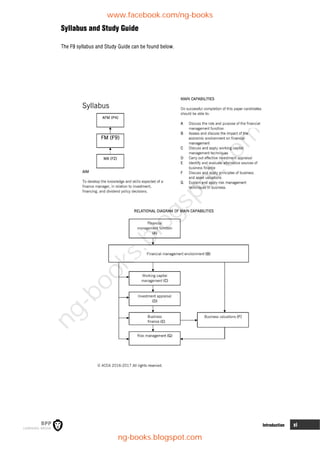
The F9 syllabus and Study Guide can be found below.
www.facebook.com/ng-books
ng-books.blogspot.com
n
g
-
b
o
o
k
s
.
b
l
o
g
s
p
o
t
.
c
o
m
xii Introduction
www.facebook.com/ng-books
ng-books.blogspot.com
n
g
-
b
o
o
k
s
.
b
l
o
g
s
p
o
t
.
c
o
m
Introduction xiii
www.facebook.com/ng-books
ng-books.blogspot.com
n
g
-
b
o
o
k
s
.
b
l
o
g
s
p
o
t
.
c
o
m
xiv Introduction
www.facebook.com/ng-books
ng-books.blogspot.com
n
g
-
b
o
o
k
s
.
b
l
o
g
s
p
o
t
.
c
o
m
Introduction xv
www.facebook.com/ng-books
ng-books.blogspot.com
n
g
-
b
o
o
k
s
.
b
l
o
g
s
p
o
t
.
c
o
m
xvi Introduction
www.facebook.com/ng-books
ng-books.blogspot.com
n
g
-
b
o
o
k
s
.
b
l
o
g
s
p
o
t
.
c
o
m
Introduction xvii
www.facebook.com/ng-books
ng-books.blogspot.com
n
g
-
b
o
o
k
s
.
b
l
o
g
s
p
o
t
.
c
o
m
xviii Introduction
www.facebook.com/ng-books
ng-books.blogspot.com
n
g
-
b
o
o
k
s
.
b
l
o
g
s
p
o
t
.
c
o
m
Introduction xix
www.facebook.com/ng-books
ng-books.blogspot.com
n
g
-
b
o
o
k
s
.
b
l
o
g
s
p
o
t
.
c
o
m
xx Introduction
www.facebook.com/ng-books
ng-books.blogspot.com
n
g
-
b
o
o
k
s
.
b
l
o
g
s
p
o
t
.
c
o
m
Introduction xxi
www.facebook.com/ng-books
ng-books.blogspot.com
n
g
-
b
o
o
k
s
.
b
l
o
g
s
p
o
t
.
c
o
m
xxii Introduction
www.facebook.com/ng-books
ng-books.blogspot.com
n
g
-
b
o
o
k
s
.
b
l
o
g
s
p
o
t
.
c
o
m
1
Financial management function
P
A
R
T
A
www.facebook.com/ng-books
ng-books.blogspot.com
n
g
-
b
o
o
k
s
.
b
l
o
g
s
p
o
t
.
c
o
m
2
www.facebook.com/ng-books
ng-books.blogspot.com
n
g
-
b
o
o
k
s
.
b
l
o
g
s
p
o
t
.
c
o
m
3
Topic list Syllabus reference
1 The nature and purpose of financial management A1(a), (b)
2 Financial objectives and the relationship with
corporate strategy
A2 (a), (b)
3 Stakeholders A3 (a), (b), (c)
4 Measuring the achievement of corporate objectives A3 (d)
5 Encouraging the achievement of stakeholder
objectives
A3 (e)
6 Not for profit organisations A4 (a), (b), (c)
Financial
management and
financial objectives
Introduction
In Parts A and B of this Study Text we examine the work of the financial
management function and the framework within which it operates.
In this chapter, after introducing the nature and purpose of financial
management, we consider the objectives of organisations. We go on to
examine the influence of stakeholders on stakeholder objectives.
The final part of this chapter examines objectives in not for profit organisations.
www.facebook.com/ng-books
ng-books.blogspot.com
n
g
-
b
o
o
k
s
.
b
l
o
g
s
p
o
t
.
c
o
m
4 1: Financial management and financial objectives  Part A Financial management function
Study guide
Intellectual level
A Financial management function
1 The nature and purpose of financial management
(a) Explain the nature and purpose of financial management. 1
(b) Explain the relationship between financial management and financial and
management accounting.
1
2 Financial objectives and the relationship with corporate strategy
(a) Discuss the relationship between financial objectives, corporate objectives
and corporate strategy.
2
(b) Identify and describe a variety of financial objectives, including: 2
(i) Shareholder wealth maximisation
(ii) Profit maximisation
(iii) Earnings per share growth
3 Stakeholders and impact on corporate objectives
(a) Identify the range of stakeholders and their objectives. 2
(b) Discuss the possible conflict between stakeholder objectives. 2
(c) Discuss the role of management in meeting stakeholder objectives,
including the application of agency theory.
2
(d) Describe and apply ways of measuring achievement of corporate objectives
including:
2
(i) Ratio analysis, using appropriate ratios such as return on capital employed,
return on equity, earnings per share and dividend per share
(ii) Changes in dividends and share prices as part of total shareholder return
(e) Explain ways to encourage the achievement of stakeholder objectives,
including:
2
(i) Managerial reward schemes such as share options and performance-related
pay
(ii) Regulatory requirements such as corporate governance codes of best
practice and stock exchange listing regulations
4 Financial and other objectives in not for profit organisations
(a) Discuss the impact of not for profit status on financial and other objectives. 2
(b) Discuss the nature and importance of value for money as an objective in not
for profit organisations.
2
(c) Discuss ways of measuring the achievement of objectives in not for profit
organisations.
2
Exam guide
The material in this chapter is examinable as an entire discussion question or as a question involving
calculations such as ratios and discussion. When doing a ratio analysis question, you must make sure you
apply your answer to the organisation in the question. The organisation will not necessarily be a publicly
quoted company with shareholders.
www.facebook.com/ng-books
ng-books.blogspot.com
n
g
-
b
o
o
k
s
.
b
l
o
g
s
p
o
t
.
c
o
m
Part A Financial management function  1: Financial management and financial objectives 5
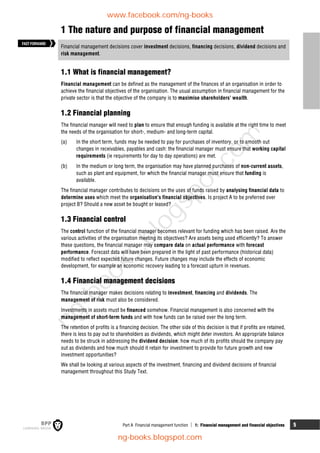
1 The nature and purpose of financial management
Financial management decisions cover investment decisions, financing decisions, dividend decisions and
risk management.
1.1 What is financial management?
Financial management can be defined as the management of the finances of an organisation in order to
achieve the financial objectives of the organisation. The usual assumption in financial management for the
private sector is that the objective of the company is to maximise shareholders' wealth.
1.2 Financial planning
The financial manager will need to plan to ensure that enough funding is available at the right time to meet
the needs of the organisation for short-, medium- and long-term capital.
(a) In the short term, funds may be needed to pay for purchases of inventory, or to smooth out
changes in receivables, payables and cash: the financial manager must ensure that working capital
requirements (ie requirements for day to day operations) are met.
(b) In the medium or long term, the organisation may have planned purchases of non-current assets,
such as plant and equipment, for which the financial manager must ensure that funding is
available.
The financial manager contributes to decisions on the uses of funds raised by analysing financial data to
determine uses which meet the organisation's financial objectives. Is project A to be preferred over
project B? Should a new asset be bought or leased?
1.3 Financial control
The control function of the financial manager becomes relevant for funding which has been raised. Are the
various activities of the organisation meeting its objectives? Are assets being used efficiently? To answer
these questions, the financial manager may compare data on actual performance with forecast
performance. Forecast data will have been prepared in the light of past performance (historical data)
modified to reflect expected future changes. Future changes may include the effects of economic
development, for example an economic recovery leading to a forecast upturn in revenues.
1.4 Financial management decisions
The financial manager makes decisions relating to investment, financing and dividends. The
management of risk must also be considered.
Investments in assets must be financed somehow. Financial management is also concerned with the
management of short-term funds and with how funds can be raised over the long term.
The retention of profits is a financing decision. The other side of this decision is that if profits are retained,
there is less to pay out to shareholders as dividends, which might deter investors. An appropriate balance
needs to be struck in addressing the dividend decision: how much of its profits should the company pay
out as dividends and how much should it retain for investment to provide for future growth and new
investment opportunities?
We shall be looking at various aspects of the investment, financing and dividend decisions of financial
management throughout this Study Text.
FASTFORWARD
www.facebook.com/ng-books
ng-books.blogspot.com
n
g
-
b
o
o
k
s
.
b
l
o
g
s
p
o
t
.
c
o
m
6 1: Financial management and financial objectives  Part A Financial management function
Examples of different types of investment decision
Decisions internal to the
business enterprise
 Whether to undertake new projects
 Whether to invest in new plant and machinery
 Research and development decisions
 Investment in a marketing or advertising campaign
Decisions involving
external parties
 Whether to carry out a takeover or a merger involving another business
 Whether to engage in a joint venture with another enterprise
Disinvestment decisions  Whether to sell off unprofitable segments of the business
 Whether to sell old or surplus plant and machinery
 The sale of subsidiary companies
Question Disposal of surplus assets
'The financial manager should identify surplus assets and dispose of them'. Why?
Answer
A surplus asset earns no return for the business. The business is likely to be paying the 'cost of capital' in
respect of the money tied up in the asset, ie the money which it can realise by selling it.
If surplus assets are sold, the business may be able to invest the cash released in more productive ways,
or alternatively it may use the cash to cut its liabilities. Either way, it will enhance the return on capital
employed for the business as a whole.
Although selling surplus assets yields short-term benefits, the business should not jeopardise its activities
in the medium or long term by disposing of productive capacity until the likelihood of it being required in
the future has been fully assessed.
1.5 Management accounting, financial accounting and financial
management
Of course, it is not just people within an organisation who require information. Those external to the
organisation, such as banks, shareholders, tax authorities, trade payables and government agencies, all
desire information too.
Management accountants provide internally used information. The financial accounting function
provides externally used information. The management accountant is not concerned with the calculation
of earnings per share for the statement of profit or loss and the financial accountant is not concerned with
the variances between budgeted and actual labour expenditure.
Management information provides a common source from which financial accounts and management
accounts are prepared. The differences between the two types of accounts arise in the manner in which
the common source of data is analysed.
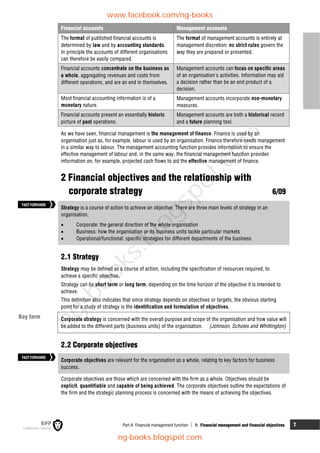
Financial accounts Management accounts
Financial accounts detail the performance of an
organisation over a defined period and the state
of affairs at the end of that period.
Management accounts are used to aid
management to record, plan and control activities
and to help the decision-making process.
Limited companies must, by law, prepare financial
accounts.
There is no legal requirement to prepare
management accounts.
www.facebook.com/ng-books
ng-books.blogspot.com
n
g
-
b
o
o
k
s
.
b
l
o
g
s
p
o
t
.
c
o
m
Part A Financial management function  1: Financial management and financial objectives 7
Financial accounts Management accounts
The format of published financial accounts is
determined by law and by accounting standards.
In principle the accounts of different organisations
can therefore be easily compared.
The format of management accounts is entirely at
management discretion: no strict rules govern the
way they are prepared or presented.
Financial accounts concentrate on the business as
a whole, aggregating revenues and costs from
different operations, and are an end in themselves.
Management accounts can focus on specific areas
of an organisation's activities. Information may aid
a decision rather than be an end product of a
decision.
Most financial accounting information is of a
monetary nature.
Management accounts incorporate non-monetary
measures.
Financial accounts present an essentially historic
picture of past operations.
Management accounts are both a historical record
and a future planning tool.
As we have seen, financial management is the management of finance. Finance is used by an
organisation just as, for example, labour is used by an organisation. Finance therefore needs management
in a similar way to labour. The management accounting function provides information to ensure the
effective management of labour and, in the same way, the financial management function provides
information on, for example, projected cash flows to aid the effective management of finance.
2 Financial objectives and the relationship with
corporate strategy 6/09
Strategy is a course of action to achieve an objective. There are three main levels of strategy in an
organisation.
 Corporate: the general direction of the whole organisation
 Business: how the organisation or its business units tackle particular markets
 Operational/functional: specific strategies for different departments of the business
2.1 Strategy
Strategy may be defined as a course of action, including the specification of resources required, to
achieve a specific objective.
Strategy can be short term or long term, depending on the time horizon of the objective it is intended to
achieve.
This definition also indicates that since strategy depends on objectives or targets, the obvious starting
point for a study of strategy is the identification and formulation of objectives.
Corporate strategy is concerned with the overall purpose and scope of the organisation and how value will
be added to the different parts (business units) of the organisation. (Johnson, Scholes and Whittington)
2.2 Corporate objectives
Corporate objectives are relevant for the organisation as a whole, relating to key factors for business
success.
Corporate objectives are those which are concerned with the firm as a whole. Objectives should be
explicit, quantifiable and capable of being achieved. The corporate objectives outline the expectations of
the firm and the strategic planning process is concerned with the means of achieving the objectives.
FASTFORWARD
FASTFORWARD
Key term
www.facebook.com/ng-books
ng-books.blogspot.com
n
g
-
b
o
o
k
s
.
b
l
o
g
s
p
o
t
.
c
o
m
8 1: Financial management and financial objectives  Part A Financial management function
Objectives should relate to the key factors for business success, which are typically as follows.
 Profitability (return on investment)
 Market share
 Growth
 Cash flow
 Customer satisfaction
 The quality of the firm's products
 Industrial relations
 Added value
2.3 Financial objectives 6/13
Financial targets may include targets for: earnings; earnings per share; dividend per share; gearing
level; profit retention; operating profitability.
The usual assumption in financial management for the private sector is that the primary financial objective
of the company is to maximise shareholders' wealth.
2.3.1 Shareholder wealth maximisation 12/08, 6/10, 12/11, 12/13
The December 2011 exam required candidates to compare and contrast the financial objectives of a
company and a not for profit organisation. Make sure that you can explain the benefits of financial
objectives, and are able to apply your knowledge to different situations. The December 2013 exam
approached the subject from a different angle. The question asked for ways in which directors of a
company could be encouraged to achieve maximisation of shareholder wealth. This required a bit of
common sense. The two main ways are via managerial reward schemes such as share option schemes,
and through regulatory requirements such as corporate governance codes.
If the financial objective of a company is to maximise the value of the company, and in particular the value
of its ordinary shares, we need to be able to put values on a company and its shares. How do we do it?
Three possible methods for the valuation of a company might occur to us.
(a) Statement of financial position (balance sheet) valuation
Here assets will be valued on a going concern basis. Certainly, investors will look at a company's
statement of financial position. If retained profits rise every year, the company will be a profitable
one. Statement of financial position values are not a measure of 'market value', although retained
profits might give some indication of what the company could pay as dividends to shareholders.
(b) Break-up basis
This method of valuing a business is only of interest when the business is threatened with
liquidation, or when its management is thinking about selling off individual assets to raise cash.
(c) Market values
The market value is the price at which buyers and sellers will trade stocks and shares in a company. This
is the method of valuation which is most relevant to the financial objectives of a company.
(i) When shares are traded on a recognised stock market, such as the stock exchange, the
market value of a company can be measured by the price at which shares are currently
being traded.
(ii) When shares are in a private company, and are not traded on any stock market, there is no
easy way to measure their market value. Even so, the financial objective of these companies
should be to maximise the wealth of their ordinary shareholders.
FASTFORWARD
Exam focus
point
www.facebook.com/ng-books
ng-books.blogspot.com
n
g
-
b
o
o
k
s
.
b
l
o
g
s
p
o
t
.
c
o
m
Part A Financial management function  1: Financial management and financial objectives 9
The wealth of the shareholders in a company comes from:
 Dividends received
 Market value of the shares
A shareholder's return on investment is obtained in the form of:
 Dividends received
 Capital gains from increases in the market value of their shares
If a company's shares are traded on a stock market, the wealth of shareholders is increased when the
share price goes up. The price of a company's shares will go up when the company makes attractive
profits, which it pays out as dividends or reinvests in the business to achieve future profit growth and
dividend growth. However, to increase the share price the company should achieve its attractive profits
without taking business risks and financial risks which worry shareholders.
If there is an increase in earnings and dividends, management can hope for an increase in the share price
too, so that shareholders benefit from both higher revenue (dividends) and also capital gains (higher
share prices). Total shareholder return is a measure which combines the increase in share price and
dividends paid and can be calculated as:
1 0 1 0
(P P D ) /P
 
Where 0
P is the share price at the beginning of the period
1
P is the share price at the end of period
1
D is the dividend paid
Question Total shareholder return
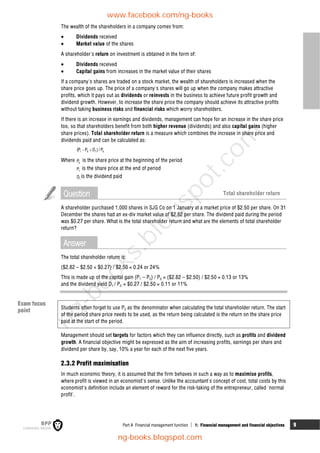
A shareholder purchased 1,000 shares in SJG Co on 1 January at a market price of $2.50 per share. On 31
December the shares had an ex-div market value of $2.82 per share. The dividend paid during the period
was $0.27 per share. What is the total shareholder return and what are the elements of total shareholder
return?
Answer
The total shareholder return is:
($2.82 – $2.50 + $0.27) / $2.50 = 0.24 or 24%
This is made up of the capital gain (P1 – P0) / P0 = ($2.82 – $2.50) / $2.50 = 0.13 or 13%
and the dividend yield D1 / P0 = $0.27 / $2.50 = 0.11 or 11%
Students often forget to use P0 as the denominator when calculating the total shareholder return. The start
of the period share price needs to be used, as the return being calculated is the return on the share price
paid at the start of the period.
Management should set targets for factors which they can influence directly, such as profits and dividend
growth. A financial objective might be expressed as the aim of increasing profits, earnings per share and
dividend per share by, say, 10% a year for each of the next five years.
2.3.2 Profit maximisation
In much economic theory, it is assumed that the firm behaves in such a way as to maximise profits,
where profit is viewed in an economist's sense. Unlike the accountant's concept of cost, total costs by this
economist's definition include an element of reward for the risk-taking of the entrepreneur, called 'normal
profit'.
Exam focus
point
www.facebook.com/ng-books
ng-books.blogspot.com
n
g
-
b
o
o
k
s
.
b
l
o
g
s
p
o
t
.
c
o
m
10 1: Financial management and financial objectives  Part A Financial management function
Where the entrepreneur is in full managerial control of the firm, as in the case of a small owner-managed
company or partnership, the economist's assumption of profit maximisation would seem to be very
reasonable. Remember though that the economist's concept of profits is broadly in terms of cash,
whereas accounting profits may not equate to cash flows.
Even in companies owned by shareholders but run by non-shareholding managers, if the manager is
serving the company's (ie the shareholders') interests, we might expect that the profit maximisation
assumption should be close to the truth.
Although profits do matter, they are not the best measure of a company's achievements.
(a) Accounting profits are not the same as 'economic' profits. Accounting profits can be manipulated
to some extent by choices of accounting policies.
Question Manipulation of profits
Can you give three examples of how accounting profits might be manipulated?
Answer
Here are some examples you might have chosen.
(a) Provisions, such as provisions for depreciation or anticipated losses
(b) The capitalisation of various expenses, such as development costs
(c) Adding overhead costs to inventory valuations
(b) Profit does not take account of risk. Shareholders will be very interested in the level of risk, and
maximising profits may be achieved by increasing risk to unacceptable levels.
(c) Profits on their own take no account of the volume of investment that it has taken to earn the
profit. Profits must be related to the volume of investment to have any real meaning. Hence
measures of financial achievement include:
(i) Accounting return on capital employed
(ii) Earnings per share
(iii) Yields on investment, eg dividend yield as a percentage of stock market value
(d) Profits are reported every year (with half-year interim results for quoted companies). They are
measures of short-term performance, whereas a company's performance should ideally be judged
over the longer term.
2.3.3 Earnings per share growth 12/08, 6/09, 6/13, 6/14
Earnings per share is calculated by dividing the net profit or loss attributable to ordinary shareholders by
the weighted average number of ordinary shares.
Earnings per share (EPS) is widely used as a measure of a company's performance and is of particular
importance in comparing results over a period of several years. A company must be able to sustain its
earnings in order to pay dividends and reinvest in the business so as to achieve future growth. Investors also
look for growth in the EPS from one year to the next.
Key term
www.facebook.com/ng-books
ng-books.blogspot.com
n
g
-
b
o
o
k
s
.
b
l
o
g
s
p
o
t
.
c
o
m
Part A Financial management function  1: Financial management and financial objectives 11
Question Earnings per share
Walter Wall Carpets made profits before tax in 20X8 of $9,320,000. Tax amounted to $2,800,000.
The company's share capital is as follows.
$
Ordinary shares (10,000,000 shares of $1) 10,000,000
8% preference shares 2,000,000
12,000,000
Calculate the EPS for 20X8.
Answer
$
Profit before tax 9,320,000
Less tax 2,800,000
Profits after tax 6,520,000
Less preference dividend (8% of $2,000,000) 160,000
Earnings attributable to ordinary shareholders 6,360,000
Number of ordinary shares 10,000,000
EPS 63.6c
Question Earnings per share growth
Grasshopper made earnings attributable to shareholders of $8,250,000 in 20X8 and $8,880,000 in 20X9.
The company's share capital was 12 million ordinary shares of $1 each in both years.
Calculate the EPS for 20X8 and 20X9 and EPS growth in relative and absolute terms.
Answer
$
Earnings attributable to ordinary shareholders (20X8) 8,250,000
Number of ordinary shares 12,000,000
EPS (20X8) 68.8c
Earnings attributable to ordinary shareholders (20X9) 8,880,000
Number of ordinary shares 12,000,000
EPS (20X9) 74.0c
EPS growth (absolute) (74.0 – 68.8) 5.2c
EPS growth (relative) (5.2/68.8) 7.6%
Note that:
(a) EPS is a figure based on past data, and
(b) It is easily manipulated by changes in accounting policies and by mergers or acquisitions.
The use of the measure in calculating management bonuses makes it particularly liable to manipulation.
For example, EPS can be increased via a share consolidation (exchanging a number of existing shares for
one new share without altering the total value of the shareholding). The attention given to EPS as a
performance measure by City analysts is arguably disproportionate to its true worth. Investors should be
more concerned with future earnings, but of course estimates of these are more difficult to reach than the
readily available figure.
www.facebook.com/ng-books
ng-books.blogspot.com
n
g
-
b
o
o
k
s
.
b
l
o
g
s
p
o
t
.
c
o
m
12 1: Financial management and financial objectives  Part A Financial management function
2.3.4 Other financial targets
In addition to targets for earnings, EPS and dividend per share, a company might set other financial
targets, such as:
(a) A restriction on the company's level of gearing, or debt. For example, a company's management
might decide:
(i) The ratio of long-term debt capital to equity capital should never exceed, say, 1:1.
(ii) The cost of interest payments should never be higher than, say, 25% of total profits before
interest and tax.
(b) A target for profit retentions. For example, management might set a target that dividend cover (the
ratio of distributable profits to dividends actually distributed) should not be less than, say, 2.5
times.
(c) A target for operating profitability. For example, management might set a target for the profit/sales
ratio (say, a minimum of 10%) or for a return on capital employed (say, a minimum ROCE of
20%).
These financial targets are not primary financial objectives, but they can act as subsidiary targets or
constraints which should help a company to achieve its main financial objective without incurring
excessive risks. They are usually measured over a year rather than over the long term.
Remember, however, that short-term measures of return can encourage a company to pursue short-term
objectives at the expense of long-term ones, for example by deferring new capital investments, or
spending only small amounts on research and development and on training.
A major problem with setting a number of different financial targets, either primary targets or supporting
secondary targets, is that they might not all be consistent with each other. When this happens, some
compromises will have to be accepted.
2.3.5 Example: Financial targets
Lion Grange Co has recently introduced a formal scheme of long-range planning. Sales in the current year
reached $10,000,000, and forecasts for the next five years are $10,600,000, $11,400,000, $12,400,000,
$13,600,000 and $15,000,000. The ratio of net profit after tax to sales is 10%, and this is expected to
continue throughout the planning period. Total assets less current liabilities will remain at around 125% of
sales. Equity in the current year is $8.75m.
It was suggested at a recent board meeting that:
(a) If profits rise, dividends should rise by at least the same percentage.
(b) An earnings retention rate of 50% should be maintained ie a payment ratio of 50%.
(c) The ratio of long-term borrowing to long-term funds (debt plus equity) is limited (by the market) to
30%, which happens also to be the current gearing level of the company.
You are required to prepare a financial analysis of the draft long-range plan.
www.facebook.com/ng-books
ng-books.blogspot.com
n
g
-
b
o
o
k
s
.
b
l
o
g
s
p
o
t
.
c
o
m
Part A Financial management function  1: Financial management and financial objectives 13
Solution
The draft financial plan for profits, dividends, assets required and funding can be drawn up in a table, as
follows.
Current
year Year 1 Year 2 Year 3 Year 4 Year 5
$m $m $m $m $m $m
Sales 10.00 10.60 11.40 12.40 13.60 15.00
Net profit after tax 1.00 1.06 1.14 1.24 1.36 1.50
Dividends
(50% of profit after tax) 0.50 0.53 0.57 0.62 0.68 0.75
Total assets less current liabilities 12.50 13.25 14.25 15.50 17.00 18.75
Equity (increased by
retained earnings) 8.75 9.28 9.85 10.47 11.15 11.90
Maximum debt
(30% of long-term funds,
or 3/7  equity) 3.75 3.98 4.22 4.49 4.78 5.10
Funds available 12.50 13.26 14.07 14.96 15.93 17.00
(Shortfalls) in funds * 0.00 0.00 (0.18) (0.54) (1.07) (1.75)
* Given maximum gearing of 30% and no new issue of shares = funds available minus net assets required.
Question Dividends and gearing
Suggest policies on dividends, retained earnings and gearing for Lion Grange, using the data above.
Answer
The financial objectives of the company are not compatible with each other. Adjustments will have to be
made.
(a) Given the assumptions about sales, profits, dividends and net assets required, there will be an
increasing shortfall of funds from year 2 onwards, unless new shares are issued or the gearing
level rises above 30%.
(b) In years 2 and 3, the shortfall can be eliminated by retaining a greater percentage of profits, but
this may have a serious adverse effect on the share price. In years 4 and 5, the shortfall in funds
cannot be removed even if dividend payments are reduced to nothing.
(c) The net asset turnover (sales/capital employed) appears to be low. The situation would be eased if
investments were able to generate a higher volume of sales, so that fewer non-current assets and
less working capital would be required to support the projected level of sales.
(d) If asset turnover cannot be improved, it may be possible to increase the profit to sales ratio by
reducing costs or increasing selling prices.
(e) If a new issue of shares is proposed to make up the shortfall in funds, the amount of funds
required must be considered very carefully. Total dividends would have to be increased in order to
pay dividends on the new shares. The company seems unable to offer prospects of suitable
dividend payments, and so raising new equity might be difficult.
(f) It is conceivable that extra funds could be raised by issuing new debt capital, so that the level of
gearing would be over 30%. It is uncertain whether investors would be prepared to lend money so
as to increase gearing. If more funds were borrowed, profits after interest and tax would fall so that
the share price might also be reduced.
www.facebook.com/ng-books
ng-books.blogspot.com
n
g
-
b
o
o
k
s
.
b
l
o
g
s
p
o
t
.
c
o
m
14 1: Financial management and financial objectives  Part A Financial management function
CaseStudy
Tate & Lyle is 'a leading global provider of ingredients and solutions to the food, beverage and other
industries'. Their corporate strategy is as follows.
'Our vision is to become the leading global provider of speciality food ingredients and solutions. Over the
last three years we have been taking a number of steps to realise this vision through our business
transformation programme. The first part of the transformation, which is now complete, was about
realigning and focusing our resources on growing our Speciality Food Ingredients business unit.
The second part is about getting the right enabling platform in place. We have made good progress
including the move to a new operating model comprising two global business units, implementing a global
Shared Service Centre and the initial roll-out of our global IS/IT system.'
http://annualreport2013.tateandlyle.com <accessed 21/01/14>
2.4 Non-financial objectives
A company may have important non-financial objectives which must be satisfied in order to ensure the
continuing participation of all stakeholders. Without their participation, financial objectives such as
maximising shareholder wealth may be compromised in the future. Examples of non-financial objectives
are as follows.
(a) The welfare of employees
A company might try to provide good wages and salaries, comfortable and safe working
conditions, good training and career development, and good pensions. If redundancies are
necessary, many companies will provide generous redundancy payments, or spend money trying
to find alternative employment for redundant staff.
(b) The welfare of management
Managers will often take decisions to improve their own circumstances, even though their
decisions will incur expenditure and so reduce profits. High salaries, company cars and other perks
are all examples of managers promoting their own interests.
(c) The provision of a service
The major objectives of some companies will include fulfilment of a responsibility to provide a
service to the public. Examples are the privatised British Telecom and British Gas. Providing a
service is of course a key responsibility of government departments and local authorities.
(d) The fulfilment of responsibilities towards customers
Responsibilities towards customers include providing in good time a product or service of a quality
that customers expect, and dealing honestly and fairly with customers. Reliable supply
arrangements and after-sales service arrangements are important.
(e) The fulfilment of responsibilities towards suppliers
Responsibilities towards suppliers are expressed mainly in terms of trading relationships. A
company's size could give it considerable power as a buyer. The company should not use its power
unscrupulously. Suppliers might rely on receiving prompt payment, in accordance with the agreed
terms of trade.
(f) The welfare of society as a whole
The management of some companies are aware of the role that their company has to play in
exercising corporate social responsibility. This includes compliance with applicable laws and
regulations but is wider than that. Companies may be aware of their responsibility to minimise
pollution and other harmful 'externalities' (such as excessive traffic) which their activities generate.
In delivering 'green' environmental policies, a company may improve its corporate image as well as
reducing harmful externality effects. Companies also may consider their 'positive' responsibilities,
for example to make a contribution to the community by local sponsorship.
www.facebook.com/ng-books
ng-books.blogspot.com
n
g
-
b
o
o
k
s
.
b
l
o
g
s
p
o
t
.
c
o
m
Part A Financial management function  1: Financial management and financial objectives 15
Other non-financial objectives are growth, diversification and leadership in research and development.
Non-financial objectives do not negate financial objectives, but they do suggest that the simple theory of
company finance, that the objective of a firm is to maximise the wealth of ordinary shareholders, is too
narrow. Financial objectives may have to be compromised in order to satisfy non-financial objectives.
3 Stakeholders
Stakeholders are individuals or groups who are affected by the activities of the firm. They can be
classified as internal (employees and managers), connected (shareholders, customers and suppliers) and
external (local communities, pressure groups, government).
There is a variety of different groups or individuals whose interests are directly affected by the activities of
a firm. These groups or individuals are referred to as stakeholders in the firms.
The various stakeholder groups in a firm can be classified as follows.
Stakeholder groups
Internal Employees and pensioners
Managers
Directors
Connected Shareholders
Debt holders (bondholders)
Customers
Bankers
Suppliers
Competitors
External Government
Pressure groups
Local and national communities
Professional and regulatory bodies
3.1 Objectives of stakeholder groups
The various groups of stakeholders in a firm will have different goals which will depend in part on the
particular situation of the enterprise. Some of the more important aspects of these different goals are as
follows.
(a) Ordinary (equity) shareholders
Ordinary (equity) shareholders are the providers of the risk capital of a company. Usually their goal
will be to maximise the wealth which they have as a result of the ownership of the shares in the
company.
(b) Trade payables (creditors)
Trade payables have supplied goods or services to the firm. Trade payables will generally be profit-
maximising firms themselves and have the objective of being paid the full amount due by the date
agreed. On the other hand, they usually wish to ensure that they continue their trading relationship
with the firm and may sometimes be prepared to accept later payment to avoid jeopardising that
relationship.
(c) Long-term payables (creditors)
Long-term payables, which will often be banks, have the objective of receiving payments of interest
and capital on the loan by the due date for the repayments. Where the loan is secured on assets of
the company, the lender will be able to appoint a receiver to dispose of the company's assets if the
company defaults on the repayments. To avoid the possibility that this may result in a loss to the
Key term
FASTFORWARD
www.facebook.com/ng-books
ng-books.blogspot.com
n
g
-
b
o
o
k
s
.
b
l
o
g
s
p
o
t
.
c
o
m
16 1: Financial management and financial objectives  Part A Financial management function
lender if the assets are not sufficient to cover the loan, the lender will wish to minimise the risk of
default and will not wish to lend more than is prudent.
(d) Employees
Employees will usually want to maximise their rewards paid to them in salaries and benefits,
according to the particular skills and the rewards available in alternative employment. Most
employees will also want continuity of employment.
(e) Government
Government has objectives which can be formulated in political terms. Government agencies
impinge on the firm's activities in different ways including through taxation of the firm's profits, the
provision of grants, health and safety legislation, training initiatives, and so on. Government
policies will often be related to macroeconomic objectives, such as sustained economic growth and
high levels of employment.
(f) Management
Management has, like other employees (and managers who are not directors will normally be
employees), the objective of maximising its own rewards. Directors, and the managers to whom they
delegate responsibilities, must manage the company for the benefit of shareholders. The objective
of reward maximisation might conflict with the exercise of this duty.
3.2 Stakeholder groups, strategy and objectives
The actions of stakeholder groups in pursuit of their various goals can exert influence on strategy and
objectives. The greater the power of the stakeholder, the greater their influence will be. Each stakeholder
group will have different expectations about what it wants, and the expectations of the various groups
may conflict. Each group, however, will influence strategic decision making.
3.3 Shareholders and management
Although ordinary shareholders (equity shareholders) are the owners of the company to whom the board
of directors are accountable, the actual powers of shareholders tend to be restricted, except in companies
where the shareholders are also the directors. The day to day running of a company is the responsibility of
management. Although the company's results are submitted for shareholders' approval at the annual
general meeting (AGM), there is often apathy and acquiescence in directors' recommendations.
Shareholders are often ignorant about their company's current situation and future prospects. They have
no right to inspect the books of account, and their forecasts of future prospects are gleaned from the
annual report and accounts, stockbrokers, investment journals and daily newspapers. The relationship
between management and shareholders is sometimes referred to as an agency relationship, in which
managers act as agents for the shareholders.
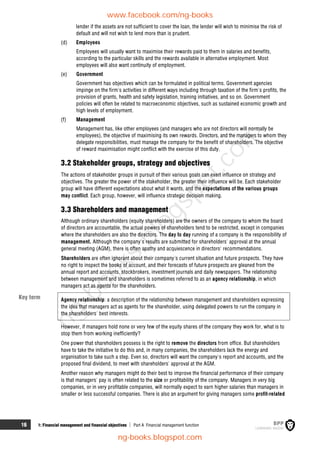
Agency relationship: a description of the relationship between management and shareholders expressing
the idea that managers act as agents for the shareholder, using delegated powers to run the company in
the shareholders' best interests.
However, if managers hold none or very few of the equity shares of the company they work for, what is to
stop them from working inefficiently?
One power that shareholders possess is the right to remove the directors from office. But shareholders
have to take the initiative to do this and, in many companies, the shareholders lack the energy and
organisation to take such a step. Even so, directors will want the company's report and accounts, and the
proposed final dividend, to meet with shareholders' approval at the AGM.
Another reason why managers might do their best to improve the financial performance of their company
is that managers' pay is often related to the size or profitability of the company. Managers in very big
companies, or in very profitable companies, will normally expect to earn higher salaries than managers in
smaller or less successful companies. There is also an argument for giving managers some profit-related
Key term
www.facebook.com/ng-books
ng-books.blogspot.com
n
g
-
b
o
o
k
s
.
b
l
o
g
s
p
o
t
.
c
o
m
Part A Financial management function  1: Financial management and financial objectives 17
pay, or providing incentives which are related to profits or share price. We will come back to this in
Section 5 of this chapter.
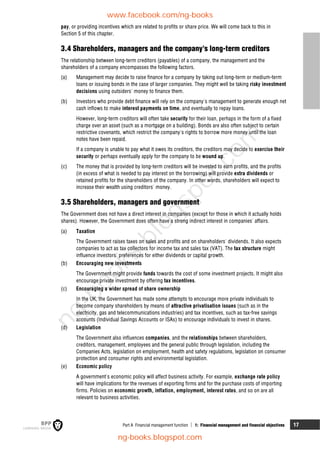
3.4 Shareholders, managers and the company's long-term creditors
The relationship between long-term creditors (payables) of a company, the management and the
shareholders of a company encompasses the following factors.
(a) Management may decide to raise finance for a company by taking out long-term or medium-term
loans or issuing bonds in the case of larger companies. They might well be taking risky investment
decisions using outsiders' money to finance them.
(b) Investors who provide debt finance will rely on the company's management to generate enough net
cash inflows to make interest payments on time, and eventually to repay loans.
However, long-term creditors will often take security for their loan, perhaps in the form of a fixed
charge over an asset (such as a mortgage on a building). Bonds are also often subject to certain
restrictive covenants, which restrict the company's rights to borrow more money until the loan
notes have been repaid.
If a company is unable to pay what it owes its creditors, the creditors may decide to exercise their
security or perhaps eventually apply for the company to be wound up.
(c) The money that is provided by long-term creditors will be invested to earn profits, and the profits
(in excess of what is needed to pay interest on the borrowing) will provide extra dividends or
retained profits for the shareholders of the company. In other words, shareholders will expect to
increase their wealth using creditors' money.
3.5 Shareholders, managers and government
The Government does not have a direct interest in companies (except for those in which it actually holds
shares). However, the Government does often have a strong indirect interest in companies' affairs.
(a) Taxation
The Government raises taxes on sales and profits and on shareholders' dividends. It also expects
companies to act as tax collectors for income tax and sales tax (VAT). The tax structure might
influence investors' preferences for either dividends or capital growth.
(b) Encouraging new investments
The Government might provide funds towards the cost of some investment projects. It might also
encourage private investment by offering tax incentives.
(c) Encouraging a wider spread of share ownership
In the UK, the Government has made some attempts to encourage more private individuals to
become company shareholders by means of attractive privatisation issues (such as in the
electricity, gas and telecommunications industries) and tax incentives, such as tax-free savings
accounts (Individual Savings Accounts or ISAs) to encourage individuals to invest in shares.
(d) Legislation
The Government also influences companies, and the relationships between shareholders,
creditors, management, employees and the general public through legislation, including the
Companies Acts, legislation on employment, health and safety regulations, legislation on consumer
protection and consumer rights and environmental legislation.
(e) Economic policy
A government's economic policy will affect business activity. For example, exchange rate policy
will have implications for the revenues of exporting firms and for the purchase costs of importing
firms. Policies on economic growth, inflation, employment, interest rates, and so on are all
relevant to business activities.
www.facebook.com/ng-books
ng-books.blogspot.com
n
g
-
b
o
o
k
s
.
b
l
o
g
s
p
o
t
.
c
o
m
18 1: Financial management and financial objectives  Part A Financial management function
4 Measuring the achievement of corporate objectives
Performance measurement is a part of the system of financial control of an enterprise as well as being
important to investors.
4.1 Measuring financial performance 6/11
As part of the system of financial control in an organisation, it will be necessary to have ways of
measuring the progress of the enterprise, so that managers know how well the company is doing. A
common means of doing this is through ratio analysis, which is concerned with comparing and
quantifying relationships between financial variables, such as those variables found in the statement of
financial position and statement of profit or loss of the enterprise.
The ACCA examination team has said, more than once, that knowledge of how to calculate and interpret
key ratios is a weak point for many candidates. Make sure that it is one of your strong points. In reviewing
ratio analysis below, we are in part revising material included in previous papers including F5.
4.2 The broad categories of ratios
Ratios can be grouped into the following four categories.
 Profitability and return
 Debt and gearing
 Liquidity
 Shareholders' investment ratios ('stock market ratios')
The key to obtaining meaningful information from ratio analysis is comparison: comparing ratios over a
number of periods within the same business to establish whether the business is improving or declining,
and comparing ratios between similar businesses to see whether the company you are analysing is
better or worse than average within its own business sector.
4.3 Ratio pyramids
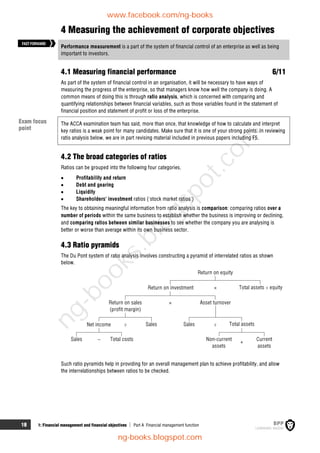
The Du Pont system of ratio analysis involves constructing a pyramid of interrelated ratios as shown
below.
Return on sales
(profit margin)
Asset turnover
Return on investment
Return on equity
Total assets ÷ equity
Net income Sales Sales Total assets
Sales Total costs Non-current
assets
Current
assets
×
×
–
÷ ÷
+
Such ratio pyramids help in providing for an overall management plan to achieve profitability, and allow
the interrelationships between ratios to be checked.
Exam focus
point
FASTFORWARD
www.facebook.com/ng-books
ng-books.blogspot.com
n
g
-
b
o
o
k
s
.
b
l
o
g
s
p
o
t
.
c
o
m
Part A Financial management function  1: Financial management and financial objectives 19
4.4 Profitability
A company ought of course to be profitable if it is to maximise shareholder wealth, and obvious checks on
profitability are:
(a) Whether the company has made a profit or a loss on its ordinary activities
(b) By how much this year's profit or loss is bigger or smaller than last year's profit or loss
Profit before taxation is generally thought to be a better figure to use than profit after taxation, because
there might be unusual variations in the tax charge from year to year which would not affect the
underlying profitability of the company's operations.
Another profit figure that should be considered is profit before interest and tax (PBIT). This is the amount
of profit which the company earned before having to pay interest to the providers of loan capital. This is
also a good measure of operating profit, the profit that the company is making from its business
operations. By providers of loan capital, we usually mean longer-term loan capital, such as loan notes and
medium-term bank loans.
4.4.1 Profitability and return: the return on capital employed
You cannot assess profits or profit growth properly without relating them to the amount of funds (the
capital) employed in making the profits. The most important profitability ratio is therefore return on
capital employed (ROCE), also called return on investment (ROI).
Return on capital employed =
PBIT
Capitalemployed
Capital employed = Shareholders' funds plus long-term liabilities
= Total assets less current liabilities
4.4.2 Evaluating the ROCE
What does a company's ROCE tell us? What should we be looking for? There are three comparisons that
can be made.
(a) The change in ROCE from one year to the next
(b) The ROCE being earned by other companies, if this information is available
(c) A comparison of the ROCE with current market borrowing rates (warning: this needs to be
interpreted with care, as ROCE will often reflect higher risk than borrowing rates)
(i) What would be the cost of extra borrowing to the company if it needed more loans, and is it
earning a ROCE that suggests it could make high enough profits to make such borrowing
worthwhile?
(ii) Is the company making a ROCE which suggests that it is making profitable use of its
current borrowing?
4.4.3 Secondary ratios
We may analyse the ROCE by looking at the kinds of interrelationships between ratios used in ratio
pyramids, which we mentioned earlier. We can thus find out why the ROCE is high or low, or better or
worse than last year. Profit margin and asset turnover together explain the ROCE, and if the ROCE is the
primary profitability ratio, these other two are the secondary ratios. The relationship between the three
ratios is as follows.
Profit margin  asset turnover = ROCE
PBIT Salesrevenue PBIT
Salesrevenue Capital employed Capital employed
 
Key terms
www.facebook.com/ng-books
ng-books.blogspot.com
n
g
-
b
o
o
k
s
.
b
l
o
g
s
p
o
t
.
c
o
m
20 1: Financial management and financial objectives  Part A Financial management function
It is also worth commenting on the change in revenue (turnover) from one year to the next. Strong sales
growth will usually indicate volume growth as well as revenue increases due to price rises, and volume
growth is one sign of a prosperous company.
Remember that capital employed is not just shareholders' funds. It is shareholders’ funds plus long-term
liabilities.
4.4.4 Return on equity
Another measure of the firm's overall performance is return on equity. This compares net profit after tax
with the equity that shareholders have invested in the firm.
Return on equity =
Earnings attributable to ordinary shareholders
Shareholders' equity
This ratio shows the earning power of the shareholders' book investment and can be used to compare two
firms in the same industry. A high return on equity could reflect the firm's good management of expenses
and ability to invest in profitable projects. However, it could also reflect a higher level of debt finance
(gearing) with associated higher risk (see Section 4.5).
Note that shareholders' equity includes reserves and is not limited to the ordinary share account.
4.4.5 Gross profit margin, the net profit margin and profit analysis
Depending on the format of the statement of profit or loss, you may be able to calculate the gross profit
margin and also the net profit margin. Looking at the two together can be quite informative.
4.4.6 Example: Profit margins
A company has the following summarised statements of profit or loss for two consecutive years.
Year 1 Year 2
$ $
Sales revenue 70,000 100,000
Less cost of sales 42,000 55,000
Gross profit 28,000 45,000
Less expenses 21,000 35,000
Net profit 7,000 10,000
Although the net profit margin is the same for both years at 10%, the gross profit margin is not.
In year 1 it is:
28,000
40%
70,000
 and in year 2 it is:
45,000
45%
100,000

Is this good or bad for the business? An increased profit margin must be good because this indicates a
wider gap between selling price and cost of sales. However, given that the net profit ratio has stayed the
same in the second year, expenses must be rising. In year 1 expenses were 30% of revenue, whereas in
year 2 they were 35% of revenue. This indicates that administration or selling and distribution expenses
may require tighter control.
A percentage analysis of profit between year 1 and year 2 is as follows.
Year 1 Year 2
% %
Cost of sales as a % of sales 60 55
Gross profit as a % of sales 40 45
100 100
Expenses as a % of sales 30 35
Net profit as a % of sales 10 10
Gross profit as a % of sales 40 45
Exam focus
point
Key term
www.facebook.com/ng-books
ng-books.blogspot.com
n
g
-
b
o
o
k
s
.
b
l
o
g
s
p
o
t
.
c
o
m
Part A Financial management function  1: Financial management and financial objectives 21
4.5 Debt and gearing ratios
Debt ratios are concerned with how much the company owes in relation to its size and whether it is getting
into heavier debt or improving its situation. Financial gearing (often simply referred to as 'gearing') is the
amount of debt finance a company uses relative to its equity finance.
(a) When a company is heavily in debt, and seems to be getting even more heavily into debt, banks
and other would-be lenders are very soon likely to refuse further borrowing.
(b) When a company is earning only a modest profit before interest and tax, and has a heavy debt
burden, there will be very little profit left over for shareholders after the interest charges have been
paid.
The main debt and gearing ratios are covered in Chapter 14.
4.6 Liquidity ratios: cash and working capital
Profitability is of course an important aspect of a company's performance, and debt or gearing is another.
Neither, however, directly addresses the key issue of liquidity. A company needs liquid assets so that it
can meet its debts when they fall due. The main liquidity ratios will be described in Chapter 4.
4.7 Shareholders' investment ratios 6/08
Indicators such as dividend yield, EPS, P/E ratio and dividend cover can be used to assess investor
returns.
Returns to shareholders are obtained in the form of dividends received and/or capital gains from
increases in market value.
A company will only be able to raise finance if investors think that the returns they can expect are
satisfactory in view of the risks they are taking. We must therefore consider how investors appraise
companies. We will concentrate on quoted companies.
Information that is relevant to market prices and returns is available from published stock market
information, and in particular from certain stock market ratios.
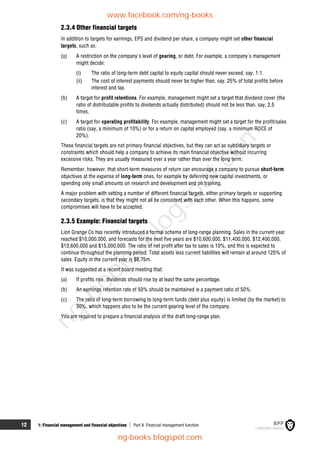
Cum dividend or cum div means the purchaser of shares is entitled to receive the next dividend payment.
Ex dividend or ex div means that the purchaser of shares is not entitled to receive the next dividend
payment.
The relationship between the cum-div price and the ex-div price is:
Market price per share (ex div) = Market price per share (cum div) – forthcoming dividend per share.
When stock market share prices are quoted, shares go from being cum div to ex div on a given day, and
shareholders buying the shares from the time they go ex div are not entitled to the next dividend pay-out,
which will happen soon.
4.7.1 The dividend yield
Dividend yield =
Dividend pershare
Ex-divmarket pricepershare
The dividend yield is the return a shareholder is currently expecting on the shares of a company.
(a) The dividend per share is taken as the dividend for the previous year.
(b) Ex div means that the share price does not include the right to the most recent dividend.
Key term
FASTFORWARD
Key terms
www.facebook.com/ng-books
ng-books.blogspot.com
n
g
-
b
o
o
k
s
.
b
l
o
g
s
p
o
t
.
c
o
m
22 1: Financial management and financial objectives  Part A Financial management function
Shareholders look for both dividend yield and capital growth. Obviously, dividend yield is therefore an
important aspect of a share's performance.
Question Dividend yield
In the year to 30 September 20X8, an advertising agency declares an interim ordinary dividend of 7.4c per
share and a final ordinary dividend of 8.6c per share. Assuming an ex-div share price of 315 cents, what is
the dividend yield?
Answer
The total dividend per share is (7.4 + 8.6) = 16 cents
16
315
× 100 = 5.1%
4.7.2 Earnings per share (EPS)
Earnings per share =
Profit distributable to ordinary shareholders
Weighted average number of ordinary shares
The use of earnings per share was discussed in Section 2.3.3 of this chapter.
4.7.3 The price earnings ratio
Price earnings ratio =
Market price of share
EPS
The price earnings (P/E) ratio is a useful yardstick for assessing the relative worth of a share.
This is the same as:
Total market value of equity
Total earnings
The value of the P/E ratio reflects the market's appraisal of the share's future prospects. It is an
important ratio because it relates two key considerations for investors, the market price of a share and its
earnings capacity.
4.7.4 Example: Price earnings ratio
A company has recently declared a dividend of 12c per share. The share price is $3.72 cum div and
earnings for the most recent year were 30c per share. Calculate the P/E ratio.
Solution
P/E ratio =
MV ex div $3.60
12
EPS 30c
 
The ex-div price should be used, as this reflects the underlying value of the share.
4.7.5 Changes in EPS: the P/E ratio and the share price 12/08
An approach to assessing what share prices ought to be, which is often used in practice, is a P/E ratio
approach.
(a) The relationship between the EPS and the share price is measured by the P/E ratio.
Key term
Key term
www.facebook.com/ng-books
ng-books.blogspot.com
n
g
-
b
o
o
k
s
.
b
l
o
g
s
p
o
t
.
c
o
m
Part A Financial management function  1: Financial management and financial objectives 23
(b) The P/E ratio tends to change gradually and is reasonably consistent between companies operating
in similar businesses.
(c) So if the EPS goes up or down, the share price should be expected to move up or down too, and
the new share price will be the new EPS multiplied by the constant P/E ratio.
For example, if a company had an EPS last year of 30c and a share price of $3.60, its P/E ratio would have
been 12. If the current year's EPS is 33c, we might expect that the P/E ratio would remain the same, 12,
and so the share price ought to go up to 12  33c = $3.96.
The ACCA examination team has commented that students have had problems with these ratios and
emphasised how important it is to be familiar with them.
Question Shareholder ratios
The directors of X are comparing some of the company's year-end statistics with those of Y, the
company's main competitor. X has had a fairly normal year in terms of profit but Y's latest profits have
been severely reduced by an exceptional loss arising from the closure of an unsuccessful division. Y has a
considerably higher level of financial gearing than X.
The board is focusing on the figures given below.
X Y
Share price 450c 525c
Nominal value of shares 50c 100c
Dividend yield 5% 4%
Price/earnings ratio 15 25
Proportion of profits earned overseas 60% 0%
In the course of the discussion a number of comments are made, including those given below.
Required
Discuss comments (a) to (d), making use of the above data where appropriate.
(a) 'There is something odd about the P/E ratios. Y has had a particularly bad year. Its P/E should
surely be lower than ours.'
(b) 'One of the factors which may explain Y's high P/E is the high financial gearing.'
(c) 'The comparison of our own P/E ratio and dividend yield with those of Y is not really valid. The
shares of the two companies have different nominal values.'
(d) 'These figures will not please our shareholders. The dividend yield is below the return an investor
could currently obtain on risk-free government bonds.'
Answer
(a) P/E ratio
The P/E ratio measures the relationship between the market price of a share and the earnings per
share. Its calculation involves the use of the share price, which is a reflection of the market's
expectations of the future earnings performance, and the historic level of earnings.
If Y has just suffered an abnormally bad year's profit performance which is not expected to be
repeated, the market will price the share on the basis of its expected future earnings. The earnings
figure used to calculate the ratio will be the historical figure which is lower than that forecast for
the future, and thus the ratio will appear high.
(b) Financial gearing
The financial gearing of the firm expresses the relationship between debt and equity in the capital
structure. A high level of gearing means that there is a high ratio of debt to equity. This means that
the company carries a high fixed interest charge, and thus the amount of earnings available to
Exam focus
point
www.facebook.com/ng-books
ng-books.blogspot.com
n
g
-
b
o
o
k
s
.
b
l
o
g
s
p
o
t
.
c
o
m
24 1: Financial management and financial objectives  Part A Financial management function
equity will be more variable from year to year than in a company with a lower gearing level. Thus
the shareholders will carry a higher level of risk than in a company with lower gearing. All other
things being equal, it is therefore likely that the share price in a highly geared company will be
lower than that in a low geared firm.
The historical P/E ratio is dependent on the current share price and the historical level of
earnings. A high P/E ratio is therefore more likely to be found in a company with low gearing than
in one with high gearing. In the case of Y, the high P/E ratio is more probably attributable to the
depressed level of earnings than to the financial structure of the company.
(c) Comparison of ratios
The ratios are calculated as follows.
P/E ratio =
Market share price
Earnings per share
Dividend yield =
Dividend per share
Market share price
Even if the shares have a nominal value (which isn't the case in every country) this nominal value
is irrelevant in calculating the ratios. This can be proved by calculating the effect on the ratios of a
share split – the ratios will be unchanged. Thus if all other factors (such as accounting conventions
used in the two firms) are equal, a direct comparison of the ratios is valid.
(d) Comparison with risk-free securities
As outlined in (c) above, the dividend yield is the relationship between the dividend per share and
the current market price of the share. The market price of the share reflects investor expectations
about the future level of earnings and growth. If the share is trading with a low dividend yield, this
means that investors have positive growth expectations after taking the level of risk into account.
Although government bonds carry little risk, they are unlikely to offer significant growth potential
either, and this means that the share will still be more attractive even after the low dividend yield
has been taken into account.
5 Encouraging the achievement of stakeholder objectives
12/08, 6/12, 12/13
5.1 Managerial reward schemes
It is argued that management will only make optimal decisions if they are monitored and appropriate
incentives are given.
The agency relationship arising from the separation of ownership from management is sometimes
characterised as the 'agency problem'. For example, if managers hold none or very little of the equity
shares of the company they work for, what is to stop them from working inefficiently, not bothering to
look for profitable new investment opportunities or giving themselves high salaries and perks?
Goal congruence is accordance between the objectives of agents acting within an organisation and the
objectives of the organisation as a whole.
Goal congruence may be better achieved and the 'agency problem' better dealt with by offering
organisational rewards (more pay and promotion) for the achievement of certain levels of performance.
The conventional theory of reward structures is that if the organisation establishes procedures for formal
measurement of performance, and rewards individuals for good performance, individuals will be more
likely to direct their efforts towards achieving the organisation's goals.

FASTFORWARD
Key term
www.facebook.com/ng-books
ng-books.blogspot.com
n
g
-
b
o
o
k
s
.

b
l
o
g
s
p
o
t
.
c
o
m
Part A Financial management function  1: Financial management and financial objectives 25
Examples of such remuneration incentives are:
(a) Performance-related pay
Pay or bonuses are usually related to the size of profits, but other performance indicators may be
used.
(b) Rewarding managers with shares
This might be done when a private company 'goes public' and managers are invited to subscribe
for shares in the company at an attractive offer price. In a management buy-out or buy-in (the
latter involving purchase of the business by new managers; the former by existing managers),
managers become owner-managers.
Shares and share options are also often included as part of the remuneration package for
employees and managers in listed businesses. Ideally these will be given in many small tranches to
incentivise building value over time.
(c) Executive share option plans (ESOPs)
In a share option scheme, selected employees are given a number of share options, each of which
gives the holder the right after a certain date to subscribe for shares in the company at a fixed
price. The value of an option will increase if the company is successful and its share price goes up.
The December 2013 exam contained a question asking for ways in which directors of a company could be
encouraged to achieve maximisation of shareholder wealth. The two main ways are via managerial reward
schemes and through regulatory requirements such as corporate governance codes. Please read the
article on ACCA’s website called ‘Myopic management’.
5.1.1 Beneficial consequences of linking reward schemes and performance
(a) Performance-related pay may give individuals an incentive to achieve a good performance level.
(b) Effective schemes also succeed in attracting and keeping the employees that are valuable to the
organisation.
(c) By tying an organisation's key performance indicators to a scheme, it is clear to all employees what
level of performance is expected of them and helps communicate their role in attempting to create
organisational success.
(d) By rewarding performance, an effective scheme creates an organisation focused on continuous
improvement.
(e) Schemes based on shares can motivate employees/managers to act in the long-term interests of
the organisation by doing things to increase the organisation's market value.
5.1.2 Problems associated with reward schemes
(a) A serious problem that can arise is that performance-related pay and performance evaluation
systems can encourage dysfunctional behaviour. Many investigations have noted the tendency of
managers to pad their budgets either in anticipation of cuts by superiors or to make subsequent
variances more favourable.
(b) Perhaps of even more concern are the numerous examples of managers making decisions that are
contrary to the wider purposes of the organisation.
(c) Schemes designed to ensure long-term achievements (that is, to combat short-termism or
myopic management) may not motivate since effort and reward are too distant in time from each
other (or managers may not think they will be around that long!).
(d) It is questionable whether any performance measures or set of measures can provide a
comprehensive assessment of what a single person achieves for an organisation. There will
Exam focus
point
www.facebook.com/ng-books
ng-books.blogspot.com
n
g
-
b
o
o
k
s
.
b
l
o
g
s
p
o
t
.
c
o
m
26 1: Financial management and financial objectives  Part A Financial management function
always be a lack of goal congruence, employees being committed to what is measured, rather than
the objectives of the organisation.
(e) Self-interested performance may be encouraged at the expense of teamwork.
(f) High levels of output (whether this is number of calls answered or production of product X) may be
achieved at the expense of quality.
(g) In order to make bonuses more accessible, standards and targets may have to be lowered, with
knock-on effects on quality.
(h) They undervalue intrinsic rewards (which reflect the satisfaction that an individual experiences
from doing a job and the opportunity for growth that the job provides) given that they promote
extrinsic rewards (bonuses and so on).
5.2 Regulatory requirements
The achievement of stakeholder objectives can be enforced using regulatory requirements such as
corporate governance codes of best practice and stock exchange listing regulations.
5.2.1 Corporate governance
Good corporate governance involves ensuring the effectiveness of risk management and internal control,
accountability to shareholders and other stakeholders, and conducting business in an ethical and
effective way.
Corporate governance is the system by which organisations are directed and controlled.
There are a number of key elements in corporate governance.
(a) The management and reduction of risk is a fundamental issue in all definitions of good
governance, whether explicitly stated or merely implied.
(b) The notion that overall performance is enhanced by good organisational structures and
management practice within set best practice guidelines underpins most definitions.
(c) Good governance provides a framework for an organisation to pursue its strategy in an ethical and
effective way from the perspective of all stakeholder groups affected, and offers safeguards
against misuse of resources, physical or intellectual.
(d) Good governance is not just about externally established codes but also requires a willingness to
apply the spirit as well as the letter of the law.
(e) Accountability is generally a major theme in all governance frameworks.
Corporate governance codes of good practice generally cover the following areas.
(a) The board should be responsible for taking major policy and strategic decisions.
(b) Directors should have a mix of skills and their performance should be assessed regularly.
(c) Appointments should be conducted by formal procedures administered by a nomination
committee.
(d) Division of responsibilities at the head of an organisation is most simply achieved by separating
the roles of chairman and chief executive.
(e) Independent non-executive directors have a key role in governance. Their number and status
should mean that their views carry significant weight.
(f) Directors' remuneration should be set by a remuneration committee consisting of independent
non-executive directors.
FASTFORWARD
Key term
FASTFORWARD
www.facebook.com/ng-books
ng-books.blogspot.com
n
g
-
b
o
o
k
s
.
b
l
o
g
s
p
o
t
.
c
o
m
Part A Financial management function  1: Financial management and financial objectives 27
(g) Remuneration should be dependent on organisation and individual performance.
(h) Accounts should disclose remuneration policy and (in detail) the packages of individual directors.
(i) Boards should regularly review risk management and internal control, and carry out a wider
review annually, the results of which should be disclosed in the accounts.
(j) Audit committees of independent non-executive directors should liaise with external auditors,
supervise internal audit, and review the annual accounts and internal controls.
(k) The board should maintain a regular dialogue with shareholders, particularly institutional
shareholders. The annual general meeting is a significant forum for communication.
(l) Annual reports must convey a fair and balanced view of the organisation. This might include
whether the organisation has complied with governance regulations and codes, and give specific
disclosures about the board, internal control reviews, going concern status and relations with
stakeholders.
5.2.2 Stock exchange listing regulations
A stock exchange employs rules and regulations to ensure that the stock market operates fairly and
efficiently for all parties involved.
A stock exchange is an organisation that provides a marketplace in which to trade shares. It also sets rules
and regulations to ensure that the stock market operates both efficiently and fairly for all parties involved.
The stock exchange operates as two different markets.
 It is a market for issuers who wish to raise equity capital by offering shares for sale to investors (a
primary market). Such companies are listed on the stock exchange.
 It is also a market for investors who can buy and sell shares at any time, without directly affecting
the entities in which they are buying the shares (a secondary market).
To be listed on a stock exchange, a stock must meet the listing requirements laid down in the listing rules
in its approval process.
6 Not for profit organisations
Not for profit and public sector organisations have their own objectives, generally concerned with
achieving specified objectives effectively and efficiently.
6.1 Not for profit sectors
Although most people would know one if they saw it, there is a surprising problem in clearly defining what
counts as a not for profit (NFP) organisation. Local authority services, for example, would not be setting
objectives in order to arrive at a profit for shareholders, but nowadays they are being increasingly required
to apply the same disciplines and processes as companies which are oriented towards straightforward
profit goals.
CaseStudy
Oxfam operates around 700 shops in Britain, and these operate at a profit. The Royal Society for the
Protection of Birds owns and operates an internet and mail order trading company which operates
profitably and effectively.
FASTFORWARD
FASTFORWARD
www.facebook.com/ng-books
ng-books.blogspot.com
n
g
-
b
o
o
k
s
.
b
l
o
g
s
p
o
t
.
c
o
m
28 1: Financial management and financial objectives  Part A Financial management function
Bois proposes that a not for profit organisation be defined as: ' ... an organisation whose attainment of its
prime goal is not assessed by economic measures. However, in pursuit of that goal it may undertake
profit-making activities.'
The not for profit sector may involve a number of different kinds of organisation with, for example,
differing legal status – charities, statutory bodies offering public transport or the provision of services
such as leisure, health or public utilities.
The tasks of setting objectives and developing strategies and controls for their implementation can all help
in improving the performance of charities and NFP organisations.
6.2 Objectives
The primary objective of many NFP organisations will be the effective provision of a service, not the
creation of profit. This has implications for reporting of results. The organisation will need to be open and
honest in showing how it has managed its budget and allocated funds raised. Efficiency and effectiveness
are particularly important in the use of donated funds, but there is a danger that resource efficiency
becomes more important than service effectiveness.
Here are some possible objectives for a NFP organisation.
(a) Surplus maximisation (equivalent to profit maximisation eg a charity shop)
(b) Revenue maximisation (as for a commercial business eg a charity shop)
(c) Usage maximisation (for example, leisure centre swimming pool usage)
(d) Usage targeting (matching the capacity available, for example, in a government-funded hospital)
(e) Full/partial cost recovery (minimising subsidy)
(f) Budget maximisation (maximising what is offered)
(g) Producer satisfaction maximisation (satisfying the wants of staff and volunteers)
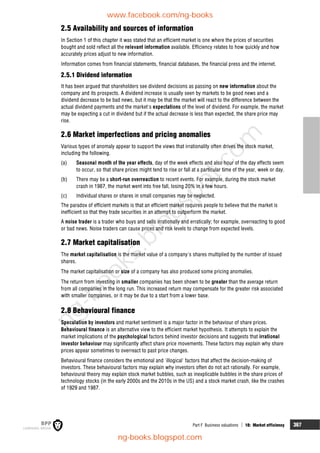

(h) Client satisfaction maximisation (the police generating the support of the public)
6.3 Value for money
Value for money is getting the best possible combination of services from the least resources.
It is reasonable to argue that not for profit organisations best serve society's interests when the gap
between the benefits they provide and the cost of providing those benefits is greatest. This is commonly
termed value for money and is not dissimilar from the concept of profit maximisation, apart from the fact
that society's interests are being maximised rather than profit.
Value for money can be defined as getting the best possible combination of services from the least
resources, which means maximising the benefits for the lowest possible cost.
This is usually accepted as requiring the application of economy, effectiveness and efficiency (sometimes
known as the 3Es).
(a) Economy (spending money frugally)
(b) Efficiency (getting out as much as possible for what goes in)
(c) Effectiveness (getting done, by means of (a) and (b), what was supposed to be done)
More formally, these criteria can be defined as follows.
Effectiveness is the extent to which declared objectives/goals are met.
Efficiency is the relationship between inputs and outputs.
Economy is attaining the appropriate quantity and quality of inputs at the lowest cost to achieve a certain
level of outputs.
Key term
FASTFORWARD
Key terms
Key term
www.facebook.com/ng-books
ng-books.blogspot.com
n
g
-
b
o
o
k
s
.
b
l
o
g
s
p
o
t
.
c
o
m
Part A Financial management function  1: Financial management and financial objectives 29
6.4 Example: Economy, efficiency, effectiveness
(a) Economy. This dimension relates to the cost of inputs. Economy within a school could be
measured, for example, by comparing average salaries per teacher with earlier years and budgets.
(b) Efficiency. The efficiency with which a school's IT laboratory is used might be measured in terms
of the proportion of the school week for which it is used.
(c) Effectiveness. The effectiveness of a school's objective to produce quality teaching could be
measured by the proportion of students going on to higher or further education.
6.5 Performance measures
Value for money as a concept assumes that there is a yardstick against which to measure the overall
performance of an organisation. It can be difficult to determine where there is value for money, however.
(a) Not for profit organisations tend to have multiple objectives, so that even if they can all be clearly
identified it is impossible to say which is the overriding objective.
(b) Outputs can seldom be measured in a way that is generally agreed to be meaningful. (Are good
exam results alone an adequate measure of the quality of teaching? How does one quantify the
easing of pain following a successful operation?) For example, in a publicly funded healthcare
system, success may be measured in terms of fewer patient deaths per hospital admission, shorter
waiting lists for operations, average speed of patient recovery, and so on.
Here are a number of possible solutions to these problems.
(a) Performance can be judged in terms of inputs. This is very common in everyday life. If somebody
tells you that their suit cost $750, for example, you would generally conclude that it was an
extremely well-designed and good quality suit, even if you did not think so when you first saw it.
The drawback, of course, is that you might also conclude that the person wearing the suit had been
cheated or was a fool, or you may think that no piece of clothing is worth $750. It is similar with
the inputs and outputs of a non profit seeking organisation.
(b) Accept that performance measurement must to some extent be subjective. Judgements can be
made by experts.
(c) Most not for profit organisations do not face competition but this does not mean that they are all
unique. Bodies like local governments, health services, and so on can compare their performance
against each other and against the historical results of their predecessors. Unit cost
measurements like 'cost per patient day' or 'cost of borrowing one library book' can be established
to allow organisations to assess whether they are doing better or worse than their counterparts.
Care must be taken not to read too much into limited information, however.
6.6 Example: Performance measures
Although output of not for profit organisations is difficult to measure in a way that is generally agreed to
be meaningful, it is not impossible. Outputs of a university might be measured in terms of the following.
Broader performance measures
 Proportion of total undergraduate population attending the university (by subject)
 Proportion of students graduating and classes of degrees obtained
 Amount of private sector research funds attracted
 Number of students finding employment after graduation
 Number of publications/articles produced by teaching staff
Operational performance measures
 Unit costs for each operating 'unit'
 Staff: student ratios; staff workloads
 Class sizes
 Availability of computers; good library stock
 Courses offered
www.facebook.com/ng-books
ng-books.blogspot.com
n
g
-
b
o
o
k
s
.
b
l
o
g
s
p
o
t
.
c
o
m
30 1: Financial management and financial objectives  Part A Financial management function
6.7 Example: Inputs and outputs
Suppose that at a cost of $40,000 and 4,000 hours (inputs) in an average year, two policemen travel
8,000 miles and are instrumental in 200 arrests (outputs). A large number of possibly meaningful
measures can be derived from these few figures, as the table below shows.
$40,000 4,000 hours 8,000 miles 200 arrests
Cost ($) $40,000 $40,000/4,000 =
$10 per hour
$40,000/8,000 =
$5 per mile
$40,000/200 =
$200 per arrest
Time (hours) 4,000 4,000/$40,000 =
6 minutes
patrolling per $1
spent
4,000/8,000 = ½
hour to patrol 1
mile
4,000/200 = 20
hours per arrest
Miles 8,000 8,000/$40,000 =
0.2 of a mile per
$1
8,000/4,000 = 2
miles patrolled
per hour
8,000/200 = 40
miles per arrest
Arrests 200 200/$40,000 = 1
arrest per $200
200/4,000 = 1
arrest every 20
hours
200/8,000 = 1
arrest every 40
miles
These measures do not necessarily identify cause and effect or personal responsibility and accountability.
Actual performance needs to be compared:
 With standards, if there are any
 With similar external activities
 With similar internal activities
 With targets
 With indices
 Over time – as trends
www.facebook.com/ng-books
ng-books.blogspot.com
n
g
-
b
o
o
k
s
.
b
l
o
g
s
p
o
t
.
c
o
m
Part A Financial management function  1: Financial management and financial objectives 31
Chapter Roundup
 Financial management decisions cover investment decisions, financing decisions, dividend decisions and
risk management.
 Strategy is a course of action to achieve an objective. There are three main levels of strategy in an
organisation.
– Corporate: the general direction of the whole organisation
– Business: how the organisation or its business units tackle particular markets
– Operational/functional: specific strategies for different departments of the business
 Corporate objectives are relevant for the organisation as a whole, relating to key factors for business
success.
 Financial targets may include targets for: earnings; earnings per share; dividend per share; gearing
level; profit retention; operating profitability.
The usual assumption in financial management for the private sector is that the primary financial objective
of the company is to maximise shareholders' wealth.
 Stakeholders are individuals or groups who are affected by the activities of the firm. They can be
classified as internal (employees and managers), connected (shareholders, customers and suppliers) and
external (local communities, pressure groups, government).
 Performance measurement is a part of the system of financial control of an enterprise as well as being
important to investors.
 Indicators such as dividend yield, EPS, P/E ratio and dividend cover can be used to assess investor
returns.
 It is argued that management will only make optimal decisions if they are monitored and appropriate
incentives are given.
 The achievement of stakeholder objectives can be enforced using regulatory requirements such as
corporate governance codes of best practice and stock exchange listing regulations.
 Good corporate governance involves ensuring the effectiveness of risk management and internal control,
accountability to shareholders and other stakeholders, and conducting business in an ethical and
effective way.
 A stock exchange employs rules and regulations to ensure that the stock market operates fairly and
efficiently for all parties involved.
 Not for profit and public sector organisations have their own objectives, generally concerned with
achieving specified objectives effectively and efficiently.
 Value for money is getting the best possible combination of services from the least resources.
www.facebook.com/ng-books
ng-books.blogspot.com
n
g
-
b
o
o
k
s
.
b
l
o
g
s
p
o
t
.
c
o
m
32 1: Financial management and financial objectives  Part A Financial management function
Quick Quiz
1 Give a definition of financial management.
2 What three broad types of decision does financial management involve?
3 What main financial objective does the theory of company finance assume that a business organisation
has?
4 If earnings per share fall from one year to the next, so will the level of dividends.
True
False
5 Tick which are stakeholder groups for a company.
Employees
Ordinary shareholders
The Board of Directors
Trade payables (suppliers)
6 Return on capital employed =
?
?
7 Which of the following are examples of financial objectives that a company might choose to pursue?
A Provision of good wages and salaries
B Restricting the level of gearing to below a specified target level
C Dealing honestly and fairly with customers on all occasions
D Producing environmentally friendly products
8 Fill in the blank.
........................................ is accordance between the objectives of agents acting within an organisation.
9 What are the 'Three Es' of value for money?
E ........................................
10 In the context of managing performance in not for profit organisations, which of the following definitions
is incorrect?
A Value for money means providing a service in a way which is economical, efficient and effective.
B Economy means doing things cheaply: not spending $2 when the same thing can be bought for $1.
C Efficiency means doing things quickly: minimising the amount of time that is spent on a given
activity.
D Effectiveness means doing the right things: spending funds so as to achieve the organisation's
objectives.
www.facebook.com/ng-books
ng-books.blogspot.com
n
g
-
b
o
o
k
s
.
b
l
o
g
s
p
o
t
.
c
o
m
Part A Financial management function  1: Financial management and financial objectives 33
Answers to Quick Quiz
1 The management of the finances of an organisation in order to achieve the financial objectives of the
organisation
2 Investment decisions, financing decisions, dividend decisions
3 To maximise the wealth of the company's ordinary shareholders
4 False. Dividends may still be maintained from payments out of profits retained in earlier periods.
5 You should have ticked all four boxes.
6
Profit beforeinterest and tax
Capitalemployed
7 B This is a financial objective that relates to the level of risk that the company accepts.
8 Goal congruence
9 Efficiency. Economy. Effectiveness
10 C Efficiency means doing things well: getting the best use out of what money is spent on.
Now try the questions below from the Practice Question Bank
Number Level Marks Approximate time
Section A Q1 Examination 2 4 mins
Section A Q2 Examination 2 4 mins
Section A Q3 Examination 2 4 mins
www.facebook.com/ng-books
ng-books.blogspot.com
n
g
-
b
o
o
k
s
.
b
l
o
g
s
p
o
t
.
c
o
m
34 1: Financial management and financial objectives  Part A Financial management function
www.facebook.com/ng-books
ng-books.blogspot.com
n
g
-
b
o
o
k
s
.
b
l
o
g
s
p
o
t
.
c
o
m
35
Financial management
environment
P
A
R
T
B
www.facebook.com/ng-books
ng-books.blogspot.com
n
g
-
b
o
o
k
s
.
b
l
o
g
s
p
o
t
.
c
o
m
36
www.facebook.com/ng-books
ng-books.blogspot.com
n
g
-
b
o
o
k
s
.
b
l
o
g
s
p
o
t
.
c
o
m
37
The economic
environment
for business
Introduction
A business will strive to achieve its objectives, but it has to do so in an
economy which the Government will try to steer to achieve its own objectives.
In this chapter we're moving away from the microeconomics of the individual
business to the macroeconomics of the economy as a whole. The business
(and you as an individual) will need to understand how government policies
can impact on different aspects of the economy, and the implications for the
business's own activities and future plans.
The main macroeconomic policy tools we will look at are fiscal, monetary,
interest rate, and exchange rate policy. We will also look at the impact that
specific government policies have on businesses.
Topic list Syllabus reference
1 Outline of macroeconomic policy B1 (a)
2 Fiscal policy B1 (b), (c)
3 Monetary policy B1 (b), (c)
4 Exchange rates B1 (b), (c)
5 Competition policy B1 (d)
6 Government assistance for business B1 (d)
7 Green policies B1 (d)
8 Corporate governance regulation B1 (d)
www.facebook.com/ng-books
ng-books.blogspot.com
n
g
-
b
o
o
k
s
.
b
l
o
g
s
p
o
t
.
c
o
m
38 2: The economic environment for business  Part B Financial management environment
Study guide
Intellectual level
B1 The economic environment for business
(a) Identify and explain the main macroeconomic policy targets. 1
(b) Define and discuss the role of fiscal, monetary, interest rate and exchange
rate policies in achieving macroeconomic policy targets.
1
(c) Explain how government economic policy interacts with planning and
decision-making in business.
2
(d) Explain the need for, and the interaction with, planning and decision-making
in business of:
1
(i) Competition policy 2
(ii) Government assistance for business 2
(iii) Green policies 2
(iv) Corporate governance regulation 2
Exam guide
The emphasis in the exam will be on discussing how economic conditions or policies affect particular
businesses, for example the impact of a change in interest rates.
1 Outline of macroeconomic policy
Macroeconomic policy involves:
 Policy objectives – the ultimate aims of economic policy
 Policy targets – quantified levels or ranges which policy is intended to achieve
 Policy instruments – the tools used to achieve objectives
Achievement of economic growth, low inflation, full employment and balance of payments stability are
policy objectives.
Policy targets might be set for economic growth or the rate of inflation, for example.
1.1 Microeconomics, macroeconomics and economic policy
Microeconomics is concerned with the economic behaviour of individual firms and consumers or
households. Macroeconomics is concerned with the economy at large, and with the behaviour of large
aggregates such as the national income, the money supply and the level of employment.
A government is concerned with how the economy is behaving as a whole, and therefore with
macroeconomic variables.
Macroeconomic policy can affect planning and decision-making in various ways, for example via interest
rate changes, which affect borrowing costs and required rates of return.
Note also that a government might adopt policies which try to exert influence at the microeconomic level.
Examples include policies to restrict the maximum hours an individual can work or the imposition of a
minimum wage.
Key terms
FASTFORWARD
www.facebook.com/ng-books
ng-books.blogspot.com
n
g
-
b
o
o
k
s
.
b
l
o
g
s
p
o
t
.
c
o
m
Part B Financial management environment  2: The economic environment for business 39
1.2 Economic policies and objectives
The policies pursued by a government may serve various objectives.
Economic
growth
Control inflation
Full
employment
Balance of
payments stability
AIMS
(a) Economic growth
'Growth' implies an increase in national income in 'real' terms (increases caused by price inflation
are not real increases at all). It is usually interpreted as a rising standard of living.
(b) Control price inflation
This means managing price inflation to a low, stable level. Inflation is viewed as a problem
because, if a country has a higher rate of inflation than its major trading partners, its exports will
become relatively expensive. It leads to a redistribution of income and wealth in ways which may
be undesirable. In times of high inflation, substantial labour time is spent on planning and
implementing price changes.
(c) Full employment
Full employment does not mean that everyone who wants a job has one all the time, but it does
mean that unemployment levels are low, and involuntary unemployment is short term.
(d) Balance of payments stability
The wealth of a country relative to others, a country's creditworthiness as a borrower, and the
goodwill between countries in international relations might all depend on the achievement of an
external trade balance over time. Deficits in external trade, with imports exceeding exports, might
also be damaging for the prospects of economic growth.
Monetary Fiscal
Exchange rate
External trade
POLICIES
www.facebook.com/ng-books
ng-books.blogspot.com
n
g
-
b
o
o
k
s
.
b
l
o
g
s
p
o
t
.
c
o
m
40 2: The economic environment for business  Part B Financial management environment
To try to achieve its objectives, a government will use a number of different policy tools or policy
instruments. These include the following.
(a) Monetary policy
Monetary policy aims to influence monetary variables such as the rate of interest and the money
supply in order to achieve targets set for employment, inflation, economic growth and the balance
of payments.
(b) Fiscal policy
Fiscal policy involves using government spending and taxation in order to influence aggregate
demand in the economy.
(c) Exchange rate policy
Some economists argue that economic objectives can be achieved through management of the
exchange rate by the Government. The strength or weakness of sterling's value, for example, will
influence the volume of UK imports and exports, the balance of payments and interest rates.
(d) External trade policy
A government might have a policy for promoting economic growth by stimulating exports; for
example, by managing the exchange rate to make exports cheaper for foreign purchasers. Another
argument is that there should be import controls to provide some form of protection for domestic
manufacturing industries by making the cost of imports higher and the volume of imports lower.
Protection could encourage domestic output to rise, stimulating the domestic economy.
These policy tools are not mutually exclusive and a government might adopt a policy mix of monetary
policy, fiscal policy and exchange rate policy and external trade policy in an attempt to achieve its
intermediate and ultimate economic objectives.
1.3 Conflicts in policy objectives and instruments
Macroeconomic policy aims cannot necessarily all be sustained together for a long period of time;
attempts to achieve one objective will often have adverse effects on others, sooner or later.
(a) There may be a conflict between steady balanced growth in the economy and full employment.
Although a growing economy should be able to provide more jobs, there is some concern that
since an economy must be modernised to grow and modern technology is labour saving, it might
be possible to achieve growth without creating many more jobs, and so keeping unemployment at
a high level.
(b) In the UK, problems with creating more employment and steady growth in the economy have
been a lack of domestic and global demand following the global financial crisis, the balance of
payments, the foreign exchange value of sterling, inflation and the money supply. The objectives of
lower unemployment and economic growth have been difficult to achieve because of the problems
and conflicts with secondary objectives.
(i) To create jobs and growth, there must be an increase in aggregate demand. When demand
picks up there will be a surge in imports, with foreign goods bought by UK manufacturers
(eg raw materials) and consumers.
(ii) For example, in the UK, the high rate of imports creates a deficit in the balance of
payments, which in turn will weaken sterling and raise the cost of imports, thus giving
some impetus to price rises.
(iii) To maintain the value of a country's currency, interest rates might need to be kept high,
and high interest rates appear to deter companies from investing.
In practice, achieving the best mix of economic policies also involves a number of problems, such as the
following.
 Inadequate information
 Time lags between use of policy and effects being noticeable
 Political pressure for short-term solutions
www.facebook.com/ng-books
ng-books.blogspot.com
n
g
-
b
o
o
k
s
.
b
l
o
g
s
p
o
t
.
c
o
m
Part B Financial management environment  2: The economic environment for business 41
 Unpredictable side effects of policies
 The influence of other countries
 Conflict between policy instruments
2 Fiscal policy
Fiscal policy seeks to influence the economy by managing the amounts which the Government spends
and the amounts it collects through taxation. Fiscal policy can be used as an instrument of demand
management.
2.1 Fiscal policy and demand management
Fiscal policy is action by the Government to spend money, or to collect money in taxes, with the purpose
of influencing the condition of the national economy.
A government might intervene in the economy by:
(a) Spending more money and financing this expenditure by borrowing
(b) Collecting more in taxes without increasing public spending
(c) Collecting more in taxes in order to increase public spending, thus diverting income from one
part of the economy to another
Government spending is an 'injection' into the economy, adding to total demand for goods and services in
the economy (known as aggregate demand) and therefore national income, whereas taxes are a
'withdrawal' from the economy. Fiscal policy can thus be used as an instrument of demand management
ie deliberate policies to stimulate and control the level of aggregate demand in an economy. Too little
demand creates unemployment, too much creates inflation.
Fiscal policy appears to offer a method of managing aggregate demand in the economy.
(a) If the Government spends more – for example, on public works such as hospitals, roads and
sewers – without raising more money in taxation (ie by borrowing more) it will increase
expenditure in the economy, and so raise demand.
(b) If the Government kept its own spending at the same level but reduced the levels of taxation, it
would also stimulate demand in the economy because firms and households would have more of
their own money after tax for consumption or saving/investing. This is an expansionary policy.
(c) In the same way, a government can reduce demand in the economy by raising taxes or reducing
its expenditure. This is a contractionary policy.
2.2 Fiscal policy and business
Fiscal policy affects business enterprises in both service and manufacturing industries in various ways.
For example:
(a) By influencing the level of aggregate demand (AD) for goods and services in the economy,
macroeconomic policy affects the environment for business. Business planning should take
account of the likely effect of changes in AD for sales growth. For example, a drop in AD might
mean lower demand from customers for a business's products and services. Business planning
will be easier if government policy is relatively stable.
(b) Tax changes brought about by fiscal policy affect businesses. For example, labour costs will be
affected by changes in employment taxes. For example, if indirect taxes such as sales tax or excise
duty rise, either the additional cost will have to be absorbed or the rise will have to be passed on to
consumers in the form of higher prices.
Key term
FASTFORWARD
www.facebook.com/ng-books
ng-books.blogspot.com
n
g
-
b
o
o
k
s
.
b
l
o
g
s
p
o
t
.
c
o
m
42 2: The economic environment for business  Part B Financial management environment
3 Monetary policy
Monetary policy aims to influence monetary variables such as the rate of interest and the money supply in
order to achieve targets set, such as targets for the rate of inflation.
Money is important because:
(a) It 'oils the wheels' of economic activity, providing an easy method for exchanging goods and
services (ie buying and selling).
(b) The total amount of money in a national economy may have a significant influence on economic
activity and inflation.
3.1 The role and aims of monetary policy
Monetary policy is the regulation of the economy through control of the monetary system by operating on
such variables as the money supply, the level of interest rates and the conditions for availability of credit.
The effectiveness of monetary policy will depend on:
(a) Whether the targets of monetary policy are achieved successfully
(b) Whether the success of monetary policy leads on to the successful achievement of the
intermediate target (eg lower inflation)
(c) Whether the successful achievement of the intermediate target (eg lower inflation) leads on to
the successful achievement of the overall objective (eg stronger economic growth)
3.2 Targets of monetary policy
Targets of monetary policy are likely to relate to the volume of national income and expenditure.
 Growth in the size of the money supply
 The level of interest rates
 The volume of credit, or growth in the volume of credit
 The volume of expenditure in the economy (ie national income or gross national product (GNP)
itself)
3.3 The money supply as a target of monetary policy
To monetarist economists, the money supply is a possible intermediate target of economic policy. This is
because they claim that an increase in the money supply will raise prices and money incomes, and this in
turn will raise the demand for money to spend.
3.4 Interest rates as a target for monetary policy
The authorities may decide that interest rates themselves should be a target of monetary policy. This
would be appropriate if it is considered that there is a direct relationship between interest rates and the
level of expenditure in the economy.
It certainly seems logical that interest rates should have a strong influence on economic activity.
However, although empirical evidence suggests there is some connection between interest rates and
investment (by companies) and consumer expenditure, the connection is not a stable and predictable one.
Some economists argue that the key element affecting investment is business confidence rather than the
level of interest rates. Interest rate changes are only likely to affect the level of expenditure after a
considerable time lag.
In 1997 the British Government gave responsibility for setting short-term interest rates to the central bank,
the Bank of England. The Bank sets rates at a level which it considers appropriate, given the inflation rate
target set by the Government. For example, if inflation is forecast to be excessive, increasing interest rates
Key term
FASTFORWARD
www.facebook.com/ng-books
ng-books.blogspot.com
n
g
-
b
o
o
k
s
.
b
l
o
g
s
p
o
t
.
c
o
m
Part B Financial management environment  2: The economic environment for business 43
should increase saving, reduce borrowing and reduce investment, thus reducing aggregate demand in the
economy. With lower aggregate demand, there is less pressure for suppliers to increase prices as they
struggle to hit sales targets, so inflationary pressure is reduced. The purpose of having the central bank
setting interest rates is to remove the risk of political influence over the decisions. In the European
Monetary Union (where the euro is the common currency), the interest rates that prevail are effectively set
at the European level.
3.5 Interest rate policy and business 12/08
Interest rate changes brought about by government policy affect the borrowing costs of business.
Increases in interest rates will mean that fewer investments show positive returns, deterring companies
from borrowing to finance expansion. Increases in interest rates will also exert a downward pressure on
share prices, making it more difficult for companies to raise monies from new share issues. Businesses
will also be squeezed by decreases in consumer demand that result from increases in interest rates.
Question Interest rate levels
Outline the effects on the economy of a policy of high interest rates to dampen demand and inflation.
Answer
An increase in interest rates is thought to reduce the money supply through demand for credit in the
economy, thereby reducing the level of effective demand. This will, in turn, decrease inflation and improve
the balance of payments (the latter by lowering the price of exports, increasing demand for them and
simultaneously increasing the relative price of imports, reducing demand for them, and freeing more
domestic output for sale abroad). Aggregate expenditure in the economy will decrease for various
reasons.
(a) A higher interest rate encourages savings at the expense of consumer expenditure.
(b) Higher interest rates will increase mortgage payments and will thus reduce the amount of
disposable income in the hands of home buyers for discretionary spending.
(c) The higher cost of consumer credit will deter borrowing and spending on consumer durables.
(d) Higher prices of goods due to higher borrowing costs for industry will also reduce some
consumer expenditure in the economy.
Investment expenditure may also decline for two reasons.
(a) Higher interest rates deter some investment due to increased borrowing costs.
(b) Higher interest rates may make the corporate sector pessimistic about future business prospects
and the economy. This may further reduce investment in the economy.
To the extent that higher domestic interest rates lead to an appreciation of the exchange rate, this should
reduce inflation by lowering the cost of imported items. Exporters will experience pressure on their costs
as a result of the more competitive price conditions they face, and may be less willing to concede high
wage demands, thus wage inflation may be constrained. The desired outcomes of the authorities' interest
rate policy noted above may be negated by the following effects of higher interest rates.
(a) Higher interest results in greater interest income for savers, who may increase their spending due
to this interest windfall.
(b) Since mortgage payments are generally a significant part of domestic household expenditure, any
increase in them will be reflected immediately in reported inflation. This could lead to higher wage
demands in the economy, and may result in a wage-price spiral.
(c) By encouraging capital inflows, higher interest rates will tend to lead to an appreciation of the
currency's exchange rate. This makes exports more expensive and imports less expensive.
www.facebook.com/ng-books
ng-books.blogspot.com
n
g
-
b
o
o
k
s
.
b
l
o
g
s
p
o
t
.
c
o
m
44 2: The economic environment for business  Part B Financial management environment
(d) A reduction in investment may decrease the pressure of demand in the economy but at the same
time will set in motion a process which in the future could reduce the economy's potential for
production.
(e) To the extent that higher interest rates squeeze demand in the economy, they will reduce
employment, decreasing the proceeds of taxation and increasing government expenditure on the
unemployed.
CaseStudy
US interest rates left unchanged by Federal Reserve
Analysts were divided over whether the Federal Reserve would raise interest rates or keep them as they
have been since December 2008. In fact, they left them unchanged with the aim of keeping them low until
employment levels increase. The inflation target is 2% but this has been kept down by cheaper oil and the
strong dollar. Before interest rates are raised, the Federal Reserve wants to be ‘reasonably confident’ that
inflation will increase.
Source: www.bbc.co.uk 17 September 2015
4 Exchange rates
Exchange rates are determined by supply and demand, even under fixed exchange rate systems.
Governments can intervene to influence the exchange rate by, for example, adjusting interest rates.
Government policies on exchange rates might be fixed or floating exchange rates as two extreme
policies, but 'in-between' schemes have been more common.
An exchange rate is the rate at which one country's currency can be traded in exchange for another
country's currency.
Dealers in foreign exchange make their profit by buying currency at one exchange rate, and selling it at a
different rate. This means that there is a selling rate and a buying rate for a currency.
4.1 Factors influencing the exchange rate for a currency
The exchange rate between two currencies is determined primarily by supply and demand in the foreign
exchange markets. Demand comes from individuals, firms and governments who want to buy a currency
and supply comes from those who want to sell it.
Supply and demand in turn are subject to a number of influences.
 The rate of inflation, compared with the rate of inflation in other countries
 Interest rates, compared with interest rates in other countries
 The balance of payments
 Speculation
 Government policy on intervention to influence the exchange rate
Other factors influence the exchange rate through their relationship with the items identified above.
(a) Total income and expenditure (demand) in the domestic economy determines the demand for
goods. This includes imported goods and demand for goods produced in the country which would
otherwise be exported if demand for them did not exist in the home markets.
Key term
FASTFORWARD
www.facebook.com/ng-books
ng-books.blogspot.com
n
g
-
b
o
o
k
s
.
b
l
o
g
s
p
o
t
.
c
o
m
Part B Financial management environment  2: The economic environment for business 45
(b) Output capacity and the level of employment in the domestic economy might influence the
balance of payments because, if the domestic economy has full employment already, it will be
unable to increase its volume of production for exports.
(c) The growth in the money supply influences interest rates and domestic inflation.
We will look at the cause of exchange rate fluctuations in more detail in Chapter 19.
4.2 Consequences of an exchange rate policy
Reasons for a policy of controlling the exchange rate are as follows.
(a) To rectify a balance of trade deficit, by trying to bring about a fall in the exchange rate
(b) To prevent a balance of trade surplus from getting too large, by trying to bring about a limited rise
in the exchange rate
(c) To stabilise the exchange rate of the currency, as exporters and importers will then face less risk
of exchange rate movements wiping out their profits; a stable currency increases confidence in the
currency and promotes international trade.
4.3 Fixed exchange rates
A government may try to keep the exchange rate at a fixed level against a major currency such as the US
dollar, or may try to keep it within a specified value range. However, if a government cannot control
inflation, the real value of its currency would not remain fixed. If one country's rate of inflation is higher
than others, its export prices will become uncompetitive in overseas markets and the country's trade
deficit will grow (or its trade surplus will diminish). Devaluation of the currency would be necessary for a
recovery. For example, a government may work to move the exchange rate from $2:£1 to $1:£1 so that
exports become less expensive.
If exchange rates are fixed, any changes in (real) interest rates in one country will create pressure for the
movement of capital into or out of the country. Capital movements would put pressure on the country's
exchange rate to change. It follows that if exchange rates are fixed and capital is allowed to move freely between
countries (ie there are no exchange controls) all countries must have consistent policies on interest rates.
4.4 Floating exchange rates
Floating exchange rates are exchange rates which are allowed to fluctuate according to demand and
supply conditions in the foreign exchange markets.
Floating exchange rates are at the opposite end of the spectrum to fixed rates. At this extreme, exchange
rates are completely left to the free play of demand and supply market forces, and there is no official
financing at all. The ruling exchange rate is, therefore, at equilibrium by definition.
In practice, many governments seek to combine the advantages of exchange rate stability with flexibility
and to avoid the disadvantages of both rigidly fixed exchange rates and free floating. Managed (or dirty)
floating refers to a system whereby exchange rates are allowed to float, but from time to time the
authorities will intervene in the foreign exchange market:
 To use their official reserves of foreign currencies to buy their own domestic currency
 To sell their domestic currency to buy more foreign currency for the official reserves
Buying and selling in this way would be intended to influence the exchange rate of the domestic currency.
Governments do not have official reserves large enough to dictate exchange rates to the market, and can
only try to 'influence' market rates with intervention.
Speculation in the capital markets often has a much bigger short-term impact than changes in
fundamental supply and demand.
Key term
www.facebook.com/ng-books
ng-books.blogspot.com
n
g
-
b
o
o
k
s
.
b
l
o
g
s
p
o
t
.
c
o
m
46 2: The economic environment for business  Part B Financial management environment
4.5 European Economic and Monetary Union
There are three main aspects to the European Monetary Union.
(a) A common currency (the euro)
(b) A European Central Bank. The European Central Bank has several roles:
(i) Issuing the common currency
(ii) Conducting monetary policy on behalf of the central government authorities
(iii) Acting as lender of last resort to all European banks
(iv) Managing the exchange rate for the common currency
(c) A centralised monetary policy applies across all the countries in the union. This involves the
surrender of control over aspects of economic policy and therefore surrender of some political
sovereignty by the Government of each member state to the central government body of the union.
4.6 Exchange rates and business
A change in the exchange rate will affect the relative prices of domestic and foreign produced goods and
services.
A lower exchange rate A higher exchange rate
Domestic goods are cheaper in foreign markets so
demand for exports increases.
Domestic goods are more expensive in foreign
markets so demand for exports falls.
Foreign goods are more expensive so demand for
imports falls.
Foreign goods are cheaper so demand for imports
rises.
Imported raw materials are more expensive so
costs of production rise.
Imported raw materials are cheaper so costs of
production fall.
Fluctuating exchange rates create uncertainties for businesses involved in international trade. A service
industry is less likely to be affected because it is less likely to be involved in substantial international trade.
International trading companies can do a number of things to reduce their risk of suffering losses on
foreign exchange transactions, including the following.
(a) Many companies buy currencies 'forward' at a fixed and known price.
(b) Dealing in a 'hard' currency may lessen the risks attached to volatile currencies.
(c) Operations can be managed so that the proportion of sales in one currency are matched by an
equal proportion of purchases in that currency.
(d) Invoicing can be in the domestic currency. This means that the customer bears all the foreign
exchange risk, however, and, in industries where customers have high bargaining power, this may
be an unacceptable arrangement. Furthermore, there is the risk that sales will be adversely affected
by high prices, reducing demand.
(e) Activities can be outsourced to the local market. Many of the Japanese car firms which have
invested in the UK in recent years have made efforts to obtain many of their inputs, subject to
quality limits, from local suppliers. Promotional activities can also be sourced locally.
(f) Firms can aim at segments in the market which are not particularly price sensitive. For example,
many German car marques such as Mercedes have been marketed in the US on the basis of quality
and exclusivity. This is a type of strategy based on differentiation focus.
Foreign currency risk will be covered in more detail in Chapter 19.
www.facebook.com/ng-books
ng-books.blogspot.com
n
g
-
b
o
o
k
s
.
b
l
o
g
s
p
o
t
.
c
o
m
Part B Financial management environment  2: The economic environment for business 47
5 Competition policy
5.1 Regulation and market failure
The Government influences markets in various ways, one of which is through direct regulation (eg the
Competition and Markets Authority in the UK).
Market failure is said to occur when the market mechanism (the interaction of supply and demand to
result in a market clearing price and quantity supplied/demanded) fails to result in economic efficiency,
and therefore the outcome is sub-optimal.
An important role of the Government is the regulation of private markets where these fail to bring about
an efficient use of resources. In response to the existence of market failure, and as an alternative to
taxation and public provision of production, the state often resorts to regulating economic activity in a
variety of ways. Of the various forms of market failure, the following are the cases where regulation of
markets can often be the most appropriate policy response.
(a) Imperfect competition
Where one company's large share or complete domination of the market is leading to inefficiency
or excessive profits, the state may intervene, for example through controls on prices or profits, in
order to try to reduce the effects of this power.
(b) Social costs
A possible means of dealing with the problem of social costs or externalities is via some form of
regulation. Regulations might include, for example, controls on emissions of pollutants, restrictions
on car use in urban areas, the banning of smoking in public buildings, or compulsory car insurance.
(c) Imperfect information
Regulation is often the best form of government action whenever informational inadequacies are
undermining the efficient operation of private markets. This is particularly so when consumer
choice is being distorted.
(d) Equity
The Government may also resort to regulation to improve social justice.
5.2 Types of regulation
Regulation can be defined as any form of state interference with the operation of the free market. This
could involve regulating demand, supply, price, profit, quantity, quality, entry, exit, information,
technology, or any other aspect of production and consumption in the market.
In many markets the participants (especially the firms) may decide to maintain a system of voluntary self-
regulation, possibly in order to try to avert the imposition of government controls. Areas where self-
regulation often exists include the professions (eg the Law Society, the British Medical Association and
other professional bodies).
5.3 Monopolies and mergers
In a pure monopoly, there is only one firm in the market, the sole producer of a good, which has no
closely competing substitutes.
A monopoly situation can have some advantages.
(a) In certain industries arguably only by achieving a monopoly will a company be able to benefit from
the kinds of economies of scale (benefits of conducting operations on a large scale) that can
minimise prices.
(b) Establishing a monopoly may be the best way for a business to maximise its profits.
Key term
Key term
FASTFORWARD
www.facebook.com/ng-books
ng-books.blogspot.com
n
g
-
b
o
o
k
s
.
b
l
o
g
s
p
o
t
.
c
o
m
48 2: The economic environment for business  Part B Financial management environment
However, monopolies often have several adverse consequences.
(a) Companies can impose higher prices on consumers.
(b) The lack of incentive of competition may mean companies have no incentive to improve their
products or offer a wider range of products.
(c) There is no pressure on the company to improve the efficiency of its use of resources.
In practice, government policy is concerned not just with situations where one firm has a 100% market
share but also with other situations where an organisation has a significant market share.
The Competition and Markets Authority can also be asked to investigate what could be called 'oligopoly
situations' involving explicit or implicit collusion between firms, who together control the market.
The investigation is not automatic. Once the case has been referred, the Authority must decide whether or
not the monopoly is acting 'against the public interest'.
In its report, the Competition and Markets Authority will say if a monopoly situation has been found to
exist and, if so, will make recommendations to deal with it. These may involve various measures.
 Price cuts
 Price and profit controls
 Removal of entry barriers
 The breaking up of the firm (rarely)
CaseStudy
The healthcare giant Johnson & Johnson has become the latest foreign company to be accused of
misconduct in China.
A ruling by a Shanghai court ordered the US company to pay $85,000 (£56,000) to a local distributor for
violating anti-monopoly laws.
Two subsidiaries of the company were accused of setting a minimum price for the sale of surgical
instruments.
Multinationals have faced increased scrutiny from the Chinese authorities.
Last month, two foreign milk suppliers announced price cuts after the Government launched an
investigation into possible price fixing.
Source: www.bbc.co.uk 2 August 2013
A prospective merger between two or more companies may be referred to the Competition and Markets
Authority for investigation if a larger company will gain more than 25% market share and where a merger
appears likely to lead to a substantial lessening of competition in one or more markets in the UK.
Again, referral to the Competition and Markets Authority is not automatic and, since the legislation was
first introduced, only a small proportion of all merger proposals have been referred.
If a potential merger is investigated, the Authority again has to determine whether or not the merger would
be against the public interest. As with monopolies, it will assess the relative benefits and costs in order to
arrive at a decision.
Question Competition
Look through newspapers or on the internet for a report on the activities of the Competition and Markets
Authority. Why is the investigation being carried out and how was it initiated?
www.facebook.com/ng-books
ng-books.blogspot.com
n
g
-
b
o
o
k
s
.
b
l
o
g
s
p
o
t
.
c
o
m
Part B Financial management environment  2: The economic environment for business 49
5.4 Restrictive practices
Some countries have legislation which deals with restrictive practices that distort, restrict or prevent
competition. A notable example of a restrictive practice would be agreements with direct competitors
resulting in them colluding to the disadvantage of the consumer (eg price-fixing agreements). The
legislation may also deal with abuse of dominant position offences, such as predatory pricing (charging
low prices to unfairly destroy competition) or refusing to supply so as to restrict competition.
5.5 European Union competition policy
As a member of the European Union (EU), the UK is also now subject to EU competition policy. This is
enshrined in Articles 85 (dealing with restrictive practices) and 86 (concerned with monopoly) of the
Treaty of Rome.
5.6 Deregulation
Deregulation or 'liberalisation' is, in general, the opposite of regulation. Deregulation can be defined as the
removal or weakening of any form of statutory (or voluntary) regulation of free market activity.
Deregulation allows free market forces more scope to determine the outcome.
Deregulation, whose main aim is to introduce more competition into an industry by removing statutory or
other entry barriers, has the following potential benefits.
(a) Improved incentives for internal/cost efficiency
Greater competition compels managers to try harder to keep down costs.
(b) Improved allocative efficiency
Competition keeps down prices closer to marginal cost, and firms therefore produce closer to the
socially optimal output level.
In some industries it could have certain disadvantages, including the following.
(a) Loss of economies of scale
If increased competition means that each firm produces less output on a smaller scale, unit costs
will be higher.
(b) Lower quality or quantity of service
The need to reduce costs may lead firms to reduce quality or eliminate unprofitable but socially
valuable services.
(c) Need to protect competition
It may be necessary to implement a regulatory regime to protect competition where inherent forces
have a tendency to eliminate it, for example if there is a dominant firm already in the industry, as in
the case of British Telecom. In this type of situation, effective 'regulation for competition' will be
required, ie regulatory measures aimed at maintaining competitive pressures, whether existing or
potential.
5.7 Privatisation
Privatisation is a policy of introducing private enterprise into industries which were previously state-
owned or state-operated.
Privatisation takes three broad forms.
(a) The deregulation of industries, to allow private firms to compete against state-owned businesses
where they were not allowed to compete before (for example, deregulation of bus and coach
services; deregulation of postal services)
(b) Contracting out work to private firms, where the work was previously done by government
employees – for example, refuse collection or hospital laundry work
(c) Transferring the ownership of assets from the state to private shareholders
Privatisation can improve efficiency in one of two ways.
FASTFORWARD
www.facebook.com/ng-books
ng-books.blogspot.com
n
g
-
b
o
o
k
s
.
b
l
o
g
s
p
o
t
.
c
o
m
50 2: The economic environment for business  Part B Financial management environment
(a) If the effect of privatisation is to increase competition, the effect might be to reduce or eliminate
allocative inefficiency.
(b) The effect of denationalisation might be to make the industries more cost-conscious, because they
will be directly answerable to shareholders, and under scrutiny from stock market investors.
There are other possible advantages of privatisation.
(a) It provides an immediate source of money for the Government.
(b) It reduces bureaucratic and political meddling in the industries concerned.
(c) It encourages wider share ownership. Denationalisation is one method of creating wider share
ownership, as the sale of BT, British Gas and some other nationalised industries have shown in the
UK.
There are arguments against privatisation too.
(a) State-owned industries are more likely to respond to the public interest, ahead of the profit motive.
For example, state-owned industries are more likely to cross-subsidise unprofitable operations
from profitable ones.
(b) Encouraging private competition to state-run industries might be inadvisable where significant
economies of scale can be achieved by monopoly operations.
(c) There is also an argument that privatised businesses act as monopolists or oligopolists.
In the exam, you may wish to answer questions using your own country's regulations as an example. You
will, however, need to understand how your own country's legislation deals with the issues we have
discussed.
6 Government assistance for business
6.1 Official aid schemes
The freedom of European governments to offer cash grants and other forms of direct assistance to
business is limited by European Union policies designed to prevent the distortion of free market
competition.
A government may provide finance to companies in cash grants and other forms of official direct
assistance, as part of its policy of helping to develop the national economy, especially in high technology
industries and in areas of high unemployment.
Government incentives might be offered on:
(a) A regional basis, giving help to firms that invest in an economically depressed area of the country
(b) A selective national basis, giving help to firms that invest in an industry that the Government
would like to see developing more quickly, for example robotics or fibre optics
In Europe, such assistance is increasingly limited by European Union policies designed to prevent the
distortion of free market competition. The UK Government's powers to grant aid for modernisation and
development are now severely restricted.
7 Green policies
There are a number of policy approaches to pollution, such as polluter pays policies, subsidies and
direct legislation.
The environment is increasingly seen as an important issue facing managers in both the public and private
sectors. The problems of pollution and the environment appear to call for international co-operation
between governments. Pollutants expelled into the atmosphere in the UK are said to cause acid rain to fall
in Scandinavia, for example.
FASTFORWARD
FASTFORWARD
Exam focus
point
www.facebook.com/ng-books
ng-books.blogspot.com
n
g
-
b
o
o
k
s
.
b
l
o
g
s
p
o
t
.
c
o
m
Part B Financial management environment  2: The economic environment for business 51
7.1 Pollution policy
Externalities are positive or negative effects on third parties resulting from production and consumption
activities.
Pollution, for example from exhaust gas emissions or the dumping of waste, is often discussed in relation
to environmental policy. If polluters take little or no account of their actions on others, this generally
results in the output of polluting industries being greater than is optimal.
One solution is to levy a tax on polluters equal to the cost of removing the effect of the externality they
generate: the polluter pays principle. This will encourage firms to cut emissions and provides an incentive
for them to research ways of permanently reducing pollution.
Apart from the imposition of a tax, there are a number of other measures open to the Government in
attempting to reduce pollution. One of the main measures available is the application of subsidies which
may be used either to persuade polluters to reduce output and hence pollution, or to assist with
expenditure on production processes, such as new machinery and air cleaning equipment, which reduce
levels of pollution.
7.2 Legislation
An alternative approach used in the UK is to impose legislation laying down regulations governing waste
disposal and atmospheric emissions. Waste may only be disposed of with prior consent and if none is
given, or it is exceeded, the polluter is fined. There may also be attempts with this type of approach to
specify standards of, for example, air and water quality with appropriate penalties for not conforming to
the required standards.
CaseStudy
The European Council's Directive (implemented in 1999 and amended in 2008) states:
'Member States must ensure that existing landfill sites may not continue to operate unless they comply
with the provisions of the Directive as soon as possible. Member States must report to the Commission
every three years on the implementation of the Directive. On the basis of these reports, the Commission
must publish a Community report on the implementation of the Directive.'
This led to the Landfill (England & Wales) Regulations 2002 being brought into force in the UK. This, in
turn, was implemented through the Government's Waste Strategy.
 Landfill Regulations require a reduction in the quantity of biodegradable and recyclable household
waste being disposed of via landfill.
 Local councils are required to increase recycling and composting of household waste to meet
rising targets over a number of years. How they achieve this is their responsibility.
 Recycling/composting EU target for 2020 is 50%
7.3 Advantages of 'environmentally friendly policies' for a business
There may be various reasons why a business may gain from adopting a policy of strict compliance with
environmental regulations, or of going further and taking voluntary initiatives to protect aspects of the
environment.
(a) If potential customers perceive the business to be environmentally friendly, some may be more
inclined to buy its products.
(b) A corporate image which embraces environmentally friendly policies may enhance relationships
with the public in general or with local communities.
Key term
www.facebook.com/ng-books
ng-books.blogspot.com
n
g
-
b
o
o
k
s
.
b
l
o
g
s
p
o
t
.
c
o
m
52 2: The economic environment for business  Part B Financial management environment
(c) People may prefer to work for an environmentally friendly business.
(d) 'Ethical' investment funds may be more likely to buy the firm's shares.
The case study below highlights the dangers for a company of not displaying environmentally friendly
policies.
CaseStudy
In September 2015, the world’s largest car maker, Volkswagen, made headlines when it was discovered
that it had deceived US regulators in exhaust emissions tests. Devices were installed in test vehicles which
gave better emissions results than would be achieved when the vehicles were actually used on the road.
Volkswagen set aside €6.5bn to cover the costs of the scandal and the CEO resigned.
Source: www.bbc.co.uk 23 September 2015
8 Corporate governance regulation
Corporate governance impacts on the way companies make decisions, their financial organisation and
their relations with investors and auditors.
In Chapter 1, Section 5.2.1, we looked at how corporate governance is used to enforce the achievement of
stakeholder objectives. Corporate governance has emerged as a major issue in the last 20 years in the
light of several high profile collapses. Guidance has been given because of the lack of confidence
perceived in financial reporting and in the ability of auditors to provide the assurances required by the
users of financial accounts.
8.1 Impact of corporate governance requirements on businesses
The consequences of failure to obey corporate governance regulations should be considered along with
failure to obey any other sort of legislation.
Businesses that fail to comply with the law run the risk of financial penalties and the financial
consequences of accompanying bad publicity.
In regimes where corporate governance principles are guidelines rather than regulations, businesses will
consider what the consequences might be of non-compliance, in particular the impact on share prices.
Obedience to requirements or guidelines can also have consequences for businesses. Compliance may
involve extra costs, including extra procedures and investment necessary to conform; for example, the
creation of sufficiently independent board committees relating to remuneration, nomination and audit.
FASTFORWARD
www.facebook.com/ng-books
ng-books.blogspot.com
n
g
-
b
o
o
k
s
.
b
l
o
g
s
p
o
t
.
c
o
m
Part B Financial management environment  2: The economic environment for business 53
Chapter Roundup
 Macroeconomic policy involves:
– Policy objectives – the ultimate aims of economic policy
– Policy targets – quantified levels or ranges which policy is intended to achieve
– Policy instruments – the tools used to achieve objectives
Achievement of economic growth, low inflation, full employment and balance of payments stability are
policy objectives.
Policy targets might be set for economic growth or the rate of inflation, for example.
 Fiscal policy seeks to influence the economy by managing the amounts which the Government spends
and the amounts it collects through taxation. Fiscal policy can be used as an instrument of demand
management.
 Monetary policy aims to influence monetary variables such as the rate of interest and the money supply in
order to achieve targets set, such as targets for the rate of inflation.
 Exchange rates are determined by supply and demand, even under fixed exchange rate systems.
Governments can intervene to influence the exchange rate by, for example, adjusting interest rates.
Government policies on exchange rates might be fixed or floating exchange rates as two extreme
policies, but 'in-between' schemes have been more common.
 The Government influences markets in various ways, one of which is through direct regulation (eg the
Competition and Markets Authority in the UK).
 Privatisation is a policy of introducing private enterprise into industries which were previously state-
owned or state-operated.
 The freedom of European governments to offer cash grants and other forms of direct assistance to
business is limited by European Union policies designed to prevent the distortion of free market
competition.
 There are a number of policy approaches to pollution, such as polluter pays policies, subsidies and
direct legislation.
 Corporate governance impacts on the way companies make decisions, their financial organisation and
their relations with investors and auditors.
www.facebook.com/ng-books
ng-books.blogspot.com
n
g
-
b
o
o
k
s
.
b
l
o
g
s
p
o
t
.
c
o
m
54 2: The economic environment for business  Part B Financial management environment
Quick Quiz
1 What are likely to be the main aims of a government's economy policy?
2 What is the difference between fiscal policy and monetary policy?
3 What effect does a high interest rate have on the exchange rate?
4 Name five factors that can influence the level of exchange rates.
5 Give four reasons for government intervention in markets.
6 What is the situation called when there is only one firm, the sole producer of a good, which has no closely
competing substitutes?
A Duopoly
B Oligopoly
C Monopoly
D Totopoly
7 Fill in the blank.
........................................ are positive or negative effects on third parties resulting from production and
consumption activities.
8 Fill in the blank.
Corporate governance is ...............................................................................................................................
www.facebook.com/ng-books
ng-books.blogspot.com
n
g
-
b
o
o
k
s
.
b
l
o
g
s
p
o
t
.
c
o
m
Part B Financial management environment  2: The economic environment for business 55
Answers to Quick Quiz
1 Main objectives include:
(a) Economic growth
(b) Control of price inflation
(c) Full employment
(d) Balance between imports and exports
2 A government's fiscal policy is concerned with taxation, borrowing and spending and their effects on the
economy. Monetary policy is concerned with money and interest rates.
3 It attracts foreign investment, thus increasing the demand for the currency. The exchange rate rises as a
result.
4 (a) Comparative inflation rates
(b) Comparative interest rates
(c) Balance of payments
(d) Speculation
(e) Government policy
5 (a) Imperfect competition
(b) Social costs/externalities
(c) Imperfect information
(d) Equity
6 C Monopoly
7 Externalities
8 The system by which companies are directed and controlled
Now try the question below from the Practice Question Bank
Number Level Marks Approximate time
Section A Q4 Examination 2 4 mins
Section A Q5 Examination 2 4 mins
Section A Q6 Examination 2 4 mins
www.facebook.com/ng-books
ng-books.blogspot.com
n
g
-
b
o
o
k
s
.
b
l
o
g
s
p
o
t
.
c
o
m
56 2: The economic environment for business  Part B Financial management environment
www.facebook.com/ng-books
ng-books.blogspot.com
n
g
-
b
o
o
k
s
.
b
l
o
g
s
p
o
t
.
c
o
m
57
Financial markets,
money markets and
institutions
Introduction
Having discussed the scope of financial management and the objectives of
firms and other organisations in Chapter 1, we now introduce the framework of
markets and institutions through which the financing of a business takes
place.
Topic list Syllabus reference
1 Financial intermediaries B2 (b)
2 Financial markets B2 (a), B3 (a), (b)
3 International money and capital markets B2 (a), (c)
4 Rates of interest and rates of return B2 (d)
5 Money market instruments B3 (c)
www.facebook.com/ng-books
ng-books.blogspot.com
n
g
-
b
o
o
k
s
.
b
l
o
g
s
p
o
t
.
c
o
m
58 3: Financial markets, money markets and institutions  Part B Financial management environment
Study guide
Intellectual level
B2 The nature and role of financial markets and institutions
(a) Identify the nature and role of money and capital markets, both nationally
and internationally.
2
(b) Explain the role of financial intermediaries. 1
(c) Explain the functions of a stock market and a corporate bond market. 2
(d) Explain the nature and features of different securities in relation to the
risk/return tradeoff.
2
B3 The nature and role of money markets
(a) Describe the role of the money markets in: 1
(i) Providing short-term liquidity to the private sector and the public sector
(ii) Providing short-term trade finance
(b) Explain the role of banks and other financial institutions in the operation of
the money markets.
2
(c) Explain the characteristics and role of the principal money-market
instruments:
2
(i) Interest-bearing instruments
(ii) Discount instruments
(iii) Derivative products
Exam guide
You are unlikely to be asked a whole longer question on financial markets and institutions. You might,
however, be asked a part question or Section A multiple choice question that relates to the circumstances
of a particular company, for instance how they could raise funds using a stock market.
1 Financial intermediaries
1.1 The role of a financial intermediary
A financial intermediary links those with surplus funds (eg lenders) to those with fund deficits (eg
potential borrowers) thus providing aggregation and economies of scale, risk pooling and maturity
transformation.
A financial intermediary is an institution bringing together providers and users of finance, either as
broker or as principal.
A financial intermediary links lenders with borrowers, by obtaining deposits from lenders and then re-
lending them to borrowers.
Key term
FASTFORWARD
www.facebook.com/ng-books
ng-books.blogspot.com
n
g
-
b
o
o
k
s
.
b
l
o
g
s
p
o
t
.
c
o
m
Part B Financial management environment  3: Financial markets, money markets and institutions 59
Not all intermediation takes place between savers and investors. Some institutions act mainly as
intermediaries between other institutions. Financial intermediaries may also lend abroad or borrow from
abroad.
Bear in mind that financial markets and institutions are topic areas on which the ACCA examination team
is not expected to set full questions. These topics could, however, be examined in subsections of a
question.
1.1.1 Examples of financial intermediaries
 Commercial banks
 Finance houses
 Mutual societies
 Institutional investors eg pension funds and investment funds
1.2 The benefits of financial intermediation
Financial intermediaries perform the following functions.
(a) They provide obvious and convenient ways in which a lender can save money. Instead of having to
find a suitable borrower for their money, the lender can deposit their money with a financial
intermediary. All the lender has to do is decide for how long they might want to lend the money,
and what sort of return they require, and they can then choose a financial intermediary that offers a
financial instrument to suit their requirements.
(b) Financial intermediaries also provide a ready source of funds for borrowers. Even when money is
in short supply, a borrower will usually find a financial intermediary prepared to lend some.
(c) They can aggregate smaller savings deposited by savers and lend on to borrowers in larger
amounts.
(d) Risk for individual lenders is reduced by pooling. Since financial intermediaries lend to a large
number of individuals and organisations, any losses suffered through default by borrowers or
capital losses are effectively pooled and borne as costs by the intermediary. Such losses are
shared among lenders in general.
(e) By pooling the funds of large numbers of people, some financial institutions are able to give
investors access to diversified portfolios covering a varied range of different securities, such as
unit trusts and investment trusts.
(f) Financial intermediaries, most importantly, provide maturity transformation, ie borrowing money
on shorter timeframes than they lend out. They bridge the gap between the wish of most lenders
for liquidity and the desire of most borrowers for loans over longer periods.
Exam focus
point
www.facebook.com/ng-books
ng-books.blogspot.com
n
g
-
b
o
o
k
s
.
b
l
o
g
s
p
o
t
.
c
o
m
60 3: Financial markets, money markets and institutions  Part B Financial management environment
2 Financial markets
2.1 Financial markets
Financial markets are the markets where individuals and organisations with surplus funds lend funds to
other individuals and organisations that want to borrow.
This function is shown diagrammatically below.
Lender-savers Borrower-spenders
Those who have saved and are lending funds, the 'lender savers', are on the left, and those who must
borrow funds to finance their spending, the 'borrower spenders', are on the right. The principal lender-
savers are households, as well as overseas institutions and their governments, who sometimes also find
themselves with excess funds and so lend them out. The most important borrower-spenders are
corporations and governments, although individuals also borrow to finance the acquisition of durable
goods or houses. The arrows show that funds flow from lender-savers to borrower-spenders via two
routes.
The first route is the direct finance route at the bottom of the diagram, when borrowers borrow funds
directly from lenders in financial markets by selling them securities (also called financial instruments),
which are claims on the borrowers' future income or assets.
Securities are assets for the buyer but liabilities for the seller. For example, if British Airways needs to
borrow funds to pay for a new aircraft, it might borrow the funds from a saver by selling the saver a bond,
a debt security that promises to make payments periodically for a specified period of time.
The channelling of funds from savers to spenders is a crucial function for the economy because the
people who save are frequently not the same people who have profitable investment opportunities
available to them, ie the entrepreneurs. Without financial markets, it is hard to transfer funds from a
person with surplus funds and no investment opportunities to one who has investment opportunities but
no funds. They would be unable to transact and both would be worse off as a result. Financial markets are
thus essential to promoting economic efficiency.
Financial markets can be classified in several ways. We will look at the main classifications below in turn.
 Capital and money markets
 Primary and secondary markets
 Exchange-traded and over the counter markets
2.2 Capital markets and money markets
Capital markets are markets for medium-term and long-term capital.
Money markets are markets for short-term capital.
FASTFORWARD
FASTFORWARD
www.facebook.com/ng-books
ng-books.blogspot.com
n
g
-
b
o
o
k
s
.
b
l
o
g
s
p
o
t
.
c
o
m
Part B Financial management environment  3: Financial markets, money markets and institutions 61
Differences in maturity between short term, medium term and long term
Year 0 Year 1 Year 5 Year 10
term
Long term
Medium term
Short term
'Maturity' means the time when the financial instrument reaches its settlement date. Money market
instruments and loans have a maturity of up to one year.
2.2.1 The money markets
Money markets are markets for:
 Trading short-term financial instruments
 Short-term lending and borrowing
The money markets are operated by the banks and other financial institutions. Although the money
markets largely involve borrowing and lending by banks, some large companies, as well as the
Government, are involved in money market operations.
The primary market is known as the official market, the other markets as the parallel or wholesale
markets.
Types of market
Primary market Capital market where new securities are issued and sold to investors
Interbank market Banks lend short-term funds to each other
Eurocurrency market Banks lend and borrow in foreign currencies
Certificate of deposit
market
Market for trading in Certificates of Deposit (negotiable instruments
acknowledging deposits)
Local authority market Local authorities borrow short-term funds by issuing and selling short-term
debt instruments
Finance house market Dealing in short-term loans raised from money markets by finance houses
Inter-company market Direct short-term lending between treasury departments of large companies
Commercial paper (short-term unsecured borrowing by businesses with high
credit ratings) and bills
We will introduce the principal money market instruments in Section 5 below. The sources of short-term
finance will be discussed in more detail in Chapter 12.
2.2.2 The capital markets
A stock market (in the UK: the main market plus the Alternative Investment Market (AIM)) acts as a
primary market for raising finance, and as a secondary market for the trading of existing securities.
Securities are tradable financial instruments. They can take the form of equity (such as shares), debt
(such as bonds and loan notes) or derivatives.
Capital markets are markets for trading in long-term finance, in the form of long-term financial
instruments such as equities and corporate bonds.
In the UK, the principal capital markets are:
(a) The Stock Exchange 'main market' (for companies with a full stock market listing)

(b) The more loosely regulated 'second tier' Alternative Investment Market (AIM)
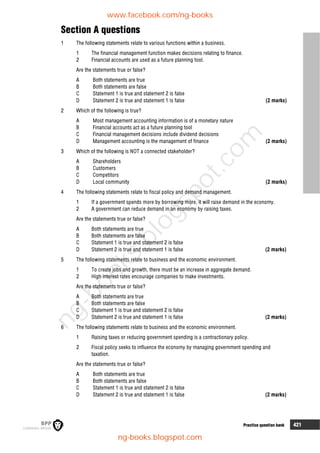
Firms obtain long-term or medium-term capital in one of the following ways.
FASTFORWARD
www.facebook.com/ng-books
ng-books.blogspot.com
n
g
-
b
o
o
k
s
.
b
l
o
g
s
p
o
t
.
c
o
m
62 3: Financial markets, money markets and institutions  Part B Financial management environment
(a) They may raise share capital. Most new issues of share capital are in the form of ordinary share
capital. Firms that issue ordinary share capital are inviting investors to take an equity stake in the
business, or to increase their existing equity stake.
(b) They may raise debt capital. Long-term debt capital might be raised in the form of loan notes,
corporate bonds, loan notes or convertible bonds.
We will look at sources of long-term finance in more detail in Chapter 12.
2.3 Primary and secondary markets
Primary markets enable organisations to raise new finance. Secondary markets enable investors to buy
and sell existing investments to each other.
The financial markets serve two main purposes.
(a) As primary markets they enable organisations to raise new finance, by issuing new shares or new
bonds. In the UK, a company must have public company status (be a publicly listed company, or
'plc') to be allowed to raise finance from the public on a capital market.
(b) As secondary markets they enable existing investors to buy and sell existing investments, should
they wish to do so. The marketability of securities is a very important feature of the capital markets,
because investors are more willing to buy stocks and shares if they know that they could sell them
easily, should they wish to.
Here are two examples of how primary and secondary markets work.
Primary markets: When one company wants to take over another, it is common to do so by issuing
shares to finance the takeover. Takeovers by means of a share exchange are only feasible if the shares that
are offered can be readily traded on a stock market, and so have an identifiable market value.
Secondary markets: When a company comes to the stock market for the first time, and 'floats' its shares
on the market, the owners of the company can realise some of the value of their shares in cash, because
they will offer a proportion of their personally held shares for sale to new investors.
2.4 Exchange-traded instruments and over the counter markets
Secondary markets may be organised on exchanges or may consist of over the counter (OTC)
transactions.
Secondary markets for financial securities can be organised on exchanges, where buyers and sellers of
securities buy and sell securities in one location, the exchange. Examples of exchanges include the
London Stock Exchange and the New York Stock Exchange for the trading of shares, the Chicago Board of
Trade for the trading of commodities and derivatives, and the London International Financial Futures and
Options Exchange (LIFFE) for the trading of derivatives.
Alternatively, secondary markets can operate as over the counter (OTC) markets, where transactions do
not involve buying and selling through an exchange, but customers negotiate individual transactions,
usually with a financial intermediary such as a bank.
Securities that are issued in an over the counter market can be negotiable or non-negotiable.
 Negotiable securities can be resold.
 Non-negotiable securities cannot be resold.
2.5 Institutional investors
Institutional investors are institutions which have large amounts of funds which they want to invest, and
they will invest in stocks and shares or any other assets which offer satisfactory returns and security or
lend money to companies directly. The institutional investors are the biggest investors in the stock
markets.
FASTFORWARD
FASTFORWARD
www.facebook.com/ng-books
ng-books.blogspot.com
n
g
-
b
o
o
k
s
.
b
l
o
g
s
p
o
t
.
c
o
m
Part B Financial management environment  3: Financial markets, money markets and institutions 63
The major institutional investors in the UK are pension funds, insurance companies, investment trusts,
unit trusts and venture capital organisations. Of these, pension funds and insurance companies have the
largest amounts of funds to invest.
2.6 Capital market participants
The various participants in the capital markets are summarised in the diagram below.
2.7 Securitisation
Securitisation is the process of converting illiquid assets into marketable asset-backed securities. The
development of securitisation has led to disintermediation and a reduction in the day to day role of
financial intermediaries, as borrowers can reach lenders directly after securitisation.
Securitisation is the process of converting illiquid assets into marketable securities. These securities are
backed by specific assets and are normally called asset-backed securities (ABS).
The oldest and historically most common type of asset securitisation is the mortgage-backed bond or
security (MBS). Very simplistically, the process is as follows.
(1) A financial entity can purchase a number of mortgage loans from banks.
(2) The entity pools the mortgage loans together.
(3) The entity issues bonds to institutional investors. The money raised from issuing the bonds is used
to pay for the mortgage loans.
(4) The institutional investors now have the right to receive the principal and interest payments made
on the mortgage.
Today, virtually anything that has a cash flow (for example, a loan, a public works project, or a receivable
balance) is a candidate for securitisation.
The development of securitisation has led to disintermediation and a reduction in the role of financial
intermediaries, as borrowers can reach lenders directly. For example, once banks have securitised
mortgages and sold them on, they have been removed from the link between lender and borrower.
Disintermediation describes a decline in the traditional deposit and lending relationship between banks
and their customers and an increase in direct relationships between the ultimate suppliers and users of
financing.
FASTFORWARD
Key term
www.facebook.com/ng-books
ng-books.blogspot.com
n
g
-
b
o
o
k
s
.
b
l
o
g
s
p
o
t
.
c
o
m
64 3: Financial markets, money markets and institutions  Part B Financial management environment
3 International money and capital markets
International money and capital markets are available for larger companies wishing to raise larger
amounts of finance.
Larger companies are able to borrow funds on the eurocurrency markets (which are international money
markets) and on the markets for eurobonds (international capital markets).
Don't suggest these international markets as possible sources of finance for a smaller business in an
exam answer.
3.1 Eurocurrency markets
A UK company might borrow money from a bank or from the investing public, in sterling. But it might also
borrow in a foreign currency, especially if it trades abroad, or if it already has assets or liabilities abroad
denominated in a foreign currency.
When a company borrows in a foreign currency, the loan is known as a eurocurrency loan.
Eurocurrency is currency which is held by individuals and institutions outside the country of issue of that
currency.
For example, if a UK company borrows US$50,000 from its bank, the loan will be a 'eurodollar' loan.
London is a major centre for eurocurrency lending and companies with foreign trade interests might
choose to borrow from their bank in another currency.
The eurocurrency markets involve the depositing of funds with a bank outside the country of the currency
in which the funds are denominated and re-lending these funds for a fairly short term, typically three
months. Most eurocurrency transactions in fact take place between banks of different countries and take
the form of negotiable certificates of deposit.
3.2 International bond markets
Large companies may arrange borrowing facilities from their bank, in the form of bank loans or bank
overdrafts. Alternatively, however, they may prefer to borrow from private investors. In other words,
instead of obtaining a £10,000,000 bank loan, a company might issue bonds, in order to borrow directly
from investors, with:
(a) The bank merely arranging the transaction, finding investors who will take up the bonds that the
borrowing company issues
(b) Interest being payable to the investors themselves, not to a bank
A strong international market has built up which allows very large companies to borrow in this way, long
term or short term. As well as eurobonds, there is also a less highly developed market in international
equity share issues ('euro-equity').
A eurobond is a bond denominated in a currency which often differs from that of the country of issue.
Eurobonds are, in effect, long-term loans raised by international companies or other institutions and sold
to investors in several countries at the same time. Such bonds can be sold by one holder to another. The
term of a eurobond issue is typically 10 to 15 years.
Eurobonds may be the most suitable source of finance for a large organisation with an excellent credit
rating, such as a large successful multinational company, which:
(a) Requires a long-term loan to finance a big capital expansion programme; the loan may be for at
least 5 and up to 20 years
FASTFORWARD
Exam focus
point
Key term
Key term
www.facebook.com/ng-books
ng-books.blogspot.com
n
g
-
b
o
o
k
s
.
b
l
o
g
s
p
o
t
.
c
o
m
Part B Financial management environment  3: Financial markets, money markets and institutions 65
(b) Requires borrowing which is not subject to the national exchange controls of any government
In addition, domestic capital issues may be regulated by the Government or central bank, with an orderly
queue for issues. In contrast, eurobond issues can be made whenever market conditions seem favourable.
A borrower who is contemplating a eurobond issue must consider the exchange risk of a long-term
foreign currency loan. If the money is to be used to purchase assets that will earn revenue in a currency
different to that of the bond issue, the borrower will run the risk of losses from unfavourable exchange
rate movements.
If the money is to be used to purchase assets which will earn revenue in the same currency, the borrower
can match these revenues with payments on the bond, and so remove or reduce the exchange risk.
An investor subscribing to a bond issue will be concerned about the following factors.
(a) Security
The borrower must be of high quality (ie have a high credit rating).
(b) Marketability
Investors may wish to have a ready market in which bonds can be bought and sold. If the
borrower is of high quality the bonds or notes will be readily negotiable.
(c) Anonymity
Investors in eurobonds tend to be attracted to the potential anonymity of this type of issue, as the
bonds are generally issued to bearer.
(d) The return on the investment
This is often paid tax free.
4 Rates of interest and rates of return
Interest rates are effectively the 'prices' governing lending and borrowing. The borrower pays interest to
the lender at a certain percentage of the capital sum, as the price for the use of the funds borrowed. As
with other prices, supply and demand effects apply. For example, the higher the rates of interest that are
charged, the lower the demand will be for funds from borrowers.
4.1 The pattern of interest rates
Interest rates on financial assets are influenced by the risk of the assets, the duration of the lending and
their maturity.
The pattern of interest rates refers to the variety of interest rates on different financial assets, and the
margin between interest rates on lending and deposits that are set by banks. Note that the pattern of
interest rates is a different thing from the general level of interest rates.
Why are there such a large number of interest rates? In other words, how is the pattern of interest rates to
be explained? The answer to this question relates to several factors.
(a) Risk
There is a trade-off between risk and return. Higher-risk borrowers must pay higher yields on their
borrowing, to compensate lenders for the greater credit risk involved. Banks will assess the
creditworthiness of the borrower, and set a rate of interest on its loan at a certain mark-up above
its base rate.
(b) Need to make a profit on re-lending
Financial intermediaries make their profits from re-lending at a higher rate of interest than the cost
of their borrowing. For example, the interest rate charged on bank loans exceeds the rate paid on
deposits and the mortgage rate charged by mutual societies exceeds the interest rate paid on
deposits.
(c) Duration of the lending
The term of the loan or asset will affect the rate of interest charged on it. In general, longer-dated
assets will earn a higher yield than similar short-dated assets but this is not always the case. The
differences in rates are therefore due to the differences in the term structure of interest rates.
FASTFORWARD
www.facebook.com/ng-books
ng-books.blogspot.com
n
g
-
b
o
o
k
s
.
b
l
o
g
s
p
o
t
.
c
o
m
66 3: Financial markets, money markets and institutions  Part B Financial management environment
(d) Size of the loan or deposit
The yield on assets might vary with the size of the loan or deposit. Administrative cost savings help
to allow lower rates of interest to be charged by banks on larger loans and higher rates of
interest to be paid on larger time deposits.
(e) Different types of financial asset
Different types of financial asset attract different rates of interest. This is partly because different
types of asset attract different sorts of lender/investor. For example, bank deposits attract
individuals and companies, whereas long-dated government securities are particularly attractive to
various institutional investors.
The rates of interest paid on government borrowing provide benchmarks for other interest rates. For
example:
(a) Clearing banks might set the three months interbank rate (LIBOR) at about 1% above the Treasury
bill rate.
(b) Banks in turn lend (wholesale) at a rate higher than LIBOR.
LIBOR or the London Interbank Offered Rate is the rate of interest at which banks borrow from each other
in the London interbank market.
We will look at interest rates in more detail in Chapter 20.
4.2 The risk-return trade-off
There is a trade-off between risk and return. Investors in riskier assets expect to be compensated for the
risk. In the case of ordinary shares, investors hope to achieve their return in the form of an increase in the
share price (a capital gain) as well as from dividends.
We have explained how rates of interest, and therefore rates of return to lenders, will be affected by the
risk involved in lending. The idea of a risk-return trade-off can, however, be extended beyond a
consideration of interest rates.
An investor has the choice between different forms of investment. The investor may earn interest by
depositing funds with a financial intermediary who will lend on to, say, a company, or it may invest in
corporate bonds. Alternatively, the investor may invest directly in a company by purchasing shares in it.
The current market price of a security is found by discounting the future expected earnings stream at a
rate suitably adjusted for risk. This means that investments carrying a higher degree of risk will demand a
higher rate of return. This rate of return or yield has two components.
 Annual income (dividend or interest)
 Expected capital gain
Some of the main forms of investment are listed below in ascending order of risk.
(a) Government bonds
The risk of default is negligible. Hence this tends to form the base level for returns in the market.
(b) Company bonds
Although there is some risk of default on company bonds, they are often secured against corporate
assets.
(c) Preference shares
These are generally riskier than bonds since they rank behind debt in the event of a liquidation,
although they rank ahead of ordinary shares. The return takes the form of a fixed percentage
dividend based on the par value of the share.
(d) Ordinary shares
Ordinary shares carry a high level of risk. Dividends are paid out of distributable profits after all
other liabilities have been paid and can be subject to large fluctuations from year to year. However,
FASTFORWARD
Key term
www.facebook.com/ng-books
ng-books.blogspot.com
n
g
-
b
o
o
k
s
.
b
l
o
g
s
p
o
t
.
c
o
m
Part B Financial management environment  3: Financial markets, money markets and institutions 67
there is the potential for significant capital appreciation in times of growth. In general, the level of
risk will vary with the operational and financial gearing of the company and the nature of the
markets in which it operates.
4.3 The reverse yield gap
Because debt involves lower risk than equity investment, we might expect yields on debt to be lower than
yields on shares. More usually, however, the opposite applies and the yields on shares are lower than on
low-risk debt; this situation is known as a reverse yield gap. A reverse yield gap can occur because
shareholders may be willing to accept lower returns on their investment in the short term, in anticipation
that they will make capital gains in the future.
4.4 Interest rates and shareholders' required rates of return 12/08
Given that equity shares and interest-earning investments stand as alternatives from the investor's point of
view, changes in the general level of interest rates can be expected to have an effect on the rates of return
which shareholders will expect.
If the return expected by an investor from an equity investment (ie an investment in shares) is 11% and
the dividend paid on the shares is 15 cents every year, the market value of one share will be 15 cents/11%
= $1.36.
Suppose that interest rates on debt investments then fall. The option of putting the funds on deposit has
become less attractive and as a result the shareholders' required return may also fall to, say, 9%. Then the
market value of one share will increase to 15 cents/9% = $1.67.
You can see from this that an increase in the shareholders' required rate of return (perhaps resulting
from an increase in the general level of interest rates) will lead to a fall in the market value of the share.
5 Money market instruments
Performance objective 9 requires you to ‘value projects, financial securities and instruments and advise on
their costs and benefits to the organisation’. This section introduces various money market instruments
and how they can be used to cover liabilities. The various features of each instrument will be useful in
practice to determine the best one to use in different situations, not only to cover the risk involved but also
to cover the risk for the required period.
Money market instruments are traded over the counter between institutional investors. They include
interest-bearing instruments, discount instruments and derivatives and can be either negotiable or non-
negotiable.
We looked at money markets in Section 2 above. Money markets are over the counter markets and the
transactions take place between institutions rather than individual investors. Money market instruments
can be either negotiable or non-negotiable.
The table below shows some of the money market instruments in the UK.
Interest-bearing instruments Discount instruments Derivatives
Money Market Deposits Treasury Bill (T-bill) Forwards and Futures
Certificate of Deposit (CD) Banker's Acceptance (BA) Swaps
Repurchase Agreement (Repo) Commercial Paper (CP) Options
Interest-bearing instruments pay interest. The investor receives face value plus interest at maturity.
Discount instruments do not pay interest. They are issued and traded at a discount to the face value and
they are redeemed at their par value at maturity. The discount is equivalent to interest and is the difference
FASTFORWARD
www.facebook.com/ng-books
ng-books.blogspot.com
n
g
-
b
o
o
k
s
.
b
l
o
g
s
p
o
t
.
c
o
m
68 3: Financial markets, money markets and institutions  Part B Financial management environment
between the issue price of the instrument and the redemption price at maturity. For example, if a bill is
issued at a price of 98.50, it is issued at a discount of 1.50 and redeemed at maturity at a price of 100.00.
The discount of 1.50 represents interest on the investment of 98.50.
Derivatives allow the buyer and seller to agree today to buy or sell an asset at some time in the future at
an agreed fixed price.
5.1 Money market deposits
Money market deposits are very short-term loans between banks and depositors. These deposits can either
be fixed deposits, where the rate of interest and maturity dates are agreed at the time of the transaction, or
call deposits where the interest is variable and the deposit can be terminated if notice is given. The table
below shows examples of market rates for money market instruments.
Overnight 7 days' notice 1 month 3 months 6 months 1 year
Interbank
Sterling
5
32
3
– 5 6 – 5
4
3
6
15
16
– 6
1
16
6
16
3
– 6
16
1
6
16
5
– 6
16
3
6
8
3
– 6
4
1
The table quotes two rates. The first figure in each column shows the interest rate at which a bank will
lend money. This is called the offer price. The second number is the rate at which the bank will pay to
borrow money. This is called the bid price. Note that while the convention in London is to quote Offer/Bid,
in most other markets including the US what is quoted is Bid/Offer.
The rate at which banks borrow from each other in the London market is of particular importance for the
money market. This is called LIBOR and is the most widely used reference rate for short-term interest
rates globally for the settlement of money market derivatives. LIBOR rates are calculated for ten currencies
including the US dollar, pound sterling and the euro. The following table shows examples of LIBOR rates
for three currencies for different maturities.
EUR USD GBP
Overnight 3.413 5.289 5.141
1 week 3.592 5.305 5.150
1 month 3.653 5.350 5.241
3 months 3.672 5.360 5.279
9 months 3.851 5.313 5.420
12 months 3.898 5.250 5.459
The LIBOR rates at different maturities define the short-term yield curve which is shown below.
LIBOR Yield Curve
4.9
5
5.1
5.2
5.3
5.4
5.5
overnight 1 week 1 month 3 months 9 months 12 months
The LIBOR yield curve can also be used to estimate the forward yield curve which gives the interest rate
between two future periods. The forward yield curve is used to price many money market derivatives.
www.facebook.com/ng-books
ng-books.blogspot.com
n
g
-
b
o
o
k
s
.
b
l
o
g
s
p
o
t
.
c
o
m
Part B Financial management environment  3: Financial markets, money markets and institutions 69
5.2 Certificates of deposit
A certificate of deposit (CD) is a certificate of receipt for funds deposited at a bank (or other financial
institution) for a specified term and paying interest at a specified rate.
Certificates of deposit can be either negotiable or non-negotiable. The holder of a negotiable CD has two
options: to hold it until maturity, receiving the interest and the principal, or to sell it before maturity at the
market price. A typical range of dollar certificates of deposit in terms of coupon and maturity is shown
below, together with the corresponding yield.
Term Coupon Annual percentage yield
3 Months 5.950 6.080
3 Months 6.150 6.290
3 Months 6.200 6.350
6 Months 6.200 6.300
6 Months 6.300 6.400
9 Months 6.400 6.450
The coupon is expressed as an annual percentage rate and needs to be adjusted to reflect the fact that its
maturity is less than a year. Sterling CDs assume there are 365 days in the year, while US CDs assume
360 days. For example, if the coupon on three-month US dollar CDs is 5.950%, this means that the
interest payment after three months will be (one quarter) 1.4875%. Converting this to an annual
percentage yield:
(1.014875)4
– 1 = 0.0608 or 6.08%
The value of the CD on maturity = face value ×  
1 couponrate days to maturity days in the year
 
  
 
Question Maturity value
Consider a Sterling CD with a face value of £1,000,000 issued on 1 March 20X0 maturing on 1 September
20X0 (184 days later). The coupon is 7% pa. Calculate the maturity value of the CD.
Answer
Value at maturity =  
 
 
365
184
07
.
0
1
000
,
000
,
1
£ 



= £1,035,288
5.3 Repos
A repurchase agreement is an agreement between two counterparties under which one counterparty
agrees to sell a financial instrument to the other on an agreed date for an agreed price, and simultaneously
agrees to buy back the instrument from the counterparty at a later date for an agreed higher price.
A repurchase agreement is in effect a loan secured by a marketable financial instrument, usually a treasury
bill or a bond. The typical term is up to 180 days but is often much shorter. It is an attractive instrument
because it can accommodate a wide spectrum of short-term maturities. A repo involves two sets of
transactions.
 First on the start date, the dealer sells the security for cash.
 On maturity, the dealer will repay the cash with interest and take back the security.
The flows in a repo are shown in the following diagram.
Key term
Key term
www.facebook.com/ng-books
ng-books.blogspot.com
n
g
-
b
o
o
k
s
.
b
l
o
g
s
p
o
t
.
c
o
m
70 3: Financial markets, money markets and institutions  Part B Financial management environment
Security
Money lent + interest
Repo
dealer
Lender
Flows at
initiation
Security
Money lent
Repo
dealer
Lender
Question Repo cash flows
A company enters into a repo agreement with a bank and it sells $10,000,000 of government bonds with
an obligation to repurchase the security in 60 days. If the repo rate is 8.2% what is the repurchase price of
the bond? Assume a 365-day year.
Answer
The repurchase price of the bonds is the sale price plus the interest on the cash received.
60
Interest $10,000,000 0.082
365
   = $134,794.52
Repurchase price = $10,000,000 + $134,794.52 = $10,134,794.52
A reverse repurchase agreement (reverse repo) is an agreement for the purchase of an instrument with
the simultaneous agreement to resell the instrument at an agreed future date and agreed price.
In a reverse repo, the dealer purchases the security initially and then sells it on maturity. Because the two
parties in a repo agreement act as a buyer and a seller of the security, a repo to one party is a reverse
repo to the other.
5.4 Treasury bills
Treasury bills are debt instruments issued by the Government with maturities ranging from one month to
one year. Most are issued with a maturity of 91 days.
5.5 Commercial paper
Commercial paper (CP) is short-term unsecured corporate debt with maturity up to 270 days. The typical
term of this debt is 30 or 60 days. Commercial paper can only be issued by large organisations with good
credit ratings, normally to fund short-term expenditure.
A bank organises a CP programme for a large company with a duration of several years. Within the term
of the programme, the company can make issues of CP, up to the maximum limit permitted by the
programme. The bank administers the programme for its corporate client, selling each issue of CP and
repaying the CP investors at redemption date.
CP is issued at a discount that reflects the prevailing interest rates.

Number of days in the year Selling price – Purchase price
Yield on commercial paper ×
Days held Purchase price
5.6 Banker's acceptance
Banker's acceptances (BAs) are negotiable bills guaranteed by a bank.
Key term
Key term
Formula to
learn
www.facebook.com/ng-books
ng-books.blogspot.com
n
g
-
b
o
o
k
s
.
b
l
o
g
s
p
o
t
.
c
o
m
Part B Financial management environment  3: Financial markets, money markets and institutions 71
Banker's acceptances are issued by firms to finance commercial transactions, such as imports or the
purchase of goods.
A bill of exchange is a short-term debt instrument that is issued ('drawn') by one person on another (the
'drawee'). When issued it is in effect a 'You Owe Me' instrument. The bill is then accepted by the drawee
(who notifies acceptance by signing the bill), when it becomes a promise to pay – an 'I Owe You'.
A BA is a bill of exchange accepted by a bank. By accepting the bill, the bank is making a promise to pay. If
the bank is well established, a BA therefore has low credit risk.
A bank may agree to accept bills on behalf of a client in a BA acceptance facility. The client has to repay
the bank for the payments made by the bank to settle its BAs, but is financed by the bank between the time
of accepting the bill and the time of its settlement.
The drawer of the bill can hold the bill until maturity, when the bank will settle the bill and make the
payment. Alternatively the drawer can sell the bill to another investor at a discount, to raise immediate
cash. The bank then pays the bill holder at maturity.
The name 'banker's acceptance' derives from the fact that the bank has guaranteed the payment to the
holder of the banker's acceptance; that is, the bank has accepted responsibility for the payment. Banks
guarantee the payment by the company for a fee.
Banker's acceptances are sold on a discounted basis, like T-bills and commercial paper. Because banker's
acceptances are negotiable instruments, they can be bought and sold until they mature. The rates on
banker's acceptances are low because, as they are guaranteed by a bank, the credit risk is low.
UK Banker's Acceptance are calculated on a Actual/365 days basis while in the US they are calculated on
an Actual/360 days basis.
The typical term of BAs is 30 to 180 days.
5.7 Futures, forwards and options
Imagine a farmer growing a crop of wheat. To grow such a crop costs money: money for seed, labour,
fertiliser, and so on. All this expenditure takes place with no certainty that when the crop is eventually
harvested the price at which the wheat is sold will cover these costs. This is obviously a risky thing to do
and many farmers will be unwilling to take on this burden. How can this uncertainty be avoided?
By using futures or options, the farmer will be able to agree today a price at which the crop will ultimately
be sold, in perhaps four or six months' time. This enables the farmer to achieve a minimum sale price for
their crop. They are no longer subject to fluctuations in wheat prices. They know what price their wheat
will bring and can thus plan their business accordingly.
From their origins in the agricultural world, futures and options have become available on a wide range of
other assets, from commodities, such as metals and crude oil, to financial products, such as currencies,
bonds and equities. To understand futures and options properly requires some application. There is much
terminology to master, and definitions to be understood, but at heart they are really quite simple. They are
products which allow you to fix today the price at which assets may be bought or sold at a future date.
Futures and options are sometimes called derivatives, as their price is derived from an underlying asset.
5.7.1 Futures
A future is an agreement to buy or sell a standard quantity of a specified asset on a fixed future date at a
price agreed today. As they are standardised, they can be and are exchange traded.
There are two parties to a futures contract, namely a buyer and a seller.
 The buyer of a future enters into an obligation to buy on a specified future date.
 The seller of a future is under an obligation to sell on a specified future date.
These obligations relate to a standard quantity of a specified asset on a fixed future date at a price
agreed today. These details of the future contract are contained within the contract specification.
www.facebook.com/ng-books
ng-books.blogspot.com
n
g
-
b
o
o
k
s
.
b
l
o
g
s
p
o
t
.
c
o
m
72 3: Financial markets, money markets and institutions  Part B Financial management environment
5.7.2 Forwards
A forward is an agreement over the counter (ie off-exchange) between two parties to make or take delivery
of an asset for an agreed price at a future date. In principal, then, the nature of the transaction is very
similar to a futures contract. However, because this is an 'over the counter' transaction between two
parties, all terms of the contract can be tailored individually to meet the buyer's and seller's needs.
The key advantage of forwards is that they allow much greater flexibility to suit particular circumstances.
This will enable a hedger to tailor their derivative hedge to their exact requirements. (Hedging is a way of
protecting against financial loss by making an investment to reduce the risk of an uncertain market.)
The main disadvantages are a lack of liquidity in comparison to exchange-traded futures, and increased
credit risk for both buyer and seller, as there is no clearing house to act as a central counterparty. This is
known as counterparty risk.
5.7.3 Options
An option is a contract that confers the right, but not the obligation, to buy or sell an asset at a given price
(exercise price or strike price) on or before a given date. Options are entered into at a cost, called the
premium.
The right to buy is known as a call option.
The right to sell is known as a put option.
www.facebook.com/ng-books
ng-books.blogspot.com
n
g
-
b
o
o
k
s
.
b
l
o
g
s
p
o
t
.
c
o
m
Part B Financial management environment  3: Financial markets, money markets and institutions 73
Chapter Roundup
 A financial intermediary links those with surplus funds (eg lenders) to those with fund deficits (eg
potential borrowers) thus providing aggregation and economies of scale, risk pooling and maturity
transformation.
 Financial markets are the markets where individuals and organisations with surplus funds lend funds to
other individuals and organisations that want to borrow.
 Capital markets are markets for medium-term and long-term capital.
Money markets are markets for short-term capital.
 A stock market (in the UK: the main market plus the Alternative Investment Market (AIM)) acts as a
primary market for raising finance, and as a secondary market for the trading of existing securities.
Securities are tradable financial instruments. They can take the form of equity (such as shares), debt
(such as bonds and loan notes) or derivatives.
 Primary markets enable organisations to raise new finance. Secondary markets enable investors to buy
and sell existing investments to each other.
 Secondary markets may be organised on exchanges or may consist of over the counter (OTC)
transactions.
 Securitisation is the process of converting illiquid assets into marketable asset-backed securities. The
development of securitisation has led to disintermediation and a reduction in the day to day role of
financial intermediaries, as borrowers can reach lenders directly after securitisation.
 International money and capital markets are available for larger companies wishing to raise larger
amounts of finance.
 Interest rates on financial assets are influenced by the risk of the assets, the duration of the lending and
their maturity.
 There is a trade-off between risk and return. Investors in riskier assets expect to be compensated for the
risk. In the case of ordinary shares, investors hope to achieve their return in the form of an increase in the
share price (a capital gain) as well as from dividends.
 Money market instruments are traded over the counter between institutional investors. They include
interest-bearing instruments, discount instruments and derivatives and can be either negotiable or non-
negotiable.
www.facebook.com/ng-books
ng-books.blogspot.com
n
g
-
b
o
o
k
s
.
b
l
o
g
s
p
o
t
.
c
o
m
74 3: Financial markets, money markets and institutions  Part B Financial management environment
Quick Quiz
1 Identify five types of financial intermediaries.
2 For short-term borrowing, a company will go to the money markets/capital markets. (Which?)
3 (a) From which does the demand for capital markets funds come: Individuals/Firms/Government?
(Delete any that do not apply.)
(b) From which does the supply of capital market funds come: Individuals/Firms/Government? (Delete
any that do not apply.)
4 Is the stock exchange a money market?
5 Fill in the blank.
If an Indian company borrows US dollars in Australia, the loan is known as a .................................. loan.
6 Which of the following types of investment carries the highest level of risk?
A Company bonds
B Preference shares
C Government bonds
D Ordinary shares
www.facebook.com/ng-books
ng-books.blogspot.com
n
g
-
b
o
o
k
s
.
b
l
o
g
s
p
o
t
.
c
o
m
Part B Financial management environment  3: Financial markets, money markets and institutions 75
Answers to Quick Quiz
1 Any five of: banks; mutual societies; insurance companies; pension funds; unit trust companies;
investment trusts; stock exchanges; venture capital organisations.
2 Money markets
3 (a) and (b): You should have deleted none.
4 No. The stock exchange is a capital market, not a money market.
5 Eurocurrency
6 D Ordinary shares
Now try the questions below from the Practice Question Bank
Number Level Marks Approximate time
Section A Q7 Examination 2 4 mins
Section A Q8 Examination 2 4 mins
Section A Q9 Examination 2 4 mins
www.facebook.com/ng-books
ng-books.blogspot.com
n
g
-
b
o
o
k
s
.
b
l
o
g
s
p
o
t
.
c
o
m
76 3: Financial markets, money markets and institutions  Part B Financial management environment
www.facebook.com/ng-books
ng-books.blogspot.com
n
g
-
b
o
o
k
s
.
b
l
o
g
s
p
o
t
.
c
o
m
77
Working capital management
P
A
R
T
C
www.facebook.com/ng-books
ng-books.blogspot.com
n
g
-
b
o
o
k
s
.
b
l
o
g
s
p
o
t
.
c
o
m
78
www.facebook.com/ng-books
ng-books.blogspot.com
n
g
-
b
o
o
k
s
.
b
l
o
g
s
p
o
t
.
c
o
m
79
Working capital
Introduction
Part C of this Study Text covers the crucial topic of working capital
management.
In this chapter, we consider functions of the financial manager relating to the
management of working capital in general terms including the elements of
working capital and the objectives and role of working capital management.
This chapter also explains the cash operating cycle and working capital ratios.
In later chapters, we shall be looking at specific aspects of the management of
cash, accounts receivable and payable and inventories.
Topic list Syllabus reference
1 The nature of working capital C1 (a)
2 Objectives of working capital management C1 (b)
3 Role of working capital management C1 (c)
4 The cash operating cycle C2 (a)
5 Liquidity ratios C2 (b)
www.facebook.com/ng-books
ng-books.blogspot.com
n
g
-
b
o
o
k
s
.
b
l
o
g
s
p
o
t
.
c
o
m
80 4: Working capital  Part C Working capital management
Study guide
Intellectual level
C1 The nature, elements and importance of working capital
(a) Describe the nature of working capital and identify its elements. 1
(b) Identify the objectives of working capital management in terms of liquidity
and profitability, and discuss the conflict between them.
2
(c) Discuss the central role of working capital management in financial
management.
2
C2 Management of inventories, accounts receivable, accounts payable and
cash
(a) Explain the cash operating cycle and the role of accounts payable and
accounts receivable.
2
(b) Explain and apply relevant accounting ratios, including: 2
(i) Current ratio and quick ratio
(ii) Inventory turnover ratio, average collection period and average payable
period
(iii) Sales revenue/net working capital ratio
Exam guide
Working capital is highly examinable and has appeared in every exam so far. Questions are likely to be a
mixture of calculations and discussion. Always make sure your discussion and explanations are applied to
the specific organisation in the question.
1 The nature of working capital
The amount tied up in working capital is equal to the value of raw materials, work in progress, finished goods
inventories and accounts receivable less accounts payable. The size of this net figure has a direct effect on
the liquidity of an organisation.
Net working capital of a business is its current assets less its current liabilities.
KEY CURRENT ASSETS AND LIABILITIES
Current assets Current liabilities
Cash Trade accounts payable
Inventory of raw materials Taxation payable
Inventory of work in progress Dividend payments due
Inventory of finished goods Short-term loans
Amounts receivable from customers Long-term loans maturing within one year
Marketable securities Lease rentals due within one year
Key term
FASTFORWARD
www.facebook.com/ng-books
ng-books.blogspot.com
n
g
-
b
o
o
k
s
.
b
l
o
g
s
p
o
t
.
c
o
m
Part C Working capital management  4: Working capital 81
1.1 Working capital characteristics of different businesses 6/11
Different businesses will have different working capital characteristics. There are three main aspects to
these differences.
(a) Holding inventory (from their purchase from external suppliers, through the production and
warehousing of finished goods, up to the time of sale)
(b) Taking time to pay suppliers and other accounts payable (creditors)
(c) Allowing customers (accounts receivable) time to pay
Here are some examples.
(a) Supermarkets and other retailers receive much of their sales in cash or by credit card or debit card.
However, they typically buy from suppliers on credit. They may therefore have the advantage of
significant cash holdings, which they may choose to invest.
(b) A company which supplies to other companies, such as a wholesaler, is likely to be selling and
buying mainly on credit. Co-ordinating the flow of cash may be quite a problem. Such a company
may make use of short-term borrowings (such as an overdraft) to manage its cash.
(c) Smaller companies with a limited trading record may face particularly severe problems. Lacking a
long track record, such companies may find it difficult to obtain credit from suppliers. At the same
time, customers will expect to receive the length of credit period that is normal for the particular
business concerned. The firm may find itself squeezed in its management of cash.
Some aspect of working capital management is likely to be included in every paper.
2 Objectives of working capital management
12/07, 6/08, 6/10
The two main objectives of working capital management are to ensure that it has sufficient liquid
resources to continue in business and to increase its profitability.
Every business needs adequate liquid resources to maintain day to day cash flow. It needs enough to pay
wages, salaries and accounts payable if it is to keep its workforce and ensure its supplies.
Maintaining adequate working capital is not just important in the short term. Adequate liquidity is needed
to ensure the survival of the business in the long term. Even a profitable company may fail without
adequate cash flow to meet its liabilities.
On the other hand, an excessively conservative approach to working capital management resulting in high
levels of cash tied up in excessive inventories/receivables will harm profits, as excessive investment in
these assets does not yield additional return.
These two objectives will often conflict, as liquid assets give the lowest returns.
In June 2008, the ACCA examination team asked for a discussion of the key factors which determine the
level of investment in current assets. Answers often referred incorrectly to working capital funding
strategies illustrating that it is essential to answer the specific requirements of the question.
3 Role of working capital management
A business needs to have clear policies for the management of each component of working capital.
Working capital management is a key factor in an organisation's long-term success. A business must
therefore have clear policies for the management of each component of working capital. The management
Exam focus
point
FASTFORWARD
FASTFORWARD
Exam focus
point
www.facebook.com/ng-books
ng-books.blogspot.com
n
g
-
b
o
o
k
s
.
b
l
o
g
s
p
o
t
.
c
o
m
82 4: Working capital  Part C Working capital management
of cash, marketable securities, accounts receivable, accounts payable and other means of short-term
financing is the direct responsibility of the financial manager and it requires continuous day to day
supervision.
Question Working capital policies
What differences would there be in working capital policies for a manufacturing company and a food
retailer?
Answer
The manufacturing company will need to invest heavily in spare parts and may be owed large amounts of
money by its customers. The food retailer will have a large inventory of goods for resale but will have
low/no accounts receivable.
The manufacturing company will therefore need a carefully considered policy on the management of
accounts receivable which will need to reflect the credit policies of its close competitors.
The food retailer will be more concerned with inventory management.
4 The cash operating cycle 6/08, 6/13, 6/14
The cash operating cycle is the period of time which elapses between the point at which cash begins to be
expended on the production of a product and the collection of cash from a customer.
The connection between investment in working capital and cash flow may be illustrated by means of the
cash operating cycle (also called the working capital cycle, trading cycle or cash conversion cycle).
The cash operating cycle in a manufacturing business equals:
Months
The average time that raw materials remain in inventory X
Less the time taken to pay suppliers (ie period of credit taken from suppliers) X
Plus the time taken to produce the goods X
Plus the time taken by customers to pay for the goods X
Cash cycle X
If the turnover periods for inventories and accounts receivable lengthen (ie inventories and receivables
levels increase), or the payment period to accounts payable shortens (ie payables level falls), then the
cash operating cycle will lengthen and the investment in working capital will increase.
The length of the cash operating cycle is often dictated by the industry. For example, a construction
business may have a long cash operating cycle because of the high level of work in progress. Restaurant
businesses usually have short cash operating cycles because they have short inventory periods and
customers pay by cash or debit or credit card.
Note also that it is possible to have a negative cash operating cycle. The bookseller and retailer Amazon
has a negative cash operating cycle because of short inventory periods and fast payments from
customers. When Amazon ships a book, for example, it charges the customer's credit card and gets paid
by the credit card company within a day.
Key term
www.facebook.com/ng-books
ng-books.blogspot.com
n
g
-
b
o
o
k
s
.
b
l
o
g
s
p
o
t
.
c
o
m
Part C Working capital management  4: Working capital 83
4.1 Example: Cash operating cycle
Wines Co buys raw materials from suppliers that allow Wines 2.5 months' credit. The raw materials
remain in inventory for one month, and it takes Wines two months to produce the goods. The goods are
sold within a couple of days of production being completed and customers take on average 1.5 months to
pay.
Required
Calculate Wines's cash operating cycle.
Solution
We can ignore the time that finished goods are in inventory, as it is no more than a couple of days.
Months
The average time that raw materials remain in inventory 1.0
Less the time taken to pay suppliers (2.5)
The time taken to produce the goods 2.0
The time taken by customers to pay for the goods 1.5
Cash cycle 2.0
The company's cash operating cycle is two months. This can be illustrated diagrammatically as follows.
Goods
purchased
Goods sold
to customers
Suppliers
paid
Cash received
from customers
Cash operating cycle
two months
0 2.5 3 4.5
The cash operating cycle is the period between the suppliers being paid and the cash being received from
the customers.
5 Liquidity ratios 6/08, 6/12, 6/13, 6/14
Working capital ratios may help to indicate whether a company is over-capitalised, with excessive
working capital, or if a business is likely to fail. A business which is trying to do too much too quickly with
too little long-term capital is overtrading.
5.1 The current ratio
The current ratio is the standard test of liquidity.
Current ratio =
Current assets
Current liabilities
A company should have enough current assets that give a promise of 'cash to come' to meet its
commitments to pay its current liabilities. Superficially, a ratio in excess of 1 implies that the organisation
has enough cash and near-cash assets to satisfy its immediate liabilities. However, interpretation needs to
be conducted with care. Too high a ratio implies that too much cash may be tied up in receivables and
inventories. What is 'comfortable' varies between different types of business.
Key term
FASTFORWARD
www.facebook.com/ng-books
ng-books.blogspot.com
n
g
-
b
o
o
k
s
.
b
l
o
g
s
p
o
t
.
c
o
m
84 4: Working capital  Part C Working capital management
5.2 The quick ratio
Quick ratio or acid test ratio =
Current assets less inventories
Current liabilities
Companies are unable to convert all their current assets into cash very quickly. In some businesses where
inventory turnover is slow, most inventories are not very liquid assets, and the cash cycle is long. For these
reasons, we calculate an additional liquidity ratio, known as the quick ratio or acid test ratio.
This ratio should ideally be at least 1 for companies with a slow inventory turnover. For companies with a
fast inventory turnover, a quick ratio can be less than 1 without suggesting that the company is in cash
flow difficulties.
5.3 The accounts receivable payment period
Accounts receivable days or accounts receivable payment period, or average collection period =
Tradereceivables
Credit salesrevenue
 365 days
This is a rough measure of the average length of time it takes for a company's accounts receivable to pay
what they owe.
The trade accounts receivable are not the total figure for accounts receivable in the statement of financial
position, which includes prepayments and non-trade accounts receivable. The trade accounts receivable
figure will be itemised in an analysis of the total accounts receivable, in a note to the accounts.
The estimate of accounts receivable days is only approximate.
(a) The statement of financial position value of accounts receivable might be abnormally high or low
compared with the 'normal' level the company usually has. This may apply especially to smaller
companies, where the size of year-end accounts receivable may largely depend on whether a few or
even a single large customer pay just before or just after the year end.
(b) Revenue (turnover) in the statement of profit or loss excludes sales tax, but the accounts
receivable figure in the statement of financial position includes sales tax. We are not strictly
comparing like with like. In addition, accounts receivable from the statement of financial position is
at a point and may not be typical.
5.4 The inventory turnover period
Inventory turnover =
Cost of sales
Averageinventory
The inventory turnover period can also be calculated:
Inventory turnover period (finished goods) =
Averageinventory
Cost of sales
 365 days
Raw materials inventory holding period =
Averageraw materialsinventory
Annualpurchases
 365 days
Average production (work-in-progress) period =
Average WIP
Cost of sales
 365 days
These indicate the average number of days that items of inventory are held for. As with the average
accounts receivable collection period, these are only approximate figures, but ones which should be
reliable enough for finding changes over time. Average inventory is often calculated as (opening + closing
balance) / 2 although other methods of estimating a typical value may be used.
A lengthening inventory turnover period indicates:
(a) A slowdown in trading, or
Key term
Key term
Key terms
www.facebook.com/ng-books
ng-books.blogspot.com
n
g
-
b
o
o
k
s
.
b
l
o
g
s
p
o
t
.
c
o
m
Part C Working capital management  4: Working capital 85
(b) A build-up in inventory levels, perhaps suggesting that the investment in inventories is becoming
excessive
If we add together the inventory days and the accounts receivable days, this should give us an indication of
how soon inventory is convertible into cash, thereby giving a further indication of the company's liquidity.
5.5 The accounts payable payment period
Accounts payable payment period =
Average tradepayables
Purchases or Cost of sales
 365 days
The accounts payable payment period often helps to assess a company's liquidity; an increase in accounts
payable days is often a sign of lack of long-term finance or poor management of current assets, resulting
in the use of extended credit from suppliers, increased bank overdraft, and so on.
All the ratios calculated above will vary by industry; hence comparisons of ratios calculated with other
similar companies in the same industry are important.
You may need to use the following periods to calculate the operating cycle.
Days
Raw materials inventory holding period X
Accounts payable payment period (X)
Average production period X
Inventory turnover period (Finished goods) X
Accounts receivable payment period X
Operating cycle X
5.6 The sales revenue/net working capital ratio
The ratio of
Sales revenue
Current assets – Current liabilities
shows the level of working capital supporting sales. Working capital must increase in line with sales to
avoid liquidity problems and this ratio can be used to forecast the level of working capital needed for a
projected level of sales.
5.7 The need for funds for investment in current assets
These liquidity ratios are a guide to the risk of cash flow problems and insolvency. If a company suddenly
finds that it is unable to renew its short-term liabilities (for example, if the bank suspends its overdraft
facilities), there will be a danger of insolvency unless the company is able to turn enough of its current
assets into cash quickly.
Current liabilities are often a cheap method of finance (trade accounts payable do not usually carry an
interest cost). Companies may therefore consider that, in the interest of higher profits, it is worth
accepting some risk of insolvency by increasing current liabilities, taking the maximum credit possible
from suppliers.
5.8 Working capital needs of different types of business 6/11
Different industries have different optimum working capital profiles, reflecting their methods of doing
business and what they are selling.
(a) Businesses with a lot of cash sales and few credit sales should have minimal accounts
receivable.
(b) Businesses that exist solely to trade will only have finished goods in inventory, whereas
manufacturers will have raw materials and work in progress as well. In addition, some finished
goods, notably foodstuffs, have to be sold within a few days because of their perishable nature.
Key term
www.facebook.com/ng-books
ng-books.blogspot.com
n
g
-
b
o
o
k
s
.
b
l
o
g
s
p
o
t
.
c
o
m
86 4: Working capital  Part C Working capital management
(c) Large companies may be able to use their strength as customers to obtain extended credit
periods from their suppliers. By contrast small companies, particularly those that have recently
started trading, may be required to pay their suppliers immediately.
(d) Some businesses will be receiving most of their monies at certain times of the year, while
incurring expenses throughout the year. Examples include travel agents who will have peaks
reflecting demand for holidays during the summer and at Christmas.
5.9 Over-capitalisation and working capital
If there are excessive inventories, accounts receivable and cash, and very few accounts payable, there will
be an overinvestment by the company in current assets. Working capital will be excessive and the
company in this respect will be over-capitalised.
Indicators of over-capitalisation
Sales/working capital Compare with previous years or similar companies. A low or falling
ratio may indicate over-capitalisation.
Liquidity ratios Compare with previous years or similar companies.
Turnover periods Long turnover periods for inventory and accounts receivable or short
credit period from suppliers may be unnecessary. Working capital
requirements can be reduced by improving these turnover times.
5.10 Example: Working capital ratios
Calculate liquidity and working capital ratios from the following accounts of a manufacturer of products for
the construction industry, and comment on the ratios.
20X3 20X2
$m $m
Sales revenue 2,065.0 1,788.7
Cost of sales 1,478.6 1,304.0
Gross profit 586.4 484.7
Current assets
Inventories 119.0 109.0
Accounts receivable (note 1) 400.9 347.4
Short-term investments 4.2 18.8
Cash at bank and in hand 48.2 48.0
572.3 523.2
Accounts payable: amounts falling due within one year
Loans and overdrafts 49.1 35.3
Corporation taxes 62.0 46.7
Dividend 19.2 14.3
Accounts payable (note 2) 370.7 324.0
501.0 420.3
Net current assets 71.3 102.9
Notes
20X3 20X2
$m $m
1 Trade accounts receivable 329.8 285.4
2 Trade accounts payable 236.2 210.8
www.facebook.com/ng-books
ng-books.blogspot.com
n
g
-
b
o
o
k
s
.
b
l
o
g
s
p
o
t
.
c
o
m
Part C Working capital management  4: Working capital 87
Solution
20X3 20X2
Current ratio
572.3
501.0
= 1.14
523.2
420.3
= 1.24
Quick ratio
453.3
501.0
= 0.90
414.2
420.3
= 0.99
Accounts receivable payment period
329.8
2,065.0
 365 = 58 days
285.4
1,788.7
 365 = 58 days
Inventory turnover period
119.0
1,478.6
 365 = 29 days
109.0
1,304.0
 365 = 31 days
Accounts payable turnover period
236.2
1,478.6
 365 = 58 days
210.8
1,304.0
 365 = 59 days
Sales revenue/net working capital
2,065.0
572.3 501.0

= 28.96
1,788.7
523.2 420.3

= 17.38
(a) The company is a manufacturing group serving the construction industry, and so would be
expected to have a comparatively lengthy accounts receivable turnover period, because of the
relatively poor cash flow in the construction industry.
(b) The company compensates for this by ensuring that they do not pay for raw materials and other
costs before they have sold their inventories of finished goods (hence the similarity of accounts
receivable and accounts payable turnover periods).
(c) The company's current and quick ratios have fallen but are still reasonable, and the quick ratio is
not much less than the current ratio. This suggests that inventory levels are strictly controlled,
which is reinforced by the low inventory turnover period.
(d) The ratio of sales revenue/net working capital indicates that working capital has not increased in
line with sales. This may forecast future liquidity problems.
It would seem that working capital is tightly managed to avoid the poor liquidity which could be caused by
a high accounts receivable turnover period and comparatively high accounts payable. However, revenue
has increased but net working capital has declined due in part to the fall in short-term investments and the
increase in loans and overdrafts.
The ACCA examination team may give you industry averages for ratios and expect you to compare
performance against what could be expected using financial analysis, including ratio analysis.
In June 2008, candidates were required to work backwards from provided ratios to calculate receivables,
inventory, etc. This requires a very good familiarity with all of the ratios.
5.11 Overtrading 12/08, 6/12
In contrast with over-capitalisation, overtrading happens when a business tries to do too much too quickly
with too little long-term capital, so that it is trying to support too large a volume of trade with the capital
resources at its disposal.
Even if an overtrading business operates at a profit, it could easily run into serious trouble because it is
short of cash. Such liquidity troubles stem from the fact that it does not have enough capital to provide
the cash to pay its debts as they fall due.
Symptoms of overtrading are as follows.
(a) There is a rapid increase in sales revenue.
(b) There is a rapid increase in the volume of current assets and possibly also non-current assets.
Inventory turnover and accounts receivable turnover might slow down, in which case the rate of
increase in inventories and accounts receivable would be even greater than the rate of increase in
sales.
Exam focus
point
www.facebook.com/ng-books
ng-books.blogspot.com
n
g
-
b
o
o
k
s
.
b
l
o
g
s
p
o
t
.
c
o
m
88 4: Working capital  Part C Working capital management
(c) There is only a small increase in equity capital (perhaps through retained profits). Most of the
increase in assets is financed by credit, especially:
(i) Trade accounts payable – the payment period to accounts payable is likely to lengthen
(ii) A bank overdraft, which often reaches or even exceeds the limit of the facilities agreed by
the bank
(d) Some debt ratios and liquidity ratios alter dramatically.
(i) The proportion of total assets financed by proprietors' capital falls, and the proportion
financed by credit rises.
(ii) The current ratio and the quick ratio fall.
(iii) The business might have a liquid deficit; that is, an excess of current liabilities over current
assets.
This list of signs is important; you must be aware of why businesses run into financial difficulties. In the
exam you might be expected to diagnose overtrading from information given about a company.
5.12 Example: Overtrading
Great Ambition Co appoints a new managing director who has great plans to expand the company. They
want to increase revenue by 100% within two years, and to do this they employ extra sales staff. They
recognise that customers do not want to have to wait for deliveries, and so they decide that the company
must build up its inventory levels. There is a substantial increase in the company's inventories. These are
held in additional warehouse space which is now rented. The company also buys new cars for its extra
sales representatives.
The managing director's policies are immediately successful in boosting sales, which double in just over
one year. Inventory levels are now much higher, but the company takes longer credit from its suppliers,
even though some suppliers have expressed their annoyance at the length of time they must wait for
payment. Credit terms for accounts receivable are unchanged, and so the volume of accounts receivable,
like the volume of sales, rises by 100%.
In spite of taking longer credit, the company still needs to increase its overdraft facilities with the bank,
which are raised from a limit of $40,000 to one of $80,000. The company is profitable, and retains some
profits in the business, but profit margins have fallen. Gross profit margins are lower because some
prices have been reduced to obtain extra sales. Net profit margins are lower because overhead costs are
higher. These include sales representatives' wages, car expenses and depreciation on cars, warehouse
rent and additional losses from having to write off out of date and slow-moving inventory items.
The statement of financial position of the company might change over time from (A) to (B).
Statement of financial position (A) Statement of financial position (B)
$ $ $ $
Non-current assets 160,000 210,000
Current assets
Inventory 60,000 150,000
Accounts receivable 64,000 135,000
Cash 1,000 –
Current assets 125,000 285,000
Total assets 285,000 495,000
Share capital 10,000 10,000
Retained profits 200,000 205,000
Total equity 210,000 215,000
Current liabilities
Bank 25,000 80,000
Accounts payable 50,000 200,000
Exam focus
point
www.facebook.com/ng-books
ng-books.blogspot.com
n
g
-
b
o
o
k
s
.
b
l
o
g
s
p
o
t
.
c
o
m
Part C Working capital management  4: Working capital 89
Statement of financial position (A) Statement of financial position (B)
$ $ $ $
Total liabilities 75,000 280,000
Total equity and liabilities 285,000 495,000
Statement of profit or loss (A) Statement of profit or loss (B)
$ $
Sales $1,000,000 $2,000,000
Gross profit $200,000 $300,000
Net profit $50,000 $20,000
In situation (B), the company has reached its overdraft limit and has four times as many accounts
payable as in situation (A) but with only twice the sales revenue. Inventory levels are much higher, and
inventory turnover is lower.
The company is overtrading. If it had to pay its next trade account, or salaries and wages, before it
received any income, it could not do so without the bank allowing it to exceed its overdraft limit. The
company is profitable, although profit margins have fallen, and it ought to expect a prosperous future. But
if it does not sort out its cash flow and liquidity, it will not survive to enjoy future profits.
Suitable solutions to the problem would be implementing measures to reduce the degree of overtrading.
(a) New capital from the shareholders could be injected.
(b) Better control could be applied to inventories and accounts receivable. The company could abandon
ambitious plans for increased sales and more non-current asset purchases until the business has
had time to consolidate its position, and build up its capital base with retained profits.
A business seeking to increase its revenue too rapidly without an adequate capital base is not the only
cause of overtrading. Other causes are as follows.
(a) When a business repays a loan, it often replaces the old loan with a new one (refinancing).
However a business might repay a loan without replacing it, with the consequence that it has less
long-term capital to finance its current level of operations.
(b) A business might be profitable, but in a period of inflation, its retained profits might be
insufficient to pay for replacement non-current assets and inventories, which now cost more
because of inflation.
www.facebook.com/ng-books
ng-books.blogspot.com
n
g
-
b
o
o
k
s
.
b
l
o
g
s
p
o
t
.
c
o
m
90 4: Working capital  Part C Working capital management
Chapter Roundup
 The amount tied up in working capital is equal to the value of raw materials, work in progress, finished
goods inventories and accounts receivable less accounts payable. The size of this net figure has a direct
effect on the liquidity of an organisation.
 The two main objectives of working capital management are to ensure that it has sufficient liquid
resources to continue in business and to increase its profitability.
 A business needs to have clear policies for the management of each component of working capital.
 Working capital ratios may help to indicate whether a company is over-capitalised, with excessive
working capital, or if a business is likely to fail. A business which is trying to do too much too quickly with
too little long-term capital is overtrading.
Quick Quiz
1 Which of the following is the most likely to be a symptom of overtrading?
A Static levels of inventory turnover
B Rapid increase in profits
C Increase in the level of the current ratio
D Rapid increase in sales
2 The cash operating cycle is:
A The time
Less B The time
Plus C The time
Plus D The time
Fill in the blanks.
3 Fill in the blanks with the following:
Current liabilities; current assets; inventories
Quick ratio =
..........................less..........................
...........................................................
4 Which of the following describes over-capitalisation and which describes overtrading?
A A company with excessive investment in working capital
B A company trying to support too large a volume of trade with the capital resources at its disposal
5 Which of the following statements best defines the current ratio?
A The ratio of current assets to current liabilities
For the majority of businesses it should be at least 2.
B The ratio of current assets to current liabilities
For the majority of businesses it should be at least 1.
C The ratio of current assets excluding inventory
For the majority of businesses it should be at least 1.
D The ratio of current assets excluding inventory to current liabilities
For the majority of businesses it should be at least 2.
www.facebook.com/ng-books
ng-books.blogspot.com
n
g
-
b
o
o
k
s
.
b
l
o
g
s
p
o
t
.
c
o
m
Part C Working capital management  4: Working capital 91
6 The accounts receivable payment period is a calculation of the time taken to pay by all accounts
receivable.
True
False
7 What are the two most likely reasons for a lengthening inventory turnover period?
8 What is the working capital requirement of a company with the following average figures over a year?
$
Inventory 3,750
Trade accounts receivable 1,500
Cash and bank balances 500
Trade accounts payable 1,800
www.facebook.com/ng-books
ng-books.blogspot.com
n
g
-
b
o
o
k
s
.
b
l
o
g
s
p
o
t
.
c
o
m
92 4: Working capital  Part C Working capital management
Answers to Quick Quiz
1 D Rapid increase in sales
2 A The time raw materials remain in inventory
B The time period of credit taken from suppliers
C The time taken to produce goods
D The time taken by customers to pay for goods
3 Quick ratio =
Current assetslessinventories
Current liabilities
4 A Over-capitalisation
B Overtrading
5 B Current assets to current liabilities: 1
6 False. The calculation normally only includes trade accounts receivable.
7 (a) A slowdown in trading
(b) A build-up of inventory levels
8 Working capital requirement = current assets less current liabilities
= 3,750 + 1,500 + 500 – 1,800
= $3,950
Now try the questions below from the Practice Question Bank
Number Level Marks Approximate time
Section A Q10 Examination 2 4 mins
Section A Q11 Examination 2 4 mins
Section A Q12 Examination 2 4 mins
Section C Q1 Examination 20 39 mins
www.facebook.com/ng-books
ng-books.blogspot.com
n
g
-
b
o
o
k
s
.
b
l
o
g
s
p
o
t
.
c
o
m
93
Managing
working capital
Introduction
This chapter deals with specific techniques in the management of accounts
receivable, accounts payable and inventory. These include overall credit control
policies (should the business offer credit – if so, how much and to whom), and
ensuring amounts owed are not excessive.
While working through this chapter, try not to think of accounts receivable and
accounts payable in isolation; they are part of working capital, each element of
which will have knock-on effects when there is a change in another. For
example, an increase in the credit period taken by accounts receivable will
reduce the amount of cash available to pay accounts payable and invest in
inventory.
Topic list Syllabus reference
1 Managing inventories C2 (c)
2 Managing accounts receivable C2 (d)
3 Managing accounts payable C2 (e)
www.facebook.com/ng-books
ng-books.blogspot.com
n
g
-
b
o
o
k
s
.
b
l
o
g
s
p
o
t
.
c
o
m
94 5: Managing working capital  Part C Working capital management
Study guide
Intellectual level
C2 Management of inventories, accounts receivable, accounts payable and
cash
(c) Discuss, apply and evaluate the use of relevant techniques in managing
inventory, including the economic order quantity model and Just-in-Time
techniques.
2
(d) Discuss, apply and evaluate the use of relevant techniques in managing
accounts receivable, including:
(i) Assessing creditworthiness 1
(ii) Managing accounts receivable 1
(iii) Collecting amounts owing 1
(iv) Offering early settlement discounts 2
(v) Using factoring and invoice discounting 2
(vi) Managing foreign accounts receivable 2
(e) Discuss and apply the use of relevant techniques in managing accounts
payable, including:
(i) Using trade credit effectively 1
(ii) Evaluating the benefits of discounts for early settlement and bulk purchase 2
(iii) Managing foreign accounts payable 1
Exam guide
Questions in this area are likely to be a mixture of calculations and discussion. The material in this chapter
is highly examinable.
1 Managing inventories 12/07, 6/08, 12/10, 6/11, 12/13
An economic order quantity can be calculated as a guide to minimising costs in managing inventory
levels. However, bulk discounts can mean that a different order quantity minimises inventory costs.
Almost every company carries inventories of some sort, even if they are only inventories of consumables
such as stationery. For a manufacturing business, inventories in the form of raw materials, work in
progress and finished goods may amount to a substantial proportion of the total assets of the business.
Some businesses attempt to control inventories on a scientific basis by balancing the costs of inventory
shortages against those of inventory holding. The 'scientific' control of inventories may be analysed into
three parts.
(a) The economic order quantity (EOQ) model can be used to decide the optimum order size for
inventories which will minimise the costs of ordering inventories plus inventory holding costs.
(b) If discounts for bulk purchases are available, it may be cheaper to buy inventories in large order
sizes so as to obtain the discounts.
(c) Uncertainty in the demand for inventories and/or the supply lead time may lead a company to
decide to hold buffer inventories in order to reduce or eliminate the risk of 'stock-outs' (running
out of inventory).
FASTFORWARD
www.facebook.com/ng-books
ng-books.blogspot.com
n
g
-
b
o
o
k
s
.
b
l
o
g
s
p
o
t
.
c
o
m
Part C Working capital management  5: Managing working capital 95
INVENTORY COSTS
Holding costs The cost of capital
Warehousing and handling costs
Deterioration
Obsolescence
Insurance
Pilferage
Procuring costs Ordering costs
Delivery costs
Shortage costs Contribution from lost sales
Extra cost of emergency inventory
Cost of lost production and sales in a stock-out
Purchase cost of
inventory
Relevant particularly when calculating discounts for bulk quantity purchases
1.1 The basic EOQ formula 6/08, 12/10
The economic order quantity (EOQ) is the optimal ordering quantity for an item of inventory which will
minimise costs.
Let D = usage in units for one period (the demand)
Co = cost of placing one order
Ch = holding cost per unit of inventory for one period relevant costs only
Q = re-order quantity
Assume that demand is constant, the lead time is constant or zero and purchase costs per unit are
constant (ie no bulk discounts).
The total annual cost of having inventory is:
(a) Holding costs (holding cost per unit × average inventory) + ordering costs
 h
Q
C
2
+ 0
C D
Q

The more orders are made each year the higher the ordering costs, but the lower the holding costs
(as less inventory is held).
(b) The objective is to minimise T =  h
Q
C
2
+ 0
C D
Q

The order quantity, EOQ, which will minimise these total costs is:
EOQ = 0
h
2C D
C
At the EOQ level, total holding costs per period equal the total ordering costs in the period.
The EOQ assumes that there are no bulk purchase discounts for large quantity orders; therefore
purchasing costs are the same regardless of the order quantity.
The EOQ formula will be given to you in the exam, but make sure you know what each letter represents
and how to do the calculation quickly and accurately.
Key term
Formula to
learn
Exam focus
point
www.facebook.com/ng-books
ng-books.blogspot.com
n
g
-
b
o
o
k
s
.
b
l
o
g
s
p
o
t
.
c
o
m
96 5: Managing working capital  Part C Working capital management
1.2 Example: Economic order quantity
The demand for a commodity is 40,000 units a year, at a steady rate. It costs $20 to place an order, and
40c to hold a unit for a year. Find the order size to minimise inventory costs, the number of orders placed
each year, the length of the inventory cycle and the total costs of holding inventory for the year.
Solution
Q = 0
h
2C D
C
=
2 20 40,000
0.4
 
= 2,000 units.
This means that there will be:
40,000
2,000
= 20 orders placed each year.
The inventory cycle is therefore:
52 weeks
20 orders
= 2.6 weeks.
Total costs will be (20  $20) +
2,000
40c
2
 

 
 
= $800 a year.
1.3 Uncertainties in demand and lead times: a re-order level system
Uncertainties in demand and lead times taken to fulfil orders mean that inventory will be ordered once it
reaches a re-order level (maximum usage  maximum lead time).
Re-order level = maximum usage  maximum lead time.
The re-order level is the measure of inventory at which a replenishment order should be made.
(a) If an order is placed too late, the organisation may run out of inventory, a stock-out, resulting in a
loss of sales and/or a loss of production.
(b) If an order is placed too soon, the organisation will hold too much inventory, and inventory holding
costs will be excessive.
Use of a re-order level builds in a measure of safety inventory and minimises the risk of the organisation
running out of inventory. This is particularly important when the volume of demand or the supply lead
time are uncertain.
The average annual cost of such a safety inventory would be:
Quantity of safety inventory Inventory holding cost
(in units)

per unit per annum
The diagram below shows how the inventory levels might fluctuate with this system. Points marked 'X'
show the re-order level at which a new order is placed. The number of units ordered each time is the EOQ.
Actual inventory levels sometimes fall below the safety inventory level, and sometimes the resupply arrives
before inventories have fallen to the safety level. On average, however, extra inventory holding will
approximate the safety inventory. The size of the safety inventory will depend on whether stock-outs
(running out of inventory) are allowed.
Key term
FASTFORWARD
www.facebook.com/ng-books
ng-books.blogspot.com
n
g
-
b
o
o
k
s
.
b
l
o
g
s
p
o
t
.
c
o
m
Part C Working capital management  5: Managing working capital 97
Time
Safety inventory
Inventory
level
1.4 Maximum and buffer safety inventory levels
Maximum inventory level = re-order level + re-order quantity – (minimum usage  minimum lead time)
The maximum level acts as a warning signal to management that inventories are reaching a potentially
wasteful level.
Minimum inventory or buffer safety inventory = re-order level – (average usage  average lead time)
The buffer safety level acts as a warning to management that inventories are approaching a dangerously
low level and that stock-outs are possible.
Average inventory = buffer safety inventory +
2
This formula assumes that inventory levels fluctuate evenly between the buffer safety (or minimum)
inventory level and the highest possible inventory level (the amount of inventory immediately after an
order is received, safety inventory and re-order quantity).
1.5 Example: Maximum and buffer safety inventory
A company has an inventory management policy which involves ordering 50,000 units when the inventory
level falls to 15,000 units. Forecast demand to meet production requirements during the next year is
310,000 units. You should assume a 50-week year and that demand is constant throughout the year.
Orders are received two weeks after being placed with the supplier. What is the average inventory level?
Solution
Average usage per week = 310,000 units/50 weeks = 6,200 units
Average lead time = 2 weeks
Re-order level = 15,000 units
Buffer safety inventory = re-order level – (average usage × average lead time)
= 15,000 – (6,200 × 2) = 2,600 units
Average inventory = buffer safety inventory +
2
= 2,600 +
50,000
2
= 27,600 units
Key term
Key term
Key term
re-order amount
re-order amount
www.facebook.com/ng-books
ng-books.blogspot.com
n
g
-
b
o
o
k
s
.
b
l
o
g
s
p
o
t
.
c
o
m
98 5: Managing working capital  Part C Working capital management
This approach assumes that a business wants to minimise the risk of stock-outs at all costs. In the
modern manufacturing environment stock-outs can have a disastrous effect on the production process.
If, however, you are given a question where the risk of stock-outs is assumed to be worth taking, and the
costs of stock-outs are quantified, the re-order level may not be calculated in the way described above. For
each possible re-order level, and therefore each possible level of buffer inventory, calculate:
 The costs of holding buffer inventory per annum
 The costs of stock-outs (Cost of one stock-out  expected number of stock-outs per order 
number of orders per year)
The expected number of stock-outs per order reflects the various levels by which demand during the lead
time could exceed the re-order level.
1.6 Example: Possibility of stock-outs
If re-order level is 4 units, but there is a probability of 0.2 that demand during the lead time would be 5
units, and 0.05 that demand during the lead time would be 6 units, then expected number of stock-outs =
((5 – 4)  0.2) + ((6 – 4)  0.05) = 0.3.
(Stock-outs are defined as the number of units not available in inventory when required.)
1.7 The effect of discounts
The solution obtained from using the simple EOQ formula may need to be modified if bulk discounts (also
called quantity discounts) are available. To decide mathematically whether it would be worthwhile taking a
discount and ordering larger quantities, it is necessary to minimise:
Total purchasing costs + Ordering costs + Inventory holding costs.
The total cost will be minimised:
 At the pre-discount EOQ level, so that a discount is not worthwhile; or
 At the minimum order size necessary to earn the discount.
1.8 Example: Bulk discounts
The annual demand for an item of inventory is 125 units. The item costs $200 a unit to purchase, the
holding cost for one unit for one year is 15% of the unit cost and ordering costs are $300 an order. The
supplier offers a 3% discount for orders of 60 units or more, and a discount of 5% for orders of 90 units
or more. What is the cost-minimising order size?
Solution
(a) The EOQ ignoring discounts is:
2 300 125
50 units
15% of 200
 

$
Purchases (no discount) 125  $200 25,000
Holding costs (50
/2) 25 units  15% × $200 750
Ordering costs 2.5 orders  $300 750
Total annual costs 26,500
(b) With a discount of 3% and an order quantity of 60 units costs are as follows.
$
Purchases $25,000  97% 24,250
Holding costs 30 units  15% of 97% of $200 873
Ordering costs 2.08 orders  $300 625
Total annual costs 25,748
www.facebook.com/ng-books
ng-books.blogspot.com
n
g
-
b
o
o
k
s
.
b
l
o
g
s
p
o
t
.
c
o
m
Part C Working capital management  5: Managing working capital 99
(c) With a discount of 5% and an order quantity of 90 units costs are as follows.
$
Purchases $25,000  95% 23,750.0
Holding costs 45 units  15% of 95% of $200 1,282.5
Ordering costs 1.39 orders  $300 416.7
Total annual costs 25,449.2
The cheapest option is to order 90 units at a time.
Question Bulk orders
Question: Bulk orders
A company uses an item of inventory as follows.
Purchase price: $96 per unit
Annual demand: 4,000 units
Ordering cost: $300
Annual holding cost: 10% of purchase price
Economic order quantity: 500 units
Should the company order 1,000 units at a time in order to secure an 8% discount?
Answer
The total annual cost at the economic order quantity of 500 units is as follows.
$
Purchases 4,000  $96 384,000
Ordering costs $300  (4,000/500) 2,400
Holding costs $96  10%  (500/2) 2,400
388,800
The total annual cost at an order quantity of 1,000 units would be as follows.
$
Purchases $384,000  92% 353,280
Ordering costs $300  (4,000/1,000) 1,200
Holding costs $96  92%  10%  (1,000/2) 4,416
358,896
The company should order the item 1,000 units at a time, saving $(388,800 - 358,896) = $29,904 a year.
1.9 Just-in-time (JIT) 12/10
Some manufacturing companies have sought to reduce their inventories of raw materials and components
to as low a level as possible. Just-in-time procurement is a term which describes a policy of obtaining
goods from suppliers at the latest possible time (ie when they are needed) and so avoiding the need to
carry any materials or components inventory.
Just-in-time production describes manufacturing to order. As orders are received, manufacturing is
triggered to fulfil those orders. This enables better product customisation, less/no risk of obsolescence
and few holding costs. It does, however, imply a flexible manufacturing process (in terms of what and
how much is made) with follow-on considerations for employment terms. In addition, idle time may need
to be tolerated (although managed to a practical minimum).
www.facebook.com/ng-books
ng-books.blogspot.com
n
g
-
b
o
o
k
s
.
b
l
o
g
s
p
o
t
.
c
o
m
100 5: Managing working capital  Part C Working capital management
Introducing JIT might bring the following potential benefits.
 Reduction in inventory holding costs
 Reduced manufacturing lead times
 Improved labour productivity
 Reduced scrap/rework/warranty costs
Reduced inventory levels mean that a lower level of investment in working capital will be required.
JIT will not be appropriate in some cases. For example, a restaurant might find it preferable to use the
traditional economic order quantity approach for staple non-perishable food inventories but adopt JIT for
perishable and 'exotic' items. In a hospital, a stock-out could quite literally be fatal and so JIT would be
quite unsuitable.
You may be required to evaluate the benefits of introducing a JIT arrangement, given certain assumptions
about the costs and benefits.
CaseStudy
Japanese car manufacturer Toyota was the first company to develop JIT (JIT was originally called the
Toyota Production System). After the end of the world war in 1945, Toyota recognised that it had much to
do to catch up with the US automobile manufacturing industry. The company was making losses. In
Japan, however, consumer demand for cars was weak, and consumers were very resistant to price
increases. Japan also had a bad record for industrial disputes. Toyota itself suffered from major strike
action in 1950.
The individual credited with devising JIT in Toyota from the 1940s was Taiichi Ohno, and JIT techniques
were developed gradually over time.
Ohno identified seven wastes and worked to eliminate them from operations in Toyota. Measures that
were taken by the company included the following.
(a) The aim of reducing costs was of paramount importance in the late 1940s. Toyota was losing
money, and market demand was weak, preventing price rises. The only way to move from losses
into profits was to cut costs, and cost reduction was probably essential for the survival of the
company.
(b) The company aimed to level the flow of production and eliminate unevenness in the work flow.
Production levelling should help to minimise idle time while at the same time allowing the company
to achieve its objective of minimum inventories.
(c) The factory layout was changed. Previously all machines, such as presses, were located in the
same area of the factory. Under the new system, different types of machines were clustered
together in production cells.
(d) Machine operators were retrained.
(e) Employee involvement in the changes was seen as being particularly important. Teamwork was
promoted.
(f) The kanban system was eventually introduced, but a major problem with its introduction was the
elimination of defects in production. The kanban system is a 'pull' system of production
scheduling. Items are only produced when they are needed. If a part is faulty when it is produced,
the production line will be held up until the fault is corrected.
Exam focus
point
www.facebook.com/ng-books
ng-books.blogspot.com
n
g
-
b
o
o
k
s
.
b
l
o
g
s
p
o
t
.
c
o
m
Part C Working capital management  5: Managing working capital 101
2 Managing accounts receivable
12/07, 6/09, 6/10, 12/12, 6/13
2.1 Total credit
Giving credit has a cost: the value of the interest charged on an overdraft to fund the period of credit, or
the interest lost on the cash not received and deposited in the bank. An increase in profit from extra sales
resulting from offering credit could offset this cost.
Credit is offered to customers to win sales and sales mean profits. But there is a cost to giving credit. The
benefits should exceed the costs.
2.2 Effect on profit of extending credit
One of the main costs of offering credit is the interest expense. How can we assess the effect on profit?
Let us assume that the Zygo Company sells widgets for $1,000, which enables it to earn a profit, after all
other expenses except interest, of $100 (ie a 10% margin).
(a) Aibee buys a widget for $1,000 on 1 January 20X1, but does not pay until 31 December 20X1.
Zygo relies on overdraft finance, which costs it 10% pa. The effect is:
$
Net profit on sale of widget 100
Overdraft cost $1,000  10% pa (100)
Actual profit after 12 months' credit Nil
In other words, the entire profit margin has been wiped out in 12 months.
(b) If Aibee had paid after six months, the effect would be:
$
Net profit 100
Overdraft cost $1,000  10% pa  6
/12 months (50)
50
Half the profit has been wiped out. (Tutorial note. The interest cost might be worked out in a more
complex way to give a more accurate figure.)
(c) If the cost of borrowing had been 18%, then the profit would have been absorbed before seven
months had elapsed. If the net profit were 5% and borrowing costs were 15%, the interest expense
would exceed the net profit after four months.
Question Cost of receivables
Winterson Tools has an average level of accounts receivable of $2m at any time representing 60 days
outstanding. (Their credit terms are 30 days.) The firm borrows money at 10% a year. The managing
director is proud of the credit control: 'I only had to write off $10,000 in bad debts last year,' they said
proudly. Are they right to be proud?
Answer
The managing director may be proud of the low level of bad debts but customers are taking an extra
month to pay and this has a cost. At any one time, there is $1m more money outstanding than there
should be (30
/60 days  $2m) and this costs $100,000 in interest charges (10%  $1m).
FASTFORWARD
www.facebook.com/ng-books
ng-books.blogspot.com
n
g
-
b
o
o
k
s
.
b
l
o
g
s
p
o
t
.
c
o
m
102 5: Managing working capital  Part C Working capital management
The level of total credit can then have a significant effect on profitability. That said, if credit considerations
are included in pricing calculations, extending credit can, in fact, increase profitability. If offering credit
generates extra sales, then those extra sales will have additional repercussions on:
(a) The amount of inventory maintained in the warehouse, to ensure that the extra demand must be
satisfied
(b) The amount of money the company owes to its accounts payable (as it will be increasing its supply
of raw materials)
2.3 Credit control policy 12/10
Several factors should be considered by management when a policy for credit control is formulated.
These include:
(a) The administrative costs of debt collection
(b) The procedures for controlling credit to individual customers and for debt collection
(c) The amount of extra capital required to finance an extension of total credit – there might be an
increase in accounts receivable, inventories and accounts payable, and the net increase in working
capital must be financed
(d) The cost of the additional finance required for any increase in the volume of accounts receivable
(or the savings from a reduction in accounts receivable) – this cost might be bank overdraft
interest, or the cost of long-term funds (such as loan inventory or equity)
(e) Any savings or additional expenses in operating the credit policy (for example the extra work
involved in pursuing slow payers)
(f) The ways in which the credit policy could be implemented – for example:
(i) Credit could be eased by giving accounts receivable a longer period in which to settle their
accounts – the cost would be the resulting increase in accounts receivable.
(ii) A discount could be offered for early payment – the cost would be the amount of the
discounts taken.
(g) The effects of easing credit, which might be to encourage a higher proportion of bad debts, and an
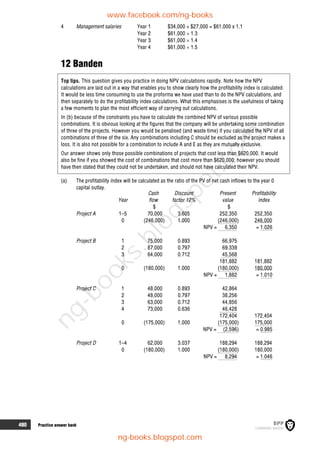
increase in sales volume. Provided that the extra gross contribution from the increase in sales
exceeds the increase in fixed cost expenses, bad debts, discounts and the finance cost of an
increase in working capital, a policy to relax credit terms would be profitable.
2.4 Assessing creditworthiness 6/15
In managing accounts receivable, the creditworthiness of customers needs to be assessed. The risks and
costs of a customer defaulting will need to be balanced against the profitability of the business provided
by that customer.
Credit control involves the initial investigation of potential credit customers and the continuing control of
outstanding accounts. The main points to note are as follows.
(a) New customers should give two good references, including one from a bank, before being granted
credit.
(b) Credit ratings might be checked through a credit rating/reference agency.
(c) A new customer's credit limit should be fixed at a low level and only increased if their payment
record subsequently warrants it.
(d) For large value customers, a file should be maintained of any available financial information about
the customer. This file should be reviewed regularly. Information is available from the company's
annual report and accounts.
FASTFORWARD
www.facebook.com/ng-books
ng-books.blogspot.com
n
g
-
b
o
o
k
s
.
b
l
o
g
s
p
o
t
.
c
o
m
Part C Working capital management  5: Managing working capital 103
(e) Government departments can sometimes advise on overseas companies.
(f) Press comments may give information about what a company is currently doing (as opposed to
the historical results in Extel cards or published accounts which only show what the company has
done in the past).
(g) The company could send a member of staff to visit the company concerned, to get a first-hand
impression of the company and its prospects. This would be advisable in the case of a prospective
major customer.
An organisation might devise a credit-rating system for new individual customers that is based on
characteristics of the customer (such as whether the customer is a homeowner, and the customer's age
and occupation). Points or ratings would be awarded according to the characteristics of the customer, and
the amount of credit that is offered would depend on their credit score.
2.5 Managing accounts receivable
Regular monitoring of accounts receivable is very important. Individual accounts receivable can be
assessed using a customer history analysis and a credit rating system. The overall level of accounts
receivable can be monitored using an aged accounts receivable listing and credit utilisation report, as
well as reports on the level of bad debts.
(a) Accounts receivable payment records must be monitored continually. This depends on successful
sales ledger administration.
(b) Credit monitoring can be simplified by a system of in-house credit ratings. For example, a
company could have five credit-risk categories for its customers. As mentioned above, these credit
categories or ratings could be used to decide either individual credit limits for customers within
that category or the frequency of the credit review.
(c) A customer's payment record and the accounts receivable aged analysis should be examined
regularly, as a matter of course. Breaches of the credit limit, or attempted breaches of it, should be
brought immediately to the attention of the credit controller.
2.5.1 Policing total credit
The total amount of credit offered, as well as individual accounts, should be policed to ensure that the
senior management policy with regard to the total credit limits is maintained. A credit utilisation report
can indicate the extent to which total limits are being utilised. An example is given below.
Customer Limit Utilisation
$'000 $'000 %
Alpha 100 90 90
Beta 50 35 70
Gamma 35 21 60
Delta 250 125 50
435 271
62.2%
This might contain other information, such as days sales outstanding.
Reviewed in aggregate, this can reveal the following.
(a) The number of customers who might want more credit
(b) The extent to which the company is exposed to accounts receivable
(c) The 'tightness' of the policy (It might be possible to increase profitable sales by offering credit. On
the other hand, perhaps the firm offers credit too easily.)
FASTFORWARD
www.facebook.com/ng-books
ng-books.blogspot.com
n
g
-
b
o
o
k
s
.
b
l
o
g
s
p
o
t
.
c
o
m
104 5: Managing working capital  Part C Working capital management
It is possible to design credit utilisation reports to highlight other trends.
(a) The degree of exposure to different countries
(b) The degree of exposure to different industries (some countries or industries may be worthy of
more credit; others may be too risky)
Credit utilisation can also be analysed by industry within country or by country within industry. It is also
useful to relate credit utilisation to total sales.
2.5.2 Extension of credit
To determine whether it would be profitable to extend the level of total credit, it is necessary to assess:
 The extra sales that a more generous credit policy would stimulate
 The profitability of the extra sales
 The extra length of the average debt collection period
 The required rate of return on the investment in additional accounts receivable
2.5.3 Example: A change in credit policy
Russian Beard Co is considering a change of credit policy which will result in an increase in the average
collection period from one to two months. The relaxation in credit is expected to produce an increase in
sales in each year amounting to 25% of the current sales volume.
Selling price per unit $10
Variable cost per unit $8.50
Current annual sales $2,400,000
The required rate of return on investments is 20%. Assume that the 25% increase in sales would result in
additional inventories of $100,000 and additional accounts payable of $20,000.
Advise the company on whether or not to extend the credit period offered to customers, if:
(a) All customers take the longer credit of two months
(b) Existing customers do not change their payment habits, and only new customers take a full two
months' credit
Solution
The change in credit policy is justifiable if the rate of return on the additional investment in working capital
would exceed 20%.
Extra profit
Contribution/sales ratio 15%
Increase in sales revenue $600,000
Increase in contribution and profit $90,000
(a) Extra investment, if all accounts receivable take two months' credit
$
Average accounts receivable after the sales increase (2/12  $3,000,000) 500,000
Less current average accounts receivable (1/12  $2,400,000) 200,000
Increase in accounts receivable 300,000
Increase in inventories 100,000
400,000
Less increase in accounts payable 20,000
Net increase in working capital investment 380,000
Return on extra investment
$90,000
$380,000
= 23.7%
www.facebook.com/ng-books
ng-books.blogspot.com
n
g
-
b
o
o
k
s
.
b
l
o
g
s
p
o
t
.
c
o
m
Part C Working capital management  5: Managing working capital 105
(b) Extra investment, if only the new accounts receivable take two months' credit
$
Increase in accounts receivable (2/12 of $600,000) 100,000
Increase in inventories 100,000
200,000
Less increase in accounts payable 20,000
Net increase in working capital investment 180,000
Return on extra investment
$90,000
$180,000
= 50%
In both case (a) and case (b) the new credit policy appears to be worthwhile.
Question Extension of credit
Enticement Co currently expects sales of $50,000 a month. Variable costs of sales are $40,000 a month
(all payable in the month of sale). It is estimated that if the credit period allowed to accounts receivable
were to be increased from 30 days to 60 days, sales volume would increase by 20%. All customers would
be expected to take advantage of the extended credit. If the cost of capital is 121
/2% a year, is the
extension of the credit period justifiable in financial terms?
Answer
$
Current accounts receivable (1 month) 50,000
Accounts receivable after implementing the proposal (2 months) 120,000
Increase in accounts receivable 70,000
Financing cost ( 12½%) 8,750
Annual contribution from additional sales (12 months  20%  $10,000) 24,000
Annual net benefit from extending credit period 15,250
2.6 Collecting amounts owing
The benefits of action to collect debts must be greater than the costs incurred.
The overall debt collection policy of the firm should be such that the administrative costs and other costs
incurred in debt collection do not exceed the benefits from incurring those costs. Beyond a certain level of
spending, however, additional expenditure on debt collection would not have enough of an effect on bad
debts or on the average collection period to justify the extra administrative costs.
Collecting debts is a two-stage process.
(a) Having agreed credit terms with a customer, a business should issue an invoice and expect to
receive payment when it is due. Issuing invoices and receiving payments is the task of sales
ledger staff. They should ensure that:
(i) The customer is fully aware of the terms.
(ii) The invoice is correctly drawn up and issued promptly.
(iii) They are aware of any potential quirks in the customer's system.
(iv) Queries are resolved quickly.
(v) Monthly statements are issued promptly.
FASTFORWARD
www.facebook.com/ng-books
ng-books.blogspot.com
n
g
-
b
o
o
k
s
.
b
l
o
g
s
p
o
t
.
c
o
m
106 5: Managing working capital  Part C Working capital management
(b) If payments become overdue, priority ones should be 'chased'. Procedures for pursuing overdue
debts must be established, for example:
(i) Instituting reminders or final demands
These should be sent to a named individual, asking for repayment by return of post. A
second or third letter may be required, followed by a final demand stating clearly the action
that will be taken. The aim is to goad customers into action, perhaps by threatening not to
sell any more goods on credit until the debt is cleared.
(ii) Chasing payment by telephone
The telephone is of greater nuisance value than a letter, and the greater immediacy can
encourage a response. It can be time consuming, however, particularly because of
problems in getting through to the right person.
(iii) Making a personal approach
Personal visits can be very time consuming and tend only to be made to important
customers who are worth the effort.
(iv) Notifying debt collection section
This means not giving further credit to the customer until they have paid the due amounts.
(v) Handing over debt collection to specialist debt collection section
Certain, generally larger, organisations may have a section to collect debts under the
supervision of the credit manager.
(vi) Instituting legal action to recover the debt
Premature legal action may unnecessarily antagonise important customers.
(vii) Hiring external debt collection agency to recover debt
Again this may upset customers.
2.7 Early settlement discounts 12/10, 6/11, 12/13
Early settlement discounts may be employed to shorten average credit periods and to reduce the
investment in accounts receivable and therefore interest costs of the finance invested in trade receivables.
The benefit in interest cost saved should exceed the cost of the discounts allowed.
To see whether the offer of a settlement discount (for early payment) is financially worthwhile we must
compare the cost of the discount with the benefit of a reduced investment in accounts receivable.
Varying the discount allowed for early payment of debts affects the average collection period and affects
the volume of demand (and possibly, therefore, indirectly affects bad debt losses). We shall begin with
examples where the offer of a discount for early payment does not affect the volume of demand.
2.8 Example: Settlement discount
Lowe and Price Co has annual credit sales of $12,000,000, and 3 months are allowed for payment. The
company decides to offer a 2% discount for payments made within 10 days of the invoice being sent, and
to reduce the maximum time allowed for payment to 2 months. It is estimated that 50% of customers will
take the discount. If the company requires a 20% return on investments, what will be the effect of the
discount? Assume that the volume of sales will be unaffected by the discount.
Solution
Our approach is to calculate:
(a) The profits forgone by offering the discount
(b) The interest charges saved or incurred as a result of the changes in the cash flows of the company
FASTFORWARD
www.facebook.com/ng-books
ng-books.blogspot.com
n
g
-
b
o
o
k
s
.
b
l
o
g
s
p
o
t
.
c
o
m
Part C Working capital management  5: Managing working capital 107
Thus:
(a) The volume of accounts receivable, if the company policy remains unchanged, would be:
3/12  $12,000,000 = $3,000,000.
(b) If the policy is changed the volume of accounts receivable would be:
(10/365  50%  $12,000,000) + (2/12  50%  $12,000,000) = $164,384 + $1,000,000
= $1,164,384.
(c) There will be a reduction in accounts receivable of $1,835,616.
(d) Since the company can invest at 20% a year, the value of a reduction in accounts receivable (a source
of funds) is 20% of $1,835,616 each year in perpetuity, that is, $367,123 a year.
(e) Summary
$
Value of reduction in accounts receivable each year 367,123
Less discounts allowed each year (2%  50%  $12,000,000) 120,000
Net benefit of new discount policy each year 247,123
An extension of the payment period allowed to accounts receivable may be introduced in order to increase sales
volume.
2.9 Percentage cost of an early settlement discount
The percentage cost of an early settlement discount to the company giving it can be estimated by the
formula:
365
t
100
1 %
(100 d)
 
 
 
 
 
 
  
 
 

 
 
 
 
 
 
 
Where d = the discount offered (5% = 5, etc)
t = the reduction in the payment period in days that is necessary to obtain the early payment
discount
Question Cost of discount
A company offers its goods to customers on 30 days' credit, subject to satisfactory trade references. It
also offers a 2% discount if payment is made within ten days of the date of the invoice.
Required
Calculate the cost to the company of offering the discount, assuming a 365 day year.
Answer
The percentage cost of the discount =
365
20
100
1
(100 2)
 

 

 
= 1.0204118.25
– 1
= 1.446 – 1
= 44.6%
www.facebook.com/ng-books
ng-books.blogspot.com
n
g
-
b
o
o
k
s
.
b
l
o
g
s
p
o
t
.
c
o
m
108 5: Managing working capital  Part C Working capital management
2.10 Bad debt risk
Different credit policies are likely to have differing levels of bad debt risk. The higher revenue resulting
from easier credit terms should be sufficiently profitable to exceed the cost of:
 Additional bad debts, and
 The additional investment necessary to achieve the higher sales.
2.10.1 Example: Receivables management
Grabbit Quick Co achieves current annual sales of $1,800,000. The cost of sales is 80% of this amount,
but bad debts average 1% of total sales, and the annual profit is as follows.
$
Sales 1,800,000
Less cost of sales 1,440,000
360,000
Less bad debts 18,000
Profit 342,000
The current debt collection period is one month, and the management consider that, if credit terms were
eased (Option A), the effects would be as follows.
Present policy Option A
Additional sales (%) – 25%
Average collection period 1 month 2 months
Bad debts (% of sales) 1% 3%
The company requires a 20% return on its investments. The costs of sales are 75% variable and 25%
fixed. Assume there would be no increase in fixed costs from the extra revenue and that there would be no
increase in average inventories or accounts payable. Which is the preferable policy, Option A or the
present one?
Solution
The increase in profit before the cost of additional finance for Option A can be found as follows.
(a) $
Increase in contribution from additional sales
25%  $1,800,000  40%* 180,000
Less increase in bad debts (3%  $2,250,000) – $18,000 49,500
Increase in annual profit 130,500
* The contribution/sales ratio is 100% – (75%  80%) = 40%
(b) $
Proposed investment in accounts receivable $2,250,000  1/6 375,000
Less current investment in accounts receivable $1,800,000  1/12 150,000
Additional investment required 225,000
Cost of additional finance at 20% $45,000
(c) As the increase in profit exceeds the cost of additional finance, Option A should be adopted.
2.10.2 Credit insurance
Companies may be able to obtain credit insurance against certain approved debts going bad through a
specialist credit insurance firm. A company cannot insure against all its bad debt losses, but may be able
to insure against losses above a 'normal' level.
When a company arranges credit insurance, it must submit specific proposals for credit to the insurance
company, stating the name of each customer to which it wants to give credit and the amount of credit it
wants to give. The insurance company will accept, amend or refuse these proposals, depending on its
assessment of each of these customers.
www.facebook.com/ng-books
ng-books.blogspot.com
n
g
-
b
o
o
k
s
.
b
l
o
g
s
p
o
t
.
c
o
m
Part C Working capital management  5: Managing working capital 109
2.11 Factoring 6/08, 12/08, 12/11, 12/13, 6/15
Some companies use either factoring or invoice discounting to improve liquidity or to reduce
administration costs. Insurance, particularly of overseas debts, can also help reduce the risk of bad debts.
A factor is defined as 'a doer or transactor of business for another', but a factoring organisation
specialises in trade debts, and manages the debts owed to a client (a business customer) on the client's
behalf.
Factoring is an arrangement to have debts collected by a factor company, which advances a proportion of
the money it is due to collect.
2.11.1 Aspects of factoring
The main aspects of factoring include the following.
(a) Administration of the client's invoicing, sales accounting and debt collection service
(b) Credit protection for the client's debts, whereby the factor takes over the risk of loss from bad
debts and so 'insures' the client against such losses. This is known as a non-recourse service.
However, if a non-recourse service is provided, the factor, not the firm, will decide what action to
take against non-payers.
(c) Making payments to the client in advance of collecting the debts. This is sometimes referred to as
'factor finance' because the factor is providing cash to the client against outstanding debts.)
2.11.2 Benefits of factoring
The ACCA examination team noted in the December 2011 exam that a number of candidates found it
difficult to identify the benefits of factoring. Make sure you are familiar with the benefits listed below, in
order to gain maximum marks in a knowledge-based part of a question.
The benefits of factoring for a business customer include the following.
(a) The business receives early payment for most of its receivables in the form of finance from the
factor. It can use this money to pay its suppliers.
(b) Optimum inventory levels can be maintained, because the business will have enough cash to pay
for the inventories it needs.
(c) Growth can be financed through sales rather than by injecting fresh external capital.
(d) The business gets finance linked to its volume of sales. In contrast, overdraft limits tend to be
determined by historical statements of financial position.
(e) The managers of the business do not have to spend their time on the problems of slow-paying
accounts receivable. Factoring organisations are also likely to employ staff who are experienced
and skilled at collecting payments from customers and chasing overdue payments.
(f) The business does not incur the costs of running its own sales ledger department, and can use
the expertise of debtor management that the factor has.
An important disadvantage is that credit customers will be making payments direct to the factor, which is
likely to present a negative picture of the firm's attitude to customer relations. It may also indicate that
the firm is in need of rapid cash, raising questions about its financial stability.
2.11.3 Example: Factoring
A company makes annual credit sales of $1,500,000. Credit terms are 30 days, but its debt administration
has been poor and the average collection period has been 45 days with 0.5% of sales resulting in bad
debts which are written off.
Key term
FASTFORWARD
Exam focus
point
www.facebook.com/ng-books
ng-books.blogspot.com
n
g
-
b
o
o
k
s
.
b
l
o
g
s
p
o
t
.
c
o
m
110 5: Managing working capital  Part C Working capital management
A factor would take on the task of debt administration and credit checking, at an annual fee of 2.5% of
credit sales. The company would save $30,000 a year in administration costs. The payment period would
be 30 days.
The factor would also provide an advance of 80% of invoiced debts at an interest rate of 14% (3% over
the current base rate). The company can obtain an overdraft facility to finance its accounts receivable at a
rate of 2.5% over base rate.
Should the factor's services be accepted? Assume a constant monthly revenue.
Solution
It is assumed that the factor would advance an amount equal to 80% of the invoiced debts, and the
balance 30 days later.
(a) The current situation is as follows, using the company's debt collection staff and a bank overdraft
to finance all debts.
Credit sales $1,500,000 pa
Average credit period 45 days
The annual cost is as follows.
$
45/365  $1,500,000  13.5% (11% + 2.5%) 24,966
Bad debts 0.5%  $1,500,000 7,500
Administration costs 30,000
Total cost 62,466
(b) The cost of the factor. 80% of credit sales financed by the factor would be 80% of $1,500,000 =
$1,200,000. For a consistent comparison, we must assume that 20% of credit sales would be
financed by a bank overdraft. The average credit period would be only 30 days. The annual cost
would be as follows.
$
Factor's finance 30/365  $1,200,000  14% 13,808
Overdraft 30/365  $300,000  13.5% 3,329
17,137
Cost of factor's services: 2.5%  $1,500,000 37,500
Cost of the factor 54,637
(c) Conclusion. The factor is cheaper. In this case, the factor's fees exactly equal the savings in bad
debts ($7,500) and administration costs ($30,000). The factor is then cheaper overall because it
will be more efficient at collecting debts. The advance of 80% of debts is not needed, however, if
the company has sufficient overdraft facility because the factor's finance charge of 14% is higher
than the company's overdraft rate of 13.5%.
An alternative way of carrying out the calculation is to consider the changes in costs that using a factor
will mean.
$
Effect of reduction in collection period
45 30
365

 $1,500,000  13.5%
8,322
Extra interest cost of factor finance 30/365  $1,200,000  (14 – 13.5)% (493)
Cost of factor's services 2.5%  $1,500,000 (37,500)
Savings in bad debts 0.5% × $1,500,000 7,500
Savings in company's administration costs 30,000
Net benefit of using factor 7,829
Check: $62,466 – $54,637 = $7,829
Points to look out for in questions about factoring are who bears the risk of bad debts, and company
administration costs that may be saved by using a factor. The ACCA examination team has commented
that calculations of the cost of factoring have often been poor.
Exam focus
point
www.facebook.com/ng-books
ng-books.blogspot.com
n
g
-
b
o
o
k
s
.
b
l
o
g
s
p
o
t
.
c
o
m
Part C Working capital management  5: Managing working capital 111
2.12 Invoice discounting 6/08
Invoice discounting is the purchase (by the provider of the discounting service) of trade debts at a
discount. Invoice discounting enables the company from which the debts are purchased to raise working
capital.
Invoice discounting is related to factoring and many factors will provide an invoice discounting service. It
is the purchase of a selection of invoices, at a discount. The invoice discounter does not take over the
administration of the client's sales ledger.
A client should only want to have some invoices discounted when he has a temporary cash shortage, and
so invoice discounting tends to consist of one-off deals. Confidential invoice discounting is an
arrangement whereby a debt is confidentially assigned to the factor, and the client's customer will only
become aware of the arrangement if they do not pay their debt to the client.
If a client needs to generate cash, they can approach a factor or invoice discounter, who will offer to
purchase selected invoices and advance up to 75% of their value. At the end of each month, the factor will
pay over the balance of the purchase price, less charges, on the invoices that have been settled in the
month.
Don't confuse invoice discounting with early settlement discounts. They are not the same thing.
2.13 Managing foreign accounts receivable 6/09
You may find it useful to read the article called Management of Foreign Accounts Receivable on the ACCA
website.
Exporters have to address the problems of larger inventories and accounts receivable, and an increased
risk of bad debts due to the transportation time and additional paperwork involved in sending goods
abroad.
Foreign debts raise the following special problems.
(a) When goods are sold abroad, the customer might ask for credit. Exports take time to arrange, and
there might be complex paperwork. Transporting the goods can be slow, if they are sent by sea.
These delays in foreign trade mean that exporters often build up large investments in inventories
and accounts receivable. These working capital investments have to be financed somehow.
(b) The risk of bad debts can be greater with foreign trade than with domestic trade. If a foreign
debtor refuses to pay a debt, the exporter must pursue the debt in the debtor's own country, where
procedures will be subject to the laws of that country.
Some businesses may decide to trust the foreign receivable and not take any special measures to reduce
the non-payment risk. This method is known as open account.
However, there are several measures available to exporters to help overcome risks of non-payment.
2.13.1 Reducing the investment in foreign accounts receivable
A company can reduce its investment in foreign accounts receivable by insisting on earlier payment for
goods. Another approach is for an exporter to arrange for a bank to give cash for a foreign debt sooner
than the exporter would receive payment in the normal course of events. There are several ways in which
this might be done.
(a) Advances against collections. Where the exporter asks their bank to handle the collection of
payment (of a bill of exchange or a cheque) on their behalf, the bank may be prepared to make an
Key term
FASTFORWARD
Exam focus
point
Exam focus
point
www.facebook.com/ng-books
ng-books.blogspot.com
n
g
-
b
o
o
k
s
.
b
l
o
g
s
p
o
t
.
c
o
m
112 5: Managing working capital  Part C Working capital management
advance to the exporter against the collection. The amount of the advance might be 80% to 90% of
the value of the collection.
(b) Negotiation of bills or cheques. This is similar to an advance against collection, but would be used
where the bill or cheque is payable outside the exporter's country (for example in the foreign
buyer's country).
(c) Discounting bills of exchange. This is where the customer agrees to accept a bill of exchange
drawn on the customer by the exporter. The exporter's bank may buy the bill before it is due for
payment (at a discount to face value) and credit the proceeds from this sale to the company's
account.
(d) Documentary credits. These are described below.
(e) Forfaiting. This is also described below.
2.13.2 Reducing the bad debt risk
Methods of minimising bad debt risks are broadly similar to those for domestic trade. An exporting
company should vet the creditworthiness of each customer, and grant credit terms accordingly.
2.13.3 Export factoring
The functions performed by an overseas factor or export factor are essentially the same as with the
factoring of domestic trade debts, which was described earlier in this chapter.
Factoring can be more expensive than credit insurance (explained below) and may not be available in all
countries.
2.13.4 Documentary credits
Documentary credits (‘letters of credit’) provide a method of payment in international trade, which gives
the exporter a secure risk-free method of obtaining payment.
The process works as follows:
(a) The buyer (a foreign buyer or domestic importer) and the seller (a domestic exporter or foreign
supplier) first of all agree a contract for the sale of the goods, which provides for payment through
a documentary credit.
(b) The buyer then requests a bank in their country to issue a letter of credit in favour of the exporter.
The bank which issues the letter of credit is known as the issuing bank.
(c) The issuing bank, by issuing its letter of credit, guarantees payment to the exporter on condition
that the exporter complies with certain specified conditions in the letter of credit (relating to such
matters as presenting documentation for the export shipment and shipping the goods before a
latest shipment date).
(d) The goods are despatched and the shipping documentation is sent to the purchaser’s bank.
(e) The bank issues a banker’s acceptance.
(f) The seller either keeps the banker’s acceptance until maturity or sells it at a discount on the money
market.
A documentary credit arrangement must be made between the exporter, the buyer and participating banks
before the export sale takes place. Documentary credits are slow to arrange, administratively
cumbersome and inflexible. For example, the exact conditions of the letter of credit must be met. If the
letter of credit states that shipping documents are required, then the seller would be unable to claim
payment if the goods were sent by air. Despite these drawbacks, letters of credit might be considered
essential where the risk of non-payment is high.
www.facebook.com/ng-books
ng-books.blogspot.com
n
g
-
b
o
o
k
s
.
b
l
o
g
s
p
o
t
.
c
o
m
Part C Working capital management  5: Managing working capital 113
2.13.5 Forfaiting
Forfaiting is a method of export finance whereby a bank purchases from a company a number of sales
invoices, usually obtaining a guarantee of payment of the invoices.
Forfaiting is the most common method of providing medium-term (say, three to five years) export
finance. It has normally been used for export sales involving capital goods (such as machinery), where
payments will be made over a number of years. It is usually available for large amounts (over $250,000),
but only in the major convertible currencies.
The forfaiter buys the foreign accounts receivable from a seller at a discount and takes on all of the credit
risk from the transaction (without recourse). The receivables then become a form of debt instrument
which can be sold on the money market.
Forfaiting can be an expensive choice, and arranging it takes time. However, it can be a useful way of
enabling trade to occur in cases where other methods of ensuring payment and smooth cash flow are not
certain, and in cases where trade may not be possible by other means.
2.13.6 Countertrade
Countertrade is a means of financing trade in which goods are exchanged for other goods. Three parties
might be involved in a 'triangular' deal. Countertrade is thus a form of barter and can involve complex
negotiations and logistics. One of the main problems with countertrade is that the value of the goods
received in exchange may be uncertain.
2.13.7 Export credit insurance
Export credit insurance is insurance against the risk of non-payment by foreign customers for export
debts.
You might be wondering why export credit insurance should be necessary, when exporters can pursue
non-paying customers through the courts in order to obtain payment. The answer is that:
(a) If a credit customer defaults on payment, the task of pursuing the case through the courts will be
lengthy, and it might be a long time before payment is eventually obtained.
(b) There are various reasons why non-payment might happen. For example, the seller can be insured
against slow payment, insolvency, certain political risks and changes in import or export
regulations.
Not all exporters take out export credit insurance because premiums are very high and the benefits are
sometimes not fully appreciated. If they do, they will obtain an insurance policy from a private insurance
company that deals in export credit insurance. Note that insurance does not usually cover 100% of the
value of the foreign sales.
2.13.8 General policies for overseas accounts receivable
There are also a number of general credit control policies that can be particularly important when dealing
with overseas customers.
(a) Prior to the sale, the customer's credit rating should be checked, and the terms of the contract
specified. One key term may be demanding the use of a letter of credit as a condition for the
transaction. The terms of the remittance and the bank to be used should be specified.
(b) The paperwork relating to the sales should be carefully completed and checked, in particular the
shipping and delivery documentation.
(c) Goods should only be released to the custody of the buyer if payment has been made, or is
sufficiently certain, either because of the customer's previous record or because the customer has
arranged for its bank to accept a bill of exchange on behalf of the buyer.
(d) Receipts should be rapidly processed and late payments chased.
Key term
Key term
www.facebook.com/ng-books
ng-books.blogspot.com
n
g
-
b
o
o
k
s
.
b
l
o
g
s
p
o
t
.
c
o
m
114 5: Managing working capital  Part C Working capital management
3 Managing accounts payable
Performance objective 10 requires you to ‘prepare and monitor an organisation’s cash flow, credit facilities
and advise on appropriate actions’. This section covers the management of accounts payable and credit
terms.
Effective management of trade accounts payable involves seeking satisfactory credit terms from supplier,
getting credit extended during periods of cash shortage and maintaining good relations with suppliers.
It may seem an obvious point, but take care not to confuse accounts receivable and accounts payable, as
many students do under exam pressure.
3.1 Management of trade accounts payable
The management of trade accounts payable involves:
 Attempting to obtain satisfactory credit from suppliers
 Attempting to extend credit during periods of cash shortage, without damaging a good business
relationship with the supplier
 Maintaining good relations with regular and important suppliers
If a supplier offers a discount for the early payment of debts, the evaluation of the decision whether or not
to accept the discount is similar to the evaluation of the decision whether or not to offer a discount. One
problem is the mirror image of the other. The methods of evaluating the offer of a discount to customers
were described earlier.
3.1.1 Trade credit
Taking credit from suppliers is a normal feature of business. Nearly every company has some trade
accounts payable waiting for payment. It is particularly important to small and fast-growing firms. Trade
credit is a source of short-term finance because it helps to keep working capital down. It is usually a cheap
source of finance, since suppliers rarely charge interest. The costs of making maximum use of trade credit
include the loss of suppliers' goodwill, and the loss of any available cash discounts for the early payment
of debts.
3.1.2 The cost of lost early payment discounts
The cost of lost cash discounts can be calculated by comparing the saving from the discount with the
opportunity cost of investing the cash used.
The cost of lost cash discounts can also be estimated by the formula:
365
t
100
1 %
(100 d)
 
 
 
 
 
 
  
 
 

 
 
 
 
 
 
 
Where d is the % discount, d = 5 for 5%
t is the reduction in the payment period in days which would be necessary to obtain the early
payment discount, final date to obtain discount – final date for payment
This is the same formula that was used for accounts receivable.
3.2 Example: Trade credit
X Co has been offered credit terms from its major supplier of 2/10, net 45. That is, a cash discount of 2%
will be given if payment is made within ten days of the invoice, and payments must be made within 45
days of the invoice. The company has the choice of paying 98c per $1 on day 10 (to pay before day 10
Exam focus
point
FASTFORWARD
www.facebook.com/ng-books
ng-books.blogspot.com
n
g
-
b
o
o
k
s
.
b
l
o
g
s
p
o
t
.
c
o
m
Part C Working capital management  5: Managing working capital 115
would be unnecessary), or to invest the 98c for an additional 35 days and eventually pay the supplier $1
per $1. The decision as to whether the discount should be accepted depends on the opportunity cost of
investing 98c for 35 days. What should the company do?
Solution
Suppose that X Co can invest cash to obtain an annual return of 25%, and that there is an invoice from the
supplier for $1,000. The two alternatives are as follows.
Refuse Accept
discount discount
$ $
Payment to supplier 1,000.0 980
Return from investing $980 between day 10 and day 45:
$980  35/365  25% 23.5
Net cost 976.5 980
It is cheaper to refuse the discount because the investment rate of return on cash retained, in this
example, exceeds the saving from the discount.
Although a company may delay payment beyond the final due date, thereby obtaining even longer credit
from its suppliers, such a policy would generally be inadvisable. Unacceptable delays in payment will
worsen the company's credit rating, and additional credit may become difficult to obtain.
3.3 Managing foreign accounts payable
Foreign accounts payable will be subject to exchange rate risk. Companies expecting to pay foreign
currency in the future will be concerned about the possibility of domestic currency depreciating against
the foreign currency, making the cost of the supplies more expensive.
Companies sometimes pay into an overseas bank account today and then let the cash earn some interest
so they can pay off the invoice in the future. This method of avoiding exchange rate risk is called leading.
The management of exchange rate risk is covered in Chapter 19.
www.facebook.com/ng-books
ng-books.blogspot.com
n
g
-
b
o
o
k
s
.
b
l
o
g
s
p
o
t
.
c
o
m
116 5: Managing working capital  Part C Working capital management
Chapter Roundup
 An economic order quantity can be calculated as a guide to minimising costs in managing inventory
levels. However, bulk discounts can mean that a different order quantity minimises inventory costs.
 Uncertainties in demand and lead times taken to fulfil orders mean that inventory will be ordered once it
reaches a re-order level (maximum usage × maximum lead time).
 Giving credit has a cost: the value of the interest charged on an overdraft to fund the period of credit, or
the interest lost on the cash not received and deposited in the bank. An increase in profit from extra sales
resulting from offering credit could offset this cost.
 In managing accounts receivable, the creditworthiness of customers needs to be assessed. The risks and
costs of a customer defaulting will need to be balanced against the profitability of the business provided
by that customer.
 Regular monitoring of accounts receivable is very important. Individual accounts receivable can be
assessed using a customer history analysis and a credit rating system. The overall level of accounts
receivable can be monitored using an aged accounts receivable listing and credit utilisation report, as
well as reports on the level of bad debts.
 The benefits of action to collect debts must be greater than the costs incurred.
 Early settlement discounts may be employed to shorten average credit periods and to reduce the
investment in accounts receivable and therefore interest costs of the finance invested in trade receivables.
The benefit in interest cost saved should exceed the cost of the discounts allowed.
 Some companies use either factoring or invoice discounting to improve liquidity or to reduce
administration costs. Insurance, particularly of overseas debts, can also help reduce the risk of bad debts.
 Exporters have to address the problems of larger inventories and accounts receivable, and an increased
risk of bad debts due to the transportation time and additional paperwork involved in sending goods
abroad.
 Effective management of trade accounts payable involves seeking satisfactory credit terms from supplier,
getting credit extended during periods of cash shortage and maintaining good relations with suppliers.
www.facebook.com/ng-books
ng-books.blogspot.com
n
g
-
b
o
o
k
s
.
b
l
o
g
s
p
o
t
.
c
o
m
Part C Working capital management  5: Managing working capital 117
Quick Quiz
1 The basic EOQ formula for inventory indicates whether bulk discounts should be taken advantage of.
True
False
2 Identify the potential benefits of JIT manufacturing.
3 PB Co uses 2,500 units of component X per year. The company has calculated that the cost of placing and
processing a purchase order for component X is $185, and the cost of holding one unit of component X
for a year is $25.
What is the economic order quantity (EOQ) for component X and, assuming a 52-week year, what is the
average frequency at which purchase orders should be placed?
4 The economic order quantity model can be used to determine:
Order Buffer Re-order
quantity inventory level
Yes/No Yes/No Yes/No
5 What service involves collecting debts of a business, advancing a proportion of the money it is due to
collect?
6 What service involves advancing a proportion of a selection of invoices, without administration of the
sales ledger of the business?
7 Which of the following is a disadvantage to a company of using a factor for its accounts receivable?
A It is easier to finance growth through sales.
B Managers spend less time on slow paying accounts receivable.
C Credit customers pay direct to the factor.
D It is easier to pay suppliers promptly to obtain discounts.
8 Which of the following does not determine the amount of credit offered by a supplier?
A The credit terms the supplier obtains from its own suppliers
B The ease with which the buyer can go elsewhere
C The supplier's total risk exposure
D The number of purchases made by the buyer each year
9 If a customer decided to pass up the chance of a cash discount of 1% in return for reducing their average
payment period from 70 to 30 days, what would be the implied cost in interest per annum?
www.facebook.com/ng-books
ng-books.blogspot.com
n
g
-
b
o
o
k
s
.
b
l
o
g
s
p
o
t
.
c
o
m
118 5: Managing working capital  Part C Working capital management
Answers to Quick Quiz
1 False. It may be necessary to modify the formula to take account of bulk discounts.
2 (a) Reduction in inventory holding costs
(b) Reduced manufacturing lead times
(c) Improved labour productivity
(d) Reduced scrap/warranty/rework/costs
(e) Price reductions on purchased materials
(f) Reduction in the number of accounting transactions
3 C EOQ = 0
h
2C D
C
Economic order quantity =
2 185 2,500
25
 
= 192 units
Frequency of ordering =
192
2,500
= 4 weeks
4 The EOQ model finds order quantity only, not buffer inventory and re-order level.
5 Factoring
6 Invoice discounting
7 C This may present a negative picture of the company to customers.
8 D The number of purchases (although the amount of annual purchases may well be a factor)
9 Cost =
365
t
100
1 %
(100 d)
 
 
 
 
 
 
  
 
 

 
 
 
 
 
 
 
=
365
40
100
1
(99)
 

 
 
= 1.019.125
– 1 = 9.5%
Now try the questions below from the Practice Question Bank
Number Level Marks Approximate time
Section A Q13 Examination 2 4 mins
Section C Q2 Introductory N/A 39 mins
Section C Q3 Introductory N/A 39 mins
www.facebook.com/ng-books
ng-books.blogspot.com
n
g
-
b
o
o
k
s
.
b
l
o
g
s
p
o
t
.
c
o
m
119
Working
capital finance
Introduction
This chapter concludes our study of working capital management methods by
considering how cash is managed. This involves looking at the various reasons
for holding cash, the preparation of cash flow forecasts and relevant
techniques for managing cash. We revisit how working capital needs are
determined and finally in this area we consider working capital funding
strategies.
Topic list Syllabus reference
1 The management of cash C2 (f)
2 Cash flow forecasts C2 (f)
3 Treasury management C2 (f)
4 Cash management models C2 (f)
5 Investing surplus cash C2 (f)
6 Working capital funding strategies C3 (a), (b)
www.facebook.com/ng-books
ng-books.blogspot.com
n
g
-
b
o
o
k
s
.
b
l
o
g
s
p
o
t
.
c
o
m
120 6: Working capital finance  Part C Working capital management
Study guide
Intellectual level
C2 Management of inventories, accounts receivable, accounts payable and
cash
(f) Explain the various reasons for holding cash, and discuss and apply the use
of relevant techniques in managing cash, including:
2
(i) Preparing cash flow forecasts to determine future cash flows and cash
balances
(ii) Assessing the benefits of centralised treasury management and cash control
(iii) Cash management models, such as the Baumol model and the Miller-Orr
model
(iv) Investing short-term
C3 Determining working capital needs and funding strategies
(a) Calculate the level of working capital investment in current assets and
discuss the key factors determining this level, including:
2
(i) The length of the working capital cycle and terms of trade
(ii) An organisation's policy on the level of investment in current assets
(iii) The industry in which the organisation operates
(b) Describe and discuss the key factors in determining working capital funding
strategies, including:
2
(i) The distinction between permanent and fluctuating current assets
(ii) The relative cost and risk of short-term and long-term finance
(iii) The matching principle
(iv) The relative costs and benefits of aggressive, conservative and matching
funding policies
(v) Management attitudes to risk, previous funding decisions and organisation
size
1
Exam guide
The material covered in this chapter is again highly examinable. Any of the calculations could form part or
all of a question and you also need to be able to explain the meaning of your answers.
Performance objective 10 requires you to ‘prepare and monitor an organisation’s cash flow, credit facilities
and advise on appropriate actions’. This chapter covers the management of cash and cash flow forecasts.
1 The management of cash
1.1 Why organisations hold cash 12/12
The economist John Maynard Keynes identified three reasons for holding cash.
(a) Firstly, a business needs cash to meet its regular commitments of paying its accounts payable, its
employees' wages, its taxes, its annual dividends to shareholders, and so on. This reason for
holding cash is what Keynes called the transactions motive.
(b) Keynes identified the precautionary motive as a second motive for holding cash. This means that
there is a need to maintain a 'buffer' of cash for unforeseen contingencies. In the context of a
www.facebook.com/ng-books
ng-books.blogspot.com
n
g
-
b
o
o
k
s
.
b
l
o
g
s
p
o
t
.
c
o
m
Part C Working capital management  6: Working capital finance 121
business, this buffer may be provided by an overdraft facility, which has the advantage that it will
cost nothing until it is actually used.
(c) Keynes identified a third motive for holding cash – the speculative motive. Some businesses hold
surplus cash as a speculative asset in the hope that interest rates will rise. However, many
businesses would regard large long-term holdings of cash as not prudent.
How much cash should a company keep on hand or 'on short call' at a bank? The more cash on hand, the
easier it will be for the company to meet its bills as they fall due and to take advantage of discounts.
However, holding cash or near equivalents to cash has a cost – the loss of earnings which would
otherwise have been obtained by using the funds in another way. The financial manager must try to
balance liquidity with profitability.
1.2 Cash flow problems
Cash flow problems can arise in various ways.
(a) Making losses
If a business is continually making losses, it will eventually have cash flow problems. If the loss is
due to a large depreciation charge, the cash flow troubles might only begin when the business
needs to replace non-current assets.
(b) Inflation
In a period of inflation, a business needs ever-increasing amounts of cash just to replace used-up
and worn-out assets. A business can be making a profit in historical cost accounting terms, but
still not be receiving enough cash to buy the replacement assets it needs.
(c) Growth
When a business is growing, it needs to acquire more non-current assets, and to support higher
amounts of inventories and accounts receivable. These additional assets must be paid for
somehow (or financed by accounts payable).
(d) Seasonal business
When a business has seasonal or cyclical sales, it may have cash flow difficulties at certain times
of the year, when:
(i) Cash inflows are low, but
(ii) Cash outflows are high, perhaps because the business is building up its inventories for the
next period of high sales.
(e) One-off items of expenditure
A single non-recurring item of expenditure may create a cash flow problem. Examples include the
repayment of loan capital on maturity of the debt or the purchase of an exceptionally expensive
item, such as a freehold property.
2 Cash flow forecasts 12/14
Cash flow forecasts show the expected receipts and payments during a forecast period and are a vital
management control tool, especially during times of recession.
A cash flow forecast is a detailed forecast of cash inflows and outflows incorporating both revenue and
capital items.
A cash flow forecast is thus a statement in which estimated future cash receipts and payments are
tabulated in such a way as to show the forecast cash balance of a business at defined intervals. For
Key term
FASTFORWARD
www.facebook.com/ng-books
ng-books.blogspot.com
n
g
-
b
o
o
k
s
.
b
l
o
g
s
p
o
t
.
c
o
m
122 6: Working capital finance  Part C Working capital management
example, in December 20X2 an accounts department might wish to estimate the cash position of the
business during the three following months, January to March 20X3. A cash flow forecast might be drawn
up in the following format.
Jan Feb Mar
$ $ $
Estimated cash receipts
From credit customers 14,000 16,500 17,000
From cash sales 3,000 4,000 4,500
Proceeds on disposal of non-current assets 2,200
Total cash receipts 17,000 22,700 21,500
Estimated cash payments
To suppliers of goods 8,000 7,800 10,500
To employees (wages) 3,000 3,500 3,500
Purchase of non-current assets 16,000
Rent and rates 1,000
Other overheads 1,200 1,200 1,200
Repayment of loan 2,500
14,700 28,500 16,200
Net surplus/(deficit) for month 2,300 (5,800) 5,300
Opening cash balance 1,200 3,500 (2,300)
Closing cash balance 3,500 (2,300) 3,000
In the example above (where the figures are purely for illustration) the accounts department has calculated
that the cash balance at the beginning of the flow forecast period, 1 January, will be $1,200. Estimates
have been made of the cash which is likely to be received by the business (from cash and credit sales, and
from a planned disposal of non-current assets in February). Similar estimates have been made of cash due
to be paid out by the business (payments to suppliers and employees, payments for rent, rates and other
overheads, payment for a planned purchase of non-current assets in February and a loan repayment due in
January).
From these estimates it is a simple step to calculate the excess of cash receipts over cash payments in
each month. In some months cash payments may exceed cash receipts and there will be a deficit for the
month; this occurs during February in the above example because of the large investment in non-current
assets in that month.
The last part of the cash flow forecast above shows how the business's estimated cash balance can then
be rolled along from month to month. Starting with the opening balance of $1,200 at 1 January a cash
surplus of $2,300 is generated in January. This leads to a closing January balance of $3,500 which
becomes the opening balance for February. The deficit of $5,800 in February throws the business's cash
position into overdraft and the overdrawn balance of $2,300 becomes the opening balance for March.
Finally, the healthy cash surplus of $5,300 in March leaves the business with a favourable cash position of
$3,000 at the end of the flow forecast period.
When preparing cash flow forecasts, it is vital that your work is clearly laid out, and referenced to
workings where appropriate.
2.1 The usefulness of cash flow forecasts 12/14
The cash flow forecast is one of the most important planning tools that an organisation can use. It shows
the cash effect of all plans made within the flow forecasting process and its preparation can therefore lead
to a modification of flow forecasts if it shows that there are insufficient cash resources to finance the
planned operations.
It can also give management an indication of potential problems that could arise and allows them the
opportunity to take action to avoid such problems. A cash flow forecast can show four positions.
Management will need to take appropriate action depending on the potential position.
Exam focus
point
www.facebook.com/ng-books
ng-books.blogspot.com
n
g
-
b
o
o
k
s
.
b
l
o
g
s
p
o
t
.
c
o
m
Part C Working capital management  6: Working capital finance 123
Cash position Appropriate management action
Short-term surplus Pay accounts payable early to obtain discount
Attempt to increase sales by increasing accounts receivable and inventories
Make short-term investments
Short-term deficit Increase accounts payable by delaying payments to suppliers
Reduce accounts receivable by improving collection of overdue payments
Arrange a bank overdraft facility, or increase the limit on an existing facility
Long-term surplus Make long-term investments
Expand
Diversify
Replace/update non-current assets
Distribute the surplus to shareholders
Long-term deficit Raise long-term finance (such as via issue of share capital)
Consider shutdown/disinvestment opportunities
A cash flow forecast question could ask you to prepare the cash flow forecast and then recommend
appropriate action for management. Ensure your advice takes account both of whether there is a surplus
or deficit and whether the position is long or short term.
2.2 What to include in a cash flow forecast
A cash flow forecast is prepared to show the expected receipts of cash and payments of cash during a
budget period.
It should be obvious that the profit or loss made by an organisation during an accounting period does
not reflect its cash flow position for the following reasons.
(a) Not all cash receipts affect statement of profit or loss income.
(b) Not all cash payments affect statement of profit or loss expenditure.
(c) Some costs in the statement of profit or loss, such as profit or loss on sale of non-current assets
or depreciation, are not cash items but are costs derived from accounting conventions.
(d) The timing of cash receipts and payments may not coincide with the recording of statement of
profit or loss transactions. For example, a charge for rent or electricity might be made in respect of
20X6 and shown in the statement of profit or loss for that year, but paid in 20X7.
To ensure that there is sufficient cash in hand to cope adequately with planned activities, management
should therefore prepare and pay close attention to a cash flow forecast rather than a statement of profit
or loss.
Clear workings and assumptions are very important in a cash flow forecast.
2.3 Example: Cash flow forecast
Peter Blair has worked for some years as a sales representative, but has recently been made redundant.
He intends to start up in business on his own account, using $15,000 which he currently has invested with
a building society. Peter maintains a bank account showing a small credit balance, and he plans to
approach his bank for the necessary additional finance. Peter provides the following additional
information.
(a) Arrangements have been made to purchase non-current assets costing $8,000. These will be paid
for at the end of September and are expected to have a five-year life, at the end of which they will
possess a nil residual value.
Exam focus
point
Exam focus
point
www.facebook.com/ng-books
ng-books.blogspot.com
n
g
-
b
o
o
k
s
.
b
l
o
g
s
p
o
t
.
c
o
m
124 6: Working capital finance  Part C Working capital management
(b) Inventories costing $5,000 will be acquired on 28 September and subsequent monthly purchases
will be at a level sufficient to replace forecast sales for the month.
(c) Forecast monthly sales are $3,000 for October, $6,000 for November and December, and $10,500
from January 20X4 onwards.
(d) Selling price is fixed at the cost of inventory plus 50%.
(e) Two months' credit will be allowed to customers but only one month's credit will be received from
suppliers of inventory.
(f) Running expenses, including rent but excluding depreciation of non-current assets, are estimated
at $1,600 per month.
(g) Blair intends to make monthly cash drawings of $1,000.
Required
Prepare a cash flow forecast for the six months to 31 March 20X4.
Solution
The opening cash balance at 1 October is $7,000 which consists of Peter's initial $15,000 less the $8,000
expended on non-current assets purchased in September. Cash receipts from credit customers arise two
months after the relevant sales.
Payments to suppliers are a little more tricky. We are told that cost of sales is 100/150  sales. Thus for
October cost of sales is 100/150  $3,000 = $2,000. These goods will be purchased in October but not
paid for until November. Similar calculations can be made for later months. The initial inventory of $5,000
is purchased in September and consequently paid for in October.
Depreciation is not a cash flow and so is not included in a cash flow forecast.
CASH FLOW FORECAST FOR THE SIX MONTHS ENDING 31 MARCH 20X4
Oct Nov Dec Jan Feb Mar
$ $ $ $ $ $
Payments
Suppliers 5,000 2,000 4,000 4,000 7,000 7,000
Running expenses 1,600 1,600 1,600 1,600 1,600 1,600
Drawings 1,000 1,000 1,000 1,000 1,000 1,000
7,600 4,600 6,600 6,600 9,600 9,600
Receipts
Accounts receivable – – 3,000 6,000 6,000 10,500
Surplus/(shortfall) (7,600) (4,600) (3,600) (600) (3,600) 900
Opening balance 7,000 (600) (5,200) (8,800) (9,400) (13,000)
Closing balance (600) (5,200) (8,800) (9,400) (13,000) (12,100)
2.4 Cash flow forecasts and an opening statement of financial position
You might be given a cash flow forecast question in which you are required to analyse an opening
statement of financial position to decide how many outstanding accounts receivable will pay what they
owe in the first few months of the cash flow forecast period, and how many outstanding accounts payable
must be paid.
Suppose that a statement of financial position as at 31 December 20X4 shows accounts receivable of
$150,000 and trade accounts payable of $60,000. The following information is also relevant.
 Accounts receivable are allowed two months to pay.
 11
/2 months' credit is taken from trade accounts payable.
 Sales and materials purchases were both made at an even monthly rate.
Let's try to ascertain the months of 20X5 in which the accounts receivable will eventually pay and the
accounts payable will be paid.
www.facebook.com/ng-books
ng-books.blogspot.com
n
g
-
b
o
o
k
s
.
b
l
o
g
s
p
o
t
.
c
o
m
Part C Working capital management  6: Working capital finance 125
(a) Since accounts receivable take two months to pay, the $150,000 of accounts receivable in the
statement of financial position represents credit sales in November and December 20X4, who will
pay in January and February 20X5 respectively. Since sales in 20X4 were at an equal monthly rate,
the cash flow forecast should plan for receipts of $75,000 each month in January and February
from the accounts receivable in the opening statement of financial position.
(b) Similarly, since accounts payable are paid after 11
/2 months, the statement of financial position
accounts payable will be paid in January and the first half of February 20X5, which means that flow
forecasted payments will be as follows.
$
In January (purchases in second half of Nov and first half of Dec 20X4) 40,000
In February (purchases in second half of Dec 20X4) 20,000
Total accounts payable in the statement of financial position 60,000
(The accounts payable of $60,000 represent 11
/2 months' purchases, so that purchases in 20X4
must be $40,000 per month, which is $20,000 per half month.)
2.5 Example: A month by month cash flow forecast
From the following information which relates to George and Zola Co you are required to prepare a month
by month cash flow forecast for the second half of 20X5 and to append such brief comments as you
consider might be helpful to management.
(a) The company's only product, a vest, sells at $40 and has a variable cost of $26 made up of
material $20, labour $4 and overhead $2.
(b) Fixed costs of $6,000 per month are paid on the 28th of each month.
(c) Quantities sold/to be sold on credit
May Jun Jul Aug Sep Oct Nov Dec
1,000 1,200 1,400 1,600 1,800 2,000 2,200 2,600
(d) Production quantities
May Jun Jul Aug Sep Oct Nov Dec
1,200 1,400 1,600 2,000 2,400 2,600 2,400 2,200
(e) Cash sales at a discount of 5% are expected to average 100 units a month.
(f) Customers settle their accounts by the end of the second month following sale.
(g) Suppliers of material are paid two months after the material is used in production.
(h) Wages are paid in the same month as they are incurred.
(i) 70% of the variable overhead is paid in the month of production, the remainder in the following month.
(j) Corporation tax of $18,000 is to be paid in October.
(k) A new delivery vehicle was bought in June. It cost $8,000 and is to be paid for in August. The old
vehicle was sold for $600, the buyer undertaking to pay in July.
(l) The company is expected to be $3,000 overdrawn at the bank at 30 June 20X5.
(m) No increases or decreases in raw materials, work in progress or finished goods are planned over
the period.
(n) No price increases or cost increases are expected in the period.
www.facebook.com/ng-books
ng-books.blogspot.com
n
g
-
b
o
o
k
s
.
b
l
o
g
s
p
o
t
.
c
o
m
126 6: Working capital finance  Part C Working capital management
Solution
Cash flow forecast for 1 July to 31 December 20X5
Jul Aug Sep Oct Nov Dec Total
$ $ $ $ $ $ $
Receipts
Credit sales 40,000 48,000 56,000 64,000 72,000 80,000 360,000
Cash sales 3,800 3,800 3,800 3,800 3,800 3,800 22,800
Sale of vehicle 600 – – – – – 600
44,400 51,800 59,800 67,800 75,800 83,800 383,400
Payments
Materials 24,000 28,000 32,000 40,000 48,000 52,000 224,000
Labour 6,400 8,000 9,600 10,400 9,600 8,800 52,800
Variable overhead (W) 3,080 3,760 4,560 5,080 4,920 4,520 25,920
Fixed costs 6,000 6,000 6,000 6,000 6,000 6,000 36,000
Corporation tax 18,000 18,000
Purchase of vehicle 8,000 8,000
39,480 53,760 52,160 79,480 68,520 71,320 364,720
Receipts less payments 4,920 (1,960) 7,640 (11,680) 7,280 12,480 18,680
Balance b/f (3,000) 1,920 (40) 7,600 (4,080) 3,200 (3,000)
Balance c/f 1,920 (40) 7,600 (4,080) 3,200 15,680 15,680
Working
Jun Jul Aug Sep Oct Nov Dec
$ $ $ $ $ $ $
Variable overhead
production cost 2,800 3,200 4,000 4,800 5,200 4,800 4,400
70% paid in month 2,240 2,800 3,360 3,640 3,360 3,080
30% in following month 840 960 1,200 1,440 1,560 1,440
3,080 3,760 4,560 5,080 4,920 4,520
Comments
(a) There will be a small overdraft at the end of August but a much larger one at the end of October. It
may be possible to delay payments to suppliers for longer than two months or to reduce purchases
of materials or reduce the volume of production by running down existing inventory levels.
(b) If neither of these courses is possible, the company may need to negotiate overdraft facilities with
its bank.
(c) The cash deficit is only temporary and by the end of December there will be a comfortable surplus.
The use to which this cash will be put should ideally be planned in advance.
You may be asked to prepare a cash flow forecast, and also consider the effects on the flow forecast or
particular figures in it of the original assumptions changing.
Question Cash budget
You are presented with the following forecasted cash flow data for your organisation for the period
November 20X1 to June 20X2. It has been extracted from functional flow forecasts that have already been
prepared.
Nov X1 Dec X1 Jan X2 Feb X2 Mar X2 Apr X2 May X2 Jun X2
$ $ $ $ $ $ $ $
Sales 80,000 100,000 110,000 130,000 140,000 150,000 160,000 180,000
Purchases 40,000 60,000 80,000 90,000 110,000 130,000 140,000 150,000
Wages 10,000 12,000 16,000 20,000 24,000 28,000 32,000 36,000
Overheads 10,000 10,000 15,000 15,000 15,000 20,000 20,000 20,000
Dividends 20,000 40,000
Capital expenditure 30,000 40,000
Exam focus
point
www.facebook.com/ng-books
ng-books.blogspot.com
n
g
-
b
o
o
k
s
.
b
l
o
g
s
p
o
t
.
c
o
m
Part C Working capital management  6: Working capital finance 127
You are also told the following.
(a) Sales are 40% cash, 60% credit. Credit sales are paid two months after the month of sale.
(b) Purchases are paid the month following purchase.
(c) 75% of wages are paid in the current month and 25% the following month.
(d) Overheads are paid the month after they are incurred.
(e) Dividends are paid three months after they are declared.
(f) Capital expenditure is paid two months after it is incurred.
(g) The opening cash balance is $15,000.
The managing director is pleased with the above figures, as they show sales will have increased by more
than 100% in the period under review. In order to achieve this they have arranged a bank overdraft with a
ceiling of $50,000 to accommodate the increased inventory levels and wage bill for overtime worked.
Required
(a) Prepare a cash flow forecast for the six-month period January to June 20X2.
(b) Comment on your results in the light of the managing director's comments and offer advice.
Answer
(a) January February March April May June
$ $ $ $ $ $
Cash receipts
Cash sales 44,000 52,000 56,000 60,000 64,000 72,000
Credit sales 48,000 60,000 66,000 78,000 84,000 90,000
92,000 112,000 122,000 138,000 148,000 162,000
Cash payments
Purchases 60,000 80,000 90,000 110,000 130,000 140,000
Wages: 75% 12,000 15,000 18,000 21,000 24,000 27,000
Wages: 25% 3,000 4,000 5,000 6,000 7,000 8,000
Overheads 10,000 15,000 15,000 15,000 20,000 20,000
Dividends 20,000
Capital expenditure 30,000 40,000
85,000 114,000 178,000 152,000 181,000 235,000
b/f 15,000 22,000 20,000 (36,000) (50,000) (83,000)
Net cash flow 7,000 (2,000) (56,000) (14,000) (33,000) (73,000)
c/f 22,000 20,000 (36,000) (50,000) (83,000) (156,000)
(b) The overdraft arrangements are quite inadequate to service the cash needs of the business over the
six-month period. If the figures are realistic then action should be taken now to avoid difficulties in
the near future. The following are possible courses of action.
(i) Activities could be curtailed.
(ii) Other sources of cash could be explored, for example a long-term loan to finance the
capital expenditure and a factoring arrangement to provide cash due from accounts
receivable more quickly.
(iii) Efforts to increase the speed of debt collection could be made.
(iv) Payments to accounts payable could be delayed.
(v) The dividend payments could be postponed (the figures indicate that this is a small
company, possibly owner managed).
(vi) Staff might be persuaded to work at a lower rate in return for, say, an annual bonus or a
profit-sharing agreement.
(vii) Extra staff might be taken on to reduce the amount of overtime paid.
(viii) The inventory holding policy should be reviewed; it may be possible to meet demand from
current production and minimise cash tied up in inventories.
www.facebook.com/ng-books
ng-books.blogspot.com
n
g
-
b
o
o
k
s
.
b
l
o
g
s
p
o
t
.
c
o
m
128 6: Working capital finance  Part C Working capital management
Performance objective 10 requires you to ‘contribute to the operation of systems for managing cash,
short-term liquidity and working capital’. You can apply the knowledge you learn from this chapter to help
demonstrate this competence.
2.6 Methods of easing cash shortages
Cash shortages can be eased by postponing capital expenditure, selling assets, taking longer to pay
accounts payable and pressing accounts receivable for earlier payment.
The steps that are usually taken by a company when a need for cash arises, and when it cannot obtain
resources from any other source, such as a loan or an increased overdraft, are as follows.
(a) Postponing capital expenditure
Some new non-current assets might be needed for the development and growth of the business,
but some capital expenditures might be postponable without serious consequences. If a company's
policy is to replace company cars every two years, but the company is facing a cash shortage, it
might decide to replace cars every three years.
(b) Accelerating cash inflows which would otherwise be expected in a later period
One way would be to press accounts receivable for earlier payment. Often, this policy will result in
a loss of goodwill and problems with customers. It might be possible to encourage credit
customers to pay more quickly by offering discounts for earlier payment.
(c) Reversing past investment decisions by selling assets previously acquired
Some assets are less crucial to a business than others. If cash flow problems are severe, the option
of selling investments or property might have to be considered. Sale and leaseback of property
could also be considered.
(d) Negotiating a reduction in cash outflows to postpone or reduce payments
There are several ways in which this could be done.
(i) Longer credit might be taken from suppliers. Such an extension of credit would have to be
negotiated carefully: there would be a risk of having further supplies refused.
(ii) Loan repayments could be rescheduled by agreement with a bank.
(iii) A deferral of the payment of company tax might be agreed with the taxation authorities.
However, they will charge interest on the outstanding amount of tax.
(iv) Dividend payments could be reduced. Dividend payments are discretionary cash outflows,
although a company's directors might be constrained by shareholders' expectations, so that
they feel obliged to pay dividends even when there is a cash shortage.
2.7 Deviations from expected cash flows
Cash flow forecasts, whether prepared on an annual, monthly, weekly or even daily basis, can only be
estimates of cash flows. Even the best estimates will not be exactly correct, so deviations from the cash
flow forecast are inevitable.
A cash flow forecast model could be constructed, using a PC and a spreadsheet package, and the
sensitivity of cash flow forecasts to changes in estimates of sales, costs, and so on could be analysed. By
planning for different eventualities, management should be able to prepare contingency measures in
advance and also appreciate the key factors in the cash flow forecast.
A knowledge of the probability distribution of possible outcomes for the cash position will allow a more
accurate estimate to be made of the minimum cash balances, or the borrowing power necessary, to
provide a satisfactory margin of safety. Unforeseen deficits can be hard to finance at short notice, and
advance planning is desirable.
FASTFORWARD
www.facebook.com/ng-books
ng-books.blogspot.com
n
g
-
b
o
o
k
s
.
b
l
o
g
s
p
o
t
.
c
o
m
Part C Working capital management  6: Working capital finance 129
3 Treasury management
A large organisation will have a treasury department to manage liquidity, short-term investment,
borrowings, foreign exchange risk and other, specialised areas such as forward contracts and futures.
Treasury management can be defined as: 'The corporate handing of all financial matters, the generation
of external and internal funds for business, the management of currencies and cash flows, and the
complex strategies, policies and procedures of corporate finance.' (Association of Corporate Treasurers)
Large companies rely heavily on the financial and currency markets. These markets are volatile, with
interest rates and foreign exchange rates changing continually and by significant amounts. To manage
cash (funds) and currency efficiently, many large companies have set up a separate treasury department.
A treasury department, even in a large organisation, is likely to be quite small, with a staff of perhaps three
to six qualified accountants, bankers or corporate treasurers working under the treasurer.
3.1 Centralisation of the treasury department
The following are advantages of having a specialist centralised treasury department.
(a) Centralised liquidity management
(i) Avoids having a mix of cash surpluses and overdrafts in different localised bank accounts
(ii) Facilitates bulk cash flows, so that lower bank charges can be negotiated
(b) Larger volumes of cash are available to invest, giving better short-term investment opportunities
(for example money markets, high-interest accounts and CDs).
(c) Any borrowing can be arranged in bulk, at lower interest rates than for smaller borrowings, and
perhaps on the eurocurrency or eurobond markets.
(d) Foreign exchange risk management is likely to be improved in a group of companies. A central
treasury department can match foreign currency income earned by one subsidiary with
expenditure in the same currency by another subsidiary. In this way, the risk of losses on adverse
exchange rate movements can be avoided without the expense of forward exchange contracts or
other hedging methods.
(e) A specialist treasury department can employ experts with knowledge of dealing in forward
contracts, futures, options, eurocurrency markets, swaps, and so on. Localised departments could
not have such expertise.
(f) The centralised pool of funds required for precautionary purposes will be smaller than the sum of
separate precautionary balances which would need to be held under decentralised treasury
arrangements.
(g) Through having a separate profit centre, attention will be focused on the contribution to group
profit performance that can be achieved by good cash, funding, investment and foreign currency
management.
Possible advantages of decentralised cash management are as follows.
(a) Sources of finance can be diversified and can match local assets.
(b) Greater autonomy can be given to subsidiaries and divisions because of the closer relationships
they will have with the decentralised cash management function.
(c) A decentralised treasury function may be more responsive to the needs of individual operating units.
(d) Since cash balances will not be aggregated at group level, there will be more limited opportunities
to invest such balances on a short-term basis.
Key term
FASTFORWARD
www.facebook.com/ng-books
ng-books.blogspot.com
n
g
-
b
o
o
k
s
.
b
l
o
g
s
p
o
t
.
c
o
m
130 6: Working capital finance  Part C Working capital management
4 Cash management models
Optimal cash holding levels can be calculated from formal models, such as the Baumol model and the
Miller-Orr model.
A number of different cash management models indicate the optimum amount of cash that a company
should hold.
4.1 The Baumol model
The Baumol model is based on the idea that deciding on optimum cash balances is like deciding on
optimum inventory levels. It assumes that cash is steadily consumed over time and a business holds a
stock of marketable securities that can be sold when cash is needed. The cost of holding cash is the
opportunity cost, ie the interest forgone from not investing the cash. The cost of placing an order is the
administration cost incurred when selling the securities.
The Baumol model uses an equation of the same form as the EOQ formula for inventory management
which we looked at earlier.
Similarly to the EOQ, costs are minimised when:
2CS
Q
i

Where S = the amount of cash to be used in each time period
C = the cost per sale of securities
i = the interest cost of holding cash or near cash equivalents
Q = the total amount to be raised to provide for S
4.1.1 Example: Baumol approach to cash management
Finder Co faces a fixed cost of $4,000 to obtain new funds. There is a requirement for $24,000 of cash
over each period of one year for the foreseeable future. The interest cost of new funds is 12% per annum;
the interest rate earned on short-term securities is 9% per annum. How much finance should Finder raise
at a time?
Solution
The cost of holding cash is 12% – 9% = 3%
The optimum level of Q (the 'reorder quantity') is:
2 4,000 24,000
0.03
 
= $80,000
The optimum amount of new funds to raise is $80,000. This amount is raised every 80,000  24,000 = 31
/3
years.
4.1.2 Drawbacks of the Baumol model
The inventory approach illustrated above has the following drawbacks.
(a) In reality, it is unlikely to be possible to predict amounts required over future periods with much
certainty.
(b) No buffer inventory of cash is allowed for. There may be costs associated with running out of cash.
(c) There may be other normal costs of holding cash which increase with the average amount held.
The examiner’s report for the June 2015 exam noted that many students were unable to correctly apply
the Baumol model to find the optimum amount of short-term investments to convert into cash. Although
the Baumol formula is not on the formula sheet, the EOQ formula is. You need to treat the fixed cost of
FASTFORWARD
Exam focus
point
www.facebook.com/ng-books
ng-books.blogspot.com
n
g
-
b
o
o
k
s
.
b
l
o
g
s
p
o
t
.
c
o
m
Part C Working capital management  6: Working capital finance 131
getting cash from short-term investments as the ordering cost. You also need to treat the penalty or
opportunity cost of holding cost as the inventory holding cost. If you can’t remember this then you need to
memorise the Baumol formula instead.
4.2 The Miller-Orr model 6/12
In an attempt to produce a more realistic approach to cash management, various models more
complicated than the inventory approach have been developed. One of these, the Miller-Orr model,
manages to achieve a reasonable degree of realism while not being too elaborate.
We can begin looking at the Miller-Orr model by asking what will happen if there is no attempt to manage
cash balances. Clearly, the cash balance is likely to 'meander' upwards or downwards. The Miller-Orr
model imposes limits to this meandering.
If the cash balance reaches an upper limit (point A) the firm buys sufficient securities to return the cash
balance to a normal level (called the 'return point'). When the cash balance reaches a lower limit (point B),
the firm sells securities to bring the balance back to the return point.
Time
Cash
balance
0
Upper limit
Lower limit
Return point
The firm
sells securities
The firm
buys securities
A
B
How are the upper and lower limits and the return point set? Miller and Orr showed that the answer to this
question depends on the variance of cash flows, transaction costs and interest rates. If the day to day
variability of cash flows is high or the transaction cost in buying or selling securities is high, then wider
limits should be set. If interest rates are high, the limits should be closer together.
To keep the interest costs of holding cash down, the return point is set at one-third of the distance (or
'spread') between the lower and the upper limit.
Return point = Lower limit + (
3
1
 spread)
The formula for the spread is:
Spread =
1
3
Transaction cost Variance of cash flows
3
3
4 Interest rate
 


 
 
To use the Miller-Orr model, it is necessary to follow the steps below.
Step 1 Set the lower limit for the cash balance. This may be zero, or it may be set at some
minimum safety margin above zero.
Step 2 Estimate the variance of cash flows, for example from sample observations over a 100-day
period.
Exam focus
point
Key term
Formula to
learn
www.facebook.com/ng-books
ng-books.blogspot.com
n
g
-
b
o
o
k
s
.
b
l
o
g
s
p
o
t
.
c
o
m
132 6: Working capital finance  Part C Working capital management
Step 3 Note the interest rate and the transaction cost for each sale or purchase of securities (the
latter is assumed to be fixed).
Step 4 Compute the upper limit and the return point from the model and implement the limits
strategy.
You may be given the information to help you through the early steps, as in the question below.
Question Miller-Orr model
The following data applies to a company.
1 The minimum cash balance is $8,000.
2 The variance of daily cash flows is 4,000,000, equivalent to a standard deviation of $2,000 per day.
3 The transaction cost for buying or selling securities is $50. The interest rate is 0.025% per day.
You are required to formulate a decision rule using the Miller-Orr model.
Answer
The spread between the upper and lower cash balance limits is calculated as follows.
Spread =
1
3
Transaction cost Variance of cash flows
3
3
4 Interest rate
 


 
 
= 3
1
3
50 4,000,000
3
4 0.00025

 

 
 
= 11
1
3
3 (6 10 )
  = 3  8,434.33
= $25,303, say $25,300
The upper limit and return point are now calculated.
Upper limit = lower limit + $25,300 = $8,000 + $25,300 = $33,300
Return point = lower limit + 1/3  spread = $8,000 + 1/3  $25,300 = $16,433, say $16,400
The decision rule is as follows. If the cash balance reaches $33,300, buy $16,900 (= 33,300  16,400) in
marketable securities. If the cash balance falls to $8,000, sell $8,400 of marketable securities for cash.
Variance = standard deviation2
so if you are given the standard deviation, you will need to square it to
calculate the variance. If you are given the annual interest rate, you will need to divide it by 365 to obtain
the daily interest rate.
The usefulness of the Miller-Orr model is limited by the assumptions on which it is based. In practice,
cash inflows and outflows are unlikely to be entirely unpredictable as the model assumes: for example,
for a retailer, seasonal factors are likely to affect cash inflows.
However, the Miller-Orr model may save management time which might otherwise be spent in responding
to those cash inflows and outflows which cannot be predicted.
5 Investing surplus cash
Temporary surpluses of cash can be invested in a variety of financial instruments. Longer-term surpluses
should be returned to shareholders if there is a lack of investment opportunities.
Companies and other organisations sometimes have a surplus of cash and become 'cash rich'. A cash
surplus is likely to be temporary, but while it exists the company should invest or deposit the cash bearing
the following considerations in mind:
FASTFORWARD
Exam focus
point
www.facebook.com/ng-books
ng-books.blogspot.com
n
g
-
b
o
o
k
s
.
b
l
o
g
s
p
o
t
.
c
o
m
Part C Working capital management  6: Working capital finance 133
(a) Liquidity – money should be available to take advantage of favourable short-term interest rates on
bank deposits, or to grasp a strategic opportunity, for example paying cash to take over another
company
(b) Profitability – the company should seek to obtain a good return for the risk incurred
(c) Safety – the company should avoid the risk of a capital loss
Other factors that organisations need to consider include:
(a) Whether to invest at fixed or floating rates. Floating rate investments are likely to be chosen if
interest rates are expected to rise.
(b) Term to maturity. The terms chosen will be affected by the business's desire for liquidity and
expectations about future rates of interest – if there are major uncertainties about future interest
rate levels it will be better to choose short-term investments. There may also be penalties for early
liquidation.
(c) How easy it will be to realise the investment.
(d) Whether a minimum amount has to be invested in certain investments.
(e) Whether to invest on international markets.
If a company has no plans to grow or to invest, then surplus cash not required for transactions or
precautionary purposes should normally be returned to shareholders.
Surplus cash may be returned to shareholders by:
(a) Increasing the usual level of the annual dividends which are paid
(b) Making a one-off special dividend payment (for example, National Power plc and BT plc have
made such payments in recent years)
(c) Using the money to buy back its own shares from some of its shareholders. This will reduce the
total number of shares in issue, and should therefore raise the level of earnings per share.
If surplus cash is to be invested on a regular basis, organisations should have investment guidelines in
place covering the following issues.
(a) Surplus funds can only be invested in specified types of investment (eg no equity shares).
(b) All investments must be convertible into cash within a set number of days.
(c) Investments should be ranked: surplus funds are to be invested in higher risk instruments only
when a sufficiency has been invested in lower risk items (so that there is always a cushion of
safety).
(d) If a firm invests in certain financial instruments, a credit rating should be obtained. Credit rating
agencies, discussed earlier, issue gradings according to risk.
5.1 Short-term investments
Temporary cash surpluses are likely to be:
(a) Deposited with a bank or similar financial institution
(b) Invested in short-term debt instruments, such as Treasury bills or CDs (Debt instruments are debt
securities which can be traded.)
(c) Invested in longer-term debt instruments such as government bonds, which can be sold when the
company eventually needs the cash
(d) Invested in shares of listed companies, which can be sold on the stock market when the company
eventually needs the cash; investing in equities is fairly high risk, since share prices can fall
substantially, resulting in large losses on investment
www.facebook.com/ng-books
ng-books.blogspot.com
n
g
-
b
o
o
k
s
.
b
l
o
g
s
p
o
t
.
c
o
m
134 6: Working capital finance  Part C Working capital management
5.2 Short-term deposits
Cash can of course be put into a bank deposit to earn interest. The rate of interest obtainable depends on
the size of the deposit, and varies from bank to bank.
There are other types of deposit.
(a) Money market lending
There is a very large money market in the UK for interbank lending. The interest rates in the market
are related to the London Interbank Offer Rate (LIBOR) and the London Interbank Bid Rate (LIBID).
(b) Local authority deposits
Local authorities often need short-term cash, and investors can deposit funds with them for
periods ranging from overnight up to one year or more.
(c) Finance house deposits
These are time deposits with finance houses (usually subsidiaries of banks).
5.3 Short-term debt instruments
There are a number of short-term debt instruments which an investor can resell before the debt matures
and is repaid. These debt instruments include certificates of deposit (CDs) and Treasury bills.
These have already been described in the context of money market instruments.
5.3.1 Certificates of deposit (CDs)
A CD is a security that is issued by a bank, acknowledging that a certain amount of money has been
deposited with it for a certain period of time (usually a short term). The CD is issued to the depositor, and
attracts a stated amount of interest.
CDs are negotiable and traded on the CD market (a money market), so if a CD holder wishes to obtain
immediate cash they can sell the CD on the market at any time. This secondhand market in CDs makes
them attractive, flexible investments for organisations with excess cash. A company with a temporary cash
surplus may therefore buy a CD as an investment.
5.3.2 Treasury bills
Treasury bills are issued weekly by the Government to finance short-term cash deficiencies in the
Government's expenditure programme. They are IOUs issued by the Government, giving a promise to pay
a certain amount to their holder on maturity. Treasury bills have a term of 91 days to maturity, after which
the holder is paid the full value of the bill.
The market for Treasury bills is very liquid, and bills can be bought or sold at any time.
6 Working capital funding strategies 12/09, 6/12
Working capital can be funded by a mixture of short- and long-term funding. Businesses should be aware
of the distinction between fluctuating and permanent assets.
6.1 The working capital requirement
Computing the working capital requirement is a matter of calculating the value of current assets less
current liabilities, perhaps by taking averages over a one-year period.
FASTFORWARD
www.facebook.com/ng-books
ng-books.blogspot.com
n
g
-
b
o
o
k
s
.
b
l
o
g
s
p
o
t
.
c
o
m
Part C Working capital management  6: Working capital finance 135
6.2 Example: Working capital requirements
The following data relate to Corn Co, a manufacturing company.
Revenue for the year $1,500,000
Costs as percentages of sales %
Direct materials 30
Direct labour 25
Variable overheads 10
Fixed overheads 15
Selling and distribution 5
On average:
(a) Accounts receivable take 2.5 months before payment.
(b) Raw materials are in inventory for three months.
(c) Work in progress represents two months' worth of half produced goods.
(d) Finished goods represents one month's production.
(e) Credit is taken as follows:
(i) Direct materials 2 months
(ii) Direct labour 1 week
(iii) Variable overheads 1 month
(iv) Fixed overheads 1 month
(v) Selling and distribution 0.5 months
Work in progress and finished goods are valued at material, labour and variable expense cost.
Compute the working capital requirement of Corn Co assuming the labour force is paid for 50 working
weeks a year.
Solution
(a) The annual costs incurred will be as follows.
$
Direct materials 30% of $1,500,000 450,000
Direct labour 25% of $1,500,000 375,000
Variable overheads 10% of $1,500,000 150,000
Fixed overheads 15% of $1,500,000 225,000
Selling and distribution 5% of $1,500,000 75,000
(b) The average value of current assets will be as follows.
$ $
Raw materials 3/12  $450,000 112,500
Work in progress
Materials (50% complete) 1/12  $450,000 37,500
Labour (50% complete) 1/12  $375,000 31,250
Variable overheads (50% complete) 1/12  $150,000 12,500
81,250
Finished goods
Materials 1/12  $450,000 37,500
Labour 1/12  $375,000 31,250
Variable overheads 1/12  $150,000 12,500
81,250
Accounts receivable 2.5/12  $1,500,000 312,500
587,500
www.facebook.com/ng-books
ng-books.blogspot.com
n
g
-
b
o
o
k
s
.
b
l
o
g
s
p
o
t
.
c
o
m
136 6: Working capital finance  Part C Working capital management
(c) Average value of current liabilities will be as follows.
Materials 2/12  $450,000 75,000
Labour 1/50  $375,000 7,500
Variable overheads 1/12  $150,000 12,500
Fixed overheads 1/12  $225,000 18,750
Selling and distribution 0.5/12  $75,000 3,125
116,875
(d) Working capital required is ($(587,500 – 116,875)) 470,625
It has been assumed that all the direct materials are allocated to work in progress when production starts.
6.3 Working capital investment policy 6/08, 12/13
Organisations have to decide what the most important risks relating to working capital are, and therefore
whether to adopt a conservative, aggressive or moderate approach to investment in working capital.
6.3.1 A conservative approach
A conservative working capital investment policy aims to reduce the risk of system breakdown by holding
high levels of working capital.
Customers are allowed generous payment terms to stimulate demand, finished goods inventories are high
to ensure availability for customers, and raw materials and work in progress are high to minimise the risk
of running out of inventory and consequent downtime in the manufacturing process. Suppliers are paid
promptly to ensure their goodwill, again to minimise the chance of stock-outs.
However, the cumulative effect on these policies can be that the firm carries a high burden of unproductive
assets, resulting in a financing cost that can destroy profitability. A period of rapid expansion may also
cause severe cash flow problems, as working capital requirements outstrip available finance. Further
problems may arise from inventory obsolescence and lack of flexibility to customer demands.
6.3.2 An aggressive approach
An aggressive working capital investment policy aims to reduce this financing cost and increase
profitability by cutting inventories, speeding up collections from customers and delaying payments to
suppliers.
The potential disadvantage of this policy is an increase in the chances of system breakdown through
running out of inventory or loss of goodwill with customers and suppliers.
However, modern manufacturing techniques encourage inventory and work in progress reductions
through just-in-time policies, flexible production facilities and improved quality management. Improved
customer satisfaction through a quality and effective response to customer demand can also mean that
credit periods are shortened.
6.3.3 A moderate approach
A moderate working capital investment policy is a middle way between the aggressive and conservative
approaches.
These characteristics are useful for comparing and analysing the different ways that individual
organisations deal with working capital and the trade-off between risk and return.
6.4 Permanent and fluctuating current assets
In order to understand working capital financing decisions, assets can be divided into three different types.
(a) Non-current (fixed) assets are long-term assets from which an organisation expects to derive
benefit over a number of periods; for example, buildings or machinery.
www.facebook.com/ng-books
ng-books.blogspot.com
n
g
-
b
o
o
k
s
.
b
l
o
g
s
p
o
t
.
c
o
m
Part C Working capital management  6: Working capital finance 137
(b) Permanent current assets are the amount required to meet long-term minimum needs and sustain
normal trading activity; for example, inventory and the average level of accounts receivable.
(c) Fluctuating current assets are the current assets which vary according to normal business activity;
for example, due to seasonal variations.
Fluctuating current assets together with permanent current assets form part of the working capital of the
business, which may be financed by either long-term funding (including equity capital) or by current
liabilities (short-term funding).
6.5 Working capital financing policy 12/09
There are different ways in which the funding of the current and non-current assets of a business can be
achieved by employing long- and short-term sources of funding.
Short-term sources of funding are usually cheaper and more flexible than long-term ones. However,
short-term sources are riskier for the borrower, as interest rates are more volatile in the short term and
they may not be renewed.
The diagram below illustrates three alternative types of policy: A, B and C. The dotted lines A, B and C are
the cut-off levels between short-term and long-term funding for each of the policies A, B and C
respectively: assets above the relevant dotted line are financed by short-term funding while assets below
the dotted line are financed by long-term funding.
Fluctuating
current assets
Permanent
current assets
Non-current assets
Time
B
C
A
Assets
($)
0
(a) Policy A can be characterised as a conservative approach to financing working capital. All non-
current assets and permanent current assets, as well as part of the fluctuating current assets, are
financed by long-term funding. There is only a need to call on short-term financing at times when
fluctuations in current assets push total assets above the level of dotted line A. At times when
fluctuating current assets are low and total assets fall below line A, there will be surplus cash
which the company will be able to invest in marketable securities.
(b) Policy B is a more aggressive approach to financing working capital. Not only are fluctuating
current assets all financed out of short-term sources, but so are some of the permanent current
assets. This policy represents an increased risk of liquidity and cash flow problems, although
potential returns will be increased if short-term financing can be obtained more cheaply than long-
term finance.
(c) A balance between risk and return might be best achieved by the moderate approach of policy C, a
policy of maturity matching in which long-term funds finance permanent assets while short-term
funds finance non-permanent assets. This means that the maturity of the funds matches the
maturity of the assets.
www.facebook.com/ng-books
ng-books.blogspot.com
n
g
-
b
o
o
k
s
.
b
l
o
g
s
p
o
t
.
c
o
m
138 6: Working capital finance  Part C Working capital management
Don't confuse working capital investment and financing. The amount of working capital that a company
chooses to have is an investment decision whereas the type of financing it uses for its working capital is a
financing decision. In exam questions, many students do not demonstrate knowledge of the conservative,
aggressive and matching approaches to working capital financing.
6.6 Other factors
The trend of overall working capital management will be complicated by the following factors.
(a) Industry norms
These are of particular importance for the management of receivables. It will be difficult to offer a
much shorter credit period than competitors.
(b) Products
The production process, and therefore the amount of work in progress, is obviously much greater
for some products and in some industries.
(c) Management issues
How working capital is managed may have a significant impact on the actual length of the working
capital cycle whatever the overall strategy might be. Factors to consider include:
(i) The size of the organisation
(ii) The degree of centralisation (which may allow a more aggressive approach to be adopted,
though this depends on how efficient the centralised departments actually are)
(iii) Management attitudes to risk
(iv) Previous funding decisions
Exam focus
point
www.facebook.com/ng-books
ng-books.blogspot.com
n
g
-
b
o
o
k
s
.
b
l
o
g
s
p
o
t
.
c
o
m
Part C Working capital management  6: Working capital finance 139
Chapter Roundup
 Cash flow forecasts show the expected receipts and payments during a forecast period and are a vital
management control tool, especially during times of recession.
 Cash shortages can be eased by postponing capital expenditure, selling assets, taking longer to pay
accounts payable and pressing accounts receivable for earlier payment.
 A large organisation will have a treasury department to manage liquidity, short-term investment,
borrowings, foreign exchange risk and other, specialised areas such as forward contracts and futures.
 Optimal cash holding levels can be calculated from formal models, such as the Baumol model and the
Miller-Orr model.
 Temporary surpluses of cash can be invested in a variety of financial instruments. Longer-term surpluses
should be returned to shareholders if there is a lack of investment opportunities.
 Working capital can be funded by a mixture of short- and long-term funding. Businesses should be aware
of the distinction between fluctuating and permanent assets.
Quick Quiz
1 Which of the following should be included in a cash flow forecast?
Include Do not include
Funds from the issue of share capital
Revaluation of a non-current asset
Receipts of dividends from outside the business
Depreciation of production machinery
Bad debts written off
Repayment of a bank loan
2 Match the appropriate management action to the cash position shown by a cash budget.
Position Action
(a) Short-term surplus 1 Diversify
(b) Short-term deficit 2 Issue share capital
(c) Long-term surplus 3 Reduce accounts receivable
(d) Long-term deficit 4 Increase accounts receivable
5 Increase accounts payable
6 Expand
3 In the Miller-Orr cash management model:
Return point = Lower limit + ........................................  Spread
4 Which of the following is most likely to reduce a firm's working capital?
A Adopting the Miller-Orr model of cash management
B Lengthening the period of credit given to accounts receivable
C Buying new machinery
D Adopting just-in-time procurement and lean manufacturing
5 Which type of policy is characterised by all non-current assets and permanent current assets being
financed by long-term funding?
www.facebook.com/ng-books
ng-books.blogspot.com
n
g
-
b
o
o
k
s
.
b
l
o
g
s
p
o
t
.
c
o
m
140 6: Working capital finance  Part C Working capital management
Answers to Quick Quiz
1 Include Do not include
Funds from the issue of share capital 
Revaluation of a non-current asset 
Receipts of dividends from outside the
business

Depreciation of production machinery 
Bad debts written off 
Repayment of a bank loan 
2 (a) 4
(b) 3, 5
(c) 1, 6
(d) 2
3 One-third
4 D The aim of using these methods is to minimise inventory holdings. The impact of using the Miller-
Orr model will depend on how the firm was managing cash before (A). Giving more credit to
accounts receivable will increase working capital (B). New machinery is not part of working capital
(C); the impact, if any, on working capital will depend on how the purchase is financed.
5 Conservative
Now try the questions below from the Practice Question Bank
Number Level Marks Approximate time
Section A Q14 Examination 2 4 mins
Section C Q4 Examination 20 39 mins
Section C Q5 Examination 20 39 mins
www.facebook.com/ng-books
ng-books.blogspot.com
n
g
-
b
o
o
k
s
.
b
l
o
g
s
p
o
t
.
c
o
m
141
Investment appraisal
P
A
R
T
D
www.facebook.com/ng-books
ng-books.blogspot.com
n
g
-
b
o
o
k
s
.
b
l
o
g
s
p
o
t
.
c
o
m
142
www.facebook.com/ng-books
ng-books.blogspot.com
n
g
-
b
o
o
k
s
.
b
l
o
g
s
p
o
t
.
c
o
m
143
Investment decisions
Introduction
This chapter introduces investment appraisal and covers the manner in which
investment opportunities are identified. It also introduces two relatively
straightforward, but widely used, investment appraisal methods: payback
period and return on capital employed. Chapter 8 will look at investment
appraisal using the more sophisticated discounted cash flow (DCF) methods,
which address some of the weaknesses of the traditional approaches covered
in this chapter (make sure you know what these are!).
Topic list Syllabus reference
1 Investment and the capital budgeting process Revision
2 Relevant cash flows D1 (a)
3 Payback period D1 (b)
4 Return on capital employed D1 (d)
www.facebook.com/ng-books
ng-books.blogspot.com
n
g
-
b
o
o
k
s
.
b
l
o
g
s
p
o
t
.
c
o
m
144 7: Investment decisions  Part D Investment appraisal
Study guide
Intellectual level
D1 Investment appraisal techniques
(a) Identify and calculate relevant cash flows for investment projects. 2
(b) Calculate payback period and discuss the usefulness of payback as an
investment appraisal method.
2
(d) Calculate return on capital employed (accounting rate of return) and discuss
its usefulness as an investment appraisal method.
2
Exam guide
As well as using the techniques covered in this chapter, you may be asked to discuss their drawbacks.
You must be able to apply your knowledge.
1 Investment and the capital budgeting process
(Brought forward knowledge)
1.1 Investment
Knowledge brought forward from earlier studies
You should be able to distinguish between capital and revenue expenditure, and between non-current
assets and working capital investment. The following section is for revision only.
Investment can be divided into two categories: capital expenditure and revenue expenditure.
Suppose that a business purchases a building for $30,000. It then adds an extension to the building at a
cost of $10,000. The building needs to have a few broken windows mended, its floors polished and some
missing roof tiles replaced. These cleaning and maintenance jobs cost $900.
The original purchase ($30,000) and the cost of the extension ($10,000) are capital expenditure because
they are incurred to acquire and then improve a non-current asset. The other costs of $900 are revenue
expenditure because they merely maintain the building and thus the earning capacity of the building.
Capital expenditure is expenditure which results in the acquisition of non-current assets or an
improvement in their earning capacity. It is not charged as an expense in the statement of profit or loss;
the expenditure appears as a non-current asset in the statement of financial position.
Revenue expenditure is charged to the statement of profit or loss and is expenditure which is incurred:
(a) For the purpose of the trade of the business – this includes expenditure classified as selling and
distribution expenses, administration expenses and finance charges
(b) To maintain the existing earning capacity of non-current assets
1.1.1 Non-current asset investment and working capital investment
Investment can be made in non-current assets or working capital.
(a) Investment in non-current assets involves a significant amount of time between the commitment
of funds and recovering the investment. Money is paid out to acquire resources which are going to
be used on a continuing basis within the organisation.
Key terms
www.facebook.com/ng-books
ng-books.blogspot.com
n
g
-
b
o
o
k
s
.
b
l
o
g
s
p
o
t
.
c
o
m
Part D Investment appraisal  7: Investment decisions 145
(b) Investment in working capital arises from the need to pay out money for resources (such as raw
materials) before it can be recovered from sales of the finished product or service. The funds are
therefore only committed for a short period of time.
1.1.2 Investment by the commercial sector
Investment by commercial organisations might include investment in:
 Plant and machinery
 Research and development
 Advertising
 Warehouse facilities
The overriding feature of a commercial sector investment is that it is generally based on financial
considerations alone. The various capital expenditure appraisal techniques that we will be looking at
assess the financial aspects of capital investment.
1.1.3 Investment by not for profit organisations
Investment by not for profit organisations differs from investment by commercial organisations for several
reasons.
(a) Relatively few not for profit organisations' capital investments are made with the intention of
earning a financial return.
(b) When there are two or more ways of achieving the same objective (mutually exclusive investment
opportunities), a commercial organisation might prefer the option with the lowest present value of
cost.
Not for profit organisations, however, rather than just considering financial cost and financial
benefits, will often have regard to the social costs and social benefits of investments.
(c) The cost of capital that is applied to project cash flows by the public sector will not be a
'commercial' rate of return, but one that is determined by the Government. Any targets that a
public sector investment has to meet before being accepted will therefore not be based on the
same criteria as those in the commercial sector.
1.2 The capital budgeting process
Knowledge brought forward from earlier studies
You should be familiar with the capital budgeting process and the investment decision-making process.
This section is included for revision only.
1.2.1 Creation of capital budgets
The capital budget will normally be prepared to cover a longer period than sales, production and resource
budgets, say from three to five years, although it should be broken down into periods matching those of
other budgets.
It should indicate the expenditure required to cover capital projects already underway and those it is
anticipated will start in the three- to five-year period (say) of the capital budget.
The budget should therefore be based on the current production budget, future expected levels of
production and the long-term development of the organisation, and industry, as a whole.
Budget limits or constraints might be imposed internally or externally.
(a) The imposition of internal constraints, which are often imposed when managerial resources are
limited, is known as soft capital rationing.
www.facebook.com/ng-books
ng-books.blogspot.com
n
g
-
b
o
o
k
s
.
b
l
o
g
s
p
o
t
.
c
o
m
146 7: Investment decisions  Part D Investment appraisal
(b) Hard capital rationing occurs when external limits are set, perhaps because of scarcity of
financing, high financing costs or restrictions on the amount of external financing an organisation
can seek.
Projects can arise from top management policy decisions or from sources such as mandatory government
regulations (health, safety and welfare capital expenditure), or be appraised using the techniques covered in
this chapter and the next.
Overall responsibility for authorisation and monitoring of capital expenditure is, in most large
organisations, the responsibility of a committee. For example:
 Expenditure up to $75,000 may be approved by individual divisional managers.
 Expenditure between $75,000 and $150,000 may be approved by divisional management.
 Expenditure over $150,000 may be approved by the board of directors.
1.2.2 The investment decision-making process
A typical model for investment decision-making has a number of distinct stages.
 Origination of proposals
 Project screening
 Analysis and acceptance
 Monitoring and review
1.2.3 Origination of proposals
Ideas for investment might come from those working in technical positions. A factory manager, for
example, could be well placed to identify ways in which expanded capacity or new machinery could
increase output or the efficiency of the manufacturing process.
Innovative ideas, such as new product lines, are more likely to come from those in higher levels of
management, given their strategic view of the organisation's direction and their knowledge of the
competitive environment.
The overriding feature of any proposal is that it should be consistent with the organisation's overall
strategy to achieve its objectives.
1.2.4 Project screening
Each proposal must be subject to detailed screening. So that a qualitative evaluation of a proposal can be
made, a number of key questions such as those below might be asked before any financial analysis is
undertaken. Only if the project passes this initial screening will more detailed financial analysis begin.
 What is the purpose of the project?
 Does it 'fit' with the organisation's long-term objectives?
 Is it a mandatory investment, for example to conform with safety legislation?
 What resources are required and are they available, eg money, capacity, labour?
 Do we have the necessary management expertise to guide the project to completion?
 Does the project expose the organisation to unnecessary risk?
 How long will the project last and what factors are key to its success?
 Have all possible alternatives been considered?
1.2.5 Analysis and acceptance
The analysis stage can be broken down into a number of steps.
Step 1 Complete and submit standard format financial information as a formal investment
proposal.
Step 2 Classify the project by type (to separate projects into those that require more or less
rigorous financial appraisal, and those that must achieve a greater or lesser rate of return in
order to be deemed acceptable).
www.facebook.com/ng-books
ng-books.blogspot.com
n
g
-
b
o
o
k
s
.
b
l
o
g
s
p
o
t
.
c
o
m
Part D Investment appraisal  7: Investment decisions 147
Step 3 Carry out financial analysis of the project.
Step 4 Compare the outcome of the financial analysis to predetermined acceptance criteria.
Step 5 Consider the project in the light of the capital budget for the current and future operating
periods.
Step 6 Make the decision (go/no go).
Step 7 Monitor the progress of the project.
Financial analysis
The financial analysis will involve the application of the organisation's preferred investment appraisal
techniques.
Here are examples of the type of question that will be addressed at this stage.
 What cash flows/profits will arise from the project and when?
 Has inflation been considered in the determination of the cash flows?
 What are the results of the financial appraisal?
 Has any allowance been made for risk and, if so, what was the outcome?
Some types of project, for example a marketing investment decision, may give rise to cash inflows and
returns which are so intangible and difficult to quantify that a full financial appraisal may not be
possible. In this case, more weight may be given to a consideration of the qualitative issues.
Qualitative issues
Besides reviewing the project's 'fit' with the organisation's overall objectives and whether it is a mandatory
investment, there is a very wide range of other qualitative issues that may be relevant to a particular
project.
(a) What are the implications of not undertaking the investment, eg adverse effect on staff morale, loss
of market share?
(b) Will acceptance of this project lead to the need for further investment activity in the future?
(c) What will be the effect on the company's image?
(d) Will the organisation be more flexible as a result of the investment, and better able to respond to
market and technology changes?
Go/no go decision
Go/no go decisions on projects may be made at different levels within the organisational hierarchy,
depending on three factors.
 The type of investment
 Its perceived riskiness
 The amount of expenditure required
For example, a divisional manager may be authorised to make decisions up to $25,000, an area manager
up to $150,000 and a group manager up to $300,000, with board approval for greater amounts.
Once the go/no go (or accept/reject) decision has been made, the organisation is committed to the
project, and the decision-maker must accept that the project's success or failure reflects on their ability to
make sound decisions.
1.2.6 Monitoring the progress of the project
During the project's progress, project controls should be applied to ensure the following.
 Capital spending does not exceed the amount authorised.
 The implementation of the project is not delayed.
 The anticipated benefits are eventually obtained.
www.facebook.com/ng-books
ng-books.blogspot.com
n
g
-
b
o
o
k
s
.
b
l
o
g
s
p
o
t
.
c
o
m
148 7: Investment decisions  Part D Investment appraisal
2 Relevant cash flows
Relevant costs of investment appraisal include opportunity costs, working capital costs and wider costs
such as infrastructure and human development costs. Non-relevant costs include past costs and
committed costs.
2.1 Relevant cash flows in investment appraisals
The cash flows that should be considered in investment appraisals are those which arise as a
consequence of the investment decision under evaluation. This means that cash flows are only relevant if
they are future incremental cash flows.
Any costs incurred in the past, or any committed costs which will be incurred regardless of whether or
not an investment is undertaken, are not relevant cash flows. They have occurred, or will occur, whatever
investment decision is taken. For example, if a company has spent money on market research into the
potential returns from an investment, the cost is a sunk cost and should not be taken into consideration
when deciding about the future and whether or not the investment should go ahead.
Any costs which do not represent an actual cash flow should also be ignored.
Here are some examples of non-relevant costs.
 Centrally allocated overheads that are not a consequence of undertaking the project
 Management costs and marketing research expenditure already incurred
 Depreciation
The ACCA examination team comments that students often include non-relevant costs in investment
appraisals. Make sure you identify any non-relevant costs when answering questions in the exam.
The annual cash profits from a project can be calculated as the incremental contribution earned minus
any incremental fixed costs which are additional cash items of expenditure (that is, ignoring depreciation
and so on).
There are, however, other cash flows to consider. These might include the following.
2.1.1 Opportunity costs
These are the costs incurred or revenues lost from diverting existing resources from their best use.
2.1.2 Example: Opportunity costs
If a salesman, who is paid an annual salary of $30,000, is diverted to work on a new project and as a result
existing sales of $50,000 are lost, the opportunity cost to the new project will be the $50,000 of lost sales.
The salesman's salary of $30,000 is not an opportunity cost since it will be incurred however their time is
spent.
2.1.3 Tax
This refers to the extra tax that will be payable on extra profits, or the reductions in tax arising from tax
allowable depreciation or operating losses in any year. We shall consider the effect of taxation in Chapter 9.
2.1.4 Residual value
This refers to the residual value or disposal value of equipment at the end of its life, or its disposal cost.
FASTFORWARD
Exam focus
point
www.facebook.com/ng-books
ng-books.blogspot.com
n
g
-
b
o
o
k
s
.
b
l
o
g
s
p
o
t
.
c
o
m
Part D Investment appraisal  7: Investment decisions 149
2.1.5 Working capital
If a company invests $20,000 in working capital and earns cash profits of $50,000, the net cash receipts
will be $30,000. This is because an increase in working capital reduces the net cash inflows below the
amount that could be expected from the 'cash profits' for the period.
Working capital will be released again at the end of a project's life, and so there will be a cash inflow
arising out of the eventual realisation into cash of the project's inventory and receivables in the final year
of the project. In other words, a reduction in working capital is included in a cash flow forecast as an
increase in cash.
$
Cash flow from profits in the period X
Minus working capital increase (X)
or Plus working capital reduction X
Equals adjusted cash flow for the period X
In investment appraisal, an investment in working capital at the beginning of the investment period is
treated as an outflow of cash, and a reduction in working capital to $0 at the end of the investment period
is treated as an inflow of cash.
2.2 Other relevant costs
Costs that will often need to be considered include:
 Infrastructure costs such as additional information technology or communication systems
 Marketing costs may be substantial, particularly of course if the investment is in a new product or
service. They will include the costs of market research, promotion and branding and the
organisation of new distribution channels.
 Human resource costs including training costs and the costs of reorganisation arising from
investments
 Additional specific fixed costs may need to be considered, while apportioned existing general
overheads are ignored. Specific fixed costs include additional electricity costs incurred by the use
of new machines.
2.3 Timing of cash flows
It is normally assumed that cash flows that arise evenly over a period of time arise at the end of that
period. For example, revenues earned in Year 1 are assumed to occur at the end of Year 1.
An exception to this general rule is that cash flows occurring at the beginning of a year (or time period)
are assumed to occur at the end of the previous time period. So cash flows at the beginning of Year 1, for
example, are assumed to occur at the end of Year 0 (which is 'now').
2.4 Relevant benefits of investments
Relevant benefits from investments include not only increased cash flows but also savings and better
relationships with customers and employees.
2.4.1 Types of benefit
The benefits from a proposed investment must also be evaluated. These might consist of benefits of
several types.
(a) Savings because assets used currently will no longer be used. The savings should include:
(i) Savings in staff costs
(ii) Savings in other operating costs, such as consumable materials
FASTFORWARD
www.facebook.com/ng-books
ng-books.blogspot.com
n
g
-
b
o
o
k
s
.
b
l
o
g
s
p
o
t
.
c
o
m
150 7: Investment decisions  Part D Investment appraisal
(b) Extra savings or revenue benefits because of the improvements or enhancements that the
investment might bring:
(i) More sales revenue and so additional contribution
(ii) More efficient system operation
(iii) Further savings in staff time, resulting perhaps in reduced future staff growth
(c) Possibly, some one-off revenue benefits from the sale of assets that are currently in use, but
which will no longer be required
Some benefits might be intangible, or impossible to give a monetary value to.
(a) Greater customer satisfaction, arising from a more prompt service (eg because of a computerised
sales and delivery service)
(b) Improved staff morale from working with higher-quality assets
(c) Better decision-making may result from better information systems
Qualitative factors may influence a decision, but cannot easily be brought into the financial analysis of a
proposed investment.
2.5 Example: Relevant cash flows
Elsie is considering the manufacture of a new product which would involve the use of both a new machine
(costing $150,000) and an existing machine, which cost $80,000 two years ago and has a current net
book value of $60,000. There is sufficient capacity on this machine, which has so far been underutilised.
Annual sales of the product would be 5,000 units, selling at $32 per unit. Unit costs would be as follows.
$
Direct labour (4 hours at $2 per hour) 8
Direct materials 7
Fixed costs including depreciation 9
24
The project would have a five-year life, after which the new machine would have a net residual value of
$10,000. Because direct labour is continually in short supply, labour resources would have to be diverted
from other work which currently earns a contribution of $1.50 per direct labour hour. The fixed overhead
absorption rate would be $2.25 per hour ($9 per unit) but actual expenditure on fixed overhead would not
alter.
Working capital requirements would be $10,000 in the first year, rising to $15,000 in the second year and
remaining at this level until the end of the project, when it will all be recovered. The company's cost of
capital is 20%. Ignore taxation.
You are required to identify the relevant cash flows for the decision as to whether or not the project is
worthwhile.
Solution
The timing of the investment in working capital should usually be attributed to the time period when the
increase occurs. With an investment, the build-up of working capital is more likely to occur at the
beginning of the period rather than gradually throughout the period. It is usually therefore normal
convention to allocate changes in working capital to the beginning of the year rather than the end of the
year. This means that the investment in working capital in the first year happens near the beginning of the
first year (= Year 0) and the further increase in the second year happens at the beginning of Year 2 ( =
Year 1).
The relevant cash flows are as follows.
(a) Year 0 Purchase of new machine: cash outflow $150,000
(b) Year 0 Initial investment in working capital: cash outflow $10,000
(c) Year 1 Additional investment in working capital in Year 2 $5,000
www.facebook.com/ng-books
ng-books.blogspot.com
n
g
-
b
o
o
k
s
.
b
l
o
g
s
p
o
t
.
c
o
m
Part D Investment appraisal  7: Investment decisions 151
(d) Years 1-5 $
Contribution from new product (5,000 units  $(32 – 15)) 85,000
Less contribution foregone
(5,000  (4  $1.50)) 30,000
Residual value of new machine 10,000
Net cash inflow 65,000
(e) Year 5 Recovery of working capital investment: net cash inflow$15,000
When the working capital tied up in the project is 'recovered' at the end of the project, it will
provide an extra cash inflow (for example debtors will eventually pay up).
(f) All other costs, which are past costs, notional accounting costs or costs which would be incurred
anyway without the project, are not relevant to the investment decision.
3 Payback period
The payback method of investment appraisal and the ROCE/ARR/ROI methods of investment appraisal are
popular appraisal techniques despite their limitations (of which you should be aware).
Payback is the amount of time it takes for cash inflows = cash outflows.
There are a number of ways of evaluating capital projects, two of which we will be examining in this
chapter. We will look first at the payback method.
Exam questions often ask about the pros and cons of the payback method. The ACCA examination team
has commented that discussion questions covering payback and ROCE are often poorly attempted by
students.
Payback is the time it takes the cash inflows from a capital investment project to equal the cash outflows,
usually expressed in years. It is the length of time before the cash inflows from an investment pay back
the investment outlay.
Payback is often used as a 'first screening method' in investment appraisal. By this, we mean that when a
capital investment project is being considered, the first question to ask is: 'How long will it take to pay
back its cost?' The organisation might have a target payback, and so it would reject a capital project
unless its payback period were less than a certain number of years.
However, a project should not be evaluated on the basis of payback alone. If a project gets through the
payback test, it ought then to be evaluated with a more sophisticated investment appraisal technique that
takes into consideration the total return over the full investment period.
3.1 Why is payback alone an inadequate investment appraisal
technique?
The reason why payback should not be used on its own to evaluate capital investments should seem fairly
obvious if you look at the figures below for two mutually exclusive projects (this means that only one of
them can be undertaken).
Project P Project Q
$ $
Capital investment 60,000 60,000
Profits before depreciation (a rough approximation of cash flows)
Year 1 20,000 50,000
Year 2 30,000 20,000
Year 3 40,000 5,000
Year 4 50,000 5,000
Year 5 60,000 5,000
Exam focus
point
Key term
FASTFORWARD
www.facebook.com/ng-books
ng-books.blogspot.com
n
g
-
b
o
o
k
s
.
b
l
o
g
s
p
o
t
.
c
o
m
152 7: Investment decisions  Part D Investment appraisal
Project P pays back in year 3 (about one quarter of the way through year 3). Project Q pays back halfway
through year 2. Using payback alone to judge capital investments, project Q would be preferred.
However, the returns from project P over its life are much higher than the returns from project Q. Project
P will earn total profits before depreciation of $140,000 on an investment of $60,000. Project Q will earn
total profits before depreciation of only $25,000 on an investment of $60,000.
3.2 Disadvantages of the payback method
There are a number of serious drawbacks to the payback method.
(a) It ignores the timing of cash flows within the payback period.
(b) It ignores the cash flows after the end of the payback period and therefore the total project return.
(c) It ignores the time value of money (a concept incorporated into more sophisticated appraisal
methods). This means that it does not take account of the fact that $1 today is worth more than $1
in one year's time. An investor who has $1 today can either consume it immediately or alternatively
can invest it at the prevailing interest rate, say 10%, to get a return of $1.10 in a year's time.
(d) Payback is unable to distinguish between projects with the same payback period.
(e) The choice of any cut-off payback period by an organisation is arbitrary.
(f) It may lead to excessive investment in short-term projects.
(g) It takes account of the risk of the timing of cash flows but not the variability of those cash flows.
3.3 Advantages of the payback method
In spite of its limitations, the payback method continues to be popular, and the following points can be
made in its favour.
(a) It is simple to calculate and simple to understand. This may be important when management
resources are limited. It is similarly helpful in communicating information about minimum
requirements to managers responsible for submitting projects.
(b) It uses cash flows rather than accounting profits.
(c) It can be used as a screening device as a first stage in eliminating obviously inappropriate projects
prior to more detailed evaluation.
(d) The fact that it tends to bias in favour of short-term projects means that it tends to minimise both
financial and business risk.
(e) It can be used when there is a capital rationing situation to identify those projects which generate
additional cash for investment quickly.
4 Return on capital employed 6/09, 12/12
ROCE =
Estimatedaverage / totalprofits
100%
Estimatedaverage /initialinvestment

The return on capital employed method (ROCE) (also called the accounting rate of return method or the
return on investment (ROI) method) of appraising a capital project is to estimate the accounting rate of
return that the project should yield. If it exceeds a target rate of return, the project will be undertaken. In
Chapter 1 we discussed how return on capital employed is measured for financial accounting purposes.
Here the measure is calculated in relation to investments.
Unfortunately, there are several different definitions of 'return on capital employed'. One of the most
popular is as follows.
FASTFORWARD
www.facebook.com/ng-books
ng-books.blogspot.com
n
g
-
b
o
o
k
s
.
b
l
o
g
s
p
o
t
.
c
o
m
Part D Investment appraisal  7: Investment decisions 153
ROCE =
Estimated average annual accounting profits
Estimated average investment
 100%
Average investment =
Capitalcost disposal value
2

The others include:
ROCE =
Estimated total profits
Estimated initial investment
 100%
ROCE =
Estimated average profits
Estimated initial investment
 100%
There are arguments in favour of each of these definitions. The most important point is, however, that the
method selected should be used consistently. For examination purposes we recommend the first definition
unless the question clearly indicates that some other one is to be used.
Previous exams have stated that the ROCE calculation should be based on the average investment and
used the first definition.
4.1 Example: Return on capital employed
A company has a target return on capital employed of 20% for its capital investments (using the first
definition from the paragraph above), and is now considering the following project.
Capital cost of asset $80,000
Estimated life 4 years
Estimated profit before depreciation
Year 1 $20,000
Year 2 $25,000
Year 3 $35,000
Year 4 $25,000
The capital asset would be depreciated by 25% of its cost each year, and will have no residual value. You
are required to assess whether the project should be undertaken.
Solution
The annual profits after depreciation, and the mid-year net book value of the asset, would be as follows.
Profit after Mid-year net ROCE in the
Year depreciation book value year
$ $ %
1 0 70,000 0
2 5,000 50,000 10
3 15,000 30,000 50
4 5,000 10,000 50
As the table shows, the ROCE is low in the early stages of the project, partly because of low profits in Year
1 but mainly because the net book value of the asset is much higher early on in its life.
The project does not achieve the target ROCE of 20% in its first two years, but exceeds it in years 3 and 4.
So should it be undertaken?
When the ROCE from a project varies from year to year, it makes sense to take an overall or 'average' view
of the project's return. In this case, we should look at the return as a whole over the four-year period.
Exam focus
point
www.facebook.com/ng-books
ng-books.blogspot.com
n
g
-
b
o
o
k
s
.
b
l
o
g
s
p
o
t
.
c
o
m
154 7: Investment decisions  Part D Investment appraisal
$
Total profit before depreciation over four years 105,000
Total profit after depreciation over four years 25,000
Average annual profit after depreciation 6,250
Original cost of investment 80,000
Average net book value over the four-year period
(80,000 0)
2

40,000
ROCE =
6,250
40,000
= 15.6%
The project would not be undertaken because it would fail to yield the target return of 20%.
4.2 ROCE and the comparison of mutually exclusive projects
The ROCE method of capital investment appraisal can also be used to compare two or more projects
which are mutually exclusive. The project with the highest ROCE would be selected (provided that the
expected ROCE is higher than the company's target ROCE).
4.3 Example: ROCE and mutually exclusive projects
Arrow wants to buy a new item of equipment which will be used to provide a service to customers of the
company. Two models of equipment are available, one with a slightly higher capacity and greater reliability
than the other. The expected costs and profits of each item are as follows.
Equipment item X Equipment item Y
Capital cost $80,000 $150,000
Life 5 years 5 years
Profits before depreciation $ $
Year 1 50,000 50,000
Year 2 50,000 50,000
Year 3 30,000 60,000
Year 4 20,000 60,000
Year 5 10,000 60,000
Disposal value 0 0
ROCE is measured as the average annual profit after depreciation, divided by the average net book value of
the asset. You are required to decide which item of equipment should be selected, if any, if the company's
target ROCE is 30%.
Solution
Item X Item Y
$ $
Total profit over life of equipment
Before depreciation 160,000 280,000
After depreciation 80,000 130,000
Average annual profit after depreciation 16,000 26,000
Average investment = (Capital cost + disposal value)/2 40,000 75,000
ROCE 40% 34.7%
Both projects would earn a return in excess of 30%, but since item X would earn a bigger ROCE, it would
be preferred to item Y, even though the profits from Y would be higher by an average of $10,000 a year.
www.facebook.com/ng-books
ng-books.blogspot.com
n
g
-
b
o
o
k
s
.
b
l
o
g
s
p
o
t
.
c
o
m
Part D Investment appraisal  7: Investment decisions 155
4.4 The drawbacks to the ROCE method of capital investment appraisal
The ROCE method of capital investment appraisal has the serious drawback that it does not take account
of the timing of the profits from an investment. Whenever capital is invested in a project, money is tied up
until the project begins to earn profits which pay back the investment. Money tied up in one project cannot
be invested anywhere else until the profits come in. Management should be aware of the benefits of early
repayments from an investment, which will provide the money for other investments.
There are a number of other disadvantages.
(a) It is based on accounting profits and not cash flows. Accounting profits are subject to a number of
different accounting treatments.
(b) It is a relative measure rather than an absolute measure and therefore takes no account of the size
of the investment.
(c) It takes no account of the length of the project.
(d) Like the payback method, it ignores the time value of money.
There are, however, advantages to the ROCE method.
(a) It is a quick and simple calculation.
(b) It involves the familiar concept of a percentage return. The fact that it gives a relative measure
means that ROCE makes it easy to compare two investment options.
(c) It looks at the entire project life.
www.facebook.com/ng-books
ng-books.blogspot.com
n
g
-
b
o
o
k
s
.
b
l
o
g
s
p
o
t
.
c
o
m
156 7: Investment decisions  Part D Investment appraisal
Chapter Roundup
 Relevant costs of investment appraisal include opportunity costs, working capital costs and wider costs such
as infrastructure and human development costs. Non-relevant costs include past costs and committed costs.
 Relevant benefits from investments include not only increased cash flows but also savings and better
relationships with customers and employees.
 The payback method of investment appraisal and the ROCE/ARR/ROI methods of investment appraisal are
popular appraisal techniques despite their limitations (of which you should be aware).
Payback is the amount of time it takes for cash inflows = cash outflows.
 ROCE =
Estimatedaverage / totalprofits
100%
Estimatedaverage /initialinvestment

www.facebook.com/ng-books
ng-books.blogspot.com
n
g
-
b
o
o
k
s
.
b
l
o
g
s
p
o
t
.
c
o
m
Part D Investment appraisal  7: Investment decisions 157
Quick Quiz
1 One reason that capital expenditure may be incurred is to maintain the earning capacity of existing non-
current assets.
True
False
2 If a machine with annual running costs of $100,000 was diverted from producing output selling for
$50,000 to producing a special order worth $70,000, what would be the relevant costs of what has
happened?
A $170,000
B $100,000
C $50,000
D $20,000
3 The financial benefits of a new investment consist of the increased sales revenues it generates.
True
False
4 Fill in the blank.
…………………………. is the time it takes the cumulative cash inflows from a capital investment
project to equal the cumulative cash outflows.
5 Which of the following can be used to calculate the return on capital employed?
(a)
Estimated average annual profits
Estimated average investment
 100%
(b)
Estimated total profits
Estimated initial investment
 100%
(c)
Estimated average annual profits
Estimated initial investment
 100%
6 Fill in the blanks in these statements about the advantages of the payback method.
(a) Focus on early payback can enhance …………………………(liquidity/profitability)
(b) Investment risk is …………………………………(increased/reduced) if payback is longer.
(c) ……………………….. term forecasts are likely to be more reliable.
7 The return on capital employed method of investment appraisal uses accounting profits before
depreciation charges.
True
False
www.facebook.com/ng-books
ng-books.blogspot.com
n
g
-
b
o
o
k
s
.
b
l
o
g
s
p
o
t
.
c
o
m
158 7: Investment decisions  Part D Investment appraisal
Answers to Quick Quiz
1 False. This is a reason for incurring revenue expenditure.
2 C $50,000, the opportunity cost of the lost sales revenue. A and B are wrong because they include
the $100,000 running costs which would be incurred anyway so are not relevant. In the absence of
any further information, $20,000 (D) would be the net benefit ($70,000 – $50,000).
3 False. Financial benefits could also include the savings from not operating existing assets any more, and
also proceeds from the disposal of old assets.
4 Payback
5 All three could be used, although (a)
Estimatedaverage annualprofits
Estimatedaverageinvestment
× 100% is generally best.
6 (a) Liquidity
(b) Increased
(c) Shorter
7 False
Now try the questions below from the Practice Question Bank
Number Level Marks Approximate time
Section A Q15 Examination 2 4 mins
Section A Q16 Examination 2 4 mins
Section A Q17 Examination 2 4 mins
Section B Q1-5 Introductory 10 20 mins
www.facebook.com/ng-books
ng-books.blogspot.com
n
g
-
b
o
o
k
s
.
b
l
o
g
s
p
o
t
.
c
o
m
159
Investment appraisal
using DCF methods
Introduction
The payback and ROCE methods of investment appraisal were considered in
the previous chapter. This chapter will look at discounted cash flow (DCF)
methods of investment appraisal which take into account changes in the value
of money over time. These two methods, Net Present Value (NPV) and
Internal Rate of Return (IRR), use the technique of discounting to bring all
cash flows resulting from the investment to a present day value by eliminating
the interest that would have been earned on that cash flow had it happened
now rather than later.
The interest rate (referred to as discount rate in this context) used in this
calculation is specific to each organisation, and depends on the relative levels
of debt and equity funding of the organisation. This links to later studies in this
text concerning cost of capital and capital structure.
Chapter 9 will look at how inflation and taxation can be incorporated into
appraisal techniques.
Topic list Syllabus reference
1 Discounted cash flow Revision
2 The net present value method D1 (e)
3 The internal rate of return method D1 (f)
4 NPV and IRR compared D1 (h)
5 Assessment of DCF methods of project appraisal D1 (g)
www.facebook.com/ng-books
ng-books.blogspot.com
n
g
-
b
o
o
k
s
.
b
l
o
g
s
p
o
t
.
c
o
m
160 8: Investment appraisal using DCF methods  Part D Investment appraisal
Study guide
Intellectual level
D1 Investment appraisal techniques
(e) Calculate net present value and discuss its usefulness as an investment
appraisal method.
2
(f) Calculate internal rate of return and discuss its usefulness as an investment
appraisal method.
2
(g) Discuss the superiority of DCF methods over non-DCF methods. 2
(h) Discuss the relative merits of NPV and IRR. 2
Exam guide
You may be asked to discuss the relative merits of the various investment appraisal techniques as well as
to demonstrate your ability to apply the techniques themselves.
Performance objective 9 requires you to ‘value projects, financial securities and instruments and advise on
their costs and benefits to the organisation’. This chapter concentrates on valuing projects using
discounted cash flow techniques.
1 Discounted cash flow (Brought forward knowledge)
Knowledge brought forward from earlier studies
You should be familiar with the concepts of interest and discounting from your earlier studies. This
section is included for revision purposes only.
There are two methods of using DCF to evaluate capital investments, the NPV method and the IRR
method.
Discounted cash flow, or DCF for short, is an investment appraisal technique which takes into account
both the timings of cash flows and also total profitability over a project's life.
Three important points about DCF are as follows.
(a) DCF looks at the cash flows of a project, not the accounting profits. Cash flows are considered
because they show the costs and benefits of a project when they actually occur and ignore notional
costs such as depreciation.
(b) Only future incremental cash inflows and outflows are considered. This means that costs incurred
in the past (sunk costs) should be ignored. Costs which would need to be incurred regardless of
whether or not the project is undertaken should also be ignored.
(c) The timing of cash flows is taken into account by discounting them. $1 earned today will be worth
more than $1 earned after two years. This is partly due to the effect of inflation, and partly due to
the greater certainty in having $1 in hand today compared with the promise of $1 in a year's time.
In addition, cash we have in hand today can be spent or invested elsewhere: for example, put into a
savings account to earn annual interest.
www.facebook.com/ng-books
ng-books.blogspot.com
n
g
-
b
o
o
k
s
.
b
l
o
g
s
p
o
t
.
c
o
m
Part D Investment appraisal  8: Investment appraisal using DCF methods 161
1.1 Compounding
Suppose that a company has $10,000 to invest, and wants to earn a return of 10% (compound interest)
on its investments. This means that if the $10,000 could be invested at 10%, the value of the investment
with interest would build up as follows.
(a) After 1 year $10,000  (1.10) = $11,000
(b) After 2 years $10,000  (1.10)
2
= $12,100
(c) After 3 years $10,000  (1.10)
3
= $13,310 and so on.
This is compounding. Compounding tells us how much an investment will be worth at the end, and can be
used to compare two projects with the same duration. The formula for the future value of an investment
plus accumulated interest after n time periods is:
FV = PV (1 + r)
n
Where FV is the future value of the investment with interest
PV is the initial or 'present' value of the investment
r is the compound rate of return per time period, expressed as a proportion
(so 10% = 0.10, 5% = 0.05, and so on)
n is the number of time periods
1.2 Discounting
Present value is the cash equivalent now of a sum of money receivable or payable at a stated future date,
discounted at a specified rate of return.
Discounting starts with the future value, and converts a future value to a present value. Discounting tells
us how much an investment will be worth in today's terms. This method can be used to compare two
investments with different durations.
For example, if a company expects to earn a (compound) rate of return of 10% on its investments, how
much would it need to invest now to have the following investments?
(a) $11,000 after 1 year
(b) $12,100 after 2 years
(c) $13,310 after 3 years
The answer is $10,000 in each case, and we can calculate it by discounting. The discounting formula to
calculate the present value of a future sum of money at the end of n time periods is:
n
1
PV FV
(1 r)


Present value of 1 = (1+r)-n
or
n
1
(1 r)

(a) After 1 year, $11,000 
1
$10,000
1.10

(b) After 2 years, $12,100 
2
1
$10,000
1.10

(c) After 3 years, $13,310 
3
1
$10,000
1.10

Discounting can be applied to both money receivable and also to money payable at a future date. By
discounting all payments and receipts from a capital investment to a present value, they can be compared
on a common basis at a value which takes account of when the various cash flows will take place.
Key term
Formula to
learn
www.facebook.com/ng-books
ng-books.blogspot.com
n
g
-
b
o
o
k
s
.
b
l
o
g
s
p
o
t
.
c
o
m
162 8: Investment appraisal using DCF methods  Part D Investment appraisal
Question Present value
Spender expects the cash inflow from an investment to be $40,000 after two years and another $30,000
after three years. Its target rate of return is 12%. Calculate the present value of these future returns, and
explain what this present value signifies.
Answer
(a) Year Cash flow Discount factor 12% Present value
$ $
2 40,000
2
1
0.797
(1.12)

31,880
3 30,000
3
1
0.712
(1.12)

21,360
Total PV 53,240
(b) The present value of the future returns, discounted at 12%, is $53,240. This means that if Spender
can invest now to earn a return of 12% on its investments, it would have to invest $53,240 now to
earn $40,000 after two years plus $30,000 after three years.
1.3 The discount factor
In the compounding and discounting examples above, we used the company's required rate of return as
the discount factor. How do companies decide the rate of return that they require?
Imagine Company A has a bank account, earning 5% interest. When considering whether or not to invest
in a project, the company's directors may use the bank interest rate as a benchmark. If the investment's
rate of return is 3%, would Company A invest? Probably not, because a higher level of return can be
earned by simply depositing the same amount of money in the bank account. However, if the investment's
rate of return is 8%, then the company will probably choose to invest.
On the other hand, consider Company B, which has no cash in hand. It will be required to borrow from a
bank should it decide to invest in a project. Company B's directors may use the loan interest as a
benchmark when evaluating investments to ensure that they only accept projects which sufficiently reward
the company for the additional costs the company has to bear in making the investment. If the company
borrows at 6%, it will most likely reject a project which yields a rate of return of 3%. However, it may
consider a project that is expected to yield a rate of return of 8%.
These examples are two simplistic ways of thinking about the cost of capital, often used to derive a
discount rate for DCF analysis and investment appraisal.
The cost of capital has two aspects to it.
(a) It is the cost of funds that a company raises and uses.
(b) The return that investors expect to be paid for putting funds into the company. It is therefore the
minimum return that a company should make from its own investments, to earn the cash flows
out of which investors can be paid their return.
The cost of capital is not the cost of borrowing, although the cost of borrowing may be an element in the
cost of capital. We will study the cost of capital in detail in Part E of this Study Text. For the purpose of
this chapter, we shall assume that the cost of capital is a known required percentage annual rate of return
on investments.
www.facebook.com/ng-books
ng-books.blogspot.com
n
g
-
b
o
o
k
s
.
b
l
o
g
s
p
o
t
.
c
o
m
Part D Investment appraisal  8: Investment appraisal using DCF methods 163
2 The net present value method
12/07, 6/08, 12/08, 6/09, 12/09, 6/10, 12/10, 6/11, 12/11, 6/12, 12/12,
6/13,12/13, 6/14
The NPV method of investment appraisal is to invest in projects with a positive NPV.
An annuity is a constant cash flow for a number of years. A perpetuity is a constant annual cash flow (an
annuity) that will last forever.
Net present value or NPV is the value obtained by discounting all cash outflows and inflows of a capital
investment project by a chosen target rate of return or cost of capital.
The NPV method compares the present value (PV) of all the cash inflows from an investment with the
present value of all the cash outflows from an investment. The NPV is thus calculated as the PV of cash
inflows minus the PV of cash outflows.
NPV
NPV positive Return from investment's cash inflows in excess of cost of capital  undertake project
NPV negative Return from investment's cash inflows below cost of capital  don't undertake project
NPV 0 Return from investment's cash inflows same as cost of capital
Note. We assume that the cost of capital is the organisation's target rate of return for proposed
investment projects.
2.1 Example: NPV
A company is considering a capital investment, where the estimated cash flows are as follows.
Year Cash flow
$
0 (ie now) (100,000)
1 60,000
2 80,000
3 40,000
4 30,000
The company's cost of capital is 15%. You are required to calculate the NPV of the project and to assess
whether it should be undertaken.
Solution
Year Cash flow Discount factor 15% Present value
$ $
0 (100,000) 1.000 (100,000)
1 60,000
1
(1.15)
= 0.870 52,200
2 80,000 2
1
(1.15)
= 0.756 60,480
3 40,000 3
1
(1.15)
= 0.658 26,320
4 30,000 4
1
(1.15)
= 0.572 17,160
NPV = 56,160
Key terms
FASTFORWARD
www.facebook.com/ng-books
ng-books.blogspot.com
n
g
-
b
o
o
k
s
.
b
l
o
g
s
p
o
t
.
c
o
m
164 8: Investment appraisal using DCF methods  Part D Investment appraisal
Note. The discount factor for any cash flow 'now' (year 0) is always = 1, regardless of what the cost of
capital is.
In this example, the PV of cash inflows exceeds the PV of cash outflows by $56,160, which means that the
project will earn a DCF yield in excess of 15%. It should therefore be undertaken.
(It may also be predicted that the investment should add $56,160 to the value of the company.)
2.2 Timing of cash flows: conventions used in DCF
Discounted cash flow applies discounting arithmetic to the relevant costs and benefits of an investment
project. Discounting, which reduces the value of future cash flows to a present value equivalent, is clearly
concerned with the timing of the cash flows. As a general rule, the following guidelines may be applied.
(a) A cash outlay to be incurred at the beginning of an investment project ('now') occurs in year 0. The
present value of $1 now, in year 0, is $1 regardless of the value of r.
(b) As explained earlier, a cash outlay, saving or inflow which occurs during the course of a time
period (say, during a year) is assumed to occur all at once at the end of the time period (at the
end of the year). Receipts of $10,000 during year 1 are therefore taken to occur at the end of
year 1.
(c) A cash outlay or receipt which occurs at the beginning of a time period (say, at the beginning of
one year) is taken to occur at the end of the previous year. Therefore a cash outlay of $5,000 at
the beginning of year 2 is taken to occur at the end of year 1.
The ACCA examination team's reports suggest that candidates often get the timing of cash flows wrong,
particularly initial investment, working capital and tax.
2.3 Discount tables for the PV of $1
The discount factor that we use in discounting is n
n
1
(1 r)
(1 r)

 

Instead of having to calculate this factor every time, we can use tables. Discount tables for the present
value of $1, for different values of r and n, are shown in the Appendix to this Study Text. Use these tables
to work out your own solution to the following question.
Remember that interest should not be included as a cash flow. Interest is allowed for in the discount rate.
Question Net present value
LCH manufactures product X which it sells for $5 per unit. Variable costs of production are currently $3
per unit, and fixed costs 50c per unit. A new machine is available which would cost $90,000 but which
could be used to make product X for a variable cost of only $2.50 per unit. Fixed costs, however, would
increase by $7,500 per annum as a direct result of purchasing the machine. The machine would have an
expected life of four years and a resale value after that time of $10,000. Sales of product X are estimated
to be 75,000 units per annum. LCH expects to earn at least 12% per annum from its investments. Ignore
taxation.
You are required to decide whether LCH should purchase the machine.
Answer
Savings are 75,000  ($3 – $2.50) = $37,500 per annum.
Additional costs are $7,500 per annum.
Exam focus
point
Exam focus
point
www.facebook.com/ng-books
ng-books.blogspot.com
n
g
-
b
o
o
k
s
.
b
l
o
g
s
p
o
t
.
c
o
m
Part D Investment appraisal  8: Investment appraisal using DCF methods 165
Net cash savings are therefore $30,000 per annum. (Remember, depreciation is not a cash flow and must
be ignored as a 'cost'.)
The first step in calculating an NPV is to establish the relevant costs year by year. All future cash flows
arising as a direct consequence of the decision should be taken into account. It is assumed that the
machine will be sold for $10,000 at the end of year 4.
Year Cash flow PV factor 12% PV of cash flow
$ $
0 (90,000) 1.000 (90,000)
1 30,000 0.893 26,790
2 30,000 0.797 23,910
3 30,000 0.712 21,360
4 40,000 0.636 25,440
NPV = +7,500
The NPV is positive and so the project is expected to earn more than 12% per annum and is therefore
acceptable.
2.4 Annuity tables
In the previous exercise, the calculations could have been simplified for years 1-3 as follows.
30,000  0.893
+ 30,000  0.797
+ 30,000  0.712
= 30,000  2.402
Where there is a constant cash flow from year to year, we can calculate the present value by adding
together the discount factors for the individual years.
These total factors could be described as 'same cash flow per annum' factors, 'cumulative present value'
factors or 'annuity' factors.
The present value of an annuity can be calculated by multiplying the annual cash flow in the annuity by the
sum of all the discount factors for the years in the annuity.
Annuity factors for annuities beginning in one year's time (and for different costs of capital) are shown in
the table for cumulative PV factors, which is shown in the Appendix to this Study Text. (2.402, for
example, is in the column for 12% per annum and the row for three years.)
Question Annuities
If you have not used them before, check that you can understand annuity tables by trying the following
exercise.
(a) What is the present value of $1,000 in contribution earned each year from years 1-10, when the
required return on investment is 11%?
(b) What is the present value of $2,000 costs incurred each year from years 3-6 when the cost of
capital is 5%?
Answer
(a) The PV of $1,000 earned each year from year 1-10 when the required earning rate of money is 11%
is calculated as follows.
$1,000  5.889 = $5,889
www.facebook.com/ng-books
ng-books.blogspot.com
n
g
-
b
o
o
k
s
.
b
l
o
g
s
p
o
t
.
c
o
m
166 8: Investment appraisal using DCF methods  Part D Investment appraisal
(b) The PV of $2,000 in costs each year from years 3-6 when the cost of capital is 5% per annum is
calculated as follows.
PV of $1 per annum for years 1-6 at 5% = 5.076
Less PV of $1 per annum for years 1-2 at 5% = 1.859
PV of $1 per annum for years 3-6 = 3.217
PV = $2,000  3.217 = $6,434
2.5 Annual cash flows in perpetuity
You also need to know how to calculate the cumulative present value of $1 per annum for every year in
perpetuity (that is, forever).
When the cost of capital is r, the cumulative PV of $1 per annum in perpetuity is $1/r.
For example, the PV of $1 per annum in perpetuity at a discount rate of 10% would be $1/0.10 = $10.
Similarly, the PV of $1 per annum in perpetuity at a discount rate of 15% would be $1/0.15 = $6.67 and at
a discount rate of 20% it would be $1/0.20 = $5.
Question Perpetuities
An organisation with a cost of capital of 14% is considering investing in a project costing $500,000. The
project would yield nothing in Year 1, but from Year 2 would yield cash inflows of $100,000 per annum in
perpetuity.
Required
Assess whether the project should be undertaken.
Answer
Year Cash flow Discount factor 14% Present value
$ $
0 (500,000) 1.000 (500,000)
1 0 0.877 0
2– 100,000 1/0.14  0.877 = 6.264 626,429
NPV = 126,429
The perpetuity of $100,000 per annum is calculated by multiplying $100,000 by 1/0.14. This gives a
cumulative present value of cash inflows at Year 2 of $714,300.
However, because the cash inflows start only at Year 2, we need to discount the cash inflows back to
today's value. This is done by using the present value factor of 0.877 (or
1
(1 0.14)

).
The NPV is positive and so the project should be undertaken.
The ACCA examination team has often commented that candidates are often unable to evaluate cash flows
in perpetuity. The formula for cash flows in perpetuity will not be provided in the exam, so make sure you
learn it!
Formula to
learn
Exam focus
point
www.facebook.com/ng-books
ng-books.blogspot.com
n
g
-
b
o
o
k
s
.
b
l
o
g
s
p
o
t
.
c
o
m
Part D Investment appraisal  8: Investment appraisal using DCF methods 167
2.6 NPV and shareholder wealth maximisation
If a project has a positive NPV it offers a higher return than the return required by the company to provide
satisfactory returns to its sources of finance. This means that the company's value is increased and the
project contributes to shareholder wealth maximisation.
3 The internal rate of return method 12/07, 6/08, 6/09, 12/11
The internal rate of return (IRR) of an investment is the cost of capital at which its NPV would be exactly
$0.
The IRR method of investment appraisal is an alternative to the NPV method for investment appraisal. This
method is to accept investment projects whose IRR exceeds a target rate of return. The IRR is calculated
approximately using a technique called interpolation.
Using the NPV method of discounted cash flow, present values are calculated by discounting at a target
rate of return, or cost of capital, and the difference between the PV of costs and the PV of benefits is the
NPV. In contrast, the internal rate of return (IRR) method is to calculate the exact DCF rate of return
which the project is expected to achieve; in other words, the rate at which the NPV is zero. If the expected
rate of return (the IRR or DCF yield) exceeds a target rate of return, the project would be worth
undertaking (ignoring risk and uncertainty factors).
Without a computer or calculator program, the calculation of the internal rate of return is made using an
approximating 'hit and miss' technique known as the interpolation method.
Step 1 Calculate the net present value using the company's cost of capital.
Step 2 Having calculated the NPV using the company's cost of capital, calculate the NPV using a
second discount rate.
(a) If the NPV is positive, use a second rate that is greater than the first rate.
(b) If the NPV is negative, use a second rate that is less than the first rate.
Step 3 Use the two NPV values to estimate the IRR. The formula to apply is as follows.
IRR  a + a
a b
NPV
(b a) %
NPV NPV
 
 

 
 
 

 
 
Where a = the lower of the two rates of return used
b = the higher of the two rates of return used
NPVa = the NPV obtained using rate a
NPVb = the NPV obtained using rate b
Note. Ideally NPVa will be a positive value and NPVb will be negative. (If NPVb is negative, then in the
equation above you will be subtracting a negative, ie treating it as an added positive.)
Do not worry if you have two positive or two negative values, since the above formula will extrapolate as well as
interpolate. In the exam you will not have time to calculate NPVs using more than two rates.
3.1 Example: The IRR method
A company is trying to decide whether to buy a machine for $80,000 which will save costs of $20,000 per
annum for five years and which will have a resale value of $10,000 at the end of year 5. If it is the
company's policy to undertake projects only if they are expected to yield a DCF return of 10% or more,
ascertain whether this project should be undertaken.
FASTFORWARD
Formula to
learn
Exam focus
point
www.facebook.com/ng-books
ng-books.blogspot.com
n
g
-
b
o
o
k
s
.
b
l
o
g
s
p
o
t
.
c
o
m
168 8: Investment appraisal using DCF methods  Part D Investment appraisal
Solution
Step 1 Calculate the first NPV, using the company's cost of capital of 10%.
Year Cash flow PV factor 10% PV of cash flow
$ $
0 (80,000) 1.000 (80,000)
1–5 20,000 3.791 75,820
5 10,000 0.621 6,210
NPV = 2,030
This is positive, which means that the IRR is more than 10%.
Step 2 Calculate the second NPV, using a rate that is greater than the first rate, as the first rate
gave a positive answer.
Suppose we try 12%.
Year Cash flow PV factor 12% PV of cash flow
$ $
0 (80,000) 1.000 (80,000)
1–5 20,000 3.605 72,100
5 10,000 0.567 5,670
NPV = (2,230)
This is fairly close to zero and negative. The IRR is therefore greater than 10% (positive
NPV of $2,030) but less than 12% (negative NPV of $2,230).
Step 3 Use the two NPV values to estimate the IRR.
The interpolation method assumes that the NPV rises in linear fashion between the two
NPVs close to 0. The IRR is therefore assumed to be on a straight line between NPV =
$2,030 at 10% and NPV = –$2,230 at 12%.
Using the formula:
IRR  a +
NPVa (b a) %
NPV NPV
a b
 
 
 

 
 
 

 
 
IRR  10 +
2,030
(12 10)
2,030 2,230
 
 
 

 
% = 10.95%, say 11%
If it is company policy to undertake investments which are expected to yield 10% or more,
this project would be undertaken.
If we were to draw a graph of a 'typical' capital project, with a negative cash flow at the start of the project,
and positive net cash flows afterwards up to the end of the project, we could draw a graph of the project's
NPV at different costs of capital. It would look like Figure 1 below.
Figure 1
www.facebook.com/ng-books
ng-books.blogspot.com
n
g
-
b
o
o
k
s
.
b
l
o
g
s
p
o
t
.
c
o
m
Part D Investment appraisal  8: Investment appraisal using DCF methods 169
If we use a cost of capital where the NPV is slightly positive, and use another cost of capital where it is
slightly negative, we can estimate the IRR – where the NPV is zero – by drawing a straight line between
the two points on the graph that we have calculated. Figure 2 below illustrates this.
Figure 2
Consider Figure 2.
(a) If we establish the NPVs at the two points P, we would estimate the IRR to be at point A.
(b) If we establish the NPVs at the two points Q, we would estimate the IRR to be at point B.
The closer our NPVs are to zero, the closer our estimate will be to the true IRR.
Question IRR
Find the IRR of the project given below and state whether the project should be accepted if the company
requires a minimum return of 17%.
Time $
0 Investment (4,000)
1 Receipts 1,200
2 " 1,410
3 " 1,875
4 " 1,150
Answer
Try 17% Try 14%
discount discount
Time Cash flow factor Present value factor Present value
$ $ $
0 (4,000) 1.000 (4,000) 1.000 (4,000)
1 1,200 0.855 1,026 0.877 1,052
2 1,410 0.731 1,031 0.769 1,084
3 1,875 0.624 1,170 0.675 1,266
4 1,150 0.534 614 0.592 681
NPV = (159) NPV = 83
The IRR must be less than 17%, but higher than 14%. The NPVs at these two costs of capital will be used
to estimate the IRR.
Using the interpolation formula:
83
IRR 14% (17% 14%) 15.03%
83 159
 
    
 

 
The project should be rejected, as the IRR is less than the minimum return demanded.
www.facebook.com/ng-books
ng-books.blogspot.com
n
g
-
b
o
o
k
s
.
b
l
o
g
s
p
o
t
.
c
o
m
170 8: Investment appraisal using DCF methods  Part D Investment appraisal
4 NPV and IRR compared 6/08
There are advantages and disadvantages to each appraisal method. Make sure that you can discuss
them.
Given that there are two methods of using DCF, the NPV method and the IRR method, the relative merits
of each method have to be considered.
4.1 Advantages and disadvantages of IRR method
The main advantage of the IRR method is that the information it provides is more easily understood by
managers, especially non-financial managers. For example, it is fairly easy to understand the meaning of
the following statement.
'The project will be expected to have an initial capital outlay of $100,000, and to earn a yield of 25%. This
is in excess of the target yield of 15% for investments.'
It is not so easy to understand the meaning of this statement.
'The project will cost $100,000 and have an NPV of $30,000 when discounted at the minimum required
rate of 15%.'
However, managers may confuse IRR and accounting return on capital employed, ROCE.
The IRR method ignores the relative size of investments. Both the following projects have an IRR of
18%.
Project A Project B
$ $
Cost, year 0 350,000 35,000
Annual savings, years 1-6 100,000 10,000
Clearly, project A is bigger (ten times as big) and so more 'profitable' but if the only information on which
the projects were judged were to be their IRR of 18%, project B would be made to seem just as beneficial
as project A, which is not the case.
4.2 Non-conventional cash flows 6/10
The projects we have considered so far have had conventional cash flows (an initial cash outflow followed
by a series of inflows). When flows vary from this they are termed non-conventional. The following project
has non-conventional cash flows.
Year Project X
$'000
0 (1,900)
1 4,590
2 (2,735)
FASTFORWARD
www.facebook.com/ng-books
ng-books.blogspot.com
n
g
-
b
o
o
k
s
.
b
l
o
g
s
p
o
t
.
c
o
m
Part D Investment appraisal  8: Investment appraisal using DCF methods 171
Project X would have two IRRs as shown by this diagram.
-50
-40
-30
-20
-10
0
10
20
30
5 10 20 30 40
NPV
Positive
Negative
Cost of capital %
The NPV rule suggests that the project is acceptable between costs of capital of 7% and 35%.
Suppose that the required rate on project X is 10% and that the IRR of 7% is used in deciding whether to
accept or reject the project. The project would be rejected since it appears that it can only yield 7%.
The diagram shows, however, that between rates of 7% and 35% the project should be accepted. Using
the IRR of 35% would produce the correct decision to accept the project. Lack of knowledge of multiple
IRRs could therefore lead to serious errors in the decision of whether to accept or reject a project.
In general, if the sign of the net cash flow changes in successive periods, the calculations may produce as
many IRRs as there are sign changes. IRR should not normally be used when there are non-conventional
cash flows.
You need to be aware of the possibility of multiple IRRs, but the area is not examinable at a computational
level.
4.3 Mutually exclusive projects
Mutually exclusive projects are two or more projects from which only one can be chosen. Examples
include the choice of a factory location or the choice of just one of a number of machines. The IRR and
NPV methods can, however, give conflicting rankings as to which project should be given priority.
Let us suppose that a company is considering two mutually exclusive options, option A and option B. The
cash flows for each would be as follows.
Year Option A Option B
$ $
0 Capital outlay (10,200) (35,250)
1 Net cash inflow 6,000 18,000
2 Net cash inflow 5,000 15,000
3 Net cash inflow 3,000 15,000
The company's cost of capital is 16%.
Exam focus
point
www.facebook.com/ng-books
ng-books.blogspot.com
n
g
-
b
o
o
k
s
.
b
l
o
g
s
p
o
t
.
c
o
m
172 8: Investment appraisal using DCF methods  Part D Investment appraisal
The NPV of each project is calculated below.
Option A Option B
Year Discount factor Cash flow Present value Cash flow Present value
$ $ $ $
0 1.000 (10,200) (10,200) (35,250) (35,250)
1 0.862 6,000 5,172 18,000 15,516
2 0.743 5,000 3,715 15,000 11,145
3 0.641 3,000 1,923 15,000 9,615
NPV = +610 NPV = +1,026
The IRR of option A is 20% and the IRR of option B is only 18% (workings not shown). On a comparison
of NPVs, option B would be preferred, but on a comparison of IRRs, option A would be preferred.
If the projects were independent this would be irrelevant since under the NPV rule both would be
accepted. With mutually exclusive projects, however, only one project can be accepted. Therefore the
ranking is crucial and we cannot be indifferent to the outcomes of the NPV and IRR appraisal methods.
The NPV method is preferable.
4.4 Reinvestment assumptions
An assumption underlying the NPV method is that any net cash inflows generated during the life of the
project will be reinvested at the cost of capital (that is, the discount rate). The IRR method, on the other
hand, assumes these cash flows can be reinvested to earn a return equal to the IRR of the original project.
In the example above, the NPV method assumes that the cash inflows of $6,000, $5,000 and $3,000 for
option A will be reinvested at the cost of capital of 16% whereas the IRR method assumes they will be
reinvested at 20%. In theory, a firm will have accepted all projects which provide a return in excess of the
cost of capital. Any other funds which become available can only be reinvested at the cost of capital. This
is the assumption implied in the NPV rule, but is unlikely to be the case in practice.
4.5 Summary of NPV and IRR comparison
(a) When cash flow patterns are conventional both methods give the same accept or reject decision.
(b) The IRR method is more easily understood.
(c) NPV is technically superior to IRR and simpler to calculate.
(d) IRR and accounting ROCE can be confused.
(e) IRR ignores the relative sizes of investments.
(f) Where cash flow patterns are non-conventional, there may be several IRRs which decision-makers
must be aware of to avoid making the wrong decision.
(g) The NPV method is superior for ranking mutually exclusive projects in order of attractiveness.
(h) The reinvestment assumption underlying the IRR method cannot be substantiated.
(i) When discount rates are expected to differ over the life of the project, such variations can be
incorporated easily into NPV calculations, but not into IRR calculations.
(j) Despite the advantages of the NPV method over the IRR method, the IRR method is widely used in
practice.
Where different investment appraisal methods give conflicting results, base your investment decision on
the results from the NPV method.
Exam focus
point
www.facebook.com/ng-books
ng-books.blogspot.com
n
g
-
b
o
o
k
s
.
b
l
o
g
s
p
o
t
.
c
o
m
Part D Investment appraisal  8: Investment appraisal using DCF methods 173
5 Assessment of DCF methods of project appraisal 12/10
DCF methods of appraisal have a number of advantages over other appraisal methods.
 The time value of money is taken into account.
 The method takes account of all a project's cash flows.
 It allows for the timing of cash flows.
 There are universally accepted methods of calculating the NPV and IRR.
5.1 Advantages of DCF methods
DCF is a capital appraisal technique that is based on a concept known as the time value of money: the
concept that $1 received today is not equal to $1 received in the future. Given the choice between
receiving $100 today and $100 in one year's time, most people would opt to receive $100 today because
they could spend it or invest it to earn interest. If the interest rate was 10%, you could invest $100 today
and it would be worth ($100  1.10) = $110 in one year's time.
There are, however, other reasons why a present $1 is worth more than a future $1.
(a) Uncertainty. Although there might be a promise of money to come in the future, it can never be
certain that the money will be received until it has actually been paid.
(b) Inflation. Inflation also means $1 now is worth more than $1 in the future because of inflation. The
time value of money concept applies even if there is zero inflation but inflation obviously increases
the discrepancy in value between monies received at different times.
Taking account of the time value of money (by discounting) is one of the principal advantages of the DCF
appraisal method. Other advantages are as follows.
 The method uses all relevant cash flows relating to the project.
 It allows for the timing of the cash flows.
 There are universally accepted methods of calculating the NPV and the IRR.
5.2 Problems with DCF methods
Although DCF methods are theoretically the best methods of investment appraisal, you should be aware of
their limitations.
(a) DCF methods use future cash flows that may be difficult to forecast. Although other methods use
these as well, arguably the problem is greater with DCF methods that take cash flows into the
longer term.
(b) The basic decision rule, accept all projects with a positive NPV, will not apply when the capital
available for investment is rationed.
(c) The cost of capital used in DCF calculations may be difficult to estimate.
(d) The cost of capital may change over the life of the investment.
5.3 The use of appraisal methods in practice 6/11
One reason for the failure of many businesses to use NPV is that its (sometimes long-term) nature may
conflict with judgements on a business that are concerned with its (short-term) profits. Managers'
remuneration may depend on the level of annual profits, and they may thus be unwilling to risk large
initial expenditure on a project that only offers good returns in the significantly uncertain long term.
In addition, the NPV method is based on the assumption that businesses seek to maximise the wealth of
their shareholders. As discussed previously, this may conflict with the interests of other stakeholders.
Public sector organisations will be concerned with the social opportunity costs.
FASTFORWARD
www.facebook.com/ng-books
ng-books.blogspot.com
n
g
-
b
o
o
k
s
.
b
l
o
g
s
p
o
t
.
c
o
m
174 8: Investment appraisal using DCF methods  Part D Investment appraisal
Even when wealth maximisation is the key objective, there may be factors that help maximise wealth but
cannot be quantified for NPV purposes, for example investment in a loss-making project for strategic
reasons such as obtaining an initial share in an important market.
The ACCA examination team has emphasised that investment appraisal is about modelling the real world
situation. Any discussion of investment appraisal techniques must be applied to the scenario in the
question and should not be just a list of generally applicable points.
Exam focus
point
www.facebook.com/ng-books
ng-books.blogspot.com
n
g
-
b
o
o
k
s
.
b
l
o
g
s
p
o
t
.
c
o
m
Part D Investment appraisal  8: Investment appraisal using DCF methods 175
Chapter Roundup
 The NPV method of investment appraisal is to invest in projects with a positive NPV.
An annuity is a constant cash flow for a number of years. A perpetuity is a constant annual cash flow (an
annuity) that will last forever.
 The internal rate of return (IRR) of an investment is the cost of capital at which its NPV would be exactly
$0.
The IRR method of investment appraisal is an alternative to the NPV method for investment appraisal. This
method is to accept investment projects whose IRR exceeds a target rate of return. The IRR is calculated
approximately using a technique called interpolation.
 There are advantages and disadvantages to each appraisal method. Make sure that you can discuss
them.
 DCF methods of appraisal have a number of advantages over other appraisal methods.
– The time value of money is taken into account.
– The method takes account of all a project's cash flows.
– It allows for the timing of cash flows.
– There are universally accepted methods of calculating the NPV and IRR.
Quick Quiz
1 What is the formula for calculating the future value of an investment plus accumulated interest after n time
periods?
2 What is the formula for calculating the present value of a future sum of money at the end of n time
periods?
3 List three cash flow timing conventions used in DCF.
4 What is the perpetuity formula?
5 List three advantages of the DCF method of project appraisal over other appraisal methods.
6 For a certain project, the net present value at a discount rate of 15% is $3,670, and at a rate of 18% the
net present value is negative at ($1,390). What is the internal rate of return of the project?
A 15.7%
B 16.5%
C 16.6%
D 17.2%
7 Tick the correct box to indicate whether or not the following items are included in the cash flows when
determining the net present value of a project.
Included Not included
(a) The disposal value of equipment at the end of its life
(b) Depreciation charges for the equipment
(c) Research costs incurred prior to the appraisal
(d) Interest payments on the loan to finance the investment
www.facebook.com/ng-books
ng-books.blogspot.com
n
g
-
b
o
o
k
s
.
b
l
o
g
s
p
o
t
.
c
o
m
176 8: Investment appraisal using DCF methods  Part D Investment appraisal
Answers to Quick Quiz
1 FV = PV (1 + r)n
2 PV = FV n
r)
(1
1

3 (a) A cash outlay to be incurred at the beginning of an investment project occurs in year 0.
(b) A cash outlay, saving or inflow which occurs during the course of a time period is assumed to
occur all at once at the end of the time period.
(c) A cash outlay or receipt that occurs at the beginning of a time period is taken to occur at the end of
the time period.
4 Annual cash flow/discount rate
5 (a) It takes account of the time value of money.
(b) It uses all cash flows relating to a project.
(c) It allows for the timing of cash flows.
6 D 15% + {(3,670/[3,670 + 1,390])  3%} = 17.2%
7 (a) Included
(b) Not included (non-cash)
(c) Not included (past cost)
(d) Not included (included in the discount rate)
Now try the questions below from the Practice Question Bank
Number Level Marks Approximate time
Section A Q18 Examination 2 4 mins
Section C Q6 Introductory N/A 39 mins
Section C Q7 Examination 20 39 mins
Section C Q8 Introductory N/A 39 mins
www.facebook.com/ng-books
ng-books.blogspot.com
n
g
-
b
o
o
k
s
.
b
l
o
g
s
p
o
t
.
c
o
m
177
Allowing for inflation
and taxation
Introduction
Having covered the more sophisticated of the investment appraisal techniques
which are available in Chapter 8, we will be looking in this chapter at how to
incorporate inflation and taxation into investment decisions. A key concept in
this chapter which you must grasp is the difference between nominal rates of
return and real rates of return, and when each is to be used as the discount
rate.
The next chapter will consider how the risk associated with a project can be
assessed and taken into account.
Topic list Syllabus reference
1 Allowing for inflation D2 (a)
2 Allowing for taxation D2 (b), (c)
3 NPV layout D2 (b), (c)
www.facebook.com/ng-books
ng-books.blogspot.com
n
g
-
b
o
o
k
s
.
b
l
o
g
s
p
o
t
.
c
o
m
178 9: Allowing for inflation and taxation  Part D Investment appraisal
Study guide
Intellectual level
D2 Allowing for inflation and taxation in investment appraisal
(a) Apply and discuss the real terms and nominal terms approaches to
investment appraisal.
2
(b) Calculate the taxation effects of relevant cash flows, including the tax
benefits of capital allowances and the tax liabilities of taxable profit.
2
(c) Calculate and apply before- and after-tax discount rates. 2
Exam guide
As well as bringing inflation into your DCF calculations, you may be asked to explain the differences
between real and nominal rates. In a 20-mark question, you can expect to have to deal with inflation, tax
and working capital in an NPV question.
You may find it useful to read the article called Advanced Investment Appraisal on the ACCA website.
1 Allowing for inflation 6/08, 12/08, 6/13, 12/13, 6/14, 12/14, 6/15
Inflation is a feature of all economies, and it must be accommodated in financial planning.
Real cash flows (cash flows in current prices) should be discounted at a real discount rate, which is a
return ignoring inflation.
Nominal cash flows (the actual expected cash flows at future prices, ie including inflationary increases)
should be discounted at a nominal discount rate, which is a rate relating to current market rates of return.
So far we have not considered the effect of inflation on the appraisal of capital investment proposals. As
the inflation rate increases, so will the minimum return required by an investor. For example, you might be
happy with a return of 5% in an inflation-free world, but if inflation were running at 15% you would expect
a considerably greater yield.
The nominal interest rate incorporates inflation. When the nominal rate of interest is higher than the rate
of inflation, there is a positive real rate. When the rate of inflation is higher than the nominal rate of
interest, the real rate of interest will be negative.
The relationship between real and nominal rates of interest is given by the Fisher formula.
(1 + i) = (1 + r)(1 + h)
Where h = rate of inflation
r = real rate of interest
i = nominal (money) rate of interest
FASTFORWARD
Formula to
learn
Exam focus
point
www.facebook.com/ng-books
ng-books.blogspot.com
n
g
-
b
o
o
k
s
.
b
l
o
g
s
p
o
t
.
c
o
m
Part D Investment appraisal  9: Allowing for inflation and taxation 179
1.1 Example: Inflation (1)
A company is considering investing in a project with the following cash flows.
Time Actual cash flows
$
0 (15,000)
1 9,000
2 8,000
3 7,000
The company requires a minimum return of 20% under the present and anticipated conditions. Inflation is
currently running at 10% a year, and this rate of inflation is expected to continue indefinitely. Should the
company go ahead with the project?
Let us first look at the company's required rate of return. Suppose that it invested $1,000 for one year on
1 January, then on 31 December it would require a minimum return of $200. With the initial investment of
$1,000, the total value of the investment by 31 December must therefore increase to $1,200. During the
course of the year the purchasing value of the dollar would fall due to inflation. We can restate the amount
received on 31 December in terms of the purchasing power of the dollar at 1 January as follows.
Amount received on 31 December in terms of the value of the pound at 1 January =
1
$1,200
(1.10)
= $1,091
In terms of the value of the dollar at 1 January, the company would make a profit of $91 which represents
a rate of return of 9.1% in 'today's money' terms. This is the real rate of return. The required rate of 20%
is a nominal rate of return (sometimes called a money rate of return). The nominal rate measures the
return in terms of the dollar which is, of course, falling in value. The real rate measures the return in
constant price level terms.
The two rates of return and the inflation rate are linked by the equation (1 + i) = (1 + r)(1 + h) where all
rates are expressed as proportions.
In our example, (1 + 0.2) = (1 + r)(1 + 0.1)
1 + r =
1.2
1.1
= 1.091
r = 9.1%
You may be asked in the exam to explain the difference between a real and nominal terms analysis.
1.2 Do we use the real rate or the nominal rate?
The rule is as follows.
(a) If the cash flows are expressed in terms of the actual number of dollars that will be received or
paid on the various future dates, we use the nominal rate for discounting.
(b) If the cash flows are expressed in terms of the value of the dollar at time 0 (that is, in constant
price level terms), we use the real rate.
The cash flows given above are expressed in terms of the actual number of dollars that will be received or
paid at the relevant dates (nominal cash flows). We should, therefore, discount them using the nominal
rate of return.
Time Cash flow Discount factor 20% PV
$ $
0 (15,000) 1.000 (15,000)
1 9,000 0.833 7,497
2 8,000 0.694 5,552
3 7,000 0.579 4,053
2,102
Exam focus
point
www.facebook.com/ng-books
ng-books.blogspot.com
n
g
-
b
o
o
k
s
.
b
l
o
g
s
p
o
t
.
c
o
m
180 9: Allowing for inflation and taxation  Part D Investment appraisal
The project has a positive net present value of $2,102.
The future cash flows can be re-expressed in terms of the value of the dollar at time 0 by deflating them as
follows, given that inflation is at 10% a year.
Time Actual cash flow Cash flow at time 0 price level
$ $
0 (15,000) (15,000)
1 9,000 9,000 
1
1.10
= 8,182
2 8,000 8,000 
2
1
(1.10)
= 6,612
3 7,000 7,000 
3
1
(1.10)
= 5,259
The cash flows expressed in terms of the value of the dollar at time 0 (real cash flows) can now be
discounted using the real rate of 9.1%.
Time Cash flow Discount factor 9.1% PV
$ $
0 (15,000) 1.00 (15,000)
1 8,182
1
1.091
7,500
2 6,612 2
1
(1.091)
5,555
3 5,259 3
1
(1.091)
4,050
NPV = 2,105
The NPV is the same as before (and the present value of the cash flow in each year is the same as before)
apart from rounding errors.
1.3 The advantages and misuses of real values and a real rate of return
Although generally companies should discount monetary values at the nominal cost of capital, there are
some advantages of using real values discounted at a real cost of capital.
(a) When all costs and benefits rise at the same rate of price inflation, real values are the same as
current day values, so that no further adjustments need to be made to cash flows before
discounting. In contrast, when nominal values are discounted at the nominal cost of capital, the
prices in future years must be calculated before discounting can begin.
(b) The Government might prefer to set a real return as a target for investments, being more suitable
than a commercial money rate of return.
1.3.1 Costs and benefits which inflate at different rates
Not all costs and benefits will rise in line with the general level of inflation. In such cases, we can apply the
nominal rate to inflated values to determine a project's NPV.
1.4 Example: Inflation (2)
Rice is considering a project which would cost $5,000 now. The annual benefits, for four years, would be
a fixed income of $2,500 a year, plus other savings of $500 a year in year 1, rising by 5% each year
because of inflation. Running costs will be $1,000 in the first year, but would increase at 10% each year
because of inflating labour costs. The general rate of inflation is expected to be 7½% and the company's
required nominal rate of return is 16%. Is the project worthwhile? Ignore taxation.
www.facebook.com/ng-books
ng-books.blogspot.com
n
g
-
b
o
o
k
s
.
b
l
o
g
s
p
o
t
.
c
o
m
Part D Investment appraisal  9: Allowing for inflation and taxation 181
Solution
The cash flows at inflated values are as follows.
Year Fixed income Other savings Running costs Net cash flow
$ $ $ $
1 2,500 500 1,000 2,000
2 2,500 525 1,100 1,925
3 2,500 551 1,210 1,841
4 2,500 579 1,331 1,748
The NPV of the project is as follows.
Year Cash flow Discount factor 16% PV
$ $
0 (5,000) 1.000 (5,000)
1 2,000 0.862 1,724
2 1,925 0.743 1,430
3 1,841 0.641 1,180
4 1,748 0.552 965
+ 299
The NPV is positive and the project would therefore seem to be worthwhile.
1.4.1 Variations in the expected rate of inflation
If the rate of inflation is expected to change, the calculation of the nominal cost of capital is slightly more
complicated.
1.5 Example: Inflation (3)
Mr Gable has just received a dividend of $1,000 on his shareholding in Gonwithy Windmills. The market
value of the shares is $8,000 ex div. What is the (nominal) cost of the equity capital, if dividends are
expected to rise because of inflation by 10% in years 1, 2 and 3, before levelling off at this year 3 amount?
Solution
The nominal cost of equity capital is the internal rate of return of the following cash flows.
Year Cash flow PV factor 15% PV at 15% PV factor 20% PV at 20%
$ $ $
0 (8,000) 1.000 (8,000) 1.000 (8,000)
1 1,100 0.870 957 0.833 916
2 1,210 0.756 915 0.694 840
3–* 1,331 pa 5.041 6,709 3.472 4,621
581 (1,623)
The IRR is approximately 15% +
581
(20 15)
581 1,623
 
 
 
 
 
% = 16.3%, say 16%
* The present value factor = (Factor 1 – ) – (Factor yrs 1-2).
For 15%
PV factor =
1
0.15
– 1.626 = 5.041
For 20%
PV factor =
1
0.2
– 1.528 = 3.472
www.facebook.com/ng-books
ng-books.blogspot.com
n
g
-
b
o
o
k
s
.
b
l
o
g
s
p
o
t
.
c
o
m
182 9: Allowing for inflation and taxation  Part D Investment appraisal
1.6 Expectations of inflation and the effects of inflation
When managers evaluate a particular project, or when shareholders evaluate their investments, they can
only guess at what the rate of inflation is going to be. Their expectations will probably be inaccurate,
because it is extremely difficult to forecast the rate of inflation correctly. The only way in which uncertainty
about inflation can be allowed for in project evaluation is by risk and uncertainty analysis. Plans should
be made to obtain 'contingency funds', for example a higher bank overdraft facility if the rate of inflation
exceeds expectations.
Inflation may be general, affecting prices of all kinds, or specific to particular prices. Generalised inflation
has the following effects.
(a) Since non-current assets and inventories will increase in monetary value, the same quantities of
assets must be financed by increasing amounts of capital.
(b) Inflation means higher costs and higher selling prices. The effect of higher prices on demand may
not be easy to predict. A company that raises its prices by 10% because the general rate of
inflation is running at 10% might suffer a serious fall in demand.
(c) Inflation, because it affects financing needs, is also likely to affect gearing, and so the cost of capital.
1.7 Mid-year and end of year monetary values
You might wonder why, in all the examples so far, the cash flows have been inflated to the end of year
money prices. Inflation does not usually run at a steady rate.
In DCF calculations it is more appropriate to use end of year monetary values. This is because, by
convention, all cash flows are assumed to occur at the end of the year, and a discount factor appropriate
to the end of the year is applied.
2 Allowing for taxation 12/07, 6/08, 12/08, 12/13, 6/14, 12/14,
6/15
Taxation is a major practical consideration for businesses. It is vital to take it into account in making
decisions.
In investment appraisal, tax is often assumed to be payable one year in arrears. Tax-allowable
depreciation details should be checked in any question you attempt.
So far, in looking at project appraisal, we have ignored taxation. However, payments of tax, or reductions
of tax payments, are cash flows and ought to be considered in DCF analysis. Assumptions which may be
stated in questions are as follows.
(a) Tax is payable in the year following the one in which the taxable profits are made. Thus, if a
project increases taxable profits by $10,000 in year 2, there will be a tax payment, assuming tax at
30%, of $3,000 in year 3. (However, a question may state that tax is payable in the same year as
the year in which the cash flows giving rise to the tax occur. Read the question carefully.)
(b) Net operating cash flows from a project should be considered as the taxable profits (not just the
taxable revenues) arising from the project (unless an indication is given to the contrary). This
assumption means that you can ignore adjustments that may otherwise have to be made for
depreciation (not an allowable charge for tax purposes) and the tax relief rules on investment.
Check any question involving tax carefully to see what assumptions about tax rates are made. Also look
out for questions which state that tax is payable in the same year as that in which the profits arise.
The June 2014 exam contained an NPV question with a tax rate of 28%. The ACCA examination team
commented that some students used a rate of 30%. Make sure that you read the question carefully to
avoid this type of simple error.
Exam focus
point
FASTFORWARD
www.facebook.com/ng-books
ng-books.blogspot.com
n
g
-
b
o
o
k
s
.
b
l
o
g
s
p
o
t
.
c
o
m
Part D Investment appraisal  9: Allowing for inflation and taxation 183
2.1 Tax-allowable depreciation
Tax-allowable depreciation (capital allowances) is used to reduce taxable profits, and the consequent
reduction in a tax payment should be treated as a cash saving arising from the acceptance of a project.
Tax-allowable depreciation is not the same as the depreciation charge for the purpose of reporting profit in
the financial statements.
For example, suppose tax-allowable depreciation is allowed on the cost of plant and machinery at the rate
of 25% on a reducing balance basis. Thus if a company purchases plant costing $80,000, the subsequent
writing down allowances would be as follows.
Tax-allowable
Year depreciation Reducing balance
$ $
1 (25% of cost) 20,000 60,000
2 (25% of RB) 15,000 45,000
3 (25% of RB) 11,250 33,750
4 (25% of RB) 8,438 25,312
When the plant is eventually sold, the difference between the sale price and the reducing balance amount
at the time of sale will be treated as:
(a) A taxable profit if the sale price exceeds the reducing balance
(b) A tax-allowable loss if the reducing balance exceeds the sale price
Examination questions often assume that this loss will be available immediately, though in practice the
balance less the sale price continues to be written off at 25% a year as part of a pool balance.
The cash saving on tax-allowable depreciation (or the cash payment for the charge) is calculated by
multiplying the amount of the tax-allowable depreciation by the tax rate. If tax cash flows occur in the year
following the year in which the item giving rise to the tax occurs, the cash flow for the tax saving from tax-
allowable depreciation will occur in the year following the year in which the allowance is claimed.
In the example above, for instance, if the rate of tax on profits is 30%, the tax-allowable depreciation for
Year 1 will be $6,000 (= $20,000  30%) and this cash flow saving will occur in Year 2.
Assumptions about tax-allowable depreciation could be simplified in an exam question. For example, you
might be told that tax-allowable depreciation can be claimed at the rate of 25% of cost on a straight line
basis (that is, over four years).
There are two possible assumptions about the time when tax-allowable depreciation starts to be claimed.
(a) It can be assumed that the first claim occurs at the start of the project (at year 0).
(b) Alternatively it can be assumed that the first claim occurs later in the first year.
Examination questions will generally indicate which of the two assumptions is required but you should
state your assumptions clearly if you have to make assumptions. Assumption (b) is easier to use since
there is one claim for tax-allowable depreciation for each year of the project.
A common mistake in exams is to include the tax-allowable depreciation itself in the NPV calculation; it is
the tax effect of the allowance that should be included.
2.2 Example: Taxation
A company is considering whether or not to purchase an item of machinery costing $40,000 payable
immediately. It would have a life of four years, after which it would be sold for $5,000. The machinery
would create annual cost savings of $14,000.
The company pays tax one year in arrears at an annual rate of 30% and can claim tax-allowable
depreciation on a 25% reducing balance basis. A balancing allowance is claimed in the final year of
operation. The company's cost of capital is 8%.
Exam focus
point
Exam focus
point
www.facebook.com/ng-books
ng-books.blogspot.com
n
g
-
b
o
o
k
s
.
b
l
o
g
s
p
o
t
.
c
o
m
184 9: Allowing for inflation and taxation  Part D Investment appraisal
Should the machinery be purchased?
Solution
Year Tax-allowable depreciation Tax benefits
$ Year $
1 40,000 × 0.25 10,000 2 10,000 × 0.3 = 3,000
2 10,000 × 0.75 7,500 3 7,500 × 0.3 = 2,250
3 7,500 × 0.75 5,625 4 5,625 × 0.3 = 1,688
23,125
4 By difference 11,875 5 11,875 × 0.3 = 3,563
40,000 – 5,000 35,000
The extra tax payments on annual cost savings of $14,000 = 0.3 × 14,000 = $4,200
Calculation of NPV
0 1 2 3 4 5
$ $ $ $ $ $
Machine costs (40,000) 5,000
Cost savings 14,000 14,000 14,000 14,000
Tax on cost saving (4,200) (4,200) (4,200) (4,200)
Tax benefits from tax-
allowable depreciation 3,000 2,250 1,688 3,563
After-tax cash flow (40,000) 14,000 12,800 12,050 16,488 (637)
Discount factor @ 8% 1.000 0.926 0.857 0.794 0.735 0.681
Present values (40,000) 12,964 10,970 9,568 12,119 (434)
The net present value is $5,187 and so the purchase appears to be worthwhile.
2.3 Taxation and DCF
The effect of taxation on capital budgeting is theoretically quite simple. Organisations must pay tax, and
the effect of undertaking a project will be to increase or decrease tax payments each year. These
incremental tax cash flows should be included in the cash flows of the project for discounting to arrive at
the project's NPV.
When taxation is ignored in the DCF calculations, the discount rate will reflect the pre-tax rate of return
required on capital investments. When taxation is included in the cash flows, a post-tax required rate of
return should be used.
Question DCF and taxation
A company is considering the purchase of an item of equipment, which would earn profits before tax of
$25,000 a year. Depreciation charges would be $20,000 a year for six years. Tax-allowable depreciation
would be $30,000 a year for the first four years. Tax is at 30%.
What would the annual net cash inflows of the project be:
(a) For the first four years?
(b) For the fifth and sixth years?
Assume that tax payments occur in the same year as the profits giving rise to them, and there is no
balancing charge or allowance when the machine is scrapped at the end of the sixth year.
www.facebook.com/ng-books
ng-books.blogspot.com
n
g
-
b
o
o
k
s
.
b
l
o
g
s
p
o
t
.
c
o
m
Part D Investment appraisal  9: Allowing for inflation and taxation 185
Answer
(a) Years 1-4 Years 5-6
$ $
Profit before tax 25,000 25,000
Add back depreciation 20,000 20,000
Net cash inflow before tax 45,000 45,000
Less tax-allowable depreciation 30,000 0
15,000 45,000
Tax at 30% 4,500 13,500
Years 1-4 Net cash inflow after tax $45,000 – $4,500 = $40,500
(b) Years 5-6 Net cash inflow after tax = $45,000 – $13,500 = $31,500
Question Tax implications
A company is considering the purchase of a machine for $150,000. It would be sold after four years for an
estimated realisable value of $50,000. By this time tax-allowable depreciation of $120,000 would have
been claimed. The rate of tax is 30%.
What are the tax implications of the sale of the machine at the end of four years?
Answer
There will be a balancing charge on the sale of the machine of $(50,000 – (150,000 – 120,000)) =
$20,000. This will give rise to a tax payment of 30%  $20,000 = $6,000.
In reality, tax on profits may be paid quarterly but the timing is simplified in a DCF calculation and an exam
question will tell you what assumptions to use.
3 NPV layout
When answering an NPV question, you may find it helpful to use the following layout. The most important
thing to notice is that tax on cash profits and cash flows arising from tax-allowable depreciation can be
calculated and presented separately. There is no need to combine them into a single cash flow figure for
tax.
Year 0 Year 1 Year 2 Year 3 Year 4
Sales receipts X X X
Costs (X) (X) (X)
Sales less costs X X X
Taxation on profits (X) (X) (X) (X)
Capital expenditure (X)
Scrap value X
Working capital (X) X
Tax benefit of tax dep'n X X X X
(X) X X X (X)
Discount factors @
post-tax cost of capital X X X X X
Present value (X) X X X (X)
Exam focus
point
www.facebook.com/ng-books
ng-books.blogspot.com
n
g
-
b
o
o
k
s
.
b
l
o
g
s
p
o
t
.
c
o
m
186 9: Allowing for inflation and taxation  Part D Investment appraisal
3.1 Working capital and inflation 6/08, 12/08, 12/13
We saw how to calculate working capital cash flows in Chapter 4. This calculation is complicated when
inflation is also to be considered.
When working capital is recovered at the end of the project it has a different nominal value to the working
capital that was invested at the beginning. The nominal value of the investment should be inflated each
period to maintain its real value. If the inflation rate is known then the incremental working capital can be
included in the NPV appraisal as a relevant cost. The full nominal value of the working capital investment
is recovered at the end of the project.
If for example a three-year project required $500,000 of working capital initially, the inflation rate was 5%
and the working capital is recovered at the end of the project, then the relevant cash flows would be:
Year 0 1 2 3
Working capital (500,000) (25,000) (26,250) 551,250
The ACCA examination team has commented that the treatment of working capital investment has been a
source of regular errors.
Exam focus
point
www.facebook.com/ng-books
ng-books.blogspot.com
n
g
-
b
o
o
k
s
.
b
l
o
g
s
p
o
t
.
c
o
m
Part D Investment appraisal  9: Allowing for inflation and taxation 187
Chapter Roundup
 Inflation is a feature of all economies, and it must be accommodated in financial planning.
Real cash flows (cash flows in current prices) should be discounted at a real discount rate, which is a
return ignoring inflation.
Nominal cash flows (the actual expected cash flows at future prices, ie including inflationary increases)
should be discounted at a nominal discount rate, which is a rate relating to current market rates of return.
 Taxation is a major practical consideration for businesses. It is vital to take it into account in making
decisions.
In investment appraisal, tax is often assumed to be payable one year in arrears. Tax-allowable
depreciation details should be checked in any question you attempt.
Quick Quiz
1 What is the relationship between the nominal rate of return, the real rate of return and the rate of inflation?
2 The nominal cost of capital is 11%. The expected annual rate of inflation is 5%. What is the real cost of
capital?
3 A company wants a minimum real return of 3% a year on its investments. Inflation is expected to be 8% a
year. What is the company's minimum nominal cost of capital?
4 Summarise briefly how taxation is taken into consideration in capital budgeting.
5 A company is appraising an investment that will save electricity costs. Electricity prices are expected to
rise at a rate of 15% per annum in future, although the general inflation rate will be 10% per annum. The
nominal cost of capital for the company is 20%. What is the appropriate discount rate to apply to the
forecast actual nominal cash flows for electricity?
A 20.0%
B 22.0%
C 26.5%
D 32.0%
6 Choose the correct words from those highlighted.
Tax-allowable depreciation is used to (1) increase/reduce taxable profits, and the consequent reduction in
a tax payment should be treated as a (2) cash saving/cash payment arising from the acceptance of a
project.
When the plant is eventually sold, the difference between the sales price and the reducing balance amount
will be treated as a (3) taxable profit/tax-allowable loss if the sales price exceeds the reducing balance,
and as a (4) taxable profit/tax-allowable loss if the reducing balance exceeds the sales price.
7 If cash flows are expressed in terms of the actual number of pounds that will be received or paid on
various future dates, should the nominal rate or real rate be used for discounting?
8 Red Co is considering the purchase of a machine for $2,190,000. It would be sold after four years for an
estimated realisable value of $790,000. By this time tax-allowable depreciation of $1,450,000 would have
been claimed. The rate of tax is 30%.
What is the cash flow arising as a result of tax implications on the sale of the machine at the end of four
years?
A Inflow of $15,000
B Outflow of $50,000
C Outflow of $459,000
D Outflow of $15,000
www.facebook.com/ng-books
ng-books.blogspot.com
n
g
-
b
o
o
k
s
.
b
l
o
g
s
p
o
t
.
c
o
m
188 9: Allowing for inflation and taxation  Part D Investment appraisal
Answers to Quick Quiz
1 (1 + nominal rate) = (1 + real rate)  (1 + inflation rate)
2
1.11
1.05
= 1.057. The real cost of capital is 5.7%.
3 1.03  1.08 = 1.1124. The nominal cost of capital is 11.24%.
4 If tax is included in the cash flows, the post-tax rate of required return on capital investments should be
used. If tax is ignored, the discount rate should reflect the pre-tax rate of return.
5 A The nominal rate of 20% is applied to the nominal cash flows.
6 (1) Reduce
(2) Cash saving
(3) Taxable profit
(4) Tax-allowable loss
7 The nominal rate
8 D There will be a balancing charge on the sale of the machine of $(790,000 – (2,190,000 –
1,450,000)) = $50,000. This will give rise to a tax payment of 30%  $50,000 = $15,000.
Now try the questions below from the Practice Question Bank
Number Level Marks Approximate time
Section A Q19 Examination 2 4 mins
Section C Q9 Introductory N/A 39 mins
Section C Q10 Introductory N/A 39 mins
www.facebook.com/ng-books
ng-books.blogspot.com
n
g
-
b
o
o
k
s
.
b
l
o
g
s
p
o
t
.
c
o
m
189
Project appraisal
and risk
Introduction
This chapter will show some of the different methods of assessing and taking
account of the risk and uncertainty associated with a project. The next chapter
of this Study Text will consider two further project appraisal topics – capital
rationing and leasing.
Topic list Syllabus reference
1 Risk and uncertainty D3 (a)
2 Sensitivity analysis D3 (b)
3 Probability analysis D3 (c)
4 Other risk adjustment techniques D3 (d), D1 (c)
www.facebook.com/ng-books
ng-books.blogspot.com
n
g
-
b
o
o
k
s
.
b
l
o
g
s
p
o
t
.
c
o
m
190 10: Project appraisal and risk  Part D Investment appraisal
Study guide
Intellectual level
D1 Investment appraisal process techniques
(c) Calculate discounted payback and discuss its usefulness as an investment
appraisal method.
2
D3 Adjusting for risk and uncertainty in investment appraisal
(a) Describe and discuss the difference between risk and uncertainty in relation
to probabilities and increasing project life.
2
(b) Apply sensitivity analysis to investment projects and discuss the usefulness
of sensitivity analysis in assisting investment decisions.
2
(c) Apply probability analysis to investment projects and discuss the usefulness
of probability analysis in assisting investment decisions.
2
(d) Apply and discuss other techniques of adjusting for risk and uncertainty in
investment appraisal, including:
(i) Simulation 1
(ii) Adjusted payback 1
(iii) Risk-adjusted discount rates 2
Exam guide
Risk and uncertainty are increasingly examinable in financial management exams and sensitivity
calculations are particularly important. You will need to be able to explain these techniques as well as be
confident and competent with the calculations.
1 Risk and uncertainty 12/07, 6/11
Risk analysis can be applied to a proposed capital investment where there are several possible outcomes
and, on the basis of past relevant experience, probabilities can be assigned to the various outcomes and
estimated cash flows that could prevail.
Uncertainty analysis can be applied to a proposed capital investment where there are several possible
outcomes but there is little past relevant experience to enable the probability of the alternative outcomes to
be predicted.
There are a wide range of techniques for incorporating risk into project appraisal.
A distinction should be made between the terms risk and uncertainty.
Risk  Several possible outcomes
 On basis of past relevant experience, assign probabilities to outcomes
 Increases as the variability of returns increases
Uncertainty  Several possible outcomes
 Little past experience, thus difficult to assign probabilities to outcomes
 Increases as project life increases
A risky situation is one where we can say that there is a 70% probability that returns from a project will be
$150,000 and a 30% probability that returns will be less than $50,000. This is more risky than an
investment where there is a 70% probability that returns will be $110,000 and a 30% probability that
returns will be $90,000. The variability of returns, which could be measured statistically, is lower with this
second investment, which is why it is less risky.
FASTFORWARD
www.facebook.com/ng-books
ng-books.blogspot.com
n
g
-
b
o
o
k
s
.
b
l
o
g
s
p
o
t
.
c
o
m
Part D Investment appraisal  10: Project appraisal and risk 191
If, however, no information can be provided about the probabilities of different returns from the project,
we are faced with an uncertain situation. For example, we might estimate that returns from an investment
could be anything between $150,000 and $50,000, but we can't estimate probabilities. This would be
uncertainty about the investment returns.
In general, risky projects are those whose predicted possible future cash flows, and therefore the project
returns, are more variable. The greater the variability, the greater the risk. The problem of risk is more
acute with capital investment decisions than other decisions for the following reasons.
(a) Estimates of capital expenditure might be for several years ahead, such as for major construction
projects. Actual costs may escalate well above budget as the work progresses.
(b) Estimates of benefits will be for several years ahead, sometimes 10, 15 or 20 years ahead or even
longer, and such long-term estimates can at best be approximations.
Make sure you can explain the difference between risk and uncertainty. This was required in December
2007 and the ACCA examination team commented that it caused difficulties.
2 Sensitivity analysis 12/07, 12/11, 6/12, 6/15
Sensitivity analysis assesses how responsive the project's NPV is to changes in the variables used to
calculate that NPV. Sensitivity analysis is one particular approach to uncertainty analysis. The certainty-
equivalent approach is another; this involves the conversion of the expected cash flows of the project to
riskless equivalent amounts.
Sensitivity analysis is one method of analysing the uncertainty surrounding a capital expenditure project
and enables an assessment to be made of how responsive the project's NPV is to changes in the variables
that are used to calculate that NPV.
The NPV could depend on a number of uncertain independent variables.
 Selling price
 Sales volume
 Cost of capital
 Initial cost
 Operating costs
 Benefits
The basic approach of sensitivity analysis is to calculate the project's NPV under alternative
assumptions to determine how sensitive it is to changing conditions. An indication is thus provided of
those variables to which the NPV is most sensitive (critical variables) and the extent to which those
variables may change before the investment results in a negative NPV.
Sensitivity analysis therefore provides an indication of why a project might fail. Management should
review critical variables to assess whether or not there is a strong possibility of events occurring which
will lead to a negative NPV. Management should also pay particular attention to controlling those variables
to which the NPV is particularly sensitive, once the decision has been taken to accept the investment.
A simple approach to deciding which variables the NPV is particularly sensitive to is to calculate the
sensitivity of each variable.
Sensitivity =
NPV
Present value of project variable
%
The lower the percentage, the more sensitive the NPV is to that project variable, as the variable would
need to change by a smaller amount to make the project non-viable.
Key term
FASTFORWARD
Exam focus
point
www.facebook.com/ng-books
ng-books.blogspot.com
n
g
-
b
o
o
k
s
.
b
l
o
g
s
p
o
t
.
c
o
m
192 10: Project appraisal and risk  Part D Investment appraisal
2.1 Example: Sensitivity analysis
Kenney Co is considering a project with the following cash flows.
Year Initial investment Variable costs Cash inflows Net cash flows
$'000 $'000 $'000 $'000
0 7,000
1 (2,000) 6,500 4,500
2 (2,000) 6,500 4,500
Cash flows arise from selling 650,000 units at $10 per unit. Kenney Co has a cost of capital of 8%.
Required
Measure the sensitivity of the project to changes in variables.
Solution
The PVs of the cash flow are as follows.
Discount PV of initial PV of variable PV of cash PV of net
Year factor 8% investment costs inflows cash flow
$'000 $'000 $'000 $'000
0 1.000 (7,000) (7,000)
1 0.926 (1,852) 6,019 4,167
2 0.857 (1,714) 5,571 3,857
(7,000) (3,566) 11,590 1,024
The project has a positive NPV and would appear to be worthwhile. The sensitivity of each project variable is
as follows.
(a) Initial investment
Sensitivity =
1,024
7,000
 100 = 14.6%
In other words, the project will only just provide the required investment return if the cost of the
investment is 14.6% higher than estimated, assuming that the value of all the other cash flows for
the investment are as estimated.
(b) Sales volume
Sensitivity =
1,024
11,590 - 3,566
 100 = 12.8%
In other words, the project will only just provide the required investment return if sales volume is
12.8% lower than estimated, assuming that the value of all the other cash flows for the investment
is as estimated.
(c) Selling price
Sensitivity =
1,024
11,590
 100 = 8.8%
(d) Variable costs
Sensitivity =
1,024
3,566
 100 = 28.7%
(e) Cost of capital. We need to calculate the IRR of the project. Let us try discount rates of 15% and
20%.
www.facebook.com/ng-books
ng-books.blogspot.com
n
g
-
b
o
o
k
s
.
b
l
o
g
s
p
o
t
.
c
o
m
Part D Investment appraisal  10: Project appraisal and risk 193
Net cash Discount Discount
Year flow factor 15% PV factor 20% PV
$'000 $'000 $'000
0 (7,000) 1 (7,000) 1 (7,000)
1 4,500 0.870 3,915 0.833 3,749
2 4,500 0.756 3,402 0.694 3,123
NPV = 317 NPV = (128)
IRR = 0.15 +
317 _
(0.20 0.15)
317 128
 

 

 
= 18.56%
The cost of capital can therefore increase by 132% before the NPV becomes negative.
The elements to which the NPV appears to be most sensitive are the selling price followed by the sales
volume. Management should thus pay particular attention to these factors so that they can be carefully
monitored.
2.2 Weaknesses of this approach to sensitivity analysis
These are as follows.
(a) The method requires that changes in each key variable are isolated, assuming that all other values
in the estimated cash flows are unchanged. However, management may be more interested in the
combination of the effects of changes in two or more key variables.
(b) Looking at factors in isolation is unrealistic since they are often interdependent.
(c) Sensitivity analysis is analysis when there is uncertainty. It does not examine the probability that
any particular variation in costs or revenues might occur.
(d) Critical factors may be those over which managers have no control.
(e) In itself it does not provide a decision rule. Parameters defining acceptability of an investment
project, given the uncertainty, must be laid down by managers.
Question Sensitivity analysis
Nevers Ure Co has a cost of capital of 8% and is considering a project with the following 'most likely' cash
flows.
Year Purchase of plant Running costs Savings
$ $ $
0 (7,000)
1 2,000 6,000
2 2,500 7,000
Required
Measure the sensitivity (in percentages) of the project to changes in the levels of expected costs and
savings.
Answer
The PVs of the cash flows are as follows.
Discount PV of PV of PV of PV of
Year factor 8% plant cost running costs savings net cash flow
$ $ $ $
0 1.000 (7,000) (7,000)
1 0.926 (1,852) 5,556 3,704
2 0.857 (2,143) 5,999 3,856
(7,000) (3,995) 11,555 560
www.facebook.com/ng-books
ng-books.blogspot.com
n
g
-
b
o
o
k
s
.
b
l
o
g
s
p
o
t
.
c
o
m
194 10: Project appraisal and risk  Part D Investment appraisal
The project has a positive NPV and would appear to be worthwhile. Sensitivity of the project to changes in
the levels of expected costs and savings is as follows.
(a) Plant costs sensitivity =
560
7,000
 100 = 8%
(b) Running costs sensitivity =
560
3,995
 100 = 14%
(c) Savings sensitivity =
560
11,555
 100 = 4.8%
The ACCA examination team has commented that sensitivity analysis is often confused with the internal
rate of return.
2.3 The certainty-equivalent approach
Another method is the certainty-equivalent approach. By this method, the expected cash flows of the project
are converted to riskless equivalent amounts. The greater the risk of an expected cash flow, the smaller
the certainty-equivalent value (for receipts) or the larger the certainty-equivalent value (for payments).
As the cash flows are reduced to supposedly certain amounts, they should be discounted at a risk-free
rate. This concept will be covered in detail later in this text, but the risk-free rate is effectively the level of
return that can be obtained from undertaking no risk.
2.4 Example: Certainty-equivalent approach
Dark Ages Co, whose cost of capital is 10%, is considering a project with the following expected cash
flows.
Year Cash flow Discount factor 10% Present value
$ $
0 (10,000) 1.000 (10,000)
1 7,000 0.909 6,363
2 5,000 0.826 4,130
3 5,000 0.751 3,755
NPV = +4,248
The project seems to be worthwhile. However, because of the uncertainty about the future cash receipts,
the management decides to reduce them to 'certainty-equivalents' by taking only 70%, 60% and 50% of
the years 1, 2 and 3 cash flows respectively. The risk-free rate is 5%.
On the basis of the information set out above, assess whether the project is worthwhile.
Solution
The risk-adjusted NPV of the project is as follows.
Year Cash flow: certainty
equivalents
Discount factor at risk-
free rate of return 5% Present value
$ $
0 (10,000) 1.000 (10,000)
1 4,900 0.952 4,665
2 3,000 0.907 2,721
3 2,500 0.864 2,160
NPV = (454)
The project's certainty-equivalent NPV is negative. This means that the project is too risky and should be
rejected.
Exam focus
point
www.facebook.com/ng-books
ng-books.blogspot.com
n
g
-
b
o
o
k
s
.
b
l
o
g
s
p
o
t
.
c
o
m
Part D Investment appraisal  10: Project appraisal and risk 195
The disadvantage of the 'certainty-equivalent' approach is that the amount of the adjustment to each cash
flow is decided subjectively.
3 Probability analysis 12/07, 6/10, 6/12
A probability analysis of expected cash flows can often be estimated and used both to calculate an
expected NPV and to measure risk.
A probability distribution of 'expected cash flows' can often be estimated, recognising that there are
several possible outcomes, not just one. This may be used to do the following.
Step 1 Calculate an expected value of the NPV.
Step 2 Measure risk, for example in the following ways.
(a) By calculating the worst possible outcome and its probability
(b) By calculating the probability that the project will fail to achieve a positive NPV
(c) By calculating the standard deviation of the NPV
3.1 Example: Probability estimates of cash flows
A company is considering a project involving the outlay of $300,000 which it estimates will generate cash
flows over its two-year life at the probabilities shown in the following table.
Cash flows for project
Year 1 Cash flow Probability
$
100,000 0.25
200,000 0.50
300,000 0.25
1.00
Year 2
If cash flow in Year 1 is: there is a probability of: that the cash flow in Year 2 will be:
$ $
100,000 0.25 Nil
0.50 100,000
0.25 200,000
1.00
200,000 0.25 100,000
0.50 200,000
0.25 300,000
1.00
300,000 0.25 200,000
0.50 300,000
0.25 350,000
1.00
The company's cost of capital for this type of project is 10% DCF.
You are required to calculate the expected value (EV) of the project's NPV and the probability that the NPV
will be negative.
FASTFORWARD
www.facebook.com/ng-books
ng-books.blogspot.com
n
g
-
b
o
o
k
s
.
b
l
o
g
s
p
o
t
.
c
o
m
196 10: Project appraisal and risk  Part D Investment appraisal
Solution
Step 1 Calculate expected value of the NPV.
First we need to draw up a probability distribution of the expected cash flows. We begin by
calculating the present values of the cash flows.
Year Cash flow Discount factor 10% Present value
$'000 $'000
1 100 0.909 90.9
1 200 0.909 181.8
1 300 0.909 272.7
2 100 0.826 82.6
2 200 0.826 165.2
2 300 0.826 247.8
2 350 0.826 289.1
Year 1 Year 2 Total PV EV of PV
PV of cash PV of cash Joint of cash of cash
flow Probability flow Probability probability inflows inflows
$'000 $'000 $'000 $'000
(a) (b) (c) (d) (b)  (d) (a) + (c)
90.9 0.25 0.0 0.25 0.0625 90.9 5.681
90.9 0.25 82.6 0.50 0.1250 173.5 21.688
90.9 0.25 165.2 0.25 0.0625 256.1 16.006
181.8 0.50 82.6 0.25 0.1250 264.4 33.050
181.8 0.50 165.2 0.50 0.2500 347.0 86.750
181.8 0.50 247.8 0.25 0.1250 429.6 53.700
272.7 0.25 165.2 0.25 0.0625 437.9 27.369
272.7 0.25 247.8 0.50 0.1250 520.5 65.063
272.7 0.25 289.1 0.25 0.0625 561.8 35.113
344.420
$
EV of PV of cash inflows 344,420
Less project cost 300,000
EV of NPV 44,420
Step 2 Measure risk.
Since the EV of the NPV is positive, the project should go ahead unless the risk is
unacceptably high. The probability that the project will have a negative NPV is the
probability that the total PV of cash inflows is less than $300,000. From the column headed
'Total PV of cash inflows', we can establish that this probability is 0.0625 + 0.125 + 0.0625
+ 0.125 = 0.375 or 37.5%. This might be considered an unacceptably high risk.
3.2 Example: Probability estimates of cash flows excluding discounting
Using probabilities to assess risk need not involve discounting. Here is an example.
A company has an overdraft limit of $500,000. There are concerns that this limit may be exceeded within
the next two years. As a result cash flow forecasts with their associated probabilities have been prepared
for the next two periods, as follows.
The cash balance at the beginning of year 1 is $500,000.
What are the expected cash balances at the end of each year and what are the probabilities of exceeding
the overdraft limit at the end of each year?
www.facebook.com/ng-books
ng-books.blogspot.com
n
g
-
b
o
o
k
s
.
b
l
o
g
s
p
o
t
.
c
o
m
Part D Investment appraisal  10: Project appraisal and risk 197
Year 1 cash flow Probability Year 2 cash flow Probability
$'000 $'000
4,000 0.20 2,500 0.10
3,000 0.50 1,000 0.65
(1,500) 0.30 (3,500) 0.25
Solution
Opening balance Year 1 cash flow
Closing balance
for year 1 Probability Expected value
$'000 $'000 $'000 $'000
500 4,000 4,500 0.20 900
500 3,000 3,500 0.50 1,750
500 (1,500) (1,000) 0.30 (300)
2,350
The expected value of the cash balance at the end of year 1 is $2,350,000.
There is a 0.3 or 30% chance that the overdraft limit will be exceeded.
Year 1
closing
balance Probability
Year 2 cash
flow Probability
Year 2
closing
balance
Joint
probability
Expected
value
$'000 $'000 $'000 $'000
(a) (b) (c) (d) (a) + (c) (b)  (d)
4,500 0.20 2,500 0.10 7,000 0.020 140.0
4,500 0.20 1,000 0.65 5,500 0.130 715.0
4,500 0.20 (3,500) 0.25 1,000 0.050 50.0
3,500 0.50 2,500 0.10 6,000 0.050 300.0
3,500 0.50 1,000 0.65 4,500 0.325 462.5
3,500 0.50 (3,500) 0.25 0 0.125 0.0
(1,000) 0.30 2,500 0.10 1,500 0.030 45.0
(1,000) 0.30 1,000 0.65 0 0.195 0.0
(1,000) 0.30 (3,500) 0.25 (4,500) 0.075 (337.5)
2,375.0
The expected value of the cash balance at the end of year 2 is $2,375,000.
There is a 0.075 or 7.5% chance that the overdraft limit will be exceeded.
3.3 Problems with expected values
There are the following problems with using expected values in making investment decisions.
 An investment may be one-off, and 'expected' NPV may never actually occur. For example, if there
is a 50% probability that the NPV will be + $10,000 and a 50% probability that it will be $(2,000),
the EV of the NPV is + $4,000. On this basis the project will go ahead. However, an NPV of $4,000
is not expected to happen. The NPV will be either plus $10,000 or minus $2,000.
 Assigning probabilities to future events and outcomes is usually highly subjective.
 Expected values do not evaluate the range of possible NPV outcomes.
4 Other risk adjustment techniques
4.1 Simulation
Other risk adjustment techniques include the use of simulation models, discounted payback and risk-
adjusted discount rates.
FASTFORWARD
www.facebook.com/ng-books
ng-books.blogspot.com
n
g
-
b
o
o
k
s
.
b
l
o
g
s
p
o
t
.
c
o
m
198 10: Project appraisal and risk  Part D Investment appraisal
Simulation will overcome problems of having a very large number of possible outcomes, as well as the
correlation of cash flows (a project which is successful in its early years is more likely to be successful in
its later years).
4.2 Example: Simulation model
The following probability estimates have been prepared for a proposed project.
Year Probability
$
Cost of equipment 0 1.00 (40,000)
Revenue each year 1-5 0.15 40,000
0.40 50,000
0.30 55,000
0.15 60,000
Running costs each year 1-5 0.10 25,000
0.25 30,000
0.35 35,000
0.30 40,000
The cost of capital is 12%. Assess how a simulation model might be used to assess the project's NPV.
Solution
A simulation model could be constructed by assigning a range of random number digits to each possible
value for each of the uncertain variables. The random numbers must exactly match their respective
probabilities. This is achieved by working upwards cumulatively from the lowest to the highest cash flow
values and assigning numbers that will correspond to probability groupings, as follows.
Revenue Running costs
Random Random
$ Prob numbers $ Prob numbers
40,000 0.15 00 – 14 * 25,000 0.10 00 – 09
50,000 0.40 15 – 54 ** 30,000 0.25 10 – 34
55,000 0.30 55 – 84 *** 40,000 0.35 35 – 69
60,000 0.15 85 – 99 40,000 0.30 70 – 99
* Probability is 0.15 (15%). Random numbers are 15% of range 00 – 99.
** Probability is 0.40 (40%). Random numbers are 40% of range 00 – 99 but starting at 15.
*** Probability is 0.30 (30%). Random numbers are 30% of range 00 – 99 but starting at 55.
For revenue, the selection of a random number in the range 00 and 14 has a probability of 0.15. This
probability represents revenue of $40,000. Numbers have been assigned to cash flows so that when
numbers are selected at random, the cash flows have exactly the same probability of being selected as is
indicated in their respective probability distribution above.
Random numbers would be generated, for example by a computer program, and these would be used to
assign values to each of the uncertain variables.
For example, if random numbers 37, 84, 20, 01, 56 and 89 were generated, the values assigned to the
variables would be as follows.
Revenue Costs
Calculation Random number Value Random number Value
$ $
1 37 50,000 84 40,000
2 20 50,000 01 25,000
3 56 55,000 89 40,000
www.facebook.com/ng-books
ng-books.blogspot.com
n
g
-
b
o
o
k
s
.
b
l
o
g
s
p
o
t
.
c
o
m
Part D Investment appraisal  10: Project appraisal and risk 199
A computer would calculate the NPV many times over using the values established in this way with more
random numbers, and the results would be analysed to provide the following.
(a) An expected NPV for the project
(b) A statistical distribution pattern for the possible variation in the NPV above or below this average
The decision whether to go ahead with the project would then be made on the basis of expected return
and risk.
4.3 Discounted payback (adjusted payback)
The discounted payback period (DPP) is the time it will take before a project's cumulative NPV turns from
being negative to being positive.
The payback method of investment appraisal, discussed in Chapter 7, recognises uncertainty in
investment decisions by focusing on the near future. Short-term projects are preferred to long-term
projects and liquidity is emphasised.
The discounted payback period is the length of time before the cumulative PV of cash inflows from the
projects begins to exceed the initial outflow. It is similar to the payback method, but uses discounted cash
flows rather than non-discounted cash flows to measure the payback period.
Discounted payback uses discounted cash flows. This is also known as adjusted payback.
For example, if we have a cost of capital of 10% and a project with the cash flows shown below, we can
calculate a discounted payback period.
Discount Present Cumulative
Year Cash flow factor value NPV
$ 10% $ $
0 (100,000) 1.000 (100,000) (100,000)
1 30,000 0.909 27,270 (72,730)
2 50,000 0.826 41,300 (31,430)
3 40,000 0.751 30,040 (1,390)
4 30,000 0.683 20,490 19,100
5 20,000 0.621 12,420 31,520
NPV = 31,520
The DPP is early in year 4.
It may be approximated as 3 years + [1,390/(1,390 + 19,100)] × 12 months
= 3 years 0.8 months, say 3 years 1 month.
A company can set a target DPP, and choose not to undertake any projects with a DPP in excess of a
certain number of years, say, five years.
4.4 Advantages and disadvantages of discounted payback period
The approach has all the perceived advantages of the payback period method of investment appraisal: it
is easy to understand and calculate, and it provides a focus on liquidity where this is relevant. In addition,
however, it also takes into account the time value of money. It therefore bridges the gap between the
theoretically superior NPV method and the regular payback period method.
However, it does differ from NPV in that the discount rate used is the unadjusted cost of capital whereas
NPV often uses an adjusted rate to reflect project risk and uncertainty.
Because the DPP approach takes the time value of money into consideration, it produces a longer
payback period than the non-discounted payback approach, and takes into account more of the project's
cash flows.
FASTFORWARD
www.facebook.com/ng-books
ng-books.blogspot.com
n
g
-
b
o
o
k
s
.
b
l
o
g
s
p
o
t
.
c
o
m
200 10: Project appraisal and risk  Part D Investment appraisal
Another advantage it has over traditional payback is that it has a clear accept or reject criterion. Using
payback, acceptance of a project depends on an arbitrarily determined cut-off time. Using DPP, a project is
acceptable if it pays back within its lifetime.
DPP still shares one disadvantage with the payback period method: cash flows which occur after the
payback period are ignored (although, as the DPP is longer than the payback period, fewer of these are
ignored).
One way of dealing with risk is to shorten the payback period required. A maximum payback period can
be set to reflect the fact that risk increases the longer the time period under consideration. However, the
disadvantages of payback as an investment appraisal method (discussed in Section 3.2 of Chapter 7)
mean that discounted payback cannot be recommended as a method of adjusting for risk.
4.5 Risk-adjusted discount rates
Investors want higher returns for higher risk investments. The greater the risk attached to future returns,
the greater the risk premium required. Investors also prefer cash now to later and require a higher return
for longer time periods.
In investment appraisal, a risk-adjusted discount rate can be used for particular types or risk classes of
investment projects to reflect their relative risks. For example, a high discount rate can be used so that a
cash flow which occurs quite some time in the future will have less effect on the decision. Alternatively,
with the launch of a new product, a higher initial risk premium may be used with a decrease in the
discount rate as the product becomes established.
www.facebook.com/ng-books
ng-books.blogspot.com
n
g
-
b
o
o
k
s
.
b
l
o
g
s
p
o
t
.
c
o
m
Part D Investment appraisal  10: Project appraisal and risk 201
Chapter Roundup
 Risk analysis can be applied to a proposed capital investment where there are several possible outcomes
and, on the basis of past relevant experience, probabilities can be assigned to the various outcomes and
estimated cash flows that could prevail.
Uncertainty analysis can be applied to a proposed capital investment where there are several possible
outcomes but there is little past relevant experience to enable the probability of the alternative outcomes to
be predicted.
There are a wide range of techniques for incorporating risk into project appraisal.
 Sensitivity analysis assesses how responsive the project's NPV is to changes in the variables used to
calculate that NPV. Sensitivity analysis is one particular approach to uncertainty analysis. The certainty-
equivalent approach is another; this involves the conversion of the expected cash flows of the project to
riskless equivalent amounts.
 A probability analysis of expected cash flows can often be estimated and used both to calculate an
expected NPV and to measure risk.
 Other risk adjustment techniques include the use of simulation models, discounted payback and risk-
adjusted discount rates.
 The discounted payback period (DPP) is the time it will take before a project's cumulative NPV turns from
being negative to being positive.
www.facebook.com/ng-books
ng-books.blogspot.com
n
g
-
b
o
o
k
s
.
b
l
o
g
s
p
o
t
.
c
o
m
202 10: Project appraisal and risk  Part D Investment appraisal
Quick Quiz
1 Give three examples of uncertain independent variables on which the NPV of a project may depend.
2 How are simulation models constructed?
3 Briefly list four ways in which managers can reduce risk.
4 Sensitivity analysis allows for uncertainty in project appraisal by assessing the probability of changes in
the decision variables.
True
False
5 Fill in the blanks.
The ........................................ is where expected cash flows are converted to riskless equivalent amounts.
6 Give two examples of ways that risk can be measured in probability analysis.
7 Expected values can help an accountant evaluate the range of possible net present value outcomes.
True
False
8 An investment project has the following discounted cash flows ($’000).
Year Discount rate
0% 10% 20%
0 (90) (90) (90)
1 30 27.3 25.0
2 30 24.8 29.8
3 30 22.5 17.4
4 30 20.5 14.5
30 5.1 (12.3)
The required rate of return on investment is 10% per annum.
What is the discounted payback period of the investment project?
A Less than 3 years
B 3 years
C Between 3 years and 4 years
D More than 4 years
www.facebook.com/ng-books
ng-books.blogspot.com
n
g
-
b
o
o
k
s
.
b
l
o
g
s
p
o
t
.
c
o
m
Part D Investment appraisal  10: Project appraisal and risk 203
Answers to Quick Quiz
1 Any three of:
(a) Selling price
(b) Sales volume
(c) Cost of capital
(d) Initial cost
(e) Operating costs
(f) Benefits
2 By assigning a range of random number digits to each possible value of each of the uncertain variables.
3 (a) Set maximum payback period
(b) Use high discounting rate
(c) Use sensitivity analysis to determine the critical factors within the decision-making process
(d) Use pessimistic estimates
4 False. Sensitivity analysis does not assess probability.
5 Certainty-equivalent approach
6 Calculating the worst possible outcome and its probability
Calculating the probability that the project will fail to achieve a positive NPV
7 False
8 C At the end of year 3, $74,600 has been 'paid back'. The remaining $15,400 for payback will be
received during year 4.
Now try the questions below from the Practice Question Bank
Number Level Marks Time
Section A Q20 Examination 2 4 mins
Section A Q21 Examination 2 4 mins
Section C Q11 Introductory N/A 29 mins
www.facebook.com/ng-books
ng-books.blogspot.com
n
g
-
b
o
o
k
s
.
b
l
o
g
s
p
o
t
.
c
o
m
204 10: Project appraisal and risk  Part D Investment appraisal
www.facebook.com/ng-books
ng-books.blogspot.com
n
g
-
b
o
o
k
s
.
b
l
o
g
s
p
o
t
.
c
o
m
205
Specific investment
decisions
Introduction
In this chapter, we consider specific investment decisions, such as whether to
lease or buy an asset, when to replace an asset and how to assess projects
when capital is a scarce resource.
Topic list Syllabus reference
1 Lease or buy decisions D4 (a)
2 Asset replacement decisions D4 (b)
3 Capital rationing D4 (c)
www.facebook.com/ng-books
ng-books.blogspot.com
n
g
-
b
o
o
k
s
.
b
l
o
g
s
p
o
t
.
c
o
m
206 11: Specific investment decisions  Part D Investment appraisal
Study guide
Intellectual level
D4 Specific investment decisions (lease or buy; asset replacement; capital
rationing)
(a) Evaluate leasing and borrowing to buy using the before- and after-tax costs
of debt.
2
(b) Evaluate asset replacement decisions using equivalent annual cost and
equivalent annual benefit.
2
(c) Evaluate investment decisions under single period capital rationing,
including:
2
(i) The calculation of profitability indexes for divisible investment projects
(ii) The calculation of the NPV of combinations of non-divisible investment
projects
(iii) A discussion of the reasons for capital rationing
Exam guide
You may be asked to calculate the results of different options and careful, methodical workings will be
essential. These calculations can be quite difficult and will need lots of practice.
1 Lease or buy decisions 12/07, 12/09, 12/13
Leasing is a commonly used source of finance.
We distinguish three types of leasing:
 Operating leases (lessor responsible for maintaining asset)
 Finance leases (lessee responsible for maintenance)
 Sale and leaseback arrangements
1.1 The nature of leasing
Rather than buying an asset outright, using either available cash resources or borrowed funds, a business
may lease an asset.
Leasing is a contract between a lessor and a lessee for hire of a specific asset by the lessee from a
manufacturer or vendor of such assets.
The lessor has ownership of the asset and so provides the initial finance for the asset.
The lessee has possession and use of the asset on payment of specified rentals over a period.
1.1.1 Examples of lessors
 Banks
 Insurance companies
1.1.2 Types of asset leased
 Office equipment
 Computers
 Cars
 Commercial vehicles
Key terms
FASTFORWARD
www.facebook.com/ng-books
ng-books.blogspot.com
n
g
-
b
o
o
k
s
.
b
l
o
g
s
p
o
t
.
c
o
m
Part D Investment appraisal  11: Specific investment decisions 207
 Aircraft
 Ships
 Buildings
1.2 Operating leases
Operating lease is a lease where the lessor retains most of the risks and rewards of ownership.
Operating leases are rental agreements between a lessor and a lessee, for a relatively short period of
time. It is useful to think of operating leases as short-term rental agreements.
(a) The lessor supplies the equipment to the lessee.
(b) The lessor is responsible for servicing and maintaining the leased equipment.
(c) The period of the lease is fairly short, less than the expected economic life of the asset. At the end
of one lease agreement, the lessor can either lease the same equipment to someone else and
obtain a good rent for it, or sell the equipment secondhand.
1.3 Finance leases
A finance lease is a lease that substantially transfers all the risks and rewards of ownership of an asset to
the lessee. It is an agreement between the lessee and the lessor for most or all of the asset's expected
useful life.
There are other important characteristics of a finance lease.
(a) The lessee is responsible for the upkeep, servicing and maintenance of the asset.
(b) The lease has a primary period covering all or most of the useful economic life of the asset. At the
end of this period, the lessor would not be able to lease the asset to someone else, because the
asset would be worn out or near the end of its useful life. The lessor must therefore ensure that the
lease payments during the primary period pay for the full cost of the asset as well as providing the
lessor with a suitable return on their investment.
(c) At the end of the primary period the lessee can normally continue to lease the asset for an
indefinite secondary period, in return for a very low nominal rent, sometimes called a 'peppercorn
rent'. Alternatively, the lessee might be allowed to sell the asset on a lessor's behalf (since the
lessor is the owner) and perhaps to keep most of the sale proceeds.
Key term
Key term
www.facebook.com/ng-books
ng-books.blogspot.com
n
g
-
b
o
o
k
s
.
b
l
o
g
s
p
o
t
.
c
o
m
208 11: Specific investment decisions  Part D Investment appraisal
1.4 Example: A motor lease
The primary period of a lease to acquire a motor car might be three years, with an agreement by the lessee
to make three annual payments of $6,000 each. The lessee will be responsible for repairs and servicing,
road tax, insurance and garaging. At the end of the primary period of the lease, the lessee may have the
option either to continue leasing the car at a nominal rent (perhaps $250 a year) or to sell the car and pay
the lessor 10% of the proceeds.
1.5 Sale and leaseback
Sale and leaseback is when a business that owns an asset agrees to sell the asset to a financial institution
and lease it back on terms specified in the sale and leaseback agreement.
The business retains use of the asset but has the funds from the sale, while having to pay rent.
A common form of sale and leaseback arrangement has involved commercial property. A company might
sell its premises to a bank or finance company (to raise cash) and then lease back the premises under a
long-term leasing arrangement.
1.6 Attractions of leasing
Attractions include the following.
(a) The supplier of the equipment is paid in full at the beginning. The equipment is sold to the lessor
and, other than guarantees, the supplier has no further financial concern about the asset.
(b) The lessor invests finance by purchasing assets from suppliers and makes a return out of the
lease payments from the lessee. The lessor will also get capital allowances (tax-allowable
depreciation) on the purchase of the equipment.
(c) Leasing may have advantages for the lessee.
(i) The lessee may not have enough cash to pay for the asset, and would have difficulty
obtaining a bank loan to buy it. If so, the lessee has to rent the asset to obtain use of it at all.
(ii) Finance leasing may be cheaper than a bank loan.
(iii) The lessee may find the tax relief available advantageous.
Operating leases have further advantages.
(a) The leased equipment does not have to be shown in the lessee's published statement of financial
position, and so the lessee's statement shows no increase in its gearing ratio.
(b) The equipment is leased for a shorter period than its expected useful life. In the case of high-
technology equipment, if the equipment becomes out of date before the end of its expected life, the
lessee does not have to keep on using it. The lessor will bear the risk of having to sell obsolete
equipment secondhand.
A major growth area in operating leasing in the UK has been in computers and office equipment (such as
photocopiers and fax machines) where technology is continually improving.
1.7 Lease or buy decisions
The decision whether to lease or buy an asset is a financing decision which interacts with the investment
decision to buy the asset. The assumption is that the preferred financing method should be the one with
the lower PV of cost. We identify the least-cost financing option by comparing the cash flows of
purchasing and leasing. We assume that if the asset is purchased, it will be financed with a bank loan;
therefore the cash flows are discounted at an after-tax cost of borrowing.
The decision of whether to buy or lease an asset is made once the decision to invest in the asset has been
made.
Discounted cash flow techniques are used to evaluate the lease or buy decision so that the least-cost
financing option can be chosen.
Key term
FASTFORWARD
www.facebook.com/ng-books
ng-books.blogspot.com
n
g
-
b
o
o
k
s
.
b
l
o
g
s
p
o
t
.
c
o
m
Part D Investment appraisal  11: Specific investment decisions 209
The cost of capital that should be applied to the cash flows for the financing decision is the cost of
borrowing. We assume that if the organisation decided to purchase the equipment, it would finance the
purchase by borrowing funds (rather than out of retained funds). We therefore compare the cost of
purchasing with the cash flows of leasing by applying this cost of borrowing to the financing cash flows.
The cash flows of purchasing do not include the interest repayments on the loan, as these are dealt with
via the cost of capital.
An important cash flow difference between leasing and buying is that:
 With buying the asset, the company receives the tax allowances (tax-allowable depreciation).
 With leasing, the lessor and not the lessee receives these allowances.
With leasing, the lease rental is allowable for tax purposes, and there are consequently savings in tax cash
flows.
1.8 A simple example
Brown Co has decided to invest in a new machine which has a ten-year life and no residual value. The
machine can either be purchased now for $50,000, or it can be leased for ten years with lease rental
payments of $8,000 per annum payable at the end of each year.
The cost of capital to be applied is 9% and taxation should be ignored.
Solution
Present value of leasing costs
PV = Annuity factor at 9% for 10 years × $8,000
= 6.418 × $8,000 = $51,344
If the machine was purchased now, it would cost $50,000. The purchase is therefore the least-cost
financing option.
1.9 An example with taxation
Mallen and Mullins has decided to install a new milling machine. The machine costs $20,000 and it would
have a useful life of five years with a trade-in value of $4,000 at the end of the fifth year. A decision now
has to be taken on the method of financing the project.
(a) The company could purchase the machine for cash, using bank loan facilities on which the current
rate of interest is 13% before tax.
(b) The company could lease the machine under an agreement which would entail payment of $4,800
at the end of each year for the next five years.
The rate of tax is 30%. If the machine is purchased, the company will be able to claim a tax depreciation
allowance of 100% in Year 1. Tax is payable with a year's delay.
Solution
Cash flows are discounted at the after-tax cost of borrowing, which is at 13%  70% = 9.1%, say 9%.
The present value (PV) of purchase costs
Cash Discount
Year Item flow factor PV
$ 9% $
0 Equipment cost (20,000) 1.000 (20,000)
5 Trade-in value 4,000 0.650 2,600
2 Tax savings, from allowances
30%  $20,000 6,000 0.842 5,052
6 Balancing charge
6 30%  $4,000 (1,200) 0.596 (715)
NPV of purchase (13,063)
www.facebook.com/ng-books
ng-books.blogspot.com
n
g
-
b
o
o
k
s
.
b
l
o
g
s
p
o
t
.
c
o
m
210 11: Specific investment decisions  Part D Investment appraisal
The PV of leasing costs
It is assumed that the lease payments are fully tax allowable.
Lease Savings Discount
Year payment in tax (30%) factor PV
$ $ 9% $
1-5 (4,800) pa 3.890 (18,672)
2-6 1,440 pa 3.569 (W) 5,139
NPV of leasing (13,533)
Working
6 year cumulative present value factor 9% 4.486
1 year present value factor 9% (0.917)
3.569
The cheapest option would be to purchase the machine.
An alternative method of making lease or buy decisions is to carry out a single financing calculation with
the payments for one method being negative and the receipts being positive, and vice versa for the other
method.
Year 0 1 2 3 4 5 6
$ $ $ $ $ $ $
Saved equipment cost 20,000
Lost trade-in value (4,000)
Balancing charge 1,200
Lost tax savings
from allowances (6,000)
Lease payments (4,800) (4,800) (4,800) (4,800) (4,800)
Tax allowances 1,440 1,440 1,440 1,440 1,440
Net cash flow 20,000 (4,800) (9,360) (3,360) (3,360) (7,360) 2,640
Discount factor 9% 1.000 0.917 0.842 0.772 0.708 0.650 0.596
PV 20,000 (4,402) (7,881) (2,594) (2,379) (4,784) 1,573
NPV (467)
The negative NPV indicates that the lease is unattractive and the purchasing decision is better, as the net
savings from not leasing outweigh the net costs of purchasing.
Remember that the decisions made by companies are not solely made according to the results of
calculations like these. Other factors (short-term cash flow advantages, flexibility, use of different costs of
capital) may be significant.
1.10 The position of the lessor
So far, we have looked at examples of leasing decisions from the viewpoint of the lessee. You may be
asked to evaluate a leasing arrangement from the position of the lessor. This is rather like a mirror image
of the lessee's position.
The lessor will receive tax-allowable depreciation on the expenditure, and the lease payments will be
taxable income.
1.11 Example: Lessor's position
Continuing the same case of Mallen and Mullins, suppose that the lessor's required rate of return is 12%
after tax. The lessor can claim 25% reducing balance tax depreciation. The lessor's cash flows will be as
follows.
Exam focus
point
Exam focus
point
www.facebook.com/ng-books
ng-books.blogspot.com
n
g
-
b
o
o
k
s
.
b
l
o
g
s
p
o
t
.
c
o
m
Part D Investment appraisal  11: Specific investment decisions 211
Discount
Cash flow factor 12% PV
$ $
Purchase costs
Year 0 (20,000) 1.000 (20,000)
Year 5 trade-in 4,000 0.567 2,268
Tax savings
Year 2 1,500 0.797 1,196
Year 3 1,125 0.712 801
Year 4 844 0.636 537
Year 5 633 0.567 359
Year 6 698 0.507 354
Lease payments: years 1-5 4,800 3.605 17,304
Tax on lease payments: years 2-6 (1,440) 3.218 (4,634)
NPV (1,815)
Conclusion
The proposed level of leasing payments are not justifiable for the lessor if it seeks a required rate of return
of 12%, since the resulting NPV is negative.
Question Lease or buy
The management of a company has decided to acquire Machine X which costs $63,000 and has an
operational life of four years. The expected scrap value would be zero. Tax is payable at 30% on operating
cash flows one year in arrears. Tax-allowable depreciation is available at 25% a year on a reducing balance
basis.
Suppose that the company has the opportunity either to purchase the machine or to lease it under a
finance lease arrangement, at an annual rent of $20,000 for four years, payable at the end of each year.
The company can borrow to finance the acquisition at 10%. Should the company lease or buy the
machine?
Answer
Working
Tax-allowable depreciation
Year $
1 (25% of $63,000) 15,750
2 (75% of $15,750) 11,813
3 (75% of $11,813) 8,859
36,422
4 ($63,000 – $36,422) 26,578
Note. 75% of $15,750 is also 25%  (63,000 – 15,750).
The financing decision will be appraised by discounting the relevant cash flows at the after-tax cost of
borrowing, which is 10%  70% = 7%.
www.facebook.com/ng-books
ng-books.blogspot.com
n
g
-
b
o
o
k
s
.
b
l
o
g
s
p
o
t
.
c
o
m
212 11: Specific investment decisions  Part D Investment appraisal
(a) Purchase option
Cash Discount Present
Year Item flow factor 7% value
$ $
0 Cost of machine (63,000) 1.000 (63,000)
Tax saved from tax-allowable
depreciation
2 30%  $15,750 4,725 0.873 4,125
3 30%  $11,813 3,544 0.816 2,892
4 30%  $8,859 2,658 0.763 2,028
5 30%  $26,578 7,973 0.713 5,685
(48,270)
(b) Leasing option
It is assumed that the lease payments are tax allowable in full.
Cash Discount Present
Year Item flow factor 7% value
$ $
1-4 Lease costs (20,000) 3.387 (67,740)
2-5 Tax savings on lease costs ( 30%) 6,000 3.165 18,990
(48,750)
The purchase option is cheaper, using a cost of capital based on the after-tax cost of borrowing. On the
assumption that investors would regard borrowing and leasing as equally risky finance options, the
purchase option is recommended.
2 Asset replacement decisions 12/09, 6/10, 6/12
DCF techniques can assist asset replacement decisions, to decide how frequently an asset should be
replaced. When an asset is being replaced with an identical asset, the equivalent annual cost method can
be used to calculate an optimum replacement cycle.
As well as assisting with decisions between particular assets, DCF techniques can be used in asset
replacement decisions to assess when and how frequently an asset should be replaced. When an asset is
to be replaced by an 'identical' asset, the problem is to decide the optimum interval between
replacements. As the asset gets older, it may cost more to maintain and operate, its residual value will
decrease and it may lose some productivity/operating capability.
2.1 Equivalent annual cost method
The equivalent annual cost method is the most convenient method of analysis to use in a period of no
inflation. With this method, the NPV of the cost of buying and using the asset over its life cycle is
converted into an equivalent annual cost or annuity. This is a constant annual cost that is equal to the NPV
of the costs over the asset life cycle. An equivalent annual cost can be calculated for each possible length
of asset replacement cycle. The least-cost replacement cycle is the one with the lowest equivalent annual
cost.
FASTFORWARD
www.facebook.com/ng-books
ng-books.blogspot.com
n
g
-
b
o
o
k
s
.
b
l
o
g
s
p
o
t
.
c
o
m
Part D Investment appraisal  11: Specific investment decisions 213
Step 1 Calculate the present value of costs for each replacement cycle over one cycle only.
These costs are not comparable because they refer to different time periods, whereas
replacement is continuous.
Step 2 Turn the present value of costs for each replacement cycle into an equivalent annual cost
(an annuity).
The equivalent annual cost is calculated as follows.
The PV of cost over one replacement cycle
The cumulativepresent value factor for thenumber of yearsin the cycle
For example if there are three years in the cycle, the denominator will be the present value
of an annuity for three years at 10% (2.487).
2.2 Example: Replacement of an identical asset
A company operates a machine which has the following costs and resale values over its four-year life.
Purchase cost: $25,000
Year 1 Year 2 Year 3 Year 4
$ $ $ $
Running costs (cash expenses) 7,500 11,000 12,500 15,000
Resale value (end of year) 15,000 10,000 7,500 2,500
The organisation's cost of capital is 10%. You are required to assess how frequently the asset should be
replaced.
Solution
In our example:
Step 1 Calculate the present value of costs for each replacement cycle over one cycle.
Replace Replace Replace Replace
every year every 2 years every 3 years every 4 years
Discount Cash PV at Cash PV at Cash PV at Cash PV at
Year factors flow 10% flow 10% flow 10% flow 10%
$ $ $ $ $ $ $ $
0 – (25,000) (25,000) (25,000) (25,000) (25,000) (25,000) (25,000) (25,000)
1 0.909 (7,500) (6,818) (7,500) (6,818) (7,500) (6,818) (7,500) (6,818)
15,000 13,635
2 0.826 (11,000) (9,086) (11,000) (9,086) (11,000) (9,086)
10,000 8,260
3 0.751 (12,500) (9,388) (12,500) (9,388)
7,500 5,633
4 0.683 (15,000) (10,245)
2,500 1,708
PV of cost over one
replacement cycle (18,183) (32,644) (44,659) (58,829)
Step 2 Calculate the equivalent annual cost.
We use a discount rate of 10%.
(a) Replacement every year:
Equivalent annual cost =
$(18,183)
$(20,003)
0.909

www.facebook.com/ng-books
ng-books.blogspot.com
n
g
-
b
o
o
k
s
.
b
l
o
g
s
p
o
t
.
c
o
m
214 11: Specific investment decisions  Part D Investment appraisal
(b) Replacement every two years:
Equivalent annual cost =
$(32,644)
$(18,804)
1.736

(c) Replacement every three years:
Equivalent annual cost =
$(44,659)
$(17,957)
2.487

(d) Replacement every four years:
Equivalent annual cost =
$(58,829)
$(18,558)
3.170

The optimum replacement policy is the one with the lowest equivalent annual cost. This is every three
years.
2.3 Equivalent annual benefit
The equivalent annual benefit is the annual annuity with the same value as the net present value of an
investment project.
The equivalent annual annuity =
NPV of project
Annuity factor
For example, a project A with an NPV of $3.75m and a duration of 6 years, given a discount rate of 12%,
will have an equivalent annual annuity of
3.75
0.91
4.11

An alternative project B with an NPV of $4.45m and a duration of 7 years will have an equivalent annual
annuity of
4.45
0.98
4.564

Project B will therefore be ranked higher than project A. This method is a useful way of comparing
projects with unequal lives.
You may find it useful to read the article called Equivalent Annual Costs and Benefits on the ACCA website.
3 Capital rationing 12/09, 12/11, 6/14
Capital rationing may occur due to internal factors (soft capital rationing) or external factors (hard capital
rationing).
Capital rationing is a situation in which a company has a limited amount of capital to invest in potential
projects, such that the different possible investments need to be compared with one another in order to
allocate the capital available most effectively.
Soft capital rationing is brought about by internal factors and decisions by management.
Hard capital rationing is brought about by external factors, such as limited availability of new external
finance.
If an organisation is in a capital rationing situation it will not be able to enter into all projects with positive
NPVs because there is not enough capital for all the investments.
Key terms
FASTFORWARD
Key term
Exam focus
point
www.facebook.com/ng-books
ng-books.blogspot.com
n
g
-
b
o
o
k
s
.
b
l
o
g
s
p
o
t
.
c
o
m
Part D Investment appraisal  11: Specific investment decisions 215
3.1 Soft and hard capital rationing
Soft capital rationing may arise for one of the following reasons.
(a) Management may be reluctant to issue additional share capital because of concern that this may
lead to outsiders gaining control of the business.
(b) Management may be unwilling to issue additional share capital if it will lead to a dilution of
earnings per share.
(c) Management may not want to raise additional debt capital because they do not wish to be
committed to large fixed interest payments.
(d) Management may wish to limit investment to a level that can be financed solely from retained
earnings.
Hard capital rationing may arise for one of the following reasons.
(a) Raising new finance through the stock market may not be possible if share prices are depressed.
(b) There may be restrictions on bank lending due to government control.
(c) Lending institutions may consider an organisation to be too risky to be granted further loan
facilities.
(d) The costs associated with making small issues of capital may be too great.
3.2 Relaxation of capital constraints
If an organisation adopts a policy that restricts funds available for investment (soft capital rationing), the
policy may be less than optimal. The organisation may reject projects with a positive net present value and
forgo opportunities that would have enhanced the market value of the organisation.
A company may be able to limit the effects of hard capital rationing and exploit new opportunities.
(a) It might seek joint venture partners with which to share projects.
(b) As an alternative to direct investment in a project, the company may be able to consider a licensing
or franchising agreement with another enterprise, under which the licensor/franchisor company
would receive royalties.
(c) It may be possible to contract out parts of a project to reduce the initial capital outlay required.
(d) The company may seek new alternative sources of capital (subject to any restrictions which apply
to it), for example:
(i) Venture capital
(ii) Debt finance secured on the assets of the project
(iii) Sale and leaseback of property or equipment (see the next chapter)
(iv) Grant aid
(v) More effective capital management
3.3 Single period capital rationing 6/14
When capital rationing occurs in a single period, projects are ranked in terms of profitability index. This
is the ratio of the NPV of a project to its investment cost. The projects with the highest ratios should be
selected for investment.
We shall begin our analysis by assuming that capital rationing occurs in a single period, and that capital is
freely available at all other times.
FASTFORWARD
www.facebook.com/ng-books
ng-books.blogspot.com
n
g
-
b
o
o
k
s
.
b
l
o
g
s
p
o
t
.
c
o
m
216 11: Specific investment decisions  Part D Investment appraisal
The following further assumptions will be made.
(a) If a company does not accept and undertake a project during the period of capital rationing, the
opportunity to undertake it is lost. The project cannot be postponed until a subsequent period
when no capital rationing exists.
(b) There is complete certainty about the outcome of each project, so that the choice between projects
is not affected by considerations of risk.
(c) Projects are divisible, so that it is possible to undertake, say, half of Project X in order to earn half
of the net present value (NPV) of the whole project.
The basic approach is to rank all investment opportunities so that the NPVs can be maximised from the
use of the available funds.
Ranking in terms of absolute NPVs will normally give incorrect results. This method leads to the selection
of large projects, each of which has a high individual NPV but which have, in total, a lower NPV than a
large number of smaller projects with lower individual NPVs. Ranking is therefore in terms of what is
called the profitability index.
This profitability index is a ratio that measures the PV of future cash flows per $1 of investment, and so
indicates which investments make the best use of the limited resources available.
Profitability index is the ratio of the present value of the project's future cash flows (not including the
capital investment) divided by the present value of the total capital investment.
3.4 Example: Single period capital rationing
Suppose that Hard Times Co is considering four projects, W, X, Y and Z. Relevant details are as follows.
Investment Present value
Profitability
index
Ranking
as per Ranking
Project required of cash inflows NPV (PI) NPV as per PI
$ $ $
W (10,000) 11,240 1,240 1.12 3 1
X (20,000) 20,991 991 1.05 4 4
Y (30,000) 32,230 2,230 1.07 2 3
Z (40,000) 43,801 3,801 1.10 1 2
Without capital rationing all four projects would be viable investments. Suppose, however, that only
$60,000 was available for capital investment. Let us look at the resulting NPV if we select projects in the
order of ranking per NPV.
Project Priority Outlay NPV
$ $
Z 1st 40,000 3,801
Y (balance)* 2nd 20,000 1,487 (2/3 of $2,230)
60,000 5,288
* Projects are divisible. By spending the balancing $20,000 on project Y, two-thirds of the full investment
would be made to earn two-thirds of the NPV.
Suppose, on the other hand, that we adopt the profitability index approach. The selection of projects will
be as follows.
Project Priority Outlay NPV
$ $
W 1st 10,000 1,240
Z 2nd 40,000 3,801
Y (balance) 3rd 10,000 743 (1/3 of $2,230)
60,000 5,784
Key term
www.facebook.com/ng-books
ng-books.blogspot.com
n
g
-
b
o
o
k
s
.
b
l
o
g
s
p
o
t
.
c
o
m
Part D Investment appraisal  11: Specific investment decisions 217
By choosing projects according to the PI, the resulting NPV (if only $60,000 is available) is increased by
$496.
3.4.1 Problems with the Profitability Index method
(a) The approach can only be used if projects are divisible. If the projects are not divisible, a decision
has to be made by examining the absolute NPVs of all possible combinations of complete projects
that can be undertaken within the constraints of the capital available. The combination of projects
which remains at or under the limit of available capital without any of them being divided, and
which maximises the total NPV, should be chosen.
(b) The selection criterion is fairly simplistic, taking no account of the possible strategic value of
individual investments in the context of the overall objectives of the organisation.
(c) The method is of limited use when projects have differing cash flow patterns. These patterns may
be important to the company since they will affect the timing and availability of funds. With multi-
period capital rationing, it is possible that the project with the highest Profitability Index is the
slowest in generating returns.
(d) The Profitability Index ignores the absolute size of individual projects. A project with a high index
might be very small and therefore only generate a small NPV.
Question Capital rationing
A company is experiencing capital rationing in year 0, when only $60,000 of investment finance will be
available. No capital rationing is expected in future periods, but none of the three projects under
consideration by the company can be postponed. The expected cash flows of the three projects are as
follows.
Project Year 0 Year 1 Year 2 Year 3 Year 4
$ $ $ $ $
A (50,000) (20,000) 20,000 40,000 40,000
B (28,000) (50,000) 40,000 40,000 20,000
C (30,000) (30,000) 30,000 40,000 10,000
The cost of capital is 10%. You are required to decide which projects should be undertaken in year 0, in
view of the capital rationing, given that projects are divisible.
Answer
The ratio of NPV at 10% to outlay in year 0 (the year of capital rationing) is as follows.
Outlay in
Project Year 0 PV NPV Ratio Ranking
$ $ $
A 50,000 55,700 5,700 1.114 3rd
B 28,000 31,290 3,290 1.118 2nd
C 30,000 34,380 4,380 1.146 1st
Working
Present value A
Year Discount factor 10% Present value
$ $
1 Cash flow (20,000) 0.909 (18,180)
2 Cash flow 20,000 0.826 16,520
3 Cash flow 40,000 0.751 30,040
4 Cash flow 40,000 0.683 27,320
55,700
www.facebook.com/ng-books
ng-books.blogspot.com
n
g
-
b
o
o
k
s
.
b
l
o
g
s
p
o
t
.
c
o
m
218 11: Specific investment decisions  Part D Investment appraisal
Present value B
Year Discount factor 10% Present value
$ $
1 Cash flow (50,000) 0.909 (45,450)
2 Cash flow 40,000 0.826 33,040
3 Cash flow 40,000 0.751 30,040
4 Cash flow 20,000 0.683 13,660
31,290
Present value C
Year Discount factor 10% Present value
$ $
1 Cash flow (30,000) 0.909 (27,270)
2 Cash flow 30,000 0.826 24,780
3 Cash flow 40,000 0.751 30,040
4 Cash flow 10,000 0.683 6,830
34,380
The optimal investment policy is as follows.
Ranking Project Year 0 outlay NPV
$ $
1st C 30,000 4,380
2nd B 28,000 3,290
3rd A (balance) 2,000 (*4% of 5,700) 228
NPV from total investment = 7,898
*4% = (2,000/50,000)
The June 2014 exam contained a calculation question on the profitability index. The question stated that
two of the projects were mutually exclusive. The ACCA examination team commented that some students
did not know what mutually exclusive meant, as they included both of the projects. If two projects are
mutually exclusive then only one of them can be undertaken.
3.5 Postponing projects
We have so far assumed that projects cannot be postponed until year 1. If this assumption is removed, the
choice of projects in year 0 would be made by reference to the loss of NPV from postponement.
3.6 Example: Postponing projects
The figures in the previous exercise will be used to illustrate the method. If any project, A, B or C, were
delayed by one year, the 'NPV' would now relate to year 1 values, so that in year 0 terms the NPVs would
be as follows.
NPV in Year 0
NPV in Year 1 Value Loss in NPV
$ $ $
(a) Project A 5,700 
1
1.10
= 5,182 518
(b) Project B 3,290 
10
.
1
1
= 2,991 299
(c) Project C 4,380 
10
.
1
1
= 3,982 398
Exam focus
point
www.facebook.com/ng-books
ng-books.blogspot.com
n
g
-
b
o
o
k
s
.
b
l
o
g
s
p
o
t
.
c
o
m
Part D Investment appraisal  11: Specific investment decisions 219
An index of postponability would be calculated as follows.
Postponability
Loss in NPV from Outlay deferred index
Project one-year postponement from year 0 (loss/outlay)
$ $
A 518 50,000 0.0104
B 299 28,000 0.0107
C 398 30,000 0.0133
The loss in NPV by deferring investment would be greatest for Project C, and least for Project A. It is
therefore more profitable to postpone A, rather than B or C, as follows.
Investment in year 0:
Project Outlay NPV
$ $
C 30,000 4,380
B 28,000 3,290
A (balance) 2,000 228 (4% of 5,700)
60,000 7,898
Investment in year 1 (balance):
Project A $48,000 4,975 (96% of 5,182)
Total NPV (as at year 0) of investments in years 0 and 1 12,873
3.7 Single period rationing with non-divisible projects
If the projects are not divisible then the method shown above may not result in the optimal solution.
Another complication which arises is that there is likely to be a small amount of unused capital with each
combination of projects. The best way to deal with this situation is to use trial and error and test the NPV
available from different combinations of projects. This can be a laborious process if there are a large
number of projects available.
3.8 Example: Single period rationing with non-divisible projects
Short O'Funds has capital of $95,000 available for investment in the forthcoming period. The directors
decide to consider projects P, Q and R only. They wish to invest only in whole projects, but surplus funds
can be invested. Which combination of projects will produce the highest NPV at a cost of capital of 20%?
Investment Present value of
Project required inflows at 20%
$'000 $'000
P 40 56.5
Q 50 67.0
R 30 48.8
Solution
The investment combinations we need to consider are the various possible pairs of projects P, Q and R.
Required PV of NPV from
Projects investment inflows projects
$'000 $'000
P and Q 90 123.5 33.5
P and R 70 105.3 35.3
Q and R 80 115.8 35.8
The highest NPV will be achieved by undertaking projects Q and R and investing the unused funds of
$15,000 externally.
www.facebook.com/ng-books
ng-books.blogspot.com
n
g
-
b
o
o
k
s
.
b
l
o
g
s
p
o
t
.
c
o
m
220 11: Specific investment decisions  Part D Investment appraisal
Chapter Roundup
 Leasing is a commonly used source of finance.
We distinguish three types of leasing:
– Operating leases (lessor responsible for maintaining asset)
– Finance leases (lessee responsible for maintenance)
– Sale and leaseback arrangements
 The decision whether to lease or buy an asset is a financing decision which interacts with the investment
decision to buy the asset. The assumption is that the preferred financing method should be the one with
the lower PV of cost. We identify the least-cost financing option by comparing the cash flows of
purchasing and leasing. We assume that if the asset is purchased, it will be financed with a bank loan;
therefore the cash flows are discounted at an after-tax cost of borrowing.
 DCF techniques can assist asset replacement decisions, to decide how frequently an asset should be
replaced. When an asset is being replaced with an identical asset, the equivalent annual cost method can
be used to calculate an optimum replacement cycle.
 Capital rationing may occur due to internal factors (soft capital rationing) or external factors (hard capital
rationing).
 When capital rationing occurs in a single period, projects are ranked in terms of profitability index. This
is the ratio of the NPV of a project to its investment cost. The projects with the highest ratios should be
selected for investment.
Quick Quiz
1 Who is responsible for the servicing of a leased asset in the case of:
(a) An operating lease?
(b) A finance lease?
The lessee or The lessor
2 The net present value of the costs of operating a machine for the next three years is $10,724 at a cost of
capital of 15%. What is the equivalent annual cost of operating the machine?
A $4,697
B $3,575
C $4,111
D $3,109
3 Hard capital rationing occurs when a restriction on an organisation's ability to invest capital funds is
caused by an internal budget ceiling imposed by management.
True
False
4 Profitability Index (PI) =
(1)
(2)
What are (1) and (2)?
www.facebook.com/ng-books
ng-books.blogspot.com
n
g
-
b
o
o
k
s
.
b
l
o
g
s
p
o
t
.
c
o
m
Part D Investment appraisal  11: Specific investment decisions 221
5 Equivalent annual cost =
PV of costs over n years
n year annuity factor
Explain briefly what is meant by:
(a) PV of costs
(b) n year annuity factor
6 What is an indivisible project?
7 Give three reasons why hard capital rationing may occur.
8 What is the best way to find the optimal solution in a situation of single period rationing with indivisible
projects?
9 What is the best way to find the optimal solution in a situation of single period rationing with divisible
projects?
www.facebook.com/ng-books
ng-books.blogspot.com
n
g
-
b
o
o
k
s
.
b
l
o
g
s
p
o
t
.
c
o
m
222 11: Specific investment decisions  Part D Investment appraisal
Answers to Quick Quiz
1 (a) The lessor
(b) The lessee
2 A $10,724/2.283 = $4,697
3 False. This describes soft capital rationing.
4 (1) Present value of cash inflows
(2) Initial investment
5 (a) The purchase cost, minus the present value of any subsequent disposal proceeds at the end of the
item's life
(b) The annuity factor at the company's cost of capital, for the number of years of the item's life
6 A project that must be undertaken completely or not at all
7 Any three of:
(a) Raising money through the stock market may not be possible if share prices are depressed.
(b) There are restrictions on lending due to government control.
(c) Lending institutions may consider the organisation to be too risky.
(d) The costs associated with making small issues of capital may be too great.
8 Use trial and error and test the NPV available from different project combinations.
9 Rank the projects according to their profitability index.
Now try the questions below from the Practice Question Bank
Number Level Marks Approximate time
Section A Q22 Examination 2 4 mins
Section C Q12 Examination 20 39 mins
Section C Q13 Examination 20 39 mins
www.facebook.com/ng-books
ng-books.blogspot.com
n
g
-
b
o
o
k
s
.
b
l
o
g
s
p
o
t
.
c
o
m
223
Business finance
P
A
R
T
E
www.facebook.com/ng-books
ng-books.blogspot.com
n
g
-
b
o
o
k
s
.
b
l
o
g
s
p
o
t
.
c
o
m
224
www.facebook.com/ng-books
ng-books.blogspot.com
n
g
-
b
o
o
k
s
.
b
l
o
g
s
p
o
t
.
c
o
m
225
Sources of finance
Introduction
In Part E of this study text we consider sources of finance. In this chapter we
will look at the distinction between short- and long-term sources of finance.
When sources of long-term finance are used, large sums are usually involved,
and so the financial manager needs to consider all the options available with
care, looking at the possible effects on the company in the long term.
If a company decides to raise new equity finance, it needs to consider which
method would be best for its circumstances.
Also considered here is the growth area of Islamic finance and how it differs
from the other forms of financing covered.
Topic list Syllabus reference
1 Short-term sources of finance E1 (a)
2 Debt finance E1 (b)
3 Venture capital E1 (b)
4 Equity finance and preference shares E1 (b), (c)
5 Islamic finance E1 (d)
www.facebook.com/ng-books
ng-books.blogspot.com
n
g
-
b
o
o
k
s
.
b
l
o
g
s
p
o
t
.
c
o
m
226 12: Sources of finance  Part E Business finance
Study guide
Intellectual level
E1 Sources of and raising business finance
(a) Identify and discuss the range of short-term sources of finance available
to businesses, including:
2
(i) Overdraft
(ii) Short-term loan
(iii) Trade credit
(iv) Lease finance
(b) Identify and discuss the range of long-term sources of finance available to
businesses, including:
2
(i) Equity finance
(ii) Debt finance
(iii) Lease finance
(iv) Venture capital
(c) Identify and discuss methods of raising equity finance, including: 2
(i) Rights issue
(ii) Placing
(iii) Public offer
(iv) Stock exchange listing
(d) Identify and discuss methods of raising short- and long-term Islamic
finance, including:
1
(i) Major difference between Islamic finance and the other forms of business
finance
(ii) The concept of riba (interest) and how returns are made by Islamic
financial securities
(iii) Islamic financial instruments available to businesses, including:
(i) Murabaha (trade credit)
(ii) Ijara (lease finance)
(iii) Mudaraba (equity finance)
(iv) Sukuk (debt finance)
(v) Musharaka (venture capital)
Exam guide
Sources of finance are a major topic. You may be asked to describe appropriate sources of finance for a
particular company, and also discuss in general terms when different sources of finance should be utilised
and when they are likely to be available.
Performance objective 10 requires you to ‘source short-term finance to improve an organisation’s
liquidity’. You can apply the knowledge you obtain from this chapter of the text to help to demonstrate this
competence.
www.facebook.com/ng-books
ng-books.blogspot.com
n
g
-
b
o
o
k
s
.
b
l
o
g
s
p
o
t
.
c
o
m
Part E Business finance  12: Sources of finance 227
1 Short-term sources of finance 12/09
A range of short-term sources of finance are available to businesses including overdrafts, short-term
loans, trade credit and operating lease finance.
Short-term finance is usually needed for businesses to run their day to day operations including payment
of wages to employees, inventory ordering and supplies. Businesses with seasonal peaks and troughs and
those engaged in international trade are likely to be heavy users of short-term finance.
1.1 Overdrafts
Where payments from a current account exceed income to the account for a temporary period, the bank
may agree to finance a deficit balance on the account by means of an overdraft. Overdrafts are the most
important source of short-term finance available to businesses. They can be arranged relatively quickly
and offer a level of flexibility with regard to the amount borrowed at any time, while interest is only paid
when the account is overdrawn.
OVERDRAFTS
Amount The bank specifies an overdraft limit. The overdrawn (negative) balance on the
account cannot exceed this limit. The bank usually decides the limit with reference
to the borrower's known income. Overdraft borrowing is through the borrower's
normal business bank account.
Margin Interest charged at the bank's administrative base rate plus a margin. This rate is
usually higher than the rate for a short-term bank loan.
Interest is calculated daily on the amount overdrawn and is charged to the
borrower's account quarterly (or monthly). An additional fee may be charged for
arranging a large-size overdraft facility.
Purpose Generally to cover short-term deficits in cash flows from normal business
operations. The borrower may not want to retain large amounts of cash in a bank
account, earning no interest; therefore some negative cash balances may occur.
Repayment Technically repayable on demand. If a bank ends an overdraft facility without
warning, the borrower could face a risk of insolvency.
Security Depends on size of facility. The bank may ask for security (collateral) but often does
not.
Benefits The customer has flexible means of short-term borrowing; the bank has to accept
fluctuations in amount of lending.
By providing an overdraft facility to a customer, the bank is committing itself to providing an overdraft to
the customer whenever the customer wants it, up to the agreed limit. The bank will earn interest on the
lending, but only to the extent that the customer uses the facility and goes into their overdraft. If the
customer does not go into their overdraft, the bank cannot charge interest.
The bank will generally charge a commitment fee when a customer is granted an overdraft facility or an
increase in their overdraft facility. This is a fee for granting an overdraft facility and agreeing to provide the
customer with funds if and whenever they need them.
FASTFORWARD
www.facebook.com/ng-books
ng-books.blogspot.com
n
g
-
b
o
o
k
s
.
b
l
o
g
s
p
o
t
.
c
o
m
228 12: Sources of finance  Part E Business finance
1.1.1 Overdrafts and the operating cycle
Many businesses require their bank to provide financial assistance for normal trading over the operating
cycle.
For example, suppose that a business has the following working capital position.
$ $
Inventories and trade receivables 10,000
Bank overdraft 1,000
Trade payables 3,000
4,000
Working capital 6,000
It now buys inventory costing $2,500 for cash, using its overdraft. Working capital remains the same,
$6,000, although the bank's financial stake has risen from $1,000 to $3,500.
$ $
Inventories and trade receivables 12,500
Bank overdraft 3,500
Trade payables 3,000
6,500
Working capital 6,000
A bank overdraft provides support for normal trading finance. In this example, finance for normal trading
rises from $(10,000  3,000) = $7,000 to $(12,500  3,000) = $9,500 and the bank's contribution rises
from $1,000 out of $7,000 to $3,500 out of $9,500.
A feature of bank lending to support normal trading finance is that the amount of the overdraft required at
any time will depend on the cash flows of the business – the timing of receipts and payments, seasonal
variations in trade patterns, and so on. The purpose of the overdraft is to bridge the gap between cash
payments and cash receipts.
1.1.2 Solid core overdrafts
When a business customer has an overdraft facility, and the account is always in overdraft, then it has a
solid core (or hard core) overdraft. For example, suppose that the account of a company has the following
record for the previous year.
Average Debit
balance Range revenue
Quarter to $ $ $ $
31 March 20X5 40,000 debit 70,000 debit – 20,000 debit 600,000
30 June 20X5 50,000 debit 80,000 debit – 25,000 debit 500,000
30 September 20X5 75,000 debit 105,000 debit – 50,000 debit 700,000
31 December 20X5 80,000 debit 110,000 debit – 60,000 debit 550,000
These figures show that the account has been permanently in overdraft, and the hard core of the overdraft
has been rising steeply over the course of the year.
If the hard core element of the overdraft appears to be becoming a long-term feature of the business, the
bank might wish, after discussions with the customer, to convert the hard core of the overdraft into a
loan, thus giving formal recognition to its more permanent nature. Otherwise annual reductions in the
hard core of an overdraft would typically be a requirement of the bank.
1.2 Short-term loans
A term loan is a loan for a fixed amount for a specified period, usually from a bank. The loan may have a
specific purpose, such as the purchase of an asset. It is drawn in full at the beginning of the loan period
and repaid at a specified time or in defined instalments. Term loans are offered with a variety of
repayment schedules. Often, the interest and capital repayments are predetermined.
www.facebook.com/ng-books
ng-books.blogspot.com
n
g
-
b
o
o
k
s
.
b
l
o
g
s
p
o
t
.
c
o
m
Part E Business finance  12: Sources of finance 229
The bank establishes a separate loan account for the loan, charging interest to the account and setting off
loan payments against the balance on the account.
The main advantage of lending on a loan account for the bank is that it makes monitoring and control of
the advance much easier, because the loan cash flows are recorded in a separate account. The bank can
see immediately when the customer is falling behind with their repayments, or struggling to make the
payments. With overdraft lending, a customer's difficulties might be obscured for some time by the variety
of transactions on their current account.
(a) The customer knows what they will be expected to pay back at regular intervals and the bank can
also predict its future income with more certainty (depending on whether the interest rate is fixed
or floating).
(b) Once the loan is agreed, the term of the loan must be adhered to, provided that the customer does
not fall behind with their repayments. It is not repayable on demand by the bank.
(c) Because the bank will be committing its funds to a customer for a number of years, it may wish to
insist on building certain written safeguards into the loan agreement, to prevent the customer
from becoming overextended with their borrowing during the course of the loan. A loan covenant
is a condition that the borrower must comply with. If the borrower does not act in accordance with
the covenants, the loan can be considered in default and the bank can demand payment.
1.3 Overdrafts and short-term loans compared
A customer might ask the bank for an overdraft facility when the bank would wish to suggest a loan
instead; alternatively, a customer might ask for a loan when an overdraft would be more appropriate.
(a) In most cases, when a customer wants finance to help with 'day to day' trading and cash flow
needs, an overdraft would be the appropriate method of financing. The customer should not be
short of cash all the time, and should expect to be in credit in some days, but in need of an
overdraft on others.
(b) When a customer wants to borrow from a bank for only a short period of time, even for the
purchase of a major fixed asset, such as an item of plant or machinery, an overdraft facility might
be more suitable than a loan, because the customer will stop paying interest as soon as their
account goes into credit.
1.3.1 Advantages of an overdraft over a loan
(a) The customer only pays interest when they are overdrawn.
(b) The bank has the flexibility to review the customer's overdraft facility periodically, and perhaps
agree to additional facilities, or insist on a reduction in the facility.
(c) An overdraft can do the same job as a loan: a facility can simply be renewed every time it comes
up for review.
Bear in mind, however, that overdrafts are normally repayable on demand.
1.3.2 Advantages of a loan for longer-term lending
(a) Both the customer and the bank know exactly what the repayments of the loan will be and how
much interest is payable, and when. This makes planning (budgeting) simpler.
(b) The interest rate on the loan balance is likely to be lower than the interest charged on overdrawn
balances. The comparative cost therefore depends on the size and duration of borrowing
requirements.
(c) The customer does not have to worry about the bank deciding to reduce or withdraw an overdraft
facility before they are in a position to repay what is owed. There is an element of 'security' or 'peace
of mind' in being able to arrange a loan for an agreed term.
(d) Loans normally carry a facility letter setting out the precise terms of the agreement.
www.facebook.com/ng-books
ng-books.blogspot.com
n
g
-
b
o
o
k
s
.
b
l
o
g
s
p
o
t
.
c
o
m
230 12: Sources of finance  Part E Business finance
However, a mix of overdrafts and loans might be suggested in some cases. Consider a case where a
business asks for a loan, perhaps to purchase a shop with inventory. The banker might wish to suggest a
loan to help with the purchase of the shop, but that inventory ought to be financed by an overdraft facility.
The offer of part-loan part-overdraft is an option that might be well worth considering.
1.3.3 Calculation of repayments on a loan
We can use an annuity table to calculate the repayments on a loan.
For example, a $30,000 loan is taken out by a business at a rate of 12% over 5 years. What will be the
annual payment, assuming that payments are made every 12 months and the loan provides for gradual
repayment over the term of the loan?
The annuity factor for 12% over 5 years is 3.605. Therefore $30,000 = 3.605  annual payment.
Annual payment =
30,000
3.605
= $8,321.78
1.3.4 The split between interest and capital repayment
A loan of $100,000 is to be repaid to the bank, over five years, in equal annual year-end instalments made
up of capital repayments and interest at 9% pa.
The annual payment =
$100,000
$25,707
3.890

Each payment can then be split between the repayment of capital and interest.
Year Balance b/f Interest @ 9% Annual payment Balance c/f
$ $ $ $
1 100,000 9,000 (25,707) 83,293
2 83,293 7,496 (25,707) 65,082
3 65,082 5,857 (25,707) 45,232
4 45,232 4,071 (25,707) 23,596
5 23,596 2,111* (25,707)
* Rounding difference
1.4 Trade credit
Trade credit is a major source of short-term finance for a business. Current assets such as raw materials
may be purchased on credit, with payment terms normally varying from between 30 and 90 days. Trade
credit therefore represents an interest-free short-term loan. In a period of high inflation, purchasing via
trade credit will be very helpful in keeping costs down. However, it is important to take into account the
loss of discounts suppliers offer for early payment.
Unacceptable delays in payment will worsen a company's credit rating and additional credit may become
difficult to obtain.
1.5 Leasing 6/11
Rather than buying an asset outright, using either available cash resources or borrowed funds, a business
may lease an asset. Leasing is a popular source of finance.
Leasing can be defined as a contract between lessor and lessee for hire of a specific asset selected from a
manufacturer or vendor of such assets by the lessee. The lessor retains ownership of the asset. The lessee
has possession and use of the asset on payment of specified rentals over a period. Operating leases are in
effect a short-term source of finance for non-current assets, and finance leases are a long-term source of
finance. This is because the lessor purchases the asset and the lessee can use it without having to incur
the initial cost immediately.
www.facebook.com/ng-books
ng-books.blogspot.com
n
g
-
b
o
o
k
s
.
b
l
o
g
s
p
o
t
.
c
o
m
Part E Business finance  12: Sources of finance 231
Many lessors are financial intermediaries, such as banks and insurance companies. The range of assets
leased is wide, including office equipment and computers, cars and commercial vehicles, aircraft, ships
and buildings.
Leasing was covered in detail in Chapter 11 of this Study Text.
1.5.1 Sale and leaseback
Sale and leaseback arrangements were also explained in Chapter 11.
A company which owns its own premises can obtain finance by selling the property to an insurance
company or pension fund for immediate cash and renting it back, usually for at least 50 years with rent
reviews every few years.
A company would raise more cash from sale and leaseback arrangements than from a mortgage, but there
are significant disadvantages.
(a) The company loses ownership of a valuable asset which is almost certain to appreciate over time.
(b) The future borrowing capacity of the firm will be reduced, as there will be fewer assets to provide
security for a loan.
(c) The company is contractually committed to occupying the property for many years ahead which
can be restricting.
(d) The real cost is likely to be high, particularly as there will be frequent rent reviews.
2 Debt finance 12/08, 6/10, 12/10, 6/14
A range of long-term sources of finance are available to businesses including debt finance, leasing,
venture capital and equity finance.
Long-term finance is used for major investments and is usually more expensive and less flexible than
short-term finance.
2.1 Reasons for seeking debt finance
Sometimes businesses may need long-term funds, but may not wish to issue equity capital. Perhaps the
current shareholders will be unwilling to contribute additional capital; possibly the company does not
wish to involve outside shareholders who will have more onerous requirements than current members.
Other reasons for choosing debt finance may include lesser cost and easier availability, particularly if the
company has little or no existing debt finance. Debt finance provides tax relief on interest payments.
2.2 Sources of debt finance
If a company does wish to raise debt finance, it will need to consider what type of finance will be available.
If it is seeking medium-term bank finance, it ought to be in the form of a loan. Bank finance is an
important source of both short-term and longer-term debt for small companies, and we shall consider this
in greater detail in Chapter 14.
If a company is seeking to issue bonds, it must decide whether to make an issue of 'conventional' bonds,
or whether investors may be attracted by a different type of bond issue, such as convertible bonds.
FASTFORWARD
www.facebook.com/ng-books
ng-books.blogspot.com
n
g
-
b
o
o
k
s
.
b
l
o
g
s
p
o
t
.
c
o
m
232 12: Sources of finance  Part E Business finance
2.3 Factors influencing choice of debt finance 12/08, 12/10, 6/12
The choice of debt finance that a company can make depends on:
 The size of the company; a public issue of bonds is only available to a large company
 The duration of the required financing
 Whether a fixed or floating interest rate is preferred (fixed rates are more expensive, but floating
rates are riskier)
 The security (collateral) that can be offered and the security that may be demanded by a lender
In Chapter 14, we shall look in detail at the factors that determine the mix of debt and equity finance that a
company chooses. For now, you need to bear in mind when reading this chapter the following
considerations influencing what type of debt finance is sought.
(a) Availability
Only listed companies are able to make a public issue of bonds. With a 'public issue' the bonds are
listed on a stock market. Most investors will not invest in bonds issued by small companies.
Smaller companies are only able to obtain significant amounts of debt finance from a bank.
(b) Credit rating
Large companies may prefer to issue bonds if they have a strong credit rating. Credit ratings are
given to bond issues by credit rating agencies. The credit rating given to a bond issue affects the
interest yield that investors will require. If a company's bonds would only be given a sub-
investment grade rating ('junk bond' rating), the company may prefer to seek debt finance from a
bank loan.
(c) Amount
Bond issues are usually for large amounts. If a company wants to borrow only a small amount of
money, a bank loan would be appropriate.
(d) Duration
If loan finance is sought to buy a particular asset to generate revenues for the business, the length
of the loan should match the length of time that the asset will be generating revenues.
(e) Fixed or floating rate
Expectations of interest rate movements will determine whether a company wants to borrow at a
fixed or floating rate. Fixed-rate finance may be more expensive, but the business runs the risk of
adverse upward rate movements if it chooses floating rate finance. Banks may refuse to lend at a
fixed rate for more than a given period of time.
(f) Security and covenants
The choice of finance may be determined by the assets that the business is willing or able to offer
as security, and by the restrictions in covenants that the lenders wish to impose.
2.4 Bonds
The term bonds describes various forms of long-term debt a company may issue, such as loan notes,
which may be:
 Redeemable
 Irredeemable
Bonds or loans come in various forms, including:
 Floating rate loan notes
 Zero coupon bonds
 Convertible bonds
FASTFORWARD
FASTFORWARD
www.facebook.com/ng-books
ng-books.blogspot.com
n
g
-
b
o
o
k
s
.
b
l
o
g
s
p
o
t
.
c
o
m
Part E Business finance  12: Sources of finance 233
Bonds are long-term debt capital raised by a company for which interest is paid, usually half yearly and at
a fixed rate. Holders of bonds are therefore long-term payables for the company.
2.4.1 Conventional bonds
Conventional bonds are fixed-rate redeemable bonds.
Bonds have a nominal value, which is the debt owed by the company, and interest is paid at a stated
'coupon' on this amount. For example, if a company issues 10% bonds, the coupon will be 10% of the
nominal value of the bonds, so that $100 of bonds will receive $10 interest each year. The rate quoted is
the gross rate, before tax.
Unlike shares, debt is often issued at nominal value, ie with $100 payable per $100 nominal value, or
close to nominal value. Bond prices are quoted per $100 nominal value of bonds, so a price of $98.65
means a market price of $98.65 per $100 nominal value.
Where the coupon rate is fixed at the time of issue, it will be set according to prevailing market
conditions given the credit rating of the company issuing the debt. Subsequent changes in market (and
company) conditions will cause the market value of the bond to fluctuate, although the coupon will stay at
the fixed percentage of the nominal value.
Bonds issued by large companies are marketable, but bond markets are small. When a company issues
new equity shares, the new shares rank equally with all existing equity shares, and can be bought and sold
in the same market. In contrast, each bond issue is different, with its own interest rate and redemption
date; the market for different bond issues by the same company cannot be combined. This is why equities
may be extensively traded on a stock market, but bonds are not.
A loan note is the written acknowledgement of a debt incurred by a company, normally containing
provisions about the payment of interest and the eventual repayment of capital. (Note. For the purposes of
the F9 exam, debentures is simply another word for bonds or loan notes.)
2.5 Deep discount bonds
Deep discount bonds are bonds or loan notes issued at a price which is at a large discount to the nominal
value of the notes, and which will be redeemable at nominal value (or above nominal value) when they
eventually mature.
For example a company might issue $1,000,000 of bonds in 20X1, at a price of $50 per $100 of bond, and
redeemable at nominal value in the year 20X9. The coupon rate of interest will be very low compared with
yields on conventional bonds with the same maturity. For a company with specific cash flow requirements,
the low servicing costs during the currency of the bond may be an attraction, coupled with a high cost of
redemption at maturity.
Investors might be attracted by the large capital gain offered by the bonds, which is the difference
between the issue price and the redemption value. However, deep discount bonds will carry a much
lower rate of interest than other types of bond. The only tax advantage is that the gain gets taxed (as
income) in one lump on maturity or sale, not as amounts of interest each year. The borrower can,
however, deduct notional interest each year in computing profits.
The main benefit of deep discount bonds for a company is that the interest yield on the bonds is lower
than on conventional bonds. However, it will have to pay a much larger amount at maturity than it
borrowed when the bonds were issued. Deep discount bonds defer much of the cost of the debt.
Key term
Key term
Key term
www.facebook.com/ng-books
ng-books.blogspot.com
n
g
-
b
o
o
k
s
.
b
l
o
g
s
p
o
t
.
c
o
m
234 12: Sources of finance  Part E Business finance
2.6 Zero coupon bonds
Zero coupon bonds are bonds that are issued at a discount to their redemption value, but no interest is
paid on them.
Zero coupon bonds are an extreme form of deep discount bond. For example, a company may issue zero
coupon discount bonds at 75.00, pay no interest at all, but at maturity (say, five years later) redeem the
bonds at 100.00. The investor gains from the difference between the issue price and the redemption value
($25 per $75 invested). There is an implied interest rate in the amount of discount at which the bonds are
issued (or subsequently resold on the market).
(a) The advantage for borrowers is that zero coupon bonds can be used to raise cash immediately,
and there is no cash repayment until redemption date. The cost of redemption is known at the time
of issue. The borrower can plan to have funds available to redeem the bonds at maturity.
(b) The advantage for lenders is restricted, unless the rate of discount on the bonds offers a high
yield. The only way of obtaining cash from the bonds before maturity is to sell them. Their market
value will depend on the remaining term to maturity and current market interest rates.
The tax advantage of zero coupon bonds is the same as that of deep discount bonds (see 2.2.5 above).
Deep discount bonds and zero coupon bonds are not common. Companies must want to pay little or no
interest and incur the main cost at redemption. Investors must have reasons for wanting to invest in these
bonds, rather than in conventional bonds.
2.7 Convertible bonds 12/07, 12/12, 12/14
Convertible bonds are bonds that give the holder the right to convert to other securities, normally ordinary
shares, at a predetermined price/rate and time.
Convertible bonds are fixed-rate bonds. The coupon rate of interest is lower than on similar conventional
bonds. They give the bond holders the right (but not an obligation) to convert their bonds at a specified
future date into new equity shares of the company, at a conversion rate that is also specified when the
bonds are issued.
For example, the conversion terms for a convertible bond may be that on 1 April 20X0, $100 of bonds can
be converted into 40 ordinary shares, whereas on 1 April 20X1, the conversion rate is 45 ordinary shares
per $100 of bonds. Once converted, convertible securities cannot be converted back into the original fixed
return security.
If bond holders choose not to convert their bonds into shares, the bonds will be redeemed at maturity,
usually at nominal rate.
2.7.1 The conversion value and the conversion premium
The current market value of ordinary shares into which a bond may be converted is known as the
conversion value. The conversion value will be below the value of the bond at the date of issue, but will be
expected to increase as the date for conversion approaches on the assumption that a company's shares
ought to increase in market value over time.
Conversion value = Conversion ratio × market price per share
Conversion premium = Current market value – current conversion value
Question Convertible debt
The 10% convertible bonds of Starchwhite are quoted at $142 per $100 nominal. The earliest date for
conversion is in 4 years' time, at the rate of 30 ordinary shares per $100 nominal bond. The share price is
currently $4.15. Annual interest on the bonds has just been paid.
Key term
FASTFORWARD
www.facebook.com/ng-books
ng-books.blogspot.com
n
g
-
b
o
o
k
s
.
b
l
o
g
s
p
o
t
.
c
o
m
Part E Business finance  12: Sources of finance 235
Required
(a) Calculate the current conversion value.
(b) Calculate the conversion premium and comment on its meaning.
Answer
(a) Conversion ratio is $100 bond = 30 ordinary shares
Conversion value = 30 × $4.15 = $124.50
(b) Conversion premium = $(142 – 124.50) = $17.50 or
17.50
124.50
× 100% = 14%
The share price will have to rise by 14% before the conversion rights become attractive.
2.7.2 The issue price and the market price of convertible bonds
A company will aim to issue bonds with the greatest possible conversion premium, as this will mean that
for the amount of capital raised it will, on conversion, have to issue the lowest number of new ordinary
shares. The premium that will be accepted by potential investors will depend on the company's growth
potential and so on prospects for a sizeable increase in the share price.
Convertible bonds issued at nominal have a lower coupon rate of interest than similar conventional
bonds. This lower interest rate is the price the investor has to pay for the conversion rights. It is, of
course, also one of the reasons why the issue of convertible bonds is attractive to a company.
A (large) company may issue convertible bonds rather than conventional bonds in order to benefit from
lower interest costs, even if this means having to issue new shares in the future, when profits and cash
flows are stronger.
When convertible bonds are traded on a stock market, their minimum market price or floor value will be
the price of conventional bonds with the same coupon rate of interest. If the market value falls to this
minimum, it follows that the market attaches no value to the conversion rights.
The actual market price of convertible bonds will depend on:
 The price of straight debt
 The current conversion value
 The length of time before conversion may take place
 The market's expectation as to future equity returns and the risk associated with these returns
Most companies issuing convertible bonds expect them to be converted. They view the bonds as delayed
equity. They are often used either because the company's ordinary share price is considered to be
particularly depressed at the time of issue or because the issue of equity shares would result in an immediate
and significant drop in earnings per share. There is no certainty, however, that the security holders will
exercise their option to convert; therefore the bonds may run their full term and need to be redeemed.
2.7.3 Example: Convertible bonds
CD has issued 50,000 units of convertible bonds, each with a nominal value of $100 and a coupon rate of
interest of 10% payable yearly. Each $100 of convertible bonds may be converted into 40 ordinary shares
of CD in three years' time. Any bonds not converted will be redeemed at 110 (that is, at $110 per $100
nominal value of bond).
Estimate the likely current market price for $100 of the bonds, if investors in the bonds now require a pre-tax
return of only 8%, and the expected value of CD ordinary shares on the conversion day is:
(a) $2.50 per share
(b) $3.00 per share
www.facebook.com/ng-books
ng-books.blogspot.com
n
g
-
b
o
o
k
s
.
b
l
o
g
s
p
o
t
.
c
o
m
236 12: Sources of finance  Part E Business finance
Solution
(a) Shares are valued at $2.50 each.
If shares are only expected to be worth $2.50 each on conversion day, the value of 40 shares will
be $100, and investors in the debt will presumably therefore redeem their debt at 110 instead of
converting them into shares.
The market value of $100 of the convertible debt will be the discounted present value of the
expected future income stream.
Discount Present
Year Cash flow factor 8% value
$ $
1 Interest 10 0.926 9.26
2 Interest 10 0.857 8.57
3 Interest 10 0.794 7.94
3 Redemption value 110 0.794 87.34
113.11
The estimated market value is $113.11 per $100 of debt. This is also the floor value.
(b) Shares are valued at $3 each.
If shares are expected to be worth $3 each, the debt holders will convert their debt into shares
(value per $100 of bonds = 40 shares  $3 = $120) rather than redeem their debt at 110.
Cash Discount Present
Year flow/value factor value
$ 8% $
1 Interest 10 0.926 9.26
2 Interest 10 0.857 8.57
3 Interest 10 0.794 7.94
3 Value of 40 shares 120 0.794 95.28
121.05
The estimated market value is $121.05 per $100 of debt.
2.8 Security
Bonds may be secured. Bank loans are often secured. Security may take the form of either a fixed charge
or a floating charge.
Fixed charge Floating charge
Security relates to specific asset/group
of assets (land and buildings)
Company can't dispose of assets
without providing substitute/consent of
lender
Security in event of default is whatever assets of the class
secured (inventory/trade receivables) company then owns
Company can dispose of assets until default takes place
In event of default lenders appoint receiver rather than lay claim
to asset
Investors are likely to expect a higher yield with unsecured bonds to compensate them for the extra risk.
Similarly, a bank may charge higher interest for an unsecured loan compared with a similar secured loan.
2.9 The redemption of bonds
Redemption is a term for the repayment of preference shares and bonds at maturity.
Bonds are usually redeemable. They are issued for a term of ten years or more, and perhaps 25 to 30
years. At the end of this period, they will 'mature' and become redeemable (at nominal value or possibly at
a value above nominal value).
Key term
www.facebook.com/ng-books
ng-books.blogspot.com
n
g
-
b
o
o
k
s
.
b
l
o
g
s
p
o
t
.
c
o
m
Part E Business finance  12: Sources of finance 237
Most redeemable bonds have an earliest and a latest redemption date. For example, 12% Loan note
20X7/X9 is redeemable at any time between the earliest specified date (in 20X7) and the latest date (in
20X9). The issuing company can choose the date.
Some bonds do not have a redemption date, and are 'irredeemable' or 'undated'. These are rare in reality
and are typically only issued by governments, not companies.
2.9.1 How will a company finance the redemption of long-term debt?
There is no guarantee that a company will be able to raise a new loan to pay off a maturing debt. One item
you should look for in a company's statement of financial position is the redemption date of current
loans, to establish how much new finance is likely to be needed by the company, and when.
Occasionally, perhaps because the secured assets have fallen in value and would not realise much in a
forced sale, or perhaps out of a belief that the company can improve its position soon, unpaid loan note
holders may be persuaded to surrender their loan notes. In exchange they may receive an equity interest
in the company or convertible loan notes, paying a lower rate of interest, but carrying the option to
convert the loan notes into shares at a specified time in the future.
2.10 Tax relief on loan interest
As far as companies are concerned, debt capital is a potentially attractive source of finance because
interest charges are an allowable expense for tax purposes. Interest charges reduce the profits chargeable
to corporation tax. Dividend payments to shareholders do not attract tax relief. The after-tax cost of debt
can therefore be much lower than the cost of equity.
(a) A new issue of bonds is likely to be preferable to a new issue of preference shares (preference
shares are shares carrying a fixed rate of dividends).
(b) Companies might wish to avoid dilution of shareholdings and increase gearing (the ratio of fixed
interest capital to equity capital) in order to improve their earnings per share by benefiting from tax
relief on interest payments.
3 Venture capital 6/13
Venture capital is risk capital, normally provided by a venture capital firm or individual venture capitalist,
in return for an equity stake.
Venture capital is capital that is invested (or is available for investing) in private companies. The venture
capital may be provided by a wealthy individual, or it may be provided by a venture capital firm that
manages a venture capital fund. (A venture capital fund consists of money from investors for investing in
private company equity.)
Venture capitalists seek to invest cash in return for shares in private companies with high growth
potential. They seek a high return, which is often realised through a stock market listing.
Venture capital may be invested in young start-up companies, but is more commonly invested in small
companies that already have a track record of business development and which need additional finance to
grow. These companies may have borrowed as much money as their banks are prepared to lend, and do
not have enough equity capital (from the existing owners or retained profits) to expand at the rate or scale
required.
Venture capital organisations have been operating for many years. There is now quite a large number of
such organisations. For example:
(a) The British Venture Capital Association is a regulatory body for all the institutions that have joined
it as members.
Key term
www.facebook.com/ng-books
ng-books.blogspot.com
n
g
-
b
o
o
k
s
.
b
l
o
g
s
p
o
t
.
c
o
m
238 12: Sources of finance  Part E Business finance
(b) Investors in Industry plc, or the 3i group as it is more commonly known, is the biggest and oldest
of the venture capital organisations. It is involved in many venture capital schemes in Europe,
Singapore, Japan and the US.
Venture capitalists want to invest in companies that will be successful. The 3i group's publicity material
states that successful investments have certain common characteristics.
 Highly motivated individuals with a strong management team in place
 A well-defined strategy
 A clearly defined target market
 Current revenue between $1m and $100m
 A proven ability to outperform your competitors
 Innovation
The types of venture that the 3i group might invest in include the following.
(a) Business start-ups. When a business has been set up by someone who has already put time and
money into getting it started, the group may be willing to provide finance to enable it to get off the
ground.
(b) Business development. The group may be willing to provide development capital for a company
which wants to invest in new products or new markets or to make a business acquisition, and so
which needs a major capital injection.
(c) Management buyouts. A management buyout is the purchase of all or parts of a business from its
owners by its managers.
(d) Helping a company where one of its owners wants to realise all or part of their investment. The 3i
group may be prepared to buy some of the company's equity.
3.1 Venture capital funds
Some other organisations are engaged in the creation of venture capital funds. In these the organisation
raises venture capital funds from investors and invests in management buyouts or expanding companies.
The venture capital fund managers usually reward themselves by taking a percentage of the portfolio of
the fund's investments.
3.2 Finding venture capital
When a company's directors look for help from a venture capital institution, they must recognise that:
(a) The institution will want an equity stake in the company.
(b) It will need convincing that the company can be successful (management buyouts of companies
which already have a record of successful trading have been increasingly favoured by venture
capitalists in recent years).
(c) It may want to have a representative appointed to the company's board, to look after its interests,
or an independent director (the 3i group runs an Independent Director Scheme).
The directors of the company must then contact venture capital organisations, to try to find one or more
which would be willing to offer finance. Typically, a venture capitalist will consider offering finance of
$500,000 upwards. A venture capital organisation will only give funds to a company that it believes can
succeed.
A venture capitalist may also agree to invest in some redeemable preference shares as well as equity, but
will want a suitable proportion of the company's equity as part of the financing arrangement.
When a venture capitalist invests in new equity for a company, the company's bank may also be prepared
to lend more, because the company is now seen as a lower credit risk.
A survey has indicated that around 75% of requests for venture capital are rejected on an initial screening,
and only about 3% of all requests survive both this screening and further investigation and result in actual
investments.
www.facebook.com/ng-books
ng-books.blogspot.com
n
g
-
b
o
o
k
s
.
b
l
o
g
s
p
o
t
.
c
o
m
Part E Business finance  12: Sources of finance 239
The venture capital organisation (VC) will take account of various factors in deciding whether or not to
invest.
Factors in investment decisions
The nature of the company's product Viability of production and selling potential
Expertise in production Technical ability to produce efficiently
Expertise in management Commitment, skills and experience
The market and competition Threat from rival producers or future new entrants
Future profits Detailed business plan showing profit prospects that compensate
for risks
Board membership To take account of VC's interests and ensure that VC has say in
future strategy
Risk borne by existing owners Owners bear significant risk and invest significant part of their
overall wealth
4 Equity finance and preference shares 6/11, 6/13
Equity finance is raised through the sale of ordinary shares to investors via a new issue or a rights issue.
4.1 Ordinary shares
Ordinary shares are issued to the owners of a company. Ordinary shares in many countries have a
nominal or 'face' value, typically $1 or 50c. In some countries, equity shares no longer have a nominal
value.
You should understand that the market value of a quoted company's shares bears no relationship to their
nominal value except that, when ordinary shares are issued for cash, the issue price must be equal to or
(more usually) more than the nominal value of the shares.
Ordinary shareholders have rights as a result of their ownership of the shares.
(a) Shareholders can attend company general meetings.
(b) They can vote on important company matters such as the appointment and re-election of directors;
approving a takeover bid for another company, where the financing arrangements will involve a
large new issue of shares; the appointment of auditors; or (possibly, as in the UK) approving the
company's remuneration policy for senior executives.
(c) They are entitled to receive a share of any agreed dividend.
(d) They will receive the annual report and accounts.
(e) They will receive a share of any assets remaining after liquidation.
(f) They can participate in any new issue of shares, unless they agree to waive this right.
Ordinary shareholders are the ultimate bearers of risk, as they are at the bottom of the creditor hierarchy
in a liquidation. This means there is a significant risk they will receive nothing after settlement of all the
company's liabilities.
This high equity risk means that shareholders expect the highest return of long-term providers of finance,
in the form of dividend yields, dividend growth and share price growth. The cost of equity finance is
therefore always higher than the cost of debt.
FASTFORWARD
www.facebook.com/ng-books
ng-books.blogspot.com
n
g
-
b
o
o
k
s
.
b
l
o
g
s
p
o
t
.
c
o
m
240 12: Sources of finance  Part E Business finance
4.2 Advantages of a stock market listing
A company can obtain a stock market listing for its shares through a public offer or a placing.
Access to a wider
pool of finance
Easier to
seek growth
by acquisiton
Original owners selling
holding to obtain funds
for other projects
Original owners
realising holding
Enhanced public
image
Improved marketability
of shares
WHY SEEK A STOCK
MARKET LISTING?
4.3 Disadvantages of a stock market listing
The owners of a company seeking a stock market listing must take the following disadvantages into
account.
(a) There will be significantly greater public regulation, accountability and scrutiny. The legal
requirements the company faces will be greater, and the company will also be subject to the rules
of the stock exchange on which its shares are listed.
(b) A wider circle of investors with more exacting requirements will hold shares.
(c) There will be additional costs involved in making share issues, including brokerage commissions
and underwriting fees.
4.4 Methods of obtaining a listing
An unquoted company that is becoming listed for the first time can issue shares on the stock market by
means of:
 An initial public offer (IPO)
 A placing
 An introduction
4.4.1 Initial public offer
An initial public offer (IPO) is an invitation to apply for shares in a company based on information
contained in a prospectus.
An initial public offer (IPO) is a means of selling the shares of a company to the public at large for the
first time. When companies 'go public' for the first time, a large issue will probably take the form of an
IPO. This is known as flotation. Subsequent issues are likely to be placings or rights issues, described
later.
An IPO entails the acquisition by an issuing house (an investment bank acting for the company) of a large
block of shares of a company, with a view to offering them for sale to the public and investing institutions.
An issuing house is usually an investment bank. It may acquire the shares either as a direct allotment from
the company or by purchase from existing shareholders. In either case, the issuing house publishes an
invitation to the public to apply for shares, either at a fixed price or on a tender basis. The issuing house
accepts responsibility to the public, and gives to the issue the support of its own standing.
FASTFORWARD
Key term
www.facebook.com/ng-books
ng-books.blogspot.com
n
g
-
b
o
o
k
s
.
b
l
o
g
s
p
o
t
.
c
o
m
Part E Business finance  12: Sources of finance 241
In an IPO, the company's shareholders may take the opportunity to sell some of their shares. They receive
the money from these share sales. In addition, the company will issue new shares in the IPO to raise
equity finance for investment.
4.4.2 A placing
A placing is an arrangement whereby, instead of offering the shares to the general public, the sponsoring
investment bank arranges for most of the issue to be bought by a small number of investors, usually
institutional investors such as pension funds and insurance companies.
4.4.3 The choice between an IPO and a placing
Is a company likely to prefer an IPO of its shares, or a placing?
(a) Placings are much cheaper. Approaching institutional investors privately is a much cheaper way of
obtaining finance, and thus placings are often used for smaller issues.
(b) Placings are likely to be quicker.
(c) Placings are likely to involve less disclosure of information.
(d) However, most of the shares will be placed with a relatively small number of (institutional)
shareholders, which means that most of the shares are unlikely to be available for trading after
the flotation, and that institutional shareholders will have control of the company.
(e) When a company first comes to the market, there may be a restriction on the proportion of shares
that can be placed, or a minimum proportion that must be offered to the general public.
4.4.4 A stock exchange introduction
By this method of obtaining a quotation, no shares are made available to the market, neither existing nor
newly created shares; nevertheless, the stock market grants a quotation. This will only happen where
shares in a large private company are already widely held, so that a market can be seen to exist. A
company might want an introduction to obtain greater marketability for the shares, a known share
valuation for inheritance tax purposes and easier access in the future to additional capital.
4.5 Costs of share issues on the stock market
Companies may incur the following costs when issuing shares.
 Underwriting costs (see below)
 Stock market listing fee (the initial charge) for the new securities
 Fees of the issuing house (investment bank), solicitors, auditors and public relations consultant
 Charges for printing and distributing the prospectus: (the prospectus is the document in which the
company offers its shares for sale)
 Advertising in national newspapers
4.5.1 Underwriting
A company about to issue new securities in order to raise finance may decide to have the issue
underwritten. Underwriters are financial institutions which agree (in exchange for a fixed fee, perhaps
2.25% of the finance to be raised) to buy at the issue price any securities which are not subscribed for by
the investing public.
Underwriters remove the risk of a share issue's being undersubscribed, but at a cost to the company
issuing the shares. It is not compulsory to have an issue underwritten. Ordinary offers for sale (IPOs) are
likely to be underwritten, although rights issues may be as well.
www.facebook.com/ng-books
ng-books.blogspot.com
n
g
-
b
o
o
k
s
.
b
l
o
g
s
p
o
t
.
c
o
m
242 12: Sources of finance  Part E Business finance
4.6 Pricing shares for a stock market launch
Companies will be keen to avoid overpricing an issue, which could result in the issue being
undersubscribed, leaving underwriters with the unwelcome task of having to buy up the unsold shares.
On the other hand, if the issue price is too low then the issue will be oversubscribed and the company
would have been able to raise the required capital by issuing fewer shares.
The share price of an issue is usually advertised as being based on a certain P/E ratio, the ratio of the price
to the company's most recent earnings per share figure in its audited accounts. The issuer's P/E ratio can
then be compared by investors with the P/E ratios of similar quoted companies. (We covered P/E ratios in
Chapter 1.)
4.7 Rights issues 12/07, 6/08, 12/08, 6/09, 12/09, 12/10, 6/14, 12/14,
6/15
A rights issue is an offer to existing shareholders enabling them to buy more shares, usually at a price
lower than the current market price, and in proportion to their existing shareholding.
A rights issue provides a way of raising new share capital by means of an offer to existing shareholders,
inviting them to subscribe cash for new shares in proportion to their existing holdings.
For example, a rights issue on a one for four basis at 280c per share would mean that a company is
inviting its existing shareholders to subscribe for one new share for every four shares they hold, at a price
of 280c per new share. A rights issue may be made by any type of company. The analysis below, however,
applies primarily to listed companies.
The major advantages of a rights issue are as follows.
(a) Rights issues are cheaper than IPOs to the general public. This is partly because no prospectus is
normally required, partly because the administration is simpler and partly because the cost of
underwriting will be less.
(b) Rights issues are more beneficial to existing shareholders than issues to the general public. New
shares are issued at a discount to the current market price to make them attractive to investors. A
rights issue secures the discount on the market price for existing shareholders, who may either
keep the shares or sell them if they wish.
(c) Relative voting rights are unaffected if shareholders all take up their rights.
(d) The finance raised may be used to reduce gearing in book value terms by increasing share capital
and/or to pay off long-term debt which will reduce gearing in market value terms. We will look at
gearing in more detail in Chapter 14.
FASTFORWARD
www.facebook.com/ng-books
ng-books.blogspot.com
n
g
-
b
o
o
k
s
.
b
l
o
g
s
p
o
t
.
c
o
m
Part E Business finance  12: Sources of finance 243
4.8 Deciding the issue price for a rights issue
The offer price in a rights issue will be lower than the current market price of existing shares. The size of
the discount will vary, and will be larger for difficult issues. In the UK, however, the offer price must be at
or above the nominal value of the shares, so as not to contravene company law.
A company making a rights issue must set a price which is low enough to secure the acceptance of
shareholders, who are being asked to provide extra funds, but not too low, so as to avoid excessive
dilution of the earnings per share.
A question could ask for discussion of the effect of a rights issue, as well as calculations, eg of the effect
on EPS.
4.9 Example: Rights issue (1)
Seagull can achieve a profit after tax of 20% on the capital employed. At present its capital structure is as
follows.
$
200,000 ordinary shares of $1 each 200,000
Retained earnings 100,000
300,000
The directors propose to raise an additional $126,000 from a rights issue. The current market price is
$1.80.
Required
(a) Calculate the number of shares that must be issued if the rights price is:
$1.60; $1.50; $1.40; $1.20.
(b) Calculate the dilution in earnings per share in each case.
Solution
The earnings at present are 20% of $300,000 = $60,000. This gives earnings per share of 30c. The
earnings after the rights issue will be 20% of $426,000 = $85,200.
No of new share
($126,000  rights EPS ($85,200  total
Rights price price) no of shares) Dilution
$ Cents Cents
1.60 78,750 30.6 + 0.6
1.50 84,000 30.0 –
1.40 90,000 29.4 – 0.6
1.20 105,000 27.9 – 2.1
Note that at a high rights price the earnings per share are increased, not diluted. The breakeven point (zero
dilution) occurs when the rights price is equal to the capital employed per share: $300,000  200,000 =
$1.50.
4.9.1 The market price of shares after a rights issue: the theoretical ex-rights price
When a rights issue is announced, all existing shareholders have the right to subscribe for new shares,
and so there are rights attached to the existing shares. The shares are therefore described as being 'cum
rights' (with rights attached) and are traded cum rights. On the first day of dealings in the newly issued
shares, the rights no longer exist and the old shares are now 'ex-rights' (without rights attached).
After the announcement of a rights issue, share prices normally fall. The extent and duration of the fall
may depend on the number of shareholders and the size of their holdings. This temporary fall is due to
uncertainty in the market about the consequences of the issue, with respect to future profits, earnings and
dividends.
Exam focus
point
www.facebook.com/ng-books
ng-books.blogspot.com
n
g
-
b
o
o
k
s
.
b
l
o
g
s
p
o
t
.
c
o
m
244 12: Sources of finance  Part E Business finance
After the issue has actually been made, the market price per share will normally fall, because there are
more shares in issue and the new shares were issued at a discount price.
In theory, the new market price will be the consequence of an adjustment to allow for the discount price of
the new issue, and a theoretical ex-rights price can be calculated.
4.9.2 Example: Rights issue (2)
Fundraiser has 1,000,000 ordinary shares of $1 in issue, which have a market price on 1 September of
$2.10 per share. The company decides to make a rights issue, and offers its shareholders the right to
subscribe for one new share at $1.50 each for every four shares already held. After the announcement of
the issue, the share price fell to $1.95, but by the time just prior to the issue being made, it had recovered
to $2 per share. This market value just before the issue is known as the cum rights price. What is the
theoretical ex-rights price?
Solution
Value of the portfolio for a shareholder with 4 shares before the rights issue:
$
4 shares @ $2.00 8.00
1 share @ $1.50 1.50
5 9.50
So the value per share after the rights issue (or TERP) is 9.50/5 = $1.90.
4.9.3 The value of rights
The value of rights is the theoretical gain a shareholder would make by exercising their rights.
(a) Using the above example, if the price offered in the rights issue is $1.50 per share, and the market
price after the issue is expected to be $1.90, the value attaching to a right is $1.90 – $1.50 = $0.40.
A shareholder would therefore be expected to gain 40 cents for each new share they buy.
If they do not have enough money to buy the share themselves, they could sell the right to
subscribe for a new share to another investor, and receive 40 cents from the sale. This other
investor would then buy the new share for $1.50, so that their total outlay to acquire the share
would be $0.40 + $1.50 = $1.90, the theoretical ex-rights price.
(b) The value of rights attaching to existing shares is calculated in the same way. If the value of rights
on a new share is 40 cents, and there is a one for four rights issue, the value of the rights attaching
to each existing share is 40  4 = 10 cents.
4.9.4 The theoretical gain or loss to shareholders
The possible courses of action open to shareholders are:
(a) To 'take up' or 'exercise' the rights; that is, to buy the new shares at the rights price. Shareholders
who do this will maintain their percentage holdings in the company by subscribing for the new
shares.
(b) To 'renounce' the rights and sell them on the market. Shareholders who do this will have lower
percentage holdings of the company's equity after the issue than before the issue, and the total
value of their shares will be less.
(c) To renounce part of the rights and take up the remainder. For example, a shareholder may sell
enough of their rights to enable them to buy the remaining rights shares they are entitled to with
the sale proceeds, and so keep the total market value of their shareholding in the company
unchanged.
(d) To do nothing. Shareholders may be protected from the consequences of their inaction because
rights not taken up are sold on a shareholder's behalf by the company. If new securities are not
taken up, they may be sold by the company to new subscribers for the benefit of the shareholders
who were entitled to the rights.
www.facebook.com/ng-books
ng-books.blogspot.com
n
g
-
b
o
o
k
s
.
b
l
o
g
s
p
o
t
.
c
o
m
Part E Business finance  12: Sources of finance 245
Question Rights issue
Gopher has issued 3,000,000 ordinary shares of $1 each, which are at present selling for $4 per share.
The company plans to issue rights to purchase 1 new equity share at a price of $3.20 per share for every 3
shares held. A shareholder who owns 900 shares thinks that they will suffer a loss in their personal wealth
because the new shares are being offered at a price lower than market value. On the assumption that the
actual market value of shares will be equal to the theoretical ex-rights price, what would the effect on the
shareholder's wealth be if:
(a) They sell all the rights
(b) They exercise half the rights and sell the other half
(c) They do nothing at all
Answer
Value of the portfolio for a shareholder with 3 shares before the rights issue
$
3 shares @ $4.00 12.00
1 share @ $3.20 3.20
4 15.20
So the value per share after the rights issue (or TERP) is 15.20/4 = 3.80.
$
Theoretical ex-rights price 3.80
Price per new share 3.20
Value of rights per new share 0.60
The value of the rights attached to each existing share is
$0.60
3
= $0.20.
We will assume that a shareholder is able to sell their rights for $0.20 per existing share held.
(a) If the shareholder sells all their rights:
$
Sale value of rights (900  $0.20) 180
Market value of their 900 shares ex rights (900  $3.80) 3,420
Total wealth 3,600
Total value of 900 shares cum rights (  $4) $3,600
The shareholder would neither gain nor lose wealth. They would not be required to provide any
additional funds to the company, but their shareholding as a proportion of the total equity of the
company will be lower.
(b) If the shareholder exercises half the rights (buys 450/3 = 150 shares at $3.20) and sells the other
half:
$
Sale value of rights (450  $0.20) 90
Market value of their 1,050 shares, ex rights (  $3.80) 3,990
4,080
Total value of 900 shares cum rights (  $4) 3,600
Additional investment (150  $3.20) 480
4,080
The shareholder would neither gain nor lose wealth, although they will have increased their
investment in the company by $480.
www.facebook.com/ng-books
ng-books.blogspot.com
n
g
-
b
o
o
k
s
.
b
l
o
g
s
p
o
t
.
c
o
m
246 12: Sources of finance  Part E Business finance
(c) If the shareholder does nothing, but all other shareholders either exercise their rights or sell them,
they would lose wealth as follows.
$
Market value of 900 shares cum rights (  $4) 3,600
Market value of 900 shares ex rights (  $3.80) 3,420
Loss in wealth 180
It follows that the shareholder, to protect their existing investment, should either exercise their rights or
sell them to another investor. If they do not exercise their rights, the new securities they were entitled to
subscribe for may be sold for their benefit by the company, and this would protect them from losing
wealth.
4.10 The actual market price after a rights issue 12/08
The actual market price of a share after a rights issue may differ from the theoretical ex-rights price. This
will occur when:
4.10.1 Expected yield from new funds raised  Earnings yield from existing funds
The market will take a view of how profitably the new funds will be invested, and will value the shares
accordingly. An example will illustrate this point.
4.10.2 Example: Rights issue (3)
Musk currently has 4,000,000 ordinary shares in issue, valued at $2 each, and the company has annual
earnings equal to 20% of the market value of the shares. A one for four rights issue is proposed, at an
issue price of $1.50. If the market continues to value the shares on a price/earnings ratio of 5, what would
the value per share be if the new funds are expected to earn, as a percentage of the money raised:
(a) 15%
(b) 20%
(c) 25%
How do these values in (a), (b) and (c) compare with the theoretical ex-rights price? Ignore issue costs.
Solution
The theoretical ex-rights price will be calculated first.
$
Four shares have a current value ( $2) of 8.00
One new share will be issued for 1.50
Five shares would have a theoretical value of 9.50
Theoretical ex-rights price =
1
4
1

((4  2) + 1.50)
= $1.90
The new funds will raise 1,000,000  $1.50 = $1,500,000.
Earnings as a % of Total earnings
money raised Additional earnings Current earnings after the issue
$ $ $
15% 225,000 1,600,000 1,825,000
20% 300,000 1,600,000 1,900,000
25% 375,000 1,600,000 1,975,000
www.facebook.com/ng-books
ng-books.blogspot.com
n
g
-
b
o
o
k
s
.
b
l
o
g
s
p
o
t
.
c
o
m
Part E Business finance  12: Sources of finance 247
If the market values shares on a P/E ratio of 5, the total market value of equity and the market price per
share would be as follows.
Total Market Price per share
earnings value (5,000,000 shares)
$ $ $
1,825,000 9,125,000 1.825
1,900,000 9,500,000 1.900
1,975,000 9,875,000 1.975
(a) If the additional funds raised are expected to generate earnings at the same rate as existing funds,
the actual market value will probably be the same as the theoretical ex-rights price.
(b) If the new funds are expected to generate earnings at a lower rate, the market value will fall below
the theoretical ex-rights price. If this happens, shareholders will lose.
(c) If the new funds are expected to earn at a higher rate than current funds, the market value should
rise above the theoretical ex-rights price. If this happens, shareholders will profit by taking up their
rights.
The decision by individual shareholders as to whether they take up the offer will therefore depend on:
 The expected rate of return on the investment (and the risk associated with it)
 The return obtainable from other investments (allowing for the associated risk)
4.11 New issues of shares for listed companies
A listed company can also raise new equity finance through a public offer or a placing. Usually these
methods will be used as a method of refinancing or to finance growth. These methods of issuing shares
will dilute the ownership of the existing shareholders. They are also more expensive as a method of
raising equity finance than a rights issue, as the new issues can incur costs such as those covered in
Section 4.5.
4.12 Stock split
A stock split occurs where, for example, each ordinary share of $1 each is split into two shares of 50c
each, thus creating cheaper shares with greater marketability. There is possibly an added psychological
advantage in that investors may expect a company which splits its shares in this way to be planning for
substantial earnings growth and dividend growth in the future.
As a consequence, the market price of shares may benefit. For example, if one existing share of $1 has a
market value of $6, and is then split into two shares of 50c each, the market value of the new shares might
settle at, say, $3.10 instead of the expected $3, in anticipation of strong future growth in earnings and
dividends.
A stock split changes the share capital but does not raise any new equity finance for the company. It also
leaves the company's reserves (as shown in its statement of financial position) unaffected.
4.13 Scrip issue
A scrip issue occurs when a company issues new shares to existing shareholders in proportion to their
existing holdings at no charge. The issue is made out of distributable reserves (retained profits).
A scrip issue, like a stock split, raises no extra finance for the company.
The difference between a stock split and a scrip issue is that a scrip issue converts equity reserves into
share capital, whereas a stock split leaves reserves unaffected.
A company may make a scrip issue when it wants to pay a dividend to shareholders, but would prefer not
to pay the dividend in cash. Scrip dividends are explained in the next chapter.
www.facebook.com/ng-books
ng-books.blogspot.com
n
g
-
b
o
o
k
s
.
b
l
o
g
s
p
o
t
.
c
o
m
248 12: Sources of finance  Part E Business finance
Students may find it useful to read the articles called 'Business finance' and 'Analysing the suitability of
financing alternatives' on the ACCA website.
4.14 Preference shares
Preference shares are shares which give the right to receive dividends (typically a fixed percentage of the
nominal value of the shares) before any dividends can be paid to ordinary shareholders.
As a source of finance, preference shares have several advantages over debt capital.
(a) Dividends do not have to be paid if company performance is poor, whereas interest must be paid
on debt capital regardless of profit.
(b) Preference shares are not secured on company assets.
(c) Preference shareholders usually have no voting rights so there is no dilution of control.
There is, however, a fairly significant disadvantage.
(a) Preference share capital is not as tax efficient as debt capital, as dividends paid are not tax
deductible, whereas interest on debt is.
5 Islamic finance
Islamic finance is finance that is compliant with Sharia'a law. Islamic finance has gone through an
exceptional growth period in recent years. The number of fully Sharia'a compliant banks continues to
increase worldwide and Sharia'a compliant financial products are not only offered by Islamic banks but
also by conventional banks using specific distribution channels. The term 'conventional' is used to identify
the financial institutions that have formed part of the financial infrastructure for a long time and are not
specifically based on Islamic principles.
5.1 Wealth creation through trade and investment
Islamic finance transactions are based on the concept of sharing risk and reward between the investor
and the user of funds.
The object of an Islamic finance undertaking is not simply the pursuit of profit, but that the economic
benefits of the enterprise should extend to goals such as social welfare and full employment. Making
profits by lending alone and the charging of interest is forbidden under Sharia'a law. The business of
trading goods and investment in Sharia'a acceptable enterprises form the core of Islamic finance.
Following the ethics of Sharia'a is important for businesses. The ethical framework recognises that capital
has a cost associated with it and is in favour of wealth generation. However, making money with money
is deemed immoral, and wealth should be generated via trade or trade-based investments.
Financial transactions are strongly based on the sharing of risk and reward between the provider of funds
(the investor) and the user of funds (the entrepreneur).
Conventional banks aim to profit by accepting money deposits in return for the payment of interest and
then lending money out in return for the payment of a higher level of interest. Islamic finance does not
permit the use of interest and invests under arrangements which share the profits and losses of the
enterprises. The Islamic bank arranges their business in such a way that the bank's profitability is closely
tied to that of the client. The bank stands to take profit or make loss in line with the projects they are
financing and as such must be more involved in the investment decision-making.
5.2 Riba 12/13
Riba (interest) is forbidden in Islamic finance.
Riba is generally interpreted as the predetermined interest collected by a lender, which the lender receives
over and above the principal amount it has lent out. The Quranic ban on riba is absolute. Riba can be
viewed as unacceptable from three different perspectives, as outlined below.
FASTFORWARD
FASTFORWARD
Exam focus
point
www.facebook.com/ng-books
ng-books.blogspot.com
n
g
-
b
o
o
k
s
.
b
l
o
g
s
p
o
t
.
c
o
m
Part E Business finance  12: Sources of finance 249
 For the borrower
Riba creates unfairness for the borrower when the enterprise makes a profit which is less than the
interest payment, turning their profit into a loss.
 For the lender
Riba creates unfairness for the lender in high inflation environments when the returns are likely to
be below the rate of inflation.
 For the economy
Riba can result in inefficient allocation of available resources in the economy and may contribute to
instability of the system. In an interest-based economy, capital is directed to the borrower with the
highest creditworthiness rather than the borrower who would make the most efficient use of the
capital.
5.3 Islamic finance contracts
This section develops the discussion of Islamic finance to include the most commonly used financial
arrangements which offer suitable Sharia'a compliant financial services. Forms of contract include:
 Mudaraba – a partnership contract
 Musharaka – a form of equity where a partnership exists and profits and losses are shared
 Murabaha – a form of credit sale
 Ijara – a form of lease
 Sukuk – similar to a bond
Unlike conventional banking where a division may exist between the lender of funds and the risks and
actions of the party using the funds, Islamic finance will require that an active role is played in the use of
the asset by the fund provider and that risks and rewards be shared. Instruments such as those listed
above have varied forms and may be applied carefully to offer services comparable to those offered by
conventional banks.
5.4 Mudaraba contract 6/12
A mudaraba transaction is a partnership transaction in which only one of the partners (the rab al mal)
contributes capital, and the other (the mudarib) contributes skill and expertise. The contributor of capital
has no right to interfere in the day to day operations of the business. Due to the fact that one of the
partners is running the business and the other is solely providing capital, the investor has to rely heavily
on the mudarib, their ability to manage the business and their honesty when it comes to profit share
payments.
Mudaraba transactions are particularly suited to private equity investments or for clients depositing money
with a bank.
Investing Partner
( )
Rab al Mal
Business Partner
( )
Mudarib
1. Capital 1. Expertise
1. Profit
and Loss
1. Profit
and Loss
Project or
Enterprise
www.facebook.com/ng-books
ng-books.blogspot.com
n
g
-
b
o
o
k
s
.
b
l
o
g
s
p
o
t
.
c
o
m
250 12: Sources of finance  Part E Business finance
5.4.1 The roles of and the returns received by the rab al mal and mudarib under a
mudaraba contract
 Capital injection
The investor provides capital for the project or company. Generally, an investor will not provide any
capital unless a clearly defined business plan is presented to them. In this structure, the investor
provides 100% of the capital.
 Skill and expertise
The business manager's contribution to the partnership is their skill and expertise in the chosen
industry or area.
 Profit and loss
Any profits will be shared between the partners according to the ratios agreed in the original
contract. Any losses are solely attributable to the investor due to the fact that they are the sole
provider of all capital to the project. In the event of a loss, the business manager does not receive
any compensation (mudarib share) for their efforts. The only exception to this is when the business
manager has been negligent, in which case they become liable for the total loss.
The investor in a mudaraba transaction is only liable to the extent of the capital they have provided. As a
result, the business manager cannot commit the business for any sum which is over and above the capital
provided.
The mudaraba contract can usually be terminated at any time by either of the parties giving a reasonable
notice. Typically, conditions governing termination are included in the contract so that any damage to the
business or project is eliminated in the event that the investor would like to take their equity out of the
venture.
The rab al mal has no right to interfere with the operations of the business, meaning this situation is
similar to an equity investment on a stock exchange.
5.5 Musharaka partnership contract
Musharaka transactions are typically suitable for investments in business ventures or specific business
projects, and need to consist of at least two parties, each of which is known as musharik. It is widely used
in equity financing.
General Partner
( )
Musharik
General Partner
( )
Musharik
1. Capital and
Expertise
1. Capital and
Expertise 2. Profit
and Loss
2. Profit
and Loss
Project or
Enterprise
Once the contract has been agreed between the partners, the process can be broken down into the
following two main components.
(a) All partners bring a share of the capital as well as expertise to the business or project. The partners
do not have to provide equal amounts of capital or equal amounts of expertise.
(b) Any profits will be shared between the partners according to the ratios agreed in the original
contract. To the contrary, any losses that the project might incur are distributed to the partners
strictly in proportion to capital contributions. Although profits can be distributed in any proportion
by mutual consent, it is not permissible to fix a lump sum profit for any single partner.
www.facebook.com/ng-books
ng-books.blogspot.com
n
g
-
b
o
o
k
s
.
b
l
o
g
s
p
o
t
.
c
o
m
Part E Business finance  12: Sources of finance 251
This transaction is similar to venture capital, for example a management buyout, where both parties
contribute both capital and expertise. The venture capitalist will want board representation and therefore
provides expertise and they will also want management to provide capital to demonstrate their
commitment.
5.6 Murabaha contract
Instruments with predictable returns are typically favoured by banks and their regulators since the reliance
on third-party profit calculations is eliminated.
A murabaha transaction is a deferred payment sale or an instalment credit sale and is mostly used for
the purchase of goods for immediate delivery on deferred payment terms. In its most basic form, this
transaction involves the seller and buyer of a good, as can be seen below.
Simple murabaha structure
As part of the contract between the buyer and the seller, the price of the goods, the mark-up, the delivery
date and payment date are agreed. The sale of the goods is immediate, against future payment. The buyer
has full knowledge of the price and quality of goods they buy. In addition, the buyer is also aware of the
exact amount of mark-up they pay for the convenience of paying later. In the context of trading, the
advantage to the buyer is that they can use the goods to generate a profit in their business and
subsequently use the profit to repay the original seller.
The underlying asset can vary, and can include raw materials and goods for resale.
Sharia'a prescribes that certain conditions are required for a sales contract (which include murabaha
contracts) to exist.
 The object in the contract must actually exist and be owned by the seller.
 The object is offered for a price and both object and price are accepted (the price should be within
fair market range).
 The object must have a value.
 The object in question and its exchange may not be prohibited by Sharia'a.
 The buyer in the contract has the right to demand that the object is of suitable quality and is not
defective.
A bank can provide finance to a business in a murabaha transaction as follows.
 The manager of the business identifies an asset that the business wants to buy.
 The bank agrees to buy the asset, and to resell it to the business at an agreed (fixed) price, higher
than the original purchase price of the asset.
 The bank will pay for the asset immediately but agrees to payment from the business under a
deferred payment arrangement (murabaha).
 The business therefore obtains the asset 'now' and pays for it later. This is similar in effect to
arranging a bank loan to purchase the asset, but it is compliant with Sharia'a law.
5.6.1 The differences between a murabaha sale and a loan of money
Murabaha is in many ways similar in its nature to a loan; however, there are key characteristics which
must be present in a murabaha contract which distinguish it.
 The goods for which the financing is being arranged must effectively be owned by the financing
company.
www.facebook.com/ng-books
ng-books.blogspot.com
n
g
-
b
o
o
k
s
.
b
l
o
g
s
p
o
t
.
c
o
m
252 12: Sources of finance  Part E Business finance
 Penalties should not be charged for late payment which would profit the lender. (Extensions are
permissible but not for additional fees or charges.)
5.7 Ijara contract
An ijara transaction is the Islamic equivalent of a lease where one party (lessor) allows another party
(lessee) to use their asset against the payment of a rental fee. Two types of leasing transactions exist:
operating and finance leases. The only distinction between the two is the presence or absence of a
purchase undertaking from the lessee to buy the asset at the end of the lease term. In a finance lease, this
purchase undertaking is provided at the start of the contract. The lessor cannot stipulate that they will only
lease the asset if the lessee signs a purchase undertaking.
Not every asset is suitable for leasing. The asset needs to be tangible, non-perishable, valuable, identifiable
and quantifiable.
In an operating lease, depicted in Figure 1, the lessor leases the asset to the lessee for a pre-agreed period
and the lessee pays pre-agreed periodic rentals. The rental or lease payments can either be fixed for the
period or floating with periodical refixing.
Figure 1: Operating lease
At the end of the period, the lessee can either request to extend the lease or hand the asset back to the
lessor. When the asset is returned to the lessor at the end of the period, they can either lease it to another
counterparty or sell the asset in the open market. If the lessor decides to sell the asset, they may offer it to
the lessee.
In a finance lease, as depicted in Figure 2, the process is the same as for an operating lease, with the
exception that the lessor amortises the asset over the term of the lease and at the end of the period the
asset will be sold to the lessee.
Figure 2: Finance lease
As with an operating lease, rentals can be fixed for the period or floating. As part of the lease agreement,
the amount at which the lessee will purchase the asset upon expiry of the lease is specified.
In both forms of ijara the lessor is the owner of the asset and incurs all risk associated with ownership.
While the lessee bears the responsibility for wear and tear, day to day maintenance and damage, the lessor
is responsible for major maintenance and insurance. Due to the fact that the lessee is using the asset on a
daily basis, they are often in a better position to determine maintenance requirements, and are generally
appointed by the lessor as an agent to ensure all maintenance is carried out. In addition, the lessee is, in
some cases, similarly appointed as agent for the lessor to insure the asset.
In the event of a total loss of the asset, the lessee is no longer obliged to pay the future periodic rentals.
However, the lessor has full recourse to any insurance payments.
5.8 Islamic bond market – sukuk
From the viewpoint of Islam, conventional bonds have two major drawbacks and as a result are prohibited.
Firstly, they pay interest, and secondly there is generally no underlying asset.
Unlike conventional bonds, sukuk are normally linked to an underlying tangible asset. The ownership of
the underlying asset is transferred to the holder of the sukuk certificates together with all ownership
www.facebook.com/ng-books
ng-books.blogspot.com
n
g
-
b
o
o
k
s
.
b
l
o
g
s
p
o
t
.
c
o
m
Part E Business finance  12: Sources of finance 253
benefits and risks. This gives sukuk characteristics of both equity and bonds. Sukuk currently issued have
a shorter term than conventional bonds and are typically three to five years.
The sukuk holder owns a proportional share of the underlying asset and the income that it generates, and
has a financial right to the revenues generated by the asset. However, as mentioned before, the holder is
also subject to ownership risk, which means that they are exposed to any risk and potential losses
associated with the share of the underlying asset. Conventional bonds, on the other hand, remain part of
the issuer's financial liability.
The position of a manager in a sukuk is fundamentally different to that of a manager in a company issuing
bonds. When a sukuk manager sells the assets to investors to raise capital, the management of the assets
remains the manager's responsibility. The sukuk manager is responsible for managing the assets on
behalf of the sukuk holders. The result of this relationship is that holders will have the right to dismiss the
manager if they feel that this is appropriate.
This is different to the relationship between the holders of conventional bonds and bond issuers. In this
situation the issuing company is responsible for fulfilling the terms of the bond, such as paying coupons
and principle, but holders of the bonds have little power to influence the actions of the issuing companies.
5.9 Summary of Islamic finance transactions
The table that follows summarises the Islamic finance transactions already covered and how they differ
from other forms of business financing.
Islamic finance
transaction
Similar to Differences
Murabaha Trade credit /
loan
There is a pre-agreed mark-up to be paid in recognition of the
convenience of paying later for an asset that is transferred
immediately. There is no interest charged.
Musharaka Venture capital Profits are shared according to a pre-agreed contract. There are no
dividends paid. Losses are shared according to capital contribution.
Mudaraba Equity Profits are shared according to a pre-agreed contract. There are no
dividends paid. Losses are solely attributable to the provider of
capital.
Ijara Leasing Whether an operating or finance transaction, in ijara the lessor is
still the owner of the asset and incurs the risk of ownership. This
means that the lessor will be responsible for major maintenance and
insurance which is different from a conventional finance lease.
Sukuk Bonds There is an underlying tangible asset that the sukuk holder shares in
the risk and rewards of ownership. This gives the sukuk properties
of equity finance as well as debt finance.
You may find it useful to read the article called ‘Introduction to Islamic finance’ on the ACCA website.
CaseStudy
Islamic finance 8 September 2014
Neither a borrower nor a lender be. Polonius would have approved of sukuk, instruments which provide a
return but do not technically pay interest. As Goldman Sachs prepares to borrow via sukuk for the first
time, Islamic financing could soon hit the mainstream. Britain has already issued sukuk and other non-
Muslim countries look set to follow. One problem: the Islamic academics who interpret Sharia'a law have
their focus far above the bottom line.
Goldman understands how this can happen. In 2011 it had to scrap a $2bn sukuk issue after some Islamic
scholars said that its sukuk was not compliant with Sharia'a, which forbids charging interest because it is
considered to be usury. Furthermore, the workarounds to meet the rules can be complicated. To comply
with Sharia'a a sukuk issuer would instead pay a fixed rent on its own real estate assets to the sukuk
www.facebook.com/ng-books
ng-books.blogspot.com
n
g
-
b
o
o
k
s
.
b
l
o
g
s
p
o
t
.
c
o
m
254 12: Sources of finance  Part E Business finance
holders, rather than typical interest, and at maturity buy back the property – a sale and leaseback
structure.
For agnostic capitalists the customer is always right, even if religion must sometimes provide the
guidelines. Global sukuk issuance in the first half of 2014 rose 6% to $66bn, according to the International
Islamic Finance Centre, on track to beat its 2012 record of $140bn (up 50% from a decade ago). Global
companies are keen to tap the new sources of wealth in the Middle East, Asia and Africa. Ernst & Young
predicts that Islamic banking will grow to $3.4tn by 2018, an eightfold increase since 2010.
This time it might all go well for Goldman, though Sharia'a compliance risks remain. Demand for sukuk is
on the rise. Note that Britain attracted orders of £2bn for a £200m issue in June. Global banks, such as
Goldman, will want to persuade more clients to borrow via the fast-growing market. But these banks
might first wish to issue some of their own sukuk, while also heeding old Polonius' advice.
Source: Financial Times, 8 September 2014
www.facebook.com/ng-books
ng-books.blogspot.com
n
g
-
b
o
o
k
s
.
b
l
o
g
s
p
o
t
.
c
o
m
Part E Business finance  12: Sources of finance 255
Chapter Roundup
 A range of short-term sources of finance are available to businesses including overdrafts, short-term
loans, trade credit and operating lease finance.
 A range of long-term sources of finance are available to businesses including debt finance, leasing,
venture capital and equity finance.
 The choice of debt finance that a company can make depends on:
– The size of the company; a public issue of bonds is only available to a large company
– The duration of the required financing
– Whether a fixed or floating interest rate is preferred (fixed rates are more expensive, but floating
rates are riskier)
– The security (collateral) that can be offered and the security that may be demanded by a lender
 The term bonds describes various forms of long-term debt a company may issue, such as loan notes,
which may be:
– Redeemable
– Irredeemable
Bonds or loans come in various forms, including:
– Floating rate loan notes
– Zero coupon bonds
– Convertible bonds
 Convertible bonds are bonds that give the holder the right to convert to other securities, normally ordinary
shares, at a predetermined price/rate and time.
 Equity finance is raised through the sale of ordinary shares to investors via a new issue or a rights issue.
 A company can obtain a stock market listing for its shares through a public offer or a placing.
 A rights issue is an offer to existing shareholders enabling them to buy more shares, usually at a price
lower than the current market price and in proportion to their existing shareholding.
 Islamic finance transactions are based on the concept of sharing risk and reward between the investor
and the user of funds.
 Riba (interest) is forbidden in Islamic finance.
www.facebook.com/ng-books
ng-books.blogspot.com
n
g
-
b
o
o
k
s
.
b
l
o
g
s
p
o
t
.
c
o
m
256 12: Sources of finance  Part E Business finance
Quick Quiz
1 Identify four reasons why a company may seek a stock market listing.
2 A company's shares have a nominal value of $1 and a market value of $3. In a rights issue, one new share
would be issued for every three shares at a price of $2.60. What is the theoretical ex-rights price?
3 Which of the following is least likely to be a reason for seeking a stock market flotation?
A Improving the existing owners' control over the business
B Access to a wider pool of finance
C Enhancement of the company's image
D Transfer of capital to other uses
4 Which of the following is not true of a rights issue by a listed company?
A Rights issues do not require a prospectus.
B The rights issues price can be at a discount to market price.
C If shareholders do not take up the rights, the rights lapse.
D Relative voting rights are unaffected if shareholders exercise their rights.
5 A company has 12% loan notes in issue, which have a market value of $135 per $100 nominal value. What
is:
(a) The coupon rate?
(b) The amount of interest payable per annum per $100 (nominal) of loan note?
6 Convertible securities are fixed-return securities that may be converted into zero coupon bonds/ordinary
shares/warrants. (Delete as appropriate.)
7 What is the value of $100 12% debt redeemable in three years' time at a premium of 20c per $ if the loan
holder's required return is 10%?
www.facebook.com/ng-books
ng-books.blogspot.com
n
g
-
b
o
o
k
s
.
b
l
o
g
s
p
o
t
.
c
o
m
Part E Business finance  12: Sources of finance 257
Answers to Quick Quiz
1 Four of the following five: access to a wider pool of finance; improved marketability of shares; transfer of
capital to other uses (eg founder members liquidating holdings); enhancement of company image; making
growth by acquisition possible.
2
1
3
1

(($3  3) + $2.60) = $2.90
3 A Flotation is likely to involve a significant loss of control to a wider circle of investors.
4 C Shareholders have the option of renouncing the rights and selling them on the market.
5 (a) 12%
(b) $12
6 Ordinary shares
7 Discount factor
Years 10% Present value
$ $
1-3 Interest 12 2.487 29.84
3 Redemption premium 120 0.751 90.12
Value of debt 119.96
Now try the questions below from the Practice Question Bank
Number Level Marks Approximate time
Section A Q23 Examination 2 4 mins
Section A Q24 Examination 2 4 mins
Section C Q14 Introductory N/A 39 mins
Section C Q15 Examination 20 39 mins
www.facebook.com/ng-books
ng-books.blogspot.com
n
g
-
b
o
o
k
s
.
b
l
o
g
s
p
o
t
.
c
o
m
258 12: Sources of finance  Part E Business finance
www.facebook.com/ng-books
ng-books.blogspot.com
n
g
-
b
o
o
k
s
.
b
l
o
g
s
p
o
t
.
c
o
m
259
Topic list Syllabus reference
1 Internal sources of finance E1 (e)(i)(ii)
2 Dividend policy E1 (e)(iii)(iv)
Dividend policy
Introduction
In the previous chapter we looked at external sources of finance. In this
chapter we will consider internal finance in the form of surplus cash.
There is a clear link between financing decisions and the wealth of a company's
shareholders. Dividend policy plays a big part in a company's relations with its
equity shareholders, and a company must consider how the stock market will
view its results.
www.facebook.com/ng-books
ng-books.blogspot.com
n
g
-
b
o
o
k
s
.
b
l
o
g
s
p
o
t
.
c
o
m
260 13: Dividend policy  Part E Business finance
Study guide
Intellectual level
E1 Sources of and raising business finance
(e) Identify and discuss internal sources of finance, including: 2
(i) Retained earnings
(ii) Increasing working capital management efficiency
(iii) The relationship between dividend policy and the financing decision
(iv) The theoretical approaches to, and the practical influences on, the dividend
decisions, including legal constraints, liquidity, shareholding expectations
and alternatives to cash dividends
Exam guide
This chapter is likely to be examined as a discussion question, perhaps combined with ratio analysis.
1 Internal sources of finance
Internal sources of finance include retained earnings and increasing working capital efficiency.
1.1 Retained earnings
Retained earnings is surplus cash that has not been needed for operating costs, interest payments, tax
liabilities, asset replacement or cash dividends. For many businesses, the cash needed to finance
investments will be available because the earnings the business has made have been retained within the
business rather than paid out as dividends. We emphasised in Chapter 1 that this interaction of
investment, financing and dividend policy is the most important issue facing many businesses.
Retained earnings belong to shareholders and are classed as equity financing.
A company may have substantial retained profits in its statement of financial position but no cash in the
bank and therefore will not be able to finance investment from retained earnings.
1.1.1 Advantages of using retained earnings
(a) Retained earnings are a flexible source of finance; companies are not tied to specific amounts or
specific repayment patterns.
(b) Using retained earnings does not involve a change in the pattern of shareholdings and no dilution
of control.
(c) Retained earnings have no issue costs.
1.1.2 Disadvantages of using retained earnings
(a) Shareholders may be sensitive to the loss of dividends that will result from retention for
reinvestment, rather than paying dividends.
(b) Not so much a disadvantage as a misconception, that retaining profits is a cost-free method of
obtaining funds. There is an opportunity cost in that if dividends were paid, the cash received could
be invested by shareholders to earn a return.
FASTFORWARD
www.facebook.com/ng-books
ng-books.blogspot.com
n
g
-
b
o
o
k
s
.
b
l
o
g
s
p
o
t
.
c
o
m
Part E Business finance  13: Dividend policy 261
1.2 Increasing working capital management efficiency
It is important not to forget that an internal source of finance is the savings that can be generated from
more efficient management of trade receivables, inventory, cash and trade payables. As we saw in Part C
of this Study Text, efficient working capital management can reduce bank overdraft and interest charges
as well as increasing cash reserves.
2 Dividend policy 12/07, 12/09, 6/10, 12/10
Retained earnings are the most important single source of finance for companies, and financial managers
should take account of the proportion of earnings that are retained as opposed to being paid as dividends.
Companies generally smooth out dividend payments by adjusting only gradually to changes in earnings:
large fluctuations might undermine investors' confidence.
The dividends a company pays may be treated as a signal to investors. A company needs to take account
of different clienteles of shareholders in deciding what dividends to pay.
For any company, the amount of earnings retained within the business has a direct impact on the amount
of dividends. Profit reinvested as retained earnings is profit that could have been paid as a dividend.
A company must restrict its self-financing through retained earnings because shareholders should be paid
a reasonable dividend, in line with realistic expectations, even if the directors would rather keep the funds
for reinvesting. At the same time, a company that is looking for extra funds will not be expected by
investors (such as banks) to pay generous dividends, nor over-generous salaries to owner-directors.
The dividend policy of a business affects the total shareholder return and therefore shareholder wealth
(see Chapter 1).
2.1 Dividend payments
Shareholders normally have the power to vote to reduce the size of the dividend at the Annual General
Meeting, but not the power to increase the dividend. The directors of the company are therefore in a
strong position with regard to shareholders when it comes to determining dividend policy. For practical
purposes, shareholders will usually be obliged to accept the dividend policy that has been decided on by
the directors, or otherwise to sell their shares.
2.2 Factors influencing dividend policy
When deciding on the dividends to pay out to shareholders, one of the main considerations of the
directors will be the amount of earnings they wish to retain to meet financing needs.
As well as future financing requirements, the decision on how much of a company's profits should be
retained, and how much paid out to shareholders, will be influenced by:
(a) The need to remain profitable. Dividends are paid out of profits, and an unprofitable company
cannot go on indefinitely paying dividends out of retained profits made in the past.
(b) The law on distributable profits. Companies legislation may make companies bound to pay
dividends solely out of accumulated net realised profits, as in the UK.
(c) The Government may impose direct restrictions on the amount of dividends that companies can
pay. (For example, this happened in the UK in the 1960s as part of a prices and income policy.)
(d) Any dividend restraints that might be imposed by loan agreements and covenants. A loan
covenant may restrict the amount of dividends that the company can pay, because this will provide
protection for the lender.
(e) The effect of inflation. There is also the need to retain some profit within the business just to
maintain its operating capability unchanged.
FASTFORWARD
www.facebook.com/ng-books
ng-books.blogspot.com
n
g
-
b
o
o
k
s
.
b
l
o
g
s
p
o
t
.
c
o
m
262 13: Dividend policy  Part E Business finance
(f) The company's gearing level. If the company wants extra finance, the sources of funds used
should strike a balance between equity and debt finance.
(g) The company's liquidity position. Dividends are a cash payment, and a company must have
enough cash to pay the dividends it declares.
(h) The need to repay debt in the near future. The company must have enough cash to pay debts as
they fall due.
(i) The ease with which the company could raise extra finance from sources other than retained
earnings. Small companies which find it hard to raise finance might have to rely more heavily on
retained earnings than large companies.
(j) The signalling effect of dividends to shareholders and the financial markets in general. See below
for more details.
2.3 Dividends as a signal to investors
The ultimate objective in any financial management decisions is to maximise shareholders' wealth. This
wealth is basically represented by the current market value of the company, which should largely be
determined by the cash flows arising from the investment decisions taken by management.
Although the market would like to value shares on the basis of underlying cash flows on the company's
projects, such information is not readily available to investors. But the directors do have this
information. The dividend declared can be interpreted as a signal from directors to shareholders about the
strength of underlying project cash flows.
Investors usually expect a consistent dividend policy from the company, with stable dividends each year
or, even better, steady dividend growth. A large rise or fall in dividends in any year can have a marked
effect on the company's share price. Stable dividends or steady dividend growth are usually needed for
share price stability. A cut in dividends may be treated by investors as signalling that the future prospects
of the company are weak. Thus the dividend which is paid acts, possibly without justification, as a signal
of the future prospects of the company.
The signalling effect of a company's dividend policy may also be used by management of a company
which faces a possible takeover. The dividend level might be increased as a defence against the takeover:
investors may take the increased dividend as a signal of improved future prospects, thus driving the share
price higher and making the company more expensive for a potential bidder to take over.
2.4 Theories of dividend policy
2.4.1 Residual theory
A 'residual' theory of dividend policy can be summarised as follows.
 If a company can identify projects with positive NPVs, it should invest in them.
 Only when these investment opportunities are exhausted should dividends be paid.
Dividends should therefore be the amount of after-tax profits left over (the 'residual' amount) after setting
aside money to invest in all viable business opportunities.
2.4.2 Traditional view
The 'traditional' view of dividend policy, implicit in our earlier discussion, is to focus on the effects of
dividends and dividend expectations on share price. The price of a share depends on both current
dividends and expectations of future dividend growth, given shareholders' required rate of return.
2.4.3 Irrelevancy theory
In contrast to the traditional view, Modigliani and Miller (MM) proposed that in a perfect capital market,
shareholders are indifferent between dividends and capital gains, and the value of a company is
determined solely by the 'earning power' of its assets and investments.
www.facebook.com/ng-books
ng-books.blogspot.com
n
g
-
b
o
o
k
s
.
b
l
o
g
s
p
o
t
.
c
o
m
Part E Business finance  13: Dividend policy 263
MM argued that if a company with investment opportunities decides to pay a dividend so that retained
earnings are insufficient to finance all its investments, the shortfall in funds will be made up by obtaining
additional funds from outside sources. As a result of obtaining outside finance instead of using retained
earnings:
Loss of value in existing shares = Amount of dividend paid
In answer to criticisms that certain shareholders will show a preference either for high dividends or for
capital gains, MM argued that if a company pursues a consistent dividend policy, 'each corporation would
tend to attract to itself a clientele consisting of those preferring its particular payout ratio, but one clientele
would be entirely as good as another in terms of the valuation it would imply for the firm'. (Note that
M&M’s view assumes that there are no transaction costs incurred when selling shares.)
2.4.4 The case in favour of the relevance of dividend policy (and against MM's views)
There are strong arguments against MM's view that dividend policy is irrelevant as a means of affecting
shareholders' wealth.
(a) M&M’s view assumes that there is no personal or corporation tax. However, differing rates of
taxation on dividends and capital gains can create a preference among investors for either a high
dividend or high earnings retention (for capital growth).
(b) Dividend retention should be preferred by companies in a period of capital rationing.
(c) Due to imperfect markets and the possible difficulties of selling shares easily at a fair price,
shareholders might need high dividends in order to have funds to invest in opportunities outside
the company.
(d) Markets are not perfect. Because of transaction costs on the sale of shares, investors who want
some cash from their investments will prefer to receive dividends rather than to sell some of their
shares to get the cash they want.
(e) Information available to shareholders is imperfect, and they are not aware of the future investment
plans and expected profits of their company. Even if management were to provide them with profit
forecasts, these forecasts would not necessarily be accurate or believable.
(f) Perhaps the strongest argument against the MM view is that shareholders will tend to prefer a
current dividend to future capital gains (or deferred dividends) because the future is more
uncertain.
Even if you accept that dividend policy may have some influence on share values, there may be other,
more important influences.
Question Dividend policy
Ochre is a company that is still managed by the two individuals who set it up 12 years ago. In the current
year the company was launched on the stock market. Previously, all the shares had been owned by its two
founders and certain employees. Now, 40% of the shares are in the hands of the investing public. The
company's profit growth and dividend policy are set out below. Will a continuation of the same dividend
policy as in the past be suitable now that the company is quoted on the stock market?
Year Profits Dividend Shares in issue
$'000 $'000
4 years ago 176 88 800,000
3 years ago 200 104 800,000
2 years ago 240 120 1,000,000
1 year ago 290 150 1,000,000
Current year 444 222 (proposed) 1,500,000
Exam focus
point
www.facebook.com/ng-books
ng-books.blogspot.com
n
g
-
b
o
o
k
s
.
b
l
o
g
s
p
o
t
.
c
o
m
264 13: Dividend policy  Part E Business finance
Answer
Year Dividend per share cents Dividend as % of profit
4 years ago 11.0 50%
3 years ago 13.0 52%
2 years ago 12.0 50%
1 year ago 15.0 52%
Current year 14.8 50%
The company appears to have pursued a dividend policy of paying out half of after-tax profits in dividend.
This policy is only suitable when a company achieves a stable EPS or steady EPS growth. Investors do not
like a fall in dividend from one year to the next, and the fall in dividend per share in the current year is
likely to be unpopular and to result in a fall in the share price.
The company would probably serve its shareholders better by paying a dividend of at least 15c per share,
possibly more, in the current year, even though the dividend as a percentage of profit would then be
higher.
2.5 Scrip dividends 6/11
A scrip dividend is a dividend paid by the issue of additional company shares, rather than by cash.
When the directors of a company would prefer to retain funds within the business but consider that they
must pay at least a certain amount of dividend, they might offer equity shareholders the choice of a cash
dividend or a scrip dividend. Each shareholder would decide separately which to take.
With enhanced scrip dividends, the value of the shares offered is much greater than the cash alternative,
giving investors an incentive to choose the shares.
2.5.1 Advantages of scrip dividends
(a) They can preserve a company's cash position if a substantial number of shareholders take up the
share option.
(b) Investors may be able to obtain tax advantages if dividends are in the form of shares.
(c) Investors looking to expand their holding can do so without incurring the transaction costs of
buying more shares.
(d) A small scrip dividend issue will not dilute the share price significantly. However, if cash is not
offered as an alternative, empirical evidence suggests that the share price will tend to fall.
(e) A share issue will decrease the company's gearing, and may therefore enhance its borrowing
capacity.
2.5.2 Disadvantages of scrip dividends
(a) Assuming that dividend per share is maintained or increased, the total cash paid as a dividend will
increase.
(b) Scrip dividends may be seen as a negative signal by the market ie the company is experiencing
cash flow issues.
2.6 Share repurchase
Purchase by a company of its own shares can take place for various reasons and must be in accordance
with any requirements of legislation.
FASTFORWARD
Key term
www.facebook.com/ng-books
ng-books.blogspot.com
n
g
-
b
o
o
k
s
.
b
l
o
g
s
p
o
t
.
c
o
m
Part E Business finance  13: Dividend policy 265
In many countries companies have the right to buy back shares from shareholders who are willing to sell
them, subject to certain conditions.
For a smaller company with few shareholders, the reason for buying back the company's own shares may
be that there is no immediate willing purchaser at a time when a shareholder wishes to sell shares.
For a public company, share repurchase could provide a way of withdrawing from the share market and
'going private'.
Public companies with a large amount of surplus cash may offer to repurchase (and then cancel) some
shares from its shareholders. A reason for this is to find a way of offering cash returns to investors
without increasing dividend payments. Higher dividend payments would affect investor expectations about
future dividends and dividend growth, whereas share buybacks would not affect dividend expectations at
all. In addition, by reducing the number of shares in issue, the company should be able to increase the
earnings per share (EPS) for the remaining shares.
2.6.1 Benefits of a share repurchase scheme
(a) Finding a use for surplus cash, which may be a 'dead asset'.
(b) Increase in earnings per share through a reduction in the number of shares in issue. This should
lead to a higher share price than would otherwise be the case, and the company should be able to
increase dividend payments on the remaining shares in issue.
(c) Increase in gearing. Repurchase of a company's own shares allows debt to be substituted for
equity, so raising gearing. This will be of interest to a company wanting to increase its gearing
without increasing its total long-term funding.
(d) Readjustment of the company's equity base to more appropriate levels, for a company whose
business is in decline.
(e) Possibly preventing a takeover or enabling a quoted company to withdraw from the stock market.
2.6.2 Drawbacks of a share repurchase scheme
(a) It can be hard to arrive at a price that will be fair both to the vendors and to any shareholders who
are not selling shares to the company.
(b) A repurchase of shares could be seen as an admission that the company cannot make better use
of the funds than the shareholders.
(c) Some shareholders may suffer from being taxed on a capital gain following the purchase of their
shares rather than receiving dividend income.
CaseStudy
BASF's Chief Executive Kurt Bock told Reuters Insider TV that, unlike its largest US rivals, the German
diversified chemicals group does not plan to revive its share buyback programme and would rather invest
in new plant and equipment.
'We pay a handsome dividend and then the money is being spent, frankly,' Bock said. 'We are rightly
leveraged, there is little money left for buybacks.'
Between 1999 and 2008, BASF purchased about 10 billion euros' ($13.7 billion) worth of its own stock.
BASF's largest US rivals Dow Chemical Co and DuPont last month sought to boost shareholder value with
share buyback programmes after posting forecast-beating quarterly earnings.
Source: http://uk.reuters.com, 25 February 2014
www.facebook.com/ng-books
ng-books.blogspot.com
n
g
-
b
o
o
k
s
.
b
l
o
g
s
p
o
t
.
c
o
m
266 13: Dividend policy  Part E Business finance
Chapter Roundup
 Internal sources of finance include retained earnings and increasing working capital efficiency.
 Retained earnings are the most important single source of finance for companies, and financial managers
should take account of the proportion of earnings that are retained as opposed to being paid as dividends.
Companies generally smooth out dividend payments by only gradually adjusting to changes in earnings:
large fluctuations might undermine investors' confidence.
The dividends a company pays may be treated as a signal to investors. A company needs to take account
of different clienteles of shareholders in deciding what dividends to pay.
 Purchase by a company of its own shares can take place for various reasons and must be in accordance
with any requirements of legislation.
Quick Quiz
1 A company offers to pay a dividend in the form of new shares which are worth more than the cash
alternative which is also offered. What is this dividend in the form of shares called?
2 Which of the following sources of finance to companies is the most widely used in practice?
A Bank borrowings C New share issues
B Rights issues D Retained earnings
3 A scrip dividend is:
A A dividend paid at a fixed percentage rate on the nominal value of the shares
B A dividend paid at a fixed percentage rate on the market value of the shares on the date that the
dividend is declared
C A dividend payment that takes the form of new shares instead of cash
D A cash dividend that is not fixed but is decided on by the directors and approved by the
shareholders
4 Give a definition of 'signalling' in the context of dividends policy.
5 Why might shareholders prefer a current dividend to a future capital gain?
www.facebook.com/ng-books
ng-books.blogspot.com
n
g
-
b
o
o
k
s
.
b
l
o
g
s
p
o
t
.
c
o
m
Part E Business finance  13: Dividend policy 267
Answers to Quick Quiz
1 An enhanced scrip dividend
2 D Retained earnings
3 C A would most commonly be a preference dividend. D is a definition of a normal dividend.
4 The use of dividend policy to indicate the future prospects of an enterprise
5 Tax advantages or because the future capital gain will be uncertain
Now try the questions below from the Practice Question Bank
Number Level Marks Approximate time
Section A Q25 Examination 2 4 mins
Section C Q16 Introductory N/A 39 mins
www.facebook.com/ng-books
ng-books.blogspot.com
n
g
-
b
o
o
k
s
.
b
l
o
g
s
p
o
t
.
c
o
m
268 13: Dividend policy  Part E Business finance
www.facebook.com/ng-books
ng-books.blogspot.com
n
g
-
b
o
o
k
s
.
b
l
o
g
s
p
o
t
.
c
o
m
269
Topic list Syllabus reference
1 Gearing E3 (c)
2 Effect on shareholder wealth E3 (d)
3 Finance for small and medium-sized entities E5 (a), (b), (c), (d)
Gearing and
capital structure
Introduction
In Chapter 12, we described different methods by which a company can obtain
long-term finance, in the form of both equity and debt.
This chapter looks now at the effect of sources of finance on the financial
position and financial risk of a company. A central question here is: What are
the implications of using different proportions of equity and debt finance?
The answer to this has to take account of the attitudes of investors to the
financial risk associated with increasing levels of debt finance, and the trade-
off between risk and return.
We also look at various gearing ratios which give us a measure of the extent to
which a company is financed by debt.
In this chapter we shall also be looking at how small and medium-sized
enterprises (SMEs) obtain finance. The sources of finance are important but
this chapter also discusses why SMEs have difficulty raising finance and how
they can tackle the obstacles that exist in obtaining finance.
www.facebook.com/ng-books
ng-books.blogspot.com
n
g
-
b
o
o
k
s
.
b
l
o
g
s
p
o
t
.
c
o
m
270 14: Gearing and capital structure  Part E Business finance
Study guide
Intellectual level
E3 Sources of finance and their relative costs
(c) Identify and discuss the problem of high levels of gearing. 2
(d) Assess the impact of sources of finance on financial position, financial risk
and shareholder wealth using appropriate measures, including:
(i) Ratio analysis using statement of financial position gearing, operational and
financial gearing, interest coverage ratio and other relevant ratios
2
(ii) Cash flow forecasting 2
(iii) Leasing or borrowing to buy 2
E5 Finance for small and medium-sized entities (SMEs)
(a) Describe the financing needs of small businesses. 2
(b) Describe the nature of the financing problem for small businesses in terms
of the funding gap, the maturity gap and inadequate security.
2
(c) Explain measures that may be taken to ease the financing problems of
SMEs, including the responses of government departments and financial
institutions.
1
(d) Identify and evaluate the financial impact of different sources of finance for
SMEs, including sources already referred to in syllabus section E1, and also:
2
(i) Business angel financing
(ii) Government assistance
(iii) Supply chain financing
(iv) Crowdfunding/peer to peer funding
Exam guide
You may be asked to explain the implications of different financing decisions on investment opportunities
and the company's continued health. Capital structure is a significant topic in this exam and can be
examined in conjunction with a number of other areas.
Performance objective 11 requires you to ‘identify key sources of financial risk to the organisation and
how they might arise’ and to ‘monitor financial risks, reviewing their status and how they should be
managed’. You can apply the knowledge you obtain from this chapter of the text to help to demonstrate
this competence.
1 Gearing 12/07, 6/09
Gearing is the amount of debt finance a company uses relative to its equity finance.
1.1 Financial risk
Debt finance tends to be relatively low risk for the debt holder, as it is interest bearing and can be secured.
The cost of debt to the company is therefore relatively low.
FASTFORWARD
Key term
www.facebook.com/ng-books
ng-books.blogspot.com
n
g
-
b
o
o
k
s
.
b
l
o
g
s
p
o
t
.
c
o
m
Part E Business finance  14: Gearing and capital structure 271
The greater the level of debt, the more financial risk (of reduced dividends after the payment of debt
interest) to the shareholder of the company, so the higher their required return. The cost of equity
therefore increases with higher gearing.
The assets of a business must be financed somehow and, when a business is growing, the additional
assets must be financed by additional capital.
However, a high level of debt creates financial risk. Financial risk can be seen from different points of
view.
(a) Ordinary shareholders
Higher levels of financial gearing increase the variability of after-tax profits and earnings per share.
With a high-geared company, a small percentage change in operating profits can result in a much
greater change in after-tax profits and EPS. Greater variability in returns to equity shareholders
means greater financial risk.
(b) The company as a whole
If a company builds up debts that it cannot pay when they fall due, it will be forced into liquidation.
(c) Suppliers / lenders
If a company cannot pay its debts, the company will go into liquidation owing suppliers money that
they are unlikely to recover in full. Lenders will therefore want a higher interest yield to
compensate them for higher financial risk and gearing.
1.2 Gearing ratios 12/09, 6/10, 12/12
The financial risk of a company's capital structure can be measured by a gearing ratio, a debt ratio or
debt/equity ratio, or by the interest cover.
Financial gearing measures the relationship between shareholders' funds (equity) and prior charge capital.
It indicates the degree to which the organisation's activities are funded by borrowed funds, as opposed to
shareholder funds.
Operational gearing measures the relationship between contribution and profit before interest and tax. It
indicates the degree to which an organisation's profits are made up of variable (as opposed to fixed) costs.
You need to be able to explain and calculate the level of financial gearing using alternative measures.
Financial gearing measures the degree to which an organisation's activities are funded by borrowed
funds, as opposed to shareholder's funds.
Commonly used measures of financial gearing are based on the statement of financial position values of
the fixed interest and equity capital. They include:
Financial gearing =
Prior charge capital
Equity capital (including reserves)
and =
Prior charge capital
Total capital employed*
* Either including or excluding non-controlling (minority) interests, deferred tax and deferred income
Prior charge capital is capital which has a right to the receipt of interest or of preferred dividends in
precedence to any claim on distributable earnings on the part of the ordinary shareholders. On winding up,
the claims of holders of prior charge also rank before those of ordinary shareholders.
With the first definition above, a company is low geared if the gearing ratio is less than 100% (meaning it
is funded less by prior charge capital than by equity capital), highly geared if the ratio is over 100% and
neutrally geared if it is exactly 100%. With the second definition, a company is neutrally geared if the ratio
is 50%, low geared below that, and highly geared above that.
Exam focus
point
Formula to
learn
FASTFORWARD
www.facebook.com/ng-books
ng-books.blogspot.com
n
g
-
b
o
o
k
s
.
b
l
o
g
s
p
o
t
.
c
o
m
272 14: Gearing and capital structure  Part E Business finance
If the question specifies a gearing formula, for example by defining an industry average for comparison,
you must use that formula.
Question Gearing
From the following statement of financial position, compute the company's financial gearing ratio.
$'000
Non-current assets 12,400
Current assets 1,000
13,400
Financing
Bonds 4,700
Bank loans 500
Provisions for liabilities and charges: deferred taxation 300
Deferred income 250
Ordinary shares 1,500
Preference shares 500
Share premium account 760
Revaluation reserve 1,200
Statement of profit or loss 2,810
12,520
Current liabilities
Loans 120
Bank overdraft 260
Trade payables 500
13,400
Answer
Prior charge capital $'000
Preference shares 500
Bonds 4,700
Long-term bank loans 500
Prior charge capital, ignoring short-term debt 5,700
Short-term loans 120
Overdraft 260
Prior charge capital, including short-term interest bearing debt 6,080
Either figure, $6,080,000 or $5,700,000, could be used. If gearing is calculated with capital employed in
the denominator, and capital employed is net non-current assets plus net current assets, it would seem
more reasonable to exclude short-term interest-bearing debt from prior charge capital. This is because
short-term debt is set off against current assets in arriving at the figure for net current assets.
Equity = 1,500 + 760 + 1,200 + 2,810 = $6,270,000
The gearing ratio can be calculated in any of the following ways.
(a)
Prior charge capital
100%
Equity
 =
6,080
100%
6,270
 = 97%
(b)
Prior charge capital
100%
Equityplusprior charge capital
 =
6,080
100%
(6,080 6,270)


= 49.2%
(c)
Prior charge capital
100%
Totalcapitalemployed
 =
5,700
100%
12,520
 = 45.5%
Exam focus
point
www.facebook.com/ng-books
ng-books.blogspot.com
n
g
-
b
o
o
k
s
.
b
l
o
g
s
p
o
t
.
c
o
m
Part E Business finance  14: Gearing and capital structure 273
1.2.1 Gearing ratios based on market values
An alternative method of calculating a gearing ratio is one based on market values.
Financial gearing =

Market value of prior charge capital
Market value of equity Market value of prior charge capital
The advantage of this method is that potential investors in a company are able to judge the further debt
capacity of the company more clearly by reference to market values than they could by looking at
statement of financial position values.
The disadvantage of a gearing ratio based on market values is that it disregards the value of the
company's assets, which might be used to secure further loans. A gearing ratio based on statement of
financial position values arguably gives a better indication of the security for lenders of fixed interest
capital.
1.2.2 Changing financial gearing
Financial gearing is an attempt to quantify the degree of risk involved in holding equity shares in a
company, both in terms of the company's ability to remain in business and in terms of expected ordinary
dividends from the company.
The more geared the company is, the greater the risk that little (if anything) will be available to distribute
by way of dividend to the ordinary shareholders. Interest and preference dividends on debt must continue
to be paid regardless of the company's profits. A high financial gearing therefore means the company is
more vulnerable to poor trading conditions.
There is therefore greater volatility of amount of earnings available for ordinary shareholders, and greater
volatility in dividends paid to those shareholders where a company is highly geared. That is the main
financial risk with high gearing. You may do extremely well or extremely badly, without a particularly large
movement in the profit from operations of the company.
Gearing ultimately measures the company's ability to remain in business. A high-geared company has a
large amount of interest to pay annually. If those borrowings are 'secured' in any way (and bonds in
particular are secured), then the holders of the debt are perfectly entitled to force the company to realise
assets to pay their interest if funds are not available from other sources. Clearly, the more highly geared a
company, the more likely this is to occur if and when profits fall.
1.2.3 Example: Gearing
Suppose that two companies are identical in every respect except for their gearing. Both have assets of
$20,000 and make the same operating profits (profit before interest and tax: PBIT). The only difference
between the two companies is that Nonlever is all-equity financed and Lever is partly financed by debt
capital, as follows.
Nonlever Lever
$ $
Assets 20,000 20,000
10% bonds 0 (10,000)
20,000 10,000
Ordinary shares of $1 20,000 10,000
Because Lever has $10,000 of 10% bonds it must make a profit before interest of at least $1,000 in order
to pay the interest charges. Nonlever, on the other hand, does not have any minimum PBIT requirement
because it has no debt capital. A company which is lower geared is considered less risky than a higher
geared company because of the greater likelihood that its PBIT will be high enough to cover interest
charges and make a profit for equity shareholders.
Formula to
learn
www.facebook.com/ng-books
ng-books.blogspot.com
n
g
-
b
o
o
k
s
.
b
l
o
g
s
p
o
t
.
c
o
m
274 14: Gearing and capital structure  Part E Business finance
1.2.4 Operational gearing
Financial risk, as we have seen, can be measured by financial gearing. Business risk refers to the risk of
making only low profits, or even losses, due to the nature of the business that the company is involved in.
One way of measuring business risk is by calculating a company's operational gearing.
Operational gearing =
Contribution
Profit before interest and tax (PBIT)
Contribution is sales minus variable cost of sales.
Operational gearing indicates the degree to which an organisation's profits are made up of variable (as
opposed to fixed) costs.
The significance of operational gearing is as follows.
(a) If contribution is high but PBIT is low, the company has a high proportion of fixed costs, which
are only just covered by contribution. Business risk, as measured by operational gearing, will be
high.
(b) If contribution is not much bigger than PBIT, the company has a low proportion of fixed costs,
which are fairly easily covered by contribution. Business risk, as measured by operational gearing,
will be low.
Operational gearing, like financial gearing, affects the volatility of earnings. If a company has high
operational gearing, a small percentage change in sales revenue will have a much greater percentage
change in operating profits. The proportional size of the change is higher than for a company with low
operational gearing.
A company with both high operational gearing and high financial gearing is likely to have highly volatile
earnings and earnings per share.
1.3 Interest coverage ratio
The interest cover ratio is a measure of financial risk which is designed to show the risks in terms of
profit rather than in terms of capital values.
Interest coverage ratio =
Profit before interest and tax
Interest
The reciprocal of this, the interest to profit ratio, is also sometimes used. As a general guide, an interest
coverage ratio of less than three times is considered low, indicating that profitability is too low given the
gearing of the company. An interest coverage ratio of more than seven is usually seen as safe.
1.4 The debt ratio
Another measure of financial risk is the debt ratio.
Debt ratio = Total debts : Total assets
Debt does not include long-term provisions and liabilities such as deferred taxation.
There is no firm rule on the maximum safe debt ratio but, as a general guide, you might regard 50% as a
safe limit to debt.
Formula to
learn
Formula to
learn
www.facebook.com/ng-books
ng-books.blogspot.com
n
g
-
b
o
o
k
s
.
b
l
o
g
s
p
o
t
.
c
o
m
Part E Business finance  14: Gearing and capital structure 275
Question Impact of new investment
Timothy Co is planning to invest in new machinery costing $10 million. The revenues and costs arising
from the investment are as follows.
$'000
Sales 2,500
Variable cost of sales 1,100
Other variable operating expenses 200
Other fixed operating expenses including tax-allowable depreciation 120
The purchase of the machinery will be financed solely by an issue of 7% bonds, repayable in 20X9.
Timothy's budgeted statement of profit or loss for the year ended, and statement of financial position at,
31 December 20X4 before taking into account the effects of the new investment are set out below.
STATEMENT OF PROFIT OR LOSS
20X4
$'000
Sales 16,000
Cost of sales (100% variable) 9,600
Gross profit 6,400
Other operating expenses (50% variable) 2,800
Profit before interest and tax 3,600
Interest 800
Profit before tax 2,800
Tax (30%) 840
Profit after tax 1,960
Dividends (Dividend cover is constant 2:1) 980
Retained earnings 980
STATEMENT OF FINANCIAL POSITION
$'000 $'000
Non-current assets 25,000
Current assets 10,000
Total assets 35,000
Equity share capital and reserves 24,000
10% bonds 20X8 8,000
Current liabilities 3,000
Total liabilities 11,000
Total equity and liabilities 35,000
Required
Demonstrate the effects of the new investment on:
(a) Operational gearing
(b) Interest cover
(c) Financial gearing (=
Prior charge capital
Total capital employed
)
Answer
The best approach is firstly to calculate the impact on the budgeted statement of profit or loss and the
finance section of the statement of financial position.
www.facebook.com/ng-books
ng-books.blogspot.com
n
g
-
b
o
o
k
s
.
b
l
o
g
s
p
o
t
.
c
o
m
276 14: Gearing and capital structure  Part E Business finance
STATEMENT OF PROFIT OR LOSS
20X4
$'000
Sales (16,000 + 2,500) 18,500
Cost of sales (9,600 + 1,100) 10,700
Gross profit 7,800
Other variable operating expenses (50%  2,800) + 200 1,600
Other fixed operating expenses (50%  2,800) + 120 1,520
Profit before interest and tax 4,680
Interest (800 + (7%  10,000)) 1,500
Profit before tax 3,180
Tax (840 + (30%  (2,500 – 1,100 – 200 – 120 – 700))) 954
Profit after tax 2,226
Dividends (50%  2,226) 1,113
Retained earnings 1,113
STATEMENT OF FINANCIAL POSITION
$'000
7% bonds 20X9 10,000
10% bonds 20X8 8,000
18,000
Equity share capital and reserves (24,000 + (1,113 – 980)) 24,133
(a) Operational gearing =
Contribution
Profit beforeinterest and tax (PBIT)
Before the investment
Operational gearing =
16,000 9,600 (50% 2,800)
3,600
  
= 1.39
After the investment
Operational gearing =
18,500 10,700 1,600
4,680
 
= 1.32
(b) Interest cover =
Profit beforeinterest and tax
Interest
Before the investment
Interest cover =
3,600
800
= 4.5
After the investment
Interest cover =
4,680
1,500
= 3.12
(c) Financial gearing =
Prior charge capital
Totalcapitalemployed
Before investment
Financial gearing =
8,000
8,000 24,000

= 25%
After investment
Financial gearing =
8,000 10,000
8,000 10,000 24,133

 
= 42.7%
www.facebook.com/ng-books
ng-books.blogspot.com
n
g
-
b
o
o
k
s
.
b
l
o
g
s
p
o
t
.
c
o
m
Part E Business finance  14: Gearing and capital structure 277
A change in sources of finance could be examined by the preparation of a cash flow forecast which we
covered in Chapter 6.
1.5 Company circumstances 6/08, 12/08
One determinant of the suitability of the gearing mix is the stability of the company. It may seem obvious,
but it is worth stressing that debt financing will be more appropriate when:
 The company is in a healthy competitive position.
 Cash flows and earnings are stable.
 Profit margins are reasonable.
 Operational gearing is low (ie the fixed costs that have to be covered by profits from trading
activities are low).
 The bulk of the company's assets are tangible.
 The liquidity and cash flow position is strong.
 The debt-equity ratio is low.
 Share prices are low.
1.6 Cost and flexibility
The cost of debt is likely to be lower than the cost of equity, because debt is less risky from the
debtholders' viewpoint. As we have seen, interest has to be paid no matter what the level of profits, and
debt capital can be secured by fixed and floating charges.
Interest rates on longer-term debt may be higher than interest rates on shorter-term debt, because many
lenders believe longer-term lending to be riskier. However, issue costs or arrangement fees will be higher
for shorter-term debt, as it has to be renewed more frequently.
A business may also find itself locked into longer-term debt, with adverse interest rates and large
penalties if it repays the debt early. Both inflation and uncertainty about future interest rate changes are
reasons why companies are unwilling to borrow long term at high rates of interest and investors are
unwilling to lend long term when they think that interest yields might go even higher.
1.7 Optimal capital structure
When we consider the capital structure decision, the question arises of whether there is an optimal mix of
capital and debt which a company should try to achieve. We will consider this issue in detail in Chapter 16
of this Study Text.
2 Effect on shareholder wealth 6/08
If a company can generate returns on capital in excess of the interest payable on debt, financial gearing
will raise the EPS. Gearing will, however, also increase the variability of returns for shareholders and
increase the chance of corporate failure.
A company will only be able to raise finance if investors think the returns they can expect are satisfactory
in view of the risks they are taking.
FASTFORWARD
Exam focus
point
www.facebook.com/ng-books
ng-books.blogspot.com
n
g
-
b
o
o
k
s
.
b
l
o
g
s
p
o
t
.
c
o
m
278 14: Gearing and capital structure  Part E Business finance
2.1 Earnings per share
Remember the definition of earnings per share.
Basic earnings per share should be calculated by dividing the net profit or loss for the period attributable to
ordinary shareholders by the weighted average number of ordinary shares outstanding during the period.
One measure of gearing uses earnings per share.
Financial gearing at a given level of sales =
% change in earnings per share
% change in profits before interest and tax
The relationship between these two figures can be used to evaluate alternative financing plans by
examining their effect on earnings per share over a range of PBIT levels. Its objective is to determine the
PBIT indifference points among the various alternative financing plans. The indifference points between
any two methods of financing can be determined by solving for PBIT the following equation.
(PBIT – I)(1– t)
S1
=
(PBIT – I)(1– t)
S2
Where t = tax rate, I = interest payable, S1 and S2 = number of shares after financing for plans 1 and 2
2.2 Example: PBIT and EPS
Edted Company has 10,000m €1 shares in issue and wants to raise €5,000m to fund an investment by either:
(a) Selling 2,500m shares at €2 each, or
(b) Issuing €5,000m 10% loan stock at par.
The income tax rate is 40%.
In order to calculate the indifference point between issuing equity shares and issuing debt, we use the
above equation.
(PBIT – 0) (1– 0.4)
12,500
=
(PBIT – 500) (1– 0.4)
10,000
10,000  0.6  PBIT = 12,500  0.6  (PBIT – 500)
6,000 PBIT = 7,500 PBIT – 3,750,000
1,500 PBIT = 3,750,000
PBIT = 2,500
We can prove this calculation as follows.
Issues equity Issues debt
€m €m
PBIT 2,500 2,500
Interest (500)
PBT 2,500 2,000
Tax (1,000) (800)
Earnings after tax 1,500 1,200
Number of shares 12,500 10,000
Earnings per share €0.12 €0.12
At a level of PBIT above €2,500 million, it will be better to issue debt, as every € extra of earnings will be
distributed between fewer shareholders. At a level of PBIT below €2,500 million, it will be better to issue
equity, as the loss of each € will be shared by more shareholders.
The company's attitude will depend on what levels of earnings it expects and also the variability of
possible earnings limits. Variations from what is expected will have a greater impact on earnings per
share if the company chooses debt finance.
Key term
www.facebook.com/ng-books
ng-books.blogspot.com
n
g
-
b
o
o
k
s
.
b
l
o
g
s
p
o
t
.
c
o
m
Part E Business finance  14: Gearing and capital structure 279
2.3 Price-earnings ratio
You will remember that the price-earnings ratio is calculated in the following way.
Price-earnings (P/E) ratio =
Market priceper share
Earningsper share
You will also recall that the value of the P/E ratio reflects the market's appraisal of the share's future
prospects. If earnings per share falls because of an increased burden arising from increased gearing, an
increased P/E ratio will mean that the share price has not fallen as much as earnings, indicating the market
views positively the projects that the increased gearing will fund.
2.4 Dividend cover
You will recall that the dividend cover is the number of times the actual dividend could be paid out of
current profits.
Dividend cover =
Earningsper share
Dividendper share
To judge the effect of increased gearing on dividend cover, you should consider changes in the dividend
levels and changes in dividend cover. If earnings decrease because of an increased burden of interest
payments, then:
(a) The directors may decide to make corresponding reductions in dividend to maintain levels of
dividend cover.
(b) Alternatively the directions may choose to maintain dividend levels, in which case dividend cover
will fall. This will indicate to shareholders an increased risk that the company will not be able to
maintain the same dividend payments in future years, should earnings fall.
2.5 Dividend yield
Remember that the dividend yield is calculated as follows.
Dividend yield =
Dividendper share
Market price per share
 100%
We have discussed how increased gearing might affect dividends and dividend cover. However, with
dividend yield, we are also looking at the effect on the market price of shares. If the additional debt finance
is expected to be used to generate good returns in the long term, it is possible that the dividend yield might
fall significantly in the short term because of a fall in short-term dividends, but also an increase in the market
price reflecting market expectations of enhanced long-term returns. How shareholders view this movement
will depend on their preference between short-term and long-term returns.
Question Gearing
A summarised statement of financial position of Rufus is as follows.
$m
Assets less current liabilities 150
Debt capital (70)
80
Share capital (20 million shares of $1) 20
Reserves 60
80
Key term
Key term
Key term
www.facebook.com/ng-books
ng-books.blogspot.com
n
g
-
b
o
o
k
s
.
b
l
o
g
s
p
o
t
.
c
o
m
280 14: Gearing and capital structure  Part E Business finance
The company's profits in the year just ended are as follows.
$m
Profit from operations 21.0
Interest 6.0
Profit before tax 15.0
Taxation at 30% 4.5
Profit after tax (earnings) 10.5
Dividends 6.5
Retained profits 4.0
The company is now considering an investment of $25 million. This will add $5 million each year to profits
before interest and tax.
(a) There are two ways of financing this investment. One would be to borrow $25 million at a cost of
8% per annum in interest. The other would be to raise the money by means of a one for four rights
issue.
(b) Whichever financing method is used, the company will increase dividends per share next year from
32.5c to 35c.
(c) The company does not intend to allow its gearing level, measured as debt finance as a proportion
of equity capital plus debt finance, to exceed 55% as at the end of any financial year. In addition,
the company will not accept any dilution in earnings per share.
Assume that the rate of taxation will remain at 30% and that debt interest costs will be $6 million plus the
interest cost of any new debt capital.
Required
(a) Produce a profit forecast for next year, assuming that the new project is undertaken and is financed
(i) by debt capital or (ii) by a rights issue.
(b) Calculate the earnings per share next year, with each financing method.
(c) Calculate the effect on gearing as at the end of next year, with each financing method.
(d) Explain whether either or both methods of funding would be acceptable.
Answer
Current earnings per share are $10.5 million/20 million shares = 52.5c
If the project is financed by $25 million of debt at 8%, interest charges will rise by $2 million. If the project
is financed by a one for four rights issue, there will be 25 million shares in issue.
Finance
with debt
Finance with
rights issue
$m $m
Profit before interest and tax (+ 5.0) 26.00 26.00
Interest 8.00 6.00
18.00 20.00
Taxation (30%) 5.40 6.00
Profit after tax 12.60 14.00
Dividends (35c per share) 7.00 8.75
Retained profits 5.60 5.25
Earnings (profits after tax) $12.6m $14.0m
Number of shares 20 million 25 million
Earnings per share 63c 56c
www.facebook.com/ng-books
ng-books.blogspot.com
n
g
-
b
o
o
k
s
.
b
l
o
g
s
p
o
t
.
c
o
m
Part E Business finance  14: Gearing and capital structure 281
The projected statement of financial position as at the end of the year will be:
Finance
with debt
Finance with
rights issue
$m $m
Assets less current liabilities 180.6 180.25
(150 + new capital 25 + retained profits)
Debt capital (95.0) (70.00)
85.6 110.25
Share capital 20.0 25.00
Reserves 65.6 85.25*
85.6 110.25
* The rights issue raises $25 million, of which $5 million is represented in the statement of financial
position by share capital and the remaining $20 million by share premium. The reserves are therefore the
current amount ($60 million) plus the share premium of $20 million plus accumulated profits of $5.25
million.
Finance
with debt
Finance with
rights issue
Debt capital 95.0 70.0
Debt capital plus equity finance (95.0 + 85.6) (70.0 + 110.25)
Gearing 53% 39%
Either financing method would be acceptable, since the company's requirements for no dilution in EPS
would be met with a rights issue as well as by borrowing, and the company's requirement for the gearing
level to remain below 55% is (just) met even if the company were to borrow the money.
3 Finance for small and medium-sized entities
SMEs are generally:
 Unquoted private companies
 Owned by a small number of individuals
 Not micro businesses
Small and medium-sized entities (SMEs) have the following characteristics.
(a) Firms are likely to be unquoted private companies.
(b) The business is owned by a few individuals, typically a family group.
(c) They are not micro businesses – very small businesses that act as the owners' medium for self-
employment.
The SME sector accounts for between a third and a half of sales and employment in the UK. The sector is
particularly associated with the service sector and niche markets. If market conditions change, small
businesses may be more adaptable.
There is, however, a significant failure rate among small firms. According to a study by the US Small
Business Association, only two-thirds of small business start-ups survive for two years and less than half
make it to four years after commencing trading.
Key term
FASTFORWARD
www.facebook.com/ng-books
ng-books.blogspot.com
n
g
-
b
o
o
k
s
.
b
l
o
g
s
p
o
t
.
c
o
m
282 14: Gearing and capital structure  Part E Business finance
3.1 The problems of financing SMEs
SMEs may not know about the sources of finance available.
Finance may be difficult to obtain because of the risks faced by SMEs.
SMEs are restricted in their sources of new equity finance. They are private companies, with a limited
number of shareholders. Unless the shareholders are wealthy, there is a limit to the amount of extra
capital they may be able to invest in the company.
SMEs therefore rely heavily on retained profits for new equity finance, but there is a limit to the amount of
equity that can be obtained from this source, especially when profits are low.
It is not easy for SMEs to attract venture capital. They must be able to demonstrate strong opportunities
for profit growth.
So if SMEs are restricted in the amount of new equity they can obtain, they may rely on borrowing to
supplement their finances.
Government policy can have a major influence on the level of funds available for borrowing.
(a) Tax policy including concessions given to businesses to invest (tax-allowable depreciation) and
taxes on distributions (higher taxes on dividends mean less income for investors) can have an
impact.
(b) Interest rate policy can affect lending to SMEs. High interest rates work in different ways –
borrowing for SMEs becomes more expensive, but the supply of funds is also greater, as higher
rates give greater incentives to investors to save.
SMEs, however, also face competition for funds. Investors have opportunities to invest in all sizes of
organisation, as well as overseas and in government debt.
The main handicap that SMEs face in accessing funds is the problem of uncertainty and risk for lenders.
(a) Whatever the details provided to potential investors, SMEs have neither the business history nor
the longer track record that larger organisations possess.
(b) Larger enterprises are subject by law to more public scrutiny: their financial statements have to
contain more detail and be audited, they receive more press coverage, and so on.
(c) Because of the uncertainties involved, banks use credit scoring systems and control their
exposure to the SME business sector.
SMEs will have to provide extensive information about their business to a bank when they seek loan
finance. They will need to give a business plan, a list of the firm's assets, details of the experience of
directors and managers and show how they intend to provide security for sums advanced.
Prospective lenders, usually banks, will then make a decision based on the information provided. The
terms of the loan (interest rate, term, security, repayment details) will depend on the risk involved, and the
lender will also want to monitor their investment.
A common problem is often that the banks will be unwilling to increase loan funding without an increase
in security given in the form of assets (which the owners may be unwilling or unable to give), or an
increase in equity funding (which may be difficult to obtain).
A further problem for SMEs is the maturity gap. It is particularly difficult for SMEs to obtain medium-term
loans due to a mismatching of the maturity of assets and liabilities. Longer-term loans are easier to obtain
than medium-term loans, as longer loans can be secured with mortgages against property.
FASTFORWARD
www.facebook.com/ng-books
ng-books.blogspot.com
n
g
-
b
o
o
k
s
.
b
l
o
g
s
p
o
t
.
c
o
m
Part E Business finance  14: Gearing and capital structure 283
3.2 Sources of finance for SMEs
Potential sources of financing for small and medium-sized companies include the following.
(a) Owner financing
(b) Overdraft financing (covered in Chapter 12)
(c) Bank loans (covered in Chapter 12)
(d) Trade credit (covered in Chapter 5)
(e) Equity finance
(f) Business angel financing
(g) Venture capital (covered in Chapter 12)
(h) Leasing (covered in Chapter 12)
(i) Factoring (covered in Chapter 5)
(j) Government assistance (covered in Chapter 2)
(k) Supply chain finance
(l) Crowdfunding/peer to peer funding
Surveys have suggested that small firms have problems accessing different sources of finance because
managers are insufficiently informed about what is available. However, the increased amount of literature
and government agencies designed to help small businesses have resulted in a reduction in this difficulty.
3.2.1 Owner financing
Finance from the owner(s)' personal resources or those of family connections is generally the initial
source of finance. At this stage, because many assets are intangible, external funding may be difficult to
obtain.
3.2.2 Equity finance
Other than investment by owners or business angels, businesses with few tangible assets will probably
have difficulty obtaining equity finance when they are formed (a problem known as the equity gap).
However, once small firms have become established, they do not necessarily need to seek a market listing
to obtain equity financing; shares can be placed privately. Letting external shareholders invest does not
necessarily mean that the original owners have to cede control, particularly if the shares are held by a
number of small investors. However, small companies may find it difficult to obtain large sums by this
means.
As noted above, owners will need to invest a certain amount of capital when the business starts up.
However, owners can subsequently choose whether they withdraw profits from the business or reinvest
them.
Surveys have suggested that the amount of equity invested by owners in a business after start-up and
retained earnings are relatively low compared with other sources of finance. However, the failure of
owners to invest limits the assets that can be acquired, and therefore the amount of security that can be
given for debt capital.
A major problem with obtaining equity finance can be the inability of the small firm to offer an easy exit
route for any investors who wish to sell their stake.
(a) The firm can purchase its own shares back from the shareholders, but this involves the use of
cash that could be better employed elsewhere.
(b) The firm can obtain a market listing but not all small firms do.
(c) The 'exit route' for equity investors in small businesses is often a sale of the business to a larger
company.
www.facebook.com/ng-books
ng-books.blogspot.com
n
g
-
b
o
o
k
s
.
b
l
o
g
s
p
o
t
.
c
o
m
284 14: Gearing and capital structure  Part E Business finance
3.2.3 Business angel financing
Business angel financing can be an important initial source of business finance. Business angels are
wealthy individuals or groups of individuals who invest directly in small businesses. They are prepared to
take high risks in the hope of high returns.
The main problem with business angel financing is that it is informal in terms of a market and can be
difficult to set up. However, informality can be a strength. There may be less need to provide business
angels with detailed information about the company, since business angels generally have prior
knowledge of the industry.
Surveys suggest that business angels are often more patient than providers of other sources of finance.
However, the money available from individual business angels may be limited, and large sums may only
be available from a consortium of business angels.
There is a useful article on the ACCA website called 'Being an angel'.
3.2.4 Supply chain finance (SCF)
In June 2014, ACCA published a report aimed at CFOs and FDs called 'A study of the business case for
supply chain finance'. In the glossary, ACCA defines SCF as 'The use of financial instruments, practices
and technologies to optimise the management of the working capital and liquidity tied up in supply chain
processes for collaborating business partners'.
The most widely used form of SCF is reverse factoring. Rather confusingly, reverse factoring is
sometimes simply referred to as SCF.
Reverse factoring is a method of financing by selling invoices at a small discount (interest rate) in order
to obtain the cash in advance of the invoice due date. This is achieved through an intermediary fund
provider such as a bank, who provides early payment to the supplier in exchange for the discount, and in
turn receives later payment from the buyer. This is a technology-based process which links the buyer, the
seller and the fund provider. The process works as follows.
Supplier sends invoice to buyer
Buyer approves invoice and
uploads the invoice data onto
the SCF platform
Supplier can see approved
invoices on the platform
Supplier can wait for payment
(60 days, say)
Supplier can sell invoice to a
funding provider on the platform
for advanced cash (5 days, say)
Payment received from buyer
when due
Payment received from buyer
when due
EITHER OR
www.facebook.com/ng-books
ng-books.blogspot.com
n
g
-
b
o
o
k
s
.
b
l
o
g
s
p
o
t
.
c
o
m
Part E Business finance  14: Gearing and capital structure 285
When the invoice is due, the buyer pays the fund provider. So the buyer has the advantage of taking 60
days, say, to pay and the supplier has the advantage of being paid in 5 days, say.
SCF relies on efficient automation and real-time visibility of invoice information. Note also that the
funding provider relies on the creditworthiness of the buyer and the buyer is usually a large company with
a good credit rating.
The good credit rating means that low interest rates are charged to the supplier to purchase the invoice.
Therefore a small or medium-sized supplier has access to a lower interest rate than would normally be
available to them.
3.2.5 Crowdfunding/peer to peer funding
SMEs are finding it increasingly difficult to obtain funding in the traditional way, ie from a bank. At the
same time, investors are finding that banks are offering very low returns for their money. This situation
has led to the development of crowdfunding.
Crowdfunding is the funding of a project by raising money from a large number of people. It is usually
carried out via the internet and involves the initiator, the people willing to support the project and a
platform to bring them together. Various platforms are now in existence, such as www.crowdcube.com
and www.seedrs.com.
CaseStudy
Can the crowd still crowdfund? By Elaine Moore, The Financial Times
There are lots of things that the bankrupt city of Detroit could do with. Whether those things include a 10ft
tall statue of a robot/policeman hybrid is immaterial, because that's what it's going to get following
a $60,000 'Detroit needs a statue of RoboCop!' campaign. That's the thing about crowdfunding websites
such as Kickstarter and Indiegogo – they make it very easy for people to raise a lot of money for very
esoteric projects.
As crowdfunding edges its way into the mainstream, the types of campaigns using the sites are getting
broader. I've supported a few worthy, interesting projects on crowdfunding sites over the past year, but a
quick inventory of the things I've put money behind also throws up a film of a TV show I haven't watched
in a decade and probably won't go to see, and a graphic novel I supported, mostly because I liked the
video pitch.
Crowdfunding allows interested individuals to club together to fund projects or businesses that might
otherwise struggle to get off the ground and it is one of the more interesting innovations within financial
services.
My foray into the sector has so far been limited to a few pounds in so-called 'reward-based' funding,
where all that is promised in return is a product, such as a book or t-shirt.
Equity crowdfunding, in which investors provide money in exchange for a share of the venture, sets the
stakes far higher. Appetite from investors for this form of fundraising is high. In recent months, fund
manager Nicola Horlick has raised £150,000 to fund a business backing films through Seedrs and Kevin
McCloud, presenter of Channel 4's Grand Designs, raised £1.5m through Crowdcube to build customised
homes.
Italy recently became the first country in Europe to implement equity-crowdfunding laws and in the US the
JOBS Act, designed to help new companies raise capital, legalised equity-based crowdfunding, boosting
investor interest as a result.
In the UK, equity crowdfunding is not yet regulated and there are some heated discussions going on about
how oversight of the sector should work.
As the recent collapse of crowdfunded beauty business Bubble & Balm showed, investors in a
crowdfunded project that fails have little or no protection, and some people are worried that not all
investors realise this is the case.
www.facebook.com/ng-books
ng-books.blogspot.com
n
g
-
b
o
o
k
s
.
b
l
o
g
s
p
o
t
.
c
o
m
286 14: Gearing and capital structure  Part E Business finance
There are reports that the UK financial regulator is thinking about preventing investors from putting in
anything less than £1,000 through equity crowdfunding, to dissuade inexperienced investors from
investing money they cannot afford to lose. But at this week's UK Crowdfunding Association's autumn
conference, companies complained that this would turn direct, online investment into a sort of club for the
wealthy. That would be a shame. Direct, consumer investment – whether crowdfunding or via peer to peer
websites – is an area in which the UK is a global leader.
The Financial Conduct Authority will take responsibility for crowdfunding in April 2014, and in the next
month will release a paper looking at ways to regulate the sector. Let's hope it doesn't lock out the crowd.
Source: www.ft.com <accessed 10/09/14>
3.3 Capital structure
Significant influences on the capital structure of small firms are:
 The lack of separation between ownership and management
 The lack of equity finance
Studies have suggested that the owners' preference and market considerations are also significant. Small
firms tend not to have target debt ratios.
Other studies suggest that the life cycle of the firm is important. Debt finance is an important early
source, its availability depending on the security available.
As firms mature, however, the reliance on debt declines. There seems to be little evidence of a relationship
between gearing, and profitability and risk levels.
3.4 Government aid for SMEs
Government aid schemes are country-specific.
Availability of government assistance is country-specific. For the exam, at a minimum, you should be
aware of the possibilities of such assistance and the major schemes operating in at least one country.
Some governments provide assistance schemes to help businesses. Some schemes may be designed to
encourage lenders and investors to make finance available to small and unquoted businesses.
3.4.1 Loan schemes
Some governments may provide loan schemes to facilitate lending to viable businesses that have been
turned down for a normal commercial loan due to a lack of security or a proven track record.
3.4.2 Grants
A grant is a sum of money given to an individual or business for a specific project or purpose. A grant
usually covers only part of the total costs involved.
Grants to help with business development are available from a variety of sources, such as
the Government, European Union, Regional Growth Fund, local authorities and some charitable
organisations.
These grants may be linked to business activity or a specific industry sector. Some grants are linked to
specific geographical areas, eg those in need of economic regeneration.
Exam focus
point
FASTFORWARD
www.facebook.com/ng-books
ng-books.blogspot.com
n
g
-
b
o
o
k
s
.
b
l
o
g
s
p
o
t
.
c
o
m
Part E Business finance  14: Gearing and capital structure 287
Question Small company finance
Ella, a small company, is currently considering a major capital investment project for which additional
finance will be required. It is not currently feasible to raise additional equity finance; consequently, debt
finance is being considered. The decision has not yet been finalised as to whether this debt finance will be
short or long term and if it is to be at fixed or variable rates. The financial controller has asked you for your
assistance in the preparation of a report for a forthcoming meeting of the board of directors.
Required
Prepare a draft report to the board of directors which identifies and briefly explains:
(a) The main factors to be considered when deciding on the appropriate mix of short-, medium- or
long-term debt finance for Ella.
(b) The practical considerations which could be factors in restricting the amount of debt which Ella
could raise.
Answer
(a) To: Board
From: Accountant
Date: 8 January 20X2
Re: Debt finance
The term of the finance
The term should be appropriate to the asset being acquired. As a general rule, long-term assets
should be financed from long-term finance sources. Cheaper short-term funds should be used to
finance short-term requirements, such as fluctuations in the level of working capital.
Flexibility
Short-term debt is a more flexible source of finance; there may be penalties for repaying long-term
debt early. If the company takes out long-term debt and interest rates fall, it will find itself locked
into unfavourable terms.
Repayment terms
The company must have sufficient funds to be able to meet repayment schedules laid down in
loan agreements, and to cover interest costs. Although there may be no specific terms of
repayment laid down for short-term debt, it may possibly be repayable on demand, so it may be
risky to finance long-term capital investments in this way.
Costs
Interest on short-term debt is usually less than on long-term debt. However, if short-term debt has
to be renewed frequently, issue expenses may raise its cost significantly.
Availability
It may be difficult to renew short-term finance in the future if the company's position or economic
conditions change adversely.
Effect on gearing
Certain types of short-term debt (bank overdrafts, increased credit from suppliers) will not be
included in gearing calculations. If a company is seen as too highly geared, lenders may be
unwilling to lend money, or judge that the high risk of default must be compensated by higher
interest rates or restrictive covenants.
www.facebook.com/ng-books
ng-books.blogspot.com
n
g
-
b
o
o
k
s
.
b
l
o
g
s
p
o
t
.
c
o
m
288 14: Gearing and capital structure  Part E Business finance
(b) Previous record of company
If the company (or possibly its directors or even shareholders) has a low credit rating with credit
reference agencies, investors may be unwilling to subscribe for loan notes. Banks may be
influenced by this, and also by their own experiences of the company as customer (has the
company exceeded overdraft limits in the past on a regular basis).
Restrictions in memorandum and articles
The company should examine the legal documents carefully to see if they place any restrictions on
what the company can borrow, and for what purposes.
Restrictions of current borrowing
The terms of any loans to the company that are currently outstanding may contain restrictions
about further borrowing that can be taken out.
Uncertainty over project
The project is a significant one, and presumably the interest and ultimately repayment that
lenders obtain may be very dependent on the success of the project. If the results are uncertain,
lenders may not be willing to take the risk.
Security
The company may be unwilling to provide the security that lenders require, particularly if it is
faced with restrictions on what it can do with the assets secured.
Alternatively, it may have insufficient assets to provide the necessary security.
You may find it useful to read the article called Business Finance for SMEs on the ACCA website.
Exam focus
point
www.facebook.com/ng-books
ng-books.blogspot.com
n
g
-
b
o
o
k
s
.
b
l
o
g
s
p
o
t
.
c
o
m
Part E Business finance  14: Gearing and capital structure 289
Chapter Roundup
 Debt finance tends to be relatively low risk for the debt holder, as it is interest bearing and can be secured.
The cost of debt to the company is therefore relatively low.
The greater the level of debt, the more financial risk (of reduced dividends after the payment of debt
interest) to the shareholder of the company, so the higher is their required return. The cost of equity
therefore increases with higher gearing.
 The financial risk of a company's capital structure can be measured by a gearing ratio, a debt ratio or
debt/equity ratio, or by the interest cover.
Financial gearing measures the relationship between shareholders' funds (equity) and prior charge capital.
It indicates the degree to which the organisation's activities are funded by borrowed funds, as opposed to
shareholder funds.
Operational gearing measures the relationship between contribution and profit before interest and tax. It
indicates the degree to which an organisation's profits are made up of variable (as opposed to fixed) costs.
 If a company can generate returns on capital in excess of the interest payable on debt, financial gearing
will raise the EPS. Gearing will, however, also increase the variability of returns for shareholders and
increase the chance of corporate failure.
 SMEs are generally:
– Unquoted private companies
– Owned by a small number of individuals
– Not micro businesses
 SMEs may not know about the sources of finance available.
Finance may be difficult to obtain because of the risks faced by SMEs.
 Government aid schemes are country-specific.
Quick Quiz
1 Fill in the blank.
……………………………….. gearing =
employed
capital
Total
capital
charge
Prior
2 Fill in the blank.
………………………………. gearing =
tax
and
interest
before
Profit
on
Contributi
3 Fill in the blank.
Interest coverage ratio = …………………………………………………..
4 What condition has to be fulfilled for increased financial gearing to result in increased earnings per share?
5 What is the debt ratio?
6 What are the main characteristics of small and medium-sized enterprises?
7 What is business angel financing?
www.facebook.com/ng-books
ng-books.blogspot.com
n
g
-
b
o
o
k
s
.
b
l
o
g
s
p
o
t
.
c
o
m
290 14: Gearing and capital structure  Part E Business finance
Answers to Quick Quiz
1 Financial gearing =
Prior charge capital
Totalcapitalemployed
2 Operational gearing =
Contribution
Profit beforeinterest and tax
3 Interest coverage ratio =
Profit beforeinterest and tax
Interest
4 The returns on capital investment must exceed the interest payable on the extra debt used to finance the
investment.
5 Total debt: Total assets
6 (a) Firms are likely to be unquoted.
(b) Ownership of the business is restricted to a few individuals, typically a family group.
(c) They are not micro businesses that offer a medium for self-employment of their owners.
7 Direct investment in SMEs by individuals or small groups of investors
Now try the questions below from the Practice Question Bank
Number Level Marks Approximate time
Section A Q26 Examination 2 4 mins
Section C Q17 Examination 20 39 mins
www.facebook.com/ng-books
ng-books.blogspot.com
n
g
-
b
o
o
k
s
.
b
l
o
g
s
p
o
t
.
c
o
m
291
Topic list Syllabus reference
1 Cost of capital E3 (a), (b)
2 Dividend growth model E2 (a)(i)
3 Capital asset pricing model (CAPM) E2 (a)(ii)(iii)(iv)
4 Cost of debt E2 (b)
5 Weighted average cost of capital (WACC) E2 (c)
The cost of capital
Introduction
In this chapter we examine the concept of the cost of capital, which can be
used as a discount rate in evaluating the investments of an organisation.
We firstly base cost of equity calculations on the dividend valuation model.
We then look at a way of establishing the cost of equity that takes risk into
account: the capital asset pricing model.
We then calculate the cost of capital for a range of debt instruments and then
estimate the cost of capital.
www.facebook.com/ng-books
ng-books.blogspot.com
n
g
-
b
o
o
k
s
.
b
l
o
g
s
p
o
t
.
c
o
m
292 15: The cost of capital  Part E Business finance
Study guide
Intellectual
level
E2 Estimating the cost of capital
(a) Estimate the cost of equity including: 2
(i) Application of the dividend growth model and discussion of its weaknesses
(ii) Explanation and discussion of systematic and unsystematic risk
(iii) Relationship between portfolio theory and the capital asset pricing model
(CAPM)
(iv) Application of the CAPM, its assumptions, advantages and disadvantages
(b) Estimating the cost of debt: 2
(i) Irredeemable debt
(ii) Redeemable debt
(iii) Convertible debt
(iv) Preference shares
(v) Bank debt
(c) Estimating the overall cost of capital including: 2
(i) Distinguishing between average and marginal cost of capital
(ii) Calculating the weighted average cost of capital (WACC) using book value
and market value weightings
E3 Sources of finance and their relative costs
(a) Describe the relative risk-return relationship and describe the relative costs
of equity and debt.
2
(b) Describe the creditor hierarchy and its connection with the relative costs of
sources of finance.
2
Exam guide
In the exam you may be asked to calculate the weighted average cost of capital and its component costs,
either as a separate sub-question, or as part of a larger question, most likely an investment appraisal.
Remember that questions won't just involve calculations; you may be asked to discuss the problems with
the methods of calculation you've used or the relevance of the costs of capital to investment decisions.
1 Cost of capital 6/08
The cost of capital is the rate of return that the enterprise must pay to satisfy the providers of funds, and
it reflects the riskiness of providing funds.
1.1 Aspects of the cost of capital
The cost of capital has two aspects to it.
(a) The cost of funds that a company raises and uses
(b) The return that investors expect to be paid for putting funds into the company
It is therefore the minimum return that a company should make on its own investments, to earn the cash
flows out of which investors can be paid their return.
FASTFORWARD
www.facebook.com/ng-books
ng-books.blogspot.com
n
g
-
b
o
o
k
s
.
b
l
o
g
s
p
o
t
.
c
o
m
Part E Business finance  15: The cost of capital 293
The cost of capital can therefore be measured by studying the returns required by investors. The cost of
capital can then be used to derive a discount rate for DCF analysis and investment appraisal.
Each form of capital has its own cost. For example, equity has a cost and each bank loan or bond issue
has a different cost. A company must make sufficient returns from its investments to satisfy the
requirements for return of all the different finance providers.
1.2 The cost of capital as an opportunity cost of finance
The cost of capital is an opportunity cost of finance, because it is the minimum return that investors
require. If they do not get this return, they will transfer some or all of their investment somewhere else.
Here are two examples.
(a) If a bank offers to lend money to a company, the interest rate it charges is the yield that the bank
wants to receive from investing in the company, because it can get just as good a return from
lending the money to someone else. In other words, the interest rate is the opportunity cost of
lending for the bank.
(b) When shareholders invest in a company, the returns that they can expect must be sufficient to
persuade them not to sell some or all of their shares and invest the money somewhere else. The
yield on the shares is therefore the opportunity cost to the shareholders of not investing
somewhere else.
1.3 The cost of capital and risk
The cost of capital can be analysed into three elements.
Risk-free rate of return +
Premium for business risk +
Premium for financial risk
COST OF CAPITAL
(a) Risk-free rate of return
This is the return which would be required from an investment if it were completely free from risk.
Typically, a risk-free yield is the yield on government securities.
(b) Premium for business risk
This is an increase in the required rate of return due to the existence of uncertainty about the
future and about a firm's business prospects. The actual returns from an investment may not be
as high as they are expected to be. Business risk will be higher for some firms than for others, and
some types of project undertaken by a firm may be more risky than other types of project that it
undertakes.
(c) Premium for financial risk
This relates to the danger of high debt levels (high gearing). The higher the gearing of a company's
capital structure, the greater will be the financial risk to ordinary shareholders, and this should be
reflected in a higher risk premium and therefore a higher cost of capital.
Because different companies are in different types of business (varying business risk) and have different
capital structures (varying financial risk) the cost of capital applied to one company may differ radically
from the cost of capital of another.
1.4 The relative costs of sources of finance
The cost of debt (the rate a firm pays on its current loans, bonds and other debts) is likely to be lower
than the cost of equity (the return paid to its shareholders). This is because debt is less risky from the
debtholders' viewpoint. In the event of liquidation, the creditor hierarchy dictates the priority of claims
and debt finance is paid off before equity. This makes debt a safer investment than equity and hence debt
investors demand a lower rate of return than equity investors.
www.facebook.com/ng-books
ng-books.blogspot.com
n
g
-
b
o
o
k
s
.
b
l
o
g
s
p
o
t
.
c
o
m
294 15: The cost of capital  Part E Business finance
Debt interest is also corporation tax deductible (unlike equity dividends), making it even cheaper to a
taxpaying company. Arrangement costs are usually lower on debt finance than on equity finance and once
again, unlike equity arrangement costs, they are also tax deductible.
1.5 The creditor (payables) hierarchy
1 Creditors with a fixed charge
2 Creditors with a floating charge
3 Unsecured creditors
4 Preference shareholders
Increasing
risk
5 Ordinary shareholders
This means that the cheapest type of finance is debt (especially if secured) and the most expensive type
of finance is equity (ordinary shares).
2 Dividend growth model 6/08, 12/13, 6/14
The dividend growth model can be used to estimate a cost of equity, on the assumption that the market
value of share is directly related to the expected future dividends from the shares.
2.1 The cost of ordinary share capital
New funds from equity shareholders are obtained either from new issues of shares or from retained
earnings. Both of these sources of funds have a cost.
(a) Shareholders will not be prepared to provide funds for a new issue of shares unless the return on
their investment is sufficiently attractive.
(b) Retained earnings also have a cost. This is an opportunity cost, the dividend forgone by
shareholders.
The cost of equity can be estimated using several different methods or models. These include the dividend
valuation model, the dividend growth model and the capital asset pricing model. Each method is a way of
estimating the cost of equity, so in theory they should produce identical answers. However, as each
involves different sources of data and estimates, in practice they would probably result in differing
estimates for the cost of equity.
2.2 The dividend valuation model 6/12, 6/13
If we begin by ignoring share issue costs, the cost of equity, both for new issues and retained earnings,
could be estimated by means of a dividend valuation model, on the assumption that the market value of
shares is directly related to expected future dividends on the shares.
Remember the formula for a perpetuity:
PV 
c
r
, or r 
c
PV
Where c is the constant cash flow every period, and r is the cost of capital.
If the future dividend per share is expected to be constant in amount, the present value of future dividends
is a perpetuity. It is no surprise, then, that the ex dividend share price is calculated by the formula:
P0
2 3
e e
e e
d d d d
.....
(1 k ) k
(1 k ) (1 k )
    
  
, so ke
0
d
P

Where ke is the cost of equity capital
d is the annual dividend per share, starting at year 1 and then continuing annually in perpetuity
FASTFORWARD
www.facebook.com/ng-books
ng-books.blogspot.com
n
g
-
b
o
o
k
s
.
b
l
o
g
s
p
o
t
.
c
o
m
Part E Business finance  15: The cost of capital 295
P0 is the ex-dividend share price (the price of a share where the share's new owner is not entitled
to the dividend that is soon to be paid)
We shall look at the dividend valuation model again in Chapter 18, in the context of valuation of shares.
2.3 Example: Dividend valuation model
Cygnus has a dividend cover ratio of 4.0 times and expects zero growth in dividends. The company has
one million $1 ordinary shares in issue and the market capitalisation (value) of the company is $50
million. After-tax profits for next year are expected to be $20 million.
What is the cost of equity capital?
Solution
Total dividends = 20 million/4 = $5 million.
ke = 5/50 = 10%
2.4 The dividend growth model
Shareholders will normally expect dividends to increase year by year and not to remain constant in
perpetuity. The fundamental theory of share values states that the market price of a share is the present
value of the discounted future cash flows of revenues from the share, so the market value given an
expected constant annual growth in dividends would be:
P0 =
2
0 0
2
e e
d (1 g) d (1 g)
.....
(1 k ) (1 k )
 
 
 
where P0 is the current market price (ex div)
d0 is the current net dividend
ke is the cost of equity capital
g is the expected annual growth in dividend payments
and both ke and g are expressed as proportions.
It is often convenient to assume a constant expected dividend growth rate in perpetuity. The formula
above then simplifies to:
0
0
e
d (1 g)
P
(k g)



= 1
e
d
(k g)

Rearranging this, we get a formula for the ordinary shareholders' cost of capital.
Cost of ordinary (equity) share capital, having a current ex div price, P0, having just paid a dividend, d0,
with the dividend growing in perpetuity by a constant g% per annum:
0
e
0
d (1 g)
k g
P

  or ke = 1
0
d
P
+ g
Look at the second formula above, and you will notice how it derives from the formula for constant
dividends in Section 2.2. This will help you to remember the formula in the exam.
Question Cost of equity
A share has a current market value of 96c, and the last dividend was 12c. If the expected annual growth
rate of dividends is 4%, calculate the cost of equity capital.
Formula to
learn
www.facebook.com/ng-books
ng-books.blogspot.com
n
g
-
b
o
o
k
s
.
b
l
o
g
s
p
o
t
.
c
o
m
296 15: The cost of capital  Part E Business finance
Answer
Cost of capital =


12(1 0.04)
0.04
96
= 0.13 + 0.04
= 0.17
= 17%
2.4.1 Estimating the growth rate
There are two methods for estimating the growth rate that you need to be familiar with.
Firstly, the future growth rate can be predicted from an analysis of the growth in dividends over the past
few years.
Year Dividends Earnings
$ $
20X1 150,000 400,000
20X2 192,000 510,000
20X3 206,000 550,000
20X4 245,000 650,000
20X5 262,350 700,000
Dividends have risen from $150,000 in 20X1 to $262,350 in 20X5. The increase represents four years'
growth. (Check that you can see that there are four years' growth, and not five years' growth, in the table.)
The average growth rate, g, may be calculated as follows.
Dividend in 20X1  (1 + g)4
= Dividend in 20X5
4
)
g
1
(  =
Dividend in 20X5
Dividend in 20X1
=
$262,350
$150,000
= 1.749
1 + g = 4
1.749 1.15

g = 0.15, ie 15%
The growth rate over the last four years is assumed to be expected by shareholders into the indefinite
future. If the company is financed entirely by equity and there are 1,000,000 shares in issue, each with a
market value of $3.35 ex div, the cost of equity, Ke, is:
0
0
d (1 g)
g
P

 =
0.26235 (1.15)
3.35
+ 0.15 = 0.24, ie 24%
2.4.2 Gordon's growth approximation
Alternatively, the growth rate can be estimated using Gordon's growth approximation. The rate of growth
in dividends is sometimes expressed theoretically as:
g = br
Where g is the annual growth rate in dividends
b is the proportion of profits that are retained
r is the rate of return on new investments
Formula to
learn
www.facebook.com/ng-books
ng-books.blogspot.com
n
g
-
b
o
o
k
s
.
b
l
o
g
s
p
o
t
.
c
o
m
Part E Business finance  15: The cost of capital 297
So, if a company retains 65% of its earnings for capital investment projects it has identified and these
projects are expected to have an average return of 8%:
g = br = 65%  8 = 5.2%
2.5 Weaknesses of the dividend growth model 6/08
(a) The model does not explicitly incorporate risk.
(b) Dividends do not grow smoothly in reality, so g is only an approximation.
(c) The model fails to take capital gains into account; however, it is argued that a change of share
ownership does not affect the present value of the dividend stream.
(d) No allowance is made for the effects of taxation although the model can be modified to incorporate
tax.
(e) It assumes there are no issue costs for new shares.
(f) It does not produce meaningful results where no dividend is paid (if d is zero, Ke is 0).
3 Capital asset pricing model (CAPM) 6/08
The capital asset pricing model can be used to calculate a cost of equity and incorporates risk.
The CAPM is based on a comparison of the systematic risk of individual investments with the risks of all
shares in the market.
3.1 Portfolio theory 6/14
Different investments react differently to events in the market. Portfolio theory suggests that investors can
reduce the total risk on their investments by diversifying their portfolio of investments. Because each
investment is exposed to different risks, investors should consider how the value of each of their
investments changes in relation to every other investment when making new investments.
Provided that the investor diversifies their investments in a suitably wide portfolio, the investments which
perform well and those which perform badly should tend to cancel each other out, and much risk can be
diversified away. In the same way, a company which invests in a number of projects will find that some do
well and some do badly, but taking the whole portfolio of investments, average returns should turn out
much as expected.
A concept in portfolio theory that is used in the capital asset pricing model is the market portfolio. The
market portfolio is a portfolio of investments, excluding risk-free investments, that represents a basket of
risky investments each weighted in proportion to their overall size. Usually 'risky investments' is taken to
mean stock market investments. An investor in a portfolio of investments that reflects the market as a
whole should therefore expect returns that are equal to the average returns for the market as a whole
(excluding returns on risk-free investments). The return available on a market 'index' measure like the
FTSE 100 in the UK or the Dow Jones in the US is often used to measure this.
3.2 Systematic risk and unsystematic risk
The total risk involved in holding securities (shares) divides into risk specific to the company
(unsystematic) and risk due to variations in market activity (systematic).
Unsystematic risk can be diversified away, while systematic or market risk cannot. Investors may mix a
diversified market portfolio with risk-free assets to achieve a preferred mix of risk and return.
Whenever an investor invests in some shares, or a company invests in a new project, there will be some
risk involved. The actual return on the investment might be better or worse than that hoped for. To some
extent, risk is unavoidable (unless the investor settles for risk-free securities, such as gilts).
FASTFORWARD
FASTFORWARD
www.facebook.com/ng-books
ng-books.blogspot.com
n
g
-
b
o
o
k
s
.
b
l
o
g
s
p
o
t
.
c
o
m
298 15: The cost of capital  Part E Business finance
We have looked at how diversification reduces the risks of investment according to the portfolio theory.
However, not all risks can be diversified away.
Risks that can be diversified away are referred to as unsystematic risk. But there is another sort of risk
too. Some markets are by their very nature more risky than others. This has nothing to do with chance
variations up or down in actual returns compared with what an investor should expect. This inherent risk
– the systematic risk or market risk – cannot be diversified away. Systematic risk includes, for example,
the risk that the market crashes as a result of a global recession, war or natural catastrophe.
Risk is the risk of variability in investment returns.
Market risk or systematic risk cannot be diversified away. Non-systematic or unsystematic risk applies
to a single investment or class of investments, and can be reduced or eliminated by diversification.
In return for accepting systematic risk, a risk-averse investor will expect to earn a return which is higher
than the return on a risk-free investment.
Common errors on this topic in exams include:
 Assuming risk-averse investors wish to eliminate risk; risk-averse investors are prepared to accept
risk, in exchange for higher returns
 Failing to link the risks of an investment with its returns
 Mixing up systematic and unsystematic risk
3.3 Systematic risk and unsystematic risk: implications for investments
The implications of systematic risk and unsystematic risk are therefore as follows.
(a) If an investor wants to avoid risk altogether, they must invest entirely in risk-free securities.
(b) If an investor holds shares in just a few companies, there will be some unsystematic risk as well
as systematic risk in their portfolio, because they will not have spread their risk enough to diversify
away the unsystematic risk. To eliminate unsystematic risk, they must build up a well-diversified
portfolio of investments.
(c) If an investor holds a balanced portfolio of all the stocks and shares on the stock market, they will
incur systematic risk which is exactly equal to the average systematic risk in the stock market as a
whole.
(d) Shares in individual companies will have different systematic risk characteristics to this market
average. Some shares will be less risky and some will be more risky than the stock market average.
Similarly, some investments will be more risky and some will be less risky than a company's
'average' investments.
3.4 Systematic risk and the CAPM
The systematic risk in individual company shares can be measured statistically, by analysing historical
returns.
The CAPM model uses a beta factor to measure a share's volatility in terms of systematic risk.
In accordance with portfolio theory, unsystematic risk is ignored in the CAPM, as it is assumed
unsystematic risk can be diversified away.
The Capital Asset Pricing Model (CAPM) is mainly concerned with how systematic risk is measured, and
how systematic risk affects required returns and share prices. Systematic risk is measured using beta
factors.
Key terms
Exam focus
point
FASTFORWARD
www.facebook.com/ng-books
ng-books.blogspot.com
n
g
-
b
o
o
k
s
.
b
l
o
g
s
p
o
t
.
c
o
m
Part E Business finance  15: The cost of capital 299
Beta factor is the measure of the systematic risk of a security relative to the average market portfolio. The
higher the beta factor, the more sensitive the security is to systematic risk (the more volatile its returns in
response to factors that affect market returns generally).
Beta factors
1 This is the measurement of systematic risk for the stock market as a whole.
0 This is the systematic risk for risk-free investments. Returns on risk-free investments
are unaffected by market risk and variations in market returns.
Less than 1 Systematic risk is lower than for the market on average.
More than 1 Systematic risk is higher than for the market on average.
The beta factor reflects the fact that different market sectors, and individual companies within each market
sector, are exposed to different degrees of systematic risk. Supermarkets are relatively unaffected by
systematic risk, for example, so are likely to have a low beta factor. On the other hand, the banking and
tourism industries are impacted to a much greater degree by systematic risk. They will have a high beta
factor.
CAPM theory includes the following propositions.
(a) Investors in shares require a return in excess of the risk-free rate, to compensate them for
systematic risk.
(b) Investors should not require a premium for unsystematic risk, because this can be diversified
away by holding a wide portfolio of investments. In this, CAPM builds on portfolio theory.
(c) Because systematic risk varies between companies, investors will require a higher return from
shares in those companies where the systematic risk is bigger.
The same propositions can be applied to capital investments by companies.
(a) Companies will want a return on a project to exceed the risk-free rate, to compensate them for
systematic risk.
(b) Unsystematic risk can be diversified away, and so a premium for unsystematic risk should not be
required.
(c) Companies should want a bigger return on projects where systematic risk is greater.
3.5 Market risk and returns
Market risk (systematic risk) is the average risk of the market as a whole. Taking all the shares on a stock
market together, the total expected returns from the market will vary because of systematic risk. The
market as a whole might do well or it might do badly.
3.6 Risk and returns from an individual security
In the same way, an individual security may offer prospects of a return of x%, but with some risk
(business risk and financial risk) attached. The return (the x%) that investors will require from the
individual security will be higher or lower than the market return, depending on whether the security's
systematic risk is greater or less than the market average. A major assumption in CAPM is that there is a
linear relationship between the return obtained from an individual security and the average return from all
securities in the market.
Key term
www.facebook.com/ng-books
ng-books.blogspot.com
n
g
-
b
o
o
k
s
.
b
l
o
g
s
p
o
t
.
c
o
m
300 15: The cost of capital  Part E Business finance
3.7 Example: CAPM (1)
The following information is available about the performance of an individual company's shares and the
stock market as a whole.
Individual company Stock market as a whole
Price at start of period 105.0 480.0
Price at end of period 110.0 490.0
Dividend during period 7.6 39.2
The return on the company's shares Ri (total shareholder return) and the expected return on the 'market
portfolio' of shares E(rm) may be calculated as:

Capital gain(or loss) dividend
Price at start of period
= 1 0 1
0
P P D
P
 
Ri =
 
(110 105) 7.6
105
= 12% E(rm) =
 
(490 480) 39.2
480
= 10.25%
A statistical analysis of 'historical' returns from a security and from the 'average' market may suggest that
a linear relationship can be assumed to exist between them. A series of comparative figures could be
prepared of the return from a company's shares and the average return of the market as a whole. The
results could be drawn on a scattergraph and a 'line of best fit' drawn (using linear regression techniques)
as shown below.
This analysis would show three things.
(a) The return from the security and the return from the market as a whole will tend to rise or fall
together.
(b) The return from the security may be higher or lower than the market return. This is because the
systematic risk of the individual security differs from that of the market as a whole.
(c) The scattergraph may not give a good line of best fit, unless a large number of data items are
plotted, because actual returns are affected by unsystematic risk as well as by systematic risk.
Note that returns can be negative. A share price fall represents a capital loss, which is a negative return.
The conclusion from this analysis is that individual securities will be either more or less risky than the
market average in a fairly predictable way. The measure of this relationship between market returns and
an individual security's returns, reflecting differences in systematic risk characteristics, can be developed
into a beta factor for the individual security.
3.8 The equity risk premium
Market risk premium or equity risk premium is the difference between the expected rate of return on a
market portfolio and the risk-free rate of return over the same period.
Key term
www.facebook.com/ng-books
ng-books.blogspot.com
n
g
-
b
o
o
k
s
.
b
l
o
g
s
p
o
t
.
c
o
m
Part E Business finance  15: The cost of capital 301
The equity risk premium E(rm – Rf) represents the excess of market returns over those associated with
investing in risk-free assets.
The CAPM makes use of the principle that returns on shares in the market as a whole are expected to be
higher than the returns on risk-free investments. The difference between market returns and risk-free
returns is called an excess return. For example, if the return on British Government stocks is 9% and
market returns are 13%, the excess return on the market's shares as a whole is 4%.
The difference between the risk-free return and the expected return on an individual security can be
measured as the excess return for the market as a whole multiplied by the security's beta factor.
3.9 The CAPM formula 6/08, 12/08, 12/09, 6/14
The capital asset pricing model is a statement of the principles explained above. It can be stated as
follows.
E(ri) = Rf + i(E(rm) – Rf)
Where E(ri) is the cost of equity capital Note: E(rm) – Rf = equity risk premium
Rf is the risk-free rate of return
E(rm) is the return from the market as a whole
i is the beta factor of the individual security
3.10 Example: CAPM (2)
Shares in Louie and Dewie have a beta of 0.9. The expected returns to the market are 10% and the risk-
free rate of return is 4%. What is the cost of equity capital for Louie and Dewie?
Solution
E(ri) = Rf + i(E(rm) – Rf)
= 4 + 0.9 (10 – 4)
= 9.4%
3.11 Example: CAPM (3)
Investors have an expected rate of return of 8% from ordinary shares in Algol, which have a beta of 1.2.
The expected returns to the market are 7%.
What will be the expected rate of return from ordinary shares in Rigel, which have a beta of 1.8?
Solution
Algol: E(ri) = Rf + i(E(rm) – Rf)
8 = Rf + 1.2(7 – Rf)
8 = Rf + 8.4 – 1.2 Rf
0.2 Rf = 0.4
Rf = 2%
Rigel: E(ri) = 2 + (7 – 2) 1.8
= 11%
Question Returns
The risk-free rate of return is 7%. The average market return is 11%.
(a) What will be the return expected from a share whose  factor is 0.9?
Formula to
learn
www.facebook.com/ng-books
ng-books.blogspot.com
n
g
-
b
o
o
k
s
.
b
l
o
g
s
p
o
t
.
c
o
m
302 15: The cost of capital  Part E Business finance
(b) What would be the share's expected value if it is expected to earn an annual dividend of 5.3c, with
no capital growth?
Answer
(a) 7% + 0.9 (11%  7%) = 10.6%
(b)
5.3c
10.6%
= 50c
3.12 Problems with applying the CAPM in practice 6/08
Problems of CAPM include unrealistic assumptions and the required estimates being difficult to make.
(a) The need to determine the excess return (E(rm) – Rf). Expected, rather than historical, returns
should be used, although historical returns are used in practice, since beta factors are derived from
statistical analysis of historical returns.
(b) The need to determine the risk-free rate. A risk-free investment might be a government security.
However, interest rates vary with the term of the lending.
(c) Errors in the statistical analysis used to calculate  values are an issue.
(d) Betas may also change over time and changes may not be identified quickly through historical
statistical analysis.
(e) The CAPM is also unable to forecast returns accurately for companies with low price/earnings
ratios and to take account of seasonal 'month of the year' effects and 'day of the week' effects that
appear to influence returns on shares.
Question Beta factor
(a) What does beta measure, and what do betas of 0.5, 1 and 1.5 mean?
(b) What factors determine the level of beta which a company may have?
Answer
(a) Beta measures the systematic risk of a risky investment, such as a share in a company. The total
risk of the share can be subdivided into two parts, known as systematic (or market) risk and
unsystematic (or unique) risk. The systematic risk depends on the sensitivity of the return of the
share to general economic and market factors, such as periods of boom and recession. The capital
asset pricing model shows how the return which investors expect from shares should depend only
on systematic risk, not on unsystematic risk, which can be eliminated by holding a well-diversified
portfolio.
Beta is calibrated such that the average risk of stock market investments has a beta of 1. Thus
shares with betas of 0.5 or 1.5 would have half or 1½ times the average sensitivity to market
variations respectively.
This is reflected by higher volatility of share prices for shares with a beta of 1.5 than for those with
a beta of 0.5. For example, a 10% increase in general stock market prices would be expected to be
reflected as a 5% increase for a share with a beta of 0.5 and a 15% increase for a share with a beta
of 1.5, with a similar effect for price reductions.
(b) The beta of a company will be the weighted average of the beta of its shares and the beta of its
debt. The beta of debt is very low, but not zero, because corporate debt bears default risk, which in
turn is dependent on the volatility of the company's cash flows.
FASTFORWARD
www.facebook.com/ng-books
ng-books.blogspot.com
n
g
-
b
o
o
k
s
.
b
l
o
g
s
p
o
t
.
c
o
m
Part E Business finance  15: The cost of capital 303
Factors determining the beta of a company's equity shares include:
(i) Sensitivity of the company's cash flows to economic factors, as stated above. For example
sales of new cars are more sensitive than sales of basic foods and necessities.
(ii) The company's operating gearing. A high level of fixed costs in the company's cost
structure will cause high variations in operating profit compared with variations in sales.
(iii) The company's financial gearing. High borrowing and interest costs will cause high
variations in equity earnings compared with variations in operating profit, increasing the
equity beta as equity returns become more variable in relation to the market as a whole.
This effect will be countered by the low beta of debt when computing the weighted average
beta of the whole company.
3.13 Dividend growth model and CAPM
The dividend growth model and CAPM will not necessarily give the same cost of equity, and in your exam
you may have to calculate the cost of equity using either, or both, models.
3.13.1 Example: Dividend growth model and CAPM
The following data relates to the ordinary shares of Stilton.
Current market price, 31 December 20X1 250c
Dividend per share, 20X1 3c
Expected growth rate in dividends and earnings 10% pa
Average market return 8%
Risk-free rate of return 5%
Beta factor of Stilton equity shares 1.40
(a) What is the estimated cost of equity using the dividend growth model?
(b) What is the estimated cost of equity using the capital asset pricing model?
Solution
(a) ke = 0
0
d (1 g)
P

+ g
=
3(1.10)
250
+ 0.10
= 0.1132 or 11.32%
(b) ke = 5 + 1.40 (8 – 5) = 9.2%
4 Cost of debt 6/08, 12/09, 6/10, 12/10
The cost of debt is the return an enterprise must pay to its lenders.
 For irredeemable debt, this is the (post-tax) interest as a percentage of the ex interest market
value of the bonds (or preferred shares).
 For redeemable debt, the cost is given by the internal rate of return of the cash flows involved
(interest and capital gain or loss at redemption).
Interest is tax deductible and this is taken into account in the calculations.
FASTFORWARD
www.facebook.com/ng-books
ng-books.blogspot.com
n
g
-
b
o
o
k
s
.
b
l
o
g
s
p
o
t
.
c
o
m
304 15: The cost of capital  Part E Business finance
4.1 The cost of debt capital
Lenders are only willing to lend if their initial outlay of money is fully compensated by future cash inflows.
Therefore, the cost of capital is the rate at which lenders recover their initial outlay of money, and the price
of debt equals the present value of cash inflows. For the borrowing company this represents:
(a) The cost of continuing to use the finance rather than redeem the securities at their current market
price; and
(b) The cost of raising additional fixed interest capital if we assume that the cost of the additional
capital would be equal to the cost of that already issued. If a company has not already issued any
fixed interest capital, it may estimate the cost of doing so by making a similar calculation for
another company which is judged to be similar as regards risk.
Remember that different types of debt have different costs. The cost of a bond will not be the same as the
cost of a bank loan.
4.2 Irredeemable debt capital
Again, remember the formula for a perpetuity: PV =
c
r
Irredeemable debt capital is a perpetuity. Rearrange the perpetuity formula and the cost of irredeemable
debt capital, paying interest i in perpetuity, and having a current ex-interest price is as follows.
P0 =
d
i
K
and kd =
0
i
P
4.3 Example: Cost of debt capital (1)
Lepus has issued bonds of $100 nominal value with annual interest of 9% per year, based on the nominal
value. The current market price of the bonds is $90. What is the cost of the bonds?
Solution
kd = 9/90 = 10%
4.4 Example: Cost of debt capital (2)
Henryted has 12% irredeemable bonds in issue with a nominal value of $100. The market price is $95 ex
interest. Calculate the cost of capital if interest is paid half-yearly.
Solution
If interest is 12% annually, therefore 6% is payable half-yearly.
Cost of loan capital =
2
6
1 1
95
 
 
 
 
= 13.0%
4.5 Redeemable debt capital 6/11
If the debt is redeemable then in the year of redemption the interest payment will be received by the
holder as well as the amount payable on redemption, so:
n
0
2 n
d net
d net d net
i p
i i
P .....
(1 k ) (1 k ) (1 k )

   
  
Exam focus
point
www.facebook.com/ng-books
ng-books.blogspot.com
n
g
-
b
o
o
k
s
.
b
l
o
g
s
p
o
t
.
c
o
m
Part E Business finance  15: The cost of capital 305
Where pn = the amount payable on redemption in year n
The above equation cannot be simplified, so 'r' will have to be calculated by trial and error, as an internal
rate of return (IRR).
The best trial and error figure to start with in calculating the cost of redeemable debt is to take the cost of
debt capital as if it were irredeemable and then add the annualised capital profit that will be made from the
present time to the time of redemption.
In the June 2011 exam students were required to identify the factors influencing the market value of
traded bonds. This involved understanding the components of the the above formula and how changes in
these variables affect the value of a bond.
4.6 Example: Cost of debt capital (3)
Owen Allot has in issue 10% bonds of a nominal value of $100. The market price is $90 ex interest.
Calculate the cost of this capital if the bond is:
(a) Irredeemable
(b) Redeemable at par after ten years
Ignore taxation.
Solution
(a) The cost of irredeemable debt capital is
0
i $10
P $90
  100% = 11.1%
(b) The cost of redeemable debt capital. The capital profit that will be made from now to the date of
redemption is $10 ($100  $90). This profit will be made over a period of ten years which gives an
annualised profit of $1 which is about 1% of current market value. The best trial and error figure to
try first is therefore 12%.
Year Cash flow
$
Discount
factor 12% PV
$
Discount
factor 11% PV
$
0 Market value (90) 1.000 (90.00) 1.000 (90.00)
1-10 Interest 10 5.650 56.50 5.889 58.89
10 Capital repayment 100 0.322 32.20 0.352 35.20
(1.30) +4.09
The approximate cost of redeemable debt capital is therefore:
(11 +
4.09
(4.09 1.30)
 
 1) = 11.76%
4.7 Debt capital and taxation
The interest on debt capital is likely to be an allowable deduction for the purposes of taxation and so the
cost of debt capital and the cost of share capital are not properly comparable costs. This tax relief on
interest ought to be recognised in computations. The after-tax cost of irredeemable debt capital is:
d net
0
i(1 T)
k
P


Where kd net is the after-tax cost of debt capital
i is the annual interest payment
P0 is the current market price of the debt capital ex interest (that is, after
payment of the current interest)
T is the rate of corporation tax
Exam focus
point
www.facebook.com/ng-books
ng-books.blogspot.com
n
g
-
b
o
o
k
s
.
b
l
o
g
s
p
o
t
.
c
o
m
306 15: The cost of capital  Part E Business finance
Note. This is only a variant of the cost of irredeemable debt capital formula in Section 4.2.
Cost of irredeemable debt capital, paying annual net interest i(1 – T), and having a current ex-interest price
P0:
kd net =
0
i(1 T)
P

Therefore if a company pays $10,000 a year interest on irredeemable bonds with a nominal value of
$100,000 and a market price of $80,000, and the rate of tax is 30%, the cost of the debt would be:
10,000
80,000
(1 – 0.30) = 0.0875 = 8.75%
The higher the rate of tax, the greater the tax benefits in having debt finance will be compared with equity
finance. In the example above, if the rate of tax had been 50%, the cost of debt after tax would have been:
10,000
80,000
(1 – 0.50) = 0.0625 = 6.25%
Students often don't remember that debt attracts tax relief in most jurisdictions.
In the case of redeemable debt, the capital repayment is not allowable for tax. To calculate the cost of the
debt capital to include in the weighted average cost of capital, it is necessary to calculate an internal rate of
return which takes account of tax relief on the interest.
4.8 Example: Cost of debt capital (4)
(a) A company has outstanding $660,000 of 8% bonds on which the interest is payable annually on 31
December. The debt is due for redemption at par on 1 January 20X6. The market price of the bonds
at 28 December 20X2 was $95. Ignoring any question of personal taxation, what do you estimate
to be the current cost of debt?
(b) If the pre-tax cost of debt rises to 12%, what effect will this have on the market price?
(c) If the effective rate of tax on company profits is 30%, what would be the after-tax cost of debt of
the bonds in (a) above? Tax is paid each 31 December on profits earned in that year.
Solution
(a) The current cost of debt is found by calculating the pre-tax internal rate of return of the cash flows
shown in the table below. A discount rate of 10% is chosen for a trial and error start to the
calculation.
Item and date Year Cash flow
$
Discount
factor 10%
Present
value
$
Market value 28.12.X2 0 (95) 1.000 (95.0)
Interest 31.12.X3 1 8 0.909 7.3
Interest 31.12.X4 2 8 0.826 6.6
Interest 31.12.X5 3 8 0.751 6.0
Redemption 1.1.X6 3 100 0.751 75.1
NPV 0.0
By coincidence, the cost of debt is 10% since the NPV of the cash flows above is zero. This is the
pre-tax cost of the debt.
Exam focus
point
Formula to
learn
www.facebook.com/ng-books
ng-books.blogspot.com
n
g
-
b
o
o
k
s
.
b
l
o
g
s
p
o
t
.
c
o
m
Part E Business finance  15: The cost of capital 307
(b) If the cost of debt rises to 12%, the market price will fall to reflect the new rate of return required
by the bond holder. The new market price will be the discounted value of all future cash flows up to
the redemption date in 20X6, using a discount rate of 12%.
Item and date Year Cash flow
$
Discount
factor 12%
Present
value
$
Interest 31.12.X2 0 8 1.000 8.0
Interest 31.12.X3 1 8 0.893 7.1
Interest 31.12.X4 2 8 0.797 6.4
Interest 31.12.X5 3 8 0.712 5.7
Redemption 1.1.X6 3 100 0.712 71.2
NPV 98.4
The estimated market price would be $98.40.
(c)
Item and date Year
Cash flow after
tax
$
Try 5%
PV
$
Try 10%
PV
$
Market value 0 (95.0) (95.0) (95.0)
Interest (8  (1 – 0.3)) 31.12.X3 1 5.6 5.3 5.1
Interest 31.12.X4 2 5.6 5.1 4.6
Interest 31.12.X5 3 5.6 4.8 4.3
Redemption 1.1.X6 3 100.0 86.4 75.1
NPV 6.6 (5.9)
The estimated after-tax cost of debt is: 5% + (

6.6
(6.6 5.9)
 5%) = 7.6%
Make sure that you know the difference in methods for calculating the cost of irredeemable and
redeemable debt, as this is often a weakness in exams.
4.9 Cost of floating rate debt
If a firm has variable or 'floating rate' debt, then the cost of an equivalent fixed interest debt should be
substituted. 'Equivalent' usually means fixed interest debt with a similar term to maturity in a firm of
similar standing, although if the cost of capital is to be used for project appraisal purposes, there is an
argument for using debt of the same duration as the project under consideration.
The short-term funds such as bank loans and overdrafts is the current interest being charged on such
funds. Alternatively, the cost of debt of ordinary or straight bonds could be used.
4.10 Cost of convertible debt
The cost of capital of convertible to debt is harder to determine. The calculation will depend on whether or
not conversion is likely to happen. Debt holders will only convert if the value of the shares is greater than
the redemption value of the debt.
(a) If conversion is not expected, the conversion value is ignored and the bond is treated as
redeemable debt, using the IRR method described in Section 4.6.
(b) If conversion is expected, the IRR method for calculating the cost of redeemable debt is used, but
the number of years to redemption is replaced by the number of years to conversion and the
redemption value is replaced by the conversion value ie the market value of the shares into which
the debt is to be converted.
Exam focus
point
www.facebook.com/ng-books
ng-books.blogspot.com
n
g
-
b
o
o
k
s
.
b
l
o
g
s
p
o
t
.
c
o
m
308 15: The cost of capital  Part E Business finance
Conversion value = P0 (1 + g)n
R
Where P0 is the current ex-dividend ordinary share price
g is the expected annual growth of the ordinary share price
n is the number of years to conversion
R is the number of shares received on conversion
4.11 Example: Cost of convertible debt
A company has issued 8% convertible bonds which are due to be redeemed in five years' time. They are
currently quoted at $82 per $100 nominal. The bonds can be converted into 25 shares in five years' time.
The share price is currently $3.50 and is expected to grow at a rate of 3% pa. Assume a 30% rate of tax.
Calculate the cost of the convertible debt.
Solution
Conversion value =   R
g
1
P n
0 
=  5
3.50 1 0.03 25
  
= $101.44
As the redemption value is $100, investors would choose to convert the bonds so the conversion value is
used in the IRR calculation.
Year Cash flow
Discount factor
8% PV
Discount factor
12% PV
$ $ $
0 Market value (82.00) 1.000 (82.00) 1.000 (82.00)
1-5 Interest (8 ×(1 – 0.3)) 5.60 3.993 22.36 3.605 20.19
5 Conversion value 101.44 0.681 69.08 0.567 57.52
9.44 (4.29)
Cost of debt = 8% +

9.44
9.44 4.29
(12% – 8%) = 10.75%
4.12 Cost of preference shares
For preference shares the future cash flows are the dividend payments in perpetuity.
The relationship between the market price of the preference shares and the annual dividend is expressed
by the formula:
P0 = 2
3
pref pref
pref
d d d
(1 k ) (1 k ) (1 k )
 
  
+ (in perpetuity)
Where
P0 is the current market price of preference share capital after payment of the current dividend
d is the dividend received
kpref is the cost of preference share capital
2 3
pref
pref pref
d d d
.....
(1 k ) (1 k ) (1 k )
 
  
This simplifies to P0 =
pref
d
k
Rearranging: kpref = d/P0
Formula to
learn
www.facebook.com/ng-books
ng-books.blogspot.com
n
g
-
b
o
o
k
s
.
b
l
o
g
s
p
o
t
.
c
o
m
Part E Business finance  15: The cost of capital 309
The cost of preference shares can be calculated as kpref =
0
d
P
.
Again, this is the 'in perpetuity' formula.
Don't forget that tax relief is not given for preference share dividends.
When calculating the weighted average cost of capital (see Section 5), the cost of preference shares is a
separate component and should not be combined with the cost of debt or the cost of equity.
5 Weighted average cost of capital (WACC)
12/07, 6/08, 12/08, 6/09, 12/09, 6/10, 12/10, 6/11, 6/12, 12/12, 6/13,
6/14, 12/14
The weighted average cost of capital (WACC) is the average cost of capital for all the company's long-
term sources of finance, weighted to allow for the relative proportions of each type of capital in the overall
capital structure.
The WACC is calculated by weighting the costs of the individual sources of finance according to their
relative importance as sources of finance.
The WACC represents the return that the company should make on its investments to be able to provide
the returns required by its finance providers.
5.1 Computing a discount rate
We have looked at the costs of individual sources of capital for a company. But how does this help us to
work out the cost of capital as a whole, or the discount rate to apply in DCF investment appraisals?
In many cases it will be difficult to associate a particular project with a particular form of finance. A
company's funds may be viewed as a pool of resources. Money is withdrawn from this pool of funds to
invest in new projects and added to the pool as new finance is raised or profits are retained. Under these
circumstances it might seem appropriate to use an average cost of capital as the discount rate.
The correct cost of capital to use in investment appraisal is the marginal cost of the funds raised (or
earnings retained) to finance the investment. The weighted average cost of capital (WACC) might be
considered the most reliable guide to the marginal cost of capital, but only on the assumption that the
company continues to invest in the future, in projects of a standard level of business risk, by raising funds
in the same proportions as its existing capital structure.
Weighted average cost of capital is the average cost of the company's finance (equity, bonds, bank
loans) weighted according to the proportion each element bears to the total pool of capital.
5.2 General formula for the WACC
A general formula for the weighted average cost of capital (WACC) k0 is as follows. This formula assumes
that the capital structure has just two elements, equity and debt.
FASTFORWARD
Key term
Exam focus
point
Formula to
learn
www.facebook.com/ng-books
ng-books.blogspot.com
n
g
-
b
o
o
k
s
.
b
l
o
g
s
p
o
t
.
c
o
m
310 15: The cost of capital  Part E Business finance
WACC = e
e d
V
V V
 
 

 
ke + d
e d
V
V V
 
 

 
kd (1 – T)
where ke is the cost of equity
kd is the cost of debt
Ve is the market value of equity in the firm
Vd is the market value of debt in the firm
T is the rate of company tax
5.3 Example: Weighted average cost of capital
An entity has the following information in its statement of financial position.
$'000
Ordinary shares of 50c 2,500
12% unsecured bonds 1,000
The ordinary shares are currently quoted at 130c each and the bonds are trading at $72 per $100 nominal.
The ordinary dividend of 15c has just been paid with an expected growth rate of 10%. Corporation tax is
currently 30%.
Calculate the weighted average cost of capital for this entity.
Solution
Market values:
$'000
Equity (Ve): 30
.
1
5
.
0
500
,
2
 6,500
Bonds (Vd): 1,000  0.72 720
7,220
Cost of equity:
   
0
e
0
d 1 g 0.15 1 0.1
k g 0.1 0.2269 22.69%
P 1.3
 
     
Cost of debt:
d
0
i 0.12
k 0.1667 16.67%
P 0.72
   
Weighted average cost of capital:
WACC = e
e d
V
V V
 
 

 
ke + d
e d
V
V V
 
 

 
kd (1 – T)
Ve + Vd = 7,220
WACC =
 
 

 
 
 
 
6,500
22.69%
7,220
+
 
 
 
 
 
 
 
720
16.67% 0.7
7,220
= 20.43% + 1.16% = 21.59%
Exam
formula
www.facebook.com/ng-books
ng-books.blogspot.com
n
g
-
b
o
o
k
s
.
b
l
o
g
s
p
o
t
.
c
o
m
Part E Business finance  15: The cost of capital 311
5.4 Weighting
Two methods of weighting could be used.
Market
values
Book
values
Market values should always be used if data is available. Although book values are often easier to
obtain, they are based on historical costs and their use will seriously understate the impact of the cost of
equity finance on the average cost of capital. If the WACC is underestimated, unprofitable projects will be
accepted.
5.5 Marginal cost of capital approach
The marginal cost of capital approach involves calculating a marginal cut-off rate for acceptable
investment projects by:
(a) Establishing rates of return for each component of capital structure, except retained earnings,
based on its value if it were to be raised under current market conditions.
(b) Relating dividends or interest to these values to obtain a marginal cost for each component.
(c) Applying the marginal cost to each component depending on its proportionate weight within the
capital structure and adding the resultant costs to give a weighted average.
It can be argued that the current weighted average cost of capital should be used to evaluate projects.
Where a company's capital structure changes only very slowly over time, the marginal cost of new capital
should be roughly equal to the weighted average cost of current capital.
Where gearing levels fluctuate significantly, or the finance for a new project carries a significantly different
level of risks to that of the existing company, there is good reason to seek an alternative marginal cost of
capital.
5.6 Example: Marginal cost of capital
Georgebear has the following capital structure.
After-tax cost Market value After-tax cost  Market value
Source % $m
Equity 12 10 1.2
Preference 10 2 0.2
Bonds 7.5 8 0.6
20 2.0
Weighted average cost of capital =

2 100%
20
= 10%
Note that this is a simplified calculation of WACC. The full calculation will give the same answer of 10%.
Georgebear's directors have decided to embark on major capital expenditure, which will be financed by a
major issue of funds. The estimated project cost is $3,000,000, 1/3 of which will be financed by equity,
2/3 of which will be financed by bonds. As a result of undertaking the project, the cost of equity (existing
www.facebook.com/ng-books
ng-books.blogspot.com
n
g
-
b
o
o
k
s
.
b
l
o
g
s
p
o
t
.
c
o
m
312 15: The cost of capital  Part E Business finance
and new shares) will rise from 12% to 14%. The cost of preference shares and the cost of existing bonds
will remain the same, while the after-tax cost of the new bonds will be 9%.
Required
Calculate the company's new weighted average cost of capital, and its marginal cost of capital.
Solution
New weighted average cost of capital
After-tax cost Market value After-tax cost  Market value
Source % $m
Equity 14 11 1.54
Preference 10 2 0.20
Existing bonds 7.5 8 0.60
New bonds 9 2 0.18
23 2.52
WACC =

2.52 100%
23
= 11.0%
Marginal cost of capital =
(2.52 2.0) 100%
23 20
 

= 17.3%
www.facebook.com/ng-books
ng-books.blogspot.com
n
g
-
b
o
o
k
s
.
b
l
o
g
s
p
o
t
.
c
o
m
Part E Business finance  15: The cost of capital 313
Chapter Roundup
 The cost of capital is the rate of return that the enterprise must pay to satisfy the providers of funds, and
it reflects the riskiness of providing funds.
 The dividend growth model can be used to estimate a cost of equity, on the assumption that the market
value of share is directly related to the expected future dividends from the shares.
 The capital asset pricing model can be used to calculate a cost of equity and incorporates risk.
The CAPM is based on a comparison of the systematic risk of individual investments with the risks of all
shares in the market.
 The total risk involved in holding securities (shares) divides into risk specific to the company
(unsystematic) and risk due to variations in market activity (systematic).
Unsystematic risk can be diversified away, while systematic or market risk cannot. Investors may mix a
diversified market portfolio with risk-free assets to achieve a preferred mix of risk and return.
 The systematic risk in individual company shares can be measured statistically, by analysing historical
returns.
The CAPM model uses a beta factor to measure a share's volatility in terms of systematic risk.
In accordance with portfolio theory, unsystematic risk is ignored in the CAPM, as it is assumed that
unsystematic risk can be diversified away.
 Problems of CAPM include unrealistic assumptions and the required estimates being difficult to make.
 The cost of debt is the return an enterprise must pay to its lenders.
– For irredeemable debt, this is the (post-tax) interest as a percentage of the ex interest market
value of the bonds (or preferred shares).
– For redeemable debt, the cost is given by the internal rate of return of the cash flows involved
(interest and capital gain or loss at redemption).
Interest is tax deductible and this is taken into account in the calculations.
 The weighted average cost of capital (WACC) is the average cost of capital for all the company's long-
term sources of finance, weighted to allow for the relative proportions of each type of capital in the overall
capital structure.
The WACC is calculated by weighting the costs of the individual sources of finance according to their
relative importance as sources of finance.
The WACC represents the return that the company should make on its investments to be able to provide
the returns required by its finance providers.
www.facebook.com/ng-books
ng-books.blogspot.com
n
g
-
b
o
o
k
s
.
b
l
o
g
s
p
o
t
.
c
o
m
314 15: The cost of capital  Part E Business finance
Quick Quiz
1 Fill in the blanks.
Cost of capital = (1) ........................................ + (2) premium for ........................................ risk +
(3) premium for ........................................ risk.
2 A share has a current market value of 120c and the last dividend was 10c. If the expected annual growth
rate of dividends is 5%, calculate the cost of equity capital.
3 What type of risk arises from the existing operations of a business and cannot be diversified away?
4 Which of the following risks can be eliminated by diversification?
A Inherent risk
B Systematic risk
C Market risk
D Unsystematic risk
5 Unsystematic risk is measured by beta factors.
True
False
6 A portfolio consisting entirely of risk-free securities will have a beta factor of (tick one box):
–1
0
1
7 The risk-free rate of return is 8%. Average market return is 14%. A share's beta factor is 0.5. What will its
expected return be?
8 Identify the variables ke, kd, Ve and Vd in the following weighted average cost of capital formula.
WACC = e
e d
V
V V
 
 

 
ke + d
e d
V
V V
 
 

 
kd (1 – T)
9 When calculating the weighted average cost of capital, which of the following is the preferred method of
weighting?
A Book values of debt and equity
B Average levels of the market values of debt and equity (ignoring reserves) over five years
C Current market values of debt and equity (ignoring reserves)
D Current market values of debt and equity (plus reserves)
10 What is the cost of $1 irredeemable debt capital paying an annual rate of interest of 7%, and having a
current market price of $1.50?
www.facebook.com/ng-books
ng-books.blogspot.com
n
g
-
b
o
o
k
s
.
b
l
o
g
s
p
o
t
.
c
o
m
Part E Business finance  15: The cost of capital 315
Answers to Quick Quiz
1 (1) Risk-free rate of return
(2) Business
(3) Financial
2
10(1 0.05)
120

+ 0.05 = 13.75%
3 Systematic or market risk
4 D Unsystematic risk is risk that is specific to sectors, companies or projects. Systematic risk (also
known as inherent risk or market risk) affects the whole market and therefore cannot be reduced by
diversification.
5 False. Beta factors measure systematic risk.
6 Zero
7 Expected return = 8 + 0.5 (14 – 8) = 11%
8 ke is the cost of equity
kd is the cost of debt
Ve is the market value of equity in the firm
Vd is the market value of debt in the firm
9 C Current market values of debt and equity (ignoring reserves)
10 Cost of debt =
0.07
1.50
= 4.67%
Now try the questions below from the Practice Question Bank
Number Level Marks Approximate time
Section A Q27 Examination 2 4 mins
Section B Q6 – Q10 Examination 10 20 mins
Section C Q18 Introductory N/A 39 mins
www.facebook.com/ng-books
ng-books.blogspot.com
n
g
-
b
o
o
k
s
.
b
l
o
g
s
p
o
t
.
c
o
m
316 15: The cost of capital  Part E Business finance
www.facebook.com/ng-books
ng-books.blogspot.com
n
g
-
b
o
o
k
s
.
b
l
o
g
s
p
o
t
.
c
o
m
317
Topic list Syllabus reference
1 Capital structure theories E4 (a), (b), (c), (d)
2 Impact of cost of capital on investments E3 (e)(i)(ii)(iii)(iv)
Capital structure
Introduction
This chapter considers the impact of capital structure on the cost of capital.
The practical application of this comes in Section 2 where we consider various
ways of incorporating the effects of changing capital structure into cost of
capital and net present value calculations.
www.facebook.com/ng-books
ng-books.blogspot.com
n
g
-
b
o
o
k
s
.
b
l
o
g
s
p
o
t
.
c
o
m
318 16: Capital structure  Part E Business finance
Study guide
Intellectual level
E3 Sources of finance and their relative costs
(e) Impact of cost of capital on investments including: 2
(i) The relationship between company value and cost of capital
(ii) The circumstances under which WACC can be used in investment appraisal
(iii) The advantages of the CAPM over WACC in determining a project-specific
cost of capital
(iv) Application of CAPM in calculating a project-specific discount rate
E4 Capital structure theories and practical considerations
(a) Describe the traditional view of capital structure and its assumptions. 2
(b) Describe the views of Miller and Modigliani on capital structure, both
without and with corporate taxation, and their assumptions.
2
(c) Identify a range of capital market imperfections and describe their impact on
the views of Miller and Modigliani on capital structure.
2
(d) Explain the relevance of pecking order theory to the selection of sources of
finance.
1
Exam guide
The theories covered in this chapter could be needed in a discussion part of a question. Gearing and
ungearing a beta is an essential technique to master using the formula which will be given to you in the exam.
1 Capital structure theories 6/09, 6/11, 12/13
Some commentators believe that an optimal mix of finance exists at which the company's cost of capital
will be minimised.
A company should seek to minimise its weighted average cost of capital. By doing so, it minimises its cost
of funds. The weighted average cost of capital is an average cost of all the different sources of finance that
a company uses. By changing the proportions of each type of finance, it will alter its WACC.
So how can a company adjust its financing structure in such a way that its WACC is minimised?
There are different views on the answer to this question. One is the so-called 'traditional' view. Another is
a view proposed by Modigliani and Miller.
The traditional view concludes that there is an optimal capital mix of equity and debt at which the
weighted average cost of capital is minimised.
However, the alternative view of Modigliani and Miller (assuming no tax) is that the firm's overall
weighted average cost of capital is not influenced by changes in its capital structure.
Both views agree that:
 The cost of equity is higher than the cost of debt.
 As the level of gearing increases, the larger proportion of debt in the capital structure means that
there is a larger proportion of lower-cost finance.
 However, as the level of gearing rises, the cost of equity also rises to compensate shareholders for
the higher risk.
 As gearing increases, the higher proportion of low-cost debt but the rising cost of equity pull the
WACC in opposite directions.
FASTFORWARD
www.facebook.com/ng-books
ng-books.blogspot.com
n
g
-
b
o
o
k
s
.
b
l
o
g
s
p
o
t
.
c
o
m
Part E Business finance  16: Capital structure 319
1.1 The traditional view
Under the traditional theory of cost of capital, the weighted average cost of capital declines initially as
gearing increases, but then rises as gearing increases further. The optimal capital structure is at the
gearing level where WACC is lowest.
The traditional view is as follows.
(a) As the level of gearing increases, the cost of debt remains unchanged up to a certain level of
gearing. Beyond this level, the cost of debt will increase.
(b) The cost of equity rises as the level of gearing increases and financial risk increases. There is a
non-linear relationship between the cost of equity and gearing.
(c) The weighted average cost of capital does not remain constant, but rather falls initially as the
proportion of debt capital increases, and then begins to increase as the rising cost of equity (and
possibly of debt) becomes more significant.
(d) The optimum level of gearing is where the company's weighted average cost of capital is
minimised.
The traditional view about the cost of capital is illustrated in the following figure.
At point 1, the cost of capital falls as the level of debt finance increases. This is because debt is cheaper
than equity.
Point P shows the optimum level of debt: cheap debt finance minimises the cost of capital.
At point 2, the cost of capital increases as the level of debt finance continues to increase. This is because
above the optimum level of debt finance, the company is perceived to be high risk by shareholders and
lenders, who start to demand a higher level of return.
The figure below shows the same cycle, illustrating the changes in cost of capital, cost of debt and cost of
equity.
FASTFORWARD
Cost of
capital
2
1
Gearing increasing
P
WACC
www.facebook.com/ng-books
ng-books.blogspot.com
n
g
-
b
o
o
k
s
.
b
l
o
g
s
p
o
t
.
c
o
m
320 16: Capital structure  Part E Business finance
Cost of
capital ke
k0
kd
P Level of gearing
0
Where ke is the cost of equity in the geared company
kd is the cost of debt
k0 is the weighted average cost of capital
1.2 Net operating income view of WACC: Modigliani-Miller (MM)
Modigliani and Miller stated that, in the absence of tax relief on debt interest, a company's capital
structure would have no impact on its WACC. WACC would be the same regardless of the company's
capital structure.
The net operating income approach takes a different view of the effect of gearing on WACC. In their 1958
theory, Modigliani and Miller (MM) proposed that the total market value of a company, in the absence of
tax relief on debt interest, will be determined only by two factors.
 The total earnings of the company
 The level of operating (business) risk attached to those earnings
The total market value would be computed by discounting the total earnings at a rate that is appropriate to
the level of operating risk. This rate would represent the WACC of the company.
Thus Modigliani and Miller concluded that the capital structure of a company would have no effect on its
overall value or WACC.
1.2.1 Assumptions of net operating income approach
Modigliani and Miller made various assumptions in arriving at this conclusion, including:
(a) A perfect capital market exists, in which investors have the same information, on which they act
rationally, to arrive at the same expectations about future earnings and risks.
(b) There are no tax or transaction costs.
(c) Debt is risk free and freely available at the same cost to investors and companies alike.
Modigliani and Miller justified their approach by the use of arbitrage.
Arbitrage is when a purchase and sale of a security takes place simultaneously in different markets, with
the aim of making a risk-free profit through the exploitation of any price difference between the markets.
Arbitrage can be used to show that once all opportunities for profit have been exploited, the market values of
two companies with the same earnings in equivalent business risk classes will have moved to an equal value.
The proof of Modigliani and Miller's theory by arbitrage is not examinable.
FASTFORWARD
Key term
Exam focus
point
www.facebook.com/ng-books
ng-books.blogspot.com
n
g
-
b
o
o
k
s
.
b
l
o
g
s
p
o
t
.
c
o
m
Part E Business finance  16: Capital structure 321
If Modigliani and Miller's theory holds, it implies:
(a) The cost of debt remains unchanged as the level of gearing increases.
(b) The cost of equity rises in such a way as to keep the weighted average cost of capital constant.
This would be represented on a graph as shown below.
Level of gearing
Cost of
capital
0
kd
ko
ke
1.3 Example: Net operating income approach
A company has $5,000 of debt at 10% interest, and earns $5,000 a year before interest is paid. There are
2,250 issued shares, and the weighted average cost of capital of the company is 20%.
The market value of the company should be as follows.
Earnings $5,000
Weighted average cost of capital 0.2
$
Market value of the company ($5,000  0.2) 25,000
Less market value of debt 5,000
Market value of equity 20,000
The cost of equity is therefore
5,000 500
20,000

=
4,500
20,000
= 22.5%
and the market value per share is
4,500
2,250

1
0.225
= $8.89
Suppose that the level of gearing is increased by issuing $5,000 more of debt at 10% interest to
repurchase 562 shares (at a market value of $8.89 per share) leaving 1,688 shares in issue.
The weighted average cost of capital will, according to the net operating income approach, remain
unchanged at 20%. The market value of the company should still therefore be $25,000.
Earnings $5,000
Weighted average cost of capital 0.2
$
Market value of the company 25,000
Less market value of debt 10,000
Market value of equity 15,000
Annual dividends will now be $5,000 – $1,000 interest = $4,000.
www.facebook.com/ng-books
ng-books.blogspot.com
n
g
-
b
o
o
k
s
.
b
l
o
g
s
p
o
t
.
c
o
m
322 16: Capital structure  Part E Business finance
The cost of equity has risen to
4,000
15,000
= 26.667% and the market value per share is still:
4,000
1,688

1
0.2667
= $8.89
The conclusion of the net operating income approach is that the level of gearing is a matter of indifference
to an investor, because it does not affect the market value of the company, nor of an individual share. This
is because as the level of gearing rises, so does the cost of equity in such a way as to keep both the
weighted average cost of capital and the market value of the shares constant. Although, in our example,
the dividend per share rises from $2 to $2.37, the increase in the cost of equity is such that the market
value per share remains at $8.89.
1.4 Market imperfections
In 1963 Modigliani and Miller modified their theory to admit that tax relief on interest payments does
lower the weighted average cost of capital. The savings arising from tax relief on debt interest are the tax
shield.
However, whereas the traditional approach to gearing and WACC is that there is an optimal level of gearing
where WACC is minimised, MM took a different view. They argued that the weighted average cost of
capital continues to fall, up to gearing of 100%.
Gearing up to 100%
Cost of
capital ke
ko
after tax
kd
0
This suggests that companies should have a capital structure made up entirely of debt. This does not
happen in practice due to the existence of other market imperfections which undermine the tax
advantages of debt finance.
1.4.1 Bankruptcy costs
MM's theory assumes perfect capital markets so a company would always be able to raise finance and
avoid bankruptcy. In reality, however, at higher levels of gearing there is an increasing risk of the company
being unable to meet its interest payments and being declared bankrupt. At these higher levels of gearing,
the bankruptcy risk means that shareholders will require a higher rate of return as compensation.
1.4.2 Agency costs
At higher levels of gearing there are also agency costs as a result of action taken by concerned debt
holders. Providers of debt finance are likely to impose restrictive covenants, such as restriction of future
dividends or the imposition of minimum levels of liquidity in order to protect their investment. They may
also increase their level of monitoring and require more financial information.
www.facebook.com/ng-books
ng-books.blogspot.com
n
g
-
b
o
o
k
s
.
b
l
o
g
s
p
o
t
.
c
o
m
Part E Business finance  16: Capital structure 323
1.4.3 Tax exhaustion
As companies increase their gearing they may reach a point where there are not enough profits from
which to obtain all available tax benefits. They will still be subject to increased bankruptcy and agency
costs but will not be able to benefit from the increased tax shield.
1.5 Pecking order theory
Pecking order theory has been developed as an alternative to traditional theory. This theory is based on
the view that companies will not seek to minimise their WACC. Instead they will seek additional finance in
an order of preference, or 'pecking order'.
Pecking order theory states that firms will prefer retained earnings to any other source of finance, and
then will choose debt, and last of all equity. The order of preference will be:
 Retained earnings
 Straight debt (bank loans or bonds)
 Convertible debt
 Preference shares
 Issue new equity shares
1.5.1 Reasons for following pecking order
(a) It is easier to use retained earnings than go to the trouble of obtaining external finance and have
to live up to the demands of external finance providers.
(b) There are no issue costs if retained earnings are used, and the issue costs of debt are lower than
those of equity.
(c) Investors prefer safer securities; that is, debt with its guaranteed income and priority on
liquidation.
(d) Some managers believe that debt issues have a better signalling effect than equity issues because
the market believes that managers are better informed about shares' true worth than the market
itself is. Their view is that the market will interpret debt issues as a sign of confidence, that
businesses are confident of making sufficient profits to fulfil their obligations on debt and that the
shares are undervalued.
By contrast, the market will interpret equity issues as a measure of last resort, that managers
believe that equity is currently overvalued and hence are trying to achieve high proceeds while they
can.
However, an issue of debt may imply a similar lack of confidence to an issue of equity; managers
may issue debt when they believe that the cost of debt is low due to the market underestimating
the risk of default and therefore undervaluing the risk premium in the cost of debt. If the market
recognises this lack of confidence, it is likely to respond by raising the cost of debt.
1.5.2 Consequences of pecking order theory
(a) Businesses will try to match investment opportunities with internal finance provided this does not
mean excessive changes in dividend payout ratios.
(b) If it is not possible to match investment opportunities with internal finance, surplus internal
funds will be invested; if there is a deficiency of internal funds, external finance will be issued in the
pecking order, starting with straight debt.
(c) Establishing an ideal debt-equity mix will be problematic, since internal equity funds will be the
first source of finance that businesses choose, and external equity funds the last.
www.facebook.com/ng-books
ng-books.blogspot.com
n
g
-
b
o
o
k
s
.
b
l
o
g
s
p
o
t
.
c
o
m
324 16: Capital structure  Part E Business finance
1.5.3 Limitations of pecking order theory
(a) It fails to take into account taxation, financial distress, agency costs or how the investment
opportunities that are available may influence the choice of finance.
(b) Pecking order theory is an explanation of what businesses actually do, rather than what they
should do.
Studies suggest that the businesses that are most likely to follow pecking order theory are those that are
operating profitably in markets where growth prospects are poor. There will thus be limited opportunities
to invest funds, and these businesses will be content to rely on retained earnings for the limited resources
that they need.
2 Impact of cost of capital on investments 6/08, 12/08
The lower a company's WACC, the higher the NPV of its future cash flows and the higher its market value.
2.1 The relationship between company value and cost of capital
The market value of a company depends on its cost of capital. The lower a company's WACC, the higher
the net present value of its future cash flows will be and therefore the higher its market value. We will
consider business valuations in more detail in Part G of this Study Text.
2.2 Using the WACC in investment appraisal
The weighted average cost of capital can be used in investment appraisal if:
(a) The project being appraised is small relative to the company.
(b) The existing capital structure will be maintained (same financial risk).
(c) The project has the same business risk as the company.
2.3 Arguments against using the WACC 6/10
(a) New investments undertaken by a company might have different business risk characteristics from
the company's existing operations. As a consequence, the return required by investors might go up
(or down) if the investments are undertaken, because their business risk is perceived to be higher
(or lower).
(b) The finance that is raised to fund a new investment might substantially change the capital structure
and the perceived financial risk of investing in the company. Depending on whether the project is
financed by equity or by debt capital, the perceived financial risk of the entire company might
change. This must be taken into account when appraising investments.
(c) Many companies raise floating-rate debt capital as well as fixed interest debt capital. With floating-
rate debt capital, the interest rate is variable, and is altered every three or six months or so in line
with changes in current market interest rates. The cost of debt capital will therefore fluctuate as
market conditions vary. Floating-rate debt is difficult to incorporate into a WACC computation, and
the best that can be done is to substitute an 'equivalent' fixed interest debt capital cost in place of
the floating-rate debt cost.
2.4 Using CAPM in investment appraisal 6/13
We looked at how the CAPM can be used to calculate a cost of equity incorporating risk in Chapter 15. It
can also be used to calculate a project-specific cost of capital.
The CAPM produces a required return based on the expected return of the market E(rm), the risk-free
interest rate (Rf) and the variability of project returns relative to the market returns (). Its main advantage
when used for investment appraisal is that it produces a discount rate which is based on the systematic
risk of the individual investment.
FASTFORWARD
www.facebook.com/ng-books
ng-books.blogspot.com
n
g
-
b
o
o
k
s
.
b
l
o
g
s
p
o
t
.
c
o
m
Part E Business finance  16: Capital structure 325
It can be used to compare projects of all different risk classes and is therefore superior to an NPV
approach which uses only one discount rate for all projects, regardless of their risk.
The model was developed with respect to securities; by applying it to an investment within the firm, the
company is assuming that the shareholder wishes investments to be evaluated as if they were securities in
the capital market and thus assumes that all shareholders will hold diversified portfolios and will not look
to the company to achieve diversification for them.
2.5 Example: Required return
Panda is all-equity financed. It wishes to invest in a project with an estimated beta of 1.5. The project has
significantly different business risk characteristics from Panda's current operations. The project requires
an outlay of $10,000 and will generate expected returns of $12,000.
The market rate of return is 12% and the risk-free rate of return is 6%.
Required
Estimate the minimum return that Panda will require from the project and assess whether the project is
worthwhile, based on the figures you are given.
Solution
We do not need to know Panda's current weighted average cost of capital, as the new project has different
business characteristics from its current operations. Instead we use the capital asset pricing model so
that:
Required return = Rf +  (E (rm) – Rf)
= 6 + 1.5(12 – 6)
= 15%
Expected return =
12,000 10,000
10,000

= 20%
Thus the project is worthwhile, as expected return exceeds required return.
2.6 Limitations of using CAPM in investment decisions 12/08
The greatest practical problems with the use of the CAPM in capital investment decisions are as follows.
(a) It is hard to estimate returns on projects under different economic environments, market returns
under different economic environments and the probabilities of the various environments.
(b) The CAPM is really just a single period model. Few investment projects last for one year only and
to extend the use of the return estimated from the model to more than one time period would
require both project performance relative to the market and the economic environment to be
reasonably stable.
In theory, it should be possible to apply the CAPM for each time period, thus arriving at successive
discount rates, one for each year of the project's life. In practice, this would exacerbate the
estimation problems mentioned above and also make the discounting process much more
cumbersome.
(c) It may be hard to determine the risk-free rate of return. Government securities are usually taken
to be risk free, but the return on these securities varies according to their term to maturity.
(d) Some experts have argued that betas calculated using complicated statistical techniques often
overestimate high betas and underestimate low betas, particularly for small companies.
www.facebook.com/ng-books
ng-books.blogspot.com
n
g
-
b
o
o
k
s
.
b
l
o
g
s
p
o
t
.
c
o
m
326 16: Capital structure  Part E Business finance
2.7 CAPM and MM combined – geared betas 12/08, 12/10, 6/14
When an investment has differing business and finance risks from the existing business, geared betas
may be used to obtain an appropriate cost of capital and required rate of return for an investment.
Geared betas are calculated by:
 Ungearing industry betas
 Converting ungeared betas back into a geared beta that reflects the company's own gearing ratio
2.7.1 Beta values and the effect of gearing
The gearing of a company will affect the risk of its equity. If a company is geared and its financial risk is
therefore higher than the risk of an all-equity company, then the  value of the geared company's equity
will be higher than the  value of a similar ungeared company's equity.
The earnings of a company with gearing are more volatile than the earnings of an all-equity company. This
means that the beta factor (a measure of its systematic risk) is larger for a geared company than an
ungeared company. Similarly, the beta factor of a high-geared company is greater than the beta factor of a
low-geared company, because the volatility in its earnings is greater.
The CAPM is consistent with the propositions of Modigliani and Miller. MM argue that as gearing rises, the
cost of equity rises to compensate shareholders for the extra financial risk of investing in a geared
company. This financial risk is an aspect of systematic risk, and ought to be reflected in a company's beta
factor.
2.7.2 Geared betas and ungeared betas
The connection between MM theory and the CAPM means that it is possible to establish a mathematical
relationship between the  value of an ungeared company and the  value of a similar, but geared,
company. The  value of a geared company will be higher than the  value of a company identical in every
respect except that it is all-equity financed. This is because of the extra financial risk. The mathematical
relationship between the 'ungeared' (or asset) and 'geared' betas is as follows.
a = e
e
e d
V
(V V (1 T))
 

 
 
 
+ d
d
e d
V (1 T)
(V V (1 T))
 


 
 
 
This is the asset beta formula on the exam formula sheet.
Where a is the asset beta or ungeared beta
e is the equity beta or geared beta
d is the beta factor of debt in the geared company
Vd is the market value of the debt capital in the geared company
Ve is the market value of the equity capital in the geared company
T is the rate of corporate tax
Debt is often assumed to be risk free and its beta (d) is then taken as zero, in which case the formula
above reduces to the following form.
a = e  e
e d
V
V V (1 T)
 
or, without tax, a = e  e
e d
V
V V

FASTFORWARD
Exam
formula
www.facebook.com/ng-books
ng-books.blogspot.com
n
g
-
b
o
o
k
s
.
b
l
o
g
s
p
o
t
.
c
o
m
Part E Business finance  16: Capital structure 327
2.7.3 Example: CAPM and geared betas
Two companies are identical in every respect except for their capital structure. Their market values are in
equilibrium, as follows.
Geared Ungeared
$'000 $'000
Annual profit before interest and tax 1,000 1,000
Less interest (4,000  8%) 320 0
680 1,000
Less tax at 30% 204 300
Profit after tax = dividends 476 700
Market value of equity 3,900 6,600
Market value of debt 4,180 0
Total market value of company 8,080 6,600
The total value of Geared is higher than the total value of Ungeared, which is consistent with MM.
All profits after tax are paid out as dividends, and so there is no dividend growth. The beta value of
Ungeared has been calculated as 1.0. The debt capital of Geared can be regarded as risk free.
Calculate:
(a) The cost of equity in Geared
(b) The market return Rm
(c) The beta value of Geared
Solution
(a) Since its market value (MV) is in equilibrium, the cost of equity in Geared can be calculated as:

d 476
MV 3,900
= 12.20%
(b) The beta value of Ungeared is 1.0, which means that the expected returns from Ungeared are
exactly the same as the market returns, and Rm = 700/6,600 = 10.6%.
(c) e = a 
e d
e
V V (1 T)
V
 
= 1.0 
 
3,900 (4,180 0.70)
3,900
= 1.75
The beta of Geared, as we should expect, is higher than the beta of Ungeared.
2.7.4 Using the geared and ungeared beta formula to estimate a beta factor
So what is the relevance of geared and ungeared betas?
A private company may want to evaluate a proposed new investment using DCF and so wants to identify a
suitable cost of capital to use as the discount rate. Because it is a private company, it does not have a beta
factor. However, it may identify a listed company that is similar to itself in many ways, and whose beta
factor it can use to establish its own cost of equity. If the listed company and the private company are
similar in every respect except for their gearing, it would be appropriate to adjust the estimated beta factor
for the private company by making an adjustment for the difference in gearing levels between the two
companies.
If a company plans to invest in a project which involves diversification into a new business, the investment
will involve a different level of systematic risk from that applying to the company's existing business. A
discount rate should be calculated which is specific to the project, and which takes account of both the
project's systematic risk and the company's gearing level. The discount rate can be found using the
CAPM.
www.facebook.com/ng-books
ng-books.blogspot.com
n
g
-
b
o
o
k
s
.
b
l
o
g
s
p
o
t
.
c
o
m
328 16: Capital structure  Part E Business finance
Step 1 Get an estimate of the systematic risk characteristics of the project's operating cash flows
by obtaining published beta values for companies in the industry into which the company is
planning to diversify.
Step 2 Adjust these beta values to allow for the company's capital gearing level. This adjustment is
done in two stages.
(a) Convert the beta values of other companies in the industry to ungeared betas, using
the formula:
a = e
e
e d
V
V V (1 T)
 
 
 
 
(b) Having obtained an ungeared beta value a, convert it back to a geared beta  e,
which reflects the company's own gearing ratio, using the formula:
e = a
e d
e
V V (1 T)
V
 
Step 3 Having estimated a project-specific geared beta, use the CAPM to estimate a project-specific
cost of equity. Having calculated a cost of equity, it may be necessary to calculate a
weighted average cost of capital if there is also debt capital in the financing.
This may seem complicated. An example will be used to illustrate the method.
2.7.5 Gearing and ungearing betas
A company's debt:equity ratio, by market values, is 2:5. The corporate debt, which is assumed to be risk
free, yields 11% before tax. The beta value of the company's equity is currently 1.1. The average returns
on stock market equity are 16%.
The company is now proposing to invest in a project which would involve diversification into a new
industry, and the following information is available about this industry.
(a) Average beta coefficient of equity capital = 1.59
(b) Average debt:equity ratio in the industry = 1:2 (by market value)
The rate of corporation tax is 30%. What would be a suitable cost of capital to apply to the project?
Solution
The company should not use its existing WACC as the discount rate for the planned project, because the
investment will be in a different industry or market sector where the systematic risk is different.
Instead it can use the average systematic risk in the 'new' industry to determine a cost of capital. A
problem is that the beta factor for listed companies that are already in the industry is different to some
extent because of the different gearing level.
To get round this problem, we calculate a geared beta for the company based on the average geared betas
of companies already in the industry, adjusted to allow for the difference in gearing.
This is essentially a three-step process.
(1) Convert the geared beta for the new industry into an ungeared beta.
(2) Use the ungeared beta to calculate a geared beta that reflects the company's own capital structure.
(3) Use this geared beta to calculate an appropriate cost of equity for the investment. This cost of
equity should be used to determine an appropriate weighted cost of capital to use as the discount
rate.
www.facebook.com/ng-books
ng-books.blogspot.com
n
g
-
b
o
o
k
s
.
b
l
o
g
s
p
o
t
.
c
o
m
Part E Business finance  16: Capital structure 329
The beta value for the industry is 1.59.
Step 1 Convert the geared beta value for the industry to an ungeared beta (asset beta) for the
industry.
a = 1.59
2
2 (1(1 0.30))
 
 
 
 
= 1.18
Step 2 Convert this ungeared industry beta back into a geared beta, which reflects the company's
own gearing level of 2:5.
e = 1.18
5 (2(1 0.30))
5
 
 
 
 
= 1.51
Step 3 (a) This is a project-specific beta for the firm's equity capital and so, using the CAPM,
we can estimate the project-specific cost of equity as:
keg = 11% + (16% – 11%) 1.51 = 18.55%
(b) The project will presumably be financed in a gearing ratio of 2:5 debt to equity, and
so the project-specific cost of capital ought to be:
[5/7  18.55%] + [2/7  70%  11%] = 15.45%
Question Ungeared and geared betas
Two companies are identical in every respect except for their capital structure. XY has a debt:equity ratio
of 1:3, and its equity has a  value of 1.20. PQ has a debt:equity ratio of 2:3. Corporation tax is at 30%.
Estimate a  value for PQ's equity.
Answer
Estimate an ungeared beta from XY data.
a = 1.20
3
3 (1(1 0.30))
 
= 0.973
Estimate a geared beta for PQ using this ungeared beta.
e = 0.973
3 (2(1– 0.30))
3

= 1.427
2.7.6 Weaknesses in the formula
The problems with using the geared and ungeared beta formula for calculating a firm's equity beta from
data about other firms are as follows.
(a) It is difficult to identify other firms with identical operating characteristics.
(b) Estimates of beta values from share price information are not wholly accurate. They are based
on statistical analysis of historical data and, as the previous example shows, estimates using one
firm's data will differ from estimates using another firm's data.
(c) There may be differences in beta values between firms caused by:
(i) Different cost structures (eg the ratio of fixed costs to variable costs)
(ii) Size differences between firms
(iii) Debt capital not being risk free
www.facebook.com/ng-books
ng-books.blogspot.com
n
g
-
b
o
o
k
s
.
b
l
o
g
s
p
o
t
.
c
o
m
330 16: Capital structure  Part E Business finance
(d) If the firm for which an equity beta is being estimated has opportunities for growth that are
recognised by investors, and which will affect its equity beta, estimates of the equity beta based on
other firms' data will be inaccurate, because the opportunities for growth will not be allowed for.
Perhaps the most significant simplifying assumption is that, to link MM theory to the CAPM, it must be
assumed that the cost of debt is a risk-free rate of return. This could obviously be unrealistic. Companies
may default on interest payments or capital repayments on their loans. It has been estimated that
corporate debt has a beta value of 0.2 or 0.3.
The consequence of making the assumption that debt is risk free is that the formulae tend to overstate the
financial risk in a geared company and to understate the business risk in geared and ungeared companies
by a compensating amount.
Question Gearing and ungearing betas
Backwoods is a major international company with its head office in the UK, wanting to raise £150 million
to establish a new production plant in the eastern region of Germany. Backwoods evaluates its
investments using NPV, but is not sure what cost of capital to use in the discounting process for this
project evaluation.
The company is also proposing to increase its equity finance in the near future for UK expansion, resulting
overall in little change in the company's market-weighted capital gearing.
The summarised financial data for the company before the expansion are shown below.
STATEMENT OF PROFIT OR LOSS (EXTRACTS) FOR THE YEAR ENDED 31 DECEMBER 20X1
£m
Revenue 1,984
Gross profit 432
Profit after tax 81
Dividends 37
Retained earnings 44
STATEMENT OF FINANCIAL POSITION (EXTRACTS) AS AT 31 DECEMBER 20X1
£m
Non-current assets 846
Current assets 350
Total assets 1,196
Issued ordinary shares of £0.50 each nominal value 225
Reserves 761
986
Medium-term and long-term loans (see note below) 210
Total equity and liabilities 1,196
Note on borrowings
These include £75m 14% fixed rate bonds due to mature in five years' time and redeemable at par. The
current market price of these bonds is £120 and they have an after-tax cost of debt of 9%. Other medium-
and long-term loans are floating-rate UK bank loans at LIBOR plus 1%, with an after-tax cost of debt of
7%.
Company rate of tax may be assumed to be at the rate of 30%. The company's ordinary shares are
currently trading at 376p.
The equity beta of Backwoods is estimated to be 1.18. The systematic risk of debt may be assumed to be
zero. The risk-free rate is 7.75% and market return is 14.5%.
The estimated equity beta of the main German competitor in the same industry as the new proposed plant
in the eastern region of Germany is 1.5, and the competitor's capital gearing is 35% equity and 65% debt
by book values, and 60% equity and 40% debt by market values.
www.facebook.com/ng-books
ng-books.blogspot.com
n
g
-
b
o
o
k
s
.
b
l
o
g
s
p
o
t
.
c
o
m
Part E Business finance  16: Capital structure 331
Required
Estimate the cost of capital that the company should use as the discount rate for its proposed investment
in eastern Germany. State clearly any assumptions that you make.
Answer
The discount rate that should be used is the weighted average cost of capital (WACC), with weightings
based on market values. The cost of capital should take into account the systematic risk of the new
investment, and therefore it will not be appropriate to use the company's existing equity beta. Instead, the
estimated equity beta of the main German competitor in the same industry as the new proposed plant will
be ungeared, and then the capital structure of Backwoods applied to find the WACC to be used for the
discount rate.
Since the systematic risk of debt can be assumed to be zero, the German equity beta can be 'ungeared'
using the following expression.
a = e
e
e d
V
V V (1 T)
 
where: a = asset beta
e = equity beta
Ve = proportion of equity in capital structure
Vd = proportion of debt in capital structure
T = tax rate
For the German company:
a = 1.5
60
60 40(1 0.30)
 
 
 
 
= 1.023
The next step is to calculate the debt and equity of Backwoods based on market values.
£m
Equity 450m shares at 376p 1,692.0
Debt: bank loans (210 – 75) 135.0
Debt: bonds (75 million  1.20) 90.0
Total debt 225.0
Total market value 1,917.0
The beta can now be re-geared
e =
1.023(1,692 225 (1 0.3))
1,692
 
= 1.118
This can now be substituted into the capital asset pricing model (CAPM) to find the cost of equity.
E(r i
) = Rf
+  (E (rm) – Rf)
where: E(r i
) = cost of equity
Rf
= risk-free rate of return
E(rm) = market rate of return
E(r i
) = 7.75% + (14.5% – 7.75%)  1.118 = 15.30%
The WACC can now be calculated:
 

 
 
1,692
15.3
1,917
+
 

 
 
135
7
1,917
+
 

 
 
90
9
1,917
= 14.4%
www.facebook.com/ng-books
ng-books.blogspot.com
n
g
-
b
o
o
k
s
.
b
l
o
g
s
p
o
t
.
c
o
m
332 16: Capital structure  Part E Business finance
An exam question may ask you to explain how CAPM can be used in investment appraisal rather than
requiring a calculation.
There is a series of articles on CAPM available on www.accaglobal.com.
Exam focus
point
www.facebook.com/ng-books
ng-books.blogspot.com
n
g
-
b
o
o
k
s
.
b
l
o
g
s
p
o
t
.
c
o
m
Part E Business finance  16: Capital structure 333
Chapter Roundup
 Some commentators believe that an optimal mix of finance exists at which the company's cost of capital
will be minimised.
 Under the traditional theory of cost of capital, the weighted average cost of capital declines initially as
gearing increases, but then rises as gearing increases further. The optimal capital structure is at the
gearing level where WACC is lowest.
 Modigliani and Miller stated that, in the absence of tax relief on debt interest, a company's capital
structure would have no impact on its WACC. WACC would be the same regardless of the company's
capital structure.
 The lower a company's WACC, the higher the NPV of its future cash flows and the higher its market value.
 When an investment has differing business and finance risks from the existing business, geared betas
may be used to obtain an appropriate cost of capital and required rate of return for an investment.
Geared betas are calculated by:
– Ungearing industry betas
– Converting ungeared betas back into a geared beta that reflects the company's own gearing ratio
Quick Quiz
1 What are the main problems in using geared and ungeared betas to calculate a firm's equity beta?
2 Explain the significance of lines 1 to 3 and point 4 in the diagram below illustrating the traditional view of
the WACC.
3 Assuming debt is risk free a = ?
4 To use WACC as the discount rate in an investment appraisal, the project must have the same business
risk as the overall company. Why is this?
5 Why, in the real world, do businesses not adopt the Modigliani and Miller (with taxation) theory that a
business should be solely funded by debt?
www.facebook.com/ng-books
ng-books.blogspot.com
n
g
-
b
o
o
k
s
.
b
l
o
g
s
p
o
t
.
c
o
m
334 16: Capital structure  Part E Business finance
Answers to Quick Quiz
1 (a) It is difficult to identify other firms with identical operating characteristics.
(b) Estimates of beta values from share price information are not wholly accurate.
(c) There may be firm-specific causes of differences in beta values.
(d) The market may recognise opportunities for future growth for some firms but not others.
2 Line 1 is the cost of equity in the geared company.
Line 2 is the weighted average cost of capital.
Line 3 is the cost of debt.
Point 4 is the optimal level of gearing.
3 a = e 
e
e d
V
V V (1 T)
 
4 If a new investment has different business risks from the company as a whole then investors may seek a
higher return if they deem the project to be riskier. Conversely, a lower return may be required if the
project is deemed to be less risky.
5 The Modigliani and Miller theory is based on perfect capital markets which do not exist in the real world.
Now try the questions below from the Practice Question Bank
Number Level Marks Approximate time
Section A Q28 Examination 2 4 mins
Section C Q19 Examination 20 39 mins
www.facebook.com/ng-books
ng-books.blogspot.com
n
g
-
b
o
o
k
s
.
b
l
o
g
s
p
o
t
.
c
o
m
335
Business valuations
P
A
R
T
F
www.facebook.com/ng-books
ng-books.blogspot.com
n
g
-
b
o
o
k
s
.
b
l
o
g
s
p
o
t
.
c
o
m
336
www.facebook.com/ng-books
ng-books.blogspot.com
n
g
-
b
o
o
k
s
.
b
l
o
g
s
p
o
t
.
c
o
m
337
Topic list Syllabus reference
1 The nature and purpose of business valuations F1 (a), (b)
2 Asset valuation bases F2 (a)
3 Income-based valuation bases F2 (b)
4 Cash flow based valuation models F2 (c)
5 Valuation of debt F3 (a)
Business valuations
Introduction
In Part F we shall be concentrating on the valuation of businesses. In this
chapter, we will cover the reasons why businesses are valued and the main
methods of valuation.
www.facebook.com/ng-books
ng-books.blogspot.com
n
g
-
b
o
o
k
s
.
b
l
o
g
s
p
o
t
.
c
o
m
338 17: Business valuations  Part F Business valuations
Study guide
Intellectual level
F1 Nature and purpose of the valuation of business and financial assets
(a) Identify and discuss reasons for valuing businesses and financial assets. 2
(b) Identify information requirements for valuation and discuss the limitations
of different types of information.
2
F2 Models for the valuation of shares
(a) Asset-based valuation models, including: 2
(i) Net book value (statement of financial position basis)
(ii) Net realisable value basis
(iii) Net replacement cost basis
(b) Income-based valuation models, including: 2
(i) Price/earnings ratio method
(ii) Earnings yield method
(c) Cash flow based valuation models, including: 2
(i) Dividend valuation model and the dividend growth model
(ii) Discounted cash flow basis
F3 The valuation of debt and other financial assets
(a) Apply appropriate valuation methods to: 2
(i) Irredeemable debt
(ii) Redeemable debt
(iii) Convertible debt
(iv) Preference shares
Exam guide
Business valuations are highly examinable. You might be asked to apply different valuation methods and
discuss their advantages and disadvantages.
1 The nature and purpose of business valuations
There are a number of different ways of putting a value on a business, or on shares in an unquoted
company. It makes sense to use several methods of valuation, and to compare the values they produce.
1.1 When valuations are required
Given quoted share prices on a stock exchange, why devise techniques for estimating the value of a
share? A share valuation will be necessary:
(a) For quoted companies, when there is a takeover bid and the offer price is an estimated 'fair value'
in excess of the current market price of the shares
A takeover is the acquisition by a company of a controlling interest in the voting share capital of another
company, usually achieved by the purchase of a majority of the voting shares.
Key term
FASTFORWARD
www.facebook.com/ng-books
ng-books.blogspot.com
n
g
-
b
o
o
k
s
.
b
l
o
g
s
p
o
t
.
c
o
m
Part F Business valuations  17: Business valuations 339
(b) For unquoted companies, when:
(i) The company wishes to 'go public' and must fix an issue price for its shares.
(ii) There is a scheme of merger with another company.
(iii) Shares are sold.
(iv) Shares need to be valued for the purposes of taxation.
(v) Shares are pledged as collateral for a loan and the bank wants to put a value to the
collateral.
(vi) Another company is proposing to take over the unquoted company by making an offer to
buy all its shares.
(c) For subsidiary companies, when the group's holding company is negotiating the sale of the
subsidiary to a management buyout team or to an external buyer
(d) For any company, where a shareholder wishes to dispose of their holding – some of the valuation
methods we describe will be most appropriate if a large or controlling interest is being sold;
however, even a small shareholding may be a significant disposal, if the purchasers can increase
their holding to a controlling interest as a result of the acquisition
If you are asked to value a business, check the wording of the question carefully to establish whether you
are being asked to estimate a value for the business as a whole, or just its equity shares.
1.2 Business valuation methods
There are a number of different methods of valuing a business. Each of the methods give different values,
and are suitable in different situations.
Max Value the cash flows or earnings under new ownership
Value the dividends under the existing management
Min Value the assets
We will look at each of the valuation methods in this chapter.
1.3 Information requirements for valuation
There is a wide range of information that can be used to value a business.
 Financial statements: statements of financial position and comprehensive income, statements of
changes in financial position and statements of shareholders' equity for the past five years
 Summary of non-current assets and depreciation schedule
 Aged accounts-receivable summary
 Aged accounts-payable summary
 List of marketable securities
 Inventory summary
 Details of any existing contracts: eg leases, supplier agreements
 List of shareholders with number of shares owned by each
 Budgets or projections, for a minimum of five years
 Information about the company's industry and economic environment
www.facebook.com/ng-books
ng-books.blogspot.com
n
g
-
b
o
o
k
s
.
b
l
o
g
s
p
o
t
.
c
o
m
340 17: Business valuations  Part F Business valuations
 List of major customers by sales
 Organisation chart and management roles and responsibilities
 Profit forecasts or budgets
This list is not exhaustive and there are limitations to some of the information. For example, statement of
financial position values of assets may be out of date and unrealistic, projections may be unduly optimistic
or pessimistic and much of the information used in business valuation is subjective. We will look at this in
more detail under each valuation method.
In an exam question as well as in practice, it is unlikely that one method would be used in isolation.
Several valuations might be made, each using a different technique or different assumptions. The
valuations could then be compared, and a final price reached as a compromise between the different
values. Remember that some methods may be more appropriate for valuing a small parcel of shares,
others for valuing a whole company.
1.4 Market capitalisation 6/08, 12/12
Market capitalisation is the market value of a company's shares. This is the share price multiplied by the
number of issued shares.
For quoted companies, calculating the market capitalisation of its shares is therefore a straightforward
process.
However, if the shares of the company do not have a liquid secondary market, its quoted market price may
not be a fair reflection of value. In these cases, where a valuation of the business is required, other
methods of valuation in addition to market capitalisation may be worth making to assess whether the
market capitalisation seems reasonable.
In June 2008, the ACCA examination team used the term 'market capitalisation' to ask for a calculation of
the value of a company. Some students were confused by this terminology.
2 Asset valuation bases
The net assets valuation method can be used as one of many valuation methods, or to provide a lower
limit for the value of a company. By itself it is unlikely to produce the most realistic value.
2.1 Net assets method of share valuation 12/10, 12/11, 12/12
In the December 2011 exam, many candidates struggled to calculate the net asset value of a company
based on a set of financial statements. There should be fairly easy marks so make sure you can do this.
Using this method of valuation, the value of an equity share is equal to the net tangible assets divided by
the number of shares.
Net tangible assets are the value in the statement of financial position of the tangible non-current assets
(net of depreciation) plus current assets, minus all liabilities.
Intangible assets (including goodwill) should be excluded, unless they have a market value (for example
patents and copyrights, which could be sold).
(a) Goodwill, if shown in the financial statements, is unlikely to be shown at a true figure for purposes
of valuation, and the value of goodwill should be reflected in another method of valuation (for
example the earnings basis).
(b) Development expenditure, if shown in the financial statements, would also have a value which is
related to future profits rather than to the worth of the company's physical assets.
Exam focus
point
FASTFORWARD
Key term
Exam focus
point
Exam focus
point
www.facebook.com/ng-books
ng-books.blogspot.com
n
g
-
b
o
o
k
s
.
b
l
o
g
s
p
o
t
.
c
o
m
Part F Business valuations  17: Business valuations 341
2.2 Example: net assets method of share valuation
The summary statement of financial position of Cactus is as follows.
Assets $
Non-current assets
Land and buildings 160,000
Plant and machinery 80,000
Motor vehicles 20,000
Goodwill 20,000
280,000
Current assets
Inventory 80,000
Receivables 60,000
Short-term investments 15,000
Cash 5,000
160,000
Total assets 440,000
Equity and liabilities
Ordinary shares of $1 80,000
Reserves 140,000
Total equity 220,000
Non-current liabilities
12% bonds 60,000
Deferred taxation 10,000
4.9% redeemable preference shares of $1 50,000
120,000
Current liabilities
Payables 60,000
Taxation 20,000
Declared ordinary dividend 20,000
100,000
Total liabilities 220,000
Total equity and liabilities 440,000
What is the value of an ordinary share using the net assets basis of valuation?
Solution
If the figures given for asset values are not questioned, the valuation would be as follows.
$
Total assets 440,000
Less goodwill (20,000)
Less total liabilities (220,000)
Net asset value of equity 200,000
Number of ordinary shares 80,000
Value per share $2.50
2.3 Choice of valuation bases
The difficulty in an asset valuation method is establishing the asset values to use. Values ought to be
realistic. The figure attached to an individual asset may vary considerably depending on whether it is
valued on a going concern or a break-up basis.
www.facebook.com/ng-books
ng-books.blogspot.com
n
g
-
b
o
o
k
s
.
b
l
o
g
s
p
o
t
.
c
o
m
342 17: Business valuations  Part F Business valuations
Possibilities include:
 Historical cost basis (net book value) – unlikely to give a realistic value, as it is dependent on the
business's depreciation and amortisation policy
 Realisable basis – if the assets are to be sold, or the business as a whole broken up. This won't be
relevant if a minority (non-controlling) shareholder is selling their stake, as the assets will continue
in the business's use
 Replacement basis – if the assets are to be used on an ongoing basis
The following list should give you some idea of the factors that must be considered.
(a) Do the assets need professional valuation? If so, how much will this cost?
(b) Have the liabilities been accurately quantified, for example deferred taxation? Are there any
contingent liabilities? Will any balancing tax charges arise on disposal?
(c) How have the current assets been valued? Are all receivables collectable? Is all inventory
realisable? Can all the assets be physically located and brought into a saleable condition? This may
be difficult in certain circumstances where the assets are situated abroad.
(d) Can any hidden liabilities be accurately assessed? Would there be redundancy payments and
closure costs?
(e) Is there an available market in which the assets can be realised (on a break-up basis)? If so, do
the statement of financial position values truly reflect these break-up values?
(f) Are there any prior charges on the assets?
(g) Does the business have a regular revaluation and replacement policy? What are the bases of the
valuation? As a broad rule, valuations will be more useful the better they estimate the future cash
flows that are derived from the asset.
(h) Are there factors that might indicate that the going concern valuation of the business as a whole
is significantly higher than the valuation of the individual assets?
(i) What shareholdings are being sold? If a non-controlling interest is being disposed of, realisable
value is of limited relevance, as the assets will not be sold.
2.4 Use of net asset basis
The net assets basis of valuation might be used in the following circumstances.
(a) As a measure of the 'security' in a share value. A share might be valued using an earnings basis.
This valuation might be higher or lower than the net asset value per share. If the earnings basis
is higher, then if the company went into liquidation, the investor could not expect to receive the full
value of their shares when the underlying assets were realised.
The asset backing for shares thus provides a measure of the possible loss if the company fails to
make the expected earnings or dividend payments. Valuable tangible assets may be a good reason
for acquiring a company, especially freehold property which might be expected to increase in value
over time.
(b) As a measure of comparison in a scheme of merger
A merger is essentially a business combination of two or more companies, of which none obtains control
over any other.
For example, if company A, which has a low asset backing, is planning a merger with company B,
which has a high asset backing, the shareholders of B might consider that their shares' value ought
to reflect this. It might therefore be agreed that something should be added to the value of the
company B shares to allow for this difference in asset backing.
Key term
www.facebook.com/ng-books
ng-books.blogspot.com
n
g
-
b
o
o
k
s
.
b
l
o
g
s
p
o
t
.
c
o
m
Part F Business valuations  17: Business valuations 343
(c) As a 'floor value' for a business that is up for sale. Shareholders will be reluctant to sell for less
than the NAV. However, if the sale is essential for cash flow purposes or to realign with corporate
strategy, even the asset value may not be realised.
For these reasons, it is always advisable to calculate the net assets per share.
3 Income-based valuation bases
P/E ratios may be used to value equity shares when a large block of shares, or a whole business, is being
valued. This method can be problematic when P/E ratios for quoted companies are used to value unquoted
companies.
3.1 P/E ratio (earnings) method of valuation
12/07, 6/08, 12/08, 6/09, 6/12, 12/12, 12/14
A P/E ratio-based valuation of equity shares may be used to value a controlling interest in the shares of a
company, where the owner can decide on dividend and retentions policy. The P/E ratio relates earnings
per share to a share's value.
Since P/E ratio =
Market value
EPS
,
then market value per share = EPS  P/E ratio
Remember that earnings per share (EPS) =
Profit / loss attributable to ordinary shareholders
Weighted average number of ordinary shares
The ACCA examination team has commented in the past that students often calculate earnings per share
incorrectly.
The P/E ratio produces an earnings-based valuation of shares by deciding a suitable P/E ratio and
multiplying this by the EPS for the shares which are being valued.
Market valuation or capitalisation =
(for individual shares) P/E ratio  Earnings per share, or
(for all the company's equity) P/E ratio  Total earnings
The EPS could be a historical EPS or a prospective future EPS. For a given EPS figure, a higher P/E ratio
will result in a higher price.
3.2 Significance of high P/E ratio
A high P/E ratio may indicate:
(a) Expectations that the EPS will grow rapidly
A high price is being paid for future profit prospects. Many small but successful and fast-growing
companies are valued on the stock market on a high P/E ratio. Some stocks (for example those of
some software companies in the 2010s) have reached high valuations before making any profits at
all, on the strength of expected future earnings.
(b) Security of earnings
A well-established low-risk company would be valued on a higher P/E ratio than a similar company
whose earnings are subject to greater uncertainty.
(c) Status
If a quoted company (the bidder) made a share for share takeover bid for an unquoted company
(the target), it would normally expect its own shares to be valued on a higher P/E ratio than the
FASTFORWARD
Exam focus
point
www.facebook.com/ng-books
ng-books.blogspot.com
n
g
-
b
o
o
k
s
.
b
l
o
g
s
p
o
t
.
c
o
m
344 17: Business valuations  Part F Business valuations
target company's shares. This is because a quoted company ought to be a lower-risk company; but
in addition, there is an advantage in having shares which are quoted on a stock market: the shares
can be readily sold. The P/E ratio of an unquoted company's shares might be around 50% to 60%
of the P/E ratio of a similar public company with a full stock market listing.
3.3 Problems with using P/E ratios
However, using the P/E ratios of quoted companies to value unquoted companies may be problematic.
This is because a P/E ratio must be guessed at, using the P/E ratios for similar quoted companies as a
guide.
 Finding a quoted company with a similar range of activities may be difficult. Quoted companies
are often diversified.
 A single year's P/E ratio may not be a good basis if earnings are volatile, or the quoted company's
share price is at an abnormal level, due for example to the expectation of a takeover bid.
 If a P/E ratio trend is used, then historical data will be used to value how the unquoted company
will do in the future.
 The quoted company may have a different capital structure to the unquoted company.
3.4 Guidelines for a P/E ratio-based valuation
When a company is thinking of acquiring an unquoted company in a takeover, the final offer price will be
agreed by negotiation, but a list of some of the factors affecting the valuer's choice of P/E ratio is given
below.
(a) The general economic and financial conditions will have an impact.
(b) The type of industry and the prospects of that industry. Use of current P/E ratios may give an
unrealistically low valuation if these ratios are being affected by a lack of confidence throughout the
industry.
(c) The size of the undertaking and its status within its industry. If an unquoted company's earnings
are growing annually, then it could probably seek a listing in its own right, and a higher P/E ratio
should therefore be used when valuing its shares.
(d) Marketability. The market in shares which do not have a stock market quotation is always a
restricted one and a higher yield is therefore required.
For examination purposes, you should normally take a figure for the P/E ratio that is around one-half to
two-thirds of the industry average, when valuing an unquoted company.
(e) The diversity of shareholdings and the financial status of any principal shareholders will be
factors.
(f) The reliability of profit estimates and the past profit record. Use of profits and P/E ratios over time
may give a more reliable valuation, especially if they are being compared with industry levels over
that time.
(g) Asset backing and liquidity are both factors.
(h) The nature of the assets will be considered, for example whether some of the non-current assets
are of a highly specialised nature, and so have only a small break-up value.
(i) Gearing. A relatively high gearing ratio will generally mean greater financial risk for ordinary
shareholders and call for a higher rate of return on equity.
(j) The extent to which the business is dependent on the technical skills of one or more individuals
will be considered.
(k) The bidder may need to be particularly careful when valuing an unlisted company of using a P/E
ratio of a 'similar' listed company. The bidder should obtain reasonable evidence that the listed
Exam focus
point
www.facebook.com/ng-books
ng-books.blogspot.com
n
g
-
b
o
o
k
s
.
b
l
o
g
s
p
o
t
.
c
o
m
Part F Business valuations  17: Business valuations 345
company does have the same risk and growth characteristics, and has similar policies on
significant areas, such as directors' remuneration.
3.4.1 Use of a bidder's P/E ratio
A bidder company may sometimes use its higher P/E ratio to value a target company. This assumes that
the bidder can improve the target's business, which may be a dangerous assumption to make. It may be
better to use an adjusted industry P/E ratio, or some other method.
3.4.2 Use of forecast earnings
When one company is thinking about taking over another, it should look at the target company's forecast
earnings, not just its historical results.
Make sure the earnings you use are future maintainable earnings. One-off income or expenses must be
excluded.
Forecasts of earnings growth should only be used if:
(a) There are good reasons to believe that earnings growth will be achieved.
(b) A reasonable estimate of growth can be made.
(c) Forecasts supplied by the target company's directors are made in good faith and using reasonable
assumptions and fair accounting policies.
Question Valuations
Flycatcher wishes to make a takeover bid for the shares of an unquoted company, Mayfly. The earnings of
Mayfly over the past five years have been as follows.
20X0 $50,000 20X3 $71,000
20X1 $72,000 20X4 $75,000
20X2 $68,000
The average P/E ratio of quoted companies in the industry in which Mayfly operates is 10. Quoted
companies which are similar in many respects to Mayfly are:
(a) Bumblebee, which has a P/E ratio of 15, but is a company with very good growth prospects
(b) Wasp, which has had a poor profit record for several years, and has a P/E ratio of 7
What would be a suitable range of valuations for the shares of Mayfly?
Exam focus
point
www.facebook.com/ng-books
ng-books.blogspot.com
n
g
-
b
o
o
k
s
.
b
l
o
g
s
p
o
t
.
c
o
m
346 17: Business valuations  Part F Business valuations
Answer
(a) Earnings. Average earnings over the last five years have been $67,200, and over the last four years
$71,500. There might appear to be some growth prospects, but estimates of future earnings are
uncertain.
A low estimate of earnings in 20X5 would be, perhaps, $71,500.
A high estimate of earnings might be $75,000 or more. This solution will use the most recent
earnings figure of $75,000 as the high estimate.
(b) P/E ratio. A P/E ratio of 15 (Bumblebee's) would be much too high for Mayfly, because the growth
of Mayfly earnings is not as certain, and Mayfly is an unquoted company.
On the other hand, Mayfly's expectations of earnings are probably better than those of Wasp. A
suitable P/E ratio might be based on the industry's average, 10; but since Mayfly is an unquoted
company and therefore more risky, a lower P/E ratio might be more appropriate: perhaps 60% to
70% of 10 = 6 or 7, or conceivably even as low as 50% of 10 = 5.
The valuation of Mayfly's shares might therefore range between:
high P/E ratio and high earnings: 7 × $75,000 = $525,000; and
low P/E ratio and low earnings: 5 × $71,500 = $357,500.
3.5 Earnings yield valuation method 12/11, 6/15
In the December 2011 exam, candidates were required to calculate the value of a company based on the
earnings yield method. Few were able to do so and many confused this with the price/earnings ratio
valuation method, which was not asked for.
Another income-based valuation model is the earnings yield method.
Earnings yield (EY) =
EPS
Market price per share
 100%
This method is effectively a variation on the P/E method (the EY being the reciprocal of the P/E ratio),
using an appropriate earnings yield as a discount rate to value the earnings.
Market value =
Earnings
EY
Exactly the same guidelines apply to this method as for the P/E method. Note that where high growth is
envisaged, the EY will be low, as current earnings will be low relative to a market price that has built in
future earnings growth. A stable earnings yield may suggest a company with low-risk characteristics.
We can incorporate earnings growth into this method in the same way as the growth model that we will
discuss in Section 4.2.
Market value =
 

Earnings (1 g)
(EY g)
This is similar to the formula given on your formula sheet as Po = 0
e
D (1 g)
K g


.
Exam focus
point
www.facebook.com/ng-books
ng-books.blogspot.com
n
g
-
b
o
o
k
s
.
b
l
o
g
s
p
o
t
.
c
o
m
Part F Business valuations  17: Business valuations 347
Question Value of a company
A company has the following results.
20X1 20X2 20X3 20X4
$m $m $m $m
Profit after tax 6.0 6.2 6.3 6.3
The company's earnings yield is 12%.
Required
Calculate the value of the company based on the present value of expected earnings.
Answer
Market value =
Earnings (1 g)
(EY g)
 

Earnings = $6.3m
EY = 12%
g = 3
6.3
6.0
– 1 = 0.0164 or 1.64%
Market value =
6.3 1.0164
0.12 0.0164


= $61.81m
4 Cash flow based valuation models
Cash flow based valuation models include the dividend valuation model, the dividend growth model and
valuation on a discounted cash flow basis.
4.1 Dividend valuation model 12/07, 6/08
The dividend valuation model is based on the theory that an equilibrium price for any share (or bond) on a
stock market is:
 The future expected stream of income from the security
 Discounted at a suitable cost of capital
Equilibrium market price is thus a present value of a future expected income stream. The annual income
stream for a share is the expected dividend every year in perpetuity.
The basic dividend-based formula for the market value of shares is expressed in the dividend valuation
model as follows.
MV (ex div) =
2 3
e e
e e
D D D D
....
1 k k
(1 k ) (1 k )
   
  
where MV = Ex-dividend market value of the shares
D = Constant annual dividend
ke = Shareholders' required rate of return
This should look familiar. We used the dividend valuation model in Chapter 15 to calculate a cost of equity,
given the annual dividend and share price.
FASTFORWARD
www.facebook.com/ng-books
ng-books.blogspot.com
n
g
-
b
o
o
k
s
.
b
l
o
g
s
p
o
t
.
c
o
m
348 17: Business valuations  Part F Business valuations
Here the same model is used to calculate a share price, given the annual dividend and the cost of equity.
For example, if a company is expected to pay an annual dividend of $0.50 per share on its equity shares
into the foreseeable future, and the cost of equity is 8%, the market value of the share would be
$0.50/0.08 = $6.25.
4.2 The dividend growth model 12/08, 6/09, 12/09, 6/10, 12/10, 12/12,
6/15
Remember the formula for the cost of equity in Chapter 15? This is the dividend growth model, which
was also introduced in Chapter 15.
P0 =
2
0 0 0
2
e e
e
D (1 g) D (1 g) D (1 g)
....
(1 k ) (k g)
(1 k )
  
  
 

= 1
e
D
k g

where D0 = Current year's dividend
g = Growth rate in earnings and dividends
D0 (1 + g) = Expected dividend in one year's time (D1)
ke = Shareholders' required rate of return
P0 = Market value excluding any dividend currently payable
In Chapter 15, we used this model to calculate a cost of equity, given the share price, the current annual
dividend and expectations of future dividend growth. Here, we calculate a market value per share, given
the current annual dividend, expectations of future dividend growth and a cost of equity.
Question DVM
Target paid a dividend of $250,000 this year. The current return to shareholders of companies in the same
industry as Target is 12%, although it is expected that an additional risk premium of 2% will be applicable
to Target, being a smaller and unquoted company. Compute the expected valuation of Target, if:
(a) The current level of dividend is expected to continue into the foreseeable future.
(b) The dividend is expected to grow at a rate of 4% pa into the foreseeable future.
(c) The dividend is expected to grow at a 3% rate for 3 years and 2% afterwards.
Answer
ke = 12% + 2% = 14% (0.14) D0 = $250,000 g (in (b)) = 4% or 0.04
(a) P0 = 0
e
d
k
=
$250,000
0.14
= $1,785,714
(b) P0 = 0
e
d (1 g)
g
k


=

$250,000(1.04)
0.14 0.04
= $2,600,000
(c) Time 1 2 3 4 onwards
Dividend ($'000) 258 266 274 279
Annuity to infinity 1/(ke – g) 8.333
Present value at Year 3 2,325
Discount factor @ 14% 0.877 0.769 0.675 0.675
226 205 185 1,569
Total $2,185,000
www.facebook.com/ng-books
ng-books.blogspot.com
n
g
-
b
o
o
k
s
.
b
l
o
g
s
p
o
t
.
c
o
m
Part F Business valuations  17: Business valuations 349
4.3 Assumptions in the dividend valuation model
The dividend valuation model is underpinned by a number of assumptions that you should bear in mind.
(a) Investors act rationally and homogenously. The model fails to take into account the different
expectations of shareholders, or how much they are motivated by a preference for dividends over
future capital appreciation on their shares.
(b) The current year's dividend (D0 figure) does not vary significantly from the trend of dividends. If
D0 does appear to be a rogue figure, it may be better to use an adjusted trend figure, calculated on
the basis of the past few years' dividends.
(c) The estimates of future dividends and prices used and also the cost of capital are reasonable. As
with other methods, it may be difficult to make a confident estimate of the cost of capital. Dividend
estimates may be made from historical trends that may not be a good guide for a future, or derived
from uncertain forecasts about future earnings.
(d) Investors' attitudes to receiving different cash flows at different times can be modelled using
discounted cash flow arithmetic.
(e) Directors use dividends to signal the strength of the company's position. (However, companies
that pay zero dividends do not have zero share values.)
(f) Dividends either show no growth or constant growth. If the growth rate is estimated using
Gordon's growth approximation (g = br), then the model assumes that the percentage of profits
retained in the business and the return on those retained profits, b and r, are constant values.
(g) Other influences on share prices are ignored.
(h) The company's earnings will increase sufficiently to maintain dividend growth levels.
(i) The discount rate used exceeds the dividend growth rate.
4.4 Discounted cash flow basis of valuation
A DCF method of share valuation may be appropriate when one company intends to buy the assets of
another company and to make further investments in order to improve cash flows in the future.
The steps in this method of valuation are:
Step 1 Estimate the cash flows that will be obtained each year from the acquired business. The cash
flows may be estimated for a maximum number of years (say, for ten years). Alternatively,
there may be an assumption about annual cash flows from the business into perpetuity.
If the proposal is to buy the equity shares only, the cash flows should be cash flows after
interest payments on debt of the target company and tax on the profits.
If the proposal is to buy the entire business, including liability for its debts, the cash flows
should be cash flows before interest payments on debt of the target company.
Step 2 Discount these cash flows at an appropriate cost of capital. This produces a value either for
the equity shares or for the business as a whole.
4.4.1 Example: Discounted future cash flows method of share valuation
Diversification wishes to make a bid for Tadpole. Tadpole makes after-tax profits of $40,000 a year.
Diversification believes that if further money is spent on additional investments, the after-tax cash flows
(ignoring the purchase consideration) could be as follows.
www.facebook.com/ng-books
ng-books.blogspot.com
n
g
-
b
o
o
k
s
.
b
l
o
g
s
p
o
t
.
c
o
m
350 17: Business valuations  Part F Business valuations
Year Cash flow (net of tax)
$
0 (100,000)
1 (80,000)
2 60,000
3 100,000
4 150,000
5 150,000
The after-tax cost of capital of Diversification is 15% and the company expects all its investments to pay
back, in discounted terms, within five years.
(a) What is the maximum price that the company should be willing to pay for the shares of Tadpole?
(b) What is the maximum price that the company should be willing to pay for the shares of Tadpole if it
decides to value the business on the basis of its cash flows in perpetuity, and annual cash flows
from Year 6 onwards are expected to be $120,000?
Solution
(a) The maximum price is one which would make the return from the total investment exactly 15%
over five years, so that the NPV at 15% would be 0.
Year
Cash flows ignoring
purchase consideration
Discount
factor (from tables) 15%
Present
value
$ $
0 (100,000) 1.000 (100,000)
1 (80,000) 0.870 (69,600)
2 60,000 0.756 45,360
3 100,000 0.658 65,800
4 150,000 0.572 85,800
5 150,000 0.497 74,550
Maximum purchase price 101,910
(b) If the shares are valued on the basis of cash flows in perpetuity, we need to add the PV of annual
cash flows from Year 6 onwards.
The value of the cash flows from Year 6 onwards, in perpetuity, at a Year 5 present value =
$120,000/0.15 = $800,000.
Discounting this to a Year 0 PV: $800,000 × 0.497 = $397,600.
This increases the valuation from $101,910 to $499,510.
The difference between this valuation and the valuation in (a) is huge. It may illustrate that business
valuations depend crucially on the assumptions that are used to reach the valuation.
4.4.2 Selection of an appropriate cost of capital
In the above example, Diversification used its own cost of capital to discount the cash flows of Tadpole.
There are a number of reasons why this may not be appropriate.
(a) The business risk of the new investment may not match that of the investing company. If Tadpole
is in a completely different line of business from Diversification, its cash flows are likely to be
subject to differing degrees of risk, and this should be taken into account when valuing them.
(b) The method of finance of the new investment may not match the current debt/equity mix of the
investing company, which may have an effect on the cost of capital to be used.
www.facebook.com/ng-books
ng-books.blogspot.com
n
g
-
b
o
o
k
s
.
b
l
o
g
s
p
o
t
.
c
o
m
Part F Business valuations  17: Business valuations 351
Question Valuation methods
Profed provides a tuition service for professional students. This includes courses of lectures provided on
their own premises and provision of study material for home study. Most of the lecturers are qualified
professionals with many years' experience in both their profession and tuition. Study materials are written
and word processed in-house, but sent out to an external printers.
The business was started 15 years ago, and now employs around 40 full-time lecturers, 10 authors and 20
support staff. Freelance lecturers and authors are employed from time to time in times of peak demand.
The shareholders of Profed mainly comprise the original founders of the business who would now like to
realise their investment. In order to arrive at an estimate of what they believe the business to be worth,
they have identified a long-established quoted company, City Tutors, who have a similar business,
although they also publish texts for external sale to universities, colleges, etc.
Summary financial statistics for the two companies for the most recent financial year are as follows.
Profed City Tutors
Issued shares (million) 4 10
Net asset values ($m) 7.2 15
Earnings per share (cents) 35 20
Dividend per share (cents) 20 18
Debt: equity ratio 1:7 1:65
Share price (cents) 362
Expected rate of growth in earnings/dividends 9% pa 7.5% pa
Notes
1 The net assets of Profed are the net book values of tangible non-current assets plus net working
capital. However:
 A recent valuation of the buildings was $1.5m above book value.
 Inventory includes past editions of textbooks which have a realisable value of $100,000
below their cost.
 Due to a dispute with one of their clients, an additional allowance for bad debts of $750,000
could prudently be made.
2 Growth rates should be assumed to be constant per annum; Profed's earnings growth rate
estimate was provided by the marketing manager, based on expected growth in sales adjusted by
normal profit margins. City Tutors' growth rates were gleaned from press reports.
3 Profed uses a discount rate of 15% to appraise its investments, and has done for many years.
Required
(a) Compute a range of valuations for the business of Profed, using the information available and
stating any assumptions made.
(b) Comment on the strengths and weaknesses of the methods you used in (a) and their suitability for
valuing Profed.
Answer
(a) The information provided allows us to value Profed on three bases: net assets, P/E ratio and
dividend valuation.
All three will be computed, even though their validity may be questioned in part (b) of the answer.
www.facebook.com/ng-books
ng-books.blogspot.com
n
g
-
b
o
o
k
s
.
b
l
o
g
s
p
o
t
.
c
o
m
352 17: Business valuations  Part F Business valuations
Assets based
$'000
Net assets at book value 7,200
Add increased valuation of buildings 1,500
Less decreased value of inventory and receivables (850)
Net asset value of equity 7,850
Value per share = $1.96
P/E ratio
Profed City Tutors
Issued shares (million) 4 10
Share price (cents) 362
Market value ($m) 36.2
Earnings per share (cents) 35 20
P/E ratio (share price  EPS) 18.1
The P/E for a similar quoted company is 18.1. This will take account of such factors as
marketability of shares, status of company and growth potential that will differ from those for
Profed. Profed's growth rate has been estimated as higher than that of City Tutors, possibly
because it is a younger, developing company, although the basis for the estimate may be
questionable.
All other things being equal, the P/E ratio for an unquoted company should be taken as between
one-half to two-thirds of that of an equivalent quoted company. Being generous, in view of the
possible higher growth prospects of Profed, we might estimate an appropriate P/E ratio of around
12, assuming that Profed is to remain a private company.
This will value Profed at 12  $0.35 = $4.20 per share, a total valuation of $16.8m.
Dividend valuation model
The dividend valuation method gives the share price as:
Next year's dividend
Cost of equity Growthrate

which assumes dividends being paid into perpetuity, and growth at a constant rate.
For Profed, next year's dividend = $0.20  1.09 = $0.218 per share
While we are given a discount rate of 15% as being traditionally used by the directors of Profed for
investment appraisal, there appears to be no rational basis for this. We can instead use the
information for City Tutors to estimate a cost of equity for Profed. This is assuming the business
risks to be similar, and ignoring the small difference in their gearing ratio.
Again, from the DVM, cost of equity =
next year's dividend
market price
+ growth rate
For City Tutors, cost of equity =
$0.18 1.075
$3.62

+ 0.075 = 12.84%
Using, say, 13% as a cost of equity for Profed (it could be argued that this should be higher since
Profed is unquoted so riskier than the quoted City Tutors):
Share price =

$0.218
0.13 0.09
= $5.45
This values the whole of the share capital at $21.8 million.
www.facebook.com/ng-books
ng-books.blogspot.com
n
g
-
b
o
o
k
s
.
b
l
o
g
s
p
o
t
.
c
o
m
Part F Business valuations  17: Business valuations 353
Range for valuation
The three methods used have thus come up with a range of value of Profed, as follows.
Value per share Total valuation
$ $m
Net assets 1.96 7.9
P/E ratio 4.20 16.8
Dividend valuation 5.45 21.8
(b) Comment on relative merits of the methods used, and their suitability
Asset-based valuation
Valuing a company on the basis of its asset values alone is rarely appropriate if it is to be sold on
a going concern basis. Exceptions would include property investment companies and investment
trusts, the market values of the assets of which will bear a close relationship to their earning
capacities.
Profed is typical of a lot of service companies, a large part of whose value lies in the skill,
knowledge and reputation of its personnel. This is not reflected in the net asset values, and
renders this method quite inappropriate. A potential purchaser of Profed will generally value its
intangible assets, such as knowledge, expertise, customer/supplier relationships and brands, more
highly than those that can be measured in accounting terms.
Knowledge of the net asset value (NAV) of a company will, however, be important as a floor value
for a company which is in financial difficulties or subject to a takeover bid. Shareholders will be
reluctant to sell for less than the NAV even if future prospects are poor.
P/E ratio valuation
The P/E ratio measures the multiple of the current year's earnings that is reflected in the market
price of a share. It is thus a method that reflects the earnings potential of a company from a market
point of view. Provided the marketing is efficient, it is likely to give the most meaningful basis for
valuation.
One of the first things to say is that the market price of a share at any point in time is determined
by supply and demand forces prevalent during small transactions, and will be dependent on a lot of
factors in addition to a realistic appraisal of future prospects. A downturn in the market economies
and political changes can all affect the day to day price of a share and thus its prevailing P/E ratio.
It is not known whether the share price given for City Tutors was taken on one particular day, or
was some sort of average over a period. The latter would perhaps give a sounder basis from which
to compute an applicable P/E ratio.
Even if the P/E ratio of City Tutors can be taken to be indicative of its true worth, using it as a
basis to value a smaller, unquoted company in the same industry can be problematic.
The status and marketability of shares in a quoted company have tangible effects on value but
these are difficult to measure.
The P/E ratio will also be affected by growth prospects – the higher the growth expected, the
higher the ratio. The growth rate incorporated by the shareholders of City Tutors is probably based
on a more rational approach than that used by Profed.
If the growth prospects of Profed, as would be perceived by the market, did not coincide with those
of Profed management it is difficult to see how the P/E ratio should be adjusted for relative levels
of growth. The earnings yield method of valuation could, however, be useful here.
In the valuation in (a) a crude adjustment has been made to City Tutors' P/E ratio to arrive at a ratio
to use to value Profed's earnings. This can result in a very inaccurate result if account has not been
taken of all the differences involved.
www.facebook.com/ng-books
ng-books.blogspot.com
n
g
-
b
o
o
k
s
.
b
l
o
g
s
p
o
t
.
c
o
m
354 17: Business valuations  Part F Business valuations
Dividend-based valuation
The dividend valuation model (DVM) is a cash flow based approach, which values the dividends
that the shareholders expect to receive from the company by discounting them at their required
rate of return. It is perhaps more appropriate for valuing a non-controlling shareholding where the
holder has no influence over the level of dividends to be paid than for valuing a whole company,
where the total cash flows will be of greater relevance.
The practical problems with the dividend valuation model lie mainly in its assumptions. Even
accepting that the required 'perfect capital market' assumptions may be satisfied to some extent, in
reality the formula used in (a) assumes constant growth rates and constant required rates of return
in perpetuity.
Determination of an appropriate cost of equity is particularly difficult for a unquoted company, and
the use of an 'equivalent' quoted company's data carries the same drawbacks as discussed above.
Similar problems arise in estimating future growth rates, and the results from the model are highly
sensitive to changes in both these inputs.
It is also highly dependent on the current year's dividend being a representative base from which
to start.
The dividend valuation model valuation provided in (a) results in a higher valuation than that under
the P/E ratio approach. Reasons for this may be:
 The share price for City Tutors may be currently depressed below its normal level,
resulting in an inappropriately low P/E ratio.
 The adjustment to get to an appropriate P/E ratio for Profed may have been too harsh,
particularly in light of its apparently better growth prospects.
 The cost of equity used in the dividend valuation model was that of City Tutors. The validity
of this will largely depend on the relative levels of risk of the two companies. Although they
both operate the same type of business, the fact that City Tutors sells its material externally
means it is perhaps less reliant on a fixed customer base.
 Even if business risks and gearing risk may be thought to be comparable, a prospective
buyer of Profed may consider investment in a younger, unquoted company to carry greater
personal risk. Their required return may thus be higher than that envisaged in the dividend
valuation model, reducing the valuation.
5 Valuation of debt 12/08
In Chapter 15, we looked at how to calculate the cost of debt and other financial assets. The same
formulae can be rearranged so that we can calculate their value.
For irredeemable debt:
Market price, ex interest (P0) =
d
I
K
=
dnet
i T
(1 ) with tax
K

For redeemable debt, the market value is the discounted present value of future interest receivable, up
to the year of redemption, plus the discounted present value of the redemption payment.
FASTFORWARD
www.facebook.com/ng-books
ng-books.blogspot.com
n
g
-
b
o
o
k
s
.
b
l
o
g
s
p
o
t
.
c
o
m
Part F Business valuations  17: Business valuations 355
5.1 Debt calculations – a few notes
(a) Debt is always quoted in $100 nominal units, or blocks; always use $100 nominal values as the
basis to your calculations.
(b) Debt can be quoted in % or as a value, eg 97% or $97. Both mean that $100 nominal value of debt
is worth $97 market value.
(c) Interest on debt is stated as a percentage of nominal value. This is known as the coupon rate. It is
not the same as the redemption yield on debt or the cost of debt.
(d) The ACCA examination team sometimes quotes an interest yield, defined as coupon/market price.
(e) Always use ex-interest prices in any calculations.
5.2 Irredeemable debt
For irredeemable bonds where the company will go on paying interest every year in perpetuity, without
ever having to redeem the loan (ignoring taxation):
P0 =
d
i
K
where P0 is the market price of the bond ex interest; that is, excluding any interest payment that might
soon be due
i is the annual interest payment on the bond
Kd is the return required by the bond investors
With taxation, we have the following:
Irredeemable (undated) debt, paying annual after-tax interest i(1 – T) in perpetuity, where P0 is the ex-
interest value:
P0 =
dnet
i(1 T)
K

For example, if the cost of debt is 7% before tax and 5.6% after tax, and the rate of tax is 20%, the market
value of irredeemable debt with a coupon rate of 6% will be:
P0 = 6/0.07 = 85.71, or
P0 = 6(1 – 0.20)/0.056 = 85.71
Both formulae produce the same valuation.
5.3 Redeemable debt
The valuation of redeemable debt spends on future expected receipts. The market value is the discounted
present value of future interest receivable, up to the year of redemption, plus the discounted present value
of the redemption payment.
Value of debt = (Interest earnings  annuity factor) + (Redemption value  Discounted cash flow factor)
5.4 Example: Valuation of debt 12/08
Furry has in issue 12% bonds with par value $100,000 and redemption value $110,000, with interest
payable quarterly. The cost of debt on the bonds is 8% annually and 2% quarterly. The bonds are
redeemable on 30 June 20X4 and it is now 31 December 20X0.
Required
Calculate the market value of the bonds.
Formula to
learn
Formula to
learn
Formula to
learn
www.facebook.com/ng-books
ng-books.blogspot.com
n
g
-
b
o
o
k
s
.
b
l
o
g
s
p
o
t
.
c
o
m
356 17: Business valuations  Part F Business valuations
Solution
You need to use the cost of debt as the discount rate, and remember to use an annuity factor for the
interest. We are discounting over 14 periods (quarters) using the quarterly discount rate (8%/4).
Period
Cash flow
Discount factor
2% Present value
$ $
1-14 Interest 3,000 12.11 36,330
14 Redemption 110,000 0.758 83,380
119,710
The market value is $119,710.
Question Value of redeemable debt
A company has issued some 9% bonds, which are now redeemable at par in three years' time. Investors
now require a redemption yield of 10%. What will the current market value of each $100 of bond be?
Answer
Discount Present
Year Cash flow factor 10% value
$ $
1 Interest 9 0.909 8.18
2 Interest 9 0.826 7.43
3 Interest 9 0.751 6.76
3 Redemption value 100 0.751 75.10
97.47
Each $100 of bond will have a market value of $97.47.
5.5 Convertible debt 6/08
Convertible bonds were discussed in Section 2 of Chapter 12. As a reminder, when convertible bonds are
traded on a stock market, its minimum market price will be the price of straight bonds with the same
coupon rate of interest. If the market value falls to this minimum, it follows that the market attaches no
value to the conversion rights.
The actual market price of convertible bonds will depend on:
 The price of straight debt
 The current conversion value
 The length of time before conversion may take place
 The market's expectation as to future equity returns and the associated risk
If the conversion value rises above the straight debt value then the price of convertible bonds will normally
reflect this increase.
Conversion value = P0 (1 + g)n
R
where P0 is the current ex-dividend ordinary share price
g is the expected annual growth of the ordinary share price
n is the number of years to conversion
R is the number of shares received on conversion
The current market value of a convertible bond where conversion is expected is the sum of the present
values of the future interest payments and the present value of the bond's conversion value.
Formula to
learn
www.facebook.com/ng-books
ng-books.blogspot.com
n
g
-
b
o
o
k
s
.
b
l
o
g
s
p
o
t
.
c
o
m
Part F Business valuations  17: Business valuations 357
5.6 Example: Valuation of convertible debt
What is the value of a 9% convertible bond if it can be converted in 5 years' time into 35 ordinary shares
or redeemed at par on the same date? An investor's required return is 10% and the current market price
of the underlying share is $2.50 which is expected to grow by 4% per annum.
Solution
Conversion value = P0 (1 + g)n
R = 2.50 × 1.045
× 35 = $106.46
Present value of $9 interest per annum for 5 years at 10% = 9 × 3.791 = $34.12
Present value of the conversion value = 106.46 × 0.621 = $66.11
Current market value of convertible bond = 34.12 + 66.11 = $100.23
5.7 Preference shares
Preference shares pay a fixed-rate dividend which is not tax deductible for the company.
The current ex-dividend value P0 paying a constant annual dividend d and having a cost of capital kpref:
P0 =
pref
d
k
Formula to
learn
www.facebook.com/ng-books
ng-books.blogspot.com
n
g
-
b
o
o
k
s
.
b
l
o
g
s
p
o
t
.
c
o
m
358 17: Business valuations  Part F Business valuations
Chapter Roundup
 There are a number of different ways of putting a value on a business, or on shares in an unquoted
company. It makes sense to use several methods of valuation, and to compare the values they produce.
 The net assets valuation method can be used as one of many valuation methods, or to provide a lower
limit for the value of a company. By itself it is unlikely to produce the most realistic value.
 P/E ratios may be used to value equity shares when a large block of shares, or a whole business, is being
valued. This method can be problematic when P/E ratios for quoted companies are used to value unquoted
companies.
 Cash flow based valuation models include the dividend valuation model, the dividend growth model and
valuation on a discounted cash flow basis.
 For irredeemable debt:
Market price, ex interest (P0) =
d
K
I
=
dnet
i T
(1 ) with tax
K

For redeemable debt, the market value is the discounted present value of future interest receivable, up
to the year of redemption, plus the discounted present value of the redemption payment.
Quick Quiz
1 Give four circumstances in which the shares of an unquoted company might need to be valued.
2 How is the P/E ratio related to EPS?
3 What is meant by 'multiples' in the context of share valuation?
4 Suggest two circumstances in which net assets might be used as a basis for valuation of a company.
5 Cum interest prices should always be used in calculations involving debt. True/False?
6 Fill in the blanks. For redeemable bonds:
Market value = ........................................ + ........................................
www.facebook.com/ng-books
ng-books.blogspot.com
n
g
-
b
o
o
k
s
.
b
l
o
g
s
p
o
t
.
c
o
m
Part F Business valuations  17: Business valuations 359
Answers to Quick Quiz
1 (a) Setting an issue price if the company is floating its shares
(b) When shares are sold
(c) For tax purposes
(d) When shares are pledged as collateral for a loan
2 P/E ratio = Share price/EPS
3 The P/E ratio: the multiple of earnings at which a company's shares are traded
4 (a) As a measure of asset backing
(b) For comparison, in a scheme of merger
5 False. Ex-interest prices should be used.
6 Market value
= Discounted present value of future interest receivable up to year of redemption
+ Discounted present value of redemption payment
Now try the questions below from the Practice Question Bank
Number Level Marks Approximate time
Section A Q29 Examination 2 4 mins
Section B Q11-15 Examination 10 20 mins
Section B Q16-20 Examination 10 20 mins
Section C Q20 Introductory N/A 39 mins
Section C Q21 Introductory N/A 39 mins
www.facebook.com/ng-books
ng-books.blogspot.com
n
g
-
b
o
o
k
s
.
b
l
o
g
s
p
o
t
.
c
o
m
360 17: Business valuations  Part F Business valuations
www.facebook.com/ng-books
ng-books.blogspot.com
n
g
-
b
o
o
k
s
.
b
l
o
g
s
p
o
t
.
c
o
m
361
Market efficiency
Introduction
This chapter deals with the determination of share prices. As we shall see, there
are various theories which seek to provide a rationale for share price
movement. The most important of these is the efficient market hypothesis,
which provides theoretical underpinning for how markets take into account new
information.
The chapter also looks at practical issues that may affect the market valuation
of shares.
Topic list Syllabus reference
1 The efficient market hypothesis F4 (a)
2 The valuation of shares F4 (b), (c)
www.facebook.com/ng-books
ng-books.blogspot.com
n
g
-
b
o
o
k
s
.
b
l
o
g
s
p
o
t
.
c
o
m
362 18: Market efficiency  Part F Business valuations
Study guide
Intellectual level
F4 Efficient market hypothesis (EMH) and practical considerations in the
valuation of shares
(a) Distinguish between and discuss weak form efficiency, semi-strong form
efficiency and strong form efficiency.
2
(b) Discuss practical considerations in the valuation of shares and businesses,
including:
2
(i) Marketability and liquidity of shares
(ii) Availability and sources of information
(iii) Market imperfections and pricing anomalies
(iv) Market capitalisation
(c) Describe the significance of investor speculation and the explanations of
investor decisions offered by behavioural finance.
1
Exam guide
Market efficiency may need to be discussed as part of a business valuation question.
1 The efficient market hypothesis 12/07, 6/08, 12/10, 6/14
The theory behind share price movements can be explained by the three forms of the efficient market
hypothesis.
 Weak form efficiency implies that prices reflect all relevant information about past price
movements and their implications.
 Semi-strong form efficiency implies that prices reflect past price movements and publicly available
knowledge.
 Strong form efficiency implies that prices reflect past price movements, publicly available
knowledge and inside knowledge.
The efficient market hypothesis provides a rationale for explaining how share prices react to new
information about a company, and when any such change in share price occurs. Stock market reaction to
new information depends on the strength of the stock market efficiency.
1.1 Definition of market efficiency
Different types of efficiency can be distinguished in the context of the operation of financial markets.
(a) Allocative efficiency
If financial markets allow funds to be directed towards firms which make the most productive use
of them, then there is allocative efficiency in these markets.
(b) Operational efficiency
Transaction costs are incurred by participants in financial markets, for example commissions on
share transactions, margins between interest rates for lending and for borrowing, and loan
arrangement fees. Financial markets have operational efficiency if transaction costs are kept as
low as possible. Transaction costs are kept low where there is open competition between brokers
and other market participants.
Key term
FASTFORWARD
www.facebook.com/ng-books
ng-books.blogspot.com
n
g
-
b
o
o
k
s
.
b
l
o
g
s
p
o
t
.
c
o
m
Part F Business valuations  18: Market efficiency 363
(c) Information processing efficiency
The information processing efficiency of a stock market means the ability of a stock market to
price stocks and shares fairly and quickly. An efficient market in this sense is one in which the
market prices of all securities reflect all the available information.
The efficient markets hypothesis is concerned with the information processing efficiency of stock markets.
1.2 Varying degrees of efficiency
There are three degrees or 'forms' of stock market efficiency: weak form, semi-strong form and strong
form.
1.2.1 Weak form efficiency
If a stock market has weak form efficiency, it is not efficient at responding to events that affect companies
and should affect share prices. It does not react to much of the information that is available about a
company. Instead, when stock market efficiency is weak, share prices respond to all available historical
published information and information about past changes in the share price.
1.2.2 Semi-strong form efficiency
If a stock market displays semi-strong efficiency, current share prices reflect:
 All relevant information about past price movements and their implications
 All publicly available knowledge about companies and market returns
Share prices respond quickly to new information as it becomes available.
This means that individuals cannot 'beat the market' by reading the newspapers or annual reports, since
the information contained in these will already be reflected in share prices.
Tests to prove semi-strong efficiency have concentrated on the speed and accuracy of stock market
response to information and on the ability of the market to anticipate share price changes before new
information is formally announced. For example, if two companies plan a merger, share prices of the two
companies will inevitably change once the merger plans are formally announced. The market would show
semi-strong efficiency, however, if it were able to anticipate such an announcement, so that share prices
of the companies concerned would change in advance of the merger plans being confirmed.
Research in both the UK and the US has suggested that market prices anticipate mergers several months
before they are formally announced, and the conclusion drawn is that the stock markets in these countries
do exhibit semi-strong efficiency.
1.2.3 Strong form efficiency
If a stock market displays a strong form of efficiency, share prices reflect all information, whether it is
publicly available or not:
 From past price changes
 From public knowledge or anticipation
 From specialists' or experts' insider knowledge (eg the inside knowledge of investment managers
about unpublished facts)
If a stock market has strong form efficiency, share prices will respond to new developments and events
before they even become public knowledge.
1.3 Features of efficient markets
Stock markets that are efficient (or semi-efficient) are therefore markets in which:
(a) The prices of securities bought and sold reflect all the relevant information available to the buyers
and sellers, and share prices change quickly to reflect all new information about future prospects.
www.facebook.com/ng-books
ng-books.blogspot.com
n
g
-
b
o
o
k
s
.
b
l
o
g
s
p
o
t
.
c
o
m
364 18: Market efficiency  Part F Business valuations
(b) No individual dominates the market.
(c) Transaction costs of buying and selling are not so high as to discourage trading significantly.
(d) Investors are rational and so make rational buying and selling decisions, and value shares in a
rational way.
(e) There are low, or no, costs of acquiring information.
1.4 Impact of efficiency on share prices
If the stock market is efficient, share prices should vary in a rational way.
(a) If a company makes an investment with a positive net present value (NPV), shareholders will get
to know about it and the market price of its shares will rise in anticipation of future dividend
increases.
(b) If a company makes a bad investment, shareholders will find out and so the price of its shares
will fall.
(c) If interest rates rise, shareholders will want a higher return from their investments, so market
prices will fall.
1.5 Implications of efficient market hypothesis for the financial
manager
If the markets are quite strongly efficient, the main consequence for financial managers will be that they
simply need to concentrate on maximising the net present value of the company's investments in order
to maximise the wealth of shareholders. Managers need not worry, for example, about the effect on share
prices of financial results in the published accounts because investors will make allowances for low
profits or dividends in the current year if higher profits or dividends are expected in the future.
If the market is strongly efficient, there is little point in financial managers attempting strategies that will
attempt to mislead the markets.
(a) There is no point for example in trying to identify a correct date when shares should be issued,
since share prices will always reflect the true worth of the company.
(b) The market will identify any attempts to window dress the accounts and put an optimistic spin on
the figures.
(c) The market will decide what level of return it requires for the risk involved in making an investment
in the company. It is pointless for the company to try to change the market's view by issuing
different types of capital instruments.
Similarly, if the company is looking to expand, the directors will be wasting their time if they seek as
takeover targets companies whose shares are undervalued, since the market will fairly value all
companies' shares.
Only if the market is semi-strongly efficient, and the financial managers possess inside information that
would significantly alter the price of the company's shares if released to the market, could they perhaps
gain an advantage. However, attempts to take account of this inside information may breach insider
dealing laws.
The different characteristics of a semi-strong form and a strong form efficient market thus affect the
timing of share price movements, in cases where the relevant information becomes available to the
market eventually. The difference between the two forms of market efficiency concerns when the share
prices change, not by how much prices eventually change.
The point that share prices may depend to some extent on the efficiency of the markets is important when
you discuss company valuations.
Exam focus
point
www.facebook.com/ng-books
ng-books.blogspot.com
n
g
-
b
o
o
k
s
.
b
l
o
g
s
p
o
t
.
c
o
m
Part F Business valuations  18: Market efficiency 365
2 The valuation of shares
Fundamental analysis is based on the theory that share prices can be derived from a rational analysis of
future dividends.
Technical analysts or chartists work on the basis that past price patterns will be repeated, therefore
future price movements can be predicted from historical patterns of share price movements in the past,
and there are some patterns that continually reappear.
Random walk theory is based on the idea that share prices will alter when new information becomes
available.
Share prices are also affected by marketability and liquidity of shares, availability and sources of
information, market imperfections and pricing anomalies, market capitalisation and investor speculation.
2.1 The fundamental theory of share values
We discussed the fundamental theory of share values in the last chapter. Remember that it is based on the
theory that the realistic market price of a share can be derived from a valuation of estimated future
dividends. The value of a share will be the discounted present value of all future expected dividends on the
shares, discounted at the shareholders' cost of capital. The theory therefore supports the view that
'realistic' share prices can be determined by valuation models, such as the dividend growth model.
If the fundamental analysis theory of share values is correct, the price of any share will be predictable,
provided that all investors have the same information about a company's expected future profits and
dividends, and a known cost of capital.
Question Share valuation
The management of Crocus is trying to decide on the dividend policy of the company.
There are two options that are being considered.
(a) The company could pay a constant annual dividend of 8c per share.
(b) The company could pay a dividend of 6c per share this year, and use the retained earnings to
achieve an annual growth of 3% in dividends for each year after that.
The shareholders' cost of capital is thought to be 10%. Which dividend policy would maximise the wealth
of shareholders, by maximising the share price?
Answer
(a) With a constant annual dividend
Share price =
8
0.1
= 80c
(b) With dividend growth
Share price
6(1.03) 6.18
88c
(0.1 0.03) 0.07
  

The dividend of 6c per share with 3% annual growth would be preferred.
2.2 Charting or technical analysis
Chartists or 'technical analysts' attempt to predict share price movements by assuming that past price
patterns will be repeated. There is no real theoretical justification for this approach, but it can at times be
FASTFORWARD
www.facebook.com/ng-books
ng-books.blogspot.com
n
g
-
b
o
o
k
s
.
b
l
o
g
s
p
o
t
.
c
o
m
366 18: Market efficiency  Part F Business valuations
spectacularly successful. Studies have suggested that the degree of success is greater than could be
expected merely from chance.
Chartists do not attempt to predict every price change. They are primarily interested in trend reversals, for
example when the price of a share has been rising for several months but suddenly starts to fall.
Moving averages help the chartist to examine overall trends. For example, they may calculate and plot
moving averages of share prices for 20 days, 60 days and 240 days. The 20 day figures will give a
reasonable representation of the actual movement in share prices after eliminating day to day fluctuations.
The other two moving averages give a good idea of longer-term trends.
One of the main problems with chartism is that it is often difficult to see a new trend until after it has
happened. By the time the chartist has detected a signal, other chartists will have as well, and the
resulting mass movement to buy or sell will push the price so as to eliminate any advantage.
With the use of sophisticated computer programs to simulate the work of a chartist, academic studies
have found that the results obtained were no better or worse than those obtained from a simple 'buy and
hold' strategy of a well-diversified portfolio of shares.
This may be explained by research that has found that there are no regular patterns or cycles in share
price movements over time – they follow a random walk.
2.3 Random walk theory
Random walk theory is consistent with the fundamental theory of share values. It accepts that a share
should have an intrinsic price dependent on the fortunes of the company and the expectations of
investors. One of its underlying assumptions is that all relevant information about a company is
available to all potential investors who will act on the information in a rational manner.
The key feature of random walk theory is that, although share prices will have an intrinsic or fundamental
value, this value will be altered as new information becomes available, and that the behaviour of investors
is such that the actual share price will fluctuate from day to day around the intrinsic value.
2.4 Marketability and liquidity of shares
In financial markets, liquidity is the ease of dealing in the shares; how easily the shares can be bought
and sold without significantly moving the price.
In general, large companies, with hundreds of millions of shares in issue, and high numbers of shares
changing hands every day, have good liquidity. In contrast, small companies with few shares in issue and
thin trading volumes can have very poor liquidity.
The marketability of shares in a private company, particularly a minority shareholding, is generally very
limited, a consequence being that the price can be difficult to determine.
Shares with restricted marketability may be subject to sudden and large falls in value and companies may
act to improve the marketability of their shares with a stock split. A stock split occurs where, for example,
each ordinary share of $1 each is split into two shares of 50c each, thus creating cheaper shares with
greater marketability. There is possibly an added psychological advantage in that investors may expect a
company which splits its shares in this way to be planning for substantial earnings growth and dividend
growth in the future.
As a consequence, the market price of shares may benefit. For example, if one existing share of $1 has a
market value of $6, and is then split into two shares of 50c each, the market value of the new shares might
settle at, say, $3.10 instead of the expected $3, in anticipation of strong future growth in earnings and
dividends.
www.facebook.com/ng-books
ng-books.blogspot.com
n
g
-
b
o
o
k
s
.
b
l
o
g
s
p
o
t
.
c
o
m
Part F Business valuations  18: Market efficiency 367
2.5 Availability and sources of information
In Section 1 of this chapter it was stated that an efficient market is one where the prices of securities
bought and sold reflect all the relevant information available. Efficiency relates to how quickly and how
accurately prices adjust to new information.
Information comes from financial statements, financial databases, the financial press and the internet.
2.5.1 Dividend information
It has been argued that shareholders see dividend decisions as passing on new information about the
company and its prospects. A dividend increase is usually seen by markets to be good news and a
dividend decrease to be bad news, but it may be that the market will react to the difference between the
actual dividend payments and the market's expectations of the level of dividend. For example, the market
may be expecting a cut in dividend but if the actual decrease is less than expected, the share price may
rise.
2.6 Market imperfections and pricing anomalies
Various types of anomaly appear to support the views that irrationality often drives the stock market,
including the following.
(a) Seasonal month of the year effects, day of the week effects and also hour of the day effects seem
to occur, so that share prices might tend to rise or fall at a particular time of the year, week or day.
(b) There may be a short-run overreaction to recent events. For example, during the stock market
crash in 1987, the market went into free fall, losing 20% in a few hours.
(c) Individual shares or shares in small companies may be neglected.
The paradox of efficient markets is that an efficient market requires people to believe that the market is
inefficient so that they trade securities in an attempt to outperform the market.
A noise trader is a trader who buys and sells irrationally and erratically; for example, overreacting to good
or bad news. Noise traders can cause prices and risk levels to change from expected levels.
2.7 Market capitalisation
The market capitalisation is the market value of a company's shares multiplied by the number of issued
shares.
The market capitalisation or size of a company has also produced some pricing anomalies.
The return from investing in smaller companies has been shown to be greater than the average return
from all companies in the long run. This increased return may compensate for the greater risk associated
with smaller companies, or it may be due to a start from a lower base.
2.8 Behavioural finance
Speculation by investors and market sentiment is a major factor in the behaviour of share prices.
Behavioural finance is an alternative view to the efficient market hypothesis. It attempts to explain the
market implications of the psychological factors behind investor decisions and suggests that irrational
investor behaviour may significantly affect share price movements. These factors may explain why share
prices appear sometimes to overreact to past price changes.
Behavioural finance considers the emotional and 'illogical' factors that affect the decision-making of
investors. These behavioural factors may explain why investors often do not act rationally. For example,
behavioural theory may explain stock market bubbles, such as inexplicable bubbles in the share prices of
technology stocks (in the early 2000s and the 2010s in the US) and a stock market crash, like the crashes
of 1929 and 1987.
www.facebook.com/ng-books
ng-books.blogspot.com
n
g
-
b
o
o
k
s
.
b
l
o
g
s
p
o
t
.
c
o
m
368 18: Market efficiency  Part F Business valuations
Chapter Roundup
 The theory behind share price movements can be explained by the three forms of the efficient market
hypothesis.
– Weak form efficiency implies that prices reflect all relevant information about past price
movements and their implications.
– Semi-strong form efficiency implies that prices reflect past price movements and publicly available
knowledge.
– Strong form efficiency implies that prices reflect past price movements, publicly available
knowledge and inside knowledge.
 Fundamental analysis is based on the theory that share prices can be derived from a rational analysis of
future dividends.
Technical analysts or chartists work on the basis that past price patterns will be repeated, therefore
future price movements can be predicted from historical patterns of share price movements in the past,
and there are some patterns that continually reappear.
Random walk theory is based on the idea that share prices will alter when new information becomes
available.
Share prices are also affected by marketability and liquidity of shares, availability and sources of
information, market imperfections and pricing anomalies, market capitalisation and investor speculation.
Quick Quiz
1 Which theory of share price behaviour does the following statement describe?
'The analysis of external and internal influences on the operations of a company with a view to assisting in
investment decisions.'
A Technical analysis
B Random walk theory
C Fundamental analysis theory
D Chartism
2 What is meant by 'efficiency' in the context of the efficient market hypothesis?
3 The different 'forms' of the efficient market hypothesis state that share prices reflect which types of
information? Tick all that apply.
Form of EMH
Weak Semi-strong Strong
No information
All information in past share price record
All other publicly available information
Specialists' and experts' 'insider' knowledge
www.facebook.com/ng-books
ng-books.blogspot.com
n
g
-
b
o
o
k
s
.
b
l
o
g
s
p
o
t
.
c
o
m
Part F Business valuations  18: Market efficiency 369
4 Which theory makes which assertions?
(a) Chartism (i) A share price can be expected to fluctuate around its
'intrinsic' value.
(b) Random walk theory (ii) Past share price patterns tend to be repeated.
(c) Fundamental analysis theory (iii) The value of a share is the discounted present value of all
future expected dividends on the share, discounted at the
shareholders' cost of capital.
5 List three factors affecting share price behaviour.
www.facebook.com/ng-books
ng-books.blogspot.com
n
g
-
b
o
o
k
s
.
b
l
o
g
s
p
o
t
.
c
o
m
370 18: Market efficiency  Part F Business valuations
Answers to Quick Quiz
1 C Fundamental analysis theory
2 Efficiency in processing information in the pricing of stocks and shares
3
Form of EMH
Weak Semi-strong Strong
No information
All information in past share price record
  
All other publicly available information
 
Specialists' and experts' 'insider' knowledge

4 (a) (ii)
(b) (i)
(c) (iii)
5 Any three of:
(a) Investor speculation
(b) Marketability and liquidity of shares
(c) Information
(d) Market imperfections
(e) Pricing anomalies
(f) Market capitalisation
Now try the questions below from the Practice Question Bank
Number Level Marks Approximate time
Section A Q30 Examination 2 4 mins
Section C Q22 Introductory N/A 39 mins
www.facebook.com/ng-books
ng-books.blogspot.com
n
g
-
b
o
o
k
s
.
b
l
o
g
s
p
o
t
.
c
o
m
371
Risk management
P
A
R
T
G
www.facebook.com/ng-books
ng-books.blogspot.com
n
g
-
b
o
o
k
s
.
b
l
o
g
s
p
o
t
.
c
o
m
372
www.facebook.com/ng-books
ng-books.blogspot.com
n
g
-
b
o
o
k
s
.
b
l
o
g
s
p
o
t
.
c
o
m
373
Foreign
currency risk
Introduction
In Part G, we look at various techniques for the management of risk, in
particular foreign currency risk and interest rate risk. In this chapter, we are
particularly concerned with risks related to exchange rate fluctuations.
The first section contains some very important basic concepts so make sure
you're happy with how foreign exchange rates are quoted and the causes of
exchange rate fluctuations.
The techniques to hedge foreign currency risk are covered in Section 4.
Forward exchange rate calculations are straightforward, but you need to use a
step by step approach to tackle money market hedges. Don't feel overwhelmed
by the terminology in the derivatives section; you need to identify the main
types of derivative and will not need to perform any calculations.
Topic list Syllabus reference
1 Exchange rates G1 (a)
2 Foreign currency risk G1 (a)
3 The causes of exchange rate fluctuations G2 (a), (b)
4 Foreign currency risk management B3 (a)(iii),
G3 (a), (b)
5 Foreign currency derivatives G3 (c)
www.facebook.com/ng-books
ng-books.blogspot.com
n
g
-
b
o
o
k
s
.
b
l
o
g
s
p
o
t
.
c
o
m
374 19: Foreign currency risk  Part G Risk management
Study guide
Intellectual level
B3 The nature and role of money market
(a) Describe the role of money markets in: 1
(iii) Allowing an organisation to manage its exposure to foreign currency risk
and interest rate risk
G1 The nature and types of risk and approaches to risk management
(a) Describe and discuss different types of foreign currency risk: 2
(i) Translation risk
(ii) Transaction risk
(iii) Economic risk
G2 Causes of exchange rate differences and interest rate fluctuations
(a) Describe the causes of exchange rate fluctuations, including:
(i) Balance of payments 1
(ii) Purchasing power parity theory 2
(iii) Interest rate parity theory 2
(iv) Four-way equivalence 2
(b) Forecast exchange rates using: 2
(i) Purchasing power parity
(ii) Interest rate parity
G3 Hedging techniques for foreign currency risk
(a) Discuss and apply traditional and basic methods of foreign currency risk
management, including:
(i) Currency of invoice 1
(ii) Netting and matching 2
(iii) Leading and lagging 2
(iv) Forward exchange contracts 2
(v) Money market hedging 2
(vi) Asset and liability management 1
(b) Compare and evaluate traditional methods of foreign currency risk
management.
2
(c) Identify the main types of foreign currency derivatives used to hedge foreign
currency risk and explain how they are used in hedging.
1
Exam guide
This is an important chapter. You need to have a good understanding of various hedging methods, and be
able to determine in a given situation what exposure needs hedging and how best to do it.
www.facebook.com/ng-books
ng-books.blogspot.com
n
g
-
b
o
o
k
s
.
b
l
o
g
s
p
o
t
.
c
o
m
Part G Risk management  19: Foreign currency risk 375
1 Exchange rates
1.1 Exchange rates
An exchange rate is the rate at which one country's currency can be traded in exchange for another
country's currency.
The spot rate is the exchange rate currently offered on a particular currency for immediate delivery.
A forward rate is an exchange rate set now for currencies to be exchanged at a future date.
Every traded currency in fact has many exchange rates. There is an exchange rate with every other traded
currency on the foreign exchange markets. Foreign exchange dealers make their profit by buying currency
for less than they sell it, and so there are really two exchange rates, a selling rate and a buying rate. Rates
change continually, because there is a huge volume of transactions daily in the foreign exchange (FX)
markets globally.
1.2 Foreign exchange demand
If an importer has to pay a foreign supplier in a foreign currency, they might ask their bank to sell them
the required amount of the currency, so that they can make the payment. For example, suppose that a UK
bank's customer, a trading company, has imported goods for which it must now pay US$10,000.
(a) The company will ask the bank to sell it US$10,000. If the company is buying currency, the bank is
selling it.
(b) When the bank agrees to sell US$10,000 to the company, it will tell the company what the spot rate
of exchange will be for the transaction. If the bank's selling rate (known as the 'offer', or 'ask'
price) is, say, $1.5135 per £1 for the currency, the bank will charge the company:
$10,000/$1.5135 per £1 = £6,607.20
Similarly, if an exporter is paid, say, $10,000 by a foreign customer in the US, they may wish to exchange
the dollars to obtain sterling. They will therefore ask the bank to buy the dollars from them. Since the
exporter is selling currency to the bank, the bank is buying the currency.
If the bank quotes a buying rate (known as the bid price) of, say, $1.5195 per £1, for the currency the
bank will pay the exporter:
$10,000/$1.5195 per £1 = £6,581.11
A bank expects to make a profit from selling and buying currency, and it does so by offering a rate for
selling a currency which is different from the rate for buying the currency.
Question Sterling receipts
Calculate how much sterling exporters would receive or how much sterling importers would pay, ignoring
the bank's commission, in each of the following situations, if they were to exchange currency and sterling
at the spot rate.
(a) A UK exporter receives a payment from a Danish customer of 150,000 kroner.
(b) A UK importer buys goods from a Japanese supplier and pays 1 million yen.
Spot rates are as follows.
Bank sells (offer) Bank buys (bid)
Danish Kr/£ 9.4340 – 9.5380
Japan Y/£ 168.650 – 170.781
Key terms
www.facebook.com/ng-books
ng-books.blogspot.com
n
g
-
b
o
o
k
s
.
b
l
o
g
s
p
o
t
.
c
o
m
376 19: Foreign currency risk  Part G Risk management
Answer
(a) The bank is being asked to buy the Danish kroner and will give the exporter:
150,000
9.5380
= £15,726.57 in exchange
(b) The bank is being asked to sell the yen to the importer and will charge for the currency:
1,000,000/168.650 = £5,929.44
1.3 The foreign exchange (FX) markets
Banks buy currency from customers and sell currency to customers – typically, exporting and importing
firms. Banks may buy currency from a government or sell currency to a government. Banks also buy and
sell currency between themselves.
International trade involves foreign currency, for either the buyer, the seller, or both (for example, a Saudi
Arabian firm might sell goods to a Malaysian buyer and invoice for the goods in US dollars). As a
consequence, it is quite likely that exporters might want to sell foreign currency earnings to a bank in
exchange for domestic currency, and that importers might want to buy foreign currency from a bank in
order to pay a foreign supplier.
Since most foreign exchange rates are not fixed but are allowed to vary, rates are continually changing and
each bank will offer new rates for new customer enquiries according to how its dealers judge the market
situation.
You may find it useful to read 'Foreign currency risk and its management', on the ACCA website.
2 Foreign currency risk 12/09, 6/13
Currency risk is the risk of changes in an exchange rate or in the foreign exchange value of a currency. It
is a two-way risk.
Currency risk occurs in three forms: transaction exposure (short-term), economic exposure (effect on
present value of longer-term cash flows) and translation exposure (book gains or losses).
2.1 The nature of foreign exchange risk
Foreign exchange risk, also called currency risk or FX risk, is the risk arising from unforeseen changes in
an exchange rate or the value of a currency.
Business decisions may be made now, but the profits or returns from those decisions may depend on
exchange rates in the future.
Foreign currency risk is a two-way risk. This means that exchange rate movements may be favourable as
well as adverse, so the term 'risk' can be misleading.
For example, say a UK company buys goods from a US supplier costing $336,000, for settlement in three
months' time. If the current spot rate of exchange is $1.50 = $1, the expected cost of the goods for the UK
buyer will be £224,000 (= $336,000/$1.50).
If the UK company does nothing to protect itself against the risk of exchange rate movement, it may do
nothing for three months, and then buy the $336,000 at whatever the spot rate is at that time. If the spot
rate after three months is $1.40 = £1, the cost of the goods will be £240,000, which is £16,000 more than
expected. However, if the spot exchange rate is $1.60, the cost of the goods will be £210,000, which is
£14,000 less than expected.
FASTFORWARD
Exam focus
point
www.facebook.com/ng-books
ng-books.blogspot.com
n
g
-
b
o
o
k
s
.
b
l
o
g
s
p
o
t
.
c
o
m
Part G Risk management  19: Foreign currency risk 377
The UK company should consider the seriousness of the risk, and the potential consequences of an
adverse movement in the exchange rate. The seriousness of the risk will depend to some extent on
expectations of future movements in the dollar-sterling spot exchange rate.
2.2 Translation risk
Translation risk is the risk that the organisation will make exchange losses when the accounting results of
its foreign branches or subsidiaries are translated into the home currency. Translation losses can result,
for example, from re-stating the book value of a foreign subsidiary's assets at the exchange rate on the
statement of financial position date.
The effect of translation risk is to create gains or losses in the reported financial results of the parent
group, but they do not create cash flow gains or losses.
2.3 Transaction risk
Transaction risk is the risk of adverse exchange rate movements occurring in the course of normal
international trading transactions. This arises when the prices of imports or exports are fixed in foreign
currency terms and there is movement in the exchange rate between the date when the price is agreed and
the date when the cash is paid or received in settlement.
For example, if an Australian company buys goods from a US supplier for an agreed price of
US$1,000,000, with payment in two months' time, it is exposed to a transaction risk, that the US dollar
may strengthen in value against the Australian dollar during the two-month credit period.
Much international trade involves credit. An importer will take credit often for several months and
sometimes longer, and an exporter will grant credit. One consequence of taking and granting credit is that
international traders will know in advance about the receipts and payments arising from their trade. They
will know:
 What foreign currency they will receive or pay
 When the receipt or payment will occur
 How much of the currency will be received or paid
The great danger to profit margins is in the movement in exchange rates. The risk is faced by (i)
exporters who invoice in a foreign currency and (ii) importers who pay in a foreign currency.
Question Changes in exchange rates
Bulldog Ltd, a UK company, buys goods from Redland which cost 100,000 Reds (the local currency). The
goods are resold in the UK for £32,000. At the time of the import purchase the exchange rate for Reds
against sterling is Red3.5650 – Red3.5800 per £1.
Required
(a) What is the expected profit on the resale?
(b) What would the actual profit be if the spot rate at the time when the currency is received has
moved to:
(i) Red3.0800 – Red3.0950 per £1?
(ii) Red4.0650 – Red4.0800 per £1?
Ignore bank commission charges.
www.facebook.com/ng-books
ng-books.blogspot.com
n
g
-
b
o
o
k
s
.
b
l
o
g
s
p
o
t
.
c
o
m
378 19: Foreign currency risk  Part G Risk management
Answer
(a) Bulldog must buy Reds to pay the supplier, and so the bank is selling Reds. The expected profit is
as follows.
£
Revenue from resale of goods 32,000.00
Less cost of 100,000 Reds in sterling ( 3.5650) 28,050.49
Expected profit 3,949.51
(b) (i) If the actual spot rate for Bulldog to buy and the bank to sell the Reds is 3.0800, the result
is as follows.
£
Revenue from resale 32,000.00
Less cost (100,000  3.0800) 32,467.53
Loss (467.53)
(ii) If the actual spot rate for Bulldog to buy and the bank to sell the Reds is 4.0650, the result
is as follows.
£
Revenue from resale 32,000.00
Less cost (100,000  4.0650) 24,600.25
Profit 7,399.75
This variation in the final sterling cost of the goods (and thus the profit) illustrates the concept of
transaction risk.
2.4 Economic risk
This refers to the effect of exchange rate movements on the international competitiveness of a company
and refers to the effect on the present value of longer-term cash flows.
It is the risk that over time a currency will depreciate or appreciate in value against other currencies, so
that a country's economy becomes more or less competitive.
For example, a UK company might use raw materials which are priced in US dollars, but export its
products mainly within the EU, pricing its exports in sterling. A depreciation of sterling against the dollar
or an appreciation of sterling against other EU currencies will erode the competitiveness of the company.
Economic exposure can be difficult to avoid, although diversification of the supplier and customer base
across different countries will reduce this kind of exposure to risk.
3 The causes of exchange rate fluctuations
3.1 Currency supply and demand
Factors influencing the exchange rate include the comparative rates of inflation in different countries
(purchasing power parity), comparative interest rates in different countries (interest rate parity), the
underlying balance of payments, speculation and government policy on managing or fixing exchange rates.
The exchange rate between two currencies – ie the buying and selling rates, both spot and forward – is
determined primarily by supply and demand in the foreign exchange markets. Demand comes from
individuals, firms and governments who want to buy a currency. Supply comes from those who want to
sell it.
FASTFORWARD
www.facebook.com/ng-books
ng-books.blogspot.com
n
g
-
b
o
o
k
s
.
b
l
o
g
s
p
o
t
.
c
o
m
Part G Risk management  19: Foreign currency risk 379
Supply and demand for currencies are in turn influenced by:
 The rate of inflation, compared with the rate of inflation in other countries
 Interest rates, compared with interest rates in other countries
 The balance of payments in goods and services
 Transactions of a capital nature, such as inward or outward foreign investment
 Sentiment of foreign exchange market participants regarding economic prospects
 Speculation
 Government policy on intervention to influence the exchange rate
3.2 Interest rate parity 6/11, 12/14
Interest rate parity is a method of predicting foreign exchange rates based on the hypothesis that the
difference between the interest rates in the two countries should offset the difference between the spot
rates and the forward foreign exchange rates over the same period.
The difference between spot and forward rates reflects differences in interest rates. In other words, the
expected dollar return on dollar deposits is equal to the expected dollar return on foreign deposits. If this
were not so, then investors holding the currency with the lower interest rates would switch to the other
currency for (say) three months, ensuring that they would not lose on returning to the original currency by
fixing the exchange rate in advance at the forward rate.
If enough investors acted in this way (known as arbitrage), forces of supply and demand would lead to a
change in the forward rate to prevent such risk-free profit making.
The principle of interest rate parity links the foreign exchange markets and the international money
markets and capital markets. The theory states that over time movements in the spot exchange rate
between two currencies are determined by differences in the interest rates between the two countries.
The principle can be stated as follows.
F0 = S0  c
b
(1 i )
(1 i )


Where F0 = forward rate
S0 = current spot rate
ic = interest rate in country c (the overseas country) up to the future date
ib = interest rate in country b (the base country) up to the future date
Try to remember that interest rate parity predicts the forward rate.
To help apply the formula the following may be useful. If there are two countries, C and B, then country
C's interest rate will be the numerator when the exchange rates are expressed as the quantity of the
currency of C required to purchase one unit of the currency of B. The formula is given in the exam on the
formula sheet.
3.2.1 Example: Interest rate parity
Exchange rates between two currencies, the Northland florin (NF) and the Southland dollar (S$), are listed
in the financial press as follows.
Spot rates $S1 = NF4.7250
NF1 = $S0.21164
90-day forward rates NF4.7506 per $S1
$S0.21050 per NF1
Key term
Formula to
learn
Exam focus
point
www.facebook.com/ng-books
ng-books.blogspot.com
n
g
-
b
o
o
k
s
.
b
l
o
g
s
p
o
t
.
c
o
m
380 19: Foreign currency risk  Part G Risk management
The money market interest rate for 90-day deposits in Northland florins is 7.5% annualised. What is
implied about interest rates in Southland?
Assume a 365-day year. (Note. In practice, foreign currency interest rates are often calculated on an
alternative 360-day basis, one month being treated as 30 days.)
Solution
Today, $S1.000 buys NF4.7250.
NF4.7250 could be placed on deposit for 90 days to earn interest of NF(4.7250 × 0.075 × 90/365) =
NF0.0874, thus growing to NF(4.7250 + 0.0874) = NF4.8124.
This is then worth $S1.0130 at the 90-day forward exchange rate (4.8124/4.7506).
This tells us that the annualised expected interest rate on 90-day deposits in Southland is 0.013 × 365/90
= 5.3%.
Alternatively, applying the formula given earlier, we have the following.
Northland interest rate on 90-day deposit = in = 7.5%  90/365 = 1.85%
Southland interest rate on 90-day deposit = is
90-day forward exchange rate = F0 = 0.21050
Spot exchange rate = S0 = 0.21164
s
(1 i )
0.2150 0.21164
1 0.0185

  

 s
1 i
1 0.0185


=
0.21050
0.21164
1 + is = 1.0185 × 0.21050  0.21164 = 1.013
is = 0.013, or 1.3%
Annualised, this is 0.013 × 365/90 = 5.3%
3.2.2 Example: Interest rate parity
A Canadian company is expecting to receive Kuwaiti dinars in one year's time. The spot rate is Canadian
dollar 5.4670 per 1 dinar. The company could borrow in dinars at 9% or in Canadian dollars at 14%. There
is no forward rate for one year's time. Predict what the exchange rate is likely to be in one year.
Solution
Using interest rate parity, the Canadian dollar is the numerator and the Kuwaiti dinar is the denominator.
So the expected future exchange rate dollar/dinar is given by:
5.4670 
1.14
1.09
= 5.7178
This prediction is subject to great inaccuracy, but note that the company could 'lock into' this exchange
rate, working a money market hedge by borrowing today in dinars at 9%, converting the cash to dollars at
spot and repaying any 14% dollar debt. When the dinar cash is received from the customer, the dinar loan
is repaid.
3.3 Purchasing power parity 6/11, 6/12
Purchasing power parity theory states that the exchange rate between two currencies is the same in
equilibrium when the purchasing power of currency is the same in each country.
Interest rate parity should not be confused with purchasing power parity (PPP).
Key term
www.facebook.com/ng-books
ng-books.blogspot.com
n
g
-
b
o
o
k
s
.
b
l
o
g
s
p
o
t
.
c
o
m
Part G Risk management  19: Foreign currency risk 381
Purchasing power parity theory is an alternative theory for predicting movements in a spot exchange rate
over time.
Purchasing power parity theory predicts that the exchange value of foreign currency depends on the
relative purchasing power of each currency in its own country and that spot exchange rates will vary over
time according to relative price changes.
Formally, purchasing power parity can be expressed in the following formula.
S1 = S0  c
b
(1 h )
(1 h )


Where S1 = expected spot rate
S0 = current spot rate
hc = expected inflation rate in country c (a foreign country)
hb = expected inflation rate in country b (the investor's country)
Note this formula is given in the exam.
Try to remember that purchasing power parity predicts the future spot rate and interest rate parity
predicts the forward rate.
Note. The expected future spot rate will not necessarily coincide with the 'forward exchange rate' currently
quoted.
3.4 Example: Purchasing power parity
The spot exchange rate between UK sterling and the Danish krone is £1 = 8.00 kroner. Assuming that
there is now purchasing parity, an amount of a commodity costing £110 in the UK will cost 880 kroner in
Denmark. Over the next year, price inflation in Denmark is expected to be 5% while inflation in the UK is
expected to be 8%. What is the 'expected spot exchange rate' at the end of the year?
Using the formula above:
Future (forward) rate, S1 = 8 
1.05
1.08
= 7.78
This is the same figure as we get if we compare the inflated prices for the commodity. At the end of the
year:
UK price = £110  1.08 = £118.80
Denmark price = Kr880  1.05 = Kr924
St = 924  118.80 = 7.78
In the real world, exchange rates move towards purchasing power parity only over the long term.
However, the theory is sometimes used to predict future exchange rates in investment appraisal
problems where forecasts of relative inflation rates are available.
CaseStudy
An amusing example of purchasing power parity is The Economist's Big Mac index. Under PPP,
movements in countries' exchange rates should in the long-term mean that the prices of an identical
basket of goods or services are equalised. The McDonalds Big Mac represents this basket.
The index compares local Big Mac prices with the price of Big Macs in America. This comparison is used
to forecast what exchange rates should be, and this is then compared with the actual exchange rates to
decide which currencies are over- and under-valued.
Exam
formula
Formula to
learn
Exam focus
point
www.facebook.com/ng-books
ng-books.blogspot.com
n
g
-
b
o
o
k
s
.
b
l
o
g
s
p
o
t
.
c
o
m
382 19: Foreign currency risk  Part G Risk management
For example, in July 2015, the price of a Big Mac in America was $4.79. At market exchange rates, the
price of a Big Mac in China was $2.74. So the Big Mac index suggests that the yuan was undervalued by
43% at the time.
3.5 The Fisher effect
The term Fisher effect is sometimes used in looking at the relationship between interest rates and
expected rates of inflation (see Chapter 9, Section 1).
The rate of interest is seen as being made up of two parts: the real required rate of return (real interest
rate) plus a premium for inflation. Then:
[1 + nominal (money) rate] = [1 + real interest rate] [1 + inflation rate]
(1 + i) = (1 + r)(1 + h)
Countries with relatively high rates of inflation will generally have high nominal rates of interest, partly
because high interest rates are a mechanism for reducing inflation, and partly because of the Fisher effect:
higher nominal interest rates serve to allow investors to obtain a high enough real rate of return where
inflation is relatively high.
According to the international Fisher effect, nominal interest rate differentials between countries provide
an unbiased predictor of future changes in spot exchange rates. The currency of countries with relatively
high interest rates is expected to depreciate against currencies with lower interest rates, because the
higher interest rates are considered necessary to compensate for the anticipated currency depreciation.
Given free movement of capital internationally, this idea suggests that the real rate of return in different
countries will equalise as a result of adjustments to spot exchange rates.
The international Fisher effect can be expressed as:
a a
b b
1 i 1 h
1 i 1 h
 

 
Where ia is the nominal interest rate in country a
ib is the nominal interest rate in country b
ha is the inflation rate in country a
hb is the inflation rate in country b
3.6 Four-way equivalence
The four-way equivalence model states that in equilibrium, differences between forward and spot rates,
differences in interest rates, expected differences in inflation rates and expected changes in spot rates are
equal to one another.
(equals)
Expectation
theory
(equals)
Fisher effects
Difference in interest rates Expected differences in
inflation rates
Expected change in spot
rate
Difference between forward
and spot
(equals)
Interest rate parity
(equals)
International
Fisher effects
(equals)
Purchasing power
parity
Exam
formula
www.facebook.com/ng-books
ng-books.blogspot.com
n
g
-
b
o
o
k
s
.
b
l
o
g
s
p
o
t
.
c
o
m
Part G Risk management  19: Foreign currency risk 383
4 Foreign currency risk management 12/07, 12/08, 12/09,
6/14, 12/14
Foreign currency risk can be managed, in order to reduce or eliminate the risk. Measures to reduce
currency risk are known as 'hedging'.
Basic methods of hedging risk include matching receipts and payments, invoicing in own currency, and
leading and lagging the times that cash is received and paid. Other common hedging methods are the
use of forward exchange contracts and money market hedging.
4.1 Risk and risk management
Risk management describes the policies which a firm may adopt and the techniques it may use to
manage the risks it faces. Exposure means being open to or vulnerable to risk. If entrepreneurship is
about risk, why should businesses want to 'manage' risk? Broadly, there are two reasons why risk
management makes good business sense.
(a) Firstly, a business may wish to reduce risks to which it is exposed to acceptable levels. What is an
acceptable level of risk may depend on various factors, including the scale of operations of the
business and the degree to which its proprietors or shareholders are risk averse.
(b) Secondly, a business may wish to avoid particular kinds of risks. For example, a business may be
averse to taking risks with exchange rates. The reasons may include the fact that the risks are
simply too great for the business to bear, for example if adverse exchange rate movements could
easily wipe out the expected profit on business transactions.
4.2 Currency of invoice
One way of avoiding exchange risk is for exporters to invoice their foreign customer in their domestic
currency, or for importers to arrange with their foreign supplier to be invoiced in their domestic
currency. However, although either the exporter or the importer can avoid the transaction risk through
invoicing in domestic currency, only one of them can do it. The other must deal in a foreign currency and
must accept the exchange risk. This is the risk of adverse movement in the exchange rate up to the date of
settlement of the invoice.
For example, if a UK exporter is able to quote and invoice an overseas buyer in sterling, then the foreign
exchange risk is in effect transferred to the overseas buyer.
An alternative method of achieving the same result is to negotiate contracts expressed in the foreign
currency but specifying a fixed rate of exchange as a condition of the contract.
There are certain advantages in invoicing in a foreign currency which might persuade an exporter to take
on the exchange risk.
(a) There is the possible marketing advantage by proposing to invoice in the buyer's own currency,
when there is competition for the sales contract.
(b) The exporter may also be able to offset payments to their own suppliers in a particular foreign
currency against receipts in that currency.
(c) By arranging to sell goods to customers in a foreign currency, an exporter might be able to obtain
a loan in that currency, and at the same time obtain cover against exchange risks by arranging to
repay the loan out of the proceeds from the sales in that currency.
4.3 Matching receipts and payments
A company may be able to reduce or eliminate its foreign exchange transaction exposure by matching
receipts and payments in a foreign currency. Wherever possible, a company that expects to make
FASTFORWARD
www.facebook.com/ng-books
ng-books.blogspot.com
n
g
-
b
o
o
k
s
.
b
l
o
g
s
p
o
t
.
c
o
m
384 19: Foreign currency risk  Part G Risk management
payments and have receipts in the same foreign currency should plan to offset its payments against its
receipts in the currency.
Since the company will be setting off foreign currency receipts against foreign currency payments, it does
not matter whether the currency strengthens or weakens against the company's 'domestic' currency
because there will be no purchase or sale of the currency.
The process of matching receipts and payments is made possible by having one or more foreign currency
accounts with a bank. Receipts of the foreign currency can be paid into the account, and payments made
from the account.
4.4 Matching assets and liabilities
A company which expects to receive a substantial amount of income in a foreign currency will be
concerned that this currency may weaken. It can hedge against this possibility by borrowing in the foreign
currency and using the foreign receipts to repay the loan. For example, US dollar receivables can be
hedged by taking out a US dollar overdraft. In the same way, US dollar trade payables can be matched
against a US dollar bank account which is used to pay the suppliers.
A company which has a long-term foreign investment, for example an overseas subsidiary, may also try to
match its foreign assets (property, plant, etc) by a long-term loan in the foreign currency. This would
reduce its risk from translation exposure.
4.5 Leading and lagging
In order to take advantage of foreign exchange rate movements, companies might try to use:
 Lead payments (payments in advance for goods purchased in a foreign currency)
 Lagged payments (delaying payments beyond their due date for goods purchased in a foreign
currency)
Payments in a foreign currency may be made in advance when the company expects the foreign currency
to increase in value up to the settlement date for the transaction.
With a lead payment, paying in advance of the due date, there is a finance cost to consider. This is the
interest cost on the money used to make the payment, but early settlement discounts may be available.
Payments in a foreign currency may be delayed until after the due settlement date when it is expected that
the currency will soon fall in value. However, delaying payments and taking more than the agreed amount
of credit is questionable business practice.
4.6 Netting
Unlike matching, netting is not technically a method of managing exchange risk. However, it is
conveniently dealt with at this stage. The objective is simply to save transactions costs by netting off inter-
company balances before arranging payment. Many multinational groups of companies engage in intra-
group trading. Where related companies located in different countries trade with one another, there is
likely to be inter-company indebtedness denominated in different currencies.
Netting is a process in which credit balances are netted off against debit balances so that only the reduced
net amounts remain due to be paid by actual currency flows.
Netting has the following advantages.
(a) Foreign exchange purchase costs, including commission and the spread between selling and
buying rates, and money transmission costs are reduced.
(b) There is less loss in interest from having money in transit.
Local laws and regulations need to be considered before netting is used, as netting is restricted by some
countries.
Key term
www.facebook.com/ng-books
ng-books.blogspot.com
n
g
-
b
o
o
k
s
.
b
l
o
g
s
p
o
t
.
c
o
m
Part G Risk management  19: Foreign currency risk 385
4.6.1 Example: Netting
A and B are respectively UK- and US-based subsidiaries of a Swiss-based holding company. At 31 March
20X5, A owed B SFr300,000 and B owed A SFr220,000. Netting can reduce the value of the inter-company
debts: the two inter-company balances are set against each other, leaving a net debt owed by A to B of SFr
80,000 (SFr300,000  220,000).
4.7 Forward exchange contracts 12/08, 6/12, 6/13, 12/14
A forward exchange contract is a contract made now for the purchase or sale of a quantity of currency in
exchange for another currency, for settlement at a future date, and at a rate of exchange that is fixed in the
contract.
A forward contract therefore fixes in advance the rate at which a specified quantity of currency will be
bought and sold.
4.7.1 The purpose of forward contracts
The purpose of a forward contract is to fix an exchange rate now for the settlement of a transaction at a
future date. This removes uncertainty about what the exchange rate will be at the future date.
Currency risk is a two-way risk. By arranging a forward contract, a company can hedge against the risk of
an adverse movement in the spot exchange rate up to the date of settlement, but at the same time it loses
the opportunity to gain from a favourable movement in the spot rate.
Forward contracts can be arranged for settlement up to several months ahead, or possibly as much as one
year ahead, depending on the nature of the money markets in the two currencies. They may therefore be
used to manage exposures to transaction risk, but cannot be used as a hedge against currency risk in the
long term.
4.7.2 Forward exchange rates
Forward exchange rates are determined by the current spot rate and differences in interest rates between
the two currencies.
A forward exchange rate may be higher or lower than the spot rate. When a currency is more expensive
forward than spot, it is quoted forward 'at a premium' to the spot rate. When a currency is cheaper
forward than spot, it is quoted forward 'at a discount' to the spot rate.
For example, suppose that:
 The spot rate for Swiss francs against sterling is SFr1.4460 – SFr1.4560 per £1, and
 The three-month forward rate is SFr1.4680 – SFr1.4800 per £1.
(a) A bank would sell 20,000 Swiss francs:
(i) At the spot rate, now, for (20,000/1.4460) £13,831.26
(ii) Under a forward contract for settlement in three months' time, for (20,000/1.4680)
£13,623.98
(b) A bank would buy 20,000 Swiss francs:
(i) At the spot rate, for (20,000/1.4560) £13,736.26
(ii) Under a forward contract for settlement in three months' time, for (20,000/1.4800)
£13,513.51
In both cases, the quoted currency (Swiss franc) would be quoted forward at a discount to the spot rate.
The forward rate can be calculated today without making any estimates of future exchange rates. Future
exchange rates depend largely on future events and will often turn out to be very different from the
forward rate. However, the forward rate is probably an unbiased predictor of the expected value of the
FASTFORWARD
www.facebook.com/ng-books
ng-books.blogspot.com
n
g
-
b
o
o
k
s
.
b
l
o
g
s
p
o
t
.
c
o
m
386 19: Foreign currency risk  Part G Risk management
future exchange rate, based on the information available today. It is also likely that the spot rate will move
in the direction indicated by the forward rate.
4.7.3 Forward exchange contracts
Forward exchange contracts are legally binding contracts. They hedge against transaction exposure by
allowing the importer or exporter to arrange for a bank to sell or buy a quantity of foreign currency at a
future date, at a rate of exchange determined when the forward contract is made. The trader will know in
advance either how much local currency they will receive (if they are selling foreign currency to the bank)
or how much local currency they must pay (if they are buying foreign currency from the bank).
Forward contracts are very popular with small companies as a method of hedging currency risk and taking
away uncertainty about the exchange rate. The current spot price is irrelevant to the outcome of a forward
contract.
A forward exchange contract is defined as:
(a) An immediately firm and binding contract, eg between a bank and its customer
(b) For the purchase or sale of a specified quantity of a stated foreign currency
(c) At a rate of exchange fixed at the time the contract is made
(d) For performance (delivery of the currency and payment for it) at a future time which is agreed when
making the contract (This future time will be either a specified date, or any time between two
specified dates.)
4.7.4 Example: Forward exchange contracts (1)
A UK importer knows on 1 April that they must pay a foreign seller 26,500 Swiss francs in one month's
time, on 1 May. They can arrange a one-month forward exchange contract with the bank on 1 April,
whereby the bank undertakes to sell the importer 26,500 Swiss francs. The bank's forward rates for one
month are:
SFr/ £1 1.4396 – 1.4504
Because the importer is buying Swiss francs and the bank is selling the francs, the appropriate rate is
1.4396.
The UK importer can be certain that whatever the spot rate is on 1 May, they will have to pay at this
forward rate. The cost in sterling will be:
(26,500/1.4396) £18,407.89.
(a) If the spot rate is lower than 1.4396 on 1 May, the importer would have successfully protected
themselves against a fall in the value of sterling, and would have avoided paying more sterling at the
spot rate to obtain the Swiss francs.
(b) If the spot rate is higher than 1.4396 on 1 May, the importer would pay more at the forward rate
than if they had obtained the francs at the spot rate on 1 May. They cannot avoid this extra cost
because a forward contract is binding.
4.7.5 What happens if a customer cannot satisfy a forward contract?
A company may arrange a forward contract and then subsequently discover that it does not need to buy or
sell the currency.
(a) An importer might find that:
(i) Their supplier fails to deliver the goods as specified, so the importer will not accept the
goods delivered and will not agree to pay for them.
(ii) The supplier sends fewer goods than expected, perhaps because of supply shortages, and
so the importer has less to pay for.
Key term
www.facebook.com/ng-books
ng-books.blogspot.com
n
g
-
b
o
o
k
s
.
b
l
o
g
s
p
o
t
.
c
o
m
Part G Risk management  19: Foreign currency risk 387
(iii) The supplier is late with the delivery, and so the importer does not have to pay for the
goods until later than expected.
(b) An exporter might experience the same types of situation, but in reverse, so that they do not
receive any payment at all, or they receive more or less than originally expected, or they receive the
expected amount, but only after some delay.
4.7.6 Close-out of forward contracts
If a customer cannot satisfy a forward exchange contract, the bank will make the customer fulfil the
contract.
(a) If the customer has arranged for the bank to buy currency but then cannot deliver the currency for
the bank to buy, the bank will:
(i) Sell currency to the customer at the spot rate (when the contract falls due for
performance)
(ii) Buy the currency back, under the terms of the forward exchange contract
(b) If the customer has contracted for the bank to sell them currency, the bank will:
(i) Sell the customer the specified amount of currency at the forward exchange rate
(ii) Buy back the unwanted currency at the spot rate
Thus, the bank arranges for the customer to perform their part of the forward exchange contract by either
selling or buying the 'missing' currency at the spot rate. These arrangements are known as closing out a
forward exchange contract.
4.8 Money market hedging 12/08, 6/12, 6/13, 6/15
Money market hedging involves borrowing in one currency, converting the money borrowed into another
currency and putting the money on deposit until the time the transaction is completed, hoping to take
advantage of favourable exchange rate movements.
Because of the close relationship between forward exchange rates and the interest rates in two currencies,
it is possible to 'manufacture' a forward rate by using the spot exchange rate and money market lending
or borrowing. This technique is known as a money market hedge or synthetic forward.
4.8.1 Setting up a money market hedge for a foreign currency payment
Suppose a British company needs to pay a supplier in Swiss francs in three months' time. It does not have
enough cash to pay now, but will do in three months' time. Instead of negotiating a forward contract, the
company could:
Step 1 Borrow the appropriate amount in sterling now.
Step 2 Convert the sterling to francs immediately at the spot rate.
Step 3 Put the francs on deposit in a Swiss franc bank account.
FASTFORWARD
www.facebook.com/ng-books
ng-books.blogspot.com
n
g
-
b
o
o
k
s
.
b
l
o
g
s
p
o
t
.
c
o
m
388 19: Foreign currency risk  Part G Risk management
Step 4 When the time comes to pay the company:
(a) Pay the supplier out of the franc bank account.
(b) Repay the sterling loan.
The effect is exactly the same as using a forward contract, and will usually cost almost exactly the same
amount. If the results from a money market hedge were very different from a forward hedge, speculators
could make money without taking a risk. Market forces therefore ensure that the two hedges produce very
similar results.
This transaction is called a money market hedge because the company is borrowing and investing in the
money markets to create the currency hedge.
4.8.2 Example: Money market hedge (1)
A UK company owes a Danish supplier Kr3,500,000 which is payable in three months' time. The spot
exchange rate is Kr7.5509 – Kr7.5548 per £1. The company can borrow in sterling for three months at
8.60% per annum and can deposit kroner for three months at 10% per annum. What is the cost in pounds
with a money market hedge and what effective forward rate would this represent?
Solution
The interest rates for three months are 2.15% (= 8.60%/4) to borrow in pounds and 2.5% (= 10%/4) to
deposit in kroner. The company needs to deposit enough kroner now so that the total including interest
will be Kr3,500,000 in three months' time. This means depositing:
Kr3,500,000/(1 + 0.025) = Kr3,414,634.
These kroner will cost £452,215 (spot rate Kr7.5509 = £1). The company must borrow this amount and,
with three months' interest at 2.15%, will have to repay:
£452,215  (1 + 0.0215) = £461,938.
Thus, in three months, the Danish supplier will be paid out of the Danish bank account and the company
will effectively be paying £461,938 to satisfy this debt. The effective forward rate which the company has
'manufactured' is 3,500,000/461,938 = Kr7.5768 = £1. This effective forward rate shows the krone at a
discount to sterling because the krone interest rate is higher than the sterling rate.
£ Kr
7.5509
£452,215 Kr3,414,634
Interest
paid: 2.15%
Kr3,500,000
Convert
Borrow Deposit
Interest
earned: 2.5%
£461,938
The foreign currency asset hedges the foreign currency liability.
Now:
3 months' time:
www.facebook.com/ng-books
ng-books.blogspot.com
n
g
-
b
o
o
k
s
.
b
l
o
g
s
p
o
t
.
c
o
m
Part G Risk management  19: Foreign currency risk 389
4.8.3 Setting up a money market hedge for a foreign currency receipt
A similar technique can be used to cover a foreign currency receipt from a trade receivable. To
manufacture a forward exchange rate, follow the steps below.
Step 1 Borrow an appropriate amount in the foreign currency today.
Step 2 Convert it immediately to home currency at the spot rate.
Step 3 Place this on deposit in the home currency.
Step 4 When the receivable's cash is received:
(a) Repay the foreign currency loan.
(b) Take the cash from the home currency deposit account.
4.8.4 Example: Money market hedge (2)
A UK company is owed SFr 2,500,000, receivable in 3 months' time from a Swiss company. The spot
exchange rate is SFr1.4498 – SFr1.4510 per £1. The company can deposit in sterling for 3 months at
8.00% per annum and can borrow Swiss francs for 3 months at 7.00% per annum. What is the receipt in
sterling with a money market hedge and what effective forward rate would this represent?
Solution
The interest rates for 3 months are 2.00% to deposit in sterling and 1.75% to borrow in Swiss francs. The
company should borrow SFr2,500,000/1.0175 = SFr 2,457,002 today. After 3 months, SFr 2,500,000 will
be repayable, including interest.
These Swiss francs will be converted to £ at 2,457,002/1.4510 = £1,693,316. The company must deposit
this amount for 3 months, when it will have increased in value with interest (2% for the three months) to:
£1,693,316 × 1.02 = £1,727,182
Thus, in 3 months, the loan will be repaid out of the proceeds from the trade receivable and the company
will receive £1,727,182. The effective forward rate which the company has 'manufactured' is
2,500,000/1,727,182 = SFr1.4474 = £1. This effective forward rate shows the Swiss franc at a premium to
the pound because the Swiss franc interest rate is lower than the sterling rate.
S
2,500,000
Convert
2.2510 Deposit
£1,091,516
Interest
earned: 2.0%
£1,113,346
Interest
paid: 1.75%
Borrow
Fr 2,457,002
£
Fr
SFr
S
4.9 Choosing between a forward contract and a money market hedge
The choice between a forward contract and a money market hedge is generally made on the basis of which
method is cheaper, with other factors being of limited significance.
FASTFORWARD
Now:
3 months' time:
www.facebook.com/ng-books
ng-books.blogspot.com
n
g
-
b
o
o
k
s
.
b
l
o
g
s
p
o
t
.
c
o
m
390 19: Foreign currency risk  Part G Risk management
4.9.1 Choosing the hedging method
When a company expects to receive or pay a sum of foreign currency in the next few months, it can
choose between using the forward exchange market and the money market to hedge against the foreign
exchange risk. Other methods may also be possible, such as making lead payments. The cheapest
method available is the one that ought to be chosen.
Often, the costs of using a forward contract and money market hedge are very similar. In such cases,
transaction costs must be considered.
4.9.2 Example: Choosing the cheapest method
Trumpton plc has bought goods from a US supplier, and must pay $4,000,000 for them in three months'
time. The company's finance director wishes to hedge against the foreign exchange risk, and the three
methods which the company usually considers are:
 Using forward exchange contracts
 Using money market borrowing or lending
 Making lead payments
The following annual interest rates and exchange rates are currently available.
US dollar Sterling
Deposit rate Borrowing rate Deposit rate Borrowing rate
% % % %
1 month 7 10.25 10.75 14.00
3 months 7 10.75 11.00 14.25
Exchange rate per £1
Spot $1.8625 – $1.8635
1 month forward $1.8565 – $1.8577
3 months forward $1.8445 – $1.8460
Which is the cheapest method for Trumpton plc? Ignore commission costs (the bank charges for
arranging a forward contract or a loan).
Solution
The three choices must be compared on a similar basis, which means working out the cost of each to
Trumpton either now or in three months' time. In the following paragraphs, the cost to Trumpton now will
be determined.
Choice 1: The forward exchange market
Trumpton must buy dollars in order to pay the US supplier. The exchange rate in a forward exchange
contract to buy $4,000,000 in 3 months' time (bank sells) is $1.8445 = £1.
The cost of the $4,000,000 to Trumpton in 3 months' time will be:
$4,000,000
1.8445
= £2,168,609.38
This is the cost in three months. To work out the cost now, we could say that by deferring payment for
three months, the company is:
 Saving having to borrow money now at 14.25% a year to make the payment now; or
 Avoiding the loss of interest on cash on deposit, earning 11% a year.
The choice depends on whether Trumpton plc (a) needs to borrow to make any current payment or (b) is
cash rich. Here, assumption (a) is selected, but (b) might in fact apply.
www.facebook.com/ng-books
ng-books.blogspot.com
n
g
-
b
o
o
k
s
.
b
l
o
g
s
p
o
t
.
c
o
m
Part G Risk management  19: Foreign currency risk 391
At an annual interest rate of 14.25% the rate for 3 months is 14.25/4 = 3.5625%. The 'present cost' of
£2,168,609.38 in 3 months' time is:
£2,168,609.38
1.035625
= £2,094,010.26
Choice 2: The money markets
Using the money markets involves:
(a) Borrowing in the foreign currency, if the company will eventually receive the currency
(b) Lending in the foreign currency, if the company will eventually pay the currency. Here, Trumpton
will pay $4,000,000 and so it would lend US dollars.
It would lend enough US dollars for 3 months, so that the principal repaid in 3 months' time plus interest
will amount to the payment due of $4,000,000.
(a) Since the US dollar deposit rate is 7%, the rate for 3 months is approximately 7/4 = 1.75%.
(b) To earn $4,000,000 in 3 months' time at 1.75% interest, Trumpton would have to lend now:

$4,000,000
$3,931,203.93
1.0175
These dollars would have to be purchased now at the spot rate of (bank sells) $1.8625 = £1. The cost
would be:

$3,931,203.93
£2,110,713.52
1.8625
By lending US dollars for three months, Trumpton is matching eventual receipts and payments in US
dollars, and so has hedged against foreign exchange risk.
Choice 3: Lead payments
Lead payments should be considered when the currency of payment is expected to strengthen over time,
and is quoted forward at a premium on the foreign exchange market. Here, the cost of a lead payment
(paying $4,000,000 now) would be $4,000,000 ÷ 1.8625 = £2,147,651.01.
Summary
£
Forward exchange contract 2,094,010.26 (cheapest)
Currency lending 2,110,713.52
Lead payment 2,147,651.01
If the exam question includes payments and receipts in the same foreign currency at the same time, the
payments and receipts can be netted off against each other.
5 Foreign currency derivatives
Foreign currency derivatives can be used to hedge foreign currency risk. Futures contracts, options and
swaps are types of derivative.
5.1 Currency futures
Currency futures are standardised contracts for the sale or purchase at a set future date of a set quantity
of currency.
FASTFORWARD
Exam focus
point
FASTFORWARD
www.facebook.com/ng-books
ng-books.blogspot.com
n
g
-
b
o
o
k
s
.
b
l
o
g
s
p
o
t
.
c
o
m
392 19: Foreign currency risk  Part G Risk management
Currency futures can be used to hedge currency risk in the same way as forward contracts. Futures are
exchange-traded instruments whereas forward contracts are over the counter transactions. Forward
contracts are used much more extensively than currency futures.
A currency future is a standardised, market-traded contract to buy or sell a specified quantity of foreign
currency.
The following table summarises the differences between currency futures and forward contracts.
Currency futures Forward contracts
Standard contracts Bespoke contracts
Traded on the open market (futures exchange) Traded over the counter
Contract price in US dollars Contract price in any currency offered by the bank
Flexible close out dates Fixed date of settlement
Underlying transactions take place at the spot rate;
the difference between the spot rate and futures
rate is settled between two parties
Underlying transactions take place at the forward
rate
Cheaper than forwards Relatively high premium required
A futures market is an exchange-traded market for the purchase or sale of a standard quantity of an
underlying item, such as currencies, commodities or shares, for settlement at a future date and at an
agreed price.
The contract size is the fixed minimum quantity of commodity which can be bought or sold using a
futures contract. In general, dealing on futures markets must be in a whole number of contracts.
The contract price is the price at which the futures contract can be bought or sold. For all currency futures
the contract price is in US dollars. The contract price is the figure which is traded on the futures exchange.
It changes continuously and is the basis for computing gains or losses.
The settlement date (or delivery date, or expiry date) is the date when trading on a particular futures
contract stops and all accounts are settled. On the International Monetary Market (IMM), the settlement
dates for all currency futures are at the end of March, June, September and December.
A future's price may be different from the spot price, and this difference is the basis.
Basis = Spot price – Futures price
One tick is the smallest measured movement in the contract price. For currency futures this is a
movement in the fourth decimal place.
Market traders will compute gains or losses on their futures positions by reference to the number of ticks
by which the contract price has moved.
5.1.1 Example: Futures contract
You will not be expected to do futures calculations in the exam but the following example will help you to
understand how they work.
A US company buys goods worth €720,000 from a German company payable in 30 days. The US
company wants to hedge against the € strengthening against the dollar.
Current spot is $0.9215 – $0.9221 per €1 and the € futures rate is $0.9245 per €1.
The standard size of a three-month € futures contract is €125,000.
In 30 days' time the spot is $0.9345 – $0.9351 per €1.
Closing futures price will be $0.9367 per €1.
Evaluate the hedge.
Exam focus
point
Key term
www.facebook.com/ng-books
ng-books.blogspot.com
n
g
-
b
o
o
k
s
.
b
l
o
g
s
p
o
t
.
c
o
m
Part G Risk management  19: Foreign currency risk 393
Solution
Step 1 Setup
(a) Which contract?
We assume that the three month contract is the best available.
(b) Type of contract
We need to buy € or sell $.
As the futures contract is in €, we need to buy futures.
(c) Number of contracts
720,000
125,000
= 5.76, say 6 contracts
(d) Tick size
Minimum price movement  contract size = 0.0001  125,000 = $12.50
Step 2 Closing futures price
We're told it will be 0.9367.
Step 3 Hedge outcome
(a) Outcome in futures market
Opening futures price 0.9245 Buy at low price
Closing futures price 0.9367 Sell at high price
Movement in ticks 122 ticks Profit
Futures profit/loss 122  $12.50  6 contracts = $9,150
(b) Net outcome
$
Spot market payment (720,000  0.9351 $/£) 673,272
Futures market profit (9,150)
664,122
5.1.2 Advantages of futures
(a) Transaction costs should be lower than other hedging methods.
(b) Futures are tradeable and can be bought and sold on a secondary market so there is pricing
transparency, unlike forward contracts where prices are set by financial institutions.
(c) The exact date of receipt or payment of the currency does not have to be known, because the
futures contract does not have to be closed out until the actual cash receipt or payment is made.
5.1.3 Disadvantages of futures
(a) The contracts cannot be tailored to the user's exact requirements.
(b) Hedge inefficiencies are caused by having to deal in a whole number of contracts and by basis
risk (the risk that the futures contract price may move by a different amount from the price of the
underlying currency or commodity).
(c) Only a limited number of currencies are the subject of futures contracts (although the number of
currencies is growing, especially with the rapid development of Asian economies).
(d) Unlike options (see below), they do not allow a company to take advantage of favourable currency
movements.
www.facebook.com/ng-books
ng-books.blogspot.com
n
g
-
b
o
o
k
s
.
b
l
o
g
s
p
o
t
.
c
o
m
394 19: Foreign currency risk  Part G Risk management
5.2 Currency options
Currency options protect against adverse exchange rate movements while allowing the investor to take
advantage of favourable exchange rate movements. They are particularly useful in situations where the
cash flow is not certain to occur (eg when tendering for overseas contracts).
A currency option is a right of an option holder to buy (call) or sell (put) a quantity of one currency in
exchange for another, at a specific exchange rate (the exercise rate, exercise price or strike price) on or
before a future expiry date. If a buyer exercises the option, the option seller must sell or buy at this rate.
If an option is not exercised, it lapses at the expiry date.
The exercise price for the option may be the same as the current spot rate, or it may be more favourable
or less favourable to the option holder than the current spot rate.
Companies can choose whether to buy:
(a) A tailor-made currency option from a bank, suited to the company's specific needs. These are over
the counter (OTC) or negotiated options; or
(b) A standard option, in certain currencies only, from an options exchange. Such options are traded
or exchange-traded options.
Because of the flexibility offered by currency options – the holder can exercise the option at any point, or
choose to sell the option – it allows the holder to enjoy the upside without a risk of suffering the downside.
However, buying a currency option involves paying a premium to the option seller. The option premium
is a cost of using an option. It is the most the buyer of the option can lose by hedging an exposure to
currency risk with an option: this maximum loss occurs if the option is not exercised, but is allowed to
lapse.
5.2.1 Example: Currency options
Currency options will be exercised by the option holder only if the exercise rate in the option is more
favourable than the spot rate at the exercise date for the option.
For example, a company may buy a currency call option, giving it the right to buy US$6,000,000 in 2
months' time in exchange for sterling at an exercise rate of $1.5000. Buying the dollars at this rate would
cost £4,000,000.
(a) If the spot exchange rate at the exercise date is $1.60, the option holder will let the option lapse
and will buy the dollars at the spot rate for £3,750,000.
(b) If the spot exchange rate at the exercise date is $1.40, the option holder will exercise the option
and will buy the dollars at the exercise rate of $1.50. (Buying at the spot rate would cost
£4,285,714.)
Similarly, a company may buy a currency put option, giving it the right to sell US$2,800,000 in 2 months'
time in exchange for sterling at an exercise rate of $1.4000. The dollars could be sold at this rate for
£2,000,000.
(a) If the spot exchange rate at the exercise date is $1.35, the option holder will let the option lapse
and will sell the dollars at the spot rate for £2,074,074.
(b) If the spot exchange rate at the exercise date is $1.45, the option holder will exercise the option
and will sell the dollars at the exercise rate of $1.40. (Selling at the spot rate would earn
£1,931,034.)
5.2.2 The purposes of currency options
The purpose of currency options is to reduce or eliminate exposure to currency risks, and they are
particularly useful for companies in the following situations.
FASTFORWARD
Key term
www.facebook.com/ng-books
ng-books.blogspot.com
n
g
-
b
o
o
k
s
.
b
l
o
g
s
p
o
t
.
c
o
m
Part G Risk management  19: Foreign currency risk 395
(a) Where there is uncertainty about foreign currency receipts or payments, either in timing or
amount. Should the foreign exchange transaction not materialise, the option can be sold on the
market (if it has any value) or exercised if this would make a profit.
(b) To support the tender for an overseas contract by a company, priced in a foreign currency. The
option would be to sell the currency earned from the contract. If the company does not win the
contract, it can let the option lapse (or make a profit on a favourable movement in the spot rate). In
this situation, an option would be preferable to a binding forward contract, because it does not
know whether or not it will need to sell any currency.
(c) To allow the publication of price lists for its goods in a foreign currency. A company can arrange
a number of currency options to sell a quantity of the foreign currency in exchange for its domestic
currency, covering the time period for which the price list remains valid.
In both situations (b) and (c), the company would not know whether it had won any export sales or would
have any foreign currency income at the time that it announces its selling prices. It cannot make a forward
exchange contract to sell foreign currency without becoming exposed in the currency.
5.2.3 Drawbacks of currency options
 They have a cost (the 'option premium'). The cost depends on the expected volatility of the
exchange rate, the choice of exercise rate and the length of time to the expiry date for the
option.
 Options must be paid for as soon as they are bought.
 Tailor-made options (arranged over the counter with a bank) lack negotiability.
 Traded options are not available in every currency.
5.3 Currency swaps
Currency swaps effectively involve the exchange of debt from one currency to another.
Currency swaps can provide a hedge against exchange rate movements for longer periods than the
forward market, and can be a means of obtaining finance from new countries.
A swap is a formal agreement whereby two organisations contractually agree to exchange payments on
different terms, eg in different currencies, or one at a fixed rate and the other at a floating rate.
In a currency swap, the parties agree to swap equivalent amounts of currency for a period. This effectively
involves the exchange of debt from one currency to another. Liability on the main debt (the principal) is
not transferred and the parties are liable to counterparty risk: if the other party defaults on the agreement
to pay interest, the original borrower remains liable to the lender.
Consider a UK company X with a subsidiary Y in France which owns vineyards. Assume a spot rate of £1 =
1.6 euros. Suppose the parent company X wishes to raise a loan of 1.6 million euros for the purpose of
buying another French wine company. At the same time, the French subsidiary Y wishes to raise £1 million
to pay for new up to date capital equipment imported from the UK. The UK parent company X could
borrow the £1 million sterling and the French subsidiary Y could borrow the 1.6 million euros, each
effectively borrowing on the other's behalf. They would then swap currencies.
5.3.1 Benefits of currency swaps
(a) Swaps are easy to arrange and are flexible since they can be arranged in any size.
(b) Transaction costs are low, only amounting to legal fees, since there is no commission or premium
to be paid.
(c) The parties can obtain the currency they require without subjecting themselves to the
uncertainties of the spot foreign exchange markets.
FASTFORWARD
Key term
www.facebook.com/ng-books
ng-books.blogspot.com
n
g
-
b
o
o
k
s
.
b
l
o
g
s
p
o
t
.
c
o
m
396 19: Foreign currency risk  Part G Risk management
(d) The company can gain access to debt finance in another country and currency where it is little
known, and consequently has a poorer credit rating, than in its home country. It can therefore take
advantage of lower interest rates than it could obtain if it arranged the currency loan itself.
(e) Currency swaps may be used to restructure the currency base of the company's liabilities. This
may be important where the company is trading overseas and receiving revenues in foreign
currencies, but its borrowings are denominated in the currency of its home country. Currency
swaps therefore provide a means of reducing exchange rate exposure.
(f) A currency swap could be used to absorb excess liquidity in one currency which is not needed
immediately in order to create funds in another where there is a need.
In practice, most currency swaps are conducted between banks and their customers. An agreement
should only be necessary if the swap were for longer than, say, one year. For shorter periods, a forward
exchange contract should be arranged if a currency hedge is required.
5.3.2 Example: Currency swap
Step 1 Edted, a UK company, wishes to invest in Germany. It borrows £20 million from its bank
and pays interest at 5%. To invest in Germany, the £20 million will be converted into euros
at a spot rate of £1 = €1.50. The earnings from the German investment will be in euros, but
Edted will have to pay interest on the swap. The company arranges to swap the £20 million
for €30 million with Gordonbear, a company in the euro currency zone. Gordonbear is thus
the counterparty in this transaction. Interest of 6% is payable on the €30 million. Edted can
use the €30 million it receives to invest in Germany.
Step 2 Each year when interest is due:
(a) Edted receives from its German investment cash remittances of €1.8 million (€30
million × 6%).
(b) Edted passes this €1.8 million to Gordonbear so that Gordonbear can settle its
interest liability.
(c) Gordonbear passes to Edted £1 million (£20 million × 5%).
(d) Edted settles its interest liability of £1 million with its lender.
Step 3 At the end of the useful life of the investment the original payments are reversed with Edted
paying back the €30 million it originally received and receiving back from Gordonbear the
£20 million. Edted uses this £20 million to repay the loan it originally received from its UK
lender.
www.facebook.com/ng-books
ng-books.blogspot.com
n
g
-
b
o
o
k
s
.
b
l
o
g
s
p
o
t
.
c
o
m
Part G Risk management  19: Foreign currency risk 397
Chapter Roundup
 Currency risk is the risk of changes in an exchange rate or in the foreign exchange value of a currency. It
is a two-way risk.
Currency risk occurs in three forms: transaction exposure (short-term), economic exposure (effect on
present value of longer-term cash flows) and translation exposure (book gains or losses).
 Factors influencing the exchange rate include the comparative rates of inflation in different countries
(purchasing power parity), comparative interest rates in different countries (interest rate parity), the
underlying balance of payments, speculation and government policy on managing or fixing exchange rates.
 Foreign currency risk can be managed, in order to reduce or eliminate the risk. Measures to reduce
currency risk are known as 'hedging'.
Basic methods of hedging risk include matching receipts and payments, invoicing in own currency, and
leading and lagging the times that cash is received and paid. Other common hedging methods are the
use of forward exchange contracts and money market hedging.
 A forward exchange contract is a contract made now for the purchase or sale of a quantity of currency in
exchange for another currency, for settlement at a future date, and at a rate of exchange that is fixed in the
contract.
A forward contract therefore fixes in advance the rate at which a specified quantity of currency will be
bought and sold.
 Money market hedging involves borrowing in one currency, converting the money borrowed into another
currency and putting the money on deposit until the time the transaction is completed, hoping to take
advantage of favourable exchange rate movements.
 The choice between a forward contract and a money market hedge is generally made on the basis of which
method is cheaper, with other factors being of limited significance.
 Foreign currency derivatives can be used to hedge foreign currency risk. Futures contracts, options and
swaps are types of derivative.
 Currency futures are standardised contracts for the sale or purchase at a set future date of a set quantity
of currency.
 Currency options protect against adverse exchange rate movements while allowing the investor to take
advantage of favourable exchange rate movements. They are particularly useful in situations where the
cash flow is not certain to occur (eg when tendering for overseas contracts).
 Currency swaps effectively involve the exchange of debt from one currency to another.
Currency swaps can provide a hedge against exchange rate movements for longer periods than the
forward market, and can be a means of obtaining finance from new countries.
www.facebook.com/ng-books
ng-books.blogspot.com
n
g
-
b
o
o
k
s
.
b
l
o
g
s
p
o
t
.
c
o
m
398 19: Foreign currency risk  Part G Risk management
Quick Quiz
1 Identify the three types of currency risk.
2 Define a 'forward exchange rate'.
3 The principle of purchasing power parity must always hold.
True
False
4 Fill in the blanks.
(a) Forward rate higher than spot rate is quoted at a ______________________
(b) Forward rate lower than spot rate is quoted at a ______________________
5 Name three methods of foreign currency risk management.
6 Name three types of foreign currency derivative used to hedge foreign currency risk.
www.facebook.com/ng-books
ng-books.blogspot.com
n
g
-
b
o
o
k
s
.
b
l
o
g
s
p
o
t
.
c
o
m
Part G Risk management  19: Foreign currency risk 399
Answers to Quick Quiz
1 (a) Transaction risk
(b) Translation risk
(c) Economic risk
2 An exchange rate set for the exchange of currencies at some future date
3 False. In reality commodity prices do differ significantly in different countries.
4 (a) Discount
(b) Premium
5 Any three of:
(a) Currency of invoice
(b) Netting and matching
(c) Leading and lagging
(d) Forward exchange contracts
(e) Money market hedging
(f) Asset and liability management
6 (a) Currency futures
(b) Currency options
(c) Currency swaps
Now try the questions below from the Practice Question Bank
Number Level Marks Approximate time
Section A Q31 Examination 2 4 mins
Section C Q23 Examination 20 39 mins
www.facebook.com/ng-books
ng-books.blogspot.com
n
g
-
b
o
o
k
s
.
b
l
o
g
s
p
o
t
.
c
o
m
400 19: Foreign currency risk  Part G Risk management
www.facebook.com/ng-books
ng-books.blogspot.com
n
g
-
b
o
o
k
s
.
b
l
o
g
s
p
o
t
.
c
o
m
401
Topic list Syllabus reference
1 Interest rates G1 (b)
2 Interest rate risk G1 (b)
3 The causes of interest rate fluctuations G2 (c)
4 Interest rate risk management G4 (a)
5 Interest rate derivatives G4 (b)
Interest rate risk
Introduction
Here we consider interest rate risk and some of the financial instruments
which are now available for managing financial risks, including derivatives
such as options. However, the risk of interest rate changes is less significant in
most cases than the risk of currency fluctuations. If the risk of currency
fluctuations is not hedged, it can in some cases fairly easily wipe out profits.
www.facebook.com/ng-books
ng-books.blogspot.com
n
g
-
b
o
o
k
s
.
b
l
o
g
s
p
o
t
.
c
o
m
402 20: Interest rate risk  Part G Risk management
Study guide
Intellectual level
G1 The nature and types of risk and approaches to risk management
(b) Describe and discuss different types of interest rate risk: 1
(i) Gap exposure
(ii) Basis risk
G2 Causes of exchange rate differences and interest rate fluctuations
(c) Describe the causes of interest rate fluctuations, including: 2
(i) Structure of interest rates and yield curves
(ii) Expectations theory
(iii) Liquidity preference theory
(iv) Market segmentation
G4 Hedging techniques for interest rate risk
(a) Discuss and apply traditional and basic methods of interest rate risk
management, including:
(i) Matching and smoothing 1
(ii) Asset and liability management 1
(iii) Forward rate agreements 2
(b) Identify the main types of interest rate derivatives used to hedge interest
rate risk and explain how they are used in hedging.
1
Exam guide
The material in this chapter, if it appears in a Section B question, will be examined almost entirely as a
discussion question. It is important that you understand and can explain the terminology.
1 Interest rates
The interest rates on financial assets are influenced by the risk of the assets, the duration of the lending,
and the size of the loan.
There is a trade-off between risk and return. Investors in riskier assets expect to be compensated for the
risk.
Interest rates are effectively prices for lending and costs for borrowing. We discussed interest rates in
Section 4 of Chapter 3.
2 Interest rate risk
Interest rate risk relates to the sensitivity of profit and cash flows to changes in interest rates.
Interest rate risk is faced by companies with floating (variable) and fixed rate debt. It can arise from gap
exposure and basis risk.
Interest rate risk is the risk of a change in interest rates, and the effect that this will have on profits and
cash flows. This type of risk is greatest for organisations with large amounts of assets that yield interest or
liabilities on which interest is payable. Banks and investment institutions are therefore heavily exposed to
interest rate risk, but so too are companies with large borrowings.
FASTFORWARD
FASTFORWARD
www.facebook.com/ng-books
ng-books.blogspot.com
n
g
-
b
o
o
k
s
.
b
l
o
g
s
p
o
t
.
c
o
m
Part G Risk management  20: Interest rate risk 403
An organisation will need to analyse how its profits and cash flows might be affected by changes in
interest rates and decide whether to take action to hedge the exposure to the risk.
2.1 Floating interest rate debt
The most common form of interest rate risk faced by a non-bank company is the volatility of cash flows
associated with a high proportion of floating interest rate debt (also known as variable interest rate debt).
Interest rates on this debt will rise or fall in line with changes in a benchmark interest rate, such as the
bank's base rate or the London Interbank Offered Rate (LIBOR).
Some interest rate risks to which a firm is exposed may cancel each other out, where it has both assets
and liabilities that are sensitive to changes in interest rates. If interest rates rise, more interest will be
payable on loans and other liabilities, but this will be compensated for by higher interest received on
assets, such as money market deposits.
2.2 Fixed interest rate debt
A company with a high proportion of fixed interest rate debt has a commitment to fixed interest payments.
If interest rates fall sharply, the company will suffer from a loss of competitive advantage compared with
companies using floating rate borrowing whose interest costs and cost of capital will fall.
This means that a company with fixed rate debt has exposure to interest rate risk, just as a company with
floating rate debt is exposed to interest rate risk.
2.3 Gap exposure
The degree to which a firm is exposed to interest rate risk can be identified by using the method of gap
analysis. Gap analysis is based on the principle of grouping together assets and liabilities which are
sensitive to interest rate changes according to their maturity dates. Two different types of 'gap' may occur.
(a) A negative gap
A negative gap occurs when a firm has a larger amount of interest-sensitive liabilities maturing at a
certain time or in a certain period than it has interest-sensitive assets maturing at the same time.
The difference between the two amounts indicates the net exposure.
(b) A positive gap
There is a positive gap if the amount of interest-sensitive assets maturing at a particular time
exceeds the amount of interest-sensitive liabilities maturing at the same time.
With a negative gap, the company faces exposure if interest rates rise by the time of maturity. With a
positive gap, the company will lose out if interest rates fall by maturity.
2.4 Basis risk
It may appear that a company which has size-matched assets and liabilities, and is both receiving and
paying interest, may not have any interest rate exposure. However, the two floating rates may not be
determined using the same basis or benchmark. For example, one loan may be linked to one-month
LIBOR and the other to six-month LIBOR.
LIBOR or the London Interbank Offered Rate is the rate of interest applying to wholesale money market
lending between London banks. There are different LIBOR rates for loans and deposits with different
maturities.
Basis risk makes it unlikely that the two floating rates will move perfectly in line with each other. As one
rate increases, the other rate may change by a different amount or may change later.
Key term
www.facebook.com/ng-books
ng-books.blogspot.com
n
g
-
b
o
o
k
s
.
b
l
o
g
s
p
o
t
.
c
o
m
404 20: Interest rate risk  Part G Risk management
3 The causes of interest rate fluctuations
The causes of interest rate fluctuations include the structure of interest rates and yield curves and
changing economic factors.
3.1 The structure of interest rates 12/13
There are several reasons why interest rates differ in different markets and market segments.
(a) Risk
Higher risk borrowers must pay higher rates on their borrowing, to compensate lenders for the
greater risk involved. For example, governments can borrow at lower rates than companies,
because lending to government is generally considered a much lower risk. Similarly, lending to a
large listed company is less risky than lending to a small start-up business, and large companies
can therefore borrow at a much lower cost.
(b) The need to make a profit on re-lending
Financial intermediaries make their profits from re-lending at a higher rate of interest than the cost
of their borrowing.
(c) The size of the loan
Deposits above a certain amount with a bank or building society may attract higher rates of interest
than smaller deposits.
(d) Different types of financial asset
Different types of financial asset attract different rates of interest. This is largely because of the
competition for deposits between different types of financial institution.
(e) The duration of the lending. This is discussed below.
3.1.1 The term structure of interest rates
The term structure of interest rates refers to the way in which the yield on a security varies according to
the term of the borrowing. The interest rate for different maturities of a debt security can be shown
graphically in a yield curve.
(a) Normally, the longer the term to maturity, the higher the rate of interest. This is shown by the
normal yield curve in the diagram below.
(b) Occasionally, interest rates may be higher for short-term maturities than longer-term maturities.
When this happens, there is a negative yield curve, which is also illustrated in the diagram below.
Normal yield curve
(upward sloping)
Downward sloping
yield curve
Term to maturity of security
% rate
of interest
0
FASTFORWARD
www.facebook.com/ng-books
ng-books.blogspot.com
n
g
-
b
o
o
k
s
.
b
l
o
g
s
p
o
t
.
c
o
m
Part G Risk management  20: Interest rate risk 405
There are several different reasons why interest rates on a debt security or loan may differ for different
maturities.
(a) Liquidity preference theory provides a reason why, in theory, the yield curve is normally upward
sloping, so that long-term financial assets offer a higher yield than short-term assets.
Liquidity preference means that investors prefer having cash now to deferring the use of the cash
by lending or investing it. Investors also prefer having cash sooner to having cash later. They
therefore want compensation in the form of a higher return for being unable to use their cash now.
The required return increases with the length of time for which the cash is unavailable. Because of
this, long-term interest rates, such as bond yields, tend to be higher than short-term yields, and the
yield curve slopes upward.
(b) Expectations theory states that interest rates reflect expectations of future changes in interest
rates. If interest rates are expected to rise in the future, the yield curve will slope upwards. When
interest rates are expected to fall, short-term rates may be higher than long-term rates, and the
yield curve downward sloping. Thus, the shape of the yield curve gives an indication about how
interest rates are expected to move in the future.
(c) The market segmentation theory of interest rates suggests that the slope of the yield curve will
reflect conditions in different segments of the market. This theory holds that the major investors
are confined to a particular segment of the market and will not switch segment even if the forecast
of likely future interest rates changes.
(d) Government policy on interest rates may be significant too. A government policy of keeping
interest rates relatively high may have the effect of forcing short-term interest rates higher than
long-term rates. Similarly, a government may have a policy of very low short-term interest rates. In
the US, the eurozone and the UK, the central banks are responsible for managing short-term
interest rates, through the rates at which the central bank lends to banks.
3.2 The general level of interest rates
Interest rates on any one type of financial asset will vary over time. In other words, the general level of
interest rates might go up or down. The general level of interest rates is affected by several factors.
(a) Need for a real return
Investors normally want to earn a 'real' rate of return on their investment. The appropriate 'real'
rate of return will depend on such factors as investment risk.
(b) Inflation
Nominal rates of interest should be sufficient to cover expected rates of inflation over the term of
the investment and to provide a real return.
(c) Uncertainty about future rates of inflation
When investors are uncertain about inflation and therefore about what future nominal and real
interest rates will be, they are likely to require higher interest yields to persuade them to take the
risk of investing, especially in the longer term.
(d) Liquidity preference of investors and the demand for borrowing
Higher interest rates have to be offered to persuade savers to invest their surplus money. When
the demand to borrow increases, interest rates will rise.
(e) Balance of payments
When a country has a continuing deficit on the current account of its balance of payments, and the
authorities are unwilling to allow the exchange rate to depreciate by more than a certain amount,
interest rates may have to be raised to attract capital into the country. The country can then
finance the deficit by borrowing from abroad.
www.facebook.com/ng-books
ng-books.blogspot.com
n
g
-
b
o
o
k
s
.
b
l
o
g
s
p
o
t
.
c
o
m
406 20: Interest rate risk  Part G Risk management
(f) Monetary policy
As explained above, the monetary policy of a government may be to try to control the rate of
inflation through management of short-term interest rates. This is done by the central bank, which
can control very short-term interest rates through the rates at which it lends to banks. However,
although the central bank can act to change just short-term interest rates, it may expect that
increases or reductions in short-term rates will eventually work through to increases or reductions
in longer-term interest rates.
3.3 Interest rate risk management 12/08, 12/12
You may find it useful to read the article called Hedging Techniques for Interest Rate Risk on the ACCA
website.
Interest rate risk can be managed using internal hedging in the form of asset and liability management,
matching and smoothing or using external hedging instruments, such as forward rate agreements and
interest rate derivatives.
3.4 Asset and liability management
Fixed interest rates for payments or earnings may have different maturity time scales. Asset and liability
management aims to achieve similar durations for payments and earnings. For example, say a business
has a 10 year mortgage on a building at a fixed rate of interest of 5% per year. It rents out the building for
6 years at a rate of 7% per year. This is fine for 6 years but then if rental yields fall to 4% per year, the
business will start to lose money. A safer option would have been to match the loan period to the rental
period.
3.5 Matching and smoothing
Matching and smoothing are two methods of internal hedging used to manage interest rate risk.
Matching is where liabilities and assets with a common interest rate are matched.
For example, subsidiary A of a company might be investing in the money markets at LIBOR and subsidiary
B is borrowing through the same market at LIBOR. If LIBOR increases, subsidiary A's borrowing cost
increases and subsidiary B's returns increase. The interest rates on the assets and liabilities are therefore
matched.
This method is most widely used by financial institutions, such as banks, who find it easier to match the
magnitudes and characteristics of their assets and liabilities than commercial or industrial companies.
Smoothing is where a company keeps a balance between its fixed rate and floating rate borrowing. Some
loans or deposits have fixed rates of interest and some have variable rates.
A rise in interest rates will make the variable rate loan more expensive but this will be compensated for by
the less expensive fixed rate loan. However, the company may incur increased transaction and
arrangement costs.
Major companies with large amounts of borrowing may try to maintain a balance between fixed rate and
floating rate debt.
3.6 Forward rate agreements (FRAs) 6/15
Forward rate agreements hedge risk by fixing the interest rate on future short-term borrowing.
A forward rate agreement (FRA) for interest rates is similar in many respects to a forward exchange
contract for currencies.
FASTFORWARD
Key term
Key term
FASTFORWARD
Exam focus
point
www.facebook.com/ng-books
ng-books.blogspot.com
n
g
-
b
o
o
k
s
.
b
l
o
g
s
p
o
t
.
c
o
m
Part G Risk management  20: Interest rate risk 407
 FRAs are arranged with a bank as an over the counter transaction.
 An FRA is a binding contract that fixes an interest rate for short-term lending/investing or short-
term borrowing, for an interest rate period that begins at a future date.
In other words, an FRA fixes an interest rate now for a future short-term lending/investing/borrowing
transaction.
However, an FRA is not an agreement to lend or borrow. It is an agreement that fixes an interest rate on a
notional amount of principal.
A company can enter into a FRA with a bank that fixes the rate of interest for short-term borrowing from
a certain time in the future. If the actual interest rate at that date proves to be higher than the rate in the
FRA, the bank pays the company the difference. If the actual interest rate is lower than the FRA rate, the
company pays the bank the difference. The FRA does not need to be with the same bank as the loan, as
the FRA is a hedging method independent of any loan agreement.
One limitation of FRAs is that they are usually only available on large loans. They are also likely to be
difficult to obtain for periods of over one year.
An advantage of FRAs is that, for the period of the FRA at least, they protect the borrower from adverse
market interest rate movements to levels above the rate negotiated for the FRA. With a normal variable
rate loan (for example linked to a bank's base rate or to LIBOR) the borrower is exposed to the risk of
such adverse market movements. On the other hand, the borrower will similarly not benefit from the
effects of favourable market interest rate movements.
The interest rates for which banks arrange FRAs will reflect their current expectations of interest rate
movements. If it is expected that interest rates are going to rise during the term for which the FRA is being
negotiated, the bank is likely to seek a higher FRA rate than the spot rate of interest which is current at the
time of negotiating the FRA.
3.6.1 FRA terminology
The terminology is as follows.
(a) 5.75-5.70 means that you can fix a borrowing rate at 5.75% (and a deposit rate at 5.70%). The
interest rate in the FRA will be compared with a reference rate or benchmark rate of interest, which
is specified by the FRA agreement. The reference rate may be, for example, the 3-month LIBOR rate
or the 6-month LIBOR rate.
(b) A '3-6' forward rate agreement is an agreement that fixes an interest rate for a period starting in 3
months' time and lasting for 3 months to the end of month 6. Similarly, a '3-12' FRA fixes the
interest rate for a 9-month period starting in 3 months' time.
(c) A basis point is 0.01%.
3.6.2 Example: Forward rate agreement
Lynn plc is a UK listed company. It is 30 June. Lynn will need a £10 million 6-month fixed rate loan from 1
October. Lynn wants to hedge its exposure to the risk of a rise in the 6-month interest rate between the
end of June and 1 October, using an FRA. The relevant FRA rate is 6% on 30 June and the reference rate
for the FRA is the 6-month LIBOR rate. The current 6-month FRA rate is 6.25%.
(a) State what FRA is required.
(b) What is the result of the FRA and the effective loan rate if the spot 6-month LIBOR rate (the
benchmark or reference rate for the FRA) is:
(i) 5%
(ii) 9%
www.facebook.com/ng-books
ng-books.blogspot.com
n
g
-
b
o
o
k
s
.
b
l
o
g
s
p
o
t
.
c
o
m
408 20: Interest rate risk  Part G Risk management
Solution
(a) The FRA required is '3-9'. It is for a period beginning after 3 months and lasting for 6 months. The
FRA is for Lynn to borrow a notional sum of £10 million for 6 months at a fixed rate of 6%, starting
on 1 October.
Lynn has fixed the effective borrowing rate with the FRA, even though it may not be borrowing the
£10 million from the bank that has arranged the FRA.
(b) (i) If the 6-month LIBOR rate on 1 October is 5%, the LIBOR rate will have fallen since 30 June.
The FRA is a binding contract, so Lynn must borrow the notional sum of £10 million for 6
months at 6%. In practice, there is no actual lending. Instead, Lynn makes a payment for
the difference between interest for 6 months at the FRA rate of 6% and the spot rate of 5%.
The payment is £10 million  (6% – 5%)  6
/12 = £50,000.
Let's suppose that Lynn is able to borrow for 6 months at the LIBOR rate. It will borrow £10
million on 1 October for 6 months at an interest rate of 5%. Taking the cost of the actual
loan interest with the cost of the FRA payment, the effective cost of borrowing for the 6
months is an annual rate of 6%. This is the rate in the FRA.
£
FRA payment £10 million  (6% – 5%)  6
/12 (50,000)
Interest payment on actual loan 5%  £10 million  6
/12 (250,000)
Total cost (300,000)
Effective annual interest rate on loan 6%
(ii) If the 6-month LIBOR rate on 1 October is 9%, the LIBOR rate will have fallen since 30
June. To settle the FRA contract, the bank must pay Lynn: £10 million  (9% – 6%)  6
/12 =
£150,000.
Let's suppose again that Lynn is able to borrow for 6 months at the LIBOR rate. It will
borrow £10 million on 1 October for 6 months at an interest rate of 9%. Taking the cost of
the actual loan interest with the revenue from the FRA contract, the effective cost of
borrowing for the 6 months is an annual rate of 6%. This is the rate in the FRA.
£
FRA receipt £10 million  (9% – 6%)  6
/12 150,000
Payment on actual loan at market rate 9%  £10 million  6
/12 (450,000)
Net payment (300,000)
Effective interest rate on loan 6%
Note that the FRA and loan need not be with the same bank.
The examiner’s report for the June 2015 exam noted that many students gained very low marks in Q1(b).
This 5-mark question asked for an explanation of the nature of a forward rate agreement (FRA) and how it
can be used to manage interest rate risk. Many students thought that a FRA was a forward exchange
contract and discussed exchange rate risk instead of interest rate risk. Make sure you read questions
carefully and try not to confuse interest rate and exchange rate risk.
4 Interest rate derivatives
Interest rate derivatives can be used to hedge against the risk of interest rate changes. They include
interest rate futures, interest rate options and interest rate swaps.
FASTFORWARD
Exam focus
point
www.facebook.com/ng-books
ng-books.blogspot.com
n
g
-
b
o
o
k
s
.
b
l
o
g
s
p
o
t
.
c
o
m
Part G Risk management  20: Interest rate risk 409
4.1 Interest rate futures
Interest rate futures offer a means of hedging against the risk of interest rate movements. Such contracts
are effectively a gamble on whether interest rates will rise or fall. Like other futures contracts, interest rate
futures offer a way in which speculators can 'bet' on market movements just as they offer others who are
more risk averse a way of hedging risks.
Interest rate futures are similar in effect to FRAs, except that the terms, amounts and periods are
standardised. For example, a company can contract to buy (or sell) £100,000 of a notional 30-year
Treasury bond bearing an 8% coupon in, say, 6 months' time, at an agreed price. The basic principles
behind such a decision are:
(a) The futures price is likely to vary with changes in interest rates, and this acts as a hedge against
adverse interest rate movements.
(b) The outlay to buy futures is much less than for buying the financial instrument itself, and so a
company can hedge large exposures of cash with a relatively small initial employment of cash.
4.1.1 Nature of interest rate futures contracts
The standardised nature of interest rate futures is a limitation on their use by the corporate treasurer as a
means of hedging, because they cannot always be matched with specific interest rate exposures. Futures
contracts are frequently used by banks and other financial institutions as a means of hedging their
portfolios: such institutions are often not concerned with achieving an exact match with their underlying
exposure.
4.1.2 Entitlement with contracts
With interest rate futures what we buy is the entitlement to interest receipts and what we sell is the
promise to make interest payments. So when a lender buys one three-month sterling contract they have
the right to receive interest for three months in pounds. When a borrower sells a three-month sterling
contract they incur an obligation to make interest payments for three months.
(a) Selling a future creates the obligation to borrow money and the obligation to pay interest.
Borrowers will wish to hedge against an interest rate rise by selling futures now and buying
futures on the day that the interest rate is fixed.
(b) Buying a future creates the obligation to deposit money and the right to receive interest. Lenders
will wish to hedge against the possibility of falling interest rates by buying futures now and selling
futures on the date that the actual lending starts.
The examiner’s report for the June 2015 exam noted that many students were unable to identify the
incorrect statement in the MCQ on interest rate futures. The incorrect statement said ‘Borrowers hedging
against an interest rate risk increase will buy interest rate futures now and sell them at a future date’. This
is incorrect because borrowers sell futures now and buy them at a later date. You need to know details like
this to be able to answer the MCQs in Section A of the exam. You also need to read the questions carefully
so as not to miss details like this.
4.1.3 Other factors to consider
(a) Short-term interest rate futures contracts normally represent interest receivable or payable on
notional lending or borrowing for a three-month period beginning on a standard future date. The
contract size depends on the currency in which the lending or borrowing takes place. For example,
the three-month sterling interest rate futures March contract represents the interest on notional
lending or borrowing of £500,000 for three months, starting at the end of March. £500,000 is the
contract size.
(b) As with all futures, a whole number of contracts must be dealt with. Note that the notional period
of lending or borrowing starts when the contract expires, at the end of March.
Exam focus
point
www.facebook.com/ng-books
ng-books.blogspot.com
n
g
-
b
o
o
k
s
.
b
l
o
g
s
p
o
t
.
c
o
m
410 20: Interest rate risk  Part G Risk management
(c) On LIFFE (London International Financial Futures and Options Exchange), futures contracts are
available with maturity dates at the end of March, June, September and December. The three-
month eurodollar interest rate futures contract is for notional lending or borrowing in US dollars.
The contract size is $1 million.
4.2 Interest rate options
Interest rate options allow an organisation to limit its exposure to adverse interest rate movements, while
allowing it to take advantage of favourable interest rate movements.
An interest rate option grants the buyer of it the right, but not the obligation, to deal at an agreed interest
rate (strike rate) at a future maturity date (the expiry date for the option).
On the date of expiry of the option, the buyer must decide whether or not to exercise the right.
Options are like insurance policies. A premium is paid and then the option can be exercised or ignored.
Clearly, a buyer of an option to borrow will not wish to exercise it if the market interest rate is now
below that specified in the option agreement. Conversely, an option to lend will not be worth exercising if
market rates have risen above the rate specified in the option by the time the option has expired.
Tailor-made 'over the counter' interest rate options can be purchased from major banks, with specific
values, periods of maturity, denominated currencies and rates of agreed interest. The cost of the option is
the 'premium'. Interest rate options offer more flexibility and are more expensive than FRAs.
Note that an option to sell is known as a put option and an option to buy is known as a call option.
4.3 Interest rate caps, collars and floors
Caps set a ceiling to the interest rate; a floor sets a lower limit. A collar is the simultaneous purchase of a
cap and sale of floor.
Various cap and collar agreements are possible.
(a) An interest rate cap is an option which sets an interest rate ceiling.
(b) A floor is an option which sets a lower limit to interest rates.
(c) Using a 'collar' arrangement, the borrower can buy an interest rate cap and at the same time sell
an interest rate floor. This limits the cost for the company, as it receives a premium for the option
it's sold.
The cost of a collar is lower than for buying an option alone. However, the borrowing company forgoes the
benefit of movements in interest rates below the floor limit in exchange for this cost reduction and an
investing company forgoes the benefit of movements in interest rates above the cap level. A zero cost
collar can even be negotiated sometimes, if the premium paid for buying the cap equals the premium
received for selling the floor.
4.4 Interest rate swaps
Interest rate swaps are where two parties agree to exchange interest rate payments.
Interest rate swaps can act as a means of switching from paying one type of interest to another, raising
less expensive loans and securing better deposit rates.
A fixed to floating rate currency swap is a combination of a currency and interest rate swap.
Interest rate swap is an agreement whereby the parties to the agreement exchange interest rate
commitments.
FASTFORWARD
Key term
FASTFORWARD
FASTFORWARD
Key term
Key terms
www.facebook.com/ng-books
ng-books.blogspot.com
n
g
-
b
o
o
k
s
.
b
l
o
g
s
p
o
t
.
c
o
m
Part G Risk management  20: Interest rate risk 411
4.4.1 Swap procedures
Interest rate swaps involve two parties agreeing to exchange interest payments with each other over an
agreed period. In practice, however, the major players in the swaps market are banks and many other
types of institution can become involved, for example national and local governments and international
institutions.
In the simplest form of interest rate swap, party A agrees to pay the interest on party B's loan, while party
B reciprocates by paying the interest on A's loan. If the swap is to make sense, the two parties must swap
interest which has different characteristics. Assuming that the interest swapped is in the same currency,
the most common motivation for the swap is to switch from paying floating rate interest to fixed interest
or vice versa. This type of swap is known as a 'plain vanilla' or generic swap.
4.4.2 Why bother to swap?
Obvious questions to ask are:
 Why do the companies bother swapping interest payments with each other?
 Why don't they just terminate their original loan and take out a new one?
The answer is that transaction costs may be too high. Terminating an original loan early may involve a
significant termination fee and taking out a new loan will involve issue costs. Arranging a swap can be
significantly cheaper, even if a banker is used as an intermediary. Because the banker is simply acting as
an agent on the swap arrangement and has to bear no default risk, the arrangement fee can be kept low.
If you have to discuss which instrument should be used to hedge interest rate risk, consider cost,
flexibility, expectations and ability to benefit from favourable interest rate movements.
Exam focus
point
www.facebook.com/ng-books
ng-books.blogspot.com
n
g
-
b
o
o
k
s
.
b
l
o
g
s
p
o
t
.
c
o
m
412 20: Interest rate risk  Part G Risk management
Chapter Roundup
 The interest rates on financial assets are influenced by the risk of the assets, the duration of the lending,
and the size of the loan.
There is a trade-off between risk and return. Investors in riskier assets expect to be compensated for the
risk.
 Interest rate risk relates to the sensitivity of profit and cash flows to changes in interest rates.
Interest rate risk is faced by companies with floating and fixed rate debt. It can arise from gap exposure
and basis risk.
 The causes of interest rate fluctuations include the structure of interest rates and yield curves and
changing economic factors.
 Interest rate risk can be managed using internal hedging in the form of asset and liability management,
matching and smoothing or using external hedging instruments, such as forward rate agreements and
interest rate derivatives.
 Forward rate agreements hedge risk by fixing the interest rate on future short-term borrowing.
 Interest rate derivatives can be used to hedge against the risk of interest rate changes. They include
interest rate futures, interest rate options and interest rate swaps.
 Interest rate options allow an organisation to limit its exposure to adverse interest rate movements, while
allowing it to take advantage of favourable interest rate movements.
 Caps set a ceiling to the interest rate; a floor sets a lower limit. A collar is the simultaneous purchase of a
cap and sale of floor.
 Interest rate swaps are where two parties agree to exchange interest rate payments.
Interest rate swaps can act as a means of switching from paying one type of interest to another, raising
less expensive loans and securing better deposit rates.
A fixed to floating rate currency swap is a combination of a currency and interest rate swap.
Quick Quiz
1 What is LIBOR?
2 Which of the following is not an explanation for a downward slope in the yield curve?
A Liquidity preference
B Expectations theory
C Government policy
D Market segmentation
3 What is basis risk?
4 How do forward rate agreements hedge risk?
5 Fill in the blanks.
With a collar, the borrower buys (1) ..…........................ and at the same time sells (2) ..............................
6 What is gap exposure?
7 Name three types of interest rate derivative used to hedge interest rate risk.
www.facebook.com/ng-books
ng-books.blogspot.com
n
g
-
b
o
o
k
s
.
b
l
o
g
s
p
o
t
.
c
o
m
Part G Risk management  20: Interest rate risk 413
Answers to Quick Quiz
1 The rate of interest that applies to wholesale money market lending between London banks
2 A Liquidity preference (and thus compensating investors for a longer period of time) is an
explanation of why the liquidity curve slopes upwards.
3 Basis risk is where a company has assets and liabilities of similar sizes, both with floating rates but the
rates are not determined using the same basis.
4 Forward rate agreements hedge risk by fixing the interest rate on future borrowing.
5 (1) An interest rate cap
(2) An interest rate floor
6 Gap exposure is where a firm is exposed to interest rate risk form differing maturities of interest-sensitive
assets and liabilities.
7 Any three of:
(a) Futures contracts
(b) Interest rate options
(c) Caps, collars and floors
(d) Interest rate swaps
Now try the questions below from the Practice Question Bank
Number Level Marks Approximate time
Section A Q32 Examination 2 4 mins
Section B Q21-25 Examination 10 20 mins
Section C Q24 Introductory N/A 39 mins
www.facebook.com/ng-books
ng-books.blogspot.com
n
g
-
b
o
o
k
s
.
b
l
o
g
s
p
o
t
.
c
o
m
414 20: Interest rate risk  Part G Risk management
www.facebook.com/ng-books
ng-books.blogspot.com
n
g
-
b
o
o
k
s
.
b
l
o
g
s
p
o
t
.
c
o
m
415
Mathematical tables
www.facebook.com/ng-books
ng-books.blogspot.com
n
g
-
b
o
o
k
s
.
b
l
o
g
s
p
o
t
.
c
o
m
416
www.facebook.com/ng-books
ng-books.blogspot.com
n
g
-
b
o
o
k
s
.
b
l
o
g
s
p
o
t
.
c
o
m
Mathematical tables 417
Present value of 1 ie (1+r)–n
Where r = discount rate
n = number of periods until payment
www.facebook.com/ng-books
ng-books.blogspot.com
n
g
-
b
o
o
k
s
.
b
l
o
g
s
p
o
t
.
c
o
m
418 Mathematical tables
Present value of an annuity of ie
Where r = discount rate
n = number of periods
Annuity Table
www.facebook.com/ng-books
ng-books.blogspot.com
n
g
-
b
o
o
k
s
.
b
l
o
g
s
p
o
t
.
c
o
m
419
Practice question and answer
bank
www.facebook.com/ng-books
ng-books.blogspot.com
n
g
-
b
o
o
k
s
.
b
l
o
g
s
p
o
t
.
c
o
m
420
www.facebook.com/ng-books
ng-books.blogspot.com
n
g
-
b
o
o
k
s
.
b
l
o
g
s
p
o
t
.
c
o
m
8 Practice question bank 421
Section A questions
1 The following statements relate to various functions within a business.
1 The financial management function makes decisions relating to finance.
2 Financial accounts are used as a future planning tool.
Are the statements true or false?
A Both statements are true
B Both statements are false
C Statement 1 is true and statement 2 is false
D Statement 2 is true and statement 1 is false (2 marks)
2 Which of the following is true?
A Most management accounting information is of a monetary nature
B Financial accounts act as a future planning tool
C Financial management decisions include dividend decisions
D Management accounting is the management of finance (2 marks)
3 Which of the following is NOT a connected stakeholder?
A Shareholders
B Customers
C Competitors
D Local community (2 marks)
4 The following statements relate to fiscal policy and demand management.
1 If a government spends more by borrowing more, it will raise demand in the economy.
2 A government can reduce demand in an economy by raising taxes.
Are the statements true or false?
A Both statements are true
B Both statements are false
C Statement 1 is true and statement 2 is false
D Statement 2 is true and statement 1 is false (2 marks)
5 The following statements relate to business and the economic environment.
1 To create jobs and growth, there must be an increase in aggregate demand.
2 High interest rates encourage companies to make investments.
Are the statements true or false?
A Both statements are true
B Both statements are false
C Statement 1 is true and statement 2 is false
D Statement 2 is true and statement 1 is false (2 marks)
6 The following statements relate to business and the economic environment.
1 Raising taxes or reducing government spending is a contractionary policy.
2 Fiscal policy seeks to influence the economy by managing government spending and
taxation.
Are the statements true or false?
A Both statements are true
B Both statements are false
C Statement 1 is true and statement 2 is false
D Statement 2 is true and statement 1 is false (2 marks)
www.facebook.com/ng-books
ng-books.blogspot.com
n
g
-
b
o
o
k
s
.
b
l
o
g
s
p
o
t
.
c
o
m
422 Practice question bank
7 Which of the following statements is NOT correct?
A Money markets are markets for short-term capital
B Money markets are operated by banks and other financial institutions
C Money market instruments include interest-bearing instruments, discount instruments and
derivatives
D Money market derivatives include certificates of deposits and money market deposits
(2 marks)
8 Which of the following is/are financial intermediaries?
1 Commercial banks
2 Pension funds
3 Finance houses
A 1 only
B 1 and 3 only
C 2 and 3 only
D 1, 2 and 3 (2 marks)
9 Which of the following is/are derivatives?
1 Treasury bills
2 Swaps
3 Certificates of deposit
A 2 only
B 3 only
C 1 and 2 only
D 1 and 3 only (2 marks)
10 Which of the following would lengthen the working capital cycle?
A Delaying payments made to suppliers
B Reducing raw material inventory
C Increasing the turnover of finished goods inventory
D Increasing credit given to customers (2 marks)
11 Which of the following is/are symptoms of overtrading?
1 A rapid increase in sales revenue
2 A decrease in the volume of current assets
A 1 only
B 2 only
C Both 1 and 2
D Neither 1 nor 2 (2 marks)
12 The following statements relate to working capital.
1 Working capital is excessive in a company that is over-capitalised
2 A conservative approach to working capital results in large levels of inventory
Are the statements true or false?
A Both statements are true
B Both statements are false
C Statement 1 is true and statement 2 is false
D Statement 2 is true and statement 1 is false (2 marks)
www.facebook.com/ng-books
ng-books.blogspot.com
n
g
-
b
o
o
k
s
.
b
l
o
g
s
p
o
t
.
c
o
m
8 Practice question bank 423
13 A company is offering its customers a choice of a cash discount of 2% for payment within 10 days
of the invoice date or paying in full within 40 days.
What is the effective annual interest rate of cash discount?
A 20.2%
B 27.9%
C 44.9%
D 78.2% (2 marks)
14 Sub Co is a subsidiary of Dub Co. Sub Co requires $5 million in finance to be easily spread over the
coming year which Dub Co will supply. Research shows:
There is a standing bank fee of $250 for each drawdown.
The interest cost of holding cash (ie finance cost less deposit interest) is 6% pa.
How much should Sub Co draw down at a time (to the nearest $'000)?
A $14,000
B $204,000
C $417,000
D $32,000 (2 marks)
15 In decision-making, costs which need to be considered are said to be relevant costs.
Which of the following are characteristics associated with relevant costs?
1 Future costs
2 Unavoidable costs
3 Incremental costs
4 Cash costs
A 1 and 3 only
B 1 and 2 only
C 1, 3 and 4 only
D All of them (2 marks)
16 Which of the following is/are relevant costs for investment appraisal of a new machine?
1 Depreciation of the machine
2 Research into different types of machine
3 Annual maintenance costs for the machine
A 1 and 2 only
B 2 only
C 3 only
D 1 and 3 only (2 marks)
17 Which of the following is/are true of the payback method of investment appraisal?
1 It tends to maximise financial and business risk
2 It’s a fairly complex technique and not easy to understand
3 It cannot be used when there is a capital rationing situation
A None of these
B All of these
C 1 only
D 2 and 3 only (2 marks)
www.facebook.com/ng-books
ng-books.blogspot.com
n
g
-
b
o
o
k
s
.
b
l
o
g
s
p
o
t
.
c
o
m
424 Practice question bank
18 Using a discount rate of 10% per year the net present value (NPV) of a project has been correctly
calculated as $50. If the discount rate is increased by 1% the NPV of the project falls by $20.
What is the internal rate of return (IRR) of the project?
A 7.5%
B 11.7%
C 12.5%
D 20.0% (2 marks)
19 The details of an investment project are as follows.
Life of the project 10 years
Cost of asset bought at the start of the project $100,000
Annual cash inflow $20,000
Cost of capital, after tax 8% each year
Corporation tax is 30% and is paid half in the year and half in the following year, in equal quarterly
instalments. The instalments are in the seventh and tenth months of the year in which the profit
was earned and in the first and fourth months of the following year.
Tax-allowable depreciation of 25% reducing balance will be claimed each year.
(Assume the asset is bought on the first day of the tax year and that the company's other projects
generate healthy profits.)
(Round all cash flows to the nearest $ and discount end of year cash flows.)
What is the present value of the cash flows that occur in the second year of the project?
A $17,622
B $18,426
C $20,193
D $22,764 (2 marks)
20 A company has a cost of capital of 10%. Project A has the following present values.
$
Initial investment 300,000
Cash inflows 600,000
Cash outflows 100,000
What is the sensitivity of Project A to changes in the cash inflows?
A 33%
B 40%
C 67%
D 300% (2 marks)
21 R Co is deciding whether to launch a new product. The initial outlay for the product is $20,000. The
forecast possible annual cash inflows and their associated probabilities are shown below.
Probability Year 1 Year 2 Year 3
$ $ $
Optimistic 0.20 10,000 12,000 9,000
Most likely 0.50 7,000 8,000 7,600
Pessimistic 0.30 6,400 7,200 6,200
The company's cost of capital is 10% per annum.
Assume the cash inflows are received at the end of the year and that the cash inflows for each year are
independent.
www.facebook.com/ng-books
ng-books.blogspot.com
n
g
-
b
o
o
k
s
.
b
l
o
g
s
p
o
t
.
c
o
m
8 Practice question bank 425
What is the expected net present value for the product?
A $(582)
B $582
C $ (19,418)
D $19,418 (2 marks)
22 TS operates a fleet of vehicles and is considering whether to replace the vehicles on a 1, 2 or 3 year
cycle. Each vehicle costs $25,000. The operating costs per vehicle for each year and the resale
value at the end of each year are as follows.
Year 1 Year 2 Year 3
$ $ $
Operating costs 5,000 8,000 11,000
Resale value 18,000 15,000 5,000
The cost of capital is 6% per annum.
You should assume that the initial investment is incurred at the beginning of year 1 and that all
other cash flows arise at the end of the year.
What is the equivalent annual cost of replacing the vehicles every two years?
A $11,743
B $12,812
C $13,511
D $15,666 (2 marks)
23 AD Co announced its intention to make a rights issue of one share at $1.45 for every four existing
shares. After the announcement of the issue the share price fell by 40c to $2.20. The price per
share just prior to the rights issue is $2.45 ex dividend.
What is the theoretical ex-rights price per share?
A $2.05
B $2.25
C $2.37
D $2.45 (2 marks)
24 The following statements refer to Islamic financial instruments.
(1) Sukuk (debt finance) holders have little influence over the actions of the Sukuk manager
(2) Under a Musharaka contract (venture capital) profits are shared between partners according
to ratios in the contract
(3) An Ijara transaction is the Islamic equivalent of a lease
Which of these statements is/are correct?
A 1 only
B 2 only
C 2 and 3 only
D 1, 2 and 3 (2 marks)
25 The following statements relate to dividend policy.
1 According to Modigliani and Miller, in a perfect capital market, shareholders are indifferent
between dividends and capital gains.
2 Residual theory states that dividends should be paid ahead of investing in positive NPV
projects.
www.facebook.com/ng-books
ng-books.blogspot.com
n
g
-
b
o
o
k
s
.
b
l
o
g
s
p
o
t
.
c
o
m
426 Practice question bank
Are the statements true or false?
A Both statements are true
B Both statements are false
C Statement 1 is true and statement 2 is false
D Statement 2 is true and statement 1 is false (2 marks)
26 CTF Co has the following information relating to its ordinary shares.
Dividend cover 5
Earnings per share 150
Published dividend yield 3.75%
What is the price of CTF Co's ordinary shares?
A 30c
B 113c
C 563c
D 800c (2 marks)
27 The equity shares of HF Co have a beta value of 0.90. This risk-free rate of return is 6% and the
market risk premium is 4%. Tax is 30%.
What is the return on shares of HF Co?
A 6.6%
B 6.7%
C 9.4%
D 9.6% (2 marks)
28 The following statements relate to capital structure theory.
1 The traditional view is that, in the absence of tax, a company's capital structure would have
no impact on its weighted cost of capital (WACC).
2 The net operating income approach (MM) assumes that debt is risk free.
Are the statements true or false?
A Both statements are true
B Both statements are false
C Statement 1 is true and statement 2 is false
D Statement 2 is true and statement 1 is false (2 marks)
29 Sparrow Co has just paid an ordinary dividend of 30c per share. The shares are now trading at
480c.
If dividend growth is expected to be 3% per annum, what is the company's cost of equity to the
nearest whole number?
A 6%
B 7%
C 8%
D 9% (2 marks)
30 The following statements relate to the valuation of shares and market efficiency.
1 Technical analysis is based on the theory that share prices can be derived from an analysis
of future dividends.
2 Under the strong form hypothesis of market efficiency, share prices reflect all available
information about past changes in the share price.
www.facebook.com/ng-books
ng-books.blogspot.com
n
g
-
b
o
o
k
s
.
b
l
o
g
s
p
o
t
.
c
o
m
8 Practice question bank 427
Are the statements true or false?
A Both statements are true
B Both statements are false
C Statement 1 is true and statement 2 is false
D Statement 2 is true and statement 1 is false (2 marks)
31 A company from Northland is expecting to receive Southland Krone in one year's time. The spot
rate is Northland dollar 3.4670 per 1 Krone. The company could borrow in Krone at 8% or in
Northland dollars at 13%. There is no forward rate for one year's time.
What would interest rate parity predict the exchange rate to be in one year?
A 0.1734
B 3.3136
C 3.6275
D 5.2251 (2 marks)
32 The following statements relate to currency risk.
1 Transaction risk is the risk that the organisation will make exchange losses when the
accounting results of its foreign branches are shown in the home currency.
2 Economic risk is the effect on the present value of longer-term cash flows.
Are the statements true or false?
A Both statements are true
B Both statements are false
C Statement 1 is true and statement 2 is false
D Statement 2 is true and statement 1 is false (2 marks)
www.facebook.com/ng-books
ng-books.blogspot.com
n
g
-
b
o
o
k
s
.
b
l
o
g
s
p
o
t
.
c
o
m
428 Practice question bank
www.facebook.com/ng-books
ng-books.blogspot.com
n
g
-
b
o
o
k
s
.
b
l
o
g
s
p
o
t
.
c
o
m
6 Practice question bank 429
Section B questions
The following scenario relates to questions 1 – 5.
A company is considering two capital expenditure proposals. Both proposals are for similar products and
both are expected to operate for four years. Only one proposal can be accepted.
The following information is available.
Profit/(loss)
Proposal A Proposal B
$ $
Initial investment 46,000 46,000
Year 1 6,500 4,500
Year 2 3,500 2,500
Year 3 13,500 4,500
Year 4 (1,500) 14,500
Estimated scrap value at the end of year 4 4,000 4,000
Depreciation is charged on the straight line basis.
1 What is the annual cash flow for year 4 for Proposal A?
A $2,500
B $9,000
C $13,000
D $15,000 (2 marks)
2 What is the payback period for Proposal B?
A 2.6 years
B 3.1 years
C 4.0 years
D It doesn’t pay back (2 marks)
3 What is the return on capital employed on average investment for Proposal A?
A 4.5%
B 22.0%
C 26.0%
D 26.2% (2 marks)
4 Which of the following are true of the payback period?
1 It is a measure used by external analysts
2 It reduces risk
3 It looks at the entire project life
4 It may lead to excessive investment in short-term projects
A 2 and 4 only
B 1, 2 and 3 only
C 1 and 4 only
D 1, 2, 3 and 4 (2 marks)
5 Which of the following are true of ROCE?
1 It can be used to compare two investment options
2 It takes account of the length of a project
3 It ignores the time value of money
4 It is subject to the company’s accounting treatment
A 1 and 2 only
B 1, 3 and 4 only
C 2 and 3 only
D 4 only (2 marks)
www.facebook.com/ng-books
ng-books.blogspot.com
n
g
-
b
o
o
k
s
.
b
l
o
g
s
p
o
t
.
c
o
m
430 Practice question bank
The following scenario relates to questions 6 – 10.
Florrie Co currently has the following long-term capital structure.
$m $m
Equity finance 75
Ordinary shares 96
Reserves 171
Non-current liabilities
Bank loans 37.5
7% convertible loan notes 40.0
5% redeemable preference shares 37.5
115
Total equity and liabilities 286
The 7% loan notes are convertible into ten ordinary shares per loan note in six years’ time. If not
converted, the loan notes can be redeemed on the same future date at their nominal value of $100. Florrie
Co has a cost of debt of 8% per year.
The ordinary shares of Florrie Co have a nominal value of $1 per share. The current ex dividend share
price of the company is $11.20 per share and share prices are expected to grow by 5% per year for the
foreseeable future. The equity beta of Florrie Co is 0.98.
6 What are the cheapest and most expensive sources of finance?
Cheapest Most expensive
A Debt with a fixed charge Ordinary shares
B Debt with a floating charge Ordinary shares
C Debt with a fixed charge Preference shares
D Debt with a floating charge Preference shares (2 marks)
7 What is the conversion value of the 7% loan notes of Florrie Co after six years?
A $15.01
B $150.10
C $177.73
D $600.40 (2 marks)
8 Assuming that the conversion value after six years is $192.36, what is the current market value of
the 7% loan notes of Florrie Co?
A $88.83
B $153.55
C $166.25
D $893.69 (2 marks)
9 Which of the following statements relating to the capital asset pricing model is correct?
A The equity beta of Florrie Co reflects systematic and financial risk
B The debt beta of Florrie Co is zero
C It is assumed that systematic risk can be diversified away
D Systematic risk for Florrie Co is higher than for the market on average (2 marks)
10 Which of the following statements relating to the weighted average cost of capital (WACC) are
true?
A If WACC is overestimated, unprofitable projects will be accepted
B Book values should always be used if the data is available
C WACC assumes the long term gearing of the company will change
D WACC assumes new investments have the same risk as current ones (2 marks)
www.facebook.com/ng-books
ng-books.blogspot.com
n
g
-
b
o
o
k
s
.
b
l
o
g
s
p
o
t
.
c
o
m
6 Practice question bank 431
The following scenario relates to questions 11 – 15.
Mathilda Co is a listed company which is seen as a potential target for acquisition by financial analysts.
The value of the company has therefore been a matter of public debate in recent weeks and the following
financial information is available:
Year 20X4 20X3 20X2 20X1
Profit after tax ($m) 25.3 24.3 22.3 21.3
Total dividends ($m) 15.0 14.0 13.0 12.5
Statement of financial position information for 20X4
$m $m
Non-current assets 227.5
Current assets
Inventory 9.5
Trade receivables 11.3 20.8
Total assets 248.3
Equity finance
Ordinary shares 50.0
Reserves 118.0 168.0
Non-current liabilities
8% bonds 62.5
Current liabilities 17.8
Total liabilities 248.3
The shares of Mathilda Co have a nominal value of 50c per share and a market value of $10.00 per
share. The business sector of Mathilda Co has an average price/earnings ratio of 16 times.
The expected net realisable values of the non-current assets and the inventory are $215.0m and
$10.5m, respectively. In the event of liquidation, only 90% of the trade receivables are expected to
be collectible.
11 What is the value of Mathilda Co using market capitalisation (equity market value)?
A $50m
B $250m
C $500m
D $1,000m (2 marks)
12 What is the value of Mathilda Co using the net asset value (liquidation basis)?
A $147.20m
B $155.37m
C $217.87m
D $248.30m (2 marks)
13 What is the value of Mathilda Co using the price/earnings ratio method (business sector average
price/earnings ratio)?
A $269.87m
B $404.8m
C $155.37m
D $240m (2 marks)
14 What is the average historic dividend growth rate for Mathilda Co?
A 4.66%
B 5.90%
C 6.27%
D 35.72% (2 marks)
www.facebook.com/ng-books
ng-books.blogspot.com
n
g
-
b
o
o
k
s
.
b
l
o
g
s
p
o
t
.
c
o
m
432 Practice question bank
15 Which of the following statements are problems in using the price/earnings ratio to value a
company?
1 It can be difficult to find a quoted company with a similar range of activities.
2 A single year’s P/E ratio may not be representative
3 It is the reciprocal of the earnings yield
4 It combines stock market information with corporate information
A 1 and 2 only
B 3 and 4 only
C 1, 3 and 4 only
D 1, 2, 3 and 4 (2 marks)
The following scenario relates to questions 16 –20
Daisy Co is listed on the stock market and has increased earnings over the last year. As a result, the board
of directors has increased the dividend payout ratio from 36% for the year to June 20X4 to 37.1% for the
year to June 20X5. Daisy Co has a cost of equity of 13%. The following information is also available:
Year to June 20X4 20X5
$’000 $’000
Earnings 12,100 12,700
Ordinary shares 7,000 7,000
The nominal value of the ordinary shares of Daisy Co is $0.50 per share. Listed companies similar to Daisy
Co have an earnings yield of 9.2%
16 What is the equity market value of Daisy Co using the dividend growth model?
A $39m
B $92m
C $97m
D $105.5m (2 marks)
17 What is the equity market value of Daisy Co using the earnings yield method?
A $12m
B $105.5m
C $132m
D $138m (2 marks)
18 The following statements relate to the dividend growth model (DGM) and the earnings yield
method (EYM).
1 The EYM uses profit (rather than cash) so is the preferable method for Daisy Co.
2 In an acquisition context, the EYM is used to value a minority shareholding in a target
company.
Are the statements true or false?
A Both statements are true
B Both statements are false
C Statement 1 is true and statement 2 is false
D Statement 2 is true and statement 1 is false (2 marks)
19 How is the net assets method of share valuation calculated?
A Net current assets  number of shares
B Net tangible assets  number of shares
C Total net assets  number of shares
D Tangible assets less current liabilities  number of shares (2 marks)
www.facebook.com/ng-books
ng-books.blogspot.com
n
g
-
b
o
o
k
s
.
b
l
o
g
s
p
o
t
.
c
o
m
6 Practice question bank 433
20 In which of the following circumstances might net assets be used as a basis for valuing a
company?
1 As a floor value
2 As a measure of asset backing for shares
3 In a merger
A 1 and 2 only
B 2 only
C 3 only
D 1, 2 and 3 (2 marks)
The following scenario relates to questions 21 – 25.
Robin Co expects to receive €800,000 from a credit customer in the European Union in six months’ time.
The spot exchange rate is €2.413 per $1 and the six month forward rate is €2.476 per $1. The following
commercial interest rates are available to Robin Co:
Deposit rate Borrow rate
Euros 3.0% per year 7.0% per year
Dollars 1.0% per year 2.5% per year
Robin Co does not have any surplus cash to use in hedging the future euro receipt.
21 What could Robin Co do to reduce the risk of the euro value dropping relative to the dollar before
the €800,000 is received?
1 Deposit €800,000 immediately
2 Enter into a forward contract to sell €800,000 in six months
3 Enter into an interest rate swap for six months
A 1 or 2 only
B 2 only
C 3 only
D 1, 2 or 3 (2 marks)
22 What is the dollar value of a forward market hedge?
A $323,102
B $331,538
C $1,930,400
D $1,980,800 (2 marks)
23 If Robin Co used a money market hedge, what would be the percentage borrowing rate for the
period?
A 1.25%
B 2.5%
C 3.5%
D 7% (2 marks)
24 Which of the following statements about forward rate agreements (FRAs) are true?
1 They fix the borrowing rate on a sum of money for an agreed period
2 They are arranged with a bank as an over-the-counter transaction
3 The allow companies to benefit from favourable interest rate movements
4 They can be used to hedge against foreign exchange risk
A 1, 2, 3 and 4
B 1 and 2 only
C 3 and 4 only
D 2, 3 and 4 only (2 marks)
www.facebook.com/ng-books
ng-books.blogspot.com
n
g
-
b
o
o
k
s
.
b
l
o
g
s
p
o
t
.
c
o
m
434 Practice question bank
25 Which of the following statements about interest rate theories are true?
1 Expectations theory provides a reason why the interest yield curve is normally upward
sloping
2 Market segmentation theory states that interest rates reflect expectations of future changes
in interest rates
A Statement 1 is true and statement 2 is false
B Statement 2 is true and statement 1 is false
C Both statements are true
D Both statements are false (2 marks)
www.facebook.com/ng-books
ng-books.blogspot.com
n
g
-
b
o
o
k
s
.
b
l
o
g
s
p
o
t
.
c
o
m
Practice question bank 435
Section C style questions
1 Gustaffson 39 mins
(a) Briefly explain what is meant by the term 'overtrading'. (3 marks)
(b) Gustaffson is a toy manufacturing company. It manufactures Polly Playtime, the latest doll craze
amongst young girls. The company is now at full production of the doll. The final accounts for
20X9 have just been published and are as follows. 20X8's accounts are also shown for comparison
purposes.
STATEMENT OF PROFIT OR LOSS Y/E 31 DECEMBER
20X9 20X8
$'000 $'000
Sales 30,000 20,000
Cost of sales 20,000 11,000
Operating profit 10,000 9,000
Interest 450 400
Profit before tax 9,550 8,600
Tax 2,000 1,200
Profit after tax 7,550 7,400
Dividends paid were $2.5m in both years.
STATEMENT OF FINANCIAL POSITION AS AT 31 DECEMBER
20X9 20X8
$'000 $'000 $'000 $'000
Non-current assets 1,500 1,400
Current assets
Inventory 7,350 3,000
Accounts receivable 10,000 6,000
Cash 2,500 4,500
19,850 13,500
21,350 14,900
Ordinary shares (25c) 5,000 5,000
Profit 6,450 1,400
8% bonds 1,200 3,500
Current liabilities
Overdraft 2,000 –
Dividends owing 2,500 2,500
Trade accounts payable 4,200 2,500
8,700 5,000
21,350 14,900
(i) By studying the above accounts and using ratio analysis, identify the main problems facing
Gustaffson. (13 marks)
(ii) Provide possible solutions to the problems identified in (i). (4 marks)
(Total = 20 marks)
www.facebook.com/ng-books
ng-books.blogspot.com
n
g
-
b
o
o
k
s
.
b
l
o
g
s
p
o
t
.
c
o
m
436 Practice question bank
2 H Finance 39 mins
H Finance Co is prepared to advance 80% of D Co's sales invoicing, provided its specialist collection
services are used by D Co. H Finance Co would charge an additional 0.5% of D Co's revenue for this
service. D Co would avoid administration costs it currently incurs amounting to $80,000 per annum.
The history of D Co's accounts receivable ledgers may be summarised as follows:
20X8 20X9 20Y0
Revenue ($'000) 78,147 81,941 98,714
% accounts receivable at year end 17 20 22
% accounts receivable of 90+ days (of revenue) 1.5 2 2.5
Bad debts ($'000) 340 497 615
D Co estimates that the aggressive collection procedures adopted by the finance company are likely to
result in lost revenue of some 10% of otherwise expected levels.
Currently, each $1 of revenue generates 18 cents additional profit before taxation. D Co turns its capital
over, on average, three times each year. On receipt by H Finance Co of amounts due from D Co's
customers, a further 15% of the amounts are to be remitted to D Co. The cheapest alternative form of
finance would cost 20% per annum.
Required
(a) Calculate whether the factoring of D Co's accounts receivable ledger would be worthwhile.
(b) Explain how the factoring of sales invoicing may assist a firm's financial performance.
(Introductory question)
3 Victory 39 mins
Victory is a retailer, specialising in vitamin supplements and health foods claimed to enhance performance.
One of the products purchased by Victory for resale is a performance enhancing vitamin drink called 'Buzz'.
Victory sells a fixed quantity of 200 bottles of Buzz per week. The estimated storage costs for a bottle of
Buzz are $2.00 per annum per bottle.
Delivery from Victory's existing supplier takes two weeks and the purchase price per bottle delivered is
$20. The current supplier charges a fixed $75 order processing charge for each order, regardless of the
order size.
Victory has recently been approached by another supplier of Buzz with the following offer:
1 The cost to Victory per bottle will be $19 each.
2 There will be a fixed order processing charge of $250 regardless of order size.
3 Delivery time will be one week.
4 Victory estimates that due to packaging differences, the storage cost per bottle will be $1.80 per
annum per bottle.
Note
The economic order quantity Q, which will minimise costs, is:
Q =
2C D
0
Ch
Where C0 = The cost of making one order
D = Annual demand
Ch = The holding cost per unit per annum
www.facebook.com/ng-books
ng-books.blogspot.com
n
g
-
b
o
o
k
s
.
b
l
o
g
s
p
o
t
.
c
o
m
Practice question bank 437
Required
(a) Assuming Victory continues to purchase from the existing supplier, calculate:
(i) Economic order quantity
(ii) Reorder level
(iii) Total cost of stocking Buzz for one year to the nearest $
(b) (i) Calculate the economic order quantity if Victory changes to the new supplier and determine
if it would be financially viable to change to this new supplier.
(ii) Discuss TWO limitations of the above calculations and briefly describe THREE other non-
financial factors to be taken into account before a final decision is made.
(c) Explain what is meant by a Just-in-Time (JIT) system and briefly describe FOUR of its main
features.
(Introductory question)
4 ZX 39 mins
ZX is a relatively small company in the agricultural industry. It is highly mechanised and uses modern
techniques and equipment. In the past, it has operated a very conservative policy in respect of the
management of its working capital. Assume that you are a newly recruited management accountant. The
finance director, who is responsible for both financial control and treasury functions, has asked you to
review this policy.
You assemble the following information about the company's forecast end-of-year financial outcomes.
The company's year end is in six months' time.
$'000
Receivables 2,500
Inventory 2,000
Cash at bank 500
Current assets 5,000
Non-current assets 1,250
Current liabilities 1,850
Forecast sales for the full year 8,000
Forecast operating profit (18% of sales) 1,440
You wish to evaluate the likely effect on the company if it introduced one or two alternative approaches to
working capital management. The finance director suggests you adjust the figures in accordance with the
following parameters.
'Moderate' policy 'Aggressive' policy
Receivables and inventory –20% –30%
Cash Reduce to $250,000 Reduce to $100,000
Non-current assets No change No change
Current liabilities +10% +20%
Forecast sales +2% +4%
Forecast profit No change in percentage profit/sales
Required
Write a report to the finance director that includes the following.
(a) An explanation of a conservative and aggressive working capital policy. (5 marks)
(b) Calculations of the return on net assets and the current ratio under each of three scenarios shown
below.
 The company continues with its present policy.
 The company adopts the 'moderate' policy.
 The company adopts the 'aggressive' policy. (8 marks)
www.facebook.com/ng-books
ng-books.blogspot.com
n
g
-
b
o
o
k
s
.
b
l
o
g
s
p
o
t
.
c
o
m
438 Practice question bank
(c) A recommendation for the company of a proposed course of action. Your recommendation should
be based on your evaluation as discussed above and on your opinion of what further action is
necessary before a final decision can be taken. (7 marks)
(Total = 20 marks)
5 Velm Co 39 mins
Velm Co sells stationery and office supplies on a wholesale basis and has an annual revenue of
$4,000,000. The company employs four people in its sales ledger and credit control department at an
annual salary of $12,000 each. All sales are on 40 days' credit with no discount for early payment. Bad
debts represent 3% of revenue and Velm Co pays annual interest of 9% on its overdraft. The most recent
accounts of the company offer the following financial information:
Velm Co: Statement of financial position as at 31 December 20X2
$'000 $'000
Non-current assets
Tangible non-current assets 17,500
Current assets
Inventory of goods for resale 900
Receivables 550
Cash 120
1,570
Total assets 19,070
Equity and liabilities
Ordinary shares 3,500
Reserves 11,640
15,140
Non-current liabilities
12% Bonds due 20Y0 2,400
Current liabilities
Trade payables 330
Overdraft 1,200
1,530
Total equity and liabilities 19,070
Velm Co is considering offering a discount of 1% to customers paying within 14 days, which it believes
will reduce bad debts to 2.4% of revenue. The company also expects that offering a discount for early
payment will reduce the average credit period taken by its customers to 26 days. The consequent
reduction in the time spent chasing customers where payments are overdue will allow one member of the
credit control team to take early retirement. Two-thirds of customers are expected to take advantage of the
discount.
Required
(a) Using the information provided, determine whether a discount for early payment of 1 per cent will
lead to an increase in profitability for Velm Co. (5 marks)
(b) Discuss the relative merits of short-term and long-term debt sources for the financing of working
capital. (8 marks)
(c) Discuss the different policies that may be adopted by a company towards the financing of working
capital needs and indicate which policy has been adopted by Velm Co. (7 marks)
(Total = 20 marks)
www.facebook.com/ng-books
ng-books.blogspot.com
n
g
-
b
o
o
k
s
.
b
l
o
g
s
p
o
t
.
c
o
m
Practice question bank 439
6 Knuckle Down 39 mins
The management of Knuckle Down are reviewing the company's capital investment options for the coming
year, and are considering six projects.
Project A would cost $29,000 now, and would earn the following cash profits.
1st year $8,000 3rd year $10,000
2nd year $12,000 4th year $ 6,000
The capital equipment purchased at the start of the project could be resold for $5,000 at the start of the
fifth year.
Project B would involve a current outlay of $44,000 on capital equipment and $20,000 on working capital.
The profits from the project would be as follows.
Year Sales Variable costs Contribution Fixed costs Profit
$ $ $ $ $
1 75,000 50,000 25,000 10,000 15,000
2 90,000 60,000 30,000 10,000 20,000
3 42,000 28,000 14,000 8,000 6,000
Fixed costs include an annual charge of $4,000 for depreciation. At the end of the third year the working
capital investment would be recovered and the equipment would be sold for $5,000.
Project C would involve a current outlay of $50,000 on equipment and $15,000 on working capital. The
investment in working capital would be increased to $21,000 at the end of the first year. Annual cash profits
would be $18,000 for five years, at the end of which the investment in working capital would be recovered.
Project D would involve an outlay of $20,000 now and a further outlay of $20,000 after one year. Cash
profits thereafter would be as follows.
2nd year $15,000
3rd year $12,000
4th to 8th years $8,000 pa
Project E is a long-term project, involving an immediate outlay of $32,000 and annual cash profits of
$4,500 in perpetuity.
Project F is another long-term project, involving an immediate outlay of $20,000 and annual cash profits
as follows.
1st to 5th years $5,000
6th to 10th years $4,000
11th year onwards for ever $3,000
The company discounts all projects of ten years duration or less at a cost of capital of 12%, and all other
projects at a cost of 15%.
Ignore taxation.
Required
(a) Calculate the NPV of each project, and determine which should be undertaken by the company on
financial grounds.
(b) Calculate the IRR of projects A, C and E.
(Introductory question)
www.facebook.com/ng-books
ng-books.blogspot.com
n
g
-
b
o
o
k
s
.
b
l
o
g
s
p
o
t
.
c
o
m
440 Practice question bank
7 Mezen 39 mins
Mezen is currently considering the launch of a new product. A market survey was recently commissioned
to assess the likely demand for the product and this showed that the product has an expected life of four
years. The survey cost $30,000 and this is due for payment in four months' time. On the basis of the
survey information as well as internal management accounting information relating to costs, the assistant
accountant prepared the following profit forecasts for the product.
Year 1 2 3 4
$'000 $'000 $'000 $'000
Sales 180 200 160 120
Cost of sales (115) (140) (110) (85)
Gross profit 65 60 50 35
Variable overheads (27) (30) (24) (18)
Fixed overheads (25) (25) (25) (25)
Market survey written off (30) – – –
Net profit/(loss) (17) 5 1 (8)
These profit forecasts were viewed with disappointment by the directors and there was a general feeling
that the new product should not be launched. The Chief Executive pointed out that the product achieved
profits in only two years of its four-year life and that over the four-year period as a whole, a net loss was
expected. However, before a meeting that had been arranged to decide formally the future of the product,
the following additional information became available:
(i) The new product will require the use of an existing machine. This has a written down value of
$80,000 but could be sold for $70,000 immediately if the new product is not launched. If the
product is launched, it will be sold at the end of the four-year period for $10,000.
(ii) Additional working capital of $20,000 will be required immediately and will be needed over the
four-year period. It will be released at the end of the period.
(iii) The fixed overheads include a figure of $15,000 per year for depreciation of the machine and
$5,000 per year for the re-allocation of existing overheads of the business.
The company has a cost of capital of 10%.
Ignore taxation.
Required
(a) Calculate the net present value of the new product. (10 marks)
(b) Calculate the approximate internal rate of return of the product. (5 marks)
(c) Explain, with reasons, whether or not the product should be launched. (5 marks)
(Total = 20 marks)
8 Auriga 39 mins
Auriga (Healthcare) has invested $220,000 over the past two years in the development of a personal
stress-monitoring device (PSMD). The device is designed for busy individuals wishing to check their
stress levels. Market research that was commissioned earlier in the year at a cost of $45,000 suggests
that the price for the PSMD should be $22 per unit and that the expected product life cycle of the device is
four years.
In order to produce the device, the business must purchase immediately specialist machinery and
equipment at a cost of $300,000. This machinery and equipment has an expected life of four years and will
have no residual value at the end of this period. The machinery and equipment can produce a maximum of
15,000 PSMDs per year over four years. To ensure that the maximum output is achieved, the business will
spend $50,000 a year in advertising the device over the next four years.
www.facebook.com/ng-books
ng-books.blogspot.com
n
g
-
b
o
o
k
s
.
b
l
o
g
s
p
o
t
.
c
o
m
Practice question bank 441
Based on the maximum output of 15,000 units per year, the PSMD has the following expected costs per
unit (excluding the advertising costs above):
Notes $
Materials (1) 6.50
Labour (2) 5.50
Overheads (3) 8.50
20.50
Notes
(1) The materials figure above includes a charge of $2 for a polymer that is currently in stock and can
be used for this project. Each PSMD requires 200 grams of the polymer and the charge is based on
the original cost of $1 per 100 grams for the polymer. It is a material that is currently used in other
areas of the business and the cost of replacing the polymer is $1.50 per 100 grams. The polymer
could easily be sold at a price of $1.25 per 100 grams.
(2) The labour costs relate to payments made to employees that will be directly involved in producing
the PSMD. These employees have no work at present and, if the PSMD is not produced, they will
be made redundant immediately at a cost of $230,000. If, however, the PSMD is produced, the
employees are likely to be found other work at the end of the four-year period and so no
redundancy costs will be incurred.
(3) The figure includes a depreciation charge for the new machinery and equipment. The policy of the
business is to depreciate non-current assets in equal instalments over their expected life. All other
overheads included in the above figure are incurred in production of the new device.
(4) Auriga uses a cost of capital of 10% to assess projects.
Ignore taxation.
Required
(a) Calculate the net present value of the project.
(b) Calculate the required reduction in annual net cash flows from operations before the project
becomes unprofitable.
(Introductory question)
9 Bridgeford 39 mins
Bridgeford is considering whether or not to invest in the development of a new product, which would have
an expected market life of 5 years.
The managing director is in favour of the project, because its estimated accounting rate of return (ARR)
would be over 15%.
His estimates for the project are as follows:
Year 0 1 2 3 4 5
$'000 $'000 $'000 $'000 $'000 $'000
Cost of equipment 2,000
Total investment in working capital 200 250 300 350 350
Sales 2,500 3,000 3,500 3,500 3,000
Materials costs 500 600 700 700 600
Labour costs 750 900 1,100 1,100 1,000
Overhead costs 300 350 350 350 350
Interest 240 240 240 240 240
Depreciation 400 400 400 400 400
Total costs 2,190 2,490 2,790 2,790 2,590
Profit 310 510 710 710 410
The average annual profit before tax is $530,000 and with corporation tax at 35%, the average annual
profit after tax is $344,500. This gives an ARR of 15.7% on the initial investment of $2,200,000.
www.facebook.com/ng-books
ng-books.blogspot.com
n
g
-
b
o
o
k
s
.
b
l
o
g
s
p
o
t
.
c
o
m
442 Practice question bank
As finance director, you have some criticisms of the managing director's estimates. His figures ignore
both inflation and capital allowances on the equipment, and you decide to prepare an amended
assessment of the project with the following data.
(1) Selling prices and overhead expenses will increase with inflation by 5% pa.
(2) Materials costs, labour costs and the working capital requirements, will increase by 10% pa.
(3) For taxation purposes, capital allowances will be available against the taxable profits of the project,
at 25% pa on a reducing balance basis.
(4) The rate of corporation tax on taxable profits is 35% and tax is paid one year in arrears.
(5) The equipment will have a zero salvage value at the end of the project's life.
(6) The company's real after-tax weighted average cost of capital is estimated to be 7% pa, and its
nominal after-tax weighted average cost of capital is 12%.
Required
(a) Estimate the net present value of the project, and recommend, on the basis of the NPV, whether or
not the project should be undertaken.
(b) Outline the strengths and weaknesses of the internal rate of return method as a basis for
investment appraisal.
(Introductory question)
10 Dinard 39 mins
(a) Explain the difference between real rates of return and nominal rates of return.
(b) Dinard Co has just developed a new product to be called Rance and is now considering whether to
put it into production. The following information is available.
(i) Costs incurred in the development of Rance amount to $480,000.
(ii) Production of Rance will require the purchase of new machinery at a cost of $2,400,000
payable immediately. This machinery is specific to the production of Rance and will be
obsolete and valueless when that production ceases. The machinery has a production life of
four years and a production capacity of 30,000 units per annum.
(iii) Production costs of Rance (at year 1 prices) are estimated as follows.
$
Variable materials 8.00
Variable labour 12.00
Variable overheads 12.00
In addition, fixed production costs (at year 1 prices), including straight line depreciation on
plant and machinery, will amount to $800,000 per annum.
(iv) The selling price of Rance will be $80.00 per unit (at year 1 prices). Demand is expected to
be 25,000 units per annum for the next four years.
(v) The retail price index is expected to increase at 5% per annum for the next four years and
the selling price of Rance is expected to increase at the same rate. Annual inflation rates for
production costs are expected to be as follows.
%
Variable materials 4
Variable labour 10
Variable overheads 4
Fixed costs 5
(vi) The company's weighted average cost of capital in nominal terms is expected to be 15%.
www.facebook.com/ng-books
ng-books.blogspot.com
n
g
-
b
o
o
k
s
.
b
l
o
g
s
p
o
t
.
c
o
m
Practice question bank 443
Required
Advise the directors of Dinard Co whether it should produce Rance on the basis of the information
above.
(Introductory question)
Note. Unless otherwise specified all costs and revenues should be assumed to rise at the end of each year.
Ignore taxation.
11 Muggins 39 mins
Muggins is evaluating a project to produce a new product. The product has an expected life of four years.
Costs associated with the product are expected to be as follows.
Variable costs per unit
Labour: $30
Materials:
6 kg of material X at $1.64 per kg
3 units of component Y at $4.20 per unit
Other variable costs: $4.40
Indirect cost each year
Apportionment of head office salaries $118,000
Apportionment of general building occupancy $168,000
Other overheads $80,000, of which $60,000 represent additional cash expenditures (including rent of
machinery)
To manufacture the product, a product manager will have to be recruited at an annual gross cost of
$34,000, and one assistant manager, whose current annual salary is $30,000, will be transferred from
another department, where he will be replaced by a new appointee at a cost of $27,000 a year.
The necessary machinery will be rented. It will be installed in the company's factory. This will take up
space that would otherwise be rented to another local company for $135,000 a year. This rent (for the
factory space) is not subject to any uncertainty, as a binding four-year lease would be created.
60,000 kg of material X are already in inventory, at a purchase value of $98,400. They have no use other
than the manufacture of the new product. Their disposal value is $50,000.
Expected sales volumes of the product, at the proposed selling price of $125 a unit, are as follows.
Year Expected sales
Units
1 10,000
2 18,000
3 18,000
4 19,000
All sales and costs will be on a cash basis and should be assumed to occur at the end of the year. Ignore
taxation.
The company requires that certainty-equivalent cash flows have a positive NPV at a discount rate of 5%.
Adjustment factors to arrive at certainty-equivalent amounts are as follows.
Year Costs Benefits
1 1.1 0.9
2 1.3 0.8
3 1.4 0.7
4 1.5 0.6
www.facebook.com/ng-books
ng-books.blogspot.com
n
g
-
b
o
o
k
s
.
b
l
o
g
s
p
o
t
.
c
o
m
444 Practice question bank
Required
Assess on financial grounds whether the project is acceptable.
(Introductory question)
12 Banden 39 mins
Banden is a highly geared company that wishes to expand its operations. Six possible capital investments
have been identified, but the company only has access to a total of $620,000. The projects are not divisible
and may not be postponed until a future period. After the project's end it is unlikely that similar investment
opportunities will occur.
Expected net cash inflows (including salvage value)
Project Year 1 Year 2 Year 3 Year 4 Year 5 Initial outlay
$ $ $ $ $ $
A 70,000 70,000 70,000 70,000 70,000 246,000
B 75,000 87,000 64,000 180,000
C 48,000 48,000 63,000 73,000 175,000
D 62,000 62,000 62,000 62,000 180,000
E 40,000 50,000 60,000 70,000 40,000 180,000
F 35,000 82,000 82,000 150,000
Projects A and E are mutually exclusive. All projects are believed to be of similar risk to the company's
existing capital investments.
Any surplus funds may be invested in the money market to earn a return of 9% per year. The money
market may be assumed to be an efficient market.
Banden's cost of capital is 12% a year.
Required
(a) (i) Calculate the expected net present value for each of the six projects.
(ii) Calculate the expected profitability index associated with each of the six projects.
(iii) Rank the projects according to both of these investment appraisal methods. Explain briefly
why these rankings differ. (12 marks)
(b) Give reasoned advice to Banden recommending which projects should be selected. (8 marks)
(Total = 20 marks)
13 ANT 39 mins
ANT, a multi-product company, is considering four investment projects, details of which are given below.
Development costs already incurred on the projects are as follows.
A B C D
$ $ $ $
100,000 75,000 80,000 60,000
Each project will require an immediate outlay on plant and machinery, the cost of which is estimated as
follows.
A B C D
$ $ $ $
2,100,000 1,400,000 2,400,000 600,000
In all four cases the plant and machinery has a useful life of five years at the end of which it will be
valueless.
www.facebook.com/ng-books
ng-books.blogspot.com
n
g
-
b
o
o
k
s
.
b
l
o
g
s
p
o
t
.
c
o
m
Practice question bank 445
Unit sales per annum, for each project, are expected to be as follows.
A B C D
150,000 75,000 80,000 120,000
Selling price and variable costs per unit for each project are estimated below.
A B C D
$ $ $ $
Selling price 30.00 40.00 25.00 50.00
Materials 7.60 12.00 4.50 25.00
Labour 9.80 12.00 5.00 10.00
Variable overheads 6.00 7.00 2.50 10.50
The company charges depreciation on plant and machinery on a straight line basis over the useful life of
the plant and machinery. Development costs of projects are written off in the year that they are incurred.
The company apportions general administration costs to projects at a rate of 5% of selling price. None of
the above projects will lead to any actual increase in the company's administration costs.
Working capital requirements for each project will amount to 20% of the expected annual sales value. In
each case this investment will be made immediately and will be recovered in full when the projects end in
five years time.
Funds available for investment are limited to $5,200,000. The company's cost of capital is estimated to be
18%.
Required
(a) Calculate the NPV of each project. (12 marks)
(b) Calculate the profitability index for each project and advise the company which of the new projects,
if any, to undertake. You may assume that each of the projects can be undertaken on a reduced
scale for a proportionate reduction in cash flows. Your advice should state clearly your order of
preference for the four projects, what proportion you would take of any project that is scaled down,
and the total NPV generated by your choice. (4 marks)
(c) Briefly discuss the limitations of the profitability index as a means of dealing with capital rationing
problems. (4 marks)
Ignore taxation. (Total = 20 marks)
14 Sagitta 39 mins
Sagitta is a large fashion retailer that opened stores in India and China three years ago. This has proved to
be less successful than expected and so the directors of the company have decided to withdraw from the
overseas market and to concentrate on the home market. To raise the finance necessary to close the
overseas stores, the directors have also decided to make a one-for-five rights issue at a discount of 30%
on the current market value. The most recent statement of profit or loss of the business is as follows.
STATEMENT OF PROFIT OR LOSS FOR THE YEAR ENDED 31 MAY 20X4
$m
Sales 1,400.00
Net profit before interest and taxation 52.0
Interest payable 24.0
Net profit before taxation 28.0
Company tax 7.0
Net profit after taxation 21.0
Dividends paid are $14 million.
www.facebook.com/ng-books
ng-books.blogspot.com
n
g
-
b
o
o
k
s
.
b
l
o
g
s
p
o
t
.
c
o
m
446 Practice question bank
The capital and reserves of the business as at 31 May 20X4 are as follows.
$m
$0.25 ordinary shares 60.0
Accumulated profits 320.0
380.0
The shares of the business are currently traded on the Stock Exchange at a P/E ratio of 16 times. An
investor owning 10,000 ordinary shares in the business has received information of the forthcoming rights
issue but cannot decide whether to take up the rights issue, sell the rights or allow the rights offer to
lapse.
Required
(a) Calculate the theoretical ex-rights price of an ordinary share in Sagitta.
(b) Calculate the price at which the rights in Sagitta are likely to be traded.
(c) Evaluate each of the options available to the investor with 10,000 ordinary shares.
(d) Discuss, from the viewpoint of the business, how critical the pricing of a rights issue is likely to be.
Sagitta's finance director has looked into alternative sources of finance, particularly Islamic finance. She
knows that there is a transaction type called Murabaha, but she is unsure how it differs from a
conventional loan.
Required
(e) Explain how a simple Murabaha transaction works and discuss the differences from a conventional
loan.
(Introductory question)
15 Headwater 39 mins
It is now August 20X6. In 20X0, the current management team of Headwater, a manufacturer of car and
motorcycle parts, bought the company from its conglomerate parent company in a management buyout
deal. Six years on, the managers are considering the possibility of obtaining a listing for the company's
shares on the stock market. The following information is available.
HEADWATER
STATEMENT OF PROFIT OR LOSS FOR THE YEAR ENDED 30 JUNE 20X6
$ million
Revenue 36.5
Cost of sales (31.6)
Profit before interest and taxation 4.9
Interest (1.3)
Profit before taxation 3.6
Taxation (0.5)
Profit attributable to ordinary shareholders 3.1
Dividends paid were $300,000.
www.facebook.com/ng-books
ng-books.blogspot.com
n
g
-
b
o
o
k
s
.
b
l
o
g
s
p
o
t
.
c
o
m
Practice question bank 447
STATEMENT OF FINANCIAL POSITION AS AT 30 JUNE 20X6
$ million $ million
Non-current assets (at cost less accumulated depreciation)
Land and buildings 3.6
Plant and machinery 9.9
13.5
Current assets
Inventories 4.4
Accounts receivable 4.7
Cash at bank 1.0
10.1
23.6
Ordinary $1 shares
Voting 1.8
'A' shares (non-voting) 0.9
Reserves 9.7
Accounts payable due after more than one year: 12% Debenture 20X8 2.2
Current liabilities
Trade accounts payable 7.0
Bank overdraft 2.0
9.0
23.6
Average performance ratios for the industry sector in which Headwater operates are given below.
Industry sector ratios
Return before interest and tax on long-term capital employed 24%
Return after tax on equity 16%
Operating profit as percentage of sales 11%
Current ratio 1.6:1
Quick (acid test) ratio 1.0:1
Total debt: equity (gearing) 24%
Dividend cover 4.0
Interest cover 4.5
Price/earnings ratio 10.0
Required
(a) Evaluate the financial state and performance of Headwater by comparing it with that of its industry
sector. (10 marks)
(b) Discuss the probable reasons why the management of Headwater is considering a Stock Exchange
listing. (5 marks)
(c) Explain how you think Headwater should restructure its statement of financial position before
becoming a listed company. (5 marks)
(Total = 20 marks)
www.facebook.com/ng-books
ng-books.blogspot.com
n
g
-
b
o
o
k
s
.
b
l
o
g
s
p
o
t
.
c
o
m
448 Practice question bank
16 ABC 39 mins
The managing directors of three profitable listed companies discussed their company's dividend policies at
a business lunch.
Company A has deliberately paid no dividends for the last five years.
Company B always pays a dividend of 50% of earnings after taxation.
Company C maintains a low but constant dividend per share (after adjusting for the general price index),
and offers regular scrip issues and shareholder concessions.
Each managing director is convinced that his company's policy is maximising shareholder wealth.
Required
Discuss the advantages and disadvantages of the alternative dividend policies of the three, and the
circumstances under which each managing director might be correct in his belief that his company's
dividend policy is maximising shareholder wealth. State clearly any assumptions that you make.
(Introductory question)
17 DF 39 mins
DF is a manufacturer of sports equipment. All of the shares of DF are held by the Wong family.
The company has recently won a major 3-year contract to supply FF with a range of sports equipment. FF
is a large company with over 100 sports shops. The contract may be renewed after 3 years.
The new contract is expected to double DF's existing total annual sales, but demand from FF will vary
considerably from month to month.
The contract will, however, mean a significant additional investment in both non-current and current
assets. A loan from the bank is to be used to finance the additional non-current assets, as the Wong family
is currently unable to supply any further share capital. Also, the Wong family does not wish to raise new
capital by issuing shares to non-family members.
The financing of the additional current assets is yet to be decided. In particular, the contract with FF will
require orders to be delivered within two days. This delivery period gives DF insufficient time to manufacture
items, thus significant inventories need to be held at all times. Also, FF requires 90 days' credit from its
suppliers. This will result in a significant additional investment in accounts receivable by DF.
If the company borrows from the bank to finance current assets, either using a loan or an overdraft, it
expects to be charged annual interest at 12%. Consequently, DF is considering alternative methods of
financing current assets. These include debt factoring, invoice discounting and offering a 3% cash
discount to FF for settlement within 10 days rather than the normal 90 days.
Required
(a) Calculate the annual equivalent rate of interest implicit in offering a 3% discount to FF for
settlement of debts within 10 days rather than 90 days.
Briefly explain the factors, other than the rate of interest, that DF would need to consider before
deciding on whether to offer a cash discount. (6 marks)
(b) Write a report to the Wong family shareholders explaining the various methods of financing
available to DF to finance the additional current assets arising from the new FF contract. The report
should include the following headings:
 Bank loan
 Overdraft
 Debt factoring
 Invoice discounting (14 marks)
(Total = 20 marks)
www.facebook.com/ng-books
ng-books.blogspot.com
n
g
-
b
o
o
k
s
.
b
l
o
g
s
p
o
t
.
c
o
m
Practice question bank 449
18 CRY 39 mins
The following figures have been extracted from the most recent accounts of CRY
STATEMENT OF FINANCIAL POSITION AS ON 30 JUNE 20X9
$'000 $'000
Non-current assets 10,936
Current assets 3,658
14,594
3,000,000 ordinary shares of $1 3,000
Reserves 7,125
Total equity 10,125
7% Bonds 1,300
Current liabilities 1,735
Corporation tax payable 1,434
4,469
14,594
Summary of profits and dividends
Year ended 30 June: 20X5 20X6 20X7 20X8 20X9
$'000 $'000 $'000 $'000 $'000
Profit before tax 1,737 2,090 1,940 1,866 2,179
Less tax 573 690 640 616 719
Profit after tax 1,164 1,400 1,300 1,250 1,460
Less dividends 620 680 740 740 810
Retained earnings 544 720 560 510 650
The current (1 July 20X9) market value of CRY's ordinary shares is $3.00 per share ex div. The bonds are
redeemable at par in ten years time. Their current market value is $77.10. Annual interest has just been
paid on the bonds. There have been no issues or redemptions of ordinary shares or bonds during the past
five years.
The current rate of corporation tax is 30%. Assume that there have been no changes in the system or
rates of taxation during the last five years.
Required
(a) Calculate the cost of capital which CRY should use as a discount rate when appraising new
investment opportunities.
(b) Discuss any difficulties and uncertainties in your estimates.
(Introductory question)
19 Katash 39 mins
Katash is a major international company with its head office in the UK. Its shares and bonds are quoted on
a major international stock exchange.
Katash is evaluating the potential for investment in an area in which it has not previously been involved.
This investment will require $900 million to purchase premises, equipment and provide working capital.
Extracts from the most recent (20X1) statement of financial position of Katash are shown below:
www.facebook.com/ng-books
ng-books.blogspot.com
n
g
-
b
o
o
k
s
.
b
l
o
g
s
p
o
t
.
c
o
m
450 Practice question bank
$m
Non-current assets 2,880
Current assets 3,760
6,640
Equity
Share capital (Shares of $1) 450
Retained earnings 2,290
2,740
Non-current liabilities
10% Secured bonds repayable at par 20X6 1,800
Current liabilities 2,100
6,640
Current share price (pence) 500
Bond price ($100) 105
Equity beta 1.2
Katash proposes to finance the $900 million investment with a combination of debt and equity as follows:
 $390 million in debt paying interest at 9.5% per annum, secured on the new premises and
repayable in 20X8.
 $510 million in equity via a rights issue. A discount of 15% on the current share price is likely.
A marginally positive NPV of the proposed investment has been calculated using a discount rate of 15%.
This is the entity's cost of equity plus a small premium, a rate judged to reflect the risk of this venture. The
Chief Executive of Katash thinks this is too marginal and is doubtful whether the investment should go
ahead. However, there is some disagreement among the Directors about how this project was evaluated,
in particular about the discount rate that has been used.
Director A: Suggests the entity's current WACC is more appropriate.
Director B: Suggests calculating a discount rate using data from Chlopop, a quoted entity, the main
competitor in the new business area. Relevant data for this entity is as follows:
 Shares in issue: 600 million currently quoted at 560 cents each
 Debt outstanding: $525 million variable rate bank loan
 Equity beta: 1.6
Other relevant information
 The risk-free rate is estimated at 5% per annum and the return on the market 12% per annum.
These rates are not expected to change in the foreseeable future.
 Katash pays corporate tax at 30% and this rate is not expected to change in the foreseeable future.
 Issue costs should be ignored.
Required
(a) Calculate the current WACC for Katash. (7 marks)
(b) Calculate a project specific cost of equity for the new investment. (5 marks)
(c) Discuss whether financial management theory suggests that Katash can reduce its WACC to a
minimum level. (8 marks)
(Total = 20 marks)
www.facebook.com/ng-books
ng-books.blogspot.com
n
g
-
b
o
o
k
s
.
b
l
o
g
s
p
o
t
.
c
o
m
Practice question bank 451
20 Black Raven 39 mins
Black Raven is a prosperous private company, whose owners are also the directors. The directors have
decided to sell their business, and have begun a search for organisations interested in its purchase. They
have asked for your assessment of the price per ordinary share a purchaser might be expected to offer.
Relevant information is as follows.
MOST RECENT STATEMENT OF FINANCIAL POSITION
$'000 $'000
Non-current assets (net book value)
Land and buildings 800
Plant and equipment 450
Motor vehicles 55
Patents 2
1,307
Current assets
Inventory 250
Receivables 125
Cash 8
383
1,690
Share capital (300,000 ordinary shares of $1) 300
Reserves 760
Long-term liability
Loan secured on property 400
Current liabilities
Payables 180
Taxation 50
230
1,690
The profits after tax and interest but before dividends over the last five years have been as follows.
Year $
1 90,000
2 80,000
3 105,000
4 90,000
5 (most recent) 100,000
The company's five year plan forecasts an after-tax profit of $100,000 for the next 12 months, with an
increase of 4% a year over each of the next four years. The annual dividend has been $45,000 (gross) for
the last six years.
As part of their preparations to sell the company, the directors of Black Raven have had the non-current
assets revalued by an independent expert, with the following results.
$
Land and buildings 1,075,000
Plant and equipment 480,000
Motor vehicles 45,000
www.facebook.com/ng-books
ng-books.blogspot.com
n
g
-
b
o
o
k
s
.
b
l
o
g
s
p
o
t
.
c
o
m
452 Practice question bank
The gross dividend yields and P/E ratios of three quoted companies in the same industry as Black Raven
Ltd over the last three years have been as follows.
Albatross Bullfinch Crow
Div. yield P/E ratio Div. yield P/E ratio Div. yield P/E ratio
% % %
Recent year 12 8.5 11.0 9.0 13.0 10.0
Previous year 12 8.0 10.6 8.5 12.6 9.5
Three years ago 12 8.5 9.3 8.0 12.4 9.0
Average 12 8.33 10.3 8.5 12.7 9.5
Large companies in the industry apply an after-tax cost of capital of about 18% to acquisition proposals
when the investment is not backed by tangible assets, as opposed to a rate of only 14% on the net
tangible assets.
Your assessment of the net cash flows which would accrue to a purchasing company, allowing for
taxation and the capital expenditure required after the acquisition to achieve the company's target five year
plan, is as follows.
$
Year 1 120,000
Year 2 120,000
Year 3 140,000
Year 4 70,000
Year 5 120,000
Required
Use the information provided to suggest a range of valuations which prospective purchasers might make.
(Hint: Asset based valuation, earnings based valuation, dividend yield basis without growth, dividend yield
basis with growth, discounted value of future cash flows.)
(Introductory question)
21 Bases of valuation 39 mins
The directors of Carmen, a large conglomerate, are considering the acquisition of the entire share capital
of Manon, which manufactures a range of engineering machinery. Neither company has any long-term
debt capital. The directors of Carmen believe that if Manon is taken over, the business risk of Carmen will
not be affected.
The accounting reference date of Manon is 31 July. Its statement of financial position as on 31 July 20X4
is expected to be as follows.
$ $
Non-current assets (net of depreciatio
F9 Financial Management - Study Text 2016-2017.pdf

F9 Financial Management - Study Text 2016-2017.pdf

  • 1.
       Visit www.ng-books.blogspot.com to downloadstudy materials for all ACCA Papers (F1 – P7) n g - b o o k s . b l o g s p o t . c o m
  • 2.
    ACCA APPROVED CONTENT PROVIDER Validfor both paper and computer based exams Contact us BPP House 142-144 Uxbridge Road London W12 8AA United Kingdom T 0845 075 1100 (UK) T +44 (0)20 8740 2211 (Overseas) E Learningmedia@bpp.com bpp.com/learningmedia February 2016 £32.00 Paper F9 Financial Management This ACCA Study Text for Paper F9 Financial Management has been comprehensively reviewed by the ACCA examining team. This review guarantees appropriate depth and breadth of content and comprehensive syllabus coverage. In addition to ACCA examining team reviewed material you get: • A user-friendly format for easy navigation • Exam focus points describing what the examining team will want you to do • Regular Fast Forward summaries emphasising the key points in each chapter • Questions and quick quizzes to test your understanding • A practice question bank containing exam- standard questions with answers • A full index • All you need in one book ACCA approved content provider BPP Learning Media is dedicated to supporting aspiring business professionals with top-quality learning material as they study for demanding professional exams, often whilst working full time. BPP Learning Media’s commitment to student success is shown by our record of quality, innovation and market leadership in paper-based and e-learning materials. BPP Learning Media’s study materials are written by professionally qualified specialists who know from personal experience the importance of top-quality materials for exam success. Financial Management Study Text ACCA F9 For exams in September 2016, December 2016, March 2017 and June 2017 Paper F9 Financial Management For exams in September 2016, December 2016, March 2017 and June 2017 ACCA Approved Study Text ACF9ST16 (RICOH).indd 1-3 05/02/2016 16:13 www.facebook.com/ng-books ng-books.blogspot.com n g - b o o k s . b l o g s p o t . c o m
  • 3.
    ACCA APPROVED CONTENTPROVIDER To access the BPP ACCA Exam Success site for this material please go to: www.bpp.com/ExamSuccessSite n Create a user account if you don’t already have one. Make sure you reply to the confirmation email. n Log in using your registered username and password. Select the paper you wish to access. n Enter the code you received when prompted. You will only have to do this once for each paper you are studying. As the first accredited publisher of ACCA materials, BPP Learning Media has set the benchmark for producing exceptional study materials for students and tutors alike. Our Study Texts, Practice & Revision Kits and i-Passes (for exams on demand) are reviewed by the ACCA examining team and are written by our in-house authors with industry and teaching experience who understand what is required for exam success. EXAM SUCCESS SITE To help maximise your chances of succeeding in your exams, we’ve put together a suite of exclusive ACCA resources. Our Exam Success site provides you with access to a free digital version of this publication, as well as extra resources designed to focus your efforts on exams and study methods. To access the Exam Success site, please email learningmedia@bpp.com with the subject line “Access to Exam Success site - eBook”, including your order reference number and the name of the book you’ve bought (ie ACCA F5 Study Text) for your access code. Once you have received your code, please follow the instructions below: www.facebook.com/ng-books ng-books.blogspot.com n g - b o o k s . b l o g s p o t . c o m
  • 4.
    S T U D Y T E X T PAPER F9 FINANCIAL MANAGEMENT BPPLearning Media is an ACCA Approved Content Provider. This means we work closely with ACCA to ensure this Study Text contains the information you need to pass your exam. In this Study Text, which has been reviewed by the ACCA examination team, we:  Highlight the most important elements in the syllabus and the key skills you need  Signpost how each chapter links to the syllabus and the study guide  Provide lots of exam focus points demonstrating what is expected of you in the exam  Emphasise key points in regular fast forward summaries  Test your knowledge in quick quizzes  Examine your understanding in our practice question bank  Reference all the important topics in our full index BPP's Practice & Revision Kit also supports this paper. FOR EXAMS FROM IN SEPTEMBER 2016, DECEMBER 2016, MARCH 2017 AND JUNE 2017 www.facebook.com/ng-books ng-books.blogspot.com n g - b o o k s . b l o g s p o t . c o m
  • 5.
    ii First edition 2007 Ninthedition February 2016 ISBN 9781 4727 4426 5 (Previous ISBN 9781 4727 2678 0) e-ISBN 9781 4727 4668 9 British Library Cataloguing-in-Publication Data A catalogue record for this book is available from the British Library Published by BPP Learning Media Ltd BPP House, Aldine Place London W12 8AA www.bpp.com/learningmedia Printed in the United Kingdom by RICOH UK Limited Unit 2 Wells Place Merstham RH1 3LG Your learning materials, published by BPP Learning Media Ltd, are printed on paper obtained from traceable sustainable Media Ltd, are printed on paper obtained from traceable sustainable sources. All rights reserved. No part of this publication may be reproduced, stored in a retrieval system or transmitted, in any form or by any means, electronic, mechanical, photocopying, recording or otherwise, without the prior written permission of BPP Learning Media Ltd. We are grateful to the Association of Chartered Certified Accountants for permission to reproduce past examination questions. The suggested solutions in the practice answer bank have been prepared by BPP Learning Media Ltd, unless otherwise stated. © BPP Learning Media Ltd 2016 A note about copyright Dear Customer What does the title © mean and why does it matter? Your market-leading BPP books, course materials and e- learning materials do not write and update themselves. People write them on their own behalf or as employees of an organisations that invests in this activity. Copyright law protects their livelihoods. It does so by creating rights over the use of the content. Breach of copyright is a form of theft – as well as being a criminal offence in some jurisdictions, it is potentially a serious breach of professional ethics. With current technology, things might seem a bit hazy but, basically, without the express permission of BPP Learning Media:  Photocopying our materials is a breach of copyright  Scanning, ripcasting or conversion of our digital materials into different file formats, uploading them to facebook or e-mailing them to your friends is a breach of copyright You can, of course, sell your books, in the form in which you have bought them – once you have finished with them. (Is this fair to your fellow students? We update for a reason.) Please note the e-products are sold on a single user licence basis: we do not supply 'unlock' codes to people who have bought them secondhand. And what about outside the UK? BPP Learning Media strives to make our materials available at prices students can afford by local printing arrangements, pricing policies and partnerships which are clearly listed on our website. A tiny minority ignore this and indulge in criminal activity by illegally photocopying our material or supporting organisations that do. If they act illegally and unethically in one area, can your really trust them? www.facebook.com/ng-books ng-books.blogspot.com n g - b o o k s . b l o g s p o t . c o m
  • 6.
    Contents iii Contents Page Introduction Helpingyou to pass v Studying F9 vii The exam paper and exam formulae ix Syllabus and study guide xi Part A Financial management function 1 Financial management and financial objectives 3 Part B Financial management environment 2 The economic environment for business 37 3 Financial markets, money markets and institutions 57 Part C Working capital management 4 Working capital 79 5 Managing working capital 93 6 Working capital finance 119 Part D Investment appraisal 7 Investment decisions 143 8 Investment appraisal using DCF methods 159 9 Allowing for inflation and taxation 177 10 Project appraisal and risk 189 11 Specific investment decisions 205 Part E Business finance 12 Sources of finance 225 13 Dividend policy 259 14 Gearing and capital structure 269 15 The cost of capital 291 16 Capital structure 317 Part F Business valuations 17 Business valuations 337 18 Market efficiency 361 Part G Risk management 19 Foreign currency risk 373 20 Interest rate risk 401 Appendix – Mathematical tables 415 Practice question bank 419 Practice answer bank 455 Index 507 Review form www.facebook.com/ng-books ng-books.blogspot.com n g - b o o k s . b l o g s p o t . c o m
  • 7.
  • 8.
    Introduction v Helping youto pass BPP Learning Media – ACCA Approved Content Provider As ACCA's Approved Content Provider, BPP Learning Media gives you the opportunity to use study materials reviewed by the ACCA examination team. By incorporating the examination team's comments and suggestions regarding the depth and breadth of syllabus coverage, the BPP Learning Media Study Text provides excellent, ACCA-approved support for your studies. The PER alert Before you can qualify as an ACCA member, you not only have to pass all your exams but also fulfil a three year practical experience requirement (PER). To help you to recognise areas of the syllabus that you might be able to apply in the workplace to achieve different performance objectives, we have introduced the 'PER alert' feature. You will find this feature throughout the Study Text to remind you that what you are learning to pass your ACCA exams is equally useful to the fulfilment of the PER requirement. Your achievement of the PER should now be recorded in your online My Experience record. Tackling studying Studying can be a daunting prospect, particularly when you have lots of other commitments. The different features of the Study Text, the purposes of which are explained fully on the Chapter features page, will help you whilst studying and improve your chances of exam success. Developing exam awareness Our Study Texts are completely focused on helping you pass your exam. Our advice on Studying F9 outlines the content of the paper, the necessary skills you are expected to be able to demonstrate and any brought forward knowledge you are expected to have. Exam focus points are included within the chapters to highlight when and how specific topics were examined, or how they might be examined in the future. Using the syllabus and study guide You can find the syllabus and study guide on pages xi–xxi of this Study Text. Testing what you can do Testing yourself helps you develop the skills you need to pass the exam and also confirms that you can recall what you have learnt. We include Questions – lots of them – both within chapters and in the Practice Question Bank, as well as Quick Quizzes at the end of each chapter to test your knowledge of the chapter content. www.facebook.com/ng-books ng-books.blogspot.com n g - b o o k s . b l o g s p o t . c o m
  • 9.
    vi Introduction Chapter features Eachchapter contains a number of helpful features to guide you through each topic. Topic list Topic list Syllabusreference What you will be studying in this chapter and the relevant section numbers, together with ACCA syllabus references. Introduction Puts the chapter content in the context of the syllabus as a whole. Study Guide Links the chapter content with ACCA guidance. Exam Guide Highlights how examinable the chapter content is likely to be and the ways in which it could be examined. Knowledge brought forward from earlier studies What you are assumed to know from previous studies/exams. Summarises the content of main chapter headings, allowing you to preview and review each section easily. Examples Demonstrate how to apply key knowledge and techniques. Key terms Definitions of important concepts that can often earn you easy marks in exams. Exam focus points When and how specific topics were examined, or how they may be examined in the future. Formula to learn Formulae that are not given in the exam but which have to be learnt. Gives you a useful indication of syllabus areas that closely relate to performance objectives in your Practical Experience Requirement (PER). Question Gives you essential practice of techniques covered in the chapter. CaseStudy Real world examples of theories and techniques. Chapter Roundup A full list of the Fast Forwards included in the chapter, providing an easy source of review. Quick Quiz A quick test of your knowledge of the main topics in the chapter. Practice Question Bank Found at the back of the Study Text with more comprehensive chapter questions. Cross referenced for easy navigation. FASTFORWARD www.facebook.com/ng-books ng-books.blogspot.com n g - b o o k s . b l o g s p o t . c o m
  • 10.
    Introduction vii Studying F9 Thispaper examines a wide range of financial management topics, many of which will be completely new to you. You will need to be competent at a range of quite tricky calculations as well as being able to explain and discuss financial management techniques and issues. The F9 examination team The ACCA examination team expects you to be able to perform and comment on calculations, exercise critical abilities, clearly demonstrate understanding of the syllabus and use question information. Syllabus update The F9 syllabus has been updated for the September 2016 sitting onwards. The syllabus changes are summarised below. Summary of changes to F9 There have been no amendments to the F9 syllabus since the last 2015-2016 syllabus. However, the format of the exam has changed. See page ix. www.facebook.com/ng-books ng-books.blogspot.com n g - b o o k s . b l o g s p o t . c o m
  • 11.
    viii Introduction 1 WhatF9 is about The aim of this syllabus is to develop the knowledge and skills expected of a finance manager in relation to investment, financing and dividend policy decisions. F9 is a middle level paper in the ACCA qualification structure. There are some links to material you have covered in F2, particularly short-term decision-making techniques. The paper with a direct link following F9 is P4 which thinks strategically and considers wider environmental factors. F9 requires you to be able to apply techniques and think about their impact on the organisation. 2 What skills are required?  You are expected to have a core of management accounting knowledge from Paper F2.  You will be required to carry out calculations, with clear workings and a logical structure.  You will be required to interpret data.  You will be required to explain management accounting techniques and discuss whether they are appropriate for a particular organisation.  You must be able to apply your skills in a practical context. 3 How to improve your chances of passing  There is no choice in this paper; all questions have to be answered. You must therefore study the entire syllabus; there are no shortcuts.  The first section of the paper consists of 15 multiple choice questions, worth two marks each. These will inevitably cover a wide range of the syllabus.  Practising questions under timed conditions is essential. BPP's Practice & Revision Kit contains 2 mark, 10 mark and 20 mark questions to help you practise this.  Questions in Sections B and C will be based on simple scenarios and answers to Section C questions must be focused and specific to the organisation.  Answer plans in Section C will help you to focus on the requirements of the question and enable you to manage your time effectively.  Answer all parts of the questions in Section C. Even if you cannot do all of the calculation elements, you will still be able to gain marks in the discussion parts.  Make sure your answers focus on practical applications of management accounting, common sense is essential!  Keep an eye out for articles, as the examination team will use the articles to communicate with students.  Read journals etc to pick up on ways in which real organisations apply management accounting and think about your own organisation if that is relevant. 4 Brought forward knowledge You will need to have a good working knowledge of certain management accounting techniques from F2. In particular, you will need to be familiar with the capital budgeting process, and be able to apply the concepts of interest and discounting. This includes being able to calculate annuities and perpetuities, and to use the discount and annuity tables to calculate net present values. This Study Text revises these topics and brought forward knowledge is identified. If you struggle with the examples and questions used, you must go back and revisit your previous work. The ACCA examination team will assume you know this material and it may form part of an exam question. www.facebook.com/ng-books ng-books.blogspot.com n g - b o o k s . b l o g s p o t . c o m
  • 12.
    Introduction ix The exampaper and exam formulae Format of the paper From September 2016, the exam will be 3 hours and 15 minutes in duration. The exam paper is divided into three sections. Section A consists of 15 multiple choice questions of two marks each. These questions can be on any part of the syllabus. Section B consists of 15 mini scenario based multiple choice questions of two marks each. These questions can be on any part of the syllabus. Section C consists of 2 constructive response questions of 20 marks, and answers to the questions will require a mixture of calculations and discussion. The 20 mark questions will cover Parts C, D and E of the syllabus. All questions are compulsory. The exam will cover as much of the syllabus as possible. Computer Based Examination ACCA have announced that they intend to commence the launch of computer-based exams (CBEs) for F5– F9 towards the end of 2016. At the time of going to print the exact details had not been confirmed. Paper- based examinations will be run in parallel while the CBEs are phased in and BPP materials have been designed to support you, whichever exam option you choose. Exam formulae Set out below are the formulae you will be given in the exam. If you are not sure what the symbols mean, or how the formulae are used, you should refer to the appropriate chapter in this Study Text. Chapter in Study Text Economic order quantity 5 = 0 2C D Ch Miller-Orr Model 6 Return point = Lower limit + ( 1 3  spread) Spread = 3 1 3 3 transaction cost variance of cash flows 4 interest rate               The Capital Asset Pricing Model 15 E(ri) = Rf + ßi(E (rm) – Rf) The asset beta formula 16 ßa = e e e d V (V V (1 T))          + d d e d V (1 T) (V V (1 T))           www.facebook.com/ng-books ng-books.blogspot.com n g - b o o k s . b l o g s p o t . c o m
  • 13.
    x Introduction The GrowthModel 15 P0 = 0 e D (1 g) (r g)   Gordon's growth approximation 15 g = bre The weighted average cost of capital 15 WACC = e e d V V V        ke + d e d V V V        kd (1–T) The Fisher formula 9 (1 + i) = (1 + r)(1 + h) Purchasing power parity and interest rate parity 19 S1 = S0  c b (1 h ) (1 h )   F0 = S0  c b (1 i ) (1 i )   www.facebook.com/ng-books ng-books.blogspot.com n g - b o o k s . b l o g s p o t . c o m
  • 14.
    Introduction xi Syllabus andStudy Guide The F9 syllabus and Study Guide can be found below. www.facebook.com/ng-books ng-books.blogspot.com n g - b o o k s . b l o g s p o t . c o m
  • 15.
  • 16.
  • 17.
  • 18.
  • 19.
  • 20.
  • 21.
  • 22.
  • 23.
  • 24.
  • 25.
  • 26.
  • 27.
  • 28.
    3 Topic list Syllabusreference 1 The nature and purpose of financial management A1(a), (b) 2 Financial objectives and the relationship with corporate strategy A2 (a), (b) 3 Stakeholders A3 (a), (b), (c) 4 Measuring the achievement of corporate objectives A3 (d) 5 Encouraging the achievement of stakeholder objectives A3 (e) 6 Not for profit organisations A4 (a), (b), (c) Financial management and financial objectives Introduction In Parts A and B of this Study Text we examine the work of the financial management function and the framework within which it operates. In this chapter, after introducing the nature and purpose of financial management, we consider the objectives of organisations. We go on to examine the influence of stakeholders on stakeholder objectives. The final part of this chapter examines objectives in not for profit organisations. www.facebook.com/ng-books ng-books.blogspot.com n g - b o o k s . b l o g s p o t . c o m
  • 29.
    4 1: Financialmanagement and financial objectives  Part A Financial management function Study guide Intellectual level A Financial management function 1 The nature and purpose of financial management (a) Explain the nature and purpose of financial management. 1 (b) Explain the relationship between financial management and financial and management accounting. 1 2 Financial objectives and the relationship with corporate strategy (a) Discuss the relationship between financial objectives, corporate objectives and corporate strategy. 2 (b) Identify and describe a variety of financial objectives, including: 2 (i) Shareholder wealth maximisation (ii) Profit maximisation (iii) Earnings per share growth 3 Stakeholders and impact on corporate objectives (a) Identify the range of stakeholders and their objectives. 2 (b) Discuss the possible conflict between stakeholder objectives. 2 (c) Discuss the role of management in meeting stakeholder objectives, including the application of agency theory. 2 (d) Describe and apply ways of measuring achievement of corporate objectives including: 2 (i) Ratio analysis, using appropriate ratios such as return on capital employed, return on equity, earnings per share and dividend per share (ii) Changes in dividends and share prices as part of total shareholder return (e) Explain ways to encourage the achievement of stakeholder objectives, including: 2 (i) Managerial reward schemes such as share options and performance-related pay (ii) Regulatory requirements such as corporate governance codes of best practice and stock exchange listing regulations 4 Financial and other objectives in not for profit organisations (a) Discuss the impact of not for profit status on financial and other objectives. 2 (b) Discuss the nature and importance of value for money as an objective in not for profit organisations. 2 (c) Discuss ways of measuring the achievement of objectives in not for profit organisations. 2 Exam guide The material in this chapter is examinable as an entire discussion question or as a question involving calculations such as ratios and discussion. When doing a ratio analysis question, you must make sure you apply your answer to the organisation in the question. The organisation will not necessarily be a publicly quoted company with shareholders. www.facebook.com/ng-books ng-books.blogspot.com n g - b o o k s . b l o g s p o t . c o m
  • 30.
    Part A Financialmanagement function  1: Financial management and financial objectives 5 1 The nature and purpose of financial management Financial management decisions cover investment decisions, financing decisions, dividend decisions and risk management. 1.1 What is financial management? Financial management can be defined as the management of the finances of an organisation in order to achieve the financial objectives of the organisation. The usual assumption in financial management for the private sector is that the objective of the company is to maximise shareholders' wealth. 1.2 Financial planning The financial manager will need to plan to ensure that enough funding is available at the right time to meet the needs of the organisation for short-, medium- and long-term capital. (a) In the short term, funds may be needed to pay for purchases of inventory, or to smooth out changes in receivables, payables and cash: the financial manager must ensure that working capital requirements (ie requirements for day to day operations) are met. (b) In the medium or long term, the organisation may have planned purchases of non-current assets, such as plant and equipment, for which the financial manager must ensure that funding is available. The financial manager contributes to decisions on the uses of funds raised by analysing financial data to determine uses which meet the organisation's financial objectives. Is project A to be preferred over project B? Should a new asset be bought or leased? 1.3 Financial control The control function of the financial manager becomes relevant for funding which has been raised. Are the various activities of the organisation meeting its objectives? Are assets being used efficiently? To answer these questions, the financial manager may compare data on actual performance with forecast performance. Forecast data will have been prepared in the light of past performance (historical data) modified to reflect expected future changes. Future changes may include the effects of economic development, for example an economic recovery leading to a forecast upturn in revenues. 1.4 Financial management decisions The financial manager makes decisions relating to investment, financing and dividends. The management of risk must also be considered. Investments in assets must be financed somehow. Financial management is also concerned with the management of short-term funds and with how funds can be raised over the long term. The retention of profits is a financing decision. The other side of this decision is that if profits are retained, there is less to pay out to shareholders as dividends, which might deter investors. An appropriate balance needs to be struck in addressing the dividend decision: how much of its profits should the company pay out as dividends and how much should it retain for investment to provide for future growth and new investment opportunities? We shall be looking at various aspects of the investment, financing and dividend decisions of financial management throughout this Study Text. FASTFORWARD www.facebook.com/ng-books ng-books.blogspot.com n g - b o o k s . b l o g s p o t . c o m
  • 31.
    6 1: Financialmanagement and financial objectives  Part A Financial management function Examples of different types of investment decision Decisions internal to the business enterprise  Whether to undertake new projects  Whether to invest in new plant and machinery  Research and development decisions  Investment in a marketing or advertising campaign Decisions involving external parties  Whether to carry out a takeover or a merger involving another business  Whether to engage in a joint venture with another enterprise Disinvestment decisions  Whether to sell off unprofitable segments of the business  Whether to sell old or surplus plant and machinery  The sale of subsidiary companies Question Disposal of surplus assets 'The financial manager should identify surplus assets and dispose of them'. Why? Answer A surplus asset earns no return for the business. The business is likely to be paying the 'cost of capital' in respect of the money tied up in the asset, ie the money which it can realise by selling it. If surplus assets are sold, the business may be able to invest the cash released in more productive ways, or alternatively it may use the cash to cut its liabilities. Either way, it will enhance the return on capital employed for the business as a whole. Although selling surplus assets yields short-term benefits, the business should not jeopardise its activities in the medium or long term by disposing of productive capacity until the likelihood of it being required in the future has been fully assessed. 1.5 Management accounting, financial accounting and financial management Of course, it is not just people within an organisation who require information. Those external to the organisation, such as banks, shareholders, tax authorities, trade payables and government agencies, all desire information too. Management accountants provide internally used information. The financial accounting function provides externally used information. The management accountant is not concerned with the calculation of earnings per share for the statement of profit or loss and the financial accountant is not concerned with the variances between budgeted and actual labour expenditure. Management information provides a common source from which financial accounts and management accounts are prepared. The differences between the two types of accounts arise in the manner in which the common source of data is analysed. Financial accounts Management accounts Financial accounts detail the performance of an organisation over a defined period and the state of affairs at the end of that period. Management accounts are used to aid management to record, plan and control activities and to help the decision-making process. Limited companies must, by law, prepare financial accounts. There is no legal requirement to prepare management accounts. www.facebook.com/ng-books ng-books.blogspot.com n g - b o o k s . b l o g s p o t . c o m
  • 32.
    Part A Financialmanagement function  1: Financial management and financial objectives 7 Financial accounts Management accounts The format of published financial accounts is determined by law and by accounting standards. In principle the accounts of different organisations can therefore be easily compared. The format of management accounts is entirely at management discretion: no strict rules govern the way they are prepared or presented. Financial accounts concentrate on the business as a whole, aggregating revenues and costs from different operations, and are an end in themselves. Management accounts can focus on specific areas of an organisation's activities. Information may aid a decision rather than be an end product of a decision. Most financial accounting information is of a monetary nature. Management accounts incorporate non-monetary measures. Financial accounts present an essentially historic picture of past operations. Management accounts are both a historical record and a future planning tool. As we have seen, financial management is the management of finance. Finance is used by an organisation just as, for example, labour is used by an organisation. Finance therefore needs management in a similar way to labour. The management accounting function provides information to ensure the effective management of labour and, in the same way, the financial management function provides information on, for example, projected cash flows to aid the effective management of finance. 2 Financial objectives and the relationship with corporate strategy 6/09 Strategy is a course of action to achieve an objective. There are three main levels of strategy in an organisation.  Corporate: the general direction of the whole organisation  Business: how the organisation or its business units tackle particular markets  Operational/functional: specific strategies for different departments of the business 2.1 Strategy Strategy may be defined as a course of action, including the specification of resources required, to achieve a specific objective. Strategy can be short term or long term, depending on the time horizon of the objective it is intended to achieve. This definition also indicates that since strategy depends on objectives or targets, the obvious starting point for a study of strategy is the identification and formulation of objectives. Corporate strategy is concerned with the overall purpose and scope of the organisation and how value will be added to the different parts (business units) of the organisation. (Johnson, Scholes and Whittington) 2.2 Corporate objectives Corporate objectives are relevant for the organisation as a whole, relating to key factors for business success. Corporate objectives are those which are concerned with the firm as a whole. Objectives should be explicit, quantifiable and capable of being achieved. The corporate objectives outline the expectations of the firm and the strategic planning process is concerned with the means of achieving the objectives. FASTFORWARD FASTFORWARD Key term www.facebook.com/ng-books ng-books.blogspot.com n g - b o o k s . b l o g s p o t . c o m
  • 33.
    8 1: Financialmanagement and financial objectives  Part A Financial management function Objectives should relate to the key factors for business success, which are typically as follows.  Profitability (return on investment)  Market share  Growth  Cash flow  Customer satisfaction  The quality of the firm's products  Industrial relations  Added value 2.3 Financial objectives 6/13 Financial targets may include targets for: earnings; earnings per share; dividend per share; gearing level; profit retention; operating profitability. The usual assumption in financial management for the private sector is that the primary financial objective of the company is to maximise shareholders' wealth. 2.3.1 Shareholder wealth maximisation 12/08, 6/10, 12/11, 12/13 The December 2011 exam required candidates to compare and contrast the financial objectives of a company and a not for profit organisation. Make sure that you can explain the benefits of financial objectives, and are able to apply your knowledge to different situations. The December 2013 exam approached the subject from a different angle. The question asked for ways in which directors of a company could be encouraged to achieve maximisation of shareholder wealth. This required a bit of common sense. The two main ways are via managerial reward schemes such as share option schemes, and through regulatory requirements such as corporate governance codes. If the financial objective of a company is to maximise the value of the company, and in particular the value of its ordinary shares, we need to be able to put values on a company and its shares. How do we do it? Three possible methods for the valuation of a company might occur to us. (a) Statement of financial position (balance sheet) valuation Here assets will be valued on a going concern basis. Certainly, investors will look at a company's statement of financial position. If retained profits rise every year, the company will be a profitable one. Statement of financial position values are not a measure of 'market value', although retained profits might give some indication of what the company could pay as dividends to shareholders. (b) Break-up basis This method of valuing a business is only of interest when the business is threatened with liquidation, or when its management is thinking about selling off individual assets to raise cash. (c) Market values The market value is the price at which buyers and sellers will trade stocks and shares in a company. This is the method of valuation which is most relevant to the financial objectives of a company. (i) When shares are traded on a recognised stock market, such as the stock exchange, the market value of a company can be measured by the price at which shares are currently being traded. (ii) When shares are in a private company, and are not traded on any stock market, there is no easy way to measure their market value. Even so, the financial objective of these companies should be to maximise the wealth of their ordinary shareholders. FASTFORWARD Exam focus point www.facebook.com/ng-books ng-books.blogspot.com n g - b o o k s . b l o g s p o t . c o m
  • 34.
    Part A Financialmanagement function  1: Financial management and financial objectives 9 The wealth of the shareholders in a company comes from:  Dividends received  Market value of the shares A shareholder's return on investment is obtained in the form of:  Dividends received  Capital gains from increases in the market value of their shares If a company's shares are traded on a stock market, the wealth of shareholders is increased when the share price goes up. The price of a company's shares will go up when the company makes attractive profits, which it pays out as dividends or reinvests in the business to achieve future profit growth and dividend growth. However, to increase the share price the company should achieve its attractive profits without taking business risks and financial risks which worry shareholders. If there is an increase in earnings and dividends, management can hope for an increase in the share price too, so that shareholders benefit from both higher revenue (dividends) and also capital gains (higher share prices). Total shareholder return is a measure which combines the increase in share price and dividends paid and can be calculated as: 1 0 1 0 (P P D ) /P   Where 0 P is the share price at the beginning of the period 1 P is the share price at the end of period 1 D is the dividend paid Question Total shareholder return A shareholder purchased 1,000 shares in SJG Co on 1 January at a market price of $2.50 per share. On 31 December the shares had an ex-div market value of $2.82 per share. The dividend paid during the period was $0.27 per share. What is the total shareholder return and what are the elements of total shareholder return? Answer The total shareholder return is: ($2.82 – $2.50 + $0.27) / $2.50 = 0.24 or 24% This is made up of the capital gain (P1 – P0) / P0 = ($2.82 – $2.50) / $2.50 = 0.13 or 13% and the dividend yield D1 / P0 = $0.27 / $2.50 = 0.11 or 11% Students often forget to use P0 as the denominator when calculating the total shareholder return. The start of the period share price needs to be used, as the return being calculated is the return on the share price paid at the start of the period. Management should set targets for factors which they can influence directly, such as profits and dividend growth. A financial objective might be expressed as the aim of increasing profits, earnings per share and dividend per share by, say, 10% a year for each of the next five years. 2.3.2 Profit maximisation In much economic theory, it is assumed that the firm behaves in such a way as to maximise profits, where profit is viewed in an economist's sense. Unlike the accountant's concept of cost, total costs by this economist's definition include an element of reward for the risk-taking of the entrepreneur, called 'normal profit'. Exam focus point www.facebook.com/ng-books ng-books.blogspot.com n g - b o o k s . b l o g s p o t . c o m
  • 35.
    10 1: Financialmanagement and financial objectives  Part A Financial management function Where the entrepreneur is in full managerial control of the firm, as in the case of a small owner-managed company or partnership, the economist's assumption of profit maximisation would seem to be very reasonable. Remember though that the economist's concept of profits is broadly in terms of cash, whereas accounting profits may not equate to cash flows. Even in companies owned by shareholders but run by non-shareholding managers, if the manager is serving the company's (ie the shareholders') interests, we might expect that the profit maximisation assumption should be close to the truth. Although profits do matter, they are not the best measure of a company's achievements. (a) Accounting profits are not the same as 'economic' profits. Accounting profits can be manipulated to some extent by choices of accounting policies. Question Manipulation of profits Can you give three examples of how accounting profits might be manipulated? Answer Here are some examples you might have chosen. (a) Provisions, such as provisions for depreciation or anticipated losses (b) The capitalisation of various expenses, such as development costs (c) Adding overhead costs to inventory valuations (b) Profit does not take account of risk. Shareholders will be very interested in the level of risk, and maximising profits may be achieved by increasing risk to unacceptable levels. (c) Profits on their own take no account of the volume of investment that it has taken to earn the profit. Profits must be related to the volume of investment to have any real meaning. Hence measures of financial achievement include: (i) Accounting return on capital employed (ii) Earnings per share (iii) Yields on investment, eg dividend yield as a percentage of stock market value (d) Profits are reported every year (with half-year interim results for quoted companies). They are measures of short-term performance, whereas a company's performance should ideally be judged over the longer term. 2.3.3 Earnings per share growth 12/08, 6/09, 6/13, 6/14 Earnings per share is calculated by dividing the net profit or loss attributable to ordinary shareholders by the weighted average number of ordinary shares. Earnings per share (EPS) is widely used as a measure of a company's performance and is of particular importance in comparing results over a period of several years. A company must be able to sustain its earnings in order to pay dividends and reinvest in the business so as to achieve future growth. Investors also look for growth in the EPS from one year to the next. Key term www.facebook.com/ng-books ng-books.blogspot.com n g - b o o k s . b l o g s p o t . c o m
  • 36.
    Part A Financialmanagement function  1: Financial management and financial objectives 11 Question Earnings per share Walter Wall Carpets made profits before tax in 20X8 of $9,320,000. Tax amounted to $2,800,000. The company's share capital is as follows. $ Ordinary shares (10,000,000 shares of $1) 10,000,000 8% preference shares 2,000,000 12,000,000 Calculate the EPS for 20X8. Answer $ Profit before tax 9,320,000 Less tax 2,800,000 Profits after tax 6,520,000 Less preference dividend (8% of $2,000,000) 160,000 Earnings attributable to ordinary shareholders 6,360,000 Number of ordinary shares 10,000,000 EPS 63.6c Question Earnings per share growth Grasshopper made earnings attributable to shareholders of $8,250,000 in 20X8 and $8,880,000 in 20X9. The company's share capital was 12 million ordinary shares of $1 each in both years. Calculate the EPS for 20X8 and 20X9 and EPS growth in relative and absolute terms. Answer $ Earnings attributable to ordinary shareholders (20X8) 8,250,000 Number of ordinary shares 12,000,000 EPS (20X8) 68.8c Earnings attributable to ordinary shareholders (20X9) 8,880,000 Number of ordinary shares 12,000,000 EPS (20X9) 74.0c EPS growth (absolute) (74.0 – 68.8) 5.2c EPS growth (relative) (5.2/68.8) 7.6% Note that: (a) EPS is a figure based on past data, and (b) It is easily manipulated by changes in accounting policies and by mergers or acquisitions. The use of the measure in calculating management bonuses makes it particularly liable to manipulation. For example, EPS can be increased via a share consolidation (exchanging a number of existing shares for one new share without altering the total value of the shareholding). The attention given to EPS as a performance measure by City analysts is arguably disproportionate to its true worth. Investors should be more concerned with future earnings, but of course estimates of these are more difficult to reach than the readily available figure. www.facebook.com/ng-books ng-books.blogspot.com n g - b o o k s . b l o g s p o t . c o m
  • 37.
    12 1: Financialmanagement and financial objectives  Part A Financial management function 2.3.4 Other financial targets In addition to targets for earnings, EPS and dividend per share, a company might set other financial targets, such as: (a) A restriction on the company's level of gearing, or debt. For example, a company's management might decide: (i) The ratio of long-term debt capital to equity capital should never exceed, say, 1:1. (ii) The cost of interest payments should never be higher than, say, 25% of total profits before interest and tax. (b) A target for profit retentions. For example, management might set a target that dividend cover (the ratio of distributable profits to dividends actually distributed) should not be less than, say, 2.5 times. (c) A target for operating profitability. For example, management might set a target for the profit/sales ratio (say, a minimum of 10%) or for a return on capital employed (say, a minimum ROCE of 20%). These financial targets are not primary financial objectives, but they can act as subsidiary targets or constraints which should help a company to achieve its main financial objective without incurring excessive risks. They are usually measured over a year rather than over the long term. Remember, however, that short-term measures of return can encourage a company to pursue short-term objectives at the expense of long-term ones, for example by deferring new capital investments, or spending only small amounts on research and development and on training. A major problem with setting a number of different financial targets, either primary targets or supporting secondary targets, is that they might not all be consistent with each other. When this happens, some compromises will have to be accepted. 2.3.5 Example: Financial targets Lion Grange Co has recently introduced a formal scheme of long-range planning. Sales in the current year reached $10,000,000, and forecasts for the next five years are $10,600,000, $11,400,000, $12,400,000, $13,600,000 and $15,000,000. The ratio of net profit after tax to sales is 10%, and this is expected to continue throughout the planning period. Total assets less current liabilities will remain at around 125% of sales. Equity in the current year is $8.75m. It was suggested at a recent board meeting that: (a) If profits rise, dividends should rise by at least the same percentage. (b) An earnings retention rate of 50% should be maintained ie a payment ratio of 50%. (c) The ratio of long-term borrowing to long-term funds (debt plus equity) is limited (by the market) to 30%, which happens also to be the current gearing level of the company. You are required to prepare a financial analysis of the draft long-range plan. www.facebook.com/ng-books ng-books.blogspot.com n g - b o o k s . b l o g s p o t . c o m
  • 38.
    Part A Financialmanagement function  1: Financial management and financial objectives 13 Solution The draft financial plan for profits, dividends, assets required and funding can be drawn up in a table, as follows. Current year Year 1 Year 2 Year 3 Year 4 Year 5 $m $m $m $m $m $m Sales 10.00 10.60 11.40 12.40 13.60 15.00 Net profit after tax 1.00 1.06 1.14 1.24 1.36 1.50 Dividends (50% of profit after tax) 0.50 0.53 0.57 0.62 0.68 0.75 Total assets less current liabilities 12.50 13.25 14.25 15.50 17.00 18.75 Equity (increased by retained earnings) 8.75 9.28 9.85 10.47 11.15 11.90 Maximum debt (30% of long-term funds, or 3/7  equity) 3.75 3.98 4.22 4.49 4.78 5.10 Funds available 12.50 13.26 14.07 14.96 15.93 17.00 (Shortfalls) in funds * 0.00 0.00 (0.18) (0.54) (1.07) (1.75) * Given maximum gearing of 30% and no new issue of shares = funds available minus net assets required. Question Dividends and gearing Suggest policies on dividends, retained earnings and gearing for Lion Grange, using the data above. Answer The financial objectives of the company are not compatible with each other. Adjustments will have to be made. (a) Given the assumptions about sales, profits, dividends and net assets required, there will be an increasing shortfall of funds from year 2 onwards, unless new shares are issued or the gearing level rises above 30%. (b) In years 2 and 3, the shortfall can be eliminated by retaining a greater percentage of profits, but this may have a serious adverse effect on the share price. In years 4 and 5, the shortfall in funds cannot be removed even if dividend payments are reduced to nothing. (c) The net asset turnover (sales/capital employed) appears to be low. The situation would be eased if investments were able to generate a higher volume of sales, so that fewer non-current assets and less working capital would be required to support the projected level of sales. (d) If asset turnover cannot be improved, it may be possible to increase the profit to sales ratio by reducing costs or increasing selling prices. (e) If a new issue of shares is proposed to make up the shortfall in funds, the amount of funds required must be considered very carefully. Total dividends would have to be increased in order to pay dividends on the new shares. The company seems unable to offer prospects of suitable dividend payments, and so raising new equity might be difficult. (f) It is conceivable that extra funds could be raised by issuing new debt capital, so that the level of gearing would be over 30%. It is uncertain whether investors would be prepared to lend money so as to increase gearing. If more funds were borrowed, profits after interest and tax would fall so that the share price might also be reduced. www.facebook.com/ng-books ng-books.blogspot.com n g - b o o k s . b l o g s p o t . c o m
  • 39.
    14 1: Financialmanagement and financial objectives  Part A Financial management function CaseStudy Tate & Lyle is 'a leading global provider of ingredients and solutions to the food, beverage and other industries'. Their corporate strategy is as follows. 'Our vision is to become the leading global provider of speciality food ingredients and solutions. Over the last three years we have been taking a number of steps to realise this vision through our business transformation programme. The first part of the transformation, which is now complete, was about realigning and focusing our resources on growing our Speciality Food Ingredients business unit. The second part is about getting the right enabling platform in place. We have made good progress including the move to a new operating model comprising two global business units, implementing a global Shared Service Centre and the initial roll-out of our global IS/IT system.' http://annualreport2013.tateandlyle.com <accessed 21/01/14> 2.4 Non-financial objectives A company may have important non-financial objectives which must be satisfied in order to ensure the continuing participation of all stakeholders. Without their participation, financial objectives such as maximising shareholder wealth may be compromised in the future. Examples of non-financial objectives are as follows. (a) The welfare of employees A company might try to provide good wages and salaries, comfortable and safe working conditions, good training and career development, and good pensions. If redundancies are necessary, many companies will provide generous redundancy payments, or spend money trying to find alternative employment for redundant staff. (b) The welfare of management Managers will often take decisions to improve their own circumstances, even though their decisions will incur expenditure and so reduce profits. High salaries, company cars and other perks are all examples of managers promoting their own interests. (c) The provision of a service The major objectives of some companies will include fulfilment of a responsibility to provide a service to the public. Examples are the privatised British Telecom and British Gas. Providing a service is of course a key responsibility of government departments and local authorities. (d) The fulfilment of responsibilities towards customers Responsibilities towards customers include providing in good time a product or service of a quality that customers expect, and dealing honestly and fairly with customers. Reliable supply arrangements and after-sales service arrangements are important. (e) The fulfilment of responsibilities towards suppliers Responsibilities towards suppliers are expressed mainly in terms of trading relationships. A company's size could give it considerable power as a buyer. The company should not use its power unscrupulously. Suppliers might rely on receiving prompt payment, in accordance with the agreed terms of trade. (f) The welfare of society as a whole The management of some companies are aware of the role that their company has to play in exercising corporate social responsibility. This includes compliance with applicable laws and regulations but is wider than that. Companies may be aware of their responsibility to minimise pollution and other harmful 'externalities' (such as excessive traffic) which their activities generate. In delivering 'green' environmental policies, a company may improve its corporate image as well as reducing harmful externality effects. Companies also may consider their 'positive' responsibilities, for example to make a contribution to the community by local sponsorship. www.facebook.com/ng-books ng-books.blogspot.com n g - b o o k s . b l o g s p o t . c o m
  • 40.
    Part A Financialmanagement function  1: Financial management and financial objectives 15 Other non-financial objectives are growth, diversification and leadership in research and development. Non-financial objectives do not negate financial objectives, but they do suggest that the simple theory of company finance, that the objective of a firm is to maximise the wealth of ordinary shareholders, is too narrow. Financial objectives may have to be compromised in order to satisfy non-financial objectives. 3 Stakeholders Stakeholders are individuals or groups who are affected by the activities of the firm. They can be classified as internal (employees and managers), connected (shareholders, customers and suppliers) and external (local communities, pressure groups, government). There is a variety of different groups or individuals whose interests are directly affected by the activities of a firm. These groups or individuals are referred to as stakeholders in the firms. The various stakeholder groups in a firm can be classified as follows. Stakeholder groups Internal Employees and pensioners Managers Directors Connected Shareholders Debt holders (bondholders) Customers Bankers Suppliers Competitors External Government Pressure groups Local and national communities Professional and regulatory bodies 3.1 Objectives of stakeholder groups The various groups of stakeholders in a firm will have different goals which will depend in part on the particular situation of the enterprise. Some of the more important aspects of these different goals are as follows. (a) Ordinary (equity) shareholders Ordinary (equity) shareholders are the providers of the risk capital of a company. Usually their goal will be to maximise the wealth which they have as a result of the ownership of the shares in the company. (b) Trade payables (creditors) Trade payables have supplied goods or services to the firm. Trade payables will generally be profit- maximising firms themselves and have the objective of being paid the full amount due by the date agreed. On the other hand, they usually wish to ensure that they continue their trading relationship with the firm and may sometimes be prepared to accept later payment to avoid jeopardising that relationship. (c) Long-term payables (creditors) Long-term payables, which will often be banks, have the objective of receiving payments of interest and capital on the loan by the due date for the repayments. Where the loan is secured on assets of the company, the lender will be able to appoint a receiver to dispose of the company's assets if the company defaults on the repayments. To avoid the possibility that this may result in a loss to the Key term FASTFORWARD www.facebook.com/ng-books ng-books.blogspot.com n g - b o o k s . b l o g s p o t . c o m
  • 41.
    16 1: Financialmanagement and financial objectives  Part A Financial management function lender if the assets are not sufficient to cover the loan, the lender will wish to minimise the risk of default and will not wish to lend more than is prudent. (d) Employees Employees will usually want to maximise their rewards paid to them in salaries and benefits, according to the particular skills and the rewards available in alternative employment. Most employees will also want continuity of employment. (e) Government Government has objectives which can be formulated in political terms. Government agencies impinge on the firm's activities in different ways including through taxation of the firm's profits, the provision of grants, health and safety legislation, training initiatives, and so on. Government policies will often be related to macroeconomic objectives, such as sustained economic growth and high levels of employment. (f) Management Management has, like other employees (and managers who are not directors will normally be employees), the objective of maximising its own rewards. Directors, and the managers to whom they delegate responsibilities, must manage the company for the benefit of shareholders. The objective of reward maximisation might conflict with the exercise of this duty. 3.2 Stakeholder groups, strategy and objectives The actions of stakeholder groups in pursuit of their various goals can exert influence on strategy and objectives. The greater the power of the stakeholder, the greater their influence will be. Each stakeholder group will have different expectations about what it wants, and the expectations of the various groups may conflict. Each group, however, will influence strategic decision making. 3.3 Shareholders and management Although ordinary shareholders (equity shareholders) are the owners of the company to whom the board of directors are accountable, the actual powers of shareholders tend to be restricted, except in companies where the shareholders are also the directors. The day to day running of a company is the responsibility of management. Although the company's results are submitted for shareholders' approval at the annual general meeting (AGM), there is often apathy and acquiescence in directors' recommendations. Shareholders are often ignorant about their company's current situation and future prospects. They have no right to inspect the books of account, and their forecasts of future prospects are gleaned from the annual report and accounts, stockbrokers, investment journals and daily newspapers. The relationship between management and shareholders is sometimes referred to as an agency relationship, in which managers act as agents for the shareholders. Agency relationship: a description of the relationship between management and shareholders expressing the idea that managers act as agents for the shareholder, using delegated powers to run the company in the shareholders' best interests. However, if managers hold none or very few of the equity shares of the company they work for, what is to stop them from working inefficiently? One power that shareholders possess is the right to remove the directors from office. But shareholders have to take the initiative to do this and, in many companies, the shareholders lack the energy and organisation to take such a step. Even so, directors will want the company's report and accounts, and the proposed final dividend, to meet with shareholders' approval at the AGM. Another reason why managers might do their best to improve the financial performance of their company is that managers' pay is often related to the size or profitability of the company. Managers in very big companies, or in very profitable companies, will normally expect to earn higher salaries than managers in smaller or less successful companies. There is also an argument for giving managers some profit-related Key term www.facebook.com/ng-books ng-books.blogspot.com n g - b o o k s . b l o g s p o t . c o m
  • 42.
    Part A Financialmanagement function  1: Financial management and financial objectives 17 pay, or providing incentives which are related to profits or share price. We will come back to this in Section 5 of this chapter. 3.4 Shareholders, managers and the company's long-term creditors The relationship between long-term creditors (payables) of a company, the management and the shareholders of a company encompasses the following factors. (a) Management may decide to raise finance for a company by taking out long-term or medium-term loans or issuing bonds in the case of larger companies. They might well be taking risky investment decisions using outsiders' money to finance them. (b) Investors who provide debt finance will rely on the company's management to generate enough net cash inflows to make interest payments on time, and eventually to repay loans. However, long-term creditors will often take security for their loan, perhaps in the form of a fixed charge over an asset (such as a mortgage on a building). Bonds are also often subject to certain restrictive covenants, which restrict the company's rights to borrow more money until the loan notes have been repaid. If a company is unable to pay what it owes its creditors, the creditors may decide to exercise their security or perhaps eventually apply for the company to be wound up. (c) The money that is provided by long-term creditors will be invested to earn profits, and the profits (in excess of what is needed to pay interest on the borrowing) will provide extra dividends or retained profits for the shareholders of the company. In other words, shareholders will expect to increase their wealth using creditors' money. 3.5 Shareholders, managers and government The Government does not have a direct interest in companies (except for those in which it actually holds shares). However, the Government does often have a strong indirect interest in companies' affairs. (a) Taxation The Government raises taxes on sales and profits and on shareholders' dividends. It also expects companies to act as tax collectors for income tax and sales tax (VAT). The tax structure might influence investors' preferences for either dividends or capital growth. (b) Encouraging new investments The Government might provide funds towards the cost of some investment projects. It might also encourage private investment by offering tax incentives. (c) Encouraging a wider spread of share ownership In the UK, the Government has made some attempts to encourage more private individuals to become company shareholders by means of attractive privatisation issues (such as in the electricity, gas and telecommunications industries) and tax incentives, such as tax-free savings accounts (Individual Savings Accounts or ISAs) to encourage individuals to invest in shares. (d) Legislation The Government also influences companies, and the relationships between shareholders, creditors, management, employees and the general public through legislation, including the Companies Acts, legislation on employment, health and safety regulations, legislation on consumer protection and consumer rights and environmental legislation. (e) Economic policy A government's economic policy will affect business activity. For example, exchange rate policy will have implications for the revenues of exporting firms and for the purchase costs of importing firms. Policies on economic growth, inflation, employment, interest rates, and so on are all relevant to business activities. www.facebook.com/ng-books ng-books.blogspot.com n g - b o o k s . b l o g s p o t . c o m
  • 43.
    18 1: Financialmanagement and financial objectives  Part A Financial management function 4 Measuring the achievement of corporate objectives Performance measurement is a part of the system of financial control of an enterprise as well as being important to investors. 4.1 Measuring financial performance 6/11 As part of the system of financial control in an organisation, it will be necessary to have ways of measuring the progress of the enterprise, so that managers know how well the company is doing. A common means of doing this is through ratio analysis, which is concerned with comparing and quantifying relationships between financial variables, such as those variables found in the statement of financial position and statement of profit or loss of the enterprise. The ACCA examination team has said, more than once, that knowledge of how to calculate and interpret key ratios is a weak point for many candidates. Make sure that it is one of your strong points. In reviewing ratio analysis below, we are in part revising material included in previous papers including F5. 4.2 The broad categories of ratios Ratios can be grouped into the following four categories.  Profitability and return  Debt and gearing  Liquidity  Shareholders' investment ratios ('stock market ratios') The key to obtaining meaningful information from ratio analysis is comparison: comparing ratios over a number of periods within the same business to establish whether the business is improving or declining, and comparing ratios between similar businesses to see whether the company you are analysing is better or worse than average within its own business sector. 4.3 Ratio pyramids The Du Pont system of ratio analysis involves constructing a pyramid of interrelated ratios as shown below. Return on sales (profit margin) Asset turnover Return on investment Return on equity Total assets ÷ equity Net income Sales Sales Total assets Sales Total costs Non-current assets Current assets × × – ÷ ÷ + Such ratio pyramids help in providing for an overall management plan to achieve profitability, and allow the interrelationships between ratios to be checked. Exam focus point FASTFORWARD www.facebook.com/ng-books ng-books.blogspot.com n g - b o o k s . b l o g s p o t . c o m
  • 44.
    Part A Financialmanagement function  1: Financial management and financial objectives 19 4.4 Profitability A company ought of course to be profitable if it is to maximise shareholder wealth, and obvious checks on profitability are: (a) Whether the company has made a profit or a loss on its ordinary activities (b) By how much this year's profit or loss is bigger or smaller than last year's profit or loss Profit before taxation is generally thought to be a better figure to use than profit after taxation, because there might be unusual variations in the tax charge from year to year which would not affect the underlying profitability of the company's operations. Another profit figure that should be considered is profit before interest and tax (PBIT). This is the amount of profit which the company earned before having to pay interest to the providers of loan capital. This is also a good measure of operating profit, the profit that the company is making from its business operations. By providers of loan capital, we usually mean longer-term loan capital, such as loan notes and medium-term bank loans. 4.4.1 Profitability and return: the return on capital employed You cannot assess profits or profit growth properly without relating them to the amount of funds (the capital) employed in making the profits. The most important profitability ratio is therefore return on capital employed (ROCE), also called return on investment (ROI). Return on capital employed = PBIT Capitalemployed Capital employed = Shareholders' funds plus long-term liabilities = Total assets less current liabilities 4.4.2 Evaluating the ROCE What does a company's ROCE tell us? What should we be looking for? There are three comparisons that can be made. (a) The change in ROCE from one year to the next (b) The ROCE being earned by other companies, if this information is available (c) A comparison of the ROCE with current market borrowing rates (warning: this needs to be interpreted with care, as ROCE will often reflect higher risk than borrowing rates) (i) What would be the cost of extra borrowing to the company if it needed more loans, and is it earning a ROCE that suggests it could make high enough profits to make such borrowing worthwhile? (ii) Is the company making a ROCE which suggests that it is making profitable use of its current borrowing? 4.4.3 Secondary ratios We may analyse the ROCE by looking at the kinds of interrelationships between ratios used in ratio pyramids, which we mentioned earlier. We can thus find out why the ROCE is high or low, or better or worse than last year. Profit margin and asset turnover together explain the ROCE, and if the ROCE is the primary profitability ratio, these other two are the secondary ratios. The relationship between the three ratios is as follows. Profit margin  asset turnover = ROCE PBIT Salesrevenue PBIT Salesrevenue Capital employed Capital employed   Key terms www.facebook.com/ng-books ng-books.blogspot.com n g - b o o k s . b l o g s p o t . c o m
  • 45.
    20 1: Financialmanagement and financial objectives  Part A Financial management function It is also worth commenting on the change in revenue (turnover) from one year to the next. Strong sales growth will usually indicate volume growth as well as revenue increases due to price rises, and volume growth is one sign of a prosperous company. Remember that capital employed is not just shareholders' funds. It is shareholders’ funds plus long-term liabilities. 4.4.4 Return on equity Another measure of the firm's overall performance is return on equity. This compares net profit after tax with the equity that shareholders have invested in the firm. Return on equity = Earnings attributable to ordinary shareholders Shareholders' equity This ratio shows the earning power of the shareholders' book investment and can be used to compare two firms in the same industry. A high return on equity could reflect the firm's good management of expenses and ability to invest in profitable projects. However, it could also reflect a higher level of debt finance (gearing) with associated higher risk (see Section 4.5). Note that shareholders' equity includes reserves and is not limited to the ordinary share account. 4.4.5 Gross profit margin, the net profit margin and profit analysis Depending on the format of the statement of profit or loss, you may be able to calculate the gross profit margin and also the net profit margin. Looking at the two together can be quite informative. 4.4.6 Example: Profit margins A company has the following summarised statements of profit or loss for two consecutive years. Year 1 Year 2 $ $ Sales revenue 70,000 100,000 Less cost of sales 42,000 55,000 Gross profit 28,000 45,000 Less expenses 21,000 35,000 Net profit 7,000 10,000 Although the net profit margin is the same for both years at 10%, the gross profit margin is not. In year 1 it is: 28,000 40% 70,000  and in year 2 it is: 45,000 45% 100,000  Is this good or bad for the business? An increased profit margin must be good because this indicates a wider gap between selling price and cost of sales. However, given that the net profit ratio has stayed the same in the second year, expenses must be rising. In year 1 expenses were 30% of revenue, whereas in year 2 they were 35% of revenue. This indicates that administration or selling and distribution expenses may require tighter control. A percentage analysis of profit between year 1 and year 2 is as follows. Year 1 Year 2 % % Cost of sales as a % of sales 60 55 Gross profit as a % of sales 40 45 100 100 Expenses as a % of sales 30 35 Net profit as a % of sales 10 10 Gross profit as a % of sales 40 45 Exam focus point Key term www.facebook.com/ng-books ng-books.blogspot.com n g - b o o k s . b l o g s p o t . c o m
  • 46.
    Part A Financialmanagement function  1: Financial management and financial objectives 21 4.5 Debt and gearing ratios Debt ratios are concerned with how much the company owes in relation to its size and whether it is getting into heavier debt or improving its situation. Financial gearing (often simply referred to as 'gearing') is the amount of debt finance a company uses relative to its equity finance. (a) When a company is heavily in debt, and seems to be getting even more heavily into debt, banks and other would-be lenders are very soon likely to refuse further borrowing. (b) When a company is earning only a modest profit before interest and tax, and has a heavy debt burden, there will be very little profit left over for shareholders after the interest charges have been paid. The main debt and gearing ratios are covered in Chapter 14. 4.6 Liquidity ratios: cash and working capital Profitability is of course an important aspect of a company's performance, and debt or gearing is another. Neither, however, directly addresses the key issue of liquidity. A company needs liquid assets so that it can meet its debts when they fall due. The main liquidity ratios will be described in Chapter 4. 4.7 Shareholders' investment ratios 6/08 Indicators such as dividend yield, EPS, P/E ratio and dividend cover can be used to assess investor returns. Returns to shareholders are obtained in the form of dividends received and/or capital gains from increases in market value. A company will only be able to raise finance if investors think that the returns they can expect are satisfactory in view of the risks they are taking. We must therefore consider how investors appraise companies. We will concentrate on quoted companies. Information that is relevant to market prices and returns is available from published stock market information, and in particular from certain stock market ratios. Cum dividend or cum div means the purchaser of shares is entitled to receive the next dividend payment. Ex dividend or ex div means that the purchaser of shares is not entitled to receive the next dividend payment. The relationship between the cum-div price and the ex-div price is: Market price per share (ex div) = Market price per share (cum div) – forthcoming dividend per share. When stock market share prices are quoted, shares go from being cum div to ex div on a given day, and shareholders buying the shares from the time they go ex div are not entitled to the next dividend pay-out, which will happen soon. 4.7.1 The dividend yield Dividend yield = Dividend pershare Ex-divmarket pricepershare The dividend yield is the return a shareholder is currently expecting on the shares of a company. (a) The dividend per share is taken as the dividend for the previous year. (b) Ex div means that the share price does not include the right to the most recent dividend. Key term FASTFORWARD Key terms www.facebook.com/ng-books ng-books.blogspot.com n g - b o o k s . b l o g s p o t . c o m
  • 47.
    22 1: Financialmanagement and financial objectives  Part A Financial management function Shareholders look for both dividend yield and capital growth. Obviously, dividend yield is therefore an important aspect of a share's performance. Question Dividend yield In the year to 30 September 20X8, an advertising agency declares an interim ordinary dividend of 7.4c per share and a final ordinary dividend of 8.6c per share. Assuming an ex-div share price of 315 cents, what is the dividend yield? Answer The total dividend per share is (7.4 + 8.6) = 16 cents 16 315 × 100 = 5.1% 4.7.2 Earnings per share (EPS) Earnings per share = Profit distributable to ordinary shareholders Weighted average number of ordinary shares The use of earnings per share was discussed in Section 2.3.3 of this chapter. 4.7.3 The price earnings ratio Price earnings ratio = Market price of share EPS The price earnings (P/E) ratio is a useful yardstick for assessing the relative worth of a share. This is the same as: Total market value of equity Total earnings The value of the P/E ratio reflects the market's appraisal of the share's future prospects. It is an important ratio because it relates two key considerations for investors, the market price of a share and its earnings capacity. 4.7.4 Example: Price earnings ratio A company has recently declared a dividend of 12c per share. The share price is $3.72 cum div and earnings for the most recent year were 30c per share. Calculate the P/E ratio. Solution P/E ratio = MV ex div $3.60 12 EPS 30c   The ex-div price should be used, as this reflects the underlying value of the share. 4.7.5 Changes in EPS: the P/E ratio and the share price 12/08 An approach to assessing what share prices ought to be, which is often used in practice, is a P/E ratio approach. (a) The relationship between the EPS and the share price is measured by the P/E ratio. Key term Key term www.facebook.com/ng-books ng-books.blogspot.com n g - b o o k s . b l o g s p o t . c o m
  • 48.
    Part A Financialmanagement function  1: Financial management and financial objectives 23 (b) The P/E ratio tends to change gradually and is reasonably consistent between companies operating in similar businesses. (c) So if the EPS goes up or down, the share price should be expected to move up or down too, and the new share price will be the new EPS multiplied by the constant P/E ratio. For example, if a company had an EPS last year of 30c and a share price of $3.60, its P/E ratio would have been 12. If the current year's EPS is 33c, we might expect that the P/E ratio would remain the same, 12, and so the share price ought to go up to 12  33c = $3.96. The ACCA examination team has commented that students have had problems with these ratios and emphasised how important it is to be familiar with them. Question Shareholder ratios The directors of X are comparing some of the company's year-end statistics with those of Y, the company's main competitor. X has had a fairly normal year in terms of profit but Y's latest profits have been severely reduced by an exceptional loss arising from the closure of an unsuccessful division. Y has a considerably higher level of financial gearing than X. The board is focusing on the figures given below. X Y Share price 450c 525c Nominal value of shares 50c 100c Dividend yield 5% 4% Price/earnings ratio 15 25 Proportion of profits earned overseas 60% 0% In the course of the discussion a number of comments are made, including those given below. Required Discuss comments (a) to (d), making use of the above data where appropriate. (a) 'There is something odd about the P/E ratios. Y has had a particularly bad year. Its P/E should surely be lower than ours.' (b) 'One of the factors which may explain Y's high P/E is the high financial gearing.' (c) 'The comparison of our own P/E ratio and dividend yield with those of Y is not really valid. The shares of the two companies have different nominal values.' (d) 'These figures will not please our shareholders. The dividend yield is below the return an investor could currently obtain on risk-free government bonds.' Answer (a) P/E ratio The P/E ratio measures the relationship between the market price of a share and the earnings per share. Its calculation involves the use of the share price, which is a reflection of the market's expectations of the future earnings performance, and the historic level of earnings. If Y has just suffered an abnormally bad year's profit performance which is not expected to be repeated, the market will price the share on the basis of its expected future earnings. The earnings figure used to calculate the ratio will be the historical figure which is lower than that forecast for the future, and thus the ratio will appear high. (b) Financial gearing The financial gearing of the firm expresses the relationship between debt and equity in the capital structure. A high level of gearing means that there is a high ratio of debt to equity. This means that the company carries a high fixed interest charge, and thus the amount of earnings available to Exam focus point www.facebook.com/ng-books ng-books.blogspot.com n g - b o o k s . b l o g s p o t . c o m
  • 49.
    24 1: Financialmanagement and financial objectives  Part A Financial management function equity will be more variable from year to year than in a company with a lower gearing level. Thus the shareholders will carry a higher level of risk than in a company with lower gearing. All other things being equal, it is therefore likely that the share price in a highly geared company will be lower than that in a low geared firm. The historical P/E ratio is dependent on the current share price and the historical level of earnings. A high P/E ratio is therefore more likely to be found in a company with low gearing than in one with high gearing. In the case of Y, the high P/E ratio is more probably attributable to the depressed level of earnings than to the financial structure of the company. (c) Comparison of ratios The ratios are calculated as follows. P/E ratio = Market share price Earnings per share Dividend yield = Dividend per share Market share price Even if the shares have a nominal value (which isn't the case in every country) this nominal value is irrelevant in calculating the ratios. This can be proved by calculating the effect on the ratios of a share split – the ratios will be unchanged. Thus if all other factors (such as accounting conventions used in the two firms) are equal, a direct comparison of the ratios is valid. (d) Comparison with risk-free securities As outlined in (c) above, the dividend yield is the relationship between the dividend per share and the current market price of the share. The market price of the share reflects investor expectations about the future level of earnings and growth. If the share is trading with a low dividend yield, this means that investors have positive growth expectations after taking the level of risk into account. Although government bonds carry little risk, they are unlikely to offer significant growth potential either, and this means that the share will still be more attractive even after the low dividend yield has been taken into account. 5 Encouraging the achievement of stakeholder objectives 12/08, 6/12, 12/13 5.1 Managerial reward schemes It is argued that management will only make optimal decisions if they are monitored and appropriate incentives are given. The agency relationship arising from the separation of ownership from management is sometimes characterised as the 'agency problem'. For example, if managers hold none or very little of the equity shares of the company they work for, what is to stop them from working inefficiently, not bothering to look for profitable new investment opportunities or giving themselves high salaries and perks? Goal congruence is accordance between the objectives of agents acting within an organisation and the objectives of the organisation as a whole. Goal congruence may be better achieved and the 'agency problem' better dealt with by offering organisational rewards (more pay and promotion) for the achievement of certain levels of performance. The conventional theory of reward structures is that if the organisation establishes procedures for formal measurement of performance, and rewards individuals for good performance, individuals will be more likely to direct their efforts towards achieving the organisation's goals. FASTFORWARD Key term www.facebook.com/ng-books ng-books.blogspot.com n g - b o o k s . b l o g s p o t . c o m
  • 50.
    Part A Financialmanagement function  1: Financial management and financial objectives 25 Examples of such remuneration incentives are: (a) Performance-related pay Pay or bonuses are usually related to the size of profits, but other performance indicators may be used. (b) Rewarding managers with shares This might be done when a private company 'goes public' and managers are invited to subscribe for shares in the company at an attractive offer price. In a management buy-out or buy-in (the latter involving purchase of the business by new managers; the former by existing managers), managers become owner-managers. Shares and share options are also often included as part of the remuneration package for employees and managers in listed businesses. Ideally these will be given in many small tranches to incentivise building value over time. (c) Executive share option plans (ESOPs) In a share option scheme, selected employees are given a number of share options, each of which gives the holder the right after a certain date to subscribe for shares in the company at a fixed price. The value of an option will increase if the company is successful and its share price goes up. The December 2013 exam contained a question asking for ways in which directors of a company could be encouraged to achieve maximisation of shareholder wealth. The two main ways are via managerial reward schemes and through regulatory requirements such as corporate governance codes. Please read the article on ACCA’s website called ‘Myopic management’. 5.1.1 Beneficial consequences of linking reward schemes and performance (a) Performance-related pay may give individuals an incentive to achieve a good performance level. (b) Effective schemes also succeed in attracting and keeping the employees that are valuable to the organisation. (c) By tying an organisation's key performance indicators to a scheme, it is clear to all employees what level of performance is expected of them and helps communicate their role in attempting to create organisational success. (d) By rewarding performance, an effective scheme creates an organisation focused on continuous improvement. (e) Schemes based on shares can motivate employees/managers to act in the long-term interests of the organisation by doing things to increase the organisation's market value. 5.1.2 Problems associated with reward schemes (a) A serious problem that can arise is that performance-related pay and performance evaluation systems can encourage dysfunctional behaviour. Many investigations have noted the tendency of managers to pad their budgets either in anticipation of cuts by superiors or to make subsequent variances more favourable. (b) Perhaps of even more concern are the numerous examples of managers making decisions that are contrary to the wider purposes of the organisation. (c) Schemes designed to ensure long-term achievements (that is, to combat short-termism or myopic management) may not motivate since effort and reward are too distant in time from each other (or managers may not think they will be around that long!). (d) It is questionable whether any performance measures or set of measures can provide a comprehensive assessment of what a single person achieves for an organisation. There will Exam focus point www.facebook.com/ng-books ng-books.blogspot.com n g - b o o k s . b l o g s p o t . c o m
  • 51.
    26 1: Financialmanagement and financial objectives  Part A Financial management function always be a lack of goal congruence, employees being committed to what is measured, rather than the objectives of the organisation. (e) Self-interested performance may be encouraged at the expense of teamwork. (f) High levels of output (whether this is number of calls answered or production of product X) may be achieved at the expense of quality. (g) In order to make bonuses more accessible, standards and targets may have to be lowered, with knock-on effects on quality. (h) They undervalue intrinsic rewards (which reflect the satisfaction that an individual experiences from doing a job and the opportunity for growth that the job provides) given that they promote extrinsic rewards (bonuses and so on). 5.2 Regulatory requirements The achievement of stakeholder objectives can be enforced using regulatory requirements such as corporate governance codes of best practice and stock exchange listing regulations. 5.2.1 Corporate governance Good corporate governance involves ensuring the effectiveness of risk management and internal control, accountability to shareholders and other stakeholders, and conducting business in an ethical and effective way. Corporate governance is the system by which organisations are directed and controlled. There are a number of key elements in corporate governance. (a) The management and reduction of risk is a fundamental issue in all definitions of good governance, whether explicitly stated or merely implied. (b) The notion that overall performance is enhanced by good organisational structures and management practice within set best practice guidelines underpins most definitions. (c) Good governance provides a framework for an organisation to pursue its strategy in an ethical and effective way from the perspective of all stakeholder groups affected, and offers safeguards against misuse of resources, physical or intellectual. (d) Good governance is not just about externally established codes but also requires a willingness to apply the spirit as well as the letter of the law. (e) Accountability is generally a major theme in all governance frameworks. Corporate governance codes of good practice generally cover the following areas. (a) The board should be responsible for taking major policy and strategic decisions. (b) Directors should have a mix of skills and their performance should be assessed regularly. (c) Appointments should be conducted by formal procedures administered by a nomination committee. (d) Division of responsibilities at the head of an organisation is most simply achieved by separating the roles of chairman and chief executive. (e) Independent non-executive directors have a key role in governance. Their number and status should mean that their views carry significant weight. (f) Directors' remuneration should be set by a remuneration committee consisting of independent non-executive directors. FASTFORWARD Key term FASTFORWARD www.facebook.com/ng-books ng-books.blogspot.com n g - b o o k s . b l o g s p o t . c o m
  • 52.
    Part A Financialmanagement function  1: Financial management and financial objectives 27 (g) Remuneration should be dependent on organisation and individual performance. (h) Accounts should disclose remuneration policy and (in detail) the packages of individual directors. (i) Boards should regularly review risk management and internal control, and carry out a wider review annually, the results of which should be disclosed in the accounts. (j) Audit committees of independent non-executive directors should liaise with external auditors, supervise internal audit, and review the annual accounts and internal controls. (k) The board should maintain a regular dialogue with shareholders, particularly institutional shareholders. The annual general meeting is a significant forum for communication. (l) Annual reports must convey a fair and balanced view of the organisation. This might include whether the organisation has complied with governance regulations and codes, and give specific disclosures about the board, internal control reviews, going concern status and relations with stakeholders. 5.2.2 Stock exchange listing regulations A stock exchange employs rules and regulations to ensure that the stock market operates fairly and efficiently for all parties involved. A stock exchange is an organisation that provides a marketplace in which to trade shares. It also sets rules and regulations to ensure that the stock market operates both efficiently and fairly for all parties involved. The stock exchange operates as two different markets.  It is a market for issuers who wish to raise equity capital by offering shares for sale to investors (a primary market). Such companies are listed on the stock exchange.  It is also a market for investors who can buy and sell shares at any time, without directly affecting the entities in which they are buying the shares (a secondary market). To be listed on a stock exchange, a stock must meet the listing requirements laid down in the listing rules in its approval process. 6 Not for profit organisations Not for profit and public sector organisations have their own objectives, generally concerned with achieving specified objectives effectively and efficiently. 6.1 Not for profit sectors Although most people would know one if they saw it, there is a surprising problem in clearly defining what counts as a not for profit (NFP) organisation. Local authority services, for example, would not be setting objectives in order to arrive at a profit for shareholders, but nowadays they are being increasingly required to apply the same disciplines and processes as companies which are oriented towards straightforward profit goals. CaseStudy Oxfam operates around 700 shops in Britain, and these operate at a profit. The Royal Society for the Protection of Birds owns and operates an internet and mail order trading company which operates profitably and effectively. FASTFORWARD FASTFORWARD www.facebook.com/ng-books ng-books.blogspot.com n g - b o o k s . b l o g s p o t . c o m
  • 53.
    28 1: Financialmanagement and financial objectives  Part A Financial management function Bois proposes that a not for profit organisation be defined as: ' ... an organisation whose attainment of its prime goal is not assessed by economic measures. However, in pursuit of that goal it may undertake profit-making activities.' The not for profit sector may involve a number of different kinds of organisation with, for example, differing legal status – charities, statutory bodies offering public transport or the provision of services such as leisure, health or public utilities. The tasks of setting objectives and developing strategies and controls for their implementation can all help in improving the performance of charities and NFP organisations. 6.2 Objectives The primary objective of many NFP organisations will be the effective provision of a service, not the creation of profit. This has implications for reporting of results. The organisation will need to be open and honest in showing how it has managed its budget and allocated funds raised. Efficiency and effectiveness are particularly important in the use of donated funds, but there is a danger that resource efficiency becomes more important than service effectiveness. Here are some possible objectives for a NFP organisation. (a) Surplus maximisation (equivalent to profit maximisation eg a charity shop) (b) Revenue maximisation (as for a commercial business eg a charity shop) (c) Usage maximisation (for example, leisure centre swimming pool usage) (d) Usage targeting (matching the capacity available, for example, in a government-funded hospital) (e) Full/partial cost recovery (minimising subsidy) (f) Budget maximisation (maximising what is offered) (g) Producer satisfaction maximisation (satisfying the wants of staff and volunteers) (h) Client satisfaction maximisation (the police generating the support of the public) 6.3 Value for money Value for money is getting the best possible combination of services from the least resources. It is reasonable to argue that not for profit organisations best serve society's interests when the gap between the benefits they provide and the cost of providing those benefits is greatest. This is commonly termed value for money and is not dissimilar from the concept of profit maximisation, apart from the fact that society's interests are being maximised rather than profit. Value for money can be defined as getting the best possible combination of services from the least resources, which means maximising the benefits for the lowest possible cost. This is usually accepted as requiring the application of economy, effectiveness and efficiency (sometimes known as the 3Es). (a) Economy (spending money frugally) (b) Efficiency (getting out as much as possible for what goes in) (c) Effectiveness (getting done, by means of (a) and (b), what was supposed to be done) More formally, these criteria can be defined as follows. Effectiveness is the extent to which declared objectives/goals are met. Efficiency is the relationship between inputs and outputs. Economy is attaining the appropriate quantity and quality of inputs at the lowest cost to achieve a certain level of outputs. Key term FASTFORWARD Key terms Key term www.facebook.com/ng-books ng-books.blogspot.com n g - b o o k s . b l o g s p o t . c o m
  • 54.
    Part A Financialmanagement function  1: Financial management and financial objectives 29 6.4 Example: Economy, efficiency, effectiveness (a) Economy. This dimension relates to the cost of inputs. Economy within a school could be measured, for example, by comparing average salaries per teacher with earlier years and budgets. (b) Efficiency. The efficiency with which a school's IT laboratory is used might be measured in terms of the proportion of the school week for which it is used. (c) Effectiveness. The effectiveness of a school's objective to produce quality teaching could be measured by the proportion of students going on to higher or further education. 6.5 Performance measures Value for money as a concept assumes that there is a yardstick against which to measure the overall performance of an organisation. It can be difficult to determine where there is value for money, however. (a) Not for profit organisations tend to have multiple objectives, so that even if they can all be clearly identified it is impossible to say which is the overriding objective. (b) Outputs can seldom be measured in a way that is generally agreed to be meaningful. (Are good exam results alone an adequate measure of the quality of teaching? How does one quantify the easing of pain following a successful operation?) For example, in a publicly funded healthcare system, success may be measured in terms of fewer patient deaths per hospital admission, shorter waiting lists for operations, average speed of patient recovery, and so on. Here are a number of possible solutions to these problems. (a) Performance can be judged in terms of inputs. This is very common in everyday life. If somebody tells you that their suit cost $750, for example, you would generally conclude that it was an extremely well-designed and good quality suit, even if you did not think so when you first saw it. The drawback, of course, is that you might also conclude that the person wearing the suit had been cheated or was a fool, or you may think that no piece of clothing is worth $750. It is similar with the inputs and outputs of a non profit seeking organisation. (b) Accept that performance measurement must to some extent be subjective. Judgements can be made by experts. (c) Most not for profit organisations do not face competition but this does not mean that they are all unique. Bodies like local governments, health services, and so on can compare their performance against each other and against the historical results of their predecessors. Unit cost measurements like 'cost per patient day' or 'cost of borrowing one library book' can be established to allow organisations to assess whether they are doing better or worse than their counterparts. Care must be taken not to read too much into limited information, however. 6.6 Example: Performance measures Although output of not for profit organisations is difficult to measure in a way that is generally agreed to be meaningful, it is not impossible. Outputs of a university might be measured in terms of the following. Broader performance measures  Proportion of total undergraduate population attending the university (by subject)  Proportion of students graduating and classes of degrees obtained  Amount of private sector research funds attracted  Number of students finding employment after graduation  Number of publications/articles produced by teaching staff Operational performance measures  Unit costs for each operating 'unit'  Staff: student ratios; staff workloads  Class sizes  Availability of computers; good library stock  Courses offered www.facebook.com/ng-books ng-books.blogspot.com n g - b o o k s . b l o g s p o t . c o m
  • 55.
    30 1: Financialmanagement and financial objectives  Part A Financial management function 6.7 Example: Inputs and outputs Suppose that at a cost of $40,000 and 4,000 hours (inputs) in an average year, two policemen travel 8,000 miles and are instrumental in 200 arrests (outputs). A large number of possibly meaningful measures can be derived from these few figures, as the table below shows. $40,000 4,000 hours 8,000 miles 200 arrests Cost ($) $40,000 $40,000/4,000 = $10 per hour $40,000/8,000 = $5 per mile $40,000/200 = $200 per arrest Time (hours) 4,000 4,000/$40,000 = 6 minutes patrolling per $1 spent 4,000/8,000 = ½ hour to patrol 1 mile 4,000/200 = 20 hours per arrest Miles 8,000 8,000/$40,000 = 0.2 of a mile per $1 8,000/4,000 = 2 miles patrolled per hour 8,000/200 = 40 miles per arrest Arrests 200 200/$40,000 = 1 arrest per $200 200/4,000 = 1 arrest every 20 hours 200/8,000 = 1 arrest every 40 miles These measures do not necessarily identify cause and effect or personal responsibility and accountability. Actual performance needs to be compared:  With standards, if there are any  With similar external activities  With similar internal activities  With targets  With indices  Over time – as trends www.facebook.com/ng-books ng-books.blogspot.com n g - b o o k s . b l o g s p o t . c o m
  • 56.
    Part A Financialmanagement function  1: Financial management and financial objectives 31 Chapter Roundup  Financial management decisions cover investment decisions, financing decisions, dividend decisions and risk management.  Strategy is a course of action to achieve an objective. There are three main levels of strategy in an organisation. – Corporate: the general direction of the whole organisation – Business: how the organisation or its business units tackle particular markets – Operational/functional: specific strategies for different departments of the business  Corporate objectives are relevant for the organisation as a whole, relating to key factors for business success.  Financial targets may include targets for: earnings; earnings per share; dividend per share; gearing level; profit retention; operating profitability. The usual assumption in financial management for the private sector is that the primary financial objective of the company is to maximise shareholders' wealth.  Stakeholders are individuals or groups who are affected by the activities of the firm. They can be classified as internal (employees and managers), connected (shareholders, customers and suppliers) and external (local communities, pressure groups, government).  Performance measurement is a part of the system of financial control of an enterprise as well as being important to investors.  Indicators such as dividend yield, EPS, P/E ratio and dividend cover can be used to assess investor returns.  It is argued that management will only make optimal decisions if they are monitored and appropriate incentives are given.  The achievement of stakeholder objectives can be enforced using regulatory requirements such as corporate governance codes of best practice and stock exchange listing regulations.  Good corporate governance involves ensuring the effectiveness of risk management and internal control, accountability to shareholders and other stakeholders, and conducting business in an ethical and effective way.  A stock exchange employs rules and regulations to ensure that the stock market operates fairly and efficiently for all parties involved.  Not for profit and public sector organisations have their own objectives, generally concerned with achieving specified objectives effectively and efficiently.  Value for money is getting the best possible combination of services from the least resources. www.facebook.com/ng-books ng-books.blogspot.com n g - b o o k s . b l o g s p o t . c o m
  • 57.
    32 1: Financialmanagement and financial objectives  Part A Financial management function Quick Quiz 1 Give a definition of financial management. 2 What three broad types of decision does financial management involve? 3 What main financial objective does the theory of company finance assume that a business organisation has? 4 If earnings per share fall from one year to the next, so will the level of dividends. True False 5 Tick which are stakeholder groups for a company. Employees Ordinary shareholders The Board of Directors Trade payables (suppliers) 6 Return on capital employed = ? ? 7 Which of the following are examples of financial objectives that a company might choose to pursue? A Provision of good wages and salaries B Restricting the level of gearing to below a specified target level C Dealing honestly and fairly with customers on all occasions D Producing environmentally friendly products 8 Fill in the blank. ........................................ is accordance between the objectives of agents acting within an organisation. 9 What are the 'Three Es' of value for money? E ........................................ E ........................................ E ........................................ 10 In the context of managing performance in not for profit organisations, which of the following definitions is incorrect? A Value for money means providing a service in a way which is economical, efficient and effective. B Economy means doing things cheaply: not spending $2 when the same thing can be bought for $1. C Efficiency means doing things quickly: minimising the amount of time that is spent on a given activity. D Effectiveness means doing the right things: spending funds so as to achieve the organisation's objectives. www.facebook.com/ng-books ng-books.blogspot.com n g - b o o k s . b l o g s p o t . c o m
  • 58.
    Part A Financialmanagement function  1: Financial management and financial objectives 33 Answers to Quick Quiz 1 The management of the finances of an organisation in order to achieve the financial objectives of the organisation 2 Investment decisions, financing decisions, dividend decisions 3 To maximise the wealth of the company's ordinary shareholders 4 False. Dividends may still be maintained from payments out of profits retained in earlier periods. 5 You should have ticked all four boxes. 6 Profit beforeinterest and tax Capitalemployed 7 B This is a financial objective that relates to the level of risk that the company accepts. 8 Goal congruence 9 Efficiency. Economy. Effectiveness 10 C Efficiency means doing things well: getting the best use out of what money is spent on. Now try the questions below from the Practice Question Bank Number Level Marks Approximate time Section A Q1 Examination 2 4 mins Section A Q2 Examination 2 4 mins Section A Q3 Examination 2 4 mins www.facebook.com/ng-books ng-books.blogspot.com n g - b o o k s . b l o g s p o t . c o m
  • 59.
    34 1: Financialmanagement and financial objectives  Part A Financial management function www.facebook.com/ng-books ng-books.blogspot.com n g - b o o k s . b l o g s p o t . c o m
  • 60.
  • 61.
  • 62.
    37 The economic environment for business Introduction Abusiness will strive to achieve its objectives, but it has to do so in an economy which the Government will try to steer to achieve its own objectives. In this chapter we're moving away from the microeconomics of the individual business to the macroeconomics of the economy as a whole. The business (and you as an individual) will need to understand how government policies can impact on different aspects of the economy, and the implications for the business's own activities and future plans. The main macroeconomic policy tools we will look at are fiscal, monetary, interest rate, and exchange rate policy. We will also look at the impact that specific government policies have on businesses. Topic list Syllabus reference 1 Outline of macroeconomic policy B1 (a) 2 Fiscal policy B1 (b), (c) 3 Monetary policy B1 (b), (c) 4 Exchange rates B1 (b), (c) 5 Competition policy B1 (d) 6 Government assistance for business B1 (d) 7 Green policies B1 (d) 8 Corporate governance regulation B1 (d) www.facebook.com/ng-books ng-books.blogspot.com n g - b o o k s . b l o g s p o t . c o m
  • 63.
    38 2: Theeconomic environment for business  Part B Financial management environment Study guide Intellectual level B1 The economic environment for business (a) Identify and explain the main macroeconomic policy targets. 1 (b) Define and discuss the role of fiscal, monetary, interest rate and exchange rate policies in achieving macroeconomic policy targets. 1 (c) Explain how government economic policy interacts with planning and decision-making in business. 2 (d) Explain the need for, and the interaction with, planning and decision-making in business of: 1 (i) Competition policy 2 (ii) Government assistance for business 2 (iii) Green policies 2 (iv) Corporate governance regulation 2 Exam guide The emphasis in the exam will be on discussing how economic conditions or policies affect particular businesses, for example the impact of a change in interest rates. 1 Outline of macroeconomic policy Macroeconomic policy involves:  Policy objectives – the ultimate aims of economic policy  Policy targets – quantified levels or ranges which policy is intended to achieve  Policy instruments – the tools used to achieve objectives Achievement of economic growth, low inflation, full employment and balance of payments stability are policy objectives. Policy targets might be set for economic growth or the rate of inflation, for example. 1.1 Microeconomics, macroeconomics and economic policy Microeconomics is concerned with the economic behaviour of individual firms and consumers or households. Macroeconomics is concerned with the economy at large, and with the behaviour of large aggregates such as the national income, the money supply and the level of employment. A government is concerned with how the economy is behaving as a whole, and therefore with macroeconomic variables. Macroeconomic policy can affect planning and decision-making in various ways, for example via interest rate changes, which affect borrowing costs and required rates of return. Note also that a government might adopt policies which try to exert influence at the microeconomic level. Examples include policies to restrict the maximum hours an individual can work or the imposition of a minimum wage. Key terms FASTFORWARD www.facebook.com/ng-books ng-books.blogspot.com n g - b o o k s . b l o g s p o t . c o m
  • 64.
    Part B Financialmanagement environment  2: The economic environment for business 39 1.2 Economic policies and objectives The policies pursued by a government may serve various objectives. Economic growth Control inflation Full employment Balance of payments stability AIMS (a) Economic growth 'Growth' implies an increase in national income in 'real' terms (increases caused by price inflation are not real increases at all). It is usually interpreted as a rising standard of living. (b) Control price inflation This means managing price inflation to a low, stable level. Inflation is viewed as a problem because, if a country has a higher rate of inflation than its major trading partners, its exports will become relatively expensive. It leads to a redistribution of income and wealth in ways which may be undesirable. In times of high inflation, substantial labour time is spent on planning and implementing price changes. (c) Full employment Full employment does not mean that everyone who wants a job has one all the time, but it does mean that unemployment levels are low, and involuntary unemployment is short term. (d) Balance of payments stability The wealth of a country relative to others, a country's creditworthiness as a borrower, and the goodwill between countries in international relations might all depend on the achievement of an external trade balance over time. Deficits in external trade, with imports exceeding exports, might also be damaging for the prospects of economic growth. Monetary Fiscal Exchange rate External trade POLICIES www.facebook.com/ng-books ng-books.blogspot.com n g - b o o k s . b l o g s p o t . c o m
  • 65.
    40 2: Theeconomic environment for business  Part B Financial management environment To try to achieve its objectives, a government will use a number of different policy tools or policy instruments. These include the following. (a) Monetary policy Monetary policy aims to influence monetary variables such as the rate of interest and the money supply in order to achieve targets set for employment, inflation, economic growth and the balance of payments. (b) Fiscal policy Fiscal policy involves using government spending and taxation in order to influence aggregate demand in the economy. (c) Exchange rate policy Some economists argue that economic objectives can be achieved through management of the exchange rate by the Government. The strength or weakness of sterling's value, for example, will influence the volume of UK imports and exports, the balance of payments and interest rates. (d) External trade policy A government might have a policy for promoting economic growth by stimulating exports; for example, by managing the exchange rate to make exports cheaper for foreign purchasers. Another argument is that there should be import controls to provide some form of protection for domestic manufacturing industries by making the cost of imports higher and the volume of imports lower. Protection could encourage domestic output to rise, stimulating the domestic economy. These policy tools are not mutually exclusive and a government might adopt a policy mix of monetary policy, fiscal policy and exchange rate policy and external trade policy in an attempt to achieve its intermediate and ultimate economic objectives. 1.3 Conflicts in policy objectives and instruments Macroeconomic policy aims cannot necessarily all be sustained together for a long period of time; attempts to achieve one objective will often have adverse effects on others, sooner or later. (a) There may be a conflict between steady balanced growth in the economy and full employment. Although a growing economy should be able to provide more jobs, there is some concern that since an economy must be modernised to grow and modern technology is labour saving, it might be possible to achieve growth without creating many more jobs, and so keeping unemployment at a high level. (b) In the UK, problems with creating more employment and steady growth in the economy have been a lack of domestic and global demand following the global financial crisis, the balance of payments, the foreign exchange value of sterling, inflation and the money supply. The objectives of lower unemployment and economic growth have been difficult to achieve because of the problems and conflicts with secondary objectives. (i) To create jobs and growth, there must be an increase in aggregate demand. When demand picks up there will be a surge in imports, with foreign goods bought by UK manufacturers (eg raw materials) and consumers. (ii) For example, in the UK, the high rate of imports creates a deficit in the balance of payments, which in turn will weaken sterling and raise the cost of imports, thus giving some impetus to price rises. (iii) To maintain the value of a country's currency, interest rates might need to be kept high, and high interest rates appear to deter companies from investing. In practice, achieving the best mix of economic policies also involves a number of problems, such as the following.  Inadequate information  Time lags between use of policy and effects being noticeable  Political pressure for short-term solutions www.facebook.com/ng-books ng-books.blogspot.com n g - b o o k s . b l o g s p o t . c o m
  • 66.
    Part B Financialmanagement environment  2: The economic environment for business 41  Unpredictable side effects of policies  The influence of other countries  Conflict between policy instruments 2 Fiscal policy Fiscal policy seeks to influence the economy by managing the amounts which the Government spends and the amounts it collects through taxation. Fiscal policy can be used as an instrument of demand management. 2.1 Fiscal policy and demand management Fiscal policy is action by the Government to spend money, or to collect money in taxes, with the purpose of influencing the condition of the national economy. A government might intervene in the economy by: (a) Spending more money and financing this expenditure by borrowing (b) Collecting more in taxes without increasing public spending (c) Collecting more in taxes in order to increase public spending, thus diverting income from one part of the economy to another Government spending is an 'injection' into the economy, adding to total demand for goods and services in the economy (known as aggregate demand) and therefore national income, whereas taxes are a 'withdrawal' from the economy. Fiscal policy can thus be used as an instrument of demand management ie deliberate policies to stimulate and control the level of aggregate demand in an economy. Too little demand creates unemployment, too much creates inflation. Fiscal policy appears to offer a method of managing aggregate demand in the economy. (a) If the Government spends more – for example, on public works such as hospitals, roads and sewers – without raising more money in taxation (ie by borrowing more) it will increase expenditure in the economy, and so raise demand. (b) If the Government kept its own spending at the same level but reduced the levels of taxation, it would also stimulate demand in the economy because firms and households would have more of their own money after tax for consumption or saving/investing. This is an expansionary policy. (c) In the same way, a government can reduce demand in the economy by raising taxes or reducing its expenditure. This is a contractionary policy. 2.2 Fiscal policy and business Fiscal policy affects business enterprises in both service and manufacturing industries in various ways. For example: (a) By influencing the level of aggregate demand (AD) for goods and services in the economy, macroeconomic policy affects the environment for business. Business planning should take account of the likely effect of changes in AD for sales growth. For example, a drop in AD might mean lower demand from customers for a business's products and services. Business planning will be easier if government policy is relatively stable. (b) Tax changes brought about by fiscal policy affect businesses. For example, labour costs will be affected by changes in employment taxes. For example, if indirect taxes such as sales tax or excise duty rise, either the additional cost will have to be absorbed or the rise will have to be passed on to consumers in the form of higher prices. Key term FASTFORWARD www.facebook.com/ng-books ng-books.blogspot.com n g - b o o k s . b l o g s p o t . c o m
  • 67.
    42 2: Theeconomic environment for business  Part B Financial management environment 3 Monetary policy Monetary policy aims to influence monetary variables such as the rate of interest and the money supply in order to achieve targets set, such as targets for the rate of inflation. Money is important because: (a) It 'oils the wheels' of economic activity, providing an easy method for exchanging goods and services (ie buying and selling). (b) The total amount of money in a national economy may have a significant influence on economic activity and inflation. 3.1 The role and aims of monetary policy Monetary policy is the regulation of the economy through control of the monetary system by operating on such variables as the money supply, the level of interest rates and the conditions for availability of credit. The effectiveness of monetary policy will depend on: (a) Whether the targets of monetary policy are achieved successfully (b) Whether the success of monetary policy leads on to the successful achievement of the intermediate target (eg lower inflation) (c) Whether the successful achievement of the intermediate target (eg lower inflation) leads on to the successful achievement of the overall objective (eg stronger economic growth) 3.2 Targets of monetary policy Targets of monetary policy are likely to relate to the volume of national income and expenditure.  Growth in the size of the money supply  The level of interest rates  The volume of credit, or growth in the volume of credit  The volume of expenditure in the economy (ie national income or gross national product (GNP) itself) 3.3 The money supply as a target of monetary policy To monetarist economists, the money supply is a possible intermediate target of economic policy. This is because they claim that an increase in the money supply will raise prices and money incomes, and this in turn will raise the demand for money to spend. 3.4 Interest rates as a target for monetary policy The authorities may decide that interest rates themselves should be a target of monetary policy. This would be appropriate if it is considered that there is a direct relationship between interest rates and the level of expenditure in the economy. It certainly seems logical that interest rates should have a strong influence on economic activity. However, although empirical evidence suggests there is some connection between interest rates and investment (by companies) and consumer expenditure, the connection is not a stable and predictable one. Some economists argue that the key element affecting investment is business confidence rather than the level of interest rates. Interest rate changes are only likely to affect the level of expenditure after a considerable time lag. In 1997 the British Government gave responsibility for setting short-term interest rates to the central bank, the Bank of England. The Bank sets rates at a level which it considers appropriate, given the inflation rate target set by the Government. For example, if inflation is forecast to be excessive, increasing interest rates Key term FASTFORWARD www.facebook.com/ng-books ng-books.blogspot.com n g - b o o k s . b l o g s p o t . c o m
  • 68.
    Part B Financialmanagement environment  2: The economic environment for business 43 should increase saving, reduce borrowing and reduce investment, thus reducing aggregate demand in the economy. With lower aggregate demand, there is less pressure for suppliers to increase prices as they struggle to hit sales targets, so inflationary pressure is reduced. The purpose of having the central bank setting interest rates is to remove the risk of political influence over the decisions. In the European Monetary Union (where the euro is the common currency), the interest rates that prevail are effectively set at the European level. 3.5 Interest rate policy and business 12/08 Interest rate changes brought about by government policy affect the borrowing costs of business. Increases in interest rates will mean that fewer investments show positive returns, deterring companies from borrowing to finance expansion. Increases in interest rates will also exert a downward pressure on share prices, making it more difficult for companies to raise monies from new share issues. Businesses will also be squeezed by decreases in consumer demand that result from increases in interest rates. Question Interest rate levels Outline the effects on the economy of a policy of high interest rates to dampen demand and inflation. Answer An increase in interest rates is thought to reduce the money supply through demand for credit in the economy, thereby reducing the level of effective demand. This will, in turn, decrease inflation and improve the balance of payments (the latter by lowering the price of exports, increasing demand for them and simultaneously increasing the relative price of imports, reducing demand for them, and freeing more domestic output for sale abroad). Aggregate expenditure in the economy will decrease for various reasons. (a) A higher interest rate encourages savings at the expense of consumer expenditure. (b) Higher interest rates will increase mortgage payments and will thus reduce the amount of disposable income in the hands of home buyers for discretionary spending. (c) The higher cost of consumer credit will deter borrowing and spending on consumer durables. (d) Higher prices of goods due to higher borrowing costs for industry will also reduce some consumer expenditure in the economy. Investment expenditure may also decline for two reasons. (a) Higher interest rates deter some investment due to increased borrowing costs. (b) Higher interest rates may make the corporate sector pessimistic about future business prospects and the economy. This may further reduce investment in the economy. To the extent that higher domestic interest rates lead to an appreciation of the exchange rate, this should reduce inflation by lowering the cost of imported items. Exporters will experience pressure on their costs as a result of the more competitive price conditions they face, and may be less willing to concede high wage demands, thus wage inflation may be constrained. The desired outcomes of the authorities' interest rate policy noted above may be negated by the following effects of higher interest rates. (a) Higher interest results in greater interest income for savers, who may increase their spending due to this interest windfall. (b) Since mortgage payments are generally a significant part of domestic household expenditure, any increase in them will be reflected immediately in reported inflation. This could lead to higher wage demands in the economy, and may result in a wage-price spiral. (c) By encouraging capital inflows, higher interest rates will tend to lead to an appreciation of the currency's exchange rate. This makes exports more expensive and imports less expensive. www.facebook.com/ng-books ng-books.blogspot.com n g - b o o k s . b l o g s p o t . c o m
  • 69.
    44 2: Theeconomic environment for business  Part B Financial management environment (d) A reduction in investment may decrease the pressure of demand in the economy but at the same time will set in motion a process which in the future could reduce the economy's potential for production. (e) To the extent that higher interest rates squeeze demand in the economy, they will reduce employment, decreasing the proceeds of taxation and increasing government expenditure on the unemployed. CaseStudy US interest rates left unchanged by Federal Reserve Analysts were divided over whether the Federal Reserve would raise interest rates or keep them as they have been since December 2008. In fact, they left them unchanged with the aim of keeping them low until employment levels increase. The inflation target is 2% but this has been kept down by cheaper oil and the strong dollar. Before interest rates are raised, the Federal Reserve wants to be ‘reasonably confident’ that inflation will increase. Source: www.bbc.co.uk 17 September 2015 4 Exchange rates Exchange rates are determined by supply and demand, even under fixed exchange rate systems. Governments can intervene to influence the exchange rate by, for example, adjusting interest rates. Government policies on exchange rates might be fixed or floating exchange rates as two extreme policies, but 'in-between' schemes have been more common. An exchange rate is the rate at which one country's currency can be traded in exchange for another country's currency. Dealers in foreign exchange make their profit by buying currency at one exchange rate, and selling it at a different rate. This means that there is a selling rate and a buying rate for a currency. 4.1 Factors influencing the exchange rate for a currency The exchange rate between two currencies is determined primarily by supply and demand in the foreign exchange markets. Demand comes from individuals, firms and governments who want to buy a currency and supply comes from those who want to sell it. Supply and demand in turn are subject to a number of influences.  The rate of inflation, compared with the rate of inflation in other countries  Interest rates, compared with interest rates in other countries  The balance of payments  Speculation  Government policy on intervention to influence the exchange rate Other factors influence the exchange rate through their relationship with the items identified above. (a) Total income and expenditure (demand) in the domestic economy determines the demand for goods. This includes imported goods and demand for goods produced in the country which would otherwise be exported if demand for them did not exist in the home markets. Key term FASTFORWARD www.facebook.com/ng-books ng-books.blogspot.com n g - b o o k s . b l o g s p o t . c o m
  • 70.
    Part B Financialmanagement environment  2: The economic environment for business 45 (b) Output capacity and the level of employment in the domestic economy might influence the balance of payments because, if the domestic economy has full employment already, it will be unable to increase its volume of production for exports. (c) The growth in the money supply influences interest rates and domestic inflation. We will look at the cause of exchange rate fluctuations in more detail in Chapter 19. 4.2 Consequences of an exchange rate policy Reasons for a policy of controlling the exchange rate are as follows. (a) To rectify a balance of trade deficit, by trying to bring about a fall in the exchange rate (b) To prevent a balance of trade surplus from getting too large, by trying to bring about a limited rise in the exchange rate (c) To stabilise the exchange rate of the currency, as exporters and importers will then face less risk of exchange rate movements wiping out their profits; a stable currency increases confidence in the currency and promotes international trade. 4.3 Fixed exchange rates A government may try to keep the exchange rate at a fixed level against a major currency such as the US dollar, or may try to keep it within a specified value range. However, if a government cannot control inflation, the real value of its currency would not remain fixed. If one country's rate of inflation is higher than others, its export prices will become uncompetitive in overseas markets and the country's trade deficit will grow (or its trade surplus will diminish). Devaluation of the currency would be necessary for a recovery. For example, a government may work to move the exchange rate from $2:£1 to $1:£1 so that exports become less expensive. If exchange rates are fixed, any changes in (real) interest rates in one country will create pressure for the movement of capital into or out of the country. Capital movements would put pressure on the country's exchange rate to change. It follows that if exchange rates are fixed and capital is allowed to move freely between countries (ie there are no exchange controls) all countries must have consistent policies on interest rates. 4.4 Floating exchange rates Floating exchange rates are exchange rates which are allowed to fluctuate according to demand and supply conditions in the foreign exchange markets. Floating exchange rates are at the opposite end of the spectrum to fixed rates. At this extreme, exchange rates are completely left to the free play of demand and supply market forces, and there is no official financing at all. The ruling exchange rate is, therefore, at equilibrium by definition. In practice, many governments seek to combine the advantages of exchange rate stability with flexibility and to avoid the disadvantages of both rigidly fixed exchange rates and free floating. Managed (or dirty) floating refers to a system whereby exchange rates are allowed to float, but from time to time the authorities will intervene in the foreign exchange market:  To use their official reserves of foreign currencies to buy their own domestic currency  To sell their domestic currency to buy more foreign currency for the official reserves Buying and selling in this way would be intended to influence the exchange rate of the domestic currency. Governments do not have official reserves large enough to dictate exchange rates to the market, and can only try to 'influence' market rates with intervention. Speculation in the capital markets often has a much bigger short-term impact than changes in fundamental supply and demand. Key term www.facebook.com/ng-books ng-books.blogspot.com n g - b o o k s . b l o g s p o t . c o m
  • 71.
    46 2: Theeconomic environment for business  Part B Financial management environment 4.5 European Economic and Monetary Union There are three main aspects to the European Monetary Union. (a) A common currency (the euro) (b) A European Central Bank. The European Central Bank has several roles: (i) Issuing the common currency (ii) Conducting monetary policy on behalf of the central government authorities (iii) Acting as lender of last resort to all European banks (iv) Managing the exchange rate for the common currency (c) A centralised monetary policy applies across all the countries in the union. This involves the surrender of control over aspects of economic policy and therefore surrender of some political sovereignty by the Government of each member state to the central government body of the union. 4.6 Exchange rates and business A change in the exchange rate will affect the relative prices of domestic and foreign produced goods and services. A lower exchange rate A higher exchange rate Domestic goods are cheaper in foreign markets so demand for exports increases. Domestic goods are more expensive in foreign markets so demand for exports falls. Foreign goods are more expensive so demand for imports falls. Foreign goods are cheaper so demand for imports rises. Imported raw materials are more expensive so costs of production rise. Imported raw materials are cheaper so costs of production fall. Fluctuating exchange rates create uncertainties for businesses involved in international trade. A service industry is less likely to be affected because it is less likely to be involved in substantial international trade. International trading companies can do a number of things to reduce their risk of suffering losses on foreign exchange transactions, including the following. (a) Many companies buy currencies 'forward' at a fixed and known price. (b) Dealing in a 'hard' currency may lessen the risks attached to volatile currencies. (c) Operations can be managed so that the proportion of sales in one currency are matched by an equal proportion of purchases in that currency. (d) Invoicing can be in the domestic currency. This means that the customer bears all the foreign exchange risk, however, and, in industries where customers have high bargaining power, this may be an unacceptable arrangement. Furthermore, there is the risk that sales will be adversely affected by high prices, reducing demand. (e) Activities can be outsourced to the local market. Many of the Japanese car firms which have invested in the UK in recent years have made efforts to obtain many of their inputs, subject to quality limits, from local suppliers. Promotional activities can also be sourced locally. (f) Firms can aim at segments in the market which are not particularly price sensitive. For example, many German car marques such as Mercedes have been marketed in the US on the basis of quality and exclusivity. This is a type of strategy based on differentiation focus. Foreign currency risk will be covered in more detail in Chapter 19. www.facebook.com/ng-books ng-books.blogspot.com n g - b o o k s . b l o g s p o t . c o m
  • 72.
    Part B Financialmanagement environment  2: The economic environment for business 47 5 Competition policy 5.1 Regulation and market failure The Government influences markets in various ways, one of which is through direct regulation (eg the Competition and Markets Authority in the UK). Market failure is said to occur when the market mechanism (the interaction of supply and demand to result in a market clearing price and quantity supplied/demanded) fails to result in economic efficiency, and therefore the outcome is sub-optimal. An important role of the Government is the regulation of private markets where these fail to bring about an efficient use of resources. In response to the existence of market failure, and as an alternative to taxation and public provision of production, the state often resorts to regulating economic activity in a variety of ways. Of the various forms of market failure, the following are the cases where regulation of markets can often be the most appropriate policy response. (a) Imperfect competition Where one company's large share or complete domination of the market is leading to inefficiency or excessive profits, the state may intervene, for example through controls on prices or profits, in order to try to reduce the effects of this power. (b) Social costs A possible means of dealing with the problem of social costs or externalities is via some form of regulation. Regulations might include, for example, controls on emissions of pollutants, restrictions on car use in urban areas, the banning of smoking in public buildings, or compulsory car insurance. (c) Imperfect information Regulation is often the best form of government action whenever informational inadequacies are undermining the efficient operation of private markets. This is particularly so when consumer choice is being distorted. (d) Equity The Government may also resort to regulation to improve social justice. 5.2 Types of regulation Regulation can be defined as any form of state interference with the operation of the free market. This could involve regulating demand, supply, price, profit, quantity, quality, entry, exit, information, technology, or any other aspect of production and consumption in the market. In many markets the participants (especially the firms) may decide to maintain a system of voluntary self- regulation, possibly in order to try to avert the imposition of government controls. Areas where self- regulation often exists include the professions (eg the Law Society, the British Medical Association and other professional bodies). 5.3 Monopolies and mergers In a pure monopoly, there is only one firm in the market, the sole producer of a good, which has no closely competing substitutes. A monopoly situation can have some advantages. (a) In certain industries arguably only by achieving a monopoly will a company be able to benefit from the kinds of economies of scale (benefits of conducting operations on a large scale) that can minimise prices. (b) Establishing a monopoly may be the best way for a business to maximise its profits. Key term Key term FASTFORWARD www.facebook.com/ng-books ng-books.blogspot.com n g - b o o k s . b l o g s p o t . c o m
  • 73.
    48 2: Theeconomic environment for business  Part B Financial management environment However, monopolies often have several adverse consequences. (a) Companies can impose higher prices on consumers. (b) The lack of incentive of competition may mean companies have no incentive to improve their products or offer a wider range of products. (c) There is no pressure on the company to improve the efficiency of its use of resources. In practice, government policy is concerned not just with situations where one firm has a 100% market share but also with other situations where an organisation has a significant market share. The Competition and Markets Authority can also be asked to investigate what could be called 'oligopoly situations' involving explicit or implicit collusion between firms, who together control the market. The investigation is not automatic. Once the case has been referred, the Authority must decide whether or not the monopoly is acting 'against the public interest'. In its report, the Competition and Markets Authority will say if a monopoly situation has been found to exist and, if so, will make recommendations to deal with it. These may involve various measures.  Price cuts  Price and profit controls  Removal of entry barriers  The breaking up of the firm (rarely) CaseStudy The healthcare giant Johnson & Johnson has become the latest foreign company to be accused of misconduct in China. A ruling by a Shanghai court ordered the US company to pay $85,000 (£56,000) to a local distributor for violating anti-monopoly laws. Two subsidiaries of the company were accused of setting a minimum price for the sale of surgical instruments. Multinationals have faced increased scrutiny from the Chinese authorities. Last month, two foreign milk suppliers announced price cuts after the Government launched an investigation into possible price fixing. Source: www.bbc.co.uk 2 August 2013 A prospective merger between two or more companies may be referred to the Competition and Markets Authority for investigation if a larger company will gain more than 25% market share and where a merger appears likely to lead to a substantial lessening of competition in one or more markets in the UK. Again, referral to the Competition and Markets Authority is not automatic and, since the legislation was first introduced, only a small proportion of all merger proposals have been referred. If a potential merger is investigated, the Authority again has to determine whether or not the merger would be against the public interest. As with monopolies, it will assess the relative benefits and costs in order to arrive at a decision. Question Competition Look through newspapers or on the internet for a report on the activities of the Competition and Markets Authority. Why is the investigation being carried out and how was it initiated? www.facebook.com/ng-books ng-books.blogspot.com n g - b o o k s . b l o g s p o t . c o m
  • 74.
    Part B Financialmanagement environment  2: The economic environment for business 49 5.4 Restrictive practices Some countries have legislation which deals with restrictive practices that distort, restrict or prevent competition. A notable example of a restrictive practice would be agreements with direct competitors resulting in them colluding to the disadvantage of the consumer (eg price-fixing agreements). The legislation may also deal with abuse of dominant position offences, such as predatory pricing (charging low prices to unfairly destroy competition) or refusing to supply so as to restrict competition. 5.5 European Union competition policy As a member of the European Union (EU), the UK is also now subject to EU competition policy. This is enshrined in Articles 85 (dealing with restrictive practices) and 86 (concerned with monopoly) of the Treaty of Rome. 5.6 Deregulation Deregulation or 'liberalisation' is, in general, the opposite of regulation. Deregulation can be defined as the removal or weakening of any form of statutory (or voluntary) regulation of free market activity. Deregulation allows free market forces more scope to determine the outcome. Deregulation, whose main aim is to introduce more competition into an industry by removing statutory or other entry barriers, has the following potential benefits. (a) Improved incentives for internal/cost efficiency Greater competition compels managers to try harder to keep down costs. (b) Improved allocative efficiency Competition keeps down prices closer to marginal cost, and firms therefore produce closer to the socially optimal output level. In some industries it could have certain disadvantages, including the following. (a) Loss of economies of scale If increased competition means that each firm produces less output on a smaller scale, unit costs will be higher. (b) Lower quality or quantity of service The need to reduce costs may lead firms to reduce quality or eliminate unprofitable but socially valuable services. (c) Need to protect competition It may be necessary to implement a regulatory regime to protect competition where inherent forces have a tendency to eliminate it, for example if there is a dominant firm already in the industry, as in the case of British Telecom. In this type of situation, effective 'regulation for competition' will be required, ie regulatory measures aimed at maintaining competitive pressures, whether existing or potential. 5.7 Privatisation Privatisation is a policy of introducing private enterprise into industries which were previously state- owned or state-operated. Privatisation takes three broad forms. (a) The deregulation of industries, to allow private firms to compete against state-owned businesses where they were not allowed to compete before (for example, deregulation of bus and coach services; deregulation of postal services) (b) Contracting out work to private firms, where the work was previously done by government employees – for example, refuse collection or hospital laundry work (c) Transferring the ownership of assets from the state to private shareholders Privatisation can improve efficiency in one of two ways. FASTFORWARD www.facebook.com/ng-books ng-books.blogspot.com n g - b o o k s . b l o g s p o t . c o m
  • 75.
    50 2: Theeconomic environment for business  Part B Financial management environment (a) If the effect of privatisation is to increase competition, the effect might be to reduce or eliminate allocative inefficiency. (b) The effect of denationalisation might be to make the industries more cost-conscious, because they will be directly answerable to shareholders, and under scrutiny from stock market investors. There are other possible advantages of privatisation. (a) It provides an immediate source of money for the Government. (b) It reduces bureaucratic and political meddling in the industries concerned. (c) It encourages wider share ownership. Denationalisation is one method of creating wider share ownership, as the sale of BT, British Gas and some other nationalised industries have shown in the UK. There are arguments against privatisation too. (a) State-owned industries are more likely to respond to the public interest, ahead of the profit motive. For example, state-owned industries are more likely to cross-subsidise unprofitable operations from profitable ones. (b) Encouraging private competition to state-run industries might be inadvisable where significant economies of scale can be achieved by monopoly operations. (c) There is also an argument that privatised businesses act as monopolists or oligopolists. In the exam, you may wish to answer questions using your own country's regulations as an example. You will, however, need to understand how your own country's legislation deals with the issues we have discussed. 6 Government assistance for business 6.1 Official aid schemes The freedom of European governments to offer cash grants and other forms of direct assistance to business is limited by European Union policies designed to prevent the distortion of free market competition. A government may provide finance to companies in cash grants and other forms of official direct assistance, as part of its policy of helping to develop the national economy, especially in high technology industries and in areas of high unemployment. Government incentives might be offered on: (a) A regional basis, giving help to firms that invest in an economically depressed area of the country (b) A selective national basis, giving help to firms that invest in an industry that the Government would like to see developing more quickly, for example robotics or fibre optics In Europe, such assistance is increasingly limited by European Union policies designed to prevent the distortion of free market competition. The UK Government's powers to grant aid for modernisation and development are now severely restricted. 7 Green policies There are a number of policy approaches to pollution, such as polluter pays policies, subsidies and direct legislation. The environment is increasingly seen as an important issue facing managers in both the public and private sectors. The problems of pollution and the environment appear to call for international co-operation between governments. Pollutants expelled into the atmosphere in the UK are said to cause acid rain to fall in Scandinavia, for example. FASTFORWARD FASTFORWARD Exam focus point www.facebook.com/ng-books ng-books.blogspot.com n g - b o o k s . b l o g s p o t . c o m
  • 76.
    Part B Financialmanagement environment  2: The economic environment for business 51 7.1 Pollution policy Externalities are positive or negative effects on third parties resulting from production and consumption activities. Pollution, for example from exhaust gas emissions or the dumping of waste, is often discussed in relation to environmental policy. If polluters take little or no account of their actions on others, this generally results in the output of polluting industries being greater than is optimal. One solution is to levy a tax on polluters equal to the cost of removing the effect of the externality they generate: the polluter pays principle. This will encourage firms to cut emissions and provides an incentive for them to research ways of permanently reducing pollution. Apart from the imposition of a tax, there are a number of other measures open to the Government in attempting to reduce pollution. One of the main measures available is the application of subsidies which may be used either to persuade polluters to reduce output and hence pollution, or to assist with expenditure on production processes, such as new machinery and air cleaning equipment, which reduce levels of pollution. 7.2 Legislation An alternative approach used in the UK is to impose legislation laying down regulations governing waste disposal and atmospheric emissions. Waste may only be disposed of with prior consent and if none is given, or it is exceeded, the polluter is fined. There may also be attempts with this type of approach to specify standards of, for example, air and water quality with appropriate penalties for not conforming to the required standards. CaseStudy The European Council's Directive (implemented in 1999 and amended in 2008) states: 'Member States must ensure that existing landfill sites may not continue to operate unless they comply with the provisions of the Directive as soon as possible. Member States must report to the Commission every three years on the implementation of the Directive. On the basis of these reports, the Commission must publish a Community report on the implementation of the Directive.' This led to the Landfill (England & Wales) Regulations 2002 being brought into force in the UK. This, in turn, was implemented through the Government's Waste Strategy.  Landfill Regulations require a reduction in the quantity of biodegradable and recyclable household waste being disposed of via landfill.  Local councils are required to increase recycling and composting of household waste to meet rising targets over a number of years. How they achieve this is their responsibility.  Recycling/composting EU target for 2020 is 50% 7.3 Advantages of 'environmentally friendly policies' for a business There may be various reasons why a business may gain from adopting a policy of strict compliance with environmental regulations, or of going further and taking voluntary initiatives to protect aspects of the environment. (a) If potential customers perceive the business to be environmentally friendly, some may be more inclined to buy its products. (b) A corporate image which embraces environmentally friendly policies may enhance relationships with the public in general or with local communities. Key term www.facebook.com/ng-books ng-books.blogspot.com n g - b o o k s . b l o g s p o t . c o m
  • 77.
    52 2: Theeconomic environment for business  Part B Financial management environment (c) People may prefer to work for an environmentally friendly business. (d) 'Ethical' investment funds may be more likely to buy the firm's shares. The case study below highlights the dangers for a company of not displaying environmentally friendly policies. CaseStudy In September 2015, the world’s largest car maker, Volkswagen, made headlines when it was discovered that it had deceived US regulators in exhaust emissions tests. Devices were installed in test vehicles which gave better emissions results than would be achieved when the vehicles were actually used on the road. Volkswagen set aside €6.5bn to cover the costs of the scandal and the CEO resigned. Source: www.bbc.co.uk 23 September 2015 8 Corporate governance regulation Corporate governance impacts on the way companies make decisions, their financial organisation and their relations with investors and auditors. In Chapter 1, Section 5.2.1, we looked at how corporate governance is used to enforce the achievement of stakeholder objectives. Corporate governance has emerged as a major issue in the last 20 years in the light of several high profile collapses. Guidance has been given because of the lack of confidence perceived in financial reporting and in the ability of auditors to provide the assurances required by the users of financial accounts. 8.1 Impact of corporate governance requirements on businesses The consequences of failure to obey corporate governance regulations should be considered along with failure to obey any other sort of legislation. Businesses that fail to comply with the law run the risk of financial penalties and the financial consequences of accompanying bad publicity. In regimes where corporate governance principles are guidelines rather than regulations, businesses will consider what the consequences might be of non-compliance, in particular the impact on share prices. Obedience to requirements or guidelines can also have consequences for businesses. Compliance may involve extra costs, including extra procedures and investment necessary to conform; for example, the creation of sufficiently independent board committees relating to remuneration, nomination and audit. FASTFORWARD www.facebook.com/ng-books ng-books.blogspot.com n g - b o o k s . b l o g s p o t . c o m
  • 78.
    Part B Financialmanagement environment  2: The economic environment for business 53 Chapter Roundup  Macroeconomic policy involves: – Policy objectives – the ultimate aims of economic policy – Policy targets – quantified levels or ranges which policy is intended to achieve – Policy instruments – the tools used to achieve objectives Achievement of economic growth, low inflation, full employment and balance of payments stability are policy objectives. Policy targets might be set for economic growth or the rate of inflation, for example.  Fiscal policy seeks to influence the economy by managing the amounts which the Government spends and the amounts it collects through taxation. Fiscal policy can be used as an instrument of demand management.  Monetary policy aims to influence monetary variables such as the rate of interest and the money supply in order to achieve targets set, such as targets for the rate of inflation.  Exchange rates are determined by supply and demand, even under fixed exchange rate systems. Governments can intervene to influence the exchange rate by, for example, adjusting interest rates. Government policies on exchange rates might be fixed or floating exchange rates as two extreme policies, but 'in-between' schemes have been more common.  The Government influences markets in various ways, one of which is through direct regulation (eg the Competition and Markets Authority in the UK).  Privatisation is a policy of introducing private enterprise into industries which were previously state- owned or state-operated.  The freedom of European governments to offer cash grants and other forms of direct assistance to business is limited by European Union policies designed to prevent the distortion of free market competition.  There are a number of policy approaches to pollution, such as polluter pays policies, subsidies and direct legislation.  Corporate governance impacts on the way companies make decisions, their financial organisation and their relations with investors and auditors. www.facebook.com/ng-books ng-books.blogspot.com n g - b o o k s . b l o g s p o t . c o m
  • 79.
    54 2: Theeconomic environment for business  Part B Financial management environment Quick Quiz 1 What are likely to be the main aims of a government's economy policy? 2 What is the difference between fiscal policy and monetary policy? 3 What effect does a high interest rate have on the exchange rate? 4 Name five factors that can influence the level of exchange rates. 5 Give four reasons for government intervention in markets. 6 What is the situation called when there is only one firm, the sole producer of a good, which has no closely competing substitutes? A Duopoly B Oligopoly C Monopoly D Totopoly 7 Fill in the blank. ........................................ are positive or negative effects on third parties resulting from production and consumption activities. 8 Fill in the blank. Corporate governance is ............................................................................................................................... www.facebook.com/ng-books ng-books.blogspot.com n g - b o o k s . b l o g s p o t . c o m
  • 80.
    Part B Financialmanagement environment  2: The economic environment for business 55 Answers to Quick Quiz 1 Main objectives include: (a) Economic growth (b) Control of price inflation (c) Full employment (d) Balance between imports and exports 2 A government's fiscal policy is concerned with taxation, borrowing and spending and their effects on the economy. Monetary policy is concerned with money and interest rates. 3 It attracts foreign investment, thus increasing the demand for the currency. The exchange rate rises as a result. 4 (a) Comparative inflation rates (b) Comparative interest rates (c) Balance of payments (d) Speculation (e) Government policy 5 (a) Imperfect competition (b) Social costs/externalities (c) Imperfect information (d) Equity 6 C Monopoly 7 Externalities 8 The system by which companies are directed and controlled Now try the question below from the Practice Question Bank Number Level Marks Approximate time Section A Q4 Examination 2 4 mins Section A Q5 Examination 2 4 mins Section A Q6 Examination 2 4 mins www.facebook.com/ng-books ng-books.blogspot.com n g - b o o k s . b l o g s p o t . c o m
  • 81.
    56 2: Theeconomic environment for business  Part B Financial management environment www.facebook.com/ng-books ng-books.blogspot.com n g - b o o k s . b l o g s p o t . c o m
  • 82.
    57 Financial markets, money marketsand institutions Introduction Having discussed the scope of financial management and the objectives of firms and other organisations in Chapter 1, we now introduce the framework of markets and institutions through which the financing of a business takes place. Topic list Syllabus reference 1 Financial intermediaries B2 (b) 2 Financial markets B2 (a), B3 (a), (b) 3 International money and capital markets B2 (a), (c) 4 Rates of interest and rates of return B2 (d) 5 Money market instruments B3 (c) www.facebook.com/ng-books ng-books.blogspot.com n g - b o o k s . b l o g s p o t . c o m
  • 83.
    58 3: Financialmarkets, money markets and institutions  Part B Financial management environment Study guide Intellectual level B2 The nature and role of financial markets and institutions (a) Identify the nature and role of money and capital markets, both nationally and internationally. 2 (b) Explain the role of financial intermediaries. 1 (c) Explain the functions of a stock market and a corporate bond market. 2 (d) Explain the nature and features of different securities in relation to the risk/return tradeoff. 2 B3 The nature and role of money markets (a) Describe the role of the money markets in: 1 (i) Providing short-term liquidity to the private sector and the public sector (ii) Providing short-term trade finance (b) Explain the role of banks and other financial institutions in the operation of the money markets. 2 (c) Explain the characteristics and role of the principal money-market instruments: 2 (i) Interest-bearing instruments (ii) Discount instruments (iii) Derivative products Exam guide You are unlikely to be asked a whole longer question on financial markets and institutions. You might, however, be asked a part question or Section A multiple choice question that relates to the circumstances of a particular company, for instance how they could raise funds using a stock market. 1 Financial intermediaries 1.1 The role of a financial intermediary A financial intermediary links those with surplus funds (eg lenders) to those with fund deficits (eg potential borrowers) thus providing aggregation and economies of scale, risk pooling and maturity transformation. A financial intermediary is an institution bringing together providers and users of finance, either as broker or as principal. A financial intermediary links lenders with borrowers, by obtaining deposits from lenders and then re- lending them to borrowers. Key term FASTFORWARD www.facebook.com/ng-books ng-books.blogspot.com n g - b o o k s . b l o g s p o t . c o m
  • 84.
    Part B Financialmanagement environment  3: Financial markets, money markets and institutions 59 Not all intermediation takes place between savers and investors. Some institutions act mainly as intermediaries between other institutions. Financial intermediaries may also lend abroad or borrow from abroad. Bear in mind that financial markets and institutions are topic areas on which the ACCA examination team is not expected to set full questions. These topics could, however, be examined in subsections of a question. 1.1.1 Examples of financial intermediaries  Commercial banks  Finance houses  Mutual societies  Institutional investors eg pension funds and investment funds 1.2 The benefits of financial intermediation Financial intermediaries perform the following functions. (a) They provide obvious and convenient ways in which a lender can save money. Instead of having to find a suitable borrower for their money, the lender can deposit their money with a financial intermediary. All the lender has to do is decide for how long they might want to lend the money, and what sort of return they require, and they can then choose a financial intermediary that offers a financial instrument to suit their requirements. (b) Financial intermediaries also provide a ready source of funds for borrowers. Even when money is in short supply, a borrower will usually find a financial intermediary prepared to lend some. (c) They can aggregate smaller savings deposited by savers and lend on to borrowers in larger amounts. (d) Risk for individual lenders is reduced by pooling. Since financial intermediaries lend to a large number of individuals and organisations, any losses suffered through default by borrowers or capital losses are effectively pooled and borne as costs by the intermediary. Such losses are shared among lenders in general. (e) By pooling the funds of large numbers of people, some financial institutions are able to give investors access to diversified portfolios covering a varied range of different securities, such as unit trusts and investment trusts. (f) Financial intermediaries, most importantly, provide maturity transformation, ie borrowing money on shorter timeframes than they lend out. They bridge the gap between the wish of most lenders for liquidity and the desire of most borrowers for loans over longer periods. Exam focus point www.facebook.com/ng-books ng-books.blogspot.com n g - b o o k s . b l o g s p o t . c o m
  • 85.
    60 3: Financialmarkets, money markets and institutions  Part B Financial management environment 2 Financial markets 2.1 Financial markets Financial markets are the markets where individuals and organisations with surplus funds lend funds to other individuals and organisations that want to borrow. This function is shown diagrammatically below. Lender-savers Borrower-spenders Those who have saved and are lending funds, the 'lender savers', are on the left, and those who must borrow funds to finance their spending, the 'borrower spenders', are on the right. The principal lender- savers are households, as well as overseas institutions and their governments, who sometimes also find themselves with excess funds and so lend them out. The most important borrower-spenders are corporations and governments, although individuals also borrow to finance the acquisition of durable goods or houses. The arrows show that funds flow from lender-savers to borrower-spenders via two routes. The first route is the direct finance route at the bottom of the diagram, when borrowers borrow funds directly from lenders in financial markets by selling them securities (also called financial instruments), which are claims on the borrowers' future income or assets. Securities are assets for the buyer but liabilities for the seller. For example, if British Airways needs to borrow funds to pay for a new aircraft, it might borrow the funds from a saver by selling the saver a bond, a debt security that promises to make payments periodically for a specified period of time. The channelling of funds from savers to spenders is a crucial function for the economy because the people who save are frequently not the same people who have profitable investment opportunities available to them, ie the entrepreneurs. Without financial markets, it is hard to transfer funds from a person with surplus funds and no investment opportunities to one who has investment opportunities but no funds. They would be unable to transact and both would be worse off as a result. Financial markets are thus essential to promoting economic efficiency. Financial markets can be classified in several ways. We will look at the main classifications below in turn.  Capital and money markets  Primary and secondary markets  Exchange-traded and over the counter markets 2.2 Capital markets and money markets Capital markets are markets for medium-term and long-term capital. Money markets are markets for short-term capital. FASTFORWARD FASTFORWARD www.facebook.com/ng-books ng-books.blogspot.com n g - b o o k s . b l o g s p o t . c o m
  • 86.
    Part B Financialmanagement environment  3: Financial markets, money markets and institutions 61 Differences in maturity between short term, medium term and long term Year 0 Year 1 Year 5 Year 10 term Long term Medium term Short term 'Maturity' means the time when the financial instrument reaches its settlement date. Money market instruments and loans have a maturity of up to one year. 2.2.1 The money markets Money markets are markets for:  Trading short-term financial instruments  Short-term lending and borrowing The money markets are operated by the banks and other financial institutions. Although the money markets largely involve borrowing and lending by banks, some large companies, as well as the Government, are involved in money market operations. The primary market is known as the official market, the other markets as the parallel or wholesale markets. Types of market Primary market Capital market where new securities are issued and sold to investors Interbank market Banks lend short-term funds to each other Eurocurrency market Banks lend and borrow in foreign currencies Certificate of deposit market Market for trading in Certificates of Deposit (negotiable instruments acknowledging deposits) Local authority market Local authorities borrow short-term funds by issuing and selling short-term debt instruments Finance house market Dealing in short-term loans raised from money markets by finance houses Inter-company market Direct short-term lending between treasury departments of large companies Commercial paper (short-term unsecured borrowing by businesses with high credit ratings) and bills We will introduce the principal money market instruments in Section 5 below. The sources of short-term finance will be discussed in more detail in Chapter 12. 2.2.2 The capital markets A stock market (in the UK: the main market plus the Alternative Investment Market (AIM)) acts as a primary market for raising finance, and as a secondary market for the trading of existing securities. Securities are tradable financial instruments. They can take the form of equity (such as shares), debt (such as bonds and loan notes) or derivatives. Capital markets are markets for trading in long-term finance, in the form of long-term financial instruments such as equities and corporate bonds. In the UK, the principal capital markets are: (a) The Stock Exchange 'main market' (for companies with a full stock market listing) (b) The more loosely regulated 'second tier' Alternative Investment Market (AIM) Firms obtain long-term or medium-term capital in one of the following ways. FASTFORWARD www.facebook.com/ng-books ng-books.blogspot.com n g - b o o k s . b l o g s p o t . c o m
  • 87.
    62 3: Financialmarkets, money markets and institutions  Part B Financial management environment (a) They may raise share capital. Most new issues of share capital are in the form of ordinary share capital. Firms that issue ordinary share capital are inviting investors to take an equity stake in the business, or to increase their existing equity stake. (b) They may raise debt capital. Long-term debt capital might be raised in the form of loan notes, corporate bonds, loan notes or convertible bonds. We will look at sources of long-term finance in more detail in Chapter 12. 2.3 Primary and secondary markets Primary markets enable organisations to raise new finance. Secondary markets enable investors to buy and sell existing investments to each other. The financial markets serve two main purposes. (a) As primary markets they enable organisations to raise new finance, by issuing new shares or new bonds. In the UK, a company must have public company status (be a publicly listed company, or 'plc') to be allowed to raise finance from the public on a capital market. (b) As secondary markets they enable existing investors to buy and sell existing investments, should they wish to do so. The marketability of securities is a very important feature of the capital markets, because investors are more willing to buy stocks and shares if they know that they could sell them easily, should they wish to. Here are two examples of how primary and secondary markets work. Primary markets: When one company wants to take over another, it is common to do so by issuing shares to finance the takeover. Takeovers by means of a share exchange are only feasible if the shares that are offered can be readily traded on a stock market, and so have an identifiable market value. Secondary markets: When a company comes to the stock market for the first time, and 'floats' its shares on the market, the owners of the company can realise some of the value of their shares in cash, because they will offer a proportion of their personally held shares for sale to new investors. 2.4 Exchange-traded instruments and over the counter markets Secondary markets may be organised on exchanges or may consist of over the counter (OTC) transactions. Secondary markets for financial securities can be organised on exchanges, where buyers and sellers of securities buy and sell securities in one location, the exchange. Examples of exchanges include the London Stock Exchange and the New York Stock Exchange for the trading of shares, the Chicago Board of Trade for the trading of commodities and derivatives, and the London International Financial Futures and Options Exchange (LIFFE) for the trading of derivatives. Alternatively, secondary markets can operate as over the counter (OTC) markets, where transactions do not involve buying and selling through an exchange, but customers negotiate individual transactions, usually with a financial intermediary such as a bank. Securities that are issued in an over the counter market can be negotiable or non-negotiable.  Negotiable securities can be resold.  Non-negotiable securities cannot be resold. 2.5 Institutional investors Institutional investors are institutions which have large amounts of funds which they want to invest, and they will invest in stocks and shares or any other assets which offer satisfactory returns and security or lend money to companies directly. The institutional investors are the biggest investors in the stock markets. FASTFORWARD FASTFORWARD www.facebook.com/ng-books ng-books.blogspot.com n g - b o o k s . b l o g s p o t . c o m
  • 88.
    Part B Financialmanagement environment  3: Financial markets, money markets and institutions 63 The major institutional investors in the UK are pension funds, insurance companies, investment trusts, unit trusts and venture capital organisations. Of these, pension funds and insurance companies have the largest amounts of funds to invest. 2.6 Capital market participants The various participants in the capital markets are summarised in the diagram below. 2.7 Securitisation Securitisation is the process of converting illiquid assets into marketable asset-backed securities. The development of securitisation has led to disintermediation and a reduction in the day to day role of financial intermediaries, as borrowers can reach lenders directly after securitisation. Securitisation is the process of converting illiquid assets into marketable securities. These securities are backed by specific assets and are normally called asset-backed securities (ABS). The oldest and historically most common type of asset securitisation is the mortgage-backed bond or security (MBS). Very simplistically, the process is as follows. (1) A financial entity can purchase a number of mortgage loans from banks. (2) The entity pools the mortgage loans together. (3) The entity issues bonds to institutional investors. The money raised from issuing the bonds is used to pay for the mortgage loans. (4) The institutional investors now have the right to receive the principal and interest payments made on the mortgage. Today, virtually anything that has a cash flow (for example, a loan, a public works project, or a receivable balance) is a candidate for securitisation. The development of securitisation has led to disintermediation and a reduction in the role of financial intermediaries, as borrowers can reach lenders directly. For example, once banks have securitised mortgages and sold them on, they have been removed from the link between lender and borrower. Disintermediation describes a decline in the traditional deposit and lending relationship between banks and their customers and an increase in direct relationships between the ultimate suppliers and users of financing. FASTFORWARD Key term www.facebook.com/ng-books ng-books.blogspot.com n g - b o o k s . b l o g s p o t . c o m
  • 89.
    64 3: Financialmarkets, money markets and institutions  Part B Financial management environment 3 International money and capital markets International money and capital markets are available for larger companies wishing to raise larger amounts of finance. Larger companies are able to borrow funds on the eurocurrency markets (which are international money markets) and on the markets for eurobonds (international capital markets). Don't suggest these international markets as possible sources of finance for a smaller business in an exam answer. 3.1 Eurocurrency markets A UK company might borrow money from a bank or from the investing public, in sterling. But it might also borrow in a foreign currency, especially if it trades abroad, or if it already has assets or liabilities abroad denominated in a foreign currency. When a company borrows in a foreign currency, the loan is known as a eurocurrency loan. Eurocurrency is currency which is held by individuals and institutions outside the country of issue of that currency. For example, if a UK company borrows US$50,000 from its bank, the loan will be a 'eurodollar' loan. London is a major centre for eurocurrency lending and companies with foreign trade interests might choose to borrow from their bank in another currency. The eurocurrency markets involve the depositing of funds with a bank outside the country of the currency in which the funds are denominated and re-lending these funds for a fairly short term, typically three months. Most eurocurrency transactions in fact take place between banks of different countries and take the form of negotiable certificates of deposit. 3.2 International bond markets Large companies may arrange borrowing facilities from their bank, in the form of bank loans or bank overdrafts. Alternatively, however, they may prefer to borrow from private investors. In other words, instead of obtaining a £10,000,000 bank loan, a company might issue bonds, in order to borrow directly from investors, with: (a) The bank merely arranging the transaction, finding investors who will take up the bonds that the borrowing company issues (b) Interest being payable to the investors themselves, not to a bank A strong international market has built up which allows very large companies to borrow in this way, long term or short term. As well as eurobonds, there is also a less highly developed market in international equity share issues ('euro-equity'). A eurobond is a bond denominated in a currency which often differs from that of the country of issue. Eurobonds are, in effect, long-term loans raised by international companies or other institutions and sold to investors in several countries at the same time. Such bonds can be sold by one holder to another. The term of a eurobond issue is typically 10 to 15 years. Eurobonds may be the most suitable source of finance for a large organisation with an excellent credit rating, such as a large successful multinational company, which: (a) Requires a long-term loan to finance a big capital expansion programme; the loan may be for at least 5 and up to 20 years FASTFORWARD Exam focus point Key term Key term www.facebook.com/ng-books ng-books.blogspot.com n g - b o o k s . b l o g s p o t . c o m
  • 90.
    Part B Financialmanagement environment  3: Financial markets, money markets and institutions 65 (b) Requires borrowing which is not subject to the national exchange controls of any government In addition, domestic capital issues may be regulated by the Government or central bank, with an orderly queue for issues. In contrast, eurobond issues can be made whenever market conditions seem favourable. A borrower who is contemplating a eurobond issue must consider the exchange risk of a long-term foreign currency loan. If the money is to be used to purchase assets that will earn revenue in a currency different to that of the bond issue, the borrower will run the risk of losses from unfavourable exchange rate movements. If the money is to be used to purchase assets which will earn revenue in the same currency, the borrower can match these revenues with payments on the bond, and so remove or reduce the exchange risk. An investor subscribing to a bond issue will be concerned about the following factors. (a) Security The borrower must be of high quality (ie have a high credit rating). (b) Marketability Investors may wish to have a ready market in which bonds can be bought and sold. If the borrower is of high quality the bonds or notes will be readily negotiable. (c) Anonymity Investors in eurobonds tend to be attracted to the potential anonymity of this type of issue, as the bonds are generally issued to bearer. (d) The return on the investment This is often paid tax free. 4 Rates of interest and rates of return Interest rates are effectively the 'prices' governing lending and borrowing. The borrower pays interest to the lender at a certain percentage of the capital sum, as the price for the use of the funds borrowed. As with other prices, supply and demand effects apply. For example, the higher the rates of interest that are charged, the lower the demand will be for funds from borrowers. 4.1 The pattern of interest rates Interest rates on financial assets are influenced by the risk of the assets, the duration of the lending and their maturity. The pattern of interest rates refers to the variety of interest rates on different financial assets, and the margin between interest rates on lending and deposits that are set by banks. Note that the pattern of interest rates is a different thing from the general level of interest rates. Why are there such a large number of interest rates? In other words, how is the pattern of interest rates to be explained? The answer to this question relates to several factors. (a) Risk There is a trade-off between risk and return. Higher-risk borrowers must pay higher yields on their borrowing, to compensate lenders for the greater credit risk involved. Banks will assess the creditworthiness of the borrower, and set a rate of interest on its loan at a certain mark-up above its base rate. (b) Need to make a profit on re-lending Financial intermediaries make their profits from re-lending at a higher rate of interest than the cost of their borrowing. For example, the interest rate charged on bank loans exceeds the rate paid on deposits and the mortgage rate charged by mutual societies exceeds the interest rate paid on deposits. (c) Duration of the lending The term of the loan or asset will affect the rate of interest charged on it. In general, longer-dated assets will earn a higher yield than similar short-dated assets but this is not always the case. The differences in rates are therefore due to the differences in the term structure of interest rates. FASTFORWARD www.facebook.com/ng-books ng-books.blogspot.com n g - b o o k s . b l o g s p o t . c o m
  • 91.
    66 3: Financialmarkets, money markets and institutions  Part B Financial management environment (d) Size of the loan or deposit The yield on assets might vary with the size of the loan or deposit. Administrative cost savings help to allow lower rates of interest to be charged by banks on larger loans and higher rates of interest to be paid on larger time deposits. (e) Different types of financial asset Different types of financial asset attract different rates of interest. This is partly because different types of asset attract different sorts of lender/investor. For example, bank deposits attract individuals and companies, whereas long-dated government securities are particularly attractive to various institutional investors. The rates of interest paid on government borrowing provide benchmarks for other interest rates. For example: (a) Clearing banks might set the three months interbank rate (LIBOR) at about 1% above the Treasury bill rate. (b) Banks in turn lend (wholesale) at a rate higher than LIBOR. LIBOR or the London Interbank Offered Rate is the rate of interest at which banks borrow from each other in the London interbank market. We will look at interest rates in more detail in Chapter 20. 4.2 The risk-return trade-off There is a trade-off between risk and return. Investors in riskier assets expect to be compensated for the risk. In the case of ordinary shares, investors hope to achieve their return in the form of an increase in the share price (a capital gain) as well as from dividends. We have explained how rates of interest, and therefore rates of return to lenders, will be affected by the risk involved in lending. The idea of a risk-return trade-off can, however, be extended beyond a consideration of interest rates. An investor has the choice between different forms of investment. The investor may earn interest by depositing funds with a financial intermediary who will lend on to, say, a company, or it may invest in corporate bonds. Alternatively, the investor may invest directly in a company by purchasing shares in it. The current market price of a security is found by discounting the future expected earnings stream at a rate suitably adjusted for risk. This means that investments carrying a higher degree of risk will demand a higher rate of return. This rate of return or yield has two components.  Annual income (dividend or interest)  Expected capital gain Some of the main forms of investment are listed below in ascending order of risk. (a) Government bonds The risk of default is negligible. Hence this tends to form the base level for returns in the market. (b) Company bonds Although there is some risk of default on company bonds, they are often secured against corporate assets. (c) Preference shares These are generally riskier than bonds since they rank behind debt in the event of a liquidation, although they rank ahead of ordinary shares. The return takes the form of a fixed percentage dividend based on the par value of the share. (d) Ordinary shares Ordinary shares carry a high level of risk. Dividends are paid out of distributable profits after all other liabilities have been paid and can be subject to large fluctuations from year to year. However, FASTFORWARD Key term www.facebook.com/ng-books ng-books.blogspot.com n g - b o o k s . b l o g s p o t . c o m
  • 92.
    Part B Financialmanagement environment  3: Financial markets, money markets and institutions 67 there is the potential for significant capital appreciation in times of growth. In general, the level of risk will vary with the operational and financial gearing of the company and the nature of the markets in which it operates. 4.3 The reverse yield gap Because debt involves lower risk than equity investment, we might expect yields on debt to be lower than yields on shares. More usually, however, the opposite applies and the yields on shares are lower than on low-risk debt; this situation is known as a reverse yield gap. A reverse yield gap can occur because shareholders may be willing to accept lower returns on their investment in the short term, in anticipation that they will make capital gains in the future. 4.4 Interest rates and shareholders' required rates of return 12/08 Given that equity shares and interest-earning investments stand as alternatives from the investor's point of view, changes in the general level of interest rates can be expected to have an effect on the rates of return which shareholders will expect. If the return expected by an investor from an equity investment (ie an investment in shares) is 11% and the dividend paid on the shares is 15 cents every year, the market value of one share will be 15 cents/11% = $1.36. Suppose that interest rates on debt investments then fall. The option of putting the funds on deposit has become less attractive and as a result the shareholders' required return may also fall to, say, 9%. Then the market value of one share will increase to 15 cents/9% = $1.67. You can see from this that an increase in the shareholders' required rate of return (perhaps resulting from an increase in the general level of interest rates) will lead to a fall in the market value of the share. 5 Money market instruments Performance objective 9 requires you to ‘value projects, financial securities and instruments and advise on their costs and benefits to the organisation’. This section introduces various money market instruments and how they can be used to cover liabilities. The various features of each instrument will be useful in practice to determine the best one to use in different situations, not only to cover the risk involved but also to cover the risk for the required period. Money market instruments are traded over the counter between institutional investors. They include interest-bearing instruments, discount instruments and derivatives and can be either negotiable or non- negotiable. We looked at money markets in Section 2 above. Money markets are over the counter markets and the transactions take place between institutions rather than individual investors. Money market instruments can be either negotiable or non-negotiable. The table below shows some of the money market instruments in the UK. Interest-bearing instruments Discount instruments Derivatives Money Market Deposits Treasury Bill (T-bill) Forwards and Futures Certificate of Deposit (CD) Banker's Acceptance (BA) Swaps Repurchase Agreement (Repo) Commercial Paper (CP) Options Interest-bearing instruments pay interest. The investor receives face value plus interest at maturity. Discount instruments do not pay interest. They are issued and traded at a discount to the face value and they are redeemed at their par value at maturity. The discount is equivalent to interest and is the difference FASTFORWARD www.facebook.com/ng-books ng-books.blogspot.com n g - b o o k s . b l o g s p o t . c o m
  • 93.
    68 3: Financialmarkets, money markets and institutions  Part B Financial management environment between the issue price of the instrument and the redemption price at maturity. For example, if a bill is issued at a price of 98.50, it is issued at a discount of 1.50 and redeemed at maturity at a price of 100.00. The discount of 1.50 represents interest on the investment of 98.50. Derivatives allow the buyer and seller to agree today to buy or sell an asset at some time in the future at an agreed fixed price. 5.1 Money market deposits Money market deposits are very short-term loans between banks and depositors. These deposits can either be fixed deposits, where the rate of interest and maturity dates are agreed at the time of the transaction, or call deposits where the interest is variable and the deposit can be terminated if notice is given. The table below shows examples of market rates for money market instruments. Overnight 7 days' notice 1 month 3 months 6 months 1 year Interbank Sterling 5 32 3 – 5 6 – 5 4 3 6 15 16 – 6 1 16 6 16 3 – 6 16 1 6 16 5 – 6 16 3 6 8 3 – 6 4 1 The table quotes two rates. The first figure in each column shows the interest rate at which a bank will lend money. This is called the offer price. The second number is the rate at which the bank will pay to borrow money. This is called the bid price. Note that while the convention in London is to quote Offer/Bid, in most other markets including the US what is quoted is Bid/Offer. The rate at which banks borrow from each other in the London market is of particular importance for the money market. This is called LIBOR and is the most widely used reference rate for short-term interest rates globally for the settlement of money market derivatives. LIBOR rates are calculated for ten currencies including the US dollar, pound sterling and the euro. The following table shows examples of LIBOR rates for three currencies for different maturities. EUR USD GBP Overnight 3.413 5.289 5.141 1 week 3.592 5.305 5.150 1 month 3.653 5.350 5.241 3 months 3.672 5.360 5.279 9 months 3.851 5.313 5.420 12 months 3.898 5.250 5.459 The LIBOR rates at different maturities define the short-term yield curve which is shown below. LIBOR Yield Curve 4.9 5 5.1 5.2 5.3 5.4 5.5 overnight 1 week 1 month 3 months 9 months 12 months The LIBOR yield curve can also be used to estimate the forward yield curve which gives the interest rate between two future periods. The forward yield curve is used to price many money market derivatives. www.facebook.com/ng-books ng-books.blogspot.com n g - b o o k s . b l o g s p o t . c o m
  • 94.
    Part B Financialmanagement environment  3: Financial markets, money markets and institutions 69 5.2 Certificates of deposit A certificate of deposit (CD) is a certificate of receipt for funds deposited at a bank (or other financial institution) for a specified term and paying interest at a specified rate. Certificates of deposit can be either negotiable or non-negotiable. The holder of a negotiable CD has two options: to hold it until maturity, receiving the interest and the principal, or to sell it before maturity at the market price. A typical range of dollar certificates of deposit in terms of coupon and maturity is shown below, together with the corresponding yield. Term Coupon Annual percentage yield 3 Months 5.950 6.080 3 Months 6.150 6.290 3 Months 6.200 6.350 6 Months 6.200 6.300 6 Months 6.300 6.400 9 Months 6.400 6.450 The coupon is expressed as an annual percentage rate and needs to be adjusted to reflect the fact that its maturity is less than a year. Sterling CDs assume there are 365 days in the year, while US CDs assume 360 days. For example, if the coupon on three-month US dollar CDs is 5.950%, this means that the interest payment after three months will be (one quarter) 1.4875%. Converting this to an annual percentage yield: (1.014875)4 – 1 = 0.0608 or 6.08% The value of the CD on maturity = face value ×   1 couponrate days to maturity days in the year        Question Maturity value Consider a Sterling CD with a face value of £1,000,000 issued on 1 March 20X0 maturing on 1 September 20X0 (184 days later). The coupon is 7% pa. Calculate the maturity value of the CD. Answer Value at maturity =       365 184 07 . 0 1 000 , 000 , 1 £     = £1,035,288 5.3 Repos A repurchase agreement is an agreement between two counterparties under which one counterparty agrees to sell a financial instrument to the other on an agreed date for an agreed price, and simultaneously agrees to buy back the instrument from the counterparty at a later date for an agreed higher price. A repurchase agreement is in effect a loan secured by a marketable financial instrument, usually a treasury bill or a bond. The typical term is up to 180 days but is often much shorter. It is an attractive instrument because it can accommodate a wide spectrum of short-term maturities. A repo involves two sets of transactions.  First on the start date, the dealer sells the security for cash.  On maturity, the dealer will repay the cash with interest and take back the security. The flows in a repo are shown in the following diagram. Key term Key term www.facebook.com/ng-books ng-books.blogspot.com n g - b o o k s . b l o g s p o t . c o m
  • 95.
    70 3: Financialmarkets, money markets and institutions  Part B Financial management environment Security Money lent + interest Repo dealer Lender Flows at initiation Security Money lent Repo dealer Lender Question Repo cash flows A company enters into a repo agreement with a bank and it sells $10,000,000 of government bonds with an obligation to repurchase the security in 60 days. If the repo rate is 8.2% what is the repurchase price of the bond? Assume a 365-day year. Answer The repurchase price of the bonds is the sale price plus the interest on the cash received. 60 Interest $10,000,000 0.082 365    = $134,794.52 Repurchase price = $10,000,000 + $134,794.52 = $10,134,794.52 A reverse repurchase agreement (reverse repo) is an agreement for the purchase of an instrument with the simultaneous agreement to resell the instrument at an agreed future date and agreed price. In a reverse repo, the dealer purchases the security initially and then sells it on maturity. Because the two parties in a repo agreement act as a buyer and a seller of the security, a repo to one party is a reverse repo to the other. 5.4 Treasury bills Treasury bills are debt instruments issued by the Government with maturities ranging from one month to one year. Most are issued with a maturity of 91 days. 5.5 Commercial paper Commercial paper (CP) is short-term unsecured corporate debt with maturity up to 270 days. The typical term of this debt is 30 or 60 days. Commercial paper can only be issued by large organisations with good credit ratings, normally to fund short-term expenditure. A bank organises a CP programme for a large company with a duration of several years. Within the term of the programme, the company can make issues of CP, up to the maximum limit permitted by the programme. The bank administers the programme for its corporate client, selling each issue of CP and repaying the CP investors at redemption date. CP is issued at a discount that reflects the prevailing interest rates.  Number of days in the year Selling price – Purchase price Yield on commercial paper × Days held Purchase price 5.6 Banker's acceptance Banker's acceptances (BAs) are negotiable bills guaranteed by a bank. Key term Key term Formula to learn www.facebook.com/ng-books ng-books.blogspot.com n g - b o o k s . b l o g s p o t . c o m
  • 96.
    Part B Financialmanagement environment  3: Financial markets, money markets and institutions 71 Banker's acceptances are issued by firms to finance commercial transactions, such as imports or the purchase of goods. A bill of exchange is a short-term debt instrument that is issued ('drawn') by one person on another (the 'drawee'). When issued it is in effect a 'You Owe Me' instrument. The bill is then accepted by the drawee (who notifies acceptance by signing the bill), when it becomes a promise to pay – an 'I Owe You'. A BA is a bill of exchange accepted by a bank. By accepting the bill, the bank is making a promise to pay. If the bank is well established, a BA therefore has low credit risk. A bank may agree to accept bills on behalf of a client in a BA acceptance facility. The client has to repay the bank for the payments made by the bank to settle its BAs, but is financed by the bank between the time of accepting the bill and the time of its settlement. The drawer of the bill can hold the bill until maturity, when the bank will settle the bill and make the payment. Alternatively the drawer can sell the bill to another investor at a discount, to raise immediate cash. The bank then pays the bill holder at maturity. The name 'banker's acceptance' derives from the fact that the bank has guaranteed the payment to the holder of the banker's acceptance; that is, the bank has accepted responsibility for the payment. Banks guarantee the payment by the company for a fee. Banker's acceptances are sold on a discounted basis, like T-bills and commercial paper. Because banker's acceptances are negotiable instruments, they can be bought and sold until they mature. The rates on banker's acceptances are low because, as they are guaranteed by a bank, the credit risk is low. UK Banker's Acceptance are calculated on a Actual/365 days basis while in the US they are calculated on an Actual/360 days basis. The typical term of BAs is 30 to 180 days. 5.7 Futures, forwards and options Imagine a farmer growing a crop of wheat. To grow such a crop costs money: money for seed, labour, fertiliser, and so on. All this expenditure takes place with no certainty that when the crop is eventually harvested the price at which the wheat is sold will cover these costs. This is obviously a risky thing to do and many farmers will be unwilling to take on this burden. How can this uncertainty be avoided? By using futures or options, the farmer will be able to agree today a price at which the crop will ultimately be sold, in perhaps four or six months' time. This enables the farmer to achieve a minimum sale price for their crop. They are no longer subject to fluctuations in wheat prices. They know what price their wheat will bring and can thus plan their business accordingly. From their origins in the agricultural world, futures and options have become available on a wide range of other assets, from commodities, such as metals and crude oil, to financial products, such as currencies, bonds and equities. To understand futures and options properly requires some application. There is much terminology to master, and definitions to be understood, but at heart they are really quite simple. They are products which allow you to fix today the price at which assets may be bought or sold at a future date. Futures and options are sometimes called derivatives, as their price is derived from an underlying asset. 5.7.1 Futures A future is an agreement to buy or sell a standard quantity of a specified asset on a fixed future date at a price agreed today. As they are standardised, they can be and are exchange traded. There are two parties to a futures contract, namely a buyer and a seller.  The buyer of a future enters into an obligation to buy on a specified future date.  The seller of a future is under an obligation to sell on a specified future date. These obligations relate to a standard quantity of a specified asset on a fixed future date at a price agreed today. These details of the future contract are contained within the contract specification. www.facebook.com/ng-books ng-books.blogspot.com n g - b o o k s . b l o g s p o t . c o m
  • 97.
    72 3: Financialmarkets, money markets and institutions  Part B Financial management environment 5.7.2 Forwards A forward is an agreement over the counter (ie off-exchange) between two parties to make or take delivery of an asset for an agreed price at a future date. In principal, then, the nature of the transaction is very similar to a futures contract. However, because this is an 'over the counter' transaction between two parties, all terms of the contract can be tailored individually to meet the buyer's and seller's needs. The key advantage of forwards is that they allow much greater flexibility to suit particular circumstances. This will enable a hedger to tailor their derivative hedge to their exact requirements. (Hedging is a way of protecting against financial loss by making an investment to reduce the risk of an uncertain market.) The main disadvantages are a lack of liquidity in comparison to exchange-traded futures, and increased credit risk for both buyer and seller, as there is no clearing house to act as a central counterparty. This is known as counterparty risk. 5.7.3 Options An option is a contract that confers the right, but not the obligation, to buy or sell an asset at a given price (exercise price or strike price) on or before a given date. Options are entered into at a cost, called the premium. The right to buy is known as a call option. The right to sell is known as a put option. www.facebook.com/ng-books ng-books.blogspot.com n g - b o o k s . b l o g s p o t . c o m
  • 98.
    Part B Financialmanagement environment  3: Financial markets, money markets and institutions 73 Chapter Roundup  A financial intermediary links those with surplus funds (eg lenders) to those with fund deficits (eg potential borrowers) thus providing aggregation and economies of scale, risk pooling and maturity transformation.  Financial markets are the markets where individuals and organisations with surplus funds lend funds to other individuals and organisations that want to borrow.  Capital markets are markets for medium-term and long-term capital. Money markets are markets for short-term capital.  A stock market (in the UK: the main market plus the Alternative Investment Market (AIM)) acts as a primary market for raising finance, and as a secondary market for the trading of existing securities. Securities are tradable financial instruments. They can take the form of equity (such as shares), debt (such as bonds and loan notes) or derivatives.  Primary markets enable organisations to raise new finance. Secondary markets enable investors to buy and sell existing investments to each other.  Secondary markets may be organised on exchanges or may consist of over the counter (OTC) transactions.  Securitisation is the process of converting illiquid assets into marketable asset-backed securities. The development of securitisation has led to disintermediation and a reduction in the day to day role of financial intermediaries, as borrowers can reach lenders directly after securitisation.  International money and capital markets are available for larger companies wishing to raise larger amounts of finance.  Interest rates on financial assets are influenced by the risk of the assets, the duration of the lending and their maturity.  There is a trade-off between risk and return. Investors in riskier assets expect to be compensated for the risk. In the case of ordinary shares, investors hope to achieve their return in the form of an increase in the share price (a capital gain) as well as from dividends.  Money market instruments are traded over the counter between institutional investors. They include interest-bearing instruments, discount instruments and derivatives and can be either negotiable or non- negotiable. www.facebook.com/ng-books ng-books.blogspot.com n g - b o o k s . b l o g s p o t . c o m
  • 99.
    74 3: Financialmarkets, money markets and institutions  Part B Financial management environment Quick Quiz 1 Identify five types of financial intermediaries. 2 For short-term borrowing, a company will go to the money markets/capital markets. (Which?) 3 (a) From which does the demand for capital markets funds come: Individuals/Firms/Government? (Delete any that do not apply.) (b) From which does the supply of capital market funds come: Individuals/Firms/Government? (Delete any that do not apply.) 4 Is the stock exchange a money market? 5 Fill in the blank. If an Indian company borrows US dollars in Australia, the loan is known as a .................................. loan. 6 Which of the following types of investment carries the highest level of risk? A Company bonds B Preference shares C Government bonds D Ordinary shares www.facebook.com/ng-books ng-books.blogspot.com n g - b o o k s . b l o g s p o t . c o m
  • 100.
    Part B Financialmanagement environment  3: Financial markets, money markets and institutions 75 Answers to Quick Quiz 1 Any five of: banks; mutual societies; insurance companies; pension funds; unit trust companies; investment trusts; stock exchanges; venture capital organisations. 2 Money markets 3 (a) and (b): You should have deleted none. 4 No. The stock exchange is a capital market, not a money market. 5 Eurocurrency 6 D Ordinary shares Now try the questions below from the Practice Question Bank Number Level Marks Approximate time Section A Q7 Examination 2 4 mins Section A Q8 Examination 2 4 mins Section A Q9 Examination 2 4 mins www.facebook.com/ng-books ng-books.blogspot.com n g - b o o k s . b l o g s p o t . c o m
  • 101.
    76 3: Financialmarkets, money markets and institutions  Part B Financial management environment www.facebook.com/ng-books ng-books.blogspot.com n g - b o o k s . b l o g s p o t . c o m
  • 102.
  • 103.
  • 104.
    79 Working capital Introduction Part Cof this Study Text covers the crucial topic of working capital management. In this chapter, we consider functions of the financial manager relating to the management of working capital in general terms including the elements of working capital and the objectives and role of working capital management. This chapter also explains the cash operating cycle and working capital ratios. In later chapters, we shall be looking at specific aspects of the management of cash, accounts receivable and payable and inventories. Topic list Syllabus reference 1 The nature of working capital C1 (a) 2 Objectives of working capital management C1 (b) 3 Role of working capital management C1 (c) 4 The cash operating cycle C2 (a) 5 Liquidity ratios C2 (b) www.facebook.com/ng-books ng-books.blogspot.com n g - b o o k s . b l o g s p o t . c o m
  • 105.
    80 4: Workingcapital  Part C Working capital management Study guide Intellectual level C1 The nature, elements and importance of working capital (a) Describe the nature of working capital and identify its elements. 1 (b) Identify the objectives of working capital management in terms of liquidity and profitability, and discuss the conflict between them. 2 (c) Discuss the central role of working capital management in financial management. 2 C2 Management of inventories, accounts receivable, accounts payable and cash (a) Explain the cash operating cycle and the role of accounts payable and accounts receivable. 2 (b) Explain and apply relevant accounting ratios, including: 2 (i) Current ratio and quick ratio (ii) Inventory turnover ratio, average collection period and average payable period (iii) Sales revenue/net working capital ratio Exam guide Working capital is highly examinable and has appeared in every exam so far. Questions are likely to be a mixture of calculations and discussion. Always make sure your discussion and explanations are applied to the specific organisation in the question. 1 The nature of working capital The amount tied up in working capital is equal to the value of raw materials, work in progress, finished goods inventories and accounts receivable less accounts payable. The size of this net figure has a direct effect on the liquidity of an organisation. Net working capital of a business is its current assets less its current liabilities. KEY CURRENT ASSETS AND LIABILITIES Current assets Current liabilities Cash Trade accounts payable Inventory of raw materials Taxation payable Inventory of work in progress Dividend payments due Inventory of finished goods Short-term loans Amounts receivable from customers Long-term loans maturing within one year Marketable securities Lease rentals due within one year Key term FASTFORWARD www.facebook.com/ng-books ng-books.blogspot.com n g - b o o k s . b l o g s p o t . c o m
  • 106.
    Part C Workingcapital management  4: Working capital 81 1.1 Working capital characteristics of different businesses 6/11 Different businesses will have different working capital characteristics. There are three main aspects to these differences. (a) Holding inventory (from their purchase from external suppliers, through the production and warehousing of finished goods, up to the time of sale) (b) Taking time to pay suppliers and other accounts payable (creditors) (c) Allowing customers (accounts receivable) time to pay Here are some examples. (a) Supermarkets and other retailers receive much of their sales in cash or by credit card or debit card. However, they typically buy from suppliers on credit. They may therefore have the advantage of significant cash holdings, which they may choose to invest. (b) A company which supplies to other companies, such as a wholesaler, is likely to be selling and buying mainly on credit. Co-ordinating the flow of cash may be quite a problem. Such a company may make use of short-term borrowings (such as an overdraft) to manage its cash. (c) Smaller companies with a limited trading record may face particularly severe problems. Lacking a long track record, such companies may find it difficult to obtain credit from suppliers. At the same time, customers will expect to receive the length of credit period that is normal for the particular business concerned. The firm may find itself squeezed in its management of cash. Some aspect of working capital management is likely to be included in every paper. 2 Objectives of working capital management 12/07, 6/08, 6/10 The two main objectives of working capital management are to ensure that it has sufficient liquid resources to continue in business and to increase its profitability. Every business needs adequate liquid resources to maintain day to day cash flow. It needs enough to pay wages, salaries and accounts payable if it is to keep its workforce and ensure its supplies. Maintaining adequate working capital is not just important in the short term. Adequate liquidity is needed to ensure the survival of the business in the long term. Even a profitable company may fail without adequate cash flow to meet its liabilities. On the other hand, an excessively conservative approach to working capital management resulting in high levels of cash tied up in excessive inventories/receivables will harm profits, as excessive investment in these assets does not yield additional return. These two objectives will often conflict, as liquid assets give the lowest returns. In June 2008, the ACCA examination team asked for a discussion of the key factors which determine the level of investment in current assets. Answers often referred incorrectly to working capital funding strategies illustrating that it is essential to answer the specific requirements of the question. 3 Role of working capital management A business needs to have clear policies for the management of each component of working capital. Working capital management is a key factor in an organisation's long-term success. A business must therefore have clear policies for the management of each component of working capital. The management Exam focus point FASTFORWARD FASTFORWARD Exam focus point www.facebook.com/ng-books ng-books.blogspot.com n g - b o o k s . b l o g s p o t . c o m
  • 107.
    82 4: Workingcapital  Part C Working capital management of cash, marketable securities, accounts receivable, accounts payable and other means of short-term financing is the direct responsibility of the financial manager and it requires continuous day to day supervision. Question Working capital policies What differences would there be in working capital policies for a manufacturing company and a food retailer? Answer The manufacturing company will need to invest heavily in spare parts and may be owed large amounts of money by its customers. The food retailer will have a large inventory of goods for resale but will have low/no accounts receivable. The manufacturing company will therefore need a carefully considered policy on the management of accounts receivable which will need to reflect the credit policies of its close competitors. The food retailer will be more concerned with inventory management. 4 The cash operating cycle 6/08, 6/13, 6/14 The cash operating cycle is the period of time which elapses between the point at which cash begins to be expended on the production of a product and the collection of cash from a customer. The connection between investment in working capital and cash flow may be illustrated by means of the cash operating cycle (also called the working capital cycle, trading cycle or cash conversion cycle). The cash operating cycle in a manufacturing business equals: Months The average time that raw materials remain in inventory X Less the time taken to pay suppliers (ie period of credit taken from suppliers) X Plus the time taken to produce the goods X Plus the time taken by customers to pay for the goods X Cash cycle X If the turnover periods for inventories and accounts receivable lengthen (ie inventories and receivables levels increase), or the payment period to accounts payable shortens (ie payables level falls), then the cash operating cycle will lengthen and the investment in working capital will increase. The length of the cash operating cycle is often dictated by the industry. For example, a construction business may have a long cash operating cycle because of the high level of work in progress. Restaurant businesses usually have short cash operating cycles because they have short inventory periods and customers pay by cash or debit or credit card. Note also that it is possible to have a negative cash operating cycle. The bookseller and retailer Amazon has a negative cash operating cycle because of short inventory periods and fast payments from customers. When Amazon ships a book, for example, it charges the customer's credit card and gets paid by the credit card company within a day. Key term www.facebook.com/ng-books ng-books.blogspot.com n g - b o o k s . b l o g s p o t . c o m
  • 108.
    Part C Workingcapital management  4: Working capital 83 4.1 Example: Cash operating cycle Wines Co buys raw materials from suppliers that allow Wines 2.5 months' credit. The raw materials remain in inventory for one month, and it takes Wines two months to produce the goods. The goods are sold within a couple of days of production being completed and customers take on average 1.5 months to pay. Required Calculate Wines's cash operating cycle. Solution We can ignore the time that finished goods are in inventory, as it is no more than a couple of days. Months The average time that raw materials remain in inventory 1.0 Less the time taken to pay suppliers (2.5) The time taken to produce the goods 2.0 The time taken by customers to pay for the goods 1.5 Cash cycle 2.0 The company's cash operating cycle is two months. This can be illustrated diagrammatically as follows. Goods purchased Goods sold to customers Suppliers paid Cash received from customers Cash operating cycle two months 0 2.5 3 4.5 The cash operating cycle is the period between the suppliers being paid and the cash being received from the customers. 5 Liquidity ratios 6/08, 6/12, 6/13, 6/14 Working capital ratios may help to indicate whether a company is over-capitalised, with excessive working capital, or if a business is likely to fail. A business which is trying to do too much too quickly with too little long-term capital is overtrading. 5.1 The current ratio The current ratio is the standard test of liquidity. Current ratio = Current assets Current liabilities A company should have enough current assets that give a promise of 'cash to come' to meet its commitments to pay its current liabilities. Superficially, a ratio in excess of 1 implies that the organisation has enough cash and near-cash assets to satisfy its immediate liabilities. However, interpretation needs to be conducted with care. Too high a ratio implies that too much cash may be tied up in receivables and inventories. What is 'comfortable' varies between different types of business. Key term FASTFORWARD www.facebook.com/ng-books ng-books.blogspot.com n g - b o o k s . b l o g s p o t . c o m
  • 109.
    84 4: Workingcapital  Part C Working capital management 5.2 The quick ratio Quick ratio or acid test ratio = Current assets less inventories Current liabilities Companies are unable to convert all their current assets into cash very quickly. In some businesses where inventory turnover is slow, most inventories are not very liquid assets, and the cash cycle is long. For these reasons, we calculate an additional liquidity ratio, known as the quick ratio or acid test ratio. This ratio should ideally be at least 1 for companies with a slow inventory turnover. For companies with a fast inventory turnover, a quick ratio can be less than 1 without suggesting that the company is in cash flow difficulties. 5.3 The accounts receivable payment period Accounts receivable days or accounts receivable payment period, or average collection period = Tradereceivables Credit salesrevenue  365 days This is a rough measure of the average length of time it takes for a company's accounts receivable to pay what they owe. The trade accounts receivable are not the total figure for accounts receivable in the statement of financial position, which includes prepayments and non-trade accounts receivable. The trade accounts receivable figure will be itemised in an analysis of the total accounts receivable, in a note to the accounts. The estimate of accounts receivable days is only approximate. (a) The statement of financial position value of accounts receivable might be abnormally high or low compared with the 'normal' level the company usually has. This may apply especially to smaller companies, where the size of year-end accounts receivable may largely depend on whether a few or even a single large customer pay just before or just after the year end. (b) Revenue (turnover) in the statement of profit or loss excludes sales tax, but the accounts receivable figure in the statement of financial position includes sales tax. We are not strictly comparing like with like. In addition, accounts receivable from the statement of financial position is at a point and may not be typical. 5.4 The inventory turnover period Inventory turnover = Cost of sales Averageinventory The inventory turnover period can also be calculated: Inventory turnover period (finished goods) = Averageinventory Cost of sales  365 days Raw materials inventory holding period = Averageraw materialsinventory Annualpurchases  365 days Average production (work-in-progress) period = Average WIP Cost of sales  365 days These indicate the average number of days that items of inventory are held for. As with the average accounts receivable collection period, these are only approximate figures, but ones which should be reliable enough for finding changes over time. Average inventory is often calculated as (opening + closing balance) / 2 although other methods of estimating a typical value may be used. A lengthening inventory turnover period indicates: (a) A slowdown in trading, or Key term Key term Key terms www.facebook.com/ng-books ng-books.blogspot.com n g - b o o k s . b l o g s p o t . c o m
  • 110.
    Part C Workingcapital management  4: Working capital 85 (b) A build-up in inventory levels, perhaps suggesting that the investment in inventories is becoming excessive If we add together the inventory days and the accounts receivable days, this should give us an indication of how soon inventory is convertible into cash, thereby giving a further indication of the company's liquidity. 5.5 The accounts payable payment period Accounts payable payment period = Average tradepayables Purchases or Cost of sales  365 days The accounts payable payment period often helps to assess a company's liquidity; an increase in accounts payable days is often a sign of lack of long-term finance or poor management of current assets, resulting in the use of extended credit from suppliers, increased bank overdraft, and so on. All the ratios calculated above will vary by industry; hence comparisons of ratios calculated with other similar companies in the same industry are important. You may need to use the following periods to calculate the operating cycle. Days Raw materials inventory holding period X Accounts payable payment period (X) Average production period X Inventory turnover period (Finished goods) X Accounts receivable payment period X Operating cycle X 5.6 The sales revenue/net working capital ratio The ratio of Sales revenue Current assets – Current liabilities shows the level of working capital supporting sales. Working capital must increase in line with sales to avoid liquidity problems and this ratio can be used to forecast the level of working capital needed for a projected level of sales. 5.7 The need for funds for investment in current assets These liquidity ratios are a guide to the risk of cash flow problems and insolvency. If a company suddenly finds that it is unable to renew its short-term liabilities (for example, if the bank suspends its overdraft facilities), there will be a danger of insolvency unless the company is able to turn enough of its current assets into cash quickly. Current liabilities are often a cheap method of finance (trade accounts payable do not usually carry an interest cost). Companies may therefore consider that, in the interest of higher profits, it is worth accepting some risk of insolvency by increasing current liabilities, taking the maximum credit possible from suppliers. 5.8 Working capital needs of different types of business 6/11 Different industries have different optimum working capital profiles, reflecting their methods of doing business and what they are selling. (a) Businesses with a lot of cash sales and few credit sales should have minimal accounts receivable. (b) Businesses that exist solely to trade will only have finished goods in inventory, whereas manufacturers will have raw materials and work in progress as well. In addition, some finished goods, notably foodstuffs, have to be sold within a few days because of their perishable nature. Key term www.facebook.com/ng-books ng-books.blogspot.com n g - b o o k s . b l o g s p o t . c o m
  • 111.
    86 4: Workingcapital  Part C Working capital management (c) Large companies may be able to use their strength as customers to obtain extended credit periods from their suppliers. By contrast small companies, particularly those that have recently started trading, may be required to pay their suppliers immediately. (d) Some businesses will be receiving most of their monies at certain times of the year, while incurring expenses throughout the year. Examples include travel agents who will have peaks reflecting demand for holidays during the summer and at Christmas. 5.9 Over-capitalisation and working capital If there are excessive inventories, accounts receivable and cash, and very few accounts payable, there will be an overinvestment by the company in current assets. Working capital will be excessive and the company in this respect will be over-capitalised. Indicators of over-capitalisation Sales/working capital Compare with previous years or similar companies. A low or falling ratio may indicate over-capitalisation. Liquidity ratios Compare with previous years or similar companies. Turnover periods Long turnover periods for inventory and accounts receivable or short credit period from suppliers may be unnecessary. Working capital requirements can be reduced by improving these turnover times. 5.10 Example: Working capital ratios Calculate liquidity and working capital ratios from the following accounts of a manufacturer of products for the construction industry, and comment on the ratios. 20X3 20X2 $m $m Sales revenue 2,065.0 1,788.7 Cost of sales 1,478.6 1,304.0 Gross profit 586.4 484.7 Current assets Inventories 119.0 109.0 Accounts receivable (note 1) 400.9 347.4 Short-term investments 4.2 18.8 Cash at bank and in hand 48.2 48.0 572.3 523.2 Accounts payable: amounts falling due within one year Loans and overdrafts 49.1 35.3 Corporation taxes 62.0 46.7 Dividend 19.2 14.3 Accounts payable (note 2) 370.7 324.0 501.0 420.3 Net current assets 71.3 102.9 Notes 20X3 20X2 $m $m 1 Trade accounts receivable 329.8 285.4 2 Trade accounts payable 236.2 210.8 www.facebook.com/ng-books ng-books.blogspot.com n g - b o o k s . b l o g s p o t . c o m
  • 112.
    Part C Workingcapital management  4: Working capital 87 Solution 20X3 20X2 Current ratio 572.3 501.0 = 1.14 523.2 420.3 = 1.24 Quick ratio 453.3 501.0 = 0.90 414.2 420.3 = 0.99 Accounts receivable payment period 329.8 2,065.0  365 = 58 days 285.4 1,788.7  365 = 58 days Inventory turnover period 119.0 1,478.6  365 = 29 days 109.0 1,304.0  365 = 31 days Accounts payable turnover period 236.2 1,478.6  365 = 58 days 210.8 1,304.0  365 = 59 days Sales revenue/net working capital 2,065.0 572.3 501.0  = 28.96 1,788.7 523.2 420.3  = 17.38 (a) The company is a manufacturing group serving the construction industry, and so would be expected to have a comparatively lengthy accounts receivable turnover period, because of the relatively poor cash flow in the construction industry. (b) The company compensates for this by ensuring that they do not pay for raw materials and other costs before they have sold their inventories of finished goods (hence the similarity of accounts receivable and accounts payable turnover periods). (c) The company's current and quick ratios have fallen but are still reasonable, and the quick ratio is not much less than the current ratio. This suggests that inventory levels are strictly controlled, which is reinforced by the low inventory turnover period. (d) The ratio of sales revenue/net working capital indicates that working capital has not increased in line with sales. This may forecast future liquidity problems. It would seem that working capital is tightly managed to avoid the poor liquidity which could be caused by a high accounts receivable turnover period and comparatively high accounts payable. However, revenue has increased but net working capital has declined due in part to the fall in short-term investments and the increase in loans and overdrafts. The ACCA examination team may give you industry averages for ratios and expect you to compare performance against what could be expected using financial analysis, including ratio analysis. In June 2008, candidates were required to work backwards from provided ratios to calculate receivables, inventory, etc. This requires a very good familiarity with all of the ratios. 5.11 Overtrading 12/08, 6/12 In contrast with over-capitalisation, overtrading happens when a business tries to do too much too quickly with too little long-term capital, so that it is trying to support too large a volume of trade with the capital resources at its disposal. Even if an overtrading business operates at a profit, it could easily run into serious trouble because it is short of cash. Such liquidity troubles stem from the fact that it does not have enough capital to provide the cash to pay its debts as they fall due. Symptoms of overtrading are as follows. (a) There is a rapid increase in sales revenue. (b) There is a rapid increase in the volume of current assets and possibly also non-current assets. Inventory turnover and accounts receivable turnover might slow down, in which case the rate of increase in inventories and accounts receivable would be even greater than the rate of increase in sales. Exam focus point www.facebook.com/ng-books ng-books.blogspot.com n g - b o o k s . b l o g s p o t . c o m
  • 113.
    88 4: Workingcapital  Part C Working capital management (c) There is only a small increase in equity capital (perhaps through retained profits). Most of the increase in assets is financed by credit, especially: (i) Trade accounts payable – the payment period to accounts payable is likely to lengthen (ii) A bank overdraft, which often reaches or even exceeds the limit of the facilities agreed by the bank (d) Some debt ratios and liquidity ratios alter dramatically. (i) The proportion of total assets financed by proprietors' capital falls, and the proportion financed by credit rises. (ii) The current ratio and the quick ratio fall. (iii) The business might have a liquid deficit; that is, an excess of current liabilities over current assets. This list of signs is important; you must be aware of why businesses run into financial difficulties. In the exam you might be expected to diagnose overtrading from information given about a company. 5.12 Example: Overtrading Great Ambition Co appoints a new managing director who has great plans to expand the company. They want to increase revenue by 100% within two years, and to do this they employ extra sales staff. They recognise that customers do not want to have to wait for deliveries, and so they decide that the company must build up its inventory levels. There is a substantial increase in the company's inventories. These are held in additional warehouse space which is now rented. The company also buys new cars for its extra sales representatives. The managing director's policies are immediately successful in boosting sales, which double in just over one year. Inventory levels are now much higher, but the company takes longer credit from its suppliers, even though some suppliers have expressed their annoyance at the length of time they must wait for payment. Credit terms for accounts receivable are unchanged, and so the volume of accounts receivable, like the volume of sales, rises by 100%. In spite of taking longer credit, the company still needs to increase its overdraft facilities with the bank, which are raised from a limit of $40,000 to one of $80,000. The company is profitable, and retains some profits in the business, but profit margins have fallen. Gross profit margins are lower because some prices have been reduced to obtain extra sales. Net profit margins are lower because overhead costs are higher. These include sales representatives' wages, car expenses and depreciation on cars, warehouse rent and additional losses from having to write off out of date and slow-moving inventory items. The statement of financial position of the company might change over time from (A) to (B). Statement of financial position (A) Statement of financial position (B) $ $ $ $ Non-current assets 160,000 210,000 Current assets Inventory 60,000 150,000 Accounts receivable 64,000 135,000 Cash 1,000 – Current assets 125,000 285,000 Total assets 285,000 495,000 Share capital 10,000 10,000 Retained profits 200,000 205,000 Total equity 210,000 215,000 Current liabilities Bank 25,000 80,000 Accounts payable 50,000 200,000 Exam focus point www.facebook.com/ng-books ng-books.blogspot.com n g - b o o k s . b l o g s p o t . c o m
  • 114.
    Part C Workingcapital management  4: Working capital 89 Statement of financial position (A) Statement of financial position (B) $ $ $ $ Total liabilities 75,000 280,000 Total equity and liabilities 285,000 495,000 Statement of profit or loss (A) Statement of profit or loss (B) $ $ Sales $1,000,000 $2,000,000 Gross profit $200,000 $300,000 Net profit $50,000 $20,000 In situation (B), the company has reached its overdraft limit and has four times as many accounts payable as in situation (A) but with only twice the sales revenue. Inventory levels are much higher, and inventory turnover is lower. The company is overtrading. If it had to pay its next trade account, or salaries and wages, before it received any income, it could not do so without the bank allowing it to exceed its overdraft limit. The company is profitable, although profit margins have fallen, and it ought to expect a prosperous future. But if it does not sort out its cash flow and liquidity, it will not survive to enjoy future profits. Suitable solutions to the problem would be implementing measures to reduce the degree of overtrading. (a) New capital from the shareholders could be injected. (b) Better control could be applied to inventories and accounts receivable. The company could abandon ambitious plans for increased sales and more non-current asset purchases until the business has had time to consolidate its position, and build up its capital base with retained profits. A business seeking to increase its revenue too rapidly without an adequate capital base is not the only cause of overtrading. Other causes are as follows. (a) When a business repays a loan, it often replaces the old loan with a new one (refinancing). However a business might repay a loan without replacing it, with the consequence that it has less long-term capital to finance its current level of operations. (b) A business might be profitable, but in a period of inflation, its retained profits might be insufficient to pay for replacement non-current assets and inventories, which now cost more because of inflation. www.facebook.com/ng-books ng-books.blogspot.com n g - b o o k s . b l o g s p o t . c o m
  • 115.
    90 4: Workingcapital  Part C Working capital management Chapter Roundup  The amount tied up in working capital is equal to the value of raw materials, work in progress, finished goods inventories and accounts receivable less accounts payable. The size of this net figure has a direct effect on the liquidity of an organisation.  The two main objectives of working capital management are to ensure that it has sufficient liquid resources to continue in business and to increase its profitability.  A business needs to have clear policies for the management of each component of working capital.  Working capital ratios may help to indicate whether a company is over-capitalised, with excessive working capital, or if a business is likely to fail. A business which is trying to do too much too quickly with too little long-term capital is overtrading. Quick Quiz 1 Which of the following is the most likely to be a symptom of overtrading? A Static levels of inventory turnover B Rapid increase in profits C Increase in the level of the current ratio D Rapid increase in sales 2 The cash operating cycle is: A The time Less B The time Plus C The time Plus D The time Fill in the blanks. 3 Fill in the blanks with the following: Current liabilities; current assets; inventories Quick ratio = ..........................less.......................... ........................................................... 4 Which of the following describes over-capitalisation and which describes overtrading? A A company with excessive investment in working capital B A company trying to support too large a volume of trade with the capital resources at its disposal 5 Which of the following statements best defines the current ratio? A The ratio of current assets to current liabilities For the majority of businesses it should be at least 2. B The ratio of current assets to current liabilities For the majority of businesses it should be at least 1. C The ratio of current assets excluding inventory For the majority of businesses it should be at least 1. D The ratio of current assets excluding inventory to current liabilities For the majority of businesses it should be at least 2. www.facebook.com/ng-books ng-books.blogspot.com n g - b o o k s . b l o g s p o t . c o m
  • 116.
    Part C Workingcapital management  4: Working capital 91 6 The accounts receivable payment period is a calculation of the time taken to pay by all accounts receivable. True False 7 What are the two most likely reasons for a lengthening inventory turnover period? 8 What is the working capital requirement of a company with the following average figures over a year? $ Inventory 3,750 Trade accounts receivable 1,500 Cash and bank balances 500 Trade accounts payable 1,800 www.facebook.com/ng-books ng-books.blogspot.com n g - b o o k s . b l o g s p o t . c o m
  • 117.
    92 4: Workingcapital  Part C Working capital management Answers to Quick Quiz 1 D Rapid increase in sales 2 A The time raw materials remain in inventory B The time period of credit taken from suppliers C The time taken to produce goods D The time taken by customers to pay for goods 3 Quick ratio = Current assetslessinventories Current liabilities 4 A Over-capitalisation B Overtrading 5 B Current assets to current liabilities: 1 6 False. The calculation normally only includes trade accounts receivable. 7 (a) A slowdown in trading (b) A build-up of inventory levels 8 Working capital requirement = current assets less current liabilities = 3,750 + 1,500 + 500 – 1,800 = $3,950 Now try the questions below from the Practice Question Bank Number Level Marks Approximate time Section A Q10 Examination 2 4 mins Section A Q11 Examination 2 4 mins Section A Q12 Examination 2 4 mins Section C Q1 Examination 20 39 mins www.facebook.com/ng-books ng-books.blogspot.com n g - b o o k s . b l o g s p o t . c o m
  • 118.
    93 Managing working capital Introduction This chapterdeals with specific techniques in the management of accounts receivable, accounts payable and inventory. These include overall credit control policies (should the business offer credit – if so, how much and to whom), and ensuring amounts owed are not excessive. While working through this chapter, try not to think of accounts receivable and accounts payable in isolation; they are part of working capital, each element of which will have knock-on effects when there is a change in another. For example, an increase in the credit period taken by accounts receivable will reduce the amount of cash available to pay accounts payable and invest in inventory. Topic list Syllabus reference 1 Managing inventories C2 (c) 2 Managing accounts receivable C2 (d) 3 Managing accounts payable C2 (e) www.facebook.com/ng-books ng-books.blogspot.com n g - b o o k s . b l o g s p o t . c o m
  • 119.
    94 5: Managingworking capital  Part C Working capital management Study guide Intellectual level C2 Management of inventories, accounts receivable, accounts payable and cash (c) Discuss, apply and evaluate the use of relevant techniques in managing inventory, including the economic order quantity model and Just-in-Time techniques. 2 (d) Discuss, apply and evaluate the use of relevant techniques in managing accounts receivable, including: (i) Assessing creditworthiness 1 (ii) Managing accounts receivable 1 (iii) Collecting amounts owing 1 (iv) Offering early settlement discounts 2 (v) Using factoring and invoice discounting 2 (vi) Managing foreign accounts receivable 2 (e) Discuss and apply the use of relevant techniques in managing accounts payable, including: (i) Using trade credit effectively 1 (ii) Evaluating the benefits of discounts for early settlement and bulk purchase 2 (iii) Managing foreign accounts payable 1 Exam guide Questions in this area are likely to be a mixture of calculations and discussion. The material in this chapter is highly examinable. 1 Managing inventories 12/07, 6/08, 12/10, 6/11, 12/13 An economic order quantity can be calculated as a guide to minimising costs in managing inventory levels. However, bulk discounts can mean that a different order quantity minimises inventory costs. Almost every company carries inventories of some sort, even if they are only inventories of consumables such as stationery. For a manufacturing business, inventories in the form of raw materials, work in progress and finished goods may amount to a substantial proportion of the total assets of the business. Some businesses attempt to control inventories on a scientific basis by balancing the costs of inventory shortages against those of inventory holding. The 'scientific' control of inventories may be analysed into three parts. (a) The economic order quantity (EOQ) model can be used to decide the optimum order size for inventories which will minimise the costs of ordering inventories plus inventory holding costs. (b) If discounts for bulk purchases are available, it may be cheaper to buy inventories in large order sizes so as to obtain the discounts. (c) Uncertainty in the demand for inventories and/or the supply lead time may lead a company to decide to hold buffer inventories in order to reduce or eliminate the risk of 'stock-outs' (running out of inventory). FASTFORWARD www.facebook.com/ng-books ng-books.blogspot.com n g - b o o k s . b l o g s p o t . c o m
  • 120.
    Part C Workingcapital management  5: Managing working capital 95 INVENTORY COSTS Holding costs The cost of capital Warehousing and handling costs Deterioration Obsolescence Insurance Pilferage Procuring costs Ordering costs Delivery costs Shortage costs Contribution from lost sales Extra cost of emergency inventory Cost of lost production and sales in a stock-out Purchase cost of inventory Relevant particularly when calculating discounts for bulk quantity purchases 1.1 The basic EOQ formula 6/08, 12/10 The economic order quantity (EOQ) is the optimal ordering quantity for an item of inventory which will minimise costs. Let D = usage in units for one period (the demand) Co = cost of placing one order Ch = holding cost per unit of inventory for one period relevant costs only Q = re-order quantity Assume that demand is constant, the lead time is constant or zero and purchase costs per unit are constant (ie no bulk discounts). The total annual cost of having inventory is: (a) Holding costs (holding cost per unit × average inventory) + ordering costs  h Q C 2 + 0 C D Q  The more orders are made each year the higher the ordering costs, but the lower the holding costs (as less inventory is held). (b) The objective is to minimise T =  h Q C 2 + 0 C D Q  The order quantity, EOQ, which will minimise these total costs is: EOQ = 0 h 2C D C At the EOQ level, total holding costs per period equal the total ordering costs in the period. The EOQ assumes that there are no bulk purchase discounts for large quantity orders; therefore purchasing costs are the same regardless of the order quantity. The EOQ formula will be given to you in the exam, but make sure you know what each letter represents and how to do the calculation quickly and accurately. Key term Formula to learn Exam focus point www.facebook.com/ng-books ng-books.blogspot.com n g - b o o k s . b l o g s p o t . c o m
  • 121.
    96 5: Managingworking capital  Part C Working capital management 1.2 Example: Economic order quantity The demand for a commodity is 40,000 units a year, at a steady rate. It costs $20 to place an order, and 40c to hold a unit for a year. Find the order size to minimise inventory costs, the number of orders placed each year, the length of the inventory cycle and the total costs of holding inventory for the year. Solution Q = 0 h 2C D C = 2 20 40,000 0.4   = 2,000 units. This means that there will be: 40,000 2,000 = 20 orders placed each year. The inventory cycle is therefore: 52 weeks 20 orders = 2.6 weeks. Total costs will be (20  $20) + 2,000 40c 2        = $800 a year. 1.3 Uncertainties in demand and lead times: a re-order level system Uncertainties in demand and lead times taken to fulfil orders mean that inventory will be ordered once it reaches a re-order level (maximum usage  maximum lead time). Re-order level = maximum usage  maximum lead time. The re-order level is the measure of inventory at which a replenishment order should be made. (a) If an order is placed too late, the organisation may run out of inventory, a stock-out, resulting in a loss of sales and/or a loss of production. (b) If an order is placed too soon, the organisation will hold too much inventory, and inventory holding costs will be excessive. Use of a re-order level builds in a measure of safety inventory and minimises the risk of the organisation running out of inventory. This is particularly important when the volume of demand or the supply lead time are uncertain. The average annual cost of such a safety inventory would be: Quantity of safety inventory Inventory holding cost (in units)  per unit per annum The diagram below shows how the inventory levels might fluctuate with this system. Points marked 'X' show the re-order level at which a new order is placed. The number of units ordered each time is the EOQ. Actual inventory levels sometimes fall below the safety inventory level, and sometimes the resupply arrives before inventories have fallen to the safety level. On average, however, extra inventory holding will approximate the safety inventory. The size of the safety inventory will depend on whether stock-outs (running out of inventory) are allowed. Key term FASTFORWARD www.facebook.com/ng-books ng-books.blogspot.com n g - b o o k s . b l o g s p o t . c o m
  • 122.
    Part C Workingcapital management  5: Managing working capital 97 Time Safety inventory Inventory level 1.4 Maximum and buffer safety inventory levels Maximum inventory level = re-order level + re-order quantity – (minimum usage  minimum lead time) The maximum level acts as a warning signal to management that inventories are reaching a potentially wasteful level. Minimum inventory or buffer safety inventory = re-order level – (average usage  average lead time) The buffer safety level acts as a warning to management that inventories are approaching a dangerously low level and that stock-outs are possible. Average inventory = buffer safety inventory + 2 This formula assumes that inventory levels fluctuate evenly between the buffer safety (or minimum) inventory level and the highest possible inventory level (the amount of inventory immediately after an order is received, safety inventory and re-order quantity). 1.5 Example: Maximum and buffer safety inventory A company has an inventory management policy which involves ordering 50,000 units when the inventory level falls to 15,000 units. Forecast demand to meet production requirements during the next year is 310,000 units. You should assume a 50-week year and that demand is constant throughout the year. Orders are received two weeks after being placed with the supplier. What is the average inventory level? Solution Average usage per week = 310,000 units/50 weeks = 6,200 units Average lead time = 2 weeks Re-order level = 15,000 units Buffer safety inventory = re-order level – (average usage × average lead time) = 15,000 – (6,200 × 2) = 2,600 units Average inventory = buffer safety inventory + 2 = 2,600 + 50,000 2 = 27,600 units Key term Key term Key term re-order amount re-order amount www.facebook.com/ng-books ng-books.blogspot.com n g - b o o k s . b l o g s p o t . c o m
  • 123.
    98 5: Managingworking capital  Part C Working capital management This approach assumes that a business wants to minimise the risk of stock-outs at all costs. In the modern manufacturing environment stock-outs can have a disastrous effect on the production process. If, however, you are given a question where the risk of stock-outs is assumed to be worth taking, and the costs of stock-outs are quantified, the re-order level may not be calculated in the way described above. For each possible re-order level, and therefore each possible level of buffer inventory, calculate:  The costs of holding buffer inventory per annum  The costs of stock-outs (Cost of one stock-out  expected number of stock-outs per order  number of orders per year) The expected number of stock-outs per order reflects the various levels by which demand during the lead time could exceed the re-order level. 1.6 Example: Possibility of stock-outs If re-order level is 4 units, but there is a probability of 0.2 that demand during the lead time would be 5 units, and 0.05 that demand during the lead time would be 6 units, then expected number of stock-outs = ((5 – 4)  0.2) + ((6 – 4)  0.05) = 0.3. (Stock-outs are defined as the number of units not available in inventory when required.) 1.7 The effect of discounts The solution obtained from using the simple EOQ formula may need to be modified if bulk discounts (also called quantity discounts) are available. To decide mathematically whether it would be worthwhile taking a discount and ordering larger quantities, it is necessary to minimise: Total purchasing costs + Ordering costs + Inventory holding costs. The total cost will be minimised:  At the pre-discount EOQ level, so that a discount is not worthwhile; or  At the minimum order size necessary to earn the discount. 1.8 Example: Bulk discounts The annual demand for an item of inventory is 125 units. The item costs $200 a unit to purchase, the holding cost for one unit for one year is 15% of the unit cost and ordering costs are $300 an order. The supplier offers a 3% discount for orders of 60 units or more, and a discount of 5% for orders of 90 units or more. What is the cost-minimising order size? Solution (a) The EOQ ignoring discounts is: 2 300 125 50 units 15% of 200    $ Purchases (no discount) 125  $200 25,000 Holding costs (50 /2) 25 units  15% × $200 750 Ordering costs 2.5 orders  $300 750 Total annual costs 26,500 (b) With a discount of 3% and an order quantity of 60 units costs are as follows. $ Purchases $25,000  97% 24,250 Holding costs 30 units  15% of 97% of $200 873 Ordering costs 2.08 orders  $300 625 Total annual costs 25,748 www.facebook.com/ng-books ng-books.blogspot.com n g - b o o k s . b l o g s p o t . c o m
  • 124.
    Part C Workingcapital management  5: Managing working capital 99 (c) With a discount of 5% and an order quantity of 90 units costs are as follows. $ Purchases $25,000  95% 23,750.0 Holding costs 45 units  15% of 95% of $200 1,282.5 Ordering costs 1.39 orders  $300 416.7 Total annual costs 25,449.2 The cheapest option is to order 90 units at a time. Question Bulk orders Question: Bulk orders A company uses an item of inventory as follows. Purchase price: $96 per unit Annual demand: 4,000 units Ordering cost: $300 Annual holding cost: 10% of purchase price Economic order quantity: 500 units Should the company order 1,000 units at a time in order to secure an 8% discount? Answer The total annual cost at the economic order quantity of 500 units is as follows. $ Purchases 4,000  $96 384,000 Ordering costs $300  (4,000/500) 2,400 Holding costs $96  10%  (500/2) 2,400 388,800 The total annual cost at an order quantity of 1,000 units would be as follows. $ Purchases $384,000  92% 353,280 Ordering costs $300  (4,000/1,000) 1,200 Holding costs $96  92%  10%  (1,000/2) 4,416 358,896 The company should order the item 1,000 units at a time, saving $(388,800 - 358,896) = $29,904 a year. 1.9 Just-in-time (JIT) 12/10 Some manufacturing companies have sought to reduce their inventories of raw materials and components to as low a level as possible. Just-in-time procurement is a term which describes a policy of obtaining goods from suppliers at the latest possible time (ie when they are needed) and so avoiding the need to carry any materials or components inventory. Just-in-time production describes manufacturing to order. As orders are received, manufacturing is triggered to fulfil those orders. This enables better product customisation, less/no risk of obsolescence and few holding costs. It does, however, imply a flexible manufacturing process (in terms of what and how much is made) with follow-on considerations for employment terms. In addition, idle time may need to be tolerated (although managed to a practical minimum). www.facebook.com/ng-books ng-books.blogspot.com n g - b o o k s . b l o g s p o t . c o m
  • 125.
    100 5: Managingworking capital  Part C Working capital management Introducing JIT might bring the following potential benefits.  Reduction in inventory holding costs  Reduced manufacturing lead times  Improved labour productivity  Reduced scrap/rework/warranty costs Reduced inventory levels mean that a lower level of investment in working capital will be required. JIT will not be appropriate in some cases. For example, a restaurant might find it preferable to use the traditional economic order quantity approach for staple non-perishable food inventories but adopt JIT for perishable and 'exotic' items. In a hospital, a stock-out could quite literally be fatal and so JIT would be quite unsuitable. You may be required to evaluate the benefits of introducing a JIT arrangement, given certain assumptions about the costs and benefits. CaseStudy Japanese car manufacturer Toyota was the first company to develop JIT (JIT was originally called the Toyota Production System). After the end of the world war in 1945, Toyota recognised that it had much to do to catch up with the US automobile manufacturing industry. The company was making losses. In Japan, however, consumer demand for cars was weak, and consumers were very resistant to price increases. Japan also had a bad record for industrial disputes. Toyota itself suffered from major strike action in 1950. The individual credited with devising JIT in Toyota from the 1940s was Taiichi Ohno, and JIT techniques were developed gradually over time. Ohno identified seven wastes and worked to eliminate them from operations in Toyota. Measures that were taken by the company included the following. (a) The aim of reducing costs was of paramount importance in the late 1940s. Toyota was losing money, and market demand was weak, preventing price rises. The only way to move from losses into profits was to cut costs, and cost reduction was probably essential for the survival of the company. (b) The company aimed to level the flow of production and eliminate unevenness in the work flow. Production levelling should help to minimise idle time while at the same time allowing the company to achieve its objective of minimum inventories. (c) The factory layout was changed. Previously all machines, such as presses, were located in the same area of the factory. Under the new system, different types of machines were clustered together in production cells. (d) Machine operators were retrained. (e) Employee involvement in the changes was seen as being particularly important. Teamwork was promoted. (f) The kanban system was eventually introduced, but a major problem with its introduction was the elimination of defects in production. The kanban system is a 'pull' system of production scheduling. Items are only produced when they are needed. If a part is faulty when it is produced, the production line will be held up until the fault is corrected. Exam focus point www.facebook.com/ng-books ng-books.blogspot.com n g - b o o k s . b l o g s p o t . c o m
  • 126.
    Part C Workingcapital management  5: Managing working capital 101 2 Managing accounts receivable 12/07, 6/09, 6/10, 12/12, 6/13 2.1 Total credit Giving credit has a cost: the value of the interest charged on an overdraft to fund the period of credit, or the interest lost on the cash not received and deposited in the bank. An increase in profit from extra sales resulting from offering credit could offset this cost. Credit is offered to customers to win sales and sales mean profits. But there is a cost to giving credit. The benefits should exceed the costs. 2.2 Effect on profit of extending credit One of the main costs of offering credit is the interest expense. How can we assess the effect on profit? Let us assume that the Zygo Company sells widgets for $1,000, which enables it to earn a profit, after all other expenses except interest, of $100 (ie a 10% margin). (a) Aibee buys a widget for $1,000 on 1 January 20X1, but does not pay until 31 December 20X1. Zygo relies on overdraft finance, which costs it 10% pa. The effect is: $ Net profit on sale of widget 100 Overdraft cost $1,000  10% pa (100) Actual profit after 12 months' credit Nil In other words, the entire profit margin has been wiped out in 12 months. (b) If Aibee had paid after six months, the effect would be: $ Net profit 100 Overdraft cost $1,000  10% pa  6 /12 months (50) 50 Half the profit has been wiped out. (Tutorial note. The interest cost might be worked out in a more complex way to give a more accurate figure.) (c) If the cost of borrowing had been 18%, then the profit would have been absorbed before seven months had elapsed. If the net profit were 5% and borrowing costs were 15%, the interest expense would exceed the net profit after four months. Question Cost of receivables Winterson Tools has an average level of accounts receivable of $2m at any time representing 60 days outstanding. (Their credit terms are 30 days.) The firm borrows money at 10% a year. The managing director is proud of the credit control: 'I only had to write off $10,000 in bad debts last year,' they said proudly. Are they right to be proud? Answer The managing director may be proud of the low level of bad debts but customers are taking an extra month to pay and this has a cost. At any one time, there is $1m more money outstanding than there should be (30 /60 days  $2m) and this costs $100,000 in interest charges (10%  $1m). FASTFORWARD www.facebook.com/ng-books ng-books.blogspot.com n g - b o o k s . b l o g s p o t . c o m
  • 127.
    102 5: Managingworking capital  Part C Working capital management The level of total credit can then have a significant effect on profitability. That said, if credit considerations are included in pricing calculations, extending credit can, in fact, increase profitability. If offering credit generates extra sales, then those extra sales will have additional repercussions on: (a) The amount of inventory maintained in the warehouse, to ensure that the extra demand must be satisfied (b) The amount of money the company owes to its accounts payable (as it will be increasing its supply of raw materials) 2.3 Credit control policy 12/10 Several factors should be considered by management when a policy for credit control is formulated. These include: (a) The administrative costs of debt collection (b) The procedures for controlling credit to individual customers and for debt collection (c) The amount of extra capital required to finance an extension of total credit – there might be an increase in accounts receivable, inventories and accounts payable, and the net increase in working capital must be financed (d) The cost of the additional finance required for any increase in the volume of accounts receivable (or the savings from a reduction in accounts receivable) – this cost might be bank overdraft interest, or the cost of long-term funds (such as loan inventory or equity) (e) Any savings or additional expenses in operating the credit policy (for example the extra work involved in pursuing slow payers) (f) The ways in which the credit policy could be implemented – for example: (i) Credit could be eased by giving accounts receivable a longer period in which to settle their accounts – the cost would be the resulting increase in accounts receivable. (ii) A discount could be offered for early payment – the cost would be the amount of the discounts taken. (g) The effects of easing credit, which might be to encourage a higher proportion of bad debts, and an increase in sales volume. Provided that the extra gross contribution from the increase in sales exceeds the increase in fixed cost expenses, bad debts, discounts and the finance cost of an increase in working capital, a policy to relax credit terms would be profitable. 2.4 Assessing creditworthiness 6/15 In managing accounts receivable, the creditworthiness of customers needs to be assessed. The risks and costs of a customer defaulting will need to be balanced against the profitability of the business provided by that customer. Credit control involves the initial investigation of potential credit customers and the continuing control of outstanding accounts. The main points to note are as follows. (a) New customers should give two good references, including one from a bank, before being granted credit. (b) Credit ratings might be checked through a credit rating/reference agency. (c) A new customer's credit limit should be fixed at a low level and only increased if their payment record subsequently warrants it. (d) For large value customers, a file should be maintained of any available financial information about the customer. This file should be reviewed regularly. Information is available from the company's annual report and accounts. FASTFORWARD www.facebook.com/ng-books ng-books.blogspot.com n g - b o o k s . b l o g s p o t . c o m
  • 128.
    Part C Workingcapital management  5: Managing working capital 103 (e) Government departments can sometimes advise on overseas companies. (f) Press comments may give information about what a company is currently doing (as opposed to the historical results in Extel cards or published accounts which only show what the company has done in the past). (g) The company could send a member of staff to visit the company concerned, to get a first-hand impression of the company and its prospects. This would be advisable in the case of a prospective major customer. An organisation might devise a credit-rating system for new individual customers that is based on characteristics of the customer (such as whether the customer is a homeowner, and the customer's age and occupation). Points or ratings would be awarded according to the characteristics of the customer, and the amount of credit that is offered would depend on their credit score. 2.5 Managing accounts receivable Regular monitoring of accounts receivable is very important. Individual accounts receivable can be assessed using a customer history analysis and a credit rating system. The overall level of accounts receivable can be monitored using an aged accounts receivable listing and credit utilisation report, as well as reports on the level of bad debts. (a) Accounts receivable payment records must be monitored continually. This depends on successful sales ledger administration. (b) Credit monitoring can be simplified by a system of in-house credit ratings. For example, a company could have five credit-risk categories for its customers. As mentioned above, these credit categories or ratings could be used to decide either individual credit limits for customers within that category or the frequency of the credit review. (c) A customer's payment record and the accounts receivable aged analysis should be examined regularly, as a matter of course. Breaches of the credit limit, or attempted breaches of it, should be brought immediately to the attention of the credit controller. 2.5.1 Policing total credit The total amount of credit offered, as well as individual accounts, should be policed to ensure that the senior management policy with regard to the total credit limits is maintained. A credit utilisation report can indicate the extent to which total limits are being utilised. An example is given below. Customer Limit Utilisation $'000 $'000 % Alpha 100 90 90 Beta 50 35 70 Gamma 35 21 60 Delta 250 125 50 435 271 62.2% This might contain other information, such as days sales outstanding. Reviewed in aggregate, this can reveal the following. (a) The number of customers who might want more credit (b) The extent to which the company is exposed to accounts receivable (c) The 'tightness' of the policy (It might be possible to increase profitable sales by offering credit. On the other hand, perhaps the firm offers credit too easily.) FASTFORWARD www.facebook.com/ng-books ng-books.blogspot.com n g - b o o k s . b l o g s p o t . c o m
  • 129.
    104 5: Managingworking capital  Part C Working capital management It is possible to design credit utilisation reports to highlight other trends. (a) The degree of exposure to different countries (b) The degree of exposure to different industries (some countries or industries may be worthy of more credit; others may be too risky) Credit utilisation can also be analysed by industry within country or by country within industry. It is also useful to relate credit utilisation to total sales. 2.5.2 Extension of credit To determine whether it would be profitable to extend the level of total credit, it is necessary to assess:  The extra sales that a more generous credit policy would stimulate  The profitability of the extra sales  The extra length of the average debt collection period  The required rate of return on the investment in additional accounts receivable 2.5.3 Example: A change in credit policy Russian Beard Co is considering a change of credit policy which will result in an increase in the average collection period from one to two months. The relaxation in credit is expected to produce an increase in sales in each year amounting to 25% of the current sales volume. Selling price per unit $10 Variable cost per unit $8.50 Current annual sales $2,400,000 The required rate of return on investments is 20%. Assume that the 25% increase in sales would result in additional inventories of $100,000 and additional accounts payable of $20,000. Advise the company on whether or not to extend the credit period offered to customers, if: (a) All customers take the longer credit of two months (b) Existing customers do not change their payment habits, and only new customers take a full two months' credit Solution The change in credit policy is justifiable if the rate of return on the additional investment in working capital would exceed 20%. Extra profit Contribution/sales ratio 15% Increase in sales revenue $600,000 Increase in contribution and profit $90,000 (a) Extra investment, if all accounts receivable take two months' credit $ Average accounts receivable after the sales increase (2/12  $3,000,000) 500,000 Less current average accounts receivable (1/12  $2,400,000) 200,000 Increase in accounts receivable 300,000 Increase in inventories 100,000 400,000 Less increase in accounts payable 20,000 Net increase in working capital investment 380,000 Return on extra investment $90,000 $380,000 = 23.7% www.facebook.com/ng-books ng-books.blogspot.com n g - b o o k s . b l o g s p o t . c o m
  • 130.
    Part C Workingcapital management  5: Managing working capital 105 (b) Extra investment, if only the new accounts receivable take two months' credit $ Increase in accounts receivable (2/12 of $600,000) 100,000 Increase in inventories 100,000 200,000 Less increase in accounts payable 20,000 Net increase in working capital investment 180,000 Return on extra investment $90,000 $180,000 = 50% In both case (a) and case (b) the new credit policy appears to be worthwhile. Question Extension of credit Enticement Co currently expects sales of $50,000 a month. Variable costs of sales are $40,000 a month (all payable in the month of sale). It is estimated that if the credit period allowed to accounts receivable were to be increased from 30 days to 60 days, sales volume would increase by 20%. All customers would be expected to take advantage of the extended credit. If the cost of capital is 121 /2% a year, is the extension of the credit period justifiable in financial terms? Answer $ Current accounts receivable (1 month) 50,000 Accounts receivable after implementing the proposal (2 months) 120,000 Increase in accounts receivable 70,000 Financing cost ( 12½%) 8,750 Annual contribution from additional sales (12 months  20%  $10,000) 24,000 Annual net benefit from extending credit period 15,250 2.6 Collecting amounts owing The benefits of action to collect debts must be greater than the costs incurred. The overall debt collection policy of the firm should be such that the administrative costs and other costs incurred in debt collection do not exceed the benefits from incurring those costs. Beyond a certain level of spending, however, additional expenditure on debt collection would not have enough of an effect on bad debts or on the average collection period to justify the extra administrative costs. Collecting debts is a two-stage process. (a) Having agreed credit terms with a customer, a business should issue an invoice and expect to receive payment when it is due. Issuing invoices and receiving payments is the task of sales ledger staff. They should ensure that: (i) The customer is fully aware of the terms. (ii) The invoice is correctly drawn up and issued promptly. (iii) They are aware of any potential quirks in the customer's system. (iv) Queries are resolved quickly. (v) Monthly statements are issued promptly. FASTFORWARD www.facebook.com/ng-books ng-books.blogspot.com n g - b o o k s . b l o g s p o t . c o m
  • 131.
    106 5: Managingworking capital  Part C Working capital management (b) If payments become overdue, priority ones should be 'chased'. Procedures for pursuing overdue debts must be established, for example: (i) Instituting reminders or final demands These should be sent to a named individual, asking for repayment by return of post. A second or third letter may be required, followed by a final demand stating clearly the action that will be taken. The aim is to goad customers into action, perhaps by threatening not to sell any more goods on credit until the debt is cleared. (ii) Chasing payment by telephone The telephone is of greater nuisance value than a letter, and the greater immediacy can encourage a response. It can be time consuming, however, particularly because of problems in getting through to the right person. (iii) Making a personal approach Personal visits can be very time consuming and tend only to be made to important customers who are worth the effort. (iv) Notifying debt collection section This means not giving further credit to the customer until they have paid the due amounts. (v) Handing over debt collection to specialist debt collection section Certain, generally larger, organisations may have a section to collect debts under the supervision of the credit manager. (vi) Instituting legal action to recover the debt Premature legal action may unnecessarily antagonise important customers. (vii) Hiring external debt collection agency to recover debt Again this may upset customers. 2.7 Early settlement discounts 12/10, 6/11, 12/13 Early settlement discounts may be employed to shorten average credit periods and to reduce the investment in accounts receivable and therefore interest costs of the finance invested in trade receivables. The benefit in interest cost saved should exceed the cost of the discounts allowed. To see whether the offer of a settlement discount (for early payment) is financially worthwhile we must compare the cost of the discount with the benefit of a reduced investment in accounts receivable. Varying the discount allowed for early payment of debts affects the average collection period and affects the volume of demand (and possibly, therefore, indirectly affects bad debt losses). We shall begin with examples where the offer of a discount for early payment does not affect the volume of demand. 2.8 Example: Settlement discount Lowe and Price Co has annual credit sales of $12,000,000, and 3 months are allowed for payment. The company decides to offer a 2% discount for payments made within 10 days of the invoice being sent, and to reduce the maximum time allowed for payment to 2 months. It is estimated that 50% of customers will take the discount. If the company requires a 20% return on investments, what will be the effect of the discount? Assume that the volume of sales will be unaffected by the discount. Solution Our approach is to calculate: (a) The profits forgone by offering the discount (b) The interest charges saved or incurred as a result of the changes in the cash flows of the company FASTFORWARD www.facebook.com/ng-books ng-books.blogspot.com n g - b o o k s . b l o g s p o t . c o m
  • 132.
    Part C Workingcapital management  5: Managing working capital 107 Thus: (a) The volume of accounts receivable, if the company policy remains unchanged, would be: 3/12  $12,000,000 = $3,000,000. (b) If the policy is changed the volume of accounts receivable would be: (10/365  50%  $12,000,000) + (2/12  50%  $12,000,000) = $164,384 + $1,000,000 = $1,164,384. (c) There will be a reduction in accounts receivable of $1,835,616. (d) Since the company can invest at 20% a year, the value of a reduction in accounts receivable (a source of funds) is 20% of $1,835,616 each year in perpetuity, that is, $367,123 a year. (e) Summary $ Value of reduction in accounts receivable each year 367,123 Less discounts allowed each year (2%  50%  $12,000,000) 120,000 Net benefit of new discount policy each year 247,123 An extension of the payment period allowed to accounts receivable may be introduced in order to increase sales volume. 2.9 Percentage cost of an early settlement discount The percentage cost of an early settlement discount to the company giving it can be estimated by the formula: 365 t 100 1 % (100 d)                                   Where d = the discount offered (5% = 5, etc) t = the reduction in the payment period in days that is necessary to obtain the early payment discount Question Cost of discount A company offers its goods to customers on 30 days' credit, subject to satisfactory trade references. It also offers a 2% discount if payment is made within ten days of the date of the invoice. Required Calculate the cost to the company of offering the discount, assuming a 365 day year. Answer The percentage cost of the discount = 365 20 100 1 (100 2)         = 1.0204118.25 – 1 = 1.446 – 1 = 44.6% www.facebook.com/ng-books ng-books.blogspot.com n g - b o o k s . b l o g s p o t . c o m
  • 133.
    108 5: Managingworking capital  Part C Working capital management 2.10 Bad debt risk Different credit policies are likely to have differing levels of bad debt risk. The higher revenue resulting from easier credit terms should be sufficiently profitable to exceed the cost of:  Additional bad debts, and  The additional investment necessary to achieve the higher sales. 2.10.1 Example: Receivables management Grabbit Quick Co achieves current annual sales of $1,800,000. The cost of sales is 80% of this amount, but bad debts average 1% of total sales, and the annual profit is as follows. $ Sales 1,800,000 Less cost of sales 1,440,000 360,000 Less bad debts 18,000 Profit 342,000 The current debt collection period is one month, and the management consider that, if credit terms were eased (Option A), the effects would be as follows. Present policy Option A Additional sales (%) – 25% Average collection period 1 month 2 months Bad debts (% of sales) 1% 3% The company requires a 20% return on its investments. The costs of sales are 75% variable and 25% fixed. Assume there would be no increase in fixed costs from the extra revenue and that there would be no increase in average inventories or accounts payable. Which is the preferable policy, Option A or the present one? Solution The increase in profit before the cost of additional finance for Option A can be found as follows. (a) $ Increase in contribution from additional sales 25%  $1,800,000  40%* 180,000 Less increase in bad debts (3%  $2,250,000) – $18,000 49,500 Increase in annual profit 130,500 * The contribution/sales ratio is 100% – (75%  80%) = 40% (b) $ Proposed investment in accounts receivable $2,250,000  1/6 375,000 Less current investment in accounts receivable $1,800,000  1/12 150,000 Additional investment required 225,000 Cost of additional finance at 20% $45,000 (c) As the increase in profit exceeds the cost of additional finance, Option A should be adopted. 2.10.2 Credit insurance Companies may be able to obtain credit insurance against certain approved debts going bad through a specialist credit insurance firm. A company cannot insure against all its bad debt losses, but may be able to insure against losses above a 'normal' level. When a company arranges credit insurance, it must submit specific proposals for credit to the insurance company, stating the name of each customer to which it wants to give credit and the amount of credit it wants to give. The insurance company will accept, amend or refuse these proposals, depending on its assessment of each of these customers. www.facebook.com/ng-books ng-books.blogspot.com n g - b o o k s . b l o g s p o t . c o m
  • 134.
    Part C Workingcapital management  5: Managing working capital 109 2.11 Factoring 6/08, 12/08, 12/11, 12/13, 6/15 Some companies use either factoring or invoice discounting to improve liquidity or to reduce administration costs. Insurance, particularly of overseas debts, can also help reduce the risk of bad debts. A factor is defined as 'a doer or transactor of business for another', but a factoring organisation specialises in trade debts, and manages the debts owed to a client (a business customer) on the client's behalf. Factoring is an arrangement to have debts collected by a factor company, which advances a proportion of the money it is due to collect. 2.11.1 Aspects of factoring The main aspects of factoring include the following. (a) Administration of the client's invoicing, sales accounting and debt collection service (b) Credit protection for the client's debts, whereby the factor takes over the risk of loss from bad debts and so 'insures' the client against such losses. This is known as a non-recourse service. However, if a non-recourse service is provided, the factor, not the firm, will decide what action to take against non-payers. (c) Making payments to the client in advance of collecting the debts. This is sometimes referred to as 'factor finance' because the factor is providing cash to the client against outstanding debts.) 2.11.2 Benefits of factoring The ACCA examination team noted in the December 2011 exam that a number of candidates found it difficult to identify the benefits of factoring. Make sure you are familiar with the benefits listed below, in order to gain maximum marks in a knowledge-based part of a question. The benefits of factoring for a business customer include the following. (a) The business receives early payment for most of its receivables in the form of finance from the factor. It can use this money to pay its suppliers. (b) Optimum inventory levels can be maintained, because the business will have enough cash to pay for the inventories it needs. (c) Growth can be financed through sales rather than by injecting fresh external capital. (d) The business gets finance linked to its volume of sales. In contrast, overdraft limits tend to be determined by historical statements of financial position. (e) The managers of the business do not have to spend their time on the problems of slow-paying accounts receivable. Factoring organisations are also likely to employ staff who are experienced and skilled at collecting payments from customers and chasing overdue payments. (f) The business does not incur the costs of running its own sales ledger department, and can use the expertise of debtor management that the factor has. An important disadvantage is that credit customers will be making payments direct to the factor, which is likely to present a negative picture of the firm's attitude to customer relations. It may also indicate that the firm is in need of rapid cash, raising questions about its financial stability. 2.11.3 Example: Factoring A company makes annual credit sales of $1,500,000. Credit terms are 30 days, but its debt administration has been poor and the average collection period has been 45 days with 0.5% of sales resulting in bad debts which are written off. Key term FASTFORWARD Exam focus point www.facebook.com/ng-books ng-books.blogspot.com n g - b o o k s . b l o g s p o t . c o m
  • 135.
    110 5: Managingworking capital  Part C Working capital management A factor would take on the task of debt administration and credit checking, at an annual fee of 2.5% of credit sales. The company would save $30,000 a year in administration costs. The payment period would be 30 days. The factor would also provide an advance of 80% of invoiced debts at an interest rate of 14% (3% over the current base rate). The company can obtain an overdraft facility to finance its accounts receivable at a rate of 2.5% over base rate. Should the factor's services be accepted? Assume a constant monthly revenue. Solution It is assumed that the factor would advance an amount equal to 80% of the invoiced debts, and the balance 30 days later. (a) The current situation is as follows, using the company's debt collection staff and a bank overdraft to finance all debts. Credit sales $1,500,000 pa Average credit period 45 days The annual cost is as follows. $ 45/365  $1,500,000  13.5% (11% + 2.5%) 24,966 Bad debts 0.5%  $1,500,000 7,500 Administration costs 30,000 Total cost 62,466 (b) The cost of the factor. 80% of credit sales financed by the factor would be 80% of $1,500,000 = $1,200,000. For a consistent comparison, we must assume that 20% of credit sales would be financed by a bank overdraft. The average credit period would be only 30 days. The annual cost would be as follows. $ Factor's finance 30/365  $1,200,000  14% 13,808 Overdraft 30/365  $300,000  13.5% 3,329 17,137 Cost of factor's services: 2.5%  $1,500,000 37,500 Cost of the factor 54,637 (c) Conclusion. The factor is cheaper. In this case, the factor's fees exactly equal the savings in bad debts ($7,500) and administration costs ($30,000). The factor is then cheaper overall because it will be more efficient at collecting debts. The advance of 80% of debts is not needed, however, if the company has sufficient overdraft facility because the factor's finance charge of 14% is higher than the company's overdraft rate of 13.5%. An alternative way of carrying out the calculation is to consider the changes in costs that using a factor will mean. $ Effect of reduction in collection period 45 30 365   $1,500,000  13.5% 8,322 Extra interest cost of factor finance 30/365  $1,200,000  (14 – 13.5)% (493) Cost of factor's services 2.5%  $1,500,000 (37,500) Savings in bad debts 0.5% × $1,500,000 7,500 Savings in company's administration costs 30,000 Net benefit of using factor 7,829 Check: $62,466 – $54,637 = $7,829 Points to look out for in questions about factoring are who bears the risk of bad debts, and company administration costs that may be saved by using a factor. The ACCA examination team has commented that calculations of the cost of factoring have often been poor. Exam focus point www.facebook.com/ng-books ng-books.blogspot.com n g - b o o k s . b l o g s p o t . c o m
  • 136.
    Part C Workingcapital management  5: Managing working capital 111 2.12 Invoice discounting 6/08 Invoice discounting is the purchase (by the provider of the discounting service) of trade debts at a discount. Invoice discounting enables the company from which the debts are purchased to raise working capital. Invoice discounting is related to factoring and many factors will provide an invoice discounting service. It is the purchase of a selection of invoices, at a discount. The invoice discounter does not take over the administration of the client's sales ledger. A client should only want to have some invoices discounted when he has a temporary cash shortage, and so invoice discounting tends to consist of one-off deals. Confidential invoice discounting is an arrangement whereby a debt is confidentially assigned to the factor, and the client's customer will only become aware of the arrangement if they do not pay their debt to the client. If a client needs to generate cash, they can approach a factor or invoice discounter, who will offer to purchase selected invoices and advance up to 75% of their value. At the end of each month, the factor will pay over the balance of the purchase price, less charges, on the invoices that have been settled in the month. Don't confuse invoice discounting with early settlement discounts. They are not the same thing. 2.13 Managing foreign accounts receivable 6/09 You may find it useful to read the article called Management of Foreign Accounts Receivable on the ACCA website. Exporters have to address the problems of larger inventories and accounts receivable, and an increased risk of bad debts due to the transportation time and additional paperwork involved in sending goods abroad. Foreign debts raise the following special problems. (a) When goods are sold abroad, the customer might ask for credit. Exports take time to arrange, and there might be complex paperwork. Transporting the goods can be slow, if they are sent by sea. These delays in foreign trade mean that exporters often build up large investments in inventories and accounts receivable. These working capital investments have to be financed somehow. (b) The risk of bad debts can be greater with foreign trade than with domestic trade. If a foreign debtor refuses to pay a debt, the exporter must pursue the debt in the debtor's own country, where procedures will be subject to the laws of that country. Some businesses may decide to trust the foreign receivable and not take any special measures to reduce the non-payment risk. This method is known as open account. However, there are several measures available to exporters to help overcome risks of non-payment. 2.13.1 Reducing the investment in foreign accounts receivable A company can reduce its investment in foreign accounts receivable by insisting on earlier payment for goods. Another approach is for an exporter to arrange for a bank to give cash for a foreign debt sooner than the exporter would receive payment in the normal course of events. There are several ways in which this might be done. (a) Advances against collections. Where the exporter asks their bank to handle the collection of payment (of a bill of exchange or a cheque) on their behalf, the bank may be prepared to make an Key term FASTFORWARD Exam focus point Exam focus point www.facebook.com/ng-books ng-books.blogspot.com n g - b o o k s . b l o g s p o t . c o m
  • 137.
    112 5: Managingworking capital  Part C Working capital management advance to the exporter against the collection. The amount of the advance might be 80% to 90% of the value of the collection. (b) Negotiation of bills or cheques. This is similar to an advance against collection, but would be used where the bill or cheque is payable outside the exporter's country (for example in the foreign buyer's country). (c) Discounting bills of exchange. This is where the customer agrees to accept a bill of exchange drawn on the customer by the exporter. The exporter's bank may buy the bill before it is due for payment (at a discount to face value) and credit the proceeds from this sale to the company's account. (d) Documentary credits. These are described below. (e) Forfaiting. This is also described below. 2.13.2 Reducing the bad debt risk Methods of minimising bad debt risks are broadly similar to those for domestic trade. An exporting company should vet the creditworthiness of each customer, and grant credit terms accordingly. 2.13.3 Export factoring The functions performed by an overseas factor or export factor are essentially the same as with the factoring of domestic trade debts, which was described earlier in this chapter. Factoring can be more expensive than credit insurance (explained below) and may not be available in all countries. 2.13.4 Documentary credits Documentary credits (‘letters of credit’) provide a method of payment in international trade, which gives the exporter a secure risk-free method of obtaining payment. The process works as follows: (a) The buyer (a foreign buyer or domestic importer) and the seller (a domestic exporter or foreign supplier) first of all agree a contract for the sale of the goods, which provides for payment through a documentary credit. (b) The buyer then requests a bank in their country to issue a letter of credit in favour of the exporter. The bank which issues the letter of credit is known as the issuing bank. (c) The issuing bank, by issuing its letter of credit, guarantees payment to the exporter on condition that the exporter complies with certain specified conditions in the letter of credit (relating to such matters as presenting documentation for the export shipment and shipping the goods before a latest shipment date). (d) The goods are despatched and the shipping documentation is sent to the purchaser’s bank. (e) The bank issues a banker’s acceptance. (f) The seller either keeps the banker’s acceptance until maturity or sells it at a discount on the money market. A documentary credit arrangement must be made between the exporter, the buyer and participating banks before the export sale takes place. Documentary credits are slow to arrange, administratively cumbersome and inflexible. For example, the exact conditions of the letter of credit must be met. If the letter of credit states that shipping documents are required, then the seller would be unable to claim payment if the goods were sent by air. Despite these drawbacks, letters of credit might be considered essential where the risk of non-payment is high. www.facebook.com/ng-books ng-books.blogspot.com n g - b o o k s . b l o g s p o t . c o m
  • 138.
    Part C Workingcapital management  5: Managing working capital 113 2.13.5 Forfaiting Forfaiting is a method of export finance whereby a bank purchases from a company a number of sales invoices, usually obtaining a guarantee of payment of the invoices. Forfaiting is the most common method of providing medium-term (say, three to five years) export finance. It has normally been used for export sales involving capital goods (such as machinery), where payments will be made over a number of years. It is usually available for large amounts (over $250,000), but only in the major convertible currencies. The forfaiter buys the foreign accounts receivable from a seller at a discount and takes on all of the credit risk from the transaction (without recourse). The receivables then become a form of debt instrument which can be sold on the money market. Forfaiting can be an expensive choice, and arranging it takes time. However, it can be a useful way of enabling trade to occur in cases where other methods of ensuring payment and smooth cash flow are not certain, and in cases where trade may not be possible by other means. 2.13.6 Countertrade Countertrade is a means of financing trade in which goods are exchanged for other goods. Three parties might be involved in a 'triangular' deal. Countertrade is thus a form of barter and can involve complex negotiations and logistics. One of the main problems with countertrade is that the value of the goods received in exchange may be uncertain. 2.13.7 Export credit insurance Export credit insurance is insurance against the risk of non-payment by foreign customers for export debts. You might be wondering why export credit insurance should be necessary, when exporters can pursue non-paying customers through the courts in order to obtain payment. The answer is that: (a) If a credit customer defaults on payment, the task of pursuing the case through the courts will be lengthy, and it might be a long time before payment is eventually obtained. (b) There are various reasons why non-payment might happen. For example, the seller can be insured against slow payment, insolvency, certain political risks and changes in import or export regulations. Not all exporters take out export credit insurance because premiums are very high and the benefits are sometimes not fully appreciated. If they do, they will obtain an insurance policy from a private insurance company that deals in export credit insurance. Note that insurance does not usually cover 100% of the value of the foreign sales. 2.13.8 General policies for overseas accounts receivable There are also a number of general credit control policies that can be particularly important when dealing with overseas customers. (a) Prior to the sale, the customer's credit rating should be checked, and the terms of the contract specified. One key term may be demanding the use of a letter of credit as a condition for the transaction. The terms of the remittance and the bank to be used should be specified. (b) The paperwork relating to the sales should be carefully completed and checked, in particular the shipping and delivery documentation. (c) Goods should only be released to the custody of the buyer if payment has been made, or is sufficiently certain, either because of the customer's previous record or because the customer has arranged for its bank to accept a bill of exchange on behalf of the buyer. (d) Receipts should be rapidly processed and late payments chased. Key term Key term www.facebook.com/ng-books ng-books.blogspot.com n g - b o o k s . b l o g s p o t . c o m
  • 139.
    114 5: Managingworking capital  Part C Working capital management 3 Managing accounts payable Performance objective 10 requires you to ‘prepare and monitor an organisation’s cash flow, credit facilities and advise on appropriate actions’. This section covers the management of accounts payable and credit terms. Effective management of trade accounts payable involves seeking satisfactory credit terms from supplier, getting credit extended during periods of cash shortage and maintaining good relations with suppliers. It may seem an obvious point, but take care not to confuse accounts receivable and accounts payable, as many students do under exam pressure. 3.1 Management of trade accounts payable The management of trade accounts payable involves:  Attempting to obtain satisfactory credit from suppliers  Attempting to extend credit during periods of cash shortage, without damaging a good business relationship with the supplier  Maintaining good relations with regular and important suppliers If a supplier offers a discount for the early payment of debts, the evaluation of the decision whether or not to accept the discount is similar to the evaluation of the decision whether or not to offer a discount. One problem is the mirror image of the other. The methods of evaluating the offer of a discount to customers were described earlier. 3.1.1 Trade credit Taking credit from suppliers is a normal feature of business. Nearly every company has some trade accounts payable waiting for payment. It is particularly important to small and fast-growing firms. Trade credit is a source of short-term finance because it helps to keep working capital down. It is usually a cheap source of finance, since suppliers rarely charge interest. The costs of making maximum use of trade credit include the loss of suppliers' goodwill, and the loss of any available cash discounts for the early payment of debts. 3.1.2 The cost of lost early payment discounts The cost of lost cash discounts can be calculated by comparing the saving from the discount with the opportunity cost of investing the cash used. The cost of lost cash discounts can also be estimated by the formula: 365 t 100 1 % (100 d)                                   Where d is the % discount, d = 5 for 5% t is the reduction in the payment period in days which would be necessary to obtain the early payment discount, final date to obtain discount – final date for payment This is the same formula that was used for accounts receivable. 3.2 Example: Trade credit X Co has been offered credit terms from its major supplier of 2/10, net 45. That is, a cash discount of 2% will be given if payment is made within ten days of the invoice, and payments must be made within 45 days of the invoice. The company has the choice of paying 98c per $1 on day 10 (to pay before day 10 Exam focus point FASTFORWARD www.facebook.com/ng-books ng-books.blogspot.com n g - b o o k s . b l o g s p o t . c o m
  • 140.
    Part C Workingcapital management  5: Managing working capital 115 would be unnecessary), or to invest the 98c for an additional 35 days and eventually pay the supplier $1 per $1. The decision as to whether the discount should be accepted depends on the opportunity cost of investing 98c for 35 days. What should the company do? Solution Suppose that X Co can invest cash to obtain an annual return of 25%, and that there is an invoice from the supplier for $1,000. The two alternatives are as follows. Refuse Accept discount discount $ $ Payment to supplier 1,000.0 980 Return from investing $980 between day 10 and day 45: $980  35/365  25% 23.5 Net cost 976.5 980 It is cheaper to refuse the discount because the investment rate of return on cash retained, in this example, exceeds the saving from the discount. Although a company may delay payment beyond the final due date, thereby obtaining even longer credit from its suppliers, such a policy would generally be inadvisable. Unacceptable delays in payment will worsen the company's credit rating, and additional credit may become difficult to obtain. 3.3 Managing foreign accounts payable Foreign accounts payable will be subject to exchange rate risk. Companies expecting to pay foreign currency in the future will be concerned about the possibility of domestic currency depreciating against the foreign currency, making the cost of the supplies more expensive. Companies sometimes pay into an overseas bank account today and then let the cash earn some interest so they can pay off the invoice in the future. This method of avoiding exchange rate risk is called leading. The management of exchange rate risk is covered in Chapter 19. www.facebook.com/ng-books ng-books.blogspot.com n g - b o o k s . b l o g s p o t . c o m
  • 141.
    116 5: Managingworking capital  Part C Working capital management Chapter Roundup  An economic order quantity can be calculated as a guide to minimising costs in managing inventory levels. However, bulk discounts can mean that a different order quantity minimises inventory costs.  Uncertainties in demand and lead times taken to fulfil orders mean that inventory will be ordered once it reaches a re-order level (maximum usage × maximum lead time).  Giving credit has a cost: the value of the interest charged on an overdraft to fund the period of credit, or the interest lost on the cash not received and deposited in the bank. An increase in profit from extra sales resulting from offering credit could offset this cost.  In managing accounts receivable, the creditworthiness of customers needs to be assessed. The risks and costs of a customer defaulting will need to be balanced against the profitability of the business provided by that customer.  Regular monitoring of accounts receivable is very important. Individual accounts receivable can be assessed using a customer history analysis and a credit rating system. The overall level of accounts receivable can be monitored using an aged accounts receivable listing and credit utilisation report, as well as reports on the level of bad debts.  The benefits of action to collect debts must be greater than the costs incurred.  Early settlement discounts may be employed to shorten average credit periods and to reduce the investment in accounts receivable and therefore interest costs of the finance invested in trade receivables. The benefit in interest cost saved should exceed the cost of the discounts allowed.  Some companies use either factoring or invoice discounting to improve liquidity or to reduce administration costs. Insurance, particularly of overseas debts, can also help reduce the risk of bad debts.  Exporters have to address the problems of larger inventories and accounts receivable, and an increased risk of bad debts due to the transportation time and additional paperwork involved in sending goods abroad.  Effective management of trade accounts payable involves seeking satisfactory credit terms from supplier, getting credit extended during periods of cash shortage and maintaining good relations with suppliers. www.facebook.com/ng-books ng-books.blogspot.com n g - b o o k s . b l o g s p o t . c o m
  • 142.
    Part C Workingcapital management  5: Managing working capital 117 Quick Quiz 1 The basic EOQ formula for inventory indicates whether bulk discounts should be taken advantage of. True False 2 Identify the potential benefits of JIT manufacturing. 3 PB Co uses 2,500 units of component X per year. The company has calculated that the cost of placing and processing a purchase order for component X is $185, and the cost of holding one unit of component X for a year is $25. What is the economic order quantity (EOQ) for component X and, assuming a 52-week year, what is the average frequency at which purchase orders should be placed? 4 The economic order quantity model can be used to determine: Order Buffer Re-order quantity inventory level Yes/No Yes/No Yes/No 5 What service involves collecting debts of a business, advancing a proportion of the money it is due to collect? 6 What service involves advancing a proportion of a selection of invoices, without administration of the sales ledger of the business? 7 Which of the following is a disadvantage to a company of using a factor for its accounts receivable? A It is easier to finance growth through sales. B Managers spend less time on slow paying accounts receivable. C Credit customers pay direct to the factor. D It is easier to pay suppliers promptly to obtain discounts. 8 Which of the following does not determine the amount of credit offered by a supplier? A The credit terms the supplier obtains from its own suppliers B The ease with which the buyer can go elsewhere C The supplier's total risk exposure D The number of purchases made by the buyer each year 9 If a customer decided to pass up the chance of a cash discount of 1% in return for reducing their average payment period from 70 to 30 days, what would be the implied cost in interest per annum? www.facebook.com/ng-books ng-books.blogspot.com n g - b o o k s . b l o g s p o t . c o m
  • 143.
    118 5: Managingworking capital  Part C Working capital management Answers to Quick Quiz 1 False. It may be necessary to modify the formula to take account of bulk discounts. 2 (a) Reduction in inventory holding costs (b) Reduced manufacturing lead times (c) Improved labour productivity (d) Reduced scrap/warranty/rework/costs (e) Price reductions on purchased materials (f) Reduction in the number of accounting transactions 3 C EOQ = 0 h 2C D C Economic order quantity = 2 185 2,500 25   = 192 units Frequency of ordering = 192 2,500 = 4 weeks 4 The EOQ model finds order quantity only, not buffer inventory and re-order level. 5 Factoring 6 Invoice discounting 7 C This may present a negative picture of the company to customers. 8 D The number of purchases (although the amount of annual purchases may well be a factor) 9 Cost = 365 t 100 1 % (100 d)                                   = 365 40 100 1 (99)        = 1.019.125 – 1 = 9.5% Now try the questions below from the Practice Question Bank Number Level Marks Approximate time Section A Q13 Examination 2 4 mins Section C Q2 Introductory N/A 39 mins Section C Q3 Introductory N/A 39 mins www.facebook.com/ng-books ng-books.blogspot.com n g - b o o k s . b l o g s p o t . c o m
  • 144.
    119 Working capital finance Introduction This chapterconcludes our study of working capital management methods by considering how cash is managed. This involves looking at the various reasons for holding cash, the preparation of cash flow forecasts and relevant techniques for managing cash. We revisit how working capital needs are determined and finally in this area we consider working capital funding strategies. Topic list Syllabus reference 1 The management of cash C2 (f) 2 Cash flow forecasts C2 (f) 3 Treasury management C2 (f) 4 Cash management models C2 (f) 5 Investing surplus cash C2 (f) 6 Working capital funding strategies C3 (a), (b) www.facebook.com/ng-books ng-books.blogspot.com n g - b o o k s . b l o g s p o t . c o m
  • 145.
    120 6: Workingcapital finance  Part C Working capital management Study guide Intellectual level C2 Management of inventories, accounts receivable, accounts payable and cash (f) Explain the various reasons for holding cash, and discuss and apply the use of relevant techniques in managing cash, including: 2 (i) Preparing cash flow forecasts to determine future cash flows and cash balances (ii) Assessing the benefits of centralised treasury management and cash control (iii) Cash management models, such as the Baumol model and the Miller-Orr model (iv) Investing short-term C3 Determining working capital needs and funding strategies (a) Calculate the level of working capital investment in current assets and discuss the key factors determining this level, including: 2 (i) The length of the working capital cycle and terms of trade (ii) An organisation's policy on the level of investment in current assets (iii) The industry in which the organisation operates (b) Describe and discuss the key factors in determining working capital funding strategies, including: 2 (i) The distinction between permanent and fluctuating current assets (ii) The relative cost and risk of short-term and long-term finance (iii) The matching principle (iv) The relative costs and benefits of aggressive, conservative and matching funding policies (v) Management attitudes to risk, previous funding decisions and organisation size 1 Exam guide The material covered in this chapter is again highly examinable. Any of the calculations could form part or all of a question and you also need to be able to explain the meaning of your answers. Performance objective 10 requires you to ‘prepare and monitor an organisation’s cash flow, credit facilities and advise on appropriate actions’. This chapter covers the management of cash and cash flow forecasts. 1 The management of cash 1.1 Why organisations hold cash 12/12 The economist John Maynard Keynes identified three reasons for holding cash. (a) Firstly, a business needs cash to meet its regular commitments of paying its accounts payable, its employees' wages, its taxes, its annual dividends to shareholders, and so on. This reason for holding cash is what Keynes called the transactions motive. (b) Keynes identified the precautionary motive as a second motive for holding cash. This means that there is a need to maintain a 'buffer' of cash for unforeseen contingencies. In the context of a www.facebook.com/ng-books ng-books.blogspot.com n g - b o o k s . b l o g s p o t . c o m
  • 146.
    Part C Workingcapital management  6: Working capital finance 121 business, this buffer may be provided by an overdraft facility, which has the advantage that it will cost nothing until it is actually used. (c) Keynes identified a third motive for holding cash – the speculative motive. Some businesses hold surplus cash as a speculative asset in the hope that interest rates will rise. However, many businesses would regard large long-term holdings of cash as not prudent. How much cash should a company keep on hand or 'on short call' at a bank? The more cash on hand, the easier it will be for the company to meet its bills as they fall due and to take advantage of discounts. However, holding cash or near equivalents to cash has a cost – the loss of earnings which would otherwise have been obtained by using the funds in another way. The financial manager must try to balance liquidity with profitability. 1.2 Cash flow problems Cash flow problems can arise in various ways. (a) Making losses If a business is continually making losses, it will eventually have cash flow problems. If the loss is due to a large depreciation charge, the cash flow troubles might only begin when the business needs to replace non-current assets. (b) Inflation In a period of inflation, a business needs ever-increasing amounts of cash just to replace used-up and worn-out assets. A business can be making a profit in historical cost accounting terms, but still not be receiving enough cash to buy the replacement assets it needs. (c) Growth When a business is growing, it needs to acquire more non-current assets, and to support higher amounts of inventories and accounts receivable. These additional assets must be paid for somehow (or financed by accounts payable). (d) Seasonal business When a business has seasonal or cyclical sales, it may have cash flow difficulties at certain times of the year, when: (i) Cash inflows are low, but (ii) Cash outflows are high, perhaps because the business is building up its inventories for the next period of high sales. (e) One-off items of expenditure A single non-recurring item of expenditure may create a cash flow problem. Examples include the repayment of loan capital on maturity of the debt or the purchase of an exceptionally expensive item, such as a freehold property. 2 Cash flow forecasts 12/14 Cash flow forecasts show the expected receipts and payments during a forecast period and are a vital management control tool, especially during times of recession. A cash flow forecast is a detailed forecast of cash inflows and outflows incorporating both revenue and capital items. A cash flow forecast is thus a statement in which estimated future cash receipts and payments are tabulated in such a way as to show the forecast cash balance of a business at defined intervals. For Key term FASTFORWARD www.facebook.com/ng-books ng-books.blogspot.com n g - b o o k s . b l o g s p o t . c o m
  • 147.
    122 6: Workingcapital finance  Part C Working capital management example, in December 20X2 an accounts department might wish to estimate the cash position of the business during the three following months, January to March 20X3. A cash flow forecast might be drawn up in the following format. Jan Feb Mar $ $ $ Estimated cash receipts From credit customers 14,000 16,500 17,000 From cash sales 3,000 4,000 4,500 Proceeds on disposal of non-current assets 2,200 Total cash receipts 17,000 22,700 21,500 Estimated cash payments To suppliers of goods 8,000 7,800 10,500 To employees (wages) 3,000 3,500 3,500 Purchase of non-current assets 16,000 Rent and rates 1,000 Other overheads 1,200 1,200 1,200 Repayment of loan 2,500 14,700 28,500 16,200 Net surplus/(deficit) for month 2,300 (5,800) 5,300 Opening cash balance 1,200 3,500 (2,300) Closing cash balance 3,500 (2,300) 3,000 In the example above (where the figures are purely for illustration) the accounts department has calculated that the cash balance at the beginning of the flow forecast period, 1 January, will be $1,200. Estimates have been made of the cash which is likely to be received by the business (from cash and credit sales, and from a planned disposal of non-current assets in February). Similar estimates have been made of cash due to be paid out by the business (payments to suppliers and employees, payments for rent, rates and other overheads, payment for a planned purchase of non-current assets in February and a loan repayment due in January). From these estimates it is a simple step to calculate the excess of cash receipts over cash payments in each month. In some months cash payments may exceed cash receipts and there will be a deficit for the month; this occurs during February in the above example because of the large investment in non-current assets in that month. The last part of the cash flow forecast above shows how the business's estimated cash balance can then be rolled along from month to month. Starting with the opening balance of $1,200 at 1 January a cash surplus of $2,300 is generated in January. This leads to a closing January balance of $3,500 which becomes the opening balance for February. The deficit of $5,800 in February throws the business's cash position into overdraft and the overdrawn balance of $2,300 becomes the opening balance for March. Finally, the healthy cash surplus of $5,300 in March leaves the business with a favourable cash position of $3,000 at the end of the flow forecast period. When preparing cash flow forecasts, it is vital that your work is clearly laid out, and referenced to workings where appropriate. 2.1 The usefulness of cash flow forecasts 12/14 The cash flow forecast is one of the most important planning tools that an organisation can use. It shows the cash effect of all plans made within the flow forecasting process and its preparation can therefore lead to a modification of flow forecasts if it shows that there are insufficient cash resources to finance the planned operations. It can also give management an indication of potential problems that could arise and allows them the opportunity to take action to avoid such problems. A cash flow forecast can show four positions. Management will need to take appropriate action depending on the potential position. Exam focus point www.facebook.com/ng-books ng-books.blogspot.com n g - b o o k s . b l o g s p o t . c o m
  • 148.
    Part C Workingcapital management  6: Working capital finance 123 Cash position Appropriate management action Short-term surplus Pay accounts payable early to obtain discount Attempt to increase sales by increasing accounts receivable and inventories Make short-term investments Short-term deficit Increase accounts payable by delaying payments to suppliers Reduce accounts receivable by improving collection of overdue payments Arrange a bank overdraft facility, or increase the limit on an existing facility Long-term surplus Make long-term investments Expand Diversify Replace/update non-current assets Distribute the surplus to shareholders Long-term deficit Raise long-term finance (such as via issue of share capital) Consider shutdown/disinvestment opportunities A cash flow forecast question could ask you to prepare the cash flow forecast and then recommend appropriate action for management. Ensure your advice takes account both of whether there is a surplus or deficit and whether the position is long or short term. 2.2 What to include in a cash flow forecast A cash flow forecast is prepared to show the expected receipts of cash and payments of cash during a budget period. It should be obvious that the profit or loss made by an organisation during an accounting period does not reflect its cash flow position for the following reasons. (a) Not all cash receipts affect statement of profit or loss income. (b) Not all cash payments affect statement of profit or loss expenditure. (c) Some costs in the statement of profit or loss, such as profit or loss on sale of non-current assets or depreciation, are not cash items but are costs derived from accounting conventions. (d) The timing of cash receipts and payments may not coincide with the recording of statement of profit or loss transactions. For example, a charge for rent or electricity might be made in respect of 20X6 and shown in the statement of profit or loss for that year, but paid in 20X7. To ensure that there is sufficient cash in hand to cope adequately with planned activities, management should therefore prepare and pay close attention to a cash flow forecast rather than a statement of profit or loss. Clear workings and assumptions are very important in a cash flow forecast. 2.3 Example: Cash flow forecast Peter Blair has worked for some years as a sales representative, but has recently been made redundant. He intends to start up in business on his own account, using $15,000 which he currently has invested with a building society. Peter maintains a bank account showing a small credit balance, and he plans to approach his bank for the necessary additional finance. Peter provides the following additional information. (a) Arrangements have been made to purchase non-current assets costing $8,000. These will be paid for at the end of September and are expected to have a five-year life, at the end of which they will possess a nil residual value. Exam focus point Exam focus point www.facebook.com/ng-books ng-books.blogspot.com n g - b o o k s . b l o g s p o t . c o m
  • 149.
    124 6: Workingcapital finance  Part C Working capital management (b) Inventories costing $5,000 will be acquired on 28 September and subsequent monthly purchases will be at a level sufficient to replace forecast sales for the month. (c) Forecast monthly sales are $3,000 for October, $6,000 for November and December, and $10,500 from January 20X4 onwards. (d) Selling price is fixed at the cost of inventory plus 50%. (e) Two months' credit will be allowed to customers but only one month's credit will be received from suppliers of inventory. (f) Running expenses, including rent but excluding depreciation of non-current assets, are estimated at $1,600 per month. (g) Blair intends to make monthly cash drawings of $1,000. Required Prepare a cash flow forecast for the six months to 31 March 20X4. Solution The opening cash balance at 1 October is $7,000 which consists of Peter's initial $15,000 less the $8,000 expended on non-current assets purchased in September. Cash receipts from credit customers arise two months after the relevant sales. Payments to suppliers are a little more tricky. We are told that cost of sales is 100/150  sales. Thus for October cost of sales is 100/150  $3,000 = $2,000. These goods will be purchased in October but not paid for until November. Similar calculations can be made for later months. The initial inventory of $5,000 is purchased in September and consequently paid for in October. Depreciation is not a cash flow and so is not included in a cash flow forecast. CASH FLOW FORECAST FOR THE SIX MONTHS ENDING 31 MARCH 20X4 Oct Nov Dec Jan Feb Mar $ $ $ $ $ $ Payments Suppliers 5,000 2,000 4,000 4,000 7,000 7,000 Running expenses 1,600 1,600 1,600 1,600 1,600 1,600 Drawings 1,000 1,000 1,000 1,000 1,000 1,000 7,600 4,600 6,600 6,600 9,600 9,600 Receipts Accounts receivable – – 3,000 6,000 6,000 10,500 Surplus/(shortfall) (7,600) (4,600) (3,600) (600) (3,600) 900 Opening balance 7,000 (600) (5,200) (8,800) (9,400) (13,000) Closing balance (600) (5,200) (8,800) (9,400) (13,000) (12,100) 2.4 Cash flow forecasts and an opening statement of financial position You might be given a cash flow forecast question in which you are required to analyse an opening statement of financial position to decide how many outstanding accounts receivable will pay what they owe in the first few months of the cash flow forecast period, and how many outstanding accounts payable must be paid. Suppose that a statement of financial position as at 31 December 20X4 shows accounts receivable of $150,000 and trade accounts payable of $60,000. The following information is also relevant.  Accounts receivable are allowed two months to pay.  11 /2 months' credit is taken from trade accounts payable.  Sales and materials purchases were both made at an even monthly rate. Let's try to ascertain the months of 20X5 in which the accounts receivable will eventually pay and the accounts payable will be paid. www.facebook.com/ng-books ng-books.blogspot.com n g - b o o k s . b l o g s p o t . c o m
  • 150.
    Part C Workingcapital management  6: Working capital finance 125 (a) Since accounts receivable take two months to pay, the $150,000 of accounts receivable in the statement of financial position represents credit sales in November and December 20X4, who will pay in January and February 20X5 respectively. Since sales in 20X4 were at an equal monthly rate, the cash flow forecast should plan for receipts of $75,000 each month in January and February from the accounts receivable in the opening statement of financial position. (b) Similarly, since accounts payable are paid after 11 /2 months, the statement of financial position accounts payable will be paid in January and the first half of February 20X5, which means that flow forecasted payments will be as follows. $ In January (purchases in second half of Nov and first half of Dec 20X4) 40,000 In February (purchases in second half of Dec 20X4) 20,000 Total accounts payable in the statement of financial position 60,000 (The accounts payable of $60,000 represent 11 /2 months' purchases, so that purchases in 20X4 must be $40,000 per month, which is $20,000 per half month.) 2.5 Example: A month by month cash flow forecast From the following information which relates to George and Zola Co you are required to prepare a month by month cash flow forecast for the second half of 20X5 and to append such brief comments as you consider might be helpful to management. (a) The company's only product, a vest, sells at $40 and has a variable cost of $26 made up of material $20, labour $4 and overhead $2. (b) Fixed costs of $6,000 per month are paid on the 28th of each month. (c) Quantities sold/to be sold on credit May Jun Jul Aug Sep Oct Nov Dec 1,000 1,200 1,400 1,600 1,800 2,000 2,200 2,600 (d) Production quantities May Jun Jul Aug Sep Oct Nov Dec 1,200 1,400 1,600 2,000 2,400 2,600 2,400 2,200 (e) Cash sales at a discount of 5% are expected to average 100 units a month. (f) Customers settle their accounts by the end of the second month following sale. (g) Suppliers of material are paid two months after the material is used in production. (h) Wages are paid in the same month as they are incurred. (i) 70% of the variable overhead is paid in the month of production, the remainder in the following month. (j) Corporation tax of $18,000 is to be paid in October. (k) A new delivery vehicle was bought in June. It cost $8,000 and is to be paid for in August. The old vehicle was sold for $600, the buyer undertaking to pay in July. (l) The company is expected to be $3,000 overdrawn at the bank at 30 June 20X5. (m) No increases or decreases in raw materials, work in progress or finished goods are planned over the period. (n) No price increases or cost increases are expected in the period. www.facebook.com/ng-books ng-books.blogspot.com n g - b o o k s . b l o g s p o t . c o m
  • 151.
    126 6: Workingcapital finance  Part C Working capital management Solution Cash flow forecast for 1 July to 31 December 20X5 Jul Aug Sep Oct Nov Dec Total $ $ $ $ $ $ $ Receipts Credit sales 40,000 48,000 56,000 64,000 72,000 80,000 360,000 Cash sales 3,800 3,800 3,800 3,800 3,800 3,800 22,800 Sale of vehicle 600 – – – – – 600 44,400 51,800 59,800 67,800 75,800 83,800 383,400 Payments Materials 24,000 28,000 32,000 40,000 48,000 52,000 224,000 Labour 6,400 8,000 9,600 10,400 9,600 8,800 52,800 Variable overhead (W) 3,080 3,760 4,560 5,080 4,920 4,520 25,920 Fixed costs 6,000 6,000 6,000 6,000 6,000 6,000 36,000 Corporation tax 18,000 18,000 Purchase of vehicle 8,000 8,000 39,480 53,760 52,160 79,480 68,520 71,320 364,720 Receipts less payments 4,920 (1,960) 7,640 (11,680) 7,280 12,480 18,680 Balance b/f (3,000) 1,920 (40) 7,600 (4,080) 3,200 (3,000) Balance c/f 1,920 (40) 7,600 (4,080) 3,200 15,680 15,680 Working Jun Jul Aug Sep Oct Nov Dec $ $ $ $ $ $ $ Variable overhead production cost 2,800 3,200 4,000 4,800 5,200 4,800 4,400 70% paid in month 2,240 2,800 3,360 3,640 3,360 3,080 30% in following month 840 960 1,200 1,440 1,560 1,440 3,080 3,760 4,560 5,080 4,920 4,520 Comments (a) There will be a small overdraft at the end of August but a much larger one at the end of October. It may be possible to delay payments to suppliers for longer than two months or to reduce purchases of materials or reduce the volume of production by running down existing inventory levels. (b) If neither of these courses is possible, the company may need to negotiate overdraft facilities with its bank. (c) The cash deficit is only temporary and by the end of December there will be a comfortable surplus. The use to which this cash will be put should ideally be planned in advance. You may be asked to prepare a cash flow forecast, and also consider the effects on the flow forecast or particular figures in it of the original assumptions changing. Question Cash budget You are presented with the following forecasted cash flow data for your organisation for the period November 20X1 to June 20X2. It has been extracted from functional flow forecasts that have already been prepared. Nov X1 Dec X1 Jan X2 Feb X2 Mar X2 Apr X2 May X2 Jun X2 $ $ $ $ $ $ $ $ Sales 80,000 100,000 110,000 130,000 140,000 150,000 160,000 180,000 Purchases 40,000 60,000 80,000 90,000 110,000 130,000 140,000 150,000 Wages 10,000 12,000 16,000 20,000 24,000 28,000 32,000 36,000 Overheads 10,000 10,000 15,000 15,000 15,000 20,000 20,000 20,000 Dividends 20,000 40,000 Capital expenditure 30,000 40,000 Exam focus point www.facebook.com/ng-books ng-books.blogspot.com n g - b o o k s . b l o g s p o t . c o m
  • 152.
    Part C Workingcapital management  6: Working capital finance 127 You are also told the following. (a) Sales are 40% cash, 60% credit. Credit sales are paid two months after the month of sale. (b) Purchases are paid the month following purchase. (c) 75% of wages are paid in the current month and 25% the following month. (d) Overheads are paid the month after they are incurred. (e) Dividends are paid three months after they are declared. (f) Capital expenditure is paid two months after it is incurred. (g) The opening cash balance is $15,000. The managing director is pleased with the above figures, as they show sales will have increased by more than 100% in the period under review. In order to achieve this they have arranged a bank overdraft with a ceiling of $50,000 to accommodate the increased inventory levels and wage bill for overtime worked. Required (a) Prepare a cash flow forecast for the six-month period January to June 20X2. (b) Comment on your results in the light of the managing director's comments and offer advice. Answer (a) January February March April May June $ $ $ $ $ $ Cash receipts Cash sales 44,000 52,000 56,000 60,000 64,000 72,000 Credit sales 48,000 60,000 66,000 78,000 84,000 90,000 92,000 112,000 122,000 138,000 148,000 162,000 Cash payments Purchases 60,000 80,000 90,000 110,000 130,000 140,000 Wages: 75% 12,000 15,000 18,000 21,000 24,000 27,000 Wages: 25% 3,000 4,000 5,000 6,000 7,000 8,000 Overheads 10,000 15,000 15,000 15,000 20,000 20,000 Dividends 20,000 Capital expenditure 30,000 40,000 85,000 114,000 178,000 152,000 181,000 235,000 b/f 15,000 22,000 20,000 (36,000) (50,000) (83,000) Net cash flow 7,000 (2,000) (56,000) (14,000) (33,000) (73,000) c/f 22,000 20,000 (36,000) (50,000) (83,000) (156,000) (b) The overdraft arrangements are quite inadequate to service the cash needs of the business over the six-month period. If the figures are realistic then action should be taken now to avoid difficulties in the near future. The following are possible courses of action. (i) Activities could be curtailed. (ii) Other sources of cash could be explored, for example a long-term loan to finance the capital expenditure and a factoring arrangement to provide cash due from accounts receivable more quickly. (iii) Efforts to increase the speed of debt collection could be made. (iv) Payments to accounts payable could be delayed. (v) The dividend payments could be postponed (the figures indicate that this is a small company, possibly owner managed). (vi) Staff might be persuaded to work at a lower rate in return for, say, an annual bonus or a profit-sharing agreement. (vii) Extra staff might be taken on to reduce the amount of overtime paid. (viii) The inventory holding policy should be reviewed; it may be possible to meet demand from current production and minimise cash tied up in inventories. www.facebook.com/ng-books ng-books.blogspot.com n g - b o o k s . b l o g s p o t . c o m
  • 153.
    128 6: Workingcapital finance  Part C Working capital management Performance objective 10 requires you to ‘contribute to the operation of systems for managing cash, short-term liquidity and working capital’. You can apply the knowledge you learn from this chapter to help demonstrate this competence. 2.6 Methods of easing cash shortages Cash shortages can be eased by postponing capital expenditure, selling assets, taking longer to pay accounts payable and pressing accounts receivable for earlier payment. The steps that are usually taken by a company when a need for cash arises, and when it cannot obtain resources from any other source, such as a loan or an increased overdraft, are as follows. (a) Postponing capital expenditure Some new non-current assets might be needed for the development and growth of the business, but some capital expenditures might be postponable without serious consequences. If a company's policy is to replace company cars every two years, but the company is facing a cash shortage, it might decide to replace cars every three years. (b) Accelerating cash inflows which would otherwise be expected in a later period One way would be to press accounts receivable for earlier payment. Often, this policy will result in a loss of goodwill and problems with customers. It might be possible to encourage credit customers to pay more quickly by offering discounts for earlier payment. (c) Reversing past investment decisions by selling assets previously acquired Some assets are less crucial to a business than others. If cash flow problems are severe, the option of selling investments or property might have to be considered. Sale and leaseback of property could also be considered. (d) Negotiating a reduction in cash outflows to postpone or reduce payments There are several ways in which this could be done. (i) Longer credit might be taken from suppliers. Such an extension of credit would have to be negotiated carefully: there would be a risk of having further supplies refused. (ii) Loan repayments could be rescheduled by agreement with a bank. (iii) A deferral of the payment of company tax might be agreed with the taxation authorities. However, they will charge interest on the outstanding amount of tax. (iv) Dividend payments could be reduced. Dividend payments are discretionary cash outflows, although a company's directors might be constrained by shareholders' expectations, so that they feel obliged to pay dividends even when there is a cash shortage. 2.7 Deviations from expected cash flows Cash flow forecasts, whether prepared on an annual, monthly, weekly or even daily basis, can only be estimates of cash flows. Even the best estimates will not be exactly correct, so deviations from the cash flow forecast are inevitable. A cash flow forecast model could be constructed, using a PC and a spreadsheet package, and the sensitivity of cash flow forecasts to changes in estimates of sales, costs, and so on could be analysed. By planning for different eventualities, management should be able to prepare contingency measures in advance and also appreciate the key factors in the cash flow forecast. A knowledge of the probability distribution of possible outcomes for the cash position will allow a more accurate estimate to be made of the minimum cash balances, or the borrowing power necessary, to provide a satisfactory margin of safety. Unforeseen deficits can be hard to finance at short notice, and advance planning is desirable. FASTFORWARD www.facebook.com/ng-books ng-books.blogspot.com n g - b o o k s . b l o g s p o t . c o m
  • 154.
    Part C Workingcapital management  6: Working capital finance 129 3 Treasury management A large organisation will have a treasury department to manage liquidity, short-term investment, borrowings, foreign exchange risk and other, specialised areas such as forward contracts and futures. Treasury management can be defined as: 'The corporate handing of all financial matters, the generation of external and internal funds for business, the management of currencies and cash flows, and the complex strategies, policies and procedures of corporate finance.' (Association of Corporate Treasurers) Large companies rely heavily on the financial and currency markets. These markets are volatile, with interest rates and foreign exchange rates changing continually and by significant amounts. To manage cash (funds) and currency efficiently, many large companies have set up a separate treasury department. A treasury department, even in a large organisation, is likely to be quite small, with a staff of perhaps three to six qualified accountants, bankers or corporate treasurers working under the treasurer. 3.1 Centralisation of the treasury department The following are advantages of having a specialist centralised treasury department. (a) Centralised liquidity management (i) Avoids having a mix of cash surpluses and overdrafts in different localised bank accounts (ii) Facilitates bulk cash flows, so that lower bank charges can be negotiated (b) Larger volumes of cash are available to invest, giving better short-term investment opportunities (for example money markets, high-interest accounts and CDs). (c) Any borrowing can be arranged in bulk, at lower interest rates than for smaller borrowings, and perhaps on the eurocurrency or eurobond markets. (d) Foreign exchange risk management is likely to be improved in a group of companies. A central treasury department can match foreign currency income earned by one subsidiary with expenditure in the same currency by another subsidiary. In this way, the risk of losses on adverse exchange rate movements can be avoided without the expense of forward exchange contracts or other hedging methods. (e) A specialist treasury department can employ experts with knowledge of dealing in forward contracts, futures, options, eurocurrency markets, swaps, and so on. Localised departments could not have such expertise. (f) The centralised pool of funds required for precautionary purposes will be smaller than the sum of separate precautionary balances which would need to be held under decentralised treasury arrangements. (g) Through having a separate profit centre, attention will be focused on the contribution to group profit performance that can be achieved by good cash, funding, investment and foreign currency management. Possible advantages of decentralised cash management are as follows. (a) Sources of finance can be diversified and can match local assets. (b) Greater autonomy can be given to subsidiaries and divisions because of the closer relationships they will have with the decentralised cash management function. (c) A decentralised treasury function may be more responsive to the needs of individual operating units. (d) Since cash balances will not be aggregated at group level, there will be more limited opportunities to invest such balances on a short-term basis. Key term FASTFORWARD www.facebook.com/ng-books ng-books.blogspot.com n g - b o o k s . b l o g s p o t . c o m
  • 155.
    130 6: Workingcapital finance  Part C Working capital management 4 Cash management models Optimal cash holding levels can be calculated from formal models, such as the Baumol model and the Miller-Orr model. A number of different cash management models indicate the optimum amount of cash that a company should hold. 4.1 The Baumol model The Baumol model is based on the idea that deciding on optimum cash balances is like deciding on optimum inventory levels. It assumes that cash is steadily consumed over time and a business holds a stock of marketable securities that can be sold when cash is needed. The cost of holding cash is the opportunity cost, ie the interest forgone from not investing the cash. The cost of placing an order is the administration cost incurred when selling the securities. The Baumol model uses an equation of the same form as the EOQ formula for inventory management which we looked at earlier. Similarly to the EOQ, costs are minimised when: 2CS Q i  Where S = the amount of cash to be used in each time period C = the cost per sale of securities i = the interest cost of holding cash or near cash equivalents Q = the total amount to be raised to provide for S 4.1.1 Example: Baumol approach to cash management Finder Co faces a fixed cost of $4,000 to obtain new funds. There is a requirement for $24,000 of cash over each period of one year for the foreseeable future. The interest cost of new funds is 12% per annum; the interest rate earned on short-term securities is 9% per annum. How much finance should Finder raise at a time? Solution The cost of holding cash is 12% – 9% = 3% The optimum level of Q (the 'reorder quantity') is: 2 4,000 24,000 0.03   = $80,000 The optimum amount of new funds to raise is $80,000. This amount is raised every 80,000  24,000 = 31 /3 years. 4.1.2 Drawbacks of the Baumol model The inventory approach illustrated above has the following drawbacks. (a) In reality, it is unlikely to be possible to predict amounts required over future periods with much certainty. (b) No buffer inventory of cash is allowed for. There may be costs associated with running out of cash. (c) There may be other normal costs of holding cash which increase with the average amount held. The examiner’s report for the June 2015 exam noted that many students were unable to correctly apply the Baumol model to find the optimum amount of short-term investments to convert into cash. Although the Baumol formula is not on the formula sheet, the EOQ formula is. You need to treat the fixed cost of FASTFORWARD Exam focus point www.facebook.com/ng-books ng-books.blogspot.com n g - b o o k s . b l o g s p o t . c o m
  • 156.
    Part C Workingcapital management  6: Working capital finance 131 getting cash from short-term investments as the ordering cost. You also need to treat the penalty or opportunity cost of holding cost as the inventory holding cost. If you can’t remember this then you need to memorise the Baumol formula instead. 4.2 The Miller-Orr model 6/12 In an attempt to produce a more realistic approach to cash management, various models more complicated than the inventory approach have been developed. One of these, the Miller-Orr model, manages to achieve a reasonable degree of realism while not being too elaborate. We can begin looking at the Miller-Orr model by asking what will happen if there is no attempt to manage cash balances. Clearly, the cash balance is likely to 'meander' upwards or downwards. The Miller-Orr model imposes limits to this meandering. If the cash balance reaches an upper limit (point A) the firm buys sufficient securities to return the cash balance to a normal level (called the 'return point'). When the cash balance reaches a lower limit (point B), the firm sells securities to bring the balance back to the return point. Time Cash balance 0 Upper limit Lower limit Return point The firm sells securities The firm buys securities A B How are the upper and lower limits and the return point set? Miller and Orr showed that the answer to this question depends on the variance of cash flows, transaction costs and interest rates. If the day to day variability of cash flows is high or the transaction cost in buying or selling securities is high, then wider limits should be set. If interest rates are high, the limits should be closer together. To keep the interest costs of holding cash down, the return point is set at one-third of the distance (or 'spread') between the lower and the upper limit. Return point = Lower limit + ( 3 1  spread) The formula for the spread is: Spread = 1 3 Transaction cost Variance of cash flows 3 3 4 Interest rate         To use the Miller-Orr model, it is necessary to follow the steps below. Step 1 Set the lower limit for the cash balance. This may be zero, or it may be set at some minimum safety margin above zero. Step 2 Estimate the variance of cash flows, for example from sample observations over a 100-day period. Exam focus point Key term Formula to learn www.facebook.com/ng-books ng-books.blogspot.com n g - b o o k s . b l o g s p o t . c o m
  • 157.
    132 6: Workingcapital finance  Part C Working capital management Step 3 Note the interest rate and the transaction cost for each sale or purchase of securities (the latter is assumed to be fixed). Step 4 Compute the upper limit and the return point from the model and implement the limits strategy. You may be given the information to help you through the early steps, as in the question below. Question Miller-Orr model The following data applies to a company. 1 The minimum cash balance is $8,000. 2 The variance of daily cash flows is 4,000,000, equivalent to a standard deviation of $2,000 per day. 3 The transaction cost for buying or selling securities is $50. The interest rate is 0.025% per day. You are required to formulate a decision rule using the Miller-Orr model. Answer The spread between the upper and lower cash balance limits is calculated as follows. Spread = 1 3 Transaction cost Variance of cash flows 3 3 4 Interest rate         = 3 1 3 50 4,000,000 3 4 0.00025         = 11 1 3 3 (6 10 )   = 3  8,434.33 = $25,303, say $25,300 The upper limit and return point are now calculated. Upper limit = lower limit + $25,300 = $8,000 + $25,300 = $33,300 Return point = lower limit + 1/3  spread = $8,000 + 1/3  $25,300 = $16,433, say $16,400 The decision rule is as follows. If the cash balance reaches $33,300, buy $16,900 (= 33,300  16,400) in marketable securities. If the cash balance falls to $8,000, sell $8,400 of marketable securities for cash. Variance = standard deviation2 so if you are given the standard deviation, you will need to square it to calculate the variance. If you are given the annual interest rate, you will need to divide it by 365 to obtain the daily interest rate. The usefulness of the Miller-Orr model is limited by the assumptions on which it is based. In practice, cash inflows and outflows are unlikely to be entirely unpredictable as the model assumes: for example, for a retailer, seasonal factors are likely to affect cash inflows. However, the Miller-Orr model may save management time which might otherwise be spent in responding to those cash inflows and outflows which cannot be predicted. 5 Investing surplus cash Temporary surpluses of cash can be invested in a variety of financial instruments. Longer-term surpluses should be returned to shareholders if there is a lack of investment opportunities. Companies and other organisations sometimes have a surplus of cash and become 'cash rich'. A cash surplus is likely to be temporary, but while it exists the company should invest or deposit the cash bearing the following considerations in mind: FASTFORWARD Exam focus point www.facebook.com/ng-books ng-books.blogspot.com n g - b o o k s . b l o g s p o t . c o m
  • 158.
    Part C Workingcapital management  6: Working capital finance 133 (a) Liquidity – money should be available to take advantage of favourable short-term interest rates on bank deposits, or to grasp a strategic opportunity, for example paying cash to take over another company (b) Profitability – the company should seek to obtain a good return for the risk incurred (c) Safety – the company should avoid the risk of a capital loss Other factors that organisations need to consider include: (a) Whether to invest at fixed or floating rates. Floating rate investments are likely to be chosen if interest rates are expected to rise. (b) Term to maturity. The terms chosen will be affected by the business's desire for liquidity and expectations about future rates of interest – if there are major uncertainties about future interest rate levels it will be better to choose short-term investments. There may also be penalties for early liquidation. (c) How easy it will be to realise the investment. (d) Whether a minimum amount has to be invested in certain investments. (e) Whether to invest on international markets. If a company has no plans to grow or to invest, then surplus cash not required for transactions or precautionary purposes should normally be returned to shareholders. Surplus cash may be returned to shareholders by: (a) Increasing the usual level of the annual dividends which are paid (b) Making a one-off special dividend payment (for example, National Power plc and BT plc have made such payments in recent years) (c) Using the money to buy back its own shares from some of its shareholders. This will reduce the total number of shares in issue, and should therefore raise the level of earnings per share. If surplus cash is to be invested on a regular basis, organisations should have investment guidelines in place covering the following issues. (a) Surplus funds can only be invested in specified types of investment (eg no equity shares). (b) All investments must be convertible into cash within a set number of days. (c) Investments should be ranked: surplus funds are to be invested in higher risk instruments only when a sufficiency has been invested in lower risk items (so that there is always a cushion of safety). (d) If a firm invests in certain financial instruments, a credit rating should be obtained. Credit rating agencies, discussed earlier, issue gradings according to risk. 5.1 Short-term investments Temporary cash surpluses are likely to be: (a) Deposited with a bank or similar financial institution (b) Invested in short-term debt instruments, such as Treasury bills or CDs (Debt instruments are debt securities which can be traded.) (c) Invested in longer-term debt instruments such as government bonds, which can be sold when the company eventually needs the cash (d) Invested in shares of listed companies, which can be sold on the stock market when the company eventually needs the cash; investing in equities is fairly high risk, since share prices can fall substantially, resulting in large losses on investment www.facebook.com/ng-books ng-books.blogspot.com n g - b o o k s . b l o g s p o t . c o m
  • 159.
    134 6: Workingcapital finance  Part C Working capital management 5.2 Short-term deposits Cash can of course be put into a bank deposit to earn interest. The rate of interest obtainable depends on the size of the deposit, and varies from bank to bank. There are other types of deposit. (a) Money market lending There is a very large money market in the UK for interbank lending. The interest rates in the market are related to the London Interbank Offer Rate (LIBOR) and the London Interbank Bid Rate (LIBID). (b) Local authority deposits Local authorities often need short-term cash, and investors can deposit funds with them for periods ranging from overnight up to one year or more. (c) Finance house deposits These are time deposits with finance houses (usually subsidiaries of banks). 5.3 Short-term debt instruments There are a number of short-term debt instruments which an investor can resell before the debt matures and is repaid. These debt instruments include certificates of deposit (CDs) and Treasury bills. These have already been described in the context of money market instruments. 5.3.1 Certificates of deposit (CDs) A CD is a security that is issued by a bank, acknowledging that a certain amount of money has been deposited with it for a certain period of time (usually a short term). The CD is issued to the depositor, and attracts a stated amount of interest. CDs are negotiable and traded on the CD market (a money market), so if a CD holder wishes to obtain immediate cash they can sell the CD on the market at any time. This secondhand market in CDs makes them attractive, flexible investments for organisations with excess cash. A company with a temporary cash surplus may therefore buy a CD as an investment. 5.3.2 Treasury bills Treasury bills are issued weekly by the Government to finance short-term cash deficiencies in the Government's expenditure programme. They are IOUs issued by the Government, giving a promise to pay a certain amount to their holder on maturity. Treasury bills have a term of 91 days to maturity, after which the holder is paid the full value of the bill. The market for Treasury bills is very liquid, and bills can be bought or sold at any time. 6 Working capital funding strategies 12/09, 6/12 Working capital can be funded by a mixture of short- and long-term funding. Businesses should be aware of the distinction between fluctuating and permanent assets. 6.1 The working capital requirement Computing the working capital requirement is a matter of calculating the value of current assets less current liabilities, perhaps by taking averages over a one-year period. FASTFORWARD www.facebook.com/ng-books ng-books.blogspot.com n g - b o o k s . b l o g s p o t . c o m
  • 160.
    Part C Workingcapital management  6: Working capital finance 135 6.2 Example: Working capital requirements The following data relate to Corn Co, a manufacturing company. Revenue for the year $1,500,000 Costs as percentages of sales % Direct materials 30 Direct labour 25 Variable overheads 10 Fixed overheads 15 Selling and distribution 5 On average: (a) Accounts receivable take 2.5 months before payment. (b) Raw materials are in inventory for three months. (c) Work in progress represents two months' worth of half produced goods. (d) Finished goods represents one month's production. (e) Credit is taken as follows: (i) Direct materials 2 months (ii) Direct labour 1 week (iii) Variable overheads 1 month (iv) Fixed overheads 1 month (v) Selling and distribution 0.5 months Work in progress and finished goods are valued at material, labour and variable expense cost. Compute the working capital requirement of Corn Co assuming the labour force is paid for 50 working weeks a year. Solution (a) The annual costs incurred will be as follows. $ Direct materials 30% of $1,500,000 450,000 Direct labour 25% of $1,500,000 375,000 Variable overheads 10% of $1,500,000 150,000 Fixed overheads 15% of $1,500,000 225,000 Selling and distribution 5% of $1,500,000 75,000 (b) The average value of current assets will be as follows. $ $ Raw materials 3/12  $450,000 112,500 Work in progress Materials (50% complete) 1/12  $450,000 37,500 Labour (50% complete) 1/12  $375,000 31,250 Variable overheads (50% complete) 1/12  $150,000 12,500 81,250 Finished goods Materials 1/12  $450,000 37,500 Labour 1/12  $375,000 31,250 Variable overheads 1/12  $150,000 12,500 81,250 Accounts receivable 2.5/12  $1,500,000 312,500 587,500 www.facebook.com/ng-books ng-books.blogspot.com n g - b o o k s . b l o g s p o t . c o m
  • 161.
    136 6: Workingcapital finance  Part C Working capital management (c) Average value of current liabilities will be as follows. Materials 2/12  $450,000 75,000 Labour 1/50  $375,000 7,500 Variable overheads 1/12  $150,000 12,500 Fixed overheads 1/12  $225,000 18,750 Selling and distribution 0.5/12  $75,000 3,125 116,875 (d) Working capital required is ($(587,500 – 116,875)) 470,625 It has been assumed that all the direct materials are allocated to work in progress when production starts. 6.3 Working capital investment policy 6/08, 12/13 Organisations have to decide what the most important risks relating to working capital are, and therefore whether to adopt a conservative, aggressive or moderate approach to investment in working capital. 6.3.1 A conservative approach A conservative working capital investment policy aims to reduce the risk of system breakdown by holding high levels of working capital. Customers are allowed generous payment terms to stimulate demand, finished goods inventories are high to ensure availability for customers, and raw materials and work in progress are high to minimise the risk of running out of inventory and consequent downtime in the manufacturing process. Suppliers are paid promptly to ensure their goodwill, again to minimise the chance of stock-outs. However, the cumulative effect on these policies can be that the firm carries a high burden of unproductive assets, resulting in a financing cost that can destroy profitability. A period of rapid expansion may also cause severe cash flow problems, as working capital requirements outstrip available finance. Further problems may arise from inventory obsolescence and lack of flexibility to customer demands. 6.3.2 An aggressive approach An aggressive working capital investment policy aims to reduce this financing cost and increase profitability by cutting inventories, speeding up collections from customers and delaying payments to suppliers. The potential disadvantage of this policy is an increase in the chances of system breakdown through running out of inventory or loss of goodwill with customers and suppliers. However, modern manufacturing techniques encourage inventory and work in progress reductions through just-in-time policies, flexible production facilities and improved quality management. Improved customer satisfaction through a quality and effective response to customer demand can also mean that credit periods are shortened. 6.3.3 A moderate approach A moderate working capital investment policy is a middle way between the aggressive and conservative approaches. These characteristics are useful for comparing and analysing the different ways that individual organisations deal with working capital and the trade-off between risk and return. 6.4 Permanent and fluctuating current assets In order to understand working capital financing decisions, assets can be divided into three different types. (a) Non-current (fixed) assets are long-term assets from which an organisation expects to derive benefit over a number of periods; for example, buildings or machinery. www.facebook.com/ng-books ng-books.blogspot.com n g - b o o k s . b l o g s p o t . c o m
  • 162.
    Part C Workingcapital management  6: Working capital finance 137 (b) Permanent current assets are the amount required to meet long-term minimum needs and sustain normal trading activity; for example, inventory and the average level of accounts receivable. (c) Fluctuating current assets are the current assets which vary according to normal business activity; for example, due to seasonal variations. Fluctuating current assets together with permanent current assets form part of the working capital of the business, which may be financed by either long-term funding (including equity capital) or by current liabilities (short-term funding). 6.5 Working capital financing policy 12/09 There are different ways in which the funding of the current and non-current assets of a business can be achieved by employing long- and short-term sources of funding. Short-term sources of funding are usually cheaper and more flexible than long-term ones. However, short-term sources are riskier for the borrower, as interest rates are more volatile in the short term and they may not be renewed. The diagram below illustrates three alternative types of policy: A, B and C. The dotted lines A, B and C are the cut-off levels between short-term and long-term funding for each of the policies A, B and C respectively: assets above the relevant dotted line are financed by short-term funding while assets below the dotted line are financed by long-term funding. Fluctuating current assets Permanent current assets Non-current assets Time B C A Assets ($) 0 (a) Policy A can be characterised as a conservative approach to financing working capital. All non- current assets and permanent current assets, as well as part of the fluctuating current assets, are financed by long-term funding. There is only a need to call on short-term financing at times when fluctuations in current assets push total assets above the level of dotted line A. At times when fluctuating current assets are low and total assets fall below line A, there will be surplus cash which the company will be able to invest in marketable securities. (b) Policy B is a more aggressive approach to financing working capital. Not only are fluctuating current assets all financed out of short-term sources, but so are some of the permanent current assets. This policy represents an increased risk of liquidity and cash flow problems, although potential returns will be increased if short-term financing can be obtained more cheaply than long- term finance. (c) A balance between risk and return might be best achieved by the moderate approach of policy C, a policy of maturity matching in which long-term funds finance permanent assets while short-term funds finance non-permanent assets. This means that the maturity of the funds matches the maturity of the assets. www.facebook.com/ng-books ng-books.blogspot.com n g - b o o k s . b l o g s p o t . c o m
  • 163.
    138 6: Workingcapital finance  Part C Working capital management Don't confuse working capital investment and financing. The amount of working capital that a company chooses to have is an investment decision whereas the type of financing it uses for its working capital is a financing decision. In exam questions, many students do not demonstrate knowledge of the conservative, aggressive and matching approaches to working capital financing. 6.6 Other factors The trend of overall working capital management will be complicated by the following factors. (a) Industry norms These are of particular importance for the management of receivables. It will be difficult to offer a much shorter credit period than competitors. (b) Products The production process, and therefore the amount of work in progress, is obviously much greater for some products and in some industries. (c) Management issues How working capital is managed may have a significant impact on the actual length of the working capital cycle whatever the overall strategy might be. Factors to consider include: (i) The size of the organisation (ii) The degree of centralisation (which may allow a more aggressive approach to be adopted, though this depends on how efficient the centralised departments actually are) (iii) Management attitudes to risk (iv) Previous funding decisions Exam focus point www.facebook.com/ng-books ng-books.blogspot.com n g - b o o k s . b l o g s p o t . c o m
  • 164.
    Part C Workingcapital management  6: Working capital finance 139 Chapter Roundup  Cash flow forecasts show the expected receipts and payments during a forecast period and are a vital management control tool, especially during times of recession.  Cash shortages can be eased by postponing capital expenditure, selling assets, taking longer to pay accounts payable and pressing accounts receivable for earlier payment.  A large organisation will have a treasury department to manage liquidity, short-term investment, borrowings, foreign exchange risk and other, specialised areas such as forward contracts and futures.  Optimal cash holding levels can be calculated from formal models, such as the Baumol model and the Miller-Orr model.  Temporary surpluses of cash can be invested in a variety of financial instruments. Longer-term surpluses should be returned to shareholders if there is a lack of investment opportunities.  Working capital can be funded by a mixture of short- and long-term funding. Businesses should be aware of the distinction between fluctuating and permanent assets. Quick Quiz 1 Which of the following should be included in a cash flow forecast? Include Do not include Funds from the issue of share capital Revaluation of a non-current asset Receipts of dividends from outside the business Depreciation of production machinery Bad debts written off Repayment of a bank loan 2 Match the appropriate management action to the cash position shown by a cash budget. Position Action (a) Short-term surplus 1 Diversify (b) Short-term deficit 2 Issue share capital (c) Long-term surplus 3 Reduce accounts receivable (d) Long-term deficit 4 Increase accounts receivable 5 Increase accounts payable 6 Expand 3 In the Miller-Orr cash management model: Return point = Lower limit + ........................................  Spread 4 Which of the following is most likely to reduce a firm's working capital? A Adopting the Miller-Orr model of cash management B Lengthening the period of credit given to accounts receivable C Buying new machinery D Adopting just-in-time procurement and lean manufacturing 5 Which type of policy is characterised by all non-current assets and permanent current assets being financed by long-term funding? www.facebook.com/ng-books ng-books.blogspot.com n g - b o o k s . b l o g s p o t . c o m
  • 165.
    140 6: Workingcapital finance  Part C Working capital management Answers to Quick Quiz 1 Include Do not include Funds from the issue of share capital  Revaluation of a non-current asset  Receipts of dividends from outside the business  Depreciation of production machinery  Bad debts written off  Repayment of a bank loan  2 (a) 4 (b) 3, 5 (c) 1, 6 (d) 2 3 One-third 4 D The aim of using these methods is to minimise inventory holdings. The impact of using the Miller- Orr model will depend on how the firm was managing cash before (A). Giving more credit to accounts receivable will increase working capital (B). New machinery is not part of working capital (C); the impact, if any, on working capital will depend on how the purchase is financed. 5 Conservative Now try the questions below from the Practice Question Bank Number Level Marks Approximate time Section A Q14 Examination 2 4 mins Section C Q4 Examination 20 39 mins Section C Q5 Examination 20 39 mins www.facebook.com/ng-books ng-books.blogspot.com n g - b o o k s . b l o g s p o t . c o m
  • 166.
  • 167.
  • 168.
    143 Investment decisions Introduction This chapterintroduces investment appraisal and covers the manner in which investment opportunities are identified. It also introduces two relatively straightforward, but widely used, investment appraisal methods: payback period and return on capital employed. Chapter 8 will look at investment appraisal using the more sophisticated discounted cash flow (DCF) methods, which address some of the weaknesses of the traditional approaches covered in this chapter (make sure you know what these are!). Topic list Syllabus reference 1 Investment and the capital budgeting process Revision 2 Relevant cash flows D1 (a) 3 Payback period D1 (b) 4 Return on capital employed D1 (d) www.facebook.com/ng-books ng-books.blogspot.com n g - b o o k s . b l o g s p o t . c o m
  • 169.
    144 7: Investmentdecisions  Part D Investment appraisal Study guide Intellectual level D1 Investment appraisal techniques (a) Identify and calculate relevant cash flows for investment projects. 2 (b) Calculate payback period and discuss the usefulness of payback as an investment appraisal method. 2 (d) Calculate return on capital employed (accounting rate of return) and discuss its usefulness as an investment appraisal method. 2 Exam guide As well as using the techniques covered in this chapter, you may be asked to discuss their drawbacks. You must be able to apply your knowledge. 1 Investment and the capital budgeting process (Brought forward knowledge) 1.1 Investment Knowledge brought forward from earlier studies You should be able to distinguish between capital and revenue expenditure, and between non-current assets and working capital investment. The following section is for revision only. Investment can be divided into two categories: capital expenditure and revenue expenditure. Suppose that a business purchases a building for $30,000. It then adds an extension to the building at a cost of $10,000. The building needs to have a few broken windows mended, its floors polished and some missing roof tiles replaced. These cleaning and maintenance jobs cost $900. The original purchase ($30,000) and the cost of the extension ($10,000) are capital expenditure because they are incurred to acquire and then improve a non-current asset. The other costs of $900 are revenue expenditure because they merely maintain the building and thus the earning capacity of the building. Capital expenditure is expenditure which results in the acquisition of non-current assets or an improvement in their earning capacity. It is not charged as an expense in the statement of profit or loss; the expenditure appears as a non-current asset in the statement of financial position. Revenue expenditure is charged to the statement of profit or loss and is expenditure which is incurred: (a) For the purpose of the trade of the business – this includes expenditure classified as selling and distribution expenses, administration expenses and finance charges (b) To maintain the existing earning capacity of non-current assets 1.1.1 Non-current asset investment and working capital investment Investment can be made in non-current assets or working capital. (a) Investment in non-current assets involves a significant amount of time between the commitment of funds and recovering the investment. Money is paid out to acquire resources which are going to be used on a continuing basis within the organisation. Key terms www.facebook.com/ng-books ng-books.blogspot.com n g - b o o k s . b l o g s p o t . c o m
  • 170.
    Part D Investmentappraisal  7: Investment decisions 145 (b) Investment in working capital arises from the need to pay out money for resources (such as raw materials) before it can be recovered from sales of the finished product or service. The funds are therefore only committed for a short period of time. 1.1.2 Investment by the commercial sector Investment by commercial organisations might include investment in:  Plant and machinery  Research and development  Advertising  Warehouse facilities The overriding feature of a commercial sector investment is that it is generally based on financial considerations alone. The various capital expenditure appraisal techniques that we will be looking at assess the financial aspects of capital investment. 1.1.3 Investment by not for profit organisations Investment by not for profit organisations differs from investment by commercial organisations for several reasons. (a) Relatively few not for profit organisations' capital investments are made with the intention of earning a financial return. (b) When there are two or more ways of achieving the same objective (mutually exclusive investment opportunities), a commercial organisation might prefer the option with the lowest present value of cost. Not for profit organisations, however, rather than just considering financial cost and financial benefits, will often have regard to the social costs and social benefits of investments. (c) The cost of capital that is applied to project cash flows by the public sector will not be a 'commercial' rate of return, but one that is determined by the Government. Any targets that a public sector investment has to meet before being accepted will therefore not be based on the same criteria as those in the commercial sector. 1.2 The capital budgeting process Knowledge brought forward from earlier studies You should be familiar with the capital budgeting process and the investment decision-making process. This section is included for revision only. 1.2.1 Creation of capital budgets The capital budget will normally be prepared to cover a longer period than sales, production and resource budgets, say from three to five years, although it should be broken down into periods matching those of other budgets. It should indicate the expenditure required to cover capital projects already underway and those it is anticipated will start in the three- to five-year period (say) of the capital budget. The budget should therefore be based on the current production budget, future expected levels of production and the long-term development of the organisation, and industry, as a whole. Budget limits or constraints might be imposed internally or externally. (a) The imposition of internal constraints, which are often imposed when managerial resources are limited, is known as soft capital rationing. www.facebook.com/ng-books ng-books.blogspot.com n g - b o o k s . b l o g s p o t . c o m
  • 171.
    146 7: Investmentdecisions  Part D Investment appraisal (b) Hard capital rationing occurs when external limits are set, perhaps because of scarcity of financing, high financing costs or restrictions on the amount of external financing an organisation can seek. Projects can arise from top management policy decisions or from sources such as mandatory government regulations (health, safety and welfare capital expenditure), or be appraised using the techniques covered in this chapter and the next. Overall responsibility for authorisation and monitoring of capital expenditure is, in most large organisations, the responsibility of a committee. For example:  Expenditure up to $75,000 may be approved by individual divisional managers.  Expenditure between $75,000 and $150,000 may be approved by divisional management.  Expenditure over $150,000 may be approved by the board of directors. 1.2.2 The investment decision-making process A typical model for investment decision-making has a number of distinct stages.  Origination of proposals  Project screening  Analysis and acceptance  Monitoring and review 1.2.3 Origination of proposals Ideas for investment might come from those working in technical positions. A factory manager, for example, could be well placed to identify ways in which expanded capacity or new machinery could increase output or the efficiency of the manufacturing process. Innovative ideas, such as new product lines, are more likely to come from those in higher levels of management, given their strategic view of the organisation's direction and their knowledge of the competitive environment. The overriding feature of any proposal is that it should be consistent with the organisation's overall strategy to achieve its objectives. 1.2.4 Project screening Each proposal must be subject to detailed screening. So that a qualitative evaluation of a proposal can be made, a number of key questions such as those below might be asked before any financial analysis is undertaken. Only if the project passes this initial screening will more detailed financial analysis begin.  What is the purpose of the project?  Does it 'fit' with the organisation's long-term objectives?  Is it a mandatory investment, for example to conform with safety legislation?  What resources are required and are they available, eg money, capacity, labour?  Do we have the necessary management expertise to guide the project to completion?  Does the project expose the organisation to unnecessary risk?  How long will the project last and what factors are key to its success?  Have all possible alternatives been considered? 1.2.5 Analysis and acceptance The analysis stage can be broken down into a number of steps. Step 1 Complete and submit standard format financial information as a formal investment proposal. Step 2 Classify the project by type (to separate projects into those that require more or less rigorous financial appraisal, and those that must achieve a greater or lesser rate of return in order to be deemed acceptable). www.facebook.com/ng-books ng-books.blogspot.com n g - b o o k s . b l o g s p o t . c o m
  • 172.
    Part D Investmentappraisal  7: Investment decisions 147 Step 3 Carry out financial analysis of the project. Step 4 Compare the outcome of the financial analysis to predetermined acceptance criteria. Step 5 Consider the project in the light of the capital budget for the current and future operating periods. Step 6 Make the decision (go/no go). Step 7 Monitor the progress of the project. Financial analysis The financial analysis will involve the application of the organisation's preferred investment appraisal techniques. Here are examples of the type of question that will be addressed at this stage.  What cash flows/profits will arise from the project and when?  Has inflation been considered in the determination of the cash flows?  What are the results of the financial appraisal?  Has any allowance been made for risk and, if so, what was the outcome? Some types of project, for example a marketing investment decision, may give rise to cash inflows and returns which are so intangible and difficult to quantify that a full financial appraisal may not be possible. In this case, more weight may be given to a consideration of the qualitative issues. Qualitative issues Besides reviewing the project's 'fit' with the organisation's overall objectives and whether it is a mandatory investment, there is a very wide range of other qualitative issues that may be relevant to a particular project. (a) What are the implications of not undertaking the investment, eg adverse effect on staff morale, loss of market share? (b) Will acceptance of this project lead to the need for further investment activity in the future? (c) What will be the effect on the company's image? (d) Will the organisation be more flexible as a result of the investment, and better able to respond to market and technology changes? Go/no go decision Go/no go decisions on projects may be made at different levels within the organisational hierarchy, depending on three factors.  The type of investment  Its perceived riskiness  The amount of expenditure required For example, a divisional manager may be authorised to make decisions up to $25,000, an area manager up to $150,000 and a group manager up to $300,000, with board approval for greater amounts. Once the go/no go (or accept/reject) decision has been made, the organisation is committed to the project, and the decision-maker must accept that the project's success or failure reflects on their ability to make sound decisions. 1.2.6 Monitoring the progress of the project During the project's progress, project controls should be applied to ensure the following.  Capital spending does not exceed the amount authorised.  The implementation of the project is not delayed.  The anticipated benefits are eventually obtained. www.facebook.com/ng-books ng-books.blogspot.com n g - b o o k s . b l o g s p o t . c o m
  • 173.
    148 7: Investmentdecisions  Part D Investment appraisal 2 Relevant cash flows Relevant costs of investment appraisal include opportunity costs, working capital costs and wider costs such as infrastructure and human development costs. Non-relevant costs include past costs and committed costs. 2.1 Relevant cash flows in investment appraisals The cash flows that should be considered in investment appraisals are those which arise as a consequence of the investment decision under evaluation. This means that cash flows are only relevant if they are future incremental cash flows. Any costs incurred in the past, or any committed costs which will be incurred regardless of whether or not an investment is undertaken, are not relevant cash flows. They have occurred, or will occur, whatever investment decision is taken. For example, if a company has spent money on market research into the potential returns from an investment, the cost is a sunk cost and should not be taken into consideration when deciding about the future and whether or not the investment should go ahead. Any costs which do not represent an actual cash flow should also be ignored. Here are some examples of non-relevant costs.  Centrally allocated overheads that are not a consequence of undertaking the project  Management costs and marketing research expenditure already incurred  Depreciation The ACCA examination team comments that students often include non-relevant costs in investment appraisals. Make sure you identify any non-relevant costs when answering questions in the exam. The annual cash profits from a project can be calculated as the incremental contribution earned minus any incremental fixed costs which are additional cash items of expenditure (that is, ignoring depreciation and so on). There are, however, other cash flows to consider. These might include the following. 2.1.1 Opportunity costs These are the costs incurred or revenues lost from diverting existing resources from their best use. 2.1.2 Example: Opportunity costs If a salesman, who is paid an annual salary of $30,000, is diverted to work on a new project and as a result existing sales of $50,000 are lost, the opportunity cost to the new project will be the $50,000 of lost sales. The salesman's salary of $30,000 is not an opportunity cost since it will be incurred however their time is spent. 2.1.3 Tax This refers to the extra tax that will be payable on extra profits, or the reductions in tax arising from tax allowable depreciation or operating losses in any year. We shall consider the effect of taxation in Chapter 9. 2.1.4 Residual value This refers to the residual value or disposal value of equipment at the end of its life, or its disposal cost. FASTFORWARD Exam focus point www.facebook.com/ng-books ng-books.blogspot.com n g - b o o k s . b l o g s p o t . c o m
  • 174.
    Part D Investmentappraisal  7: Investment decisions 149 2.1.5 Working capital If a company invests $20,000 in working capital and earns cash profits of $50,000, the net cash receipts will be $30,000. This is because an increase in working capital reduces the net cash inflows below the amount that could be expected from the 'cash profits' for the period. Working capital will be released again at the end of a project's life, and so there will be a cash inflow arising out of the eventual realisation into cash of the project's inventory and receivables in the final year of the project. In other words, a reduction in working capital is included in a cash flow forecast as an increase in cash. $ Cash flow from profits in the period X Minus working capital increase (X) or Plus working capital reduction X Equals adjusted cash flow for the period X In investment appraisal, an investment in working capital at the beginning of the investment period is treated as an outflow of cash, and a reduction in working capital to $0 at the end of the investment period is treated as an inflow of cash. 2.2 Other relevant costs Costs that will often need to be considered include:  Infrastructure costs such as additional information technology or communication systems  Marketing costs may be substantial, particularly of course if the investment is in a new product or service. They will include the costs of market research, promotion and branding and the organisation of new distribution channels.  Human resource costs including training costs and the costs of reorganisation arising from investments  Additional specific fixed costs may need to be considered, while apportioned existing general overheads are ignored. Specific fixed costs include additional electricity costs incurred by the use of new machines. 2.3 Timing of cash flows It is normally assumed that cash flows that arise evenly over a period of time arise at the end of that period. For example, revenues earned in Year 1 are assumed to occur at the end of Year 1. An exception to this general rule is that cash flows occurring at the beginning of a year (or time period) are assumed to occur at the end of the previous time period. So cash flows at the beginning of Year 1, for example, are assumed to occur at the end of Year 0 (which is 'now'). 2.4 Relevant benefits of investments Relevant benefits from investments include not only increased cash flows but also savings and better relationships with customers and employees. 2.4.1 Types of benefit The benefits from a proposed investment must also be evaluated. These might consist of benefits of several types. (a) Savings because assets used currently will no longer be used. The savings should include: (i) Savings in staff costs (ii) Savings in other operating costs, such as consumable materials FASTFORWARD www.facebook.com/ng-books ng-books.blogspot.com n g - b o o k s . b l o g s p o t . c o m
  • 175.
    150 7: Investmentdecisions  Part D Investment appraisal (b) Extra savings or revenue benefits because of the improvements or enhancements that the investment might bring: (i) More sales revenue and so additional contribution (ii) More efficient system operation (iii) Further savings in staff time, resulting perhaps in reduced future staff growth (c) Possibly, some one-off revenue benefits from the sale of assets that are currently in use, but which will no longer be required Some benefits might be intangible, or impossible to give a monetary value to. (a) Greater customer satisfaction, arising from a more prompt service (eg because of a computerised sales and delivery service) (b) Improved staff morale from working with higher-quality assets (c) Better decision-making may result from better information systems Qualitative factors may influence a decision, but cannot easily be brought into the financial analysis of a proposed investment. 2.5 Example: Relevant cash flows Elsie is considering the manufacture of a new product which would involve the use of both a new machine (costing $150,000) and an existing machine, which cost $80,000 two years ago and has a current net book value of $60,000. There is sufficient capacity on this machine, which has so far been underutilised. Annual sales of the product would be 5,000 units, selling at $32 per unit. Unit costs would be as follows. $ Direct labour (4 hours at $2 per hour) 8 Direct materials 7 Fixed costs including depreciation 9 24 The project would have a five-year life, after which the new machine would have a net residual value of $10,000. Because direct labour is continually in short supply, labour resources would have to be diverted from other work which currently earns a contribution of $1.50 per direct labour hour. The fixed overhead absorption rate would be $2.25 per hour ($9 per unit) but actual expenditure on fixed overhead would not alter. Working capital requirements would be $10,000 in the first year, rising to $15,000 in the second year and remaining at this level until the end of the project, when it will all be recovered. The company's cost of capital is 20%. Ignore taxation. You are required to identify the relevant cash flows for the decision as to whether or not the project is worthwhile. Solution The timing of the investment in working capital should usually be attributed to the time period when the increase occurs. With an investment, the build-up of working capital is more likely to occur at the beginning of the period rather than gradually throughout the period. It is usually therefore normal convention to allocate changes in working capital to the beginning of the year rather than the end of the year. This means that the investment in working capital in the first year happens near the beginning of the first year (= Year 0) and the further increase in the second year happens at the beginning of Year 2 ( = Year 1). The relevant cash flows are as follows. (a) Year 0 Purchase of new machine: cash outflow $150,000 (b) Year 0 Initial investment in working capital: cash outflow $10,000 (c) Year 1 Additional investment in working capital in Year 2 $5,000 www.facebook.com/ng-books ng-books.blogspot.com n g - b o o k s . b l o g s p o t . c o m
  • 176.
    Part D Investmentappraisal  7: Investment decisions 151 (d) Years 1-5 $ Contribution from new product (5,000 units  $(32 – 15)) 85,000 Less contribution foregone (5,000  (4  $1.50)) 30,000 Residual value of new machine 10,000 Net cash inflow 65,000 (e) Year 5 Recovery of working capital investment: net cash inflow$15,000 When the working capital tied up in the project is 'recovered' at the end of the project, it will provide an extra cash inflow (for example debtors will eventually pay up). (f) All other costs, which are past costs, notional accounting costs or costs which would be incurred anyway without the project, are not relevant to the investment decision. 3 Payback period The payback method of investment appraisal and the ROCE/ARR/ROI methods of investment appraisal are popular appraisal techniques despite their limitations (of which you should be aware). Payback is the amount of time it takes for cash inflows = cash outflows. There are a number of ways of evaluating capital projects, two of which we will be examining in this chapter. We will look first at the payback method. Exam questions often ask about the pros and cons of the payback method. The ACCA examination team has commented that discussion questions covering payback and ROCE are often poorly attempted by students. Payback is the time it takes the cash inflows from a capital investment project to equal the cash outflows, usually expressed in years. It is the length of time before the cash inflows from an investment pay back the investment outlay. Payback is often used as a 'first screening method' in investment appraisal. By this, we mean that when a capital investment project is being considered, the first question to ask is: 'How long will it take to pay back its cost?' The organisation might have a target payback, and so it would reject a capital project unless its payback period were less than a certain number of years. However, a project should not be evaluated on the basis of payback alone. If a project gets through the payback test, it ought then to be evaluated with a more sophisticated investment appraisal technique that takes into consideration the total return over the full investment period. 3.1 Why is payback alone an inadequate investment appraisal technique? The reason why payback should not be used on its own to evaluate capital investments should seem fairly obvious if you look at the figures below for two mutually exclusive projects (this means that only one of them can be undertaken). Project P Project Q $ $ Capital investment 60,000 60,000 Profits before depreciation (a rough approximation of cash flows) Year 1 20,000 50,000 Year 2 30,000 20,000 Year 3 40,000 5,000 Year 4 50,000 5,000 Year 5 60,000 5,000 Exam focus point Key term FASTFORWARD www.facebook.com/ng-books ng-books.blogspot.com n g - b o o k s . b l o g s p o t . c o m
  • 177.
    152 7: Investmentdecisions  Part D Investment appraisal Project P pays back in year 3 (about one quarter of the way through year 3). Project Q pays back halfway through year 2. Using payback alone to judge capital investments, project Q would be preferred. However, the returns from project P over its life are much higher than the returns from project Q. Project P will earn total profits before depreciation of $140,000 on an investment of $60,000. Project Q will earn total profits before depreciation of only $25,000 on an investment of $60,000. 3.2 Disadvantages of the payback method There are a number of serious drawbacks to the payback method. (a) It ignores the timing of cash flows within the payback period. (b) It ignores the cash flows after the end of the payback period and therefore the total project return. (c) It ignores the time value of money (a concept incorporated into more sophisticated appraisal methods). This means that it does not take account of the fact that $1 today is worth more than $1 in one year's time. An investor who has $1 today can either consume it immediately or alternatively can invest it at the prevailing interest rate, say 10%, to get a return of $1.10 in a year's time. (d) Payback is unable to distinguish between projects with the same payback period. (e) The choice of any cut-off payback period by an organisation is arbitrary. (f) It may lead to excessive investment in short-term projects. (g) It takes account of the risk of the timing of cash flows but not the variability of those cash flows. 3.3 Advantages of the payback method In spite of its limitations, the payback method continues to be popular, and the following points can be made in its favour. (a) It is simple to calculate and simple to understand. This may be important when management resources are limited. It is similarly helpful in communicating information about minimum requirements to managers responsible for submitting projects. (b) It uses cash flows rather than accounting profits. (c) It can be used as a screening device as a first stage in eliminating obviously inappropriate projects prior to more detailed evaluation. (d) The fact that it tends to bias in favour of short-term projects means that it tends to minimise both financial and business risk. (e) It can be used when there is a capital rationing situation to identify those projects which generate additional cash for investment quickly. 4 Return on capital employed 6/09, 12/12 ROCE = Estimatedaverage / totalprofits 100% Estimatedaverage /initialinvestment  The return on capital employed method (ROCE) (also called the accounting rate of return method or the return on investment (ROI) method) of appraising a capital project is to estimate the accounting rate of return that the project should yield. If it exceeds a target rate of return, the project will be undertaken. In Chapter 1 we discussed how return on capital employed is measured for financial accounting purposes. Here the measure is calculated in relation to investments. Unfortunately, there are several different definitions of 'return on capital employed'. One of the most popular is as follows. FASTFORWARD www.facebook.com/ng-books ng-books.blogspot.com n g - b o o k s . b l o g s p o t . c o m
  • 178.
    Part D Investmentappraisal  7: Investment decisions 153 ROCE = Estimated average annual accounting profits Estimated average investment  100% Average investment = Capitalcost disposal value 2  The others include: ROCE = Estimated total profits Estimated initial investment  100% ROCE = Estimated average profits Estimated initial investment  100% There are arguments in favour of each of these definitions. The most important point is, however, that the method selected should be used consistently. For examination purposes we recommend the first definition unless the question clearly indicates that some other one is to be used. Previous exams have stated that the ROCE calculation should be based on the average investment and used the first definition. 4.1 Example: Return on capital employed A company has a target return on capital employed of 20% for its capital investments (using the first definition from the paragraph above), and is now considering the following project. Capital cost of asset $80,000 Estimated life 4 years Estimated profit before depreciation Year 1 $20,000 Year 2 $25,000 Year 3 $35,000 Year 4 $25,000 The capital asset would be depreciated by 25% of its cost each year, and will have no residual value. You are required to assess whether the project should be undertaken. Solution The annual profits after depreciation, and the mid-year net book value of the asset, would be as follows. Profit after Mid-year net ROCE in the Year depreciation book value year $ $ % 1 0 70,000 0 2 5,000 50,000 10 3 15,000 30,000 50 4 5,000 10,000 50 As the table shows, the ROCE is low in the early stages of the project, partly because of low profits in Year 1 but mainly because the net book value of the asset is much higher early on in its life. The project does not achieve the target ROCE of 20% in its first two years, but exceeds it in years 3 and 4. So should it be undertaken? When the ROCE from a project varies from year to year, it makes sense to take an overall or 'average' view of the project's return. In this case, we should look at the return as a whole over the four-year period. Exam focus point www.facebook.com/ng-books ng-books.blogspot.com n g - b o o k s . b l o g s p o t . c o m
  • 179.
    154 7: Investmentdecisions  Part D Investment appraisal $ Total profit before depreciation over four years 105,000 Total profit after depreciation over four years 25,000 Average annual profit after depreciation 6,250 Original cost of investment 80,000 Average net book value over the four-year period (80,000 0) 2  40,000 ROCE = 6,250 40,000 = 15.6% The project would not be undertaken because it would fail to yield the target return of 20%. 4.2 ROCE and the comparison of mutually exclusive projects The ROCE method of capital investment appraisal can also be used to compare two or more projects which are mutually exclusive. The project with the highest ROCE would be selected (provided that the expected ROCE is higher than the company's target ROCE). 4.3 Example: ROCE and mutually exclusive projects Arrow wants to buy a new item of equipment which will be used to provide a service to customers of the company. Two models of equipment are available, one with a slightly higher capacity and greater reliability than the other. The expected costs and profits of each item are as follows. Equipment item X Equipment item Y Capital cost $80,000 $150,000 Life 5 years 5 years Profits before depreciation $ $ Year 1 50,000 50,000 Year 2 50,000 50,000 Year 3 30,000 60,000 Year 4 20,000 60,000 Year 5 10,000 60,000 Disposal value 0 0 ROCE is measured as the average annual profit after depreciation, divided by the average net book value of the asset. You are required to decide which item of equipment should be selected, if any, if the company's target ROCE is 30%. Solution Item X Item Y $ $ Total profit over life of equipment Before depreciation 160,000 280,000 After depreciation 80,000 130,000 Average annual profit after depreciation 16,000 26,000 Average investment = (Capital cost + disposal value)/2 40,000 75,000 ROCE 40% 34.7% Both projects would earn a return in excess of 30%, but since item X would earn a bigger ROCE, it would be preferred to item Y, even though the profits from Y would be higher by an average of $10,000 a year. www.facebook.com/ng-books ng-books.blogspot.com n g - b o o k s . b l o g s p o t . c o m
  • 180.
    Part D Investmentappraisal  7: Investment decisions 155 4.4 The drawbacks to the ROCE method of capital investment appraisal The ROCE method of capital investment appraisal has the serious drawback that it does not take account of the timing of the profits from an investment. Whenever capital is invested in a project, money is tied up until the project begins to earn profits which pay back the investment. Money tied up in one project cannot be invested anywhere else until the profits come in. Management should be aware of the benefits of early repayments from an investment, which will provide the money for other investments. There are a number of other disadvantages. (a) It is based on accounting profits and not cash flows. Accounting profits are subject to a number of different accounting treatments. (b) It is a relative measure rather than an absolute measure and therefore takes no account of the size of the investment. (c) It takes no account of the length of the project. (d) Like the payback method, it ignores the time value of money. There are, however, advantages to the ROCE method. (a) It is a quick and simple calculation. (b) It involves the familiar concept of a percentage return. The fact that it gives a relative measure means that ROCE makes it easy to compare two investment options. (c) It looks at the entire project life. www.facebook.com/ng-books ng-books.blogspot.com n g - b o o k s . b l o g s p o t . c o m
  • 181.
    156 7: Investmentdecisions  Part D Investment appraisal Chapter Roundup  Relevant costs of investment appraisal include opportunity costs, working capital costs and wider costs such as infrastructure and human development costs. Non-relevant costs include past costs and committed costs.  Relevant benefits from investments include not only increased cash flows but also savings and better relationships with customers and employees.  The payback method of investment appraisal and the ROCE/ARR/ROI methods of investment appraisal are popular appraisal techniques despite their limitations (of which you should be aware). Payback is the amount of time it takes for cash inflows = cash outflows.  ROCE = Estimatedaverage / totalprofits 100% Estimatedaverage /initialinvestment  www.facebook.com/ng-books ng-books.blogspot.com n g - b o o k s . b l o g s p o t . c o m
  • 182.
    Part D Investmentappraisal  7: Investment decisions 157 Quick Quiz 1 One reason that capital expenditure may be incurred is to maintain the earning capacity of existing non- current assets. True False 2 If a machine with annual running costs of $100,000 was diverted from producing output selling for $50,000 to producing a special order worth $70,000, what would be the relevant costs of what has happened? A $170,000 B $100,000 C $50,000 D $20,000 3 The financial benefits of a new investment consist of the increased sales revenues it generates. True False 4 Fill in the blank. …………………………. is the time it takes the cumulative cash inflows from a capital investment project to equal the cumulative cash outflows. 5 Which of the following can be used to calculate the return on capital employed? (a) Estimated average annual profits Estimated average investment  100% (b) Estimated total profits Estimated initial investment  100% (c) Estimated average annual profits Estimated initial investment  100% 6 Fill in the blanks in these statements about the advantages of the payback method. (a) Focus on early payback can enhance …………………………(liquidity/profitability) (b) Investment risk is …………………………………(increased/reduced) if payback is longer. (c) ……………………….. term forecasts are likely to be more reliable. 7 The return on capital employed method of investment appraisal uses accounting profits before depreciation charges. True False www.facebook.com/ng-books ng-books.blogspot.com n g - b o o k s . b l o g s p o t . c o m
  • 183.
    158 7: Investmentdecisions  Part D Investment appraisal Answers to Quick Quiz 1 False. This is a reason for incurring revenue expenditure. 2 C $50,000, the opportunity cost of the lost sales revenue. A and B are wrong because they include the $100,000 running costs which would be incurred anyway so are not relevant. In the absence of any further information, $20,000 (D) would be the net benefit ($70,000 – $50,000). 3 False. Financial benefits could also include the savings from not operating existing assets any more, and also proceeds from the disposal of old assets. 4 Payback 5 All three could be used, although (a) Estimatedaverage annualprofits Estimatedaverageinvestment × 100% is generally best. 6 (a) Liquidity (b) Increased (c) Shorter 7 False Now try the questions below from the Practice Question Bank Number Level Marks Approximate time Section A Q15 Examination 2 4 mins Section A Q16 Examination 2 4 mins Section A Q17 Examination 2 4 mins Section B Q1-5 Introductory 10 20 mins www.facebook.com/ng-books ng-books.blogspot.com n g - b o o k s . b l o g s p o t . c o m
  • 184.
    159 Investment appraisal using DCFmethods Introduction The payback and ROCE methods of investment appraisal were considered in the previous chapter. This chapter will look at discounted cash flow (DCF) methods of investment appraisal which take into account changes in the value of money over time. These two methods, Net Present Value (NPV) and Internal Rate of Return (IRR), use the technique of discounting to bring all cash flows resulting from the investment to a present day value by eliminating the interest that would have been earned on that cash flow had it happened now rather than later. The interest rate (referred to as discount rate in this context) used in this calculation is specific to each organisation, and depends on the relative levels of debt and equity funding of the organisation. This links to later studies in this text concerning cost of capital and capital structure. Chapter 9 will look at how inflation and taxation can be incorporated into appraisal techniques. Topic list Syllabus reference 1 Discounted cash flow Revision 2 The net present value method D1 (e) 3 The internal rate of return method D1 (f) 4 NPV and IRR compared D1 (h) 5 Assessment of DCF methods of project appraisal D1 (g) www.facebook.com/ng-books ng-books.blogspot.com n g - b o o k s . b l o g s p o t . c o m
  • 185.
    160 8: Investmentappraisal using DCF methods  Part D Investment appraisal Study guide Intellectual level D1 Investment appraisal techniques (e) Calculate net present value and discuss its usefulness as an investment appraisal method. 2 (f) Calculate internal rate of return and discuss its usefulness as an investment appraisal method. 2 (g) Discuss the superiority of DCF methods over non-DCF methods. 2 (h) Discuss the relative merits of NPV and IRR. 2 Exam guide You may be asked to discuss the relative merits of the various investment appraisal techniques as well as to demonstrate your ability to apply the techniques themselves. Performance objective 9 requires you to ‘value projects, financial securities and instruments and advise on their costs and benefits to the organisation’. This chapter concentrates on valuing projects using discounted cash flow techniques. 1 Discounted cash flow (Brought forward knowledge) Knowledge brought forward from earlier studies You should be familiar with the concepts of interest and discounting from your earlier studies. This section is included for revision purposes only. There are two methods of using DCF to evaluate capital investments, the NPV method and the IRR method. Discounted cash flow, or DCF for short, is an investment appraisal technique which takes into account both the timings of cash flows and also total profitability over a project's life. Three important points about DCF are as follows. (a) DCF looks at the cash flows of a project, not the accounting profits. Cash flows are considered because they show the costs and benefits of a project when they actually occur and ignore notional costs such as depreciation. (b) Only future incremental cash inflows and outflows are considered. This means that costs incurred in the past (sunk costs) should be ignored. Costs which would need to be incurred regardless of whether or not the project is undertaken should also be ignored. (c) The timing of cash flows is taken into account by discounting them. $1 earned today will be worth more than $1 earned after two years. This is partly due to the effect of inflation, and partly due to the greater certainty in having $1 in hand today compared with the promise of $1 in a year's time. In addition, cash we have in hand today can be spent or invested elsewhere: for example, put into a savings account to earn annual interest. www.facebook.com/ng-books ng-books.blogspot.com n g - b o o k s . b l o g s p o t . c o m
  • 186.
    Part D Investmentappraisal  8: Investment appraisal using DCF methods 161 1.1 Compounding Suppose that a company has $10,000 to invest, and wants to earn a return of 10% (compound interest) on its investments. This means that if the $10,000 could be invested at 10%, the value of the investment with interest would build up as follows. (a) After 1 year $10,000  (1.10) = $11,000 (b) After 2 years $10,000  (1.10) 2 = $12,100 (c) After 3 years $10,000  (1.10) 3 = $13,310 and so on. This is compounding. Compounding tells us how much an investment will be worth at the end, and can be used to compare two projects with the same duration. The formula for the future value of an investment plus accumulated interest after n time periods is: FV = PV (1 + r) n Where FV is the future value of the investment with interest PV is the initial or 'present' value of the investment r is the compound rate of return per time period, expressed as a proportion (so 10% = 0.10, 5% = 0.05, and so on) n is the number of time periods 1.2 Discounting Present value is the cash equivalent now of a sum of money receivable or payable at a stated future date, discounted at a specified rate of return. Discounting starts with the future value, and converts a future value to a present value. Discounting tells us how much an investment will be worth in today's terms. This method can be used to compare two investments with different durations. For example, if a company expects to earn a (compound) rate of return of 10% on its investments, how much would it need to invest now to have the following investments? (a) $11,000 after 1 year (b) $12,100 after 2 years (c) $13,310 after 3 years The answer is $10,000 in each case, and we can calculate it by discounting. The discounting formula to calculate the present value of a future sum of money at the end of n time periods is: n 1 PV FV (1 r)   Present value of 1 = (1+r)-n or n 1 (1 r)  (a) After 1 year, $11,000  1 $10,000 1.10  (b) After 2 years, $12,100  2 1 $10,000 1.10  (c) After 3 years, $13,310  3 1 $10,000 1.10  Discounting can be applied to both money receivable and also to money payable at a future date. By discounting all payments and receipts from a capital investment to a present value, they can be compared on a common basis at a value which takes account of when the various cash flows will take place. Key term Formula to learn www.facebook.com/ng-books ng-books.blogspot.com n g - b o o k s . b l o g s p o t . c o m
  • 187.
    162 8: Investmentappraisal using DCF methods  Part D Investment appraisal Question Present value Spender expects the cash inflow from an investment to be $40,000 after two years and another $30,000 after three years. Its target rate of return is 12%. Calculate the present value of these future returns, and explain what this present value signifies. Answer (a) Year Cash flow Discount factor 12% Present value $ $ 2 40,000 2 1 0.797 (1.12)  31,880 3 30,000 3 1 0.712 (1.12)  21,360 Total PV 53,240 (b) The present value of the future returns, discounted at 12%, is $53,240. This means that if Spender can invest now to earn a return of 12% on its investments, it would have to invest $53,240 now to earn $40,000 after two years plus $30,000 after three years. 1.3 The discount factor In the compounding and discounting examples above, we used the company's required rate of return as the discount factor. How do companies decide the rate of return that they require? Imagine Company A has a bank account, earning 5% interest. When considering whether or not to invest in a project, the company's directors may use the bank interest rate as a benchmark. If the investment's rate of return is 3%, would Company A invest? Probably not, because a higher level of return can be earned by simply depositing the same amount of money in the bank account. However, if the investment's rate of return is 8%, then the company will probably choose to invest. On the other hand, consider Company B, which has no cash in hand. It will be required to borrow from a bank should it decide to invest in a project. Company B's directors may use the loan interest as a benchmark when evaluating investments to ensure that they only accept projects which sufficiently reward the company for the additional costs the company has to bear in making the investment. If the company borrows at 6%, it will most likely reject a project which yields a rate of return of 3%. However, it may consider a project that is expected to yield a rate of return of 8%. These examples are two simplistic ways of thinking about the cost of capital, often used to derive a discount rate for DCF analysis and investment appraisal. The cost of capital has two aspects to it. (a) It is the cost of funds that a company raises and uses. (b) The return that investors expect to be paid for putting funds into the company. It is therefore the minimum return that a company should make from its own investments, to earn the cash flows out of which investors can be paid their return. The cost of capital is not the cost of borrowing, although the cost of borrowing may be an element in the cost of capital. We will study the cost of capital in detail in Part E of this Study Text. For the purpose of this chapter, we shall assume that the cost of capital is a known required percentage annual rate of return on investments. www.facebook.com/ng-books ng-books.blogspot.com n g - b o o k s . b l o g s p o t . c o m
  • 188.
    Part D Investmentappraisal  8: Investment appraisal using DCF methods 163 2 The net present value method 12/07, 6/08, 12/08, 6/09, 12/09, 6/10, 12/10, 6/11, 12/11, 6/12, 12/12, 6/13,12/13, 6/14 The NPV method of investment appraisal is to invest in projects with a positive NPV. An annuity is a constant cash flow for a number of years. A perpetuity is a constant annual cash flow (an annuity) that will last forever. Net present value or NPV is the value obtained by discounting all cash outflows and inflows of a capital investment project by a chosen target rate of return or cost of capital. The NPV method compares the present value (PV) of all the cash inflows from an investment with the present value of all the cash outflows from an investment. The NPV is thus calculated as the PV of cash inflows minus the PV of cash outflows. NPV NPV positive Return from investment's cash inflows in excess of cost of capital  undertake project NPV negative Return from investment's cash inflows below cost of capital  don't undertake project NPV 0 Return from investment's cash inflows same as cost of capital Note. We assume that the cost of capital is the organisation's target rate of return for proposed investment projects. 2.1 Example: NPV A company is considering a capital investment, where the estimated cash flows are as follows. Year Cash flow $ 0 (ie now) (100,000) 1 60,000 2 80,000 3 40,000 4 30,000 The company's cost of capital is 15%. You are required to calculate the NPV of the project and to assess whether it should be undertaken. Solution Year Cash flow Discount factor 15% Present value $ $ 0 (100,000) 1.000 (100,000) 1 60,000 1 (1.15) = 0.870 52,200 2 80,000 2 1 (1.15) = 0.756 60,480 3 40,000 3 1 (1.15) = 0.658 26,320 4 30,000 4 1 (1.15) = 0.572 17,160 NPV = 56,160 Key terms FASTFORWARD www.facebook.com/ng-books ng-books.blogspot.com n g - b o o k s . b l o g s p o t . c o m
  • 189.
    164 8: Investmentappraisal using DCF methods  Part D Investment appraisal Note. The discount factor for any cash flow 'now' (year 0) is always = 1, regardless of what the cost of capital is. In this example, the PV of cash inflows exceeds the PV of cash outflows by $56,160, which means that the project will earn a DCF yield in excess of 15%. It should therefore be undertaken. (It may also be predicted that the investment should add $56,160 to the value of the company.) 2.2 Timing of cash flows: conventions used in DCF Discounted cash flow applies discounting arithmetic to the relevant costs and benefits of an investment project. Discounting, which reduces the value of future cash flows to a present value equivalent, is clearly concerned with the timing of the cash flows. As a general rule, the following guidelines may be applied. (a) A cash outlay to be incurred at the beginning of an investment project ('now') occurs in year 0. The present value of $1 now, in year 0, is $1 regardless of the value of r. (b) As explained earlier, a cash outlay, saving or inflow which occurs during the course of a time period (say, during a year) is assumed to occur all at once at the end of the time period (at the end of the year). Receipts of $10,000 during year 1 are therefore taken to occur at the end of year 1. (c) A cash outlay or receipt which occurs at the beginning of a time period (say, at the beginning of one year) is taken to occur at the end of the previous year. Therefore a cash outlay of $5,000 at the beginning of year 2 is taken to occur at the end of year 1. The ACCA examination team's reports suggest that candidates often get the timing of cash flows wrong, particularly initial investment, working capital and tax. 2.3 Discount tables for the PV of $1 The discount factor that we use in discounting is n n 1 (1 r) (1 r)     Instead of having to calculate this factor every time, we can use tables. Discount tables for the present value of $1, for different values of r and n, are shown in the Appendix to this Study Text. Use these tables to work out your own solution to the following question. Remember that interest should not be included as a cash flow. Interest is allowed for in the discount rate. Question Net present value LCH manufactures product X which it sells for $5 per unit. Variable costs of production are currently $3 per unit, and fixed costs 50c per unit. A new machine is available which would cost $90,000 but which could be used to make product X for a variable cost of only $2.50 per unit. Fixed costs, however, would increase by $7,500 per annum as a direct result of purchasing the machine. The machine would have an expected life of four years and a resale value after that time of $10,000. Sales of product X are estimated to be 75,000 units per annum. LCH expects to earn at least 12% per annum from its investments. Ignore taxation. You are required to decide whether LCH should purchase the machine. Answer Savings are 75,000  ($3 – $2.50) = $37,500 per annum. Additional costs are $7,500 per annum. Exam focus point Exam focus point www.facebook.com/ng-books ng-books.blogspot.com n g - b o o k s . b l o g s p o t . c o m
  • 190.
    Part D Investmentappraisal  8: Investment appraisal using DCF methods 165 Net cash savings are therefore $30,000 per annum. (Remember, depreciation is not a cash flow and must be ignored as a 'cost'.) The first step in calculating an NPV is to establish the relevant costs year by year. All future cash flows arising as a direct consequence of the decision should be taken into account. It is assumed that the machine will be sold for $10,000 at the end of year 4. Year Cash flow PV factor 12% PV of cash flow $ $ 0 (90,000) 1.000 (90,000) 1 30,000 0.893 26,790 2 30,000 0.797 23,910 3 30,000 0.712 21,360 4 40,000 0.636 25,440 NPV = +7,500 The NPV is positive and so the project is expected to earn more than 12% per annum and is therefore acceptable. 2.4 Annuity tables In the previous exercise, the calculations could have been simplified for years 1-3 as follows. 30,000  0.893 + 30,000  0.797 + 30,000  0.712 = 30,000  2.402 Where there is a constant cash flow from year to year, we can calculate the present value by adding together the discount factors for the individual years. These total factors could be described as 'same cash flow per annum' factors, 'cumulative present value' factors or 'annuity' factors. The present value of an annuity can be calculated by multiplying the annual cash flow in the annuity by the sum of all the discount factors for the years in the annuity. Annuity factors for annuities beginning in one year's time (and for different costs of capital) are shown in the table for cumulative PV factors, which is shown in the Appendix to this Study Text. (2.402, for example, is in the column for 12% per annum and the row for three years.) Question Annuities If you have not used them before, check that you can understand annuity tables by trying the following exercise. (a) What is the present value of $1,000 in contribution earned each year from years 1-10, when the required return on investment is 11%? (b) What is the present value of $2,000 costs incurred each year from years 3-6 when the cost of capital is 5%? Answer (a) The PV of $1,000 earned each year from year 1-10 when the required earning rate of money is 11% is calculated as follows. $1,000  5.889 = $5,889 www.facebook.com/ng-books ng-books.blogspot.com n g - b o o k s . b l o g s p o t . c o m
  • 191.
    166 8: Investmentappraisal using DCF methods  Part D Investment appraisal (b) The PV of $2,000 in costs each year from years 3-6 when the cost of capital is 5% per annum is calculated as follows. PV of $1 per annum for years 1-6 at 5% = 5.076 Less PV of $1 per annum for years 1-2 at 5% = 1.859 PV of $1 per annum for years 3-6 = 3.217 PV = $2,000  3.217 = $6,434 2.5 Annual cash flows in perpetuity You also need to know how to calculate the cumulative present value of $1 per annum for every year in perpetuity (that is, forever). When the cost of capital is r, the cumulative PV of $1 per annum in perpetuity is $1/r. For example, the PV of $1 per annum in perpetuity at a discount rate of 10% would be $1/0.10 = $10. Similarly, the PV of $1 per annum in perpetuity at a discount rate of 15% would be $1/0.15 = $6.67 and at a discount rate of 20% it would be $1/0.20 = $5. Question Perpetuities An organisation with a cost of capital of 14% is considering investing in a project costing $500,000. The project would yield nothing in Year 1, but from Year 2 would yield cash inflows of $100,000 per annum in perpetuity. Required Assess whether the project should be undertaken. Answer Year Cash flow Discount factor 14% Present value $ $ 0 (500,000) 1.000 (500,000) 1 0 0.877 0 2– 100,000 1/0.14  0.877 = 6.264 626,429 NPV = 126,429 The perpetuity of $100,000 per annum is calculated by multiplying $100,000 by 1/0.14. This gives a cumulative present value of cash inflows at Year 2 of $714,300. However, because the cash inflows start only at Year 2, we need to discount the cash inflows back to today's value. This is done by using the present value factor of 0.877 (or 1 (1 0.14)  ). The NPV is positive and so the project should be undertaken. The ACCA examination team has often commented that candidates are often unable to evaluate cash flows in perpetuity. The formula for cash flows in perpetuity will not be provided in the exam, so make sure you learn it! Formula to learn Exam focus point www.facebook.com/ng-books ng-books.blogspot.com n g - b o o k s . b l o g s p o t . c o m
  • 192.
    Part D Investmentappraisal  8: Investment appraisal using DCF methods 167 2.6 NPV and shareholder wealth maximisation If a project has a positive NPV it offers a higher return than the return required by the company to provide satisfactory returns to its sources of finance. This means that the company's value is increased and the project contributes to shareholder wealth maximisation. 3 The internal rate of return method 12/07, 6/08, 6/09, 12/11 The internal rate of return (IRR) of an investment is the cost of capital at which its NPV would be exactly $0. The IRR method of investment appraisal is an alternative to the NPV method for investment appraisal. This method is to accept investment projects whose IRR exceeds a target rate of return. The IRR is calculated approximately using a technique called interpolation. Using the NPV method of discounted cash flow, present values are calculated by discounting at a target rate of return, or cost of capital, and the difference between the PV of costs and the PV of benefits is the NPV. In contrast, the internal rate of return (IRR) method is to calculate the exact DCF rate of return which the project is expected to achieve; in other words, the rate at which the NPV is zero. If the expected rate of return (the IRR or DCF yield) exceeds a target rate of return, the project would be worth undertaking (ignoring risk and uncertainty factors). Without a computer or calculator program, the calculation of the internal rate of return is made using an approximating 'hit and miss' technique known as the interpolation method. Step 1 Calculate the net present value using the company's cost of capital. Step 2 Having calculated the NPV using the company's cost of capital, calculate the NPV using a second discount rate. (a) If the NPV is positive, use a second rate that is greater than the first rate. (b) If the NPV is negative, use a second rate that is less than the first rate. Step 3 Use the two NPV values to estimate the IRR. The formula to apply is as follows. IRR  a + a a b NPV (b a) % NPV NPV                 Where a = the lower of the two rates of return used b = the higher of the two rates of return used NPVa = the NPV obtained using rate a NPVb = the NPV obtained using rate b Note. Ideally NPVa will be a positive value and NPVb will be negative. (If NPVb is negative, then in the equation above you will be subtracting a negative, ie treating it as an added positive.) Do not worry if you have two positive or two negative values, since the above formula will extrapolate as well as interpolate. In the exam you will not have time to calculate NPVs using more than two rates. 3.1 Example: The IRR method A company is trying to decide whether to buy a machine for $80,000 which will save costs of $20,000 per annum for five years and which will have a resale value of $10,000 at the end of year 5. If it is the company's policy to undertake projects only if they are expected to yield a DCF return of 10% or more, ascertain whether this project should be undertaken. FASTFORWARD Formula to learn Exam focus point www.facebook.com/ng-books ng-books.blogspot.com n g - b o o k s . b l o g s p o t . c o m
  • 193.
    168 8: Investmentappraisal using DCF methods  Part D Investment appraisal Solution Step 1 Calculate the first NPV, using the company's cost of capital of 10%. Year Cash flow PV factor 10% PV of cash flow $ $ 0 (80,000) 1.000 (80,000) 1–5 20,000 3.791 75,820 5 10,000 0.621 6,210 NPV = 2,030 This is positive, which means that the IRR is more than 10%. Step 2 Calculate the second NPV, using a rate that is greater than the first rate, as the first rate gave a positive answer. Suppose we try 12%. Year Cash flow PV factor 12% PV of cash flow $ $ 0 (80,000) 1.000 (80,000) 1–5 20,000 3.605 72,100 5 10,000 0.567 5,670 NPV = (2,230) This is fairly close to zero and negative. The IRR is therefore greater than 10% (positive NPV of $2,030) but less than 12% (negative NPV of $2,230). Step 3 Use the two NPV values to estimate the IRR. The interpolation method assumes that the NPV rises in linear fashion between the two NPVs close to 0. The IRR is therefore assumed to be on a straight line between NPV = $2,030 at 10% and NPV = –$2,230 at 12%. Using the formula: IRR  a + NPVa (b a) % NPV NPV a b                   IRR  10 + 2,030 (12 10) 2,030 2,230          % = 10.95%, say 11% If it is company policy to undertake investments which are expected to yield 10% or more, this project would be undertaken. If we were to draw a graph of a 'typical' capital project, with a negative cash flow at the start of the project, and positive net cash flows afterwards up to the end of the project, we could draw a graph of the project's NPV at different costs of capital. It would look like Figure 1 below. Figure 1 www.facebook.com/ng-books ng-books.blogspot.com n g - b o o k s . b l o g s p o t . c o m
  • 194.
    Part D Investmentappraisal  8: Investment appraisal using DCF methods 169 If we use a cost of capital where the NPV is slightly positive, and use another cost of capital where it is slightly negative, we can estimate the IRR – where the NPV is zero – by drawing a straight line between the two points on the graph that we have calculated. Figure 2 below illustrates this. Figure 2 Consider Figure 2. (a) If we establish the NPVs at the two points P, we would estimate the IRR to be at point A. (b) If we establish the NPVs at the two points Q, we would estimate the IRR to be at point B. The closer our NPVs are to zero, the closer our estimate will be to the true IRR. Question IRR Find the IRR of the project given below and state whether the project should be accepted if the company requires a minimum return of 17%. Time $ 0 Investment (4,000) 1 Receipts 1,200 2 " 1,410 3 " 1,875 4 " 1,150 Answer Try 17% Try 14% discount discount Time Cash flow factor Present value factor Present value $ $ $ 0 (4,000) 1.000 (4,000) 1.000 (4,000) 1 1,200 0.855 1,026 0.877 1,052 2 1,410 0.731 1,031 0.769 1,084 3 1,875 0.624 1,170 0.675 1,266 4 1,150 0.534 614 0.592 681 NPV = (159) NPV = 83 The IRR must be less than 17%, but higher than 14%. The NPVs at these two costs of capital will be used to estimate the IRR. Using the interpolation formula: 83 IRR 14% (17% 14%) 15.03% 83 159             The project should be rejected, as the IRR is less than the minimum return demanded. www.facebook.com/ng-books ng-books.blogspot.com n g - b o o k s . b l o g s p o t . c o m
  • 195.
    170 8: Investmentappraisal using DCF methods  Part D Investment appraisal 4 NPV and IRR compared 6/08 There are advantages and disadvantages to each appraisal method. Make sure that you can discuss them. Given that there are two methods of using DCF, the NPV method and the IRR method, the relative merits of each method have to be considered. 4.1 Advantages and disadvantages of IRR method The main advantage of the IRR method is that the information it provides is more easily understood by managers, especially non-financial managers. For example, it is fairly easy to understand the meaning of the following statement. 'The project will be expected to have an initial capital outlay of $100,000, and to earn a yield of 25%. This is in excess of the target yield of 15% for investments.' It is not so easy to understand the meaning of this statement. 'The project will cost $100,000 and have an NPV of $30,000 when discounted at the minimum required rate of 15%.' However, managers may confuse IRR and accounting return on capital employed, ROCE. The IRR method ignores the relative size of investments. Both the following projects have an IRR of 18%. Project A Project B $ $ Cost, year 0 350,000 35,000 Annual savings, years 1-6 100,000 10,000 Clearly, project A is bigger (ten times as big) and so more 'profitable' but if the only information on which the projects were judged were to be their IRR of 18%, project B would be made to seem just as beneficial as project A, which is not the case. 4.2 Non-conventional cash flows 6/10 The projects we have considered so far have had conventional cash flows (an initial cash outflow followed by a series of inflows). When flows vary from this they are termed non-conventional. The following project has non-conventional cash flows. Year Project X $'000 0 (1,900) 1 4,590 2 (2,735) FASTFORWARD www.facebook.com/ng-books ng-books.blogspot.com n g - b o o k s . b l o g s p o t . c o m
  • 196.
    Part D Investmentappraisal  8: Investment appraisal using DCF methods 171 Project X would have two IRRs as shown by this diagram. -50 -40 -30 -20 -10 0 10 20 30 5 10 20 30 40 NPV Positive Negative Cost of capital % The NPV rule suggests that the project is acceptable between costs of capital of 7% and 35%. Suppose that the required rate on project X is 10% and that the IRR of 7% is used in deciding whether to accept or reject the project. The project would be rejected since it appears that it can only yield 7%. The diagram shows, however, that between rates of 7% and 35% the project should be accepted. Using the IRR of 35% would produce the correct decision to accept the project. Lack of knowledge of multiple IRRs could therefore lead to serious errors in the decision of whether to accept or reject a project. In general, if the sign of the net cash flow changes in successive periods, the calculations may produce as many IRRs as there are sign changes. IRR should not normally be used when there are non-conventional cash flows. You need to be aware of the possibility of multiple IRRs, but the area is not examinable at a computational level. 4.3 Mutually exclusive projects Mutually exclusive projects are two or more projects from which only one can be chosen. Examples include the choice of a factory location or the choice of just one of a number of machines. The IRR and NPV methods can, however, give conflicting rankings as to which project should be given priority. Let us suppose that a company is considering two mutually exclusive options, option A and option B. The cash flows for each would be as follows. Year Option A Option B $ $ 0 Capital outlay (10,200) (35,250) 1 Net cash inflow 6,000 18,000 2 Net cash inflow 5,000 15,000 3 Net cash inflow 3,000 15,000 The company's cost of capital is 16%. Exam focus point www.facebook.com/ng-books ng-books.blogspot.com n g - b o o k s . b l o g s p o t . c o m
  • 197.
    172 8: Investmentappraisal using DCF methods  Part D Investment appraisal The NPV of each project is calculated below. Option A Option B Year Discount factor Cash flow Present value Cash flow Present value $ $ $ $ 0 1.000 (10,200) (10,200) (35,250) (35,250) 1 0.862 6,000 5,172 18,000 15,516 2 0.743 5,000 3,715 15,000 11,145 3 0.641 3,000 1,923 15,000 9,615 NPV = +610 NPV = +1,026 The IRR of option A is 20% and the IRR of option B is only 18% (workings not shown). On a comparison of NPVs, option B would be preferred, but on a comparison of IRRs, option A would be preferred. If the projects were independent this would be irrelevant since under the NPV rule both would be accepted. With mutually exclusive projects, however, only one project can be accepted. Therefore the ranking is crucial and we cannot be indifferent to the outcomes of the NPV and IRR appraisal methods. The NPV method is preferable. 4.4 Reinvestment assumptions An assumption underlying the NPV method is that any net cash inflows generated during the life of the project will be reinvested at the cost of capital (that is, the discount rate). The IRR method, on the other hand, assumes these cash flows can be reinvested to earn a return equal to the IRR of the original project. In the example above, the NPV method assumes that the cash inflows of $6,000, $5,000 and $3,000 for option A will be reinvested at the cost of capital of 16% whereas the IRR method assumes they will be reinvested at 20%. In theory, a firm will have accepted all projects which provide a return in excess of the cost of capital. Any other funds which become available can only be reinvested at the cost of capital. This is the assumption implied in the NPV rule, but is unlikely to be the case in practice. 4.5 Summary of NPV and IRR comparison (a) When cash flow patterns are conventional both methods give the same accept or reject decision. (b) The IRR method is more easily understood. (c) NPV is technically superior to IRR and simpler to calculate. (d) IRR and accounting ROCE can be confused. (e) IRR ignores the relative sizes of investments. (f) Where cash flow patterns are non-conventional, there may be several IRRs which decision-makers must be aware of to avoid making the wrong decision. (g) The NPV method is superior for ranking mutually exclusive projects in order of attractiveness. (h) The reinvestment assumption underlying the IRR method cannot be substantiated. (i) When discount rates are expected to differ over the life of the project, such variations can be incorporated easily into NPV calculations, but not into IRR calculations. (j) Despite the advantages of the NPV method over the IRR method, the IRR method is widely used in practice. Where different investment appraisal methods give conflicting results, base your investment decision on the results from the NPV method. Exam focus point www.facebook.com/ng-books ng-books.blogspot.com n g - b o o k s . b l o g s p o t . c o m
  • 198.
    Part D Investmentappraisal  8: Investment appraisal using DCF methods 173 5 Assessment of DCF methods of project appraisal 12/10 DCF methods of appraisal have a number of advantages over other appraisal methods.  The time value of money is taken into account.  The method takes account of all a project's cash flows.  It allows for the timing of cash flows.  There are universally accepted methods of calculating the NPV and IRR. 5.1 Advantages of DCF methods DCF is a capital appraisal technique that is based on a concept known as the time value of money: the concept that $1 received today is not equal to $1 received in the future. Given the choice between receiving $100 today and $100 in one year's time, most people would opt to receive $100 today because they could spend it or invest it to earn interest. If the interest rate was 10%, you could invest $100 today and it would be worth ($100  1.10) = $110 in one year's time. There are, however, other reasons why a present $1 is worth more than a future $1. (a) Uncertainty. Although there might be a promise of money to come in the future, it can never be certain that the money will be received until it has actually been paid. (b) Inflation. Inflation also means $1 now is worth more than $1 in the future because of inflation. The time value of money concept applies even if there is zero inflation but inflation obviously increases the discrepancy in value between monies received at different times. Taking account of the time value of money (by discounting) is one of the principal advantages of the DCF appraisal method. Other advantages are as follows.  The method uses all relevant cash flows relating to the project.  It allows for the timing of the cash flows.  There are universally accepted methods of calculating the NPV and the IRR. 5.2 Problems with DCF methods Although DCF methods are theoretically the best methods of investment appraisal, you should be aware of their limitations. (a) DCF methods use future cash flows that may be difficult to forecast. Although other methods use these as well, arguably the problem is greater with DCF methods that take cash flows into the longer term. (b) The basic decision rule, accept all projects with a positive NPV, will not apply when the capital available for investment is rationed. (c) The cost of capital used in DCF calculations may be difficult to estimate. (d) The cost of capital may change over the life of the investment. 5.3 The use of appraisal methods in practice 6/11 One reason for the failure of many businesses to use NPV is that its (sometimes long-term) nature may conflict with judgements on a business that are concerned with its (short-term) profits. Managers' remuneration may depend on the level of annual profits, and they may thus be unwilling to risk large initial expenditure on a project that only offers good returns in the significantly uncertain long term. In addition, the NPV method is based on the assumption that businesses seek to maximise the wealth of their shareholders. As discussed previously, this may conflict with the interests of other stakeholders. Public sector organisations will be concerned with the social opportunity costs. FASTFORWARD www.facebook.com/ng-books ng-books.blogspot.com n g - b o o k s . b l o g s p o t . c o m
  • 199.
    174 8: Investmentappraisal using DCF methods  Part D Investment appraisal Even when wealth maximisation is the key objective, there may be factors that help maximise wealth but cannot be quantified for NPV purposes, for example investment in a loss-making project for strategic reasons such as obtaining an initial share in an important market. The ACCA examination team has emphasised that investment appraisal is about modelling the real world situation. Any discussion of investment appraisal techniques must be applied to the scenario in the question and should not be just a list of generally applicable points. Exam focus point www.facebook.com/ng-books ng-books.blogspot.com n g - b o o k s . b l o g s p o t . c o m
  • 200.
    Part D Investmentappraisal  8: Investment appraisal using DCF methods 175 Chapter Roundup  The NPV method of investment appraisal is to invest in projects with a positive NPV. An annuity is a constant cash flow for a number of years. A perpetuity is a constant annual cash flow (an annuity) that will last forever.  The internal rate of return (IRR) of an investment is the cost of capital at which its NPV would be exactly $0. The IRR method of investment appraisal is an alternative to the NPV method for investment appraisal. This method is to accept investment projects whose IRR exceeds a target rate of return. The IRR is calculated approximately using a technique called interpolation.  There are advantages and disadvantages to each appraisal method. Make sure that you can discuss them.  DCF methods of appraisal have a number of advantages over other appraisal methods. – The time value of money is taken into account. – The method takes account of all a project's cash flows. – It allows for the timing of cash flows. – There are universally accepted methods of calculating the NPV and IRR. Quick Quiz 1 What is the formula for calculating the future value of an investment plus accumulated interest after n time periods? 2 What is the formula for calculating the present value of a future sum of money at the end of n time periods? 3 List three cash flow timing conventions used in DCF. 4 What is the perpetuity formula? 5 List three advantages of the DCF method of project appraisal over other appraisal methods. 6 For a certain project, the net present value at a discount rate of 15% is $3,670, and at a rate of 18% the net present value is negative at ($1,390). What is the internal rate of return of the project? A 15.7% B 16.5% C 16.6% D 17.2% 7 Tick the correct box to indicate whether or not the following items are included in the cash flows when determining the net present value of a project. Included Not included (a) The disposal value of equipment at the end of its life (b) Depreciation charges for the equipment (c) Research costs incurred prior to the appraisal (d) Interest payments on the loan to finance the investment www.facebook.com/ng-books ng-books.blogspot.com n g - b o o k s . b l o g s p o t . c o m
  • 201.
    176 8: Investmentappraisal using DCF methods  Part D Investment appraisal Answers to Quick Quiz 1 FV = PV (1 + r)n 2 PV = FV n r) (1 1  3 (a) A cash outlay to be incurred at the beginning of an investment project occurs in year 0. (b) A cash outlay, saving or inflow which occurs during the course of a time period is assumed to occur all at once at the end of the time period. (c) A cash outlay or receipt that occurs at the beginning of a time period is taken to occur at the end of the time period. 4 Annual cash flow/discount rate 5 (a) It takes account of the time value of money. (b) It uses all cash flows relating to a project. (c) It allows for the timing of cash flows. 6 D 15% + {(3,670/[3,670 + 1,390])  3%} = 17.2% 7 (a) Included (b) Not included (non-cash) (c) Not included (past cost) (d) Not included (included in the discount rate) Now try the questions below from the Practice Question Bank Number Level Marks Approximate time Section A Q18 Examination 2 4 mins Section C Q6 Introductory N/A 39 mins Section C Q7 Examination 20 39 mins Section C Q8 Introductory N/A 39 mins www.facebook.com/ng-books ng-books.blogspot.com n g - b o o k s . b l o g s p o t . c o m
  • 202.
    177 Allowing for inflation andtaxation Introduction Having covered the more sophisticated of the investment appraisal techniques which are available in Chapter 8, we will be looking in this chapter at how to incorporate inflation and taxation into investment decisions. A key concept in this chapter which you must grasp is the difference between nominal rates of return and real rates of return, and when each is to be used as the discount rate. The next chapter will consider how the risk associated with a project can be assessed and taken into account. Topic list Syllabus reference 1 Allowing for inflation D2 (a) 2 Allowing for taxation D2 (b), (c) 3 NPV layout D2 (b), (c) www.facebook.com/ng-books ng-books.blogspot.com n g - b o o k s . b l o g s p o t . c o m
  • 203.
    178 9: Allowingfor inflation and taxation  Part D Investment appraisal Study guide Intellectual level D2 Allowing for inflation and taxation in investment appraisal (a) Apply and discuss the real terms and nominal terms approaches to investment appraisal. 2 (b) Calculate the taxation effects of relevant cash flows, including the tax benefits of capital allowances and the tax liabilities of taxable profit. 2 (c) Calculate and apply before- and after-tax discount rates. 2 Exam guide As well as bringing inflation into your DCF calculations, you may be asked to explain the differences between real and nominal rates. In a 20-mark question, you can expect to have to deal with inflation, tax and working capital in an NPV question. You may find it useful to read the article called Advanced Investment Appraisal on the ACCA website. 1 Allowing for inflation 6/08, 12/08, 6/13, 12/13, 6/14, 12/14, 6/15 Inflation is a feature of all economies, and it must be accommodated in financial planning. Real cash flows (cash flows in current prices) should be discounted at a real discount rate, which is a return ignoring inflation. Nominal cash flows (the actual expected cash flows at future prices, ie including inflationary increases) should be discounted at a nominal discount rate, which is a rate relating to current market rates of return. So far we have not considered the effect of inflation on the appraisal of capital investment proposals. As the inflation rate increases, so will the minimum return required by an investor. For example, you might be happy with a return of 5% in an inflation-free world, but if inflation were running at 15% you would expect a considerably greater yield. The nominal interest rate incorporates inflation. When the nominal rate of interest is higher than the rate of inflation, there is a positive real rate. When the rate of inflation is higher than the nominal rate of interest, the real rate of interest will be negative. The relationship between real and nominal rates of interest is given by the Fisher formula. (1 + i) = (1 + r)(1 + h) Where h = rate of inflation r = real rate of interest i = nominal (money) rate of interest FASTFORWARD Formula to learn Exam focus point www.facebook.com/ng-books ng-books.blogspot.com n g - b o o k s . b l o g s p o t . c o m
  • 204.
    Part D Investmentappraisal  9: Allowing for inflation and taxation 179 1.1 Example: Inflation (1) A company is considering investing in a project with the following cash flows. Time Actual cash flows $ 0 (15,000) 1 9,000 2 8,000 3 7,000 The company requires a minimum return of 20% under the present and anticipated conditions. Inflation is currently running at 10% a year, and this rate of inflation is expected to continue indefinitely. Should the company go ahead with the project? Let us first look at the company's required rate of return. Suppose that it invested $1,000 for one year on 1 January, then on 31 December it would require a minimum return of $200. With the initial investment of $1,000, the total value of the investment by 31 December must therefore increase to $1,200. During the course of the year the purchasing value of the dollar would fall due to inflation. We can restate the amount received on 31 December in terms of the purchasing power of the dollar at 1 January as follows. Amount received on 31 December in terms of the value of the pound at 1 January = 1 $1,200 (1.10) = $1,091 In terms of the value of the dollar at 1 January, the company would make a profit of $91 which represents a rate of return of 9.1% in 'today's money' terms. This is the real rate of return. The required rate of 20% is a nominal rate of return (sometimes called a money rate of return). The nominal rate measures the return in terms of the dollar which is, of course, falling in value. The real rate measures the return in constant price level terms. The two rates of return and the inflation rate are linked by the equation (1 + i) = (1 + r)(1 + h) where all rates are expressed as proportions. In our example, (1 + 0.2) = (1 + r)(1 + 0.1) 1 + r = 1.2 1.1 = 1.091 r = 9.1% You may be asked in the exam to explain the difference between a real and nominal terms analysis. 1.2 Do we use the real rate or the nominal rate? The rule is as follows. (a) If the cash flows are expressed in terms of the actual number of dollars that will be received or paid on the various future dates, we use the nominal rate for discounting. (b) If the cash flows are expressed in terms of the value of the dollar at time 0 (that is, in constant price level terms), we use the real rate. The cash flows given above are expressed in terms of the actual number of dollars that will be received or paid at the relevant dates (nominal cash flows). We should, therefore, discount them using the nominal rate of return. Time Cash flow Discount factor 20% PV $ $ 0 (15,000) 1.000 (15,000) 1 9,000 0.833 7,497 2 8,000 0.694 5,552 3 7,000 0.579 4,053 2,102 Exam focus point www.facebook.com/ng-books ng-books.blogspot.com n g - b o o k s . b l o g s p o t . c o m
  • 205.
    180 9: Allowingfor inflation and taxation  Part D Investment appraisal The project has a positive net present value of $2,102. The future cash flows can be re-expressed in terms of the value of the dollar at time 0 by deflating them as follows, given that inflation is at 10% a year. Time Actual cash flow Cash flow at time 0 price level $ $ 0 (15,000) (15,000) 1 9,000 9,000  1 1.10 = 8,182 2 8,000 8,000  2 1 (1.10) = 6,612 3 7,000 7,000  3 1 (1.10) = 5,259 The cash flows expressed in terms of the value of the dollar at time 0 (real cash flows) can now be discounted using the real rate of 9.1%. Time Cash flow Discount factor 9.1% PV $ $ 0 (15,000) 1.00 (15,000) 1 8,182 1 1.091 7,500 2 6,612 2 1 (1.091) 5,555 3 5,259 3 1 (1.091) 4,050 NPV = 2,105 The NPV is the same as before (and the present value of the cash flow in each year is the same as before) apart from rounding errors. 1.3 The advantages and misuses of real values and a real rate of return Although generally companies should discount monetary values at the nominal cost of capital, there are some advantages of using real values discounted at a real cost of capital. (a) When all costs and benefits rise at the same rate of price inflation, real values are the same as current day values, so that no further adjustments need to be made to cash flows before discounting. In contrast, when nominal values are discounted at the nominal cost of capital, the prices in future years must be calculated before discounting can begin. (b) The Government might prefer to set a real return as a target for investments, being more suitable than a commercial money rate of return. 1.3.1 Costs and benefits which inflate at different rates Not all costs and benefits will rise in line with the general level of inflation. In such cases, we can apply the nominal rate to inflated values to determine a project's NPV. 1.4 Example: Inflation (2) Rice is considering a project which would cost $5,000 now. The annual benefits, for four years, would be a fixed income of $2,500 a year, plus other savings of $500 a year in year 1, rising by 5% each year because of inflation. Running costs will be $1,000 in the first year, but would increase at 10% each year because of inflating labour costs. The general rate of inflation is expected to be 7½% and the company's required nominal rate of return is 16%. Is the project worthwhile? Ignore taxation. www.facebook.com/ng-books ng-books.blogspot.com n g - b o o k s . b l o g s p o t . c o m
  • 206.
    Part D Investmentappraisal  9: Allowing for inflation and taxation 181 Solution The cash flows at inflated values are as follows. Year Fixed income Other savings Running costs Net cash flow $ $ $ $ 1 2,500 500 1,000 2,000 2 2,500 525 1,100 1,925 3 2,500 551 1,210 1,841 4 2,500 579 1,331 1,748 The NPV of the project is as follows. Year Cash flow Discount factor 16% PV $ $ 0 (5,000) 1.000 (5,000) 1 2,000 0.862 1,724 2 1,925 0.743 1,430 3 1,841 0.641 1,180 4 1,748 0.552 965 + 299 The NPV is positive and the project would therefore seem to be worthwhile. 1.4.1 Variations in the expected rate of inflation If the rate of inflation is expected to change, the calculation of the nominal cost of capital is slightly more complicated. 1.5 Example: Inflation (3) Mr Gable has just received a dividend of $1,000 on his shareholding in Gonwithy Windmills. The market value of the shares is $8,000 ex div. What is the (nominal) cost of the equity capital, if dividends are expected to rise because of inflation by 10% in years 1, 2 and 3, before levelling off at this year 3 amount? Solution The nominal cost of equity capital is the internal rate of return of the following cash flows. Year Cash flow PV factor 15% PV at 15% PV factor 20% PV at 20% $ $ $ 0 (8,000) 1.000 (8,000) 1.000 (8,000) 1 1,100 0.870 957 0.833 916 2 1,210 0.756 915 0.694 840 3–* 1,331 pa 5.041 6,709 3.472 4,621 581 (1,623) The IRR is approximately 15% + 581 (20 15) 581 1,623           % = 16.3%, say 16% * The present value factor = (Factor 1 – ) – (Factor yrs 1-2). For 15% PV factor = 1 0.15 – 1.626 = 5.041 For 20% PV factor = 1 0.2 – 1.528 = 3.472 www.facebook.com/ng-books ng-books.blogspot.com n g - b o o k s . b l o g s p o t . c o m
  • 207.
    182 9: Allowingfor inflation and taxation  Part D Investment appraisal 1.6 Expectations of inflation and the effects of inflation When managers evaluate a particular project, or when shareholders evaluate their investments, they can only guess at what the rate of inflation is going to be. Their expectations will probably be inaccurate, because it is extremely difficult to forecast the rate of inflation correctly. The only way in which uncertainty about inflation can be allowed for in project evaluation is by risk and uncertainty analysis. Plans should be made to obtain 'contingency funds', for example a higher bank overdraft facility if the rate of inflation exceeds expectations. Inflation may be general, affecting prices of all kinds, or specific to particular prices. Generalised inflation has the following effects. (a) Since non-current assets and inventories will increase in monetary value, the same quantities of assets must be financed by increasing amounts of capital. (b) Inflation means higher costs and higher selling prices. The effect of higher prices on demand may not be easy to predict. A company that raises its prices by 10% because the general rate of inflation is running at 10% might suffer a serious fall in demand. (c) Inflation, because it affects financing needs, is also likely to affect gearing, and so the cost of capital. 1.7 Mid-year and end of year monetary values You might wonder why, in all the examples so far, the cash flows have been inflated to the end of year money prices. Inflation does not usually run at a steady rate. In DCF calculations it is more appropriate to use end of year monetary values. This is because, by convention, all cash flows are assumed to occur at the end of the year, and a discount factor appropriate to the end of the year is applied. 2 Allowing for taxation 12/07, 6/08, 12/08, 12/13, 6/14, 12/14, 6/15 Taxation is a major practical consideration for businesses. It is vital to take it into account in making decisions. In investment appraisal, tax is often assumed to be payable one year in arrears. Tax-allowable depreciation details should be checked in any question you attempt. So far, in looking at project appraisal, we have ignored taxation. However, payments of tax, or reductions of tax payments, are cash flows and ought to be considered in DCF analysis. Assumptions which may be stated in questions are as follows. (a) Tax is payable in the year following the one in which the taxable profits are made. Thus, if a project increases taxable profits by $10,000 in year 2, there will be a tax payment, assuming tax at 30%, of $3,000 in year 3. (However, a question may state that tax is payable in the same year as the year in which the cash flows giving rise to the tax occur. Read the question carefully.) (b) Net operating cash flows from a project should be considered as the taxable profits (not just the taxable revenues) arising from the project (unless an indication is given to the contrary). This assumption means that you can ignore adjustments that may otherwise have to be made for depreciation (not an allowable charge for tax purposes) and the tax relief rules on investment. Check any question involving tax carefully to see what assumptions about tax rates are made. Also look out for questions which state that tax is payable in the same year as that in which the profits arise. The June 2014 exam contained an NPV question with a tax rate of 28%. The ACCA examination team commented that some students used a rate of 30%. Make sure that you read the question carefully to avoid this type of simple error. Exam focus point FASTFORWARD www.facebook.com/ng-books ng-books.blogspot.com n g - b o o k s . b l o g s p o t . c o m
  • 208.
    Part D Investmentappraisal  9: Allowing for inflation and taxation 183 2.1 Tax-allowable depreciation Tax-allowable depreciation (capital allowances) is used to reduce taxable profits, and the consequent reduction in a tax payment should be treated as a cash saving arising from the acceptance of a project. Tax-allowable depreciation is not the same as the depreciation charge for the purpose of reporting profit in the financial statements. For example, suppose tax-allowable depreciation is allowed on the cost of plant and machinery at the rate of 25% on a reducing balance basis. Thus if a company purchases plant costing $80,000, the subsequent writing down allowances would be as follows. Tax-allowable Year depreciation Reducing balance $ $ 1 (25% of cost) 20,000 60,000 2 (25% of RB) 15,000 45,000 3 (25% of RB) 11,250 33,750 4 (25% of RB) 8,438 25,312 When the plant is eventually sold, the difference between the sale price and the reducing balance amount at the time of sale will be treated as: (a) A taxable profit if the sale price exceeds the reducing balance (b) A tax-allowable loss if the reducing balance exceeds the sale price Examination questions often assume that this loss will be available immediately, though in practice the balance less the sale price continues to be written off at 25% a year as part of a pool balance. The cash saving on tax-allowable depreciation (or the cash payment for the charge) is calculated by multiplying the amount of the tax-allowable depreciation by the tax rate. If tax cash flows occur in the year following the year in which the item giving rise to the tax occurs, the cash flow for the tax saving from tax- allowable depreciation will occur in the year following the year in which the allowance is claimed. In the example above, for instance, if the rate of tax on profits is 30%, the tax-allowable depreciation for Year 1 will be $6,000 (= $20,000  30%) and this cash flow saving will occur in Year 2. Assumptions about tax-allowable depreciation could be simplified in an exam question. For example, you might be told that tax-allowable depreciation can be claimed at the rate of 25% of cost on a straight line basis (that is, over four years). There are two possible assumptions about the time when tax-allowable depreciation starts to be claimed. (a) It can be assumed that the first claim occurs at the start of the project (at year 0). (b) Alternatively it can be assumed that the first claim occurs later in the first year. Examination questions will generally indicate which of the two assumptions is required but you should state your assumptions clearly if you have to make assumptions. Assumption (b) is easier to use since there is one claim for tax-allowable depreciation for each year of the project. A common mistake in exams is to include the tax-allowable depreciation itself in the NPV calculation; it is the tax effect of the allowance that should be included. 2.2 Example: Taxation A company is considering whether or not to purchase an item of machinery costing $40,000 payable immediately. It would have a life of four years, after which it would be sold for $5,000. The machinery would create annual cost savings of $14,000. The company pays tax one year in arrears at an annual rate of 30% and can claim tax-allowable depreciation on a 25% reducing balance basis. A balancing allowance is claimed in the final year of operation. The company's cost of capital is 8%. Exam focus point Exam focus point www.facebook.com/ng-books ng-books.blogspot.com n g - b o o k s . b l o g s p o t . c o m
  • 209.
    184 9: Allowingfor inflation and taxation  Part D Investment appraisal Should the machinery be purchased? Solution Year Tax-allowable depreciation Tax benefits $ Year $ 1 40,000 × 0.25 10,000 2 10,000 × 0.3 = 3,000 2 10,000 × 0.75 7,500 3 7,500 × 0.3 = 2,250 3 7,500 × 0.75 5,625 4 5,625 × 0.3 = 1,688 23,125 4 By difference 11,875 5 11,875 × 0.3 = 3,563 40,000 – 5,000 35,000 The extra tax payments on annual cost savings of $14,000 = 0.3 × 14,000 = $4,200 Calculation of NPV 0 1 2 3 4 5 $ $ $ $ $ $ Machine costs (40,000) 5,000 Cost savings 14,000 14,000 14,000 14,000 Tax on cost saving (4,200) (4,200) (4,200) (4,200) Tax benefits from tax- allowable depreciation 3,000 2,250 1,688 3,563 After-tax cash flow (40,000) 14,000 12,800 12,050 16,488 (637) Discount factor @ 8% 1.000 0.926 0.857 0.794 0.735 0.681 Present values (40,000) 12,964 10,970 9,568 12,119 (434) The net present value is $5,187 and so the purchase appears to be worthwhile. 2.3 Taxation and DCF The effect of taxation on capital budgeting is theoretically quite simple. Organisations must pay tax, and the effect of undertaking a project will be to increase or decrease tax payments each year. These incremental tax cash flows should be included in the cash flows of the project for discounting to arrive at the project's NPV. When taxation is ignored in the DCF calculations, the discount rate will reflect the pre-tax rate of return required on capital investments. When taxation is included in the cash flows, a post-tax required rate of return should be used. Question DCF and taxation A company is considering the purchase of an item of equipment, which would earn profits before tax of $25,000 a year. Depreciation charges would be $20,000 a year for six years. Tax-allowable depreciation would be $30,000 a year for the first four years. Tax is at 30%. What would the annual net cash inflows of the project be: (a) For the first four years? (b) For the fifth and sixth years? Assume that tax payments occur in the same year as the profits giving rise to them, and there is no balancing charge or allowance when the machine is scrapped at the end of the sixth year. www.facebook.com/ng-books ng-books.blogspot.com n g - b o o k s . b l o g s p o t . c o m
  • 210.
    Part D Investmentappraisal  9: Allowing for inflation and taxation 185 Answer (a) Years 1-4 Years 5-6 $ $ Profit before tax 25,000 25,000 Add back depreciation 20,000 20,000 Net cash inflow before tax 45,000 45,000 Less tax-allowable depreciation 30,000 0 15,000 45,000 Tax at 30% 4,500 13,500 Years 1-4 Net cash inflow after tax $45,000 – $4,500 = $40,500 (b) Years 5-6 Net cash inflow after tax = $45,000 – $13,500 = $31,500 Question Tax implications A company is considering the purchase of a machine for $150,000. It would be sold after four years for an estimated realisable value of $50,000. By this time tax-allowable depreciation of $120,000 would have been claimed. The rate of tax is 30%. What are the tax implications of the sale of the machine at the end of four years? Answer There will be a balancing charge on the sale of the machine of $(50,000 – (150,000 – 120,000)) = $20,000. This will give rise to a tax payment of 30%  $20,000 = $6,000. In reality, tax on profits may be paid quarterly but the timing is simplified in a DCF calculation and an exam question will tell you what assumptions to use. 3 NPV layout When answering an NPV question, you may find it helpful to use the following layout. The most important thing to notice is that tax on cash profits and cash flows arising from tax-allowable depreciation can be calculated and presented separately. There is no need to combine them into a single cash flow figure for tax. Year 0 Year 1 Year 2 Year 3 Year 4 Sales receipts X X X Costs (X) (X) (X) Sales less costs X X X Taxation on profits (X) (X) (X) (X) Capital expenditure (X) Scrap value X Working capital (X) X Tax benefit of tax dep'n X X X X (X) X X X (X) Discount factors @ post-tax cost of capital X X X X X Present value (X) X X X (X) Exam focus point www.facebook.com/ng-books ng-books.blogspot.com n g - b o o k s . b l o g s p o t . c o m
  • 211.
    186 9: Allowingfor inflation and taxation  Part D Investment appraisal 3.1 Working capital and inflation 6/08, 12/08, 12/13 We saw how to calculate working capital cash flows in Chapter 4. This calculation is complicated when inflation is also to be considered. When working capital is recovered at the end of the project it has a different nominal value to the working capital that was invested at the beginning. The nominal value of the investment should be inflated each period to maintain its real value. If the inflation rate is known then the incremental working capital can be included in the NPV appraisal as a relevant cost. The full nominal value of the working capital investment is recovered at the end of the project. If for example a three-year project required $500,000 of working capital initially, the inflation rate was 5% and the working capital is recovered at the end of the project, then the relevant cash flows would be: Year 0 1 2 3 Working capital (500,000) (25,000) (26,250) 551,250 The ACCA examination team has commented that the treatment of working capital investment has been a source of regular errors. Exam focus point www.facebook.com/ng-books ng-books.blogspot.com n g - b o o k s . b l o g s p o t . c o m
  • 212.
    Part D Investmentappraisal  9: Allowing for inflation and taxation 187 Chapter Roundup  Inflation is a feature of all economies, and it must be accommodated in financial planning. Real cash flows (cash flows in current prices) should be discounted at a real discount rate, which is a return ignoring inflation. Nominal cash flows (the actual expected cash flows at future prices, ie including inflationary increases) should be discounted at a nominal discount rate, which is a rate relating to current market rates of return.  Taxation is a major practical consideration for businesses. It is vital to take it into account in making decisions. In investment appraisal, tax is often assumed to be payable one year in arrears. Tax-allowable depreciation details should be checked in any question you attempt. Quick Quiz 1 What is the relationship between the nominal rate of return, the real rate of return and the rate of inflation? 2 The nominal cost of capital is 11%. The expected annual rate of inflation is 5%. What is the real cost of capital? 3 A company wants a minimum real return of 3% a year on its investments. Inflation is expected to be 8% a year. What is the company's minimum nominal cost of capital? 4 Summarise briefly how taxation is taken into consideration in capital budgeting. 5 A company is appraising an investment that will save electricity costs. Electricity prices are expected to rise at a rate of 15% per annum in future, although the general inflation rate will be 10% per annum. The nominal cost of capital for the company is 20%. What is the appropriate discount rate to apply to the forecast actual nominal cash flows for electricity? A 20.0% B 22.0% C 26.5% D 32.0% 6 Choose the correct words from those highlighted. Tax-allowable depreciation is used to (1) increase/reduce taxable profits, and the consequent reduction in a tax payment should be treated as a (2) cash saving/cash payment arising from the acceptance of a project. When the plant is eventually sold, the difference between the sales price and the reducing balance amount will be treated as a (3) taxable profit/tax-allowable loss if the sales price exceeds the reducing balance, and as a (4) taxable profit/tax-allowable loss if the reducing balance exceeds the sales price. 7 If cash flows are expressed in terms of the actual number of pounds that will be received or paid on various future dates, should the nominal rate or real rate be used for discounting? 8 Red Co is considering the purchase of a machine for $2,190,000. It would be sold after four years for an estimated realisable value of $790,000. By this time tax-allowable depreciation of $1,450,000 would have been claimed. The rate of tax is 30%. What is the cash flow arising as a result of tax implications on the sale of the machine at the end of four years? A Inflow of $15,000 B Outflow of $50,000 C Outflow of $459,000 D Outflow of $15,000 www.facebook.com/ng-books ng-books.blogspot.com n g - b o o k s . b l o g s p o t . c o m
  • 213.
    188 9: Allowingfor inflation and taxation  Part D Investment appraisal Answers to Quick Quiz 1 (1 + nominal rate) = (1 + real rate)  (1 + inflation rate) 2 1.11 1.05 = 1.057. The real cost of capital is 5.7%. 3 1.03  1.08 = 1.1124. The nominal cost of capital is 11.24%. 4 If tax is included in the cash flows, the post-tax rate of required return on capital investments should be used. If tax is ignored, the discount rate should reflect the pre-tax rate of return. 5 A The nominal rate of 20% is applied to the nominal cash flows. 6 (1) Reduce (2) Cash saving (3) Taxable profit (4) Tax-allowable loss 7 The nominal rate 8 D There will be a balancing charge on the sale of the machine of $(790,000 – (2,190,000 – 1,450,000)) = $50,000. This will give rise to a tax payment of 30%  $50,000 = $15,000. Now try the questions below from the Practice Question Bank Number Level Marks Approximate time Section A Q19 Examination 2 4 mins Section C Q9 Introductory N/A 39 mins Section C Q10 Introductory N/A 39 mins www.facebook.com/ng-books ng-books.blogspot.com n g - b o o k s . b l o g s p o t . c o m
  • 214.
    189 Project appraisal and risk Introduction Thischapter will show some of the different methods of assessing and taking account of the risk and uncertainty associated with a project. The next chapter of this Study Text will consider two further project appraisal topics – capital rationing and leasing. Topic list Syllabus reference 1 Risk and uncertainty D3 (a) 2 Sensitivity analysis D3 (b) 3 Probability analysis D3 (c) 4 Other risk adjustment techniques D3 (d), D1 (c) www.facebook.com/ng-books ng-books.blogspot.com n g - b o o k s . b l o g s p o t . c o m
  • 215.
    190 10: Projectappraisal and risk  Part D Investment appraisal Study guide Intellectual level D1 Investment appraisal process techniques (c) Calculate discounted payback and discuss its usefulness as an investment appraisal method. 2 D3 Adjusting for risk and uncertainty in investment appraisal (a) Describe and discuss the difference between risk and uncertainty in relation to probabilities and increasing project life. 2 (b) Apply sensitivity analysis to investment projects and discuss the usefulness of sensitivity analysis in assisting investment decisions. 2 (c) Apply probability analysis to investment projects and discuss the usefulness of probability analysis in assisting investment decisions. 2 (d) Apply and discuss other techniques of adjusting for risk and uncertainty in investment appraisal, including: (i) Simulation 1 (ii) Adjusted payback 1 (iii) Risk-adjusted discount rates 2 Exam guide Risk and uncertainty are increasingly examinable in financial management exams and sensitivity calculations are particularly important. You will need to be able to explain these techniques as well as be confident and competent with the calculations. 1 Risk and uncertainty 12/07, 6/11 Risk analysis can be applied to a proposed capital investment where there are several possible outcomes and, on the basis of past relevant experience, probabilities can be assigned to the various outcomes and estimated cash flows that could prevail. Uncertainty analysis can be applied to a proposed capital investment where there are several possible outcomes but there is little past relevant experience to enable the probability of the alternative outcomes to be predicted. There are a wide range of techniques for incorporating risk into project appraisal. A distinction should be made between the terms risk and uncertainty. Risk  Several possible outcomes  On basis of past relevant experience, assign probabilities to outcomes  Increases as the variability of returns increases Uncertainty  Several possible outcomes  Little past experience, thus difficult to assign probabilities to outcomes  Increases as project life increases A risky situation is one where we can say that there is a 70% probability that returns from a project will be $150,000 and a 30% probability that returns will be less than $50,000. This is more risky than an investment where there is a 70% probability that returns will be $110,000 and a 30% probability that returns will be $90,000. The variability of returns, which could be measured statistically, is lower with this second investment, which is why it is less risky. FASTFORWARD www.facebook.com/ng-books ng-books.blogspot.com n g - b o o k s . b l o g s p o t . c o m
  • 216.
    Part D Investmentappraisal  10: Project appraisal and risk 191 If, however, no information can be provided about the probabilities of different returns from the project, we are faced with an uncertain situation. For example, we might estimate that returns from an investment could be anything between $150,000 and $50,000, but we can't estimate probabilities. This would be uncertainty about the investment returns. In general, risky projects are those whose predicted possible future cash flows, and therefore the project returns, are more variable. The greater the variability, the greater the risk. The problem of risk is more acute with capital investment decisions than other decisions for the following reasons. (a) Estimates of capital expenditure might be for several years ahead, such as for major construction projects. Actual costs may escalate well above budget as the work progresses. (b) Estimates of benefits will be for several years ahead, sometimes 10, 15 or 20 years ahead or even longer, and such long-term estimates can at best be approximations. Make sure you can explain the difference between risk and uncertainty. This was required in December 2007 and the ACCA examination team commented that it caused difficulties. 2 Sensitivity analysis 12/07, 12/11, 6/12, 6/15 Sensitivity analysis assesses how responsive the project's NPV is to changes in the variables used to calculate that NPV. Sensitivity analysis is one particular approach to uncertainty analysis. The certainty- equivalent approach is another; this involves the conversion of the expected cash flows of the project to riskless equivalent amounts. Sensitivity analysis is one method of analysing the uncertainty surrounding a capital expenditure project and enables an assessment to be made of how responsive the project's NPV is to changes in the variables that are used to calculate that NPV. The NPV could depend on a number of uncertain independent variables.  Selling price  Sales volume  Cost of capital  Initial cost  Operating costs  Benefits The basic approach of sensitivity analysis is to calculate the project's NPV under alternative assumptions to determine how sensitive it is to changing conditions. An indication is thus provided of those variables to which the NPV is most sensitive (critical variables) and the extent to which those variables may change before the investment results in a negative NPV. Sensitivity analysis therefore provides an indication of why a project might fail. Management should review critical variables to assess whether or not there is a strong possibility of events occurring which will lead to a negative NPV. Management should also pay particular attention to controlling those variables to which the NPV is particularly sensitive, once the decision has been taken to accept the investment. A simple approach to deciding which variables the NPV is particularly sensitive to is to calculate the sensitivity of each variable. Sensitivity = NPV Present value of project variable % The lower the percentage, the more sensitive the NPV is to that project variable, as the variable would need to change by a smaller amount to make the project non-viable. Key term FASTFORWARD Exam focus point www.facebook.com/ng-books ng-books.blogspot.com n g - b o o k s . b l o g s p o t . c o m
  • 217.
    192 10: Projectappraisal and risk  Part D Investment appraisal 2.1 Example: Sensitivity analysis Kenney Co is considering a project with the following cash flows. Year Initial investment Variable costs Cash inflows Net cash flows $'000 $'000 $'000 $'000 0 7,000 1 (2,000) 6,500 4,500 2 (2,000) 6,500 4,500 Cash flows arise from selling 650,000 units at $10 per unit. Kenney Co has a cost of capital of 8%. Required Measure the sensitivity of the project to changes in variables. Solution The PVs of the cash flow are as follows. Discount PV of initial PV of variable PV of cash PV of net Year factor 8% investment costs inflows cash flow $'000 $'000 $'000 $'000 0 1.000 (7,000) (7,000) 1 0.926 (1,852) 6,019 4,167 2 0.857 (1,714) 5,571 3,857 (7,000) (3,566) 11,590 1,024 The project has a positive NPV and would appear to be worthwhile. The sensitivity of each project variable is as follows. (a) Initial investment Sensitivity = 1,024 7,000  100 = 14.6% In other words, the project will only just provide the required investment return if the cost of the investment is 14.6% higher than estimated, assuming that the value of all the other cash flows for the investment are as estimated. (b) Sales volume Sensitivity = 1,024 11,590 - 3,566  100 = 12.8% In other words, the project will only just provide the required investment return if sales volume is 12.8% lower than estimated, assuming that the value of all the other cash flows for the investment is as estimated. (c) Selling price Sensitivity = 1,024 11,590  100 = 8.8% (d) Variable costs Sensitivity = 1,024 3,566  100 = 28.7% (e) Cost of capital. We need to calculate the IRR of the project. Let us try discount rates of 15% and 20%. www.facebook.com/ng-books ng-books.blogspot.com n g - b o o k s . b l o g s p o t . c o m
  • 218.
    Part D Investmentappraisal  10: Project appraisal and risk 193 Net cash Discount Discount Year flow factor 15% PV factor 20% PV $'000 $'000 $'000 0 (7,000) 1 (7,000) 1 (7,000) 1 4,500 0.870 3,915 0.833 3,749 2 4,500 0.756 3,402 0.694 3,123 NPV = 317 NPV = (128) IRR = 0.15 + 317 _ (0.20 0.15) 317 128         = 18.56% The cost of capital can therefore increase by 132% before the NPV becomes negative. The elements to which the NPV appears to be most sensitive are the selling price followed by the sales volume. Management should thus pay particular attention to these factors so that they can be carefully monitored. 2.2 Weaknesses of this approach to sensitivity analysis These are as follows. (a) The method requires that changes in each key variable are isolated, assuming that all other values in the estimated cash flows are unchanged. However, management may be more interested in the combination of the effects of changes in two or more key variables. (b) Looking at factors in isolation is unrealistic since they are often interdependent. (c) Sensitivity analysis is analysis when there is uncertainty. It does not examine the probability that any particular variation in costs or revenues might occur. (d) Critical factors may be those over which managers have no control. (e) In itself it does not provide a decision rule. Parameters defining acceptability of an investment project, given the uncertainty, must be laid down by managers. Question Sensitivity analysis Nevers Ure Co has a cost of capital of 8% and is considering a project with the following 'most likely' cash flows. Year Purchase of plant Running costs Savings $ $ $ 0 (7,000) 1 2,000 6,000 2 2,500 7,000 Required Measure the sensitivity (in percentages) of the project to changes in the levels of expected costs and savings. Answer The PVs of the cash flows are as follows. Discount PV of PV of PV of PV of Year factor 8% plant cost running costs savings net cash flow $ $ $ $ 0 1.000 (7,000) (7,000) 1 0.926 (1,852) 5,556 3,704 2 0.857 (2,143) 5,999 3,856 (7,000) (3,995) 11,555 560 www.facebook.com/ng-books ng-books.blogspot.com n g - b o o k s . b l o g s p o t . c o m
  • 219.
    194 10: Projectappraisal and risk  Part D Investment appraisal The project has a positive NPV and would appear to be worthwhile. Sensitivity of the project to changes in the levels of expected costs and savings is as follows. (a) Plant costs sensitivity = 560 7,000  100 = 8% (b) Running costs sensitivity = 560 3,995  100 = 14% (c) Savings sensitivity = 560 11,555  100 = 4.8% The ACCA examination team has commented that sensitivity analysis is often confused with the internal rate of return. 2.3 The certainty-equivalent approach Another method is the certainty-equivalent approach. By this method, the expected cash flows of the project are converted to riskless equivalent amounts. The greater the risk of an expected cash flow, the smaller the certainty-equivalent value (for receipts) or the larger the certainty-equivalent value (for payments). As the cash flows are reduced to supposedly certain amounts, they should be discounted at a risk-free rate. This concept will be covered in detail later in this text, but the risk-free rate is effectively the level of return that can be obtained from undertaking no risk. 2.4 Example: Certainty-equivalent approach Dark Ages Co, whose cost of capital is 10%, is considering a project with the following expected cash flows. Year Cash flow Discount factor 10% Present value $ $ 0 (10,000) 1.000 (10,000) 1 7,000 0.909 6,363 2 5,000 0.826 4,130 3 5,000 0.751 3,755 NPV = +4,248 The project seems to be worthwhile. However, because of the uncertainty about the future cash receipts, the management decides to reduce them to 'certainty-equivalents' by taking only 70%, 60% and 50% of the years 1, 2 and 3 cash flows respectively. The risk-free rate is 5%. On the basis of the information set out above, assess whether the project is worthwhile. Solution The risk-adjusted NPV of the project is as follows. Year Cash flow: certainty equivalents Discount factor at risk- free rate of return 5% Present value $ $ 0 (10,000) 1.000 (10,000) 1 4,900 0.952 4,665 2 3,000 0.907 2,721 3 2,500 0.864 2,160 NPV = (454) The project's certainty-equivalent NPV is negative. This means that the project is too risky and should be rejected. Exam focus point www.facebook.com/ng-books ng-books.blogspot.com n g - b o o k s . b l o g s p o t . c o m
  • 220.
    Part D Investmentappraisal  10: Project appraisal and risk 195 The disadvantage of the 'certainty-equivalent' approach is that the amount of the adjustment to each cash flow is decided subjectively. 3 Probability analysis 12/07, 6/10, 6/12 A probability analysis of expected cash flows can often be estimated and used both to calculate an expected NPV and to measure risk. A probability distribution of 'expected cash flows' can often be estimated, recognising that there are several possible outcomes, not just one. This may be used to do the following. Step 1 Calculate an expected value of the NPV. Step 2 Measure risk, for example in the following ways. (a) By calculating the worst possible outcome and its probability (b) By calculating the probability that the project will fail to achieve a positive NPV (c) By calculating the standard deviation of the NPV 3.1 Example: Probability estimates of cash flows A company is considering a project involving the outlay of $300,000 which it estimates will generate cash flows over its two-year life at the probabilities shown in the following table. Cash flows for project Year 1 Cash flow Probability $ 100,000 0.25 200,000 0.50 300,000 0.25 1.00 Year 2 If cash flow in Year 1 is: there is a probability of: that the cash flow in Year 2 will be: $ $ 100,000 0.25 Nil 0.50 100,000 0.25 200,000 1.00 200,000 0.25 100,000 0.50 200,000 0.25 300,000 1.00 300,000 0.25 200,000 0.50 300,000 0.25 350,000 1.00 The company's cost of capital for this type of project is 10% DCF. You are required to calculate the expected value (EV) of the project's NPV and the probability that the NPV will be negative. FASTFORWARD www.facebook.com/ng-books ng-books.blogspot.com n g - b o o k s . b l o g s p o t . c o m
  • 221.
    196 10: Projectappraisal and risk  Part D Investment appraisal Solution Step 1 Calculate expected value of the NPV. First we need to draw up a probability distribution of the expected cash flows. We begin by calculating the present values of the cash flows. Year Cash flow Discount factor 10% Present value $'000 $'000 1 100 0.909 90.9 1 200 0.909 181.8 1 300 0.909 272.7 2 100 0.826 82.6 2 200 0.826 165.2 2 300 0.826 247.8 2 350 0.826 289.1 Year 1 Year 2 Total PV EV of PV PV of cash PV of cash Joint of cash of cash flow Probability flow Probability probability inflows inflows $'000 $'000 $'000 $'000 (a) (b) (c) (d) (b)  (d) (a) + (c) 90.9 0.25 0.0 0.25 0.0625 90.9 5.681 90.9 0.25 82.6 0.50 0.1250 173.5 21.688 90.9 0.25 165.2 0.25 0.0625 256.1 16.006 181.8 0.50 82.6 0.25 0.1250 264.4 33.050 181.8 0.50 165.2 0.50 0.2500 347.0 86.750 181.8 0.50 247.8 0.25 0.1250 429.6 53.700 272.7 0.25 165.2 0.25 0.0625 437.9 27.369 272.7 0.25 247.8 0.50 0.1250 520.5 65.063 272.7 0.25 289.1 0.25 0.0625 561.8 35.113 344.420 $ EV of PV of cash inflows 344,420 Less project cost 300,000 EV of NPV 44,420 Step 2 Measure risk. Since the EV of the NPV is positive, the project should go ahead unless the risk is unacceptably high. The probability that the project will have a negative NPV is the probability that the total PV of cash inflows is less than $300,000. From the column headed 'Total PV of cash inflows', we can establish that this probability is 0.0625 + 0.125 + 0.0625 + 0.125 = 0.375 or 37.5%. This might be considered an unacceptably high risk. 3.2 Example: Probability estimates of cash flows excluding discounting Using probabilities to assess risk need not involve discounting. Here is an example. A company has an overdraft limit of $500,000. There are concerns that this limit may be exceeded within the next two years. As a result cash flow forecasts with their associated probabilities have been prepared for the next two periods, as follows. The cash balance at the beginning of year 1 is $500,000. What are the expected cash balances at the end of each year and what are the probabilities of exceeding the overdraft limit at the end of each year? www.facebook.com/ng-books ng-books.blogspot.com n g - b o o k s . b l o g s p o t . c o m
  • 222.
    Part D Investmentappraisal  10: Project appraisal and risk 197 Year 1 cash flow Probability Year 2 cash flow Probability $'000 $'000 4,000 0.20 2,500 0.10 3,000 0.50 1,000 0.65 (1,500) 0.30 (3,500) 0.25 Solution Opening balance Year 1 cash flow Closing balance for year 1 Probability Expected value $'000 $'000 $'000 $'000 500 4,000 4,500 0.20 900 500 3,000 3,500 0.50 1,750 500 (1,500) (1,000) 0.30 (300) 2,350 The expected value of the cash balance at the end of year 1 is $2,350,000. There is a 0.3 or 30% chance that the overdraft limit will be exceeded. Year 1 closing balance Probability Year 2 cash flow Probability Year 2 closing balance Joint probability Expected value $'000 $'000 $'000 $'000 (a) (b) (c) (d) (a) + (c) (b)  (d) 4,500 0.20 2,500 0.10 7,000 0.020 140.0 4,500 0.20 1,000 0.65 5,500 0.130 715.0 4,500 0.20 (3,500) 0.25 1,000 0.050 50.0 3,500 0.50 2,500 0.10 6,000 0.050 300.0 3,500 0.50 1,000 0.65 4,500 0.325 462.5 3,500 0.50 (3,500) 0.25 0 0.125 0.0 (1,000) 0.30 2,500 0.10 1,500 0.030 45.0 (1,000) 0.30 1,000 0.65 0 0.195 0.0 (1,000) 0.30 (3,500) 0.25 (4,500) 0.075 (337.5) 2,375.0 The expected value of the cash balance at the end of year 2 is $2,375,000. There is a 0.075 or 7.5% chance that the overdraft limit will be exceeded. 3.3 Problems with expected values There are the following problems with using expected values in making investment decisions.  An investment may be one-off, and 'expected' NPV may never actually occur. For example, if there is a 50% probability that the NPV will be + $10,000 and a 50% probability that it will be $(2,000), the EV of the NPV is + $4,000. On this basis the project will go ahead. However, an NPV of $4,000 is not expected to happen. The NPV will be either plus $10,000 or minus $2,000.  Assigning probabilities to future events and outcomes is usually highly subjective.  Expected values do not evaluate the range of possible NPV outcomes. 4 Other risk adjustment techniques 4.1 Simulation Other risk adjustment techniques include the use of simulation models, discounted payback and risk- adjusted discount rates. FASTFORWARD www.facebook.com/ng-books ng-books.blogspot.com n g - b o o k s . b l o g s p o t . c o m
  • 223.
    198 10: Projectappraisal and risk  Part D Investment appraisal Simulation will overcome problems of having a very large number of possible outcomes, as well as the correlation of cash flows (a project which is successful in its early years is more likely to be successful in its later years). 4.2 Example: Simulation model The following probability estimates have been prepared for a proposed project. Year Probability $ Cost of equipment 0 1.00 (40,000) Revenue each year 1-5 0.15 40,000 0.40 50,000 0.30 55,000 0.15 60,000 Running costs each year 1-5 0.10 25,000 0.25 30,000 0.35 35,000 0.30 40,000 The cost of capital is 12%. Assess how a simulation model might be used to assess the project's NPV. Solution A simulation model could be constructed by assigning a range of random number digits to each possible value for each of the uncertain variables. The random numbers must exactly match their respective probabilities. This is achieved by working upwards cumulatively from the lowest to the highest cash flow values and assigning numbers that will correspond to probability groupings, as follows. Revenue Running costs Random Random $ Prob numbers $ Prob numbers 40,000 0.15 00 – 14 * 25,000 0.10 00 – 09 50,000 0.40 15 – 54 ** 30,000 0.25 10 – 34 55,000 0.30 55 – 84 *** 40,000 0.35 35 – 69 60,000 0.15 85 – 99 40,000 0.30 70 – 99 * Probability is 0.15 (15%). Random numbers are 15% of range 00 – 99. ** Probability is 0.40 (40%). Random numbers are 40% of range 00 – 99 but starting at 15. *** Probability is 0.30 (30%). Random numbers are 30% of range 00 – 99 but starting at 55. For revenue, the selection of a random number in the range 00 and 14 has a probability of 0.15. This probability represents revenue of $40,000. Numbers have been assigned to cash flows so that when numbers are selected at random, the cash flows have exactly the same probability of being selected as is indicated in their respective probability distribution above. Random numbers would be generated, for example by a computer program, and these would be used to assign values to each of the uncertain variables. For example, if random numbers 37, 84, 20, 01, 56 and 89 were generated, the values assigned to the variables would be as follows. Revenue Costs Calculation Random number Value Random number Value $ $ 1 37 50,000 84 40,000 2 20 50,000 01 25,000 3 56 55,000 89 40,000 www.facebook.com/ng-books ng-books.blogspot.com n g - b o o k s . b l o g s p o t . c o m
  • 224.
    Part D Investmentappraisal  10: Project appraisal and risk 199 A computer would calculate the NPV many times over using the values established in this way with more random numbers, and the results would be analysed to provide the following. (a) An expected NPV for the project (b) A statistical distribution pattern for the possible variation in the NPV above or below this average The decision whether to go ahead with the project would then be made on the basis of expected return and risk. 4.3 Discounted payback (adjusted payback) The discounted payback period (DPP) is the time it will take before a project's cumulative NPV turns from being negative to being positive. The payback method of investment appraisal, discussed in Chapter 7, recognises uncertainty in investment decisions by focusing on the near future. Short-term projects are preferred to long-term projects and liquidity is emphasised. The discounted payback period is the length of time before the cumulative PV of cash inflows from the projects begins to exceed the initial outflow. It is similar to the payback method, but uses discounted cash flows rather than non-discounted cash flows to measure the payback period. Discounted payback uses discounted cash flows. This is also known as adjusted payback. For example, if we have a cost of capital of 10% and a project with the cash flows shown below, we can calculate a discounted payback period. Discount Present Cumulative Year Cash flow factor value NPV $ 10% $ $ 0 (100,000) 1.000 (100,000) (100,000) 1 30,000 0.909 27,270 (72,730) 2 50,000 0.826 41,300 (31,430) 3 40,000 0.751 30,040 (1,390) 4 30,000 0.683 20,490 19,100 5 20,000 0.621 12,420 31,520 NPV = 31,520 The DPP is early in year 4. It may be approximated as 3 years + [1,390/(1,390 + 19,100)] × 12 months = 3 years 0.8 months, say 3 years 1 month. A company can set a target DPP, and choose not to undertake any projects with a DPP in excess of a certain number of years, say, five years. 4.4 Advantages and disadvantages of discounted payback period The approach has all the perceived advantages of the payback period method of investment appraisal: it is easy to understand and calculate, and it provides a focus on liquidity where this is relevant. In addition, however, it also takes into account the time value of money. It therefore bridges the gap between the theoretically superior NPV method and the regular payback period method. However, it does differ from NPV in that the discount rate used is the unadjusted cost of capital whereas NPV often uses an adjusted rate to reflect project risk and uncertainty. Because the DPP approach takes the time value of money into consideration, it produces a longer payback period than the non-discounted payback approach, and takes into account more of the project's cash flows. FASTFORWARD www.facebook.com/ng-books ng-books.blogspot.com n g - b o o k s . b l o g s p o t . c o m
  • 225.
    200 10: Projectappraisal and risk  Part D Investment appraisal Another advantage it has over traditional payback is that it has a clear accept or reject criterion. Using payback, acceptance of a project depends on an arbitrarily determined cut-off time. Using DPP, a project is acceptable if it pays back within its lifetime. DPP still shares one disadvantage with the payback period method: cash flows which occur after the payback period are ignored (although, as the DPP is longer than the payback period, fewer of these are ignored). One way of dealing with risk is to shorten the payback period required. A maximum payback period can be set to reflect the fact that risk increases the longer the time period under consideration. However, the disadvantages of payback as an investment appraisal method (discussed in Section 3.2 of Chapter 7) mean that discounted payback cannot be recommended as a method of adjusting for risk. 4.5 Risk-adjusted discount rates Investors want higher returns for higher risk investments. The greater the risk attached to future returns, the greater the risk premium required. Investors also prefer cash now to later and require a higher return for longer time periods. In investment appraisal, a risk-adjusted discount rate can be used for particular types or risk classes of investment projects to reflect their relative risks. For example, a high discount rate can be used so that a cash flow which occurs quite some time in the future will have less effect on the decision. Alternatively, with the launch of a new product, a higher initial risk premium may be used with a decrease in the discount rate as the product becomes established. www.facebook.com/ng-books ng-books.blogspot.com n g - b o o k s . b l o g s p o t . c o m
  • 226.
    Part D Investmentappraisal  10: Project appraisal and risk 201 Chapter Roundup  Risk analysis can be applied to a proposed capital investment where there are several possible outcomes and, on the basis of past relevant experience, probabilities can be assigned to the various outcomes and estimated cash flows that could prevail. Uncertainty analysis can be applied to a proposed capital investment where there are several possible outcomes but there is little past relevant experience to enable the probability of the alternative outcomes to be predicted. There are a wide range of techniques for incorporating risk into project appraisal.  Sensitivity analysis assesses how responsive the project's NPV is to changes in the variables used to calculate that NPV. Sensitivity analysis is one particular approach to uncertainty analysis. The certainty- equivalent approach is another; this involves the conversion of the expected cash flows of the project to riskless equivalent amounts.  A probability analysis of expected cash flows can often be estimated and used both to calculate an expected NPV and to measure risk.  Other risk adjustment techniques include the use of simulation models, discounted payback and risk- adjusted discount rates.  The discounted payback period (DPP) is the time it will take before a project's cumulative NPV turns from being negative to being positive. www.facebook.com/ng-books ng-books.blogspot.com n g - b o o k s . b l o g s p o t . c o m
  • 227.
    202 10: Projectappraisal and risk  Part D Investment appraisal Quick Quiz 1 Give three examples of uncertain independent variables on which the NPV of a project may depend. 2 How are simulation models constructed? 3 Briefly list four ways in which managers can reduce risk. 4 Sensitivity analysis allows for uncertainty in project appraisal by assessing the probability of changes in the decision variables. True False 5 Fill in the blanks. The ........................................ is where expected cash flows are converted to riskless equivalent amounts. 6 Give two examples of ways that risk can be measured in probability analysis. 7 Expected values can help an accountant evaluate the range of possible net present value outcomes. True False 8 An investment project has the following discounted cash flows ($’000). Year Discount rate 0% 10% 20% 0 (90) (90) (90) 1 30 27.3 25.0 2 30 24.8 29.8 3 30 22.5 17.4 4 30 20.5 14.5 30 5.1 (12.3) The required rate of return on investment is 10% per annum. What is the discounted payback period of the investment project? A Less than 3 years B 3 years C Between 3 years and 4 years D More than 4 years www.facebook.com/ng-books ng-books.blogspot.com n g - b o o k s . b l o g s p o t . c o m
  • 228.
    Part D Investmentappraisal  10: Project appraisal and risk 203 Answers to Quick Quiz 1 Any three of: (a) Selling price (b) Sales volume (c) Cost of capital (d) Initial cost (e) Operating costs (f) Benefits 2 By assigning a range of random number digits to each possible value of each of the uncertain variables. 3 (a) Set maximum payback period (b) Use high discounting rate (c) Use sensitivity analysis to determine the critical factors within the decision-making process (d) Use pessimistic estimates 4 False. Sensitivity analysis does not assess probability. 5 Certainty-equivalent approach 6 Calculating the worst possible outcome and its probability Calculating the probability that the project will fail to achieve a positive NPV 7 False 8 C At the end of year 3, $74,600 has been 'paid back'. The remaining $15,400 for payback will be received during year 4. Now try the questions below from the Practice Question Bank Number Level Marks Time Section A Q20 Examination 2 4 mins Section A Q21 Examination 2 4 mins Section C Q11 Introductory N/A 29 mins www.facebook.com/ng-books ng-books.blogspot.com n g - b o o k s . b l o g s p o t . c o m
  • 229.
    204 10: Projectappraisal and risk  Part D Investment appraisal www.facebook.com/ng-books ng-books.blogspot.com n g - b o o k s . b l o g s p o t . c o m
  • 230.
    205 Specific investment decisions Introduction In thischapter, we consider specific investment decisions, such as whether to lease or buy an asset, when to replace an asset and how to assess projects when capital is a scarce resource. Topic list Syllabus reference 1 Lease or buy decisions D4 (a) 2 Asset replacement decisions D4 (b) 3 Capital rationing D4 (c) www.facebook.com/ng-books ng-books.blogspot.com n g - b o o k s . b l o g s p o t . c o m
  • 231.
    206 11: Specificinvestment decisions  Part D Investment appraisal Study guide Intellectual level D4 Specific investment decisions (lease or buy; asset replacement; capital rationing) (a) Evaluate leasing and borrowing to buy using the before- and after-tax costs of debt. 2 (b) Evaluate asset replacement decisions using equivalent annual cost and equivalent annual benefit. 2 (c) Evaluate investment decisions under single period capital rationing, including: 2 (i) The calculation of profitability indexes for divisible investment projects (ii) The calculation of the NPV of combinations of non-divisible investment projects (iii) A discussion of the reasons for capital rationing Exam guide You may be asked to calculate the results of different options and careful, methodical workings will be essential. These calculations can be quite difficult and will need lots of practice. 1 Lease or buy decisions 12/07, 12/09, 12/13 Leasing is a commonly used source of finance. We distinguish three types of leasing:  Operating leases (lessor responsible for maintaining asset)  Finance leases (lessee responsible for maintenance)  Sale and leaseback arrangements 1.1 The nature of leasing Rather than buying an asset outright, using either available cash resources or borrowed funds, a business may lease an asset. Leasing is a contract between a lessor and a lessee for hire of a specific asset by the lessee from a manufacturer or vendor of such assets. The lessor has ownership of the asset and so provides the initial finance for the asset. The lessee has possession and use of the asset on payment of specified rentals over a period. 1.1.1 Examples of lessors  Banks  Insurance companies 1.1.2 Types of asset leased  Office equipment  Computers  Cars  Commercial vehicles Key terms FASTFORWARD www.facebook.com/ng-books ng-books.blogspot.com n g - b o o k s . b l o g s p o t . c o m
  • 232.
    Part D Investmentappraisal  11: Specific investment decisions 207  Aircraft  Ships  Buildings 1.2 Operating leases Operating lease is a lease where the lessor retains most of the risks and rewards of ownership. Operating leases are rental agreements between a lessor and a lessee, for a relatively short period of time. It is useful to think of operating leases as short-term rental agreements. (a) The lessor supplies the equipment to the lessee. (b) The lessor is responsible for servicing and maintaining the leased equipment. (c) The period of the lease is fairly short, less than the expected economic life of the asset. At the end of one lease agreement, the lessor can either lease the same equipment to someone else and obtain a good rent for it, or sell the equipment secondhand. 1.3 Finance leases A finance lease is a lease that substantially transfers all the risks and rewards of ownership of an asset to the lessee. It is an agreement between the lessee and the lessor for most or all of the asset's expected useful life. There are other important characteristics of a finance lease. (a) The lessee is responsible for the upkeep, servicing and maintenance of the asset. (b) The lease has a primary period covering all or most of the useful economic life of the asset. At the end of this period, the lessor would not be able to lease the asset to someone else, because the asset would be worn out or near the end of its useful life. The lessor must therefore ensure that the lease payments during the primary period pay for the full cost of the asset as well as providing the lessor with a suitable return on their investment. (c) At the end of the primary period the lessee can normally continue to lease the asset for an indefinite secondary period, in return for a very low nominal rent, sometimes called a 'peppercorn rent'. Alternatively, the lessee might be allowed to sell the asset on a lessor's behalf (since the lessor is the owner) and perhaps to keep most of the sale proceeds. Key term Key term www.facebook.com/ng-books ng-books.blogspot.com n g - b o o k s . b l o g s p o t . c o m
  • 233.
    208 11: Specificinvestment decisions  Part D Investment appraisal 1.4 Example: A motor lease The primary period of a lease to acquire a motor car might be three years, with an agreement by the lessee to make three annual payments of $6,000 each. The lessee will be responsible for repairs and servicing, road tax, insurance and garaging. At the end of the primary period of the lease, the lessee may have the option either to continue leasing the car at a nominal rent (perhaps $250 a year) or to sell the car and pay the lessor 10% of the proceeds. 1.5 Sale and leaseback Sale and leaseback is when a business that owns an asset agrees to sell the asset to a financial institution and lease it back on terms specified in the sale and leaseback agreement. The business retains use of the asset but has the funds from the sale, while having to pay rent. A common form of sale and leaseback arrangement has involved commercial property. A company might sell its premises to a bank or finance company (to raise cash) and then lease back the premises under a long-term leasing arrangement. 1.6 Attractions of leasing Attractions include the following. (a) The supplier of the equipment is paid in full at the beginning. The equipment is sold to the lessor and, other than guarantees, the supplier has no further financial concern about the asset. (b) The lessor invests finance by purchasing assets from suppliers and makes a return out of the lease payments from the lessee. The lessor will also get capital allowances (tax-allowable depreciation) on the purchase of the equipment. (c) Leasing may have advantages for the lessee. (i) The lessee may not have enough cash to pay for the asset, and would have difficulty obtaining a bank loan to buy it. If so, the lessee has to rent the asset to obtain use of it at all. (ii) Finance leasing may be cheaper than a bank loan. (iii) The lessee may find the tax relief available advantageous. Operating leases have further advantages. (a) The leased equipment does not have to be shown in the lessee's published statement of financial position, and so the lessee's statement shows no increase in its gearing ratio. (b) The equipment is leased for a shorter period than its expected useful life. In the case of high- technology equipment, if the equipment becomes out of date before the end of its expected life, the lessee does not have to keep on using it. The lessor will bear the risk of having to sell obsolete equipment secondhand. A major growth area in operating leasing in the UK has been in computers and office equipment (such as photocopiers and fax machines) where technology is continually improving. 1.7 Lease or buy decisions The decision whether to lease or buy an asset is a financing decision which interacts with the investment decision to buy the asset. The assumption is that the preferred financing method should be the one with the lower PV of cost. We identify the least-cost financing option by comparing the cash flows of purchasing and leasing. We assume that if the asset is purchased, it will be financed with a bank loan; therefore the cash flows are discounted at an after-tax cost of borrowing. The decision of whether to buy or lease an asset is made once the decision to invest in the asset has been made. Discounted cash flow techniques are used to evaluate the lease or buy decision so that the least-cost financing option can be chosen. Key term FASTFORWARD www.facebook.com/ng-books ng-books.blogspot.com n g - b o o k s . b l o g s p o t . c o m
  • 234.
    Part D Investmentappraisal  11: Specific investment decisions 209 The cost of capital that should be applied to the cash flows for the financing decision is the cost of borrowing. We assume that if the organisation decided to purchase the equipment, it would finance the purchase by borrowing funds (rather than out of retained funds). We therefore compare the cost of purchasing with the cash flows of leasing by applying this cost of borrowing to the financing cash flows. The cash flows of purchasing do not include the interest repayments on the loan, as these are dealt with via the cost of capital. An important cash flow difference between leasing and buying is that:  With buying the asset, the company receives the tax allowances (tax-allowable depreciation).  With leasing, the lessor and not the lessee receives these allowances. With leasing, the lease rental is allowable for tax purposes, and there are consequently savings in tax cash flows. 1.8 A simple example Brown Co has decided to invest in a new machine which has a ten-year life and no residual value. The machine can either be purchased now for $50,000, or it can be leased for ten years with lease rental payments of $8,000 per annum payable at the end of each year. The cost of capital to be applied is 9% and taxation should be ignored. Solution Present value of leasing costs PV = Annuity factor at 9% for 10 years × $8,000 = 6.418 × $8,000 = $51,344 If the machine was purchased now, it would cost $50,000. The purchase is therefore the least-cost financing option. 1.9 An example with taxation Mallen and Mullins has decided to install a new milling machine. The machine costs $20,000 and it would have a useful life of five years with a trade-in value of $4,000 at the end of the fifth year. A decision now has to be taken on the method of financing the project. (a) The company could purchase the machine for cash, using bank loan facilities on which the current rate of interest is 13% before tax. (b) The company could lease the machine under an agreement which would entail payment of $4,800 at the end of each year for the next five years. The rate of tax is 30%. If the machine is purchased, the company will be able to claim a tax depreciation allowance of 100% in Year 1. Tax is payable with a year's delay. Solution Cash flows are discounted at the after-tax cost of borrowing, which is at 13%  70% = 9.1%, say 9%. The present value (PV) of purchase costs Cash Discount Year Item flow factor PV $ 9% $ 0 Equipment cost (20,000) 1.000 (20,000) 5 Trade-in value 4,000 0.650 2,600 2 Tax savings, from allowances 30%  $20,000 6,000 0.842 5,052 6 Balancing charge 6 30%  $4,000 (1,200) 0.596 (715) NPV of purchase (13,063) www.facebook.com/ng-books ng-books.blogspot.com n g - b o o k s . b l o g s p o t . c o m
  • 235.
    210 11: Specificinvestment decisions  Part D Investment appraisal The PV of leasing costs It is assumed that the lease payments are fully tax allowable. Lease Savings Discount Year payment in tax (30%) factor PV $ $ 9% $ 1-5 (4,800) pa 3.890 (18,672) 2-6 1,440 pa 3.569 (W) 5,139 NPV of leasing (13,533) Working 6 year cumulative present value factor 9% 4.486 1 year present value factor 9% (0.917) 3.569 The cheapest option would be to purchase the machine. An alternative method of making lease or buy decisions is to carry out a single financing calculation with the payments for one method being negative and the receipts being positive, and vice versa for the other method. Year 0 1 2 3 4 5 6 $ $ $ $ $ $ $ Saved equipment cost 20,000 Lost trade-in value (4,000) Balancing charge 1,200 Lost tax savings from allowances (6,000) Lease payments (4,800) (4,800) (4,800) (4,800) (4,800) Tax allowances 1,440 1,440 1,440 1,440 1,440 Net cash flow 20,000 (4,800) (9,360) (3,360) (3,360) (7,360) 2,640 Discount factor 9% 1.000 0.917 0.842 0.772 0.708 0.650 0.596 PV 20,000 (4,402) (7,881) (2,594) (2,379) (4,784) 1,573 NPV (467) The negative NPV indicates that the lease is unattractive and the purchasing decision is better, as the net savings from not leasing outweigh the net costs of purchasing. Remember that the decisions made by companies are not solely made according to the results of calculations like these. Other factors (short-term cash flow advantages, flexibility, use of different costs of capital) may be significant. 1.10 The position of the lessor So far, we have looked at examples of leasing decisions from the viewpoint of the lessee. You may be asked to evaluate a leasing arrangement from the position of the lessor. This is rather like a mirror image of the lessee's position. The lessor will receive tax-allowable depreciation on the expenditure, and the lease payments will be taxable income. 1.11 Example: Lessor's position Continuing the same case of Mallen and Mullins, suppose that the lessor's required rate of return is 12% after tax. The lessor can claim 25% reducing balance tax depreciation. The lessor's cash flows will be as follows. Exam focus point Exam focus point www.facebook.com/ng-books ng-books.blogspot.com n g - b o o k s . b l o g s p o t . c o m
  • 236.
    Part D Investmentappraisal  11: Specific investment decisions 211 Discount Cash flow factor 12% PV $ $ Purchase costs Year 0 (20,000) 1.000 (20,000) Year 5 trade-in 4,000 0.567 2,268 Tax savings Year 2 1,500 0.797 1,196 Year 3 1,125 0.712 801 Year 4 844 0.636 537 Year 5 633 0.567 359 Year 6 698 0.507 354 Lease payments: years 1-5 4,800 3.605 17,304 Tax on lease payments: years 2-6 (1,440) 3.218 (4,634) NPV (1,815) Conclusion The proposed level of leasing payments are not justifiable for the lessor if it seeks a required rate of return of 12%, since the resulting NPV is negative. Question Lease or buy The management of a company has decided to acquire Machine X which costs $63,000 and has an operational life of four years. The expected scrap value would be zero. Tax is payable at 30% on operating cash flows one year in arrears. Tax-allowable depreciation is available at 25% a year on a reducing balance basis. Suppose that the company has the opportunity either to purchase the machine or to lease it under a finance lease arrangement, at an annual rent of $20,000 for four years, payable at the end of each year. The company can borrow to finance the acquisition at 10%. Should the company lease or buy the machine? Answer Working Tax-allowable depreciation Year $ 1 (25% of $63,000) 15,750 2 (75% of $15,750) 11,813 3 (75% of $11,813) 8,859 36,422 4 ($63,000 – $36,422) 26,578 Note. 75% of $15,750 is also 25%  (63,000 – 15,750). The financing decision will be appraised by discounting the relevant cash flows at the after-tax cost of borrowing, which is 10%  70% = 7%. www.facebook.com/ng-books ng-books.blogspot.com n g - b o o k s . b l o g s p o t . c o m
  • 237.
    212 11: Specificinvestment decisions  Part D Investment appraisal (a) Purchase option Cash Discount Present Year Item flow factor 7% value $ $ 0 Cost of machine (63,000) 1.000 (63,000) Tax saved from tax-allowable depreciation 2 30%  $15,750 4,725 0.873 4,125 3 30%  $11,813 3,544 0.816 2,892 4 30%  $8,859 2,658 0.763 2,028 5 30%  $26,578 7,973 0.713 5,685 (48,270) (b) Leasing option It is assumed that the lease payments are tax allowable in full. Cash Discount Present Year Item flow factor 7% value $ $ 1-4 Lease costs (20,000) 3.387 (67,740) 2-5 Tax savings on lease costs ( 30%) 6,000 3.165 18,990 (48,750) The purchase option is cheaper, using a cost of capital based on the after-tax cost of borrowing. On the assumption that investors would regard borrowing and leasing as equally risky finance options, the purchase option is recommended. 2 Asset replacement decisions 12/09, 6/10, 6/12 DCF techniques can assist asset replacement decisions, to decide how frequently an asset should be replaced. When an asset is being replaced with an identical asset, the equivalent annual cost method can be used to calculate an optimum replacement cycle. As well as assisting with decisions between particular assets, DCF techniques can be used in asset replacement decisions to assess when and how frequently an asset should be replaced. When an asset is to be replaced by an 'identical' asset, the problem is to decide the optimum interval between replacements. As the asset gets older, it may cost more to maintain and operate, its residual value will decrease and it may lose some productivity/operating capability. 2.1 Equivalent annual cost method The equivalent annual cost method is the most convenient method of analysis to use in a period of no inflation. With this method, the NPV of the cost of buying and using the asset over its life cycle is converted into an equivalent annual cost or annuity. This is a constant annual cost that is equal to the NPV of the costs over the asset life cycle. An equivalent annual cost can be calculated for each possible length of asset replacement cycle. The least-cost replacement cycle is the one with the lowest equivalent annual cost. FASTFORWARD www.facebook.com/ng-books ng-books.blogspot.com n g - b o o k s . b l o g s p o t . c o m
  • 238.
    Part D Investmentappraisal  11: Specific investment decisions 213 Step 1 Calculate the present value of costs for each replacement cycle over one cycle only. These costs are not comparable because they refer to different time periods, whereas replacement is continuous. Step 2 Turn the present value of costs for each replacement cycle into an equivalent annual cost (an annuity). The equivalent annual cost is calculated as follows. The PV of cost over one replacement cycle The cumulativepresent value factor for thenumber of yearsin the cycle For example if there are three years in the cycle, the denominator will be the present value of an annuity for three years at 10% (2.487). 2.2 Example: Replacement of an identical asset A company operates a machine which has the following costs and resale values over its four-year life. Purchase cost: $25,000 Year 1 Year 2 Year 3 Year 4 $ $ $ $ Running costs (cash expenses) 7,500 11,000 12,500 15,000 Resale value (end of year) 15,000 10,000 7,500 2,500 The organisation's cost of capital is 10%. You are required to assess how frequently the asset should be replaced. Solution In our example: Step 1 Calculate the present value of costs for each replacement cycle over one cycle. Replace Replace Replace Replace every year every 2 years every 3 years every 4 years Discount Cash PV at Cash PV at Cash PV at Cash PV at Year factors flow 10% flow 10% flow 10% flow 10% $ $ $ $ $ $ $ $ 0 – (25,000) (25,000) (25,000) (25,000) (25,000) (25,000) (25,000) (25,000) 1 0.909 (7,500) (6,818) (7,500) (6,818) (7,500) (6,818) (7,500) (6,818) 15,000 13,635 2 0.826 (11,000) (9,086) (11,000) (9,086) (11,000) (9,086) 10,000 8,260 3 0.751 (12,500) (9,388) (12,500) (9,388) 7,500 5,633 4 0.683 (15,000) (10,245) 2,500 1,708 PV of cost over one replacement cycle (18,183) (32,644) (44,659) (58,829) Step 2 Calculate the equivalent annual cost. We use a discount rate of 10%. (a) Replacement every year: Equivalent annual cost = $(18,183) $(20,003) 0.909  www.facebook.com/ng-books ng-books.blogspot.com n g - b o o k s . b l o g s p o t . c o m
  • 239.
    214 11: Specificinvestment decisions  Part D Investment appraisal (b) Replacement every two years: Equivalent annual cost = $(32,644) $(18,804) 1.736  (c) Replacement every three years: Equivalent annual cost = $(44,659) $(17,957) 2.487  (d) Replacement every four years: Equivalent annual cost = $(58,829) $(18,558) 3.170  The optimum replacement policy is the one with the lowest equivalent annual cost. This is every three years. 2.3 Equivalent annual benefit The equivalent annual benefit is the annual annuity with the same value as the net present value of an investment project. The equivalent annual annuity = NPV of project Annuity factor For example, a project A with an NPV of $3.75m and a duration of 6 years, given a discount rate of 12%, will have an equivalent annual annuity of 3.75 0.91 4.11  An alternative project B with an NPV of $4.45m and a duration of 7 years will have an equivalent annual annuity of 4.45 0.98 4.564  Project B will therefore be ranked higher than project A. This method is a useful way of comparing projects with unequal lives. You may find it useful to read the article called Equivalent Annual Costs and Benefits on the ACCA website. 3 Capital rationing 12/09, 12/11, 6/14 Capital rationing may occur due to internal factors (soft capital rationing) or external factors (hard capital rationing). Capital rationing is a situation in which a company has a limited amount of capital to invest in potential projects, such that the different possible investments need to be compared with one another in order to allocate the capital available most effectively. Soft capital rationing is brought about by internal factors and decisions by management. Hard capital rationing is brought about by external factors, such as limited availability of new external finance. If an organisation is in a capital rationing situation it will not be able to enter into all projects with positive NPVs because there is not enough capital for all the investments. Key terms FASTFORWARD Key term Exam focus point www.facebook.com/ng-books ng-books.blogspot.com n g - b o o k s . b l o g s p o t . c o m
  • 240.
    Part D Investmentappraisal  11: Specific investment decisions 215 3.1 Soft and hard capital rationing Soft capital rationing may arise for one of the following reasons. (a) Management may be reluctant to issue additional share capital because of concern that this may lead to outsiders gaining control of the business. (b) Management may be unwilling to issue additional share capital if it will lead to a dilution of earnings per share. (c) Management may not want to raise additional debt capital because they do not wish to be committed to large fixed interest payments. (d) Management may wish to limit investment to a level that can be financed solely from retained earnings. Hard capital rationing may arise for one of the following reasons. (a) Raising new finance through the stock market may not be possible if share prices are depressed. (b) There may be restrictions on bank lending due to government control. (c) Lending institutions may consider an organisation to be too risky to be granted further loan facilities. (d) The costs associated with making small issues of capital may be too great. 3.2 Relaxation of capital constraints If an organisation adopts a policy that restricts funds available for investment (soft capital rationing), the policy may be less than optimal. The organisation may reject projects with a positive net present value and forgo opportunities that would have enhanced the market value of the organisation. A company may be able to limit the effects of hard capital rationing and exploit new opportunities. (a) It might seek joint venture partners with which to share projects. (b) As an alternative to direct investment in a project, the company may be able to consider a licensing or franchising agreement with another enterprise, under which the licensor/franchisor company would receive royalties. (c) It may be possible to contract out parts of a project to reduce the initial capital outlay required. (d) The company may seek new alternative sources of capital (subject to any restrictions which apply to it), for example: (i) Venture capital (ii) Debt finance secured on the assets of the project (iii) Sale and leaseback of property or equipment (see the next chapter) (iv) Grant aid (v) More effective capital management 3.3 Single period capital rationing 6/14 When capital rationing occurs in a single period, projects are ranked in terms of profitability index. This is the ratio of the NPV of a project to its investment cost. The projects with the highest ratios should be selected for investment. We shall begin our analysis by assuming that capital rationing occurs in a single period, and that capital is freely available at all other times. FASTFORWARD www.facebook.com/ng-books ng-books.blogspot.com n g - b o o k s . b l o g s p o t . c o m
  • 241.
    216 11: Specificinvestment decisions  Part D Investment appraisal The following further assumptions will be made. (a) If a company does not accept and undertake a project during the period of capital rationing, the opportunity to undertake it is lost. The project cannot be postponed until a subsequent period when no capital rationing exists. (b) There is complete certainty about the outcome of each project, so that the choice between projects is not affected by considerations of risk. (c) Projects are divisible, so that it is possible to undertake, say, half of Project X in order to earn half of the net present value (NPV) of the whole project. The basic approach is to rank all investment opportunities so that the NPVs can be maximised from the use of the available funds. Ranking in terms of absolute NPVs will normally give incorrect results. This method leads to the selection of large projects, each of which has a high individual NPV but which have, in total, a lower NPV than a large number of smaller projects with lower individual NPVs. Ranking is therefore in terms of what is called the profitability index. This profitability index is a ratio that measures the PV of future cash flows per $1 of investment, and so indicates which investments make the best use of the limited resources available. Profitability index is the ratio of the present value of the project's future cash flows (not including the capital investment) divided by the present value of the total capital investment. 3.4 Example: Single period capital rationing Suppose that Hard Times Co is considering four projects, W, X, Y and Z. Relevant details are as follows. Investment Present value Profitability index Ranking as per Ranking Project required of cash inflows NPV (PI) NPV as per PI $ $ $ W (10,000) 11,240 1,240 1.12 3 1 X (20,000) 20,991 991 1.05 4 4 Y (30,000) 32,230 2,230 1.07 2 3 Z (40,000) 43,801 3,801 1.10 1 2 Without capital rationing all four projects would be viable investments. Suppose, however, that only $60,000 was available for capital investment. Let us look at the resulting NPV if we select projects in the order of ranking per NPV. Project Priority Outlay NPV $ $ Z 1st 40,000 3,801 Y (balance)* 2nd 20,000 1,487 (2/3 of $2,230) 60,000 5,288 * Projects are divisible. By spending the balancing $20,000 on project Y, two-thirds of the full investment would be made to earn two-thirds of the NPV. Suppose, on the other hand, that we adopt the profitability index approach. The selection of projects will be as follows. Project Priority Outlay NPV $ $ W 1st 10,000 1,240 Z 2nd 40,000 3,801 Y (balance) 3rd 10,000 743 (1/3 of $2,230) 60,000 5,784 Key term www.facebook.com/ng-books ng-books.blogspot.com n g - b o o k s . b l o g s p o t . c o m
  • 242.
    Part D Investmentappraisal  11: Specific investment decisions 217 By choosing projects according to the PI, the resulting NPV (if only $60,000 is available) is increased by $496. 3.4.1 Problems with the Profitability Index method (a) The approach can only be used if projects are divisible. If the projects are not divisible, a decision has to be made by examining the absolute NPVs of all possible combinations of complete projects that can be undertaken within the constraints of the capital available. The combination of projects which remains at or under the limit of available capital without any of them being divided, and which maximises the total NPV, should be chosen. (b) The selection criterion is fairly simplistic, taking no account of the possible strategic value of individual investments in the context of the overall objectives of the organisation. (c) The method is of limited use when projects have differing cash flow patterns. These patterns may be important to the company since they will affect the timing and availability of funds. With multi- period capital rationing, it is possible that the project with the highest Profitability Index is the slowest in generating returns. (d) The Profitability Index ignores the absolute size of individual projects. A project with a high index might be very small and therefore only generate a small NPV. Question Capital rationing A company is experiencing capital rationing in year 0, when only $60,000 of investment finance will be available. No capital rationing is expected in future periods, but none of the three projects under consideration by the company can be postponed. The expected cash flows of the three projects are as follows. Project Year 0 Year 1 Year 2 Year 3 Year 4 $ $ $ $ $ A (50,000) (20,000) 20,000 40,000 40,000 B (28,000) (50,000) 40,000 40,000 20,000 C (30,000) (30,000) 30,000 40,000 10,000 The cost of capital is 10%. You are required to decide which projects should be undertaken in year 0, in view of the capital rationing, given that projects are divisible. Answer The ratio of NPV at 10% to outlay in year 0 (the year of capital rationing) is as follows. Outlay in Project Year 0 PV NPV Ratio Ranking $ $ $ A 50,000 55,700 5,700 1.114 3rd B 28,000 31,290 3,290 1.118 2nd C 30,000 34,380 4,380 1.146 1st Working Present value A Year Discount factor 10% Present value $ $ 1 Cash flow (20,000) 0.909 (18,180) 2 Cash flow 20,000 0.826 16,520 3 Cash flow 40,000 0.751 30,040 4 Cash flow 40,000 0.683 27,320 55,700 www.facebook.com/ng-books ng-books.blogspot.com n g - b o o k s . b l o g s p o t . c o m
  • 243.
    218 11: Specificinvestment decisions  Part D Investment appraisal Present value B Year Discount factor 10% Present value $ $ 1 Cash flow (50,000) 0.909 (45,450) 2 Cash flow 40,000 0.826 33,040 3 Cash flow 40,000 0.751 30,040 4 Cash flow 20,000 0.683 13,660 31,290 Present value C Year Discount factor 10% Present value $ $ 1 Cash flow (30,000) 0.909 (27,270) 2 Cash flow 30,000 0.826 24,780 3 Cash flow 40,000 0.751 30,040 4 Cash flow 10,000 0.683 6,830 34,380 The optimal investment policy is as follows. Ranking Project Year 0 outlay NPV $ $ 1st C 30,000 4,380 2nd B 28,000 3,290 3rd A (balance) 2,000 (*4% of 5,700) 228 NPV from total investment = 7,898 *4% = (2,000/50,000) The June 2014 exam contained a calculation question on the profitability index. The question stated that two of the projects were mutually exclusive. The ACCA examination team commented that some students did not know what mutually exclusive meant, as they included both of the projects. If two projects are mutually exclusive then only one of them can be undertaken. 3.5 Postponing projects We have so far assumed that projects cannot be postponed until year 1. If this assumption is removed, the choice of projects in year 0 would be made by reference to the loss of NPV from postponement. 3.6 Example: Postponing projects The figures in the previous exercise will be used to illustrate the method. If any project, A, B or C, were delayed by one year, the 'NPV' would now relate to year 1 values, so that in year 0 terms the NPVs would be as follows. NPV in Year 0 NPV in Year 1 Value Loss in NPV $ $ $ (a) Project A 5,700  1 1.10 = 5,182 518 (b) Project B 3,290  10 . 1 1 = 2,991 299 (c) Project C 4,380  10 . 1 1 = 3,982 398 Exam focus point www.facebook.com/ng-books ng-books.blogspot.com n g - b o o k s . b l o g s p o t . c o m
  • 244.
    Part D Investmentappraisal  11: Specific investment decisions 219 An index of postponability would be calculated as follows. Postponability Loss in NPV from Outlay deferred index Project one-year postponement from year 0 (loss/outlay) $ $ A 518 50,000 0.0104 B 299 28,000 0.0107 C 398 30,000 0.0133 The loss in NPV by deferring investment would be greatest for Project C, and least for Project A. It is therefore more profitable to postpone A, rather than B or C, as follows. Investment in year 0: Project Outlay NPV $ $ C 30,000 4,380 B 28,000 3,290 A (balance) 2,000 228 (4% of 5,700) 60,000 7,898 Investment in year 1 (balance): Project A $48,000 4,975 (96% of 5,182) Total NPV (as at year 0) of investments in years 0 and 1 12,873 3.7 Single period rationing with non-divisible projects If the projects are not divisible then the method shown above may not result in the optimal solution. Another complication which arises is that there is likely to be a small amount of unused capital with each combination of projects. The best way to deal with this situation is to use trial and error and test the NPV available from different combinations of projects. This can be a laborious process if there are a large number of projects available. 3.8 Example: Single period rationing with non-divisible projects Short O'Funds has capital of $95,000 available for investment in the forthcoming period. The directors decide to consider projects P, Q and R only. They wish to invest only in whole projects, but surplus funds can be invested. Which combination of projects will produce the highest NPV at a cost of capital of 20%? Investment Present value of Project required inflows at 20% $'000 $'000 P 40 56.5 Q 50 67.0 R 30 48.8 Solution The investment combinations we need to consider are the various possible pairs of projects P, Q and R. Required PV of NPV from Projects investment inflows projects $'000 $'000 P and Q 90 123.5 33.5 P and R 70 105.3 35.3 Q and R 80 115.8 35.8 The highest NPV will be achieved by undertaking projects Q and R and investing the unused funds of $15,000 externally. www.facebook.com/ng-books ng-books.blogspot.com n g - b o o k s . b l o g s p o t . c o m
  • 245.
    220 11: Specificinvestment decisions  Part D Investment appraisal Chapter Roundup  Leasing is a commonly used source of finance. We distinguish three types of leasing: – Operating leases (lessor responsible for maintaining asset) – Finance leases (lessee responsible for maintenance) – Sale and leaseback arrangements  The decision whether to lease or buy an asset is a financing decision which interacts with the investment decision to buy the asset. The assumption is that the preferred financing method should be the one with the lower PV of cost. We identify the least-cost financing option by comparing the cash flows of purchasing and leasing. We assume that if the asset is purchased, it will be financed with a bank loan; therefore the cash flows are discounted at an after-tax cost of borrowing.  DCF techniques can assist asset replacement decisions, to decide how frequently an asset should be replaced. When an asset is being replaced with an identical asset, the equivalent annual cost method can be used to calculate an optimum replacement cycle.  Capital rationing may occur due to internal factors (soft capital rationing) or external factors (hard capital rationing).  When capital rationing occurs in a single period, projects are ranked in terms of profitability index. This is the ratio of the NPV of a project to its investment cost. The projects with the highest ratios should be selected for investment. Quick Quiz 1 Who is responsible for the servicing of a leased asset in the case of: (a) An operating lease? (b) A finance lease? The lessee or The lessor 2 The net present value of the costs of operating a machine for the next three years is $10,724 at a cost of capital of 15%. What is the equivalent annual cost of operating the machine? A $4,697 B $3,575 C $4,111 D $3,109 3 Hard capital rationing occurs when a restriction on an organisation's ability to invest capital funds is caused by an internal budget ceiling imposed by management. True False 4 Profitability Index (PI) = (1) (2) What are (1) and (2)? www.facebook.com/ng-books ng-books.blogspot.com n g - b o o k s . b l o g s p o t . c o m
  • 246.
    Part D Investmentappraisal  11: Specific investment decisions 221 5 Equivalent annual cost = PV of costs over n years n year annuity factor Explain briefly what is meant by: (a) PV of costs (b) n year annuity factor 6 What is an indivisible project? 7 Give three reasons why hard capital rationing may occur. 8 What is the best way to find the optimal solution in a situation of single period rationing with indivisible projects? 9 What is the best way to find the optimal solution in a situation of single period rationing with divisible projects? www.facebook.com/ng-books ng-books.blogspot.com n g - b o o k s . b l o g s p o t . c o m
  • 247.
    222 11: Specificinvestment decisions  Part D Investment appraisal Answers to Quick Quiz 1 (a) The lessor (b) The lessee 2 A $10,724/2.283 = $4,697 3 False. This describes soft capital rationing. 4 (1) Present value of cash inflows (2) Initial investment 5 (a) The purchase cost, minus the present value of any subsequent disposal proceeds at the end of the item's life (b) The annuity factor at the company's cost of capital, for the number of years of the item's life 6 A project that must be undertaken completely or not at all 7 Any three of: (a) Raising money through the stock market may not be possible if share prices are depressed. (b) There are restrictions on lending due to government control. (c) Lending institutions may consider the organisation to be too risky. (d) The costs associated with making small issues of capital may be too great. 8 Use trial and error and test the NPV available from different project combinations. 9 Rank the projects according to their profitability index. Now try the questions below from the Practice Question Bank Number Level Marks Approximate time Section A Q22 Examination 2 4 mins Section C Q12 Examination 20 39 mins Section C Q13 Examination 20 39 mins www.facebook.com/ng-books ng-books.blogspot.com n g - b o o k s . b l o g s p o t . c o m
  • 248.
  • 249.
  • 250.
    225 Sources of finance Introduction InPart E of this study text we consider sources of finance. In this chapter we will look at the distinction between short- and long-term sources of finance. When sources of long-term finance are used, large sums are usually involved, and so the financial manager needs to consider all the options available with care, looking at the possible effects on the company in the long term. If a company decides to raise new equity finance, it needs to consider which method would be best for its circumstances. Also considered here is the growth area of Islamic finance and how it differs from the other forms of financing covered. Topic list Syllabus reference 1 Short-term sources of finance E1 (a) 2 Debt finance E1 (b) 3 Venture capital E1 (b) 4 Equity finance and preference shares E1 (b), (c) 5 Islamic finance E1 (d) www.facebook.com/ng-books ng-books.blogspot.com n g - b o o k s . b l o g s p o t . c o m
  • 251.
    226 12: Sourcesof finance  Part E Business finance Study guide Intellectual level E1 Sources of and raising business finance (a) Identify and discuss the range of short-term sources of finance available to businesses, including: 2 (i) Overdraft (ii) Short-term loan (iii) Trade credit (iv) Lease finance (b) Identify and discuss the range of long-term sources of finance available to businesses, including: 2 (i) Equity finance (ii) Debt finance (iii) Lease finance (iv) Venture capital (c) Identify and discuss methods of raising equity finance, including: 2 (i) Rights issue (ii) Placing (iii) Public offer (iv) Stock exchange listing (d) Identify and discuss methods of raising short- and long-term Islamic finance, including: 1 (i) Major difference between Islamic finance and the other forms of business finance (ii) The concept of riba (interest) and how returns are made by Islamic financial securities (iii) Islamic financial instruments available to businesses, including: (i) Murabaha (trade credit) (ii) Ijara (lease finance) (iii) Mudaraba (equity finance) (iv) Sukuk (debt finance) (v) Musharaka (venture capital) Exam guide Sources of finance are a major topic. You may be asked to describe appropriate sources of finance for a particular company, and also discuss in general terms when different sources of finance should be utilised and when they are likely to be available. Performance objective 10 requires you to ‘source short-term finance to improve an organisation’s liquidity’. You can apply the knowledge you obtain from this chapter of the text to help to demonstrate this competence. www.facebook.com/ng-books ng-books.blogspot.com n g - b o o k s . b l o g s p o t . c o m
  • 252.
    Part E Businessfinance  12: Sources of finance 227 1 Short-term sources of finance 12/09 A range of short-term sources of finance are available to businesses including overdrafts, short-term loans, trade credit and operating lease finance. Short-term finance is usually needed for businesses to run their day to day operations including payment of wages to employees, inventory ordering and supplies. Businesses with seasonal peaks and troughs and those engaged in international trade are likely to be heavy users of short-term finance. 1.1 Overdrafts Where payments from a current account exceed income to the account for a temporary period, the bank may agree to finance a deficit balance on the account by means of an overdraft. Overdrafts are the most important source of short-term finance available to businesses. They can be arranged relatively quickly and offer a level of flexibility with regard to the amount borrowed at any time, while interest is only paid when the account is overdrawn. OVERDRAFTS Amount The bank specifies an overdraft limit. The overdrawn (negative) balance on the account cannot exceed this limit. The bank usually decides the limit with reference to the borrower's known income. Overdraft borrowing is through the borrower's normal business bank account. Margin Interest charged at the bank's administrative base rate plus a margin. This rate is usually higher than the rate for a short-term bank loan. Interest is calculated daily on the amount overdrawn and is charged to the borrower's account quarterly (or monthly). An additional fee may be charged for arranging a large-size overdraft facility. Purpose Generally to cover short-term deficits in cash flows from normal business operations. The borrower may not want to retain large amounts of cash in a bank account, earning no interest; therefore some negative cash balances may occur. Repayment Technically repayable on demand. If a bank ends an overdraft facility without warning, the borrower could face a risk of insolvency. Security Depends on size of facility. The bank may ask for security (collateral) but often does not. Benefits The customer has flexible means of short-term borrowing; the bank has to accept fluctuations in amount of lending. By providing an overdraft facility to a customer, the bank is committing itself to providing an overdraft to the customer whenever the customer wants it, up to the agreed limit. The bank will earn interest on the lending, but only to the extent that the customer uses the facility and goes into their overdraft. If the customer does not go into their overdraft, the bank cannot charge interest. The bank will generally charge a commitment fee when a customer is granted an overdraft facility or an increase in their overdraft facility. This is a fee for granting an overdraft facility and agreeing to provide the customer with funds if and whenever they need them. FASTFORWARD www.facebook.com/ng-books ng-books.blogspot.com n g - b o o k s . b l o g s p o t . c o m
  • 253.
    228 12: Sourcesof finance  Part E Business finance 1.1.1 Overdrafts and the operating cycle Many businesses require their bank to provide financial assistance for normal trading over the operating cycle. For example, suppose that a business has the following working capital position. $ $ Inventories and trade receivables 10,000 Bank overdraft 1,000 Trade payables 3,000 4,000 Working capital 6,000 It now buys inventory costing $2,500 for cash, using its overdraft. Working capital remains the same, $6,000, although the bank's financial stake has risen from $1,000 to $3,500. $ $ Inventories and trade receivables 12,500 Bank overdraft 3,500 Trade payables 3,000 6,500 Working capital 6,000 A bank overdraft provides support for normal trading finance. In this example, finance for normal trading rises from $(10,000  3,000) = $7,000 to $(12,500  3,000) = $9,500 and the bank's contribution rises from $1,000 out of $7,000 to $3,500 out of $9,500. A feature of bank lending to support normal trading finance is that the amount of the overdraft required at any time will depend on the cash flows of the business – the timing of receipts and payments, seasonal variations in trade patterns, and so on. The purpose of the overdraft is to bridge the gap between cash payments and cash receipts. 1.1.2 Solid core overdrafts When a business customer has an overdraft facility, and the account is always in overdraft, then it has a solid core (or hard core) overdraft. For example, suppose that the account of a company has the following record for the previous year. Average Debit balance Range revenue Quarter to $ $ $ $ 31 March 20X5 40,000 debit 70,000 debit – 20,000 debit 600,000 30 June 20X5 50,000 debit 80,000 debit – 25,000 debit 500,000 30 September 20X5 75,000 debit 105,000 debit – 50,000 debit 700,000 31 December 20X5 80,000 debit 110,000 debit – 60,000 debit 550,000 These figures show that the account has been permanently in overdraft, and the hard core of the overdraft has been rising steeply over the course of the year. If the hard core element of the overdraft appears to be becoming a long-term feature of the business, the bank might wish, after discussions with the customer, to convert the hard core of the overdraft into a loan, thus giving formal recognition to its more permanent nature. Otherwise annual reductions in the hard core of an overdraft would typically be a requirement of the bank. 1.2 Short-term loans A term loan is a loan for a fixed amount for a specified period, usually from a bank. The loan may have a specific purpose, such as the purchase of an asset. It is drawn in full at the beginning of the loan period and repaid at a specified time or in defined instalments. Term loans are offered with a variety of repayment schedules. Often, the interest and capital repayments are predetermined. www.facebook.com/ng-books ng-books.blogspot.com n g - b o o k s . b l o g s p o t . c o m
  • 254.
    Part E Businessfinance  12: Sources of finance 229 The bank establishes a separate loan account for the loan, charging interest to the account and setting off loan payments against the balance on the account. The main advantage of lending on a loan account for the bank is that it makes monitoring and control of the advance much easier, because the loan cash flows are recorded in a separate account. The bank can see immediately when the customer is falling behind with their repayments, or struggling to make the payments. With overdraft lending, a customer's difficulties might be obscured for some time by the variety of transactions on their current account. (a) The customer knows what they will be expected to pay back at regular intervals and the bank can also predict its future income with more certainty (depending on whether the interest rate is fixed or floating). (b) Once the loan is agreed, the term of the loan must be adhered to, provided that the customer does not fall behind with their repayments. It is not repayable on demand by the bank. (c) Because the bank will be committing its funds to a customer for a number of years, it may wish to insist on building certain written safeguards into the loan agreement, to prevent the customer from becoming overextended with their borrowing during the course of the loan. A loan covenant is a condition that the borrower must comply with. If the borrower does not act in accordance with the covenants, the loan can be considered in default and the bank can demand payment. 1.3 Overdrafts and short-term loans compared A customer might ask the bank for an overdraft facility when the bank would wish to suggest a loan instead; alternatively, a customer might ask for a loan when an overdraft would be more appropriate. (a) In most cases, when a customer wants finance to help with 'day to day' trading and cash flow needs, an overdraft would be the appropriate method of financing. The customer should not be short of cash all the time, and should expect to be in credit in some days, but in need of an overdraft on others. (b) When a customer wants to borrow from a bank for only a short period of time, even for the purchase of a major fixed asset, such as an item of plant or machinery, an overdraft facility might be more suitable than a loan, because the customer will stop paying interest as soon as their account goes into credit. 1.3.1 Advantages of an overdraft over a loan (a) The customer only pays interest when they are overdrawn. (b) The bank has the flexibility to review the customer's overdraft facility periodically, and perhaps agree to additional facilities, or insist on a reduction in the facility. (c) An overdraft can do the same job as a loan: a facility can simply be renewed every time it comes up for review. Bear in mind, however, that overdrafts are normally repayable on demand. 1.3.2 Advantages of a loan for longer-term lending (a) Both the customer and the bank know exactly what the repayments of the loan will be and how much interest is payable, and when. This makes planning (budgeting) simpler. (b) The interest rate on the loan balance is likely to be lower than the interest charged on overdrawn balances. The comparative cost therefore depends on the size and duration of borrowing requirements. (c) The customer does not have to worry about the bank deciding to reduce or withdraw an overdraft facility before they are in a position to repay what is owed. There is an element of 'security' or 'peace of mind' in being able to arrange a loan for an agreed term. (d) Loans normally carry a facility letter setting out the precise terms of the agreement. www.facebook.com/ng-books ng-books.blogspot.com n g - b o o k s . b l o g s p o t . c o m
  • 255.
    230 12: Sourcesof finance  Part E Business finance However, a mix of overdrafts and loans might be suggested in some cases. Consider a case where a business asks for a loan, perhaps to purchase a shop with inventory. The banker might wish to suggest a loan to help with the purchase of the shop, but that inventory ought to be financed by an overdraft facility. The offer of part-loan part-overdraft is an option that might be well worth considering. 1.3.3 Calculation of repayments on a loan We can use an annuity table to calculate the repayments on a loan. For example, a $30,000 loan is taken out by a business at a rate of 12% over 5 years. What will be the annual payment, assuming that payments are made every 12 months and the loan provides for gradual repayment over the term of the loan? The annuity factor for 12% over 5 years is 3.605. Therefore $30,000 = 3.605  annual payment. Annual payment = 30,000 3.605 = $8,321.78 1.3.4 The split between interest and capital repayment A loan of $100,000 is to be repaid to the bank, over five years, in equal annual year-end instalments made up of capital repayments and interest at 9% pa. The annual payment = $100,000 $25,707 3.890  Each payment can then be split between the repayment of capital and interest. Year Balance b/f Interest @ 9% Annual payment Balance c/f $ $ $ $ 1 100,000 9,000 (25,707) 83,293 2 83,293 7,496 (25,707) 65,082 3 65,082 5,857 (25,707) 45,232 4 45,232 4,071 (25,707) 23,596 5 23,596 2,111* (25,707) * Rounding difference 1.4 Trade credit Trade credit is a major source of short-term finance for a business. Current assets such as raw materials may be purchased on credit, with payment terms normally varying from between 30 and 90 days. Trade credit therefore represents an interest-free short-term loan. In a period of high inflation, purchasing via trade credit will be very helpful in keeping costs down. However, it is important to take into account the loss of discounts suppliers offer for early payment. Unacceptable delays in payment will worsen a company's credit rating and additional credit may become difficult to obtain. 1.5 Leasing 6/11 Rather than buying an asset outright, using either available cash resources or borrowed funds, a business may lease an asset. Leasing is a popular source of finance. Leasing can be defined as a contract between lessor and lessee for hire of a specific asset selected from a manufacturer or vendor of such assets by the lessee. The lessor retains ownership of the asset. The lessee has possession and use of the asset on payment of specified rentals over a period. Operating leases are in effect a short-term source of finance for non-current assets, and finance leases are a long-term source of finance. This is because the lessor purchases the asset and the lessee can use it without having to incur the initial cost immediately. www.facebook.com/ng-books ng-books.blogspot.com n g - b o o k s . b l o g s p o t . c o m
  • 256.
    Part E Businessfinance  12: Sources of finance 231 Many lessors are financial intermediaries, such as banks and insurance companies. The range of assets leased is wide, including office equipment and computers, cars and commercial vehicles, aircraft, ships and buildings. Leasing was covered in detail in Chapter 11 of this Study Text. 1.5.1 Sale and leaseback Sale and leaseback arrangements were also explained in Chapter 11. A company which owns its own premises can obtain finance by selling the property to an insurance company or pension fund for immediate cash and renting it back, usually for at least 50 years with rent reviews every few years. A company would raise more cash from sale and leaseback arrangements than from a mortgage, but there are significant disadvantages. (a) The company loses ownership of a valuable asset which is almost certain to appreciate over time. (b) The future borrowing capacity of the firm will be reduced, as there will be fewer assets to provide security for a loan. (c) The company is contractually committed to occupying the property for many years ahead which can be restricting. (d) The real cost is likely to be high, particularly as there will be frequent rent reviews. 2 Debt finance 12/08, 6/10, 12/10, 6/14 A range of long-term sources of finance are available to businesses including debt finance, leasing, venture capital and equity finance. Long-term finance is used for major investments and is usually more expensive and less flexible than short-term finance. 2.1 Reasons for seeking debt finance Sometimes businesses may need long-term funds, but may not wish to issue equity capital. Perhaps the current shareholders will be unwilling to contribute additional capital; possibly the company does not wish to involve outside shareholders who will have more onerous requirements than current members. Other reasons for choosing debt finance may include lesser cost and easier availability, particularly if the company has little or no existing debt finance. Debt finance provides tax relief on interest payments. 2.2 Sources of debt finance If a company does wish to raise debt finance, it will need to consider what type of finance will be available. If it is seeking medium-term bank finance, it ought to be in the form of a loan. Bank finance is an important source of both short-term and longer-term debt for small companies, and we shall consider this in greater detail in Chapter 14. If a company is seeking to issue bonds, it must decide whether to make an issue of 'conventional' bonds, or whether investors may be attracted by a different type of bond issue, such as convertible bonds. FASTFORWARD www.facebook.com/ng-books ng-books.blogspot.com n g - b o o k s . b l o g s p o t . c o m
  • 257.
    232 12: Sourcesof finance  Part E Business finance 2.3 Factors influencing choice of debt finance 12/08, 12/10, 6/12 The choice of debt finance that a company can make depends on:  The size of the company; a public issue of bonds is only available to a large company  The duration of the required financing  Whether a fixed or floating interest rate is preferred (fixed rates are more expensive, but floating rates are riskier)  The security (collateral) that can be offered and the security that may be demanded by a lender In Chapter 14, we shall look in detail at the factors that determine the mix of debt and equity finance that a company chooses. For now, you need to bear in mind when reading this chapter the following considerations influencing what type of debt finance is sought. (a) Availability Only listed companies are able to make a public issue of bonds. With a 'public issue' the bonds are listed on a stock market. Most investors will not invest in bonds issued by small companies. Smaller companies are only able to obtain significant amounts of debt finance from a bank. (b) Credit rating Large companies may prefer to issue bonds if they have a strong credit rating. Credit ratings are given to bond issues by credit rating agencies. The credit rating given to a bond issue affects the interest yield that investors will require. If a company's bonds would only be given a sub- investment grade rating ('junk bond' rating), the company may prefer to seek debt finance from a bank loan. (c) Amount Bond issues are usually for large amounts. If a company wants to borrow only a small amount of money, a bank loan would be appropriate. (d) Duration If loan finance is sought to buy a particular asset to generate revenues for the business, the length of the loan should match the length of time that the asset will be generating revenues. (e) Fixed or floating rate Expectations of interest rate movements will determine whether a company wants to borrow at a fixed or floating rate. Fixed-rate finance may be more expensive, but the business runs the risk of adverse upward rate movements if it chooses floating rate finance. Banks may refuse to lend at a fixed rate for more than a given period of time. (f) Security and covenants The choice of finance may be determined by the assets that the business is willing or able to offer as security, and by the restrictions in covenants that the lenders wish to impose. 2.4 Bonds The term bonds describes various forms of long-term debt a company may issue, such as loan notes, which may be:  Redeemable  Irredeemable Bonds or loans come in various forms, including:  Floating rate loan notes  Zero coupon bonds  Convertible bonds FASTFORWARD FASTFORWARD www.facebook.com/ng-books ng-books.blogspot.com n g - b o o k s . b l o g s p o t . c o m
  • 258.
    Part E Businessfinance  12: Sources of finance 233 Bonds are long-term debt capital raised by a company for which interest is paid, usually half yearly and at a fixed rate. Holders of bonds are therefore long-term payables for the company. 2.4.1 Conventional bonds Conventional bonds are fixed-rate redeemable bonds. Bonds have a nominal value, which is the debt owed by the company, and interest is paid at a stated 'coupon' on this amount. For example, if a company issues 10% bonds, the coupon will be 10% of the nominal value of the bonds, so that $100 of bonds will receive $10 interest each year. The rate quoted is the gross rate, before tax. Unlike shares, debt is often issued at nominal value, ie with $100 payable per $100 nominal value, or close to nominal value. Bond prices are quoted per $100 nominal value of bonds, so a price of $98.65 means a market price of $98.65 per $100 nominal value. Where the coupon rate is fixed at the time of issue, it will be set according to prevailing market conditions given the credit rating of the company issuing the debt. Subsequent changes in market (and company) conditions will cause the market value of the bond to fluctuate, although the coupon will stay at the fixed percentage of the nominal value. Bonds issued by large companies are marketable, but bond markets are small. When a company issues new equity shares, the new shares rank equally with all existing equity shares, and can be bought and sold in the same market. In contrast, each bond issue is different, with its own interest rate and redemption date; the market for different bond issues by the same company cannot be combined. This is why equities may be extensively traded on a stock market, but bonds are not. A loan note is the written acknowledgement of a debt incurred by a company, normally containing provisions about the payment of interest and the eventual repayment of capital. (Note. For the purposes of the F9 exam, debentures is simply another word for bonds or loan notes.) 2.5 Deep discount bonds Deep discount bonds are bonds or loan notes issued at a price which is at a large discount to the nominal value of the notes, and which will be redeemable at nominal value (or above nominal value) when they eventually mature. For example a company might issue $1,000,000 of bonds in 20X1, at a price of $50 per $100 of bond, and redeemable at nominal value in the year 20X9. The coupon rate of interest will be very low compared with yields on conventional bonds with the same maturity. For a company with specific cash flow requirements, the low servicing costs during the currency of the bond may be an attraction, coupled with a high cost of redemption at maturity. Investors might be attracted by the large capital gain offered by the bonds, which is the difference between the issue price and the redemption value. However, deep discount bonds will carry a much lower rate of interest than other types of bond. The only tax advantage is that the gain gets taxed (as income) in one lump on maturity or sale, not as amounts of interest each year. The borrower can, however, deduct notional interest each year in computing profits. The main benefit of deep discount bonds for a company is that the interest yield on the bonds is lower than on conventional bonds. However, it will have to pay a much larger amount at maturity than it borrowed when the bonds were issued. Deep discount bonds defer much of the cost of the debt. Key term Key term Key term www.facebook.com/ng-books ng-books.blogspot.com n g - b o o k s . b l o g s p o t . c o m
  • 259.
    234 12: Sourcesof finance  Part E Business finance 2.6 Zero coupon bonds Zero coupon bonds are bonds that are issued at a discount to their redemption value, but no interest is paid on them. Zero coupon bonds are an extreme form of deep discount bond. For example, a company may issue zero coupon discount bonds at 75.00, pay no interest at all, but at maturity (say, five years later) redeem the bonds at 100.00. The investor gains from the difference between the issue price and the redemption value ($25 per $75 invested). There is an implied interest rate in the amount of discount at which the bonds are issued (or subsequently resold on the market). (a) The advantage for borrowers is that zero coupon bonds can be used to raise cash immediately, and there is no cash repayment until redemption date. The cost of redemption is known at the time of issue. The borrower can plan to have funds available to redeem the bonds at maturity. (b) The advantage for lenders is restricted, unless the rate of discount on the bonds offers a high yield. The only way of obtaining cash from the bonds before maturity is to sell them. Their market value will depend on the remaining term to maturity and current market interest rates. The tax advantage of zero coupon bonds is the same as that of deep discount bonds (see 2.2.5 above). Deep discount bonds and zero coupon bonds are not common. Companies must want to pay little or no interest and incur the main cost at redemption. Investors must have reasons for wanting to invest in these bonds, rather than in conventional bonds. 2.7 Convertible bonds 12/07, 12/12, 12/14 Convertible bonds are bonds that give the holder the right to convert to other securities, normally ordinary shares, at a predetermined price/rate and time. Convertible bonds are fixed-rate bonds. The coupon rate of interest is lower than on similar conventional bonds. They give the bond holders the right (but not an obligation) to convert their bonds at a specified future date into new equity shares of the company, at a conversion rate that is also specified when the bonds are issued. For example, the conversion terms for a convertible bond may be that on 1 April 20X0, $100 of bonds can be converted into 40 ordinary shares, whereas on 1 April 20X1, the conversion rate is 45 ordinary shares per $100 of bonds. Once converted, convertible securities cannot be converted back into the original fixed return security. If bond holders choose not to convert their bonds into shares, the bonds will be redeemed at maturity, usually at nominal rate. 2.7.1 The conversion value and the conversion premium The current market value of ordinary shares into which a bond may be converted is known as the conversion value. The conversion value will be below the value of the bond at the date of issue, but will be expected to increase as the date for conversion approaches on the assumption that a company's shares ought to increase in market value over time. Conversion value = Conversion ratio × market price per share Conversion premium = Current market value – current conversion value Question Convertible debt The 10% convertible bonds of Starchwhite are quoted at $142 per $100 nominal. The earliest date for conversion is in 4 years' time, at the rate of 30 ordinary shares per $100 nominal bond. The share price is currently $4.15. Annual interest on the bonds has just been paid. Key term FASTFORWARD www.facebook.com/ng-books ng-books.blogspot.com n g - b o o k s . b l o g s p o t . c o m
  • 260.
    Part E Businessfinance  12: Sources of finance 235 Required (a) Calculate the current conversion value. (b) Calculate the conversion premium and comment on its meaning. Answer (a) Conversion ratio is $100 bond = 30 ordinary shares Conversion value = 30 × $4.15 = $124.50 (b) Conversion premium = $(142 – 124.50) = $17.50 or 17.50 124.50 × 100% = 14% The share price will have to rise by 14% before the conversion rights become attractive. 2.7.2 The issue price and the market price of convertible bonds A company will aim to issue bonds with the greatest possible conversion premium, as this will mean that for the amount of capital raised it will, on conversion, have to issue the lowest number of new ordinary shares. The premium that will be accepted by potential investors will depend on the company's growth potential and so on prospects for a sizeable increase in the share price. Convertible bonds issued at nominal have a lower coupon rate of interest than similar conventional bonds. This lower interest rate is the price the investor has to pay for the conversion rights. It is, of course, also one of the reasons why the issue of convertible bonds is attractive to a company. A (large) company may issue convertible bonds rather than conventional bonds in order to benefit from lower interest costs, even if this means having to issue new shares in the future, when profits and cash flows are stronger. When convertible bonds are traded on a stock market, their minimum market price or floor value will be the price of conventional bonds with the same coupon rate of interest. If the market value falls to this minimum, it follows that the market attaches no value to the conversion rights. The actual market price of convertible bonds will depend on:  The price of straight debt  The current conversion value  The length of time before conversion may take place  The market's expectation as to future equity returns and the risk associated with these returns Most companies issuing convertible bonds expect them to be converted. They view the bonds as delayed equity. They are often used either because the company's ordinary share price is considered to be particularly depressed at the time of issue or because the issue of equity shares would result in an immediate and significant drop in earnings per share. There is no certainty, however, that the security holders will exercise their option to convert; therefore the bonds may run their full term and need to be redeemed. 2.7.3 Example: Convertible bonds CD has issued 50,000 units of convertible bonds, each with a nominal value of $100 and a coupon rate of interest of 10% payable yearly. Each $100 of convertible bonds may be converted into 40 ordinary shares of CD in three years' time. Any bonds not converted will be redeemed at 110 (that is, at $110 per $100 nominal value of bond). Estimate the likely current market price for $100 of the bonds, if investors in the bonds now require a pre-tax return of only 8%, and the expected value of CD ordinary shares on the conversion day is: (a) $2.50 per share (b) $3.00 per share www.facebook.com/ng-books ng-books.blogspot.com n g - b o o k s . b l o g s p o t . c o m
  • 261.
    236 12: Sourcesof finance  Part E Business finance Solution (a) Shares are valued at $2.50 each. If shares are only expected to be worth $2.50 each on conversion day, the value of 40 shares will be $100, and investors in the debt will presumably therefore redeem their debt at 110 instead of converting them into shares. The market value of $100 of the convertible debt will be the discounted present value of the expected future income stream. Discount Present Year Cash flow factor 8% value $ $ 1 Interest 10 0.926 9.26 2 Interest 10 0.857 8.57 3 Interest 10 0.794 7.94 3 Redemption value 110 0.794 87.34 113.11 The estimated market value is $113.11 per $100 of debt. This is also the floor value. (b) Shares are valued at $3 each. If shares are expected to be worth $3 each, the debt holders will convert their debt into shares (value per $100 of bonds = 40 shares  $3 = $120) rather than redeem their debt at 110. Cash Discount Present Year flow/value factor value $ 8% $ 1 Interest 10 0.926 9.26 2 Interest 10 0.857 8.57 3 Interest 10 0.794 7.94 3 Value of 40 shares 120 0.794 95.28 121.05 The estimated market value is $121.05 per $100 of debt. 2.8 Security Bonds may be secured. Bank loans are often secured. Security may take the form of either a fixed charge or a floating charge. Fixed charge Floating charge Security relates to specific asset/group of assets (land and buildings) Company can't dispose of assets without providing substitute/consent of lender Security in event of default is whatever assets of the class secured (inventory/trade receivables) company then owns Company can dispose of assets until default takes place In event of default lenders appoint receiver rather than lay claim to asset Investors are likely to expect a higher yield with unsecured bonds to compensate them for the extra risk. Similarly, a bank may charge higher interest for an unsecured loan compared with a similar secured loan. 2.9 The redemption of bonds Redemption is a term for the repayment of preference shares and bonds at maturity. Bonds are usually redeemable. They are issued for a term of ten years or more, and perhaps 25 to 30 years. At the end of this period, they will 'mature' and become redeemable (at nominal value or possibly at a value above nominal value). Key term www.facebook.com/ng-books ng-books.blogspot.com n g - b o o k s . b l o g s p o t . c o m
  • 262.
    Part E Businessfinance  12: Sources of finance 237 Most redeemable bonds have an earliest and a latest redemption date. For example, 12% Loan note 20X7/X9 is redeemable at any time between the earliest specified date (in 20X7) and the latest date (in 20X9). The issuing company can choose the date. Some bonds do not have a redemption date, and are 'irredeemable' or 'undated'. These are rare in reality and are typically only issued by governments, not companies. 2.9.1 How will a company finance the redemption of long-term debt? There is no guarantee that a company will be able to raise a new loan to pay off a maturing debt. One item you should look for in a company's statement of financial position is the redemption date of current loans, to establish how much new finance is likely to be needed by the company, and when. Occasionally, perhaps because the secured assets have fallen in value and would not realise much in a forced sale, or perhaps out of a belief that the company can improve its position soon, unpaid loan note holders may be persuaded to surrender their loan notes. In exchange they may receive an equity interest in the company or convertible loan notes, paying a lower rate of interest, but carrying the option to convert the loan notes into shares at a specified time in the future. 2.10 Tax relief on loan interest As far as companies are concerned, debt capital is a potentially attractive source of finance because interest charges are an allowable expense for tax purposes. Interest charges reduce the profits chargeable to corporation tax. Dividend payments to shareholders do not attract tax relief. The after-tax cost of debt can therefore be much lower than the cost of equity. (a) A new issue of bonds is likely to be preferable to a new issue of preference shares (preference shares are shares carrying a fixed rate of dividends). (b) Companies might wish to avoid dilution of shareholdings and increase gearing (the ratio of fixed interest capital to equity capital) in order to improve their earnings per share by benefiting from tax relief on interest payments. 3 Venture capital 6/13 Venture capital is risk capital, normally provided by a venture capital firm or individual venture capitalist, in return for an equity stake. Venture capital is capital that is invested (or is available for investing) in private companies. The venture capital may be provided by a wealthy individual, or it may be provided by a venture capital firm that manages a venture capital fund. (A venture capital fund consists of money from investors for investing in private company equity.) Venture capitalists seek to invest cash in return for shares in private companies with high growth potential. They seek a high return, which is often realised through a stock market listing. Venture capital may be invested in young start-up companies, but is more commonly invested in small companies that already have a track record of business development and which need additional finance to grow. These companies may have borrowed as much money as their banks are prepared to lend, and do not have enough equity capital (from the existing owners or retained profits) to expand at the rate or scale required. Venture capital organisations have been operating for many years. There is now quite a large number of such organisations. For example: (a) The British Venture Capital Association is a regulatory body for all the institutions that have joined it as members. Key term www.facebook.com/ng-books ng-books.blogspot.com n g - b o o k s . b l o g s p o t . c o m
  • 263.
    238 12: Sourcesof finance  Part E Business finance (b) Investors in Industry plc, or the 3i group as it is more commonly known, is the biggest and oldest of the venture capital organisations. It is involved in many venture capital schemes in Europe, Singapore, Japan and the US. Venture capitalists want to invest in companies that will be successful. The 3i group's publicity material states that successful investments have certain common characteristics.  Highly motivated individuals with a strong management team in place  A well-defined strategy  A clearly defined target market  Current revenue between $1m and $100m  A proven ability to outperform your competitors  Innovation The types of venture that the 3i group might invest in include the following. (a) Business start-ups. When a business has been set up by someone who has already put time and money into getting it started, the group may be willing to provide finance to enable it to get off the ground. (b) Business development. The group may be willing to provide development capital for a company which wants to invest in new products or new markets or to make a business acquisition, and so which needs a major capital injection. (c) Management buyouts. A management buyout is the purchase of all or parts of a business from its owners by its managers. (d) Helping a company where one of its owners wants to realise all or part of their investment. The 3i group may be prepared to buy some of the company's equity. 3.1 Venture capital funds Some other organisations are engaged in the creation of venture capital funds. In these the organisation raises venture capital funds from investors and invests in management buyouts or expanding companies. The venture capital fund managers usually reward themselves by taking a percentage of the portfolio of the fund's investments. 3.2 Finding venture capital When a company's directors look for help from a venture capital institution, they must recognise that: (a) The institution will want an equity stake in the company. (b) It will need convincing that the company can be successful (management buyouts of companies which already have a record of successful trading have been increasingly favoured by venture capitalists in recent years). (c) It may want to have a representative appointed to the company's board, to look after its interests, or an independent director (the 3i group runs an Independent Director Scheme). The directors of the company must then contact venture capital organisations, to try to find one or more which would be willing to offer finance. Typically, a venture capitalist will consider offering finance of $500,000 upwards. A venture capital organisation will only give funds to a company that it believes can succeed. A venture capitalist may also agree to invest in some redeemable preference shares as well as equity, but will want a suitable proportion of the company's equity as part of the financing arrangement. When a venture capitalist invests in new equity for a company, the company's bank may also be prepared to lend more, because the company is now seen as a lower credit risk. A survey has indicated that around 75% of requests for venture capital are rejected on an initial screening, and only about 3% of all requests survive both this screening and further investigation and result in actual investments. www.facebook.com/ng-books ng-books.blogspot.com n g - b o o k s . b l o g s p o t . c o m
  • 264.
    Part E Businessfinance  12: Sources of finance 239 The venture capital organisation (VC) will take account of various factors in deciding whether or not to invest. Factors in investment decisions The nature of the company's product Viability of production and selling potential Expertise in production Technical ability to produce efficiently Expertise in management Commitment, skills and experience The market and competition Threat from rival producers or future new entrants Future profits Detailed business plan showing profit prospects that compensate for risks Board membership To take account of VC's interests and ensure that VC has say in future strategy Risk borne by existing owners Owners bear significant risk and invest significant part of their overall wealth 4 Equity finance and preference shares 6/11, 6/13 Equity finance is raised through the sale of ordinary shares to investors via a new issue or a rights issue. 4.1 Ordinary shares Ordinary shares are issued to the owners of a company. Ordinary shares in many countries have a nominal or 'face' value, typically $1 or 50c. In some countries, equity shares no longer have a nominal value. You should understand that the market value of a quoted company's shares bears no relationship to their nominal value except that, when ordinary shares are issued for cash, the issue price must be equal to or (more usually) more than the nominal value of the shares. Ordinary shareholders have rights as a result of their ownership of the shares. (a) Shareholders can attend company general meetings. (b) They can vote on important company matters such as the appointment and re-election of directors; approving a takeover bid for another company, where the financing arrangements will involve a large new issue of shares; the appointment of auditors; or (possibly, as in the UK) approving the company's remuneration policy for senior executives. (c) They are entitled to receive a share of any agreed dividend. (d) They will receive the annual report and accounts. (e) They will receive a share of any assets remaining after liquidation. (f) They can participate in any new issue of shares, unless they agree to waive this right. Ordinary shareholders are the ultimate bearers of risk, as they are at the bottom of the creditor hierarchy in a liquidation. This means there is a significant risk they will receive nothing after settlement of all the company's liabilities. This high equity risk means that shareholders expect the highest return of long-term providers of finance, in the form of dividend yields, dividend growth and share price growth. The cost of equity finance is therefore always higher than the cost of debt. FASTFORWARD www.facebook.com/ng-books ng-books.blogspot.com n g - b o o k s . b l o g s p o t . c o m
  • 265.
    240 12: Sourcesof finance  Part E Business finance 4.2 Advantages of a stock market listing A company can obtain a stock market listing for its shares through a public offer or a placing. Access to a wider pool of finance Easier to seek growth by acquisiton Original owners selling holding to obtain funds for other projects Original owners realising holding Enhanced public image Improved marketability of shares WHY SEEK A STOCK MARKET LISTING? 4.3 Disadvantages of a stock market listing The owners of a company seeking a stock market listing must take the following disadvantages into account. (a) There will be significantly greater public regulation, accountability and scrutiny. The legal requirements the company faces will be greater, and the company will also be subject to the rules of the stock exchange on which its shares are listed. (b) A wider circle of investors with more exacting requirements will hold shares. (c) There will be additional costs involved in making share issues, including brokerage commissions and underwriting fees. 4.4 Methods of obtaining a listing An unquoted company that is becoming listed for the first time can issue shares on the stock market by means of:  An initial public offer (IPO)  A placing  An introduction 4.4.1 Initial public offer An initial public offer (IPO) is an invitation to apply for shares in a company based on information contained in a prospectus. An initial public offer (IPO) is a means of selling the shares of a company to the public at large for the first time. When companies 'go public' for the first time, a large issue will probably take the form of an IPO. This is known as flotation. Subsequent issues are likely to be placings or rights issues, described later. An IPO entails the acquisition by an issuing house (an investment bank acting for the company) of a large block of shares of a company, with a view to offering them for sale to the public and investing institutions. An issuing house is usually an investment bank. It may acquire the shares either as a direct allotment from the company or by purchase from existing shareholders. In either case, the issuing house publishes an invitation to the public to apply for shares, either at a fixed price or on a tender basis. The issuing house accepts responsibility to the public, and gives to the issue the support of its own standing. FASTFORWARD Key term www.facebook.com/ng-books ng-books.blogspot.com n g - b o o k s . b l o g s p o t . c o m
  • 266.
    Part E Businessfinance  12: Sources of finance 241 In an IPO, the company's shareholders may take the opportunity to sell some of their shares. They receive the money from these share sales. In addition, the company will issue new shares in the IPO to raise equity finance for investment. 4.4.2 A placing A placing is an arrangement whereby, instead of offering the shares to the general public, the sponsoring investment bank arranges for most of the issue to be bought by a small number of investors, usually institutional investors such as pension funds and insurance companies. 4.4.3 The choice between an IPO and a placing Is a company likely to prefer an IPO of its shares, or a placing? (a) Placings are much cheaper. Approaching institutional investors privately is a much cheaper way of obtaining finance, and thus placings are often used for smaller issues. (b) Placings are likely to be quicker. (c) Placings are likely to involve less disclosure of information. (d) However, most of the shares will be placed with a relatively small number of (institutional) shareholders, which means that most of the shares are unlikely to be available for trading after the flotation, and that institutional shareholders will have control of the company. (e) When a company first comes to the market, there may be a restriction on the proportion of shares that can be placed, or a minimum proportion that must be offered to the general public. 4.4.4 A stock exchange introduction By this method of obtaining a quotation, no shares are made available to the market, neither existing nor newly created shares; nevertheless, the stock market grants a quotation. This will only happen where shares in a large private company are already widely held, so that a market can be seen to exist. A company might want an introduction to obtain greater marketability for the shares, a known share valuation for inheritance tax purposes and easier access in the future to additional capital. 4.5 Costs of share issues on the stock market Companies may incur the following costs when issuing shares.  Underwriting costs (see below)  Stock market listing fee (the initial charge) for the new securities  Fees of the issuing house (investment bank), solicitors, auditors and public relations consultant  Charges for printing and distributing the prospectus: (the prospectus is the document in which the company offers its shares for sale)  Advertising in national newspapers 4.5.1 Underwriting A company about to issue new securities in order to raise finance may decide to have the issue underwritten. Underwriters are financial institutions which agree (in exchange for a fixed fee, perhaps 2.25% of the finance to be raised) to buy at the issue price any securities which are not subscribed for by the investing public. Underwriters remove the risk of a share issue's being undersubscribed, but at a cost to the company issuing the shares. It is not compulsory to have an issue underwritten. Ordinary offers for sale (IPOs) are likely to be underwritten, although rights issues may be as well. www.facebook.com/ng-books ng-books.blogspot.com n g - b o o k s . b l o g s p o t . c o m
  • 267.
    242 12: Sourcesof finance  Part E Business finance 4.6 Pricing shares for a stock market launch Companies will be keen to avoid overpricing an issue, which could result in the issue being undersubscribed, leaving underwriters with the unwelcome task of having to buy up the unsold shares. On the other hand, if the issue price is too low then the issue will be oversubscribed and the company would have been able to raise the required capital by issuing fewer shares. The share price of an issue is usually advertised as being based on a certain P/E ratio, the ratio of the price to the company's most recent earnings per share figure in its audited accounts. The issuer's P/E ratio can then be compared by investors with the P/E ratios of similar quoted companies. (We covered P/E ratios in Chapter 1.) 4.7 Rights issues 12/07, 6/08, 12/08, 6/09, 12/09, 12/10, 6/14, 12/14, 6/15 A rights issue is an offer to existing shareholders enabling them to buy more shares, usually at a price lower than the current market price, and in proportion to their existing shareholding. A rights issue provides a way of raising new share capital by means of an offer to existing shareholders, inviting them to subscribe cash for new shares in proportion to their existing holdings. For example, a rights issue on a one for four basis at 280c per share would mean that a company is inviting its existing shareholders to subscribe for one new share for every four shares they hold, at a price of 280c per new share. A rights issue may be made by any type of company. The analysis below, however, applies primarily to listed companies. The major advantages of a rights issue are as follows. (a) Rights issues are cheaper than IPOs to the general public. This is partly because no prospectus is normally required, partly because the administration is simpler and partly because the cost of underwriting will be less. (b) Rights issues are more beneficial to existing shareholders than issues to the general public. New shares are issued at a discount to the current market price to make them attractive to investors. A rights issue secures the discount on the market price for existing shareholders, who may either keep the shares or sell them if they wish. (c) Relative voting rights are unaffected if shareholders all take up their rights. (d) The finance raised may be used to reduce gearing in book value terms by increasing share capital and/or to pay off long-term debt which will reduce gearing in market value terms. We will look at gearing in more detail in Chapter 14. FASTFORWARD www.facebook.com/ng-books ng-books.blogspot.com n g - b o o k s . b l o g s p o t . c o m
  • 268.
    Part E Businessfinance  12: Sources of finance 243 4.8 Deciding the issue price for a rights issue The offer price in a rights issue will be lower than the current market price of existing shares. The size of the discount will vary, and will be larger for difficult issues. In the UK, however, the offer price must be at or above the nominal value of the shares, so as not to contravene company law. A company making a rights issue must set a price which is low enough to secure the acceptance of shareholders, who are being asked to provide extra funds, but not too low, so as to avoid excessive dilution of the earnings per share. A question could ask for discussion of the effect of a rights issue, as well as calculations, eg of the effect on EPS. 4.9 Example: Rights issue (1) Seagull can achieve a profit after tax of 20% on the capital employed. At present its capital structure is as follows. $ 200,000 ordinary shares of $1 each 200,000 Retained earnings 100,000 300,000 The directors propose to raise an additional $126,000 from a rights issue. The current market price is $1.80. Required (a) Calculate the number of shares that must be issued if the rights price is: $1.60; $1.50; $1.40; $1.20. (b) Calculate the dilution in earnings per share in each case. Solution The earnings at present are 20% of $300,000 = $60,000. This gives earnings per share of 30c. The earnings after the rights issue will be 20% of $426,000 = $85,200. No of new share ($126,000  rights EPS ($85,200  total Rights price price) no of shares) Dilution $ Cents Cents 1.60 78,750 30.6 + 0.6 1.50 84,000 30.0 – 1.40 90,000 29.4 – 0.6 1.20 105,000 27.9 – 2.1 Note that at a high rights price the earnings per share are increased, not diluted. The breakeven point (zero dilution) occurs when the rights price is equal to the capital employed per share: $300,000  200,000 = $1.50. 4.9.1 The market price of shares after a rights issue: the theoretical ex-rights price When a rights issue is announced, all existing shareholders have the right to subscribe for new shares, and so there are rights attached to the existing shares. The shares are therefore described as being 'cum rights' (with rights attached) and are traded cum rights. On the first day of dealings in the newly issued shares, the rights no longer exist and the old shares are now 'ex-rights' (without rights attached). After the announcement of a rights issue, share prices normally fall. The extent and duration of the fall may depend on the number of shareholders and the size of their holdings. This temporary fall is due to uncertainty in the market about the consequences of the issue, with respect to future profits, earnings and dividends. Exam focus point www.facebook.com/ng-books ng-books.blogspot.com n g - b o o k s . b l o g s p o t . c o m
  • 269.
    244 12: Sourcesof finance  Part E Business finance After the issue has actually been made, the market price per share will normally fall, because there are more shares in issue and the new shares were issued at a discount price. In theory, the new market price will be the consequence of an adjustment to allow for the discount price of the new issue, and a theoretical ex-rights price can be calculated. 4.9.2 Example: Rights issue (2) Fundraiser has 1,000,000 ordinary shares of $1 in issue, which have a market price on 1 September of $2.10 per share. The company decides to make a rights issue, and offers its shareholders the right to subscribe for one new share at $1.50 each for every four shares already held. After the announcement of the issue, the share price fell to $1.95, but by the time just prior to the issue being made, it had recovered to $2 per share. This market value just before the issue is known as the cum rights price. What is the theoretical ex-rights price? Solution Value of the portfolio for a shareholder with 4 shares before the rights issue: $ 4 shares @ $2.00 8.00 1 share @ $1.50 1.50 5 9.50 So the value per share after the rights issue (or TERP) is 9.50/5 = $1.90. 4.9.3 The value of rights The value of rights is the theoretical gain a shareholder would make by exercising their rights. (a) Using the above example, if the price offered in the rights issue is $1.50 per share, and the market price after the issue is expected to be $1.90, the value attaching to a right is $1.90 – $1.50 = $0.40. A shareholder would therefore be expected to gain 40 cents for each new share they buy. If they do not have enough money to buy the share themselves, they could sell the right to subscribe for a new share to another investor, and receive 40 cents from the sale. This other investor would then buy the new share for $1.50, so that their total outlay to acquire the share would be $0.40 + $1.50 = $1.90, the theoretical ex-rights price. (b) The value of rights attaching to existing shares is calculated in the same way. If the value of rights on a new share is 40 cents, and there is a one for four rights issue, the value of the rights attaching to each existing share is 40  4 = 10 cents. 4.9.4 The theoretical gain or loss to shareholders The possible courses of action open to shareholders are: (a) To 'take up' or 'exercise' the rights; that is, to buy the new shares at the rights price. Shareholders who do this will maintain their percentage holdings in the company by subscribing for the new shares. (b) To 'renounce' the rights and sell them on the market. Shareholders who do this will have lower percentage holdings of the company's equity after the issue than before the issue, and the total value of their shares will be less. (c) To renounce part of the rights and take up the remainder. For example, a shareholder may sell enough of their rights to enable them to buy the remaining rights shares they are entitled to with the sale proceeds, and so keep the total market value of their shareholding in the company unchanged. (d) To do nothing. Shareholders may be protected from the consequences of their inaction because rights not taken up are sold on a shareholder's behalf by the company. If new securities are not taken up, they may be sold by the company to new subscribers for the benefit of the shareholders who were entitled to the rights. www.facebook.com/ng-books ng-books.blogspot.com n g - b o o k s . b l o g s p o t . c o m
  • 270.
    Part E Businessfinance  12: Sources of finance 245 Question Rights issue Gopher has issued 3,000,000 ordinary shares of $1 each, which are at present selling for $4 per share. The company plans to issue rights to purchase 1 new equity share at a price of $3.20 per share for every 3 shares held. A shareholder who owns 900 shares thinks that they will suffer a loss in their personal wealth because the new shares are being offered at a price lower than market value. On the assumption that the actual market value of shares will be equal to the theoretical ex-rights price, what would the effect on the shareholder's wealth be if: (a) They sell all the rights (b) They exercise half the rights and sell the other half (c) They do nothing at all Answer Value of the portfolio for a shareholder with 3 shares before the rights issue $ 3 shares @ $4.00 12.00 1 share @ $3.20 3.20 4 15.20 So the value per share after the rights issue (or TERP) is 15.20/4 = 3.80. $ Theoretical ex-rights price 3.80 Price per new share 3.20 Value of rights per new share 0.60 The value of the rights attached to each existing share is $0.60 3 = $0.20. We will assume that a shareholder is able to sell their rights for $0.20 per existing share held. (a) If the shareholder sells all their rights: $ Sale value of rights (900  $0.20) 180 Market value of their 900 shares ex rights (900  $3.80) 3,420 Total wealth 3,600 Total value of 900 shares cum rights (  $4) $3,600 The shareholder would neither gain nor lose wealth. They would not be required to provide any additional funds to the company, but their shareholding as a proportion of the total equity of the company will be lower. (b) If the shareholder exercises half the rights (buys 450/3 = 150 shares at $3.20) and sells the other half: $ Sale value of rights (450  $0.20) 90 Market value of their 1,050 shares, ex rights (  $3.80) 3,990 4,080 Total value of 900 shares cum rights (  $4) 3,600 Additional investment (150  $3.20) 480 4,080 The shareholder would neither gain nor lose wealth, although they will have increased their investment in the company by $480. www.facebook.com/ng-books ng-books.blogspot.com n g - b o o k s . b l o g s p o t . c o m
  • 271.
    246 12: Sourcesof finance  Part E Business finance (c) If the shareholder does nothing, but all other shareholders either exercise their rights or sell them, they would lose wealth as follows. $ Market value of 900 shares cum rights (  $4) 3,600 Market value of 900 shares ex rights (  $3.80) 3,420 Loss in wealth 180 It follows that the shareholder, to protect their existing investment, should either exercise their rights or sell them to another investor. If they do not exercise their rights, the new securities they were entitled to subscribe for may be sold for their benefit by the company, and this would protect them from losing wealth. 4.10 The actual market price after a rights issue 12/08 The actual market price of a share after a rights issue may differ from the theoretical ex-rights price. This will occur when: 4.10.1 Expected yield from new funds raised  Earnings yield from existing funds The market will take a view of how profitably the new funds will be invested, and will value the shares accordingly. An example will illustrate this point. 4.10.2 Example: Rights issue (3) Musk currently has 4,000,000 ordinary shares in issue, valued at $2 each, and the company has annual earnings equal to 20% of the market value of the shares. A one for four rights issue is proposed, at an issue price of $1.50. If the market continues to value the shares on a price/earnings ratio of 5, what would the value per share be if the new funds are expected to earn, as a percentage of the money raised: (a) 15% (b) 20% (c) 25% How do these values in (a), (b) and (c) compare with the theoretical ex-rights price? Ignore issue costs. Solution The theoretical ex-rights price will be calculated first. $ Four shares have a current value ( $2) of 8.00 One new share will be issued for 1.50 Five shares would have a theoretical value of 9.50 Theoretical ex-rights price = 1 4 1  ((4  2) + 1.50) = $1.90 The new funds will raise 1,000,000  $1.50 = $1,500,000. Earnings as a % of Total earnings money raised Additional earnings Current earnings after the issue $ $ $ 15% 225,000 1,600,000 1,825,000 20% 300,000 1,600,000 1,900,000 25% 375,000 1,600,000 1,975,000 www.facebook.com/ng-books ng-books.blogspot.com n g - b o o k s . b l o g s p o t . c o m
  • 272.
    Part E Businessfinance  12: Sources of finance 247 If the market values shares on a P/E ratio of 5, the total market value of equity and the market price per share would be as follows. Total Market Price per share earnings value (5,000,000 shares) $ $ $ 1,825,000 9,125,000 1.825 1,900,000 9,500,000 1.900 1,975,000 9,875,000 1.975 (a) If the additional funds raised are expected to generate earnings at the same rate as existing funds, the actual market value will probably be the same as the theoretical ex-rights price. (b) If the new funds are expected to generate earnings at a lower rate, the market value will fall below the theoretical ex-rights price. If this happens, shareholders will lose. (c) If the new funds are expected to earn at a higher rate than current funds, the market value should rise above the theoretical ex-rights price. If this happens, shareholders will profit by taking up their rights. The decision by individual shareholders as to whether they take up the offer will therefore depend on:  The expected rate of return on the investment (and the risk associated with it)  The return obtainable from other investments (allowing for the associated risk) 4.11 New issues of shares for listed companies A listed company can also raise new equity finance through a public offer or a placing. Usually these methods will be used as a method of refinancing or to finance growth. These methods of issuing shares will dilute the ownership of the existing shareholders. They are also more expensive as a method of raising equity finance than a rights issue, as the new issues can incur costs such as those covered in Section 4.5. 4.12 Stock split A stock split occurs where, for example, each ordinary share of $1 each is split into two shares of 50c each, thus creating cheaper shares with greater marketability. There is possibly an added psychological advantage in that investors may expect a company which splits its shares in this way to be planning for substantial earnings growth and dividend growth in the future. As a consequence, the market price of shares may benefit. For example, if one existing share of $1 has a market value of $6, and is then split into two shares of 50c each, the market value of the new shares might settle at, say, $3.10 instead of the expected $3, in anticipation of strong future growth in earnings and dividends. A stock split changes the share capital but does not raise any new equity finance for the company. It also leaves the company's reserves (as shown in its statement of financial position) unaffected. 4.13 Scrip issue A scrip issue occurs when a company issues new shares to existing shareholders in proportion to their existing holdings at no charge. The issue is made out of distributable reserves (retained profits). A scrip issue, like a stock split, raises no extra finance for the company. The difference between a stock split and a scrip issue is that a scrip issue converts equity reserves into share capital, whereas a stock split leaves reserves unaffected. A company may make a scrip issue when it wants to pay a dividend to shareholders, but would prefer not to pay the dividend in cash. Scrip dividends are explained in the next chapter. www.facebook.com/ng-books ng-books.blogspot.com n g - b o o k s . b l o g s p o t . c o m
  • 273.
    248 12: Sourcesof finance  Part E Business finance Students may find it useful to read the articles called 'Business finance' and 'Analysing the suitability of financing alternatives' on the ACCA website. 4.14 Preference shares Preference shares are shares which give the right to receive dividends (typically a fixed percentage of the nominal value of the shares) before any dividends can be paid to ordinary shareholders. As a source of finance, preference shares have several advantages over debt capital. (a) Dividends do not have to be paid if company performance is poor, whereas interest must be paid on debt capital regardless of profit. (b) Preference shares are not secured on company assets. (c) Preference shareholders usually have no voting rights so there is no dilution of control. There is, however, a fairly significant disadvantage. (a) Preference share capital is not as tax efficient as debt capital, as dividends paid are not tax deductible, whereas interest on debt is. 5 Islamic finance Islamic finance is finance that is compliant with Sharia'a law. Islamic finance has gone through an exceptional growth period in recent years. The number of fully Sharia'a compliant banks continues to increase worldwide and Sharia'a compliant financial products are not only offered by Islamic banks but also by conventional banks using specific distribution channels. The term 'conventional' is used to identify the financial institutions that have formed part of the financial infrastructure for a long time and are not specifically based on Islamic principles. 5.1 Wealth creation through trade and investment Islamic finance transactions are based on the concept of sharing risk and reward between the investor and the user of funds. The object of an Islamic finance undertaking is not simply the pursuit of profit, but that the economic benefits of the enterprise should extend to goals such as social welfare and full employment. Making profits by lending alone and the charging of interest is forbidden under Sharia'a law. The business of trading goods and investment in Sharia'a acceptable enterprises form the core of Islamic finance. Following the ethics of Sharia'a is important for businesses. The ethical framework recognises that capital has a cost associated with it and is in favour of wealth generation. However, making money with money is deemed immoral, and wealth should be generated via trade or trade-based investments. Financial transactions are strongly based on the sharing of risk and reward between the provider of funds (the investor) and the user of funds (the entrepreneur). Conventional banks aim to profit by accepting money deposits in return for the payment of interest and then lending money out in return for the payment of a higher level of interest. Islamic finance does not permit the use of interest and invests under arrangements which share the profits and losses of the enterprises. The Islamic bank arranges their business in such a way that the bank's profitability is closely tied to that of the client. The bank stands to take profit or make loss in line with the projects they are financing and as such must be more involved in the investment decision-making. 5.2 Riba 12/13 Riba (interest) is forbidden in Islamic finance. Riba is generally interpreted as the predetermined interest collected by a lender, which the lender receives over and above the principal amount it has lent out. The Quranic ban on riba is absolute. Riba can be viewed as unacceptable from three different perspectives, as outlined below. FASTFORWARD FASTFORWARD Exam focus point www.facebook.com/ng-books ng-books.blogspot.com n g - b o o k s . b l o g s p o t . c o m
  • 274.
    Part E Businessfinance  12: Sources of finance 249  For the borrower Riba creates unfairness for the borrower when the enterprise makes a profit which is less than the interest payment, turning their profit into a loss.  For the lender Riba creates unfairness for the lender in high inflation environments when the returns are likely to be below the rate of inflation.  For the economy Riba can result in inefficient allocation of available resources in the economy and may contribute to instability of the system. In an interest-based economy, capital is directed to the borrower with the highest creditworthiness rather than the borrower who would make the most efficient use of the capital. 5.3 Islamic finance contracts This section develops the discussion of Islamic finance to include the most commonly used financial arrangements which offer suitable Sharia'a compliant financial services. Forms of contract include:  Mudaraba – a partnership contract  Musharaka – a form of equity where a partnership exists and profits and losses are shared  Murabaha – a form of credit sale  Ijara – a form of lease  Sukuk – similar to a bond Unlike conventional banking where a division may exist between the lender of funds and the risks and actions of the party using the funds, Islamic finance will require that an active role is played in the use of the asset by the fund provider and that risks and rewards be shared. Instruments such as those listed above have varied forms and may be applied carefully to offer services comparable to those offered by conventional banks. 5.4 Mudaraba contract 6/12 A mudaraba transaction is a partnership transaction in which only one of the partners (the rab al mal) contributes capital, and the other (the mudarib) contributes skill and expertise. The contributor of capital has no right to interfere in the day to day operations of the business. Due to the fact that one of the partners is running the business and the other is solely providing capital, the investor has to rely heavily on the mudarib, their ability to manage the business and their honesty when it comes to profit share payments. Mudaraba transactions are particularly suited to private equity investments or for clients depositing money with a bank. Investing Partner ( ) Rab al Mal Business Partner ( ) Mudarib 1. Capital 1. Expertise 1. Profit and Loss 1. Profit and Loss Project or Enterprise www.facebook.com/ng-books ng-books.blogspot.com n g - b o o k s . b l o g s p o t . c o m
  • 275.
    250 12: Sourcesof finance  Part E Business finance 5.4.1 The roles of and the returns received by the rab al mal and mudarib under a mudaraba contract  Capital injection The investor provides capital for the project or company. Generally, an investor will not provide any capital unless a clearly defined business plan is presented to them. In this structure, the investor provides 100% of the capital.  Skill and expertise The business manager's contribution to the partnership is their skill and expertise in the chosen industry or area.  Profit and loss Any profits will be shared between the partners according to the ratios agreed in the original contract. Any losses are solely attributable to the investor due to the fact that they are the sole provider of all capital to the project. In the event of a loss, the business manager does not receive any compensation (mudarib share) for their efforts. The only exception to this is when the business manager has been negligent, in which case they become liable for the total loss. The investor in a mudaraba transaction is only liable to the extent of the capital they have provided. As a result, the business manager cannot commit the business for any sum which is over and above the capital provided. The mudaraba contract can usually be terminated at any time by either of the parties giving a reasonable notice. Typically, conditions governing termination are included in the contract so that any damage to the business or project is eliminated in the event that the investor would like to take their equity out of the venture. The rab al mal has no right to interfere with the operations of the business, meaning this situation is similar to an equity investment on a stock exchange. 5.5 Musharaka partnership contract Musharaka transactions are typically suitable for investments in business ventures or specific business projects, and need to consist of at least two parties, each of which is known as musharik. It is widely used in equity financing. General Partner ( ) Musharik General Partner ( ) Musharik 1. Capital and Expertise 1. Capital and Expertise 2. Profit and Loss 2. Profit and Loss Project or Enterprise Once the contract has been agreed between the partners, the process can be broken down into the following two main components. (a) All partners bring a share of the capital as well as expertise to the business or project. The partners do not have to provide equal amounts of capital or equal amounts of expertise. (b) Any profits will be shared between the partners according to the ratios agreed in the original contract. To the contrary, any losses that the project might incur are distributed to the partners strictly in proportion to capital contributions. Although profits can be distributed in any proportion by mutual consent, it is not permissible to fix a lump sum profit for any single partner. www.facebook.com/ng-books ng-books.blogspot.com n g - b o o k s . b l o g s p o t . c o m
  • 276.
    Part E Businessfinance  12: Sources of finance 251 This transaction is similar to venture capital, for example a management buyout, where both parties contribute both capital and expertise. The venture capitalist will want board representation and therefore provides expertise and they will also want management to provide capital to demonstrate their commitment. 5.6 Murabaha contract Instruments with predictable returns are typically favoured by banks and their regulators since the reliance on third-party profit calculations is eliminated. A murabaha transaction is a deferred payment sale or an instalment credit sale and is mostly used for the purchase of goods for immediate delivery on deferred payment terms. In its most basic form, this transaction involves the seller and buyer of a good, as can be seen below. Simple murabaha structure As part of the contract between the buyer and the seller, the price of the goods, the mark-up, the delivery date and payment date are agreed. The sale of the goods is immediate, against future payment. The buyer has full knowledge of the price and quality of goods they buy. In addition, the buyer is also aware of the exact amount of mark-up they pay for the convenience of paying later. In the context of trading, the advantage to the buyer is that they can use the goods to generate a profit in their business and subsequently use the profit to repay the original seller. The underlying asset can vary, and can include raw materials and goods for resale. Sharia'a prescribes that certain conditions are required for a sales contract (which include murabaha contracts) to exist.  The object in the contract must actually exist and be owned by the seller.  The object is offered for a price and both object and price are accepted (the price should be within fair market range).  The object must have a value.  The object in question and its exchange may not be prohibited by Sharia'a.  The buyer in the contract has the right to demand that the object is of suitable quality and is not defective. A bank can provide finance to a business in a murabaha transaction as follows.  The manager of the business identifies an asset that the business wants to buy.  The bank agrees to buy the asset, and to resell it to the business at an agreed (fixed) price, higher than the original purchase price of the asset.  The bank will pay for the asset immediately but agrees to payment from the business under a deferred payment arrangement (murabaha).  The business therefore obtains the asset 'now' and pays for it later. This is similar in effect to arranging a bank loan to purchase the asset, but it is compliant with Sharia'a law. 5.6.1 The differences between a murabaha sale and a loan of money Murabaha is in many ways similar in its nature to a loan; however, there are key characteristics which must be present in a murabaha contract which distinguish it.  The goods for which the financing is being arranged must effectively be owned by the financing company. www.facebook.com/ng-books ng-books.blogspot.com n g - b o o k s . b l o g s p o t . c o m
  • 277.
    252 12: Sourcesof finance  Part E Business finance  Penalties should not be charged for late payment which would profit the lender. (Extensions are permissible but not for additional fees or charges.) 5.7 Ijara contract An ijara transaction is the Islamic equivalent of a lease where one party (lessor) allows another party (lessee) to use their asset against the payment of a rental fee. Two types of leasing transactions exist: operating and finance leases. The only distinction between the two is the presence or absence of a purchase undertaking from the lessee to buy the asset at the end of the lease term. In a finance lease, this purchase undertaking is provided at the start of the contract. The lessor cannot stipulate that they will only lease the asset if the lessee signs a purchase undertaking. Not every asset is suitable for leasing. The asset needs to be tangible, non-perishable, valuable, identifiable and quantifiable. In an operating lease, depicted in Figure 1, the lessor leases the asset to the lessee for a pre-agreed period and the lessee pays pre-agreed periodic rentals. The rental or lease payments can either be fixed for the period or floating with periodical refixing. Figure 1: Operating lease At the end of the period, the lessee can either request to extend the lease or hand the asset back to the lessor. When the asset is returned to the lessor at the end of the period, they can either lease it to another counterparty or sell the asset in the open market. If the lessor decides to sell the asset, they may offer it to the lessee. In a finance lease, as depicted in Figure 2, the process is the same as for an operating lease, with the exception that the lessor amortises the asset over the term of the lease and at the end of the period the asset will be sold to the lessee. Figure 2: Finance lease As with an operating lease, rentals can be fixed for the period or floating. As part of the lease agreement, the amount at which the lessee will purchase the asset upon expiry of the lease is specified. In both forms of ijara the lessor is the owner of the asset and incurs all risk associated with ownership. While the lessee bears the responsibility for wear and tear, day to day maintenance and damage, the lessor is responsible for major maintenance and insurance. Due to the fact that the lessee is using the asset on a daily basis, they are often in a better position to determine maintenance requirements, and are generally appointed by the lessor as an agent to ensure all maintenance is carried out. In addition, the lessee is, in some cases, similarly appointed as agent for the lessor to insure the asset. In the event of a total loss of the asset, the lessee is no longer obliged to pay the future periodic rentals. However, the lessor has full recourse to any insurance payments. 5.8 Islamic bond market – sukuk From the viewpoint of Islam, conventional bonds have two major drawbacks and as a result are prohibited. Firstly, they pay interest, and secondly there is generally no underlying asset. Unlike conventional bonds, sukuk are normally linked to an underlying tangible asset. The ownership of the underlying asset is transferred to the holder of the sukuk certificates together with all ownership www.facebook.com/ng-books ng-books.blogspot.com n g - b o o k s . b l o g s p o t . c o m
  • 278.
    Part E Businessfinance  12: Sources of finance 253 benefits and risks. This gives sukuk characteristics of both equity and bonds. Sukuk currently issued have a shorter term than conventional bonds and are typically three to five years. The sukuk holder owns a proportional share of the underlying asset and the income that it generates, and has a financial right to the revenues generated by the asset. However, as mentioned before, the holder is also subject to ownership risk, which means that they are exposed to any risk and potential losses associated with the share of the underlying asset. Conventional bonds, on the other hand, remain part of the issuer's financial liability. The position of a manager in a sukuk is fundamentally different to that of a manager in a company issuing bonds. When a sukuk manager sells the assets to investors to raise capital, the management of the assets remains the manager's responsibility. The sukuk manager is responsible for managing the assets on behalf of the sukuk holders. The result of this relationship is that holders will have the right to dismiss the manager if they feel that this is appropriate. This is different to the relationship between the holders of conventional bonds and bond issuers. In this situation the issuing company is responsible for fulfilling the terms of the bond, such as paying coupons and principle, but holders of the bonds have little power to influence the actions of the issuing companies. 5.9 Summary of Islamic finance transactions The table that follows summarises the Islamic finance transactions already covered and how they differ from other forms of business financing. Islamic finance transaction Similar to Differences Murabaha Trade credit / loan There is a pre-agreed mark-up to be paid in recognition of the convenience of paying later for an asset that is transferred immediately. There is no interest charged. Musharaka Venture capital Profits are shared according to a pre-agreed contract. There are no dividends paid. Losses are shared according to capital contribution. Mudaraba Equity Profits are shared according to a pre-agreed contract. There are no dividends paid. Losses are solely attributable to the provider of capital. Ijara Leasing Whether an operating or finance transaction, in ijara the lessor is still the owner of the asset and incurs the risk of ownership. This means that the lessor will be responsible for major maintenance and insurance which is different from a conventional finance lease. Sukuk Bonds There is an underlying tangible asset that the sukuk holder shares in the risk and rewards of ownership. This gives the sukuk properties of equity finance as well as debt finance. You may find it useful to read the article called ‘Introduction to Islamic finance’ on the ACCA website. CaseStudy Islamic finance 8 September 2014 Neither a borrower nor a lender be. Polonius would have approved of sukuk, instruments which provide a return but do not technically pay interest. As Goldman Sachs prepares to borrow via sukuk for the first time, Islamic financing could soon hit the mainstream. Britain has already issued sukuk and other non- Muslim countries look set to follow. One problem: the Islamic academics who interpret Sharia'a law have their focus far above the bottom line. Goldman understands how this can happen. In 2011 it had to scrap a $2bn sukuk issue after some Islamic scholars said that its sukuk was not compliant with Sharia'a, which forbids charging interest because it is considered to be usury. Furthermore, the workarounds to meet the rules can be complicated. To comply with Sharia'a a sukuk issuer would instead pay a fixed rent on its own real estate assets to the sukuk www.facebook.com/ng-books ng-books.blogspot.com n g - b o o k s . b l o g s p o t . c o m
  • 279.
    254 12: Sourcesof finance  Part E Business finance holders, rather than typical interest, and at maturity buy back the property – a sale and leaseback structure. For agnostic capitalists the customer is always right, even if religion must sometimes provide the guidelines. Global sukuk issuance in the first half of 2014 rose 6% to $66bn, according to the International Islamic Finance Centre, on track to beat its 2012 record of $140bn (up 50% from a decade ago). Global companies are keen to tap the new sources of wealth in the Middle East, Asia and Africa. Ernst & Young predicts that Islamic banking will grow to $3.4tn by 2018, an eightfold increase since 2010. This time it might all go well for Goldman, though Sharia'a compliance risks remain. Demand for sukuk is on the rise. Note that Britain attracted orders of £2bn for a £200m issue in June. Global banks, such as Goldman, will want to persuade more clients to borrow via the fast-growing market. But these banks might first wish to issue some of their own sukuk, while also heeding old Polonius' advice. Source: Financial Times, 8 September 2014 www.facebook.com/ng-books ng-books.blogspot.com n g - b o o k s . b l o g s p o t . c o m
  • 280.
    Part E Businessfinance  12: Sources of finance 255 Chapter Roundup  A range of short-term sources of finance are available to businesses including overdrafts, short-term loans, trade credit and operating lease finance.  A range of long-term sources of finance are available to businesses including debt finance, leasing, venture capital and equity finance.  The choice of debt finance that a company can make depends on: – The size of the company; a public issue of bonds is only available to a large company – The duration of the required financing – Whether a fixed or floating interest rate is preferred (fixed rates are more expensive, but floating rates are riskier) – The security (collateral) that can be offered and the security that may be demanded by a lender  The term bonds describes various forms of long-term debt a company may issue, such as loan notes, which may be: – Redeemable – Irredeemable Bonds or loans come in various forms, including: – Floating rate loan notes – Zero coupon bonds – Convertible bonds  Convertible bonds are bonds that give the holder the right to convert to other securities, normally ordinary shares, at a predetermined price/rate and time.  Equity finance is raised through the sale of ordinary shares to investors via a new issue or a rights issue.  A company can obtain a stock market listing for its shares through a public offer or a placing.  A rights issue is an offer to existing shareholders enabling them to buy more shares, usually at a price lower than the current market price and in proportion to their existing shareholding.  Islamic finance transactions are based on the concept of sharing risk and reward between the investor and the user of funds.  Riba (interest) is forbidden in Islamic finance. www.facebook.com/ng-books ng-books.blogspot.com n g - b o o k s . b l o g s p o t . c o m
  • 281.
    256 12: Sourcesof finance  Part E Business finance Quick Quiz 1 Identify four reasons why a company may seek a stock market listing. 2 A company's shares have a nominal value of $1 and a market value of $3. In a rights issue, one new share would be issued for every three shares at a price of $2.60. What is the theoretical ex-rights price? 3 Which of the following is least likely to be a reason for seeking a stock market flotation? A Improving the existing owners' control over the business B Access to a wider pool of finance C Enhancement of the company's image D Transfer of capital to other uses 4 Which of the following is not true of a rights issue by a listed company? A Rights issues do not require a prospectus. B The rights issues price can be at a discount to market price. C If shareholders do not take up the rights, the rights lapse. D Relative voting rights are unaffected if shareholders exercise their rights. 5 A company has 12% loan notes in issue, which have a market value of $135 per $100 nominal value. What is: (a) The coupon rate? (b) The amount of interest payable per annum per $100 (nominal) of loan note? 6 Convertible securities are fixed-return securities that may be converted into zero coupon bonds/ordinary shares/warrants. (Delete as appropriate.) 7 What is the value of $100 12% debt redeemable in three years' time at a premium of 20c per $ if the loan holder's required return is 10%? www.facebook.com/ng-books ng-books.blogspot.com n g - b o o k s . b l o g s p o t . c o m
  • 282.
    Part E Businessfinance  12: Sources of finance 257 Answers to Quick Quiz 1 Four of the following five: access to a wider pool of finance; improved marketability of shares; transfer of capital to other uses (eg founder members liquidating holdings); enhancement of company image; making growth by acquisition possible. 2 1 3 1  (($3  3) + $2.60) = $2.90 3 A Flotation is likely to involve a significant loss of control to a wider circle of investors. 4 C Shareholders have the option of renouncing the rights and selling them on the market. 5 (a) 12% (b) $12 6 Ordinary shares 7 Discount factor Years 10% Present value $ $ 1-3 Interest 12 2.487 29.84 3 Redemption premium 120 0.751 90.12 Value of debt 119.96 Now try the questions below from the Practice Question Bank Number Level Marks Approximate time Section A Q23 Examination 2 4 mins Section A Q24 Examination 2 4 mins Section C Q14 Introductory N/A 39 mins Section C Q15 Examination 20 39 mins www.facebook.com/ng-books ng-books.blogspot.com n g - b o o k s . b l o g s p o t . c o m
  • 283.
    258 12: Sourcesof finance  Part E Business finance www.facebook.com/ng-books ng-books.blogspot.com n g - b o o k s . b l o g s p o t . c o m
  • 284.
    259 Topic list Syllabusreference 1 Internal sources of finance E1 (e)(i)(ii) 2 Dividend policy E1 (e)(iii)(iv) Dividend policy Introduction In the previous chapter we looked at external sources of finance. In this chapter we will consider internal finance in the form of surplus cash. There is a clear link between financing decisions and the wealth of a company's shareholders. Dividend policy plays a big part in a company's relations with its equity shareholders, and a company must consider how the stock market will view its results. www.facebook.com/ng-books ng-books.blogspot.com n g - b o o k s . b l o g s p o t . c o m
  • 285.
    260 13: Dividendpolicy  Part E Business finance Study guide Intellectual level E1 Sources of and raising business finance (e) Identify and discuss internal sources of finance, including: 2 (i) Retained earnings (ii) Increasing working capital management efficiency (iii) The relationship between dividend policy and the financing decision (iv) The theoretical approaches to, and the practical influences on, the dividend decisions, including legal constraints, liquidity, shareholding expectations and alternatives to cash dividends Exam guide This chapter is likely to be examined as a discussion question, perhaps combined with ratio analysis. 1 Internal sources of finance Internal sources of finance include retained earnings and increasing working capital efficiency. 1.1 Retained earnings Retained earnings is surplus cash that has not been needed for operating costs, interest payments, tax liabilities, asset replacement or cash dividends. For many businesses, the cash needed to finance investments will be available because the earnings the business has made have been retained within the business rather than paid out as dividends. We emphasised in Chapter 1 that this interaction of investment, financing and dividend policy is the most important issue facing many businesses. Retained earnings belong to shareholders and are classed as equity financing. A company may have substantial retained profits in its statement of financial position but no cash in the bank and therefore will not be able to finance investment from retained earnings. 1.1.1 Advantages of using retained earnings (a) Retained earnings are a flexible source of finance; companies are not tied to specific amounts or specific repayment patterns. (b) Using retained earnings does not involve a change in the pattern of shareholdings and no dilution of control. (c) Retained earnings have no issue costs. 1.1.2 Disadvantages of using retained earnings (a) Shareholders may be sensitive to the loss of dividends that will result from retention for reinvestment, rather than paying dividends. (b) Not so much a disadvantage as a misconception, that retaining profits is a cost-free method of obtaining funds. There is an opportunity cost in that if dividends were paid, the cash received could be invested by shareholders to earn a return. FASTFORWARD www.facebook.com/ng-books ng-books.blogspot.com n g - b o o k s . b l o g s p o t . c o m
  • 286.
    Part E Businessfinance  13: Dividend policy 261 1.2 Increasing working capital management efficiency It is important not to forget that an internal source of finance is the savings that can be generated from more efficient management of trade receivables, inventory, cash and trade payables. As we saw in Part C of this Study Text, efficient working capital management can reduce bank overdraft and interest charges as well as increasing cash reserves. 2 Dividend policy 12/07, 12/09, 6/10, 12/10 Retained earnings are the most important single source of finance for companies, and financial managers should take account of the proportion of earnings that are retained as opposed to being paid as dividends. Companies generally smooth out dividend payments by adjusting only gradually to changes in earnings: large fluctuations might undermine investors' confidence. The dividends a company pays may be treated as a signal to investors. A company needs to take account of different clienteles of shareholders in deciding what dividends to pay. For any company, the amount of earnings retained within the business has a direct impact on the amount of dividends. Profit reinvested as retained earnings is profit that could have been paid as a dividend. A company must restrict its self-financing through retained earnings because shareholders should be paid a reasonable dividend, in line with realistic expectations, even if the directors would rather keep the funds for reinvesting. At the same time, a company that is looking for extra funds will not be expected by investors (such as banks) to pay generous dividends, nor over-generous salaries to owner-directors. The dividend policy of a business affects the total shareholder return and therefore shareholder wealth (see Chapter 1). 2.1 Dividend payments Shareholders normally have the power to vote to reduce the size of the dividend at the Annual General Meeting, but not the power to increase the dividend. The directors of the company are therefore in a strong position with regard to shareholders when it comes to determining dividend policy. For practical purposes, shareholders will usually be obliged to accept the dividend policy that has been decided on by the directors, or otherwise to sell their shares. 2.2 Factors influencing dividend policy When deciding on the dividends to pay out to shareholders, one of the main considerations of the directors will be the amount of earnings they wish to retain to meet financing needs. As well as future financing requirements, the decision on how much of a company's profits should be retained, and how much paid out to shareholders, will be influenced by: (a) The need to remain profitable. Dividends are paid out of profits, and an unprofitable company cannot go on indefinitely paying dividends out of retained profits made in the past. (b) The law on distributable profits. Companies legislation may make companies bound to pay dividends solely out of accumulated net realised profits, as in the UK. (c) The Government may impose direct restrictions on the amount of dividends that companies can pay. (For example, this happened in the UK in the 1960s as part of a prices and income policy.) (d) Any dividend restraints that might be imposed by loan agreements and covenants. A loan covenant may restrict the amount of dividends that the company can pay, because this will provide protection for the lender. (e) The effect of inflation. There is also the need to retain some profit within the business just to maintain its operating capability unchanged. FASTFORWARD www.facebook.com/ng-books ng-books.blogspot.com n g - b o o k s . b l o g s p o t . c o m
  • 287.
    262 13: Dividendpolicy  Part E Business finance (f) The company's gearing level. If the company wants extra finance, the sources of funds used should strike a balance between equity and debt finance. (g) The company's liquidity position. Dividends are a cash payment, and a company must have enough cash to pay the dividends it declares. (h) The need to repay debt in the near future. The company must have enough cash to pay debts as they fall due. (i) The ease with which the company could raise extra finance from sources other than retained earnings. Small companies which find it hard to raise finance might have to rely more heavily on retained earnings than large companies. (j) The signalling effect of dividends to shareholders and the financial markets in general. See below for more details. 2.3 Dividends as a signal to investors The ultimate objective in any financial management decisions is to maximise shareholders' wealth. This wealth is basically represented by the current market value of the company, which should largely be determined by the cash flows arising from the investment decisions taken by management. Although the market would like to value shares on the basis of underlying cash flows on the company's projects, such information is not readily available to investors. But the directors do have this information. The dividend declared can be interpreted as a signal from directors to shareholders about the strength of underlying project cash flows. Investors usually expect a consistent dividend policy from the company, with stable dividends each year or, even better, steady dividend growth. A large rise or fall in dividends in any year can have a marked effect on the company's share price. Stable dividends or steady dividend growth are usually needed for share price stability. A cut in dividends may be treated by investors as signalling that the future prospects of the company are weak. Thus the dividend which is paid acts, possibly without justification, as a signal of the future prospects of the company. The signalling effect of a company's dividend policy may also be used by management of a company which faces a possible takeover. The dividend level might be increased as a defence against the takeover: investors may take the increased dividend as a signal of improved future prospects, thus driving the share price higher and making the company more expensive for a potential bidder to take over. 2.4 Theories of dividend policy 2.4.1 Residual theory A 'residual' theory of dividend policy can be summarised as follows.  If a company can identify projects with positive NPVs, it should invest in them.  Only when these investment opportunities are exhausted should dividends be paid. Dividends should therefore be the amount of after-tax profits left over (the 'residual' amount) after setting aside money to invest in all viable business opportunities. 2.4.2 Traditional view The 'traditional' view of dividend policy, implicit in our earlier discussion, is to focus on the effects of dividends and dividend expectations on share price. The price of a share depends on both current dividends and expectations of future dividend growth, given shareholders' required rate of return. 2.4.3 Irrelevancy theory In contrast to the traditional view, Modigliani and Miller (MM) proposed that in a perfect capital market, shareholders are indifferent between dividends and capital gains, and the value of a company is determined solely by the 'earning power' of its assets and investments. www.facebook.com/ng-books ng-books.blogspot.com n g - b o o k s . b l o g s p o t . c o m
  • 288.
    Part E Businessfinance  13: Dividend policy 263 MM argued that if a company with investment opportunities decides to pay a dividend so that retained earnings are insufficient to finance all its investments, the shortfall in funds will be made up by obtaining additional funds from outside sources. As a result of obtaining outside finance instead of using retained earnings: Loss of value in existing shares = Amount of dividend paid In answer to criticisms that certain shareholders will show a preference either for high dividends or for capital gains, MM argued that if a company pursues a consistent dividend policy, 'each corporation would tend to attract to itself a clientele consisting of those preferring its particular payout ratio, but one clientele would be entirely as good as another in terms of the valuation it would imply for the firm'. (Note that M&M’s view assumes that there are no transaction costs incurred when selling shares.) 2.4.4 The case in favour of the relevance of dividend policy (and against MM's views) There are strong arguments against MM's view that dividend policy is irrelevant as a means of affecting shareholders' wealth. (a) M&M’s view assumes that there is no personal or corporation tax. However, differing rates of taxation on dividends and capital gains can create a preference among investors for either a high dividend or high earnings retention (for capital growth). (b) Dividend retention should be preferred by companies in a period of capital rationing. (c) Due to imperfect markets and the possible difficulties of selling shares easily at a fair price, shareholders might need high dividends in order to have funds to invest in opportunities outside the company. (d) Markets are not perfect. Because of transaction costs on the sale of shares, investors who want some cash from their investments will prefer to receive dividends rather than to sell some of their shares to get the cash they want. (e) Information available to shareholders is imperfect, and they are not aware of the future investment plans and expected profits of their company. Even if management were to provide them with profit forecasts, these forecasts would not necessarily be accurate or believable. (f) Perhaps the strongest argument against the MM view is that shareholders will tend to prefer a current dividend to future capital gains (or deferred dividends) because the future is more uncertain. Even if you accept that dividend policy may have some influence on share values, there may be other, more important influences. Question Dividend policy Ochre is a company that is still managed by the two individuals who set it up 12 years ago. In the current year the company was launched on the stock market. Previously, all the shares had been owned by its two founders and certain employees. Now, 40% of the shares are in the hands of the investing public. The company's profit growth and dividend policy are set out below. Will a continuation of the same dividend policy as in the past be suitable now that the company is quoted on the stock market? Year Profits Dividend Shares in issue $'000 $'000 4 years ago 176 88 800,000 3 years ago 200 104 800,000 2 years ago 240 120 1,000,000 1 year ago 290 150 1,000,000 Current year 444 222 (proposed) 1,500,000 Exam focus point www.facebook.com/ng-books ng-books.blogspot.com n g - b o o k s . b l o g s p o t . c o m
  • 289.
    264 13: Dividendpolicy  Part E Business finance Answer Year Dividend per share cents Dividend as % of profit 4 years ago 11.0 50% 3 years ago 13.0 52% 2 years ago 12.0 50% 1 year ago 15.0 52% Current year 14.8 50% The company appears to have pursued a dividend policy of paying out half of after-tax profits in dividend. This policy is only suitable when a company achieves a stable EPS or steady EPS growth. Investors do not like a fall in dividend from one year to the next, and the fall in dividend per share in the current year is likely to be unpopular and to result in a fall in the share price. The company would probably serve its shareholders better by paying a dividend of at least 15c per share, possibly more, in the current year, even though the dividend as a percentage of profit would then be higher. 2.5 Scrip dividends 6/11 A scrip dividend is a dividend paid by the issue of additional company shares, rather than by cash. When the directors of a company would prefer to retain funds within the business but consider that they must pay at least a certain amount of dividend, they might offer equity shareholders the choice of a cash dividend or a scrip dividend. Each shareholder would decide separately which to take. With enhanced scrip dividends, the value of the shares offered is much greater than the cash alternative, giving investors an incentive to choose the shares. 2.5.1 Advantages of scrip dividends (a) They can preserve a company's cash position if a substantial number of shareholders take up the share option. (b) Investors may be able to obtain tax advantages if dividends are in the form of shares. (c) Investors looking to expand their holding can do so without incurring the transaction costs of buying more shares. (d) A small scrip dividend issue will not dilute the share price significantly. However, if cash is not offered as an alternative, empirical evidence suggests that the share price will tend to fall. (e) A share issue will decrease the company's gearing, and may therefore enhance its borrowing capacity. 2.5.2 Disadvantages of scrip dividends (a) Assuming that dividend per share is maintained or increased, the total cash paid as a dividend will increase. (b) Scrip dividends may be seen as a negative signal by the market ie the company is experiencing cash flow issues. 2.6 Share repurchase Purchase by a company of its own shares can take place for various reasons and must be in accordance with any requirements of legislation. FASTFORWARD Key term www.facebook.com/ng-books ng-books.blogspot.com n g - b o o k s . b l o g s p o t . c o m
  • 290.
    Part E Businessfinance  13: Dividend policy 265 In many countries companies have the right to buy back shares from shareholders who are willing to sell them, subject to certain conditions. For a smaller company with few shareholders, the reason for buying back the company's own shares may be that there is no immediate willing purchaser at a time when a shareholder wishes to sell shares. For a public company, share repurchase could provide a way of withdrawing from the share market and 'going private'. Public companies with a large amount of surplus cash may offer to repurchase (and then cancel) some shares from its shareholders. A reason for this is to find a way of offering cash returns to investors without increasing dividend payments. Higher dividend payments would affect investor expectations about future dividends and dividend growth, whereas share buybacks would not affect dividend expectations at all. In addition, by reducing the number of shares in issue, the company should be able to increase the earnings per share (EPS) for the remaining shares. 2.6.1 Benefits of a share repurchase scheme (a) Finding a use for surplus cash, which may be a 'dead asset'. (b) Increase in earnings per share through a reduction in the number of shares in issue. This should lead to a higher share price than would otherwise be the case, and the company should be able to increase dividend payments on the remaining shares in issue. (c) Increase in gearing. Repurchase of a company's own shares allows debt to be substituted for equity, so raising gearing. This will be of interest to a company wanting to increase its gearing without increasing its total long-term funding. (d) Readjustment of the company's equity base to more appropriate levels, for a company whose business is in decline. (e) Possibly preventing a takeover or enabling a quoted company to withdraw from the stock market. 2.6.2 Drawbacks of a share repurchase scheme (a) It can be hard to arrive at a price that will be fair both to the vendors and to any shareholders who are not selling shares to the company. (b) A repurchase of shares could be seen as an admission that the company cannot make better use of the funds than the shareholders. (c) Some shareholders may suffer from being taxed on a capital gain following the purchase of their shares rather than receiving dividend income. CaseStudy BASF's Chief Executive Kurt Bock told Reuters Insider TV that, unlike its largest US rivals, the German diversified chemicals group does not plan to revive its share buyback programme and would rather invest in new plant and equipment. 'We pay a handsome dividend and then the money is being spent, frankly,' Bock said. 'We are rightly leveraged, there is little money left for buybacks.' Between 1999 and 2008, BASF purchased about 10 billion euros' ($13.7 billion) worth of its own stock. BASF's largest US rivals Dow Chemical Co and DuPont last month sought to boost shareholder value with share buyback programmes after posting forecast-beating quarterly earnings. Source: http://uk.reuters.com, 25 February 2014 www.facebook.com/ng-books ng-books.blogspot.com n g - b o o k s . b l o g s p o t . c o m
  • 291.
    266 13: Dividendpolicy  Part E Business finance Chapter Roundup  Internal sources of finance include retained earnings and increasing working capital efficiency.  Retained earnings are the most important single source of finance for companies, and financial managers should take account of the proportion of earnings that are retained as opposed to being paid as dividends. Companies generally smooth out dividend payments by only gradually adjusting to changes in earnings: large fluctuations might undermine investors' confidence. The dividends a company pays may be treated as a signal to investors. A company needs to take account of different clienteles of shareholders in deciding what dividends to pay.  Purchase by a company of its own shares can take place for various reasons and must be in accordance with any requirements of legislation. Quick Quiz 1 A company offers to pay a dividend in the form of new shares which are worth more than the cash alternative which is also offered. What is this dividend in the form of shares called? 2 Which of the following sources of finance to companies is the most widely used in practice? A Bank borrowings C New share issues B Rights issues D Retained earnings 3 A scrip dividend is: A A dividend paid at a fixed percentage rate on the nominal value of the shares B A dividend paid at a fixed percentage rate on the market value of the shares on the date that the dividend is declared C A dividend payment that takes the form of new shares instead of cash D A cash dividend that is not fixed but is decided on by the directors and approved by the shareholders 4 Give a definition of 'signalling' in the context of dividends policy. 5 Why might shareholders prefer a current dividend to a future capital gain? www.facebook.com/ng-books ng-books.blogspot.com n g - b o o k s . b l o g s p o t . c o m
  • 292.
    Part E Businessfinance  13: Dividend policy 267 Answers to Quick Quiz 1 An enhanced scrip dividend 2 D Retained earnings 3 C A would most commonly be a preference dividend. D is a definition of a normal dividend. 4 The use of dividend policy to indicate the future prospects of an enterprise 5 Tax advantages or because the future capital gain will be uncertain Now try the questions below from the Practice Question Bank Number Level Marks Approximate time Section A Q25 Examination 2 4 mins Section C Q16 Introductory N/A 39 mins www.facebook.com/ng-books ng-books.blogspot.com n g - b o o k s . b l o g s p o t . c o m
  • 293.
    268 13: Dividendpolicy  Part E Business finance www.facebook.com/ng-books ng-books.blogspot.com n g - b o o k s . b l o g s p o t . c o m
  • 294.
    269 Topic list Syllabusreference 1 Gearing E3 (c) 2 Effect on shareholder wealth E3 (d) 3 Finance for small and medium-sized entities E5 (a), (b), (c), (d) Gearing and capital structure Introduction In Chapter 12, we described different methods by which a company can obtain long-term finance, in the form of both equity and debt. This chapter looks now at the effect of sources of finance on the financial position and financial risk of a company. A central question here is: What are the implications of using different proportions of equity and debt finance? The answer to this has to take account of the attitudes of investors to the financial risk associated with increasing levels of debt finance, and the trade- off between risk and return. We also look at various gearing ratios which give us a measure of the extent to which a company is financed by debt. In this chapter we shall also be looking at how small and medium-sized enterprises (SMEs) obtain finance. The sources of finance are important but this chapter also discusses why SMEs have difficulty raising finance and how they can tackle the obstacles that exist in obtaining finance. www.facebook.com/ng-books ng-books.blogspot.com n g - b o o k s . b l o g s p o t . c o m
  • 295.
    270 14: Gearingand capital structure  Part E Business finance Study guide Intellectual level E3 Sources of finance and their relative costs (c) Identify and discuss the problem of high levels of gearing. 2 (d) Assess the impact of sources of finance on financial position, financial risk and shareholder wealth using appropriate measures, including: (i) Ratio analysis using statement of financial position gearing, operational and financial gearing, interest coverage ratio and other relevant ratios 2 (ii) Cash flow forecasting 2 (iii) Leasing or borrowing to buy 2 E5 Finance for small and medium-sized entities (SMEs) (a) Describe the financing needs of small businesses. 2 (b) Describe the nature of the financing problem for small businesses in terms of the funding gap, the maturity gap and inadequate security. 2 (c) Explain measures that may be taken to ease the financing problems of SMEs, including the responses of government departments and financial institutions. 1 (d) Identify and evaluate the financial impact of different sources of finance for SMEs, including sources already referred to in syllabus section E1, and also: 2 (i) Business angel financing (ii) Government assistance (iii) Supply chain financing (iv) Crowdfunding/peer to peer funding Exam guide You may be asked to explain the implications of different financing decisions on investment opportunities and the company's continued health. Capital structure is a significant topic in this exam and can be examined in conjunction with a number of other areas. Performance objective 11 requires you to ‘identify key sources of financial risk to the organisation and how they might arise’ and to ‘monitor financial risks, reviewing their status and how they should be managed’. You can apply the knowledge you obtain from this chapter of the text to help to demonstrate this competence. 1 Gearing 12/07, 6/09 Gearing is the amount of debt finance a company uses relative to its equity finance. 1.1 Financial risk Debt finance tends to be relatively low risk for the debt holder, as it is interest bearing and can be secured. The cost of debt to the company is therefore relatively low. FASTFORWARD Key term www.facebook.com/ng-books ng-books.blogspot.com n g - b o o k s . b l o g s p o t . c o m
  • 296.
    Part E Businessfinance  14: Gearing and capital structure 271 The greater the level of debt, the more financial risk (of reduced dividends after the payment of debt interest) to the shareholder of the company, so the higher their required return. The cost of equity therefore increases with higher gearing. The assets of a business must be financed somehow and, when a business is growing, the additional assets must be financed by additional capital. However, a high level of debt creates financial risk. Financial risk can be seen from different points of view. (a) Ordinary shareholders Higher levels of financial gearing increase the variability of after-tax profits and earnings per share. With a high-geared company, a small percentage change in operating profits can result in a much greater change in after-tax profits and EPS. Greater variability in returns to equity shareholders means greater financial risk. (b) The company as a whole If a company builds up debts that it cannot pay when they fall due, it will be forced into liquidation. (c) Suppliers / lenders If a company cannot pay its debts, the company will go into liquidation owing suppliers money that they are unlikely to recover in full. Lenders will therefore want a higher interest yield to compensate them for higher financial risk and gearing. 1.2 Gearing ratios 12/09, 6/10, 12/12 The financial risk of a company's capital structure can be measured by a gearing ratio, a debt ratio or debt/equity ratio, or by the interest cover. Financial gearing measures the relationship between shareholders' funds (equity) and prior charge capital. It indicates the degree to which the organisation's activities are funded by borrowed funds, as opposed to shareholder funds. Operational gearing measures the relationship between contribution and profit before interest and tax. It indicates the degree to which an organisation's profits are made up of variable (as opposed to fixed) costs. You need to be able to explain and calculate the level of financial gearing using alternative measures. Financial gearing measures the degree to which an organisation's activities are funded by borrowed funds, as opposed to shareholder's funds. Commonly used measures of financial gearing are based on the statement of financial position values of the fixed interest and equity capital. They include: Financial gearing = Prior charge capital Equity capital (including reserves) and = Prior charge capital Total capital employed* * Either including or excluding non-controlling (minority) interests, deferred tax and deferred income Prior charge capital is capital which has a right to the receipt of interest or of preferred dividends in precedence to any claim on distributable earnings on the part of the ordinary shareholders. On winding up, the claims of holders of prior charge also rank before those of ordinary shareholders. With the first definition above, a company is low geared if the gearing ratio is less than 100% (meaning it is funded less by prior charge capital than by equity capital), highly geared if the ratio is over 100% and neutrally geared if it is exactly 100%. With the second definition, a company is neutrally geared if the ratio is 50%, low geared below that, and highly geared above that. Exam focus point Formula to learn FASTFORWARD www.facebook.com/ng-books ng-books.blogspot.com n g - b o o k s . b l o g s p o t . c o m
  • 297.
    272 14: Gearingand capital structure  Part E Business finance If the question specifies a gearing formula, for example by defining an industry average for comparison, you must use that formula. Question Gearing From the following statement of financial position, compute the company's financial gearing ratio. $'000 Non-current assets 12,400 Current assets 1,000 13,400 Financing Bonds 4,700 Bank loans 500 Provisions for liabilities and charges: deferred taxation 300 Deferred income 250 Ordinary shares 1,500 Preference shares 500 Share premium account 760 Revaluation reserve 1,200 Statement of profit or loss 2,810 12,520 Current liabilities Loans 120 Bank overdraft 260 Trade payables 500 13,400 Answer Prior charge capital $'000 Preference shares 500 Bonds 4,700 Long-term bank loans 500 Prior charge capital, ignoring short-term debt 5,700 Short-term loans 120 Overdraft 260 Prior charge capital, including short-term interest bearing debt 6,080 Either figure, $6,080,000 or $5,700,000, could be used. If gearing is calculated with capital employed in the denominator, and capital employed is net non-current assets plus net current assets, it would seem more reasonable to exclude short-term interest-bearing debt from prior charge capital. This is because short-term debt is set off against current assets in arriving at the figure for net current assets. Equity = 1,500 + 760 + 1,200 + 2,810 = $6,270,000 The gearing ratio can be calculated in any of the following ways. (a) Prior charge capital 100% Equity  = 6,080 100% 6,270  = 97% (b) Prior charge capital 100% Equityplusprior charge capital  = 6,080 100% (6,080 6,270)   = 49.2% (c) Prior charge capital 100% Totalcapitalemployed  = 5,700 100% 12,520  = 45.5% Exam focus point www.facebook.com/ng-books ng-books.blogspot.com n g - b o o k s . b l o g s p o t . c o m
  • 298.
    Part E Businessfinance  14: Gearing and capital structure 273 1.2.1 Gearing ratios based on market values An alternative method of calculating a gearing ratio is one based on market values. Financial gearing =  Market value of prior charge capital Market value of equity Market value of prior charge capital The advantage of this method is that potential investors in a company are able to judge the further debt capacity of the company more clearly by reference to market values than they could by looking at statement of financial position values. The disadvantage of a gearing ratio based on market values is that it disregards the value of the company's assets, which might be used to secure further loans. A gearing ratio based on statement of financial position values arguably gives a better indication of the security for lenders of fixed interest capital. 1.2.2 Changing financial gearing Financial gearing is an attempt to quantify the degree of risk involved in holding equity shares in a company, both in terms of the company's ability to remain in business and in terms of expected ordinary dividends from the company. The more geared the company is, the greater the risk that little (if anything) will be available to distribute by way of dividend to the ordinary shareholders. Interest and preference dividends on debt must continue to be paid regardless of the company's profits. A high financial gearing therefore means the company is more vulnerable to poor trading conditions. There is therefore greater volatility of amount of earnings available for ordinary shareholders, and greater volatility in dividends paid to those shareholders where a company is highly geared. That is the main financial risk with high gearing. You may do extremely well or extremely badly, without a particularly large movement in the profit from operations of the company. Gearing ultimately measures the company's ability to remain in business. A high-geared company has a large amount of interest to pay annually. If those borrowings are 'secured' in any way (and bonds in particular are secured), then the holders of the debt are perfectly entitled to force the company to realise assets to pay their interest if funds are not available from other sources. Clearly, the more highly geared a company, the more likely this is to occur if and when profits fall. 1.2.3 Example: Gearing Suppose that two companies are identical in every respect except for their gearing. Both have assets of $20,000 and make the same operating profits (profit before interest and tax: PBIT). The only difference between the two companies is that Nonlever is all-equity financed and Lever is partly financed by debt capital, as follows. Nonlever Lever $ $ Assets 20,000 20,000 10% bonds 0 (10,000) 20,000 10,000 Ordinary shares of $1 20,000 10,000 Because Lever has $10,000 of 10% bonds it must make a profit before interest of at least $1,000 in order to pay the interest charges. Nonlever, on the other hand, does not have any minimum PBIT requirement because it has no debt capital. A company which is lower geared is considered less risky than a higher geared company because of the greater likelihood that its PBIT will be high enough to cover interest charges and make a profit for equity shareholders. Formula to learn www.facebook.com/ng-books ng-books.blogspot.com n g - b o o k s . b l o g s p o t . c o m
  • 299.
    274 14: Gearingand capital structure  Part E Business finance 1.2.4 Operational gearing Financial risk, as we have seen, can be measured by financial gearing. Business risk refers to the risk of making only low profits, or even losses, due to the nature of the business that the company is involved in. One way of measuring business risk is by calculating a company's operational gearing. Operational gearing = Contribution Profit before interest and tax (PBIT) Contribution is sales minus variable cost of sales. Operational gearing indicates the degree to which an organisation's profits are made up of variable (as opposed to fixed) costs. The significance of operational gearing is as follows. (a) If contribution is high but PBIT is low, the company has a high proportion of fixed costs, which are only just covered by contribution. Business risk, as measured by operational gearing, will be high. (b) If contribution is not much bigger than PBIT, the company has a low proportion of fixed costs, which are fairly easily covered by contribution. Business risk, as measured by operational gearing, will be low. Operational gearing, like financial gearing, affects the volatility of earnings. If a company has high operational gearing, a small percentage change in sales revenue will have a much greater percentage change in operating profits. The proportional size of the change is higher than for a company with low operational gearing. A company with both high operational gearing and high financial gearing is likely to have highly volatile earnings and earnings per share. 1.3 Interest coverage ratio The interest cover ratio is a measure of financial risk which is designed to show the risks in terms of profit rather than in terms of capital values. Interest coverage ratio = Profit before interest and tax Interest The reciprocal of this, the interest to profit ratio, is also sometimes used. As a general guide, an interest coverage ratio of less than three times is considered low, indicating that profitability is too low given the gearing of the company. An interest coverage ratio of more than seven is usually seen as safe. 1.4 The debt ratio Another measure of financial risk is the debt ratio. Debt ratio = Total debts : Total assets Debt does not include long-term provisions and liabilities such as deferred taxation. There is no firm rule on the maximum safe debt ratio but, as a general guide, you might regard 50% as a safe limit to debt. Formula to learn Formula to learn www.facebook.com/ng-books ng-books.blogspot.com n g - b o o k s . b l o g s p o t . c o m
  • 300.
    Part E Businessfinance  14: Gearing and capital structure 275 Question Impact of new investment Timothy Co is planning to invest in new machinery costing $10 million. The revenues and costs arising from the investment are as follows. $'000 Sales 2,500 Variable cost of sales 1,100 Other variable operating expenses 200 Other fixed operating expenses including tax-allowable depreciation 120 The purchase of the machinery will be financed solely by an issue of 7% bonds, repayable in 20X9. Timothy's budgeted statement of profit or loss for the year ended, and statement of financial position at, 31 December 20X4 before taking into account the effects of the new investment are set out below. STATEMENT OF PROFIT OR LOSS 20X4 $'000 Sales 16,000 Cost of sales (100% variable) 9,600 Gross profit 6,400 Other operating expenses (50% variable) 2,800 Profit before interest and tax 3,600 Interest 800 Profit before tax 2,800 Tax (30%) 840 Profit after tax 1,960 Dividends (Dividend cover is constant 2:1) 980 Retained earnings 980 STATEMENT OF FINANCIAL POSITION $'000 $'000 Non-current assets 25,000 Current assets 10,000 Total assets 35,000 Equity share capital and reserves 24,000 10% bonds 20X8 8,000 Current liabilities 3,000 Total liabilities 11,000 Total equity and liabilities 35,000 Required Demonstrate the effects of the new investment on: (a) Operational gearing (b) Interest cover (c) Financial gearing (= Prior charge capital Total capital employed ) Answer The best approach is firstly to calculate the impact on the budgeted statement of profit or loss and the finance section of the statement of financial position. www.facebook.com/ng-books ng-books.blogspot.com n g - b o o k s . b l o g s p o t . c o m
  • 301.
    276 14: Gearingand capital structure  Part E Business finance STATEMENT OF PROFIT OR LOSS 20X4 $'000 Sales (16,000 + 2,500) 18,500 Cost of sales (9,600 + 1,100) 10,700 Gross profit 7,800 Other variable operating expenses (50%  2,800) + 200 1,600 Other fixed operating expenses (50%  2,800) + 120 1,520 Profit before interest and tax 4,680 Interest (800 + (7%  10,000)) 1,500 Profit before tax 3,180 Tax (840 + (30%  (2,500 – 1,100 – 200 – 120 – 700))) 954 Profit after tax 2,226 Dividends (50%  2,226) 1,113 Retained earnings 1,113 STATEMENT OF FINANCIAL POSITION $'000 7% bonds 20X9 10,000 10% bonds 20X8 8,000 18,000 Equity share capital and reserves (24,000 + (1,113 – 980)) 24,133 (a) Operational gearing = Contribution Profit beforeinterest and tax (PBIT) Before the investment Operational gearing = 16,000 9,600 (50% 2,800) 3,600    = 1.39 After the investment Operational gearing = 18,500 10,700 1,600 4,680   = 1.32 (b) Interest cover = Profit beforeinterest and tax Interest Before the investment Interest cover = 3,600 800 = 4.5 After the investment Interest cover = 4,680 1,500 = 3.12 (c) Financial gearing = Prior charge capital Totalcapitalemployed Before investment Financial gearing = 8,000 8,000 24,000  = 25% After investment Financial gearing = 8,000 10,000 8,000 10,000 24,133    = 42.7% www.facebook.com/ng-books ng-books.blogspot.com n g - b o o k s . b l o g s p o t . c o m
  • 302.
    Part E Businessfinance  14: Gearing and capital structure 277 A change in sources of finance could be examined by the preparation of a cash flow forecast which we covered in Chapter 6. 1.5 Company circumstances 6/08, 12/08 One determinant of the suitability of the gearing mix is the stability of the company. It may seem obvious, but it is worth stressing that debt financing will be more appropriate when:  The company is in a healthy competitive position.  Cash flows and earnings are stable.  Profit margins are reasonable.  Operational gearing is low (ie the fixed costs that have to be covered by profits from trading activities are low).  The bulk of the company's assets are tangible.  The liquidity and cash flow position is strong.  The debt-equity ratio is low.  Share prices are low. 1.6 Cost and flexibility The cost of debt is likely to be lower than the cost of equity, because debt is less risky from the debtholders' viewpoint. As we have seen, interest has to be paid no matter what the level of profits, and debt capital can be secured by fixed and floating charges. Interest rates on longer-term debt may be higher than interest rates on shorter-term debt, because many lenders believe longer-term lending to be riskier. However, issue costs or arrangement fees will be higher for shorter-term debt, as it has to be renewed more frequently. A business may also find itself locked into longer-term debt, with adverse interest rates and large penalties if it repays the debt early. Both inflation and uncertainty about future interest rate changes are reasons why companies are unwilling to borrow long term at high rates of interest and investors are unwilling to lend long term when they think that interest yields might go even higher. 1.7 Optimal capital structure When we consider the capital structure decision, the question arises of whether there is an optimal mix of capital and debt which a company should try to achieve. We will consider this issue in detail in Chapter 16 of this Study Text. 2 Effect on shareholder wealth 6/08 If a company can generate returns on capital in excess of the interest payable on debt, financial gearing will raise the EPS. Gearing will, however, also increase the variability of returns for shareholders and increase the chance of corporate failure. A company will only be able to raise finance if investors think the returns they can expect are satisfactory in view of the risks they are taking. FASTFORWARD Exam focus point www.facebook.com/ng-books ng-books.blogspot.com n g - b o o k s . b l o g s p o t . c o m
  • 303.
    278 14: Gearingand capital structure  Part E Business finance 2.1 Earnings per share Remember the definition of earnings per share. Basic earnings per share should be calculated by dividing the net profit or loss for the period attributable to ordinary shareholders by the weighted average number of ordinary shares outstanding during the period. One measure of gearing uses earnings per share. Financial gearing at a given level of sales = % change in earnings per share % change in profits before interest and tax The relationship between these two figures can be used to evaluate alternative financing plans by examining their effect on earnings per share over a range of PBIT levels. Its objective is to determine the PBIT indifference points among the various alternative financing plans. The indifference points between any two methods of financing can be determined by solving for PBIT the following equation. (PBIT – I)(1– t) S1 = (PBIT – I)(1– t) S2 Where t = tax rate, I = interest payable, S1 and S2 = number of shares after financing for plans 1 and 2 2.2 Example: PBIT and EPS Edted Company has 10,000m €1 shares in issue and wants to raise €5,000m to fund an investment by either: (a) Selling 2,500m shares at €2 each, or (b) Issuing €5,000m 10% loan stock at par. The income tax rate is 40%. In order to calculate the indifference point between issuing equity shares and issuing debt, we use the above equation. (PBIT – 0) (1– 0.4) 12,500 = (PBIT – 500) (1– 0.4) 10,000 10,000  0.6  PBIT = 12,500  0.6  (PBIT – 500) 6,000 PBIT = 7,500 PBIT – 3,750,000 1,500 PBIT = 3,750,000 PBIT = 2,500 We can prove this calculation as follows. Issues equity Issues debt €m €m PBIT 2,500 2,500 Interest (500) PBT 2,500 2,000 Tax (1,000) (800) Earnings after tax 1,500 1,200 Number of shares 12,500 10,000 Earnings per share €0.12 €0.12 At a level of PBIT above €2,500 million, it will be better to issue debt, as every € extra of earnings will be distributed between fewer shareholders. At a level of PBIT below €2,500 million, it will be better to issue equity, as the loss of each € will be shared by more shareholders. The company's attitude will depend on what levels of earnings it expects and also the variability of possible earnings limits. Variations from what is expected will have a greater impact on earnings per share if the company chooses debt finance. Key term www.facebook.com/ng-books ng-books.blogspot.com n g - b o o k s . b l o g s p o t . c o m
  • 304.
    Part E Businessfinance  14: Gearing and capital structure 279 2.3 Price-earnings ratio You will remember that the price-earnings ratio is calculated in the following way. Price-earnings (P/E) ratio = Market priceper share Earningsper share You will also recall that the value of the P/E ratio reflects the market's appraisal of the share's future prospects. If earnings per share falls because of an increased burden arising from increased gearing, an increased P/E ratio will mean that the share price has not fallen as much as earnings, indicating the market views positively the projects that the increased gearing will fund. 2.4 Dividend cover You will recall that the dividend cover is the number of times the actual dividend could be paid out of current profits. Dividend cover = Earningsper share Dividendper share To judge the effect of increased gearing on dividend cover, you should consider changes in the dividend levels and changes in dividend cover. If earnings decrease because of an increased burden of interest payments, then: (a) The directors may decide to make corresponding reductions in dividend to maintain levels of dividend cover. (b) Alternatively the directions may choose to maintain dividend levels, in which case dividend cover will fall. This will indicate to shareholders an increased risk that the company will not be able to maintain the same dividend payments in future years, should earnings fall. 2.5 Dividend yield Remember that the dividend yield is calculated as follows. Dividend yield = Dividendper share Market price per share  100% We have discussed how increased gearing might affect dividends and dividend cover. However, with dividend yield, we are also looking at the effect on the market price of shares. If the additional debt finance is expected to be used to generate good returns in the long term, it is possible that the dividend yield might fall significantly in the short term because of a fall in short-term dividends, but also an increase in the market price reflecting market expectations of enhanced long-term returns. How shareholders view this movement will depend on their preference between short-term and long-term returns. Question Gearing A summarised statement of financial position of Rufus is as follows. $m Assets less current liabilities 150 Debt capital (70) 80 Share capital (20 million shares of $1) 20 Reserves 60 80 Key term Key term Key term www.facebook.com/ng-books ng-books.blogspot.com n g - b o o k s . b l o g s p o t . c o m
  • 305.
    280 14: Gearingand capital structure  Part E Business finance The company's profits in the year just ended are as follows. $m Profit from operations 21.0 Interest 6.0 Profit before tax 15.0 Taxation at 30% 4.5 Profit after tax (earnings) 10.5 Dividends 6.5 Retained profits 4.0 The company is now considering an investment of $25 million. This will add $5 million each year to profits before interest and tax. (a) There are two ways of financing this investment. One would be to borrow $25 million at a cost of 8% per annum in interest. The other would be to raise the money by means of a one for four rights issue. (b) Whichever financing method is used, the company will increase dividends per share next year from 32.5c to 35c. (c) The company does not intend to allow its gearing level, measured as debt finance as a proportion of equity capital plus debt finance, to exceed 55% as at the end of any financial year. In addition, the company will not accept any dilution in earnings per share. Assume that the rate of taxation will remain at 30% and that debt interest costs will be $6 million plus the interest cost of any new debt capital. Required (a) Produce a profit forecast for next year, assuming that the new project is undertaken and is financed (i) by debt capital or (ii) by a rights issue. (b) Calculate the earnings per share next year, with each financing method. (c) Calculate the effect on gearing as at the end of next year, with each financing method. (d) Explain whether either or both methods of funding would be acceptable. Answer Current earnings per share are $10.5 million/20 million shares = 52.5c If the project is financed by $25 million of debt at 8%, interest charges will rise by $2 million. If the project is financed by a one for four rights issue, there will be 25 million shares in issue. Finance with debt Finance with rights issue $m $m Profit before interest and tax (+ 5.0) 26.00 26.00 Interest 8.00 6.00 18.00 20.00 Taxation (30%) 5.40 6.00 Profit after tax 12.60 14.00 Dividends (35c per share) 7.00 8.75 Retained profits 5.60 5.25 Earnings (profits after tax) $12.6m $14.0m Number of shares 20 million 25 million Earnings per share 63c 56c www.facebook.com/ng-books ng-books.blogspot.com n g - b o o k s . b l o g s p o t . c o m
  • 306.
    Part E Businessfinance  14: Gearing and capital structure 281 The projected statement of financial position as at the end of the year will be: Finance with debt Finance with rights issue $m $m Assets less current liabilities 180.6 180.25 (150 + new capital 25 + retained profits) Debt capital (95.0) (70.00) 85.6 110.25 Share capital 20.0 25.00 Reserves 65.6 85.25* 85.6 110.25 * The rights issue raises $25 million, of which $5 million is represented in the statement of financial position by share capital and the remaining $20 million by share premium. The reserves are therefore the current amount ($60 million) plus the share premium of $20 million plus accumulated profits of $5.25 million. Finance with debt Finance with rights issue Debt capital 95.0 70.0 Debt capital plus equity finance (95.0 + 85.6) (70.0 + 110.25) Gearing 53% 39% Either financing method would be acceptable, since the company's requirements for no dilution in EPS would be met with a rights issue as well as by borrowing, and the company's requirement for the gearing level to remain below 55% is (just) met even if the company were to borrow the money. 3 Finance for small and medium-sized entities SMEs are generally:  Unquoted private companies  Owned by a small number of individuals  Not micro businesses Small and medium-sized entities (SMEs) have the following characteristics. (a) Firms are likely to be unquoted private companies. (b) The business is owned by a few individuals, typically a family group. (c) They are not micro businesses – very small businesses that act as the owners' medium for self- employment. The SME sector accounts for between a third and a half of sales and employment in the UK. The sector is particularly associated with the service sector and niche markets. If market conditions change, small businesses may be more adaptable. There is, however, a significant failure rate among small firms. According to a study by the US Small Business Association, only two-thirds of small business start-ups survive for two years and less than half make it to four years after commencing trading. Key term FASTFORWARD www.facebook.com/ng-books ng-books.blogspot.com n g - b o o k s . b l o g s p o t . c o m
  • 307.
    282 14: Gearingand capital structure  Part E Business finance 3.1 The problems of financing SMEs SMEs may not know about the sources of finance available. Finance may be difficult to obtain because of the risks faced by SMEs. SMEs are restricted in their sources of new equity finance. They are private companies, with a limited number of shareholders. Unless the shareholders are wealthy, there is a limit to the amount of extra capital they may be able to invest in the company. SMEs therefore rely heavily on retained profits for new equity finance, but there is a limit to the amount of equity that can be obtained from this source, especially when profits are low. It is not easy for SMEs to attract venture capital. They must be able to demonstrate strong opportunities for profit growth. So if SMEs are restricted in the amount of new equity they can obtain, they may rely on borrowing to supplement their finances. Government policy can have a major influence on the level of funds available for borrowing. (a) Tax policy including concessions given to businesses to invest (tax-allowable depreciation) and taxes on distributions (higher taxes on dividends mean less income for investors) can have an impact. (b) Interest rate policy can affect lending to SMEs. High interest rates work in different ways – borrowing for SMEs becomes more expensive, but the supply of funds is also greater, as higher rates give greater incentives to investors to save. SMEs, however, also face competition for funds. Investors have opportunities to invest in all sizes of organisation, as well as overseas and in government debt. The main handicap that SMEs face in accessing funds is the problem of uncertainty and risk for lenders. (a) Whatever the details provided to potential investors, SMEs have neither the business history nor the longer track record that larger organisations possess. (b) Larger enterprises are subject by law to more public scrutiny: their financial statements have to contain more detail and be audited, they receive more press coverage, and so on. (c) Because of the uncertainties involved, banks use credit scoring systems and control their exposure to the SME business sector. SMEs will have to provide extensive information about their business to a bank when they seek loan finance. They will need to give a business plan, a list of the firm's assets, details of the experience of directors and managers and show how they intend to provide security for sums advanced. Prospective lenders, usually banks, will then make a decision based on the information provided. The terms of the loan (interest rate, term, security, repayment details) will depend on the risk involved, and the lender will also want to monitor their investment. A common problem is often that the banks will be unwilling to increase loan funding without an increase in security given in the form of assets (which the owners may be unwilling or unable to give), or an increase in equity funding (which may be difficult to obtain). A further problem for SMEs is the maturity gap. It is particularly difficult for SMEs to obtain medium-term loans due to a mismatching of the maturity of assets and liabilities. Longer-term loans are easier to obtain than medium-term loans, as longer loans can be secured with mortgages against property. FASTFORWARD www.facebook.com/ng-books ng-books.blogspot.com n g - b o o k s . b l o g s p o t . c o m
  • 308.
    Part E Businessfinance  14: Gearing and capital structure 283 3.2 Sources of finance for SMEs Potential sources of financing for small and medium-sized companies include the following. (a) Owner financing (b) Overdraft financing (covered in Chapter 12) (c) Bank loans (covered in Chapter 12) (d) Trade credit (covered in Chapter 5) (e) Equity finance (f) Business angel financing (g) Venture capital (covered in Chapter 12) (h) Leasing (covered in Chapter 12) (i) Factoring (covered in Chapter 5) (j) Government assistance (covered in Chapter 2) (k) Supply chain finance (l) Crowdfunding/peer to peer funding Surveys have suggested that small firms have problems accessing different sources of finance because managers are insufficiently informed about what is available. However, the increased amount of literature and government agencies designed to help small businesses have resulted in a reduction in this difficulty. 3.2.1 Owner financing Finance from the owner(s)' personal resources or those of family connections is generally the initial source of finance. At this stage, because many assets are intangible, external funding may be difficult to obtain. 3.2.2 Equity finance Other than investment by owners or business angels, businesses with few tangible assets will probably have difficulty obtaining equity finance when they are formed (a problem known as the equity gap). However, once small firms have become established, they do not necessarily need to seek a market listing to obtain equity financing; shares can be placed privately. Letting external shareholders invest does not necessarily mean that the original owners have to cede control, particularly if the shares are held by a number of small investors. However, small companies may find it difficult to obtain large sums by this means. As noted above, owners will need to invest a certain amount of capital when the business starts up. However, owners can subsequently choose whether they withdraw profits from the business or reinvest them. Surveys have suggested that the amount of equity invested by owners in a business after start-up and retained earnings are relatively low compared with other sources of finance. However, the failure of owners to invest limits the assets that can be acquired, and therefore the amount of security that can be given for debt capital. A major problem with obtaining equity finance can be the inability of the small firm to offer an easy exit route for any investors who wish to sell their stake. (a) The firm can purchase its own shares back from the shareholders, but this involves the use of cash that could be better employed elsewhere. (b) The firm can obtain a market listing but not all small firms do. (c) The 'exit route' for equity investors in small businesses is often a sale of the business to a larger company. www.facebook.com/ng-books ng-books.blogspot.com n g - b o o k s . b l o g s p o t . c o m
  • 309.
    284 14: Gearingand capital structure  Part E Business finance 3.2.3 Business angel financing Business angel financing can be an important initial source of business finance. Business angels are wealthy individuals or groups of individuals who invest directly in small businesses. They are prepared to take high risks in the hope of high returns. The main problem with business angel financing is that it is informal in terms of a market and can be difficult to set up. However, informality can be a strength. There may be less need to provide business angels with detailed information about the company, since business angels generally have prior knowledge of the industry. Surveys suggest that business angels are often more patient than providers of other sources of finance. However, the money available from individual business angels may be limited, and large sums may only be available from a consortium of business angels. There is a useful article on the ACCA website called 'Being an angel'. 3.2.4 Supply chain finance (SCF) In June 2014, ACCA published a report aimed at CFOs and FDs called 'A study of the business case for supply chain finance'. In the glossary, ACCA defines SCF as 'The use of financial instruments, practices and technologies to optimise the management of the working capital and liquidity tied up in supply chain processes for collaborating business partners'. The most widely used form of SCF is reverse factoring. Rather confusingly, reverse factoring is sometimes simply referred to as SCF. Reverse factoring is a method of financing by selling invoices at a small discount (interest rate) in order to obtain the cash in advance of the invoice due date. This is achieved through an intermediary fund provider such as a bank, who provides early payment to the supplier in exchange for the discount, and in turn receives later payment from the buyer. This is a technology-based process which links the buyer, the seller and the fund provider. The process works as follows. Supplier sends invoice to buyer Buyer approves invoice and uploads the invoice data onto the SCF platform Supplier can see approved invoices on the platform Supplier can wait for payment (60 days, say) Supplier can sell invoice to a funding provider on the platform for advanced cash (5 days, say) Payment received from buyer when due Payment received from buyer when due EITHER OR www.facebook.com/ng-books ng-books.blogspot.com n g - b o o k s . b l o g s p o t . c o m
  • 310.
    Part E Businessfinance  14: Gearing and capital structure 285 When the invoice is due, the buyer pays the fund provider. So the buyer has the advantage of taking 60 days, say, to pay and the supplier has the advantage of being paid in 5 days, say. SCF relies on efficient automation and real-time visibility of invoice information. Note also that the funding provider relies on the creditworthiness of the buyer and the buyer is usually a large company with a good credit rating. The good credit rating means that low interest rates are charged to the supplier to purchase the invoice. Therefore a small or medium-sized supplier has access to a lower interest rate than would normally be available to them. 3.2.5 Crowdfunding/peer to peer funding SMEs are finding it increasingly difficult to obtain funding in the traditional way, ie from a bank. At the same time, investors are finding that banks are offering very low returns for their money. This situation has led to the development of crowdfunding. Crowdfunding is the funding of a project by raising money from a large number of people. It is usually carried out via the internet and involves the initiator, the people willing to support the project and a platform to bring them together. Various platforms are now in existence, such as www.crowdcube.com and www.seedrs.com. CaseStudy Can the crowd still crowdfund? By Elaine Moore, The Financial Times There are lots of things that the bankrupt city of Detroit could do with. Whether those things include a 10ft tall statue of a robot/policeman hybrid is immaterial, because that's what it's going to get following a $60,000 'Detroit needs a statue of RoboCop!' campaign. That's the thing about crowdfunding websites such as Kickstarter and Indiegogo – they make it very easy for people to raise a lot of money for very esoteric projects. As crowdfunding edges its way into the mainstream, the types of campaigns using the sites are getting broader. I've supported a few worthy, interesting projects on crowdfunding sites over the past year, but a quick inventory of the things I've put money behind also throws up a film of a TV show I haven't watched in a decade and probably won't go to see, and a graphic novel I supported, mostly because I liked the video pitch. Crowdfunding allows interested individuals to club together to fund projects or businesses that might otherwise struggle to get off the ground and it is one of the more interesting innovations within financial services. My foray into the sector has so far been limited to a few pounds in so-called 'reward-based' funding, where all that is promised in return is a product, such as a book or t-shirt. Equity crowdfunding, in which investors provide money in exchange for a share of the venture, sets the stakes far higher. Appetite from investors for this form of fundraising is high. In recent months, fund manager Nicola Horlick has raised £150,000 to fund a business backing films through Seedrs and Kevin McCloud, presenter of Channel 4's Grand Designs, raised £1.5m through Crowdcube to build customised homes. Italy recently became the first country in Europe to implement equity-crowdfunding laws and in the US the JOBS Act, designed to help new companies raise capital, legalised equity-based crowdfunding, boosting investor interest as a result. In the UK, equity crowdfunding is not yet regulated and there are some heated discussions going on about how oversight of the sector should work. As the recent collapse of crowdfunded beauty business Bubble & Balm showed, investors in a crowdfunded project that fails have little or no protection, and some people are worried that not all investors realise this is the case. www.facebook.com/ng-books ng-books.blogspot.com n g - b o o k s . b l o g s p o t . c o m
  • 311.
    286 14: Gearingand capital structure  Part E Business finance There are reports that the UK financial regulator is thinking about preventing investors from putting in anything less than £1,000 through equity crowdfunding, to dissuade inexperienced investors from investing money they cannot afford to lose. But at this week's UK Crowdfunding Association's autumn conference, companies complained that this would turn direct, online investment into a sort of club for the wealthy. That would be a shame. Direct, consumer investment – whether crowdfunding or via peer to peer websites – is an area in which the UK is a global leader. The Financial Conduct Authority will take responsibility for crowdfunding in April 2014, and in the next month will release a paper looking at ways to regulate the sector. Let's hope it doesn't lock out the crowd. Source: www.ft.com <accessed 10/09/14> 3.3 Capital structure Significant influences on the capital structure of small firms are:  The lack of separation between ownership and management  The lack of equity finance Studies have suggested that the owners' preference and market considerations are also significant. Small firms tend not to have target debt ratios. Other studies suggest that the life cycle of the firm is important. Debt finance is an important early source, its availability depending on the security available. As firms mature, however, the reliance on debt declines. There seems to be little evidence of a relationship between gearing, and profitability and risk levels. 3.4 Government aid for SMEs Government aid schemes are country-specific. Availability of government assistance is country-specific. For the exam, at a minimum, you should be aware of the possibilities of such assistance and the major schemes operating in at least one country. Some governments provide assistance schemes to help businesses. Some schemes may be designed to encourage lenders and investors to make finance available to small and unquoted businesses. 3.4.1 Loan schemes Some governments may provide loan schemes to facilitate lending to viable businesses that have been turned down for a normal commercial loan due to a lack of security or a proven track record. 3.4.2 Grants A grant is a sum of money given to an individual or business for a specific project or purpose. A grant usually covers only part of the total costs involved. Grants to help with business development are available from a variety of sources, such as the Government, European Union, Regional Growth Fund, local authorities and some charitable organisations. These grants may be linked to business activity or a specific industry sector. Some grants are linked to specific geographical areas, eg those in need of economic regeneration. Exam focus point FASTFORWARD www.facebook.com/ng-books ng-books.blogspot.com n g - b o o k s . b l o g s p o t . c o m
  • 312.
    Part E Businessfinance  14: Gearing and capital structure 287 Question Small company finance Ella, a small company, is currently considering a major capital investment project for which additional finance will be required. It is not currently feasible to raise additional equity finance; consequently, debt finance is being considered. The decision has not yet been finalised as to whether this debt finance will be short or long term and if it is to be at fixed or variable rates. The financial controller has asked you for your assistance in the preparation of a report for a forthcoming meeting of the board of directors. Required Prepare a draft report to the board of directors which identifies and briefly explains: (a) The main factors to be considered when deciding on the appropriate mix of short-, medium- or long-term debt finance for Ella. (b) The practical considerations which could be factors in restricting the amount of debt which Ella could raise. Answer (a) To: Board From: Accountant Date: 8 January 20X2 Re: Debt finance The term of the finance The term should be appropriate to the asset being acquired. As a general rule, long-term assets should be financed from long-term finance sources. Cheaper short-term funds should be used to finance short-term requirements, such as fluctuations in the level of working capital. Flexibility Short-term debt is a more flexible source of finance; there may be penalties for repaying long-term debt early. If the company takes out long-term debt and interest rates fall, it will find itself locked into unfavourable terms. Repayment terms The company must have sufficient funds to be able to meet repayment schedules laid down in loan agreements, and to cover interest costs. Although there may be no specific terms of repayment laid down for short-term debt, it may possibly be repayable on demand, so it may be risky to finance long-term capital investments in this way. Costs Interest on short-term debt is usually less than on long-term debt. However, if short-term debt has to be renewed frequently, issue expenses may raise its cost significantly. Availability It may be difficult to renew short-term finance in the future if the company's position or economic conditions change adversely. Effect on gearing Certain types of short-term debt (bank overdrafts, increased credit from suppliers) will not be included in gearing calculations. If a company is seen as too highly geared, lenders may be unwilling to lend money, or judge that the high risk of default must be compensated by higher interest rates or restrictive covenants. www.facebook.com/ng-books ng-books.blogspot.com n g - b o o k s . b l o g s p o t . c o m
  • 313.
    288 14: Gearingand capital structure  Part E Business finance (b) Previous record of company If the company (or possibly its directors or even shareholders) has a low credit rating with credit reference agencies, investors may be unwilling to subscribe for loan notes. Banks may be influenced by this, and also by their own experiences of the company as customer (has the company exceeded overdraft limits in the past on a regular basis). Restrictions in memorandum and articles The company should examine the legal documents carefully to see if they place any restrictions on what the company can borrow, and for what purposes. Restrictions of current borrowing The terms of any loans to the company that are currently outstanding may contain restrictions about further borrowing that can be taken out. Uncertainty over project The project is a significant one, and presumably the interest and ultimately repayment that lenders obtain may be very dependent on the success of the project. If the results are uncertain, lenders may not be willing to take the risk. Security The company may be unwilling to provide the security that lenders require, particularly if it is faced with restrictions on what it can do with the assets secured. Alternatively, it may have insufficient assets to provide the necessary security. You may find it useful to read the article called Business Finance for SMEs on the ACCA website. Exam focus point www.facebook.com/ng-books ng-books.blogspot.com n g - b o o k s . b l o g s p o t . c o m
  • 314.
    Part E Businessfinance  14: Gearing and capital structure 289 Chapter Roundup  Debt finance tends to be relatively low risk for the debt holder, as it is interest bearing and can be secured. The cost of debt to the company is therefore relatively low. The greater the level of debt, the more financial risk (of reduced dividends after the payment of debt interest) to the shareholder of the company, so the higher is their required return. The cost of equity therefore increases with higher gearing.  The financial risk of a company's capital structure can be measured by a gearing ratio, a debt ratio or debt/equity ratio, or by the interest cover. Financial gearing measures the relationship between shareholders' funds (equity) and prior charge capital. It indicates the degree to which the organisation's activities are funded by borrowed funds, as opposed to shareholder funds. Operational gearing measures the relationship between contribution and profit before interest and tax. It indicates the degree to which an organisation's profits are made up of variable (as opposed to fixed) costs.  If a company can generate returns on capital in excess of the interest payable on debt, financial gearing will raise the EPS. Gearing will, however, also increase the variability of returns for shareholders and increase the chance of corporate failure.  SMEs are generally: – Unquoted private companies – Owned by a small number of individuals – Not micro businesses  SMEs may not know about the sources of finance available. Finance may be difficult to obtain because of the risks faced by SMEs.  Government aid schemes are country-specific. Quick Quiz 1 Fill in the blank. ……………………………….. gearing = employed capital Total capital charge Prior 2 Fill in the blank. ………………………………. gearing = tax and interest before Profit on Contributi 3 Fill in the blank. Interest coverage ratio = ………………………………………………….. 4 What condition has to be fulfilled for increased financial gearing to result in increased earnings per share? 5 What is the debt ratio? 6 What are the main characteristics of small and medium-sized enterprises? 7 What is business angel financing? www.facebook.com/ng-books ng-books.blogspot.com n g - b o o k s . b l o g s p o t . c o m
  • 315.
    290 14: Gearingand capital structure  Part E Business finance Answers to Quick Quiz 1 Financial gearing = Prior charge capital Totalcapitalemployed 2 Operational gearing = Contribution Profit beforeinterest and tax 3 Interest coverage ratio = Profit beforeinterest and tax Interest 4 The returns on capital investment must exceed the interest payable on the extra debt used to finance the investment. 5 Total debt: Total assets 6 (a) Firms are likely to be unquoted. (b) Ownership of the business is restricted to a few individuals, typically a family group. (c) They are not micro businesses that offer a medium for self-employment of their owners. 7 Direct investment in SMEs by individuals or small groups of investors Now try the questions below from the Practice Question Bank Number Level Marks Approximate time Section A Q26 Examination 2 4 mins Section C Q17 Examination 20 39 mins www.facebook.com/ng-books ng-books.blogspot.com n g - b o o k s . b l o g s p o t . c o m
  • 316.
    291 Topic list Syllabusreference 1 Cost of capital E3 (a), (b) 2 Dividend growth model E2 (a)(i) 3 Capital asset pricing model (CAPM) E2 (a)(ii)(iii)(iv) 4 Cost of debt E2 (b) 5 Weighted average cost of capital (WACC) E2 (c) The cost of capital Introduction In this chapter we examine the concept of the cost of capital, which can be used as a discount rate in evaluating the investments of an organisation. We firstly base cost of equity calculations on the dividend valuation model. We then look at a way of establishing the cost of equity that takes risk into account: the capital asset pricing model. We then calculate the cost of capital for a range of debt instruments and then estimate the cost of capital. www.facebook.com/ng-books ng-books.blogspot.com n g - b o o k s . b l o g s p o t . c o m
  • 317.
    292 15: Thecost of capital  Part E Business finance Study guide Intellectual level E2 Estimating the cost of capital (a) Estimate the cost of equity including: 2 (i) Application of the dividend growth model and discussion of its weaknesses (ii) Explanation and discussion of systematic and unsystematic risk (iii) Relationship between portfolio theory and the capital asset pricing model (CAPM) (iv) Application of the CAPM, its assumptions, advantages and disadvantages (b) Estimating the cost of debt: 2 (i) Irredeemable debt (ii) Redeemable debt (iii) Convertible debt (iv) Preference shares (v) Bank debt (c) Estimating the overall cost of capital including: 2 (i) Distinguishing between average and marginal cost of capital (ii) Calculating the weighted average cost of capital (WACC) using book value and market value weightings E3 Sources of finance and their relative costs (a) Describe the relative risk-return relationship and describe the relative costs of equity and debt. 2 (b) Describe the creditor hierarchy and its connection with the relative costs of sources of finance. 2 Exam guide In the exam you may be asked to calculate the weighted average cost of capital and its component costs, either as a separate sub-question, or as part of a larger question, most likely an investment appraisal. Remember that questions won't just involve calculations; you may be asked to discuss the problems with the methods of calculation you've used or the relevance of the costs of capital to investment decisions. 1 Cost of capital 6/08 The cost of capital is the rate of return that the enterprise must pay to satisfy the providers of funds, and it reflects the riskiness of providing funds. 1.1 Aspects of the cost of capital The cost of capital has two aspects to it. (a) The cost of funds that a company raises and uses (b) The return that investors expect to be paid for putting funds into the company It is therefore the minimum return that a company should make on its own investments, to earn the cash flows out of which investors can be paid their return. FASTFORWARD www.facebook.com/ng-books ng-books.blogspot.com n g - b o o k s . b l o g s p o t . c o m
  • 318.
    Part E Businessfinance  15: The cost of capital 293 The cost of capital can therefore be measured by studying the returns required by investors. The cost of capital can then be used to derive a discount rate for DCF analysis and investment appraisal. Each form of capital has its own cost. For example, equity has a cost and each bank loan or bond issue has a different cost. A company must make sufficient returns from its investments to satisfy the requirements for return of all the different finance providers. 1.2 The cost of capital as an opportunity cost of finance The cost of capital is an opportunity cost of finance, because it is the minimum return that investors require. If they do not get this return, they will transfer some or all of their investment somewhere else. Here are two examples. (a) If a bank offers to lend money to a company, the interest rate it charges is the yield that the bank wants to receive from investing in the company, because it can get just as good a return from lending the money to someone else. In other words, the interest rate is the opportunity cost of lending for the bank. (b) When shareholders invest in a company, the returns that they can expect must be sufficient to persuade them not to sell some or all of their shares and invest the money somewhere else. The yield on the shares is therefore the opportunity cost to the shareholders of not investing somewhere else. 1.3 The cost of capital and risk The cost of capital can be analysed into three elements. Risk-free rate of return + Premium for business risk + Premium for financial risk COST OF CAPITAL (a) Risk-free rate of return This is the return which would be required from an investment if it were completely free from risk. Typically, a risk-free yield is the yield on government securities. (b) Premium for business risk This is an increase in the required rate of return due to the existence of uncertainty about the future and about a firm's business prospects. The actual returns from an investment may not be as high as they are expected to be. Business risk will be higher for some firms than for others, and some types of project undertaken by a firm may be more risky than other types of project that it undertakes. (c) Premium for financial risk This relates to the danger of high debt levels (high gearing). The higher the gearing of a company's capital structure, the greater will be the financial risk to ordinary shareholders, and this should be reflected in a higher risk premium and therefore a higher cost of capital. Because different companies are in different types of business (varying business risk) and have different capital structures (varying financial risk) the cost of capital applied to one company may differ radically from the cost of capital of another. 1.4 The relative costs of sources of finance The cost of debt (the rate a firm pays on its current loans, bonds and other debts) is likely to be lower than the cost of equity (the return paid to its shareholders). This is because debt is less risky from the debtholders' viewpoint. In the event of liquidation, the creditor hierarchy dictates the priority of claims and debt finance is paid off before equity. This makes debt a safer investment than equity and hence debt investors demand a lower rate of return than equity investors. www.facebook.com/ng-books ng-books.blogspot.com n g - b o o k s . b l o g s p o t . c o m
  • 319.
    294 15: Thecost of capital  Part E Business finance Debt interest is also corporation tax deductible (unlike equity dividends), making it even cheaper to a taxpaying company. Arrangement costs are usually lower on debt finance than on equity finance and once again, unlike equity arrangement costs, they are also tax deductible. 1.5 The creditor (payables) hierarchy 1 Creditors with a fixed charge 2 Creditors with a floating charge 3 Unsecured creditors 4 Preference shareholders Increasing risk 5 Ordinary shareholders This means that the cheapest type of finance is debt (especially if secured) and the most expensive type of finance is equity (ordinary shares). 2 Dividend growth model 6/08, 12/13, 6/14 The dividend growth model can be used to estimate a cost of equity, on the assumption that the market value of share is directly related to the expected future dividends from the shares. 2.1 The cost of ordinary share capital New funds from equity shareholders are obtained either from new issues of shares or from retained earnings. Both of these sources of funds have a cost. (a) Shareholders will not be prepared to provide funds for a new issue of shares unless the return on their investment is sufficiently attractive. (b) Retained earnings also have a cost. This is an opportunity cost, the dividend forgone by shareholders. The cost of equity can be estimated using several different methods or models. These include the dividend valuation model, the dividend growth model and the capital asset pricing model. Each method is a way of estimating the cost of equity, so in theory they should produce identical answers. However, as each involves different sources of data and estimates, in practice they would probably result in differing estimates for the cost of equity. 2.2 The dividend valuation model 6/12, 6/13 If we begin by ignoring share issue costs, the cost of equity, both for new issues and retained earnings, could be estimated by means of a dividend valuation model, on the assumption that the market value of shares is directly related to expected future dividends on the shares. Remember the formula for a perpetuity: PV  c r , or r  c PV Where c is the constant cash flow every period, and r is the cost of capital. If the future dividend per share is expected to be constant in amount, the present value of future dividends is a perpetuity. It is no surprise, then, that the ex dividend share price is calculated by the formula: P0 2 3 e e e e d d d d ..... (1 k ) k (1 k ) (1 k )         , so ke 0 d P  Where ke is the cost of equity capital d is the annual dividend per share, starting at year 1 and then continuing annually in perpetuity FASTFORWARD www.facebook.com/ng-books ng-books.blogspot.com n g - b o o k s . b l o g s p o t . c o m
  • 320.
    Part E Businessfinance  15: The cost of capital 295 P0 is the ex-dividend share price (the price of a share where the share's new owner is not entitled to the dividend that is soon to be paid) We shall look at the dividend valuation model again in Chapter 18, in the context of valuation of shares. 2.3 Example: Dividend valuation model Cygnus has a dividend cover ratio of 4.0 times and expects zero growth in dividends. The company has one million $1 ordinary shares in issue and the market capitalisation (value) of the company is $50 million. After-tax profits for next year are expected to be $20 million. What is the cost of equity capital? Solution Total dividends = 20 million/4 = $5 million. ke = 5/50 = 10% 2.4 The dividend growth model Shareholders will normally expect dividends to increase year by year and not to remain constant in perpetuity. The fundamental theory of share values states that the market price of a share is the present value of the discounted future cash flows of revenues from the share, so the market value given an expected constant annual growth in dividends would be: P0 = 2 0 0 2 e e d (1 g) d (1 g) ..... (1 k ) (1 k )       where P0 is the current market price (ex div) d0 is the current net dividend ke is the cost of equity capital g is the expected annual growth in dividend payments and both ke and g are expressed as proportions. It is often convenient to assume a constant expected dividend growth rate in perpetuity. The formula above then simplifies to: 0 0 e d (1 g) P (k g)    = 1 e d (k g)  Rearranging this, we get a formula for the ordinary shareholders' cost of capital. Cost of ordinary (equity) share capital, having a current ex div price, P0, having just paid a dividend, d0, with the dividend growing in perpetuity by a constant g% per annum: 0 e 0 d (1 g) k g P    or ke = 1 0 d P + g Look at the second formula above, and you will notice how it derives from the formula for constant dividends in Section 2.2. This will help you to remember the formula in the exam. Question Cost of equity A share has a current market value of 96c, and the last dividend was 12c. If the expected annual growth rate of dividends is 4%, calculate the cost of equity capital. Formula to learn www.facebook.com/ng-books ng-books.blogspot.com n g - b o o k s . b l o g s p o t . c o m
  • 321.
    296 15: Thecost of capital  Part E Business finance Answer Cost of capital =   12(1 0.04) 0.04 96 = 0.13 + 0.04 = 0.17 = 17% 2.4.1 Estimating the growth rate There are two methods for estimating the growth rate that you need to be familiar with. Firstly, the future growth rate can be predicted from an analysis of the growth in dividends over the past few years. Year Dividends Earnings $ $ 20X1 150,000 400,000 20X2 192,000 510,000 20X3 206,000 550,000 20X4 245,000 650,000 20X5 262,350 700,000 Dividends have risen from $150,000 in 20X1 to $262,350 in 20X5. The increase represents four years' growth. (Check that you can see that there are four years' growth, and not five years' growth, in the table.) The average growth rate, g, may be calculated as follows. Dividend in 20X1  (1 + g)4 = Dividend in 20X5 4 ) g 1 (  = Dividend in 20X5 Dividend in 20X1 = $262,350 $150,000 = 1.749 1 + g = 4 1.749 1.15  g = 0.15, ie 15% The growth rate over the last four years is assumed to be expected by shareholders into the indefinite future. If the company is financed entirely by equity and there are 1,000,000 shares in issue, each with a market value of $3.35 ex div, the cost of equity, Ke, is: 0 0 d (1 g) g P   = 0.26235 (1.15) 3.35 + 0.15 = 0.24, ie 24% 2.4.2 Gordon's growth approximation Alternatively, the growth rate can be estimated using Gordon's growth approximation. The rate of growth in dividends is sometimes expressed theoretically as: g = br Where g is the annual growth rate in dividends b is the proportion of profits that are retained r is the rate of return on new investments Formula to learn www.facebook.com/ng-books ng-books.blogspot.com n g - b o o k s . b l o g s p o t . c o m
  • 322.
    Part E Businessfinance  15: The cost of capital 297 So, if a company retains 65% of its earnings for capital investment projects it has identified and these projects are expected to have an average return of 8%: g = br = 65%  8 = 5.2% 2.5 Weaknesses of the dividend growth model 6/08 (a) The model does not explicitly incorporate risk. (b) Dividends do not grow smoothly in reality, so g is only an approximation. (c) The model fails to take capital gains into account; however, it is argued that a change of share ownership does not affect the present value of the dividend stream. (d) No allowance is made for the effects of taxation although the model can be modified to incorporate tax. (e) It assumes there are no issue costs for new shares. (f) It does not produce meaningful results where no dividend is paid (if d is zero, Ke is 0). 3 Capital asset pricing model (CAPM) 6/08 The capital asset pricing model can be used to calculate a cost of equity and incorporates risk. The CAPM is based on a comparison of the systematic risk of individual investments with the risks of all shares in the market. 3.1 Portfolio theory 6/14 Different investments react differently to events in the market. Portfolio theory suggests that investors can reduce the total risk on their investments by diversifying their portfolio of investments. Because each investment is exposed to different risks, investors should consider how the value of each of their investments changes in relation to every other investment when making new investments. Provided that the investor diversifies their investments in a suitably wide portfolio, the investments which perform well and those which perform badly should tend to cancel each other out, and much risk can be diversified away. In the same way, a company which invests in a number of projects will find that some do well and some do badly, but taking the whole portfolio of investments, average returns should turn out much as expected. A concept in portfolio theory that is used in the capital asset pricing model is the market portfolio. The market portfolio is a portfolio of investments, excluding risk-free investments, that represents a basket of risky investments each weighted in proportion to their overall size. Usually 'risky investments' is taken to mean stock market investments. An investor in a portfolio of investments that reflects the market as a whole should therefore expect returns that are equal to the average returns for the market as a whole (excluding returns on risk-free investments). The return available on a market 'index' measure like the FTSE 100 in the UK or the Dow Jones in the US is often used to measure this. 3.2 Systematic risk and unsystematic risk The total risk involved in holding securities (shares) divides into risk specific to the company (unsystematic) and risk due to variations in market activity (systematic). Unsystematic risk can be diversified away, while systematic or market risk cannot. Investors may mix a diversified market portfolio with risk-free assets to achieve a preferred mix of risk and return. Whenever an investor invests in some shares, or a company invests in a new project, there will be some risk involved. The actual return on the investment might be better or worse than that hoped for. To some extent, risk is unavoidable (unless the investor settles for risk-free securities, such as gilts). FASTFORWARD FASTFORWARD www.facebook.com/ng-books ng-books.blogspot.com n g - b o o k s . b l o g s p o t . c o m
  • 323.
    298 15: Thecost of capital  Part E Business finance We have looked at how diversification reduces the risks of investment according to the portfolio theory. However, not all risks can be diversified away. Risks that can be diversified away are referred to as unsystematic risk. But there is another sort of risk too. Some markets are by their very nature more risky than others. This has nothing to do with chance variations up or down in actual returns compared with what an investor should expect. This inherent risk – the systematic risk or market risk – cannot be diversified away. Systematic risk includes, for example, the risk that the market crashes as a result of a global recession, war or natural catastrophe. Risk is the risk of variability in investment returns. Market risk or systematic risk cannot be diversified away. Non-systematic or unsystematic risk applies to a single investment or class of investments, and can be reduced or eliminated by diversification. In return for accepting systematic risk, a risk-averse investor will expect to earn a return which is higher than the return on a risk-free investment. Common errors on this topic in exams include:  Assuming risk-averse investors wish to eliminate risk; risk-averse investors are prepared to accept risk, in exchange for higher returns  Failing to link the risks of an investment with its returns  Mixing up systematic and unsystematic risk 3.3 Systematic risk and unsystematic risk: implications for investments The implications of systematic risk and unsystematic risk are therefore as follows. (a) If an investor wants to avoid risk altogether, they must invest entirely in risk-free securities. (b) If an investor holds shares in just a few companies, there will be some unsystematic risk as well as systematic risk in their portfolio, because they will not have spread their risk enough to diversify away the unsystematic risk. To eliminate unsystematic risk, they must build up a well-diversified portfolio of investments. (c) If an investor holds a balanced portfolio of all the stocks and shares on the stock market, they will incur systematic risk which is exactly equal to the average systematic risk in the stock market as a whole. (d) Shares in individual companies will have different systematic risk characteristics to this market average. Some shares will be less risky and some will be more risky than the stock market average. Similarly, some investments will be more risky and some will be less risky than a company's 'average' investments. 3.4 Systematic risk and the CAPM The systematic risk in individual company shares can be measured statistically, by analysing historical returns. The CAPM model uses a beta factor to measure a share's volatility in terms of systematic risk. In accordance with portfolio theory, unsystematic risk is ignored in the CAPM, as it is assumed unsystematic risk can be diversified away. The Capital Asset Pricing Model (CAPM) is mainly concerned with how systematic risk is measured, and how systematic risk affects required returns and share prices. Systematic risk is measured using beta factors. Key terms Exam focus point FASTFORWARD www.facebook.com/ng-books ng-books.blogspot.com n g - b o o k s . b l o g s p o t . c o m
  • 324.
    Part E Businessfinance  15: The cost of capital 299 Beta factor is the measure of the systematic risk of a security relative to the average market portfolio. The higher the beta factor, the more sensitive the security is to systematic risk (the more volatile its returns in response to factors that affect market returns generally). Beta factors 1 This is the measurement of systematic risk for the stock market as a whole. 0 This is the systematic risk for risk-free investments. Returns on risk-free investments are unaffected by market risk and variations in market returns. Less than 1 Systematic risk is lower than for the market on average. More than 1 Systematic risk is higher than for the market on average. The beta factor reflects the fact that different market sectors, and individual companies within each market sector, are exposed to different degrees of systematic risk. Supermarkets are relatively unaffected by systematic risk, for example, so are likely to have a low beta factor. On the other hand, the banking and tourism industries are impacted to a much greater degree by systematic risk. They will have a high beta factor. CAPM theory includes the following propositions. (a) Investors in shares require a return in excess of the risk-free rate, to compensate them for systematic risk. (b) Investors should not require a premium for unsystematic risk, because this can be diversified away by holding a wide portfolio of investments. In this, CAPM builds on portfolio theory. (c) Because systematic risk varies between companies, investors will require a higher return from shares in those companies where the systematic risk is bigger. The same propositions can be applied to capital investments by companies. (a) Companies will want a return on a project to exceed the risk-free rate, to compensate them for systematic risk. (b) Unsystematic risk can be diversified away, and so a premium for unsystematic risk should not be required. (c) Companies should want a bigger return on projects where systematic risk is greater. 3.5 Market risk and returns Market risk (systematic risk) is the average risk of the market as a whole. Taking all the shares on a stock market together, the total expected returns from the market will vary because of systematic risk. The market as a whole might do well or it might do badly. 3.6 Risk and returns from an individual security In the same way, an individual security may offer prospects of a return of x%, but with some risk (business risk and financial risk) attached. The return (the x%) that investors will require from the individual security will be higher or lower than the market return, depending on whether the security's systematic risk is greater or less than the market average. A major assumption in CAPM is that there is a linear relationship between the return obtained from an individual security and the average return from all securities in the market. Key term www.facebook.com/ng-books ng-books.blogspot.com n g - b o o k s . b l o g s p o t . c o m
  • 325.
    300 15: Thecost of capital  Part E Business finance 3.7 Example: CAPM (1) The following information is available about the performance of an individual company's shares and the stock market as a whole. Individual company Stock market as a whole Price at start of period 105.0 480.0 Price at end of period 110.0 490.0 Dividend during period 7.6 39.2 The return on the company's shares Ri (total shareholder return) and the expected return on the 'market portfolio' of shares E(rm) may be calculated as:  Capital gain(or loss) dividend Price at start of period = 1 0 1 0 P P D P   Ri =   (110 105) 7.6 105 = 12% E(rm) =   (490 480) 39.2 480 = 10.25% A statistical analysis of 'historical' returns from a security and from the 'average' market may suggest that a linear relationship can be assumed to exist between them. A series of comparative figures could be prepared of the return from a company's shares and the average return of the market as a whole. The results could be drawn on a scattergraph and a 'line of best fit' drawn (using linear regression techniques) as shown below. This analysis would show three things. (a) The return from the security and the return from the market as a whole will tend to rise or fall together. (b) The return from the security may be higher or lower than the market return. This is because the systematic risk of the individual security differs from that of the market as a whole. (c) The scattergraph may not give a good line of best fit, unless a large number of data items are plotted, because actual returns are affected by unsystematic risk as well as by systematic risk. Note that returns can be negative. A share price fall represents a capital loss, which is a negative return. The conclusion from this analysis is that individual securities will be either more or less risky than the market average in a fairly predictable way. The measure of this relationship between market returns and an individual security's returns, reflecting differences in systematic risk characteristics, can be developed into a beta factor for the individual security. 3.8 The equity risk premium Market risk premium or equity risk premium is the difference between the expected rate of return on a market portfolio and the risk-free rate of return over the same period. Key term www.facebook.com/ng-books ng-books.blogspot.com n g - b o o k s . b l o g s p o t . c o m
  • 326.
    Part E Businessfinance  15: The cost of capital 301 The equity risk premium E(rm – Rf) represents the excess of market returns over those associated with investing in risk-free assets. The CAPM makes use of the principle that returns on shares in the market as a whole are expected to be higher than the returns on risk-free investments. The difference between market returns and risk-free returns is called an excess return. For example, if the return on British Government stocks is 9% and market returns are 13%, the excess return on the market's shares as a whole is 4%. The difference between the risk-free return and the expected return on an individual security can be measured as the excess return for the market as a whole multiplied by the security's beta factor. 3.9 The CAPM formula 6/08, 12/08, 12/09, 6/14 The capital asset pricing model is a statement of the principles explained above. It can be stated as follows. E(ri) = Rf + i(E(rm) – Rf) Where E(ri) is the cost of equity capital Note: E(rm) – Rf = equity risk premium Rf is the risk-free rate of return E(rm) is the return from the market as a whole i is the beta factor of the individual security 3.10 Example: CAPM (2) Shares in Louie and Dewie have a beta of 0.9. The expected returns to the market are 10% and the risk- free rate of return is 4%. What is the cost of equity capital for Louie and Dewie? Solution E(ri) = Rf + i(E(rm) – Rf) = 4 + 0.9 (10 – 4) = 9.4% 3.11 Example: CAPM (3) Investors have an expected rate of return of 8% from ordinary shares in Algol, which have a beta of 1.2. The expected returns to the market are 7%. What will be the expected rate of return from ordinary shares in Rigel, which have a beta of 1.8? Solution Algol: E(ri) = Rf + i(E(rm) – Rf) 8 = Rf + 1.2(7 – Rf) 8 = Rf + 8.4 – 1.2 Rf 0.2 Rf = 0.4 Rf = 2% Rigel: E(ri) = 2 + (7 – 2) 1.8 = 11% Question Returns The risk-free rate of return is 7%. The average market return is 11%. (a) What will be the return expected from a share whose  factor is 0.9? Formula to learn www.facebook.com/ng-books ng-books.blogspot.com n g - b o o k s . b l o g s p o t . c o m
  • 327.
    302 15: Thecost of capital  Part E Business finance (b) What would be the share's expected value if it is expected to earn an annual dividend of 5.3c, with no capital growth? Answer (a) 7% + 0.9 (11%  7%) = 10.6% (b) 5.3c 10.6% = 50c 3.12 Problems with applying the CAPM in practice 6/08 Problems of CAPM include unrealistic assumptions and the required estimates being difficult to make. (a) The need to determine the excess return (E(rm) – Rf). Expected, rather than historical, returns should be used, although historical returns are used in practice, since beta factors are derived from statistical analysis of historical returns. (b) The need to determine the risk-free rate. A risk-free investment might be a government security. However, interest rates vary with the term of the lending. (c) Errors in the statistical analysis used to calculate  values are an issue. (d) Betas may also change over time and changes may not be identified quickly through historical statistical analysis. (e) The CAPM is also unable to forecast returns accurately for companies with low price/earnings ratios and to take account of seasonal 'month of the year' effects and 'day of the week' effects that appear to influence returns on shares. Question Beta factor (a) What does beta measure, and what do betas of 0.5, 1 and 1.5 mean? (b) What factors determine the level of beta which a company may have? Answer (a) Beta measures the systematic risk of a risky investment, such as a share in a company. The total risk of the share can be subdivided into two parts, known as systematic (or market) risk and unsystematic (or unique) risk. The systematic risk depends on the sensitivity of the return of the share to general economic and market factors, such as periods of boom and recession. The capital asset pricing model shows how the return which investors expect from shares should depend only on systematic risk, not on unsystematic risk, which can be eliminated by holding a well-diversified portfolio. Beta is calibrated such that the average risk of stock market investments has a beta of 1. Thus shares with betas of 0.5 or 1.5 would have half or 1½ times the average sensitivity to market variations respectively. This is reflected by higher volatility of share prices for shares with a beta of 1.5 than for those with a beta of 0.5. For example, a 10% increase in general stock market prices would be expected to be reflected as a 5% increase for a share with a beta of 0.5 and a 15% increase for a share with a beta of 1.5, with a similar effect for price reductions. (b) The beta of a company will be the weighted average of the beta of its shares and the beta of its debt. The beta of debt is very low, but not zero, because corporate debt bears default risk, which in turn is dependent on the volatility of the company's cash flows. FASTFORWARD www.facebook.com/ng-books ng-books.blogspot.com n g - b o o k s . b l o g s p o t . c o m
  • 328.
    Part E Businessfinance  15: The cost of capital 303 Factors determining the beta of a company's equity shares include: (i) Sensitivity of the company's cash flows to economic factors, as stated above. For example sales of new cars are more sensitive than sales of basic foods and necessities. (ii) The company's operating gearing. A high level of fixed costs in the company's cost structure will cause high variations in operating profit compared with variations in sales. (iii) The company's financial gearing. High borrowing and interest costs will cause high variations in equity earnings compared with variations in operating profit, increasing the equity beta as equity returns become more variable in relation to the market as a whole. This effect will be countered by the low beta of debt when computing the weighted average beta of the whole company. 3.13 Dividend growth model and CAPM The dividend growth model and CAPM will not necessarily give the same cost of equity, and in your exam you may have to calculate the cost of equity using either, or both, models. 3.13.1 Example: Dividend growth model and CAPM The following data relates to the ordinary shares of Stilton. Current market price, 31 December 20X1 250c Dividend per share, 20X1 3c Expected growth rate in dividends and earnings 10% pa Average market return 8% Risk-free rate of return 5% Beta factor of Stilton equity shares 1.40 (a) What is the estimated cost of equity using the dividend growth model? (b) What is the estimated cost of equity using the capital asset pricing model? Solution (a) ke = 0 0 d (1 g) P  + g = 3(1.10) 250 + 0.10 = 0.1132 or 11.32% (b) ke = 5 + 1.40 (8 – 5) = 9.2% 4 Cost of debt 6/08, 12/09, 6/10, 12/10 The cost of debt is the return an enterprise must pay to its lenders.  For irredeemable debt, this is the (post-tax) interest as a percentage of the ex interest market value of the bonds (or preferred shares).  For redeemable debt, the cost is given by the internal rate of return of the cash flows involved (interest and capital gain or loss at redemption). Interest is tax deductible and this is taken into account in the calculations. FASTFORWARD www.facebook.com/ng-books ng-books.blogspot.com n g - b o o k s . b l o g s p o t . c o m
  • 329.
    304 15: Thecost of capital  Part E Business finance 4.1 The cost of debt capital Lenders are only willing to lend if their initial outlay of money is fully compensated by future cash inflows. Therefore, the cost of capital is the rate at which lenders recover their initial outlay of money, and the price of debt equals the present value of cash inflows. For the borrowing company this represents: (a) The cost of continuing to use the finance rather than redeem the securities at their current market price; and (b) The cost of raising additional fixed interest capital if we assume that the cost of the additional capital would be equal to the cost of that already issued. If a company has not already issued any fixed interest capital, it may estimate the cost of doing so by making a similar calculation for another company which is judged to be similar as regards risk. Remember that different types of debt have different costs. The cost of a bond will not be the same as the cost of a bank loan. 4.2 Irredeemable debt capital Again, remember the formula for a perpetuity: PV = c r Irredeemable debt capital is a perpetuity. Rearrange the perpetuity formula and the cost of irredeemable debt capital, paying interest i in perpetuity, and having a current ex-interest price is as follows. P0 = d i K and kd = 0 i P 4.3 Example: Cost of debt capital (1) Lepus has issued bonds of $100 nominal value with annual interest of 9% per year, based on the nominal value. The current market price of the bonds is $90. What is the cost of the bonds? Solution kd = 9/90 = 10% 4.4 Example: Cost of debt capital (2) Henryted has 12% irredeemable bonds in issue with a nominal value of $100. The market price is $95 ex interest. Calculate the cost of capital if interest is paid half-yearly. Solution If interest is 12% annually, therefore 6% is payable half-yearly. Cost of loan capital = 2 6 1 1 95         = 13.0% 4.5 Redeemable debt capital 6/11 If the debt is redeemable then in the year of redemption the interest payment will be received by the holder as well as the amount payable on redemption, so: n 0 2 n d net d net d net i p i i P ..... (1 k ) (1 k ) (1 k )         Exam focus point www.facebook.com/ng-books ng-books.blogspot.com n g - b o o k s . b l o g s p o t . c o m
  • 330.
    Part E Businessfinance  15: The cost of capital 305 Where pn = the amount payable on redemption in year n The above equation cannot be simplified, so 'r' will have to be calculated by trial and error, as an internal rate of return (IRR). The best trial and error figure to start with in calculating the cost of redeemable debt is to take the cost of debt capital as if it were irredeemable and then add the annualised capital profit that will be made from the present time to the time of redemption. In the June 2011 exam students were required to identify the factors influencing the market value of traded bonds. This involved understanding the components of the the above formula and how changes in these variables affect the value of a bond. 4.6 Example: Cost of debt capital (3) Owen Allot has in issue 10% bonds of a nominal value of $100. The market price is $90 ex interest. Calculate the cost of this capital if the bond is: (a) Irredeemable (b) Redeemable at par after ten years Ignore taxation. Solution (a) The cost of irredeemable debt capital is 0 i $10 P $90   100% = 11.1% (b) The cost of redeemable debt capital. The capital profit that will be made from now to the date of redemption is $10 ($100  $90). This profit will be made over a period of ten years which gives an annualised profit of $1 which is about 1% of current market value. The best trial and error figure to try first is therefore 12%. Year Cash flow $ Discount factor 12% PV $ Discount factor 11% PV $ 0 Market value (90) 1.000 (90.00) 1.000 (90.00) 1-10 Interest 10 5.650 56.50 5.889 58.89 10 Capital repayment 100 0.322 32.20 0.352 35.20 (1.30) +4.09 The approximate cost of redeemable debt capital is therefore: (11 + 4.09 (4.09 1.30)    1) = 11.76% 4.7 Debt capital and taxation The interest on debt capital is likely to be an allowable deduction for the purposes of taxation and so the cost of debt capital and the cost of share capital are not properly comparable costs. This tax relief on interest ought to be recognised in computations. The after-tax cost of irredeemable debt capital is: d net 0 i(1 T) k P   Where kd net is the after-tax cost of debt capital i is the annual interest payment P0 is the current market price of the debt capital ex interest (that is, after payment of the current interest) T is the rate of corporation tax Exam focus point www.facebook.com/ng-books ng-books.blogspot.com n g - b o o k s . b l o g s p o t . c o m
  • 331.
    306 15: Thecost of capital  Part E Business finance Note. This is only a variant of the cost of irredeemable debt capital formula in Section 4.2. Cost of irredeemable debt capital, paying annual net interest i(1 – T), and having a current ex-interest price P0: kd net = 0 i(1 T) P  Therefore if a company pays $10,000 a year interest on irredeemable bonds with a nominal value of $100,000 and a market price of $80,000, and the rate of tax is 30%, the cost of the debt would be: 10,000 80,000 (1 – 0.30) = 0.0875 = 8.75% The higher the rate of tax, the greater the tax benefits in having debt finance will be compared with equity finance. In the example above, if the rate of tax had been 50%, the cost of debt after tax would have been: 10,000 80,000 (1 – 0.50) = 0.0625 = 6.25% Students often don't remember that debt attracts tax relief in most jurisdictions. In the case of redeemable debt, the capital repayment is not allowable for tax. To calculate the cost of the debt capital to include in the weighted average cost of capital, it is necessary to calculate an internal rate of return which takes account of tax relief on the interest. 4.8 Example: Cost of debt capital (4) (a) A company has outstanding $660,000 of 8% bonds on which the interest is payable annually on 31 December. The debt is due for redemption at par on 1 January 20X6. The market price of the bonds at 28 December 20X2 was $95. Ignoring any question of personal taxation, what do you estimate to be the current cost of debt? (b) If the pre-tax cost of debt rises to 12%, what effect will this have on the market price? (c) If the effective rate of tax on company profits is 30%, what would be the after-tax cost of debt of the bonds in (a) above? Tax is paid each 31 December on profits earned in that year. Solution (a) The current cost of debt is found by calculating the pre-tax internal rate of return of the cash flows shown in the table below. A discount rate of 10% is chosen for a trial and error start to the calculation. Item and date Year Cash flow $ Discount factor 10% Present value $ Market value 28.12.X2 0 (95) 1.000 (95.0) Interest 31.12.X3 1 8 0.909 7.3 Interest 31.12.X4 2 8 0.826 6.6 Interest 31.12.X5 3 8 0.751 6.0 Redemption 1.1.X6 3 100 0.751 75.1 NPV 0.0 By coincidence, the cost of debt is 10% since the NPV of the cash flows above is zero. This is the pre-tax cost of the debt. Exam focus point Formula to learn www.facebook.com/ng-books ng-books.blogspot.com n g - b o o k s . b l o g s p o t . c o m
  • 332.
    Part E Businessfinance  15: The cost of capital 307 (b) If the cost of debt rises to 12%, the market price will fall to reflect the new rate of return required by the bond holder. The new market price will be the discounted value of all future cash flows up to the redemption date in 20X6, using a discount rate of 12%. Item and date Year Cash flow $ Discount factor 12% Present value $ Interest 31.12.X2 0 8 1.000 8.0 Interest 31.12.X3 1 8 0.893 7.1 Interest 31.12.X4 2 8 0.797 6.4 Interest 31.12.X5 3 8 0.712 5.7 Redemption 1.1.X6 3 100 0.712 71.2 NPV 98.4 The estimated market price would be $98.40. (c) Item and date Year Cash flow after tax $ Try 5% PV $ Try 10% PV $ Market value 0 (95.0) (95.0) (95.0) Interest (8  (1 – 0.3)) 31.12.X3 1 5.6 5.3 5.1 Interest 31.12.X4 2 5.6 5.1 4.6 Interest 31.12.X5 3 5.6 4.8 4.3 Redemption 1.1.X6 3 100.0 86.4 75.1 NPV 6.6 (5.9) The estimated after-tax cost of debt is: 5% + (  6.6 (6.6 5.9)  5%) = 7.6% Make sure that you know the difference in methods for calculating the cost of irredeemable and redeemable debt, as this is often a weakness in exams. 4.9 Cost of floating rate debt If a firm has variable or 'floating rate' debt, then the cost of an equivalent fixed interest debt should be substituted. 'Equivalent' usually means fixed interest debt with a similar term to maturity in a firm of similar standing, although if the cost of capital is to be used for project appraisal purposes, there is an argument for using debt of the same duration as the project under consideration. The short-term funds such as bank loans and overdrafts is the current interest being charged on such funds. Alternatively, the cost of debt of ordinary or straight bonds could be used. 4.10 Cost of convertible debt The cost of capital of convertible to debt is harder to determine. The calculation will depend on whether or not conversion is likely to happen. Debt holders will only convert if the value of the shares is greater than the redemption value of the debt. (a) If conversion is not expected, the conversion value is ignored and the bond is treated as redeemable debt, using the IRR method described in Section 4.6. (b) If conversion is expected, the IRR method for calculating the cost of redeemable debt is used, but the number of years to redemption is replaced by the number of years to conversion and the redemption value is replaced by the conversion value ie the market value of the shares into which the debt is to be converted. Exam focus point www.facebook.com/ng-books ng-books.blogspot.com n g - b o o k s . b l o g s p o t . c o m
  • 333.
    308 15: Thecost of capital  Part E Business finance Conversion value = P0 (1 + g)n R Where P0 is the current ex-dividend ordinary share price g is the expected annual growth of the ordinary share price n is the number of years to conversion R is the number of shares received on conversion 4.11 Example: Cost of convertible debt A company has issued 8% convertible bonds which are due to be redeemed in five years' time. They are currently quoted at $82 per $100 nominal. The bonds can be converted into 25 shares in five years' time. The share price is currently $3.50 and is expected to grow at a rate of 3% pa. Assume a 30% rate of tax. Calculate the cost of the convertible debt. Solution Conversion value =   R g 1 P n 0  =  5 3.50 1 0.03 25    = $101.44 As the redemption value is $100, investors would choose to convert the bonds so the conversion value is used in the IRR calculation. Year Cash flow Discount factor 8% PV Discount factor 12% PV $ $ $ 0 Market value (82.00) 1.000 (82.00) 1.000 (82.00) 1-5 Interest (8 ×(1 – 0.3)) 5.60 3.993 22.36 3.605 20.19 5 Conversion value 101.44 0.681 69.08 0.567 57.52 9.44 (4.29) Cost of debt = 8% +  9.44 9.44 4.29 (12% – 8%) = 10.75% 4.12 Cost of preference shares For preference shares the future cash flows are the dividend payments in perpetuity. The relationship between the market price of the preference shares and the annual dividend is expressed by the formula: P0 = 2 3 pref pref pref d d d (1 k ) (1 k ) (1 k )      + (in perpetuity) Where P0 is the current market price of preference share capital after payment of the current dividend d is the dividend received kpref is the cost of preference share capital 2 3 pref pref pref d d d ..... (1 k ) (1 k ) (1 k )      This simplifies to P0 = pref d k Rearranging: kpref = d/P0 Formula to learn www.facebook.com/ng-books ng-books.blogspot.com n g - b o o k s . b l o g s p o t . c o m
  • 334.
    Part E Businessfinance  15: The cost of capital 309 The cost of preference shares can be calculated as kpref = 0 d P . Again, this is the 'in perpetuity' formula. Don't forget that tax relief is not given for preference share dividends. When calculating the weighted average cost of capital (see Section 5), the cost of preference shares is a separate component and should not be combined with the cost of debt or the cost of equity. 5 Weighted average cost of capital (WACC) 12/07, 6/08, 12/08, 6/09, 12/09, 6/10, 12/10, 6/11, 6/12, 12/12, 6/13, 6/14, 12/14 The weighted average cost of capital (WACC) is the average cost of capital for all the company's long- term sources of finance, weighted to allow for the relative proportions of each type of capital in the overall capital structure. The WACC is calculated by weighting the costs of the individual sources of finance according to their relative importance as sources of finance. The WACC represents the return that the company should make on its investments to be able to provide the returns required by its finance providers. 5.1 Computing a discount rate We have looked at the costs of individual sources of capital for a company. But how does this help us to work out the cost of capital as a whole, or the discount rate to apply in DCF investment appraisals? In many cases it will be difficult to associate a particular project with a particular form of finance. A company's funds may be viewed as a pool of resources. Money is withdrawn from this pool of funds to invest in new projects and added to the pool as new finance is raised or profits are retained. Under these circumstances it might seem appropriate to use an average cost of capital as the discount rate. The correct cost of capital to use in investment appraisal is the marginal cost of the funds raised (or earnings retained) to finance the investment. The weighted average cost of capital (WACC) might be considered the most reliable guide to the marginal cost of capital, but only on the assumption that the company continues to invest in the future, in projects of a standard level of business risk, by raising funds in the same proportions as its existing capital structure. Weighted average cost of capital is the average cost of the company's finance (equity, bonds, bank loans) weighted according to the proportion each element bears to the total pool of capital. 5.2 General formula for the WACC A general formula for the weighted average cost of capital (WACC) k0 is as follows. This formula assumes that the capital structure has just two elements, equity and debt. FASTFORWARD Key term Exam focus point Formula to learn www.facebook.com/ng-books ng-books.blogspot.com n g - b o o k s . b l o g s p o t . c o m
  • 335.
    310 15: Thecost of capital  Part E Business finance WACC = e e d V V V        ke + d e d V V V        kd (1 – T) where ke is the cost of equity kd is the cost of debt Ve is the market value of equity in the firm Vd is the market value of debt in the firm T is the rate of company tax 5.3 Example: Weighted average cost of capital An entity has the following information in its statement of financial position. $'000 Ordinary shares of 50c 2,500 12% unsecured bonds 1,000 The ordinary shares are currently quoted at 130c each and the bonds are trading at $72 per $100 nominal. The ordinary dividend of 15c has just been paid with an expected growth rate of 10%. Corporation tax is currently 30%. Calculate the weighted average cost of capital for this entity. Solution Market values: $'000 Equity (Ve): 30 . 1 5 . 0 500 , 2  6,500 Bonds (Vd): 1,000  0.72 720 7,220 Cost of equity:     0 e 0 d 1 g 0.15 1 0.1 k g 0.1 0.2269 22.69% P 1.3         Cost of debt: d 0 i 0.12 k 0.1667 16.67% P 0.72     Weighted average cost of capital: WACC = e e d V V V        ke + d e d V V V        kd (1 – T) Ve + Vd = 7,220 WACC =              6,500 22.69% 7,220 +               720 16.67% 0.7 7,220 = 20.43% + 1.16% = 21.59% Exam formula www.facebook.com/ng-books ng-books.blogspot.com n g - b o o k s . b l o g s p o t . c o m
  • 336.
    Part E Businessfinance  15: The cost of capital 311 5.4 Weighting Two methods of weighting could be used. Market values Book values Market values should always be used if data is available. Although book values are often easier to obtain, they are based on historical costs and their use will seriously understate the impact of the cost of equity finance on the average cost of capital. If the WACC is underestimated, unprofitable projects will be accepted. 5.5 Marginal cost of capital approach The marginal cost of capital approach involves calculating a marginal cut-off rate for acceptable investment projects by: (a) Establishing rates of return for each component of capital structure, except retained earnings, based on its value if it were to be raised under current market conditions. (b) Relating dividends or interest to these values to obtain a marginal cost for each component. (c) Applying the marginal cost to each component depending on its proportionate weight within the capital structure and adding the resultant costs to give a weighted average. It can be argued that the current weighted average cost of capital should be used to evaluate projects. Where a company's capital structure changes only very slowly over time, the marginal cost of new capital should be roughly equal to the weighted average cost of current capital. Where gearing levels fluctuate significantly, or the finance for a new project carries a significantly different level of risks to that of the existing company, there is good reason to seek an alternative marginal cost of capital. 5.6 Example: Marginal cost of capital Georgebear has the following capital structure. After-tax cost Market value After-tax cost  Market value Source % $m Equity 12 10 1.2 Preference 10 2 0.2 Bonds 7.5 8 0.6 20 2.0 Weighted average cost of capital =  2 100% 20 = 10% Note that this is a simplified calculation of WACC. The full calculation will give the same answer of 10%. Georgebear's directors have decided to embark on major capital expenditure, which will be financed by a major issue of funds. The estimated project cost is $3,000,000, 1/3 of which will be financed by equity, 2/3 of which will be financed by bonds. As a result of undertaking the project, the cost of equity (existing www.facebook.com/ng-books ng-books.blogspot.com n g - b o o k s . b l o g s p o t . c o m
  • 337.
    312 15: Thecost of capital  Part E Business finance and new shares) will rise from 12% to 14%. The cost of preference shares and the cost of existing bonds will remain the same, while the after-tax cost of the new bonds will be 9%. Required Calculate the company's new weighted average cost of capital, and its marginal cost of capital. Solution New weighted average cost of capital After-tax cost Market value After-tax cost  Market value Source % $m Equity 14 11 1.54 Preference 10 2 0.20 Existing bonds 7.5 8 0.60 New bonds 9 2 0.18 23 2.52 WACC =  2.52 100% 23 = 11.0% Marginal cost of capital = (2.52 2.0) 100% 23 20    = 17.3% www.facebook.com/ng-books ng-books.blogspot.com n g - b o o k s . b l o g s p o t . c o m
  • 338.
    Part E Businessfinance  15: The cost of capital 313 Chapter Roundup  The cost of capital is the rate of return that the enterprise must pay to satisfy the providers of funds, and it reflects the riskiness of providing funds.  The dividend growth model can be used to estimate a cost of equity, on the assumption that the market value of share is directly related to the expected future dividends from the shares.  The capital asset pricing model can be used to calculate a cost of equity and incorporates risk. The CAPM is based on a comparison of the systematic risk of individual investments with the risks of all shares in the market.  The total risk involved in holding securities (shares) divides into risk specific to the company (unsystematic) and risk due to variations in market activity (systematic). Unsystematic risk can be diversified away, while systematic or market risk cannot. Investors may mix a diversified market portfolio with risk-free assets to achieve a preferred mix of risk and return.  The systematic risk in individual company shares can be measured statistically, by analysing historical returns. The CAPM model uses a beta factor to measure a share's volatility in terms of systematic risk. In accordance with portfolio theory, unsystematic risk is ignored in the CAPM, as it is assumed that unsystematic risk can be diversified away.  Problems of CAPM include unrealistic assumptions and the required estimates being difficult to make.  The cost of debt is the return an enterprise must pay to its lenders. – For irredeemable debt, this is the (post-tax) interest as a percentage of the ex interest market value of the bonds (or preferred shares). – For redeemable debt, the cost is given by the internal rate of return of the cash flows involved (interest and capital gain or loss at redemption). Interest is tax deductible and this is taken into account in the calculations.  The weighted average cost of capital (WACC) is the average cost of capital for all the company's long- term sources of finance, weighted to allow for the relative proportions of each type of capital in the overall capital structure. The WACC is calculated by weighting the costs of the individual sources of finance according to their relative importance as sources of finance. The WACC represents the return that the company should make on its investments to be able to provide the returns required by its finance providers. www.facebook.com/ng-books ng-books.blogspot.com n g - b o o k s . b l o g s p o t . c o m
  • 339.
    314 15: Thecost of capital  Part E Business finance Quick Quiz 1 Fill in the blanks. Cost of capital = (1) ........................................ + (2) premium for ........................................ risk + (3) premium for ........................................ risk. 2 A share has a current market value of 120c and the last dividend was 10c. If the expected annual growth rate of dividends is 5%, calculate the cost of equity capital. 3 What type of risk arises from the existing operations of a business and cannot be diversified away? 4 Which of the following risks can be eliminated by diversification? A Inherent risk B Systematic risk C Market risk D Unsystematic risk 5 Unsystematic risk is measured by beta factors. True False 6 A portfolio consisting entirely of risk-free securities will have a beta factor of (tick one box): –1 0 1 7 The risk-free rate of return is 8%. Average market return is 14%. A share's beta factor is 0.5. What will its expected return be? 8 Identify the variables ke, kd, Ve and Vd in the following weighted average cost of capital formula. WACC = e e d V V V        ke + d e d V V V        kd (1 – T) 9 When calculating the weighted average cost of capital, which of the following is the preferred method of weighting? A Book values of debt and equity B Average levels of the market values of debt and equity (ignoring reserves) over five years C Current market values of debt and equity (ignoring reserves) D Current market values of debt and equity (plus reserves) 10 What is the cost of $1 irredeemable debt capital paying an annual rate of interest of 7%, and having a current market price of $1.50? www.facebook.com/ng-books ng-books.blogspot.com n g - b o o k s . b l o g s p o t . c o m
  • 340.
    Part E Businessfinance  15: The cost of capital 315 Answers to Quick Quiz 1 (1) Risk-free rate of return (2) Business (3) Financial 2 10(1 0.05) 120  + 0.05 = 13.75% 3 Systematic or market risk 4 D Unsystematic risk is risk that is specific to sectors, companies or projects. Systematic risk (also known as inherent risk or market risk) affects the whole market and therefore cannot be reduced by diversification. 5 False. Beta factors measure systematic risk. 6 Zero 7 Expected return = 8 + 0.5 (14 – 8) = 11% 8 ke is the cost of equity kd is the cost of debt Ve is the market value of equity in the firm Vd is the market value of debt in the firm 9 C Current market values of debt and equity (ignoring reserves) 10 Cost of debt = 0.07 1.50 = 4.67% Now try the questions below from the Practice Question Bank Number Level Marks Approximate time Section A Q27 Examination 2 4 mins Section B Q6 – Q10 Examination 10 20 mins Section C Q18 Introductory N/A 39 mins www.facebook.com/ng-books ng-books.blogspot.com n g - b o o k s . b l o g s p o t . c o m
  • 341.
    316 15: Thecost of capital  Part E Business finance www.facebook.com/ng-books ng-books.blogspot.com n g - b o o k s . b l o g s p o t . c o m
  • 342.
    317 Topic list Syllabusreference 1 Capital structure theories E4 (a), (b), (c), (d) 2 Impact of cost of capital on investments E3 (e)(i)(ii)(iii)(iv) Capital structure Introduction This chapter considers the impact of capital structure on the cost of capital. The practical application of this comes in Section 2 where we consider various ways of incorporating the effects of changing capital structure into cost of capital and net present value calculations. www.facebook.com/ng-books ng-books.blogspot.com n g - b o o k s . b l o g s p o t . c o m
  • 343.
    318 16: Capitalstructure  Part E Business finance Study guide Intellectual level E3 Sources of finance and their relative costs (e) Impact of cost of capital on investments including: 2 (i) The relationship between company value and cost of capital (ii) The circumstances under which WACC can be used in investment appraisal (iii) The advantages of the CAPM over WACC in determining a project-specific cost of capital (iv) Application of CAPM in calculating a project-specific discount rate E4 Capital structure theories and practical considerations (a) Describe the traditional view of capital structure and its assumptions. 2 (b) Describe the views of Miller and Modigliani on capital structure, both without and with corporate taxation, and their assumptions. 2 (c) Identify a range of capital market imperfections and describe their impact on the views of Miller and Modigliani on capital structure. 2 (d) Explain the relevance of pecking order theory to the selection of sources of finance. 1 Exam guide The theories covered in this chapter could be needed in a discussion part of a question. Gearing and ungearing a beta is an essential technique to master using the formula which will be given to you in the exam. 1 Capital structure theories 6/09, 6/11, 12/13 Some commentators believe that an optimal mix of finance exists at which the company's cost of capital will be minimised. A company should seek to minimise its weighted average cost of capital. By doing so, it minimises its cost of funds. The weighted average cost of capital is an average cost of all the different sources of finance that a company uses. By changing the proportions of each type of finance, it will alter its WACC. So how can a company adjust its financing structure in such a way that its WACC is minimised? There are different views on the answer to this question. One is the so-called 'traditional' view. Another is a view proposed by Modigliani and Miller. The traditional view concludes that there is an optimal capital mix of equity and debt at which the weighted average cost of capital is minimised. However, the alternative view of Modigliani and Miller (assuming no tax) is that the firm's overall weighted average cost of capital is not influenced by changes in its capital structure. Both views agree that:  The cost of equity is higher than the cost of debt.  As the level of gearing increases, the larger proportion of debt in the capital structure means that there is a larger proportion of lower-cost finance.  However, as the level of gearing rises, the cost of equity also rises to compensate shareholders for the higher risk.  As gearing increases, the higher proportion of low-cost debt but the rising cost of equity pull the WACC in opposite directions. FASTFORWARD www.facebook.com/ng-books ng-books.blogspot.com n g - b o o k s . b l o g s p o t . c o m
  • 344.
    Part E Businessfinance  16: Capital structure 319 1.1 The traditional view Under the traditional theory of cost of capital, the weighted average cost of capital declines initially as gearing increases, but then rises as gearing increases further. The optimal capital structure is at the gearing level where WACC is lowest. The traditional view is as follows. (a) As the level of gearing increases, the cost of debt remains unchanged up to a certain level of gearing. Beyond this level, the cost of debt will increase. (b) The cost of equity rises as the level of gearing increases and financial risk increases. There is a non-linear relationship between the cost of equity and gearing. (c) The weighted average cost of capital does not remain constant, but rather falls initially as the proportion of debt capital increases, and then begins to increase as the rising cost of equity (and possibly of debt) becomes more significant. (d) The optimum level of gearing is where the company's weighted average cost of capital is minimised. The traditional view about the cost of capital is illustrated in the following figure. At point 1, the cost of capital falls as the level of debt finance increases. This is because debt is cheaper than equity. Point P shows the optimum level of debt: cheap debt finance minimises the cost of capital. At point 2, the cost of capital increases as the level of debt finance continues to increase. This is because above the optimum level of debt finance, the company is perceived to be high risk by shareholders and lenders, who start to demand a higher level of return. The figure below shows the same cycle, illustrating the changes in cost of capital, cost of debt and cost of equity. FASTFORWARD Cost of capital 2 1 Gearing increasing P WACC www.facebook.com/ng-books ng-books.blogspot.com n g - b o o k s . b l o g s p o t . c o m
  • 345.
    320 16: Capitalstructure  Part E Business finance Cost of capital ke k0 kd P Level of gearing 0 Where ke is the cost of equity in the geared company kd is the cost of debt k0 is the weighted average cost of capital 1.2 Net operating income view of WACC: Modigliani-Miller (MM) Modigliani and Miller stated that, in the absence of tax relief on debt interest, a company's capital structure would have no impact on its WACC. WACC would be the same regardless of the company's capital structure. The net operating income approach takes a different view of the effect of gearing on WACC. In their 1958 theory, Modigliani and Miller (MM) proposed that the total market value of a company, in the absence of tax relief on debt interest, will be determined only by two factors.  The total earnings of the company  The level of operating (business) risk attached to those earnings The total market value would be computed by discounting the total earnings at a rate that is appropriate to the level of operating risk. This rate would represent the WACC of the company. Thus Modigliani and Miller concluded that the capital structure of a company would have no effect on its overall value or WACC. 1.2.1 Assumptions of net operating income approach Modigliani and Miller made various assumptions in arriving at this conclusion, including: (a) A perfect capital market exists, in which investors have the same information, on which they act rationally, to arrive at the same expectations about future earnings and risks. (b) There are no tax or transaction costs. (c) Debt is risk free and freely available at the same cost to investors and companies alike. Modigliani and Miller justified their approach by the use of arbitrage. Arbitrage is when a purchase and sale of a security takes place simultaneously in different markets, with the aim of making a risk-free profit through the exploitation of any price difference between the markets. Arbitrage can be used to show that once all opportunities for profit have been exploited, the market values of two companies with the same earnings in equivalent business risk classes will have moved to an equal value. The proof of Modigliani and Miller's theory by arbitrage is not examinable. FASTFORWARD Key term Exam focus point www.facebook.com/ng-books ng-books.blogspot.com n g - b o o k s . b l o g s p o t . c o m
  • 346.
    Part E Businessfinance  16: Capital structure 321 If Modigliani and Miller's theory holds, it implies: (a) The cost of debt remains unchanged as the level of gearing increases. (b) The cost of equity rises in such a way as to keep the weighted average cost of capital constant. This would be represented on a graph as shown below. Level of gearing Cost of capital 0 kd ko ke 1.3 Example: Net operating income approach A company has $5,000 of debt at 10% interest, and earns $5,000 a year before interest is paid. There are 2,250 issued shares, and the weighted average cost of capital of the company is 20%. The market value of the company should be as follows. Earnings $5,000 Weighted average cost of capital 0.2 $ Market value of the company ($5,000  0.2) 25,000 Less market value of debt 5,000 Market value of equity 20,000 The cost of equity is therefore 5,000 500 20,000  = 4,500 20,000 = 22.5% and the market value per share is 4,500 2,250  1 0.225 = $8.89 Suppose that the level of gearing is increased by issuing $5,000 more of debt at 10% interest to repurchase 562 shares (at a market value of $8.89 per share) leaving 1,688 shares in issue. The weighted average cost of capital will, according to the net operating income approach, remain unchanged at 20%. The market value of the company should still therefore be $25,000. Earnings $5,000 Weighted average cost of capital 0.2 $ Market value of the company 25,000 Less market value of debt 10,000 Market value of equity 15,000 Annual dividends will now be $5,000 – $1,000 interest = $4,000. www.facebook.com/ng-books ng-books.blogspot.com n g - b o o k s . b l o g s p o t . c o m
  • 347.
    322 16: Capitalstructure  Part E Business finance The cost of equity has risen to 4,000 15,000 = 26.667% and the market value per share is still: 4,000 1,688  1 0.2667 = $8.89 The conclusion of the net operating income approach is that the level of gearing is a matter of indifference to an investor, because it does not affect the market value of the company, nor of an individual share. This is because as the level of gearing rises, so does the cost of equity in such a way as to keep both the weighted average cost of capital and the market value of the shares constant. Although, in our example, the dividend per share rises from $2 to $2.37, the increase in the cost of equity is such that the market value per share remains at $8.89. 1.4 Market imperfections In 1963 Modigliani and Miller modified their theory to admit that tax relief on interest payments does lower the weighted average cost of capital. The savings arising from tax relief on debt interest are the tax shield. However, whereas the traditional approach to gearing and WACC is that there is an optimal level of gearing where WACC is minimised, MM took a different view. They argued that the weighted average cost of capital continues to fall, up to gearing of 100%. Gearing up to 100% Cost of capital ke ko after tax kd 0 This suggests that companies should have a capital structure made up entirely of debt. This does not happen in practice due to the existence of other market imperfections which undermine the tax advantages of debt finance. 1.4.1 Bankruptcy costs MM's theory assumes perfect capital markets so a company would always be able to raise finance and avoid bankruptcy. In reality, however, at higher levels of gearing there is an increasing risk of the company being unable to meet its interest payments and being declared bankrupt. At these higher levels of gearing, the bankruptcy risk means that shareholders will require a higher rate of return as compensation. 1.4.2 Agency costs At higher levels of gearing there are also agency costs as a result of action taken by concerned debt holders. Providers of debt finance are likely to impose restrictive covenants, such as restriction of future dividends or the imposition of minimum levels of liquidity in order to protect their investment. They may also increase their level of monitoring and require more financial information. www.facebook.com/ng-books ng-books.blogspot.com n g - b o o k s . b l o g s p o t . c o m
  • 348.
    Part E Businessfinance  16: Capital structure 323 1.4.3 Tax exhaustion As companies increase their gearing they may reach a point where there are not enough profits from which to obtain all available tax benefits. They will still be subject to increased bankruptcy and agency costs but will not be able to benefit from the increased tax shield. 1.5 Pecking order theory Pecking order theory has been developed as an alternative to traditional theory. This theory is based on the view that companies will not seek to minimise their WACC. Instead they will seek additional finance in an order of preference, or 'pecking order'. Pecking order theory states that firms will prefer retained earnings to any other source of finance, and then will choose debt, and last of all equity. The order of preference will be:  Retained earnings  Straight debt (bank loans or bonds)  Convertible debt  Preference shares  Issue new equity shares 1.5.1 Reasons for following pecking order (a) It is easier to use retained earnings than go to the trouble of obtaining external finance and have to live up to the demands of external finance providers. (b) There are no issue costs if retained earnings are used, and the issue costs of debt are lower than those of equity. (c) Investors prefer safer securities; that is, debt with its guaranteed income and priority on liquidation. (d) Some managers believe that debt issues have a better signalling effect than equity issues because the market believes that managers are better informed about shares' true worth than the market itself is. Their view is that the market will interpret debt issues as a sign of confidence, that businesses are confident of making sufficient profits to fulfil their obligations on debt and that the shares are undervalued. By contrast, the market will interpret equity issues as a measure of last resort, that managers believe that equity is currently overvalued and hence are trying to achieve high proceeds while they can. However, an issue of debt may imply a similar lack of confidence to an issue of equity; managers may issue debt when they believe that the cost of debt is low due to the market underestimating the risk of default and therefore undervaluing the risk premium in the cost of debt. If the market recognises this lack of confidence, it is likely to respond by raising the cost of debt. 1.5.2 Consequences of pecking order theory (a) Businesses will try to match investment opportunities with internal finance provided this does not mean excessive changes in dividend payout ratios. (b) If it is not possible to match investment opportunities with internal finance, surplus internal funds will be invested; if there is a deficiency of internal funds, external finance will be issued in the pecking order, starting with straight debt. (c) Establishing an ideal debt-equity mix will be problematic, since internal equity funds will be the first source of finance that businesses choose, and external equity funds the last. www.facebook.com/ng-books ng-books.blogspot.com n g - b o o k s . b l o g s p o t . c o m
  • 349.
    324 16: Capitalstructure  Part E Business finance 1.5.3 Limitations of pecking order theory (a) It fails to take into account taxation, financial distress, agency costs or how the investment opportunities that are available may influence the choice of finance. (b) Pecking order theory is an explanation of what businesses actually do, rather than what they should do. Studies suggest that the businesses that are most likely to follow pecking order theory are those that are operating profitably in markets where growth prospects are poor. There will thus be limited opportunities to invest funds, and these businesses will be content to rely on retained earnings for the limited resources that they need. 2 Impact of cost of capital on investments 6/08, 12/08 The lower a company's WACC, the higher the NPV of its future cash flows and the higher its market value. 2.1 The relationship between company value and cost of capital The market value of a company depends on its cost of capital. The lower a company's WACC, the higher the net present value of its future cash flows will be and therefore the higher its market value. We will consider business valuations in more detail in Part G of this Study Text. 2.2 Using the WACC in investment appraisal The weighted average cost of capital can be used in investment appraisal if: (a) The project being appraised is small relative to the company. (b) The existing capital structure will be maintained (same financial risk). (c) The project has the same business risk as the company. 2.3 Arguments against using the WACC 6/10 (a) New investments undertaken by a company might have different business risk characteristics from the company's existing operations. As a consequence, the return required by investors might go up (or down) if the investments are undertaken, because their business risk is perceived to be higher (or lower). (b) The finance that is raised to fund a new investment might substantially change the capital structure and the perceived financial risk of investing in the company. Depending on whether the project is financed by equity or by debt capital, the perceived financial risk of the entire company might change. This must be taken into account when appraising investments. (c) Many companies raise floating-rate debt capital as well as fixed interest debt capital. With floating- rate debt capital, the interest rate is variable, and is altered every three or six months or so in line with changes in current market interest rates. The cost of debt capital will therefore fluctuate as market conditions vary. Floating-rate debt is difficult to incorporate into a WACC computation, and the best that can be done is to substitute an 'equivalent' fixed interest debt capital cost in place of the floating-rate debt cost. 2.4 Using CAPM in investment appraisal 6/13 We looked at how the CAPM can be used to calculate a cost of equity incorporating risk in Chapter 15. It can also be used to calculate a project-specific cost of capital. The CAPM produces a required return based on the expected return of the market E(rm), the risk-free interest rate (Rf) and the variability of project returns relative to the market returns (). Its main advantage when used for investment appraisal is that it produces a discount rate which is based on the systematic risk of the individual investment. FASTFORWARD www.facebook.com/ng-books ng-books.blogspot.com n g - b o o k s . b l o g s p o t . c o m
  • 350.
    Part E Businessfinance  16: Capital structure 325 It can be used to compare projects of all different risk classes and is therefore superior to an NPV approach which uses only one discount rate for all projects, regardless of their risk. The model was developed with respect to securities; by applying it to an investment within the firm, the company is assuming that the shareholder wishes investments to be evaluated as if they were securities in the capital market and thus assumes that all shareholders will hold diversified portfolios and will not look to the company to achieve diversification for them. 2.5 Example: Required return Panda is all-equity financed. It wishes to invest in a project with an estimated beta of 1.5. The project has significantly different business risk characteristics from Panda's current operations. The project requires an outlay of $10,000 and will generate expected returns of $12,000. The market rate of return is 12% and the risk-free rate of return is 6%. Required Estimate the minimum return that Panda will require from the project and assess whether the project is worthwhile, based on the figures you are given. Solution We do not need to know Panda's current weighted average cost of capital, as the new project has different business characteristics from its current operations. Instead we use the capital asset pricing model so that: Required return = Rf +  (E (rm) – Rf) = 6 + 1.5(12 – 6) = 15% Expected return = 12,000 10,000 10,000  = 20% Thus the project is worthwhile, as expected return exceeds required return. 2.6 Limitations of using CAPM in investment decisions 12/08 The greatest practical problems with the use of the CAPM in capital investment decisions are as follows. (a) It is hard to estimate returns on projects under different economic environments, market returns under different economic environments and the probabilities of the various environments. (b) The CAPM is really just a single period model. Few investment projects last for one year only and to extend the use of the return estimated from the model to more than one time period would require both project performance relative to the market and the economic environment to be reasonably stable. In theory, it should be possible to apply the CAPM for each time period, thus arriving at successive discount rates, one for each year of the project's life. In practice, this would exacerbate the estimation problems mentioned above and also make the discounting process much more cumbersome. (c) It may be hard to determine the risk-free rate of return. Government securities are usually taken to be risk free, but the return on these securities varies according to their term to maturity. (d) Some experts have argued that betas calculated using complicated statistical techniques often overestimate high betas and underestimate low betas, particularly for small companies. www.facebook.com/ng-books ng-books.blogspot.com n g - b o o k s . b l o g s p o t . c o m
  • 351.
    326 16: Capitalstructure  Part E Business finance 2.7 CAPM and MM combined – geared betas 12/08, 12/10, 6/14 When an investment has differing business and finance risks from the existing business, geared betas may be used to obtain an appropriate cost of capital and required rate of return for an investment. Geared betas are calculated by:  Ungearing industry betas  Converting ungeared betas back into a geared beta that reflects the company's own gearing ratio 2.7.1 Beta values and the effect of gearing The gearing of a company will affect the risk of its equity. If a company is geared and its financial risk is therefore higher than the risk of an all-equity company, then the  value of the geared company's equity will be higher than the  value of a similar ungeared company's equity. The earnings of a company with gearing are more volatile than the earnings of an all-equity company. This means that the beta factor (a measure of its systematic risk) is larger for a geared company than an ungeared company. Similarly, the beta factor of a high-geared company is greater than the beta factor of a low-geared company, because the volatility in its earnings is greater. The CAPM is consistent with the propositions of Modigliani and Miller. MM argue that as gearing rises, the cost of equity rises to compensate shareholders for the extra financial risk of investing in a geared company. This financial risk is an aspect of systematic risk, and ought to be reflected in a company's beta factor. 2.7.2 Geared betas and ungeared betas The connection between MM theory and the CAPM means that it is possible to establish a mathematical relationship between the  value of an ungeared company and the  value of a similar, but geared, company. The  value of a geared company will be higher than the  value of a company identical in every respect except that it is all-equity financed. This is because of the extra financial risk. The mathematical relationship between the 'ungeared' (or asset) and 'geared' betas is as follows. a = e e e d V (V V (1 T))          + d d e d V (1 T) (V V (1 T))           This is the asset beta formula on the exam formula sheet. Where a is the asset beta or ungeared beta e is the equity beta or geared beta d is the beta factor of debt in the geared company Vd is the market value of the debt capital in the geared company Ve is the market value of the equity capital in the geared company T is the rate of corporate tax Debt is often assumed to be risk free and its beta (d) is then taken as zero, in which case the formula above reduces to the following form. a = e  e e d V V V (1 T)   or, without tax, a = e  e e d V V V  FASTFORWARD Exam formula www.facebook.com/ng-books ng-books.blogspot.com n g - b o o k s . b l o g s p o t . c o m
  • 352.
    Part E Businessfinance  16: Capital structure 327 2.7.3 Example: CAPM and geared betas Two companies are identical in every respect except for their capital structure. Their market values are in equilibrium, as follows. Geared Ungeared $'000 $'000 Annual profit before interest and tax 1,000 1,000 Less interest (4,000  8%) 320 0 680 1,000 Less tax at 30% 204 300 Profit after tax = dividends 476 700 Market value of equity 3,900 6,600 Market value of debt 4,180 0 Total market value of company 8,080 6,600 The total value of Geared is higher than the total value of Ungeared, which is consistent with MM. All profits after tax are paid out as dividends, and so there is no dividend growth. The beta value of Ungeared has been calculated as 1.0. The debt capital of Geared can be regarded as risk free. Calculate: (a) The cost of equity in Geared (b) The market return Rm (c) The beta value of Geared Solution (a) Since its market value (MV) is in equilibrium, the cost of equity in Geared can be calculated as:  d 476 MV 3,900 = 12.20% (b) The beta value of Ungeared is 1.0, which means that the expected returns from Ungeared are exactly the same as the market returns, and Rm = 700/6,600 = 10.6%. (c) e = a  e d e V V (1 T) V   = 1.0    3,900 (4,180 0.70) 3,900 = 1.75 The beta of Geared, as we should expect, is higher than the beta of Ungeared. 2.7.4 Using the geared and ungeared beta formula to estimate a beta factor So what is the relevance of geared and ungeared betas? A private company may want to evaluate a proposed new investment using DCF and so wants to identify a suitable cost of capital to use as the discount rate. Because it is a private company, it does not have a beta factor. However, it may identify a listed company that is similar to itself in many ways, and whose beta factor it can use to establish its own cost of equity. If the listed company and the private company are similar in every respect except for their gearing, it would be appropriate to adjust the estimated beta factor for the private company by making an adjustment for the difference in gearing levels between the two companies. If a company plans to invest in a project which involves diversification into a new business, the investment will involve a different level of systematic risk from that applying to the company's existing business. A discount rate should be calculated which is specific to the project, and which takes account of both the project's systematic risk and the company's gearing level. The discount rate can be found using the CAPM. www.facebook.com/ng-books ng-books.blogspot.com n g - b o o k s . b l o g s p o t . c o m
  • 353.
    328 16: Capitalstructure  Part E Business finance Step 1 Get an estimate of the systematic risk characteristics of the project's operating cash flows by obtaining published beta values for companies in the industry into which the company is planning to diversify. Step 2 Adjust these beta values to allow for the company's capital gearing level. This adjustment is done in two stages. (a) Convert the beta values of other companies in the industry to ungeared betas, using the formula: a = e e e d V V V (1 T)         (b) Having obtained an ungeared beta value a, convert it back to a geared beta  e, which reflects the company's own gearing ratio, using the formula: e = a e d e V V (1 T) V   Step 3 Having estimated a project-specific geared beta, use the CAPM to estimate a project-specific cost of equity. Having calculated a cost of equity, it may be necessary to calculate a weighted average cost of capital if there is also debt capital in the financing. This may seem complicated. An example will be used to illustrate the method. 2.7.5 Gearing and ungearing betas A company's debt:equity ratio, by market values, is 2:5. The corporate debt, which is assumed to be risk free, yields 11% before tax. The beta value of the company's equity is currently 1.1. The average returns on stock market equity are 16%. The company is now proposing to invest in a project which would involve diversification into a new industry, and the following information is available about this industry. (a) Average beta coefficient of equity capital = 1.59 (b) Average debt:equity ratio in the industry = 1:2 (by market value) The rate of corporation tax is 30%. What would be a suitable cost of capital to apply to the project? Solution The company should not use its existing WACC as the discount rate for the planned project, because the investment will be in a different industry or market sector where the systematic risk is different. Instead it can use the average systematic risk in the 'new' industry to determine a cost of capital. A problem is that the beta factor for listed companies that are already in the industry is different to some extent because of the different gearing level. To get round this problem, we calculate a geared beta for the company based on the average geared betas of companies already in the industry, adjusted to allow for the difference in gearing. This is essentially a three-step process. (1) Convert the geared beta for the new industry into an ungeared beta. (2) Use the ungeared beta to calculate a geared beta that reflects the company's own capital structure. (3) Use this geared beta to calculate an appropriate cost of equity for the investment. This cost of equity should be used to determine an appropriate weighted cost of capital to use as the discount rate. www.facebook.com/ng-books ng-books.blogspot.com n g - b o o k s . b l o g s p o t . c o m
  • 354.
    Part E Businessfinance  16: Capital structure 329 The beta value for the industry is 1.59. Step 1 Convert the geared beta value for the industry to an ungeared beta (asset beta) for the industry. a = 1.59 2 2 (1(1 0.30))         = 1.18 Step 2 Convert this ungeared industry beta back into a geared beta, which reflects the company's own gearing level of 2:5. e = 1.18 5 (2(1 0.30)) 5         = 1.51 Step 3 (a) This is a project-specific beta for the firm's equity capital and so, using the CAPM, we can estimate the project-specific cost of equity as: keg = 11% + (16% – 11%) 1.51 = 18.55% (b) The project will presumably be financed in a gearing ratio of 2:5 debt to equity, and so the project-specific cost of capital ought to be: [5/7  18.55%] + [2/7  70%  11%] = 15.45% Question Ungeared and geared betas Two companies are identical in every respect except for their capital structure. XY has a debt:equity ratio of 1:3, and its equity has a  value of 1.20. PQ has a debt:equity ratio of 2:3. Corporation tax is at 30%. Estimate a  value for PQ's equity. Answer Estimate an ungeared beta from XY data. a = 1.20 3 3 (1(1 0.30))   = 0.973 Estimate a geared beta for PQ using this ungeared beta. e = 0.973 3 (2(1– 0.30)) 3  = 1.427 2.7.6 Weaknesses in the formula The problems with using the geared and ungeared beta formula for calculating a firm's equity beta from data about other firms are as follows. (a) It is difficult to identify other firms with identical operating characteristics. (b) Estimates of beta values from share price information are not wholly accurate. They are based on statistical analysis of historical data and, as the previous example shows, estimates using one firm's data will differ from estimates using another firm's data. (c) There may be differences in beta values between firms caused by: (i) Different cost structures (eg the ratio of fixed costs to variable costs) (ii) Size differences between firms (iii) Debt capital not being risk free www.facebook.com/ng-books ng-books.blogspot.com n g - b o o k s . b l o g s p o t . c o m
  • 355.
    330 16: Capitalstructure  Part E Business finance (d) If the firm for which an equity beta is being estimated has opportunities for growth that are recognised by investors, and which will affect its equity beta, estimates of the equity beta based on other firms' data will be inaccurate, because the opportunities for growth will not be allowed for. Perhaps the most significant simplifying assumption is that, to link MM theory to the CAPM, it must be assumed that the cost of debt is a risk-free rate of return. This could obviously be unrealistic. Companies may default on interest payments or capital repayments on their loans. It has been estimated that corporate debt has a beta value of 0.2 or 0.3. The consequence of making the assumption that debt is risk free is that the formulae tend to overstate the financial risk in a geared company and to understate the business risk in geared and ungeared companies by a compensating amount. Question Gearing and ungearing betas Backwoods is a major international company with its head office in the UK, wanting to raise £150 million to establish a new production plant in the eastern region of Germany. Backwoods evaluates its investments using NPV, but is not sure what cost of capital to use in the discounting process for this project evaluation. The company is also proposing to increase its equity finance in the near future for UK expansion, resulting overall in little change in the company's market-weighted capital gearing. The summarised financial data for the company before the expansion are shown below. STATEMENT OF PROFIT OR LOSS (EXTRACTS) FOR THE YEAR ENDED 31 DECEMBER 20X1 £m Revenue 1,984 Gross profit 432 Profit after tax 81 Dividends 37 Retained earnings 44 STATEMENT OF FINANCIAL POSITION (EXTRACTS) AS AT 31 DECEMBER 20X1 £m Non-current assets 846 Current assets 350 Total assets 1,196 Issued ordinary shares of £0.50 each nominal value 225 Reserves 761 986 Medium-term and long-term loans (see note below) 210 Total equity and liabilities 1,196 Note on borrowings These include £75m 14% fixed rate bonds due to mature in five years' time and redeemable at par. The current market price of these bonds is £120 and they have an after-tax cost of debt of 9%. Other medium- and long-term loans are floating-rate UK bank loans at LIBOR plus 1%, with an after-tax cost of debt of 7%. Company rate of tax may be assumed to be at the rate of 30%. The company's ordinary shares are currently trading at 376p. The equity beta of Backwoods is estimated to be 1.18. The systematic risk of debt may be assumed to be zero. The risk-free rate is 7.75% and market return is 14.5%. The estimated equity beta of the main German competitor in the same industry as the new proposed plant in the eastern region of Germany is 1.5, and the competitor's capital gearing is 35% equity and 65% debt by book values, and 60% equity and 40% debt by market values. www.facebook.com/ng-books ng-books.blogspot.com n g - b o o k s . b l o g s p o t . c o m
  • 356.
    Part E Businessfinance  16: Capital structure 331 Required Estimate the cost of capital that the company should use as the discount rate for its proposed investment in eastern Germany. State clearly any assumptions that you make. Answer The discount rate that should be used is the weighted average cost of capital (WACC), with weightings based on market values. The cost of capital should take into account the systematic risk of the new investment, and therefore it will not be appropriate to use the company's existing equity beta. Instead, the estimated equity beta of the main German competitor in the same industry as the new proposed plant will be ungeared, and then the capital structure of Backwoods applied to find the WACC to be used for the discount rate. Since the systematic risk of debt can be assumed to be zero, the German equity beta can be 'ungeared' using the following expression. a = e e e d V V V (1 T)   where: a = asset beta e = equity beta Ve = proportion of equity in capital structure Vd = proportion of debt in capital structure T = tax rate For the German company: a = 1.5 60 60 40(1 0.30)         = 1.023 The next step is to calculate the debt and equity of Backwoods based on market values. £m Equity 450m shares at 376p 1,692.0 Debt: bank loans (210 – 75) 135.0 Debt: bonds (75 million  1.20) 90.0 Total debt 225.0 Total market value 1,917.0 The beta can now be re-geared e = 1.023(1,692 225 (1 0.3)) 1,692   = 1.118 This can now be substituted into the capital asset pricing model (CAPM) to find the cost of equity. E(r i ) = Rf +  (E (rm) – Rf) where: E(r i ) = cost of equity Rf = risk-free rate of return E(rm) = market rate of return E(r i ) = 7.75% + (14.5% – 7.75%)  1.118 = 15.30% The WACC can now be calculated:        1,692 15.3 1,917 +        135 7 1,917 +        90 9 1,917 = 14.4% www.facebook.com/ng-books ng-books.blogspot.com n g - b o o k s . b l o g s p o t . c o m
  • 357.
    332 16: Capitalstructure  Part E Business finance An exam question may ask you to explain how CAPM can be used in investment appraisal rather than requiring a calculation. There is a series of articles on CAPM available on www.accaglobal.com. Exam focus point www.facebook.com/ng-books ng-books.blogspot.com n g - b o o k s . b l o g s p o t . c o m
  • 358.
    Part E Businessfinance  16: Capital structure 333 Chapter Roundup  Some commentators believe that an optimal mix of finance exists at which the company's cost of capital will be minimised.  Under the traditional theory of cost of capital, the weighted average cost of capital declines initially as gearing increases, but then rises as gearing increases further. The optimal capital structure is at the gearing level where WACC is lowest.  Modigliani and Miller stated that, in the absence of tax relief on debt interest, a company's capital structure would have no impact on its WACC. WACC would be the same regardless of the company's capital structure.  The lower a company's WACC, the higher the NPV of its future cash flows and the higher its market value.  When an investment has differing business and finance risks from the existing business, geared betas may be used to obtain an appropriate cost of capital and required rate of return for an investment. Geared betas are calculated by: – Ungearing industry betas – Converting ungeared betas back into a geared beta that reflects the company's own gearing ratio Quick Quiz 1 What are the main problems in using geared and ungeared betas to calculate a firm's equity beta? 2 Explain the significance of lines 1 to 3 and point 4 in the diagram below illustrating the traditional view of the WACC. 3 Assuming debt is risk free a = ? 4 To use WACC as the discount rate in an investment appraisal, the project must have the same business risk as the overall company. Why is this? 5 Why, in the real world, do businesses not adopt the Modigliani and Miller (with taxation) theory that a business should be solely funded by debt? www.facebook.com/ng-books ng-books.blogspot.com n g - b o o k s . b l o g s p o t . c o m
  • 359.
    334 16: Capitalstructure  Part E Business finance Answers to Quick Quiz 1 (a) It is difficult to identify other firms with identical operating characteristics. (b) Estimates of beta values from share price information are not wholly accurate. (c) There may be firm-specific causes of differences in beta values. (d) The market may recognise opportunities for future growth for some firms but not others. 2 Line 1 is the cost of equity in the geared company. Line 2 is the weighted average cost of capital. Line 3 is the cost of debt. Point 4 is the optimal level of gearing. 3 a = e  e e d V V V (1 T)   4 If a new investment has different business risks from the company as a whole then investors may seek a higher return if they deem the project to be riskier. Conversely, a lower return may be required if the project is deemed to be less risky. 5 The Modigliani and Miller theory is based on perfect capital markets which do not exist in the real world. Now try the questions below from the Practice Question Bank Number Level Marks Approximate time Section A Q28 Examination 2 4 mins Section C Q19 Examination 20 39 mins www.facebook.com/ng-books ng-books.blogspot.com n g - b o o k s . b l o g s p o t . c o m
  • 360.
  • 361.
  • 362.
    337 Topic list Syllabusreference 1 The nature and purpose of business valuations F1 (a), (b) 2 Asset valuation bases F2 (a) 3 Income-based valuation bases F2 (b) 4 Cash flow based valuation models F2 (c) 5 Valuation of debt F3 (a) Business valuations Introduction In Part F we shall be concentrating on the valuation of businesses. In this chapter, we will cover the reasons why businesses are valued and the main methods of valuation. www.facebook.com/ng-books ng-books.blogspot.com n g - b o o k s . b l o g s p o t . c o m
  • 363.
    338 17: Businessvaluations  Part F Business valuations Study guide Intellectual level F1 Nature and purpose of the valuation of business and financial assets (a) Identify and discuss reasons for valuing businesses and financial assets. 2 (b) Identify information requirements for valuation and discuss the limitations of different types of information. 2 F2 Models for the valuation of shares (a) Asset-based valuation models, including: 2 (i) Net book value (statement of financial position basis) (ii) Net realisable value basis (iii) Net replacement cost basis (b) Income-based valuation models, including: 2 (i) Price/earnings ratio method (ii) Earnings yield method (c) Cash flow based valuation models, including: 2 (i) Dividend valuation model and the dividend growth model (ii) Discounted cash flow basis F3 The valuation of debt and other financial assets (a) Apply appropriate valuation methods to: 2 (i) Irredeemable debt (ii) Redeemable debt (iii) Convertible debt (iv) Preference shares Exam guide Business valuations are highly examinable. You might be asked to apply different valuation methods and discuss their advantages and disadvantages. 1 The nature and purpose of business valuations There are a number of different ways of putting a value on a business, or on shares in an unquoted company. It makes sense to use several methods of valuation, and to compare the values they produce. 1.1 When valuations are required Given quoted share prices on a stock exchange, why devise techniques for estimating the value of a share? A share valuation will be necessary: (a) For quoted companies, when there is a takeover bid and the offer price is an estimated 'fair value' in excess of the current market price of the shares A takeover is the acquisition by a company of a controlling interest in the voting share capital of another company, usually achieved by the purchase of a majority of the voting shares. Key term FASTFORWARD www.facebook.com/ng-books ng-books.blogspot.com n g - b o o k s . b l o g s p o t . c o m
  • 364.
    Part F Businessvaluations  17: Business valuations 339 (b) For unquoted companies, when: (i) The company wishes to 'go public' and must fix an issue price for its shares. (ii) There is a scheme of merger with another company. (iii) Shares are sold. (iv) Shares need to be valued for the purposes of taxation. (v) Shares are pledged as collateral for a loan and the bank wants to put a value to the collateral. (vi) Another company is proposing to take over the unquoted company by making an offer to buy all its shares. (c) For subsidiary companies, when the group's holding company is negotiating the sale of the subsidiary to a management buyout team or to an external buyer (d) For any company, where a shareholder wishes to dispose of their holding – some of the valuation methods we describe will be most appropriate if a large or controlling interest is being sold; however, even a small shareholding may be a significant disposal, if the purchasers can increase their holding to a controlling interest as a result of the acquisition If you are asked to value a business, check the wording of the question carefully to establish whether you are being asked to estimate a value for the business as a whole, or just its equity shares. 1.2 Business valuation methods There are a number of different methods of valuing a business. Each of the methods give different values, and are suitable in different situations. Max Value the cash flows or earnings under new ownership Value the dividends under the existing management Min Value the assets We will look at each of the valuation methods in this chapter. 1.3 Information requirements for valuation There is a wide range of information that can be used to value a business.  Financial statements: statements of financial position and comprehensive income, statements of changes in financial position and statements of shareholders' equity for the past five years  Summary of non-current assets and depreciation schedule  Aged accounts-receivable summary  Aged accounts-payable summary  List of marketable securities  Inventory summary  Details of any existing contracts: eg leases, supplier agreements  List of shareholders with number of shares owned by each  Budgets or projections, for a minimum of five years  Information about the company's industry and economic environment www.facebook.com/ng-books ng-books.blogspot.com n g - b o o k s . b l o g s p o t . c o m
  • 365.
    340 17: Businessvaluations  Part F Business valuations  List of major customers by sales  Organisation chart and management roles and responsibilities  Profit forecasts or budgets This list is not exhaustive and there are limitations to some of the information. For example, statement of financial position values of assets may be out of date and unrealistic, projections may be unduly optimistic or pessimistic and much of the information used in business valuation is subjective. We will look at this in more detail under each valuation method. In an exam question as well as in practice, it is unlikely that one method would be used in isolation. Several valuations might be made, each using a different technique or different assumptions. The valuations could then be compared, and a final price reached as a compromise between the different values. Remember that some methods may be more appropriate for valuing a small parcel of shares, others for valuing a whole company. 1.4 Market capitalisation 6/08, 12/12 Market capitalisation is the market value of a company's shares. This is the share price multiplied by the number of issued shares. For quoted companies, calculating the market capitalisation of its shares is therefore a straightforward process. However, if the shares of the company do not have a liquid secondary market, its quoted market price may not be a fair reflection of value. In these cases, where a valuation of the business is required, other methods of valuation in addition to market capitalisation may be worth making to assess whether the market capitalisation seems reasonable. In June 2008, the ACCA examination team used the term 'market capitalisation' to ask for a calculation of the value of a company. Some students were confused by this terminology. 2 Asset valuation bases The net assets valuation method can be used as one of many valuation methods, or to provide a lower limit for the value of a company. By itself it is unlikely to produce the most realistic value. 2.1 Net assets method of share valuation 12/10, 12/11, 12/12 In the December 2011 exam, many candidates struggled to calculate the net asset value of a company based on a set of financial statements. There should be fairly easy marks so make sure you can do this. Using this method of valuation, the value of an equity share is equal to the net tangible assets divided by the number of shares. Net tangible assets are the value in the statement of financial position of the tangible non-current assets (net of depreciation) plus current assets, minus all liabilities. Intangible assets (including goodwill) should be excluded, unless they have a market value (for example patents and copyrights, which could be sold). (a) Goodwill, if shown in the financial statements, is unlikely to be shown at a true figure for purposes of valuation, and the value of goodwill should be reflected in another method of valuation (for example the earnings basis). (b) Development expenditure, if shown in the financial statements, would also have a value which is related to future profits rather than to the worth of the company's physical assets. Exam focus point FASTFORWARD Key term Exam focus point Exam focus point www.facebook.com/ng-books ng-books.blogspot.com n g - b o o k s . b l o g s p o t . c o m
  • 366.
    Part F Businessvaluations  17: Business valuations 341 2.2 Example: net assets method of share valuation The summary statement of financial position of Cactus is as follows. Assets $ Non-current assets Land and buildings 160,000 Plant and machinery 80,000 Motor vehicles 20,000 Goodwill 20,000 280,000 Current assets Inventory 80,000 Receivables 60,000 Short-term investments 15,000 Cash 5,000 160,000 Total assets 440,000 Equity and liabilities Ordinary shares of $1 80,000 Reserves 140,000 Total equity 220,000 Non-current liabilities 12% bonds 60,000 Deferred taxation 10,000 4.9% redeemable preference shares of $1 50,000 120,000 Current liabilities Payables 60,000 Taxation 20,000 Declared ordinary dividend 20,000 100,000 Total liabilities 220,000 Total equity and liabilities 440,000 What is the value of an ordinary share using the net assets basis of valuation? Solution If the figures given for asset values are not questioned, the valuation would be as follows. $ Total assets 440,000 Less goodwill (20,000) Less total liabilities (220,000) Net asset value of equity 200,000 Number of ordinary shares 80,000 Value per share $2.50 2.3 Choice of valuation bases The difficulty in an asset valuation method is establishing the asset values to use. Values ought to be realistic. The figure attached to an individual asset may vary considerably depending on whether it is valued on a going concern or a break-up basis. www.facebook.com/ng-books ng-books.blogspot.com n g - b o o k s . b l o g s p o t . c o m
  • 367.
    342 17: Businessvaluations  Part F Business valuations Possibilities include:  Historical cost basis (net book value) – unlikely to give a realistic value, as it is dependent on the business's depreciation and amortisation policy  Realisable basis – if the assets are to be sold, or the business as a whole broken up. This won't be relevant if a minority (non-controlling) shareholder is selling their stake, as the assets will continue in the business's use  Replacement basis – if the assets are to be used on an ongoing basis The following list should give you some idea of the factors that must be considered. (a) Do the assets need professional valuation? If so, how much will this cost? (b) Have the liabilities been accurately quantified, for example deferred taxation? Are there any contingent liabilities? Will any balancing tax charges arise on disposal? (c) How have the current assets been valued? Are all receivables collectable? Is all inventory realisable? Can all the assets be physically located and brought into a saleable condition? This may be difficult in certain circumstances where the assets are situated abroad. (d) Can any hidden liabilities be accurately assessed? Would there be redundancy payments and closure costs? (e) Is there an available market in which the assets can be realised (on a break-up basis)? If so, do the statement of financial position values truly reflect these break-up values? (f) Are there any prior charges on the assets? (g) Does the business have a regular revaluation and replacement policy? What are the bases of the valuation? As a broad rule, valuations will be more useful the better they estimate the future cash flows that are derived from the asset. (h) Are there factors that might indicate that the going concern valuation of the business as a whole is significantly higher than the valuation of the individual assets? (i) What shareholdings are being sold? If a non-controlling interest is being disposed of, realisable value is of limited relevance, as the assets will not be sold. 2.4 Use of net asset basis The net assets basis of valuation might be used in the following circumstances. (a) As a measure of the 'security' in a share value. A share might be valued using an earnings basis. This valuation might be higher or lower than the net asset value per share. If the earnings basis is higher, then if the company went into liquidation, the investor could not expect to receive the full value of their shares when the underlying assets were realised. The asset backing for shares thus provides a measure of the possible loss if the company fails to make the expected earnings or dividend payments. Valuable tangible assets may be a good reason for acquiring a company, especially freehold property which might be expected to increase in value over time. (b) As a measure of comparison in a scheme of merger A merger is essentially a business combination of two or more companies, of which none obtains control over any other. For example, if company A, which has a low asset backing, is planning a merger with company B, which has a high asset backing, the shareholders of B might consider that their shares' value ought to reflect this. It might therefore be agreed that something should be added to the value of the company B shares to allow for this difference in asset backing. Key term www.facebook.com/ng-books ng-books.blogspot.com n g - b o o k s . b l o g s p o t . c o m
  • 368.
    Part F Businessvaluations  17: Business valuations 343 (c) As a 'floor value' for a business that is up for sale. Shareholders will be reluctant to sell for less than the NAV. However, if the sale is essential for cash flow purposes or to realign with corporate strategy, even the asset value may not be realised. For these reasons, it is always advisable to calculate the net assets per share. 3 Income-based valuation bases P/E ratios may be used to value equity shares when a large block of shares, or a whole business, is being valued. This method can be problematic when P/E ratios for quoted companies are used to value unquoted companies. 3.1 P/E ratio (earnings) method of valuation 12/07, 6/08, 12/08, 6/09, 6/12, 12/12, 12/14 A P/E ratio-based valuation of equity shares may be used to value a controlling interest in the shares of a company, where the owner can decide on dividend and retentions policy. The P/E ratio relates earnings per share to a share's value. Since P/E ratio = Market value EPS , then market value per share = EPS  P/E ratio Remember that earnings per share (EPS) = Profit / loss attributable to ordinary shareholders Weighted average number of ordinary shares The ACCA examination team has commented in the past that students often calculate earnings per share incorrectly. The P/E ratio produces an earnings-based valuation of shares by deciding a suitable P/E ratio and multiplying this by the EPS for the shares which are being valued. Market valuation or capitalisation = (for individual shares) P/E ratio  Earnings per share, or (for all the company's equity) P/E ratio  Total earnings The EPS could be a historical EPS or a prospective future EPS. For a given EPS figure, a higher P/E ratio will result in a higher price. 3.2 Significance of high P/E ratio A high P/E ratio may indicate: (a) Expectations that the EPS will grow rapidly A high price is being paid for future profit prospects. Many small but successful and fast-growing companies are valued on the stock market on a high P/E ratio. Some stocks (for example those of some software companies in the 2010s) have reached high valuations before making any profits at all, on the strength of expected future earnings. (b) Security of earnings A well-established low-risk company would be valued on a higher P/E ratio than a similar company whose earnings are subject to greater uncertainty. (c) Status If a quoted company (the bidder) made a share for share takeover bid for an unquoted company (the target), it would normally expect its own shares to be valued on a higher P/E ratio than the FASTFORWARD Exam focus point www.facebook.com/ng-books ng-books.blogspot.com n g - b o o k s . b l o g s p o t . c o m
  • 369.
    344 17: Businessvaluations  Part F Business valuations target company's shares. This is because a quoted company ought to be a lower-risk company; but in addition, there is an advantage in having shares which are quoted on a stock market: the shares can be readily sold. The P/E ratio of an unquoted company's shares might be around 50% to 60% of the P/E ratio of a similar public company with a full stock market listing. 3.3 Problems with using P/E ratios However, using the P/E ratios of quoted companies to value unquoted companies may be problematic. This is because a P/E ratio must be guessed at, using the P/E ratios for similar quoted companies as a guide.  Finding a quoted company with a similar range of activities may be difficult. Quoted companies are often diversified.  A single year's P/E ratio may not be a good basis if earnings are volatile, or the quoted company's share price is at an abnormal level, due for example to the expectation of a takeover bid.  If a P/E ratio trend is used, then historical data will be used to value how the unquoted company will do in the future.  The quoted company may have a different capital structure to the unquoted company. 3.4 Guidelines for a P/E ratio-based valuation When a company is thinking of acquiring an unquoted company in a takeover, the final offer price will be agreed by negotiation, but a list of some of the factors affecting the valuer's choice of P/E ratio is given below. (a) The general economic and financial conditions will have an impact. (b) The type of industry and the prospects of that industry. Use of current P/E ratios may give an unrealistically low valuation if these ratios are being affected by a lack of confidence throughout the industry. (c) The size of the undertaking and its status within its industry. If an unquoted company's earnings are growing annually, then it could probably seek a listing in its own right, and a higher P/E ratio should therefore be used when valuing its shares. (d) Marketability. The market in shares which do not have a stock market quotation is always a restricted one and a higher yield is therefore required. For examination purposes, you should normally take a figure for the P/E ratio that is around one-half to two-thirds of the industry average, when valuing an unquoted company. (e) The diversity of shareholdings and the financial status of any principal shareholders will be factors. (f) The reliability of profit estimates and the past profit record. Use of profits and P/E ratios over time may give a more reliable valuation, especially if they are being compared with industry levels over that time. (g) Asset backing and liquidity are both factors. (h) The nature of the assets will be considered, for example whether some of the non-current assets are of a highly specialised nature, and so have only a small break-up value. (i) Gearing. A relatively high gearing ratio will generally mean greater financial risk for ordinary shareholders and call for a higher rate of return on equity. (j) The extent to which the business is dependent on the technical skills of one or more individuals will be considered. (k) The bidder may need to be particularly careful when valuing an unlisted company of using a P/E ratio of a 'similar' listed company. The bidder should obtain reasonable evidence that the listed Exam focus point www.facebook.com/ng-books ng-books.blogspot.com n g - b o o k s . b l o g s p o t . c o m
  • 370.
    Part F Businessvaluations  17: Business valuations 345 company does have the same risk and growth characteristics, and has similar policies on significant areas, such as directors' remuneration. 3.4.1 Use of a bidder's P/E ratio A bidder company may sometimes use its higher P/E ratio to value a target company. This assumes that the bidder can improve the target's business, which may be a dangerous assumption to make. It may be better to use an adjusted industry P/E ratio, or some other method. 3.4.2 Use of forecast earnings When one company is thinking about taking over another, it should look at the target company's forecast earnings, not just its historical results. Make sure the earnings you use are future maintainable earnings. One-off income or expenses must be excluded. Forecasts of earnings growth should only be used if: (a) There are good reasons to believe that earnings growth will be achieved. (b) A reasonable estimate of growth can be made. (c) Forecasts supplied by the target company's directors are made in good faith and using reasonable assumptions and fair accounting policies. Question Valuations Flycatcher wishes to make a takeover bid for the shares of an unquoted company, Mayfly. The earnings of Mayfly over the past five years have been as follows. 20X0 $50,000 20X3 $71,000 20X1 $72,000 20X4 $75,000 20X2 $68,000 The average P/E ratio of quoted companies in the industry in which Mayfly operates is 10. Quoted companies which are similar in many respects to Mayfly are: (a) Bumblebee, which has a P/E ratio of 15, but is a company with very good growth prospects (b) Wasp, which has had a poor profit record for several years, and has a P/E ratio of 7 What would be a suitable range of valuations for the shares of Mayfly? Exam focus point www.facebook.com/ng-books ng-books.blogspot.com n g - b o o k s . b l o g s p o t . c o m
  • 371.
    346 17: Businessvaluations  Part F Business valuations Answer (a) Earnings. Average earnings over the last five years have been $67,200, and over the last four years $71,500. There might appear to be some growth prospects, but estimates of future earnings are uncertain. A low estimate of earnings in 20X5 would be, perhaps, $71,500. A high estimate of earnings might be $75,000 or more. This solution will use the most recent earnings figure of $75,000 as the high estimate. (b) P/E ratio. A P/E ratio of 15 (Bumblebee's) would be much too high for Mayfly, because the growth of Mayfly earnings is not as certain, and Mayfly is an unquoted company. On the other hand, Mayfly's expectations of earnings are probably better than those of Wasp. A suitable P/E ratio might be based on the industry's average, 10; but since Mayfly is an unquoted company and therefore more risky, a lower P/E ratio might be more appropriate: perhaps 60% to 70% of 10 = 6 or 7, or conceivably even as low as 50% of 10 = 5. The valuation of Mayfly's shares might therefore range between: high P/E ratio and high earnings: 7 × $75,000 = $525,000; and low P/E ratio and low earnings: 5 × $71,500 = $357,500. 3.5 Earnings yield valuation method 12/11, 6/15 In the December 2011 exam, candidates were required to calculate the value of a company based on the earnings yield method. Few were able to do so and many confused this with the price/earnings ratio valuation method, which was not asked for. Another income-based valuation model is the earnings yield method. Earnings yield (EY) = EPS Market price per share  100% This method is effectively a variation on the P/E method (the EY being the reciprocal of the P/E ratio), using an appropriate earnings yield as a discount rate to value the earnings. Market value = Earnings EY Exactly the same guidelines apply to this method as for the P/E method. Note that where high growth is envisaged, the EY will be low, as current earnings will be low relative to a market price that has built in future earnings growth. A stable earnings yield may suggest a company with low-risk characteristics. We can incorporate earnings growth into this method in the same way as the growth model that we will discuss in Section 4.2. Market value =    Earnings (1 g) (EY g) This is similar to the formula given on your formula sheet as Po = 0 e D (1 g) K g   . Exam focus point www.facebook.com/ng-books ng-books.blogspot.com n g - b o o k s . b l o g s p o t . c o m
  • 372.
    Part F Businessvaluations  17: Business valuations 347 Question Value of a company A company has the following results. 20X1 20X2 20X3 20X4 $m $m $m $m Profit after tax 6.0 6.2 6.3 6.3 The company's earnings yield is 12%. Required Calculate the value of the company based on the present value of expected earnings. Answer Market value = Earnings (1 g) (EY g)    Earnings = $6.3m EY = 12% g = 3 6.3 6.0 – 1 = 0.0164 or 1.64% Market value = 6.3 1.0164 0.12 0.0164   = $61.81m 4 Cash flow based valuation models Cash flow based valuation models include the dividend valuation model, the dividend growth model and valuation on a discounted cash flow basis. 4.1 Dividend valuation model 12/07, 6/08 The dividend valuation model is based on the theory that an equilibrium price for any share (or bond) on a stock market is:  The future expected stream of income from the security  Discounted at a suitable cost of capital Equilibrium market price is thus a present value of a future expected income stream. The annual income stream for a share is the expected dividend every year in perpetuity. The basic dividend-based formula for the market value of shares is expressed in the dividend valuation model as follows. MV (ex div) = 2 3 e e e e D D D D .... 1 k k (1 k ) (1 k )        where MV = Ex-dividend market value of the shares D = Constant annual dividend ke = Shareholders' required rate of return This should look familiar. We used the dividend valuation model in Chapter 15 to calculate a cost of equity, given the annual dividend and share price. FASTFORWARD www.facebook.com/ng-books ng-books.blogspot.com n g - b o o k s . b l o g s p o t . c o m
  • 373.
    348 17: Businessvaluations  Part F Business valuations Here the same model is used to calculate a share price, given the annual dividend and the cost of equity. For example, if a company is expected to pay an annual dividend of $0.50 per share on its equity shares into the foreseeable future, and the cost of equity is 8%, the market value of the share would be $0.50/0.08 = $6.25. 4.2 The dividend growth model 12/08, 6/09, 12/09, 6/10, 12/10, 12/12, 6/15 Remember the formula for the cost of equity in Chapter 15? This is the dividend growth model, which was also introduced in Chapter 15. P0 = 2 0 0 0 2 e e e D (1 g) D (1 g) D (1 g) .... (1 k ) (k g) (1 k )          = 1 e D k g  where D0 = Current year's dividend g = Growth rate in earnings and dividends D0 (1 + g) = Expected dividend in one year's time (D1) ke = Shareholders' required rate of return P0 = Market value excluding any dividend currently payable In Chapter 15, we used this model to calculate a cost of equity, given the share price, the current annual dividend and expectations of future dividend growth. Here, we calculate a market value per share, given the current annual dividend, expectations of future dividend growth and a cost of equity. Question DVM Target paid a dividend of $250,000 this year. The current return to shareholders of companies in the same industry as Target is 12%, although it is expected that an additional risk premium of 2% will be applicable to Target, being a smaller and unquoted company. Compute the expected valuation of Target, if: (a) The current level of dividend is expected to continue into the foreseeable future. (b) The dividend is expected to grow at a rate of 4% pa into the foreseeable future. (c) The dividend is expected to grow at a 3% rate for 3 years and 2% afterwards. Answer ke = 12% + 2% = 14% (0.14) D0 = $250,000 g (in (b)) = 4% or 0.04 (a) P0 = 0 e d k = $250,000 0.14 = $1,785,714 (b) P0 = 0 e d (1 g) g k   =  $250,000(1.04) 0.14 0.04 = $2,600,000 (c) Time 1 2 3 4 onwards Dividend ($'000) 258 266 274 279 Annuity to infinity 1/(ke – g) 8.333 Present value at Year 3 2,325 Discount factor @ 14% 0.877 0.769 0.675 0.675 226 205 185 1,569 Total $2,185,000 www.facebook.com/ng-books ng-books.blogspot.com n g - b o o k s . b l o g s p o t . c o m
  • 374.
    Part F Businessvaluations  17: Business valuations 349 4.3 Assumptions in the dividend valuation model The dividend valuation model is underpinned by a number of assumptions that you should bear in mind. (a) Investors act rationally and homogenously. The model fails to take into account the different expectations of shareholders, or how much they are motivated by a preference for dividends over future capital appreciation on their shares. (b) The current year's dividend (D0 figure) does not vary significantly from the trend of dividends. If D0 does appear to be a rogue figure, it may be better to use an adjusted trend figure, calculated on the basis of the past few years' dividends. (c) The estimates of future dividends and prices used and also the cost of capital are reasonable. As with other methods, it may be difficult to make a confident estimate of the cost of capital. Dividend estimates may be made from historical trends that may not be a good guide for a future, or derived from uncertain forecasts about future earnings. (d) Investors' attitudes to receiving different cash flows at different times can be modelled using discounted cash flow arithmetic. (e) Directors use dividends to signal the strength of the company's position. (However, companies that pay zero dividends do not have zero share values.) (f) Dividends either show no growth or constant growth. If the growth rate is estimated using Gordon's growth approximation (g = br), then the model assumes that the percentage of profits retained in the business and the return on those retained profits, b and r, are constant values. (g) Other influences on share prices are ignored. (h) The company's earnings will increase sufficiently to maintain dividend growth levels. (i) The discount rate used exceeds the dividend growth rate. 4.4 Discounted cash flow basis of valuation A DCF method of share valuation may be appropriate when one company intends to buy the assets of another company and to make further investments in order to improve cash flows in the future. The steps in this method of valuation are: Step 1 Estimate the cash flows that will be obtained each year from the acquired business. The cash flows may be estimated for a maximum number of years (say, for ten years). Alternatively, there may be an assumption about annual cash flows from the business into perpetuity. If the proposal is to buy the equity shares only, the cash flows should be cash flows after interest payments on debt of the target company and tax on the profits. If the proposal is to buy the entire business, including liability for its debts, the cash flows should be cash flows before interest payments on debt of the target company. Step 2 Discount these cash flows at an appropriate cost of capital. This produces a value either for the equity shares or for the business as a whole. 4.4.1 Example: Discounted future cash flows method of share valuation Diversification wishes to make a bid for Tadpole. Tadpole makes after-tax profits of $40,000 a year. Diversification believes that if further money is spent on additional investments, the after-tax cash flows (ignoring the purchase consideration) could be as follows. www.facebook.com/ng-books ng-books.blogspot.com n g - b o o k s . b l o g s p o t . c o m
  • 375.
    350 17: Businessvaluations  Part F Business valuations Year Cash flow (net of tax) $ 0 (100,000) 1 (80,000) 2 60,000 3 100,000 4 150,000 5 150,000 The after-tax cost of capital of Diversification is 15% and the company expects all its investments to pay back, in discounted terms, within five years. (a) What is the maximum price that the company should be willing to pay for the shares of Tadpole? (b) What is the maximum price that the company should be willing to pay for the shares of Tadpole if it decides to value the business on the basis of its cash flows in perpetuity, and annual cash flows from Year 6 onwards are expected to be $120,000? Solution (a) The maximum price is one which would make the return from the total investment exactly 15% over five years, so that the NPV at 15% would be 0. Year Cash flows ignoring purchase consideration Discount factor (from tables) 15% Present value $ $ 0 (100,000) 1.000 (100,000) 1 (80,000) 0.870 (69,600) 2 60,000 0.756 45,360 3 100,000 0.658 65,800 4 150,000 0.572 85,800 5 150,000 0.497 74,550 Maximum purchase price 101,910 (b) If the shares are valued on the basis of cash flows in perpetuity, we need to add the PV of annual cash flows from Year 6 onwards. The value of the cash flows from Year 6 onwards, in perpetuity, at a Year 5 present value = $120,000/0.15 = $800,000. Discounting this to a Year 0 PV: $800,000 × 0.497 = $397,600. This increases the valuation from $101,910 to $499,510. The difference between this valuation and the valuation in (a) is huge. It may illustrate that business valuations depend crucially on the assumptions that are used to reach the valuation. 4.4.2 Selection of an appropriate cost of capital In the above example, Diversification used its own cost of capital to discount the cash flows of Tadpole. There are a number of reasons why this may not be appropriate. (a) The business risk of the new investment may not match that of the investing company. If Tadpole is in a completely different line of business from Diversification, its cash flows are likely to be subject to differing degrees of risk, and this should be taken into account when valuing them. (b) The method of finance of the new investment may not match the current debt/equity mix of the investing company, which may have an effect on the cost of capital to be used. www.facebook.com/ng-books ng-books.blogspot.com n g - b o o k s . b l o g s p o t . c o m
  • 376.
    Part F Businessvaluations  17: Business valuations 351 Question Valuation methods Profed provides a tuition service for professional students. This includes courses of lectures provided on their own premises and provision of study material for home study. Most of the lecturers are qualified professionals with many years' experience in both their profession and tuition. Study materials are written and word processed in-house, but sent out to an external printers. The business was started 15 years ago, and now employs around 40 full-time lecturers, 10 authors and 20 support staff. Freelance lecturers and authors are employed from time to time in times of peak demand. The shareholders of Profed mainly comprise the original founders of the business who would now like to realise their investment. In order to arrive at an estimate of what they believe the business to be worth, they have identified a long-established quoted company, City Tutors, who have a similar business, although they also publish texts for external sale to universities, colleges, etc. Summary financial statistics for the two companies for the most recent financial year are as follows. Profed City Tutors Issued shares (million) 4 10 Net asset values ($m) 7.2 15 Earnings per share (cents) 35 20 Dividend per share (cents) 20 18 Debt: equity ratio 1:7 1:65 Share price (cents) 362 Expected rate of growth in earnings/dividends 9% pa 7.5% pa Notes 1 The net assets of Profed are the net book values of tangible non-current assets plus net working capital. However:  A recent valuation of the buildings was $1.5m above book value.  Inventory includes past editions of textbooks which have a realisable value of $100,000 below their cost.  Due to a dispute with one of their clients, an additional allowance for bad debts of $750,000 could prudently be made. 2 Growth rates should be assumed to be constant per annum; Profed's earnings growth rate estimate was provided by the marketing manager, based on expected growth in sales adjusted by normal profit margins. City Tutors' growth rates were gleaned from press reports. 3 Profed uses a discount rate of 15% to appraise its investments, and has done for many years. Required (a) Compute a range of valuations for the business of Profed, using the information available and stating any assumptions made. (b) Comment on the strengths and weaknesses of the methods you used in (a) and their suitability for valuing Profed. Answer (a) The information provided allows us to value Profed on three bases: net assets, P/E ratio and dividend valuation. All three will be computed, even though their validity may be questioned in part (b) of the answer. www.facebook.com/ng-books ng-books.blogspot.com n g - b o o k s . b l o g s p o t . c o m
  • 377.
    352 17: Businessvaluations  Part F Business valuations Assets based $'000 Net assets at book value 7,200 Add increased valuation of buildings 1,500 Less decreased value of inventory and receivables (850) Net asset value of equity 7,850 Value per share = $1.96 P/E ratio Profed City Tutors Issued shares (million) 4 10 Share price (cents) 362 Market value ($m) 36.2 Earnings per share (cents) 35 20 P/E ratio (share price  EPS) 18.1 The P/E for a similar quoted company is 18.1. This will take account of such factors as marketability of shares, status of company and growth potential that will differ from those for Profed. Profed's growth rate has been estimated as higher than that of City Tutors, possibly because it is a younger, developing company, although the basis for the estimate may be questionable. All other things being equal, the P/E ratio for an unquoted company should be taken as between one-half to two-thirds of that of an equivalent quoted company. Being generous, in view of the possible higher growth prospects of Profed, we might estimate an appropriate P/E ratio of around 12, assuming that Profed is to remain a private company. This will value Profed at 12  $0.35 = $4.20 per share, a total valuation of $16.8m. Dividend valuation model The dividend valuation method gives the share price as: Next year's dividend Cost of equity Growthrate  which assumes dividends being paid into perpetuity, and growth at a constant rate. For Profed, next year's dividend = $0.20  1.09 = $0.218 per share While we are given a discount rate of 15% as being traditionally used by the directors of Profed for investment appraisal, there appears to be no rational basis for this. We can instead use the information for City Tutors to estimate a cost of equity for Profed. This is assuming the business risks to be similar, and ignoring the small difference in their gearing ratio. Again, from the DVM, cost of equity = next year's dividend market price + growth rate For City Tutors, cost of equity = $0.18 1.075 $3.62  + 0.075 = 12.84% Using, say, 13% as a cost of equity for Profed (it could be argued that this should be higher since Profed is unquoted so riskier than the quoted City Tutors): Share price =  $0.218 0.13 0.09 = $5.45 This values the whole of the share capital at $21.8 million. www.facebook.com/ng-books ng-books.blogspot.com n g - b o o k s . b l o g s p o t . c o m
  • 378.
    Part F Businessvaluations  17: Business valuations 353 Range for valuation The three methods used have thus come up with a range of value of Profed, as follows. Value per share Total valuation $ $m Net assets 1.96 7.9 P/E ratio 4.20 16.8 Dividend valuation 5.45 21.8 (b) Comment on relative merits of the methods used, and their suitability Asset-based valuation Valuing a company on the basis of its asset values alone is rarely appropriate if it is to be sold on a going concern basis. Exceptions would include property investment companies and investment trusts, the market values of the assets of which will bear a close relationship to their earning capacities. Profed is typical of a lot of service companies, a large part of whose value lies in the skill, knowledge and reputation of its personnel. This is not reflected in the net asset values, and renders this method quite inappropriate. A potential purchaser of Profed will generally value its intangible assets, such as knowledge, expertise, customer/supplier relationships and brands, more highly than those that can be measured in accounting terms. Knowledge of the net asset value (NAV) of a company will, however, be important as a floor value for a company which is in financial difficulties or subject to a takeover bid. Shareholders will be reluctant to sell for less than the NAV even if future prospects are poor. P/E ratio valuation The P/E ratio measures the multiple of the current year's earnings that is reflected in the market price of a share. It is thus a method that reflects the earnings potential of a company from a market point of view. Provided the marketing is efficient, it is likely to give the most meaningful basis for valuation. One of the first things to say is that the market price of a share at any point in time is determined by supply and demand forces prevalent during small transactions, and will be dependent on a lot of factors in addition to a realistic appraisal of future prospects. A downturn in the market economies and political changes can all affect the day to day price of a share and thus its prevailing P/E ratio. It is not known whether the share price given for City Tutors was taken on one particular day, or was some sort of average over a period. The latter would perhaps give a sounder basis from which to compute an applicable P/E ratio. Even if the P/E ratio of City Tutors can be taken to be indicative of its true worth, using it as a basis to value a smaller, unquoted company in the same industry can be problematic. The status and marketability of shares in a quoted company have tangible effects on value but these are difficult to measure. The P/E ratio will also be affected by growth prospects – the higher the growth expected, the higher the ratio. The growth rate incorporated by the shareholders of City Tutors is probably based on a more rational approach than that used by Profed. If the growth prospects of Profed, as would be perceived by the market, did not coincide with those of Profed management it is difficult to see how the P/E ratio should be adjusted for relative levels of growth. The earnings yield method of valuation could, however, be useful here. In the valuation in (a) a crude adjustment has been made to City Tutors' P/E ratio to arrive at a ratio to use to value Profed's earnings. This can result in a very inaccurate result if account has not been taken of all the differences involved. www.facebook.com/ng-books ng-books.blogspot.com n g - b o o k s . b l o g s p o t . c o m
  • 379.
    354 17: Businessvaluations  Part F Business valuations Dividend-based valuation The dividend valuation model (DVM) is a cash flow based approach, which values the dividends that the shareholders expect to receive from the company by discounting them at their required rate of return. It is perhaps more appropriate for valuing a non-controlling shareholding where the holder has no influence over the level of dividends to be paid than for valuing a whole company, where the total cash flows will be of greater relevance. The practical problems with the dividend valuation model lie mainly in its assumptions. Even accepting that the required 'perfect capital market' assumptions may be satisfied to some extent, in reality the formula used in (a) assumes constant growth rates and constant required rates of return in perpetuity. Determination of an appropriate cost of equity is particularly difficult for a unquoted company, and the use of an 'equivalent' quoted company's data carries the same drawbacks as discussed above. Similar problems arise in estimating future growth rates, and the results from the model are highly sensitive to changes in both these inputs. It is also highly dependent on the current year's dividend being a representative base from which to start. The dividend valuation model valuation provided in (a) results in a higher valuation than that under the P/E ratio approach. Reasons for this may be:  The share price for City Tutors may be currently depressed below its normal level, resulting in an inappropriately low P/E ratio.  The adjustment to get to an appropriate P/E ratio for Profed may have been too harsh, particularly in light of its apparently better growth prospects.  The cost of equity used in the dividend valuation model was that of City Tutors. The validity of this will largely depend on the relative levels of risk of the two companies. Although they both operate the same type of business, the fact that City Tutors sells its material externally means it is perhaps less reliant on a fixed customer base.  Even if business risks and gearing risk may be thought to be comparable, a prospective buyer of Profed may consider investment in a younger, unquoted company to carry greater personal risk. Their required return may thus be higher than that envisaged in the dividend valuation model, reducing the valuation. 5 Valuation of debt 12/08 In Chapter 15, we looked at how to calculate the cost of debt and other financial assets. The same formulae can be rearranged so that we can calculate their value. For irredeemable debt: Market price, ex interest (P0) = d I K = dnet i T (1 ) with tax K  For redeemable debt, the market value is the discounted present value of future interest receivable, up to the year of redemption, plus the discounted present value of the redemption payment. FASTFORWARD www.facebook.com/ng-books ng-books.blogspot.com n g - b o o k s . b l o g s p o t . c o m
  • 380.
    Part F Businessvaluations  17: Business valuations 355 5.1 Debt calculations – a few notes (a) Debt is always quoted in $100 nominal units, or blocks; always use $100 nominal values as the basis to your calculations. (b) Debt can be quoted in % or as a value, eg 97% or $97. Both mean that $100 nominal value of debt is worth $97 market value. (c) Interest on debt is stated as a percentage of nominal value. This is known as the coupon rate. It is not the same as the redemption yield on debt or the cost of debt. (d) The ACCA examination team sometimes quotes an interest yield, defined as coupon/market price. (e) Always use ex-interest prices in any calculations. 5.2 Irredeemable debt For irredeemable bonds where the company will go on paying interest every year in perpetuity, without ever having to redeem the loan (ignoring taxation): P0 = d i K where P0 is the market price of the bond ex interest; that is, excluding any interest payment that might soon be due i is the annual interest payment on the bond Kd is the return required by the bond investors With taxation, we have the following: Irredeemable (undated) debt, paying annual after-tax interest i(1 – T) in perpetuity, where P0 is the ex- interest value: P0 = dnet i(1 T) K  For example, if the cost of debt is 7% before tax and 5.6% after tax, and the rate of tax is 20%, the market value of irredeemable debt with a coupon rate of 6% will be: P0 = 6/0.07 = 85.71, or P0 = 6(1 – 0.20)/0.056 = 85.71 Both formulae produce the same valuation. 5.3 Redeemable debt The valuation of redeemable debt spends on future expected receipts. The market value is the discounted present value of future interest receivable, up to the year of redemption, plus the discounted present value of the redemption payment. Value of debt = (Interest earnings  annuity factor) + (Redemption value  Discounted cash flow factor) 5.4 Example: Valuation of debt 12/08 Furry has in issue 12% bonds with par value $100,000 and redemption value $110,000, with interest payable quarterly. The cost of debt on the bonds is 8% annually and 2% quarterly. The bonds are redeemable on 30 June 20X4 and it is now 31 December 20X0. Required Calculate the market value of the bonds. Formula to learn Formula to learn Formula to learn www.facebook.com/ng-books ng-books.blogspot.com n g - b o o k s . b l o g s p o t . c o m
  • 381.
    356 17: Businessvaluations  Part F Business valuations Solution You need to use the cost of debt as the discount rate, and remember to use an annuity factor for the interest. We are discounting over 14 periods (quarters) using the quarterly discount rate (8%/4). Period Cash flow Discount factor 2% Present value $ $ 1-14 Interest 3,000 12.11 36,330 14 Redemption 110,000 0.758 83,380 119,710 The market value is $119,710. Question Value of redeemable debt A company has issued some 9% bonds, which are now redeemable at par in three years' time. Investors now require a redemption yield of 10%. What will the current market value of each $100 of bond be? Answer Discount Present Year Cash flow factor 10% value $ $ 1 Interest 9 0.909 8.18 2 Interest 9 0.826 7.43 3 Interest 9 0.751 6.76 3 Redemption value 100 0.751 75.10 97.47 Each $100 of bond will have a market value of $97.47. 5.5 Convertible debt 6/08 Convertible bonds were discussed in Section 2 of Chapter 12. As a reminder, when convertible bonds are traded on a stock market, its minimum market price will be the price of straight bonds with the same coupon rate of interest. If the market value falls to this minimum, it follows that the market attaches no value to the conversion rights. The actual market price of convertible bonds will depend on:  The price of straight debt  The current conversion value  The length of time before conversion may take place  The market's expectation as to future equity returns and the associated risk If the conversion value rises above the straight debt value then the price of convertible bonds will normally reflect this increase. Conversion value = P0 (1 + g)n R where P0 is the current ex-dividend ordinary share price g is the expected annual growth of the ordinary share price n is the number of years to conversion R is the number of shares received on conversion The current market value of a convertible bond where conversion is expected is the sum of the present values of the future interest payments and the present value of the bond's conversion value. Formula to learn www.facebook.com/ng-books ng-books.blogspot.com n g - b o o k s . b l o g s p o t . c o m
  • 382.
    Part F Businessvaluations  17: Business valuations 357 5.6 Example: Valuation of convertible debt What is the value of a 9% convertible bond if it can be converted in 5 years' time into 35 ordinary shares or redeemed at par on the same date? An investor's required return is 10% and the current market price of the underlying share is $2.50 which is expected to grow by 4% per annum. Solution Conversion value = P0 (1 + g)n R = 2.50 × 1.045 × 35 = $106.46 Present value of $9 interest per annum for 5 years at 10% = 9 × 3.791 = $34.12 Present value of the conversion value = 106.46 × 0.621 = $66.11 Current market value of convertible bond = 34.12 + 66.11 = $100.23 5.7 Preference shares Preference shares pay a fixed-rate dividend which is not tax deductible for the company. The current ex-dividend value P0 paying a constant annual dividend d and having a cost of capital kpref: P0 = pref d k Formula to learn www.facebook.com/ng-books ng-books.blogspot.com n g - b o o k s . b l o g s p o t . c o m
  • 383.
    358 17: Businessvaluations  Part F Business valuations Chapter Roundup  There are a number of different ways of putting a value on a business, or on shares in an unquoted company. It makes sense to use several methods of valuation, and to compare the values they produce.  The net assets valuation method can be used as one of many valuation methods, or to provide a lower limit for the value of a company. By itself it is unlikely to produce the most realistic value.  P/E ratios may be used to value equity shares when a large block of shares, or a whole business, is being valued. This method can be problematic when P/E ratios for quoted companies are used to value unquoted companies.  Cash flow based valuation models include the dividend valuation model, the dividend growth model and valuation on a discounted cash flow basis.  For irredeemable debt: Market price, ex interest (P0) = d K I = dnet i T (1 ) with tax K  For redeemable debt, the market value is the discounted present value of future interest receivable, up to the year of redemption, plus the discounted present value of the redemption payment. Quick Quiz 1 Give four circumstances in which the shares of an unquoted company might need to be valued. 2 How is the P/E ratio related to EPS? 3 What is meant by 'multiples' in the context of share valuation? 4 Suggest two circumstances in which net assets might be used as a basis for valuation of a company. 5 Cum interest prices should always be used in calculations involving debt. True/False? 6 Fill in the blanks. For redeemable bonds: Market value = ........................................ + ........................................ www.facebook.com/ng-books ng-books.blogspot.com n g - b o o k s . b l o g s p o t . c o m
  • 384.
    Part F Businessvaluations  17: Business valuations 359 Answers to Quick Quiz 1 (a) Setting an issue price if the company is floating its shares (b) When shares are sold (c) For tax purposes (d) When shares are pledged as collateral for a loan 2 P/E ratio = Share price/EPS 3 The P/E ratio: the multiple of earnings at which a company's shares are traded 4 (a) As a measure of asset backing (b) For comparison, in a scheme of merger 5 False. Ex-interest prices should be used. 6 Market value = Discounted present value of future interest receivable up to year of redemption + Discounted present value of redemption payment Now try the questions below from the Practice Question Bank Number Level Marks Approximate time Section A Q29 Examination 2 4 mins Section B Q11-15 Examination 10 20 mins Section B Q16-20 Examination 10 20 mins Section C Q20 Introductory N/A 39 mins Section C Q21 Introductory N/A 39 mins www.facebook.com/ng-books ng-books.blogspot.com n g - b o o k s . b l o g s p o t . c o m
  • 385.
    360 17: Businessvaluations  Part F Business valuations www.facebook.com/ng-books ng-books.blogspot.com n g - b o o k s . b l o g s p o t . c o m
  • 386.
    361 Market efficiency Introduction This chapterdeals with the determination of share prices. As we shall see, there are various theories which seek to provide a rationale for share price movement. The most important of these is the efficient market hypothesis, which provides theoretical underpinning for how markets take into account new information. The chapter also looks at practical issues that may affect the market valuation of shares. Topic list Syllabus reference 1 The efficient market hypothesis F4 (a) 2 The valuation of shares F4 (b), (c) www.facebook.com/ng-books ng-books.blogspot.com n g - b o o k s . b l o g s p o t . c o m
  • 387.
    362 18: Marketefficiency  Part F Business valuations Study guide Intellectual level F4 Efficient market hypothesis (EMH) and practical considerations in the valuation of shares (a) Distinguish between and discuss weak form efficiency, semi-strong form efficiency and strong form efficiency. 2 (b) Discuss practical considerations in the valuation of shares and businesses, including: 2 (i) Marketability and liquidity of shares (ii) Availability and sources of information (iii) Market imperfections and pricing anomalies (iv) Market capitalisation (c) Describe the significance of investor speculation and the explanations of investor decisions offered by behavioural finance. 1 Exam guide Market efficiency may need to be discussed as part of a business valuation question. 1 The efficient market hypothesis 12/07, 6/08, 12/10, 6/14 The theory behind share price movements can be explained by the three forms of the efficient market hypothesis.  Weak form efficiency implies that prices reflect all relevant information about past price movements and their implications.  Semi-strong form efficiency implies that prices reflect past price movements and publicly available knowledge.  Strong form efficiency implies that prices reflect past price movements, publicly available knowledge and inside knowledge. The efficient market hypothesis provides a rationale for explaining how share prices react to new information about a company, and when any such change in share price occurs. Stock market reaction to new information depends on the strength of the stock market efficiency. 1.1 Definition of market efficiency Different types of efficiency can be distinguished in the context of the operation of financial markets. (a) Allocative efficiency If financial markets allow funds to be directed towards firms which make the most productive use of them, then there is allocative efficiency in these markets. (b) Operational efficiency Transaction costs are incurred by participants in financial markets, for example commissions on share transactions, margins between interest rates for lending and for borrowing, and loan arrangement fees. Financial markets have operational efficiency if transaction costs are kept as low as possible. Transaction costs are kept low where there is open competition between brokers and other market participants. Key term FASTFORWARD www.facebook.com/ng-books ng-books.blogspot.com n g - b o o k s . b l o g s p o t . c o m
  • 388.
    Part F Businessvaluations  18: Market efficiency 363 (c) Information processing efficiency The information processing efficiency of a stock market means the ability of a stock market to price stocks and shares fairly and quickly. An efficient market in this sense is one in which the market prices of all securities reflect all the available information. The efficient markets hypothesis is concerned with the information processing efficiency of stock markets. 1.2 Varying degrees of efficiency There are three degrees or 'forms' of stock market efficiency: weak form, semi-strong form and strong form. 1.2.1 Weak form efficiency If a stock market has weak form efficiency, it is not efficient at responding to events that affect companies and should affect share prices. It does not react to much of the information that is available about a company. Instead, when stock market efficiency is weak, share prices respond to all available historical published information and information about past changes in the share price. 1.2.2 Semi-strong form efficiency If a stock market displays semi-strong efficiency, current share prices reflect:  All relevant information about past price movements and their implications  All publicly available knowledge about companies and market returns Share prices respond quickly to new information as it becomes available. This means that individuals cannot 'beat the market' by reading the newspapers or annual reports, since the information contained in these will already be reflected in share prices. Tests to prove semi-strong efficiency have concentrated on the speed and accuracy of stock market response to information and on the ability of the market to anticipate share price changes before new information is formally announced. For example, if two companies plan a merger, share prices of the two companies will inevitably change once the merger plans are formally announced. The market would show semi-strong efficiency, however, if it were able to anticipate such an announcement, so that share prices of the companies concerned would change in advance of the merger plans being confirmed. Research in both the UK and the US has suggested that market prices anticipate mergers several months before they are formally announced, and the conclusion drawn is that the stock markets in these countries do exhibit semi-strong efficiency. 1.2.3 Strong form efficiency If a stock market displays a strong form of efficiency, share prices reflect all information, whether it is publicly available or not:  From past price changes  From public knowledge or anticipation  From specialists' or experts' insider knowledge (eg the inside knowledge of investment managers about unpublished facts) If a stock market has strong form efficiency, share prices will respond to new developments and events before they even become public knowledge. 1.3 Features of efficient markets Stock markets that are efficient (or semi-efficient) are therefore markets in which: (a) The prices of securities bought and sold reflect all the relevant information available to the buyers and sellers, and share prices change quickly to reflect all new information about future prospects. www.facebook.com/ng-books ng-books.blogspot.com n g - b o o k s . b l o g s p o t . c o m
  • 389.
    364 18: Marketefficiency  Part F Business valuations (b) No individual dominates the market. (c) Transaction costs of buying and selling are not so high as to discourage trading significantly. (d) Investors are rational and so make rational buying and selling decisions, and value shares in a rational way. (e) There are low, or no, costs of acquiring information. 1.4 Impact of efficiency on share prices If the stock market is efficient, share prices should vary in a rational way. (a) If a company makes an investment with a positive net present value (NPV), shareholders will get to know about it and the market price of its shares will rise in anticipation of future dividend increases. (b) If a company makes a bad investment, shareholders will find out and so the price of its shares will fall. (c) If interest rates rise, shareholders will want a higher return from their investments, so market prices will fall. 1.5 Implications of efficient market hypothesis for the financial manager If the markets are quite strongly efficient, the main consequence for financial managers will be that they simply need to concentrate on maximising the net present value of the company's investments in order to maximise the wealth of shareholders. Managers need not worry, for example, about the effect on share prices of financial results in the published accounts because investors will make allowances for low profits or dividends in the current year if higher profits or dividends are expected in the future. If the market is strongly efficient, there is little point in financial managers attempting strategies that will attempt to mislead the markets. (a) There is no point for example in trying to identify a correct date when shares should be issued, since share prices will always reflect the true worth of the company. (b) The market will identify any attempts to window dress the accounts and put an optimistic spin on the figures. (c) The market will decide what level of return it requires for the risk involved in making an investment in the company. It is pointless for the company to try to change the market's view by issuing different types of capital instruments. Similarly, if the company is looking to expand, the directors will be wasting their time if they seek as takeover targets companies whose shares are undervalued, since the market will fairly value all companies' shares. Only if the market is semi-strongly efficient, and the financial managers possess inside information that would significantly alter the price of the company's shares if released to the market, could they perhaps gain an advantage. However, attempts to take account of this inside information may breach insider dealing laws. The different characteristics of a semi-strong form and a strong form efficient market thus affect the timing of share price movements, in cases where the relevant information becomes available to the market eventually. The difference between the two forms of market efficiency concerns when the share prices change, not by how much prices eventually change. The point that share prices may depend to some extent on the efficiency of the markets is important when you discuss company valuations. Exam focus point www.facebook.com/ng-books ng-books.blogspot.com n g - b o o k s . b l o g s p o t . c o m
  • 390.
    Part F Businessvaluations  18: Market efficiency 365 2 The valuation of shares Fundamental analysis is based on the theory that share prices can be derived from a rational analysis of future dividends. Technical analysts or chartists work on the basis that past price patterns will be repeated, therefore future price movements can be predicted from historical patterns of share price movements in the past, and there are some patterns that continually reappear. Random walk theory is based on the idea that share prices will alter when new information becomes available. Share prices are also affected by marketability and liquidity of shares, availability and sources of information, market imperfections and pricing anomalies, market capitalisation and investor speculation. 2.1 The fundamental theory of share values We discussed the fundamental theory of share values in the last chapter. Remember that it is based on the theory that the realistic market price of a share can be derived from a valuation of estimated future dividends. The value of a share will be the discounted present value of all future expected dividends on the shares, discounted at the shareholders' cost of capital. The theory therefore supports the view that 'realistic' share prices can be determined by valuation models, such as the dividend growth model. If the fundamental analysis theory of share values is correct, the price of any share will be predictable, provided that all investors have the same information about a company's expected future profits and dividends, and a known cost of capital. Question Share valuation The management of Crocus is trying to decide on the dividend policy of the company. There are two options that are being considered. (a) The company could pay a constant annual dividend of 8c per share. (b) The company could pay a dividend of 6c per share this year, and use the retained earnings to achieve an annual growth of 3% in dividends for each year after that. The shareholders' cost of capital is thought to be 10%. Which dividend policy would maximise the wealth of shareholders, by maximising the share price? Answer (a) With a constant annual dividend Share price = 8 0.1 = 80c (b) With dividend growth Share price 6(1.03) 6.18 88c (0.1 0.03) 0.07     The dividend of 6c per share with 3% annual growth would be preferred. 2.2 Charting or technical analysis Chartists or 'technical analysts' attempt to predict share price movements by assuming that past price patterns will be repeated. There is no real theoretical justification for this approach, but it can at times be FASTFORWARD www.facebook.com/ng-books ng-books.blogspot.com n g - b o o k s . b l o g s p o t . c o m
  • 391.
    366 18: Marketefficiency  Part F Business valuations spectacularly successful. Studies have suggested that the degree of success is greater than could be expected merely from chance. Chartists do not attempt to predict every price change. They are primarily interested in trend reversals, for example when the price of a share has been rising for several months but suddenly starts to fall. Moving averages help the chartist to examine overall trends. For example, they may calculate and plot moving averages of share prices for 20 days, 60 days and 240 days. The 20 day figures will give a reasonable representation of the actual movement in share prices after eliminating day to day fluctuations. The other two moving averages give a good idea of longer-term trends. One of the main problems with chartism is that it is often difficult to see a new trend until after it has happened. By the time the chartist has detected a signal, other chartists will have as well, and the resulting mass movement to buy or sell will push the price so as to eliminate any advantage. With the use of sophisticated computer programs to simulate the work of a chartist, academic studies have found that the results obtained were no better or worse than those obtained from a simple 'buy and hold' strategy of a well-diversified portfolio of shares. This may be explained by research that has found that there are no regular patterns or cycles in share price movements over time – they follow a random walk. 2.3 Random walk theory Random walk theory is consistent with the fundamental theory of share values. It accepts that a share should have an intrinsic price dependent on the fortunes of the company and the expectations of investors. One of its underlying assumptions is that all relevant information about a company is available to all potential investors who will act on the information in a rational manner. The key feature of random walk theory is that, although share prices will have an intrinsic or fundamental value, this value will be altered as new information becomes available, and that the behaviour of investors is such that the actual share price will fluctuate from day to day around the intrinsic value. 2.4 Marketability and liquidity of shares In financial markets, liquidity is the ease of dealing in the shares; how easily the shares can be bought and sold without significantly moving the price. In general, large companies, with hundreds of millions of shares in issue, and high numbers of shares changing hands every day, have good liquidity. In contrast, small companies with few shares in issue and thin trading volumes can have very poor liquidity. The marketability of shares in a private company, particularly a minority shareholding, is generally very limited, a consequence being that the price can be difficult to determine. Shares with restricted marketability may be subject to sudden and large falls in value and companies may act to improve the marketability of their shares with a stock split. A stock split occurs where, for example, each ordinary share of $1 each is split into two shares of 50c each, thus creating cheaper shares with greater marketability. There is possibly an added psychological advantage in that investors may expect a company which splits its shares in this way to be planning for substantial earnings growth and dividend growth in the future. As a consequence, the market price of shares may benefit. For example, if one existing share of $1 has a market value of $6, and is then split into two shares of 50c each, the market value of the new shares might settle at, say, $3.10 instead of the expected $3, in anticipation of strong future growth in earnings and dividends. www.facebook.com/ng-books ng-books.blogspot.com n g - b o o k s . b l o g s p o t . c o m
  • 392.
    Part F Businessvaluations  18: Market efficiency 367 2.5 Availability and sources of information In Section 1 of this chapter it was stated that an efficient market is one where the prices of securities bought and sold reflect all the relevant information available. Efficiency relates to how quickly and how accurately prices adjust to new information. Information comes from financial statements, financial databases, the financial press and the internet. 2.5.1 Dividend information It has been argued that shareholders see dividend decisions as passing on new information about the company and its prospects. A dividend increase is usually seen by markets to be good news and a dividend decrease to be bad news, but it may be that the market will react to the difference between the actual dividend payments and the market's expectations of the level of dividend. For example, the market may be expecting a cut in dividend but if the actual decrease is less than expected, the share price may rise. 2.6 Market imperfections and pricing anomalies Various types of anomaly appear to support the views that irrationality often drives the stock market, including the following. (a) Seasonal month of the year effects, day of the week effects and also hour of the day effects seem to occur, so that share prices might tend to rise or fall at a particular time of the year, week or day. (b) There may be a short-run overreaction to recent events. For example, during the stock market crash in 1987, the market went into free fall, losing 20% in a few hours. (c) Individual shares or shares in small companies may be neglected. The paradox of efficient markets is that an efficient market requires people to believe that the market is inefficient so that they trade securities in an attempt to outperform the market. A noise trader is a trader who buys and sells irrationally and erratically; for example, overreacting to good or bad news. Noise traders can cause prices and risk levels to change from expected levels. 2.7 Market capitalisation The market capitalisation is the market value of a company's shares multiplied by the number of issued shares. The market capitalisation or size of a company has also produced some pricing anomalies. The return from investing in smaller companies has been shown to be greater than the average return from all companies in the long run. This increased return may compensate for the greater risk associated with smaller companies, or it may be due to a start from a lower base. 2.8 Behavioural finance Speculation by investors and market sentiment is a major factor in the behaviour of share prices. Behavioural finance is an alternative view to the efficient market hypothesis. It attempts to explain the market implications of the psychological factors behind investor decisions and suggests that irrational investor behaviour may significantly affect share price movements. These factors may explain why share prices appear sometimes to overreact to past price changes. Behavioural finance considers the emotional and 'illogical' factors that affect the decision-making of investors. These behavioural factors may explain why investors often do not act rationally. For example, behavioural theory may explain stock market bubbles, such as inexplicable bubbles in the share prices of technology stocks (in the early 2000s and the 2010s in the US) and a stock market crash, like the crashes of 1929 and 1987. www.facebook.com/ng-books ng-books.blogspot.com n g - b o o k s . b l o g s p o t . c o m
  • 393.
    368 18: Marketefficiency  Part F Business valuations Chapter Roundup  The theory behind share price movements can be explained by the three forms of the efficient market hypothesis. – Weak form efficiency implies that prices reflect all relevant information about past price movements and their implications. – Semi-strong form efficiency implies that prices reflect past price movements and publicly available knowledge. – Strong form efficiency implies that prices reflect past price movements, publicly available knowledge and inside knowledge.  Fundamental analysis is based on the theory that share prices can be derived from a rational analysis of future dividends. Technical analysts or chartists work on the basis that past price patterns will be repeated, therefore future price movements can be predicted from historical patterns of share price movements in the past, and there are some patterns that continually reappear. Random walk theory is based on the idea that share prices will alter when new information becomes available. Share prices are also affected by marketability and liquidity of shares, availability and sources of information, market imperfections and pricing anomalies, market capitalisation and investor speculation. Quick Quiz 1 Which theory of share price behaviour does the following statement describe? 'The analysis of external and internal influences on the operations of a company with a view to assisting in investment decisions.' A Technical analysis B Random walk theory C Fundamental analysis theory D Chartism 2 What is meant by 'efficiency' in the context of the efficient market hypothesis? 3 The different 'forms' of the efficient market hypothesis state that share prices reflect which types of information? Tick all that apply. Form of EMH Weak Semi-strong Strong No information All information in past share price record All other publicly available information Specialists' and experts' 'insider' knowledge www.facebook.com/ng-books ng-books.blogspot.com n g - b o o k s . b l o g s p o t . c o m
  • 394.
    Part F Businessvaluations  18: Market efficiency 369 4 Which theory makes which assertions? (a) Chartism (i) A share price can be expected to fluctuate around its 'intrinsic' value. (b) Random walk theory (ii) Past share price patterns tend to be repeated. (c) Fundamental analysis theory (iii) The value of a share is the discounted present value of all future expected dividends on the share, discounted at the shareholders' cost of capital. 5 List three factors affecting share price behaviour. www.facebook.com/ng-books ng-books.blogspot.com n g - b o o k s . b l o g s p o t . c o m
  • 395.
    370 18: Marketefficiency  Part F Business valuations Answers to Quick Quiz 1 C Fundamental analysis theory 2 Efficiency in processing information in the pricing of stocks and shares 3 Form of EMH Weak Semi-strong Strong No information All information in past share price record    All other publicly available information   Specialists' and experts' 'insider' knowledge  4 (a) (ii) (b) (i) (c) (iii) 5 Any three of: (a) Investor speculation (b) Marketability and liquidity of shares (c) Information (d) Market imperfections (e) Pricing anomalies (f) Market capitalisation Now try the questions below from the Practice Question Bank Number Level Marks Approximate time Section A Q30 Examination 2 4 mins Section C Q22 Introductory N/A 39 mins www.facebook.com/ng-books ng-books.blogspot.com n g - b o o k s . b l o g s p o t . c o m
  • 396.
  • 397.
  • 398.
    373 Foreign currency risk Introduction In PartG, we look at various techniques for the management of risk, in particular foreign currency risk and interest rate risk. In this chapter, we are particularly concerned with risks related to exchange rate fluctuations. The first section contains some very important basic concepts so make sure you're happy with how foreign exchange rates are quoted and the causes of exchange rate fluctuations. The techniques to hedge foreign currency risk are covered in Section 4. Forward exchange rate calculations are straightforward, but you need to use a step by step approach to tackle money market hedges. Don't feel overwhelmed by the terminology in the derivatives section; you need to identify the main types of derivative and will not need to perform any calculations. Topic list Syllabus reference 1 Exchange rates G1 (a) 2 Foreign currency risk G1 (a) 3 The causes of exchange rate fluctuations G2 (a), (b) 4 Foreign currency risk management B3 (a)(iii), G3 (a), (b) 5 Foreign currency derivatives G3 (c) www.facebook.com/ng-books ng-books.blogspot.com n g - b o o k s . b l o g s p o t . c o m
  • 399.
    374 19: Foreigncurrency risk  Part G Risk management Study guide Intellectual level B3 The nature and role of money market (a) Describe the role of money markets in: 1 (iii) Allowing an organisation to manage its exposure to foreign currency risk and interest rate risk G1 The nature and types of risk and approaches to risk management (a) Describe and discuss different types of foreign currency risk: 2 (i) Translation risk (ii) Transaction risk (iii) Economic risk G2 Causes of exchange rate differences and interest rate fluctuations (a) Describe the causes of exchange rate fluctuations, including: (i) Balance of payments 1 (ii) Purchasing power parity theory 2 (iii) Interest rate parity theory 2 (iv) Four-way equivalence 2 (b) Forecast exchange rates using: 2 (i) Purchasing power parity (ii) Interest rate parity G3 Hedging techniques for foreign currency risk (a) Discuss and apply traditional and basic methods of foreign currency risk management, including: (i) Currency of invoice 1 (ii) Netting and matching 2 (iii) Leading and lagging 2 (iv) Forward exchange contracts 2 (v) Money market hedging 2 (vi) Asset and liability management 1 (b) Compare and evaluate traditional methods of foreign currency risk management. 2 (c) Identify the main types of foreign currency derivatives used to hedge foreign currency risk and explain how they are used in hedging. 1 Exam guide This is an important chapter. You need to have a good understanding of various hedging methods, and be able to determine in a given situation what exposure needs hedging and how best to do it. www.facebook.com/ng-books ng-books.blogspot.com n g - b o o k s . b l o g s p o t . c o m
  • 400.
    Part G Riskmanagement  19: Foreign currency risk 375 1 Exchange rates 1.1 Exchange rates An exchange rate is the rate at which one country's currency can be traded in exchange for another country's currency. The spot rate is the exchange rate currently offered on a particular currency for immediate delivery. A forward rate is an exchange rate set now for currencies to be exchanged at a future date. Every traded currency in fact has many exchange rates. There is an exchange rate with every other traded currency on the foreign exchange markets. Foreign exchange dealers make their profit by buying currency for less than they sell it, and so there are really two exchange rates, a selling rate and a buying rate. Rates change continually, because there is a huge volume of transactions daily in the foreign exchange (FX) markets globally. 1.2 Foreign exchange demand If an importer has to pay a foreign supplier in a foreign currency, they might ask their bank to sell them the required amount of the currency, so that they can make the payment. For example, suppose that a UK bank's customer, a trading company, has imported goods for which it must now pay US$10,000. (a) The company will ask the bank to sell it US$10,000. If the company is buying currency, the bank is selling it. (b) When the bank agrees to sell US$10,000 to the company, it will tell the company what the spot rate of exchange will be for the transaction. If the bank's selling rate (known as the 'offer', or 'ask' price) is, say, $1.5135 per £1 for the currency, the bank will charge the company: $10,000/$1.5135 per £1 = £6,607.20 Similarly, if an exporter is paid, say, $10,000 by a foreign customer in the US, they may wish to exchange the dollars to obtain sterling. They will therefore ask the bank to buy the dollars from them. Since the exporter is selling currency to the bank, the bank is buying the currency. If the bank quotes a buying rate (known as the bid price) of, say, $1.5195 per £1, for the currency the bank will pay the exporter: $10,000/$1.5195 per £1 = £6,581.11 A bank expects to make a profit from selling and buying currency, and it does so by offering a rate for selling a currency which is different from the rate for buying the currency. Question Sterling receipts Calculate how much sterling exporters would receive or how much sterling importers would pay, ignoring the bank's commission, in each of the following situations, if they were to exchange currency and sterling at the spot rate. (a) A UK exporter receives a payment from a Danish customer of 150,000 kroner. (b) A UK importer buys goods from a Japanese supplier and pays 1 million yen. Spot rates are as follows. Bank sells (offer) Bank buys (bid) Danish Kr/£ 9.4340 – 9.5380 Japan Y/£ 168.650 – 170.781 Key terms www.facebook.com/ng-books ng-books.blogspot.com n g - b o o k s . b l o g s p o t . c o m
  • 401.
    376 19: Foreigncurrency risk  Part G Risk management Answer (a) The bank is being asked to buy the Danish kroner and will give the exporter: 150,000 9.5380 = £15,726.57 in exchange (b) The bank is being asked to sell the yen to the importer and will charge for the currency: 1,000,000/168.650 = £5,929.44 1.3 The foreign exchange (FX) markets Banks buy currency from customers and sell currency to customers – typically, exporting and importing firms. Banks may buy currency from a government or sell currency to a government. Banks also buy and sell currency between themselves. International trade involves foreign currency, for either the buyer, the seller, or both (for example, a Saudi Arabian firm might sell goods to a Malaysian buyer and invoice for the goods in US dollars). As a consequence, it is quite likely that exporters might want to sell foreign currency earnings to a bank in exchange for domestic currency, and that importers might want to buy foreign currency from a bank in order to pay a foreign supplier. Since most foreign exchange rates are not fixed but are allowed to vary, rates are continually changing and each bank will offer new rates for new customer enquiries according to how its dealers judge the market situation. You may find it useful to read 'Foreign currency risk and its management', on the ACCA website. 2 Foreign currency risk 12/09, 6/13 Currency risk is the risk of changes in an exchange rate or in the foreign exchange value of a currency. It is a two-way risk. Currency risk occurs in three forms: transaction exposure (short-term), economic exposure (effect on present value of longer-term cash flows) and translation exposure (book gains or losses). 2.1 The nature of foreign exchange risk Foreign exchange risk, also called currency risk or FX risk, is the risk arising from unforeseen changes in an exchange rate or the value of a currency. Business decisions may be made now, but the profits or returns from those decisions may depend on exchange rates in the future. Foreign currency risk is a two-way risk. This means that exchange rate movements may be favourable as well as adverse, so the term 'risk' can be misleading. For example, say a UK company buys goods from a US supplier costing $336,000, for settlement in three months' time. If the current spot rate of exchange is $1.50 = $1, the expected cost of the goods for the UK buyer will be £224,000 (= $336,000/$1.50). If the UK company does nothing to protect itself against the risk of exchange rate movement, it may do nothing for three months, and then buy the $336,000 at whatever the spot rate is at that time. If the spot rate after three months is $1.40 = £1, the cost of the goods will be £240,000, which is £16,000 more than expected. However, if the spot exchange rate is $1.60, the cost of the goods will be £210,000, which is £14,000 less than expected. FASTFORWARD Exam focus point www.facebook.com/ng-books ng-books.blogspot.com n g - b o o k s . b l o g s p o t . c o m
  • 402.
    Part G Riskmanagement  19: Foreign currency risk 377 The UK company should consider the seriousness of the risk, and the potential consequences of an adverse movement in the exchange rate. The seriousness of the risk will depend to some extent on expectations of future movements in the dollar-sterling spot exchange rate. 2.2 Translation risk Translation risk is the risk that the organisation will make exchange losses when the accounting results of its foreign branches or subsidiaries are translated into the home currency. Translation losses can result, for example, from re-stating the book value of a foreign subsidiary's assets at the exchange rate on the statement of financial position date. The effect of translation risk is to create gains or losses in the reported financial results of the parent group, but they do not create cash flow gains or losses. 2.3 Transaction risk Transaction risk is the risk of adverse exchange rate movements occurring in the course of normal international trading transactions. This arises when the prices of imports or exports are fixed in foreign currency terms and there is movement in the exchange rate between the date when the price is agreed and the date when the cash is paid or received in settlement. For example, if an Australian company buys goods from a US supplier for an agreed price of US$1,000,000, with payment in two months' time, it is exposed to a transaction risk, that the US dollar may strengthen in value against the Australian dollar during the two-month credit period. Much international trade involves credit. An importer will take credit often for several months and sometimes longer, and an exporter will grant credit. One consequence of taking and granting credit is that international traders will know in advance about the receipts and payments arising from their trade. They will know:  What foreign currency they will receive or pay  When the receipt or payment will occur  How much of the currency will be received or paid The great danger to profit margins is in the movement in exchange rates. The risk is faced by (i) exporters who invoice in a foreign currency and (ii) importers who pay in a foreign currency. Question Changes in exchange rates Bulldog Ltd, a UK company, buys goods from Redland which cost 100,000 Reds (the local currency). The goods are resold in the UK for £32,000. At the time of the import purchase the exchange rate for Reds against sterling is Red3.5650 – Red3.5800 per £1. Required (a) What is the expected profit on the resale? (b) What would the actual profit be if the spot rate at the time when the currency is received has moved to: (i) Red3.0800 – Red3.0950 per £1? (ii) Red4.0650 – Red4.0800 per £1? Ignore bank commission charges. www.facebook.com/ng-books ng-books.blogspot.com n g - b o o k s . b l o g s p o t . c o m
  • 403.
    378 19: Foreigncurrency risk  Part G Risk management Answer (a) Bulldog must buy Reds to pay the supplier, and so the bank is selling Reds. The expected profit is as follows. £ Revenue from resale of goods 32,000.00 Less cost of 100,000 Reds in sterling ( 3.5650) 28,050.49 Expected profit 3,949.51 (b) (i) If the actual spot rate for Bulldog to buy and the bank to sell the Reds is 3.0800, the result is as follows. £ Revenue from resale 32,000.00 Less cost (100,000  3.0800) 32,467.53 Loss (467.53) (ii) If the actual spot rate for Bulldog to buy and the bank to sell the Reds is 4.0650, the result is as follows. £ Revenue from resale 32,000.00 Less cost (100,000  4.0650) 24,600.25 Profit 7,399.75 This variation in the final sterling cost of the goods (and thus the profit) illustrates the concept of transaction risk. 2.4 Economic risk This refers to the effect of exchange rate movements on the international competitiveness of a company and refers to the effect on the present value of longer-term cash flows. It is the risk that over time a currency will depreciate or appreciate in value against other currencies, so that a country's economy becomes more or less competitive. For example, a UK company might use raw materials which are priced in US dollars, but export its products mainly within the EU, pricing its exports in sterling. A depreciation of sterling against the dollar or an appreciation of sterling against other EU currencies will erode the competitiveness of the company. Economic exposure can be difficult to avoid, although diversification of the supplier and customer base across different countries will reduce this kind of exposure to risk. 3 The causes of exchange rate fluctuations 3.1 Currency supply and demand Factors influencing the exchange rate include the comparative rates of inflation in different countries (purchasing power parity), comparative interest rates in different countries (interest rate parity), the underlying balance of payments, speculation and government policy on managing or fixing exchange rates. The exchange rate between two currencies – ie the buying and selling rates, both spot and forward – is determined primarily by supply and demand in the foreign exchange markets. Demand comes from individuals, firms and governments who want to buy a currency. Supply comes from those who want to sell it. FASTFORWARD www.facebook.com/ng-books ng-books.blogspot.com n g - b o o k s . b l o g s p o t . c o m
  • 404.
    Part G Riskmanagement  19: Foreign currency risk 379 Supply and demand for currencies are in turn influenced by:  The rate of inflation, compared with the rate of inflation in other countries  Interest rates, compared with interest rates in other countries  The balance of payments in goods and services  Transactions of a capital nature, such as inward or outward foreign investment  Sentiment of foreign exchange market participants regarding economic prospects  Speculation  Government policy on intervention to influence the exchange rate 3.2 Interest rate parity 6/11, 12/14 Interest rate parity is a method of predicting foreign exchange rates based on the hypothesis that the difference between the interest rates in the two countries should offset the difference between the spot rates and the forward foreign exchange rates over the same period. The difference between spot and forward rates reflects differences in interest rates. In other words, the expected dollar return on dollar deposits is equal to the expected dollar return on foreign deposits. If this were not so, then investors holding the currency with the lower interest rates would switch to the other currency for (say) three months, ensuring that they would not lose on returning to the original currency by fixing the exchange rate in advance at the forward rate. If enough investors acted in this way (known as arbitrage), forces of supply and demand would lead to a change in the forward rate to prevent such risk-free profit making. The principle of interest rate parity links the foreign exchange markets and the international money markets and capital markets. The theory states that over time movements in the spot exchange rate between two currencies are determined by differences in the interest rates between the two countries. The principle can be stated as follows. F0 = S0  c b (1 i ) (1 i )   Where F0 = forward rate S0 = current spot rate ic = interest rate in country c (the overseas country) up to the future date ib = interest rate in country b (the base country) up to the future date Try to remember that interest rate parity predicts the forward rate. To help apply the formula the following may be useful. If there are two countries, C and B, then country C's interest rate will be the numerator when the exchange rates are expressed as the quantity of the currency of C required to purchase one unit of the currency of B. The formula is given in the exam on the formula sheet. 3.2.1 Example: Interest rate parity Exchange rates between two currencies, the Northland florin (NF) and the Southland dollar (S$), are listed in the financial press as follows. Spot rates $S1 = NF4.7250 NF1 = $S0.21164 90-day forward rates NF4.7506 per $S1 $S0.21050 per NF1 Key term Formula to learn Exam focus point www.facebook.com/ng-books ng-books.blogspot.com n g - b o o k s . b l o g s p o t . c o m
  • 405.
    380 19: Foreigncurrency risk  Part G Risk management The money market interest rate for 90-day deposits in Northland florins is 7.5% annualised. What is implied about interest rates in Southland? Assume a 365-day year. (Note. In practice, foreign currency interest rates are often calculated on an alternative 360-day basis, one month being treated as 30 days.) Solution Today, $S1.000 buys NF4.7250. NF4.7250 could be placed on deposit for 90 days to earn interest of NF(4.7250 × 0.075 × 90/365) = NF0.0874, thus growing to NF(4.7250 + 0.0874) = NF4.8124. This is then worth $S1.0130 at the 90-day forward exchange rate (4.8124/4.7506). This tells us that the annualised expected interest rate on 90-day deposits in Southland is 0.013 × 365/90 = 5.3%. Alternatively, applying the formula given earlier, we have the following. Northland interest rate on 90-day deposit = in = 7.5%  90/365 = 1.85% Southland interest rate on 90-day deposit = is 90-day forward exchange rate = F0 = 0.21050 Spot exchange rate = S0 = 0.21164 s (1 i ) 0.2150 0.21164 1 0.0185       s 1 i 1 0.0185   = 0.21050 0.21164 1 + is = 1.0185 × 0.21050  0.21164 = 1.013 is = 0.013, or 1.3% Annualised, this is 0.013 × 365/90 = 5.3% 3.2.2 Example: Interest rate parity A Canadian company is expecting to receive Kuwaiti dinars in one year's time. The spot rate is Canadian dollar 5.4670 per 1 dinar. The company could borrow in dinars at 9% or in Canadian dollars at 14%. There is no forward rate for one year's time. Predict what the exchange rate is likely to be in one year. Solution Using interest rate parity, the Canadian dollar is the numerator and the Kuwaiti dinar is the denominator. So the expected future exchange rate dollar/dinar is given by: 5.4670  1.14 1.09 = 5.7178 This prediction is subject to great inaccuracy, but note that the company could 'lock into' this exchange rate, working a money market hedge by borrowing today in dinars at 9%, converting the cash to dollars at spot and repaying any 14% dollar debt. When the dinar cash is received from the customer, the dinar loan is repaid. 3.3 Purchasing power parity 6/11, 6/12 Purchasing power parity theory states that the exchange rate between two currencies is the same in equilibrium when the purchasing power of currency is the same in each country. Interest rate parity should not be confused with purchasing power parity (PPP). Key term www.facebook.com/ng-books ng-books.blogspot.com n g - b o o k s . b l o g s p o t . c o m
  • 406.
    Part G Riskmanagement  19: Foreign currency risk 381 Purchasing power parity theory is an alternative theory for predicting movements in a spot exchange rate over time. Purchasing power parity theory predicts that the exchange value of foreign currency depends on the relative purchasing power of each currency in its own country and that spot exchange rates will vary over time according to relative price changes. Formally, purchasing power parity can be expressed in the following formula. S1 = S0  c b (1 h ) (1 h )   Where S1 = expected spot rate S0 = current spot rate hc = expected inflation rate in country c (a foreign country) hb = expected inflation rate in country b (the investor's country) Note this formula is given in the exam. Try to remember that purchasing power parity predicts the future spot rate and interest rate parity predicts the forward rate. Note. The expected future spot rate will not necessarily coincide with the 'forward exchange rate' currently quoted. 3.4 Example: Purchasing power parity The spot exchange rate between UK sterling and the Danish krone is £1 = 8.00 kroner. Assuming that there is now purchasing parity, an amount of a commodity costing £110 in the UK will cost 880 kroner in Denmark. Over the next year, price inflation in Denmark is expected to be 5% while inflation in the UK is expected to be 8%. What is the 'expected spot exchange rate' at the end of the year? Using the formula above: Future (forward) rate, S1 = 8  1.05 1.08 = 7.78 This is the same figure as we get if we compare the inflated prices for the commodity. At the end of the year: UK price = £110  1.08 = £118.80 Denmark price = Kr880  1.05 = Kr924 St = 924  118.80 = 7.78 In the real world, exchange rates move towards purchasing power parity only over the long term. However, the theory is sometimes used to predict future exchange rates in investment appraisal problems where forecasts of relative inflation rates are available. CaseStudy An amusing example of purchasing power parity is The Economist's Big Mac index. Under PPP, movements in countries' exchange rates should in the long-term mean that the prices of an identical basket of goods or services are equalised. The McDonalds Big Mac represents this basket. The index compares local Big Mac prices with the price of Big Macs in America. This comparison is used to forecast what exchange rates should be, and this is then compared with the actual exchange rates to decide which currencies are over- and under-valued. Exam formula Formula to learn Exam focus point www.facebook.com/ng-books ng-books.blogspot.com n g - b o o k s . b l o g s p o t . c o m
  • 407.
    382 19: Foreigncurrency risk  Part G Risk management For example, in July 2015, the price of a Big Mac in America was $4.79. At market exchange rates, the price of a Big Mac in China was $2.74. So the Big Mac index suggests that the yuan was undervalued by 43% at the time. 3.5 The Fisher effect The term Fisher effect is sometimes used in looking at the relationship between interest rates and expected rates of inflation (see Chapter 9, Section 1). The rate of interest is seen as being made up of two parts: the real required rate of return (real interest rate) plus a premium for inflation. Then: [1 + nominal (money) rate] = [1 + real interest rate] [1 + inflation rate] (1 + i) = (1 + r)(1 + h) Countries with relatively high rates of inflation will generally have high nominal rates of interest, partly because high interest rates are a mechanism for reducing inflation, and partly because of the Fisher effect: higher nominal interest rates serve to allow investors to obtain a high enough real rate of return where inflation is relatively high. According to the international Fisher effect, nominal interest rate differentials between countries provide an unbiased predictor of future changes in spot exchange rates. The currency of countries with relatively high interest rates is expected to depreciate against currencies with lower interest rates, because the higher interest rates are considered necessary to compensate for the anticipated currency depreciation. Given free movement of capital internationally, this idea suggests that the real rate of return in different countries will equalise as a result of adjustments to spot exchange rates. The international Fisher effect can be expressed as: a a b b 1 i 1 h 1 i 1 h      Where ia is the nominal interest rate in country a ib is the nominal interest rate in country b ha is the inflation rate in country a hb is the inflation rate in country b 3.6 Four-way equivalence The four-way equivalence model states that in equilibrium, differences between forward and spot rates, differences in interest rates, expected differences in inflation rates and expected changes in spot rates are equal to one another. (equals) Expectation theory (equals) Fisher effects Difference in interest rates Expected differences in inflation rates Expected change in spot rate Difference between forward and spot (equals) Interest rate parity (equals) International Fisher effects (equals) Purchasing power parity Exam formula www.facebook.com/ng-books ng-books.blogspot.com n g - b o o k s . b l o g s p o t . c o m
  • 408.
    Part G Riskmanagement  19: Foreign currency risk 383 4 Foreign currency risk management 12/07, 12/08, 12/09, 6/14, 12/14 Foreign currency risk can be managed, in order to reduce or eliminate the risk. Measures to reduce currency risk are known as 'hedging'. Basic methods of hedging risk include matching receipts and payments, invoicing in own currency, and leading and lagging the times that cash is received and paid. Other common hedging methods are the use of forward exchange contracts and money market hedging. 4.1 Risk and risk management Risk management describes the policies which a firm may adopt and the techniques it may use to manage the risks it faces. Exposure means being open to or vulnerable to risk. If entrepreneurship is about risk, why should businesses want to 'manage' risk? Broadly, there are two reasons why risk management makes good business sense. (a) Firstly, a business may wish to reduce risks to which it is exposed to acceptable levels. What is an acceptable level of risk may depend on various factors, including the scale of operations of the business and the degree to which its proprietors or shareholders are risk averse. (b) Secondly, a business may wish to avoid particular kinds of risks. For example, a business may be averse to taking risks with exchange rates. The reasons may include the fact that the risks are simply too great for the business to bear, for example if adverse exchange rate movements could easily wipe out the expected profit on business transactions. 4.2 Currency of invoice One way of avoiding exchange risk is for exporters to invoice their foreign customer in their domestic currency, or for importers to arrange with their foreign supplier to be invoiced in their domestic currency. However, although either the exporter or the importer can avoid the transaction risk through invoicing in domestic currency, only one of them can do it. The other must deal in a foreign currency and must accept the exchange risk. This is the risk of adverse movement in the exchange rate up to the date of settlement of the invoice. For example, if a UK exporter is able to quote and invoice an overseas buyer in sterling, then the foreign exchange risk is in effect transferred to the overseas buyer. An alternative method of achieving the same result is to negotiate contracts expressed in the foreign currency but specifying a fixed rate of exchange as a condition of the contract. There are certain advantages in invoicing in a foreign currency which might persuade an exporter to take on the exchange risk. (a) There is the possible marketing advantage by proposing to invoice in the buyer's own currency, when there is competition for the sales contract. (b) The exporter may also be able to offset payments to their own suppliers in a particular foreign currency against receipts in that currency. (c) By arranging to sell goods to customers in a foreign currency, an exporter might be able to obtain a loan in that currency, and at the same time obtain cover against exchange risks by arranging to repay the loan out of the proceeds from the sales in that currency. 4.3 Matching receipts and payments A company may be able to reduce or eliminate its foreign exchange transaction exposure by matching receipts and payments in a foreign currency. Wherever possible, a company that expects to make FASTFORWARD www.facebook.com/ng-books ng-books.blogspot.com n g - b o o k s . b l o g s p o t . c o m
  • 409.
    384 19: Foreigncurrency risk  Part G Risk management payments and have receipts in the same foreign currency should plan to offset its payments against its receipts in the currency. Since the company will be setting off foreign currency receipts against foreign currency payments, it does not matter whether the currency strengthens or weakens against the company's 'domestic' currency because there will be no purchase or sale of the currency. The process of matching receipts and payments is made possible by having one or more foreign currency accounts with a bank. Receipts of the foreign currency can be paid into the account, and payments made from the account. 4.4 Matching assets and liabilities A company which expects to receive a substantial amount of income in a foreign currency will be concerned that this currency may weaken. It can hedge against this possibility by borrowing in the foreign currency and using the foreign receipts to repay the loan. For example, US dollar receivables can be hedged by taking out a US dollar overdraft. In the same way, US dollar trade payables can be matched against a US dollar bank account which is used to pay the suppliers. A company which has a long-term foreign investment, for example an overseas subsidiary, may also try to match its foreign assets (property, plant, etc) by a long-term loan in the foreign currency. This would reduce its risk from translation exposure. 4.5 Leading and lagging In order to take advantage of foreign exchange rate movements, companies might try to use:  Lead payments (payments in advance for goods purchased in a foreign currency)  Lagged payments (delaying payments beyond their due date for goods purchased in a foreign currency) Payments in a foreign currency may be made in advance when the company expects the foreign currency to increase in value up to the settlement date for the transaction. With a lead payment, paying in advance of the due date, there is a finance cost to consider. This is the interest cost on the money used to make the payment, but early settlement discounts may be available. Payments in a foreign currency may be delayed until after the due settlement date when it is expected that the currency will soon fall in value. However, delaying payments and taking more than the agreed amount of credit is questionable business practice. 4.6 Netting Unlike matching, netting is not technically a method of managing exchange risk. However, it is conveniently dealt with at this stage. The objective is simply to save transactions costs by netting off inter- company balances before arranging payment. Many multinational groups of companies engage in intra- group trading. Where related companies located in different countries trade with one another, there is likely to be inter-company indebtedness denominated in different currencies. Netting is a process in which credit balances are netted off against debit balances so that only the reduced net amounts remain due to be paid by actual currency flows. Netting has the following advantages. (a) Foreign exchange purchase costs, including commission and the spread between selling and buying rates, and money transmission costs are reduced. (b) There is less loss in interest from having money in transit. Local laws and regulations need to be considered before netting is used, as netting is restricted by some countries. Key term www.facebook.com/ng-books ng-books.blogspot.com n g - b o o k s . b l o g s p o t . c o m
  • 410.
    Part G Riskmanagement  19: Foreign currency risk 385 4.6.1 Example: Netting A and B are respectively UK- and US-based subsidiaries of a Swiss-based holding company. At 31 March 20X5, A owed B SFr300,000 and B owed A SFr220,000. Netting can reduce the value of the inter-company debts: the two inter-company balances are set against each other, leaving a net debt owed by A to B of SFr 80,000 (SFr300,000  220,000). 4.7 Forward exchange contracts 12/08, 6/12, 6/13, 12/14 A forward exchange contract is a contract made now for the purchase or sale of a quantity of currency in exchange for another currency, for settlement at a future date, and at a rate of exchange that is fixed in the contract. A forward contract therefore fixes in advance the rate at which a specified quantity of currency will be bought and sold. 4.7.1 The purpose of forward contracts The purpose of a forward contract is to fix an exchange rate now for the settlement of a transaction at a future date. This removes uncertainty about what the exchange rate will be at the future date. Currency risk is a two-way risk. By arranging a forward contract, a company can hedge against the risk of an adverse movement in the spot exchange rate up to the date of settlement, but at the same time it loses the opportunity to gain from a favourable movement in the spot rate. Forward contracts can be arranged for settlement up to several months ahead, or possibly as much as one year ahead, depending on the nature of the money markets in the two currencies. They may therefore be used to manage exposures to transaction risk, but cannot be used as a hedge against currency risk in the long term. 4.7.2 Forward exchange rates Forward exchange rates are determined by the current spot rate and differences in interest rates between the two currencies. A forward exchange rate may be higher or lower than the spot rate. When a currency is more expensive forward than spot, it is quoted forward 'at a premium' to the spot rate. When a currency is cheaper forward than spot, it is quoted forward 'at a discount' to the spot rate. For example, suppose that:  The spot rate for Swiss francs against sterling is SFr1.4460 – SFr1.4560 per £1, and  The three-month forward rate is SFr1.4680 – SFr1.4800 per £1. (a) A bank would sell 20,000 Swiss francs: (i) At the spot rate, now, for (20,000/1.4460) £13,831.26 (ii) Under a forward contract for settlement in three months' time, for (20,000/1.4680) £13,623.98 (b) A bank would buy 20,000 Swiss francs: (i) At the spot rate, for (20,000/1.4560) £13,736.26 (ii) Under a forward contract for settlement in three months' time, for (20,000/1.4800) £13,513.51 In both cases, the quoted currency (Swiss franc) would be quoted forward at a discount to the spot rate. The forward rate can be calculated today without making any estimates of future exchange rates. Future exchange rates depend largely on future events and will often turn out to be very different from the forward rate. However, the forward rate is probably an unbiased predictor of the expected value of the FASTFORWARD www.facebook.com/ng-books ng-books.blogspot.com n g - b o o k s . b l o g s p o t . c o m
  • 411.
    386 19: Foreigncurrency risk  Part G Risk management future exchange rate, based on the information available today. It is also likely that the spot rate will move in the direction indicated by the forward rate. 4.7.3 Forward exchange contracts Forward exchange contracts are legally binding contracts. They hedge against transaction exposure by allowing the importer or exporter to arrange for a bank to sell or buy a quantity of foreign currency at a future date, at a rate of exchange determined when the forward contract is made. The trader will know in advance either how much local currency they will receive (if they are selling foreign currency to the bank) or how much local currency they must pay (if they are buying foreign currency from the bank). Forward contracts are very popular with small companies as a method of hedging currency risk and taking away uncertainty about the exchange rate. The current spot price is irrelevant to the outcome of a forward contract. A forward exchange contract is defined as: (a) An immediately firm and binding contract, eg between a bank and its customer (b) For the purchase or sale of a specified quantity of a stated foreign currency (c) At a rate of exchange fixed at the time the contract is made (d) For performance (delivery of the currency and payment for it) at a future time which is agreed when making the contract (This future time will be either a specified date, or any time between two specified dates.) 4.7.4 Example: Forward exchange contracts (1) A UK importer knows on 1 April that they must pay a foreign seller 26,500 Swiss francs in one month's time, on 1 May. They can arrange a one-month forward exchange contract with the bank on 1 April, whereby the bank undertakes to sell the importer 26,500 Swiss francs. The bank's forward rates for one month are: SFr/ £1 1.4396 – 1.4504 Because the importer is buying Swiss francs and the bank is selling the francs, the appropriate rate is 1.4396. The UK importer can be certain that whatever the spot rate is on 1 May, they will have to pay at this forward rate. The cost in sterling will be: (26,500/1.4396) £18,407.89. (a) If the spot rate is lower than 1.4396 on 1 May, the importer would have successfully protected themselves against a fall in the value of sterling, and would have avoided paying more sterling at the spot rate to obtain the Swiss francs. (b) If the spot rate is higher than 1.4396 on 1 May, the importer would pay more at the forward rate than if they had obtained the francs at the spot rate on 1 May. They cannot avoid this extra cost because a forward contract is binding. 4.7.5 What happens if a customer cannot satisfy a forward contract? A company may arrange a forward contract and then subsequently discover that it does not need to buy or sell the currency. (a) An importer might find that: (i) Their supplier fails to deliver the goods as specified, so the importer will not accept the goods delivered and will not agree to pay for them. (ii) The supplier sends fewer goods than expected, perhaps because of supply shortages, and so the importer has less to pay for. Key term www.facebook.com/ng-books ng-books.blogspot.com n g - b o o k s . b l o g s p o t . c o m
  • 412.
    Part G Riskmanagement  19: Foreign currency risk 387 (iii) The supplier is late with the delivery, and so the importer does not have to pay for the goods until later than expected. (b) An exporter might experience the same types of situation, but in reverse, so that they do not receive any payment at all, or they receive more or less than originally expected, or they receive the expected amount, but only after some delay. 4.7.6 Close-out of forward contracts If a customer cannot satisfy a forward exchange contract, the bank will make the customer fulfil the contract. (a) If the customer has arranged for the bank to buy currency but then cannot deliver the currency for the bank to buy, the bank will: (i) Sell currency to the customer at the spot rate (when the contract falls due for performance) (ii) Buy the currency back, under the terms of the forward exchange contract (b) If the customer has contracted for the bank to sell them currency, the bank will: (i) Sell the customer the specified amount of currency at the forward exchange rate (ii) Buy back the unwanted currency at the spot rate Thus, the bank arranges for the customer to perform their part of the forward exchange contract by either selling or buying the 'missing' currency at the spot rate. These arrangements are known as closing out a forward exchange contract. 4.8 Money market hedging 12/08, 6/12, 6/13, 6/15 Money market hedging involves borrowing in one currency, converting the money borrowed into another currency and putting the money on deposit until the time the transaction is completed, hoping to take advantage of favourable exchange rate movements. Because of the close relationship between forward exchange rates and the interest rates in two currencies, it is possible to 'manufacture' a forward rate by using the spot exchange rate and money market lending or borrowing. This technique is known as a money market hedge or synthetic forward. 4.8.1 Setting up a money market hedge for a foreign currency payment Suppose a British company needs to pay a supplier in Swiss francs in three months' time. It does not have enough cash to pay now, but will do in three months' time. Instead of negotiating a forward contract, the company could: Step 1 Borrow the appropriate amount in sterling now. Step 2 Convert the sterling to francs immediately at the spot rate. Step 3 Put the francs on deposit in a Swiss franc bank account. FASTFORWARD www.facebook.com/ng-books ng-books.blogspot.com n g - b o o k s . b l o g s p o t . c o m
  • 413.
    388 19: Foreigncurrency risk  Part G Risk management Step 4 When the time comes to pay the company: (a) Pay the supplier out of the franc bank account. (b) Repay the sterling loan. The effect is exactly the same as using a forward contract, and will usually cost almost exactly the same amount. If the results from a money market hedge were very different from a forward hedge, speculators could make money without taking a risk. Market forces therefore ensure that the two hedges produce very similar results. This transaction is called a money market hedge because the company is borrowing and investing in the money markets to create the currency hedge. 4.8.2 Example: Money market hedge (1) A UK company owes a Danish supplier Kr3,500,000 which is payable in three months' time. The spot exchange rate is Kr7.5509 – Kr7.5548 per £1. The company can borrow in sterling for three months at 8.60% per annum and can deposit kroner for three months at 10% per annum. What is the cost in pounds with a money market hedge and what effective forward rate would this represent? Solution The interest rates for three months are 2.15% (= 8.60%/4) to borrow in pounds and 2.5% (= 10%/4) to deposit in kroner. The company needs to deposit enough kroner now so that the total including interest will be Kr3,500,000 in three months' time. This means depositing: Kr3,500,000/(1 + 0.025) = Kr3,414,634. These kroner will cost £452,215 (spot rate Kr7.5509 = £1). The company must borrow this amount and, with three months' interest at 2.15%, will have to repay: £452,215  (1 + 0.0215) = £461,938. Thus, in three months, the Danish supplier will be paid out of the Danish bank account and the company will effectively be paying £461,938 to satisfy this debt. The effective forward rate which the company has 'manufactured' is 3,500,000/461,938 = Kr7.5768 = £1. This effective forward rate shows the krone at a discount to sterling because the krone interest rate is higher than the sterling rate. £ Kr 7.5509 £452,215 Kr3,414,634 Interest paid: 2.15% Kr3,500,000 Convert Borrow Deposit Interest earned: 2.5% £461,938 The foreign currency asset hedges the foreign currency liability. Now: 3 months' time: www.facebook.com/ng-books ng-books.blogspot.com n g - b o o k s . b l o g s p o t . c o m
  • 414.
    Part G Riskmanagement  19: Foreign currency risk 389 4.8.3 Setting up a money market hedge for a foreign currency receipt A similar technique can be used to cover a foreign currency receipt from a trade receivable. To manufacture a forward exchange rate, follow the steps below. Step 1 Borrow an appropriate amount in the foreign currency today. Step 2 Convert it immediately to home currency at the spot rate. Step 3 Place this on deposit in the home currency. Step 4 When the receivable's cash is received: (a) Repay the foreign currency loan. (b) Take the cash from the home currency deposit account. 4.8.4 Example: Money market hedge (2) A UK company is owed SFr 2,500,000, receivable in 3 months' time from a Swiss company. The spot exchange rate is SFr1.4498 – SFr1.4510 per £1. The company can deposit in sterling for 3 months at 8.00% per annum and can borrow Swiss francs for 3 months at 7.00% per annum. What is the receipt in sterling with a money market hedge and what effective forward rate would this represent? Solution The interest rates for 3 months are 2.00% to deposit in sterling and 1.75% to borrow in Swiss francs. The company should borrow SFr2,500,000/1.0175 = SFr 2,457,002 today. After 3 months, SFr 2,500,000 will be repayable, including interest. These Swiss francs will be converted to £ at 2,457,002/1.4510 = £1,693,316. The company must deposit this amount for 3 months, when it will have increased in value with interest (2% for the three months) to: £1,693,316 × 1.02 = £1,727,182 Thus, in 3 months, the loan will be repaid out of the proceeds from the trade receivable and the company will receive £1,727,182. The effective forward rate which the company has 'manufactured' is 2,500,000/1,727,182 = SFr1.4474 = £1. This effective forward rate shows the Swiss franc at a premium to the pound because the Swiss franc interest rate is lower than the sterling rate. S 2,500,000 Convert 2.2510 Deposit £1,091,516 Interest earned: 2.0% £1,113,346 Interest paid: 1.75% Borrow Fr 2,457,002 £ Fr SFr S 4.9 Choosing between a forward contract and a money market hedge The choice between a forward contract and a money market hedge is generally made on the basis of which method is cheaper, with other factors being of limited significance. FASTFORWARD Now: 3 months' time: www.facebook.com/ng-books ng-books.blogspot.com n g - b o o k s . b l o g s p o t . c o m
  • 415.
    390 19: Foreigncurrency risk  Part G Risk management 4.9.1 Choosing the hedging method When a company expects to receive or pay a sum of foreign currency in the next few months, it can choose between using the forward exchange market and the money market to hedge against the foreign exchange risk. Other methods may also be possible, such as making lead payments. The cheapest method available is the one that ought to be chosen. Often, the costs of using a forward contract and money market hedge are very similar. In such cases, transaction costs must be considered. 4.9.2 Example: Choosing the cheapest method Trumpton plc has bought goods from a US supplier, and must pay $4,000,000 for them in three months' time. The company's finance director wishes to hedge against the foreign exchange risk, and the three methods which the company usually considers are:  Using forward exchange contracts  Using money market borrowing or lending  Making lead payments The following annual interest rates and exchange rates are currently available. US dollar Sterling Deposit rate Borrowing rate Deposit rate Borrowing rate % % % % 1 month 7 10.25 10.75 14.00 3 months 7 10.75 11.00 14.25 Exchange rate per £1 Spot $1.8625 – $1.8635 1 month forward $1.8565 – $1.8577 3 months forward $1.8445 – $1.8460 Which is the cheapest method for Trumpton plc? Ignore commission costs (the bank charges for arranging a forward contract or a loan). Solution The three choices must be compared on a similar basis, which means working out the cost of each to Trumpton either now or in three months' time. In the following paragraphs, the cost to Trumpton now will be determined. Choice 1: The forward exchange market Trumpton must buy dollars in order to pay the US supplier. The exchange rate in a forward exchange contract to buy $4,000,000 in 3 months' time (bank sells) is $1.8445 = £1. The cost of the $4,000,000 to Trumpton in 3 months' time will be: $4,000,000 1.8445 = £2,168,609.38 This is the cost in three months. To work out the cost now, we could say that by deferring payment for three months, the company is:  Saving having to borrow money now at 14.25% a year to make the payment now; or  Avoiding the loss of interest on cash on deposit, earning 11% a year. The choice depends on whether Trumpton plc (a) needs to borrow to make any current payment or (b) is cash rich. Here, assumption (a) is selected, but (b) might in fact apply. www.facebook.com/ng-books ng-books.blogspot.com n g - b o o k s . b l o g s p o t . c o m
  • 416.
    Part G Riskmanagement  19: Foreign currency risk 391 At an annual interest rate of 14.25% the rate for 3 months is 14.25/4 = 3.5625%. The 'present cost' of £2,168,609.38 in 3 months' time is: £2,168,609.38 1.035625 = £2,094,010.26 Choice 2: The money markets Using the money markets involves: (a) Borrowing in the foreign currency, if the company will eventually receive the currency (b) Lending in the foreign currency, if the company will eventually pay the currency. Here, Trumpton will pay $4,000,000 and so it would lend US dollars. It would lend enough US dollars for 3 months, so that the principal repaid in 3 months' time plus interest will amount to the payment due of $4,000,000. (a) Since the US dollar deposit rate is 7%, the rate for 3 months is approximately 7/4 = 1.75%. (b) To earn $4,000,000 in 3 months' time at 1.75% interest, Trumpton would have to lend now:  $4,000,000 $3,931,203.93 1.0175 These dollars would have to be purchased now at the spot rate of (bank sells) $1.8625 = £1. The cost would be:  $3,931,203.93 £2,110,713.52 1.8625 By lending US dollars for three months, Trumpton is matching eventual receipts and payments in US dollars, and so has hedged against foreign exchange risk. Choice 3: Lead payments Lead payments should be considered when the currency of payment is expected to strengthen over time, and is quoted forward at a premium on the foreign exchange market. Here, the cost of a lead payment (paying $4,000,000 now) would be $4,000,000 ÷ 1.8625 = £2,147,651.01. Summary £ Forward exchange contract 2,094,010.26 (cheapest) Currency lending 2,110,713.52 Lead payment 2,147,651.01 If the exam question includes payments and receipts in the same foreign currency at the same time, the payments and receipts can be netted off against each other. 5 Foreign currency derivatives Foreign currency derivatives can be used to hedge foreign currency risk. Futures contracts, options and swaps are types of derivative. 5.1 Currency futures Currency futures are standardised contracts for the sale or purchase at a set future date of a set quantity of currency. FASTFORWARD Exam focus point FASTFORWARD www.facebook.com/ng-books ng-books.blogspot.com n g - b o o k s . b l o g s p o t . c o m
  • 417.
    392 19: Foreigncurrency risk  Part G Risk management Currency futures can be used to hedge currency risk in the same way as forward contracts. Futures are exchange-traded instruments whereas forward contracts are over the counter transactions. Forward contracts are used much more extensively than currency futures. A currency future is a standardised, market-traded contract to buy or sell a specified quantity of foreign currency. The following table summarises the differences between currency futures and forward contracts. Currency futures Forward contracts Standard contracts Bespoke contracts Traded on the open market (futures exchange) Traded over the counter Contract price in US dollars Contract price in any currency offered by the bank Flexible close out dates Fixed date of settlement Underlying transactions take place at the spot rate; the difference between the spot rate and futures rate is settled between two parties Underlying transactions take place at the forward rate Cheaper than forwards Relatively high premium required A futures market is an exchange-traded market for the purchase or sale of a standard quantity of an underlying item, such as currencies, commodities or shares, for settlement at a future date and at an agreed price. The contract size is the fixed minimum quantity of commodity which can be bought or sold using a futures contract. In general, dealing on futures markets must be in a whole number of contracts. The contract price is the price at which the futures contract can be bought or sold. For all currency futures the contract price is in US dollars. The contract price is the figure which is traded on the futures exchange. It changes continuously and is the basis for computing gains or losses. The settlement date (or delivery date, or expiry date) is the date when trading on a particular futures contract stops and all accounts are settled. On the International Monetary Market (IMM), the settlement dates for all currency futures are at the end of March, June, September and December. A future's price may be different from the spot price, and this difference is the basis. Basis = Spot price – Futures price One tick is the smallest measured movement in the contract price. For currency futures this is a movement in the fourth decimal place. Market traders will compute gains or losses on their futures positions by reference to the number of ticks by which the contract price has moved. 5.1.1 Example: Futures contract You will not be expected to do futures calculations in the exam but the following example will help you to understand how they work. A US company buys goods worth €720,000 from a German company payable in 30 days. The US company wants to hedge against the € strengthening against the dollar. Current spot is $0.9215 – $0.9221 per €1 and the € futures rate is $0.9245 per €1. The standard size of a three-month € futures contract is €125,000. In 30 days' time the spot is $0.9345 – $0.9351 per €1. Closing futures price will be $0.9367 per €1. Evaluate the hedge. Exam focus point Key term www.facebook.com/ng-books ng-books.blogspot.com n g - b o o k s . b l o g s p o t . c o m
  • 418.
    Part G Riskmanagement  19: Foreign currency risk 393 Solution Step 1 Setup (a) Which contract? We assume that the three month contract is the best available. (b) Type of contract We need to buy € or sell $. As the futures contract is in €, we need to buy futures. (c) Number of contracts 720,000 125,000 = 5.76, say 6 contracts (d) Tick size Minimum price movement  contract size = 0.0001  125,000 = $12.50 Step 2 Closing futures price We're told it will be 0.9367. Step 3 Hedge outcome (a) Outcome in futures market Opening futures price 0.9245 Buy at low price Closing futures price 0.9367 Sell at high price Movement in ticks 122 ticks Profit Futures profit/loss 122  $12.50  6 contracts = $9,150 (b) Net outcome $ Spot market payment (720,000  0.9351 $/£) 673,272 Futures market profit (9,150) 664,122 5.1.2 Advantages of futures (a) Transaction costs should be lower than other hedging methods. (b) Futures are tradeable and can be bought and sold on a secondary market so there is pricing transparency, unlike forward contracts where prices are set by financial institutions. (c) The exact date of receipt or payment of the currency does not have to be known, because the futures contract does not have to be closed out until the actual cash receipt or payment is made. 5.1.3 Disadvantages of futures (a) The contracts cannot be tailored to the user's exact requirements. (b) Hedge inefficiencies are caused by having to deal in a whole number of contracts and by basis risk (the risk that the futures contract price may move by a different amount from the price of the underlying currency or commodity). (c) Only a limited number of currencies are the subject of futures contracts (although the number of currencies is growing, especially with the rapid development of Asian economies). (d) Unlike options (see below), they do not allow a company to take advantage of favourable currency movements. www.facebook.com/ng-books ng-books.blogspot.com n g - b o o k s . b l o g s p o t . c o m
  • 419.
    394 19: Foreigncurrency risk  Part G Risk management 5.2 Currency options Currency options protect against adverse exchange rate movements while allowing the investor to take advantage of favourable exchange rate movements. They are particularly useful in situations where the cash flow is not certain to occur (eg when tendering for overseas contracts). A currency option is a right of an option holder to buy (call) or sell (put) a quantity of one currency in exchange for another, at a specific exchange rate (the exercise rate, exercise price or strike price) on or before a future expiry date. If a buyer exercises the option, the option seller must sell or buy at this rate. If an option is not exercised, it lapses at the expiry date. The exercise price for the option may be the same as the current spot rate, or it may be more favourable or less favourable to the option holder than the current spot rate. Companies can choose whether to buy: (a) A tailor-made currency option from a bank, suited to the company's specific needs. These are over the counter (OTC) or negotiated options; or (b) A standard option, in certain currencies only, from an options exchange. Such options are traded or exchange-traded options. Because of the flexibility offered by currency options – the holder can exercise the option at any point, or choose to sell the option – it allows the holder to enjoy the upside without a risk of suffering the downside. However, buying a currency option involves paying a premium to the option seller. The option premium is a cost of using an option. It is the most the buyer of the option can lose by hedging an exposure to currency risk with an option: this maximum loss occurs if the option is not exercised, but is allowed to lapse. 5.2.1 Example: Currency options Currency options will be exercised by the option holder only if the exercise rate in the option is more favourable than the spot rate at the exercise date for the option. For example, a company may buy a currency call option, giving it the right to buy US$6,000,000 in 2 months' time in exchange for sterling at an exercise rate of $1.5000. Buying the dollars at this rate would cost £4,000,000. (a) If the spot exchange rate at the exercise date is $1.60, the option holder will let the option lapse and will buy the dollars at the spot rate for £3,750,000. (b) If the spot exchange rate at the exercise date is $1.40, the option holder will exercise the option and will buy the dollars at the exercise rate of $1.50. (Buying at the spot rate would cost £4,285,714.) Similarly, a company may buy a currency put option, giving it the right to sell US$2,800,000 in 2 months' time in exchange for sterling at an exercise rate of $1.4000. The dollars could be sold at this rate for £2,000,000. (a) If the spot exchange rate at the exercise date is $1.35, the option holder will let the option lapse and will sell the dollars at the spot rate for £2,074,074. (b) If the spot exchange rate at the exercise date is $1.45, the option holder will exercise the option and will sell the dollars at the exercise rate of $1.40. (Selling at the spot rate would earn £1,931,034.) 5.2.2 The purposes of currency options The purpose of currency options is to reduce or eliminate exposure to currency risks, and they are particularly useful for companies in the following situations. FASTFORWARD Key term www.facebook.com/ng-books ng-books.blogspot.com n g - b o o k s . b l o g s p o t . c o m
  • 420.
    Part G Riskmanagement  19: Foreign currency risk 395 (a) Where there is uncertainty about foreign currency receipts or payments, either in timing or amount. Should the foreign exchange transaction not materialise, the option can be sold on the market (if it has any value) or exercised if this would make a profit. (b) To support the tender for an overseas contract by a company, priced in a foreign currency. The option would be to sell the currency earned from the contract. If the company does not win the contract, it can let the option lapse (or make a profit on a favourable movement in the spot rate). In this situation, an option would be preferable to a binding forward contract, because it does not know whether or not it will need to sell any currency. (c) To allow the publication of price lists for its goods in a foreign currency. A company can arrange a number of currency options to sell a quantity of the foreign currency in exchange for its domestic currency, covering the time period for which the price list remains valid. In both situations (b) and (c), the company would not know whether it had won any export sales or would have any foreign currency income at the time that it announces its selling prices. It cannot make a forward exchange contract to sell foreign currency without becoming exposed in the currency. 5.2.3 Drawbacks of currency options  They have a cost (the 'option premium'). The cost depends on the expected volatility of the exchange rate, the choice of exercise rate and the length of time to the expiry date for the option.  Options must be paid for as soon as they are bought.  Tailor-made options (arranged over the counter with a bank) lack negotiability.  Traded options are not available in every currency. 5.3 Currency swaps Currency swaps effectively involve the exchange of debt from one currency to another. Currency swaps can provide a hedge against exchange rate movements for longer periods than the forward market, and can be a means of obtaining finance from new countries. A swap is a formal agreement whereby two organisations contractually agree to exchange payments on different terms, eg in different currencies, or one at a fixed rate and the other at a floating rate. In a currency swap, the parties agree to swap equivalent amounts of currency for a period. This effectively involves the exchange of debt from one currency to another. Liability on the main debt (the principal) is not transferred and the parties are liable to counterparty risk: if the other party defaults on the agreement to pay interest, the original borrower remains liable to the lender. Consider a UK company X with a subsidiary Y in France which owns vineyards. Assume a spot rate of £1 = 1.6 euros. Suppose the parent company X wishes to raise a loan of 1.6 million euros for the purpose of buying another French wine company. At the same time, the French subsidiary Y wishes to raise £1 million to pay for new up to date capital equipment imported from the UK. The UK parent company X could borrow the £1 million sterling and the French subsidiary Y could borrow the 1.6 million euros, each effectively borrowing on the other's behalf. They would then swap currencies. 5.3.1 Benefits of currency swaps (a) Swaps are easy to arrange and are flexible since they can be arranged in any size. (b) Transaction costs are low, only amounting to legal fees, since there is no commission or premium to be paid. (c) The parties can obtain the currency they require without subjecting themselves to the uncertainties of the spot foreign exchange markets. FASTFORWARD Key term www.facebook.com/ng-books ng-books.blogspot.com n g - b o o k s . b l o g s p o t . c o m
  • 421.
    396 19: Foreigncurrency risk  Part G Risk management (d) The company can gain access to debt finance in another country and currency where it is little known, and consequently has a poorer credit rating, than in its home country. It can therefore take advantage of lower interest rates than it could obtain if it arranged the currency loan itself. (e) Currency swaps may be used to restructure the currency base of the company's liabilities. This may be important where the company is trading overseas and receiving revenues in foreign currencies, but its borrowings are denominated in the currency of its home country. Currency swaps therefore provide a means of reducing exchange rate exposure. (f) A currency swap could be used to absorb excess liquidity in one currency which is not needed immediately in order to create funds in another where there is a need. In practice, most currency swaps are conducted between banks and their customers. An agreement should only be necessary if the swap were for longer than, say, one year. For shorter periods, a forward exchange contract should be arranged if a currency hedge is required. 5.3.2 Example: Currency swap Step 1 Edted, a UK company, wishes to invest in Germany. It borrows £20 million from its bank and pays interest at 5%. To invest in Germany, the £20 million will be converted into euros at a spot rate of £1 = €1.50. The earnings from the German investment will be in euros, but Edted will have to pay interest on the swap. The company arranges to swap the £20 million for €30 million with Gordonbear, a company in the euro currency zone. Gordonbear is thus the counterparty in this transaction. Interest of 6% is payable on the €30 million. Edted can use the €30 million it receives to invest in Germany. Step 2 Each year when interest is due: (a) Edted receives from its German investment cash remittances of €1.8 million (€30 million × 6%). (b) Edted passes this €1.8 million to Gordonbear so that Gordonbear can settle its interest liability. (c) Gordonbear passes to Edted £1 million (£20 million × 5%). (d) Edted settles its interest liability of £1 million with its lender. Step 3 At the end of the useful life of the investment the original payments are reversed with Edted paying back the €30 million it originally received and receiving back from Gordonbear the £20 million. Edted uses this £20 million to repay the loan it originally received from its UK lender. www.facebook.com/ng-books ng-books.blogspot.com n g - b o o k s . b l o g s p o t . c o m
  • 422.
    Part G Riskmanagement  19: Foreign currency risk 397 Chapter Roundup  Currency risk is the risk of changes in an exchange rate or in the foreign exchange value of a currency. It is a two-way risk. Currency risk occurs in three forms: transaction exposure (short-term), economic exposure (effect on present value of longer-term cash flows) and translation exposure (book gains or losses).  Factors influencing the exchange rate include the comparative rates of inflation in different countries (purchasing power parity), comparative interest rates in different countries (interest rate parity), the underlying balance of payments, speculation and government policy on managing or fixing exchange rates.  Foreign currency risk can be managed, in order to reduce or eliminate the risk. Measures to reduce currency risk are known as 'hedging'. Basic methods of hedging risk include matching receipts and payments, invoicing in own currency, and leading and lagging the times that cash is received and paid. Other common hedging methods are the use of forward exchange contracts and money market hedging.  A forward exchange contract is a contract made now for the purchase or sale of a quantity of currency in exchange for another currency, for settlement at a future date, and at a rate of exchange that is fixed in the contract. A forward contract therefore fixes in advance the rate at which a specified quantity of currency will be bought and sold.  Money market hedging involves borrowing in one currency, converting the money borrowed into another currency and putting the money on deposit until the time the transaction is completed, hoping to take advantage of favourable exchange rate movements.  The choice between a forward contract and a money market hedge is generally made on the basis of which method is cheaper, with other factors being of limited significance.  Foreign currency derivatives can be used to hedge foreign currency risk. Futures contracts, options and swaps are types of derivative.  Currency futures are standardised contracts for the sale or purchase at a set future date of a set quantity of currency.  Currency options protect against adverse exchange rate movements while allowing the investor to take advantage of favourable exchange rate movements. They are particularly useful in situations where the cash flow is not certain to occur (eg when tendering for overseas contracts).  Currency swaps effectively involve the exchange of debt from one currency to another. Currency swaps can provide a hedge against exchange rate movements for longer periods than the forward market, and can be a means of obtaining finance from new countries. www.facebook.com/ng-books ng-books.blogspot.com n g - b o o k s . b l o g s p o t . c o m
  • 423.
    398 19: Foreigncurrency risk  Part G Risk management Quick Quiz 1 Identify the three types of currency risk. 2 Define a 'forward exchange rate'. 3 The principle of purchasing power parity must always hold. True False 4 Fill in the blanks. (a) Forward rate higher than spot rate is quoted at a ______________________ (b) Forward rate lower than spot rate is quoted at a ______________________ 5 Name three methods of foreign currency risk management. 6 Name three types of foreign currency derivative used to hedge foreign currency risk. www.facebook.com/ng-books ng-books.blogspot.com n g - b o o k s . b l o g s p o t . c o m
  • 424.
    Part G Riskmanagement  19: Foreign currency risk 399 Answers to Quick Quiz 1 (a) Transaction risk (b) Translation risk (c) Economic risk 2 An exchange rate set for the exchange of currencies at some future date 3 False. In reality commodity prices do differ significantly in different countries. 4 (a) Discount (b) Premium 5 Any three of: (a) Currency of invoice (b) Netting and matching (c) Leading and lagging (d) Forward exchange contracts (e) Money market hedging (f) Asset and liability management 6 (a) Currency futures (b) Currency options (c) Currency swaps Now try the questions below from the Practice Question Bank Number Level Marks Approximate time Section A Q31 Examination 2 4 mins Section C Q23 Examination 20 39 mins www.facebook.com/ng-books ng-books.blogspot.com n g - b o o k s . b l o g s p o t . c o m
  • 425.
    400 19: Foreigncurrency risk  Part G Risk management www.facebook.com/ng-books ng-books.blogspot.com n g - b o o k s . b l o g s p o t . c o m
  • 426.
    401 Topic list Syllabusreference 1 Interest rates G1 (b) 2 Interest rate risk G1 (b) 3 The causes of interest rate fluctuations G2 (c) 4 Interest rate risk management G4 (a) 5 Interest rate derivatives G4 (b) Interest rate risk Introduction Here we consider interest rate risk and some of the financial instruments which are now available for managing financial risks, including derivatives such as options. However, the risk of interest rate changes is less significant in most cases than the risk of currency fluctuations. If the risk of currency fluctuations is not hedged, it can in some cases fairly easily wipe out profits. www.facebook.com/ng-books ng-books.blogspot.com n g - b o o k s . b l o g s p o t . c o m
  • 427.
    402 20: Interestrate risk  Part G Risk management Study guide Intellectual level G1 The nature and types of risk and approaches to risk management (b) Describe and discuss different types of interest rate risk: 1 (i) Gap exposure (ii) Basis risk G2 Causes of exchange rate differences and interest rate fluctuations (c) Describe the causes of interest rate fluctuations, including: 2 (i) Structure of interest rates and yield curves (ii) Expectations theory (iii) Liquidity preference theory (iv) Market segmentation G4 Hedging techniques for interest rate risk (a) Discuss and apply traditional and basic methods of interest rate risk management, including: (i) Matching and smoothing 1 (ii) Asset and liability management 1 (iii) Forward rate agreements 2 (b) Identify the main types of interest rate derivatives used to hedge interest rate risk and explain how they are used in hedging. 1 Exam guide The material in this chapter, if it appears in a Section B question, will be examined almost entirely as a discussion question. It is important that you understand and can explain the terminology. 1 Interest rates The interest rates on financial assets are influenced by the risk of the assets, the duration of the lending, and the size of the loan. There is a trade-off between risk and return. Investors in riskier assets expect to be compensated for the risk. Interest rates are effectively prices for lending and costs for borrowing. We discussed interest rates in Section 4 of Chapter 3. 2 Interest rate risk Interest rate risk relates to the sensitivity of profit and cash flows to changes in interest rates. Interest rate risk is faced by companies with floating (variable) and fixed rate debt. It can arise from gap exposure and basis risk. Interest rate risk is the risk of a change in interest rates, and the effect that this will have on profits and cash flows. This type of risk is greatest for organisations with large amounts of assets that yield interest or liabilities on which interest is payable. Banks and investment institutions are therefore heavily exposed to interest rate risk, but so too are companies with large borrowings. FASTFORWARD FASTFORWARD www.facebook.com/ng-books ng-books.blogspot.com n g - b o o k s . b l o g s p o t . c o m
  • 428.
    Part G Riskmanagement  20: Interest rate risk 403 An organisation will need to analyse how its profits and cash flows might be affected by changes in interest rates and decide whether to take action to hedge the exposure to the risk. 2.1 Floating interest rate debt The most common form of interest rate risk faced by a non-bank company is the volatility of cash flows associated with a high proportion of floating interest rate debt (also known as variable interest rate debt). Interest rates on this debt will rise or fall in line with changes in a benchmark interest rate, such as the bank's base rate or the London Interbank Offered Rate (LIBOR). Some interest rate risks to which a firm is exposed may cancel each other out, where it has both assets and liabilities that are sensitive to changes in interest rates. If interest rates rise, more interest will be payable on loans and other liabilities, but this will be compensated for by higher interest received on assets, such as money market deposits. 2.2 Fixed interest rate debt A company with a high proportion of fixed interest rate debt has a commitment to fixed interest payments. If interest rates fall sharply, the company will suffer from a loss of competitive advantage compared with companies using floating rate borrowing whose interest costs and cost of capital will fall. This means that a company with fixed rate debt has exposure to interest rate risk, just as a company with floating rate debt is exposed to interest rate risk. 2.3 Gap exposure The degree to which a firm is exposed to interest rate risk can be identified by using the method of gap analysis. Gap analysis is based on the principle of grouping together assets and liabilities which are sensitive to interest rate changes according to their maturity dates. Two different types of 'gap' may occur. (a) A negative gap A negative gap occurs when a firm has a larger amount of interest-sensitive liabilities maturing at a certain time or in a certain period than it has interest-sensitive assets maturing at the same time. The difference between the two amounts indicates the net exposure. (b) A positive gap There is a positive gap if the amount of interest-sensitive assets maturing at a particular time exceeds the amount of interest-sensitive liabilities maturing at the same time. With a negative gap, the company faces exposure if interest rates rise by the time of maturity. With a positive gap, the company will lose out if interest rates fall by maturity. 2.4 Basis risk It may appear that a company which has size-matched assets and liabilities, and is both receiving and paying interest, may not have any interest rate exposure. However, the two floating rates may not be determined using the same basis or benchmark. For example, one loan may be linked to one-month LIBOR and the other to six-month LIBOR. LIBOR or the London Interbank Offered Rate is the rate of interest applying to wholesale money market lending between London banks. There are different LIBOR rates for loans and deposits with different maturities. Basis risk makes it unlikely that the two floating rates will move perfectly in line with each other. As one rate increases, the other rate may change by a different amount or may change later. Key term www.facebook.com/ng-books ng-books.blogspot.com n g - b o o k s . b l o g s p o t . c o m
  • 429.
    404 20: Interestrate risk  Part G Risk management 3 The causes of interest rate fluctuations The causes of interest rate fluctuations include the structure of interest rates and yield curves and changing economic factors. 3.1 The structure of interest rates 12/13 There are several reasons why interest rates differ in different markets and market segments. (a) Risk Higher risk borrowers must pay higher rates on their borrowing, to compensate lenders for the greater risk involved. For example, governments can borrow at lower rates than companies, because lending to government is generally considered a much lower risk. Similarly, lending to a large listed company is less risky than lending to a small start-up business, and large companies can therefore borrow at a much lower cost. (b) The need to make a profit on re-lending Financial intermediaries make their profits from re-lending at a higher rate of interest than the cost of their borrowing. (c) The size of the loan Deposits above a certain amount with a bank or building society may attract higher rates of interest than smaller deposits. (d) Different types of financial asset Different types of financial asset attract different rates of interest. This is largely because of the competition for deposits between different types of financial institution. (e) The duration of the lending. This is discussed below. 3.1.1 The term structure of interest rates The term structure of interest rates refers to the way in which the yield on a security varies according to the term of the borrowing. The interest rate for different maturities of a debt security can be shown graphically in a yield curve. (a) Normally, the longer the term to maturity, the higher the rate of interest. This is shown by the normal yield curve in the diagram below. (b) Occasionally, interest rates may be higher for short-term maturities than longer-term maturities. When this happens, there is a negative yield curve, which is also illustrated in the diagram below. Normal yield curve (upward sloping) Downward sloping yield curve Term to maturity of security % rate of interest 0 FASTFORWARD www.facebook.com/ng-books ng-books.blogspot.com n g - b o o k s . b l o g s p o t . c o m
  • 430.
    Part G Riskmanagement  20: Interest rate risk 405 There are several different reasons why interest rates on a debt security or loan may differ for different maturities. (a) Liquidity preference theory provides a reason why, in theory, the yield curve is normally upward sloping, so that long-term financial assets offer a higher yield than short-term assets. Liquidity preference means that investors prefer having cash now to deferring the use of the cash by lending or investing it. Investors also prefer having cash sooner to having cash later. They therefore want compensation in the form of a higher return for being unable to use their cash now. The required return increases with the length of time for which the cash is unavailable. Because of this, long-term interest rates, such as bond yields, tend to be higher than short-term yields, and the yield curve slopes upward. (b) Expectations theory states that interest rates reflect expectations of future changes in interest rates. If interest rates are expected to rise in the future, the yield curve will slope upwards. When interest rates are expected to fall, short-term rates may be higher than long-term rates, and the yield curve downward sloping. Thus, the shape of the yield curve gives an indication about how interest rates are expected to move in the future. (c) The market segmentation theory of interest rates suggests that the slope of the yield curve will reflect conditions in different segments of the market. This theory holds that the major investors are confined to a particular segment of the market and will not switch segment even if the forecast of likely future interest rates changes. (d) Government policy on interest rates may be significant too. A government policy of keeping interest rates relatively high may have the effect of forcing short-term interest rates higher than long-term rates. Similarly, a government may have a policy of very low short-term interest rates. In the US, the eurozone and the UK, the central banks are responsible for managing short-term interest rates, through the rates at which the central bank lends to banks. 3.2 The general level of interest rates Interest rates on any one type of financial asset will vary over time. In other words, the general level of interest rates might go up or down. The general level of interest rates is affected by several factors. (a) Need for a real return Investors normally want to earn a 'real' rate of return on their investment. The appropriate 'real' rate of return will depend on such factors as investment risk. (b) Inflation Nominal rates of interest should be sufficient to cover expected rates of inflation over the term of the investment and to provide a real return. (c) Uncertainty about future rates of inflation When investors are uncertain about inflation and therefore about what future nominal and real interest rates will be, they are likely to require higher interest yields to persuade them to take the risk of investing, especially in the longer term. (d) Liquidity preference of investors and the demand for borrowing Higher interest rates have to be offered to persuade savers to invest their surplus money. When the demand to borrow increases, interest rates will rise. (e) Balance of payments When a country has a continuing deficit on the current account of its balance of payments, and the authorities are unwilling to allow the exchange rate to depreciate by more than a certain amount, interest rates may have to be raised to attract capital into the country. The country can then finance the deficit by borrowing from abroad. www.facebook.com/ng-books ng-books.blogspot.com n g - b o o k s . b l o g s p o t . c o m
  • 431.
    406 20: Interestrate risk  Part G Risk management (f) Monetary policy As explained above, the monetary policy of a government may be to try to control the rate of inflation through management of short-term interest rates. This is done by the central bank, which can control very short-term interest rates through the rates at which it lends to banks. However, although the central bank can act to change just short-term interest rates, it may expect that increases or reductions in short-term rates will eventually work through to increases or reductions in longer-term interest rates. 3.3 Interest rate risk management 12/08, 12/12 You may find it useful to read the article called Hedging Techniques for Interest Rate Risk on the ACCA website. Interest rate risk can be managed using internal hedging in the form of asset and liability management, matching and smoothing or using external hedging instruments, such as forward rate agreements and interest rate derivatives. 3.4 Asset and liability management Fixed interest rates for payments or earnings may have different maturity time scales. Asset and liability management aims to achieve similar durations for payments and earnings. For example, say a business has a 10 year mortgage on a building at a fixed rate of interest of 5% per year. It rents out the building for 6 years at a rate of 7% per year. This is fine for 6 years but then if rental yields fall to 4% per year, the business will start to lose money. A safer option would have been to match the loan period to the rental period. 3.5 Matching and smoothing Matching and smoothing are two methods of internal hedging used to manage interest rate risk. Matching is where liabilities and assets with a common interest rate are matched. For example, subsidiary A of a company might be investing in the money markets at LIBOR and subsidiary B is borrowing through the same market at LIBOR. If LIBOR increases, subsidiary A's borrowing cost increases and subsidiary B's returns increase. The interest rates on the assets and liabilities are therefore matched. This method is most widely used by financial institutions, such as banks, who find it easier to match the magnitudes and characteristics of their assets and liabilities than commercial or industrial companies. Smoothing is where a company keeps a balance between its fixed rate and floating rate borrowing. Some loans or deposits have fixed rates of interest and some have variable rates. A rise in interest rates will make the variable rate loan more expensive but this will be compensated for by the less expensive fixed rate loan. However, the company may incur increased transaction and arrangement costs. Major companies with large amounts of borrowing may try to maintain a balance between fixed rate and floating rate debt. 3.6 Forward rate agreements (FRAs) 6/15 Forward rate agreements hedge risk by fixing the interest rate on future short-term borrowing. A forward rate agreement (FRA) for interest rates is similar in many respects to a forward exchange contract for currencies. FASTFORWARD Key term Key term FASTFORWARD Exam focus point www.facebook.com/ng-books ng-books.blogspot.com n g - b o o k s . b l o g s p o t . c o m
  • 432.
    Part G Riskmanagement  20: Interest rate risk 407  FRAs are arranged with a bank as an over the counter transaction.  An FRA is a binding contract that fixes an interest rate for short-term lending/investing or short- term borrowing, for an interest rate period that begins at a future date. In other words, an FRA fixes an interest rate now for a future short-term lending/investing/borrowing transaction. However, an FRA is not an agreement to lend or borrow. It is an agreement that fixes an interest rate on a notional amount of principal. A company can enter into a FRA with a bank that fixes the rate of interest for short-term borrowing from a certain time in the future. If the actual interest rate at that date proves to be higher than the rate in the FRA, the bank pays the company the difference. If the actual interest rate is lower than the FRA rate, the company pays the bank the difference. The FRA does not need to be with the same bank as the loan, as the FRA is a hedging method independent of any loan agreement. One limitation of FRAs is that they are usually only available on large loans. They are also likely to be difficult to obtain for periods of over one year. An advantage of FRAs is that, for the period of the FRA at least, they protect the borrower from adverse market interest rate movements to levels above the rate negotiated for the FRA. With a normal variable rate loan (for example linked to a bank's base rate or to LIBOR) the borrower is exposed to the risk of such adverse market movements. On the other hand, the borrower will similarly not benefit from the effects of favourable market interest rate movements. The interest rates for which banks arrange FRAs will reflect their current expectations of interest rate movements. If it is expected that interest rates are going to rise during the term for which the FRA is being negotiated, the bank is likely to seek a higher FRA rate than the spot rate of interest which is current at the time of negotiating the FRA. 3.6.1 FRA terminology The terminology is as follows. (a) 5.75-5.70 means that you can fix a borrowing rate at 5.75% (and a deposit rate at 5.70%). The interest rate in the FRA will be compared with a reference rate or benchmark rate of interest, which is specified by the FRA agreement. The reference rate may be, for example, the 3-month LIBOR rate or the 6-month LIBOR rate. (b) A '3-6' forward rate agreement is an agreement that fixes an interest rate for a period starting in 3 months' time and lasting for 3 months to the end of month 6. Similarly, a '3-12' FRA fixes the interest rate for a 9-month period starting in 3 months' time. (c) A basis point is 0.01%. 3.6.2 Example: Forward rate agreement Lynn plc is a UK listed company. It is 30 June. Lynn will need a £10 million 6-month fixed rate loan from 1 October. Lynn wants to hedge its exposure to the risk of a rise in the 6-month interest rate between the end of June and 1 October, using an FRA. The relevant FRA rate is 6% on 30 June and the reference rate for the FRA is the 6-month LIBOR rate. The current 6-month FRA rate is 6.25%. (a) State what FRA is required. (b) What is the result of the FRA and the effective loan rate if the spot 6-month LIBOR rate (the benchmark or reference rate for the FRA) is: (i) 5% (ii) 9% www.facebook.com/ng-books ng-books.blogspot.com n g - b o o k s . b l o g s p o t . c o m
  • 433.
    408 20: Interestrate risk  Part G Risk management Solution (a) The FRA required is '3-9'. It is for a period beginning after 3 months and lasting for 6 months. The FRA is for Lynn to borrow a notional sum of £10 million for 6 months at a fixed rate of 6%, starting on 1 October. Lynn has fixed the effective borrowing rate with the FRA, even though it may not be borrowing the £10 million from the bank that has arranged the FRA. (b) (i) If the 6-month LIBOR rate on 1 October is 5%, the LIBOR rate will have fallen since 30 June. The FRA is a binding contract, so Lynn must borrow the notional sum of £10 million for 6 months at 6%. In practice, there is no actual lending. Instead, Lynn makes a payment for the difference between interest for 6 months at the FRA rate of 6% and the spot rate of 5%. The payment is £10 million  (6% – 5%)  6 /12 = £50,000. Let's suppose that Lynn is able to borrow for 6 months at the LIBOR rate. It will borrow £10 million on 1 October for 6 months at an interest rate of 5%. Taking the cost of the actual loan interest with the cost of the FRA payment, the effective cost of borrowing for the 6 months is an annual rate of 6%. This is the rate in the FRA. £ FRA payment £10 million  (6% – 5%)  6 /12 (50,000) Interest payment on actual loan 5%  £10 million  6 /12 (250,000) Total cost (300,000) Effective annual interest rate on loan 6% (ii) If the 6-month LIBOR rate on 1 October is 9%, the LIBOR rate will have fallen since 30 June. To settle the FRA contract, the bank must pay Lynn: £10 million  (9% – 6%)  6 /12 = £150,000. Let's suppose again that Lynn is able to borrow for 6 months at the LIBOR rate. It will borrow £10 million on 1 October for 6 months at an interest rate of 9%. Taking the cost of the actual loan interest with the revenue from the FRA contract, the effective cost of borrowing for the 6 months is an annual rate of 6%. This is the rate in the FRA. £ FRA receipt £10 million  (9% – 6%)  6 /12 150,000 Payment on actual loan at market rate 9%  £10 million  6 /12 (450,000) Net payment (300,000) Effective interest rate on loan 6% Note that the FRA and loan need not be with the same bank. The examiner’s report for the June 2015 exam noted that many students gained very low marks in Q1(b). This 5-mark question asked for an explanation of the nature of a forward rate agreement (FRA) and how it can be used to manage interest rate risk. Many students thought that a FRA was a forward exchange contract and discussed exchange rate risk instead of interest rate risk. Make sure you read questions carefully and try not to confuse interest rate and exchange rate risk. 4 Interest rate derivatives Interest rate derivatives can be used to hedge against the risk of interest rate changes. They include interest rate futures, interest rate options and interest rate swaps. FASTFORWARD Exam focus point www.facebook.com/ng-books ng-books.blogspot.com n g - b o o k s . b l o g s p o t . c o m
  • 434.
    Part G Riskmanagement  20: Interest rate risk 409 4.1 Interest rate futures Interest rate futures offer a means of hedging against the risk of interest rate movements. Such contracts are effectively a gamble on whether interest rates will rise or fall. Like other futures contracts, interest rate futures offer a way in which speculators can 'bet' on market movements just as they offer others who are more risk averse a way of hedging risks. Interest rate futures are similar in effect to FRAs, except that the terms, amounts and periods are standardised. For example, a company can contract to buy (or sell) £100,000 of a notional 30-year Treasury bond bearing an 8% coupon in, say, 6 months' time, at an agreed price. The basic principles behind such a decision are: (a) The futures price is likely to vary with changes in interest rates, and this acts as a hedge against adverse interest rate movements. (b) The outlay to buy futures is much less than for buying the financial instrument itself, and so a company can hedge large exposures of cash with a relatively small initial employment of cash. 4.1.1 Nature of interest rate futures contracts The standardised nature of interest rate futures is a limitation on their use by the corporate treasurer as a means of hedging, because they cannot always be matched with specific interest rate exposures. Futures contracts are frequently used by banks and other financial institutions as a means of hedging their portfolios: such institutions are often not concerned with achieving an exact match with their underlying exposure. 4.1.2 Entitlement with contracts With interest rate futures what we buy is the entitlement to interest receipts and what we sell is the promise to make interest payments. So when a lender buys one three-month sterling contract they have the right to receive interest for three months in pounds. When a borrower sells a three-month sterling contract they incur an obligation to make interest payments for three months. (a) Selling a future creates the obligation to borrow money and the obligation to pay interest. Borrowers will wish to hedge against an interest rate rise by selling futures now and buying futures on the day that the interest rate is fixed. (b) Buying a future creates the obligation to deposit money and the right to receive interest. Lenders will wish to hedge against the possibility of falling interest rates by buying futures now and selling futures on the date that the actual lending starts. The examiner’s report for the June 2015 exam noted that many students were unable to identify the incorrect statement in the MCQ on interest rate futures. The incorrect statement said ‘Borrowers hedging against an interest rate risk increase will buy interest rate futures now and sell them at a future date’. This is incorrect because borrowers sell futures now and buy them at a later date. You need to know details like this to be able to answer the MCQs in Section A of the exam. You also need to read the questions carefully so as not to miss details like this. 4.1.3 Other factors to consider (a) Short-term interest rate futures contracts normally represent interest receivable or payable on notional lending or borrowing for a three-month period beginning on a standard future date. The contract size depends on the currency in which the lending or borrowing takes place. For example, the three-month sterling interest rate futures March contract represents the interest on notional lending or borrowing of £500,000 for three months, starting at the end of March. £500,000 is the contract size. (b) As with all futures, a whole number of contracts must be dealt with. Note that the notional period of lending or borrowing starts when the contract expires, at the end of March. Exam focus point www.facebook.com/ng-books ng-books.blogspot.com n g - b o o k s . b l o g s p o t . c o m
  • 435.
    410 20: Interestrate risk  Part G Risk management (c) On LIFFE (London International Financial Futures and Options Exchange), futures contracts are available with maturity dates at the end of March, June, September and December. The three- month eurodollar interest rate futures contract is for notional lending or borrowing in US dollars. The contract size is $1 million. 4.2 Interest rate options Interest rate options allow an organisation to limit its exposure to adverse interest rate movements, while allowing it to take advantage of favourable interest rate movements. An interest rate option grants the buyer of it the right, but not the obligation, to deal at an agreed interest rate (strike rate) at a future maturity date (the expiry date for the option). On the date of expiry of the option, the buyer must decide whether or not to exercise the right. Options are like insurance policies. A premium is paid and then the option can be exercised or ignored. Clearly, a buyer of an option to borrow will not wish to exercise it if the market interest rate is now below that specified in the option agreement. Conversely, an option to lend will not be worth exercising if market rates have risen above the rate specified in the option by the time the option has expired. Tailor-made 'over the counter' interest rate options can be purchased from major banks, with specific values, periods of maturity, denominated currencies and rates of agreed interest. The cost of the option is the 'premium'. Interest rate options offer more flexibility and are more expensive than FRAs. Note that an option to sell is known as a put option and an option to buy is known as a call option. 4.3 Interest rate caps, collars and floors Caps set a ceiling to the interest rate; a floor sets a lower limit. A collar is the simultaneous purchase of a cap and sale of floor. Various cap and collar agreements are possible. (a) An interest rate cap is an option which sets an interest rate ceiling. (b) A floor is an option which sets a lower limit to interest rates. (c) Using a 'collar' arrangement, the borrower can buy an interest rate cap and at the same time sell an interest rate floor. This limits the cost for the company, as it receives a premium for the option it's sold. The cost of a collar is lower than for buying an option alone. However, the borrowing company forgoes the benefit of movements in interest rates below the floor limit in exchange for this cost reduction and an investing company forgoes the benefit of movements in interest rates above the cap level. A zero cost collar can even be negotiated sometimes, if the premium paid for buying the cap equals the premium received for selling the floor. 4.4 Interest rate swaps Interest rate swaps are where two parties agree to exchange interest rate payments. Interest rate swaps can act as a means of switching from paying one type of interest to another, raising less expensive loans and securing better deposit rates. A fixed to floating rate currency swap is a combination of a currency and interest rate swap. Interest rate swap is an agreement whereby the parties to the agreement exchange interest rate commitments. FASTFORWARD Key term FASTFORWARD FASTFORWARD Key term Key terms www.facebook.com/ng-books ng-books.blogspot.com n g - b o o k s . b l o g s p o t . c o m
  • 436.
    Part G Riskmanagement  20: Interest rate risk 411 4.4.1 Swap procedures Interest rate swaps involve two parties agreeing to exchange interest payments with each other over an agreed period. In practice, however, the major players in the swaps market are banks and many other types of institution can become involved, for example national and local governments and international institutions. In the simplest form of interest rate swap, party A agrees to pay the interest on party B's loan, while party B reciprocates by paying the interest on A's loan. If the swap is to make sense, the two parties must swap interest which has different characteristics. Assuming that the interest swapped is in the same currency, the most common motivation for the swap is to switch from paying floating rate interest to fixed interest or vice versa. This type of swap is known as a 'plain vanilla' or generic swap. 4.4.2 Why bother to swap? Obvious questions to ask are:  Why do the companies bother swapping interest payments with each other?  Why don't they just terminate their original loan and take out a new one? The answer is that transaction costs may be too high. Terminating an original loan early may involve a significant termination fee and taking out a new loan will involve issue costs. Arranging a swap can be significantly cheaper, even if a banker is used as an intermediary. Because the banker is simply acting as an agent on the swap arrangement and has to bear no default risk, the arrangement fee can be kept low. If you have to discuss which instrument should be used to hedge interest rate risk, consider cost, flexibility, expectations and ability to benefit from favourable interest rate movements. Exam focus point www.facebook.com/ng-books ng-books.blogspot.com n g - b o o k s . b l o g s p o t . c o m
  • 437.
    412 20: Interestrate risk  Part G Risk management Chapter Roundup  The interest rates on financial assets are influenced by the risk of the assets, the duration of the lending, and the size of the loan. There is a trade-off between risk and return. Investors in riskier assets expect to be compensated for the risk.  Interest rate risk relates to the sensitivity of profit and cash flows to changes in interest rates. Interest rate risk is faced by companies with floating and fixed rate debt. It can arise from gap exposure and basis risk.  The causes of interest rate fluctuations include the structure of interest rates and yield curves and changing economic factors.  Interest rate risk can be managed using internal hedging in the form of asset and liability management, matching and smoothing or using external hedging instruments, such as forward rate agreements and interest rate derivatives.  Forward rate agreements hedge risk by fixing the interest rate on future short-term borrowing.  Interest rate derivatives can be used to hedge against the risk of interest rate changes. They include interest rate futures, interest rate options and interest rate swaps.  Interest rate options allow an organisation to limit its exposure to adverse interest rate movements, while allowing it to take advantage of favourable interest rate movements.  Caps set a ceiling to the interest rate; a floor sets a lower limit. A collar is the simultaneous purchase of a cap and sale of floor.  Interest rate swaps are where two parties agree to exchange interest rate payments. Interest rate swaps can act as a means of switching from paying one type of interest to another, raising less expensive loans and securing better deposit rates. A fixed to floating rate currency swap is a combination of a currency and interest rate swap. Quick Quiz 1 What is LIBOR? 2 Which of the following is not an explanation for a downward slope in the yield curve? A Liquidity preference B Expectations theory C Government policy D Market segmentation 3 What is basis risk? 4 How do forward rate agreements hedge risk? 5 Fill in the blanks. With a collar, the borrower buys (1) ..…........................ and at the same time sells (2) .............................. 6 What is gap exposure? 7 Name three types of interest rate derivative used to hedge interest rate risk. www.facebook.com/ng-books ng-books.blogspot.com n g - b o o k s . b l o g s p o t . c o m
  • 438.
    Part G Riskmanagement  20: Interest rate risk 413 Answers to Quick Quiz 1 The rate of interest that applies to wholesale money market lending between London banks 2 A Liquidity preference (and thus compensating investors for a longer period of time) is an explanation of why the liquidity curve slopes upwards. 3 Basis risk is where a company has assets and liabilities of similar sizes, both with floating rates but the rates are not determined using the same basis. 4 Forward rate agreements hedge risk by fixing the interest rate on future borrowing. 5 (1) An interest rate cap (2) An interest rate floor 6 Gap exposure is where a firm is exposed to interest rate risk form differing maturities of interest-sensitive assets and liabilities. 7 Any three of: (a) Futures contracts (b) Interest rate options (c) Caps, collars and floors (d) Interest rate swaps Now try the questions below from the Practice Question Bank Number Level Marks Approximate time Section A Q32 Examination 2 4 mins Section B Q21-25 Examination 10 20 mins Section C Q24 Introductory N/A 39 mins www.facebook.com/ng-books ng-books.blogspot.com n g - b o o k s . b l o g s p o t . c o m
  • 439.
    414 20: Interestrate risk  Part G Risk management www.facebook.com/ng-books ng-books.blogspot.com n g - b o o k s . b l o g s p o t . c o m
  • 440.
  • 441.
  • 442.
    Mathematical tables 417 Presentvalue of 1 ie (1+r)–n Where r = discount rate n = number of periods until payment www.facebook.com/ng-books ng-books.blogspot.com n g - b o o k s . b l o g s p o t . c o m
  • 443.
    418 Mathematical tables Presentvalue of an annuity of ie Where r = discount rate n = number of periods Annuity Table www.facebook.com/ng-books ng-books.blogspot.com n g - b o o k s . b l o g s p o t . c o m
  • 444.
    419 Practice question andanswer bank www.facebook.com/ng-books ng-books.blogspot.com n g - b o o k s . b l o g s p o t . c o m
  • 445.
  • 446.
    8 Practice questionbank 421 Section A questions 1 The following statements relate to various functions within a business. 1 The financial management function makes decisions relating to finance. 2 Financial accounts are used as a future planning tool. Are the statements true or false? A Both statements are true B Both statements are false C Statement 1 is true and statement 2 is false D Statement 2 is true and statement 1 is false (2 marks) 2 Which of the following is true? A Most management accounting information is of a monetary nature B Financial accounts act as a future planning tool C Financial management decisions include dividend decisions D Management accounting is the management of finance (2 marks) 3 Which of the following is NOT a connected stakeholder? A Shareholders B Customers C Competitors D Local community (2 marks) 4 The following statements relate to fiscal policy and demand management. 1 If a government spends more by borrowing more, it will raise demand in the economy. 2 A government can reduce demand in an economy by raising taxes. Are the statements true or false? A Both statements are true B Both statements are false C Statement 1 is true and statement 2 is false D Statement 2 is true and statement 1 is false (2 marks) 5 The following statements relate to business and the economic environment. 1 To create jobs and growth, there must be an increase in aggregate demand. 2 High interest rates encourage companies to make investments. Are the statements true or false? A Both statements are true B Both statements are false C Statement 1 is true and statement 2 is false D Statement 2 is true and statement 1 is false (2 marks) 6 The following statements relate to business and the economic environment. 1 Raising taxes or reducing government spending is a contractionary policy. 2 Fiscal policy seeks to influence the economy by managing government spending and taxation. Are the statements true or false? A Both statements are true B Both statements are false C Statement 1 is true and statement 2 is false D Statement 2 is true and statement 1 is false (2 marks) www.facebook.com/ng-books ng-books.blogspot.com n g - b o o k s . b l o g s p o t . c o m
  • 447.
    422 Practice questionbank 7 Which of the following statements is NOT correct? A Money markets are markets for short-term capital B Money markets are operated by banks and other financial institutions C Money market instruments include interest-bearing instruments, discount instruments and derivatives D Money market derivatives include certificates of deposits and money market deposits (2 marks) 8 Which of the following is/are financial intermediaries? 1 Commercial banks 2 Pension funds 3 Finance houses A 1 only B 1 and 3 only C 2 and 3 only D 1, 2 and 3 (2 marks) 9 Which of the following is/are derivatives? 1 Treasury bills 2 Swaps 3 Certificates of deposit A 2 only B 3 only C 1 and 2 only D 1 and 3 only (2 marks) 10 Which of the following would lengthen the working capital cycle? A Delaying payments made to suppliers B Reducing raw material inventory C Increasing the turnover of finished goods inventory D Increasing credit given to customers (2 marks) 11 Which of the following is/are symptoms of overtrading? 1 A rapid increase in sales revenue 2 A decrease in the volume of current assets A 1 only B 2 only C Both 1 and 2 D Neither 1 nor 2 (2 marks) 12 The following statements relate to working capital. 1 Working capital is excessive in a company that is over-capitalised 2 A conservative approach to working capital results in large levels of inventory Are the statements true or false? A Both statements are true B Both statements are false C Statement 1 is true and statement 2 is false D Statement 2 is true and statement 1 is false (2 marks) www.facebook.com/ng-books ng-books.blogspot.com n g - b o o k s . b l o g s p o t . c o m
  • 448.
    8 Practice questionbank 423 13 A company is offering its customers a choice of a cash discount of 2% for payment within 10 days of the invoice date or paying in full within 40 days. What is the effective annual interest rate of cash discount? A 20.2% B 27.9% C 44.9% D 78.2% (2 marks) 14 Sub Co is a subsidiary of Dub Co. Sub Co requires $5 million in finance to be easily spread over the coming year which Dub Co will supply. Research shows: There is a standing bank fee of $250 for each drawdown. The interest cost of holding cash (ie finance cost less deposit interest) is 6% pa. How much should Sub Co draw down at a time (to the nearest $'000)? A $14,000 B $204,000 C $417,000 D $32,000 (2 marks) 15 In decision-making, costs which need to be considered are said to be relevant costs. Which of the following are characteristics associated with relevant costs? 1 Future costs 2 Unavoidable costs 3 Incremental costs 4 Cash costs A 1 and 3 only B 1 and 2 only C 1, 3 and 4 only D All of them (2 marks) 16 Which of the following is/are relevant costs for investment appraisal of a new machine? 1 Depreciation of the machine 2 Research into different types of machine 3 Annual maintenance costs for the machine A 1 and 2 only B 2 only C 3 only D 1 and 3 only (2 marks) 17 Which of the following is/are true of the payback method of investment appraisal? 1 It tends to maximise financial and business risk 2 It’s a fairly complex technique and not easy to understand 3 It cannot be used when there is a capital rationing situation A None of these B All of these C 1 only D 2 and 3 only (2 marks) www.facebook.com/ng-books ng-books.blogspot.com n g - b o o k s . b l o g s p o t . c o m
  • 449.
    424 Practice questionbank 18 Using a discount rate of 10% per year the net present value (NPV) of a project has been correctly calculated as $50. If the discount rate is increased by 1% the NPV of the project falls by $20. What is the internal rate of return (IRR) of the project? A 7.5% B 11.7% C 12.5% D 20.0% (2 marks) 19 The details of an investment project are as follows. Life of the project 10 years Cost of asset bought at the start of the project $100,000 Annual cash inflow $20,000 Cost of capital, after tax 8% each year Corporation tax is 30% and is paid half in the year and half in the following year, in equal quarterly instalments. The instalments are in the seventh and tenth months of the year in which the profit was earned and in the first and fourth months of the following year. Tax-allowable depreciation of 25% reducing balance will be claimed each year. (Assume the asset is bought on the first day of the tax year and that the company's other projects generate healthy profits.) (Round all cash flows to the nearest $ and discount end of year cash flows.) What is the present value of the cash flows that occur in the second year of the project? A $17,622 B $18,426 C $20,193 D $22,764 (2 marks) 20 A company has a cost of capital of 10%. Project A has the following present values. $ Initial investment 300,000 Cash inflows 600,000 Cash outflows 100,000 What is the sensitivity of Project A to changes in the cash inflows? A 33% B 40% C 67% D 300% (2 marks) 21 R Co is deciding whether to launch a new product. The initial outlay for the product is $20,000. The forecast possible annual cash inflows and their associated probabilities are shown below. Probability Year 1 Year 2 Year 3 $ $ $ Optimistic 0.20 10,000 12,000 9,000 Most likely 0.50 7,000 8,000 7,600 Pessimistic 0.30 6,400 7,200 6,200 The company's cost of capital is 10% per annum. Assume the cash inflows are received at the end of the year and that the cash inflows for each year are independent. www.facebook.com/ng-books ng-books.blogspot.com n g - b o o k s . b l o g s p o t . c o m
  • 450.
    8 Practice questionbank 425 What is the expected net present value for the product? A $(582) B $582 C $ (19,418) D $19,418 (2 marks) 22 TS operates a fleet of vehicles and is considering whether to replace the vehicles on a 1, 2 or 3 year cycle. Each vehicle costs $25,000. The operating costs per vehicle for each year and the resale value at the end of each year are as follows. Year 1 Year 2 Year 3 $ $ $ Operating costs 5,000 8,000 11,000 Resale value 18,000 15,000 5,000 The cost of capital is 6% per annum. You should assume that the initial investment is incurred at the beginning of year 1 and that all other cash flows arise at the end of the year. What is the equivalent annual cost of replacing the vehicles every two years? A $11,743 B $12,812 C $13,511 D $15,666 (2 marks) 23 AD Co announced its intention to make a rights issue of one share at $1.45 for every four existing shares. After the announcement of the issue the share price fell by 40c to $2.20. The price per share just prior to the rights issue is $2.45 ex dividend. What is the theoretical ex-rights price per share? A $2.05 B $2.25 C $2.37 D $2.45 (2 marks) 24 The following statements refer to Islamic financial instruments. (1) Sukuk (debt finance) holders have little influence over the actions of the Sukuk manager (2) Under a Musharaka contract (venture capital) profits are shared between partners according to ratios in the contract (3) An Ijara transaction is the Islamic equivalent of a lease Which of these statements is/are correct? A 1 only B 2 only C 2 and 3 only D 1, 2 and 3 (2 marks) 25 The following statements relate to dividend policy. 1 According to Modigliani and Miller, in a perfect capital market, shareholders are indifferent between dividends and capital gains. 2 Residual theory states that dividends should be paid ahead of investing in positive NPV projects. www.facebook.com/ng-books ng-books.blogspot.com n g - b o o k s . b l o g s p o t . c o m
  • 451.
    426 Practice questionbank Are the statements true or false? A Both statements are true B Both statements are false C Statement 1 is true and statement 2 is false D Statement 2 is true and statement 1 is false (2 marks) 26 CTF Co has the following information relating to its ordinary shares. Dividend cover 5 Earnings per share 150 Published dividend yield 3.75% What is the price of CTF Co's ordinary shares? A 30c B 113c C 563c D 800c (2 marks) 27 The equity shares of HF Co have a beta value of 0.90. This risk-free rate of return is 6% and the market risk premium is 4%. Tax is 30%. What is the return on shares of HF Co? A 6.6% B 6.7% C 9.4% D 9.6% (2 marks) 28 The following statements relate to capital structure theory. 1 The traditional view is that, in the absence of tax, a company's capital structure would have no impact on its weighted cost of capital (WACC). 2 The net operating income approach (MM) assumes that debt is risk free. Are the statements true or false? A Both statements are true B Both statements are false C Statement 1 is true and statement 2 is false D Statement 2 is true and statement 1 is false (2 marks) 29 Sparrow Co has just paid an ordinary dividend of 30c per share. The shares are now trading at 480c. If dividend growth is expected to be 3% per annum, what is the company's cost of equity to the nearest whole number? A 6% B 7% C 8% D 9% (2 marks) 30 The following statements relate to the valuation of shares and market efficiency. 1 Technical analysis is based on the theory that share prices can be derived from an analysis of future dividends. 2 Under the strong form hypothesis of market efficiency, share prices reflect all available information about past changes in the share price. www.facebook.com/ng-books ng-books.blogspot.com n g - b o o k s . b l o g s p o t . c o m
  • 452.
    8 Practice questionbank 427 Are the statements true or false? A Both statements are true B Both statements are false C Statement 1 is true and statement 2 is false D Statement 2 is true and statement 1 is false (2 marks) 31 A company from Northland is expecting to receive Southland Krone in one year's time. The spot rate is Northland dollar 3.4670 per 1 Krone. The company could borrow in Krone at 8% or in Northland dollars at 13%. There is no forward rate for one year's time. What would interest rate parity predict the exchange rate to be in one year? A 0.1734 B 3.3136 C 3.6275 D 5.2251 (2 marks) 32 The following statements relate to currency risk. 1 Transaction risk is the risk that the organisation will make exchange losses when the accounting results of its foreign branches are shown in the home currency. 2 Economic risk is the effect on the present value of longer-term cash flows. Are the statements true or false? A Both statements are true B Both statements are false C Statement 1 is true and statement 2 is false D Statement 2 is true and statement 1 is false (2 marks) www.facebook.com/ng-books ng-books.blogspot.com n g - b o o k s . b l o g s p o t . c o m
  • 453.
    428 Practice questionbank www.facebook.com/ng-books ng-books.blogspot.com n g - b o o k s . b l o g s p o t . c o m
  • 454.
    6 Practice questionbank 429 Section B questions The following scenario relates to questions 1 – 5. A company is considering two capital expenditure proposals. Both proposals are for similar products and both are expected to operate for four years. Only one proposal can be accepted. The following information is available. Profit/(loss) Proposal A Proposal B $ $ Initial investment 46,000 46,000 Year 1 6,500 4,500 Year 2 3,500 2,500 Year 3 13,500 4,500 Year 4 (1,500) 14,500 Estimated scrap value at the end of year 4 4,000 4,000 Depreciation is charged on the straight line basis. 1 What is the annual cash flow for year 4 for Proposal A? A $2,500 B $9,000 C $13,000 D $15,000 (2 marks) 2 What is the payback period for Proposal B? A 2.6 years B 3.1 years C 4.0 years D It doesn’t pay back (2 marks) 3 What is the return on capital employed on average investment for Proposal A? A 4.5% B 22.0% C 26.0% D 26.2% (2 marks) 4 Which of the following are true of the payback period? 1 It is a measure used by external analysts 2 It reduces risk 3 It looks at the entire project life 4 It may lead to excessive investment in short-term projects A 2 and 4 only B 1, 2 and 3 only C 1 and 4 only D 1, 2, 3 and 4 (2 marks) 5 Which of the following are true of ROCE? 1 It can be used to compare two investment options 2 It takes account of the length of a project 3 It ignores the time value of money 4 It is subject to the company’s accounting treatment A 1 and 2 only B 1, 3 and 4 only C 2 and 3 only D 4 only (2 marks) www.facebook.com/ng-books ng-books.blogspot.com n g - b o o k s . b l o g s p o t . c o m
  • 455.
    430 Practice questionbank The following scenario relates to questions 6 – 10. Florrie Co currently has the following long-term capital structure. $m $m Equity finance 75 Ordinary shares 96 Reserves 171 Non-current liabilities Bank loans 37.5 7% convertible loan notes 40.0 5% redeemable preference shares 37.5 115 Total equity and liabilities 286 The 7% loan notes are convertible into ten ordinary shares per loan note in six years’ time. If not converted, the loan notes can be redeemed on the same future date at their nominal value of $100. Florrie Co has a cost of debt of 8% per year. The ordinary shares of Florrie Co have a nominal value of $1 per share. The current ex dividend share price of the company is $11.20 per share and share prices are expected to grow by 5% per year for the foreseeable future. The equity beta of Florrie Co is 0.98. 6 What are the cheapest and most expensive sources of finance? Cheapest Most expensive A Debt with a fixed charge Ordinary shares B Debt with a floating charge Ordinary shares C Debt with a fixed charge Preference shares D Debt with a floating charge Preference shares (2 marks) 7 What is the conversion value of the 7% loan notes of Florrie Co after six years? A $15.01 B $150.10 C $177.73 D $600.40 (2 marks) 8 Assuming that the conversion value after six years is $192.36, what is the current market value of the 7% loan notes of Florrie Co? A $88.83 B $153.55 C $166.25 D $893.69 (2 marks) 9 Which of the following statements relating to the capital asset pricing model is correct? A The equity beta of Florrie Co reflects systematic and financial risk B The debt beta of Florrie Co is zero C It is assumed that systematic risk can be diversified away D Systematic risk for Florrie Co is higher than for the market on average (2 marks) 10 Which of the following statements relating to the weighted average cost of capital (WACC) are true? A If WACC is overestimated, unprofitable projects will be accepted B Book values should always be used if the data is available C WACC assumes the long term gearing of the company will change D WACC assumes new investments have the same risk as current ones (2 marks) www.facebook.com/ng-books ng-books.blogspot.com n g - b o o k s . b l o g s p o t . c o m
  • 456.
    6 Practice questionbank 431 The following scenario relates to questions 11 – 15. Mathilda Co is a listed company which is seen as a potential target for acquisition by financial analysts. The value of the company has therefore been a matter of public debate in recent weeks and the following financial information is available: Year 20X4 20X3 20X2 20X1 Profit after tax ($m) 25.3 24.3 22.3 21.3 Total dividends ($m) 15.0 14.0 13.0 12.5 Statement of financial position information for 20X4 $m $m Non-current assets 227.5 Current assets Inventory 9.5 Trade receivables 11.3 20.8 Total assets 248.3 Equity finance Ordinary shares 50.0 Reserves 118.0 168.0 Non-current liabilities 8% bonds 62.5 Current liabilities 17.8 Total liabilities 248.3 The shares of Mathilda Co have a nominal value of 50c per share and a market value of $10.00 per share. The business sector of Mathilda Co has an average price/earnings ratio of 16 times. The expected net realisable values of the non-current assets and the inventory are $215.0m and $10.5m, respectively. In the event of liquidation, only 90% of the trade receivables are expected to be collectible. 11 What is the value of Mathilda Co using market capitalisation (equity market value)? A $50m B $250m C $500m D $1,000m (2 marks) 12 What is the value of Mathilda Co using the net asset value (liquidation basis)? A $147.20m B $155.37m C $217.87m D $248.30m (2 marks) 13 What is the value of Mathilda Co using the price/earnings ratio method (business sector average price/earnings ratio)? A $269.87m B $404.8m C $155.37m D $240m (2 marks) 14 What is the average historic dividend growth rate for Mathilda Co? A 4.66% B 5.90% C 6.27% D 35.72% (2 marks) www.facebook.com/ng-books ng-books.blogspot.com n g - b o o k s . b l o g s p o t . c o m
  • 457.
    432 Practice questionbank 15 Which of the following statements are problems in using the price/earnings ratio to value a company? 1 It can be difficult to find a quoted company with a similar range of activities. 2 A single year’s P/E ratio may not be representative 3 It is the reciprocal of the earnings yield 4 It combines stock market information with corporate information A 1 and 2 only B 3 and 4 only C 1, 3 and 4 only D 1, 2, 3 and 4 (2 marks) The following scenario relates to questions 16 –20 Daisy Co is listed on the stock market and has increased earnings over the last year. As a result, the board of directors has increased the dividend payout ratio from 36% for the year to June 20X4 to 37.1% for the year to June 20X5. Daisy Co has a cost of equity of 13%. The following information is also available: Year to June 20X4 20X5 $’000 $’000 Earnings 12,100 12,700 Ordinary shares 7,000 7,000 The nominal value of the ordinary shares of Daisy Co is $0.50 per share. Listed companies similar to Daisy Co have an earnings yield of 9.2% 16 What is the equity market value of Daisy Co using the dividend growth model? A $39m B $92m C $97m D $105.5m (2 marks) 17 What is the equity market value of Daisy Co using the earnings yield method? A $12m B $105.5m C $132m D $138m (2 marks) 18 The following statements relate to the dividend growth model (DGM) and the earnings yield method (EYM). 1 The EYM uses profit (rather than cash) so is the preferable method for Daisy Co. 2 In an acquisition context, the EYM is used to value a minority shareholding in a target company. Are the statements true or false? A Both statements are true B Both statements are false C Statement 1 is true and statement 2 is false D Statement 2 is true and statement 1 is false (2 marks) 19 How is the net assets method of share valuation calculated? A Net current assets  number of shares B Net tangible assets  number of shares C Total net assets  number of shares D Tangible assets less current liabilities  number of shares (2 marks) www.facebook.com/ng-books ng-books.blogspot.com n g - b o o k s . b l o g s p o t . c o m
  • 458.
    6 Practice questionbank 433 20 In which of the following circumstances might net assets be used as a basis for valuing a company? 1 As a floor value 2 As a measure of asset backing for shares 3 In a merger A 1 and 2 only B 2 only C 3 only D 1, 2 and 3 (2 marks) The following scenario relates to questions 21 – 25. Robin Co expects to receive €800,000 from a credit customer in the European Union in six months’ time. The spot exchange rate is €2.413 per $1 and the six month forward rate is €2.476 per $1. The following commercial interest rates are available to Robin Co: Deposit rate Borrow rate Euros 3.0% per year 7.0% per year Dollars 1.0% per year 2.5% per year Robin Co does not have any surplus cash to use in hedging the future euro receipt. 21 What could Robin Co do to reduce the risk of the euro value dropping relative to the dollar before the €800,000 is received? 1 Deposit €800,000 immediately 2 Enter into a forward contract to sell €800,000 in six months 3 Enter into an interest rate swap for six months A 1 or 2 only B 2 only C 3 only D 1, 2 or 3 (2 marks) 22 What is the dollar value of a forward market hedge? A $323,102 B $331,538 C $1,930,400 D $1,980,800 (2 marks) 23 If Robin Co used a money market hedge, what would be the percentage borrowing rate for the period? A 1.25% B 2.5% C 3.5% D 7% (2 marks) 24 Which of the following statements about forward rate agreements (FRAs) are true? 1 They fix the borrowing rate on a sum of money for an agreed period 2 They are arranged with a bank as an over-the-counter transaction 3 The allow companies to benefit from favourable interest rate movements 4 They can be used to hedge against foreign exchange risk A 1, 2, 3 and 4 B 1 and 2 only C 3 and 4 only D 2, 3 and 4 only (2 marks) www.facebook.com/ng-books ng-books.blogspot.com n g - b o o k s . b l o g s p o t . c o m
  • 459.
    434 Practice questionbank 25 Which of the following statements about interest rate theories are true? 1 Expectations theory provides a reason why the interest yield curve is normally upward sloping 2 Market segmentation theory states that interest rates reflect expectations of future changes in interest rates A Statement 1 is true and statement 2 is false B Statement 2 is true and statement 1 is false C Both statements are true D Both statements are false (2 marks) www.facebook.com/ng-books ng-books.blogspot.com n g - b o o k s . b l o g s p o t . c o m
  • 460.
    Practice question bank435 Section C style questions 1 Gustaffson 39 mins (a) Briefly explain what is meant by the term 'overtrading'. (3 marks) (b) Gustaffson is a toy manufacturing company. It manufactures Polly Playtime, the latest doll craze amongst young girls. The company is now at full production of the doll. The final accounts for 20X9 have just been published and are as follows. 20X8's accounts are also shown for comparison purposes. STATEMENT OF PROFIT OR LOSS Y/E 31 DECEMBER 20X9 20X8 $'000 $'000 Sales 30,000 20,000 Cost of sales 20,000 11,000 Operating profit 10,000 9,000 Interest 450 400 Profit before tax 9,550 8,600 Tax 2,000 1,200 Profit after tax 7,550 7,400 Dividends paid were $2.5m in both years. STATEMENT OF FINANCIAL POSITION AS AT 31 DECEMBER 20X9 20X8 $'000 $'000 $'000 $'000 Non-current assets 1,500 1,400 Current assets Inventory 7,350 3,000 Accounts receivable 10,000 6,000 Cash 2,500 4,500 19,850 13,500 21,350 14,900 Ordinary shares (25c) 5,000 5,000 Profit 6,450 1,400 8% bonds 1,200 3,500 Current liabilities Overdraft 2,000 – Dividends owing 2,500 2,500 Trade accounts payable 4,200 2,500 8,700 5,000 21,350 14,900 (i) By studying the above accounts and using ratio analysis, identify the main problems facing Gustaffson. (13 marks) (ii) Provide possible solutions to the problems identified in (i). (4 marks) (Total = 20 marks) www.facebook.com/ng-books ng-books.blogspot.com n g - b o o k s . b l o g s p o t . c o m
  • 461.
    436 Practice questionbank 2 H Finance 39 mins H Finance Co is prepared to advance 80% of D Co's sales invoicing, provided its specialist collection services are used by D Co. H Finance Co would charge an additional 0.5% of D Co's revenue for this service. D Co would avoid administration costs it currently incurs amounting to $80,000 per annum. The history of D Co's accounts receivable ledgers may be summarised as follows: 20X8 20X9 20Y0 Revenue ($'000) 78,147 81,941 98,714 % accounts receivable at year end 17 20 22 % accounts receivable of 90+ days (of revenue) 1.5 2 2.5 Bad debts ($'000) 340 497 615 D Co estimates that the aggressive collection procedures adopted by the finance company are likely to result in lost revenue of some 10% of otherwise expected levels. Currently, each $1 of revenue generates 18 cents additional profit before taxation. D Co turns its capital over, on average, three times each year. On receipt by H Finance Co of amounts due from D Co's customers, a further 15% of the amounts are to be remitted to D Co. The cheapest alternative form of finance would cost 20% per annum. Required (a) Calculate whether the factoring of D Co's accounts receivable ledger would be worthwhile. (b) Explain how the factoring of sales invoicing may assist a firm's financial performance. (Introductory question) 3 Victory 39 mins Victory is a retailer, specialising in vitamin supplements and health foods claimed to enhance performance. One of the products purchased by Victory for resale is a performance enhancing vitamin drink called 'Buzz'. Victory sells a fixed quantity of 200 bottles of Buzz per week. The estimated storage costs for a bottle of Buzz are $2.00 per annum per bottle. Delivery from Victory's existing supplier takes two weeks and the purchase price per bottle delivered is $20. The current supplier charges a fixed $75 order processing charge for each order, regardless of the order size. Victory has recently been approached by another supplier of Buzz with the following offer: 1 The cost to Victory per bottle will be $19 each. 2 There will be a fixed order processing charge of $250 regardless of order size. 3 Delivery time will be one week. 4 Victory estimates that due to packaging differences, the storage cost per bottle will be $1.80 per annum per bottle. Note The economic order quantity Q, which will minimise costs, is: Q = 2C D 0 Ch Where C0 = The cost of making one order D = Annual demand Ch = The holding cost per unit per annum www.facebook.com/ng-books ng-books.blogspot.com n g - b o o k s . b l o g s p o t . c o m
  • 462.
    Practice question bank437 Required (a) Assuming Victory continues to purchase from the existing supplier, calculate: (i) Economic order quantity (ii) Reorder level (iii) Total cost of stocking Buzz for one year to the nearest $ (b) (i) Calculate the economic order quantity if Victory changes to the new supplier and determine if it would be financially viable to change to this new supplier. (ii) Discuss TWO limitations of the above calculations and briefly describe THREE other non- financial factors to be taken into account before a final decision is made. (c) Explain what is meant by a Just-in-Time (JIT) system and briefly describe FOUR of its main features. (Introductory question) 4 ZX 39 mins ZX is a relatively small company in the agricultural industry. It is highly mechanised and uses modern techniques and equipment. In the past, it has operated a very conservative policy in respect of the management of its working capital. Assume that you are a newly recruited management accountant. The finance director, who is responsible for both financial control and treasury functions, has asked you to review this policy. You assemble the following information about the company's forecast end-of-year financial outcomes. The company's year end is in six months' time. $'000 Receivables 2,500 Inventory 2,000 Cash at bank 500 Current assets 5,000 Non-current assets 1,250 Current liabilities 1,850 Forecast sales for the full year 8,000 Forecast operating profit (18% of sales) 1,440 You wish to evaluate the likely effect on the company if it introduced one or two alternative approaches to working capital management. The finance director suggests you adjust the figures in accordance with the following parameters. 'Moderate' policy 'Aggressive' policy Receivables and inventory –20% –30% Cash Reduce to $250,000 Reduce to $100,000 Non-current assets No change No change Current liabilities +10% +20% Forecast sales +2% +4% Forecast profit No change in percentage profit/sales Required Write a report to the finance director that includes the following. (a) An explanation of a conservative and aggressive working capital policy. (5 marks) (b) Calculations of the return on net assets and the current ratio under each of three scenarios shown below.  The company continues with its present policy.  The company adopts the 'moderate' policy.  The company adopts the 'aggressive' policy. (8 marks) www.facebook.com/ng-books ng-books.blogspot.com n g - b o o k s . b l o g s p o t . c o m
  • 463.
    438 Practice questionbank (c) A recommendation for the company of a proposed course of action. Your recommendation should be based on your evaluation as discussed above and on your opinion of what further action is necessary before a final decision can be taken. (7 marks) (Total = 20 marks) 5 Velm Co 39 mins Velm Co sells stationery and office supplies on a wholesale basis and has an annual revenue of $4,000,000. The company employs four people in its sales ledger and credit control department at an annual salary of $12,000 each. All sales are on 40 days' credit with no discount for early payment. Bad debts represent 3% of revenue and Velm Co pays annual interest of 9% on its overdraft. The most recent accounts of the company offer the following financial information: Velm Co: Statement of financial position as at 31 December 20X2 $'000 $'000 Non-current assets Tangible non-current assets 17,500 Current assets Inventory of goods for resale 900 Receivables 550 Cash 120 1,570 Total assets 19,070 Equity and liabilities Ordinary shares 3,500 Reserves 11,640 15,140 Non-current liabilities 12% Bonds due 20Y0 2,400 Current liabilities Trade payables 330 Overdraft 1,200 1,530 Total equity and liabilities 19,070 Velm Co is considering offering a discount of 1% to customers paying within 14 days, which it believes will reduce bad debts to 2.4% of revenue. The company also expects that offering a discount for early payment will reduce the average credit period taken by its customers to 26 days. The consequent reduction in the time spent chasing customers where payments are overdue will allow one member of the credit control team to take early retirement. Two-thirds of customers are expected to take advantage of the discount. Required (a) Using the information provided, determine whether a discount for early payment of 1 per cent will lead to an increase in profitability for Velm Co. (5 marks) (b) Discuss the relative merits of short-term and long-term debt sources for the financing of working capital. (8 marks) (c) Discuss the different policies that may be adopted by a company towards the financing of working capital needs and indicate which policy has been adopted by Velm Co. (7 marks) (Total = 20 marks) www.facebook.com/ng-books ng-books.blogspot.com n g - b o o k s . b l o g s p o t . c o m
  • 464.
    Practice question bank439 6 Knuckle Down 39 mins The management of Knuckle Down are reviewing the company's capital investment options for the coming year, and are considering six projects. Project A would cost $29,000 now, and would earn the following cash profits. 1st year $8,000 3rd year $10,000 2nd year $12,000 4th year $ 6,000 The capital equipment purchased at the start of the project could be resold for $5,000 at the start of the fifth year. Project B would involve a current outlay of $44,000 on capital equipment and $20,000 on working capital. The profits from the project would be as follows. Year Sales Variable costs Contribution Fixed costs Profit $ $ $ $ $ 1 75,000 50,000 25,000 10,000 15,000 2 90,000 60,000 30,000 10,000 20,000 3 42,000 28,000 14,000 8,000 6,000 Fixed costs include an annual charge of $4,000 for depreciation. At the end of the third year the working capital investment would be recovered and the equipment would be sold for $5,000. Project C would involve a current outlay of $50,000 on equipment and $15,000 on working capital. The investment in working capital would be increased to $21,000 at the end of the first year. Annual cash profits would be $18,000 for five years, at the end of which the investment in working capital would be recovered. Project D would involve an outlay of $20,000 now and a further outlay of $20,000 after one year. Cash profits thereafter would be as follows. 2nd year $15,000 3rd year $12,000 4th to 8th years $8,000 pa Project E is a long-term project, involving an immediate outlay of $32,000 and annual cash profits of $4,500 in perpetuity. Project F is another long-term project, involving an immediate outlay of $20,000 and annual cash profits as follows. 1st to 5th years $5,000 6th to 10th years $4,000 11th year onwards for ever $3,000 The company discounts all projects of ten years duration or less at a cost of capital of 12%, and all other projects at a cost of 15%. Ignore taxation. Required (a) Calculate the NPV of each project, and determine which should be undertaken by the company on financial grounds. (b) Calculate the IRR of projects A, C and E. (Introductory question) www.facebook.com/ng-books ng-books.blogspot.com n g - b o o k s . b l o g s p o t . c o m
  • 465.
    440 Practice questionbank 7 Mezen 39 mins Mezen is currently considering the launch of a new product. A market survey was recently commissioned to assess the likely demand for the product and this showed that the product has an expected life of four years. The survey cost $30,000 and this is due for payment in four months' time. On the basis of the survey information as well as internal management accounting information relating to costs, the assistant accountant prepared the following profit forecasts for the product. Year 1 2 3 4 $'000 $'000 $'000 $'000 Sales 180 200 160 120 Cost of sales (115) (140) (110) (85) Gross profit 65 60 50 35 Variable overheads (27) (30) (24) (18) Fixed overheads (25) (25) (25) (25) Market survey written off (30) – – – Net profit/(loss) (17) 5 1 (8) These profit forecasts were viewed with disappointment by the directors and there was a general feeling that the new product should not be launched. The Chief Executive pointed out that the product achieved profits in only two years of its four-year life and that over the four-year period as a whole, a net loss was expected. However, before a meeting that had been arranged to decide formally the future of the product, the following additional information became available: (i) The new product will require the use of an existing machine. This has a written down value of $80,000 but could be sold for $70,000 immediately if the new product is not launched. If the product is launched, it will be sold at the end of the four-year period for $10,000. (ii) Additional working capital of $20,000 will be required immediately and will be needed over the four-year period. It will be released at the end of the period. (iii) The fixed overheads include a figure of $15,000 per year for depreciation of the machine and $5,000 per year for the re-allocation of existing overheads of the business. The company has a cost of capital of 10%. Ignore taxation. Required (a) Calculate the net present value of the new product. (10 marks) (b) Calculate the approximate internal rate of return of the product. (5 marks) (c) Explain, with reasons, whether or not the product should be launched. (5 marks) (Total = 20 marks) 8 Auriga 39 mins Auriga (Healthcare) has invested $220,000 over the past two years in the development of a personal stress-monitoring device (PSMD). The device is designed for busy individuals wishing to check their stress levels. Market research that was commissioned earlier in the year at a cost of $45,000 suggests that the price for the PSMD should be $22 per unit and that the expected product life cycle of the device is four years. In order to produce the device, the business must purchase immediately specialist machinery and equipment at a cost of $300,000. This machinery and equipment has an expected life of four years and will have no residual value at the end of this period. The machinery and equipment can produce a maximum of 15,000 PSMDs per year over four years. To ensure that the maximum output is achieved, the business will spend $50,000 a year in advertising the device over the next four years. www.facebook.com/ng-books ng-books.blogspot.com n g - b o o k s . b l o g s p o t . c o m
  • 466.
    Practice question bank441 Based on the maximum output of 15,000 units per year, the PSMD has the following expected costs per unit (excluding the advertising costs above): Notes $ Materials (1) 6.50 Labour (2) 5.50 Overheads (3) 8.50 20.50 Notes (1) The materials figure above includes a charge of $2 for a polymer that is currently in stock and can be used for this project. Each PSMD requires 200 grams of the polymer and the charge is based on the original cost of $1 per 100 grams for the polymer. It is a material that is currently used in other areas of the business and the cost of replacing the polymer is $1.50 per 100 grams. The polymer could easily be sold at a price of $1.25 per 100 grams. (2) The labour costs relate to payments made to employees that will be directly involved in producing the PSMD. These employees have no work at present and, if the PSMD is not produced, they will be made redundant immediately at a cost of $230,000. If, however, the PSMD is produced, the employees are likely to be found other work at the end of the four-year period and so no redundancy costs will be incurred. (3) The figure includes a depreciation charge for the new machinery and equipment. The policy of the business is to depreciate non-current assets in equal instalments over their expected life. All other overheads included in the above figure are incurred in production of the new device. (4) Auriga uses a cost of capital of 10% to assess projects. Ignore taxation. Required (a) Calculate the net present value of the project. (b) Calculate the required reduction in annual net cash flows from operations before the project becomes unprofitable. (Introductory question) 9 Bridgeford 39 mins Bridgeford is considering whether or not to invest in the development of a new product, which would have an expected market life of 5 years. The managing director is in favour of the project, because its estimated accounting rate of return (ARR) would be over 15%. His estimates for the project are as follows: Year 0 1 2 3 4 5 $'000 $'000 $'000 $'000 $'000 $'000 Cost of equipment 2,000 Total investment in working capital 200 250 300 350 350 Sales 2,500 3,000 3,500 3,500 3,000 Materials costs 500 600 700 700 600 Labour costs 750 900 1,100 1,100 1,000 Overhead costs 300 350 350 350 350 Interest 240 240 240 240 240 Depreciation 400 400 400 400 400 Total costs 2,190 2,490 2,790 2,790 2,590 Profit 310 510 710 710 410 The average annual profit before tax is $530,000 and with corporation tax at 35%, the average annual profit after tax is $344,500. This gives an ARR of 15.7% on the initial investment of $2,200,000. www.facebook.com/ng-books ng-books.blogspot.com n g - b o o k s . b l o g s p o t . c o m
  • 467.
    442 Practice questionbank As finance director, you have some criticisms of the managing director's estimates. His figures ignore both inflation and capital allowances on the equipment, and you decide to prepare an amended assessment of the project with the following data. (1) Selling prices and overhead expenses will increase with inflation by 5% pa. (2) Materials costs, labour costs and the working capital requirements, will increase by 10% pa. (3) For taxation purposes, capital allowances will be available against the taxable profits of the project, at 25% pa on a reducing balance basis. (4) The rate of corporation tax on taxable profits is 35% and tax is paid one year in arrears. (5) The equipment will have a zero salvage value at the end of the project's life. (6) The company's real after-tax weighted average cost of capital is estimated to be 7% pa, and its nominal after-tax weighted average cost of capital is 12%. Required (a) Estimate the net present value of the project, and recommend, on the basis of the NPV, whether or not the project should be undertaken. (b) Outline the strengths and weaknesses of the internal rate of return method as a basis for investment appraisal. (Introductory question) 10 Dinard 39 mins (a) Explain the difference between real rates of return and nominal rates of return. (b) Dinard Co has just developed a new product to be called Rance and is now considering whether to put it into production. The following information is available. (i) Costs incurred in the development of Rance amount to $480,000. (ii) Production of Rance will require the purchase of new machinery at a cost of $2,400,000 payable immediately. This machinery is specific to the production of Rance and will be obsolete and valueless when that production ceases. The machinery has a production life of four years and a production capacity of 30,000 units per annum. (iii) Production costs of Rance (at year 1 prices) are estimated as follows. $ Variable materials 8.00 Variable labour 12.00 Variable overheads 12.00 In addition, fixed production costs (at year 1 prices), including straight line depreciation on plant and machinery, will amount to $800,000 per annum. (iv) The selling price of Rance will be $80.00 per unit (at year 1 prices). Demand is expected to be 25,000 units per annum for the next four years. (v) The retail price index is expected to increase at 5% per annum for the next four years and the selling price of Rance is expected to increase at the same rate. Annual inflation rates for production costs are expected to be as follows. % Variable materials 4 Variable labour 10 Variable overheads 4 Fixed costs 5 (vi) The company's weighted average cost of capital in nominal terms is expected to be 15%. www.facebook.com/ng-books ng-books.blogspot.com n g - b o o k s . b l o g s p o t . c o m
  • 468.
    Practice question bank443 Required Advise the directors of Dinard Co whether it should produce Rance on the basis of the information above. (Introductory question) Note. Unless otherwise specified all costs and revenues should be assumed to rise at the end of each year. Ignore taxation. 11 Muggins 39 mins Muggins is evaluating a project to produce a new product. The product has an expected life of four years. Costs associated with the product are expected to be as follows. Variable costs per unit Labour: $30 Materials: 6 kg of material X at $1.64 per kg 3 units of component Y at $4.20 per unit Other variable costs: $4.40 Indirect cost each year Apportionment of head office salaries $118,000 Apportionment of general building occupancy $168,000 Other overheads $80,000, of which $60,000 represent additional cash expenditures (including rent of machinery) To manufacture the product, a product manager will have to be recruited at an annual gross cost of $34,000, and one assistant manager, whose current annual salary is $30,000, will be transferred from another department, where he will be replaced by a new appointee at a cost of $27,000 a year. The necessary machinery will be rented. It will be installed in the company's factory. This will take up space that would otherwise be rented to another local company for $135,000 a year. This rent (for the factory space) is not subject to any uncertainty, as a binding four-year lease would be created. 60,000 kg of material X are already in inventory, at a purchase value of $98,400. They have no use other than the manufacture of the new product. Their disposal value is $50,000. Expected sales volumes of the product, at the proposed selling price of $125 a unit, are as follows. Year Expected sales Units 1 10,000 2 18,000 3 18,000 4 19,000 All sales and costs will be on a cash basis and should be assumed to occur at the end of the year. Ignore taxation. The company requires that certainty-equivalent cash flows have a positive NPV at a discount rate of 5%. Adjustment factors to arrive at certainty-equivalent amounts are as follows. Year Costs Benefits 1 1.1 0.9 2 1.3 0.8 3 1.4 0.7 4 1.5 0.6 www.facebook.com/ng-books ng-books.blogspot.com n g - b o o k s . b l o g s p o t . c o m
  • 469.
    444 Practice questionbank Required Assess on financial grounds whether the project is acceptable. (Introductory question) 12 Banden 39 mins Banden is a highly geared company that wishes to expand its operations. Six possible capital investments have been identified, but the company only has access to a total of $620,000. The projects are not divisible and may not be postponed until a future period. After the project's end it is unlikely that similar investment opportunities will occur. Expected net cash inflows (including salvage value) Project Year 1 Year 2 Year 3 Year 4 Year 5 Initial outlay $ $ $ $ $ $ A 70,000 70,000 70,000 70,000 70,000 246,000 B 75,000 87,000 64,000 180,000 C 48,000 48,000 63,000 73,000 175,000 D 62,000 62,000 62,000 62,000 180,000 E 40,000 50,000 60,000 70,000 40,000 180,000 F 35,000 82,000 82,000 150,000 Projects A and E are mutually exclusive. All projects are believed to be of similar risk to the company's existing capital investments. Any surplus funds may be invested in the money market to earn a return of 9% per year. The money market may be assumed to be an efficient market. Banden's cost of capital is 12% a year. Required (a) (i) Calculate the expected net present value for each of the six projects. (ii) Calculate the expected profitability index associated with each of the six projects. (iii) Rank the projects according to both of these investment appraisal methods. Explain briefly why these rankings differ. (12 marks) (b) Give reasoned advice to Banden recommending which projects should be selected. (8 marks) (Total = 20 marks) 13 ANT 39 mins ANT, a multi-product company, is considering four investment projects, details of which are given below. Development costs already incurred on the projects are as follows. A B C D $ $ $ $ 100,000 75,000 80,000 60,000 Each project will require an immediate outlay on plant and machinery, the cost of which is estimated as follows. A B C D $ $ $ $ 2,100,000 1,400,000 2,400,000 600,000 In all four cases the plant and machinery has a useful life of five years at the end of which it will be valueless. www.facebook.com/ng-books ng-books.blogspot.com n g - b o o k s . b l o g s p o t . c o m
  • 470.
    Practice question bank445 Unit sales per annum, for each project, are expected to be as follows. A B C D 150,000 75,000 80,000 120,000 Selling price and variable costs per unit for each project are estimated below. A B C D $ $ $ $ Selling price 30.00 40.00 25.00 50.00 Materials 7.60 12.00 4.50 25.00 Labour 9.80 12.00 5.00 10.00 Variable overheads 6.00 7.00 2.50 10.50 The company charges depreciation on plant and machinery on a straight line basis over the useful life of the plant and machinery. Development costs of projects are written off in the year that they are incurred. The company apportions general administration costs to projects at a rate of 5% of selling price. None of the above projects will lead to any actual increase in the company's administration costs. Working capital requirements for each project will amount to 20% of the expected annual sales value. In each case this investment will be made immediately and will be recovered in full when the projects end in five years time. Funds available for investment are limited to $5,200,000. The company's cost of capital is estimated to be 18%. Required (a) Calculate the NPV of each project. (12 marks) (b) Calculate the profitability index for each project and advise the company which of the new projects, if any, to undertake. You may assume that each of the projects can be undertaken on a reduced scale for a proportionate reduction in cash flows. Your advice should state clearly your order of preference for the four projects, what proportion you would take of any project that is scaled down, and the total NPV generated by your choice. (4 marks) (c) Briefly discuss the limitations of the profitability index as a means of dealing with capital rationing problems. (4 marks) Ignore taxation. (Total = 20 marks) 14 Sagitta 39 mins Sagitta is a large fashion retailer that opened stores in India and China three years ago. This has proved to be less successful than expected and so the directors of the company have decided to withdraw from the overseas market and to concentrate on the home market. To raise the finance necessary to close the overseas stores, the directors have also decided to make a one-for-five rights issue at a discount of 30% on the current market value. The most recent statement of profit or loss of the business is as follows. STATEMENT OF PROFIT OR LOSS FOR THE YEAR ENDED 31 MAY 20X4 $m Sales 1,400.00 Net profit before interest and taxation 52.0 Interest payable 24.0 Net profit before taxation 28.0 Company tax 7.0 Net profit after taxation 21.0 Dividends paid are $14 million. www.facebook.com/ng-books ng-books.blogspot.com n g - b o o k s . b l o g s p o t . c o m
  • 471.
    446 Practice questionbank The capital and reserves of the business as at 31 May 20X4 are as follows. $m $0.25 ordinary shares 60.0 Accumulated profits 320.0 380.0 The shares of the business are currently traded on the Stock Exchange at a P/E ratio of 16 times. An investor owning 10,000 ordinary shares in the business has received information of the forthcoming rights issue but cannot decide whether to take up the rights issue, sell the rights or allow the rights offer to lapse. Required (a) Calculate the theoretical ex-rights price of an ordinary share in Sagitta. (b) Calculate the price at which the rights in Sagitta are likely to be traded. (c) Evaluate each of the options available to the investor with 10,000 ordinary shares. (d) Discuss, from the viewpoint of the business, how critical the pricing of a rights issue is likely to be. Sagitta's finance director has looked into alternative sources of finance, particularly Islamic finance. She knows that there is a transaction type called Murabaha, but she is unsure how it differs from a conventional loan. Required (e) Explain how a simple Murabaha transaction works and discuss the differences from a conventional loan. (Introductory question) 15 Headwater 39 mins It is now August 20X6. In 20X0, the current management team of Headwater, a manufacturer of car and motorcycle parts, bought the company from its conglomerate parent company in a management buyout deal. Six years on, the managers are considering the possibility of obtaining a listing for the company's shares on the stock market. The following information is available. HEADWATER STATEMENT OF PROFIT OR LOSS FOR THE YEAR ENDED 30 JUNE 20X6 $ million Revenue 36.5 Cost of sales (31.6) Profit before interest and taxation 4.9 Interest (1.3) Profit before taxation 3.6 Taxation (0.5) Profit attributable to ordinary shareholders 3.1 Dividends paid were $300,000. www.facebook.com/ng-books ng-books.blogspot.com n g - b o o k s . b l o g s p o t . c o m
  • 472.
    Practice question bank447 STATEMENT OF FINANCIAL POSITION AS AT 30 JUNE 20X6 $ million $ million Non-current assets (at cost less accumulated depreciation) Land and buildings 3.6 Plant and machinery 9.9 13.5 Current assets Inventories 4.4 Accounts receivable 4.7 Cash at bank 1.0 10.1 23.6 Ordinary $1 shares Voting 1.8 'A' shares (non-voting) 0.9 Reserves 9.7 Accounts payable due after more than one year: 12% Debenture 20X8 2.2 Current liabilities Trade accounts payable 7.0 Bank overdraft 2.0 9.0 23.6 Average performance ratios for the industry sector in which Headwater operates are given below. Industry sector ratios Return before interest and tax on long-term capital employed 24% Return after tax on equity 16% Operating profit as percentage of sales 11% Current ratio 1.6:1 Quick (acid test) ratio 1.0:1 Total debt: equity (gearing) 24% Dividend cover 4.0 Interest cover 4.5 Price/earnings ratio 10.0 Required (a) Evaluate the financial state and performance of Headwater by comparing it with that of its industry sector. (10 marks) (b) Discuss the probable reasons why the management of Headwater is considering a Stock Exchange listing. (5 marks) (c) Explain how you think Headwater should restructure its statement of financial position before becoming a listed company. (5 marks) (Total = 20 marks) www.facebook.com/ng-books ng-books.blogspot.com n g - b o o k s . b l o g s p o t . c o m
  • 473.
    448 Practice questionbank 16 ABC 39 mins The managing directors of three profitable listed companies discussed their company's dividend policies at a business lunch. Company A has deliberately paid no dividends for the last five years. Company B always pays a dividend of 50% of earnings after taxation. Company C maintains a low but constant dividend per share (after adjusting for the general price index), and offers regular scrip issues and shareholder concessions. Each managing director is convinced that his company's policy is maximising shareholder wealth. Required Discuss the advantages and disadvantages of the alternative dividend policies of the three, and the circumstances under which each managing director might be correct in his belief that his company's dividend policy is maximising shareholder wealth. State clearly any assumptions that you make. (Introductory question) 17 DF 39 mins DF is a manufacturer of sports equipment. All of the shares of DF are held by the Wong family. The company has recently won a major 3-year contract to supply FF with a range of sports equipment. FF is a large company with over 100 sports shops. The contract may be renewed after 3 years. The new contract is expected to double DF's existing total annual sales, but demand from FF will vary considerably from month to month. The contract will, however, mean a significant additional investment in both non-current and current assets. A loan from the bank is to be used to finance the additional non-current assets, as the Wong family is currently unable to supply any further share capital. Also, the Wong family does not wish to raise new capital by issuing shares to non-family members. The financing of the additional current assets is yet to be decided. In particular, the contract with FF will require orders to be delivered within two days. This delivery period gives DF insufficient time to manufacture items, thus significant inventories need to be held at all times. Also, FF requires 90 days' credit from its suppliers. This will result in a significant additional investment in accounts receivable by DF. If the company borrows from the bank to finance current assets, either using a loan or an overdraft, it expects to be charged annual interest at 12%. Consequently, DF is considering alternative methods of financing current assets. These include debt factoring, invoice discounting and offering a 3% cash discount to FF for settlement within 10 days rather than the normal 90 days. Required (a) Calculate the annual equivalent rate of interest implicit in offering a 3% discount to FF for settlement of debts within 10 days rather than 90 days. Briefly explain the factors, other than the rate of interest, that DF would need to consider before deciding on whether to offer a cash discount. (6 marks) (b) Write a report to the Wong family shareholders explaining the various methods of financing available to DF to finance the additional current assets arising from the new FF contract. The report should include the following headings:  Bank loan  Overdraft  Debt factoring  Invoice discounting (14 marks) (Total = 20 marks) www.facebook.com/ng-books ng-books.blogspot.com n g - b o o k s . b l o g s p o t . c o m
  • 474.
    Practice question bank449 18 CRY 39 mins The following figures have been extracted from the most recent accounts of CRY STATEMENT OF FINANCIAL POSITION AS ON 30 JUNE 20X9 $'000 $'000 Non-current assets 10,936 Current assets 3,658 14,594 3,000,000 ordinary shares of $1 3,000 Reserves 7,125 Total equity 10,125 7% Bonds 1,300 Current liabilities 1,735 Corporation tax payable 1,434 4,469 14,594 Summary of profits and dividends Year ended 30 June: 20X5 20X6 20X7 20X8 20X9 $'000 $'000 $'000 $'000 $'000 Profit before tax 1,737 2,090 1,940 1,866 2,179 Less tax 573 690 640 616 719 Profit after tax 1,164 1,400 1,300 1,250 1,460 Less dividends 620 680 740 740 810 Retained earnings 544 720 560 510 650 The current (1 July 20X9) market value of CRY's ordinary shares is $3.00 per share ex div. The bonds are redeemable at par in ten years time. Their current market value is $77.10. Annual interest has just been paid on the bonds. There have been no issues or redemptions of ordinary shares or bonds during the past five years. The current rate of corporation tax is 30%. Assume that there have been no changes in the system or rates of taxation during the last five years. Required (a) Calculate the cost of capital which CRY should use as a discount rate when appraising new investment opportunities. (b) Discuss any difficulties and uncertainties in your estimates. (Introductory question) 19 Katash 39 mins Katash is a major international company with its head office in the UK. Its shares and bonds are quoted on a major international stock exchange. Katash is evaluating the potential for investment in an area in which it has not previously been involved. This investment will require $900 million to purchase premises, equipment and provide working capital. Extracts from the most recent (20X1) statement of financial position of Katash are shown below: www.facebook.com/ng-books ng-books.blogspot.com n g - b o o k s . b l o g s p o t . c o m
  • 475.
    450 Practice questionbank $m Non-current assets 2,880 Current assets 3,760 6,640 Equity Share capital (Shares of $1) 450 Retained earnings 2,290 2,740 Non-current liabilities 10% Secured bonds repayable at par 20X6 1,800 Current liabilities 2,100 6,640 Current share price (pence) 500 Bond price ($100) 105 Equity beta 1.2 Katash proposes to finance the $900 million investment with a combination of debt and equity as follows:  $390 million in debt paying interest at 9.5% per annum, secured on the new premises and repayable in 20X8.  $510 million in equity via a rights issue. A discount of 15% on the current share price is likely. A marginally positive NPV of the proposed investment has been calculated using a discount rate of 15%. This is the entity's cost of equity plus a small premium, a rate judged to reflect the risk of this venture. The Chief Executive of Katash thinks this is too marginal and is doubtful whether the investment should go ahead. However, there is some disagreement among the Directors about how this project was evaluated, in particular about the discount rate that has been used. Director A: Suggests the entity's current WACC is more appropriate. Director B: Suggests calculating a discount rate using data from Chlopop, a quoted entity, the main competitor in the new business area. Relevant data for this entity is as follows:  Shares in issue: 600 million currently quoted at 560 cents each  Debt outstanding: $525 million variable rate bank loan  Equity beta: 1.6 Other relevant information  The risk-free rate is estimated at 5% per annum and the return on the market 12% per annum. These rates are not expected to change in the foreseeable future.  Katash pays corporate tax at 30% and this rate is not expected to change in the foreseeable future.  Issue costs should be ignored. Required (a) Calculate the current WACC for Katash. (7 marks) (b) Calculate a project specific cost of equity for the new investment. (5 marks) (c) Discuss whether financial management theory suggests that Katash can reduce its WACC to a minimum level. (8 marks) (Total = 20 marks) www.facebook.com/ng-books ng-books.blogspot.com n g - b o o k s . b l o g s p o t . c o m
  • 476.
    Practice question bank451 20 Black Raven 39 mins Black Raven is a prosperous private company, whose owners are also the directors. The directors have decided to sell their business, and have begun a search for organisations interested in its purchase. They have asked for your assessment of the price per ordinary share a purchaser might be expected to offer. Relevant information is as follows. MOST RECENT STATEMENT OF FINANCIAL POSITION $'000 $'000 Non-current assets (net book value) Land and buildings 800 Plant and equipment 450 Motor vehicles 55 Patents 2 1,307 Current assets Inventory 250 Receivables 125 Cash 8 383 1,690 Share capital (300,000 ordinary shares of $1) 300 Reserves 760 Long-term liability Loan secured on property 400 Current liabilities Payables 180 Taxation 50 230 1,690 The profits after tax and interest but before dividends over the last five years have been as follows. Year $ 1 90,000 2 80,000 3 105,000 4 90,000 5 (most recent) 100,000 The company's five year plan forecasts an after-tax profit of $100,000 for the next 12 months, with an increase of 4% a year over each of the next four years. The annual dividend has been $45,000 (gross) for the last six years. As part of their preparations to sell the company, the directors of Black Raven have had the non-current assets revalued by an independent expert, with the following results. $ Land and buildings 1,075,000 Plant and equipment 480,000 Motor vehicles 45,000 www.facebook.com/ng-books ng-books.blogspot.com n g - b o o k s . b l o g s p o t . c o m
  • 477.
    452 Practice questionbank The gross dividend yields and P/E ratios of three quoted companies in the same industry as Black Raven Ltd over the last three years have been as follows. Albatross Bullfinch Crow Div. yield P/E ratio Div. yield P/E ratio Div. yield P/E ratio % % % Recent year 12 8.5 11.0 9.0 13.0 10.0 Previous year 12 8.0 10.6 8.5 12.6 9.5 Three years ago 12 8.5 9.3 8.0 12.4 9.0 Average 12 8.33 10.3 8.5 12.7 9.5 Large companies in the industry apply an after-tax cost of capital of about 18% to acquisition proposals when the investment is not backed by tangible assets, as opposed to a rate of only 14% on the net tangible assets. Your assessment of the net cash flows which would accrue to a purchasing company, allowing for taxation and the capital expenditure required after the acquisition to achieve the company's target five year plan, is as follows. $ Year 1 120,000 Year 2 120,000 Year 3 140,000 Year 4 70,000 Year 5 120,000 Required Use the information provided to suggest a range of valuations which prospective purchasers might make. (Hint: Asset based valuation, earnings based valuation, dividend yield basis without growth, dividend yield basis with growth, discounted value of future cash flows.) (Introductory question) 21 Bases of valuation 39 mins The directors of Carmen, a large conglomerate, are considering the acquisition of the entire share capital of Manon, which manufactures a range of engineering machinery. Neither company has any long-term debt capital. The directors of Carmen believe that if Manon is taken over, the business risk of Carmen will not be affected. The accounting reference date of Manon is 31 July. Its statement of financial position as on 31 July 20X4 is expected to be as follows. $ $ Non-current assets (net of depreciatio