
French Coffee Market: External
Analysis
TEAM 101, Section E3
Master Strategist Day
Executive summary - The Coffee Industry in France
Industry
Overview
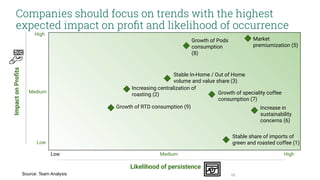
● Market premiumization based on changes in customer preference is the key trend with high
likelihood of persistence and impact in profits. Coffee pods provide convenience and continue to
grow. Specialty coffee offers exceptional tastes and is expanding, but currently a niche market.
● Increasing concerns for sustainability is another trend. While the pod market faces is increasingly
criticized due to its high amount of waste, coffee with sustainability certificate can benefit from price
premium of 10-15%.
● Customers preference toward naturally flavored, low sugar beverages can be beneficial for
Ready-to-Drink (RTD) coffee (estimated CAGR: 13%).
Major Trends
Implications
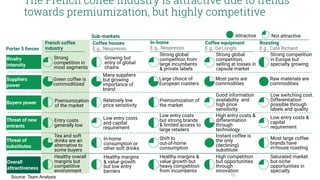
● Overall, the French coffee industry is attractive due to premiumization, limited power of suppliers
and low threat of substitutes. However, it is highly competitive and entry barriers are generally low,
putting pressure on profits, except for a few dominant incumbents that benefit from a strong brand.
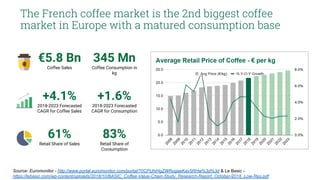
● The French coffee industry is a 5.8 bn EUR market, the 2nd largest in Europe. Consumption is
stagnant, however the market size is growing due to increasing premiumization.
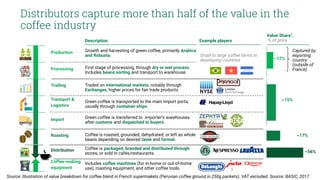
● Players active in distribution capture over half of the value. The other half of the value is shared
between roasters, importers and producers.
● In-home and out-of-home are roughly equivalent in terms of value. However, in-home is highly
consolidated with a few dominant players such as Nestlé and Lavazza. Out-of-home is highly
fragmented, with international chains such as Starbucks making their first moves.
1
The French coffee market is the 2nd biggest coffee
market in Europe with a matured consumption base
€5.8 Bn
Coffee Sales
+4.1%
2018-2023 Forecasted
CAGR for Coffee Sales
+1.6%
2018-2023 Forecasted
CAGR for Consumption
83%
Retail Share of
Consumption
61%
Retail Share of Sales
345 Mn
Coffee Consumption in
kg
Source: Euromonitor - http://www.portal.euromonitor.com/portal/?0CPUhiHgZWRugaeKav5RHw%3d%3d & Le Basic -
https://lebasic.com/wp-content/uploads/2018/10/BASIC_Coffee-Value-Chain-Study_Research-Report_October-2018_Low-Res.pdf2
Distributors capture more than half of the value in the
coffee industry
Production
Processing
Trading
Transport &
Logistics
Import
Roasting
Distribution
Coffee-making
equipment
Value Share1
,
% of priceDescription Example players
~12%
~15%
~17%
~56%
Growth and harvesting of green coffee, primarily Arabica
and Robusta.
First stage of processing, through dry or wet process.
Includes beans sorting and transport to warehouse.
Traded on international markets, notably through
Exchanges, higher prices for fair trade products
Green coffee is transported to the main import ports,
usually through container ships.
Green coffee is transferred to importer’s warehouses
after customs and dispatched to buyers.
Includes coffee machines (for in-home or out-of-home
use), roasting equipment, and other coffee tools.
Small to large coffee farms in
developing countries
Coffee is roasted, grounded, dehydrated; or left as whole
beans depending on desired taste and format.
Coffee is packaged, branded and distributed through
stores, or sold in cafés/restaurants.
Source: Illustration of value breakdown for coffee blend in French supermakets (Peruvian coffee ground in 250g packets). VAT excluded. Source: BASIC, 2017
Captured by
exporting
country
(outside of
France)
3
Source: Team Analysis
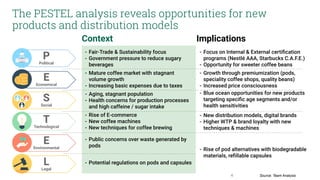
The PESTEL analysis reveals opportunities for new
products and distribution models
PPolitical
EEconomical
SSocial
TTechnological
EEnvironmental
LLegal
Context Implications
4
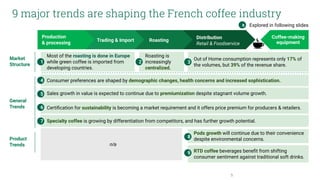
9 major trends are shaping the French coffee industry
Production
& processing
Trading & Import Roasting
Distribution
Retail & Foodservice
Coffee-making
equipment
Most of the roasting is done in Europe
while green coffee is imported from
developing countries.
1
Roasting is
increasingly
centralized.
2
Out of Home consumption represents only 17% of
the volumes, but 39% of the revenue share.
3
General
Trends
Market
Structure
Consumer preferences are shaped by demographic changes, health concerns and increased sophistication.
Sales growth in value is expected to continue due to premiumization despite stagnant volume growth.
Certification for sustainability is becoming a market requirement and it offers price premium for producers & retailers.
Specialty coffee is growing by differentiation from competitors, and has further growth potential.
Pods growth will continue due to their convenience
despite environmental concerns.8
4
5
6
7
RTD coffee beverages benefit from shifting
consumer sentiment against traditional soft drinks.
9
Product
Trends n/a
Explored in following slidesx
5
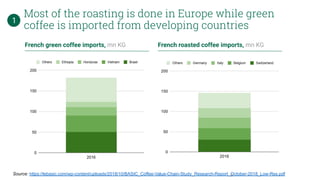
Most of the roasting is done in Europe while green
coffee is imported from developing countries
French green coffee imports, mn KG French roasted coffee imports, mn KG
Source: https://lebasic.com/wp-content/uploads/2018/10/BASIC_Coffee-Value-Chain-Study_Research-Report_October-2018_Low-Res.pdf
1
6
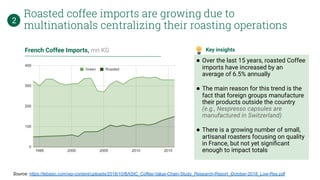
Roasted coffee imports are growing due to
multinationals centralizing their roasting operations
French Coffee Imports, mn KG Key insights
● Over the last 15 years, roasted Coffee
imports have increased by an
average of 6.5% annually
● The main reason for this trend is the
fact that foreign groups manufacture
their products outside the country
(e.g., Nespresso capsules are
manufactured in Switzerland)
● There is a growing number of small,
artisanal roasters focusing on quality
in France, but not yet significant
enough to impact totals
Source: https://lebasic.com/wp-content/uploads/2018/10/BASIC_Coffee-Value-Chain-Study_Research-Report_October-2018_Low-Res.pdf
2
7
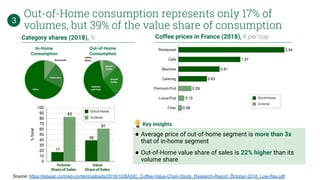
● Average price of out-of-home segment is more than 3x
that of in-home segment
● Out-of-Home value share of sales is 22% higher than its
volume share
Coffee prices in France (2018), € per cupCategory shares (2018), %
In-Home
Consumption
Out-of-Home
Consumption
Key insights
Out-of-Home consumption represents only 17% of
volumes, but 39% of the value share of consumption
3
Source: https://lebasic.com/wp-content/uploads/2018/10/BASIC_Coffee-Value-Chain-Study_Research-Report_October-2018_Low-Res.pdf8
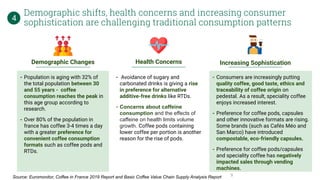
Demographic shifts, health concerns and increasing consumer
sophistication are challenging traditional consumption patterns
4
Health Concerns Increasing Sophistication
Population is aging with 32% of
the total population between 30
and 55 years - coffee
consumption reaches the peak in
this age group according to
research.
Over 80% of the population in
france has coffee 3-4 times a day
with a greater preference for
convenient coffee consumption
formats such as coffee pods and
RTDs.
Demographic Changes
Avoidance of sugary and
carbonated drinks is giving a rise
in preference for alternative
additive-free drinks like RTDs.
- Concerns about caffeine
consumption and the effects of
caffeine on health limits volume
growth. Coffee pods containing
lower coffee per portion is another
reason for the rise of pods.
Consumers are increasingly putting
quality coffee, good taste, ethics and
traceability of coffee origin on
pedestal. As a result, speciality coffee
enjoys increased interest.
Preference for coffee pods, capsules
and other innovative formats are rising.
Some brands (such as Cafés Méo and
San Marco) have introduced
compostable, eco-friendly capsules.
Preference for coffee pods/capsules
and speciality coffee has negatively
impacted sales through vending
machines.
9Source: Euromonitor, Coffee in France 2019 Report and Basic Coffee Value Chain Supply Analysis Report
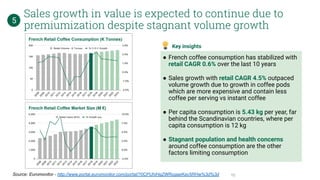
Key insights
Source: Euromonitor - http://www.portal.euromonitor.com/portal/?0CPUhiHgZWRugaeKav5RHw%3d%3d
● French coffee consumption has stabilized with
retail CAGR 0.6% over the last 10 years
● Sales growth with retail CAGR 4.5% outpaced
volume growth due to growth in coffee pods
which are more expensive and contain less
coffee per serving vs instant coffee
● Per capita consumption is 5.43 kg per year, far
behind the Scandinavian countries, where per
capita consumption is 12 kg
● Stagnant population and health concerns
around coffee consumption are the other
factors limiting consumption
Sales growth in value is expected to continue due to
premiumization despite stagnant volume growth
5
10
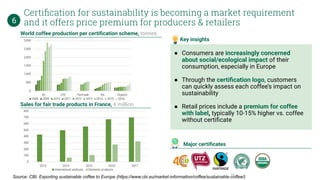
● Consumers are increasingly concerned
about social/ecological impact of their
consumption, especially in Europe
● Through the certification logo, customers
can quickly assess each coffee’s impact on
sustainability
● Retail prices include a premium for coffee
with label, typically 10-15% higher vs. coffee
without certificate
World coffee production per certification scheme, tonnes
Sales for fair trade products in France, € million
Major certificatesMajor certificates
Key insights
Source: CBI, Exporting sustainable coffee to Europe (https://www.cbi.eu/market-information/coffee/sustainable-coffee/)
Certification for sustainability is becoming a market requirement
and it offers price premium for producers & retailers6
11
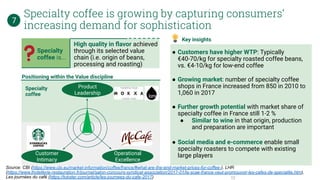
Customer
Intimacy
Product
Leadership
Operational
Excellence
Positioning within the Value discipline
● Customers have higher WTP: Typically
€40-70/kg for specialty roasted coffee beans,
vs. €4-10/kg for low-end coffee
● Growing market: number of specialty coffee
shops in France increased from 850 in 2010 to
1,060 in 2017
● Further growth potential with market share of
specialty coffee in France still 1-2 %
● Similar to wine in that origin, production
and preparation are important
● Social media and e-commerce enable small
specialty roasters to compete with existing
large players
Key insights
Specialty
coffee is...
High quality in flavor achieved
through its selected value
chain (i.e. origin of beans,
processing and roasting)
Source: CBI (https://www.cbi.eu/market-information/coffee/france/#what-are-the-end-market-prices-for-coffee-), LHR
(https://www.lhotellerie-restauration.fr/journal/salon-concours-syndicat-association/2017-01/la-scae-france-veut-promouvoir-les-cafes-de-specialite.htm),
Les journées du café (https://tokster.com/article/les-journees-du-cafe-2017)
Specialty
coffee
Specialty coffee is growing by capturing consumers’
increasing demand for sophistication
7
12
Source: Euromonitor: http://www.portal.euromonitor.com/portal/?d0vfE4h%2f34%2bUDMyrJzDCJg%3d%3d -
ECF: https://www.ecf-coffee.org/publications/european-coffee-report -
Le Basic: https://lebasic.com/wp-content/uploads/2018/10/BASIC_Coffee-Value-Chain-Study_Research-Report_October-2018_Low-Res.pdf
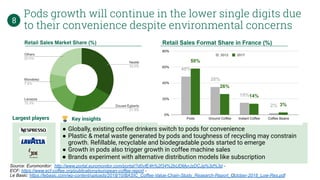
● Globally, existing coffee drinkers switch to pods for convenience
● Plastic & metal waste generated by pods and toughness of recycling may constrain
growth. Refillable, recyclable and biodegradable pods started to emerge
● Growth in pods also trigger growth in coffee machine sales
● Brands experiment with alternative distribution models like subscription
Key insightsLargest players
Pods growth will continue in the lower single digits due
to their convenience despite environmental concerns
8
13
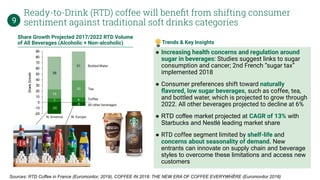
● Increasing health concerns and regulation around
sugar in beverages: Studies suggest links to sugar
consumption and cancer; 2nd French “sugar tax”
implemented 2018
● Consumer preferences shift toward naturally
flavored, low sugar beverages, such as coffee, tea,
and bottled water, which is projected to grow through
2022. All other beverages projected to decline at 6%
● RTD coffee market projected at CAGR of 13% with
Starbucks and Nestlé leading market share
● RTD coffee segment limited by shelf-life and
concerns about seasonality of demand. New
entrants can innovate on supply chain and beverage
styles to overcome these limitations and access new
customers
Trends & Key Insights
Share Growth Projected 2017/2022 RTD Volume
of All Beverages (Alcoholic + Non-alcoholic)
Sources: RTD Coffee in France (Euromonitor, 2019), COFFEE IN 2018: THE NEW ERA OF COFFEE EVERYWHERE (Euromonitor 2018)
Ready-to-Drink (RTD) coffee will benefit from shifting consumer
sentiment against traditional soft drinks categories9
14
Source: Team Analysis
Strong global
competition from
large incumbents
& private labels
Sub-markets
Strong competition
in Europe but
specialty growing
Raw materials are
commodities
Rivalry
intensity
Suppliers
power
Buyers power
Threat of new
entrants
Threat of
substitutes
Overall
attractiveness
Low switching cost.
Differentiation
possible through
labels and quality
Low entry costs &
capital
requirement
Tea and soft
drinks are an
alternative to
some buyers
In-home
E.g., Nespresso
Coffee houses
E.g., Nespresso
Coffee equipment
E.g., De'Longhi
Roasting
E.g., Café Richard
French coffee
industry
Most large coffee
brands have
in-house roasting
Growing but
entry of global
chains
Strong global
competition,
selling at losses in
capsule market
Instant coffee is
the only
(declining)
substitute
Most parts are
commodities
High entry costs &
differentiation
through
technology
Good information
availability and
high price
sensitivity
Large choice of
European roasters
Premiumization of
the market
Low entry costs
but strong brands
& limited access to
large retailers
Shift to
out-of-home
consumption
Many suppliers
but growing
importance of
brand
Relatively low
price sensitivity
Low entry costs
and capital
requirement
In-home
consumption or
other soft drinks
Strong
competition in
most segments
Green coffee is
commoditized
Premiumization
of the market
Entry costs
generally low
Saturated market
but niche
opportunities in
specialty
High competition
but opportunities
through
innovation
Healthy margins &
value growth but
heavy competition
from incumbents
Healthy margins
& value growth
but low entry
barriers
Healthy overall
margins but
competitive
environment
Attractive Not attractive
Porter 5 forces
The French coffee industry is attractive due to trends
towards premiumization, but highly competitive
15
Source: Team Analysis
ImpactonProfits
Likelihood of persistence
Low Medium High
Low
Medium
High
Market
premiumization (5)
Growth of Pods
consumption
(8)
Stable In-Home / Out of Home
volume and value share (3)
Growth of speciality coffee
consumption (7)
Increase in
sustainability
concerns (6)
Growth of RTD consumption (9)
Increasing centralization of
roasting (2)
Stable share of imports of
green and roasted coffee (1)
Companies should focus on trends with the highest
expected impact on profit and likelihood of occurrence
16
AsiaEurope Middle East| |

External analysis - french coffee industry

  • 1.
    French Coffee Market:External Analysis TEAM 101, Section E3 Master Strategist Day
  • 2.
    Executive summary -The Coffee Industry in France Industry Overview ● Market premiumization based on changes in customer preference is the key trend with high likelihood of persistence and impact in profits. Coffee pods provide convenience and continue to grow. Specialty coffee offers exceptional tastes and is expanding, but currently a niche market. ● Increasing concerns for sustainability is another trend. While the pod market faces is increasingly criticized due to its high amount of waste, coffee with sustainability certificate can benefit from price premium of 10-15%. ● Customers preference toward naturally flavored, low sugar beverages can be beneficial for Ready-to-Drink (RTD) coffee (estimated CAGR: 13%). Major Trends Implications ● Overall, the French coffee industry is attractive due to premiumization, limited power of suppliers and low threat of substitutes. However, it is highly competitive and entry barriers are generally low, putting pressure on profits, except for a few dominant incumbents that benefit from a strong brand. ● The French coffee industry is a 5.8 bn EUR market, the 2nd largest in Europe. Consumption is stagnant, however the market size is growing due to increasing premiumization. ● Players active in distribution capture over half of the value. The other half of the value is shared between roasters, importers and producers. ● In-home and out-of-home are roughly equivalent in terms of value. However, in-home is highly consolidated with a few dominant players such as Nestlé and Lavazza. Out-of-home is highly fragmented, with international chains such as Starbucks making their first moves. 1
  • 3.
    The French coffeemarket is the 2nd biggest coffee market in Europe with a matured consumption base €5.8 Bn Coffee Sales +4.1% 2018-2023 Forecasted CAGR for Coffee Sales +1.6% 2018-2023 Forecasted CAGR for Consumption 83% Retail Share of Consumption 61% Retail Share of Sales 345 Mn Coffee Consumption in kg Source: Euromonitor - http://www.portal.euromonitor.com/portal/?0CPUhiHgZWRugaeKav5RHw%3d%3d & Le Basic - https://lebasic.com/wp-content/uploads/2018/10/BASIC_Coffee-Value-Chain-Study_Research-Report_October-2018_Low-Res.pdf2
  • 4.
    Distributors capture morethan half of the value in the coffee industry Production Processing Trading Transport & Logistics Import Roasting Distribution Coffee-making equipment Value Share1 , % of priceDescription Example players ~12% ~15% ~17% ~56% Growth and harvesting of green coffee, primarily Arabica and Robusta. First stage of processing, through dry or wet process. Includes beans sorting and transport to warehouse. Traded on international markets, notably through Exchanges, higher prices for fair trade products Green coffee is transported to the main import ports, usually through container ships. Green coffee is transferred to importer’s warehouses after customs and dispatched to buyers. Includes coffee machines (for in-home or out-of-home use), roasting equipment, and other coffee tools. Small to large coffee farms in developing countries Coffee is roasted, grounded, dehydrated; or left as whole beans depending on desired taste and format. Coffee is packaged, branded and distributed through stores, or sold in cafés/restaurants. Source: Illustration of value breakdown for coffee blend in French supermakets (Peruvian coffee ground in 250g packets). VAT excluded. Source: BASIC, 2017 Captured by exporting country (outside of France) 3
  • 5.
    Source: Team Analysis ThePESTEL analysis reveals opportunities for new products and distribution models PPolitical EEconomical SSocial TTechnological EEnvironmental LLegal Context Implications 4
  • 6.
    9 major trendsare shaping the French coffee industry Production & processing Trading & Import Roasting Distribution Retail & Foodservice Coffee-making equipment Most of the roasting is done in Europe while green coffee is imported from developing countries. 1 Roasting is increasingly centralized. 2 Out of Home consumption represents only 17% of the volumes, but 39% of the revenue share. 3 General Trends Market Structure Consumer preferences are shaped by demographic changes, health concerns and increased sophistication. Sales growth in value is expected to continue due to premiumization despite stagnant volume growth. Certification for sustainability is becoming a market requirement and it offers price premium for producers & retailers. Specialty coffee is growing by differentiation from competitors, and has further growth potential. Pods growth will continue due to their convenience despite environmental concerns.8 4 5 6 7 RTD coffee beverages benefit from shifting consumer sentiment against traditional soft drinks. 9 Product Trends n/a Explored in following slidesx 5
  • 7.
    Most of theroasting is done in Europe while green coffee is imported from developing countries French green coffee imports, mn KG French roasted coffee imports, mn KG Source: https://lebasic.com/wp-content/uploads/2018/10/BASIC_Coffee-Value-Chain-Study_Research-Report_October-2018_Low-Res.pdf 1 6
  • 8.
    Roasted coffee importsare growing due to multinationals centralizing their roasting operations French Coffee Imports, mn KG Key insights ● Over the last 15 years, roasted Coffee imports have increased by an average of 6.5% annually ● The main reason for this trend is the fact that foreign groups manufacture their products outside the country (e.g., Nespresso capsules are manufactured in Switzerland) ● There is a growing number of small, artisanal roasters focusing on quality in France, but not yet significant enough to impact totals Source: https://lebasic.com/wp-content/uploads/2018/10/BASIC_Coffee-Value-Chain-Study_Research-Report_October-2018_Low-Res.pdf 2 7
  • 9.
    ● Average priceof out-of-home segment is more than 3x that of in-home segment ● Out-of-Home value share of sales is 22% higher than its volume share Coffee prices in France (2018), € per cupCategory shares (2018), % In-Home Consumption Out-of-Home Consumption Key insights Out-of-Home consumption represents only 17% of volumes, but 39% of the value share of consumption 3 Source: https://lebasic.com/wp-content/uploads/2018/10/BASIC_Coffee-Value-Chain-Study_Research-Report_October-2018_Low-Res.pdf8
  • 10.
    Demographic shifts, healthconcerns and increasing consumer sophistication are challenging traditional consumption patterns 4 Health Concerns Increasing Sophistication Population is aging with 32% of the total population between 30 and 55 years - coffee consumption reaches the peak in this age group according to research. Over 80% of the population in france has coffee 3-4 times a day with a greater preference for convenient coffee consumption formats such as coffee pods and RTDs. Demographic Changes Avoidance of sugary and carbonated drinks is giving a rise in preference for alternative additive-free drinks like RTDs. - Concerns about caffeine consumption and the effects of caffeine on health limits volume growth. Coffee pods containing lower coffee per portion is another reason for the rise of pods. Consumers are increasingly putting quality coffee, good taste, ethics and traceability of coffee origin on pedestal. As a result, speciality coffee enjoys increased interest. Preference for coffee pods, capsules and other innovative formats are rising. Some brands (such as Cafés Méo and San Marco) have introduced compostable, eco-friendly capsules. Preference for coffee pods/capsules and speciality coffee has negatively impacted sales through vending machines. 9Source: Euromonitor, Coffee in France 2019 Report and Basic Coffee Value Chain Supply Analysis Report
  • 11.
    Key insights Source: Euromonitor- http://www.portal.euromonitor.com/portal/?0CPUhiHgZWRugaeKav5RHw%3d%3d ● French coffee consumption has stabilized with retail CAGR 0.6% over the last 10 years ● Sales growth with retail CAGR 4.5% outpaced volume growth due to growth in coffee pods which are more expensive and contain less coffee per serving vs instant coffee ● Per capita consumption is 5.43 kg per year, far behind the Scandinavian countries, where per capita consumption is 12 kg ● Stagnant population and health concerns around coffee consumption are the other factors limiting consumption Sales growth in value is expected to continue due to premiumization despite stagnant volume growth 5 10
  • 12.
    ● Consumers areincreasingly concerned about social/ecological impact of their consumption, especially in Europe ● Through the certification logo, customers can quickly assess each coffee’s impact on sustainability ● Retail prices include a premium for coffee with label, typically 10-15% higher vs. coffee without certificate World coffee production per certification scheme, tonnes Sales for fair trade products in France, € million Major certificatesMajor certificates Key insights Source: CBI, Exporting sustainable coffee to Europe (https://www.cbi.eu/market-information/coffee/sustainable-coffee/) Certification for sustainability is becoming a market requirement and it offers price premium for producers & retailers6 11
  • 13.
    Customer Intimacy Product Leadership Operational Excellence Positioning within theValue discipline ● Customers have higher WTP: Typically €40-70/kg for specialty roasted coffee beans, vs. €4-10/kg for low-end coffee ● Growing market: number of specialty coffee shops in France increased from 850 in 2010 to 1,060 in 2017 ● Further growth potential with market share of specialty coffee in France still 1-2 % ● Similar to wine in that origin, production and preparation are important ● Social media and e-commerce enable small specialty roasters to compete with existing large players Key insights Specialty coffee is... High quality in flavor achieved through its selected value chain (i.e. origin of beans, processing and roasting) Source: CBI (https://www.cbi.eu/market-information/coffee/france/#what-are-the-end-market-prices-for-coffee-), LHR (https://www.lhotellerie-restauration.fr/journal/salon-concours-syndicat-association/2017-01/la-scae-france-veut-promouvoir-les-cafes-de-specialite.htm), Les journées du café (https://tokster.com/article/les-journees-du-cafe-2017) Specialty coffee Specialty coffee is growing by capturing consumers’ increasing demand for sophistication 7 12
  • 14.
    Source: Euromonitor: http://www.portal.euromonitor.com/portal/?d0vfE4h%2f34%2bUDMyrJzDCJg%3d%3d- ECF: https://www.ecf-coffee.org/publications/european-coffee-report - Le Basic: https://lebasic.com/wp-content/uploads/2018/10/BASIC_Coffee-Value-Chain-Study_Research-Report_October-2018_Low-Res.pdf ● Globally, existing coffee drinkers switch to pods for convenience ● Plastic & metal waste generated by pods and toughness of recycling may constrain growth. Refillable, recyclable and biodegradable pods started to emerge ● Growth in pods also trigger growth in coffee machine sales ● Brands experiment with alternative distribution models like subscription Key insightsLargest players Pods growth will continue in the lower single digits due to their convenience despite environmental concerns 8 13
  • 15.
    ● Increasing healthconcerns and regulation around sugar in beverages: Studies suggest links to sugar consumption and cancer; 2nd French “sugar tax” implemented 2018 ● Consumer preferences shift toward naturally flavored, low sugar beverages, such as coffee, tea, and bottled water, which is projected to grow through 2022. All other beverages projected to decline at 6% ● RTD coffee market projected at CAGR of 13% with Starbucks and Nestlé leading market share ● RTD coffee segment limited by shelf-life and concerns about seasonality of demand. New entrants can innovate on supply chain and beverage styles to overcome these limitations and access new customers Trends & Key Insights Share Growth Projected 2017/2022 RTD Volume of All Beverages (Alcoholic + Non-alcoholic) Sources: RTD Coffee in France (Euromonitor, 2019), COFFEE IN 2018: THE NEW ERA OF COFFEE EVERYWHERE (Euromonitor 2018) Ready-to-Drink (RTD) coffee will benefit from shifting consumer sentiment against traditional soft drinks categories9 14
  • 16.
    Source: Team Analysis Strongglobal competition from large incumbents & private labels Sub-markets Strong competition in Europe but specialty growing Raw materials are commodities Rivalry intensity Suppliers power Buyers power Threat of new entrants Threat of substitutes Overall attractiveness Low switching cost. Differentiation possible through labels and quality Low entry costs & capital requirement Tea and soft drinks are an alternative to some buyers In-home E.g., Nespresso Coffee houses E.g., Nespresso Coffee equipment E.g., De'Longhi Roasting E.g., Café Richard French coffee industry Most large coffee brands have in-house roasting Growing but entry of global chains Strong global competition, selling at losses in capsule market Instant coffee is the only (declining) substitute Most parts are commodities High entry costs & differentiation through technology Good information availability and high price sensitivity Large choice of European roasters Premiumization of the market Low entry costs but strong brands & limited access to large retailers Shift to out-of-home consumption Many suppliers but growing importance of brand Relatively low price sensitivity Low entry costs and capital requirement In-home consumption or other soft drinks Strong competition in most segments Green coffee is commoditized Premiumization of the market Entry costs generally low Saturated market but niche opportunities in specialty High competition but opportunities through innovation Healthy margins & value growth but heavy competition from incumbents Healthy margins & value growth but low entry barriers Healthy overall margins but competitive environment Attractive Not attractive Porter 5 forces The French coffee industry is attractive due to trends towards premiumization, but highly competitive 15
  • 17.
    Source: Team Analysis ImpactonProfits Likelihoodof persistence Low Medium High Low Medium High Market premiumization (5) Growth of Pods consumption (8) Stable In-Home / Out of Home volume and value share (3) Growth of speciality coffee consumption (7) Increase in sustainability concerns (6) Growth of RTD consumption (9) Increasing centralization of roasting (2) Stable share of imports of green and roasted coffee (1) Companies should focus on trends with the highest expected impact on profit and likelihood of occurrence 16
  • 18.