
EXPRESSIONISM IN MODERN &
CONTEMPORARY
ARCHITECTURE
What role does it play?
Expressionism is a term that arises in the early 20th century
around a group of painters, mainly German and centered in Munich,
who sought to convey deep emotional content using significant
amounts of abstraction but without losing figural subject matter.
Color played a major role in their work. They also sought to convey
a new and different kind of emotional content, often verging on
complex psychology and psychic struggle. It is important to
remember that during this same time, the work of Sigmund Freud was
very new and ground-breaking, suggesting that many undercurrents in
the personality determine human emotional and psychological
reaction in a variety of situational “archetypes.”
While expressionism in architecture may not have quite so
much Freudian content, there is abundant evidence that many
architects at least went through a period in which they hoped to make
architecture more emotionally expressive than a machine or industrial
aesthetic would permit.
Expressionism is not a clearly defined term and may have
more than one definition. It can often overlap other kinds of content
and formal choices. Nevertheless, there is a certain quality about it
that usually allows us to recognize it. Expressionist forms are often
sculptural, sometimes irrational, usually personal and idiosyncratic.
But they are also often distorted. The notion of identifying
“expressive” qualities in a building is not necessarily the same as
identifying “expressionistic” qualities. A building may convey some
intentional meaning through its form (“expressive”); or the stamp of
the personality, individuality, identity, or even the pathology of the
architect (“expressionistic”). This may not always be easy to
distinguish. A wildly sculptural form may not always be the
evidence of expressionism. Expressionistic form can also convey
spirituality as well as psychology and it is important to evaluate a
potentially expressionist form carefully before pronouncing a verdict.
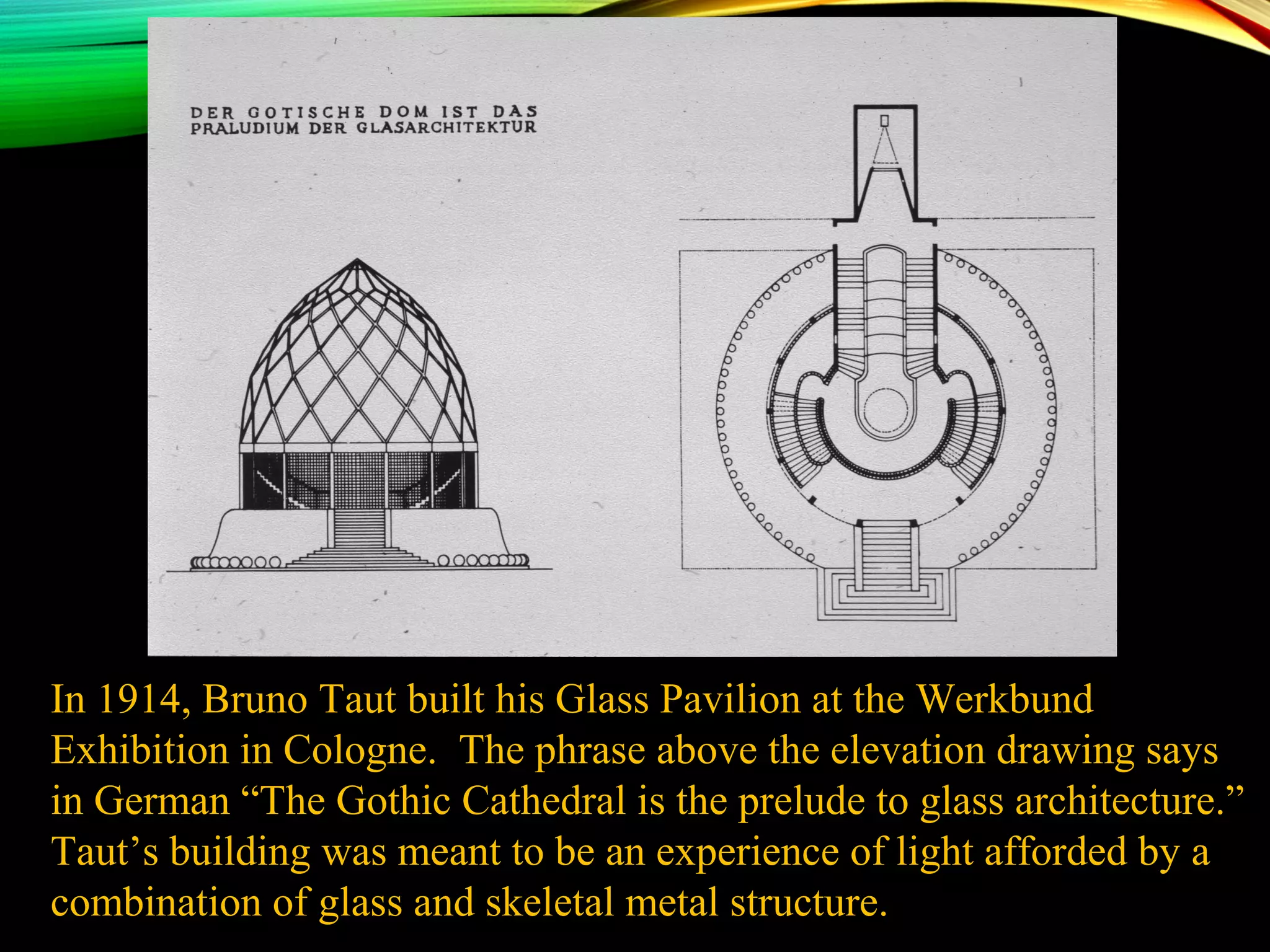
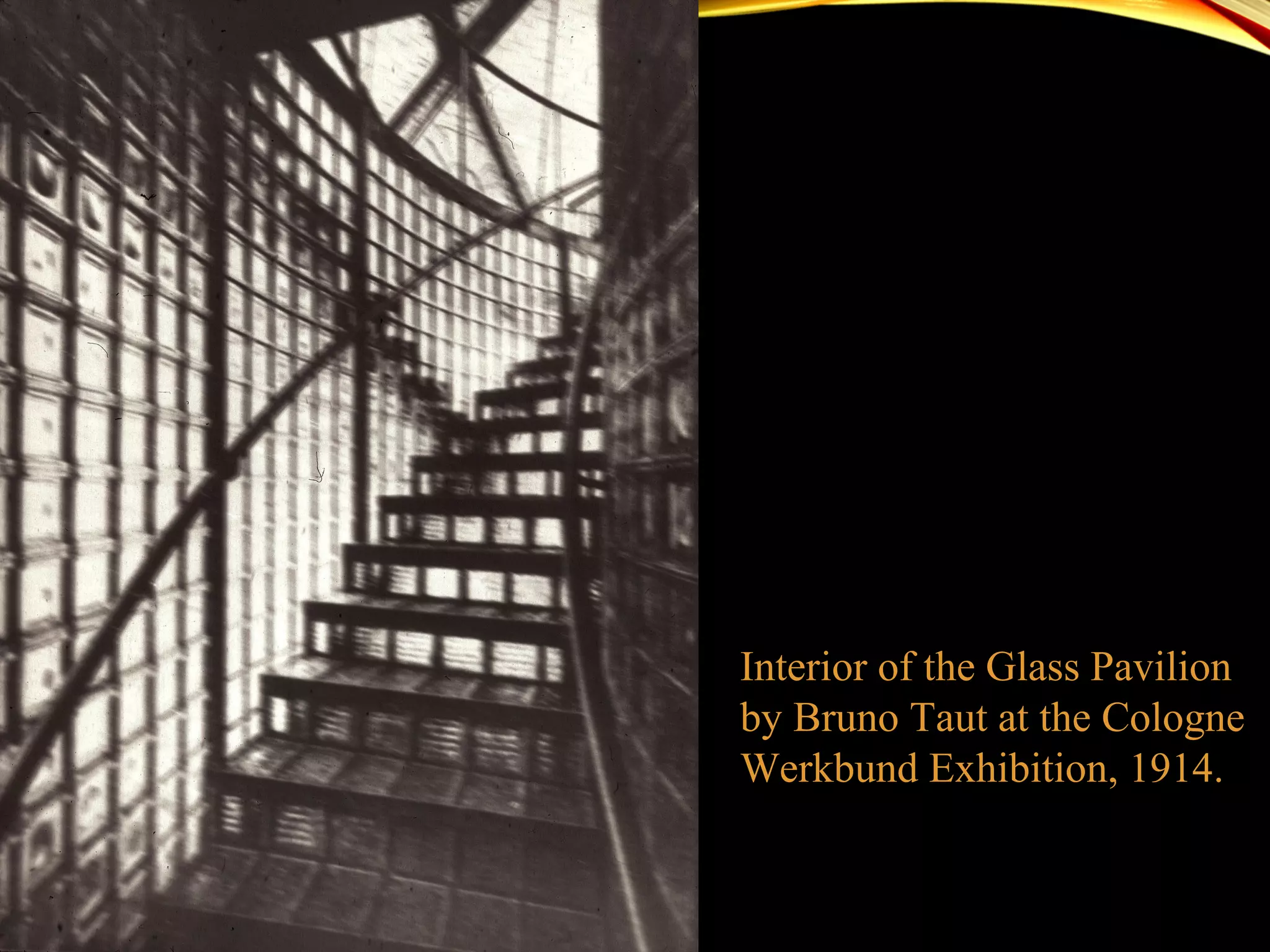
In 1914, Bruno Taut built his Glass Pavilion at the Werkbund
Exhibition in Cologne. The phrase above the elevation drawing says
in German “The Gothic Cathedral is the prelude to glass architecture.”
Taut’s building was meant to be an experience of light afforded by a
combination of glass and skeletal metal structure.
Interior of the Glass Pavilion
by Bruno Taut at the Cologne
Werkbund Exhibition, 1914.
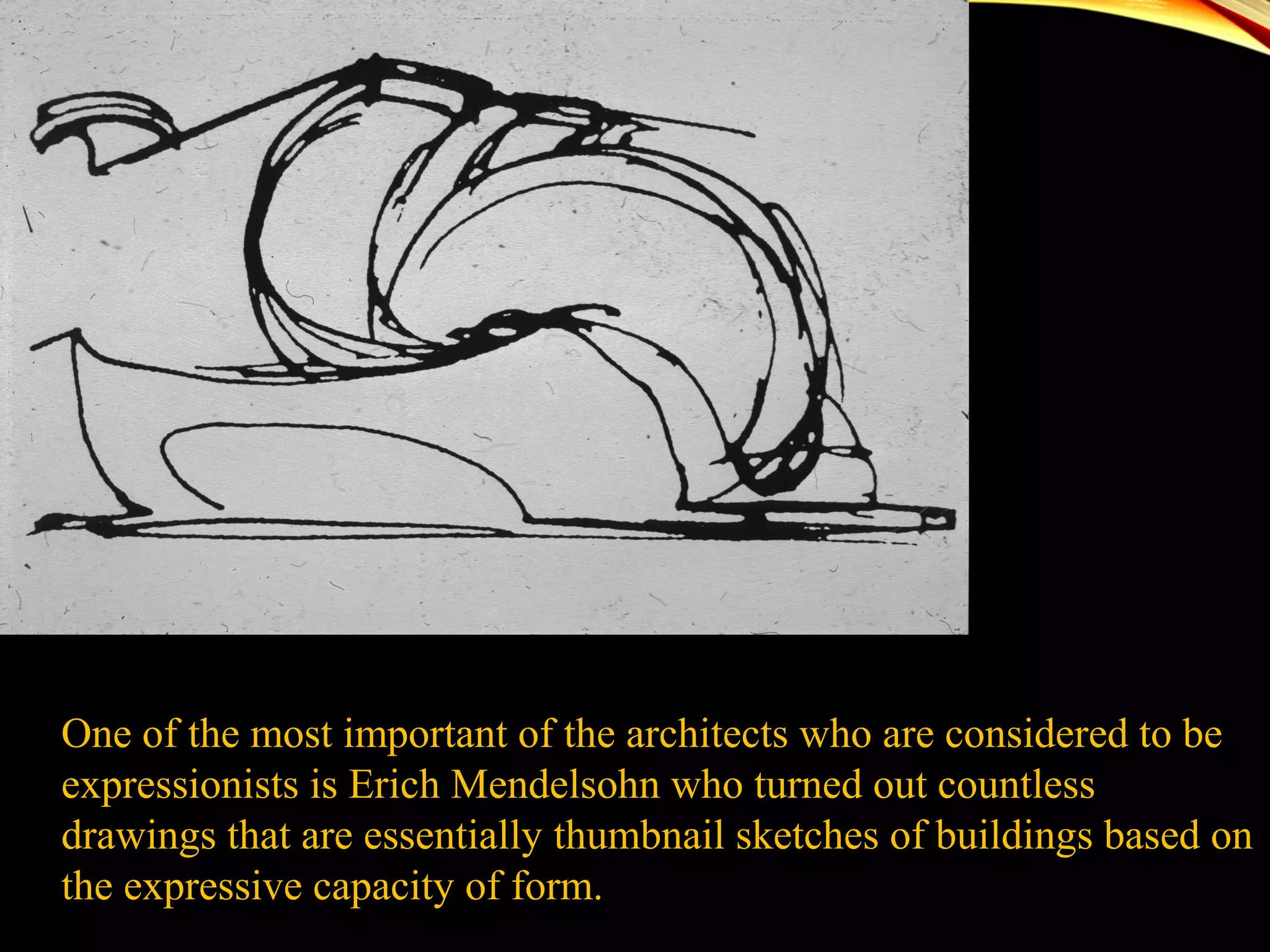
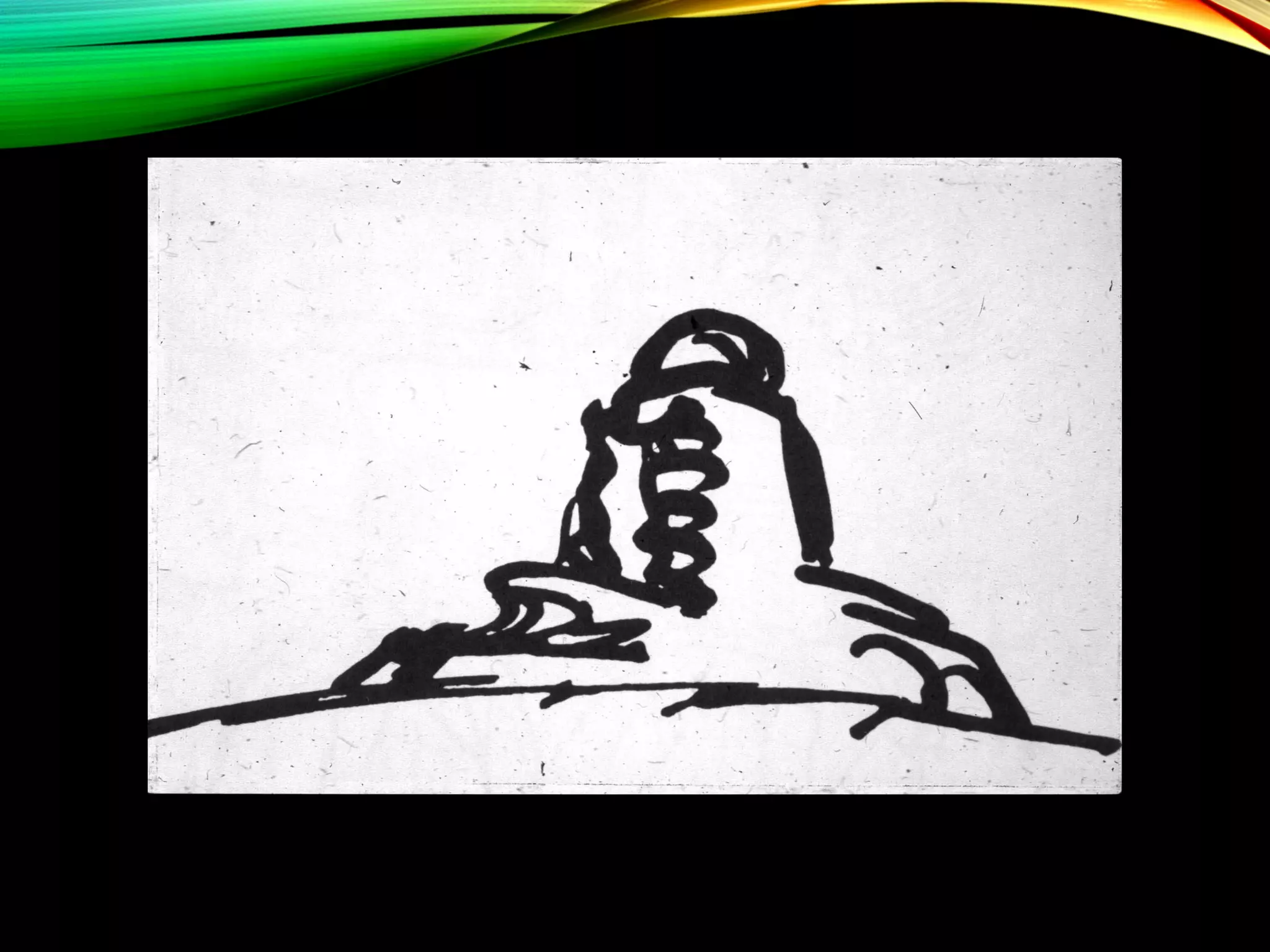
One of the most important of the architects who are considered to be
expressionists is Erich Mendelsohn who turned out countless
drawings that are essentially thumbnail sketches of buildings based on
the expressive capacity of form.
Enveloping Structure, 1914-15
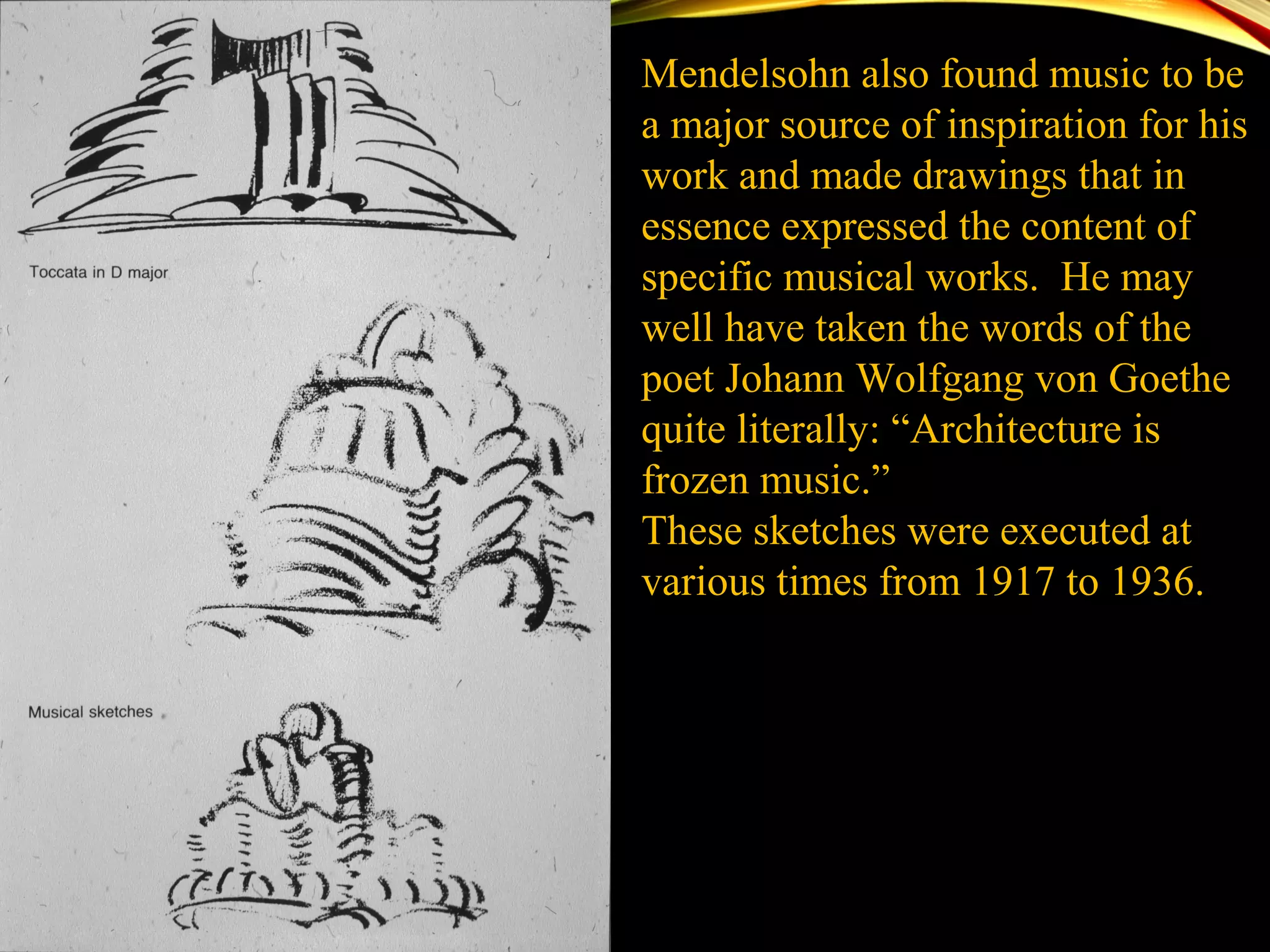
Mendelsohn also found music to be
a major source of inspiration for his
work and made drawings that in
essence expressed the content of
specific musical works. He may
well have taken the words of the
poet Johann Wolfgang von Goethe
quite literally: “Architecture is
frozen music.”
These sketches were executed at
various times from 1917 to 1936.
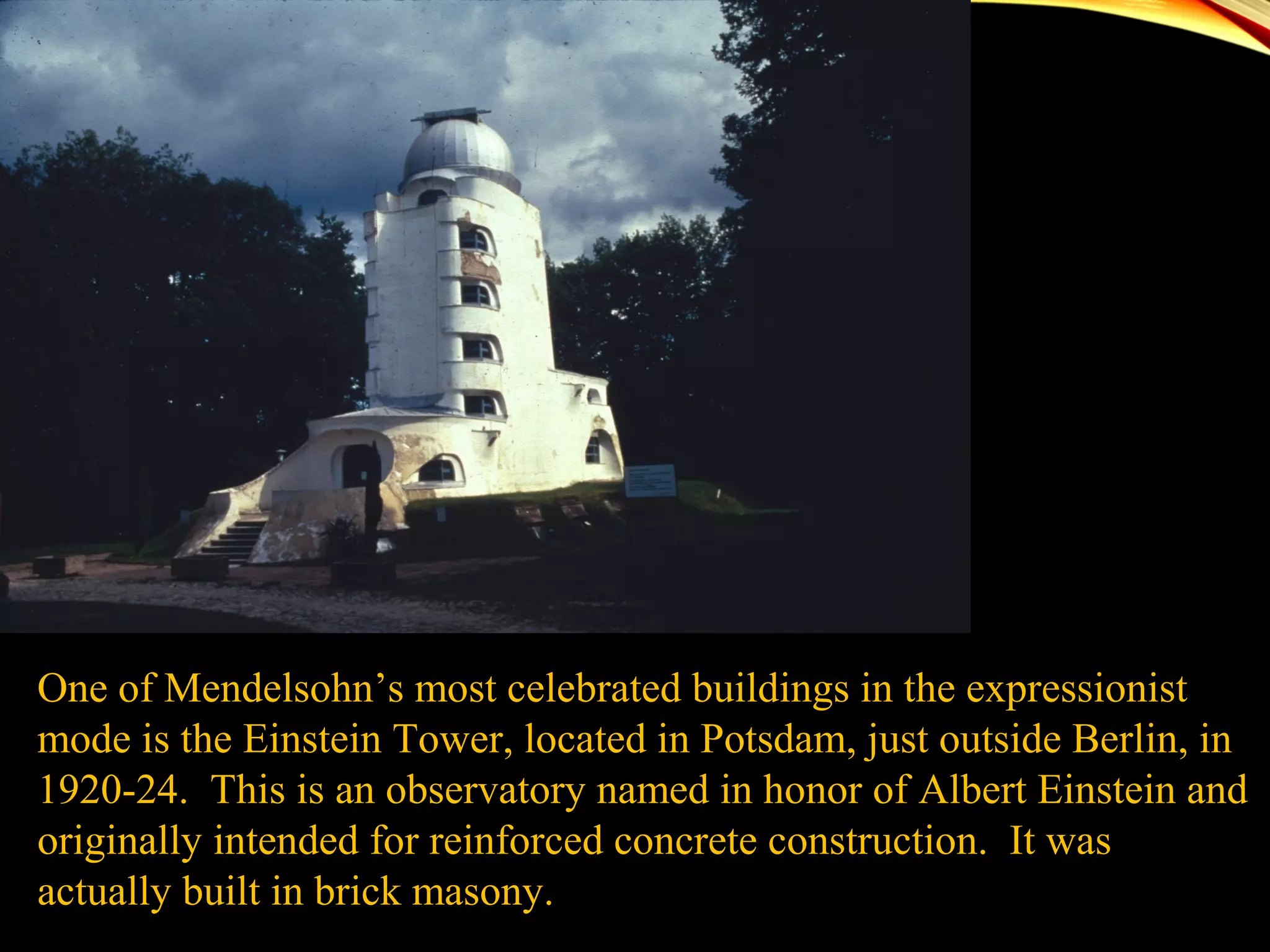
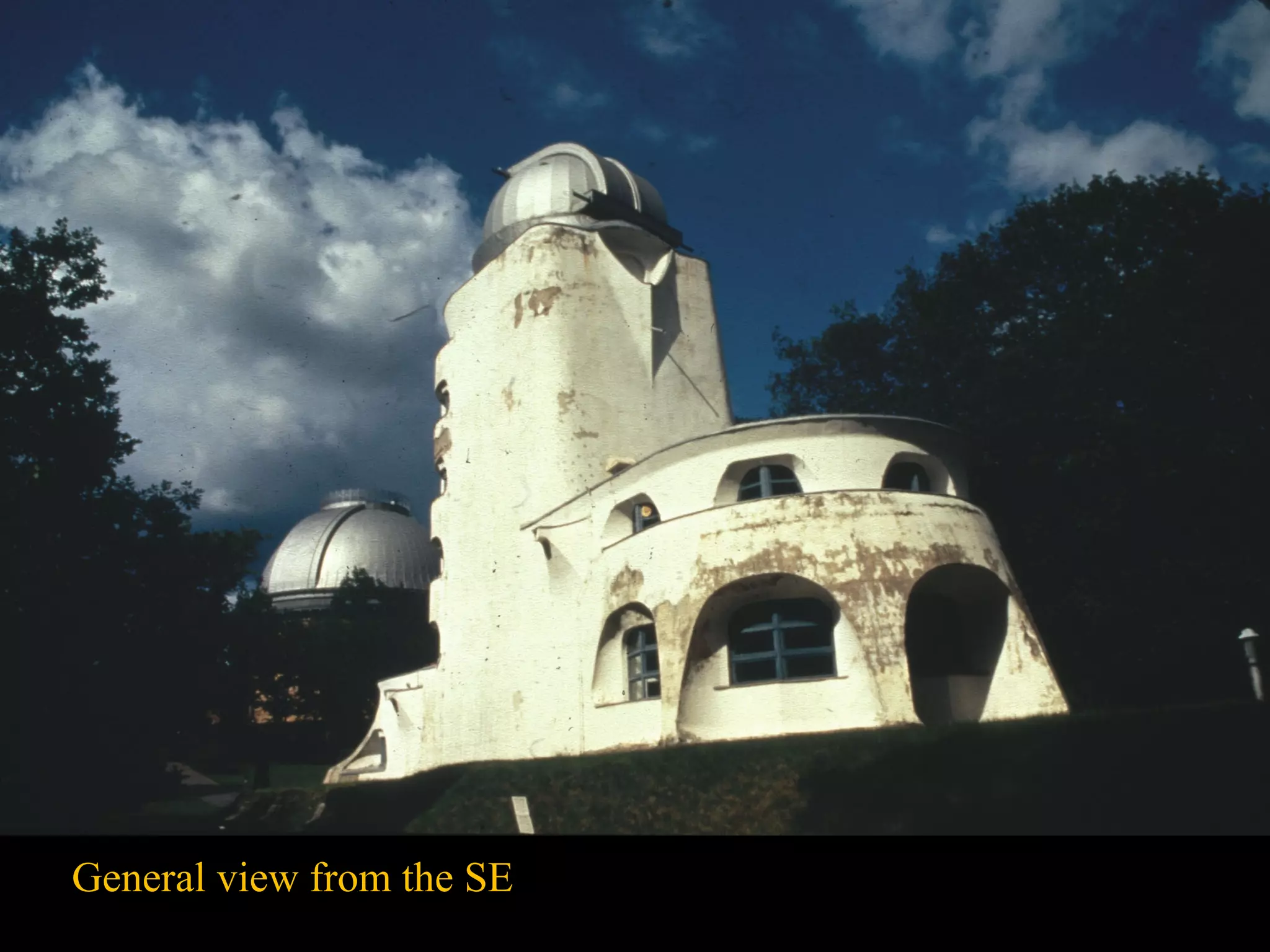
One of Mendelsohn’s most celebrated buildings in the expressionist
mode is the Einstein Tower, located in Potsdam, just outside Berlin, in
1920-24. This is an observatory named in honor of Albert Einstein and
originally intended for reinforced concrete construction. It was
actually built in brick masony.
General view from the SE
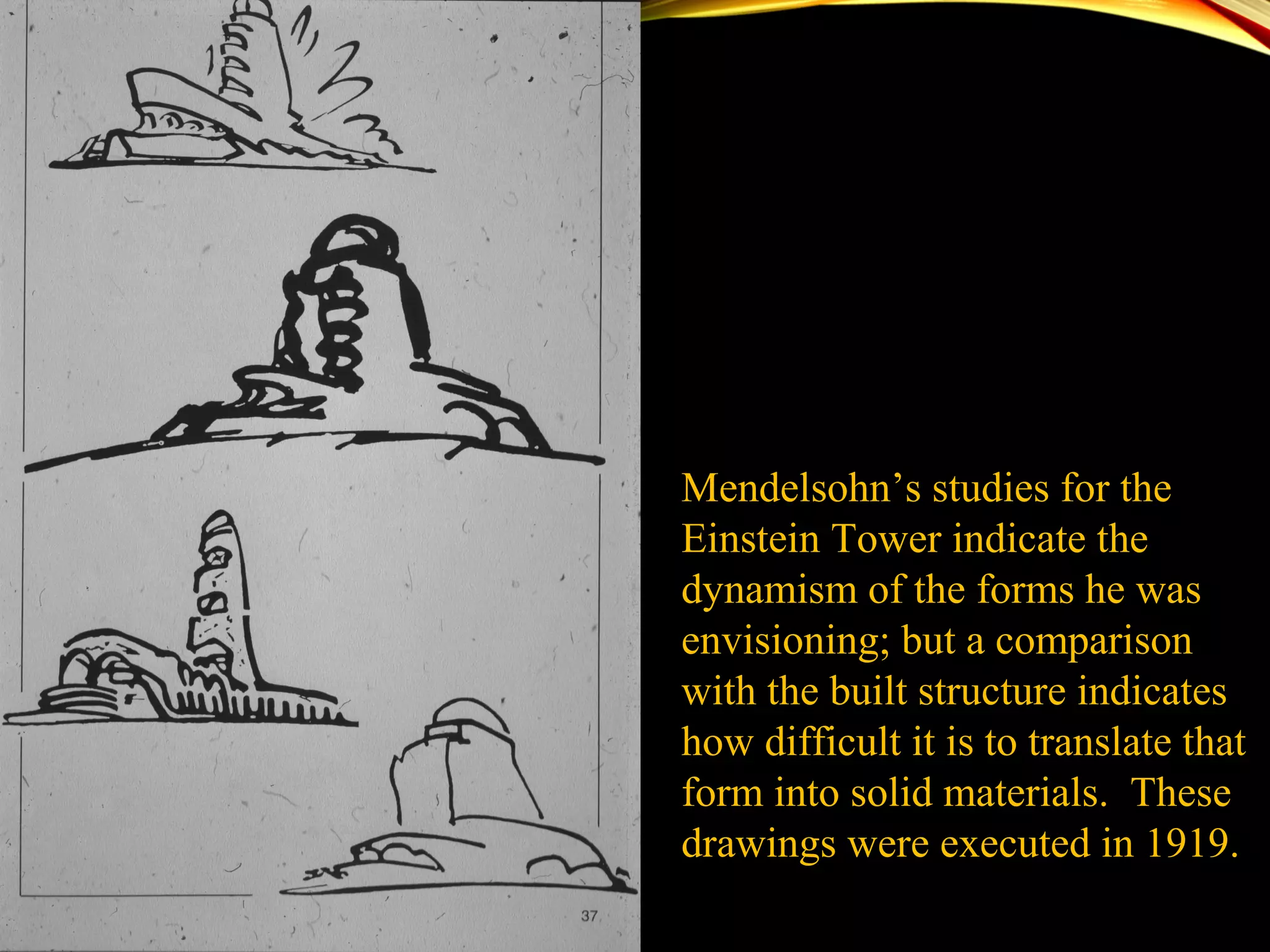
Mendelsohn’s studies for the
Einstein Tower indicate the
dynamism of the forms he was
envisioning; but a comparison
with the built structure indicates
how difficult it is to translate that
form into solid materials. These
drawings were executed in 1919.
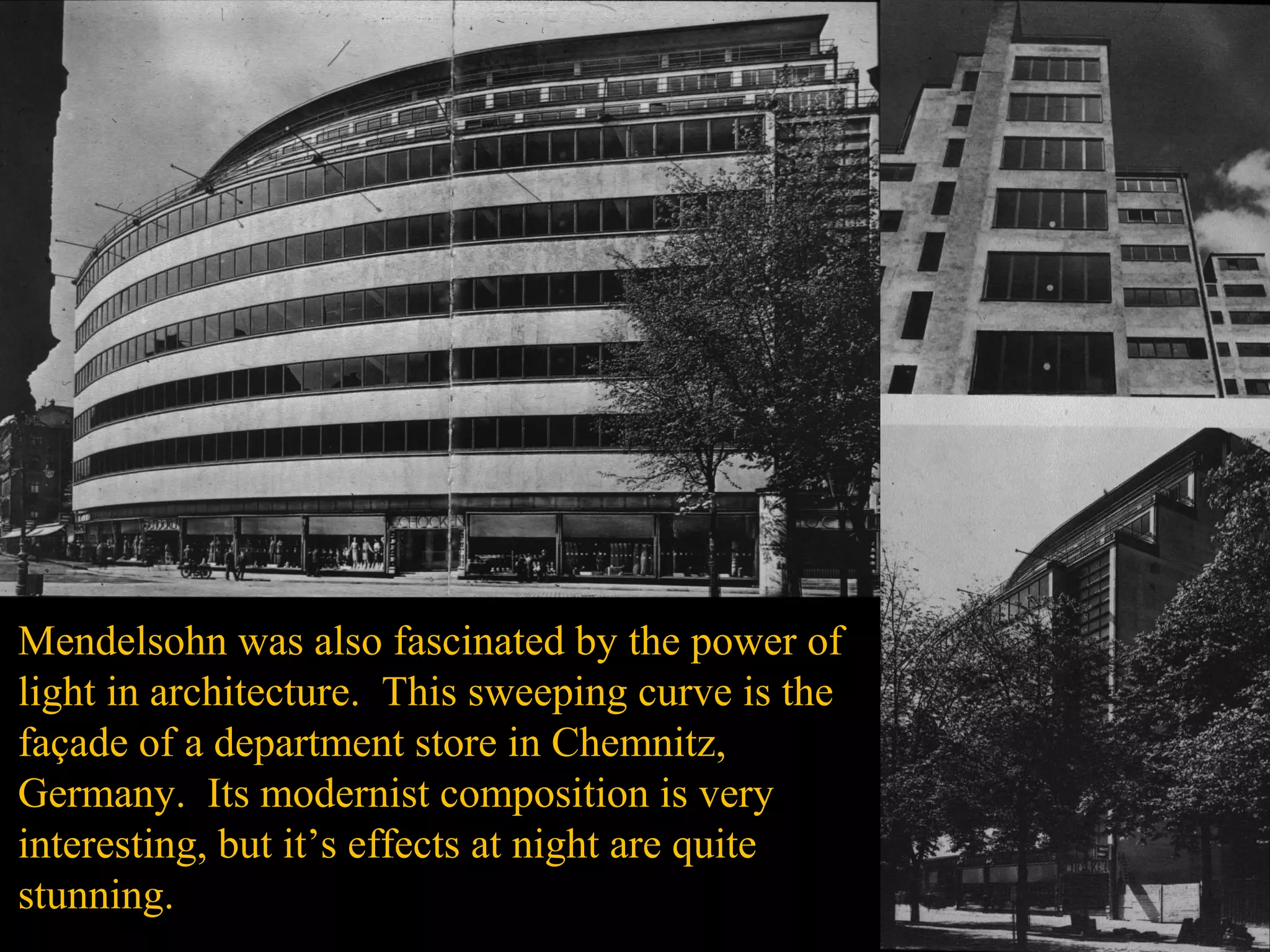
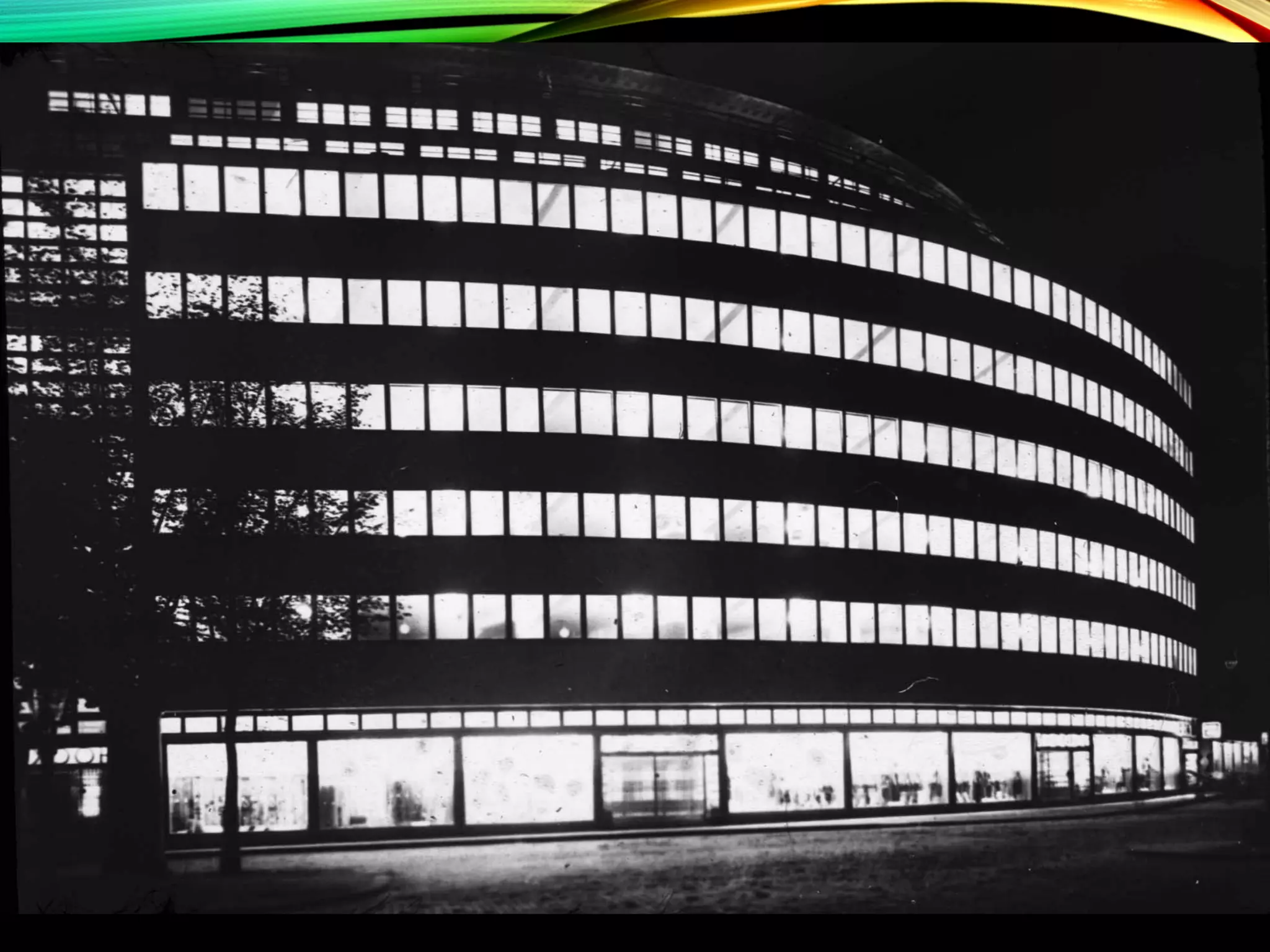
Mendelsohn was also fascinated by the power of
light in architecture. This sweeping curve is the
façade of a department store in Chemnitz,
Germany. Its modernist composition is very
interesting, but it’s effects at night are quite
stunning.
One of the most fascinating and important of the architects who are
usually named as expressionists is Rudolf Steiner (1862-1925), a man
who called himself a spiritual scientist. Steiner was born in Austria-
Hungary and was educated at the University of Vienna. He edited the
scientific works of the German Romantic poet Johann Wolfgang von
Goethe. In his research on Goethe, he became aware of Goethe’s
theory of color and his plant studies leading to the concept of
metamorphosis.
While some scientists believed that Goethe’s color theory was
unscientific, especially compared to the theory of color as refracted
light, Steiner argued that the poetic truth of Goethe’s ideas held up
under laboratory conditions and thus have a compelling value that
supersedes initial impression. Similarly, the theory of plant
metamorphosis, which has generally had more credibility with
botanists, is, according to Steiner, more reliable because it deals with
both the physical and the metaphysical aspect of plant growth.
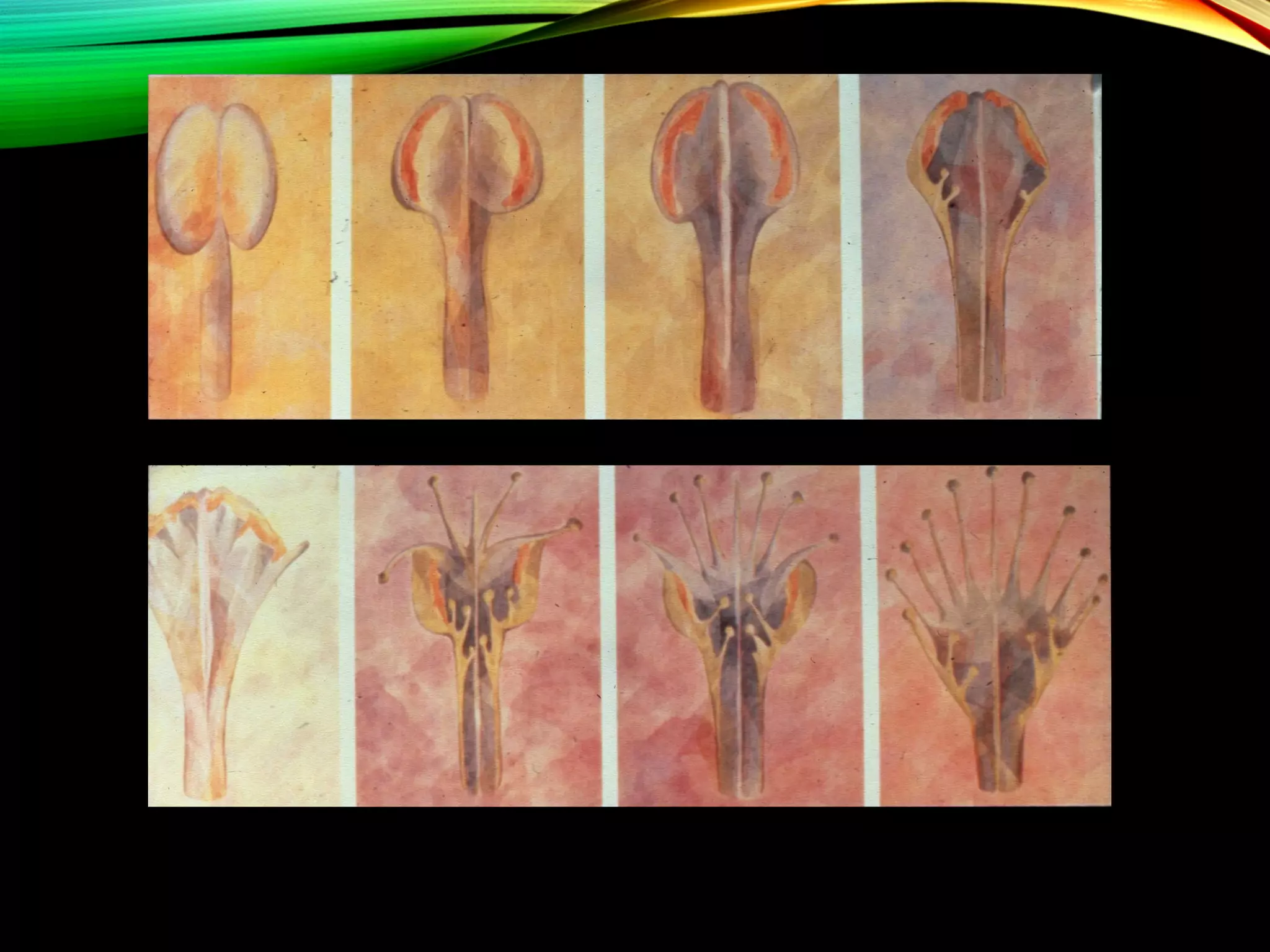
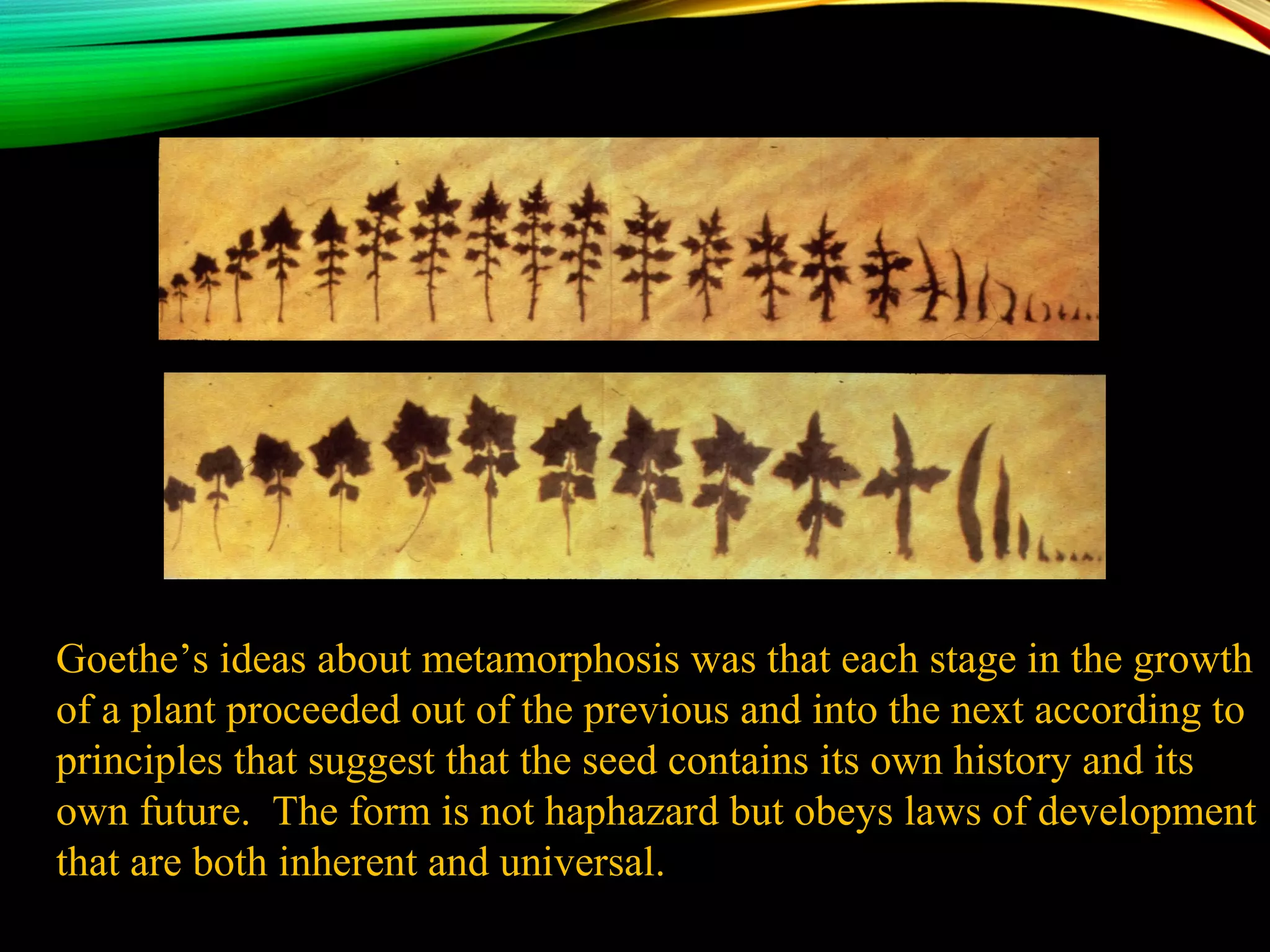
Goethe’s ideas about metamorphosis was that each stage in the growth
of a plant proceeded out of the previous and into the next according to
principles that suggest that the seed contains its own history and its
own future. The form is not haphazard but obeys laws of development
that are both inherent and universal.
Steiner was also fascinated by the relationship between mathematics
and spirituality. He taught that the visible world was the densest and
most material realm of a much larger spiritual world and that any
human being who chose could have access to the larger spiritual world
through a process of meditation, spiritual discipline, and will power.
He taught that just as we do not presume that someone somewhere
earlier in history invented mathematics but rather we accept
mathematics as self-justifying facts or truths, the spiritual world could
be perceived in the same way. We learn mathematics by beginning
with simple concepts and moving into much more complex levels.
The same is true of the spiritual world.
He also taught that human life is metamorphic, much like that of the
natural world, and that the greatest effort of the time was to acquire
deeper knowledge of human relationships to the spiritual world. This
eventually became known as “Anthroposophy” (anthropos=man,
sophia=knowledge or wisdom).
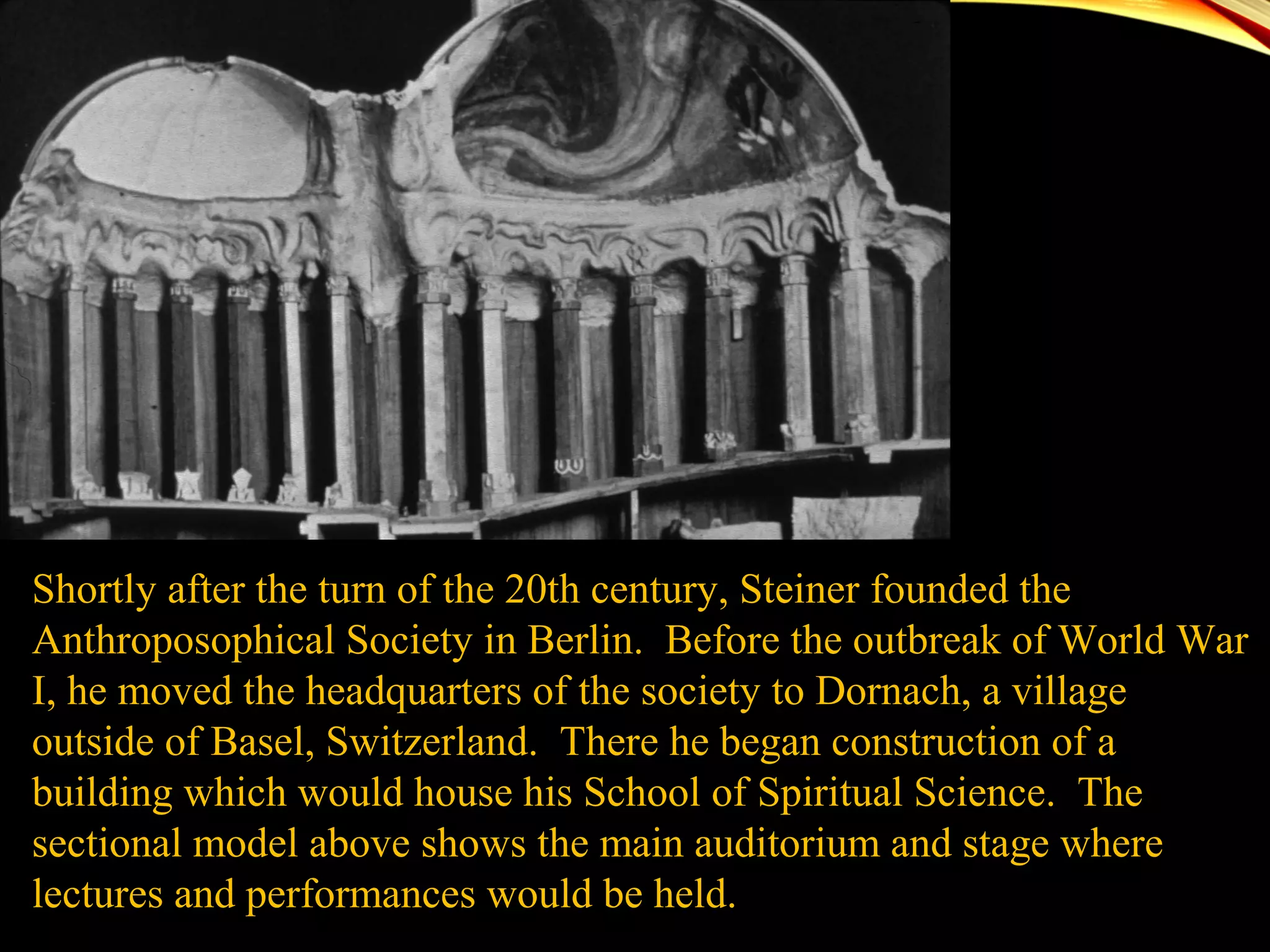
Shortly after the turn of the 20th century, Steiner founded the
Anthroposophical Society in Berlin. Before the outbreak of World War
I, he moved the headquarters of the society to Dornach, a village
outside of Basel, Switzerland. There he began construction of a
building which would house his School of Spiritual Science. The
sectional model above shows the main auditorium and stage where
lectures and performances would be held.
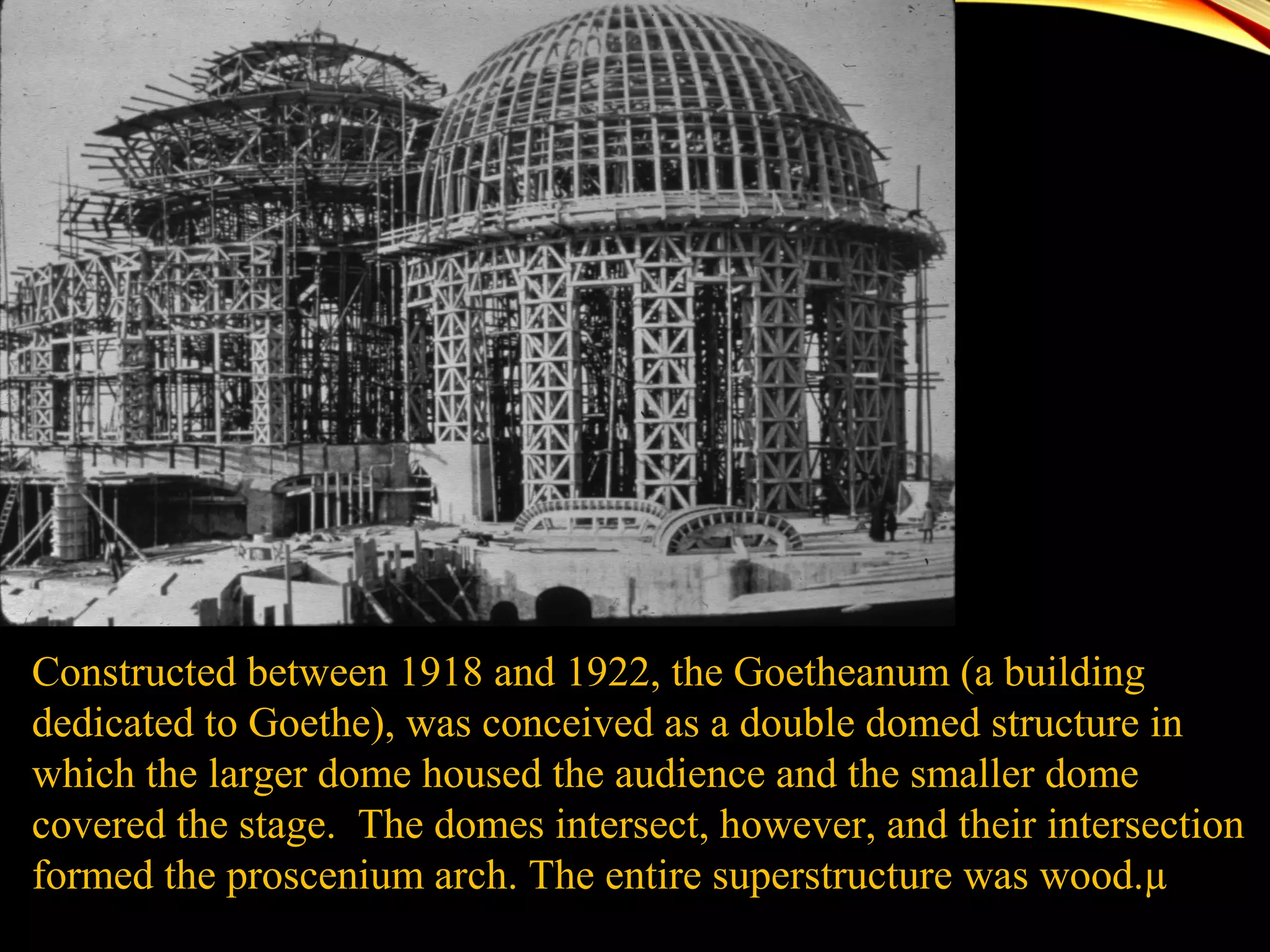
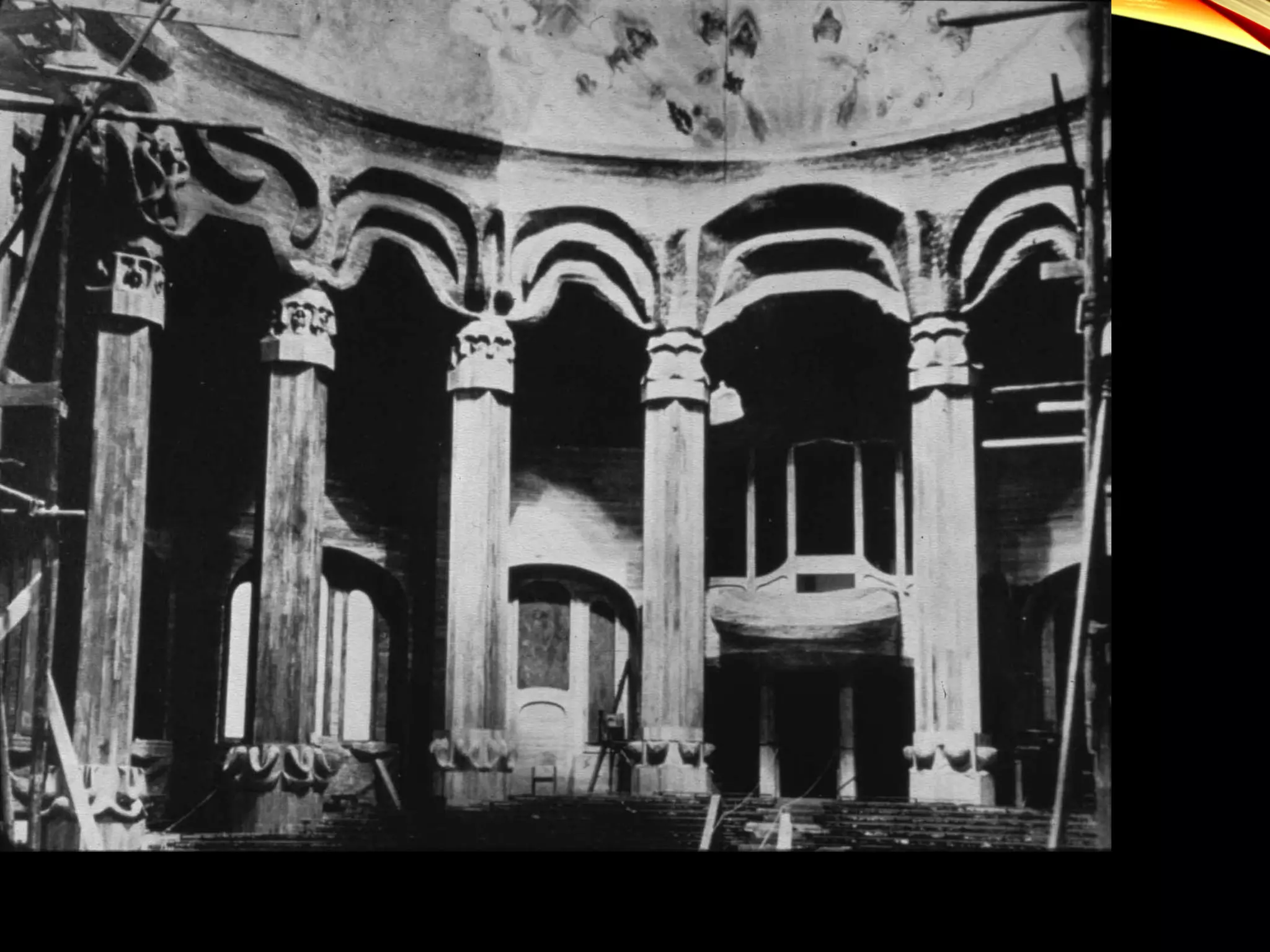
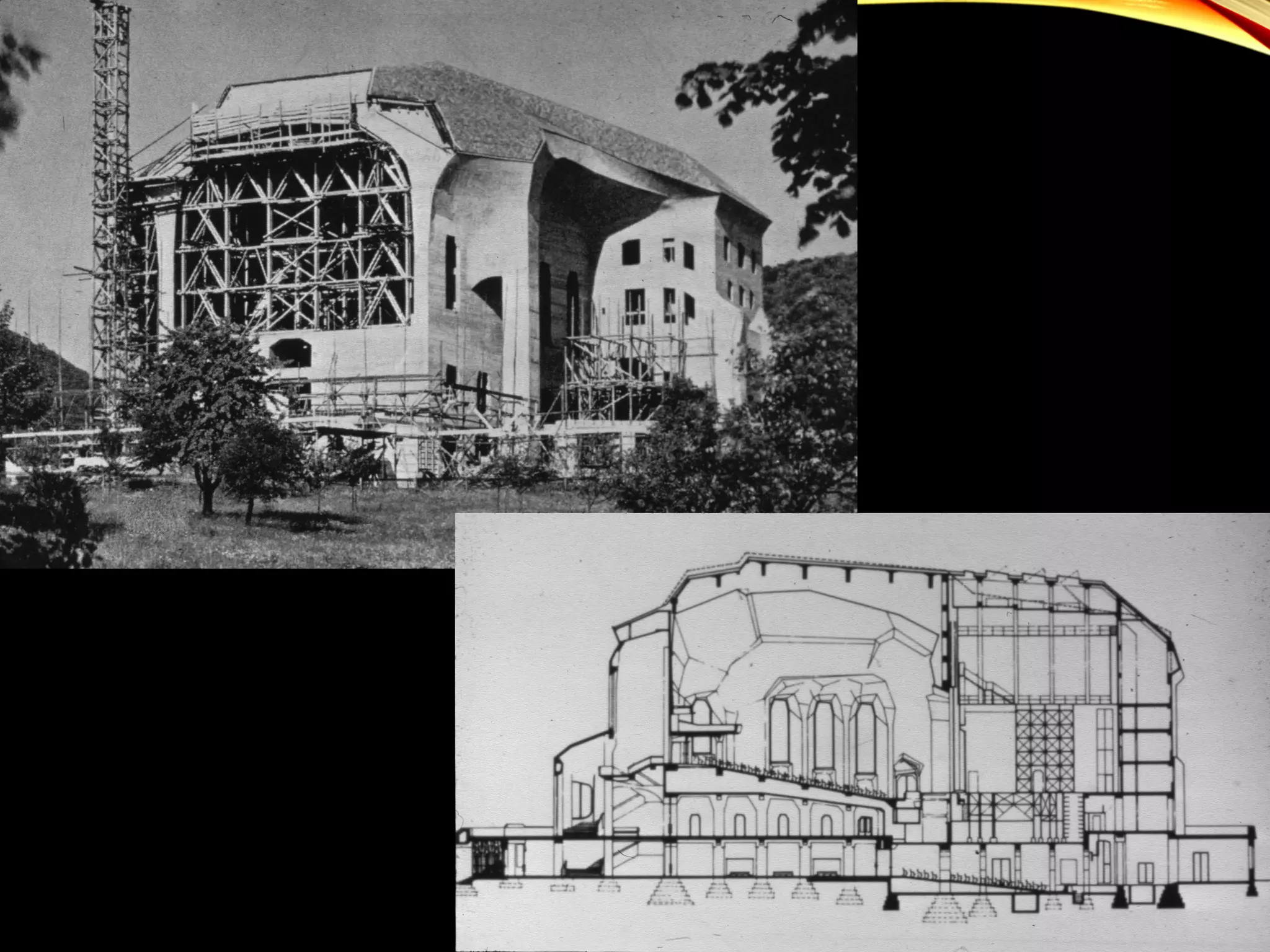
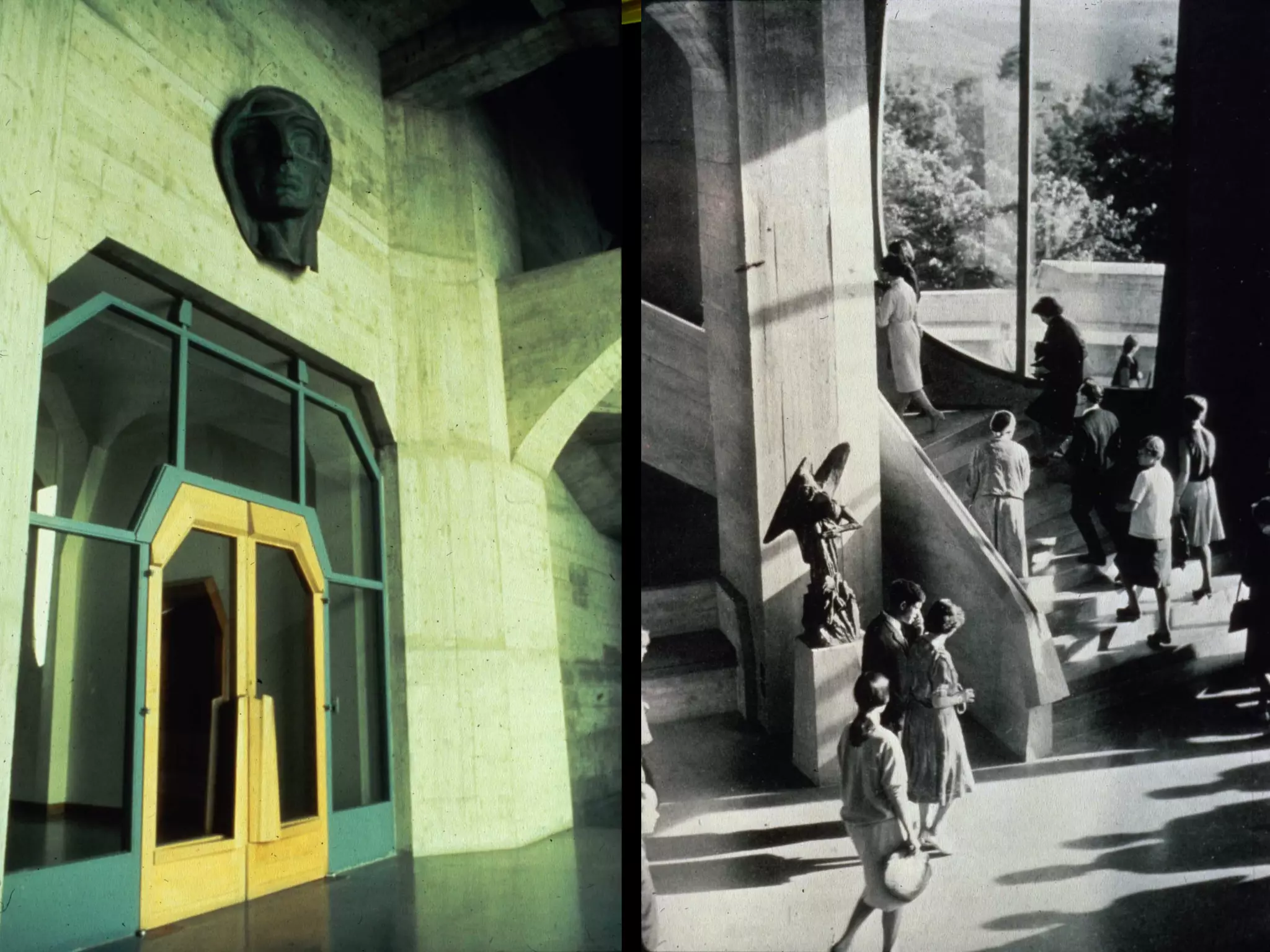
Constructed between 1918 and 1922, the Goetheanum (a building
dedicated to Goethe), was conceived as a double domed structure in
which the larger dome housed the audience and the smaller dome
covered the stage. The domes intersect, however, and their intersection
formed the proscenium arch. The entire superstructure was wood.µ
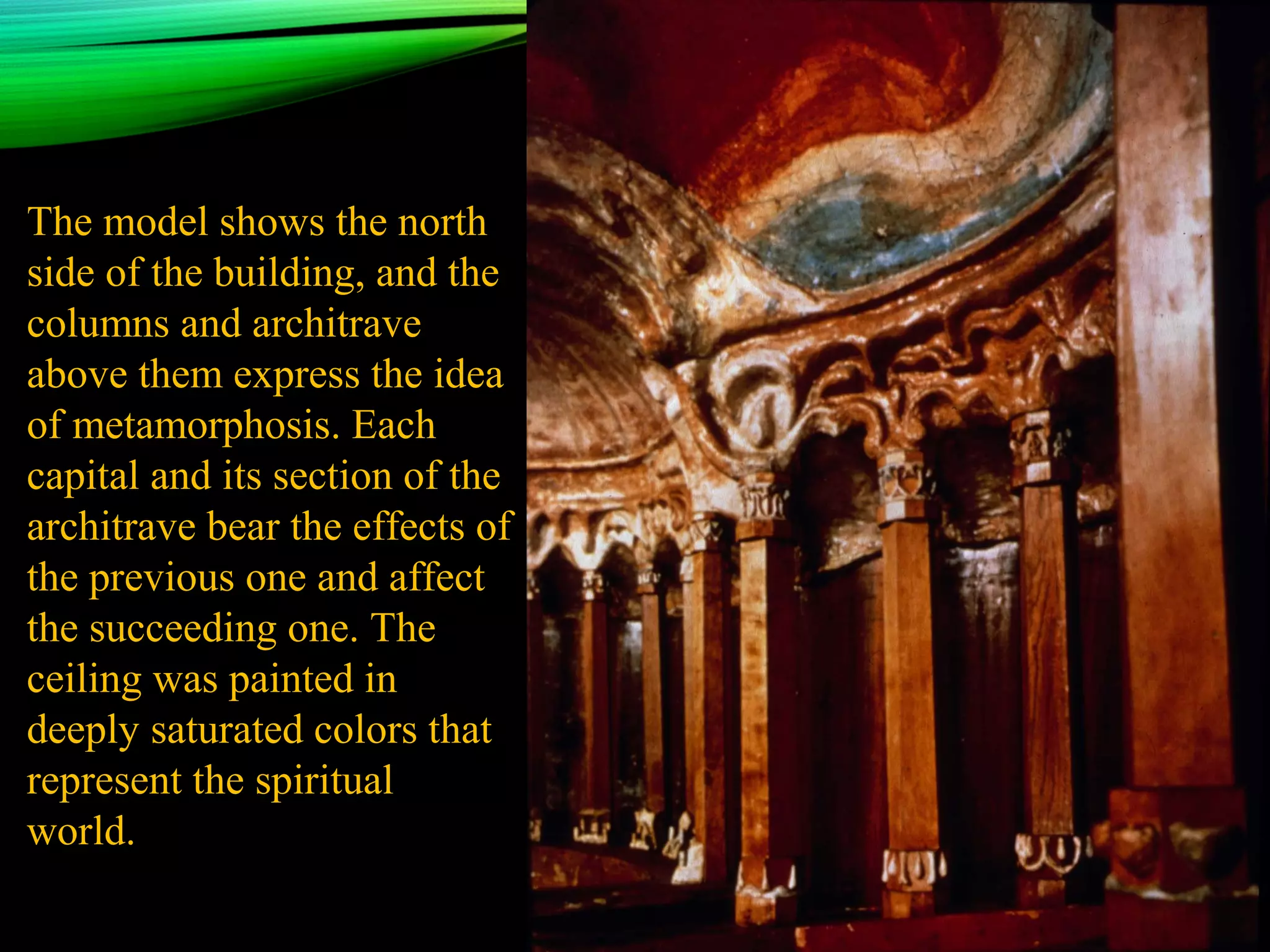
The model shows the north
side of the building, and the
columns and architrave
above them express the idea
of metamorphosis. Each
capital and its section of the
architrave bear the effects of
the previous one and affect
the succeeding one. The
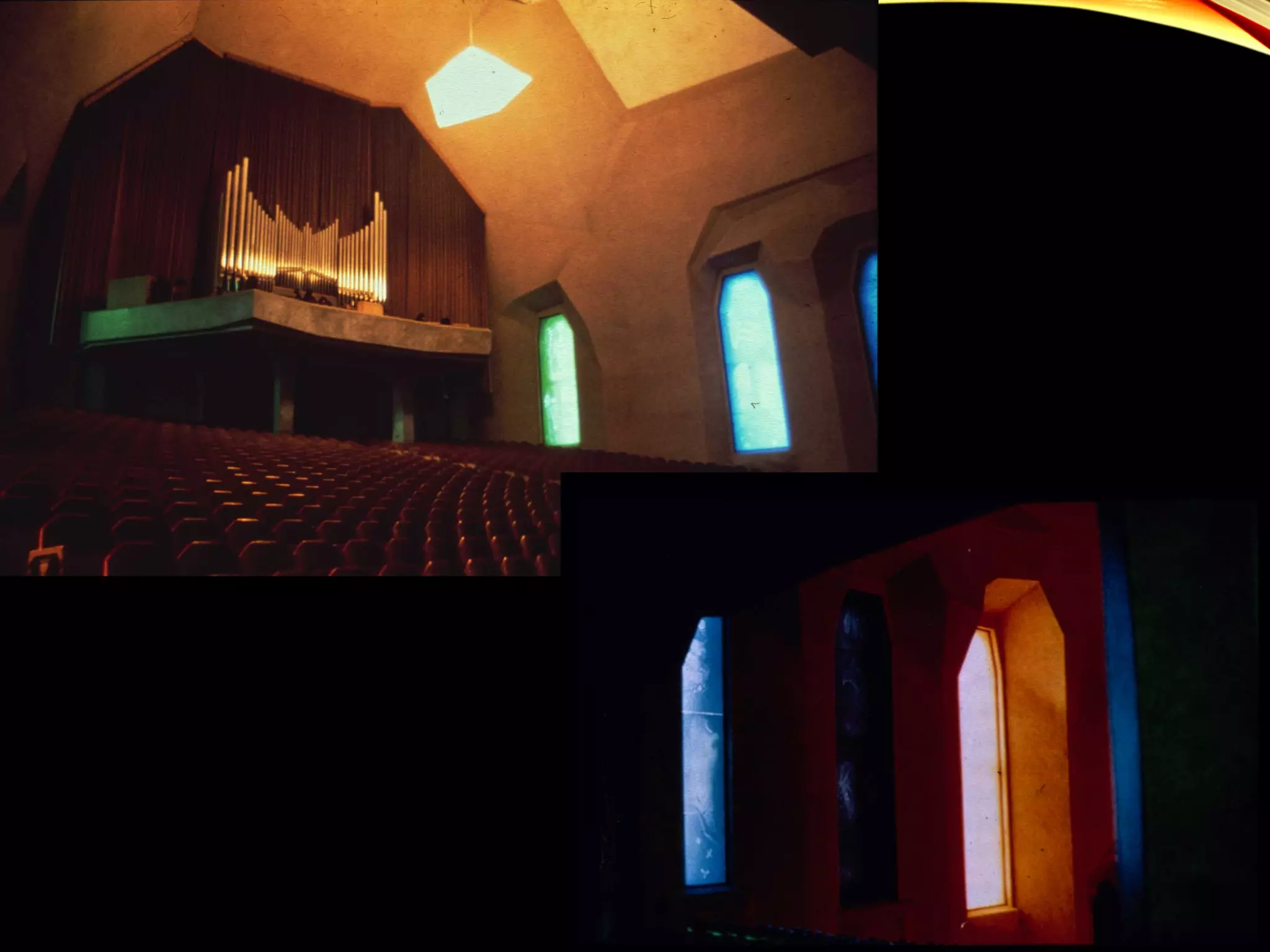
ceiling was painted in
deeply saturated colors that
represent the spiritual
world.
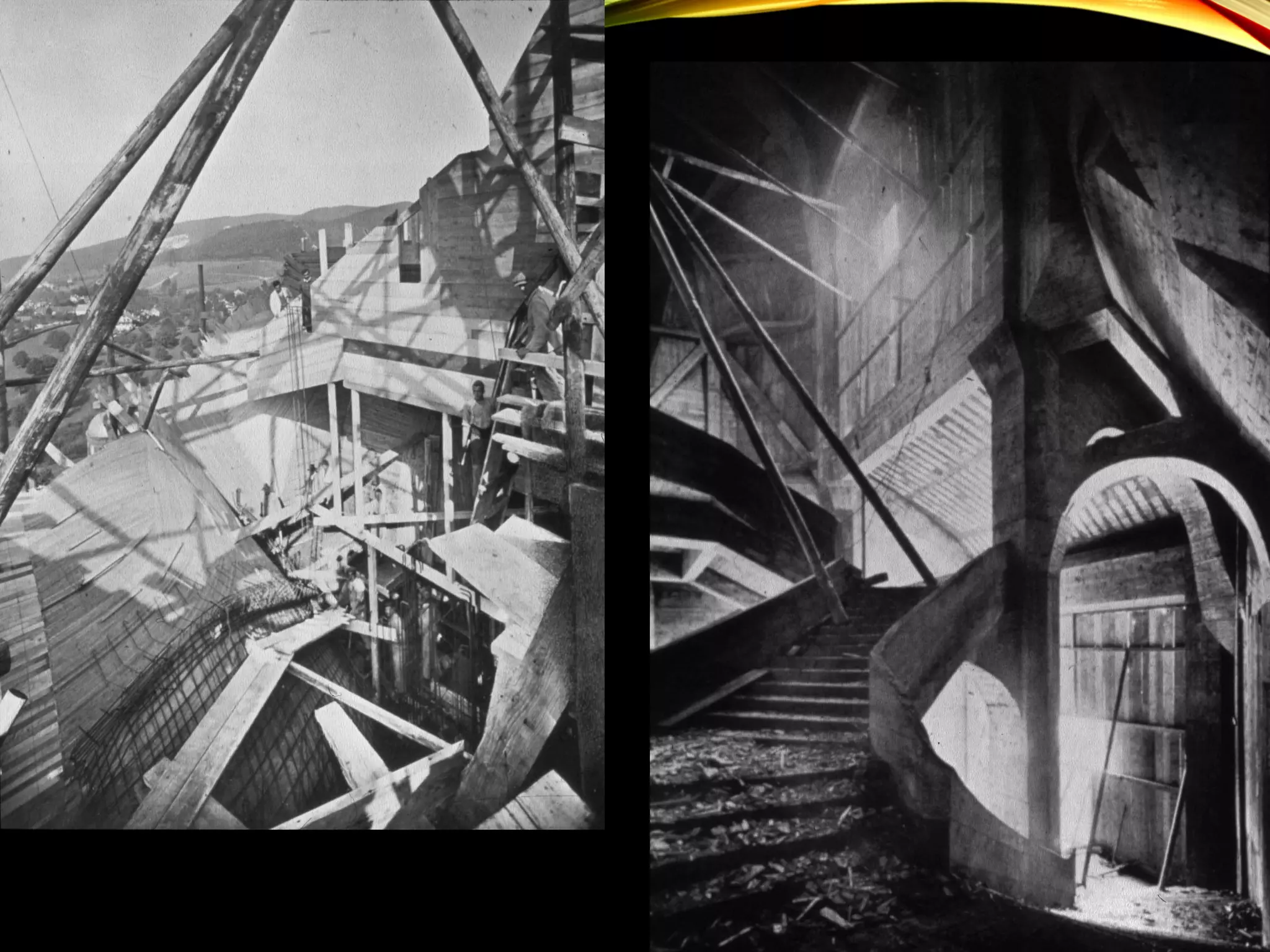
Interior of the Great Hall during construction
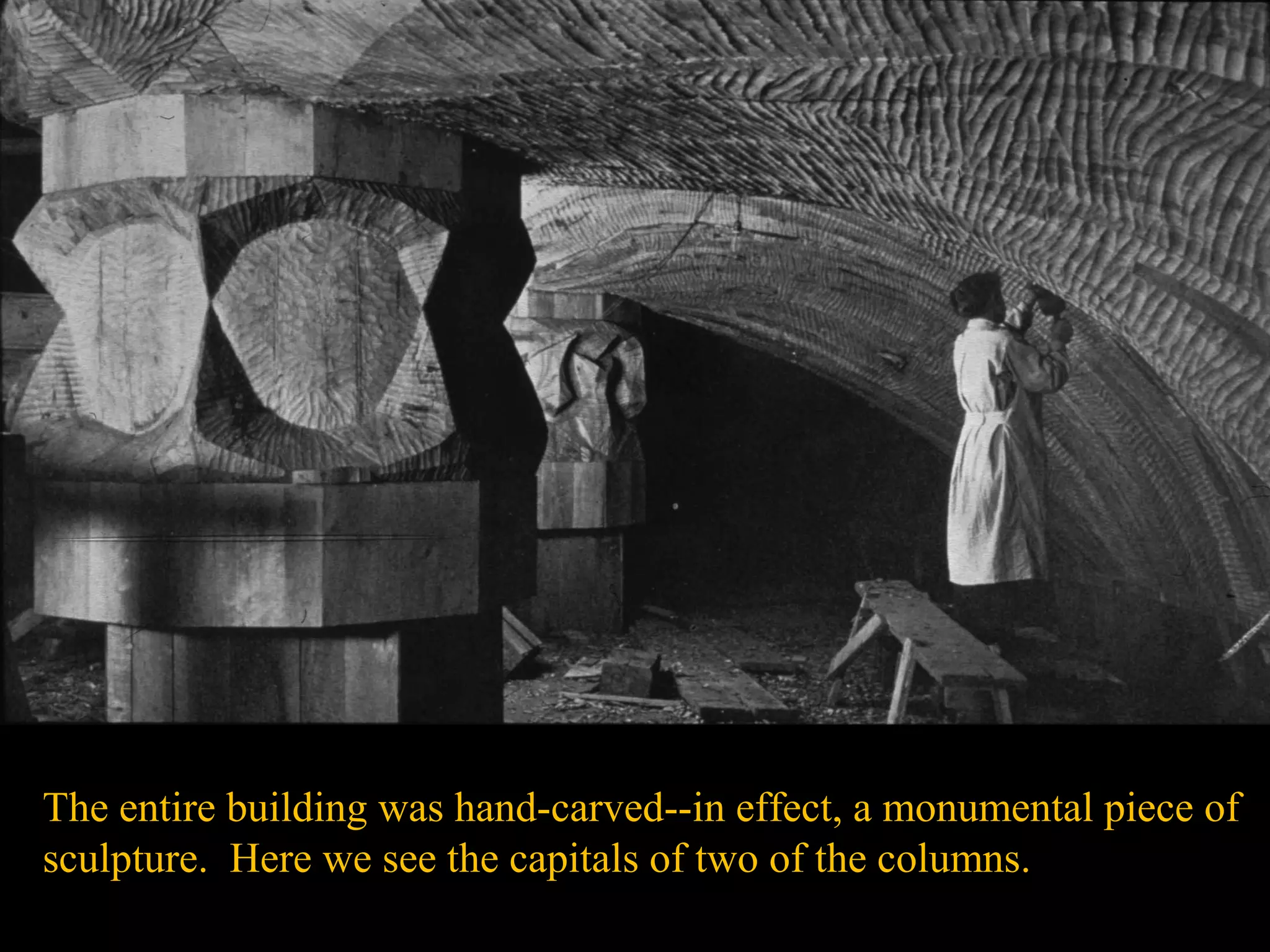
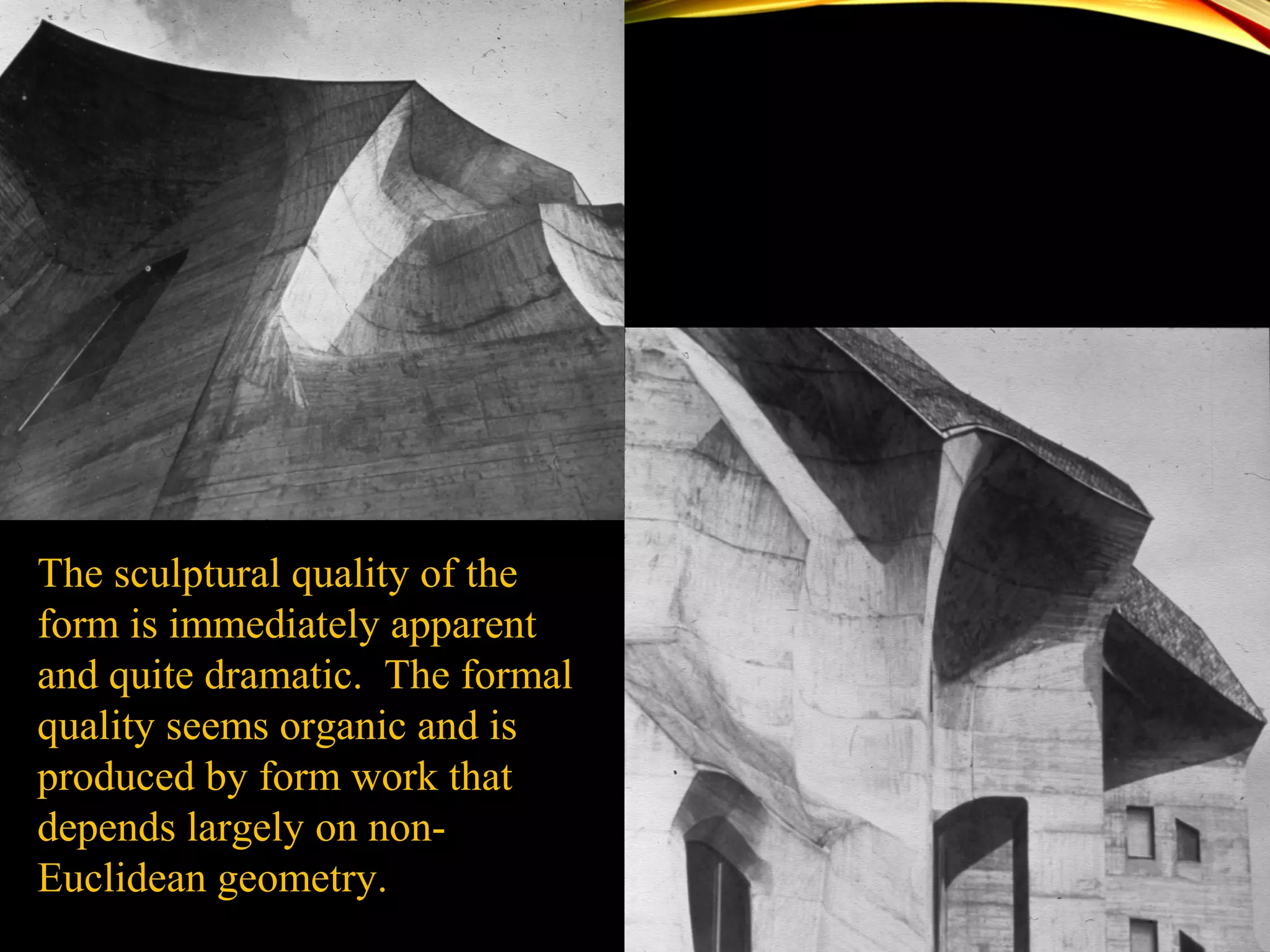
The entire building was hand-carved--in effect, a monumental piece of
sculpture. Here we see the capitals of two of the columns.
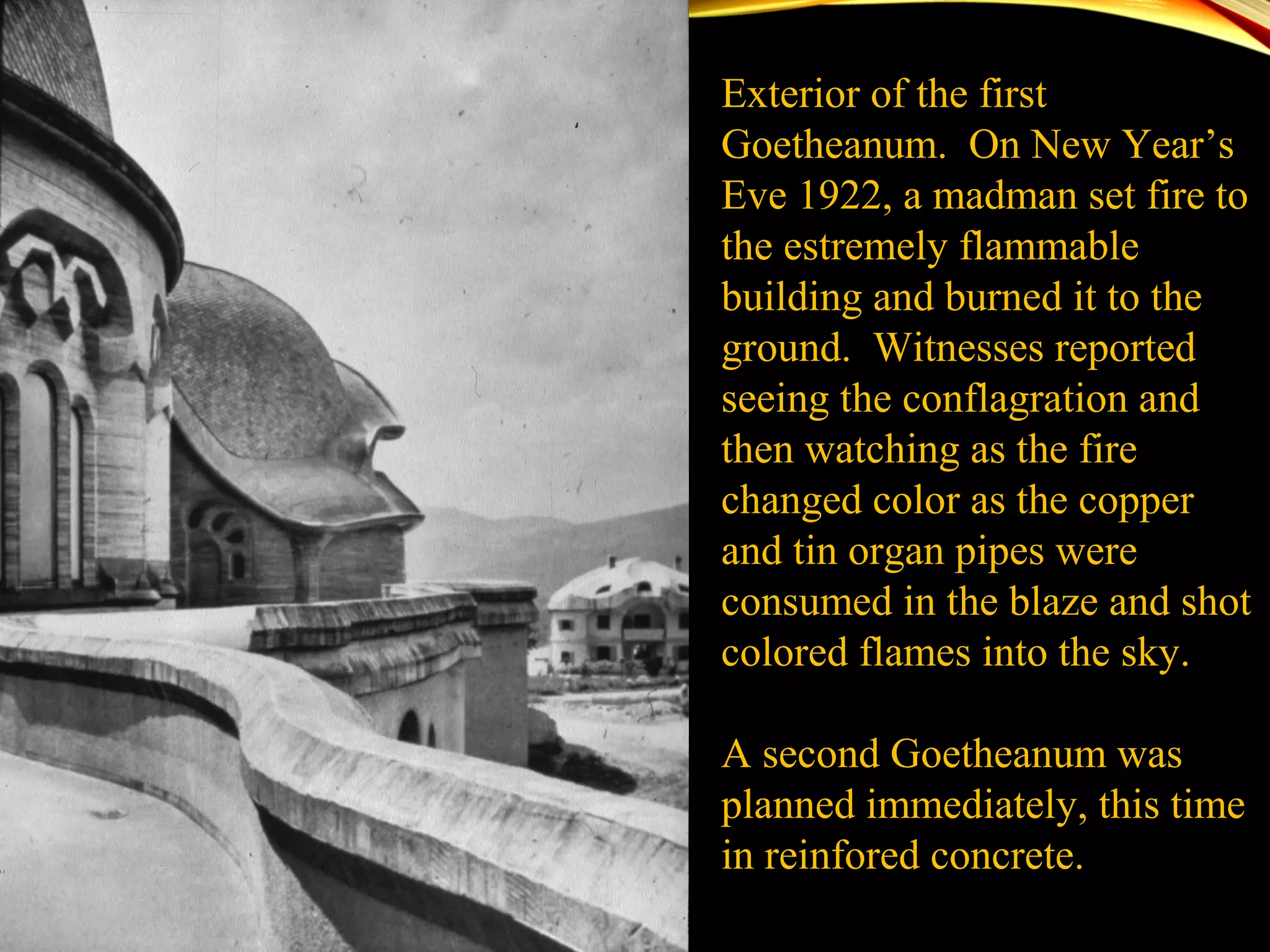
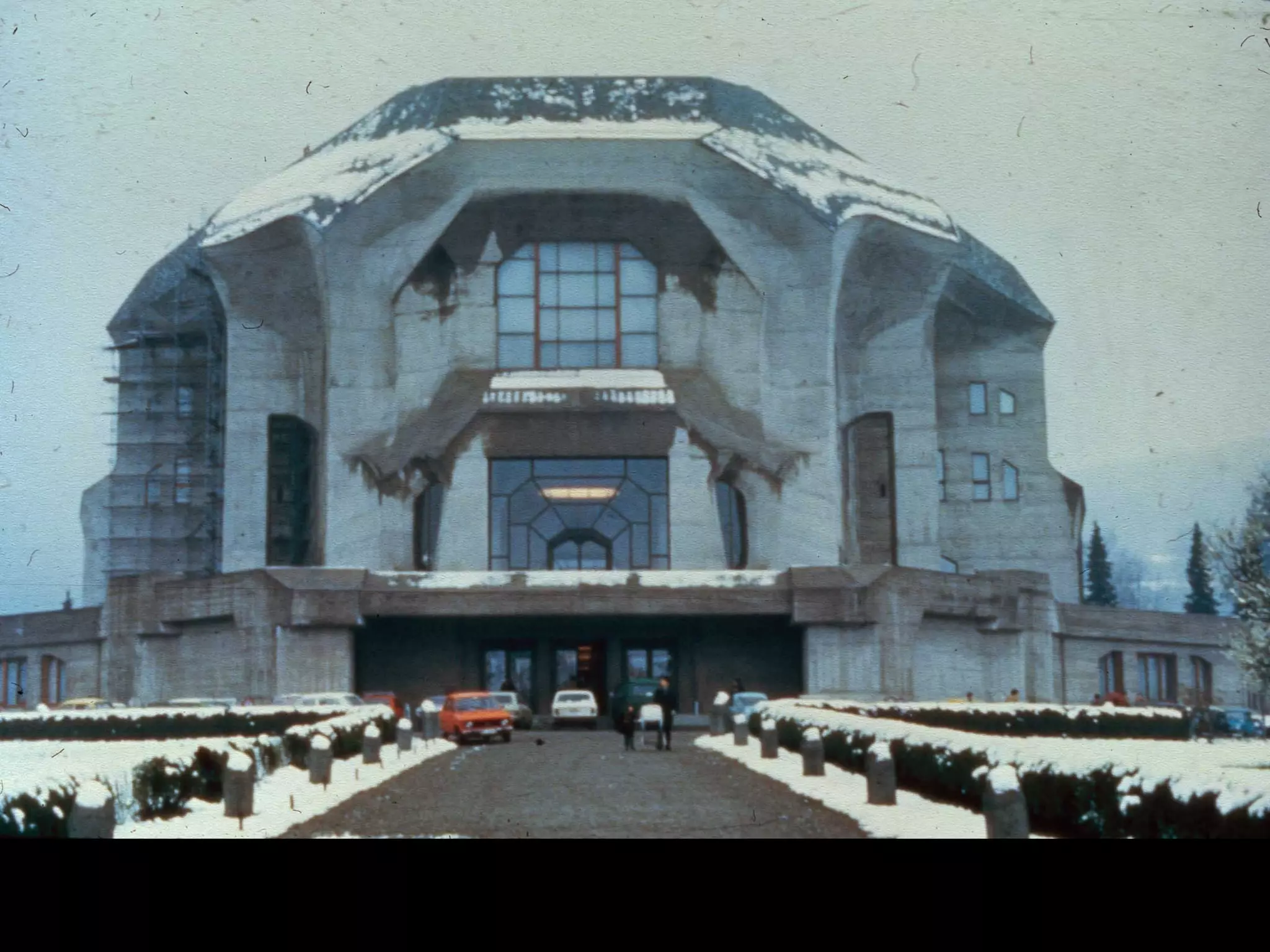
Exterior of the first
Goetheanum. On New Year’s
Eve 1922, a madman set fire to
the estremely flammable
building and burned it to the
ground. Witnesses reported
seeing the conflagration and
then watching as the fire
changed color as the copper
and tin organ pipes were
consumed in the blaze and shot
colored flames into the sky.
A second Goetheanum was
planned immediately, this time
in reinfored concrete.
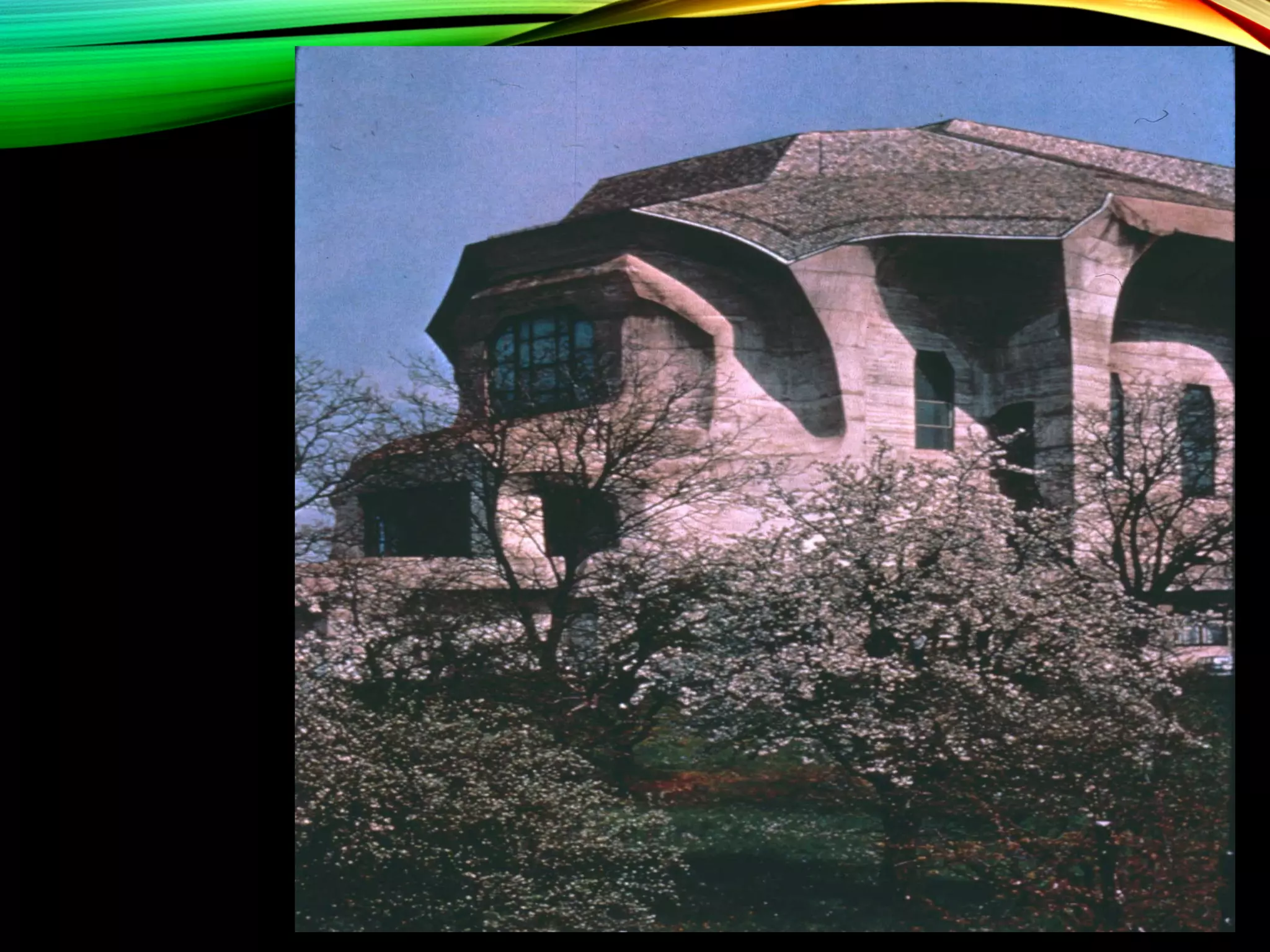
The sculptural quality of the
form is immediately apparent
and quite dramatic. The formal
quality seems organic and is
produced by form work that
depends largely on non-
Euclidean geometry.
A number of architects and artists practicing just after World War I
went through periods in which their work has retrospectively been
defined as expressionistic. One of those was the otherwise very
rational and often prosaic Mies van der Rohe. Fascinated by Frank
Lloyd Wright and a by-product of the studio of Peter Behrens in
Berlin, most of Mies’s early work seemed to be in line with the
general direction of de Stijl and functionalist architecture.
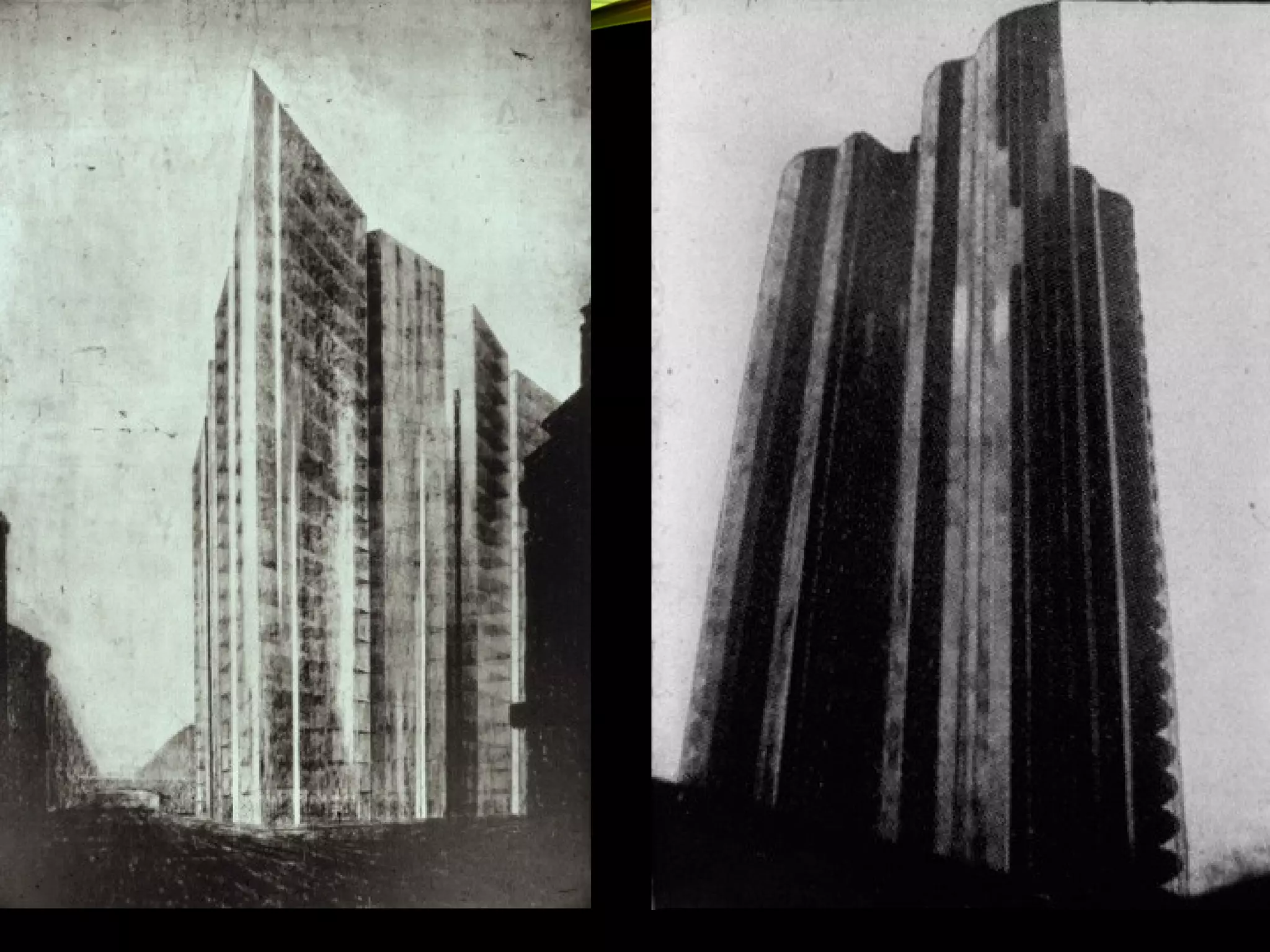
The exceptions to this took place at the turn of the decade into the
1920s and in the 1920s: the glass skyscrapers that he designed for
the site on Friedrichstrasse in Berlin (1921-1922) and the
Monument to the Communist martyrs Karl Liebknecht and Rosa
Luxemburg (1926). These works venture into an area that stands
apart from other work that Mies did before and even during as well
as after this period.
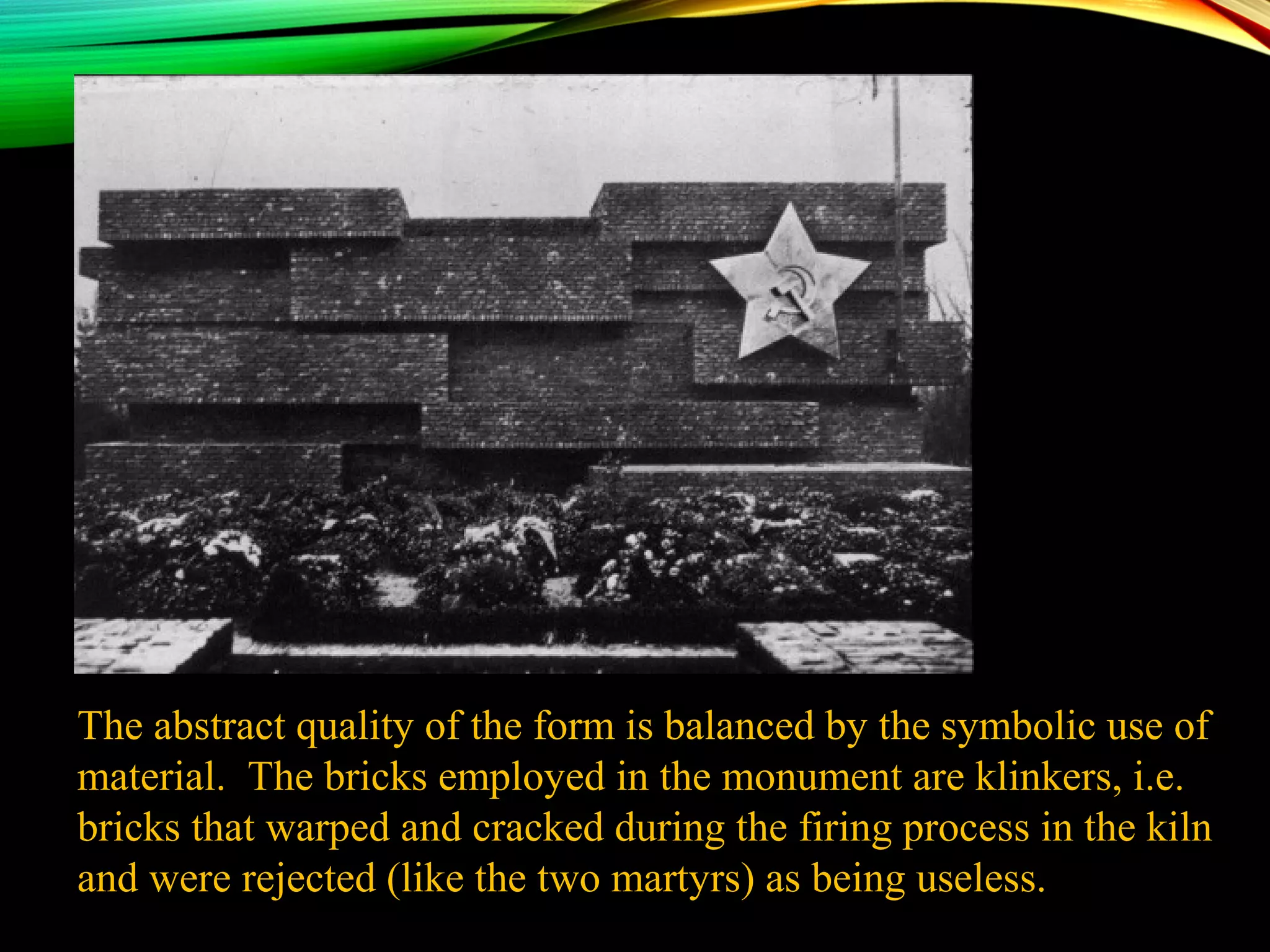
The abstract quality of the form is balanced by the symbolic use of
material. The bricks employed in the monument are klinkers, i.e.
bricks that warped and cracked during the firing process in the kiln
and were rejected (like the two martyrs) as being useless.
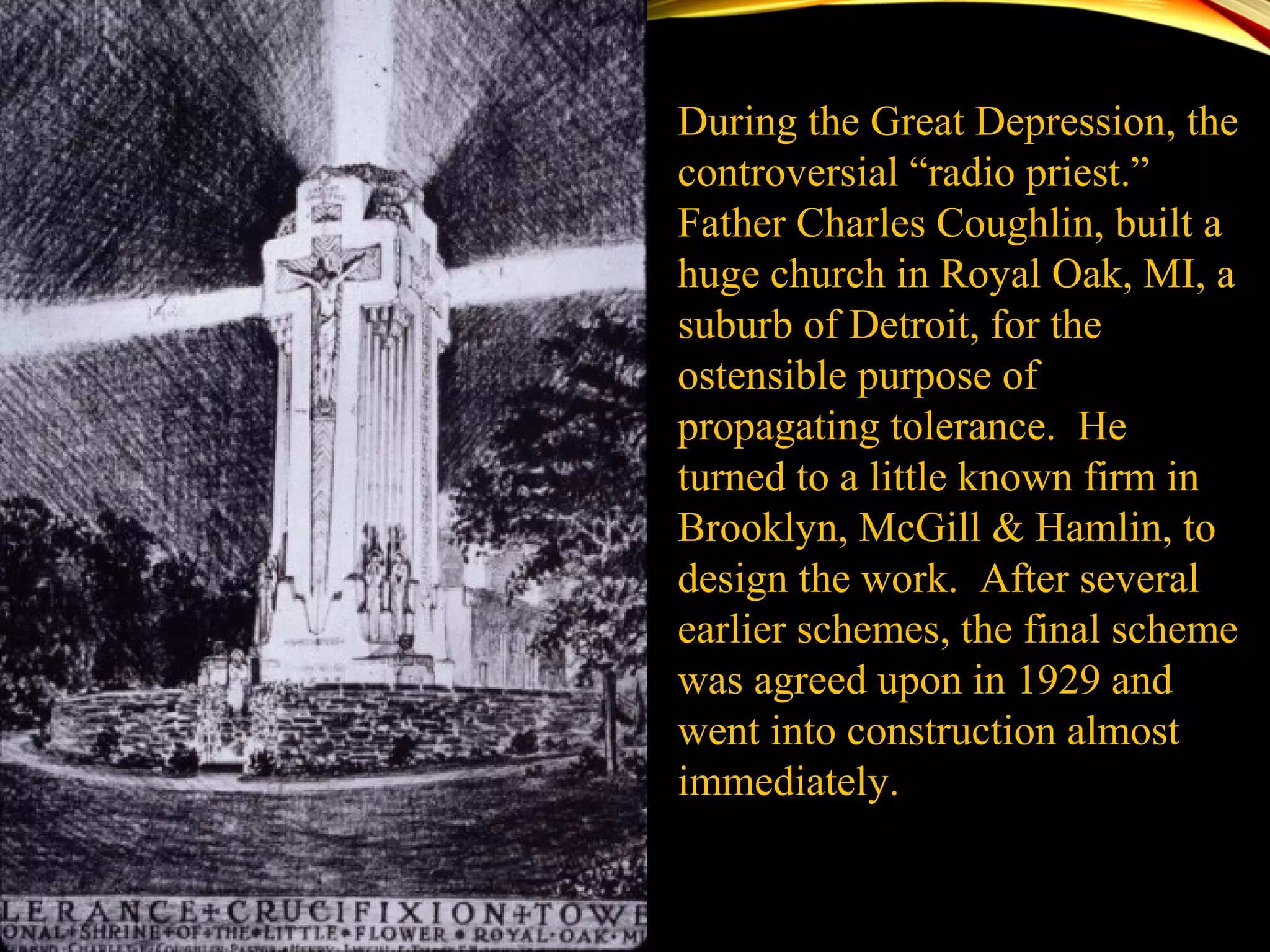
During the Great Depression, the
controversial “radio priest.”
Father Charles Coughlin, built a
huge church in Royal Oak, MI, a
suburb of Detroit, for the
ostensible purpose of
propagating tolerance. He
turned to a little known firm in
Brooklyn, McGill & Hamlin, to
design the work. After several
earlier schemes, the final scheme
was agreed upon in 1929 and
went into construction almost
immediately.
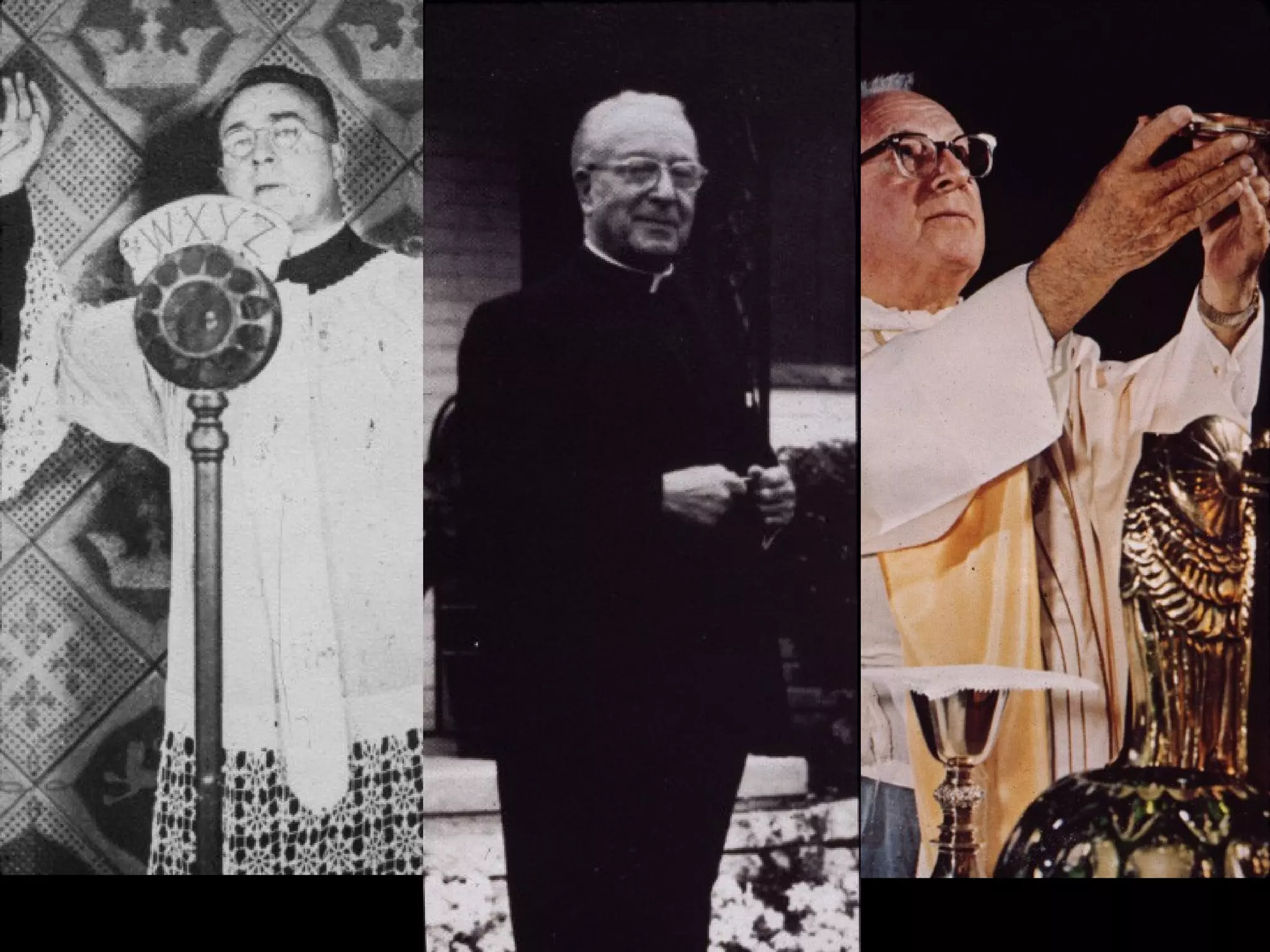
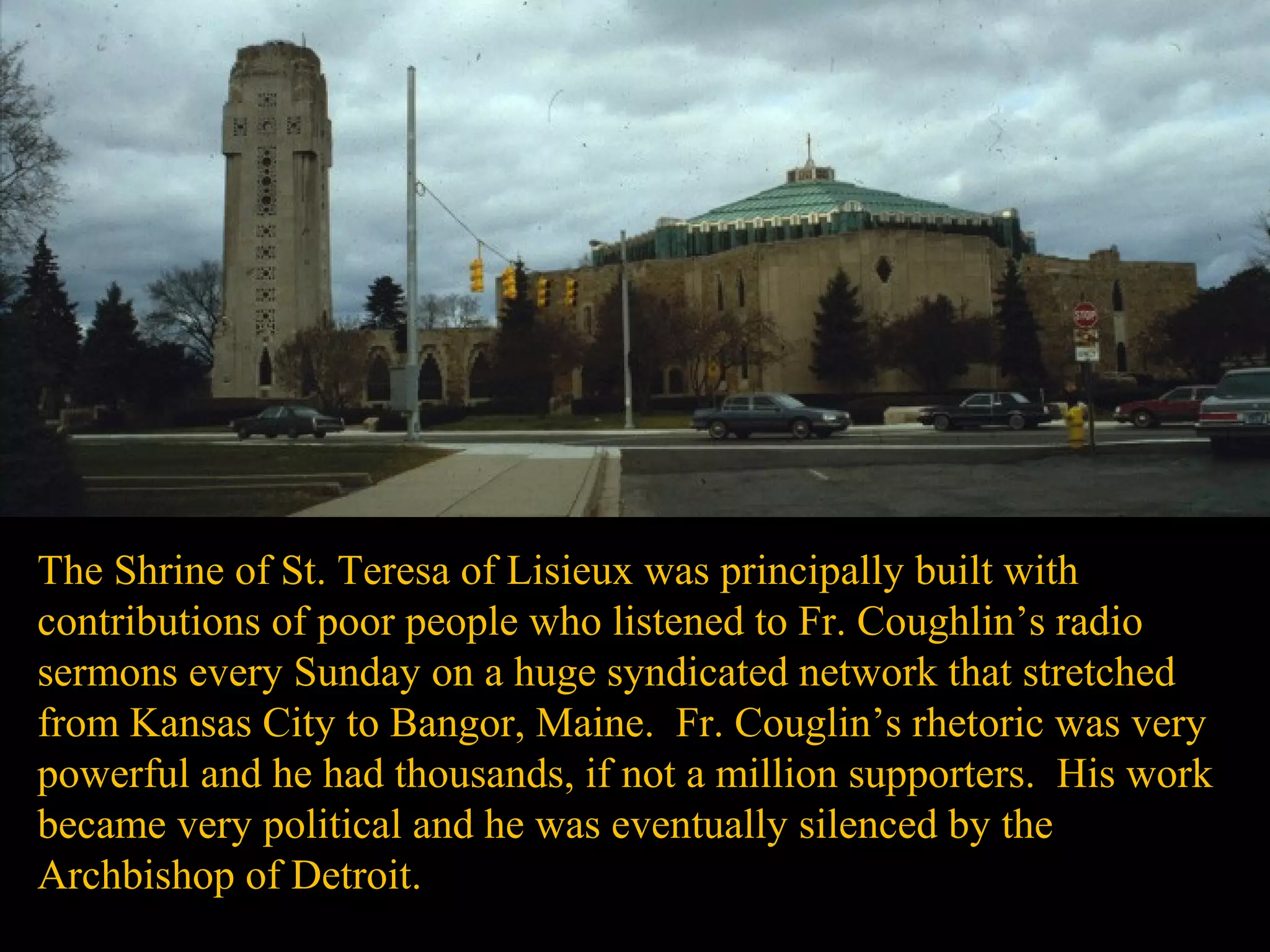
The Shrine of St. Teresa of Lisieux was principally built with
contributions of poor people who listened to Fr. Coughlin’s radio
sermons every Sunday on a huge syndicated network that stretched
from Kansas City to Bangor, Maine. Fr. Couglin’s rhetoric was very
powerful and he had thousands, if not a million supporters. His work
became very political and he was eventually silenced by the
Archbishop of Detroit.
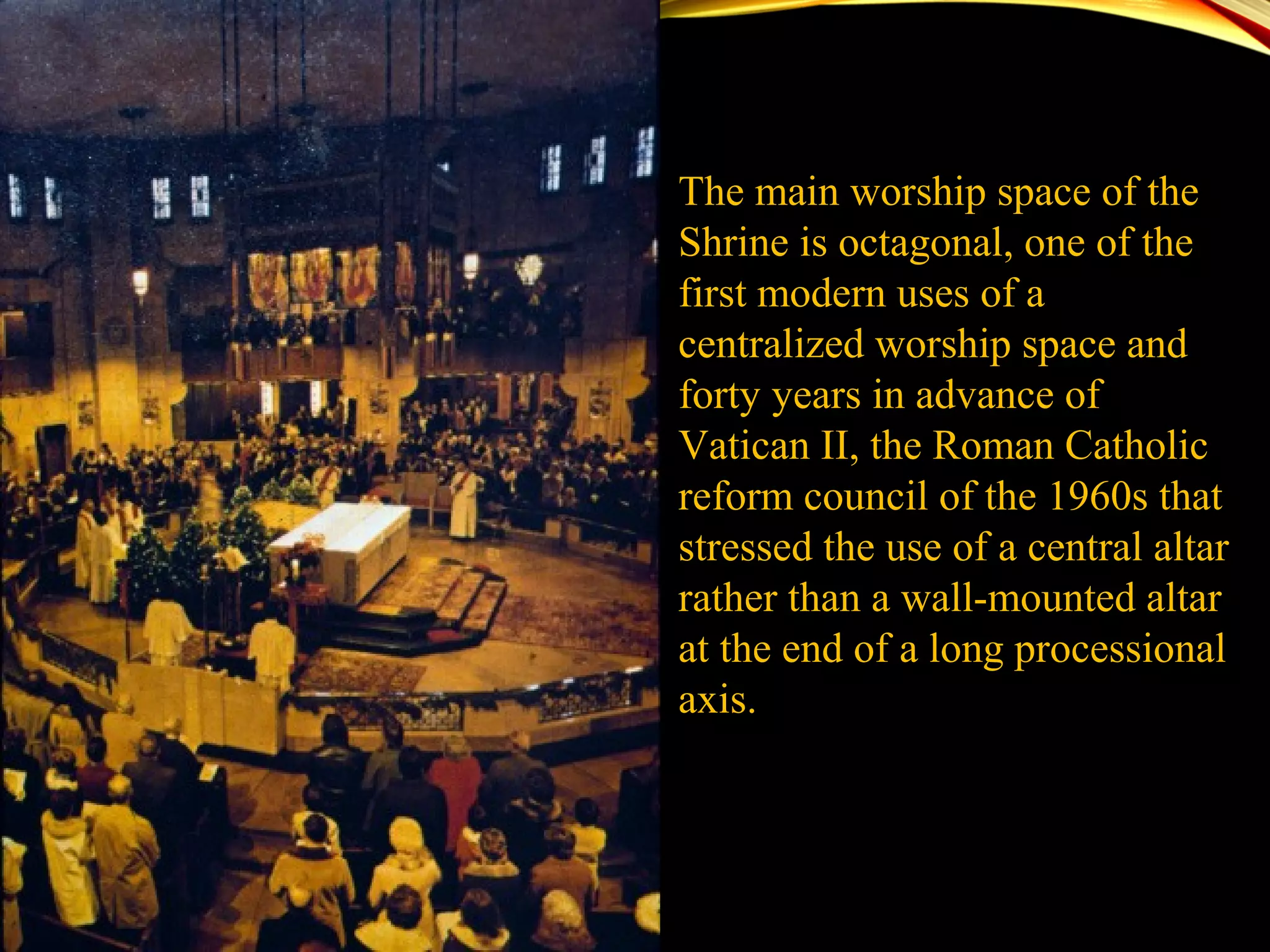
The main worship space of the
Shrine is octagonal, one of the
first modern uses of a
centralized worship space and
forty years in advance of
Vatican II, the Roman Catholic
reform council of the 1960s that
stressed the use of a central altar
rather than a wall-mounted altar
at the end of a long processional
axis.
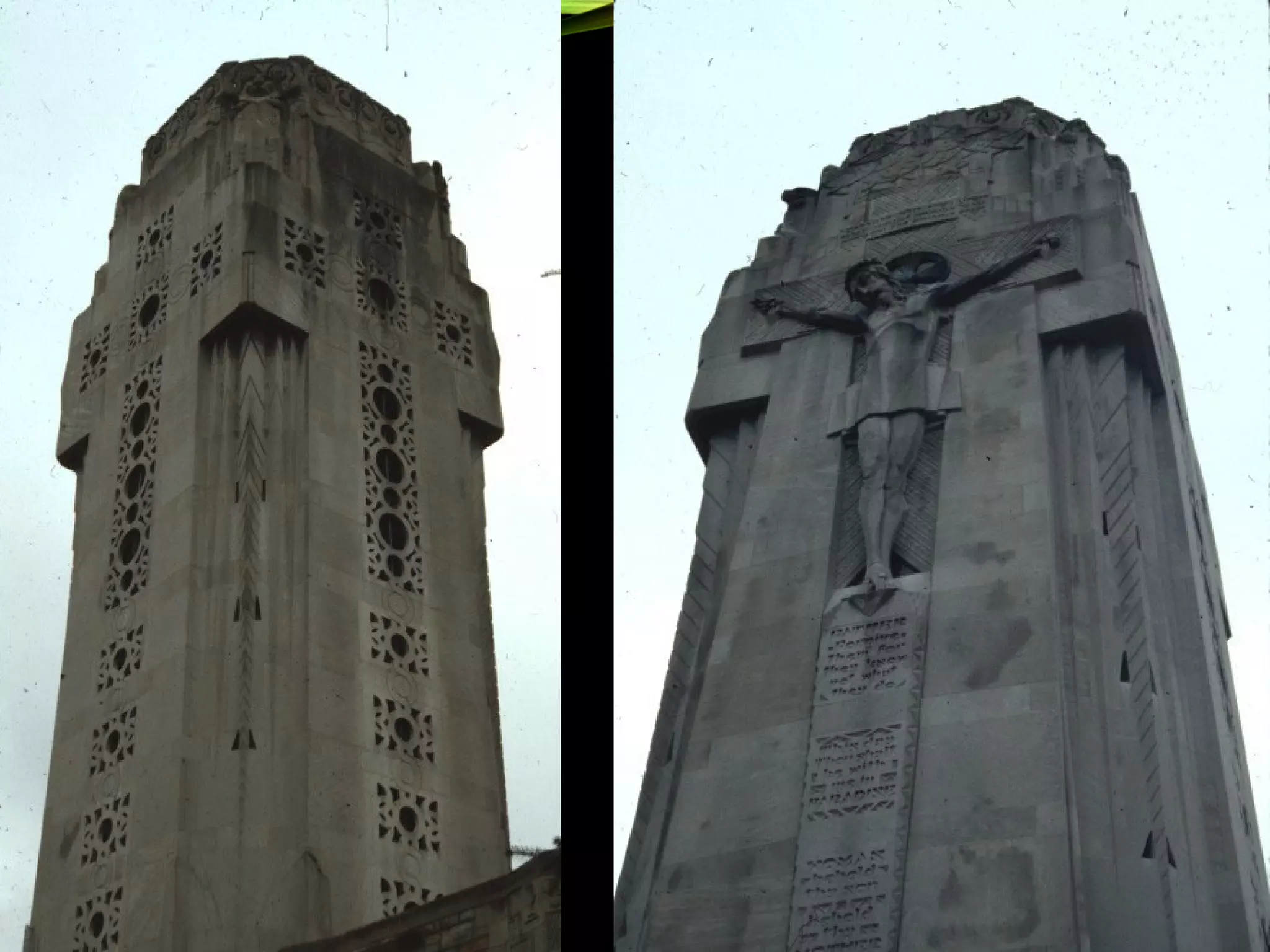
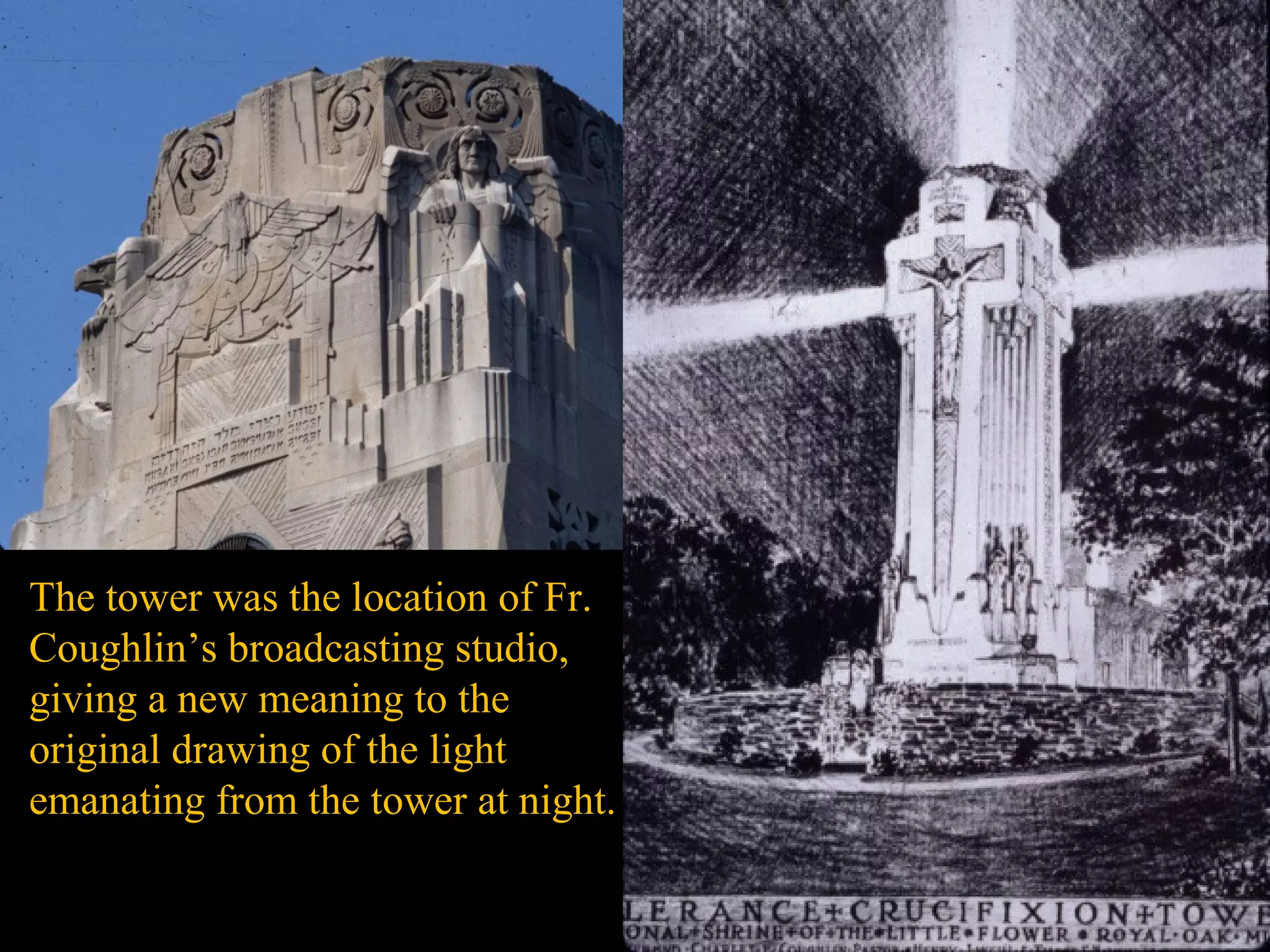
The tower was the location of Fr.
Coughlin’s broadcasting studio,
giving a new meaning to the
original drawing of the light
emanating from the tower at night.
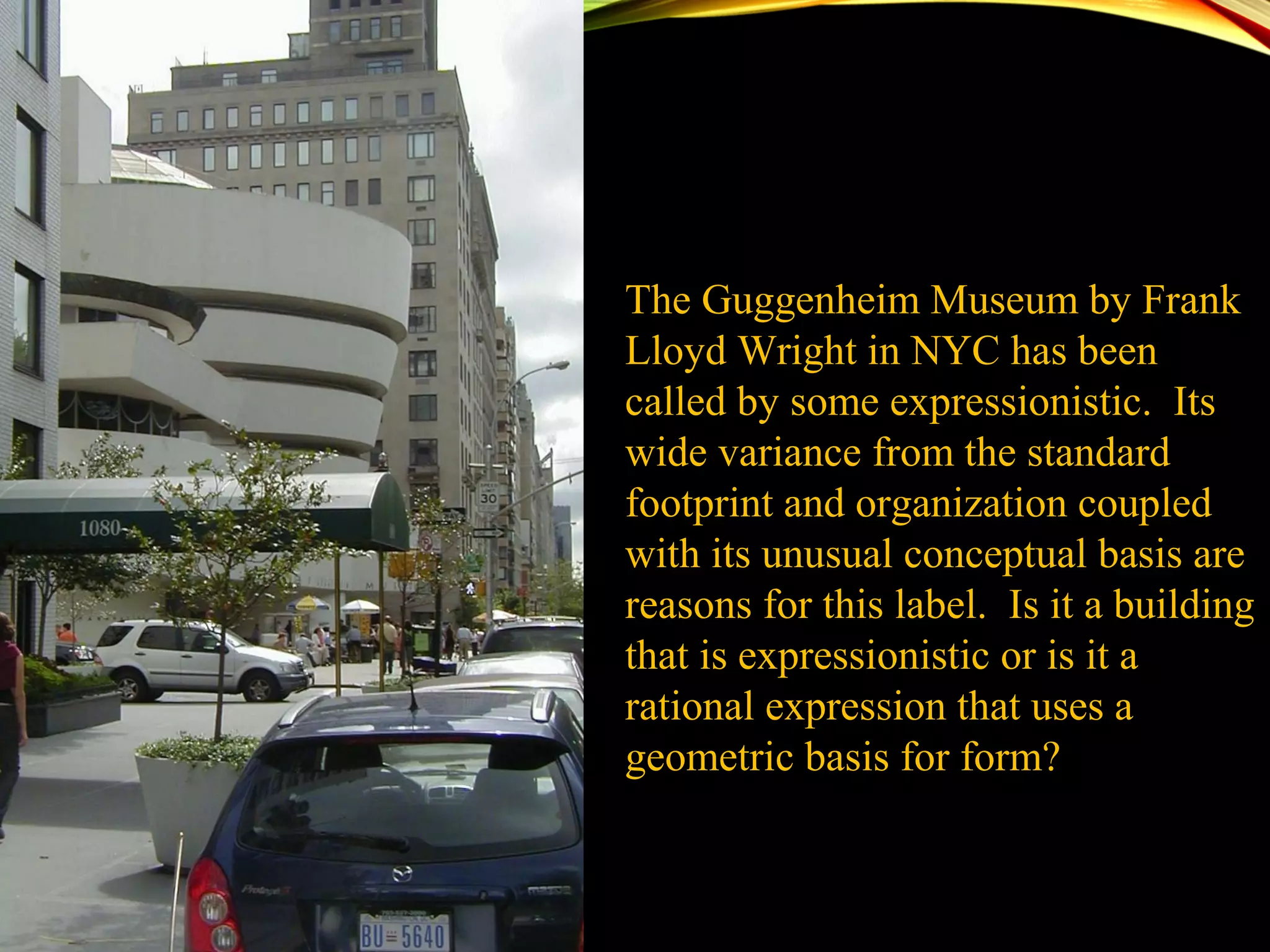
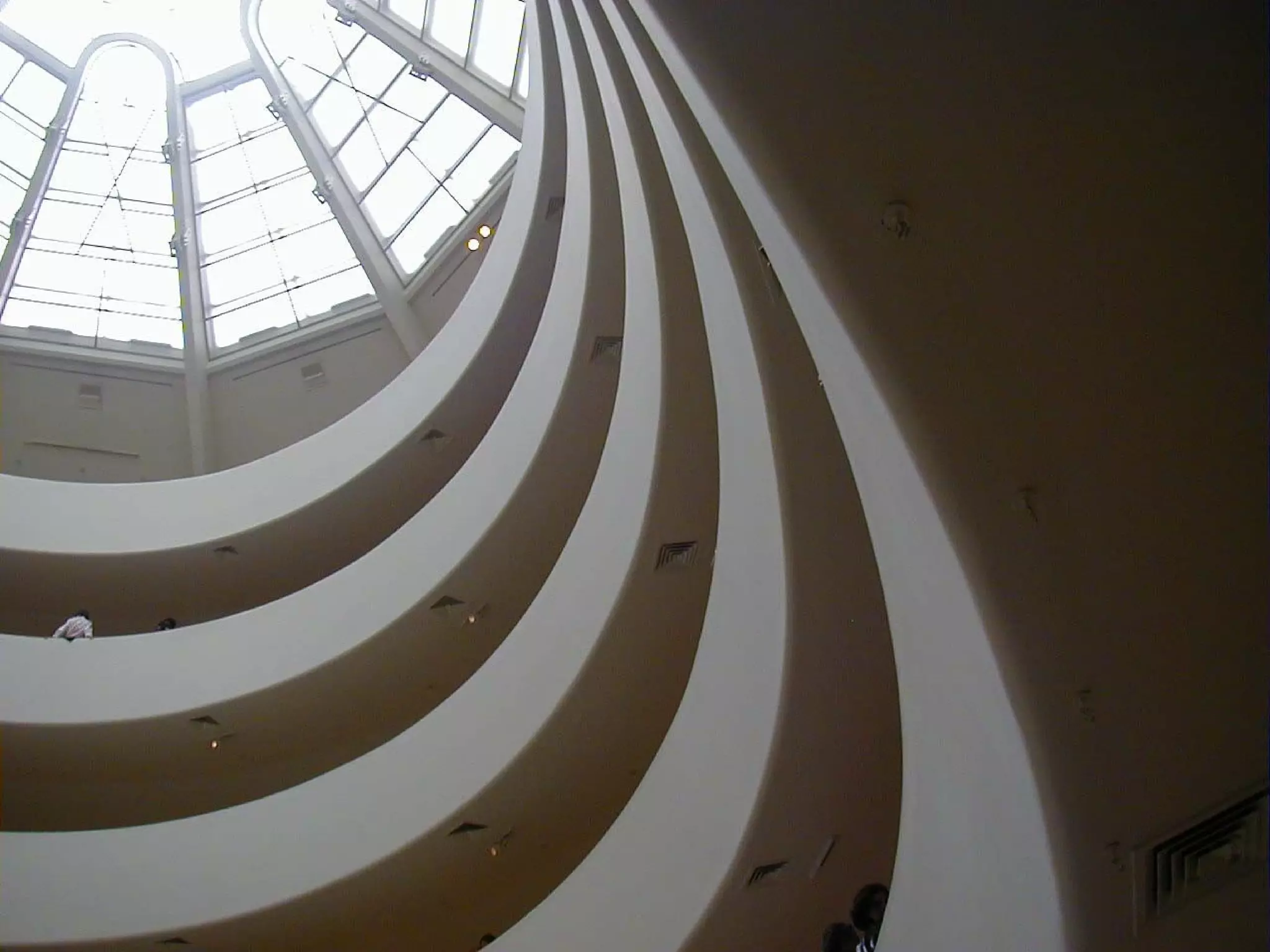
The Guggenheim Museum by Frank
Lloyd Wright in NYC has been
called by some expressionistic. Its
wide variance from the standard
footprint and organization coupled
with its unusual conceptual basis are
reasons for this label. Is it a building
that is expressionistic or is it a
rational expression that uses a
geometric basis for form?
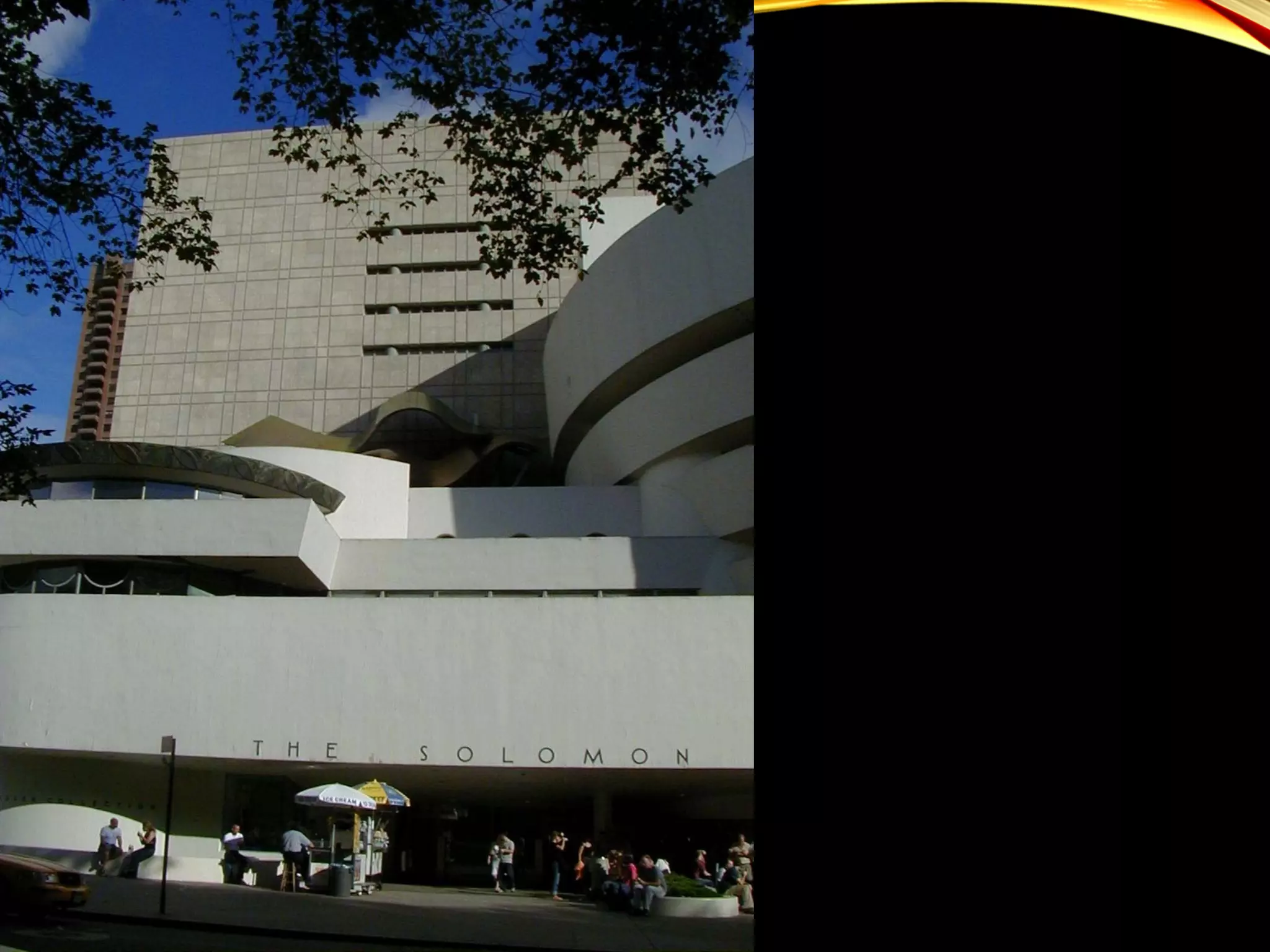
The Guggenheim from
Fifth Avenue with the
Gwathmey-Siegel addition
behind it.
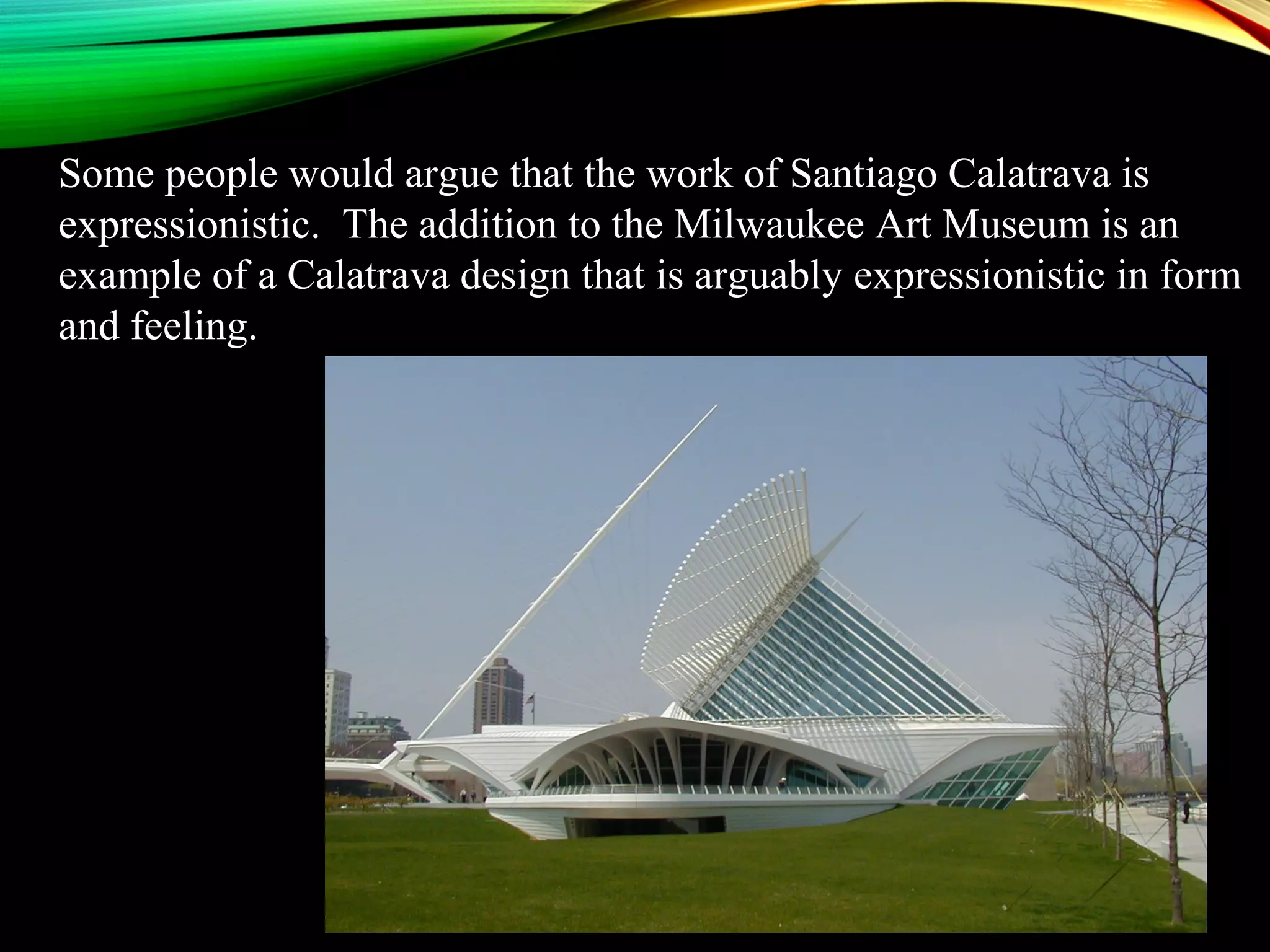
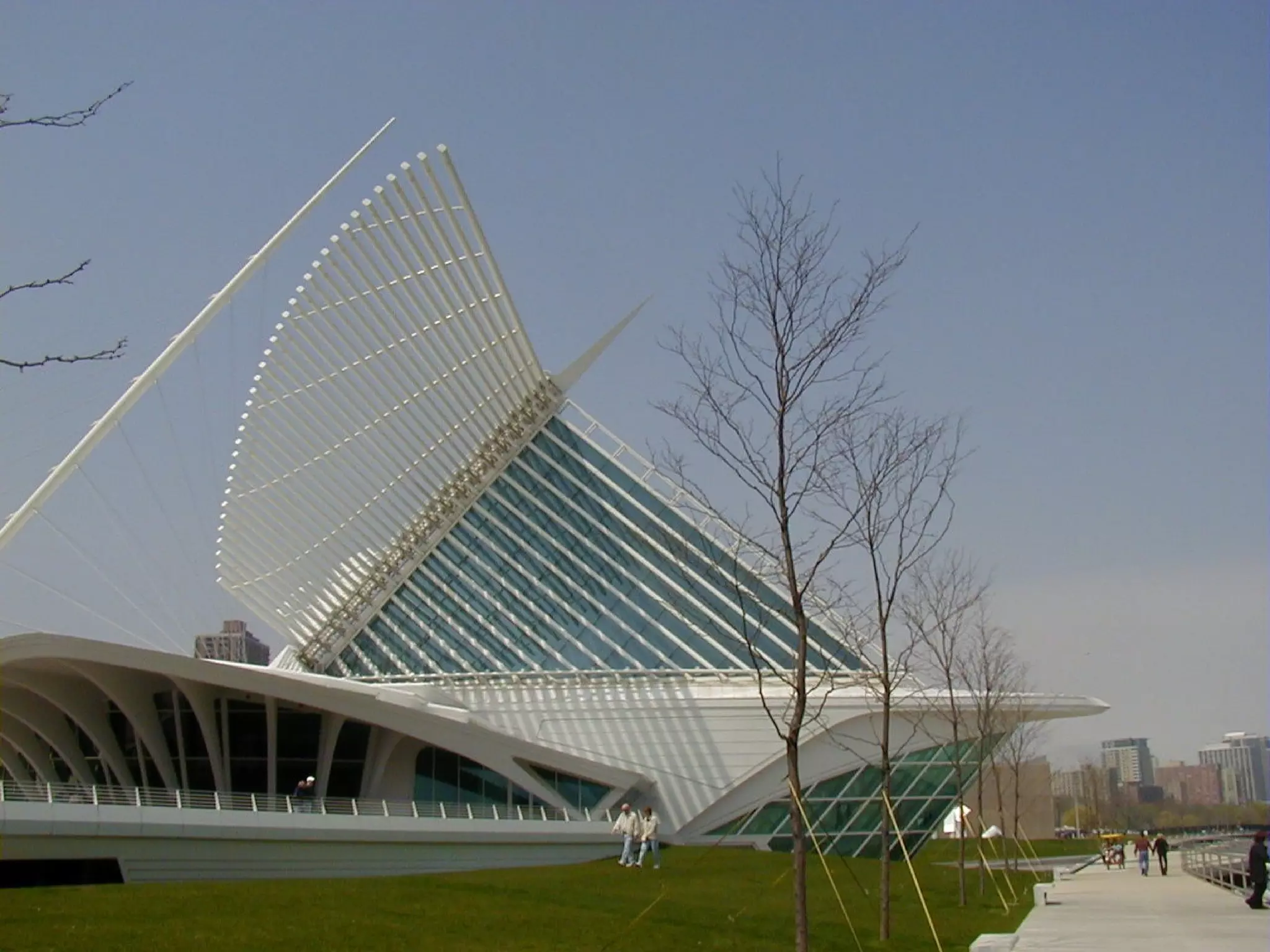
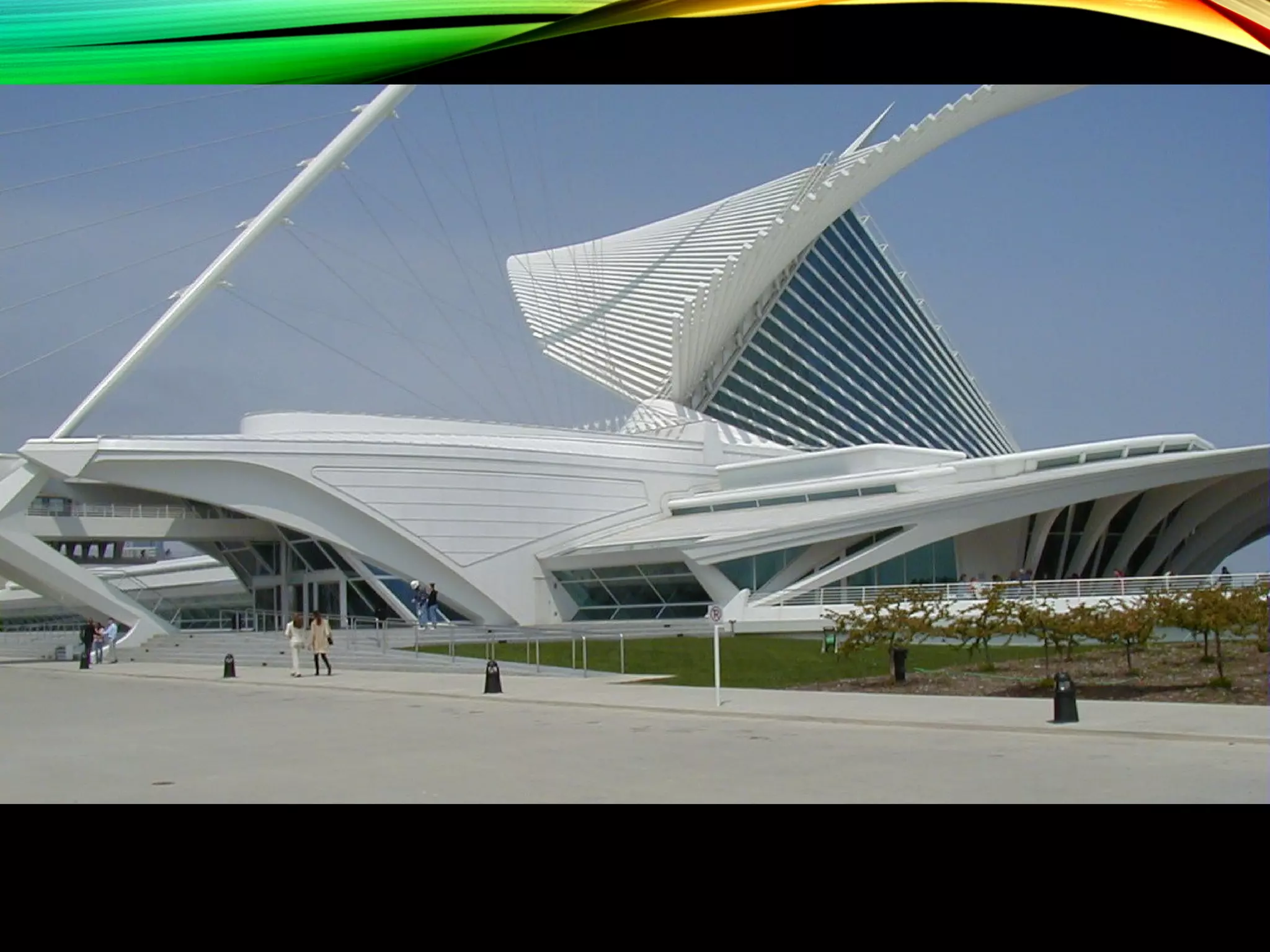
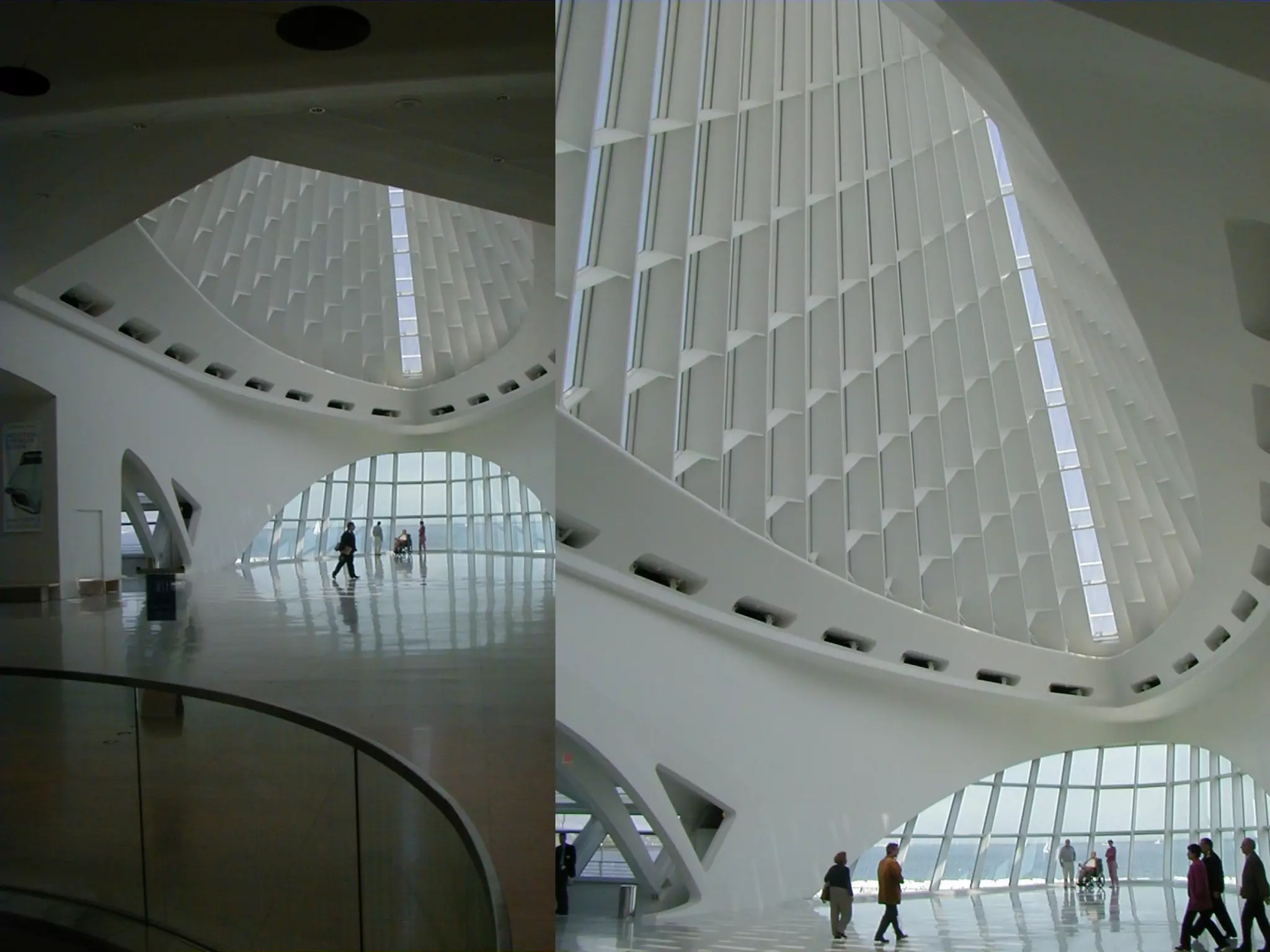
Some people would argue that the work of Santiago Calatrava is
expressionistic. The addition to the Milwaukee Art Museum is an
example of a Calatrava design that is arguably expressionistic in form
and feeling.
THANK YOU…..

Expressionism

  • 1.
    EXPRESSIONISM IN MODERN& CONTEMPORARY ARCHITECTURE What role does it play?
  • 2.
    Expressionism is aterm that arises in the early 20th century around a group of painters, mainly German and centered in Munich, who sought to convey deep emotional content using significant amounts of abstraction but without losing figural subject matter. Color played a major role in their work. They also sought to convey a new and different kind of emotional content, often verging on complex psychology and psychic struggle. It is important to remember that during this same time, the work of Sigmund Freud was very new and ground-breaking, suggesting that many undercurrents in the personality determine human emotional and psychological reaction in a variety of situational “archetypes.” While expressionism in architecture may not have quite so much Freudian content, there is abundant evidence that many architects at least went through a period in which they hoped to make architecture more emotionally expressive than a machine or industrial aesthetic would permit.
  • 3.
    Expressionism is nota clearly defined term and may have more than one definition. It can often overlap other kinds of content and formal choices. Nevertheless, there is a certain quality about it that usually allows us to recognize it. Expressionist forms are often sculptural, sometimes irrational, usually personal and idiosyncratic. But they are also often distorted. The notion of identifying “expressive” qualities in a building is not necessarily the same as identifying “expressionistic” qualities. A building may convey some intentional meaning through its form (“expressive”); or the stamp of the personality, individuality, identity, or even the pathology of the architect (“expressionistic”). This may not always be easy to distinguish. A wildly sculptural form may not always be the evidence of expressionism. Expressionistic form can also convey spirituality as well as psychology and it is important to evaluate a potentially expressionist form carefully before pronouncing a verdict.
  • 4.
    In 1914, BrunoTaut built his Glass Pavilion at the Werkbund Exhibition in Cologne. The phrase above the elevation drawing says in German “The Gothic Cathedral is the prelude to glass architecture.” Taut’s building was meant to be an experience of light afforded by a combination of glass and skeletal metal structure.
  • 5.
    Interior of theGlass Pavilion by Bruno Taut at the Cologne Werkbund Exhibition, 1914.
  • 6.
    One of themost important of the architects who are considered to be expressionists is Erich Mendelsohn who turned out countless drawings that are essentially thumbnail sketches of buildings based on the expressive capacity of form. Enveloping Structure, 1914-15
  • 7.
    Mendelsohn also foundmusic to be a major source of inspiration for his work and made drawings that in essence expressed the content of specific musical works. He may well have taken the words of the poet Johann Wolfgang von Goethe quite literally: “Architecture is frozen music.” These sketches were executed at various times from 1917 to 1936.
  • 8.
    One of Mendelsohn’smost celebrated buildings in the expressionist mode is the Einstein Tower, located in Potsdam, just outside Berlin, in 1920-24. This is an observatory named in honor of Albert Einstein and originally intended for reinforced concrete construction. It was actually built in brick masony.
  • 9.
  • 11.
    Mendelsohn’s studies forthe Einstein Tower indicate the dynamism of the forms he was envisioning; but a comparison with the built structure indicates how difficult it is to translate that form into solid materials. These drawings were executed in 1919.
  • 12.
    Mendelsohn was alsofascinated by the power of light in architecture. This sweeping curve is the façade of a department store in Chemnitz, Germany. Its modernist composition is very interesting, but it’s effects at night are quite stunning.
  • 14.
    One of themost fascinating and important of the architects who are usually named as expressionists is Rudolf Steiner (1862-1925), a man who called himself a spiritual scientist. Steiner was born in Austria- Hungary and was educated at the University of Vienna. He edited the scientific works of the German Romantic poet Johann Wolfgang von Goethe. In his research on Goethe, he became aware of Goethe’s theory of color and his plant studies leading to the concept of metamorphosis. While some scientists believed that Goethe’s color theory was unscientific, especially compared to the theory of color as refracted light, Steiner argued that the poetic truth of Goethe’s ideas held up under laboratory conditions and thus have a compelling value that supersedes initial impression. Similarly, the theory of plant metamorphosis, which has generally had more credibility with botanists, is, according to Steiner, more reliable because it deals with both the physical and the metaphysical aspect of plant growth.
  • 16.
    Goethe’s ideas aboutmetamorphosis was that each stage in the growth of a plant proceeded out of the previous and into the next according to principles that suggest that the seed contains its own history and its own future. The form is not haphazard but obeys laws of development that are both inherent and universal.
  • 17.
    Steiner was alsofascinated by the relationship between mathematics and spirituality. He taught that the visible world was the densest and most material realm of a much larger spiritual world and that any human being who chose could have access to the larger spiritual world through a process of meditation, spiritual discipline, and will power. He taught that just as we do not presume that someone somewhere earlier in history invented mathematics but rather we accept mathematics as self-justifying facts or truths, the spiritual world could be perceived in the same way. We learn mathematics by beginning with simple concepts and moving into much more complex levels. The same is true of the spiritual world. He also taught that human life is metamorphic, much like that of the natural world, and that the greatest effort of the time was to acquire deeper knowledge of human relationships to the spiritual world. This eventually became known as “Anthroposophy” (anthropos=man, sophia=knowledge or wisdom).
  • 18.
    Shortly after theturn of the 20th century, Steiner founded the Anthroposophical Society in Berlin. Before the outbreak of World War I, he moved the headquarters of the society to Dornach, a village outside of Basel, Switzerland. There he began construction of a building which would house his School of Spiritual Science. The sectional model above shows the main auditorium and stage where lectures and performances would be held.
  • 19.
    Constructed between 1918and 1922, the Goetheanum (a building dedicated to Goethe), was conceived as a double domed structure in which the larger dome housed the audience and the smaller dome covered the stage. The domes intersect, however, and their intersection formed the proscenium arch. The entire superstructure was wood.µ
  • 20.
    The model showsthe north side of the building, and the columns and architrave above them express the idea of metamorphosis. Each capital and its section of the architrave bear the effects of the previous one and affect the succeeding one. The ceiling was painted in deeply saturated colors that represent the spiritual world.
  • 21.
    Interior of theGreat Hall during construction
  • 22.
    The entire buildingwas hand-carved--in effect, a monumental piece of sculpture. Here we see the capitals of two of the columns.
  • 23.
    Exterior of thefirst Goetheanum. On New Year’s Eve 1922, a madman set fire to the estremely flammable building and burned it to the ground. Witnesses reported seeing the conflagration and then watching as the fire changed color as the copper and tin organ pipes were consumed in the blaze and shot colored flames into the sky. A second Goetheanum was planned immediately, this time in reinfored concrete.
  • 25.
    The sculptural qualityof the form is immediately apparent and quite dramatic. The formal quality seems organic and is produced by form work that depends largely on non- Euclidean geometry.
  • 31.
    A number ofarchitects and artists practicing just after World War I went through periods in which their work has retrospectively been defined as expressionistic. One of those was the otherwise very rational and often prosaic Mies van der Rohe. Fascinated by Frank Lloyd Wright and a by-product of the studio of Peter Behrens in Berlin, most of Mies’s early work seemed to be in line with the general direction of de Stijl and functionalist architecture. The exceptions to this took place at the turn of the decade into the 1920s and in the 1920s: the glass skyscrapers that he designed for the site on Friedrichstrasse in Berlin (1921-1922) and the Monument to the Communist martyrs Karl Liebknecht and Rosa Luxemburg (1926). These works venture into an area that stands apart from other work that Mies did before and even during as well as after this period.
  • 33.
    The abstract qualityof the form is balanced by the symbolic use of material. The bricks employed in the monument are klinkers, i.e. bricks that warped and cracked during the firing process in the kiln and were rejected (like the two martyrs) as being useless.
  • 34.
    During the GreatDepression, the controversial “radio priest.” Father Charles Coughlin, built a huge church in Royal Oak, MI, a suburb of Detroit, for the ostensible purpose of propagating tolerance. He turned to a little known firm in Brooklyn, McGill & Hamlin, to design the work. After several earlier schemes, the final scheme was agreed upon in 1929 and went into construction almost immediately.
  • 36.
    The Shrine ofSt. Teresa of Lisieux was principally built with contributions of poor people who listened to Fr. Coughlin’s radio sermons every Sunday on a huge syndicated network that stretched from Kansas City to Bangor, Maine. Fr. Couglin’s rhetoric was very powerful and he had thousands, if not a million supporters. His work became very political and he was eventually silenced by the Archbishop of Detroit.
  • 37.
    The main worshipspace of the Shrine is octagonal, one of the first modern uses of a centralized worship space and forty years in advance of Vatican II, the Roman Catholic reform council of the 1960s that stressed the use of a central altar rather than a wall-mounted altar at the end of a long processional axis.
  • 39.
    The tower wasthe location of Fr. Coughlin’s broadcasting studio, giving a new meaning to the original drawing of the light emanating from the tower at night.
  • 41.
    The Guggenheim Museumby Frank Lloyd Wright in NYC has been called by some expressionistic. Its wide variance from the standard footprint and organization coupled with its unusual conceptual basis are reasons for this label. Is it a building that is expressionistic or is it a rational expression that uses a geometric basis for form?
  • 42.
    The Guggenheim from FifthAvenue with the Gwathmey-Siegel addition behind it.
  • 44.
    Some people wouldargue that the work of Santiago Calatrava is expressionistic. The addition to the Milwaukee Art Museum is an example of a Calatrava design that is arguably expressionistic in form and feeling.
  • 48.