Types of Higher
Education
Pathways
1.Academic Pathways
These are traditional routes focused on theoretical
knowledge and academic
disciplines.
Undergraduate Degrees
a. Associate Degree (e.g., AA, AS) – usually 2
years at a community or technical
college.
b. Bachelor’s Degree (e.g., BA, BSc) – usually
3–4 years at a university or
college.
Graduate Degrees
a. Master’s Degree (e.g., MA, MSc, MBA) –
1–2 years after a bachelor's degree.
b. Doctoral Degree (PhD, EdD, etc.) – 3–7
years after a master's or directly after
a bachelor’s in some systems.
4.
Types of Higher
Education
Pathways
2.Vocational / Technical Pathways
Focused on practical skills and job-specific
training.
• Certificates and Diplomas – Often 6
months to 2 years in technical schools or
community colleges.
• Apprenticeships – Work-based learning
with classroom instruction in skilled
trades.
• Trainee ships – Similar to
apprenticeships, but often shorter and less
technical.
5.
Types of Higher
Education
Pathways
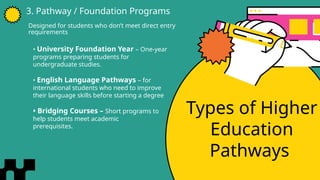
3.Pathway / Foundation Programs
• University Foundation Year – One-year
programs preparing students for
undergraduate studies.
• English Language Pathways – for
international students who need to improve
their language skills before starting a degree
• Bridging Courses – Short programs to
help students meet academic
prerequisites.
Designed for students who don’t meet direct entry
requirements
6.
Types of Higher
Education
Pathways
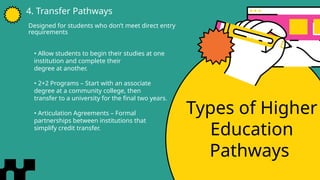
4.Transfer Pathways
• Allow students to begin their studies at one
institution and complete their
degree at another.
• 2+2 Programs – Start with an associate
degree at a community college, then
transfer to a university for the final two years.
• Articulation Agreements – Formal
partnerships between institutions that
simplify credit transfer.
Designed for students who don’t meet direct entry
requirements
7.
Types of Higher
Education
Pathways
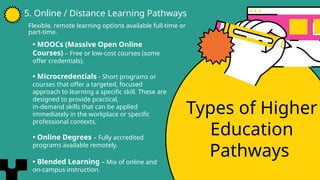
5.Online / Distance Learning Pathways
• MOOCs (Massive Open Online
Courses) – Free or low-cost courses (some
offer credentials).
• Microcredentials - Short programs or
courses that offer a targeted, focused
approach to learning a specific skill. These are
designed to provide practical,
in-demand skills that can be applied
immediately in the workplace or specific
professional contexts.
• Online Degrees – Fully accredited
programs available remotely.
• Blended Learning – Mix of online and
on-campus instruction.
Flexible, remote learning options available full-time or
part-time.
8.
Types of Higher
Education
Pathways
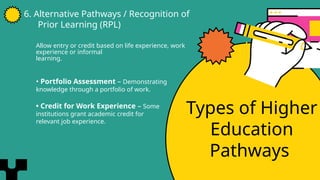
6.Alternative Pathways / Recognition of
Prior Learning (RPL)
• Portfolio Assessment – Demonstrating
knowledge through a portfolio of work.
• Credit for Work Experience – Some
institutions grant academic credit for
relevant job experience.
Allow entry or credit based on life experience, work
experience or informal
learning.
9.
Types of Higher
Education
Pathways
7.Specialized Pathways
• Honors Programs – For high-achieving
undergraduates, often involving research.
• Dual Degrees / Double Majors –
Earning two degrees simultaneously.
• Accelerated Programs – Faster
completion (e.g., 3-year bachelor's, combined
BA/MA).
• Pre-Professional Programs – For
careers like medicine, law, or education.
Tailored for specific student groups or career goals.
10.
Pathways AreNot Always Linear
Many students:
• Change majors
• Transfer institutions
• Return to education after
working
• Stack credentials (e.g.,
certificate diploma degree)
→ →
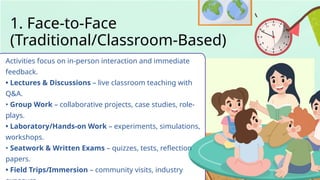
Activities focus onin-person interaction and immediate
feedback.
• Lectures & Discussions – live classroom teaching with
Q&A.
• Group Work – collaborative projects, case studies, role-
plays.
• Laboratory/Hands-on Work – experiments, simulations,
workshops.
• Seatwork & Written Exams – quizzes, tests, reflection
papers.
• Field Trips/Immersion – community visits, industry
1. Face-to-Face
(Traditional/Classroom-Based)
13.
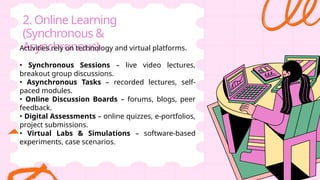
2. Online Learning
(Synchronous&
Asynchronous)
Activities rely on technology and virtual platforms.
• Synchronous Sessions – live video lectures,
breakout group discussions.
• Asynchronous Tasks – recorded lectures, self-
paced modules.
• Online Discussion Boards – forums, blogs, peer
feedback.
• Digital Assessments – online quizzes, e-portfolios,
project submissions.
• Virtual Labs & Simulations – software-based
experiments, case scenarios.
14.
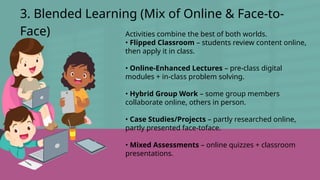
3. Blended Learning(Mix of Online & Face-to-
Face) Activities combine the best of both worlds.
• Flipped Classroom – students review content online,
then apply it in class.
• Online-Enhanced Lectures – pre-class digital
modules + in-class problem solving.
• Hybrid Group Work – some group members
collaborate online, others in person.
• Case Studies/Projects – partly researched online,
partly presented face-toface.
• Mixed Assessments – online quizzes + classroom
presentations.
15.
4.Distance/Modular Learning (Self-Paced,
Printor Digital Modules)
Activities focus on independent study and self-directed tasks.
• Module-Based Readings & Exercises – worksheets, guided
questions.
• Self-Assessment Quizzes – practice tests within modules.
• Portfolio Development – compilation of outputs and
reflections.
• Research/Applied Projects – community-based or workplace-
based tasks.
• Regular Check-ins – via SMS, phone calls, or occasional
consultations.
Why Financing Matters
•Rising costs of tuition, books,
and living expenses
• Impact of financial decisions
on long-term goals
• Importance of planning early
• Major Financing Options
18.
Financing Options inHigher
Education
1. Scholarships
• Definition: Merit-based financial aid that doesn’t require repayment
• Sources: Schools, government, private organizations
Examples: Academic, athletic, artistic, and community service
scholarships
2. Grants
• Definition: Need-based aid that also doesn’t require repayment
• Sources: Government (e.g., CHED, UniFAST), NGOs
Examples: Tertiary Education Subsidy (TES), Student Financial
Assistance
Programs
3. Student Loans
• Definition: Borrowed money that must be repaid with interest
• Types: Government loans (e.g., GSIS, SSS), private bank loans
• Considerations: Interest rates, repayment terms, grace periods
19.
Financing Options inHigher
Education
4. Work-Study Programs
• Definition: Part-time jobs offered to students to help pay for education
• Benefits: Income + experience
Examples: Campus jobs, internships with stipends`
5. Personal Savings & Family Support
• Definition: Using personal or family resources to fund education
• Strategies: Saving early, budgeting, and financial planning
20.
Activity 2
“A Dayin the Life of a Higher Education Student”
GROUP 1 Pathways: “Student wants to become a teacher
but doesn’t know whether to pursue a 4-year or ladderized
program.”
GROUP 2 Modalities: “Student lives far from school and is
unsure if online learning is effective.”
GROUP 3 Specialization: “Student excels in science but is
interested in arts. Which major should they choose?”
GROUP 4 Financing Options: “Student applied for a
scholarship but got rejected. What are the alternatives?”
GROUP 5 Career Planning: “Student dreams of starting a
business but worries about balancing work and school.”
21.
Career Development
Strategies atWork
PERFORMANCE AND
EVALUATION
Understanding and meeting performance
expectations.
ENGAGEMENT Participating in company projects and initiatives.
BUILDING
RELATIONSHIPS WITH
SUPERVISORS
Establishing good communication
and seeking feedback.
22.
MANAGING CAREER
CHANGES
CAREER TRANSITIONS
Howto find job opportunities aligned with
your career goals.
DEALING WITH UNCERTAINTY
Coping with uncertainty and stress during transitions.
ADJUSTMENT STRATEGIES
Adapting your career plan according to
changing circumstances.
23.
CONCLUSION AND
NEXT STEPS
Careerdevelopment is an ongoing process requiring
planning and adjustments.
Stay focused on your goals, enhance your skills, and
leverage available opportunities.
Take concrete steps to plan and manage your career more
effectively, and continue to grow to achieve success.




![LITE 2018 – Learning Paths [Heather Bayfield + JJ Cranston]](https://cdn.slidesharecdn.com/ss_thumbnails/session5-learning-paths-181029162954-thumbnail.jpg?width=640&height=640&fit=bounds)


