About MDC

MDC helps communities and organizations apply demonstrated solutions to the
barriers that separate people from opportunity.


We have worked for over 45 years in partnership with community colleges to
design, test, and deliver programs that accelerate educational achievement and
workplace success.


As an Achieving the Dream founding partner and managing partner of the
Developmental Education Initiative, we’ve learned a lot about how community
colleges are helping their students succeed.
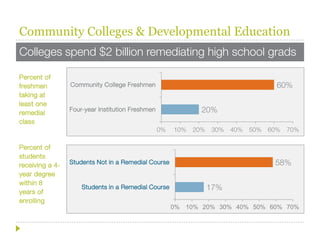
Community Colleges & Developmental Education
Colleges spend $2 billion remediating high school grads

Percent of
freshmen         Community College Freshmen                                            60%
taking at
least one
remedial
                 Four-year Institution Freshmen                20%
class
                                                  0%   10%   20%   30%   40%   50%   60%   70%

Percent of
students
receiving a 4-   Students Not in a Remedial Course                                    58%
year degree
within 8
years of
                     Students in a Remedial Course                 17%
enrolling
                                                       0% 10% 20% 30% 40% 50% 60% 70%
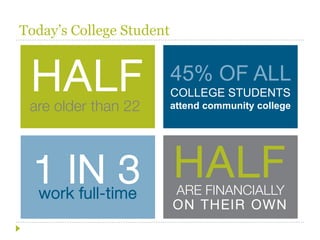
Today’s College Student


 HALF
 are older than 22
                          45% OF ALL
                          COLLEGE STUDENTS
                          attend community college


  1 IN 3 HALF
  work full-time          ARE FINANCIALLY
                          ON THEIR OWN
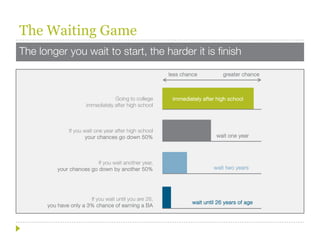
The Waiting Game
The longer you wait to start, the harder it is finish

                                                        less chance           greater chance


                                  Going to college       immediately after high school
                      immediately after high school


               If you wait one year after high school
                       your chances go down 50%                            wait one year


                          If you wait another year,
          your chances go down by another 50%                             wait two years


                       If you wait until you are 26,
                                                                 wait until 26 years of age
      you have only a 3% chance of earning a BA
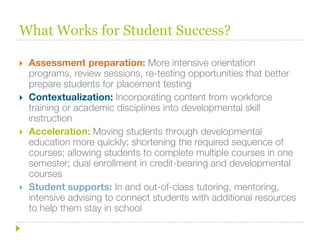
What Works for Student Success?

   Assessment preparation: More intensive orientation
    programs, review sessions, re-testing opportunities that better
    prepare students for placement testing
   Contextualization: Incorporating content from workforce
    training or academic disciplines into developmental skill
    instruction
   Acceleration: Moving students through developmental
    education more quickly; shortening the required sequence of
    courses; allowing students to complete multiple courses in one
    semester; dual enrollment in credit-bearing and developmental
    courses
   Student supports: In and out-of-class tutoring, mentoring,
    intensive advising to connect students with additional resources
    to help them stay in school
MDC created this guidebook to help colleges serve
more students with effective programs, eventually
reaching most of those that can benefit.

                              more2most.org
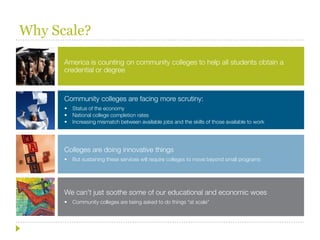
Why Scale?

      America is counting on community colleges to help all students obtain a
      credential or degree


      Community colleges are facing more scrutiny:
      •   Status of the economy
      •   National college completion rates
      •   Increasing mismatch between available jobs and the skills of those available to work


      Colleges are doing innovative things
      •   But sustaining these services will require colleges to move beyond small programs


      We can’t just soothe some of our educational and economic woes
      •   Community colleges are being asked to do things “at scale”
Challenges
There is no silver bullet; no “one best way” to scale

   There are few sorting mechanisms for promising
    innovations, making it difficult for true best practices to
    rise to the top.
   There is little investment specifically targeted to scaling
    efforts.
   Existing funding models for this work outside the
    private sector are inadequate.
   Navigating the politics of change within any human
    system is critical—and difficult.
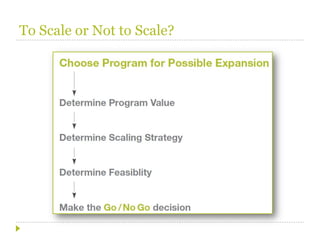
To Scale or Not to Scale?
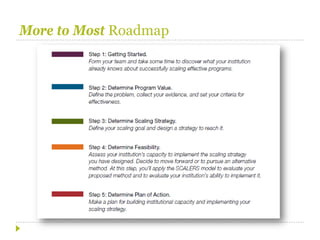
More to Most Roadmap
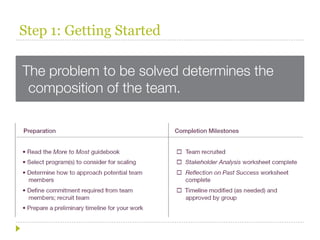
Step 1: Getting Started

The problem to be solved determines the
 composition of the team.
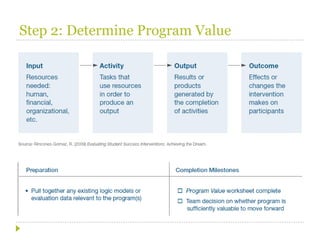
Step 2: Determine Program Value
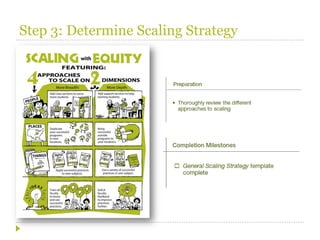
Step 3: Determine Scaling Strategy
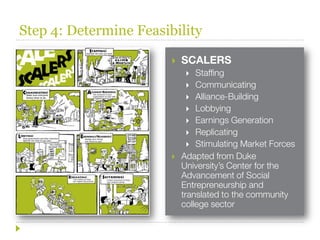
Step 4: Determine Feasibility

                           SCALERS
                               Staffing
                               Communicating
                               Alliance-Building
                               Lobbying
                               Earnings Generation
                               Replicating
                               Stimulating Market Forces
                           Adapted from Duke
                            University’s Center for the
                            Advancement of Social
                            Entrepreneurship and
                            translated to the community
                            college sector
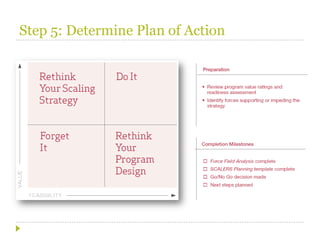
Step 5: Determine Plan of Action
Scaling as Sustainability
Scaling impact within the complex system of a community
college requires continued adaptation, incorporation of new
ideas, and refinement of existing programs.


   What have you learned in going from some to more
    that will help you get to most?
   What new capacities have you developed? What
    capacities have you strengthened?
   How will you institutionalize this kind of planning so
    that it becomes a part of the way you approach any
    new program?
307 West Main Street
Durham, NC 27701-3215

Phone: 919.381.5802
Fax: 919.381.5805

www.more2most.org
www.mdcinc.org

MDC M2M for Web

  • 2.
    About MDC MDC helpscommunities and organizations apply demonstrated solutions to the barriers that separate people from opportunity. We have worked for over 45 years in partnership with community colleges to design, test, and deliver programs that accelerate educational achievement and workplace success. As an Achieving the Dream founding partner and managing partner of the Developmental Education Initiative, we’ve learned a lot about how community colleges are helping their students succeed.
  • 3.
    Community Colleges &Developmental Education Colleges spend $2 billion remediating high school grads Percent of freshmen Community College Freshmen 60% taking at least one remedial Four-year Institution Freshmen 20% class 0% 10% 20% 30% 40% 50% 60% 70% Percent of students receiving a 4- Students Not in a Remedial Course 58% year degree within 8 years of Students in a Remedial Course 17% enrolling 0% 10% 20% 30% 40% 50% 60% 70%
  • 4.
    Today’s College Student HALF are older than 22 45% OF ALL COLLEGE STUDENTS attend community college 1 IN 3 HALF work full-time ARE FINANCIALLY ON THEIR OWN
  • 5.
    The Waiting Game Thelonger you wait to start, the harder it is finish less chance greater chance Going to college immediately after high school immediately after high school If you wait one year after high school your chances go down 50% wait one year If you wait another year, your chances go down by another 50% wait two years If you wait until you are 26, wait until 26 years of age you have only a 3% chance of earning a BA
  • 6.
    What Works forStudent Success?  Assessment preparation: More intensive orientation programs, review sessions, re-testing opportunities that better prepare students for placement testing  Contextualization: Incorporating content from workforce training or academic disciplines into developmental skill instruction  Acceleration: Moving students through developmental education more quickly; shortening the required sequence of courses; allowing students to complete multiple courses in one semester; dual enrollment in credit-bearing and developmental courses  Student supports: In and out-of-class tutoring, mentoring, intensive advising to connect students with additional resources to help them stay in school
  • 7.
    MDC created thisguidebook to help colleges serve more students with effective programs, eventually reaching most of those that can benefit. more2most.org
  • 8.
    Why Scale? America is counting on community colleges to help all students obtain a credential or degree Community colleges are facing more scrutiny: • Status of the economy • National college completion rates • Increasing mismatch between available jobs and the skills of those available to work Colleges are doing innovative things • But sustaining these services will require colleges to move beyond small programs We can’t just soothe some of our educational and economic woes • Community colleges are being asked to do things “at scale”
  • 9.
    Challenges There is nosilver bullet; no “one best way” to scale  There are few sorting mechanisms for promising innovations, making it difficult for true best practices to rise to the top.  There is little investment specifically targeted to scaling efforts.  Existing funding models for this work outside the private sector are inadequate.  Navigating the politics of change within any human system is critical—and difficult.
  • 10.
    To Scale orNot to Scale?
  • 11.
    More to MostRoadmap
  • 12.
    Step 1: GettingStarted The problem to be solved determines the composition of the team.
  • 13.
    Step 2: DetermineProgram Value
  • 14.
    Step 3: DetermineScaling Strategy
  • 15.
    Step 4: DetermineFeasibility  SCALERS  Staffing  Communicating  Alliance-Building  Lobbying  Earnings Generation  Replicating  Stimulating Market Forces  Adapted from Duke University’s Center for the Advancement of Social Entrepreneurship and translated to the community college sector
  • 16.
    Step 5: DeterminePlan of Action
  • 17.
    Scaling as Sustainability Scalingimpact within the complex system of a community college requires continued adaptation, incorporation of new ideas, and refinement of existing programs.  What have you learned in going from some to more that will help you get to most?  What new capacities have you developed? What capacities have you strengthened?  How will you institutionalize this kind of planning so that it becomes a part of the way you approach any new program?
  • 18.
    307 West MainStreet Durham, NC 27701-3215 Phone: 919.381.5802 Fax: 919.381.5805 www.more2most.org www.mdcinc.org