EXODUS 5 COMME TARY
EDITED BY GLE PEASE
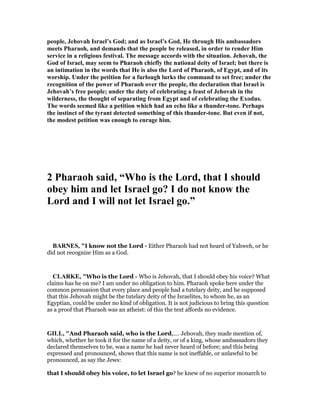
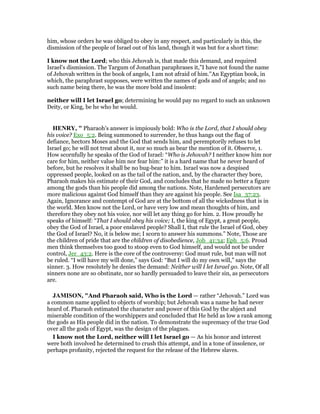
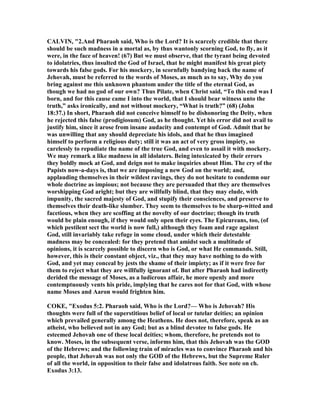
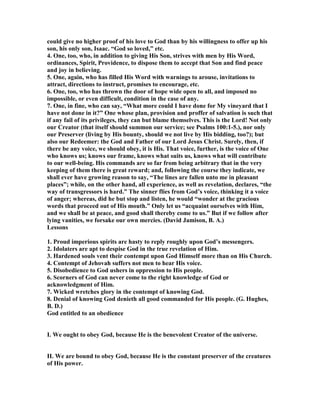
I TRODUCTIO
COFFMA , "This chapter gives the account of the first episode in the long
confrontation between God and Pharaoh over the demand that he, "Let my people
go!" The chapter reveals that the Hebrews were not yet ready for deliverance, but
that they should suffer hardship before their liberty could be achieved. "The
Hebrew slaves must learn that they too must suffer loss. They will have to pay the
price of their liberty-to-be. It is not just a gift from God."[1] The absolute necessity
for such suffering derived from the fact that in a general sense, the Hebrew slaves in
Egypt, prior to this confrontation, had been relatively comfortable. They certainly
had been well fed. And, apparently, there had been some leisure time allowed to
them for purposes of tending their own gardens, fishing, etc. It is revealed in
umbers 11 that, even after all the great wonders that had delivered them from
Egypt, they still tired of God's "manna," and they actually preferred "the leeks and
garlic" of Egypt to their diet as wanderers. Keil observed, "It is certain that in such
a state of mind as this, they would never have been willing to leave Egypt ... without
a very great increase in the hardships which they suffered there."[2] The events of
this chapter were designed by the Lord to provide the kind of incentive they needed.
There was also another necessary achievement of these events, and that was the
unification of Israel, as appears later in the notes. Failure to observe these
preliminary and necessary results from what happened here has led some to
denominate this first confrontation as a failure, but it was no such thing. God's plan
was working, and it would not cease working until Israel was delivered and
Pharaoh with his army had perished in the Red Sea!
Bricks Without Straw
1 Afterward Moses and Aaron went to Pharaoh
and said, “This is what the Lord, the God of
Israel, says: ‘Let my people go, so that they may
hold a festival to me in the wilderness.’”
BAR ES, "Pharaoh - This king, probably Tothmosis II, the great grandson of
Aahmes Exo_1:8, the original persecutor of the Israelites, must have been resident at
this time in a city, probably Tanis Exo_2:5, of Lower Egypt, situated on the Nile.
The Lord God - Yahweh God of Israel demanded the services of His people. The
demand, according to the general views of the pagans, was just and natural; the
Israelites could not offer the necessary sacrifices in the presence of Egyptians.
CLARKE, "And afterward Moses and Aaron went - This chapter is properly a
continuation of the preceding, as the succeeding is a continuation of this; and to
preserve the connection of the facts they should be read together.
How simply, and yet with what authority, does Moses deliver his message to the
Egyptian king! Thus saith Jehovah, God of Israel, Let my people go. It is well in this, as
in almost every other case where ‫יהוה‬ Jehovah occurs, to preserve the original word: our
using the word Lord is not sufficiently expressive, and often leaves the sense indistinct.
GILL, "And afterwards Moses and Aaron went in, and told Pharaoh,....
Whose name, some say, was Cenchres, others Amenophis, according to Manetho and
Chaeremon (h); See Gill on Exo_3:10 went into Pharaoh's palace, and being introduced
by the proper officer at court for that purpose, addressed him in the following manner:
thus saith the Lord God of Israel: as ambassadors of him, who is King of kings, and
Lord of lords; and so Artapanus (i), the Heathen, says that the Egyptian king, hearing
that Moses was come, sent for him to know wherefore he was come, who told him, that
the Lord of the world commanded him to let the Jews go, as it follows here:
let my people go, that they may hold a feast unto me in the wilderness; in the
wilderness of Sinai or Arabia, at Horeb there, where they might keep it more freely and
safely, without being disturbed by the Egyptians, and without giving any offence to
them; and the demand is just; they were the people of God, and therefore he claims
them, and service from them was due to him; and Pharaoh had no right to detain them,
and what is required was but their reasonable service they owed to their God. This feast
was to be held, not for themselves, but to God, which chiefly consisted in offering
sacrifice, as is after explained; the entire dismission of them is not at once demanded,
only to go a little while into the wilderness, and keep a feast there to the Lord; though it
was not intended they should return, but it was put in this form to try Pharaoh, and that
he might be the more inexcusable in refusing to grant what was so reasonable.
HE RY, "Moses and Aaron, having delivered their message to the elders of Israel,
with whom they found good acceptance, are now to deal with Pharaoh, to whom they
come in peril of their lives - Moses particularly, who perhaps was out-lawed for killing
the Egyptian forty years before, so that if any of the old courtiers should happen to
remember that against him now it might cost him his head. Their message itself was
displeasing, and touch Pharaoh both in his honour and in his profit, two tender points;
yet these faithful ambassadors boldly deliver it, whether he will hear or whether he will
forbear.
I. Their demand is piously bold: Thus saith the Lord God of Israel, Let my people go,
Exo_5:1. Moses, in treating with the elders of Israel, is directed to call God the God of
their fathers; but, in treating with Pharaoh, they call him the God of Israel, and it is the
first time we find him called so in scripture: he is called the God of Israel, the person
(Gen_33:20); but here it is Israel, the people. They are just beginning to be formed into
a people when God is called their God. Moses, it is likely, was directed to call him so, at
least it might be inferred from Exo_9:22, Israel is my son. In this great name they
deliver their message: Let my people go. 1. They were God's people, and therefore
Pharaoh ought not to detain them in bondage. Note, God will own his own people,
though ever so poor and despicable, and will find a time to plead their cause. “The
Israelites are slaves in Egypt, but they are my people,” says God, “and I will not suffer
them to be always trampled upon.” See Isa_52:4, Isa_52:5. 2. He expected services and
sacrifices from them, and therefore they must have leave to go where they could freely
exercise their religion, without giving offence to, or receiving offence from, the
Egyptians. Note, God delivers his people out of the hand of their enemies, that they may
serve him, and serve him cheerfully, that they may hold a feast to him, which they may
do, while they have his favour and presence, even in a wilderness, a dry and barren land.
JAMISO , "Exo_5:1-23. First interview with Pharaoh.
Moses and Aaron went in — As representatives of the Hebrews, they were entitled
to ask an audience of the king, and their thorough Egyptian training taught them how
and when to seek it.
and told Pharaoh — When introduced, they delivered a message in the name of the
God of Israel. This is the first time He is mentioned by that national appellation in
Scripture. It seems to have been used by divine direction (Exo_4:2) and designed to put
honor on the Hebrews in their depressed condition (Heb_11:16).
K&D 1-2. "Pharaoh's Answer to the Request of Moses and Aaron. - Exo_5:1-5. When
the elders of Israel had listened with gladness and gratitude to the communications of
Moses and Aaron respecting the revelation which Moses had received from Jehovah,
that He was now about to deliver His people out of their bondage in Egypt; Moses and
Aaron proceeded to Pharaoh, and requested in the name of the God of Israel, that he
would let the people of Israel go and celebrate a festival in the wilderness in honour of
their God. When we consider that every nation presented sacrifices to its deities, and
celebrated festivals in their honour, and that they had all their own modes of worship,
which were supposed to be appointed by the gods themselves, so that a god could not be
worshipped acceptably in every place; the demand presented to Pharaoh on the part of
the God of the Israelites, that he would let His people go into the wilderness and sacrifice
to Him, appears so natural and reasonable, that Pharaoh could not have refused their
request, if there had been a single trace of the fear of God in his heart. But what was his
answer? “Who is Jehovah, that I should listen to His voice, to let Israel go? I know not
Jehovah.” There was a certain truth in these last words. The God of Israel had not yet
made Himself known to him. But this was no justification. Although as a heathen he
might naturally measure the power of the God by the existing condition of His people,
and infer from the impotence of the Israelites that their God must be also weak, he
would not have dared to refuse the petition of the Israelites, to be allowed to sacrifice to
their God or celebrate a sacrificial festival, if he had had any faith in gods at all.
CALVI , "1.And afterwards Moses and Aaron went in. Moses here begins to set
forth how many and how great were the proofs of God’s power displayed in the
deliverance of his people. For, since the pride, the madness, and the obstinacy of the
king were indomitable, every door was closed, until broken down miraculously, and
by various means. It was, indeed, possible for God to overwhelm him at once, by a
single nod, so that he should even fall down dead at the very sight of Moses; but, as
we have already briefly stated, and he will himself presently declare, He, in the first
place, chose more clearly to lay open His power; for if Pharaoh had either
voluntarily yielded, or had been overcome without effort, the glory of the victory
would not have been so illustrious. In the second place, He wished this monument to
exist of His singular love towards His elect people; for by contending so
perseveringly and so forcibly against the obstinacy of this most powerful king, He
gave no doubtful proof of his love towards his Church. In the third place, He wished
to accustom His servants in all ages to patience, lest they should faint in their minds,
if He does not immediately answer their prayers, and, at every moment, relieve them
from their distresses. In the fourth place, He wished to shew that, against all the
strivings and devices of Satan, against the madness of the ungodly, and all worldly
hinderances, His hand must always prevail; and to leave us no room to doubt, but
that whatever we see opposing us will at length be overcome by him. In the fifth
place, By detecting the illusions of Satan and the magicians, He would render His
Church more wary, that she might carefully watch against such devices, and that
her faith might continue invincible against all the machinations of error. Finally, He
would convince Pharaoh and the Egyptians, that their folly was not to be excused by
any pretense of ignorance; and, at the same time, by this example, He would shew us
how horrible a darkness possesses the minds of the reprobate, when He has
deprived them of the light of his Spirit. These things must be attentively observed in
the course of the narrative, if we desire to profit by it.
Since it is difficult to obtain access to kings, who deign not to admit to their presence
any of the lower orders, Moses and Aaron must have been endued with no ordinary
confidence, when they boldly approached Pharaoh. For it was a disagreeable
message, and one very likely to give offense, that he should permit the people to take
three days’ journey beyond the bounds of Egypt; since a suspicion must
unquestionably arise that, being thus dismissed, they would no longer remain his
subjects, and that thus a part of the land would be emptied of its inhabitants. Still
Moses and Aaron do not fear to deliver God’s command, in which there was this
additional annoyance to the proud and sensitive ears of the king, viz., that they
attributed the glory of Deity to the God of Israel alone; for, by calling Him Jehovah,
they imply that the gods worshipped in Egypt were false, and invented by the
imaginations of man. We have said elsewhere that there was no deceit in the pretext
that God called his people into the wilderness to hold a feast, although He does not
reveal His counsel to the tyrant; for it was really His pleasure that a sacrifice of
thanksgiving should be offered to Himself on Mount Sinai, and that they should be
thus separated from the polluted nation with which they were mixed up; and,
assuredly, He wished to arouse the tyrant’s wrath, by ignominiously condemning
the whole of Egypt, as not capable of pure worship. For He was obliged by no law to
declare openly their deliverance; but that He might draw forth from the mind of the
tyrant the venom of his impiety, He asked for nothing connected with the advantage
of His people, but merely demanded the worship which was due to Himself. The
word which Moses uses means properly to hold a feast, but also embraces whatever
is connected with it; and, therefore, by synecdoche, it is taken here, as also in other
passages, for the solemn worship of God. (66)
BE SO , "Exodus 5:1. Thus saith the Lord God of Israel — Moses, in treating
with the elders of Israel, is directed to call God the God of their fathers; but in
treating with Pharaoh, he and Aaron call him the God of Israel, and it is the first
time we find him called so in Scripture. He is called the God of Israel, the person,
(Genesis 33:20,) but here it is Israel, the people. They are just beginning to be
formed into a people when God is called their God. Let my people go — They were
God’s people, and therefore Pharaoh ought not to detain them in bondage. And he
expected services and sacrifices from them, and therefore they must have leave to go
where they could freely exercise their religion, without giving offence to, or
receiving offence from the Egyptians.
COKE, "Exodus 5:1. And afterward Moses, &c.— The elders of Israel, being
convinced of the Divine commission wherewith Moses was invested, ch. Exodus 3:18
accompany him and Aaron to Pharaoh. Pharaoh's answer, in the second verse,
shews that the Hebrew name Jehovah should have been retained in our version.
Thus saith Jehovah, Exodus 5:2. Who is Jehovah?—I know not Jehovah.
My people, &c.— This may be considered either as the substance of their message,
or rather, perhaps, as the concise and peremptory declaration of Jehovah's
pleasure. Bishop Warburton observes, that the separation of this people has been
arraigned, as inconsistent with the Divine attributes. But it cannot be denied, that it
became the goodness of the Deity to preserve the doctrine of the Unity, amidst an
idolatrous world. or could such a separation be made otherwise, than by bringing
a part of mankind under God's peculiar protection. ow, as some people must needs
be selected for this purpose, it seems most agreeable to our ideas of Divine Wisdom,
to make the blessings, attendant on such a selection, the reward of some exalted
piety and virtue in the progenitors of the chosen people: but, therefore, to pretend
that they were chosen as favourites, is both unjust and absurd. The separation was
made for the sake of mankind in general; though one people became the honoured
instrument, in reward of their forefathers' piety and virtues.
That they may hold a feast— The verb, here rendered, to hold a feast, ‫חגג‬ chagag,
signifies, primarily, to dance; to dance round in circles, says Parkhurst; to celebrate
a feast with circular dancing. This made an eminent part of the religious rites of the
ancient Heathen, as it does of the modern to this day. It seems to have been
expressive of the supposed independent power of the sun and heavens, the first and
great objects of idolatry.
TRAPP, " And afterward Moses and Aaron went in, and told Pharaoh, Thus saith
the LORD God of Israel, Let my people go, that they may hold a feast unto me in
the wilderness.
Ver. 1. That they may hold a feast.] "That they may serve me." [Exodus 4:23] "Let
us keep the feast," {εορταζωµεν, 1 Corinthians 5:8} which is the same with "Let us
serve God acceptably." [Hebrews 12:28] It is a feast, and better, for a good soul to
converse with God. [Psalms 63:5 Isaiah 25:6]
WHEDO , "THE I TERCESSIO OF MOSES WITH PHARAOH, A D THE
RESULT, Exodus 5:1-23.
1. The era of preparation ends, and the first act of the struggle begins. Moses and
Aaron open their mission to Pharaoh. Thus saith Jehovah, God of Israel, so the
phrase should be rendered, since “Jehovah” is the proper name, and not the
compound word “Lord God,” as the Authorized Version would indicate. Moses and
Aaron do not at first demand national independence. It is a far more moderate
request to be permitted to sacrifice according to the command of Jehovah. As all
nations had their forms of worship, and as religious claims were everywhere
acknowledged to be paramount, this was no unreasonable petition, especially in
Egypt, where religious festivals and processions were a most familiar pageant. At
the same time it contained the core principle of Israel’s mission — recognition of
Jehovah. See on Exodus 3:18-19. It is a strange and irreverent misconception that
has led some interpreters to consider this a deceptive request.
COFFMA , ""And afterward Moses and Aaron came, and said unto Pharaoh,
Thus saith Jehovah, the God of Israel, Let my people go, that they may hold a feast
unto me in the wilderness."
o difficulty at all seems to have been encountered here by Moses and Aaron in
their having ready access to Pharaoh. The reason very well could have been as
suggested by Ellison: "The freedom Moses enjoyed is probably to be attributed to
his having been adopted by Pharaoh's daughter."[3] If there were any difficulties,
the sacred author ignored them. The proximity of Pharaoh's presence to the
Israelites in Goshen (in the Delta area of northern Egypt) is seen as a problem to
some who believe that the capital of Egypt in that period was located in the southern
part of the kingdom, but the problem disappears in the fact that most of the capitals
of kings in that period had more than one location, summer residences and winter
residences of ruling monarchs being fairly common. The events of this chapter took
place just after the harvest in May or June, and Pharaoh's summer palace was
evidently in the vicinity of where Israel resided. Rawlinson placed the summer
palace at Zoan (Tanis), and interpreted the word "afterward" (at the head of the
chapter) as an indication that, "Moses and Aaron had to wait for the return of
Pharaoh from his southern to his northern capital."[4]
"Let my people go, that they may hold a feast to me in the wilderness ..." There was
nothing in that request that was the basis of any legitimate objection on Pharaoh's
part. Work-journals belonging to overseers of employees in the times of the
Pharaoh's listed, among other allowable reasons for absenteeism, "the offering of
sacrifices by workmen to their gods."[5] There is visible in this first demand which
God made of Pharaoh a definite mercy. By asking something that was legitimate
enough, as presented, Pharaoh, had his heart been right, would have granted it.
"Pharaoh could not have refused this request, if there had been a single trace of the
fear of God in his heart."[6] This view is a far better explanation of the limitation of
this first demand than the arrogant conclusion that this initial request was "a false
pretext."[7] By refusing the first reasonable and lawful request, Pharaoh himself
opened the door for all that followed.
ELLICOTT, "(1) Went in.—Heb., went—i.e., left their usual residence, and
approached the Court, which, according to the Psalms (Psalms 78:12; Psalms 78:43),
was held at Zoan (i.e., Tanis). This was the ordinary residence of Rameses II. and
his son Menephthah.
Thus saith the Lord God of Israel.—Heb., Thus has said Jehovah, God of Israel.
The Pharaohs claimed to hold direct communications with the Egyptian deities, and
could not deny the possibility of the Hebrew leaders holding communications with
their God. Menepthah himself—the probable “Pharaoh of the Exodus”—gave out
that he had received a warning from Phthah in the fifth year of his reign (Brugsch,
History of Egypt, vol. ii., p. 119; 1st ed.).
That they may hold a feast unto me.—God’s entire purpose is not at once revealed
to Pharaoh. He is tried with a moderate demand, which he might well have granted.
By refusing it he showed himself harsh, unkind, and inconsiderate, so tempting God
to lay upon him a greater burthen.
In the wilderness—i.e., beyond the frontier, or, at any rate, beyond inhabited
Egypt—that the Egyptians might not be driven to fury by seeing animals sacrificed
which they regarded as sacred. (See Exodus 8:26, and the comment ad loc.)
CO STABLE, "Verses 1-9
At Moses and Aaron"s first audience with Pharaoh they simply presented God"s
command ( Exodus 5:1). [ ote: For an introduction to Liberation Theology, see
Wolf, pp130-31.] They did not perform miracles but asked for permission to leave
Egypt.
The Israelites could have worshipped the gods of Egypt in the land, but they had to
leave Egypt to worship a non-Egyptian God. Moses" request was a request to
exercise a basic human right, namely, freedom of worship.
" Exodus 5:1-5 introduces another aspect of labour in Egypt: claims for time off
work, and specifically for worship or religious holidays. On this topic, useful
background comes from the extensive, fragmentary and often very detailed records
kept for the activities of the royal workmen (who lived at the Deir el-Medina
village), who cut the royal tombs in the Valleys of the Kings and Queens in Western
Thebes, c1530-1100 B.C.
"Daily notes were kept for the men"s attendances at work or of their absences from
it. Sometimes reasons for absence are given.... The entire workforce might be off for
up to8 or14days, especially if interruptions, official holidays and "weekends" came
together. In Ancient Egypt-as elsewhere-major national festivals (usually main
feasts of chief gods) were also public holidays. Then, each main city had its own
holidays on main feasts of the principal local god(s). Besides all this, the royal
workmen at Deir el-Medina can be seen claiming time off for all kinds of reasons,
including "offering to his god," "(off) for his feast"; even "brewing for his feast" or
for a specific deity. ot only individuals but groups of men together could get time
off for such observances. And a full-scale feast could last several days.
"What was true in Thebes or Memphis would apply equally at Pi-Ramesse
(Raamses). Song of Solomon , when Moses requested time off from Pharaoh, for the
Hebrews to go off and celebrate a feast to the Lord God, it is perhaps not too
surprising that Pharaoh"s reaction was almost "not another holiday!"" [ ote:
Kenneth Kitchen, "Labour Conditions in the Egypt of the Exodus ," Buried History
(September1984):47-48.]
Pharaoh was not only the king of Egypt, but the Egyptians regarded him as a divine
person; he was a god ( Exodus 5:2). [ ote: See Frankfort, ch2: "The Egyptian
State."] Consequently when Moses and Aaron asked Pharaoh to accede to the
command of Yahweh, Pharaoh saw this request as a threat to his sovereignty. He
knew (i.e, had respect for) the gods of Egypt, but he did not know (have respect for)
Yahweh, the God of his foreign slaves. If Yahweh had identified Himself with these
slaves, and if He had not already delivered them, why should Pharaoh fear and obey
Him?
"It required no ordinary daring to confront the representative of a long line of kings
who had been taught to consider themselves as the representatives and equals of the
gods. They were accustomed to receive Divine titles and honours, and to act as
irresponsible despots. Their will was indisputable, and all the world seemed to exist
for no other reason than [to] minister to their state." [ ote: Meyer, p88.]
"These words ["Who is the LORD that I should obey His voice to let Israel go? I do
not know the LORD ..."] form the motivation for the events that follow, events
designed to demonstrate who the Lord is.
"Thus as the plague narratives begin, the purpose of the plagues is clearly stated:
"so that the Egyptians will know that I am the LORD" ( Exodus 7:5). Throughout
the plague narratives we see the Egyptians learning precisely this lesson ( Exodus
8:19; Exodus 9:20; Exodus 9:27; Exodus 10:7). As the narratives progress, the
larger purpose also emerges. The plagues which God had sent against the Egyptians
were "to be recounted to your son and your son"s son ... so that you may know that
I am the LORD."" [ ote: Sailhamer, The Pentateuch . . ., pp249-50.]
"The point is clear from the chapter: when the people of God attempt to devote
their full service and allegiance to God, they encounter opposition from the world."
[ ote: The ET Bible note on5:1.]
In their second appeal to Pharaoh, Moses and Aaron used milder terms ( Exodus
5:3). They presented themselves not as ambassadors of Yahweh but as
representatives of their brethren. They did not mention the name "Yahweh," that
was unknown to Pharaoh, or "Israel," that would have struck him as arrogant.
They did not command but requested ("Please ..."). Moreover they gave reasons for
their request: their God had appeared to them, and they feared His wrath if they
disobeyed Him.
"Moses . . . appealed to him [Pharaoh] almost precisely as, centuries after, Paul
addressed the assembly on Mars Hill ... [cf. Acts 17:22-23]." [ ote: Meyer, p107.]
The Egyptians regarded the sacrifices that the Israelites would offer as unacceptable
since almost all forms of life were sacred in Egypt. They believed their gods
manifested themselves through cows, goats, and many other animals.
"The Egyptians considered sacred the lion, the ox, the ram, the wolf, the dog, the
cat, the ibis, the vulture, the falcon, the hippopotamus, the crocodile, the cobra, the
dolphin, different varieties of fish, trees, and small animals, including the frog,
scarab, locust, and other insects. In addition to these there were anthropomorphic
gods; that Isaiah , men in the prime of life such as Annen, Atum, or Osiris." [ ote:
William Ward, The Spirit of Ancient Egypt, p123.]
"Where did Moses get the idea that they should have a pilgrim feast and make
sacrifices? God had only said they would serve Him in that mountain. In the OT the
pilgrim feasts to the sanctuary three times a year incorporated the ideas of serving
the LORD and keeping the commands. So the words here simply use the more
general idea of appearing before their God. And, they would go to the desert
because there was no homeland yet. Only there could they be free." [ ote: The ET
Bible note on5:3.]
Pharaoh"s reply to Moses and Aaron"s second appeal was even harsher than his
response to their first command ( Exodus 5:5; cf. Exodus 5:1). Their aggressive
approach may have been what God used to cause Pharaoh to harden his heart
initially.
EXPOSITOR'S DICTIO ARY, "
Compare these sentences from Mrs. H. B. Stowe"s appeal to the women of England
in1862: "The writer of this has been present at a solemn religious festival in the
national capital, given at the home of a portion of those fugitive slaves who have fled
to our lines for protection—who, under the shadow of our flag, find sympathy and
succour. The national day of thanksgiving was there kept by over a thousand
redeemed slaves, and for whom Christian charity had spread an ample repast. Our
sisters, we wish you could have witnessed the scene. We wish you could have heard
the prayer of the blind old negro, called among his fellows John the Baptist, when in
touching broken English he poured forth his thanksgiving. We wish you could have
heard the sound of that strange rhythmical chant which is now forbidden to be sung
on Southern plantations—the psalm of this modern Exodus—which combines the
barbaric fire of the Marseillaise with the religious fervour of the old Hebrew
prophet:—
Oh, go down, Moses,
Way down into Egypt"s land1
Tell King Pharaoh
To let my people go!
Stand away dere,
Stand away dere,
And let my people go1
In his Letters (pp42-43) Dr. John Ker observes that "the whole history of this time
seems to me one of the most remarkable since the Exodus—the freeing of as many
captives, and the leading a larger nation, white and black, and a whole continent
that is to be, out into a higher life—for think what would have become of America
had this plague-spot spread! It is the more remarkable that, though there was an
Egypt, and slaves and a Red Sea, there was no Moses nor Aaron, for honest
Abraham Lincoln will stand neither for prophet nor for priest. There was only God,
and the rod in His own hand—the orthern people, sometimes a serpent, sometimes
a piece of wood, used for the most part unconsciously, as one can see. But God is
very manifest, and it gives one great comfort to see moral order still working, and a
governor among the nations."
PULPIT, "Having secured the adhesion of the Israelitish people, Moses and Aaron
sought an interview with the Egyptian monarch who was now in possession of the
throne. According to the bulk of modern authorities, and according to our own
views of Egyptian history, this was Menephthah,the son and successor of Rameses
II. Menephthah was a weak prince, whom events had favoured, and who had been
thus led to have an exalted opinion of himself. A great invasion of Egypt had
occurred at the beginning of his reign, which had been met and completely repulsed,
not by his own skill or valour, but by the skill and valour of his generals.
Menephthah himself had pointedly avoided incurring any danger. He claimed to be
in direct communication with the Egyptian gods, who revealed themselves to him in
visions, and pleaded a distinct command of Phthah as preventing him from putting
himself at the head of his army. Still, he counted as his own all the successes gained
by his generals, and was as vainglorious and arrogant as if he had himself
performed prodigies of valour Such was the temper of the king before whom we
believe that Moses and Aaron appeared. There would be no difficulty in any
Egyptian subject, who had a prayer to make or a petition to present, obtaining an
audience of the monarch, for it was an accepted principle of the administration that
the kings were to hear all complaints, and admit to their presence all classes of the
community.
Exodus 5:1
And afterward. The interposition of some not inconsiderable space of time seems to
be implied. Menephthah resided partly at Memphis, partly at Zoan (Tanis). Moses
and Aaron may have had to wait until he returned from his southern to his northern
capital. Moses and Aaron went in, and told Pharaoh. Aaron was, no doubt, the sole
spokesman, but as he spoke for both, the plural is used. Thus saith the Lord God of
Israel. Literally, "Thus saith Jehovah, God of Israel." Pharaoh would understand
Jehovah to be a proper name, parallel to his own Phthah, Ra, Ammon, etc. Let my
people go. The rationale of the demand is given in Exodus 8:26. The Israelites could
not offer their proper sacrificial animals in the presence of the Egyptians without
the risk of provoking a burst of religious animosity, since among the animals would
necessarily be some which all, or many, of the Egyptians regarded as sacred, and
under no circumstances to be killed. The fanaticism of the Egyptians on such
occasions led to wars, tumults, and massacres. (See Plutarch, 'De Isid. et Osir.,' §
44.) To avoid this danger the "feast" must be held beyond the bounds of Egypt—in
the adjacent "wilderness."
BIBLICAL ILLUSTRATOR, "Verse 1
Exodus 5:1
Let My people go.
The deliverance of God’s people
The history of the deliverance of God’s people from the bondage of Egypt, their
pilgrimage through the wilderness, and their ultimate settlement in the Land of
Promise, bears striking analogy to the history of the human soul.
I. The words “Let My people go,” regarded as spoken concerning human souls, may
be said to contain in themselves the whole gospel history of our redemption. Even
the small word “My” is emphatic.
1. We are God’s people; not Satan’s people. When God claims us we should
remember that He claims His own, and that we are bound to support His claim.
2. The summons to let the people of God go implies a bondage from which they are
to be delivered. That which forms the basis of Holy Scripture is the fact that man
committed sin. He rebelled against his Maker, and became the slave of one to whom
he owed no obedience.
3. If the words “Let My people go” imply the existence of slavery, they still more
emphatically imply the way and the promise of redemption. The Gospel of Christ, as
preached throughout the whole world, is just this--“Let My people go.”
II. The whole system of ordinances and sacraments, in which we find ourselves by
God’s providence, like the system of ordinances and sacrifices which was given to
Israel when they came out of Egypt, are intended to insure and perfect and turn to
the best account the liberty which the Lord has given us, for the soul of man may
not be content with emancipation once and for all.
III. The consideration of what Jesus Christ has done for us is the chief means of
moving our hearts to seek that liberty which God designs us all to possess. (Bp.
Harvey Goodwin.)
Freedom to serve God
I. Perfect freedom is not the thing demanded of Pharaoh, nor is this the prize of
their high calling held out before the eyes of the Israelites. To serve God is the
perfect freedom held out: to change masters, to be rid of him who had no claim to
their allegiance, and to be permitted without hindrance to serve Him who was
indeed their Lord and their God. This was the boon offered to the children of Israel,
and demanded on their account by Moses as the ambassador of God.
II. This feature in the deliverance of the Israelites is worthy of special notice, when
we regard it as typical of the deliverance from sin and the bondage of the devil,
which our heavenly Father is willing to effect for each of us. “Let My people go,”--
not that they may be free from a master, but that they may serve; let them go,
because they have been redeemed by Christ, and are not their own, but His. The
deliverance from sin which God works for His people is, in fact, a change from one
service to another: a change from service to sin, which is perfect bondage, to service
to God, which is perfect freedom.
III. The blessedness of the service of God is not estimated as it ought to be; men in
these days are too like the children of Israel, who seemed to think that they had
conferred a favour on Moses by following his guidance, and that the least reverse
would be a sufficient excuse to justify them in going back again to Egypt. There is
nothing in their conduct more strange or more blamable than in the conduct of men
calling themselves Christians, who do not perceive that in the earnest discharge of
God’s service is their highest happiness as well as their principal duty and most
blessed privilege. (Bp. Harvey Goodwin.)
Lessons
1. God’s ambassadors must proceed orderly in delivering their message--first to
Israel, secondly to Pharaoh.
2. Order of persons as well as time is observable by God’s servants.
3. The poorest persons under God’s authority may press into the presence of the
proudest kings.
4. God’s ambassadors must speak and declare His will to the greatest potentates.
5. God’s messengers must go in His authority and vouch His name,
6. The true way of making out God unto man is concretely not abstractly. Every
nation acknowledgeth God, but not Israel’s God.
7. The true God hath a peculiar people whom He owneth in the world.
8. The will of God is to have His people set free from all that hinders them from
Him.
9. The end of all redemption is that God’s people should serve Him.
10. The true service of God is a festival living to Him.
11. Such feasting with God is better in the wilderness than in Egypt.
12. All such feasting, sacrificing, and worship must terminate in Jehovah. (G.
Hughes, B. D.)
Moses before Pharaoh
1. The sense of his high commission enabled him to discharge the duty it laid upon
him with dignity and boldness. The sinking of heart that had seized him upon its
first announcement had passed away; and in its place had come “the spirit of power,
and of love, and of a sound mind.”
2. Aaron was with him; but the relation he sustained to the work is marked, as it is
throughout the narrative, by the order of the names, Moses and Aaron--never
Aaron and Moses--a companion, aa associate, but only as a helper, a support, a
spokesman, though Aaron was the eider. There are chords in our nature that
vibrate mysteriously to another’s touch, a magnetism that works by laws
imperfectly understood, by which the presence and sympathy of a companion, silent
though it be, and without visible action, braces and enlivens the heart; and that,
though the disparity be so great that the inferior who cares for us can only think as
we think, and feel as we feel, without any contribution of useful counsel or active
succour. “At my first answer,” says St. Paul, “no man stood with me, but all men
forsook me.” Let us not say that we cannot help our friend because we are inferior
and of small resources. It is too often but the cover of cowardice or coldness of
heart. He that knows the magic there is in a look, a touch, or a word, to alleviate and
quicken a pained or fainting soul, feels the falsehood. or let us, in our height of
pride and self-sufficiency, despise the “fellowship of kindred minds” because they
are below us, and, it may be, without manifest strength to aid. A little child’s
sympathy is not to be despised. Moses’ commission was sole, but Aaron’s presence
facilitated its execution. There is a wonderful power in company.
3. What Moses first asked of Pharaoh for his people, then, was a religious privilege--
liberty to go out into the wild country beyond the bounds of Goshen, and worship
God; sacrifice to that great Being in whom their fathers had trusted, but whose
image, we may well believe, had grown dim among them during their long period of
depression and enslavement. Moses was a religious reformer. The revival of truth,
faith, and loyalty to Jehovah, lay at the bottom of all the other great things he was to
do for them. The feast in the wilderness was preliminary to all that was to follow, to
stand as the frontispiece of that series of wonderful events in which their deliverance
was to be accomplished, the prologue of the great drama of their entrance upon
national life.
4. To Pharaoh, in this call, there was a test of faith, and of that obedience in which
all real faith finds its true expression. God came forth from His obscurity and spoke
to him. Would he hear that voice, recognize it as the voice of Him who is “King of
kings”? In humanity there is a chord that ever vibrates to God’s touch, and an ear
that hears His voice. It was the call of God’s mercy to Pharaoh, Jehovah’s coming
near to him to do him good. Alas! he “knew not the time of his visitation.” But if the
heart of Pharaoh towards God was tested by this call, so was his heart towards man.
It was an appeal to his humanity.
5. See the wisdom of acting in great matters with judgment, moderation, and
patience. Many a good design has been ruined by abruptness, haste, and grasping
greed. Moses did not succeed in his embassy, but he adopted fit and judicious
methods to obtain success; and if they failed to secure their object, it was simply
because they encountered an opposition that no power or skill could overcome. The
eagerness that will have all at once, loses all. The impatience that will reach the goal
at a single bound, never reaches it. To have asked the immediate emancipation of
the Israelites would have been manifestly useless.
6. Finally, beware of striving against God. It can end in nothing but destruction. Its
gains are losses, its successes its most ruinous failures. (R. A. Hallam, D. D.)
Reasons for sending Moses and Aaron
Why did God send Moses and Aaron to Pharaoh, when He could have destroyed
Him with a stroke, and have wrought the freedom of Israel?
1. That God’s power might appear in showing His wonders.
2. That the Israelites might see the great care God had over them.
3. To exercise their patience, not being delivered at once.
4. To leave Pharaoh without excuse. (J. S. Exell, M. A.)
A proclamation of God
1. His name.
2. His authority.
3. His regard for His people.
4. His desire for the freedom of man. (J. S. Exell, M. A.)
The freedom of men
1. Earnestly desired.
2. Effectively undertaken.
3. Divinely approved.
4. Successfully achieved. (J. S. Exell, M. A.)
A Divine challenge
The slavery of Israel in Egypt was hopeless slavery; they could not get free unless
God interfered and worked miracles on their behalf. And the slavery of the sinner to
his sin is equally hopeless; he could never be free, unless a mind that is infinitely
greater than he can ever command shall come to his assistance and help. What a
blessed circumstance it is, then, for those poor chosen children of God, who are still
in bondage, that the Lord has power to say, and then power to carry out what He
has said--“Thus saith the Lord, let My people go, that they may serve Me.”
I. The fulness of the sentence. “Thus saith the Lord, let My people go, that they may
serve Me.” I don’t doubt but what there are some of God’s people who have not any
idea they are His people. The demand was not made to Pharaoh, “Make their tasks
less heavy; make the whip less cruel; put kinder taskmasters over them.” o, but,
“Let them go free.” Christ did not come into the world merely to make our sin more
tolerable, but to deliver us right away from it. He did not come to make our lusts
less mighty; but to put all these things far away from His people, and work out a full
and complete deliverance. Again, you will mark, it says, “Let My people go.” It says
nothing about their coming back again. Once gone, they are gone for ever.
II. The rightness of it. The voice of justice, and pity, and mercy, cries to death, and
hell, and sin, “Let My people go free--Satan, keep thine own if thou wilt, but let My
people go free, for they are Mine. This people have I created for Myself; they shall
show forth My praise. Let My people go free, for I have bought them with My
precious blood. Thou hast not bought them, nor hast thou made them: thou hast no
right to them; let My people go free.” All this is our comfort about poor sinners, and
we hope that some of them, though they don’t know it, are God’s people.
III. The repetition of this sentence. Observe now, as Pharaoh would not give up the
people, the sentence had to be repeated again, and again, until at last God would
bear it no longer, but brought down on him one tremendous blow. He smote the
firstborn of Egypt, the chief of all their strength, and then He led forth His people
like sheep by the hands of Moses and Aaron. In like manner this sentence of God
has to be repeated many times in your experience and mine, “Thus, saith the Lord,
let My people go free,” and if you are not quite free yet, don’t despair; God will
repeat that sentence till at last you shall be brought forth with silver and gold, and
there shall not be a feeble thought in all your soul; you shall go forth with gladness
and with joy; you shall enter into Canaan at last, up yonder where His throne is
glittering now in glorious light, that angel eyes cannot bear. It is no wonder then, if
it is to be repeated in our experience, that the Church of Christ must keep on
repeating it in the world as God’s message. Go, missionary, to India, and say to
Juggernaut, and Kalee, and Brahma, and Vishnu, “Thus saith the Lord, let My
people go free.” Go, ye servants of the Lord, to China, speak to the followers of
Confucius, and say, “Thus saith the Lord, let My people go free.” Go ye to the gates
of the harlot city, even Rome, and say, “Thus saith the Lord, let My people go, that
they may serve Me.” Think not though you die that your message will die with you.
‘Tis for Moses to say, “Thus saith the Lord,” and if he be driven from Pharaoh’s
sight, the “Thus saith the Lord” still stands, though His servant fall. Yes, brothers
and sisters, the whole Church must keep on throughout every age, crying, “Thus
saith the Lord, let My people go.”
IV. The omnipotence of the command. Sin is a Pharaoh, but God is Jehovah. Your
sins are hard; you cannot overcome them of yourself, but God can. There is hope
yet; let that hope arouse you to action. Say to your soul tonight, “I am not in hell,
though I might have been. I am still on praying ground and pleading terms, and
now, God helping me, I will begin to think.” And when you begin to think you will
begin to be blessed. (C. H. Spurgeon.)
God’s people
I. Who are these whom god calls “my people”?
1. They are a distinct and separate race. The people of God are not those who agree
with each other as to certain theories--in these things they may be sundered far as
the poles. It is not that they come together on certain particular occasions and
observe the same ceremonies. o ceremonies however ancient, however solemn,
however significant, however faithfully observed can make us His people. The
distinction is one of birth. It is a difference of nature. Born of God, begotten of God,
they arc the children of God. Within them is the very Spirit of God whereby they
cry “Abba Father.”
2. They are Created of God by a distinct and wholly supernatural act. The children
of a new life--of the resurrection. And out of that relationship to God come a
thousand new relationships. There is a new authority which is ever supreme--there
is a new nature, with new hopes, and new desires; and new needs; and new
aspirations; and new delights; a nature which can find its only satisfaction in Him in
whom it found its source; there is a new relationship to all things. Born of God, they
look further; they soar higher; they find more.
II. But if these are His people, why does he suffer them to be here? Forsaken,
wronged--has God forgotten to be gracious? Who shall deliver them out of the hand
of Pharaoh?
1. That they may know that I am the Lord--this is the key to it all. They are led into
the wilderness where there is neither bread nor water, that they may learn to look
up to God for their help: so they are hemmed in by all possible evils in Egypt, that
they may see the greatness and might of their God in their deliverance. The mightier
the nation that oppressed them, the greater the glory of their deliverance. The more
hopeless their condition, and the more hopeless the people, so much more room was
there for God to show forth His mighty arm. The greatness of life--its breadth and
depth, its expanse like heaven above us, its solidity like the earth beneath us--is
exactly according to our knowledge of our God. And the deep peace and rest--the
blessedness and satisfaction--these too come only from knowing Him. We are most
indebted--not to those things for which it is easiest to give thanks, but to those from
which we have shrunk, and which set us wondering, fearing, perhaps even doubting.
The reaper is a happy man, and poets sing and artists paint the scene of harvest
home. But the keen frosts that break the clods, and the patient ploughman plodding
wearily behind the share with which he cleaves the soil in chill winter winds and
under cheerless skies--these are apt to be forgotten and unthanked. And yet what
should the reaper bring if the ploughman went not forth? “My people.” God sends
them to school that they may learn to know Him.
2. Learn further that wherever His people are led, they can never get where God
cannot help them. Be sure of that. Whatever clouds gather they cannot hide His
child in the darkness. o circumstances can ever shut us out from His help.
3. The Lord knoweth them that are His. He leadeth them in a way that they know
not, but He knoweth the way. Fear not: we too may sing--“He leadeth us in a right
way to bring us to a city of habitation.”
4. otice yet another characteristic of His people. See Israel come forth from Egypt.
Every man, every woman, every child bows his head beneath a doorpost on which is
sprinkled the blood--each one passes between the side posts whereon is the crimson
stain. They arc the redeemed of the Lord--My people--ransomed by a great price.
The people of God find their deliverance in the power of the Cross. (M. G. Pearse.)
Moses and Aaron before Pharaoh
We never heard of an insurrection against a tyrannical government, deliberately
planned, for which there was not aggregated some sort of preparation in armies and
munitions of war. So we inquire in this instance, What was the number of Israel’s
troops now on their belligerent way to beseige the capital of Egypt? Only one
organized battalion, consisting of these two old men! What were the arms they
carried? These were altogether seven weapons in detail. Any one can count them at
his pleasure: one shepherd’s crook, called a “rod,” one tremendous name in the
Hebrew language, four promises, and a miracle. These were expected to
revolutionize Egypt.
I. Inadequacy of conspicuous resources is no argument against success, when God in
Person has sent His servants forth to do His errand.
II. The Almighty God has never let go His hold upon any individual of the human
race, for all the spiteful rebellion some men have shown.
III. It is of the utmost importance that intelligent people should have a safe creed.
Undoubtedly Pharaoh is very much in earnest. He does not “know” Jehovah; he
knows the deities he has been educated to worship. But if we only wait a little
longer, and read the story of the exodus clear through to the crossing of the Red Sea,
we shall find out whether it made any difference to Pharaoh what he believed in that
moment when he defied Jehovah!
IV. See how clearly the all-wise God works up to simple issues with every wilful
transgressor before He casts him utterly out. There is only one question which
confronts any man, no matter how many are the forms in which it may be put: Will
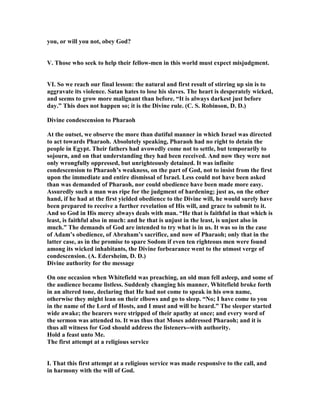
you, or will you not, obey God?
V. Those who seek to help their fellow-men in this world must expect misjudgment.
VI. So we reach our final lesson: the natural and first result of stirring up sin is to
aggravate its violence. Satan hates to lose his slaves. The heart is desperately wicked,
and seems to grow more malignant than before. “It is always darkest just before
day.” This does not happen so; it is the Divine rule. (C. S. Robinson, D. D.)
Divine condescension to Pharaoh
At the outset, we observe the more than dutiful manner in which Israel was directed
to act towards Pharaoh. Absolutely speaking, Pharaoh had no right to detain the
people in Egypt. Their fathers had avowedly come not to settle, but temporarily to
sojourn, and on that understanding they had been received. And now they were not
only wrongfully oppressed, but unrighteously detained. It was infinite
condescension to Pharaoh’s weakness, on the part of God, not to insist from the first
upon the immediate and entire dismissal of Israel. Less could not have been asked
than was demanded of Pharaoh, nor could obedience have been made more easy.
Assuredly such a man was ripe for the judgment of hardening; just as, on the other
hand, if he had at the first yielded obedience to the Divine will, he would surely have
been prepared to receive a further revelation of His will, and grace to submit to it.
And so God in His mercy always deals with man. “He that is faithful in that which is
least, is faithful also in much: and he that is unjust in the least, is unjust also in
much.” The demands of God are intended to try what is in us. It was so in the case
of Adam’s obedience, of Abraham’s sacrifice, and now of Pharaoh; only that in the
latter case, as in the promise to spare Sodom if even ten righteous men were found
among its wicked inhabitants, the Divine forbearance went to the utmost verge of
condescension. (A. Edersheim, D. D.)
Divine authority for the message
On one occasion when Whitefield was preaching, an old man fell asleep, and some of
the audience became listless. Suddenly changing his manner, Whitefield broke forth
in an altered tone, declaring that He had not come to speak in his own name,
otherwise they might lean on their elbows and go to sleep. “ o; I have come to you
in the name of the Lord of Hosts, and I must and will be heard.” The sleeper started
wide awake; the hearers were stripped of their apathy at once; and every word of
the sermon was attended to. It was thus that Moses addressed Pharaoh; and it is
thus all witness for God should address the listeners--with authority.
Hold a feast unto Me.
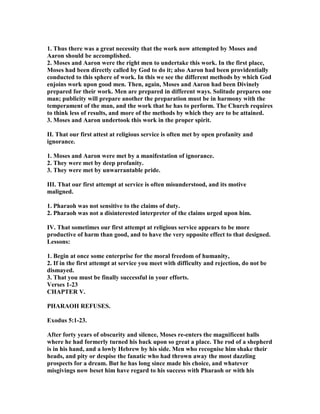
The first attempt at a religious service
I. That this first attempt at a religious service was made responsive to the call, and
in harmony with the will of God.
1. Thus there was a great necessity that the work now attempted by Moses and
Aaron should be accomplished.
2. Moses and Aaron were the right men to undertake this work. In the first place,
Moses had been directly called by God to do it; also Aaron had been providentially
conducted to this sphere of work. In this we see the different methods by which God
enjoins work upon good men. Then, again, Moses and Aaron had been Divinely
prepared for their work. Men are prepared in different ways. Solitude prepares one
man; publicity will prepare another the preparation must be in harmony with the
temperament of the man, and the work that he has to perform. The Church requires
to think less of results, and more of the methods by which they are to be attained.
3. Moses and Aaron undertook this work in the proper spirit.
II. That our first attest at religious service is often met by open profanity and
ignorance.
1. Moses and Aaron were met by a manifestation of ignorance.
2. They were met by deep profanity.
3. They were met by unwarrantable pride.
III. That our first attempt at service is often misunderstood, and its motive
maligned.
1. Pharaoh was not sensitive to the claims of duty.
2. Pharaoh was not a disinterested interpreter of the claims urged upon him.
IV. That sometimes our first attempt at religious service appears to be more
productive of harm than good, and to have the very opposite effect to that designed.
Lessons:
1. Begin at once some enterprise for the moral freedom of humanity,
2. If in the first attempt at service you meet with difficulty and rejection, do not be
dismayed.
3. That you must be finally successful in your efforts.
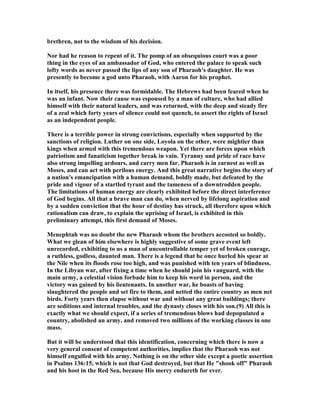
Verses 1-23
CHAPTER V.
PHARAOH REFUSES.
Exodus 5:1-23.
After forty years of obscurity and silence, Moses re-enters the magnificent halls
where he had formerly turned his back upon so great a place. The rod of a shepherd
is in his hand, and a lowly Hebrew by his side. Men who recognise him shake their
heads, and pity or despise the fanatic who had thrown away the most dazzling
prospects for a dream. But he has long since made his choice, and whatever
misgivings now beset him have regard to his success with Pharaoh or with his
brethren, not to the wisdom of his decision.
or had he reason to repent of it. The pomp of an obsequious court was a poor
thing in the eyes of an ambassador of God, who entered the palace to speak such
lofty words as never passed the lips of any son of Pharaoh's daughter. He was
presently to become a god unto Pharaoh, with Aaron for his prophet.
In itself, his presence there was formidable. The Hebrews had been feared when he
was an infant. ow their cause was espoused by a man of culture, who had allied
himself with their natural leaders, and was returned, with the deep and steady fire
of a zeal which forty years of silence could not quench, to assert the rights of Israel
as an independent people.
There is a terrible power in strong convictions, especially when supported by the
sanctions of religion. Luther on one side, Loyola on the other, were mightier than
kings when armed with this tremendous weapon. Yet there are forces upon which
patriotism and fanaticism together break in vain. Tyranny and pride of race have
also strong impelling ardours, and carry men far. Pharaoh is in earnest as well as
Moses, and can act with perilous energy. And this great narrative begins the story of
a nation's emancipation with a human demand, boldly made, but defeated by the
pride and vigour of a startled tyrant and the tameness of a downtrodden people.
The limitations of human energy are clearly exhibited before the direct interference
of God begins. All that a brave man can do, when nerved by lifelong aspiration and
by a sudden conviction that the hour of destiny has struck, all therefore upon which
rationalism can draw, to explain the uprising of Israel, is exhibited in this
preliminary attempt, this first demand of Moses.
Menephtah was no doubt the new Pharaoh whom the brothers accosted so boldly.
What we glean of him elsewhere is highly suggestive of some grave event left
unrecorded, exhibiting to us a man of uncontrollable temper yet of broken courage,
a ruthless, godless, daunted man. There is a legend that he once hurled his spear at
the ile when its floods rose too high, and was punished with ten years of blindness.
In the Libyan war, after fixing a time when he should join his vanguard, with the
main army, a celestial vision forbade him to keep his word in person, and the
victory was gained by his lieutenants. In another war, he boasts of having
slaughtered the people and set fire to them, and netted the entire country as men net
birds. Forty years then elapse without war and without any great buildings; there
are seditions and internal troubles, and the dynasty closes with his son.(9) All this is
exactly what we should expect, if a series of tremendous blows had depopulated a
country, abolished an army, and removed two millions of the working classes in one
mass.
But it will be understood that this identification, concerning which there is now a
very general consent of competent authorities, implies that the Pharaoh was not
himself engulfed with his army. othing is on the other side except a poetic assertion
in Psalms 136:15, which is not that God destroyed, but that He "shook off" Pharaoh
and his host in the Red Sea, because His mercy endureth for ever.
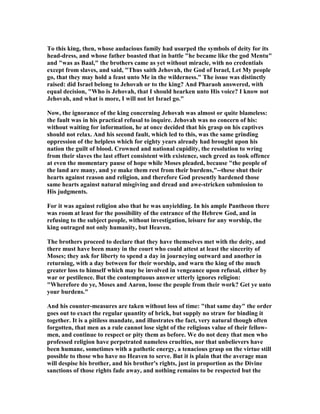
To this king, then, whose audacious family had usurped the symbols of deity for its
head-dress, and whose father boasted that in battle "he became like the god Mentu"
and "was as Baal," the brothers came as yet without miracle, with no credentials
except from slaves, and said, "Thus saith Jehovah, the God of Israel, Let My people
go, that they may hold a feast unto Me in the wilderness." The issue was distinctly
raised: did Israel belong to Jehovah or to the king? And Pharaoh answered, with
equal decision, "Who is Jehovah, that I should hearken unto His voice? I know not
Jehovah, and what is more, I will not let Israel go."
ow, the ignorance of the king concerning Jehovah was almost or quite blameless:
the fault was in his practical refusal to inquire. Jehovah was no concern of his:
without waiting for information, he at once decided that his grasp on his captives
should not relax. And his second fault, which led to this, was the same grinding
oppression of the helpless which for eighty years already had brought upon his
nation the guilt of blood. Crowned and national cupidity, the resolution to wring
from their slaves the last effort consistent with existence, such greed as took offence
at even the momentary pause of hope while Moses pleaded, because "the people of
the land are many, and ye make them rest from their burdens,"--these shut their
hearts against reason and religion, and therefore God presently hardened those
same hearts against natural misgiving and dread and awe-stricken submission to
His judgments.
For it was against religion also that he was unyielding. In his ample Pantheon there
was room at least for the possibility of the entrance of the Hebrew God, and in
refusing to the subject people, without investigation, leisure for any worship, the
king outraged not only humanity, but Heaven.
The brothers proceed to declare that they have themselves met with the deity, and
there must have been many in the court who could attest at least the sincerity of
Moses; they ask for liberty to spend a day in journeying outward and another in
returning, with a day between for their worship, and warn the king of the much
greater loss to himself which may be involved in vengeance upon refusal, either by
war or pestilence. But the contemptuous answer utterly ignores religion:
"Wherefore do ye, Moses and Aaron, loose the people from their work? Get ye unto
your burdens."
And his counter-measures are taken without loss of time: "that same day" the order
goes out to exact the regular quantity of brick, but supply no straw for binding it
together. It is a pitiless mandate, and illustrates the fact, very natural though often
forgotten, that men as a rule cannot lose sight of the religious value of their fellow-
men, and continue to respect or pity them as before. We do not deny that men who
professed religion have perpetrated nameless cruelties, nor that unbelievers have
been humane, sometimes with a pathetic energy, a tenacious grasp on the virtue still
possible to those who have no Heaven to serve. But it is plain that the average man
will despise his brother, and his brother's rights, just in proportion as the Divine
sanctions of those rights fade away, and nothing remains to be respected but the
culture, power and affluence which the victim lacks. "I know not Israel's God" is a
sure prelude to the refusal to let Israel go, and even to the cruelty which beats the
slave who fails to render impossible obedience.
"They be idle, therefore they cry, saying, Let us go and sacrifice to our God." And
still there are men who hold the same opinion, that time spent in devotion is wasted,
as regards the duties of real life. In truth, religion means freshness, elasticity and
hope: a man will be not slothful in business, but fervent in spirit, if he serves the
Lord. But perhaps immortal hope, and the knowledge that there is One Who shall
break all prison bars and let the oppressed go free, are not the best narcotics to drug
down the soul of a man into the monotonous tameness of a slave.
In the tenth verse we read that the Egyptian taskmasters and the officers combined
to urge the people to their aggravated labours. And by the fourteenth verse we find
that the latter officials were Hebrew officers whom Pharaoh's taskmasters had set
over them.
So that we have here one of the surest and worst effects of slavery--namely, the
demoralisation of the oppressed, the readiness of average men, who can obtain for
themselves a little relief, to do so at their brethren's cost. These officials were
scribes, "writers": their business was to register the amount of labour due, and
actually rendered. These were doubtless the more comfortable class, of whom we
read afterwards that they possessed property, for their cattle escaped the murrain
and their trees the hail. And they had the means of acquiring quite sufficient skill to
justify whatever is recorded of the works done in the construction of the tabernacle.
The time is long past when scepticism found support for its incredulity in these
details.
One advantage of the last sharp agony of persecution was that it finally detached
this official class from the Egyptian interest, and welded Israel into a homogeneous
people, with officers already provided. For, when the supply of bricks came short,
these officials were beaten, and, as if no cause of the failure were palpable, they
were asked, with a malicious chuckle, "Wherefore have ye not fulfilled your task
both yesterday and today, as heretofore?" And when they explain to Pharaoh, in
words already expressive of their alienation, that the fault is with "thine own
people," they are repulsed with insult, and made to feel themselves in evil case. For
indeed they needed to be chastised for their forgetfulness of God. How soon would
their hearts have turned back, how much more bitter yet would have been their
complaints in the desert, if it were not for this last experience! But if judgment
began with them, what should presently be the fate of their oppressors?
Their broken spirit shows itself by murmuring, not against Pharaoh, but against
Moses and Aaron, who at least had striven to help them. Here, as in the whole story,
there is not a trace of either the lofty spirit which could have evolved the Mosaic
law, or the hero-worship of a later age.
It is written that Moses, hearing their reproaches, "returned unto the Lord,"
although no visible shrine, no consecrated place of worship, can be thought of.
What is involved is the consecration which the heart bestows upon any place of
privacy and prayer, where, in shutting out the world, the soul is aware of the special
nearness of its King. In one sense we never leave Him, never return to Him. In
another sense, by direct address of the attention and the will, we enter into His
presence; we find Him in the midst of us, Who is everywhere. And all ceremonial
consecrations do their office by helping us to realise and act upon the presence of
Him in Whom, even when He is forgotten, we live and move and have our being.
Therefore in the deepest sense each man consecrates or desecrates for himself his
own place of prayer. There is a city where the Divine presence saturates every
consciousness with rapture. And the seer beheld no temple therein, for the Lord
God the Almighty, and the Lamb, are the temple of it.
Startling to our notions of reverence are the words in which Moses addresses God.
"Lord, why hast Thou evil entreated this people? Why is it that Thou hast sent me?
for since I came to Pharaoh to speak in Thy name, he hath evil entreated this
people; neither hast Thou delivered Thy people at all." It is almost as if his faith had
utterly given way, like that of the Psalmist when he saw the wicked in great
prosperity, while waters of a full cup were wrung out by the people of God (Psalms
73:3, Psalms 73:10). And there is always a dangerous moment when the first glow of
enthusiasm burns down, and we realise how long the process, how bitter the
disappointments, by which even a scanty measure of success must be obtained. Yet
God had expressly warned Moses that Pharaoh would not release them until Egypt
had been smitten with all His plagues. But the warning passed unapprehended, as
we let many a truth pass intellectually accepted it is true, but only as a theorem, a
vague and abstract formula. As we know that we must die, that worldly pleasures
are brief and unreal, and that sin draws evil in its train, yet wonder when these
phrases become solid and practical in our experience, so, in the first flush and
wonder of the promised emancipation, Moses had forgotten the predicted interval of
trial.
His words would have been profane and irreverent indeed but for one redeeming
quality. They were addressed to God Himself. Whenever the people murmured,
Moses turned for help to Him Who reckons the most unconventional and daring
appeal to Him far better than the most ceremonious phrases in which men cover
their unbelief: "Lord, wherefore hast Thou evil entreated this people?" is in reality
a much more pious utterance than "I will not ask, neither will I tempt the Lord."
Wherefore Moses receives large encouragement, although no formal answer is
vouchsafed to his daring question.
Even so, in our dangers, our torturing illnesses, and many a crisis which breaks
through all the crust of forms and conventionalities, God may perhaps recognise a
true appeal to Him, in words which only scandalise the orthodoxy of the formal and
precise. In the bold rejoinder of the Syro-Phoenician woman He recognised great
faith. His disciples would simply have sent her away as clamorous.
Moses had again failed, even though Divinely commissioned, in the work of
emancipating Israel, and thereupon he had cried to the Lord Himself to undertake
the work. This abortive attempt, however, was far from useless: it taught humility
and patience to the leader, and it pressed the nation together, as in a vice, by the
weight of a common burden, now become intolerable. At the same moment, the
iniquity of the tyrant was filled up.
But the Lord did not explain this, in answer to the remonstrance of Moses. Many
things happen, for which no distinct verbal explanation is possible, many things of
which the deep spiritual fitness cannot be expressed in words. Experience is the true
commentator upon Providence, if only because the slow building of character is
more to God than either the hasting forward of deliverance or the clearing away of
intellectual mists. And it is only as we take His yoke upon us that we truly learn of
Him. Yet much is implied, if not spoken out, in the words, " ow (because the time is
ripe) shalt thou see what I will do to Pharaoh (I, because others have failed); for by
a strong hand shall he let them go, and by a strong hand shall he drive them out of
the land." It is under the weight of the "strong hand" of God Himself that the
tyrant must either bend or break.
Similar to this is the explanation of many delays in answering our prayer, of the
strange raising up of tyrants and demagogues, and of much else that perplexes
Christians in history and in their own experience. These events develop human
character, for good or evil. And they give scope for the revealing of the fulness of the
power which rescues. We have no means of measuring the supernatural force which
overcomes but by the amount of the resistance offered. And if all good things came
to us easily and at once, we should not become aware of the horrible pit, our rescue
from which demands gratitude. The Israelites would not have sung a hymn of such
fervent gratitude when the sea was crossed, if they had not known the weight of
slavery and the anguish of suspense. And in heaven the redeemed who have come
out of great tribulation sing the song of Moses and of the Lamb.
Fresh air, a balmy wind, a bright blue sky--which of us feels a thrill of conscious
exultation for these cheap delights? The released prisoner, the restored invalid, feels
it:
"The common earth, the air, the skies, To him are opening paradise."
Even so should Israel be taught to value deliverance. And now the process could
begin.
EXPOSITOR'S BIBLE COMME TARY, "PHARAOH REFUSES.
Exodus 5:1-23.
After forty years of obscurity and silence, Moses re-enters the magnificent halls
where he had formerly turned his back upon so great a place. The rod of a shepherd
is in his hand, and a lowly Hebrew by his side. Men who recognise him shake their
heads, and pity or despise the fanatic who had thrown away the most dazzling
prospects for a dream. But he has long since made his choice, and whatever
misgivings now beset him have regard to his success with Pharaoh or with his
brethren, not to the wisdom of his decision.
or had he reason to repent of it. The pomp of an obsequious court was a poor
thing in the eyes of an ambassador of God, who entered the palace to speak such
lofty words as never passed the lips of any son of Pharaoh's daughter. He was
presently to become a god unto Pharaoh, with Aaron for his prophet.
In itself, his presence there was formidable. The Hebrews had been feared when he
was an infant. ow their cause was espoused by a man of culture, who had allied
himself with their natural leaders, and was returned, with the deep and steady fire
of a zeal which forty years of silence could not quench, to assert the rights of Israel
as an independent people.
There is a terrible power in strong convictions, especially when supported by the
sanctions of religion. Luther on one side, Loyola on the other, were mightier than
kings when armed with this tremendous weapon. Yet there are forces upon which
patriotism and fanaticism together break in vain. Tyranny and pride of race have
also strong impelling ardours, and carry men far. Pharaoh is in earnest as well as
Moses, and can act with perilous energy. And this great narrative begins the story of
a nation's emancipation with a human demand, boldly made, but defeated by the
pride and vigour of a startled tyrant and the tameness of a downtrodden people.
The limitations of human energy are clearly exhibited before the direct interference
of God begins. All that a brave man can do, when nerved by lifelong aspiration and
by a sudden conviction that the hour of destiny has struck, all therefore upon which
rationalism can draw, to explain the uprising of Israel, is exhibited in this
preliminary attempt, this first demand of Moses.
Menephtah was no doubt the new Pharaoh whom the brothers accosted so boldly.
What we glean of him elsewhere is highly suggestive of some grave event left
unrecorded, exhibiting to us a man of uncontrollable temper yet of broken courage,
a ruthless, godless, daunted man. There is a legend that he once hurled his spear at
the ile when its floods rose too high, and was punished with ten years of blindness.
In the Libyan war, after fixing a time when he should join his vanguard, with the
main army, a celestial vision forbade him to keep his word in person, and the
victory was gained by his lieutenants. In another war, he boasts of having
slaughtered the people and set fire to them, and netted the entire country as men net
birds. Forty years then elapse without war and without any great buildings; there
are seditions and internal troubles, and the dynasty closes with his son.(9) All this is
exactly what we should expect, if a series of tremendous blows had depopulated a
country, abolished an army, and removed two millions of the working classes in one
mass.
But it will be understood that this identification, concerning which there is now a
very general consent of competent authorities, implies that the Pharaoh was not
himself engulfed with his army. othing is on the other side except a poetic assertion
in Psalms 136:15, which is not that God destroyed, but that He "shook off" Pharaoh
and his host in the Red Sea, because His mercy endureth for ever.
To this king, then, whose audacious family had usurped the symbols of deity for its
head-dress, and whose father boasted that in battle "he became like the god Mentu"
and "was as Baal," the brothers came as yet without miracle, with no credentials
except from slaves, and said, "Thus saith Jehovah, the God of Israel, Let My people
go, that they may hold a feast unto Me in the wilderness." The issue was distinctly
raised: did Israel belong to Jehovah or to the king? And Pharaoh answered, with
equal decision, "Who is Jehovah, that I should hearken unto His voice? I know not
Jehovah, and what is more, I will not let Israel go."
ow, the ignorance of the king concerning Jehovah was almost or quite blameless:
the fault was in his practical refusal to inquire. Jehovah was no concern of his:
without waiting for information, he at once decided that his grasp on his captives
should not relax. And his second fault, which led to this, was the same grinding
oppression of the helpless which for eighty years already had brought upon his
nation the guilt of blood. Crowned and national cupidity, the resolution to wring
from their slaves the last effort consistent with existence, such greed as took offence
at even the momentary pause of hope while Moses pleaded, because "the people of
the land are many, and ye make them rest from their burdens,"--these shut their
hearts against reason and religion, and therefore God presently hardened those
same hearts against natural misgiving and dread and awe-stricken submission to
His judgments.
For it was against religion also that he was unyielding. In his ample Pantheon there
was room at least for the possibility of the entrance of the Hebrew God, and in
refusing to the subject people, without investigation, leisure for any worship, the
king outraged not only humanity, but Heaven.
The brothers proceed to declare that they have themselves met with the deity, and
there must have been many in the court who could attest at least the sincerity of
Moses; they ask for liberty to spend a day in journeying outward and another in
returning, with a day between for their worship, and warn the king of the much
greater loss to himself which may be involved in vengeance upon refusal, either by
war or pestilence. But the contemptuous answer utterly ignores religion:
"Wherefore do ye, Moses and Aaron, loose the people from their work? Get ye unto
your burdens."
And his counter-measures are taken without loss of time: "that same day" the order
goes out to exact the regular quantity of brick, but supply no straw for binding it
together. It is a pitiless mandate, and illustrates the fact, very natural though often
forgotten, that men as a rule cannot lose sight of the religious value of their fellow-
men, and continue to respect or pity them as before. We do not deny that men who
professed religion have perpetrated nameless cruelties, nor that unbelievers have
been humane, sometimes with a pathetic energy, a tenacious grasp on the virtue still
possible to those who have no Heaven to serve. But it is plain that the average man
will despise his brother, and his brother's rights, just in proportion as the Divine
sanctions of those rights fade away, and nothing remains to be respected but the
culture, power and affluence which the victim lacks. "I know not Israel's God" is a
sure prelude to the refusal to let Israel go, and even to the cruelty which beats the
slave who fails to render impossible obedience.
"They be idle, therefore they cry, saying, Let us go and sacrifice to our God." And
still there are men who hold the same opinion, that time spent in devotion is wasted,
as regards the duties of real life. In truth, religion means freshness, elasticity and
hope: a man will be not slothful in business, but fervent in spirit, if he serves the
Lord. But perhaps immortal hope, and the knowledge that there is One Who shall
break all prison bars and let the oppressed go free, are not the best narcotics to drug
down the soul of a man into the monotonous tameness of a slave.
In the tenth verse we read that the Egyptian taskmasters and the officers combined
to urge the people to their aggravated labours. And by the fourteenth verse we find
that the latter officials were Hebrew officers whom Pharaoh's taskmasters had set
over them.
So that we have here one of the surest and worst effects of slavery--namely, the
demoralisation of the oppressed, the readiness of average men, who can obtain for
themselves a little relief, to do so at their brethren's cost. These officials were
scribes, "writers": their business was to register the amount of labour due, and
actually rendered. These were doubtless the more comfortable class, of whom we
read afterwards that they possessed property, for their cattle escaped the murrain
and their trees the hail. And they had the means of acquiring quite sufficient skill to
justify whatever is recorded of the works done in the construction of the tabernacle.
The time is long past when scepticism found support for its incredulity in these
details.
One advantage of the last sharp agony of persecution was that it finally detached
this official class from the Egyptian interest, and welded Israel into a homogeneous
people, with officers already provided. For, when the supply of bricks came short,
these officials were beaten, and, as if no cause of the failure were palpable, they
were asked, with a malicious chuckle, "Wherefore have ye not fulfilled your task
both yesterday and today, as heretofore?" And when they explain to Pharaoh, in
words already expressive of their alienation, that the fault is with "thine own
people," they are repulsed with insult, and made to feel themselves in evil case. For
indeed they needed to be chastised for their forgetfulness of God. How soon would
their hearts have turned back, how much more bitter yet would have been their
complaints in the desert, if it were not for this last experience! But if judgment
began with them, what should presently be the fate of their oppressors?
Their broken spirit shows itself by murmuring, not against Pharaoh, but against
Moses and Aaron, who at least had striven to help them. Here, as in the whole story,
there is not a trace of either the lofty spirit which could have evolved the Mosaic
law, or the hero-worship of a later age.
It is written that Moses, hearing their reproaches, "returned unto the Lord,"
although no visible shrine, no consecrated place of worship, can be thought of.
What is involved is the consecration which the heart bestows upon any place of
privacy and prayer, where, in shutting out the world, the soul is aware of the special
nearness of its King. In one sense we never leave Him, never return to Him. In
another sense, by direct address of the attention and the will, we enter into His
presence; we find Him in the midst of us, Who is everywhere. And all ceremonial
consecrations do their office by helping us to realise and act upon the presence of
Him in Whom, even when He is forgotten, we live and move and have our being.
Therefore in the deepest sense each man consecrates or desecrates for himself his
own place of prayer. There is a city where the Divine presence saturates every
consciousness with rapture. And the seer beheld no temple therein, for the Lord
God the Almighty, and the Lamb, are the temple of it.
Startling to our notions of reverence are the words in which Moses addresses God.
"Lord, why hast Thou evil entreated this people? Why is it that Thou hast sent me?
for since I came to Pharaoh to speak in Thy name, he hath evil entreated this
people; neither hast Thou delivered Thy people at all." It is almost as if his faith had
utterly given way, like that of the Psalmist when he saw the wicked in great
prosperity, while waters of a full cup were wrung out by the people of God (Psalms
73:3, Psalms 73:10). And there is always a dangerous moment when the first glow of
enthusiasm burns down, and we realise how long the process, how bitter the
disappointments, by which even a scanty measure of success must be obtained. Yet
God had expressly warned Moses that Pharaoh would not release them until Egypt
had been smitten with all His plagues. But the warning passed unapprehended, as
we let many a truth pass intellectually accepted it is true, but only as a theorem, a
vague and abstract formula. As we know that we must die, that worldly pleasures
are brief and unreal, and that sin draws evil in its train, yet wonder when these
phrases become solid and practical in our experience, so, in the first flush and
wonder of the promised emancipation, Moses had forgotten the predicted interval of
trial.
His words would have been profane and irreverent indeed but for one redeeming
quality. They were addressed to God Himself. Whenever the people murmured,
Moses turned for help to Him Who reckons the most unconventional and daring
appeal to Him far better than the most ceremonious phrases in which men cover
their unbelief: "Lord, wherefore hast Thou evil entreated this people?" is in reality
a much more pious utterance than "I will not ask, neither will I tempt the Lord."
Wherefore Moses receives large encouragement, although no formal answer is
vouchsafed to his daring question.
Even so, in our dangers, our torturing illnesses, and many a crisis which breaks
through all the crust of forms and conventionalities, God may perhaps recognise a
true appeal to Him, in words which only scandalise the orthodoxy of the formal and
precise. In the bold rejoinder of the Syro-Phoenician woman He recognised great
faith. His disciples would simply have sent her away as clamorous.
Moses had again failed, even though Divinely commissioned, in the work of
emancipating Israel, and thereupon he had cried to the Lord Himself to undertake
the work. This abortive attempt, however, was far from useless: it taught humility
and patience to the leader, and it pressed the nation together, as in a vice, by the
weight of a common burden, now become intolerable. At the same moment, the
iniquity of the tyrant was filled up.
But the Lord did not explain this, in answer to the remonstrance of Moses. Many
things happen, for which no distinct verbal explanation is possible, many things of
which the deep spiritual fitness cannot be expressed in words. Experience is the true
commentator upon Providence, if only because the slow building of character is
more to God than either the hasting forward of deliverance or the clearing away of
intellectual mists. And it is only as we take His yoke upon us that we truly learn of
Him. Yet much is implied, if not spoken out, in the words, " ow (because the time is
ripe) shalt thou see what I will do to Pharaoh (I, because others have failed); for by
a strong hand shall he let them go, and by a strong hand shall he drive them out of
the land." It is under the weight of the "strong hand" of God Himself that the
tyrant must either bend or break.
Similar to this is the explanation of many delays in answering our prayer, of the
strange raising up of tyrants and demagogues, and of much else that perplexes
Christians in history and in their own experience. These events develop human
character, for good or evil. And they give scope for the revealing of the fulness of the
power which rescues. We have no means of measuring the supernatural force which
overcomes but by the amount of the resistance offered. And if all good things came
to us easily and at once, we should not become aware of the horrible pit, our rescue
from which demands gratitude. The Israelites would not have sung a hymn of such
fervent gratitude when the sea was crossed, if they had not known the weight of
slavery and the anguish of suspense. And in heaven the redeemed who have come
out of great tribulation sing the song of Moses and of the Lamb.
Fresh air, a balmy wind, a bright blue sky--which of us feels a thrill of conscious
exultation for these cheap delights? The released prisoner, the restored invalid, feels
it:
"The common earth, the air, the skies, To him are opening paradise."
Even so should Israel be taught to value deliverance. And now the process could
begin.
LA GE, "Exodus 5:1. Afterward Moses and Aaron went.—Their message is quite
in accordance with the philosophical notions of the ancients, and especially with the
Israelitish faith. Having accepted the message from Horeb, Israel became Jehovah’s
people, Jehovah Israel’s God; and as Israel’s God, He through His ambassadors
meets Pharaoh, and demands that the people be released, in order to render Him
service in a religious festival. The message accords with the situation. Jehovah, the
God of Israel, may seem to Pharaoh chiefly the national deity of Israel; but there is
an intimation in the words that He is also the Lord of Pharaoh, of Egypt, and of its
worship. Under the petition for a furlough lurks the command to set free; under the
recognition of the power of Pharaoh over the people, the declaration that Israel is
Jehovah’s free people; under the duty of celebrating a feast of Jehovah in the
wilderness, the thought of separating from Egypt and of celebrating the Exodus.
The words seemed like a petition which had an echo like a thunder-tone. Perhaps
the instinct of the tyrant detected something of this thunder-tone. But even if not,
the modest petition was enough to enrage him.
2 Pharaoh said, “Who is the Lord, that I should
obey him and let Israel go? I do not know the
Lord and I will not let Israel go.”
BAR ES, "I know not the Lord - Either Pharaoh had not heard of Yahweh, or he
did not recognize Him as a God.
CLARKE, "Who is the Lord - Who is Jehovah, that I should obey his voice? What
claims has he on me? I am under no obligation to him. Pharaoh spoke here under the
common persuasion that every place and people had a tutelary deity, and he supposed
that this Jehovah might be the tutelary deity of the Israelites, to whom he, as an
Egyptian, could be under no kind of obligation. It is not judicious to bring this question
as a proof that Pharaoh was an atheist: of this the text affords no evidence.
GILL, "And Pharaoh said, who is the Lord,.... Jehovah, they made mention of,
which, whether he took it for the name of a deity, or of a king, whose ambassadors they
declared themselves to be, was a name he had never heard of before; and this being
expressed and pronounced, shows that this name is not ineffable, or unlawful to be
pronounced, as say the Jews:
that I should obey his voice, to let Israel go? he knew of no superior monarch to
him, whose orders he was obliged to obey in any respect, and particularly in this, the
dismission of the people of Israel out of his land, though it was but for a short time:
I know not the Lord; who this Jehovah is, that made this demand, and required
Israel's dismission. The Targum of Jonathan paraphrases it,"I have not found the name
of Jehovah written in the book of angels, I am not afraid of him.''An Egyptian book, in
which, the paraphrast supposes, were written the names of gods and of angels; and no
such name being there, he was the more bold and insolent:
neither will I let Israel go; determining he would pay no regard to such an unknown
Deity, or King, be he who he would.
HE RY, " Pharaoh's answer is impiously bold: Who is the Lord, that I should obey
his voice? Exo_5:2. Being summoned to surrender, he thus hangs out the flag of
defiance, hectors Moses and the God that sends him, and peremptorily refuses to let
Israel go; he will not treat about it, nor so much as bear the mention of it. Observe, 1.
How scornfully he speaks of the God of Israel: “Who is Jehovah? I neither know him nor
care for him, neither value him nor fear him:” it is a hard name that he never heard of
before, but he resolves it shall be no bug-bear to him. Israel was now a despised
oppressed people, looked on as the tail of the nation, and, by the character they bore,
Pharaoh makes his estimate of their God, and concludes that he made no better a figure
among the gods than his people did among the nations. Note, Hardened persecutors are
more malicious against God himself than they are against his people. See Isa_37:23.
Again, Ignorance and contempt of God are at the bottom of all the wickedness that is in
the world. Men know not the Lord, or have very low and mean thoughts of him, and
therefore they obey not his voice, nor will let any thing go for him. 2. How proudly he
speaks of himself: “That I should obey his voice; I, the king of Egypt, a great people,
obey the God of Israel, a poor enslaved people? Shall I, that rule the Israel of God, obey
the God of Israel? No, it is below me; I scorn to answer his summons.” Note, Those are
the children of pride that are the children of disobedience, Job_41:34; Eph_5:6. Proud
men think themselves too good to stoop even to God himself, and would not be under
control, Jer_43:2. Here is the core of the controversy: God must rule, but man will not
be ruled. “I will have my will done,” says God: “But I will do my own will,” says the
sinner. 3. How resolutely he denies the demand: Neither will I let Israel go. Note, Of all
sinners none are so obstinate, nor so hardly persuaded to leave their sin, as persecutors
are.
JAMISO , "And Pharaoh said, Who is the Lord — rather “Jehovah.” Lord was
a common name applied to objects of worship; but Jehovah was a name he had never
heard of. Pharaoh estimated the character and power of this God by the abject and
miserable condition of the worshippers and concluded that He held as low a rank among
the gods as His people did in the nation. To demonstrate the supremacy of the true God
over all the gods of Egypt, was the design of the plagues.
I know not the Lord, neither will I let Israel go — As his honor and interest
were both involved he determined to crush this attempt, and in a tone of insolence, or
perhaps profanity, rejected the request for the release of the Hebrew slaves.
CALVI , "2.And Pharaoh said, Who is the Lord? It is scarcely credible that there
should be such madness in a mortal as, by thus wantonly scorning God, to fly, as it
were, in the face of heaven! (67) But we must observe, that the tyrant being devoted
to idolatries, thus insulted the God of Israel, that he might manifest his great piety
towards his false gods. For his mockery, in scornfully bandying back the name of
Jehovah, must be referred to the words of Moses, as much as to say, Why do you
bring against me this unknown phantom under the title of the eternal God, as
though we had no god of our own? Thus Pilate, when Christ said, “To this end was I
born, and for this cause came I into the world, that I should bear witness unto the
truth,” asks ironically, and not without mockery, “What is truth?” (68) (John
18:37.) In short, Pharaoh did not conceive himself to be dishonoring the Deity, when
he rejected this false (prodigiosum) God, as he thought. Yet his error did not avail to
justify him, since it arose from insane audacity and contempt of God. Admit that he
was unwilling that any should depreciate his idols, and that he thus imagined
himself to perform a religious duty; still it was an act of very gross impiety, so
carelessly to repudiate the name of the true God, and even to assail it with mockery.
We may remark a like madness in all idolaters. Being intoxicated by their errors
they boldly mock at God, and deign not to make inquiries about Him. The cry of the
Papists now-a-days is, that we are imposing a new God on the world; and,
applauding themselves in their wildest ravings, they do not hesitate to condemn our
whole doctrine as impious; not because they are persuaded that they are themselves
worshipping God aright; but they are willfully blind, that they may elude, with
impunity, the sacred majesty of God, and stupify their consciences, and preserve to
themselves their death-like slumber. They seem to themselves to be sharp-witted and
facetious, when they are scoffing at the novelty of our doctrine; though its truth
would be plain enough, if they would only open their eyes. The Epicureans, too, (of
which pestilent sect the world is now full,) although they foam and rage against
God, still invariably take refuge in some cloud, under which their detestable
madness may be concealed: for they pretend that amidst such a multitude of
opinions, it is scarcely possible to discern who is God, or what He commands. Still,
however, this is their constant object, viz., that they may have nothing to do with
God, and yet may conceal by jests the shame of their impiety; as if it were free for
them to reject what they are willfully ignorant of. But after Pharaoh had indirectly
derided the message of Moses, as a ludicrous affair, he more openly and more
contemptuously vents his pride, implying that he cares not for that God, with whose
name Moses and Aaron would frighten him.
COKE, "Exodus 5:2. Pharaoh said, Who is the Lord?— Who is Jehovah? His
thoughts were full of the superstitious belief of local or tutelar deities; an opinion
which prevailed generally among the Heathens. He does not, therefore, speak as an
atheist, who believed not in any God; but as a blind devotee to false gods. He
esteemed Jehovah one of these local deities; whom, therefore, he pretends not to
know. Moses, in the subsequent verse, informs him, that this Jehovah was the GOD
of the Hebrews; and the following train of miracles was to convince Pharaoh and his
people, that Jehovah was not only the GOD of the Hebrews, but the Supreme Ruler
of all the world, in opposition to their false and idolatrous faith. See note on ch.
Exodus 3:13.
REFLECTIO S.—Moses and Aaron make no delay. Observe,
1. They boldly deliver their message. God's people are his peculiar portion, and
those who injure or oppress them do it at their peril. They must hold a feast to him,
and the sacrifice which points to the atonement is the substance of the feast. Faith in
the atoning blood of Jesus makes the sweetest feast for the soul.
2. Pharaoh's impious answer, and flat denial. They who oppress God's people, will
despise their God: they neither know him, nor fear him. ote; (1.) The cause of
every sin is ignorance of God; for where there is no knowledge, there is no fear of
him. (2.) Obstinate sinners go from iniquity to impiety. They first offend, and then
defy the God of Israel: but it shall be to their cost.
BE SO , "Exodus 5:2. Who is the Lord, that I should obey his voice? — I am the
sovereign lord of Egypt, and I own no superior here. The Hebrew name Jehovah
ought to have been retained in this and the preceding verse, and not to have been
translated Lord. Thus saith Jehovah — who is Jehovah — I know not Jehovah. The
Egyptians, it must be observed, and other nations were at this time sunk in idolatry,
and knowing nothing of the true God, the possessor of heaven and earth, each
nation had a god or gods of its own. Pharaoh, therefore, did not speak as an atheist,
or mean that he knew nothing of any god whom he ought to obey; but he knew
nothing of the God of the Hebrews, whom they termed Jehovah, imagining him to
be like one of the gods of Egypt, or of some other country, a mere local deity, whom
therefore it neither concerned him to know nor to obey. ow the train of miracles
which followed were intended to teach Pharaoh and his people, that Jehovah was
not only the God of the Hebrews, but of all the world, having an uncontrolled and
sovereign power over universal nature.
TRAPP, "Exodus 5:2 And Pharaoh said, Who [is] the LORD, that I should obey his
voice to let Israel go? I know not the LORD, neither will I let Israel go.
Ver. 2. Who is the Lord?] God’s attributes either show what he is, or who he is. To
the question of Moses - What he is? - God gave a short answer, "I am." To this
second by Pharaoh, Who he is? - God made a large reply, till Pharaoh was
compelled to answer himself, "The Lord is righteous."
COFFMA , "FIRST RESPO SE
"And Pharaoh said, Who is Jehovah, that I should hearken to his voice to let Israel
go? I know not Jehovah, and moreover I will not let Israel go."
This was the first in a series of responses by Pharaoh, and, as the series unfolds,
there is visible a progressive erosion of his stubborn insolence. Unger believed that
Pharaoh told the truth in professing ignorance of Jehovah: "The contemptuous
Pharaoh, whose absolute power was enforced by his deification in the Egyptian
religion, knew many gods, but he was ignorant of this God (the true God)."[8]
However, we are inclined to agree with Rawlinson who thought that it was "more
probable that he (merely) pretended ignorance."[9] Certainly we reject the notion
that the name Jehovah (Yahweh) had been revealed only recently at that time, that
"Pharaoh could not have known the name since the Hebrews had only recently been
introduced to it." With Fields, we believe that, "This goes against Bible
teaching."[10] It appears to us as extremely unlikely that Pharaoh did not know of
Jehovah, because the action of Jehovah in the life of Joseph, elevating him to the
throne of Egypt (as deputy), was no secret. If Pharaoh was ignorant, he was willfully
ignorant. His response in denying that he knew Jehovah is very similar to that of
Sennacherib's haughty response in 2 Kings 18:35.
PARKER, "For All Gleaners
"I know not the Lord."— Exodus 5:2.
A kind of agnosticism more prevalent than agnosticism of a scientific kind.—There
is an agnosticism of the heart; there is an agnosticism of the will.—Men reason
foolishly about this not-knowing.—Men imagine that because they know not the
Lord, the Lord knows not them.—This is a vital distinction.—We do not extinguish
the sun by closing our eyes.—If men will not inquire for God in a spirit worthy of
such an inquiry they can never know God.—Pharaoh"s no-knowledge was avowed
in a tone of defiance. It was not an intellectual ignorance, but a spirit of moral
denial.—Pharaoh practically made himself God by denying the true God.—This is
the natural result of all atheism.—Atheism cannot be a mere negative; if it pretend
to intelligence it must, in some degree, involve the godhead of the being who
presumes to deny God; the greatest difficulty is with people who know the Lord and
do not obey him.—If they who professedly know the Lord would carry out his will
in daily obedience and sacrifice of the heart, their lives would constitute the most
powerful of all arguments.
ELLICOTT, "(2) Who is the Lord?—Heb., Who is Jehovah? If Jehovah was a
name, the use of which had been laid aside, as would seem to have been the case by
the later chapters of Genesis, and which was revived by the scene at the burning
bush, Pharaoh may very probably not have heard of it.
That I should obey his voice.—The king means to say, that, whoever Jehovah is, He
can have no authority over him, as He is not one of his gods. The Egyptians were
accustomed to the idea of local gods, and quite expected every nation to have a deity
or several deities of its own; but they regarded the power of each as circumscribed,
certainly not extending beyond the race or nation to which the god belonged.
EXPOSITOR'S DICTIO ARY, "Exodus 5:2
"He had come," says Maurice, "to regard himself as the Lord, his will as the will
which all things were to obey.... He had lost the sense of a righteous government and
order in the world; he had come to believe in tricks and lies; he had come to think
men were the mere creatures of natural agencies."
ote (as Wilkie tells us always to do) the hands in Charles I."s portrait—a complete
revelation of the man: the one clutching almost convulsively his baton in affectation
of power; the other poor hand hanging weak and helpless.
—Westcott.
LA GE, "Exodus 5:2.Who is Jehovah?—As the heathen had the notion that the
gods governed territorially, the Jews seemed to fall under the dominion of the
Egyptian gods. They had no land, had moreover in Pharaoh’s eyes no right to be
called a nation; therefore, even if they had a deity, it must have been, in his opinion,
an anonymous one. This seemed to him to be proved by the new name, Jehovah
(which therefore could not have been of Egyptian origin). But even disregard of a
known foreign deity was impiety; still more, disregard of the unknown God who, as
such, was the very object towards which all his higher aspirations and conscientious
compunctions pointed.[F 8] Thus his obduracy began with an act of impiety, which
was at the same time inhumanity, inasmuch as he denied to the people freedom of
worship. He was the prototype of all religious tyrants.
PULPIT, "And Pharaoh said, Who is the Lord? Rather, "Who is Jehovah?" Either
Pharaoh is actually ignorant, or he pretends to be. The former is possible, since
Jehovah was a name but little employed, until the return of Moses to Egypt. The
latter, however, is more probable. That I should obey his voice. Why am I to obey
his voice? What is your Jehovah to me? What authority has he over me? He is, at
best, your god, not mine. I know not Jehovah. I acknowledge him not. He is not
within the range of my Pantheon. either will I let Israel go, i.e. "nor even, if he
were, would I consent to such a request as this from him." The Pharaohs assumed to
be themselves gods, on a par with the national gods, and not bound to obey them.
BIBLICAL ILLUSTRATOR, "Verse 2
Exodus 5:2
Who is the Lord that I should obey His voice?
Pharaoh’s question answered
If we would know God as He is, we should neither take our own idea nor adopt the
world’s estimates, but see Him as He has revealed Himself in His Word, especially in
the Gospel which began to be spoken by His Son, the only Teacher competent to
instruct us here.
1. God is One, indeed, who will punish sin, etc. As a Holy God, He hates it; and, as a
Just God, He will “by no means clear the guilty,” etc.
2. But, at the same time, He is One who would rather not, and who will not unless
He must. Judgment is His strange work, and He “would have all men to be saved
and to come to a knowledge of the truth.”
3. One, too, so averse to punish that He “spared not His own Son,” etc. Abraham
could give no higher proof of his love to God than by his willingness to offer up his
son, his only son, Isaac. “God so loved,” etc.
4. One, too, who, in addition to giving His Son, strives with men by His Word,
ordinances, Spirit, Providence, to dispose them to accept that Son and find peace
and joy in believing.
5. One, again, who has filled His Word with warnings to arouse, invitations to
attract, directions to instruct, promises to encourage, etc.
6. One, too, who has thrown the door of hope wide open to all, and imposed no
impossible, or even difficult, condition in the case of any.
7. One, in fine, who can say, “What more could I have done for My vineyard that I
have not done in it?” One whose plan, provision and proffer of salvation is such that
if any fail of its privileges, they can but blame themselves. This is the Lord! ot only
our Creator (that itself should summon our service; see Psalms 100:1-5.), nor only
our Preserver (living by His bounty, should we not live by His bidding, too?); but
also our Redeemer: the God and Father of our Lord Jesus Christ. Surely, then, if
there be any voice, we should obey, it is His. That voice, further, is the voice of One
who knows us; knows our frame, knows what suits us, knows what will contribute
to our well-being. His commands are so far from being arbitrary that in the very
keeping of them there is great reward; and, following the course they indicate, we
shall ever have growing reason to say, “The lines are fallen unto me in pleasant
places”; while, on the other hand, all experience, as well as revelation, declares, “the
way of transgressors is hard.” The sinner flies from God’s voice, thinking it a voice
of anger; whereas, did he but stop and listen, he would “wonder at the gracious
words that proceed out of His mouth.” Only let us “acquaint ourselves with Him,
and we shall be at peace, and good shall thereby come to us.” But if we follow after
lying vanities, we forsake our own mercies. (David Jamison, B. A.)
Lessons
1. Proud imperious spirits are hasty to reply roughly upon God’s messengers.
2. Idolaters are apt to despise God in the true revelation of Him.
3. Hardened souls vent their contempt upon God Himself more than on His Church.
4. Contempt of Jehovah suffers not men to hear His voice.
5. Disobedience to God ushers in oppression to His people.
6. Scorners of God can never come to the right knowledge of God or
acknowledgment of Him.
7. Wicked wretches glory in the contempt of knowing God.
8. Denial of knowing God denieth all good commanded for His people. (G. Hughes,
B. D.)
God entitled to an obedience
I. We ought to obey God, because He is the benevolent Creator of the universe.
II. We are bound to obey God, because He is the constant preserver of the creatures
of His power.
III. We are under yet greater obligations to obey God, because He is the perfect
Governor of the universe.
IV. We are obligated in the highest degree to obey God, because He is the Merciful
Redeemer of sinners. (C. Coffin, D. D.)
God’s claim on our obedience
I. Some particulars relative to God’s voice.
1. The persons to whom He speaks--Mankind.
2. The means by which He speaks.
(a) Of creation.
(b) Of providence.
3. What He says to us. He speaks to us variously, according to our various states, as
sinful, submissive, and reclaimed creatures. As sinful creatures, who transgress His
laws, He speaks to us in the language of reproof; charging us with rebellion (Isaiah
1:1-2); and ingratitude (Deuteronomy 32:6); and in the language of warning;
showing us that we are rejected by Him (Proverbs 15:8; Proverbs 15:26); under His
curse (Galatians 3:10); and under the sentence of eternal death (Ezekiel 18:20;
Romans 6:21). As submissive creatures, who desire to obey Him, He speaks to us in
the language of kind authority (Isaiah 55:6-7; Matthew 11:28-29); of encouragement
(Isaiah 1:16-18); and of caution against delay. (Psalms 95:7-8). As reclaimed
creatures, restored to His favour and service, He speaks in the language of
instruction (Micah 6:8; Titus 2:12); and in the language of consolation, (Isaiah 40:1;
Psalms 84:11).
4. With what design He speaks. This is to engage our obedience. His works teach us
to glorify Him as God (Romans 1:21). His Word requires practical piety as man’s
indispensable duty (1 Samuel 15:22; Matthew 7:21; James 1:22; James 1:25). The
obedience thus required must be prompt, without delay (Job 22:21). Universal,
without defect (Psalms 119:6). Persevering, without intermission (Romans 2:7); and
humble, without arrogance. It must be humbly ascribed to Divine grace (Isaiah
26:12); humbly presented through Christ for acceptance (1 Peter 2:5); and humbly
as unprofitable at best (Luke 17:10). Such being the obedience which God requires,
let us consider--
II. His claims on our obedience to His voice. These will appear by answering the
inquiry here instituted--“Who is the Lord?” etc.
1. He is our indisputable Proprietor.
2. He is our acknowledged Sovereign.
3. He is our best Friend, and kindest Benefactor.
4. He is the Disposer of our eternal destiny.
Pharaoh’s impious interrogation
I. God has spoken to mankind.
II. Why and how you should hear.
1. Why.
2. How. With awe, sacred attentions, holy anxiety.
III. The impiety and folly of refusing to hear the voice of God.
1. It is a flagrant contempt of God.
2. It is open rebellion against authority.
3. It must be eventually ruinous to the sinner. (J. Burns, D. D.)
Scorners of God
1. They hear not His voice.
2. They perceive not His revelations.
3. They recognize not His claims.
4. They insult His servants.
5. They enslave His people.
6. They are obstinate in their denials. (J. S. Exell, M. A.)
Pharaoh fighting against God
A certain king used to wander about in disguise. Once he fell into a quarrel, and was
getting rather roughly handled. But as soon as his assailant knew that he was
pummeling the king, he dropped on his knees, asking for mercy. It is a good thing to
know against whom we are fighting. Pharaoh did not realize that. When Job came
to see that he was fighting against God, he said, “Behold, I am vile . . . I will lay mine
hand upon mine mouth.”
“I know not the Lord”-agnosticism of the heart and will
A kind of agnosticism more prevalent than agnosticism of a scientific kind. There is
an agnosticism of the heart; there is an agnosticism of the will. Men reason foolishly
about this not knowing. Men imagine that because they know not the Lord, the
Lord knows not them. There is a vital distinction. We do not extinguish the sun by
closing our eyes. If men will not inquire for God in a spirit worthy of such an
inquiry, they can never know God. Pharaoh’s no-knowledge was avowed in a tone
of defiance. It was not an intellectual ignorance, but a spirit of moral denial.
Pharaoh practically made himself god by denying the true God. This is the natural
result of all atheism. Atheism cannot be a mere negative; if it pretend to intelligence
it must, in some degree, involve the Godhead of the being who presumes to deny
God; the greatest difficulty is with people who know the Lord, and do not obey Him.
If they who professedly know the Lord, would carry out His will in daily obedience
and sacrifice of the heart, their lives would constitute the most powerful of all
arguments. (J. Parker, D. D.)
Dangerous ignorance
He says he does not know Jehovah; he does not recognize His authority or admit His
claims. His soul is full of practical unbelief in God--a fact which commonly lies at
the bottom of all the hardening of sinners’ hearts in every age. Pharaoh did not at
first contemplate crossing swords and measuring strong arms with the Almighty
God. If he had taken this view of the case he might have paused a while to consider.
So it usually is with sinners. Unbelief in God conduces to launch them upon this
terrible conflict. Once committed, they become more hardened; one sin leads on to
more sinning till sin becomes incurable--shall we say it?--an uncontrollable
madness. (H. Cowles, D. D.)
“Who is the Lord?”
This is--
1. The language of independence. “Who is the Lord?” I am the lord of Egypt, etc.
2. Of decided opposition; a setting up of his will against that of Jehovah; “Who is
the Lord that I should obey Him?”
3. Of contemptuous rejection of Divine authority. He says, “Let My people go”; but
I say, I will not.
4. Of insolent defiance, braving all terrors. Are we not struck with horror at the
impiety of Pharaoh’s answer to the message of Jehovah?
But what, if in this congregation, there be a man or woman in whose heart the same
principle of rebellion reigns!
1. I address myself first to the young--“My son, give Me thine heart.” ow what is
the answer of many? is your heart either divided, or altogether devoted to
worldly,pursuits and gratifications? if so then the principle, if not the words of
Pharaoh is yours.
2. I would address those who are more advanced in life. Ye men of business, I have a
message to you. Let me ask you if, on account of worldly gain, you do not sometimes
violate your conscience? Then is not your language, “Who is the Lord”? I must
mind my business first, I know not the Lord, neither will I let my gains go. (George
Breay, B. A.)
Pharaoh’s ignorance self-imposed
We may think that this would be of course the language of a heathen king, of one
who was not in the covenant. The Scripture does not teach us so. We are told that
the Lord spoke to Laban and to Abimelech, and that they understood His voice.
When Joseph told Pharaoh who was reigning in his day, that the Lord had sent him
his dream, and had interpreted it, he believed the message and acted accordingly. It
is never assumed in any part of Scripture that God is not declaring Himself to
heathens, or that heathens may not own Him. We shall find precisely the opposite
doctrine in the Old Testament as in the ew. When then this Pharaoh said, “Who is
the Lord, that I should obey His voice?” we are to understand that he had brought
himself into a condition of ignorance and darkness, which did not belong to him in
consequence of his position, or of any natural disadvantages. He had come to regard
himself as the Lord, his will as the will which all things were to obey; therefore he
said inevitably, “Who is the Lord? ‘ He had lost the sense of a righteous government
and order in the world; he had come to believe in tricks and lies; he had come to
think men were the mere creatures and slaves of natural agencies. Had God no voice
for such a man, or for the priests and the people whom he represented, and whose
feelings were the counterparts of his? We shall find that He had. (F. D. Maurice, M.
A.)
SIMEO , "PHARAOH’S IMPIETY
Exodus 5:2. And Pharaoh said, Who is the Lord, that I should obey his voice, to let
Israel go? I know not the Lord, neither will I let Israel go.
MA Y of the characters in the Old Testament are “set forth to us as examples;”
and their history is recorded “for our admonition, upon whom the ends of the world
are come [ ote: 1 Corinthians 10:6; 1 Corinthians 10:11.].” Amongst these, Pharaoh
holds a very conspicuous place. When he persisted in his rebellion against God,
Moses was inspired to declare to him what a monument of God’s indignation he
should be made to all future generations, and that God had raised him up to his
exalted station for that express purpose. ot that God had infused any evil
disposition into his mind; but by investing him with regal authority, and continuing
him in the exercise of that authority notwithstanding his impious abuse of it, he
enabled Pharaoh to display more conspicuously the wickedness of his heart, and to
involve himself and his whole kingdom in more awful judgments than he could have
done if he had moved in the situation of a private man. St. Paul quotes this
declaration, in order to shew, that God disposes of men according to his sovereign
will and pleasure, either converting them unto himself, or permitting them to
proceed in their wickedness, in such a way as shall ultimately conduce most to the
honour of his own name, and to the accomplishment of his own eternal purposes
[ ote: Compare Exodus 9:16 with Romans 9:15-18.]. In this view, the passage
before us is commended to us, as of singular importance. It shews us, not only what
Pharaoh was, but what human nature itself is, if left to manifest its dispositions
without restraint. I shall take occasion from it, therefore, to shew,
I. The impiety of Pharaoh—
I will bring it before you in a brief but comprehensive way. Mark,
1. Its source—
[It arose from pride and ignorance. Because there was no man of greater eminence
than himself on earth, this unhappy monarch imagined that there was none above
him even in heaven. Poor foolish worm! swelling with his own importance, whilst
the plagues inflicted on him shewed how impotent he was to repel the assaults of the
meanest insects. What insufferable arrogance was there in that question, “Who is
the Lord, that I should obey his voice?” And what horrible impiety in that
declaration, “I know not the Lord; neither will I let Israel go!” True, thou son of
Belial, thou hast unwittingly assigned the real cause of thine obstinacy: “I know not
the Lord [ ote: 1 Samuel 2:12.].” As St. Paul says of the Jews, “Had they known,
they would not have crucified the Lord of glory [ ote: 1 Corinthians 2:8.],” so say I
to thee: Hadst thou known what a great and holy Being thou wast resisting, thou
wouldst not have dared to withstand him thus. o: thou wouldst have bowed before
him, and submitted instantly to his commands. Thy profaneness was proof enough
of thine ignorance.]
2. Its operation—
[His obstinacy was irreclaimable, whether by judgments or by mercies. ine
successive plagues, and the removal of them all at thy request, were insufficient to
subdue the pride and haughtiness of thy spirit. ot even the tenth, the greatest and
heaviest of them all, prevailed on thee to desist from fighting against God. Thy
relentings were only momentary: thy hardness returned the very instant thou wast
out of the furnace: thine own consent thou didst recall; and follow with murderous
rage those thou hadst permitted to go forth from, thy land. How blinded wast thou
by the wickedness of thine own heart! Thou wast alike insensible to the evil and the
danger of thy ways. And in this thou hast shewn what is, in every place and in every
age, the sad effect of sin.]
3. Its issue—
[Whither did it lead this devoted monarch, but to shame and ruin? Thou saidst,
“ either will I let Israel go.” But when that Jehovah whom thou defiedst put forth
his hand against thee, thou didst thrust them forth from thy land: and so anxious
were thy whole people to get rid of them, that they loaded them with all their most
valuable jewels, and with every thing that could be desired to speed their way.
But when they seemed to be entangled in the land, and an opportunity was afforded
thee, as thou thoughtest, for their destruction, thou couldst not forbear: thou
wouldst seize the occasion, and summon all thine hosts, and execute upon them thy
vengeance to the uttermost. Thou sawest the sea opening for them a way: but hadst
thou yet to learn that God would put a difference between the Israelites and
Egyptians? Presumptuous wretch! thou wouldst follow them even through the sea
itself, and lead on in passion thine infatuated hosts. I see thee enter within the
watery walls which Omnipotence had raised: but there thou hastenest to thy
destruction. ow escape from the snare into which thine impiety has led thee. Thou
canst not: thy chariot wheels are broken; and too late dost thou find that Jehovah
fights for Israel. Of all that followed this infuriated monarch, not one escaped; the
sea came upon them, and overwhelmed them all; not so much as one was left, to
report to Egypt the calamity they had sustained.]
But, not to dwell any longer on the impiety of Pharaoh, I shall proceed to that which
is of more immediate interest to ourselves; namely, to shew,
II. To what an extent a similar spirit prevails amongst us—
To you the messages of heaven are sent—
[We, Brethren, are ambassadors of God to you, and in his sacred name do we bring
you the counsels which we offer; and every word that is so delivered, in accordance
with his mind and will, must be received, “not as the word of man, but as the word
of God himself.” To every different class of hearers have we a message suited to
their state. We call upon the licentious to forsake their evil ways; the worldling to
seek for better things than this world can give; the formal and self-righteous to
renounce their self-dependence, and to make the Lord Jesus Christ the ground of all
their hopes.]
But who amongst you can be prevailed upon to obey the word?
[The same spirit by which Pharaoh was actuated, pervades the great mass of
mankind; every one displaying it in a way suited to his own particular state. Some
will openly say, with Pharaoh, “Who is the Lord, that I should obey his voice?”
Others, who would not altogether express themselves in such impious terms, will yet
in effect maintain the same language, and practically follow the some ungodly
course. The inspired writers give this precise view of the ungodly world. Job speaks
of them, as saying to God in his day, “Depart from us; for we desire not the
knowledge of thy ways, what is the Almighty, that we should serve him? and what
profit should we have, if we pray unto him [ ote: Job 21:14-15.] ?” David gives a
similar representation of them in his day: “They have said, With our tongues shall
we prevail: our lips are our own: who is Lord over us [ ote: Psalms 12:4.] ?” The
Prophet Jeremiah gives exactly the same character of those in his age: all classes of
the community said to his very face, in answer to the messages he delivered to them
from the Lord, “As for the word that thou hast spoken unto us in the name of the
Lord, we will not hearken unto thee: but we will certainly do whatsoever thing
goeth forth out of our own mouth, or cometh into our own hearts [ ote: Jeremiah
44:16-17 with 23:17.].” ow from these testimonies it is evident that I am not
putting an undue construction on the words of Pharaoh, or pressing them too far,
when I represent them as characterizing the spirit of the present day. It is clear that
men do at this day “reject the word of the Lord,” and “cast it behind them,” and, in
effect, say as he did, “Who is the Lord, that I should obey his voice?” It is obvious,
too, that they do this in the midst of all the judgments and mercies with which God
is pleased to visit them. There may be in many an occasional relenting, or purpose to
amend: but all endeavour to lower the commands of God to the standard that is
agreeable to their own minds; nor do any, except those who have been savingly
converted to God, through Christ, ever surrender up themselves to God, or yield an
unreserved obedience to his commands.]
And in what must your disobedience issue?
[Ask of persons in their career of sin, and they will tell you that they have nothing to
fear. The confidence of Pharaoh and all his host exactly represents their state.
Behold that whole army: onward they go, in prosecution of their bloody purpose:
but little do they think how soon they will rue their folly, and how irretrievable will
their ruin be m the space of a few moments. See them pressing forward: how little
do they apprehend the fate that awaits them! So be-hold the various classes of
ungodly men: how little do they dream of the destruction to which they are
hastening! Wait but a few short moments, and they will all sink into everlasting
perdition. But will not their confidence deliver them? o: the greater their
confidence, the more certain is their ruin. But surely we may hope that their
numbers will be some protection o: of the whole Egyptian army, not one soul
escaped: nor, if the unconverted world were a million times more numerous than
they are, should one single soul escape the wrath of God. They are willingly and
determinately treasuring up wrath to themselves against the day of wrath: and at
the appointed season it shall come upon them to the uttermost. Then they will know
who that Lord is, whom now they so despise: and they shall find, to their cost, that
“those who walk in pride he is able to abase [ ote: Daniel 4:37.].”]
See then, from hence,
1. How great is the folly of ungodly men!
[Were a child to contend in battle with a man, who would not upbraid him for his
folly and presumption in entering into so unequal a contest? But what shall we say
of those who set themselves in array against the Majesty of heaven? Truly, a contest
of briers and thorns against a devouring fire would not be more absurd. And this is
the very comparison which is made by God himself: “Who would set briers and
thorns against me in battle? I would go through them, and burn them up together
[ ote: Isaiah 27:4.].” I pray you, Brethren, remember against whom it is that you
fight. It is against Him, who by a word spake the universe into existence, and by a
word could reduce it in an instant to absolute nonentity. Look at the fallen angels,
and see the consequence of rebelling against God! Look at the antediluvian world,
and say, whether it be not an evil and bitter thing to sin against him, and to provoke
his displeasure. Were it possible for you to withstand his power or to elude his
search, you might have some excuse for casting off his light and easy yoke: but
indeed you must, ere long, be summoned to his tribunal, and receive at his hands a
doom which can never be reversed. And “will ye be strong in the day that he shall
deal with you, or will ye thunder with a voice like his?” I pray you, lay down the
weapons of your rebellion without delay, and implore mercy at the Saviour’s hands,
whilst yet “the day of salvation lasts, and the accepted time is continued to you.”]
2. How greatly are they to be pitied!
[See how secure they are in their own apprehensions, and how confidently they
expect a successful termination of their conflicts! Unhappy men! Methinks I see you
in the agonies of death, and behold you at the instant of your entrance into the
presence of your God. Oh! could we but conceive your terrors, and hear your cries,
and witness your unavailing lamentations, how should we pity you! Could we
further behold the triumphant exultations of that cruel fiend, who was once your
tempter, and will then be your tormentor to all eternity, how should we weep over
you! And lastly, if we could behold you suffering the vengeance of eternal fire,
under the wrath of Almighty God, methinks it would be too much for us to endure:
the very sight would overwhelm us, even though we had no fears for ourselves.
Verily, it was with good reason that the Saviour wept over the devoted city of
Jerusalem: and we would that “our eyes also were a fountain of tears, to run down
day and night” on account of your present obduracy, and on account of the miseries
that await you in the eternal world!]
3. How desirable is the knowledge of God, as revealed in the Gospel!
[ ever was there one who sought the face of God in vain. o: however long ye may
have rebelled against God, there is mercy for you, if you turn to him with your
whole hearts. Think how many of those who crucified the Lord of glory obtained
mercy at his hands: and so shall you also, if you will humble yourselves before him,
and seek for mercy through his atoning blood. “ ot so much as one of you should
perish, if you would but go to him.” o truly, “there is no condemnation to them
that are in Christ Jesus.” “All that believe in him shall be justified from all things.”
“Acquaint, then, Yourselves with God, and be at peace.” Seek “that knowledge of
him which is life eternal.” And know, that, whilst “they who know him not, and
obey not his Gospel, shall be banished from the presence of his glory,” his believing
and obedient servants shall both serve him, and be served by him, in his kingdom
and glory, for ever and ever.]
3 Then they said, “The God of the Hebrews has
met with us. ow let us take a three-day journey
into the wilderness to offer sacrifices to the Lord
our God, or he may strike us with plagues or with
the sword.”
BAR ES, "Three days’ journey - See the Exo_3:18 note.
With pestilence, or with the sword - This shows that the plague was well known
to the ancient Egyptians. The reference to the sword is equally natural, since the
Israelites occupied the eastern district, which was frequently disturbed by the
neighboring Shasous.
CLARKE, "Three days’ journey - The distance from Goshen to Sinai; see Exo_
3:18.
And sacrifice unto the Lord - Great stress is laid on this circumstance. God
required sacrifice; no religious acts which they performed could be acceptable to him
without this. He had now showed them that it was their indispensable duty thus to
worship him, and that if they did not they might expect him to send the pestilence -
some plague or death proceeding immediately from himself, or the sword -
extermination by the hands of an enemy. The original word ‫דבר‬ deber, from ‫בדר‬ dabar, to
drive off, draw under, etc., which we translate pestilence from the Latin pestis, the
plague, signifies any kind of disease by which an extraordinary mortality is occasioned,
and which appears from the circumstances of the case to come immediately from God.
The Israelites could not sacrifice in the land of Egypt, because the animals they were to
offer to God were held sacred by the Egyptians; and they could not omit this duty,
because it was essential to religion even before the giving of the law. Thus we find that
Divine justice required the life of the animal for the life of the transgressor, and the
people were conscious, if this were not done, that God would consume them with the
pestilence or the sword. From the foundation of the world the true religion required
sacrifice. Before, under, and after the law, this was deemed essential to salvation. Under
the Christian dispensation Jesus is the lamb of God that taketh away the sin of the
world; and being still the Lamb newly slain before the throne, no man cometh unto the
Father but by him.
“In this first application to Pharaoh, we observe,” says Dr. Dodd, “that proper
respectful submission which is due from subjects to their sovereign. They represent to
him the danger they should be in by disobeying their God, but do not so much as hint at
any punishment that would follow to Pharaoh.”
GILL, "And they said, the God of the Hebrews hath met with us,.... Perceiving
that the name Jehovah was unknown to him, and treated by him in a scornful manner,
they leave it out, and only say, "the God of the Hebrews": a people that dwelt in his
country, he well knew by this name, and could not be ignorant that their God was
different from his; and it was he that had met Moses and Aaron; they did not seek to him
to be sent on this errand, but he appeared to them as he did to Moses at Horeb, and to
Aaron in Egypt. Some render it, "the God of the Hebrews is called upon us" (f); his name
was called upon them, or they were called by his name; they were his servants and
worshippers, and therefore under obligation to attend to what he enjoined them:
let us go, we pray thee, three days' journey into the desert: a request which was
made in a very humble and modest manner, and not at all extravagant, nor anything
dangerous and disadvantageous to him; for now they speak as of themselves, and
therefore humbly entreat him; they do not ask to be wholly and for ever set free, only to
go for three days; they do not propose to meet and have their rendezvous in any part of
his country, much less in his metropolis, where he night fear they would rise in a body,
and seize upon his person and treasure, only to go into the wilderness, to Mount Sinai
there. And hence it appears, that the distance between Egypt and Mount Sinai was three
days' journey, to go the straightest way, as Aben Ezra observes:
and sacrifice unto the Lord our God: which is what was meant by keeping a feast;
some sacrifices the people, as well as the priests, feasted on; this was not a civil, but a
religious concern:
lest he fall upon us with pestilence, or with the sword: this they urge as a reason
to have their request granted, taken from the danger they should be exposed unto,
should they not be allowed to go and offer sacrifice to God; though by this they might
suggest both loss and danger to Pharaoh, in order to stir him up the more to listen to
their request; for should they be smitten with pestilence, or the sword, he would lose the
benefit of their bond service, which would be a considerable decline in his revenues; and
besides, if God would be so displeased with the Israelites for not going, and not
sacrificing, when they were detained, how much more displeased would he be with
Pharaoh and the Egyptians for hindering them?
HE RY, "Finding that Pharaoh had no veneration at all for God, Moses and Aaron
next try whether he had any compassion for Israel, and become humble suitors to him
for leave to go and sacrifice, but in vain.
I. Their request is very humble and modest, Exo_5:3. They make no complaint of the
rigour they were ruled with. They plead that the journey they designed was not a project
formed among themselves, but that their God had met with them, and called them to it.
They beg with all submission: We pray thee. The poor useth entreaties; though God may
summon princes that oppress, it becomes us to beseech and make supplication to them.
What they ask is very reasonable, only for a short vacation, while they went three days'
journey into the desert, and that on a good errand, and unexceptionable: “We will
sacrifice unto the Lord our God, as other people do to theirs;” and, lastly, they give a
very good reason, “Lest, if we quite cast off his worship, he fall upon us with one
judgment or other, and then Pharaoh will lose his vassals.”
JAMISO , "The God of the Hebrews hath met with us — Instead of being
provoked into reproaches or threats, they mildly assured him that it was not a proposal
originating among themselves, but a duty enjoined on them by their God. They had for a
long series of years been debarred from the privilege of religious worship, and as there
was reason to fear that a continued neglect of divine ordinances would draw down upon
them the judgments of offended heaven, they begged permission to go three days’
journey into the desert - a place of seclusion - where their sacrificial observances would
neither suffer interruption nor give umbrage to the Egyptians. In saying this, they
concealed their ultimate design of abandoning the kingdom, and by making this partial
request at first, they probably wished to try the king’s temper before they disclosed their
intentions any farther. But they said only what God had put in their mouths (Exo_3:12,
Exo_3:18), and this “legalizes the specific act, while it gives no sanction to the general
habit of dissimulation” [Chalmers].
K&D, "The messengers founded their request upon the fact that the God of the
Hebrews had met them (‫א‬ ָ‫ר‬ ְ‫ק‬ִ‫,נ‬ vid., Exo_3:18), and referred to the punishment which the
neglect of the sacrificial festival demanded by God might bring upon the nation. ‫נוּ‬ ֵ‫ע‬ָ ְ‫פ‬ִ‫ן־י‬ ֶ :
“lest He strike us (attack us) with pestilence or sword.” ‫ע‬ַ‫ג‬ ָ : to strike, hit against any one,
either by accident or with a hostile intent; ordinarily construed with ְ , also with an
accusative, 1Sa_10:5, and chosen here probably with reference to ‫א‬ ָ‫ר‬ ְ‫ק‬ִ‫נ‬ = ‫ה‬ ָ‫ר‬ ְ‫ק‬ִ‫.נ‬ “Pestilence
or sword:” these are mentioned as expressive of a violent death, and as the means
employed by the deities, according to the ordinary belief of the nations, to punish the
neglect of their worship. The expression “God of the Hebrews,” for “God of Israel” (Exo_
5:1), is not chosen as being “more intelligible to the king, because the Israelites were
called Hebrews by foreigners, more especially by the Egyptians (Exo_1:16; Exo_2:6),” as
Knobel supposes, but to convince Pharaoh of the necessity for their going into the desert
to keep the festival demanded by their God. In Egypt they might sacrifice to the gods of
Egypt, but not to the God of the Hebrews.
CALVI , "3.And they said, The God of the Hebrews. Moses and Aaron proceed
with their message; neither does the pride of the tyrant decrease or weaken their
courage in proclaiming the glory of the One true God, who had peculiarly attached
Himself to them. And, certainly, this is the attribute of faith, to trample upon
everything that exalteth itself on earth; since the truth of God is superior to all
human greatness. or could they more effectually refute that profane and impious
word, “I know not the Lord,” than by again asseverating that the true God is the
Protector of their nation, and that this had been disclosed to them in an open
manifestation of Himself. The threatening, which they added, admonishes Pharaoh
that his rebellion would not be unpunished, if he kept back the people from the
worship of God; for if He would take vengeance on the people which was retained
against their will, how could he escape with impunity, who professedly entered into
contention with God? When, then, they declare that some calamity would befall
them unless they obeyed the call of God, they intimate that Pharaoh must beware of
some greater visitation.
BE SO , "Exodus 5:3. Three days’ journey into the desert — And that on a good
errand, and unexceptionable: we will sacrifice to the Lord our God — As other
people do to theirs; lest if we quite cast off his worship, he fall upon us — With one
judgment or other, and then Pharaoh will lose his vassals.
Though it was the intention of the Israelites quite to leave Egypt; yet the request was
made only to go three days’ journey into the desert to sacrifice, probably to set the
tyranny of the king in a stronger light, who would not indulge them in this small
liberty even for the performance of religious rites. And as this demand was made by
the express order of God, who knew that Pharaoh would not grant it, all appearance
of there being any artful design in it to deceive Pharaoh is taken away.
COKE, "Exodus 5:3. Let us go—three days—into the desert— They do not open
their whole purpose at once. It was not necessary, and it would not have been
prudent. They urge the strong motive of religious fear, to work upon Pharaoh;
Exodus 5:3 lest he fall upon us with the pestilence, or with the sword. or was this a
mere pretence; for they had just cause to fear the Divine indignation, if they did not
offer to Jehovah that worship and honour which he required, and turn from that
idolatry into which they had fallen in Egypt, Ezekiel 20:7-8 to which they were
afterwards so prone, and for which they were so frequently chastised by the Lord,
Ezekiel 17:21. It is usual with the Hebrews to call any great mortality the pestilence:
therefore the Greek and the Chaldee translate it, both here and elsewhere, death. In
this first application to Pharaoh, we observe that proper, respectful submission,
which is due from subjects to their sovereign. They represent to him the danger that
they should be in, by disobeying their GOD but do not so much as hint at any
punishment which would follow to Pharaoh.
TRAPP, "Exodus 5:3 And they said, The God of the Hebrews hath met with us: let
us go, we pray thee, three days’ journey into the desert, and sacrifice unto the
LORD our God; lest he fall upon us with pestilence, or with the sword.
Ver. 3. Three days’ journey,] viz., to mount Horeb. They made it three months’
journey ere they came there. [Exodus 13:17-18] God leads his people oft not the
nearest, but the safest way to their journey’s end.
COFFMA , "Verse 3-4
"And they said, The God of the Hebrews hath met with us: let us go, we pray thee,
three days journey into the wilderness, and sacrifice unto Jehovah our God, lest he
fall upon us with the pestilence, or with the sword. And the king of Egypt said unto
them, Wherefore do ye, Moses and Aaron, loose the people from their works? get
you unto your burdens."
"God ... hath met with us ..." Whether or not this refers merely to Moses and Aaron,
or to the Hebrew people is indifferent, it was true either way. God had indeed met
with the Hebrew people in the person of his two chosen representatives, Moses and
Aaron. To view this statement as grounds for finding "separate sources" is as lame
a proposition as any ever encountered.
"In the wilderness ... and sacrifice ..." It would have been impossible for the
Hebrews to sacrifice to Jehovah in Egypt, because they sacrificed the very animals
that the Egyptians worshipped! All kinds of riots and commotions would have
followed any such action.
"Lest he fall upon us with the pestilence, or with the sword ..." Ellison properly
discerned the skill and persuasiveness of this request. If God had indeed visited his
people with either pestilence, or sword, the Egyptians themselves would have been
most vitally affected.[11] Think, for example, how a fatal disease breaking out
among the Israelites would also have quickly spread to the Egyptians, or how, in
case of a war, Egypt herself would alone have been required to repel the invader.
"Wherefore do ye, Moses and Aaron, loose the people ...?" Pharaoh looked upon
Moses and Aaron as mere rabble-rousers, labor leaders looking to improve working
conditions. He considered them merely as his slaves and ordered them back to their
burdens.
ELLICOTT, "(3) The God of the Hebrews.—Moses accepts Pharaoh’s view, and
does not insist on the authority of Jehovah over Egyptians, but makes an appeal ad
misericordiam. He has, at any rate, authority over Hebrews; and, having made a
requirement, He will be angered if they neglect it. Will not Pharaoh allow them to
escape His anger?
With the sword.—Egypt was very open to invasion on its eastern frontier; and the
brunt of an invasion in this quarter would fall upon the Hebrews. In the time of the
nineteenth dynasty, Hittite incursions were especially feared.
LA GE, "Exodus 5:3. He is glorified by us.—[This is Lange’s translation of ‫א‬ ָ‫ְר‬‫ק‬ִ‫נ‬
‫ֵינוּ‬‫ל‬ָ‫ע‬].[F 9] The correction : “He hath met us” (‫ה‬ ָ‫ָר‬‫ק‬), weakens the force of a
significant word. They appeal to the fact that Jehovah from of old has been their
fathers’ God; and also in their calling themselves Hebrews is disclosed the
recollection of ancient dignities and the love of freedom growing out of it.—Three
days’ journey.—Keil says: “In Egypt offerings may be made to the gods of Egypt,
but not to the God of the Hebrews.” But see Exodus 8:26. In the “three days’
journey” also is expressed the hope of freedom.—With the pestilence.—A reference
to the power of Jehovah, as able to inflict pestilence and war, and to His jealousy, as
able so severely to punish the neglect of the worship due Him. ot without truth, but
also not without subtileness, did they say, “lest He fall upon us;” in the background
was the thought: “lest He fall upon thee.” Clericus remarks that, according to the
belief of the heathen, the gods punish the neglect of their worship.
PULPIT, "And they said. Moses and Aaron are not abashed by a single refusal.
They expostulate, and urge fresh reasons why Pharaoh should accede to their
request. But first they explain that Jehovah is the God of the Hebrews, by which
name the Israelites seem to have been generally known to the Egyptians (See Exodus
1:15, Exodus 1:16, Exodus 1:19; Exodus 2:6, Exodus 2:7.) Their God, they say, has
met with them—made, that is. a special revelation of himself to them—an idea quite
familiar to the king, and which he could not pretend to misunderstand and he has
laid on them an express command. They are to go a three days' journey into the
desert—to be quite clear of interruption from the Egyptians. Will not Pharaoh allow
them to obey the order? If they do not obey it, their God will be angry, and will
punish them, either by sending a pestilence among them, or causing an invader to
fall upon them with the sword. The eastern frontier of Egypt was at this time very
open to invasion, and was actually threatened by a vast army some ten or fifteen
years later.
BIBLICAL ILLUSTRATOR, "Verse 3
Exodus 5:3
Let us go, we pray thee, three days’ Journey.
Lessons
1. God’s ambassadors must not forsake His message, upon man’s denial.
2. Further arguments must press God’s message, when the proposal is not enough.
3. The God of the Hebrews must be owned by them, though despised by Pharaoh.
4. Relation unto God, and call from Him necessitates souls to follow His commands.
5. Although God command powers, yet it beseemeth His people to entreat them.
6. To go at God’s call, and serve Him only after His will must be insisted on by His.
7. Small desires of the Church for God, leave powers on earth inexusable in denying.
8. To sacrifice to God and to feast with Him are synonymous.
9. Entreaties from powers to serve God for averting His judgments is reasonable.
10. Pestilence and sword are God’s judgments exacting the neglect of His service.
11. These plagues are incident on all that neglect God, but much more on them that
forbid others to serve Him.
12. The fear of these judgments should awe souls from slighting His message to
them. (G. Hughes, B. D.)
It is right to recognize the danger of disobedience to God
“Let us go . . . lest He fall upon us with pestilence, or with the sword.” It is right to
have in mind the fact that God will punish us if we refuse to do as He tells us to. It
may answer for other people to talk about needing no other motive to well doing
than love; but you and I are not always influenced by love alone. If we knew to-day
that we could do wrong with entire impunity--do a little wrong, I mean, a pet wrong,
a wrong that no one would know anything about, and that wouldn’t seem to harm
anybody very much any way--could do it without any suffering or any punishment;
do you think we should be just as strong for the right as now, while we know that
the disclosure and the punishment of sin is sure? Well, even if you and I think so,
God doesn’t take that view of it. God threatens as well as entreats. He holds up the
danger of punishment for sin, as welt as the rewards of loving and serving Him
trustfully; and God doesn’t make any mistake in so doing. (S. S. Times.)
4 But the king of Egypt said, “Moses and Aaron,
why are you taking the people away from their
labor? Get back to your work!”
CLARKE, "Wherefore do ye, Moses and Aaron - He hints that the Hebrews are
in a state of revolt, and charges Moses and Aaron as being ringleaders of the sedition.
This unprincipled charge has been, in nearly similar circumstances, often repeated since.
Men who have labored to bring the mass of the common people from ignorance,
irreligion, and general profligacy of manners, to an acquaintance with themselves and
God, and to a proper knowledge of their duty to him and to each other, have been often
branded as being disaffected to the state, and as movers of sedition among the people!
See Clarke on Exo_5:17 (note).
Let the people - ‫תפריעו‬ taphriu, from ‫פרע‬ para, to loose or disengage, which we
translate to let, from the Anglo-Saxon lettan, to hinder. Ye hinder the people from
working. Get ye to your burdens. “Let religion alone, and mind your work.” The language
not only of tyranny, but of the basest irreligion also.
GILL, "And the king of Egypt said to them,.... For he was not struck dumb, as
Artapanus (g), afore cited writer, says:
wherefore do ye, Moses and Aaron, let the people from their works? as they
did when they gathered them together, and wrought signs before them; which Pharaoh it
seems had heard of, and had got their names very readily:
get you unto your burdens; meaning not Moses and Aaron, ordering them to go
about their private and family business, but the people they represented, and on whose
account they came; and it is highly probable the elders of the people, at least some of
them, were with them, to whom these words might be more particularly directed. See
Exo_3:18.
HE RY, " Pharaoh's denial of their request is very barbarous and unreasonable,
Exo_5:4-9.
1. His suggestions were very unreasonable. (1.) That the people were idle, and that
therefore they talked of going to sacrifice. The cities they built for Pharaoh, and the other
fruit of their labours, were witnesses for them that they were not idle; yet he thus basely
misrepresents them, that he might have a pretence to increase their burdens. (2.) That
Moses and Aaron made them idle with vain words, Exo_5:9. God's words are here called
vain words; and those that called them to the best and most needful business are
accused of making them idle. Note, The malice of Satan has often represented the service
and worship of God as fit employment for those only that have nothing else to do, and
the business only of the idle; whereas indeed it is the indispensable duty of those that are
most busy in the world.
2. His resolutions hereupon were most barbarous. (1.) Moses and Aaron themselves
must get to their burdens (Exo_5:4); they are Israelites, and, however God had
distinguished them from the rest, Pharaoh makes no difference: they must share in the
common slavery of their nation. Persecutors have always taken a particular pleasure in
putting contempt and hardship upon the ministers of the churches. (2.) The usual tale of
bricks must be exacted, without the usual allowance of straw to mix with the clay, or to
burn the bricks with, that thus more work might be laid upon the men, which if they
performed, they would be broken with labour; and, if not, they would be exposed to
punishment.
JAMISO , "Wherefore do ye, Moses and Aaron, let the people from their
works? etc. — Without taking any notice of what they had said, he treated them as
ambitious demagogues, who were appealing to the superstitious feelings of the people,
to stir up sedition and diffuse a spirit of discontent, which spreading through so vast a
body of slaves, might endanger the peace of the country.
K&D 4-5, "But Pharaoh would hear nothing of any worship. He believed that the
wish was simply an excuse for procuring holidays for the people, or days of rest from
their labours, and ordered the messengers off to their slave duties: “Get you unto your
burdens.” For as the people were very numerous, he would necessarily lose by their
keeping holiday. He called the Israelites “the people of the land,” not “as being his own
property, because he was the lord of the land” (Baumgarten), but as the working class,
“land-people,” equivalent to “common people,” in distinction from the ruling castes of
the Egyptians (vid., Jer_52:25 : Eze_7:27).
CALVI , "4.And the king of Egypt said unto them. It is surprising that the king, in
the excess of his arrogance, did not more cruelly entreat these servants of God,
whom he accounted the ringleaders of sedition. But he was undoubtedly restrained
by God from proceeding at once to destroy them. By his pertinacity in resisting their
departure, he will more clearly shew by and bye how important to his interests he
considered it that the people should remain in Egypt; how comes it then that he is
contented with verbal reproof, and refrains from shedding their blood, if it were not
that God protected his servants under the shield of His defense? He harshly
reproves them, indeed, and condemns them to the same labors, by which the rest of
the people were oppressed; but since it is notorious that moderate rigor never
satisfies tyrants, we conclude that they were preserved under the guardianship of
God, and would otherwise have died a hundred times over. But let us learn from his
accusation against them, as the promoters of rebellion, to bear patiently, after their
example, calumnies and false imputations; only, in reliance on God’s command, let
us be fully conscious that we are unjustly accused. The next verse, wherein he says,
that “the people of the land are now many,” is intended to aggravate their guilt;
both because they would inflict a deeper injury on the public, than as if they had
withheld a few from their work; and also, because, by inflaming a large number of
people, they would bring greater danger on the country.
COKE, "Exodus 5:4. Wherefore do ye, Moses and Aaron— Though the elders of
Israel were with them, Pharaoh addresses and considers Moses and Aaron as the
principals: and so far from attending to, or granting their petition, he treats them as
ringleaders of a seditious multitude; and, with haughty insolence, remands them to
those labours which he had so severely enjoined, and which he seems to think his
just tribute. It is evident that the cruel edict for destroying the infants had been long
abolished; as, otherwise, the people could not well have been many, as Pharaoh
asserts they were, Exodus 5:5 nor could their resting from their burdens, i.e. their
ceasing from their labours, have been of any material consequence.
TRAPP, "Exodus 5:4 And the king of Egypt said unto them, Wherefore do ye,
Moses and Aaron, let the people from their works? get you unto your burdens.
Ver 4. Let the people from their works.] Moses talks of sacrifice; Pharaoh of work.
Anything seems due work to a carnal mind, saving God’s service; nothing
superfluous but religious duties. (a) Seneca saith the Jews cast away a seventh part
of their time upon a weekly Sabbath. "To what end is this loss?" said Judas.
LA GE, "Exodus 5:4. Wherefore, Moses and Aaron.—He thus declares their
allegation about a message from Jehovah to be fictitious. He conceives himself to
have to do only with two serfs.—Release the people.—And so introduce anarchy and
barbarism. The same objection has been made against propositions to introduce
freedom of evangelical religion.—Get you to your burdens.—To all the other traits
of the tyrant this trait of ignorance must also be added. As he thinks that Moses and
Aaron belong among the serfs, so he also thinks that servile labor is the proper
employment of the people.
BIBLICAL ILLUSTRATOR, "Verse 4
Exodus 5:4
Get you unto your burdens.
Wrong judgment
Good men are often wrongly judged:--
1. In respect to their motives.
2. Actions.
3. Writings. (J. S. Exell, M. A.)
The claims of religion
You will observe that God gave a command, and Pharaoh refused either to obey the
command, or to pay anything like respect unto it,
I. Let us consider what it is that God requires. In the case of Israel we see that He
requires what I may sum up in three particulars.
1. He requires that they should acknowledge Him publicly as their God; that is the
first principle. “Let My people go, that they may hold,” etc.
2. He requires of Israel that there should be a marked acceptance of His way of
reconciliation. “Let us go and sacrifice unto the Lord our God.” From the very first
when man sinned, there was God’s revealed way by which the sinner must come
near to Him; and, therefore, the feast that was to be held unto Jehovah, was a feast
that was to be founded upon sacrifice.
3. God requires that everything else should give way and yield to the discharge of
these required duties. They were to go at once to Pharaoh, and ask his permission to
go and obey God’s commands, and to sacrifice unto Him as their Lord. They were
not to be withheld from doing this by their knowledge of Pharaoh’s tyrannical
disposition. They were not to be withheld by the remembrance of their worldly
duties, or of the hardships and the toils connected with these duties. ow is there
anything peculiar to Israel and to God’s requirements of Israel in all this? Do we
not see, underlying this narrative, a principle which is universally applicable to all
those to whom God’s message comes? What doth the Lord require of us, to whom
the word of this salvation is sent? Does He not demand of us acknowledgment,
acceptance of His salvation, and immediate decision?
II. But now what does man think of the requirements of God? Let us answer this
question by referring to the case of Pharaoh. Pharaoh said, “Ye be idle; therefore ye
say, let us go and do sacrifice to the Lord. Therefore now go and work.” And then
again, “Who is the Lord, that I should obey His voice to let Israel go? I know not the
Lord, neither will I let Israel go.” And again, “Let more work be laid upon the men,
that they may labour therein, and let them not regard vain words.” What is the
meaning of this language? May I not render it truly, but simply, when I say that in
Pharaoh’s mind there was an opinion that there was no need of so much religion?
“Let them go and work”; there was no need of going to sacrifice to the Lord their
God. And then when he heard God’s threatenings to those who neglected His
commands, how did Pharaoh feel then? He maintains that there is no danger in
neglecting the supposed commands of God in this matter. He thinks them vain
words, all about God’s threatenings to those who do not acknowledge Him, and who
do not accept His terms of reconciliation. “All these are vain words, pay no attention
to them, go and work.” That was Pharaoh’s way of thinking. And then, further, he
thought that there was no sincerity in those who professed to want to worship God.
“Ye are idle; therefore ye cry, Let us go and sacrifice. You do not mean to go and
sacrifice; you do not want to go and sacrifice; it is your idleness, your hypocrisy.” So
that you will observe Pharaoh thought thus of God’s requirements; first, that there
was no need of them; secondly, that there was no danger in neglecting them; and
thirdly, that those who professed did not intend to worship, they did not mean what
they said. ow is Pharaoh at all singular in the ideas which are thus attributed to
him? Is it not still the case that an unconverted man acts in the same way as
Pharaoh acted? And then when Pharaoh is reminded of the awful language in which
God speaks to those who neglect His requirements, and His judgments against those
who know not the Lord, and who obey not the gospel of the Lord Jesus Christ, what
does Pharaoh, and what do unconverted men now say, but that in their opinion all
these are vain words? Pharaoh thought they were vain words; and so do men now.
(W. Cadman, M. A.)
Egyptian bondage in the metropolis
I. ow, dark as this picture is, I do not hesitate to say that it is faithfully reproduced
at the present time. You may see the same thing any day in this metropolis. The
bondsmen, whose lives are now made bitter with hard bondage, are the artizans
who make the garments you now have on; the men, the women, the children, who
minister to your fashions and your luxuries; the shopmen and shopwomen who wait
on your convenience, the industrial classes in general, by whose toil this country is
rich and luxurious, who are forced to spend the marrow of their strength, and make
their lives short and bitter, in providing superfluities for others. The Pharaoh at
whose bidding all this is done is the spirit of commerce, that lust of filthy lucre, that
morbid and unbridled zeal of competition, which reigns supreme over so large a
portion of the world of business.
II. Let us therefore inquire whether any remedy can be applied to these great and
sore evils? Can we individually or collectively do anything towards delivering our
brethren from these oppressions and wrongs? ow, it appears to me that there is
but one perfect and thorough remedy, and that is the dethronement of the Pharaoh
who tyrannizes so cruelly over his subjects; I mean the overthrow of that vicious
commercial spirit which has enslaved the great mass of the public. If this were done,
if every one traded in a fair and legitimate manner, if every one dealt by others as he
would wish to be dealt by himself, if no one entered into the arena of dishonest and
ruinous competition, if every employer were as determined to give fair wages to his
workpeople, as to secure a fair profit to himself; if these principles were universal,
then oppressions would cease in our midst, and our courts and alleys would be the
abodes of happiness. But this is not to be yet. The evil and the good will be mingled
together until the harvest, which is the end of the world. We can only hope at
present for improvements and palliatives. ow--
1. With respect to shopkeepers, much evil might be remedied if all the members of
each several trade would meet together and bind themselves by a mutual covenant
not to keep their shops open beyond a certain reasonable hour.
2. To shop-assistants and operatives, I would suggest that the members of each trade
or establishment might with great ]propriety express their opinions on the subject in
a manly and temperate spirit to their employers.
3. And now to the large class of persons who are ordinary purchasers--the public in
general--I would say, it is in supplying your wants or conveniences, that all this
competition, and oppression, and cruelty is engendered. Much good might be
effected by a determination on the part of purchasers never to buy after a certain
reasonable hour.
III. The restricting of the hours of labour. Within just and reasonable limits would
be the cause of immense benefit not only to the labouring man, but to all classes. I
believe that the employers would be gainers even in a money point of view by the
improvements now advocated. The men would work with more spirit and energy,
because they would feel that they were men, because they would be in a much higher
physical condition than when they were overtasked; they would labour with more
cheerfulness and good will; the work would be done more skilfully, because with
more sustained attention. There would be less drunkenness amongst the men,
because in the intervals of labour they would feel less exhausted and have less
craving for stimulus. Then, again, the public would be gainers. They would be
better served; articles of commerce would not be cheaper possibly, but they would
be better in quality, and therefore really cheaper in the end. Moreover, the country
would be a gainer, by having a strong, energetic, and numerous race of labouring
men, in the stead of thy present pale, jaded, and dyspeptic race. Lastly, the Church
of Christ would gain many members. There is scarcely any greater hindrance to the
progress of religion amongst our industrial classes than this Egyptian system of
overtasking the strength. How can that man give due attention to his religious duties
on Sunday who is exhausted and prostrate by a week of excessive toil? (J. Tagg, M.
A.)
Folly of unwise exaction
The llama, or guanaco (Auchenia llama), is found among the recesses of the Andes.
In the silver mines his utility is very great, as he frequently carries the metal from
the mines in places where the declivities are so steep that neither asses nor mules can
keep their footing. The burden carried by this useful animal, the camel of the ew
World, should not exceed from one hundred to one hundred and twenty-five
pounds. If the load be too heavy he lies down, and no force or persuasion will induce
him to resume his journey until the excess be removed. Thus he teaches us the
uuwisdom of endeavouring to exact too much from those who are willing to serve us
well. (Scientific Illustrations.)
Pharaoh’s complaint
That complaint has been made by a good many interested employers since the days
of Pharaoh. “How these evangelists do hinder trade”! “What a clog on business this
revival is!” “How much money these missionary causes do divert from the
shopkeepers!” “This Sunday-go-to-meeting notion takes the profits off of the
menagerie; or of the agricultural fair!” “These thanksgivings and fast-days interfere
wretchedly with steady work!” “Why can’t things go on regular, week in and week
out, without any bother about religion?” This is the way the Pharaoh class looks at
attention to God’s service. But is it the right way? (S. S. Times.)
PULPIT, "The king makes no direct reply to this appeal, but turns upon his
petitioners, and charges them with an offence against the crown. Why do they,
Moses and Aaron, by summoning the people to meet together, and exciting their
minds with vague hopes, "let the people from their works." This is damage to the
crown, whoso labourers the people are, and he, the Pharaoh, will not have it. "Get
you—all of you, people and leaders together—to your appointed tasks—your
burdens."
5 Then Pharaoh said, “Look, the people of the
land are now numerous, and you are stopping
them from working.”
CLARKE, "The people of the land now are many - The sanguinary edict had no
doubt been long before repealed, or they could not have multiplied so greatly.
GILL, "And Pharaoh said, behold, the people of the land now are many,.... So
that if some were taken off, as suggested, there were enough of them to do business and
so he cared not; but if allowed to go, they might mutiny and rebel, and give a great deal
of trouble to quell them; or it may be, the sense is, they were very numerous, and too
numerous already, and if they were took off of their work, and allowed to go a feasting,
they would be more so, which agrees with the next clause:
and you make them rest from their burdens; which was the way to make them
more numerous still, and to frustrate the design of laying burdens upon them, which was
originally intended to hinder the multiplication of them, Exo_1:9.
TRAPP, "Exodus 5:5 And Pharaoh said, Behold, the people of the land now [are]
many, and ye make them rest from their burdens.
Ver. 5. The people of the land now are many.] Et nihil agendo male agere discent.
Iphicrates never suffered his soldiers to be out of employment; but, if out of military
services, he set them to dig or lop trees or carry burdens, &c., to keep them from
rebelling or worse doing. (a)
COFFMA , "Verses 5-7
"And Pharaoh said, Behold, the people of the land are many, and ye make them rest
from their burdens. And the same day Pharaoh commanded the taskmasters of the
people, saying, Ye shall no more give the people straw to make bricks, which they
did make heretofore: let them go and gather straw for themselves."
"The people of the land are many ..." There appears to be some disagreement
among scholars as to the exact meaning of this, but, apparently, Johnson's
suggestion that it means merely, "common working people"[12] is as good a
rendition as any.
"The taskmasters of the people ..." There are no less than three classes of overseers
mentioned in this chapter, and a differentiation among them is vital to the
understanding of it. There are three different words used in the Hebrew, as follows:
[~sarrey] [~massira], superintendents over major projects, and of high rank,
[~nogeshim], subordinate overseers of various specific projects, and far more
numerous, and
[~shoterim] (rendered "officers") each group of slaves, numerous clerks-of-the
works, who were recruited from among the Hebrews themselves, being therefore,
Hebrews elevated over their own brethren, and thus enjoying special favors from
Pharaoh.[13]
"Ye shall no more give the people straw ..." The ancient monuments in Egypt show
bricks containing straw, and others without it. The straw apparently had two uses.
It made the mud of which the bricks were made to be more easily handled, and also
increased the stability of the brick before it was dried. Until this episode, Pharaoh's
taskmasters had supplied the straw, but, here the cruel despot increased the rigor of
their tasks by withholding straw, yet requiring the same number of bricks as
formerly, requiring the people to go and gather their own straw! It was a cruel and
unreasonable edict.
There is evident in this chapter a kind of schism in the ranks of Israel. "The elders
of Israel had been instructed to go in with Moses before Pharaoh (Exodus 3:18).
Where were they?[14] Their appeal a little later to Pharaoh in their own persons,
instead of with Moses and Aaron, confirms the suspicion that they might have been
among the special "officers" who enjoyed favors from the king, and who did not
risk losing their petty positions by associating with Moses.
ELLICOTT, "(5) And Pharaoh said.—Moses and Aaron having retired, re infectâ,
Pharaoh turns to the officers of his court and reproaches them with allowing the
Hebrews to be idle. They have time to hold meetings (Exodus 4:30-31), and listen to
inflammatory harangues, and depute leaders to make very inconvenient proposals—
why are they not kept closer to their tasks? Some change of system is requisite.
Make them rest.—Rather, “let them rest.”
LA GE, "Exodus 5:5.The people of the land (peasants). The simple notion of
countrymen can, according to the parallel passages, Jeremiah 52:25 and Ezekiel
7:27, denote neither bondmen nor Egyptian countrymen as a caste, although both
ideas are alluded to in the expression, a people of peasants, who as such must be
kept at work, especially as there are becoming too many of them. The perfect sense,
“Ye have made them rest,” is to be ascribed to the fancy of the tyrant.
PULPIT, "The people are many. This is added as an aggravation of the offence
charged in the last verse. The people are numerous. Therefore the greater damage is
done to the crown by putting a stop to their labours. With these words the first
interview between the Israelite leaders and the Egyptian monarch ends. Moses and
Aaron, we must suppose, retired discomfited from the royal presence.
6 That same day Pharaoh gave this order to the
slave drivers and overseers in charge of the
people:
BAR ES, "Their officers - Or scribes. Hebrews able to keep accounts in writing,
appointed by the Egyptian superintendents, and responsible to them for the work; see
Exo_5:14. Subordinate officers are frequently represented on Egyptian monuments,
giving in written accounts to their immediate superiors.
CLARKE, "The task-masters of the people and their officers - The task-
masters were Egyptians, (see Clarke on Exo_1:11 (note)), the officers were Hebrews; see
Clarke below Exo_5:14 (note). But it is probable that the task-masters Exo_1:11, who are
called ‫מסים‬ ‫שרי‬ sarey missim, princes of the burdens or taxes, were different from those
termed taskmasters here, as the words are different; ‫נגשים‬ nogesim signifies exactors or
oppressors - persons who exacted from them an unreasonable proportion either of labor
or money.
Officers - ‫שטרים‬ shoterim; those seem to have been an inferior sort of officers, who
attended on superior officers or magistrates to execute their orders. They are supposed
to have been something like our sheriffs.
GILL, "And Pharaoh commanded the same day the taskmasters of the
people,.... Who were Egyptians, and whom Pharaoh sent for the same day, to give them
orders to oppress them yet more and more, so far was he from complying with their
request:
and their officers; who were Israelites, and were under the taskmasters, and
accountable to them for each man's work that they had the inspection and care of:
saying, as follows.
JAMISO , "Pharaoh commanded — It was a natural consequence of the high
displeasure created by this interview that he should put additional burdens on the
oppressed Israelites.
taskmasters — Egyptian overseers, appointed to exact labor of the Israelites.
officers — Hebrews placed over their brethren, under the taskmasters, precisely
analogous to the Arab officers set over the Arab Fellahs, the poor laborers in modern
Egypt.
K&D 6-8, "As Pharaoh possessed neither fear of God (εᆒσέβεια) nor fear of the gods,
but, in the proud security of his might, determined to keep the Israelites as slaves, and to
use them as tools for the glorifying of his kingdom by the erection of magnificent
buildings, he suspected that their wish to go into the desert was nothing but an excuse
invented by idlers, and prompted by a thirst for freedom, which might become
dangerous to his kingdom, on account of the numerical strength of the people. He
therefore thought that he could best extinguish such desires and attempts by increasing
the oppression and adding to their labours. For this reason he instructed his bailiffs to
abstain from delivering straw to the Israelites who were engaged in making bricks, and
to let them gather it for themselves; but yet not to make the least abatement in the
number (‫ת‬ֶ‫ּנ‬ⅴ ְ‫ת‬ ַ‫)מ‬ to be delivered every day. ‫ם‬ ָ‫ע‬ ָ ‫ים‬ ִ‫שׂ‬ְ‫ּג‬ ַ‫,ה‬ “those who urged the people on,”
were the bailiffs selected from the Egyptians and placed over the Israelitish workmen,
the general managers of the work. Under them there were the ‫ים‬ ִ‫ר‬ ְ‫ּט‬‫שׁ‬ (lit., writers,
γραµµατεሏς lxx, from ‫ר‬ ַ‫ט‬ ָ‫שׁ‬ to write), who were chosen from the Israelites (vid., Exo_5:14),
and had to distribute the work among the people, and hand it over, when finished, to the
royal officers. ‫ים‬ִ‫נ‬ ֵ‫ב‬ ְ‫ל‬ ‫ּן‬‫ב‬ ְ‫:ל‬ to make bricks, not to burn them; for the bricks in the ancient
monuments of Egypt, and in many of the pyramids, are not burnt but dried in the sun
(Herod. ii. 136; Hengst. Egypt and Books of Moses, pp. 2 and 79ff.). ‫שׁ‬ ֵ‫:קשׁ‬ a denom. verb
from ‫שׁ‬ ַ‫,ק‬ to gather stubble, then to stubble, to gather (Num_15:32-33). ‫ן‬ ֶ‫ב‬ ֶ , of uncertain
etymology, is chopped straw; here, the stubble that was left standing when the corn was
reaped, or the straw that lay upon the ground. This they chopped up and mixed with the
clay, to give greater durability to the bricks, as may be seen in bricks found in the oldest
monuments (cf. Hgst. p. 79).
CALVI , "6.And Pharaoh commanded. We shall more clearly perceive, as the
narrative proceeds, that these taskmasters and officers were taken from amongst the
children of Israel, although we have before read that some were Egyptians. But, as
tyrants are ingenious in securing their own interests, Pharaoh in his subtlety wished
to provide that none should escape, but that all alike should be brought in turn to
the labor. For some, in such a multitude, might have evaded the Egyptians; but,
when the charge was given to the Israelites, their familiar knowledge would prevent
any from escaping. Besides, it is probable that with these taskmasters was deposited
the straw, which they distributed either to parties of ten, or to individuals; he
therefore doubles the work in this way, by commanding them to gather the straw
with which the bricks were made. But, according to the proverb, that “the edicts of
kings are monosyllables,” Moses shews the vehemence of the tyranny by the brevity
of the command. But this passage teaches us, that when God has begun to regard us
for the purpose of relieving our troubles, He sometimes takes occasion to increase
the pressure of our burdens. Thus, when God had engaged to be the deliverer of the
Israelites, their trouble became greater, by the tyrant adding to their ordinary tasks
that of gathering the straw for themselves. For thus it pleases God to prove the faith
of His people; and thus is it expedient to lift up to Him their minds, which are too
much set on earth, whilst they do not immediately perceive the fruit of the grace
promised to them, nay, whilst they feel that nothing else is brought them by God’s
favour, except that their condition becomes worse. It is very useful for us to ponder
this, that we may more patiently and calmly bear to be excited to the love and desire
of heavenly blessings, by crosses and adversities. ow-a-days the Gospel procures
hatred for many, deprives others of their pleasures, degrades others from their
honours, brings to others the loss of their goods, sentences others to prison, others to
exile, and endangers the life of some; in a word, the more God exerts His power, the
more is Satan’s rage excited on the other side, and the wicked become more fiercely
cruel. This offense would greatly shake us, unless we knew, from the admonition of
this example, that the inestimable grace, which is offered us in Christ, ought to be so
valued by us, that in comparison with it, riches, honours, and all that men seek
after, should be accounted nothing; and that we should find no difficulty in
despising inconveniences of whatever kind.
TRAPP, "Exodus 5:6 And Pharaoh commanded the same day the taskmasters of the
people, and their officers, saying,
Ver. 6. And Pharaoh commanded.] He raged the more for the message of
dismission: so, wholesome admonitions make ill men worse. Corruptions increase
and get bigger by the law. [Romans 7:8]
WHEDO , "Verses 6-9
6-9. Increase of the oppression is the fierce and despotic reply to their request. Two
grades of officers are now mentioned in addition to the sarim, or Egyptian
superintendents, mentioned Exodus 1:11, namely, the (Egyptian) overseers —
rendered taskmasters — and (Hebrew) scribes, (shoterim,) rendered officers. These
Hebrew shoterim, or scribes, were so called because of the great amount of writing
which the Egyptian method of supervision required. Writing was used as much in
the ancient Egyptian business as it is in the American business of to-day. Wilkinson
relates that in the accounts which the overseers of shepherds were required to
present to the steward’s scribes, “Every egg was noted and entered, with the
chickens and goslings. And, in order to prevent any connivance, or a question
respecting the accuracy of a report, two scribes received it from the superintendent
at the same moment. Every thing was done in writing. Bureaucracy was as
consequential in Egypt as in modern Austria or France. Scribes were required, on
every occasion, to settle public or private questions; no bargain of consequence was
made without the voucher of a written document.… They would have been in an
agony of mind to see us so careless and so duped in many of our railway and other
speculations.” Egyptian deeds and conveyances were documents most formidable
for length, and bristled with circumlocution and circumstantiality enough to
gladden the heart of a modern lawyer.
It will thus be seen how thoroughly the Hebrews were trained in writing during
their Egyptian sojourn, and were thus providentially qualified to prepare and
preserve the most valuable documents in the world. Yet we are not to think of them
as learning the art in Egypt, for, as Ewald shows, (Hist. Israel, i, p. 51,) this great art
was known in the alphabetic form among the Shemitic nations before the time of
Moses.
ELLICOTT, "(6) Taskmasters . . . officers.—Three grades of officials are mentioned
as employed in superintending the forced labours of the Hebrews—(1) “lords of
service” (sarey massim), in Exodus 1:11; (2) “taskmasters” (nogeshim), here and in
Exodus 5:10; Exodus 5:13-14; and (3) “officers”—literally, scribes (shoterim), here
and in Exodus 5:11-21. The “lords of service” were probably a small body who
exercised a general superintendence, and determined the works in which the
Hebrews should be employed. They were, no doubt, native Egyptians. The
nogeshim, or “taskmasters,” were their subordinates—Egyptians like themselves—
comparatively numerous, and serving as intermediaries between the “lords” and the
“officers.” These last were Hebrews, and engaged mainly in keeping the tale of the
bricks, and seeing that the proper number was reached. Such an organisation is
consonant with all that we know of the Egyptian governmental system, which was
bureaucratic and complex, involving in every department the employment of several
grades of officials.
LA GE, "Exodus 5:6.The same day.—Restlessness of the persecuting spirit. The
‫ָם‬‫ע‬ָ‫בּ‬ ‫ים‬ ִ‫ְשׂ‬‫ג‬ֹ ‫,נ‬ or the “drivers over them,” are the Egyptian overseers who were
appointed over them; the ‫ים‬ ִ‫ר‬ְ‫ֹט‬ ‫,שׁ‬ or the scribes belonging to them, were taken from
the Jewish people, officers subordinate to the others, in themselves leaders of the
people.
PULPIT, "Exodus 5:6-9
Rulers are not always content simply to refuse inconvenient demands. Sometimes
they set to work with much ingenuity and worldly wisdom to prevent their
repetition. This is especially the case where they entertain a fear of their petitioners.
The Spartans removed Helots, who had earned their freedom, by the Crypteia. The
massacre of St. Bartholomew was caused by the Huguenot demand for freedom of
worship and the difficulty of repressing it. The Pharaoh now is not content to let
things take their course, but devises a plan by which he hopes to crush altogether
the aspirations of the Hebrew people, and secure himself against the recurrence of
any such appeal as that which had been made to him by Moses and Aaron. The
Israelites had recently been employed chiefly in brickmaking. They had had to dig
the clay and temper it, to mix it with straw, and mould it into the form of bricks; but
the straw had been supplied to them. The king determined that this should be no
longer done; the Israelites should find the straw for themselves. It has been
estimated that by this change their labour was "more than doubled." (Canon Cook.)
It was a not unreasonable expectation that under this system popular meetings
would cease (Exodus 5:9); and that Moses and Aaron, not being backed up by the
voice of the people, would discontinue their agitation.
Exodus 5:6
The same day. Pharaoh lost no time. Having conceived his idea, he issued his order
at once-on the very day of the interview with the two leaders. It would be well if the
children of light were as "wise" and as energetic on all occasions as the children of
darkness. Taskmasters and officers. The word translated "taskmaster" here is not
the same as the expression similarly rendered in Exodus 1:11; and it is thought not
to designate the same class. The sarey massim of the former passage are thought to
be general superintendents of works, few in number and of high rank, the nogeshim
of the present place to be subordinates, numerous and inferior in position. Both of
these classes were probably Egyptians. The "officers" (shoterim) were undoubtedly
Hebrews. They were especially employed in keeping the tale of the bricks, and
seeing that they reached the proper amount. Literally, the word shoterim means
"scribes," and is so rendered in most passages.
7 “You are no longer to supply the people with
straw for making bricks; let them go and gather
their own straw.
BAR ES, "Some of the most ancient buildings in Egypt were constructed of bricks
not burned, but dried in the sun; they were made of clay, or more commonly of mud,
mixed with straw chopped into small pieces. An immense quantity of straw must have
been wanted for the works on which the Israelites were engaged, and their labors must
have been more than doubled by this requisition.
CLARKE, "Straw to make brick - There have been many conjectures concerning
the use of straw in making bricks. Some suppose it was used merely for burning them,
but this is unfounded. The eastern bricks are often made of clay and straw kneaded
together, and then not burned, but thoroughly dried in the sun. This is expressly
mentioned by Philo in his life of Moses, who says, describing the oppression of the
Israelites in Egypt, that some were obliged to work in clay for the formation of bricks,
and others to gather straw for the same purpose, because straw is the bond by which the
brick is held together, πλινθου γαρ αχορα δεσµος - Phil. Oper., edit. Mang., vol. ii., p. 86.
And Philo’s account is confirmed by the most intelligent travelers. Dr. Shaw says that the
straw in the bricks still preserves its original color, which is a proof that the bricks were
never burned. Some of these are still to be seen in the cabinets of the curious; and there
are several from ancient Babylon now before me, where the straw which was
amalgamated with the clay is still perfectly visible. From this we may see the reason of
the complaint made to Pharaoh, Exo_5:16 : the Egyptians refused to give the necessary
portion of straw for kneading the bricks, and yet they required that the full tale or
number of bricks should be produced each day as they did when all the necessary
materials were brought to hand; so the people were obliged to go over all the cornfields,
and pluck up the stubble, which they were obliged to substitute for straw. See Exo_5:12.
GILL, "Ye shall no more give the people straw to make brick,.... Whether this
was given and used to mix with the clay, as is done in some places (h), that the bricks
made thereof might be firmer and stronger, or to burn them with in the furnaces, or to
cover them from the heat of the sun, that they might not dry too soon and crack, is not
easy to determine; though it is said that the unburnt bricks of Egypt formerly were, and
still are made of clay mixed with straw. The Egyptian pyramid of unburnt brick, Dr.
Pococke (i) observes, seems to be made of the earth brought by the Nile, being of a sandy
black earth, with some pebbles and shells in it; it is mixed up with chopped straw, in
order to bind the clay together, as they now make unburnt bricks in Egypt, and many
other eastern parts, which they use very much in their buildings. He says he found some
of these bricks (of the pyramid) thirteen inches and a half long, six inches and a half
broad, and four inches thick; and others fifteen inches long, seven broad, and four
inches three quarters thick. But be the straw for what use it will, it had been dealt out to
them by proper persons to be used in one way or another; but now it was forbidden to be
given them:
as heretofore it had been done:
let them go and gather straw for themselves; out of the fields where it lay, after
the corn had been reaped and gathered in, or in barns, where it had been threshed; to do
which must take up a good deal of their time, and especially if the straw lay at any
distance, or was hard to be come at.
JAMISO , "Ye shall no more give the people straw to make brick — The
making of bricks appears to have been a government monopoly as the ancient bricks are
nearly all stamped with the name of a king, and they were formed, as they are still in
Lower Egypt, of clay mixed with chopped straw and dried or hardened in the sun. The
Israelites were employed in this drudgery; and though they still dwelt in Goshen and
held property in flocks and herds, they were compelled in rotation to serve in the brick
quarries, pressed in alternating groups, just as the fellaheen, or peasants, are marched
by press gangs in the same country still.
let them go and gather straw for themselves — The enraged despot did not
issue orders to do an impracticable thing. The Egyptian reapers in the corn harvest were
accustomed merely to cut off the ears and leave the stalk standing.
COKE, "Exodus 5:7. Straw to make brick— The straw was mixed with clay and
mud: "The composition of bricks in Egypt," Dr. Shaw tells us, "was only a mixture
of clay, mud, and straw, slightly blended and kneaded together, and afterwards
baked in the sun. Paleis cohaerent lateres, (the sides of the bricks cohere to the
straw,) says Philo, in his life of Moses. The straw which keeps these bricks together,
in Egypt, and still preserves its original colour, seems to be a proof, that these bricks
were never burnt, or made in kilns." Travels, p. 136.
REFLECTIO S.—They who have no fear of God, will have little compassion for
man. Observe, 1. Moses and Aaron entreat Pharaoh for three days' respite, lest God
be angry for the neglect of his service. ote; We have need to fear the visitations of
the Lord, when we are found disusing his ordinances. 2. Pharaoh will not part with
them for an hour; nay, reproaches them as idle, and adds to their burdens: nor shall
Moses and Aaron fare better than the rest. Learn, (1.)That faithful ministers must
expect, in dangerous times, to be the first to suffer. (2.) The service of God often
bears, from the enemies of it, the reproach of idleness. (3.) When we have to deal
with men of perverse minds, like Pharaoh, we must expect such unreasonable
demands.
TRAPP, "Exodus 5:7 Ye shall no more give the people straw to make brick, as
heretofore: let them go and gather straw for themselves.
Ver. 7. Ye shall no more give the people straw.] Speculum tyrannidis semper
augescentis atque invalescentis. "The matter mends with us," said those martyrs in
prison, "as sour ale doth in summer." (a
ELLICOTT, "(7) Straw to make brick.—“The use of crude brick was general in
Egypt for dwelling-houses, tombs, and ordinary buildings, the walls of towns,
fortresses, and the sacred enclosures of temples, and for all purposes where stone
was not required, which last was nearly confined to temples, quays, and reservoirs”
(Wilkinson, in Rawlinson’s Herodotus, vol. ii. p. 213). These crude bricks were
always made of the mud of the ile, mixed with chopped straw, which served to
bind them together (Rosellini, Monumenti Civili, vol. ii. p. 252).
Let them go and gather straw.—It has been estimated that this requirement would
“more than double” the people’s toils (Canon Cook). They would have to disperse
themselves over the harvest fields, often lying at a considerable distance from the
brick-fields, to detach the straw from the soil, gather it into bundles, and convey it
to the scene of their ordinary labours. Having done this they were then required to
complete the ordinary “tale.”
LA GE, "Exodus 5:7. “The bricks in the old monuments of Egypt, also in many
pyramids, are not burnt, but only dried in the sun, as Herodotus (II:136) mentions
of a pyramid” (Keil). The bricks were made firm by means of the chopped straw,
generally gathered from the stubble of the harvested fields, which was mixed with
the clay. This too is confirmed by ancient monuments. Hengstenberg, Egypt, etc.,
p80 sq.—Heretofore.—Heb.: “yesterday and the day before yesterday.” The usual
Hebrew method of designating past time.
PULPIT, "Straw to make brick. Straw was used in Egypt to bind together the clay,
or mud, which was, of course, the main material of the bricks.
, to raise crops of cucumbers, melons, leeks, onions, and garlic ( umbers 11:5), to
catch fish (ibid.), and attend public meetings (Exodus 4:30, Exodus 4:31). They had,
in fact, had time which they could call their own. ow this was to be so no more.
The Pharaoh, however, misrepresents and exaggerates, speaking as if their forced
labours had been a mere nothing, and mere want of occupation had led them to
raise the cry—"Let us go and sacrifice." It would have been far nearer the truth to
say, that the severity and continuousness of their labours had made the notion of
festival time, during which they would cease from their toils, generally popular.
BIBLICAL ILLUSTRATOR, "Verses 7-12
Exodus 5:7-12
Ye shall no more give the people straw.
Requiring the impossible
I. That there are some people in society who strive to make those under them do the
impossible. Pharaoh tried to make the Israelites do the impossible, when he
commanded them to make bricks without providing them with straw. This demand
of tyranny is heard to-day, in our large factories, and amongst our agricultural
population.
1. All require men to do the impossible who wish them to work beyond their
capabilities.
2. All require men to do the impossible who wish them to work beyond their
opportunity. Every man must have time, and a proper time to do his work. He must
not be expected to do two things at once.
3. Contemplate the method employed to get men to do the impossible. These
methods are various. Some will condescend to flattery and cant to get men to do that
for which they are wholly unadapted. Others will use force and persecution.
II. That the people who strive to make those under them do the impossible are
throwing society into an attitude of pain and complaint. “Then the officers of the
Children of Israel came and cried unto Pharaoh, saying, wherefore dealest thou thus
with thy servants.”
1. The requirement of the impossible tends to throw society into an attitude of pain.
ational happiness is to a very large extent the outcome of a free and sympathetic
employment of the working classes.
2. The requirement of the impossible tends to throw society into an attitude of
complaint.
III. That the people who strive to make those under them do the impossible, and
who throw society into an attitude of pain are but little affected by the woe they
occasion, and generally resent any mention of it to them. “Go therefore now, and
work; for there shall no straw be given you, yet shall ye deliver the tale of bricks.”
1. otwithstanding the outcry of the oppressed, the tyrant demands renewed work.
“Go therefore now, and work.”
2. otwithstanding the outcry of the oppressed, the tyrant adheres to his cruel
measures. “There shall no straw be given you.”
3. otwithstanding the outcry of the oppressed, the tyrant mocks their woe, and
treats them with contempt.
Lessons:
1. ever require the impossible.
2. ever attempt the impossible.
3. Adapt methods to ends.
4. Cultivate kindly dispositions toward your employers. (J. S. Exell, M. A.)
Lacking the essential
Writing on the treatment of his brother, General A. S. Johnston, Mr. W. P.
Johnston says: “His command was imperial in extent, and his powers and discretion
as large as the theory of the Confederate Government permitted. He lacked nothing
except men, munitions of war, and the means of obtaining them! He had the right to
ask for anything, and the State executives had the power to withhold everything.”
(H. O. Mackey.)
Strawless bricks
I. An illustration of the painful aggravations of the lot of the toilers of every age.
II. An illustration of the unsatisfactory efforts of men seeking for happiness apart
from religion.
III. An illustration of the powerlessness of all religious systems not possessed of a
living Christ.
IV. An illustration of futile endeavours to attain Christian peace without exercising
living faith. (F. Hastings.)
The world and Satan opposed to the Christian’s spiritual progress
“If thou come to serve the Lord,” saith the wisdom of the Son of Sirach, “prepare
thy soul for temptation.” Have you listened to the gracious pleading of the Spirit of
God, in sincere anxiety for a complete and eternal deliverance? You will meet with
hindrances, one of the first will arise from those who make a mock at sin, who
deride the privileges and duties of pure and undefiled religion.
I. The prejudices of the careless and worldly against sincere and vital godliness.
1. It is regarded as the dream and vision of a heated and enthusiastic imagination.
2. It is regarded as inconsistent with a proper attention to the duties of active life.
II. Another temptation which satan employs to oppose an entire devotion of the
heart to God, is by exaggerating the importance of worldly pursuits. “Let there be
more work laid upon the men.” What shall it profit a man if he shall gain the whole
world, if he shall lose his own soul? A double caution may be deduced:
1. To those who would hinder the spiritual freedom of others whom they may
control or influence; as Pharaoh would have impeded the political deliverance of
Israel. You may settle from Scripture and prayer whether the resolutions and
desires you oppose arise from the inspiration of God, or the imagination of men.
Woe to him that striveth with his Maker.
2. You who are thus hindered, remember that Scripture addresses you with a
cautionary voice Be not slothful in business. (J. R. Buddicom.)
The burdens increased
ote that--
I. Benefactors may expect misrepresentation. Moses was censured; Christ rejected
by His own. The enemy will slander. Our hope is in working only for God.
II. Sin asks to be let alone. Pharaoh blamed Moses; Ahab blamed Elijah; the Jews
blamed the disciples.
III. Sin becomes more terrible with age. Pharaoh grew more exacting, and the
people weaker; he answers prayers with falsehoods and insults. Sin toys with youth,
but scourges manhood.
IV. All appeal must be made to God. Moses turned to God; he did not censure the
elders.
V. It is darkest just before day. Sin grows worse till it breaks down. It threatens in
order to drown conscience. (Dr. Fowler.)
Sin more tyrannical when men would escape from it
When Moses demanded from Pharaoh the liberation of the Hebrews, the tyrant
increased their burdens; and in like manner, when the soul rises to expel evil from
its domain, it then for the first time discovers the full bitterness of its bondage. Its
earliest impulse thereon is to blame the truth which awakened it to a sense of its
degradation, for causing the misery which it only revealed. The preacher is
accounted cruel when he has been only faithful; and his hearer accuses him of
personal malice when he has been only holding up a mirror wherein the angry one
caught a glimpse of himself. But all these are hopeful signs. They are, indeed, when
rightly regarded and fostered, the prophecies of a coming conversion. The docile
slave, who is contented with his condition, is petted and made much of by his
master; but if he tries to run away, he is immediately put into fetters. So, when we
are roused to battle with sin, it is then that, most of all, we feel its power. Satan does
his worst on the soul just as he is about to be expelled from its possession. (W. M.
Taylor, D. D.)
Means necessary to work
I. That man cannot accomplish work without means. A man cannot write a book
without intellect, or build a church without money, or save souls without intimate
communion with God. Folly to make the attempt.
II. That one man has often the power to intercept the means by which another man
works.
III. that when men are robbed of their means of work, they are thrown into great
straits.
IV. Any man who intercepts the wore. Of another takes a fearful responsibility upon
himself. (J. S. Exell, M. A.)
The Church cast upon her own resources
I. That the church is often cast upon her own resources. Times of dark depression.
II. That when human aid is thus withdrawn, men expect from the church the same
amount of work that she accomplished before.
III. That when the church does not accomplish her work is fully and speedily under
these difficult circumstances, she is persecuted and slandered by the world. (J. S.
Exell, M. A.)
The discipline of failure
The intervention of Moses in behalf of his people was not, at first, attended with
happy results. The people themselves were abject and spiritless, and Pharaoh was
stubborn and unyielding. The condition of the Hebrews grew worse instead of
better. And yet, it was but passing through a stage as helpful to its ultimate success
as any other. Great enterprises are wont to encounter such cheeks in their initial
stages. The worm that is to be a butterfly must go into the condition of a chrysalis,
and lie motionless, and seemingly dead. The seed that is to be a plant must “fall into
the ground and die.” Men want the rapid, the grand, and noticeable; and the
“kingdom of heaven cometh not with observation.” Men desire deliverance, but they
do not like the process of deliverance. Yet such checks are tests of character, trials of
men’s faith and earnestness. Moses did not despair of a cause because it had met
with a reverse. He believed that the cause was God’s. He believed in himself as
God’s instrument to make it victorious. ow I have said that this sort of discipline is
common; and doubtless it is needful and salutary. A defeat at the outset, duly used,
is the security of an augmented success. Yet, at no age is the trial that is ever
repeating itself, though it be with diminished force, an unprofitable subject of
contemplation--the trial of an over-sanguine expectation followed by painful and
disheartening failure. Such an one, starting with a full, strong confidence in his own
sincerity and earnestness, looks for large and speedy results. “The strong man
armed keepeth his house, and his goods are in safety.” He looks at him over the
ramparts with placid contempt. And now comes the hour of despondency. His
ministry is a failure. He is nothing; he can do nothing. Men will not heed his
message. “The trial of your faith is more precious than of gold that perisheth.” Try
it again. “Thou shalt see greater things than these.” “God will help thee, and that
right early.” “And thou shalt come again with joy, and bring thy sheaves with thee.”
(R. A. Hallam, D. D.)
8 But require them to make the same number of
bricks as before; don’t reduce the quota. They are
lazy; that is why they are crying out, ‘Let us go
and sacrifice to our God.’
CLARKE, "And the tale of the bricks - Tale signifies the number, from the
Anglo-Saxon to number, to count, etc.
For they be idle; therefore they cry - Let us go and sacrifice - Thus their
desire to worship the true God in a proper manner was attributed to their unwillingness
to work; a reflection which the Egyptians (in principle) of the present day cast on these
who, while they are fervent in spirit serving the Lord, are not slothful in business. See
Clarke below Exo_5:17 (note).
GILL, "And the tale of the bricks, which they did make heretofore, you shall
lay upon them,.... Oblige them to make and bring in the same number of bricks they
used to do, when straw was brought to them and given them; by which it appears, that
their daily task was such a number of bricks:
you shall not diminish ought thereof; not make any abatement of the number of
bricks, in consideration of their loss of time and their labour in going to fetch straw from
other places:
for they be idle; and want to be indulged in a lazy disposition, which ought by no
means to be connived at:
therefore they cry, let us go and sacrifice to our God; suggesting, that this
request and cry of theirs did not proceed from a religious principle, or the great
veneration they had for their God, but from the sloth and idleness they were addicted to.
JAMISO , "tale — an appointed number of bricks. The materials of their labor were
to be no longer supplied, and yet, as the same amount of produce was exacted daily, it is
impossible to imagine more aggravated cruelty - a perfect specimen of Oriental
despotism.
TRAPP, "Exodus 5:8 And the tale of the bricks, which they did make heretofore, ye
shall lay upon them; ye shall not diminish [ought] thereof: for they [be] idle;
therefore they cry, saying, Let us go [and] sacrifice to our God.
Ver. 8. For they be idle.] I heard a great man once say, saith Luther, ecesse est
otiosos esse homilies qui ista negotia religionis curant. They must needs be idle
fellows that are so much taken up about the business of religion. {See Trapp on
"Exodus 5:4"}
COFFMA , "Verse 8-9
"And the number of the bricks, which they did make heretofore, ye shall lay upon
them; ye shall not diminish aught thereof: for they are idle; therefore they cry,
saying, Let us go and sacrifice to our God. Let heavier work be laid upon the men,
that they may labor therein; and let them not regard lying words."
"The number of the bricks ..." In the KJV, this reads "the tale of bricks." "To tell"
in Old English meant "to count." And the total was called the "tale."[15] (Compare
our word "tally".) The counter of votes in the English Parliament is still called The
Teller!
"And let them not regard lying words ..." By this order, Pharaoh called Moses and
Aaron "liars," not only disbelieving them, but attempting also to destroy any faith
that the Hebrews had in their words.
Robert Gordon, and others, have supposed that, "Pharaoh outmaneuvered Moses
and Aaron at this first meeting,"[16] but we strongly disagree with this. On the
surface, yes, of course, the first round in the conflict went to Pharaoh, but there
were also some very significant developments favoring the ultimate success of the
mission. See under Exodus 5:14.
9 Make the work harder for the people so that
they keep working and pay no attention to lies.”
GILL, "Let there more work be laid upon the men,.... Instead of lessening it, let
it be increased, or "be heavy" (k) upon them, that it may oppress and afflict them and
keep them down, and weaken their strength and their spirits, and diminish them:
that they may labour therein; and have no leisure time to spend in idleness and
sloth:
and let them not regard vain words; or "words of falsehood" (l) and lies, such as
were spoken by Moses and Aaron, promising them liberty and deliverance from their
bondage, which he was determined never to grant, and so eventually make such words to
appear to be vain and empty, falsehood and lies.
K&D 9-11, "“Let the work be heavy (press heavily) upon the people, and they shall
make with it (i.e., stick to their work), and not look at lying words.” By “lying words”
the king meant the words of Moses, that the God of Israel had appeared to him, and
demanded a sacrificial festival from His people. In Exo_5:11 special emphasis is laid
upon ‫ם‬ ֶ ፍ “ye:” “Go, ye yourselves, fetch your straw,” not others for you as heretofore;
“for nothing is taken (diminished) from your work.” The word ‫י‬ ִⅴ for has been correctly
explained by Kimchi as supposing a parenthetical thought, et quidem alacriter vobis
eundum est.
CALVI , "9.Let there more work be laid upon the men. Although Pharaoh knew
that he was cruelly entreating the unhappy Israelites, who ought, as strangers, to be
hospitably and kindly received, yet he says that they were abusing their idleness,
and were revolting because he indulged them too much. Thus, when tyranny has lost
all regard for justice, there are no bounds to its harshness; and so far from being
moved to pity by complaints, they only aggravate its cruelty. And these are the
means by which its flatterers inflame it more, viz., that its subjects will never be
quiet unless they faint under the weight of their burdens; that this is the best receipt
for governing them, so to oppress them that they dare not open their mouths; if they
cry, or murmur, that they should be oppressed the more, (69) till they grow
hardened, and, as it were, callous to their bondage. They, therefore, relax not their
contumelies and cruelties until the wretched people have altogether succumbed.
Pharaoh insults them still more wantonly, when he says that he imposes heavier
burdens upon them, that “they may not regard vain words.” But what are these,
except that they ask permission to worship God? His impiety, therefore, bursts forth
in the midst of his tyrannical insolence; nor does he only mean to utter a blasphemy
against God, but he is instigated by the wiles of Satan to undermine the faith of the
Church. By a similar impulse, Rabshakeh proclaimed that Hezekiah deceived the
people by “vain words,” when he bade them trust in the living God. (Isaiah 36:5.)
or does Satan cease to employ the same machination against the faithful, as if all
that God promises was deceit and vanity.
TRAPP, "Exodus 5:9 Let there more work be laid upon the men, that they may
labour therein; and let them not regard vain words.
Ver. 9. And not regard vain words.] Vain lying words. So this profane prince calleth
and counteth the word of God. "What is truth?" saith Pilate, scoffingly.
PULPIT, "Let there more work be laid upon the men. Rather, as in the margin,
"Let the work be heavy upon the men." Let the tasks set them be such as to occupy
all their time, and not leave them any spare moments in which they may be tempted
to listen to mischievous talkers, like Moses and Aaron) who flatter them with vain
(literally, lying, words. Pharaoh, no doubt, imagined that the hopes raised by the
two brothers were vain and illusive. He was utterly blind as to the course which
events were about to take.
10 Then the slave drivers and the overseers went
out and said to the people, “This is what Pharaoh
says: ‘I will not give you any more straw.
GILL, "And the taskmasters of the people went out,.... From the presence of
Pharaoh, out of his court, to the respective places where they were set to see that the
Israelites did their work:
and their officers; the officers of the Israelites, who were under the taskmasters, and
answerable to them for the work of the people, and their tale of bricks:
and they spake to the people, saying, thus saith Pharaoh, I will not give you
straw; that is, any longer, as he had used to do.
HE RY 10-14, "Pharaoh's orders are here put in execution; straw is denied, and yet
the work not diminished. 1. The Egyptian task-masters were very severe. Pharaoh having
decreed unrighteous decrees, the task-masters were ready to write the grievousness that
he had prescribed, Isa_10:1. Cruel princes will never want cruel instruments to be
employed under them, who will justify them in that which is most unreasonable. These
task-masters insisted upon the daily tasks, as when there was straw, Exo_5:13. See what
need we have to pray that we may be delivered from unreasonable and wicked men,
2Th_3:2. The enmity of the serpent's seed against the seed of the woman is such as
breaks through all the laws of reason, honour, humanity, and common justice. 2. The
people hereby were dispersed throughout all the land of Egypt, to gather stubble, Exo_
5:12. By this means Pharaoh's unjust and barbarous usage of them came to be known to
all the kingdom, and perhaps caused them to be pitied by their neighbours, and made
Pharaoh's government less acceptable even to his own subjects: good-will is never got by
persecution. 3. The Israelite-officers were used with particular harshness, Exo_5:14.
Those that were the fathers of the houses of Israel paid dearly for their honour; for from
them immediately the service was exacted, and they were beaten when it was not
performed. See here, (1.) What a miserable thing slavery is, and what reason we have to
be thankful to God that we are a free people, and not oppressed. Liberty and property
are valuable jewels in the eyes of those whose services and possessions lie at the mercy of
an arbitrary power. (2.) What disappointments we often meet with after the raising of
our expectations. The Israelites were now lately encouraged to hope for enlargement, but
behold greater distresses. This teaches us always to rejoice with trembling. (3.) What
strange steps God sometimes takes in delivering his people; he often brings them to the
utmost straits when he is just ready to appear for them. The lowest ebbs go before the
highest tides; and very cloudy mornings commonly introduce the fairest days, Deu_
32:36. God's time to help is when things are at the worst; and Providence verifies the
paradox, The worse the better.
TRAPP, "Exodus 5:10 And the taskmasters of the people went out, and their
officers, and they spake to the people, saying, Thus saith Pharaoh, I will not give
you straw.
Ver. 10. I will not give you straw.] Cold comfort! Things commonly go backward
with the saints before they come forward, as the corn groweth downward ere it
grow upward. Hold out faith and patience; deliverance is at next door by. Cum
duplicantur lateres, venit Moyses. When things are at worst, they will mend.
COFFMA , "Verses 10-14
"And the taskmasters of the people went out, and their officers, and they spake to
the people, saying, Thus saith Pharaoh, I will not give you straw. Go yourselves, get
you straw where ye can find it; for naught of your work shall be diminished. So the
people were scattered abroad throughout all the land of Egypt to gather stubble for
straw. And the taskmasters were urgent saying, Fulfill your works, your daily tasks,
as when there was straw. And the officers of the children of Israel, whom Pharaoh's
taskmasters had set over them, were beaten, and demanded, Wherefore have ye not
fulfilled your task both yesterday and today; in making brick as heretofore?"
We shall not dwell upon the impossibility of what Pharaoh demanded, nor the futile
efforts of the Hebrew officers to get the tasks accomplished by their brethren. They
could not do it. Then the significant thing happened. Those Hebrew "officers" were
beaten and made responsible for the failure. Very well, they would go to Pharaoh
themselves and handle their grievances without regard to Moses and Aaron! The
obsequious manner in which they attempted this is revealed in the next three verses.
See under Exodus 5:18.
"To gather stubble for straw ..." "Stubble here is not what we know by that word,
but includes all kinds of field rubbish ... To make this fit for making brick, it had to
be gathered, chopped up, and sorted."[17] Also, the manner of harvesting wheat
was that of cutting off the heads near the top, so there was indeed a great deal of
straw in the open country.
PULPIT, "Exodus 5:10-14
The command of Pharaoh gone forth—no straw was to be provided for the
Israelites, they were themselves to gather straw. The taskmasters could not soften
the edict; they could only promulgate it (Exodus 5:10, Exodus 5:11). And the
Israelites could only choose between rebelling and endeavouring to obey. To rebel
seemed hopeless; Moses and Aaron did not advise rebellion, and so the attempt was
made to carry out Pharaoh's behest (Exodus 5:12). But experience proved that
obedience to it was impossible. Though the people did their best, and the native
officers set over them did their best, and the Egyptian taskmasters hurried them on
as much as possible (Exodus 5:13), the result was that the tale of bricks fell short.
Then, according to a barbarous practice said to be even now not unknown in Egypt
(Kalisch), the native officers who Had not delivered in the appointed "tale of
bricks" were bastinadoed, suffering agonies for no fault of their own (Exodus 5:16),
but because the people Had been set an impossible task.
Exodus 5:10
The taskmasters … went out, i.e. quitted the royal palace to which they Had been
summoned (Exodus 5:6), and proceeded to the places where the people worked. The
vicinity of Zoan was probably one great brickfield. Thus saith Pharaoh. The exact
words of Pharaoh. (Exodus 5:7) are not repeated, but modified, according to men's
ordinary practice in similar cases.
11 Go and get your own straw wherever you can
find it, but your work will not be reduced at all.’”
GILL, "Go ye, get ye straw, where you can find it,.... Before it was provided by the
king, and brought to the brickkilns, but now they are bid to go and fetch it themselves,
and get it where they could, whether in fields or barns; and if they were obliged to pay
for it out of their labour; it was a greater oppression still:
yet not ought of your work shall be diminished; they were to do the same work,
and make the same number of bricks, as when straw was brought and given them; and
no allowance made for waste of time in seeking, or expenses in procuring straw, which
was very hard upon them.
WHEDO , "11. Get you straw — For the sun-baked bricks, which were made of
ile mud mixed with cut straw, as is seen in specimens still preserved. Similar
oppression and a like unreasonable exaction are on record in an Egyptian papyrus
of the nineteenth dynasty, wherein the writer complains, “I have no one to help me
in making bricks, no straw.”
CO STABLE, "Verses 11-21
Stubble was the part of the corn or grain stalk that remained standing after field
hands had harvested a crop ( Exodus 5:12). This the Israelites chopped up and
mixed with the clay to strengthen their bricks.
"In Exodus 2:23 the cry of the people went up before God. By contrast, here in
Exodus 5:15 the cry of the people is before Pharaoh. It is as if the author wants to
show that Pharaoh was standing in God"s way and thus provides another
motivation for the plagues which follow." [ ote: Sailhamer, The Pentateuch . . .,
p250.]
"This Pharaoh, so unreasonable with men and so stingy with straw, is about to be
shown up before Yahweh as no more than a man of straw." [ ote: Durham, p66.]
The Israelites turned on Moses just as the Israelites in Jesus" day turned against
their Savior.
"The Lord God brought a vine out of Egypt, but during the four hundred years of
its sojourn there, it had undeniably become inveterately degenerate and wild."
[ ote: Meyer, p18.]
PULPIT, "Get you straw where ye can find it. Straw was not valued in Egypt.
Reaping was effected either by gathering the ears, or by cutting the stalks of the
corn at a short distance below the heads; and the straw was then left almost entirely
upon the ground. Grass was so plentiful that it was not required for fodder, and
there was no employment of it as litter in farmyards. Thus abundance of straw
could be gathered in the cornfields after harvest; and as there were many harvests,
some sort of straw was probably obtainable in the Delta at almost all seasons of the
year. To collect it, however, and chop it small, as required in brickmaking,
consumed much time, and left too little for the actual making of the bricks.
12 So the people scattered all over Egypt to gather
stubble to use for straw.
BAR ES, "Stubble instead of straw - Rather, for the straw: i. e. to be prepared as
straw. This marks the season of the year, namely, early spring, after the barley or wheat
harvest, toward the end of April. Their suffering must have been severe: at that season
the pestilential sand-wind blows over Egypt some 50 days, hence, its name - Chamsin.
(compare Gen_41:6 note).
GILL, "Exodus 5:12
So the people were scattered abroad throughout all the land of Egypt,.... That
part of it where they dwelt:
to gather stubble instead of straw; straw not being easy to come at, they were
obliged to gather stubble that was left in the fields, after the corn was gathered in. Ben
Melech observes, that the word signifies small straw, or small sticks of wood, and Kimchi
(m), and if so, this must be to burn the bricks with in the furnaces.
JAMISO , "So the people were scattered — It was an immense grievance to the
laborers individually, but there would be no hindrance from the husbandmen whose
fields they entered, as almost all the lands of Egypt were in the possession of the crown
(Gen_47:20).
K&D, "‫ק‬ ‫שׁ‬ ֵ‫קשׁ‬ ְ‫:ל‬ “to gather stubble for straw;” not “stubble for, in the sense of instead
of straw,” for ְ‫ל‬ is not equivalent to ‫ת‬ ַ‫ח‬ ַ but to gather the stubble left in the fields for the
chopped straw required for the bricks.
CALVI , "12.So the people were scattered abroad. This circumstance proves how
bitterly they were afflicted, and what labor beyond their strength was imposed upon
them. In order to make bricks, at least, they should have remained in a particular
spot, but straw is not supplied to them for the purpose; they are obliged, therefore,
to disperse here and there, and to gather stubble instead of straw in the distant
parts of Egypt. They could not do both; it was then in fact just to procure a false
pretext, which he might catch at as the ground of their condemnation: as now we
often see the enemies of Christ inventing the most insupportable torments, by which
the unhappy Church may be driven to deny the faith. For it was the design of
Pharaoh to drive Moses and Aaron far away, that they might never agitate any
more for the departure of the people; and if he had obtained this wish, he would
doubtless have remitted some part of his abominable cruelty; but, because they did
not cease, he wished to extort from the people by bitter sufferings, that they should
send them away themselves, or refuse even to lend an ear to the commands of God.
For although he must have been perfectly conscious that there was no reason to
accuse the people of idleness, but that the tale of bricks was not delivered, because
the poor wretches, who had been hardly able before to perform half their labor,
were now incapable, by the utmost exertion, to bear their burdens, and therefore
sees that they are altogether overwhelmed by them; yet still he reproaches them with
reveling in idleness, in order that they may turn away from Moses, and renounce
and abandon the hope presented to them from on high. And, because he can only
torment them more by killing them outright, he commands their officers to be
beaten, that by their punishment the whole people might be in greater dread.
Finally, those whom he saw standing too firmly, he determined to drive at last to
despair. He is deaf to every excuse of the officers; for when he had once made up his
mind to crush the people until he had destroyed in them all recollection of God,
there is no more feeling or pity in him than in a stone.
TRAPP, "Exodus 5:12 So the people were scattered abroad throughout all the land
of Egypt to gather stubble instead of straw.
Ver. 12. So the people were scattered.] So are most people now-a-days busied about
trash and trifles, neglecting the one thing necessary. In the enthronisation of the
Pope before he puts on his triple crown, a wad of straw is set on fire before him, and
one appointed to say, Sic transit gloria round, the glory of this world is but a blaze
of straw or stubble, soon extinct. They that highly esteem it rejoice in a thing of
nought, feed upon ashes, &c. [Amos 6:13]
ELLICOTT, "(12) Stubble instead of straw.—Heb., stubble for the straw. Reaping
in Egypt was effected by cutting off the ears only from the stalks, and thus a very
tall stubble was left in the fields. This appears not to have been valued by the
cultivators, and whoever wished was allowed to collect it. After collecting it, and
bringing it to the brick-fields in bundles, they would have to chop it small before it
would be fit for use.
PULPIT, "The people were mattered abroad throughout all the land of Egypt. The
expression used is hyperbolical, and not to be understood literally. A tolerably wide
dispersion over the central and eastern portions of the Delta is probably intended.
Stubble instead of straw. Rather, "stubble for the straw." Teben, the word
translated straw, seems to he properly "chopped straw" (stramenta minutim
concisa, Cook). The Israelites, who had been accustomed to have this provided for
them, gathered now long stalks of stubble in the fields, which they had subsequently
to make into teben by chopping it into short bits.
13 The slave drivers kept pressing them, saying,
“Complete the work required of you for each day,
just as when you had straw.”
GILL, "And the taskmasters hasted them, Kept them tight and close to their work,
and were urgent on them to make quick dispatch of it:
saying, fulfil your works, your daily tasks, as when there was straw; they
insisted upon it, that they did the same business at the brickkilns, made the same
number of bricks every day, as they used to do when they had straw at hand. See Exo_
5:11.
JAMISO 13-19, "And the taskmasters hasted them ... officers ... beaten —
As the nearest fields were bared and the people had to go farther for stubble, it was
impossible for them to meet the demand by the usual tale of bricks. “The beating of the
officers is just what might have been expected from an Eastern tyrant, especially in the
valley of the Nile, as it appears from the monuments, that ancient Egypt, like modern
China, was principally governed by the stick” [Taylor]. “The mode of beating was by the
offender being laid flat on the ground and generally held by the hands and feet while the
chastisement was administered” [Wilkinson]. (Deu_25:2). A picture representing the
Hebrews on a brick field, exactly as described in this chapter, was found in an Egyptian
tomb at Thebes.
K&D, "‫ּו‬‫מ‬‫ּו‬‫י‬ ְ ‫ּום‬‫י‬ ‫ר‬ ַ‫ב‬ ְ , the quantity fixed for every day, “just as when the straw was
(there),” i.e., was given out for the work.
COKE, "Exodus 5:13. The taskmasters hasted them, &c.— Bad men will usually
find bad instruments to serve them. The taskmasters severely urge the people: and
though, without straw, it was impossible to fulfil their tale of bricks, they are beaten.
What a blessing is liberty ! How highly should we value it?
ELLICOTT, "(13) The taskmasters hasted them.—The Egyptian monuments show
us foreign labourers engaged in brick-making under Egyptian overseers, or
“taskmasters,” who are armed with sticks, and “haste” the labourers whenever they
cease work for the purpose of resting themselves. The overseers are represented as
continually saying to the workpeople, “Work without faintness.” (See Wilkinson, in
Rawlinson’s Herodotus, vol. ii. p. 214.)
As when there was straw.—Heb., as when there, was the straw—i.e., as. when the
straw was furnished to you.
PULPIT, "The taskmasters hasted them. The Egyptian overseers, armed with rods,
went about among the toiling Israelites continually, and "hasted them" by dealing
out blows freely on all who made any pause in their work. The unceasing toil lasted
from morning to night; yet still the required" tale" could not be produced; and
consequently the native officers, whose business it was to produce the "tale," were
punished by the bastinado at the close of the day not giving in the proper amount.
Kalisch observes—"Even now the Arabic fellahs, whose position is very analogous
to that of the Israelites described in our text, are treated by the Turks in the same
manner. Arabic overseers have to give an account of the labours of their
countrymen to the Turkish taskmasters, who often chastise them mercilessly for the
real or imputed of. fences of the Arabic workmen."
14 And Pharaoh’s slave drivers beat the Israelite
overseers they had appointed, demanding, “Why
haven’t you met your quota of bricks yesterday or
today, as before?”
CLARKE, "And the officers - were beaten - Probably bastinadoed; for this is the
common punishment in Egypt to the present day for minor offenses. The manner of it is
this: the culprit lies on his belly, his legs being turned up behind erect, and the
executioner gives him so many blows on the soles of the feet with a stick. This is a very
severe punishment, the sufferer not being able to walk for many weeks after, and some
are lamed by it through the whole of their lives.
GILL, "And the officers of the children of Israel, which Pharaoh's
taskmasters had set over them,.... This makes it clear, not only that the taskmasters
and officers were different persons, but that the one were Egyptians appointed by
Pharaoh, and the other were Israelites, of the better sort of them, who were set over the
poorer sort by the taskmasters, to look after them, and take an account of their work,
and the tale of their bricks, and give it in to the taskmasters; now these
were beaten by the taskmasters, either with a cane, stick, or cudgel, or with whips and
scourges, because there was a deficiency in their accounts, and the full tale of bricks was
not given in:
and demanded, wherefore have ye not fulfilled your task in making brick,
both yesterday and today, as heretofore? the first day they were deficient they
took no notice of it, did not call them to an account for it, but this being the case the
second day, they not only expostulated with them about it, but beat them for it, which
was hard usage. They had no need to ask them the reason of it, which they knew very
well, and must be sensible that the men could not do the same work, and be obliged to
spend part of their time in going about for straw or stubble; or the same number of men
make the same tale of bricks, when some of them were employed to get straw for the
rest, and to beat those officers for a deficiency through such means was cruel.
K&D 14-18, "As the Israelites could not do the work appointed them, their
overlookers were beaten by the Egyptian bailiffs; and when they complained to the king
of this treatment, they were repulsed with harshness, and told “Ye are idle, idle;
therefore ye say, Let us go and sacrifice to Jehovah.” ְ‫ך‬ ֶ ַ‫ע‬ ‫את‬ ָ‫ט‬ ָ‫ח‬ְ‫:ו‬ “and thy people sin;”
i.e., not “thy people (the Israelites) must be sinners,” which might be the meaning of ‫א‬ ָ‫ט‬ ָ‫ח‬
according to Gen_43:9, but “thy (Egyptian) people sin.” “Thy people” must be
understood as applying to the Egyptians, on account of the antithesis to “thy servants,”
which not only refers to the Israelitish overlookers, but includes all the Israelites,
especially in the first clause. ‫את‬ ָ‫ט‬ ָ‫ח‬ is an unusual feminine form, for ‫ה‬ፎ ְ‫ט‬ ָ‫ח‬ (vid., Gen_
33:11); and ‫ם‬ ַ‫ע‬ is construed as a feminine, as in Jdg_18:7 and Jer_8:5.
ELLICOTT, "(14) The officers . . . were beaten.—This is the usual practice in the
East. When any requisition is made on a town or a village, or any body of persons,
the procuring of it is left to the “head men,” who are alone responsible to the
Government, and are punished in case they fail to exact the full amount.
And demanded.—Rather, and asked, or (as Kalisch renders it) “with the words.”
PULPIT, "Vicarious suffering is a blessed thing only when undergone voluntarily.
In all other cases it is unjust, oppressive, cruel At the English court under the early
Stuarts there was a boy who had to receive all the punishments deserved by the
heir-apparent. This was a piece of detestable tyranny. The execution of children for
the offences of their parents, which prevailed under the judges (Joshua 7:24, Joshua
7:25) and the kings of Israel (2 Kings 9:26) was still worse; and bad not even the
show of justice about it, since it was not accepted in lieu of the parents' suffering,
but was additional to it. The Oriental system of punishing "head men" for any
offence or default of. those under their jurisdiction, goes on the idea that they can
and ought to prevent such sins of commission or omission. But this idea is not in
accord with facts. Frequently they cannot; sometimes they neither can nor ought. In
all such cases the punishment inflicted is an injustice; and the system itself must
consequently be regarded as no better than an organised and licensed tyranny. Yet
large tracts of Asia and Africa groan under it. "How long, O Lord, how long?"
15 Then the Israelite overseers went and appealed
to Pharaoh: “Why have you treated your servants
this way?
GILL, "Then the officers of the children of Israel came and cried unto
Pharaoh,.... Made their complaints to him, perhaps with tears in their eyes, being used
so very ill. They little thought it was by Pharaoh's orders; they supposed he knew
nothing of it, and therefore hoped to have their grievances redressed by him, but were
mistaken:
saying, wherefore dealest thou thus with thy servants? so they call themselves,
they living in his country, and being under his jurisdiction, though not properly his
subjects; however, he had made them his slaves, and so indeed even bondservants.
HE RY 15-18, "It was a great strait that the head-workmen were in, when they must
either abuse those that were under them or be abused by those that were over them; yet,
it should seem, rather than they would tyrannize, they would be tyrannized over; and
they were so. In this evil case (Exo_5:19), observe,
I. How justly they complained to Pharaoh: They came and cried unto Pharaoh, Exo_
5:15. Whither should they go with a remonstrance of their grievances but to the supreme
power, which is ordained for the protection of the injured? As bad as Pharaoh was his
oppressed subjects had liberty to complain to him; there was no law against petitioning:
it was a very modest, but moving, representation that they made of their condition
(Exo_5:16): Thy servants are beaten (severely enough, no doubt, when things were in
such a ferment), and yet the fault is in thy own people, the task-masters, who deny us
what is necessary for carrying on our work. Note, It is common for those to be most
rigorous in blaming others who are most blameworthy themselves. But what did they get
by this complaint? It did but make bad worse. 1. Pharaoh taunted them (Exo_5:17);
when they were almost killed with working, he told them they were idle: they underwent
the fatigue of industry, and yet lay under the imputation of slothfulness, while nothing
appeared to ground the charge upon but this, that they said, Let us go and do sacrifice.
Note, It is common for the best actions to be mentioned under the worst names; holy
diligence in the best business is censured by many as a culpable carelessness in the
business of the world. It is well for us that men are not to be our judges, but a God who
knows what the principles are on which we act. Those that are diligent in doing sacrifice
to the Lord will, with God, escape the doom of the slothful servant, though, with men,
they do not. 2. He bound on their burdens: Go now and work. Exo_5:18. Note,
Wickedness proceedeth from the wicked; what can be expected from unrighteous men
but more unrighteousness?
COKE, "Exodus 5:15. The officers—came and cried unto Pharaoh— Theirs was an
evil case, no doubt. The remonstrance they made was as just and humble, as the
answer they receive is tyrannical and severe. For, 1. They are his servants, willing to
labour, and are beaten, when the fault is in Pharaoh's people. It is ever the lot of
God's people to suffer unjustly. 2. They are received with taunts and reproaches.
How could they, who were dying under hard servitude, be reproached with
idleness? and was their desire to sacrifice to God, such a crime? ote; The world's
reproaches are usually as groundless as Pharaoh's; and whatever pretence they may
make, the real cause is, the inbred enmity of their hearts against our God and his
holy ways.
TRAPP, "Exodus 5:15 Then the officers of the children of Israel came and cried
unto Pharaoh, saying, Wherefore dealest thou thus with thy servants?
Ver. 15. Came and cried unto Pharaoh.] They did not rail upon him to his face, as
the Janizaries did (a) in an uproar upon Bajazet II, their prince, saying that they
would by and by teach him, as a drunkard, a beast, and a rascal, to use his great
place and calling with more sobriety and discretion. either did they go behind his
back and call him, as Sanders did Queen Elizabeth, his natural sovereign, Lupam
Anglicanam , the English wolf, or as Rhiston calleth her, leoenam, omnes Athalias,
Macchas, Iezabeles, Herodiades, &c., superantem, a lioness worse than any Athalia,
Maacha, Jezabel. A foul-mouthed Jesuit made this false anagram of her, Elizabeth,
Jezabel. T is omitted; the presage of the gallows - whereon this anagrammatist was
afterwards justly executed. Aretine, by a longer custom of libellous and
contumelious speaking against princes, had got such a habit, that at last he came to
diminish and disesteem God himself. (b)
WHEDO , "Verse 15-16
15, 16. The Hebrew scribes come to Pharaoh and complain that they are beaten for
not performing an impossible task. The monuments also give us pictures of
labourers working under the stick, showing that it was customary for the
superintendents to stimulate by blows. There is a papyrus, translated by M. Chabas,
which relates the punishment of twelve labourers who failed to make up the
required “tale of bricks.” The Egyptians had much confidence in the virtue of
corporeal punishment.
COFFMA , "Verses 15-18
"Then the officers of the children of Israel came and cried unto Pharaoh, saying,
Wherefore dealest thou thus with thy servants? There is no straw given unto thy
servants, and they say to us, Make brick: and, behold, thy servants are beaten; but
the fault is in thine own people. But he said, Ye are idle, ye are idle: therefore ye say,
Let us go and sacrifice to Jehovah. Go therefore now, and work; for there shall no
straw be given you, yet shall ye deliver the number of bricks."
ote the cringing and servile manner of these Hebrew officers addressing Pharaoh:
"Thy servants ... thy servants ... thy servants ...!" If they had hoped to negotiate a
milder work situation by this interview, they were bitterly disappointed. Their
attempt to "go around" Moses and Aaron had ended in disaster, but there was a
tremendous plus in this for the ultimate purpose of their delivery. "The treatment of
the clerks brought them into sympathy with their enslaved brethren. Israel closed
ranks!"[18] This development was absolutely a prerequisite of their deliverance.
God's plan was already working, however, it might have seemed otherwise at the
time.
ELLICOTT, "(15) The officers . . . came and cried unto Pharaoh.—The Egyptian
monarchs were accessible to all. It was a part of their duty to hear complaints
personally; and they, for the most part, devoted to this employment the earlier
hours of each day (see Herod. ii. 173;. Those who came to them generally cried to
them for justice, as is the Oriental wont.
PULPIT, "Exodus 5:15-19
Smarting under the sense of injustice, the Israelite officers "came and cried to
Pharaoh" (Exodus 5:15), supposing that he could not have intended such manifest
unfairness and cruelty. They were conscious to themselves of having done their
utmost, and of having failed simply because the thing required was impossible.
Surely the king would understand this, if they pointed it out, and would either allow
straw as before, or diminish the number of the bricks. But the king had no desire
for justice, and did not even pretend to it. He asked for no particulars, ordered no
inquiry into the ground of complaint; but turned upon the complainants with the
cuckoo cry—"Idle, idle yourselves—else ye had no time to come here; go, work—go,
work." Then the officers felt that they were indeed "in evil case" (Exodus 5:19)—
the king was determined not to do justice—no hope remained—they must be beaten
again and again, until they died of the punishment (Exodus 5:21).
Exodus 5:15
Came and cried. The shrill "cry" of Orientals when making complaint has often
been noticed by travellers, and is probably here alluded to. To Pharaoh. See the
"Introductory paragraph" at the beginning of the chapter, where it has been
noticed that complainants had free access to the presence of Egyptian kings.
BIBLICAL ILLUSTRATOR, "Verse 15-16
Exodus 5:15-16
Wherefore dealest thou thus.
Lessons
1. Oppressed souls cannot but complain of cruel and unjust smitings; blows make
cries.
2. Addresses for relief are fittest from the afflicted to the highest power oppressing.
3. Access and cries and sad speeches are forced from oppressed to oppressors.
4. The execution by instruments is justly charged upon their lords.
5. True servants may justly expostulate about hard dealings from their rulers.
6. Unreasonable exactions will force afflicted ones to expostulate with powers
oppressing them (Exodus 5:15).
7. To give no straw and to command bricks is a most unreasonable exaction.
8. To punish innocent servants when others sin is a most unjust oppression.
9. Such sad dealings make God’s servants sometimes to complain to earthly powers
(Exodus 5:16). (G. Hughes, B. D.)
Reasons required for moral conduct
I. There are times when men are required to give reasons for their method of moral
conduct. Public opinion often calls a man to its tribunal. Sometimes men are the
questioners. Sometimes God is the Questioner.
II. It is highly important that every man should be able to allege heavenly principles
and motives as the basis of his conduct. Love to God and man is the only true and
loyal principle and motive of human action, and only will sustain the scrutiny of
infinite rectitude.
III. That a man who can allege heavenly principles as the basis of his conduct will be
safe at any tribunal to which he may be called.
1. He will be safe at the tribunal of his own conscience.
2. He will be safe at the tribunal of God’s Book.
3. He will be safe at the tribunal of public opinion.
4. He will be safe at the final tribunal of the universe. (J. S. Exell, M. A.)
The expostulations of the slave
I. They expostulate that the means necessary to the accomplishment of their daily
work were withheld. “There is no straw given to thy servants.”
II. They expostulate that they were brutally treated. “Thy servants are beaten.”
III. They expostulate that they were not morally culpable in their neglect of work.
“The fault is in thine own people.” (J. S. Exell, M. A.)
The tyrant
1. Unreasonable in his demands.
2. Cruel in his resentment.
3. Mistaken in his judgment of guilt. (J. S. Exell, M. A.)
The true object of blame
Gotthold had a little dog, which, when placed before a mirror, became instantly
enraged, and barked at its own linage. He remarked on the occasion: In general, a
mirror serves as an excitement to self-love, whereas it stimulates this dog to anger
against itself. The animal cannot conceive that the figure it sees is only its own
reflection, but fancies that it is a strange dog, and therefore will not suffer it to
approach its master. This may remind us of an infirmity of our depraved hearts. We
often complain of others, and take offence at the things they do against us, without
reflecting that, for the most part, the blame lies with ourselves.
16 Your servants are given no straw, yet we are
told, ‘Make bricks!’ Your servants are being
beaten, but the fault is with your own people.”
CLARKE, "The fault is in thine own people - ‫חטאת‬ chatath, the sin, is in thy own
people. 1st. Because they require impossibilities; and 2dly, because they punish us for
not doing what cannot be performed.
GILL, "There is no straw given unto thy servants,.... As used to be, which they
supposed Pharaoh knew nothing of, and by which it appears that the order given by
Pharaoh, Exo_5:6 was not given in the hearing of the officers, only to the taskmasters,
and by them to be made known to the officers, though indeed both are there mentioned,
and both represent this to the people, Exo_5:10.
and they say to us, make brick, though they had no straw to make or burn it with:
and, behold, thy servants are beaten; because the same number of bricks is not
made as heretofore, but the fault is in thine own people; the taskmasters, who sent the
people abroad to get straw or stubble themselves, and therefore could not make the
same bricks as before; or "thy people sin" (n), the guilt is theirs: or by thy people are
meant the Israelites, whom they call Pharaoh's people to gain favour with him; and then
the sense is, either "sin" is imputed "to thy people" (o), the blame is laid upon them, or
punishment is inflicted on them without cause, sin being often put for punishment; they
are wrongfully charged with a fault, and wrongfully punished.
TRAPP, "Exodus 5:16 There is no straw given unto thy servants, and they say to us,
Make brick: and, behold, thy servants [are] beaten; but the fault [is] in thine own
people.
Ver. 16. But the fault is in thine own people.] Effugiunt corvi, vexat censura
columbas. As a man is friended, so is his matter ended. And where the hedge is low,
a man may lightly make large leaps. Or, as the Frenchman saith, Qui son chien vult
tuer, la rage luy met sus, He that hath a mind to kill a dog, gives out that he is mad.
It was fault enough in God’s Israel, that they would not be miserable.
ELLICOTT, "(16) The fault is in thine own people.—Heb., thy people is in fault.
There can be no reasonable doubt that this clause is antithetical to the preceding
one, and means that, though the Hebrews are punished, the people really in fault are
the Egyptians.
LA GE, "Exodus 5:16. Thy people is in fault (orsinneth).—According to Knobel,
the phrase “thy people” refers to Israel; according to Keil, to the Egyptians. The
latter view is preferable; it is an indirect complaint concerning the conduct of the
king himself, against whom they do not dare to make direct reproaches. “‫את‬ָ‫ָט‬‫ח‬ is a
rare feminine form for ‫אָה‬ְ‫ָט‬‫ח‬ (see on Genesis 33:11) and ‫ַם‬‫ע‬ is construed as feminine,
as in Judges 18:7; Jeremiah 8:5” (Keil).[F 10]
17 Pharaoh said, “Lazy, that’s what you are—
lazy! That is why you keep saying, ‘Let us go and
sacrifice to the Lord.’
BAR ES, "Ye are idle - The old Egyptian language abounds in epithets which show
contempt for idleness. The charge was equally offensive and ingenious; one which would
be readily believed by Egyptians who knew how much public and private labors were
impeded by festivals and other religious ceremonies. Among the great sins which,
according to Egyptian belief, involved condemnation in the final judgment, idleness is
twice mentioned.
CLARKE, "Ye are idle - therefore ye say, Let us go and do sacrifice - It is
common for those who feel unconcerned about their own souls to attribute the religious
earnestness of others, who feel the importance of eternal things, to idleness or a
disregard of their secular concerns. Strange that they cannot see there is a medium! He
who has commanded them to be diligent in business, has also commanded them to be
fervent in spirit, serving the Lord. He whose diligence in business is not connected with
a true religious fervor of spirit, is a lover of the world; and whatever form he may have
he has not the power of godliness, and therefore is completely out of the road to
salvation.
GILL, "But he said, ye are idle, ye are idle,.... Instead of expressing indignation at
the taskmasters, and relieving the officers and the people, he insults them in a flouting
sarcastic way, charging them with sloth and idleness; and which, for the certainty of it,
or, however, to show how strongly persuaded and fully assured he was of the truth of it,
repeats it, and gives the following as a proof of it:
therefore ye say, let us go and do sacrifice to the Lord; suggesting that it was not
so much the service and honour of God they regarded, as that they might have a leisure
day from work and labour.
PARKER, ""But he said, Ye are idle, ye are idle: therefore ye say, Let us go and do
sacrifice to the Lord."— Exodus 5:17.
A religious sentiment foolishly accounted for.—Men judge others by themselves.—
When religion is of no consequence to them, they cannot imagine its being of any
importance to others.—Religious exercises are supposed to be associated with
idleness. This is a sophism; this is also a vulgarity.—The popular delusion is that
engagement in religious exercises takes nothing out of the strength and vigour of the
worshipper.—The truth Isaiah , that an exercise of a religious kind, if it be of the
true quality, leaves a man wholly prostrate—inflicting upon him the greatest
spiritual and physical loss.—The reaction is of an edifying and inspiring kind; but
so far as the man himself is concerned, if he has truly worshipped, he has gone out
of himself, and to that extent has exhausted himself.—We must not take other
people"s account of our religious inspirations.—We must not be laughed out of our
enthusiasm.— othing is easier than to divert the mind from the right cause or
motive of action, and to trouble the soul with suspicions of its own integrity.—It is
useless to attempt to disprove such accusations by mere words.—Words are
accounted as idle as religious exercises by the people who live a worldly and shallow
life. Such people attach no moral value to words. They themselves are false in every
fibre of their nature.—There are not wanting to-day journalists, critics, sneerers,
who account for all religious sentiment, emotion, and activity on some narrow and
frivolous ground.—Churches must not be deterred by what mockers say.
ELLICOTT, "(17) Ye are idle.—Idleness was regarded by the Egyptians as one of
the worst sins. It had to be specially disclaimed in the final judgment before Osiris
(Birch, in Bunsen’s Egypt, vol. v. p. 254). Men sometimes disclaimed it in the
epitaphs which they placed upon their tombs (Records of the Past, vol. vi. p. 137).
Pharaoh had already made the charge, by implication, against Moses and Aaron
(Exodus 5:4). o doubt, among the Egyptians themselves, a good deal of idleness
resulted from the frequent attendance upon religious festivals (Herod. ii. 59-64).
Hence the charge might seem plausible.
EXPOSITOR'S DICTIO ARY, "Mistaken Views of Religion
Exodus 5:17
That was Pharaoh"s rough-and-ready and foolish estimate of religious aspiration
and service. In this matter Pharaoh lives today. There are many people who cannot
understand the utility of religion, they think religious people are always going to
church, and no good comes of it. We must put up with these things; we have to bear
many reproaches, and this we may well add to the number without really increasing
the weight or the keenness of the injustice.
Sometimes great men are mistaken, and sometimes they are unwise, and at no time
do they really comprehend, if they be outside of it themselves, the true religious
instinct and the true meaning of deep religious worship, ceremony, and service. The
spiritual has always had to contend with the material; the praying man has always
been an obnoxious problem to the man who never prays.
I. This opens up the whole subject of work and its meaning, spiritual worship and
its signification, heart-sacrifice and its story in red reeking blood. Who is the
worker—the architect or the bricklayer? I never hear of the architects meeting in
council for the purpose of limiting their hours or increasing their bank holidays.
The bricklayer is the worker; so it seems; in a certain aspect he is the worker; but
how could he move without the architect? The architect cannot do without the
builder any more than the builder can do without the architect; they are workers
together; and this is the true idea of society, each man having his own talent, making
his own contribution, working under his own individual sense of responsibility, and
all men catching the spirit of comradeship and of union and cooperation, united in
the uprearing of a great cathedral, a poem in wood and stone, a house of the living
God.
II. Insincere religion is idle. People who go to church when they do not want to go—
that is idleness, and that idleness will soon sour and deepen into blasphemy. Going
because I suppose we shall be expected to go—that is idleness and weariness.
III. Let us not care what Pharaoh says, but examine our own hearts. The name
typified by Pharaoh has given me an opportunity of cross-examining myself, and I
will say, Pharaoh, thou thinkest I am idle, and therefore I want to be religious; I
wonder if Pharaoh is right; he is a very astute Prayer of Manasseh , he has great
councillors about him, he has a great country to administer, and there is a light in
those eyes sometimes that suggests that he can see a long way into a motive. I never
thought this would come to pass, that Pharaoh would say to me that I am an idle
hound, because I want to go and serve the Lord. Is Pharaoh right? It is lawful to
learn from the enemy, and if Pharaoh has fixed his eye upon the blemish in my life,
if he does see the hollowness of my heart, well, I will think over what the king says.
We may learn some things from heathenism. But if I can, by the grace of God,
assure myself that by the Holy Spirit I am really sincere in wanting to go to this
sermon, this sacrament, this prayer; if I know through and through, really, that I do
want to go and serve God, the gates of hell shall not prevail against me.
—Joseph Parker, City Temple Pulpit, vol. III. p142.
SIMEO , "THE OPPOSITIO THAT IS MADE TO RELIGIO
Exodus 5:17-18. But he said, Ye are idle, ye are idle; therefore ye say, Let us go and
do sacrifice to the Lord. Go therefore now and work.
MA prides himself upon his reason: but let him be under the influence of passion
or interest, and nothing can be found more unreasonable: his eyes are blinded, his
heart is hardened, his conscience is seared, and his actions are nearer to those of a
maniac, than of a rational being. or is his madness ever carried to a greater extent,
than when religion is concerned. Look at the persecutors of God’s people, from Cain
to this present moment: what have they been, but agents of the devil, fighting
against God, and murdering their fellow-creatures with insatiable cruelty? A just
specimen of their conduct we have in the history before us. Moses and Aaron were
sent of God, to require that the Hebrew nation, who were then in Egypt, should go
and offer sacrifices to him in the wilderness; where they might serve him without
any fear of offending, or of being interrupted by, the people amongst whom they
dwelt. Pharaoh not only refused his permission, but proudly defied Jehovah, and
ordered immediately that such burthens should be laid upon the people as it was
impossible for them to bear. On their complaining to him of the oppression which
they suffered, and of the unmerited punishment that was inflicted on them, he
relaxed nothing of his unrighteous decree, but exulted in their miseries, and
dismissed them with invectives: “Ye are idle, ye are idle,” &c.
In discoursing on these words, it will be profitable to us to consider,
I. What is that sacrifice which God requires at our hands—
We, as well as the Hebrews, are called to sacrifice unto our God.
But is it our flocks and our herds that he requires? o [ ote: Psalms 50:8-15;
Psalms 51:16.]: this is the message which he has sent us; “My son, give me thy heart
[ ote: Proverbs 23:26.].” The sacrifice that he demands, is,
1. An humble heart—
[Every child of man must, at his peril, present this to God — — — And every one
that presents it to him, shall certainly he accepted [ ote: Psalms 51:17.] — — —]
2. A believing heart—
[“Without faith it is impossible to please God [ ote: Hebrews 11:6.].” It is faith that
renders every other offering pleasing and acceptable to him [ ote: Hebrews 11:4.].
This he considers as a sacrifice — — — It was not sufficient, that penitents under
the law confessed their sins, or that they brought their sin-offering to be presented
by the priest: they must lay their hands upon the head of their offering, and thereby
profess their faith in that atonement, which in due time was to be made for the sins
of the whole world [ ote: Philippians 2:17. The lamb that was offered every
morning and evening, was to have a meat-offering of fine flour mingled with oil, and
a drink-offering of wine poured upon it: and all was to be consumed together:
Exodus 29:40. St. Paul, referring to this, calls their faith the sacrifice; and says, that
he should rejoice in offering (in pouring out as a libation) his own blood, to be
presented to God together with it.]. In like manner we also must not only
“acknowledge our iniquity,” but must by faith transfer it to the sacred head of
Jesus, who atoned for it on the cross, and through whom alone we can ever find
acceptance with God [ ote: John 1:29.].]
3. A thankful heart—
[This is a tribute most justly due to Him, who has loaded us with so many benefits,
but, above all, has redeemed us by the blood of his only-begotten Son. The command
given us is, “Rejoice evermore;” “Rejoice in the Lord alway, and again I say,
rejoice.” This is a sacrifice peculiarly pleasing to God [ ote: Hebrews 13:15; Psalms
107:22; Psalms 116:17.] — — — and “the very stones will cry out against us,” if we
should refuse to offer it [ ote: Luke 19:40.].]
4. An obedient heart—
[This is the crown of all. It is the end of all. For this we repent; for this we believe;
for this we give thanks to God: all without this were only a solemn mockery. It is in
order to this that God has vouchsafed to us so many mercies [ ote: Romans 12:1.]
— — — And we may be well assured, that every act of obedience, however small, if
only it proceed from an humble, believing, and thankful heart, shall be accepted of
him [ ote: Hebrews 13:16.].]
Reasonable as such a sacrifice is, we are shocked to see,
II. In what light it is regarded by an ungodly world—
Did Pharaoh contemptuously resist the divine mandate; did he treat the request of
the Hebrews as a pretext for idleness; and did he make it an occasion for the most
cruel oppression? Here we may see a true picture of the world at this day: it is
precisely thus that religion is now opposed;
1. With contempt—
[Pharaoh regarded the proposal of Moses as unworthy of notice. He saw no
necessity for either himself or others to obey the commands of God; nor did he
believe that any evil consequences would ensue from disobedience [ ote:, 9. He calls
the menaces with which God’s command was enforced, “vain words.”]. And how
are the requisitions, which are now made to us in Jehovah’s name, attended to
amongst us? Is not this the universal cry; ‘There is no need of so much religion; we
shall do very well without it; we have nothing to fear, though we live in the neglect
of it?’ Yes: all our exhortations to serve God with your whole hearts are, by many,
considered in no better view than as weak, though well-intentioned, effusions of a
heated imagination.]
2. With calumny—
[Men who choose not to obey the calls of God will always revile those who do. They
will impute their zeal to hypocrisy, or idleness, or conceit, and vanity. They will
presume to judge the motives of religious people, with as much confidence as if they
could see the heart. Pharaoh had certainly no reason to ascribe to idleness the
request that had been made to him: yet with a malignant triumph he professes to
have seen through their motives, which he was determined to counteract. So, at this
time, the enemies of true religion will represent the professors of it as heretical and
seditious, and the Ministers of it as people that “turn the world upside down.”]
3. With oppression—
[It is happy for us that all possess not the power of Pharaoh; and that the law has
affixed bounds to the tyranny of man. Were it not so, we should still see, that the
natural enmity of man against his God is as fierce as ever. Civilization has altered
our habits, but made no change at all in our hearts. Husbands, parents, masters, in
numberless instances, obstruct the progress of religion in the hearts of those over
whom they have influence; either requiring services that shall interfere with their
religious duties, or laying snares to divert their attention from them. And when
complaint is made by their injured dependents, they will shew no regard to then:
consciences, but will exult in tyrannizing over them with their imperious mandate.]
Address—
1. The opposers of true religion—
[Many who in themselves are serious and devout, are as bitter enemies to spiritual
religion as the most abandoned profligate can be. When the Jews wanted to expel
Paul and Barnabas from Antioch, they could find no better, or more willing, agents
than “devout and honourable women [ ote: Acts 13:50.].” But it were better for any
one to have a millstone about his neck, and to be cast into the sea, than to be found
among the opposers of vital godliness [ ote: Matthew 18:6.]. “Their Redeemer is
mighty;” and he will avenge their cause. Instead therefore of setting yourselves
against them, and calumniating them, inquire what is the reason that you yourselves
are not religious. May not your own words be retorted upon you; “Ye are idle, ye
are idle; therefore ye say, Let us not sacrifice unto the Lord?” Yes; it is no calumny
to affirm this: “Go therefore now, and work.” Go; and instead of obstructing the
sacrifices of others, present to God the sacrifice that he demands of you.]
2. Those who meet with persecution for righteousness’ sake—
[“All who will live godly in Christ Jesus are taught to expect persecution:” therefore
think it not strange that you are called to suffer; but rather “rejoice that you are
counted worthy to suffer for Christ’s sake.” Are you discouraged, because the relief
you have sought for is withheld, and your troubles seem to increase? It was thus
that God dealt with the Hebrews in the instance before us: and he not unfrequently
deals thus with his people, in order that he may be the more glorified in their
ultimate deliverance. If therefore the shadows of the night be still lengthened, you
need not despair; for “at evening-time it shall be light;” and in the hour of your
deepest distress God will surely interpose for your succour and relief [ ote:
Deuteronomy 32:36.]. Take care however that the enemies of religion have no cause
to find fault with you for neglecting the duties of your station. It is no little
stumbling-block in their way, when you give them occasion to adopt the language of
the text. See to it then, that you be active and diligent in every work to which God,
in his providence, has called you. The direction given you by God himself combines
worldly activity with spiritual fervour, and represents each of them, in its place, as
truly acceptable to him; “Be not slothful in business, but fervent in spirit, serving
the Lord [ ote: Romans 12:11.].”]
18 ow get to work. You will not be given any
straw, yet you must produce your full quota of
bricks.”
GILL, "Go therefore now, and work,.... Go about your business, attend to your
work, even you officers, as well as your people; work yourselves, as well as see that your
people do theirs, and do not trouble me with such impertinent applications:
for there shall no straw be given you, yet shall ye deliver the tale of bricks;
the usual number of bricks, as the Vulgate Latin version has it; though in Exo_5:8, it is
rendered in that version the measure of bricks, and so another word is translated by
them, Exo_5:14, and perhaps both may be intended, both number and measure; that is,
that it was expected and insisted on that they delivered the full number of bricks they
used to make, and these of full measure; for bricks were made of different measures, as
Vitruvius (p) observes; some among the bricks were of two hands' breadth, others of
four, and a third sort of five. See Gill on Exo_5:7.
TRAPP, "Exodus 5:18 Go therefore now, [and] work; for there shall no straw be
given you, yet shall ye deliver the tale of bricks.
Ver. 18. Yet shall ye deliver the tale of bricks.] Or be miserably beaten, if but one be
missing. The Spaniards, besides other intolerable burdens and bondages that they
lay upon the poor Indians, suppose they show the wretches great favour when they
do not, for their pleasure, whip them with cords, and day by day drop their naked
bodies with burning bacon. (a) Regimen without righteousness turns into tyranny.
EXPOSITOR'S DICTIO ARY, "Exodus 5:18
Is it not the height of vanity, the height of selfishness to demand affection? How can
any one say, "I am a great and noble creature: come and worship me, pour yourself
out before me: I deserve it all". Surely, looked at in that way, it seems the height of
blasphemy to demand it. And is it not the highest pitch of selfishness to require that
a perpetual stream of the same intensity should be continued whatever occupations
may distract you, whatever new interests may fill your mind—still the most subtle,
the most evanescent, the most inscrutable outcome of the human soul is to be
exacted from you as by a rigorous taskmaster: you must make your tale of bricks
with or without straw, it matters little.
—Dr. Mandell Creighton, Life and Letters, vol1. p117.
Describing in The Soul (part2) the vain effort after self-amendment made by
sensitive hearts, F. W. ewman observes: "The conscience taxes them with a
thousand sins before unsuspected. The evil thus gets worse; the worshipper is less
and less able to look boldly up into the Pure, All-seeing Eye: and he perhaps keeps
working at his heart to infuse spiritual affections by some direct process under the
guidance of the will. It cannot be done. He quickens his conscience thus, but he does
not strengthen his soul; hence he is perpetually undertaking tasks beyond his
strength,—making bricks without straw; a very Egyptian slavery."
19 The Israelite overseers realized they were in
trouble when they were told, “You are not to
reduce the number of bricks required of you for
each day.”
CLARKE, "Did see that they were in evil case - They saw that they could
neither expect justice nor mercy; that their deliverance was very doubtful, and their case
almost hopeless.
GILL, "And the officers of the children of Israel did see that they were in
evil case,.... In a bad condition and circumstances, and that there was no likelihood of
their getting out of them, since Pharaoh treated them after this manner; they saw not
only that the common people were in a bad condition, in great bondage, misery, and
distress, to be obliged to get straw to make brick, and carry in their full tale as before;
but that they themselves were in a bad situation, since for the deficiency in their people
they were like to be beaten for it from time to time:
after it was said, ye shall not minish ought from your bricks of your daily
task; after this had been said and confirmed by Pharaoh, they had no hope of things
being better with them, but looked upon their unhappy lot as irretrievable.
K&D 19-20, "When the Israelitish overlookers saw that they were in evil (‫ע‬ ָ‫ר‬ ְ as in
Psa_10:6, i.e., in an evil condition), they came to meet Moses and Aaron, waiting for
them as they came out from the king, and reproaching them with only making the
circumstances of the people worse.
CALVI , "19.And the officers of the children of Israel did see. Some take the
Hebrew word ‫רע‬)70 ), rang, for “grief,” but refer it to the people; as though it were
said, “the officers did see the people sorrowful, when they informed them of the
command of the king.” But the simpler sense, in my opinion, will be, that they saw
no remedy for their evil case, and that they could not be delivered from the cruel
bondage in which they were. Some also explain it, that the officers themselves felt,
from their own experience, after they had been so inhumanly repulsed by the king,
how unhappy was their condition. But if I must choose either meaning, I should
prefer what I have above stated, that they themselves sympathized with the public
calamity, whilst they could see no hope of deliverance. Unless, perhaps, it would be
better thus to take it, — that, when they came into the people’s presence, they were
themselves of sad countenance, and looked upon them with looks cast down by
sorrow and shame, because they brought the cruel edict for doubling their labour.
And certainly I willingly embrace this meaning, that when they were forced to
promulgate the command of the king, their countenances betrayed their sorrow,
because they could not evade the necessity of being the ministers of his ungodly
tyranny and cruelty. For Moses adds immediately after, that they delivered the
edict. Hence, then, their mournful aspect, because they unwillingly oppressed their
brethren, whose troubles they would have preferred to lighten. The sum of the
matter is, that their case was altogether desperate; because the officers themselves
conveyed this message of the unchangeable cruelty of the tyrant, and by the
agitation of their countenances bore witness that no mitigation could be hoped for.
TRAPP, "Exodus 5:19 And the officers of the children of Israel did see [that] they
[were] in evil [case], after it was said, Ye shall not minish [ought] from your bricks
of your daily task.
Ver. 19. In evil case.] For their evil courses. [Ezekiel 23:8; Ezekiel 20:5; Ezekiel
20:7-8 Joshua 24:14] It is written as a heavy curse of God, [Leviticus 26:17] "If ye
still trespass against me, I will set princes over you that shall hate you":
Mischievous, odious princes; odious to God, malignant to the people.
COFFMA , ""And the officers of the children did see that they were in an evil case,
when it was said, Ye shall not diminish aught from your bricks, yours daily tasks."
Pharaoh's refusal to believe his own petty officers shows that his charge of
"idleness" was only an excuse. His hatred against God's people would be intensified
and enforced with the most cruel reprisals against them. o wonder the "officers"
faced the situation with fear and consternation. Their case was indeed "evil."
However, it is apparent that Moses had anticipated the outcome of this maneuver on
the part of some of the Israelites themselves, and appropriately was awaiting their
return from Pharaoh's presence.
20 When they left Pharaoh, they found Moses and
Aaron waiting to meet them,
GILL, "And they met Moses and Aaron,.... The officers of the children of Israel,
who had been with their complaints to Pharaoh:
who stood in the way as they came forth from Pharaoh; they, had placed
themselves in a proper situation, that they might meet them when they came out, and
know what success they had, and which they were extremely desirous of hearing; by
which they might judge in what temper Pharaoh was, and what they might for the future
expect from him in consequence of their embassy.
JAMISO , "they met Moses ... The Lord look upon you, and judge — Thus
the deliverer of Israel found that this patriotic interference did, in the first instance, only
aggravate the evil he wished to remove, and that instead of receiving the gratitude, he
was loaded with the reproaches of his countrymen. But as the greatest darkness is
immediately before the dawn, so the people of God are often plunged into the deepest
affliction when on the eve of their deliverance; and so it was in this case.
CALVI , "20.And they met Moses. Some translate it, (71) “they met together with
Moses,” taking the particle ‫,את‬ eth, for “together with;” but it is more in accordance
with the context that the officers and some part of the elders or people encountered
Moses and Aaron as they returned from Pharaoh. An accidental meeting is
indicated, from whence it arose that their minds were still more exasperated against
the Lord’s servants. That blind grief is here described which, with a fury akin to
madness, aroused the Israelites to unfounded anger against the innocent, who had
deserved nothing of the kind. It is not indeed wonderful that they were so brutalized
by the weight of their sorrows as to lose all sense of justice, and were even so
completely driven out of their minds, as unreasonably to vent their indignation
against the ministers of their deliverance; for this not unfrequently happens; but
although it may be too common a fault, yet are not they free from the accusation of
ingratitude who are carried away thus inconsiderately by the force of their passions;
nay, we should learn from this example how carefully we ought to restrain our grief,
which, if indulged, parts company both with reason and with kindness. For what
could be more unjust than because Pharaoh is tyrannical and cruel to lay the blame
on Moses and Aaron? But; this outbreak arose from want of faith; because they
measure the favor of God by their immediate success. They had lately thanked God
for their promised redemption; now, as if they had been deceived, they accuse Moses
and Aaron. Hence we gather how wavering was their faith, which vanishes at once
upon so slight a cause. If the calling of Moses had not been ratified by miracles, they
might have taken occasion to be angry from their ill success; but now, when they
had experimentally known that God was the author of the whole proceeding, it is an
act of perversity and falsehood to accuse Moses of rashness; and thus they do
injustice not only to a mortal man, but to God their deliverer — an injustice which
is doubled by the blasphemous abuse of His name, when they speak of Him as the
promoter of a bad cause. For the expression, “the Lord — judge,” is, as it were, to
impose upon Him the law by which He must condemn Himself. On this account
intemperate grief is still more to be watched against, which, whilst it bursts out
immoderately against men, does not even spare God. They did not indeed think that
they were reproaching God and rejecting His loving-kindness; for the excess of their
passion had transported them out of themselves. Meantime we must mark the
source of the evil, namely, that they were impatient, because God did not
immediately complete what He had promised, but deferred it for a time; and again,
because they sought to be exempted from every evil. Thus they preferred rotting, as
it were, in their miseries, to suffering some little inconvenience for the hope of the
favor of God. And this cowardice is natural to almost all of us, that we prefer to be
without God’s help rather than to suffer under the cross, whilst He leads us to
salvation gradually, and sometimes by a circuitous path. othing indeed is sweeter
than to hear that our afflictions are regarded by God, and that He will come to our
relief in tribulation; but if God’s favor awakens the wrath of the ungodly against us,
we shall be prepared to abandon all His promises rather than purchase the hopes
they afford at so great a price. In the meantime, we see how kindly God contended
with the intemperate and corrupt conduct of His people. For certainly by
reproaching Moses and Aaron so rudely, the Israelites rejected (as far as in them
lay) that message respecting their deliverance which they at first had greedily
received; and yet He ceased not to carry on His work even to the end.
TRAPP, "Exodus 5:20 And they met Moses and Aaron, who stood in the way, as
they came forth from Pharaoh:
Ver. 20. And they met Moses.] How ready are we to mistake the grounds of our
afflictions, and to cast them upon false causes! The Sareptan told the prophet that
he had killed her son. [1 Kings 17:18]
WHEDO , "Verse 20-21
20, 21. The bastinadoed shoterim have now lost all faith in Moses and Aaron, for
they feel that the yoke that was to have been broken is only tightened. They forget
that this is exactly what might have been expected from Jehovah’s prediction.
Exodus 3:19-20.
COFFMA , "Verse 20-21
"And they met Moses and Aaron who stood in the way, as they came forth from
Pharaoh: And they said unto them, Jehovah look upon you, and judge; because ye
have made our savor to be abhorred in the eyes of Pharaoh, and in the eyes of his
servants, to put a sword in their hand to slay us."
"Jehovah look upon you, and judge ..." As Keil commented:
"What perversity of the natural heart! They call upon God to judge, while by their
very complaining they show that they have no confidence in God and his power to
save."[19]
"You have made our savor (odor) to be abhorred in the eyes of Pharaoh ..." This is
an amazing mixed metaphor. The eyes do not detect odors! Rawlinson surmised
from this that the metaphor "in the eyes of" had already lost its original meaning
and had rather the meaning of "in the respect of," or "in the opinion of."[20] The
passage simply means, "Ye have made us to stink in the nostrils of Pharaoh!"
PULPIT, "Exodus 5:20, Exodus 5:21
On quitting the presence of Pharaoh, the officers of the Israelites, burning with the
sense of the injustice done them, and deeply apprehensive with respect to their own
future, found Moses and Aaron waiting in the precincts of the court to know the
result of their application. It need cause no surprise that they poured out their pent-
up indignation upon them. Were not Moses and Aaron the sole cause of the existing
state of things? Did not the extreme affliction of the people, did not their own
sufferings in the past, did not their apprehended sufferings in the future, originate
wholly in the seductive words which the two brothers had addressed to them at the
assembly of the people? (Exodus 4:29-31). Accordingly, they denounced, almost
cursed their officious would-be deliverers (Exodus 5:21). "The Lord look upon you,
and judge" between you and us, whether the blame of this whole matter does not lie
upon you, its initiators—you have made us to be abhorred in the sight of Pharaoh,
and of the Egyptians generally you have brought us into danger of our lives—the
Lord judge you!"
Exodus 5:20
Who stood in the way. Rather, "who waited to meet them." It was not accident, but
design, that had brought the two brothers to the spot. They were as anxious as the
officers to know what course Pharaoh would take—whether he would relax the
burthens of the people or no—whether he would have compassion or the contrary.
BIBLICAL ILLUSTRATOR, "Verse 20-21
Exodus 5:20-21
Ye have made our savour to be abhorred.
Lessons
1. Sense of evil from tyrants may make the oppressed fall foul with their best
friends.
2. Providence orders His servants sometimes to meet with friends after sad usage by
oppressors.
3. Ministers of salvation wait to meet God’s afflicted, when they looked not after
them.
4. Instruments of deliverance may desire a good egress of the oppressed from
tyrants, and not find it (Exodus 5:20).
5. Sense overcharged with oppression may make men reproach God and curse His
ministers.
6. Unbelieving souls are ready to set God against His own word, and instruments
sent by Him.
7. Hasty unbelievers under cross providences are ready to charge the cause upon
God’s ministers.
8. It is the lot of God’s instruments of life, to be charged to be causes of death, by
foolish souls.
9. Such unreasonable charges are recorded to the shame of such brutish creatures
(Exodus 5:21). (G. Hughes, B. D.)
Ministers blamed
There was no other to lay the blame upon; and so they charge their trouble upon
Moses and Aaron. “If you had not come we should have plodded along in our
bondage, bearing it as best we could; but you came and raised our hopes, not only to
dash them down, but to make our already hard lot more bitter and unbearable.”
They were angry, apparently not with Pharaoh, but with God’s ministers. I have
heard it said, that most sinners who have been aroused out of the sleep and death of
sin “wake up mad.” Indeed, I am quite sure that this is often the case. I remember
the case of a man who came to me at one of our meetings in America. He was in the
greatest distress of mind, fairly frantic with the conviction of sin, and with the
terror of conscience working mightily under the law. At the same time he was
bitterly angry with Mr. Moody, who had preceded me in those meetings, and also
with me. With a terrible oath he said: “I wish to God you and Moody had never
come to this city, and begun these--Gospel meetings. Before you came and began to
preach I had no trouble. I used to go to church regularly on Sunday morning; but I
was not troubled about my sins. What a fool I was ever to come into this rink! I have
had no peace day or night since I first heard Moody preach. And you have been
making it worse. You talk of peace and joy; but you have turned my soul into a
perfect hell. I cannot stay away from the meetings; and to come to them only makes
me worse. You promise salvation; and I only find torment. I wish to God you would
clear out and leave the city; and then perhaps I could get back my old peace. If this
is religion, I am sure I do not want any of it.” And thus he raved and tore about like
a madman. The devil was giving him a great tearing; and he could not distinguish
between what the devil and his sin were doing in him, and the grace that was even
then loosing him. Let us not be discouraged or surprised if the first effect of our
preaching, or labour with souls, seems to make matters worse. “I am a lost soul,”
cried George Whitefield’s brother, one day, while sitting at table with Lady
Huntingdon, his brother, and some other earnest Christians who were talking of the
things of the Kingdom. “Thank God for that,” cried Lady Huntingdon; “for now I
am sure the Lord has begun a good work in you.” Conviction of sin, and the
struggle of the old man to get out of the grip of God’s law, are not pleasant
experiences; but they precede conversion. (G. F. Pentecost, D. D.)
21 and they said, “May the Lord look on you and
judge you! You have made us obnoxious to
Pharaoh and his officials and have put a sword in
their hand to kill us.”
CLARKE, "The Lord look upon you, and judge - These were hasty and unkind
expressions; but the afflicted must be allowed the privilege of complaining; it is all the
solace that such sorrow can find; and if in such distress words are spoken which should
not be justified, yet the considerate and benevolent will hear them with indulgence. God
is merciful; and the stroke of this people was heavier even than their groaning.
Put a sword in their hand - Given them a pretense which they had not before, to
oppress us even unto death.
GILL, "And they said unto them, the Lord look upon you and judge,.... Or,
"will look upon you and judge" (q); and so it is either a prediction of what would be done
to them, or an imprecation on them that God would take notice of their conduct, and
punish them, or at least chastise them for acting the part they had, if not wickedly, yet
imprudently:
because you have made our savour to be abhorred in the eyes of Pharaoh; or
to "stink" (r); they were become vile, abominable, and hateful to him, he could not bear
the sight of them, and treated them as the filth and offscouring of all things; they had
lost their good name, credit, and reputation with him; for leave being asked for them to
go three days' journey into the wilderness, to offer sacrifice, and keep a feast, they were
looked upon as a parcel of idle slothful fellows:
and in the eyes of his servants; not the taskmasters only, but his nobles,
counsellors, and courtiers:
to put a sword in their hands to slay us; a proverbial expression, signifying that
they by their conduct had exposed them to the utmost danger, and had given their
enemies an occasion against them, and an opportunity of destroying their whole nation,
under a pretence of disobedience and disloyalty.
HE RY 21-23, " How unjustly they complained of Moses and Aaron: The Lord look
upon you, and judge, Exo_5:21. This was not fair. Moses and Aaron had given sufficient
evidence of their hearty good-will to the liberties of Israel; and yet, because things
succeed not immediately as they hoped, they are reproached as accessaries to their
slavery. They should have humbled themselves before God, and taken to themselves the
shame of their sin, which turned away good things from them; but, instead of this, they
fly in the face of their best friends, and quarrel with the instruments of their deliverance,
because of some little difficulties and obstructions they met with in effecting it. Note,
Those that are called out to public service for God and their generation must expect to be
tried, not only by the malicious threats of proud enemies, but by the unjust and unkind
censures of unthinking friends, who judge only by outward appearance and look but a
little way before them. Now what did Moses do in this strait? It grieved him to the heart
that the event did not answer, but rather contradict, his expectation; and their
upbraidings were very cutting, and like a sword in his bones; but, 1. He returned to the
Lord (Exo_5:22), to acquaint him with it, and to represent the case to him: he knew that
what he had said and done was by divine direction; and therefore what blame is laid
upon him for it he considers as reflecting upon God, and, like Hezekiah, spreads it before
him as interested in the cause, and appeals to him. Compare this with Jer_20:7-9. Note,
When we find ourselves, at any time, perplexed and embarrassed in the way of our duty,
we ought to have recourse to God, and lay open our case before him by faithful and
fervent prayer. If we retreat, let us retreat to him, and no further. 2. He expostulated
with him, Exo_5:22, Exo_5:23. He knew not how to reconcile the providence with the
promise and the commission which he had received. “Is this God's coming down to
deliver Israel? Must I, who hoped to be a blessing to them, become a scourge to them?
By this attempt to get them out of the pit, they are but sunk the deeper into it.” Now he
asks, (1.) Wherefore hast thou so evil entreated this people? Note, Even when God is
coming towards his people in ways of mercy, he sometimes takes such methods as that
they may think themselves but ill treated. The instruments of deliverance, when they aim
to help, are found to hinder, and that becomes a trap which, it was hoped, would have
been for their welfare, God suffering it to be so that we may learn to cease from man, and
may come off from a dependence upon second causes. Note, further, When the people of
God think themselves ill treated, they should go to God by prayer, and plead with him,
and that is the way to have better treatment in God's good time. (2.) Why is it thou hast
sent me? Thus, [1.] He complains of his ill success: “Pharaoh has done evil to this people,
and not one step seems to be taken towards their deliverance.” Note, It cannot but sit
very heavily upon the spirits of those whom God employs for him to see that their labour
does no good, and much more to see that it does hurt eventually, though not designedly.
It is uncomfortable to a good minister to perceive that his endeavours for men's
conviction and conversion do but exasperate their corruptions, confirm their prejudices,
harden their hearts, and seal them up under unbelief. This makes them go in the
bitterness of their souls, as the prophet, Eze_3:14. Or, [2.] He enquires what was further
to be done: Why hast thou sent me? that is, “What other method shall I take in
pursuance of my commission?” Note, Disappointments in our work must not drive us
from our God, but still we must consider why we are sent.
JAMISO , "they met Moses ... The Lord look upon you, and judge — Thus
the deliverer of Israel found that this patriotic interference did, in the first instance, only
aggravate the evil he wished to remove, and that instead of receiving the gratitude, he
was loaded with the reproaches of his countrymen. But as the greatest darkness is
immediately before the dawn, so the people of God are often plunged into the deepest
affliction when on the eve of their deliverance; and so it was in this case.
K&D 21-23, "“Jehovah look upon you and judge” (i.e., punish you, because) “ye have
made the smell of us to stink in the eyes of Pharaoh and his servants,” i.e., destroyed
our good name with the king and his servants, and turned it into hatred and disgust. ַ‫יח‬ ֵ‫,ר‬
a pleasant smell, is a figure employed for a good name or repute, and the figurative use
of the word explains the connection with the eyes instead of the nose. “To give a sword
into their hand to kill us.” Moses and Aaron, they imagined, through their appeal to
Pharaoh had made the king and his counsellors suspect them of being restless people,
and so had put a weapon into their hands for their oppression and destruction. What
perversity of the natural heart! They call upon God to judge, whilst by their very
complaining they show that they have no confidence in God and His power to save.
Moses turned (‫ב‬ ָ‫שׁ‬ָ ַ‫ו‬ Exo_5:22) to Jehovah with the question, “Why hast Thou done evil
to this people,” - increased their oppression by my mission to Pharaoh, and yet not
delivered them? “These are not words of contumacy or indignation, but of inquiry and
prayer” (Aug. quaest. 14). The question and complaint proceeded from faith, which flies
to God when it cannot understand the dealings of God, to point out to Him how
incomprehensible are His ways, to appeal to Him to help in the time of need, and to
remove what seems opposed to His nature and His will.
BE SO , "Exodus 5:21. The Lord look upon you and judge — They should have
humbled themselves before God, but instead of that they fly in the face of their best
friends. Those that are called to public service for God and their generation, must
expect to be tried not only by the threats of proud enemies, but by the unjust and
unkind censures of unthinking friends. To put a sword in their hand to slay us —
To give them the occasion they have long sought for.
COKE, "Exodus 5:21. The Lord look upon you, and judge— See Genesis 16:5 and,
for the latter clause of the verse, Genesis 34:30.
Have made our savour to be abhorred— Or, have made us odious. The last clause of
the verse, to put a sword in their hands to slay us, is proverbial; importing, "to give
them a handle to destroy us."
TRAPP, "Exodus 5:21 And they said unto them, The LORD look upon you, and
judge; because ye have made our savour to be abhorred in the eyes of Pharaoh, and
in the eyes of his servants, to put a sword in their hand to slay us.
Ver. 21. The Lord look upon you.] Thus we have seen dogs in a chase bark at their
best friends.
ELLICOTT, "(21) Ye have made our savour to be abhorred.—Heb., to stink. An
idiom common to the Hebrews with the Egyptians (Comp. Genesis 34:30; 1 Samuel
13:4; 2 Samuel 10:6, &c, with Papyr. Anastas. 1:27, 7), and very expressive. The
English idiom, “to be in bad odour with a person,” is similar, but lacks the force of
the Hebrew phrase.
In the eyes.—Mixed metaphors occur in all languages, and may generally be
accounted for by the literal meaning of some familiar expression having come to be
forgotten. In Heb., liphney, “in the face of,” and be’eyney, “in the eyes of,” were
mere prepositions, having the force of “before,” “with,” “in regard to.”
A sword . . . to slay us.—This was not, perhaps, mere Oriental hyperbole. The
officers may have feared that their inability to enforce the Pharaoh’s impracticable
demands would ultimately lead to their execution.
PULPIT, "They said unto them. The officers were too full of their wrongs to wait
until questioned. They took the word, and, without relating the result of their
interview, implied it. The Lord look upon you, and judge, they said, meaning "the
Lord (Jehovah) consider your conduct, and judge it" not exactly, "condemn it and
punish it" (Keil and Delitzsch)—but "pass sentence on it," "judge whether it has
been right or not." We make this appeal because ye have at any rate done us a great
injury—ye have made our savour to be abhorred in the eyes of Pharaoh. ( ote the
mixed metaphor, which shows- perhaps rather that "in the eyes" had lost its
original meaning, and come to signify no more than "with" or "in respect of," than
that the literal meaning of making a person's savour to "stink" did not occur to the
writer.) ay, ye have done more—ye have put a sword in the hand of his servants to
slay us. That is to say, "ye have armed them with a weapon wherewith we expect
that they will take our lives." Either they will beat us to death—and death is a not
infrequent result of a repeated employment of the bastinado—or when they find
that punishment unavailing they will execute us as traitors. On the use of the
bastinado as a punishment in Egypt, see Chabas, 'Melanges Egyptologiques,' 3me
serie, vol. 1. pp. 100-6.
God Promises Deliverance
22 Moses returned to the Lord and said, “Why,
Lord, why have you brought trouble on this
people? Is this why you sent me?
CLARKE, "And Moses returned unto the Lord - This may imply, either that
there was a particular place into which Moses ordinarily went to commune with
Jehovah; or it may mean that kind of turning of heart and affection to God, which every
pious mind feels itself disposed to practice in any time or place. The old adage will apply
here: “A praying heart never lacks a praying place.” Lord, wherefore hast thou so evil
entreated this people? - It is certain that in this address Moses uses great plainness of
speech. Whether the offspring of a testy impatience and undue familiarity, or of strong
faith which gave him more than ordinary access to the throne of his gracious Sovereign,
it would be difficult to say. The latter appears to be the most probable, as we do not find,
from the succeeding chapter, that God was displeased with his freedom; we may
therefore suppose that it was kept within due bounds, and that the principles and
motives were all pure and good. However, it should be noted, that such freedom of
speech with the Most High should never be used but on very special occasions, and then
only by his extraordinary messengers.
GILL, "And Moses returned unto the Lord,.... Bishop Patrick thinks, that this not
only intimates that the Lord had appeared to Moses since he came into Egypt, but that
there was some settled place where he appeared, and where he might resort to him on all
occasions, and therefore is said to return to him; though it may signify no more, than
that, instead of staying to give an answer to the officers, which he might be at a loss to
do, he went to God, to the throne of grace, by prayer, as he was wont to do in cases of
difficulty:
and said, Lord, wherefore hast thou so evil entreated this people? or afflicted
them, and suffered them to be thus afflicted; which to ascribe to God was right, whatever
were the means or instruments; for all afflictions are of him, and who has always wise
reasons for what he does, as he now had; to try the faith and patience of his people; to
make the Egyptians more odious to them, and so take them off from following their
manners, customs, rites, and superstitions, and make them more desirous of departing
from thence to the land of Canaan, nor seek a return to Egypt again; and that his
vengeance on the Egyptians for such cruelty and inhumanity might appear the more just,
and his power might be seen in the plagues he inflicted on them, and in the deliverance
of his people when reduced to the utmost extremity:
why is it that thou hast sent me? he seems to wish he had never been sent, and
could be glad to be recalled, something of the same disposition still remaining in him as
when first called; since no end was answered by his mission, no deliverance wrought,
yea, the people were more afflicted and oppressed than before; and therefore he was at a
loss how to account for it that he should be sent at all, seeing nothing came of it to the
good of the people.
CALVI , "22.And Moses returned. This return unto the Lord is here used in a bad
sense for forsaking his office; for Moses is not related to have either calmly prayed,
or, as in a difficult emergency, to have humbly sought counsel of the Lord; but,
leaving the men with whom he had to do, to have gone back in disgust to God, to
demand his dismissal. He returned, then, to God, that the whole undertaking might
be abandoned, as though he had never been sent. This is what the words convey,
since he openly expostulates with God, because He had permitted His people to be
more cruelly entreated, though He had promised them deliverance. At first sight, his
madness would seem to be greater than that of the whole people, because he directly
and openly accuses God as the author of all the evil which Pharaoh had inflicted; yet
I doubt not but that he rather sorrowfully recounted the complaints of the people
than spoke his own sentiments. Still his bitterness is not altogether excusable, when
he repents of his vocation, and is indignant, because an unsuccessful charge had
been intrusted to him. But when he accuses the slackness of God in redeeming His
people, it is made apparent how deep is the darkness which had taken possession of
his mind. He had been forewarned in good time of the hardness of Pharaoh’s heart;
he had heard that he would not yield until crushed by God’s mighty hand; now,
forgetting of all, he marvels that their redemption is not complete. The same thing
often occurs to us, that the doctrine of faith and hope, which in peaceful times shines
brightly in our hearts and echoes from our tongue, is altogether lost when we come
to serious conflict. Wherefore we ought to devote ourselves with greater goodwill to
its study, that even in the most trying circumstances the recollection of it may be our
support.
BE SO , "Exodus 5:22. Moses returned unto the Lord — And expostulated with
him. He knew not how to reconcile the providence with the promise, and the
commission he had received. Is this God’s coming down to deliver Israel? Must I,
who hoped to be a blessing to them, become a scourge to them?
By this attempt to get them out of the pit, they are but sunk the farther into it.
Wherefore hast thou so evil-entreated this people? — Even when God is coming
toward his people in ways of mercy, yet sometimes he takes such methods that they
may think themselves but ill-treated; when they think so, they should go to God by
prayer, which is the way to have better treatment in God’s good time. Why is it that
thou hast sent me? — Pharaoh has done evil to this people, and not one step seems
to be taken toward their deliverance. It cannot but sit very heavy upon the spirits of
those whom God employs for him, to see that their labour doth no good, and much
more to see that it doth hurt eventually, though not designedly.
COKE, "Exodus 5:22. And Moses returned unto the Lord— This either implies,
that there was some particular place, where the Lord condescended to meet with,
and reveal himself to Moses; or else we must understand the words in the sense
which the LXX give them; he turned to the Lord, επεστρεψε προς κυριον ; he
addressed himself to God in prayer. Houbigant renders it, then Moses, turning to
the Lord, said thus unto him.
REFLECTIO S. We have here,
1. The people's displeasure at Moses and Aaron. How unjust and ill-timed? Are they
who put their lives in their hands to save them, to be reproached as destroyers? The
best actions will, if not immediately successful, expose us often to the censures of
those whom we meant to serve.
2. Moses's application to God. He presented a remonstrance to Pharaoh in vain; but
he shall not do so with God. He expostulates, complains, and begs help in this
needful time of trouble. ote; (1.) Our sufferings may increase, when God is
working most for our deliverance. (2.) It is a heavy grief to ministers, to see their
labours of love, instead of being successful, exasperating the enmity, and stirring up
the corruptions of their hearers. (3.) The way to be eased, is to go and complain to
our God.
TRAPP, "Exodus 5:22 And Moses returned unto the LORD, and said, Lord,
wherefore hast thou [so] evil entreated this people? why [is] it [that] thou hast sent
me?
Ver. 22. And Moses returned unto the Lord.] He turned aside, as it were to speak
with a friend, and to disburden himself in God’s bosom. This is the saints’ privilege.
{See Trapp on "Matthew 11:25"}
WHEDO , "Verse 22-23
22, 23. Moses, too, smarting under the accusations of his brethren, and also
wounded by sympathy for their increased sufferings, returns to Jehovah with
passionate entreaty for an explanation of his providence. There is a characteristic
vehemence — an almost irreverent impetuosity — in his prayer, most natural to the
man, and yet betraying a weakness which any writer of the Jewish ages would have
been glad to hide. Only Moses could have written this, and only inspired man could
write with such unworldly objectivity of himself.
COFFMA , "Verse 22-23
"And Moses returned unto Jehovah, and said, Lord, wherefore hast thou dealt with
this people? why is it that thou hast sent me? For since I came to Pharaoh to speak
in thy name, he hath dealt with this people; neither hast thou delivered thy people at
all"
These are tragic words indeed. ot only were the people discouraged by the
disastrous situation in which they found themselves, but Moses also was sorely
oppressed by the thoughts which crowded into his mind. In that dark moment,
however, Moses did what every child of God should do in like moments of
frustration and doubt. He went straight to God with the problem.
"Moses returned unto Jehovah ..." "We are not to understand that Moses had
forsaken God and now `returned' to him, but simply that in his trouble he had
recourse to God, took his sorrow to the Throne of Grace, and poured it out before
the Almighty."[21] either Moses nor the people, at that point in time, could see
that real progress had already been made.
There had been a very necessary unification of the people in that the "officers" were
enrolled among the oppressed, along with all the people.
By Pharaoh's refusing a perfectly reasonable and legitimate request of his workers
to go sacrifice to their God, he firmly established himself as an unqualified enemy of
God, and that, not upon the refusal of the preposterous proposition that he give up
his entire nation of slaves completely, but by his refusal of a request which every
intelligent person in Egypt recognized as reasonable and lawful. There had been no
deception whatever in Moses' first request for the mere "three days" into the
wilderness. God already knew what Pharaoh would do, and therefore allowed him
to hang himself on the short rope instead of the long one! This first confrontation,
therefore, set the stage and paved the way toward the ultimate, final, and total
achievement of the purpose of God. The next confrontation would begin soon.
CO STABLE, "Moses" prayer of inquiry and complaint reveals the immaturity of
his faith at this time. Hebrews , too, needed the demonstrations of God"s power that
followed.
"By allowing us to listen to Moses" prayer to God, the author uncovers Moses" own
view of his calling. It was God"s work, and Moses was sent by God to do it." [ ote:
Sailhamer, The Pentateuch . . ., p250.]
This section climaxes with the apparent failure of Yahweh"s plan to rescue Israel.
This desperate condition provides the pessimistic backdrop for the supernatural
demonstrations of Yahweh"s power that follow.
ELLICOTT, "(22) Moses returned unto the Lord.—He could find nothing to say to
the officers. The course of events had as much disappointed him as it had them All
that he could do was to complain to God, with a freedom which seems to us almost
to border on irreverence, but which God excused in him, since it had its root in his
tender love for his people. Moses might perhaps have borne with patience a mere
negative result—the postponement of any open manifestation of the Divine power—
but the thought that he had increased the burthens and aggravated the misery of his
countrymen was more than he could bear without complaining
LA GE,"Exodus 5:22. Augustine’s interpretation: Hæc non contumacyiæ verba
sunt, vel indignationis sed inquisitionis et orationis, is not a sufficient explanation of
the mood in which Moses speaks. It is the mark of the genuineness of the personal
relation between the believers and Jehovah, that they may give expression even to
their vexation in view of Jehovah’s unsearchable dealings. Expressions of this sort
run through the book of Job, the Psalm, and the Prophets, and over into the ew
Testament, and prove that the ideal religion is not that in which souls stand related
to God as selfless creatures to an absolute destiny.
PULPIT, "Exodus 5:22, Exodus 5:23
The two brothers made no reply to the words of the officers. Perhaps their hearts
were too full for speech; perhaps they knew not what to say. Whatever faith they
had, it did no doubt seem a hard thing that their interference, Divinely ordered as it
was, should have produced as yet nothing but an aggravation of their misery to the
Israelite people. They could not understand the course of the Divine action. God had
warned them not to expect success at once (Exodus 3:19; Exodus 4:21); but he had
said nothing of evil consequences following upon their first efforts. Thus we can well
understand that the two brothers (and especially Moses, the more impetuous of
them) were bitterly grieved and disappointed. They felt their cup of sorrow to be
full—the reproaches of the officers made it overflow. Hence the bitterness of the
complaint with which this chapter terminates, and which introduces the long series
of precious promise, contained in the opening section of Exodus 6:1-30.
Exodus 5:22
Moses returned unto the Lord. We are not to understand that Moses had forsaken
God and now "returned" to him but simply that in his trouble he had recourse to
God, took his sorrow to the Throne of Grace, and poured it out before the Almighty
A good example truly, and one which Christians in all their trials would do well to
follow. Lord, wherefore, etc. The words, no doubt, are bold. They have been said to
"approach to irreverence." But there are parallels to them, which have never been
regarded as irreverent, in the Psalms: e.g. "O God, why hast thou cast us off for
ever? Why does thine anger smoke against the sheep of thy pasture?" (Psalms 74:1)
"How long wilt thou hide thyself? Where are thy former lovingkindnesses?
Wherefore hast thou made all men for nought?" (Psalms 89:46-49), and the like.
Kalisch seems right in saying that "the desponding complaint of Moses was not the
result of disbelief or doubt, but the effort of a pious soul struggling after a deeper
penetration into the mysteries of the Almighty."
BIBLICAL ILLUSTRATOR, "Verse 22-23
Exodus 5:22-23
Why is it that Thou hast sent me?
The sorrows of Christian service
There is a tone of unspeakable sadness in this complaint of Moses. He had been
crossed in his aims, his Divinely-inspired hopes had received an unexpected reverse,
and all his plans for liberating Israel lay in ruins. It was a bitter moment, and every
one who knows anything of the vicissitudes of Christian work will be able to enter
into his feelings on this occasion. There come times to every earnest labourer in
God’s service, when his efforts seem fruitless, and he gets downcast. There are so
many unforeseen contingencies to interrupt our work, that it is beyond our power to
provide against them. This portion of the Great Law-giver’s history will picture to
us the sorrows of Christian service arising from--
I. opposition. It may seem strange that any opposition at all should have to be
encountered in the prosecution of God’s work; yet it has been so in every age,
especially when its success affected any of the worldly interests that men hold dear.
The reformer, the patriot, the philanthropist, the man who strives to battle with
injustice, and to leave the world better than he found it, may always lay their
account for opposition. Such is human nature, that it may be taken for granted that
those whose vested interests arc to be touched will resist change. Pharaoh may, in
this respect, be taken as a type of the enemies of philanthropic and Christian work.
As Moses and Aaron had to contend with the selfishness of the Egyptian king, so,
when our popular leaders have sought the emancipation and elevation of their
fellow-men, their efforts have been thwarted by the cupidity of some time-serving
official, or the prejudice of some petty aristocrat. Luther had arrayed against him
all the forces of Charles V. as well as the emissaries of the Pope. Calvin had to
remonstrate with the king of France in favour of religious liberty for his oppressed
subjects. Savonarola manfully resisted the tyranny of the Medicean rule in Florence,
and paid the penalty with his life. William of Orange contended successfully for the
liberation of the etherlands from the Pharaoh of Papal domination. Instances
without number might be adduced from history illustrative of the opposition
encountered in the long struggle for human rights. There was a high-handed
Pharaoh ever ready to step in and say, This is not for the good of the people, and I
will not let it be done. or need we be at all surprised at this, when we reflect that
One greater than all the philanthropists, reformers, and martyrs, had to endure the
contradiction of men in the discharge of the noblest mission the world has ever
known. The Lord Jesus came to proclaim principles which, if acted out, would put
an end to injustice and oppression. He was opposed on every hand, and so will it be
with all who follow in His steps. If you oppose the evil of the world, the world will
oppose you. If you resist oppression, the oppressor will resist you. Moses, from the
moment he struck at Pharaoh, had trouble to his dying day, but he emancipated a
nation and left an undying name. Let no opposition, then, deter you from the right.
II. Misrepresentation. This additional sorrow was experienced by Moses when the
King of Egypt met his demand for the release of Israel by insinuating that his action
was prompted by selfish ambition. “Why do ye, Moses and Aaron, let (or hinder)
the people from their work?” As if he had said, The people are content, if you would
only let them alone. You are stirring up this agitation for your own interest.
Indolence lies at the bottom of the movement. “Ye are idle, ye are idle.” From this
absurd charge it is obvious in what light Pharaoh regarded the whole question. He
looked at it from the side of self-interest. He was not accustomed to look at the
moral side of things. He judged every one by his own low moral standard. ow, in
all this, have we not a picture of what is going on every day round about us? Some
noble soul, stung at the sight of oppression and injustice, raises his voice in protest
from no other motive than to see justice done. The oppressor, smarting under the
rebuke, cries out in impotent rage, What have you got to do with it? Why do you
hinder the people from their work? You are agitating for some selfish purpose. “Ye
are idle, ye are idle.” You are interfering. Attend to your own affairs. Such is the
style of argument which the philanthropist and Christian worker have oftentimes to
face. They have to appeal to men destitute of religious feeling, who recognize no
interest higher than their pocket. There own motives are of the earth earthy, and
they judge others accordingly. One regrets that there is need for this style of
remark, but the spirit here condemned is still prevalent among us. I have known a
devoted evangelist well-nigh crushed in spirit on having the taunt flung in his face,
that he was engaging in Christian work for a living. Such insinuations are a sore
annoyance to the sensitive labourer, and well if he can bear them for conscience
sake.
III. Ingratitude. Another discouragement which the Christian worker has often to
face, arises from the ingratitude of those whom he seeks to serve. One would have
thought they would have enthusiastically hailed him as their deliverer; but, instead
of that, they flung back his efforts into his face, and ungratefully taunted him with
making their condition more bitter than it had been. They said, Ye have put a sword
into Pharaoh’s hands to slay us. But how true is all this of Christian work still. The
effort to break away from old surroundings originates new pains, and the blame of
the new pains is apt to be laid at the door of the man who suggested the change. It is
impossible to break off from a long-established evil custom or practice without a
painful wrench. It is impossible to deliver a sinner from the consequences of his sins
without making disagreeable revelations to him of the wickedness of his heart,
which often increases his pains a thousand-fold. The attempt to make things better
has often the tendency to make them worse for the time being. And this is a great
source of discouragement to the worker. It may cost the drunkard many a pang to
throw aside his cups; but he must not reproach the man who led him to see the evils
of intemperance. A physician is not cruel because he probes a wound deeply and
pains the patient; and he would be an ungrateful patient who would reproach the
physician for an operation, however painful, which saved his life. The man who
aims at permanent good need not therefore be surprised if he incurs temporary
reproach. In the early days of Christianity, the apostles were called men who turned
the world upside down.
IV. Failure. This is another experience for which the Christian worker has to lay his
account; and it would be the saddest of all if the failure was final. But it is not final,
it is temporary, and only apparent. What we call failure may arise from our--
1. Impatience to see results. From the very nature of the work, results do not readily
manifest themselves. In manual labour we see the results of our exertions, and can
measure our progress from time to time. Take the building of a house. The mason
sees the edifice gradually rising before his eyes, and can calculate more or less
exactly the time when it will be finished. But in Christian work it is altogether
different. You cannot measure results. You have different kind of material to deal
with, material that does not readily lend itself to a physical test. You cannot apply
the moral test as you can the physical. It is true you may see fruits in changed lives
and improved morals, the redress of grievances and the establishment of purer laws;
but all that takes time, and the man who laid the foundation of the improvement
seldom sees its completion. ow, it is this which makes us so impatient, that we are
apt to misunderstand the slowness of the progress. We do not see the improvement
we expected, and we draw a wrong conclusion and call it failure.
2. Inability to interpret God’s method of working. In Christian work we have not
only to lament our lack of results, but in many cases present appearances are
positively against us. This, too, gives our services the impression of failure. Had
Moses been able to interpret the meaning of events, he would have seen that the
increased burdens were the first indication of success, for if Pharaoh had not
dreaded that his power was drawing to an end, he would not have demanded more
work. It is not easy to acquiesce when things are going against us. Few indeed can
look below the surface and read events aright, and this lack of discernment accounts
for many of the fancied difficulties of Christian service. (D. Merson, M. A.)
Christian workers: their difficulties and discouragements
I. That Christian workers have frequently to contend with the obstinacy and
ridicule of men in high positions. We imagine that ridicule is almost the severest
trial the Christian worker has to endure. Thus we see that it is not the Divine plan to
shield men from the ridicule and insult incurred by their effort of moral service, but
rather to give grace that they may endure as serving Him who is invisible.
II. That Christian workers have frequently to contend with the discouragement of a
first defeat, and apparent failure. ever be disheartened by apparent failure, it may
be but the shutting of a door, which will open wide upon your next approach.
III. That Christian workers have frequently to contend with the misapprehension of
those whom they seek to benefit.
IV. That Christian workers have frequently to contend with their own
misconception of the Divine method of working, and their inability to rightly
interpret the meaning of events in relation thereto. Lessons:
1. ot to be discouraged by apparent failures in Christian service.
2. ot to yield to the scorn of the mighty in our attempt to improve the moral
condition of men.
3. To interpret the reproach of the slave in the light of his augmented slavery, and
not to be dismayed by it.
4. To prayerfully study daily events so as to find God’s purposes of freedom
developing themselves therein. (J. S. Exell, M. A.)
The apparent failure of Christian service
I. Our surprise that Christian service should be a failure. It is a matter of surprise--
1. Because the workers had been Divinely sent, and prepared for their toil. They had
been instructed by vision. They had been enriched by life’s discipline. They had
gathered impulse from holy communion with heaven. They were invested with the
power to work miracles. They were given the message which they were to deliver
unto Pharaoh. We cannot but wonder at this failure.
2. Because the workers had received all the accompaniments necessary to their toil.
They did not go a warfare in their own charges. All the resources of heaven went
with them.
3. Because the workers had arisen to a moral fortitude needful to the work. Once
they were cowardly, and shrank from the mission, but their cowardice had broken
unto heroism; their tremor was removed by the promise of God. Hence we should
have expected them to have succeeded at once, as a brave soul is never far from
victory.
II. Our sorrow that Christian service should be a failure. It is a matter of sorrow,
because--
1. The tyrant is unpunished.
2. The slave is unfreed.
3. The workers are disappointed.
III. Our hope that the failure of Christian service will not be ultimate.
1. Because the Divine call will be vindicated.
2. Because service for the good of men cannot ultimately fail.
Lessons:
1. Do not be alarmed at the temporary failure of Christian work.
2. The apparent failure of Christian work answers some wise purposes.
3. Those who occasion the temporary failure of Christian work are liable to the
retribution of heaven.
4. Let Christian workers hold on to the word and promise of God. (J. S. Exell, M.
A.)
Lessons
1. Unjust incriminations from God’s people may make the ministers of God quail
and recede from their duty.
2. God’s faithful instruments though they do retreat of weakness, yet it is unto the
Lord.
3. God’s faithful ones under pressures may charge God foolishly for doing evil to
His people.
4. In such workings of flesh, the Spirit may humbly expostulate with God by prayer.
5. Sad events in ministering may make God’s servants question their mission.
6. In such questioning, souls may humbly deprecate the frustration of their ministry
(Exodus 5:22).
7. The evil doings of men may turn His servants sometimes to expostulate with God.
8. Wicked men will do worse and worse notwithstanding God’s instruments come
and speak in His name.
9. Evil instruments may be permitted of God to oppress, and He not at all deliver.
(G. Hughes, B. D.)
Perseverance rewarded
I once heard a gentle-man say that he remembered the making of the railway
between Manchester and Liverpool, and it was constructed over ground which at
first seemed to say that no line could ever be made. The soil was of a soft, peaty
character, and it almost appeared as if no line could be constructed. However, they
threw in oceans of stuff, of rubbish of all kinds, and gradually their perseverance
was rewarded, for the foundation grew firmer and firmer, the line was built, and
now you cannot go over a stronger bit of road on any line in the kingdom. And may
it not be so in the cause of missions? Do not let us be in a hurry with regard to
results. We may seem to be doing little or nothing, and the morass is as deep as ever.
Our work may appear to be fruitless, but in reality we are laying the foundation,
and driving deep the piles which prepare the basis for urgent and enduring
Christian work and a highway for the Gospel.
The challenge of circumstances
All along the history of humanity there are great epochs, where some upward step
marks a new era of civilization, such as the invention of the printing press. Yet the
environing circumstances did not encourage such inventions. Every adventurer into
the realms of the unfamiliar met at once with opposition. It was a square issue with
such men whether their inward light or their outward environment was to prevail;
and the greater the opposition the firmer their determination. Had Livingstone
surrendered to circumstances, he would have remained a factory hand all his life; it
was because he defied his surroundings and conquered them that he rose to
eminence. It is a doctrine of fatalism that we are what our forefathers, our climate,
and other influences have made us. One might say: “How can I be better? I am a
child of godless parents, surrounded by thoughtless people, driven by business,
wordly minded--such is the atmosphere in which I live.” But such was the
atmosphere in which John Lawrence, Governor-General of India, found himself
when he first trod the streets of Calcutta. He set his face like a flint against luxury,
intrigue, profligacy. He took up the challenge of circumstances. With indomitable
will he fought, crushing mutiny to-day and righting an injustice to.morrow, until his
patient heroism won him the title of the Saviour of India. (Great Thoughts.)
Human shortsightedness
With every fresh movement of God’s grace in the inner life, fresh difficulties and
questions are raised. If we will bring these before the Lord, though it should be with
the expression of trembling and grief, yet are they not to be regarded as signs of
unbelief, but rather of the struggles and contests of faith; and the Lord is patient
toward the doubtings of human shortsightedness. (Otto Von Gerlach, D. D.)
Success and failure
ot unfrequently our first essays at service are encouraging: otherwise we might
turn back. But we must be prepared to meet with discouragemeats further along; as
we shall see that Moses did. It is hard to tell, upon the whole, which is the most
profitable to the Christian worker--success, or failure. o doubt, both are useful;
and in such proportion as God adjusts, they are exactly suited to our need. All
failure would so discourage us, that we should turn back from the work; whereas if
we never had anything but success, we should become proud and self-sufficient.
Discouragements are useful in keeping us humbled and low before God, in a spirit
of dependence and prayer; while successes inspire and stimulate us in the work, and
give us boldness to go forward in new and more difficult enterprises. I recently met
Miss Macpherson, who is doing so much for the poor waifs in London; and she told
me of her early trials in getting her work started. At first she felt quite equal to it;
and so sure was she that others would see it in the same light that she did, that when
she went to solicit money from some of the wealthy merchants of London, with
which to build her Home, she had no doubt of an immediate response. She was
greatly staggered and discouraged when she found that her expected patrons kindly
and politely held themselves excused. This discouragement drove her to her knees;
and there she found strength in God. Presently the money came to her from other
directions, and in answer to her prayers; and was really of more use to her than if
she had obtained it in her own way. And now her success in rescuing children, and
finding good homes for them in Canada, is so great, that she is all enthusiasm. She
affords an admirable example of what a single-handed woman can do who goes
down into Egypt to bring up the little ones. (G. F. Pentecost, D. D.)
God’s work not estimated according to apparent results
A missionary in China was greatly depressed by the carelessness of his hearers. One
day the words of Isaiah 53:1 came to his mind as sent from above, and they were
followed by a dream. He thought he was standing near a rocky boulder, and trying
with all his might to break it with a sledge-hammer; but blow after blow had no
effect--there was no impression made. At length he heard a voice, which said,
“ ever mind, go on; I will pay you all the same, whether yon break it or not.” So he
went on doing the work that was given him, and was content. (W. Baxendale.)
23 Ever since I went to Pharaoh to speak in your
name, he has brought trouble on this people, and
you have not rescued your people at all.”
BAR ES, "The earnestness of this remonstrance, and even its approach to
irreverence, are quite in keeping with other notices of Moses’ naturally impetuous
character. See Exo_3:13.
CLARKE, "He hath done evil to this people - Their misery is increased instead
of being diminished.
Neither hast thou delivered thy people at all - The marginal reading is both
literal and correct: And delivering thou hast not delivered. Thou hast begun the work by
giving us counsels and a commission, but thou hast not brought the people from under
their bondage. Thou hast signified thy pleasure relative to their deliverance, but thou
hast not brought them out of the hands of their enemies.
1. It is no certain proof of the displeasure of God that a whole people, or an individual,
may be found in a state of great oppression and distress; nor are affluence and
prosperity any certain signs of his approbation. God certainly loved the Israelites better
than he did the Egyptians; yet the former were in the deepest adversity, while the latter
were in the height of prosperity. Luther once observed, that if secular prosperity were to
be considered as a criterion of the Divine approbation, then the grand Turk must be the
highest in the favor of God, as he was at that time the most prosperous sovereign on the
earth. An observation of this kind, on a case so obvious, was really well calculated to
repress hasty conclusions drawn from these external states, and to lay down a correct
rule of judgment for all such occasions.
2. In all our addresses to God we should ever remember that we have sinned against
him, and deserve nothing but punishment from his hand. We should therefore bow
before him with the deepest humiliation of soul, and take that caution of the wise man,
“Be not rash with thy mouth, and let not thine heart be hasty to utter any thing before
God; for God is in heaven, and thou upon earth; therefore let thy words be few,” Ecc_
5:2. There is the more need to attend to this caution, because many ignorant though
well-meaning people use very improper, not to say indecent, freedoms in their addresses
to the throne of grace. With such proceedings God cannot be well pleased; and he who
has not a proper impression of the dignity and excellence of the Divine Nature, is not in
such a disposition as it is essentially necessary to feel in order to receive help from God.
He who knows he has sinned, and feels that he is less than the least of all God’s mercies,
will pray with the deepest humility, and even rejoice before God with trembling. A
solemn Awe of the Divine Majesty is not less requisite to successful praying, than faith in
our Lord Jesus Christ. When we have such a commission as that of Moses, we may make
use of his freedom of speech; but till then, the publican’s prayer will best suit the
generality of those who are even dignified by the name of Christian - Lord, be merciful to
me, a Sinner!
GILL, "For since I came to Pharaoh to speak in thy name,.... Had he come in his
own name, it needed not be wondered at if he should not succeed, but coming in the
name of God, it might have been expected he would, and that Pharaoh would have been
prevailed upon, or obliged to use the people well, and let them go; but instead of that:
he hath done evil to this people; afflicted and oppressed them more than ever: see
Exo_5:7, &c.
neither hast thou delivered thy people at all; there was not the least thing done
towards their deliverance, their affliction was not at all mitigated, but increased: Moses
expected that God would have made a beginning as soon as he had delivered his message
to Pharaoh; that his mind would have been disposed in favour of the people, and he
would have made their bondage lighter and easier, if he did not dismiss them at once;
but, instead of that, more work was laid upon them, and their burdens were heavier:
now this was a stumbling and a temptation to Moses, to wish he had never been sent;
but if he had called to mind, which he seems to have forgotten, that Pharaoh would not
let the people go at first, until all the wonders were wrought he had given him power to
do, Exo_4:2 it would have relieved him, and removed his objections, and put a stop to
his expostulation with God, who gives an answer to them in the following chapter,
without expressing any displeasure at them.
TRAPP, "Exodus 5:23 For since I came to Pharaoh to speak in thy name, he hath
done evil to this people; neither hast thou delivered thy people at all.
Ver. 23. either hast thou delivered.] Here Moses himself was too short spirited. He
considered not, belike, that God’s promises do many times bear a long date, neither
is it fit to set him a time, or to awaken him whom our soul loveth, until he please. Do
but "wait," saith the Lord. [Habakkuk 2:3] You shall be delivered, you shall be
delivered, you shall be delivered; you shall, you shall. So much that text in effect
soundeth and assureth.
PULPIT, "He hath done evil to this people. See above, Exodus 5:7-9, and Exodus
5:14. Pharaoh had increased the burdens of the whole nation, and in this way "done
evil" to them. He had also brought the punishment of scourging on a number of the
chiefs. either hast thou delivered thy people at all. The promised deliverance
(Exodus 3:8, Exodus 3:20) had not come—there was no sign of it—the people was
suffering under a more cruel bondage than ever.

Exodus 5 commentary

  • 1.
    EXODUS 5 COMMETARY EDITED BY GLE PEASE I TRODUCTIO COFFMA , "This chapter gives the account of the first episode in the long confrontation between God and Pharaoh over the demand that he, "Let my people go!" The chapter reveals that the Hebrews were not yet ready for deliverance, but that they should suffer hardship before their liberty could be achieved. "The Hebrew slaves must learn that they too must suffer loss. They will have to pay the price of their liberty-to-be. It is not just a gift from God."[1] The absolute necessity for such suffering derived from the fact that in a general sense, the Hebrew slaves in Egypt, prior to this confrontation, had been relatively comfortable. They certainly had been well fed. And, apparently, there had been some leisure time allowed to them for purposes of tending their own gardens, fishing, etc. It is revealed in umbers 11 that, even after all the great wonders that had delivered them from Egypt, they still tired of God's "manna," and they actually preferred "the leeks and garlic" of Egypt to their diet as wanderers. Keil observed, "It is certain that in such a state of mind as this, they would never have been willing to leave Egypt ... without a very great increase in the hardships which they suffered there."[2] The events of this chapter were designed by the Lord to provide the kind of incentive they needed. There was also another necessary achievement of these events, and that was the unification of Israel, as appears later in the notes. Failure to observe these preliminary and necessary results from what happened here has led some to denominate this first confrontation as a failure, but it was no such thing. God's plan was working, and it would not cease working until Israel was delivered and Pharaoh with his army had perished in the Red Sea! Bricks Without Straw 1 Afterward Moses and Aaron went to Pharaoh and said, “This is what the Lord, the God of Israel, says: ‘Let my people go, so that they may hold a festival to me in the wilderness.’”
  • 2.
    BAR ES, "Pharaoh- This king, probably Tothmosis II, the great grandson of Aahmes Exo_1:8, the original persecutor of the Israelites, must have been resident at this time in a city, probably Tanis Exo_2:5, of Lower Egypt, situated on the Nile. The Lord God - Yahweh God of Israel demanded the services of His people. The demand, according to the general views of the pagans, was just and natural; the Israelites could not offer the necessary sacrifices in the presence of Egyptians. CLARKE, "And afterward Moses and Aaron went - This chapter is properly a continuation of the preceding, as the succeeding is a continuation of this; and to preserve the connection of the facts they should be read together. How simply, and yet with what authority, does Moses deliver his message to the Egyptian king! Thus saith Jehovah, God of Israel, Let my people go. It is well in this, as in almost every other case where ‫יהוה‬ Jehovah occurs, to preserve the original word: our using the word Lord is not sufficiently expressive, and often leaves the sense indistinct. GILL, "And afterwards Moses and Aaron went in, and told Pharaoh,.... Whose name, some say, was Cenchres, others Amenophis, according to Manetho and Chaeremon (h); See Gill on Exo_3:10 went into Pharaoh's palace, and being introduced by the proper officer at court for that purpose, addressed him in the following manner: thus saith the Lord God of Israel: as ambassadors of him, who is King of kings, and Lord of lords; and so Artapanus (i), the Heathen, says that the Egyptian king, hearing that Moses was come, sent for him to know wherefore he was come, who told him, that the Lord of the world commanded him to let the Jews go, as it follows here: let my people go, that they may hold a feast unto me in the wilderness; in the wilderness of Sinai or Arabia, at Horeb there, where they might keep it more freely and safely, without being disturbed by the Egyptians, and without giving any offence to them; and the demand is just; they were the people of God, and therefore he claims them, and service from them was due to him; and Pharaoh had no right to detain them, and what is required was but their reasonable service they owed to their God. This feast was to be held, not for themselves, but to God, which chiefly consisted in offering sacrifice, as is after explained; the entire dismission of them is not at once demanded, only to go a little while into the wilderness, and keep a feast there to the Lord; though it was not intended they should return, but it was put in this form to try Pharaoh, and that he might be the more inexcusable in refusing to grant what was so reasonable. HE RY, "Moses and Aaron, having delivered their message to the elders of Israel, with whom they found good acceptance, are now to deal with Pharaoh, to whom they come in peril of their lives - Moses particularly, who perhaps was out-lawed for killing the Egyptian forty years before, so that if any of the old courtiers should happen to remember that against him now it might cost him his head. Their message itself was displeasing, and touch Pharaoh both in his honour and in his profit, two tender points; yet these faithful ambassadors boldly deliver it, whether he will hear or whether he will
  • 3.
    forbear. I. Their demandis piously bold: Thus saith the Lord God of Israel, Let my people go, Exo_5:1. Moses, in treating with the elders of Israel, is directed to call God the God of their fathers; but, in treating with Pharaoh, they call him the God of Israel, and it is the first time we find him called so in scripture: he is called the God of Israel, the person (Gen_33:20); but here it is Israel, the people. They are just beginning to be formed into a people when God is called their God. Moses, it is likely, was directed to call him so, at least it might be inferred from Exo_9:22, Israel is my son. In this great name they deliver their message: Let my people go. 1. They were God's people, and therefore Pharaoh ought not to detain them in bondage. Note, God will own his own people, though ever so poor and despicable, and will find a time to plead their cause. “The Israelites are slaves in Egypt, but they are my people,” says God, “and I will not suffer them to be always trampled upon.” See Isa_52:4, Isa_52:5. 2. He expected services and sacrifices from them, and therefore they must have leave to go where they could freely exercise their religion, without giving offence to, or receiving offence from, the Egyptians. Note, God delivers his people out of the hand of their enemies, that they may serve him, and serve him cheerfully, that they may hold a feast to him, which they may do, while they have his favour and presence, even in a wilderness, a dry and barren land. JAMISO , "Exo_5:1-23. First interview with Pharaoh. Moses and Aaron went in — As representatives of the Hebrews, they were entitled to ask an audience of the king, and their thorough Egyptian training taught them how and when to seek it. and told Pharaoh — When introduced, they delivered a message in the name of the God of Israel. This is the first time He is mentioned by that national appellation in Scripture. It seems to have been used by divine direction (Exo_4:2) and designed to put honor on the Hebrews in their depressed condition (Heb_11:16). K&D 1-2. "Pharaoh's Answer to the Request of Moses and Aaron. - Exo_5:1-5. When the elders of Israel had listened with gladness and gratitude to the communications of Moses and Aaron respecting the revelation which Moses had received from Jehovah, that He was now about to deliver His people out of their bondage in Egypt; Moses and Aaron proceeded to Pharaoh, and requested in the name of the God of Israel, that he would let the people of Israel go and celebrate a festival in the wilderness in honour of their God. When we consider that every nation presented sacrifices to its deities, and celebrated festivals in their honour, and that they had all their own modes of worship, which were supposed to be appointed by the gods themselves, so that a god could not be worshipped acceptably in every place; the demand presented to Pharaoh on the part of the God of the Israelites, that he would let His people go into the wilderness and sacrifice to Him, appears so natural and reasonable, that Pharaoh could not have refused their request, if there had been a single trace of the fear of God in his heart. But what was his answer? “Who is Jehovah, that I should listen to His voice, to let Israel go? I know not Jehovah.” There was a certain truth in these last words. The God of Israel had not yet made Himself known to him. But this was no justification. Although as a heathen he might naturally measure the power of the God by the existing condition of His people, and infer from the impotence of the Israelites that their God must be also weak, he would not have dared to refuse the petition of the Israelites, to be allowed to sacrifice to their God or celebrate a sacrificial festival, if he had had any faith in gods at all.
  • 4.
    CALVI , "1.Andafterwards Moses and Aaron went in. Moses here begins to set forth how many and how great were the proofs of God’s power displayed in the deliverance of his people. For, since the pride, the madness, and the obstinacy of the king were indomitable, every door was closed, until broken down miraculously, and by various means. It was, indeed, possible for God to overwhelm him at once, by a single nod, so that he should even fall down dead at the very sight of Moses; but, as we have already briefly stated, and he will himself presently declare, He, in the first place, chose more clearly to lay open His power; for if Pharaoh had either voluntarily yielded, or had been overcome without effort, the glory of the victory would not have been so illustrious. In the second place, He wished this monument to exist of His singular love towards His elect people; for by contending so perseveringly and so forcibly against the obstinacy of this most powerful king, He gave no doubtful proof of his love towards his Church. In the third place, He wished to accustom His servants in all ages to patience, lest they should faint in their minds, if He does not immediately answer their prayers, and, at every moment, relieve them from their distresses. In the fourth place, He wished to shew that, against all the strivings and devices of Satan, against the madness of the ungodly, and all worldly hinderances, His hand must always prevail; and to leave us no room to doubt, but that whatever we see opposing us will at length be overcome by him. In the fifth place, By detecting the illusions of Satan and the magicians, He would render His Church more wary, that she might carefully watch against such devices, and that her faith might continue invincible against all the machinations of error. Finally, He would convince Pharaoh and the Egyptians, that their folly was not to be excused by any pretense of ignorance; and, at the same time, by this example, He would shew us how horrible a darkness possesses the minds of the reprobate, when He has deprived them of the light of his Spirit. These things must be attentively observed in the course of the narrative, if we desire to profit by it. Since it is difficult to obtain access to kings, who deign not to admit to their presence any of the lower orders, Moses and Aaron must have been endued with no ordinary confidence, when they boldly approached Pharaoh. For it was a disagreeable message, and one very likely to give offense, that he should permit the people to take three days’ journey beyond the bounds of Egypt; since a suspicion must unquestionably arise that, being thus dismissed, they would no longer remain his subjects, and that thus a part of the land would be emptied of its inhabitants. Still Moses and Aaron do not fear to deliver God’s command, in which there was this additional annoyance to the proud and sensitive ears of the king, viz., that they attributed the glory of Deity to the God of Israel alone; for, by calling Him Jehovah, they imply that the gods worshipped in Egypt were false, and invented by the imaginations of man. We have said elsewhere that there was no deceit in the pretext that God called his people into the wilderness to hold a feast, although He does not reveal His counsel to the tyrant; for it was really His pleasure that a sacrifice of thanksgiving should be offered to Himself on Mount Sinai, and that they should be thus separated from the polluted nation with which they were mixed up; and, assuredly, He wished to arouse the tyrant’s wrath, by ignominiously condemning the whole of Egypt, as not capable of pure worship. For He was obliged by no law to declare openly their deliverance; but that He might draw forth from the mind of the
  • 5.
    tyrant the venomof his impiety, He asked for nothing connected with the advantage of His people, but merely demanded the worship which was due to Himself. The word which Moses uses means properly to hold a feast, but also embraces whatever is connected with it; and, therefore, by synecdoche, it is taken here, as also in other passages, for the solemn worship of God. (66) BE SO , "Exodus 5:1. Thus saith the Lord God of Israel — Moses, in treating with the elders of Israel, is directed to call God the God of their fathers; but in treating with Pharaoh, he and Aaron call him the God of Israel, and it is the first time we find him called so in Scripture. He is called the God of Israel, the person, (Genesis 33:20,) but here it is Israel, the people. They are just beginning to be formed into a people when God is called their God. Let my people go — They were God’s people, and therefore Pharaoh ought not to detain them in bondage. And he expected services and sacrifices from them, and therefore they must have leave to go where they could freely exercise their religion, without giving offence to, or receiving offence from the Egyptians. COKE, "Exodus 5:1. And afterward Moses, &c.— The elders of Israel, being convinced of the Divine commission wherewith Moses was invested, ch. Exodus 3:18 accompany him and Aaron to Pharaoh. Pharaoh's answer, in the second verse, shews that the Hebrew name Jehovah should have been retained in our version. Thus saith Jehovah, Exodus 5:2. Who is Jehovah?—I know not Jehovah. My people, &c.— This may be considered either as the substance of their message, or rather, perhaps, as the concise and peremptory declaration of Jehovah's pleasure. Bishop Warburton observes, that the separation of this people has been arraigned, as inconsistent with the Divine attributes. But it cannot be denied, that it became the goodness of the Deity to preserve the doctrine of the Unity, amidst an idolatrous world. or could such a separation be made otherwise, than by bringing a part of mankind under God's peculiar protection. ow, as some people must needs be selected for this purpose, it seems most agreeable to our ideas of Divine Wisdom, to make the blessings, attendant on such a selection, the reward of some exalted piety and virtue in the progenitors of the chosen people: but, therefore, to pretend that they were chosen as favourites, is both unjust and absurd. The separation was made for the sake of mankind in general; though one people became the honoured instrument, in reward of their forefathers' piety and virtues. That they may hold a feast— The verb, here rendered, to hold a feast, ‫חגג‬ chagag, signifies, primarily, to dance; to dance round in circles, says Parkhurst; to celebrate a feast with circular dancing. This made an eminent part of the religious rites of the ancient Heathen, as it does of the modern to this day. It seems to have been expressive of the supposed independent power of the sun and heavens, the first and great objects of idolatry. TRAPP, " And afterward Moses and Aaron went in, and told Pharaoh, Thus saith the LORD God of Israel, Let my people go, that they may hold a feast unto me in
  • 6.
    the wilderness. Ver. 1.That they may hold a feast.] "That they may serve me." [Exodus 4:23] "Let us keep the feast," {εορταζωµεν, 1 Corinthians 5:8} which is the same with "Let us serve God acceptably." [Hebrews 12:28] It is a feast, and better, for a good soul to converse with God. [Psalms 63:5 Isaiah 25:6] WHEDO , "THE I TERCESSIO OF MOSES WITH PHARAOH, A D THE RESULT, Exodus 5:1-23. 1. The era of preparation ends, and the first act of the struggle begins. Moses and Aaron open their mission to Pharaoh. Thus saith Jehovah, God of Israel, so the phrase should be rendered, since “Jehovah” is the proper name, and not the compound word “Lord God,” as the Authorized Version would indicate. Moses and Aaron do not at first demand national independence. It is a far more moderate request to be permitted to sacrifice according to the command of Jehovah. As all nations had their forms of worship, and as religious claims were everywhere acknowledged to be paramount, this was no unreasonable petition, especially in Egypt, where religious festivals and processions were a most familiar pageant. At the same time it contained the core principle of Israel’s mission — recognition of Jehovah. See on Exodus 3:18-19. It is a strange and irreverent misconception that has led some interpreters to consider this a deceptive request. COFFMA , ""And afterward Moses and Aaron came, and said unto Pharaoh, Thus saith Jehovah, the God of Israel, Let my people go, that they may hold a feast unto me in the wilderness." o difficulty at all seems to have been encountered here by Moses and Aaron in their having ready access to Pharaoh. The reason very well could have been as suggested by Ellison: "The freedom Moses enjoyed is probably to be attributed to his having been adopted by Pharaoh's daughter."[3] If there were any difficulties, the sacred author ignored them. The proximity of Pharaoh's presence to the Israelites in Goshen (in the Delta area of northern Egypt) is seen as a problem to some who believe that the capital of Egypt in that period was located in the southern part of the kingdom, but the problem disappears in the fact that most of the capitals of kings in that period had more than one location, summer residences and winter residences of ruling monarchs being fairly common. The events of this chapter took place just after the harvest in May or June, and Pharaoh's summer palace was evidently in the vicinity of where Israel resided. Rawlinson placed the summer palace at Zoan (Tanis), and interpreted the word "afterward" (at the head of the chapter) as an indication that, "Moses and Aaron had to wait for the return of Pharaoh from his southern to his northern capital."[4] "Let my people go, that they may hold a feast to me in the wilderness ..." There was nothing in that request that was the basis of any legitimate objection on Pharaoh's part. Work-journals belonging to overseers of employees in the times of the Pharaoh's listed, among other allowable reasons for absenteeism, "the offering of
  • 7.
    sacrifices by workmento their gods."[5] There is visible in this first demand which God made of Pharaoh a definite mercy. By asking something that was legitimate enough, as presented, Pharaoh, had his heart been right, would have granted it. "Pharaoh could not have refused this request, if there had been a single trace of the fear of God in his heart."[6] This view is a far better explanation of the limitation of this first demand than the arrogant conclusion that this initial request was "a false pretext."[7] By refusing the first reasonable and lawful request, Pharaoh himself opened the door for all that followed. ELLICOTT, "(1) Went in.—Heb., went—i.e., left their usual residence, and approached the Court, which, according to the Psalms (Psalms 78:12; Psalms 78:43), was held at Zoan (i.e., Tanis). This was the ordinary residence of Rameses II. and his son Menephthah. Thus saith the Lord God of Israel.—Heb., Thus has said Jehovah, God of Israel. The Pharaohs claimed to hold direct communications with the Egyptian deities, and could not deny the possibility of the Hebrew leaders holding communications with their God. Menepthah himself—the probable “Pharaoh of the Exodus”—gave out that he had received a warning from Phthah in the fifth year of his reign (Brugsch, History of Egypt, vol. ii., p. 119; 1st ed.). That they may hold a feast unto me.—God’s entire purpose is not at once revealed to Pharaoh. He is tried with a moderate demand, which he might well have granted. By refusing it he showed himself harsh, unkind, and inconsiderate, so tempting God to lay upon him a greater burthen. In the wilderness—i.e., beyond the frontier, or, at any rate, beyond inhabited Egypt—that the Egyptians might not be driven to fury by seeing animals sacrificed which they regarded as sacred. (See Exodus 8:26, and the comment ad loc.) CO STABLE, "Verses 1-9 At Moses and Aaron"s first audience with Pharaoh they simply presented God"s command ( Exodus 5:1). [ ote: For an introduction to Liberation Theology, see Wolf, pp130-31.] They did not perform miracles but asked for permission to leave Egypt. The Israelites could have worshipped the gods of Egypt in the land, but they had to leave Egypt to worship a non-Egyptian God. Moses" request was a request to exercise a basic human right, namely, freedom of worship. " Exodus 5:1-5 introduces another aspect of labour in Egypt: claims for time off work, and specifically for worship or religious holidays. On this topic, useful background comes from the extensive, fragmentary and often very detailed records kept for the activities of the royal workmen (who lived at the Deir el-Medina village), who cut the royal tombs in the Valleys of the Kings and Queens in Western Thebes, c1530-1100 B.C.
  • 8.
    "Daily notes werekept for the men"s attendances at work or of their absences from it. Sometimes reasons for absence are given.... The entire workforce might be off for up to8 or14days, especially if interruptions, official holidays and "weekends" came together. In Ancient Egypt-as elsewhere-major national festivals (usually main feasts of chief gods) were also public holidays. Then, each main city had its own holidays on main feasts of the principal local god(s). Besides all this, the royal workmen at Deir el-Medina can be seen claiming time off for all kinds of reasons, including "offering to his god," "(off) for his feast"; even "brewing for his feast" or for a specific deity. ot only individuals but groups of men together could get time off for such observances. And a full-scale feast could last several days. "What was true in Thebes or Memphis would apply equally at Pi-Ramesse (Raamses). Song of Solomon , when Moses requested time off from Pharaoh, for the Hebrews to go off and celebrate a feast to the Lord God, it is perhaps not too surprising that Pharaoh"s reaction was almost "not another holiday!"" [ ote: Kenneth Kitchen, "Labour Conditions in the Egypt of the Exodus ," Buried History (September1984):47-48.] Pharaoh was not only the king of Egypt, but the Egyptians regarded him as a divine person; he was a god ( Exodus 5:2). [ ote: See Frankfort, ch2: "The Egyptian State."] Consequently when Moses and Aaron asked Pharaoh to accede to the command of Yahweh, Pharaoh saw this request as a threat to his sovereignty. He knew (i.e, had respect for) the gods of Egypt, but he did not know (have respect for) Yahweh, the God of his foreign slaves. If Yahweh had identified Himself with these slaves, and if He had not already delivered them, why should Pharaoh fear and obey Him? "It required no ordinary daring to confront the representative of a long line of kings who had been taught to consider themselves as the representatives and equals of the gods. They were accustomed to receive Divine titles and honours, and to act as irresponsible despots. Their will was indisputable, and all the world seemed to exist for no other reason than [to] minister to their state." [ ote: Meyer, p88.] "These words ["Who is the LORD that I should obey His voice to let Israel go? I do not know the LORD ..."] form the motivation for the events that follow, events designed to demonstrate who the Lord is. "Thus as the plague narratives begin, the purpose of the plagues is clearly stated: "so that the Egyptians will know that I am the LORD" ( Exodus 7:5). Throughout the plague narratives we see the Egyptians learning precisely this lesson ( Exodus 8:19; Exodus 9:20; Exodus 9:27; Exodus 10:7). As the narratives progress, the larger purpose also emerges. The plagues which God had sent against the Egyptians were "to be recounted to your son and your son"s son ... so that you may know that I am the LORD."" [ ote: Sailhamer, The Pentateuch . . ., pp249-50.] "The point is clear from the chapter: when the people of God attempt to devote
  • 9.
    their full serviceand allegiance to God, they encounter opposition from the world." [ ote: The ET Bible note on5:1.] In their second appeal to Pharaoh, Moses and Aaron used milder terms ( Exodus 5:3). They presented themselves not as ambassadors of Yahweh but as representatives of their brethren. They did not mention the name "Yahweh," that was unknown to Pharaoh, or "Israel," that would have struck him as arrogant. They did not command but requested ("Please ..."). Moreover they gave reasons for their request: their God had appeared to them, and they feared His wrath if they disobeyed Him. "Moses . . . appealed to him [Pharaoh] almost precisely as, centuries after, Paul addressed the assembly on Mars Hill ... [cf. Acts 17:22-23]." [ ote: Meyer, p107.] The Egyptians regarded the sacrifices that the Israelites would offer as unacceptable since almost all forms of life were sacred in Egypt. They believed their gods manifested themselves through cows, goats, and many other animals. "The Egyptians considered sacred the lion, the ox, the ram, the wolf, the dog, the cat, the ibis, the vulture, the falcon, the hippopotamus, the crocodile, the cobra, the dolphin, different varieties of fish, trees, and small animals, including the frog, scarab, locust, and other insects. In addition to these there were anthropomorphic gods; that Isaiah , men in the prime of life such as Annen, Atum, or Osiris." [ ote: William Ward, The Spirit of Ancient Egypt, p123.] "Where did Moses get the idea that they should have a pilgrim feast and make sacrifices? God had only said they would serve Him in that mountain. In the OT the pilgrim feasts to the sanctuary three times a year incorporated the ideas of serving the LORD and keeping the commands. So the words here simply use the more general idea of appearing before their God. And, they would go to the desert because there was no homeland yet. Only there could they be free." [ ote: The ET Bible note on5:3.] Pharaoh"s reply to Moses and Aaron"s second appeal was even harsher than his response to their first command ( Exodus 5:5; cf. Exodus 5:1). Their aggressive approach may have been what God used to cause Pharaoh to harden his heart initially. EXPOSITOR'S DICTIO ARY, " Compare these sentences from Mrs. H. B. Stowe"s appeal to the women of England in1862: "The writer of this has been present at a solemn religious festival in the national capital, given at the home of a portion of those fugitive slaves who have fled to our lines for protection—who, under the shadow of our flag, find sympathy and succour. The national day of thanksgiving was there kept by over a thousand redeemed slaves, and for whom Christian charity had spread an ample repast. Our sisters, we wish you could have witnessed the scene. We wish you could have heard the prayer of the blind old negro, called among his fellows John the Baptist, when in
  • 10.
    touching broken Englishhe poured forth his thanksgiving. We wish you could have heard the sound of that strange rhythmical chant which is now forbidden to be sung on Southern plantations—the psalm of this modern Exodus—which combines the barbaric fire of the Marseillaise with the religious fervour of the old Hebrew prophet:— Oh, go down, Moses, Way down into Egypt"s land1 Tell King Pharaoh To let my people go! Stand away dere, Stand away dere, And let my people go1 In his Letters (pp42-43) Dr. John Ker observes that "the whole history of this time seems to me one of the most remarkable since the Exodus—the freeing of as many captives, and the leading a larger nation, white and black, and a whole continent that is to be, out into a higher life—for think what would have become of America had this plague-spot spread! It is the more remarkable that, though there was an Egypt, and slaves and a Red Sea, there was no Moses nor Aaron, for honest Abraham Lincoln will stand neither for prophet nor for priest. There was only God, and the rod in His own hand—the orthern people, sometimes a serpent, sometimes a piece of wood, used for the most part unconsciously, as one can see. But God is very manifest, and it gives one great comfort to see moral order still working, and a governor among the nations." PULPIT, "Having secured the adhesion of the Israelitish people, Moses and Aaron sought an interview with the Egyptian monarch who was now in possession of the throne. According to the bulk of modern authorities, and according to our own views of Egyptian history, this was Menephthah,the son and successor of Rameses II. Menephthah was a weak prince, whom events had favoured, and who had been thus led to have an exalted opinion of himself. A great invasion of Egypt had occurred at the beginning of his reign, which had been met and completely repulsed, not by his own skill or valour, but by the skill and valour of his generals. Menephthah himself had pointedly avoided incurring any danger. He claimed to be in direct communication with the Egyptian gods, who revealed themselves to him in visions, and pleaded a distinct command of Phthah as preventing him from putting himself at the head of his army. Still, he counted as his own all the successes gained by his generals, and was as vainglorious and arrogant as if he had himself performed prodigies of valour Such was the temper of the king before whom we believe that Moses and Aaron appeared. There would be no difficulty in any
  • 11.
    Egyptian subject, whohad a prayer to make or a petition to present, obtaining an audience of the monarch, for it was an accepted principle of the administration that the kings were to hear all complaints, and admit to their presence all classes of the community. Exodus 5:1 And afterward. The interposition of some not inconsiderable space of time seems to be implied. Menephthah resided partly at Memphis, partly at Zoan (Tanis). Moses and Aaron may have had to wait until he returned from his southern to his northern capital. Moses and Aaron went in, and told Pharaoh. Aaron was, no doubt, the sole spokesman, but as he spoke for both, the plural is used. Thus saith the Lord God of Israel. Literally, "Thus saith Jehovah, God of Israel." Pharaoh would understand Jehovah to be a proper name, parallel to his own Phthah, Ra, Ammon, etc. Let my people go. The rationale of the demand is given in Exodus 8:26. The Israelites could not offer their proper sacrificial animals in the presence of the Egyptians without the risk of provoking a burst of religious animosity, since among the animals would necessarily be some which all, or many, of the Egyptians regarded as sacred, and under no circumstances to be killed. The fanaticism of the Egyptians on such occasions led to wars, tumults, and massacres. (See Plutarch, 'De Isid. et Osir.,' § 44.) To avoid this danger the "feast" must be held beyond the bounds of Egypt—in the adjacent "wilderness." BIBLICAL ILLUSTRATOR, "Verse 1 Exodus 5:1 Let My people go. The deliverance of God’s people The history of the deliverance of God’s people from the bondage of Egypt, their pilgrimage through the wilderness, and their ultimate settlement in the Land of Promise, bears striking analogy to the history of the human soul. I. The words “Let My people go,” regarded as spoken concerning human souls, may be said to contain in themselves the whole gospel history of our redemption. Even the small word “My” is emphatic. 1. We are God’s people; not Satan’s people. When God claims us we should remember that He claims His own, and that we are bound to support His claim. 2. The summons to let the people of God go implies a bondage from which they are to be delivered. That which forms the basis of Holy Scripture is the fact that man committed sin. He rebelled against his Maker, and became the slave of one to whom he owed no obedience. 3. If the words “Let My people go” imply the existence of slavery, they still more emphatically imply the way and the promise of redemption. The Gospel of Christ, as
  • 12.
    preached throughout thewhole world, is just this--“Let My people go.” II. The whole system of ordinances and sacraments, in which we find ourselves by God’s providence, like the system of ordinances and sacrifices which was given to Israel when they came out of Egypt, are intended to insure and perfect and turn to the best account the liberty which the Lord has given us, for the soul of man may not be content with emancipation once and for all. III. The consideration of what Jesus Christ has done for us is the chief means of moving our hearts to seek that liberty which God designs us all to possess. (Bp. Harvey Goodwin.) Freedom to serve God I. Perfect freedom is not the thing demanded of Pharaoh, nor is this the prize of their high calling held out before the eyes of the Israelites. To serve God is the perfect freedom held out: to change masters, to be rid of him who had no claim to their allegiance, and to be permitted without hindrance to serve Him who was indeed their Lord and their God. This was the boon offered to the children of Israel, and demanded on their account by Moses as the ambassador of God. II. This feature in the deliverance of the Israelites is worthy of special notice, when we regard it as typical of the deliverance from sin and the bondage of the devil, which our heavenly Father is willing to effect for each of us. “Let My people go,”-- not that they may be free from a master, but that they may serve; let them go, because they have been redeemed by Christ, and are not their own, but His. The deliverance from sin which God works for His people is, in fact, a change from one service to another: a change from service to sin, which is perfect bondage, to service to God, which is perfect freedom. III. The blessedness of the service of God is not estimated as it ought to be; men in these days are too like the children of Israel, who seemed to think that they had conferred a favour on Moses by following his guidance, and that the least reverse would be a sufficient excuse to justify them in going back again to Egypt. There is nothing in their conduct more strange or more blamable than in the conduct of men calling themselves Christians, who do not perceive that in the earnest discharge of God’s service is their highest happiness as well as their principal duty and most blessed privilege. (Bp. Harvey Goodwin.) Lessons 1. God’s ambassadors must proceed orderly in delivering their message--first to Israel, secondly to Pharaoh.
  • 13.
    2. Order ofpersons as well as time is observable by God’s servants. 3. The poorest persons under God’s authority may press into the presence of the proudest kings. 4. God’s ambassadors must speak and declare His will to the greatest potentates. 5. God’s messengers must go in His authority and vouch His name, 6. The true way of making out God unto man is concretely not abstractly. Every nation acknowledgeth God, but not Israel’s God. 7. The true God hath a peculiar people whom He owneth in the world. 8. The will of God is to have His people set free from all that hinders them from Him. 9. The end of all redemption is that God’s people should serve Him. 10. The true service of God is a festival living to Him. 11. Such feasting with God is better in the wilderness than in Egypt. 12. All such feasting, sacrificing, and worship must terminate in Jehovah. (G. Hughes, B. D.) Moses before Pharaoh 1. The sense of his high commission enabled him to discharge the duty it laid upon him with dignity and boldness. The sinking of heart that had seized him upon its first announcement had passed away; and in its place had come “the spirit of power, and of love, and of a sound mind.” 2. Aaron was with him; but the relation he sustained to the work is marked, as it is throughout the narrative, by the order of the names, Moses and Aaron--never Aaron and Moses--a companion, aa associate, but only as a helper, a support, a spokesman, though Aaron was the eider. There are chords in our nature that vibrate mysteriously to another’s touch, a magnetism that works by laws imperfectly understood, by which the presence and sympathy of a companion, silent though it be, and without visible action, braces and enlivens the heart; and that, though the disparity be so great that the inferior who cares for us can only think as we think, and feel as we feel, without any contribution of useful counsel or active succour. “At my first answer,” says St. Paul, “no man stood with me, but all men forsook me.” Let us not say that we cannot help our friend because we are inferior and of small resources. It is too often but the cover of cowardice or coldness of heart. He that knows the magic there is in a look, a touch, or a word, to alleviate and quicken a pained or fainting soul, feels the falsehood. or let us, in our height of pride and self-sufficiency, despise the “fellowship of kindred minds” because they are below us, and, it may be, without manifest strength to aid. A little child’s sympathy is not to be despised. Moses’ commission was sole, but Aaron’s presence facilitated its execution. There is a wonderful power in company. 3. What Moses first asked of Pharaoh for his people, then, was a religious privilege-- liberty to go out into the wild country beyond the bounds of Goshen, and worship God; sacrifice to that great Being in whom their fathers had trusted, but whose image, we may well believe, had grown dim among them during their long period of depression and enslavement. Moses was a religious reformer. The revival of truth, faith, and loyalty to Jehovah, lay at the bottom of all the other great things he was to do for them. The feast in the wilderness was preliminary to all that was to follow, to stand as the frontispiece of that series of wonderful events in which their deliverance
  • 14.
    was to beaccomplished, the prologue of the great drama of their entrance upon national life. 4. To Pharaoh, in this call, there was a test of faith, and of that obedience in which all real faith finds its true expression. God came forth from His obscurity and spoke to him. Would he hear that voice, recognize it as the voice of Him who is “King of kings”? In humanity there is a chord that ever vibrates to God’s touch, and an ear that hears His voice. It was the call of God’s mercy to Pharaoh, Jehovah’s coming near to him to do him good. Alas! he “knew not the time of his visitation.” But if the heart of Pharaoh towards God was tested by this call, so was his heart towards man. It was an appeal to his humanity. 5. See the wisdom of acting in great matters with judgment, moderation, and patience. Many a good design has been ruined by abruptness, haste, and grasping greed. Moses did not succeed in his embassy, but he adopted fit and judicious methods to obtain success; and if they failed to secure their object, it was simply because they encountered an opposition that no power or skill could overcome. The eagerness that will have all at once, loses all. The impatience that will reach the goal at a single bound, never reaches it. To have asked the immediate emancipation of the Israelites would have been manifestly useless. 6. Finally, beware of striving against God. It can end in nothing but destruction. Its gains are losses, its successes its most ruinous failures. (R. A. Hallam, D. D.) Reasons for sending Moses and Aaron Why did God send Moses and Aaron to Pharaoh, when He could have destroyed Him with a stroke, and have wrought the freedom of Israel? 1. That God’s power might appear in showing His wonders. 2. That the Israelites might see the great care God had over them. 3. To exercise their patience, not being delivered at once. 4. To leave Pharaoh without excuse. (J. S. Exell, M. A.) A proclamation of God 1. His name. 2. His authority. 3. His regard for His people. 4. His desire for the freedom of man. (J. S. Exell, M. A.) The freedom of men 1. Earnestly desired. 2. Effectively undertaken. 3. Divinely approved. 4. Successfully achieved. (J. S. Exell, M. A.) A Divine challenge The slavery of Israel in Egypt was hopeless slavery; they could not get free unless God interfered and worked miracles on their behalf. And the slavery of the sinner to his sin is equally hopeless; he could never be free, unless a mind that is infinitely greater than he can ever command shall come to his assistance and help. What a blessed circumstance it is, then, for those poor chosen children of God, who are still
  • 15.
    in bondage, thatthe Lord has power to say, and then power to carry out what He has said--“Thus saith the Lord, let My people go, that they may serve Me.” I. The fulness of the sentence. “Thus saith the Lord, let My people go, that they may serve Me.” I don’t doubt but what there are some of God’s people who have not any idea they are His people. The demand was not made to Pharaoh, “Make their tasks less heavy; make the whip less cruel; put kinder taskmasters over them.” o, but, “Let them go free.” Christ did not come into the world merely to make our sin more tolerable, but to deliver us right away from it. He did not come to make our lusts less mighty; but to put all these things far away from His people, and work out a full and complete deliverance. Again, you will mark, it says, “Let My people go.” It says nothing about their coming back again. Once gone, they are gone for ever. II. The rightness of it. The voice of justice, and pity, and mercy, cries to death, and hell, and sin, “Let My people go free--Satan, keep thine own if thou wilt, but let My people go free, for they are Mine. This people have I created for Myself; they shall show forth My praise. Let My people go free, for I have bought them with My precious blood. Thou hast not bought them, nor hast thou made them: thou hast no right to them; let My people go free.” All this is our comfort about poor sinners, and we hope that some of them, though they don’t know it, are God’s people. III. The repetition of this sentence. Observe now, as Pharaoh would not give up the people, the sentence had to be repeated again, and again, until at last God would bear it no longer, but brought down on him one tremendous blow. He smote the firstborn of Egypt, the chief of all their strength, and then He led forth His people like sheep by the hands of Moses and Aaron. In like manner this sentence of God has to be repeated many times in your experience and mine, “Thus, saith the Lord, let My people go free,” and if you are not quite free yet, don’t despair; God will repeat that sentence till at last you shall be brought forth with silver and gold, and there shall not be a feeble thought in all your soul; you shall go forth with gladness and with joy; you shall enter into Canaan at last, up yonder where His throne is glittering now in glorious light, that angel eyes cannot bear. It is no wonder then, if it is to be repeated in our experience, that the Church of Christ must keep on repeating it in the world as God’s message. Go, missionary, to India, and say to Juggernaut, and Kalee, and Brahma, and Vishnu, “Thus saith the Lord, let My people go free.” Go, ye servants of the Lord, to China, speak to the followers of Confucius, and say, “Thus saith the Lord, let My people go free.” Go ye to the gates of the harlot city, even Rome, and say, “Thus saith the Lord, let My people go, that they may serve Me.” Think not though you die that your message will die with you. ‘Tis for Moses to say, “Thus saith the Lord,” and if he be driven from Pharaoh’s sight, the “Thus saith the Lord” still stands, though His servant fall. Yes, brothers and sisters, the whole Church must keep on throughout every age, crying, “Thus saith the Lord, let My people go.”
  • 16.
    IV. The omnipotenceof the command. Sin is a Pharaoh, but God is Jehovah. Your sins are hard; you cannot overcome them of yourself, but God can. There is hope yet; let that hope arouse you to action. Say to your soul tonight, “I am not in hell, though I might have been. I am still on praying ground and pleading terms, and now, God helping me, I will begin to think.” And when you begin to think you will begin to be blessed. (C. H. Spurgeon.) God’s people I. Who are these whom god calls “my people”? 1. They are a distinct and separate race. The people of God are not those who agree with each other as to certain theories--in these things they may be sundered far as the poles. It is not that they come together on certain particular occasions and observe the same ceremonies. o ceremonies however ancient, however solemn, however significant, however faithfully observed can make us His people. The distinction is one of birth. It is a difference of nature. Born of God, begotten of God, they arc the children of God. Within them is the very Spirit of God whereby they cry “Abba Father.” 2. They are Created of God by a distinct and wholly supernatural act. The children of a new life--of the resurrection. And out of that relationship to God come a thousand new relationships. There is a new authority which is ever supreme--there is a new nature, with new hopes, and new desires; and new needs; and new aspirations; and new delights; a nature which can find its only satisfaction in Him in whom it found its source; there is a new relationship to all things. Born of God, they look further; they soar higher; they find more. II. But if these are His people, why does he suffer them to be here? Forsaken, wronged--has God forgotten to be gracious? Who shall deliver them out of the hand of Pharaoh? 1. That they may know that I am the Lord--this is the key to it all. They are led into the wilderness where there is neither bread nor water, that they may learn to look up to God for their help: so they are hemmed in by all possible evils in Egypt, that they may see the greatness and might of their God in their deliverance. The mightier the nation that oppressed them, the greater the glory of their deliverance. The more hopeless their condition, and the more hopeless the people, so much more room was there for God to show forth His mighty arm. The greatness of life--its breadth and depth, its expanse like heaven above us, its solidity like the earth beneath us--is exactly according to our knowledge of our God. And the deep peace and rest--the blessedness and satisfaction--these too come only from knowing Him. We are most indebted--not to those things for which it is easiest to give thanks, but to those from which we have shrunk, and which set us wondering, fearing, perhaps even doubting. The reaper is a happy man, and poets sing and artists paint the scene of harvest home. But the keen frosts that break the clods, and the patient ploughman plodding
  • 17.
    wearily behind theshare with which he cleaves the soil in chill winter winds and under cheerless skies--these are apt to be forgotten and unthanked. And yet what should the reaper bring if the ploughman went not forth? “My people.” God sends them to school that they may learn to know Him. 2. Learn further that wherever His people are led, they can never get where God cannot help them. Be sure of that. Whatever clouds gather they cannot hide His child in the darkness. o circumstances can ever shut us out from His help. 3. The Lord knoweth them that are His. He leadeth them in a way that they know not, but He knoweth the way. Fear not: we too may sing--“He leadeth us in a right way to bring us to a city of habitation.” 4. otice yet another characteristic of His people. See Israel come forth from Egypt. Every man, every woman, every child bows his head beneath a doorpost on which is sprinkled the blood--each one passes between the side posts whereon is the crimson stain. They arc the redeemed of the Lord--My people--ransomed by a great price. The people of God find their deliverance in the power of the Cross. (M. G. Pearse.) Moses and Aaron before Pharaoh We never heard of an insurrection against a tyrannical government, deliberately planned, for which there was not aggregated some sort of preparation in armies and munitions of war. So we inquire in this instance, What was the number of Israel’s troops now on their belligerent way to beseige the capital of Egypt? Only one organized battalion, consisting of these two old men! What were the arms they carried? These were altogether seven weapons in detail. Any one can count them at his pleasure: one shepherd’s crook, called a “rod,” one tremendous name in the Hebrew language, four promises, and a miracle. These were expected to revolutionize Egypt. I. Inadequacy of conspicuous resources is no argument against success, when God in Person has sent His servants forth to do His errand. II. The Almighty God has never let go His hold upon any individual of the human race, for all the spiteful rebellion some men have shown. III. It is of the utmost importance that intelligent people should have a safe creed. Undoubtedly Pharaoh is very much in earnest. He does not “know” Jehovah; he knows the deities he has been educated to worship. But if we only wait a little longer, and read the story of the exodus clear through to the crossing of the Red Sea, we shall find out whether it made any difference to Pharaoh what he believed in that moment when he defied Jehovah! IV. See how clearly the all-wise God works up to simple issues with every wilful transgressor before He casts him utterly out. There is only one question which confronts any man, no matter how many are the forms in which it may be put: Will
  • 18.
    you, or willyou not, obey God? V. Those who seek to help their fellow-men in this world must expect misjudgment. VI. So we reach our final lesson: the natural and first result of stirring up sin is to aggravate its violence. Satan hates to lose his slaves. The heart is desperately wicked, and seems to grow more malignant than before. “It is always darkest just before day.” This does not happen so; it is the Divine rule. (C. S. Robinson, D. D.) Divine condescension to Pharaoh At the outset, we observe the more than dutiful manner in which Israel was directed to act towards Pharaoh. Absolutely speaking, Pharaoh had no right to detain the people in Egypt. Their fathers had avowedly come not to settle, but temporarily to sojourn, and on that understanding they had been received. And now they were not only wrongfully oppressed, but unrighteously detained. It was infinite condescension to Pharaoh’s weakness, on the part of God, not to insist from the first upon the immediate and entire dismissal of Israel. Less could not have been asked than was demanded of Pharaoh, nor could obedience have been made more easy. Assuredly such a man was ripe for the judgment of hardening; just as, on the other hand, if he had at the first yielded obedience to the Divine will, he would surely have been prepared to receive a further revelation of His will, and grace to submit to it. And so God in His mercy always deals with man. “He that is faithful in that which is least, is faithful also in much: and he that is unjust in the least, is unjust also in much.” The demands of God are intended to try what is in us. It was so in the case of Adam’s obedience, of Abraham’s sacrifice, and now of Pharaoh; only that in the latter case, as in the promise to spare Sodom if even ten righteous men were found among its wicked inhabitants, the Divine forbearance went to the utmost verge of condescension. (A. Edersheim, D. D.) Divine authority for the message On one occasion when Whitefield was preaching, an old man fell asleep, and some of the audience became listless. Suddenly changing his manner, Whitefield broke forth in an altered tone, declaring that He had not come to speak in his own name, otherwise they might lean on their elbows and go to sleep. “ o; I have come to you in the name of the Lord of Hosts, and I must and will be heard.” The sleeper started wide awake; the hearers were stripped of their apathy at once; and every word of the sermon was attended to. It was thus that Moses addressed Pharaoh; and it is thus all witness for God should address the listeners--with authority. Hold a feast unto Me. The first attempt at a religious service I. That this first attempt at a religious service was made responsive to the call, and in harmony with the will of God.
  • 19.
    1. Thus therewas a great necessity that the work now attempted by Moses and Aaron should be accomplished. 2. Moses and Aaron were the right men to undertake this work. In the first place, Moses had been directly called by God to do it; also Aaron had been providentially conducted to this sphere of work. In this we see the different methods by which God enjoins work upon good men. Then, again, Moses and Aaron had been Divinely prepared for their work. Men are prepared in different ways. Solitude prepares one man; publicity will prepare another the preparation must be in harmony with the temperament of the man, and the work that he has to perform. The Church requires to think less of results, and more of the methods by which they are to be attained. 3. Moses and Aaron undertook this work in the proper spirit. II. That our first attest at religious service is often met by open profanity and ignorance. 1. Moses and Aaron were met by a manifestation of ignorance. 2. They were met by deep profanity. 3. They were met by unwarrantable pride. III. That our first attempt at service is often misunderstood, and its motive maligned. 1. Pharaoh was not sensitive to the claims of duty. 2. Pharaoh was not a disinterested interpreter of the claims urged upon him. IV. That sometimes our first attempt at religious service appears to be more productive of harm than good, and to have the very opposite effect to that designed. Lessons: 1. Begin at once some enterprise for the moral freedom of humanity, 2. If in the first attempt at service you meet with difficulty and rejection, do not be dismayed. 3. That you must be finally successful in your efforts. Verses 1-23 CHAPTER V. PHARAOH REFUSES. Exodus 5:1-23. After forty years of obscurity and silence, Moses re-enters the magnificent halls where he had formerly turned his back upon so great a place. The rod of a shepherd is in his hand, and a lowly Hebrew by his side. Men who recognise him shake their heads, and pity or despise the fanatic who had thrown away the most dazzling prospects for a dream. But he has long since made his choice, and whatever misgivings now beset him have regard to his success with Pharaoh or with his
  • 20.
    brethren, not tothe wisdom of his decision. or had he reason to repent of it. The pomp of an obsequious court was a poor thing in the eyes of an ambassador of God, who entered the palace to speak such lofty words as never passed the lips of any son of Pharaoh's daughter. He was presently to become a god unto Pharaoh, with Aaron for his prophet. In itself, his presence there was formidable. The Hebrews had been feared when he was an infant. ow their cause was espoused by a man of culture, who had allied himself with their natural leaders, and was returned, with the deep and steady fire of a zeal which forty years of silence could not quench, to assert the rights of Israel as an independent people. There is a terrible power in strong convictions, especially when supported by the sanctions of religion. Luther on one side, Loyola on the other, were mightier than kings when armed with this tremendous weapon. Yet there are forces upon which patriotism and fanaticism together break in vain. Tyranny and pride of race have also strong impelling ardours, and carry men far. Pharaoh is in earnest as well as Moses, and can act with perilous energy. And this great narrative begins the story of a nation's emancipation with a human demand, boldly made, but defeated by the pride and vigour of a startled tyrant and the tameness of a downtrodden people. The limitations of human energy are clearly exhibited before the direct interference of God begins. All that a brave man can do, when nerved by lifelong aspiration and by a sudden conviction that the hour of destiny has struck, all therefore upon which rationalism can draw, to explain the uprising of Israel, is exhibited in this preliminary attempt, this first demand of Moses. Menephtah was no doubt the new Pharaoh whom the brothers accosted so boldly. What we glean of him elsewhere is highly suggestive of some grave event left unrecorded, exhibiting to us a man of uncontrollable temper yet of broken courage, a ruthless, godless, daunted man. There is a legend that he once hurled his spear at the ile when its floods rose too high, and was punished with ten years of blindness. In the Libyan war, after fixing a time when he should join his vanguard, with the main army, a celestial vision forbade him to keep his word in person, and the victory was gained by his lieutenants. In another war, he boasts of having slaughtered the people and set fire to them, and netted the entire country as men net birds. Forty years then elapse without war and without any great buildings; there are seditions and internal troubles, and the dynasty closes with his son.(9) All this is exactly what we should expect, if a series of tremendous blows had depopulated a country, abolished an army, and removed two millions of the working classes in one mass. But it will be understood that this identification, concerning which there is now a very general consent of competent authorities, implies that the Pharaoh was not himself engulfed with his army. othing is on the other side except a poetic assertion in Psalms 136:15, which is not that God destroyed, but that He "shook off" Pharaoh and his host in the Red Sea, because His mercy endureth for ever.
  • 21.
    To this king,then, whose audacious family had usurped the symbols of deity for its head-dress, and whose father boasted that in battle "he became like the god Mentu" and "was as Baal," the brothers came as yet without miracle, with no credentials except from slaves, and said, "Thus saith Jehovah, the God of Israel, Let My people go, that they may hold a feast unto Me in the wilderness." The issue was distinctly raised: did Israel belong to Jehovah or to the king? And Pharaoh answered, with equal decision, "Who is Jehovah, that I should hearken unto His voice? I know not Jehovah, and what is more, I will not let Israel go." ow, the ignorance of the king concerning Jehovah was almost or quite blameless: the fault was in his practical refusal to inquire. Jehovah was no concern of his: without waiting for information, he at once decided that his grasp on his captives should not relax. And his second fault, which led to this, was the same grinding oppression of the helpless which for eighty years already had brought upon his nation the guilt of blood. Crowned and national cupidity, the resolution to wring from their slaves the last effort consistent with existence, such greed as took offence at even the momentary pause of hope while Moses pleaded, because "the people of the land are many, and ye make them rest from their burdens,"--these shut their hearts against reason and religion, and therefore God presently hardened those same hearts against natural misgiving and dread and awe-stricken submission to His judgments. For it was against religion also that he was unyielding. In his ample Pantheon there was room at least for the possibility of the entrance of the Hebrew God, and in refusing to the subject people, without investigation, leisure for any worship, the king outraged not only humanity, but Heaven. The brothers proceed to declare that they have themselves met with the deity, and there must have been many in the court who could attest at least the sincerity of Moses; they ask for liberty to spend a day in journeying outward and another in returning, with a day between for their worship, and warn the king of the much greater loss to himself which may be involved in vengeance upon refusal, either by war or pestilence. But the contemptuous answer utterly ignores religion: "Wherefore do ye, Moses and Aaron, loose the people from their work? Get ye unto your burdens." And his counter-measures are taken without loss of time: "that same day" the order goes out to exact the regular quantity of brick, but supply no straw for binding it together. It is a pitiless mandate, and illustrates the fact, very natural though often forgotten, that men as a rule cannot lose sight of the religious value of their fellow- men, and continue to respect or pity them as before. We do not deny that men who professed religion have perpetrated nameless cruelties, nor that unbelievers have been humane, sometimes with a pathetic energy, a tenacious grasp on the virtue still possible to those who have no Heaven to serve. But it is plain that the average man will despise his brother, and his brother's rights, just in proportion as the Divine sanctions of those rights fade away, and nothing remains to be respected but the
  • 22.
    culture, power andaffluence which the victim lacks. "I know not Israel's God" is a sure prelude to the refusal to let Israel go, and even to the cruelty which beats the slave who fails to render impossible obedience. "They be idle, therefore they cry, saying, Let us go and sacrifice to our God." And still there are men who hold the same opinion, that time spent in devotion is wasted, as regards the duties of real life. In truth, religion means freshness, elasticity and hope: a man will be not slothful in business, but fervent in spirit, if he serves the Lord. But perhaps immortal hope, and the knowledge that there is One Who shall break all prison bars and let the oppressed go free, are not the best narcotics to drug down the soul of a man into the monotonous tameness of a slave. In the tenth verse we read that the Egyptian taskmasters and the officers combined to urge the people to their aggravated labours. And by the fourteenth verse we find that the latter officials were Hebrew officers whom Pharaoh's taskmasters had set over them. So that we have here one of the surest and worst effects of slavery--namely, the demoralisation of the oppressed, the readiness of average men, who can obtain for themselves a little relief, to do so at their brethren's cost. These officials were scribes, "writers": their business was to register the amount of labour due, and actually rendered. These were doubtless the more comfortable class, of whom we read afterwards that they possessed property, for their cattle escaped the murrain and their trees the hail. And they had the means of acquiring quite sufficient skill to justify whatever is recorded of the works done in the construction of the tabernacle. The time is long past when scepticism found support for its incredulity in these details. One advantage of the last sharp agony of persecution was that it finally detached this official class from the Egyptian interest, and welded Israel into a homogeneous people, with officers already provided. For, when the supply of bricks came short, these officials were beaten, and, as if no cause of the failure were palpable, they were asked, with a malicious chuckle, "Wherefore have ye not fulfilled your task both yesterday and today, as heretofore?" And when they explain to Pharaoh, in words already expressive of their alienation, that the fault is with "thine own people," they are repulsed with insult, and made to feel themselves in evil case. For indeed they needed to be chastised for their forgetfulness of God. How soon would their hearts have turned back, how much more bitter yet would have been their complaints in the desert, if it were not for this last experience! But if judgment began with them, what should presently be the fate of their oppressors? Their broken spirit shows itself by murmuring, not against Pharaoh, but against Moses and Aaron, who at least had striven to help them. Here, as in the whole story, there is not a trace of either the lofty spirit which could have evolved the Mosaic law, or the hero-worship of a later age. It is written that Moses, hearing their reproaches, "returned unto the Lord,"
  • 23.
    although no visibleshrine, no consecrated place of worship, can be thought of. What is involved is the consecration which the heart bestows upon any place of privacy and prayer, where, in shutting out the world, the soul is aware of the special nearness of its King. In one sense we never leave Him, never return to Him. In another sense, by direct address of the attention and the will, we enter into His presence; we find Him in the midst of us, Who is everywhere. And all ceremonial consecrations do their office by helping us to realise and act upon the presence of Him in Whom, even when He is forgotten, we live and move and have our being. Therefore in the deepest sense each man consecrates or desecrates for himself his own place of prayer. There is a city where the Divine presence saturates every consciousness with rapture. And the seer beheld no temple therein, for the Lord God the Almighty, and the Lamb, are the temple of it. Startling to our notions of reverence are the words in which Moses addresses God. "Lord, why hast Thou evil entreated this people? Why is it that Thou hast sent me? for since I came to Pharaoh to speak in Thy name, he hath evil entreated this people; neither hast Thou delivered Thy people at all." It is almost as if his faith had utterly given way, like that of the Psalmist when he saw the wicked in great prosperity, while waters of a full cup were wrung out by the people of God (Psalms 73:3, Psalms 73:10). And there is always a dangerous moment when the first glow of enthusiasm burns down, and we realise how long the process, how bitter the disappointments, by which even a scanty measure of success must be obtained. Yet God had expressly warned Moses that Pharaoh would not release them until Egypt had been smitten with all His plagues. But the warning passed unapprehended, as we let many a truth pass intellectually accepted it is true, but only as a theorem, a vague and abstract formula. As we know that we must die, that worldly pleasures are brief and unreal, and that sin draws evil in its train, yet wonder when these phrases become solid and practical in our experience, so, in the first flush and wonder of the promised emancipation, Moses had forgotten the predicted interval of trial. His words would have been profane and irreverent indeed but for one redeeming quality. They were addressed to God Himself. Whenever the people murmured, Moses turned for help to Him Who reckons the most unconventional and daring appeal to Him far better than the most ceremonious phrases in which men cover their unbelief: "Lord, wherefore hast Thou evil entreated this people?" is in reality a much more pious utterance than "I will not ask, neither will I tempt the Lord." Wherefore Moses receives large encouragement, although no formal answer is vouchsafed to his daring question. Even so, in our dangers, our torturing illnesses, and many a crisis which breaks through all the crust of forms and conventionalities, God may perhaps recognise a true appeal to Him, in words which only scandalise the orthodoxy of the formal and precise. In the bold rejoinder of the Syro-Phoenician woman He recognised great faith. His disciples would simply have sent her away as clamorous.
  • 24.
    Moses had againfailed, even though Divinely commissioned, in the work of emancipating Israel, and thereupon he had cried to the Lord Himself to undertake the work. This abortive attempt, however, was far from useless: it taught humility and patience to the leader, and it pressed the nation together, as in a vice, by the weight of a common burden, now become intolerable. At the same moment, the iniquity of the tyrant was filled up. But the Lord did not explain this, in answer to the remonstrance of Moses. Many things happen, for which no distinct verbal explanation is possible, many things of which the deep spiritual fitness cannot be expressed in words. Experience is the true commentator upon Providence, if only because the slow building of character is more to God than either the hasting forward of deliverance or the clearing away of intellectual mists. And it is only as we take His yoke upon us that we truly learn of Him. Yet much is implied, if not spoken out, in the words, " ow (because the time is ripe) shalt thou see what I will do to Pharaoh (I, because others have failed); for by a strong hand shall he let them go, and by a strong hand shall he drive them out of the land." It is under the weight of the "strong hand" of God Himself that the tyrant must either bend or break. Similar to this is the explanation of many delays in answering our prayer, of the strange raising up of tyrants and demagogues, and of much else that perplexes Christians in history and in their own experience. These events develop human character, for good or evil. And they give scope for the revealing of the fulness of the power which rescues. We have no means of measuring the supernatural force which overcomes but by the amount of the resistance offered. And if all good things came to us easily and at once, we should not become aware of the horrible pit, our rescue from which demands gratitude. The Israelites would not have sung a hymn of such fervent gratitude when the sea was crossed, if they had not known the weight of slavery and the anguish of suspense. And in heaven the redeemed who have come out of great tribulation sing the song of Moses and of the Lamb. Fresh air, a balmy wind, a bright blue sky--which of us feels a thrill of conscious exultation for these cheap delights? The released prisoner, the restored invalid, feels it: "The common earth, the air, the skies, To him are opening paradise." Even so should Israel be taught to value deliverance. And now the process could begin. EXPOSITOR'S BIBLE COMME TARY, "PHARAOH REFUSES. Exodus 5:1-23. After forty years of obscurity and silence, Moses re-enters the magnificent halls where he had formerly turned his back upon so great a place. The rod of a shepherd
  • 25.
    is in hishand, and a lowly Hebrew by his side. Men who recognise him shake their heads, and pity or despise the fanatic who had thrown away the most dazzling prospects for a dream. But he has long since made his choice, and whatever misgivings now beset him have regard to his success with Pharaoh or with his brethren, not to the wisdom of his decision. or had he reason to repent of it. The pomp of an obsequious court was a poor thing in the eyes of an ambassador of God, who entered the palace to speak such lofty words as never passed the lips of any son of Pharaoh's daughter. He was presently to become a god unto Pharaoh, with Aaron for his prophet. In itself, his presence there was formidable. The Hebrews had been feared when he was an infant. ow their cause was espoused by a man of culture, who had allied himself with their natural leaders, and was returned, with the deep and steady fire of a zeal which forty years of silence could not quench, to assert the rights of Israel as an independent people. There is a terrible power in strong convictions, especially when supported by the sanctions of religion. Luther on one side, Loyola on the other, were mightier than kings when armed with this tremendous weapon. Yet there are forces upon which patriotism and fanaticism together break in vain. Tyranny and pride of race have also strong impelling ardours, and carry men far. Pharaoh is in earnest as well as Moses, and can act with perilous energy. And this great narrative begins the story of a nation's emancipation with a human demand, boldly made, but defeated by the pride and vigour of a startled tyrant and the tameness of a downtrodden people. The limitations of human energy are clearly exhibited before the direct interference of God begins. All that a brave man can do, when nerved by lifelong aspiration and by a sudden conviction that the hour of destiny has struck, all therefore upon which rationalism can draw, to explain the uprising of Israel, is exhibited in this preliminary attempt, this first demand of Moses. Menephtah was no doubt the new Pharaoh whom the brothers accosted so boldly. What we glean of him elsewhere is highly suggestive of some grave event left unrecorded, exhibiting to us a man of uncontrollable temper yet of broken courage, a ruthless, godless, daunted man. There is a legend that he once hurled his spear at the ile when its floods rose too high, and was punished with ten years of blindness. In the Libyan war, after fixing a time when he should join his vanguard, with the main army, a celestial vision forbade him to keep his word in person, and the victory was gained by his lieutenants. In another war, he boasts of having slaughtered the people and set fire to them, and netted the entire country as men net birds. Forty years then elapse without war and without any great buildings; there are seditions and internal troubles, and the dynasty closes with his son.(9) All this is exactly what we should expect, if a series of tremendous blows had depopulated a country, abolished an army, and removed two millions of the working classes in one mass. But it will be understood that this identification, concerning which there is now a
  • 26.
    very general consentof competent authorities, implies that the Pharaoh was not himself engulfed with his army. othing is on the other side except a poetic assertion in Psalms 136:15, which is not that God destroyed, but that He "shook off" Pharaoh and his host in the Red Sea, because His mercy endureth for ever. To this king, then, whose audacious family had usurped the symbols of deity for its head-dress, and whose father boasted that in battle "he became like the god Mentu" and "was as Baal," the brothers came as yet without miracle, with no credentials except from slaves, and said, "Thus saith Jehovah, the God of Israel, Let My people go, that they may hold a feast unto Me in the wilderness." The issue was distinctly raised: did Israel belong to Jehovah or to the king? And Pharaoh answered, with equal decision, "Who is Jehovah, that I should hearken unto His voice? I know not Jehovah, and what is more, I will not let Israel go." ow, the ignorance of the king concerning Jehovah was almost or quite blameless: the fault was in his practical refusal to inquire. Jehovah was no concern of his: without waiting for information, he at once decided that his grasp on his captives should not relax. And his second fault, which led to this, was the same grinding oppression of the helpless which for eighty years already had brought upon his nation the guilt of blood. Crowned and national cupidity, the resolution to wring from their slaves the last effort consistent with existence, such greed as took offence at even the momentary pause of hope while Moses pleaded, because "the people of the land are many, and ye make them rest from their burdens,"--these shut their hearts against reason and religion, and therefore God presently hardened those same hearts against natural misgiving and dread and awe-stricken submission to His judgments. For it was against religion also that he was unyielding. In his ample Pantheon there was room at least for the possibility of the entrance of the Hebrew God, and in refusing to the subject people, without investigation, leisure for any worship, the king outraged not only humanity, but Heaven. The brothers proceed to declare that they have themselves met with the deity, and there must have been many in the court who could attest at least the sincerity of Moses; they ask for liberty to spend a day in journeying outward and another in returning, with a day between for their worship, and warn the king of the much greater loss to himself which may be involved in vengeance upon refusal, either by war or pestilence. But the contemptuous answer utterly ignores religion: "Wherefore do ye, Moses and Aaron, loose the people from their work? Get ye unto your burdens." And his counter-measures are taken without loss of time: "that same day" the order goes out to exact the regular quantity of brick, but supply no straw for binding it together. It is a pitiless mandate, and illustrates the fact, very natural though often forgotten, that men as a rule cannot lose sight of the religious value of their fellow- men, and continue to respect or pity them as before. We do not deny that men who professed religion have perpetrated nameless cruelties, nor that unbelievers have
  • 27.
    been humane, sometimeswith a pathetic energy, a tenacious grasp on the virtue still possible to those who have no Heaven to serve. But it is plain that the average man will despise his brother, and his brother's rights, just in proportion as the Divine sanctions of those rights fade away, and nothing remains to be respected but the culture, power and affluence which the victim lacks. "I know not Israel's God" is a sure prelude to the refusal to let Israel go, and even to the cruelty which beats the slave who fails to render impossible obedience. "They be idle, therefore they cry, saying, Let us go and sacrifice to our God." And still there are men who hold the same opinion, that time spent in devotion is wasted, as regards the duties of real life. In truth, religion means freshness, elasticity and hope: a man will be not slothful in business, but fervent in spirit, if he serves the Lord. But perhaps immortal hope, and the knowledge that there is One Who shall break all prison bars and let the oppressed go free, are not the best narcotics to drug down the soul of a man into the monotonous tameness of a slave. In the tenth verse we read that the Egyptian taskmasters and the officers combined to urge the people to their aggravated labours. And by the fourteenth verse we find that the latter officials were Hebrew officers whom Pharaoh's taskmasters had set over them. So that we have here one of the surest and worst effects of slavery--namely, the demoralisation of the oppressed, the readiness of average men, who can obtain for themselves a little relief, to do so at their brethren's cost. These officials were scribes, "writers": their business was to register the amount of labour due, and actually rendered. These were doubtless the more comfortable class, of whom we read afterwards that they possessed property, for their cattle escaped the murrain and their trees the hail. And they had the means of acquiring quite sufficient skill to justify whatever is recorded of the works done in the construction of the tabernacle. The time is long past when scepticism found support for its incredulity in these details. One advantage of the last sharp agony of persecution was that it finally detached this official class from the Egyptian interest, and welded Israel into a homogeneous people, with officers already provided. For, when the supply of bricks came short, these officials were beaten, and, as if no cause of the failure were palpable, they were asked, with a malicious chuckle, "Wherefore have ye not fulfilled your task both yesterday and today, as heretofore?" And when they explain to Pharaoh, in words already expressive of their alienation, that the fault is with "thine own people," they are repulsed with insult, and made to feel themselves in evil case. For indeed they needed to be chastised for their forgetfulness of God. How soon would their hearts have turned back, how much more bitter yet would have been their complaints in the desert, if it were not for this last experience! But if judgment began with them, what should presently be the fate of their oppressors? Their broken spirit shows itself by murmuring, not against Pharaoh, but against Moses and Aaron, who at least had striven to help them. Here, as in the whole story,
  • 28.
    there is nota trace of either the lofty spirit which could have evolved the Mosaic law, or the hero-worship of a later age. It is written that Moses, hearing their reproaches, "returned unto the Lord," although no visible shrine, no consecrated place of worship, can be thought of. What is involved is the consecration which the heart bestows upon any place of privacy and prayer, where, in shutting out the world, the soul is aware of the special nearness of its King. In one sense we never leave Him, never return to Him. In another sense, by direct address of the attention and the will, we enter into His presence; we find Him in the midst of us, Who is everywhere. And all ceremonial consecrations do their office by helping us to realise and act upon the presence of Him in Whom, even when He is forgotten, we live and move and have our being. Therefore in the deepest sense each man consecrates or desecrates for himself his own place of prayer. There is a city where the Divine presence saturates every consciousness with rapture. And the seer beheld no temple therein, for the Lord God the Almighty, and the Lamb, are the temple of it. Startling to our notions of reverence are the words in which Moses addresses God. "Lord, why hast Thou evil entreated this people? Why is it that Thou hast sent me? for since I came to Pharaoh to speak in Thy name, he hath evil entreated this people; neither hast Thou delivered Thy people at all." It is almost as if his faith had utterly given way, like that of the Psalmist when he saw the wicked in great prosperity, while waters of a full cup were wrung out by the people of God (Psalms 73:3, Psalms 73:10). And there is always a dangerous moment when the first glow of enthusiasm burns down, and we realise how long the process, how bitter the disappointments, by which even a scanty measure of success must be obtained. Yet God had expressly warned Moses that Pharaoh would not release them until Egypt had been smitten with all His plagues. But the warning passed unapprehended, as we let many a truth pass intellectually accepted it is true, but only as a theorem, a vague and abstract formula. As we know that we must die, that worldly pleasures are brief and unreal, and that sin draws evil in its train, yet wonder when these phrases become solid and practical in our experience, so, in the first flush and wonder of the promised emancipation, Moses had forgotten the predicted interval of trial. His words would have been profane and irreverent indeed but for one redeeming quality. They were addressed to God Himself. Whenever the people murmured, Moses turned for help to Him Who reckons the most unconventional and daring appeal to Him far better than the most ceremonious phrases in which men cover their unbelief: "Lord, wherefore hast Thou evil entreated this people?" is in reality a much more pious utterance than "I will not ask, neither will I tempt the Lord." Wherefore Moses receives large encouragement, although no formal answer is vouchsafed to his daring question. Even so, in our dangers, our torturing illnesses, and many a crisis which breaks through all the crust of forms and conventionalities, God may perhaps recognise a
  • 29.
    true appeal toHim, in words which only scandalise the orthodoxy of the formal and precise. In the bold rejoinder of the Syro-Phoenician woman He recognised great faith. His disciples would simply have sent her away as clamorous. Moses had again failed, even though Divinely commissioned, in the work of emancipating Israel, and thereupon he had cried to the Lord Himself to undertake the work. This abortive attempt, however, was far from useless: it taught humility and patience to the leader, and it pressed the nation together, as in a vice, by the weight of a common burden, now become intolerable. At the same moment, the iniquity of the tyrant was filled up. But the Lord did not explain this, in answer to the remonstrance of Moses. Many things happen, for which no distinct verbal explanation is possible, many things of which the deep spiritual fitness cannot be expressed in words. Experience is the true commentator upon Providence, if only because the slow building of character is more to God than either the hasting forward of deliverance or the clearing away of intellectual mists. And it is only as we take His yoke upon us that we truly learn of Him. Yet much is implied, if not spoken out, in the words, " ow (because the time is ripe) shalt thou see what I will do to Pharaoh (I, because others have failed); for by a strong hand shall he let them go, and by a strong hand shall he drive them out of the land." It is under the weight of the "strong hand" of God Himself that the tyrant must either bend or break. Similar to this is the explanation of many delays in answering our prayer, of the strange raising up of tyrants and demagogues, and of much else that perplexes Christians in history and in their own experience. These events develop human character, for good or evil. And they give scope for the revealing of the fulness of the power which rescues. We have no means of measuring the supernatural force which overcomes but by the amount of the resistance offered. And if all good things came to us easily and at once, we should not become aware of the horrible pit, our rescue from which demands gratitude. The Israelites would not have sung a hymn of such fervent gratitude when the sea was crossed, if they had not known the weight of slavery and the anguish of suspense. And in heaven the redeemed who have come out of great tribulation sing the song of Moses and of the Lamb. Fresh air, a balmy wind, a bright blue sky--which of us feels a thrill of conscious exultation for these cheap delights? The released prisoner, the restored invalid, feels it: "The common earth, the air, the skies, To him are opening paradise." Even so should Israel be taught to value deliverance. And now the process could begin. LA GE, "Exodus 5:1. Afterward Moses and Aaron went.—Their message is quite in accordance with the philosophical notions of the ancients, and especially with the Israelitish faith. Having accepted the message from Horeb, Israel became Jehovah’s
  • 30.
    people, Jehovah Israel’sGod; and as Israel’s God, He through His ambassadors meets Pharaoh, and demands that the people be released, in order to render Him service in a religious festival. The message accords with the situation. Jehovah, the God of Israel, may seem to Pharaoh chiefly the national deity of Israel; but there is an intimation in the words that He is also the Lord of Pharaoh, of Egypt, and of its worship. Under the petition for a furlough lurks the command to set free; under the recognition of the power of Pharaoh over the people, the declaration that Israel is Jehovah’s free people; under the duty of celebrating a feast of Jehovah in the wilderness, the thought of separating from Egypt and of celebrating the Exodus. The words seemed like a petition which had an echo like a thunder-tone. Perhaps the instinct of the tyrant detected something of this thunder-tone. But even if not, the modest petition was enough to enrage him. 2 Pharaoh said, “Who is the Lord, that I should obey him and let Israel go? I do not know the Lord and I will not let Israel go.” BAR ES, "I know not the Lord - Either Pharaoh had not heard of Yahweh, or he did not recognize Him as a God. CLARKE, "Who is the Lord - Who is Jehovah, that I should obey his voice? What claims has he on me? I am under no obligation to him. Pharaoh spoke here under the common persuasion that every place and people had a tutelary deity, and he supposed that this Jehovah might be the tutelary deity of the Israelites, to whom he, as an Egyptian, could be under no kind of obligation. It is not judicious to bring this question as a proof that Pharaoh was an atheist: of this the text affords no evidence. GILL, "And Pharaoh said, who is the Lord,.... Jehovah, they made mention of, which, whether he took it for the name of a deity, or of a king, whose ambassadors they declared themselves to be, was a name he had never heard of before; and this being expressed and pronounced, shows that this name is not ineffable, or unlawful to be pronounced, as say the Jews: that I should obey his voice, to let Israel go? he knew of no superior monarch to
  • 31.
    him, whose ordershe was obliged to obey in any respect, and particularly in this, the dismission of the people of Israel out of his land, though it was but for a short time: I know not the Lord; who this Jehovah is, that made this demand, and required Israel's dismission. The Targum of Jonathan paraphrases it,"I have not found the name of Jehovah written in the book of angels, I am not afraid of him.''An Egyptian book, in which, the paraphrast supposes, were written the names of gods and of angels; and no such name being there, he was the more bold and insolent: neither will I let Israel go; determining he would pay no regard to such an unknown Deity, or King, be he who he would. HE RY, " Pharaoh's answer is impiously bold: Who is the Lord, that I should obey his voice? Exo_5:2. Being summoned to surrender, he thus hangs out the flag of defiance, hectors Moses and the God that sends him, and peremptorily refuses to let Israel go; he will not treat about it, nor so much as bear the mention of it. Observe, 1. How scornfully he speaks of the God of Israel: “Who is Jehovah? I neither know him nor care for him, neither value him nor fear him:” it is a hard name that he never heard of before, but he resolves it shall be no bug-bear to him. Israel was now a despised oppressed people, looked on as the tail of the nation, and, by the character they bore, Pharaoh makes his estimate of their God, and concludes that he made no better a figure among the gods than his people did among the nations. Note, Hardened persecutors are more malicious against God himself than they are against his people. See Isa_37:23. Again, Ignorance and contempt of God are at the bottom of all the wickedness that is in the world. Men know not the Lord, or have very low and mean thoughts of him, and therefore they obey not his voice, nor will let any thing go for him. 2. How proudly he speaks of himself: “That I should obey his voice; I, the king of Egypt, a great people, obey the God of Israel, a poor enslaved people? Shall I, that rule the Israel of God, obey the God of Israel? No, it is below me; I scorn to answer his summons.” Note, Those are the children of pride that are the children of disobedience, Job_41:34; Eph_5:6. Proud men think themselves too good to stoop even to God himself, and would not be under control, Jer_43:2. Here is the core of the controversy: God must rule, but man will not be ruled. “I will have my will done,” says God: “But I will do my own will,” says the sinner. 3. How resolutely he denies the demand: Neither will I let Israel go. Note, Of all sinners none are so obstinate, nor so hardly persuaded to leave their sin, as persecutors are. JAMISO , "And Pharaoh said, Who is the Lord — rather “Jehovah.” Lord was a common name applied to objects of worship; but Jehovah was a name he had never heard of. Pharaoh estimated the character and power of this God by the abject and miserable condition of the worshippers and concluded that He held as low a rank among the gods as His people did in the nation. To demonstrate the supremacy of the true God over all the gods of Egypt, was the design of the plagues. I know not the Lord, neither will I let Israel go — As his honor and interest were both involved he determined to crush this attempt, and in a tone of insolence, or perhaps profanity, rejected the request for the release of the Hebrew slaves.
  • 32.
    CALVI , "2.AndPharaoh said, Who is the Lord? It is scarcely credible that there should be such madness in a mortal as, by thus wantonly scorning God, to fly, as it were, in the face of heaven! (67) But we must observe, that the tyrant being devoted to idolatries, thus insulted the God of Israel, that he might manifest his great piety towards his false gods. For his mockery, in scornfully bandying back the name of Jehovah, must be referred to the words of Moses, as much as to say, Why do you bring against me this unknown phantom under the title of the eternal God, as though we had no god of our own? Thus Pilate, when Christ said, “To this end was I born, and for this cause came I into the world, that I should bear witness unto the truth,” asks ironically, and not without mockery, “What is truth?” (68) (John 18:37.) In short, Pharaoh did not conceive himself to be dishonoring the Deity, when he rejected this false (prodigiosum) God, as he thought. Yet his error did not avail to justify him, since it arose from insane audacity and contempt of God. Admit that he was unwilling that any should depreciate his idols, and that he thus imagined himself to perform a religious duty; still it was an act of very gross impiety, so carelessly to repudiate the name of the true God, and even to assail it with mockery. We may remark a like madness in all idolaters. Being intoxicated by their errors they boldly mock at God, and deign not to make inquiries about Him. The cry of the Papists now-a-days is, that we are imposing a new God on the world; and, applauding themselves in their wildest ravings, they do not hesitate to condemn our whole doctrine as impious; not because they are persuaded that they are themselves worshipping God aright; but they are willfully blind, that they may elude, with impunity, the sacred majesty of God, and stupify their consciences, and preserve to themselves their death-like slumber. They seem to themselves to be sharp-witted and facetious, when they are scoffing at the novelty of our doctrine; though its truth would be plain enough, if they would only open their eyes. The Epicureans, too, (of which pestilent sect the world is now full,) although they foam and rage against God, still invariably take refuge in some cloud, under which their detestable madness may be concealed: for they pretend that amidst such a multitude of opinions, it is scarcely possible to discern who is God, or what He commands. Still, however, this is their constant object, viz., that they may have nothing to do with God, and yet may conceal by jests the shame of their impiety; as if it were free for them to reject what they are willfully ignorant of. But after Pharaoh had indirectly derided the message of Moses, as a ludicrous affair, he more openly and more contemptuously vents his pride, implying that he cares not for that God, with whose name Moses and Aaron would frighten him. COKE, "Exodus 5:2. Pharaoh said, Who is the Lord?— Who is Jehovah? His thoughts were full of the superstitious belief of local or tutelar deities; an opinion which prevailed generally among the Heathens. He does not, therefore, speak as an atheist, who believed not in any God; but as a blind devotee to false gods. He esteemed Jehovah one of these local deities; whom, therefore, he pretends not to know. Moses, in the subsequent verse, informs him, that this Jehovah was the GOD of the Hebrews; and the following train of miracles was to convince Pharaoh and his people, that Jehovah was not only the GOD of the Hebrews, but the Supreme Ruler of all the world, in opposition to their false and idolatrous faith. See note on ch. Exodus 3:13.
  • 33.
    REFLECTIO S.—Moses andAaron make no delay. Observe, 1. They boldly deliver their message. God's people are his peculiar portion, and those who injure or oppress them do it at their peril. They must hold a feast to him, and the sacrifice which points to the atonement is the substance of the feast. Faith in the atoning blood of Jesus makes the sweetest feast for the soul. 2. Pharaoh's impious answer, and flat denial. They who oppress God's people, will despise their God: they neither know him, nor fear him. ote; (1.) The cause of every sin is ignorance of God; for where there is no knowledge, there is no fear of him. (2.) Obstinate sinners go from iniquity to impiety. They first offend, and then defy the God of Israel: but it shall be to their cost. BE SO , "Exodus 5:2. Who is the Lord, that I should obey his voice? — I am the sovereign lord of Egypt, and I own no superior here. The Hebrew name Jehovah ought to have been retained in this and the preceding verse, and not to have been translated Lord. Thus saith Jehovah — who is Jehovah — I know not Jehovah. The Egyptians, it must be observed, and other nations were at this time sunk in idolatry, and knowing nothing of the true God, the possessor of heaven and earth, each nation had a god or gods of its own. Pharaoh, therefore, did not speak as an atheist, or mean that he knew nothing of any god whom he ought to obey; but he knew nothing of the God of the Hebrews, whom they termed Jehovah, imagining him to be like one of the gods of Egypt, or of some other country, a mere local deity, whom therefore it neither concerned him to know nor to obey. ow the train of miracles which followed were intended to teach Pharaoh and his people, that Jehovah was not only the God of the Hebrews, but of all the world, having an uncontrolled and sovereign power over universal nature. TRAPP, "Exodus 5:2 And Pharaoh said, Who [is] the LORD, that I should obey his voice to let Israel go? I know not the LORD, neither will I let Israel go. Ver. 2. Who is the Lord?] God’s attributes either show what he is, or who he is. To the question of Moses - What he is? - God gave a short answer, "I am." To this second by Pharaoh, Who he is? - God made a large reply, till Pharaoh was compelled to answer himself, "The Lord is righteous." COFFMA , "FIRST RESPO SE "And Pharaoh said, Who is Jehovah, that I should hearken to his voice to let Israel go? I know not Jehovah, and moreover I will not let Israel go." This was the first in a series of responses by Pharaoh, and, as the series unfolds, there is visible a progressive erosion of his stubborn insolence. Unger believed that Pharaoh told the truth in professing ignorance of Jehovah: "The contemptuous Pharaoh, whose absolute power was enforced by his deification in the Egyptian
  • 34.
    religion, knew manygods, but he was ignorant of this God (the true God)."[8] However, we are inclined to agree with Rawlinson who thought that it was "more probable that he (merely) pretended ignorance."[9] Certainly we reject the notion that the name Jehovah (Yahweh) had been revealed only recently at that time, that "Pharaoh could not have known the name since the Hebrews had only recently been introduced to it." With Fields, we believe that, "This goes against Bible teaching."[10] It appears to us as extremely unlikely that Pharaoh did not know of Jehovah, because the action of Jehovah in the life of Joseph, elevating him to the throne of Egypt (as deputy), was no secret. If Pharaoh was ignorant, he was willfully ignorant. His response in denying that he knew Jehovah is very similar to that of Sennacherib's haughty response in 2 Kings 18:35. PARKER, "For All Gleaners "I know not the Lord."— Exodus 5:2. A kind of agnosticism more prevalent than agnosticism of a scientific kind.—There is an agnosticism of the heart; there is an agnosticism of the will.—Men reason foolishly about this not-knowing.—Men imagine that because they know not the Lord, the Lord knows not them.—This is a vital distinction.—We do not extinguish the sun by closing our eyes.—If men will not inquire for God in a spirit worthy of such an inquiry they can never know God.—Pharaoh"s no-knowledge was avowed in a tone of defiance. It was not an intellectual ignorance, but a spirit of moral denial.—Pharaoh practically made himself God by denying the true God.—This is the natural result of all atheism.—Atheism cannot be a mere negative; if it pretend to intelligence it must, in some degree, involve the godhead of the being who presumes to deny God; the greatest difficulty is with people who know the Lord and do not obey him.—If they who professedly know the Lord would carry out his will in daily obedience and sacrifice of the heart, their lives would constitute the most powerful of all arguments. ELLICOTT, "(2) Who is the Lord?—Heb., Who is Jehovah? If Jehovah was a name, the use of which had been laid aside, as would seem to have been the case by the later chapters of Genesis, and which was revived by the scene at the burning bush, Pharaoh may very probably not have heard of it. That I should obey his voice.—The king means to say, that, whoever Jehovah is, He can have no authority over him, as He is not one of his gods. The Egyptians were accustomed to the idea of local gods, and quite expected every nation to have a deity or several deities of its own; but they regarded the power of each as circumscribed, certainly not extending beyond the race or nation to which the god belonged. EXPOSITOR'S DICTIO ARY, "Exodus 5:2 "He had come," says Maurice, "to regard himself as the Lord, his will as the will which all things were to obey.... He had lost the sense of a righteous government and order in the world; he had come to believe in tricks and lies; he had come to think
  • 35.
    men were themere creatures of natural agencies." ote (as Wilkie tells us always to do) the hands in Charles I."s portrait—a complete revelation of the man: the one clutching almost convulsively his baton in affectation of power; the other poor hand hanging weak and helpless. —Westcott. LA GE, "Exodus 5:2.Who is Jehovah?—As the heathen had the notion that the gods governed territorially, the Jews seemed to fall under the dominion of the Egyptian gods. They had no land, had moreover in Pharaoh’s eyes no right to be called a nation; therefore, even if they had a deity, it must have been, in his opinion, an anonymous one. This seemed to him to be proved by the new name, Jehovah (which therefore could not have been of Egyptian origin). But even disregard of a known foreign deity was impiety; still more, disregard of the unknown God who, as such, was the very object towards which all his higher aspirations and conscientious compunctions pointed.[F 8] Thus his obduracy began with an act of impiety, which was at the same time inhumanity, inasmuch as he denied to the people freedom of worship. He was the prototype of all religious tyrants. PULPIT, "And Pharaoh said, Who is the Lord? Rather, "Who is Jehovah?" Either Pharaoh is actually ignorant, or he pretends to be. The former is possible, since Jehovah was a name but little employed, until the return of Moses to Egypt. The latter, however, is more probable. That I should obey his voice. Why am I to obey his voice? What is your Jehovah to me? What authority has he over me? He is, at best, your god, not mine. I know not Jehovah. I acknowledge him not. He is not within the range of my Pantheon. either will I let Israel go, i.e. "nor even, if he were, would I consent to such a request as this from him." The Pharaohs assumed to be themselves gods, on a par with the national gods, and not bound to obey them. BIBLICAL ILLUSTRATOR, "Verse 2 Exodus 5:2 Who is the Lord that I should obey His voice? Pharaoh’s question answered If we would know God as He is, we should neither take our own idea nor adopt the world’s estimates, but see Him as He has revealed Himself in His Word, especially in the Gospel which began to be spoken by His Son, the only Teacher competent to instruct us here. 1. God is One, indeed, who will punish sin, etc. As a Holy God, He hates it; and, as a Just God, He will “by no means clear the guilty,” etc. 2. But, at the same time, He is One who would rather not, and who will not unless He must. Judgment is His strange work, and He “would have all men to be saved and to come to a knowledge of the truth.” 3. One, too, so averse to punish that He “spared not His own Son,” etc. Abraham
  • 36.
    could give nohigher proof of his love to God than by his willingness to offer up his son, his only son, Isaac. “God so loved,” etc. 4. One, too, who, in addition to giving His Son, strives with men by His Word, ordinances, Spirit, Providence, to dispose them to accept that Son and find peace and joy in believing. 5. One, again, who has filled His Word with warnings to arouse, invitations to attract, directions to instruct, promises to encourage, etc. 6. One, too, who has thrown the door of hope wide open to all, and imposed no impossible, or even difficult, condition in the case of any. 7. One, in fine, who can say, “What more could I have done for My vineyard that I have not done in it?” One whose plan, provision and proffer of salvation is such that if any fail of its privileges, they can but blame themselves. This is the Lord! ot only our Creator (that itself should summon our service; see Psalms 100:1-5.), nor only our Preserver (living by His bounty, should we not live by His bidding, too?); but also our Redeemer: the God and Father of our Lord Jesus Christ. Surely, then, if there be any voice, we should obey, it is His. That voice, further, is the voice of One who knows us; knows our frame, knows what suits us, knows what will contribute to our well-being. His commands are so far from being arbitrary that in the very keeping of them there is great reward; and, following the course they indicate, we shall ever have growing reason to say, “The lines are fallen unto me in pleasant places”; while, on the other hand, all experience, as well as revelation, declares, “the way of transgressors is hard.” The sinner flies from God’s voice, thinking it a voice of anger; whereas, did he but stop and listen, he would “wonder at the gracious words that proceed out of His mouth.” Only let us “acquaint ourselves with Him, and we shall be at peace, and good shall thereby come to us.” But if we follow after lying vanities, we forsake our own mercies. (David Jamison, B. A.) Lessons 1. Proud imperious spirits are hasty to reply roughly upon God’s messengers. 2. Idolaters are apt to despise God in the true revelation of Him. 3. Hardened souls vent their contempt upon God Himself more than on His Church. 4. Contempt of Jehovah suffers not men to hear His voice. 5. Disobedience to God ushers in oppression to His people. 6. Scorners of God can never come to the right knowledge of God or acknowledgment of Him. 7. Wicked wretches glory in the contempt of knowing God. 8. Denial of knowing God denieth all good commanded for His people. (G. Hughes, B. D.) God entitled to an obedience I. We ought to obey God, because He is the benevolent Creator of the universe. II. We are bound to obey God, because He is the constant preserver of the creatures of His power.
  • 37.
    III. We areunder yet greater obligations to obey God, because He is the perfect Governor of the universe. IV. We are obligated in the highest degree to obey God, because He is the Merciful Redeemer of sinners. (C. Coffin, D. D.) God’s claim on our obedience I. Some particulars relative to God’s voice. 1. The persons to whom He speaks--Mankind. 2. The means by which He speaks. (a) Of creation. (b) Of providence. 3. What He says to us. He speaks to us variously, according to our various states, as sinful, submissive, and reclaimed creatures. As sinful creatures, who transgress His laws, He speaks to us in the language of reproof; charging us with rebellion (Isaiah 1:1-2); and ingratitude (Deuteronomy 32:6); and in the language of warning; showing us that we are rejected by Him (Proverbs 15:8; Proverbs 15:26); under His curse (Galatians 3:10); and under the sentence of eternal death (Ezekiel 18:20; Romans 6:21). As submissive creatures, who desire to obey Him, He speaks to us in the language of kind authority (Isaiah 55:6-7; Matthew 11:28-29); of encouragement (Isaiah 1:16-18); and of caution against delay. (Psalms 95:7-8). As reclaimed creatures, restored to His favour and service, He speaks in the language of instruction (Micah 6:8; Titus 2:12); and in the language of consolation, (Isaiah 40:1; Psalms 84:11). 4. With what design He speaks. This is to engage our obedience. His works teach us to glorify Him as God (Romans 1:21). His Word requires practical piety as man’s indispensable duty (1 Samuel 15:22; Matthew 7:21; James 1:22; James 1:25). The obedience thus required must be prompt, without delay (Job 22:21). Universal, without defect (Psalms 119:6). Persevering, without intermission (Romans 2:7); and humble, without arrogance. It must be humbly ascribed to Divine grace (Isaiah 26:12); humbly presented through Christ for acceptance (1 Peter 2:5); and humbly as unprofitable at best (Luke 17:10). Such being the obedience which God requires, let us consider-- II. His claims on our obedience to His voice. These will appear by answering the inquiry here instituted--“Who is the Lord?” etc. 1. He is our indisputable Proprietor. 2. He is our acknowledged Sovereign. 3. He is our best Friend, and kindest Benefactor. 4. He is the Disposer of our eternal destiny. Pharaoh’s impious interrogation
  • 38.
    I. God hasspoken to mankind. II. Why and how you should hear. 1. Why. 2. How. With awe, sacred attentions, holy anxiety. III. The impiety and folly of refusing to hear the voice of God. 1. It is a flagrant contempt of God. 2. It is open rebellion against authority. 3. It must be eventually ruinous to the sinner. (J. Burns, D. D.) Scorners of God 1. They hear not His voice. 2. They perceive not His revelations. 3. They recognize not His claims. 4. They insult His servants. 5. They enslave His people. 6. They are obstinate in their denials. (J. S. Exell, M. A.) Pharaoh fighting against God A certain king used to wander about in disguise. Once he fell into a quarrel, and was getting rather roughly handled. But as soon as his assailant knew that he was pummeling the king, he dropped on his knees, asking for mercy. It is a good thing to know against whom we are fighting. Pharaoh did not realize that. When Job came to see that he was fighting against God, he said, “Behold, I am vile . . . I will lay mine hand upon mine mouth.” “I know not the Lord”-agnosticism of the heart and will A kind of agnosticism more prevalent than agnosticism of a scientific kind. There is an agnosticism of the heart; there is an agnosticism of the will. Men reason foolishly about this not knowing. Men imagine that because they know not the Lord, the Lord knows not them. There is a vital distinction. We do not extinguish the sun by closing our eyes. If men will not inquire for God in a spirit worthy of such an inquiry, they can never know God. Pharaoh’s no-knowledge was avowed in a tone of defiance. It was not an intellectual ignorance, but a spirit of moral denial. Pharaoh practically made himself god by denying the true God. This is the natural result of all atheism. Atheism cannot be a mere negative; if it pretend to intelligence it must, in some degree, involve the Godhead of the being who presumes to deny God; the greatest difficulty is with people who know the Lord, and do not obey Him. If they who professedly know the Lord, would carry out His will in daily obedience and sacrifice of the heart, their lives would constitute the most powerful of all arguments. (J. Parker, D. D.)
  • 39.
    Dangerous ignorance He sayshe does not know Jehovah; he does not recognize His authority or admit His claims. His soul is full of practical unbelief in God--a fact which commonly lies at the bottom of all the hardening of sinners’ hearts in every age. Pharaoh did not at first contemplate crossing swords and measuring strong arms with the Almighty God. If he had taken this view of the case he might have paused a while to consider. So it usually is with sinners. Unbelief in God conduces to launch them upon this terrible conflict. Once committed, they become more hardened; one sin leads on to more sinning till sin becomes incurable--shall we say it?--an uncontrollable madness. (H. Cowles, D. D.) “Who is the Lord?” This is-- 1. The language of independence. “Who is the Lord?” I am the lord of Egypt, etc. 2. Of decided opposition; a setting up of his will against that of Jehovah; “Who is the Lord that I should obey Him?” 3. Of contemptuous rejection of Divine authority. He says, “Let My people go”; but I say, I will not. 4. Of insolent defiance, braving all terrors. Are we not struck with horror at the impiety of Pharaoh’s answer to the message of Jehovah? But what, if in this congregation, there be a man or woman in whose heart the same principle of rebellion reigns! 1. I address myself first to the young--“My son, give Me thine heart.” ow what is the answer of many? is your heart either divided, or altogether devoted to worldly,pursuits and gratifications? if so then the principle, if not the words of Pharaoh is yours. 2. I would address those who are more advanced in life. Ye men of business, I have a message to you. Let me ask you if, on account of worldly gain, you do not sometimes violate your conscience? Then is not your language, “Who is the Lord”? I must mind my business first, I know not the Lord, neither will I let my gains go. (George Breay, B. A.) Pharaoh’s ignorance self-imposed We may think that this would be of course the language of a heathen king, of one who was not in the covenant. The Scripture does not teach us so. We are told that the Lord spoke to Laban and to Abimelech, and that they understood His voice. When Joseph told Pharaoh who was reigning in his day, that the Lord had sent him his dream, and had interpreted it, he believed the message and acted accordingly. It is never assumed in any part of Scripture that God is not declaring Himself to heathens, or that heathens may not own Him. We shall find precisely the opposite doctrine in the Old Testament as in the ew. When then this Pharaoh said, “Who is the Lord, that I should obey His voice?” we are to understand that he had brought himself into a condition of ignorance and darkness, which did not belong to him in consequence of his position, or of any natural disadvantages. He had come to regard himself as the Lord, his will as the will which all things were to obey; therefore he said inevitably, “Who is the Lord? ‘ He had lost the sense of a righteous government
  • 40.
    and order inthe world; he had come to believe in tricks and lies; he had come to think men were the mere creatures and slaves of natural agencies. Had God no voice for such a man, or for the priests and the people whom he represented, and whose feelings were the counterparts of his? We shall find that He had. (F. D. Maurice, M. A.) SIMEO , "PHARAOH’S IMPIETY Exodus 5:2. And Pharaoh said, Who is the Lord, that I should obey his voice, to let Israel go? I know not the Lord, neither will I let Israel go. MA Y of the characters in the Old Testament are “set forth to us as examples;” and their history is recorded “for our admonition, upon whom the ends of the world are come [ ote: 1 Corinthians 10:6; 1 Corinthians 10:11.].” Amongst these, Pharaoh holds a very conspicuous place. When he persisted in his rebellion against God, Moses was inspired to declare to him what a monument of God’s indignation he should be made to all future generations, and that God had raised him up to his exalted station for that express purpose. ot that God had infused any evil disposition into his mind; but by investing him with regal authority, and continuing him in the exercise of that authority notwithstanding his impious abuse of it, he enabled Pharaoh to display more conspicuously the wickedness of his heart, and to involve himself and his whole kingdom in more awful judgments than he could have done if he had moved in the situation of a private man. St. Paul quotes this declaration, in order to shew, that God disposes of men according to his sovereign will and pleasure, either converting them unto himself, or permitting them to proceed in their wickedness, in such a way as shall ultimately conduce most to the honour of his own name, and to the accomplishment of his own eternal purposes [ ote: Compare Exodus 9:16 with Romans 9:15-18.]. In this view, the passage before us is commended to us, as of singular importance. It shews us, not only what Pharaoh was, but what human nature itself is, if left to manifest its dispositions without restraint. I shall take occasion from it, therefore, to shew, I. The impiety of Pharaoh— I will bring it before you in a brief but comprehensive way. Mark, 1. Its source— [It arose from pride and ignorance. Because there was no man of greater eminence than himself on earth, this unhappy monarch imagined that there was none above him even in heaven. Poor foolish worm! swelling with his own importance, whilst the plagues inflicted on him shewed how impotent he was to repel the assaults of the meanest insects. What insufferable arrogance was there in that question, “Who is the Lord, that I should obey his voice?” And what horrible impiety in that declaration, “I know not the Lord; neither will I let Israel go!” True, thou son of Belial, thou hast unwittingly assigned the real cause of thine obstinacy: “I know not the Lord [ ote: 1 Samuel 2:12.].” As St. Paul says of the Jews, “Had they known,
  • 41.
    they would nothave crucified the Lord of glory [ ote: 1 Corinthians 2:8.],” so say I to thee: Hadst thou known what a great and holy Being thou wast resisting, thou wouldst not have dared to withstand him thus. o: thou wouldst have bowed before him, and submitted instantly to his commands. Thy profaneness was proof enough of thine ignorance.] 2. Its operation— [His obstinacy was irreclaimable, whether by judgments or by mercies. ine successive plagues, and the removal of them all at thy request, were insufficient to subdue the pride and haughtiness of thy spirit. ot even the tenth, the greatest and heaviest of them all, prevailed on thee to desist from fighting against God. Thy relentings were only momentary: thy hardness returned the very instant thou wast out of the furnace: thine own consent thou didst recall; and follow with murderous rage those thou hadst permitted to go forth from, thy land. How blinded wast thou by the wickedness of thine own heart! Thou wast alike insensible to the evil and the danger of thy ways. And in this thou hast shewn what is, in every place and in every age, the sad effect of sin.] 3. Its issue— [Whither did it lead this devoted monarch, but to shame and ruin? Thou saidst, “ either will I let Israel go.” But when that Jehovah whom thou defiedst put forth his hand against thee, thou didst thrust them forth from thy land: and so anxious were thy whole people to get rid of them, that they loaded them with all their most valuable jewels, and with every thing that could be desired to speed their way. But when they seemed to be entangled in the land, and an opportunity was afforded thee, as thou thoughtest, for their destruction, thou couldst not forbear: thou wouldst seize the occasion, and summon all thine hosts, and execute upon them thy vengeance to the uttermost. Thou sawest the sea opening for them a way: but hadst thou yet to learn that God would put a difference between the Israelites and Egyptians? Presumptuous wretch! thou wouldst follow them even through the sea itself, and lead on in passion thine infatuated hosts. I see thee enter within the watery walls which Omnipotence had raised: but there thou hastenest to thy destruction. ow escape from the snare into which thine impiety has led thee. Thou canst not: thy chariot wheels are broken; and too late dost thou find that Jehovah fights for Israel. Of all that followed this infuriated monarch, not one escaped; the sea came upon them, and overwhelmed them all; not so much as one was left, to report to Egypt the calamity they had sustained.] But, not to dwell any longer on the impiety of Pharaoh, I shall proceed to that which is of more immediate interest to ourselves; namely, to shew, II. To what an extent a similar spirit prevails amongst us— To you the messages of heaven are sent—
  • 42.
    [We, Brethren, areambassadors of God to you, and in his sacred name do we bring you the counsels which we offer; and every word that is so delivered, in accordance with his mind and will, must be received, “not as the word of man, but as the word of God himself.” To every different class of hearers have we a message suited to their state. We call upon the licentious to forsake their evil ways; the worldling to seek for better things than this world can give; the formal and self-righteous to renounce their self-dependence, and to make the Lord Jesus Christ the ground of all their hopes.] But who amongst you can be prevailed upon to obey the word? [The same spirit by which Pharaoh was actuated, pervades the great mass of mankind; every one displaying it in a way suited to his own particular state. Some will openly say, with Pharaoh, “Who is the Lord, that I should obey his voice?” Others, who would not altogether express themselves in such impious terms, will yet in effect maintain the same language, and practically follow the some ungodly course. The inspired writers give this precise view of the ungodly world. Job speaks of them, as saying to God in his day, “Depart from us; for we desire not the knowledge of thy ways, what is the Almighty, that we should serve him? and what profit should we have, if we pray unto him [ ote: Job 21:14-15.] ?” David gives a similar representation of them in his day: “They have said, With our tongues shall we prevail: our lips are our own: who is Lord over us [ ote: Psalms 12:4.] ?” The Prophet Jeremiah gives exactly the same character of those in his age: all classes of the community said to his very face, in answer to the messages he delivered to them from the Lord, “As for the word that thou hast spoken unto us in the name of the Lord, we will not hearken unto thee: but we will certainly do whatsoever thing goeth forth out of our own mouth, or cometh into our own hearts [ ote: Jeremiah 44:16-17 with 23:17.].” ow from these testimonies it is evident that I am not putting an undue construction on the words of Pharaoh, or pressing them too far, when I represent them as characterizing the spirit of the present day. It is clear that men do at this day “reject the word of the Lord,” and “cast it behind them,” and, in effect, say as he did, “Who is the Lord, that I should obey his voice?” It is obvious, too, that they do this in the midst of all the judgments and mercies with which God is pleased to visit them. There may be in many an occasional relenting, or purpose to amend: but all endeavour to lower the commands of God to the standard that is agreeable to their own minds; nor do any, except those who have been savingly converted to God, through Christ, ever surrender up themselves to God, or yield an unreserved obedience to his commands.] And in what must your disobedience issue? [Ask of persons in their career of sin, and they will tell you that they have nothing to fear. The confidence of Pharaoh and all his host exactly represents their state. Behold that whole army: onward they go, in prosecution of their bloody purpose: but little do they think how soon they will rue their folly, and how irretrievable will their ruin be m the space of a few moments. See them pressing forward: how little
  • 43.
    do they apprehendthe fate that awaits them! So be-hold the various classes of ungodly men: how little do they dream of the destruction to which they are hastening! Wait but a few short moments, and they will all sink into everlasting perdition. But will not their confidence deliver them? o: the greater their confidence, the more certain is their ruin. But surely we may hope that their numbers will be some protection o: of the whole Egyptian army, not one soul escaped: nor, if the unconverted world were a million times more numerous than they are, should one single soul escape the wrath of God. They are willingly and determinately treasuring up wrath to themselves against the day of wrath: and at the appointed season it shall come upon them to the uttermost. Then they will know who that Lord is, whom now they so despise: and they shall find, to their cost, that “those who walk in pride he is able to abase [ ote: Daniel 4:37.].”] See then, from hence, 1. How great is the folly of ungodly men! [Were a child to contend in battle with a man, who would not upbraid him for his folly and presumption in entering into so unequal a contest? But what shall we say of those who set themselves in array against the Majesty of heaven? Truly, a contest of briers and thorns against a devouring fire would not be more absurd. And this is the very comparison which is made by God himself: “Who would set briers and thorns against me in battle? I would go through them, and burn them up together [ ote: Isaiah 27:4.].” I pray you, Brethren, remember against whom it is that you fight. It is against Him, who by a word spake the universe into existence, and by a word could reduce it in an instant to absolute nonentity. Look at the fallen angels, and see the consequence of rebelling against God! Look at the antediluvian world, and say, whether it be not an evil and bitter thing to sin against him, and to provoke his displeasure. Were it possible for you to withstand his power or to elude his search, you might have some excuse for casting off his light and easy yoke: but indeed you must, ere long, be summoned to his tribunal, and receive at his hands a doom which can never be reversed. And “will ye be strong in the day that he shall deal with you, or will ye thunder with a voice like his?” I pray you, lay down the weapons of your rebellion without delay, and implore mercy at the Saviour’s hands, whilst yet “the day of salvation lasts, and the accepted time is continued to you.”] 2. How greatly are they to be pitied! [See how secure they are in their own apprehensions, and how confidently they expect a successful termination of their conflicts! Unhappy men! Methinks I see you in the agonies of death, and behold you at the instant of your entrance into the presence of your God. Oh! could we but conceive your terrors, and hear your cries, and witness your unavailing lamentations, how should we pity you! Could we further behold the triumphant exultations of that cruel fiend, who was once your tempter, and will then be your tormentor to all eternity, how should we weep over you! And lastly, if we could behold you suffering the vengeance of eternal fire, under the wrath of Almighty God, methinks it would be too much for us to endure:
  • 44.
    the very sightwould overwhelm us, even though we had no fears for ourselves. Verily, it was with good reason that the Saviour wept over the devoted city of Jerusalem: and we would that “our eyes also were a fountain of tears, to run down day and night” on account of your present obduracy, and on account of the miseries that await you in the eternal world!] 3. How desirable is the knowledge of God, as revealed in the Gospel! [ ever was there one who sought the face of God in vain. o: however long ye may have rebelled against God, there is mercy for you, if you turn to him with your whole hearts. Think how many of those who crucified the Lord of glory obtained mercy at his hands: and so shall you also, if you will humble yourselves before him, and seek for mercy through his atoning blood. “ ot so much as one of you should perish, if you would but go to him.” o truly, “there is no condemnation to them that are in Christ Jesus.” “All that believe in him shall be justified from all things.” “Acquaint, then, Yourselves with God, and be at peace.” Seek “that knowledge of him which is life eternal.” And know, that, whilst “they who know him not, and obey not his Gospel, shall be banished from the presence of his glory,” his believing and obedient servants shall both serve him, and be served by him, in his kingdom and glory, for ever and ever.] 3 Then they said, “The God of the Hebrews has met with us. ow let us take a three-day journey into the wilderness to offer sacrifices to the Lord our God, or he may strike us with plagues or with the sword.” BAR ES, "Three days’ journey - See the Exo_3:18 note. With pestilence, or with the sword - This shows that the plague was well known to the ancient Egyptians. The reference to the sword is equally natural, since the Israelites occupied the eastern district, which was frequently disturbed by the neighboring Shasous. CLARKE, "Three days’ journey - The distance from Goshen to Sinai; see Exo_
  • 45.
    3:18. And sacrifice untothe Lord - Great stress is laid on this circumstance. God required sacrifice; no religious acts which they performed could be acceptable to him without this. He had now showed them that it was their indispensable duty thus to worship him, and that if they did not they might expect him to send the pestilence - some plague or death proceeding immediately from himself, or the sword - extermination by the hands of an enemy. The original word ‫דבר‬ deber, from ‫בדר‬ dabar, to drive off, draw under, etc., which we translate pestilence from the Latin pestis, the plague, signifies any kind of disease by which an extraordinary mortality is occasioned, and which appears from the circumstances of the case to come immediately from God. The Israelites could not sacrifice in the land of Egypt, because the animals they were to offer to God were held sacred by the Egyptians; and they could not omit this duty, because it was essential to religion even before the giving of the law. Thus we find that Divine justice required the life of the animal for the life of the transgressor, and the people were conscious, if this were not done, that God would consume them with the pestilence or the sword. From the foundation of the world the true religion required sacrifice. Before, under, and after the law, this was deemed essential to salvation. Under the Christian dispensation Jesus is the lamb of God that taketh away the sin of the world; and being still the Lamb newly slain before the throne, no man cometh unto the Father but by him. “In this first application to Pharaoh, we observe,” says Dr. Dodd, “that proper respectful submission which is due from subjects to their sovereign. They represent to him the danger they should be in by disobeying their God, but do not so much as hint at any punishment that would follow to Pharaoh.” GILL, "And they said, the God of the Hebrews hath met with us,.... Perceiving that the name Jehovah was unknown to him, and treated by him in a scornful manner, they leave it out, and only say, "the God of the Hebrews": a people that dwelt in his country, he well knew by this name, and could not be ignorant that their God was different from his; and it was he that had met Moses and Aaron; they did not seek to him to be sent on this errand, but he appeared to them as he did to Moses at Horeb, and to Aaron in Egypt. Some render it, "the God of the Hebrews is called upon us" (f); his name was called upon them, or they were called by his name; they were his servants and worshippers, and therefore under obligation to attend to what he enjoined them: let us go, we pray thee, three days' journey into the desert: a request which was made in a very humble and modest manner, and not at all extravagant, nor anything dangerous and disadvantageous to him; for now they speak as of themselves, and therefore humbly entreat him; they do not ask to be wholly and for ever set free, only to go for three days; they do not propose to meet and have their rendezvous in any part of his country, much less in his metropolis, where he night fear they would rise in a body, and seize upon his person and treasure, only to go into the wilderness, to Mount Sinai there. And hence it appears, that the distance between Egypt and Mount Sinai was three days' journey, to go the straightest way, as Aben Ezra observes: and sacrifice unto the Lord our God: which is what was meant by keeping a feast; some sacrifices the people, as well as the priests, feasted on; this was not a civil, but a religious concern: lest he fall upon us with pestilence, or with the sword: this they urge as a reason
  • 46.
    to have theirrequest granted, taken from the danger they should be exposed unto, should they not be allowed to go and offer sacrifice to God; though by this they might suggest both loss and danger to Pharaoh, in order to stir him up the more to listen to their request; for should they be smitten with pestilence, or the sword, he would lose the benefit of their bond service, which would be a considerable decline in his revenues; and besides, if God would be so displeased with the Israelites for not going, and not sacrificing, when they were detained, how much more displeased would he be with Pharaoh and the Egyptians for hindering them? HE RY, "Finding that Pharaoh had no veneration at all for God, Moses and Aaron next try whether he had any compassion for Israel, and become humble suitors to him for leave to go and sacrifice, but in vain. I. Their request is very humble and modest, Exo_5:3. They make no complaint of the rigour they were ruled with. They plead that the journey they designed was not a project formed among themselves, but that their God had met with them, and called them to it. They beg with all submission: We pray thee. The poor useth entreaties; though God may summon princes that oppress, it becomes us to beseech and make supplication to them. What they ask is very reasonable, only for a short vacation, while they went three days' journey into the desert, and that on a good errand, and unexceptionable: “We will sacrifice unto the Lord our God, as other people do to theirs;” and, lastly, they give a very good reason, “Lest, if we quite cast off his worship, he fall upon us with one judgment or other, and then Pharaoh will lose his vassals.” JAMISO , "The God of the Hebrews hath met with us — Instead of being provoked into reproaches or threats, they mildly assured him that it was not a proposal originating among themselves, but a duty enjoined on them by their God. They had for a long series of years been debarred from the privilege of religious worship, and as there was reason to fear that a continued neglect of divine ordinances would draw down upon them the judgments of offended heaven, they begged permission to go three days’ journey into the desert - a place of seclusion - where their sacrificial observances would neither suffer interruption nor give umbrage to the Egyptians. In saying this, they concealed their ultimate design of abandoning the kingdom, and by making this partial request at first, they probably wished to try the king’s temper before they disclosed their intentions any farther. But they said only what God had put in their mouths (Exo_3:12, Exo_3:18), and this “legalizes the specific act, while it gives no sanction to the general habit of dissimulation” [Chalmers]. K&D, "The messengers founded their request upon the fact that the God of the Hebrews had met them (‫א‬ ָ‫ר‬ ְ‫ק‬ִ‫,נ‬ vid., Exo_3:18), and referred to the punishment which the neglect of the sacrificial festival demanded by God might bring upon the nation. ‫נוּ‬ ֵ‫ע‬ָ ְ‫פ‬ִ‫ן־י‬ ֶ : “lest He strike us (attack us) with pestilence or sword.” ‫ע‬ַ‫ג‬ ָ : to strike, hit against any one, either by accident or with a hostile intent; ordinarily construed with ְ , also with an accusative, 1Sa_10:5, and chosen here probably with reference to ‫א‬ ָ‫ר‬ ְ‫ק‬ִ‫נ‬ = ‫ה‬ ָ‫ר‬ ְ‫ק‬ִ‫.נ‬ “Pestilence or sword:” these are mentioned as expressive of a violent death, and as the means employed by the deities, according to the ordinary belief of the nations, to punish the neglect of their worship. The expression “God of the Hebrews,” for “God of Israel” (Exo_ 5:1), is not chosen as being “more intelligible to the king, because the Israelites were
  • 47.
    called Hebrews byforeigners, more especially by the Egyptians (Exo_1:16; Exo_2:6),” as Knobel supposes, but to convince Pharaoh of the necessity for their going into the desert to keep the festival demanded by their God. In Egypt they might sacrifice to the gods of Egypt, but not to the God of the Hebrews. CALVI , "3.And they said, The God of the Hebrews. Moses and Aaron proceed with their message; neither does the pride of the tyrant decrease or weaken their courage in proclaiming the glory of the One true God, who had peculiarly attached Himself to them. And, certainly, this is the attribute of faith, to trample upon everything that exalteth itself on earth; since the truth of God is superior to all human greatness. or could they more effectually refute that profane and impious word, “I know not the Lord,” than by again asseverating that the true God is the Protector of their nation, and that this had been disclosed to them in an open manifestation of Himself. The threatening, which they added, admonishes Pharaoh that his rebellion would not be unpunished, if he kept back the people from the worship of God; for if He would take vengeance on the people which was retained against their will, how could he escape with impunity, who professedly entered into contention with God? When, then, they declare that some calamity would befall them unless they obeyed the call of God, they intimate that Pharaoh must beware of some greater visitation. BE SO , "Exodus 5:3. Three days’ journey into the desert — And that on a good errand, and unexceptionable: we will sacrifice to the Lord our God — As other people do to theirs; lest if we quite cast off his worship, he fall upon us — With one judgment or other, and then Pharaoh will lose his vassals. Though it was the intention of the Israelites quite to leave Egypt; yet the request was made only to go three days’ journey into the desert to sacrifice, probably to set the tyranny of the king in a stronger light, who would not indulge them in this small liberty even for the performance of religious rites. And as this demand was made by the express order of God, who knew that Pharaoh would not grant it, all appearance of there being any artful design in it to deceive Pharaoh is taken away. COKE, "Exodus 5:3. Let us go—three days—into the desert— They do not open their whole purpose at once. It was not necessary, and it would not have been prudent. They urge the strong motive of religious fear, to work upon Pharaoh; Exodus 5:3 lest he fall upon us with the pestilence, or with the sword. or was this a mere pretence; for they had just cause to fear the Divine indignation, if they did not offer to Jehovah that worship and honour which he required, and turn from that idolatry into which they had fallen in Egypt, Ezekiel 20:7-8 to which they were afterwards so prone, and for which they were so frequently chastised by the Lord, Ezekiel 17:21. It is usual with the Hebrews to call any great mortality the pestilence: therefore the Greek and the Chaldee translate it, both here and elsewhere, death. In this first application to Pharaoh, we observe that proper, respectful submission,
  • 48.
    which is duefrom subjects to their sovereign. They represent to him the danger that they should be in, by disobeying their GOD but do not so much as hint at any punishment which would follow to Pharaoh. TRAPP, "Exodus 5:3 And they said, The God of the Hebrews hath met with us: let us go, we pray thee, three days’ journey into the desert, and sacrifice unto the LORD our God; lest he fall upon us with pestilence, or with the sword. Ver. 3. Three days’ journey,] viz., to mount Horeb. They made it three months’ journey ere they came there. [Exodus 13:17-18] God leads his people oft not the nearest, but the safest way to their journey’s end. COFFMA , "Verse 3-4 "And they said, The God of the Hebrews hath met with us: let us go, we pray thee, three days journey into the wilderness, and sacrifice unto Jehovah our God, lest he fall upon us with the pestilence, or with the sword. And the king of Egypt said unto them, Wherefore do ye, Moses and Aaron, loose the people from their works? get you unto your burdens." "God ... hath met with us ..." Whether or not this refers merely to Moses and Aaron, or to the Hebrew people is indifferent, it was true either way. God had indeed met with the Hebrew people in the person of his two chosen representatives, Moses and Aaron. To view this statement as grounds for finding "separate sources" is as lame a proposition as any ever encountered. "In the wilderness ... and sacrifice ..." It would have been impossible for the Hebrews to sacrifice to Jehovah in Egypt, because they sacrificed the very animals that the Egyptians worshipped! All kinds of riots and commotions would have followed any such action. "Lest he fall upon us with the pestilence, or with the sword ..." Ellison properly discerned the skill and persuasiveness of this request. If God had indeed visited his people with either pestilence, or sword, the Egyptians themselves would have been most vitally affected.[11] Think, for example, how a fatal disease breaking out among the Israelites would also have quickly spread to the Egyptians, or how, in case of a war, Egypt herself would alone have been required to repel the invader. "Wherefore do ye, Moses and Aaron, loose the people ...?" Pharaoh looked upon Moses and Aaron as mere rabble-rousers, labor leaders looking to improve working conditions. He considered them merely as his slaves and ordered them back to their burdens. ELLICOTT, "(3) The God of the Hebrews.—Moses accepts Pharaoh’s view, and does not insist on the authority of Jehovah over Egyptians, but makes an appeal ad misericordiam. He has, at any rate, authority over Hebrews; and, having made a requirement, He will be angered if they neglect it. Will not Pharaoh allow them to escape His anger?
  • 49.
    With the sword.—Egyptwas very open to invasion on its eastern frontier; and the brunt of an invasion in this quarter would fall upon the Hebrews. In the time of the nineteenth dynasty, Hittite incursions were especially feared. LA GE, "Exodus 5:3. He is glorified by us.—[This is Lange’s translation of ‫א‬ ָ‫ְר‬‫ק‬ִ‫נ‬ ‫ֵינוּ‬‫ל‬ָ‫ע‬].[F 9] The correction : “He hath met us” (‫ה‬ ָ‫ָר‬‫ק‬), weakens the force of a significant word. They appeal to the fact that Jehovah from of old has been their fathers’ God; and also in their calling themselves Hebrews is disclosed the recollection of ancient dignities and the love of freedom growing out of it.—Three days’ journey.—Keil says: “In Egypt offerings may be made to the gods of Egypt, but not to the God of the Hebrews.” But see Exodus 8:26. In the “three days’ journey” also is expressed the hope of freedom.—With the pestilence.—A reference to the power of Jehovah, as able to inflict pestilence and war, and to His jealousy, as able so severely to punish the neglect of the worship due Him. ot without truth, but also not without subtileness, did they say, “lest He fall upon us;” in the background was the thought: “lest He fall upon thee.” Clericus remarks that, according to the belief of the heathen, the gods punish the neglect of their worship. PULPIT, "And they said. Moses and Aaron are not abashed by a single refusal. They expostulate, and urge fresh reasons why Pharaoh should accede to their request. But first they explain that Jehovah is the God of the Hebrews, by which name the Israelites seem to have been generally known to the Egyptians (See Exodus 1:15, Exodus 1:16, Exodus 1:19; Exodus 2:6, Exodus 2:7.) Their God, they say, has met with them—made, that is. a special revelation of himself to them—an idea quite familiar to the king, and which he could not pretend to misunderstand and he has laid on them an express command. They are to go a three days' journey into the desert—to be quite clear of interruption from the Egyptians. Will not Pharaoh allow them to obey the order? If they do not obey it, their God will be angry, and will punish them, either by sending a pestilence among them, or causing an invader to fall upon them with the sword. The eastern frontier of Egypt was at this time very open to invasion, and was actually threatened by a vast army some ten or fifteen years later. BIBLICAL ILLUSTRATOR, "Verse 3 Exodus 5:3 Let us go, we pray thee, three days’ Journey. Lessons 1. God’s ambassadors must not forsake His message, upon man’s denial. 2. Further arguments must press God’s message, when the proposal is not enough. 3. The God of the Hebrews must be owned by them, though despised by Pharaoh. 4. Relation unto God, and call from Him necessitates souls to follow His commands. 5. Although God command powers, yet it beseemeth His people to entreat them. 6. To go at God’s call, and serve Him only after His will must be insisted on by His.
  • 50.
    7. Small desiresof the Church for God, leave powers on earth inexusable in denying. 8. To sacrifice to God and to feast with Him are synonymous. 9. Entreaties from powers to serve God for averting His judgments is reasonable. 10. Pestilence and sword are God’s judgments exacting the neglect of His service. 11. These plagues are incident on all that neglect God, but much more on them that forbid others to serve Him. 12. The fear of these judgments should awe souls from slighting His message to them. (G. Hughes, B. D.) It is right to recognize the danger of disobedience to God “Let us go . . . lest He fall upon us with pestilence, or with the sword.” It is right to have in mind the fact that God will punish us if we refuse to do as He tells us to. It may answer for other people to talk about needing no other motive to well doing than love; but you and I are not always influenced by love alone. If we knew to-day that we could do wrong with entire impunity--do a little wrong, I mean, a pet wrong, a wrong that no one would know anything about, and that wouldn’t seem to harm anybody very much any way--could do it without any suffering or any punishment; do you think we should be just as strong for the right as now, while we know that the disclosure and the punishment of sin is sure? Well, even if you and I think so, God doesn’t take that view of it. God threatens as well as entreats. He holds up the danger of punishment for sin, as welt as the rewards of loving and serving Him trustfully; and God doesn’t make any mistake in so doing. (S. S. Times.) 4 But the king of Egypt said, “Moses and Aaron, why are you taking the people away from their labor? Get back to your work!” CLARKE, "Wherefore do ye, Moses and Aaron - He hints that the Hebrews are in a state of revolt, and charges Moses and Aaron as being ringleaders of the sedition. This unprincipled charge has been, in nearly similar circumstances, often repeated since. Men who have labored to bring the mass of the common people from ignorance, irreligion, and general profligacy of manners, to an acquaintance with themselves and God, and to a proper knowledge of their duty to him and to each other, have been often branded as being disaffected to the state, and as movers of sedition among the people! See Clarke on Exo_5:17 (note).
  • 51.
    Let the people- ‫תפריעו‬ taphriu, from ‫פרע‬ para, to loose or disengage, which we translate to let, from the Anglo-Saxon lettan, to hinder. Ye hinder the people from working. Get ye to your burdens. “Let religion alone, and mind your work.” The language not only of tyranny, but of the basest irreligion also. GILL, "And the king of Egypt said to them,.... For he was not struck dumb, as Artapanus (g), afore cited writer, says: wherefore do ye, Moses and Aaron, let the people from their works? as they did when they gathered them together, and wrought signs before them; which Pharaoh it seems had heard of, and had got their names very readily: get you unto your burdens; meaning not Moses and Aaron, ordering them to go about their private and family business, but the people they represented, and on whose account they came; and it is highly probable the elders of the people, at least some of them, were with them, to whom these words might be more particularly directed. See Exo_3:18. HE RY, " Pharaoh's denial of their request is very barbarous and unreasonable, Exo_5:4-9. 1. His suggestions were very unreasonable. (1.) That the people were idle, and that therefore they talked of going to sacrifice. The cities they built for Pharaoh, and the other fruit of their labours, were witnesses for them that they were not idle; yet he thus basely misrepresents them, that he might have a pretence to increase their burdens. (2.) That Moses and Aaron made them idle with vain words, Exo_5:9. God's words are here called vain words; and those that called them to the best and most needful business are accused of making them idle. Note, The malice of Satan has often represented the service and worship of God as fit employment for those only that have nothing else to do, and the business only of the idle; whereas indeed it is the indispensable duty of those that are most busy in the world. 2. His resolutions hereupon were most barbarous. (1.) Moses and Aaron themselves must get to their burdens (Exo_5:4); they are Israelites, and, however God had distinguished them from the rest, Pharaoh makes no difference: they must share in the common slavery of their nation. Persecutors have always taken a particular pleasure in putting contempt and hardship upon the ministers of the churches. (2.) The usual tale of bricks must be exacted, without the usual allowance of straw to mix with the clay, or to burn the bricks with, that thus more work might be laid upon the men, which if they performed, they would be broken with labour; and, if not, they would be exposed to punishment. JAMISO , "Wherefore do ye, Moses and Aaron, let the people from their works? etc. — Without taking any notice of what they had said, he treated them as ambitious demagogues, who were appealing to the superstitious feelings of the people, to stir up sedition and diffuse a spirit of discontent, which spreading through so vast a body of slaves, might endanger the peace of the country. K&D 4-5, "But Pharaoh would hear nothing of any worship. He believed that the
  • 52.
    wish was simplyan excuse for procuring holidays for the people, or days of rest from their labours, and ordered the messengers off to their slave duties: “Get you unto your burdens.” For as the people were very numerous, he would necessarily lose by their keeping holiday. He called the Israelites “the people of the land,” not “as being his own property, because he was the lord of the land” (Baumgarten), but as the working class, “land-people,” equivalent to “common people,” in distinction from the ruling castes of the Egyptians (vid., Jer_52:25 : Eze_7:27). CALVI , "4.And the king of Egypt said unto them. It is surprising that the king, in the excess of his arrogance, did not more cruelly entreat these servants of God, whom he accounted the ringleaders of sedition. But he was undoubtedly restrained by God from proceeding at once to destroy them. By his pertinacity in resisting their departure, he will more clearly shew by and bye how important to his interests he considered it that the people should remain in Egypt; how comes it then that he is contented with verbal reproof, and refrains from shedding their blood, if it were not that God protected his servants under the shield of His defense? He harshly reproves them, indeed, and condemns them to the same labors, by which the rest of the people were oppressed; but since it is notorious that moderate rigor never satisfies tyrants, we conclude that they were preserved under the guardianship of God, and would otherwise have died a hundred times over. But let us learn from his accusation against them, as the promoters of rebellion, to bear patiently, after their example, calumnies and false imputations; only, in reliance on God’s command, let us be fully conscious that we are unjustly accused. The next verse, wherein he says, that “the people of the land are now many,” is intended to aggravate their guilt; both because they would inflict a deeper injury on the public, than as if they had withheld a few from their work; and also, because, by inflaming a large number of people, they would bring greater danger on the country. COKE, "Exodus 5:4. Wherefore do ye, Moses and Aaron— Though the elders of Israel were with them, Pharaoh addresses and considers Moses and Aaron as the principals: and so far from attending to, or granting their petition, he treats them as ringleaders of a seditious multitude; and, with haughty insolence, remands them to those labours which he had so severely enjoined, and which he seems to think his just tribute. It is evident that the cruel edict for destroying the infants had been long abolished; as, otherwise, the people could not well have been many, as Pharaoh asserts they were, Exodus 5:5 nor could their resting from their burdens, i.e. their ceasing from their labours, have been of any material consequence. TRAPP, "Exodus 5:4 And the king of Egypt said unto them, Wherefore do ye, Moses and Aaron, let the people from their works? get you unto your burdens. Ver 4. Let the people from their works.] Moses talks of sacrifice; Pharaoh of work. Anything seems due work to a carnal mind, saving God’s service; nothing superfluous but religious duties. (a) Seneca saith the Jews cast away a seventh part of their time upon a weekly Sabbath. "To what end is this loss?" said Judas.
  • 53.
    LA GE, "Exodus5:4. Wherefore, Moses and Aaron.—He thus declares their allegation about a message from Jehovah to be fictitious. He conceives himself to have to do only with two serfs.—Release the people.—And so introduce anarchy and barbarism. The same objection has been made against propositions to introduce freedom of evangelical religion.—Get you to your burdens.—To all the other traits of the tyrant this trait of ignorance must also be added. As he thinks that Moses and Aaron belong among the serfs, so he also thinks that servile labor is the proper employment of the people. BIBLICAL ILLUSTRATOR, "Verse 4 Exodus 5:4 Get you unto your burdens. Wrong judgment Good men are often wrongly judged:-- 1. In respect to their motives. 2. Actions. 3. Writings. (J. S. Exell, M. A.) The claims of religion You will observe that God gave a command, and Pharaoh refused either to obey the command, or to pay anything like respect unto it, I. Let us consider what it is that God requires. In the case of Israel we see that He requires what I may sum up in three particulars. 1. He requires that they should acknowledge Him publicly as their God; that is the first principle. “Let My people go, that they may hold,” etc. 2. He requires of Israel that there should be a marked acceptance of His way of reconciliation. “Let us go and sacrifice unto the Lord our God.” From the very first when man sinned, there was God’s revealed way by which the sinner must come near to Him; and, therefore, the feast that was to be held unto Jehovah, was a feast that was to be founded upon sacrifice. 3. God requires that everything else should give way and yield to the discharge of these required duties. They were to go at once to Pharaoh, and ask his permission to go and obey God’s commands, and to sacrifice unto Him as their Lord. They were not to be withheld from doing this by their knowledge of Pharaoh’s tyrannical disposition. They were not to be withheld by the remembrance of their worldly duties, or of the hardships and the toils connected with these duties. ow is there anything peculiar to Israel and to God’s requirements of Israel in all this? Do we
  • 54.
    not see, underlyingthis narrative, a principle which is universally applicable to all those to whom God’s message comes? What doth the Lord require of us, to whom the word of this salvation is sent? Does He not demand of us acknowledgment, acceptance of His salvation, and immediate decision? II. But now what does man think of the requirements of God? Let us answer this question by referring to the case of Pharaoh. Pharaoh said, “Ye be idle; therefore ye say, let us go and do sacrifice to the Lord. Therefore now go and work.” And then again, “Who is the Lord, that I should obey His voice to let Israel go? I know not the Lord, neither will I let Israel go.” And again, “Let more work be laid upon the men, that they may labour therein, and let them not regard vain words.” What is the meaning of this language? May I not render it truly, but simply, when I say that in Pharaoh’s mind there was an opinion that there was no need of so much religion? “Let them go and work”; there was no need of going to sacrifice to the Lord their God. And then when he heard God’s threatenings to those who neglected His commands, how did Pharaoh feel then? He maintains that there is no danger in neglecting the supposed commands of God in this matter. He thinks them vain words, all about God’s threatenings to those who do not acknowledge Him, and who do not accept His terms of reconciliation. “All these are vain words, pay no attention to them, go and work.” That was Pharaoh’s way of thinking. And then, further, he thought that there was no sincerity in those who professed to want to worship God. “Ye are idle; therefore ye cry, Let us go and sacrifice. You do not mean to go and sacrifice; you do not want to go and sacrifice; it is your idleness, your hypocrisy.” So that you will observe Pharaoh thought thus of God’s requirements; first, that there was no need of them; secondly, that there was no danger in neglecting them; and thirdly, that those who professed did not intend to worship, they did not mean what they said. ow is Pharaoh at all singular in the ideas which are thus attributed to him? Is it not still the case that an unconverted man acts in the same way as Pharaoh acted? And then when Pharaoh is reminded of the awful language in which God speaks to those who neglect His requirements, and His judgments against those who know not the Lord, and who obey not the gospel of the Lord Jesus Christ, what does Pharaoh, and what do unconverted men now say, but that in their opinion all these are vain words? Pharaoh thought they were vain words; and so do men now. (W. Cadman, M. A.) Egyptian bondage in the metropolis I. ow, dark as this picture is, I do not hesitate to say that it is faithfully reproduced at the present time. You may see the same thing any day in this metropolis. The bondsmen, whose lives are now made bitter with hard bondage, are the artizans who make the garments you now have on; the men, the women, the children, who minister to your fashions and your luxuries; the shopmen and shopwomen who wait on your convenience, the industrial classes in general, by whose toil this country is rich and luxurious, who are forced to spend the marrow of their strength, and make their lives short and bitter, in providing superfluities for others. The Pharaoh at whose bidding all this is done is the spirit of commerce, that lust of filthy lucre, that
  • 55.
    morbid and unbridledzeal of competition, which reigns supreme over so large a portion of the world of business. II. Let us therefore inquire whether any remedy can be applied to these great and sore evils? Can we individually or collectively do anything towards delivering our brethren from these oppressions and wrongs? ow, it appears to me that there is but one perfect and thorough remedy, and that is the dethronement of the Pharaoh who tyrannizes so cruelly over his subjects; I mean the overthrow of that vicious commercial spirit which has enslaved the great mass of the public. If this were done, if every one traded in a fair and legitimate manner, if every one dealt by others as he would wish to be dealt by himself, if no one entered into the arena of dishonest and ruinous competition, if every employer were as determined to give fair wages to his workpeople, as to secure a fair profit to himself; if these principles were universal, then oppressions would cease in our midst, and our courts and alleys would be the abodes of happiness. But this is not to be yet. The evil and the good will be mingled together until the harvest, which is the end of the world. We can only hope at present for improvements and palliatives. ow-- 1. With respect to shopkeepers, much evil might be remedied if all the members of each several trade would meet together and bind themselves by a mutual covenant not to keep their shops open beyond a certain reasonable hour. 2. To shop-assistants and operatives, I would suggest that the members of each trade or establishment might with great ]propriety express their opinions on the subject in a manly and temperate spirit to their employers. 3. And now to the large class of persons who are ordinary purchasers--the public in general--I would say, it is in supplying your wants or conveniences, that all this competition, and oppression, and cruelty is engendered. Much good might be effected by a determination on the part of purchasers never to buy after a certain reasonable hour. III. The restricting of the hours of labour. Within just and reasonable limits would be the cause of immense benefit not only to the labouring man, but to all classes. I believe that the employers would be gainers even in a money point of view by the improvements now advocated. The men would work with more spirit and energy, because they would feel that they were men, because they would be in a much higher physical condition than when they were overtasked; they would labour with more cheerfulness and good will; the work would be done more skilfully, because with more sustained attention. There would be less drunkenness amongst the men, because in the intervals of labour they would feel less exhausted and have less craving for stimulus. Then, again, the public would be gainers. They would be better served; articles of commerce would not be cheaper possibly, but they would be better in quality, and therefore really cheaper in the end. Moreover, the country would be a gainer, by having a strong, energetic, and numerous race of labouring men, in the stead of thy present pale, jaded, and dyspeptic race. Lastly, the Church of Christ would gain many members. There is scarcely any greater hindrance to the progress of religion amongst our industrial classes than this Egyptian system of
  • 56.
    overtasking the strength.How can that man give due attention to his religious duties on Sunday who is exhausted and prostrate by a week of excessive toil? (J. Tagg, M. A.) Folly of unwise exaction The llama, or guanaco (Auchenia llama), is found among the recesses of the Andes. In the silver mines his utility is very great, as he frequently carries the metal from the mines in places where the declivities are so steep that neither asses nor mules can keep their footing. The burden carried by this useful animal, the camel of the ew World, should not exceed from one hundred to one hundred and twenty-five pounds. If the load be too heavy he lies down, and no force or persuasion will induce him to resume his journey until the excess be removed. Thus he teaches us the uuwisdom of endeavouring to exact too much from those who are willing to serve us well. (Scientific Illustrations.) Pharaoh’s complaint That complaint has been made by a good many interested employers since the days of Pharaoh. “How these evangelists do hinder trade”! “What a clog on business this revival is!” “How much money these missionary causes do divert from the shopkeepers!” “This Sunday-go-to-meeting notion takes the profits off of the menagerie; or of the agricultural fair!” “These thanksgivings and fast-days interfere wretchedly with steady work!” “Why can’t things go on regular, week in and week out, without any bother about religion?” This is the way the Pharaoh class looks at attention to God’s service. But is it the right way? (S. S. Times.) PULPIT, "The king makes no direct reply to this appeal, but turns upon his petitioners, and charges them with an offence against the crown. Why do they, Moses and Aaron, by summoning the people to meet together, and exciting their minds with vague hopes, "let the people from their works." This is damage to the crown, whoso labourers the people are, and he, the Pharaoh, will not have it. "Get you—all of you, people and leaders together—to your appointed tasks—your burdens." 5 Then Pharaoh said, “Look, the people of the land are now numerous, and you are stopping them from working.”
  • 57.
    CLARKE, "The peopleof the land now are many - The sanguinary edict had no doubt been long before repealed, or they could not have multiplied so greatly. GILL, "And Pharaoh said, behold, the people of the land now are many,.... So that if some were taken off, as suggested, there were enough of them to do business and so he cared not; but if allowed to go, they might mutiny and rebel, and give a great deal of trouble to quell them; or it may be, the sense is, they were very numerous, and too numerous already, and if they were took off of their work, and allowed to go a feasting, they would be more so, which agrees with the next clause: and you make them rest from their burdens; which was the way to make them more numerous still, and to frustrate the design of laying burdens upon them, which was originally intended to hinder the multiplication of them, Exo_1:9. TRAPP, "Exodus 5:5 And Pharaoh said, Behold, the people of the land now [are] many, and ye make them rest from their burdens. Ver. 5. The people of the land now are many.] Et nihil agendo male agere discent. Iphicrates never suffered his soldiers to be out of employment; but, if out of military services, he set them to dig or lop trees or carry burdens, &c., to keep them from rebelling or worse doing. (a) COFFMA , "Verses 5-7 "And Pharaoh said, Behold, the people of the land are many, and ye make them rest from their burdens. And the same day Pharaoh commanded the taskmasters of the people, saying, Ye shall no more give the people straw to make bricks, which they did make heretofore: let them go and gather straw for themselves." "The people of the land are many ..." There appears to be some disagreement among scholars as to the exact meaning of this, but, apparently, Johnson's suggestion that it means merely, "common working people"[12] is as good a rendition as any. "The taskmasters of the people ..." There are no less than three classes of overseers mentioned in this chapter, and a differentiation among them is vital to the understanding of it. There are three different words used in the Hebrew, as follows: [~sarrey] [~massira], superintendents over major projects, and of high rank, [~nogeshim], subordinate overseers of various specific projects, and far more numerous, and
  • 58.
    [~shoterim] (rendered "officers")each group of slaves, numerous clerks-of-the works, who were recruited from among the Hebrews themselves, being therefore, Hebrews elevated over their own brethren, and thus enjoying special favors from Pharaoh.[13] "Ye shall no more give the people straw ..." The ancient monuments in Egypt show bricks containing straw, and others without it. The straw apparently had two uses. It made the mud of which the bricks were made to be more easily handled, and also increased the stability of the brick before it was dried. Until this episode, Pharaoh's taskmasters had supplied the straw, but, here the cruel despot increased the rigor of their tasks by withholding straw, yet requiring the same number of bricks as formerly, requiring the people to go and gather their own straw! It was a cruel and unreasonable edict. There is evident in this chapter a kind of schism in the ranks of Israel. "The elders of Israel had been instructed to go in with Moses before Pharaoh (Exodus 3:18). Where were they?[14] Their appeal a little later to Pharaoh in their own persons, instead of with Moses and Aaron, confirms the suspicion that they might have been among the special "officers" who enjoyed favors from the king, and who did not risk losing their petty positions by associating with Moses. ELLICOTT, "(5) And Pharaoh said.—Moses and Aaron having retired, re infectâ, Pharaoh turns to the officers of his court and reproaches them with allowing the Hebrews to be idle. They have time to hold meetings (Exodus 4:30-31), and listen to inflammatory harangues, and depute leaders to make very inconvenient proposals— why are they not kept closer to their tasks? Some change of system is requisite. Make them rest.—Rather, “let them rest.” LA GE, "Exodus 5:5.The people of the land (peasants). The simple notion of countrymen can, according to the parallel passages, Jeremiah 52:25 and Ezekiel 7:27, denote neither bondmen nor Egyptian countrymen as a caste, although both ideas are alluded to in the expression, a people of peasants, who as such must be kept at work, especially as there are becoming too many of them. The perfect sense, “Ye have made them rest,” is to be ascribed to the fancy of the tyrant. PULPIT, "The people are many. This is added as an aggravation of the offence charged in the last verse. The people are numerous. Therefore the greater damage is done to the crown by putting a stop to their labours. With these words the first interview between the Israelite leaders and the Egyptian monarch ends. Moses and Aaron, we must suppose, retired discomfited from the royal presence.
  • 59.
    6 That sameday Pharaoh gave this order to the slave drivers and overseers in charge of the people: BAR ES, "Their officers - Or scribes. Hebrews able to keep accounts in writing, appointed by the Egyptian superintendents, and responsible to them for the work; see Exo_5:14. Subordinate officers are frequently represented on Egyptian monuments, giving in written accounts to their immediate superiors. CLARKE, "The task-masters of the people and their officers - The task- masters were Egyptians, (see Clarke on Exo_1:11 (note)), the officers were Hebrews; see Clarke below Exo_5:14 (note). But it is probable that the task-masters Exo_1:11, who are called ‫מסים‬ ‫שרי‬ sarey missim, princes of the burdens or taxes, were different from those termed taskmasters here, as the words are different; ‫נגשים‬ nogesim signifies exactors or oppressors - persons who exacted from them an unreasonable proportion either of labor or money. Officers - ‫שטרים‬ shoterim; those seem to have been an inferior sort of officers, who attended on superior officers or magistrates to execute their orders. They are supposed to have been something like our sheriffs. GILL, "And Pharaoh commanded the same day the taskmasters of the people,.... Who were Egyptians, and whom Pharaoh sent for the same day, to give them orders to oppress them yet more and more, so far was he from complying with their request: and their officers; who were Israelites, and were under the taskmasters, and accountable to them for each man's work that they had the inspection and care of: saying, as follows. JAMISO , "Pharaoh commanded — It was a natural consequence of the high displeasure created by this interview that he should put additional burdens on the oppressed Israelites. taskmasters — Egyptian overseers, appointed to exact labor of the Israelites. officers — Hebrews placed over their brethren, under the taskmasters, precisely analogous to the Arab officers set over the Arab Fellahs, the poor laborers in modern Egypt.
  • 60.
    K&D 6-8, "AsPharaoh possessed neither fear of God (εᆒσέβεια) nor fear of the gods, but, in the proud security of his might, determined to keep the Israelites as slaves, and to use them as tools for the glorifying of his kingdom by the erection of magnificent buildings, he suspected that their wish to go into the desert was nothing but an excuse invented by idlers, and prompted by a thirst for freedom, which might become dangerous to his kingdom, on account of the numerical strength of the people. He therefore thought that he could best extinguish such desires and attempts by increasing the oppression and adding to their labours. For this reason he instructed his bailiffs to abstain from delivering straw to the Israelites who were engaged in making bricks, and to let them gather it for themselves; but yet not to make the least abatement in the number (‫ת‬ֶ‫ּנ‬ⅴ ְ‫ת‬ ַ‫)מ‬ to be delivered every day. ‫ם‬ ָ‫ע‬ ָ ‫ים‬ ִ‫שׂ‬ְ‫ּג‬ ַ‫,ה‬ “those who urged the people on,” were the bailiffs selected from the Egyptians and placed over the Israelitish workmen, the general managers of the work. Under them there were the ‫ים‬ ִ‫ר‬ ְ‫ּט‬‫שׁ‬ (lit., writers, γραµµατεሏς lxx, from ‫ר‬ ַ‫ט‬ ָ‫שׁ‬ to write), who were chosen from the Israelites (vid., Exo_5:14), and had to distribute the work among the people, and hand it over, when finished, to the royal officers. ‫ים‬ִ‫נ‬ ֵ‫ב‬ ְ‫ל‬ ‫ּן‬‫ב‬ ְ‫:ל‬ to make bricks, not to burn them; for the bricks in the ancient monuments of Egypt, and in many of the pyramids, are not burnt but dried in the sun (Herod. ii. 136; Hengst. Egypt and Books of Moses, pp. 2 and 79ff.). ‫שׁ‬ ֵ‫:קשׁ‬ a denom. verb from ‫שׁ‬ ַ‫,ק‬ to gather stubble, then to stubble, to gather (Num_15:32-33). ‫ן‬ ֶ‫ב‬ ֶ , of uncertain etymology, is chopped straw; here, the stubble that was left standing when the corn was reaped, or the straw that lay upon the ground. This they chopped up and mixed with the clay, to give greater durability to the bricks, as may be seen in bricks found in the oldest monuments (cf. Hgst. p. 79). CALVI , "6.And Pharaoh commanded. We shall more clearly perceive, as the narrative proceeds, that these taskmasters and officers were taken from amongst the children of Israel, although we have before read that some were Egyptians. But, as tyrants are ingenious in securing their own interests, Pharaoh in his subtlety wished to provide that none should escape, but that all alike should be brought in turn to the labor. For some, in such a multitude, might have evaded the Egyptians; but, when the charge was given to the Israelites, their familiar knowledge would prevent any from escaping. Besides, it is probable that with these taskmasters was deposited the straw, which they distributed either to parties of ten, or to individuals; he therefore doubles the work in this way, by commanding them to gather the straw with which the bricks were made. But, according to the proverb, that “the edicts of kings are monosyllables,” Moses shews the vehemence of the tyranny by the brevity of the command. But this passage teaches us, that when God has begun to regard us for the purpose of relieving our troubles, He sometimes takes occasion to increase the pressure of our burdens. Thus, when God had engaged to be the deliverer of the Israelites, their trouble became greater, by the tyrant adding to their ordinary tasks that of gathering the straw for themselves. For thus it pleases God to prove the faith of His people; and thus is it expedient to lift up to Him their minds, which are too much set on earth, whilst they do not immediately perceive the fruit of the grace promised to them, nay, whilst they feel that nothing else is brought them by God’s favour, except that their condition becomes worse. It is very useful for us to ponder
  • 61.
    this, that wemay more patiently and calmly bear to be excited to the love and desire of heavenly blessings, by crosses and adversities. ow-a-days the Gospel procures hatred for many, deprives others of their pleasures, degrades others from their honours, brings to others the loss of their goods, sentences others to prison, others to exile, and endangers the life of some; in a word, the more God exerts His power, the more is Satan’s rage excited on the other side, and the wicked become more fiercely cruel. This offense would greatly shake us, unless we knew, from the admonition of this example, that the inestimable grace, which is offered us in Christ, ought to be so valued by us, that in comparison with it, riches, honours, and all that men seek after, should be accounted nothing; and that we should find no difficulty in despising inconveniences of whatever kind. TRAPP, "Exodus 5:6 And Pharaoh commanded the same day the taskmasters of the people, and their officers, saying, Ver. 6. And Pharaoh commanded.] He raged the more for the message of dismission: so, wholesome admonitions make ill men worse. Corruptions increase and get bigger by the law. [Romans 7:8] WHEDO , "Verses 6-9 6-9. Increase of the oppression is the fierce and despotic reply to their request. Two grades of officers are now mentioned in addition to the sarim, or Egyptian superintendents, mentioned Exodus 1:11, namely, the (Egyptian) overseers — rendered taskmasters — and (Hebrew) scribes, (shoterim,) rendered officers. These Hebrew shoterim, or scribes, were so called because of the great amount of writing which the Egyptian method of supervision required. Writing was used as much in the ancient Egyptian business as it is in the American business of to-day. Wilkinson relates that in the accounts which the overseers of shepherds were required to present to the steward’s scribes, “Every egg was noted and entered, with the chickens and goslings. And, in order to prevent any connivance, or a question respecting the accuracy of a report, two scribes received it from the superintendent at the same moment. Every thing was done in writing. Bureaucracy was as consequential in Egypt as in modern Austria or France. Scribes were required, on every occasion, to settle public or private questions; no bargain of consequence was made without the voucher of a written document.… They would have been in an agony of mind to see us so careless and so duped in many of our railway and other speculations.” Egyptian deeds and conveyances were documents most formidable for length, and bristled with circumlocution and circumstantiality enough to gladden the heart of a modern lawyer. It will thus be seen how thoroughly the Hebrews were trained in writing during their Egyptian sojourn, and were thus providentially qualified to prepare and preserve the most valuable documents in the world. Yet we are not to think of them as learning the art in Egypt, for, as Ewald shows, (Hist. Israel, i, p. 51,) this great art was known in the alphabetic form among the Shemitic nations before the time of Moses.
  • 62.
    ELLICOTT, "(6) Taskmasters. . . officers.—Three grades of officials are mentioned as employed in superintending the forced labours of the Hebrews—(1) “lords of service” (sarey massim), in Exodus 1:11; (2) “taskmasters” (nogeshim), here and in Exodus 5:10; Exodus 5:13-14; and (3) “officers”—literally, scribes (shoterim), here and in Exodus 5:11-21. The “lords of service” were probably a small body who exercised a general superintendence, and determined the works in which the Hebrews should be employed. They were, no doubt, native Egyptians. The nogeshim, or “taskmasters,” were their subordinates—Egyptians like themselves— comparatively numerous, and serving as intermediaries between the “lords” and the “officers.” These last were Hebrews, and engaged mainly in keeping the tale of the bricks, and seeing that the proper number was reached. Such an organisation is consonant with all that we know of the Egyptian governmental system, which was bureaucratic and complex, involving in every department the employment of several grades of officials. LA GE, "Exodus 5:6.The same day.—Restlessness of the persecuting spirit. The ‫ָם‬‫ע‬ָ‫בּ‬ ‫ים‬ ִ‫ְשׂ‬‫ג‬ֹ ‫,נ‬ or the “drivers over them,” are the Egyptian overseers who were appointed over them; the ‫ים‬ ִ‫ר‬ְ‫ֹט‬ ‫,שׁ‬ or the scribes belonging to them, were taken from the Jewish people, officers subordinate to the others, in themselves leaders of the people. PULPIT, "Exodus 5:6-9 Rulers are not always content simply to refuse inconvenient demands. Sometimes they set to work with much ingenuity and worldly wisdom to prevent their repetition. This is especially the case where they entertain a fear of their petitioners. The Spartans removed Helots, who had earned their freedom, by the Crypteia. The massacre of St. Bartholomew was caused by the Huguenot demand for freedom of worship and the difficulty of repressing it. The Pharaoh now is not content to let things take their course, but devises a plan by which he hopes to crush altogether the aspirations of the Hebrew people, and secure himself against the recurrence of any such appeal as that which had been made to him by Moses and Aaron. The Israelites had recently been employed chiefly in brickmaking. They had had to dig the clay and temper it, to mix it with straw, and mould it into the form of bricks; but the straw had been supplied to them. The king determined that this should be no longer done; the Israelites should find the straw for themselves. It has been estimated that by this change their labour was "more than doubled." (Canon Cook.) It was a not unreasonable expectation that under this system popular meetings would cease (Exodus 5:9); and that Moses and Aaron, not being backed up by the voice of the people, would discontinue their agitation. Exodus 5:6 The same day. Pharaoh lost no time. Having conceived his idea, he issued his order at once-on the very day of the interview with the two leaders. It would be well if the children of light were as "wise" and as energetic on all occasions as the children of darkness. Taskmasters and officers. The word translated "taskmaster" here is not
  • 63.
    the same asthe expression similarly rendered in Exodus 1:11; and it is thought not to designate the same class. The sarey massim of the former passage are thought to be general superintendents of works, few in number and of high rank, the nogeshim of the present place to be subordinates, numerous and inferior in position. Both of these classes were probably Egyptians. The "officers" (shoterim) were undoubtedly Hebrews. They were especially employed in keeping the tale of the bricks, and seeing that they reached the proper amount. Literally, the word shoterim means "scribes," and is so rendered in most passages. 7 “You are no longer to supply the people with straw for making bricks; let them go and gather their own straw. BAR ES, "Some of the most ancient buildings in Egypt were constructed of bricks not burned, but dried in the sun; they were made of clay, or more commonly of mud, mixed with straw chopped into small pieces. An immense quantity of straw must have been wanted for the works on which the Israelites were engaged, and their labors must have been more than doubled by this requisition. CLARKE, "Straw to make brick - There have been many conjectures concerning the use of straw in making bricks. Some suppose it was used merely for burning them, but this is unfounded. The eastern bricks are often made of clay and straw kneaded together, and then not burned, but thoroughly dried in the sun. This is expressly mentioned by Philo in his life of Moses, who says, describing the oppression of the Israelites in Egypt, that some were obliged to work in clay for the formation of bricks, and others to gather straw for the same purpose, because straw is the bond by which the brick is held together, πλινθου γαρ αχορα δεσµος - Phil. Oper., edit. Mang., vol. ii., p. 86. And Philo’s account is confirmed by the most intelligent travelers. Dr. Shaw says that the straw in the bricks still preserves its original color, which is a proof that the bricks were never burned. Some of these are still to be seen in the cabinets of the curious; and there are several from ancient Babylon now before me, where the straw which was amalgamated with the clay is still perfectly visible. From this we may see the reason of the complaint made to Pharaoh, Exo_5:16 : the Egyptians refused to give the necessary portion of straw for kneading the bricks, and yet they required that the full tale or number of bricks should be produced each day as they did when all the necessary materials were brought to hand; so the people were obliged to go over all the cornfields,
  • 64.
    and pluck upthe stubble, which they were obliged to substitute for straw. See Exo_5:12. GILL, "Ye shall no more give the people straw to make brick,.... Whether this was given and used to mix with the clay, as is done in some places (h), that the bricks made thereof might be firmer and stronger, or to burn them with in the furnaces, or to cover them from the heat of the sun, that they might not dry too soon and crack, is not easy to determine; though it is said that the unburnt bricks of Egypt formerly were, and still are made of clay mixed with straw. The Egyptian pyramid of unburnt brick, Dr. Pococke (i) observes, seems to be made of the earth brought by the Nile, being of a sandy black earth, with some pebbles and shells in it; it is mixed up with chopped straw, in order to bind the clay together, as they now make unburnt bricks in Egypt, and many other eastern parts, which they use very much in their buildings. He says he found some of these bricks (of the pyramid) thirteen inches and a half long, six inches and a half broad, and four inches thick; and others fifteen inches long, seven broad, and four inches three quarters thick. But be the straw for what use it will, it had been dealt out to them by proper persons to be used in one way or another; but now it was forbidden to be given them: as heretofore it had been done: let them go and gather straw for themselves; out of the fields where it lay, after the corn had been reaped and gathered in, or in barns, where it had been threshed; to do which must take up a good deal of their time, and especially if the straw lay at any distance, or was hard to be come at. JAMISO , "Ye shall no more give the people straw to make brick — The making of bricks appears to have been a government monopoly as the ancient bricks are nearly all stamped with the name of a king, and they were formed, as they are still in Lower Egypt, of clay mixed with chopped straw and dried or hardened in the sun. The Israelites were employed in this drudgery; and though they still dwelt in Goshen and held property in flocks and herds, they were compelled in rotation to serve in the brick quarries, pressed in alternating groups, just as the fellaheen, or peasants, are marched by press gangs in the same country still. let them go and gather straw for themselves — The enraged despot did not issue orders to do an impracticable thing. The Egyptian reapers in the corn harvest were accustomed merely to cut off the ears and leave the stalk standing. COKE, "Exodus 5:7. Straw to make brick— The straw was mixed with clay and mud: "The composition of bricks in Egypt," Dr. Shaw tells us, "was only a mixture of clay, mud, and straw, slightly blended and kneaded together, and afterwards baked in the sun. Paleis cohaerent lateres, (the sides of the bricks cohere to the straw,) says Philo, in his life of Moses. The straw which keeps these bricks together, in Egypt, and still preserves its original colour, seems to be a proof, that these bricks were never burnt, or made in kilns." Travels, p. 136. REFLECTIO S.—They who have no fear of God, will have little compassion for
  • 65.
    man. Observe, 1.Moses and Aaron entreat Pharaoh for three days' respite, lest God be angry for the neglect of his service. ote; We have need to fear the visitations of the Lord, when we are found disusing his ordinances. 2. Pharaoh will not part with them for an hour; nay, reproaches them as idle, and adds to their burdens: nor shall Moses and Aaron fare better than the rest. Learn, (1.)That faithful ministers must expect, in dangerous times, to be the first to suffer. (2.) The service of God often bears, from the enemies of it, the reproach of idleness. (3.) When we have to deal with men of perverse minds, like Pharaoh, we must expect such unreasonable demands. TRAPP, "Exodus 5:7 Ye shall no more give the people straw to make brick, as heretofore: let them go and gather straw for themselves. Ver. 7. Ye shall no more give the people straw.] Speculum tyrannidis semper augescentis atque invalescentis. "The matter mends with us," said those martyrs in prison, "as sour ale doth in summer." (a ELLICOTT, "(7) Straw to make brick.—“The use of crude brick was general in Egypt for dwelling-houses, tombs, and ordinary buildings, the walls of towns, fortresses, and the sacred enclosures of temples, and for all purposes where stone was not required, which last was nearly confined to temples, quays, and reservoirs” (Wilkinson, in Rawlinson’s Herodotus, vol. ii. p. 213). These crude bricks were always made of the mud of the ile, mixed with chopped straw, which served to bind them together (Rosellini, Monumenti Civili, vol. ii. p. 252). Let them go and gather straw.—It has been estimated that this requirement would “more than double” the people’s toils (Canon Cook). They would have to disperse themselves over the harvest fields, often lying at a considerable distance from the brick-fields, to detach the straw from the soil, gather it into bundles, and convey it to the scene of their ordinary labours. Having done this they were then required to complete the ordinary “tale.” LA GE, "Exodus 5:7. “The bricks in the old monuments of Egypt, also in many pyramids, are not burnt, but only dried in the sun, as Herodotus (II:136) mentions of a pyramid” (Keil). The bricks were made firm by means of the chopped straw, generally gathered from the stubble of the harvested fields, which was mixed with the clay. This too is confirmed by ancient monuments. Hengstenberg, Egypt, etc., p80 sq.—Heretofore.—Heb.: “yesterday and the day before yesterday.” The usual Hebrew method of designating past time. PULPIT, "Straw to make brick. Straw was used in Egypt to bind together the clay, or mud, which was, of course, the main material of the bricks. , to raise crops of cucumbers, melons, leeks, onions, and garlic ( umbers 11:5), to catch fish (ibid.), and attend public meetings (Exodus 4:30, Exodus 4:31). They had,
  • 66.
    in fact, hadtime which they could call their own. ow this was to be so no more. The Pharaoh, however, misrepresents and exaggerates, speaking as if their forced labours had been a mere nothing, and mere want of occupation had led them to raise the cry—"Let us go and sacrifice." It would have been far nearer the truth to say, that the severity and continuousness of their labours had made the notion of festival time, during which they would cease from their toils, generally popular. BIBLICAL ILLUSTRATOR, "Verses 7-12 Exodus 5:7-12 Ye shall no more give the people straw. Requiring the impossible I. That there are some people in society who strive to make those under them do the impossible. Pharaoh tried to make the Israelites do the impossible, when he commanded them to make bricks without providing them with straw. This demand of tyranny is heard to-day, in our large factories, and amongst our agricultural population. 1. All require men to do the impossible who wish them to work beyond their capabilities. 2. All require men to do the impossible who wish them to work beyond their opportunity. Every man must have time, and a proper time to do his work. He must not be expected to do two things at once. 3. Contemplate the method employed to get men to do the impossible. These methods are various. Some will condescend to flattery and cant to get men to do that for which they are wholly unadapted. Others will use force and persecution. II. That the people who strive to make those under them do the impossible are throwing society into an attitude of pain and complaint. “Then the officers of the Children of Israel came and cried unto Pharaoh, saying, wherefore dealest thou thus with thy servants.” 1. The requirement of the impossible tends to throw society into an attitude of pain. ational happiness is to a very large extent the outcome of a free and sympathetic employment of the working classes. 2. The requirement of the impossible tends to throw society into an attitude of complaint. III. That the people who strive to make those under them do the impossible, and who throw society into an attitude of pain are but little affected by the woe they occasion, and generally resent any mention of it to them. “Go therefore now, and work; for there shall no straw be given you, yet shall ye deliver the tale of bricks.” 1. otwithstanding the outcry of the oppressed, the tyrant demands renewed work.
  • 67.
    “Go therefore now,and work.” 2. otwithstanding the outcry of the oppressed, the tyrant adheres to his cruel measures. “There shall no straw be given you.” 3. otwithstanding the outcry of the oppressed, the tyrant mocks their woe, and treats them with contempt. Lessons: 1. ever require the impossible. 2. ever attempt the impossible. 3. Adapt methods to ends. 4. Cultivate kindly dispositions toward your employers. (J. S. Exell, M. A.) Lacking the essential Writing on the treatment of his brother, General A. S. Johnston, Mr. W. P. Johnston says: “His command was imperial in extent, and his powers and discretion as large as the theory of the Confederate Government permitted. He lacked nothing except men, munitions of war, and the means of obtaining them! He had the right to ask for anything, and the State executives had the power to withhold everything.” (H. O. Mackey.) Strawless bricks I. An illustration of the painful aggravations of the lot of the toilers of every age. II. An illustration of the unsatisfactory efforts of men seeking for happiness apart from religion. III. An illustration of the powerlessness of all religious systems not possessed of a living Christ. IV. An illustration of futile endeavours to attain Christian peace without exercising living faith. (F. Hastings.) The world and Satan opposed to the Christian’s spiritual progress “If thou come to serve the Lord,” saith the wisdom of the Son of Sirach, “prepare thy soul for temptation.” Have you listened to the gracious pleading of the Spirit of God, in sincere anxiety for a complete and eternal deliverance? You will meet with hindrances, one of the first will arise from those who make a mock at sin, who deride the privileges and duties of pure and undefiled religion. I. The prejudices of the careless and worldly against sincere and vital godliness. 1. It is regarded as the dream and vision of a heated and enthusiastic imagination.
  • 68.
    2. It isregarded as inconsistent with a proper attention to the duties of active life. II. Another temptation which satan employs to oppose an entire devotion of the heart to God, is by exaggerating the importance of worldly pursuits. “Let there be more work laid upon the men.” What shall it profit a man if he shall gain the whole world, if he shall lose his own soul? A double caution may be deduced: 1. To those who would hinder the spiritual freedom of others whom they may control or influence; as Pharaoh would have impeded the political deliverance of Israel. You may settle from Scripture and prayer whether the resolutions and desires you oppose arise from the inspiration of God, or the imagination of men. Woe to him that striveth with his Maker. 2. You who are thus hindered, remember that Scripture addresses you with a cautionary voice Be not slothful in business. (J. R. Buddicom.) The burdens increased ote that-- I. Benefactors may expect misrepresentation. Moses was censured; Christ rejected by His own. The enemy will slander. Our hope is in working only for God. II. Sin asks to be let alone. Pharaoh blamed Moses; Ahab blamed Elijah; the Jews blamed the disciples. III. Sin becomes more terrible with age. Pharaoh grew more exacting, and the people weaker; he answers prayers with falsehoods and insults. Sin toys with youth, but scourges manhood. IV. All appeal must be made to God. Moses turned to God; he did not censure the elders. V. It is darkest just before day. Sin grows worse till it breaks down. It threatens in order to drown conscience. (Dr. Fowler.) Sin more tyrannical when men would escape from it When Moses demanded from Pharaoh the liberation of the Hebrews, the tyrant increased their burdens; and in like manner, when the soul rises to expel evil from its domain, it then for the first time discovers the full bitterness of its bondage. Its earliest impulse thereon is to blame the truth which awakened it to a sense of its degradation, for causing the misery which it only revealed. The preacher is accounted cruel when he has been only faithful; and his hearer accuses him of
  • 69.
    personal malice whenhe has been only holding up a mirror wherein the angry one caught a glimpse of himself. But all these are hopeful signs. They are, indeed, when rightly regarded and fostered, the prophecies of a coming conversion. The docile slave, who is contented with his condition, is petted and made much of by his master; but if he tries to run away, he is immediately put into fetters. So, when we are roused to battle with sin, it is then that, most of all, we feel its power. Satan does his worst on the soul just as he is about to be expelled from its possession. (W. M. Taylor, D. D.) Means necessary to work I. That man cannot accomplish work without means. A man cannot write a book without intellect, or build a church without money, or save souls without intimate communion with God. Folly to make the attempt. II. That one man has often the power to intercept the means by which another man works. III. that when men are robbed of their means of work, they are thrown into great straits. IV. Any man who intercepts the wore. Of another takes a fearful responsibility upon himself. (J. S. Exell, M. A.) The Church cast upon her own resources I. That the church is often cast upon her own resources. Times of dark depression. II. That when human aid is thus withdrawn, men expect from the church the same amount of work that she accomplished before. III. That when the church does not accomplish her work is fully and speedily under these difficult circumstances, she is persecuted and slandered by the world. (J. S. Exell, M. A.) The discipline of failure The intervention of Moses in behalf of his people was not, at first, attended with happy results. The people themselves were abject and spiritless, and Pharaoh was stubborn and unyielding. The condition of the Hebrews grew worse instead of better. And yet, it was but passing through a stage as helpful to its ultimate success
  • 70.
    as any other.Great enterprises are wont to encounter such cheeks in their initial stages. The worm that is to be a butterfly must go into the condition of a chrysalis, and lie motionless, and seemingly dead. The seed that is to be a plant must “fall into the ground and die.” Men want the rapid, the grand, and noticeable; and the “kingdom of heaven cometh not with observation.” Men desire deliverance, but they do not like the process of deliverance. Yet such checks are tests of character, trials of men’s faith and earnestness. Moses did not despair of a cause because it had met with a reverse. He believed that the cause was God’s. He believed in himself as God’s instrument to make it victorious. ow I have said that this sort of discipline is common; and doubtless it is needful and salutary. A defeat at the outset, duly used, is the security of an augmented success. Yet, at no age is the trial that is ever repeating itself, though it be with diminished force, an unprofitable subject of contemplation--the trial of an over-sanguine expectation followed by painful and disheartening failure. Such an one, starting with a full, strong confidence in his own sincerity and earnestness, looks for large and speedy results. “The strong man armed keepeth his house, and his goods are in safety.” He looks at him over the ramparts with placid contempt. And now comes the hour of despondency. His ministry is a failure. He is nothing; he can do nothing. Men will not heed his message. “The trial of your faith is more precious than of gold that perisheth.” Try it again. “Thou shalt see greater things than these.” “God will help thee, and that right early.” “And thou shalt come again with joy, and bring thy sheaves with thee.” (R. A. Hallam, D. D.) 8 But require them to make the same number of bricks as before; don’t reduce the quota. They are lazy; that is why they are crying out, ‘Let us go and sacrifice to our God.’ CLARKE, "And the tale of the bricks - Tale signifies the number, from the Anglo-Saxon to number, to count, etc. For they be idle; therefore they cry - Let us go and sacrifice - Thus their desire to worship the true God in a proper manner was attributed to their unwillingness to work; a reflection which the Egyptians (in principle) of the present day cast on these who, while they are fervent in spirit serving the Lord, are not slothful in business. See
  • 71.
    Clarke below Exo_5:17(note). GILL, "And the tale of the bricks, which they did make heretofore, you shall lay upon them,.... Oblige them to make and bring in the same number of bricks they used to do, when straw was brought to them and given them; by which it appears, that their daily task was such a number of bricks: you shall not diminish ought thereof; not make any abatement of the number of bricks, in consideration of their loss of time and their labour in going to fetch straw from other places: for they be idle; and want to be indulged in a lazy disposition, which ought by no means to be connived at: therefore they cry, let us go and sacrifice to our God; suggesting, that this request and cry of theirs did not proceed from a religious principle, or the great veneration they had for their God, but from the sloth and idleness they were addicted to. JAMISO , "tale — an appointed number of bricks. The materials of their labor were to be no longer supplied, and yet, as the same amount of produce was exacted daily, it is impossible to imagine more aggravated cruelty - a perfect specimen of Oriental despotism. TRAPP, "Exodus 5:8 And the tale of the bricks, which they did make heretofore, ye shall lay upon them; ye shall not diminish [ought] thereof: for they [be] idle; therefore they cry, saying, Let us go [and] sacrifice to our God. Ver. 8. For they be idle.] I heard a great man once say, saith Luther, ecesse est otiosos esse homilies qui ista negotia religionis curant. They must needs be idle fellows that are so much taken up about the business of religion. {See Trapp on "Exodus 5:4"} COFFMA , "Verse 8-9 "And the number of the bricks, which they did make heretofore, ye shall lay upon them; ye shall not diminish aught thereof: for they are idle; therefore they cry, saying, Let us go and sacrifice to our God. Let heavier work be laid upon the men, that they may labor therein; and let them not regard lying words." "The number of the bricks ..." In the KJV, this reads "the tale of bricks." "To tell" in Old English meant "to count." And the total was called the "tale."[15] (Compare our word "tally".) The counter of votes in the English Parliament is still called The Teller! "And let them not regard lying words ..." By this order, Pharaoh called Moses and
  • 72.
    Aaron "liars," notonly disbelieving them, but attempting also to destroy any faith that the Hebrews had in their words. Robert Gordon, and others, have supposed that, "Pharaoh outmaneuvered Moses and Aaron at this first meeting,"[16] but we strongly disagree with this. On the surface, yes, of course, the first round in the conflict went to Pharaoh, but there were also some very significant developments favoring the ultimate success of the mission. See under Exodus 5:14. 9 Make the work harder for the people so that they keep working and pay no attention to lies.” GILL, "Let there more work be laid upon the men,.... Instead of lessening it, let it be increased, or "be heavy" (k) upon them, that it may oppress and afflict them and keep them down, and weaken their strength and their spirits, and diminish them: that they may labour therein; and have no leisure time to spend in idleness and sloth: and let them not regard vain words; or "words of falsehood" (l) and lies, such as were spoken by Moses and Aaron, promising them liberty and deliverance from their bondage, which he was determined never to grant, and so eventually make such words to appear to be vain and empty, falsehood and lies. K&D 9-11, "“Let the work be heavy (press heavily) upon the people, and they shall make with it (i.e., stick to their work), and not look at lying words.” By “lying words” the king meant the words of Moses, that the God of Israel had appeared to him, and demanded a sacrificial festival from His people. In Exo_5:11 special emphasis is laid upon ‫ם‬ ֶ ፍ “ye:” “Go, ye yourselves, fetch your straw,” not others for you as heretofore; “for nothing is taken (diminished) from your work.” The word ‫י‬ ִⅴ for has been correctly explained by Kimchi as supposing a parenthetical thought, et quidem alacriter vobis eundum est. CALVI , "9.Let there more work be laid upon the men. Although Pharaoh knew that he was cruelly entreating the unhappy Israelites, who ought, as strangers, to be hospitably and kindly received, yet he says that they were abusing their idleness,
  • 73.
    and were revoltingbecause he indulged them too much. Thus, when tyranny has lost all regard for justice, there are no bounds to its harshness; and so far from being moved to pity by complaints, they only aggravate its cruelty. And these are the means by which its flatterers inflame it more, viz., that its subjects will never be quiet unless they faint under the weight of their burdens; that this is the best receipt for governing them, so to oppress them that they dare not open their mouths; if they cry, or murmur, that they should be oppressed the more, (69) till they grow hardened, and, as it were, callous to their bondage. They, therefore, relax not their contumelies and cruelties until the wretched people have altogether succumbed. Pharaoh insults them still more wantonly, when he says that he imposes heavier burdens upon them, that “they may not regard vain words.” But what are these, except that they ask permission to worship God? His impiety, therefore, bursts forth in the midst of his tyrannical insolence; nor does he only mean to utter a blasphemy against God, but he is instigated by the wiles of Satan to undermine the faith of the Church. By a similar impulse, Rabshakeh proclaimed that Hezekiah deceived the people by “vain words,” when he bade them trust in the living God. (Isaiah 36:5.) or does Satan cease to employ the same machination against the faithful, as if all that God promises was deceit and vanity. TRAPP, "Exodus 5:9 Let there more work be laid upon the men, that they may labour therein; and let them not regard vain words. Ver. 9. And not regard vain words.] Vain lying words. So this profane prince calleth and counteth the word of God. "What is truth?" saith Pilate, scoffingly. PULPIT, "Let there more work be laid upon the men. Rather, as in the margin, "Let the work be heavy upon the men." Let the tasks set them be such as to occupy all their time, and not leave them any spare moments in which they may be tempted to listen to mischievous talkers, like Moses and Aaron) who flatter them with vain (literally, lying, words. Pharaoh, no doubt, imagined that the hopes raised by the two brothers were vain and illusive. He was utterly blind as to the course which events were about to take. 10 Then the slave drivers and the overseers went out and said to the people, “This is what Pharaoh says: ‘I will not give you any more straw.
  • 74.
    GILL, "And thetaskmasters of the people went out,.... From the presence of Pharaoh, out of his court, to the respective places where they were set to see that the Israelites did their work: and their officers; the officers of the Israelites, who were under the taskmasters, and answerable to them for the work of the people, and their tale of bricks: and they spake to the people, saying, thus saith Pharaoh, I will not give you straw; that is, any longer, as he had used to do. HE RY 10-14, "Pharaoh's orders are here put in execution; straw is denied, and yet the work not diminished. 1. The Egyptian task-masters were very severe. Pharaoh having decreed unrighteous decrees, the task-masters were ready to write the grievousness that he had prescribed, Isa_10:1. Cruel princes will never want cruel instruments to be employed under them, who will justify them in that which is most unreasonable. These task-masters insisted upon the daily tasks, as when there was straw, Exo_5:13. See what need we have to pray that we may be delivered from unreasonable and wicked men, 2Th_3:2. The enmity of the serpent's seed against the seed of the woman is such as breaks through all the laws of reason, honour, humanity, and common justice. 2. The people hereby were dispersed throughout all the land of Egypt, to gather stubble, Exo_ 5:12. By this means Pharaoh's unjust and barbarous usage of them came to be known to all the kingdom, and perhaps caused them to be pitied by their neighbours, and made Pharaoh's government less acceptable even to his own subjects: good-will is never got by persecution. 3. The Israelite-officers were used with particular harshness, Exo_5:14. Those that were the fathers of the houses of Israel paid dearly for their honour; for from them immediately the service was exacted, and they were beaten when it was not performed. See here, (1.) What a miserable thing slavery is, and what reason we have to be thankful to God that we are a free people, and not oppressed. Liberty and property are valuable jewels in the eyes of those whose services and possessions lie at the mercy of an arbitrary power. (2.) What disappointments we often meet with after the raising of our expectations. The Israelites were now lately encouraged to hope for enlargement, but behold greater distresses. This teaches us always to rejoice with trembling. (3.) What strange steps God sometimes takes in delivering his people; he often brings them to the utmost straits when he is just ready to appear for them. The lowest ebbs go before the highest tides; and very cloudy mornings commonly introduce the fairest days, Deu_ 32:36. God's time to help is when things are at the worst; and Providence verifies the paradox, The worse the better. TRAPP, "Exodus 5:10 And the taskmasters of the people went out, and their officers, and they spake to the people, saying, Thus saith Pharaoh, I will not give you straw. Ver. 10. I will not give you straw.] Cold comfort! Things commonly go backward with the saints before they come forward, as the corn groweth downward ere it grow upward. Hold out faith and patience; deliverance is at next door by. Cum duplicantur lateres, venit Moyses. When things are at worst, they will mend.
  • 75.
    COFFMA , "Verses10-14 "And the taskmasters of the people went out, and their officers, and they spake to the people, saying, Thus saith Pharaoh, I will not give you straw. Go yourselves, get you straw where ye can find it; for naught of your work shall be diminished. So the people were scattered abroad throughout all the land of Egypt to gather stubble for straw. And the taskmasters were urgent saying, Fulfill your works, your daily tasks, as when there was straw. And the officers of the children of Israel, whom Pharaoh's taskmasters had set over them, were beaten, and demanded, Wherefore have ye not fulfilled your task both yesterday and today; in making brick as heretofore?" We shall not dwell upon the impossibility of what Pharaoh demanded, nor the futile efforts of the Hebrew officers to get the tasks accomplished by their brethren. They could not do it. Then the significant thing happened. Those Hebrew "officers" were beaten and made responsible for the failure. Very well, they would go to Pharaoh themselves and handle their grievances without regard to Moses and Aaron! The obsequious manner in which they attempted this is revealed in the next three verses. See under Exodus 5:18. "To gather stubble for straw ..." "Stubble here is not what we know by that word, but includes all kinds of field rubbish ... To make this fit for making brick, it had to be gathered, chopped up, and sorted."[17] Also, the manner of harvesting wheat was that of cutting off the heads near the top, so there was indeed a great deal of straw in the open country. PULPIT, "Exodus 5:10-14 The command of Pharaoh gone forth—no straw was to be provided for the Israelites, they were themselves to gather straw. The taskmasters could not soften the edict; they could only promulgate it (Exodus 5:10, Exodus 5:11). And the Israelites could only choose between rebelling and endeavouring to obey. To rebel seemed hopeless; Moses and Aaron did not advise rebellion, and so the attempt was made to carry out Pharaoh's behest (Exodus 5:12). But experience proved that obedience to it was impossible. Though the people did their best, and the native officers set over them did their best, and the Egyptian taskmasters hurried them on as much as possible (Exodus 5:13), the result was that the tale of bricks fell short. Then, according to a barbarous practice said to be even now not unknown in Egypt (Kalisch), the native officers who Had not delivered in the appointed "tale of bricks" were bastinadoed, suffering agonies for no fault of their own (Exodus 5:16), but because the people Had been set an impossible task. Exodus 5:10 The taskmasters … went out, i.e. quitted the royal palace to which they Had been summoned (Exodus 5:6), and proceeded to the places where the people worked. The vicinity of Zoan was probably one great brickfield. Thus saith Pharaoh. The exact words of Pharaoh. (Exodus 5:7) are not repeated, but modified, according to men's ordinary practice in similar cases.
  • 76.
    11 Go andget your own straw wherever you can find it, but your work will not be reduced at all.’” GILL, "Go ye, get ye straw, where you can find it,.... Before it was provided by the king, and brought to the brickkilns, but now they are bid to go and fetch it themselves, and get it where they could, whether in fields or barns; and if they were obliged to pay for it out of their labour; it was a greater oppression still: yet not ought of your work shall be diminished; they were to do the same work, and make the same number of bricks, as when straw was brought and given them; and no allowance made for waste of time in seeking, or expenses in procuring straw, which was very hard upon them. WHEDO , "11. Get you straw — For the sun-baked bricks, which were made of ile mud mixed with cut straw, as is seen in specimens still preserved. Similar oppression and a like unreasonable exaction are on record in an Egyptian papyrus of the nineteenth dynasty, wherein the writer complains, “I have no one to help me in making bricks, no straw.” CO STABLE, "Verses 11-21 Stubble was the part of the corn or grain stalk that remained standing after field hands had harvested a crop ( Exodus 5:12). This the Israelites chopped up and mixed with the clay to strengthen their bricks. "In Exodus 2:23 the cry of the people went up before God. By contrast, here in Exodus 5:15 the cry of the people is before Pharaoh. It is as if the author wants to show that Pharaoh was standing in God"s way and thus provides another motivation for the plagues which follow." [ ote: Sailhamer, The Pentateuch . . ., p250.] "This Pharaoh, so unreasonable with men and so stingy with straw, is about to be shown up before Yahweh as no more than a man of straw." [ ote: Durham, p66.] The Israelites turned on Moses just as the Israelites in Jesus" day turned against their Savior.
  • 77.
    "The Lord Godbrought a vine out of Egypt, but during the four hundred years of its sojourn there, it had undeniably become inveterately degenerate and wild." [ ote: Meyer, p18.] PULPIT, "Get you straw where ye can find it. Straw was not valued in Egypt. Reaping was effected either by gathering the ears, or by cutting the stalks of the corn at a short distance below the heads; and the straw was then left almost entirely upon the ground. Grass was so plentiful that it was not required for fodder, and there was no employment of it as litter in farmyards. Thus abundance of straw could be gathered in the cornfields after harvest; and as there were many harvests, some sort of straw was probably obtainable in the Delta at almost all seasons of the year. To collect it, however, and chop it small, as required in brickmaking, consumed much time, and left too little for the actual making of the bricks. 12 So the people scattered all over Egypt to gather stubble to use for straw. BAR ES, "Stubble instead of straw - Rather, for the straw: i. e. to be prepared as straw. This marks the season of the year, namely, early spring, after the barley or wheat harvest, toward the end of April. Their suffering must have been severe: at that season the pestilential sand-wind blows over Egypt some 50 days, hence, its name - Chamsin. (compare Gen_41:6 note). GILL, "Exodus 5:12 So the people were scattered abroad throughout all the land of Egypt,.... That part of it where they dwelt: to gather stubble instead of straw; straw not being easy to come at, they were obliged to gather stubble that was left in the fields, after the corn was gathered in. Ben Melech observes, that the word signifies small straw, or small sticks of wood, and Kimchi (m), and if so, this must be to burn the bricks with in the furnaces. JAMISO , "So the people were scattered — It was an immense grievance to the laborers individually, but there would be no hindrance from the husbandmen whose fields they entered, as almost all the lands of Egypt were in the possession of the crown (Gen_47:20).
  • 78.
    K&D, "‫ק‬ ‫שׁ‬ֵ‫קשׁ‬ ְ‫:ל‬ “to gather stubble for straw;” not “stubble for, in the sense of instead of straw,” for ְ‫ל‬ is not equivalent to ‫ת‬ ַ‫ח‬ ַ but to gather the stubble left in the fields for the chopped straw required for the bricks. CALVI , "12.So the people were scattered abroad. This circumstance proves how bitterly they were afflicted, and what labor beyond their strength was imposed upon them. In order to make bricks, at least, they should have remained in a particular spot, but straw is not supplied to them for the purpose; they are obliged, therefore, to disperse here and there, and to gather stubble instead of straw in the distant parts of Egypt. They could not do both; it was then in fact just to procure a false pretext, which he might catch at as the ground of their condemnation: as now we often see the enemies of Christ inventing the most insupportable torments, by which the unhappy Church may be driven to deny the faith. For it was the design of Pharaoh to drive Moses and Aaron far away, that they might never agitate any more for the departure of the people; and if he had obtained this wish, he would doubtless have remitted some part of his abominable cruelty; but, because they did not cease, he wished to extort from the people by bitter sufferings, that they should send them away themselves, or refuse even to lend an ear to the commands of God. For although he must have been perfectly conscious that there was no reason to accuse the people of idleness, but that the tale of bricks was not delivered, because the poor wretches, who had been hardly able before to perform half their labor, were now incapable, by the utmost exertion, to bear their burdens, and therefore sees that they are altogether overwhelmed by them; yet still he reproaches them with reveling in idleness, in order that they may turn away from Moses, and renounce and abandon the hope presented to them from on high. And, because he can only torment them more by killing them outright, he commands their officers to be beaten, that by their punishment the whole people might be in greater dread. Finally, those whom he saw standing too firmly, he determined to drive at last to despair. He is deaf to every excuse of the officers; for when he had once made up his mind to crush the people until he had destroyed in them all recollection of God, there is no more feeling or pity in him than in a stone. TRAPP, "Exodus 5:12 So the people were scattered abroad throughout all the land of Egypt to gather stubble instead of straw. Ver. 12. So the people were scattered.] So are most people now-a-days busied about trash and trifles, neglecting the one thing necessary. In the enthronisation of the Pope before he puts on his triple crown, a wad of straw is set on fire before him, and one appointed to say, Sic transit gloria round, the glory of this world is but a blaze of straw or stubble, soon extinct. They that highly esteem it rejoice in a thing of nought, feed upon ashes, &c. [Amos 6:13] ELLICOTT, "(12) Stubble instead of straw.—Heb., stubble for the straw. Reaping in Egypt was effected by cutting off the ears only from the stalks, and thus a very tall stubble was left in the fields. This appears not to have been valued by the
  • 79.
    cultivators, and whoeverwished was allowed to collect it. After collecting it, and bringing it to the brick-fields in bundles, they would have to chop it small before it would be fit for use. PULPIT, "The people were mattered abroad throughout all the land of Egypt. The expression used is hyperbolical, and not to be understood literally. A tolerably wide dispersion over the central and eastern portions of the Delta is probably intended. Stubble instead of straw. Rather, "stubble for the straw." Teben, the word translated straw, seems to he properly "chopped straw" (stramenta minutim concisa, Cook). The Israelites, who had been accustomed to have this provided for them, gathered now long stalks of stubble in the fields, which they had subsequently to make into teben by chopping it into short bits. 13 The slave drivers kept pressing them, saying, “Complete the work required of you for each day, just as when you had straw.” GILL, "And the taskmasters hasted them, Kept them tight and close to their work, and were urgent on them to make quick dispatch of it: saying, fulfil your works, your daily tasks, as when there was straw; they insisted upon it, that they did the same business at the brickkilns, made the same number of bricks every day, as they used to do when they had straw at hand. See Exo_ 5:11. JAMISO 13-19, "And the taskmasters hasted them ... officers ... beaten — As the nearest fields were bared and the people had to go farther for stubble, it was impossible for them to meet the demand by the usual tale of bricks. “The beating of the officers is just what might have been expected from an Eastern tyrant, especially in the valley of the Nile, as it appears from the monuments, that ancient Egypt, like modern China, was principally governed by the stick” [Taylor]. “The mode of beating was by the offender being laid flat on the ground and generally held by the hands and feet while the chastisement was administered” [Wilkinson]. (Deu_25:2). A picture representing the Hebrews on a brick field, exactly as described in this chapter, was found in an Egyptian tomb at Thebes.
  • 80.
    K&D, "‫ּו‬‫מ‬‫ּו‬‫י‬ ְ‫ּום‬‫י‬ ‫ר‬ ַ‫ב‬ ְ , the quantity fixed for every day, “just as when the straw was (there),” i.e., was given out for the work. COKE, "Exodus 5:13. The taskmasters hasted them, &c.— Bad men will usually find bad instruments to serve them. The taskmasters severely urge the people: and though, without straw, it was impossible to fulfil their tale of bricks, they are beaten. What a blessing is liberty ! How highly should we value it? ELLICOTT, "(13) The taskmasters hasted them.—The Egyptian monuments show us foreign labourers engaged in brick-making under Egyptian overseers, or “taskmasters,” who are armed with sticks, and “haste” the labourers whenever they cease work for the purpose of resting themselves. The overseers are represented as continually saying to the workpeople, “Work without faintness.” (See Wilkinson, in Rawlinson’s Herodotus, vol. ii. p. 214.) As when there was straw.—Heb., as when there, was the straw—i.e., as. when the straw was furnished to you. PULPIT, "The taskmasters hasted them. The Egyptian overseers, armed with rods, went about among the toiling Israelites continually, and "hasted them" by dealing out blows freely on all who made any pause in their work. The unceasing toil lasted from morning to night; yet still the required" tale" could not be produced; and consequently the native officers, whose business it was to produce the "tale," were punished by the bastinado at the close of the day not giving in the proper amount. Kalisch observes—"Even now the Arabic fellahs, whose position is very analogous to that of the Israelites described in our text, are treated by the Turks in the same manner. Arabic overseers have to give an account of the labours of their countrymen to the Turkish taskmasters, who often chastise them mercilessly for the real or imputed of. fences of the Arabic workmen." 14 And Pharaoh’s slave drivers beat the Israelite overseers they had appointed, demanding, “Why haven’t you met your quota of bricks yesterday or today, as before?”
  • 81.
    CLARKE, "And theofficers - were beaten - Probably bastinadoed; for this is the common punishment in Egypt to the present day for minor offenses. The manner of it is this: the culprit lies on his belly, his legs being turned up behind erect, and the executioner gives him so many blows on the soles of the feet with a stick. This is a very severe punishment, the sufferer not being able to walk for many weeks after, and some are lamed by it through the whole of their lives. GILL, "And the officers of the children of Israel, which Pharaoh's taskmasters had set over them,.... This makes it clear, not only that the taskmasters and officers were different persons, but that the one were Egyptians appointed by Pharaoh, and the other were Israelites, of the better sort of them, who were set over the poorer sort by the taskmasters, to look after them, and take an account of their work, and the tale of their bricks, and give it in to the taskmasters; now these were beaten by the taskmasters, either with a cane, stick, or cudgel, or with whips and scourges, because there was a deficiency in their accounts, and the full tale of bricks was not given in: and demanded, wherefore have ye not fulfilled your task in making brick, both yesterday and today, as heretofore? the first day they were deficient they took no notice of it, did not call them to an account for it, but this being the case the second day, they not only expostulated with them about it, but beat them for it, which was hard usage. They had no need to ask them the reason of it, which they knew very well, and must be sensible that the men could not do the same work, and be obliged to spend part of their time in going about for straw or stubble; or the same number of men make the same tale of bricks, when some of them were employed to get straw for the rest, and to beat those officers for a deficiency through such means was cruel. K&D 14-18, "As the Israelites could not do the work appointed them, their overlookers were beaten by the Egyptian bailiffs; and when they complained to the king of this treatment, they were repulsed with harshness, and told “Ye are idle, idle; therefore ye say, Let us go and sacrifice to Jehovah.” ְ‫ך‬ ֶ ַ‫ע‬ ‫את‬ ָ‫ט‬ ָ‫ח‬ְ‫:ו‬ “and thy people sin;” i.e., not “thy people (the Israelites) must be sinners,” which might be the meaning of ‫א‬ ָ‫ט‬ ָ‫ח‬ according to Gen_43:9, but “thy (Egyptian) people sin.” “Thy people” must be understood as applying to the Egyptians, on account of the antithesis to “thy servants,” which not only refers to the Israelitish overlookers, but includes all the Israelites, especially in the first clause. ‫את‬ ָ‫ט‬ ָ‫ח‬ is an unusual feminine form, for ‫ה‬ፎ ְ‫ט‬ ָ‫ח‬ (vid., Gen_ 33:11); and ‫ם‬ ַ‫ע‬ is construed as a feminine, as in Jdg_18:7 and Jer_8:5. ELLICOTT, "(14) The officers . . . were beaten.—This is the usual practice in the East. When any requisition is made on a town or a village, or any body of persons, the procuring of it is left to the “head men,” who are alone responsible to the Government, and are punished in case they fail to exact the full amount.
  • 82.
    And demanded.—Rather, andasked, or (as Kalisch renders it) “with the words.” PULPIT, "Vicarious suffering is a blessed thing only when undergone voluntarily. In all other cases it is unjust, oppressive, cruel At the English court under the early Stuarts there was a boy who had to receive all the punishments deserved by the heir-apparent. This was a piece of detestable tyranny. The execution of children for the offences of their parents, which prevailed under the judges (Joshua 7:24, Joshua 7:25) and the kings of Israel (2 Kings 9:26) was still worse; and bad not even the show of justice about it, since it was not accepted in lieu of the parents' suffering, but was additional to it. The Oriental system of punishing "head men" for any offence or default of. those under their jurisdiction, goes on the idea that they can and ought to prevent such sins of commission or omission. But this idea is not in accord with facts. Frequently they cannot; sometimes they neither can nor ought. In all such cases the punishment inflicted is an injustice; and the system itself must consequently be regarded as no better than an organised and licensed tyranny. Yet large tracts of Asia and Africa groan under it. "How long, O Lord, how long?" 15 Then the Israelite overseers went and appealed to Pharaoh: “Why have you treated your servants this way? GILL, "Then the officers of the children of Israel came and cried unto Pharaoh,.... Made their complaints to him, perhaps with tears in their eyes, being used so very ill. They little thought it was by Pharaoh's orders; they supposed he knew nothing of it, and therefore hoped to have their grievances redressed by him, but were mistaken: saying, wherefore dealest thou thus with thy servants? so they call themselves, they living in his country, and being under his jurisdiction, though not properly his subjects; however, he had made them his slaves, and so indeed even bondservants. HE RY 15-18, "It was a great strait that the head-workmen were in, when they must either abuse those that were under them or be abused by those that were over them; yet, it should seem, rather than they would tyrannize, they would be tyrannized over; and they were so. In this evil case (Exo_5:19), observe, I. How justly they complained to Pharaoh: They came and cried unto Pharaoh, Exo_
  • 83.
    5:15. Whither shouldthey go with a remonstrance of their grievances but to the supreme power, which is ordained for the protection of the injured? As bad as Pharaoh was his oppressed subjects had liberty to complain to him; there was no law against petitioning: it was a very modest, but moving, representation that they made of their condition (Exo_5:16): Thy servants are beaten (severely enough, no doubt, when things were in such a ferment), and yet the fault is in thy own people, the task-masters, who deny us what is necessary for carrying on our work. Note, It is common for those to be most rigorous in blaming others who are most blameworthy themselves. But what did they get by this complaint? It did but make bad worse. 1. Pharaoh taunted them (Exo_5:17); when they were almost killed with working, he told them they were idle: they underwent the fatigue of industry, and yet lay under the imputation of slothfulness, while nothing appeared to ground the charge upon but this, that they said, Let us go and do sacrifice. Note, It is common for the best actions to be mentioned under the worst names; holy diligence in the best business is censured by many as a culpable carelessness in the business of the world. It is well for us that men are not to be our judges, but a God who knows what the principles are on which we act. Those that are diligent in doing sacrifice to the Lord will, with God, escape the doom of the slothful servant, though, with men, they do not. 2. He bound on their burdens: Go now and work. Exo_5:18. Note, Wickedness proceedeth from the wicked; what can be expected from unrighteous men but more unrighteousness? COKE, "Exodus 5:15. The officers—came and cried unto Pharaoh— Theirs was an evil case, no doubt. The remonstrance they made was as just and humble, as the answer they receive is tyrannical and severe. For, 1. They are his servants, willing to labour, and are beaten, when the fault is in Pharaoh's people. It is ever the lot of God's people to suffer unjustly. 2. They are received with taunts and reproaches. How could they, who were dying under hard servitude, be reproached with idleness? and was their desire to sacrifice to God, such a crime? ote; The world's reproaches are usually as groundless as Pharaoh's; and whatever pretence they may make, the real cause is, the inbred enmity of their hearts against our God and his holy ways. TRAPP, "Exodus 5:15 Then the officers of the children of Israel came and cried unto Pharaoh, saying, Wherefore dealest thou thus with thy servants? Ver. 15. Came and cried unto Pharaoh.] They did not rail upon him to his face, as the Janizaries did (a) in an uproar upon Bajazet II, their prince, saying that they would by and by teach him, as a drunkard, a beast, and a rascal, to use his great place and calling with more sobriety and discretion. either did they go behind his back and call him, as Sanders did Queen Elizabeth, his natural sovereign, Lupam Anglicanam , the English wolf, or as Rhiston calleth her, leoenam, omnes Athalias, Macchas, Iezabeles, Herodiades, &c., superantem, a lioness worse than any Athalia, Maacha, Jezabel. A foul-mouthed Jesuit made this false anagram of her, Elizabeth, Jezabel. T is omitted; the presage of the gallows - whereon this anagrammatist was afterwards justly executed. Aretine, by a longer custom of libellous and contumelious speaking against princes, had got such a habit, that at last he came to diminish and disesteem God himself. (b)
  • 84.
    WHEDO , "Verse15-16 15, 16. The Hebrew scribes come to Pharaoh and complain that they are beaten for not performing an impossible task. The monuments also give us pictures of labourers working under the stick, showing that it was customary for the superintendents to stimulate by blows. There is a papyrus, translated by M. Chabas, which relates the punishment of twelve labourers who failed to make up the required “tale of bricks.” The Egyptians had much confidence in the virtue of corporeal punishment. COFFMA , "Verses 15-18 "Then the officers of the children of Israel came and cried unto Pharaoh, saying, Wherefore dealest thou thus with thy servants? There is no straw given unto thy servants, and they say to us, Make brick: and, behold, thy servants are beaten; but the fault is in thine own people. But he said, Ye are idle, ye are idle: therefore ye say, Let us go and sacrifice to Jehovah. Go therefore now, and work; for there shall no straw be given you, yet shall ye deliver the number of bricks." ote the cringing and servile manner of these Hebrew officers addressing Pharaoh: "Thy servants ... thy servants ... thy servants ...!" If they had hoped to negotiate a milder work situation by this interview, they were bitterly disappointed. Their attempt to "go around" Moses and Aaron had ended in disaster, but there was a tremendous plus in this for the ultimate purpose of their delivery. "The treatment of the clerks brought them into sympathy with their enslaved brethren. Israel closed ranks!"[18] This development was absolutely a prerequisite of their deliverance. God's plan was already working, however, it might have seemed otherwise at the time. ELLICOTT, "(15) The officers . . . came and cried unto Pharaoh.—The Egyptian monarchs were accessible to all. It was a part of their duty to hear complaints personally; and they, for the most part, devoted to this employment the earlier hours of each day (see Herod. ii. 173;. Those who came to them generally cried to them for justice, as is the Oriental wont. PULPIT, "Exodus 5:15-19 Smarting under the sense of injustice, the Israelite officers "came and cried to Pharaoh" (Exodus 5:15), supposing that he could not have intended such manifest unfairness and cruelty. They were conscious to themselves of having done their utmost, and of having failed simply because the thing required was impossible. Surely the king would understand this, if they pointed it out, and would either allow straw as before, or diminish the number of the bricks. But the king had no desire for justice, and did not even pretend to it. He asked for no particulars, ordered no inquiry into the ground of complaint; but turned upon the complainants with the cuckoo cry—"Idle, idle yourselves—else ye had no time to come here; go, work—go, work." Then the officers felt that they were indeed "in evil case" (Exodus 5:19)— the king was determined not to do justice—no hope remained—they must be beaten again and again, until they died of the punishment (Exodus 5:21).
  • 85.
    Exodus 5:15 Came andcried. The shrill "cry" of Orientals when making complaint has often been noticed by travellers, and is probably here alluded to. To Pharaoh. See the "Introductory paragraph" at the beginning of the chapter, where it has been noticed that complainants had free access to the presence of Egyptian kings. BIBLICAL ILLUSTRATOR, "Verse 15-16 Exodus 5:15-16 Wherefore dealest thou thus. Lessons 1. Oppressed souls cannot but complain of cruel and unjust smitings; blows make cries. 2. Addresses for relief are fittest from the afflicted to the highest power oppressing. 3. Access and cries and sad speeches are forced from oppressed to oppressors. 4. The execution by instruments is justly charged upon their lords. 5. True servants may justly expostulate about hard dealings from their rulers. 6. Unreasonable exactions will force afflicted ones to expostulate with powers oppressing them (Exodus 5:15). 7. To give no straw and to command bricks is a most unreasonable exaction. 8. To punish innocent servants when others sin is a most unjust oppression. 9. Such sad dealings make God’s servants sometimes to complain to earthly powers (Exodus 5:16). (G. Hughes, B. D.) Reasons required for moral conduct I. There are times when men are required to give reasons for their method of moral conduct. Public opinion often calls a man to its tribunal. Sometimes men are the questioners. Sometimes God is the Questioner. II. It is highly important that every man should be able to allege heavenly principles and motives as the basis of his conduct. Love to God and man is the only true and loyal principle and motive of human action, and only will sustain the scrutiny of infinite rectitude. III. That a man who can allege heavenly principles as the basis of his conduct will be safe at any tribunal to which he may be called. 1. He will be safe at the tribunal of his own conscience. 2. He will be safe at the tribunal of God’s Book.
  • 86.
    3. He willbe safe at the tribunal of public opinion. 4. He will be safe at the final tribunal of the universe. (J. S. Exell, M. A.) The expostulations of the slave I. They expostulate that the means necessary to the accomplishment of their daily work were withheld. “There is no straw given to thy servants.” II. They expostulate that they were brutally treated. “Thy servants are beaten.” III. They expostulate that they were not morally culpable in their neglect of work. “The fault is in thine own people.” (J. S. Exell, M. A.) The tyrant 1. Unreasonable in his demands. 2. Cruel in his resentment. 3. Mistaken in his judgment of guilt. (J. S. Exell, M. A.) The true object of blame Gotthold had a little dog, which, when placed before a mirror, became instantly enraged, and barked at its own linage. He remarked on the occasion: In general, a mirror serves as an excitement to self-love, whereas it stimulates this dog to anger against itself. The animal cannot conceive that the figure it sees is only its own reflection, but fancies that it is a strange dog, and therefore will not suffer it to approach its master. This may remind us of an infirmity of our depraved hearts. We often complain of others, and take offence at the things they do against us, without reflecting that, for the most part, the blame lies with ourselves. 16 Your servants are given no straw, yet we are told, ‘Make bricks!’ Your servants are being beaten, but the fault is with your own people.”
  • 87.
    CLARKE, "The faultis in thine own people - ‫חטאת‬ chatath, the sin, is in thy own people. 1st. Because they require impossibilities; and 2dly, because they punish us for not doing what cannot be performed. GILL, "There is no straw given unto thy servants,.... As used to be, which they supposed Pharaoh knew nothing of, and by which it appears that the order given by Pharaoh, Exo_5:6 was not given in the hearing of the officers, only to the taskmasters, and by them to be made known to the officers, though indeed both are there mentioned, and both represent this to the people, Exo_5:10. and they say to us, make brick, though they had no straw to make or burn it with: and, behold, thy servants are beaten; because the same number of bricks is not made as heretofore, but the fault is in thine own people; the taskmasters, who sent the people abroad to get straw or stubble themselves, and therefore could not make the same bricks as before; or "thy people sin" (n), the guilt is theirs: or by thy people are meant the Israelites, whom they call Pharaoh's people to gain favour with him; and then the sense is, either "sin" is imputed "to thy people" (o), the blame is laid upon them, or punishment is inflicted on them without cause, sin being often put for punishment; they are wrongfully charged with a fault, and wrongfully punished. TRAPP, "Exodus 5:16 There is no straw given unto thy servants, and they say to us, Make brick: and, behold, thy servants [are] beaten; but the fault [is] in thine own people. Ver. 16. But the fault is in thine own people.] Effugiunt corvi, vexat censura columbas. As a man is friended, so is his matter ended. And where the hedge is low, a man may lightly make large leaps. Or, as the Frenchman saith, Qui son chien vult tuer, la rage luy met sus, He that hath a mind to kill a dog, gives out that he is mad. It was fault enough in God’s Israel, that they would not be miserable. ELLICOTT, "(16) The fault is in thine own people.—Heb., thy people is in fault. There can be no reasonable doubt that this clause is antithetical to the preceding one, and means that, though the Hebrews are punished, the people really in fault are the Egyptians. LA GE, "Exodus 5:16. Thy people is in fault (orsinneth).—According to Knobel, the phrase “thy people” refers to Israel; according to Keil, to the Egyptians. The latter view is preferable; it is an indirect complaint concerning the conduct of the king himself, against whom they do not dare to make direct reproaches. “‫את‬ָ‫ָט‬‫ח‬ is a rare feminine form for ‫אָה‬ְ‫ָט‬‫ח‬ (see on Genesis 33:11) and ‫ַם‬‫ע‬ is construed as feminine, as in Judges 18:7; Jeremiah 8:5” (Keil).[F 10]
  • 88.
    17 Pharaoh said,“Lazy, that’s what you are— lazy! That is why you keep saying, ‘Let us go and sacrifice to the Lord.’ BAR ES, "Ye are idle - The old Egyptian language abounds in epithets which show contempt for idleness. The charge was equally offensive and ingenious; one which would be readily believed by Egyptians who knew how much public and private labors were impeded by festivals and other religious ceremonies. Among the great sins which, according to Egyptian belief, involved condemnation in the final judgment, idleness is twice mentioned. CLARKE, "Ye are idle - therefore ye say, Let us go and do sacrifice - It is common for those who feel unconcerned about their own souls to attribute the religious earnestness of others, who feel the importance of eternal things, to idleness or a disregard of their secular concerns. Strange that they cannot see there is a medium! He who has commanded them to be diligent in business, has also commanded them to be fervent in spirit, serving the Lord. He whose diligence in business is not connected with a true religious fervor of spirit, is a lover of the world; and whatever form he may have he has not the power of godliness, and therefore is completely out of the road to salvation. GILL, "But he said, ye are idle, ye are idle,.... Instead of expressing indignation at the taskmasters, and relieving the officers and the people, he insults them in a flouting sarcastic way, charging them with sloth and idleness; and which, for the certainty of it, or, however, to show how strongly persuaded and fully assured he was of the truth of it, repeats it, and gives the following as a proof of it: therefore ye say, let us go and do sacrifice to the Lord; suggesting that it was not so much the service and honour of God they regarded, as that they might have a leisure day from work and labour. PARKER, ""But he said, Ye are idle, ye are idle: therefore ye say, Let us go and do sacrifice to the Lord."— Exodus 5:17. A religious sentiment foolishly accounted for.—Men judge others by themselves.— When religion is of no consequence to them, they cannot imagine its being of any importance to others.—Religious exercises are supposed to be associated with
  • 89.
    idleness. This isa sophism; this is also a vulgarity.—The popular delusion is that engagement in religious exercises takes nothing out of the strength and vigour of the worshipper.—The truth Isaiah , that an exercise of a religious kind, if it be of the true quality, leaves a man wholly prostrate—inflicting upon him the greatest spiritual and physical loss.—The reaction is of an edifying and inspiring kind; but so far as the man himself is concerned, if he has truly worshipped, he has gone out of himself, and to that extent has exhausted himself.—We must not take other people"s account of our religious inspirations.—We must not be laughed out of our enthusiasm.— othing is easier than to divert the mind from the right cause or motive of action, and to trouble the soul with suspicions of its own integrity.—It is useless to attempt to disprove such accusations by mere words.—Words are accounted as idle as religious exercises by the people who live a worldly and shallow life. Such people attach no moral value to words. They themselves are false in every fibre of their nature.—There are not wanting to-day journalists, critics, sneerers, who account for all religious sentiment, emotion, and activity on some narrow and frivolous ground.—Churches must not be deterred by what mockers say. ELLICOTT, "(17) Ye are idle.—Idleness was regarded by the Egyptians as one of the worst sins. It had to be specially disclaimed in the final judgment before Osiris (Birch, in Bunsen’s Egypt, vol. v. p. 254). Men sometimes disclaimed it in the epitaphs which they placed upon their tombs (Records of the Past, vol. vi. p. 137). Pharaoh had already made the charge, by implication, against Moses and Aaron (Exodus 5:4). o doubt, among the Egyptians themselves, a good deal of idleness resulted from the frequent attendance upon religious festivals (Herod. ii. 59-64). Hence the charge might seem plausible. EXPOSITOR'S DICTIO ARY, "Mistaken Views of Religion Exodus 5:17 That was Pharaoh"s rough-and-ready and foolish estimate of religious aspiration and service. In this matter Pharaoh lives today. There are many people who cannot understand the utility of religion, they think religious people are always going to church, and no good comes of it. We must put up with these things; we have to bear many reproaches, and this we may well add to the number without really increasing the weight or the keenness of the injustice. Sometimes great men are mistaken, and sometimes they are unwise, and at no time do they really comprehend, if they be outside of it themselves, the true religious instinct and the true meaning of deep religious worship, ceremony, and service. The spiritual has always had to contend with the material; the praying man has always been an obnoxious problem to the man who never prays. I. This opens up the whole subject of work and its meaning, spiritual worship and its signification, heart-sacrifice and its story in red reeking blood. Who is the worker—the architect or the bricklayer? I never hear of the architects meeting in council for the purpose of limiting their hours or increasing their bank holidays.
  • 90.
    The bricklayer isthe worker; so it seems; in a certain aspect he is the worker; but how could he move without the architect? The architect cannot do without the builder any more than the builder can do without the architect; they are workers together; and this is the true idea of society, each man having his own talent, making his own contribution, working under his own individual sense of responsibility, and all men catching the spirit of comradeship and of union and cooperation, united in the uprearing of a great cathedral, a poem in wood and stone, a house of the living God. II. Insincere religion is idle. People who go to church when they do not want to go— that is idleness, and that idleness will soon sour and deepen into blasphemy. Going because I suppose we shall be expected to go—that is idleness and weariness. III. Let us not care what Pharaoh says, but examine our own hearts. The name typified by Pharaoh has given me an opportunity of cross-examining myself, and I will say, Pharaoh, thou thinkest I am idle, and therefore I want to be religious; I wonder if Pharaoh is right; he is a very astute Prayer of Manasseh , he has great councillors about him, he has a great country to administer, and there is a light in those eyes sometimes that suggests that he can see a long way into a motive. I never thought this would come to pass, that Pharaoh would say to me that I am an idle hound, because I want to go and serve the Lord. Is Pharaoh right? It is lawful to learn from the enemy, and if Pharaoh has fixed his eye upon the blemish in my life, if he does see the hollowness of my heart, well, I will think over what the king says. We may learn some things from heathenism. But if I can, by the grace of God, assure myself that by the Holy Spirit I am really sincere in wanting to go to this sermon, this sacrament, this prayer; if I know through and through, really, that I do want to go and serve God, the gates of hell shall not prevail against me. —Joseph Parker, City Temple Pulpit, vol. III. p142. SIMEO , "THE OPPOSITIO THAT IS MADE TO RELIGIO Exodus 5:17-18. But he said, Ye are idle, ye are idle; therefore ye say, Let us go and do sacrifice to the Lord. Go therefore now and work. MA prides himself upon his reason: but let him be under the influence of passion or interest, and nothing can be found more unreasonable: his eyes are blinded, his heart is hardened, his conscience is seared, and his actions are nearer to those of a maniac, than of a rational being. or is his madness ever carried to a greater extent, than when religion is concerned. Look at the persecutors of God’s people, from Cain to this present moment: what have they been, but agents of the devil, fighting against God, and murdering their fellow-creatures with insatiable cruelty? A just specimen of their conduct we have in the history before us. Moses and Aaron were sent of God, to require that the Hebrew nation, who were then in Egypt, should go and offer sacrifices to him in the wilderness; where they might serve him without any fear of offending, or of being interrupted by, the people amongst whom they dwelt. Pharaoh not only refused his permission, but proudly defied Jehovah, and
  • 91.
    ordered immediately thatsuch burthens should be laid upon the people as it was impossible for them to bear. On their complaining to him of the oppression which they suffered, and of the unmerited punishment that was inflicted on them, he relaxed nothing of his unrighteous decree, but exulted in their miseries, and dismissed them with invectives: “Ye are idle, ye are idle,” &c. In discoursing on these words, it will be profitable to us to consider, I. What is that sacrifice which God requires at our hands— We, as well as the Hebrews, are called to sacrifice unto our God. But is it our flocks and our herds that he requires? o [ ote: Psalms 50:8-15; Psalms 51:16.]: this is the message which he has sent us; “My son, give me thy heart [ ote: Proverbs 23:26.].” The sacrifice that he demands, is, 1. An humble heart— [Every child of man must, at his peril, present this to God — — — And every one that presents it to him, shall certainly he accepted [ ote: Psalms 51:17.] — — —] 2. A believing heart— [“Without faith it is impossible to please God [ ote: Hebrews 11:6.].” It is faith that renders every other offering pleasing and acceptable to him [ ote: Hebrews 11:4.]. This he considers as a sacrifice — — — It was not sufficient, that penitents under the law confessed their sins, or that they brought their sin-offering to be presented by the priest: they must lay their hands upon the head of their offering, and thereby profess their faith in that atonement, which in due time was to be made for the sins of the whole world [ ote: Philippians 2:17. The lamb that was offered every morning and evening, was to have a meat-offering of fine flour mingled with oil, and a drink-offering of wine poured upon it: and all was to be consumed together: Exodus 29:40. St. Paul, referring to this, calls their faith the sacrifice; and says, that he should rejoice in offering (in pouring out as a libation) his own blood, to be presented to God together with it.]. In like manner we also must not only “acknowledge our iniquity,” but must by faith transfer it to the sacred head of Jesus, who atoned for it on the cross, and through whom alone we can ever find acceptance with God [ ote: John 1:29.].] 3. A thankful heart— [This is a tribute most justly due to Him, who has loaded us with so many benefits, but, above all, has redeemed us by the blood of his only-begotten Son. The command given us is, “Rejoice evermore;” “Rejoice in the Lord alway, and again I say, rejoice.” This is a sacrifice peculiarly pleasing to God [ ote: Hebrews 13:15; Psalms 107:22; Psalms 116:17.] — — — and “the very stones will cry out against us,” if we should refuse to offer it [ ote: Luke 19:40.].]
  • 92.
    4. An obedientheart— [This is the crown of all. It is the end of all. For this we repent; for this we believe; for this we give thanks to God: all without this were only a solemn mockery. It is in order to this that God has vouchsafed to us so many mercies [ ote: Romans 12:1.] — — — And we may be well assured, that every act of obedience, however small, if only it proceed from an humble, believing, and thankful heart, shall be accepted of him [ ote: Hebrews 13:16.].] Reasonable as such a sacrifice is, we are shocked to see, II. In what light it is regarded by an ungodly world— Did Pharaoh contemptuously resist the divine mandate; did he treat the request of the Hebrews as a pretext for idleness; and did he make it an occasion for the most cruel oppression? Here we may see a true picture of the world at this day: it is precisely thus that religion is now opposed; 1. With contempt— [Pharaoh regarded the proposal of Moses as unworthy of notice. He saw no necessity for either himself or others to obey the commands of God; nor did he believe that any evil consequences would ensue from disobedience [ ote:, 9. He calls the menaces with which God’s command was enforced, “vain words.”]. And how are the requisitions, which are now made to us in Jehovah’s name, attended to amongst us? Is not this the universal cry; ‘There is no need of so much religion; we shall do very well without it; we have nothing to fear, though we live in the neglect of it?’ Yes: all our exhortations to serve God with your whole hearts are, by many, considered in no better view than as weak, though well-intentioned, effusions of a heated imagination.] 2. With calumny— [Men who choose not to obey the calls of God will always revile those who do. They will impute their zeal to hypocrisy, or idleness, or conceit, and vanity. They will presume to judge the motives of religious people, with as much confidence as if they could see the heart. Pharaoh had certainly no reason to ascribe to idleness the request that had been made to him: yet with a malignant triumph he professes to have seen through their motives, which he was determined to counteract. So, at this time, the enemies of true religion will represent the professors of it as heretical and seditious, and the Ministers of it as people that “turn the world upside down.”] 3. With oppression— [It is happy for us that all possess not the power of Pharaoh; and that the law has affixed bounds to the tyranny of man. Were it not so, we should still see, that the
  • 93.
    natural enmity ofman against his God is as fierce as ever. Civilization has altered our habits, but made no change at all in our hearts. Husbands, parents, masters, in numberless instances, obstruct the progress of religion in the hearts of those over whom they have influence; either requiring services that shall interfere with their religious duties, or laying snares to divert their attention from them. And when complaint is made by their injured dependents, they will shew no regard to then: consciences, but will exult in tyrannizing over them with their imperious mandate.] Address— 1. The opposers of true religion— [Many who in themselves are serious and devout, are as bitter enemies to spiritual religion as the most abandoned profligate can be. When the Jews wanted to expel Paul and Barnabas from Antioch, they could find no better, or more willing, agents than “devout and honourable women [ ote: Acts 13:50.].” But it were better for any one to have a millstone about his neck, and to be cast into the sea, than to be found among the opposers of vital godliness [ ote: Matthew 18:6.]. “Their Redeemer is mighty;” and he will avenge their cause. Instead therefore of setting yourselves against them, and calumniating them, inquire what is the reason that you yourselves are not religious. May not your own words be retorted upon you; “Ye are idle, ye are idle; therefore ye say, Let us not sacrifice unto the Lord?” Yes; it is no calumny to affirm this: “Go therefore now, and work.” Go; and instead of obstructing the sacrifices of others, present to God the sacrifice that he demands of you.] 2. Those who meet with persecution for righteousness’ sake— [“All who will live godly in Christ Jesus are taught to expect persecution:” therefore think it not strange that you are called to suffer; but rather “rejoice that you are counted worthy to suffer for Christ’s sake.” Are you discouraged, because the relief you have sought for is withheld, and your troubles seem to increase? It was thus that God dealt with the Hebrews in the instance before us: and he not unfrequently deals thus with his people, in order that he may be the more glorified in their ultimate deliverance. If therefore the shadows of the night be still lengthened, you need not despair; for “at evening-time it shall be light;” and in the hour of your deepest distress God will surely interpose for your succour and relief [ ote: Deuteronomy 32:36.]. Take care however that the enemies of religion have no cause to find fault with you for neglecting the duties of your station. It is no little stumbling-block in their way, when you give them occasion to adopt the language of the text. See to it then, that you be active and diligent in every work to which God, in his providence, has called you. The direction given you by God himself combines worldly activity with spiritual fervour, and represents each of them, in its place, as truly acceptable to him; “Be not slothful in business, but fervent in spirit, serving the Lord [ ote: Romans 12:11.].”]
  • 94.
    18 ow getto work. You will not be given any straw, yet you must produce your full quota of bricks.” GILL, "Go therefore now, and work,.... Go about your business, attend to your work, even you officers, as well as your people; work yourselves, as well as see that your people do theirs, and do not trouble me with such impertinent applications: for there shall no straw be given you, yet shall ye deliver the tale of bricks; the usual number of bricks, as the Vulgate Latin version has it; though in Exo_5:8, it is rendered in that version the measure of bricks, and so another word is translated by them, Exo_5:14, and perhaps both may be intended, both number and measure; that is, that it was expected and insisted on that they delivered the full number of bricks they used to make, and these of full measure; for bricks were made of different measures, as Vitruvius (p) observes; some among the bricks were of two hands' breadth, others of four, and a third sort of five. See Gill on Exo_5:7. TRAPP, "Exodus 5:18 Go therefore now, [and] work; for there shall no straw be given you, yet shall ye deliver the tale of bricks. Ver. 18. Yet shall ye deliver the tale of bricks.] Or be miserably beaten, if but one be missing. The Spaniards, besides other intolerable burdens and bondages that they lay upon the poor Indians, suppose they show the wretches great favour when they do not, for their pleasure, whip them with cords, and day by day drop their naked bodies with burning bacon. (a) Regimen without righteousness turns into tyranny. EXPOSITOR'S DICTIO ARY, "Exodus 5:18 Is it not the height of vanity, the height of selfishness to demand affection? How can any one say, "I am a great and noble creature: come and worship me, pour yourself out before me: I deserve it all". Surely, looked at in that way, it seems the height of blasphemy to demand it. And is it not the highest pitch of selfishness to require that a perpetual stream of the same intensity should be continued whatever occupations may distract you, whatever new interests may fill your mind—still the most subtle, the most evanescent, the most inscrutable outcome of the human soul is to be exacted from you as by a rigorous taskmaster: you must make your tale of bricks
  • 95.
    with or withoutstraw, it matters little. —Dr. Mandell Creighton, Life and Letters, vol1. p117. Describing in The Soul (part2) the vain effort after self-amendment made by sensitive hearts, F. W. ewman observes: "The conscience taxes them with a thousand sins before unsuspected. The evil thus gets worse; the worshipper is less and less able to look boldly up into the Pure, All-seeing Eye: and he perhaps keeps working at his heart to infuse spiritual affections by some direct process under the guidance of the will. It cannot be done. He quickens his conscience thus, but he does not strengthen his soul; hence he is perpetually undertaking tasks beyond his strength,—making bricks without straw; a very Egyptian slavery." 19 The Israelite overseers realized they were in trouble when they were told, “You are not to reduce the number of bricks required of you for each day.” CLARKE, "Did see that they were in evil case - They saw that they could neither expect justice nor mercy; that their deliverance was very doubtful, and their case almost hopeless. GILL, "And the officers of the children of Israel did see that they were in evil case,.... In a bad condition and circumstances, and that there was no likelihood of their getting out of them, since Pharaoh treated them after this manner; they saw not only that the common people were in a bad condition, in great bondage, misery, and distress, to be obliged to get straw to make brick, and carry in their full tale as before; but that they themselves were in a bad situation, since for the deficiency in their people they were like to be beaten for it from time to time: after it was said, ye shall not minish ought from your bricks of your daily task; after this had been said and confirmed by Pharaoh, they had no hope of things being better with them, but looked upon their unhappy lot as irretrievable. K&D 19-20, "When the Israelitish overlookers saw that they were in evil (‫ע‬ ָ‫ר‬ ְ as in
  • 96.
    Psa_10:6, i.e., inan evil condition), they came to meet Moses and Aaron, waiting for them as they came out from the king, and reproaching them with only making the circumstances of the people worse. CALVI , "19.And the officers of the children of Israel did see. Some take the Hebrew word ‫רע‬)70 ), rang, for “grief,” but refer it to the people; as though it were said, “the officers did see the people sorrowful, when they informed them of the command of the king.” But the simpler sense, in my opinion, will be, that they saw no remedy for their evil case, and that they could not be delivered from the cruel bondage in which they were. Some also explain it, that the officers themselves felt, from their own experience, after they had been so inhumanly repulsed by the king, how unhappy was their condition. But if I must choose either meaning, I should prefer what I have above stated, that they themselves sympathized with the public calamity, whilst they could see no hope of deliverance. Unless, perhaps, it would be better thus to take it, — that, when they came into the people’s presence, they were themselves of sad countenance, and looked upon them with looks cast down by sorrow and shame, because they brought the cruel edict for doubling their labour. And certainly I willingly embrace this meaning, that when they were forced to promulgate the command of the king, their countenances betrayed their sorrow, because they could not evade the necessity of being the ministers of his ungodly tyranny and cruelty. For Moses adds immediately after, that they delivered the edict. Hence, then, their mournful aspect, because they unwillingly oppressed their brethren, whose troubles they would have preferred to lighten. The sum of the matter is, that their case was altogether desperate; because the officers themselves conveyed this message of the unchangeable cruelty of the tyrant, and by the agitation of their countenances bore witness that no mitigation could be hoped for. TRAPP, "Exodus 5:19 And the officers of the children of Israel did see [that] they [were] in evil [case], after it was said, Ye shall not minish [ought] from your bricks of your daily task. Ver. 19. In evil case.] For their evil courses. [Ezekiel 23:8; Ezekiel 20:5; Ezekiel 20:7-8 Joshua 24:14] It is written as a heavy curse of God, [Leviticus 26:17] "If ye still trespass against me, I will set princes over you that shall hate you": Mischievous, odious princes; odious to God, malignant to the people. COFFMA , ""And the officers of the children did see that they were in an evil case, when it was said, Ye shall not diminish aught from your bricks, yours daily tasks." Pharaoh's refusal to believe his own petty officers shows that his charge of "idleness" was only an excuse. His hatred against God's people would be intensified and enforced with the most cruel reprisals against them. o wonder the "officers" faced the situation with fear and consternation. Their case was indeed "evil." However, it is apparent that Moses had anticipated the outcome of this maneuver on
  • 97.
    the part ofsome of the Israelites themselves, and appropriately was awaiting their return from Pharaoh's presence. 20 When they left Pharaoh, they found Moses and Aaron waiting to meet them, GILL, "And they met Moses and Aaron,.... The officers of the children of Israel, who had been with their complaints to Pharaoh: who stood in the way as they came forth from Pharaoh; they, had placed themselves in a proper situation, that they might meet them when they came out, and know what success they had, and which they were extremely desirous of hearing; by which they might judge in what temper Pharaoh was, and what they might for the future expect from him in consequence of their embassy. JAMISO , "they met Moses ... The Lord look upon you, and judge — Thus the deliverer of Israel found that this patriotic interference did, in the first instance, only aggravate the evil he wished to remove, and that instead of receiving the gratitude, he was loaded with the reproaches of his countrymen. But as the greatest darkness is immediately before the dawn, so the people of God are often plunged into the deepest affliction when on the eve of their deliverance; and so it was in this case. CALVI , "20.And they met Moses. Some translate it, (71) “they met together with Moses,” taking the particle ‫,את‬ eth, for “together with;” but it is more in accordance with the context that the officers and some part of the elders or people encountered Moses and Aaron as they returned from Pharaoh. An accidental meeting is indicated, from whence it arose that their minds were still more exasperated against the Lord’s servants. That blind grief is here described which, with a fury akin to madness, aroused the Israelites to unfounded anger against the innocent, who had deserved nothing of the kind. It is not indeed wonderful that they were so brutalized by the weight of their sorrows as to lose all sense of justice, and were even so completely driven out of their minds, as unreasonably to vent their indignation against the ministers of their deliverance; for this not unfrequently happens; but although it may be too common a fault, yet are not they free from the accusation of ingratitude who are carried away thus inconsiderately by the force of their passions; nay, we should learn from this example how carefully we ought to restrain our grief,
  • 98.
    which, if indulged,parts company both with reason and with kindness. For what could be more unjust than because Pharaoh is tyrannical and cruel to lay the blame on Moses and Aaron? But; this outbreak arose from want of faith; because they measure the favor of God by their immediate success. They had lately thanked God for their promised redemption; now, as if they had been deceived, they accuse Moses and Aaron. Hence we gather how wavering was their faith, which vanishes at once upon so slight a cause. If the calling of Moses had not been ratified by miracles, they might have taken occasion to be angry from their ill success; but now, when they had experimentally known that God was the author of the whole proceeding, it is an act of perversity and falsehood to accuse Moses of rashness; and thus they do injustice not only to a mortal man, but to God their deliverer — an injustice which is doubled by the blasphemous abuse of His name, when they speak of Him as the promoter of a bad cause. For the expression, “the Lord — judge,” is, as it were, to impose upon Him the law by which He must condemn Himself. On this account intemperate grief is still more to be watched against, which, whilst it bursts out immoderately against men, does not even spare God. They did not indeed think that they were reproaching God and rejecting His loving-kindness; for the excess of their passion had transported them out of themselves. Meantime we must mark the source of the evil, namely, that they were impatient, because God did not immediately complete what He had promised, but deferred it for a time; and again, because they sought to be exempted from every evil. Thus they preferred rotting, as it were, in their miseries, to suffering some little inconvenience for the hope of the favor of God. And this cowardice is natural to almost all of us, that we prefer to be without God’s help rather than to suffer under the cross, whilst He leads us to salvation gradually, and sometimes by a circuitous path. othing indeed is sweeter than to hear that our afflictions are regarded by God, and that He will come to our relief in tribulation; but if God’s favor awakens the wrath of the ungodly against us, we shall be prepared to abandon all His promises rather than purchase the hopes they afford at so great a price. In the meantime, we see how kindly God contended with the intemperate and corrupt conduct of His people. For certainly by reproaching Moses and Aaron so rudely, the Israelites rejected (as far as in them lay) that message respecting their deliverance which they at first had greedily received; and yet He ceased not to carry on His work even to the end. TRAPP, "Exodus 5:20 And they met Moses and Aaron, who stood in the way, as they came forth from Pharaoh: Ver. 20. And they met Moses.] How ready are we to mistake the grounds of our afflictions, and to cast them upon false causes! The Sareptan told the prophet that he had killed her son. [1 Kings 17:18] WHEDO , "Verse 20-21 20, 21. The bastinadoed shoterim have now lost all faith in Moses and Aaron, for they feel that the yoke that was to have been broken is only tightened. They forget that this is exactly what might have been expected from Jehovah’s prediction. Exodus 3:19-20.
  • 99.
    COFFMA , "Verse20-21 "And they met Moses and Aaron who stood in the way, as they came forth from Pharaoh: And they said unto them, Jehovah look upon you, and judge; because ye have made our savor to be abhorred in the eyes of Pharaoh, and in the eyes of his servants, to put a sword in their hand to slay us." "Jehovah look upon you, and judge ..." As Keil commented: "What perversity of the natural heart! They call upon God to judge, while by their very complaining they show that they have no confidence in God and his power to save."[19] "You have made our savor (odor) to be abhorred in the eyes of Pharaoh ..." This is an amazing mixed metaphor. The eyes do not detect odors! Rawlinson surmised from this that the metaphor "in the eyes of" had already lost its original meaning and had rather the meaning of "in the respect of," or "in the opinion of."[20] The passage simply means, "Ye have made us to stink in the nostrils of Pharaoh!" PULPIT, "Exodus 5:20, Exodus 5:21 On quitting the presence of Pharaoh, the officers of the Israelites, burning with the sense of the injustice done them, and deeply apprehensive with respect to their own future, found Moses and Aaron waiting in the precincts of the court to know the result of their application. It need cause no surprise that they poured out their pent- up indignation upon them. Were not Moses and Aaron the sole cause of the existing state of things? Did not the extreme affliction of the people, did not their own sufferings in the past, did not their apprehended sufferings in the future, originate wholly in the seductive words which the two brothers had addressed to them at the assembly of the people? (Exodus 4:29-31). Accordingly, they denounced, almost cursed their officious would-be deliverers (Exodus 5:21). "The Lord look upon you, and judge" between you and us, whether the blame of this whole matter does not lie upon you, its initiators—you have made us to be abhorred in the sight of Pharaoh, and of the Egyptians generally you have brought us into danger of our lives—the Lord judge you!" Exodus 5:20 Who stood in the way. Rather, "who waited to meet them." It was not accident, but design, that had brought the two brothers to the spot. They were as anxious as the officers to know what course Pharaoh would take—whether he would relax the burthens of the people or no—whether he would have compassion or the contrary. BIBLICAL ILLUSTRATOR, "Verse 20-21
  • 100.
    Exodus 5:20-21 Ye havemade our savour to be abhorred. Lessons 1. Sense of evil from tyrants may make the oppressed fall foul with their best friends. 2. Providence orders His servants sometimes to meet with friends after sad usage by oppressors. 3. Ministers of salvation wait to meet God’s afflicted, when they looked not after them. 4. Instruments of deliverance may desire a good egress of the oppressed from tyrants, and not find it (Exodus 5:20). 5. Sense overcharged with oppression may make men reproach God and curse His ministers. 6. Unbelieving souls are ready to set God against His own word, and instruments sent by Him. 7. Hasty unbelievers under cross providences are ready to charge the cause upon God’s ministers. 8. It is the lot of God’s instruments of life, to be charged to be causes of death, by foolish souls. 9. Such unreasonable charges are recorded to the shame of such brutish creatures (Exodus 5:21). (G. Hughes, B. D.) Ministers blamed There was no other to lay the blame upon; and so they charge their trouble upon Moses and Aaron. “If you had not come we should have plodded along in our bondage, bearing it as best we could; but you came and raised our hopes, not only to dash them down, but to make our already hard lot more bitter and unbearable.” They were angry, apparently not with Pharaoh, but with God’s ministers. I have heard it said, that most sinners who have been aroused out of the sleep and death of sin “wake up mad.” Indeed, I am quite sure that this is often the case. I remember the case of a man who came to me at one of our meetings in America. He was in the greatest distress of mind, fairly frantic with the conviction of sin, and with the terror of conscience working mightily under the law. At the same time he was bitterly angry with Mr. Moody, who had preceded me in those meetings, and also with me. With a terrible oath he said: “I wish to God you and Moody had never come to this city, and begun these--Gospel meetings. Before you came and began to preach I had no trouble. I used to go to church regularly on Sunday morning; but I was not troubled about my sins. What a fool I was ever to come into this rink! I have had no peace day or night since I first heard Moody preach. And you have been making it worse. You talk of peace and joy; but you have turned my soul into a perfect hell. I cannot stay away from the meetings; and to come to them only makes me worse. You promise salvation; and I only find torment. I wish to God you would clear out and leave the city; and then perhaps I could get back my old peace. If this is religion, I am sure I do not want any of it.” And thus he raved and tore about like a madman. The devil was giving him a great tearing; and he could not distinguish between what the devil and his sin were doing in him, and the grace that was even
  • 101.
    then loosing him.Let us not be discouraged or surprised if the first effect of our preaching, or labour with souls, seems to make matters worse. “I am a lost soul,” cried George Whitefield’s brother, one day, while sitting at table with Lady Huntingdon, his brother, and some other earnest Christians who were talking of the things of the Kingdom. “Thank God for that,” cried Lady Huntingdon; “for now I am sure the Lord has begun a good work in you.” Conviction of sin, and the struggle of the old man to get out of the grip of God’s law, are not pleasant experiences; but they precede conversion. (G. F. Pentecost, D. D.) 21 and they said, “May the Lord look on you and judge you! You have made us obnoxious to Pharaoh and his officials and have put a sword in their hand to kill us.” CLARKE, "The Lord look upon you, and judge - These were hasty and unkind expressions; but the afflicted must be allowed the privilege of complaining; it is all the solace that such sorrow can find; and if in such distress words are spoken which should not be justified, yet the considerate and benevolent will hear them with indulgence. God is merciful; and the stroke of this people was heavier even than their groaning. Put a sword in their hand - Given them a pretense which they had not before, to oppress us even unto death. GILL, "And they said unto them, the Lord look upon you and judge,.... Or, "will look upon you and judge" (q); and so it is either a prediction of what would be done to them, or an imprecation on them that God would take notice of their conduct, and punish them, or at least chastise them for acting the part they had, if not wickedly, yet imprudently: because you have made our savour to be abhorred in the eyes of Pharaoh; or to "stink" (r); they were become vile, abominable, and hateful to him, he could not bear the sight of them, and treated them as the filth and offscouring of all things; they had lost their good name, credit, and reputation with him; for leave being asked for them to go three days' journey into the wilderness, to offer sacrifice, and keep a feast, they were looked upon as a parcel of idle slothful fellows: and in the eyes of his servants; not the taskmasters only, but his nobles,
  • 102.
    counsellors, and courtiers: toput a sword in their hands to slay us; a proverbial expression, signifying that they by their conduct had exposed them to the utmost danger, and had given their enemies an occasion against them, and an opportunity of destroying their whole nation, under a pretence of disobedience and disloyalty. HE RY 21-23, " How unjustly they complained of Moses and Aaron: The Lord look upon you, and judge, Exo_5:21. This was not fair. Moses and Aaron had given sufficient evidence of their hearty good-will to the liberties of Israel; and yet, because things succeed not immediately as they hoped, they are reproached as accessaries to their slavery. They should have humbled themselves before God, and taken to themselves the shame of their sin, which turned away good things from them; but, instead of this, they fly in the face of their best friends, and quarrel with the instruments of their deliverance, because of some little difficulties and obstructions they met with in effecting it. Note, Those that are called out to public service for God and their generation must expect to be tried, not only by the malicious threats of proud enemies, but by the unjust and unkind censures of unthinking friends, who judge only by outward appearance and look but a little way before them. Now what did Moses do in this strait? It grieved him to the heart that the event did not answer, but rather contradict, his expectation; and their upbraidings were very cutting, and like a sword in his bones; but, 1. He returned to the Lord (Exo_5:22), to acquaint him with it, and to represent the case to him: he knew that what he had said and done was by divine direction; and therefore what blame is laid upon him for it he considers as reflecting upon God, and, like Hezekiah, spreads it before him as interested in the cause, and appeals to him. Compare this with Jer_20:7-9. Note, When we find ourselves, at any time, perplexed and embarrassed in the way of our duty, we ought to have recourse to God, and lay open our case before him by faithful and fervent prayer. If we retreat, let us retreat to him, and no further. 2. He expostulated with him, Exo_5:22, Exo_5:23. He knew not how to reconcile the providence with the promise and the commission which he had received. “Is this God's coming down to deliver Israel? Must I, who hoped to be a blessing to them, become a scourge to them? By this attempt to get them out of the pit, they are but sunk the deeper into it.” Now he asks, (1.) Wherefore hast thou so evil entreated this people? Note, Even when God is coming towards his people in ways of mercy, he sometimes takes such methods as that they may think themselves but ill treated. The instruments of deliverance, when they aim to help, are found to hinder, and that becomes a trap which, it was hoped, would have been for their welfare, God suffering it to be so that we may learn to cease from man, and may come off from a dependence upon second causes. Note, further, When the people of God think themselves ill treated, they should go to God by prayer, and plead with him, and that is the way to have better treatment in God's good time. (2.) Why is it thou hast sent me? Thus, [1.] He complains of his ill success: “Pharaoh has done evil to this people, and not one step seems to be taken towards their deliverance.” Note, It cannot but sit very heavily upon the spirits of those whom God employs for him to see that their labour does no good, and much more to see that it does hurt eventually, though not designedly. It is uncomfortable to a good minister to perceive that his endeavours for men's conviction and conversion do but exasperate their corruptions, confirm their prejudices, harden their hearts, and seal them up under unbelief. This makes them go in the bitterness of their souls, as the prophet, Eze_3:14. Or, [2.] He enquires what was further to be done: Why hast thou sent me? that is, “What other method shall I take in pursuance of my commission?” Note, Disappointments in our work must not drive us from our God, but still we must consider why we are sent.
  • 103.
    JAMISO , "theymet Moses ... The Lord look upon you, and judge — Thus the deliverer of Israel found that this patriotic interference did, in the first instance, only aggravate the evil he wished to remove, and that instead of receiving the gratitude, he was loaded with the reproaches of his countrymen. But as the greatest darkness is immediately before the dawn, so the people of God are often plunged into the deepest affliction when on the eve of their deliverance; and so it was in this case. K&D 21-23, "“Jehovah look upon you and judge” (i.e., punish you, because) “ye have made the smell of us to stink in the eyes of Pharaoh and his servants,” i.e., destroyed our good name with the king and his servants, and turned it into hatred and disgust. ַ‫יח‬ ֵ‫,ר‬ a pleasant smell, is a figure employed for a good name or repute, and the figurative use of the word explains the connection with the eyes instead of the nose. “To give a sword into their hand to kill us.” Moses and Aaron, they imagined, through their appeal to Pharaoh had made the king and his counsellors suspect them of being restless people, and so had put a weapon into their hands for their oppression and destruction. What perversity of the natural heart! They call upon God to judge, whilst by their very complaining they show that they have no confidence in God and His power to save. Moses turned (‫ב‬ ָ‫שׁ‬ָ ַ‫ו‬ Exo_5:22) to Jehovah with the question, “Why hast Thou done evil to this people,” - increased their oppression by my mission to Pharaoh, and yet not delivered them? “These are not words of contumacy or indignation, but of inquiry and prayer” (Aug. quaest. 14). The question and complaint proceeded from faith, which flies to God when it cannot understand the dealings of God, to point out to Him how incomprehensible are His ways, to appeal to Him to help in the time of need, and to remove what seems opposed to His nature and His will. BE SO , "Exodus 5:21. The Lord look upon you and judge — They should have humbled themselves before God, but instead of that they fly in the face of their best friends. Those that are called to public service for God and their generation, must expect to be tried not only by the threats of proud enemies, but by the unjust and unkind censures of unthinking friends. To put a sword in their hand to slay us — To give them the occasion they have long sought for. COKE, "Exodus 5:21. The Lord look upon you, and judge— See Genesis 16:5 and, for the latter clause of the verse, Genesis 34:30. Have made our savour to be abhorred— Or, have made us odious. The last clause of the verse, to put a sword in their hands to slay us, is proverbial; importing, "to give them a handle to destroy us." TRAPP, "Exodus 5:21 And they said unto them, The LORD look upon you, and judge; because ye have made our savour to be abhorred in the eyes of Pharaoh, and in the eyes of his servants, to put a sword in their hand to slay us. Ver. 21. The Lord look upon you.] Thus we have seen dogs in a chase bark at their best friends.
  • 104.
    ELLICOTT, "(21) Yehave made our savour to be abhorred.—Heb., to stink. An idiom common to the Hebrews with the Egyptians (Comp. Genesis 34:30; 1 Samuel 13:4; 2 Samuel 10:6, &c, with Papyr. Anastas. 1:27, 7), and very expressive. The English idiom, “to be in bad odour with a person,” is similar, but lacks the force of the Hebrew phrase. In the eyes.—Mixed metaphors occur in all languages, and may generally be accounted for by the literal meaning of some familiar expression having come to be forgotten. In Heb., liphney, “in the face of,” and be’eyney, “in the eyes of,” were mere prepositions, having the force of “before,” “with,” “in regard to.” A sword . . . to slay us.—This was not, perhaps, mere Oriental hyperbole. The officers may have feared that their inability to enforce the Pharaoh’s impracticable demands would ultimately lead to their execution. PULPIT, "They said unto them. The officers were too full of their wrongs to wait until questioned. They took the word, and, without relating the result of their interview, implied it. The Lord look upon you, and judge, they said, meaning "the Lord (Jehovah) consider your conduct, and judge it" not exactly, "condemn it and punish it" (Keil and Delitzsch)—but "pass sentence on it," "judge whether it has been right or not." We make this appeal because ye have at any rate done us a great injury—ye have made our savour to be abhorred in the eyes of Pharaoh. ( ote the mixed metaphor, which shows- perhaps rather that "in the eyes" had lost its original meaning, and come to signify no more than "with" or "in respect of," than that the literal meaning of making a person's savour to "stink" did not occur to the writer.) ay, ye have done more—ye have put a sword in the hand of his servants to slay us. That is to say, "ye have armed them with a weapon wherewith we expect that they will take our lives." Either they will beat us to death—and death is a not infrequent result of a repeated employment of the bastinado—or when they find that punishment unavailing they will execute us as traitors. On the use of the bastinado as a punishment in Egypt, see Chabas, 'Melanges Egyptologiques,' 3me serie, vol. 1. pp. 100-6. God Promises Deliverance 22 Moses returned to the Lord and said, “Why, Lord, why have you brought trouble on this people? Is this why you sent me?
  • 105.
    CLARKE, "And Mosesreturned unto the Lord - This may imply, either that there was a particular place into which Moses ordinarily went to commune with Jehovah; or it may mean that kind of turning of heart and affection to God, which every pious mind feels itself disposed to practice in any time or place. The old adage will apply here: “A praying heart never lacks a praying place.” Lord, wherefore hast thou so evil entreated this people? - It is certain that in this address Moses uses great plainness of speech. Whether the offspring of a testy impatience and undue familiarity, or of strong faith which gave him more than ordinary access to the throne of his gracious Sovereign, it would be difficult to say. The latter appears to be the most probable, as we do not find, from the succeeding chapter, that God was displeased with his freedom; we may therefore suppose that it was kept within due bounds, and that the principles and motives were all pure and good. However, it should be noted, that such freedom of speech with the Most High should never be used but on very special occasions, and then only by his extraordinary messengers. GILL, "And Moses returned unto the Lord,.... Bishop Patrick thinks, that this not only intimates that the Lord had appeared to Moses since he came into Egypt, but that there was some settled place where he appeared, and where he might resort to him on all occasions, and therefore is said to return to him; though it may signify no more, than that, instead of staying to give an answer to the officers, which he might be at a loss to do, he went to God, to the throne of grace, by prayer, as he was wont to do in cases of difficulty: and said, Lord, wherefore hast thou so evil entreated this people? or afflicted them, and suffered them to be thus afflicted; which to ascribe to God was right, whatever were the means or instruments; for all afflictions are of him, and who has always wise reasons for what he does, as he now had; to try the faith and patience of his people; to make the Egyptians more odious to them, and so take them off from following their manners, customs, rites, and superstitions, and make them more desirous of departing from thence to the land of Canaan, nor seek a return to Egypt again; and that his vengeance on the Egyptians for such cruelty and inhumanity might appear the more just, and his power might be seen in the plagues he inflicted on them, and in the deliverance of his people when reduced to the utmost extremity: why is it that thou hast sent me? he seems to wish he had never been sent, and could be glad to be recalled, something of the same disposition still remaining in him as when first called; since no end was answered by his mission, no deliverance wrought, yea, the people were more afflicted and oppressed than before; and therefore he was at a loss how to account for it that he should be sent at all, seeing nothing came of it to the good of the people. CALVI , "22.And Moses returned. This return unto the Lord is here used in a bad
  • 106.
    sense for forsakinghis office; for Moses is not related to have either calmly prayed, or, as in a difficult emergency, to have humbly sought counsel of the Lord; but, leaving the men with whom he had to do, to have gone back in disgust to God, to demand his dismissal. He returned, then, to God, that the whole undertaking might be abandoned, as though he had never been sent. This is what the words convey, since he openly expostulates with God, because He had permitted His people to be more cruelly entreated, though He had promised them deliverance. At first sight, his madness would seem to be greater than that of the whole people, because he directly and openly accuses God as the author of all the evil which Pharaoh had inflicted; yet I doubt not but that he rather sorrowfully recounted the complaints of the people than spoke his own sentiments. Still his bitterness is not altogether excusable, when he repents of his vocation, and is indignant, because an unsuccessful charge had been intrusted to him. But when he accuses the slackness of God in redeeming His people, it is made apparent how deep is the darkness which had taken possession of his mind. He had been forewarned in good time of the hardness of Pharaoh’s heart; he had heard that he would not yield until crushed by God’s mighty hand; now, forgetting of all, he marvels that their redemption is not complete. The same thing often occurs to us, that the doctrine of faith and hope, which in peaceful times shines brightly in our hearts and echoes from our tongue, is altogether lost when we come to serious conflict. Wherefore we ought to devote ourselves with greater goodwill to its study, that even in the most trying circumstances the recollection of it may be our support. BE SO , "Exodus 5:22. Moses returned unto the Lord — And expostulated with him. He knew not how to reconcile the providence with the promise, and the commission he had received. Is this God’s coming down to deliver Israel? Must I, who hoped to be a blessing to them, become a scourge to them? By this attempt to get them out of the pit, they are but sunk the farther into it. Wherefore hast thou so evil-entreated this people? — Even when God is coming toward his people in ways of mercy, yet sometimes he takes such methods that they may think themselves but ill-treated; when they think so, they should go to God by prayer, which is the way to have better treatment in God’s good time. Why is it that thou hast sent me? — Pharaoh has done evil to this people, and not one step seems to be taken toward their deliverance. It cannot but sit very heavy upon the spirits of those whom God employs for him, to see that their labour doth no good, and much more to see that it doth hurt eventually, though not designedly. COKE, "Exodus 5:22. And Moses returned unto the Lord— This either implies, that there was some particular place, where the Lord condescended to meet with, and reveal himself to Moses; or else we must understand the words in the sense which the LXX give them; he turned to the Lord, επεστρεψε προς κυριον ; he addressed himself to God in prayer. Houbigant renders it, then Moses, turning to the Lord, said thus unto him. REFLECTIO S. We have here,
  • 107.
    1. The people'sdispleasure at Moses and Aaron. How unjust and ill-timed? Are they who put their lives in their hands to save them, to be reproached as destroyers? The best actions will, if not immediately successful, expose us often to the censures of those whom we meant to serve. 2. Moses's application to God. He presented a remonstrance to Pharaoh in vain; but he shall not do so with God. He expostulates, complains, and begs help in this needful time of trouble. ote; (1.) Our sufferings may increase, when God is working most for our deliverance. (2.) It is a heavy grief to ministers, to see their labours of love, instead of being successful, exasperating the enmity, and stirring up the corruptions of their hearers. (3.) The way to be eased, is to go and complain to our God. TRAPP, "Exodus 5:22 And Moses returned unto the LORD, and said, Lord, wherefore hast thou [so] evil entreated this people? why [is] it [that] thou hast sent me? Ver. 22. And Moses returned unto the Lord.] He turned aside, as it were to speak with a friend, and to disburden himself in God’s bosom. This is the saints’ privilege. {See Trapp on "Matthew 11:25"} WHEDO , "Verse 22-23 22, 23. Moses, too, smarting under the accusations of his brethren, and also wounded by sympathy for their increased sufferings, returns to Jehovah with passionate entreaty for an explanation of his providence. There is a characteristic vehemence — an almost irreverent impetuosity — in his prayer, most natural to the man, and yet betraying a weakness which any writer of the Jewish ages would have been glad to hide. Only Moses could have written this, and only inspired man could write with such unworldly objectivity of himself. COFFMA , "Verse 22-23 "And Moses returned unto Jehovah, and said, Lord, wherefore hast thou dealt with this people? why is it that thou hast sent me? For since I came to Pharaoh to speak in thy name, he hath dealt with this people; neither hast thou delivered thy people at all" These are tragic words indeed. ot only were the people discouraged by the disastrous situation in which they found themselves, but Moses also was sorely oppressed by the thoughts which crowded into his mind. In that dark moment, however, Moses did what every child of God should do in like moments of frustration and doubt. He went straight to God with the problem. "Moses returned unto Jehovah ..." "We are not to understand that Moses had forsaken God and now `returned' to him, but simply that in his trouble he had recourse to God, took his sorrow to the Throne of Grace, and poured it out before the Almighty."[21] either Moses nor the people, at that point in time, could see that real progress had already been made.
  • 108.
    There had beena very necessary unification of the people in that the "officers" were enrolled among the oppressed, along with all the people. By Pharaoh's refusing a perfectly reasonable and legitimate request of his workers to go sacrifice to their God, he firmly established himself as an unqualified enemy of God, and that, not upon the refusal of the preposterous proposition that he give up his entire nation of slaves completely, but by his refusal of a request which every intelligent person in Egypt recognized as reasonable and lawful. There had been no deception whatever in Moses' first request for the mere "three days" into the wilderness. God already knew what Pharaoh would do, and therefore allowed him to hang himself on the short rope instead of the long one! This first confrontation, therefore, set the stage and paved the way toward the ultimate, final, and total achievement of the purpose of God. The next confrontation would begin soon. CO STABLE, "Moses" prayer of inquiry and complaint reveals the immaturity of his faith at this time. Hebrews , too, needed the demonstrations of God"s power that followed. "By allowing us to listen to Moses" prayer to God, the author uncovers Moses" own view of his calling. It was God"s work, and Moses was sent by God to do it." [ ote: Sailhamer, The Pentateuch . . ., p250.] This section climaxes with the apparent failure of Yahweh"s plan to rescue Israel. This desperate condition provides the pessimistic backdrop for the supernatural demonstrations of Yahweh"s power that follow. ELLICOTT, "(22) Moses returned unto the Lord.—He could find nothing to say to the officers. The course of events had as much disappointed him as it had them All that he could do was to complain to God, with a freedom which seems to us almost to border on irreverence, but which God excused in him, since it had its root in his tender love for his people. Moses might perhaps have borne with patience a mere negative result—the postponement of any open manifestation of the Divine power— but the thought that he had increased the burthens and aggravated the misery of his countrymen was more than he could bear without complaining LA GE,"Exodus 5:22. Augustine’s interpretation: Hæc non contumacyiæ verba sunt, vel indignationis sed inquisitionis et orationis, is not a sufficient explanation of the mood in which Moses speaks. It is the mark of the genuineness of the personal relation between the believers and Jehovah, that they may give expression even to their vexation in view of Jehovah’s unsearchable dealings. Expressions of this sort run through the book of Job, the Psalm, and the Prophets, and over into the ew Testament, and prove that the ideal religion is not that in which souls stand related to God as selfless creatures to an absolute destiny. PULPIT, "Exodus 5:22, Exodus 5:23
  • 109.
    The two brothersmade no reply to the words of the officers. Perhaps their hearts were too full for speech; perhaps they knew not what to say. Whatever faith they had, it did no doubt seem a hard thing that their interference, Divinely ordered as it was, should have produced as yet nothing but an aggravation of their misery to the Israelite people. They could not understand the course of the Divine action. God had warned them not to expect success at once (Exodus 3:19; Exodus 4:21); but he had said nothing of evil consequences following upon their first efforts. Thus we can well understand that the two brothers (and especially Moses, the more impetuous of them) were bitterly grieved and disappointed. They felt their cup of sorrow to be full—the reproaches of the officers made it overflow. Hence the bitterness of the complaint with which this chapter terminates, and which introduces the long series of precious promise, contained in the opening section of Exodus 6:1-30. Exodus 5:22 Moses returned unto the Lord. We are not to understand that Moses had forsaken God and now "returned" to him but simply that in his trouble he had recourse to God, took his sorrow to the Throne of Grace, and poured it out before the Almighty A good example truly, and one which Christians in all their trials would do well to follow. Lord, wherefore, etc. The words, no doubt, are bold. They have been said to "approach to irreverence." But there are parallels to them, which have never been regarded as irreverent, in the Psalms: e.g. "O God, why hast thou cast us off for ever? Why does thine anger smoke against the sheep of thy pasture?" (Psalms 74:1) "How long wilt thou hide thyself? Where are thy former lovingkindnesses? Wherefore hast thou made all men for nought?" (Psalms 89:46-49), and the like. Kalisch seems right in saying that "the desponding complaint of Moses was not the result of disbelief or doubt, but the effort of a pious soul struggling after a deeper penetration into the mysteries of the Almighty." BIBLICAL ILLUSTRATOR, "Verse 22-23 Exodus 5:22-23 Why is it that Thou hast sent me? The sorrows of Christian service There is a tone of unspeakable sadness in this complaint of Moses. He had been crossed in his aims, his Divinely-inspired hopes had received an unexpected reverse, and all his plans for liberating Israel lay in ruins. It was a bitter moment, and every one who knows anything of the vicissitudes of Christian work will be able to enter into his feelings on this occasion. There come times to every earnest labourer in God’s service, when his efforts seem fruitless, and he gets downcast. There are so many unforeseen contingencies to interrupt our work, that it is beyond our power to provide against them. This portion of the Great Law-giver’s history will picture to us the sorrows of Christian service arising from-- I. opposition. It may seem strange that any opposition at all should have to be
  • 110.
    encountered in theprosecution of God’s work; yet it has been so in every age, especially when its success affected any of the worldly interests that men hold dear. The reformer, the patriot, the philanthropist, the man who strives to battle with injustice, and to leave the world better than he found it, may always lay their account for opposition. Such is human nature, that it may be taken for granted that those whose vested interests arc to be touched will resist change. Pharaoh may, in this respect, be taken as a type of the enemies of philanthropic and Christian work. As Moses and Aaron had to contend with the selfishness of the Egyptian king, so, when our popular leaders have sought the emancipation and elevation of their fellow-men, their efforts have been thwarted by the cupidity of some time-serving official, or the prejudice of some petty aristocrat. Luther had arrayed against him all the forces of Charles V. as well as the emissaries of the Pope. Calvin had to remonstrate with the king of France in favour of religious liberty for his oppressed subjects. Savonarola manfully resisted the tyranny of the Medicean rule in Florence, and paid the penalty with his life. William of Orange contended successfully for the liberation of the etherlands from the Pharaoh of Papal domination. Instances without number might be adduced from history illustrative of the opposition encountered in the long struggle for human rights. There was a high-handed Pharaoh ever ready to step in and say, This is not for the good of the people, and I will not let it be done. or need we be at all surprised at this, when we reflect that One greater than all the philanthropists, reformers, and martyrs, had to endure the contradiction of men in the discharge of the noblest mission the world has ever known. The Lord Jesus came to proclaim principles which, if acted out, would put an end to injustice and oppression. He was opposed on every hand, and so will it be with all who follow in His steps. If you oppose the evil of the world, the world will oppose you. If you resist oppression, the oppressor will resist you. Moses, from the moment he struck at Pharaoh, had trouble to his dying day, but he emancipated a nation and left an undying name. Let no opposition, then, deter you from the right. II. Misrepresentation. This additional sorrow was experienced by Moses when the King of Egypt met his demand for the release of Israel by insinuating that his action was prompted by selfish ambition. “Why do ye, Moses and Aaron, let (or hinder) the people from their work?” As if he had said, The people are content, if you would only let them alone. You are stirring up this agitation for your own interest. Indolence lies at the bottom of the movement. “Ye are idle, ye are idle.” From this absurd charge it is obvious in what light Pharaoh regarded the whole question. He looked at it from the side of self-interest. He was not accustomed to look at the moral side of things. He judged every one by his own low moral standard. ow, in all this, have we not a picture of what is going on every day round about us? Some noble soul, stung at the sight of oppression and injustice, raises his voice in protest from no other motive than to see justice done. The oppressor, smarting under the rebuke, cries out in impotent rage, What have you got to do with it? Why do you hinder the people from their work? You are agitating for some selfish purpose. “Ye are idle, ye are idle.” You are interfering. Attend to your own affairs. Such is the style of argument which the philanthropist and Christian worker have oftentimes to face. They have to appeal to men destitute of religious feeling, who recognize no
  • 111.
    interest higher thantheir pocket. There own motives are of the earth earthy, and they judge others accordingly. One regrets that there is need for this style of remark, but the spirit here condemned is still prevalent among us. I have known a devoted evangelist well-nigh crushed in spirit on having the taunt flung in his face, that he was engaging in Christian work for a living. Such insinuations are a sore annoyance to the sensitive labourer, and well if he can bear them for conscience sake. III. Ingratitude. Another discouragement which the Christian worker has often to face, arises from the ingratitude of those whom he seeks to serve. One would have thought they would have enthusiastically hailed him as their deliverer; but, instead of that, they flung back his efforts into his face, and ungratefully taunted him with making their condition more bitter than it had been. They said, Ye have put a sword into Pharaoh’s hands to slay us. But how true is all this of Christian work still. The effort to break away from old surroundings originates new pains, and the blame of the new pains is apt to be laid at the door of the man who suggested the change. It is impossible to break off from a long-established evil custom or practice without a painful wrench. It is impossible to deliver a sinner from the consequences of his sins without making disagreeable revelations to him of the wickedness of his heart, which often increases his pains a thousand-fold. The attempt to make things better has often the tendency to make them worse for the time being. And this is a great source of discouragement to the worker. It may cost the drunkard many a pang to throw aside his cups; but he must not reproach the man who led him to see the evils of intemperance. A physician is not cruel because he probes a wound deeply and pains the patient; and he would be an ungrateful patient who would reproach the physician for an operation, however painful, which saved his life. The man who aims at permanent good need not therefore be surprised if he incurs temporary reproach. In the early days of Christianity, the apostles were called men who turned the world upside down. IV. Failure. This is another experience for which the Christian worker has to lay his account; and it would be the saddest of all if the failure was final. But it is not final, it is temporary, and only apparent. What we call failure may arise from our-- 1. Impatience to see results. From the very nature of the work, results do not readily manifest themselves. In manual labour we see the results of our exertions, and can measure our progress from time to time. Take the building of a house. The mason sees the edifice gradually rising before his eyes, and can calculate more or less exactly the time when it will be finished. But in Christian work it is altogether different. You cannot measure results. You have different kind of material to deal with, material that does not readily lend itself to a physical test. You cannot apply the moral test as you can the physical. It is true you may see fruits in changed lives and improved morals, the redress of grievances and the establishment of purer laws; but all that takes time, and the man who laid the foundation of the improvement seldom sees its completion. ow, it is this which makes us so impatient, that we are
  • 112.
    apt to misunderstandthe slowness of the progress. We do not see the improvement we expected, and we draw a wrong conclusion and call it failure. 2. Inability to interpret God’s method of working. In Christian work we have not only to lament our lack of results, but in many cases present appearances are positively against us. This, too, gives our services the impression of failure. Had Moses been able to interpret the meaning of events, he would have seen that the increased burdens were the first indication of success, for if Pharaoh had not dreaded that his power was drawing to an end, he would not have demanded more work. It is not easy to acquiesce when things are going against us. Few indeed can look below the surface and read events aright, and this lack of discernment accounts for many of the fancied difficulties of Christian service. (D. Merson, M. A.) Christian workers: their difficulties and discouragements I. That Christian workers have frequently to contend with the obstinacy and ridicule of men in high positions. We imagine that ridicule is almost the severest trial the Christian worker has to endure. Thus we see that it is not the Divine plan to shield men from the ridicule and insult incurred by their effort of moral service, but rather to give grace that they may endure as serving Him who is invisible. II. That Christian workers have frequently to contend with the discouragement of a first defeat, and apparent failure. ever be disheartened by apparent failure, it may be but the shutting of a door, which will open wide upon your next approach. III. That Christian workers have frequently to contend with the misapprehension of those whom they seek to benefit. IV. That Christian workers have frequently to contend with their own misconception of the Divine method of working, and their inability to rightly interpret the meaning of events in relation thereto. Lessons: 1. ot to be discouraged by apparent failures in Christian service. 2. ot to yield to the scorn of the mighty in our attempt to improve the moral condition of men. 3. To interpret the reproach of the slave in the light of his augmented slavery, and not to be dismayed by it. 4. To prayerfully study daily events so as to find God’s purposes of freedom developing themselves therein. (J. S. Exell, M. A.) The apparent failure of Christian service I. Our surprise that Christian service should be a failure. It is a matter of surprise-- 1. Because the workers had been Divinely sent, and prepared for their toil. They had
  • 113.
    been instructed byvision. They had been enriched by life’s discipline. They had gathered impulse from holy communion with heaven. They were invested with the power to work miracles. They were given the message which they were to deliver unto Pharaoh. We cannot but wonder at this failure. 2. Because the workers had received all the accompaniments necessary to their toil. They did not go a warfare in their own charges. All the resources of heaven went with them. 3. Because the workers had arisen to a moral fortitude needful to the work. Once they were cowardly, and shrank from the mission, but their cowardice had broken unto heroism; their tremor was removed by the promise of God. Hence we should have expected them to have succeeded at once, as a brave soul is never far from victory. II. Our sorrow that Christian service should be a failure. It is a matter of sorrow, because-- 1. The tyrant is unpunished. 2. The slave is unfreed. 3. The workers are disappointed. III. Our hope that the failure of Christian service will not be ultimate. 1. Because the Divine call will be vindicated. 2. Because service for the good of men cannot ultimately fail. Lessons: 1. Do not be alarmed at the temporary failure of Christian work. 2. The apparent failure of Christian work answers some wise purposes. 3. Those who occasion the temporary failure of Christian work are liable to the retribution of heaven. 4. Let Christian workers hold on to the word and promise of God. (J. S. Exell, M. A.) Lessons 1. Unjust incriminations from God’s people may make the ministers of God quail and recede from their duty. 2. God’s faithful instruments though they do retreat of weakness, yet it is unto the Lord. 3. God’s faithful ones under pressures may charge God foolishly for doing evil to His people. 4. In such workings of flesh, the Spirit may humbly expostulate with God by prayer. 5. Sad events in ministering may make God’s servants question their mission. 6. In such questioning, souls may humbly deprecate the frustration of their ministry (Exodus 5:22). 7. The evil doings of men may turn His servants sometimes to expostulate with God. 8. Wicked men will do worse and worse notwithstanding God’s instruments come and speak in His name. 9. Evil instruments may be permitted of God to oppress, and He not at all deliver.
  • 114.
    (G. Hughes, B.D.) Perseverance rewarded I once heard a gentle-man say that he remembered the making of the railway between Manchester and Liverpool, and it was constructed over ground which at first seemed to say that no line could ever be made. The soil was of a soft, peaty character, and it almost appeared as if no line could be constructed. However, they threw in oceans of stuff, of rubbish of all kinds, and gradually their perseverance was rewarded, for the foundation grew firmer and firmer, the line was built, and now you cannot go over a stronger bit of road on any line in the kingdom. And may it not be so in the cause of missions? Do not let us be in a hurry with regard to results. We may seem to be doing little or nothing, and the morass is as deep as ever. Our work may appear to be fruitless, but in reality we are laying the foundation, and driving deep the piles which prepare the basis for urgent and enduring Christian work and a highway for the Gospel. The challenge of circumstances All along the history of humanity there are great epochs, where some upward step marks a new era of civilization, such as the invention of the printing press. Yet the environing circumstances did not encourage such inventions. Every adventurer into the realms of the unfamiliar met at once with opposition. It was a square issue with such men whether their inward light or their outward environment was to prevail; and the greater the opposition the firmer their determination. Had Livingstone surrendered to circumstances, he would have remained a factory hand all his life; it was because he defied his surroundings and conquered them that he rose to eminence. It is a doctrine of fatalism that we are what our forefathers, our climate, and other influences have made us. One might say: “How can I be better? I am a child of godless parents, surrounded by thoughtless people, driven by business, wordly minded--such is the atmosphere in which I live.” But such was the atmosphere in which John Lawrence, Governor-General of India, found himself when he first trod the streets of Calcutta. He set his face like a flint against luxury, intrigue, profligacy. He took up the challenge of circumstances. With indomitable will he fought, crushing mutiny to-day and righting an injustice to.morrow, until his patient heroism won him the title of the Saviour of India. (Great Thoughts.) Human shortsightedness With every fresh movement of God’s grace in the inner life, fresh difficulties and questions are raised. If we will bring these before the Lord, though it should be with the expression of trembling and grief, yet are they not to be regarded as signs of unbelief, but rather of the struggles and contests of faith; and the Lord is patient toward the doubtings of human shortsightedness. (Otto Von Gerlach, D. D.) Success and failure ot unfrequently our first essays at service are encouraging: otherwise we might turn back. But we must be prepared to meet with discouragemeats further along; as we shall see that Moses did. It is hard to tell, upon the whole, which is the most profitable to the Christian worker--success, or failure. o doubt, both are useful;
  • 115.
    and in suchproportion as God adjusts, they are exactly suited to our need. All failure would so discourage us, that we should turn back from the work; whereas if we never had anything but success, we should become proud and self-sufficient. Discouragements are useful in keeping us humbled and low before God, in a spirit of dependence and prayer; while successes inspire and stimulate us in the work, and give us boldness to go forward in new and more difficult enterprises. I recently met Miss Macpherson, who is doing so much for the poor waifs in London; and she told me of her early trials in getting her work started. At first she felt quite equal to it; and so sure was she that others would see it in the same light that she did, that when she went to solicit money from some of the wealthy merchants of London, with which to build her Home, she had no doubt of an immediate response. She was greatly staggered and discouraged when she found that her expected patrons kindly and politely held themselves excused. This discouragement drove her to her knees; and there she found strength in God. Presently the money came to her from other directions, and in answer to her prayers; and was really of more use to her than if she had obtained it in her own way. And now her success in rescuing children, and finding good homes for them in Canada, is so great, that she is all enthusiasm. She affords an admirable example of what a single-handed woman can do who goes down into Egypt to bring up the little ones. (G. F. Pentecost, D. D.) God’s work not estimated according to apparent results A missionary in China was greatly depressed by the carelessness of his hearers. One day the words of Isaiah 53:1 came to his mind as sent from above, and they were followed by a dream. He thought he was standing near a rocky boulder, and trying with all his might to break it with a sledge-hammer; but blow after blow had no effect--there was no impression made. At length he heard a voice, which said, “ ever mind, go on; I will pay you all the same, whether yon break it or not.” So he went on doing the work that was given him, and was content. (W. Baxendale.) 23 Ever since I went to Pharaoh to speak in your name, he has brought trouble on this people, and you have not rescued your people at all.” BAR ES, "The earnestness of this remonstrance, and even its approach to irreverence, are quite in keeping with other notices of Moses’ naturally impetuous character. See Exo_3:13.
  • 116.
    CLARKE, "He hathdone evil to this people - Their misery is increased instead of being diminished. Neither hast thou delivered thy people at all - The marginal reading is both literal and correct: And delivering thou hast not delivered. Thou hast begun the work by giving us counsels and a commission, but thou hast not brought the people from under their bondage. Thou hast signified thy pleasure relative to their deliverance, but thou hast not brought them out of the hands of their enemies. 1. It is no certain proof of the displeasure of God that a whole people, or an individual, may be found in a state of great oppression and distress; nor are affluence and prosperity any certain signs of his approbation. God certainly loved the Israelites better than he did the Egyptians; yet the former were in the deepest adversity, while the latter were in the height of prosperity. Luther once observed, that if secular prosperity were to be considered as a criterion of the Divine approbation, then the grand Turk must be the highest in the favor of God, as he was at that time the most prosperous sovereign on the earth. An observation of this kind, on a case so obvious, was really well calculated to repress hasty conclusions drawn from these external states, and to lay down a correct rule of judgment for all such occasions. 2. In all our addresses to God we should ever remember that we have sinned against him, and deserve nothing but punishment from his hand. We should therefore bow before him with the deepest humiliation of soul, and take that caution of the wise man, “Be not rash with thy mouth, and let not thine heart be hasty to utter any thing before God; for God is in heaven, and thou upon earth; therefore let thy words be few,” Ecc_ 5:2. There is the more need to attend to this caution, because many ignorant though well-meaning people use very improper, not to say indecent, freedoms in their addresses to the throne of grace. With such proceedings God cannot be well pleased; and he who has not a proper impression of the dignity and excellence of the Divine Nature, is not in such a disposition as it is essentially necessary to feel in order to receive help from God. He who knows he has sinned, and feels that he is less than the least of all God’s mercies, will pray with the deepest humility, and even rejoice before God with trembling. A solemn Awe of the Divine Majesty is not less requisite to successful praying, than faith in our Lord Jesus Christ. When we have such a commission as that of Moses, we may make use of his freedom of speech; but till then, the publican’s prayer will best suit the generality of those who are even dignified by the name of Christian - Lord, be merciful to me, a Sinner! GILL, "For since I came to Pharaoh to speak in thy name,.... Had he come in his own name, it needed not be wondered at if he should not succeed, but coming in the name of God, it might have been expected he would, and that Pharaoh would have been prevailed upon, or obliged to use the people well, and let them go; but instead of that: he hath done evil to this people; afflicted and oppressed them more than ever: see Exo_5:7, &c. neither hast thou delivered thy people at all; there was not the least thing done towards their deliverance, their affliction was not at all mitigated, but increased: Moses expected that God would have made a beginning as soon as he had delivered his message to Pharaoh; that his mind would have been disposed in favour of the people, and he
  • 117.
    would have madetheir bondage lighter and easier, if he did not dismiss them at once; but, instead of that, more work was laid upon them, and their burdens were heavier: now this was a stumbling and a temptation to Moses, to wish he had never been sent; but if he had called to mind, which he seems to have forgotten, that Pharaoh would not let the people go at first, until all the wonders were wrought he had given him power to do, Exo_4:2 it would have relieved him, and removed his objections, and put a stop to his expostulation with God, who gives an answer to them in the following chapter, without expressing any displeasure at them. TRAPP, "Exodus 5:23 For since I came to Pharaoh to speak in thy name, he hath done evil to this people; neither hast thou delivered thy people at all. Ver. 23. either hast thou delivered.] Here Moses himself was too short spirited. He considered not, belike, that God’s promises do many times bear a long date, neither is it fit to set him a time, or to awaken him whom our soul loveth, until he please. Do but "wait," saith the Lord. [Habakkuk 2:3] You shall be delivered, you shall be delivered, you shall be delivered; you shall, you shall. So much that text in effect soundeth and assureth. PULPIT, "He hath done evil to this people. See above, Exodus 5:7-9, and Exodus 5:14. Pharaoh had increased the burdens of the whole nation, and in this way "done evil" to them. He had also brought the punishment of scourging on a number of the chiefs. either hast thou delivered thy people at all. The promised deliverance (Exodus 3:8, Exodus 3:20) had not come—there was no sign of it—the people was suffering under a more cruel bondage than ever.