NEW FRONTIERS IN RETAIL
THE STORYTELLING STORE
MARCH 2018
N E W F R O N T I E R S
I N R E T A I L
T H E S T O R Y T E L L I N G
S T O R E
Why storytelling and stores?
Combining storytelling and stores might seem to some obvious, to others enigmatic and still, to
others, useless. Store managers might think, “Who needs storytelling when I’m running my store
efficiently and selling well?”, sales managers might say, “storytelling is for communication and
marketing… just give me the tools and I’ll do the selling!” and general managers might say, “Here
we go again! Some new marketing idea to mess up the works!”.
Actually, storytelling and retail have always merged in the best stores and the best salespeople.
Any good salesperson can explain how they use personal stories to create empathy with the
customer. Major stores have always done the same. Walking down Madison Avenue in New York
City in the 60’s and entering Brooks Brothers or Abercrombie and Fitch was entering a world of
luxury, attention to the customer and the fulfillment of role playing on many levels. Stories were
part of the offering: stories about important events, luxury living and unique safaris or arctic
adventures were part of what you bought. So really, storytelling is part of retail history. So what’s
new today?
Many things have happened in retail since the sixties. But two elements have become of
strategic importance in the last couple of years: engagement and data. And here is where
storytelling emerges as one of the basic strategies to help excel in both. Simply put, storytelling
drives engagement and allows the collection of emotional data. Sure, a solid storytelling strategy
is not the only element which brings success to a product or service, but it is certainly a key
element often overlooked. Pricing, marketing, communications and visual merchandising are
all, obviously, part of the successful mix. But all these strategies are weaker without the synergy
of a strong storytelling strategy. In older terms, it’s brand equity in the making, it’s brand
awareness put into practice.
Reflection by Edward Rozzo
Director of Business Narrative
Retail Design Architecture
It may appear premature to speak about storytelling when you are in the process of
architecturally designing a new store, but the contemporary approach to the customer’s
journey obliges us to realize that the store has become only one of the various touch
points in which the consumer engages with the brand. That engagement can be simply
reassumed as the participation on various levels of storytelling in which the consumer
virtually participates in the narration of self. Anthony Giddens’ studies on the Self in Late-
Modernity emphasized this narration as being a fundamental aspect of our late-modern,
or as some would have it, post-modern society. Consequentially, creating a fictitious story
on which to base the concepts, design and execution of a retail environment is the most
successful way of differentiating the sales point and avoiding turning it into a sterile
technical landscape which so many retailers believe to be the future.
People need values and fantasy, not another tablet to swipe or another electronic gadget
to fuddle with. So the store is the ideal setting in which the consumer becomes the
protagonist of your story. Stores represent not only life-styles or persona, but an actual
theater in which your story takes place. When the customer walks into a storytelling
store, he or she becomes the protagonist of his or her self-narrative. This role playing is at
the core of self-identity and the storytelling store should be at the core of your
customer’s self.
The integration of the virtual with brick and mortar reality does not mean becoming a
gadget freak. Digital technologies offer us two concrete developments: new
communication platforms closer to people’s lives 24/7 and the possibility to eliminate
errors, time and space in the buying process. These are great advantages. Unfortunately,
people are confusing these advantages with the whole retail process and that is a
nearsighted mistake. Any truly engaging in-store experience is actually a form of
storytelling for the participant. Ambience, role-playing and narcissistic image projection is
what people crave in a fragmented unstable society such as ours.
Retail Design Italy
We at Retail Design Italy have come a long way from the days when store design meant a
pleasant life-style atmosphere within the limits of interior design. Today, the creation of a
store is part of a structurally complex analysis which involves analytical capabilities going
far beyond the architects studio and deep into market and management conditions.
Coupling deep insights into consumer habits, customer relations and cutting-edge
technologies with the power of storytelling throughout the whole design and deployment
process guarantees an interactive customer journey which leads to sales and more lasting
relationships with clients. The Storytelling Store is where the future of customer relations
lies and we are proud to be at the forefront of tomorrow’s retail innovation.
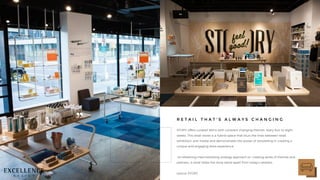
STORY offers curated items with constant changing themes every four to eight
weeks. This retail stores is a hybrid space that blurs the lines between retail,
exhibition, and media and demonstrates the power of storytelling in creating a
unique and engaging store experience.
Its refreshing merchandising strategy approach to rotating series of themes and
partners, is what helps the store stand apart from today’s retailers.
source: STORY
R E T A I L T H A T ' S A L W A Y S C H A N G I N G
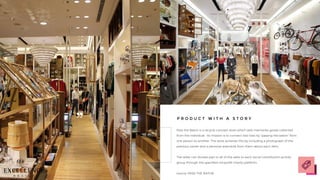
Pass the Baton is a recycle concept store which sells memories goods collected
from the individual. Its mission is to connect two lives by "passing the baton" from
one person to another. The store achieves this by including a photograph of the
previous owner and a personal anecdote from them about each item.
The seller can donate part or all of the sales to each social contribution activity
group through the specified nonprofit charity platform.
source: PASS THE BATON
P R O D U C T W I T H A S T O R Y
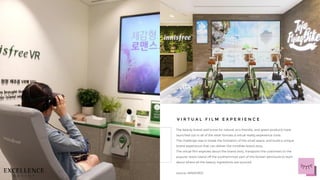
The beauty brand well know for natural, eco-friendly, and green products have
launched out in all of the retail formats a virtual reality experience zone.
The challenge was to break the limitation of the small space, and build a unique
brand experience that can deliver the Innisfree brand story.
The virtual film explores about the brand story, transports the customers to the
popular resort island off the southernmost part of the Korean peninsula to learn
about where all the beauty ingredients are sourced.
source: INNISFREE
V I R T U A L F I L M E X P E R I E N C E
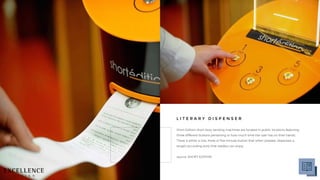
Short Edition short story vending machines are located in public locations featuring
three different buttons pertaining to how much time the user has on their hands.
There is either a one, three or five minute button that when pressed, dispenses a
length-according story that readers can enjoy.
source: SHORT EDITION
L I T E R A R Y D I S P E N S E R
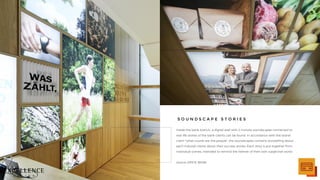
Inside the bank branch, a digital wall with 2-minute soundscapes connected to
real life stories of the bank clients can be found. In accordance with the brand
claim "what counts are the people", the soundscapes contains storytelling about
each induvial clients about their success stories. Each story is put together from
individual scenes, intended to remind the listener of their own subjective world.
source: ERSTE BANK
S O U N D S C A P E S T O R I E S
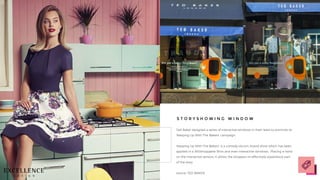
Ted Baker designed a series of interactive windows in their retail to promote its
'Keeping Up With The Bakers' campaign.
'Keeping Up With The Bakers’ is a comedy sitcom, brand show which has been
applied in a 360shoppable films and even interactive windows. Placing a hand
on the interactive sensors, it allows the shoppers to effectively experience part
of the story.
source: TED BAKER
S T O R Y S H O W I N G W I N D O W
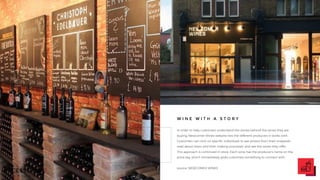
In order to help customers understand the stories behind the wines they are
buying, Newcomer Wines website lists the different producers it works with.
Customers can click on specific individuals to see photos from their vineyards,
read about them and their making processes, and see the wines they offer.
This approach is continued in-store. Each wine has the producer’s name on the
price tag, which immediately gives customers something to connect with.
source: NEWCOMER WINES
W I N E W I T H A S T O R Y
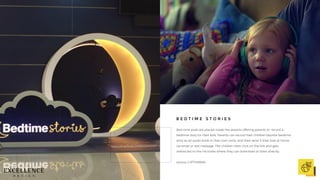
Bed time pods are placed inside the airports offering parents to record a
bedtime story for their kids. Parents can record their children favorite bedtime
story as an audio book in their own voice, and then send it their kids at home
via email or text message. The children then click on the link and gets
redirected to the microsite where they can download or listen directly.
source: LUFTHANSA
B E D T I M E S T O R I E S
Excellence Design Trends

Excellence Design Trends

  • 1.
    NEW FRONTIERS INRETAIL THE STORYTELLING STORE MARCH 2018
  • 2.
    N E WF R O N T I E R S I N R E T A I L T H E S T O R Y T E L L I N G S T O R E Why storytelling and stores? Combining storytelling and stores might seem to some obvious, to others enigmatic and still, to others, useless. Store managers might think, “Who needs storytelling when I’m running my store efficiently and selling well?”, sales managers might say, “storytelling is for communication and marketing… just give me the tools and I’ll do the selling!” and general managers might say, “Here we go again! Some new marketing idea to mess up the works!”. Actually, storytelling and retail have always merged in the best stores and the best salespeople. Any good salesperson can explain how they use personal stories to create empathy with the customer. Major stores have always done the same. Walking down Madison Avenue in New York City in the 60’s and entering Brooks Brothers or Abercrombie and Fitch was entering a world of luxury, attention to the customer and the fulfillment of role playing on many levels. Stories were part of the offering: stories about important events, luxury living and unique safaris or arctic adventures were part of what you bought. So really, storytelling is part of retail history. So what’s new today? Many things have happened in retail since the sixties. But two elements have become of strategic importance in the last couple of years: engagement and data. And here is where storytelling emerges as one of the basic strategies to help excel in both. Simply put, storytelling drives engagement and allows the collection of emotional data. Sure, a solid storytelling strategy is not the only element which brings success to a product or service, but it is certainly a key element often overlooked. Pricing, marketing, communications and visual merchandising are all, obviously, part of the successful mix. But all these strategies are weaker without the synergy of a strong storytelling strategy. In older terms, it’s brand equity in the making, it’s brand awareness put into practice. Reflection by Edward Rozzo Director of Business Narrative
  • 3.
    Retail Design Architecture Itmay appear premature to speak about storytelling when you are in the process of architecturally designing a new store, but the contemporary approach to the customer’s journey obliges us to realize that the store has become only one of the various touch points in which the consumer engages with the brand. That engagement can be simply reassumed as the participation on various levels of storytelling in which the consumer virtually participates in the narration of self. Anthony Giddens’ studies on the Self in Late- Modernity emphasized this narration as being a fundamental aspect of our late-modern, or as some would have it, post-modern society. Consequentially, creating a fictitious story on which to base the concepts, design and execution of a retail environment is the most successful way of differentiating the sales point and avoiding turning it into a sterile technical landscape which so many retailers believe to be the future. People need values and fantasy, not another tablet to swipe or another electronic gadget to fuddle with. So the store is the ideal setting in which the consumer becomes the protagonist of your story. Stores represent not only life-styles or persona, but an actual theater in which your story takes place. When the customer walks into a storytelling store, he or she becomes the protagonist of his or her self-narrative. This role playing is at the core of self-identity and the storytelling store should be at the core of your customer’s self. The integration of the virtual with brick and mortar reality does not mean becoming a gadget freak. Digital technologies offer us two concrete developments: new communication platforms closer to people’s lives 24/7 and the possibility to eliminate errors, time and space in the buying process. These are great advantages. Unfortunately, people are confusing these advantages with the whole retail process and that is a nearsighted mistake. Any truly engaging in-store experience is actually a form of storytelling for the participant. Ambience, role-playing and narcissistic image projection is what people crave in a fragmented unstable society such as ours. Retail Design Italy We at Retail Design Italy have come a long way from the days when store design meant a pleasant life-style atmosphere within the limits of interior design. Today, the creation of a store is part of a structurally complex analysis which involves analytical capabilities going far beyond the architects studio and deep into market and management conditions. Coupling deep insights into consumer habits, customer relations and cutting-edge technologies with the power of storytelling throughout the whole design and deployment process guarantees an interactive customer journey which leads to sales and more lasting relationships with clients. The Storytelling Store is where the future of customer relations lies and we are proud to be at the forefront of tomorrow’s retail innovation.
  • 4.
    STORY offers curateditems with constant changing themes every four to eight weeks. This retail stores is a hybrid space that blurs the lines between retail, exhibition, and media and demonstrates the power of storytelling in creating a unique and engaging store experience. Its refreshing merchandising strategy approach to rotating series of themes and partners, is what helps the store stand apart from today’s retailers. source: STORY R E T A I L T H A T ' S A L W A Y S C H A N G I N G
  • 5.
    Pass the Batonis a recycle concept store which sells memories goods collected from the individual. Its mission is to connect two lives by "passing the baton" from one person to another. The store achieves this by including a photograph of the previous owner and a personal anecdote from them about each item. The seller can donate part or all of the sales to each social contribution activity group through the specified nonprofit charity platform. source: PASS THE BATON P R O D U C T W I T H A S T O R Y
  • 6.
    The beauty brandwell know for natural, eco-friendly, and green products have launched out in all of the retail formats a virtual reality experience zone. The challenge was to break the limitation of the small space, and build a unique brand experience that can deliver the Innisfree brand story. The virtual film explores about the brand story, transports the customers to the popular resort island off the southernmost part of the Korean peninsula to learn about where all the beauty ingredients are sourced. source: INNISFREE V I R T U A L F I L M E X P E R I E N C E
  • 7.
    Short Edition shortstory vending machines are located in public locations featuring three different buttons pertaining to how much time the user has on their hands. There is either a one, three or five minute button that when pressed, dispenses a length-according story that readers can enjoy. source: SHORT EDITION L I T E R A R Y D I S P E N S E R
  • 8.
    Inside the bankbranch, a digital wall with 2-minute soundscapes connected to real life stories of the bank clients can be found. In accordance with the brand claim "what counts are the people", the soundscapes contains storytelling about each induvial clients about their success stories. Each story is put together from individual scenes, intended to remind the listener of their own subjective world. source: ERSTE BANK S O U N D S C A P E S T O R I E S
  • 9.
    Ted Baker designeda series of interactive windows in their retail to promote its 'Keeping Up With The Bakers' campaign. 'Keeping Up With The Bakers’ is a comedy sitcom, brand show which has been applied in a 360shoppable films and even interactive windows. Placing a hand on the interactive sensors, it allows the shoppers to effectively experience part of the story. source: TED BAKER S T O R Y S H O W I N G W I N D O W
  • 10.
    In order tohelp customers understand the stories behind the wines they are buying, Newcomer Wines website lists the different producers it works with. Customers can click on specific individuals to see photos from their vineyards, read about them and their making processes, and see the wines they offer. This approach is continued in-store. Each wine has the producer’s name on the price tag, which immediately gives customers something to connect with. source: NEWCOMER WINES W I N E W I T H A S T O R Y
  • 11.
    Bed time podsare placed inside the airports offering parents to record a bedtime story for their kids. Parents can record their children favorite bedtime story as an audio book in their own voice, and then send it their kids at home via email or text message. The children then click on the link and gets redirected to the microsite where they can download or listen directly. source: LUFTHANSA B E D T I M E S T O R I E S