The Evolution of the
World Wide Web
Webvolution: Where Boundless Possibilities Shape the Digital Era
Introduction
Welcome to "The Evolution of the Web: Unleashing the Digital Frontier" presentation.
The World Wide Web (WWW), born in 1989, was a humble initiative to connect
scientists globally. Today, it has become an indispensable force, reshaping how we
communicate, conduct business, and find entertainment.
● The internet and the web have transformed the world, revolutionizing how we connect,
communicate, and conduct business.
● In this presentation, we will embark on a journey through time, exploring the key milestones
that have shaped the web as we know it today.
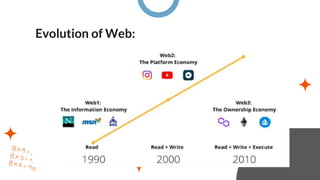
Evolution of Web:
Web 1.0: The Read-Only Web
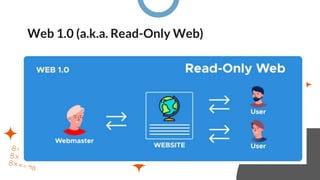
The first stage of the web’s evolution, known as Web 1.0 or the “read-only web,” was
characterized by static, informational websites linked together by hyperlinks. During
this phase, users could only passively consume content without the ability to interact
with it or contribute their own content.
Web 1.0 - Static Foundations
● Web 1.0 (1991-2004) laid the groundwork for the digital revolution.
● Static web pages and basic HTML marked the initial stages.
● Information consumption dominated the one-way flow of data.
● Early technologies: HTML, HTTP, and web browsers like Mosaic and Netscape Navigator.
Web 1.0 (a.k.a. Read-Only Web)
Web 2.0: The Read-Write Web
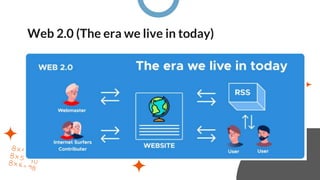
The second stage of the web’s evolution, known as Web 2.0 or the “read-write web,”
saw a dramatic increase in user interaction and user-generated content. Websites
became more dynamic and focused on usability, interoperability, and collaboration,
giving rise to blogs, social media, video streaming, and other forms of interactive
content.
Web 2.0 - Dynamic User Empowerment
● Web 2.0 (2005-2010) brought dynamic changes, empowering users like never before.
● Interactive websites, user-generated content, and social media became mainstream.
● The web transformed into a collaborative and engaging platform.
● Key technologies: Ajax, JavaScript, CSS, and the rise of platforms like Facebook, YouTube,
and Wikipedia.
Web 2.0 (The era we live in today)
Web 3.0: The Decentralized Web
Web 3.0, also known as the “decentralized web” or “Web3,” is the next stage in the
evolution of the web. This vision of a more open and decentralized web is still a work
in progress but promises to provide greater utility and control to its users.
Web 3.0 - The Intelligent Web
● Web 3.0 (2010-present) ushered in the era of the "Intelligent Web" or "Semantic Web."
● Contextual understanding and intelligent data interactions became paramount.
● Technologies like RDF, SPARQL, and AI algorithms fuel the Semantic Web.
Web 3.0 (A way to decentralisation)
Internet of Things (IoT):
The Internet of Things (IoT) has swiftly emerged as a transformative technology, reshaping
our interactions with the world. By seamlessly linking physical objects to the digital realm
through sensors and actuators, IoT grants us real-time insights into our environment.
IoT's potential is fueled by three pivotal technologies:
Artificial Intelligence (AI), 5G networks, and Big Data. The convergence of these innovations
promises a future that is even more interconnected and intelligent.
Internet of Things:
Artificial Intelligence (AI) and the Web:
Unleashing the Potential of Artificial Intelligence
Artificial Intelligence (AI) is a branch of computer science that focuses on creating
machines or computer systems that can perform tasks that typically require human
intelligence. The goal of AI is to design systems that can reason, learn from experience,
and adapt to new situations, making them capable of performing complex tasks with
high accuracy and efficiency.
Types of AI:
Narrow AI (Weak AI): Narrow AI refers to AI systems that are designed and trained for
a specific task or set of tasks. These systems excel in their defined domain but lack the
ability to perform tasks beyond their scope. Examples include virtual assistants like Siri
or Alexa, image recognition systems, and recommendation algorithms.
General AI (Strong AI): General AI is an advanced form of AI that possesses human-like
cognitive abilities and can perform any intellectual task that a human can do. This level
of AI is theoretical and still beyond the current state of technology. General AI would
be capable of learning and understanding various tasks, adapting to new situations, and
reasoning across multiple domains.
Artificial Superintelligence (ASI): ASI refers to AI systems that surpass human
intelligence in every aspect. This is also a speculative concept, and there is ongoing
debate and speculation about the implications and challenges associated with
achieving ASI.
AI Applications:
AI has found applications across various fields and industries, including:
Natural Language Processing (NLP): Enabling machines to understand and generate
human language, leading to chatbots, language translation, and voice assistants.
Machine Learning: Utilizing algorithms that enable machines to learn from data and
improve their performance over time, enabling personalized recommendations, fraud
detection, and medical diagnosis.
Robotics: Integrating AI with robotics to create intelligent autonomous machines
capable of performing tasks in diverse environments.
The Future - Web 4.0?
Web 4.0: A Glimpse into the Future
As we embrace Web 3.0's potential, curiosity grows about the
possibilities of Web 4.0. Undefined but exciting, it promises a more
immersive and connected experience, potentially integrated with our
minds. The evolution of the internet continues, holding great promise
for the future.
Conclusion
● "Evolution of the Web: Unleashing the Digital Revolution" illustrates the web's
incredible impact.
● From static pages to an intelligent and interconnected ecosystem, the web has
transformed societies.
● As we move ahead, let's build a web that is secure, inclusive, and empowers
every individual.

Evolution of web.pptx

  • 1.
    The Evolution ofthe World Wide Web Webvolution: Where Boundless Possibilities Shape the Digital Era
  • 2.
    Introduction Welcome to "TheEvolution of the Web: Unleashing the Digital Frontier" presentation. The World Wide Web (WWW), born in 1989, was a humble initiative to connect scientists globally. Today, it has become an indispensable force, reshaping how we communicate, conduct business, and find entertainment. ● The internet and the web have transformed the world, revolutionizing how we connect, communicate, and conduct business. ● In this presentation, we will embark on a journey through time, exploring the key milestones that have shaped the web as we know it today.
  • 3.
  • 4.
    Web 1.0: TheRead-Only Web The first stage of the web’s evolution, known as Web 1.0 or the “read-only web,” was characterized by static, informational websites linked together by hyperlinks. During this phase, users could only passively consume content without the ability to interact with it or contribute their own content. Web 1.0 - Static Foundations ● Web 1.0 (1991-2004) laid the groundwork for the digital revolution. ● Static web pages and basic HTML marked the initial stages. ● Information consumption dominated the one-way flow of data. ● Early technologies: HTML, HTTP, and web browsers like Mosaic and Netscape Navigator.
  • 5.
    Web 1.0 (a.k.a.Read-Only Web)
  • 6.
    Web 2.0: TheRead-Write Web The second stage of the web’s evolution, known as Web 2.0 or the “read-write web,” saw a dramatic increase in user interaction and user-generated content. Websites became more dynamic and focused on usability, interoperability, and collaboration, giving rise to blogs, social media, video streaming, and other forms of interactive content. Web 2.0 - Dynamic User Empowerment ● Web 2.0 (2005-2010) brought dynamic changes, empowering users like never before. ● Interactive websites, user-generated content, and social media became mainstream. ● The web transformed into a collaborative and engaging platform. ● Key technologies: Ajax, JavaScript, CSS, and the rise of platforms like Facebook, YouTube, and Wikipedia.
  • 7.
    Web 2.0 (Theera we live in today)
  • 8.
    Web 3.0: TheDecentralized Web Web 3.0, also known as the “decentralized web” or “Web3,” is the next stage in the evolution of the web. This vision of a more open and decentralized web is still a work in progress but promises to provide greater utility and control to its users. Web 3.0 - The Intelligent Web ● Web 3.0 (2010-present) ushered in the era of the "Intelligent Web" or "Semantic Web." ● Contextual understanding and intelligent data interactions became paramount. ● Technologies like RDF, SPARQL, and AI algorithms fuel the Semantic Web.
  • 9.
    Web 3.0 (Away to decentralisation)
  • 10.
    Internet of Things(IoT): The Internet of Things (IoT) has swiftly emerged as a transformative technology, reshaping our interactions with the world. By seamlessly linking physical objects to the digital realm through sensors and actuators, IoT grants us real-time insights into our environment. IoT's potential is fueled by three pivotal technologies: Artificial Intelligence (AI), 5G networks, and Big Data. The convergence of these innovations promises a future that is even more interconnected and intelligent.
  • 11.
  • 12.
    Artificial Intelligence (AI)and the Web: Unleashing the Potential of Artificial Intelligence Artificial Intelligence (AI) is a branch of computer science that focuses on creating machines or computer systems that can perform tasks that typically require human intelligence. The goal of AI is to design systems that can reason, learn from experience, and adapt to new situations, making them capable of performing complex tasks with high accuracy and efficiency.
  • 13.
    Types of AI: NarrowAI (Weak AI): Narrow AI refers to AI systems that are designed and trained for a specific task or set of tasks. These systems excel in their defined domain but lack the ability to perform tasks beyond their scope. Examples include virtual assistants like Siri or Alexa, image recognition systems, and recommendation algorithms. General AI (Strong AI): General AI is an advanced form of AI that possesses human-like cognitive abilities and can perform any intellectual task that a human can do. This level of AI is theoretical and still beyond the current state of technology. General AI would be capable of learning and understanding various tasks, adapting to new situations, and reasoning across multiple domains. Artificial Superintelligence (ASI): ASI refers to AI systems that surpass human intelligence in every aspect. This is also a speculative concept, and there is ongoing debate and speculation about the implications and challenges associated with achieving ASI.
  • 14.
    AI Applications: AI hasfound applications across various fields and industries, including: Natural Language Processing (NLP): Enabling machines to understand and generate human language, leading to chatbots, language translation, and voice assistants. Machine Learning: Utilizing algorithms that enable machines to learn from data and improve their performance over time, enabling personalized recommendations, fraud detection, and medical diagnosis. Robotics: Integrating AI with robotics to create intelligent autonomous machines capable of performing tasks in diverse environments.
  • 15.
    The Future -Web 4.0? Web 4.0: A Glimpse into the Future As we embrace Web 3.0's potential, curiosity grows about the possibilities of Web 4.0. Undefined but exciting, it promises a more immersive and connected experience, potentially integrated with our minds. The evolution of the internet continues, holding great promise for the future.
  • 16.
    Conclusion ● "Evolution ofthe Web: Unleashing the Digital Revolution" illustrates the web's incredible impact. ● From static pages to an intelligent and interconnected ecosystem, the web has transformed societies. ● As we move ahead, let's build a web that is secure, inclusive, and empowers every individual.