EVIDENCE
BY ANJANA $ AASIM
FORENSIC4ALL
Evidence is the available
body of facts or information
indicating whether a belief or
proposition is true or valid.
Evidence, broadly construed,
is anything presented in
support of an assertion. This
support may be strong or
weak. The strongest type of
evidence is that which
provides direct proof of the
truth of an assertion.
Types of Evidence
There are six types of evidences
Trace Evidence
Transfer Evidence
Indented or impression evidence
Straited Evidence
Geometric Evidence
Chemical Evidence
FORENSIC4ALL
Trace evidence:
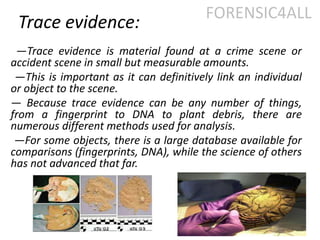
—Trace evidence is material found at a crime scene or
accident scene in small but measurable amounts.
—This is important as it can definitively link an individual
or object to the scene.
— Because trace evidence can be any number of things,
from a fingerprint to DNA to plant debris, there are
numerous different methods used for analysis.
—For some objects, there is a large database available for
comparisons (fingerprints, DNA), while the science of others
has not advanced that far.
FORENSIC4ALL
Transfer evidence:
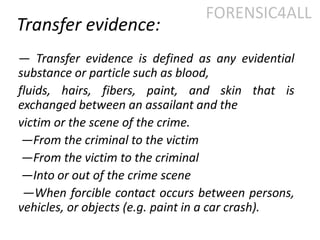
— Transfer evidence is defined as any evidential
substance or particle such as blood,
fluids, hairs, fibers, paint, and skin that is
exchanged between an assailant and the
victim or the scene of the crime.
—From the criminal to the victim
—From the victim to the criminal
—Into or out of the crime scene
—When forcible contact occurs between persons,
vehicles, or objects (e.g. paint in a car crash).
FORENSIC4ALL
Indented or impression evidence:
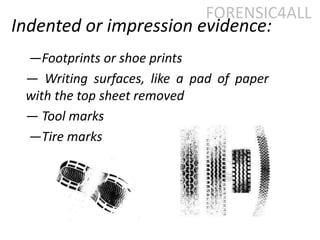
—Footprints or shoe prints
— Writing surfaces, like a pad of paper
with the top sheet removed
— Tool marks
—Tire marks
FORENSIC4ALL
Striated evidence:
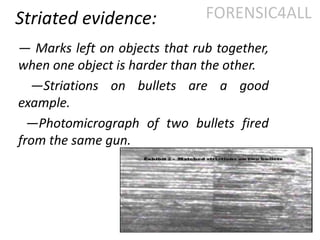
— Marks left on objects that rub together,
when one object is harder than the other.
—Striations on bullets are a good
example.
—Photomicrograph of two bullets fired
from the same gun.
FORENSIC4ALL
Geometric evidence:
—Pieces of Broken Evidence
—Headlights with hit and run
accidents.
FORENSIC4ALL
Chemical evidence:
— Narcotics
—Flammables
— Alcohol
— Chemicals associated with clandestine
labs.
FORENSIC4ALL
FORENSIC4ALLVisit my blog for more details
http://forensics4all.blogspot.in/

Evidence

  • 1.
    EVIDENCE BY ANJANA $AASIM FORENSIC4ALL
  • 2.
    Evidence is theavailable body of facts or information indicating whether a belief or proposition is true or valid. Evidence, broadly construed, is anything presented in support of an assertion. This support may be strong or weak. The strongest type of evidence is that which provides direct proof of the truth of an assertion.
  • 3.
    Types of Evidence Thereare six types of evidences Trace Evidence Transfer Evidence Indented or impression evidence Straited Evidence Geometric Evidence Chemical Evidence FORENSIC4ALL
  • 4.
    Trace evidence: —Trace evidenceis material found at a crime scene or accident scene in small but measurable amounts. —This is important as it can definitively link an individual or object to the scene. — Because trace evidence can be any number of things, from a fingerprint to DNA to plant debris, there are numerous different methods used for analysis. —For some objects, there is a large database available for comparisons (fingerprints, DNA), while the science of others has not advanced that far. FORENSIC4ALL
  • 5.
    Transfer evidence: — Transferevidence is defined as any evidential substance or particle such as blood, fluids, hairs, fibers, paint, and skin that is exchanged between an assailant and the victim or the scene of the crime. —From the criminal to the victim —From the victim to the criminal —Into or out of the crime scene —When forcible contact occurs between persons, vehicles, or objects (e.g. paint in a car crash). FORENSIC4ALL
  • 6.
    Indented or impressionevidence: —Footprints or shoe prints — Writing surfaces, like a pad of paper with the top sheet removed — Tool marks —Tire marks FORENSIC4ALL
  • 7.
    Striated evidence: — Marksleft on objects that rub together, when one object is harder than the other. —Striations on bullets are a good example. —Photomicrograph of two bullets fired from the same gun. FORENSIC4ALL
  • 8.
    Geometric evidence: —Pieces ofBroken Evidence —Headlights with hit and run accidents. FORENSIC4ALL
  • 9.
    Chemical evidence: — Narcotics —Flammables —Alcohol — Chemicals associated with clandestine labs. FORENSIC4ALL
  • 10.
    FORENSIC4ALLVisit my blogfor more details http://forensics4all.blogspot.in/