
www.chyp.comPlease Copy and Distribute1
Welcome to the
Tomorrow’s Transactions
FinTech Unconference
#TTUnConf
NESTA
February 2016
www.chyp.comPlease Copy and Distribute
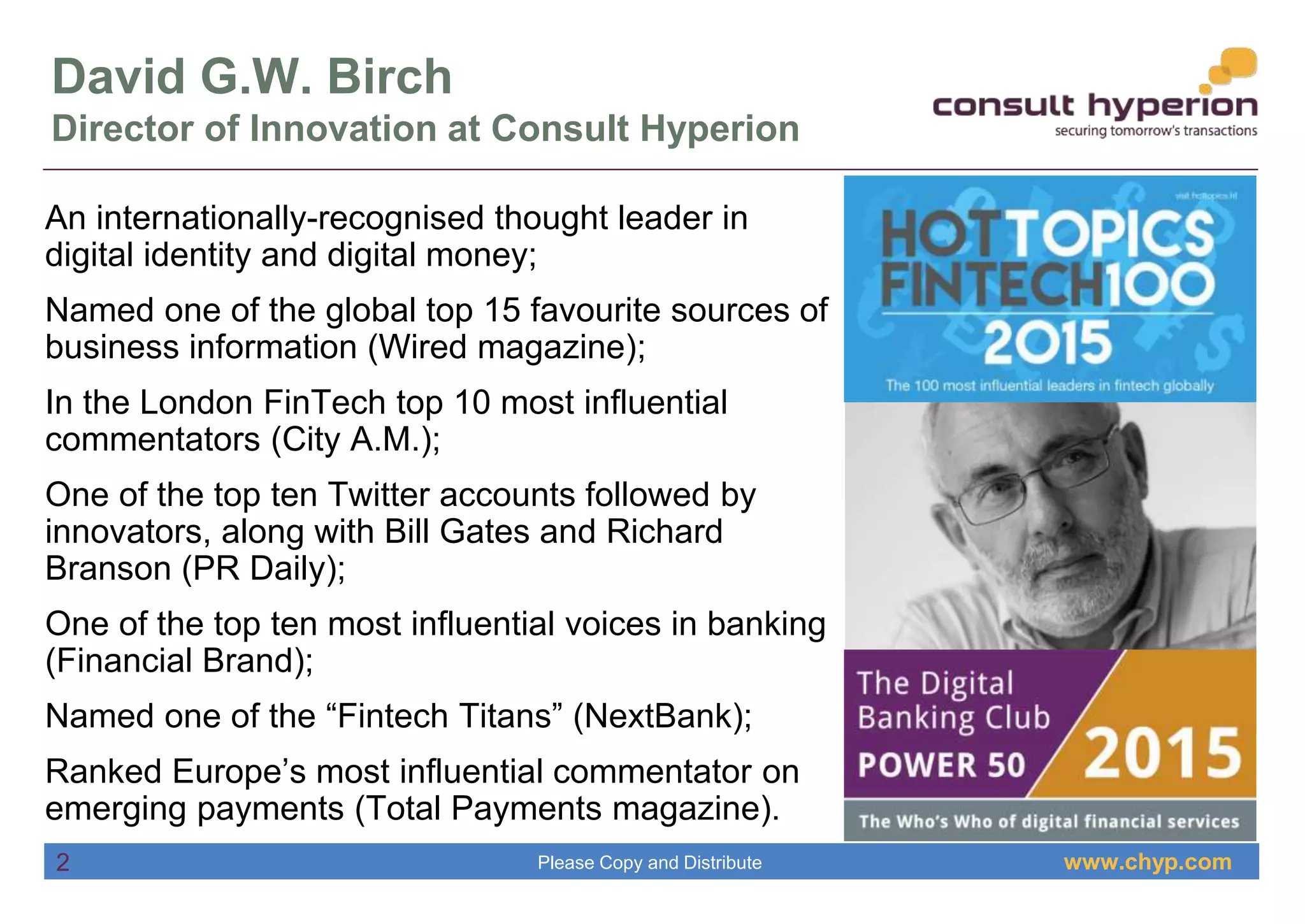
David G.W. Birch
Director of Innovation at Consult Hyperion
An internationally-recognised thought leader in
digital identity and digital money;
Named one of the global top 15 favourite sources of
business information (Wired magazine);
In the London FinTech top 10 most influential
commentators (City A.M.);
One of the top ten Twitter accounts followed by
innovators, along with Bill Gates and Richard
Branson (PR Daily);
One of the top ten most influential voices in banking
(Financial Brand);
Named one of the “Fintech Titans” (NextBank);
Ranked Europe’s most influential commentator on
emerging payments (Total Payments magazine).
2
www.chyp.comPlease Copy and Distribute
A FinTech Parable
1066: Noted War Criminal William the Bastard’s Illegal invasion of England
3
www.chyp.comPlease Copy and Distribute
History
Written by the Victors
Propaganda! Norman Claims of WMDs
4
www.chyp.comPlease Copy and Distribute
London is a Fintech Hub
The Bastard’s Asset Register
5
www.chyp.comPlease Copy and Distribute
Tax-Evading Scoundrels
No tax WHATSOEVER paid by Guildford
6
www.chyp.comPlease Copy and Distribute
Environment
Dr. John Cooper-Clarke says mass illiteracy is a comparatively recent phenomenon
7
www.chyp.comPlease Copy and Distribute
So…
We need a record of taxes due and paid that is…
Immutable – no-one can go back and change the amounts
Permanent – let’s say the record must last 500 years or so
Legible — for an illiterate population
Simple – all market participants must be able to read
Permissioned — only certain participants can create records
and take part in the consensus-forming
8
www.chyp.comPlease Copy and Distribute
Welcome to the
Norman Blockchain
The Tallies
9
www.chyp.comPlease Copy and Distribute
Simon Le Knackermouton and
The Tallycoin
Small
Cheap
Long-Lasting
Unalterable
Understandable
10
www.chyp.comPlease Copy and Distribute
London — Fintech Hub
since Henry II
A Bearer Instrument: Deferred Payment to Store of Value to Means of Exchange
11
www.chyp.comPlease Copy and Distribute
Printing is for Other People
You Can Forge Papers, Signatures
12
www.chyp.comPlease Copy and Distribute
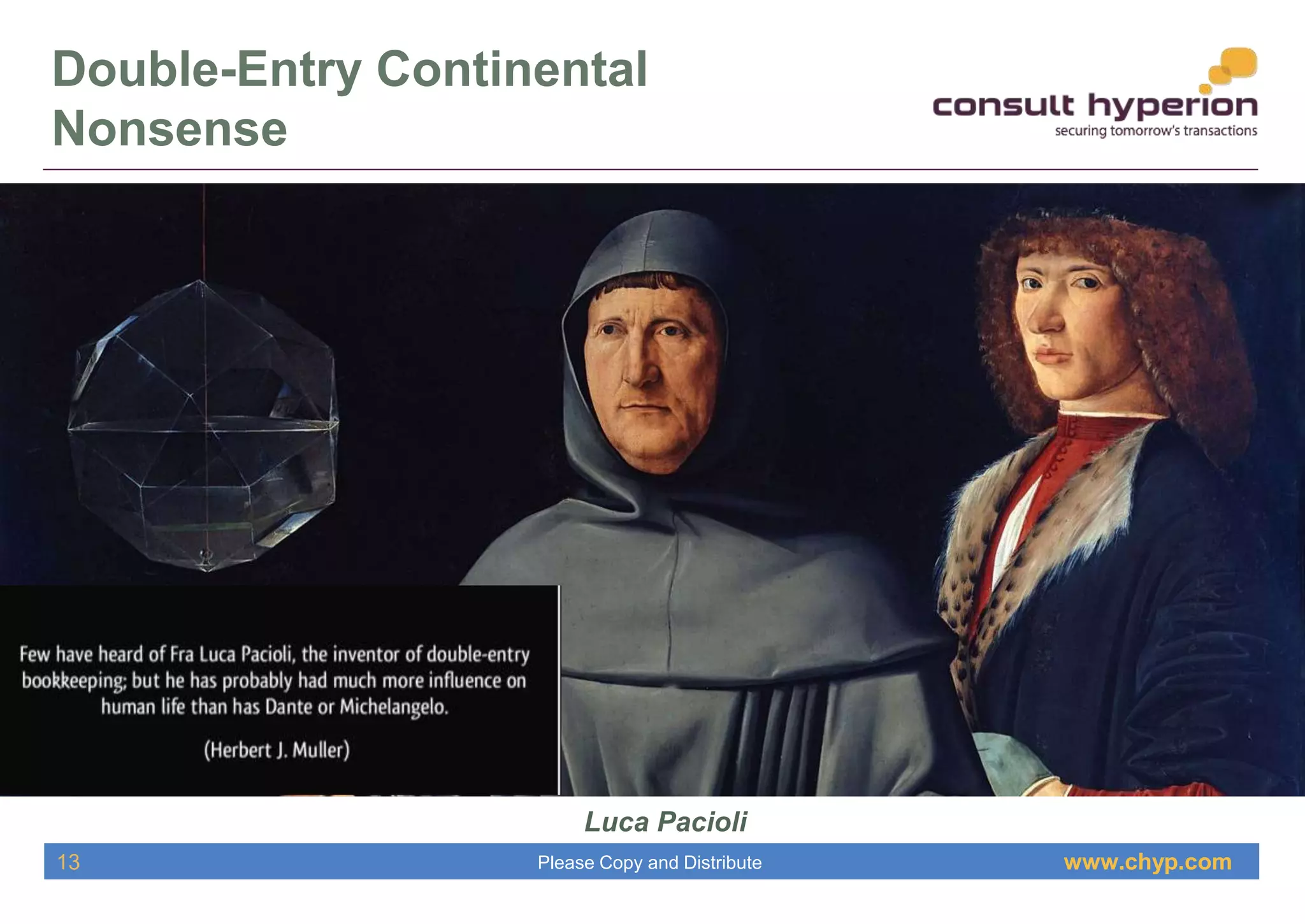
Double-Entry Continental
Nonsense
Luca Pacioli
13
www.chyp.comPlease Copy and Distribute
Money is Debt
OK, Let’s Experiment
14
www.chyp.comPlease Copy and Distribute
The Mother of Parliaments
The Great British New Technology Compromise
15
www.chyp.comPlease Copy and Distribute
Three Key Points
1. Finance is a very conservative, as are people in general
2. Technology and the monetization of debt
3. Everything’s a ****ing blockchain
16
www.chyp.comPlease Copy and Distribute
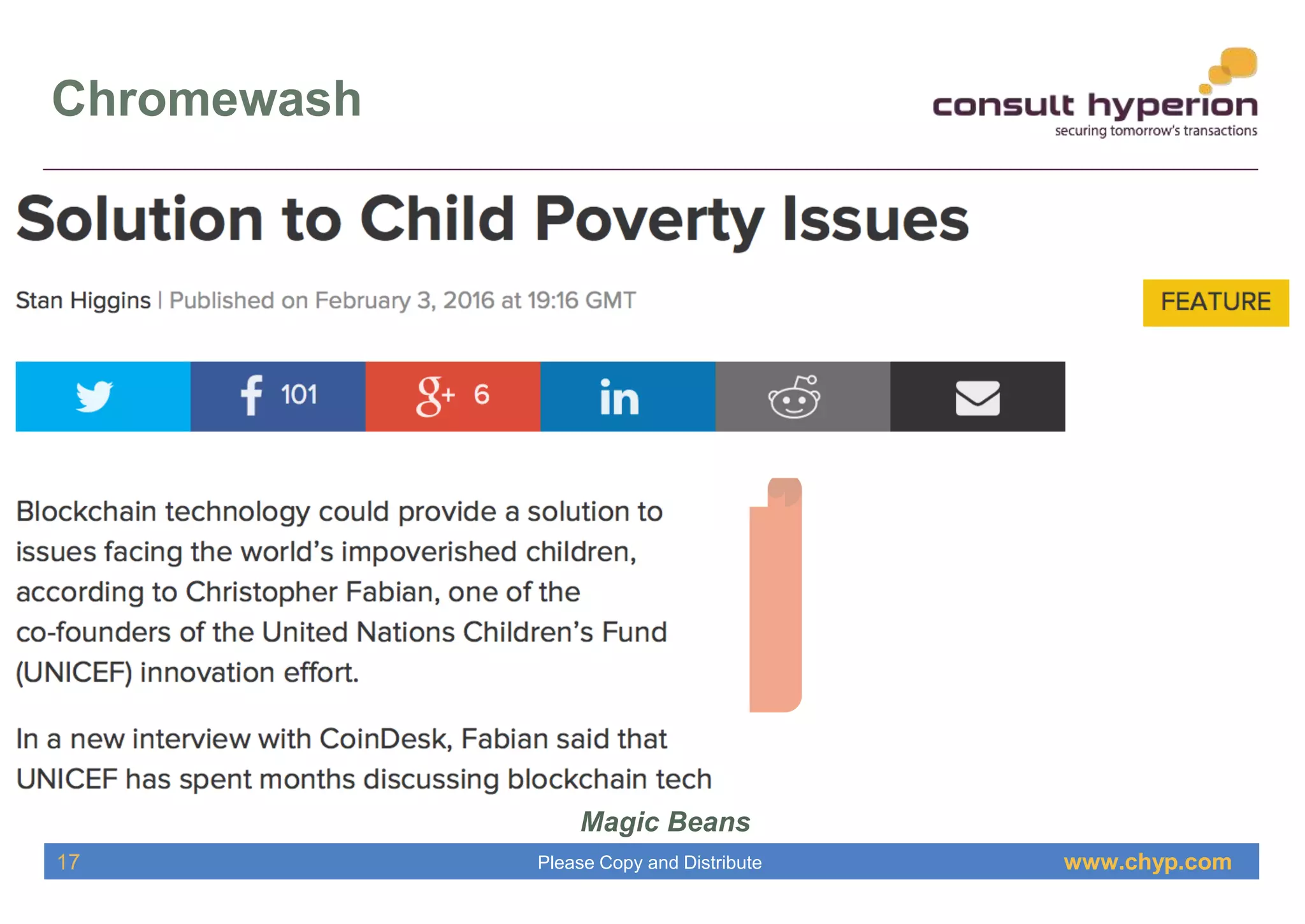
Chromewash
Magic Beans
17
www.chyp.comPlease Copy and Distribute
Contact
18
Browse www.chyp.com
Follow @chyppings
Mail info@chyp.com
Comment http://www.chyp.com/media/blog/
Listen http://www.chyp.com/media/podcasts/
Consult Hyperion UK
Tweed House, 12 The Mount
Guildford, Surrey GU24HN, UK.
+44 1483 301793
Consult Hyperion USA
535 Madison Avenue, 19th Floor
New York, NY 10022, USA.
+1 888 835 6124

Everything's a ****ing blockchain

  • 1.
    www.chyp.comPlease Copy andDistribute1 Welcome to the Tomorrow’s Transactions FinTech Unconference #TTUnConf NESTA February 2016
  • 2.
    www.chyp.comPlease Copy andDistribute David G.W. Birch Director of Innovation at Consult Hyperion An internationally-recognised thought leader in digital identity and digital money; Named one of the global top 15 favourite sources of business information (Wired magazine); In the London FinTech top 10 most influential commentators (City A.M.); One of the top ten Twitter accounts followed by innovators, along with Bill Gates and Richard Branson (PR Daily); One of the top ten most influential voices in banking (Financial Brand); Named one of the “Fintech Titans” (NextBank); Ranked Europe’s most influential commentator on emerging payments (Total Payments magazine). 2
  • 3.
    www.chyp.comPlease Copy andDistribute A FinTech Parable 1066: Noted War Criminal William the Bastard’s Illegal invasion of England 3
  • 4.
    www.chyp.comPlease Copy andDistribute History Written by the Victors Propaganda! Norman Claims of WMDs 4
  • 5.
    www.chyp.comPlease Copy andDistribute London is a Fintech Hub The Bastard’s Asset Register 5
  • 6.
    www.chyp.comPlease Copy andDistribute Tax-Evading Scoundrels No tax WHATSOEVER paid by Guildford 6
  • 7.
    www.chyp.comPlease Copy andDistribute Environment Dr. John Cooper-Clarke says mass illiteracy is a comparatively recent phenomenon 7
  • 8.
    www.chyp.comPlease Copy andDistribute So… We need a record of taxes due and paid that is… Immutable – no-one can go back and change the amounts Permanent – let’s say the record must last 500 years or so Legible — for an illiterate population Simple – all market participants must be able to read Permissioned — only certain participants can create records and take part in the consensus-forming 8
  • 9.
    www.chyp.comPlease Copy andDistribute Welcome to the Norman Blockchain The Tallies 9
  • 10.
    www.chyp.comPlease Copy andDistribute Simon Le Knackermouton and The Tallycoin Small Cheap Long-Lasting Unalterable Understandable 10
  • 11.
    www.chyp.comPlease Copy andDistribute London — Fintech Hub since Henry II A Bearer Instrument: Deferred Payment to Store of Value to Means of Exchange 11
  • 12.
    www.chyp.comPlease Copy andDistribute Printing is for Other People You Can Forge Papers, Signatures 12
  • 13.
    www.chyp.comPlease Copy andDistribute Double-Entry Continental Nonsense Luca Pacioli 13
  • 14.
    www.chyp.comPlease Copy andDistribute Money is Debt OK, Let’s Experiment 14
  • 15.
    www.chyp.comPlease Copy andDistribute The Mother of Parliaments The Great British New Technology Compromise 15
  • 16.
    www.chyp.comPlease Copy andDistribute Three Key Points 1. Finance is a very conservative, as are people in general 2. Technology and the monetization of debt 3. Everything’s a ****ing blockchain 16
  • 17.
    www.chyp.comPlease Copy andDistribute Chromewash Magic Beans 17
  • 18.
    www.chyp.comPlease Copy andDistribute Contact 18 Browse www.chyp.com Follow @chyppings Mail info@chyp.com Comment http://www.chyp.com/media/blog/ Listen http://www.chyp.com/media/podcasts/ Consult Hyperion UK Tweed House, 12 The Mount Guildford, Surrey GU24HN, UK. +44 1483 301793 Consult Hyperion USA 535 Madison Avenue, 19th Floor New York, NY 10022, USA. +1 888 835 6124

Editor's Notes

  • #2 Firstly, organisations can be very conservative about the technology of money even when the market isn’t. It takes a lot for societies to change the technology of money even if they are comfortable with changing all sorts of other technologies. Once pressure builds up and change occurs, however, then it then takes some time for society to become ready to change again and technologies are kept in use past even after better alternatives become available. Secondly, the impact of technological innovation on finance (as in every other field) is impossible to predict. Across all technological changes, however What is almost a constant, though, is that the real benefits usually are not the ones that we expected, and the real perils are not those we feared… the New Deal’s precautions against the bank failures of the Depression created institutions that helped promote the wave of savings–and–loan bankruptcies of the 1980s. We have no basis for saying right now whether the impact of (for example) blockchain on the financial sector will be good or bad. After all, All forecasting is in an important sense backward looking—vividly compared to steering a ship by it’s wake Thirdly, the financial community will take advantage of innovation. Once the king (or Bill Gates) adopts a particular technology to fulfill the important function of representing money, then financial innovators will take the same technology and use it to make markets. Some organisations (e.g. traditional exchanges) may fade and new entrants (e.g. Net–based private capital placement spaces) may prosper, but overall the City will thrive. Tenner, E. Another Look Back, and a Look Ahead in Why Things Bite Back—Predicting the Problems of Progress (Fourth Estate: London, 1996).  Harris, R. Models or Markets? in Economic Forecasting—Models or Markets?, J. Ramsey, Editor. p. 86 (1977).
  • #3 David G.W Birch is Director of Innovation at Consult Hyperion, the secure electronic transactions consultancy. He is an internationally-recognised thought leader in digital identity and digital money; was named one of the global top 15 favourite sources of business information (Wired magazine) and one of the top ten most influential voices in banking (Financial Brand); was found one of the top ten Twitter accounts followed by innovators, along with Bill Gates and Richard Branson (PR Daily); was ranked in the top three most influential people in London’s FinTech community (City A.M.), was voted one of the European “Top 40” people in digital financial services (Financial News), was listed one of the world’s top 100 most influential FinTech leaders (Hot Topics) and was rated Europe’s most influential commentator on emerging payments (Total Payments).
  • #10 Tally sticks came into use in England after the Norman invasion. Tax assessments were made for areas of the country and the relevant sheriff was required to collect the taxes and remit them to the king. To ensure that both the sheriff and the king knew where they stood, the tax assessment was recorded by cutting notches in a wooden twig and then splitting the twig in two, so that each of them had a durable record of the assessment. When it was time to pay up, the sheriff would show up with the cash and his half of the tally to be reckoned against the King’s half. As the system evolved, the taxes were paid in two stages: half paid up front at Easter and the rest paid later in the year at Michaelmas when the “tallying up” took place. Cunningham, W. Royal Revenues in The Growth of English Industry and Commerce during the Early and Middle Ages (Cambridge University Press, 1915). Technologically, the system worked very well. The tally sticks were small and long–lasting, were easy to store and transport, and easily understood by those who couldn’t read (i.e. almost everyone). As a new technology, however, they soon began to exhibit some unforeseen (in the context of their record–keeping function) characteristics.  
  • #11 By the reign of Henry II (who died in France in 1189), the Exchequer was already a sophisticated and organised department of the king’s court with an elaborate staff of officers. The use of tallies to enable this operation had an interesting consequence. Since the king (as is generally the case) couldn’t be bothered to wait until taxes fell due, and could not borrow money at interest, he would sell the tallies at a discount. The holder of the tally could then cash it in when the taxes fell due, making it (in effect) a fixed–term government bond. The discount on the tallies varied, just as one would expect, by economic circumstances. Adam Smith notes that in the time of King William the discount reached 60% when the Bank of England suspended transactions during a debasement of the coinage. The tally system could (of course) be abused by the Exchequer selling tallies which they would not redeem, but kings soon learned not to renege on tallies, since the discount on future tallies would be increased and the Exchequer would be hit hard. Smith, A. Of Public Debts in Wealth Of Nations: Chapter III.
  • #12 The market for tallies evolved quickly. Someone in (say) Bristol who was holding a tally for taxes due in (say) York would either have to travel to collect their due payment or find someone else who would, for an appropriate discount, buy the tally. Thus, a market for tallies grew, arbitrating various temporal and spatial preferences by discounting. It is known from recorded instances that officials working in the Exchequer helped this market to operate smoothly . To summarise: by middle of the twelfth century, there was a functional market in government debt centred on London. No wonder the London money markets are so sophisticated. I often fall into the trap of thinking that there’s never been a revolution in monetary technology before, so I forget how rapidly previous significant developments were co–opted by the financial ‘establishment’ and taken for granted or just how old some aspects of the apparently modern financial infrastructure are. And it’s not just government bonds. When the Doge of Venice died in 1238, he left an estate indistinguishable from a modern portfolio: 7% in cash (coins) and the rest in negotiable municipal bonds and ‘partnerships’, a precursor to equities. Davies, G. (1995). The Treasury and the tally in A History of Money—From Ancient Times to the Present Day. Cardiff, University of Wales Press. p.146–152.   Buchan, J. (1997). An Idea of Order in Borgo Sansepolcro in Frozen Desire. London, Picador. p.50–72.  
  • #15  The Bank of England, being a sensible and conservative institution naturally suspicious of new technologies, continued to use wooden tally sticks until 1826: some 500 years after the invention of double–entry bookkeeping and 400 years after Johann Gutenburg’s invention of printing. The tally sticks were then taken out of circulation and stored in the Houses of Parliament until 1834, when the authorities decided that the tallies were no longer required and that they should be burned. As it happened, they were burned rather too enthusiastically and in the resulting conflagaration the Houses of Parliament were razed to the ground, an incident so loaded with symbolism about the long–term impact of innovations in the technology of money that had it occurred in a novel no–one would believe it. To be replaced by the present Gothic structure, built (1840–60) by Sir Charles Barry    
  • #17 This is not a negative message: after all, London has survived and thrived through the introduction of banknotes and bills of exchange, derivatives and EFT. The City has always been associated with financial innovation and the creation of markets. Look at insurance. London didn’t invent insurance: the preamble to the Insurance Act of 1601 talks about it as a long established business, starting Whereas it hath bene tyme out of mynde an usage amongste Merchantes… London invented the market: Lloyd’s. Today, the City of London is still good at being a market. It handles 30% of world foreign exchange dealing (more than New York and Tokyo combined). Some 60% of all international bonds are issued in London, and 75% of the trading of them takes place in the City. The City is the world centre for settling gold trades and half the world’s oil cargoes are fixed up on the Baltic Exchange. London is sure to be the principal wholesale market for the Euro, even if the UK isn’t part of Euroland. All things considered, there doesn’t seem to be any reason for London to be worried about the rise of the Net! Raphael, A. Coffee House to Catastrophe in Ultimate Risk. p.17–41, Bantam (London: 1994).   Jacomb, M. The City to Come in The Spectator: p. 17–18 (8th November 1998).  
  • #18 Exciting news arrives from a friend. “Check this out” he tells me, “they’re using the block chain to replace the Pound Sterling / create a land registry in Ruritania / cure cancer” (*delete where applicable) and there’s a URL attached. I click on it. It says that a company has signed a memorandum of understanding to create a working group to examine the possibility of a pilot to use a database that will have “seamless integration with blockchain technologies”. I emailed him back, pointing out that my arse has seamless integration with blockchain technologies but that doesn’t make it a blockchain. How many times this happened over the last few weeks? It’s getting out of control. A client tells me that one of their competitors is using bitcoin to manage some asset or other. I look at the website that she points me to. What it actually says is that the competitor is looking at a “bitcoin-inspired” system (what you or I might term a “database"). Then I go to another meeting where someone says that the blockchain could be a potential solution to a particular problem, but says it in such a way as to drive suspicion that they don’t know what a blockchain is. But of course, because I’m English, I say “that’s an interesting idea”. It seems to me that in a relatively short time the word blockchain has become detached from its technological roots and from its location in the spectrum of shared ledger implementation options to become one of those almost generic chromewash terms, like “big data” or “cloud” (there is no cloud, remember, it’s just somebody else’s computer) to deliver a superficial veneer of futurism. I happen to be at a seminar on financial services recently and there was a presentation about the use of the blockchain to deliver lower costs, or something or other, in a particular area. The guy who was sitting next to me, who I think was from a bank, wrote “magic beans” on his notepad. What an accurate description.
  • #19 There’s always hype around new technologies, we all understand that. But in the case of the blockchain, the hype seems particularly merciless and quantitatively different. Why? I honestly don’t know, but it must somehow be related to its association with bitcoin and the creation myth associated with it. Why else would otherwise sensible people tell me that they read that a bank is using the blockchain on the basis that they saw someone from that bank talking at a conference about exploring “blockchain compatible” (a meaningless phrase) options? Personally, I think the shared ledger concept and the associated technologies for establishing communications, consensus, content and contracts between multiple organisations (and, more importantly for financial services, regulators) is one of the most interesting new developments in the sector in my career. My old friend Ian Grigg, who really does know what he is talking about, hypothesises that the blockchain is not the right solution for technical reasons but because everyone has agreed it is  (a Reed’s Law spiral), but I think it’s too early to call that. There is no doubt that the blockchain is a particularly interesting way to implement one particular kind of shared ledger, and there is no doubt that there is tremendous creativity unleashed from the permissionless innovation environment, but it’s a big step from that to ending world hunger. Please can we have some rationality in the reporting and discussion of the technology? A “Bitcoin-like platform” is not “bitcoin”. “The blockchain” is not “a blockchain”. A “blockchain-secured trusted third party” is a “trusted third party”.  Dave Birch Consult Hyperion February 2016