METHODS OF SEPERATION
IN EVERYDAY LIFE
METHODS OF
SEPERATION IN
EVERYDAY LIFE
•Conten
t
•Definition
•Examples
•Activity
•Procedure
•Summary
Evaporatio
n
Evaporatio
n
Definition
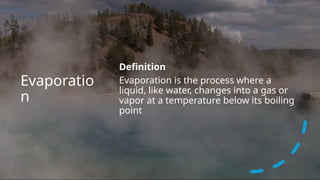
Evaporation is the process where a
liquid, like water, changes into a gas or
vapor at a temperature below its boiling
point
Evaporation In Everyday Life
Surface process: It
happens on the surface of
the liquid, unlike boiling,
which occurs throughout
the entire liquid.
Triggered by heat: Energy,
often from heat, causes the
liquid molecules to move
faster and escape into the
atmosphere.
Happens at any temperature:
It can happen at any
temperature, although it
happens faster when it is
warmer.
Below boiling point: The
liquid turns into a gas
without needing to reach
its boiling point.
Evaporatio
n Examples
Drying clothes on a line
Sweating on your skin
The gradual drying of
water in a pot left outside.
Evaporation
Activity
Activity
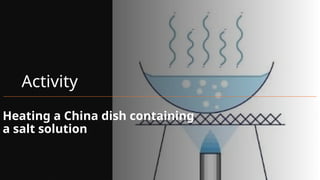
Heating a China dish containing
a salt solution
Heating a China dish
containing a salt
solution
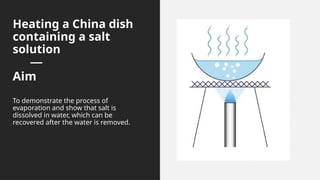
Aim
To demonstrate the process of
evaporation and show that salt is
dissolved in water, which can be
recovered after the water is removed.
Heating a China
dish containing a
salt solution
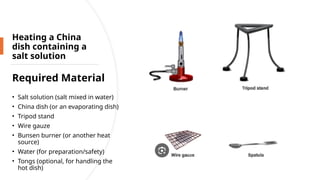
Required Material
• Salt solution (salt mixed in water)
• China dish (or an evaporating dish)
• Tripod stand
• Wire gauze
• Bunsen burner (or another heat
source)
• Water (for preparation/safety)
• Tongs (optional, for handling the
hot dish)
Heating a China dish
containing a salt
solution
Procedure
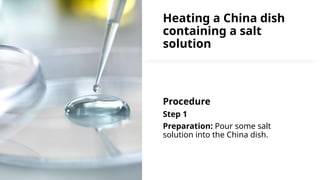
Step 1
Preparation: Pour some salt
solution into the China dish.
Heating a China
dish containing a
salt solution
Procedure
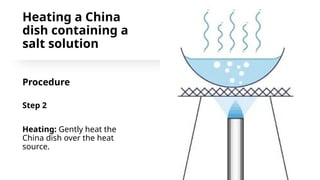
Step 2
Heating: Gently heat the
China dish over the heat
source.
Heating a China
dish containing
a salt solution
Procedure
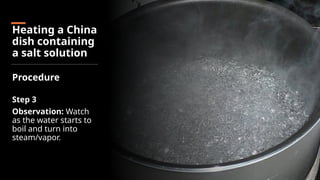
Step 3
Observation: Watch
as the water starts to
boil and turn into
steam/vapor.
Heating a China dish
containing a salt solution
Procedure
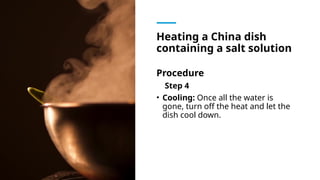
Step 4
• Cooling: Once all the water is
gone, turn off the heat and let the
dish cool down.
Heating a China dish
containing a salt
solution
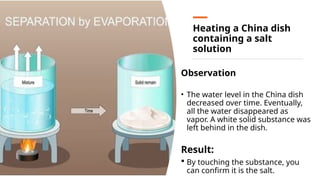
Observation
• The water level in the China dish
decreased over time. Eventually,
all the water disappeared as
vapor. A white solid substance was
left behind in the dish.
Result:
 By touching the substance, you
can confirm it is the salt.
Heating a China
dish containing
a salt solution
Summary
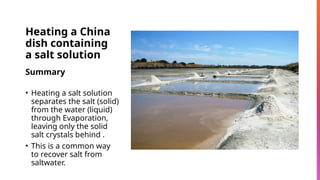
• Heating a salt solution
separates the salt (solid)
from the water (liquid)
through Evaporation,
leaving only the solid
salt crystals behind .
• This is a common way
to recover salt from
saltwater.
Evaporation in Everyday Life with Examples

Evaporation in Everyday Life with Examples

  • 1.
  • 2.
    METHODS OF SEPERATION IN EVERYDAYLIFE •Conten t •Definition •Examples •Activity •Procedure •Summary
  • 3.
  • 4.
    Evaporatio n Definition Evaporation is theprocess where a liquid, like water, changes into a gas or vapor at a temperature below its boiling point
  • 5.
    Evaporation In EverydayLife Surface process: It happens on the surface of the liquid, unlike boiling, which occurs throughout the entire liquid. Triggered by heat: Energy, often from heat, causes the liquid molecules to move faster and escape into the atmosphere. Happens at any temperature: It can happen at any temperature, although it happens faster when it is warmer. Below boiling point: The liquid turns into a gas without needing to reach its boiling point.
  • 6.
    Evaporatio n Examples Drying clotheson a line Sweating on your skin The gradual drying of water in a pot left outside.
  • 7.
  • 8.
    Activity Heating a Chinadish containing a salt solution
  • 9.
    Heating a Chinadish containing a salt solution Aim To demonstrate the process of evaporation and show that salt is dissolved in water, which can be recovered after the water is removed.
  • 10.
    Heating a China dishcontaining a salt solution Required Material • Salt solution (salt mixed in water) • China dish (or an evaporating dish) • Tripod stand • Wire gauze • Bunsen burner (or another heat source) • Water (for preparation/safety) • Tongs (optional, for handling the hot dish)
  • 11.
    Heating a Chinadish containing a salt solution Procedure Step 1 Preparation: Pour some salt solution into the China dish.
  • 12.
    Heating a China dishcontaining a salt solution Procedure Step 2 Heating: Gently heat the China dish over the heat source.
  • 13.
    Heating a China dishcontaining a salt solution Procedure Step 3 Observation: Watch as the water starts to boil and turn into steam/vapor.
  • 14.
    Heating a Chinadish containing a salt solution Procedure Step 4 • Cooling: Once all the water is gone, turn off the heat and let the dish cool down.
  • 15.
    Heating a Chinadish containing a salt solution Observation • The water level in the China dish decreased over time. Eventually, all the water disappeared as vapor. A white solid substance was left behind in the dish. Result:  By touching the substance, you can confirm it is the salt.
  • 16.
    Heating a China dishcontaining a salt solution Summary • Heating a salt solution separates the salt (solid) from the water (liquid) through Evaporation, leaving only the solid salt crystals behind . • This is a common way to recover salt from saltwater.