Presentation on the importance of environment science in engineering
1.
USES OF ELECTRICVEHICLES
10573-Vajra Thatte
10574-Kasturi Vaidya
10575-Pruthviraj Vyawhare
2.
WHAT ARE ELECTRICVEHICLES?
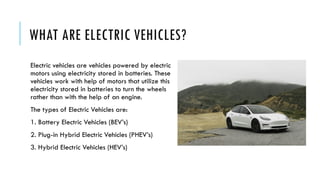
Electric vehicles are vehicles powered by electric
motors using electricity stored in batteries. These
vehicles work with help of motors that utilize this
electricity stored in batteries to turn the wheels
rather than with the help of an engine.
The types of Electric Vehicles are:
1. Battery Electric Vehicles (BEV’s)
2. Plug-in Hybrid Electric Vehicles (PHEV’s)
3. Hybrid Electric Vehicles (HEV’s)
3.
HISTORY OF ELECTRICVEHICLES
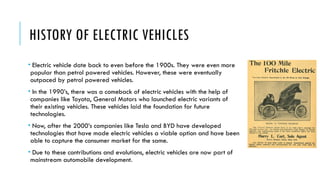
• Electric vehicle date back to even before the 1900s. They were even more
popular than petrol powered vehicles. However, these were eventually
outpaced by petrol powered vehicles.
• In the 1990’s, there was a comeback of electric vehicles with the help of
companies like Toyota, General Motors who launched electric variants of
their existing vehicles. These vehicles laid the foundation for future
technologies.
• Now, after the 2000’s companies like Tesla and BYD have developed
technologies that have made electric vehicles a viable option and have been
able to capture the consumer market for the same.
• Due to these contributions and evolutions, electric vehicles are now part of
mainstream automobile development.
4.
IMPORTANCE OF ELECTRICVEHICLES
• Due to the climate crisis today, we are in need of an eco-friendly
solution for transportation.
• Fossil fuels were abundant at one point but now, they have been
reduced and are found only in select regions. This rarity has also
caused their prices to be volatile.
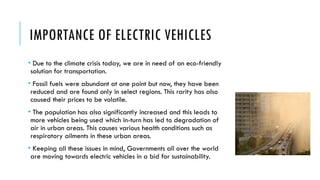
• The population has also significantly increased and this leads to
more vehicles being used which in-turn has led to degradation of
air in urban areas. This causes various health conditions such as
respiratory ailments in these urban areas.
• Keeping all these issues in mind, Governments all over the world
are moving towards electric vehicles in a bid for sustainability.
5.
ENVIRONMENTAL BENEFITS
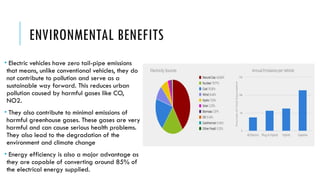
• Electricvehicles have zero tail-pipe emissions
that means, unlike conventional vehicles, they do
not contribute to pollution and serve as a
sustainable way forward. This reduces urban
pollution caused by harmful gases like CO,
NO2.
• They also contribute to minimal emissions of
harmful greenhouse gases. These gases are very
harmful and can cause serious health problems.
They also lead to the degradation of the
environment and climate change
• Energy efficiency is also a major advantage as
they are capable of converting around 85% of
the electrical energy supplied.
6.
IMPACT ON URBANLIFE
• As electric vehicles do not release harmful gases, they
also prevent the health issues due to heavy pollution such
as asthma, lung disease. This is especially good in urban
areas as the vehicles density is very high.
• Apart from reducing air pollutants, electric vehicle
motors do not make any noise and are quieter than
conventional engines. This has many advantages such as:
1. Lower stress levels
2. Peaceful Residential Zones
3. Improved Urban Living Standards
COMMERCIAL APPLICATIONS
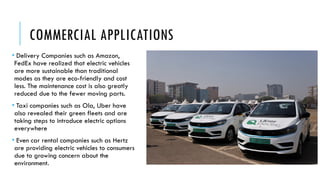
• DeliveryCompanies such as Amazon,
FedEx have realized that electric vehicles
are more sustainable than traditional
modes as they are eco-friendly and cost
less. The maintenance cost is also greatly
reduced due to the fewer moving parts.
• Taxi companies such as Ola, Uber have
also revealed their green fleets and are
taking steps to introduce electric options
everywhere
• Even car rental companies such as Hertz
are providing electric vehicles to consumers
due to growing concern about the
environment.
9.
PUBLIC TRANSPORT
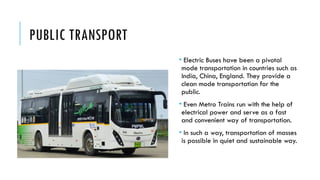
• ElectricBuses have been a pivotal
mode transportation in countries such as
India, China, England. They provide a
clean mode transportation for the
public.
• Even Metro Trains run with the help of
electrical power and serve as a fast
and convenient way of transportation.
• In such a way, transportation of masses
is possible in quiet and sustainable way.
10.
SOCIAL BENEFITS
• Cleanerair is one of the major benefits of using electric vehicles that reduces the
diseases such as asthma, lung disease and ensures clean air is available for the
public.
• It leads to a lesser dependance on fossil fuels which are scarce and ensures energy
security. This is a good step in sustainability.
• Electric Vehicles are quieter and leads to lesser noise pollution which is good for
mental health and ensure a peaceful atmosphere.
• Small scale vehicles can be used to help those with disabilities and for short range
transportation for old folk.
11.
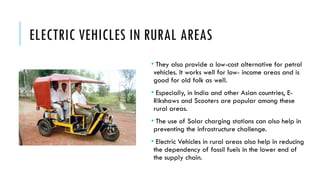
ELECTRIC VEHICLES INRURAL AREAS
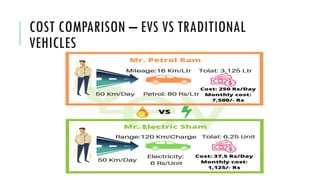
• They also provide a low-cost alternative for petrol
vehicles. It works well for low- income areas and is
good for old folk as well.
• Especially, in India and other Asian countries, E-
Rikshaws and Scooters are popular among these
rural areas.
• The use of Solar charging stations can also help in
preventing the infrastructure challenge.
• Electric Vehicles in rural areas also help in reducing
the dependency of fossil fuels in the lower end of
the supply chain.
12.
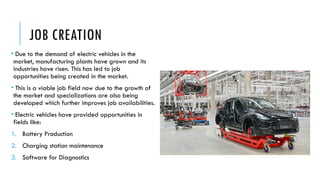
JOB CREATION
• Dueto the demand of electric vehicles in the
market, manufacturing plants have grown and its
industries have risen. This has led to job
opportunities being created in the market.
• This is a viable job field now due to the growth of
the market and specializations are also being
developed which further improves job availabilities.
• Electric vehicles have provided opportunities in
fields like:
1. Battery Production
2. Charging station maintenance
3. Software for Diagnostics
13.
GOVERNMENT POLICIES
Governments aroundthe world have included policies that provide exposure and
preference to electric vehicles. Some of these are policies are:
• India: FAME II which provides tax cuts.
• USA: Federal EV tax credit.
• EU: Ban on new ICE vehicle sales from 2035
Various other schemes have also help aid the promotion of electric vehicles.
14.
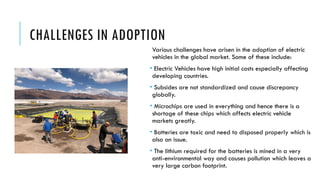
CHALLENGES IN ADOPTION
Variouschallenges have arisen in the adoption of electric
vehicles in the global market. Some of these include:
• Electric Vehicles have high initial costs especially affecting
developing countries.
• Subsides are not standardized and cause discrepancy
globally.
• Microchips are used in everything and hence there is a
shortage of these chips which affects electric vehicle
markets greatly.
• Batteries are toxic and need to disposed properly which is
also an issue.
• The lithium required for the batteries is mined in a very
anti-environmental way and causes pollution which leaves a
very large carbon footprint.
15.
CHARGING INFRASTRUCTURE
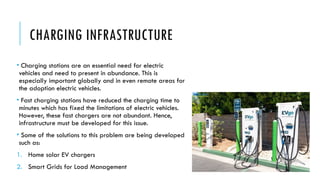
• Chargingstations are an essential need for electric
vehicles and need to present in abundance. This is
especially important globally and in even remote areas for
the adoption electric vehicles.
• Fast charging stations have reduced the charging time to
minutes which has fixed the limitations of electric vehicles.
However, these fast chargers are not abundant. Hence,
infrastructure must be developed for this issue.
• Some of the solutions to this problem are being developed
such as:
1. Home solar EV chargers
2. Smart Grids for Load Management
16.
INNOVATIONS IN BATTERYTECHNOLOGY
• Solid state batteries are being developed which are
safer and can hold charge for longer periods of time.
• Currently, Lithium batteries are being used but,
experiments are being conducted with Lithium Sulphur as
well as with Graphene to develop a better and safer
battery.
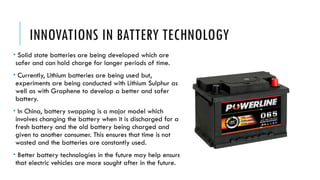
• In China, battery swapping is a major model which
involves changing the battery when it is discharged for a
fresh battery and the old battery being charged and
given to another consumer. This ensures that time is not
wasted and the batteries are constantly used.
• Better battery technologies in the future may help ensure
that electric vehicles are more sought after in the future.
17.
FUTURE TRENDS
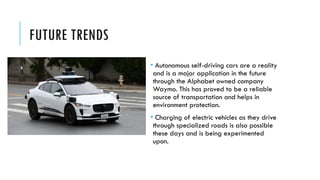
• Autonomousself-driving cars are a reality
and is a major application in the future
through the Alphabet owned company
Waymo. This has proved to be a reliable
source of transportation and helps in
environment protection.
• Charging of electric vehicles as they drive
through specialized roads is also possible
these days and is being experimented
upon.
18.
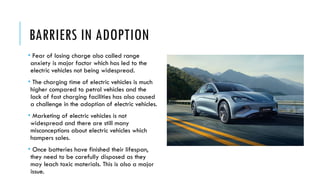
BARRIERS IN ADOPTION
•Fear of losing charge also called range
anxiety is major factor which has led to the
electric vehicles not being widespread.
• The charging time of electric vehicles is much
higher compared to petrol vehicles and the
lack of fast charging facilities has also caused
a challenge in the adoption of electric vehicles.
• Marketing of electric vehicles is not
widespread and there are still many
misconceptions about electric vehicles which
hampers sales.
• Once batteries have finished their lifespan,
they need to be carefully disposed as they
may leach toxic materials. This is also a major
issue.
19.
CONCLUSION
Electric vehicles arean eco-friendly alternative to conventional methods of transport.
Many misconceptions still exist about them which are not true and need to be cleared
up from the consumer’s minds. That being said, electric vehicles have problems that
need to be addressed and research needs to be performed to resolve these issues.
Conventional and electric vehicles can both be used in harmony to suit the necessary
needs.