THE
FINAL
STATE
OF
THE
WICKED
THE
FINAL
STATE
OF
THE
WICKED
2Pe 3:3 Knowing this
first, that there shall
come in the last days
scoffers, walking after
their own lusts,
2Pe 3:4 And saying,
Where is the promise of
his coming? for since
the fathers fell asleep,
all things continue as
they were from the
beginning of the
creation.
Let me introduce you to one Robert Peterson who today lists
four different views that questions the reality of hell.
[1] Life after death is unlikely
[2] Everyone goes to heaven
[3] Unbelievers get a chance after death
[4] Unbelievers are ultimately destroyed.
Sometimes different words are used to express their doubts,
but the doubt remains the same.
And through the years several philosophers have doubted
that there is life after death.
The suggestion is that modern science has dispelled the
religious myths about heaven and hell.
Bertram Russell, actually agnostic, was one of the leading
lights of the view that life after death is unlikely.
The 2nd way that some view the lfe afte this one is to
think that everyone will be saved. As early as Origen
the expectation was expressed that all men would be
restored to holiness and blessedness, a hope which
included Satan and all other demonic spirits.
Karl Barth taught that all human beings
already share universally in the salvation
brought by Jesus Christ and need only to be
informed of that fact. This is a product of
Barths view that all humanity is elected in
Jesus as the God-man and that sin and
unbelief are ontologically impossible.
John Hick, a well-known British philosopher of religion also
rejects the traditional teaching about hell.
He says that the idea of God inflicting sinners with
unending torments is "a serious perversion of the
Christians Gospel."
He adds in another place that the concept of eternal
punishment is "morally revolting" because it attributes "to
God an unappeasable vindictiveness and insatiable
cruelty”.
However none of these writers give proper attention to
clear Biblical Teaching. Their views are based more on a
view of God than on Scripture.
WE MUST REMEMBER THAT WE CAN
ONLY KNOW WHAT GOD TEACHES
BY STUDYING THE SCRIPTURES.
The third objection to the concept of an eternal
hell is the view that the unbelievers will be
given another opportunity to hear the gospel.
Clark Pinnock is one of the leading advocates of this view.
He informs us that his biew is based "on the insight that
God, since he loves humanity, would not send anyone to
hell without first ascertaining what their response would
have been to his grace.
NOTE--that Pinnock is not suggesting universalism
because those who have heard the gospel and
declined the offer of salvation may not have
another opportunity.
There are also those who may have a chance to
accept the gospel but will not do so.
He says, "the opportunity would be there to
repent after death but not necessarily the desire."
The view that God will give people an opportunity
to accept the gospel after physical death has not
been widely accepted.
One reason for this is that the scriptures seem to
be clear that one's destiny is sealed at the point of
physical death.
The fourth view of the future of the
wicked is that the unbelievers will
ultimately be destroyed, that is,
annihilated or, in different words,
reduced to nonexistence. For those
espousing this view--it began back in
the fourth century by Arnoblus.
Others, like the Jehovah's witnesses and the 7-day
advents, have held this view through the years
since.
In recent years this same view has been newly
advanced by scholars like J. R. W. Stott, Philip E.
Huges, and Steven Travis.
Another author which should be mentioned
because of his influence is Edward W. Fudge who is
also pushing this doctrine.
There are basically three arguments which are made to
support the concept that the wicked are annihilated.
[1] It is argued that some NT passages teach that the
unbeliever will "perish." John 3:16 is often quoted-- For God
so loved the world, that he gave his only begotten Son, that
whosoever believeth in him should not perish, but have
everlasting life.
And a point is made about the contrast between "ETERNAL
LIFE" and "PERISH."The same Greek word is used in Matt
10:28-- And fear not them which kill the body, but are not
able to kill the soul: but rather fear him which is able to
destroy both soul and body in hell.
Stott argues that we should take the language at face value
for both concepts. He says, " it would seem strange,
therefore, If people who are said to suffer destruction are in
fact not destroyed.
Stott, in order to make this argument, must show that the
word translated "perish" in John 3:16 must mean "to
annihilate," a thing that he cannot do.
The word used means "be lost, perish, be ruined" It has the
meaning in such passages of something that does not
lose its being, but refers to the loss of its "WELL-
BEING."
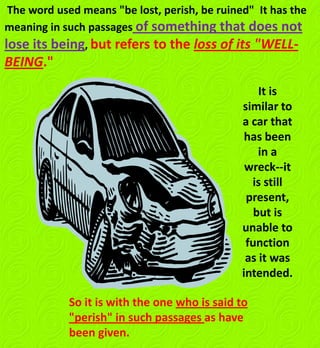
It is
similar to
a car that
has been
in a
wreck--it
is still
present,
but is
unable to
function
as it was
intended.
So it is with the one who is said to
"perish" in such passages as have
been given.
Argument--2--that is used for annihilationism
centers in the use of images or symbols to
describe hell. Jesus spoke of "the hell of
fire"[Matt 5:22;18:9] and of "eternal fire"[Matt
18:8;25:41].
The argument is made that the references to fire
are basically intended to show consumption of
what is placed in the fire, not to show torment or
pain.
Whatever is thrown into the fire would "be
consumed for ever, not tormented for ever.
Hence it is the smoke{evidence that the fire has
done it work which "rise for ever and ever."
3nd argument for annihilation is based on the
biblical view of justice. Scripture teaches that God
will judge people according to their deeds {2 Cor
5:10}, which is taken to imply that the penalty
given will be equal to the evil done.
But discussion of eternal punishment must not be
based on human feelings, nor should it be
removed from the whole subject of the character
of God, the nature of evil, and the requirements
for justice.
If men could actually understand how terrible sin
is, this objection would most likely never be
raised.
Another question about eternal punishment is: "Is not God
defeated in his purpose if a single soul is ultimately lost?"
C.S. Lewis answers this question with this statement: In a
sense, yes, but this was the chance God took in creating
beings with free wills. Remember also that those in hell will
be there of their own volition. refusing to give up the selves
they have chosen above God.
The view of the state of unbelievers and the wicked
presented in this study is that they will suffer eternally in hell.
The views given to date are based on the thought that this
view is too harsh.
The only way to answer this question is to look to the
scriptures.
As we begin it should be noted that Jesus said more about
Hell than any other person in the New Testament.
In fact, He used the word hell every time it is used in the New
Testament except the the one time it is used by James in 3:6
referring to the source of evil speech.
The Greek word translated hell is "Ghenna."
it drives from an Aramic expression "gee
hinnom", which means "valley of Hinnom."
This valley was just south of Jerusalem where
children were offered as sacrifices to the
Ammonite god molech{2Kgs 16:3, 21:6; Jer.
7:31, 19:5]
It is also the valley where the refuse of
Jerusalem was burned.
The valley became a type of sin and woe and
finally the word Gehenna came to be the term
used to refer to the eschatological fire of hell
and for the place of final punishment for the
wicked.
The biblical teaching is clear that the sin will be
punished{Dan 12:2,Matt 10:15, John 5:28,29; Rom
2:5-11}and that the duration of that punishment
is often expressed in the NT by the word "AION"
or a derivative.
The word means "an age." its use for the "age to
come" gave rise to its adjective form "AIONIOS"
which means "eternal" or "everlasting."
This word is used 70 times in the NT. It is used to
refer to God-- Rom 16-26 as well as ascribing glory
to God "forever" in 2cor 11:31.
It would be almost impossible to convey the
concept of endless duration more strongly that
this word does.
The consistent use of this adjective to express the
eternalness of God shows conclusively that it does
not mean limited duration unless there is
sufficient evident to limit it to its immediate
context.
The consistent use of this adjective to express the
eternalness of God shows conclusively that it does not mean
limited duration unless there is sufficient evident to limit it to
its immediate context.
It is important to note that the same adjective is used to
describe punishment that is used to describe the life given by
God Matt 25:46.
The punishment is as long lasting as the life. One is no more
limited than the other.
The suggestion that "eternal punishment" simply means that
the punishment is irreversible does not seem to harmonize
with the above statements of Scripture.
Of course, the punishment is irreversible, but Scripture
indicates that it is also continuous, conscious existence.
Jesus describes hell as "inquenchable fire"-Mk 9:43, and, as a
place "where their worm does not die, and the fire is not
quenched-Mk 9:47-48.
He also speaks about fearing God because he has power to
cast into hell after He has killed Lk 12:5. Jesus also speaks
of a sin that will not be forgiven "either in this age or in the
age to come" Matt 12:32.
He also spoke of the door being shut--Matt 25:10, of some
being cast out into the outer darkness; in that place "there
will be weeping and gnashing of teeth"-matt 8:12, and of
an impassible gulf after this life. Luke 16:26.
John records Jesus' statement "He who believes in the Son
has eternal life; but he who does not obey the Son shall
not see life, but the wrath of God abides on him"-Jn 3:36.
To those on His left at judgment, the Lord will say, "Depart
from me, accursed ones, into the eternal fire which has
been prepared for the devil and his angels."—
Matt 25:41.
The punishment for the devil and his angels is described as
"torment day and night forever and ever."-Rev 20:10.
All of these passages especially
the last, signify,
"NOT EXTINCTION IN
OPPOSITON TO
EXISTENCE, BUT
TORTUROUS EXISTENCE
IN THE SOCIETY OF EVIL
TO OPPOSITION TO LIFE
IN THE SOCEITY OF GOD."
It is true that the descriptive terms for hell are
figurative.
It is also true that the figures impart information that
must be taken in harmony with the context and given
the most natural meaning unless there is good reason
not to do so.
There is no good reason to deny the clear indication of
Jesus' teaching.
The mention of "fire" in connection with eternal
punishment does not necessitate the idea that "fire
consumes." Therefore, the wicked are not consumed
or annihilated.“
Was the bush seen by Moses consumed by
the fire?--Ex 4:27. Certainly not! We cannot
allow human experience and wisdom to limit
our understanding of God.
The claim that eternal torment serves no useful purpose but
exhibits a vindictiveness' incompatible with the love of God in
Christ also assumes that man can know and understand God
fully...
Such is not the case Isa 55:8-9. Such claims tend to make man
more loving and kind than God.
There are a number of things in God's Word that we do not
fully understand.
It is concerning that the matter under discussion that our
feelings influence us and on occasion may affect our thinking.
We rejoice at the prospects of heaven and tend to shrink from
the pains of hell.
Yet, the one mystery is as much within the range of our
intellect as the other for both express something of the
immeasurable expression of His infinite holiness.
Let us remember that the question is not how men respond to
a biblical teaching, but what Jesus and the New Testament
writers actually say about it.
Keep in mind that it is true that the bible never says "The soul
is immortal.
However, the idea of continual existence is indicated and that
is not necessarily the same things as immortality.
Immortality has to do with a kind of existence which is in
fellowship with God. The eternal part of man is inherent in his
makeup. He is created in God's image and likeness{Gen 1:26-
27}.That likeness has not been lost{James 3:9}.
When Scripture speaks of the wicked being destroyed or
perishing, the meaning is not that they cease to exist.
The destruction spoken of is the loss of well-being, not the
loss of being itself.
No word used to describe the final state of the wicked must
indicate annihilation. Neither is that the natural meaning of
any such word in its context.
The very nature of God demands that the
wicked be punished.
That punishment is spoken of in scripture
consistently in terms which show it to be
terrible, conscious and non -ending.
This warning is one motive for being what
God wants us to be--Acts 17:30-31; Rom.
2:4-11.
An understanding of the teaching about
eternal punishment, should also motivate
us to greater efforts to evangelize those
who do not know Christ as Saviour.
Please keep in mind that as we go on
Jesus said more about hell than anyone!!
Luk_16:23 And in hell
he lift up his eyes,
being in torments, and
seeth Abraham afar
off, and Lazarus in
his bosom.
"And he cried and said, Father
Abraham, have mercy on me, and
send Lazarus, that he may dip the tip
of his finger in water, and cool my
tongue; for I am tormented in this
flame."
Well, I don't know about you--but I am not
interested in going to Hell as described in the
scriptures--ARE YOU?
Here we have the testimony of a man who is
here and clearly is in torment.
Now--ARE YOU GOING TO BE THERE? No, I agree
with you--I don't know of many folks who desire
to go to hell when they die.
But the question still is: WHAT ABOUT YOU? ARE
GOING TO END UP IN HELL WHEN YOU DIE? Yes,
I know, you don't want to...but are you going to
end up in HELL WHEN YOU DIE?
Take a few moments and think about this--after
all wouldn't you rather take a few moments now
rather than after death with no options of
making any changes in life?
For a long long time I thought about Hell
as being a Place of fire and torment. And,
it is most certainly Going to be that but it
is so much more than just FIRE AND
BRIMSTONE.
So put this picture in your mind and hold
on to it!
Now you have this picture—keep it in the
next slide.
So, How do we as human beings react to the teaching
about Hell?
We have folks who deal with Hell by denying its
existence or that somehow the Words God used to
describe both heaven and hell identically-only apply to
Heaven.
Psa_9:17 The wicked shall be turned into hell, and all
the nations that forget God.
Luk_12:5 But I will forewarn you whom ye shall fear:
Fear him, which after he hath killed hath power to cast
into hell; yea, I say unto you, Fear him.
2Pe_2:4 For if God spared not the angels that sinned,
but cast them down to hell, and delivered them into
chains of darkness, to be reserved unto judgment;
Rev_20:14 And death and hell were cast into the lake of
fire. This is the second death.
So, we can know that some folks are already going to
be there--BUT WILL YOU BE ONE OF THE LOST SOULS IN
HELL?
[1] Those nations who have forgotten God
[2] The wicked
Number one is easy to figure out but number 2 is not so
easy because we fumble the examination here.. We
place the "wicked" as folks who do bad things and we
need to remember that God not only defines the
wicked as such--as you and I do but also as those who
disobey His Son and His Word.
Look at this text--Keep in Mind that Jesus is talking to
people who know and who believe in God..but
nevertheless are lost.
Those people are the Jews of that day--
Mat 7:13 Go in through the narrow gate. The gate to
destruction is wide, and the road that leads there is easy
to follow. A lot of people go through that gate.
Mat 7:14 But the gate to life is very narrow. The road
that leads there is so hard to follow that only a few
people find it.
Mat 7:15 Watch out for false prophets! They dress up
like sheep, but inside they are wolves who have come to
attack you.
Mat 7:16 You can tell what they are by what they do. No
one picks grapes or figs from thornbushes. Mat 7:17 A
good tree produces good fruit, and a bad tree produces
bad fruit. Mat 7:18 A good tree cannot produce bad
fruit, and a bad tree cannot produce good fruit. Mat 7:19
Every tree that produces bad fruit will be chopped down
and burned.
Mat 7:20 You can tell who the false prophets are by
their deeds.
Mat 7:21 Not everyone who calls me their Lord will get
into the kingdom of heaven. Only the ones who obey my
Father in heaven will get in. {Complete Jewish Ver}
Mat 7:19 Every tree that produces bad fruit will be
chopped down and burned.
Mat 7:20 You can tell who the false prophets are by
their deeds.
Mat 7:21 Not everyone who calls me their Lord will get
into the kingdom of heaven. Only the ones who obey
my Father in heaven will get in. {Complete Jewish
Version}
The rich man did not open his eyes in the grave,
neither did he seek water in a generic "unseen world."
He was in HELL! In contrast Lazuras was not in Hell,
even though he was in the "unseen world, " he was in
Abraham's bosom.
A saved person is never said to be in Hades.
Rom 6:17 But God be thanked, that ye were the
servants of sin, but ye have obeyed from the heart that
form of doctrine which was delivered you.
Now, we can begin to see why a lot of folks
tend to not think about Hell at all but we
must. We must? Yes, for each and every one
of us is going to die…
That is our soul is going to be separated from
our bodies. The body which was dust returns
to the ground but our souls will be 'eternally
either in heaven or in hell!"
DEVIL
DRAGON
SATAN
SERPENT
We want to offer a bible study for your consideration
that is vastly different from many you may have viewed
previously.
The first two lessons are on War and the commonality of
Man. Yes, at one time man was united together but
disobedience caused God to intervene and thus we have
the development of nations.
And, there is an intense war--not between human beings
but by powers larger and more powerful than all of us
put together.
This is a ten lesson email bible course that you can easily
read in 3-5 minutes each even if you are a real slow
reader. You will receive one a day and that's it.
You are totally free to unsubscribe at any time-- there is
no cost to you and no ongoing commitment required.
you can go here To subscribe
You are also free to share this book with whomever you
want.
If you have received this from someone you know and
Want to know how the battle developed and how you
Could be losing and not know it until it is too late—
GO HERE
CLICK HERE
AND TAKE
THE COURSE

Eternal torment

  • 1.
  • 2.
    2Pe 3:3 Knowingthis first, that there shall come in the last days scoffers, walking after their own lusts, 2Pe 3:4 And saying, Where is the promise of his coming? for since the fathers fell asleep, all things continue as they were from the beginning of the creation.
  • 3.
    Let me introduceyou to one Robert Peterson who today lists four different views that questions the reality of hell. [1] Life after death is unlikely [2] Everyone goes to heaven [3] Unbelievers get a chance after death [4] Unbelievers are ultimately destroyed. Sometimes different words are used to express their doubts, but the doubt remains the same. And through the years several philosophers have doubted that there is life after death. The suggestion is that modern science has dispelled the religious myths about heaven and hell. Bertram Russell, actually agnostic, was one of the leading lights of the view that life after death is unlikely.
  • 4.
    The 2nd waythat some view the lfe afte this one is to think that everyone will be saved. As early as Origen the expectation was expressed that all men would be restored to holiness and blessedness, a hope which included Satan and all other demonic spirits. Karl Barth taught that all human beings already share universally in the salvation brought by Jesus Christ and need only to be informed of that fact. This is a product of Barths view that all humanity is elected in Jesus as the God-man and that sin and unbelief are ontologically impossible.
  • 5.
    John Hick, awell-known British philosopher of religion also rejects the traditional teaching about hell. He says that the idea of God inflicting sinners with unending torments is "a serious perversion of the Christians Gospel." He adds in another place that the concept of eternal punishment is "morally revolting" because it attributes "to God an unappeasable vindictiveness and insatiable cruelty”. However none of these writers give proper attention to clear Biblical Teaching. Their views are based more on a view of God than on Scripture. WE MUST REMEMBER THAT WE CAN ONLY KNOW WHAT GOD TEACHES BY STUDYING THE SCRIPTURES.
  • 6.
    The third objectionto the concept of an eternal hell is the view that the unbelievers will be given another opportunity to hear the gospel. Clark Pinnock is one of the leading advocates of this view. He informs us that his biew is based "on the insight that God, since he loves humanity, would not send anyone to hell without first ascertaining what their response would have been to his grace.
  • 7.
    NOTE--that Pinnock isnot suggesting universalism because those who have heard the gospel and declined the offer of salvation may not have another opportunity. There are also those who may have a chance to accept the gospel but will not do so. He says, "the opportunity would be there to repent after death but not necessarily the desire." The view that God will give people an opportunity to accept the gospel after physical death has not been widely accepted. One reason for this is that the scriptures seem to be clear that one's destiny is sealed at the point of physical death.
  • 8.
    The fourth viewof the future of the wicked is that the unbelievers will ultimately be destroyed, that is, annihilated or, in different words, reduced to nonexistence. For those espousing this view--it began back in the fourth century by Arnoblus. Others, like the Jehovah's witnesses and the 7-day advents, have held this view through the years since. In recent years this same view has been newly advanced by scholars like J. R. W. Stott, Philip E. Huges, and Steven Travis. Another author which should be mentioned because of his influence is Edward W. Fudge who is also pushing this doctrine.
  • 9.
    There are basicallythree arguments which are made to support the concept that the wicked are annihilated. [1] It is argued that some NT passages teach that the unbeliever will "perish." John 3:16 is often quoted-- For God so loved the world, that he gave his only begotten Son, that whosoever believeth in him should not perish, but have everlasting life. And a point is made about the contrast between "ETERNAL LIFE" and "PERISH."The same Greek word is used in Matt 10:28-- And fear not them which kill the body, but are not able to kill the soul: but rather fear him which is able to destroy both soul and body in hell. Stott argues that we should take the language at face value for both concepts. He says, " it would seem strange, therefore, If people who are said to suffer destruction are in fact not destroyed. Stott, in order to make this argument, must show that the word translated "perish" in John 3:16 must mean "to annihilate," a thing that he cannot do.
  • 10.
    The word usedmeans "be lost, perish, be ruined" It has the meaning in such passages of something that does not lose its being, but refers to the loss of its "WELL- BEING." It is similar to a car that has been in a wreck--it is still present, but is unable to function as it was intended. So it is with the one who is said to "perish" in such passages as have been given.
  • 11.
    Argument--2--that is usedfor annihilationism centers in the use of images or symbols to describe hell. Jesus spoke of "the hell of fire"[Matt 5:22;18:9] and of "eternal fire"[Matt 18:8;25:41]. The argument is made that the references to fire are basically intended to show consumption of what is placed in the fire, not to show torment or pain. Whatever is thrown into the fire would "be consumed for ever, not tormented for ever. Hence it is the smoke{evidence that the fire has done it work which "rise for ever and ever."
  • 12.
    3nd argument forannihilation is based on the biblical view of justice. Scripture teaches that God will judge people according to their deeds {2 Cor 5:10}, which is taken to imply that the penalty given will be equal to the evil done. But discussion of eternal punishment must not be based on human feelings, nor should it be removed from the whole subject of the character of God, the nature of evil, and the requirements for justice. If men could actually understand how terrible sin is, this objection would most likely never be raised.
  • 13.
    Another question abouteternal punishment is: "Is not God defeated in his purpose if a single soul is ultimately lost?" C.S. Lewis answers this question with this statement: In a sense, yes, but this was the chance God took in creating beings with free wills. Remember also that those in hell will be there of their own volition. refusing to give up the selves they have chosen above God. The view of the state of unbelievers and the wicked presented in this study is that they will suffer eternally in hell. The views given to date are based on the thought that this view is too harsh. The only way to answer this question is to look to the scriptures. As we begin it should be noted that Jesus said more about Hell than any other person in the New Testament. In fact, He used the word hell every time it is used in the New Testament except the the one time it is used by James in 3:6 referring to the source of evil speech.
  • 14.
    The Greek wordtranslated hell is "Ghenna." it drives from an Aramic expression "gee hinnom", which means "valley of Hinnom." This valley was just south of Jerusalem where children were offered as sacrifices to the Ammonite god molech{2Kgs 16:3, 21:6; Jer. 7:31, 19:5] It is also the valley where the refuse of Jerusalem was burned. The valley became a type of sin and woe and finally the word Gehenna came to be the term used to refer to the eschatological fire of hell and for the place of final punishment for the wicked.
  • 15.
    The biblical teachingis clear that the sin will be punished{Dan 12:2,Matt 10:15, John 5:28,29; Rom 2:5-11}and that the duration of that punishment is often expressed in the NT by the word "AION" or a derivative. The word means "an age." its use for the "age to come" gave rise to its adjective form "AIONIOS" which means "eternal" or "everlasting." This word is used 70 times in the NT. It is used to refer to God-- Rom 16-26 as well as ascribing glory to God "forever" in 2cor 11:31. It would be almost impossible to convey the concept of endless duration more strongly that this word does. The consistent use of this adjective to express the eternalness of God shows conclusively that it does not mean limited duration unless there is sufficient evident to limit it to its immediate context.
  • 16.
    The consistent useof this adjective to express the eternalness of God shows conclusively that it does not mean limited duration unless there is sufficient evident to limit it to its immediate context. It is important to note that the same adjective is used to describe punishment that is used to describe the life given by God Matt 25:46. The punishment is as long lasting as the life. One is no more limited than the other. The suggestion that "eternal punishment" simply means that the punishment is irreversible does not seem to harmonize with the above statements of Scripture. Of course, the punishment is irreversible, but Scripture indicates that it is also continuous, conscious existence. Jesus describes hell as "inquenchable fire"-Mk 9:43, and, as a place "where their worm does not die, and the fire is not quenched-Mk 9:47-48.
  • 17.
    He also speaksabout fearing God because he has power to cast into hell after He has killed Lk 12:5. Jesus also speaks of a sin that will not be forgiven "either in this age or in the age to come" Matt 12:32. He also spoke of the door being shut--Matt 25:10, of some being cast out into the outer darkness; in that place "there will be weeping and gnashing of teeth"-matt 8:12, and of an impassible gulf after this life. Luke 16:26. John records Jesus' statement "He who believes in the Son has eternal life; but he who does not obey the Son shall not see life, but the wrath of God abides on him"-Jn 3:36. To those on His left at judgment, the Lord will say, "Depart from me, accursed ones, into the eternal fire which has been prepared for the devil and his angels."— Matt 25:41. The punishment for the devil and his angels is described as "torment day and night forever and ever."-Rev 20:10.
  • 18.
    All of thesepassages especially the last, signify, "NOT EXTINCTION IN OPPOSITON TO EXISTENCE, BUT TORTUROUS EXISTENCE IN THE SOCIETY OF EVIL TO OPPOSITION TO LIFE IN THE SOCEITY OF GOD."
  • 19.
    It is truethat the descriptive terms for hell are figurative. It is also true that the figures impart information that must be taken in harmony with the context and given the most natural meaning unless there is good reason not to do so. There is no good reason to deny the clear indication of Jesus' teaching. The mention of "fire" in connection with eternal punishment does not necessitate the idea that "fire consumes." Therefore, the wicked are not consumed or annihilated.“ Was the bush seen by Moses consumed by the fire?--Ex 4:27. Certainly not! We cannot allow human experience and wisdom to limit our understanding of God.
  • 20.
    The claim thateternal torment serves no useful purpose but exhibits a vindictiveness' incompatible with the love of God in Christ also assumes that man can know and understand God fully... Such is not the case Isa 55:8-9. Such claims tend to make man more loving and kind than God. There are a number of things in God's Word that we do not fully understand. It is concerning that the matter under discussion that our feelings influence us and on occasion may affect our thinking. We rejoice at the prospects of heaven and tend to shrink from the pains of hell. Yet, the one mystery is as much within the range of our intellect as the other for both express something of the immeasurable expression of His infinite holiness. Let us remember that the question is not how men respond to a biblical teaching, but what Jesus and the New Testament writers actually say about it.
  • 21.
    Keep in mindthat it is true that the bible never says "The soul is immortal. However, the idea of continual existence is indicated and that is not necessarily the same things as immortality. Immortality has to do with a kind of existence which is in fellowship with God. The eternal part of man is inherent in his makeup. He is created in God's image and likeness{Gen 1:26- 27}.That likeness has not been lost{James 3:9}. When Scripture speaks of the wicked being destroyed or perishing, the meaning is not that they cease to exist. The destruction spoken of is the loss of well-being, not the loss of being itself. No word used to describe the final state of the wicked must indicate annihilation. Neither is that the natural meaning of any such word in its context.
  • 22.
    The very natureof God demands that the wicked be punished. That punishment is spoken of in scripture consistently in terms which show it to be terrible, conscious and non -ending. This warning is one motive for being what God wants us to be--Acts 17:30-31; Rom. 2:4-11. An understanding of the teaching about eternal punishment, should also motivate us to greater efforts to evangelize those who do not know Christ as Saviour. Please keep in mind that as we go on Jesus said more about hell than anyone!!
  • 23.
    Luk_16:23 And inhell he lift up his eyes, being in torments, and seeth Abraham afar off, and Lazarus in his bosom. "And he cried and said, Father Abraham, have mercy on me, and send Lazarus, that he may dip the tip of his finger in water, and cool my tongue; for I am tormented in this flame."
  • 24.
    Well, I don'tknow about you--but I am not interested in going to Hell as described in the scriptures--ARE YOU? Here we have the testimony of a man who is here and clearly is in torment. Now--ARE YOU GOING TO BE THERE? No, I agree with you--I don't know of many folks who desire to go to hell when they die. But the question still is: WHAT ABOUT YOU? ARE GOING TO END UP IN HELL WHEN YOU DIE? Yes, I know, you don't want to...but are you going to end up in HELL WHEN YOU DIE? Take a few moments and think about this--after all wouldn't you rather take a few moments now rather than after death with no options of making any changes in life?
  • 25.
    For a longlong time I thought about Hell as being a Place of fire and torment. And, it is most certainly Going to be that but it is so much more than just FIRE AND BRIMSTONE. So put this picture in your mind and hold on to it! Now you have this picture—keep it in the next slide.
  • 27.
    So, How dowe as human beings react to the teaching about Hell? We have folks who deal with Hell by denying its existence or that somehow the Words God used to describe both heaven and hell identically-only apply to Heaven. Psa_9:17 The wicked shall be turned into hell, and all the nations that forget God. Luk_12:5 But I will forewarn you whom ye shall fear: Fear him, which after he hath killed hath power to cast into hell; yea, I say unto you, Fear him. 2Pe_2:4 For if God spared not the angels that sinned, but cast them down to hell, and delivered them into chains of darkness, to be reserved unto judgment; Rev_20:14 And death and hell were cast into the lake of fire. This is the second death.
  • 28.
    So, we canknow that some folks are already going to be there--BUT WILL YOU BE ONE OF THE LOST SOULS IN HELL? [1] Those nations who have forgotten God [2] The wicked Number one is easy to figure out but number 2 is not so easy because we fumble the examination here.. We place the "wicked" as folks who do bad things and we need to remember that God not only defines the wicked as such--as you and I do but also as those who disobey His Son and His Word. Look at this text--Keep in Mind that Jesus is talking to people who know and who believe in God..but nevertheless are lost. Those people are the Jews of that day--
  • 29.
    Mat 7:13 Goin through the narrow gate. The gate to destruction is wide, and the road that leads there is easy to follow. A lot of people go through that gate. Mat 7:14 But the gate to life is very narrow. The road that leads there is so hard to follow that only a few people find it. Mat 7:15 Watch out for false prophets! They dress up like sheep, but inside they are wolves who have come to attack you. Mat 7:16 You can tell what they are by what they do. No one picks grapes or figs from thornbushes. Mat 7:17 A good tree produces good fruit, and a bad tree produces bad fruit. Mat 7:18 A good tree cannot produce bad fruit, and a bad tree cannot produce good fruit. Mat 7:19 Every tree that produces bad fruit will be chopped down and burned. Mat 7:20 You can tell who the false prophets are by their deeds. Mat 7:21 Not everyone who calls me their Lord will get into the kingdom of heaven. Only the ones who obey my Father in heaven will get in. {Complete Jewish Ver}
  • 30.
    Mat 7:19 Everytree that produces bad fruit will be chopped down and burned. Mat 7:20 You can tell who the false prophets are by their deeds. Mat 7:21 Not everyone who calls me their Lord will get into the kingdom of heaven. Only the ones who obey my Father in heaven will get in. {Complete Jewish Version} The rich man did not open his eyes in the grave, neither did he seek water in a generic "unseen world." He was in HELL! In contrast Lazuras was not in Hell, even though he was in the "unseen world, " he was in Abraham's bosom. A saved person is never said to be in Hades. Rom 6:17 But God be thanked, that ye were the servants of sin, but ye have obeyed from the heart that form of doctrine which was delivered you.
  • 31.
    Now, we canbegin to see why a lot of folks tend to not think about Hell at all but we must. We must? Yes, for each and every one of us is going to die… That is our soul is going to be separated from our bodies. The body which was dust returns to the ground but our souls will be 'eternally either in heaven or in hell!"
  • 33.
  • 34.
    We want tooffer a bible study for your consideration that is vastly different from many you may have viewed previously. The first two lessons are on War and the commonality of Man. Yes, at one time man was united together but disobedience caused God to intervene and thus we have the development of nations. And, there is an intense war--not between human beings but by powers larger and more powerful than all of us put together. This is a ten lesson email bible course that you can easily read in 3-5 minutes each even if you are a real slow reader. You will receive one a day and that's it. You are totally free to unsubscribe at any time-- there is no cost to you and no ongoing commitment required. you can go here To subscribe
  • 35.
    You are alsofree to share this book with whomever you want. If you have received this from someone you know and Want to know how the battle developed and how you Could be losing and not know it until it is too late— GO HERE
  • 36.