


Bright Star
in a dark place
(Chapter 3)
By Samuel E. Ward
For text version: cbckck.blogspot.com
1
Introduction
2
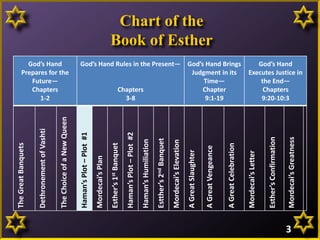
Chart of the
Book of Esther
3
God’s Hand
Prepares for the
Future—
Chapters
1-2
God’s Hand Rules in the Present—
Chapters
3-8
God’s Hand Brings
Judgment in its
Time—
Chapter
9:1-19
God’s Hand
Executes Justice in
the End—
Chapters
9:20-10:3
TheGreatBanquets
DethronementofVashti
TheChoiceofaNewQueen
Haman’sPlot–Plot#1
Mordecai’sPlan
Esther’s1stBanquet
Haman’sPlot–Plot#2
Haman’sHumiliation
Estther’s2ndBanquet
Mordecai’sElevation
AGreatSlaughter
AGreatVengeance
AGreatCelebration
Mordecai’sLetter
Esther’sConfirmation
Mordecai’sGreatness
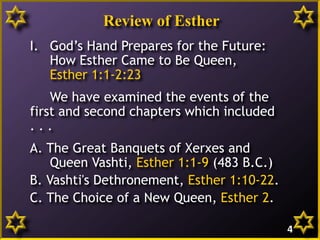
Review of Esther
I. God’s Hand Prepares for the Future:
How Esther Came to Be Queen,
Esther 1:1-2:23
We have examined the events of the
first and second chapters which included
. . .
A. The Great Banquets of Xerxes and
Queen Vashti, Esther 1:1-9 (483 B.C.)
B. Vashti's Dethronement, Esther 1:10-22.
C. The Choice of a New Queen, Esther 2.
4
II. God’s hand Rules
in the present
The events that threatened God’s
people, begin to unfold in this chapter.
However, God had providentially
prepared for these events. Throughout
the rest of this book are several
evidences that God still watches over
His people Israel, even those who live in
far distant lands. The situation is
reminiscent of the pleas of God’s people
in the days just prior to the Exodus.
5
(Exo 3:7 NIV) The LORD said, "I have
indeed seen the misery of my people in
Egypt. I have heard them crying out
because of their slave drivers, and I am
concerned about their suffering.
He is about to hear the cries of His
people again as indicated by their
“fasting, weeping, and wailing.” The
rest of the story is about how He
accomplishes it.
6
See the evidence of God’s hand
acting through the events that begin in
Esther 3.
We begin by taking note of . . .
A. Haman’s Plot to Exterminate the
Jews– Plot #1, Esther 3.
1. Instigated by Mordecai’s refusal to
bow to Haman, Esther 3:1-2.
7
It is hard to imagine, from what we
observe of Haman’s character, that his
arrogance and pride had gone unnoticed
by Xerxes.
Proverbs 26:1 (NIV 2011) Like snow in
summer or rain in harvest, honor is not
fitting for a fool.
Haman will prove the proverb.
Stupid Choice # 3: Xerxes gave the
place of honor to an arrogant and
ambitious fool.
8
There is a reason why God
established guidelines for the selection
of leaders within His church. It is
unwise to give positions of authority and
leadership just to fill vacant positions or
without regard to examination of
character and Christlikeness.
(1 Tim 3:1-7; 8-10,12)
9
2. Exacerbated by others’ sharing
gossip as a test of Haman’s
tolerance of Mordecai through
gossip, a Jew, Esther 3:3-4.
a. To separate good friends from
each other, Proverbs 17:9.
b. To fill their idle time and to be
disruptive,
2 Thessalonians 3:11.
c. To spread inappropriate and
often untrue things about
others, 1 Timothy 5:13.
10
3. Intensified by Haman’s hatred for
the whole of Mordecai’s people,
Esther 3:5-6. See Proverbs 16:27.
The literature suggests two
reasons why Mordecai would not bow
before Haman with scholars usually
favoring #1, #2, or both of the
following:
11
a. Mordecai considered bowing
before Haman an act of
sacrilege that should be
reserved for God alone.
The Expositor's Bible Commentary – Volume 4: 1 & 2 Kings, 1 & 2
Chronicles, Ezra, Nehemiah, Esther, Job.
b. Mordecai remembered the
history of Israel with Haman’s
people (the Amalekites
ambushed Israel when they
departed Egypt.)
See Exo 17-8-16;1 Sam 15:1-2.
Ibid.
12
4. Scheduled by the casting of lots
(the pur), Esther 3:7.
Fifteen centuries later the Apostle
Paul would preach on Mars Hill about a
God unknown to them Who was the true
Master of the universe. It was His
decision concerning the appointed times
and boundaries of nations, Acts 17:26.
13
5. Sought by Haman through the
offer of a bribe, Esther 3:8-9.
When a nation becomes corrupt in its
application of justice and the robbing
its people, it can expect two things:
a. A curse from God,
Deuteronomy 27:25
b. A path laid to destruction,
Proverbs 29:4
14
6. Financed freely by Xerxes without
question, Esther 3:10-11.
Xerxes’ willingness to take the
word of one man concerning a
whole nation of people stands as
an extreme example of a ruler
out of touch with his country.
15
For an example from Israel’s own
history of a king out of touch with his
people, we need only turn to
Rehoboam’s decision to make the labor
and tax burden on the people even
heavier than that imposed by his father,
Solomon, 1 Kings 12:10-11.
16
7. Activated with orders sanctioned
by Xerxes and sent by Haman to
all officials of the empire,
Esther 3:12-14.
8. Became a matter of celebration
for the king and Haman but
bewilderment for the citizens of
Susa, Esther 3:15.
17
Conclusions
1. Leadership is a stewardship from God for
the benefit of those being lead, not a
domain from which leaders seek to be
served by others so they can pursue
their own personal plans and ambitions.
(1 Cor 10:24 NIV) Nobody should seek
his own good, but the good of others.
18
2. God has not forgotten His promise to
Israel concerning her enemies.
(Gen 12:3 NIV) I will bless those who
bless you, and whoever curses you I will
curse; and all peoples on earth will be
blessed through you."
19
3. God is always watching the nations
and so the nations should be careful
when choosing to oppose Him. No
one can frustrate God’s plans for the
world and His people.
(Psa 66:7 NIV) He rules forever by his
power, his eyes watch the nations-- let
not the rebellious rise up against him.
Selah
20
(Isa 46:10 NIV) I make known the end
from the beginning, from ancient times,
what is still to come. I say: My purpose
will stand, and I will do all that I please.
21
The Book of Esther is a
testament to God’s
commitment to the promises
He makes to His people that
they shall be kept.
We can all sleep well
tonight.
22

Esther 3 ss

  • 1.
    Bright Star in adark place (Chapter 3) By Samuel E. Ward For text version: cbckck.blogspot.com 1
  • 2.
  • 3.
    Chart of the Bookof Esther 3 God’s Hand Prepares for the Future— Chapters 1-2 God’s Hand Rules in the Present— Chapters 3-8 God’s Hand Brings Judgment in its Time— Chapter 9:1-19 God’s Hand Executes Justice in the End— Chapters 9:20-10:3 TheGreatBanquets DethronementofVashti TheChoiceofaNewQueen Haman’sPlot–Plot#1 Mordecai’sPlan Esther’s1stBanquet Haman’sPlot–Plot#2 Haman’sHumiliation Estther’s2ndBanquet Mordecai’sElevation AGreatSlaughter AGreatVengeance AGreatCelebration Mordecai’sLetter Esther’sConfirmation Mordecai’sGreatness
  • 4.
    Review of Esther I.God’s Hand Prepares for the Future: How Esther Came to Be Queen, Esther 1:1-2:23 We have examined the events of the first and second chapters which included . . . A. The Great Banquets of Xerxes and Queen Vashti, Esther 1:1-9 (483 B.C.) B. Vashti's Dethronement, Esther 1:10-22. C. The Choice of a New Queen, Esther 2. 4
  • 5.
    II. God’s handRules in the present The events that threatened God’s people, begin to unfold in this chapter. However, God had providentially prepared for these events. Throughout the rest of this book are several evidences that God still watches over His people Israel, even those who live in far distant lands. The situation is reminiscent of the pleas of God’s people in the days just prior to the Exodus. 5
  • 6.
    (Exo 3:7 NIV)The LORD said, "I have indeed seen the misery of my people in Egypt. I have heard them crying out because of their slave drivers, and I am concerned about their suffering. He is about to hear the cries of His people again as indicated by their “fasting, weeping, and wailing.” The rest of the story is about how He accomplishes it. 6
  • 7.
    See the evidenceof God’s hand acting through the events that begin in Esther 3. We begin by taking note of . . . A. Haman’s Plot to Exterminate the Jews– Plot #1, Esther 3. 1. Instigated by Mordecai’s refusal to bow to Haman, Esther 3:1-2. 7
  • 8.
    It is hardto imagine, from what we observe of Haman’s character, that his arrogance and pride had gone unnoticed by Xerxes. Proverbs 26:1 (NIV 2011) Like snow in summer or rain in harvest, honor is not fitting for a fool. Haman will prove the proverb. Stupid Choice # 3: Xerxes gave the place of honor to an arrogant and ambitious fool. 8
  • 9.
    There is areason why God established guidelines for the selection of leaders within His church. It is unwise to give positions of authority and leadership just to fill vacant positions or without regard to examination of character and Christlikeness. (1 Tim 3:1-7; 8-10,12) 9
  • 10.
    2. Exacerbated byothers’ sharing gossip as a test of Haman’s tolerance of Mordecai through gossip, a Jew, Esther 3:3-4. a. To separate good friends from each other, Proverbs 17:9. b. To fill their idle time and to be disruptive, 2 Thessalonians 3:11. c. To spread inappropriate and often untrue things about others, 1 Timothy 5:13. 10
  • 11.
    3. Intensified byHaman’s hatred for the whole of Mordecai’s people, Esther 3:5-6. See Proverbs 16:27. The literature suggests two reasons why Mordecai would not bow before Haman with scholars usually favoring #1, #2, or both of the following: 11
  • 12.
    a. Mordecai consideredbowing before Haman an act of sacrilege that should be reserved for God alone. The Expositor's Bible Commentary – Volume 4: 1 & 2 Kings, 1 & 2 Chronicles, Ezra, Nehemiah, Esther, Job. b. Mordecai remembered the history of Israel with Haman’s people (the Amalekites ambushed Israel when they departed Egypt.) See Exo 17-8-16;1 Sam 15:1-2. Ibid. 12
  • 13.
    4. Scheduled bythe casting of lots (the pur), Esther 3:7. Fifteen centuries later the Apostle Paul would preach on Mars Hill about a God unknown to them Who was the true Master of the universe. It was His decision concerning the appointed times and boundaries of nations, Acts 17:26. 13
  • 14.
    5. Sought byHaman through the offer of a bribe, Esther 3:8-9. When a nation becomes corrupt in its application of justice and the robbing its people, it can expect two things: a. A curse from God, Deuteronomy 27:25 b. A path laid to destruction, Proverbs 29:4 14
  • 15.
    6. Financed freelyby Xerxes without question, Esther 3:10-11. Xerxes’ willingness to take the word of one man concerning a whole nation of people stands as an extreme example of a ruler out of touch with his country. 15
  • 16.
    For an examplefrom Israel’s own history of a king out of touch with his people, we need only turn to Rehoboam’s decision to make the labor and tax burden on the people even heavier than that imposed by his father, Solomon, 1 Kings 12:10-11. 16
  • 17.
    7. Activated withorders sanctioned by Xerxes and sent by Haman to all officials of the empire, Esther 3:12-14. 8. Became a matter of celebration for the king and Haman but bewilderment for the citizens of Susa, Esther 3:15. 17
  • 18.
    Conclusions 1. Leadership isa stewardship from God for the benefit of those being lead, not a domain from which leaders seek to be served by others so they can pursue their own personal plans and ambitions. (1 Cor 10:24 NIV) Nobody should seek his own good, but the good of others. 18
  • 19.
    2. God hasnot forgotten His promise to Israel concerning her enemies. (Gen 12:3 NIV) I will bless those who bless you, and whoever curses you I will curse; and all peoples on earth will be blessed through you." 19
  • 20.
    3. God isalways watching the nations and so the nations should be careful when choosing to oppose Him. No one can frustrate God’s plans for the world and His people. (Psa 66:7 NIV) He rules forever by his power, his eyes watch the nations-- let not the rebellious rise up against him. Selah 20
  • 21.
    (Isa 46:10 NIV)I make known the end from the beginning, from ancient times, what is still to come. I say: My purpose will stand, and I will do all that I please. 21
  • 22.
    The Book ofEsther is a testament to God’s commitment to the promises He makes to His people that they shall be kept. We can all sleep well tonight. 22