Essentials Of Financial Analysis 1st Edition G Thomas Friedlob
Essentials Of Financial Analysis 1st Edition G Thomas Friedlob
Essentials Of Financial Analysis 1st Edition G Thomas Friedlob
Essentials Of Financial Analysis 1st Edition G Thomas Friedlob
Essentials Of Financial Analysis 1st Edition G Thomas Friedlob
1.
Essentials Of FinancialAnalysis 1st Edition G
Thomas Friedlob download
https://ebookbell.com/product/essentials-of-financial-
analysis-1st-edition-g-thomas-friedlob-2490404
Explore and download more ebooks at ebookbell.com
iii
Contents
Preface iv
1 UnderstandingFinancial Statements and Annual Reports 1
2 Analyzing Profitability 33
3 Analyzing Liquidity and Solvency 71
4 Analyzing Activity with Financial and Nonfinancial
Measures 121
5 Quality of Earnings and Cash Flows 145
6 Earnings Releases and EVA Analysis 175
7 E-Business 207
Notes 226
Index 229
6.
iv
Preface
T
he financial analysisof companies is usually undertaken so that
investors, creditors, and other stakeholders can make decisions
about those companies.The focus of this book is on the financial
analysis of companies that are publicly traded and therefore make public
the data and information needed by stakeholders, who can then use the
analytical procedures included in this book.
The primary objectives in this book are to
• Provide an overview of financial statements and where and
how to obtain them.
• Explain how to use the information provided in annual reports
and Securities and Exchange Commission (SEC) filings, to
examine a company’s profitability, liquidity, and solvency.
• Examine various techniques for evaluating the market value of
companies based on their financial reports and stock prices.
• Discuss issues related to the quality of earnings and financial
reporting.
• Describe several ways of examining the cash flows of
companies.
• Describe new developments in areas like pro forma reporting,
economic value added (EVA), and discounted cash flow
methods.
7.
v
P r ef a c e
Chapter 1 starts by looking briefly at how accounting for resources
began.Then, an example of a set of financial statements (for Coca-Cola
Company) is included and their content explained. Following that is a
comparison of cash-basis and accrual-basis accounting.
Chapter 2 looks at profitability from many angles. Profits are
reported on the income statement, so we start with a look at the cate-
gories of earnings on the income statement.The chapter discusses oper-
ating income and comprehensive income and where to find that
information. Because revenue recognition is so much in the spotlight
lately, the basics of that principle are discussed. Four of the main analyt-
ical techniques used by financial analysts are included: return on assets
(ROA), return on equity (ROE), earnings per share (EPS), and the
price/earnings (P/E) ratio.
Chapter 3 examines the concepts of liquidity and solvency and how
to evaluate those attributes for a company.The primary focus is on the
balance sheet. However, also included are some cash flow adequacy
ratios,since lack of cash flow can force companies to declare bankruptcy.
The chapter discusses how leverage can affect a company.Also included
is a discussion of the auditor’s decision process when evaluating going
concern status.Finally,we include a demonstration of the use of Altman’s
Z score.
Chapter 4 examines the activity,effectiveness,and productivity mea-
sures that can be used to evaluate companies.The chapter discusses sev-
eral turnover ratios, like accounts receivable and inventory turnover. It
also discusses a method of analyzing capacity usage and how to calculate
operating leverage and examine its impact on profitability.
Chapter 5 discusses the issue of quality of earnings and how certain
aspects of financial reporting enhance or detract from that quality.
Because quality is related to how predictive of cash flows the informa-
tion is, the chapter also includes several cash flow ratios and what infor-
mation they provide. Common-size cash flow statements take the cash
8.
flow analysis onestep further.Common-size income statements and bal-
ance sheets are also included.
Chapters 6 and 7 discuss relatively recent developments in financial
analysis. Chapter 6 includes pro forma reporting and EVA. Chapter 7
discusses e-business and includes several methods for analyzing the value
of Internet businesses.
As more and more people make the decision to control their own
investment decisions,the need for explanations of financial analysis tools
becomes greater.The intent of this book is to provide helpful explana-
tory information to financial statement users and company stakeholders
of all sorts. If you are one of these stakeholders, we hope that this book
will help you to make good decisions regarding the businesses in which
you have or want to have a stake.
Acknowledgments
The authors would like to acknowledge the contribution of Paul
Schleifer to this project.They would also like to thank Judy Howarth for
her patience throughout the process of writing this book.
vi
E S S E N T I A L S o f F i n a n c i a l A n a l y s i s
9.
1
Understanding Financial
Statements and
AnnualReports
CHAPTER 1
After reading this chapter, you will be able to
• Appreciate the history of accounting
• Understand the basics of the financial statements
• Understand cash-basis versus accrual-basis accounting
• Know how to obtain financial statements, Securities and
Exchange Commission (SEC) filings, and annual reports
• Identify the main components of an annual report or 10K
filing
I
nvestors and owners have struggled with communicating and analyz-
ing financial performance for centuries. Since the beginning of busi-
ness activity—and with it, delegation of responsibility—the owner of
the invested resources (perhaps a herd of goats) has sought to monitor
and evaluate the stewardship of the operating manager (the shepherd).
Accounting records have been found in Babylon, Assyria, and Sumeria
that date back over 7,000 years. In these early records, scribes described
business transactions using wedge-shaped cuneiform writing impressed
on clay tablets. For privacy, a tablet was wrapped in a clay sheet, marked
with a seal, and fired.
10.
Because there isa natural season to farming and herding, a natural
beginning and a natural end, it was easy to analyze the results of activi-
ties: The value of the harvest was compared to the value of the seed and
other resources, or the growth of the flock was noted after young were
born, as in Exhibit 1.1.The same natural beginning and end to business
activity was true when ancient sailors such as Columbus or Magellan
embarked ventures to find new wealth in faraway places. Early account-
ing and financial analysis focused on determining the profit from each
separate season or venture. Queen Isabella, for example, supplied ships
and provisions,and Columbus sailed away. Years later,when he returned,
the worth of the NewWorld booty was compared to the cost of the ini-
tial provisions.The difference was profit.
Specific ventures, and agriculture and pastoral cycles have natural
beginnings and ends.A list of all assets and liabilities was prepared at the
beginning and end of the undertaking,and the change was profit or loss.
Much the same method is used today, but modern businesses generally
have no natural cycle.Barring business failure,modern businesses will go
on forever. Plants operate day after day, year after year. Old plants wear
out, new plants are built. Even now, some businesses have operated con-
2
E S S E N T I A L S o f F i n a n c i a l A n a l y s i s
Pastorale Accounting
Size of Herd
Beginning of spring 50 goats
End of summer 57 goats
Beginning goat herd 50 goats
Ending goat herd 57 goats
—–
Increased wealth (profit) 7 goats
—–
—–
EXHIBIT 1.1
11.
tinuously for hundredsof years. Investors, creditors, and others cannot
wait for a modern business to naturally wind down before profit is cal-
culated. To solve this problem, the arbitrary cycle of a fiscal year is
imposed on business activity.
Many businesses have a busy season and a slow season.Where this is
true, businesses may adopt a fiscal, or economic, year that starts and ends
in the slow season, rather than using the calendar year with a year end at
December 31. For example, Ethan Allen, a furniture manufacturer, and
Robert Mondavi, a wine producer, both use a fiscal year that ends on
June 30. PriceSmart, a membership shopping club operating in Central
America,Asia,and the Caribbean,uses August 31.Net2Phone uses a July
31 year end.Wal-Mart and Kmart have a January 31 year end.
Accounting is the language of business. It is the vehicle for commu-
nicating financial information about a company to many different groups
of people: managers, owners, creditors, investors, customers, suppliers,
government agencies, economists, and others. Each of these groups may
have different uses for the information. Owners are concerned that the
company produce a profit and increase their wealth. Creditors want to
know that the company is liquid enough to make debt payments and
solvent enough to repay the loan principle if the business fails.Managers
want to be compensated for their work and have confidence their
employer will provide job security. Customers and suppliers want to
benefit from their ongoing business relationships.The government wants
to ensure the public good, by collecting taxes and improving financial
reporting.All these stakeholders can benefit and achieve their objectives
if they have good accounting information.
Accounting is an ever-changing communicative system. All parties
with a stake in the economic environment, upon which accounting
reports, continually press for improvements in the information that
accounting systems provide.This book presents many traditional as well
as new ways of examining financial information that will facilitate the
3
U n d e r s t a n d i n g F i n a n c i a l S t a t e m e n t s a n d A n n u a l R e p o r t s
12.
user’s making effectivedecisions.This chapter provides an overall view of
the information typically provided in financial statements.
A Tour of the Financial Statements
We chose the financial statements of The Coca-Cola Company because
they show the basics very well and because practically everyone has
4
E S S E N T I A L S o f F i n a n c i a l A n a l y s i s
Opaqueness versus
Transparency
The events surrounding Enron’s catastrophic bankruptcy have
increased the focus on financial reporting by many companies. There
has been much discussion on the issue of opaqueness versus
transparency, which alludes to whether financial reporting actually is
informative enough for decision makers. A lot of pressure has been
brought to bear on companies to make their financial statements
more transparent. For example, IBM had not disclosed that certain
gains on sales of assets had been used to reduce the operating
expenses on the income statement. After experiencing a stock price
decline that resulted when the New York Times reported that IBM’s
“fourth-quarter earnings met expectations only because of a gain . . .
from the sale of its optical transceiver business . . .”, IBM decided to
improve and increase its financial disclosures. However, John Joyce,
IBM’s chief financial officer (CFO), disagrees that such gains should
be separately disclosed even though he is willing to disclose infor-
mation about how IBM calculates its operating expenses. So, the
push for transparency may result in more information in the notes to
the financial statements even if not a change in the amounts on the
financial statements themselves.
Source: “IBM Plans to Expand Earnings Reports to Include More Details about Its
Income,” The Wall Street Journal, February 19, 2002.
IN THE REAL WORLD
T
E
A
M
F
L
Y
Team-Fly®
13.
heard of Coke.The company includes four financial statements in its
annual report, and they are shown in Exhibit 1.2. The names of the
financial statements are
• Consolidated Statements of Income
• Consolidated Balance Sheets
• Consolidated Statements of Cash Flows
• Consolidated Statements of Share-Owners’ Equity
Notice that the balance sheet covers two years and the other statements
cover three years. All the titles listed above include the word “consoli-
dated” because the statements include the accounts of The Coca-Cola
Company (Coca-Cola) and all subsidiaries in which the company’s own-
ership interest enables it to exert control.A starting point for determin-
5
U n d e r s t a n d i n g F i n a n c i a l S t a t e m e n t s a n d A n n u a l R e p o r t s
The Coca-Cola Company and
Subsidiaries
Consolidated Statements of Income
Year Ended December 31, 2001 2000 1999
(in millions, except per share data)
NET OPERATING REVENUES $20,092 $19,889 $19,284
Cost of goods sold 6,044 6,204 6,009
GROSS PROFIT 14,048 13,685 13,275
Selling, administrative and
general expenses 8,696 8,551 8,480
Other operating charges — 1,443 813
OPERATING INCOME 5,352 3,691 3,982
Interest income 325 345 260
Interest expense 289 447 337
EXHIBIT 1.2
14.
6
E S SE N T I A L S o f F i n a n c i a l A n a l y s i s
TH E CO C A -CO L A CO M PA N Y A N D SU B S I D I A R I E S C O N T I N U E D
Year Ended December 31, 2001 2000 1999
Equity income (loss) 152 (289) (184)
Other income—net 39 99 98
Gains on issuances of stock by
equity investees 91 — —
INCOME BEFORE INCOME TAXES
AND CUMULATIVE EFFECT OF
ACCOUNTING CHANGE 5,670 3,399 3,819
Income taxes 1,691 1,222 1,388
INCOME BEFORE CUMULATIVE
EFFECT OF ACCOUNTING CHANGE 3,979 2,177 2,431
Cumulative effect of accounting
change, net of income taxes (10) — —
NET INCOME $ 3,969 $ 2,177 $ 2,431
BASIC NET INCOME PER SHARE
Before accounting change $ 1.60 $ .88 $ .98
Cumulative effect of
accounting change — — —
$ 1.60 $ .88 $ .98
DILUTED NET INCOME PER SHARE
Before accounting change $ 1.60 $ .88 $ .98
Cumulative effect of accounting
change — — —
$ 1.60 $ .88 $ .98
AVERAGE SHARES OUTSTANDING 2,487 2,477 2,469
Dilutive effect of stock options — 10 18
AVERAGE SHARES OUTSTANDING 2,487 2,487 2,487
ASSUMING DILUTION
EXHIBIT 1.2
15.
7
U n de r s t a n d i n g F i n a n c i a l S t a t e m e n t s a n d A n n u a l R e p o r t s
TH E CO C A -CO L A CO M PA N Y A N D SU B S I D I A R I E S C O N T I N U E D
Consolidated Balance Sheets
December 31, 2001 2000
(in millions except share data)
ASSETS
CURRENT
Cash and cash equivalents $ 1,866 $ 1,819
Marketable securities 68 73
1,934 1,892
Trade accounts receivable, less allowances
of $59 in 2001 and $62 in 2000 1,882 1,757
Inventories 1,055 1,066
Prepaid expenses and other assets 2,300 1,905
TOTAL CURRENT ASSETS 7,171 6,620
INVESTMENTS AND OTHER ASSETS
Equity method investments
Coca-Cola Enterprises Inc. 788 707
Coca-Cola Amatil Limited 432 617
Coca-Cola HBC S.A. 791 758
Other, principally bottling companies 3,117 3,164
Cost method investments, principally
bottling companies 294 519
Other assets 2,792 2,364
8,214 8,129
PROPERTY, PLANT AND EQUIPMENT
Land 217 225
Buildings and improvements 1,812 1,642
Machinery and equipment 4,881 4,547
Containers 195 200
7,105 6,614
Less allowances for depreciation 2,652 2,446
EXHIBIT 1.2
16.
8
E S SE N T I A L S o f F i n a n c i a l A n a l y s i s
TH E CO C A -CO L A CO M PA N Y A N D SU B S I D I A R I E S C O N T I N U E D
December 31, 2001 2000
4,453 4,168
TRADEMARKS AND OTHER INTANGIBLE ASSETS 2,579 1,917
$ 22,417 $ 20,834
LIABILITIES AND SHARE-OWNERS’ EQUITY
CURRENT
Accounts payable and accrued expenses $ 3,679 $ 3,905
Loans and notes payable 3,743 4,795
Current maturities of long-term debt 156 21
Accrued income taxes 851 600
TOTAL CURRENT LIABILITIES 8,429 9,321
LONG-TERM DEBT 1,219 835
OTHER LIABILITIES 961 1,004
DEFERRED INCOME TAXES 442 358
SHARE-OWNERS’ EQUITY
Common stock, $.25 par value
Authorized: 5,600,000,000 shares
Issued: 3,491,465,016 shares in 2001;
3,481,882,834 shares in 2000 873 870
Capital surplus 3,520 3,196
Reinvested earnings 23,443 21,265
Accumulated other comprehensive income
and unearned compensation on restricted
stock (2,788) (2,722)
25,048 22,609
EXHIBIT 1.2
17.
9
U n de r s t a n d i n g F i n a n c i a l S t a t e m e n t s a n d A n n u a l R e p o r t s
TH E CO C A -CO L A CO M PA N Y A N D SU B S I D I A R I E S C O N T I N U E D
December 31, 2001 2000
Less treasury stock, at cost
(1,005,237,693 shares in 2001;
997,121,427 shares in 2000) 13,682 13,293
11,366 9,316
$ 22,417 $ 20,834
Consolidated Statements of Cash Flows
Year Ended December 31, 2001 2000 1999
(in millions)
OPERATING ACTIVITIES
Net income $ 3,969 $ 2,177 $ 2,431
Depreciation and amortization 803 773 792
Deferred income taxes 56 3 97
Equity income or loss, net of dividends (54) 380 292
Foreign currency adjustments (60) 196 (41)
Gains on issuances of stock by
equity investees (91) — —
Gains on sales of assets, including
bottling interests (85) (127) (49)
Other operating charges — 916 799
Other items 34 119 119
Net change in operating assets and
liabilities (462) (852) (557)
Net cash provided by operating
activities 4,110 3,585 3,883
EXHIBIT 1.2
18.
10
E S SE N T I A L S o f F i n a n c i a l A n a l y s i s
TH E CO C A -CO L A CO M PA N Y A N D SU B S I D I A R I E S C O N T I N U E D
Year Ended December 31, 2001 2000 1999
INVESTING ACTIVITIES
Acquisitions and investments,
principally trademarks and
bottling companies (651) (397) (1,876)
Purchases of investments and
other assets (456) (508) (518)
Proceeds from disposals of
investments and other assets 455 290 176
Purchases of property, plant and
equipment (769) (733) (1,069)
Proceeds from disposals of
property, plant and equipment 91 45 45
Other investing activities 142 138 (179)
Net cash used in investing activities (1,188) (1,165) (3,421)
FINANCING ACTIVITIES
Issuances of debt 3,011 3,671 3,411
Payments of debt (3,937) (4,256) (2,455)
Issuances of stock 164 331 168
Purchases of stock for treasury (277) (133) (15)
Dividends (1,791) (1,685) (1,580)
Net cash used in financing activities (2,830) (2,072) (471)
EFFECT OF EXCHANGE RATE CHANGES
ON CASH AND CASH EQUIVALENTS (45) (140) (28)
CASH AND CASH EQUIVALENTS
Net increase (decrease) during
the year 47 208 (37)
Balance at beginning of year 1,819 1,611 1,648
Balance at end of year $ 1,866 $ 1,819 $ 1,611
EXHIBIT 1.2
19.
ing control iswhen a company owns more than 50 percent of the vot-
ing stock of another company. Coca-Cola states in its “Management’s
Discussion and Analysis” (MD&A) that “all majority-owned entities in
which our Company’s control is considered other than temporary are
consolidated.”
Starting with the income statement,the next section will give a brief
explanation of each line item.
Income Statement
• Net operating revenues. Revenues earned performing fundamen-
tal business operations. Coca-Cola’s revenue recognition policy
is to record revenue “when title passes to our bottling partners
or our customers.”
• Cost of goods sold. The cost of the inventory that Coca-Cola
sold to its bottling partners or customers
• Gross profit. The difference between sales (or operating) rev-
enues and cost of goods sold
• Selling, administrative, and general expenses. Operating expenses in
addition to cost of goods sold.The bulk of this category goes
to marketing and advertising for Coca-Cola.
• Other operating charges. A category that may include nonrecur-
ring expenses and costs like write-downs of asset values and
settlements of lawsuits
• Operating income. Typically is the income from basic business
operations and is also known as earnings before interest and
taxes. For Coca-Cola, this is also before inclusion of items
related to investments that Coca-Cola has made in other
companies.
• Interest income and interest expense. Interest earned on
investments and interest incurred for borrowing, like commer-
cial paper debt
11
U n d e r s t a n d i n g F i n a n c i a l S t a t e m e n t s a n d A n n u a l R e p o r t s
20.
• Equity incomeor loss. This is Coca-Cola’s share of the income
earned by companies that Coca-Cola has bought enough stock
in to be able to influence their management practices.
• Other income. Can include atypical events like when a
subsidiary merges with another company and decreases the
parent’s (i.e., Coca-Cola’s) ownership interest in the combined
activity.
• Gains on issuances of stock by equity investees. An equity investee is
a company that Coca-Cola owns stock in.The investee issued
more stock to a third party, Coca-Cola’s investment value
increased, so Coca-Cola had a gain.
• Income taxes. The income tax effect of every item preceding this
line
• Income before cumulative effect of accounting change. Also known as
income from continuing operations; operations that are discon-
tinued or are being discontinued are shown separately
• Cumulative effect of accounting change, net of income taxes.When a
company changes how it accounts for something, it may be
necessary to report the impact on net income in prior years as
if the company had always used the new method. In Coca-
Cola’s case, the company adapted a new requirement for
reporting derivatives and hedging activities.
• Net income. The “bottom line”!
• Basic net income per share. Commonly known as earnings per
share (EPS).This is net income divided by the average number
of common shares outstanding (a company may disclose the
number of shares here, as Coca-Cola does, or in the notes)
• Diluted net income per share. Reported only if not greater than
basic EPS. Diluted EPS shows how much reduction would
occur if additional common shares were issued through con-
version of other securities or exercise of stock options.
12
E S S E N T I A L S o f F i n a n c i a l A n a l y s i s
21.
Balance Sheet
• Assets.Resources that a company has legal control of
• Current assets. Cash and other assets likely to be converted to
cash or consumed within a year; usually includes the following
five components
1. Cash and cash equivalents.The latter are marketable and
highly liquid securities with short-term maturities (say, no
more than three months). May include CDs and money
market funds
2. Marketable securities. May include any investment in the
stocks or bonds of another entity (probably small enough
to not involve influence or control)
3. Trade accounts receivable. Receivables that result from credit
sales to customers, reduced by an amount that is likely to
be uncollectible
4. Inventories. Contains merchandise inventory for a retail
company; raw materials, supplies, work-in-process, and
finished goods inventories for a manufacturing company.
Companies disclose in the notes what inventory method(s)
are used (e.g., first-in, first-out [FIFO] or last-in, first-out
[LIFO] or average)
5. Prepaid expenses and other assets. Includes resources paid for
but not consumed yet, like prepaid rent, prepaid insurance,
prepaid advertising, and supplies
• Equity method investments. For Coca-Cola, this includes “invest-
ments in companies in which we have the ability to exercise
significant influence [traditionally 20%–50%] over operating
and financial policies, including certain investments where there
is a temporary majority interest.” The equity method involves
recognizing a share of the net earnings of investee companies
(subsidiaries) in the income of the investor (Coca-Cola)
13
U n d e r s t a n d i n g F i n a n c i a l S t a t e m e n t s a n d A n n u a l R e p o r t s
22.
• Cost methodinvestments.These are also investments in other
companies but of a lesser percentage so as not to have influ-
ence (less than 20 percent).These investments are carried at
cost or fair market value.
• Other assets. For Coca-Cola, this includes investments in infra-
structure programs with bottlers and advance payments to cus-
tomers for distribution rights; in general, this category contains
all assets that do not fit into the other categories.
• Property, plant and equipment. Typically, tangible, long-term plant
assets (useful for more than a year); some plant assets (not land)
are depreciated.
• Trademarks and other intangible assets. May also include patents,
copyrights, goodwill, and other resources that have no physical
existence.
• Liabilities and share-owners’ equity. Represent the sources of all
those assets on the other side of the balance sheet (e.g., the
sources being either creditors [liabilities] or owners [owners’
equity])
• Current liabilities. Obligations that will be settled within a year,
usually, by payment from current assets
• Accounts payable and accrued expenses. Obligations to parties that
have provided goods or services to the company. May include
liabilities for purchases, wages and salaries, taxes, and advertising
• Loans and notes payable. If current, probably includes commer-
cial paper from banks in the United States and outstanding
amounts from a line of credit
• Current maturities of long-term debt.The portion of a company’s
long-term debt (typically, notes and bonds) that is due in the
coming year
• Accrued income taxes. Taxes associated with profits already earned
but on which the payment is avoided in the current year
• Long-term debt. Includes interest-bearing debt that is due
beyond a year (typically, notes and bonds)
14
E S S E N T I A L S o f F i n a n c i a l A n a l y s i s
T
E
A
M
F
L
Y
Team-Fly®
23.
• Deferred incometaxes. Deferred taxes can arise when the tax
expense (based on accounting income) is different from the
taxes payable (based on taxable income); accounting income
can differ significantly from taxable income.
• Share-owners’ equity. Represents the property of owners; the
amount of the assets that owners have claim to
• Common stock. The total par value of common stock issued to
date
• Capital surplus. The amount of the proceeds, received from
original stock issuances, in excess of the par value (i.e., by the
end of 2001 Coca-Cola had received $4,393 million from issu-
ing common stock made up of $873 million par value plus
$3,520 million excess). Par value and excess (or surplus)
together represent the contributed capital (contributed by
owners).
• Reinvested earnings. The cumulative amount of net income rein-
vested in the company (also called retained earnings) after any
dividends have been distributed to owners
• Accumulated other comprehensive income, etc. Includes other changes
in shareholders’ equity that are not on the income statement and
not a result of transactions with owners in their capacity as own-
ers (this component is discussed further in Chapter 2)
• Treasury stock. Represents the cost incurred by a company in
buying back its own, formerly outstanding, stock
Cash Flow Statement
• Operating activities. Activities related to the fundamental business
operation of the company (i.e., buying and selling goods
and/or services)
• Net income.When the operating section of the cash flow state-
ment begins with net income, then it has been prepared by
reconciling net income to cash provided by operating activities.
15
U n d e r s t a n d i n g F i n a n c i a l S t a t e m e n t s a n d A n n u a l R e p o r t s
24.
• Depreciation andamortization.These noncash expenses reduce
net income but do not affect cash, so they are added back to
net income in order to arrive at cash from operations.
• Net change in operating assets and liabilities. For Coca-Cola this
net change is explained in a note.
In general, the adjustments explained in the note are related
to increases and decreases in current assets and current liabili-
ties (here called operating assets and liabilities).To explain just
one of those changes, let’s think about credit sales. Credit sales
increase sales revenues (and therefore increase net income) but
do not affect cash (the company receives an account receivable
instead of getting cash), so the increase in accounts receivable
should be deducted from net income to arrive at cash from
operations.
• Investing activities. Activities generally related to the purchase
and sale of long-term assets. Coca-Cola bought and sold vari-
ous property, plant and equipment assets and acquired bottling
companies and trademarks.
• Financing activities. Activities generally related to obtaining
financial resources from the credit market and stock market (or
paying off debt or paying dividends)
• Effect of exchange rate changes on cash and cash equivalents. Because
Coca-Cola operates in a global environment, it is exposed to
the risk of changes in foreign currency exchange rates.To
reduce this risk, the company engages in foreign currency
hedging.These hedging activities are described in the notes.
Share-owners’ Equity Statement
The format of this statement looks complicated, but it basically is for-
matted to show all the changes in all the equity accounts over a three-
year period. One year picks up where the previous year leaves off.
The section on the year 2001 follows.
16
E S S E N T I A L S o f F i n a n c i a l A n a l y s i s
25.
• Comprehensive income.Changes in share-owners’ equity that are
not part of net income or due to transactions with owners
• Net income. The amount of income as shown on the income
statement. Notice that it is added to reinvested earnings (see
also dividends, the last component in this list).
• Translation adjustments. Contains the dollar effect of changes in
foreign currency exchange rates
• Cumulative effect of SFAS No. 133. Shows the effect of adapting
Statement of Financial Accounting Standards (SFAS) No. 133
on January 1, 2001.This SFAS requires companies to show the
fair value of derivative instruments as either assets or liabilities
on the balance sheet. Derivative instruments are generally used
to reduce exposure to risk.
• Net gain (loss) on derivatives. Contains gains and losses on
hedges. Derivative instruments are supposed to be classified as a
fair-value hedge, a cash-flow hedge, or a hedge of net invest-
ment in a foreign operation (depending on the exposure being
hedged). For Coca-Cola, the $92 reported here is mostly
related to a foreign currency cash-flow hedge.
• Net change in unrealized gain (loss) on securities.This contains the
effect of a changing fair market value for securities classified as
available for sale
• Minimum pension liability. This represents, in Coca-Cola’s case, a
decrease in comprehensive income due to having to increase a
liability related to pension plans.
• Stock issued to employees exercising stock options. Represents the
cash raised by selling stock to employees at a specified option
price
• Restricted stock. Restricted stock plans are for certain officers
and key employees of the company.These are adjustments to
equity accounts that may or may not have affected the income
statement, but did not directly result in a cash flow.
17
U n d e r s t a n d i n g F i n a n c i a l S t a t e m e n t s a n d A n n u a l R e p o r t s
26.
18
E S SE N T I A L S o f F i n a n c i a l A n a l y s i s
Financial Performance
Measurement Project
At press time, the most recent update on the Financial Accounting
Standards Board’s (FASB) Web site pertaining to its financial per-
formance project read, in part, as follows:
Project Objectives
The primary objectives of the project are (1) to improve the qual-
ity of information displayed in financial statements so that
investors, creditors, and others can better evaluate an enter-
prise’s financial performance and (2) to ascertain that sufficient
information is contained in the financial statements to permit
calculation of key financial measures used by investors and
creditors. Several of the respondents to the August Proposal
suggested that this project, although limited to the display of
items and measures in financial statements, is especially timely
because the proliferation of alternative and inconsistent finan-
cial performance measures is undermining high-quality financial
reporting, which is essential to well-informed investment deci-
sions and efficient capital markets.
The project will focus on form and content, classification and
aggregation, and display of specified items and summarized
amounts on the face of all basic financial statements, interim as
well as annual. That includes determining whether to require the
display of certain items determined to be key measures or nec-
essary for the calculation of key measures. The project will not
address management discussion and analysis or the reporting
of so-called pro forma earnings in press releases or other com-
munications outside financial statements and does not include
segment information or matters of recognition or measurement
of items in financial statements.
The outcome of this project might be right around the corner. Go to
www.fasb.org to find out what changes may occur and when.
TIPS & TECHNIQUES
27.
• Tax benefitfrom employees’ stock option and restricted
stock plans
• Restricted stock and other stocks plans, less cancellations
• Amortization of restricted stock
• Unearned restricted stock adjustment
• Purchase of stock for the treasury. Represents payment to existing
stockholders to buy back their Coca-Cola stock
• Dividends. Payments to shareholders (the only other thing,
besides net income, to affect Reinvested Earnings)
19
U n d e r s t a n d i n g F i n a n c i a l S t a t e m e n t s a n d A n n u a l R e p o r t s
Changes in GAAP
If earnings appear to improve from one period to the next, it may not
necessarily reflect better success in operations. Sometimes earn-
ings are affected by a change in the accounting methods a company
uses or a change in what generally accepted accounting principles
(GAAP) or the SEC will allow. For example, the oil industry will be
affected by a change that the SEC allowed in February 2002. Before
February, energy companies had to recognize the full decline of the
price of gas as a charge against earnings. In February, the SEC
allowed Houston Exploration Company to reduce that charge by the
benefit gained from a cash flow hedge. For example, if the price of
gas goes from $2.00 to $1.00 per gallon but a hedge agreement
guarantees the company will receive no less than $1.50, then the
charge against earnings will be at $.50 per gallon rather than the full
decline of $1.00. As a result, earnings are higher after the new
accounting guidance but the cash flow itself is not affected. The les-
son is: Take good news (higher earnings) with a grain of salt.
Source: “Accounting Change May Boost Earnings at Oil Firms if Hedging Gains
Are Figured,” The Wall Street Journal, March 20, 2002.
IN TH E RE A L WO R L D
28.
A Quick Reviewof Cash-Basis versus Accrual-
Basis Accounting
The balance sheet is given its name because the left and right sides bal-
ance each other.Assets on the left should always equal the sum of the lia-
bilities and owners’ equity on the right
Assets = Liabilities + Owners’ equity
Furthermore, owners’ equity contains the retained earnings balance
that accumulates by adding the net income to it at the end of every
period. So the accounting equation shown above can be expanded as
follows:
20
E S S E N T I A L S o f F i n a n c i a l A n a l y s i s
The Importance of Notes to
the Financial Statements
One aspect of financial analysis should include a study of what short
sellers look at in their decision making. Short selling involves bor-
rowing stock to sell when its price is high and buying it back to return
it when its price is lower. The short seller benefits from the decline
of stock value. Examining what makes a short seller pessimistic
about a company can be a valuable tool. For example, short seller
James Chanos was alerted by a fairly complicated-sounding note
entitled “Related Party Transactions,” which mentioned that an
Enron officer was a “managing member” of another company with
which Enron had engaged in transactions. Related-party transac-
tions, especially if they are not clearly disclosed, could make one
wonder if there are conflicts of interest wherein the company itself is
not being well served and the substance of transactions may not be
what they seem.
Source: “Enron Short Seller Detected Red Flags in Regulatory Filings,” The Wall
Street Journal, November 5, 2001, C1.
IN THE REAL WORLD
29.
Cash + Otherassets = Liabilities + Owners’ equity + Revenues – Expenses
Basing a spreadsheet on the above equation (notice that assets are
split into cash and other assets) helps to show how the traditional
accounting system has come to be known as a double-entry system (it is
like Newton’s Third Law of Motion, which says that every action must
have an equal and opposite reaction).The following spreadsheet shows
many possible ways to affect an accounting system and still balance.
We are assuming that cash must be involved in order to show what
transactions can possibly be entered in a cash-basis-only system (see
Exhibit 1.3).
21
U n d e r s t a n d i n g F i n a n c i a l S t a t e m e n t s a n d A n n u a l R e p o r t s
Write-Offs
The traditional approach to write-offs was to get them out in the
open, then ignore them, and even sometimes watch the company’s
stock price go up—figuring that the worst was over. Research has
shown that this may no longer be appropriate. Write-offs in 2001 for
companies in the Standard & Poor’s 500 stock index totaled more
than in the previous half decade. Simultaneously, bankruptcies
increased. Multex.com and The Wall Street Journal examined statis-
tics for 1996–2001 for public companies with market capitalization
of at least $1 billion and found that the group with the largest
charges relative to revenue saw their stock prices decline by 9.4 per-
cent within 90 days. Companies with the smallest charges had a
median gain of 1.48 percent. According to Marc Gerstein, director of
investment research at Multex.com, “If you want to weed out stocks
to look at for investment purposes, companies with unusually large
write-offs are a good place to start.”
Source: “Stock Gurus Disregard Most Big Write-offs, but They Often Hold Vital
Clues to Outlook,” The Wall Street Journal, December 31, 2001.
IN THE REAL WORLD
30.
Examples of explanationsfor the transactions include:
1. If cash increases and another asset decreases, the transaction could
have been a sale of equipment for cash.
2. An increase in both cash and a liability could signify that the com-
pany borrowed money from the bank or received payment for
work contracted to be performed later.
3. An increase in cash and owners’ equity would result from a com-
pany issuing its stock to investors.
4. An increase in cash and revenues would result from a cash sale to
a customer.
5. A decrease in cash and also in the expense column (which really
means that expenses increased) would result if a company paid its
rent for the month.
6. A decrease in cash and in owners’ equity results when a company
pays out cash dividends.
22
E S S E N T I A L S o f F i n a n c i a l A n a l y s i s
Cash-Basis Accounting
Balance Sheet Income Statement
Other Owners’
Cash + Assets = Liabilities + Equity + Revenue – Expenses
1. + –
2. + +
3. + +
4. + +
5. – –
6. – –
7. – –
8. – +
EXHIBIT 1.3
31.
7. A decreasein cash and liabilities results when a company pays off
debt.
8. A decrease in cash and an increase in other assets results when a
company buys inventory to hold for sale later.
Now, let’s examine the transactions that can be recorded under the
accrual basis of accounting (see Exhibit 1.4).Notice that none of the fol-
lowing transactions affect cash.
Examples of explanations for the transactions include:
1. Noncash assets could increase and liabilities increase if a company
enters into a long-term capital lease of, for example, equipment.
23
U n d e r s t a n d i n g F i n a n c i a l S t a t e m e n t s a n d A n n u a l R e p o r t s
Accrual-Basis Accounting
Balance Sheet Income Statement
Other Owners’
Cash + Assets = Liabilities + Equity + Revenue – Expenses
1. + +
2. + +
3. + +
4. – –
5. – –
6. + –
7. + –
8. – +
9. – +
10. + –
11. + and –
EXHIBIT 1.4
32.
2. Noncash assetscould increase and owners’ equity increase if a
company issues stock in exchange for land.
3. Noncash assets could increase and revenues increase for a credit
sale (the asset would be accounts receivable).
24
E S S E N T I A L S o f F i n a n c i a l A n a l y s i s
A Tool for Financial Analysis:
XBRL: Extensible Business Reporting Language
• What is it? Software that will be added to accounting and
financial reporting software so that financial information can
be better accessed and used.
• How does it work? XBRL code will be used to tag and auto-
matically translate all business information so that the data
can be searched, identified, linked, and analyzed.
• What will it accomplish? XBRL will enable financial informa-
tion users to perform fast and accurate searches of busi-
ness data. They will be able to “tailor the search for multiple
companies’ data and export [it] easily into a spreadsheet for
further analysis; since each piece of information is identified
with a tag, comparisons and calculations can be
automated.”*
• Who will benefit? Anyone who prepares or uses business
data: organizations, auditors, bankers, shareholders, and
investors.
*“Finally, Business Talks the Same Language,” Journal of Accountancy, August
2000, 24–30.
IN THE REAL WORLD
T
E
A
M
F
L
Y
Team-Fly®
33.
25
U n de r s t a n d i n g F i n a n c i a l S t a t e m e n t s a n d A n n u a l R e p o r t s
4. Noncash assets would decrease when they are depreciated and an
expense recorded (depreciation expense).
5. Noncash assets decrease and owners’ equity decreases when cer-
tain investments (classified as available for sale) are written down
to market value and the unrealized loss reported as a deduction to
owners’ equity.
6. A liability (like wages or taxes payable) increases and an expense is
recorded (wages or tax expense) when accruals are recorded at the
end of an accounting period.
7. A liability increases and owners’equity decreases when a dividend
is declared (the dividend does not have to be paid yet to be
recorded).
8. A liability is decreased and owners’ equity increased when con-
vertible bonds are converted to stocks and the stock issued.
9. A liability decreases and revenues increase when a company per-
forms a service that enables it to earn the payment received some
time ago (or when time goes by and the rental payment received
last month has now been earned).
10. Owners’ equity increases and expenses are recorded if an em-
ployee is paid with stock instead of cash for services performed.
11. An increase and decrease occur completely within the owners’
equity accounts when a stock dividend is distributed.
Notice that quite a few transactions can affect the income statement
(revenues and expenses) without affecting cash at all. So there is a lot of
room for judgment since noncash transactions have to be recorded at fair
market value and market value can be more or less objectively deter-
minable, depending on the circumstances.
Following are some useful Web sites for obtaining and understand-
ing financial statements.
34.
26
E S SE N T I A L S o f F i n a n c i a l A n a l y s i s
Beware Companies’ Promotion
of Their Own Stock
Recent events demonstrate that companies have a vested interest
in promoting their own stock and boosting the perceived chances at
growth in value. For example, some Enron employees reported that
they had been asked to sit in a trading room and make it look like
they were busy trading when the financial analysts came through on
tour. In addition, some financial analysts report that when they say
anything about a company’s financial situation that might put that
company in a bad light, their access to the company is sometimes
affected and former contacts become irate and/or inaccessible. So
it is apparent that companies want to look as good as possible.
Financial statement users and analysts should be aware of where
this bias may creep into a company’s financial reporting. Deanna
Burgess has analyzed the graphs in a sample of annual reports and
found that about a fifth of them had vertical-scale alterations that
have the potential to mislead the reader into thinking that the
changes, shown in the data graphed, are more significant than they
really are. Vertical scale alterations are present when the origin is
something other than zero. It is important to be aware of this
because Burgess found that people’s perceptions were affected by
even the slightest alteration: “Virtually no amount of graphical manip-
ulation was acceptable; any alteration in the vertical scale caused a
sizable difference in readers’ perceptions.”
Source: Deanna Oxender Burgess, “Graphical Sleight of Hand,” Journal of
Accountancy, February 2002, 45–51.
TIPS AND TECHNIQUES
35.
Web Sites forFurther Research
Financial Statements—General
• www.sec.gov
• www.freeEdgar.com
• www.pwcglobal.com
Financial Statements—Individual Companies
• The Coca-Cola Company: www.coca-cola.com
• Pfizer: www.pfizer.com
• The Dow Chemical Company: www.dow.com
• Corning Incorporated: www.corning.com
• BankOne Corporation: www.bankone.com
• General Electric Company: www.ge.com/annual01
Industry Averages, Industry Information and
Financial Analysis, and Information About Stock
Markets
• http://cbs.marketwatch.com/news
• www.usadata.com—stock quotes, research, and the like
• www.esignal.com—stock quotes and the like
• http://sdsmarketwatch.com
• http://invest-faq.com
• www.geoinvest.com—stock market information, free stock
research
• www.nelnet.com—links to more than 2,700 investment managers
from websites worldwide
• www.dtonline.com
• www.1stresearch.com—industry profiles: overview, trends, and so
on
27
U n d e r s t a n d i n g F i n a n c i a l S t a t e m e n t s a n d A n n u a l R e p o r t s
36.
• www.justquotes.com—current andhistorical stock prices and
much more
• www.ibbotson.com—industry information on cost of capital and
risk
• www.options-iri.com—provides insights about the market
• www.oio.com—stock quotes, volatility charts, market news
• www.dogsofthedow.com—stock selection information, stock histo-
ries from 1996 to the present
• www.spglobal.com
• www.cnnfn.com
• www.dowjones.com
• www.nbci.com
• www.morningstar.com—market news, analyst research
• www.schwab.com—market news, charts
• www.smartmoney.com—quotes, market updates
• www.fool.com—investment news, stock quotes and research, and
the like
• www.multex.com—contains market research
• http://yahoo.marketguide.com
• http://www.financialweb.com
• http://moneycentral.msn.com/investor/invsub/results/compare.asp
• http://www.corporateinformation.com
Education
• www.free-ed.net
• http://library.thinkquest.org/3088/—EduStock.com: Edustock is
an educational Web page designed to teach young and old alike
what the stock market is and how it can work for them.
28
E S S E N T I A L S o f F i n a n c i a l A n a l y s i s
37.
• http://www.investsmart.com.au/home/default.asp—
InvestSmart.com
• http://TeachMeFinance.com
•www.tiaa-cref.org/library/dictionary—dictionary of financial terms
• www.financiallearning.com
• www.investorguide.com
• www.fool.com—for The Motley Fool
General Business Information and Current
Business Events
• www.wsj.com
• www.fortune.com
• www.ustoday.com
• www.nytimes.com
• www.apoline.com
• www.reuters.com
Generally Accepted Accounting Principles (GAAP)
and Generally Accepted Auditing Standards
(GAAS)
• www.aicpa.org
• www.fasb.org
• www.gasb.org
• www.cpa2biz.com
Advice for Advisers
• www.investmentadvisor.com
29
U n d e r s t a n d i n g F i n a n c i a l S t a t e m e n t s a n d A n n u a l R e p o r t s
38.
General Knowledge andBackground in
Financial Matters
• http://ourworld.compuserve.com/homepages/Bonehead_Finance
• www.fool.com
• www.bernardsvill.org/invest.htm
• http://smartmoney.com
• www.ozsoft.com
• http://moneycentral.msn.com
• www.featuresource.com—business articles
Search Engines and Sites to Find Other Sites
• www.yahoo.com
• http://lii.org
• www.webbieworld.com—features picks for popular sites in many
categories, including business
• www.google.com
E-business Sites
• www.dci.com—lots of information about information
technology
• www.bcg.com—look at BCG Publications for information on
e-commerce
• www.website101.com
• www.lexmercatoria.org
• www.gbd.org
• www.zdnet.com/enterprise/e-business
30
E S S E N T I A L S o f F i n a n c i a l A n a l y s i s
39.
Summary
Organizations have manyways to communicate information about them-
selves. Different decision makers have different ideas about what they
want to know about an organization. However, when it comes to decid-
ing whether to let an organization use your money, it is the financial
information that is most needed.And that financial information comes in
many forms.The fortunate thing is that financial reporting does follow
GAAP, enabling one to evaluate and compare companies. In addition,
there are numerous analytical techniques one can use to gain further
insight into what the numbers mean.This book covers many of those tra-
ditional analytical techniques as well as some relatively new ones.
31
U n d e r s t a n d i n g F i n a n c i a l S t a t e m e n t s a n d A n n u a l R e p o r t s
41.
33
Analyzing Profitability
CHAPTER 2
Afterreading this chapter, you will be able to
• Identify the types of earnings reported in the income statement
• Understand the concept of operating income
• Understand the concept of comprehensive income
• Identify the information revealed in a company’s comprehen-
sive income
• Understand the revenue recognition principle
• Evaluate the return on investment (ROI) of a company using
financial statements
• Evaluate the return on equity (ROE) of a company using
financial statements
• Understand the concept of earnings per share (EPS)
• Examine and understand the price/earnings (P/E) ratio of a
company
Analyzing Profitability
Any analysis of profitability would have to begin with a discussion of
what profit is, where one can find it reported, and how one can measure
it.Profit is viewed as the same thing as net income,which is the bottom-
42.
line result onthe income statement.Net income is calculated as revenues
and gains less expenses and losses.Most of the information on an income
statement is related to operations and can be used to assess and under-
stand how the business is performing.
The income statement is an accrual-basis income statement. This
means that it contains information about economic activity that did not
necessarily result in a cash flow. For example, the sales revenue will most
likely contain credit sales as well as cash sales.Sometimes,a company may
even report net income on the income statement but negative cash flow
from operations on the cash flow statement. The company may, for
example,have paid cash for inventory or other resources that will not be
consumed and expensed until next year.Or a company may report a net
loss on the income statement and a positive cash flow from operations on
the cash flow statement.(This is the case with the Dow Chemical Com-
pany financial statements that we will examine later in the chapter.)
When companies report their earnings in press releases, they often
include, in addition to the dollar amount of the net income, a dollar
amount for what net income would be without one-time charges.One-
time charges are expenses or costs that,according to the company,do not
happen on a regular basis, like restructuring charges or goodwill write-
offs. The company is usually trying to focus the reader’s attention on
what the company views as the normal earnings (which is usually a
more optimistic result). Some would criticize this approach by saying
that when a company has one-time charges year after year, they become
an expected and normal part of the business’s financial picture.Be that as
it may, the interested financial statement user can get this information in
a more complete context in the set of comparative income statements
(which typically includes three years) and make a judgment about what
happens regularly and what does not.The next section will look briefly
at the conceptual background of reporting accounting information, and
after that the chapter will look in more detail at the income statement,
34
E S S E N T I A L S o f F i n a n c i a l A n a l y s i s
T
E
A
M
F
L
Y
Team-Fly®
43.
particularly discussing thetypes of earnings to be found on the income
statement.
Recognition, Measurement, and Reporting
Analyzing the profitability of a company depends on obtaining informa-
tion about the profit reported by the company.A lot of judgment may go
on behind the scenes to reach that number. The Financial Accounting
Standards Board (FASB) guides that judgment with its pronouncements
(FASB Statements) and a conceptual body of literature known as State-
ments of Financial Accounting Concepts. The theory in these concept
statements provides guidance concerning three main issues related to what
amount of profits to report: recognition, measurement, and reporting.1
Recognition
Numbers are in the financial statements because someone made a jour-
nal entry.The journal entry results when someone decides there is an
amount (or several amounts) that must be recorded to represent a trans-
action. In some cases, many assumptions and estimates must be made to
reach that number.When that number is recorded, an economic trans-
action is recognized.The issue of revenue recognition will be discussed
further later in the chapter.
Measurement
In order for an economic event to be recognized, it has to be measured.
There are five ways to measure an economic event,though not all events
have all five attributes:
1. Historical cost.The cash equivalent price paid for goods or services
on the acquisition date
2. Current replacement cost.The price that would be paid currently to
purchase or replace equivalent goods or services (e.g., a computer
that has declined in value). There are two ways to measure
35
A n a l y z i n g P r o f i t a b i l i t y
44.
replacement cost: Thereplacement of the computer with an iden-
tical old computer or the replacement of the computing power
the computer contained
3. Current market value.The price that would be received from sell-
ing an asset (e.g., the market value of an investment in stock may
change daily)
4. Net realizable value.The amount of cash expected to be received
from the sale of an item (e.g., net accounts receivable)
5. Present (discounted) value. Future cash flows from the sale or use of
an item discounted to their present value at an appropriate inter-
est rate (e.g., the present value of long-term debt is less than its
maturity value)
Even if all these values are about the same for an asset when it is pur-
chased, business and environmental conditions may cause these five val-
ues to diverge over time.The best way to value items in the financial
statements depends on how reliable the information is. For example,
information about the market value of an investment in currently traded
stock is more reliable than information about the appraised market value
of an old building.
Reporting
According to the FASB, companies should provide financial statements
to the public that show the following:
• Financial position at the end of the period
• Earnings (net income) for the period
• Cash flows during the period
• Investments by and distributions to owners during the period
• Comprehensive income (total nonowner changes in equity) for
the period
The first three are shown on the balance sheet, income statement,
and cash flow statement, respectively. The other two may be reported
36
E S S E N T I A L S o f F i n a n c i a l A n a l y s i s
45.
in separate statementsof their own or in a stockholders’ equity state-
ment.The Dow Chemical Company happens to report all five of the
possible financial statements.Exhibits 2.1 through 2.3 show the Consol-
idated Statements of Income, Consolidated Balance Sheets, and Con-
solidated Statements of Comprehensive Income.
37
A n a l y z i n g P r o f i t a b i l i t y
The Dow Chemical Company
and Subsidiaries
Consolidated Statements of Income
For the years ended December 31 2001 2000 1999
(in millions, except per share amounts)
Net Sales $ 27,805 $ 29,534 $ 25,859
———— ———— ————
Cost of sales 23,652 24,131 20,300
Research and development
expenses 1,072 1,119 1,075
Selling, general and
administrative expenses 1,765 1,825 1,776
Amortization of intangibles 178 139 160
Purchased in-process research
and development charges 69 6 6
Special charges – – 94
Merger-related expenses and
restructuring 1,487 – –
Insurance and finance company
operations, pretax income 30 85 150
Equity in earnings of
nonconsolidated affiliates 29 354 95
Sundry income—net 394 352 329
———— ———— ————
EXHIBIT 2.1
46.
38
E S SE N T I A L S o f F i n a n c i a l A n a l y s i s
TH E DO W CH E M I C A L CO M PA N Y A N D SU B S I D I A R I E S
For the years ended December 31 2001 2000 1999
Earnings before Interest, Income
Taxes, and Minority Interests 35 3,105 3,022
———— ———— ————
Interest income 85 146 132
Interest expense and
amortization of debt discount 733 665 564
———— ———— ————
Income (Loss) before Income
Taxes and Minority Interests (613) 2,586 2,590
———— ———— ————
Provision (Credit) for income
taxes (228) 839 874
Minority interests’ share in
income 32 72 74
Preferred stock dividends – – 5
———— ———— ————
Income (Loss) before Cumulative
Effect of Change in Accounting
Principle (417) 1,675 1,637
———— ———— ————
Cumulative effect of change in
accounting principle 32 – (20)
———— ———— ————
Net Income (Loss) Available for
Common Stockholders $ (385) $ 1,675 $ 1,617
———— ———— ————
Share Data
Earnings (Loss) before
cumulative effect of change
in accounting principle per
common share—basic $ (0.46 ) $ 1.88 $ 1.87
Earnings (Loss) per common
share—basic $ (0.43 ) $ 1.88 $ 1.85
Earnings (Loss) before
cumulative effect of change
in accounting principle per
common share—diluted $ (0.46 ) $ 1.85 $ 1.84
EXHIBIT 2.1
47.
39
A n al y z i n g P r o f i t a b i l i t y
TH E DO W CH E M I C A L CO M PA N Y A N D SU B S I D I A R I E S
For the years ended December 31 2001 2000 1999
Earnings (Loss) per common
share—diluted $ (0.43 ) $ 1.85 $ 1.82
Common stock dividends
declared per share of Dow
common stock $ 1.295 $ 1.16 $ 1.16
Weighted-average common
shares outstanding—basic 901.8 893.2 874.9
Weighted-average common
shares outstanding—diluted 901.8 904.5 893.5
Source: 10K for Dow Chemical Company, December 31, 2001.
EXHIBIT 2.1
The Dow Chemical Company
and Subsidiaries
Consolidated Balance Sheets
At December 31 2001 2000
(in millions)
Assets
Current Assets
Cash and cash equivalents $ 220 $ 278
Marketable securities and interest-bearing
deposits 44 163
Accounts and notes receivable:
Trade (net of allowance for doubtful
receivables—2001: $123; 2000: $103) 2,868 3,655
Other 2,230 2,764
EXHIBIT 2.2
48.
40
E S SE N T I A L S o f F i n a n c i a l A n a l y s i s
TH E DO W CH E M I C A L CO M PA N Y A N D SU B S I D I A R I E S
At December 31 2001 2000
(in millions)
Inventories:
Finished and work in process 3,569 3,396
Materials and supplies 871 817
Deferred income tax assets—current 506 250
———– ———–
Total current assets 10,308 11,323
———– ———–
Investments
Investment in nonconsolidated affiliates 1,581 2,096
Other investments 1,663 2,528
Noncurrent receivables 802 674
———– ———–
Total investments 4,046 5,298
———– ———–
Property
Property 35,890 34,852
Less accumulated depreciation 22,311 21,141
———– ———–
Net property 13,579 13,711
———– ———–
Other Assets
Goodwill (net of accumulated
amortization—2001: $569; 2000: $459) 3,130 1,928
Deferred income tax assets—noncurrent 2,248 1,968
Deferred charges and other assets 2,204 1,763
———– ———–
Total other assets 7,582 5,659
———– ———–
Total Assets $ 35,515 $ 35,991
———– ———–
Liabilities and Stockholders’ Equity
Current Liabilities
Notes payable $ 1,209 $ 2,519
Long-term debt due within one year 408 318
Accounts payable:
Trade 2,713 2,975
EXHIBIT 2.2
49.
41
A n al y z i n g P r o f i t a b i l i t y
TH E DO W CH E M I C A L CO M PA N Y A N D SU B S I D I A R I E S
At December 31 2001 2000
(in millions)
Other 926 1,594
Income taxes payable 190 258
Deferred income tax liabilities—current 236 35
Dividends payable 323 217
Accrued and other current liabilities 2,120 2,257
———– ———–
Total current liabilities 8,125 10,173
———– ———–
Long-Term Debt 9,266 6,613
———– ———–
Other Noncurrent Liabilities
Deferred income tax liabilities—noncurrent 760 1,165
Pension and other postretirement
benefits—noncurrent 2,475 2,238
Other noncurrent obligations 3,539 3,012
———– ———–
Total other noncurrent liabilities 6,774 6,415
———– ———–
Minority Interest in Subsidiaries 357 450
———– ———–
Preferred Securities of Subsidiaries 1,000 500
———– ———–
Stockholders’ Equity
Common stock (authorized 1,500,000,000
shares of $2.50 par value each; issued
981,377,562) 2,453 2,453
Additional paid-in capital – –
Unearned ESOP shares (90) (103)
Retained earnings 11,112 12,675
Accumulated other comprehensive loss (1,070) (560)
Treasury stock at cost (shares 2001: (2,412) (2,625)
76,540,276; 2000: 84,280,041)
———– ———–
Net stockholders’ equity 9,993 11,840
———– ———–
Total Liabilities and Stockholders’ Equity $ 35,515 $ 35,991
———– ———–
Source: 10K for Dow Chemical Company, December 31, 2001
EXHIBIT 2.2
50.
42
E S SE N T I A L S o f F i n a n c i a l A n a l y s i s
The Dow Chemical Company
and Subsidiaries
Consolidated Statements of Comprehensive Income
For the years ended December 31 2001 2000 1999
(in millions)
Net Income (Loss) Available for
Common Stockholders $ (385) $ 1,675 $ 1,617
——— –——— –———
Other Comprehensive Income (Loss),
Net of Tax (tax amounts shown
below for 2001, 2000, 1999)
Unrealized gains (losses) on
investments:
Unrealized holding gains (losses)
during the period (less tax
of $ (34), $20, $127) (60) 35 213
Less: Reclassification
adjustments for net
amounts included in net
income (loss) (less tax of
$(152), $(4), $(31)) (259) (8) (52)
Cumulative translation
adjustments (less tax of
$(21), $(33), $(47)) (148) (188) (121)
Minimum pension liability
adjustments (less tax of $(8),
$5, $0) (21) 12 –
Net loss on cash flow hedging
derivative instruments (less
tax of $(13) for 2001) (22) – –
——— –——— –———
Total other comprehensive income
(loss) (510) (149) 40
——— –——— –———
Comprehensive Income (Loss) $ (895) $ 1,526 $ 1,657
——— –——— –———
Source: 10K for Dow Chemical Company, December 31, 2001.
EXHIBIT 2.3
51.
Revenue Recognition
In general,revenue is recognized (i.e., recorded) at the point of sale.
When a customer makes a purchase, the transaction is completed, and
the seller has a right to collect payment, the revenue can be recorded.
Under the matching principle (matching the expenses incurred to
accomplish a sale, with the revenues earned from the sale), the appropri-
ate costs from the sale, such as cost of goods sold and sales commissions,
are also recorded, and the profit is determined.
There are several broad issues that companies have to address when
determining how to follow the general guidance.There are also some
very specific ways to recognize revenue because of generally accepted
accounting methods traditionally used in particular industries.
The broad issues, which require additional revenue recognition
guidance, include sales with installment payments, contract sales, and
sales with a right of return.
Installment sales are not the same as sales with installment collections
of cash.The former would be accounted for using accrual accounting,
which would apply the revenue recognition criteria in Exhibit 2.4.The
latter involves sales that are collected over a number of years, like real
estate sales,and may involve the risk of not collecting all payments.Such
sales, with extended payment periods, may be accounted for using the
installment sales method,which involves recording revenues in a specific
proportion to the pattern of cash collections. For these sales in which
uncollectibility risks are present, recognizing the revenue at the point of
sale would overstate income. However, in order to use the installment
sales method, certain criteria have to be met (like the lack of reasonable
assurance as to the collection of the sale price).Companies have to make
judgments as to the likelihood of collection of the sale price.
Contract sales may involve long-term construction-type contracts or
long-term service contracts. As the obligation under the terms of the
43
A n a l y z i n g P r o f i t a b i l i t y
But he hada club, this dragon to drub, 5
Or he had ne'er done it, I warrant ye:
But More of More-Hall, with nothing at all,
He slew the dragon of Wantley.
This dragon had two furious wings,
Each one upon each shoulder; 10
With a sting in his tayl, as long as a flayl,
Which made him bolder and bolder.
He had long claws, and in his jaws
Four and forty teeth of iron;
With a hide as tough as any buff, 15
Which did him round environ.
Have you not heard how the Trojan horse
Held seventy men in his belly?
This dragon was not quite so big,
But very near, I'll tell ye. 20
Devoured he poor children three,
That could not with him grapple;
And at one sup he eat them up,
As one would eat an apple.
All sorts of cattle this dragon did eat; 25
Some say he ate up trees,
And that the forests sure he would
Devour up by degrees;
For houses and churches were to him geese and turkies;
He ate all, and left none behind, 30
But some stones, dear Jack, that he could not crack,
Which on the hills you will find.
In Yorkshire, near fair Rotherham,
The place I know it well,
Some two or three miles, or thereabouts, 35
I vow I cannot tell;
54.
But there isa hedge, just on the hill edge,
And Matthew's house hard by it;
O there and then was this dragon's den,
You could not chuse but spy it. 40
Some say, this dragon was a witch;
Some say, he was a devil;
For from his nose a smoke arose,
And with it burning snivel;
Which he cast off, when he did cough, 45
In a well that he did stand by,
Which made it look just like a brook
Running with burning brandy.
Hard by a furious knight there dwelt,
Of whom all towns did ring, 50
For he could wrestle, play at quarter-staff, kick, cuff and huff,
Call son of a w...., do any kind of thing.
By the tail and the main, with his hands twain,
He swung a horse till he was dead;
And that which is stranger, he for very anger 55
Eat him all up but his head.
These children, as I told, being eat,
Men, women, girls, and boys,
Sighing and sobbing, came to his lodging,
And made a hideous noise; 60
"O save us all, More of More-Hall,
Thou peerless knight of these woods;
Do but slay this dragon, who won't leave us a rag on,
We'll give thee all our goods."
"Tut, tut," quoth he, "no goods I want: 65
But I want, I want, in sooth,
A fair maid of sixteen, that's brisk and keen,
With smiles about the mouth,
55.
Hair black assloe, skin white as snow,
With blushes her cheeks adorning, 70
To anoynt me o'er night, ere I go to fight,
And to dress me in the morning."
This being done, he did engage
To hew the dragon down;
But first he went, new armour to 75
Bespeak at Sheffield town;
With spikes all about, not within but without,
Of steel so sharp and strong,
Both behind and before, arms, legs, and all o'er,
Some five or six inches long. 80
Had you but seen him in this dress,
How fierce he look'd and how big,
You would have thought him for to be
Some Egyptian porcupig.
He frighted all, cats, dogs, and all, 85
Each cow, each horse, and each hog:
For fear they did flee, for they took him to be
Some strange outlandish hedge-hog.
To see this fight, all people then
Got up on trees and houses; 90
On churches some, and chimneys too;
But these put on their trowses,
Not to spoil their hose. As soon as he rose,
To make him strong and mighty,
He drank by the tale, six pots of ale, 95
And a quart of aqua-vitæ.
It is not strength that always wins,
For wit doth strength excell;
Which made our cunning champion
Creep down into a well, 100
56.
Where he didthink, this dragon would drink,
And so he did in truth;
And as he stoop'd low, he rose up and cry'd, "Boh!"
And hit him in the mouth.
"Oh," quoth the dragon, "pox take thee, come out! 105
Thou disturb'st me in my drink:"
And then he turn'd, and s... at him;
Good lack how he did stink!
"Beshrew thy soul, thy body's foul,
Thy dung smells not like balsam; 110
Thou son of a w...., thou stink'st so sore,
Sure thy diet is unwholesome."
Our politick knight, on the other side,
Crept out upon the brink,
And gave the dragon such a douse, 115
He knew not what to think:
"By cock," quoth he, "say you so, do you see?"
And then at him he let fly
With hand and with foot, and so they went to't;
And the word it was, Hey boys, hey! 120
"Your words," quoth the dragon, "I don't understand";
Then to it they fell at all,
Like two wild boars so fierce, if I may
Compare great things with small.
Two days and a night, with this dragon did fight 125
Our champion on the ground;
Though their strength it was great, their skill it was neat,
They never had one wound.
At length the hard earth began to quake,
The dragon gave him a knock, 130
Which made him to reel, and straitway he thought,
To lift him as high as a rock,
57.
And thence lethim fall. But More of More-Hall,
Like a valiant son of Mars,
As he came like a lout, so he turn'd him about,135
And hit him a kick on the a...
"Oh," quoth the dragon, with a deep sigh,
And turn'd six times together,
Sobbing and tearing, cursing and swearing,
Out of his throat of leather; 140
"More of More-Hall! O thou rascàl!
Would I had seen thee never;
With the thing at thy foot, thou hast prick'd my a... gut,
And I am quite undone forever."
"Murder, murder," the dragon cry'd, 145
"Alack, alack, for grief;
Had you but mist that place, you could
Have done me no mischief."
Then his head he shaked, trembled and quaked,
And down he laid and cry'd; 150
First on one knee, then on back tumbled he,
So groan'd, kickt, s..., and dy'd.
29, were to him gorse and birches. Other copies.
⁂ In the improved edition of the Reliques, a most extraordinary
attempt to explain the foregoing burlesque as an allegory (!) is made
in a "Key" appended to the ballad, and said to be "communicated by
Godfrey Bosville, Esq., of Thorp, near Malton, in Yorkshire."
"Warncliff Lodge, and Warncliff Wood (vulgarly pronounced
Wantley), are in the parish of Penniston, in Yorkshire. The rectory of
Penniston was part of the dissolved monastery of St. Stephen's,
Westminster; and was granted to the Duke of Norfolk's family: who
58.
therewith endowed anhospital, which he built at Sheffield, for
women. The trustees let the impropriation of the great tithes of
Penniston to the Wortley family, who got a great deal by it, and
wanted to get still more: for Mr. Nicholas Wortley attempted to take
the tithes in kind, but Mr. Francis Bosville opposed him, and there
was a decree in favour of the modus in 37th Eliz. The vicarage of
Penniston did not go along with the rectory, but with the copyhold
rents, and was part of a large purchase made by Ralph Bosville,
Esq., from Queen Elizabeth, in the 2d year of her reign: and that
part he sold in 12th Eliz. to his elder brother Godfrey, the father of
Francis; who left it, with the rest of his estate, to his wife, for her
life, and then to Ralph, third son of his uncle Ralph. The widow
married Lyonel Rowlestone, lived eighteen years, and survived
Ralph.
"This premised, the ballad apparently relates to the lawsuit carried
on concerning this claim of tithes made by the Wortley family.
'Houses and churches were to him geese and turkeys:' which are
titheable things, the Dragon chose to live on. Sir Francis Wortley, the
son of Nicholas, attempted again to take the tithes in kind: but the
parishioners subscribed an agreement to defend their modus. And at
the head of the agreement was Lyonel Rowlestone, who is supposed
to be one of 'the stones, dear Jack, which the Dragon could not
crack.' The agreement is still preserved in a large sheet of
parchment, dated 1st of James I., and is full of names and seals,
which might be meant by the coat of armour, "with spikes all about,
both within and without." More of More-hall was either the attorney,
or counsellor, who conducted the suit. He is not distinctly
remembered, but More-hall is still extant at the very bottom of
Wantley [Warncliff] Wood, and lies so low, that it might be said to be
in a well: as the Dragon's den [Warncliff Lodge] was at the top of
the wood 'with Matthew's house hard by it.' The keepers belonging
to the Wortley family were named, for many generations, Matthew
Northall: the last of them left this lodge, within memory, to be
keeper to the Duke of Norfolk. The present owner of More-hall still
attends Mr. Bosville's Manor Court at Oxspring, and pays a rose a
59.
year. 'More ofMore-Hall, with nothing at all, slew the Dragon of
Wantley.' He gave him, instead of tithes, so small a modus, that it
was in effect, nothing at all, and was slaying him with a vengeance.
'The poor children three,' &c., cannot surely mean the three sisters
of Francis Bosville, who would have been coheiresses, had he made
no will? The late Mr. Bosville had a contest with the descendants of
two of them, the late Sir George Saville's father, and Mr. Copley,
about the presentation to Penniston, they supposing Francis had not
the power to give this part of the estate from the heirs at law; but it
was decided against them. The Dragon (Sir Francis Wortley)
succeeded better with his cousin Wordesworth, the freehold lord of
the manor, (for it is the copyhold manor that belongs to Mr. Bosville,)
having persuaded him not to join the refractory parishioners, under
a promise that he would let him his tithes cheap: and now the
estates of Wortley and Wordesworth are the only lands that pay
tithes in the parish.
"N. B. The 'two days and a night,' mentioned in ver. 125, as the
duration of the combat, was probably that of the trial at law."
Note to p. 128, and p. 131, v. 75-80. Grundtvig, ii. 653, refers to a
B[oe]otian legend in Pausanias ix. 26, 5, for an instance of a similar
contrivance. The story goes, that one Menestratus, to save a friend
who was about to be exposed in due course to a dragon, made
himself a brazen breastplate, which had on every scale a hook with
the point bent upwards. Armed in this, he went voluntarily to meet
the monster, and destroyed him, though at the expense of his own
life.
60.
APPENDIX.
KEMPY KAYE.
From Sharpe'sBallad Book, p. 81.
There is a resemblance in two points between this ballad and the
Danish Greve Genselin (Grundtvig, No. 16, translated by Jamieson,
Illustrations, p. 310). The characters in both are giants: the smallest
kemp that danced at Genselin's bridal was "fifteen ells to his knee."
Secondly, the bridal in the one ballad and the wooing in the other
are described in a style of extravagant parody; more gross in the
English, however, than in the Danish, where it is confined to the
bride's enormous appetite. This portion of Greve Genselin occurs
also in Tord af Havsgaard (Grundtvig, No. 1), which ballad is
founded upon the story of Thor's Hammer in the Edda.
61.
Kempy Kaye's awooing gane,
Far far ayont the sea,
An' he has met with an auld auld man,
His gudefather to be.
"Gae scrape yeersel, and gae scart yeersel, 5
And mak your bruchty face clean,
For the wooers are to be here the nicht,
And yeer body's to be seen.
"What's the matter wi' you, my fair maiden,
You luk so pale and wan? 10
I'm sure you was once the fairest maiden
That ever the sun shined on."
Sae they scrapit her, and they scartit her,
Like the face of an assy pan,
And in cam Kempy Kaye himself, 15
A clever and tall young man.
His teeth they were like tether sticks,
His nose was three feet lang;
Between his shouthers was ells three,
Between his een a span. 20
"I'm coming to court your dochter dear,
An' some pairt of your gear:"
"An' by my sooth," quo' Bengoleer,
"She'll sair a man o' weir.
"My dochter she's a thrifty lass; 25
She span seven year to me;
An' if it war weil counted up,
Full ten wobs it would be."
He led his dochter by the han',
62.
His dochter benbrought he; 30
"O is she not the fairest lass
That's in great Christendye?"
Ilka hair intil her head
Was like a heather cow,
And ilka louse aninder it 35
Was like a lintseed bow.
She had lauchty teeth, an' kaily lips,
An' wide lugs fu' o' hair;
Her pouches fu' o' pease-meal daigh,
War hinging down her spare. 40
Ilka ee intil her head
Was like a rotten ploom,
An' down down browit was the quean,
An' sairly did she gloom.
Ilka nail upon her hand 45
Was like an iron rake,
An' ilka teeth into her head
Was like a tether stake.
She gied to him a gay gravat
O' the auld horse's sheet, 50
And he gied her a gay gold ring
O' the auld couple reet.
7, 8. Var.
For Kempy Kaye's to be here the nicht,
Or else the morn at een.
16-20. See King Henry, v. 21,22, vol. i. p. 148, and The Wee Wee
Man, vol. i. p. 126, note. Also Carle of Carlile, v. 177-188 in
Madden's Syr Gawayne, p. 256.
63.
36. Var. Waslike a brucket yowe.
KEMPY KAYE.
From Kinloch's Ballad Book, p. 41.
Kempy Kaye is a wooing gane
Far far ayont the sea,
And there he met wi' auld Goling,
His gudefather to be, be,
His gudefather to be. 5
"Whar are ye gaun, O Kempy Kaye,
Whar are ye gaun sa sune?"
"O I am gaun to court a wife,
And think na ye that's weel dune, dune,
And think na ye that's weel dune?" 10
"And ye be gaun to court a wife,
As ye do tell to me,
'Tis ye sall hae my Fusome Fug,
Your ae wife for to be, be,
Your ae wife for to be." 15
"Rise up, rise up my Fusome Fug,
And mak your foul face clean,
For the brawest wooer that ere ye saw
Is come develling doun the green, green,
Is come develling doun the green." 20
Up then raise the Fusome Fug,
To mak her foul face clean;
And aye she curs'd her mither
64.
She had nawater in, in,
She had na water in. 25
She rampit out, and she rampit in,
She rampit but and ben;
The tittles and tattles that hang frae her tail
Wad muck an acre o' land, land,
Wad muck an acre o' land. 30
She had a neis upon her face
Was like an auld pat-fit;
Atween her neis bot and her mou
Was inch thick deep o' dirt, dirt,
Was inch thick deep o' dirt. 35
She had twa een intil her head
War like twa rotten plooms;
The heavy brows hung down her face,
And O I vow she glooms, glooms!
And O I vow she glooms! 40
Ilka hair that was on her head
Was like a heather cow,
And ilka louse that lookit out
Was like a lintseed bow, bow,
Was like a lintseed bow. 45
When Kempy Kaye cam to the house,
He lookit thro' a hole,
And there he saw the dirty drab
Just whisking oure the coal, coal,
Just whisking oure the coal. 50
He gied to her a braw silk napkin,
Was made o' an auld horse brat;
"I ne'er wore a silk napkin a' my life,
But weel I wat Is'e wear that, that,
65.
But weel Iwat Is'e wear that. 55
"He gied to her a braw gowd ring,
Was made frae an auld brass pan,
"I ne'er wore a gowd ring in a' my life,
But now I wat I'se wear ane, ane,
But now I wat Is'e wear ane." 60
Whan thir twa loves had met thegither,
O kissing to tak their fill,
The slaver that hang atween their twa gabs
Wad hae tether'd a ten year auld bill, bill,
Wad hae tether'd a ten year auld bill. 65
THE JOVIAL HUNTER OF BROMSGROVE.
From Ancient Poems, Ballads, and Songs of the Peasantry of
England, edited by Robert Bell, p. 124. This ballad, says the editor,
"has long been popular in Worcestershire and some of the adjoining
counties. It was printed for the first time by Mr. Allies of Worcester,
under the title of The Jovial Hunter of Bromsgrove; but amongst the
peasantry of that county, and the adjoining county of Warwick, it has
always been called The Old Man and his Three Sons—the name
given to a fragment of the ballad still used as a nursery song in the
north of England, the chorus of which slightly varies from that of the
ballad: (see p. 250 of the same publication.)" Mr. Bell imagines that
there is an allusion to this ballad in As You Like It, i. 2, where Le
Beau says
"There comes an old man and his three sons,"
and Celia replies,
66.
"I could matchthis beginning with an old tale."
Old Sir Robert Bolton had three sons,
Wind well thy horn, good hunter;
And one of them was Sir Ryalas,
For he was a jovial hunter.
He ranged all round down by the wood side, 5
Wind well thy horn, good hunter,
Till in a tree-top a gay lady he spied,
For he was a jovial hunter.
"O, what dost thee mean, fair lady?" said he,
Wind well thy horn, good hunter; 10
"The wild boar's killed my lord, and has thirty men gored,
And thou beest a jovial hunter.
"O what shall I do this wild boar for to see?"
Wind well thy horn, good hunter;
"O, thee blow a blast, and he'll come unto thee, 15
As thou beest a jovial hunter.
Then he blowed a blast, full north, east, west and south,
Wind well thy horn, good hunter;
And the wild boar then heard him full in his den,
As he was a jovial hunter. 20
Then he made the best of his speed unto him,
Wind well thy horn, good hunter;
[Swift flew the boar, with his tusks smeared with gore,]
To Sir Ryalas, the jovial hunter.
Then the wild boar, being so stout and so strong, 25
Wind well thy horn, good hunter;
67.
Thrashed down thetrees as he ramped him along,
To Sir Ryalas, the jovial hunter.
"O what dost thee want of me?" wild boar, said he,
Wind well thy horn, good hunter; 30
"O I think in my heart I can do enough for thee,
For I am the jovial hunter."
Then they fought four hours in a long summer day,
Wind well thy horn, good hunter;
Till the wild boar fain would have got him away 35
From Sir Ryalas, the jovial hunter.
Then Sir Ryalas drawed his broad sword with might,
Wind well thy horn, good hunter;
And he fairly cut the boar's head off quite,
For he was a jovial hunter. 40
Then out of the wood the wild woman flew,
Wind well thy horn, good hunter;
"O my pretty spotted pig thou hast slew,
For thou beest a jovial hunter.
"There are three things, I demand them of thee, 45
Wind well thy horn, good hunter;
"It's thy horn, and thy hound, and thy gay lady,
As thou beest a jovial hunter."
"If these three things thou dost ask of me,"
Wind well thy horn, good hunter; 50
It's just as my sword and thy neck can agree,
For I am a jovial hunter."
Then into his long locks the wild woman flew,
Wind well thy horn, good hunter;
Till she thought in her heart to tear him through, 55
Though he was a jovial hunter.
68.
Then Sir Ryalasdrawed his broad sword again,
Wind well thy horn, good hunter;
And he fairly split her head into twain,
For he was a jovial hunter. 60
In Bromsgrove church, the knight he doth lie,
Wind well thy horn, good hunter;
And the wild boar's head is pictured thereby,
Sir Ryalas, the jovial hunter.
23. Inserted by Bell.
THE BLUDY SERK.
The Bludy Serk, both story and morality, is taken from the Gesta
Romanorum; see two forms of the tale in Madden's Old English
Versions, &c. p. 22, p. 404.
This poem is preserved in the Bannatyne Manuscript, and has been
several times printed. The present copy is from Laing's Select
Remains of the Ancient Popular Poetry of Scotland. The author is
Robert Henryson, whose ballad of Robene and Makyne has been
given in the fourth volume of this collection.
This hindir yeir I hard be tald,
Thair was a worthy king;
Dukis, erlis, and barronis bald,
He had at his bidding.
The lord was anceane and ald, 5
And sexty yeiris cowth ring;
He had a dochter, fair to fald,
A lusty lady ying.
Off all fairheid scho bur the flour,
69.
And eik hirfaderis air; 10
Off lusty laitis and he honour;
Meik, bot and debonair.
Scho wynnit in a bigly bour;
On fold wes none so fair;
Princes luvit hir, paramour, 15
In cuntries our all quhair.
Thair dwelt a lyt besyde the king
A fowll gyane of ane;
Stollin he hes the lady ying,
Away with hir is gane; 20
And kest hir in his dungering,
Quhair licht scho micht se nane;
Hungir and cauld and grit thristing
Scho fand in to hir wame.
He wes the laithliest on to luk 25
That on the grund mycht gang;
His nailis wes lyk ane hellis cruk,
Thairwith fyve quarteris lang.
Thair wes nane that he ourtuk,
In rycht or yit in wrang, 30
But all in schondir he thame schuke,
The gyane wes so strang.
He held the lady day and nycht
Within his deip dungeoun;
He wald nocht gif of hir a sicht 35
For gold nor yit ransoun,
Bot gife the king mycht get a knycht
To fecht with his persoun,
To fecht with him, both day and nycht,
Quhill ane wer dungin doun. 40
The king gart seik baith fer and neir,
70.
Beth be seand land,
Off any knycht gife he micht heir,
Wald fecht with that gyand.
A worthy prince, that had no peir, 45
Hes tane the deid on hand,
For the luve of the lady cleir,
And held full trewe cunnand.
That prince come prowdly to the toun,
Of that gyane to heir, 50
And fawcht with him, his awin persoun,
And tuke him presonier,
And kest him in his awin dungeoun,
Allane withouttin feir,
With hungir, cawld, and confusioun, 55
As full weill worthy weir;
Syne brak the bour, had hame the bricht,
Vnto hir fadir he;
Sa evil wondit was the knycht,
That he behuvit to de. 60
Unlusum was his likame dicht,
His sark was all bludy;
In all the warld was thair a wicht
So petyouse for to se!
The lady murnyt, and maid grit mone, 65
With all her mekle micht:
"I lufit nevir lufe, bot one,
That dulfully now is dicht!
God sen my lyfe wer fra me tone,
Or I had sene yone sicht; 70
Or ellis in begging evir to gone,
Furth with yone curtass knycht!"
He said, "Fair lady, now mone I
71.
De, trestly yeme trow:
Tak ye my sark that is bludy, 75
And hing it forrow yow:
First think on it, and syne on me,
Quhen men cumis yow to wow."
The lady said, "Be Mary fre,
Thairto I mak a wow." 80
Quhen that scho lukit to the serk,
Scho thocht on the persoun,
And prayit for him with all hir harte,
That lowsd hir of bandoun,
Quhair scho was wont to sit full merk, 85
In that deip dungéoun;
And ever quhill scho wes in quert,
That wass hir a lessoun.
Sa weill the lady luvit the knycht,
That no man wald scho tak: 90
Sa suld we do our God of micht
That did all for us mak;
Quhilk fullély to deid was dicht,
For sinfull manis saik;
Sa suld we do both day and nycht, 95
With prayaris to him mak.
MORALITAS.
This king is lyk the trinitie,
Baith in hevin and heir:
The manis saule to the lady,
The gyane to Lucefeir: 100
The knycht to Chryst, that deit on tre,
And coft our synnis deir:
The pit to hell, with panis fell,
The syn to the woweir.
72.
The lady waswowd, but scho said nay, 105
With men that wald hir wed;
Sa suld we wryth all syn away,
That in our breistis bred.
I pray to Jesu Chryst verrey
For us his blud that bled, 110
To be our help on domysday,
Quhair lawis ar straitly led.
The saule is Godis dochtir deir,
And eik his handewerk,
That was betrasit with Lucifeir, 115
Quha sittis in hell full merk.
Borrowit with Chrystis angell cleir,
Hend men, will ye nocht herk?
For his lufe that bocht us deir,
Think on the Bludy Serk! 120
58. MS. deir.
THE WANTON WIFE OF BATH.
Evans's Old Ballads, i. 277; Collection of 1723, ii. 173.
This excellent ballad, to adopt the encomium of Addison, (Spectator,
No. 247,) was admitted by Percy into the earlier editions of the
Reliques, (iii. 146, 1st ed.) though excluded from the revised edition
of 1794. The same story circulates among the peasantry of England
and Scotland in the form of a penny tract or chap-book; Notices of
Popular Histories, p. 16, Percy Soc. vol. xxiii., Notes and Queries,
New Series, vol. iii. p. 49. The jest is an old one. Mr. Halliwell refers
to a fabliau in Barbazan's collection, which contains the groundwork
of this piece; Du Vilain qui conquist Paradis par Plait, Meon's ed. iv.
114.
73.
In Bath awanton wife did dwell,
As Chaucer he doth write,
Who did in pleasure spend her days,
In many a fond delight.
Upon a time love sick she was, 5
And at the length did die;
Her soul at last at Heaven's gate
Did knock most mightily.
Then Adam came unto the gate:
"Who knocketh there?" quoth he: 10
"I am the Wife of Bath," she said,
"And fain would come to thee."
"Thou art a sinner," Adam said,
"And here no place shall have;"
"And so art thou, I trow," quoth she, 15
"And gip, a doting knave!
"I will come in in spite," she said,
"Of all such churls as thee;
Thou wert the causer of our woe,
Our pain and misery; 20
"And first broke God's commandments,
In pleasure of thy wife:"
When Adam heard her tell this tale,
He run away for life.
Then down came Jacob at the gate, 25
And bids her pack to hell:
"Thou false deceiver, why?" said she;—
"Thou mayst be there as well.
"For thou deceiv'dst thy father dear,
And thine own brother too:" 30
74.
Away slunk Jacobpresently,
And made no more ado.
She knocks again with might and main,
And Lot he chides her straight:
"Why then," quoth she, "thou drunken ass, 35
Who bid thee here to prate?
"With thy two daughters thou didst lie,
On them two bastards got:"
And thus most tauntingly she chaft
Against poor silly Lot. 40
"Who calleth there," quoth Judith then,
"With such shrill sounding notes?"
"This fine minks surely came not here,"
Quoth she, "for cutting throats!"
Good Lord, how Judith blush'd for shame, 45
When she heard her say so!
King David hearing of the same,
He to the gate did go.
Quoth David, "Who knocks there so loud,
And maketh all this strife?" 50
"You were more kind good sir," she said,
"Unto Uriah's wife.
"And when thy servant thou didst cause
In battle to be slain,
Thou causedst then more strife than I, 55
Who would come here so fain."
"The woman's mad," said Solomon,
"That thus doth taunt a king;"
"Not half so mad as you," she said,
"I trow, in many a thing. 60
75.
"Thou hadst sevenhundred wives at once,
For whom thou didst provide,
And yet three hundred wh...., God wot,
Thou didst maintain beside.
"And those made thee forsake thy God, 65
And worship stocks and stones;
Besides the charge they put thee to
In breeding of young bones.
"Hadst thou not been besides thy wits,
Thou wouldst not thus have ventur'd; 70
And therefor I do marvel much
How thou this place hast entered."
"I never heard," quoth Jonas then,
"So vile a scold as this;"
"Thou wh...son runaway," quoth she, 75
"Thou diddest more amiss."
"They say," quoth Thomas, "women's tongues
Of aspen leaves are made;"
"Thou unbelieving wretch," quoth she,
"All is not true that's said." 80
When Mary Magdalen heard her then,
She came unto the gate;
Quoth she, "Good woman, you must think
Upon your former state."
"No sinner enters in this place," 85
Quoth Mary Magdalen then;
"'Twere ill for you, fair mistress mild,"
She answered her again.
"You for your honesty," quoth she,
"Had once been ston'd to death, 90
76.
Had not ourSaviour Christ come by,
And written on the earth.
"It was not by your occupation
You are become divine;
I hope my soul, by Christ's passion, 95
Shall be as safe as thine."
Then rose the good apostle Paul;
Unto this wife he cried,
"Except thou shake thy sins away,
Thou here shalt be denied." 100
"Remember, Paul, what thou hast done
All thro' a lewd desire,
How thou didst persecute God's church
With wrath as hot as fire."
Then up starts Peter at the last, 105
And to the gate he hies;
"Fond fool," quoth he, "knock not so fast;
Thou weariest Christ with cries."
"Peter," said she, "content thyself,
For mercy may be won; 110
I never did deny my Christ
As thou thyself hast done."
When as our Saviour Christ heard this,
With heavenly angels bright,
He comes unto this sinful soul, 115
Who trembled at his sight.
Of him for mercy she did crave;
Quoth he, "Thou hast refused
My proffer'd grace and mercy both,
And much my name abused." 120
77.
"Sore have Isinn'd, O Lord," she said,
"And spent my time in vain;
But bring me, like a wand'ring sheep,
Into thy fold again.
"O Lord my God, I will amend 125
My former wicked vice;
The thief for one poor silly word
Past into Paradise."
"My laws and my commandments,"
Saith Christ, "were known to thee; 130
But of the same, in any wise,
Not yet one word did ye."
"I grant the same, O Lord," quoth she;
"Most lewdly did I live;
But yet the loving father did 135
His prodigal son forgive."
"So I forgive thy soul," he said,
"Through thy repenting cry;
Come you therefore into my joy,
I will not thee deny." 140
THE GENTLEMAN IN THRACIA.
From Collier's Roxburghe Ballads, p. 17.
This ballad is founded on a tale in the Gesta Romanorum, (Old
English Versions, &c. p. 140.) Nearly the same story occurs in
Barbazan's Fabliaux, ii. 440, and also, says Madden, in the Contes
Tartares of Gueulette, iii. 157, and many other places. The model for
78.
all these isof course the Judgment of Solomon, in 1 Kings, iii. 16-27.
See Douce, ii. 385.
Mr. Collier remarks that this ballad is without date, but was
undoubtedly written late in the sixteenth, or early in the
seventeenth, century.
In searching ancient chronicles,
It was my chance to finde
A story worth the writing out,
In my conceit and mind.
It is an admonition good 5
That children ought to have,
With reverence for to thinke upon
Their parents laid in grave.
In Thracia liv'd a gentleman,
Of noble progeny, 10
Who rul'd his household with great fame,
And true integrity.
This gentleman did take to wife
A neat and gallant dame,
Whose outward shew and beauty bright 15
Did many hearts inflame.
The luster that came from her lookes,
Her carriage and her grace,
Like beauteous Cynthia did outshine
Each lady in that place. 20
And being puffed up in pride,
With ease and jollity,
Her husband could not her content;
She other men must try.
Lasciviously long time she liv'd, 25
Yet bore it cunningly;
For she had those that watch'd so well,
79.
That he couldnought espy.
With bribes and gifts she so bewitch'd
The hearts of some were neere, 30
That they conceal'd her wickednesse,
And kept it from her deare.
Thus spending of her time away
In extreme wantonesse,
Her private friends, when she did please, 35
Unto her had accesse.
But the all-seeing eye of heaven
Such sinnes will not conceale,
And by some meanes at last will he
The truth of all reveale. 40
Upon a time sore sicke she fell,
Yea to the very death,
And her physician told her plaine
She must resigne her breath.
Divines did likewise visit her, 45
And holy counsell gave,
And bade her call upon the Lord,
That he her soule might save.
Amongst the rest, she did desire
They would her husband bring; 50
"I have a secret to reveale,"
She said, "my heart doth sting."
Then he came posting presently
Unto her where she lay,
And weeping then he did desire, 55
What she to him would say.
She did intreat that all might voyd
The roome, and he would stay;
"Your pardon, husband, I beseech,"
80.
Unto him shedid say: 60
"For I have wrong'd your marriage-bed,
And plaid the wanton wife;
To you the truth I will reveale,
Ere I depart this life.
"Foure hopefull sonnes you think you have; 65
To me it best is knowne,
And three of them are none of yours;
Of foure but one's your owne,
And by your selfe on me begot,
Which hath a wanton beene; 70
These dying teares forgivenesse beg;
Let mercy then be seene."
This strooke her husband in a dump,
His heart was almost dead;
But rouzing of his spirits up, 75
These words to her he said.
"I doe forgive thee with my heart,
So thou the truth wilt tell,
Which of the foure is my owne sonne,
And all things shall be well." 80
"O pardon me, my husband deare,"
Unto him she did say;
"They are my children every one,"
And so she went away.
Away he goes with heavy heart; 85
His griefes he did conceale,
And like a wise and prudent man,
To none did it reveale.
Not knowing which to be his owne,
Each of his love did share, 90
And to be train'd in vertues paths
81.
Of them hehad a care.
In learning great and gentle grace
They were brought up and taught,
Such deare affection in the hearts 95
Of parents God hath wrought.
They now were growne to mens estates,
And liv'd most gallantly;
Each had his horse, his hawke, his hound,
And did their manhood try. 100
The ancient man did joy thereat,
But yet he did not know
Which was his sonne amongst the foure;
That bred in him much woe.
At length his glasse of life was run, 105
The fates doe so decree;
For poore and rich they all must dye,
And death will take no fee.
Unto some judges he did send,
And counsell that were grave, 110
Who presently to him did come
To know what he would have.
They coming then to his beds side,
Unto them he did say:
"I know you all to be my friends, 115
Most faithfull every way;
And now, before I leave the world,
I beg this at your hands,
To have a care which of my sonnes
Shall have my goods and lands." 120
And to them all he did relate
What things his wife had done.
"There is but one amongst the foure
82.
That is mynative sonne;
And to your judgement I commit, 125
When I am laid in grave,
Which is my sonne, and which is fit
My lands and goods to have."
He dying, they in councill sate
What best were to be done; 130
For 'twas a taske of great import
To judge which was his sonne.
The brothers likewise were at strife,
Which should the living have,
When as the ancient man was dead, 135
And buried in his grave.
The judges must decide the cause,
And thus they did decree:
The dead man's body up to take,
And tye it to a tree; 140
A bow each brother he must have,
And eke an arrow take,
To shoot at their dead fathers corps,
As if he were a stake.
And he whose arrow nearest hit 145
His heart, as he did stand,
They'd judge him for to be right heire,
And fit to have the land.
On this they all did straight agree,
And to the field they went; 150
Each had a man his shaft to beare,
And bow already bent.
"Now," quoth the judges, "try your skill
Upon your father there,
That we may quickly know who shall 155
83.
Unto the landbe heire."
The oldest took his bow in hand,
And shaft, where as he stood,
Which pierc'd so deep the dead mans brest,
That it did run with blood. 160
The second brother then must shoot,
Who straight did take his aime,
And with his arrow made a wound,
That blood came from the same.
The third likewise must try his skill 165
The matter to decide;
Whose shaft did make a wound most deep
Into the dead man's side.
Unto the fourth and youngest, then,
A bow and shaft were brought; 170
Who said, "D'ee thinke that ere my heart
Could harbour such a thought,
To shoot at my dear father's heart,
Although that he be dead,
For all the kingdomes in the world 175
That farre and wide are spread?"
And turning of him round about,
The teares ran downe amaine:
He flung his bow upon the ground,
And broke his shaft in twaine. 180
The judges seeing his remorse,
They then concluded all
He was the right, the other three
They were unnaturall.
And so he straight possest the lands, 185
Being made the heire of all,
And heaven by nature in this kind
84.
Unto his heartdid call.
His brothers they did envy him,
But yet he need not care, 190
And of his wealth, in portions large,
Unto them he did share.
SIR RICHARD WHITTINGTON'S
ADVANCEMENT.
This ballad is taken from The Crowne-Garland of Golden Roses, p.
20, Percy Society, vol. vi. Another copy is in A Collection of Old
Ballads, i. 130. A play called The History of Whittington was entered
on the Stationers' books in Feb. 1604, and the "famous fable of
Whittington and his puss" is mentioned in Eastward Hoe, 1605.
(Weber and Halliwell.)
"There is something so fabulous," (says the editor of Old Ballads,
following Grafton and Stow,) "or at least, that has such a romantic
appearance, in the history of Whittington, that I shall not choose to
relate it; but refer my credulous readers to common tradition, or to
the penny histories. Certain it is that there was such a man; a citizen
of London, by trade a mercer, and one who has left public edifices
and charitable works enow behind him, to transmit his name to
posterity. Amongst others, he founded a house of prayer; with an
allowance for a master, fellows, choristers, clerks, &c., and an
almshouse for thirteen poor men, called Whittington College. He
entirely rebuilt the loathsome prison, which then was standing at the
west gate of the city, and called it Newgate. He built the better half
of St. Bartholomew's Hospital, in West-Smithfield, and the fine
library in Grey-Fryars, now called Christ's Hospital: as also great part
of the east end of Guildhall, with a chapel, and a library in which the
records of the city might be kept.... 'Tis said of him, that he
advanced a very considerable sum of money towards carrying on the
85.
war in France,under this last monarch. He married Alice, the
daughter of Hugh and Molde Fitzwarren: at whose house, traditions
say, Whittington lived a servant, when he got his immense riches by
venturing his cat in one of his master's ships. However, if we may
give credit to his own will, he was a knight's son; and more obliged
to an English king and prince, than to any African monarch, for his
riches. For when he founded Whittington College, and left a
maintenance for so many people, as above related, they were, as
Stow records it, for this maintenance bound to pray for the good
estate of Richard Whittington, and Alice his wife, their founders; and
for Sir William Whittington, and Dame Joan his wife; and for Hugh
Fitzwarren, and Dame Molde his wife; the fathers and mothers of
the said Richard Whittington and Alice his wife; for King Richard the
Second, and Thomas of Woodstock, Duke of Gloucester, special lords
and promoters of the said Richard Whittington, &c."
Richard Whittington was Sheriff of London in the 18th year of
Richard the Second, 1394, was then knighted, and chosen Mayor in
the 22d year of the same reign, 1398. He was again Mayor in the
9th year of Henry the Fourth, 1407, and the 8th of Henry the Fifth,
1420.
Keightley has devoted a chapter of his Tales and Popular Fictions
(the seventh) to the legend of Whittington and his Cat. He cites two
similar stories from Thiele's Danish Popular Traditions, another from
the letters of Count Magalotti, a Florentine of the latter half of the
17th century, another from the Facezie of Arlotto, a Tuscan humorist
of the 15th century, another, of Venetian origin, from a German
chronicle of the 13th century, and finally one from the Persian Tarikh
al Wasaf, a work said to have been composed at the end of the 13th
or the beginning of the 14th century. Mr. Halliwell adds one more of
a Portuguese wrecked on the coast of Guinea, from the Description
of Guinea, 1665.
Here must I tell the praise
Of worthy Whittington,
Known to be in his dayes
86.
Thrice Maior ofLondon.
But of poor parentage, 5
Borne was he, as we heare,
And in his tender age
Bred up in Lancashire.
Poorely to London than
Came up this simple lad, 10
Where, with a marchant-man,
Soone he a dwelling had;
And in a kitchen plast,
A scullion for to be,
Whereas long time he past 15
In labour drudgingly.
His daily service was
Turning spitts at the fire;
And to scour pots of brasse,
For a poore scullions hire. 20
Meat and drinke all his pay,
Of coyne he had no store;
Therefore to run away,
In secret thought he bore.
So from this marchant-man, 25
Whittington secretly
Towards his country ran,
To purchase liberty.
But as he went along,
In a fair summer's morne, 30
Londons bells sweetly rung,
"Whittington, back return!"
Evermore sounding so,
"Turn againe, Whittington;
For thou in time shall grow 35
87.
Lord-Maior of London."
Whereuponback againe
Whittington came with speed,
A prentise to remaine,
As the Lord had decreed. 40
"Still blessed be the bells;
(This was his daily song)
They my good fortune tells,
Most sweetly have they rung.
If God so favour me, 45
I will not proove unkind;
London my love shall see,
And my great bounties find."
But see his happy chance!
This scullion had a cat, 50
Which did his state advance,
And by it wealth he gat.
His maister ventred forth,
To a land far unknowne,
With marchandize of worth, 55
As is in stories showne.
Whittington had no more
But this poor cat as than,
Which to the ship he bore,
Like a brave marchant-man. 60
"Vent'ring the same," quoth he,
"I may get store of golde,
And Maior of London be,
As the bells have me told."
Whittington's marchandise, 65
Carried was to a land
Troubled with rats and mice,
88.
Welcome to ourwebsite – the perfect destination for book lovers and
knowledge seekers. We believe that every book holds a new world,
offering opportunities for learning, discovery, and personal growth.
That’s why we are dedicated to bringing you a diverse collection of
books, ranging from classic literature and specialized publications to
self-development guides and children's books.
More than just a book-buying platform, we strive to be a bridge
connecting you with timeless cultural and intellectual values. With an
elegant, user-friendly interface and a smart search system, you can
quickly find the books that best suit your interests. Additionally,
our special promotions and home delivery services help you save time
and fully enjoy the joy of reading.
Join us on a journey of knowledge exploration, passion nurturing, and
personal growth every day!
ebookbell.com





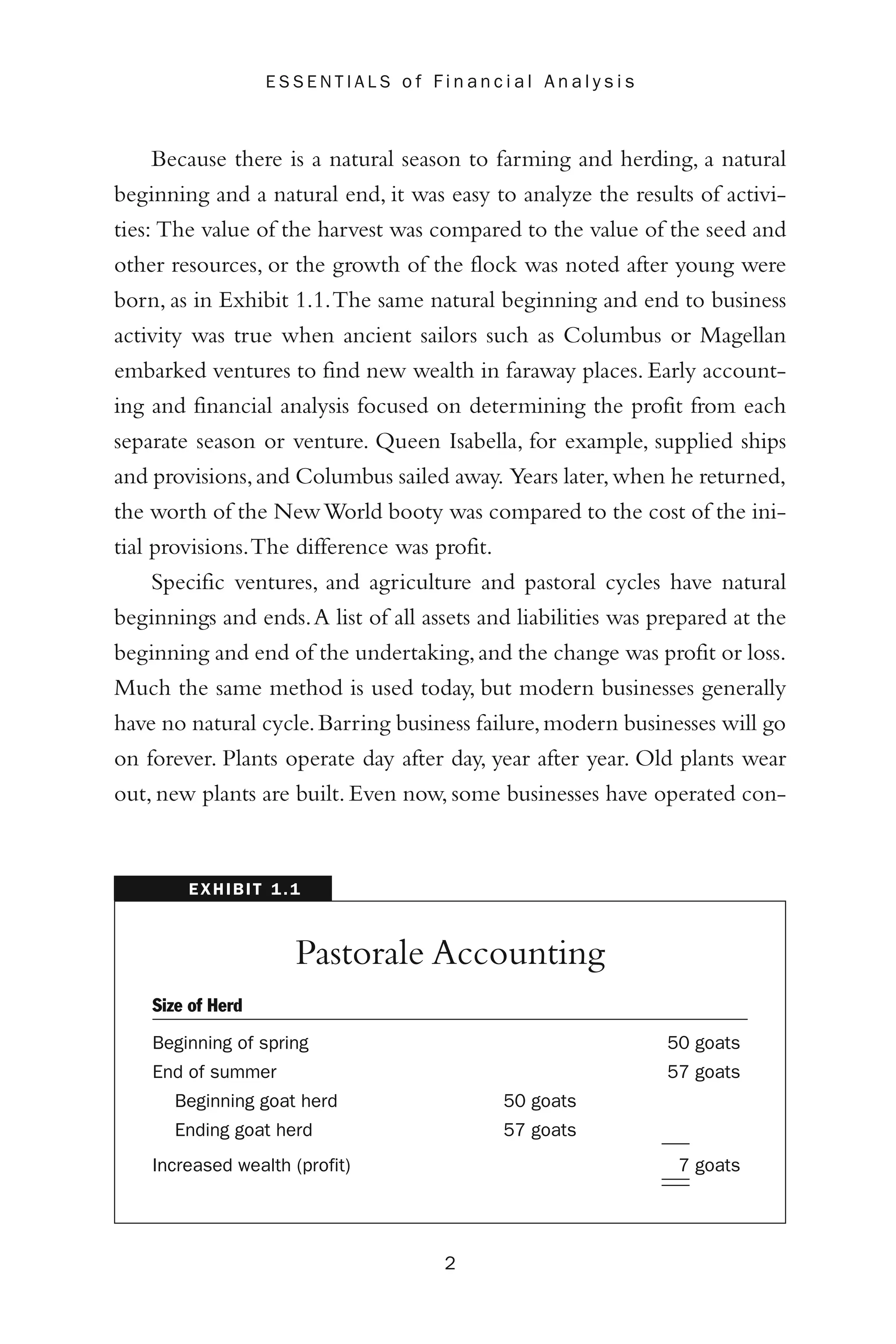


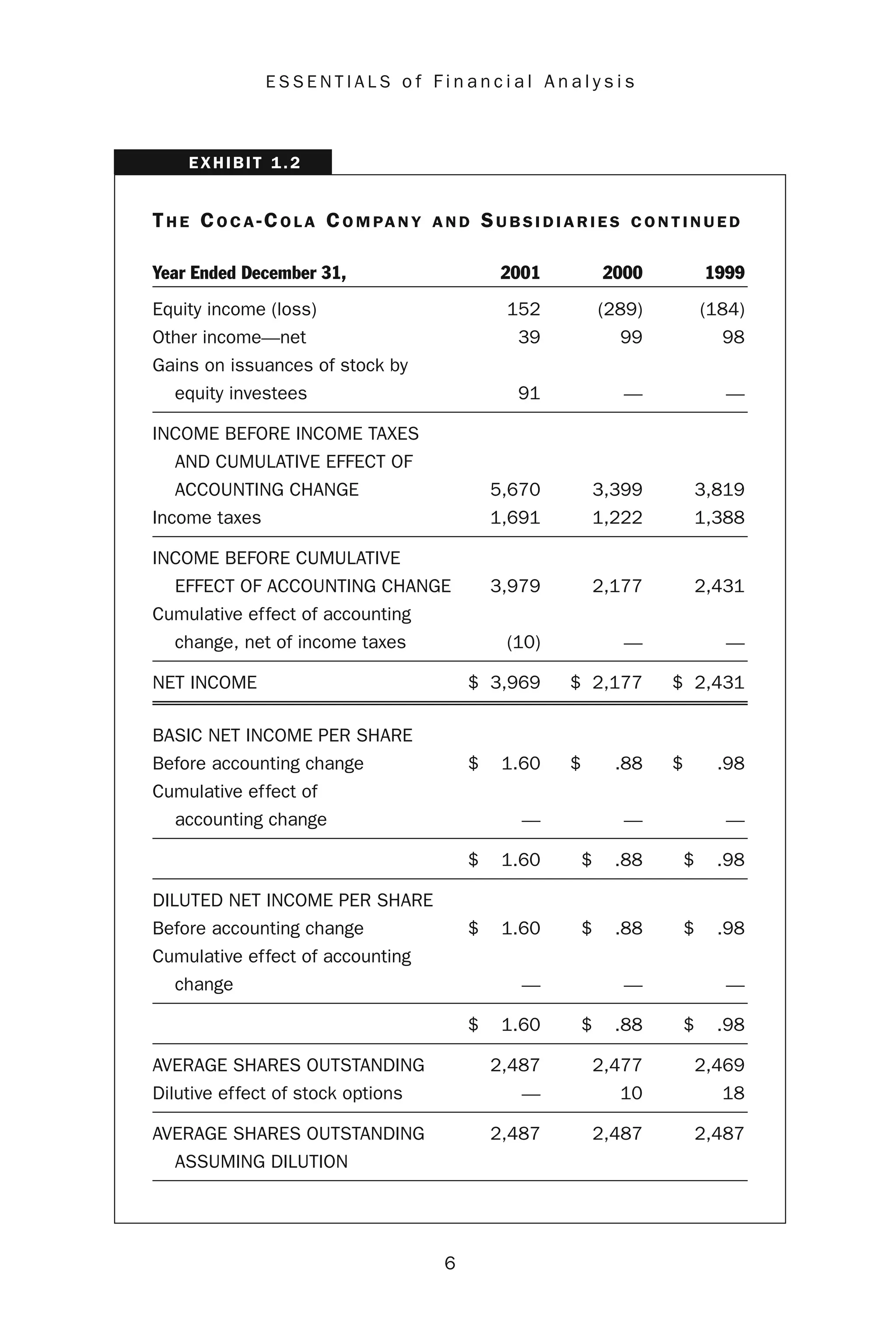


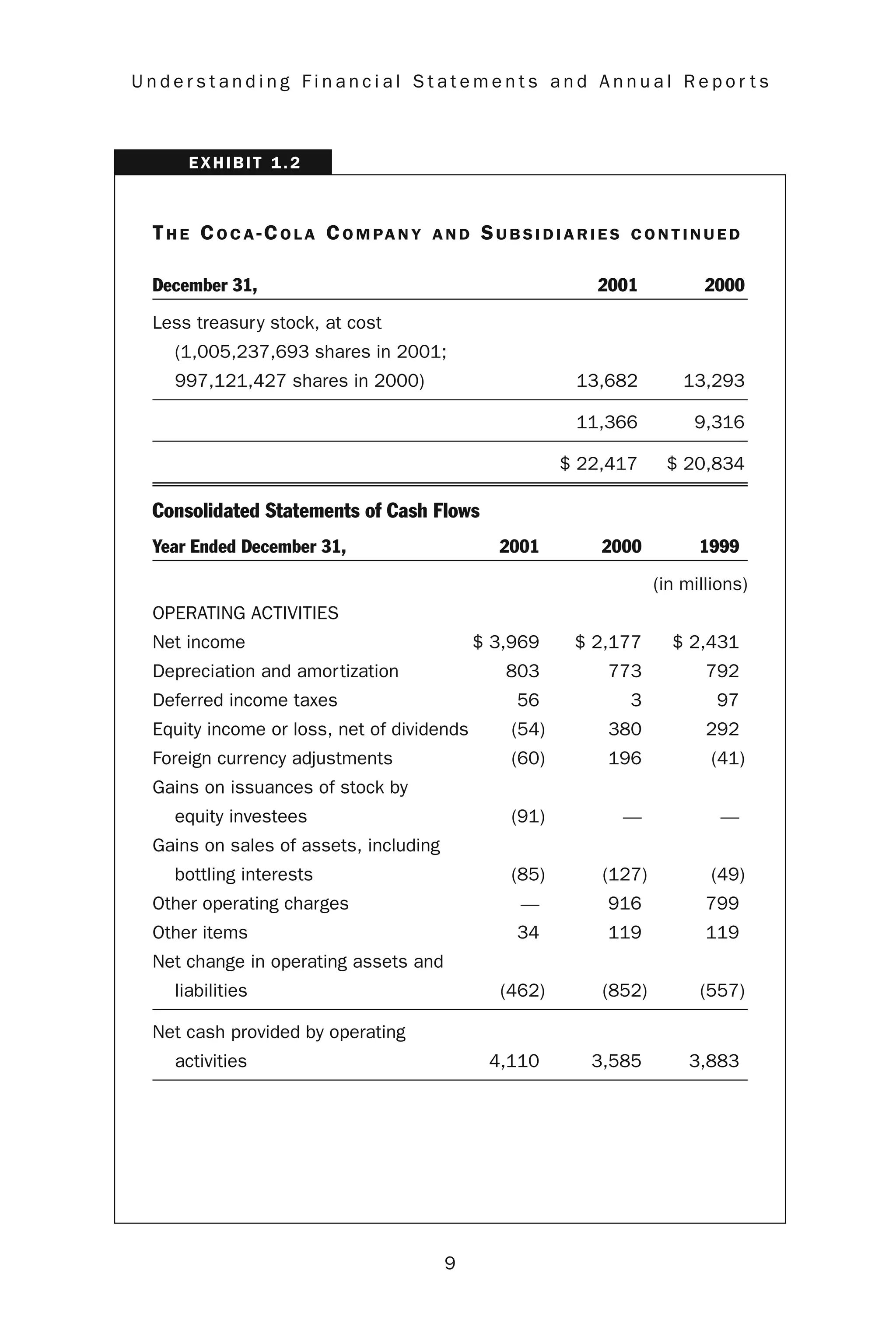


![Balance Sheet
• Assets. Resources that a company has legal control of
• Current assets. Cash and other assets likely to be converted to
cash or consumed within a year; usually includes the following
five components
1. Cash and cash equivalents.The latter are marketable and
highly liquid securities with short-term maturities (say, no
more than three months). May include CDs and money
market funds
2. Marketable securities. May include any investment in the
stocks or bonds of another entity (probably small enough
to not involve influence or control)
3. Trade accounts receivable. Receivables that result from credit
sales to customers, reduced by an amount that is likely to
be uncollectible
4. Inventories. Contains merchandise inventory for a retail
company; raw materials, supplies, work-in-process, and
finished goods inventories for a manufacturing company.
Companies disclose in the notes what inventory method(s)
are used (e.g., first-in, first-out [FIFO] or last-in, first-out
[LIFO] or average)
5. Prepaid expenses and other assets. Includes resources paid for
but not consumed yet, like prepaid rent, prepaid insurance,
prepaid advertising, and supplies
• Equity method investments. For Coca-Cola, this includes “invest-
ments in companies in which we have the ability to exercise
significant influence [traditionally 20%–50%] over operating
and financial policies, including certain investments where there
is a temporary majority interest.” The equity method involves
recognizing a share of the net earnings of investee companies
(subsidiaries) in the income of the investor (Coca-Cola)
13
U n d e r s t a n d i n g F i n a n c i a l S t a t e m e n t s a n d A n n u a l R e p o r t s](https://image.slidesharecdn.com/1245202-250518122135-1df443d4/75/Essentials-Of-Financial-Analysis-1st-Edition-G-Thomas-Friedlob-21-2048.jpg)
![• Cost method investments.These are also investments in other
companies but of a lesser percentage so as not to have influ-
ence (less than 20 percent).These investments are carried at
cost or fair market value.
• Other assets. For Coca-Cola, this includes investments in infra-
structure programs with bottlers and advance payments to cus-
tomers for distribution rights; in general, this category contains
all assets that do not fit into the other categories.
• Property, plant and equipment. Typically, tangible, long-term plant
assets (useful for more than a year); some plant assets (not land)
are depreciated.
• Trademarks and other intangible assets. May also include patents,
copyrights, goodwill, and other resources that have no physical
existence.
• Liabilities and share-owners’ equity. Represent the sources of all
those assets on the other side of the balance sheet (e.g., the
sources being either creditors [liabilities] or owners [owners’
equity])
• Current liabilities. Obligations that will be settled within a year,
usually, by payment from current assets
• Accounts payable and accrued expenses. Obligations to parties that
have provided goods or services to the company. May include
liabilities for purchases, wages and salaries, taxes, and advertising
• Loans and notes payable. If current, probably includes commer-
cial paper from banks in the United States and outstanding
amounts from a line of credit
• Current maturities of long-term debt.The portion of a company’s
long-term debt (typically, notes and bonds) that is due in the
coming year
• Accrued income taxes. Taxes associated with profits already earned
but on which the payment is avoided in the current year
• Long-term debt. Includes interest-bearing debt that is due
beyond a year (typically, notes and bonds)
14
E S S E N T I A L S o f F i n a n c i a l A n a l y s i s
T
E
A
M
F
L
Y
Team-Fly®](https://image.slidesharecdn.com/1245202-250518122135-1df443d4/75/Essentials-Of-Financial-Analysis-1st-Edition-G-Thomas-Friedlob-22-2048.jpg)


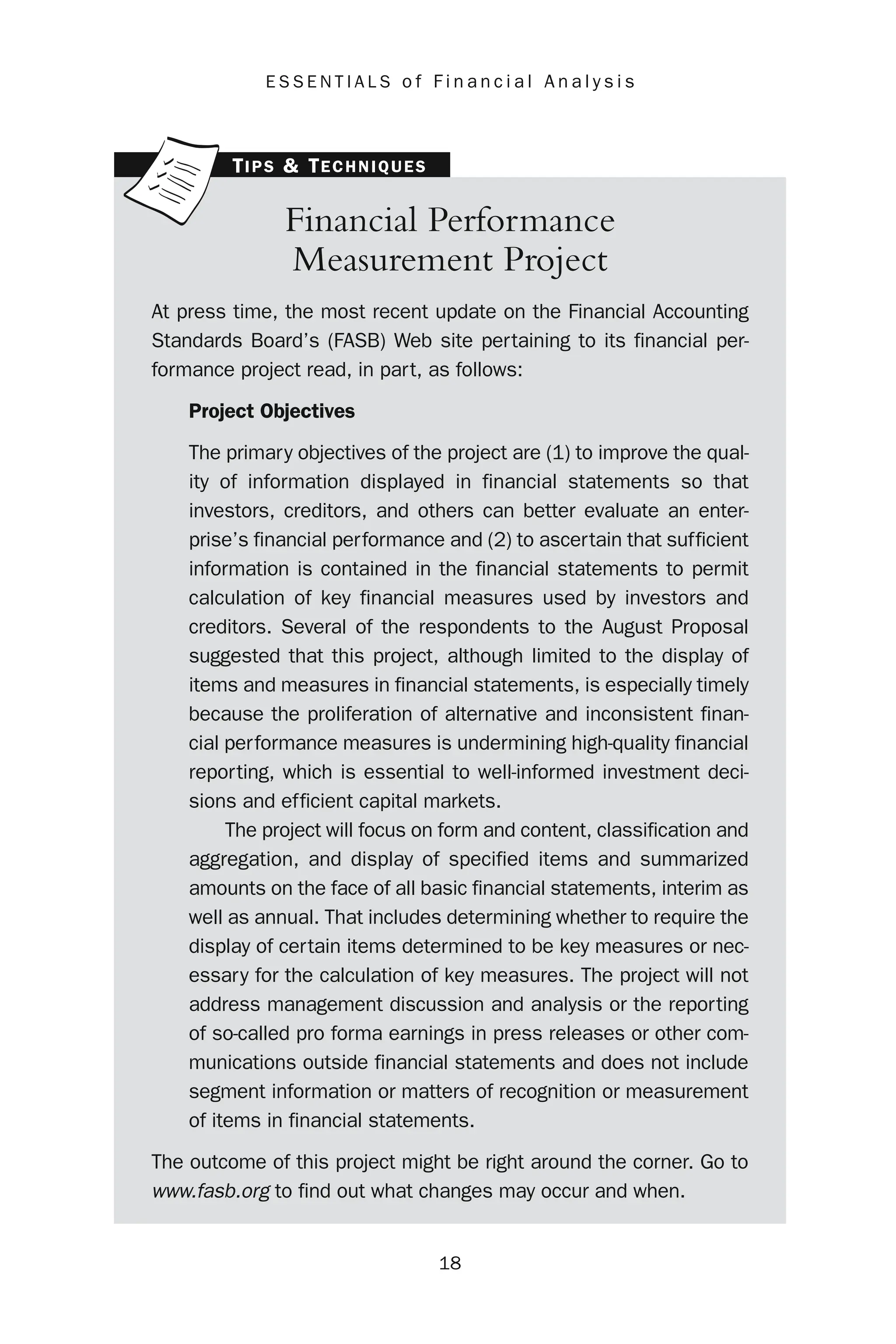
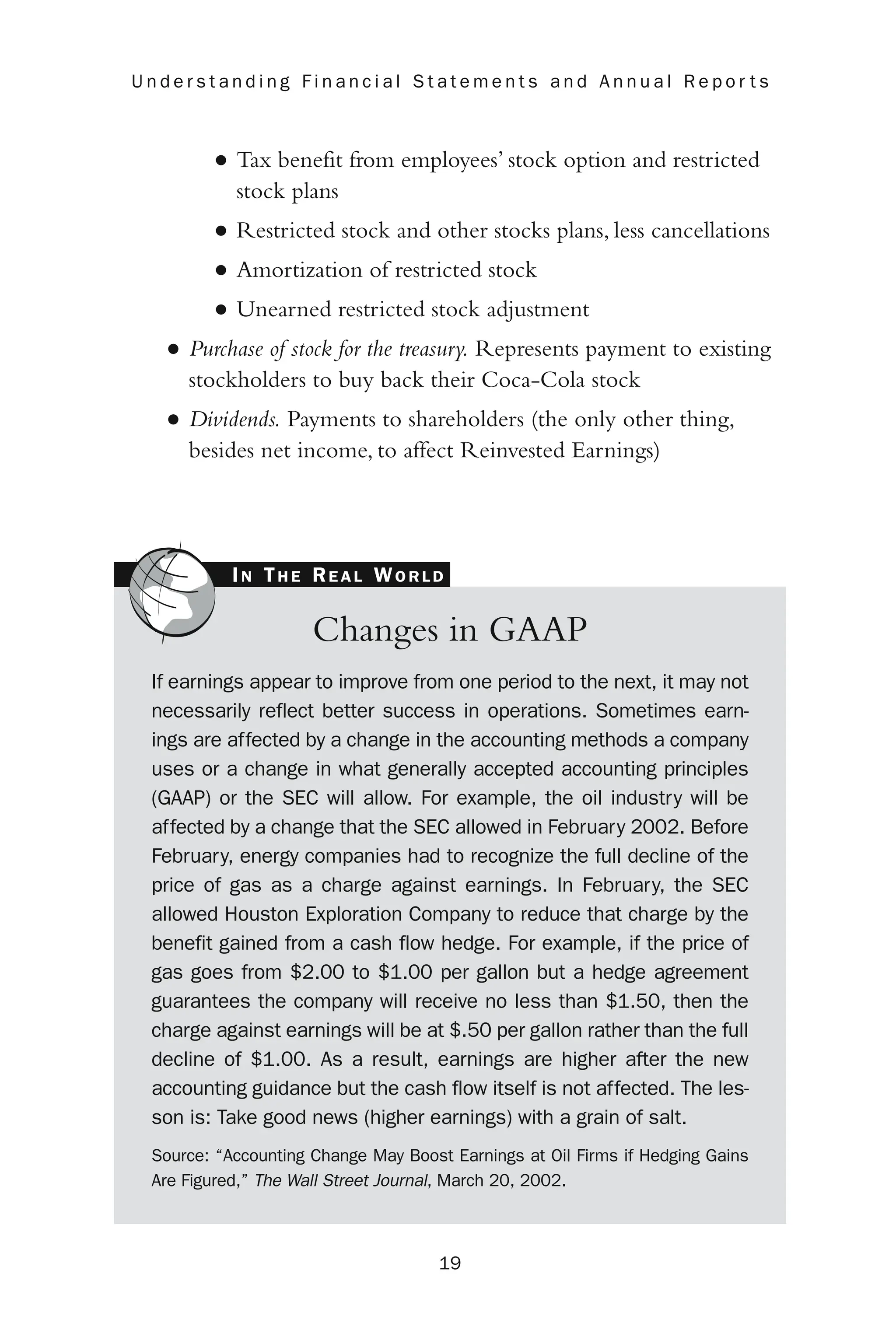

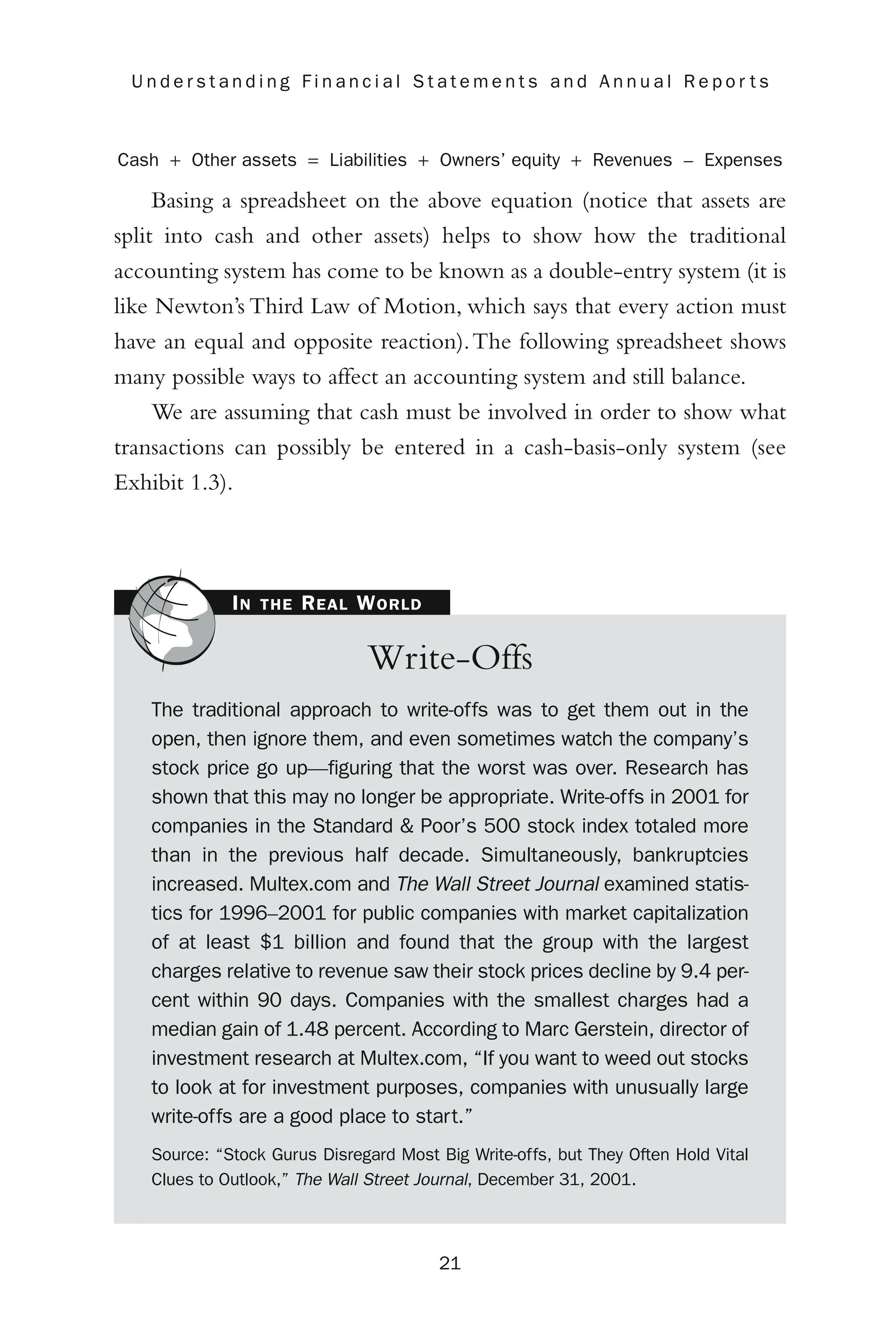


![2. Noncash assets could increase and owners’ equity increase if a
company issues stock in exchange for land.
3. Noncash assets could increase and revenues increase for a credit
sale (the asset would be accounts receivable).
24
E S S E N T I A L S o f F i n a n c i a l A n a l y s i s
A Tool for Financial Analysis:
XBRL: Extensible Business Reporting Language
• What is it? Software that will be added to accounting and
financial reporting software so that financial information can
be better accessed and used.
• How does it work? XBRL code will be used to tag and auto-
matically translate all business information so that the data
can be searched, identified, linked, and analyzed.
• What will it accomplish? XBRL will enable financial informa-
tion users to perform fast and accurate searches of busi-
ness data. They will be able to “tailor the search for multiple
companies’ data and export [it] easily into a spreadsheet for
further analysis; since each piece of information is identified
with a tag, comparisons and calculations can be
automated.”*
• Who will benefit? Anyone who prepares or uses business
data: organizations, auditors, bankers, shareholders, and
investors.
*“Finally, Business Talks the Same Language,” Journal of Accountancy, August
2000, 24–30.
IN THE REAL WORLD
T
E
A
M
F
L
Y
Team-Fly®](https://image.slidesharecdn.com/1245202-250518122135-1df443d4/75/Essentials-Of-Financial-Analysis-1st-Edition-G-Thomas-Friedlob-32-2048.jpg)
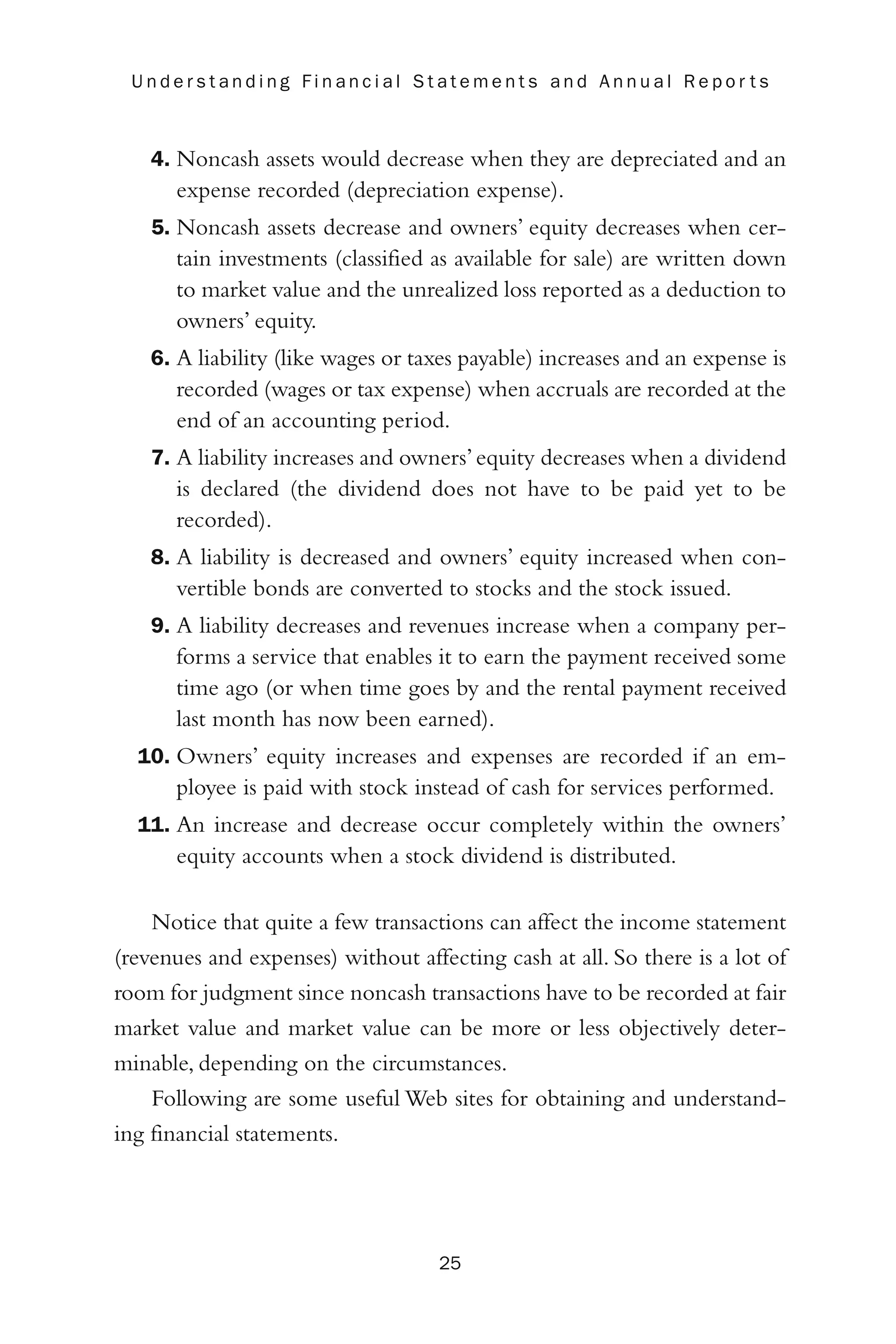


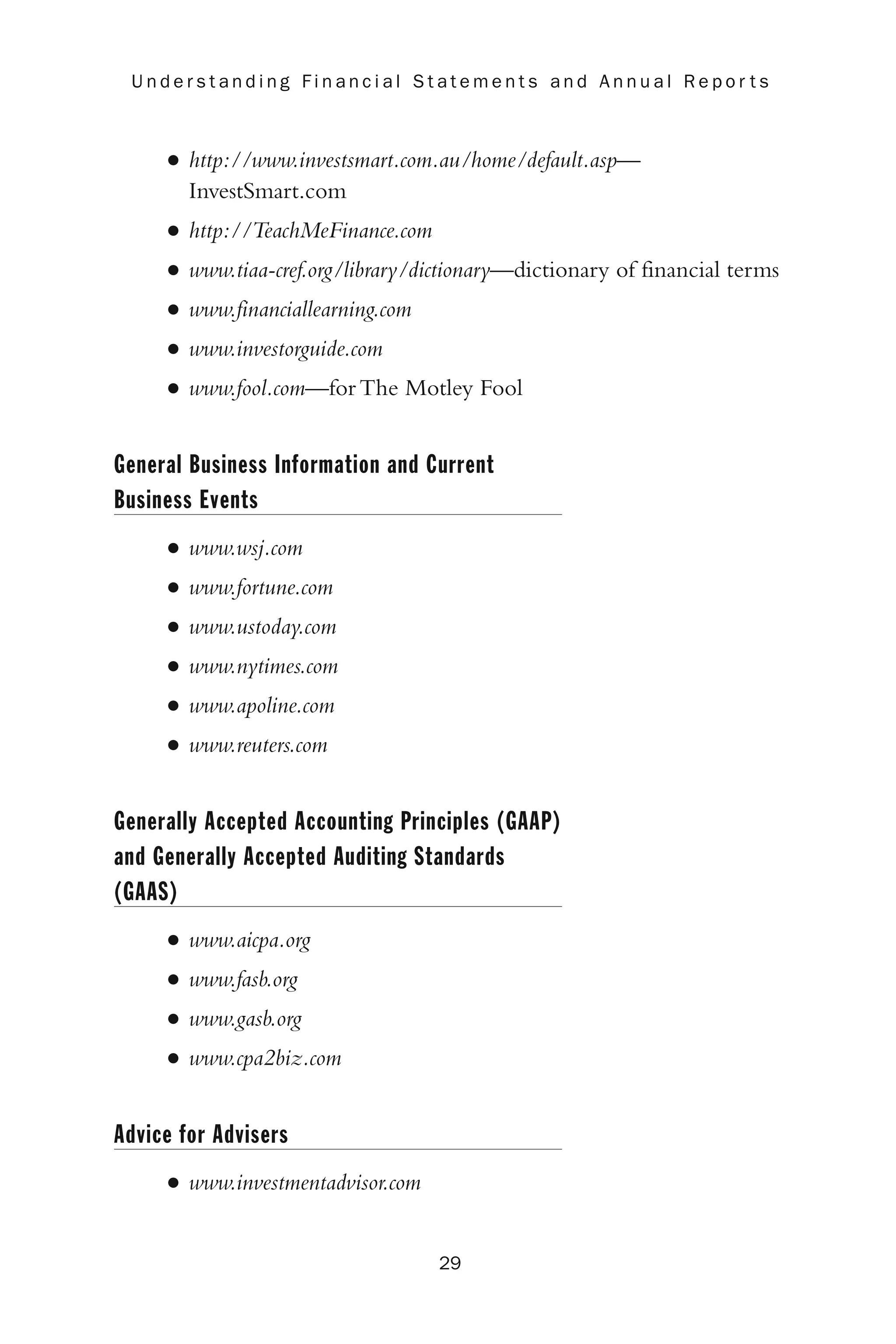




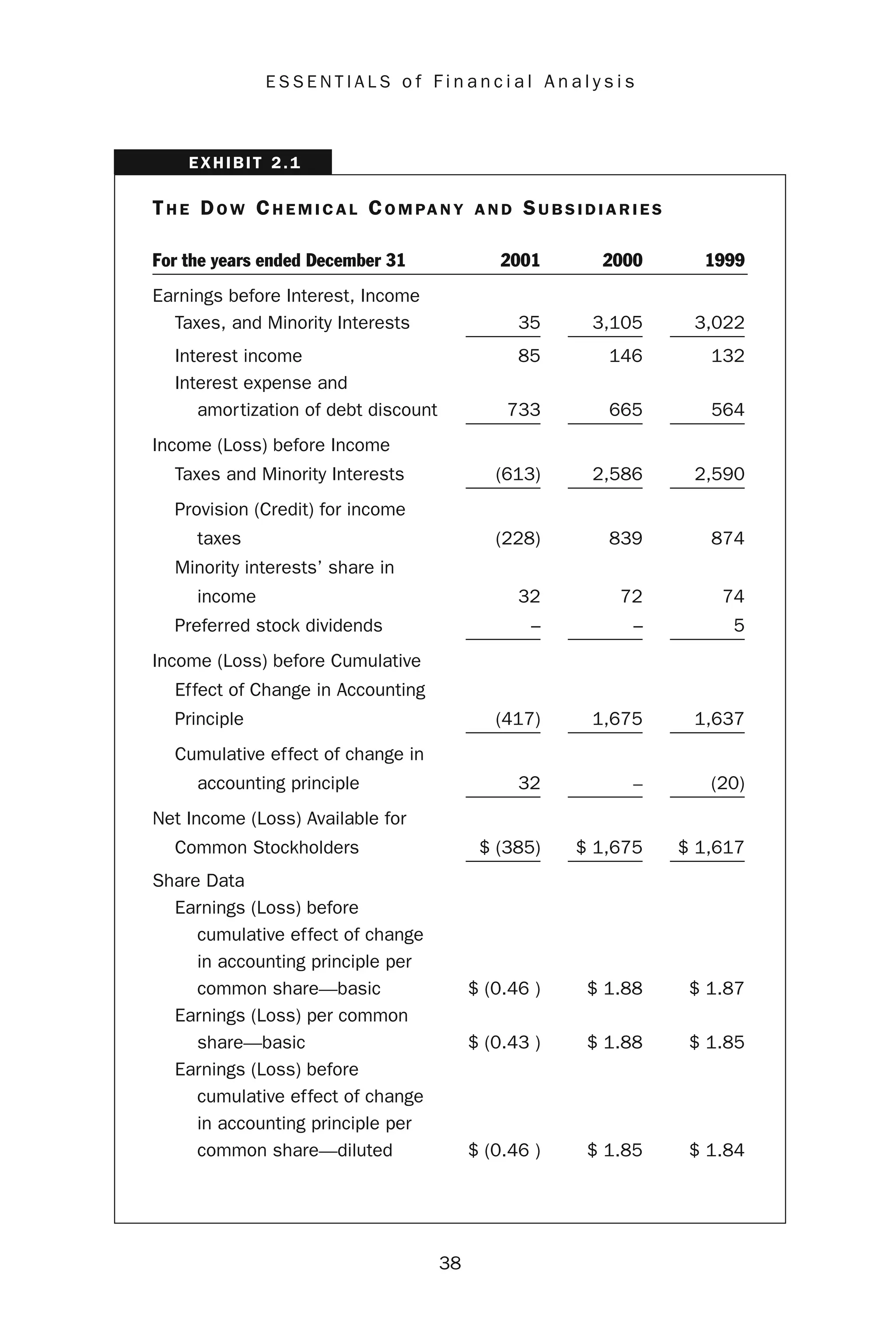
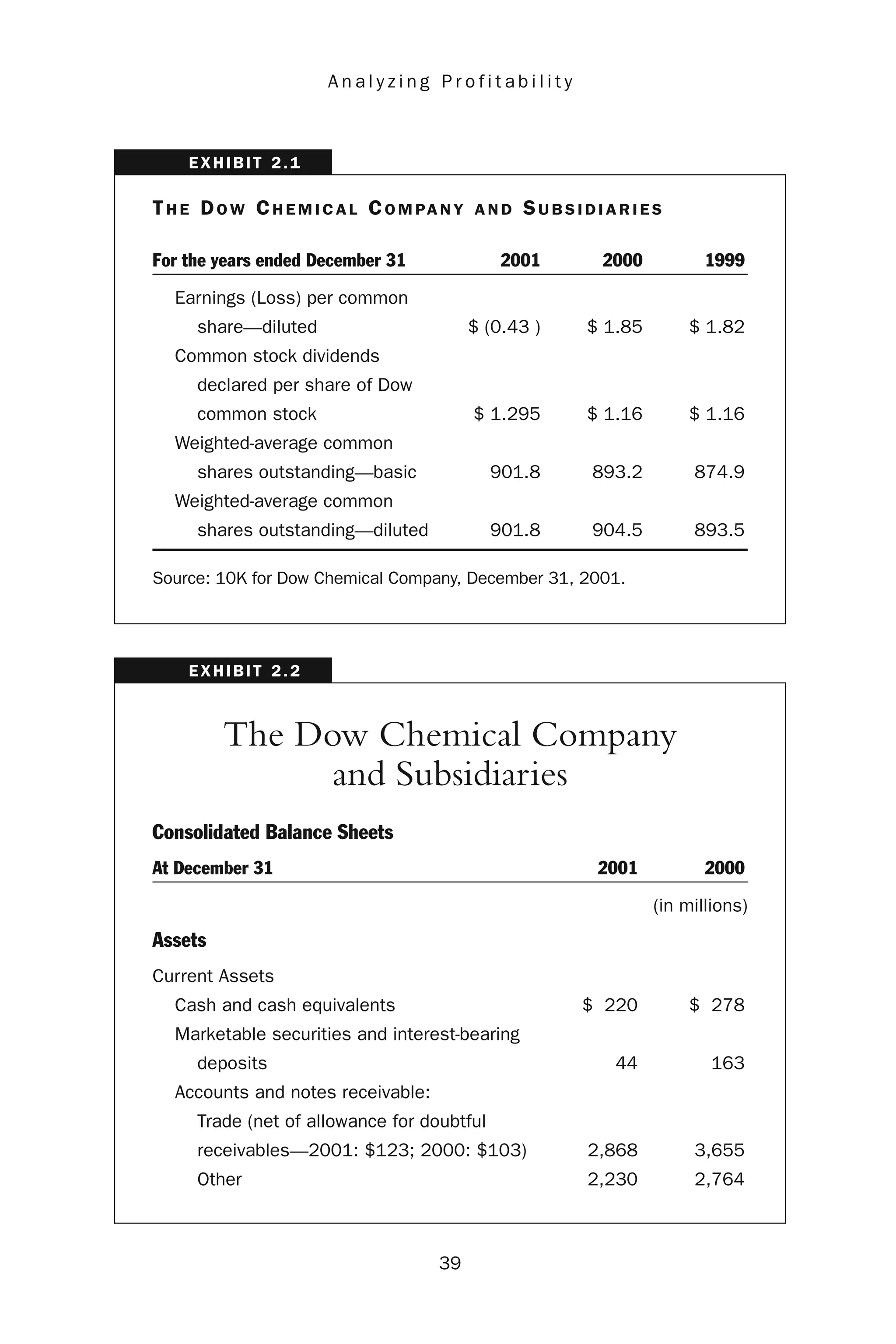


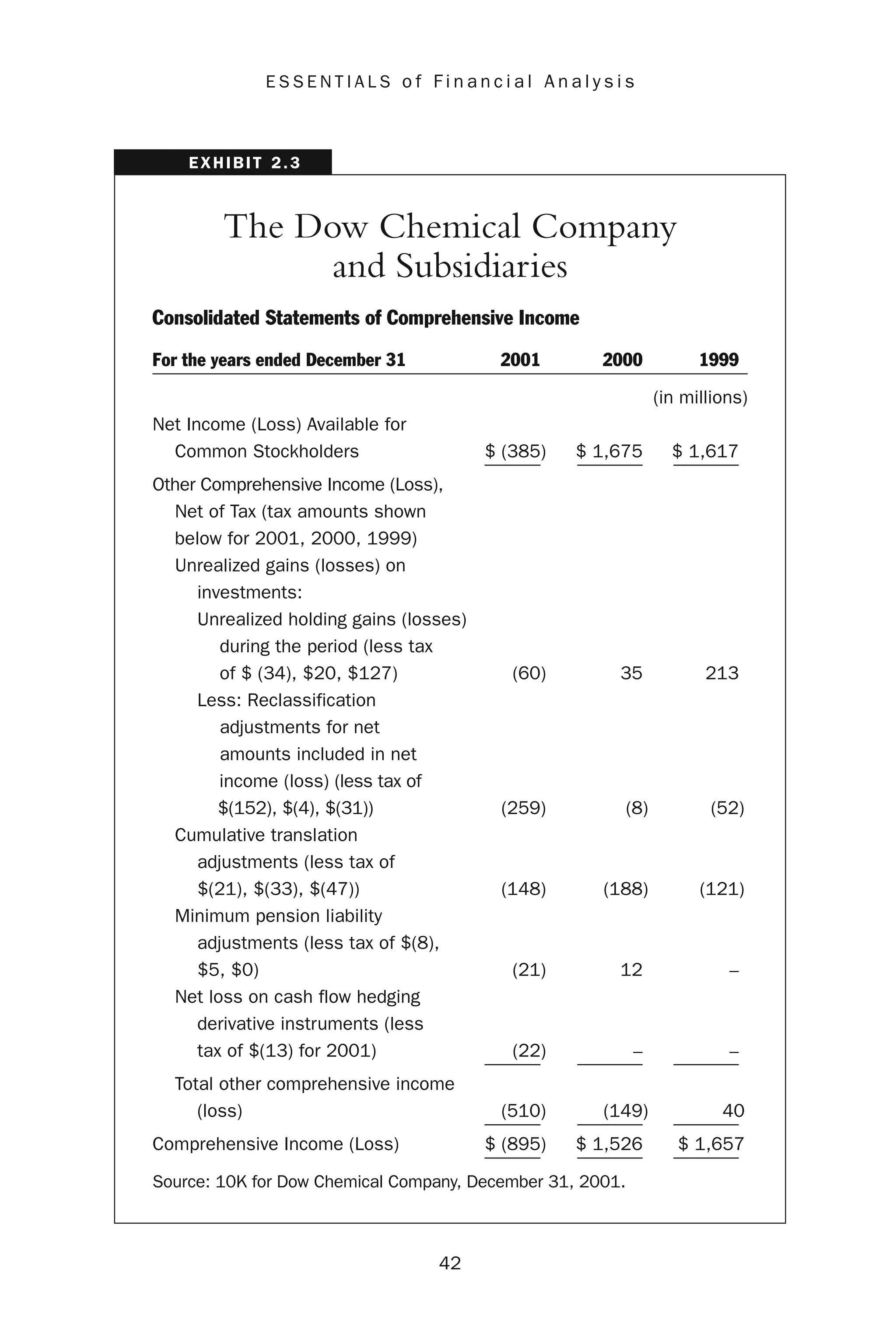




![therewith endowed an hospital, which he built at Sheffield, for
women. The trustees let the impropriation of the great tithes of
Penniston to the Wortley family, who got a great deal by it, and
wanted to get still more: for Mr. Nicholas Wortley attempted to take
the tithes in kind, but Mr. Francis Bosville opposed him, and there
was a decree in favour of the modus in 37th Eliz. The vicarage of
Penniston did not go along with the rectory, but with the copyhold
rents, and was part of a large purchase made by Ralph Bosville,
Esq., from Queen Elizabeth, in the 2d year of her reign: and that
part he sold in 12th Eliz. to his elder brother Godfrey, the father of
Francis; who left it, with the rest of his estate, to his wife, for her
life, and then to Ralph, third son of his uncle Ralph. The widow
married Lyonel Rowlestone, lived eighteen years, and survived
Ralph.
"This premised, the ballad apparently relates to the lawsuit carried
on concerning this claim of tithes made by the Wortley family.
'Houses and churches were to him geese and turkeys:' which are
titheable things, the Dragon chose to live on. Sir Francis Wortley, the
son of Nicholas, attempted again to take the tithes in kind: but the
parishioners subscribed an agreement to defend their modus. And at
the head of the agreement was Lyonel Rowlestone, who is supposed
to be one of 'the stones, dear Jack, which the Dragon could not
crack.' The agreement is still preserved in a large sheet of
parchment, dated 1st of James I., and is full of names and seals,
which might be meant by the coat of armour, "with spikes all about,
both within and without." More of More-hall was either the attorney,
or counsellor, who conducted the suit. He is not distinctly
remembered, but More-hall is still extant at the very bottom of
Wantley [Warncliff] Wood, and lies so low, that it might be said to be
in a well: as the Dragon's den [Warncliff Lodge] was at the top of
the wood 'with Matthew's house hard by it.' The keepers belonging
to the Wortley family were named, for many generations, Matthew
Northall: the last of them left this lodge, within memory, to be
keeper to the Duke of Norfolk. The present owner of More-hall still
attends Mr. Bosville's Manor Court at Oxspring, and pays a rose a](https://image.slidesharecdn.com/1245202-250518122135-1df443d4/75/Essentials-Of-Financial-Analysis-1st-Edition-G-Thomas-Friedlob-58-2048.jpg)
![year. 'More of More-Hall, with nothing at all, slew the Dragon of
Wantley.' He gave him, instead of tithes, so small a modus, that it
was in effect, nothing at all, and was slaying him with a vengeance.
'The poor children three,' &c., cannot surely mean the three sisters
of Francis Bosville, who would have been coheiresses, had he made
no will? The late Mr. Bosville had a contest with the descendants of
two of them, the late Sir George Saville's father, and Mr. Copley,
about the presentation to Penniston, they supposing Francis had not
the power to give this part of the estate from the heirs at law; but it
was decided against them. The Dragon (Sir Francis Wortley)
succeeded better with his cousin Wordesworth, the freehold lord of
the manor, (for it is the copyhold manor that belongs to Mr. Bosville,)
having persuaded him not to join the refractory parishioners, under
a promise that he would let him his tithes cheap: and now the
estates of Wortley and Wordesworth are the only lands that pay
tithes in the parish.
"N. B. The 'two days and a night,' mentioned in ver. 125, as the
duration of the combat, was probably that of the trial at law."
Note to p. 128, and p. 131, v. 75-80. Grundtvig, ii. 653, refers to a
B[oe]otian legend in Pausanias ix. 26, 5, for an instance of a similar
contrivance. The story goes, that one Menestratus, to save a friend
who was about to be exposed in due course to a dragon, made
himself a brazen breastplate, which had on every scale a hook with
the point bent upwards. Armed in this, he went voluntarily to meet
the monster, and destroyed him, though at the expense of his own
life.](https://image.slidesharecdn.com/1245202-250518122135-1df443d4/75/Essentials-Of-Financial-Analysis-1st-Edition-G-Thomas-Friedlob-59-2048.jpg)



!["I could match this beginning with an old tale."
Old Sir Robert Bolton had three sons,
Wind well thy horn, good hunter;
And one of them was Sir Ryalas,
For he was a jovial hunter.
He ranged all round down by the wood side, 5
Wind well thy horn, good hunter,
Till in a tree-top a gay lady he spied,
For he was a jovial hunter.
"O, what dost thee mean, fair lady?" said he,
Wind well thy horn, good hunter; 10
"The wild boar's killed my lord, and has thirty men gored,
And thou beest a jovial hunter.
"O what shall I do this wild boar for to see?"
Wind well thy horn, good hunter;
"O, thee blow a blast, and he'll come unto thee, 15
As thou beest a jovial hunter.
Then he blowed a blast, full north, east, west and south,
Wind well thy horn, good hunter;
And the wild boar then heard him full in his den,
As he was a jovial hunter. 20
Then he made the best of his speed unto him,
Wind well thy horn, good hunter;
[Swift flew the boar, with his tusks smeared with gore,]
To Sir Ryalas, the jovial hunter.
Then the wild boar, being so stout and so strong, 25
Wind well thy horn, good hunter;](https://image.slidesharecdn.com/1245202-250518122135-1df443d4/75/Essentials-Of-Financial-Analysis-1st-Edition-G-Thomas-Friedlob-66-2048.jpg)