Dr.M.Pyingkodi
AP/MCA
Kongu Engineering College
Erode, Tamilnadu
Essential Concepts for Machine Learning
Machine Learning
• Machine Learning is an Application of Artificial
Intelligence (AI) it gives devices the ability to learn
from their experiences and improve their self
without doing any coding.
• Field of study that gives computers the capability to
learn without being explicitly programmed.
• Machine Learning is a subset of Artificial Intelligence.
• It is the study of making machines more human-like
in their behaviour and decisions by giving them the
ability to learn and develop their own programs.
• no explicit programming.
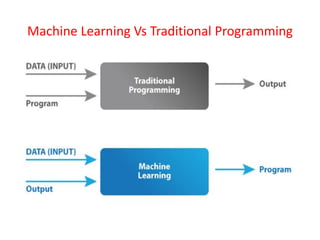
Machine Learning Vs Traditional Programming
Terminology of Machine Learning
• Model
• Feature
• Feature Vector
• Training
• Prediction
• Target (Label)
• Overfitting
• Underfitting
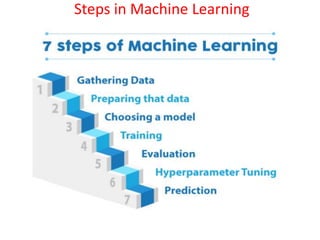
Steps in Machine Learning
• Gathering Data
• Preparing that data
• Choosing a model
• Training
• Evaluation
• Hyperparameter Tuning
• Prediction
Totally Seven steps
Steps in Machine Learning
Mathematical Areas for Machine Learning
• Linear algebra for data analysis: Scalars,
Vectors, Matrices, and Tensors
• Mathematical Analysis: Derivatives and
Gradients
• Probability theory and statistics
• Multivariate Calculus
• Algorithms and Complex Optimizations
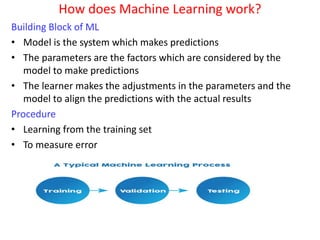
How does Machine Learning work?
Building Block of ML
• Model is the system which makes predictions
• The parameters are the factors which are considered by the
model to make predictions
• The learner makes the adjustments in the parameters and the
model to align the predictions with the actual results
Procedure
• Learning from the training set
• To measure error
Machine Learning Languages and Packages
Languages
R, C++, JavaScript, Java, C#, Julia, Shell, TypeScript, and Scala.
Can run on any platform, including Windows, MacOS, Linux,
Unix, and others.
Packages
• Numpy, OpenCV, and Scikit are used when working with images
• NLTK along with Numpy and Scikit again when working with text
• Librosa for audio applications
• Matplotlib, Seaborn, and Scikit for data representation
• TensorFlow and Pytorch for Deep Learning applications
• Scipy for Scientific Computing
• Django for integrating web applications
• Pandas for high-level data structures and analysis
Machine Learning : Types
1. Supervised learning
A model has a set of input variables (x), and an output variable (y). An
algorithm identifies the mapping function between the input and output
variables. The relationship is y = f(x).
2. Unsupervised Learning
It is the one where the output is unknown, and we have only the input
variable at hand. The algorithm learns by itself and discovers an impressive
structure in the data
3. Semi-supervised Learning
In semi-supervised learning, data scientists train model with a minimal amount
of labelled data and a large amount of unlabelled data. Usually, the first step is
to cluster similar data with the help of an unsupervised machine learning
algorithm. The next step is to label the unlabelled data using the
characteristics of the limited labeled data available
4. Reinforcement Learning
In this approach, machine learning models are trained to make a series of
decisions based on the rewards and feedback they receive for their actions.
Machine Learning Applications
• Prediction
• Image recognition
• Speech Recognition
• Medical diagnoses
• Virtual Personal Assistants
• Predictions while Commuting
• Videos Surveillance
• Social Media Services
• Online Customer Support
• Search Engine Result Refining
• Product Recommendations
• Online Fraud Detection
Machine Learning Applications in Daily Life
1. Commute Estimation
Google’s Map
Riding Apps
Commercial flights to use Autopilot
2. Email Intelligence
Spam Filters
Email Classification
Smart Replies
3.Banking and Personal Finance
Fraud Prevention
Credit Decisions
Check Deposit on Mobile
4.Evaluation and Assessment
In checking Plagiarism
Robo-readers
5. Social Networking
Facebook
Machine Learning Applications in Daily Life
5. Social Networking
Facebook
Pinterest
Snapchat
Instagram
6. Medical Diagnosis and Healthcare
– The analysis of medical data for detecting regularities in data,
– Handling inappropriate data,
– Explaining data generated by medical units,
– Also for effective monitoring of patients.
7. Personal Smart Assistants
Personal assistant along with Amazon Alexa and Google Home
ex:ML chatbots
Machine Learning Examples
Amazon using machine learning to give better
product choice recommendations to there
costumers based on their preferences,
Netflix uses machine learning to give better
suggestions to their users of the Tv series or
movie or shows that they would like to watch.
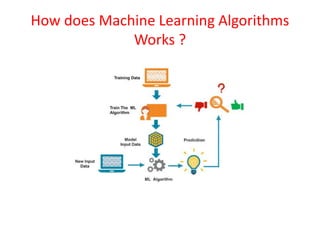
How does Machine Learning Algorithms
Works ?
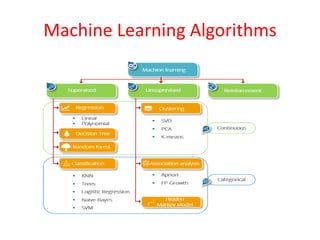
Machine Learning Algorithms
Artificial intelligence, Machine learning, Deep Learning
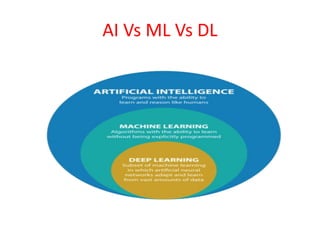
• Artificial intelligence
AI a science like mathematics or biology. It studies ways to build
intelligent programs and machines that can creatively solve
problems, which has always been considered a human
prerogative.
• Machine learning
ML is a subset of artificial intelligence (AI) that provides systems
the ability to automatically learn and improve from experience
without being explicitly programmed. In ML, there are different
algorithms (e.g. neural networks) that help to solve problems.
• Deep Learning
DL is a subset of machine learning, which uses the neural networks
to analyze different factors with a structure that is similar to the
human neural system.
AI Vs ML Vs DL

Essential concepts for machine learning

  • 1.
    Dr.M.Pyingkodi AP/MCA Kongu Engineering College Erode,Tamilnadu Essential Concepts for Machine Learning
  • 2.
    Machine Learning • MachineLearning is an Application of Artificial Intelligence (AI) it gives devices the ability to learn from their experiences and improve their self without doing any coding. • Field of study that gives computers the capability to learn without being explicitly programmed. • Machine Learning is a subset of Artificial Intelligence. • It is the study of making machines more human-like in their behaviour and decisions by giving them the ability to learn and develop their own programs. • no explicit programming.
  • 3.
    Machine Learning VsTraditional Programming
  • 4.
    Terminology of MachineLearning • Model • Feature • Feature Vector • Training • Prediction • Target (Label) • Overfitting • Underfitting
  • 5.
    Steps in MachineLearning • Gathering Data • Preparing that data • Choosing a model • Training • Evaluation • Hyperparameter Tuning • Prediction Totally Seven steps
  • 6.
  • 7.
    Mathematical Areas forMachine Learning • Linear algebra for data analysis: Scalars, Vectors, Matrices, and Tensors • Mathematical Analysis: Derivatives and Gradients • Probability theory and statistics • Multivariate Calculus • Algorithms and Complex Optimizations
  • 8.
    How does MachineLearning work? Building Block of ML • Model is the system which makes predictions • The parameters are the factors which are considered by the model to make predictions • The learner makes the adjustments in the parameters and the model to align the predictions with the actual results Procedure • Learning from the training set • To measure error
  • 9.
    Machine Learning Languagesand Packages Languages R, C++, JavaScript, Java, C#, Julia, Shell, TypeScript, and Scala. Can run on any platform, including Windows, MacOS, Linux, Unix, and others. Packages • Numpy, OpenCV, and Scikit are used when working with images • NLTK along with Numpy and Scikit again when working with text • Librosa for audio applications • Matplotlib, Seaborn, and Scikit for data representation • TensorFlow and Pytorch for Deep Learning applications • Scipy for Scientific Computing • Django for integrating web applications • Pandas for high-level data structures and analysis
  • 10.
    Machine Learning :Types 1. Supervised learning A model has a set of input variables (x), and an output variable (y). An algorithm identifies the mapping function between the input and output variables. The relationship is y = f(x). 2. Unsupervised Learning It is the one where the output is unknown, and we have only the input variable at hand. The algorithm learns by itself and discovers an impressive structure in the data 3. Semi-supervised Learning In semi-supervised learning, data scientists train model with a minimal amount of labelled data and a large amount of unlabelled data. Usually, the first step is to cluster similar data with the help of an unsupervised machine learning algorithm. The next step is to label the unlabelled data using the characteristics of the limited labeled data available 4. Reinforcement Learning In this approach, machine learning models are trained to make a series of decisions based on the rewards and feedback they receive for their actions.
  • 11.
    Machine Learning Applications •Prediction • Image recognition • Speech Recognition • Medical diagnoses • Virtual Personal Assistants • Predictions while Commuting • Videos Surveillance • Social Media Services • Online Customer Support • Search Engine Result Refining • Product Recommendations • Online Fraud Detection
  • 12.
    Machine Learning Applicationsin Daily Life 1. Commute Estimation Google’s Map Riding Apps Commercial flights to use Autopilot 2. Email Intelligence Spam Filters Email Classification Smart Replies 3.Banking and Personal Finance Fraud Prevention Credit Decisions Check Deposit on Mobile 4.Evaluation and Assessment In checking Plagiarism Robo-readers 5. Social Networking Facebook
  • 13.
    Machine Learning Applicationsin Daily Life 5. Social Networking Facebook Pinterest Snapchat Instagram 6. Medical Diagnosis and Healthcare – The analysis of medical data for detecting regularities in data, – Handling inappropriate data, – Explaining data generated by medical units, – Also for effective monitoring of patients. 7. Personal Smart Assistants Personal assistant along with Amazon Alexa and Google Home ex:ML chatbots
  • 14.
    Machine Learning Examples Amazonusing machine learning to give better product choice recommendations to there costumers based on their preferences, Netflix uses machine learning to give better suggestions to their users of the Tv series or movie or shows that they would like to watch.
  • 15.
    How does MachineLearning Algorithms Works ?
  • 16.
  • 17.
    Artificial intelligence, Machinelearning, Deep Learning • Artificial intelligence AI a science like mathematics or biology. It studies ways to build intelligent programs and machines that can creatively solve problems, which has always been considered a human prerogative. • Machine learning ML is a subset of artificial intelligence (AI) that provides systems the ability to automatically learn and improve from experience without being explicitly programmed. In ML, there are different algorithms (e.g. neural networks) that help to solve problems. • Deep Learning DL is a subset of machine learning, which uses the neural networks to analyze different factors with a structure that is similar to the human neural system.
  • 18.
    AI Vs MLVs DL