Error-Proofing
Your Research
Common Mistakes and How to Address them
Sta. Elena High School
Prepared and presented
by Vince Marko A. Sano
Objectives
Identify the approach used in stating or
describing the background of the research
Present the components of writing an
introduction or background of the research;
Evaluate the common mistakes in writing a
research paper and present ways on how to
address them
01
02
03
Why conduct a
discussion
about mistakes?
First, learning about mistakes prior to writing the
research helps you recognize what practices to
avoid. By knowing what to be careful with, you
can actually concentrate on telling your reader
about your main argument.
Second, learning what not to do is sometimes
more powerful than being told what to do. By
clarifying what are not admissible or permitted,
you will not have an excuse about being ignorant
of the expectations for research.
Sometimes a researcher
can think of a truly
interesting research project,
and write a commendable
proposal, but this not
necessarily lead to the
execution of the project.
DESCRIPTION
A student had a good
research question comparing
traditional and non-traditional
schools. He even wrote a
promising proposal and had an
extensive literature review.
However, when he was about
to go to the schools, he was
politely informed that the
school was not open to being
researched on.
EXAMPLE LESSON
Have an initial assessment
whether a research topic is
feasible or not. Try to check
data for claims and if the
respondents are open for
being the subjects of the
study.
Another thing to make sure
is that you complete your
research within the time
allotted for it.
Infeasibility of
Research Project
Lack of
Preliminary
Readings
With the advent of social media and news in the
form of tweets, it is no surprise that the youth
would much prefer quick and immediate ideas
rather than go to the process of difficulty and
reading academic books, journals, and other
scholarly writing.
DESCRIPTION
Before you go deeper on a research topic, do
preliminary readings first. Preliminary reading is
about knowing the broad ideas that surround
your research, immersing yourself in the
vocabulary of a particular perspective, and
understanding what are known and not yet
known.
LESSON
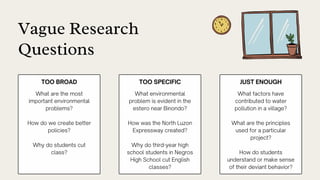
Vague Research
Questions
What are the most
important environmental
problems?


How do we create better
policies?


Why do students cut
class?


TOO BROAD
What environmental
problem is evident in the
estero near Binondo?


How was the North Luzon
Expressway created?


Why do third-year high
school students in Negros
High School cut English
classes?


TOO SPECIFIC
What factors have
contributed to water
pollution in a village?


What are the principles
used for a particular
project?


How do students
understand or make sense
of their deviant behavior?
JUST ENOUGH
Unidentified
Research Gaps
You have to show that there is something
original in your argument, or that at least your
argument nuances the insights from another
research. By the term nuance, your argument
should provide an added perspective to what
is generally known to be true.
NOTE
To say that basketball is one of the most
popular sports in the Philippines does not merit
much original thinking.
However, to argue that basketball has been
used as a means of colonizing and pacifying
the Philippines is an interesting and debatable
argument.
EXAMPLE
Undefined
Terms
For the first example, the term "CHED" should have
been defined first. Say something about the
agency or the institution first.
WRITE DOWN THE ACRONYM FIRST
Talk briefly in the introduction about how chronic
spontaneous urticaria is a skin condition in which
the person experiences allergies almost daily for
at least six weeks.
TECHNICAL TERMS SHOULD BE DEFINED AT
THE START OF YOUR RESEARCH AND NOT
WAIT UNTIL THE LITERATURE REVIEW
OPERATIONALIZE TERMS
You will have to specify if you are trying to measure
intelligence in terms of IQ, examination grades, or
school performance.
01
02
03
CHED has given a lot of scholarships to
professors...
People who experience chronic
spontaneous urticaria have difficulties...
Intelligent people often get into exclusive
schools...
1.
2.
3.
EXAMPLE MISTAKES
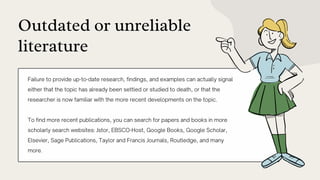
Outdated or unreliable
literature
Failure to provide up-to-date research, findings, and examples can actually signal
either that the topic has already been settled or studied to death, or that the
researcher is now familiar with the more recent developments on the topic.
To find more recent publications, you can search for papers and books in more
scholarly search websites: Jstor, EBSCO-Host, Google Books, Google Scholar,
Elsevier, Sage Publications, Taylor and Francis Journals, Routledge, and many
more.
Leading questions
"We heard that attendance is a problem in your
school? Is your child attending school?"


It could lead your respondent to answer the
socially desirable answer rather than the
accurate answer.
Double-barreled
questions
"Why do some children perform well in their
studies and why do some cause a lot of
trouble?"


This question is literally asking two different
and separate things.
Informal tone
and language
You have the option of using the first person
(I/We) or the third person (The researcher/s) to
refer to the researcher.
The second person (You) is not used because
the research paper should not directly address
the reader.
SHOULD I USE FIRST-PERSON POV AND
PRONOUNS, OR THIRD-PERSON
PRONOUNS?
First Person:
In this research, I argue that higher carbon dioxide
emissions...
Third person:
The researcher tests the assumptions, and she
shows that...
EXAMPLES
NOTE
In academic essays in schools, teachers
usually advise students to stick to the
objective-sounding third person.
However, it must be also noted that the APA
actually recommends using the first-person.
Ambiguity
Usually, the word "the author/researcher" will be used to refer to the person
writing the research. However, if this is preceded by the research of other
authors, this may lead to ambiguity.
Example:
Mueller and Abrutyn (2015) highlight suicidality, and the researchers further clarify
this position...
In this example, it is not clear who "the researchers" are referring to - Mueller and
Abrutyn, or the authors? In this example, the first person is preferred.
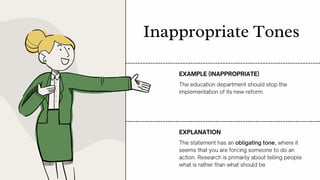
Inappropriate Tones
The education department should stop the
implementation of its new reform.
EXAMPLE (INAPPROPRIATE)
The statement has an obligating tone, where it
seems that you are forcing someone to do an
action. Research is primarily about telling people
what is rather than what should be
EXPLANATION
Inappropriate Tones
We are certain about the effectiveness of the
new intervention.
EXAMPLE (INAPPROPRIATE)
The statement has a direct tone, which conveys
100% certainty in the argument. The direct tone
actually sounds a little presumptuous.
EXPLANATION
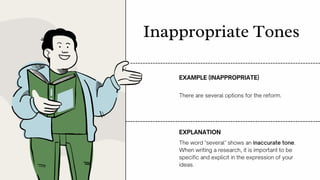
Inappropriate Tones
There are several options for the reform.
EXAMPLE (INAPPROPRIATE)
The word "several" shows an inaccurate tone.
When writing a research, it is important to be
specific and explicit in the expression of your
ideas.
EXPLANATION
Inappropriate Tones
The third reform is a fantastic option to help
improve education.
EXAMPLE (INAPPROPRIATE)
The use of the word "fantastic" makes the
sentence have a more dramatic or exaggerated
tone. It can be distracting for your readers. It
can also signal that you are mixing your
evidence with your own biases and personal
opinion.
EXPLANATION
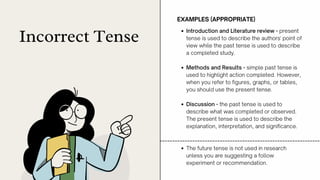
Incorrect Tense
Introduction and Literature review - present
tense is used to describe the authors' point of
view while the past tense is used to describe
a completed study.
Methods and Results - simple past tense is
used to highlight action completed. However,
when you refer to figures, graphs, or tables,
you should use the present tense.
Discussion - the past tense is used to
describe what was completed or observed.
The present tense is used to describe the
explanation, interpretation, and significance.
The future tense is not used in research
unless you are suggesting a follow
experiment or recommendation.
EXAMPLES (APPROPRIATE)
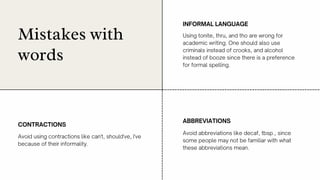
Mistakes with
words
Using tonite, thru, and tho are wrong for
academic writing. One should also use
criminals instead of crooks, and alcohol
instead of booze since there is a preference
for formal spelling.
INFORMAL LANGUAGE
Avoid using contractions like can't, should've, I've
because of their informality.
CONTRACTIONS
ABBREVIATIONS
Avoid abbreviations like decaf, tbsp., since
some people may not be familiar with what
these abbreviations mean.
Practice :)
Thank you!
DO YOU HAVE ANY FOLLOW-UP QUESTIONS FOR ME?

Error-Proofing Your Research.pdf

  • 1.
    Error-Proofing Your Research Common Mistakesand How to Address them Sta. Elena High School Prepared and presented by Vince Marko A. Sano
  • 2.
    Objectives Identify the approachused in stating or describing the background of the research Present the components of writing an introduction or background of the research; Evaluate the common mistakes in writing a research paper and present ways on how to address them 01 02 03
  • 3.
    Why conduct a discussion aboutmistakes? First, learning about mistakes prior to writing the research helps you recognize what practices to avoid. By knowing what to be careful with, you can actually concentrate on telling your reader about your main argument. Second, learning what not to do is sometimes more powerful than being told what to do. By clarifying what are not admissible or permitted, you will not have an excuse about being ignorant of the expectations for research.
  • 4.
    Sometimes a researcher canthink of a truly interesting research project, and write a commendable proposal, but this not necessarily lead to the execution of the project. DESCRIPTION A student had a good research question comparing traditional and non-traditional schools. He even wrote a promising proposal and had an extensive literature review. However, when he was about to go to the schools, he was politely informed that the school was not open to being researched on. EXAMPLE LESSON Have an initial assessment whether a research topic is feasible or not. Try to check data for claims and if the respondents are open for being the subjects of the study. Another thing to make sure is that you complete your research within the time allotted for it. Infeasibility of Research Project
  • 5.
    Lack of Preliminary Readings With theadvent of social media and news in the form of tweets, it is no surprise that the youth would much prefer quick and immediate ideas rather than go to the process of difficulty and reading academic books, journals, and other scholarly writing. DESCRIPTION Before you go deeper on a research topic, do preliminary readings first. Preliminary reading is about knowing the broad ideas that surround your research, immersing yourself in the vocabulary of a particular perspective, and understanding what are known and not yet known. LESSON
  • 6.
    Vague Research Questions What arethe most important environmental problems? How do we create better policies? Why do students cut class? TOO BROAD What environmental problem is evident in the estero near Binondo? How was the North Luzon Expressway created? Why do third-year high school students in Negros High School cut English classes? TOO SPECIFIC What factors have contributed to water pollution in a village? What are the principles used for a particular project? How do students understand or make sense of their deviant behavior? JUST ENOUGH
  • 7.
    Unidentified Research Gaps You haveto show that there is something original in your argument, or that at least your argument nuances the insights from another research. By the term nuance, your argument should provide an added perspective to what is generally known to be true. NOTE To say that basketball is one of the most popular sports in the Philippines does not merit much original thinking. However, to argue that basketball has been used as a means of colonizing and pacifying the Philippines is an interesting and debatable argument. EXAMPLE
  • 8.
    Undefined Terms For the firstexample, the term "CHED" should have been defined first. Say something about the agency or the institution first. WRITE DOWN THE ACRONYM FIRST Talk briefly in the introduction about how chronic spontaneous urticaria is a skin condition in which the person experiences allergies almost daily for at least six weeks. TECHNICAL TERMS SHOULD BE DEFINED AT THE START OF YOUR RESEARCH AND NOT WAIT UNTIL THE LITERATURE REVIEW OPERATIONALIZE TERMS You will have to specify if you are trying to measure intelligence in terms of IQ, examination grades, or school performance. 01 02 03 CHED has given a lot of scholarships to professors... People who experience chronic spontaneous urticaria have difficulties... Intelligent people often get into exclusive schools... 1. 2. 3. EXAMPLE MISTAKES
  • 9.
    Outdated or unreliable literature Failureto provide up-to-date research, findings, and examples can actually signal either that the topic has already been settled or studied to death, or that the researcher is now familiar with the more recent developments on the topic. To find more recent publications, you can search for papers and books in more scholarly search websites: Jstor, EBSCO-Host, Google Books, Google Scholar, Elsevier, Sage Publications, Taylor and Francis Journals, Routledge, and many more.
  • 10.
    Leading questions "We heardthat attendance is a problem in your school? Is your child attending school?" It could lead your respondent to answer the socially desirable answer rather than the accurate answer. Double-barreled questions "Why do some children perform well in their studies and why do some cause a lot of trouble?" This question is literally asking two different and separate things.
  • 11.
    Informal tone and language Youhave the option of using the first person (I/We) or the third person (The researcher/s) to refer to the researcher. The second person (You) is not used because the research paper should not directly address the reader. SHOULD I USE FIRST-PERSON POV AND PRONOUNS, OR THIRD-PERSON PRONOUNS? First Person: In this research, I argue that higher carbon dioxide emissions... Third person: The researcher tests the assumptions, and she shows that... EXAMPLES NOTE In academic essays in schools, teachers usually advise students to stick to the objective-sounding third person. However, it must be also noted that the APA actually recommends using the first-person.
  • 12.
    Ambiguity Usually, the word"the author/researcher" will be used to refer to the person writing the research. However, if this is preceded by the research of other authors, this may lead to ambiguity. Example: Mueller and Abrutyn (2015) highlight suicidality, and the researchers further clarify this position... In this example, it is not clear who "the researchers" are referring to - Mueller and Abrutyn, or the authors? In this example, the first person is preferred.
  • 13.
    Inappropriate Tones The educationdepartment should stop the implementation of its new reform. EXAMPLE (INAPPROPRIATE) The statement has an obligating tone, where it seems that you are forcing someone to do an action. Research is primarily about telling people what is rather than what should be EXPLANATION
  • 14.
    Inappropriate Tones We arecertain about the effectiveness of the new intervention. EXAMPLE (INAPPROPRIATE) The statement has a direct tone, which conveys 100% certainty in the argument. The direct tone actually sounds a little presumptuous. EXPLANATION
  • 15.
    Inappropriate Tones There areseveral options for the reform. EXAMPLE (INAPPROPRIATE) The word "several" shows an inaccurate tone. When writing a research, it is important to be specific and explicit in the expression of your ideas. EXPLANATION
  • 16.
    Inappropriate Tones The thirdreform is a fantastic option to help improve education. EXAMPLE (INAPPROPRIATE) The use of the word "fantastic" makes the sentence have a more dramatic or exaggerated tone. It can be distracting for your readers. It can also signal that you are mixing your evidence with your own biases and personal opinion. EXPLANATION
  • 17.
    Incorrect Tense Introduction andLiterature review - present tense is used to describe the authors' point of view while the past tense is used to describe a completed study. Methods and Results - simple past tense is used to highlight action completed. However, when you refer to figures, graphs, or tables, you should use the present tense. Discussion - the past tense is used to describe what was completed or observed. The present tense is used to describe the explanation, interpretation, and significance. The future tense is not used in research unless you are suggesting a follow experiment or recommendation. EXAMPLES (APPROPRIATE)
  • 18.
    Mistakes with words Using tonite,thru, and tho are wrong for academic writing. One should also use criminals instead of crooks, and alcohol instead of booze since there is a preference for formal spelling. INFORMAL LANGUAGE Avoid using contractions like can't, should've, I've because of their informality. CONTRACTIONS ABBREVIATIONS Avoid abbreviations like decaf, tbsp., since some people may not be familiar with what these abbreviations mean.
  • 19.
  • 20.
    Thank you! DO YOUHAVE ANY FOLLOW-UP QUESTIONS FOR ME?