Welcome
Safety
Safety
Safety
Safety
Safety
Safety
Safety
Safety
Safety
Safety
Safety
Safety
Safety
Safety
Safety
Safety
Safety
Safety
Safety
Safety
Safety
Safety
Safety
Safety
Safety
Safety
Safety
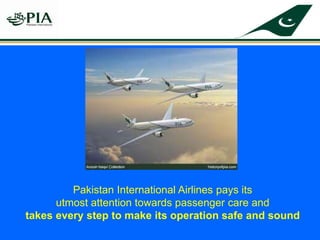
Pakistan International Airlines pays its
utmost attention towards passenger care and
takes every step to make its operation safe and sound
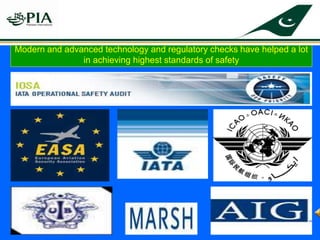
Modern and advanced technology and regulatory checks have helped a lot
in achieving highest standards of safety
And air travel has become safer than crossing a road
Still, no airline is ever immune to an accident
To efficiently respond to such
eventualities and to minimize the
losses if accident occur ………
…….. PIA has put on considerable
efforts in the area of Emergency
Response Planning (ERP)
1. Helps effective management
of major accidents
2. Ensures humanitarian assistance
to victims and families
3. Facilitates to maintain
corporate image
ERP
4. NTSB & Family Assistance Act
Requirements in USA
5. Mandatory IOSA Requirement
6. It is an Insurance Plan
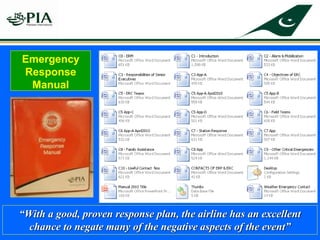
“With a good, proven response plan, the airline has an excellent
chance to negate many of the negative aspects of the event”
Emergency
Response
Manual
Station
Emergency
Plans
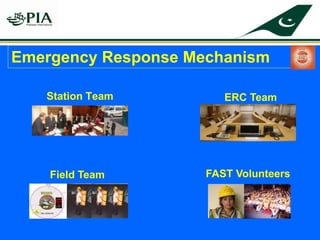
Station Team
Emergency Response Mechanism
Field Team
ERC Team
FAST Volunteers
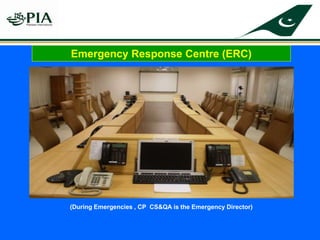
Emergency Response Centre (ERC)
(During Emergencies , CP CS&QA is the Emergency Director)
• Conference Call Set
• International Line
• NTC Lines
• 5 digit Intercoms
• Executive Intercom
• JTC Inter Com
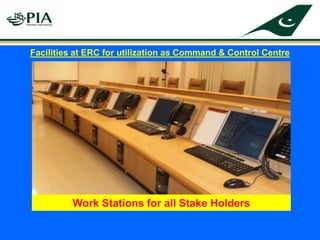
Facilities at ERC for utilization as Command & Control Centre
Work Stations for all Stake Holders
Mobile Charging Unit
5 Station Clock & Smart Board
Emergency Call Centre (ECC)
Media Response Centre (MRC)
Field Team Kits
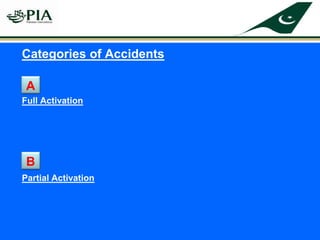
Categories of Accidents
A
Full Activation
B
Partial Activation
Categories of Accidents
A
Full Activation
• Major A/C Accident
• Missing A/C (Fuel Exhausted)
• Hijacking
B
Partial Activation
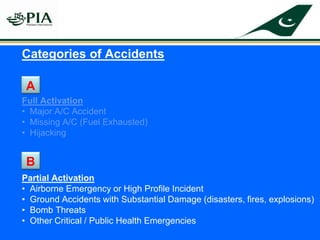
Categories of Accidents
A
Full Activation
• Major A/C Accident
• Missing A/C (Fuel Exhausted)
• Hijacking
B
Partial Activation
• Airborne Emergency or High Profile Incident
• Ground Accidents with Substantial Damage (disasters, fires, explosions)
• Bomb Threats
• Other Critical / Public Health Emergencies
Alarm & Mobilization
1. SMS Initiated by Situation
Room through Contact Centre
2. Phone Calls through
Telephone Exchange
3. Notification Tree
4. Call Home Scheme
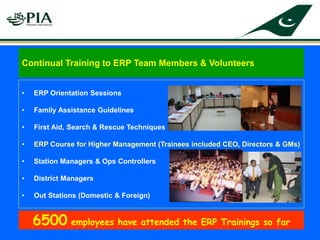
• ERP Orientation Sessions
• Family Assistance Guidelines
• First Aid, Search & Rescue Techniques
• ERP Course for Higher Management (Trainees included CEO, Directors & GMs)
• Station Managers & Ops Controllers
• District Managers
• Out Stations (Domestic & Foreign)
Continual Training to ERP Team Members & Volunteers
6500 employees have attended the ERP Trainings so far
Passenger Record & Family Information System
An agreement with
Kenyon International
Doc
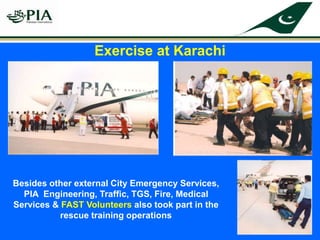
Besides other external City Emergency Services,
PIA Engineering, Traffic, TGS, Fire, Medical
Services & FAST Volunteers also took part in the
rescue training operations
Exercise at Karachi
Media Response
Salient Points
No employee except Chairman & CEO or Station Head is
permitted to talk with the press
First Press Statement should be released within 1 hour of
the accident from ERC
Press Conference of the Chairman & CEO should be held
within three hours of the accident.
ERC Activations by Now
• Faisalabad Explosion – Well Coordinated actions by different departments
• Avian / Bird Flu
• Relief Goods Transportation: Swat IDP – Flood Relief Operation (5200 +tons)
• Hajj Operation
• Volcanic Eruption in Europe
• Airblue Accident
• Snow Fall in Europe & USA / Fog & Rain Disruptions in Pakistan
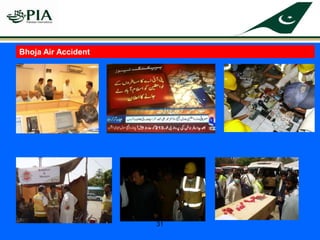
• Bhoja Air Accident
31
Emergency Response Planning
Bhoja Air Accident
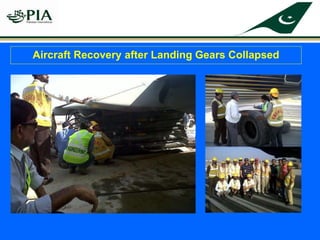
Aircraft Recovery after Landing Gears Collapsed
33
Training to OMV Oil Field Team
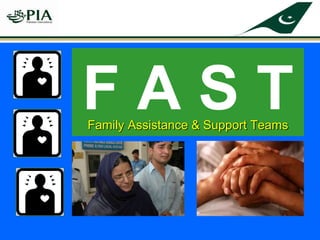
Family Assistance & Support Teams
F A S T
Psychotrauma
Normal reactions of normal people in a highly abnormal situation
- grief
- hostility
- anger
- frustration
- shock
Humanitarian Support is required at
• Accident Site
• Hospitals
• Passenger Information Centers
• Family Assistance Centers
• Hotels
• Family’s Residence
• While Traveling
Provision of Information to
• The General Public
• The Family of Passengers
• Meeters and Relatives at the Airports
• Injured Passengers at the Hospitals
Who gets hurt?
• Survivors
• Next-of-Kin
• Special Assistance Team Members
• The Company
• The Community
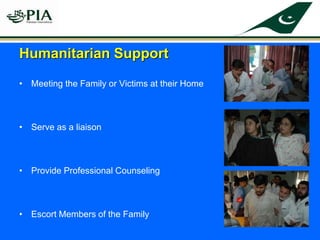
• Meeting the Family or Victims at their Home
• Serve as a liaison
• Provide Professional Counseling
• Escort Members of the Family
Humanitarian Support
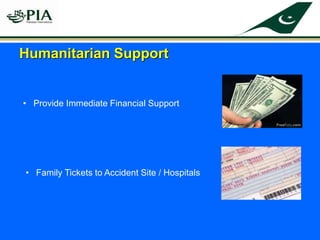
• Provide Immediate Financial Support
Humanitarian Support
• Family Tickets to Accident Site / Hospitals
Return of Personal Belongings (Condition and Time)
Humanitarian Support
• Respect for Values, Beliefs and Culture
• Respect the Wishes of the Family
• Confidentiality
Humanitarian Support
• Transportation of Remains
• Support in Identification of Deceased
• Memorials: Respect the Wishes of the Families
• Annual Remembrance Service
Humanitarian Support
Typical questions by family members
1. Confirm if the person is a victim
2. Victim’s Condition
3. Victim’s Location
4. When to Return Home
5. Next Step
Special Assistance Team
Support
• Emotional • Physical
“To demonstrate personal care as if the survivor or
family member is your own personal relative”
Tangible Support
Clothing
Monetary
Food & Drink
Transportation
Problem Solving with People in Trauma
Emotions First, Problems Second
Emotional Support
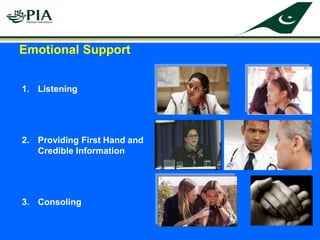
1. Listening
2. Providing First Hand and
Credible Information
3. Consoling
• Cognitive : Thoughts
• Emotive : Feelings
Don’t
Judge !
Crisis Communication
• Different families react differently
• You deal with different emotions: hostility, anger, shock,
frustration, and grief
• Each family has its own set of circumstances
• Everything is so individual
• It is important to really listen
• You must not take things personally
Effective Communication
• Body language
• Eye level – Eye contact
• Tone of voice
• Mirroring (Tone and Rhythm to create rapport)
Effective Communication
• Use of voice to create calm
• Angry people – How to approach
• Win : Win Problem solving techniques
Ideal Responses
• Allow venting of feelings
• Acknowledge Situation (Do not try to defend the
company or crew)
• Promise only what has been approved by the Company and
what realistically can be accomplished
Ideal Responses
• Never discuss causes of the accident
• Consider every response carefully, choose your words wisely
• If you have nothing to say…..Remain silently supportive
Effective Responses
• “I am truly sorry for your loss”
• “I am truly sorry for you and your family
having to go through this event”
• “I am here to assist you in any way possible”
Inappropriate Responses
• “Accidents are not planned”
• “We always had a good safety record”
• “It was better for them this way”
• “It could have been worse…”
Inappropriate Responses
• “At least only 5 people died”
• “All things happens for a reason…”
• “It was their destiny”
• “They are sitting right beside God enjoying paradise….”
Inappropriate Responses
• “Do not worry you are going to get another pet or toy”
• “They were old it was their time to go anyway”
• “Think that they did not feel any pain…They died instantly”
Inappropriate Responses
• “Crying won’t bring them back”
• “When my mother died, this is what I did.…”
• “It was not the airline’s fault, it was….”
• “We all have to die one day….”
Self care by Team Members and Station Employees
• Take regular breaks
• Create Shifts
• Support each other (Create a “buddy system”)
• Debrief daily
Self care by Team Members and Station Employees
• Be aware of your own mental health
• Watch others for signs of stress or burn out
• Ask for counseling if you feel overwhelmed
Stay out of
the Ditch!
Group Task
Group A
Modalities of Interaction with major carrier at an airport at the time of
emergency
Group B
How to jointly manage 300 plus victims at different places like
hospitals, lounges etc.
Group C
Humanitarian Assistance – Do’s & Dont’s
Thank You

Erp 31jan13

  • 1.
  • 2.
  • 3.
    Pakistan International Airlinespays its utmost attention towards passenger care and takes every step to make its operation safe and sound
  • 4.
    Modern and advancedtechnology and regulatory checks have helped a lot in achieving highest standards of safety
  • 5.
    And air travelhas become safer than crossing a road
  • 6.
    Still, no airlineis ever immune to an accident
  • 7.
    To efficiently respondto such eventualities and to minimize the losses if accident occur ……… …….. PIA has put on considerable efforts in the area of Emergency Response Planning (ERP)
  • 8.
    1. Helps effectivemanagement of major accidents 2. Ensures humanitarian assistance to victims and families 3. Facilitates to maintain corporate image ERP
  • 9.
    4. NTSB &Family Assistance Act Requirements in USA 5. Mandatory IOSA Requirement 6. It is an Insurance Plan
  • 10.
    “With a good,proven response plan, the airline has an excellent chance to negate many of the negative aspects of the event” Emergency Response Manual
  • 11.
  • 12.
    Station Team Emergency ResponseMechanism Field Team ERC Team FAST Volunteers
  • 13.
    Emergency Response Centre(ERC) (During Emergencies , CP CS&QA is the Emergency Director)
  • 14.
    • Conference CallSet • International Line • NTC Lines • 5 digit Intercoms • Executive Intercom • JTC Inter Com
  • 15.
    Facilities at ERCfor utilization as Command & Control Centre Work Stations for all Stake Holders
  • 16.
  • 17.
    5 Station Clock& Smart Board
  • 18.
  • 19.
  • 20.
  • 21.
    Categories of Accidents A FullActivation B Partial Activation
  • 22.
    Categories of Accidents A FullActivation • Major A/C Accident • Missing A/C (Fuel Exhausted) • Hijacking B Partial Activation
  • 23.
    Categories of Accidents A FullActivation • Major A/C Accident • Missing A/C (Fuel Exhausted) • Hijacking B Partial Activation • Airborne Emergency or High Profile Incident • Ground Accidents with Substantial Damage (disasters, fires, explosions) • Bomb Threats • Other Critical / Public Health Emergencies
  • 24.
    Alarm & Mobilization 1.SMS Initiated by Situation Room through Contact Centre 2. Phone Calls through Telephone Exchange 3. Notification Tree 4. Call Home Scheme
  • 25.
    • ERP OrientationSessions • Family Assistance Guidelines • First Aid, Search & Rescue Techniques • ERP Course for Higher Management (Trainees included CEO, Directors & GMs) • Station Managers & Ops Controllers • District Managers • Out Stations (Domestic & Foreign) Continual Training to ERP Team Members & Volunteers 6500 employees have attended the ERP Trainings so far
  • 26.
    Passenger Record &Family Information System
  • 27.
    An agreement with KenyonInternational Doc
  • 28.
    Besides other externalCity Emergency Services, PIA Engineering, Traffic, TGS, Fire, Medical Services & FAST Volunteers also took part in the rescue training operations Exercise at Karachi
  • 29.
    Media Response Salient Points Noemployee except Chairman & CEO or Station Head is permitted to talk with the press First Press Statement should be released within 1 hour of the accident from ERC Press Conference of the Chairman & CEO should be held within three hours of the accident.
  • 30.
    ERC Activations byNow • Faisalabad Explosion – Well Coordinated actions by different departments • Avian / Bird Flu • Relief Goods Transportation: Swat IDP – Flood Relief Operation (5200 +tons) • Hajj Operation • Volcanic Eruption in Europe • Airblue Accident • Snow Fall in Europe & USA / Fog & Rain Disruptions in Pakistan • Bhoja Air Accident
  • 31.
  • 32.
    Aircraft Recovery afterLanding Gears Collapsed
  • 33.
    33 Training to OMVOil Field Team
  • 34.
    Family Assistance &Support Teams F A S T
  • 35.
    Psychotrauma Normal reactions ofnormal people in a highly abnormal situation - grief - hostility - anger - frustration - shock
  • 36.
    Humanitarian Support isrequired at • Accident Site • Hospitals • Passenger Information Centers • Family Assistance Centers • Hotels • Family’s Residence • While Traveling
  • 37.
    Provision of Informationto • The General Public • The Family of Passengers • Meeters and Relatives at the Airports • Injured Passengers at the Hospitals
  • 38.
    Who gets hurt? •Survivors • Next-of-Kin • Special Assistance Team Members • The Company • The Community
  • 39.
    • Meeting theFamily or Victims at their Home • Serve as a liaison • Provide Professional Counseling • Escort Members of the Family Humanitarian Support
  • 40.
    • Provide ImmediateFinancial Support Humanitarian Support • Family Tickets to Accident Site / Hospitals
  • 41.
    Return of PersonalBelongings (Condition and Time) Humanitarian Support
  • 42.
    • Respect forValues, Beliefs and Culture • Respect the Wishes of the Family • Confidentiality Humanitarian Support
  • 43.
    • Transportation ofRemains • Support in Identification of Deceased • Memorials: Respect the Wishes of the Families • Annual Remembrance Service Humanitarian Support
  • 44.
    Typical questions byfamily members 1. Confirm if the person is a victim 2. Victim’s Condition 3. Victim’s Location 4. When to Return Home 5. Next Step
  • 45.
    Special Assistance Team Support •Emotional • Physical “To demonstrate personal care as if the survivor or family member is your own personal relative”
  • 46.
  • 47.
    Problem Solving withPeople in Trauma Emotions First, Problems Second
  • 48.
    Emotional Support 1. Listening 2.Providing First Hand and Credible Information 3. Consoling
  • 49.
    • Cognitive :Thoughts • Emotive : Feelings
  • 50.
  • 51.
    Crisis Communication • Differentfamilies react differently • You deal with different emotions: hostility, anger, shock, frustration, and grief • Each family has its own set of circumstances • Everything is so individual • It is important to really listen • You must not take things personally
  • 52.
    Effective Communication • Bodylanguage • Eye level – Eye contact • Tone of voice • Mirroring (Tone and Rhythm to create rapport)
  • 53.
    Effective Communication • Useof voice to create calm • Angry people – How to approach • Win : Win Problem solving techniques
  • 54.
    Ideal Responses • Allowventing of feelings • Acknowledge Situation (Do not try to defend the company or crew) • Promise only what has been approved by the Company and what realistically can be accomplished
  • 55.
    Ideal Responses • Neverdiscuss causes of the accident • Consider every response carefully, choose your words wisely • If you have nothing to say…..Remain silently supportive
  • 56.
    Effective Responses • “Iam truly sorry for your loss” • “I am truly sorry for you and your family having to go through this event” • “I am here to assist you in any way possible”
  • 57.
    Inappropriate Responses • “Accidentsare not planned” • “We always had a good safety record” • “It was better for them this way” • “It could have been worse…”
  • 58.
    Inappropriate Responses • “Atleast only 5 people died” • “All things happens for a reason…” • “It was their destiny” • “They are sitting right beside God enjoying paradise….”
  • 59.
    Inappropriate Responses • “Donot worry you are going to get another pet or toy” • “They were old it was their time to go anyway” • “Think that they did not feel any pain…They died instantly”
  • 60.
    Inappropriate Responses • “Cryingwon’t bring them back” • “When my mother died, this is what I did.…” • “It was not the airline’s fault, it was….” • “We all have to die one day….”
  • 61.
    Self care byTeam Members and Station Employees • Take regular breaks • Create Shifts • Support each other (Create a “buddy system”) • Debrief daily
  • 62.
    Self care byTeam Members and Station Employees • Be aware of your own mental health • Watch others for signs of stress or burn out • Ask for counseling if you feel overwhelmed
  • 63.
  • 64.
    Group Task Group A Modalitiesof Interaction with major carrier at an airport at the time of emergency Group B How to jointly manage 300 plus victims at different places like hospitals, lounges etc. Group C Humanitarian Assistance – Do’s & Dont’s
  • 65.

Editor's Notes

  • #48 Narejo Human Resources - www.narejohr.com