Energise Enable
Involve
YES, I CAN
LEARN & SPEAK
ENGLISH
Energise Enable
Involve
HOW TO LEARN ENGLISH
EFFECTIVELY
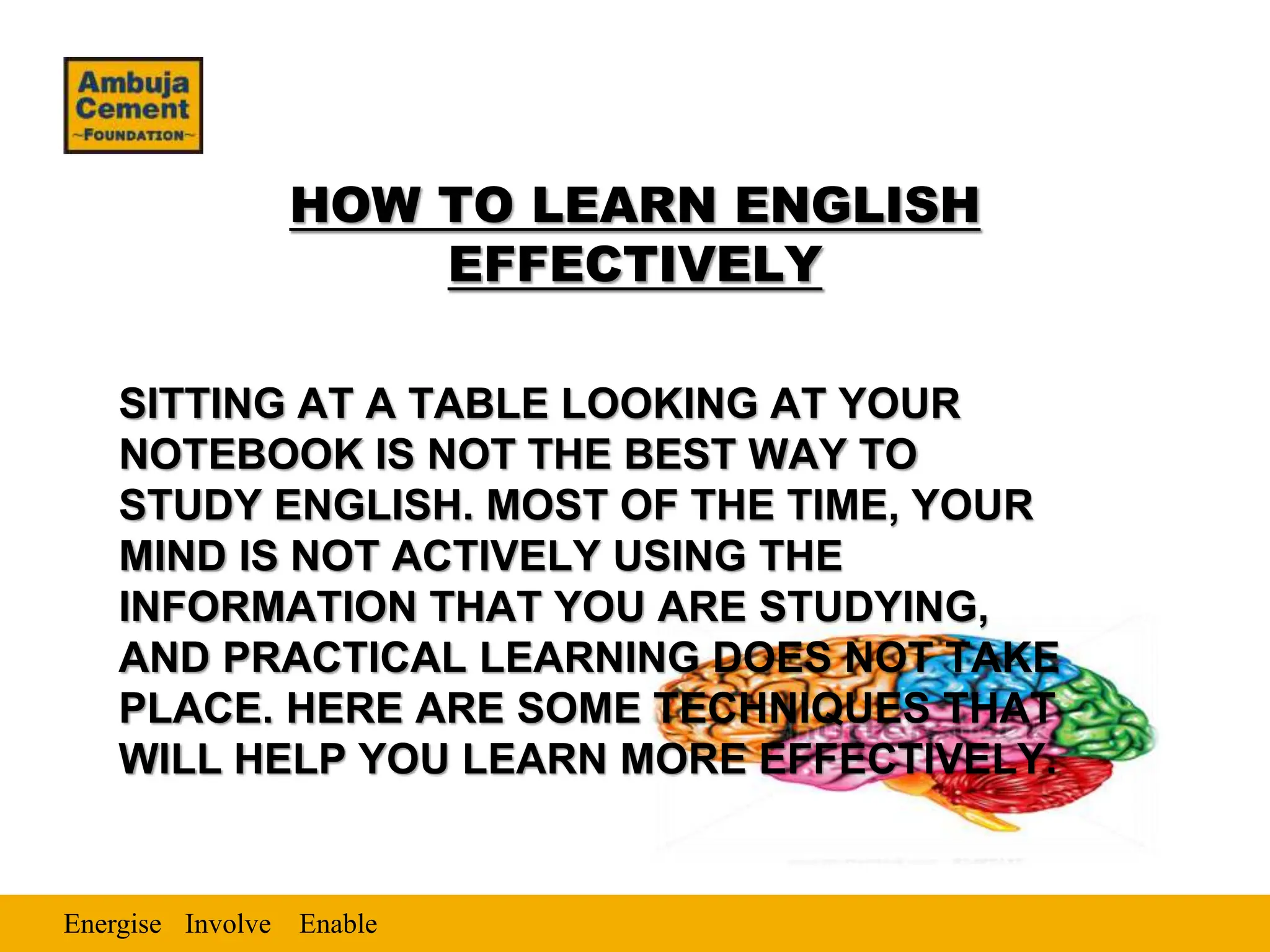
SITTING AT A TABLE LOOKING AT YOUR
NOTEBOOK IS NOT THE BEST WAY TO
STUDY ENGLISH. MOST OF THE TIME, YOUR
MIND IS NOT ACTIVELY USING THE
INFORMATION THAT YOU ARE STUDYING,
AND PRACTICAL LEARNING DOES NOT TAKE
PLACE. HERE ARE SOME TECHNIQUES THAT
WILL HELP YOU LEARN MORE EFFECTIVELY.
Energise Enable
Involve
WRITE A JOURNAL
• Writing every day lets you see your grammar clearly in
front of you, express your ideas, and use a non-oral
method in communicate in English. Then read the
corrected version out loud.
• It is a good idea to re-copy the corrected journal too, so
that you will have the experience of writing your ideas
down in proper English.
Energise Enable
Involve
READ A BOOK
• By Reading A Story, You Create A Picture In Your
Imagination That Will Connected Different Parts Of Your
Brain To English. Find A Book That Is Not Too Difficult.
• Do Not Stop Every Time You Find A New Word.
• Guess What The Word Probably Means, Continue
Reading, And Check In Your Dictionary At The End Of
The Page Or Chapter.
Energise Enable
Involve
Re-write your class notes every day.
• Writing your notes a second time will allow you to
remember more strongly what you study.
• It will also make your notebook neater, making it
easier to study.
Energise Enable
Involve
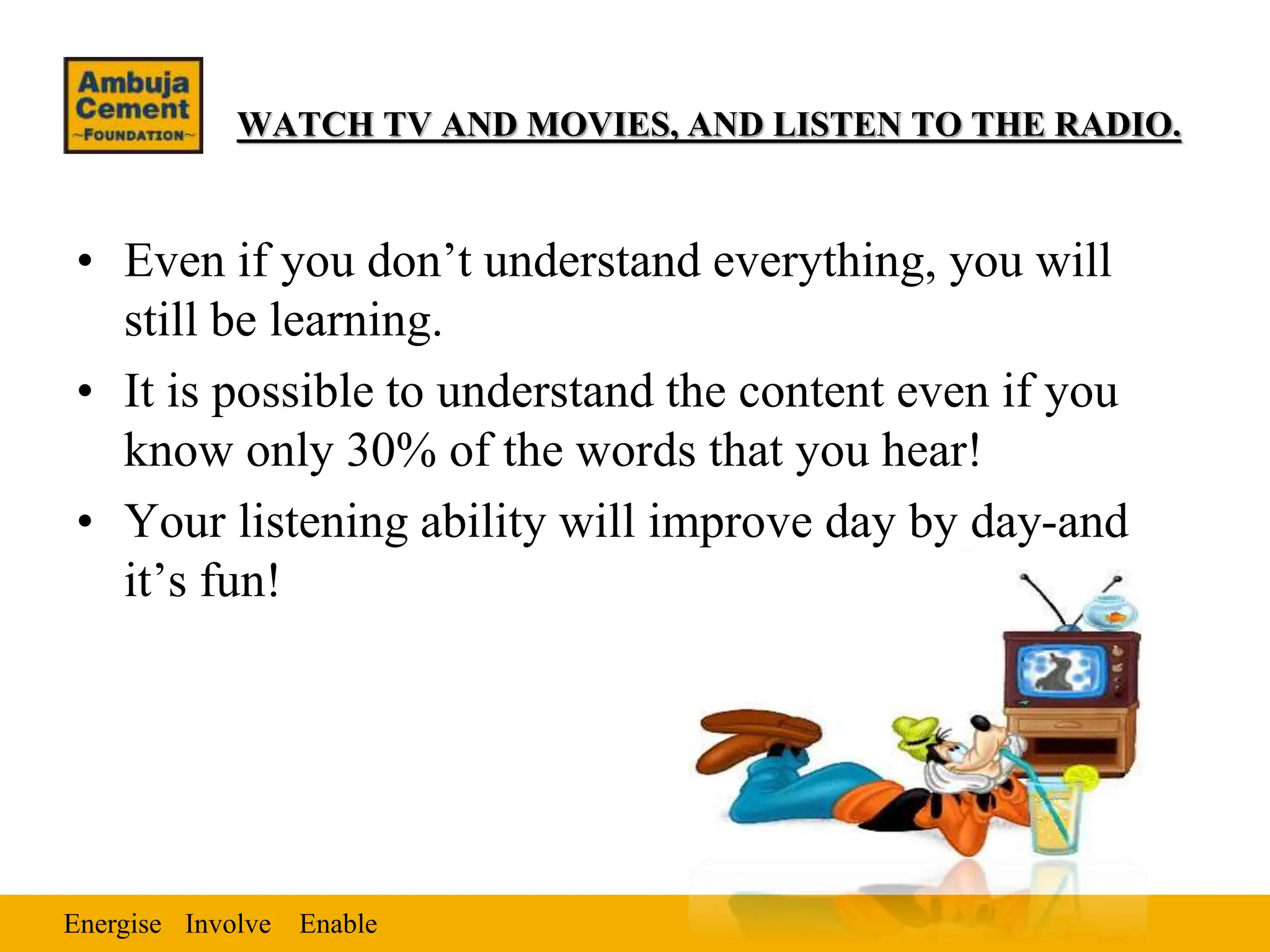
WATCH TV AND MOVIES, AND LISTEN TO THE RADIO.
• Even if you don’t understand everything, you will
still be learning.
• It is possible to understand the content even if you
know only 30% of the words that you hear!
• Your listening ability will improve day by day-and
it’s fun!
Energise Enable
Involve
KEEP A VOCABULARY NOTEBOOK IN A
SEPARATE NOTEBOOK FROM YOUR CLASS
NOTES
• Take an active approach to learning new vocabulary.
• If you find 5 words a day, 6 days a week, you will learn about 140 new words a month;
10 words a day would bring you over than 280 new words a month.
• Hint – approach new words by subject: things connected to your hobies, to your
interests etc.
• Do it this way:
• Think of a word you know in your language.
• Look it up in your dictionary.
• When you find the English word, write it down on the left side of your vocabulary note
book.
• In the midle of the page, write down if the word is a noun (n), verb (v), adjective (adj),
etc. so that you will know how to use the word.
• Look the word up in an English-English dictionary.
• Write the English definition on the right side of the the page (or on the next page).
• Copy a sentence from the dictionary. This will help you learn how to use the word
correctly.
• Practice reading this sentence untll it becomes natural for you.
Energise Enable
Involve
SPEAK LOTS OF ENGLISH WITH
YOUR FRINDS
• You improve your spoken English by speaking
English in different situations with people of all
nationalities.
• If you want to speak English better in the future,
speak it as much as possible now!
Energise Enable
Involve
THINK POSITIVELY
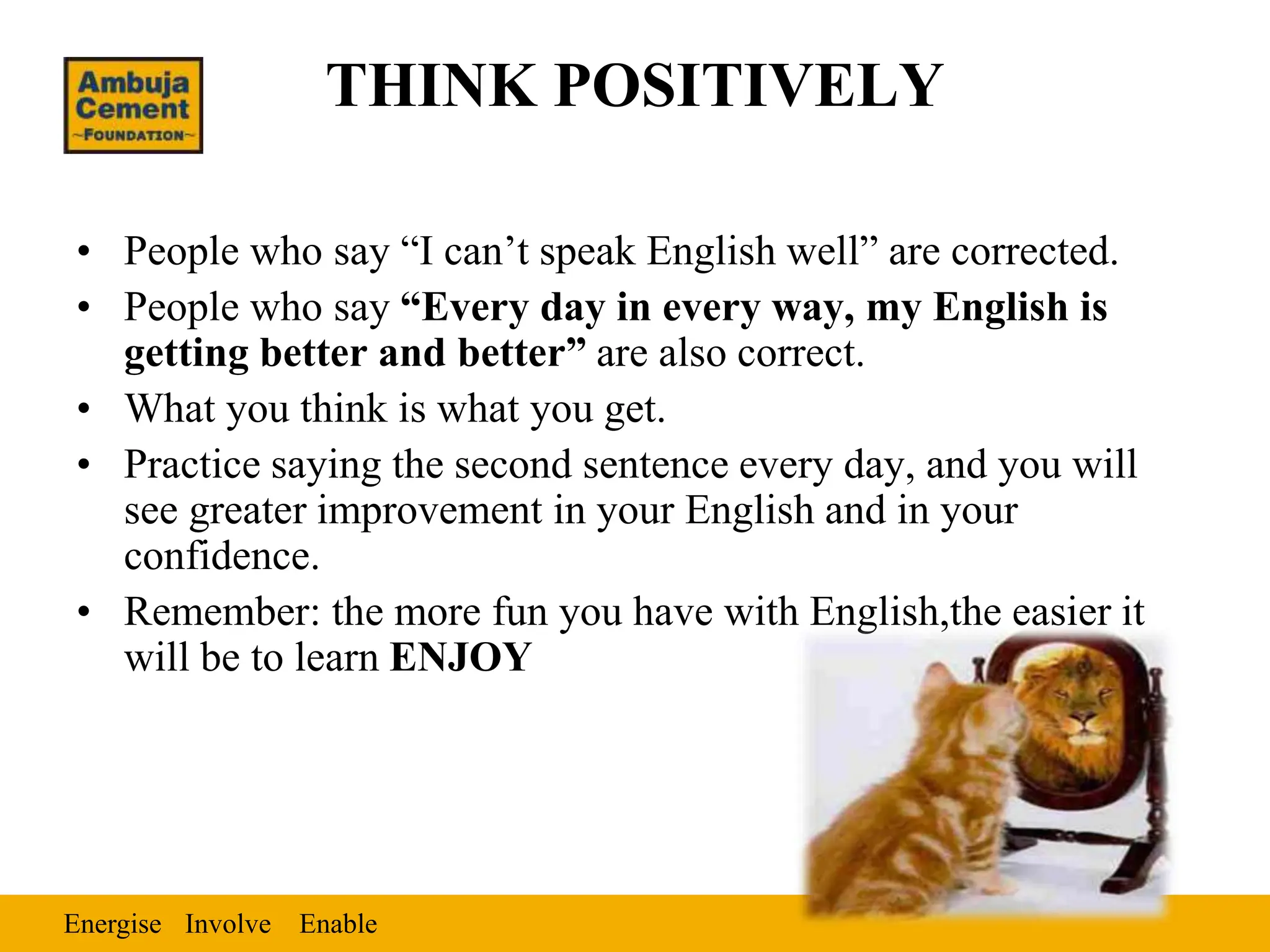
• People who say “I can’t speak English well” are corrected.
• People who say “Every day in every way, my English is
getting better and better” are also correct.
• What you think is what you get.
• Practice saying the second sentence every day, and you will
see greater improvement in your English and in your
confidence.
• Remember: the more fun you have with English,the easier it
will be to learn ENJOY
Energise Enable
Involve
English Grammar
In Easy Way
Energise Enable
Involve
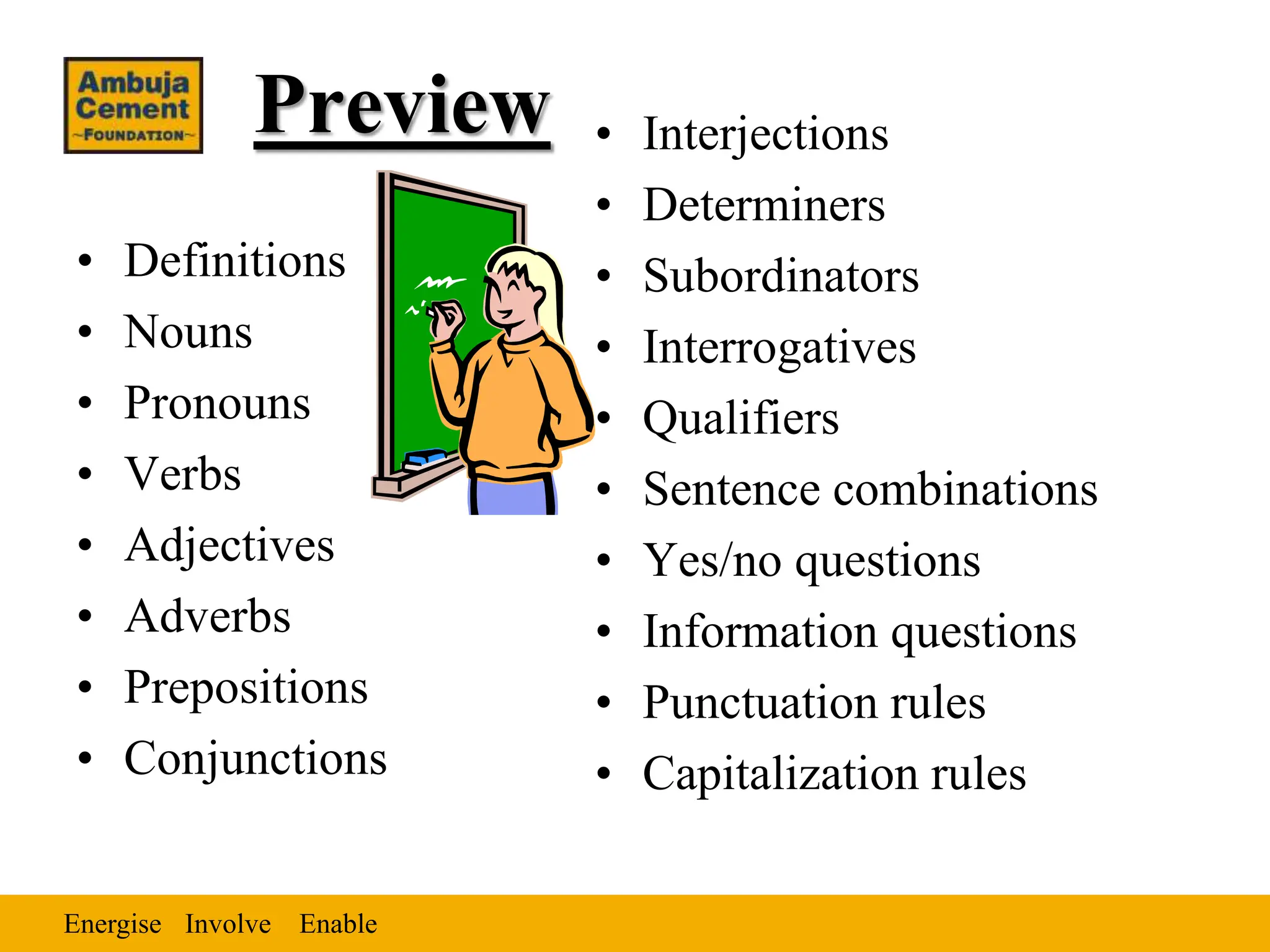
Preview
• Definitions
• Nouns
• Pronouns
• Verbs
• Adjectives
• Adverbs
• Prepositions
• Conjunctions
• Interjections
• Determiners
• Subordinators
• Interrogatives
• Qualifiers
• Sentence combinations
• Yes/no questions
• Information questions
• Punctuation rules
• Capitalization rules
Energise Enable
Involve
Grammar
• DEFINITION
The grammar of a language is a complex of systems
that may be analyzed and studied on these three
levels: (Noam Chomsky’s UG)
1. Phonology (set of sounds/ symbols)
2. Morphology (combinations of sounds that
carry single units of meaning)
3. Syntax (how single units of meaning are
combined to form words, phrases and
sentences.
Energise Enable
Involve
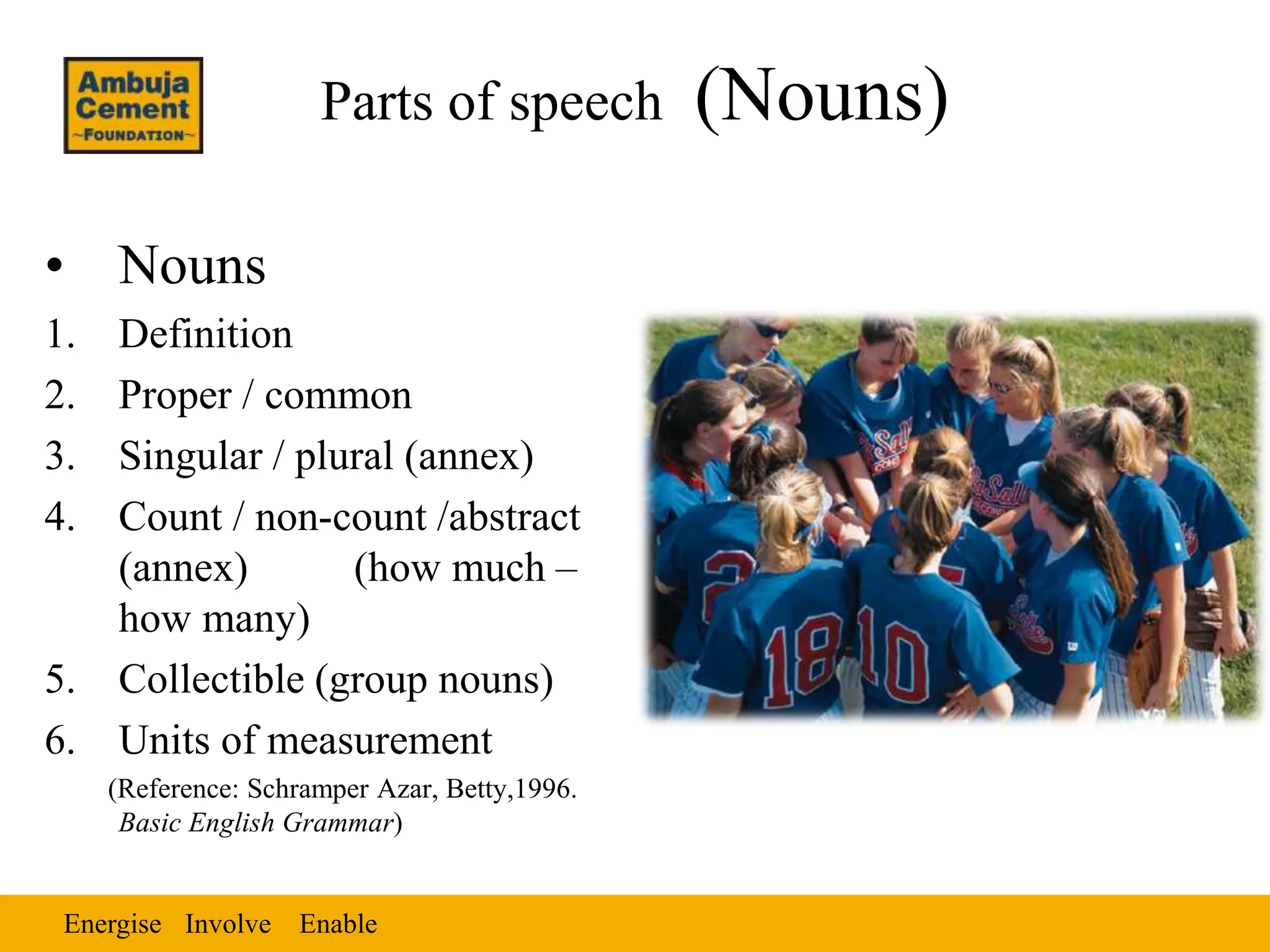
Parts of speech (Nouns)
• Nouns
1. Definition
2. Proper / common
3. Singular / plural (annex)
4. Count / non-count /abstract
(annex) (how much –
how many)
5. Collectible (group nouns)
6. Units of measurement
(Reference: Schramper Azar, Betty,1996.
Basic English Grammar)
Energise Enable
Involve
Definition
(proper and common nouns)
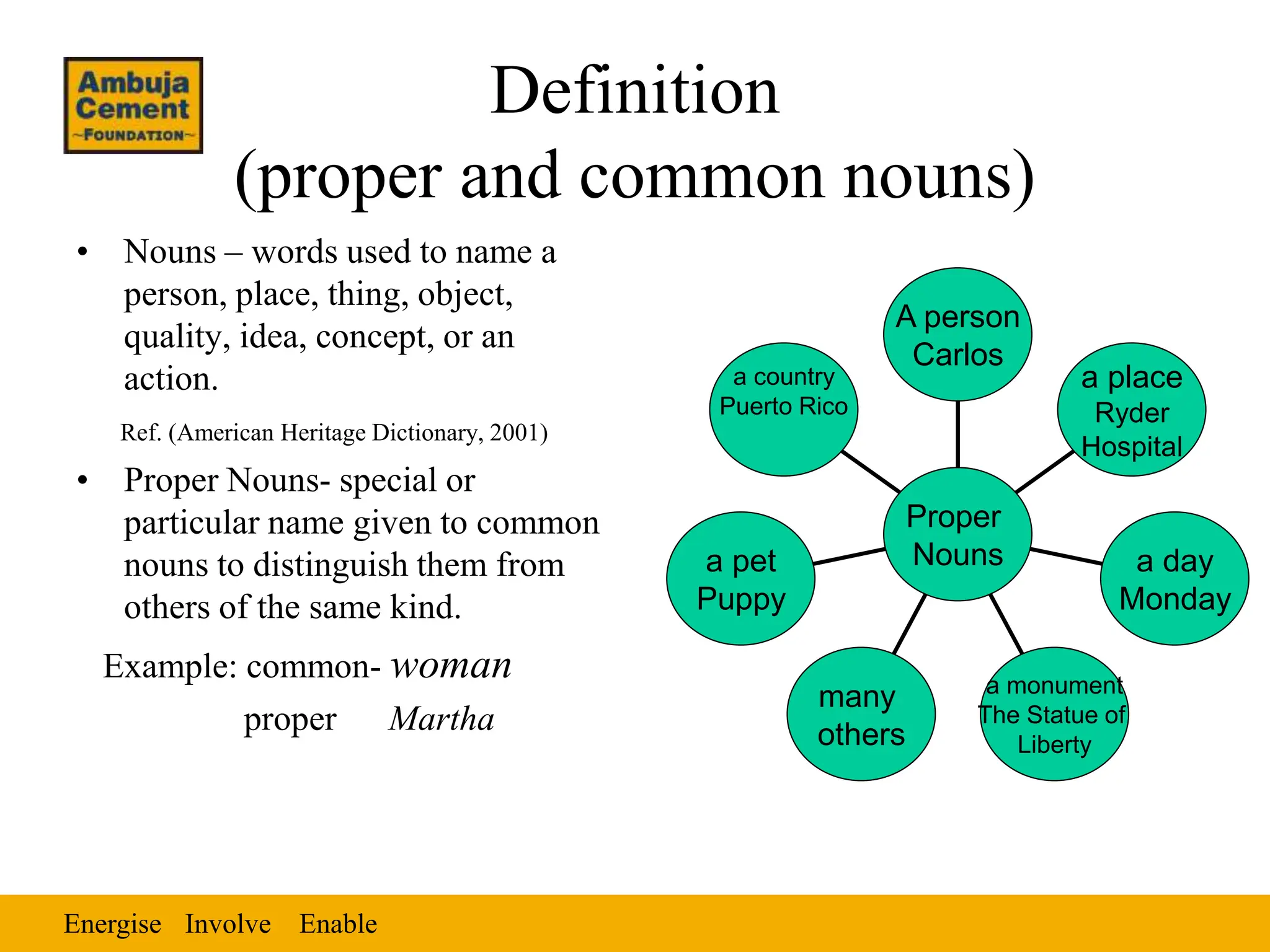
• Nouns – words used to name a
person, place, thing, object,
quality, idea, concept, or an
action.
Ref. (American Heritage Dictionary, 2001)
• Proper Nouns- special or
particular name given to common
nouns to distinguish them from
others of the same kind.
Example: common- woman
proper Martha
a country
Puerto Rico
a pet
Puppy
many
others
a monument
The Statue of
Liberty
a day
Monday
a place
Ryder
Hospital
A person
Carlos
Proper
Nouns
Energise Enable
Involve
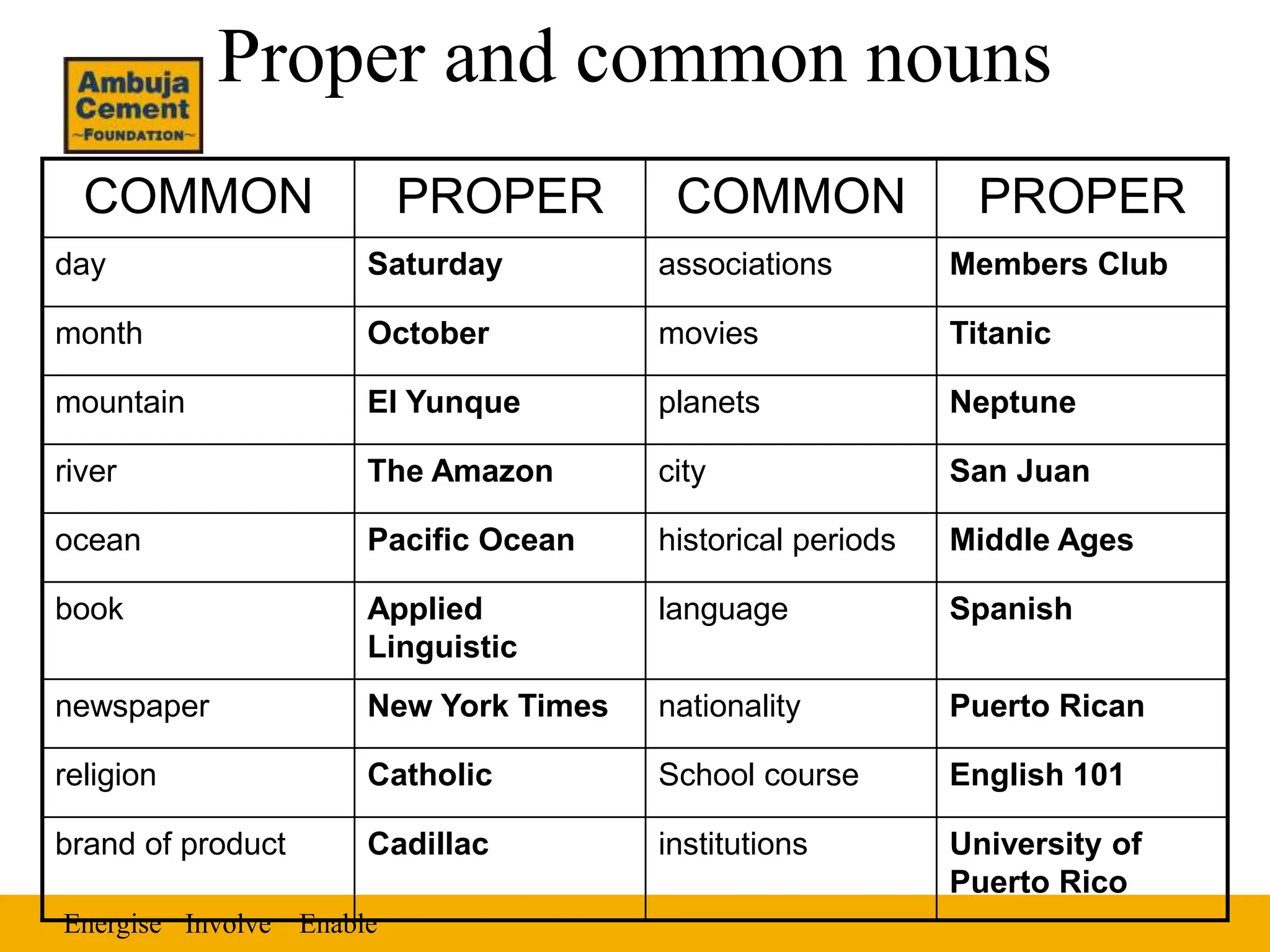
Proper and common nouns
COMMON PROPER COMMON PROPER
day Saturday associations Members Club
month October movies Titanic
mountain El Yunque planets Neptune
river The Amazon city San Juan
ocean Pacific Ocean historical periods Middle Ages
book Applied
Linguistic
language Spanish
newspaper New York Times nationality Puerto Rican
religion Catholic School course English 101
brand of product Cadillac institutions University of
Puerto Rico
Energise Enable
Involve
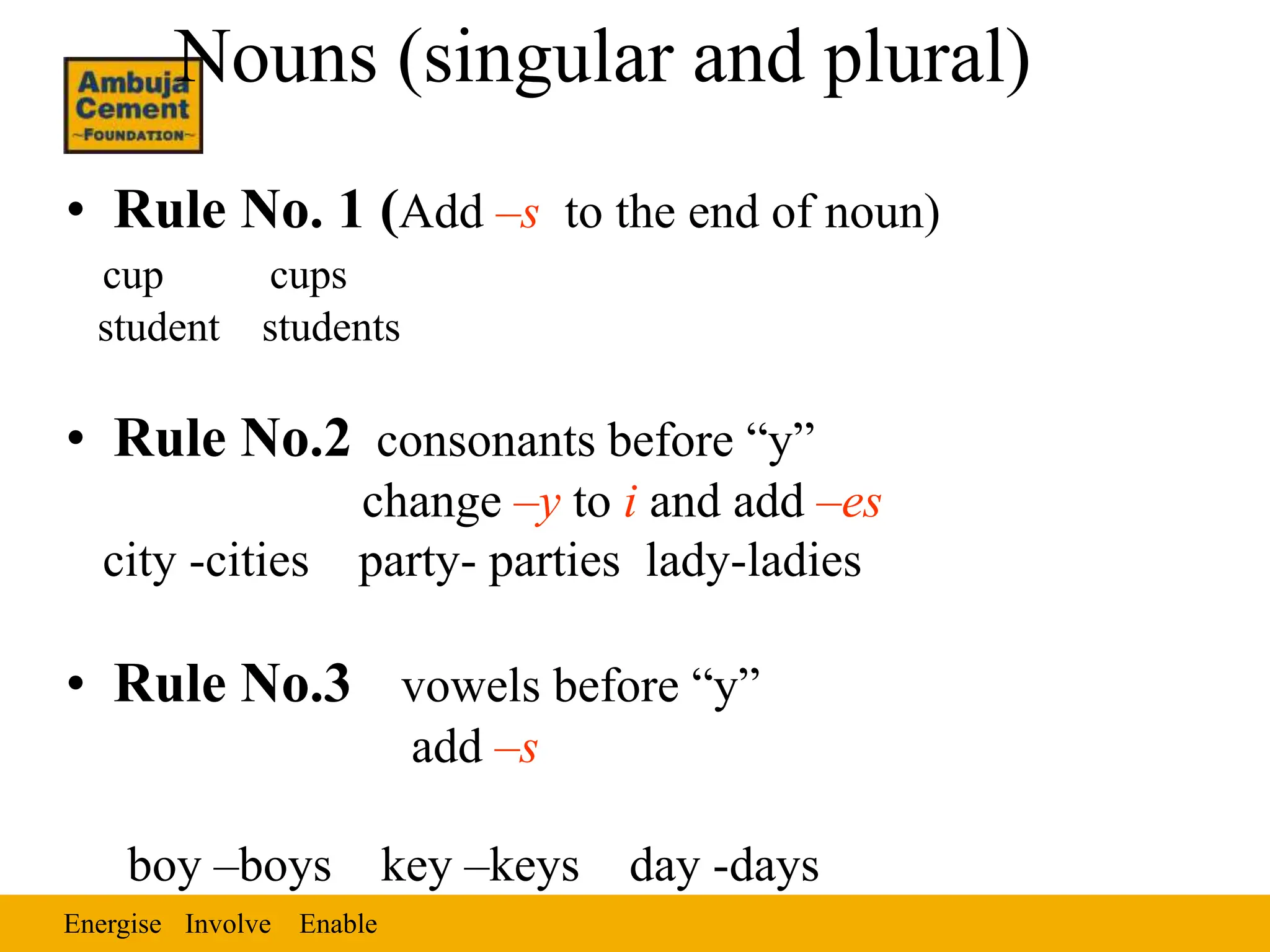
Nouns (singular and plural)
• Rule No. 1 (Add –s to the end of noun)
cup cups
student students
• Rule No.2 consonants before “y”
change –y to i and add –es
city -cities party- parties lady-ladies
• Rule No.3 vowels before “y”
add –s
boy –boys key –keys day -days
Energise Enable
Involve
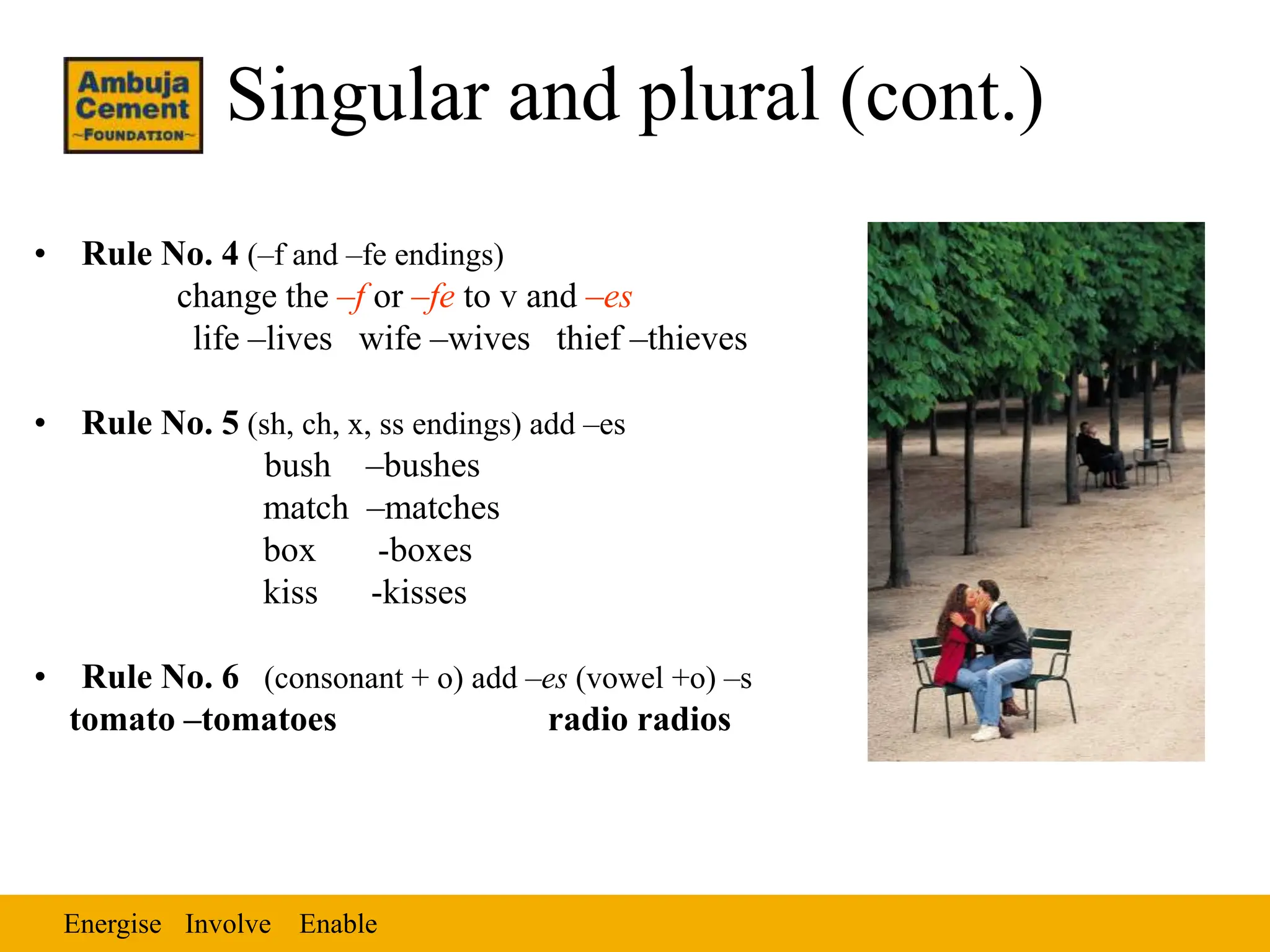
Singular and plural (cont.)
• Rule No. 4 (–f and –fe endings)
change the –f or –fe to v and –es
life –lives wife –wives thief –thieves
• Rule No. 5 (sh, ch, x, ss endings) add –es
bush –bushes
match –matches
box -boxes
kiss -kisses
• Rule No. 6 (consonant + o) add –es (vowel +o) –s
tomato –tomatoes radio radios
Energise Enable
Involve
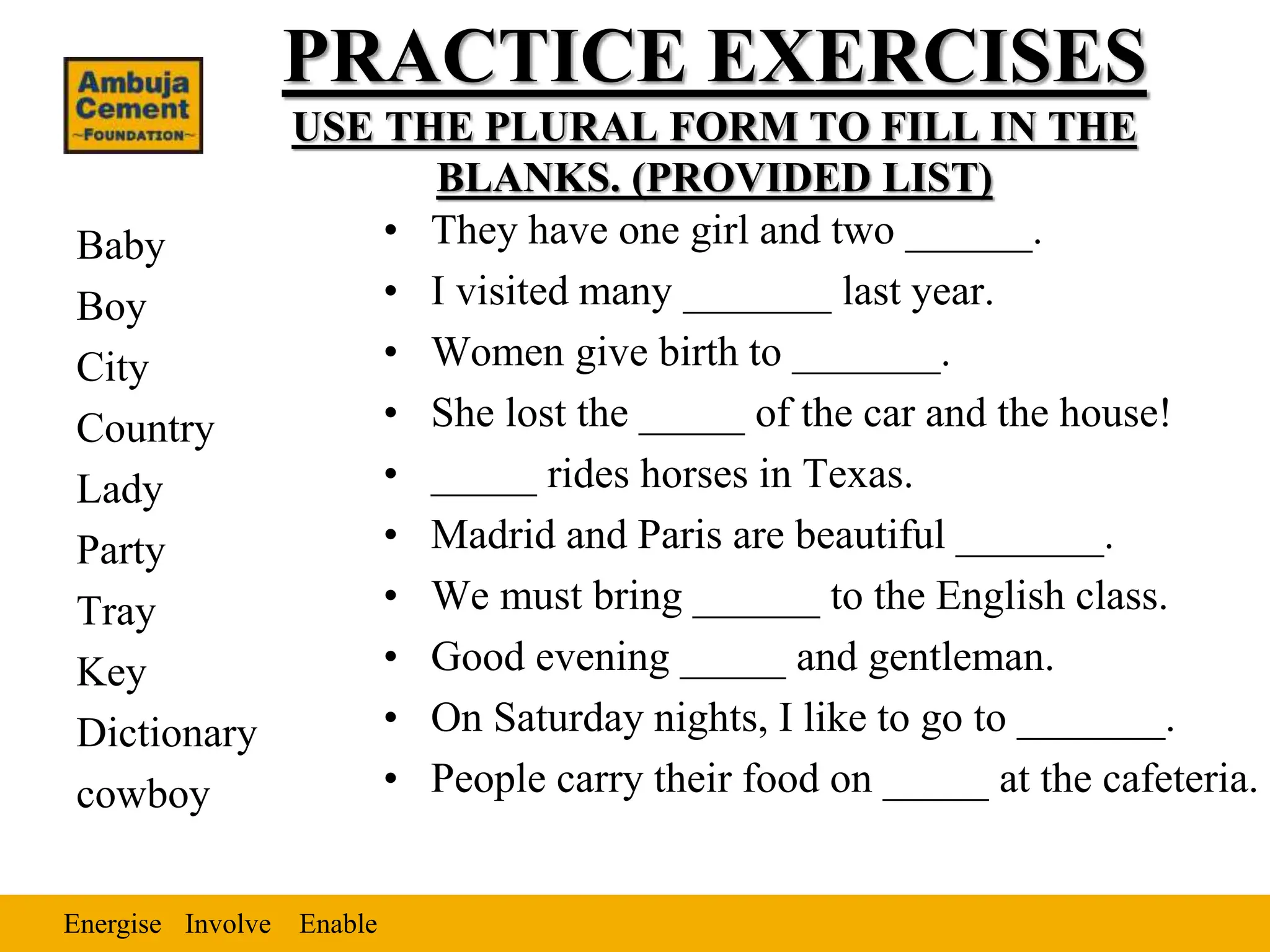
PRACTICE EXERCISES
USE THE PLURAL FORM TO FILL IN THE
BLANKS. (PROVIDED LIST)
Baby
Boy
City
Country
Lady
Party
Tray
Key
Dictionary
cowboy
• They have one girl and two ______.
• I visited many _______ last year.
• Women give birth to _______.
• She lost the _____ of the car and the house!
• _____ rides horses in Texas.
• Madrid and Paris are beautiful _______.
• We must bring ______ to the English class.
• Good evening _____ and gentleman.
• On Saturday nights, I like to go to _______.
• People carry their food on _____ at the cafeteria.
Energise Enable
Involve
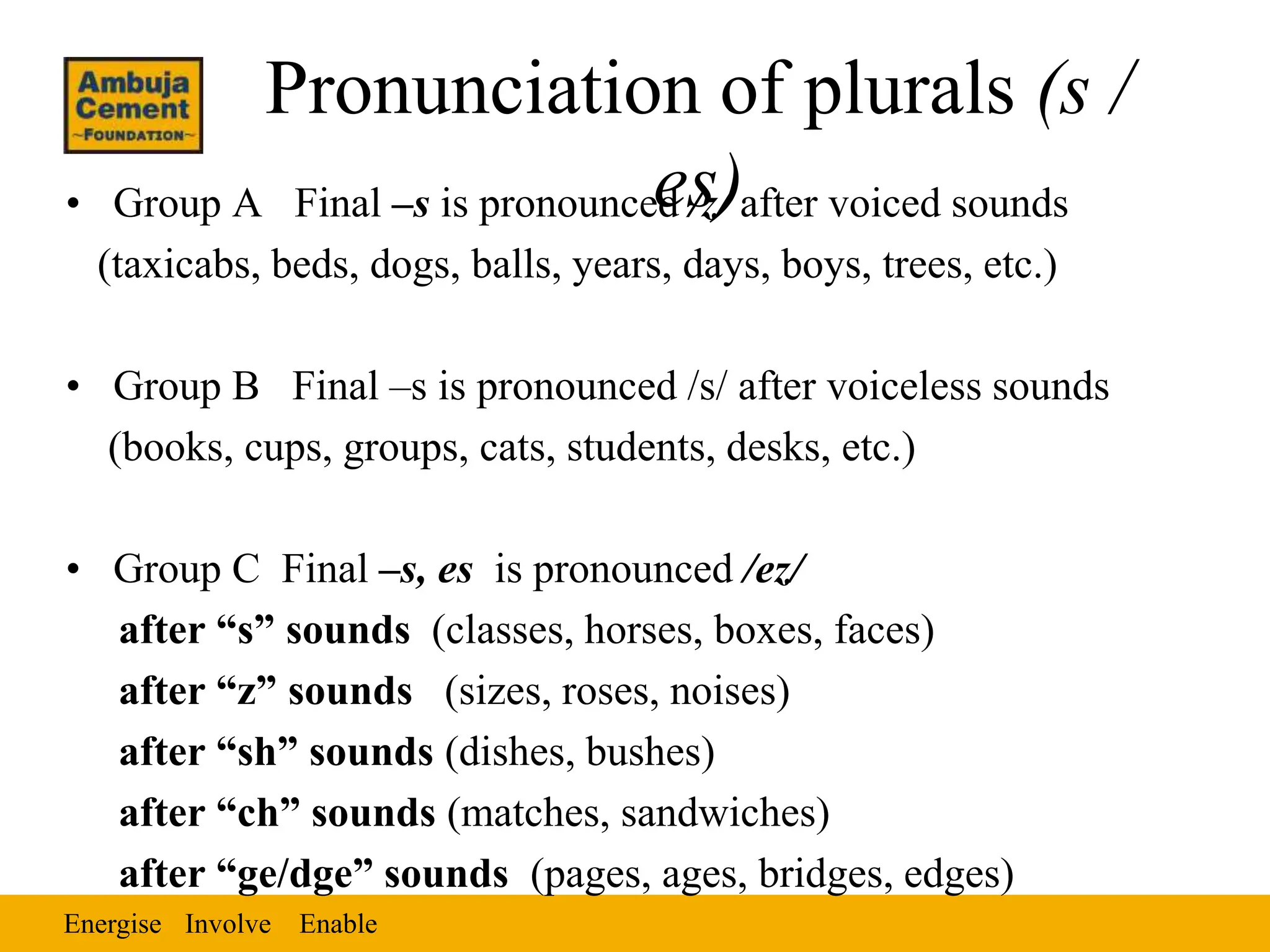
Pronunciation of plurals (s /
es)
• Group A Final –s is pronounced /z/ after voiced sounds
(taxicabs, beds, dogs, balls, years, days, boys, trees, etc.)
• Group B Final –s is pronounced /s/ after voiceless sounds
(books, cups, groups, cats, students, desks, etc.)
• Group C Final –s, es is pronounced /ez/
after “s” sounds (classes, horses, boxes, faces)
after “z” sounds (sizes, roses, noises)
after “sh” sounds (dishes, bushes)
after “ch” sounds (matches, sandwiches)
after “ge/dge” sounds (pages, ages, bridges, edges)
Energise Enable
Involve
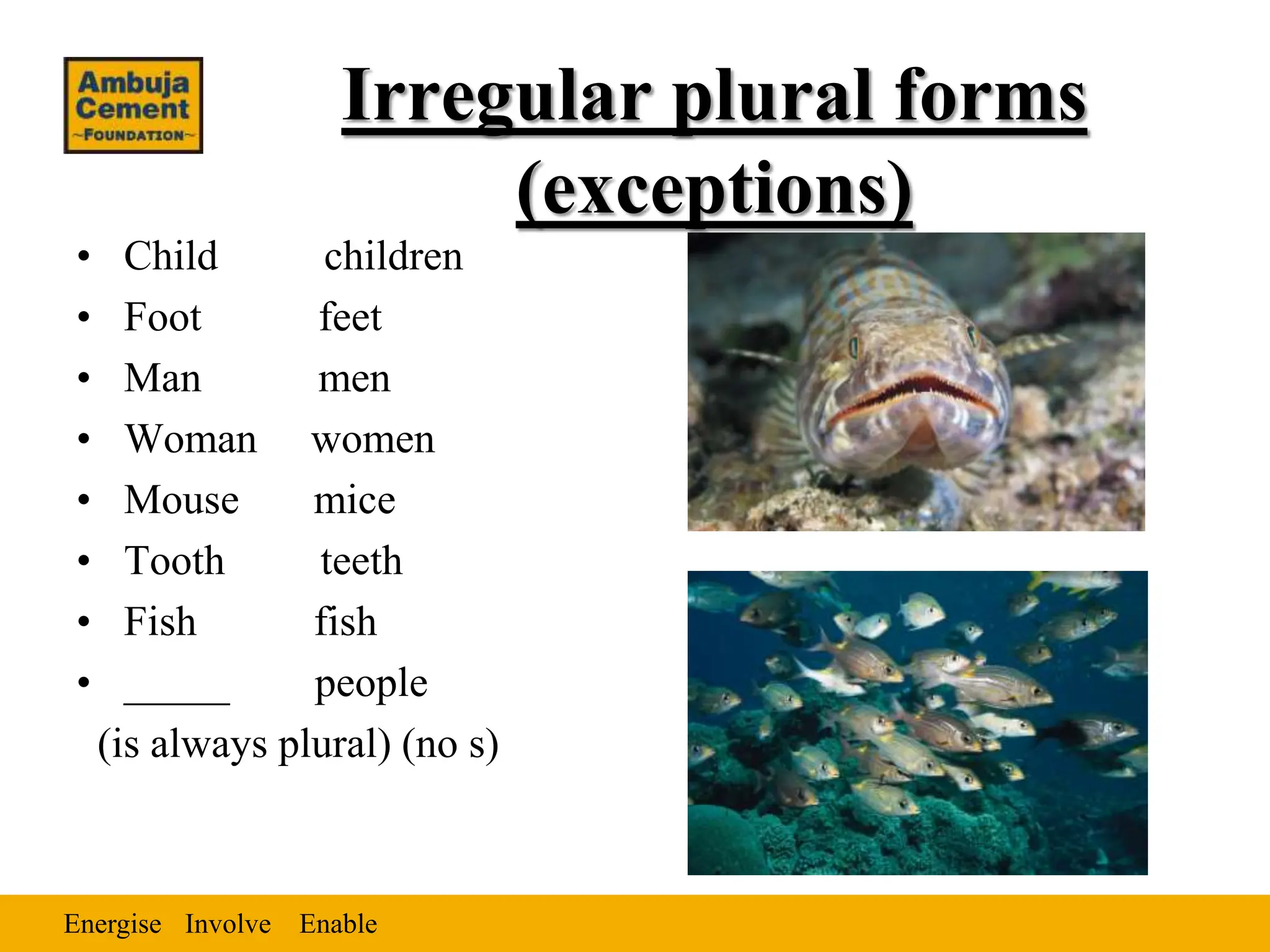
Irregular plural forms
(exceptions)
• Child children
• Foot feet
• Man men
• Woman women
• Mouse mice
• Tooth teeth
• Fish fish
• _____ people
(is always plural) (no s)
Energise Enable
Involve
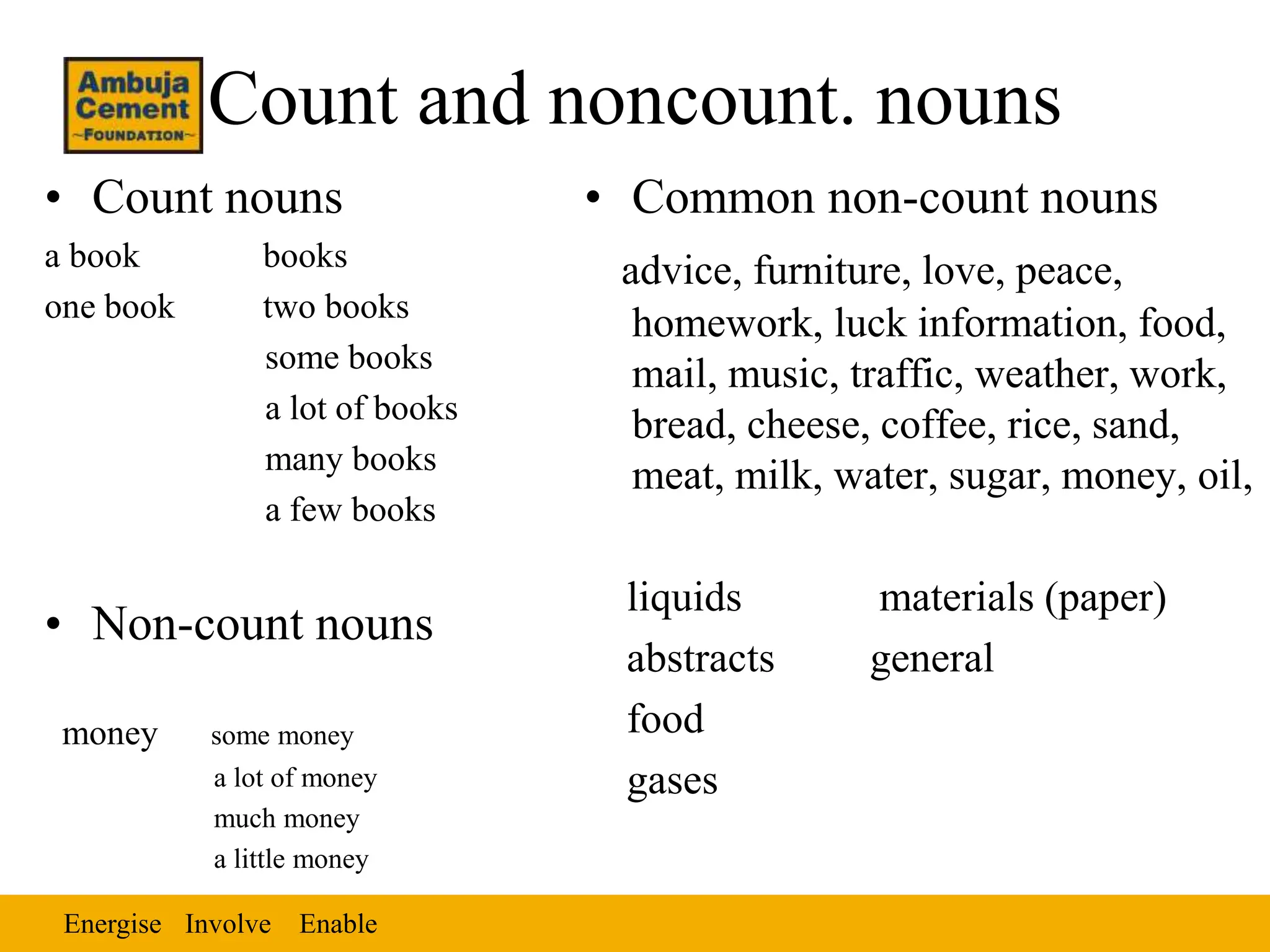
Count and noncount. nouns
• Count nouns
a book books
one book two books
some books
a lot of books
many books
a few books
• Non-count nouns
money some money
a lot of money
much money
a little money
• Common non-count nouns
advice, furniture, love, peace,
homework, luck information, food,
mail, music, traffic, weather, work,
bread, cheese, coffee, rice, sand,
meat, milk, water, sugar, money, oil,
liquids materials (paper)
abstracts general
food
gases
Energise Enable
Involve
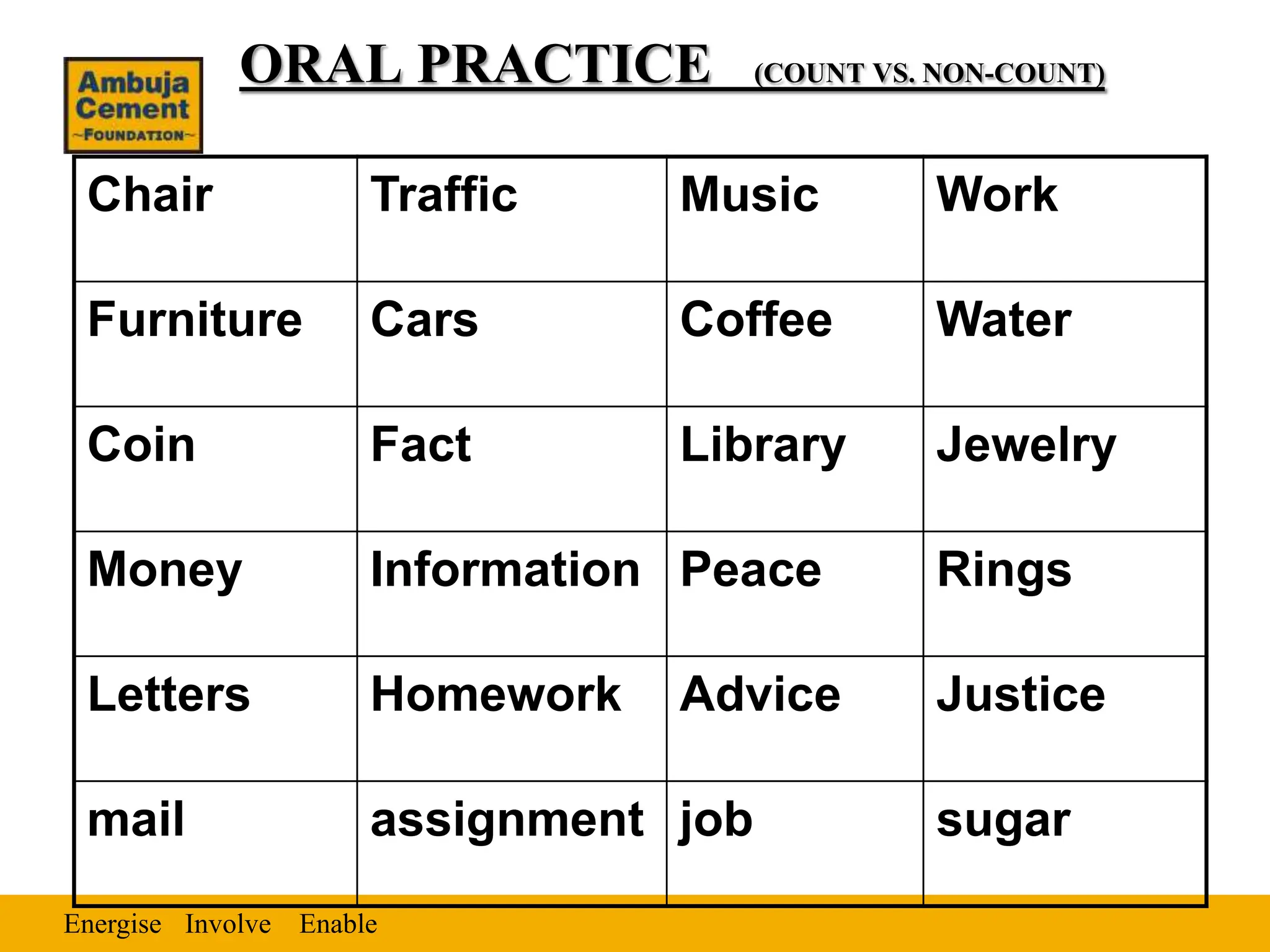
Chair Traffic Music Work
Furniture Cars Coffee Water
Coin Fact Library Jewelry
Money Information Peace Rings
Letters Homework Advice Justice
mail assignment job sugar
ORAL PRACTICE (COUNT VS. NON-COUNT)
Energise Enable
Involve
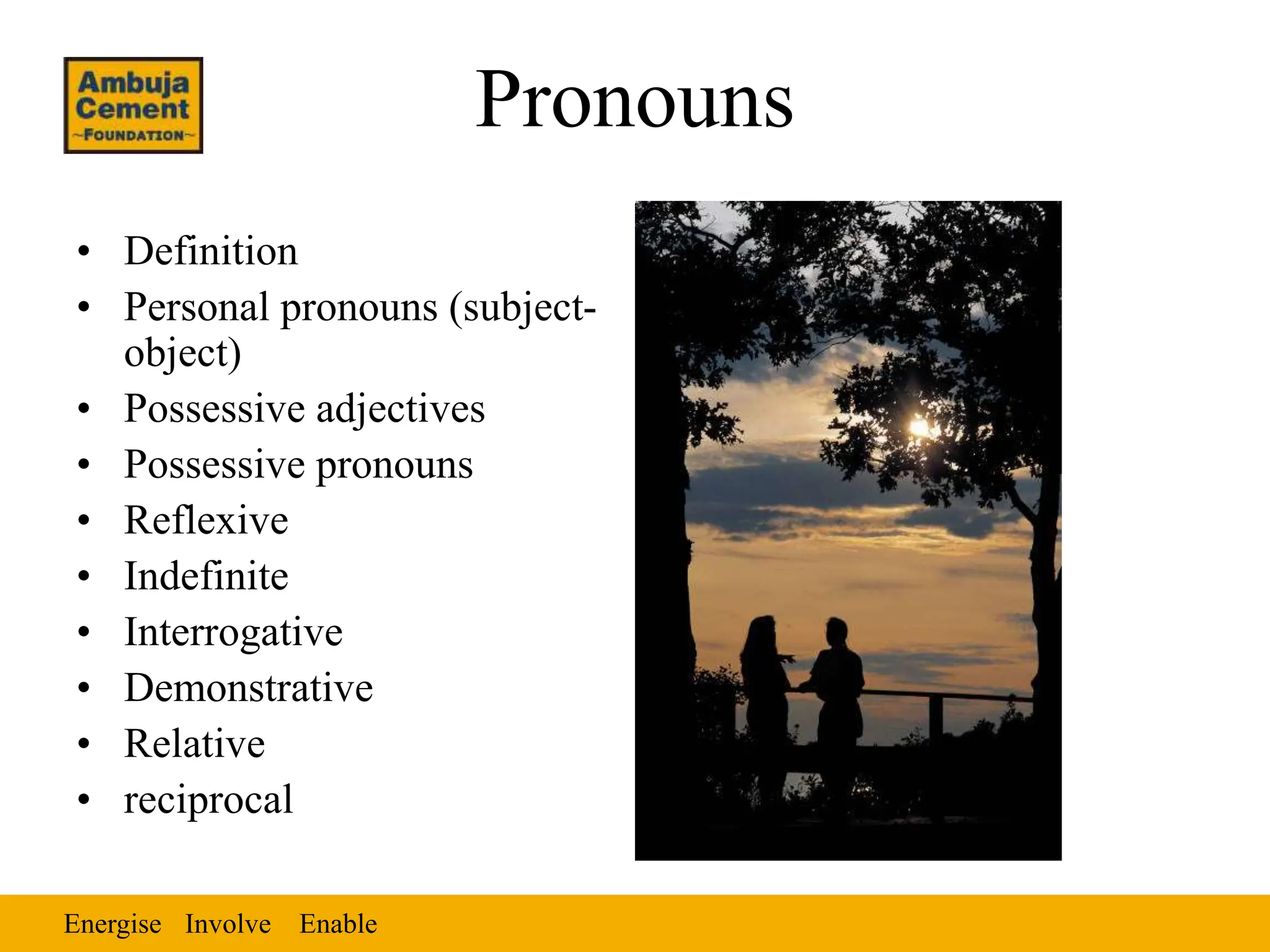
Pronouns
• Definition
• Personal pronouns (subject-
object)
• Possessive adjectives
• Possessive pronouns
• Reflexive
• Indefinite
• Interrogative
• Demonstrative
• Relative
• reciprocal
Energise Enable
Involve
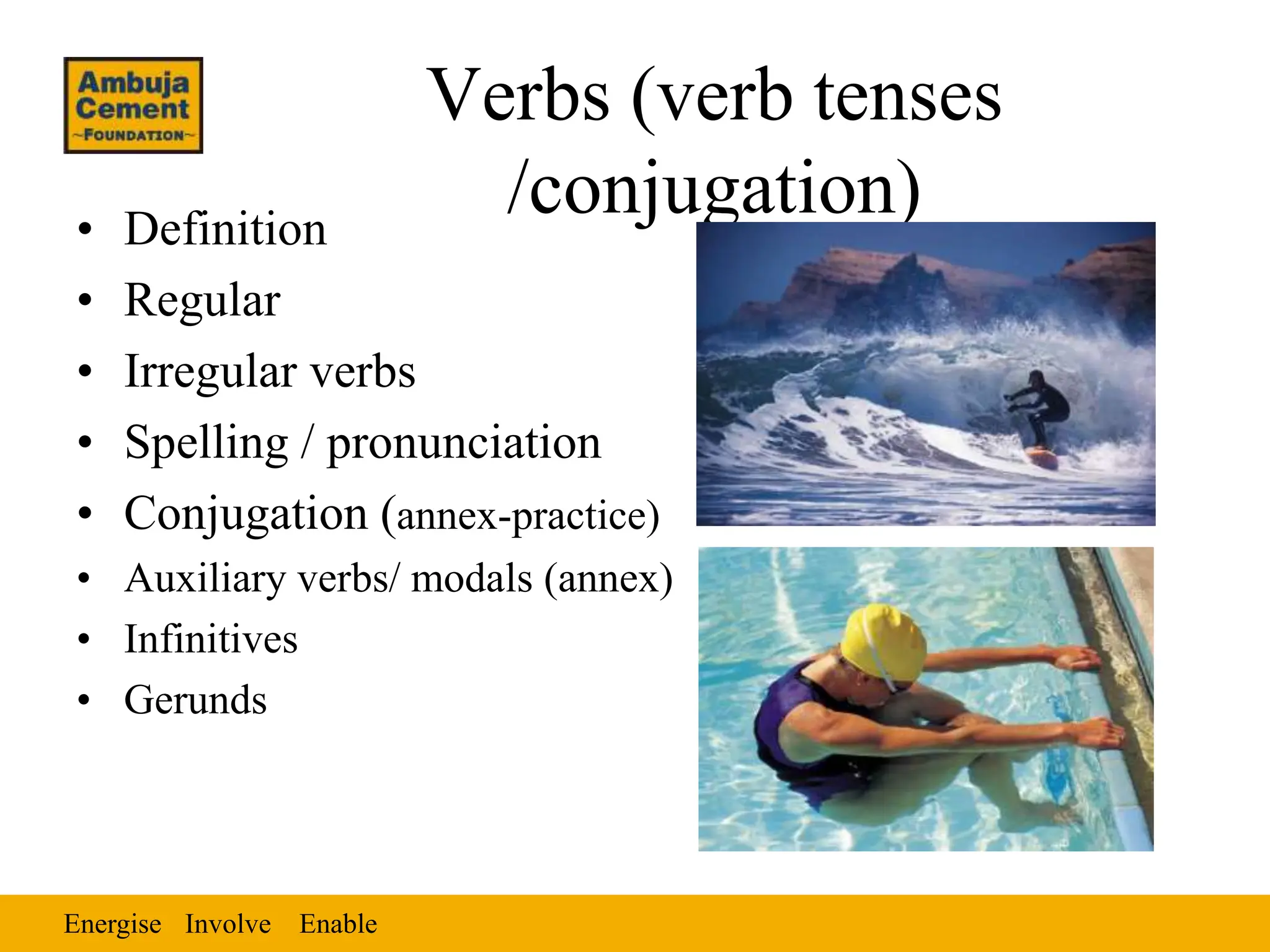
Verbs (verb tenses
/conjugation)
• Definition
• Regular
• Irregular verbs
• Spelling / pronunciation
• Conjugation (annex-practice)
• Auxiliary verbs/ modals (annex)
• Infinitives
• Gerunds
Energise Enable
Involve
Verbs
Regular/ Irregular/ verb tenses
Regular verbs (d or ed endings)
/d/ sound pronunciation
/t/ sound pronunciation
/ed/ pronunciation
Energise Enable
Involve
Irregular verbs
• Three forms
• Two forms
• One form
Energise Enable
Involve
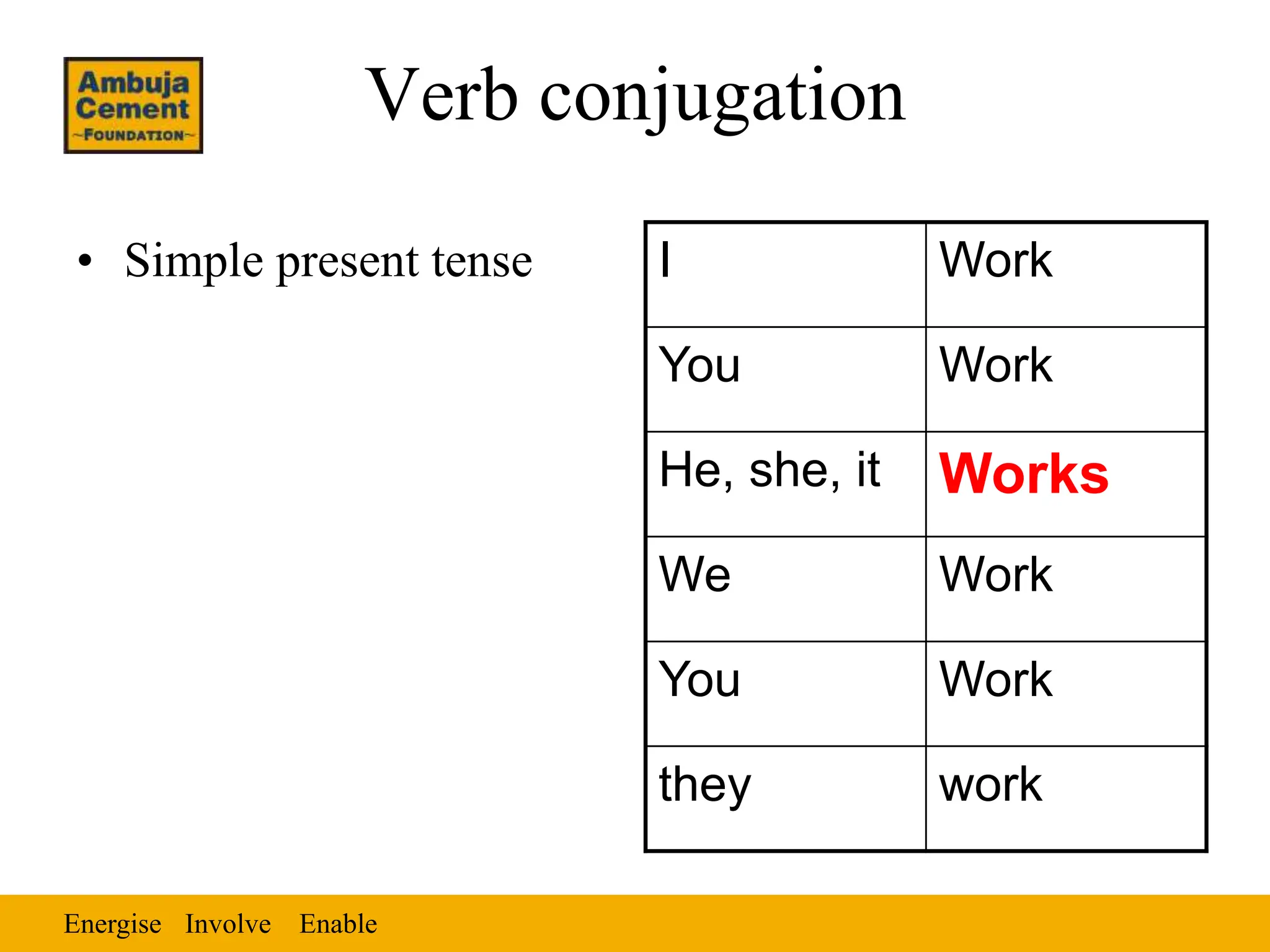
Verb conjugation
• Simple present tense I Work
You Work
He, she, it Works
We Work
You Work
they work
Energise Enable
Involve
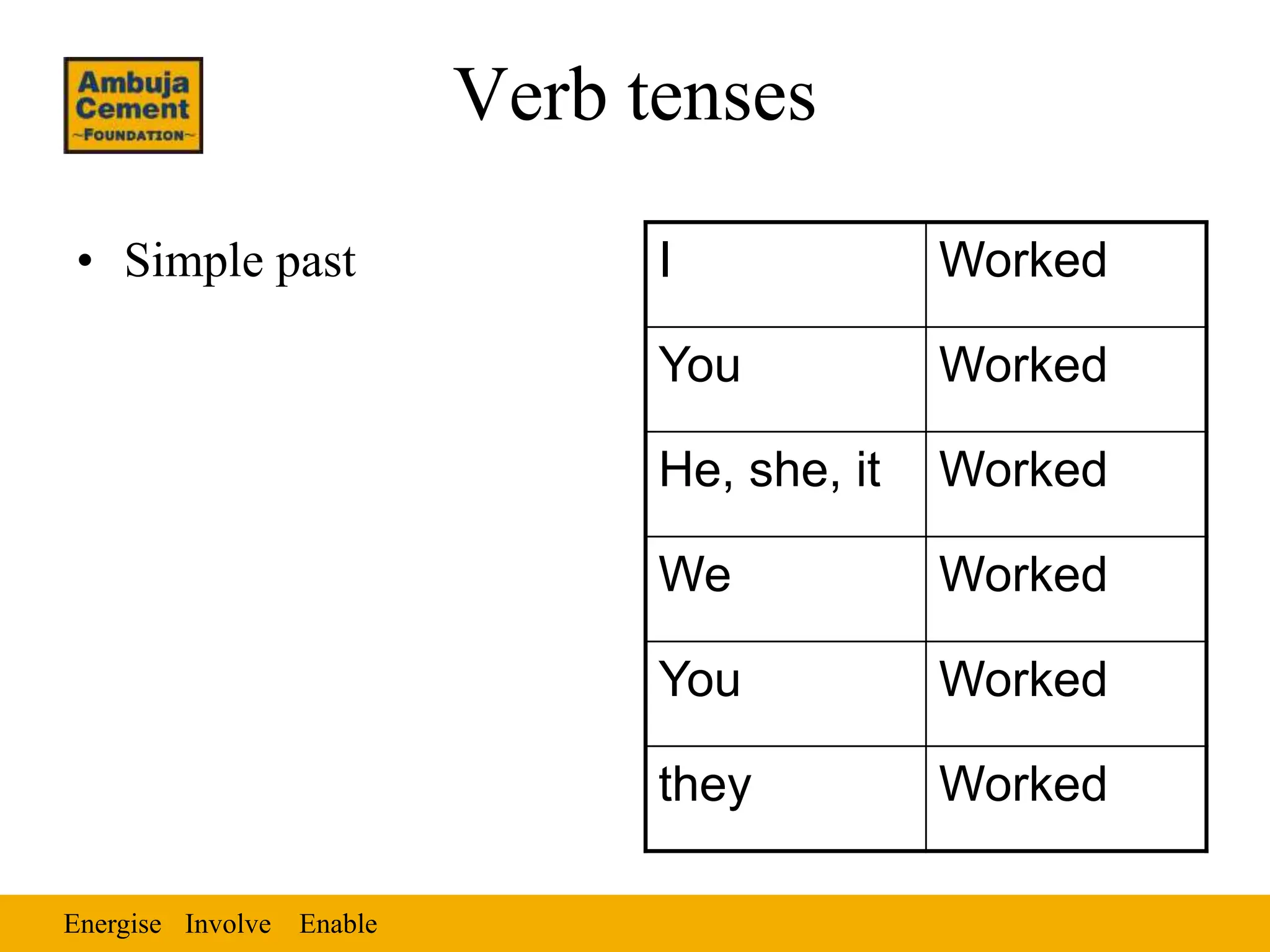
Verb tenses
• Simple past I Worked
You Worked
He, she, it Worked
We Worked
You Worked
they Worked
Energise Enable
Involve
Verb tenses
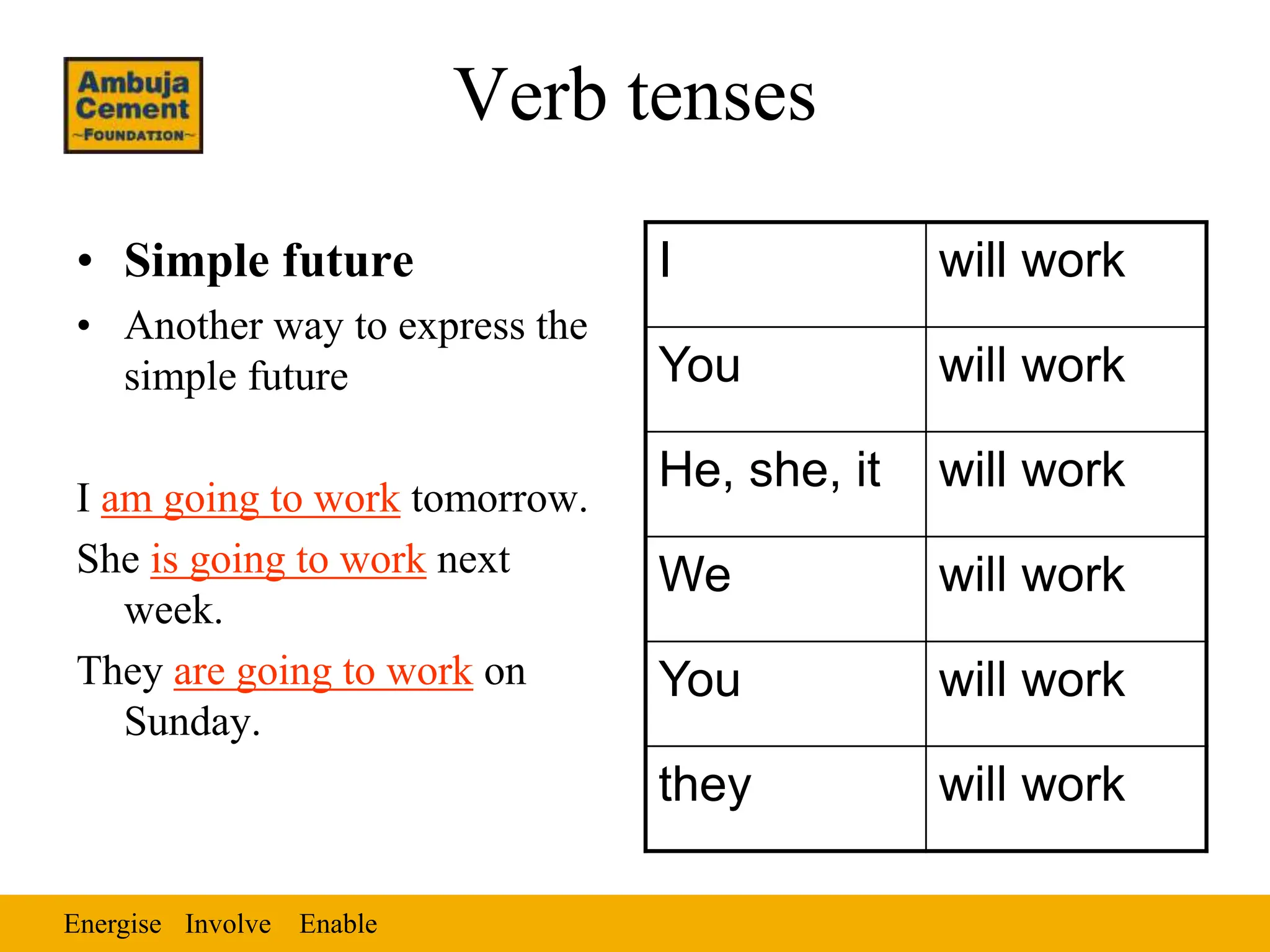
• Simple future
• Another way to express the
simple future
I am going to work tomorrow.
She is going to work next
week.
They are going to work on
Sunday.
I will work
You will work
He, she, it will work
We will work
You will work
they will work
Energise Enable
Involve
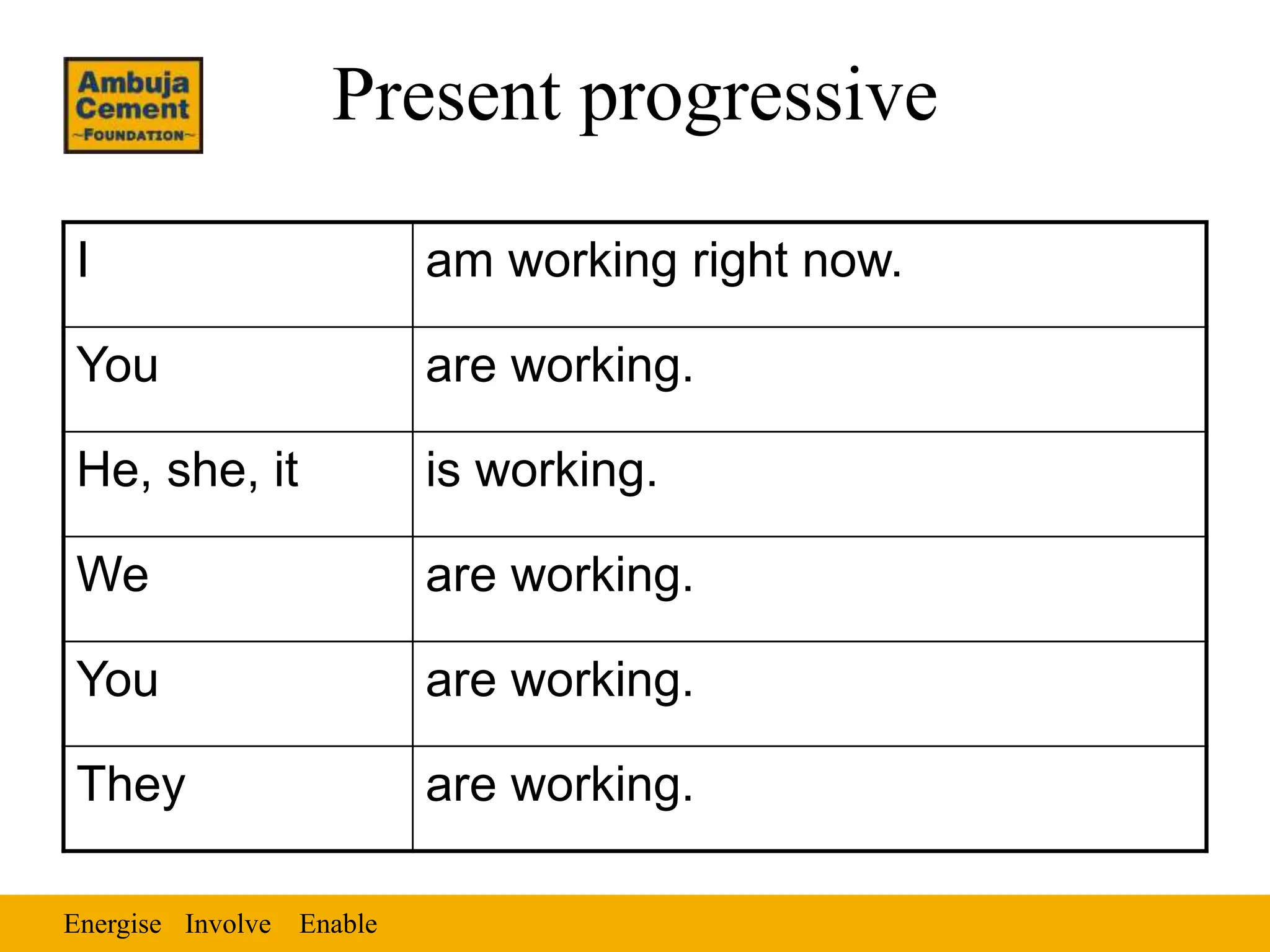
Present progressive
I am working right now.
You are working.
He, she, it is working.
We are working.
You are working.
They are working.
Energise Enable
Involve
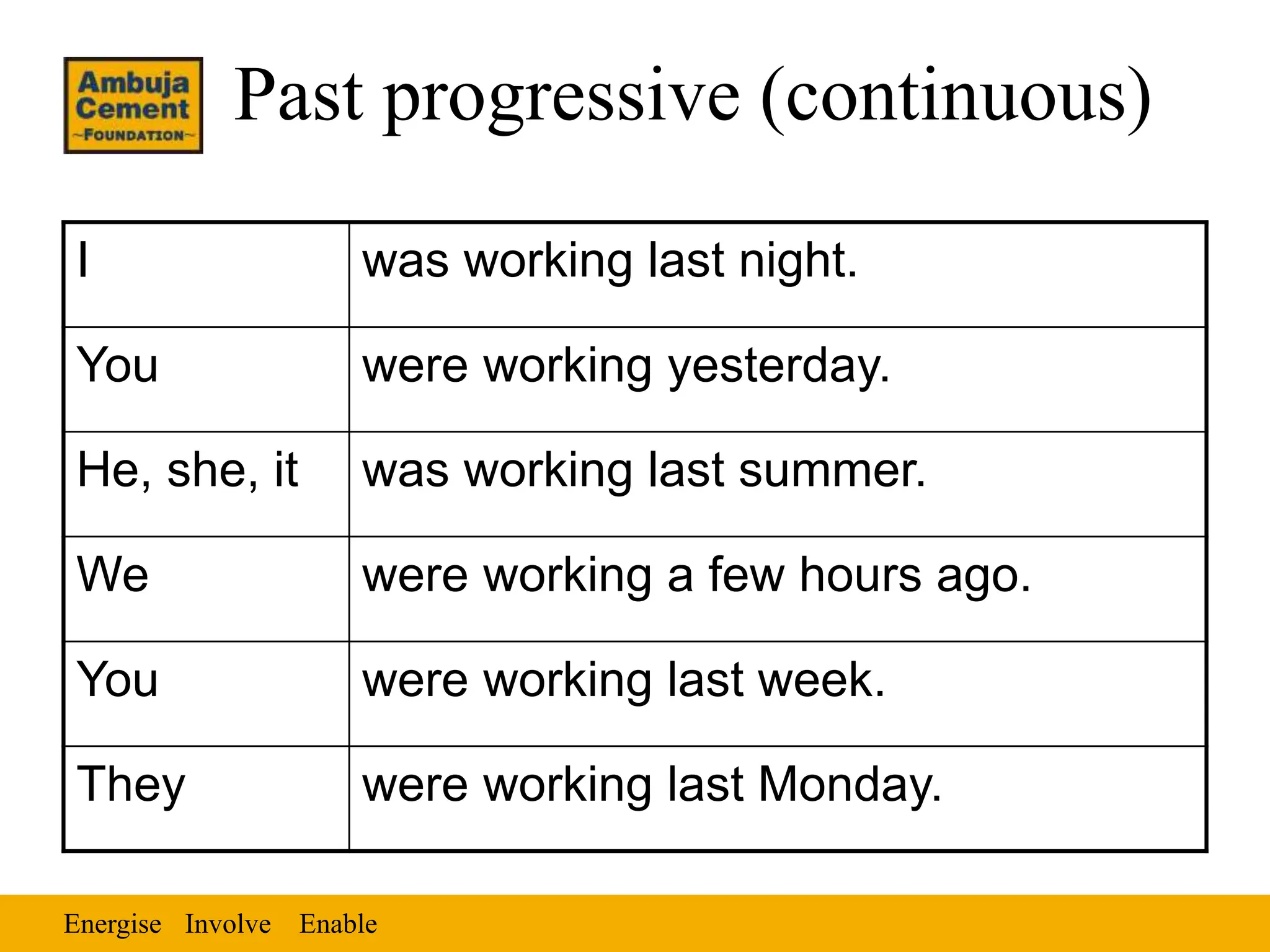
Past progressive (continuous)
I was working last night.
You were working yesterday.
He, she, it was working last summer.
We were working a few hours ago.
You were working last week.
They were working last Monday.
Energise Enable
Involve
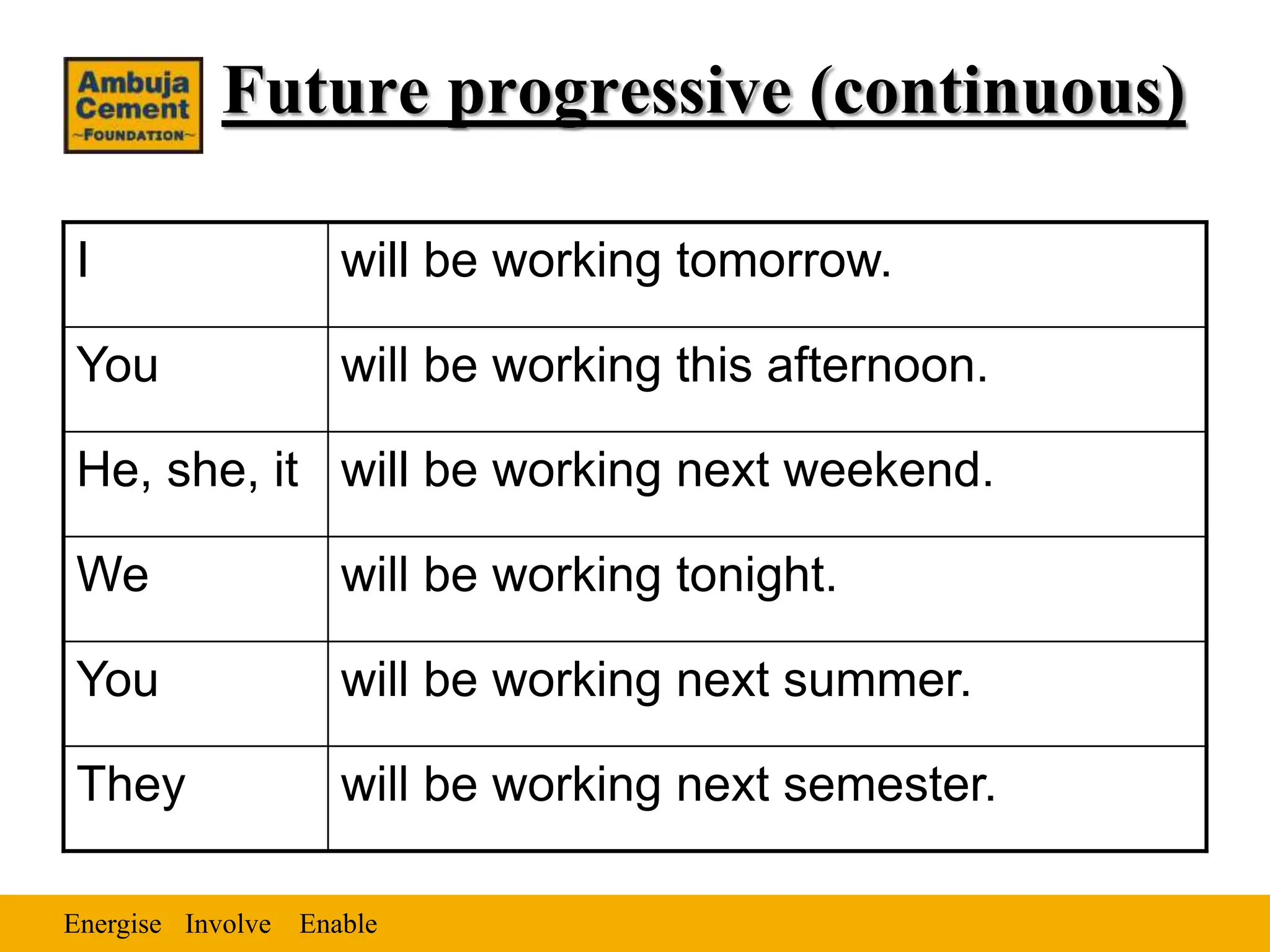
Future progressive (continuous)
I will be working tomorrow.
You will be working this afternoon.
He, she, it will be working next weekend.
We will be working tonight.
You will be working next summer.
They will be working next semester.
Energise Enable
Involve
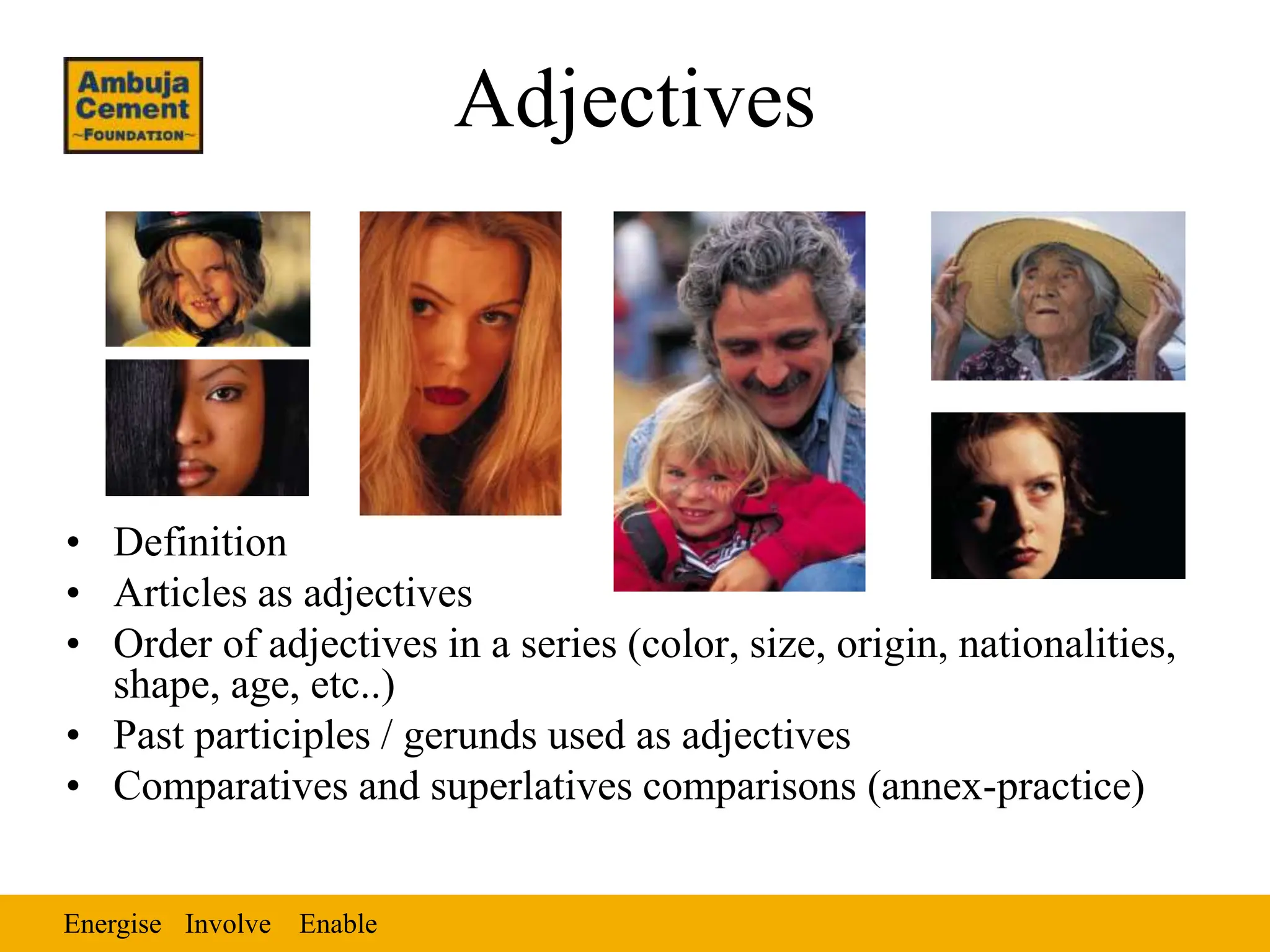
Adjectives
• Definition
• Articles as adjectives
• Order of adjectives in a series (color, size, origin, nationalities,
shape, age, etc..)
• Past participles / gerunds used as adjectives
• Comparatives and superlatives comparisons (annex-practice)
Energise Enable
Involve
Adverbs
• Definition
• Adverbs of frequency (annex)
• Adverbs of time
• Adverbs of location (place)
• Adverbs of mode
Energise Enable
Involve
Prepositions
• Definition
• IN, ON and AT (annex
–time and location)
• All prepositions
• Transitional expressions
(prep. Phrases-annex)
Energise Enable
Involve
Conjunctions
• Definition
• Correlative conjunctions
• Coordinating conjunctions
• Subordinate conjunctions
• Conjunctive adverbs
• Other subordinators (annex)
Energise Enable
Involve
Interjections and other words
• Definition and examples
• Onomatopoeias
• Numerals (cardinals,
ordinals)
• Determiners
• Qualifiers
• Subordinators
• interrogatives
Energise Enable
Involve
Capitalization Rules (annex)
Punctuation Rules (annex)
Sentence Combinations
YES/NO questions
Information questions
Energise Enable
Involve
• THANK YOU AND KEEP GOING

erozghar class assignment of presentation file upload

  • 1.
    Energise Enable Involve YES, ICAN LEARN & SPEAK ENGLISH
  • 2.
    Energise Enable Involve HOW TOLEARN ENGLISH EFFECTIVELY SITTING AT A TABLE LOOKING AT YOUR NOTEBOOK IS NOT THE BEST WAY TO STUDY ENGLISH. MOST OF THE TIME, YOUR MIND IS NOT ACTIVELY USING THE INFORMATION THAT YOU ARE STUDYING, AND PRACTICAL LEARNING DOES NOT TAKE PLACE. HERE ARE SOME TECHNIQUES THAT WILL HELP YOU LEARN MORE EFFECTIVELY.
  • 3.
    Energise Enable Involve WRITE AJOURNAL • Writing every day lets you see your grammar clearly in front of you, express your ideas, and use a non-oral method in communicate in English. Then read the corrected version out loud. • It is a good idea to re-copy the corrected journal too, so that you will have the experience of writing your ideas down in proper English.
  • 4.
    Energise Enable Involve READ ABOOK • By Reading A Story, You Create A Picture In Your Imagination That Will Connected Different Parts Of Your Brain To English. Find A Book That Is Not Too Difficult. • Do Not Stop Every Time You Find A New Word. • Guess What The Word Probably Means, Continue Reading, And Check In Your Dictionary At The End Of The Page Or Chapter.
  • 5.
    Energise Enable Involve Re-write yourclass notes every day. • Writing your notes a second time will allow you to remember more strongly what you study. • It will also make your notebook neater, making it easier to study.
  • 6.
    Energise Enable Involve WATCH TVAND MOVIES, AND LISTEN TO THE RADIO. • Even if you don’t understand everything, you will still be learning. • It is possible to understand the content even if you know only 30% of the words that you hear! • Your listening ability will improve day by day-and it’s fun!
  • 7.
    Energise Enable Involve KEEP AVOCABULARY NOTEBOOK IN A SEPARATE NOTEBOOK FROM YOUR CLASS NOTES • Take an active approach to learning new vocabulary. • If you find 5 words a day, 6 days a week, you will learn about 140 new words a month; 10 words a day would bring you over than 280 new words a month. • Hint – approach new words by subject: things connected to your hobies, to your interests etc. • Do it this way: • Think of a word you know in your language. • Look it up in your dictionary. • When you find the English word, write it down on the left side of your vocabulary note book. • In the midle of the page, write down if the word is a noun (n), verb (v), adjective (adj), etc. so that you will know how to use the word. • Look the word up in an English-English dictionary. • Write the English definition on the right side of the the page (or on the next page). • Copy a sentence from the dictionary. This will help you learn how to use the word correctly. • Practice reading this sentence untll it becomes natural for you.
  • 8.
    Energise Enable Involve SPEAK LOTSOF ENGLISH WITH YOUR FRINDS • You improve your spoken English by speaking English in different situations with people of all nationalities. • If you want to speak English better in the future, speak it as much as possible now!
  • 9.
    Energise Enable Involve THINK POSITIVELY •People who say “I can’t speak English well” are corrected. • People who say “Every day in every way, my English is getting better and better” are also correct. • What you think is what you get. • Practice saying the second sentence every day, and you will see greater improvement in your English and in your confidence. • Remember: the more fun you have with English,the easier it will be to learn ENJOY
  • 10.
  • 11.
    Energise Enable Involve Preview • Definitions •Nouns • Pronouns • Verbs • Adjectives • Adverbs • Prepositions • Conjunctions • Interjections • Determiners • Subordinators • Interrogatives • Qualifiers • Sentence combinations • Yes/no questions • Information questions • Punctuation rules • Capitalization rules
  • 12.
    Energise Enable Involve Grammar • DEFINITION Thegrammar of a language is a complex of systems that may be analyzed and studied on these three levels: (Noam Chomsky’s UG) 1. Phonology (set of sounds/ symbols) 2. Morphology (combinations of sounds that carry single units of meaning) 3. Syntax (how single units of meaning are combined to form words, phrases and sentences.
  • 13.
    Energise Enable Involve Parts ofspeech (Nouns) • Nouns 1. Definition 2. Proper / common 3. Singular / plural (annex) 4. Count / non-count /abstract (annex) (how much – how many) 5. Collectible (group nouns) 6. Units of measurement (Reference: Schramper Azar, Betty,1996. Basic English Grammar)
  • 14.
    Energise Enable Involve Definition (proper andcommon nouns) • Nouns – words used to name a person, place, thing, object, quality, idea, concept, or an action. Ref. (American Heritage Dictionary, 2001) • Proper Nouns- special or particular name given to common nouns to distinguish them from others of the same kind. Example: common- woman proper Martha a country Puerto Rico a pet Puppy many others a monument The Statue of Liberty a day Monday a place Ryder Hospital A person Carlos Proper Nouns
  • 15.

    Energise Enable Involve Proper andcommon nouns COMMON PROPER COMMON PROPER day Saturday associations Members Club month October movies Titanic mountain El Yunque planets Neptune river The Amazon city San Juan ocean Pacific Ocean historical periods Middle Ages book Applied Linguistic language Spanish newspaper New York Times nationality Puerto Rican religion Catholic School course English 101 brand of product Cadillac institutions University of Puerto Rico
  • 16.
    Energise Enable Involve Nouns (singularand plural) • Rule No. 1 (Add –s to the end of noun) cup cups student students • Rule No.2 consonants before “y” change –y to i and add –es city -cities party- parties lady-ladies • Rule No.3 vowels before “y” add –s boy –boys key –keys day -days
  • 17.
    Energise Enable Involve Singular andplural (cont.) • Rule No. 4 (–f and –fe endings) change the –f or –fe to v and –es life –lives wife –wives thief –thieves • Rule No. 5 (sh, ch, x, ss endings) add –es bush –bushes match –matches box -boxes kiss -kisses • Rule No. 6 (consonant + o) add –es (vowel +o) –s tomato –tomatoes radio radios
  • 18.
    Energise Enable Involve PRACTICE EXERCISES USETHE PLURAL FORM TO FILL IN THE BLANKS. (PROVIDED LIST) Baby Boy City Country Lady Party Tray Key Dictionary cowboy • They have one girl and two ______. • I visited many _______ last year. • Women give birth to _______. • She lost the _____ of the car and the house! • _____ rides horses in Texas. • Madrid and Paris are beautiful _______. • We must bring ______ to the English class. • Good evening _____ and gentleman. • On Saturday nights, I like to go to _______. • People carry their food on _____ at the cafeteria.
  • 19.
    Energise Enable Involve Pronunciation ofplurals (s / es) • Group A Final –s is pronounced /z/ after voiced sounds (taxicabs, beds, dogs, balls, years, days, boys, trees, etc.) • Group B Final –s is pronounced /s/ after voiceless sounds (books, cups, groups, cats, students, desks, etc.) • Group C Final –s, es is pronounced /ez/ after “s” sounds (classes, horses, boxes, faces) after “z” sounds (sizes, roses, noises) after “sh” sounds (dishes, bushes) after “ch” sounds (matches, sandwiches) after “ge/dge” sounds (pages, ages, bridges, edges)
  • 20.
    Energise Enable Involve Irregular pluralforms (exceptions) • Child children • Foot feet • Man men • Woman women • Mouse mice • Tooth teeth • Fish fish • _____ people (is always plural) (no s)
  • 21.
    Energise Enable Involve Count andnoncount. nouns • Count nouns a book books one book two books some books a lot of books many books a few books • Non-count nouns money some money a lot of money much money a little money • Common non-count nouns advice, furniture, love, peace, homework, luck information, food, mail, music, traffic, weather, work, bread, cheese, coffee, rice, sand, meat, milk, water, sugar, money, oil, liquids materials (paper) abstracts general food gases
  • 22.
    Energise Enable Involve Chair TrafficMusic Work Furniture Cars Coffee Water Coin Fact Library Jewelry Money Information Peace Rings Letters Homework Advice Justice mail assignment job sugar ORAL PRACTICE (COUNT VS. NON-COUNT)
  • 23.
    Energise Enable Involve Pronouns • Definition •Personal pronouns (subject- object) • Possessive adjectives • Possessive pronouns • Reflexive • Indefinite • Interrogative • Demonstrative • Relative • reciprocal
  • 24.
    Energise Enable Involve Verbs (verbtenses /conjugation) • Definition • Regular • Irregular verbs • Spelling / pronunciation • Conjugation (annex-practice) • Auxiliary verbs/ modals (annex) • Infinitives • Gerunds
  • 25.
    Energise Enable Involve Verbs Regular/ Irregular/verb tenses Regular verbs (d or ed endings) /d/ sound pronunciation /t/ sound pronunciation /ed/ pronunciation
  • 26.
    Energise Enable Involve Irregular verbs •Three forms • Two forms • One form
  • 27.
    Energise Enable Involve Verb conjugation •Simple present tense I Work You Work He, she, it Works We Work You Work they work
  • 28.
    Energise Enable Involve Verb tenses •Simple past I Worked You Worked He, she, it Worked We Worked You Worked they Worked
  • 29.
    Energise Enable Involve Verb tenses •Simple future • Another way to express the simple future I am going to work tomorrow. She is going to work next week. They are going to work on Sunday. I will work You will work He, she, it will work We will work You will work they will work
  • 30.
    Energise Enable Involve Present progressive Iam working right now. You are working. He, she, it is working. We are working. You are working. They are working.
  • 31.
    Energise Enable Involve Past progressive(continuous) I was working last night. You were working yesterday. He, she, it was working last summer. We were working a few hours ago. You were working last week. They were working last Monday.
  • 32.
    Energise Enable Involve Future progressive(continuous) I will be working tomorrow. You will be working this afternoon. He, she, it will be working next weekend. We will be working tonight. You will be working next summer. They will be working next semester.
  • 33.
    Energise Enable Involve Adjectives • Definition •Articles as adjectives • Order of adjectives in a series (color, size, origin, nationalities, shape, age, etc..) • Past participles / gerunds used as adjectives • Comparatives and superlatives comparisons (annex-practice)
  • 34.
    Energise Enable Involve Adverbs • Definition •Adverbs of frequency (annex) • Adverbs of time • Adverbs of location (place) • Adverbs of mode
  • 35.
    Energise Enable Involve Prepositions • Definition •IN, ON and AT (annex –time and location) • All prepositions • Transitional expressions (prep. Phrases-annex)
  • 36.
    Energise Enable Involve Conjunctions • Definition •Correlative conjunctions • Coordinating conjunctions • Subordinate conjunctions • Conjunctive adverbs • Other subordinators (annex)
  • 37.
    Energise Enable Involve Interjections andother words • Definition and examples • Onomatopoeias • Numerals (cardinals, ordinals) • Determiners • Qualifiers • Subordinators • interrogatives
  • 38.
    Energise Enable Involve Capitalization Rules(annex) Punctuation Rules (annex) Sentence Combinations YES/NO questions Information questions
  • 39.