By: Erin Brooks
Design a solar oven
Monday, May 20, 13
Imagine for design #1
• Idea#1
• Our materials are newspaper and rocks and sand.
• We need 2 units of newspaper and 1 unit of rocks and
sand.
• The advantage of this idea is both have the least
impact of the environment and are a great insulator.
• The disadvantage of this idea is that the newspaper
isn't the best insulator.
Monday, May 20, 13
Imagining for design #1
• Idea #2
• Our materials are cloth and Cotten balls.
• We need 2 units of cotton balls and 1 unit of cloth.
• The advantage is that both Cotten and cloth are
good insulators of heat.
• The disadvantage is the cloth is in the middle of
the most and the least of environmental impact.
Monday, May 20, 13
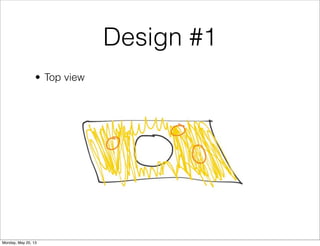
Design #1
• Top view
Monday, May 20, 13
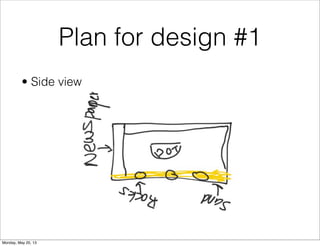
Plan for design #1
• Side view
Monday, May 20, 13
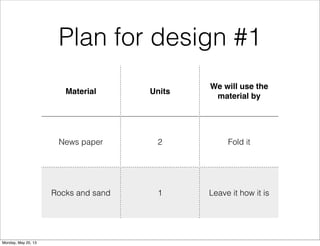
Plan for design #1
Material Units
We will use the
material by
News paper 2 Fold it
Rocks and sand 1 Leave it how it is
Monday, May 20, 13
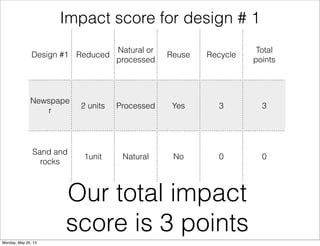
Impact score for design # 1
Design #1 Reduced
Natural or
processed
Reuse Recycle
Total
points
Newspape
r
2 units Processed Yes 3 3
Sand and
rocks
1unit Natural No 0 0
Our total impact
score is 3 points
Monday, May 20, 13
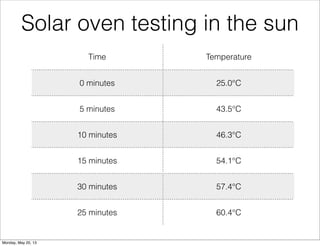
Solar oven testing in the sun
Time Temperature
0 minutes 25.0°C
5 minutes 43.5°C
10 minutes 46.3°C
15 minutes 54.1°C
30 minutes 57.4°C
25 minutes 60.4°C
Monday, May 20, 13
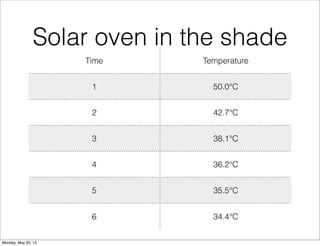
Solar oven in the shade
Time Temperature
1 50.0°C
2 42.7°C
3 38.1°C
4 36.2°C
5 35.5°C
6 34.4°C
Monday, May 20, 13
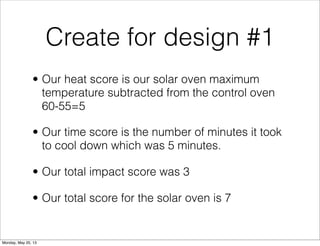
Create for design #1
• Our heat score is our solar oven maximum
temperature subtracted from the control oven
60-55=5
• Our time score is the number of minutes it took
to cool down which was 5 minutes.
• Our total impact score was 3
• Our total score for the solar oven is 7
Monday, May 20, 13
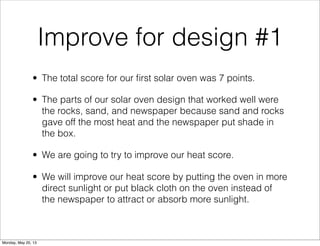
Improve for design #1
• The total score for our first solar oven was 7 points.
• The parts of our solar oven design that worked well were
the rocks, sand, and newspaper because sand and rocks
gave off the most heat and the newspaper put shade in
the box.
• We are going to try to improve our heat score.
• We will improve our heat score by putting the oven in more
direct sunlight or put black cloth on the oven instead of
the newspaper to attract or absorb more sunlight.
Monday, May 20, 13
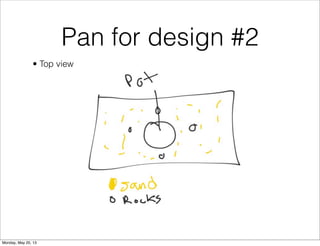
Pan for design #2
• Top view
Monday, May 20, 13
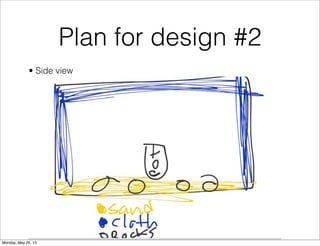
Plan for design #2
• Side view
Monday, May 20, 13
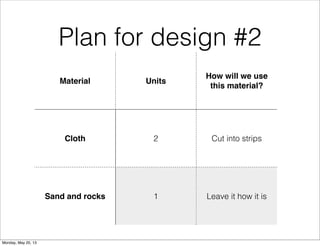
Plan for design #2
Material Units
How will we use
this material?
Cloth
Sand and rocks
2 Cut into strips
1 Leave it how it is
Monday, May 20, 13
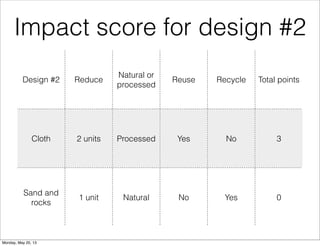
Impact score for design #2
Design #2 Reduce
Natural or
processed
Reuse Recycle Total points
Cloth 2 units Processed Yes No 3
Sand and
rocks
1 unit Natural No Yes 0
Monday, May 20, 13
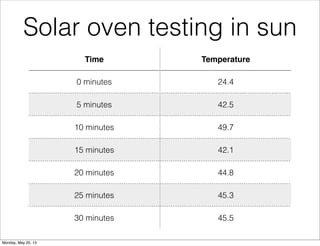
Solar oven testing in sun
Time Temperature
0 minutes 24.4
5 minutes 42.5
10 minutes 49.7
15 minutes 42.1
20 minutes 44.8
25 minutes 45.3
30 minutes 45.5
Monday, May 20, 13
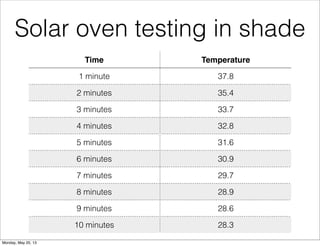
Solar oven testing in shade
Time Temperature
1 minute 37.8
2 minutes 35.4
3 minutes 33.7
4 minutes 32.8
5 minutes 31.6
6 minutes 30.9
7 minutes 29.7
8 minutes 28.9
9 minutes 28.6
10 minutes 28.3
Monday, May 20, 13
Create for design #2
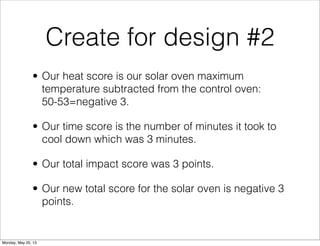
• Our heat score is our solar oven maximum
temperature subtracted from the control oven:
50-53=negative 3.
• Our time score is the number of minutes it took to
cool down which was 3 minutes.
• Our total impact score was 3 points.
• Our new total score for the solar oven is negative 3
points.
Monday, May 20, 13
Reflection
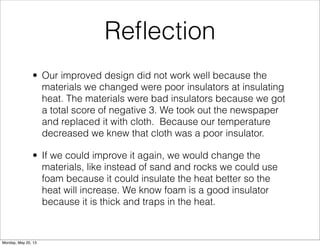
• Our improved design did not work well because the
materials we changed were poor insulators at insulating
heat. The materials were bad insulators because we got
a total score of negative 3. We took out the newspaper
and replaced it with cloth. Because our temperature
decreased we knew that cloth was a poor insulator.
• If we could improve it again, we would change the
materials, like instead of sand and rocks we could use
foam because it could insulate the heat better so the
heat will increase. We know foam is a good insulator
because it is thick and traps in the heat.
Monday, May 20, 13

Erin brooks solar oven

  • 1.
    By: Erin Brooks Designa solar oven Monday, May 20, 13
  • 2.
    Imagine for design#1 • Idea#1 • Our materials are newspaper and rocks and sand. • We need 2 units of newspaper and 1 unit of rocks and sand. • The advantage of this idea is both have the least impact of the environment and are a great insulator. • The disadvantage of this idea is that the newspaper isn't the best insulator. Monday, May 20, 13
  • 3.
    Imagining for design#1 • Idea #2 • Our materials are cloth and Cotten balls. • We need 2 units of cotton balls and 1 unit of cloth. • The advantage is that both Cotten and cloth are good insulators of heat. • The disadvantage is the cloth is in the middle of the most and the least of environmental impact. Monday, May 20, 13
  • 4.
    Design #1 • Topview Monday, May 20, 13
  • 5.
    Plan for design#1 • Side view Monday, May 20, 13
  • 6.
    Plan for design#1 Material Units We will use the material by News paper 2 Fold it Rocks and sand 1 Leave it how it is Monday, May 20, 13
  • 7.
    Impact score fordesign # 1 Design #1 Reduced Natural or processed Reuse Recycle Total points Newspape r 2 units Processed Yes 3 3 Sand and rocks 1unit Natural No 0 0 Our total impact score is 3 points Monday, May 20, 13
  • 8.
    Solar oven testingin the sun Time Temperature 0 minutes 25.0°C 5 minutes 43.5°C 10 minutes 46.3°C 15 minutes 54.1°C 30 minutes 57.4°C 25 minutes 60.4°C Monday, May 20, 13
  • 9.
    Solar oven inthe shade Time Temperature 1 50.0°C 2 42.7°C 3 38.1°C 4 36.2°C 5 35.5°C 6 34.4°C Monday, May 20, 13
  • 10.
    Create for design#1 • Our heat score is our solar oven maximum temperature subtracted from the control oven 60-55=5 • Our time score is the number of minutes it took to cool down which was 5 minutes. • Our total impact score was 3 • Our total score for the solar oven is 7 Monday, May 20, 13
  • 11.
    Improve for design#1 • The total score for our first solar oven was 7 points. • The parts of our solar oven design that worked well were the rocks, sand, and newspaper because sand and rocks gave off the most heat and the newspaper put shade in the box. • We are going to try to improve our heat score. • We will improve our heat score by putting the oven in more direct sunlight or put black cloth on the oven instead of the newspaper to attract or absorb more sunlight. Monday, May 20, 13
  • 12.
    Pan for design#2 • Top view Monday, May 20, 13
  • 13.
    Plan for design#2 • Side view Monday, May 20, 13
  • 14.
    Plan for design#2 Material Units How will we use this material? Cloth Sand and rocks 2 Cut into strips 1 Leave it how it is Monday, May 20, 13
  • 15.
    Impact score fordesign #2 Design #2 Reduce Natural or processed Reuse Recycle Total points Cloth 2 units Processed Yes No 3 Sand and rocks 1 unit Natural No Yes 0 Monday, May 20, 13
  • 16.
    Solar oven testingin sun Time Temperature 0 minutes 24.4 5 minutes 42.5 10 minutes 49.7 15 minutes 42.1 20 minutes 44.8 25 minutes 45.3 30 minutes 45.5 Monday, May 20, 13
  • 17.
    Solar oven testingin shade Time Temperature 1 minute 37.8 2 minutes 35.4 3 minutes 33.7 4 minutes 32.8 5 minutes 31.6 6 minutes 30.9 7 minutes 29.7 8 minutes 28.9 9 minutes 28.6 10 minutes 28.3 Monday, May 20, 13
  • 18.
    Create for design#2 • Our heat score is our solar oven maximum temperature subtracted from the control oven: 50-53=negative 3. • Our time score is the number of minutes it took to cool down which was 3 minutes. • Our total impact score was 3 points. • Our new total score for the solar oven is negative 3 points. Monday, May 20, 13
  • 19.
    Reflection • Our improveddesign did not work well because the materials we changed were poor insulators at insulating heat. The materials were bad insulators because we got a total score of negative 3. We took out the newspaper and replaced it with cloth. Because our temperature decreased we knew that cloth was a poor insulator. • If we could improve it again, we would change the materials, like instead of sand and rocks we could use foam because it could insulate the heat better so the heat will increase. We know foam is a good insulator because it is thick and traps in the heat. Monday, May 20, 13