STUDY
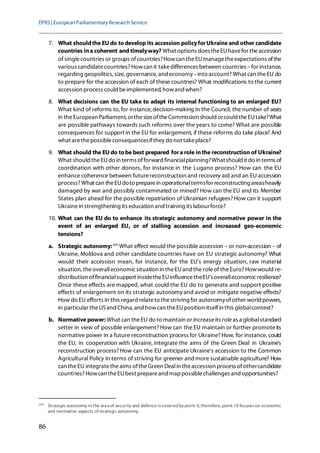
EPRS | European ParliamentaryResearch Service
Author: Mario Damen
PolicyForesight Unit
PE 747.454 – September2023 EN
EU-Ukraine
2035
Strategic foresight
analysis on the
future of the EU
and Ukraine
EPRS | European ParliamentaryResearchService
Strategicforesightanalysison
the futureofthe EUandUkraine
This analysis looks atthefutureoftheEUand Ukraine, usinga timehorizon
of2035. It was launched in June2022as a StrategicForesight Conversation,
a few months after the Russian invasion of Ukraine on 24 February 2022.
Theensuing war hasdrastically changed allaspectsoflifein Ukraine, affects
theEU in many significant ways and shifted pre-war geopoliticaland geo-
economic paradigms. The European Council decision of 24 June 2022 to
givecandidatestatus to Ukraineand Moldova added totheneed fora long-
term perspectiveon EU-Ukrainerelations.
The analysis is based on foresight methodologies, including a multi-stage
stakeholder consultation and scenario building. Four scenarios examine
futuredevelopmentsalong two main axes: theUkraine-Russiarelationship,
addressing the development and possible outcome of the war,
characterised by the level of hazard; and the EU-Ukraine relationship,
characterised by thelevelofintegration.
The resulting policy considerations address four areas of future EU action:
firstly, thetransition from militarysupport towards anewEuropean security
architecture; secondly, theprocess ofEUenlargement, reconstruction and
recovery of Ukraine; thirdly, the development of an effective, green and
sovereign European Union; and fourthly, continuity and review of EU
relations with five countries which are key to the conflict: Russia, Belarus,
Türkiye, China and theUS.
EU-Ukraine2035
AUTHOR
Mario Damen, PolicyForesightUnit, EPRS
To contactthe author, please email: eprs-policyforesight@europarl.europa.eu
ACKNOWLEDGEMENTS
This analysis has been drawn up by the Policy Foresight Unit (PFOR), within the Directorate-General for
Parliamentary Research Services (EPRS) of the Secretariat of the European Parliament. It is the
result of the Strategic Foresight Conversation project on the future of the EU and Ukraine, conducted by staff
of the PFOR unit. Apart from the author and project leader, the following persons have contributed to the
process in various capacities, such as providing methodological expertise, organising surveys and workshops,
processinginformationandpeerreviewing:
Suzana Anghel, Antoine Cahen, Anastasiia Chernova, Julie Claustre, Virginia Mahieu, Eamonn Noonan,
Zsolt Pataki, Andreas Samonig, KjeldvanWieringen, andLieve vanWoensel.
LINGUISTIC VERSIONS
Original: EN
A summaryisavailable in: DE, FR, UA
ManuscriptcompletedinAugust2023.
DISCLAIMERANDCOPYRIGHT
This document is prepared for, and addressed to, the Members and staff of the European
Parliament as background material to assist them in their parliamentary work. The content of the
document is the sole responsibility of its author(s) and any opinions expressed herein should not be taken
to representan officialpositionof theParliament.
Reproduction and translation for non-commercial purposes are authorised, provided the source is
acknowledgedandthe EuropeanParliamentisgivenpriornotice andsentacopy.
Brussels© EuropeanUnion, 2023.
The pictogramsforthe scenarioshave beendrawnfrom the Noun-projectwebsiteandare creative
commonswithreferencetothe creators:
Fair Stability: Balance bySarah
ColdWarII: WatchtowerbyLuisPrado
FrozenConflict: Snowflake byTamzidHasan
Chaotic World: FireballbyAndrew Doane
Row of flagpoleswithEuropeanUnionandUkraine flagsflutteringbywindonblue skybackground© Adobe
stockby PavloVakhrushev
PE747.454
ISBN: 978-92-848-0914-1
DOI: 10.2861/956276
CAT: QA-07-23-276-EN-N
eprs@ep.europa.eu
http://www.eprs.ep.parl.union.eu(intranet)
http://www.europarl.europa.eu/thinktank(internet)
http://epthinktank.eu(blog)
EU-Ukraine 2035
I
Executive summary
The Strategic Foresight Conversation (SFC) on the futureof the EU and Ukraine was a multi-stage
stakeholder consultation in which more than 50 experts from various backgrounds participated
between June 2022 and June 2023. The Russian invasion of Ukraine on 24 February 2022 and the
ensuing war has not only changed allaspects oflife in Ukraine, but is also affecting theEU in many
significant ways and has shifted geopolitical and geo-economic paradigms. The SFC investigated
future relations between theEU and Ukraine across a range of cross-cutting domains. Against the
backdropoftheEuropean Councildecision of24June2022to givecandidatestatusto Ukraineand
Moldova, a rather long time horizon of 2035 was chosen, to allow to look beyond the war and
includeviews on reconstruction,EUenlargement and EUexternalrelations.
The process consisted of three phases. Phase one explored the EU-Ukraine relationship and
considered the impact of possible developments. Phase two identified drivers of change and
developedfourscenarios:
1. Fair Stability assumes that Ukraine would regain all of its territory and join the EU and
NATO,while a new cooperativeRussianregimesignsa peaceagreement.
2. Cold War II assumes that the front would get stuck without agreement between the
parties, leading to a bipolar world and partialUkrainianintegrationinto theEUand NATO.
3. Frozen Conflict assumes that the parties would negotiate trade-offs after the front got
stuck, leading to Ukrainian neutrality and a stagnant EUaccession process.
4. Devastated Europe assumes that Russia would escalate the war, leading to NATO
involvement in thewar and a strongerand enlargedNATO, but a disunited,weak EU.
Scenarios arenotpredictionsbuta toolto imaginepossiblefutures–bothdesirableandundesirable
ones. They served as stepping stones to formulatepolicy considerations in phasethreeoftheSFC;
thesepolicy considerations wereput in thepoliticalcontext ofEuropeanParliament resolutions.The
actionable conclusionsof theseconsiderationswereclustered intofourareas forEU action:
1. From military support towards a new European security architecture: the EU could
transition from the coordination of and public support for short-term military and
economic aid to Ukraine towards developing a future security architecture for wider
Europe, which may involvediplomaticefforts.
2. TowardsEU enlargement, reconstruction and recovery: Ukraineshouldaddress reforms
needed for EUaccession, in particularthoseregardingtheruleoflaw. TheEUcould prepare
for shifts in distribution ofpoliticalpower and financialmeans and developa coordinated
position on enlargement for several accession candidates, balancing the principle of
individualmerit anda groupapproach. Parallelism between Ukraine'sEUaccession andits
reconstruction is important. Reconstruction requires coordination, financing and the
contribution ofreturning refugees.
3. Building an effective, green and sovereign European Union: the EU could prepare its
institutions for enlargement, whileaddressingthedoublechallengeofachieving strategic
autonomy in its energy, raw material and agricultural needs and delivering on the
European Green Deal. It could drawlessons from earlierenlargements.
4. Reviewing the EU'sexternal relations: theEU could preparefor different possiblefuture
relationships with Russia and Belarus, facing more antagonistic or cooperative
governments. It could carefully calibrate its relations with Türkiyeand China, taking into
account US-China relations and theneed for de-risking economicrelations.
Although certain elements of the scenarios and policy considerations have already materialised,
therearestillmany open questions thatarerelevant for futurepolicymaking.
EPRS| EuropeanParliamentaryResearchService
II
Table of contents
1. Process: The strategic foresight conversation_______________________________________1
1.1. Introduction ______________________________________________________________1
1.2. Phase 1: 360° exploration____________________________________________________3
1.3. Phase 2: Scenario building ___________________________________________________5
1.3.1. Developing the scenario grid ______________________________________________5
1.3.2. Scenarios ______________________________________________________________6
1.3.3. Links between scenarios – Pathways________________________________________12
1.3.4. Comparison with availablescenarios _______________________________________13
1.4. Phase 3: Towards policy considerations________________________________________14
2. Findings: Policy considerations_________________________________________________16
2.1. EU support relatedto the war and diplomacy___________________________________16
2.1.1. European Parliament resolutions __________________________________________17
2.1.2. Expert views___________________________________________________________18
2.2. The European security architecture and defence ________________________________21
2.2.1. European Parliament resolutions __________________________________________22
2.2.2. Expert views___________________________________________________________23
2.3. EU enlargement __________________________________________________________29
2.3.1. European Parliament resolutions __________________________________________29
2.3.2. Expert views___________________________________________________________31
2.4. Reconstruction and recovery of Ukraine _______________________________________36
2.4.1. European Parliament resolutions __________________________________________37
2.4.2. Expert views___________________________________________________________39
2.5. Internal functioning of the EU _______________________________________________43
EU-Ukraine 2035
III
2.5.1. European Parliament resolutions __________________________________________43
2.5.2. Expert views___________________________________________________________44
2.6. EU strategicautonomy and (green) normative power ____________________________47
2.6.1. European Parliament resolutions __________________________________________48
2.6.2. Expert views___________________________________________________________51
2.7. EU relations with key countries ______________________________________________54
2.7.1. Russia ________________________________________________________________54
2.7.2. Belarus _______________________________________________________________59
2.7.3. Türkiye_______________________________________________________________62
2.7.4. China ________________________________________________________________65
2.7.5. The US _______________________________________________________________68
3. Conclusions and way forward__________________________________________________72
3.1. Process:Overview and comparison ___________________________________________72
3.2. Findings: Towards four areas ofaction_________________________________________73
4. Annexes___________________________________________________________________79
4.1. European Parliament resolutions_____________________________________________79
4.2. Methodology ____________________________________________________________80
360° exploration: Questions in the June 2022 expert survey__________________________80
360° exploration: 'What if?' questions in the 29 September 2022 workshop______________81
Scenario building methodology________________________________________________83
Policy considerations: Questions in the March 2023 expert survey_____________________85
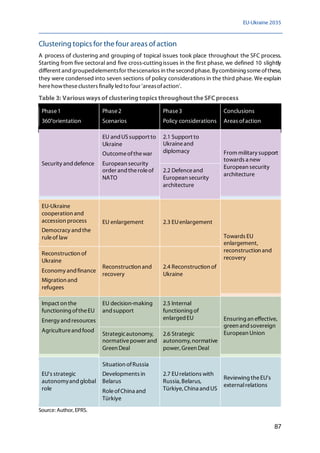
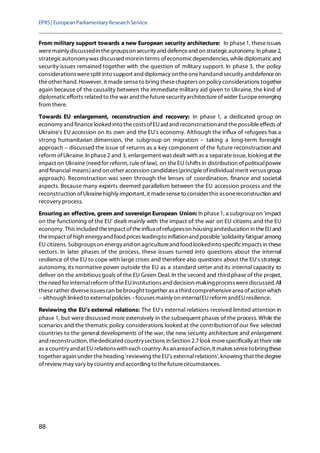
Clustering topics for the four areas of action ______________________________________87
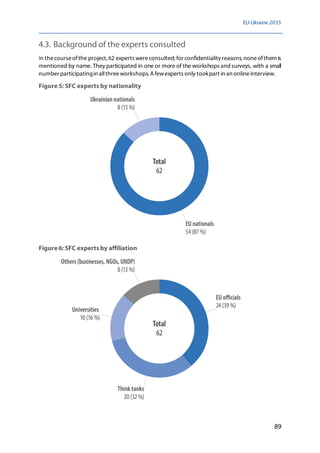
4.3. Background oftheexperts consulted _________________________________________89
EPRS| EuropeanParliamentaryResearchService
IV
Table of figures
Figure1: Thethree phases of the Strategic Foresight Conversation _______________________2
Figure2: Links between conditions and scenarios, pathways___________________________12
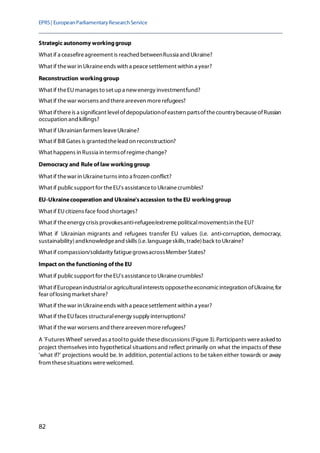
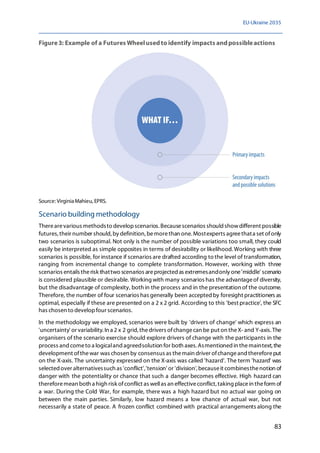
Figure3: Example ofa Futures Wheelused to identify impacts and possible actions ________83
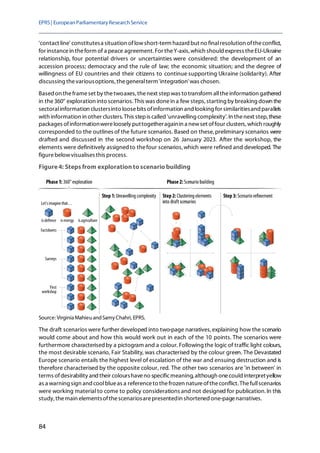
Figure4: Steps from exploration to scenario building_________________________________84
Figure5: SFC experts by nationality _______________________________________________89
Figure6: SFC experts by affiliation ________________________________________________89
Table of tables
Table 1: Initialscenario grid ______________________________________________________5
Table 2: Summary of EU-Ukraine2035 scenarios ______________________________________7
Table 3: Various ways of clustering topics throughout the SFC process ___________________87
EU-Ukraine 2035
1
1. Process:Thestrategicforesightconversation
1.1. Introduction
The Russian invasion of Ukraine on 24 February 2022 and theensuing war has not only drastically
changed allaspects oflife in Ukraine, but is also affecting theEUin many significant ways, notleast
by shifting pre-war geopoliticaland geo-economicparadigms. TheEuropean Council's decision to
grant Ukraine the status of candidate country for EU membership on 24 June 2022 intensified
developments in the relationship between the EU and Ukraine, building on the 2014 EU-Ukraine
Association Agreement, which has been fully applied since 2017. While the situation in Ukraine is
still evolving and many international and EU efforts are focusing on the immediate effects of the
war, the long-term implications ofthewar areof an unprecedented magnitudeand posecomplex
challenges to decision-makers.
Strategic foresight can helpto address theimplications ofthewar and its two-way consequences
on both Ukraineand theEUfroma long-termperspective. Therefore,theEPRSPolicy ForesightUnit
(PFOR) decided in June 2022 to launch a Strategic Foresight Conversation (SFC) on investigating
future relations between the EU and Ukraine across a range of cross-cutting domains, seen from
various angles of the developing relationship. The conversation process involved more than 50
experts, who mainly lookedat possibledevelopmentsand challengesfroman EUperspective, while
also taking theimpact on Ukraineand theglobalenvironment into account. It used an anticipatory
governance1
approach to develop considerations for policymakers on the EU-Ukraine relationship
against thebackdropoftheongoing war.
As the name indicates, the SFC was organised as a conversation process, involving regular
consultations with experts (multi-stage stakeholder engagement approach) on the various topics.
These consultations took different forms, ranging from online surveys and online expert
consultations to workshops with groups of participants. Experts from EU-wide and national think
tanks,universities, EUinstitutionsand variousUkrainian stakeholder organisations participated.All
surveys, workshops and onlineinterviews weredoneunder Chatham Houserules, in orderto create
a trusted environmentin which participants could speaktheir mind freely. As a consequence,none
oftheremarks madearelinked to any specificperson.
From the start, it was a challenge to look beyond the immediate concerns of the war towards
potential futures for the EU and Ukraine. Structuring the process into three distinct phases helped
to accommodatethis challenge:
Phase 1: the first phasefocused on gathering as many elements as possibleabout theEU-Ukraine
relationshipthrough a 360°exploration and by considering their impacts over thenext 1-5 years.
Phase1 thus allowed participants to develop their thinking beyond immediate and short-term
events towards possible medium-term futures. It was launched with a survey in June 2022 and
concluded with an in-person workshopin Brussels on 29September2022.
Phase 2: in thesecond phase, allfindingsweresummarisedand uncertainties and driversofchange
were identified, which formed the basis for building scenarios. Scenarios are imaginations of
possiblefutures in theform of narratives leading from thepresent to a particular future. Scenarios
1
The OECD defines 'anticipatory governance' as the 'systematic embedding and application of strategic foresight
throughout the entire governance architecture, including policy analysis, engagement, and decision-making'
(Foresight and anticipatory governance: Lessons in effective foresight institutionalisation, OECD 2021).
EPRS| EuropeanParliamentaryResearchService
2
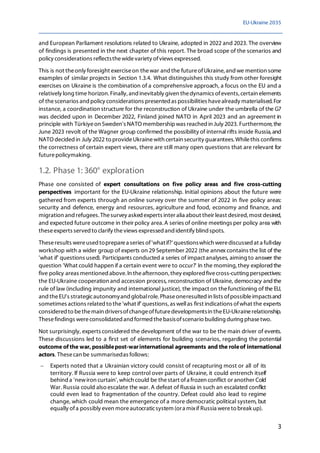
are therefore not predictions but rather a tool to help visualise the possible consequences of
decisions or developments. Thedevelopmentofthewar and thelevelofintegrationofUkraineinto
the EU were identified as two main drivers of change. Following the methodology of building
scenarios along two axes on a 2 x 2 grid (see Section 4.2), four scenarios were developed. Draft
scenarios were discussed with participants in a second workshop on 26 January 2023 and then
developed into four consistentnarratives. Buildingscenarios is likeclimbing a hillin order to havea
better view from the top. The scenarios therefore constitutea tool to elevate thinking beyond the
medium term towardspossiblelong-termfutures.
Setting the time horizon for the scenarios involved the challenge of taking account of both the
development of the war in the medium term and post-war political and economic developments,
including EU enlargement, the reconstruction of Ukraine and the future security architecture of
Europe, in thelong term.Thewar and post-war elementswerealso used to structurethescenarios.
Whereas initially a timehorizon of2040was envisaged(focusingon post-war developments), some
experts preferred a shorter horizon upto 2030(focusing on thewar). Finally, 2035 was chosen as a
compromise date. Taking into account the 2024 elections for the European Parliament, this time
horizon correspondsto two moreparliamentary mandates andrelatedEUinstitutionalcycles.
Phase 3: having reached a long-term outlook into four possible futures, the conversation process
descendedthehillagain towards considering themediumand short term in thethird phase. Based
on a second survey anda finalworkshopon 30March 2023–and on remarksmadein earlier phases
– a set of policy considerations was drafted. This was done systematically by asking experts to
imaginethesteps necessary to achieve(or avoid)each scenario,a processknown as 'backcasting'.
Figure1: The threephases of theStrategicForesight Conversation
Source: Author, EPRS.
Policy considerations aretriggers for decision-makers to beawareofthechallenges, opportunities
and actions that lie ahead, and of the complex interrelationships between these. Policy
considerations do not prescribe what should be done, and are therefore not recommendations.
However, they aim to focus on what theEUcould do about a particular issue, and arethereforenot
merely descriptiveeither.Thepolicy considerations werecomparedto elements ofexisting policies
EU-Ukraine 2035
3
and European Parliament resolutions related to Ukraine, adopted in 2022 and 2023. The overview
of findings is presented in the next chapter of this report. The broad scope of the scenarios and
policy considerations reflectsthewidevariety ofviews expressed.
This is not theonly foresight exerciseon thewar and the futureofUkraine,and we mention some
examples of similar projects in Section 1.3.4. What distinguishes this study from other foresight
exercises on Ukraine is the combination of a comprehensive approach, a focus on the EU and a
relatively long time horizon. Finally, and inevitably given thedynamics ofevents, certain elements
of thescenarios and policy considerations presented as possibilities havealready materialised.For
instance, a coordination structure for the reconstruction of Ukraine under the umbrella of the G7
was decided upon in December 2022, Finland joined NATO in April 2023 and an agreement in
principle with Türkiyeon Sweden's NATO membershipwas reached in July 2023. Furthermore, the
June 2023 revolt of the Wagner group confirmed the possibility of internal rifts inside Russia,and
NATO decidedin July 2022 to provideUkrainewith certain security guarantees.Whilethis confirms
the correctness of certain expert views, there are still many open questions that are relevant for
futurepolicymaking.
1.2. Phase 1: 360° exploration
Phase one consisted of expert consultations on five policy areas and five cross-cutting
perspectives important for the EU-Ukraine relationship. Initial opinions about the future were
gathered from experts through an online survey over the summer of 2022 in five policy areas:
security and defence, energy and resources, agriculture and food, economy and finance, and
migration and refugees. Thesurvey asked experts inter alia about their least desired, most desired,
and expected future outcome in their policy area.A series of online meetings per policy area with
theseexperts served to clarify theviews expressedand identify blind spots.
Theseresults wereused topreparea series of'whatif?' questionswhich werediscussed at a full-day
workshop with a wider group of experts on 29 September 2022 (the annex contains the list of the
'what if' questions used). Participants conducted a series of impact analyses, aiming to answer the
question 'What could happen if a certain event were to occur?' In the morning,they explored the
five policy areas mentioned above.In theafternoon, they explored fivecross-cutting perspectives:
the EU-Ukraine cooperation and accession process, reconstruction of Ukraine, democracy andthe
rule of law (including impunity and international justice), the impact on thefunctioning of the EU,
and theEU's strategicautonomyand globalrole. Phaseoneresulted in lists ofpossibleimpactsand
sometimes actions related to the'what if' questions, as wellas first indications ofwhat the experts
considered to bethemain driversofchangeoffuturedevelopmentsin theEU-Ukrainerelationship.
Thesefindings wereconsolidated and formed thebasisofscenario building during phasetwo.
Not surprisingly, experts considered the development of the war to be the main driver of events.
These discussions led to a first set of elements for building scenarios, regarding the potential
outcome of the war, possiblepost-warinternational agreements and the roleof international
actors. Thesecan be summarisedas follows:
− Experts noted that a Ukrainian victory could consist of recapturing most or all of its
territory. If Russia were to keep control over parts of Ukraine, it could entrench itself
behind a 'newiron curtain', which could be thestart ofa frozen conflict or another Cold
War. Russia could also escalate the war. A defeat of Russia in such an escalated conflict
could even lead to fragmentation of the country. Defeat could also lead to regime
change, which could mean the emergence of a more democratic political system, but
equally ofa possibly even moreautocraticsystem (ora mixif Russia wereto break up).
EPRS| EuropeanParliamentaryResearchService
4
− Experts considered theoptionsofa ceasefireagreement ora morecomprehensivepeace
agreement thatwould settleterritorialquestions andreparations. A ceasefireagreement
seemed to entailmorerisks ofrecurringconflict (as,for instance,shownby thesituation
in Nagorno-Karabakh). Nevertheless, history provides examples of lasting situations
without a peace agreement (Germany before reunification, Korea and Cyprus). A peace
agreement suggests a morestable outcomein which both parties come to terms with
newterritorialrealitiesand reparations, but history equally providesexampleswherethis
was not thecaseand feelings ofresentment led to renewedconflict (theVersailles Treaty
after World War I).
− Experts mentioned theroleofthird countries in theconflict. This included theroleofthe
US as the one of the main providers of financial and military support, of Türkiye as a
possiblemediatorbetweenUkraineand Russia, ofIran asa provider ofweaponstoRussia,
and of China, which, on the one hand, supports Russia and, on the other hand, might
pressurethecountryto avoid further escalation.
As regards EU accession, the reconstruction of Ukraine and developments in several policy
areas, experts came to further initial conclusions, which would become elements of the scenarios
and later ofthepolicy considerations. Thesecan besummarisedas follows:
− Experts identified therelationshipbetween thereconstructionofUkraineand itspossible
EU accession as particularly important.This raised the question of how the EU could
cooperateand coordinatewith other important donors such astheUS, theUK or theG7.
Experts discussed how reconstruction could ideally enhance the Ukrainian economy
('build back better'), or how a failed effort dueto lack of funds might lead to economic
loss, poverty and further migration. Ukraine's integration into the single market might
work out positively for its economy,or increased competition might lead to theclosure
ofnon-competitiveUkrainianindustriesand businesses.Expertsalso discussed theroles
ofcountries and privateinvestors, and potentialRussian war reparationscontributing to
Ukrainian reconstruction.
− A long war or frozen conflict entails various risks and could make Ukrainian politicians
and society feel less urged to improvetheruleof law and to focus on themilitary effort
instead. 'War fatigue' in EU countries might undermine support for accession, which
could reinforceUkrainian allegations of'unfulfilled EUpromises', thusfurther diminishing
support for democraticreforms.TheEUseems to lack a clearnarrativeonwhy supporting
Ukraine is in the interest of the EU. While Ukraine is suffering destruction of its energy
infrastructure and farmland, the EU could suffer further energy supply disruptions and
high energy prices could affect the willingness of EU citizens to support the war. Food
shortages could shift the focus of EU agricultural policy back from quality to quantity,
thereby undoing someofits environmentalachievements.
− Experts concluded that theinfluxofrefugees into EUcountries has putpressureon their
already tight housing markets and education systems, which might lead to 'solidarity
fatigue' among EU citizens. Refugees staying in EU countries could further absorb EU
values regarding democracy, sustainability and the fight against corruption and
repatriate these to Ukraine upon return. Money and skills transferred home from the
'Ukrainian diaspora' could contribute to reconstruction of the Ukrainian economy.
However, post-war migration might lead to a loss of skilled workers for the Ukrainian
economy, including farmers.
− Experts discussednegativeloopsin which thewar causes economicloss, energypoverty,
food scarcity and migration flows, which in turn becomedrivers offurthereconomicloss
(inflation) or further negative impact. However, they also discussed 'positive loops' in
which, for instance,economicrecoveryand increased tradecould bebeneficialfor both
theEU and Ukraineor thepossiblespreadingofEUvalues through returning refugees.
EU-Ukraine 2035
5
1.3. Phase 2: Scenario building
1.3.1. Developing the scenario grid
Apart from an initial exploration of impacts, phase 1 also initiated the search for themain drivers
of change of possible futures forthe EU and Ukraine. As stated above, experts clearly identified
thedevelopment andoutcomeofthewar as themain driverofchange.For reasonsexplained in the
annex,it was decided to build four scenarios alongan X-axis and a Y-axis that constitutea 2x2grid.
The development and outcome of the war would constitute the driver on the X-axis of this grid.
Having considered several alternative options, the final X-axis indicates the level of hazard in the
Ukraine-Russia relationshipin thelong term, ranging from lowhazard on theleft end of theX-axis
to high hazard on its right end.
X-axis: Levelof hazardinthe Ukraine-Russiarelationshipinthe longterm
Low hazard---------------------------------------Medium ------------------------------------Highhazard
It was clear from thediscussions that,oncetheUkraine-Russia relationshiphadbeen addressed on
theX-axis, theY-axis shouldaddresstheUkraine-EUrelationship. After consideringseveraloptions,
it was decided that the Y-axis would indicate the level of EU-Ukraine integration.Therefore,the Y-
axis ranges from minimalintegration at thebottomto maximumintegration at its top.
Y-axis: Levelof EU-Ukraine integrationinthe longterm
Minimalintegration----------------------------Medium ----------------------------Maximumintegration
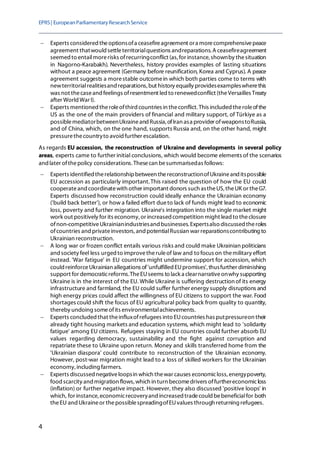
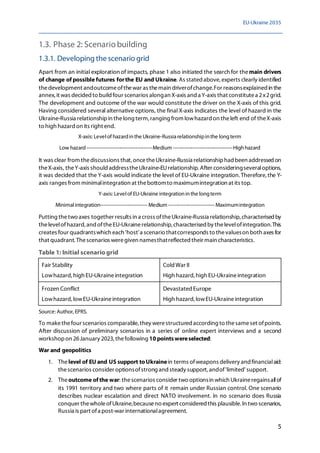
Putting thetwo axes together results in a cross oftheUkraine-Russia relationship, characterised by
thelevelofhazard, and oftheEU-Ukrainerelationship, characterised by thelevelofintegration.This
creates four quadrantswhich each 'host'a scenario thatcorresponds to thevalueson both axes for
that quadrant. Thescenarios weregiven namesthatreflected their main characteristics.
Table 1: Initial scenario grid
Fair Stability
Lowhazard, high EU-Ukraineintegration
Cold War II
High hazard, high EU-Ukraineintegration
Frozen Conflict
Lowhazard, lowEU-Ukraineintegration
Devastated Europe
High hazard, lowEU-Ukraineintegration
Source: Author, EPRS.
To makethefour scenarios comparable, they werestructured according to thesameset ofpoints.
After discussion of preliminary scenarios in a series of online expert interviews and a second
workshopon 26January 2023, thefollowing 10 pointswereselected:
War and geopolitics
1. Thelevel of EU and US support toUkrainein terms ofweapons delivery and financialaid:
thescenarios consider optionsofstrong andsteady support, andof'limited' support.
2. Theoutcome of the war: thescenarios consider two optionsin which Ukraineregainsallof
its 1991 territory and two where parts of it remain under Russian control. One scenario
describes nuclear escalation and direct NATO involvement. In no scenario does Russia
conquer thewholeofUkraine,becauseno expert considered this plausible. In two scenarios,
Russia is part ofa post-war internationalagreement.
EPRS| EuropeanParliamentaryResearchService
6
3. Thepoliticaland economicsituationof Russia: thescenarios consideroptions in which the
Russian regime is replaced by a more constructive one, continues on a similar path of
autocracy and power consolidation, or collapses, leading toa fragmentation ofgovernance
structures.
4. Roleof China and Türkiye:apart from Russiaand theUS,thescenariosconsidertheroleof
thesetwo countries morespecifically, as they werethemostmentioned by experts.
5. Developments in Belarus: the scenarios give special attention to Belarus, because of its
closeinvolvement in thewar, its geographicalproximity to theEU(Belarus hasbeen part of
the Eastern Partnership since 2009) and the effects of its developments on the future
European order.
European development trajectory
6. The future European security order and the role of NATO: based on experts' views, it is
assumed in all scenarios that NATO will remain the key pillar of a future European security
order, but the scenarios consider variations in new NATO members and the scope and
natureofNATO's involvementin thepost-war order.
7. ThefutureofEU enlargement: thescenarios considerseveraloptions forUkraine'spossible
EU accession: one option of full accession of five countries after negotiations,one of an
open-ended, staged approach, one with a small enlargement not including Ukraine, and
onewithout any enlargement.
8. Internal decision-makingin the EU and the consequences for EU support for Ukraine:
the scenarios describe two cases of positive decision-making dynamics regarding EU
relations with its neighbours(ofwhich oneincludes EUreform), and two negativeones.
9. The reconstruction and economic recovery of Ukraine and the EU's role in it: the
scenarios consider four different ways of coordinating Ukraine's reconstruction – two
leading to the recovery of its economy, and two not doing so. They also link these to the
possiblecontributionofreturning refugees.
10. EU strategic autonomy and normative power, related to the implementation of the
Green Deal:onescenario leads to successfulimplementation oftheGreenDealand a more
autonomous EU, another to the EU sharing transatlantic autonomy with the US, and two
others to partialor failed implementationoftheGreen Dealand a loss ofEUautonomy.
It was important to draft each scenario as a long-term future projected in 2035. However, many
elements of each scenario also address steps towards that end-picture, taking place in a medium-
term future. Structuring the10points in two groups –thosemainly addressing thedevelopment of
thewar in themedium term and thoseaddressing enlargement,reconstructionand futurepolicies
in thelonger term –accommodated this internaltension in thetimehorizon.
1.3.2. Scenarios
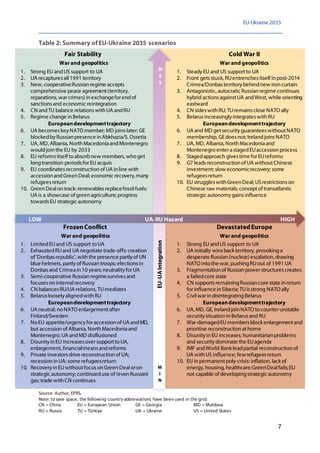
Table2belowshows thesummary gridofallfour scenarios. It containsveryshortindicationsofeach
scenario along the10selectedpoints. This is followedby foursuccinct descriptionsofeach scenario.
Although allscenarios point to possiblefutures and are,in that sense,equalto each other, theyare
obviously not equally desirable. From an EU perspective, the two scenarios above the X-axis (Fair
Stability and Cold War II) are more desirable, because they show strong internal EU cohesion,
whereas the two scenarios below the X-axis show a disunited and ineffective EU. The Fair Stability
scenario represents theoutcomethatis mostdesirablefromboth an EUand Ukrainian pointofview.
EU-Ukraine 2035
7
Table 2: Summary ofEU-Ukraine 2035 scenarios
Fair Stability
War and geopolitics
1. Strong EU andUS support to UA
2. UA recapturesall1991 territory
3. New, cooperativeRussianregime accepts
comprehensive peace agreement(territory,
reparations, warcrimes) inexchangeforendof
sanctionsand economic reintegration
4. CN andTU balance relationswithUA andRU
5. Regime change inBelarus
Europeandevelopmenttrajectory
6. UA becomeskeyNATO member; MD joinslater; GE
blockedbyRussianpresence inAbkhazia/S. Ossetia
7. UA, MD, Albania, NorthMacedoniaandMontenegro
wouldjointhe EU by 2033
8. EU reformsitself toabsorbnew members, whoget
longtransition periodsforEU acquis
9. EU coordinatesreconstructionof UA inline with
accessionandGreenDeal; economic recovery,many
refugeesreturn
10. GreenDealontrack: renewablesreplacefossilfuels;
UA is a showcase of greenagriculture; progress
towardsEU strategic autonomy
Cold War II
War and geopolitics
1. SteadyEU and US supportto UA
2. Front getsstuck, RUentrenchesitself inpost-2014
Crimea/Donbasterritorybehindnew ironcurtain
3. Antagonistic, autocratic Russianregime continues
hybrid actionsagainstUA andWest, while orienting
eastward
4. CN sideswithRU; TUremainsclose NATO ally
5. BelarusincreasinglyintegrateswithRU
Europeandevelopmenttrajectory
6. UA and MD getsecurityguaranteeswithoutNATO
membership, GEdoesnot; IrelandjoinsNATO
7. UA, MD, Albania, NorthMacedoniaand
MontenegroenterastagedEUaccessionprocess
8. Stagedapproach givestime forEUreforms
9. G7 leadsreconstructionof UA withoutChinese
investment; slow economicrecovery; some
refugeesreturn
10. EU struggleswithGreenDeal; USrestrictionson
Chinese raw materials; conceptof transatlantic
strategic autonomygainsinfluence
FrozenConflict
War and geopolitics
1. LimitedEUand US support toUA
2. ExhaustedRUand UA negotiate trade-offs: creation
of 'Donbasrepublic', withthe presence partlyof UN
blue helmets, partlyof Russiantroops; electionsin
Donbasand Crimeain10 years; neutralityforUA
3. Semi-cooperative Russianregimesurvivesand
focusesoninternalrecovery
4. CN balancesRU/UA relations, TUmediates
5. BelaruslooselyalignedwithRU
Europeandevelopmenttrajectory
6. UA neutral; noNATO enlargementafter
Finland/Sweden
7. NoEU appetite/urgencyforaccessionof UA andMD,
but accessionof Albania, NorthMacedoniaand
Montenegro; UA andMD disillusioned
8. DisunityinEU increasesoversupporttoUA,
enlargement, financialmeansandreforms
9. Private investorsdrive reconstructionof UA;
recessioninUA; some refugeesreturn
10. RecoveryinEUwithoutfocusonGreenDealoron
strategic autonomy; continueduse of (evenRussian)
gas; trade withCN continues
DevastatedEurope
War and geopolitics
1. Strong EU andUS support to UA
2. UA initially winsbackterritory, provokinga
desperate Russian(nuclear) escalation, drawing
NATO intothe war, pushingRUout of 1991 UA
3. Fragmentationof Russianpowerstructurescreates
a failedcore state
4. CN supportsremainingRussiancore state inreturn
forinfluence inSiberia; TUisstrong NATO ally
5. CivilwarindisintegratingBelarus
Europeandevelopmenttrajectory
6. UA, MD, GE, IrelandjoinNATO tocounterunstable
securitysituationinBelarusand RU
7. War-damagedEUmembersblockenlargementand
prioritise reconstructionathome
8. DisunityinEU increases; humanitarianproblems
and securitydominate the EUagenda
9. IMF andWorld Bankleadpartial reconstructionof
UA withUS influence; fewrefugeesreturn
10. EU inpermanentpoly-crisis: inflation, lackof
energy, housing, healthcare;GreenDealfails;EU
not capable of developingstrategic autonomy
Source: Author, EPRS.
Note: to save space, the following country abbreviations have been used in the grid:
CN = China EU = European Union GE = Georgia MD = Moldova
RU = Russia TU = Türkiye UA = Ukraine US = United States
EU-UA
Integration
LOW UA-RU Hazard HIGH
M
A
X
M
I
N
EPRS| EuropeanParliamentaryResearchService
8
Fair Stability
War and geopolitics
In this scenario, theEU and the US would give strong and steady military and financial support to
Ukraine, irrespective of the political party in power in the US. Due to the robust military actions of
the Ukrainian army, constant deliveries of Western heavy weapons and strict economic sanctions,
Ukraine would win the war and Russia be driven out of Ukraine. Victory would also be enabled by
thefall ofPutin's regimein thefinalphaseofthewar, beforeit could haveescalated. A newRussian
government would adopt a more constructive approach to Ukraine and its Western partners,
resulting in a comprehensive peace agreement,including (partial) payment of reparations and an
internationaltribunalfor theprosecutionofwar crimes. In return, Westerncountries would lift their
sanctions and allow Russia to gradually reintegrate into the global economy. China and Türkiye
would have played a role of mediator, facilitating this outcome. The EU and the US would co-sign
the agreement between Russia and Ukraine. Russia would be more cooperative, but not develop
truedemocracy. Most Russianswould copewith the consequences ofa lost war, ranging from lost
relatives and feelings of humiliation to poverty. Belarusian President Lukashenko, lacking Putin's
support, would losepowerand Belarus would embarkon a moreindependent coursefromMoscow.
European development trajectory
Sweden and Finland would join NATO during thewar and Ukrainewould join immediately after.As
the most experienced army in NATO,Ukraine could assure a leading role on NATO's eastern flank.
Crimea would return to Ukraine, Russian troops would leave Transnistria as part of the peace
agreement and Moldova would abandon neutrality and join NATO. However, Russia's continued
presence in South Ossetia and Abkhazia would block Georgia from joining NATO. With peace and
stability regained, neutralEUcountriesAustria,Cyprus,IrelandandMaltawould notapply forNATO.
After the war, Ukraine would focus on complex EU accession negotiations.It would have to solve
certain issues regarding governance and the rule of law, for instance reintegrating Donbas and
avoiding a new oligarch system. Long transition periods for implementing theEU's environmental
and agriculturallegislation would allowfor demining and fulfilling all accession obligations. In this
scenario, theEUwould embarkon internalreform (votingin Council, smaller European Commission,
number ofEuropeanParliament seats)toallowforenlargement involvingseveralcountries.Albania,
Montenegro andNorth Macedonia (the Western Balkan countries that fulfil all criteria), would join
theEUwith Moldova andUkraineby 2033. Ukrainewould becomethemainrecipient ofEUregional
and agriculturalfunds. Enlargementwould lead to labour mobility and economicgrowth.
The EU and Ukraine would coordinate reconstruction with input from the US, other G7 countries
and China. This would facilitatelinking investmentsto theaccession processand theEUGreen Deal.
Many refugees would return and contributeto accession and reconstruction. 'Building back better'
a modern, sustainableand digitalUkrainianeconomy, togetherwith localcitizens and civil society,
would attract foreign investors. In mostEUcountries, Green Dealimplementation would beon track.
Renewables would increasingly replacefossilfuels and greenagricultureemergeas a newstandard,
Ukraine being a showcase example. The new European order would be based on multilateralism,
with a strong EU being an essential pillar in NATO, wielding its value-based regulatory power, and
making substantialprogresstowards strategicautonomy in its defenceand its economy.
EU-Ukraine 2035
9
Cold War II
War and geopolitics
In this scenario, theEUand theUSwould also givesteady military and financialsupport to Ukraine.
However, although EU and US support would strengthen Ukraine enough to drive Russia back to
theareas oftheDonbas region capturedin 2014, it would not beableto recaptureallofits territory.
Russia would entrench itselfin Crimea and theoccupied partsofDonbas, buildinga modern version
of the iron curtain along this frozen frontline. From behind this 'new wall' and based on an
antagonistic understanding of opposing blocks, Russia would continue cyber-attacks and other
forms ofhybrid warfareagainst Ukraineand its Western allies. A futuresuccessor to President Putin
would not change this policy and the underlying narrative of Russian exceptionalism. Because
Western sanctions stayed in place, the Russian economy would re-orient itself towards the East.
China and Russia would bedriven increasingly intoeach other'sarms, alsobecauseofever moreUS
economicrestrictions on China. In spiteoftheir differences, Russia and China would beconsidered
as representatives ofa competing world order. TheEUwould increasingly sharethisvieworiginating
from the US, leading to a bipolar world. Türkiye would have to give up its mediating role and,
possibly under pressure of US sanctions on trade with Russia, cement its Westward orientation.
Belarus would enter into a formalunionwith Russia,in which Russia would havethedecisivevote.
European development trajectory
Sweden andFinlandwould join NATO and theincreasing tensionofa bipolar world might alsopush
Ireland to abandon itsneutrality.NeutralEUcountries Austria,Cyprus andMalta would nottakethat
step. NATO membership would not be an easy option for a divided Ukraine, which would instead
get security guarantees from its Western allies. This would encourage Moldova to abandon its
neutrality and sign a similar security compact, which would not cover Transnistria. Ukraine and
Moldova would de facto progressively integrate into many of NATO's structures, but a stronger
Russian presencein South Ossetia and Abkhazia woulddepriveGeorgia ofsimilar guarantees.
TheEUwould discuss howto integratea divided Ukraineinto the'European family'and finally allow
accession ofits freeterritories, referring to theprecedent ofCyprus, becauseEUintegration would
be seen as a political imperative in a bipolar world. Albania, Montenegro, North Macedonia (the
Western Balkan countries fulfilling all criteria) and Moldova would also accede. All new members
would follow a staged or 'step-by-step' integration process into the various EU policies; this
arrangement would allowtheEUto postponeinstitutionalreforms.As most EUMember Statesare
also NATO members and part of the security compacts with Ukraine and Moldova, EU-NATO
cooperation would increase, creating a true transatlantic security architecture. The OSCE, once
meant as a pan-Europeansecurity structure,would increasingly loseimportanceand focus on non-
military tasks.
In this bipolar world, China would not participate in Ukraine's reconstruction, which would be led
by a special G7 task force. Following subsequent packages of US restrictions on exports to China,
theUS and theEU would cooperatemoreon tradeand industrialpolicy with a view to controlling
the global flow of technology and raw materials. Changing supply chains and energy flows would
make the EU struggle to implement its Green Deal. In a world of geopolitics, the concept of
European strategicautonomywould bereplaced by transatlanticstrategicautonomy.
EPRS| EuropeanParliamentaryResearchService
10
Frozen Conflict
War and geopolitics
In this scenario, the EU and the US would be increasingly hesitant about their support to Ukraine.
After 2024, a Republican US President could prioritise domestic growth and the geo-economic
confrontationwith China over financialand military aid to Ukraine, whileEU Member States would
increasingly differ in thelevelof support they give. Russia could initially profit from thesituation by
making someterritorialgainson thebattlefield. However, thefront would bestuck.BothRussiaand
Ukrainewould concludethat theycould notwin thewarand would lookfor away toend theconflict
and prioritiseeconomicand socialrecovery. Negotiations, possiblyfacilitated by Türkiyeand/orthe
UnitedNations,wouldleadto a cease-fireagreementand thecreationofa provisionalindependent
Donbas republic. UNbluehelmetswould bestationedin thosepartsofDonbasconqueredby Russia
since February 2022, while Russian troops would withdraw to the areas captured in 2014. Parties
would agreeon holding internationally supervised elections in 10yearsto decideon thefinalstatus
of Donbas and Crimea. Ukraine would remove the aim of NATO membership from its constitution
and pledgeneutrality. Belaruswould continueitsalignment with Russia, butmighthavesomemore
room for an independent course. China could continue trading with both Russia and the EU,
knowing that tradewith theUSwould bedecreasing.
European development trajectory
Ukraine would no longer aspire to NATO membership, knowing that the new American foreign
policy would focus on potential conflict with China and push for a solution to end hostilities. The
only new countries joining NATO would be Sweden and Finland. Now that peace had returnedto
theEuropean continent, most EUMember Stateswould feelless urgency to push forward with the
EU accession of Ukraine and Moldova. The EU would have opened accession negotiations,which
would be stuck on a combination ofissues. MemberStateswouldpoint to weaknesses in Ukrainian
democracy and theapplicationoftheruleoflaw, whileless vocally admittingthatthefinancialcosts
of enlargement and reconstruction did not resonate with EU voters. This would lead to
disappointment in Ukraine,particularly iftheEU agreed on EU accession for a few countries in the
Western Balkans. Different views on EUaccession would lead to a serious deteriorationin relations
between Member States. InternalreformoftheEUwould not takeplace.
Thedivisions insidetheEUwould bereflectedin thepreferenceofUkrainefor inviting only 'friendly
countries' and their companiesto contributeto thereconstruction ofitsfreeparts. Privateinvestors,
not theEU, would bethe main drivers ofUkraine's reconstruction. Most ofthem would comefrom
the US, Poland, Türkiye or China. They would invest in the best parts of the Ukrainian energy and
agriculture sector, while many small and medium-sized Ukrainian enterprises would go bankrupt.
Without thefull benefit of theEU internalmarket,and facing thehugecosts ofreconstruction and
demining, the Ukrainian economy would slip into recession. Whereas some Ukrainian refugees
would return to rebuild their country, others would stay abroaddue to better opportunities. Most
EUMember States wouldslowly recover from theimpact ofthewar. TheEUwould prioritisegrowth
over greening in its internal recovery plans andthe Green Deal would be 'adjusted' to low growth
perspectives. EU strategic autonomy would be difficult to achieve, with imports from China under
pressurefrom Americansanctionsand energyhard to secure.
EU-Ukraine 2035
11
DevastatedEurope
War and geopolitics
In this scenario, strong EUand USmilitaryand financialsupport toUkrainewould createa Ukrainian
military superiority that would push the Russian army swiftly out of Donbas. However, contrary to
theFair Stability scenario, this would not lead to thefallofPresident Putin.When Ukrainelaunched
its attack on Crimea, Russia would escalate the war, for instance with a counter-offensive from
Belarus, which would join thewar actively.Escalation might involveTransnistria or countries in the
region, for instance Armenia, Azerbaijan or Iran. In this scenario, Russia would be under so much
pressurethat it would launch nuclear missiles on western Ukraineto interruptWesternsupplies and
cut Ukraine off from its allies. This would lead to NATO invoking Article 5, once nuclear fallout
reachednearby NATO countries. Targeted NATOairstrikeswould destroy most oftheRussian army
in Ukraine, theBlack Sea fleet and (nuclear)launchingsitesin Russia. In theensuing chaoticsituation,
parts oftheRussianarmy could surrender,whileother partsandprivatemercenaries couldcontinue
fighting. The war might escalate further if Russia were to launch (nuclear) attacks against NATO
countries, which would drawNATO further into thewar.A militarycoupagainstPutin could follow,
but this scenario assumesthat a newmilitary government would notbeableto controlthesituation
or lead successful negotiations. This would lead to a rather chaotic fragmentation of Russia into
diverse power centres, and regional entities might increase their independence. This would
redesign the power balance in the Black Sea basin, with regions formerly under Russian control
(Crimea, Transnistria, South Ossetia and Abkhazia) reintegrating into the countries to which they
belong under international law. All these countries (Ukraine, Moldova,Georgia)would join NATO.
China would take advantage of the situation and bring parts of central Asia and parts of Siberia
(further)into its sphereofinfluence. At thesametime, China would makesurethat what remained
of Russia would not be defeated completely. The Russian defeat in Ukraine would split the
population and army ofBelarus upto thepoint ofcivilwar.
European development trajectory
Thedevastating war would changethemood in Europe, especially ifNATO countries wereattacked
after escalation. Although this could lead to a sentiment of collective resilience, this scenario
assumes that enthusiasm about Ukraine's liberation would be overshadowed by multiple crises in
the EU and fear of an upcoming war with China. In Russia, feelings of resentment and humiliation
would prevail.Western powers would focus on a strong newsecurity architecturein Europe, most
likely with NATO as its central pillar. However, the question of EU enlargement would split EU
Member States evenfurtherbetween thoseadvocating fast-track accessionofUkraineandMoldova
and thosewho would prefer no enlargement at all. The IMF andthe WorldBank wouldcoordinate
the reconstruction of Ukraine under strong US guidance. Although EU standards would apply in
some sectors, based on the Association Agreement, the need for further alignment with EU
standardswould declinewithout a perspectivefor accession. FewUkrainianrefugeeswould return
without economicprospects. EUcountries hit by thewar would focus on reconstruction and social
issues at home. Inflation in the Eurozone would be high, poverty widespread and housing and
healthcareseriousproblems. Networks ofopportunisticand sometimes criminalenterprises would
flourish, fostering corruption insidetheEU. TheEUwould beineffectivein managing thispoly-crisis,
theEU Green Dealwould fail, andits internationalinfluencewould benegligible.
EPRS| EuropeanParliamentaryResearchService
12
1.3.3. Links between scenarios – Pathways
It is important to note once again that scenarios are imaginations of possible futures and not
predictions.Although themethodologyappliedleads to fourscenarioson a 2x2 grid,this does not
mean that thesearetheonly possiblescenarios, nor that thenarrativeofevents in each scenario is
the only possible option within that scenario. Scenarios are a tool to help visualise the possible
consequences of decisions taken under certain conditions. Both the conditions and the decisions
may bedifferent in therealfuture,leading to different'pathways' of events. Thepurposeofhaving
several scenarios is to reflect a broad range of possible futures, to show policymakers the various
implications ofdifferent conditions and decisions. At thesametime, thenumber ofscenariosmust
stay limited in order to bepractical.
Each scenario needs certain conditions to be fulfilledin order to unfold. If theseconditions are
not fulfilled, other scenarios becomemorelikely,particularly regardingtheoutcomeofthewar.We
havevisualised someoftheseconditions in an arrowdiagram below. Forexample, thearrows in the
clockwise direction could be summarised as follows: strong Russian resilience in the war makes a
Ukrainian victory (Fair Stability) less likely and an entrenched front (Cold War II) more likely. If,
however, that front collapses, this increases the chances for escalation of the conflict (Devastated
Europe). If Russia is not defeated in such an escalated conflict and switches to a strategy of
negotiations,theoptionofa ceasefireagreement (Frozen Conflict)becomesmorelikely. If,however,
due to Ukrainian resilience and strong Western support, Russia is defeated, this might reopen the
road towards a Ukrainian victory and a comprehensive peace agreement (Fair Stability). Similar
considerations can be made for the arrows in the counter-clockwisedirection. This diagram does
not necessarily coverallpossiblerelations betweenconditions andscenarios. However, it illustrates
thefluidity between scenarios and possiblepathways,particularly whilethewar is ongoing.
Figure2: Links betweenconditions andscenarios,pathways
Source: Author, EPRS.
Furthermore, alternative pathways do not always lead towards another scenario, but can also
lead todifferent outcomes withinascenario – a 'subscenario'. Everystageoftheprocessinvolves
'junctions' in the sequence of events, which can lead to different futures. The real future can
EU-Ukraine 2035
13
thereforeconsist ofelements from different scenarios. Onecould,for instance,imaginethat in the
Devastated Europe scenario the impact of nuclear attacks not only leads to confusion and chaos,
but possibly also to increased feelings of unity in the face of a common enemy. This could change
the outcome of the scenario towards a more united European stance on enlargement and better
prospects for common solutions to the poly-crisis. Equally, one could imagine that in the Fair
Stability scenario the war is won by Ukraine and its reconstruction and accession happen as
described, but without Russian agreement to all aspects of the suggested peace agreement, for
instancewithout agreementon thesettlementofreparations.
Thescenarios developedin phase2oftheprocesshaveserved as narrativesthat drawtheattention
to multiple important elements that will play a role and have to be addressed in many EU and
national policies for the coming years. From this point, the process moved towards formulating
policy considerations.
1.3.4. Comparison with available scenarios
While developing the scenarios, the project team had access to a few other publicly available
scenarios. One of the first set of scenarios published was by Matthew Burrows and Robert A.
Manning from the Atlantic Council. Their first version, published in April 2022, consisted of four
scenarios, named 'A frozen conflict', 'A double cold war', 'A nuclear apocalypse' and 'A brave new
world'. Although thesenamesshowsomesimilarityto thefour scenarios ofthis StrategicForesight
Conversation, they differ in two essential ways: firstly, they haveno clear time horizon but mostly
envisage developments for a limited number of years from 2022; secondly, they focus on the
outcome of the war and do not include considerations on EU accession and very few on the
reconstruction of Ukraine.2
One month later, the authors published an updated version, called
'Three possible futures for a frozen conflict in Ukraine'. They concludedthat a frozen conflict had
become the most likely scenario and presented three variations with a time horizon of only two
years. The main difference between thesethree scenarios is the territory regained from Russia by
Ukraine, varying from nothing,to the 24 February 2022 status quo, to all but Crimea. These three
scenarios also highlight concerns about the economic impact of the war and the possibility of
increasingly different approachesbetween theUS and theEU.3
Another setofscenarioswas published in July 2022, coming fromtheFrench think tankFuturibles.4
The Futuribles foresight exercise also differs from this Strategic Foresight Conversation because it
has a short time horizon until 2025 and therefore focuses more on the development and possible
outcome of the war itself. Nevertheless,Futuribles started by also analysing non-military trends in
areas such as energyand infrastructure, agricultureand food, macroeconomics and financeandthe
humanitarian dimension, calling this 'the framework in which the scenarios unfold'. The paper
presented sixscenarios, starting with three'most plausible'ones ('stalemateand instabilities','high
intensity conflict in Ukraine – towards a world of blocs', and 'fears, national self-interest and
territorial expansion of the conflict'). These were followed by three 'less plausible' ones ('Russian
territorial objectives achieved', 'return to the pre-conflict status quo' and 'third world war'). The
plausible scenarios were presentedas narratives of 2-3 pages, while the less plausible ones were
presented in only oneparagraph.
2
See: M. Burrows and R. Manning, How will the Russia-Ukraine war reshape the world? Here are four possible futures,
Atlantic Council, April 2022.
3
See: M. Burrows and R. Manning, Three possible futuresfor a frozen conflict in Ukraine, Atlantic Council, 26 May 2022.
4
See: F. Bourse, M. Segur, A. Lebec and C. Louis, What scenarios for the war in Ukraine?, Futuribles, 12 July 2022.
EPRS| EuropeanParliamentaryResearchService
14
Similar to our considerations at the end of Section 1.3 on possible pathways within and between
scenarios, both Atlantic Council and Futuribles consider options of shifts from one scenario to
another or within a scenario. Futuribles has partly visualised these in so-called 'bifurcations'. The
three Atlantic Council scenarios from May 2022 and the six Futuribles scenarios were not
constructed along axes on a 2 x 2 grid, and could be read as gradual variations along one or more
dimensions. For the three Atlantic Council scenarios, this appears to be the dimension of the level
of territory that Ukrainecan keepunder its control. For thesix Futuribles scenarios, thesituation is
morecomplex. Nevertheless, thescenarioscould beput on a scalefrom mostfavourableto Ukraine
(return to the pre-conflict status quo), via various in-between situations (stalemate, bipolar world,
multipolar world of self-interest), to the least favourable scenarios (Russian territorial objectives
achieved and third world war). Neither the Atlantic Council nor Futuribles develop policy
considerationsbased on thescenarios, althoughseveraloftheseareimplied in thetext.
In thecourseoftheSFC, theproject teamhasbeen in contactwith a third grouppursuinga foresight
exercise regarding the future of Ukraine, whosereport was publishedshortly before this one.This
foresight exercise was requestedby the Ukrainian parliament (Verkhovna Rada) shortly after the
outbreak ofthewar andconducted as a joint project between theInter-factionalUnion ofMembers
ofParliament 'StrategicForesightofUkraine'in theVerkhovna Rada and theAll-Party Parliamentary
Groupfor FutureGenerations in theUnited Kingdom, with strong organisationalsupport from the
United Nations Development Programme(UNDP).5
This scenario exerciseis similar to ours in terms
of methodology (using various forms of stakeholders analysis) and long-term view (using 2040 as
thetimehorizon), but differsmostlybecauseofits focus on internaldevelopmentsin Ukraine, rather
than EU-Ukraine relations. As the title suggests, thefocus of the report is on scenarios. It develops
four scenarios 'for therecovery and development ofUkraine', which arenot placed on a 2 x 2 grid,
but rather stand next to each other as independent possiblefutures. Threeofthescenariospaint a
rather negative view of Ukraine's future, called 'Slow slide to world war', 'Drift to autocracy' and
'Decentralised digital survival'. In the fourth and positive scenario, called 'The hard work of unity',
Ukraine regains all of its territory, including Crimea, and joins the EU andNATO.Nevertheless, and
bearing in mind that thereport was requestedby theUkrainian parliament, thereport looks beyond
thescenarios to what it calls 'strategicimplications', which aresimilar to our policy considerations.
These are divided into general implications for all scenarios and specific ones for each scenario.
Examples of general strategic implications are: 'tackle corruption as key to effective recovery and
development', 'develop international partnerships and innovations for the military industry',
'developdigitalskills and thedigitaleconomy' and 'continuethede-oligarchisation movement'.
Our report distinguishes itself from thesethree other scenario exercises by combining a long time
horizon and a broad approach in terms of topics and geography, with a focus on policy
considerations.
1.4. Phase 3: Towards policy considerations
Policy considerations aretriggers for decision-makers to beawareofthechallenges, opportunities
and actions that lie ahead, and of the complex interrelationships between these. Policy
considerationsdo not prescribewhat should bedone, and arein that sensenot recommendations.
However, policy considerations highlight what the EU could do about a particular issue. The
policy considerationsaddress similar categories as thescenarios, but they havebeen structured in
seven sections accordingto theEU's capacity to act.
5
See: C. Baylon and I. Kylymnyk, Scenarios: Ukraine 2040, Kyiv, 2023.
EU-Ukraine 2035
15
Thepolicy considerationsderived from thedialogueswith experts wereput in a politicalcontext by
opening each section with a short factualdescription oftheissuesat stakeand a summaryofviews
expressed in European Parliament resolutions related to Ukraine, adoptedbetween theautumnof
2021 and June 2023. The complete overview of findings is presented in Chapter 2. To make the
policy considerations moreusefulfor EUpolicymakers, each sectionin Chapter 2ends with a set of
considerationswhich could serveas guidancefor EUaction, presented in a bluebox.
Thepolicy considerations arestructured into threeblocks:
1. A briefdescription ofthemain issues,including references to importantdecisions of
the(European)Counciland Commissionregarding thetopic.
2. An extract ofkey elements ofEuropeanParliamentresolutionsregardingthetopic.
3. Theviews of theexperts consulted in theSFC, structuredaccording to subtopics.
Theexpert views were gathered in two main ways:
a. The collective outcome of the survey of June 2022, the workshop of 29 September
2022 and theonlineconsultations conductedfromOctober 2022untilFebruary2023.
These consultations consisted mostly of online interviews with one expert in a
particular domain. In a few cases, they wereheld as groupinterviews with upto four
experts. Experts were first asked to react to the preliminary scenarios,followed by a
free conversation in which they could express their views on the challenges,
opportunitiesand possibleactions ahead.
b. Responses from participants who took part in a survey in March 2023, designed
specifically to gather policy considerations. This survey consisted of 10 groups of
questions, structured along the 10 points of the scenarios (see annex). Participants
were asked to identify policy considerations, thinking back from thepossiblefutures
presented in the scenarios. This method is known as 'back-casting'.By back-casting
future scenarios into the present, we ask ourselves: What actions should we take (or
not)in order to cometo this scenario, or conversely, to avoid it? This survey was sent
to 62 experts and returned by 15ofthem, a responsepercentageof24%.
An initialset ofpolicy considerations in theformofbullet points per topicwas discussed with those
participants thattookpart in theMarch 2023surveyin an onlineworkshopon 30March 2023. After
theworkshop, theyweretransformedinto flowing text and structuredinto subtopics.
To present thefindings in Chapter 2, thestructureofthe10 blocks of questions has been replaced
by a structure of seven sections, according to the EU's capacity to act in various domains. The first
section is directed at medium-term actions related to thewar, such asmilitaryand financialsupport
and diplomatic initiatives. The subsequent sections address long-term issues, such as the future
security architecture of Europe, EU enlargement and the reconstruction of Ukraine. Although the
accomplishment of these objectives is likely to happen in the long term, actions to achieve them
could start earlier;thisis particularly thecasefor thestrategicautonomy oftheEUand itsnormative
power. Achieving thegoals oftheEUGreenDealby 2030and ultimately 2050needs policy decisions
starting from today. Finally, the policy considerations address EU relations with five countries that
play an important rolein thewar.
EPRS| EuropeanParliamentaryResearchService
16
2. Findings:Policy considerations
Thefollowing seven sections ofpolicy considerationseach start witha descriptionofthetopic, often
mentioning key European Councildecisions or Commission documents related to it. To further put
theconsiderations in a political context, an overviewofEuropean Parliament positions as adopted
in plenary resolutions follows;quotesfromtheseresolutions arealwaysaccompanied by a footnote
indicating therelevant point(s)oftheresolution. Thesectionson Parliamentpositions arefollowed
by the views of our experts. These represent a wide variety of policy considerations, which may
complement or sometimes evencontradict each other. Allconsiderationsmentioned in the'expert
views' sections express only theviews ofoneor moreexperts and do not reflect thepositionofthe
EUinstitutions, theEuropean Parliamentor theSFCproject team. Sometimes they areexact quotes,
but moreoften they arecondensed summaries ofwhat has been said. Theproject team has added
footnotes to several considerations for the purpose of clarification or as additional background
information. Thishas not been donesystematically butin places wheretheproject team considered
it useful. Each of the seven policy sections ends with a blue box of considerations for possible EU
action. These sets of key considerations lay out common denominators for EU action amongst the
diversity ofexpert views.
2.1. EU support relatedto the war and diplomacy
The EU has reacted coherently and rapidly in condemning the Russian invasion, deciding on
multiple packages of sanctions against Russia6
and providing considerable military, humanitarian
and financial support to Ukraine. Sanctions were coordinated with international partners, such as
theUS and theUK, as weredecisions on (financing)thedelivery ofweapons and ammunition.
In thefirst stageofthewar, diplomaticefforts by theEUand key Member States, notablyFranceand
Germany, involvedboth Russia and Ukraine, with a view to possibly ending the hostilities soon. In
later stages, diplomatic efforts focused mostly on supporting Ukraine, expressed, for instance,
through several visits by Commission President von der Leyen and European Council President
Michel to Ukraine. In March 2023, the European Council expressed support for the 10-point peace
plan of Ukrainian President Zelenskyy.7
6
For an overview and evaluation of the various EU sanctions against Russia, see: A. Caprile and A. Delivorias, EU
sanctions on Russia: Overview, impact, challenges, EPRS, European Parliament, March 2023.
7
See European Council Conclusions of 23 March 2023, point 2.
EU-Ukraine 2035
17
2.1.1. European Parliament resolutions
In its first resolution regarding thewar,adoptedon 1March2022,8
theEuropeanParliament strongly
condemned the Russian invasion and called for a diplomatic solution to the conflict, while
welcoming the sanctions against Russia and suggesting more targeted sanctions. Parliament also
called for 'strengthening Ukraine's defence capacities' and supported the 'historic decision to
allocate significant additional funding to provide Ukraine with defensive weapons through the
European Peace Facility'.9
It also welcomed EU support in the area of cybersecurity and called for
economic and financial support to Ukraine.10
The call for support to Ukraine was reiterated and
developed – adding humanitarian aid, for instance – in subsequent resolutions, such as those
adopted on 9 March, 7 April and 5 May 2022.11
The latter addressed the logistical challenges of
replacing blocked sea routes by land routes for trade,calling for betterrailconnectionswith theEU
and liberalising road, rail and inland waterway transport, welcoming the 'Getreidebrücke'
initiative.12
Parliament (indirectly) addressed possible war fatigue in EU countries by calling to fight Russian
disinformation in the EU and support citizens and enterprises suffering economically from the
consequences of the war. On 19 May 2022, it called for 'solidarity with thoseaffected by this new
severecrisis, in orderto helphouseholdsandcompanies,in particular SMEs', because'adetermined,
coordinatedandsolidarity-based European responseis essentialto limit thespread ofthe crisis by
identifying, preventing and mitigating its economic and social consequences, and therefore
maintaining Europeancitizens'support fortheactionstaken against Russia andfor theother actions
needed in supporting theUkrainiansin their defence'.13
Almost a year after the start of the war, Parliament focused more strongly on military support.On
2 February 2023,for instance, it called 'on theMember States toincreaseand acceleratetheir military
assistanceto Ukraine, in particular theprovision ofweapons,in responseto clearlyidentified needs'
and urged them 'to speed up the delivery of military support and equipment to Ukraine', while
welcoming 'the decision of the governments of several EU Member States, the US, the UK and
Canada to deliver modern main battle tanks to Ukraine'.14
On 16 February 2022, Parliament stated
that 'themain objectiveforUkraineis to win thewar againstRussia, understood as itsability to drive
all theforces ofRussia, itsproxies and allies out oftheinternationally recognised territory ofUkraine;
[and that Parliament]considersthat this objectivecan bemet only throughthecontinued, sustained
and steadily increasing supply of all types of weapons to Ukraine, without exception'. Parliament
reaffirmed its support for providingmilitary aid to Ukraine'for as long as necessary' and called 'for
8
Resolution of 1 March 2022 on the Russian aggression against Ukraine.
9
Ibid, point 27. For more information on the use of the European Peace Facility, see: B. Bilquin, European Peace Facility:
State of play as of 31 March 2023, EPRS, European Parliament, April 2023.
10
Ibid, points 30 and 34.
11
Resolution of 9 March 2022 on foreign interference in all democratic processes in the EU, including disinformation;
Resolution of 7 April 2022 on the conclusions of the European Council meeting of 24-25 March 2022, including the
latest developments of the war against Ukraine and the EU sanctions against Russia and their implementation;
Resolution of 5 May 2022 on the impact of the Russian illegal war of aggression against Ukraine on the EU transport
and tourism sectors.
12
Ibid (5 May 2022), in particular points 28, 29, 32 and 39.
13
Resolution of 19 May 2022 on the social and economic consequences for the EU of the Russian war in Ukraine –
reinforcing the EU's capacity to act, point 5.
14
Resolution of 2 February 2023 on the Preparation of the EU-UA Summit, point 7.
EPRS| EuropeanParliamentaryResearchService
18
serious consideration to be given to supplying Ukraine with Western fighter jets, helicopters and
appropriatemissilesystemsand to substantially increasing munitions deliveries'.15
As regards diplomatic efforts, Parliament initially focused on reducing the threat of Russian
espionage, calling 'on the Member States to lower theRussian Federation'slevelofrepresentation
and reduce the number of Russian and Belarusian diplomatic and consular staff in the EU, in
particular wheretheir actions involveespionage, disinformation or military matters'.16
Ten months
later, it called on theCouncil, theCommission and theMemberStatesto 'support the10-pointpeace
plan presented by PresidentofUkraineVolodymyr Zelenskyy17
and towork towards establishing an
international coalition to implement that plan'.18
Parliament also called on others to take a clear
position on the conflict. In October 2022, it called 'on all countries and international organisations
to unequivocally condemn Russia'swar ofaggression and its attemptsto acquireterritoryby force
and through its sham referendums' and 'for the EU andits Member States to actively engage with
the many governments which have adopted a neutral position regarding Russia's aggression
against Ukraine'.19
In the same vein, in February 2023 Parliament called on 'the EEAS and the
Member States to increasetheir engagementwith world leaders from otherregionswith regard to
support for Ukraineand to strengthen internationalpressureon theRussian regime'.20
2.1.2. Expert views
EU support to Ukraine and the development of the war
Experts acknowledged that theEUand its Member Stateshavealreadygiven considerablesupport
to Ukrainein theform ofweapons and other equipment, humanitarianaid and theintroductionof
sanctions. They noted that 2023may bea decisiveyear on thebattlefield for thequestion whether
thewar is to becomea protractedconflict or could lead toa clear outcomein theforeseeablefuture.
So far, there has been a gap between military and economic resources promised to Ukraineby its
allies and thosedelivered. Lack of(timely)deliveryofthese, particularlyadvanced weapons systems
to control the airspace, would delay the Ukrainian counter-offensive and drag out thewar. In the
long term, experts noted, an unresolved conflict would drain theresources ofUkraineand its allies
and lead to more militarisation and corresponding budgetary consequences. A protracted low-
intensity conflict could benefit Russia, which could use the time to replenish its resources and
resumeactivehostilities onceready.
15
Resolution of 16 February 2023 on one year of Russia's invasion and war of aggression against Ukraine, points 8 and
18.
16
Resolution of 7 April 2022, point 32.
17
After presenting a 'formula for peace' at the UN General Assembly of September 2022, Ukrainian President Zelenskyy
presented a 10-point peace plan at the G20 leadersmeeting in Bali on 15 November 2022. It combinessectoral issues
– such as callsfor nuclear safety, food and energy security, and environmental protection – with conditions related to
ending the war, such as thereleaseof prisoners, restorationof territorialintegrity,withdrawalof Russian troops, justice
for war crimes, security guarantees and 'a document confirming the end of the war signed by the parties'. The
European Parliament called for supporting the plan on 2 February 2023 and the European Council did so on 23 March
2023; the EU has not presented peace plans of its own. At a press conference on 18 January 2023, Russian Foreign
Minister Lavrov said: [the Ukrainian peace plan] 'cram[s] everything together: food, energy and biological security, the
withdrawal of Russian troops from everywhere, repentance of the Russian Federation, a tribunal and condemnation.
Negotiations with Zelensky are out of the question, because he adopted a law that banned talks with the Russian
Government', and added, on the prospects for talks between Russia and the West: 'We are ready to consider serious
proposals and to decide on what we do next. So far, there have not been such proposals.'
18
Resolution of 8 February 2023 on the Preparation of the EU-UA Summit, point 8.
19
Resolution of 6 October 2022 on Russia's escalation of itswar of aggression against Ukraine, point 3.
20
Resolution of 16 February 2023 on one year of Russia's invasion and war of aggression against Ukraine, point 28.
EU-Ukraine 2035
19
A war oflong duration would also increasepressureontheunified support oftheEUand itsMember
States, as well as other allies, for a variety ofreasons. Thefact that Ukrainian infrastructure, in spite
of being continuously rebuilt after destruction, keeps being exposed to newdestruction, does not
encourage continuedeconomic support. If the global economy experiences recession or another
(banking) crisis, negative feelings about economic support to Ukraine could further increase. In
general, a long conflict could lead to a kind of 'war fatigue' amongpoliticians and thepopulation of
Ukraine's Western allies. This could result in or come along with changes of leadership in these
countries. In theEU, this could increasetheheterogeneity ofMember States'positions with respect
to military and economicsupport and possibly on sanctions, ultimately breaking EUunity through
internaldifferences and disputes. Oneexpertnoted that private(commercial)interests couldplay a
rolein such developments.
At the same time, experts acknowledged that Western allies are reaching their own limits, for
instance in terms of the non-availability of military equipment or other materials.So apart from
accelerating and enhancing decision-making on military support,EUcountriesshould also increase
production of ammunition and agree on a better strategy for their defence industries and
procurement,according to theseexperts.Besidesmilitary support, a fewexpertssuggested that the
EU could better enforce existing sanctions.21
One expert suggested that, in case of long-term
occupation ofparts ofUkraine(as in theFrozen Conflict or Cold War scenarios), theEUwould need
to developa strategy aimedat keepingUkrainiansin theoccupied territorieswithin theinformation
space of the EU and the Ukrainian government, to ensure they are protectedto some extent from
Russian propaganda.
EU diplomacy
Experts first explored challenges and opportunities for a possible diplomatic role for the EU as
mediator in theconflict between Russia andUkraine. Such challengescould emanatefromUkraine,
Russia or the EU itself. Experts considered, for instance, that the strength of EU diplomacy is often
linked to its high reputationin matters ofethicsand theruleoflaw, and that this could bechallenged
by candidatecountries such as Ukraineifthey seethat Member States havedifferent views on rule
of law issues inside the EU.22
Ukraine could also challenge the credibility of EU diplomacy if it felt
that theEUgavein on principles regarding territorialintegrity andrespectfor internationallaw. This
would also send the wrong signal to Russia regarding territorial integrity. Oppositeto such views
from Ukraine, experts noted, would be the view from Russia that the EU was discredited as a
potentialmediator in theconflict becauseofits unequivocalsupportfor Ukrainein thewar and for
the Ukrainian 10-point peace plan, as well as the prospect of Ukraine's EU membership. Finally,an
EUdiplomaticmediation effort could faildueto differing opinions within theEUonhowtodealwith
Russia,23
on what would bean acceptableoutcomeofthewar in territorialterms,or on thegoalof
Ukrainian EUmembership.
Apart from thesechallenges,experts saw opportunities for EU diplomacy. A proactive and united
EU would strengthen its role on the world stage and its effectiveness as a supranational actor.
Experts noted that thewar had alreadypushed theEUto act moreas an independentinternational
21
One expert referred to the Commission proposal of 2 December 2022 for a Directive on the definition of criminal
offences and penaltiesfor the violation of Union restrictive measures, currently being examined by the co-legislators.
22
Experts referred to different views on the role the Commission should play as guarantor of rule of law principles vis-
á-vis Member States in the cases of Poland and Hungary. The Commission launched proceedings against Hungary
and Poland for violationsof the rightsof LGBTIQ people in July 2021 and against Poland for violations of EU law by its
Constitutional Tribunal in December 2021, which were contested by these Member States.
23
A few expertsreferred to remarks by French President Macron in the early stages of the war that 'Russia should not
be humiliated'.
EPRS| EuropeanParliamentaryResearchService
20
leader on security, building on the principles laid down in its Strategic Compass andoperating in
coordination with NATO. A few experts did see a potential role for the EU or some of its Member
States in possiblenegotiationsofa post-war agreement. Theyreferred to the'Normandy Format'in
which theEU had, since2014, delegated negotiatingpower to Franceand Germany combined with
a reporting obligationto theEuropean Council. Experts noted that,iftherewerenegotiations after
the current war between Russia and Ukraine, probably other Member States would wish to be
included in such a format, particularly eastern and NordicMember States.24
Finally, some experts considered that EU diplomacy should not so much focus on potential
mediation, but should reflect unequivocal EU support for Ukraine. Such a policy would fit in a
scenario likeFair Stability, in which theinterests ofUkraineand its allies coincideand reinforceeach
other, possibly leading to a new level of security and cooperation in Europe and globally. In this
respect, some experts saw a particular role for the EU to mobilise partners across the world,
including in UN fora, with a focus on so-called 'swing states' from the Global South, to mobilise
support for Ukraineand its peaceplan. This could helpto counter Russian and Chinesenarratives in
Africa and Latin America in particular. According to theseexperts, the EU should reject conditions
put forward by Russia, strengthen sanctions and crack down on the circumvention of sanctions.
Communication within theEUshould explain why peaceon Russian terms would not bebeneficial
to either Ukraine or the EU. These experts also considered that the EU should monitor Russian
influence and stability in Moldova and the Balkans to avoid a spillover from the conflict or
manipulation by Russia. In the Cold War and Frozen Conflict scenarios in particular, the EU should
be aware of and combat disinformation and other Russian hybrid threats. These experts also
emphasised thattheEUshould supportMoldova's European ambition moreactively.
24
The Normandy format is a diplomatic meeting format, established in June 2014, that brings together France,
Germany, Russia and Ukraine with the aim of finding a peaceful resolution to the conflict between Russia and Ukraine.
The Normandy format facilitated the Minsk agreements, which were never fully implemented. See, for instance:
Center for Strategic and International Studies (CSIS), 9 February 2022, Understanding the Normandy format and its
relation to the current standoff with Russia. One expert suggested that a new format called P5+3 could consist of the
five permanent members of the UN Security Council (China, France, Russia, UK, US) plus Germany, Poland and Türkiye.
EU support relatedto thewar and diplomacy–
Key policy considerationsfor EUaction
• Continuing humanitarian and economic aid to Ukraine and enforcing sanctions on
Russia.
• Enhancing decision-making on and delivery of military equipment to Ukraineto avoid
thewar turning into a frozen conflict, leading to lower public support for thewar effort
in EUcountries.
• Fostering convergence between Member States' positions on what can be considered
acceptableand possibleoutcomesofthewar and EUaccession.
• Strengthening EU diplomacy through united positions, particularly regarding the rule
of law and international law, and using its potential to convince other countries in
internationalfora.
• Anticipating possibleparticipation by theEUor a groupofits Member Statesin possible
negotiations for a post-war agreement.
• Keeping upprinciples ofinternationallawand not compromising on theseto achievea
solution to theconflict.
• Monitoring Russian influence beyond Ukraine, particularly in Moldova and Western
Balkan countries, with a viewto avoiding spillovers from theconflict.
EU-Ukraine 2035
21
2.2. The European securityarchitectureand defence
Developing a future European security architecture should be basedon lessons from the ongoing
war.TheEUhas acknowledged that thecurrentworld is moredriven bygeopolitics and that security
and defence policies should be higher on the European agenda. The Versailles Declaration,25
adopted by theEUHeads ofStateand Governmenton 11March 2022, is a guiding documentin this
respect. It condemned theRussianinvasionofUkraine, noting that it violates internationallawand
undermines European security.The declaration's section on 'bolstering our defence capabilities'
states that European leaders 'decided that the European Union would take more responsibility for
its own security and, in the field of defence, pursue a strategic course of action and increase its
capacity to act autonomously'. This intention is followed by a list of concrete actions, such as a
substantialincreasein defenceexpenditure, incentivesfor jointprojects andjoint procurement, and
investment in capabilities, including cybersecurity and strengthening the EU defence industry. At
the European Council of 24-25 March 2022, European leaders endorsed the EU Strategic Compass
for Security and Defence,26
which outlines theEuropean securitypolicy upto 2030. TheseEuropean
decisions were followed by national action, of which the decision of the German government to
fundamentally change its defence policy ('Zeitenwende') and create a €100 billion fund for
investment in military procurementis oneofthemost remarkable.27
The new attractiveness of NATO as a security provider – reflected in the membership applications
ofSweden andFinland,theforward presenceofNATO in easternEuropeand thecentralroleofthe
US and NATO in coordinating military support to Ukraine – is another indicator of the direction in
which a futureEuropean securityarchitecturecould develop.Whereas NATO membershipis aspired
to by, but may not be possible in the short run for, Ukraine and Georgia, the international
community has come up with alternativeproposals to grant security to Ukraine,in particular, in a
more structured way. The plan for a Kyiv Security Compact, presented by former NATO Secretary
General Anders Fogh Rasmussen and Head of the Ukrainian Presidential Office Andrii Yermak has
gained much attention. Presented in September 2022, it envisages long-term security support to
Ukraineby a groupofmainly Westerncountries.28
NATOdecided atits 11July 2023Summit in Vilnius
25
The Versailles Declaration was adopted at the informal meeting of the European Council in Versailleson 10 and 11
March 2022.
26
Strategic Compass.
27
For an overview of important European and national decisions regarding security and defence in the first months of
thewar untilMay 2022,see: S. Clapp, Russia's war on Ukraine: reflectionson European security, neutralityand strategic
orientation, EPRS, European Parliament, May 2022.
28
Itskey recommendations include 'a multi-decade effort of sustained investment in Ukraine's defence industrial base,
scalable weapons transfers and intelligence support from allies, intensive training missions and joint exercisesunder
EPRS| EuropeanParliamentaryResearchService
22
to provideUkrainewith certain securityguarantees, presenting theseas a transition towardsNATO
membership.29
Considerations regarding the future security architecture of Europe should also
include the role of the Organisation for Security and Cooperation in Europe (OSCE),which did not
succeed in monitoring the situation in Donbas and avoiding escalation of the conflict, but is
nevertheless oneofthefewplatformswhereRussia and Western countriescouldstillmeet.
Experts discussed alltheseelements, which arestructured belowby starting with lessonsfrom the
war, then looking at the possible roles of NATO, the OSCE and security guarantees in a possible
futuresecurity architecture, and finally reflecting on theroleoftheEUand its defenceindustry.
2.2.1. European Parliament resolutions
From its first resolutions after the Russian invasion, Parliament has emphasised the central role of
NATO and the EU-NATO relationship for guaranteeing security in Europe. At the same time, it has
made multiple calls for further developing (elements of) the common security and defence policy
(CSDP). On 1March 2022, it stated 'that NATOis thefoundation ofcollectivedefencefor theMember
States who areNATO allies'andit welcomed 'theunitybetweentheEU,NATO and otherlike-minded
democraticpartnersin facing theRussian aggression'. At thesametime, it reiterated its callfor the
Member States to 'increasedefence spending and ensure more effective capabilities andto make
full use of the joint defence efforts within the European framework, notably the Permanent
Structured Cooperation (PESCO) and the European Defence Fund, in order to strengthen the
European pillar within NATO, which willincreasethesecurity ofNATO countries andMember States
alike'. 30
On 9 March 2022, Parliament adopted a resolution which focusedon foreign interference
and theneed to fight disinformation.31
In May 2022,Parliament called for moreambitionon theEU's
project for military mobility, alsoin termsofinfrastructure, andregrettedthattheEuropean Council
cut financing for it under theConnecting EuropeFacility (CEF II)for 2021-2027.32
Parliament addressed the need to develop the CSDP and implement various elements of the
Strategic Compass in particular in its resolution of 8 June 2022.33
It called for progress in foreign
policy and defence cooperation at Union level, as expressed in the Versailles Declaration, and in
establishing a defenceunion and a regular EUdefenceminister council. It called for enhancing and
upgrading intelligence sharing and cooperation among the Member States and with like-minded
partners, for instance by improving the resources and capabilities of the EU Intelligence and
Situation Centre and the European Union Military Staff Intelligence Directorate. It also called for
implementation of the most urgent aspects of the Strategic Compass, including operationalising
theproposalfor a rapid deploymentcapacity instrument. Parliamentalso encouragedtheMember
the European Union and NATO flags'; security guarantees that are 'binding based on bilateral agreements, but
brought together under a joint strategic partnership document – called the Kyiv Security Compact' and supported by
'a core group of allied countries' which could include 'the US, UK, Canada, Poland, Italy, Germany, France, Australia,
Türkiye, and Nordic, Baltic, Central and Eastern European countries'. See the full text of the Compact.
29
See: Vilnius Summit Communiqué of 11 July 2023, in particular point 11 (reaffirming the 2008 commitment that
Ukraine will become a member of NATO and an invitation to join 'when Alliesagree and conditions are met'), point
12 (agreement on a substantial package of expanded political and practical support for Ukraine and a NATO-Ukraine
Council), and point 13 (continued delivery of non-lethal assistance as a multi-year programme, helping Ukraine
rebuild itssecurity and defence sector and transition towards full interoperability with NATO).
30
Resolution of 1 March 2022 on the Russian aggression against Ukraine, points 24 and 25.
31
Resolution of 9 March 2022 on foreign interference in all democratic processesin the EU, including disinformation.
32
Resolution of 5 May 2022 on the impact of the Russian illegal war of aggression against Ukraine on the EU transport
and tourism sectors.
33
Recommendation of 8 June 2022 to the Council and the Vice-President of the Commission/High Representative of
the Union for Foreign Affairs and Security Policy on the EU's Foreign, Security and Defence Policy after the Russian
war of aggression against Ukraine.
EU-Ukraine 2035
23
States to increase their defence budgets and investment and acknowledge the NATO target to
spend 2%ofGDPon defence.34
That sameday,Parliament adopted another resolutionon theCSDP,
this time related to security in the Eastern Partnership (EaP) area. In it, Parliament supports 'closer
defence and security coordination and cooperation with someEaPcountries' andcalled,inter alia,
for closer coordinationwith theOSCEand coordination between CSDPmissions and NATO actions.35
Parliament also mentioned the OSCE in relation to common values and democratic capacity-
building and as a platform to build politicalsupport for a specialtribunalfor thecrimeofaggression
against Ukraine.Parliament also urged theMember States to 'explore every option to re-establish
theOSCE Special Monitoring Mission to Ukrainemandate'. 36
In October 2022, Parliament addressed Russian threats ofa nuclear strike, calling on Russia to cease
such threats and on theMember States and internationalpartners to preparea quick and decisive
responseshould Russia conduct a nuclear strikeon Ukraine.37
Parliamentcalled on theCouncil, the
Commission and the Member States 'to engage with Ukraine on the topic of future security
guarantees, such as thoseproposed in theKyiv Security Compact'.38
2.2.2. Expert views
Lessons from the war: EU intelligence and geopolitical realism
Experts considered that theEUcould drawtwo particular lessonsfromthewar:firstly,theEUandits
Member States should reinforcetheir intelligencecapacity,to knowandbetter understandwhat the
drivers and plans of non-EU countries are; secondly, they should acknowledge geopolitics and
power as drivers ofinternationalrelations andshould adapt their own policies accordingly.
As regards reinforcing intelligence capacities, experts noted that,since the UK has left the EU, the
EU is no longer linked to important intelligencesystems oftheAnglo-Saxon world,in particularthe
UK's Secret IntelligenceService(also known asMI6),theUS CentralIntelligenceService(CIA)and the
Five Eyes intelligence-sharing alliancebetween theintelligenceservices oftheUS,the UK,Canada,
Australia and New Zealand.39
They also noted that no similar arrangement exists for sharing
intelligence information among EU countries, nor does an agreement on sharing intelligence
between theEUand NATO.Referring totheaim oftheStrategicCompassto strengthen anEUSingle
Intelligence and Analysis Capacity (SIAC) and boost capacities to detect and respond to hybrid
threats,40
these experts considered that the EU should invest in active intelligence and counter-
34
The NATO guideline that its members (called 'allies' in NATO terms) should spend 2 % of their GDP on defence was
reiterated more strongly in the NATO Vilnius Summit Declaration of 11 July 2023, point 27: 'Consistent with our
obligations under Article 3 of the Washington Treaty, we make an enduring commitment to invest at least 2% of our
Gross Domestic Product (GDP) annually on defence'.
35
Resolution of 18 June 2022 on security in the Eastern Partnership area and the role of the common security and
defence policy, in particular points 5, 10 and 17.
36
In, respectively: Resolution of 9 March 2022 on foreign interference in all democratic processes in the EU, including
disinformation, point 149; Resolution of 19 January 2023 on the establishment of a tribunal on the crime of aggression
against Ukraine, point 4; Resolution of 19 May 2022 on the fight against impunity for war crimes in Ukraine, point 30.
37
Resolution of 6 October 2022 on Russia's escalation of itswar of aggression against Ukraine, point 16.
38
Resolution of 2 February 2023 on the Preparation of the EU-UA Summit, point 8.
39
For more information on SIS and CIA, see their websitesat www.sis.gov.uk and www.cia.gov. For information on the
Five Eyes alliance, see, for instance, this informative blog of the UK Defence Journal.
40
For a short description of EU intelligence bodies and activities, see, for instance: N. Delcroix, Single Intelligence
Analysis Capacity (SIAC) and itsrole in supporting EU decision making, pp. 10 and 11 of Impetus#28 of autumn/winter
2019. For the plans of the EU Strategic Compass on SIAC, see: European External Action Service, 24 March 2022, A
strategic compass for security and defence – for a European Union that protectsitscitizens, values and interestsand
contributes to international peace and security, Chapter 3 pp. 33-41, in particular the following quote from page 33:
EPRS| EuropeanParliamentaryResearchService
24
intelligence. This could include designing tools to infiltratetheinformation spheres ofthreatening
actors. Thesecould bestateactorsor non-stateactors,which might becomea growing threat in the
future. Experts noted that this would requiresubstantialinvestments in specialised personnelwith
specific skills, for instance regarding languages andinformation technology. They also pointedto
the need to map weaknesses in Member States' national intelligence services (mentioning recent
revelations in Germany)and suggested that such a 'counter-intelligenceprotectiveumbrella' should
also cover non-EUcountries in theWestern Balkans, Ukraine, Moldovaand Georgia.
As regards geopolitics, all experts concluded that the war has shaken the existing system of
European securityand has shown that theEUwas unprepared for such a challenge. They therefore
considered that theEUshould developitssecuritystrategyand itsunderstanding ofthegeopolitical
landscape. In doing so, the EU should address aspects of conventional war and weapons, such as
tanks and ammunition, as well as hybrid warfare, including cyber-attacks. The EU should develop
long-term plans for investment in research and development (R&D), the forging of international
partnerships and defence procurement. Some experts suggested that the EU should, in particular,
strengthen its capacities in the maritime, air and space domains. This could include a maritime
presencein other areas oftheworld, such astheIndo-Pacific. Oneexpertconcluded thatthecurrent
war has not only shown the weakness of the current European security system, but also indicated
theineffectiveness ofan approach based oninternationalagreementsand thepeacefulcoexistence
of countries and peoples, fostered by trade.41
Another expert said,in this respect,that EUcountries
should, in their relationswith Russia,focusless on intentions laid down in internationalagreements
and moreon realities happening 'ontheground'.
Severalexperts discussed thepossibleposition ofRussiain a futureEuropeansecurityarchitecture;
this would obviously depend on the outcome of the war. A few experts dwelled upon the role of
Crimea in security terms. OneexpertnotedthattheannexationofCrimea is a centralelement in the
success ofPutin's regimeand it can thereforenot betreated likeany other occupied partofUkraine.
Another expert pointedto thestrategicimportanceofCrimea for controlling theSea ofAzov, while
another considered that the liberation of Crimea by Ukraine might cause Russia to use nuclear
weapons. Moregenerally, mostexperts called for long-term vigilancein relations with Russia. They
argued that,as long as Russia has nuclear weapons, NATO should beready to respond to possible
aggression. Oneexpert envisaged a security order in which Russia should be deprived of nuclear
weapons or even be demilitarised. Other experts considered that no future Russian government
would agree to such conditions, even after a Russian defeat,and that, combined with feelings of
resentmentafter a Russiandefeat, thiswould beunlikely to lead to a stablesecurityenvironmentin
Europe. Some experts therefore suggestedthat new efforts should be made to includeRussia in a
future European security architecture – an opportunity that was missed in the 1990s. This could
most likely only happen after a Russian defeat, in a scenario similar to Fair Stability. Other experts
considered outcomeslikeCold War or Frozen Conflict to be morelikely and suggested that theEU
andNATO shoulddevelopa newstrategyofdeterrencetowards Russia.
Future security architecture:Roles of NATO and OSCE, security guarantees
Experts discussed variousoptionsfor a futuresecurityarchitecturein Europe. Mostexperts pointed
to the leading role of the United States and NATO in coordinating military support to Ukraine,for
instance through the meetings of the Ukraine Defence Contact Group, better known as the
'We will strengthen our intelligence-based situational awarenessand relevant EU capacities, notably in the framework
of the EU Single Intelligence AnalysisCapacity, as well as the EU Satellite Centre.'
41
The latter conclusion would question some fundamental principles of value-based EU foreign policy and this
discussion was not further developed by the experts.
EU-Ukraine 2035
25
'Ramstein format'.42
A few experts considered that the role of the US could be decisive for the
outcomeofthewarandmany considered thattheUSand NATO would mostlikely play an important
role in any futuresecurity architecturefor Europe. Someexperts noted that thewar had increased
the attractiveness of NATO as a security provider, illustratedby the membership applications of
Sweden and Finland, but experts weremorecautious about possiblefutureNATO membershipfor
Ukraine. Most experts consideredthat this would only be possible after the war, because Ukraine
joining NATO during the war would trigger Article 5 of the NATO Charter and draw NATO into the
war.43
Severalexperts considered it likely thatUkrainewould join NATO, with oneexpertsuggesting
that Ukraine would probably demand andpossibly obtain a leading role on NATO's eastern flank,
based on its achievements in the war. Once it had acceded, Ukraine might be a vocal member of
NATO in putting forward its national interests, similar to France or Türkiye. Only one expert
expressed theviewthatUkrainewould probably not join NATO, either becauseofopposition by one
or moreNATO allies, or becausethewar would end in a scenario similar to Frozen Conflict or Cold
War.A few experts addressed thepossibility ofothercountries in theregion joining NATO. Someof
them suggestedthat, in the event of a Ukrainian victory, Moldova and Georgia would most likely
also join. Others suggested that,particularly without a clear victory, Russia might prevent one or
both ofthesetwo countries fromjoining NATO.44
Because NATO membership may not be easily and rapidly obtainable for Ukraine, Georgia or
Moldova, several experts deemed proposals for security guarantees to these countries a good
solution, either as transitionalor permanent measures.Someofthem referred to theproposals for
a Kyiv Security Compact mentioned above. Some experts mentioned the security guarantees
promised to Ukraine in the Budapest Memorandum of 1994,45
when it refrained from keeping
nuclear weapons, adding that a newmemorandum should givebetter guarantees honouredby the
guarantors. Oneexpert compared futuresecurityguarantees to thosegiven by theUS to Taiwan46
and also compared these to US military assistance to Israel.47
Although in the scenarios security
42
The Ukraine Defence Contact Group comprises more than 50 countriesand held its first meeting on 26 April 2022 at
the US military base in Ramstein, Germany.
43
Article 5 is the cornerstone of the NATO alliance and states that an armed attack on one NATO member will be
considered as an attack against them all.
44
Georgia applied for NATO and was given the perspective of membership at NATO's summit in Bucharest in 2008. For
more information on NATO-Georgia relations, see: https://www.nato.int/cps/en/natohq/topics_38988.htm. Moldova
is, according to itsconstitution a neutral country and has not applied for NATO membership. Experts suggesting that
Moldova would join NATO therefore imply that a combination of a pro-Western government and decreased Russian
influence in the country would pave the way for abandoning neutrality and applying for NATO membership. For more
information on NATO-Moldova relations, see: https://www.nato.int/cps/en/natohq/topics_49727.htm. The four
scenarios cover various options of Georgia and/or Moldova joining NATO.
45
The Budapest Memorandum on Security Assurances was signed on 5 December 1994 by the Russian Federation,
Ukraine, the United Kingdom and the US, who promised to respect the sovereignty and existing borders of Ukraine,
when giving up itsnuclear weapons. Although Belarus, Kazakhstan and Ukraine had already committed in the Lisbon
Protocol of 23 May 1992 to return their nuclear weapons to Russia and accede as Non Nuclear Weapon States to the
Treaty on the Non-Proliferation of Nuclear Weapons (Non Proliferation Treaty or NPT), Ukraine only did so after
obtaining the additional security assurances of the Budapest Memorandum, because many Ukrainian officials
continued to view Russia as a potential threat. To Ukraine's frustration, these guarantees were not honoured during
the conflict in Donbas since 2014 and the Russian invasion of 2022.
46
US relations with Taiwan are guided by the Taiwan Relations Act (TRA) of 1979. In 1982, the US agreed on six
assurances to Taiwan, including conditions for arms sales and not recognising Chinese sovereignty over Taiwan. The
TRA was amended in 2022 by the Taiwan Policy Act, allowing the provision of arms not only in a 'defensive manner',
but also to deter 'actsof aggression by the People'sLiberation Army'. The further development of security guarantees
for Taiwan is a subject of debate in the US – see, for instance, a comment from 7 March 2023 on the US-Taiwan
business council website.
47
According to the US State Department, US security assistance to Israel, given since 1948, has 'helped transform the
Israel Defense Forces into one of the world's most capable, effective militariesand turned the Israeli military industry
EPRS| EuropeanParliamentaryResearchService
26
guarantees are only part of the Cold War scenario, experts considered they could also apply to
alternativeversions oftheFrozen Conflict scenario.
Someexperts madepositivemention oftheOSCE.48
Onecalled it a very interestingdevelopment of
the Cold War, attuned to managing a block-on-block confrontation and supporting confidence-
building measures. However, these experts agreed that the OSCE has unfortunately proved
incapableofavoiding a return to war on theEuropean continent. They suggestedthatRussia might
havehoped after 1991that theOSCE would becomethemain European security structure,making
NATO obsolete, but that this did not happen due to – as oneexpert put it – 'Western arroganceor
Russian revisionism'. One expert pointed, in this respect, at the US for missing the opportunity to
create such a pan-European security structure after 1991 and a few experts said that the US had
mainly focused on addressing the risk of nuclear proliferation via the Budapest Memorandum.49
Experts agreed that theOSCE initially had a rolein monitoring thesituation ontheground in Donbas
since2014, but had failed to do so successfully, mainly becauseRussia preventedthis.
As for a possiblefuturerolefor theOSCE, experts mentioned various scenarios. On theonehand, if
Russia continued its confrontational approach to the West, the OSCE would have little chance of
playing a constructiveroleand might becomeobsolete. On theother hand, ifa moreconstructive
approach between the West and Russia were possible (as in the Fair Stability scenario), the OSCE
might become relevant again. One expert considered that the foundational idea of the OSCE as a
mediator between blocks should inspire the post-war situation and the OSCE could be the right
venuefor cooperation. However, evenin such a positivescenario, theseexpertsconsideredthatthe
OSCE would probably play only a limited or no role in hard security matters such as arms control.
They saw most potential for the OSCE as a discussion platform, an observer (of elections, for
instance)or a facilitator ofculturalcooperation. In this respect, oneexpert said thattheOSCE might
help Russia reflect on it recent past after a defeat, which might trigger 'rewritingits history books'.
Future security architecture:Role of the EU, EU-NATO relations, defence industry
As regards the possible role of the EU in the future security architecture of Europe, experts noted
that most EU countries are also members of NATO. They considered that the US has a leading
position in NATO and that theEUas a wholederives its military strength mainly and indirectly from
NATO and less from defencecooperation effortswithin theEU.ThefutureroleoftheEUas a security
actor would depend in the first place on how the EU envisages its own future. If a more military
future were envisaged, this would increasethe significance of a united front within the EU and a
united position among its Member States.In such a case, someexperts noted, the EU would need
and technology sector into one of the largest exportersof military capabilities worldwide' (see: US State Department
factsheet). On the eve of the 11 July 2023 NATO Summit in Vilnius, US President Biden referred explicitly to Israel asa
model for security guarantees for Ukraine in an interview with CNN on 9 July.
48
What started in the early 1970sas the Conference on Security and Cooperation in Europe (CSCE), culminating in the
signing of the Helsinki Final Act in 1975, wasrenamed the Organisation for Security and Cooperation in Europe (OSCE)
in 1994 to mark its potentially increased role in managing post-war security matters. For more information on the
OSCE, see the OSCE website.
49
Shortly after the dissolution of the Soviet Union on 8 December 1991, the US recognised the Russian Federation on
25 December 1991 assuccessor state to the Soviet Union. However, there were widespread concernsthat the nuclear
weapons of the Soviet Union were dispersed over several successor states. According to the National Security Archive
– which bases itsinformation on released diplomatic documents – the Bush Administration was, in 1992, 'reluctant to
embrace the relationsof deep mutual trust and alliance proposed by the newly independent Russian Federation and
itsleader BorisYeltsin' and 'focused primarily on command and control of the remaining Soviet nuclear weapons that
were scattered over 15 republics'. By way of explanation, the Archive adds that 'Bush faced a difficult re-election
campaign in 1992, including primary opposition from his own party in the spring, and ultimately a third party
challenge as well – all accusing him of spending too much time on foreign affairs'.
EU-Ukraine 2035
27
to perceive itselfas a singular strategicentity and not only as an 'adjunct to NATO'. This would call
for European strategic autonomy in defence matters, based on a credible and varied defence
industrialbase, significant R&Dinvestment, and a certain levelof European preferencefor defence
procurement, directing EU money towards an EU industrial base. Without such a preference,
according to one expert, 'evisceration' would occur, because political and technical expediency
would lead to an increaseof currently practiced massivepurchases fromtheUS. Theexpert added
that many nationshavea legitimateinterest in acquiring materielfrom theUS, but that this should
not be done at the expense of a long-term EU defence policy and further development of the
European defence industrial base. According to this expert, the EU should then also address the
major imbalance with the US, especially by 'squelching' the so-called extraterritorial reach of
discriminatoryUSlaw.
However, no expert consideredthat the EU should compete with NATO. Most experts considered
NATO to remain themain provider ofsecurity for theEuro-Atlanticarea and EU-NATO cooperation
and complementarity to be essential. The EU could, for instance,contribute to the NATO forward
presence with the 5000 Rapid Deployment Capacity envisaged in the Strategic Compass. It could
also boost its coordination potential for EU military mobility as part of EU-NATO cooperation.EU
Member States could ensuretheyfulfilled thecommitment to dedicate2%oftheir GDP to defence
spending. Someexpertsnoted that thedegreeofEU-NATO cooperationwould alsodiffer according
to thescenario. In theFrozen Conflict scenario, politicalunityin theEUandin NATO would becrucial
andcouldbemaintained through common understanding ofcompetitorsandrisks for Euro-Atlantic
security,a common strategy, andreinforcement ofdefencecapabilities and capabilities to counter
hybrid threats. In theDevastated Europescenario, EUdefenceprojectsandprospectscould possibly
strongly align with NATO to benefit from protection of full security capabilities, including non-EU
NATO allies like theUS and theUK.In theFair Stability scenario, theEUcould further developCDSP
instruments and possibly envisageEUmilitarymissions in Ukraine.
Independent ofthedegreeofEU-NATO cooperation, allexperts considered thatEUMember States
should boost thedevelopmentoftheir capabilities,including via joint procurement.A fewspecified
this by mentioning concrete goals. They considered, for instance, that the EU should meet the
benchmarks agreed in the European Defence Agency (EDA) framework50
and that the EU Military
Assistance Mission (EUMAM) in support of Ukraine should be enhanced.51
This would, inter alia,
requireimplementing theEuropean DefenceFund(EDF),as wellas adopting andimplementing the
European Defence Industry Reinforcement through common Procurement Act (EDIRPA).52
One
expert considered that the EU could invest in learning from military innovations in Ukraine, for
instance on unmanned aerial vehicles (UAVs or drones) and establish joint EU-Ukraine military
enterprises.Oneexpert consideredthat investing in an EUdefenceindustry might initially compete
with investing in Ukraine's reconstruction by draining finite resources, but that this would be
50
The EDA sets several benchmarks regarding defence equipment procurement and research and technology (R&T),
with the aim of fostering collaboration between Member States as well as ensuring better value for money. For
example, the benchmark for 'European collaborative defence equipment procurement' was set at 35 % of Member
States' total defence procurement expenditure. In 2021, EU Member States conducted only 18 % of their defence
equipment procurement jointly. The same is valid for defence R&T, where the benchmark was set at 20 % of total
cumulative EU Member States' R&T expenditure, while joint spending remained at 7 % in 2021.
51
The EUMAM isaimed at strengthening the capacity of the Ukrainian armed forcesand includes24 EU Member States
that have offered training modules and personnel. Launched in November 2022 with the aim of training 15 000
Ukrainian troops by May 2023, an increase in the number of troops to be trained to 30 000 was announced on
2 February 2023.
52
' EDF and EDIRPA are instruments intended to strengthen the European defence industry and support the
development and procurement of defence capabilities. On the European defence industry, see this EPRS briefing of
28 June 2023.
EPRS| EuropeanParliamentaryResearchService
28
beneficial in the long run. One expert pointed to the fact that, currently, the EU Green Deal
taxonomy and theeffortsharing regulationon emissionreduction53
discourageprivateinvestment
in defence. If the EU deems rebuilding an industrial base really important, it should focus less on
greening themilitary54
andchangetack byproviding a blanketagreement toexoneratethedefence
industry from a number ofenvironmentalnorms, such astheprohibition oflead as a componentin
explosives.
53
See the EU taxonomy for sustainable activitiesand the effort sharing regulation.
54
The European Defence Agency highlighted several options for greening the defence industry, for instance by
publishing a leaflet.
The EU securityarchitectureanddefence–
Key policy considerationsfor EUaction
• Reinforcing theEU's intelligencecapability by strengthening intelligencecooperation,
including through theEUSingleIntelligenceand AnalysisCapacity(SIAC)and boosting
capacities to detect and respond to hybrid threats.
• Implementing the EU's Strategic Compass, for instance by increasing defence
capacities and international partnerships, and continuing to develop a better
understanding ofthegeopoliticallandscape.
• Developing new security relations with Russia, considering defence and relying on
NATO deterrencein theshorttermand vigilancenotexcluding cooperation in thelong
term.
• Developing a strategy for possible next steps in EU-NATO relations, including a
strengthened EU pillar within NATO; considering the growing attractiveness and
centrality of NATO in the future European security architecture, including by sharing
theburden oftransatlanticsecurity costs.
• Considering whetherandhowtheEUcould orshould contributeto securityguarantees
for Ukraineand other countries in theregion.
• Considering what the future role of the OSCE in the European security architecture
could be and howthat would relateto EUefforts.
• Further developing the EU defence technological industrial base, among other things
by enhancing joint procurement, implementing the European Defence Fund and
adopting and implementing the EDIRPA regulation; considering defence industry-
specific exemptions to environmentallegislationon securitygrounds.
EU-Ukraine 2035
29
2.3. EU enlargement
The European Councildecision of24 June 2022 to give candidatestatus to Ukraineand Moldova55
has reignited thediscussionon EUenlargement in allits facets. About a year later, on 30June2023,
the European Council acknowledged 'Ukraine's commitment and substantial efforts to meet the
required conditions in its EUaccession process' and encouraged'Ukraineto continueon its path of
reforms', stating that the EU 'will continue to work closely with Ukraine and support its efforts to
fully meet all conditions'.56
We asked experts about their expectations for Ukraine'sEUaccession and howthis would relateto
theaccession process ofother candidatecountries. Currently,eight countries havethestatus ofEU
candidate country (Albania, Bosnia-Herzegovina, Moldova, Montenegro, North Macedonia, Serbia,
Türkiye and Ukraine) and two countries have a perspective to become a candidate (Georgia and
Kosovo57
).58
Experts raised issues about publicand politicalsupport for enlargement in theEUand
theexpectations and options ahead ofcandidatecountries. They also discussedwhetherthefocus
should be on individual merits or a group approach and the meaning of a 'staged approach' to
accession, whilereferringto thenewaccessionmethodologyoftheEuropean Commission.59
Finally,
they made suggestions for EU assistance to candidate countries. Since 2007, EU assistance to
candidate countries has been coordinated through a single instrument – the Instrument for Pre-
Accession Assistance,or IPA.60
2.3.1. European Parliament resolutions
As early as 1 March 2022, the European Parliament called 'for the EU institutions to work towards
granting EU candidatestatusto Ukrainein linewith Article49 of theTreaty on EuropeanUnion and
55
See: European Council conclusions of 23-24 June 2022, point 11. The European Council expressed its readiness to
grant the status of candidate country to Georgia 'once the priorities specified in the Commission's opinion on
Georgia's membership application have been addressed', point 13 of the same European Council Conclusions.
56
See: European Council conclusions of 30 June 2023, point 11.
57
This designation is without prejudice to positions on status, and isin line with UNSCR 1244/1999 and the ICJ Opinion
on the Kosovo declaration of independence.
58
See: European Commission webpage on Joining the EU, consulted on 19 April 2023.
59
See: European Commission, Enhancing the accession process – a credible EU perspective for the Western Balkans,
COM(2020) 57 final of 5 February 2020. It envisages, inter alia, thematic clustersof negotiation chapters to be opened
after fulfilling certain benchmarks and more predictability via positive and negative compliance conditionality.
60
IPA replaced former pre-accession instruments such as Phare, ISPA, SAPPARD and CARDS: see European Commission
webpage, consulted on 6 July 2023.
EPRS| EuropeanParliamentaryResearchService
30
on thebasis ofmerit', reinforcing thison 19May 2022by calling 'to grant EU candidatestatus'. 61
On
8 June2022,62
Parliament addressedenlargement in generalterms in relation totheWesternBalkan
and Eastern Partnership countries.For instance, it recommendedto 'recognise that the European
integration of the Western Balkans is essential for the long-term stability and security of the
European Union'63
andto develop'proposals on howto continuetostrengthen ties withtheEastern
Partnershipcountries[…], including for theEuropean aspirationsofMoldovaand Georgia'.64
In that
respect, it recommended to 'reinforce the Union's diplomatic presence and engagement in
countries that show an interest in enhancedcooperation with the Union,in particular the Eastern
Partnership countries and those in the Western Balkans' and 'urgently strengthen the Union's
enlargement strategy'.65
On the day before the European Council's decision to grant candidate status to Ukraine and
Moldova66
, Parliament welcomed theCommission'sformalrecommendationto grantEUcandidate
status to these two countries and a European perspective for Georgia and reiterated its call for
granting candidate status in stronger and more explicit terms. It stated that 'in order to retain the
credibility of the EU enlargement process and unlock its transformative power, thelong-standing
commitment towards the Western Balkan countries must be maintained and their parallel track
needs to continue unaffected with more dynamism on the basis of merit, political alignment,
solidarity in internationalmattersand agreed commitments'.67
At thesametime,Parliamentinvited
'the authorities of Ukraine, the Republic of Moldova and Georgia to unambiguously demonstrate
their political determination to implement theEuropean ambitions oftheir peopleby significantly
enhancing progress with substantial reforms in order to effectively fulfil the criteria for EU
membershipas soonas possible'.68
About a year aftertheCommissionhad presented its newaccession methodologyin February 2020,
Parliament statedthatit welcomed 'therevised methodology from theCommission and its stronger
emphasis on the political nature of the enlargement process'.69
Once Ukraine had acquired
candidate status in June 2022, Parliament came back to the methodological aspects of accession.
On 23November 2022, Parliamentcalled upon theCounciland theHR/VPto'acknowledgetheneed
for theEUto enhancetheeffectiveness ofits enlargement policy, upgradeits enlargement strategy
and undertake a thorough critical assessment and revision of the EU's enlargement capacity and
perspectives, and enhanceit through thenewEU strategy for enlargement'. It called to 'overcome
theenlargement gridlock by revamping theaccession processto clearly definepolitical and socio-
61
In, respectively: Resolution of 1 March 2022 on the Russian aggression against Ukraine, point 37, and Resolution of 19
May 2022 on the social and economic consequences for the EU of the Russian war in Ukraine – reinforcing the EU's
capacity to act, point 5; italicsby the author.
62
Recommendation of 8 June 2022 to the Council and the Vice-President of the Commission/High Representative of
the Union for Foreign Affairs and Security Policy on the EU's Foreign, Security and Defence Policy after the Russian
war of aggression against Ukraine.
63
Ibid, point 1 an.
64
Ibid, point 1 ao.
65
Ibid, points 1 ap and aq.
66
Resolution of 23 June 2022 on the candidate status of Ukraine, the Republic of Moldova and Georgia.
67
Ibid, point 6.
68
Ibid, point 8.
69
Resolution of 20 January 2021 on the implementation of the common foreign and security policy, point 20; Parliament
had already debated the new accession methodology on 10 February 2020, shortly after its presentation by the
Commission, but without adopting a resolution.
EU-Ukraine 2035
31
economicaims, makingfulluseofthenewenlargement methodologyto increaseitscredibility' and
to 'offer membership-oriented roadmaps for each individualaccession country'.70
It also emphasised'thatthedemocratictransformationand theruleoflawhavea centralrolein the
EU accession process, in line with the new methodology'.71
On 2 February 2023, Parliament
underlined that accession to the EU must be 'based on respect for the relevant procedures and
conditional upon the fulfilment of the established criteria, in particular the so-called Copenhagen
criteria for EU membership'. Accession, accordingto theresolution, 'remainsa merit-based process
that requires adoption and implementation of relevant reforms in particular in the areas of
democracy, the rule of law, human rights, fundamental freedoms, a market economy and
implementation of the EU acquis'. Parliament also called on 'those attending the forthcoming
summit between the EU and Ukraine to work towards the start of accession negotiations and to
support a roadmapoutlining thenext steps to enableUkraine'saccession to theEUsinglemarket',
saying this should be 'based on a step-by-step approach'. In that respect, it called 'on the
Commission to present a bold and ambitious plan for these negotiations and for Ukraine's rapid,
stepwiseintegrationinto EUpolicies and programmes, accompanied by a roadmapfor each stepin
the process'. This should include 'an innovative, complementary and flexible interaction between
theongoing work on theimplementation oftheAssociation Agreement in forceand theaccession
negotiation process'. It also called on the Commission and Member States to 'strengthen strategic
communication and provide relevant information on the mutual benefits and opportunities of
enlargement […]in order to further increasesupportand improveunderstanding oftheaccession
process' and 'improvethevisibility ofEUfunding and its tangibleresultsin Ukraine'.72
On 16 February 2023, Parliament drew particular attention to the situation in Moldova, 'which is
constantly facing Russian political blackmail, security threats and provocations aimed at
destabilising thegovernmentand underminingdemocracyand that threatento derailthecountry's
European path'and called for theEUand its Member States'to continuesupporting theRepublicof
Moldova, as its vulnerabilities could weakenUkraine's resilienceand affect Europe's security'. It also
reiterated its 'callfor innovative, complementary andflexibleinteractionbetweentheongoing work
on the implementation of the Association Agreement in force and the accession negotiation
process, thus allowing for Ukraine's gradual integration into the EU single market and sectoral
programmes, including accessto EUfundsin therespectiveareas, sothat Ukrainian citizenscan reap
thebenefits ofaccession throughouttheprocessand not only upon itscompletion'. After reiterating
its support for Ukraine's candidate status, Parliament called 'on Ukraine, the Commission and the
Councilto work towards thestart ofaccessionnegotiations thisyear'.73
2.3.2. Expert views
Expectations, acceptance,timing
Currently, althoughtherearevariationsbetweencountries, publicand politicalendorsementofthe
EU's support to Ukraine is rather high across Member States.74
However, experts cautioned that
support might weakenover timeand lead to divisions between MemberStatesfor severalreasons.
70
Resolution of 23 November 2022 on the new EU strategy for enlargement, points 1(f), 1(o) and 1(r).
71
Ibid, point 1 ak.
72
Resolution of 2 February 2023 on the Preparation of the EU-UA Summit, points 13, 17 and 21.
73
Resolution of 16 February 2023 on one year of Russia's invasion and war of aggression against Ukraine, points 9, 15
and 16, italicsby the author.
74
According to the Spring 2023 Eurobarometer, 88 % of EU citizens are in favour of humanitarian support, 86 % of
welcoming people fleeing the war, 75 % of financial support, 72 % back sanctions against Russia and 64 % support
financing the purchase and supply of military equipment and granting EU candidate status to Ukraine.
EPRS| EuropeanParliamentaryResearchService
32
Apart from general 'war fatigue' or an economic backlash related to the war, as mentioned earlier
(high energy prices, inflation), specific concerns related to Ukraine's EU accession and/or other
candidates might emerge as an issue only when accession negotiations become concrete. These
could include a loss of political or economic power by existing Member States, such as a loss of
voting power in the Council and Parliament. Based on its population size, Ukraine would become
the fifth largest Member State, after Germany, France, Italy and Spain, and just before Poland.
Furthermore, it would mostlikely becomethemain recipientofEUagriculturaland structuralfunds,
altering the existing equilibrium. Experts expected that this might diminish popular support
primarily in western EUcountries,which, apartfrompayingincreased financialcontributions,might
also experiencean 'eastward shift ofthecentreofgravityoftheEU' in a negativeway. Nevertheless,
they assumedthatsupport might alsodecreasein centraland easternEUcountries–wheresupport
is currently high – particularly in Hungary and Czechia, where euroscepticism is already generally
high.75
However, experts did not expect this to lead to a substantialdecreasein supportin Poland –
currently the biggest recipient of EU funds – because they assumed that Polish citizens and
politicians would continueto prioritisegeopoliticaland historicalnarratives for Ukraine'saccession
over economicones.76
In general, proponentsofaccessionpoint totheexpected economicbenefits
(new markets,labour mobility, newaccess to rawmaterials), whereas opponents point to thecosts
(reconstruction, EU funds). Experts indicated that highlighting the positive experiences of earlier
enlargementscould influencepublicopinion in favour ofUkraine'sEUaccession.
Experts also signalled a particular dilemma in terms of expectations if Ukraine acceded before
candidates that havebeen longer in thewaiting room for EUaccession. They expressed both sides
of this dilemma, sometimes making a case for the speedy accession of Ukraine, sometimes
cautioning against 'fast track accession'.Thosein favour ofspeedy accession highlighted Ukraine's
added valueto theEUin terms ofsecurity andeconomy. Someexperts mentionedtheneed for the
EU to see the country not as a competitor, but as a partner that has been aspiring to join the
'European family' and been willing to defend the EU and its model on the frontline. Dragging out
the accession process for too long could result in disappointment among the Ukrainian people,
while not granting accession could ultimately undermine the Ukrainian state. Therefore, these
experts called for meaningful accession negotiations to start rather soon (some experts indicated
that this could bewithin thenext 1-3 years), with a view to accession before2035. They added that
Ukraine should be a 'viable state where reconstruction has started' when starting these
negotiations.77
Experts who cautioned against 'fast track accession' said that this could cause feelings of
disappointment and resentment in other candidate countries, as well as feelings of resistance in
current EUcountries, ifpeople seeaccession as a 'reward' for a country sufferingexceptionally in a
war rather than an objective decision. Fast-track accession could also imply challenges for the
Ukrainian government, which might have to allow strong guidance from the EU for an extended
period of time to compensate for the short transition phase to accession. Therefore, these experts
argued for taking time over the accession process and linking it to other candidate countries,
75
On Euroscepticism in the Visegrad countries(Czechia, Hungary, Poland and Slovakia), see, for instance: Z. Vegh, From
pro-European alliance to Eurosceptic protest group? The case of the Visegrad group, Swedish Institute for Policy
Studies, June Issue, 2018.
76
This assumption was challenged when Poland temporarily closed its borders for Ukrainian grain in response to
farmers' complaints about the effect of falling priceson the domestic Polish market in April 2023.
77
As of July 2023, there are indicationsthat accession negotiationsmight be opened before the war has ended and full
reconstruction has started. For instance, Oliver Varhelyi, Commissioner for Enlargement, stated in June 2023 that
Ukraine could satisfy the seven conditions(set in the European Commission report endorsed by the European Council
of June 2022) by October 2023, despite the ongoing war.
EU-Ukraine 2035
33
particularly those in the Western Balkans. They considered accession before 2035 to be too
optimisticand thateven 2040mightnotbea viabletarget date. Oneexpertexpressed theviewthat,
oncethewar is over, a long accession process mightstallcompletely –similar to thecaseofTürkiye
– and Ukraine's accession mightnot happen at all. Oneother expert assumed that,ifUkrainedoes
not accedeto theEU, noneoftheother candidatecountrieswilleither. IfUkraineaccedes to theEU,
a few experts noted, it might – similarly to its possible NATO accession – enter as a country that is
very conscious ofits achievements in wartime,its sovereigntyand its interests,and would therefore
most likely bea vocalMember State.
For theparticular caseoftheCold War IIscenario, in which partsofUkrainemight disappearbehind
a new kind of iron curtain, experts also expressed mixed views. On theonehand, they emphasised
theimportanceofincluding thefree parts ofUkrainein Western institutionsliketheEUand NATO;
on the other hand, they cautioned that this might not be feasible. In that respect, they noted that
comparisonswith Cyprus' EUaccession arefundamentally different in at least two ways: thesizeof
thecountry,and thenatureand intensityoftheconflict.
Individual merits versus group approach
Experts acknowledged that different countries would require different approaches for accession,
but also emphasised thatthesedifferent approaches should maintain objectivityand adherenceto
uniform essential entry criteria for all candidates, particularly the Copenhagen criteria. Like the
European Parliament, they underlined that enlargement is a merit-based individual process.
Countries' success in making actualreformswould increasetheincentivefor other countries to step
up their efforts. They pointed to the risk of assigning countries to accession groups, which might
prove counterproductive, if, in the end, not all countries in that groupaccede at thesame time. In
that respect, one expert made a comparison with the recent debates on enlargement of the
Schengen regime, leading to theaccession ofCroatia only andleaving outRomania and Bulgaria.
As regards other candidate countries, experts noted that a merit-based approach would also
differentiate between Western Balkan countries. Some of these were mentionedas making actual
efforts in their reform process (North Macedonia,Albania,Montenegro) andothers as stalling and
therefore having fewer prospects for speedy accession (Bosnia-Herzegovina, Serbia, Kosovo).
Experts also pointed to Russianinfluenceon media and politics in Western Balkan countries, which
could sway preferences in these countries against EU accession. In Moldova, experts considered
Russia's military presence in Transnistria to be a complicating factor for EU accession,but not as a
determining factor forthedevelopment ofthewar in Ukraine. Moldovahas,formanyyears, been in
a frozen conflict situation. Some experts expected parallels between the accession processes for
Moldova and Ukraine, because they acquired candidate status at the same time, are geographical
neighbours, haveboth experienced Russia's capacity to influence the course of their country and
haveprotagonistsinsidetheEU(Poland for Ukraine, Romania for Moldova). Fulfilling theaccession
criteria might be easier for Moldova, being a smaller country not actively engagedin an ongoing
war, but it has its own complicated political dynamics and relations with Russia. Oneexpert noted
that Moldova currently has 'the most pro-European government ever', and considered this a
circumstancetheEUshould useto proceedwith accession.
Having affirmed theimportanceofobjectivecriteria, someexpertsnevertheless suggested a group
approach might be necessary,particularly to mitigate the impression of preferential treatment for
Ukraine,mentioned above. Aiming forenlargementwith a groupofcountries would alsoincentivise
theEU to work on its own internalreform (seeSection 2.5). Theseexperts compared an upcoming
group accession in the 2030s with the 2004 accession of 10 new members, which fundamentally
changed thecharacter oftheEU.
EPRS| EuropeanParliamentaryResearchService
34
Oneexpert pointed to specific challenges that could ariseifstates applied for EU membershipthat
havenot been recognised by allEUcountries or by thecountry fromwhich they haveseceded (the
example of Kosovo). Such challenges would also apply if regions in which a part of the population
is striving for independence secede from their mother country and aspire to EU accession (the
example of Scotland was mentioned). Although, at first sight, these issues do not relate to the
situation of Ukraine, they might become relevant if Ukraine does not come out of the war with its
entire1991territoryand ifregions ofUkraine(forexample,Crimea orDonbas)acquirespecialstatus.
Accession methodology
Experts acknowledged that theway in which accessionnegotiations willbeconducted depends,on
the one hand, on strategic considerations from the side of the EU and, on the other, on practical
aspects. Oneexpert summarisedthis by statingthattheEUmustmakethefundamentaldecisionas
to whether it considers accession primarily as a strategic objective,or primarily as an extension of
its common market. In a strategicapproach (preferredby theexpert), theEUshould bedemanding
on principles such as therule of law and democracy, but less so on technicalities, considering that
they arelikely to sort themselves outin thelong term. In a common marketapproach, theEUcould
insist on legislative and technical harmonisation, but should lower its ambitions as a geopolitical
power.
Some experts considered that the EU has failed to make a clear decision in this respect and has
thereby weakened its diplomaticcredibility.They called upontheEU–whicheverstrategyit chooses
– to translate that strategy into time-bound operational targets and show that it is serious about
enlargement, forinstancebysetting a dateanda clear road mapfor eachofthecandidatecountries.
For Ukraine, these experts advocated a combination of constant support on the one hand, and a
strict requirement to fulfillall theconditions and agreements on theother. This could bea gradual
process that ensures an economic balance and takes the interests of the EU Member States into
account.
Severalexperts referredto thenewaccessionmethodology presentedby theEuropean Commission
in 2020. Experts considered thattheCommission should developa concreteplan onhowtoprogress
with theconcept ofaccelerated/gradualintegration ofcandidatecountriesas proposed underthis
enhanced enlargement methodology. The EU should, for instance, identify concrete sectoral
policies wheredeeper integration would bepossible. Oneexpert pointedto thespecificposition of
theEU's common foreign and security policy (CFSP). Upto now, alignment with EUCFSPpolicy has
been advisable but not mandatory until full membership. The expert suggested applying strong
conditionality in theenlargement progressto CFSPalignmentfor candidatecountries, especially for
theWestern Balkancountries.
However, experts also expressed theviewthat thenewmethodology, which can beapplied under
the current EU Treaties, is not really revolutionary. More fundamental reforms of the accession
process with a staged or step-by-stepapproach, in which a candidatecountry could already befully
admitted to sectoral policies while other parts of the acquis are still under negotiation, would
demand Treaty change, according to these experts. On the one hand, experts considered this
desirable to enable candidates' gradual accession and to give the EU leverage by linking, for
instance, progress on anti-corruption policies to access to certain internal market policies. On the
other hand, expertsnoted that such a newstep-by-stepapproach mightcreateadditionalproblems
for theEU's relations with,forinstance,Türkiye, Switzerland,theUK orthecountries oftheEuropean
Economic Area (Norway, Iceland, Liechtenstein), some of which have requested this kind of
treatment but havebeen denied it.
EU-Ukraine 2035
35
EU assistance for accession
Experts acknowledged that, depending on the outcome of the war and the internal situation in
Ukraine, which could involvereintegration offormerlyoccupied areas, theEUcould providesupport
for reconstruction, reform and post-war transition towards EU accession. The more practical and
immediate forms of assistance will be addressed in Section 2.4 on reconstruction. Experts
considered theEUcould intensify expert-levelcooperation with regard to specificpolicies between
the government of Ukraine and EU Member States. The EU could also support capacity-building
efforts in Ukraineto ensurethat it is better equipped to handlefuturecrises.
Apart from thefinancing neededfor Ukraine'sreconstruction, theEUcould makefunds availableto
candidatecountries in generalto bridgethewidening economicand developmentalgapwith the
EU. In that respect, theEUcould consider establishinga specialfund. Oneexpertsuggestedapplying
this approach already (or first) to the three Western Balkan countries with whom accession
negotiations areongoing.
Experts also suggested that the EU could take certain steps before accession to facilitate the
accession process and the integration of new Member States. They considered that DG NEAR,the
service in the Commission responsible for EU enlargement and neighborhood policy, would need
morecapacity, possibly including thecreation of specialtask forces. They also suggested granting
observer status to Members of Parliament from accession countries in the European Parliament at
an early stageoftheaccession process, as wellas involving government officials in other EUbodies.
EU enlargement – Key policy considerations for EUaction
• Managing theaccession processinsidetheEU, taking into account publicsupport and
economic or other factors that could undermine support, in the context of Ukraine's
andMoldova's newly acquired candidatestatus.
• Addressing expectations ofcountries which acquired candidatestatusbeforeUkraine
and Moldova in order to maintain theEU's credibility and attractiveness.
• Fostering convergencebetweenMember States'positions on EUenlargement.
• Agreeing on a roadmap for accession with a revamped accession methodology, for
instanceat thestart ofthe2024-2029institutionalcycle.
• Preparing EU assistance to candidate countries in specific policy areas, possibly
including dedicated funding, based on theassessmentofpreviousenlargements.
• Taking practicaland organisationalstepstofacilitateintegrationofcandidatecountries
into the EU, for instance through giving early observer status in the European
Parliament or other EU bodies and adequate staffing of EU services dealing with
enlargement.
EPRS| EuropeanParliamentaryResearchService
36
2.4. Reconstructionand recoveryof Ukraine
TheUkrainian government and severalinternationalactors, notablytheEU, theWorld Bank andthe
G7 have dealt with the organisation and costs of reconstruction. The European Commission
published a communication as early as May 2022,78
in which it proposed to develop a
'RebuildUkraineplan' and establish a 'Ukrainereconstruction platform'. Theplatform would beco-
led by theCommission and theUkrainian government and bringtogether supportingpartnersand
organisations, includingEUMember States, andinternationalfinancialinstitutions. It would act as a
single-entry point for all actions on the reconstruction of Ukraine. A central role for the EU in the
coordination process would guaranteesynergy with theEUaccession processofUkraine.79
Ukraine published its own National Recovery Plan in July 2022.80
Recovery over a 10-year
implementation period in threesteps would costupto US$750billion.Ukraine,theWorldBankand
the EU made a joint assessment in August 2022, in which they estimated damages and other
economiclosses caused by thewar by 1June2022at US$97 billion and US$252 billion respectively,
leading to a totalofUS$349 billion in financing needs for reconstruction.81
Reconstruction was also
discussed at theinternationalUkraineRecoveryconferences, in Luganoin July 2022 and London in
June2023.82
The leaders of theG783
decided in December 2022 to establish a 'multi-agency Donor
Coordination Platform' with a view to supporting Ukraine's repair, recovery and reconstruction.
Although the platform, which first met in January 2023, may not exactly concur with the
Commission proposalofMay 2022, it largely fulfils theintended purposeandsatisfiestheEU's wish
for a centralrolein thecoordination ofeffortsby having theCommission hosting its secretariat.
Our scenarios, which were drafted before or in parallel with the international decisions on
reconstruction, reflect the various options for coordination, which will remain relevant in the
implementation phase. Apart from discussing coordination issues, experts addressedthe need for
78
Communication from the European Commission of 18 May 2022 on Ukraine relief and reconstruction, COM(2022) 233
final; the European Council endorsed the plan in itsconclusions of 30 May 2022, point 12.
79
Synergies between reconstruction and EU accession is also a central theme of a book co-authored by Member of the
European Parliament and former prime minister of Lithuania Andrius Kubilius (see: A. Åslund and A. Kubilius,
Reconstruction, reform, and EU accession for Ukraine, Frivärld – Stockholm Freeworld Forum, 2023).
80
National Recovery Council, Ukraine's National Recovery Plan, July 2022.
81
World Bank, Government of Ukraine, European Commission, Ukraine – rapid damage and needsassessment, August
2022.
82
The Ukraine Reform conferences, held since 2017, were renamed Ukraine Recovery conferences in 2022. They took
place on 4-5 July 2022 in Lugano, Switzerland and 21-22 June 2023 in London, UK.
83
G7 leaders discussed Ukraine at their summits of 27 June 2022 in Elmau, Germany and 12 December 2022 online.
EU-Ukraine 2035
37
theEUto start reserving financialcapacityfor reconstruction, plan forthelong termand coordinate
with theprivatesector and civilsociety.
However, reconstruction and recovery is much morethan directing money at theright moment to
theright recipients. It is also about thegovernanceoffinancialtransactions,theinclusion ofvarious
stakeholders, transparency and avoiding corruption. Furthermore, reconstruction involves finding
enough skilled workers inside or outside Ukraine. This is linked to the question of how many
refugees will return to Ukraine and their possible role in the reconstruction and recovery of the
country.Expertsaddressedalltheseissuesand also pointed tothesocietalaspects ofreconstruction
and recovery, ranging from dealing with wounded and traumatised people to reintegrating
formerly occupied areas, including issuesoflanguageand culture.
2.4.1. European Parliament resolutions
As early as 1 March 2022, Parliament addressed thefuturereconstruction ofUkraine, by calling for
the EU and its Member States 'to prepare a multi-billion euro assistance and recovery plan for
Ukraineto supporttheUkrainian economyand thereconstruction ofits destroyed infrastructure'.It
emphasised thatRussia bears responsibilityfor thedestruction and 'willberequired to compensate
thedamage'. Thesameresolutionalso called for an assessment oftheenvironmentalimpact ofthe
war on the region.84
On 7 April 2022, Parliament called for 'a Marshall Plan-like fund (the Ukraine
Solidarity TrustFund)to rebuild Ukraineafter thewar, launch a massiveinvestment programmeand
unleash thecountry's growth potential',which should befinanced 'inter alia by theEU, its Member
States, donor contributions and Russia's compensation for war damages, including Russian assets
which werepreviously frozen as a resultofsanctions'.85
On 5 May 2022, Parliament urged theEUto 'deliver financialassistanceto Ukraineto helpit rebuild
its transport infrastructure'and requested 'internationalsupportfor thedemining efforts oflittoral
countries' because of floating sea-mines.86
On 19 May 2022, Parliament called for debt relief for
Ukraine and requested that 'the Commission and the Member States lead the work on a Ukraine
Solidarity Trust Fund and thestrategyto rebuild Ukraineafter thewar' with thefullinvolvement of
Parliament.87
A few weeks later, Parliament recommended to 'prepare to contribute as much as
possible to rebuilding the country post-war, as democracy and freedom are dependent on
prosperity and economicstability'andto 'establish a legalinstrumentallowing frozen Russianassets
and funds to be confiscated and used for reparations and the reconstruction of Ukraine'.88
In
October 2022, Parliament called for theprotection ofUkraine'sculturalheritageduring thewar and
to support Ukrainian cultural actors and civil society in developing a roadmapfor reconstruction,
recovery and therestorationofculturalsites.89
84
Resolution of 1 March 2022 on the Russian aggression against Ukraine, points 35 and 50.
85
Resolution of 7 April 2022 on the conclusions of the European Council meeting of 24-25 March 2022, including the
latest developments of the war against Ukraine and the EU sanctions against Russia and their implementation, point
22.
86
Resolution of 5 May 2022 on the impact of the Russian illegal war of aggression against Ukraine on the EU transport
and tourism sectors, in particular points 4 and 24.
87
Resolution of 19 May 2022 on the social and economic consequences for the EU of the Russian war in Ukraine –
reinforcing the EU's capacity to act, point 7.
88
Recommendation of 8 June 2022 to the Council and the Vice-President of the Commission/High Representative of
the Union for Foreign Affairs and Security Policy on the EU's Foreign, Security and Defence Policy after the Russian
war of aggression against Ukraine, point 1a.
89
Resolution of 20 October 2022 on cultural solidarity with Ukraine and a joint emergency response mechanism for
cultural recovery in Europe, points 4, 5 and 6.
EPRS| EuropeanParliamentaryResearchService
38
On 2 February 2023, Parliament called on the upcoming EU-UkraineSummit to 'prioritisetheneed
for an EU comprehensive recovery package for Ukraine, […] and further help to strengthen the
growth oftheeconomyoncethewaris over'.It recalled 'that therecovery packageshould bejointly
led by the EU, international financial institutions and like-minded partners, with the substantial
involvement oftheG7' and recommended thatUkrainian localself-governmentrepresentatives and
civil society contribute to the design of recovery measures. It underlined 'the importance of
environmentaland transparency conditions for thereconstruction effort' and 'theimplementation
of the most relevant environmental reforms'. Parliament addressed the financial implications by
calling for the recovery package 'to be supported by the necessary EU budget capacity'.
Furthermore, Parliament reiteratedits call'to identify a proper legalbaseto allow theuseof frozen
Russian Central Bank assets, as well as assets of Russian oligarchs, to finance the reconstruction of
Ukraine'. In that context, it supported 'the establishment of a special international monitoring
mission to record theenvironmentalconsequencesoftheRussian aggressionagainstUkrainewith
a viewto establishing a basis upon which to obtain specificcompensation fromRussia'.90
The situation of refugees and the vulnerable situation of women and children in particular was
addressed by Parliament in resolutions as earlyas March, Apriland May 2022.91
In theseresolutions,
Parliament, inter alia, welcomed the activation of the Temporary Protection Directive (TPD) for
refugees in the EU,92
called for educational support to child refugees and welcomed police
coordination against human trafficking.93
In the resolution of 2 February 2023 mentioned above,
Parliament addressed some societal aspects of the reconstruction and recovery of Ukraine. For
instance, it called on theEUand its Member States 'to extend theopportunities forUkrainianofficials
to study and observe the work of the EU institutions' and 'to continue to provide educational
opportunities for Ukraine's young people, civil servants and diplomats' and 'the establishment of
theEastern PartnershipAcademyfor PublicAdministration'.94
On 16 February 2023, Parliament called on the Ukrainian Government 'to continue to strengthen
local self-government […] and to embed the success of the decentralisation reform in the overall
architecture of Ukraine's repair, recovery and reconstruction processes'. In the same resolution, it
called for 'continuous and increased support from theEUand its Member States for thetreatment
and rehabilitation ofinjured defendersofUkraine' and for'theEUand host countries ofwomenand
girls who have fled Ukraine to guarantee access to sexual and reproductive health and rights
services, particularly emergency contraception, including for survivors of rape, and to support the
provision oftheseservicesin Ukraine'.95
90
Resolution of 2 February 2023 on the Preparation of the EU-UA Summit, points 11 and 12.
91
See, in particular: Resolution of 1 March 2022 on the Russian aggression against Ukraine; Resolution of 7 April 2022
on the EU's protection of children and young people fleeing the war in Ukraine; Resolution of 5 May 2022 on the
impact of the war against Ukraine on women.
92
Council Directive 2001/55/ECof 20 July 2001 'on minimum standards for giving temporary protection in the event of
a mass influx of displaced persons and on measures promoting a balance of efforts between Member States in
receiving such persons and bearing the consequences thereof' was applied to refugees from Ukraine by Council
Implementing Decision (EU) 2022/382of4 March 2022establishing the existenceof a mass influx of displaced persons
from Ukraine within the meaning of Article 5 of Directive 2001/55/EC, and having the effect of introducing temporary
protection.
93
Parliament came back to the situation of children, in particular their forced transfer and prosecution in itsResolution
of 15 June 2023 on the torture and criminal prosecution of Ukrainian minors Tihran Ohannisian and Mykyta
Khanhanov by the Russian Federation.
94
Ibid, point 23.
95
Resolution of 16 February 2023 on one year of Russia's invasion and war of aggression against Ukraine, points 4, 13
and 17.
EU-Ukraine 2035
39
Finally, on 15 June 2023 Parliament adopted a comprehensive resolution on 'the sustainable
reconstruction and integration ofUkraineinto theEuro-Atlanticcommunity'. As thetitleindicates,
this resolution combines EU accession with NATO accession and with reconstruction. Apart from
new specific elements, such as condemning the destruction of the Kakhovka dam, the resolution
reiterates many elements of previous resolutions, though in a more comprehensive form. For
instance, the resolution '[u]nderlines that the peace brought by Ukraine's victory must be secured
by integrating Ukraine into the EU and NATO', '[h]ighlights the importance of linking Ukraine's
reconstruction with the country's EU accession preparations and ongoing domestic reforms', and
calls for developing 'a temporary framework for security guarantees, to be implemented
immediately after thewar, untilfullNATO membershipis achieved'.96
2.4.2. Expert views
Coordination with international partners, businessand civil society
Experts acknowledged that national and supranational coordination among donors could be a
challenge, pointing to therisk of separatetracks.They thereforesupported thecreationofa single
structure uniting all major donors, which would communicate with the Ukrainian side. They
emphasised that international aid needs to be aligned with national Ukrainian priorities. Most
experts saw a substantial role for the EU in the coordination of aid and in ensuring a coherent
approach with its own policies and those of other donors. They emphasised the need to align
recovery with the accession process and the importance of other donors understanding and
accepting this logic. Nevertheless, experts also acknowledged the role of other important donor
countries,notably theUS.They assumed that,in return for its substantialmilitary and financialaid,
theUSwould most likely want to havea substantialrolein thereconstruction and recovery process.
Experts mentioned Türkiyeand China as other countries who werealso likely to havean interest in
participating in thereconstruction.
Furthermore, experts underlined that the reconstruction process would only be effective and
mutually beneficial if there were opportunities for private initiatives to participate in the
reconstruction. This could include European businesses, who would need protection for foreign
investment,equalaccessto resourcesandinformation, and possiblysomeformofinsuranceagainst
the risks of recurring political instability or conflict. This could possibly mean developing new
instruments to scale private finance and hedge private investments. At the same time, experts
emphasised that it would be important to dedicate sufficient funding to national implementing
partners, be they governments or non-governmental organisations. By facilitating partnerships
between donors, NGOs, and other stakeholders, the EU would not only ensure that aid efforts are
coordinated and effective, but also developcapabilities on theground in Ukraine.
EU financial planning
Experts pointed to the need for the EU to start early with long-term financial planning for its
contribution to the reconstruction and recovery of Ukraine. They called for a holistic approach,
which should go beyond existing macro-financial assistance and would mean that the EU should
have the courage to set priorities. This could mean treating investments related to the future
security ofEuropewith higher prioritythanthosethatarenot.In theevent ofa long conflict, theEU
would, for instance, need to secure the financial sustainability of the European Peace Facility and
weigh this against financialmeans for reconstruction.
96
Resolution of 15 June 2023 on the sustainable reconstruction and integration of Ukraine into the Euro-Atlantic
community, in particular points 6, 11 and 23.
EPRS| EuropeanParliamentaryResearchService
40
On an operationallevel, theEU would need to include thesefinancialneeds in theupcoming mid-
term reviewofits multiannualfinancialframework(MFF)until2027and in theplanning for thenext
MFF 2027-2033. Most probably, the EU would have to develop innovative new financing
mechanisms, for instancean extraordinaryand temporaryincreasein Member States' contributions
to the EU budget, a dedicated facility or new EU own resources.Public private partnerships (PPPs)
might be necessary, for instance for major infrastructure works. Finally, the EU could continue,
together with the international community,work on the legal aspects of a possible use of frozen
assets from sanctioned individualsand entities in support ofUkraine'sreconstruction.
Governance and fighting corruption
Experts pointed to therisk ofweakcontrolovertheuseofthefunds by recipientsand thepossibility
of corruption.Avoiding thiswould also beimportant to maintain a high levelofsupport amongEU
citizens for aid to Ukraine. Experts noted that corruption is a complex phenomenon that can
originate from the recipient or the donor country. Corruption in Ukraine could originate from the
roleofoligarchs,imperfections in thejudiciary,fromnewconflicts ofinterest linked tothewar, such
as connections between government officials and theweapons industry,or from theuncontrolled
availability of arms in the country. Referring to corruption originating from donor countries, one
expert mentioned the US-led reconstruction in Afghanistan, where allegedly much corruption
originated from American contractorsdiverting USpublicmoney towards privateinterests.97
Therefore, experts called for particular attention to be paid to oversight and accountability
mechanisms, including the parliamentary dimension. The use of EU and international funding
should betransparent, with clear reportingmechanisms.98
A dedicatedstructureor theEUcould be
tasked to monitor and controltheuseofallocated funds and serveas a guarantor ofa transparent
and fair investment process. Throughout the reconstruction process, governments and the EU in
particular should focus on governanceissues,theruleoflaw, and anti-corruption mechanisms, for
instanceby guaranteeing sufficient ways for legalredress in caseof alleged incorrect useof donor
aid. The actualinvestment should mostly bedoneby privateparties,althoughdonorgovernments
could bedirectly involved,for instancein certain stateinfrastructureprojects.Oneexpert suggested
establishing a 'joint platformfor a democraticUkraine'to financecivilsociety and freemedia.
Possible return of refugeesand availability of skilled workers
Experts noted that privateandpublicefforts in EU countries in thefirst year of the war focused on
absorbing a considerablenumberofUkrainianrefugees. Mostbenefit fromtheEU's TPD, which has
been prolonged until March 2024 and could be extended until March 2025. If the war continues
much longer, many might try to stay in the EU for a longer period or seek permanent residence.
Experts suggested that theEUand its Member Statescould start considering options,such as a new
form of temporary admittance, eased access to asylum or long-term residence, or pathways to
naturalisation. One expert noted that Member States may not be prepared for increased
applications for asylum and should thereforeacceleratethedevelopment ofalternativeoptions.99
97
For a critical article on US involvement in corruption in Afghanistan, see, for example: S. Chayes, Afghanistan's
corruption was made in America, Foreign Affairs, 3 September 2021. For comparison, according to Transparency
International, in 2021 Afghanistan had a Corruption Perception Index (CPI) of 16 out of 100 and ranked 174th out of
180 countries, while Ukraine had a CPI of 32 out of 100 and ranked 122nd out of 180 countries.
98
See also: T. Peters, Financing Ukraine's recovery – consequences for the EU budget and budgetary control, and
principlesfor success, EPRS, European Parliament, June 2023.
99
On options for refugeesafter TPD, see, for instance: M. Siger, What happens next, scenarios following the end of the
temporary protection in the EU, 9 March 2023; on refugees' own outlook, see, for instance: UNHCR, Lives on hold,
intentionsand perspectives of refugeesfrom Ukraine #3, February 2023.
EU-Ukraine 2035
41
Experts also considered thedownsidefor Ukraineofrefugeesstayinglonger in EUcountries.Ukraine
would not only have to deal with separated families over a longer period, but would also miss
qualified personnel for the reconstruction effort, which most likely requires a large number of
workers. Ifthewar developedtowards a frozen or stalled conflict, experts foresawvariousnegative
effects for Ukraine. On the one hand, many Ukrainians would not be available for reconstruction
becausethey would stillbe in thearmy or would beconvalescing from injuries. On theother hand,
once released from military duties or recovered, they could be tempted to reunite with family
abroad, leading to an additionalmigrationof(qualified)peopleout ofthecountry.Ifreconstruction
started in a situation where few refugees return, Ukraine could invite labour immigrants, possibly
from central Asia. This could have various consequences on social cohesion or wages. Oneexpert
compared such a situation tolabourimmigrationin Qatarfor theFootballWorld Cup, which has led
to discussions about financing and ethicalissues.
Oppositeto thesescenarios, expertsalso considered theoption that–in theevent oflasting peace
and stability – many refugees would return to Ukraine. They suggested that, if Ukrainians havea
place to return to in terms of jobs and a projected future, they would willingly do so. For such a
large-scalereturn, EUMember States might want to call on competent internationalorganisations
for assistance.100
Experts considered that, in this case, positive effects might reinforce each other.
Refugees that have stayedin EU countries might have absorbed EU values regarding democracy,
sustainability and the fight against corruption and repatriate these to Ukraine upon return. They
might also have acquired money and skills that could contribute to the reconstruction and
economic recovery and innovation.This might be particularly welcome for Ukraine's intention to
createa better society and economyafter thewar, referredto as 'build back better'.
EU assistance for reconstruction
Experts considered that the EU could assist, for instance, in demining, depolluting of fields, or
repurposing land, such as turning battlefields into forests. The EU could be well positioned for
demining or raising 'mine awareness' in view of its experiences elsewhere. One expert noted that
demining could becomean area ofinnovation and an upcoming market.
The EU could, furthermore, provide technical assistance to Ukraine in areas such as financial
management, procurement and project implementation to ensure that aid resources are used
effectively and efficiently. Clear and participatory support planning (including NGOs/CSOs) would
be required to ensureprogresson recovery.
Experts also pointed to challenges related to particular sectors.Upgrading nuclear safety and the
electricity net would be challenges in the energy sector, while a shortageof machinery and'land-
grabbing' would be specific challenges for the agricultural sector. One expert noted that
reconstruction might be hampered by a lack of security, for instance in areas bordering Russia.
Particularly in a Cold War scenario, the EU could develop projects for cities in the west of Ukraine
that arehosting largenumbersofrefugees.
Societal aspects of reconstruction and recovery
Experts acknowledged that thesocialrecoveryofUkrainewould bea considerablechallenge, both
if the country did not regain all of its territory and if formerly occupied regions had to reintegrate
into the country. In all cases, Ukraine would have to address issues of physical and mental health
(post-traumatic stress). Policies could include programmes regarding re-education for wounded
100
In this respect, one expert pointed to potential assistance from the IOM, UNDP or UN OCHA.
EPRS| EuropeanParliamentaryResearchService
42
people, treating people who had suffered from gender-basedviolence, or feelings of dissociation
between localareas and thecapital.
If Ukraine did not regain all of its territory, reintegration of families from occupied areas would be
more difficult. If Ukraine's EU accession stalled, as in the Frozen Conflict and Devastated Europe
scenarios, experts considered that it could also have a negative impact on EU commitment to the
reconstruction ofthecountry. Apart from a lack of practicalassistancein therecovery ofdamaged
and polluted areas, this could havenegativesocialeffects in theformofmigration outofUkraineor
insidethecountry or negativeattitudes andviolencedueto a lack ofprospects.
If Ukraineregainedallofits territory, as in theFair Stabilityscenario, thereintegration oftheformerly
occupied areas would pose considerable challenges of a social and cultural nature. Experts noted
that,throughoutthewar,a dichotomy betweenthefreeand occupied areas has developed, which
could be particularly problematic for areas occupied since 2014 (Crimea and Donbas). Narratives
about diversity, including language and religion, are likely to influence societal integration and –
possibly in the long term – future relations with Russia. Experts warned of a negative approach to
thepast that could lead tothelocking-in ofvicious circles ofconflict and enduring trauma. Theissue
of minority languages, in particularRussian,could returnoncethewar is over and beimportant for
theacceptanceofminorities.
Oneexpert suggested usingbestpractices from othersocieties that havedealt with internalconflict,
such as South Africa orRwanda, which included Truth andReconciliation Commissions. Such efforts
would probably need to focus on local programmes and include education of new generations.
They could complement the legal prosecution of injustice during the war. One expert said that
Ukrainecould focus on affirming its own identity andindependence, instead ofrejectingRussia and
its culture.Someexperts suggested that theEUand its Member States could offer expertisebased
on experiencein dealing with otherpost-war societies, for instancein formerYugoslavia. Oneexpert
suggested that,for reintegration ofoccupied areas, lessonscould possibly belearned fromGerman
reunification.
ReconstructionandrecoveryofUkraine–
Key policy considerationsfor EUaction
• Coordinating reconstruction aid with other international donors, business and civil
society, in close cooperation with the Ukrainian authorities and in coherence with the
EU accession process.
• Starting multiannual EU financial planning for investment in the reconstruction and
recovery of Ukraine as soon as possible, in particular by integrating it into the current
and upcoming multiannualfinancialframework,whileconsidering innovativefinancing
mechanisms.
• Developing oversight and accountability mechanisms for the delivery of aid and
integrating theprinciples offightingcorruption and legalredressagainstabuseinto the
process.
• Considering options for the long-term perspectives for Ukrainian refugees in EU
countries, while providing those who want to return with education, skills and
assistance.
• Offering expertise for sectoral reconstruction – for instance, demining of land,
rebuilding the energy grid or financial management – and for dealing with post-
traumaticstressand reconciliationand reintegration offormerly occupied areas.
EU-Ukraine 2035
43
2.5. Internal functioningof the EU
As with the2004EUenlargement, theprospectofenlarging theEUwith severalnewMember States
has reignited thedebateaboutdeepening theEUbeforeenlarging. Theassumptionis that themore
members theEUhas, themoredifficult decision-making could become,hencethegreatertheneed
to redistributetheseats in Parliament, reducethenumber ofEUCommissioners,and reviewtheuse
of unanimity voting in the Council. The current EU Treaty envisages a maximum of 751 seats in
Parliament and allocates the decision of the distribution per country, within certain conditions,to
the European Council. The European Commission should consist of a number of members
corresponding to two thirds of thenumber of Member States. However, as allowed by the Treaty,
theEuropean Councilhas untilnow decided to allocateoneCommissioner per Member State.101
A
sensitiveissueis thereductionofcases in which unanimity can beapplied for voting in theCouncil.
Although currently most decisions are taken by qualified majority voting (QMV), unanimity still
applies to certain policy areas, notably foreign and securitypolicy. TheEuropeanCouncildecides as
a general rule on the basis of consensus, although in a few cases it can decide by unanimity (for
instance,on altering thenumberofCommissioners)or QMV (for electing its president).102
Institutionalrevisionsto theinternalfunctioning oftheEUareonly oneaspect ofthebroader notion
of 'absorption capacity' of the EU in view of enlargement. Absorption capacity can also refer to
politicalacceptanceor financialcapacity, which havebeen dealt with in theprevious sections. Some
modifications to the internal functioning of the EU that could facilitate decision-making in an
enlarged EU, in particular increasing thecases ofQMV in theCouncil, would requiremodification of
theEUTreaties. Following theConferenceontheFutureofEurope, which concluded on 9May 2021,
the European Parliament has called for revision of the EU Treaties.However, there is currently no
majority of Member States in the European Council supporting this. Therefore, the political and
academicdebatehas shifted focus to steps which arepossiblewithoutmodificationoftheTreaties.
2.5.1. European Parliament resolutions
In its resolutions of 2022 regarding Ukraine, Parliament made a few references to the internal
functioning of the EU in order to be ready for enlargement. In its resolution of 8 June 2022, it
recommended 'thattheCounciland theVice-President of theCommission/High Representativeof
101
Treaty on European Union (TEU): Article 14 stipulatesthat each Member State shall have between six and 96 seats in
the European Parliament and the representation of its citizensshall be digressively proportional. Article 17(5) TEU
stipulates that the European Council can decide by unanimity to alter the number of Commissioners.
102
Ibid, Article 15-5: 'The European Council shall elect its President, by a qualified majority'; in practice, the European
Council will also look for consensus on itsPresident.
EPRS| EuropeanParliamentaryResearchService
44
the Union for Foreign Affairs and Security Policy introduce qualified majority voting for certain
foreign policy areas, as alreadyprovided for in theTreaties, for exampletheadoptionofEUpersonal
sanctions regimes, and striveto extend qualified majority voting to foreign policy in theCouncil, in
order to increasetheeffectiveness ofEU foreign policy'.103
In its resolution of23 June 2022, on the
candidate status of Georgia, Moldova and Ukraine, Parliament reiterated its call for the EU
institutions 'to speed up the necessary steps to make EU decision-making moreefficient'.104
On 23
November 2022, in its resolution on the new enlargement strategy,Parliament called upon the
Counciland theHR/VPto 'enhancetheEU'scapacityto act by reforming decision-making,including
through theintroductionofqualified majority votingin areas relevantto theaccessionprocess, and
ensuring the effective functioning of an enlarged union as a whole'. It called in particular for
abolishing 'therequirementfor unanimitywhen deciding on thestartofthenegotiation processas
well as theopening and closing ofindividualnegotiating clusters and chapters'.105
Apart from its resolutions regarding Ukraine, Parliament adopted a specific resolution on 9 June
2022 calling for a Convention for therevision oftheTreaties,in responseto thefinaloutcomeofthe
Conference on the Future of Europe, which had been presented on 9 May that year. Without
explicitly referring to thewarin Ukraineorto enlargement, Parliament pointed out in thisresolution
that 'especially following themost recentcrises','theTreaties need tobeamended urgently tomake
sure the Union has the competence to take more effective action during future crises'. More
specifically, Parliament submitted to theCouncilproposals for amending theTreaties, inter alia to:
− enhance the EU's capacity to act by reforming voting procedures, including allowing
decisions in theCouncilby qualified majority voting instead ofunanimity;
− adapt thecompetences conferred on theUnion in theTreaties, especially in theareas of
health, energy, defence, and in socialand economicpolicies;
− support strengthening the competitiveness and resilience of the EU economy, in
particular for smalland medium-sized enterprises,and to promoteinvestments focused
on thejust, green and digitaltransitions;
− provide Parliament with full co-decision rights on the EU budget, and with the right to
initiate, amend or repeallegislation;
− strengthen the procedure for the protection of the values the EU is founded on andto
clarify thedetermination and consequencesofbreaches offundamentalvalues.106
2.5.2. Expert views
Institutional reform for EU accession
Several experts considered the current set-up of the EU outdated and not fit for a growing
membership. A fewwere of theopinion that unanimity voting has,in thecurrent EU,been abused
by certain Member States for national interests, sometimes even under the influence of third
countries. Severalexperts suggested that theEUshould launch a Convention on internalEUreform
aimedat Treatyrevision, as requestedby theEuropean Parliamentandendorsed by theCommission
in theStateoftheUnion Speech of2022.107
This could includemoving away from unanimityvoting
in the Council towards a generalisation of QMV. One expert referred to new concepts, such as
103
Recommendation of 8 June 2022 to the Council and the Vice-President of the Commission/High Representative of
the Union for Foreign Affairs and Security Policy on the EU's Foreign, Security and Defence Policy after the Russian
war of aggression against Ukraine, point 1d.
104
Resolution of 23 June 2022 on the candidate status of Ukraine, the Republic of Moldova and Georgia, point 14.
105
Resolution of 23 November 2023 on the new EU strategy for enlargement, point 1(d).
106
Resolution of 9 June 2022 on the call for a Convention for the revision of the Treaties, in particular points 4 and 5.
107
See: Ursula von der Leyen, State of the Union speech of 14 September 2022 before the European Parliament.
EU-Ukraine 2035
45
'emergency brakes' or 'super QMV'. A'blocking minority'option should befurtherexplored–to force
EU Member States to build coalitions instead ofoneMember Stateblocking a decision.108
Another
expert suggested that therecould bea certain trade-offbetweencountries opposingtheincreased
useofQMV and thoseopposing enlargement –supposing thesecategories do notoverlap.109
Preparing for accession without Treaty reform
One expert noted that innovative mechanisms to circumvent unanimity voting in the Council
introduced in the Treaty of Lisbon (so-called 'passerelle clauses'110
) have not been used until now.
Several experts considered that an enlarged EU would probably develop in the direction of
diversified integration or a multi-speed EU with groups of countries cooperating more closely in
different areas. One expert suggested a development towards regional parliaments and
commissions in addition to an EU-wide parliament and commission. The hierarchy and division of
responsibilities and decision-making between these would,however, probably need to be settled
by Treaty revision.
Someexperts reflected upon therelationshipbetween theEuropeanPoliticalCommunity(EPC)and
theaccession process. They noted that proponentsofEUenlargement had spoken out against the
EPC, dismissing it as a 'surrogate for EU Membership' for candidate countries. They also
acknowledged thattheEPCsummit ofOctober2022hadmostly facilitated unityamongEUMember
States, candidatecountriesand otherEuropean countries ontheir position vis-à-visRussia,showing
theusefulnessoftheEPCasa platformfor high-levelpoliticaldebateonissues ofcommon European
interest. 111
Although theEPChas no formalrolein EU accession, someexperts consideredthatthe
EPC setting could offer occasions to leaders of accession countries to discuss accession-related
issues in side meetings with EU leaders, get used to the multilateral way of working and,by their
visiblepresence,helpfoster politicalwill in EUcountries for EUenlargement.112
Oneexpert noted that,after all,complexity should not stoptheEUfrom enlargingfurther, because
even the minimal level of integration of all Member States would provide the EU with a stronger
position globally in terms ofsecurity and economy. Enlargement would also promotestability and
prosperity in theEU's neighbourhood,and onecould imaginewhat thegeopoliticalconsequences
today would havebeen ifthe2004, 2007and 2013 enlargementshad not takenplace.In that sense,
the'cost ofnon-enlargement'might bebigger thanthecostsofenlargement.
108
'Emergency brake' means the possibility for a Member State to oppose a decision by QMV for a vital and stated reason
of national policy. 'Super QMV' means a qualified majority requiring a higher percentage of votes in favour than usual.
For more information, see, for instance: SWP comment of October 2022; Engage working paper from April 2023; Blog
of HR'VP Josep Borrell of 27 June 2023; C. Navarra and L. Jančová, with I. Ioannides, Qualified Majority Voting in
Common Foreign and Security Policy, A Cost of Non-Europe Report, EPRS, European Parliament, August 2023
109
According to the SWP comment of October 2022, 'the German government should suggest linking the demand for
more QMV with the potential new eastward enlargement to form a package solution'. In May 2023, nine EU foreign
ministerslaunched a 'group of friends on QMV in EU CFSP'. Slovenia is the only central European state in this group.
110
For an explanation and analysis of passerelle clauses, see: S. Kotanidis, Passerelle clauses in the EU Treaties –
opportunitiesfor more flexible supranational decision-making, EPRS, European Parliament, November 2020.
111
The idea for a European Political Community was launched on 9 May 2022 by French President Emmanuel Macron,
and the EPC held itsfirst summit in Prague on 6 October 2022. See also: S. Anghel, Outcome of the European Political
Community and European Council meetings in Prague on 6-7 October 2022, EPRS, European Parliament, October
2022.
112
For instance, at the second meeting of the EPC on 1 June in Moldova, although EU accession was not on the agenda,
hosting Moldovan President Sandu and participating Ukrainian President Zelenskyy used the occasion to make a plea
for opening EU accession negotiations by the end of 2023. See: S. Anghel and J. Ernault, Outcome of the European
Political Community meeting in Bulboaca, Moldova on 1 June 2023, EPRS, European Parliament, June 2023.
EPRS| EuropeanParliamentaryResearchService
46
InternalfunctioningoftheEU – Key policy considerationsfor EUaction
• Using all options availablein the current EUTreaties to facilitatedecision-making in an
enlarged EU, such as the passerelle clauses or enhanced cooperation between groups
ofMember States.
• Considering revision oftheEUTreatiesin viewofenlargementand makingan inventory
ofthechanges deemed necessary.
• Contributing to the development of the European Political Community (EPC) as a
platform for high-level political debate on issues of common European interest; using
the EPC setting or its side meetings to facilitate the integration of candidatecountries
into theEUbeforemembership.
EU-Ukraine 2035
47
2.6. EU strategic autonomyand (green) normativepower
The strong decline in the delivery of Russian fossil fuels, in particular gas, has triggeredrenewed
discussion abouteconomicdependencies ofEUcountrieson various rawmaterialsand theissueof
theEU's (open)strategicautonomy.113
TheVersailles Declarationmentioned in Section 2.2,adopted
by the EU Heads of State and Government on 11 March 2022, not only dwelled upon bolstering
defencecapabilities and increasing theEU's capacity toact autonomously in mattersofsecurity and
defence, but also called for reducing the EU's energy dependencies and building a more robust
economicbase. It emphasised,for instance, theneedto acceleratethereduction ofrelianceon fossil
fuels, diversify energy suppliesand speed upthedevelopmentofrenewableenergysources. It also
identified sectors that areinstrumentalin addressingtheEU's strategicdependencies, in particular
critical raw materials, semiconductors, health, digital technologies, and food.114
The Versailles
Declaration has been followed upby a number ofconcreteproposals and decisions in theseareas.
The debate on dependencies and EU strategic autonomy is linked to the EU's ongoing effort to
undergo a 'twin transition' ofbecoming greener and moredigital;theEUGreen Dealis at theheart
ofthis transition.115
Thequestionfor this analysis is whetherthevariouseconomicshocks ofthewar
hamper the green transition and thereby the EU's normative power, or whether they can act as
'shock therapy' to increase the sense of urgency to achieve the goals of the Green Deal, thereby
strengthening theEU's normativepower. TheCommissionand theEuropeanCouncilaim to usethe
window of opportunity for systemic change, in particular for the energy transition. Experts
acknowledgedthis,but also expressedconcernsthat security ofsupply and economicaffordability
may sometimes prevail over greening. Parliament resolutions and expert views shed quite some
light on the EU's aims of increasing its strategic autonomy while achieving the goals of the Green
Deal and thereby enhancing its assumed normativepower insideand outsidetheEU.
113
'EU strategic autonomy' can be defined as 'the capacity of the EU to act autonomously – that is, without being
dependent on other countries – in strategically important policy areas'. For more information, see: S. Anghel,
B. Immenkamp, E. Lazarou, J. Saulnier and A. Wilson, On the path to strategic autonomy – the EU in an evolving
geopolitical environment, EPRS, European Parliament, September 2020; M. Damen, EU Strategic Autonomy 2013-
2023 – from concept to capacity, EPRS, European Parliament, July 2022; M. Damen, Four challengesof the energy crisis
for the EU's strategic autonomy, EPRS, European Parliament, April 2023.
114
See VersaillesDeclaration point 7 and sectionsII and III.
115
The European Green Deal of 11 December 2019 isa 'new growth strategy that aims to transform the EU into a fair and
prosperous society, with a modern, resource-efficient and competitive economy where there are no net emissions of
greenhouse gases in 2050 and where economic growth is decoupled from resource use'. The communication was
followed by the EU Climate Law, adopted in June 2021, and a set of proposals called 'Fit for 55'. Measures go across
economic sectors, with particular attention on the energy, transport and agricultural sectors.
EPRS| EuropeanParliamentaryResearchService
48
2.6.1. European Parliament resolutions
Parliament's resolutionsoften referred to theEU's need to decreasedependencies and increaseits
strategic autonomy, particularly related to energy, security and food. The following quote, from
18 January 2023, can illustrate Parliament's stance in general: '[Parliament] underscores that the
tectonicshift in thegeopoliticallandscapecaused by Russia's warofaggression against Ukraineand
other international challenges, including the continued rise of global authoritarianism, increasing
Sino-Russian cooperation, the PRC assertive foreign policy, the climate emergency andthe impact
of theCOVID-19 pandemiccall for a swifter implementation oftheconcept ofstrategicautonomy,
solidarity and for a geopoliticalawakeningoftheEU'.116
In March 2022, Parliament emphasised'theneed forMember Statestoacknowledgeand acceptthat
severe sanctions against the Russian Federation will unavoidably entail negative effects on their
economicsituation' and reiterated its 'previous calls to significantly reduceenergydependence'.117
Strategic autonomy regarding energy was a recurring topic in later resolutions. In April 2022,
Parliament stressed 'the importance of the diversification of energy resources, technologies and
supply routes, in addition to further investing in energy efficiency, renewable energy, gas and
electricity storagesolutionsand sustainablelong-terminvestmentsin linewith theEuropean Green
Deal'.118
In early May that year, Parliament noted that 'making Europe energy independent from
Russian energy sources […]can becomeat thesametimean opportunity to acceleratetheenergy
transition'.119
Later in May, Parliament underlined theimportance of 'ensuring energy sovereignty
and independence from Russian supplies and more strategic autonomy and energy security, by
upgrading and ensuring major investment in the EU's energy infrastructure, […], and energy
efficiency'. It welcomed 'theplan outlined bytheCommission under itsnewREPowerEUprogramme
to make Europe independent from Russian fossil fuels well before 2030' and called for 'the swift
implementation oftheNationalRecovery and ResiliencePlans, particularly in thearea ofenergy, at
both national and European level', strongly believing 'that this should increase the EU's strategic
autonomy'. Parliament acknowledged that these measures would require much investment, and
therefore called 'for the establishment of a new dedicated European Fund (a Strategic Autonomy
Fund for Europe) to finance cross-border energy infrastructure, avoiding lock-in effects on fossil
fuels, and renewable energy production and energy efficiency, reinforcing the path towards the
European Green Deal, as well as cybersecurity, industrial competitiveness, the circular economy,
food security and sustainable development, thereby securing Europe's autonomy and protecting
quality public services in thedecades to come'. It stressedthat, in parallel, 'additionalnewEU own
resources are necessary to at least cover the repayment costs of NGEU (principal and interest) and
to assuresustainablefinancing oftheEUbudget on a long-term basis in order to avoid thenewEU
priorities being financed to thedetrimentofexisting EUprogrammesand policies',andhighlighted
'the need to take further action if the proposed new own resources are not adopted or do not
generatetheanticipated levelofrevenuefor theEUbudget'.120
116
Resolution of 18 January 2023 on the implementation of the common foreign and security policy – annual report
2022, point 4.
117
Resolution of 1 March 2022 on the Russian aggression against Ukraine, points 18 and 22.
118
Resolution of 7 April 2022 on the conclusions of the European Council meeting of 24-25 March 2022, including the
latest developments of the war against Ukraine and the EU sanctions against Russia and their implementation, point
18.
119
Resolution of 5 May 2022 on the impact of the Russian illegal war of aggression against Ukraine on the EU transport
and tourism sectors, point 47.
120
Resolution of 19 May 2022 on the social and economic consequences for the EU of the Russian war in Ukraine –
reinforcing the EU's capacity to act, points 4, 37, 38, 44 and 45.
EU-Ukraine 2035
49
In terms of security, Parliament addressedeconomic resilience, cooperation with eastern partners
and democratic interference. In March 2022, it recommended 'securing production and supply
chains of critical infrastructure and critical material within the EU', believing that 'the EU's move
towards open strategicautonomy and digitalsovereigntyis important and theright wayforward'.121
Theresolution pointsto dependencies on various products,notnecessarily linkedto Russia.In June
2022, Parliament called for creating 'tools to counteract economiccoercion and to achieve, as soon
as possible, food sovereignty andfullsecurity ofenergy supplies toreduceenergy dependencies'.It
also called for strengthening 'the security and resilience of the EU's associated partners through
utilising thepossibilities opened by theStrategicCompass and increasing assistanceto Georgia and
Moldova within the framework of the European Peace Facility'. In the same resolution,Parliament
called for making 'theUnion'sstrategicautonomyan overarchingaim in allareasand a fundamental
and holistic approach to its foreign, security and defence policy and external action, to give it the
ability to act alone when needed and with partners when possible and therefore enable it to play
an important roleon theinternationalstage'.122
In February 2023, Parliament called on the EU and
its Member States 'to prevent Russia's interference in political, electoral and other democratic
processes in Ukraineand beyond, in particular malicious actsaimed at manipulating publicopinion
andundermining Europeanintegration'.123
In March 2022, Parliament dealt with food security, showing the interrelationship between EU
strategicautonomy and theGreenDeal.124
Parliamentunderlined'that theEUis theworld's biggest
importer and exporter of agri- and aquatic food products' and, 'in order to increase the long-term
resilience of the EU's agri- and aquatic food systems', the EU should decrease its dependency on
imports and 'support technologies and practices that are less reliant on these inputs'. Parliament
therefore called on the Commission to prepare an action plan to ensure functioning food supply
chains and food security within theEU, 'taking into account the lessons learnt from the impact of
thewar in Ukraineand otherpossibledisruptions'.Parliamentnoted 'thatthisaction planrepresents
an opportunity to acceleratetheachievement oftheobjectives oftheGreen Deal', reiterating 'that
European strategicautonomy in food,feed and theagriculturalsector overallmust bereinforced, in
line with theGreen Deal objectives'.125
The resolution suggestedtrade-related measures, more resilient and sustainable agriculture and
reduction offood waste.On trade,Parliament recognised thattheEUmust'considerhowtodevelop
more autonomous agricultural, fisheries and aquaculture systems […], reducing the EU's
dependenceon imports and increasingdomesticproduction',particularly for products which used
to be imported from Ukraine, such as cereals, oilseeds, protein crops and fertilisers. This might
require'significant shifts in market and exportmodels, as wellas serious contingencyplanning […]
such as autonomy in EUfeed production, alternativeoutletsfor exports, enhanced reactivecapacity,
strategicstocksofbasicfood, feed and otherfoodproducts, autonomy in fertilisers and replacement
products'. Concretely, Parliament called for the lifting of anti-dumping duties on fertilisers,more
flexibility for imports of cereals, soybeans and fertilisers, and securing new import markets for
121
Resolution of 9 March 2022 on foreign interference in all democratic processes in the European Union, including
disinformation, point 79.
122
Recommendation of 8 June 2022 to the Council and the Vice-President of the Commission/High Representative of
the Union for Foreign Affairs and Security Policy on the EU's Foreign, Security and Defence Policy after the Russian
war of aggression against Ukraine, points 1i and 1l.
123
Resolution of 2 February 2023 on the Preparation of the EU-UA Summit, point 31.
124
Resolution of 24 March 2022 on the need for an urgent EU action plan to ensure food security inside and outside the
EU in light of the Russian invasion of Ukraine.
125
Ibid, points 17, 51, 52 and 53.
EPRS| EuropeanParliamentaryResearchService
50
livestock.Parliament stressed, however, 'thatallimported food and feed needs to liveup to theEU
sustainability and food safety standards, including maximum residue levels of pesticides and
antimicrobials', and therefore denounced 'proposals to misuse the current crises to weaken these
requirementsand commitments'.Equally, measuresshould 'avoid barriers to thefreemovement of
goods' and guarantee'theproper functioning ofthesinglemarket'.126
In order to create more resilient and sustainable agriculturein the EU, Parliament made a plea to
takeaway 'barriersidentified by farmers to producing renewableenergy'.It also called for reducing
dependence on chemical fertilisers by using 'alternative organic sources of nutrients and nutrient
cycling' through measures'toenhancetheuseoforganicfertilisingproductsobtained from sewage
sludge, processed manure, biocharcoal and frass in order to substitute chemical fertilisers'. Such
measures should 'enhance circularity on farms and decrease dependence on third-country
resources'.Furthermeasures could include'shiftsin planting regimes toprovidemorehome-grown
food and feed','a comprehensiveEuropean protein strategy'and 'precisionfarming anddeveloping
and fast-tracking access to markets of alternative proteins, organic fertilisers, microbial protection
ofcrops andagro-ecology'.Parliamentalso called for 'theacceleration and strengthening ofactions
to reduce food waste to maximise food availability and the use of the resources within the EU to
improvefood autonomy'.127
Parliament indirectly addressed therelationship between enlargement and strategic autonomy in
June2022, when it called enlargement 'a geostrategicinvestment in a stable, strong and unitedEU',
strongly believing 'that the prospect of full EU membership for the countries striving to become
Member States of the EU is in the Union's own political, economic and security interests'.128
It
reiterated this position in February 2023, when it underlined 'thattheRussianwar ofaggression has
fundamentally changed the geopolitical situation in Europe' and that it believed 'Ukraine's
membershipoftheEUrepresents a geostrategicinvestment in a united and strong Europe'.129
Finally, Parliament's resolution of October 2022 on cultural solidarity with Ukraine and cultural
recovery in Europe includes some references to European values and strategic autonomy. The
resolution considered that 'Russia's war against Ukraineis an attempt to eradicatetheidentity and
culture of a sovereign nation, also through strategic and targeted acts of destruction on cultural
heritagesites'and is therefore'alsoan attackagainst our common Europeanidentity, our values and
way of life, characterised by open societies based on democracy, respectfor human rights, dignity,
the rule of law and cultural diversity'. This war and previous crises, such as the COVID pandemic,
have – according to the resolution – 'challenged the Union's strategic autonomy, but have also
revealed its great potential to forge a strong sense of belonging to Europe, to come up with joint
responses to pressing needs and consolidatesupportbehind Europeanintegration'. Theresolution
calls for culturalsupport ofUkraineand for 'post-crisis recovery oftheEU's culturalecosystem as a
whole', for instance by 'focus[ing] on culture in all key EU policies and priorities such as climate
action, thedigitaltransformation,economicrecoveryand internationalrelations'.130
126
Ibid, points 21, 40, 41, 42, 49, 58 and 67.
127
Ibid, points 23, 26, 28, 31, 44, 45 and 68.
128
Resolution of 23 June 2022 on the candidate status of Ukraine, the Republic of Moldova and Georgia, point 15.
129
Resolution of 16 February 2023 on one year of Russia's invasion and war of aggression against Ukraine, point 16.
130
Resolution of 20 October 2022 on cultural solidarity with Ukraine and a joint emergency response mechanism for
cultural recovery in Europe, in particular considerations A and B and point 9.
EU-Ukraine 2035
51
2.6.2. Expert views
Experts noted that the war highlighted the EU's dependency on energy imports and thereby
brought thedebateon strategicautonomyback to thepolitical agenda.A few experts considered
that the EU should focus more on ensuring long term sustainability of the EU's decoupling from
Russian energy resources. This could be done by better implementing agreed sanctions and
penalties for violations andpossibly agreeingon newsanctions ontheRussian nuclear industry. The
EU, in coordination with theUS and/or G7countries, could also introduceconditionality to energy
cooperation with partners such as Türkiye or countries from the Global South, ensuring that such
cooperation would notindirectly support Russian energy. Oneexpert suggested thattheEUshould
make a kind of economic grand bargain with the US, which should include gas supplies. Others
spokemoregenerally ofcooperation and interconnection with like-minded partners.
In more general economic terms, some experts consideredit probable that the war would lead to
structuralchanges in Western economiestowardseliminating dependencies on rawmaterials and
increasing the EU's strategic autonomy. They pointed in particular to the potential of EU
enlargement for increasing EU strategic autonomy. Ukraine could, for instance, become an
important supplier of EU security, food, green energy and other raw materials, which would be a
form of'smart re-shoring' or 'near-shoring'to theEuropeanregion.Oneexpert suggested mapping
positive effects of former EU enlargements on theEU's strategic autonomy,also to 'win the hearts
and minds of decision-makers and the population' for enlargement. A few experts said, however,
that (economic) strategic autonomy should not be overstated as an objective of EU enlargement,
because integrating new EU countries is not only about economic or industrial benefits, but also
about broadeninga democraticcommunity based on values,principles and freedoms.
Experts also pointed to the reverse influence of EU accession on the economies of acceding
countries, particularlyin modernising them andmaking them moresustainable. Integrationinto the
EUand adopting EUlegislation could,for instance,enablethemto speeduptheir energy transition.
This would, however, require flexible thinking from the EU and openness to different paths to
achieving thegoals oftheEUGreen Deal. TheEUshould,for instance,considernuclearpower as an
important zero carbon source.131
The EU would need to take the different capabilities of (new)
Member States to finance and profit from the energy transition into account and would probably
need to explore trade-offs between ensuring energy supplies, affordable prices and green goals.
Someexperts noted that Ukraine, Moldova and WesternBalkancountries already implement many
EU energy laws, as they are members of the Energy Community.132
This allows them to participate
in some EU measures developed to cope with the energy crisis, such as common gas purchases.
Moregenerally, someexpertsconsidered economicrisks fortheEUrelated to theaccession ofthese
countries to belimited,becauseintegration is a gradualprocessand would takemany years.
As regards agriculture, a few experts noted possible future tension with the EU Green Deal if the
agricultural sector in Ukraine went for maximum yields at the cost of the environment, to raise
production sufficiently to alleviate food shortages and yield income for the country. They
emphasised that agricultural production methods should be brought to the level required by the
EU in terms ofenvironmentally-and animal-friendly methodsfor EUaccession.Theuseofprecision
agriculture, possiblysupportedby artificialintelligence,or organicfarming could helpachievethis.
Oneexpert drew attention to thefact that Ukraineadopted,just two weeks beforetheoutbreakof
131
According to the International Renewable Energy Agency (IRENA), in 2019 only 4 % of Ukraine's energy supply was
produced from renewables (mainly biomass) and 24 % from nuclear energy.
132
The Energy Community, founded in 2005, isan international organisation which brings together the European Union
and its neighbours to create an integrated pan-European energy market.
EPRS| EuropeanParliamentaryResearchService
52
the war, a 'food system transformation matrix', which is a road map for the transformation of food
systems that can beconsidered asa kind ofUkrainianagriculturalGreen Deal.This reflected a green
transformation in Ukraine's agricultural sector upto 2030, but will have to be adjusted to the new
realities caused by thewar for theagriculturalsector.
Experts brought forward three general considerations regarding the relationship between EU
accession, normativepower and theEUGreen Deal.Firstly, they emphasised that EUaccessionas a
process based on theimplementation ofEUstandards is,in itself,an exampleoftheEU's normative
power,becausecandidatecountries undertakereformsand accept theacquis communautaireas a
condition. Thefuturereconstruction ofUkraineand its economy will,for instance,haveto fulfil EU
requirements and political reform should lead to democratisation. Several experts noted that
conditionality was already part of the EU's Association Agreements, which contain clauses for
applying, inter alia, elements of the EU's agricultural and trade policies. The EU can further help
candidate countries comply with EU legislation through bilateral cooperation and by providing
technicalassistance, forwhich variousEU-funded projectsexist.133
TheCommissionopinion of2022
recommending candidate status for Ukraine contains guiding principles and concrete steps to
achievesufficient conformity beforeaccessiontalks can start.
Secondly, experts notedthatthedestructionofUkraine'sexisting industrialinfrastructure, although
terribleand causing economicloss,could also bea blessingin disguise.Becausethemain industries
of Ukraine were built on old Soviet and post-Soviet technologies, their destruction avoids going
through a probably cumbersomeprocess ofmodernisation and opensthedoor to rebuild Ukraine's
economy 'fromscratch' according totheprinciples oftheGreen Deal.Expertsnoted,again, that this
may requireflexibility from theEUto achievethe goals oftheGreen Dealunder difficult conditions
for both EUMember States (facing energy, economicandsecuritychallenges)andUkraineandother
candidatecountries(facing war damageor otherspecificchallenges). Theysuggested thatfinancial
support from the EU for candidate countries in their green transitions may be necessary, because
candidates havea doublehandicapofhaving less funds availablefor morefundamentalmeasures
that involvemorecoststhan in existing Member States.
Thirdly, some experts argued that enlargement is also beneficial for the EU's normative power,
because it means more countries in the world implementing EU legislation and more leverage for
theEUin internationalfora. Evenbeforeenlargement, theapplication ofsanctionsas an instrument
ofits foreign policy has already contributed positivelyto theimageoftheEUas a normativepower.
Taking theoppositeview, someexpertsargued that,in today's polarisedworld, theEUshould focus
moreon regionalsecurityandEuropeancompetitiveness than onits roleas a globalstandard setter.
In a world whereinternationallawand territorialintegrityareso easily neglected, theconcept ofEU
normativepower might notbesuitableanymoreas a characterisationofEUpower. Instead, theEU
should think about how to become more pragmatic in its approach to international cooperation,
not only with partnersliketheUS,but alsowith countries such as Türkiyeand countries oftheGlobal
South, in order to achieve its own short- and long-term goals and prevent these countries from
deeper cooperation with Russia or China. A fewexperts pointed at thefact that centraland eastern
EU countries tend to have a negative view of strategic autonomy, because they see it mainly as
decoupling European defencefrom theUSand therebyas a threat to NATO. Countries with a more
positive view of strategic autonomy often focus more on its economic aspect, seeing it as a
necessary exercise in reducing dependencies. According to these experts, the war has further
constrained thepossibilities of EU strategic autonomy, given the centrality of the US in support to
133
Experts mentioned, for instance, U-LEAD, EU4Business, Pravo-Justice II, EU4DigitalUA and EU4Culture.
EU-Ukraine 2035
53
Ukraine. They consideredthat thestrategicautonomy debatewould mostlikely unfold primarily as
a defensiveeconomicexercisein what is called 'de-risking' ofrelations with third countries such as
China.
Whereas thefirst groupofexperts,mentionedabove,emphasised thecoherencebetween strategic
autonomy,thenormativepower ofEUvalues and theGreen Deal–particularly in theenlargement
process, the second group of more critical experts emphasised the potential tension between
pursuing normativepower and autonomyversus focusing on security in cooperation with theUS.
EU strategicautonomyand(green) normativepower –
Key policy considerationsfor EUaction
• Considering structural changes in the EU's economy towards eliminating dependencies
on raw materials and increasing the EU's strategic autonomy, particularly in the sectors
ofenergy, agricultureand food andrawmaterials.
• Mapping positive effects of former EU enlargements, for instance regarding military,
energy and food security, on theEU's strategicautonomyand thepotentialeffects ofthe
accession of current candidate countries in the Western Balkans and of Ukraine and
Moldova.
• Supporting candidatecountriesin their green transitionsthrough expertiseand financial
means, while taking into account their particular challenges – such as Ukraine's
reconstruction –and theneed to apply thegoals oftheEUGreen Dealflexibly according
to needs and capabilities.
• Sustaining and possibly increasing theEU's normativepower through theconditionality
of EU legislation in the enlargement process and the indirect effect thereof in
international fora. Creating synergies between increasing the EU's strategic autonomy
and its normativepower regardingstandards,greeningand democraticvalues.
• Considering risks and opportunities for EU open strategic autonomy in an increasingly
bipolar world in which EU dependence on the US for security is critical and economic
relations with China need 'de-risking'.
EPRS| EuropeanParliamentaryResearchService
54
2.7. EU relations withkey countries
2.7.1. Russia
EU-Russia relations have been strained since Russia's annexation of Crimea in February 2014, to
which theEU responded with a (limited)set ofsanctions and restrictivemeasures. In 2016, theEU's
foreign affairs ministers adopted five principles guiding the EU's policy towards Russia:
implementation oftheMinsk agreements; closer ties with theEU's Eastern Partners; strengthening
EU resilienceto Russian hybrid threats; selectiveengagement on issuesofEUinterest;and support
for people-to-peoplecontacts.134
On 23February 2022, theday beforeRussia's invasion ofUkraine,
the EU's foreign affairs ministers adopted what became known as the first package of additional
sanctions against Russia, in response to Russia's recognition of the non-government-controlled
areas of the Donetsk and Luhansk oblasts of Ukraine and sending of troops into theregion.135
The
next day, in reaction to the invasion, the European Council met in a special session and adopted
conclusions condemning 'in thestrongestpossibletermstheRussian Federation'sunprovokedand
unjustified military aggression against Ukraine'. TheEuropean Councilstated that'Russia is grossly
violating international law and the principles of the UN Charter and undermining European and
global security and stability' and that 'Russia bears full responsibility for this act of aggression and
all thedestruction and lossoflifeit will cause. It will be held accountablefor its actions'.136
Since then, theEU has adopted11packages ofsanctions against Russia and also its ally Belarus.137
Moreover, the European Council and the Council, the Commission and the European Parliament
havemet on numerousoccasions for further decisions and stepsregarding thewar, its development
and measures taken in this context.138
As regards the implementation and circumvention of the
sanctions, theEuropeanCommissionappointed a SpecialEnvoy forImplementationofEUSanctions
134
See for instance: M. Russell, The EU's Russia policy – five guiding principles, EPRS, European Parliament, February 2018.
135
See Council press release of 23 February 2022.
136
For the full text, see: European Council Conclusions, 24 February 2022.
137
For an overview, see: A. Caprile and A. Delivorias, EU sanctions on Russia: overview, impact, challenges, EPRS,
European Parliament, March 2023; Infographic of EU sanctions against Russia over Ukraine since 2014 on the Council
website.
138
For an overview of (European) Council meetings, see: Timeline – EU response to Russia's invasion of Ukraine; for an
overview of adopted European Parliament resolutions related to the war in Ukraine, see Annex 2 to thisreport.
EU-Ukraine 2035
55
in December 2022, who convened a sanctionscoordinatorsforumofEUMemberStates anda broad
coalition ofinternationalallies and like-minded partners.139
European Parliament resolutions
Since 2014, the European Parliament has adoptedmorethan 10 resolutions relatedto Russia. The
latest one on general EU-Russia relations before the war dates from 16 September 2021. Its
preamblestill contains positivereferences to Russia, recalling 'strong historicalinterdependencies,
as well as culturaland human ties between Russia and EUMember States'and thefact that 'theEU
is still Russia's largest trading partner' and 'theEUthelargest investor in Russia'. It then introduced
thecrucial notion that 'Parliamentdistinguishesbetween theRussian peopleand President Putin's
regime, which is a stagnating authoritariankleptocracy'. Thebody oftheresolutioncontainedcalls
for the EU to deter Russia and press it not to interfere in the EU's Eastern and Southern
Neighbourhoods, countering the Russian threat by recognising the European aspirations of its
neighbouring countries, and, inter alia, engaging with NATO and expanding current engagements
in the Black Sea region. It still left room for 'conditional selective dialogue with the Kremlin
authorities and regional governments, andon the other hand strategic engagement with Russian
civil society'.140
On 16 December 2021, Parliament condemned 'the current large Russian military
build-upalong theborders with Ukraine', demanding'thattheRussian Federation immediatelyand
fully withdrawits military forces'.141
The first resolution since the outbreak of the war echoed the European Council conclusions in
slightly different words, condemning 'in the strongest possible terms the Russian Federation's
illegal, unprovoked and unjustified military aggression against andinvasion ofUkraine'. Parliament
furthermorecondemned theunilateralrecognition by Russia oftheoccupied areas oftheDonetsk
and Luhansk regions and called for sanctions against Russia and for collecting evidence of war
crimes committed on the territory of Ukraine since February 2014 onwards.142
Parliament warned
against disinformation and welcomed the EU ban on Russian propaganda outlets such as Sputnik
TV and RT,condemned'theconcept ofthe 'Russian world' aimed at justifying expansionist actions
by the regime' and 'deplored Russia's attempts not to fully recognise the history of Soviet crimes
and instead to introducea newRussian narrative'.143
Parliamentfurthermorecalled for 'ensuring full
independence from Russian supplies as regards its critical raw materials' and energy,144
for
prosecuting 'the actions of Vladimir Putin and Aliaksandr Lukashenka as war crimes and crimes
against humanity' and for excluding 'Russia from the G20 and other multilateral cooperative
organisations, such as the UN Human Rights Council, Interpol, the World Trade Organization,
UNESCO'.145
Parliament repeated its support for (more)sanctions and theneed to fight against the
139
The Commission nominated itsformer Secretary General David O'Sullivan on 13 December 2022, who convened the
first meeting of the sanctions forum in February 2023.
140
European Parliament recommendation of 16 September 2021 to the Council, the Commission and the Vice-President
of the Commission/High Representative of the Union for Foreign Affairs and Security Policy on the direction of EU-
Russia political relations, in particular preamble A and B and points 1(b), 1(l), 1(q) and 1(y).
141
Resolution of 16 December 2021 on the situation at the Ukrainian border and in Russian-occupied territories of
Ukraine, points 2 and 3.
142
Resolution of 1 March 2022 on the Russian aggression against Ukraine, inter alia, points 1, 8, 15, 16, 17, 42 and 45.
143
Resolution of 9 March 2022 on foreign interference in all democratic processes in the European Union, including
disinformation, in particular points 2 and 121.
144
Resolution of 24 March 2022 on the need for an urgent EU action plan to ensure food security inside and outside the
EU in light of the Russian invasion of Ukraine, points 22 and 24.
145
Resolution of 7 April 2022 on the conclusions of the European Council meeting of 24-25 March 2022, including the
latest developments of the war against Ukraine and the EU sanctions against Russia and their implementation, points
3 and 11.
EPRS| EuropeanParliamentaryResearchService
56
impunity of war crimes several times, underscoring in January 2023 the need 'for the creation of a
specialtribunalto prosecutethecrimeofaggression against Ukraine'.146
In November 2022, Parliament called for the EU and its Member States 'to develop an EU legal
framework for the designation of states as sponsors of terrorism and states which use means of
terrorism' and 'consider adding the Russian Federation to such an EU list'.147
In later resolutions,
Parliament emphasised the need to 'ensure comprehensive monitoring of EU sanctions and their
implementation',148
and asked the Commission 'for an impact assessment on the effectiveness of
sanctions on the Russian war effort and on the circumvention of sanctions'.149
It dedicated a
resolution to forced deportationofUkrainian civilians and forced adoptionofUkrainian children in
Russia in September 2022.150
Parliament also addressedthe situation of Russians dissenting from their current government. In
April 2022, it condemned 'the Russian regime's domestic repression, which has worsened in the
wakeofRussia's war ofaggressionagainstUkraine' and called for thereleaseofopposition leader–
and laureateofParliament's Sakharov Prize–Alexei Navalny.151
Oneyear later, it drew attention to
his health condition, as well as that of Russo-British opposition activist Vladimir Kara-Murza.152
In
October 2022, Parliament urged 'Member States to issue humanitarian visas to Russian citizens in
need of protection, such as those subjected to political persecution',153
and demanded that they
'protect and grantasylum to Russiansand Belarusians being persecuted for speakingout againstor
protesting the war, as well as Russian and Belarusian deserters and conscientious objectors'.154
Although Parliament called for 'furtheraction to continuetheinternationalisolation oftheRussian
Federation, including with regard toRussia's membershipofinternationalorganisationsand bodies
such as the United Nations Security Council',155
it also called 'on theCommission, theEEAS and the
Member States to start reflecting on how to engage with Russia in the future and how to assist it
with a successful transition from an authoritarian regime to a democratic country that renounces
revisionist and imperialistic policies' and, in that respect,considered that 'a first step would be for
theEUinstitutionsto engagewith Russian democraticleadersandcivilsociety and mobilisesupport
for their agenda for a democraticRussia' andsupported 'thecreation ofa democracy hubfor Russia,
hosted by theEuropeanParliament'.156
146
In, for instance: Resolution of 19 May 2022 on the social and economic consequences for the EU of the Russian war in
Ukraine – reinforcing the EU's capacity to act; Resolution of 19 May 2022 on the fight against impunity for war crimes
in Ukraine; Resolution of 19 January 2023 on the establishment of a tribunal on the crime of aggression against
Ukraine, in particular point 3; Resolution of 2 February 2023 on the Preparation of the EU-UA Summit.
147
Resolution of 23 November 2022 on recognising the Russian Federation as a state sponsor of terrorism, point 4.
148
Recommendation of 8 June 2022 to the Council and the Vice-President of the Commission/High Representative of
the Union for Foreign Affairs and Security Policy on the EU's Foreign, Security and Defence Policy after the Russian
war of aggression against Ukraine, point 1 bd.
149
Resolution of 16 February 2023 on one year of Russia's invasion and war of aggression against Ukraine, point 20.
150
Resolution of 15 September 2022 on human rights violations in the context of the forced deportation of Ukrainian
civilians to and the forced adoption of Ukrainian children in Russia.
151
Resolution of 7 April 2022 on increasing repression in Russia, including the case of Alexey Navalny, points 1 and 7.
152
Resolution of 20 April 2023 of 20 April 2023 on repression in Russia, in particular the cases of Vladimir Kara-Murza and
Aleksei Navalny.
153
Resolution of 6 October 2022 on Russia's escalation of itswar of aggression against Ukraine, point 12.
154
Resolution of 16 February 2023 on one year of Russia's invasion and war of aggression against Ukraine, point 30.
155
Resolution of 16 February 2023 on one year of Russia's invasion and war of aggression against Ukraine, point 21.
156
Resolution of 6 October 2022 on Russia's escalation of itswar of aggression against Ukraine, point 20.
EU-Ukraine 2035
57
Expert views
Sanctions and international justice
Starting from the current situation, in which the EU has adopted several packages of sanctions
against Russia, experts first considered the effectiveness of these sanctions. Several experts noted
that there are indications that Russia is evading certain sanctions. They mentioned evasion in the
field of financing and banking with the help of cryptocurrency and circumvention of sanctions in
trade relations involving Türkiye. Türkiye was, for instance, said to buy Russian raw materials for
metallurgy at reducedprices and,after transformingthem into'rolled products', exportthem tothe
EU as Turkish products. TheEUshould thereforedevelopan extended alliancewith third countries
on applying sanctions to Russia, promising them support if applying sanctions causedthem harm
in terms of, for instance, their economy, energy or food supply. In that respect,the EU could take
(more)responsibility for Ukrainian grainexportsto countries in need.
Experts furthermorenoted that,althoughEUinstitutions areresponsiblefor thepreparation,review
and renewal of sanctions, the EU lacks a mandate to monitor the impact of the sanctions.
Implementation and enforcement of sanctions is left to the Member States. Experts therefore
suggested introducing a common framework for an impact assessment of EU sanctions, better
monitoring of sanctions, and measures against circumventing sanctions.The abovementioned EU
envoy for sanctions and the sanctions coordinators forum (partly) address these issues. Some
experts proposedfurtherconcretemeasures,such asintroducing tighter regulationson theuseand
tracing ofcryptocurrencies,furtherlimiting Russia'sability to financethewar,a secondarysanctions
mechanism that would close any loopholes, and expanding human rights sanctions to all judges,
police officers and prison directorsinvolvedin Russian politicalprisoners' cases.
As regards internationaljusticefor war crimes, expertsconsidered that,althoughthearrest warrant
of the International Criminal Court (ICC) is difficult to enforce, since Russia is not part of the Rome
Statute, it nevertheless sends a powerfulsignalto theRussian regimethat warcrimes willbeneither
forgotten nor ignoredby theinternationalcommunity.157
Similarly, althoughtheInternationalCourt
of Justice (ICJ) may not be able to impose compliance, andRussia may not be willing to accept its
judgments, its involvement nevertheless sends an important legal signal. Experts therefore
suggested that prosecution of war crimes should be carried out through a special tribunal, even
with an uncooperativeRussia. TheEUshould continuetocooperateclosely with theUkrainian State
Prosecution Office on investigative work, documentation and subsequent prosecution of Russian
war crimes to that end. Oneexpert suggested thatEUdiplomacy mightpossiblyeven lead to some
form ofapologies from theRussian state,ifa morecooperativeregimeleads thecountry.
Internal developmentsinRussia
As expressed in the scenarios, experts held various views about internal developments in Russia
during and after the war. Several experts considered a form of collapse of the Russian state likely.
They noted that this would most probably not be as orderly as the 1991 dissolution of the Soviet
157
On 17 March 2023, the International Criminal Court issued arrest warrants against Vladimir Putin and Maria Lvova-
Belova for being allegedly responsible for 'the war crime of unlawful deportation of population (children) and that of
unlawful transfer of population (children) from occupied areas of Ukraine to the Russian Federation'. According to
Article 5 of the Rome Statute – the founding document of the ICC – the court's jurisdiction is limited to 'the most
seriouscrimesof concern to the international community asa whole', namely genocide, crimesagainst humanity, war
crimes and the crime of aggression. The Rome Statute has currently been ratified by 123 countries. None of the five
countries discussed in Section 2.7 of this study (Russia, Belarus, Türkiye, China and the US) have ratified the Statute.
See: ICC factsheet 'Joining the International Criminal Court', consulted on 9 July 2023.
EPRS| EuropeanParliamentaryResearchService
58
Union, but rather take the form of an 'implosion' of governance structures in certain parts of the
Russian Federation, leading to chaos, partialsecession and a redistributionofpoliticalpower. Some
spoke of Russia as a future failed state. One expert noted that Western experts tend to look at a
possible dissolution of the Russian Federation mainly through the lens of the experiences of the
dissolution oftheSovietUnion, focusing on therisksfor thegovernanceofRussia's nuclear weapons
(which led to the Budapest Memorandum in 1994) and considering it as irreversible. However,
according to this expert, if onecompares it,for instance,to the events after theRussian revolution
of 1917, dissolution could also be a temporary phase involving internal war, resulting in a new
Russian entity that would beratherstable.
Most experts considered the transition of Russia into a Western-style democracy rather unlikely.
They warned that positive experiences of transforming the communist regimes of central and
eastern Europeinto democracies andsubsequent post-Cold WarEUand NATO enlargementscould
not be projected to Russia. Russian political history and culture are different and regime change
might takeseveralforms, but not necessarily Western-styledemocracy. Expertsthereforesuggested
to define any successor regime to the current onein terms of its attitude towards the West and to
consider theoptionsofa cooperativeor anantagonisticregime. Severalexpertsspokein this respect
about theeffects a Russiandefeat in thewarwould haveonthepopulation. Theremightbefeelings
of reliefthat thewar is over, but also feelings oftrauma and humiliation, similarto or even stronger
than after thedissolution oftheSoviet Union. This could result in 'inner immigration' and focus on
personal recovery (oneexpert spoke of a lost generation) or in renewed nationalism supporting a
new autocraticregime.
Most experts suggested that the West should start to discuss more generally how it would see a
possible'end-gamepicture' for Russia, also in societalterms. Although most experts consideredthe
chances for a real democratic transformation of Russia after the war to be rather low, there could
nevertheless be a window of opportunity in the immediate post-war period to realise certain
societalchanges in Russia, leading to an end ofRussian imperialism anda normalisation ofrelations
with countries in its neighbourhood. EU institutions and Member States should start working on
scenarios for usingsuch a windowofopportunity, for instancewith exiled Russians who opposethe
war. Any strategy in this direction should alsoincludethework ofhistoriansand non-governmental
organisations in order to – as one expert put it – 'de-ideologise and de-colonialise the writing of
Russian history'. Another expert said that Ukrainians – and also people in the EU – should not
ostracisetheRussian population as such,but keepthedoor open for potentialfuturecooperation.
Future EU-Russia relations
Some experts considered that, whereas cooperation with the current Russian government is not
possible and supposing there might be a window of opportunity for political change later, the EU
could try to engage with the Russian opposition. This could, for instance, consist of providing
finance, legalsupport or an emergencyexit out ofthecountryto Russian activistsfrom thepolitical
opposition, human rightsdefendersor journalists. Theyacknowledgedthat thismaybedifficult due
to the loose structure of this opposition, and some experts warned that such cooperation might
backfire, becausetheRussiangovernment willconsider this foreign influencein internalaffairsand
useit as an argument fortaking furthermeasures against oppositiongroups.A fewexpertstherefore
considered two alternativeways for theEUto exercise influenceon opinions in Russia. On theone
hand, the EU could support the Russian opposition outside Russia, for instance through political
foundations establishing Russian discussionplatformson Russia'sfuture,enhancing thecreation of
a united opposition coalition. In that respect, the EU could develop a smarter EU visa policy for
Russian emigrants, in orderto attract peoplethat could workon thesegoals. On theotherhand,the
EU-Ukraine 2035
59
EU could developtargeted information programmes for peopleinsideRussia, for instancethrough
broadcasting with freeVPNaccess or influencing Russianmedia with pro-Western messages.These
experts acknowledged thatthis would bea paradigmshift compared totherather reluctant existing
European policies, which tend to refrain from activeinterventions.
Someexperts suggestedthat theEUcould useits sanctions policy as leverageover Russia with the
aim of ending the war. The EU, possibly with the US and other partners, could have leverage over
Russian political and economic elites by offering a (partial) lifting of sanctions in exchange for
significant financial contributions (for instance, as a percentage of their wealth) to Ukrainian
reconstruction and the signature of a public manifesto against the war. One expert suggested the
EU might havesuch leverageeven overtheRussiangovernment,as theRussian Ministry ofForeign
Affairs hadsignalled that Russia is readyfor peacenegotiationsifsanctionsarelifted.158
In any case,
experts emphasised, in order to exercise effective diplomacy, the EU should speak with one voice
and coordinate its positions. As acknowledged earlier, Russia most likely does not consider the EU
to bea crediblemediatorin thewar, dueto itsstrong supportfor UkraineandUkraine's EUcandidate
status. In allscenarios, even onelikeDevastatedEurope,experts considered it importantfor theEU
to keep some lines of communication open with Russia,also via the US, and engage with Russia's
friends, including China, or with countries in theCaucasusand CentralAsia.
Several experts expressed views on future security relations between the EU and Russia. For the
short term, they considered it important to strengthen the military and economic position of the
Balticcountries,to reducetheir vulnerability to Russia or Belarus. They furthermoreconsidered the
EU should enhance its own military capacities, regardless of the outcome of the war. For the long
term, experts suggested different scenarios, depending on Russia's futuregovernment. Ifthereis a
more cooperative Russian government, the EU could consider making Russia part of a wider pan-
European security architecture,binding it more strongly to the EU politically, economically and in
terms ofsecurity. Afewexperts considered that,ifRussia wishestoreintegratewithEurope(not only
theEU), new continent-wideinstitutionswould haveto bedeveloped. NATO, theEUand theOSCE
would not be able to providesuch a framework, becausetheyare'allchildren oftheCold War' and
cannot sufficiently provide the perception of security that all nations on the continent will desire.
Possibly, theEuropean PoliticalCommunitycould includeRussia in thefuture. IfRussia continuesto
have an antagonistic government, experts suggested that the EU will have to adapt to meet a
generation-long challenge. In such a case, some experts suggested that the EU could mobilise its
diplomaticresources to support Ukraine's claim that Russia should no longer havea seat in theUN
Security Council. In military terms, andifRussia lost thewar, a fewexperts suggested thattheEU, in
cooperation with theUSand NATO, should consideroptions to reducethesizeoftheRussian army
and possibly aim for the denuclearisation of Russia. Discussions on such long-term perspectives
could already start at thelevelofthink tanksand politicalgroups, accordingto theseexperts.
2.7.2. Belarus
Belarus was, in 2009, one of the six countries with whom the EU created an 'Eastern Partnership'.
However, EU relations with the partnership countries diverged soon afterwards. The EU could
conclude an Association Agreement with three countries (Georgia, Moldova and Ukraine) and a
comprehensiveand enhanced partnershipagreement with Armenia. Relationswith Azerbaijan and
Belarus,however,didnot developsubstantially.Thepoliticaland human rights situationin Belarus
158
On 30 April 2022, it was reported that Russian Foreign Minister Lavrov had said that lifting of sanctions was part of
peace talks with Ukraine, although Ukraine denied this. Peace talksstalled soon after and, at a press conference on 18
January 2023, Lavrov insisted on the unfair and illegal nature of sanctions without suggesting that lifting them might
change Russian actions in or towards Ukraine.
EPRS| EuropeanParliamentaryResearchService
60
did not allow closeassociation with theEU and, particularly sincetheflawed elections of 2015, the
EU followed a policy of'criticalengagement'.159
When Belarusian President Lukashenko claimed to have won a sixth term in office in the 2020
presidential elections, which had been preceded by strong campaigning by opposition candidate
Sviatlana Tsikhanouskaya and protests against theregime, thecountry experienced moreprotests
and repression. Therefore, since October 2020 the EU has progressively imposed restrictive
measures against Belarus for what it called unacceptable violenceagainst peaceful protesters,
intimidation, arbitrary arrests and detentions. TheEUdid not recognisetheresults oftheelections
in Belarus. In response, Belarus suspended its participation in theEastern Partnershipin June2021.
EU relations with Belarus further deteriorated following its role in the February 2022 Russian
invasion of Ukraine. The EU condemned Belarus' involvement in Russia's invasion and adopted a
variety ofmeasuresin 2022, including individualand economicsanctions.160
European Parliament resolutions
In March and April 2022, Parliament called for the adoption and application ofsimilar sanctions(to
those applied to Russia) to Belarus. Sanctions on Belarus should 'mirror those introduced against
Russia in order to close any loopholes allowing Putin to use Lukashenka's aid to circumvent
sanctions'. Concretely, Parliament stressed 'that all assets belonging to Russian officials or the
oligarchs associated, their proxies and strawmen in Belarus linked to Lukashenka's regime,should
beseized and EUvisas revoked as part ofa completeandimmediateban on goldenpassports, visas
and residence permits'. It also called 'for the EU and its Member States to establish a global anti-
corruption sanctions mechanism and to swiftly adopt targeted sanctions against individuals
responsible for high-level corruption in Belarus'. In 2023, Parliament came back to the issue and
called 'for therestrictivemeasures againstBelarusto bestrengthened'.161
Parliament furthermore addressed the application of international justice to the political and
military leadership of Belarus regarding its responsibility in the war. In January 2023, Parliament
deemed that 'the special international tribunal must have jurisdiction to investigate Aliaksandr
Lukashenka and the political and military leadership in Belarus, as an enabling state from the
territory of which and with the logistic support of which the Russian Federation is committing its
war ofaggressionagainstUkraine, asit falls under thedescriptionofa crimeofaggression according
to Article 8 bis of the RomeStatute'.Onemonth later, Parliament underlined 'that President Putin,
other Russian leaders and their Belarusian allies who planned and gavetherelevant orders to start
this war of aggression against Ukraine must be held accountable for the crimeof aggression they
havecommitted; [and]insist[ed]further that thoseaccomplices enabling theRussian regimemust
also beheld accountablefor their rolein Russia's war ofaggression'.162
159
For more information on EU relationswith the Eastern Partnership countries, see, for instance: M. Damen, Diversifying
Unity – how Eastern Partnership countriesdevelop their economy, governance and identity in a geopolitical context,
EPRS, European Parliament, November 2019.
160
For more information on recent developments in EU-Belarus relations, see, for instance, EU relationswith Belaruson
the Council website.
161
Parliament's position on sanctions against Belarus, quoted here, was expressed in itsResolution of 1 March 2022 on
the Russian aggression against Ukraine, point 17, its Resolution of 7 April 2022 on the conclusions of the European
Council meeting of 24-25 March 2022, including the latest developments of the war against Ukraine and the EU
sanctions against Russia and their implementation, points19, 21 and 28, and itsResolution of 2 February 2023 on the
Preparation of the EU-UA Summit, point 26.
162
Resolution of 19 January 2023 on the establishment of a tribunal on the crime of aggression against Ukraine, point 7,
and Resolution of 16 February 2023 on one year of Russia's invasion and war of aggression against Ukraine, point 10.
EU-Ukraine 2035
61
Parliament called several times to support anti-war movements, civil society and human rights
defenders, mostly doing so for these groups in Russia and Belarus at the sametime. This was, for
instance,thecasein its resolutionof1March 2022, in which it also called for issuingemergencyvisas
to peoplebelonging to thesegroupsandat risk ofa severecrackdown by theBelarusian or Russian
regimes.163
Almost oneyear later, Parliament reiterated'its solidarityand supportforthecourageous
peoplein Russia and Belarus protestingRussia'swar ofaggression against Ukraine' and demanded
'that Member States protect and grant asylum to Russians and Belarusians being persecuted for
speaking out against or protesting the war, as well as Russian and Belarusian deserters and
conscientious objectors'.164
In November 2022, Parliament adopted a resolution specifically on therepression ofthedemocratic
opposition and civilsociety in Belarus. It recalled Parliament's non-recognition ofthe2020election
results, reiterated support for the democratic opposition, demanded the release of political
prisoners, and welcomed various forms of support for a democratic Belarus by the EU and its
Member States.165
In March 2023, Parliament adopted anotherresolution on repression against the
peopleofBelarus, in which it reminded 'theBelarusian authoritiesoftheir obligations to respectthe
human rights ofallBelarusian citizens' and condemned sentencesgiven to opposition leaders and
thepersecution oftradeunionsand nationalminoritygroups. Theresolutioncontains onepointon
the broader political relationship between Russia and Belarus, in which Parliament 'notes with
concern thecontinuing so-called integration ofRussia and Belarus in severalfields, which amounts
to de facto occupation, and in particular the progressive militarisation of Belarus and the region,
including through the presence of Russian troops in Belarus, which represents a challenge for the
security and stability of the European continent, and which goes against thewill of the Belarusian
people'.166
Expert views
Belarus as an opponent of the EU
Experts noted that Russia cannot affordto loseBelarusas an ally in thewar becauseofits strategic
importance as a transit route to Ukraine for military equipment and the armed forces. Even if the
current Belarusian president wereto beremoved from powerdueto a publicuprising oran internal
coup, Russia would try to makesurethat thenewgovernment was also Russia-friendly. Belaruswill
also continueto be important for Russia as a buffer zonewith the West,and therefore, in a Frozen
Conflict or Cold War scenario, Belarus risksdisappearingbehind thenewiron curtainon theRussian
side. In such a scenario, theEUshould strengthen its borderswith Belarus. Someexperts therefore
concluded that Belarus should be treated as a participant in the war and should be openly
denounced as such.They considered that theEUcould expandsanctionsagainstthecurrentregime
and keep Russian and Belarusian sanctions regimes aligned. One expert stated that 'whatever
retribution is meted to Russia, it should also apply to Belarus'.However, other experts considered
that EU sanctions against Belarus could push the country even more towards Russia and could
therefore be counter-productive. In the event of an escalating war leading to instability in Russia
and Belarus (Devastated Europescenario), partsofBelaruscould join thewar on theUkrainian side.
163
Resolution of 1 March 2022 on the Russian aggression against Ukraine, points 41 and 44.
164
Resolution of 16 February 2023 on one year of Russia's invasion and war of aggression against Ukraine, point 30.
165
Resolution of 24 November 2022 on the continuing repression of the democratic opposition and civil society in
Belarus.
166
Resolution of 15 March 2023 on further repression against the people of Belarus, in particular the cases of Andrzej
Pozcobut and AlesBialiatski, in particular points 3-9 and 13.
EPRS| EuropeanParliamentaryResearchService
62
Because Russia would consider this an existential threat, it might call on other countries – such as
China – for military supportand/or ultimately escalatethewar towards a nuclear one.
Belarus as a future partnerof the EU
Apart from such negative scenarios, several experts called for keeping the option of positive
developments in Belarus open and also taking action in the direction of a Fair Stability scenario. A
changein government in Belarusis most likely ifRussia is defeated in Ukraine,becauseRussiawould
no longer have the capacity to intervene. If this materialises, opportunities for further EU
engagement with Belarus would emerge. These experts therefore considered that the EU should
increase its support to Belarusian civil society and students coming to the EU, and continue to
support an inclusive and large democratic opposition. This would signal to the Belarusian people
that the EU supports future democratic changes and demonstrate the EU's commitment to
European valuesand EUleadership. TheEUshould not forgetthat, unlikein Russia, thereis potential
for democratic transition in Belarus, considering the massive protests against the outcome of the
presidential elections in August 2020. These experts concretely suggested that the EU could help
the Belarusian opposition cabinet to create a blueprint for good governance and transparent
reform,delivering a clear position on Russian aggression in Ukraineand defining a vision of future
relations with Russia.TheEU could also seek opportunities to createinformalbut trusted relations
between a Belarusian opposition in exile and the Ukrainian government. Ukrainian success in the
war, in post-war reconstruction and in European integration, would send a strong signal to
Belarusian citizens that close ties with the EU bring more benefits than maintaining a 'neutral' or
openly pro-Russian position.Ifregimechangehappened, theEastern Partnershipframework could
be used as a first platform to supportBelarus.
2.7.3. Türkiye
The role and position of Türkiye in the war between Russia andUkraine is difficult to assess.167
On
theonehand, Türkiyeblocked theaccessofRussian warshipsto theBlack Seaas early as28February
2022168
and voted in favour oftheUNresolution of2March 2022condemning theRussian invasion
of Ukraine.169
On the other hand, Türkiye did not impose sanctions on Russia, allegedly
circumvented EU sanctions170
and initially blocked NATO membership for Finland and Sweden.171
Thenon-alignment ofTürkiyewith EUforeign policy regarding sanctionsis not only problematicfor
the sanctions themselves, but also contradicts Türkiye's status as a candidate for EU accession.
Instead, Türkiye has chosen its own independent position in the conflict, sometimes acting as a
167
For articlesgiving an overview of Türkiye's position in the war, see, for instance: B. Jenkins, Consequences of the war
in Ukraine: two areas of contention – Türkiye and the Balkans, TheRANDBlog, 6 March 2023; S. Ganaptay, Unpacking
Turkey's non-binary Ukraine war policy, The Washington Institute for Near East Policy, 7 March 2023; R. Suleymanov,
Trouble in paradise? New disputes cloud Turkey-Russia relations, Carnegie Endowment, 17 July 2023.
168
Türkiye did so by invoking Article 19 of the 1936 Montreux Convention, which allows barring warships of designated
belligerent statesfrom transiting the Turkish Straits. In an article on Lawfare on 14 June 2022, Adam Aliano points to
alleged circumvention of the blockade by using merchant vessels for transporting military goods.
169
For a world map showing voting results on the UN resolution of 2 March 2022 by country, see: 10 points synthétique
sur le vote a l'Assemblée générale desNations Unieson the website of Le Grand Continent.
170
On Türkiye's non-alignment with EU sanctions, see A. Caprile and A. Delivorias, EU sanctions on Russia: Overview,
impact, challenges, EPRS, European Parliament, March 2023, p. 7. In response to criticism on circumvention, Türkiye
published a list of banned foreign goods that could no longer be transited to Russia; see Euractiv, Türkiye halts transit
of sanctioned good to Russia, 20 March 2023.
171
During a visit by Finnish President Niinistö on 17 March 2023, Turkish President Erdogan ended his resistance to
Finland joining NATO, with Finland subsequently joining on 4 April 2023. Ahead of the EU-NATO Summit in Vilniuson
10 July 2023, Erdogan also agreed to no longer block Sweden's NATO membership in return for Swedish assurances
that it would combat terrorism and not support certain Kurdish groups.
EU-Ukraine 2035
63
mediator, particularly when forging the agreement on the export of grain via the Black Sea172
and
facilitating prisoner swaps betweenRussia and Ukraine.
European Parliament resolutions
On 18 January 2023, Parliament expressed its 'appreciation for Türkiye's condemnation of the
unjustified Russian invasion and military aggression against Ukraine and for its role as facilitator
between Ukraineand Russia, including throughits vitalcontribution to theimportantdealto export
Ukrainian grain'. Atthesametime, it expressed'seriousconcern atthecontinuing lack ofalignment
with EU sanctions against Russia, particularly on the free movement of goods derived from the
current custom union and against the backdrop of its recently strengthened trade and financial
relations with Russia'. Furthermore, and also linked to the accession process, Parliament stressed
that 'Türkiye's geopolitical role does not override the serious shortcomings in the human rights
situation in thecountry, which remain themain obstaclefor progressin EU-Türkiyerelations'.173
Severalresolutions addressthecircumventionofsanctions,withoutspecifically mentioning Türkiye.
In April 2022, Parliament called 'for the establishment of a clear plan of action vis-à-vis non-EU
countries that arefacilitating theevasion ofsanctions by theRussian Federation',andcalledin this
context for 'financial institutions in non-EU countries that are engaged in or enable money
laundering to beblacklisted'.174
In February 2023, Parliament condemned'thosethird countries that
havehelped Russia and Belarusto circumvent theimposedsanctionsand asks theCommissionand
theMember States to considermeasuresagainst thosethirdcountries'.175
Türkiye was mentionedas one among several countries, and not specifically related to thewar in
Ukraine, spreading disinformation. In March 2022, Parliament said it was 'deeply concerned about
the spread of foreign state propaganda, mainly originating in Moscow and Beijing, as well as in
Ankara'. It furthermore expressed concern over 'the attempts of the Turkish Government to
influence people with Turkish roots with the aim of using the diaspora as a relay for Ankara's
positions and to divideEuropean societies'. Parliament observed that foreign interferencecan also
be pursued through influence in and the instrumentalisation of religious institutes, mentioning in
this respect 'TurkishGovernment influencethrough mosques in Franceand Germany'.176
Addressing theoverall EU-Turkiye relationship, Parliament called for the EU to 'urgently define an
overallstrategy for its short-,medium-and long-term relationswith Türkiye, combining allaspects
and policies, in order tofoster amorestable, credibleand predictablepartnership, giventhat Türkiye
plays a key role in the region and taking into account the country's continuous destabilising
activities in the Western Balkans, Eastern Mediterranean, Middle East and South Caucasus and its
ongoing democraticbacksliding'.177
172
The agreement was welcomed by EU HR/VP Josep Borrell on 22 July 2022.
173
Resolution of 18 January 2023 on the implementation of the common foreign and security policy – annual report
2022, point 127.
174
Resolution of 7 April 2022 on the conclusions of the European Council meeting of 24-25 March 2022, including the
latest developments of the war against Ukraine and the EU sanctions against Russia and their implementation, points
9 and 23.
175
Resolution of 2 February 2023 on the Preparation of the EU-UA Summit, point 27.
176
Resolution of 9 March 2022 on foreign interference in all democratic processes in the European Union, including
disinformation, points 41, 122 and 133.
177
Resolution of 18 January 2023 on the implementation of the common foreign and security policy – annual report
2022, point 128.
EPRS| EuropeanParliamentaryResearchService
64
Expert views
Similar to EU relations with Belarus, but to a different extent, experts' views ranged from critical
views of the country, implying a tough stance, to more positive views, implying cooperation. One
expert summarisedthe dilemma by stating that 'the problem is that Türkiye is trying to maintain
more or less friendly relations with all parties of the conflict'. Experts put this in the broader
perspective of Turkish foreign policy, considering it has always been very pragmatic and aimedat
Turkish interests and 'themaximumbenefit for itself'.
Türkiye as a spoiler
Critical views of Türkiye included the reproach that it circumvents economic sanctions against
Russia, for instancein tradein steeland hydrocarbons (seeRussia section). Circumventioncould also
take the form of replacing EU exports to Russia, for instance of fruits and vegetables. One expert
suggested that thepresenceofa substantialRussianexpat communityin Türkiyeplayed a rolein its
positioning towardsRussia. Experts also expressed concernover thefact thatTürkiyeis,on theone
hand,a member ofNATO, but that,on theother hand, it maintains a complexsecurity relationship
with Russia in the Black Sea region.178
Türkiye's recent rapprochement with Syria resulted from a
Russian request, according to oneexpert.Türkiye's blocking ofSweden's NATO accession was also
viewed critically. One expert therefore suggested that the EU should 'break a taboo' and apply
secondary sanctions to Türkiye with clear red lines as to what would be allowed and what not (for
instance, weapons or dual components)in its relations with Russia. A few experts suggested that
NATO could apply morepoliticalpressureto Türkiye.
Experts also considered whether theEUaccession process could helpin aligning Türkiyemorewith
EUand Western values and views regardingthewar. Criticalexperts deemed this a futileeffort, with
oneof them stating that 'nothing can beachieved under thecurrent regimeofPresident Erdogan,
which goes against allaccession criteria and hasinstrumentalised theEUfor internalpolicy'.
Türkiye as a partnerof the EU
Nevertheless, other experts were more positive and considered that the accession process with
Türkiye could start moving again in the future, pointing to the fact that the new enlargement
methodology envisages that a country may advance or backslide during the process. They
suggested that the EU could commit to particular Turkish interests in return for fulfilling EU
conditions. TheEU could,for instance, makeprogress on thecustoms union and visa liberalisation
for Turkish citizens, enhanceyouth mobility and mobility ofresearchers, orincreaseits contribution
to thepost-earthquakereconstruction, whileconditioning theuseofthesefundswith reforms. This
would increase the positive visibility of the EU among Turkish citizens while making it clear that
assistance and funds are dependent on the regime's willingness to abide by the rule of law and
human rights. Similarly, the EU could offer Türkiye cooperation on trading in energy (gas and
electricity)on thecondition that Türkiyestrictly apply EUsanctions against Russia.
In security terms, several experts considered that, if Russia started to lose the war (as in the Fair
Stability and Devastated Europescenarios), or disappearedbehind a newiron curtain (asin theCold
War IIscenario), thereis a high probability that Türkiyewould join the'winning side' andtakea more
constructiveapproach in its relations with theEU,becauseit would bringthecountrymorebenefits
than joining the Russian side. One expert spoke of Türkiye taking a 'wait and see' approach to the
war and its outcome, althoughit might havea slight preferencefor Ukrainewinning thewar. Some
178
See, for instance: D. Isachenko and G. Swistek, The Black Sea as Mare Clausum, SWP comment, 21 June 2023.
EU-Ukraine 2035
65
experts recalled that Türkiye has,in the past, supportedUkraine's bid for NATO membership and
that Türkiye would like to have a share in the reconstruction of Ukraine. Some experts expressed
appreciation of Türkiye as a mediator facilitating thedeal on the export of grain from Ukraine and
mentioned thatthecountry had alsomediated in theexchangeofprisoners ofwarbetween Ukraine
and Russia. Positive experts therefore consideredthat Türkiye, as a NATO member, an active actor
in thehydrocarbon trade, a neighbour to important South Caucasus and MiddleEastern countries,
and an increasingly important regional power, could become an important partner for the EU, for
instancein energy, security, foreign, economicand migration policies. In a Frozen Conflict scenario,
in which Türkiye could play a role as a potential mediator, the EU might have less leverage over
Türkiye,but EU-Türkiyerelationswould nevertheless continueto beimportant.
2.7.4. China
Similarly to Türkiye, thepositionofChina in thewar is not easy to assess and China openly presents
itselfas a mediator, although manyin theWest perceiveChina as being much closer to Russia than
to Ukraine.179
China abstained in the vote on the UN resolution of 2 March 2022 condemning the
Russian invasion of Ukraine, together with 34 other countries, all of them in Central Asia and the
GlobalSouth.180
Shortly after announcing a peace initiative at the Munich Security Conference of February 2023,
China published a 12-point paper called 'China's position on thepoliticalsettlementoftheUkraine
crisis'.181
The paper was soon labelled as a 'peace plan' and received mixed reactions.182
Chinese
President Xi Jinping visited Moscow in March 2023 and had a phone call with Ukrainian President
Zelenskyy in April.Specialenvoyfor EurasianaffairsLiHuivisitedKyiv,Warsaw, Paris, Berlin, Brussels,
and Moscowfor exploratory talksin May 2023, without any concreteresults.183
In March 2023, Commission President von der Leyen brought forward thenotion of'de-risking'EU
relations with China.184
This concept was considered mostlyto referto diminishing therisk ofstrong
economic dependencies on China. The European Council conclusions of 30 June 2023 reaffirmed
theEU's approach towards Chinaas simultaneouslya partner, a competitorand a systemicrival, and
called upon China to press Russia to stop its war of aggression and withdraw its troops from
Ukraine.185
European Parliament resolutions
Of the resolutions related to the war in Ukraine, only a few mention China by name. Several
resolutions refer indirectly to China, for instance as an alleged source of disinformation or as a
country circumventing –or not applying –sanctionsagainstRussia. On 1March 2022, immediately
after the Russian invasion of Ukraine, Parliament did call explicitly on China, 'as a permanent
179
Several articleson China's position in the war can be found on the website of Foreign Affairs; an interview with EU
HR/VP Josep Borrell under the title 'We must learn to live with China – a conversation with Josep Borrell' of 6 June
2023 can be found on the website of Groupe d'Etudes geopolitiques.
180
See the world map showing voting results on the UN resolution of 2 March 2022 by country, 10 points synthétique
sur le vote a l'Assemblée générale desNations Unies, on the website of Le Grand Continent.
181
See: China's Position on the Political Settlement of the Ukraine Crisis, released on 24 February 2023, exactly one year
after the Russian invasion of Ukraine.
182
See, for instance: China urgesRussia-Ukraine cease-fire and peace talks, published on DW.com on 24 February 2023.
183
On the visits of Li Hui, see, for instance: Reuterson the visit to Kyiv, China observers on the visit to Warsaw, the EEAS
on the visit to Brussels and the Moscow Times on the visit to Moscow.
184
See speech by President von der Leyen on EU-China relations, 30 March 2023.
185
European Council conclusions of 30 June 2023, points30 and 33.
EPRS| EuropeanParliamentaryResearchService
66
member of the UN Security Council, to fully respect the sovereignty and territorial integrity of
Ukraine, and to useitsleverageon Russia tobring an endto thecurrent aggression, which threatens
internationalstability'.186
That same month, Parliament addressed the issue of disinformation spread by a number of
countries, mentioning China several times, although not necessarily linked to the war in Ukraine.
Parliament expressed, for example, deep concern 'about the spread of foreign state propaganda,
mainly originating in Moscow and Beijing, as well as in Ankara, which is translated into local
languages […]or ChineseCommunist Party-sponsoredmedia contentdisguisedas journalism,and
distributed with newspapers',maintaining'that such channels cannotbeconsidered realmedia and
therefore should not enjoy the same rights and protection as democratic media.' The same
resolution also recalled the 'Chinese counter-sanctions against five MEPs, Parliament's
Subcommittee on Human Rights, three MPs from EU Member States, the Political and Security
Committee of the Council of the EU, two European scholars and two European think tanks in
Germany and Denmark respectively'. Parliament encouraged 'the EU and its Member States to
deepen cooperation with Taiwan in countering interference operations and disinformation
campaigns from malign third countries' and supported'intensified cooperation between relevant
European and Taiwanesegovernment agencies, NGOs andthinktanks in thefield'.187
On 18January
2023, Parliament specifically called 'for a strong EU strategic communication and outreach
campaign to African countries in order to counter theharmfulnarratives, in particular thosebeing
spread in theregion by theRussian Federation and PRC'.188
In April 2022, Parliament called for 'the establishment of a clear plan of action vis-à-vis non-EU
countries thatarefacilitating theevasionofsanctions by theRussian Federation' and'in thiscontext,
for any financial institutions in non-EU countries that are engagedin or enable money laundering
to be blacklisted',which might also apply to China.189
Expert views
Geopolitics
Experts emphasisedthattheEUand its Member Statesshould understand that Chinasees its policy
regarding the war in Ukraine as part of a wider geostrategic competition (or systemic rivalry) with
theUS and theWest. Its activity towards Russia,in particularthelevelofcoordinationand effortsto
adjust the international rules-based order, are part of Xi Jinping's vision of a 'New Era'.190
In that
respect, experts notedthat, although China is presenting itself as a neutral party that is willing to
mediatein thewar between Russia and Ukraine, it is in fact increasingly strengthening its ties with
Russia. Experts pointed in particularto thethree-dayvisit by XiJinping to Putin in March 2023, and
to theChinesegovernment allegedlyconsidering supplying military aid to Russia, asreported by US
186
Resolution of 1 March 2022 on the Russian aggression against Ukraine, point 47.
187
Resolution of 9 March 2022 on foreign interference in all democratic processes in the European Union, including
disinformation, points 41, 125, 127, 128, 131, 132 and 152.
188
Resolution of 18 January 2023 on the implementation of the common foreign and security policy – annual report
2022, point 163.
189
Resolution of 7 April 2022 on the conclusions of the European Council meeting of 24-25 March 2022, including the
latest developments of the war against Ukraine and the EU sanctions against Russia and their implementation, points
9 and 23.
190
On the Chinese notion of a New Era, see, for instance: H. Jones, Forging the 'New Era': the temporal politics of Xi
Jinping, The Diplomat, 1 October 2022.
EU-Ukraine 2035
67
intelligence.191
Some considered that, if Russia tried to further dismantle the European security
architecture, China would be likely to support this.Experts concludedthat its closeness to Russia
excludes China as a credible mediator between Russia and Ukraine, not only in theeyes ofUkraine
and its Western allies, but also in theeyes ofsomeAsian countries, such as Japan and SouthKorea.
Therefore, someexpertsconsideredthat theEUshould closely followsecurity developmentsin Asia,
particularly potentialescalation oftensionsin theTaiwan Strait or in the South China Sea, in which
the US might become involved. If this were to happen, the EU would experience the economic
consequences or,in a worst casescenario, thoseofmilitary conflict.
Experts further noted that China's projected neutralpositionand readinessto mediatealso seemto
serve as a message of trustworthiness and reassurance to its (economic) partners in the Global
South. They considered that it would notbeeasyfor theEUto formulatea good responsetoChina's
efforts. If the EU dismissed the 2023 Chinese 12-point position paper, the EU would create the
impression thatit is unwilling to engagein peaceefforts, whileChina does. Ontheother hand, ifthe
EUendorsedthepaper, it would support Chinesenarrativeson thewar. Nevertheless, theEUshould
also consider the positive fact that it concurs with China on the importance of not escalating the
war, particularly when it comes to avoiding the use of nuclear weapons. Even if China is not a
credible mediator in the eyes of the EU, it could still be a kind of 'back channel' for EU
communicationswith Russia,accordingto oneexpert. Furthermore, theEUcould warnChina notto
provide (military) support to Russia, although the EU should not overestimate its influence on
China's foreign policy line towards Russia. A few experts considered that the EU should forcefully
showthat it takes action against circumventionofsanctionsagainstRussia. Oneexpert considered
that the EU should 'break a taboo' and follow the US by applying secondary sanctions to China192
and that the EU should, in general, coordinate its approach towards China more with the US.
Another expert considered,on thecontrary,that, although theEUshould forma credibledeterrent
to China providing weaponsand ammunition toRussia, it should remain detached from thecurrent
US-China confrontation, for 'fearoffueling a self-fulfilling prophecy'.Nonetheless,accordingto this
expert, China should be in no doubt that,if therewerea conflagration, theEUwould sidewith the
US. Finally, oneexpert considered that Russia is likely to becomeweaker becauseofthewar andthe
EU should thereforebepreparedfor an increasingroleofChina as a mediator and/or globalactor.
Geo-economics
Experts noted that China's position on theRussian invasion has had a limited direct impact on the
EU's tradepolicy towards China.Whereas theEUhas been hit by an energy crisis and inflation and
is facing US domestic subsidies challenging its competitiveness, they noted that the EU wants to
maintain good economicrelations withChina.They also notedthat, although theEUis economically
dependent on China, China is equally dependent on theEU– even if it does not communicatethis
in such terms. China cannotafford to losetheworld's two largest markets and tradingpartners: the
EU and the US. This gives the US and particularly the EU a certain leverage over China and its
geopoliticalpositioning. Such leverageis,however,likely to belimited, becauseChina'seconomy is
probably moreresilient totheshockofeconomicdecoupling fromtheEUthantheotherway round.
Experts explained this by pointing to the fact that China's economy is still a developing one with
more volatility and flexibility than most EU economies, and that, due to the influence of the state
over China's economy, thegovernmentcan better influenceeconomicconsequences.
191
In February 2023, ahead of the Munich Security Conference, US Secretary of State Blinken stated that 'new
information' suggested that China would provide lethal support to Russia – which China denied.
192
Under the 11th EU sanctions package, the EU is said to have already included three China-based companies in the
sanctions list. See, for instance, Euronews of 21 June 2023.
EPRS| EuropeanParliamentaryResearchService
68
Nevertheless, expertswarned ofa potentially considerableindirect impact,ifChina's policy towards
Russia,its economicconflict with theUS(sanctions)oreven its possibleinvolvement in a war in Asia
(Taiwan)forcedthe EU to reviewits relations with China. In such a case, theEU would be forced to
decouple from strong economic ties and dependencies on China. To be prepared for such a
situation, theEUshould start'de-risking' its relationswith China, a termthat expertsnoted is not yet
fully defined. Independently of whether the EU uses the term de-risking, decoupling or reducing
dependencies, according totheseexperts, this would increasethird market competition, sinceboth
the EU and China would in such a case start looking for alternative global value chains and end
markets. If EU-China political relations turnedsour because of geopolitics, experts consideredthat
the EU might follow the US in imposing sanctions on Chinese industries directly or indirectly
involved in military production, whether linked to thewar in Ukraineor a futurewar in Asia.
Experts therefore concludedthat reducing theEU's economic dependence on China might be the
main challenge for the years to come. They considered that the EU should strongly reduce its
relianceon China for strategiccomponentsand materials,whilemaintaining traderelations. TheEU
could do this by further developing its own industrial strategy, by engaging in a geo-economic
dialoguewith theGlobalSouth andby increasingtradetieswith specificcountries in theAsia-Pacific
area. TheEU should also communicatetheoption ofusing market accessas leverageto China and
havethewillingness to apply it if needed.
As mentioned in Section 2.4on thereconstruction ofUkraine, experts considered thatChina is likely
to have an interest in participating in the reconstruction; Ukraine was already part of China's Belt
and Road initiative as a gateway to Europe. Apart from investing directly in Ukraine, Chinese
companies might also apply for tenders financed by European money transferred for the
reconstruction. To whatextent China would participatein thereconstructionwould mostly depend
on Ukraine's decisions. IfUkraineconsideredthatChina'srelationshipwith Russia was a threatto its
nationalsecurity, it might reduceor even block China's participation in thereconstructionprocess.
Oneexpert took theviewthat this could happen rather soon and pointed in particularto therisk of
China 'grabbing' good agriculturalland in Ukraineon thepromiseofde-mining it.
2.7.5. The US
While the EU has had its Association Agreement with Ukraine since 2014 (which has been fully
effectivesince2017), theUSand Ukrainesigned a Charteron StrategicPartnershipon 10November
2021, a bit morethan threemonthsbeforetheRussian invasion.Its four coreprinciplesare:support
for each other's sovereignty and territorial integrity; a shared belief in democracy and the rule of
law; cooperation on defence and security;and thenotion that a strong Ukraine contributes to the
security and prosperity of 'a Europe whole, free, democratic and at peace'.Its section on 'Security
and Countering Russian Aggression' refersto the2008Bucharestsummit declaration by NATO and
reaffirms that the 'United States support Ukraine's right to decide its own future foreign policy
coursefreefrom outsideinterference,including with respect to Ukraine's aspirationsto join NATO'.
In the section on economic transformation, both parties statethat they intend to 'support efforts
under theUnited States-UkraineTradeand InvestmentCouncilto expand market access for goods
and services and improvetheinvestment environment'.193
TheUS has been imposing sanctions on Russia since2014, which havebecomeincreasingly severe
and far-reaching since theinvasion of Ukraine in February 2022. Sanctions have been coordinated
with the EU and other allies and have targeted Russian assets, trade and the economic sectors
193
See: US-Ukraine Charter on Strategic Partnership, Sections I 'Principles of Cooperation', II 'Security and Countering
Russian Aggression', and IV 'Economic Transformation' on the website of the US State Department.
EU-Ukraine 2035
69
involved in thewar, as wellas individuals and entities engaged in sanctioned activities.194
According
to the US State Department, by 14 June 2023 the US had invested approximately US$42 billion in
security assistance to Ukraine, which includes a range of military equipment and weapons.195
This
makes theUSthebiggest providerofsecuritysupport to Ukraine, followed by Germany, theUK and
theEU, with moremodest amounts between€5.5billion and €7.5 billion each. US financialsupport
to Ukraineamountedto €24.3billion by 31May 2023, which makes theUS thesecond-largest donor
of financial aid, after the EU (€27.3 billion) and before Japan (€5.59 billion) and the UK (€3.89
billion).196
Apart from political support and various forms of aid, the US is also the coordinator of
military supportto Ukrainethrough theso-called 'Ramsteinformat' (seeSection2.2).
European Parliament resolutions
As is thecasefor China, only a few ofParliament's resolutions related to thewar in Ukrainemention
theUS by name. However, severalresolutions refer indirectly to theUS as oneof the 'international
partners' or supporters of Ukraine. Most of these resolutions concern various forms of aid and
assistanceand finding a common stanceon Russia, for instancethrough sanctions, addressing war
crimes or relations insideinternationalorganisations, in particulartheUnited Nations (UN). Therole
oftheUS in thereconstruction ofUkrainedoes notfigureexplicitly in Parliament's resolutions.
On 1 March 2022, Parliament called 'for the use of UN crisis resolution mechanisms' and called 'on
theEU, its Member Statesand theUnited Statesto continuetheir diplomaticefforts tobring thewar
in Ukraineto an end', butat thesametimewelcomed'theactivation ofNATO's defenceplans aswell
as the activation of the NATO response forces and their partial deployment, in addition to troop
deployments from NATO allies including the UK, the US and Canada, in order to strengthen the
eastern flank and deter any further Russian aggression'.197
On 9 March, Parliament underlined'the
importanceofclosecooperation with theUS and other like-mindedstates for themodernisation of
multilateral organisations' and welcomed 'the discussions between the US and the EU on
multilateralexport controls on cyber-surveillanceitemsin thecontext oftheTradeand Technology
Council', while emphasising that'theUSis an importantpartner in countering foreign interference,
disinformation campaigns and hybrid threats in those regions'.198
On 2 February 2023, Parliament
welcomed 'thedecision ofthegovernmentsofseveralEUMember States, theUS, theUKand Canada
to deliver modern main battletanks to Ukraine',adding on 16Februarythatthesecountries should
'swiftly deliver on their pledgeto provideUkrainewith modernbattletanks'. 199
Expert views
US militarysupportand security engagement
Experts expressed concern about opinion polls showing falling support among US citizens for
financialand military aid to Ukraineand,in particular,about Republican politicianssuggesting limits
194
For an overview of US sanctions, as of February 2023, see: M. Szczepanski, Russia's war on Ukraine: US sanctions, EPRS,
European Parliament, February 2023. For later updates, see the websites of the US State Department and the US
Treasury.
195
See: US Department of State, US Security Cooperation with Ukraine, 14 June 2023, consulted on 24 June 2023.
196
For regularly updated and comparative information on military, financial and humanitarian aid to Ukraine given by
Western partners, see the Ukraine Support Tracker of the Kiel Institute for the World Economy, consulted on 13 July
2023.
197
Resolution of 1 March 2022 on the Russian aggression against Ukraine, points 19 and 25.
198
Resolution of 9 March 2022 on foreign interference in all democratic processes in the European Union, including
disinformation, points 144, 147 and 151.
199
Resolution of 2 February 2023 on the Preparation of the EU-UA Summit, point 7, and Resolution of 16 February 2023
on one year of Russia's invasion and war of aggression against Ukraine, point 18.
EPRS| EuropeanParliamentaryResearchService
70
to thesupport theUScould or should giveto Ukraine.Expertsconsidered that support to Ukraineis
likely to become an issuein campaigns for theupcoming presidentialand congressionalelections
in November 2024. Some experts therefore emphasisedthe need to speed up military assistance
given by Western states –not only in view of thewar itself, but also in view of a possibledeclinein
US support after November2024, particularly ifPresident Biden loses to a Republican candidate. A
few experts put this in the historical context of American isolationism, for instance in the period
between World Wars Iand II.
Several experts therefore saw an active role for the EU to work with the US Administration and
Congress to maintain US support. Although some experts suggested that deepening EU-US
economicrelations could helpto achievethis goal, they alsostated thatsuch cooperation does not
guaranteeconsensuson foreignpolicy matters. Theseexpertsthereforealso pointed to theneedto
work with theUS in other frameworks, such as theRamstein format, EU-NATO relationsand theG7.
Oneexpert considered thatEU-UScooperationon support to Ukraineshould bedeepened to make
sure that it would depend less on individual politicians and become 'ingrainedin the mind-set of
peopleand institutions'.
A few experts pointed to theoppositescenario ofa 'hawkish'US policy eager to defeat Russia'once
and for all', thereby risking escalation of the war. Such escalation could lead in the direction of a
scenario like 'Devastated Europe', which, apart from devastation, also leads to a structural
weakening ofRussia and strengthening oftheroleof the US in Europe. Experts noted that various
views exist in the US on how to approach the war and its possible outcome, including moderate
views that aim to win the war through balancedsteps of military support andincreased EU-NATO
cooperation. One expert suggested that the US might be open for a settlement in which Russia
could keepCrimea ifit left Donbas and settledfor thetrialofwar crimesand payment ofreparations.
Severalexperts consideredthat limiting escalation ofthewar in Europemight bein theUS interest,
as theUS might want to keepits main military power availablefor a possibleconflict with China.
US investmentand reconstruction
Experts acknowledged that theUSis, besides theEU, thebiggest financialsupporterofUkraineand
that UScompanieshavealsomadeconsiderableinvestments in Ukraine. They considered,therefore,
that USgovernment agencies and privateentities would play a leading rolein thereconstruction of
Ukraine.200
As regards possiblecompetition between EUand UScompanies for participation in the
reconstruction, a few experts expressed the view that this was not likely to become a problem
because of the vast amount of work aheadand because companies and countries might focus on
particular sectors, leading to a kind of division of labour. Experts noted that, for the EU, the
connection between reconstruction and accessionis essential, including applying allEUGreen Deal
legislation in reconstruction projects (normativepower). Theynotedat thesametimethatongoing
and possiblefutureUSinvestors mayapply practices thatdo not necessarily align with EUviews on
sustainability. One expert pointed to substantial investment by big US companies from the
agriculture and food sector in Ukrainian farmland, aimed at large-scale intensive production
involving theuseof pesticides and/or GMOs.201
Other experts pointed to US investment in nuclear
200
This is, for instance, confirmed by President Zelenskyy's website, which indicatesthat he took advice from US investor
Blackrock in September and December 2022 on how to organise Ukraine's reconstruction. The Ukrainian Ministry of
Economy signed a Memorandum of Understanding for consultative assistance by Blackrock for developing a platform
to attract private capital for investment in key sectors of the Ukrainian economy in November 2022.
201
Even before the war, the privatisation and subsequent selling or leasing of Ukrainian farmland was the subject of
politicaldebate. Acriticalreviewof Ukraine'sland reformshows involvement of not only US, but also EU and Ukrainian
investors; see: F. Mousseau and E. Devillers, War and theft: the take-over of Ukraine's agricultural land, The Oakland
EU-Ukraine 2035
71
energy in Ukraine.202
This may also bereflected at thepoliticallevel by differing views between the
EUand theUS on thereconstructionprocess.Apart from differing viewson sustainability, they could
also differ on theroleof digitalcompanies and data policies.
A few experts suggested that this potential problem might be solved by deeper cooperation and
policy coordination between theEUand theUS, possibly involving a cross-sectoral'EU-USpackage
deal' including,for instance,a preferentialtradeagreementand cooperation on energy,climateand
theeconomy. Such cooperation could counter visibletensionsin EU-US relations on economicand
industrialpolicies, such asthoserelated to theUSInflation Reduction Act(IRA).It could also facilitate
finding common politicalapproachestowardsthird countries such asChina or Türkiyeandcountries
in Central Asia and the Western Balkans. Other experts considered that this problem would not
occur, because, with a view to EU accession, Ukraine would orient its economic policies and
legislative agenda more towards the EU than towards the US, thereby obliging all investors in the
country –including American ones –to abideby EUlaws and standards.
Institute, February 2023. During the war, US assistance has focused on improving Ukraine's export logistics, for
instance though private sector partnerships to help Ukraine continue feeding the world.
202
Before the war, the US signed an energy partnership with Ukraine in September 2021, which envisages the
construction of five new nuclear power plants. During the war, according to the US Department of State, US aid is
focusing on energy security by providing equipment and assisting Ukraine in integrating into the European electricity
grid, ENTSO-E.
EPRS| EuropeanParliamentaryResearchService
72
3. Conclusionsandwayforward
3.1. Process:Overview and comparison
Thethreephases oftheStrategicForesight Conversation each had their specificmerits andresults.
The360°exploration oftheEU-Ukrainerelationship(phaseone)helped identify themainissuesat
stakeand thekey drivers oftherelationship. It resulted in basicnarrativesfromtheworking groups,
which becamebuilding blocks for thefour possiblefuturessketched out in thescenarios. Already in
this phase, a distinction emerged between the development of the war and its possible
consequences for the future European security architecture on the one hand, and possible
integration between the EU and Ukraine through the process of EU enlargement and the
reconstruction of Ukraine on the other hand. This resulted in the first considerations about the
relations between thecombinedenlargement-reconstructionprocess and its consequencesfor the
EU's implementationoftheGreen Dealand its open strategicautonomy.
EU relations withkey countries –
Key policy considerationsfor EUaction
• EU-Russia relations: in the short term, working on implementation and non-
circumvention ofsanctions; in themedium term, facilitating internationaljusticefor war
crimes; in thelong term, preparingfor different possiblescenarios, rangingfroma break-
upof Russia, to dealing with an autocraticand antagonisticgovernment, to cooperating
with a moreconstructiveRussia in a newpan-Europeansecurityarchitecture. Developing
relations with Russia's civilsociety and opposition.
• EU-Belarus relations: in theshortterm, applying and possibly expanding sanctions; in the
medium term, facilitating international justice for complicity in war crimes; in the long
term, preparing for either a continued autocratic and antagonistic government,or –
possibly chaotic and violent – regime change; developing relations with Belarus' civil
society and opposition and preparing options for future cooperation in the event of
regimechange.
• EU-Türkiye relations: in the short term, insisting on correct application of sanctions
against Russia by indicating clear red lines for Türkiye-Russia relations; in the medium
and long term, conditioning EUassistanceand cooperationon alignment with accession
criteria, taking into account Turkish interests and fostering visibility of EU assistance
among Turkish citizens.
• EU-China relations: in the short term, warning China not to providemilitary support to
Russia, while avoiding confrontation; in the medium and long term, understanding
China's Russia policy aspartofitssystemicrivalry with theUSandtheWest,and therefore
'de-risking' economicrelations and reducing relianceon imports and developing an EU
industrialstrategy, combined with geo-economicdialoguewith theGlobalSouth.
• EU-US relations: in theshort term, working with theUS Administration and Congressto
maintain USsupport to Ukrainewhileavoiding theriskofescalation; in themediumand
long term, bridging differing views between the EU and the US on the reconstruction
process and sustainability, while emphasising the importance of approximating the
reconstruction with EUlegislation in view of Ukraine's EUaccession. Being prepared for
a shift in US priorities dueto internalpoliticalchanges.
EU-Ukraine 2035
73
Thescenario building process (phasetwo)helped in creating long-term views ofpossiblefutures
and looked more deeply at the role of non-EU countries as important international actors in the
conflict and influencers ofthepost-conflict outcome. Consultations in phasetwo exploredtherole
of five countries deemed to beofparticular importanceto thefutureoftheregion. Theseincluded
two countries considered as 'aggressors' (Russia and Belarus), two considered as potential
'mediators' (China and Türkiye) and the EU's most important ally (the US). Expert views on the
possible role of these countries were integrated into the scenarios, and also served as building
blocks for thepolicy considerationsin thenext phase.Thefour scenariosor imaginationsofpossible
futures covered the various possible outcomes of the war and different levels of integration of
Ukraineinto theEU. Thetimehorizon of2035was theoutcomeofa compromisebetween a shorter
horizon, focusing on the development of the war, and a longer horizon, looking at long-term
reconstruction andEUenlargement. It coveredthepossibility oftheEUenlarging to includeUkraine
within 10 years in themost positivescenario (Fair Stability), as wellas options in which theprocess
would havestalled by that date. Thepossibility ofa parallelconflict in theIndo-Pacific area was not
actively explored, but considered as an option in the most negative of the four scenarios
(Devastated Europe).
While developing the scenarios, the project team had access to a few other publicly available
scenarios, in particular those published by Matthew Burrows and Robert A. Manning from the
Atlantic Council and those from the French think tank Futuribles. Moreover, the project team had
exchanges with stafffrom Futuribles andfrom a third grouppursuing a foresightexerciseregarding
thefutureofUkraine, requested by theUkrainianparliament (VerkhovnaRada). Stafffrom thesetwo
scenario exercises participated in a few sessions of this project and vice versa. This report
distinguishes itself from thesethreeother scenario exercises bycombininga long time horizon
of 2035, abroad approach intopics and geography and a focuson policy considerations. The
Strategic Foresight Conversation has been looking beyond possible outcomes of the war towards
EUaccession and Ukraine'sreconstruction, and theirpossibleeffects on EUstrategicautonomyand
thefutureoftheGreen Deal.A broadgeographicapproach meantinvolvingfutureviews onthefive
countries mentioned above, as well as those affected by possible EU or NATO enlargement
(Moldova, Georgia, non-EU countries in the Western Balkans). Because of the focus on policy
considerations, thescenarioswerenot thefinalproductoftheexercise, butplayed a roleas stepping
stones towards expert views on future EU actions. The resolutions adopted by the European
Parliament provided thepoliticalcontext for theexpert views.
To recall the metaphor from the introduction: building scenarios is like climbing a hill in order to
have a better view from the top, while developing policy considerations is like descending the hill
again and returning homewith fresh ideas in mind for futureaction.
3.2. Findings: Towards four areas of action
Having reached a long-term outlook into four possiblefutures, theconversation process moved to
developing the policy considerations (phase three). Some of these resulted from thinking what
actions needed to be taken to achieve or avoid a particular scenario. Others developed as general
considerations, regardless of the scenarios. We called policy considerations 'triggers for decision
makers to beawareofthechallenges, opportunities andactionsthat lay ahead, and ofthecomplex
interrelationships between these'. Although these do not necessarily prescribe what should be
done, we have nevertheless ended each of the seven policy sections with a blue box of
considerations for possible EU action. These sets of key considerations lay out common
denominators for EUaction among thediversityofexpert views.
EPRS| EuropeanParliamentaryResearchService
74
Throughout the whole SFC, a process of clusteringand grouping topical issues has taken place.
Starting from five sectoral and five cross-cutting issues in the first phase, we defined 10 slightly
different and groupedelementsfor thescenarios in thesecond phase. Bycombining someofthese,
they werecondensed into seven sections ofpolicy considerationsin thethird phase. Comingto the
conclusion oftheprocess,theproject team suggestedonemorestepofclustering,leading towards
four 'areas of action'.
All considerations regarding military aid, diplomatic efforts and an emerging future security
architecturefor wider Europebelong together. Wecallthis 'Frommilitarysupport towardsa new
European security architecture'.
Parallelism between the EU accession process and the reconstruction of Ukraine was deemed
important by many experts and thereforeconstitutes another joint area ofaction. Wecall this area
ofaction 'TowardsEU enlargement, reconstruction and recovery'.
SectoralEUpolicies such as energyand agriculturehavean internaldimension –testing theinternal
resilience of the EU – and an external dimension – influencing the EU's strategic autonomy and
normativepower outsidetheEU. This relates to delivering on theambitious goals oftheEU Green
Deal and to the EU's internal effectiveness to take decisions. We bring all these elements together
as a third comprehensiveareaofaction which wecall'Buildingan effective, green and sovereign
European Union'.
The remaining area of action refers to the EU's external relations, except matters relating to the
European security architectureor EUaccession. TheEUGlobal Strategy and theStrategicCompass
remain guiding documents for the coming years, but from a foresight perspective the EU should
preparefor –possiblyfundamental–changes in its relations with severalcountries,including Russia
and China. Wecall this area 'Reviewingthe EU's external relations'.
Having created four 'areas of EU action' along these lines, we end this report by presenting all
individual policy considerations in Chapter 2 according to these four areas of action. Although
written in short sentences with broad margins of interpretation, these actionable conclusions of
this SFC could inspire EU actions for the years up to 2035, comprising two more terms of the
European Parliament and Commission. Each area of action starts with a recommendation
summarisingthe essence of the subsequent considerations.
EU-Ukraine 2035
75
From militarysupport towardsa newEuropeansecurityarchitecture
The EU could transition from the coordination of and public support for short-term
military and economic aid to Ukraine towards developing a future security architecture
for widerEurope, whichmay involve diplomatic efforts.
Supporting Ukraine: Continuing humanitarian and economic aid to Ukraine and enforcing
sanctions on Russia. Enhancing decision-making on and delivery of military equipment to
Ukraineto avoid thewar turninginto a frozen conflict, leading to lower publicsupport for the
war effort in EU countries. Fostering convergencebetween MemberStates' positionson what
can be considered acceptable and possible outcomes of the war and EU accession.
Strengthening EU diplomacy through united positions, particularly regarding therule of law
and internationallaw, and using its potentialto convinceothercountriesin internationalfora.
Anticipating possible participation by the EU or a group of its Member States in possible
negotiations for a post-war agreement. Keeping up principles of international law and not
compromising on these to achieve a solution to the conflict. Monitoring Russian influence
beyond Ukraine,particularlyin Moldova andWestern Balkancountries, with a viewtoavoiding
spillovers from theconflict.
Future security architecture: Reinforcing the EU's intelligence capability by strengthening
intelligence cooperation, including through theEU Single Intelligence and Analysis Capacity
(SIAC)and boosting capacities todetect and respond to hybrid threats. Implementing theEU's
Strategic Compass, for instance by increasing defence capacities and international
partnerships, andcontinuing todevelopa betterunderstanding ofthegeopoliticallandscape.
Developing new security relations with Russia, considering defence and relying on NATO
deterrence in the short term and vigilance, not excluding cooperation, in the long term.
Developing a strategy for possiblenext steps in EU-NATO relations, including a strengthened
EU pillar within NATO; considering the growing attractiveness and centrality of NATO in the
futureEuropean security architecture, includingby sharing theburdenoftransatlanticsecurity
costs.Considering whetherand howtheEUcould or should contributeto security guarantees
for Ukraineand other countries in theregion. Consideringwhat thefutureroleoftheOSCE in
theEuropean security architecturecould beand how that would relateto EU efforts.Further
developing the EU defence technological industrial base, among other things by enhancing
joint procurement, implementing the European Defence Fund and adopting and
implementing the EDIRPA regulation; considering defence industry- specific exemptions to
environmentallegislation on securitygrounds.
EPRS| EuropeanParliamentaryResearchService
76
Towards EU enlargement,reconstructionand recovery
Ukraineshould address reforms needed for EU accession, in particular those regarding
the rule of law. The EU could prepare for shifts in distribution of political power and
financial means and develop a coordinated position on enlargement for several
accession candidates, balancing the principle of individual merit with a group
approach. Parallelism between Ukraine's EU accession and its reconstruction is
important. Reconstruction requires coordination, financing and the contribution of
returning refugees.
EU enlargement: Managing theaccession process insidetheEU, taking into account public
support and economic or other factors that could undermine support, in the context of
Ukraine's and Moldova's newly acquired candidate status. Addressing expectations of
countries which acquired candidatestatus beforeUkraineand Moldova in order to maintain
the EU's credibility and attractiveness. Fostering convergence between Member States'
positions on EU enlargement. Agreeing on a roadmap for accession with a revamped
accession methodology, for instance at the start of the 2024-2029 institutional cycle.
Preparing EU assistance to candidate countries in specific policy areas, possibly including
dedicatedfunding,basedon theassessment ofprevious enlargements. Taking practicaland
organisational steps to facilitate integration of candidatecountries into the EU, for instance
through giving early observer status in the European Parliament or other EU bodies and
adequatestaffing ofEUservices dealing with enlargement.
Ukraine'sreconstruction: Coordinating reconstruction aid with other internationaldonors,
business and civil society, in close cooperation with the Ukrainian authorities and in
coherence with the EU accession process. Starting multiannual EU financial planning for
investment in thereconstructionand recovery ofUkraineas soonas possible, in particular by
integrating it into the current and upcoming multiannual financial framework, while
considering innovative financing mechanisms. Developing oversight and accountability
mechanisms for the delivery of aid and integrating the principles of fighting corruption and
legal redress against abuse into the process. Considering options for the long-term
perspectives for Ukrainian refugeesin EUcountries, whileproviding thosewho wantto return
with education, skills and assistance. Offering expertise for sectoral reconstruction – for
instance, demining ofland, rebuildingtheenergygrid orfinancialmanagement –anddealing
with post-traumaticstressand reconciliationand reintegration offormerly occupied areas.
EU-Ukraine 2035
77
Building aneffective,greenand sovereignEuropeanUnion
The EU could prepare its institutions for enlargement, while addressing the double
challenge of achieving strategic autonomy in its energy, raw material and agricultural
needs and delivering on the EU Green Deal. It could draw lessons from earlier
enlargements.
Effective: Using all options availablein thecurrent EUTreaties to facilitatedecision-making in
an enlarged EU, such as the passerelle clauses or enhanced cooperation between groups of
Member States. Considering revision of the EU Treaties in view of future enlargements and
making an inventory of the changes deemed necessary. Contributing to the development of
theEuropean PoliticalCommunity (EPC)as a platform for high-levelpoliticaldebateon issues
of common European interest; using the EPC setting or its side meetings to facilitate the
integration ofcandidatecountriesinto theEUbeforemembership.
Green and sovereign: Considering structural changes in the EU's economy towards
eliminating dependencies on raw materials and increasing the EU's strategic autonomy,
particularly in thesectors ofenergy, agricultureand food and rawmaterials. Mappingpositive
effects ofearlier EUenlargements,for instanceregarding military, energy andfood security, on
the EU's strategic autonomy and the potential effects of the accession of current candidate
countries in theWestern Balkans andofUkraineand Moldova. Supporting candidatecountries
in their green transitionsthrough expertiseand financialmeans, whiletaking intoaccount their
particular challenges – such as Ukraine's reconstruction – and the needto apply the goals of
the EU Green Deal flexibly according to needs and capabilities. Sustaining and possibly
increasing the EU's normative power through the conditionality of EU legislation in the
enlargement process and the indirect effect thereof in international fora.Creating synergies
between increasing theEU's strategicautonomyand itsnormativepowerregarding standards,
greening and democratic values. Considering risks and opportunities for EU open strategic
autonomy in an increasingly bipolar world in which EU dependence on the US for security is
critical and economicrelations with China need 'de-risking'.
EPRS| EuropeanParliamentaryResearchService
78
ReviewingtheEU's externalrelations
The EU could prepare for different possible future relationships with Russia and
Belarus, facing more antagonistic or cooperative governments. It could carefully
calibrate its relations with Türkiye and China, taking into account US-China relations
and the need for de-riskingeconomic relations.
EU-Russiarelations: in the short term, working on implementation and non-circumvention
of sanctions; in themedium term, facilitating internationaljusticefor war crimes; in thelong
term, preparing fordifferentpossiblescenarios,ranging froma break-upofRussia, todealing
with an autocratic and antagonistic government, to cooperating with a more constructive
Russia in a new pan-European security architecture. Developing relations with Russia's civil
society and opposition.
EU-Belarus relations: in the short term, applying and possibly expanding sanctions; in the
medium term, facilitating internationaljusticefor complicity in war crimes; in thelong term,
preparing for either a continued autocratic and antagonistic government, or – possibly
chaotic and violent – regime change; developing relations with Belarus' civil society and
opposition and preparing options for futurecooperation in theevent ofregimechange.
EU-Türkiyerelations: in theshort term, insistingon correct applicationofsanctionsagainst
Russia by indicating clear red lines for Türkiye-Russia relations; in themediumand long term,
conditioning EUassistanceand cooperation on alignment with accession criteria, takinginto
account Turkish interests and fostering visibility ofEUassistanceamong Turkish citizens.
EU-China relations: in the short term, warning China not to provide military support to
Russia, while avoiding confrontation; in the medium and long term, understanding China's
Russia policy as part ofitssystemicrivalrywith theUSand theWest, andtherefore'de-risking'
economic relations and reducing reliance on imports and developing an EU industrial
strategy, combined with geo-economicdialoguewith theGlobalSouth.
EU-US relations: in the short term, working with the US Administration and Congress to
maintain USsupportto Ukrainewhileavoiding therisk ofescalation; in themedium andlong
term, bridging differing views between theEUand theUS on thereconstruction processand
sustainability,while emphasising the importance of approximating the reconstruction with
EUlegislation in view ofUkraine's EUaccession.Being prepared fora shift in USpriorities due
to internalpoliticalchanges.
EU-Ukraine 2035
79
4. Annexes
4.1. European Parliament resolutions203
15 June 2023: the sustainable reconstruction and integration of Ukraine into the Euro-Atlantic
community
15 June 2023: the torture and criminal prosecution of Ukrainian minors Tihran Ohannisian and
Mykyta Khanhanov by theRussianFederation
20April2023: repression in Russia, in particularthecasesofVladimir Kara-Murzaand AlekseiNavalny
15 March 2023: further repression against the people of Belarus, in particular the cases of Andrzej
Poczobut and Ales Bialiatski
16 February 2023: oneyear ofRussia's invasionand war ofaggression againstUkraine
2 February 2023: preparation oftheEU-UkraineSummit
19 January 2023: theestablishment ofa tribunalon thecrimeofaggressionagainst Ukraine
24 November 2022: the continuing repression of the democratic opposition and civil society in
Belarus
23 November 2022: recognising theRussian Federation as a statesponsorofterrorism
23 November 2022: newEU strategy for enlargement
20 October 2022: cultural solidarity with Ukraine and a joint emergency response mechanism for
culturalrecovery in Europe
6 October 2022: Russia's escalationofits war ofaggressionagainst Ukraine
15 September 2022: human rights violations in the context of forced deportation of Ukrainian
civilians to and forced adoption ofUkrainian children in Russia
7 July 2022: exceptionalmacro-financialassistanceto Ukraine
23 June2022: candidatestatusofUkraine, theRepublicofMoldova and Georgia
9 June2022: thecall for a Convention for therevision oftheTreaties
8 June 2022: security in the Eastern Partnership area and the role of the common security and
defencepolicy
8 June 2022: the EU's Foreign, Security and Defence Policy after the Russian war of aggression
against Ukraine
19 May 2022: thefight against impunity for war crimesin Ukraine
19 May 2022: social and economic consequences for the EU of the Russian war in Ukraine –
reinforcing theEU's capacity to act
5 May 2022: theimpact ofthewar against Ukraineon women
203
This list contains European Parliament resolutions on the war in Ukraine and related topics adopted between the
autumn of 2021 and June 2023 in reverse chronological order. The titlesare hyperlinked to the resolutions.
EPRS| EuropeanParliamentaryResearchService
80
5 May 2022: impact oftheRussian illegalwar ofaggression againstUkraineon theEUtransportand
tourism sectors
7 April2022: on theincreasing repression in Russia, including thecaseofAlexeiNavalny
7 April2022: conclusions oftheEuropeanCouncilMeeting of24-25March 2022, including thelatest
developments of the war against Ukraine and the EU sanctions against Russia and their
implementation
7 April2022: protection ofchildren and young peoplefleeing thewar in Ukraine
24 March 2022: need for an urgent EUaction plan to ensurefoodsecurity insideand outsidetheEU
in light oftheRussian invasion ofUkraine
9 March 2022: foreign interferencein alldemocraticprocesses in theEU, including disinformation
1 March 2022: Russian aggression againstUkraine
16 February 2022: providing macro-financialassistanceto Ukraineand position at firstreading
16 December 2021: on the situation at the Ukrainian border and in Russian-occupied territories of
Ukraine
16 September 2021: European Parliament recommendation on thedirection ofEUrelations
20 January 2021: resolution on theimplementationofthecommon foreign and security policy
4.2. Methodology
360° exploration: Questions in the June 2022 expert survey
In a survey, experts in each of the five policy areas (security and defence, energy and resources,
agricultureandfood,economy andfinance, and migrationand refugees), wereasked thefollowing
questions about the respective policy area. The results were further discussed during online
meetings with theparticipants, consolidatedin overviews and processed into 'what if?' questions.
1. Please briefly describe your expectations.What would you consider themost likely outcome of
thewar in Ukrainefor [policy area]?
2. Considering [policy area], what would be the most desirable potential outcome of the war in
Ukraine?
3. Considering [policy area], what would be the least desirable potential outcome of the war in
Ukraine?
4. Pleaseindicatethelevelofimpact thewar in Ukrainemighthaveon theEUin thefollowing areas:
(on a sliding scalefrom 1. Negligible impact to 5. Hugeimpact,for each ofthefive policy areas).
5. In your view, what measures or key elements concerning [policy area] should be considered for
Ukraine's potentialaccessionto theEU?
6. In your view, what measures or key elements concerning [policy area]should be considered by
theEU for Ukraine's reconstruction?
EU-Ukraine 2035
81
360° exploration: 'What if?'questions in the 29 September 2022 workshop
Out of a larger set of 'what if?' questions drawn from the survey results, participants in the various
working groups decided to work on thequestions below.
Security and Defence workinggroup
What if Russia suffersa powerfuldefeat in Ukraineand resortsto nuclear escalation?
What if Russia significantlyescalatesits militaryeffortsin Ukraine?
What if public support for the EU's assistance to Ukraine crumbles or the EU reconstruction/
assistancefundsallocated to Ukraineareinsufficient?
What if thewar in Ukraineturns into a frozen conflict/ends in a stalemate?
What if Putin's regimecollapses/becomes severely weakened domestically?
Energy workinggroup
What if theEUfaces structuralenergy supply interruptions?
What if energy prices stay very high for severalyears?
What if pricecompensation measureshamperinvestmentsin renewableenergy?
What if other EUgas suppliers becomeunreliableas well?
What if thewar in Ukraineends with a peacesettlement within a year?
Agriculture and Food workinggroup
What if Russia controls southernUkraineandallits ports?
What if theEUfaces a further migration wave(notrefugee-specific)?
What if EUcitizens face shortages?
What if Ukraine's farmersleavetheir countryenmasse?
What if Ukrainejoins theEUCommon AgriculturalPolicy?
Economy workinggroup
What ifWestern allocations foreconomicrecovery aresignificantlylower and slower than promised?
What ifintegration into theSingleMarketleads to widespread closureofUkrainian SMEs and larger
uncompetitiveenterprises in theshortterm?
Migration workinggroup
What if thenumber ofrefugees increasesover thewinter?
What if Ukrainian migrants and refugees transfer EU values (i.e. anti-corruption, democracy,
sustainability)andknowledgeand skills (i.e.languageskills, trade)back to Ukraine?
What ifcompassion/solidarityfatiguegrows across MemberStatesand/ortheenergy crisis provokes
anti-refugee/extremepoliticalmovements in theEU?
What if thewar worsens and thereareeven morerefugees?
What if theUkrainian diaspora mobilises towardsreconstructionand accessionefforts?
What if a largenumber oftheUkrainianswho fled thewar to theEUdo not return home?
EPRS| EuropeanParliamentaryResearchService
82
Strategic autonomy workinggroup
What if a ceasefireagreement is reached betweenRussia and Ukraine?
What if thewar in Ukraineends with a peacesettlement within a year?
Reconstruction workinggroup
What if theEUmanages to set upa newenergy investmentfund?
What if thewar worsens and thereareeven morerefugees?
What ifthereis a significant levelofdepopulationofeastern partsofthecountrybecauseofRussian
occupation and killings?
What if Ukrainian farmers leaveUkraine?
What if Bill Gates is granted thelead on reconstruction?
What happens in Russia in termsofregimechange?
Democracy and Rule of law workinggroup
What if thewar in Ukraineturns into a frozen conflict?
What if publicsupport for theEU's assistanceto Ukrainecrumbles?
EU-Ukrainecooperation and Ukraine'saccession tothe EU workinggroup
What if EUcitizens face food shortages?
What if theenergy crisis provokesanti-refugee/extremepoliticalmovementsin theEU?
What if Ukrainian migrants and refugees transfer EU values (i.e. anti-corruption, democracy,
sustainability)andknowledgeand skills (i.e. languageskills, trade)back to Ukraine?
What if compassion/solidarity fatiguegrowsacrossMember States?
Impact on the functioning of the EU
What if publicsupport for theEU's assistanceto Ukrainecrumbles?
What ifEuropean industrialor agriculturalinterests opposetheeconomicintegration ofUkraine, for
fear oflosing market share?
What if thewar in Ukraineends with a peacesettlement within a year?
What if theEUfaces structuralenergy supply interruptions?
What if thewar worsens and thereareeven morerefugees?
A 'Futures Wheel' served as a toolto guide thesediscussions (Figure3). Participants wereasked to
project themselves into hypothetical situations and reflect primarily on what the impacts of these
'what if?' projections would be. In addition, potential actions to be taken either towards or away
from thesesituations werewelcomed.
EU-Ukraine 2035
83
Figure3: Example of a Futures Wheelusedto identify impacts andpossibleactions
Source: VirginiaMahieu, EPRS.
Scenario building methodology
Therearevarious methodsto developscenarios. Becausescenarios should showdifferent possible
futures, their number should, by definition,bemorethan one. Mostexperts agreethata set ofonly
two scenarios is suboptimal. Not only is the number of possible variations too small, they could
easily be interpreted as simple opposites in terms of desirability or likelihood.Working with three
scenarios is possible, for instance if scenarios are drafted according to the level of transformation,
ranging from incremental change to complete transformation. However, working with three
scenarios entails therisk thattwo scenarios areprojected as extremesandonly one'middle' scenario
is considered plausible or desirable. Working with many scenarios has the advantageof diversity,
but the disadvantage of complexity, both in the process and in the presentation of the outcome.
Therefore, the number of four scenarios has generally been accepted by foresight practitioners as
optimal, especially if these are presented on a 2 x 2 grid. According to this 'best practice', the SFC
has chosen to developfour scenarios.
In the methodology we employed, scenarios were built by 'drivers of change' which express an
'uncertainty' or variability. In a 2 x 2 grid, thedrivers ofchangecan be put on theX- and Y-axis. The
organisers of the scenario exercise should explore drivers of change with the participants in the
process and cometo a logicaland agreedsolution for both axes. Asmentioned in themaintext, the
development ofthewar was chosen by consensus as themain driver ofchangeand thereforeput
on the X-axis. The uncertainty expressed on the X-axis was called 'hazard'. The term 'hazard' was
selected over alternativessuch as 'conflict','tension' or 'division', becauseit combinesthenotion of
danger with the potentiality or chance that such a danger becomes effective. High hazard can
thereforemean both a high risk ofconflict as wellas an effectiveconflict, taking placein theform of
a war. During the Cold War, for example, there was a high hazard but no actual war going on
between the main parties. Similarly, low hazard means a low chance of actual war, but not
necessarily a state of peace. A frozen conflict combined with practical arrangements along the
EPRS| EuropeanParliamentaryResearchService
84
'contact line' constitutesa situation oflowshort-term hazard but no finalresolution oftheconflict,
for instancein theform of a peace agreement.For theY-axis, which should express theEU-Ukraine
relationship, four potential drivers or uncertainties were considered: the development of an
accession process; democracy and the rule of law; the economic situation; and the degree of
willingness of EU countries and their citizens to continue supporting Ukraine (solidarity). After
discussing thevariousoptions, thegeneralterm'integration'was chosen.
Based on theframeset by thetwoaxes, thenext stepwas to transform alltheinformation gathered
in the360° exploration into scenarios. This was donein a few steps, starting by breaking down the
sectoralinformation clustersinto loosebits ofinformation and looking for similaritiesand parallels
with information in other clusters. This stepis called 'unravelling complexity'. In thenext step, these
packages ofinformationwereloosely puttogetheragainin a newset offour clusters, which roughly
corresponded to the outlines of the future scenarios. Based on these,preliminary scenarios were
drafted and discussed in the second workshop on 26 January 2023. After the workshop, the
elements were definitively assignedto thefour scenarios,which were refined and developed. The
figurebelowvisualises this process.
Figure4: Steps from explorationto scenario building
Source: VirginiaMahieuandSamyChahri, EPRS.
The draft scenarios were further developed into two-page narratives,explaining how the scenario
would come about and how this would work out in each of the 10 points. The scenarios were
furthermore characterised by a pictogram and a colour. Following the logic of traffic light colours,
the most desirable scenario, Fair Stability, was characterised by the colour green. The Devastated
Europe scenario entails the highest level of escalation of the war and ensuing destruction and is
therefore characterised by the opposite colour, red. The other two scenarios are 'in between' in
terms ofdesirability and their colourshaveno specificmeaning, although onecould interpretyellow
as a warning sign and coolblueas a referenceto thefrozen natureoftheconflict. Thefullscenarios
were working material to come to policy considerations and not designed for publication. In this
study, themain elementsofthescenariosarepresentedin shortened one-pagenarratives.
EU-Ukraine 2035
85
Policyconsiderations: Questions in the March 2023 expert survey
Based on the 10 points in the scenario grid, the second survey asked participants 10 blocks of
questions.This allowed for theinclusion of all elements resulting from theSFCand for making the
policy considerations comparableby grouping them under thesameheadings. As explained in the
main text, theresultsfromthesurvey wererestructured in sevensections forthepresentation ofthe
policy considerations; allcountry-related considerations wereput in sectionseven.The10blocks of
questions werethefollowing:
War and geopolitics
1. How can the EU support Ukraine together with its key partners, in particular the US?
What are the potential fields of cooperation or coordination with the US? What are the
differences in policies and howcan they beaddressed? Thiscan includematters offinancial
aid, delivery ofweapons, diplomacy or views on thefuturereconstruction ofUkraine.
2. What can the EU doby itself to influence the outcome of the war? What can theEUand
its Member States do in terms ofoperationaland strategicmilitary support, financialaid or
sanctions? Howcan theEUensuresufficient multiannualplanning for thesevarious kindsof
support? Whatrolecould theEUplay in negotiationsofa post-war agreement?
3. How can a future EU policy towards Russia develop in the coming years? What can or
should theEUdo next in terms ofsanctions?What could theEUdo as regardsinternational
justiceand thepossibleseizureofRussian assets? What diplomaticoptions does theEUhave
in casenegotiations weretotakeplace? Howcan theEUpreparefor thetrialsofwar crimes?
How can the EU develop long-term plans for dealing with a different Russia (more/less
aggressive, fragmented, etc.)?
4. How can a future EU policy towards China and Türkiyedevelop inthe coming years?
a. China: How does theEUrelateits tradepolicy with China to its position on thewar
in Ukraine? What options should theEUdevelopfor different outcomes ofthewar
as regards its relationswith China?
b. Türkiye: How does the EU develop its relations with Türkiye under the various
scenarios? Howcould theEUdeal with Türkiye's suspendedaccession negotiations
if theaccession process for Ukraine, Moldova and Western Balkan countries moves
ahead?
5. What options does the EU have in developing a future policy towards Belarus? What
options does the EU have to increase sanctions or exercise different forms of pressure on
theBelarusian regime? What optionsdoes theEUhaveto support thepopulation ofBelarus
in spite of its government's position in the war? How can the EU continue to develop a
positiveagenda forBelarus in casethesituation changes? Whatdiplomaticoptions does the
EU havefor relations with Belarus?
European development trajectory
6. What options does the EU have in its cooperation with NATOwhiledeveloping an EU
security and defence policyof itsown?What can theEUdo to achievestrategicautonomy
in terms of its defence industry and capacities, while cooperating with non-EU NATO
partners? What can theEUcontributeto a futureEuropeansecurity architecture?Whatkind
ofrelations could theEUdevelopwith other security organisations, such as theOSCE?
EPRS| EuropeanParliamentaryResearchService
86
7. What shouldthe EU do todevelop its accession policyforUkraine and other candidate
countries ina coherent and timelyway? What options doestheEUhavefor theaccession
of singlecountries or groups ofcountries?Howcan theEUmanagetheexpectations ofthe
various candidatecountries? Howcan it takedifferences between countries –for instance,
regarding geopolitics, size, governance, andeconomy–into account? What can theEU do
to prepare for the accession of each of these countries? What modifications to the current
accession process could beimplemented, howand when?
8. What decisions can the EU take to adapt its internal functioning to an enlarged EU?
What kind of reforms to, for instance,decision-making in the Council, the number of seats
in theEuropean Parliament, orthesizeoftheCommission should orcould theEUtake?What
are possible pathways towards such reforms over the years to come? What are possible
consequences for support in the EU for enlargement, if these reforms do take place? And
what arethepossibleconsequencesifthey do not takeplace?
9. What should the EU do tobe best prepared fora role inthe reconstruction of Ukraine?
What should theEUdo in terms offorward financialplanning?Whatshould it do in terms of
coordination with other donors, for instance in the Lugano process? How can the EU
enhance coherence between futurereconstruction and recovery aid and an EU accession
process? What can theEUdoto preparein operationaltermsfor reconstructing areasheavily
damaged by war and possibly contaminated or mined? How can the EU and its Member
States plan ahead for the possible repatriation of Ukrainian refugees? How can it support
Ukrainein strengthening its education and training its labourforce?
10. What can the EU do to enhance its strategic autonomy and normative power in the
event of an enlarged EU, or of stalling accession and increased geo-economic
tensions?
a. Strategic autonomy:204
What effect would the possible accession – or non-accession – of
Ukraine, Moldova and other candidate countries have on EU strategic autonomy? What
would their accession mean, for instance, for the EU's energy situation, raw material
situation, theoveralleconomicsituation in theEUand the roleof theEuro? Howwould re-
distribution offinancialsupport insidetheEUinfluencetheEU'soveralleconomicresilience?
Once these effects are mapped, what could the EU do to generate and support positive
effects of enlargement on its strategic autonomy and avoid or mitigate negative effects?
How do EU efforts in this regard relateto thestriving for autonomyofother world powers,
in particular theUSand China, and howcan theEUposition itselfin this globalcontext?
b. Normative power: What can theEU do to maintain or increaseits roleas a globalstandard
setter in view of possible enlargement? How can the EU maintain or further promoteits
normative power in a future reconstruction process for Ukraine? How, for instance, could
the EU, in cooperation with Ukraine, integrate the aims of the Green Deal in Ukraine's
reconstruction process? How can the EU anticipate Ukraine's accession to the Common
Agricultural Policy in terms of striving for greener andmore sustainable agriculture? How
can theEU integratetheaims oftheGreen Dealin theaccession process ofothercandidate
countries? Howcan theEUbest prepareand mappossiblechallenges and opportunities?
204
Strategic autonomy in the area of security and defence iscovered by point 6; therefore, point 10 focuseson economic
and normative aspects of strategic autonomy.
EU-Ukraine 2035
87
Clustering topics for the four areas of action
A process of clustering and grouping of topical issues took place throughout the SFC process.
Starting from five sectoral and five cross-cutting issues in the first phase, we defined 10 slightly
different and groupedelementsfor thescenarios in thesecond phase. Bycombining someofthese,
they were condensed into seven sections of policy considerations in the third phase. We explain
herehowtheseclusters finally led to four 'areasofaction'.
Table 3: Various ways of clusteringtopics throughout theSFCprocess
Phase1
360°orientation
Phase2
Scenarios
Phase3
Policy considerations
Conclusions
Areas ofaction
Security and defence
EU and USsupport to
Ukraine
Outcomeofthewar
European security
order and theroleof
NATO
2.1 Support to
Ukraineand
diplomacy From military support
towards a new
European security
architecture
2.2 Defenceand
European security
architecture
EU-Ukraine
cooperation and
accession process
Democracy and the
ruleof law
EU enlargement 2.3 EUenlargement
Towards EU
enlargement,
reconstruction and
recovery
Reconstruction of
Ukraine
Economy and finance
Migration and
refugees
Reconstruction and
recovery
2.4 Reconstruction of
Ukraine
Impact on the
functioning oftheEU
Energy and resources
Agricultureand food
EU decision-making
and support
2.5 Internal
functioning of
enlarged EU Ensuring an effective,
green and sovereign
European Union
Strategicautonomy,
normativepower and
Green Deal
2.6 Strategic
autonomy, normative
power, Green Deal
EU's strategic
autonomyand global
role
Situation ofRussia
Developments in
Belarus
RoleofChina and
Türkiye
2.7 EUrelations with
Russia, Belarus,
Türkiye, China and US
Reviewing theEU's
externalrelations
Source: Author, EPRS.
EPRS| EuropeanParliamentaryResearchService
88
From military support towards a new European security architecture: In phase1, theseissues
weremainly discussedin thegroupson security and defenceand on strategicautonomy. In phase2,
strategicautonomywas discussed morein terms ofeconomicdependencies, whilediplomaticand
security issues remained together with the question of military support. In phase 3, the policy
considerationsweresplit into support and diplomacy ontheonehandand security anddefenceon
theother hand. However, it madesenseto bring thesechapters on policy considerations together
again because of the causality between the immediate military aid given to Ukraine, the kind of
diplomaticefforts related to thewar and thefuturesecurityarchitectureofwider Europeemerging
from there.
Towards EU enlargement, reconstruction and recovery: In phase 1, a dedicated group on
economy and financelooked into thecostsofEUaidandreconstructionandthepossibleeffects of
Ukraine's EU accession on its own and the EU's economy. Although the influx of refugees has a
strong humanitarian dimension, the subgroup on migration – taking a long-term foresight
approach – discussed the issue of returns as a key component of the future reconstruction and
reform ofUkraine. In phase2 and 3, enlargement was dealt with as a separateissue, looking at the
impact on Ukraine(need for reform, ruleof law), on theEU (shifts in distribution ofpoliticalpower
and financial means)and on other accession candidates(principleofindividualmerit versus group
approach). Reconstruction was seen through the lenses of coordination, finance and societal
aspects. Because many experts deemed parallelism between the EU accession process and the
reconstruction ofUkrainehighly important, it madesenseto considerthis asonereconstruction and
recovery process.
Ensuring an effective, green and sovereign European Union: In phase1, a subgroupon 'impact
on the functioning of the EU' dealt mainly with the impact of the war on EU citizens and the EU
economy. This included theimpact oftheinfluxofrefugeeson housing andeducation in theEUand
theimpact ofhigh energyand food prices leadingto inflationand possible'solidarity fatigue' among
EU citizens. Subgroupson energyand on agricultureand food lookedinto specificimpacts in these
sectors. In later phases of the process, these issues turned into questions about the internal
resilience of the EU to cope with large crises and therefore also questions about the EU's strategic
autonomy, its normative power outside the EU as a standard setter and its internal capacity to
deliver on the ambitious goals of the EU Green Deal. In the second and thirdphase of the project,
theneed for internalreform oftheEUinstitutions and decision-makingprocesswerediscussed.All
theserather diverseissuescan bebrought together as a third comprehensivearea ofaction which
– although linked to externalpolicies –focuses mainly on internalEUreform andEUresilience.
Reviewing the EU's external relations: The EU's external relations received limited attention in
phase 1, but were discussed more extensively in the subsequent phases of the process. While the
scenarios and the thematic policy considerations looked at the contribution of our five selected
countries to the general developments of the war, the new security architecture and enlargement
and reconstruction, thededicated countrysections in Section 2.7look morespecifically at their role
as a country andat EUrelationswith each country.As anareaofaction,it makes sensetobringthese
together again under theheading 'reviewing theEU's externalrelations', knowing that thedegree
ofreview may vary by country and according to thefuturecircumstances.
EU-Ukraine 2035
89
4.3. Background of the experts consulted
In thecourseofthe project, 62 experts wereconsulted; for confidentiality reasons, noneofthem is
mentioned by name. They participated in one or more of the workshops andsurveys, with a small
number participatingin allthreeworkshops. A fewexperts only tookpart in an onlineinterview.
Figure5: SFC experts by nationality
Figure6: SFC experts by affiliation
This analysis looks at the future of the EU and Ukraine,
using a time horizon of 2035. It was launched in June
2022 as a Strategic Foresight Conversation, a few
months after the Russian invasion of Ukraine on 24
February 2022. Theensuing war has drastically changed
all aspects of life in Ukraine, affects the EU in many
significant ways and shifted pre-war geopolitical and
geo-economic paradigms. The European Council
decision of 24 June 2022 to give candidate status to
Ukraineand Moldovaadded totheneedfor a long-term
perspectiveon EU-Ukrainerelations.
The analysis is based on foresight methodologies,
including a multi-stage stakeholder consultation and
scenario building. Four scenarios examine future
developments alongtwo main axes: theUkraine-Russia
relationship, addressing thedevelopmentand possible
outcome of the war, characterised by the level of
hazard; and the EU-Ukraine relationship, characterised
by thelevel ofintegration.
Theresulting policy considerationsaddressfour areasof
future EU action: firstly, the transition from military
support towards a new European security architecture;
secondly, the process of EU enlargement,
reconstruction and recovery of Ukraine; thirdly, the
development of an effective, green and sovereign
European Union;andfourthly,continuity andreviewof
EU relations with five countries which are key to the
conflict:Russia,Belarus,Türkiye,China andtheUS.
This is a publicationof the PolicyForesight Unit
EPRS | European ParliamentaryResearch Service
This document is prepared for, and addressed to,theMembersand staffoftheEuropean
Parliament as background materialto assistthem in their parliamentarywork. Thecontent of
thedocument is thesoleresponsibility ofits author(s)and any opinions expressed hereinshould
not betaken to representan officialposition oftheParliament.
ISBN978-92-848-0914-1| DOI 10.2861/956276 | QA-07-23-276-EN-N
QA-07-23-276-EN-N

EPRS_STU(2023)747454_EN.pdf

  • 1.
    STUDY EPRS | EuropeanParliamentaryResearch Service Author: Mario Damen PolicyForesight Unit PE 747.454 – September2023 EN EU-Ukraine 2035 Strategic foresight analysis on the future of the EU and Ukraine
  • 3.
    EPRS | EuropeanParliamentaryResearchService Strategicforesightanalysison the futureofthe EUandUkraine This analysis looks atthefutureoftheEUand Ukraine, usinga timehorizon of2035. It was launched in June2022as a StrategicForesight Conversation, a few months after the Russian invasion of Ukraine on 24 February 2022. Theensuing war hasdrastically changed allaspectsoflifein Ukraine, affects theEU in many significant ways and shifted pre-war geopoliticaland geo- economic paradigms. The European Council decision of 24 June 2022 to givecandidatestatus to Ukraineand Moldova added totheneed fora long- term perspectiveon EU-Ukrainerelations. The analysis is based on foresight methodologies, including a multi-stage stakeholder consultation and scenario building. Four scenarios examine futuredevelopmentsalong two main axes: theUkraine-Russiarelationship, addressing the development and possible outcome of the war, characterised by the level of hazard; and the EU-Ukraine relationship, characterised by thelevelofintegration. The resulting policy considerations address four areas of future EU action: firstly, thetransition from militarysupport towards anewEuropean security architecture; secondly, theprocess ofEUenlargement, reconstruction and recovery of Ukraine; thirdly, the development of an effective, green and sovereign European Union; and fourthly, continuity and review of EU relations with five countries which are key to the conflict: Russia, Belarus, Türkiye, China and theUS. EU-Ukraine2035
  • 4.
    AUTHOR Mario Damen, PolicyForesightUnit,EPRS To contactthe author, please email: eprs-policyforesight@europarl.europa.eu ACKNOWLEDGEMENTS This analysis has been drawn up by the Policy Foresight Unit (PFOR), within the Directorate-General for Parliamentary Research Services (EPRS) of the Secretariat of the European Parliament. It is the result of the Strategic Foresight Conversation project on the future of the EU and Ukraine, conducted by staff of the PFOR unit. Apart from the author and project leader, the following persons have contributed to the process in various capacities, such as providing methodological expertise, organising surveys and workshops, processinginformationandpeerreviewing: Suzana Anghel, Antoine Cahen, Anastasiia Chernova, Julie Claustre, Virginia Mahieu, Eamonn Noonan, Zsolt Pataki, Andreas Samonig, KjeldvanWieringen, andLieve vanWoensel. LINGUISTIC VERSIONS Original: EN A summaryisavailable in: DE, FR, UA ManuscriptcompletedinAugust2023. DISCLAIMERANDCOPYRIGHT This document is prepared for, and addressed to, the Members and staff of the European Parliament as background material to assist them in their parliamentary work. The content of the document is the sole responsibility of its author(s) and any opinions expressed herein should not be taken to representan officialpositionof theParliament. Reproduction and translation for non-commercial purposes are authorised, provided the source is acknowledgedandthe EuropeanParliamentisgivenpriornotice andsentacopy. Brussels© EuropeanUnion, 2023. The pictogramsforthe scenarioshave beendrawnfrom the Noun-projectwebsiteandare creative commonswithreferencetothe creators: Fair Stability: Balance bySarah ColdWarII: WatchtowerbyLuisPrado FrozenConflict: Snowflake byTamzidHasan Chaotic World: FireballbyAndrew Doane Row of flagpoleswithEuropeanUnionandUkraine flagsflutteringbywindonblue skybackground© Adobe stockby PavloVakhrushev PE747.454 ISBN: 978-92-848-0914-1 DOI: 10.2861/956276 CAT: QA-07-23-276-EN-N eprs@ep.europa.eu http://www.eprs.ep.parl.union.eu(intranet) http://www.europarl.europa.eu/thinktank(internet) http://epthinktank.eu(blog)
  • 5.
    EU-Ukraine 2035 I Executive summary TheStrategic Foresight Conversation (SFC) on the futureof the EU and Ukraine was a multi-stage stakeholder consultation in which more than 50 experts from various backgrounds participated between June 2022 and June 2023. The Russian invasion of Ukraine on 24 February 2022 and the ensuing war has not only changed allaspects oflife in Ukraine, but is also affecting theEU in many significant ways and has shifted geopolitical and geo-economic paradigms. The SFC investigated future relations between theEU and Ukraine across a range of cross-cutting domains. Against the backdropoftheEuropean Councildecision of24June2022to givecandidatestatusto Ukraineand Moldova, a rather long time horizon of 2035 was chosen, to allow to look beyond the war and includeviews on reconstruction,EUenlargement and EUexternalrelations. The process consisted of three phases. Phase one explored the EU-Ukraine relationship and considered the impact of possible developments. Phase two identified drivers of change and developedfourscenarios: 1. Fair Stability assumes that Ukraine would regain all of its territory and join the EU and NATO,while a new cooperativeRussianregimesignsa peaceagreement. 2. Cold War II assumes that the front would get stuck without agreement between the parties, leading to a bipolar world and partialUkrainianintegrationinto theEUand NATO. 3. Frozen Conflict assumes that the parties would negotiate trade-offs after the front got stuck, leading to Ukrainian neutrality and a stagnant EUaccession process. 4. Devastated Europe assumes that Russia would escalate the war, leading to NATO involvement in thewar and a strongerand enlargedNATO, but a disunited,weak EU. Scenarios arenotpredictionsbuta toolto imaginepossiblefutures–bothdesirableandundesirable ones. They served as stepping stones to formulatepolicy considerations in phasethreeoftheSFC; thesepolicy considerations wereput in thepoliticalcontext ofEuropeanParliament resolutions.The actionable conclusionsof theseconsiderationswereclustered intofourareas forEU action: 1. From military support towards a new European security architecture: the EU could transition from the coordination of and public support for short-term military and economic aid to Ukraine towards developing a future security architecture for wider Europe, which may involvediplomaticefforts. 2. TowardsEU enlargement, reconstruction and recovery: Ukraineshouldaddress reforms needed for EUaccession, in particularthoseregardingtheruleoflaw. TheEUcould prepare for shifts in distribution ofpoliticalpower and financialmeans and developa coordinated position on enlargement for several accession candidates, balancing the principle of individualmerit anda groupapproach. Parallelism between Ukraine'sEUaccession andits reconstruction is important. Reconstruction requires coordination, financing and the contribution ofreturning refugees. 3. Building an effective, green and sovereign European Union: the EU could prepare its institutions for enlargement, whileaddressingthedoublechallengeofachieving strategic autonomy in its energy, raw material and agricultural needs and delivering on the European Green Deal. It could drawlessons from earlierenlargements. 4. Reviewing the EU'sexternal relations: theEU could preparefor different possiblefuture relationships with Russia and Belarus, facing more antagonistic or cooperative governments. It could carefully calibrate its relations with Türkiyeand China, taking into account US-China relations and theneed for de-risking economicrelations. Although certain elements of the scenarios and policy considerations have already materialised, therearestillmany open questions thatarerelevant for futurepolicymaking.
  • 6.
    EPRS| EuropeanParliamentaryResearchService II Table ofcontents 1. Process: The strategic foresight conversation_______________________________________1 1.1. Introduction ______________________________________________________________1 1.2. Phase 1: 360° exploration____________________________________________________3 1.3. Phase 2: Scenario building ___________________________________________________5 1.3.1. Developing the scenario grid ______________________________________________5 1.3.2. Scenarios ______________________________________________________________6 1.3.3. Links between scenarios – Pathways________________________________________12 1.3.4. Comparison with availablescenarios _______________________________________13 1.4. Phase 3: Towards policy considerations________________________________________14 2. Findings: Policy considerations_________________________________________________16 2.1. EU support relatedto the war and diplomacy___________________________________16 2.1.1. European Parliament resolutions __________________________________________17 2.1.2. Expert views___________________________________________________________18 2.2. The European security architecture and defence ________________________________21 2.2.1. European Parliament resolutions __________________________________________22 2.2.2. Expert views___________________________________________________________23 2.3. EU enlargement __________________________________________________________29 2.3.1. European Parliament resolutions __________________________________________29 2.3.2. Expert views___________________________________________________________31 2.4. Reconstruction and recovery of Ukraine _______________________________________36 2.4.1. European Parliament resolutions __________________________________________37 2.4.2. Expert views___________________________________________________________39 2.5. Internal functioning of the EU _______________________________________________43
  • 7.
    EU-Ukraine 2035 III 2.5.1. EuropeanParliament resolutions __________________________________________43 2.5.2. Expert views___________________________________________________________44 2.6. EU strategicautonomy and (green) normative power ____________________________47 2.6.1. European Parliament resolutions __________________________________________48 2.6.2. Expert views___________________________________________________________51 2.7. EU relations with key countries ______________________________________________54 2.7.1. Russia ________________________________________________________________54 2.7.2. Belarus _______________________________________________________________59 2.7.3. Türkiye_______________________________________________________________62 2.7.4. China ________________________________________________________________65 2.7.5. The US _______________________________________________________________68 3. Conclusions and way forward__________________________________________________72 3.1. Process:Overview and comparison ___________________________________________72 3.2. Findings: Towards four areas ofaction_________________________________________73 4. Annexes___________________________________________________________________79 4.1. European Parliament resolutions_____________________________________________79 4.2. Methodology ____________________________________________________________80 360° exploration: Questions in the June 2022 expert survey__________________________80 360° exploration: 'What if?' questions in the 29 September 2022 workshop______________81 Scenario building methodology________________________________________________83 Policy considerations: Questions in the March 2023 expert survey_____________________85 Clustering topics for the four areas of action ______________________________________87 4.3. Background oftheexperts consulted _________________________________________89
  • 8.
    EPRS| EuropeanParliamentaryResearchService IV Table offigures Figure1: Thethree phases of the Strategic Foresight Conversation _______________________2 Figure2: Links between conditions and scenarios, pathways___________________________12 Figure3: Example ofa Futures Wheelused to identify impacts and possible actions ________83 Figure4: Steps from exploration to scenario building_________________________________84 Figure5: SFC experts by nationality _______________________________________________89 Figure6: SFC experts by affiliation ________________________________________________89 Table of tables Table 1: Initialscenario grid ______________________________________________________5 Table 2: Summary of EU-Ukraine2035 scenarios ______________________________________7 Table 3: Various ways of clustering topics throughout the SFC process ___________________87
  • 9.
    EU-Ukraine 2035 1 1. Process:Thestrategicforesightconversation 1.1.Introduction The Russian invasion of Ukraine on 24 February 2022 and theensuing war has not only drastically changed allaspects oflife in Ukraine, but is also affecting theEUin many significant ways, notleast by shifting pre-war geopoliticaland geo-economicparadigms. TheEuropean Council's decision to grant Ukraine the status of candidate country for EU membership on 24 June 2022 intensified developments in the relationship between the EU and Ukraine, building on the 2014 EU-Ukraine Association Agreement, which has been fully applied since 2017. While the situation in Ukraine is still evolving and many international and EU efforts are focusing on the immediate effects of the war, the long-term implications ofthewar areof an unprecedented magnitudeand posecomplex challenges to decision-makers. Strategic foresight can helpto address theimplications ofthewar and its two-way consequences on both Ukraineand theEUfroma long-termperspective. Therefore,theEPRSPolicy ForesightUnit (PFOR) decided in June 2022 to launch a Strategic Foresight Conversation (SFC) on investigating future relations between the EU and Ukraine across a range of cross-cutting domains, seen from various angles of the developing relationship. The conversation process involved more than 50 experts, who mainly lookedat possibledevelopmentsand challengesfroman EUperspective, while also taking theimpact on Ukraineand theglobalenvironment into account. It used an anticipatory governance1 approach to develop considerations for policymakers on the EU-Ukraine relationship against thebackdropoftheongoing war. As the name indicates, the SFC was organised as a conversation process, involving regular consultations with experts (multi-stage stakeholder engagement approach) on the various topics. These consultations took different forms, ranging from online surveys and online expert consultations to workshops with groups of participants. Experts from EU-wide and national think tanks,universities, EUinstitutionsand variousUkrainian stakeholder organisations participated.All surveys, workshops and onlineinterviews weredoneunder Chatham Houserules, in orderto create a trusted environmentin which participants could speaktheir mind freely. As a consequence,none oftheremarks madearelinked to any specificperson. From the start, it was a challenge to look beyond the immediate concerns of the war towards potential futures for the EU and Ukraine. Structuring the process into three distinct phases helped to accommodatethis challenge: Phase 1: the first phasefocused on gathering as many elements as possibleabout theEU-Ukraine relationshipthrough a 360°exploration and by considering their impacts over thenext 1-5 years. Phase1 thus allowed participants to develop their thinking beyond immediate and short-term events towards possible medium-term futures. It was launched with a survey in June 2022 and concluded with an in-person workshopin Brussels on 29September2022. Phase 2: in thesecond phase, allfindingsweresummarisedand uncertainties and driversofchange were identified, which formed the basis for building scenarios. Scenarios are imaginations of possiblefutures in theform of narratives leading from thepresent to a particular future. Scenarios 1 The OECD defines 'anticipatory governance' as the 'systematic embedding and application of strategic foresight throughout the entire governance architecture, including policy analysis, engagement, and decision-making' (Foresight and anticipatory governance: Lessons in effective foresight institutionalisation, OECD 2021).
  • 10.
    EPRS| EuropeanParliamentaryResearchService 2 are thereforenot predictions but rather a tool to help visualise the possible consequences of decisions or developments. Thedevelopmentofthewar and thelevelofintegrationofUkraineinto the EU were identified as two main drivers of change. Following the methodology of building scenarios along two axes on a 2 x 2 grid (see Section 4.2), four scenarios were developed. Draft scenarios were discussed with participants in a second workshop on 26 January 2023 and then developed into four consistentnarratives. Buildingscenarios is likeclimbing a hillin order to havea better view from the top. The scenarios therefore constitutea tool to elevate thinking beyond the medium term towardspossiblelong-termfutures. Setting the time horizon for the scenarios involved the challenge of taking account of both the development of the war in the medium term and post-war political and economic developments, including EU enlargement, the reconstruction of Ukraine and the future security architecture of Europe, in thelong term.Thewar and post-war elementswerealso used to structurethescenarios. Whereas initially a timehorizon of2040was envisaged(focusingon post-war developments), some experts preferred a shorter horizon upto 2030(focusing on thewar). Finally, 2035 was chosen as a compromise date. Taking into account the 2024 elections for the European Parliament, this time horizon correspondsto two moreparliamentary mandates andrelatedEUinstitutionalcycles. Phase 3: having reached a long-term outlook into four possible futures, the conversation process descendedthehillagain towards considering themediumand short term in thethird phase. Based on a second survey anda finalworkshopon 30March 2023–and on remarksmadein earlier phases – a set of policy considerations was drafted. This was done systematically by asking experts to imaginethesteps necessary to achieve(or avoid)each scenario,a processknown as 'backcasting'. Figure1: The threephases of theStrategicForesight Conversation Source: Author, EPRS. Policy considerations aretriggers for decision-makers to beawareofthechallenges, opportunities and actions that lie ahead, and of the complex interrelationships between these. Policy considerations do not prescribe what should be done, and are therefore not recommendations. However, they aim to focus on what theEUcould do about a particular issue, and arethereforenot merely descriptiveeither.Thepolicy considerations werecomparedto elements ofexisting policies
  • 11.
    EU-Ukraine 2035 3 and EuropeanParliament resolutions related to Ukraine, adopted in 2022 and 2023. The overview of findings is presented in the next chapter of this report. The broad scope of the scenarios and policy considerations reflectsthewidevariety ofviews expressed. This is not theonly foresight exerciseon thewar and the futureofUkraine,and we mention some examples of similar projects in Section 1.3.4. What distinguishes this study from other foresight exercises on Ukraine is the combination of a comprehensive approach, a focus on the EU and a relatively long time horizon. Finally, and inevitably given thedynamics ofevents, certain elements of thescenarios and policy considerations presented as possibilities havealready materialised.For instance, a coordination structure for the reconstruction of Ukraine under the umbrella of the G7 was decided upon in December 2022, Finland joined NATO in April 2023 and an agreement in principle with Türkiyeon Sweden's NATO membershipwas reached in July 2023. Furthermore, the June 2023 revolt of the Wagner group confirmed the possibility of internal rifts inside Russia,and NATO decidedin July 2022 to provideUkrainewith certain security guarantees.Whilethis confirms the correctness of certain expert views, there are still many open questions that are relevant for futurepolicymaking. 1.2. Phase 1: 360° exploration Phase one consisted of expert consultations on five policy areas and five cross-cutting perspectives important for the EU-Ukraine relationship. Initial opinions about the future were gathered from experts through an online survey over the summer of 2022 in five policy areas: security and defence, energy and resources, agriculture and food, economy and finance, and migration and refugees. Thesurvey asked experts inter alia about their least desired, most desired, and expected future outcome in their policy area.A series of online meetings per policy area with theseexperts served to clarify theviews expressedand identify blind spots. Theseresults wereused topreparea series of'whatif?' questionswhich werediscussed at a full-day workshop with a wider group of experts on 29 September 2022 (the annex contains the list of the 'what if' questions used). Participants conducted a series of impact analyses, aiming to answer the question 'What could happen if a certain event were to occur?' In the morning,they explored the five policy areas mentioned above.In theafternoon, they explored fivecross-cutting perspectives: the EU-Ukraine cooperation and accession process, reconstruction of Ukraine, democracy andthe rule of law (including impunity and international justice), the impact on thefunctioning of the EU, and theEU's strategicautonomyand globalrole. Phaseoneresulted in lists ofpossibleimpactsand sometimes actions related to the'what if' questions, as wellas first indications ofwhat the experts considered to bethemain driversofchangeoffuturedevelopmentsin theEU-Ukrainerelationship. Thesefindings wereconsolidated and formed thebasisofscenario building during phasetwo. Not surprisingly, experts considered the development of the war to be the main driver of events. These discussions led to a first set of elements for building scenarios, regarding the potential outcome of the war, possiblepost-warinternational agreements and the roleof international actors. Thesecan be summarisedas follows: − Experts noted that a Ukrainian victory could consist of recapturing most or all of its territory. If Russia were to keep control over parts of Ukraine, it could entrench itself behind a 'newiron curtain', which could be thestart ofa frozen conflict or another Cold War. Russia could also escalate the war. A defeat of Russia in such an escalated conflict could even lead to fragmentation of the country. Defeat could also lead to regime change, which could mean the emergence of a more democratic political system, but equally ofa possibly even moreautocraticsystem (ora mixif Russia wereto break up).
  • 12.
    EPRS| EuropeanParliamentaryResearchService 4 − Expertsconsidered theoptionsofa ceasefireagreement ora morecomprehensivepeace agreement thatwould settleterritorialquestions andreparations. A ceasefireagreement seemed to entailmorerisks ofrecurringconflict (as,for instance,shownby thesituation in Nagorno-Karabakh). Nevertheless, history provides examples of lasting situations without a peace agreement (Germany before reunification, Korea and Cyprus). A peace agreement suggests a morestable outcomein which both parties come to terms with newterritorialrealitiesand reparations, but history equally providesexampleswherethis was not thecaseand feelings ofresentment led to renewedconflict (theVersailles Treaty after World War I). − Experts mentioned theroleofthird countries in theconflict. This included theroleofthe US as the one of the main providers of financial and military support, of Türkiye as a possiblemediatorbetweenUkraineand Russia, ofIran asa provider ofweaponstoRussia, and of China, which, on the one hand, supports Russia and, on the other hand, might pressurethecountryto avoid further escalation. As regards EU accession, the reconstruction of Ukraine and developments in several policy areas, experts came to further initial conclusions, which would become elements of the scenarios and later ofthepolicy considerations. Thesecan besummarisedas follows: − Experts identified therelationshipbetween thereconstructionofUkraineand itspossible EU accession as particularly important.This raised the question of how the EU could cooperateand coordinatewith other important donors such astheUS, theUK or theG7. Experts discussed how reconstruction could ideally enhance the Ukrainian economy ('build back better'), or how a failed effort dueto lack of funds might lead to economic loss, poverty and further migration. Ukraine's integration into the single market might work out positively for its economy,or increased competition might lead to theclosure ofnon-competitiveUkrainianindustriesand businesses.Expertsalso discussed theroles ofcountries and privateinvestors, and potentialRussian war reparationscontributing to Ukrainian reconstruction. − A long war or frozen conflict entails various risks and could make Ukrainian politicians and society feel less urged to improvetheruleof law and to focus on themilitary effort instead. 'War fatigue' in EU countries might undermine support for accession, which could reinforceUkrainian allegations of'unfulfilled EUpromises', thusfurther diminishing support for democraticreforms.TheEUseems to lack a clearnarrativeonwhy supporting Ukraine is in the interest of the EU. While Ukraine is suffering destruction of its energy infrastructure and farmland, the EU could suffer further energy supply disruptions and high energy prices could affect the willingness of EU citizens to support the war. Food shortages could shift the focus of EU agricultural policy back from quality to quantity, thereby undoing someofits environmentalachievements. − Experts concluded that theinfluxofrefugees into EUcountries has putpressureon their already tight housing markets and education systems, which might lead to 'solidarity fatigue' among EU citizens. Refugees staying in EU countries could further absorb EU values regarding democracy, sustainability and the fight against corruption and repatriate these to Ukraine upon return. Money and skills transferred home from the 'Ukrainian diaspora' could contribute to reconstruction of the Ukrainian economy. However, post-war migration might lead to a loss of skilled workers for the Ukrainian economy, including farmers. − Experts discussednegativeloopsin which thewar causes economicloss, energypoverty, food scarcity and migration flows, which in turn becomedrivers offurthereconomicloss (inflation) or further negative impact. However, they also discussed 'positive loops' in which, for instance,economicrecoveryand increased tradecould bebeneficialfor both theEU and Ukraineor thepossiblespreadingofEUvalues through returning refugees.
  • 13.
    EU-Ukraine 2035 5 1.3. Phase2: Scenario building 1.3.1. Developing the scenario grid Apart from an initial exploration of impacts, phase 1 also initiated the search for themain drivers of change of possible futures forthe EU and Ukraine. As stated above, experts clearly identified thedevelopment andoutcomeofthewar as themain driverofchange.For reasonsexplained in the annex,it was decided to build four scenarios alongan X-axis and a Y-axis that constitutea 2x2grid. The development and outcome of the war would constitute the driver on the X-axis of this grid. Having considered several alternative options, the final X-axis indicates the level of hazard in the Ukraine-Russia relationshipin thelong term, ranging from lowhazard on theleft end of theX-axis to high hazard on its right end. X-axis: Levelof hazardinthe Ukraine-Russiarelationshipinthe longterm Low hazard---------------------------------------Medium ------------------------------------Highhazard It was clear from thediscussions that,oncetheUkraine-Russia relationshiphadbeen addressed on theX-axis, theY-axis shouldaddresstheUkraine-EUrelationship. After consideringseveraloptions, it was decided that the Y-axis would indicate the level of EU-Ukraine integration.Therefore,the Y- axis ranges from minimalintegration at thebottomto maximumintegration at its top. Y-axis: Levelof EU-Ukraine integrationinthe longterm Minimalintegration----------------------------Medium ----------------------------Maximumintegration Putting thetwo axes together results in a cross oftheUkraine-Russia relationship, characterised by thelevelofhazard, and oftheEU-Ukrainerelationship, characterised by thelevelofintegration.This creates four quadrantswhich each 'host'a scenario thatcorresponds to thevalueson both axes for that quadrant. Thescenarios weregiven namesthatreflected their main characteristics. Table 1: Initial scenario grid Fair Stability Lowhazard, high EU-Ukraineintegration Cold War II High hazard, high EU-Ukraineintegration Frozen Conflict Lowhazard, lowEU-Ukraineintegration Devastated Europe High hazard, lowEU-Ukraineintegration Source: Author, EPRS. To makethefour scenarios comparable, they werestructured according to thesameset ofpoints. After discussion of preliminary scenarios in a series of online expert interviews and a second workshopon 26January 2023, thefollowing 10 pointswereselected: War and geopolitics 1. Thelevel of EU and US support toUkrainein terms ofweapons delivery and financialaid: thescenarios consider optionsofstrong andsteady support, andof'limited' support. 2. Theoutcome of the war: thescenarios consider two optionsin which Ukraineregainsallof its 1991 territory and two where parts of it remain under Russian control. One scenario describes nuclear escalation and direct NATO involvement. In no scenario does Russia conquer thewholeofUkraine,becauseno expert considered this plausible. In two scenarios, Russia is part ofa post-war internationalagreement.
  • 14.
    EPRS| EuropeanParliamentaryResearchService 6 3. Thepoliticalandeconomicsituationof Russia: thescenarios consideroptions in which the Russian regime is replaced by a more constructive one, continues on a similar path of autocracy and power consolidation, or collapses, leading toa fragmentation ofgovernance structures. 4. Roleof China and Türkiye:apart from Russiaand theUS,thescenariosconsidertheroleof thesetwo countries morespecifically, as they werethemostmentioned by experts. 5. Developments in Belarus: the scenarios give special attention to Belarus, because of its closeinvolvement in thewar, its geographicalproximity to theEU(Belarus hasbeen part of the Eastern Partnership since 2009) and the effects of its developments on the future European order. European development trajectory 6. The future European security order and the role of NATO: based on experts' views, it is assumed in all scenarios that NATO will remain the key pillar of a future European security order, but the scenarios consider variations in new NATO members and the scope and natureofNATO's involvementin thepost-war order. 7. ThefutureofEU enlargement: thescenarios considerseveraloptions forUkraine'spossible EU accession: one option of full accession of five countries after negotiations,one of an open-ended, staged approach, one with a small enlargement not including Ukraine, and onewithout any enlargement. 8. Internal decision-makingin the EU and the consequences for EU support for Ukraine: the scenarios describe two cases of positive decision-making dynamics regarding EU relations with its neighbours(ofwhich oneincludes EUreform), and two negativeones. 9. The reconstruction and economic recovery of Ukraine and the EU's role in it: the scenarios consider four different ways of coordinating Ukraine's reconstruction – two leading to the recovery of its economy, and two not doing so. They also link these to the possiblecontributionofreturning refugees. 10. EU strategic autonomy and normative power, related to the implementation of the Green Deal:onescenario leads to successfulimplementation oftheGreenDealand a more autonomous EU, another to the EU sharing transatlantic autonomy with the US, and two others to partialor failed implementationoftheGreen Dealand a loss ofEUautonomy. It was important to draft each scenario as a long-term future projected in 2035. However, many elements of each scenario also address steps towards that end-picture, taking place in a medium- term future. Structuring the10points in two groups –thosemainly addressing thedevelopment of thewar in themedium term and thoseaddressing enlargement,reconstructionand futurepolicies in thelonger term –accommodated this internaltension in thetimehorizon. 1.3.2. Scenarios Table2belowshows thesummary gridofallfour scenarios. It containsveryshortindicationsofeach scenario along the10selectedpoints. This is followedby foursuccinct descriptionsofeach scenario. Although allscenarios point to possiblefutures and are,in that sense,equalto each other, theyare obviously not equally desirable. From an EU perspective, the two scenarios above the X-axis (Fair Stability and Cold War II) are more desirable, because they show strong internal EU cohesion, whereas the two scenarios below the X-axis show a disunited and ineffective EU. The Fair Stability scenario represents theoutcomethatis mostdesirablefromboth an EUand Ukrainian pointofview.
  • 15.
    EU-Ukraine 2035 7 Table 2:Summary ofEU-Ukraine 2035 scenarios Fair Stability War and geopolitics 1. Strong EU andUS support to UA 2. UA recapturesall1991 territory 3. New, cooperativeRussianregime accepts comprehensive peace agreement(territory, reparations, warcrimes) inexchangeforendof sanctionsand economic reintegration 4. CN andTU balance relationswithUA andRU 5. Regime change inBelarus Europeandevelopmenttrajectory 6. UA becomeskeyNATO member; MD joinslater; GE blockedbyRussianpresence inAbkhazia/S. Ossetia 7. UA, MD, Albania, NorthMacedoniaandMontenegro wouldjointhe EU by 2033 8. EU reformsitself toabsorbnew members, whoget longtransition periodsforEU acquis 9. EU coordinatesreconstructionof UA inline with accessionandGreenDeal; economic recovery,many refugeesreturn 10. GreenDealontrack: renewablesreplacefossilfuels; UA is a showcase of greenagriculture; progress towardsEU strategic autonomy Cold War II War and geopolitics 1. SteadyEU and US supportto UA 2. Front getsstuck, RUentrenchesitself inpost-2014 Crimea/Donbasterritorybehindnew ironcurtain 3. Antagonistic, autocratic Russianregime continues hybrid actionsagainstUA andWest, while orienting eastward 4. CN sideswithRU; TUremainsclose NATO ally 5. BelarusincreasinglyintegrateswithRU Europeandevelopmenttrajectory 6. UA and MD getsecurityguaranteeswithoutNATO membership, GEdoesnot; IrelandjoinsNATO 7. UA, MD, Albania, NorthMacedoniaand MontenegroenterastagedEUaccessionprocess 8. Stagedapproach givestime forEUreforms 9. G7 leadsreconstructionof UA withoutChinese investment; slow economicrecovery; some refugeesreturn 10. EU struggleswithGreenDeal; USrestrictionson Chinese raw materials; conceptof transatlantic strategic autonomygainsinfluence FrozenConflict War and geopolitics 1. LimitedEUand US support toUA 2. ExhaustedRUand UA negotiate trade-offs: creation of 'Donbasrepublic', withthe presence partlyof UN blue helmets, partlyof Russiantroops; electionsin Donbasand Crimeain10 years; neutralityforUA 3. Semi-cooperative Russianregimesurvivesand focusesoninternalrecovery 4. CN balancesRU/UA relations, TUmediates 5. BelaruslooselyalignedwithRU Europeandevelopmenttrajectory 6. UA neutral; noNATO enlargementafter Finland/Sweden 7. NoEU appetite/urgencyforaccessionof UA andMD, but accessionof Albania, NorthMacedoniaand Montenegro; UA andMD disillusioned 8. DisunityinEU increasesoversupporttoUA, enlargement, financialmeansandreforms 9. Private investorsdrive reconstructionof UA; recessioninUA; some refugeesreturn 10. RecoveryinEUwithoutfocusonGreenDealoron strategic autonomy; continueduse of (evenRussian) gas; trade withCN continues DevastatedEurope War and geopolitics 1. Strong EU andUS support to UA 2. UA initially winsbackterritory, provokinga desperate Russian(nuclear) escalation, drawing NATO intothe war, pushingRUout of 1991 UA 3. Fragmentationof Russianpowerstructurescreates a failedcore state 4. CN supportsremainingRussiancore state inreturn forinfluence inSiberia; TUisstrong NATO ally 5. CivilwarindisintegratingBelarus Europeandevelopmenttrajectory 6. UA, MD, GE, IrelandjoinNATO tocounterunstable securitysituationinBelarusand RU 7. War-damagedEUmembersblockenlargementand prioritise reconstructionathome 8. DisunityinEU increases; humanitarianproblems and securitydominate the EUagenda 9. IMF andWorld Bankleadpartial reconstructionof UA withUS influence; fewrefugeesreturn 10. EU inpermanentpoly-crisis: inflation, lackof energy, housing, healthcare;GreenDealfails;EU not capable of developingstrategic autonomy Source: Author, EPRS. Note: to save space, the following country abbreviations have been used in the grid: CN = China EU = European Union GE = Georgia MD = Moldova RU = Russia TU = Türkiye UA = Ukraine US = United States EU-UA Integration LOW UA-RU Hazard HIGH M A X M I N
  • 16.
    EPRS| EuropeanParliamentaryResearchService 8 Fair Stability Warand geopolitics In this scenario, theEU and the US would give strong and steady military and financial support to Ukraine, irrespective of the political party in power in the US. Due to the robust military actions of the Ukrainian army, constant deliveries of Western heavy weapons and strict economic sanctions, Ukraine would win the war and Russia be driven out of Ukraine. Victory would also be enabled by thefall ofPutin's regimein thefinalphaseofthewar, beforeit could haveescalated. A newRussian government would adopt a more constructive approach to Ukraine and its Western partners, resulting in a comprehensive peace agreement,including (partial) payment of reparations and an internationaltribunalfor theprosecutionofwar crimes. In return, Westerncountries would lift their sanctions and allow Russia to gradually reintegrate into the global economy. China and Türkiye would have played a role of mediator, facilitating this outcome. The EU and the US would co-sign the agreement between Russia and Ukraine. Russia would be more cooperative, but not develop truedemocracy. Most Russianswould copewith the consequences ofa lost war, ranging from lost relatives and feelings of humiliation to poverty. Belarusian President Lukashenko, lacking Putin's support, would losepowerand Belarus would embarkon a moreindependent coursefromMoscow. European development trajectory Sweden and Finland would join NATO during thewar and Ukrainewould join immediately after.As the most experienced army in NATO,Ukraine could assure a leading role on NATO's eastern flank. Crimea would return to Ukraine, Russian troops would leave Transnistria as part of the peace agreement and Moldova would abandon neutrality and join NATO. However, Russia's continued presence in South Ossetia and Abkhazia would block Georgia from joining NATO. With peace and stability regained, neutralEUcountriesAustria,Cyprus,IrelandandMaltawould notapply forNATO. After the war, Ukraine would focus on complex EU accession negotiations.It would have to solve certain issues regarding governance and the rule of law, for instance reintegrating Donbas and avoiding a new oligarch system. Long transition periods for implementing theEU's environmental and agriculturallegislation would allowfor demining and fulfilling all accession obligations. In this scenario, theEUwould embarkon internalreform (votingin Council, smaller European Commission, number ofEuropeanParliament seats)toallowforenlargement involvingseveralcountries.Albania, Montenegro andNorth Macedonia (the Western Balkan countries that fulfil all criteria), would join theEUwith Moldova andUkraineby 2033. Ukrainewould becomethemainrecipient ofEUregional and agriculturalfunds. Enlargementwould lead to labour mobility and economicgrowth. The EU and Ukraine would coordinate reconstruction with input from the US, other G7 countries and China. This would facilitatelinking investmentsto theaccession processand theEUGreen Deal. Many refugees would return and contributeto accession and reconstruction. 'Building back better' a modern, sustainableand digitalUkrainianeconomy, togetherwith localcitizens and civil society, would attract foreign investors. In mostEUcountries, Green Dealimplementation would beon track. Renewables would increasingly replacefossilfuels and greenagricultureemergeas a newstandard, Ukraine being a showcase example. The new European order would be based on multilateralism, with a strong EU being an essential pillar in NATO, wielding its value-based regulatory power, and making substantialprogresstowards strategicautonomy in its defenceand its economy.
  • 17.
    EU-Ukraine 2035 9 Cold WarII War and geopolitics In this scenario, theEUand theUSwould also givesteady military and financialsupport to Ukraine. However, although EU and US support would strengthen Ukraine enough to drive Russia back to theareas oftheDonbas region capturedin 2014, it would not beableto recaptureallofits territory. Russia would entrench itselfin Crimea and theoccupied partsofDonbas, buildinga modern version of the iron curtain along this frozen frontline. From behind this 'new wall' and based on an antagonistic understanding of opposing blocks, Russia would continue cyber-attacks and other forms ofhybrid warfareagainst Ukraineand its Western allies. A futuresuccessor to President Putin would not change this policy and the underlying narrative of Russian exceptionalism. Because Western sanctions stayed in place, the Russian economy would re-orient itself towards the East. China and Russia would bedriven increasingly intoeach other'sarms, alsobecauseofever moreUS economicrestrictions on China. In spiteoftheir differences, Russia and China would beconsidered as representatives ofa competing world order. TheEUwould increasingly sharethisvieworiginating from the US, leading to a bipolar world. Türkiye would have to give up its mediating role and, possibly under pressure of US sanctions on trade with Russia, cement its Westward orientation. Belarus would enter into a formalunionwith Russia,in which Russia would havethedecisivevote. European development trajectory Sweden andFinlandwould join NATO and theincreasing tensionofa bipolar world might alsopush Ireland to abandon itsneutrality.NeutralEUcountries Austria,Cyprus andMalta would nottakethat step. NATO membership would not be an easy option for a divided Ukraine, which would instead get security guarantees from its Western allies. This would encourage Moldova to abandon its neutrality and sign a similar security compact, which would not cover Transnistria. Ukraine and Moldova would de facto progressively integrate into many of NATO's structures, but a stronger Russian presencein South Ossetia and Abkhazia woulddepriveGeorgia ofsimilar guarantees. TheEUwould discuss howto integratea divided Ukraineinto the'European family'and finally allow accession ofits freeterritories, referring to theprecedent ofCyprus, becauseEUintegration would be seen as a political imperative in a bipolar world. Albania, Montenegro, North Macedonia (the Western Balkan countries fulfilling all criteria) and Moldova would also accede. All new members would follow a staged or 'step-by-step' integration process into the various EU policies; this arrangement would allowtheEUto postponeinstitutionalreforms.As most EUMember Statesare also NATO members and part of the security compacts with Ukraine and Moldova, EU-NATO cooperation would increase, creating a true transatlantic security architecture. The OSCE, once meant as a pan-Europeansecurity structure,would increasingly loseimportanceand focus on non- military tasks. In this bipolar world, China would not participate in Ukraine's reconstruction, which would be led by a special G7 task force. Following subsequent packages of US restrictions on exports to China, theUS and theEU would cooperatemoreon tradeand industrialpolicy with a view to controlling the global flow of technology and raw materials. Changing supply chains and energy flows would make the EU struggle to implement its Green Deal. In a world of geopolitics, the concept of European strategicautonomywould bereplaced by transatlanticstrategicautonomy.
  • 18.
    EPRS| EuropeanParliamentaryResearchService 10 Frozen Conflict Warand geopolitics In this scenario, the EU and the US would be increasingly hesitant about their support to Ukraine. After 2024, a Republican US President could prioritise domestic growth and the geo-economic confrontationwith China over financialand military aid to Ukraine, whileEU Member States would increasingly differ in thelevelof support they give. Russia could initially profit from thesituation by making someterritorialgainson thebattlefield. However, thefront would bestuck.BothRussiaand Ukrainewould concludethat theycould notwin thewarand would lookfor away toend theconflict and prioritiseeconomicand socialrecovery. Negotiations, possiblyfacilitated by Türkiyeand/orthe UnitedNations,wouldleadto a cease-fireagreementand thecreationofa provisionalindependent Donbas republic. UNbluehelmetswould bestationedin thosepartsofDonbasconqueredby Russia since February 2022, while Russian troops would withdraw to the areas captured in 2014. Parties would agreeon holding internationally supervised elections in 10yearsto decideon thefinalstatus of Donbas and Crimea. Ukraine would remove the aim of NATO membership from its constitution and pledgeneutrality. Belaruswould continueitsalignment with Russia, butmighthavesomemore room for an independent course. China could continue trading with both Russia and the EU, knowing that tradewith theUSwould bedecreasing. European development trajectory Ukraine would no longer aspire to NATO membership, knowing that the new American foreign policy would focus on potential conflict with China and push for a solution to end hostilities. The only new countries joining NATO would be Sweden and Finland. Now that peace had returnedto theEuropean continent, most EUMember Stateswould feelless urgency to push forward with the EU accession of Ukraine and Moldova. The EU would have opened accession negotiations,which would be stuck on a combination ofissues. MemberStateswouldpoint to weaknesses in Ukrainian democracy and theapplicationoftheruleoflaw, whileless vocally admittingthatthefinancialcosts of enlargement and reconstruction did not resonate with EU voters. This would lead to disappointment in Ukraine,particularly iftheEU agreed on EU accession for a few countries in the Western Balkans. Different views on EUaccession would lead to a serious deteriorationin relations between Member States. InternalreformoftheEUwould not takeplace. Thedivisions insidetheEUwould bereflectedin thepreferenceofUkrainefor inviting only 'friendly countries' and their companiesto contributeto thereconstruction ofitsfreeparts. Privateinvestors, not theEU, would bethe main drivers ofUkraine's reconstruction. Most ofthem would comefrom the US, Poland, Türkiye or China. They would invest in the best parts of the Ukrainian energy and agriculture sector, while many small and medium-sized Ukrainian enterprises would go bankrupt. Without thefull benefit of theEU internalmarket,and facing thehugecosts ofreconstruction and demining, the Ukrainian economy would slip into recession. Whereas some Ukrainian refugees would return to rebuild their country, others would stay abroaddue to better opportunities. Most EUMember States wouldslowly recover from theimpact ofthewar. TheEUwould prioritisegrowth over greening in its internal recovery plans andthe Green Deal would be 'adjusted' to low growth perspectives. EU strategic autonomy would be difficult to achieve, with imports from China under pressurefrom Americansanctionsand energyhard to secure.
  • 19.
    EU-Ukraine 2035 11 DevastatedEurope War andgeopolitics In this scenario, strong EUand USmilitaryand financialsupport toUkrainewould createa Ukrainian military superiority that would push the Russian army swiftly out of Donbas. However, contrary to theFair Stability scenario, this would not lead to thefallofPresident Putin.When Ukrainelaunched its attack on Crimea, Russia would escalate the war, for instance with a counter-offensive from Belarus, which would join thewar actively.Escalation might involveTransnistria or countries in the region, for instance Armenia, Azerbaijan or Iran. In this scenario, Russia would be under so much pressurethat it would launch nuclear missiles on western Ukraineto interruptWesternsupplies and cut Ukraine off from its allies. This would lead to NATO invoking Article 5, once nuclear fallout reachednearby NATO countries. Targeted NATOairstrikeswould destroy most oftheRussian army in Ukraine, theBlack Sea fleet and (nuclear)launchingsitesin Russia. In theensuing chaoticsituation, parts oftheRussianarmy could surrender,whileother partsandprivatemercenaries couldcontinue fighting. The war might escalate further if Russia were to launch (nuclear) attacks against NATO countries, which would drawNATO further into thewar.A militarycoupagainstPutin could follow, but this scenario assumesthat a newmilitary government would notbeableto controlthesituation or lead successful negotiations. This would lead to a rather chaotic fragmentation of Russia into diverse power centres, and regional entities might increase their independence. This would redesign the power balance in the Black Sea basin, with regions formerly under Russian control (Crimea, Transnistria, South Ossetia and Abkhazia) reintegrating into the countries to which they belong under international law. All these countries (Ukraine, Moldova,Georgia)would join NATO. China would take advantage of the situation and bring parts of central Asia and parts of Siberia (further)into its sphereofinfluence. At thesametime, China would makesurethat what remained of Russia would not be defeated completely. The Russian defeat in Ukraine would split the population and army ofBelarus upto thepoint ofcivilwar. European development trajectory Thedevastating war would changethemood in Europe, especially ifNATO countries wereattacked after escalation. Although this could lead to a sentiment of collective resilience, this scenario assumes that enthusiasm about Ukraine's liberation would be overshadowed by multiple crises in the EU and fear of an upcoming war with China. In Russia, feelings of resentment and humiliation would prevail.Western powers would focus on a strong newsecurity architecturein Europe, most likely with NATO as its central pillar. However, the question of EU enlargement would split EU Member States evenfurtherbetween thoseadvocating fast-track accessionofUkraineandMoldova and thosewho would prefer no enlargement at all. The IMF andthe WorldBank wouldcoordinate the reconstruction of Ukraine under strong US guidance. Although EU standards would apply in some sectors, based on the Association Agreement, the need for further alignment with EU standardswould declinewithout a perspectivefor accession. FewUkrainianrefugeeswould return without economicprospects. EUcountries hit by thewar would focus on reconstruction and social issues at home. Inflation in the Eurozone would be high, poverty widespread and housing and healthcareseriousproblems. Networks ofopportunisticand sometimes criminalenterprises would flourish, fostering corruption insidetheEU. TheEUwould beineffectivein managing thispoly-crisis, theEU Green Dealwould fail, andits internationalinfluencewould benegligible.
  • 20.
    EPRS| EuropeanParliamentaryResearchService 12 1.3.3. Linksbetween scenarios – Pathways It is important to note once again that scenarios are imaginations of possible futures and not predictions.Although themethodologyappliedleads to fourscenarioson a 2x2 grid,this does not mean that thesearetheonly possiblescenarios, nor that thenarrativeofevents in each scenario is the only possible option within that scenario. Scenarios are a tool to help visualise the possible consequences of decisions taken under certain conditions. Both the conditions and the decisions may bedifferent in therealfuture,leading to different'pathways' of events. Thepurposeofhaving several scenarios is to reflect a broad range of possible futures, to show policymakers the various implications ofdifferent conditions and decisions. At thesametime, thenumber ofscenariosmust stay limited in order to bepractical. Each scenario needs certain conditions to be fulfilledin order to unfold. If theseconditions are not fulfilled, other scenarios becomemorelikely,particularly regardingtheoutcomeofthewar.We havevisualised someoftheseconditions in an arrowdiagram below. Forexample, thearrows in the clockwise direction could be summarised as follows: strong Russian resilience in the war makes a Ukrainian victory (Fair Stability) less likely and an entrenched front (Cold War II) more likely. If, however, that front collapses, this increases the chances for escalation of the conflict (Devastated Europe). If Russia is not defeated in such an escalated conflict and switches to a strategy of negotiations,theoptionofa ceasefireagreement (Frozen Conflict)becomesmorelikely. If,however, due to Ukrainian resilience and strong Western support, Russia is defeated, this might reopen the road towards a Ukrainian victory and a comprehensive peace agreement (Fair Stability). Similar considerations can be made for the arrows in the counter-clockwisedirection. This diagram does not necessarily coverallpossiblerelations betweenconditions andscenarios. However, it illustrates thefluidity between scenarios and possiblepathways,particularly whilethewar is ongoing. Figure2: Links betweenconditions andscenarios,pathways Source: Author, EPRS. Furthermore, alternative pathways do not always lead towards another scenario, but can also lead todifferent outcomes withinascenario – a 'subscenario'. Everystageoftheprocessinvolves 'junctions' in the sequence of events, which can lead to different futures. The real future can
  • 21.
    EU-Ukraine 2035 13 thereforeconsist ofelementsfrom different scenarios. Onecould,for instance,imaginethat in the Devastated Europe scenario the impact of nuclear attacks not only leads to confusion and chaos, but possibly also to increased feelings of unity in the face of a common enemy. This could change the outcome of the scenario towards a more united European stance on enlargement and better prospects for common solutions to the poly-crisis. Equally, one could imagine that in the Fair Stability scenario the war is won by Ukraine and its reconstruction and accession happen as described, but without Russian agreement to all aspects of the suggested peace agreement, for instancewithout agreementon thesettlementofreparations. Thescenarios developedin phase2oftheprocesshaveserved as narrativesthat drawtheattention to multiple important elements that will play a role and have to be addressed in many EU and national policies for the coming years. From this point, the process moved towards formulating policy considerations. 1.3.4. Comparison with available scenarios While developing the scenarios, the project team had access to a few other publicly available scenarios. One of the first set of scenarios published was by Matthew Burrows and Robert A. Manning from the Atlantic Council. Their first version, published in April 2022, consisted of four scenarios, named 'A frozen conflict', 'A double cold war', 'A nuclear apocalypse' and 'A brave new world'. Although thesenamesshowsomesimilarityto thefour scenarios ofthis StrategicForesight Conversation, they differ in two essential ways: firstly, they haveno clear time horizon but mostly envisage developments for a limited number of years from 2022; secondly, they focus on the outcome of the war and do not include considerations on EU accession and very few on the reconstruction of Ukraine.2 One month later, the authors published an updated version, called 'Three possible futures for a frozen conflict in Ukraine'. They concludedthat a frozen conflict had become the most likely scenario and presented three variations with a time horizon of only two years. The main difference between thesethree scenarios is the territory regained from Russia by Ukraine, varying from nothing,to the 24 February 2022 status quo, to all but Crimea. These three scenarios also highlight concerns about the economic impact of the war and the possibility of increasingly different approachesbetween theUS and theEU.3 Another setofscenarioswas published in July 2022, coming fromtheFrench think tankFuturibles.4 The Futuribles foresight exercise also differs from this Strategic Foresight Conversation because it has a short time horizon until 2025 and therefore focuses more on the development and possible outcome of the war itself. Nevertheless,Futuribles started by also analysing non-military trends in areas such as energyand infrastructure, agricultureand food, macroeconomics and financeandthe humanitarian dimension, calling this 'the framework in which the scenarios unfold'. The paper presented sixscenarios, starting with three'most plausible'ones ('stalemateand instabilities','high intensity conflict in Ukraine – towards a world of blocs', and 'fears, national self-interest and territorial expansion of the conflict'). These were followed by three 'less plausible' ones ('Russian territorial objectives achieved', 'return to the pre-conflict status quo' and 'third world war'). The plausible scenarios were presentedas narratives of 2-3 pages, while the less plausible ones were presented in only oneparagraph. 2 See: M. Burrows and R. Manning, How will the Russia-Ukraine war reshape the world? Here are four possible futures, Atlantic Council, April 2022. 3 See: M. Burrows and R. Manning, Three possible futuresfor a frozen conflict in Ukraine, Atlantic Council, 26 May 2022. 4 See: F. Bourse, M. Segur, A. Lebec and C. Louis, What scenarios for the war in Ukraine?, Futuribles, 12 July 2022.
  • 22.
    EPRS| EuropeanParliamentaryResearchService 14 Similar toour considerations at the end of Section 1.3 on possible pathways within and between scenarios, both Atlantic Council and Futuribles consider options of shifts from one scenario to another or within a scenario. Futuribles has partly visualised these in so-called 'bifurcations'. The three Atlantic Council scenarios from May 2022 and the six Futuribles scenarios were not constructed along axes on a 2 x 2 grid, and could be read as gradual variations along one or more dimensions. For the three Atlantic Council scenarios, this appears to be the dimension of the level of territory that Ukrainecan keepunder its control. For thesix Futuribles scenarios, thesituation is morecomplex. Nevertheless, thescenarioscould beput on a scalefrom mostfavourableto Ukraine (return to the pre-conflict status quo), via various in-between situations (stalemate, bipolar world, multipolar world of self-interest), to the least favourable scenarios (Russian territorial objectives achieved and third world war). Neither the Atlantic Council nor Futuribles develop policy considerationsbased on thescenarios, althoughseveraloftheseareimplied in thetext. In thecourseoftheSFC, theproject teamhasbeen in contactwith a third grouppursuinga foresight exercise regarding the future of Ukraine, whosereport was publishedshortly before this one.This foresight exercise was requestedby the Ukrainian parliament (Verkhovna Rada) shortly after the outbreak ofthewar andconducted as a joint project between theInter-factionalUnion ofMembers ofParliament 'StrategicForesightofUkraine'in theVerkhovna Rada and theAll-Party Parliamentary Groupfor FutureGenerations in theUnited Kingdom, with strong organisationalsupport from the United Nations Development Programme(UNDP).5 This scenario exerciseis similar to ours in terms of methodology (using various forms of stakeholders analysis) and long-term view (using 2040 as thetimehorizon), but differsmostlybecauseofits focus on internaldevelopmentsin Ukraine, rather than EU-Ukraine relations. As the title suggests, thefocus of the report is on scenarios. It develops four scenarios 'for therecovery and development ofUkraine', which arenot placed on a 2 x 2 grid, but rather stand next to each other as independent possiblefutures. Threeofthescenariospaint a rather negative view of Ukraine's future, called 'Slow slide to world war', 'Drift to autocracy' and 'Decentralised digital survival'. In the fourth and positive scenario, called 'The hard work of unity', Ukraine regains all of its territory, including Crimea, and joins the EU andNATO.Nevertheless, and bearing in mind that thereport was requestedby theUkrainian parliament, thereport looks beyond thescenarios to what it calls 'strategicimplications', which aresimilar to our policy considerations. These are divided into general implications for all scenarios and specific ones for each scenario. Examples of general strategic implications are: 'tackle corruption as key to effective recovery and development', 'develop international partnerships and innovations for the military industry', 'developdigitalskills and thedigitaleconomy' and 'continuethede-oligarchisation movement'. Our report distinguishes itself from thesethree other scenario exercises by combining a long time horizon and a broad approach in terms of topics and geography, with a focus on policy considerations. 1.4. Phase 3: Towards policy considerations Policy considerations aretriggers for decision-makers to beawareofthechallenges, opportunities and actions that lie ahead, and of the complex interrelationships between these. Policy considerationsdo not prescribewhat should bedone, and arein that sensenot recommendations. However, policy considerations highlight what the EU could do about a particular issue. The policy considerationsaddress similar categories as thescenarios, but they havebeen structured in seven sections accordingto theEU's capacity to act. 5 See: C. Baylon and I. Kylymnyk, Scenarios: Ukraine 2040, Kyiv, 2023.
  • 23.
    EU-Ukraine 2035 15 Thepolicy considerationsderivedfrom thedialogueswith experts wereput in a politicalcontext by opening each section with a short factualdescription oftheissuesat stakeand a summaryofviews expressed in European Parliament resolutions related to Ukraine, adoptedbetween theautumnof 2021 and June 2023. The complete overview of findings is presented in Chapter 2. To make the policy considerations moreusefulfor EUpolicymakers, each sectionin Chapter 2ends with a set of considerationswhich could serveas guidancefor EUaction, presented in a bluebox. Thepolicy considerations arestructured into threeblocks: 1. A briefdescription ofthemain issues,including references to importantdecisions of the(European)Counciland Commissionregarding thetopic. 2. An extract ofkey elements ofEuropeanParliamentresolutionsregardingthetopic. 3. Theviews of theexperts consulted in theSFC, structuredaccording to subtopics. Theexpert views were gathered in two main ways: a. The collective outcome of the survey of June 2022, the workshop of 29 September 2022 and theonlineconsultations conductedfromOctober 2022untilFebruary2023. These consultations consisted mostly of online interviews with one expert in a particular domain. In a few cases, they wereheld as groupinterviews with upto four experts. Experts were first asked to react to the preliminary scenarios,followed by a free conversation in which they could express their views on the challenges, opportunitiesand possibleactions ahead. b. Responses from participants who took part in a survey in March 2023, designed specifically to gather policy considerations. This survey consisted of 10 groups of questions, structured along the 10 points of the scenarios (see annex). Participants were asked to identify policy considerations, thinking back from thepossiblefutures presented in the scenarios. This method is known as 'back-casting'.By back-casting future scenarios into the present, we ask ourselves: What actions should we take (or not)in order to cometo this scenario, or conversely, to avoid it? This survey was sent to 62 experts and returned by 15ofthem, a responsepercentageof24%. An initialset ofpolicy considerations in theformofbullet points per topicwas discussed with those participants thattookpart in theMarch 2023surveyin an onlineworkshopon 30March 2023. After theworkshop, theyweretransformedinto flowing text and structuredinto subtopics. To present thefindings in Chapter 2, thestructureofthe10 blocks of questions has been replaced by a structure of seven sections, according to the EU's capacity to act in various domains. The first section is directed at medium-term actions related to thewar, such asmilitaryand financialsupport and diplomatic initiatives. The subsequent sections address long-term issues, such as the future security architecture of Europe, EU enlargement and the reconstruction of Ukraine. Although the accomplishment of these objectives is likely to happen in the long term, actions to achieve them could start earlier;thisis particularly thecasefor thestrategicautonomy oftheEUand itsnormative power. Achieving thegoals oftheEUGreenDealby 2030and ultimately 2050needs policy decisions starting from today. Finally, the policy considerations address EU relations with five countries that play an important rolein thewar.
  • 24.
    EPRS| EuropeanParliamentaryResearchService 16 2. Findings:Policyconsiderations Thefollowing seven sections ofpolicy considerationseach start witha descriptionofthetopic, often mentioning key European Councildecisions or Commission documents related to it. To further put theconsiderations in a political context, an overviewofEuropean Parliament positions as adopted in plenary resolutions follows;quotesfromtheseresolutions arealwaysaccompanied by a footnote indicating therelevant point(s)oftheresolution. Thesectionson Parliamentpositions arefollowed by the views of our experts. These represent a wide variety of policy considerations, which may complement or sometimes evencontradict each other. Allconsiderationsmentioned in the'expert views' sections express only theviews ofoneor moreexperts and do not reflect thepositionofthe EUinstitutions, theEuropean Parliamentor theSFCproject team. Sometimes they areexact quotes, but moreoften they arecondensed summaries ofwhat has been said. Theproject team has added footnotes to several considerations for the purpose of clarification or as additional background information. Thishas not been donesystematically butin places wheretheproject team considered it useful. Each of the seven policy sections ends with a blue box of considerations for possible EU action. These sets of key considerations lay out common denominators for EU action amongst the diversity ofexpert views. 2.1. EU support relatedto the war and diplomacy The EU has reacted coherently and rapidly in condemning the Russian invasion, deciding on multiple packages of sanctions against Russia6 and providing considerable military, humanitarian and financial support to Ukraine. Sanctions were coordinated with international partners, such as theUS and theUK, as weredecisions on (financing)thedelivery ofweapons and ammunition. In thefirst stageofthewar, diplomaticefforts by theEUand key Member States, notablyFranceand Germany, involvedboth Russia and Ukraine, with a view to possibly ending the hostilities soon. In later stages, diplomatic efforts focused mostly on supporting Ukraine, expressed, for instance, through several visits by Commission President von der Leyen and European Council President Michel to Ukraine. In March 2023, the European Council expressed support for the 10-point peace plan of Ukrainian President Zelenskyy.7 6 For an overview and evaluation of the various EU sanctions against Russia, see: A. Caprile and A. Delivorias, EU sanctions on Russia: Overview, impact, challenges, EPRS, European Parliament, March 2023. 7 See European Council Conclusions of 23 March 2023, point 2.
  • 25.
    EU-Ukraine 2035 17 2.1.1. EuropeanParliament resolutions In its first resolution regarding thewar,adoptedon 1March2022,8 theEuropeanParliament strongly condemned the Russian invasion and called for a diplomatic solution to the conflict, while welcoming the sanctions against Russia and suggesting more targeted sanctions. Parliament also called for 'strengthening Ukraine's defence capacities' and supported the 'historic decision to allocate significant additional funding to provide Ukraine with defensive weapons through the European Peace Facility'.9 It also welcomed EU support in the area of cybersecurity and called for economic and financial support to Ukraine.10 The call for support to Ukraine was reiterated and developed – adding humanitarian aid, for instance – in subsequent resolutions, such as those adopted on 9 March, 7 April and 5 May 2022.11 The latter addressed the logistical challenges of replacing blocked sea routes by land routes for trade,calling for betterrailconnectionswith theEU and liberalising road, rail and inland waterway transport, welcoming the 'Getreidebrücke' initiative.12 Parliament (indirectly) addressed possible war fatigue in EU countries by calling to fight Russian disinformation in the EU and support citizens and enterprises suffering economically from the consequences of the war. On 19 May 2022, it called for 'solidarity with thoseaffected by this new severecrisis, in orderto helphouseholdsandcompanies,in particular SMEs', because'adetermined, coordinatedandsolidarity-based European responseis essentialto limit thespread ofthe crisis by identifying, preventing and mitigating its economic and social consequences, and therefore maintaining Europeancitizens'support fortheactionstaken against Russia andfor theother actions needed in supporting theUkrainiansin their defence'.13 Almost a year after the start of the war, Parliament focused more strongly on military support.On 2 February 2023,for instance, it called 'on theMember States toincreaseand acceleratetheir military assistanceto Ukraine, in particular theprovision ofweapons,in responseto clearlyidentified needs' and urged them 'to speed up the delivery of military support and equipment to Ukraine', while welcoming 'the decision of the governments of several EU Member States, the US, the UK and Canada to deliver modern main battle tanks to Ukraine'.14 On 16 February 2022, Parliament stated that 'themain objectiveforUkraineis to win thewar againstRussia, understood as itsability to drive all theforces ofRussia, itsproxies and allies out oftheinternationally recognised territory ofUkraine; [and that Parliament]considersthat this objectivecan bemet only throughthecontinued, sustained and steadily increasing supply of all types of weapons to Ukraine, without exception'. Parliament reaffirmed its support for providingmilitary aid to Ukraine'for as long as necessary' and called 'for 8 Resolution of 1 March 2022 on the Russian aggression against Ukraine. 9 Ibid, point 27. For more information on the use of the European Peace Facility, see: B. Bilquin, European Peace Facility: State of play as of 31 March 2023, EPRS, European Parliament, April 2023. 10 Ibid, points 30 and 34. 11 Resolution of 9 March 2022 on foreign interference in all democratic processes in the EU, including disinformation; Resolution of 7 April 2022 on the conclusions of the European Council meeting of 24-25 March 2022, including the latest developments of the war against Ukraine and the EU sanctions against Russia and their implementation; Resolution of 5 May 2022 on the impact of the Russian illegal war of aggression against Ukraine on the EU transport and tourism sectors. 12 Ibid (5 May 2022), in particular points 28, 29, 32 and 39. 13 Resolution of 19 May 2022 on the social and economic consequences for the EU of the Russian war in Ukraine – reinforcing the EU's capacity to act, point 5. 14 Resolution of 2 February 2023 on the Preparation of the EU-UA Summit, point 7.
  • 26.
    EPRS| EuropeanParliamentaryResearchService 18 serious considerationto be given to supplying Ukraine with Western fighter jets, helicopters and appropriatemissilesystemsand to substantially increasing munitions deliveries'.15 As regards diplomatic efforts, Parliament initially focused on reducing the threat of Russian espionage, calling 'on the Member States to lower theRussian Federation'slevelofrepresentation and reduce the number of Russian and Belarusian diplomatic and consular staff in the EU, in particular wheretheir actions involveespionage, disinformation or military matters'.16 Ten months later, it called on theCouncil, theCommission and theMemberStatesto 'support the10-pointpeace plan presented by PresidentofUkraineVolodymyr Zelenskyy17 and towork towards establishing an international coalition to implement that plan'.18 Parliament also called on others to take a clear position on the conflict. In October 2022, it called 'on all countries and international organisations to unequivocally condemn Russia'swar ofaggression and its attemptsto acquireterritoryby force and through its sham referendums' and 'for the EU andits Member States to actively engage with the many governments which have adopted a neutral position regarding Russia's aggression against Ukraine'.19 In the same vein, in February 2023 Parliament called on 'the EEAS and the Member States to increasetheir engagementwith world leaders from otherregionswith regard to support for Ukraineand to strengthen internationalpressureon theRussian regime'.20 2.1.2. Expert views EU support to Ukraine and the development of the war Experts acknowledged that theEUand its Member Stateshavealreadygiven considerablesupport to Ukrainein theform ofweapons and other equipment, humanitarianaid and theintroductionof sanctions. They noted that 2023may bea decisiveyear on thebattlefield for thequestion whether thewar is to becomea protractedconflict or could lead toa clear outcomein theforeseeablefuture. So far, there has been a gap between military and economic resources promised to Ukraineby its allies and thosedelivered. Lack of(timely)deliveryofthese, particularlyadvanced weapons systems to control the airspace, would delay the Ukrainian counter-offensive and drag out thewar. In the long term, experts noted, an unresolved conflict would drain theresources ofUkraineand its allies and lead to more militarisation and corresponding budgetary consequences. A protracted low- intensity conflict could benefit Russia, which could use the time to replenish its resources and resumeactivehostilities onceready. 15 Resolution of 16 February 2023 on one year of Russia's invasion and war of aggression against Ukraine, points 8 and 18. 16 Resolution of 7 April 2022, point 32. 17 After presenting a 'formula for peace' at the UN General Assembly of September 2022, Ukrainian President Zelenskyy presented a 10-point peace plan at the G20 leadersmeeting in Bali on 15 November 2022. It combinessectoral issues – such as callsfor nuclear safety, food and energy security, and environmental protection – with conditions related to ending the war, such as thereleaseof prisoners, restorationof territorialintegrity,withdrawalof Russian troops, justice for war crimes, security guarantees and 'a document confirming the end of the war signed by the parties'. The European Parliament called for supporting the plan on 2 February 2023 and the European Council did so on 23 March 2023; the EU has not presented peace plans of its own. At a press conference on 18 January 2023, Russian Foreign Minister Lavrov said: [the Ukrainian peace plan] 'cram[s] everything together: food, energy and biological security, the withdrawal of Russian troops from everywhere, repentance of the Russian Federation, a tribunal and condemnation. Negotiations with Zelensky are out of the question, because he adopted a law that banned talks with the Russian Government', and added, on the prospects for talks between Russia and the West: 'We are ready to consider serious proposals and to decide on what we do next. So far, there have not been such proposals.' 18 Resolution of 8 February 2023 on the Preparation of the EU-UA Summit, point 8. 19 Resolution of 6 October 2022 on Russia's escalation of itswar of aggression against Ukraine, point 3. 20 Resolution of 16 February 2023 on one year of Russia's invasion and war of aggression against Ukraine, point 28.
  • 27.
    EU-Ukraine 2035 19 A waroflong duration would also increasepressureontheunified support oftheEUand itsMember States, as well as other allies, for a variety ofreasons. Thefact that Ukrainian infrastructure, in spite of being continuously rebuilt after destruction, keeps being exposed to newdestruction, does not encourage continuedeconomic support. If the global economy experiences recession or another (banking) crisis, negative feelings about economic support to Ukraine could further increase. In general, a long conflict could lead to a kind of 'war fatigue' amongpoliticians and thepopulation of Ukraine's Western allies. This could result in or come along with changes of leadership in these countries. In theEU, this could increasetheheterogeneity ofMember States'positions with respect to military and economicsupport and possibly on sanctions, ultimately breaking EUunity through internaldifferences and disputes. Oneexpertnoted that private(commercial)interests couldplay a rolein such developments. At the same time, experts acknowledged that Western allies are reaching their own limits, for instance in terms of the non-availability of military equipment or other materials.So apart from accelerating and enhancing decision-making on military support,EUcountriesshould also increase production of ammunition and agree on a better strategy for their defence industries and procurement,according to theseexperts.Besidesmilitary support, a fewexpertssuggested that the EU could better enforce existing sanctions.21 One expert suggested that, in case of long-term occupation ofparts ofUkraine(as in theFrozen Conflict or Cold War scenarios), theEUwould need to developa strategy aimedat keepingUkrainiansin theoccupied territorieswithin theinformation space of the EU and the Ukrainian government, to ensure they are protectedto some extent from Russian propaganda. EU diplomacy Experts first explored challenges and opportunities for a possible diplomatic role for the EU as mediator in theconflict between Russia andUkraine. Such challengescould emanatefromUkraine, Russia or the EU itself. Experts considered, for instance, that the strength of EU diplomacy is often linked to its high reputationin matters ofethicsand theruleoflaw, and that this could bechallenged by candidatecountries such as Ukraineifthey seethat Member States havedifferent views on rule of law issues inside the EU.22 Ukraine could also challenge the credibility of EU diplomacy if it felt that theEUgavein on principles regarding territorialintegrity andrespectfor internationallaw. This would also send the wrong signal to Russia regarding territorial integrity. Oppositeto such views from Ukraine, experts noted, would be the view from Russia that the EU was discredited as a potentialmediator in theconflict becauseofits unequivocalsupportfor Ukrainein thewar and for the Ukrainian 10-point peace plan, as well as the prospect of Ukraine's EU membership. Finally,an EUdiplomaticmediation effort could faildueto differing opinions within theEUonhowtodealwith Russia,23 on what would bean acceptableoutcomeofthewar in territorialterms,or on thegoalof Ukrainian EUmembership. Apart from thesechallenges,experts saw opportunities for EU diplomacy. A proactive and united EU would strengthen its role on the world stage and its effectiveness as a supranational actor. Experts noted that thewar had alreadypushed theEUto act moreas an independentinternational 21 One expert referred to the Commission proposal of 2 December 2022 for a Directive on the definition of criminal offences and penaltiesfor the violation of Union restrictive measures, currently being examined by the co-legislators. 22 Experts referred to different views on the role the Commission should play as guarantor of rule of law principles vis- á-vis Member States in the cases of Poland and Hungary. The Commission launched proceedings against Hungary and Poland for violationsof the rightsof LGBTIQ people in July 2021 and against Poland for violations of EU law by its Constitutional Tribunal in December 2021, which were contested by these Member States. 23 A few expertsreferred to remarks by French President Macron in the early stages of the war that 'Russia should not be humiliated'.
  • 28.
    EPRS| EuropeanParliamentaryResearchService 20 leader onsecurity, building on the principles laid down in its Strategic Compass andoperating in coordination with NATO. A few experts did see a potential role for the EU or some of its Member States in possiblenegotiationsofa post-war agreement. Theyreferred to the'Normandy Format'in which theEU had, since2014, delegated negotiatingpower to Franceand Germany combined with a reporting obligationto theEuropean Council. Experts noted that,iftherewerenegotiations after the current war between Russia and Ukraine, probably other Member States would wish to be included in such a format, particularly eastern and NordicMember States.24 Finally, some experts considered that EU diplomacy should not so much focus on potential mediation, but should reflect unequivocal EU support for Ukraine. Such a policy would fit in a scenario likeFair Stability, in which theinterests ofUkraineand its allies coincideand reinforceeach other, possibly leading to a new level of security and cooperation in Europe and globally. In this respect, some experts saw a particular role for the EU to mobilise partners across the world, including in UN fora, with a focus on so-called 'swing states' from the Global South, to mobilise support for Ukraineand its peaceplan. This could helpto counter Russian and Chinesenarratives in Africa and Latin America in particular. According to theseexperts, the EU should reject conditions put forward by Russia, strengthen sanctions and crack down on the circumvention of sanctions. Communication within theEUshould explain why peaceon Russian terms would not bebeneficial to either Ukraine or the EU. These experts also considered that the EU should monitor Russian influence and stability in Moldova and the Balkans to avoid a spillover from the conflict or manipulation by Russia. In the Cold War and Frozen Conflict scenarios in particular, the EU should be aware of and combat disinformation and other Russian hybrid threats. These experts also emphasised thattheEUshould supportMoldova's European ambition moreactively. 24 The Normandy format is a diplomatic meeting format, established in June 2014, that brings together France, Germany, Russia and Ukraine with the aim of finding a peaceful resolution to the conflict between Russia and Ukraine. The Normandy format facilitated the Minsk agreements, which were never fully implemented. See, for instance: Center for Strategic and International Studies (CSIS), 9 February 2022, Understanding the Normandy format and its relation to the current standoff with Russia. One expert suggested that a new format called P5+3 could consist of the five permanent members of the UN Security Council (China, France, Russia, UK, US) plus Germany, Poland and Türkiye. EU support relatedto thewar and diplomacy– Key policy considerationsfor EUaction • Continuing humanitarian and economic aid to Ukraine and enforcing sanctions on Russia. • Enhancing decision-making on and delivery of military equipment to Ukraineto avoid thewar turning into a frozen conflict, leading to lower public support for thewar effort in EUcountries. • Fostering convergence between Member States' positions on what can be considered acceptableand possibleoutcomesofthewar and EUaccession. • Strengthening EU diplomacy through united positions, particularly regarding the rule of law and international law, and using its potential to convince other countries in internationalfora. • Anticipating possibleparticipation by theEUor a groupofits Member Statesin possible negotiations for a post-war agreement. • Keeping upprinciples ofinternationallawand not compromising on theseto achievea solution to theconflict. • Monitoring Russian influence beyond Ukraine, particularly in Moldova and Western Balkan countries, with a viewto avoiding spillovers from theconflict.
  • 29.
    EU-Ukraine 2035 21 2.2. TheEuropean securityarchitectureand defence Developing a future European security architecture should be basedon lessons from the ongoing war.TheEUhas acknowledged that thecurrentworld is moredriven bygeopolitics and that security and defence policies should be higher on the European agenda. The Versailles Declaration,25 adopted by theEUHeads ofStateand Governmenton 11March 2022, is a guiding documentin this respect. It condemned theRussianinvasionofUkraine, noting that it violates internationallawand undermines European security.The declaration's section on 'bolstering our defence capabilities' states that European leaders 'decided that the European Union would take more responsibility for its own security and, in the field of defence, pursue a strategic course of action and increase its capacity to act autonomously'. This intention is followed by a list of concrete actions, such as a substantialincreasein defenceexpenditure, incentivesfor jointprojects andjoint procurement, and investment in capabilities, including cybersecurity and strengthening the EU defence industry. At the European Council of 24-25 March 2022, European leaders endorsed the EU Strategic Compass for Security and Defence,26 which outlines theEuropean securitypolicy upto 2030. TheseEuropean decisions were followed by national action, of which the decision of the German government to fundamentally change its defence policy ('Zeitenwende') and create a €100 billion fund for investment in military procurementis oneofthemost remarkable.27 The new attractiveness of NATO as a security provider – reflected in the membership applications ofSweden andFinland,theforward presenceofNATO in easternEuropeand thecentralroleofthe US and NATO in coordinating military support to Ukraine – is another indicator of the direction in which a futureEuropean securityarchitecturecould develop.Whereas NATO membershipis aspired to by, but may not be possible in the short run for, Ukraine and Georgia, the international community has come up with alternativeproposals to grant security to Ukraine,in particular, in a more structured way. The plan for a Kyiv Security Compact, presented by former NATO Secretary General Anders Fogh Rasmussen and Head of the Ukrainian Presidential Office Andrii Yermak has gained much attention. Presented in September 2022, it envisages long-term security support to Ukraineby a groupofmainly Westerncountries.28 NATOdecided atits 11July 2023Summit in Vilnius 25 The Versailles Declaration was adopted at the informal meeting of the European Council in Versailleson 10 and 11 March 2022. 26 Strategic Compass. 27 For an overview of important European and national decisions regarding security and defence in the first months of thewar untilMay 2022,see: S. Clapp, Russia's war on Ukraine: reflectionson European security, neutralityand strategic orientation, EPRS, European Parliament, May 2022. 28 Itskey recommendations include 'a multi-decade effort of sustained investment in Ukraine's defence industrial base, scalable weapons transfers and intelligence support from allies, intensive training missions and joint exercisesunder
  • 30.
    EPRS| EuropeanParliamentaryResearchService 22 to provideUkrainewithcertain securityguarantees, presenting theseas a transition towardsNATO membership.29 Considerations regarding the future security architecture of Europe should also include the role of the Organisation for Security and Cooperation in Europe (OSCE),which did not succeed in monitoring the situation in Donbas and avoiding escalation of the conflict, but is nevertheless oneofthefewplatformswhereRussia and Western countriescouldstillmeet. Experts discussed alltheseelements, which arestructured belowby starting with lessonsfrom the war, then looking at the possible roles of NATO, the OSCE and security guarantees in a possible futuresecurity architecture, and finally reflecting on theroleoftheEUand its defenceindustry. 2.2.1. European Parliament resolutions From its first resolutions after the Russian invasion, Parliament has emphasised the central role of NATO and the EU-NATO relationship for guaranteeing security in Europe. At the same time, it has made multiple calls for further developing (elements of) the common security and defence policy (CSDP). On 1March 2022, it stated 'that NATOis thefoundation ofcollectivedefencefor theMember States who areNATO allies'andit welcomed 'theunitybetweentheEU,NATO and otherlike-minded democraticpartnersin facing theRussian aggression'. At thesametime, it reiterated its callfor the Member States to 'increasedefence spending and ensure more effective capabilities andto make full use of the joint defence efforts within the European framework, notably the Permanent Structured Cooperation (PESCO) and the European Defence Fund, in order to strengthen the European pillar within NATO, which willincreasethesecurity ofNATO countries andMember States alike'. 30 On 9 March 2022, Parliament adopted a resolution which focusedon foreign interference and theneed to fight disinformation.31 In May 2022,Parliament called for moreambitionon theEU's project for military mobility, alsoin termsofinfrastructure, andregrettedthattheEuropean Council cut financing for it under theConnecting EuropeFacility (CEF II)for 2021-2027.32 Parliament addressed the need to develop the CSDP and implement various elements of the Strategic Compass in particular in its resolution of 8 June 2022.33 It called for progress in foreign policy and defence cooperation at Union level, as expressed in the Versailles Declaration, and in establishing a defenceunion and a regular EUdefenceminister council. It called for enhancing and upgrading intelligence sharing and cooperation among the Member States and with like-minded partners, for instance by improving the resources and capabilities of the EU Intelligence and Situation Centre and the European Union Military Staff Intelligence Directorate. It also called for implementation of the most urgent aspects of the Strategic Compass, including operationalising theproposalfor a rapid deploymentcapacity instrument. Parliamentalso encouragedtheMember the European Union and NATO flags'; security guarantees that are 'binding based on bilateral agreements, but brought together under a joint strategic partnership document – called the Kyiv Security Compact' and supported by 'a core group of allied countries' which could include 'the US, UK, Canada, Poland, Italy, Germany, France, Australia, Türkiye, and Nordic, Baltic, Central and Eastern European countries'. See the full text of the Compact. 29 See: Vilnius Summit Communiqué of 11 July 2023, in particular point 11 (reaffirming the 2008 commitment that Ukraine will become a member of NATO and an invitation to join 'when Alliesagree and conditions are met'), point 12 (agreement on a substantial package of expanded political and practical support for Ukraine and a NATO-Ukraine Council), and point 13 (continued delivery of non-lethal assistance as a multi-year programme, helping Ukraine rebuild itssecurity and defence sector and transition towards full interoperability with NATO). 30 Resolution of 1 March 2022 on the Russian aggression against Ukraine, points 24 and 25. 31 Resolution of 9 March 2022 on foreign interference in all democratic processesin the EU, including disinformation. 32 Resolution of 5 May 2022 on the impact of the Russian illegal war of aggression against Ukraine on the EU transport and tourism sectors. 33 Recommendation of 8 June 2022 to the Council and the Vice-President of the Commission/High Representative of the Union for Foreign Affairs and Security Policy on the EU's Foreign, Security and Defence Policy after the Russian war of aggression against Ukraine.
  • 31.
    EU-Ukraine 2035 23 States toincrease their defence budgets and investment and acknowledge the NATO target to spend 2%ofGDPon defence.34 That sameday,Parliament adopted another resolutionon theCSDP, this time related to security in the Eastern Partnership (EaP) area. In it, Parliament supports 'closer defence and security coordination and cooperation with someEaPcountries' andcalled,inter alia, for closer coordinationwith theOSCEand coordination between CSDPmissions and NATO actions.35 Parliament also mentioned the OSCE in relation to common values and democratic capacity- building and as a platform to build politicalsupport for a specialtribunalfor thecrimeofaggression against Ukraine.Parliament also urged theMember States to 'explore every option to re-establish theOSCE Special Monitoring Mission to Ukrainemandate'. 36 In October 2022, Parliament addressed Russian threats ofa nuclear strike, calling on Russia to cease such threats and on theMember States and internationalpartners to preparea quick and decisive responseshould Russia conduct a nuclear strikeon Ukraine.37 Parliamentcalled on theCouncil, the Commission and the Member States 'to engage with Ukraine on the topic of future security guarantees, such as thoseproposed in theKyiv Security Compact'.38 2.2.2. Expert views Lessons from the war: EU intelligence and geopolitical realism Experts considered that theEUcould drawtwo particular lessonsfromthewar:firstly,theEUandits Member States should reinforcetheir intelligencecapacity,to knowandbetter understandwhat the drivers and plans of non-EU countries are; secondly, they should acknowledge geopolitics and power as drivers ofinternationalrelations andshould adapt their own policies accordingly. As regards reinforcing intelligence capacities, experts noted that,since the UK has left the EU, the EU is no longer linked to important intelligencesystems oftheAnglo-Saxon world,in particularthe UK's Secret IntelligenceService(also known asMI6),theUS CentralIntelligenceService(CIA)and the Five Eyes intelligence-sharing alliancebetween theintelligenceservices oftheUS,the UK,Canada, Australia and New Zealand.39 They also noted that no similar arrangement exists for sharing intelligence information among EU countries, nor does an agreement on sharing intelligence between theEUand NATO.Referring totheaim oftheStrategicCompassto strengthen anEUSingle Intelligence and Analysis Capacity (SIAC) and boost capacities to detect and respond to hybrid threats,40 these experts considered that the EU should invest in active intelligence and counter- 34 The NATO guideline that its members (called 'allies' in NATO terms) should spend 2 % of their GDP on defence was reiterated more strongly in the NATO Vilnius Summit Declaration of 11 July 2023, point 27: 'Consistent with our obligations under Article 3 of the Washington Treaty, we make an enduring commitment to invest at least 2% of our Gross Domestic Product (GDP) annually on defence'. 35 Resolution of 18 June 2022 on security in the Eastern Partnership area and the role of the common security and defence policy, in particular points 5, 10 and 17. 36 In, respectively: Resolution of 9 March 2022 on foreign interference in all democratic processes in the EU, including disinformation, point 149; Resolution of 19 January 2023 on the establishment of a tribunal on the crime of aggression against Ukraine, point 4; Resolution of 19 May 2022 on the fight against impunity for war crimes in Ukraine, point 30. 37 Resolution of 6 October 2022 on Russia's escalation of itswar of aggression against Ukraine, point 16. 38 Resolution of 2 February 2023 on the Preparation of the EU-UA Summit, point 8. 39 For more information on SIS and CIA, see their websitesat www.sis.gov.uk and www.cia.gov. For information on the Five Eyes alliance, see, for instance, this informative blog of the UK Defence Journal. 40 For a short description of EU intelligence bodies and activities, see, for instance: N. Delcroix, Single Intelligence Analysis Capacity (SIAC) and itsrole in supporting EU decision making, pp. 10 and 11 of Impetus#28 of autumn/winter 2019. For the plans of the EU Strategic Compass on SIAC, see: European External Action Service, 24 March 2022, A strategic compass for security and defence – for a European Union that protectsitscitizens, values and interestsand contributes to international peace and security, Chapter 3 pp. 33-41, in particular the following quote from page 33:
  • 32.
    EPRS| EuropeanParliamentaryResearchService 24 intelligence. Thiscould include designing tools to infiltratetheinformation spheres ofthreatening actors. Thesecould bestateactorsor non-stateactors,which might becomea growing threat in the future. Experts noted that this would requiresubstantialinvestments in specialised personnelwith specific skills, for instance regarding languages andinformation technology. They also pointedto the need to map weaknesses in Member States' national intelligence services (mentioning recent revelations in Germany)and suggested that such a 'counter-intelligenceprotectiveumbrella' should also cover non-EUcountries in theWestern Balkans, Ukraine, Moldovaand Georgia. As regards geopolitics, all experts concluded that the war has shaken the existing system of European securityand has shown that theEUwas unprepared for such a challenge. They therefore considered that theEUshould developitssecuritystrategyand itsunderstanding ofthegeopolitical landscape. In doing so, the EU should address aspects of conventional war and weapons, such as tanks and ammunition, as well as hybrid warfare, including cyber-attacks. The EU should develop long-term plans for investment in research and development (R&D), the forging of international partnerships and defence procurement. Some experts suggested that the EU should, in particular, strengthen its capacities in the maritime, air and space domains. This could include a maritime presencein other areas oftheworld, such astheIndo-Pacific. Oneexpertconcluded thatthecurrent war has not only shown the weakness of the current European security system, but also indicated theineffectiveness ofan approach based oninternationalagreementsand thepeacefulcoexistence of countries and peoples, fostered by trade.41 Another expert said,in this respect,that EUcountries should, in their relationswith Russia,focusless on intentions laid down in internationalagreements and moreon realities happening 'ontheground'. Severalexperts discussed thepossibleposition ofRussiain a futureEuropeansecurityarchitecture; this would obviously depend on the outcome of the war. A few experts dwelled upon the role of Crimea in security terms. OneexpertnotedthattheannexationofCrimea is a centralelement in the success ofPutin's regimeand it can thereforenot betreated likeany other occupied partofUkraine. Another expert pointedto thestrategicimportanceofCrimea for controlling theSea ofAzov, while another considered that the liberation of Crimea by Ukraine might cause Russia to use nuclear weapons. Moregenerally, mostexperts called for long-term vigilancein relations with Russia. They argued that,as long as Russia has nuclear weapons, NATO should beready to respond to possible aggression. Oneexpert envisaged a security order in which Russia should be deprived of nuclear weapons or even be demilitarised. Other experts considered that no future Russian government would agree to such conditions, even after a Russian defeat,and that, combined with feelings of resentmentafter a Russiandefeat, thiswould beunlikely to lead to a stablesecurityenvironmentin Europe. Some experts therefore suggestedthat new efforts should be made to includeRussia in a future European security architecture – an opportunity that was missed in the 1990s. This could most likely only happen after a Russian defeat, in a scenario similar to Fair Stability. Other experts considered outcomeslikeCold War or Frozen Conflict to be morelikely and suggested that theEU andNATO shoulddevelopa newstrategyofdeterrencetowards Russia. Future security architecture:Roles of NATO and OSCE, security guarantees Experts discussed variousoptionsfor a futuresecurityarchitecturein Europe. Mostexperts pointed to the leading role of the United States and NATO in coordinating military support to Ukraine,for instance through the meetings of the Ukraine Defence Contact Group, better known as the 'We will strengthen our intelligence-based situational awarenessand relevant EU capacities, notably in the framework of the EU Single Intelligence AnalysisCapacity, as well as the EU Satellite Centre.' 41 The latter conclusion would question some fundamental principles of value-based EU foreign policy and this discussion was not further developed by the experts.
  • 33.
    EU-Ukraine 2035 25 'Ramstein format'.42 Afew experts considered that the role of the US could be decisive for the outcomeofthewarandmany considered thattheUSand NATO would mostlikely play an important role in any futuresecurity architecturefor Europe. Someexperts noted that thewar had increased the attractiveness of NATO as a security provider, illustratedby the membership applications of Sweden and Finland, but experts weremorecautious about possiblefutureNATO membershipfor Ukraine. Most experts consideredthat this would only be possible after the war, because Ukraine joining NATO during the war would trigger Article 5 of the NATO Charter and draw NATO into the war.43 Severalexperts considered it likely thatUkrainewould join NATO, with oneexpertsuggesting that Ukraine would probably demand andpossibly obtain a leading role on NATO's eastern flank, based on its achievements in the war. Once it had acceded, Ukraine might be a vocal member of NATO in putting forward its national interests, similar to France or Türkiye. Only one expert expressed theviewthatUkrainewould probably not join NATO, either becauseofopposition by one or moreNATO allies, or becausethewar would end in a scenario similar to Frozen Conflict or Cold War.A few experts addressed thepossibility ofothercountries in theregion joining NATO. Someof them suggestedthat, in the event of a Ukrainian victory, Moldova and Georgia would most likely also join. Others suggested that,particularly without a clear victory, Russia might prevent one or both ofthesetwo countries fromjoining NATO.44 Because NATO membership may not be easily and rapidly obtainable for Ukraine, Georgia or Moldova, several experts deemed proposals for security guarantees to these countries a good solution, either as transitionalor permanent measures.Someofthem referred to theproposals for a Kyiv Security Compact mentioned above. Some experts mentioned the security guarantees promised to Ukraine in the Budapest Memorandum of 1994,45 when it refrained from keeping nuclear weapons, adding that a newmemorandum should givebetter guarantees honouredby the guarantors. Oneexpert compared futuresecurityguarantees to thosegiven by theUS to Taiwan46 and also compared these to US military assistance to Israel.47 Although in the scenarios security 42 The Ukraine Defence Contact Group comprises more than 50 countriesand held its first meeting on 26 April 2022 at the US military base in Ramstein, Germany. 43 Article 5 is the cornerstone of the NATO alliance and states that an armed attack on one NATO member will be considered as an attack against them all. 44 Georgia applied for NATO and was given the perspective of membership at NATO's summit in Bucharest in 2008. For more information on NATO-Georgia relations, see: https://www.nato.int/cps/en/natohq/topics_38988.htm. Moldova is, according to itsconstitution a neutral country and has not applied for NATO membership. Experts suggesting that Moldova would join NATO therefore imply that a combination of a pro-Western government and decreased Russian influence in the country would pave the way for abandoning neutrality and applying for NATO membership. For more information on NATO-Moldova relations, see: https://www.nato.int/cps/en/natohq/topics_49727.htm. The four scenarios cover various options of Georgia and/or Moldova joining NATO. 45 The Budapest Memorandum on Security Assurances was signed on 5 December 1994 by the Russian Federation, Ukraine, the United Kingdom and the US, who promised to respect the sovereignty and existing borders of Ukraine, when giving up itsnuclear weapons. Although Belarus, Kazakhstan and Ukraine had already committed in the Lisbon Protocol of 23 May 1992 to return their nuclear weapons to Russia and accede as Non Nuclear Weapon States to the Treaty on the Non-Proliferation of Nuclear Weapons (Non Proliferation Treaty or NPT), Ukraine only did so after obtaining the additional security assurances of the Budapest Memorandum, because many Ukrainian officials continued to view Russia as a potential threat. To Ukraine's frustration, these guarantees were not honoured during the conflict in Donbas since 2014 and the Russian invasion of 2022. 46 US relations with Taiwan are guided by the Taiwan Relations Act (TRA) of 1979. In 1982, the US agreed on six assurances to Taiwan, including conditions for arms sales and not recognising Chinese sovereignty over Taiwan. The TRA was amended in 2022 by the Taiwan Policy Act, allowing the provision of arms not only in a 'defensive manner', but also to deter 'actsof aggression by the People'sLiberation Army'. The further development of security guarantees for Taiwan is a subject of debate in the US – see, for instance, a comment from 7 March 2023 on the US-Taiwan business council website. 47 According to the US State Department, US security assistance to Israel, given since 1948, has 'helped transform the Israel Defense Forces into one of the world's most capable, effective militariesand turned the Israeli military industry
  • 34.
    EPRS| EuropeanParliamentaryResearchService 26 guarantees areonly part of the Cold War scenario, experts considered they could also apply to alternativeversions oftheFrozen Conflict scenario. Someexperts madepositivemention oftheOSCE.48 Onecalled it a very interestingdevelopment of the Cold War, attuned to managing a block-on-block confrontation and supporting confidence- building measures. However, these experts agreed that the OSCE has unfortunately proved incapableofavoiding a return to war on theEuropean continent. They suggestedthatRussia might havehoped after 1991that theOSCE would becomethemain European security structure,making NATO obsolete, but that this did not happen due to – as oneexpert put it – 'Western arroganceor Russian revisionism'. One expert pointed, in this respect, at the US for missing the opportunity to create such a pan-European security structure after 1991 and a few experts said that the US had mainly focused on addressing the risk of nuclear proliferation via the Budapest Memorandum.49 Experts agreed that theOSCE initially had a rolein monitoring thesituation ontheground in Donbas since2014, but had failed to do so successfully, mainly becauseRussia preventedthis. As for a possiblefuturerolefor theOSCE, experts mentioned various scenarios. On theonehand, if Russia continued its confrontational approach to the West, the OSCE would have little chance of playing a constructiveroleand might becomeobsolete. On theother hand, ifa moreconstructive approach between the West and Russia were possible (as in the Fair Stability scenario), the OSCE might become relevant again. One expert considered that the foundational idea of the OSCE as a mediator between blocks should inspire the post-war situation and the OSCE could be the right venuefor cooperation. However, evenin such a positivescenario, theseexpertsconsideredthatthe OSCE would probably play only a limited or no role in hard security matters such as arms control. They saw most potential for the OSCE as a discussion platform, an observer (of elections, for instance)or a facilitator ofculturalcooperation. In this respect, oneexpert said thattheOSCE might help Russia reflect on it recent past after a defeat, which might trigger 'rewritingits history books'. Future security architecture:Role of the EU, EU-NATO relations, defence industry As regards the possible role of the EU in the future security architecture of Europe, experts noted that most EU countries are also members of NATO. They considered that the US has a leading position in NATO and that theEUas a wholederives its military strength mainly and indirectly from NATO and less from defencecooperation effortswithin theEU.ThefutureroleoftheEUas a security actor would depend in the first place on how the EU envisages its own future. If a more military future were envisaged, this would increasethe significance of a united front within the EU and a united position among its Member States.In such a case, someexperts noted, the EU would need and technology sector into one of the largest exportersof military capabilities worldwide' (see: US State Department factsheet). On the eve of the 11 July 2023 NATO Summit in Vilnius, US President Biden referred explicitly to Israel asa model for security guarantees for Ukraine in an interview with CNN on 9 July. 48 What started in the early 1970sas the Conference on Security and Cooperation in Europe (CSCE), culminating in the signing of the Helsinki Final Act in 1975, wasrenamed the Organisation for Security and Cooperation in Europe (OSCE) in 1994 to mark its potentially increased role in managing post-war security matters. For more information on the OSCE, see the OSCE website. 49 Shortly after the dissolution of the Soviet Union on 8 December 1991, the US recognised the Russian Federation on 25 December 1991 assuccessor state to the Soviet Union. However, there were widespread concernsthat the nuclear weapons of the Soviet Union were dispersed over several successor states. According to the National Security Archive – which bases itsinformation on released diplomatic documents – the Bush Administration was, in 1992, 'reluctant to embrace the relationsof deep mutual trust and alliance proposed by the newly independent Russian Federation and itsleader BorisYeltsin' and 'focused primarily on command and control of the remaining Soviet nuclear weapons that were scattered over 15 republics'. By way of explanation, the Archive adds that 'Bush faced a difficult re-election campaign in 1992, including primary opposition from his own party in the spring, and ultimately a third party challenge as well – all accusing him of spending too much time on foreign affairs'.
  • 35.
    EU-Ukraine 2035 27 to perceiveitselfas a singular strategicentity and not only as an 'adjunct to NATO'. This would call for European strategic autonomy in defence matters, based on a credible and varied defence industrialbase, significant R&Dinvestment, and a certain levelof European preferencefor defence procurement, directing EU money towards an EU industrial base. Without such a preference, according to one expert, 'evisceration' would occur, because political and technical expediency would lead to an increaseof currently practiced massivepurchases fromtheUS. Theexpert added that many nationshavea legitimateinterest in acquiring materielfrom theUS, but that this should not be done at the expense of a long-term EU defence policy and further development of the European defence industrial base. According to this expert, the EU should then also address the major imbalance with the US, especially by 'squelching' the so-called extraterritorial reach of discriminatoryUSlaw. However, no expert consideredthat the EU should compete with NATO. Most experts considered NATO to remain themain provider ofsecurity for theEuro-Atlanticarea and EU-NATO cooperation and complementarity to be essential. The EU could, for instance,contribute to the NATO forward presence with the 5000 Rapid Deployment Capacity envisaged in the Strategic Compass. It could also boost its coordination potential for EU military mobility as part of EU-NATO cooperation.EU Member States could ensuretheyfulfilled thecommitment to dedicate2%oftheir GDP to defence spending. Someexpertsnoted that thedegreeofEU-NATO cooperationwould alsodiffer according to thescenario. In theFrozen Conflict scenario, politicalunityin theEUandin NATO would becrucial andcouldbemaintained through common understanding ofcompetitorsandrisks for Euro-Atlantic security,a common strategy, andreinforcement ofdefencecapabilities and capabilities to counter hybrid threats. In theDevastated Europescenario, EUdefenceprojectsandprospectscould possibly strongly align with NATO to benefit from protection of full security capabilities, including non-EU NATO allies like theUS and theUK.In theFair Stability scenario, theEUcould further developCDSP instruments and possibly envisageEUmilitarymissions in Ukraine. Independent ofthedegreeofEU-NATO cooperation, allexperts considered thatEUMember States should boost thedevelopmentoftheir capabilities,including via joint procurement.A fewspecified this by mentioning concrete goals. They considered, for instance, that the EU should meet the benchmarks agreed in the European Defence Agency (EDA) framework50 and that the EU Military Assistance Mission (EUMAM) in support of Ukraine should be enhanced.51 This would, inter alia, requireimplementing theEuropean DefenceFund(EDF),as wellas adopting andimplementing the European Defence Industry Reinforcement through common Procurement Act (EDIRPA).52 One expert considered that the EU could invest in learning from military innovations in Ukraine, for instance on unmanned aerial vehicles (UAVs or drones) and establish joint EU-Ukraine military enterprises.Oneexpert consideredthat investing in an EUdefenceindustry might initially compete with investing in Ukraine's reconstruction by draining finite resources, but that this would be 50 The EDA sets several benchmarks regarding defence equipment procurement and research and technology (R&T), with the aim of fostering collaboration between Member States as well as ensuring better value for money. For example, the benchmark for 'European collaborative defence equipment procurement' was set at 35 % of Member States' total defence procurement expenditure. In 2021, EU Member States conducted only 18 % of their defence equipment procurement jointly. The same is valid for defence R&T, where the benchmark was set at 20 % of total cumulative EU Member States' R&T expenditure, while joint spending remained at 7 % in 2021. 51 The EUMAM isaimed at strengthening the capacity of the Ukrainian armed forcesand includes24 EU Member States that have offered training modules and personnel. Launched in November 2022 with the aim of training 15 000 Ukrainian troops by May 2023, an increase in the number of troops to be trained to 30 000 was announced on 2 February 2023. 52 ' EDF and EDIRPA are instruments intended to strengthen the European defence industry and support the development and procurement of defence capabilities. On the European defence industry, see this EPRS briefing of 28 June 2023.
  • 36.
    EPRS| EuropeanParliamentaryResearchService 28 beneficial inthe long run. One expert pointed to the fact that, currently, the EU Green Deal taxonomy and theeffortsharing regulationon emissionreduction53 discourageprivateinvestment in defence. If the EU deems rebuilding an industrial base really important, it should focus less on greening themilitary54 andchangetack byproviding a blanketagreement toexoneratethedefence industry from a number ofenvironmentalnorms, such astheprohibition oflead as a componentin explosives. 53 See the EU taxonomy for sustainable activitiesand the effort sharing regulation. 54 The European Defence Agency highlighted several options for greening the defence industry, for instance by publishing a leaflet. The EU securityarchitectureanddefence– Key policy considerationsfor EUaction • Reinforcing theEU's intelligencecapability by strengthening intelligencecooperation, including through theEUSingleIntelligenceand AnalysisCapacity(SIAC)and boosting capacities to detect and respond to hybrid threats. • Implementing the EU's Strategic Compass, for instance by increasing defence capacities and international partnerships, and continuing to develop a better understanding ofthegeopoliticallandscape. • Developing new security relations with Russia, considering defence and relying on NATO deterrencein theshorttermand vigilancenotexcluding cooperation in thelong term. • Developing a strategy for possible next steps in EU-NATO relations, including a strengthened EU pillar within NATO; considering the growing attractiveness and centrality of NATO in the future European security architecture, including by sharing theburden oftransatlanticsecurity costs. • Considering whetherandhowtheEUcould orshould contributeto securityguarantees for Ukraineand other countries in theregion. • Considering what the future role of the OSCE in the European security architecture could be and howthat would relateto EUefforts. • Further developing the EU defence technological industrial base, among other things by enhancing joint procurement, implementing the European Defence Fund and adopting and implementing the EDIRPA regulation; considering defence industry- specific exemptions to environmentallegislationon securitygrounds.
  • 37.
    EU-Ukraine 2035 29 2.3. EUenlargement The European Councildecision of24 June 2022 to give candidatestatus to Ukraineand Moldova55 has reignited thediscussionon EUenlargement in allits facets. About a year later, on 30June2023, the European Council acknowledged 'Ukraine's commitment and substantial efforts to meet the required conditions in its EUaccession process' and encouraged'Ukraineto continueon its path of reforms', stating that the EU 'will continue to work closely with Ukraine and support its efforts to fully meet all conditions'.56 We asked experts about their expectations for Ukraine'sEUaccession and howthis would relateto theaccession process ofother candidatecountries. Currently,eight countries havethestatus ofEU candidate country (Albania, Bosnia-Herzegovina, Moldova, Montenegro, North Macedonia, Serbia, Türkiye and Ukraine) and two countries have a perspective to become a candidate (Georgia and Kosovo57 ).58 Experts raised issues about publicand politicalsupport for enlargement in theEUand theexpectations and options ahead ofcandidatecountries. They also discussedwhetherthefocus should be on individual merits or a group approach and the meaning of a 'staged approach' to accession, whilereferringto thenewaccessionmethodologyoftheEuropean Commission.59 Finally, they made suggestions for EU assistance to candidate countries. Since 2007, EU assistance to candidate countries has been coordinated through a single instrument – the Instrument for Pre- Accession Assistance,or IPA.60 2.3.1. European Parliament resolutions As early as 1 March 2022, the European Parliament called 'for the EU institutions to work towards granting EU candidatestatusto Ukrainein linewith Article49 of theTreaty on EuropeanUnion and 55 See: European Council conclusions of 23-24 June 2022, point 11. The European Council expressed its readiness to grant the status of candidate country to Georgia 'once the priorities specified in the Commission's opinion on Georgia's membership application have been addressed', point 13 of the same European Council Conclusions. 56 See: European Council conclusions of 30 June 2023, point 11. 57 This designation is without prejudice to positions on status, and isin line with UNSCR 1244/1999 and the ICJ Opinion on the Kosovo declaration of independence. 58 See: European Commission webpage on Joining the EU, consulted on 19 April 2023. 59 See: European Commission, Enhancing the accession process – a credible EU perspective for the Western Balkans, COM(2020) 57 final of 5 February 2020. It envisages, inter alia, thematic clustersof negotiation chapters to be opened after fulfilling certain benchmarks and more predictability via positive and negative compliance conditionality. 60 IPA replaced former pre-accession instruments such as Phare, ISPA, SAPPARD and CARDS: see European Commission webpage, consulted on 6 July 2023.
  • 38.
    EPRS| EuropeanParliamentaryResearchService 30 on thebasisofmerit', reinforcing thison 19May 2022by calling 'to grant EU candidatestatus'. 61 On 8 June2022,62 Parliament addressedenlargement in generalterms in relation totheWesternBalkan and Eastern Partnership countries.For instance, it recommendedto 'recognise that the European integration of the Western Balkans is essential for the long-term stability and security of the European Union'63 andto develop'proposals on howto continuetostrengthen ties withtheEastern Partnershipcountries[…], including for theEuropean aspirationsofMoldovaand Georgia'.64 In that respect, it recommended to 'reinforce the Union's diplomatic presence and engagement in countries that show an interest in enhancedcooperation with the Union,in particular the Eastern Partnership countries and those in the Western Balkans' and 'urgently strengthen the Union's enlargement strategy'.65 On the day before the European Council's decision to grant candidate status to Ukraine and Moldova66 , Parliament welcomed theCommission'sformalrecommendationto grantEUcandidate status to these two countries and a European perspective for Georgia and reiterated its call for granting candidate status in stronger and more explicit terms. It stated that 'in order to retain the credibility of the EU enlargement process and unlock its transformative power, thelong-standing commitment towards the Western Balkan countries must be maintained and their parallel track needs to continue unaffected with more dynamism on the basis of merit, political alignment, solidarity in internationalmattersand agreed commitments'.67 At thesametime,Parliamentinvited 'the authorities of Ukraine, the Republic of Moldova and Georgia to unambiguously demonstrate their political determination to implement theEuropean ambitions oftheir peopleby significantly enhancing progress with substantial reforms in order to effectively fulfil the criteria for EU membershipas soonas possible'.68 About a year aftertheCommissionhad presented its newaccession methodologyin February 2020, Parliament statedthatit welcomed 'therevised methodology from theCommission and its stronger emphasis on the political nature of the enlargement process'.69 Once Ukraine had acquired candidate status in June 2022, Parliament came back to the methodological aspects of accession. On 23November 2022, Parliamentcalled upon theCounciland theHR/VPto'acknowledgetheneed for theEUto enhancetheeffectiveness ofits enlargement policy, upgradeits enlargement strategy and undertake a thorough critical assessment and revision of the EU's enlargement capacity and perspectives, and enhanceit through thenewEU strategy for enlargement'. It called to 'overcome theenlargement gridlock by revamping theaccession processto clearly definepolitical and socio- 61 In, respectively: Resolution of 1 March 2022 on the Russian aggression against Ukraine, point 37, and Resolution of 19 May 2022 on the social and economic consequences for the EU of the Russian war in Ukraine – reinforcing the EU's capacity to act, point 5; italicsby the author. 62 Recommendation of 8 June 2022 to the Council and the Vice-President of the Commission/High Representative of the Union for Foreign Affairs and Security Policy on the EU's Foreign, Security and Defence Policy after the Russian war of aggression against Ukraine. 63 Ibid, point 1 an. 64 Ibid, point 1 ao. 65 Ibid, points 1 ap and aq. 66 Resolution of 23 June 2022 on the candidate status of Ukraine, the Republic of Moldova and Georgia. 67 Ibid, point 6. 68 Ibid, point 8. 69 Resolution of 20 January 2021 on the implementation of the common foreign and security policy, point 20; Parliament had already debated the new accession methodology on 10 February 2020, shortly after its presentation by the Commission, but without adopting a resolution.
  • 39.
    EU-Ukraine 2035 31 economicaims, makingfulluseofthenewenlargementmethodologyto increaseitscredibility' and to 'offer membership-oriented roadmaps for each individualaccession country'.70 It also emphasised'thatthedemocratictransformationand theruleoflawhavea centralrolein the EU accession process, in line with the new methodology'.71 On 2 February 2023, Parliament underlined that accession to the EU must be 'based on respect for the relevant procedures and conditional upon the fulfilment of the established criteria, in particular the so-called Copenhagen criteria for EU membership'. Accession, accordingto theresolution, 'remainsa merit-based process that requires adoption and implementation of relevant reforms in particular in the areas of democracy, the rule of law, human rights, fundamental freedoms, a market economy and implementation of the EU acquis'. Parliament also called on 'those attending the forthcoming summit between the EU and Ukraine to work towards the start of accession negotiations and to support a roadmapoutlining thenext steps to enableUkraine'saccession to theEUsinglemarket', saying this should be 'based on a step-by-step approach'. In that respect, it called 'on the Commission to present a bold and ambitious plan for these negotiations and for Ukraine's rapid, stepwiseintegrationinto EUpolicies and programmes, accompanied by a roadmapfor each stepin the process'. This should include 'an innovative, complementary and flexible interaction between theongoing work on theimplementation oftheAssociation Agreement in forceand theaccession negotiation process'. It also called on the Commission and Member States to 'strengthen strategic communication and provide relevant information on the mutual benefits and opportunities of enlargement […]in order to further increasesupportand improveunderstanding oftheaccession process' and 'improvethevisibility ofEUfunding and its tangibleresultsin Ukraine'.72 On 16 February 2023, Parliament drew particular attention to the situation in Moldova, 'which is constantly facing Russian political blackmail, security threats and provocations aimed at destabilising thegovernmentand underminingdemocracyand that threatento derailthecountry's European path'and called for theEUand its Member States'to continuesupporting theRepublicof Moldova, as its vulnerabilities could weakenUkraine's resilienceand affect Europe's security'. It also reiterated its 'callfor innovative, complementary andflexibleinteractionbetweentheongoing work on the implementation of the Association Agreement in force and the accession negotiation process, thus allowing for Ukraine's gradual integration into the EU single market and sectoral programmes, including accessto EUfundsin therespectiveareas, sothat Ukrainian citizenscan reap thebenefits ofaccession throughouttheprocessand not only upon itscompletion'. After reiterating its support for Ukraine's candidate status, Parliament called 'on Ukraine, the Commission and the Councilto work towards thestart ofaccessionnegotiations thisyear'.73 2.3.2. Expert views Expectations, acceptance,timing Currently, althoughtherearevariationsbetweencountries, publicand politicalendorsementofthe EU's support to Ukraine is rather high across Member States.74 However, experts cautioned that support might weakenover timeand lead to divisions between MemberStatesfor severalreasons. 70 Resolution of 23 November 2022 on the new EU strategy for enlargement, points 1(f), 1(o) and 1(r). 71 Ibid, point 1 ak. 72 Resolution of 2 February 2023 on the Preparation of the EU-UA Summit, points 13, 17 and 21. 73 Resolution of 16 February 2023 on one year of Russia's invasion and war of aggression against Ukraine, points 9, 15 and 16, italicsby the author. 74 According to the Spring 2023 Eurobarometer, 88 % of EU citizens are in favour of humanitarian support, 86 % of welcoming people fleeing the war, 75 % of financial support, 72 % back sanctions against Russia and 64 % support financing the purchase and supply of military equipment and granting EU candidate status to Ukraine.
  • 40.
    EPRS| EuropeanParliamentaryResearchService 32 Apart fromgeneral 'war fatigue' or an economic backlash related to the war, as mentioned earlier (high energy prices, inflation), specific concerns related to Ukraine's EU accession and/or other candidates might emerge as an issue only when accession negotiations become concrete. These could include a loss of political or economic power by existing Member States, such as a loss of voting power in the Council and Parliament. Based on its population size, Ukraine would become the fifth largest Member State, after Germany, France, Italy and Spain, and just before Poland. Furthermore, it would mostlikely becomethemain recipientofEUagriculturaland structuralfunds, altering the existing equilibrium. Experts expected that this might diminish popular support primarily in western EUcountries,which, apartfrompayingincreased financialcontributions,might also experiencean 'eastward shift ofthecentreofgravityoftheEU' in a negativeway. Nevertheless, they assumedthatsupport might alsodecreasein centraland easternEUcountries–wheresupport is currently high – particularly in Hungary and Czechia, where euroscepticism is already generally high.75 However, experts did not expect this to lead to a substantialdecreasein supportin Poland – currently the biggest recipient of EU funds – because they assumed that Polish citizens and politicians would continueto prioritisegeopoliticaland historicalnarratives for Ukraine'saccession over economicones.76 In general, proponentsofaccessionpoint totheexpected economicbenefits (new markets,labour mobility, newaccess to rawmaterials), whereas opponents point to thecosts (reconstruction, EU funds). Experts indicated that highlighting the positive experiences of earlier enlargementscould influencepublicopinion in favour ofUkraine'sEUaccession. Experts also signalled a particular dilemma in terms of expectations if Ukraine acceded before candidates that havebeen longer in thewaiting room for EUaccession. They expressed both sides of this dilemma, sometimes making a case for the speedy accession of Ukraine, sometimes cautioning against 'fast track accession'.Thosein favour ofspeedy accession highlighted Ukraine's added valueto theEUin terms ofsecurity andeconomy. Someexperts mentionedtheneed for the EU to see the country not as a competitor, but as a partner that has been aspiring to join the 'European family' and been willing to defend the EU and its model on the frontline. Dragging out the accession process for too long could result in disappointment among the Ukrainian people, while not granting accession could ultimately undermine the Ukrainian state. Therefore, these experts called for meaningful accession negotiations to start rather soon (some experts indicated that this could bewithin thenext 1-3 years), with a view to accession before2035. They added that Ukraine should be a 'viable state where reconstruction has started' when starting these negotiations.77 Experts who cautioned against 'fast track accession' said that this could cause feelings of disappointment and resentment in other candidate countries, as well as feelings of resistance in current EUcountries, ifpeople seeaccession as a 'reward' for a country sufferingexceptionally in a war rather than an objective decision. Fast-track accession could also imply challenges for the Ukrainian government, which might have to allow strong guidance from the EU for an extended period of time to compensate for the short transition phase to accession. Therefore, these experts argued for taking time over the accession process and linking it to other candidate countries, 75 On Euroscepticism in the Visegrad countries(Czechia, Hungary, Poland and Slovakia), see, for instance: Z. Vegh, From pro-European alliance to Eurosceptic protest group? The case of the Visegrad group, Swedish Institute for Policy Studies, June Issue, 2018. 76 This assumption was challenged when Poland temporarily closed its borders for Ukrainian grain in response to farmers' complaints about the effect of falling priceson the domestic Polish market in April 2023. 77 As of July 2023, there are indicationsthat accession negotiationsmight be opened before the war has ended and full reconstruction has started. For instance, Oliver Varhelyi, Commissioner for Enlargement, stated in June 2023 that Ukraine could satisfy the seven conditions(set in the European Commission report endorsed by the European Council of June 2022) by October 2023, despite the ongoing war.
  • 41.
    EU-Ukraine 2035 33 particularly thosein the Western Balkans. They considered accession before 2035 to be too optimisticand thateven 2040mightnotbea viabletarget date. Oneexpertexpressed theviewthat, oncethewar is over, a long accession process mightstallcompletely –similar to thecaseofTürkiye – and Ukraine's accession mightnot happen at all. Oneother expert assumed that,ifUkrainedoes not accedeto theEU, noneoftheother candidatecountrieswilleither. IfUkraineaccedes to theEU, a few experts noted, it might – similarly to its possible NATO accession – enter as a country that is very conscious ofits achievements in wartime,its sovereigntyand its interests,and would therefore most likely bea vocalMember State. For theparticular caseoftheCold War IIscenario, in which partsofUkrainemight disappearbehind a new kind of iron curtain, experts also expressed mixed views. On theonehand, they emphasised theimportanceofincluding thefree parts ofUkrainein Western institutionsliketheEUand NATO; on the other hand, they cautioned that this might not be feasible. In that respect, they noted that comparisonswith Cyprus' EUaccession arefundamentally different in at least two ways: thesizeof thecountry,and thenatureand intensityoftheconflict. Individual merits versus group approach Experts acknowledged that different countries would require different approaches for accession, but also emphasised thatthesedifferent approaches should maintain objectivityand adherenceto uniform essential entry criteria for all candidates, particularly the Copenhagen criteria. Like the European Parliament, they underlined that enlargement is a merit-based individual process. Countries' success in making actualreformswould increasetheincentivefor other countries to step up their efforts. They pointed to the risk of assigning countries to accession groups, which might prove counterproductive, if, in the end, not all countries in that groupaccede at thesame time. In that respect, one expert made a comparison with the recent debates on enlargement of the Schengen regime, leading to theaccession ofCroatia only andleaving outRomania and Bulgaria. As regards other candidate countries, experts noted that a merit-based approach would also differentiate between Western Balkan countries. Some of these were mentionedas making actual efforts in their reform process (North Macedonia,Albania,Montenegro) andothers as stalling and therefore having fewer prospects for speedy accession (Bosnia-Herzegovina, Serbia, Kosovo). Experts also pointed to Russianinfluenceon media and politics in Western Balkan countries, which could sway preferences in these countries against EU accession. In Moldova, experts considered Russia's military presence in Transnistria to be a complicating factor for EU accession,but not as a determining factor forthedevelopment ofthewar in Ukraine. Moldovahas,formanyyears, been in a frozen conflict situation. Some experts expected parallels between the accession processes for Moldova and Ukraine, because they acquired candidate status at the same time, are geographical neighbours, haveboth experienced Russia's capacity to influence the course of their country and haveprotagonistsinsidetheEU(Poland for Ukraine, Romania for Moldova). Fulfilling theaccession criteria might be easier for Moldova, being a smaller country not actively engagedin an ongoing war, but it has its own complicated political dynamics and relations with Russia. Oneexpert noted that Moldova currently has 'the most pro-European government ever', and considered this a circumstancetheEUshould useto proceedwith accession. Having affirmed theimportanceofobjectivecriteria, someexpertsnevertheless suggested a group approach might be necessary,particularly to mitigate the impression of preferential treatment for Ukraine,mentioned above. Aiming forenlargementwith a groupofcountries would alsoincentivise theEU to work on its own internalreform (seeSection 2.5). Theseexperts compared an upcoming group accession in the 2030s with the 2004 accession of 10 new members, which fundamentally changed thecharacter oftheEU.
  • 42.
    EPRS| EuropeanParliamentaryResearchService 34 Oneexpert pointedto specific challenges that could ariseifstates applied for EU membershipthat havenot been recognised by allEUcountries or by thecountry fromwhich they haveseceded (the example of Kosovo). Such challenges would also apply if regions in which a part of the population is striving for independence secede from their mother country and aspire to EU accession (the example of Scotland was mentioned). Although, at first sight, these issues do not relate to the situation of Ukraine, they might become relevant if Ukraine does not come out of the war with its entire1991territoryand ifregions ofUkraine(forexample,Crimea orDonbas)acquirespecialstatus. Accession methodology Experts acknowledged that theway in which accessionnegotiations willbeconducted depends,on the one hand, on strategic considerations from the side of the EU and, on the other, on practical aspects. Oneexpert summarisedthis by statingthattheEUmustmakethefundamentaldecisionas to whether it considers accession primarily as a strategic objective,or primarily as an extension of its common market. In a strategicapproach (preferredby theexpert), theEUshould bedemanding on principles such as therule of law and democracy, but less so on technicalities, considering that they arelikely to sort themselves outin thelong term. In a common marketapproach, theEUcould insist on legislative and technical harmonisation, but should lower its ambitions as a geopolitical power. Some experts considered that the EU has failed to make a clear decision in this respect and has thereby weakened its diplomaticcredibility.They called upontheEU–whicheverstrategyit chooses – to translate that strategy into time-bound operational targets and show that it is serious about enlargement, forinstancebysetting a dateanda clear road mapfor eachofthecandidatecountries. For Ukraine, these experts advocated a combination of constant support on the one hand, and a strict requirement to fulfillall theconditions and agreements on theother. This could bea gradual process that ensures an economic balance and takes the interests of the EU Member States into account. Severalexperts referredto thenewaccessionmethodology presentedby theEuropean Commission in 2020. Experts considered thattheCommission should developa concreteplan onhowtoprogress with theconcept ofaccelerated/gradualintegration ofcandidatecountriesas proposed underthis enhanced enlargement methodology. The EU should, for instance, identify concrete sectoral policies wheredeeper integration would bepossible. Oneexpert pointedto thespecificposition of theEU's common foreign and security policy (CFSP). Upto now, alignment with EUCFSPpolicy has been advisable but not mandatory until full membership. The expert suggested applying strong conditionality in theenlargement progressto CFSPalignmentfor candidatecountries, especially for theWestern Balkancountries. However, experts also expressed theviewthat thenewmethodology, which can beapplied under the current EU Treaties, is not really revolutionary. More fundamental reforms of the accession process with a staged or step-by-stepapproach, in which a candidatecountry could already befully admitted to sectoral policies while other parts of the acquis are still under negotiation, would demand Treaty change, according to these experts. On the one hand, experts considered this desirable to enable candidates' gradual accession and to give the EU leverage by linking, for instance, progress on anti-corruption policies to access to certain internal market policies. On the other hand, expertsnoted that such a newstep-by-stepapproach mightcreateadditionalproblems for theEU's relations with,forinstance,Türkiye, Switzerland,theUK orthecountries oftheEuropean Economic Area (Norway, Iceland, Liechtenstein), some of which have requested this kind of treatment but havebeen denied it.
  • 43.
    EU-Ukraine 2035 35 EU assistancefor accession Experts acknowledged that, depending on the outcome of the war and the internal situation in Ukraine, which could involvereintegration offormerlyoccupied areas, theEUcould providesupport for reconstruction, reform and post-war transition towards EU accession. The more practical and immediate forms of assistance will be addressed in Section 2.4 on reconstruction. Experts considered theEUcould intensify expert-levelcooperation with regard to specificpolicies between the government of Ukraine and EU Member States. The EU could also support capacity-building efforts in Ukraineto ensurethat it is better equipped to handlefuturecrises. Apart from thefinancing neededfor Ukraine'sreconstruction, theEUcould makefunds availableto candidatecountries in generalto bridgethewidening economicand developmentalgapwith the EU. In that respect, theEUcould consider establishinga specialfund. Oneexpertsuggestedapplying this approach already (or first) to the three Western Balkan countries with whom accession negotiations areongoing. Experts also suggested that the EU could take certain steps before accession to facilitate the accession process and the integration of new Member States. They considered that DG NEAR,the service in the Commission responsible for EU enlargement and neighborhood policy, would need morecapacity, possibly including thecreation of specialtask forces. They also suggested granting observer status to Members of Parliament from accession countries in the European Parliament at an early stageoftheaccession process, as wellas involving government officials in other EUbodies. EU enlargement – Key policy considerations for EUaction • Managing theaccession processinsidetheEU, taking into account publicsupport and economic or other factors that could undermine support, in the context of Ukraine's andMoldova's newly acquired candidatestatus. • Addressing expectations ofcountries which acquired candidatestatusbeforeUkraine and Moldova in order to maintain theEU's credibility and attractiveness. • Fostering convergencebetweenMember States'positions on EUenlargement. • Agreeing on a roadmap for accession with a revamped accession methodology, for instanceat thestart ofthe2024-2029institutionalcycle. • Preparing EU assistance to candidate countries in specific policy areas, possibly including dedicated funding, based on theassessmentofpreviousenlargements. • Taking practicaland organisationalstepstofacilitateintegrationofcandidatecountries into the EU, for instance through giving early observer status in the European Parliament or other EU bodies and adequate staffing of EU services dealing with enlargement.
  • 44.
    EPRS| EuropeanParliamentaryResearchService 36 2.4. Reconstructionandrecoveryof Ukraine TheUkrainian government and severalinternationalactors, notablytheEU, theWorld Bank andthe G7 have dealt with the organisation and costs of reconstruction. The European Commission published a communication as early as May 2022,78 in which it proposed to develop a 'RebuildUkraineplan' and establish a 'Ukrainereconstruction platform'. Theplatform would beco- led by theCommission and theUkrainian government and bringtogether supportingpartnersand organisations, includingEUMember States, andinternationalfinancialinstitutions. It would act as a single-entry point for all actions on the reconstruction of Ukraine. A central role for the EU in the coordination process would guaranteesynergy with theEUaccession processofUkraine.79 Ukraine published its own National Recovery Plan in July 2022.80 Recovery over a 10-year implementation period in threesteps would costupto US$750billion.Ukraine,theWorldBankand the EU made a joint assessment in August 2022, in which they estimated damages and other economiclosses caused by thewar by 1June2022at US$97 billion and US$252 billion respectively, leading to a totalofUS$349 billion in financing needs for reconstruction.81 Reconstruction was also discussed at theinternationalUkraineRecoveryconferences, in Luganoin July 2022 and London in June2023.82 The leaders of theG783 decided in December 2022 to establish a 'multi-agency Donor Coordination Platform' with a view to supporting Ukraine's repair, recovery and reconstruction. Although the platform, which first met in January 2023, may not exactly concur with the Commission proposalofMay 2022, it largely fulfils theintended purposeandsatisfiestheEU's wish for a centralrolein thecoordination ofeffortsby having theCommission hosting its secretariat. Our scenarios, which were drafted before or in parallel with the international decisions on reconstruction, reflect the various options for coordination, which will remain relevant in the implementation phase. Apart from discussing coordination issues, experts addressedthe need for 78 Communication from the European Commission of 18 May 2022 on Ukraine relief and reconstruction, COM(2022) 233 final; the European Council endorsed the plan in itsconclusions of 30 May 2022, point 12. 79 Synergies between reconstruction and EU accession is also a central theme of a book co-authored by Member of the European Parliament and former prime minister of Lithuania Andrius Kubilius (see: A. Åslund and A. Kubilius, Reconstruction, reform, and EU accession for Ukraine, Frivärld – Stockholm Freeworld Forum, 2023). 80 National Recovery Council, Ukraine's National Recovery Plan, July 2022. 81 World Bank, Government of Ukraine, European Commission, Ukraine – rapid damage and needsassessment, August 2022. 82 The Ukraine Reform conferences, held since 2017, were renamed Ukraine Recovery conferences in 2022. They took place on 4-5 July 2022 in Lugano, Switzerland and 21-22 June 2023 in London, UK. 83 G7 leaders discussed Ukraine at their summits of 27 June 2022 in Elmau, Germany and 12 December 2022 online.
  • 45.
    EU-Ukraine 2035 37 theEUto startreserving financialcapacityfor reconstruction, plan forthelong termand coordinate with theprivatesector and civilsociety. However, reconstruction and recovery is much morethan directing money at theright moment to theright recipients. It is also about thegovernanceoffinancialtransactions,theinclusion ofvarious stakeholders, transparency and avoiding corruption. Furthermore, reconstruction involves finding enough skilled workers inside or outside Ukraine. This is linked to the question of how many refugees will return to Ukraine and their possible role in the reconstruction and recovery of the country.Expertsaddressedalltheseissuesand also pointed tothesocietalaspects ofreconstruction and recovery, ranging from dealing with wounded and traumatised people to reintegrating formerly occupied areas, including issuesoflanguageand culture. 2.4.1. European Parliament resolutions As early as 1 March 2022, Parliament addressed thefuturereconstruction ofUkraine, by calling for the EU and its Member States 'to prepare a multi-billion euro assistance and recovery plan for Ukraineto supporttheUkrainian economyand thereconstruction ofits destroyed infrastructure'.It emphasised thatRussia bears responsibilityfor thedestruction and 'willberequired to compensate thedamage'. Thesameresolutionalso called for an assessment oftheenvironmentalimpact ofthe war on the region.84 On 7 April 2022, Parliament called for 'a Marshall Plan-like fund (the Ukraine Solidarity TrustFund)to rebuild Ukraineafter thewar, launch a massiveinvestment programmeand unleash thecountry's growth potential',which should befinanced 'inter alia by theEU, its Member States, donor contributions and Russia's compensation for war damages, including Russian assets which werepreviously frozen as a resultofsanctions'.85 On 5 May 2022, Parliament urged theEUto 'deliver financialassistanceto Ukraineto helpit rebuild its transport infrastructure'and requested 'internationalsupportfor thedemining efforts oflittoral countries' because of floating sea-mines.86 On 19 May 2022, Parliament called for debt relief for Ukraine and requested that 'the Commission and the Member States lead the work on a Ukraine Solidarity Trust Fund and thestrategyto rebuild Ukraineafter thewar' with thefullinvolvement of Parliament.87 A few weeks later, Parliament recommended to 'prepare to contribute as much as possible to rebuilding the country post-war, as democracy and freedom are dependent on prosperity and economicstability'andto 'establish a legalinstrumentallowing frozen Russianassets and funds to be confiscated and used for reparations and the reconstruction of Ukraine'.88 In October 2022, Parliament called for theprotection ofUkraine'sculturalheritageduring thewar and to support Ukrainian cultural actors and civil society in developing a roadmapfor reconstruction, recovery and therestorationofculturalsites.89 84 Resolution of 1 March 2022 on the Russian aggression against Ukraine, points 35 and 50. 85 Resolution of 7 April 2022 on the conclusions of the European Council meeting of 24-25 March 2022, including the latest developments of the war against Ukraine and the EU sanctions against Russia and their implementation, point 22. 86 Resolution of 5 May 2022 on the impact of the Russian illegal war of aggression against Ukraine on the EU transport and tourism sectors, in particular points 4 and 24. 87 Resolution of 19 May 2022 on the social and economic consequences for the EU of the Russian war in Ukraine – reinforcing the EU's capacity to act, point 7. 88 Recommendation of 8 June 2022 to the Council and the Vice-President of the Commission/High Representative of the Union for Foreign Affairs and Security Policy on the EU's Foreign, Security and Defence Policy after the Russian war of aggression against Ukraine, point 1a. 89 Resolution of 20 October 2022 on cultural solidarity with Ukraine and a joint emergency response mechanism for cultural recovery in Europe, points 4, 5 and 6.
  • 46.
    EPRS| EuropeanParliamentaryResearchService 38 On 2February 2023, Parliament called on the upcoming EU-UkraineSummit to 'prioritisetheneed for an EU comprehensive recovery package for Ukraine, […] and further help to strengthen the growth oftheeconomyoncethewaris over'.It recalled 'that therecovery packageshould bejointly led by the EU, international financial institutions and like-minded partners, with the substantial involvement oftheG7' and recommended thatUkrainian localself-governmentrepresentatives and civil society contribute to the design of recovery measures. It underlined 'the importance of environmentaland transparency conditions for thereconstruction effort' and 'theimplementation of the most relevant environmental reforms'. Parliament addressed the financial implications by calling for the recovery package 'to be supported by the necessary EU budget capacity'. Furthermore, Parliament reiteratedits call'to identify a proper legalbaseto allow theuseof frozen Russian Central Bank assets, as well as assets of Russian oligarchs, to finance the reconstruction of Ukraine'. In that context, it supported 'the establishment of a special international monitoring mission to record theenvironmentalconsequencesoftheRussian aggressionagainstUkrainewith a viewto establishing a basis upon which to obtain specificcompensation fromRussia'.90 The situation of refugees and the vulnerable situation of women and children in particular was addressed by Parliament in resolutions as earlyas March, Apriland May 2022.91 In theseresolutions, Parliament, inter alia, welcomed the activation of the Temporary Protection Directive (TPD) for refugees in the EU,92 called for educational support to child refugees and welcomed police coordination against human trafficking.93 In the resolution of 2 February 2023 mentioned above, Parliament addressed some societal aspects of the reconstruction and recovery of Ukraine. For instance, it called on theEUand its Member States 'to extend theopportunities forUkrainianofficials to study and observe the work of the EU institutions' and 'to continue to provide educational opportunities for Ukraine's young people, civil servants and diplomats' and 'the establishment of theEastern PartnershipAcademyfor PublicAdministration'.94 On 16 February 2023, Parliament called on the Ukrainian Government 'to continue to strengthen local self-government […] and to embed the success of the decentralisation reform in the overall architecture of Ukraine's repair, recovery and reconstruction processes'. In the same resolution, it called for 'continuous and increased support from theEUand its Member States for thetreatment and rehabilitation ofinjured defendersofUkraine' and for'theEUand host countries ofwomenand girls who have fled Ukraine to guarantee access to sexual and reproductive health and rights services, particularly emergency contraception, including for survivors of rape, and to support the provision oftheseservicesin Ukraine'.95 90 Resolution of 2 February 2023 on the Preparation of the EU-UA Summit, points 11 and 12. 91 See, in particular: Resolution of 1 March 2022 on the Russian aggression against Ukraine; Resolution of 7 April 2022 on the EU's protection of children and young people fleeing the war in Ukraine; Resolution of 5 May 2022 on the impact of the war against Ukraine on women. 92 Council Directive 2001/55/ECof 20 July 2001 'on minimum standards for giving temporary protection in the event of a mass influx of displaced persons and on measures promoting a balance of efforts between Member States in receiving such persons and bearing the consequences thereof' was applied to refugees from Ukraine by Council Implementing Decision (EU) 2022/382of4 March 2022establishing the existenceof a mass influx of displaced persons from Ukraine within the meaning of Article 5 of Directive 2001/55/EC, and having the effect of introducing temporary protection. 93 Parliament came back to the situation of children, in particular their forced transfer and prosecution in itsResolution of 15 June 2023 on the torture and criminal prosecution of Ukrainian minors Tihran Ohannisian and Mykyta Khanhanov by the Russian Federation. 94 Ibid, point 23. 95 Resolution of 16 February 2023 on one year of Russia's invasion and war of aggression against Ukraine, points 4, 13 and 17.
  • 47.
    EU-Ukraine 2035 39 Finally, on15 June 2023 Parliament adopted a comprehensive resolution on 'the sustainable reconstruction and integration ofUkraineinto theEuro-Atlanticcommunity'. As thetitleindicates, this resolution combines EU accession with NATO accession and with reconstruction. Apart from new specific elements, such as condemning the destruction of the Kakhovka dam, the resolution reiterates many elements of previous resolutions, though in a more comprehensive form. For instance, the resolution '[u]nderlines that the peace brought by Ukraine's victory must be secured by integrating Ukraine into the EU and NATO', '[h]ighlights the importance of linking Ukraine's reconstruction with the country's EU accession preparations and ongoing domestic reforms', and calls for developing 'a temporary framework for security guarantees, to be implemented immediately after thewar, untilfullNATO membershipis achieved'.96 2.4.2. Expert views Coordination with international partners, businessand civil society Experts acknowledged that national and supranational coordination among donors could be a challenge, pointing to therisk of separatetracks.They thereforesupported thecreationofa single structure uniting all major donors, which would communicate with the Ukrainian side. They emphasised that international aid needs to be aligned with national Ukrainian priorities. Most experts saw a substantial role for the EU in the coordination of aid and in ensuring a coherent approach with its own policies and those of other donors. They emphasised the need to align recovery with the accession process and the importance of other donors understanding and accepting this logic. Nevertheless, experts also acknowledged the role of other important donor countries,notably theUS.They assumed that,in return for its substantialmilitary and financialaid, theUSwould most likely want to havea substantialrolein thereconstruction and recovery process. Experts mentioned Türkiyeand China as other countries who werealso likely to havean interest in participating in thereconstruction. Furthermore, experts underlined that the reconstruction process would only be effective and mutually beneficial if there were opportunities for private initiatives to participate in the reconstruction. This could include European businesses, who would need protection for foreign investment,equalaccessto resourcesandinformation, and possiblysomeformofinsuranceagainst the risks of recurring political instability or conflict. This could possibly mean developing new instruments to scale private finance and hedge private investments. At the same time, experts emphasised that it would be important to dedicate sufficient funding to national implementing partners, be they governments or non-governmental organisations. By facilitating partnerships between donors, NGOs, and other stakeholders, the EU would not only ensure that aid efforts are coordinated and effective, but also developcapabilities on theground in Ukraine. EU financial planning Experts pointed to the need for the EU to start early with long-term financial planning for its contribution to the reconstruction and recovery of Ukraine. They called for a holistic approach, which should go beyond existing macro-financial assistance and would mean that the EU should have the courage to set priorities. This could mean treating investments related to the future security ofEuropewith higher prioritythanthosethatarenot.In theevent ofa long conflict, theEU would, for instance, need to secure the financial sustainability of the European Peace Facility and weigh this against financialmeans for reconstruction. 96 Resolution of 15 June 2023 on the sustainable reconstruction and integration of Ukraine into the Euro-Atlantic community, in particular points 6, 11 and 23.
  • 48.
    EPRS| EuropeanParliamentaryResearchService 40 On anoperationallevel, theEU would need to include thesefinancialneeds in theupcoming mid- term reviewofits multiannualfinancialframework(MFF)until2027and in theplanning for thenext MFF 2027-2033. Most probably, the EU would have to develop innovative new financing mechanisms, for instancean extraordinaryand temporaryincreasein Member States' contributions to the EU budget, a dedicated facility or new EU own resources.Public private partnerships (PPPs) might be necessary, for instance for major infrastructure works. Finally, the EU could continue, together with the international community,work on the legal aspects of a possible use of frozen assets from sanctioned individualsand entities in support ofUkraine'sreconstruction. Governance and fighting corruption Experts pointed to therisk ofweakcontrolovertheuseofthefunds by recipientsand thepossibility of corruption.Avoiding thiswould also beimportant to maintain a high levelofsupport amongEU citizens for aid to Ukraine. Experts noted that corruption is a complex phenomenon that can originate from the recipient or the donor country. Corruption in Ukraine could originate from the roleofoligarchs,imperfections in thejudiciary,fromnewconflicts ofinterest linked tothewar, such as connections between government officials and theweapons industry,or from theuncontrolled availability of arms in the country. Referring to corruption originating from donor countries, one expert mentioned the US-led reconstruction in Afghanistan, where allegedly much corruption originated from American contractorsdiverting USpublicmoney towards privateinterests.97 Therefore, experts called for particular attention to be paid to oversight and accountability mechanisms, including the parliamentary dimension. The use of EU and international funding should betransparent, with clear reportingmechanisms.98 A dedicatedstructureor theEUcould be tasked to monitor and controltheuseofallocated funds and serveas a guarantor ofa transparent and fair investment process. Throughout the reconstruction process, governments and the EU in particular should focus on governanceissues,theruleoflaw, and anti-corruption mechanisms, for instanceby guaranteeing sufficient ways for legalredress in caseof alleged incorrect useof donor aid. The actualinvestment should mostly bedoneby privateparties,althoughdonorgovernments could bedirectly involved,for instancein certain stateinfrastructureprojects.Oneexpert suggested establishing a 'joint platformfor a democraticUkraine'to financecivilsociety and freemedia. Possible return of refugeesand availability of skilled workers Experts noted that privateandpublicefforts in EU countries in thefirst year of the war focused on absorbing a considerablenumberofUkrainianrefugees. Mostbenefit fromtheEU's TPD, which has been prolonged until March 2024 and could be extended until March 2025. If the war continues much longer, many might try to stay in the EU for a longer period or seek permanent residence. Experts suggested that theEUand its Member Statescould start considering options,such as a new form of temporary admittance, eased access to asylum or long-term residence, or pathways to naturalisation. One expert noted that Member States may not be prepared for increased applications for asylum and should thereforeacceleratethedevelopment ofalternativeoptions.99 97 For a critical article on US involvement in corruption in Afghanistan, see, for example: S. Chayes, Afghanistan's corruption was made in America, Foreign Affairs, 3 September 2021. For comparison, according to Transparency International, in 2021 Afghanistan had a Corruption Perception Index (CPI) of 16 out of 100 and ranked 174th out of 180 countries, while Ukraine had a CPI of 32 out of 100 and ranked 122nd out of 180 countries. 98 See also: T. Peters, Financing Ukraine's recovery – consequences for the EU budget and budgetary control, and principlesfor success, EPRS, European Parliament, June 2023. 99 On options for refugeesafter TPD, see, for instance: M. Siger, What happens next, scenarios following the end of the temporary protection in the EU, 9 March 2023; on refugees' own outlook, see, for instance: UNHCR, Lives on hold, intentionsand perspectives of refugeesfrom Ukraine #3, February 2023.
  • 49.
    EU-Ukraine 2035 41 Experts alsoconsidered thedownsidefor Ukraineofrefugeesstayinglonger in EUcountries.Ukraine would not only have to deal with separated families over a longer period, but would also miss qualified personnel for the reconstruction effort, which most likely requires a large number of workers. Ifthewar developedtowards a frozen or stalled conflict, experts foresawvariousnegative effects for Ukraine. On the one hand, many Ukrainians would not be available for reconstruction becausethey would stillbe in thearmy or would beconvalescing from injuries. On theother hand, once released from military duties or recovered, they could be tempted to reunite with family abroad, leading to an additionalmigrationof(qualified)peopleout ofthecountry.Ifreconstruction started in a situation where few refugees return, Ukraine could invite labour immigrants, possibly from central Asia. This could have various consequences on social cohesion or wages. Oneexpert compared such a situation tolabourimmigrationin Qatarfor theFootballWorld Cup, which has led to discussions about financing and ethicalissues. Oppositeto thesescenarios, expertsalso considered theoption that–in theevent oflasting peace and stability – many refugees would return to Ukraine. They suggested that, if Ukrainians havea place to return to in terms of jobs and a projected future, they would willingly do so. For such a large-scalereturn, EUMember States might want to call on competent internationalorganisations for assistance.100 Experts considered that, in this case, positive effects might reinforce each other. Refugees that have stayedin EU countries might have absorbed EU values regarding democracy, sustainability and the fight against corruption and repatriate these to Ukraine upon return. They might also have acquired money and skills that could contribute to the reconstruction and economic recovery and innovation.This might be particularly welcome for Ukraine's intention to createa better society and economyafter thewar, referredto as 'build back better'. EU assistance for reconstruction Experts considered that the EU could assist, for instance, in demining, depolluting of fields, or repurposing land, such as turning battlefields into forests. The EU could be well positioned for demining or raising 'mine awareness' in view of its experiences elsewhere. One expert noted that demining could becomean area ofinnovation and an upcoming market. The EU could, furthermore, provide technical assistance to Ukraine in areas such as financial management, procurement and project implementation to ensure that aid resources are used effectively and efficiently. Clear and participatory support planning (including NGOs/CSOs) would be required to ensureprogresson recovery. Experts also pointed to challenges related to particular sectors.Upgrading nuclear safety and the electricity net would be challenges in the energy sector, while a shortageof machinery and'land- grabbing' would be specific challenges for the agricultural sector. One expert noted that reconstruction might be hampered by a lack of security, for instance in areas bordering Russia. Particularly in a Cold War scenario, the EU could develop projects for cities in the west of Ukraine that arehosting largenumbersofrefugees. Societal aspects of reconstruction and recovery Experts acknowledged that thesocialrecoveryofUkrainewould bea considerablechallenge, both if the country did not regain all of its territory and if formerly occupied regions had to reintegrate into the country. In all cases, Ukraine would have to address issues of physical and mental health (post-traumatic stress). Policies could include programmes regarding re-education for wounded 100 In this respect, one expert pointed to potential assistance from the IOM, UNDP or UN OCHA.
  • 50.
    EPRS| EuropeanParliamentaryResearchService 42 people, treatingpeople who had suffered from gender-basedviolence, or feelings of dissociation between localareas and thecapital. If Ukraine did not regain all of its territory, reintegration of families from occupied areas would be more difficult. If Ukraine's EU accession stalled, as in the Frozen Conflict and Devastated Europe scenarios, experts considered that it could also have a negative impact on EU commitment to the reconstruction ofthecountry. Apart from a lack of practicalassistancein therecovery ofdamaged and polluted areas, this could havenegativesocialeffects in theformofmigration outofUkraineor insidethecountry or negativeattitudes andviolencedueto a lack ofprospects. If Ukraineregainedallofits territory, as in theFair Stabilityscenario, thereintegration oftheformerly occupied areas would pose considerable challenges of a social and cultural nature. Experts noted that,throughoutthewar,a dichotomy betweenthefreeand occupied areas has developed, which could be particularly problematic for areas occupied since 2014 (Crimea and Donbas). Narratives about diversity, including language and religion, are likely to influence societal integration and – possibly in the long term – future relations with Russia. Experts warned of a negative approach to thepast that could lead tothelocking-in ofvicious circles ofconflict and enduring trauma. Theissue of minority languages, in particularRussian,could returnoncethewar is over and beimportant for theacceptanceofminorities. Oneexpert suggested usingbestpractices from othersocieties that havedealt with internalconflict, such as South Africa orRwanda, which included Truth andReconciliation Commissions. Such efforts would probably need to focus on local programmes and include education of new generations. They could complement the legal prosecution of injustice during the war. One expert said that Ukrainecould focus on affirming its own identity andindependence, instead ofrejectingRussia and its culture.Someexperts suggested that theEUand its Member States could offer expertisebased on experiencein dealing with otherpost-war societies, for instancein formerYugoslavia. Oneexpert suggested that,for reintegration ofoccupied areas, lessonscould possibly belearned fromGerman reunification. ReconstructionandrecoveryofUkraine– Key policy considerationsfor EUaction • Coordinating reconstruction aid with other international donors, business and civil society, in close cooperation with the Ukrainian authorities and in coherence with the EU accession process. • Starting multiannual EU financial planning for investment in the reconstruction and recovery of Ukraine as soon as possible, in particular by integrating it into the current and upcoming multiannualfinancialframework,whileconsidering innovativefinancing mechanisms. • Developing oversight and accountability mechanisms for the delivery of aid and integrating theprinciples offightingcorruption and legalredressagainstabuseinto the process. • Considering options for the long-term perspectives for Ukrainian refugees in EU countries, while providing those who want to return with education, skills and assistance. • Offering expertise for sectoral reconstruction – for instance, demining of land, rebuilding the energy grid or financial management – and for dealing with post- traumaticstressand reconciliationand reintegration offormerly occupied areas.
  • 51.
    EU-Ukraine 2035 43 2.5. Internalfunctioningof the EU As with the2004EUenlargement, theprospectofenlarging theEUwith severalnewMember States has reignited thedebateaboutdeepening theEUbeforeenlarging. Theassumptionis that themore members theEUhas, themoredifficult decision-making could become,hencethegreatertheneed to redistributetheseats in Parliament, reducethenumber ofEUCommissioners,and reviewtheuse of unanimity voting in the Council. The current EU Treaty envisages a maximum of 751 seats in Parliament and allocates the decision of the distribution per country, within certain conditions,to the European Council. The European Commission should consist of a number of members corresponding to two thirds of thenumber of Member States. However, as allowed by the Treaty, theEuropean Councilhas untilnow decided to allocateoneCommissioner per Member State.101 A sensitiveissueis thereductionofcases in which unanimity can beapplied for voting in theCouncil. Although currently most decisions are taken by qualified majority voting (QMV), unanimity still applies to certain policy areas, notably foreign and securitypolicy. TheEuropeanCouncildecides as a general rule on the basis of consensus, although in a few cases it can decide by unanimity (for instance,on altering thenumberofCommissioners)or QMV (for electing its president).102 Institutionalrevisionsto theinternalfunctioning oftheEUareonly oneaspect ofthebroader notion of 'absorption capacity' of the EU in view of enlargement. Absorption capacity can also refer to politicalacceptanceor financialcapacity, which havebeen dealt with in theprevious sections. Some modifications to the internal functioning of the EU that could facilitate decision-making in an enlarged EU, in particular increasing thecases ofQMV in theCouncil, would requiremodification of theEUTreaties. Following theConferenceontheFutureofEurope, which concluded on 9May 2021, the European Parliament has called for revision of the EU Treaties.However, there is currently no majority of Member States in the European Council supporting this. Therefore, the political and academicdebatehas shifted focus to steps which arepossiblewithoutmodificationoftheTreaties. 2.5.1. European Parliament resolutions In its resolutions of 2022 regarding Ukraine, Parliament made a few references to the internal functioning of the EU in order to be ready for enlargement. In its resolution of 8 June 2022, it recommended 'thattheCounciland theVice-President of theCommission/High Representativeof 101 Treaty on European Union (TEU): Article 14 stipulatesthat each Member State shall have between six and 96 seats in the European Parliament and the representation of its citizensshall be digressively proportional. Article 17(5) TEU stipulates that the European Council can decide by unanimity to alter the number of Commissioners. 102 Ibid, Article 15-5: 'The European Council shall elect its President, by a qualified majority'; in practice, the European Council will also look for consensus on itsPresident.
  • 52.
    EPRS| EuropeanParliamentaryResearchService 44 the Unionfor Foreign Affairs and Security Policy introduce qualified majority voting for certain foreign policy areas, as alreadyprovided for in theTreaties, for exampletheadoptionofEUpersonal sanctions regimes, and striveto extend qualified majority voting to foreign policy in theCouncil, in order to increasetheeffectiveness ofEU foreign policy'.103 In its resolution of23 June 2022, on the candidate status of Georgia, Moldova and Ukraine, Parliament reiterated its call for the EU institutions 'to speed up the necessary steps to make EU decision-making moreefficient'.104 On 23 November 2022, in its resolution on the new enlargement strategy,Parliament called upon the Counciland theHR/VPto 'enhancetheEU'scapacityto act by reforming decision-making,including through theintroductionofqualified majority votingin areas relevantto theaccessionprocess, and ensuring the effective functioning of an enlarged union as a whole'. It called in particular for abolishing 'therequirementfor unanimitywhen deciding on thestartofthenegotiation processas well as theopening and closing ofindividualnegotiating clusters and chapters'.105 Apart from its resolutions regarding Ukraine, Parliament adopted a specific resolution on 9 June 2022 calling for a Convention for therevision oftheTreaties,in responseto thefinaloutcomeofthe Conference on the Future of Europe, which had been presented on 9 May that year. Without explicitly referring to thewarin Ukraineorto enlargement, Parliament pointed out in thisresolution that 'especially following themost recentcrises','theTreaties need tobeamended urgently tomake sure the Union has the competence to take more effective action during future crises'. More specifically, Parliament submitted to theCouncilproposals for amending theTreaties, inter alia to: − enhance the EU's capacity to act by reforming voting procedures, including allowing decisions in theCouncilby qualified majority voting instead ofunanimity; − adapt thecompetences conferred on theUnion in theTreaties, especially in theareas of health, energy, defence, and in socialand economicpolicies; − support strengthening the competitiveness and resilience of the EU economy, in particular for smalland medium-sized enterprises,and to promoteinvestments focused on thejust, green and digitaltransitions; − provide Parliament with full co-decision rights on the EU budget, and with the right to initiate, amend or repeallegislation; − strengthen the procedure for the protection of the values the EU is founded on andto clarify thedetermination and consequencesofbreaches offundamentalvalues.106 2.5.2. Expert views Institutional reform for EU accession Several experts considered the current set-up of the EU outdated and not fit for a growing membership. A fewwere of theopinion that unanimity voting has,in thecurrent EU,been abused by certain Member States for national interests, sometimes even under the influence of third countries. Severalexperts suggested that theEUshould launch a Convention on internalEUreform aimedat Treatyrevision, as requestedby theEuropean Parliamentandendorsed by theCommission in theStateoftheUnion Speech of2022.107 This could includemoving away from unanimityvoting in the Council towards a generalisation of QMV. One expert referred to new concepts, such as 103 Recommendation of 8 June 2022 to the Council and the Vice-President of the Commission/High Representative of the Union for Foreign Affairs and Security Policy on the EU's Foreign, Security and Defence Policy after the Russian war of aggression against Ukraine, point 1d. 104 Resolution of 23 June 2022 on the candidate status of Ukraine, the Republic of Moldova and Georgia, point 14. 105 Resolution of 23 November 2023 on the new EU strategy for enlargement, point 1(d). 106 Resolution of 9 June 2022 on the call for a Convention for the revision of the Treaties, in particular points 4 and 5. 107 See: Ursula von der Leyen, State of the Union speech of 14 September 2022 before the European Parliament.
  • 53.
    EU-Ukraine 2035 45 'emergency brakes'or 'super QMV'. A'blocking minority'option should befurtherexplored–to force EU Member States to build coalitions instead ofoneMember Stateblocking a decision.108 Another expert suggested that therecould bea certain trade-offbetweencountries opposingtheincreased useofQMV and thoseopposing enlargement –supposing thesecategories do notoverlap.109 Preparing for accession without Treaty reform One expert noted that innovative mechanisms to circumvent unanimity voting in the Council introduced in the Treaty of Lisbon (so-called 'passerelle clauses'110 ) have not been used until now. Several experts considered that an enlarged EU would probably develop in the direction of diversified integration or a multi-speed EU with groups of countries cooperating more closely in different areas. One expert suggested a development towards regional parliaments and commissions in addition to an EU-wide parliament and commission. The hierarchy and division of responsibilities and decision-making between these would,however, probably need to be settled by Treaty revision. Someexperts reflected upon therelationshipbetween theEuropeanPoliticalCommunity(EPC)and theaccession process. They noted that proponentsofEUenlargement had spoken out against the EPC, dismissing it as a 'surrogate for EU Membership' for candidate countries. They also acknowledged thattheEPCsummit ofOctober2022hadmostly facilitated unityamongEUMember States, candidatecountriesand otherEuropean countries ontheir position vis-à-visRussia,showing theusefulnessoftheEPCasa platformfor high-levelpoliticaldebateonissues ofcommon European interest. 111 Although theEPChas no formalrolein EU accession, someexperts consideredthatthe EPC setting could offer occasions to leaders of accession countries to discuss accession-related issues in side meetings with EU leaders, get used to the multilateral way of working and,by their visiblepresence,helpfoster politicalwill in EUcountries for EUenlargement.112 Oneexpert noted that,after all,complexity should not stoptheEUfrom enlargingfurther, because even the minimal level of integration of all Member States would provide the EU with a stronger position globally in terms ofsecurity and economy. Enlargement would also promotestability and prosperity in theEU's neighbourhood,and onecould imaginewhat thegeopoliticalconsequences today would havebeen ifthe2004, 2007and 2013 enlargementshad not takenplace.In that sense, the'cost ofnon-enlargement'might bebigger thanthecostsofenlargement. 108 'Emergency brake' means the possibility for a Member State to oppose a decision by QMV for a vital and stated reason of national policy. 'Super QMV' means a qualified majority requiring a higher percentage of votes in favour than usual. For more information, see, for instance: SWP comment of October 2022; Engage working paper from April 2023; Blog of HR'VP Josep Borrell of 27 June 2023; C. Navarra and L. Jančová, with I. Ioannides, Qualified Majority Voting in Common Foreign and Security Policy, A Cost of Non-Europe Report, EPRS, European Parliament, August 2023 109 According to the SWP comment of October 2022, 'the German government should suggest linking the demand for more QMV with the potential new eastward enlargement to form a package solution'. In May 2023, nine EU foreign ministerslaunched a 'group of friends on QMV in EU CFSP'. Slovenia is the only central European state in this group. 110 For an explanation and analysis of passerelle clauses, see: S. Kotanidis, Passerelle clauses in the EU Treaties – opportunitiesfor more flexible supranational decision-making, EPRS, European Parliament, November 2020. 111 The idea for a European Political Community was launched on 9 May 2022 by French President Emmanuel Macron, and the EPC held itsfirst summit in Prague on 6 October 2022. See also: S. Anghel, Outcome of the European Political Community and European Council meetings in Prague on 6-7 October 2022, EPRS, European Parliament, October 2022. 112 For instance, at the second meeting of the EPC on 1 June in Moldova, although EU accession was not on the agenda, hosting Moldovan President Sandu and participating Ukrainian President Zelenskyy used the occasion to make a plea for opening EU accession negotiations by the end of 2023. See: S. Anghel and J. Ernault, Outcome of the European Political Community meeting in Bulboaca, Moldova on 1 June 2023, EPRS, European Parliament, June 2023.
  • 54.
    EPRS| EuropeanParliamentaryResearchService 46 InternalfunctioningoftheEU –Key policy considerationsfor EUaction • Using all options availablein the current EUTreaties to facilitatedecision-making in an enlarged EU, such as the passerelle clauses or enhanced cooperation between groups ofMember States. • Considering revision oftheEUTreatiesin viewofenlargementand makingan inventory ofthechanges deemed necessary. • Contributing to the development of the European Political Community (EPC) as a platform for high-level political debate on issues of common European interest; using the EPC setting or its side meetings to facilitate the integration of candidatecountries into theEUbeforemembership.
  • 55.
    EU-Ukraine 2035 47 2.6. EUstrategic autonomyand (green) normativepower The strong decline in the delivery of Russian fossil fuels, in particular gas, has triggeredrenewed discussion abouteconomicdependencies ofEUcountrieson various rawmaterialsand theissueof theEU's (open)strategicautonomy.113 TheVersailles Declarationmentioned in Section 2.2,adopted by the EU Heads of State and Government on 11 March 2022, not only dwelled upon bolstering defencecapabilities and increasing theEU's capacity toact autonomously in mattersofsecurity and defence, but also called for reducing the EU's energy dependencies and building a more robust economicbase. It emphasised,for instance, theneedto acceleratethereduction ofrelianceon fossil fuels, diversify energy suppliesand speed upthedevelopmentofrenewableenergysources. It also identified sectors that areinstrumentalin addressingtheEU's strategicdependencies, in particular critical raw materials, semiconductors, health, digital technologies, and food.114 The Versailles Declaration has been followed upby a number ofconcreteproposals and decisions in theseareas. The debate on dependencies and EU strategic autonomy is linked to the EU's ongoing effort to undergo a 'twin transition' ofbecoming greener and moredigital;theEUGreen Dealis at theheart ofthis transition.115 Thequestionfor this analysis is whetherthevariouseconomicshocks ofthewar hamper the green transition and thereby the EU's normative power, or whether they can act as 'shock therapy' to increase the sense of urgency to achieve the goals of the Green Deal, thereby strengthening theEU's normativepower. TheCommissionand theEuropeanCouncilaim to usethe window of opportunity for systemic change, in particular for the energy transition. Experts acknowledgedthis,but also expressedconcernsthat security ofsupply and economicaffordability may sometimes prevail over greening. Parliament resolutions and expert views shed quite some light on the EU's aims of increasing its strategic autonomy while achieving the goals of the Green Deal and thereby enhancing its assumed normativepower insideand outsidetheEU. 113 'EU strategic autonomy' can be defined as 'the capacity of the EU to act autonomously – that is, without being dependent on other countries – in strategically important policy areas'. For more information, see: S. Anghel, B. Immenkamp, E. Lazarou, J. Saulnier and A. Wilson, On the path to strategic autonomy – the EU in an evolving geopolitical environment, EPRS, European Parliament, September 2020; M. Damen, EU Strategic Autonomy 2013- 2023 – from concept to capacity, EPRS, European Parliament, July 2022; M. Damen, Four challengesof the energy crisis for the EU's strategic autonomy, EPRS, European Parliament, April 2023. 114 See VersaillesDeclaration point 7 and sectionsII and III. 115 The European Green Deal of 11 December 2019 isa 'new growth strategy that aims to transform the EU into a fair and prosperous society, with a modern, resource-efficient and competitive economy where there are no net emissions of greenhouse gases in 2050 and where economic growth is decoupled from resource use'. The communication was followed by the EU Climate Law, adopted in June 2021, and a set of proposals called 'Fit for 55'. Measures go across economic sectors, with particular attention on the energy, transport and agricultural sectors.
  • 56.
    EPRS| EuropeanParliamentaryResearchService 48 2.6.1. EuropeanParliament resolutions Parliament's resolutionsoften referred to theEU's need to decreasedependencies and increaseits strategic autonomy, particularly related to energy, security and food. The following quote, from 18 January 2023, can illustrate Parliament's stance in general: '[Parliament] underscores that the tectonicshift in thegeopoliticallandscapecaused by Russia's warofaggression against Ukraineand other international challenges, including the continued rise of global authoritarianism, increasing Sino-Russian cooperation, the PRC assertive foreign policy, the climate emergency andthe impact of theCOVID-19 pandemiccall for a swifter implementation oftheconcept ofstrategicautonomy, solidarity and for a geopoliticalawakeningoftheEU'.116 In March 2022, Parliament emphasised'theneed forMember Statestoacknowledgeand acceptthat severe sanctions against the Russian Federation will unavoidably entail negative effects on their economicsituation' and reiterated its 'previous calls to significantly reduceenergydependence'.117 Strategic autonomy regarding energy was a recurring topic in later resolutions. In April 2022, Parliament stressed 'the importance of the diversification of energy resources, technologies and supply routes, in addition to further investing in energy efficiency, renewable energy, gas and electricity storagesolutionsand sustainablelong-terminvestmentsin linewith theEuropean Green Deal'.118 In early May that year, Parliament noted that 'making Europe energy independent from Russian energy sources […]can becomeat thesametimean opportunity to acceleratetheenergy transition'.119 Later in May, Parliament underlined theimportance of 'ensuring energy sovereignty and independence from Russian supplies and more strategic autonomy and energy security, by upgrading and ensuring major investment in the EU's energy infrastructure, […], and energy efficiency'. It welcomed 'theplan outlined bytheCommission under itsnewREPowerEUprogramme to make Europe independent from Russian fossil fuels well before 2030' and called for 'the swift implementation oftheNationalRecovery and ResiliencePlans, particularly in thearea ofenergy, at both national and European level', strongly believing 'that this should increase the EU's strategic autonomy'. Parliament acknowledged that these measures would require much investment, and therefore called 'for the establishment of a new dedicated European Fund (a Strategic Autonomy Fund for Europe) to finance cross-border energy infrastructure, avoiding lock-in effects on fossil fuels, and renewable energy production and energy efficiency, reinforcing the path towards the European Green Deal, as well as cybersecurity, industrial competitiveness, the circular economy, food security and sustainable development, thereby securing Europe's autonomy and protecting quality public services in thedecades to come'. It stressedthat, in parallel, 'additionalnewEU own resources are necessary to at least cover the repayment costs of NGEU (principal and interest) and to assuresustainablefinancing oftheEUbudget on a long-term basis in order to avoid thenewEU priorities being financed to thedetrimentofexisting EUprogrammesand policies',andhighlighted 'the need to take further action if the proposed new own resources are not adopted or do not generatetheanticipated levelofrevenuefor theEUbudget'.120 116 Resolution of 18 January 2023 on the implementation of the common foreign and security policy – annual report 2022, point 4. 117 Resolution of 1 March 2022 on the Russian aggression against Ukraine, points 18 and 22. 118 Resolution of 7 April 2022 on the conclusions of the European Council meeting of 24-25 March 2022, including the latest developments of the war against Ukraine and the EU sanctions against Russia and their implementation, point 18. 119 Resolution of 5 May 2022 on the impact of the Russian illegal war of aggression against Ukraine on the EU transport and tourism sectors, point 47. 120 Resolution of 19 May 2022 on the social and economic consequences for the EU of the Russian war in Ukraine – reinforcing the EU's capacity to act, points 4, 37, 38, 44 and 45.
  • 57.
    EU-Ukraine 2035 49 In termsof security, Parliament addressedeconomic resilience, cooperation with eastern partners and democratic interference. In March 2022, it recommended 'securing production and supply chains of critical infrastructure and critical material within the EU', believing that 'the EU's move towards open strategicautonomy and digitalsovereigntyis important and theright wayforward'.121 Theresolution pointsto dependencies on various products,notnecessarily linkedto Russia.In June 2022, Parliament called for creating 'tools to counteract economiccoercion and to achieve, as soon as possible, food sovereignty andfullsecurity ofenergy supplies toreduceenergy dependencies'.It also called for strengthening 'the security and resilience of the EU's associated partners through utilising thepossibilities opened by theStrategicCompass and increasing assistanceto Georgia and Moldova within the framework of the European Peace Facility'. In the same resolution,Parliament called for making 'theUnion'sstrategicautonomyan overarchingaim in allareasand a fundamental and holistic approach to its foreign, security and defence policy and external action, to give it the ability to act alone when needed and with partners when possible and therefore enable it to play an important roleon theinternationalstage'.122 In February 2023, Parliament called on the EU and its Member States 'to prevent Russia's interference in political, electoral and other democratic processes in Ukraineand beyond, in particular malicious actsaimed at manipulating publicopinion andundermining Europeanintegration'.123 In March 2022, Parliament dealt with food security, showing the interrelationship between EU strategicautonomy and theGreenDeal.124 Parliamentunderlined'that theEUis theworld's biggest importer and exporter of agri- and aquatic food products' and, 'in order to increase the long-term resilience of the EU's agri- and aquatic food systems', the EU should decrease its dependency on imports and 'support technologies and practices that are less reliant on these inputs'. Parliament therefore called on the Commission to prepare an action plan to ensure functioning food supply chains and food security within theEU, 'taking into account the lessons learnt from the impact of thewar in Ukraineand otherpossibledisruptions'.Parliamentnoted 'thatthisaction planrepresents an opportunity to acceleratetheachievement oftheobjectives oftheGreen Deal', reiterating 'that European strategicautonomy in food,feed and theagriculturalsector overallmust bereinforced, in line with theGreen Deal objectives'.125 The resolution suggestedtrade-related measures, more resilient and sustainable agriculture and reduction offood waste.On trade,Parliament recognised thattheEUmust'considerhowtodevelop more autonomous agricultural, fisheries and aquaculture systems […], reducing the EU's dependenceon imports and increasingdomesticproduction',particularly for products which used to be imported from Ukraine, such as cereals, oilseeds, protein crops and fertilisers. This might require'significant shifts in market and exportmodels, as wellas serious contingencyplanning […] such as autonomy in EUfeed production, alternativeoutletsfor exports, enhanced reactivecapacity, strategicstocksofbasicfood, feed and otherfoodproducts, autonomy in fertilisers and replacement products'. Concretely, Parliament called for the lifting of anti-dumping duties on fertilisers,more flexibility for imports of cereals, soybeans and fertilisers, and securing new import markets for 121 Resolution of 9 March 2022 on foreign interference in all democratic processes in the European Union, including disinformation, point 79. 122 Recommendation of 8 June 2022 to the Council and the Vice-President of the Commission/High Representative of the Union for Foreign Affairs and Security Policy on the EU's Foreign, Security and Defence Policy after the Russian war of aggression against Ukraine, points 1i and 1l. 123 Resolution of 2 February 2023 on the Preparation of the EU-UA Summit, point 31. 124 Resolution of 24 March 2022 on the need for an urgent EU action plan to ensure food security inside and outside the EU in light of the Russian invasion of Ukraine. 125 Ibid, points 17, 51, 52 and 53.
  • 58.
    EPRS| EuropeanParliamentaryResearchService 50 livestock.Parliament stressed,however, 'thatallimported food and feed needs to liveup to theEU sustainability and food safety standards, including maximum residue levels of pesticides and antimicrobials', and therefore denounced 'proposals to misuse the current crises to weaken these requirementsand commitments'.Equally, measuresshould 'avoid barriers to thefreemovement of goods' and guarantee'theproper functioning ofthesinglemarket'.126 In order to create more resilient and sustainable agriculturein the EU, Parliament made a plea to takeaway 'barriersidentified by farmers to producing renewableenergy'.It also called for reducing dependence on chemical fertilisers by using 'alternative organic sources of nutrients and nutrient cycling' through measures'toenhancetheuseoforganicfertilisingproductsobtained from sewage sludge, processed manure, biocharcoal and frass in order to substitute chemical fertilisers'. Such measures should 'enhance circularity on farms and decrease dependence on third-country resources'.Furthermeasures could include'shiftsin planting regimes toprovidemorehome-grown food and feed','a comprehensiveEuropean protein strategy'and 'precisionfarming anddeveloping and fast-tracking access to markets of alternative proteins, organic fertilisers, microbial protection ofcrops andagro-ecology'.Parliamentalso called for 'theacceleration and strengthening ofactions to reduce food waste to maximise food availability and the use of the resources within the EU to improvefood autonomy'.127 Parliament indirectly addressed therelationship between enlargement and strategic autonomy in June2022, when it called enlargement 'a geostrategicinvestment in a stable, strong and unitedEU', strongly believing 'that the prospect of full EU membership for the countries striving to become Member States of the EU is in the Union's own political, economic and security interests'.128 It reiterated this position in February 2023, when it underlined 'thattheRussianwar ofaggression has fundamentally changed the geopolitical situation in Europe' and that it believed 'Ukraine's membershipoftheEUrepresents a geostrategicinvestment in a united and strong Europe'.129 Finally, Parliament's resolution of October 2022 on cultural solidarity with Ukraine and cultural recovery in Europe includes some references to European values and strategic autonomy. The resolution considered that 'Russia's war against Ukraineis an attempt to eradicatetheidentity and culture of a sovereign nation, also through strategic and targeted acts of destruction on cultural heritagesites'and is therefore'alsoan attackagainst our common Europeanidentity, our values and way of life, characterised by open societies based on democracy, respectfor human rights, dignity, the rule of law and cultural diversity'. This war and previous crises, such as the COVID pandemic, have – according to the resolution – 'challenged the Union's strategic autonomy, but have also revealed its great potential to forge a strong sense of belonging to Europe, to come up with joint responses to pressing needs and consolidatesupportbehind Europeanintegration'. Theresolution calls for culturalsupport ofUkraineand for 'post-crisis recovery oftheEU's culturalecosystem as a whole', for instance by 'focus[ing] on culture in all key EU policies and priorities such as climate action, thedigitaltransformation,economicrecoveryand internationalrelations'.130 126 Ibid, points 21, 40, 41, 42, 49, 58 and 67. 127 Ibid, points 23, 26, 28, 31, 44, 45 and 68. 128 Resolution of 23 June 2022 on the candidate status of Ukraine, the Republic of Moldova and Georgia, point 15. 129 Resolution of 16 February 2023 on one year of Russia's invasion and war of aggression against Ukraine, point 16. 130 Resolution of 20 October 2022 on cultural solidarity with Ukraine and a joint emergency response mechanism for cultural recovery in Europe, in particular considerations A and B and point 9.
  • 59.
    EU-Ukraine 2035 51 2.6.2. Expertviews Experts noted that the war highlighted the EU's dependency on energy imports and thereby brought thedebateon strategicautonomyback to thepolitical agenda.A few experts considered that the EU should focus more on ensuring long term sustainability of the EU's decoupling from Russian energy resources. This could be done by better implementing agreed sanctions and penalties for violations andpossibly agreeingon newsanctions ontheRussian nuclear industry. The EU, in coordination with theUS and/or G7countries, could also introduceconditionality to energy cooperation with partners such as Türkiye or countries from the Global South, ensuring that such cooperation would notindirectly support Russian energy. Oneexpert suggested thattheEUshould make a kind of economic grand bargain with the US, which should include gas supplies. Others spokemoregenerally ofcooperation and interconnection with like-minded partners. In more general economic terms, some experts consideredit probable that the war would lead to structuralchanges in Western economiestowardseliminating dependencies on rawmaterials and increasing the EU's strategic autonomy. They pointed in particular to the potential of EU enlargement for increasing EU strategic autonomy. Ukraine could, for instance, become an important supplier of EU security, food, green energy and other raw materials, which would be a form of'smart re-shoring' or 'near-shoring'to theEuropeanregion.Oneexpert suggested mapping positive effects of former EU enlargements on theEU's strategic autonomy,also to 'win the hearts and minds of decision-makers and the population' for enlargement. A few experts said, however, that (economic) strategic autonomy should not be overstated as an objective of EU enlargement, because integrating new EU countries is not only about economic or industrial benefits, but also about broadeninga democraticcommunity based on values,principles and freedoms. Experts also pointed to the reverse influence of EU accession on the economies of acceding countries, particularlyin modernising them andmaking them moresustainable. Integrationinto the EUand adopting EUlegislation could,for instance,enablethemto speeduptheir energy transition. This would, however, require flexible thinking from the EU and openness to different paths to achieving thegoals oftheEUGreen Deal. TheEUshould,for instance,considernuclearpower as an important zero carbon source.131 The EU would need to take the different capabilities of (new) Member States to finance and profit from the energy transition into account and would probably need to explore trade-offs between ensuring energy supplies, affordable prices and green goals. Someexperts noted that Ukraine, Moldova and WesternBalkancountries already implement many EU energy laws, as they are members of the Energy Community.132 This allows them to participate in some EU measures developed to cope with the energy crisis, such as common gas purchases. Moregenerally, someexpertsconsidered economicrisks fortheEUrelated to theaccession ofthese countries to belimited,becauseintegration is a gradualprocessand would takemany years. As regards agriculture, a few experts noted possible future tension with the EU Green Deal if the agricultural sector in Ukraine went for maximum yields at the cost of the environment, to raise production sufficiently to alleviate food shortages and yield income for the country. They emphasised that agricultural production methods should be brought to the level required by the EU in terms ofenvironmentally-and animal-friendly methodsfor EUaccession.Theuseofprecision agriculture, possiblysupportedby artificialintelligence,or organicfarming could helpachievethis. Oneexpert drew attention to thefact that Ukraineadopted,just two weeks beforetheoutbreakof 131 According to the International Renewable Energy Agency (IRENA), in 2019 only 4 % of Ukraine's energy supply was produced from renewables (mainly biomass) and 24 % from nuclear energy. 132 The Energy Community, founded in 2005, isan international organisation which brings together the European Union and its neighbours to create an integrated pan-European energy market.
  • 60.
    EPRS| EuropeanParliamentaryResearchService 52 the war,a 'food system transformation matrix', which is a road map for the transformation of food systems that can beconsidered asa kind ofUkrainianagriculturalGreen Deal.This reflected a green transformation in Ukraine's agricultural sector upto 2030, but will have to be adjusted to the new realities caused by thewar for theagriculturalsector. Experts brought forward three general considerations regarding the relationship between EU accession, normativepower and theEUGreen Deal.Firstly, they emphasised that EUaccessionas a process based on theimplementation ofEUstandards is,in itself,an exampleoftheEU's normative power,becausecandidatecountries undertakereformsand accept theacquis communautaireas a condition. Thefuturereconstruction ofUkraineand its economy will,for instance,haveto fulfil EU requirements and political reform should lead to democratisation. Several experts noted that conditionality was already part of the EU's Association Agreements, which contain clauses for applying, inter alia, elements of the EU's agricultural and trade policies. The EU can further help candidate countries comply with EU legislation through bilateral cooperation and by providing technicalassistance, forwhich variousEU-funded projectsexist.133 TheCommissionopinion of2022 recommending candidate status for Ukraine contains guiding principles and concrete steps to achievesufficient conformity beforeaccessiontalks can start. Secondly, experts notedthatthedestructionofUkraine'sexisting industrialinfrastructure, although terribleand causing economicloss,could also bea blessingin disguise.Becausethemain industries of Ukraine were built on old Soviet and post-Soviet technologies, their destruction avoids going through a probably cumbersomeprocess ofmodernisation and opensthedoor to rebuild Ukraine's economy 'fromscratch' according totheprinciples oftheGreen Deal.Expertsnoted,again, that this may requireflexibility from theEUto achievethe goals oftheGreen Dealunder difficult conditions for both EUMember States (facing energy, economicandsecuritychallenges)andUkraineandother candidatecountries(facing war damageor otherspecificchallenges). Theysuggested thatfinancial support from the EU for candidate countries in their green transitions may be necessary, because candidates havea doublehandicapofhaving less funds availablefor morefundamentalmeasures that involvemorecoststhan in existing Member States. Thirdly, some experts argued that enlargement is also beneficial for the EU's normative power, because it means more countries in the world implementing EU legislation and more leverage for theEUin internationalfora. Evenbeforeenlargement, theapplication ofsanctionsas an instrument ofits foreign policy has already contributed positivelyto theimageoftheEUas a normativepower. Taking theoppositeview, someexpertsargued that,in today's polarisedworld, theEUshould focus moreon regionalsecurityandEuropeancompetitiveness than onits roleas a globalstandard setter. In a world whereinternationallawand territorialintegrityareso easily neglected, theconcept ofEU normativepower might notbesuitableanymoreas a characterisationofEUpower. Instead, theEU should think about how to become more pragmatic in its approach to international cooperation, not only with partnersliketheUS,but alsowith countries such as Türkiyeand countries oftheGlobal South, in order to achieve its own short- and long-term goals and prevent these countries from deeper cooperation with Russia or China. A fewexperts pointed at thefact that centraland eastern EU countries tend to have a negative view of strategic autonomy, because they see it mainly as decoupling European defencefrom theUSand therebyas a threat to NATO. Countries with a more positive view of strategic autonomy often focus more on its economic aspect, seeing it as a necessary exercise in reducing dependencies. According to these experts, the war has further constrained thepossibilities of EU strategic autonomy, given the centrality of the US in support to 133 Experts mentioned, for instance, U-LEAD, EU4Business, Pravo-Justice II, EU4DigitalUA and EU4Culture.
  • 61.
    EU-Ukraine 2035 53 Ukraine. Theyconsideredthat thestrategicautonomy debatewould mostlikely unfold primarily as a defensiveeconomicexercisein what is called 'de-risking' ofrelations with third countries such as China. Whereas thefirst groupofexperts,mentionedabove,emphasised thecoherencebetween strategic autonomy,thenormativepower ofEUvalues and theGreen Deal–particularly in theenlargement process, the second group of more critical experts emphasised the potential tension between pursuing normativepower and autonomyversus focusing on security in cooperation with theUS. EU strategicautonomyand(green) normativepower – Key policy considerationsfor EUaction • Considering structural changes in the EU's economy towards eliminating dependencies on raw materials and increasing the EU's strategic autonomy, particularly in the sectors ofenergy, agricultureand food andrawmaterials. • Mapping positive effects of former EU enlargements, for instance regarding military, energy and food security, on theEU's strategicautonomyand thepotentialeffects ofthe accession of current candidate countries in the Western Balkans and of Ukraine and Moldova. • Supporting candidatecountriesin their green transitionsthrough expertiseand financial means, while taking into account their particular challenges – such as Ukraine's reconstruction –and theneed to apply thegoals oftheEUGreen Dealflexibly according to needs and capabilities. • Sustaining and possibly increasing theEU's normativepower through theconditionality of EU legislation in the enlargement process and the indirect effect thereof in international fora. Creating synergies between increasing the EU's strategic autonomy and its normativepower regardingstandards,greeningand democraticvalues. • Considering risks and opportunities for EU open strategic autonomy in an increasingly bipolar world in which EU dependence on the US for security is critical and economic relations with China need 'de-risking'.
  • 62.
    EPRS| EuropeanParliamentaryResearchService 54 2.7. EUrelations withkey countries 2.7.1. Russia EU-Russia relations have been strained since Russia's annexation of Crimea in February 2014, to which theEU responded with a (limited)set ofsanctions and restrictivemeasures. In 2016, theEU's foreign affairs ministers adopted five principles guiding the EU's policy towards Russia: implementation oftheMinsk agreements; closer ties with theEU's Eastern Partners; strengthening EU resilienceto Russian hybrid threats; selectiveengagement on issuesofEUinterest;and support for people-to-peoplecontacts.134 On 23February 2022, theday beforeRussia's invasion ofUkraine, the EU's foreign affairs ministers adopted what became known as the first package of additional sanctions against Russia, in response to Russia's recognition of the non-government-controlled areas of the Donetsk and Luhansk oblasts of Ukraine and sending of troops into theregion.135 The next day, in reaction to the invasion, the European Council met in a special session and adopted conclusions condemning 'in thestrongestpossibletermstheRussian Federation'sunprovokedand unjustified military aggression against Ukraine'. TheEuropean Councilstated that'Russia is grossly violating international law and the principles of the UN Charter and undermining European and global security and stability' and that 'Russia bears full responsibility for this act of aggression and all thedestruction and lossoflifeit will cause. It will be held accountablefor its actions'.136 Since then, theEU has adopted11packages ofsanctions against Russia and also its ally Belarus.137 Moreover, the European Council and the Council, the Commission and the European Parliament havemet on numerousoccasions for further decisions and stepsregarding thewar, its development and measures taken in this context.138 As regards the implementation and circumvention of the sanctions, theEuropeanCommissionappointed a SpecialEnvoy forImplementationofEUSanctions 134 See for instance: M. Russell, The EU's Russia policy – five guiding principles, EPRS, European Parliament, February 2018. 135 See Council press release of 23 February 2022. 136 For the full text, see: European Council Conclusions, 24 February 2022. 137 For an overview, see: A. Caprile and A. Delivorias, EU sanctions on Russia: overview, impact, challenges, EPRS, European Parliament, March 2023; Infographic of EU sanctions against Russia over Ukraine since 2014 on the Council website. 138 For an overview of (European) Council meetings, see: Timeline – EU response to Russia's invasion of Ukraine; for an overview of adopted European Parliament resolutions related to the war in Ukraine, see Annex 2 to thisreport.
  • 63.
    EU-Ukraine 2035 55 in December2022, who convened a sanctionscoordinatorsforumofEUMemberStates anda broad coalition ofinternationalallies and like-minded partners.139 European Parliament resolutions Since 2014, the European Parliament has adoptedmorethan 10 resolutions relatedto Russia. The latest one on general EU-Russia relations before the war dates from 16 September 2021. Its preamblestill contains positivereferences to Russia, recalling 'strong historicalinterdependencies, as well as culturaland human ties between Russia and EUMember States'and thefact that 'theEU is still Russia's largest trading partner' and 'theEUthelargest investor in Russia'. It then introduced thecrucial notion that 'Parliamentdistinguishesbetween theRussian peopleand President Putin's regime, which is a stagnating authoritariankleptocracy'. Thebody oftheresolutioncontainedcalls for the EU to deter Russia and press it not to interfere in the EU's Eastern and Southern Neighbourhoods, countering the Russian threat by recognising the European aspirations of its neighbouring countries, and, inter alia, engaging with NATO and expanding current engagements in the Black Sea region. It still left room for 'conditional selective dialogue with the Kremlin authorities and regional governments, andon the other hand strategic engagement with Russian civil society'.140 On 16 December 2021, Parliament condemned 'the current large Russian military build-upalong theborders with Ukraine', demanding'thattheRussian Federation immediatelyand fully withdrawits military forces'.141 The first resolution since the outbreak of the war echoed the European Council conclusions in slightly different words, condemning 'in the strongest possible terms the Russian Federation's illegal, unprovoked and unjustified military aggression against andinvasion ofUkraine'. Parliament furthermorecondemned theunilateralrecognition by Russia oftheoccupied areas oftheDonetsk and Luhansk regions and called for sanctions against Russia and for collecting evidence of war crimes committed on the territory of Ukraine since February 2014 onwards.142 Parliament warned against disinformation and welcomed the EU ban on Russian propaganda outlets such as Sputnik TV and RT,condemned'theconcept ofthe 'Russian world' aimed at justifying expansionist actions by the regime' and 'deplored Russia's attempts not to fully recognise the history of Soviet crimes and instead to introducea newRussian narrative'.143 Parliamentfurthermorecalled for 'ensuring full independence from Russian supplies as regards its critical raw materials' and energy,144 for prosecuting 'the actions of Vladimir Putin and Aliaksandr Lukashenka as war crimes and crimes against humanity' and for excluding 'Russia from the G20 and other multilateral cooperative organisations, such as the UN Human Rights Council, Interpol, the World Trade Organization, UNESCO'.145 Parliament repeated its support for (more)sanctions and theneed to fight against the 139 The Commission nominated itsformer Secretary General David O'Sullivan on 13 December 2022, who convened the first meeting of the sanctions forum in February 2023. 140 European Parliament recommendation of 16 September 2021 to the Council, the Commission and the Vice-President of the Commission/High Representative of the Union for Foreign Affairs and Security Policy on the direction of EU- Russia political relations, in particular preamble A and B and points 1(b), 1(l), 1(q) and 1(y). 141 Resolution of 16 December 2021 on the situation at the Ukrainian border and in Russian-occupied territories of Ukraine, points 2 and 3. 142 Resolution of 1 March 2022 on the Russian aggression against Ukraine, inter alia, points 1, 8, 15, 16, 17, 42 and 45. 143 Resolution of 9 March 2022 on foreign interference in all democratic processes in the European Union, including disinformation, in particular points 2 and 121. 144 Resolution of 24 March 2022 on the need for an urgent EU action plan to ensure food security inside and outside the EU in light of the Russian invasion of Ukraine, points 22 and 24. 145 Resolution of 7 April 2022 on the conclusions of the European Council meeting of 24-25 March 2022, including the latest developments of the war against Ukraine and the EU sanctions against Russia and their implementation, points 3 and 11.
  • 64.
    EPRS| EuropeanParliamentaryResearchService 56 impunity ofwar crimes several times, underscoring in January 2023 the need 'for the creation of a specialtribunalto prosecutethecrimeofaggression against Ukraine'.146 In November 2022, Parliament called for the EU and its Member States 'to develop an EU legal framework for the designation of states as sponsors of terrorism and states which use means of terrorism' and 'consider adding the Russian Federation to such an EU list'.147 In later resolutions, Parliament emphasised the need to 'ensure comprehensive monitoring of EU sanctions and their implementation',148 and asked the Commission 'for an impact assessment on the effectiveness of sanctions on the Russian war effort and on the circumvention of sanctions'.149 It dedicated a resolution to forced deportationofUkrainian civilians and forced adoptionofUkrainian children in Russia in September 2022.150 Parliament also addressedthe situation of Russians dissenting from their current government. In April 2022, it condemned 'the Russian regime's domestic repression, which has worsened in the wakeofRussia's war ofaggressionagainstUkraine' and called for thereleaseofopposition leader– and laureateofParliament's Sakharov Prize–Alexei Navalny.151 Oneyear later, it drew attention to his health condition, as well as that of Russo-British opposition activist Vladimir Kara-Murza.152 In October 2022, Parliament urged 'Member States to issue humanitarian visas to Russian citizens in need of protection, such as those subjected to political persecution',153 and demanded that they 'protect and grantasylum to Russiansand Belarusians being persecuted for speakingout againstor protesting the war, as well as Russian and Belarusian deserters and conscientious objectors'.154 Although Parliament called for 'furtheraction to continuetheinternationalisolation oftheRussian Federation, including with regard toRussia's membershipofinternationalorganisationsand bodies such as the United Nations Security Council',155 it also called 'on theCommission, theEEAS and the Member States to start reflecting on how to engage with Russia in the future and how to assist it with a successful transition from an authoritarian regime to a democratic country that renounces revisionist and imperialistic policies' and, in that respect,considered that 'a first step would be for theEUinstitutionsto engagewith Russian democraticleadersandcivilsociety and mobilisesupport for their agenda for a democraticRussia' andsupported 'thecreation ofa democracy hubfor Russia, hosted by theEuropeanParliament'.156 146 In, for instance: Resolution of 19 May 2022 on the social and economic consequences for the EU of the Russian war in Ukraine – reinforcing the EU's capacity to act; Resolution of 19 May 2022 on the fight against impunity for war crimes in Ukraine; Resolution of 19 January 2023 on the establishment of a tribunal on the crime of aggression against Ukraine, in particular point 3; Resolution of 2 February 2023 on the Preparation of the EU-UA Summit. 147 Resolution of 23 November 2022 on recognising the Russian Federation as a state sponsor of terrorism, point 4. 148 Recommendation of 8 June 2022 to the Council and the Vice-President of the Commission/High Representative of the Union for Foreign Affairs and Security Policy on the EU's Foreign, Security and Defence Policy after the Russian war of aggression against Ukraine, point 1 bd. 149 Resolution of 16 February 2023 on one year of Russia's invasion and war of aggression against Ukraine, point 20. 150 Resolution of 15 September 2022 on human rights violations in the context of the forced deportation of Ukrainian civilians to and the forced adoption of Ukrainian children in Russia. 151 Resolution of 7 April 2022 on increasing repression in Russia, including the case of Alexey Navalny, points 1 and 7. 152 Resolution of 20 April 2023 of 20 April 2023 on repression in Russia, in particular the cases of Vladimir Kara-Murza and Aleksei Navalny. 153 Resolution of 6 October 2022 on Russia's escalation of itswar of aggression against Ukraine, point 12. 154 Resolution of 16 February 2023 on one year of Russia's invasion and war of aggression against Ukraine, point 30. 155 Resolution of 16 February 2023 on one year of Russia's invasion and war of aggression against Ukraine, point 21. 156 Resolution of 6 October 2022 on Russia's escalation of itswar of aggression against Ukraine, point 20.
  • 65.
    EU-Ukraine 2035 57 Expert views Sanctionsand international justice Starting from the current situation, in which the EU has adopted several packages of sanctions against Russia, experts first considered the effectiveness of these sanctions. Several experts noted that there are indications that Russia is evading certain sanctions. They mentioned evasion in the field of financing and banking with the help of cryptocurrency and circumvention of sanctions in trade relations involving Türkiye. Türkiye was, for instance, said to buy Russian raw materials for metallurgy at reducedprices and,after transformingthem into'rolled products', exportthem tothe EU as Turkish products. TheEUshould thereforedevelopan extended alliancewith third countries on applying sanctions to Russia, promising them support if applying sanctions causedthem harm in terms of, for instance, their economy, energy or food supply. In that respect,the EU could take (more)responsibility for Ukrainian grainexportsto countries in need. Experts furthermorenoted that,althoughEUinstitutions areresponsiblefor thepreparation,review and renewal of sanctions, the EU lacks a mandate to monitor the impact of the sanctions. Implementation and enforcement of sanctions is left to the Member States. Experts therefore suggested introducing a common framework for an impact assessment of EU sanctions, better monitoring of sanctions, and measures against circumventing sanctions.The abovementioned EU envoy for sanctions and the sanctions coordinators forum (partly) address these issues. Some experts proposedfurtherconcretemeasures,such asintroducing tighter regulationson theuseand tracing ofcryptocurrencies,furtherlimiting Russia'sability to financethewar,a secondarysanctions mechanism that would close any loopholes, and expanding human rights sanctions to all judges, police officers and prison directorsinvolvedin Russian politicalprisoners' cases. As regards internationaljusticefor war crimes, expertsconsidered that,althoughthearrest warrant of the International Criminal Court (ICC) is difficult to enforce, since Russia is not part of the Rome Statute, it nevertheless sends a powerfulsignalto theRussian regimethat warcrimes willbeneither forgotten nor ignoredby theinternationalcommunity.157 Similarly, althoughtheInternationalCourt of Justice (ICJ) may not be able to impose compliance, andRussia may not be willing to accept its judgments, its involvement nevertheless sends an important legal signal. Experts therefore suggested that prosecution of war crimes should be carried out through a special tribunal, even with an uncooperativeRussia. TheEUshould continuetocooperateclosely with theUkrainian State Prosecution Office on investigative work, documentation and subsequent prosecution of Russian war crimes to that end. Oneexpert suggested thatEUdiplomacy mightpossiblyeven lead to some form ofapologies from theRussian state,ifa morecooperativeregimeleads thecountry. Internal developmentsinRussia As expressed in the scenarios, experts held various views about internal developments in Russia during and after the war. Several experts considered a form of collapse of the Russian state likely. They noted that this would most probably not be as orderly as the 1991 dissolution of the Soviet 157 On 17 March 2023, the International Criminal Court issued arrest warrants against Vladimir Putin and Maria Lvova- Belova for being allegedly responsible for 'the war crime of unlawful deportation of population (children) and that of unlawful transfer of population (children) from occupied areas of Ukraine to the Russian Federation'. According to Article 5 of the Rome Statute – the founding document of the ICC – the court's jurisdiction is limited to 'the most seriouscrimesof concern to the international community asa whole', namely genocide, crimesagainst humanity, war crimes and the crime of aggression. The Rome Statute has currently been ratified by 123 countries. None of the five countries discussed in Section 2.7 of this study (Russia, Belarus, Türkiye, China and the US) have ratified the Statute. See: ICC factsheet 'Joining the International Criminal Court', consulted on 9 July 2023.
  • 66.
    EPRS| EuropeanParliamentaryResearchService 58 Union, butrather take the form of an 'implosion' of governance structures in certain parts of the Russian Federation, leading to chaos, partialsecession and a redistributionofpoliticalpower. Some spoke of Russia as a future failed state. One expert noted that Western experts tend to look at a possible dissolution of the Russian Federation mainly through the lens of the experiences of the dissolution oftheSovietUnion, focusing on therisksfor thegovernanceofRussia's nuclear weapons (which led to the Budapest Memorandum in 1994) and considering it as irreversible. However, according to this expert, if onecompares it,for instance,to the events after theRussian revolution of 1917, dissolution could also be a temporary phase involving internal war, resulting in a new Russian entity that would beratherstable. Most experts considered the transition of Russia into a Western-style democracy rather unlikely. They warned that positive experiences of transforming the communist regimes of central and eastern Europeinto democracies andsubsequent post-Cold WarEUand NATO enlargementscould not be projected to Russia. Russian political history and culture are different and regime change might takeseveralforms, but not necessarily Western-styledemocracy. Expertsthereforesuggested to define any successor regime to the current onein terms of its attitude towards the West and to consider theoptionsofa cooperativeor anantagonisticregime. Severalexpertsspokein this respect about theeffects a Russiandefeat in thewarwould haveonthepopulation. Theremightbefeelings of reliefthat thewar is over, but also feelings oftrauma and humiliation, similarto or even stronger than after thedissolution oftheSoviet Union. This could result in 'inner immigration' and focus on personal recovery (oneexpert spoke of a lost generation) or in renewed nationalism supporting a new autocraticregime. Most experts suggested that the West should start to discuss more generally how it would see a possible'end-gamepicture' for Russia, also in societalterms. Although most experts consideredthe chances for a real democratic transformation of Russia after the war to be rather low, there could nevertheless be a window of opportunity in the immediate post-war period to realise certain societalchanges in Russia, leading to an end ofRussian imperialism anda normalisation ofrelations with countries in its neighbourhood. EU institutions and Member States should start working on scenarios for usingsuch a windowofopportunity, for instancewith exiled Russians who opposethe war. Any strategy in this direction should alsoincludethework ofhistoriansand non-governmental organisations in order to – as one expert put it – 'de-ideologise and de-colonialise the writing of Russian history'. Another expert said that Ukrainians – and also people in the EU – should not ostracisetheRussian population as such,but keepthedoor open for potentialfuturecooperation. Future EU-Russia relations Some experts considered that, whereas cooperation with the current Russian government is not possible and supposing there might be a window of opportunity for political change later, the EU could try to engage with the Russian opposition. This could, for instance, consist of providing finance, legalsupport or an emergencyexit out ofthecountryto Russian activistsfrom thepolitical opposition, human rightsdefendersor journalists. Theyacknowledgedthat thismaybedifficult due to the loose structure of this opposition, and some experts warned that such cooperation might backfire, becausetheRussiangovernment willconsider this foreign influencein internalaffairsand useit as an argument fortaking furthermeasures against oppositiongroups.A fewexpertstherefore considered two alternativeways for theEUto exercise influenceon opinions in Russia. On theone hand, the EU could support the Russian opposition outside Russia, for instance through political foundations establishing Russian discussionplatformson Russia'sfuture,enhancing thecreation of a united opposition coalition. In that respect, the EU could develop a smarter EU visa policy for Russian emigrants, in orderto attract peoplethat could workon thesegoals. On theotherhand,the
  • 67.
    EU-Ukraine 2035 59 EU coulddeveloptargeted information programmes for peopleinsideRussia, for instancethrough broadcasting with freeVPNaccess or influencing Russianmedia with pro-Western messages.These experts acknowledged thatthis would bea paradigmshift compared totherather reluctant existing European policies, which tend to refrain from activeinterventions. Someexperts suggestedthat theEUcould useits sanctions policy as leverageover Russia with the aim of ending the war. The EU, possibly with the US and other partners, could have leverage over Russian political and economic elites by offering a (partial) lifting of sanctions in exchange for significant financial contributions (for instance, as a percentage of their wealth) to Ukrainian reconstruction and the signature of a public manifesto against the war. One expert suggested the EU might havesuch leverageeven overtheRussiangovernment,as theRussian Ministry ofForeign Affairs hadsignalled that Russia is readyfor peacenegotiationsifsanctionsarelifted.158 In any case, experts emphasised, in order to exercise effective diplomacy, the EU should speak with one voice and coordinate its positions. As acknowledged earlier, Russia most likely does not consider the EU to bea crediblemediatorin thewar, dueto itsstrong supportfor UkraineandUkraine's EUcandidate status. In allscenarios, even onelikeDevastatedEurope,experts considered it importantfor theEU to keep some lines of communication open with Russia,also via the US, and engage with Russia's friends, including China, or with countries in theCaucasusand CentralAsia. Several experts expressed views on future security relations between the EU and Russia. For the short term, they considered it important to strengthen the military and economic position of the Balticcountries,to reducetheir vulnerability to Russia or Belarus. They furthermoreconsidered the EU should enhance its own military capacities, regardless of the outcome of the war. For the long term, experts suggested different scenarios, depending on Russia's futuregovernment. Ifthereis a more cooperative Russian government, the EU could consider making Russia part of a wider pan- European security architecture,binding it more strongly to the EU politically, economically and in terms ofsecurity. Afewexperts considered that,ifRussia wishestoreintegratewithEurope(not only theEU), new continent-wideinstitutionswould haveto bedeveloped. NATO, theEUand theOSCE would not be able to providesuch a framework, becausetheyare'allchildren oftheCold War' and cannot sufficiently provide the perception of security that all nations on the continent will desire. Possibly, theEuropean PoliticalCommunitycould includeRussia in thefuture. IfRussia continuesto have an antagonistic government, experts suggested that the EU will have to adapt to meet a generation-long challenge. In such a case, some experts suggested that the EU could mobilise its diplomaticresources to support Ukraine's claim that Russia should no longer havea seat in theUN Security Council. In military terms, andifRussia lost thewar, a fewexperts suggested thattheEU, in cooperation with theUSand NATO, should consideroptions to reducethesizeoftheRussian army and possibly aim for the denuclearisation of Russia. Discussions on such long-term perspectives could already start at thelevelofthink tanksand politicalgroups, accordingto theseexperts. 2.7.2. Belarus Belarus was, in 2009, one of the six countries with whom the EU created an 'Eastern Partnership'. However, EU relations with the partnership countries diverged soon afterwards. The EU could conclude an Association Agreement with three countries (Georgia, Moldova and Ukraine) and a comprehensiveand enhanced partnershipagreement with Armenia. Relationswith Azerbaijan and Belarus,however,didnot developsubstantially.Thepoliticaland human rights situationin Belarus 158 On 30 April 2022, it was reported that Russian Foreign Minister Lavrov had said that lifting of sanctions was part of peace talks with Ukraine, although Ukraine denied this. Peace talksstalled soon after and, at a press conference on 18 January 2023, Lavrov insisted on the unfair and illegal nature of sanctions without suggesting that lifting them might change Russian actions in or towards Ukraine.
  • 68.
    EPRS| EuropeanParliamentaryResearchService 60 did notallow closeassociation with theEU and, particularly sincetheflawed elections of 2015, the EU followed a policy of'criticalengagement'.159 When Belarusian President Lukashenko claimed to have won a sixth term in office in the 2020 presidential elections, which had been preceded by strong campaigning by opposition candidate Sviatlana Tsikhanouskaya and protests against theregime, thecountry experienced moreprotests and repression. Therefore, since October 2020 the EU has progressively imposed restrictive measures against Belarus for what it called unacceptable violenceagainst peaceful protesters, intimidation, arbitrary arrests and detentions. TheEUdid not recognisetheresults oftheelections in Belarus. In response, Belarus suspended its participation in theEastern Partnershipin June2021. EU relations with Belarus further deteriorated following its role in the February 2022 Russian invasion of Ukraine. The EU condemned Belarus' involvement in Russia's invasion and adopted a variety ofmeasuresin 2022, including individualand economicsanctions.160 European Parliament resolutions In March and April 2022, Parliament called for the adoption and application ofsimilar sanctions(to those applied to Russia) to Belarus. Sanctions on Belarus should 'mirror those introduced against Russia in order to close any loopholes allowing Putin to use Lukashenka's aid to circumvent sanctions'. Concretely, Parliament stressed 'that all assets belonging to Russian officials or the oligarchs associated, their proxies and strawmen in Belarus linked to Lukashenka's regime,should beseized and EUvisas revoked as part ofa completeandimmediateban on goldenpassports, visas and residence permits'. It also called 'for the EU and its Member States to establish a global anti- corruption sanctions mechanism and to swiftly adopt targeted sanctions against individuals responsible for high-level corruption in Belarus'. In 2023, Parliament came back to the issue and called 'for therestrictivemeasures againstBelarusto bestrengthened'.161 Parliament furthermore addressed the application of international justice to the political and military leadership of Belarus regarding its responsibility in the war. In January 2023, Parliament deemed that 'the special international tribunal must have jurisdiction to investigate Aliaksandr Lukashenka and the political and military leadership in Belarus, as an enabling state from the territory of which and with the logistic support of which the Russian Federation is committing its war ofaggressionagainstUkraine, asit falls under thedescriptionofa crimeofaggression according to Article 8 bis of the RomeStatute'.Onemonth later, Parliament underlined 'that President Putin, other Russian leaders and their Belarusian allies who planned and gavetherelevant orders to start this war of aggression against Ukraine must be held accountable for the crimeof aggression they havecommitted; [and]insist[ed]further that thoseaccomplices enabling theRussian regimemust also beheld accountablefor their rolein Russia's war ofaggression'.162 159 For more information on EU relationswith the Eastern Partnership countries, see, for instance: M. Damen, Diversifying Unity – how Eastern Partnership countriesdevelop their economy, governance and identity in a geopolitical context, EPRS, European Parliament, November 2019. 160 For more information on recent developments in EU-Belarus relations, see, for instance, EU relationswith Belaruson the Council website. 161 Parliament's position on sanctions against Belarus, quoted here, was expressed in itsResolution of 1 March 2022 on the Russian aggression against Ukraine, point 17, its Resolution of 7 April 2022 on the conclusions of the European Council meeting of 24-25 March 2022, including the latest developments of the war against Ukraine and the EU sanctions against Russia and their implementation, points19, 21 and 28, and itsResolution of 2 February 2023 on the Preparation of the EU-UA Summit, point 26. 162 Resolution of 19 January 2023 on the establishment of a tribunal on the crime of aggression against Ukraine, point 7, and Resolution of 16 February 2023 on one year of Russia's invasion and war of aggression against Ukraine, point 10.
  • 69.
    EU-Ukraine 2035 61 Parliament calledseveral times to support anti-war movements, civil society and human rights defenders, mostly doing so for these groups in Russia and Belarus at the sametime. This was, for instance,thecasein its resolutionof1March 2022, in which it also called for issuingemergencyvisas to peoplebelonging to thesegroupsandat risk ofa severecrackdown by theBelarusian or Russian regimes.163 Almost oneyear later, Parliament reiterated'its solidarityand supportforthecourageous peoplein Russia and Belarus protestingRussia'swar ofaggression against Ukraine' and demanded 'that Member States protect and grant asylum to Russians and Belarusians being persecuted for speaking out against or protesting the war, as well as Russian and Belarusian deserters and conscientious objectors'.164 In November 2022, Parliament adopted a resolution specifically on therepression ofthedemocratic opposition and civilsociety in Belarus. It recalled Parliament's non-recognition ofthe2020election results, reiterated support for the democratic opposition, demanded the release of political prisoners, and welcomed various forms of support for a democratic Belarus by the EU and its Member States.165 In March 2023, Parliament adopted anotherresolution on repression against the peopleofBelarus, in which it reminded 'theBelarusian authoritiesoftheir obligations to respectthe human rights ofallBelarusian citizens' and condemned sentencesgiven to opposition leaders and thepersecution oftradeunionsand nationalminoritygroups. Theresolutioncontains onepointon the broader political relationship between Russia and Belarus, in which Parliament 'notes with concern thecontinuing so-called integration ofRussia and Belarus in severalfields, which amounts to de facto occupation, and in particular the progressive militarisation of Belarus and the region, including through the presence of Russian troops in Belarus, which represents a challenge for the security and stability of the European continent, and which goes against thewill of the Belarusian people'.166 Expert views Belarus as an opponent of the EU Experts noted that Russia cannot affordto loseBelarusas an ally in thewar becauseofits strategic importance as a transit route to Ukraine for military equipment and the armed forces. Even if the current Belarusian president wereto beremoved from powerdueto a publicuprising oran internal coup, Russia would try to makesurethat thenewgovernment was also Russia-friendly. Belaruswill also continueto be important for Russia as a buffer zonewith the West,and therefore, in a Frozen Conflict or Cold War scenario, Belarus risksdisappearingbehind thenewiron curtainon theRussian side. In such a scenario, theEUshould strengthen its borderswith Belarus. Someexperts therefore concluded that Belarus should be treated as a participant in the war and should be openly denounced as such.They considered that theEUcould expandsanctionsagainstthecurrentregime and keep Russian and Belarusian sanctions regimes aligned. One expert stated that 'whatever retribution is meted to Russia, it should also apply to Belarus'.However, other experts considered that EU sanctions against Belarus could push the country even more towards Russia and could therefore be counter-productive. In the event of an escalating war leading to instability in Russia and Belarus (Devastated Europescenario), partsofBelaruscould join thewar on theUkrainian side. 163 Resolution of 1 March 2022 on the Russian aggression against Ukraine, points 41 and 44. 164 Resolution of 16 February 2023 on one year of Russia's invasion and war of aggression against Ukraine, point 30. 165 Resolution of 24 November 2022 on the continuing repression of the democratic opposition and civil society in Belarus. 166 Resolution of 15 March 2023 on further repression against the people of Belarus, in particular the cases of Andrzej Pozcobut and AlesBialiatski, in particular points 3-9 and 13.
  • 70.
    EPRS| EuropeanParliamentaryResearchService 62 Because Russiawould consider this an existential threat, it might call on other countries – such as China – for military supportand/or ultimately escalatethewar towards a nuclear one. Belarus as a future partnerof the EU Apart from such negative scenarios, several experts called for keeping the option of positive developments in Belarus open and also taking action in the direction of a Fair Stability scenario. A changein government in Belarusis most likely ifRussia is defeated in Ukraine,becauseRussiawould no longer have the capacity to intervene. If this materialises, opportunities for further EU engagement with Belarus would emerge. These experts therefore considered that the EU should increase its support to Belarusian civil society and students coming to the EU, and continue to support an inclusive and large democratic opposition. This would signal to the Belarusian people that the EU supports future democratic changes and demonstrate the EU's commitment to European valuesand EUleadership. TheEUshould not forgetthat, unlikein Russia, thereis potential for democratic transition in Belarus, considering the massive protests against the outcome of the presidential elections in August 2020. These experts concretely suggested that the EU could help the Belarusian opposition cabinet to create a blueprint for good governance and transparent reform,delivering a clear position on Russian aggression in Ukraineand defining a vision of future relations with Russia.TheEU could also seek opportunities to createinformalbut trusted relations between a Belarusian opposition in exile and the Ukrainian government. Ukrainian success in the war, in post-war reconstruction and in European integration, would send a strong signal to Belarusian citizens that close ties with the EU bring more benefits than maintaining a 'neutral' or openly pro-Russian position.Ifregimechangehappened, theEastern Partnershipframework could be used as a first platform to supportBelarus. 2.7.3. Türkiye The role and position of Türkiye in the war between Russia andUkraine is difficult to assess.167 On theonehand, Türkiyeblocked theaccessofRussian warshipsto theBlack Seaas early as28February 2022168 and voted in favour oftheUNresolution of2March 2022condemning theRussian invasion of Ukraine.169 On the other hand, Türkiye did not impose sanctions on Russia, allegedly circumvented EU sanctions170 and initially blocked NATO membership for Finland and Sweden.171 Thenon-alignment ofTürkiyewith EUforeign policy regarding sanctionsis not only problematicfor the sanctions themselves, but also contradicts Türkiye's status as a candidate for EU accession. Instead, Türkiye has chosen its own independent position in the conflict, sometimes acting as a 167 For articlesgiving an overview of Türkiye's position in the war, see, for instance: B. Jenkins, Consequences of the war in Ukraine: two areas of contention – Türkiye and the Balkans, TheRANDBlog, 6 March 2023; S. Ganaptay, Unpacking Turkey's non-binary Ukraine war policy, The Washington Institute for Near East Policy, 7 March 2023; R. Suleymanov, Trouble in paradise? New disputes cloud Turkey-Russia relations, Carnegie Endowment, 17 July 2023. 168 Türkiye did so by invoking Article 19 of the 1936 Montreux Convention, which allows barring warships of designated belligerent statesfrom transiting the Turkish Straits. In an article on Lawfare on 14 June 2022, Adam Aliano points to alleged circumvention of the blockade by using merchant vessels for transporting military goods. 169 For a world map showing voting results on the UN resolution of 2 March 2022 by country, see: 10 points synthétique sur le vote a l'Assemblée générale desNations Unieson the website of Le Grand Continent. 170 On Türkiye's non-alignment with EU sanctions, see A. Caprile and A. Delivorias, EU sanctions on Russia: Overview, impact, challenges, EPRS, European Parliament, March 2023, p. 7. In response to criticism on circumvention, Türkiye published a list of banned foreign goods that could no longer be transited to Russia; see Euractiv, Türkiye halts transit of sanctioned good to Russia, 20 March 2023. 171 During a visit by Finnish President Niinistö on 17 March 2023, Turkish President Erdogan ended his resistance to Finland joining NATO, with Finland subsequently joining on 4 April 2023. Ahead of the EU-NATO Summit in Vilniuson 10 July 2023, Erdogan also agreed to no longer block Sweden's NATO membership in return for Swedish assurances that it would combat terrorism and not support certain Kurdish groups.
  • 71.
    EU-Ukraine 2035 63 mediator, particularlywhen forging the agreement on the export of grain via the Black Sea172 and facilitating prisoner swaps betweenRussia and Ukraine. European Parliament resolutions On 18 January 2023, Parliament expressed its 'appreciation for Türkiye's condemnation of the unjustified Russian invasion and military aggression against Ukraine and for its role as facilitator between Ukraineand Russia, including throughits vitalcontribution to theimportantdealto export Ukrainian grain'. Atthesametime, it expressed'seriousconcern atthecontinuing lack ofalignment with EU sanctions against Russia, particularly on the free movement of goods derived from the current custom union and against the backdrop of its recently strengthened trade and financial relations with Russia'. Furthermore, and also linked to the accession process, Parliament stressed that 'Türkiye's geopolitical role does not override the serious shortcomings in the human rights situation in thecountry, which remain themain obstaclefor progressin EU-Türkiyerelations'.173 Severalresolutions addressthecircumventionofsanctions,withoutspecifically mentioning Türkiye. In April 2022, Parliament called 'for the establishment of a clear plan of action vis-à-vis non-EU countries that arefacilitating theevasion ofsanctions by theRussian Federation',andcalledin this context for 'financial institutions in non-EU countries that are engaged in or enable money laundering to beblacklisted'.174 In February 2023, Parliament condemned'thosethird countries that havehelped Russia and Belarusto circumvent theimposedsanctionsand asks theCommissionand theMember States to considermeasuresagainst thosethirdcountries'.175 Türkiye was mentionedas one among several countries, and not specifically related to thewar in Ukraine, spreading disinformation. In March 2022, Parliament said it was 'deeply concerned about the spread of foreign state propaganda, mainly originating in Moscow and Beijing, as well as in Ankara'. It furthermore expressed concern over 'the attempts of the Turkish Government to influence people with Turkish roots with the aim of using the diaspora as a relay for Ankara's positions and to divideEuropean societies'. Parliament observed that foreign interferencecan also be pursued through influence in and the instrumentalisation of religious institutes, mentioning in this respect 'TurkishGovernment influencethrough mosques in Franceand Germany'.176 Addressing theoverall EU-Turkiye relationship, Parliament called for the EU to 'urgently define an overallstrategy for its short-,medium-and long-term relationswith Türkiye, combining allaspects and policies, in order tofoster amorestable, credibleand predictablepartnership, giventhat Türkiye plays a key role in the region and taking into account the country's continuous destabilising activities in the Western Balkans, Eastern Mediterranean, Middle East and South Caucasus and its ongoing democraticbacksliding'.177 172 The agreement was welcomed by EU HR/VP Josep Borrell on 22 July 2022. 173 Resolution of 18 January 2023 on the implementation of the common foreign and security policy – annual report 2022, point 127. 174 Resolution of 7 April 2022 on the conclusions of the European Council meeting of 24-25 March 2022, including the latest developments of the war against Ukraine and the EU sanctions against Russia and their implementation, points 9 and 23. 175 Resolution of 2 February 2023 on the Preparation of the EU-UA Summit, point 27. 176 Resolution of 9 March 2022 on foreign interference in all democratic processes in the European Union, including disinformation, points 41, 122 and 133. 177 Resolution of 18 January 2023 on the implementation of the common foreign and security policy – annual report 2022, point 128.
  • 72.
    EPRS| EuropeanParliamentaryResearchService 64 Expert views Similarto EU relations with Belarus, but to a different extent, experts' views ranged from critical views of the country, implying a tough stance, to more positive views, implying cooperation. One expert summarisedthe dilemma by stating that 'the problem is that Türkiye is trying to maintain more or less friendly relations with all parties of the conflict'. Experts put this in the broader perspective of Turkish foreign policy, considering it has always been very pragmatic and aimedat Turkish interests and 'themaximumbenefit for itself'. Türkiye as a spoiler Critical views of Türkiye included the reproach that it circumvents economic sanctions against Russia, for instancein tradein steeland hydrocarbons (seeRussia section). Circumventioncould also take the form of replacing EU exports to Russia, for instance of fruits and vegetables. One expert suggested that thepresenceofa substantialRussianexpat communityin Türkiyeplayed a rolein its positioning towardsRussia. Experts also expressed concernover thefact thatTürkiyeis,on theone hand,a member ofNATO, but that,on theother hand, it maintains a complexsecurity relationship with Russia in the Black Sea region.178 Türkiye's recent rapprochement with Syria resulted from a Russian request, according to oneexpert.Türkiye's blocking ofSweden's NATO accession was also viewed critically. One expert therefore suggested that the EU should 'break a taboo' and apply secondary sanctions to Türkiye with clear red lines as to what would be allowed and what not (for instance, weapons or dual components)in its relations with Russia. A few experts suggested that NATO could apply morepoliticalpressureto Türkiye. Experts also considered whether theEUaccession process could helpin aligning Türkiyemorewith EUand Western values and views regardingthewar. Criticalexperts deemed this a futileeffort, with oneof them stating that 'nothing can beachieved under thecurrent regimeofPresident Erdogan, which goes against allaccession criteria and hasinstrumentalised theEUfor internalpolicy'. Türkiye as a partnerof the EU Nevertheless, other experts were more positive and considered that the accession process with Türkiye could start moving again in the future, pointing to the fact that the new enlargement methodology envisages that a country may advance or backslide during the process. They suggested that the EU could commit to particular Turkish interests in return for fulfilling EU conditions. TheEU could,for instance, makeprogress on thecustoms union and visa liberalisation for Turkish citizens, enhanceyouth mobility and mobility ofresearchers, orincreaseits contribution to thepost-earthquakereconstruction, whileconditioning theuseofthesefundswith reforms. This would increase the positive visibility of the EU among Turkish citizens while making it clear that assistance and funds are dependent on the regime's willingness to abide by the rule of law and human rights. Similarly, the EU could offer Türkiye cooperation on trading in energy (gas and electricity)on thecondition that Türkiyestrictly apply EUsanctions against Russia. In security terms, several experts considered that, if Russia started to lose the war (as in the Fair Stability and Devastated Europescenarios), or disappearedbehind a newiron curtain (asin theCold War IIscenario), thereis a high probability that Türkiyewould join the'winning side' andtakea more constructiveapproach in its relations with theEU,becauseit would bringthecountrymorebenefits than joining the Russian side. One expert spoke of Türkiye taking a 'wait and see' approach to the war and its outcome, althoughit might havea slight preferencefor Ukrainewinning thewar. Some 178 See, for instance: D. Isachenko and G. Swistek, The Black Sea as Mare Clausum, SWP comment, 21 June 2023.
  • 73.
    EU-Ukraine 2035 65 experts recalledthat Türkiye has,in the past, supportedUkraine's bid for NATO membership and that Türkiye would like to have a share in the reconstruction of Ukraine. Some experts expressed appreciation of Türkiye as a mediator facilitating thedeal on the export of grain from Ukraine and mentioned thatthecountry had alsomediated in theexchangeofprisoners ofwarbetween Ukraine and Russia. Positive experts therefore consideredthat Türkiye, as a NATO member, an active actor in thehydrocarbon trade, a neighbour to important South Caucasus and MiddleEastern countries, and an increasingly important regional power, could become an important partner for the EU, for instancein energy, security, foreign, economicand migration policies. In a Frozen Conflict scenario, in which Türkiye could play a role as a potential mediator, the EU might have less leverage over Türkiye,but EU-Türkiyerelationswould nevertheless continueto beimportant. 2.7.4. China Similarly to Türkiye, thepositionofChina in thewar is not easy to assess and China openly presents itselfas a mediator, although manyin theWest perceiveChina as being much closer to Russia than to Ukraine.179 China abstained in the vote on the UN resolution of 2 March 2022 condemning the Russian invasion of Ukraine, together with 34 other countries, all of them in Central Asia and the GlobalSouth.180 Shortly after announcing a peace initiative at the Munich Security Conference of February 2023, China published a 12-point paper called 'China's position on thepoliticalsettlementoftheUkraine crisis'.181 The paper was soon labelled as a 'peace plan' and received mixed reactions.182 Chinese President Xi Jinping visited Moscow in March 2023 and had a phone call with Ukrainian President Zelenskyy in April.Specialenvoyfor EurasianaffairsLiHuivisitedKyiv,Warsaw, Paris, Berlin, Brussels, and Moscowfor exploratory talksin May 2023, without any concreteresults.183 In March 2023, Commission President von der Leyen brought forward thenotion of'de-risking'EU relations with China.184 This concept was considered mostlyto referto diminishing therisk ofstrong economic dependencies on China. The European Council conclusions of 30 June 2023 reaffirmed theEU's approach towards Chinaas simultaneouslya partner, a competitorand a systemicrival, and called upon China to press Russia to stop its war of aggression and withdraw its troops from Ukraine.185 European Parliament resolutions Of the resolutions related to the war in Ukraine, only a few mention China by name. Several resolutions refer indirectly to China, for instance as an alleged source of disinformation or as a country circumventing –or not applying –sanctionsagainstRussia. On 1March 2022, immediately after the Russian invasion of Ukraine, Parliament did call explicitly on China, 'as a permanent 179 Several articleson China's position in the war can be found on the website of Foreign Affairs; an interview with EU HR/VP Josep Borrell under the title 'We must learn to live with China – a conversation with Josep Borrell' of 6 June 2023 can be found on the website of Groupe d'Etudes geopolitiques. 180 See the world map showing voting results on the UN resolution of 2 March 2022 by country, 10 points synthétique sur le vote a l'Assemblée générale desNations Unies, on the website of Le Grand Continent. 181 See: China's Position on the Political Settlement of the Ukraine Crisis, released on 24 February 2023, exactly one year after the Russian invasion of Ukraine. 182 See, for instance: China urgesRussia-Ukraine cease-fire and peace talks, published on DW.com on 24 February 2023. 183 On the visits of Li Hui, see, for instance: Reuterson the visit to Kyiv, China observers on the visit to Warsaw, the EEAS on the visit to Brussels and the Moscow Times on the visit to Moscow. 184 See speech by President von der Leyen on EU-China relations, 30 March 2023. 185 European Council conclusions of 30 June 2023, points30 and 33.
  • 74.
    EPRS| EuropeanParliamentaryResearchService 66 member ofthe UN Security Council, to fully respect the sovereignty and territorial integrity of Ukraine, and to useitsleverageon Russia tobring an endto thecurrent aggression, which threatens internationalstability'.186 That same month, Parliament addressed the issue of disinformation spread by a number of countries, mentioning China several times, although not necessarily linked to the war in Ukraine. Parliament expressed, for example, deep concern 'about the spread of foreign state propaganda, mainly originating in Moscow and Beijing, as well as in Ankara, which is translated into local languages […]or ChineseCommunist Party-sponsoredmedia contentdisguisedas journalism,and distributed with newspapers',maintaining'that such channels cannotbeconsidered realmedia and therefore should not enjoy the same rights and protection as democratic media.' The same resolution also recalled the 'Chinese counter-sanctions against five MEPs, Parliament's Subcommittee on Human Rights, three MPs from EU Member States, the Political and Security Committee of the Council of the EU, two European scholars and two European think tanks in Germany and Denmark respectively'. Parliament encouraged 'the EU and its Member States to deepen cooperation with Taiwan in countering interference operations and disinformation campaigns from malign third countries' and supported'intensified cooperation between relevant European and Taiwanesegovernment agencies, NGOs andthinktanks in thefield'.187 On 18January 2023, Parliament specifically called 'for a strong EU strategic communication and outreach campaign to African countries in order to counter theharmfulnarratives, in particular thosebeing spread in theregion by theRussian Federation and PRC'.188 In April 2022, Parliament called for 'the establishment of a clear plan of action vis-à-vis non-EU countries thatarefacilitating theevasionofsanctions by theRussian Federation' and'in thiscontext, for any financial institutions in non-EU countries that are engagedin or enable money laundering to be blacklisted',which might also apply to China.189 Expert views Geopolitics Experts emphasisedthattheEUand its Member Statesshould understand that Chinasees its policy regarding the war in Ukraine as part of a wider geostrategic competition (or systemic rivalry) with theUS and theWest. Its activity towards Russia,in particularthelevelofcoordinationand effortsto adjust the international rules-based order, are part of Xi Jinping's vision of a 'New Era'.190 In that respect, experts notedthat, although China is presenting itself as a neutral party that is willing to mediatein thewar between Russia and Ukraine, it is in fact increasingly strengthening its ties with Russia. Experts pointed in particularto thethree-dayvisit by XiJinping to Putin in March 2023, and to theChinesegovernment allegedlyconsidering supplying military aid to Russia, asreported by US 186 Resolution of 1 March 2022 on the Russian aggression against Ukraine, point 47. 187 Resolution of 9 March 2022 on foreign interference in all democratic processes in the European Union, including disinformation, points 41, 125, 127, 128, 131, 132 and 152. 188 Resolution of 18 January 2023 on the implementation of the common foreign and security policy – annual report 2022, point 163. 189 Resolution of 7 April 2022 on the conclusions of the European Council meeting of 24-25 March 2022, including the latest developments of the war against Ukraine and the EU sanctions against Russia and their implementation, points 9 and 23. 190 On the Chinese notion of a New Era, see, for instance: H. Jones, Forging the 'New Era': the temporal politics of Xi Jinping, The Diplomat, 1 October 2022.
  • 75.
    EU-Ukraine 2035 67 intelligence.191 Some consideredthat, if Russia tried to further dismantle the European security architecture, China would be likely to support this.Experts concludedthat its closeness to Russia excludes China as a credible mediator between Russia and Ukraine, not only in theeyes ofUkraine and its Western allies, but also in theeyes ofsomeAsian countries, such as Japan and SouthKorea. Therefore, someexpertsconsideredthat theEUshould closely followsecurity developmentsin Asia, particularly potentialescalation oftensionsin theTaiwan Strait or in the South China Sea, in which the US might become involved. If this were to happen, the EU would experience the economic consequences or,in a worst casescenario, thoseofmilitary conflict. Experts further noted that China's projected neutralpositionand readinessto mediatealso seemto serve as a message of trustworthiness and reassurance to its (economic) partners in the Global South. They considered that it would notbeeasyfor theEUto formulatea good responsetoChina's efforts. If the EU dismissed the 2023 Chinese 12-point position paper, the EU would create the impression thatit is unwilling to engagein peaceefforts, whileChina does. Ontheother hand, ifthe EUendorsedthepaper, it would support Chinesenarrativeson thewar. Nevertheless, theEUshould also consider the positive fact that it concurs with China on the importance of not escalating the war, particularly when it comes to avoiding the use of nuclear weapons. Even if China is not a credible mediator in the eyes of the EU, it could still be a kind of 'back channel' for EU communicationswith Russia,accordingto oneexpert. Furthermore, theEUcould warnChina notto provide (military) support to Russia, although the EU should not overestimate its influence on China's foreign policy line towards Russia. A few experts considered that the EU should forcefully showthat it takes action against circumventionofsanctionsagainstRussia. Oneexpert considered that the EU should 'break a taboo' and follow the US by applying secondary sanctions to China192 and that the EU should, in general, coordinate its approach towards China more with the US. Another expert considered,on thecontrary,that, although theEUshould forma credibledeterrent to China providing weaponsand ammunition toRussia, it should remain detached from thecurrent US-China confrontation, for 'fearoffueling a self-fulfilling prophecy'.Nonetheless,accordingto this expert, China should be in no doubt that,if therewerea conflagration, theEUwould sidewith the US. Finally, oneexpert considered that Russia is likely to becomeweaker becauseofthewar andthe EU should thereforebepreparedfor an increasingroleofChina as a mediator and/or globalactor. Geo-economics Experts noted that China's position on theRussian invasion has had a limited direct impact on the EU's tradepolicy towards China.Whereas theEUhas been hit by an energy crisis and inflation and is facing US domestic subsidies challenging its competitiveness, they noted that the EU wants to maintain good economicrelations withChina.They also notedthat, although theEUis economically dependent on China, China is equally dependent on theEU– even if it does not communicatethis in such terms. China cannotafford to losetheworld's two largest markets and tradingpartners: the EU and the US. This gives the US and particularly the EU a certain leverage over China and its geopoliticalpositioning. Such leverageis,however,likely to belimited, becauseChina'seconomy is probably moreresilient totheshockofeconomicdecoupling fromtheEUthantheotherway round. Experts explained this by pointing to the fact that China's economy is still a developing one with more volatility and flexibility than most EU economies, and that, due to the influence of the state over China's economy, thegovernmentcan better influenceeconomicconsequences. 191 In February 2023, ahead of the Munich Security Conference, US Secretary of State Blinken stated that 'new information' suggested that China would provide lethal support to Russia – which China denied. 192 Under the 11th EU sanctions package, the EU is said to have already included three China-based companies in the sanctions list. See, for instance, Euronews of 21 June 2023.
  • 76.
    EPRS| EuropeanParliamentaryResearchService 68 Nevertheless, expertswarnedofa potentially considerableindirect impact,ifChina's policy towards Russia,its economicconflict with theUS(sanctions)oreven its possibleinvolvement in a war in Asia (Taiwan)forcedthe EU to reviewits relations with China. In such a case, theEU would be forced to decouple from strong economic ties and dependencies on China. To be prepared for such a situation, theEUshould start'de-risking' its relationswith China, a termthat expertsnoted is not yet fully defined. Independently of whether the EU uses the term de-risking, decoupling or reducing dependencies, according totheseexperts, this would increasethird market competition, sinceboth the EU and China would in such a case start looking for alternative global value chains and end markets. If EU-China political relations turnedsour because of geopolitics, experts consideredthat the EU might follow the US in imposing sanctions on Chinese industries directly or indirectly involved in military production, whether linked to thewar in Ukraineor a futurewar in Asia. Experts therefore concludedthat reducing theEU's economic dependence on China might be the main challenge for the years to come. They considered that the EU should strongly reduce its relianceon China for strategiccomponentsand materials,whilemaintaining traderelations. TheEU could do this by further developing its own industrial strategy, by engaging in a geo-economic dialoguewith theGlobalSouth andby increasingtradetieswith specificcountries in theAsia-Pacific area. TheEU should also communicatetheoption ofusing market accessas leverageto China and havethewillingness to apply it if needed. As mentioned in Section 2.4on thereconstruction ofUkraine, experts considered thatChina is likely to have an interest in participating in the reconstruction; Ukraine was already part of China's Belt and Road initiative as a gateway to Europe. Apart from investing directly in Ukraine, Chinese companies might also apply for tenders financed by European money transferred for the reconstruction. To whatextent China would participatein thereconstructionwould mostly depend on Ukraine's decisions. IfUkraineconsideredthatChina'srelationshipwith Russia was a threatto its nationalsecurity, it might reduceor even block China's participation in thereconstructionprocess. Oneexpert took theviewthat this could happen rather soon and pointed in particularto therisk of China 'grabbing' good agriculturalland in Ukraineon thepromiseofde-mining it. 2.7.5. The US While the EU has had its Association Agreement with Ukraine since 2014 (which has been fully effectivesince2017), theUSand Ukrainesigned a Charteron StrategicPartnershipon 10November 2021, a bit morethan threemonthsbeforetheRussian invasion.Its four coreprinciplesare:support for each other's sovereignty and territorial integrity; a shared belief in democracy and the rule of law; cooperation on defence and security;and thenotion that a strong Ukraine contributes to the security and prosperity of 'a Europe whole, free, democratic and at peace'.Its section on 'Security and Countering Russian Aggression' refersto the2008Bucharestsummit declaration by NATO and reaffirms that the 'United States support Ukraine's right to decide its own future foreign policy coursefreefrom outsideinterference,including with respect to Ukraine's aspirationsto join NATO'. In the section on economic transformation, both parties statethat they intend to 'support efforts under theUnited States-UkraineTradeand InvestmentCouncilto expand market access for goods and services and improvetheinvestment environment'.193 TheUS has been imposing sanctions on Russia since2014, which havebecomeincreasingly severe and far-reaching since theinvasion of Ukraine in February 2022. Sanctions have been coordinated with the EU and other allies and have targeted Russian assets, trade and the economic sectors 193 See: US-Ukraine Charter on Strategic Partnership, Sections I 'Principles of Cooperation', II 'Security and Countering Russian Aggression', and IV 'Economic Transformation' on the website of the US State Department.
  • 77.
    EU-Ukraine 2035 69 involved inthewar, as wellas individuals and entities engaged in sanctioned activities.194 According to the US State Department, by 14 June 2023 the US had invested approximately US$42 billion in security assistance to Ukraine, which includes a range of military equipment and weapons.195 This makes theUSthebiggest providerofsecuritysupport to Ukraine, followed by Germany, theUK and theEU, with moremodest amounts between€5.5billion and €7.5 billion each. US financialsupport to Ukraineamountedto €24.3billion by 31May 2023, which makes theUS thesecond-largest donor of financial aid, after the EU (€27.3 billion) and before Japan (€5.59 billion) and the UK (€3.89 billion).196 Apart from political support and various forms of aid, the US is also the coordinator of military supportto Ukrainethrough theso-called 'Ramsteinformat' (seeSection2.2). European Parliament resolutions As is thecasefor China, only a few ofParliament's resolutions related to thewar in Ukrainemention theUS by name. However, severalresolutions refer indirectly to theUS as oneof the 'international partners' or supporters of Ukraine. Most of these resolutions concern various forms of aid and assistanceand finding a common stanceon Russia, for instancethrough sanctions, addressing war crimes or relations insideinternationalorganisations, in particulartheUnited Nations (UN). Therole oftheUS in thereconstruction ofUkrainedoes notfigureexplicitly in Parliament's resolutions. On 1 March 2022, Parliament called 'for the use of UN crisis resolution mechanisms' and called 'on theEU, its Member Statesand theUnited Statesto continuetheir diplomaticefforts tobring thewar in Ukraineto an end', butat thesametimewelcomed'theactivation ofNATO's defenceplans aswell as the activation of the NATO response forces and their partial deployment, in addition to troop deployments from NATO allies including the UK, the US and Canada, in order to strengthen the eastern flank and deter any further Russian aggression'.197 On 9 March, Parliament underlined'the importanceofclosecooperation with theUS and other like-mindedstates for themodernisation of multilateral organisations' and welcomed 'the discussions between the US and the EU on multilateralexport controls on cyber-surveillanceitemsin thecontext oftheTradeand Technology Council', while emphasising that'theUSis an importantpartner in countering foreign interference, disinformation campaigns and hybrid threats in those regions'.198 On 2 February 2023, Parliament welcomed 'thedecision ofthegovernmentsofseveralEUMember States, theUS, theUKand Canada to deliver modern main battletanks to Ukraine',adding on 16Februarythatthesecountries should 'swiftly deliver on their pledgeto provideUkrainewith modernbattletanks'. 199 Expert views US militarysupportand security engagement Experts expressed concern about opinion polls showing falling support among US citizens for financialand military aid to Ukraineand,in particular,about Republican politicianssuggesting limits 194 For an overview of US sanctions, as of February 2023, see: M. Szczepanski, Russia's war on Ukraine: US sanctions, EPRS, European Parliament, February 2023. For later updates, see the websites of the US State Department and the US Treasury. 195 See: US Department of State, US Security Cooperation with Ukraine, 14 June 2023, consulted on 24 June 2023. 196 For regularly updated and comparative information on military, financial and humanitarian aid to Ukraine given by Western partners, see the Ukraine Support Tracker of the Kiel Institute for the World Economy, consulted on 13 July 2023. 197 Resolution of 1 March 2022 on the Russian aggression against Ukraine, points 19 and 25. 198 Resolution of 9 March 2022 on foreign interference in all democratic processes in the European Union, including disinformation, points 144, 147 and 151. 199 Resolution of 2 February 2023 on the Preparation of the EU-UA Summit, point 7, and Resolution of 16 February 2023 on one year of Russia's invasion and war of aggression against Ukraine, point 18.
  • 78.
    EPRS| EuropeanParliamentaryResearchService 70 to thesupporttheUScould or should giveto Ukraine.Expertsconsidered that support to Ukraineis likely to become an issuein campaigns for theupcoming presidentialand congressionalelections in November 2024. Some experts therefore emphasisedthe need to speed up military assistance given by Western states –not only in view of thewar itself, but also in view of a possibledeclinein US support after November2024, particularly ifPresident Biden loses to a Republican candidate. A few experts put this in the historical context of American isolationism, for instance in the period between World Wars Iand II. Several experts therefore saw an active role for the EU to work with the US Administration and Congress to maintain US support. Although some experts suggested that deepening EU-US economicrelations could helpto achievethis goal, they alsostated thatsuch cooperation does not guaranteeconsensuson foreignpolicy matters. Theseexpertsthereforealso pointed to theneedto work with theUS in other frameworks, such as theRamstein format, EU-NATO relationsand theG7. Oneexpert considered thatEU-UScooperationon support to Ukraineshould bedeepened to make sure that it would depend less on individual politicians and become 'ingrainedin the mind-set of peopleand institutions'. A few experts pointed to theoppositescenario ofa 'hawkish'US policy eager to defeat Russia'once and for all', thereby risking escalation of the war. Such escalation could lead in the direction of a scenario like 'Devastated Europe', which, apart from devastation, also leads to a structural weakening ofRussia and strengthening oftheroleof the US in Europe. Experts noted that various views exist in the US on how to approach the war and its possible outcome, including moderate views that aim to win the war through balancedsteps of military support andincreased EU-NATO cooperation. One expert suggested that the US might be open for a settlement in which Russia could keepCrimea ifit left Donbas and settledfor thetrialofwar crimesand payment ofreparations. Severalexperts consideredthat limiting escalation ofthewar in Europemight bein theUS interest, as theUS might want to keepits main military power availablefor a possibleconflict with China. US investmentand reconstruction Experts acknowledged that theUSis, besides theEU, thebiggest financialsupporterofUkraineand that UScompanieshavealsomadeconsiderableinvestments in Ukraine. They considered,therefore, that USgovernment agencies and privateentities would play a leading rolein thereconstruction of Ukraine.200 As regards possiblecompetition between EUand UScompanies for participation in the reconstruction, a few experts expressed the view that this was not likely to become a problem because of the vast amount of work aheadand because companies and countries might focus on particular sectors, leading to a kind of division of labour. Experts noted that, for the EU, the connection between reconstruction and accessionis essential, including applying allEUGreen Deal legislation in reconstruction projects (normativepower). Theynotedat thesametimethatongoing and possiblefutureUSinvestors mayapply practices thatdo not necessarily align with EUviews on sustainability. One expert pointed to substantial investment by big US companies from the agriculture and food sector in Ukrainian farmland, aimed at large-scale intensive production involving theuseof pesticides and/or GMOs.201 Other experts pointed to US investment in nuclear 200 This is, for instance, confirmed by President Zelenskyy's website, which indicatesthat he took advice from US investor Blackrock in September and December 2022 on how to organise Ukraine's reconstruction. The Ukrainian Ministry of Economy signed a Memorandum of Understanding for consultative assistance by Blackrock for developing a platform to attract private capital for investment in key sectors of the Ukrainian economy in November 2022. 201 Even before the war, the privatisation and subsequent selling or leasing of Ukrainian farmland was the subject of politicaldebate. Acriticalreviewof Ukraine'sland reformshows involvement of not only US, but also EU and Ukrainian investors; see: F. Mousseau and E. Devillers, War and theft: the take-over of Ukraine's agricultural land, The Oakland
  • 79.
    EU-Ukraine 2035 71 energy inUkraine.202 This may also bereflected at thepoliticallevel by differing views between the EUand theUS on thereconstructionprocess.Apart from differing viewson sustainability, they could also differ on theroleof digitalcompanies and data policies. A few experts suggested that this potential problem might be solved by deeper cooperation and policy coordination between theEUand theUS, possibly involving a cross-sectoral'EU-USpackage deal' including,for instance,a preferentialtradeagreementand cooperation on energy,climateand theeconomy. Such cooperation could counter visibletensionsin EU-US relations on economicand industrialpolicies, such asthoserelated to theUSInflation Reduction Act(IRA).It could also facilitate finding common politicalapproachestowardsthird countries such asChina or Türkiyeandcountries in Central Asia and the Western Balkans. Other experts considered that this problem would not occur, because, with a view to EU accession, Ukraine would orient its economic policies and legislative agenda more towards the EU than towards the US, thereby obliging all investors in the country –including American ones –to abideby EUlaws and standards. Institute, February 2023. During the war, US assistance has focused on improving Ukraine's export logistics, for instance though private sector partnerships to help Ukraine continue feeding the world. 202 Before the war, the US signed an energy partnership with Ukraine in September 2021, which envisages the construction of five new nuclear power plants. During the war, according to the US Department of State, US aid is focusing on energy security by providing equipment and assisting Ukraine in integrating into the European electricity grid, ENTSO-E.
  • 80.
    EPRS| EuropeanParliamentaryResearchService 72 3. Conclusionsandwayforward 3.1.Process:Overview and comparison Thethreephases oftheStrategicForesight Conversation each had their specificmerits andresults. The360°exploration oftheEU-Ukrainerelationship(phaseone)helped identify themainissuesat stakeand thekey drivers oftherelationship. It resulted in basicnarrativesfromtheworking groups, which becamebuilding blocks for thefour possiblefuturessketched out in thescenarios. Already in this phase, a distinction emerged between the development of the war and its possible consequences for the future European security architecture on the one hand, and possible integration between the EU and Ukraine through the process of EU enlargement and the reconstruction of Ukraine on the other hand. This resulted in the first considerations about the relations between thecombinedenlargement-reconstructionprocess and its consequencesfor the EU's implementationoftheGreen Dealand its open strategicautonomy. EU relations withkey countries – Key policy considerationsfor EUaction • EU-Russia relations: in the short term, working on implementation and non- circumvention ofsanctions; in themedium term, facilitating internationaljusticefor war crimes; in thelong term, preparingfor different possiblescenarios, rangingfroma break- upof Russia, to dealing with an autocraticand antagonisticgovernment, to cooperating with a moreconstructiveRussia in a newpan-Europeansecurityarchitecture. Developing relations with Russia's civilsociety and opposition. • EU-Belarus relations: in theshortterm, applying and possibly expanding sanctions; in the medium term, facilitating international justice for complicity in war crimes; in the long term, preparing for either a continued autocratic and antagonistic government,or – possibly chaotic and violent – regime change; developing relations with Belarus' civil society and opposition and preparing options for future cooperation in the event of regimechange. • EU-Türkiye relations: in the short term, insisting on correct application of sanctions against Russia by indicating clear red lines for Türkiye-Russia relations; in the medium and long term, conditioning EUassistanceand cooperationon alignment with accession criteria, taking into account Turkish interests and fostering visibility of EU assistance among Turkish citizens. • EU-China relations: in the short term, warning China not to providemilitary support to Russia, while avoiding confrontation; in the medium and long term, understanding China's Russia policy aspartofitssystemicrivalry with theUSandtheWest,and therefore 'de-risking' economicrelations and reducing relianceon imports and developing an EU industrialstrategy, combined with geo-economicdialoguewith theGlobalSouth. • EU-US relations: in theshort term, working with theUS Administration and Congressto maintain USsupport to Ukrainewhileavoiding theriskofescalation; in themediumand long term, bridging differing views between the EU and the US on the reconstruction process and sustainability, while emphasising the importance of approximating the reconstruction with EUlegislation in view of Ukraine's EUaccession. Being prepared for a shift in US priorities dueto internalpoliticalchanges.
  • 81.
    EU-Ukraine 2035 73 Thescenario buildingprocess (phasetwo)helped in creating long-term views ofpossiblefutures and looked more deeply at the role of non-EU countries as important international actors in the conflict and influencers ofthepost-conflict outcome. Consultations in phasetwo exploredtherole of five countries deemed to beofparticular importanceto thefutureoftheregion. Theseincluded two countries considered as 'aggressors' (Russia and Belarus), two considered as potential 'mediators' (China and Türkiye) and the EU's most important ally (the US). Expert views on the possible role of these countries were integrated into the scenarios, and also served as building blocks for thepolicy considerationsin thenext phase.Thefour scenariosor imaginationsofpossible futures covered the various possible outcomes of the war and different levels of integration of Ukraineinto theEU. Thetimehorizon of2035was theoutcomeofa compromisebetween a shorter horizon, focusing on the development of the war, and a longer horizon, looking at long-term reconstruction andEUenlargement. It coveredthepossibility oftheEUenlarging to includeUkraine within 10 years in themost positivescenario (Fair Stability), as wellas options in which theprocess would havestalled by that date. Thepossibility ofa parallelconflict in theIndo-Pacific area was not actively explored, but considered as an option in the most negative of the four scenarios (Devastated Europe). While developing the scenarios, the project team had access to a few other publicly available scenarios, in particular those published by Matthew Burrows and Robert A. Manning from the Atlantic Council and those from the French think tank Futuribles. Moreover, the project team had exchanges with stafffrom Futuribles andfrom a third grouppursuing a foresightexerciseregarding thefutureofUkraine, requested by theUkrainianparliament (VerkhovnaRada). Stafffrom thesetwo scenario exercises participated in a few sessions of this project and vice versa. This report distinguishes itself from thesethreeother scenario exercises bycombininga long time horizon of 2035, abroad approach intopics and geography and a focuson policy considerations. The Strategic Foresight Conversation has been looking beyond possible outcomes of the war towards EUaccession and Ukraine'sreconstruction, and theirpossibleeffects on EUstrategicautonomyand thefutureoftheGreen Deal.A broadgeographicapproach meantinvolvingfutureviews onthefive countries mentioned above, as well as those affected by possible EU or NATO enlargement (Moldova, Georgia, non-EU countries in the Western Balkans). Because of the focus on policy considerations, thescenarioswerenot thefinalproductoftheexercise, butplayed a roleas stepping stones towards expert views on future EU actions. The resolutions adopted by the European Parliament provided thepoliticalcontext for theexpert views. To recall the metaphor from the introduction: building scenarios is like climbing a hill in order to have a better view from the top, while developing policy considerations is like descending the hill again and returning homewith fresh ideas in mind for futureaction. 3.2. Findings: Towards four areas of action Having reached a long-term outlook into four possiblefutures, theconversation process moved to developing the policy considerations (phase three). Some of these resulted from thinking what actions needed to be taken to achieve or avoid a particular scenario. Others developed as general considerations, regardless of the scenarios. We called policy considerations 'triggers for decision makers to beawareofthechallenges, opportunities andactionsthat lay ahead, and ofthecomplex interrelationships between these'. Although these do not necessarily prescribe what should be done, we have nevertheless ended each of the seven policy sections with a blue box of considerations for possible EU action. These sets of key considerations lay out common denominators for EUaction among thediversityofexpert views.
  • 82.
    EPRS| EuropeanParliamentaryResearchService 74 Throughout thewhole SFC, a process of clusteringand grouping topical issues has taken place. Starting from five sectoral and five cross-cutting issues in the first phase, we defined 10 slightly different and groupedelementsfor thescenarios in thesecond phase. Bycombining someofthese, they werecondensed into seven sections ofpolicy considerationsin thethird phase. Comingto the conclusion oftheprocess,theproject team suggestedonemorestepofclustering,leading towards four 'areas of action'. All considerations regarding military aid, diplomatic efforts and an emerging future security architecturefor wider Europebelong together. Wecallthis 'Frommilitarysupport towardsa new European security architecture'. Parallelism between the EU accession process and the reconstruction of Ukraine was deemed important by many experts and thereforeconstitutes another joint area ofaction. Wecall this area ofaction 'TowardsEU enlargement, reconstruction and recovery'. SectoralEUpolicies such as energyand agriculturehavean internaldimension –testing theinternal resilience of the EU – and an external dimension – influencing the EU's strategic autonomy and normativepower outsidetheEU. This relates to delivering on theambitious goals oftheEU Green Deal and to the EU's internal effectiveness to take decisions. We bring all these elements together as a third comprehensiveareaofaction which wecall'Buildingan effective, green and sovereign European Union'. The remaining area of action refers to the EU's external relations, except matters relating to the European security architectureor EUaccession. TheEUGlobal Strategy and theStrategicCompass remain guiding documents for the coming years, but from a foresight perspective the EU should preparefor –possiblyfundamental–changes in its relations with severalcountries,including Russia and China. Wecall this area 'Reviewingthe EU's external relations'. Having created four 'areas of EU action' along these lines, we end this report by presenting all individual policy considerations in Chapter 2 according to these four areas of action. Although written in short sentences with broad margins of interpretation, these actionable conclusions of this SFC could inspire EU actions for the years up to 2035, comprising two more terms of the European Parliament and Commission. Each area of action starts with a recommendation summarisingthe essence of the subsequent considerations.
  • 83.
    EU-Ukraine 2035 75 From militarysupporttowardsa newEuropeansecurityarchitecture The EU could transition from the coordination of and public support for short-term military and economic aid to Ukraine towards developing a future security architecture for widerEurope, whichmay involve diplomatic efforts. Supporting Ukraine: Continuing humanitarian and economic aid to Ukraine and enforcing sanctions on Russia. Enhancing decision-making on and delivery of military equipment to Ukraineto avoid thewar turninginto a frozen conflict, leading to lower publicsupport for the war effort in EU countries. Fostering convergencebetween MemberStates' positionson what can be considered acceptable and possible outcomes of the war and EU accession. Strengthening EU diplomacy through united positions, particularly regarding therule of law and internationallaw, and using its potentialto convinceothercountriesin internationalfora. Anticipating possible participation by the EU or a group of its Member States in possible negotiations for a post-war agreement. Keeping up principles of international law and not compromising on these to achieve a solution to the conflict. Monitoring Russian influence beyond Ukraine,particularlyin Moldova andWestern Balkancountries, with a viewtoavoiding spillovers from theconflict. Future security architecture: Reinforcing the EU's intelligence capability by strengthening intelligence cooperation, including through theEU Single Intelligence and Analysis Capacity (SIAC)and boosting capacities todetect and respond to hybrid threats. Implementing theEU's Strategic Compass, for instance by increasing defence capacities and international partnerships, andcontinuing todevelopa betterunderstanding ofthegeopoliticallandscape. Developing new security relations with Russia, considering defence and relying on NATO deterrence in the short term and vigilance, not excluding cooperation, in the long term. Developing a strategy for possiblenext steps in EU-NATO relations, including a strengthened EU pillar within NATO; considering the growing attractiveness and centrality of NATO in the futureEuropean security architecture, includingby sharing theburdenoftransatlanticsecurity costs.Considering whetherand howtheEUcould or should contributeto security guarantees for Ukraineand other countries in theregion. Consideringwhat thefutureroleoftheOSCE in theEuropean security architecturecould beand how that would relateto EU efforts.Further developing the EU defence technological industrial base, among other things by enhancing joint procurement, implementing the European Defence Fund and adopting and implementing the EDIRPA regulation; considering defence industry- specific exemptions to environmentallegislation on securitygrounds.
  • 84.
    EPRS| EuropeanParliamentaryResearchService 76 Towards EUenlargement,reconstructionand recovery Ukraineshould address reforms needed for EU accession, in particular those regarding the rule of law. The EU could prepare for shifts in distribution of political power and financial means and develop a coordinated position on enlargement for several accession candidates, balancing the principle of individual merit with a group approach. Parallelism between Ukraine's EU accession and its reconstruction is important. Reconstruction requires coordination, financing and the contribution of returning refugees. EU enlargement: Managing theaccession process insidetheEU, taking into account public support and economic or other factors that could undermine support, in the context of Ukraine's and Moldova's newly acquired candidate status. Addressing expectations of countries which acquired candidatestatus beforeUkraineand Moldova in order to maintain the EU's credibility and attractiveness. Fostering convergence between Member States' positions on EU enlargement. Agreeing on a roadmap for accession with a revamped accession methodology, for instance at the start of the 2024-2029 institutional cycle. Preparing EU assistance to candidate countries in specific policy areas, possibly including dedicatedfunding,basedon theassessment ofprevious enlargements. Taking practicaland organisational steps to facilitate integration of candidatecountries into the EU, for instance through giving early observer status in the European Parliament or other EU bodies and adequatestaffing ofEUservices dealing with enlargement. Ukraine'sreconstruction: Coordinating reconstruction aid with other internationaldonors, business and civil society, in close cooperation with the Ukrainian authorities and in coherence with the EU accession process. Starting multiannual EU financial planning for investment in thereconstructionand recovery ofUkraineas soonas possible, in particular by integrating it into the current and upcoming multiannual financial framework, while considering innovative financing mechanisms. Developing oversight and accountability mechanisms for the delivery of aid and integrating the principles of fighting corruption and legal redress against abuse into the process. Considering options for the long-term perspectives for Ukrainian refugeesin EUcountries, whileproviding thosewho wantto return with education, skills and assistance. Offering expertise for sectoral reconstruction – for instance, demining ofland, rebuildingtheenergygrid orfinancialmanagement –anddealing with post-traumaticstressand reconciliationand reintegration offormerly occupied areas.
  • 85.
    EU-Ukraine 2035 77 Building aneffective,greenandsovereignEuropeanUnion The EU could prepare its institutions for enlargement, while addressing the double challenge of achieving strategic autonomy in its energy, raw material and agricultural needs and delivering on the EU Green Deal. It could draw lessons from earlier enlargements. Effective: Using all options availablein thecurrent EUTreaties to facilitatedecision-making in an enlarged EU, such as the passerelle clauses or enhanced cooperation between groups of Member States. Considering revision of the EU Treaties in view of future enlargements and making an inventory of the changes deemed necessary. Contributing to the development of theEuropean PoliticalCommunity (EPC)as a platform for high-levelpoliticaldebateon issues of common European interest; using the EPC setting or its side meetings to facilitate the integration ofcandidatecountriesinto theEUbeforemembership. Green and sovereign: Considering structural changes in the EU's economy towards eliminating dependencies on raw materials and increasing the EU's strategic autonomy, particularly in thesectors ofenergy, agricultureand food and rawmaterials. Mappingpositive effects ofearlier EUenlargements,for instanceregarding military, energy andfood security, on the EU's strategic autonomy and the potential effects of the accession of current candidate countries in theWestern Balkans andofUkraineand Moldova. Supporting candidatecountries in their green transitionsthrough expertiseand financialmeans, whiletaking intoaccount their particular challenges – such as Ukraine's reconstruction – and the needto apply the goals of the EU Green Deal flexibly according to needs and capabilities. Sustaining and possibly increasing the EU's normative power through the conditionality of EU legislation in the enlargement process and the indirect effect thereof in international fora.Creating synergies between increasing theEU's strategicautonomyand itsnormativepowerregarding standards, greening and democratic values. Considering risks and opportunities for EU open strategic autonomy in an increasingly bipolar world in which EU dependence on the US for security is critical and economicrelations with China need 'de-risking'.
  • 86.
    EPRS| EuropeanParliamentaryResearchService 78 ReviewingtheEU's externalrelations TheEU could prepare for different possible future relationships with Russia and Belarus, facing more antagonistic or cooperative governments. It could carefully calibrate its relations with Türkiye and China, taking into account US-China relations and the need for de-riskingeconomic relations. EU-Russiarelations: in the short term, working on implementation and non-circumvention of sanctions; in themedium term, facilitating internationaljusticefor war crimes; in thelong term, preparing fordifferentpossiblescenarios,ranging froma break-upofRussia, todealing with an autocratic and antagonistic government, to cooperating with a more constructive Russia in a new pan-European security architecture. Developing relations with Russia's civil society and opposition. EU-Belarus relations: in the short term, applying and possibly expanding sanctions; in the medium term, facilitating internationaljusticefor complicity in war crimes; in thelong term, preparing for either a continued autocratic and antagonistic government, or – possibly chaotic and violent – regime change; developing relations with Belarus' civil society and opposition and preparing options for futurecooperation in theevent ofregimechange. EU-Türkiyerelations: in theshort term, insistingon correct applicationofsanctionsagainst Russia by indicating clear red lines for Türkiye-Russia relations; in themediumand long term, conditioning EUassistanceand cooperation on alignment with accession criteria, takinginto account Turkish interests and fostering visibility ofEUassistanceamong Turkish citizens. EU-China relations: in the short term, warning China not to provide military support to Russia, while avoiding confrontation; in the medium and long term, understanding China's Russia policy as part ofitssystemicrivalrywith theUSand theWest, andtherefore'de-risking' economic relations and reducing reliance on imports and developing an EU industrial strategy, combined with geo-economicdialoguewith theGlobalSouth. EU-US relations: in the short term, working with the US Administration and Congress to maintain USsupportto Ukrainewhileavoiding therisk ofescalation; in themedium andlong term, bridging differing views between theEUand theUS on thereconstruction processand sustainability,while emphasising the importance of approximating the reconstruction with EUlegislation in view ofUkraine's EUaccession.Being prepared fora shift in USpriorities due to internalpoliticalchanges.
  • 87.
    EU-Ukraine 2035 79 4. Annexes 4.1.European Parliament resolutions203 15 June 2023: the sustainable reconstruction and integration of Ukraine into the Euro-Atlantic community 15 June 2023: the torture and criminal prosecution of Ukrainian minors Tihran Ohannisian and Mykyta Khanhanov by theRussianFederation 20April2023: repression in Russia, in particularthecasesofVladimir Kara-Murzaand AlekseiNavalny 15 March 2023: further repression against the people of Belarus, in particular the cases of Andrzej Poczobut and Ales Bialiatski 16 February 2023: oneyear ofRussia's invasionand war ofaggression againstUkraine 2 February 2023: preparation oftheEU-UkraineSummit 19 January 2023: theestablishment ofa tribunalon thecrimeofaggressionagainst Ukraine 24 November 2022: the continuing repression of the democratic opposition and civil society in Belarus 23 November 2022: recognising theRussian Federation as a statesponsorofterrorism 23 November 2022: newEU strategy for enlargement 20 October 2022: cultural solidarity with Ukraine and a joint emergency response mechanism for culturalrecovery in Europe 6 October 2022: Russia's escalationofits war ofaggressionagainst Ukraine 15 September 2022: human rights violations in the context of forced deportation of Ukrainian civilians to and forced adoption ofUkrainian children in Russia 7 July 2022: exceptionalmacro-financialassistanceto Ukraine 23 June2022: candidatestatusofUkraine, theRepublicofMoldova and Georgia 9 June2022: thecall for a Convention for therevision oftheTreaties 8 June 2022: security in the Eastern Partnership area and the role of the common security and defencepolicy 8 June 2022: the EU's Foreign, Security and Defence Policy after the Russian war of aggression against Ukraine 19 May 2022: thefight against impunity for war crimesin Ukraine 19 May 2022: social and economic consequences for the EU of the Russian war in Ukraine – reinforcing theEU's capacity to act 5 May 2022: theimpact ofthewar against Ukraineon women 203 This list contains European Parliament resolutions on the war in Ukraine and related topics adopted between the autumn of 2021 and June 2023 in reverse chronological order. The titlesare hyperlinked to the resolutions.
  • 88.
    EPRS| EuropeanParliamentaryResearchService 80 5 May2022: impact oftheRussian illegalwar ofaggression againstUkraineon theEUtransportand tourism sectors 7 April2022: on theincreasing repression in Russia, including thecaseofAlexeiNavalny 7 April2022: conclusions oftheEuropeanCouncilMeeting of24-25March 2022, including thelatest developments of the war against Ukraine and the EU sanctions against Russia and their implementation 7 April2022: protection ofchildren and young peoplefleeing thewar in Ukraine 24 March 2022: need for an urgent EUaction plan to ensurefoodsecurity insideand outsidetheEU in light oftheRussian invasion ofUkraine 9 March 2022: foreign interferencein alldemocraticprocesses in theEU, including disinformation 1 March 2022: Russian aggression againstUkraine 16 February 2022: providing macro-financialassistanceto Ukraineand position at firstreading 16 December 2021: on the situation at the Ukrainian border and in Russian-occupied territories of Ukraine 16 September 2021: European Parliament recommendation on thedirection ofEUrelations 20 January 2021: resolution on theimplementationofthecommon foreign and security policy 4.2. Methodology 360° exploration: Questions in the June 2022 expert survey In a survey, experts in each of the five policy areas (security and defence, energy and resources, agricultureandfood,economy andfinance, and migrationand refugees), wereasked thefollowing questions about the respective policy area. The results were further discussed during online meetings with theparticipants, consolidatedin overviews and processed into 'what if?' questions. 1. Please briefly describe your expectations.What would you consider themost likely outcome of thewar in Ukrainefor [policy area]? 2. Considering [policy area], what would be the most desirable potential outcome of the war in Ukraine? 3. Considering [policy area], what would be the least desirable potential outcome of the war in Ukraine? 4. Pleaseindicatethelevelofimpact thewar in Ukrainemighthaveon theEUin thefollowing areas: (on a sliding scalefrom 1. Negligible impact to 5. Hugeimpact,for each ofthefive policy areas). 5. In your view, what measures or key elements concerning [policy area] should be considered for Ukraine's potentialaccessionto theEU? 6. In your view, what measures or key elements concerning [policy area]should be considered by theEU for Ukraine's reconstruction?
  • 89.
    EU-Ukraine 2035 81 360° exploration:'What if?'questions in the 29 September 2022 workshop Out of a larger set of 'what if?' questions drawn from the survey results, participants in the various working groups decided to work on thequestions below. Security and Defence workinggroup What if Russia suffersa powerfuldefeat in Ukraineand resortsto nuclear escalation? What if Russia significantlyescalatesits militaryeffortsin Ukraine? What if public support for the EU's assistance to Ukraine crumbles or the EU reconstruction/ assistancefundsallocated to Ukraineareinsufficient? What if thewar in Ukraineturns into a frozen conflict/ends in a stalemate? What if Putin's regimecollapses/becomes severely weakened domestically? Energy workinggroup What if theEUfaces structuralenergy supply interruptions? What if energy prices stay very high for severalyears? What if pricecompensation measureshamperinvestmentsin renewableenergy? What if other EUgas suppliers becomeunreliableas well? What if thewar in Ukraineends with a peacesettlement within a year? Agriculture and Food workinggroup What if Russia controls southernUkraineandallits ports? What if theEUfaces a further migration wave(notrefugee-specific)? What if EUcitizens face shortages? What if Ukraine's farmersleavetheir countryenmasse? What if Ukrainejoins theEUCommon AgriculturalPolicy? Economy workinggroup What ifWestern allocations foreconomicrecovery aresignificantlylower and slower than promised? What ifintegration into theSingleMarketleads to widespread closureofUkrainian SMEs and larger uncompetitiveenterprises in theshortterm? Migration workinggroup What if thenumber ofrefugees increasesover thewinter? What if Ukrainian migrants and refugees transfer EU values (i.e. anti-corruption, democracy, sustainability)andknowledgeand skills (i.e.languageskills, trade)back to Ukraine? What ifcompassion/solidarityfatiguegrows across MemberStatesand/ortheenergy crisis provokes anti-refugee/extremepoliticalmovements in theEU? What if thewar worsens and thereareeven morerefugees? What if theUkrainian diaspora mobilises towardsreconstructionand accessionefforts? What if a largenumber oftheUkrainianswho fled thewar to theEUdo not return home?
  • 90.
    EPRS| EuropeanParliamentaryResearchService 82 Strategic autonomyworkinggroup What if a ceasefireagreement is reached betweenRussia and Ukraine? What if thewar in Ukraineends with a peacesettlement within a year? Reconstruction workinggroup What if theEUmanages to set upa newenergy investmentfund? What if thewar worsens and thereareeven morerefugees? What ifthereis a significant levelofdepopulationofeastern partsofthecountrybecauseofRussian occupation and killings? What if Ukrainian farmers leaveUkraine? What if Bill Gates is granted thelead on reconstruction? What happens in Russia in termsofregimechange? Democracy and Rule of law workinggroup What if thewar in Ukraineturns into a frozen conflict? What if publicsupport for theEU's assistanceto Ukrainecrumbles? EU-Ukrainecooperation and Ukraine'saccession tothe EU workinggroup What if EUcitizens face food shortages? What if theenergy crisis provokesanti-refugee/extremepoliticalmovementsin theEU? What if Ukrainian migrants and refugees transfer EU values (i.e. anti-corruption, democracy, sustainability)andknowledgeand skills (i.e. languageskills, trade)back to Ukraine? What if compassion/solidarity fatiguegrowsacrossMember States? Impact on the functioning of the EU What if publicsupport for theEU's assistanceto Ukrainecrumbles? What ifEuropean industrialor agriculturalinterests opposetheeconomicintegration ofUkraine, for fear oflosing market share? What if thewar in Ukraineends with a peacesettlement within a year? What if theEUfaces structuralenergy supply interruptions? What if thewar worsens and thereareeven morerefugees? A 'Futures Wheel' served as a toolto guide thesediscussions (Figure3). Participants wereasked to project themselves into hypothetical situations and reflect primarily on what the impacts of these 'what if?' projections would be. In addition, potential actions to be taken either towards or away from thesesituations werewelcomed.
  • 91.
    EU-Ukraine 2035 83 Figure3: Exampleof a Futures Wheelusedto identify impacts andpossibleactions Source: VirginiaMahieu, EPRS. Scenario building methodology Therearevarious methodsto developscenarios. Becausescenarios should showdifferent possible futures, their number should, by definition,bemorethan one. Mostexperts agreethata set ofonly two scenarios is suboptimal. Not only is the number of possible variations too small, they could easily be interpreted as simple opposites in terms of desirability or likelihood.Working with three scenarios is possible, for instance if scenarios are drafted according to the level of transformation, ranging from incremental change to complete transformation. However, working with three scenarios entails therisk thattwo scenarios areprojected as extremesandonly one'middle' scenario is considered plausible or desirable. Working with many scenarios has the advantageof diversity, but the disadvantage of complexity, both in the process and in the presentation of the outcome. Therefore, the number of four scenarios has generally been accepted by foresight practitioners as optimal, especially if these are presented on a 2 x 2 grid. According to this 'best practice', the SFC has chosen to developfour scenarios. In the methodology we employed, scenarios were built by 'drivers of change' which express an 'uncertainty' or variability. In a 2 x 2 grid, thedrivers ofchangecan be put on theX- and Y-axis. The organisers of the scenario exercise should explore drivers of change with the participants in the process and cometo a logicaland agreedsolution for both axes. Asmentioned in themaintext, the development ofthewar was chosen by consensus as themain driver ofchangeand thereforeput on the X-axis. The uncertainty expressed on the X-axis was called 'hazard'. The term 'hazard' was selected over alternativessuch as 'conflict','tension' or 'division', becauseit combinesthenotion of danger with the potentiality or chance that such a danger becomes effective. High hazard can thereforemean both a high risk ofconflict as wellas an effectiveconflict, taking placein theform of a war. During the Cold War, for example, there was a high hazard but no actual war going on between the main parties. Similarly, low hazard means a low chance of actual war, but not necessarily a state of peace. A frozen conflict combined with practical arrangements along the
  • 92.
    EPRS| EuropeanParliamentaryResearchService 84 'contact line'constitutesa situation oflowshort-term hazard but no finalresolution oftheconflict, for instancein theform of a peace agreement.For theY-axis, which should express theEU-Ukraine relationship, four potential drivers or uncertainties were considered: the development of an accession process; democracy and the rule of law; the economic situation; and the degree of willingness of EU countries and their citizens to continue supporting Ukraine (solidarity). After discussing thevariousoptions, thegeneralterm'integration'was chosen. Based on theframeset by thetwoaxes, thenext stepwas to transform alltheinformation gathered in the360° exploration into scenarios. This was donein a few steps, starting by breaking down the sectoralinformation clustersinto loosebits ofinformation and looking for similaritiesand parallels with information in other clusters. This stepis called 'unravelling complexity'. In thenext step, these packages ofinformationwereloosely puttogetheragainin a newset offour clusters, which roughly corresponded to the outlines of the future scenarios. Based on these,preliminary scenarios were drafted and discussed in the second workshop on 26 January 2023. After the workshop, the elements were definitively assignedto thefour scenarios,which were refined and developed. The figurebelowvisualises this process. Figure4: Steps from explorationto scenario building Source: VirginiaMahieuandSamyChahri, EPRS. The draft scenarios were further developed into two-page narratives,explaining how the scenario would come about and how this would work out in each of the 10 points. The scenarios were furthermore characterised by a pictogram and a colour. Following the logic of traffic light colours, the most desirable scenario, Fair Stability, was characterised by the colour green. The Devastated Europe scenario entails the highest level of escalation of the war and ensuing destruction and is therefore characterised by the opposite colour, red. The other two scenarios are 'in between' in terms ofdesirability and their colourshaveno specificmeaning, although onecould interpretyellow as a warning sign and coolblueas a referenceto thefrozen natureoftheconflict. Thefullscenarios were working material to come to policy considerations and not designed for publication. In this study, themain elementsofthescenariosarepresentedin shortened one-pagenarratives.
  • 93.
    EU-Ukraine 2035 85 Policyconsiderations: Questionsin the March 2023 expert survey Based on the 10 points in the scenario grid, the second survey asked participants 10 blocks of questions.This allowed for theinclusion of all elements resulting from theSFCand for making the policy considerations comparableby grouping them under thesameheadings. As explained in the main text, theresultsfromthesurvey wererestructured in sevensections forthepresentation ofthe policy considerations; allcountry-related considerations wereput in sectionseven.The10blocks of questions werethefollowing: War and geopolitics 1. How can the EU support Ukraine together with its key partners, in particular the US? What are the potential fields of cooperation or coordination with the US? What are the differences in policies and howcan they beaddressed? Thiscan includematters offinancial aid, delivery ofweapons, diplomacy or views on thefuturereconstruction ofUkraine. 2. What can the EU doby itself to influence the outcome of the war? What can theEUand its Member States do in terms ofoperationaland strategicmilitary support, financialaid or sanctions? Howcan theEUensuresufficient multiannualplanning for thesevarious kindsof support? Whatrolecould theEUplay in negotiationsofa post-war agreement? 3. How can a future EU policy towards Russia develop in the coming years? What can or should theEUdo next in terms ofsanctions?What could theEUdo as regardsinternational justiceand thepossibleseizureofRussian assets? What diplomaticoptions does theEUhave in casenegotiations weretotakeplace? Howcan theEUpreparefor thetrialsofwar crimes? How can the EU develop long-term plans for dealing with a different Russia (more/less aggressive, fragmented, etc.)? 4. How can a future EU policy towards China and Türkiyedevelop inthe coming years? a. China: How does theEUrelateits tradepolicy with China to its position on thewar in Ukraine? What options should theEUdevelopfor different outcomes ofthewar as regards its relationswith China? b. Türkiye: How does the EU develop its relations with Türkiye under the various scenarios? Howcould theEUdeal with Türkiye's suspendedaccession negotiations if theaccession process for Ukraine, Moldova and Western Balkan countries moves ahead? 5. What options does the EU have in developing a future policy towards Belarus? What options does the EU have to increase sanctions or exercise different forms of pressure on theBelarusian regime? What optionsdoes theEUhaveto support thepopulation ofBelarus in spite of its government's position in the war? How can the EU continue to develop a positiveagenda forBelarus in casethesituation changes? Whatdiplomaticoptions does the EU havefor relations with Belarus? European development trajectory 6. What options does the EU have in its cooperation with NATOwhiledeveloping an EU security and defence policyof itsown?What can theEUdo to achievestrategicautonomy in terms of its defence industry and capacities, while cooperating with non-EU NATO partners? What can theEUcontributeto a futureEuropeansecurity architecture?Whatkind ofrelations could theEUdevelopwith other security organisations, such as theOSCE?
  • 94.
    EPRS| EuropeanParliamentaryResearchService 86 7. Whatshouldthe EU do todevelop its accession policyforUkraine and other candidate countries ina coherent and timelyway? What options doestheEUhavefor theaccession of singlecountries or groups ofcountries?Howcan theEUmanagetheexpectations ofthe various candidatecountries? Howcan it takedifferences between countries –for instance, regarding geopolitics, size, governance, andeconomy–into account? What can theEU do to prepare for the accession of each of these countries? What modifications to the current accession process could beimplemented, howand when? 8. What decisions can the EU take to adapt its internal functioning to an enlarged EU? What kind of reforms to, for instance,decision-making in the Council, the number of seats in theEuropean Parliament, orthesizeoftheCommission should orcould theEUtake?What are possible pathways towards such reforms over the years to come? What are possible consequences for support in the EU for enlargement, if these reforms do take place? And what arethepossibleconsequencesifthey do not takeplace? 9. What should the EU do tobe best prepared fora role inthe reconstruction of Ukraine? What should theEUdo in terms offorward financialplanning?Whatshould it do in terms of coordination with other donors, for instance in the Lugano process? How can the EU enhance coherence between futurereconstruction and recovery aid and an EU accession process? What can theEUdoto preparein operationaltermsfor reconstructing areasheavily damaged by war and possibly contaminated or mined? How can the EU and its Member States plan ahead for the possible repatriation of Ukrainian refugees? How can it support Ukrainein strengthening its education and training its labourforce? 10. What can the EU do to enhance its strategic autonomy and normative power in the event of an enlarged EU, or of stalling accession and increased geo-economic tensions? a. Strategic autonomy:204 What effect would the possible accession – or non-accession – of Ukraine, Moldova and other candidate countries have on EU strategic autonomy? What would their accession mean, for instance, for the EU's energy situation, raw material situation, theoveralleconomicsituation in theEUand the roleof theEuro? Howwould re- distribution offinancialsupport insidetheEUinfluencetheEU'soveralleconomicresilience? Once these effects are mapped, what could the EU do to generate and support positive effects of enlargement on its strategic autonomy and avoid or mitigate negative effects? How do EU efforts in this regard relateto thestriving for autonomyofother world powers, in particular theUSand China, and howcan theEUposition itselfin this globalcontext? b. Normative power: What can theEU do to maintain or increaseits roleas a globalstandard setter in view of possible enlargement? How can the EU maintain or further promoteits normative power in a future reconstruction process for Ukraine? How, for instance, could the EU, in cooperation with Ukraine, integrate the aims of the Green Deal in Ukraine's reconstruction process? How can the EU anticipate Ukraine's accession to the Common Agricultural Policy in terms of striving for greener andmore sustainable agriculture? How can theEU integratetheaims oftheGreen Dealin theaccession process ofothercandidate countries? Howcan theEUbest prepareand mappossiblechallenges and opportunities? 204 Strategic autonomy in the area of security and defence iscovered by point 6; therefore, point 10 focuseson economic and normative aspects of strategic autonomy.
  • 95.
    EU-Ukraine 2035 87 Clustering topicsfor the four areas of action A process of clustering and grouping of topical issues took place throughout the SFC process. Starting from five sectoral and five cross-cutting issues in the first phase, we defined 10 slightly different and groupedelementsfor thescenarios in thesecond phase. Bycombining someofthese, they were condensed into seven sections of policy considerations in the third phase. We explain herehowtheseclusters finally led to four 'areasofaction'. Table 3: Various ways of clusteringtopics throughout theSFCprocess Phase1 360°orientation Phase2 Scenarios Phase3 Policy considerations Conclusions Areas ofaction Security and defence EU and USsupport to Ukraine Outcomeofthewar European security order and theroleof NATO 2.1 Support to Ukraineand diplomacy From military support towards a new European security architecture 2.2 Defenceand European security architecture EU-Ukraine cooperation and accession process Democracy and the ruleof law EU enlargement 2.3 EUenlargement Towards EU enlargement, reconstruction and recovery Reconstruction of Ukraine Economy and finance Migration and refugees Reconstruction and recovery 2.4 Reconstruction of Ukraine Impact on the functioning oftheEU Energy and resources Agricultureand food EU decision-making and support 2.5 Internal functioning of enlarged EU Ensuring an effective, green and sovereign European Union Strategicautonomy, normativepower and Green Deal 2.6 Strategic autonomy, normative power, Green Deal EU's strategic autonomyand global role Situation ofRussia Developments in Belarus RoleofChina and Türkiye 2.7 EUrelations with Russia, Belarus, Türkiye, China and US Reviewing theEU's externalrelations Source: Author, EPRS.
  • 96.
    EPRS| EuropeanParliamentaryResearchService 88 From militarysupport towards a new European security architecture: In phase1, theseissues weremainly discussedin thegroupson security and defenceand on strategicautonomy. In phase2, strategicautonomywas discussed morein terms ofeconomicdependencies, whilediplomaticand security issues remained together with the question of military support. In phase 3, the policy considerationsweresplit into support and diplomacy ontheonehandand security anddefenceon theother hand. However, it madesenseto bring thesechapters on policy considerations together again because of the causality between the immediate military aid given to Ukraine, the kind of diplomaticefforts related to thewar and thefuturesecurityarchitectureofwider Europeemerging from there. Towards EU enlargement, reconstruction and recovery: In phase 1, a dedicated group on economy and financelooked into thecostsofEUaidandreconstructionandthepossibleeffects of Ukraine's EU accession on its own and the EU's economy. Although the influx of refugees has a strong humanitarian dimension, the subgroup on migration – taking a long-term foresight approach – discussed the issue of returns as a key component of the future reconstruction and reform ofUkraine. In phase2 and 3, enlargement was dealt with as a separateissue, looking at the impact on Ukraine(need for reform, ruleof law), on theEU (shifts in distribution ofpoliticalpower and financial means)and on other accession candidates(principleofindividualmerit versus group approach). Reconstruction was seen through the lenses of coordination, finance and societal aspects. Because many experts deemed parallelism between the EU accession process and the reconstruction ofUkrainehighly important, it madesenseto considerthis asonereconstruction and recovery process. Ensuring an effective, green and sovereign European Union: In phase1, a subgroupon 'impact on the functioning of the EU' dealt mainly with the impact of the war on EU citizens and the EU economy. This included theimpact oftheinfluxofrefugeeson housing andeducation in theEUand theimpact ofhigh energyand food prices leadingto inflationand possible'solidarity fatigue' among EU citizens. Subgroupson energyand on agricultureand food lookedinto specificimpacts in these sectors. In later phases of the process, these issues turned into questions about the internal resilience of the EU to cope with large crises and therefore also questions about the EU's strategic autonomy, its normative power outside the EU as a standard setter and its internal capacity to deliver on the ambitious goals of the EU Green Deal. In the second and thirdphase of the project, theneed for internalreform oftheEUinstitutions and decision-makingprocesswerediscussed.All theserather diverseissuescan bebrought together as a third comprehensivearea ofaction which – although linked to externalpolicies –focuses mainly on internalEUreform andEUresilience. Reviewing the EU's external relations: The EU's external relations received limited attention in phase 1, but were discussed more extensively in the subsequent phases of the process. While the scenarios and the thematic policy considerations looked at the contribution of our five selected countries to the general developments of the war, the new security architecture and enlargement and reconstruction, thededicated countrysections in Section 2.7look morespecifically at their role as a country andat EUrelationswith each country.As anareaofaction,it makes sensetobringthese together again under theheading 'reviewing theEU's externalrelations', knowing that thedegree ofreview may vary by country and according to thefuturecircumstances.
  • 97.
    EU-Ukraine 2035 89 4.3. Backgroundof the experts consulted In thecourseofthe project, 62 experts wereconsulted; for confidentiality reasons, noneofthem is mentioned by name. They participated in one or more of the workshops andsurveys, with a small number participatingin allthreeworkshops. A fewexperts only tookpart in an onlineinterview. Figure5: SFC experts by nationality Figure6: SFC experts by affiliation
  • 98.
    This analysis looksat the future of the EU and Ukraine, using a time horizon of 2035. It was launched in June 2022 as a Strategic Foresight Conversation, a few months after the Russian invasion of Ukraine on 24 February 2022. Theensuing war has drastically changed all aspects of life in Ukraine, affects the EU in many significant ways and shifted pre-war geopolitical and geo-economic paradigms. The European Council decision of 24 June 2022 to give candidate status to Ukraineand Moldovaadded totheneedfor a long-term perspectiveon EU-Ukrainerelations. The analysis is based on foresight methodologies, including a multi-stage stakeholder consultation and scenario building. Four scenarios examine future developments alongtwo main axes: theUkraine-Russia relationship, addressing thedevelopmentand possible outcome of the war, characterised by the level of hazard; and the EU-Ukraine relationship, characterised by thelevel ofintegration. Theresulting policy considerationsaddressfour areasof future EU action: firstly, the transition from military support towards a new European security architecture; secondly, the process of EU enlargement, reconstruction and recovery of Ukraine; thirdly, the development of an effective, green and sovereign European Union;andfourthly,continuity andreviewof EU relations with five countries which are key to the conflict:Russia,Belarus,Türkiye,China andtheUS. This is a publicationof the PolicyForesight Unit EPRS | European ParliamentaryResearch Service This document is prepared for, and addressed to,theMembersand staffoftheEuropean Parliament as background materialto assistthem in their parliamentarywork. Thecontent of thedocument is thesoleresponsibility ofits author(s)and any opinions expressed hereinshould not betaken to representan officialposition oftheParliament. ISBN978-92-848-0914-1| DOI 10.2861/956276 | QA-07-23-276-EN-N QA-07-23-276-EN-N