ENZYMES
Enzymes are inseparable from living
organisms. They are the largest group of
proteins and they catalyze almost every
reaction that occurs in living organisms.
They exhibit extraordinary catalytic powers.
Š 2007 Paul Billiet ODWS
 much greater than that of synthetic
catalysts. They exhibit a high degree
of specificity & they function in dilute
aqueous solutions under very mild
conditions of temperature and
pressure.
ENZYME
 An enzyme is an organic compound
that acts as a catalyst for a
biochemical reaction.
 They are the largest and the most
highly specialized class of proteins.
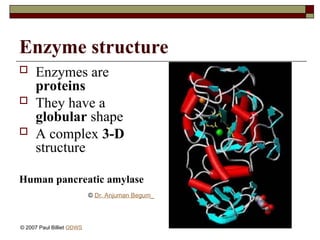
Enzyme structure
 Enzymes are
proteins
 They have a
globular shape
 A complex 3-D
structure
Human pancreatic amylase
Š Dr. Anjuman Begum
Š 2007 Paul Billiet ODWS
Structure of Enzyme
It has two general structural classes
Simple enzymes
Conjugated enzymes
Š 2007 Paul Billiet ODWS
Structure of Enzyme
 Simple enzymes
are enzymes composed only of protein
(amino acid chains)
 Conjugated enzymes
are enzyme that has a non-protein part
in addition to its protein part
Š 2007 Paul Billiet ODWS
Structure of Enzyme
 Coenzyme
is a small organic molecule that serves as a
cofactor in a conjugated enzyme
Š 2007 Paul Billiet ODWS
Cofactors
 An additional non-
protein molecule that is
needed by some
enzymes to help the
reaction
 Tightly bound cofactors
are called prosthetic
groups
 Cofactors that are bound
and released easily are
called coenzymes
 Many vitamins are
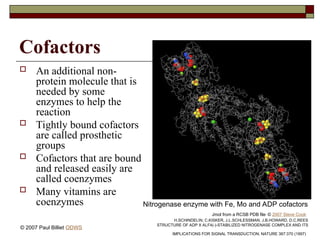
coenzymes Nitrogenase enzyme with Fe, Mo and ADP cofactors
Jmol from a RCSB PDB file Š 2007 Steve Cook
H.SCHINDELIN, C.KISKER, J.L.SCHLESSMAN, J.B.HOWARD, D.C.REES
STRUCTURE OF ADP X ALF4(-)-STABILIZED NITROGENASE COMPLEX AND ITS
IMPLICATIONS FOR SIGNAL TRANSDUCTION; NATURE 387:370 (1997)
Š 2007 Paul Billiet ODWS
Nomenclature and Classification
of Enzymes
 Enzymes are most commonly named by
using a system that attempts to provide
information about the function rather than
the structure of the enzyme
 Substrate
is the reactant in an enzyme-catalyzed
reaction
Š 2007 Paul Billiet ODWS
Important aspects of enzyme-
naming process
 The suffix –ase identifies a substance as an
enzyme (urease, sucrase & lipase)
 The suffix –in is still found in the names of
some of the first enzymes studied, many of
which are digestive enzymes
(trypsin,chymotrypsin & pepsin)
 The type of reaction catalyzed by an
enzyme is often noted with a prefix (oxidase
&hydrolase)
Š 2007 Paul Billiet ODWS
Important aspects of enzyme-
naming process
 The identity of the substrate is often noted in
addition to the type of reaction (glucose
oxidase, pyruvate carboxylase and
succinate dehydrogenase)
 Sometimes, the substrate but not the
reaction type is given ( urease & lactase), in
such names, the reaction involved is
hyrdolysis
Š 2007 Paul Billiet ODWS
Predict the function of the
following enzyme
 Cellulase
 cellulase catalyzes hydrolysis of cellulose
 Sucrase
 sucrase catalyzes hydrolysis of the
disaccharide sucrose
 L-amino acid oxidase
 catlayzes the oxidation of L-amino acids
Š 2007 Paul Billiet ODWS
Predict the function of the
following enzyme
 Aspartate aminotransferase
 aspartate aminotransferase catalyzes the
transfer of an amino group from aspartate
to a different molecule of L-amino acids
Š 2007 Paul Billiet ODWS
Six major classes of enzymes on the basis
of the types of reactions they catalyze
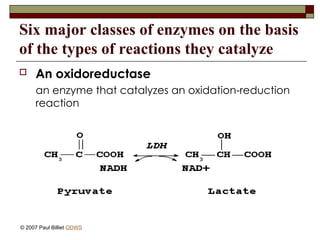
 An oxidoreductase
an enzyme that catalyzes an oxidation-reduction
reaction
Š 2007 Paul Billiet ODWS
Six major classes of enzymes on the basis
of the types of reactions they catalyze
 A transferase
an enzyme that catalyzes the transfer of a
functional group from one molecule to another
 It has two major subtypes
1. transaminases
2. kinases
Š 2007 Paul Billiet ODWS
Six major classes of enzymes on the basis
of the types of reactions they catalyze
 Transaminases
transferase that catalyzes the transfer of an
amino group from one molecule to
another
 Kinases
transferase that play a major role in metabolic
energy- production reaction, catalyze
the transfer of a phosphate group from
ATP to ADP and a phosphorylated product
Š 2007 Paul Billiet ODWS
Six major classes of enzymes on the basis
of the types of reactions they catalyze
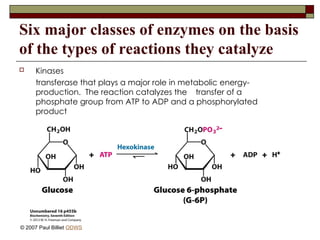
 Kinases
transferase that plays a major role in metabolic energy-
production. The reaction catalyzes the transfer of a
phosphate group from ATP to ADP and a phosphorylated
product
Š 2007 Paul Billiet ODWS
Six major classes of enzymes on the basis
of the types of reactions they catalyze
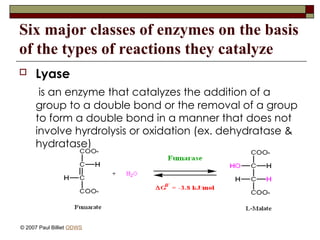
 Lyase
is an enzyme that catalyzes the addition of a
group to a double bond or the removal of a group
to form a double bond in a manner that does not
involve hyrdrolysis or oxidation (ex. dehydratase &
hydratase)
Š 2007 Paul Billiet ODWS
Six major classes of enzymes on the basis
of the types of reactions they catalyze
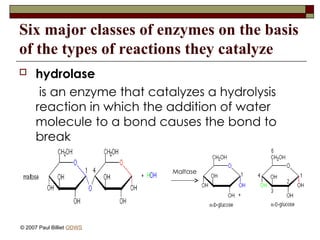
 hydrolase
is an enzyme that catalyzes a hydrolysis
reaction in which the addition of water
molecule to a bond causes the bond to
break
Š 2007 Paul Billiet ODWS
Maltase
Six major classes of enzymes on the basis
of the types of reactions they catalyze
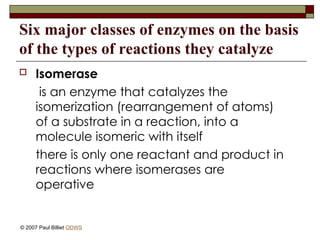
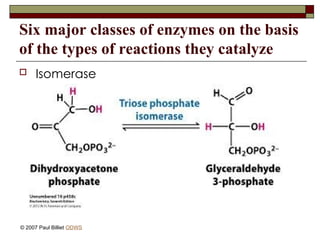
 Isomerase
is an enzyme that catalyzes the
isomerization (rearrangement of atoms)
of a substrate in a reaction, into a
molecule isomeric with itself
there is only one reactant and product in
reactions where isomerases are
operative
Š 2007 Paul Billiet ODWS
Six major classes of enzymes on the basis
of the types of reactions they catalyze
 Isomerase
Š 2007 Paul Billiet ODWS
Six major classes of enzymes on the basis
of the types of reactions they catalyze
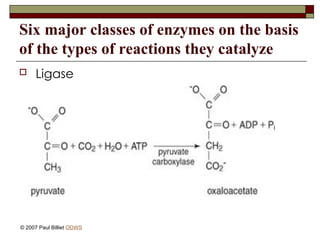
 Ligase
is an enzyme that catalyzes the bonding
together of two molecules into one with the
participation of ATP
 ATP is required because such reactions are
generally energetically unfavorable and
they require the simultaneous input of
energy obtained by hydrolysis reaction in
which ATP is converted to ADP
Š 2007 Paul Billiet ODWS
Six major classes of enzymes on the basis
of the types of reactions they catalyze
 Ligase
Š 2007 Paul Billiet ODWS
MODEL OF ENZYME ACTION
The active site
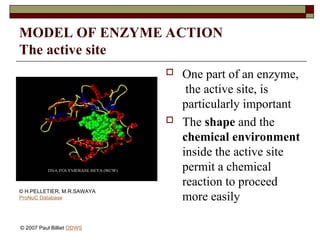
 One part of an enzyme,
the active site, is
particularly important
 The shape and the
chemical environment
inside the active site
permit a chemical
reaction to proceed
more easily
Š H.PELLETIER, M.R.SAWAYA
ProNuC Database
Š 2007 Paul Billiet ODWS
MODEL OF ENZYME ACTION
The active site
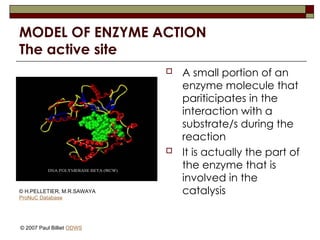
 A small portion of an
enzyme molecule that
pariticipates in the
interaction with a
substrate/s during the
reaction
 It is actually the part of
the enzyme that is
involved in the
catalysis
Š H.PELLETIER, M.R.SAWAYA
ProNuC Database
Š 2007 Paul Billiet ODWS
The substrate
 The substrate of an enzyme is the reactant
that is activated by the enzyme
 Enzymes are specific to their substrates
 The specificity is determined by the active
site
Š 2007 Paul Billiet ODWS
The Lock and Key Hypothesis
 Fit between the substrate and the active site of the enzyme is
exact
 Like a key fits into a lock very precisely
 The key is analogous to the enzyme and the substrate
analogous to the lock.
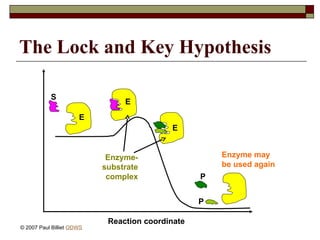
 Temporary structure called the enzyme-substrate complex
formed
 Products have a different shape from the substrate
 Once formed, they are released from the active site
 Leaving it free to become attached to another substrate
Š 2007 Paul Billiet ODWS
The Lock and Key Hypothesis
Enzyme may
be used again
Enzyme-
substrate
complex
E
S
P
E
E
P
Reaction coordinate
Š 2007 Paul Billiet ODWS
The Lock and Key Hypothesis
 This explains enzyme specificity
 This explains the loss of activity when
enzymes denature
Š 2007 Paul Billiet ODWS
The Induced Fit Hypothesis
 Some proteins can change their shape
(conformation)
 When a substrate combines with an enzyme, it
induces a change in the enzyme’s conformation
 The active site is then moulded into a precise
conformation
 Making the chemical environment suitable for the
reaction
 The bonds of the substrate are stretched to make the
reaction easier (lowers activation energy)
Š 2007 Paul Billiet ODWS
The Induced Fit Hypothesis
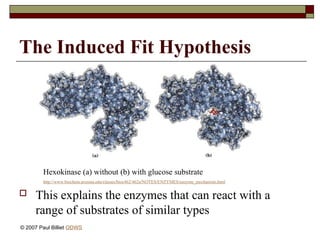
 This explains the enzymes that can react with a
range of substrates of similar types
Hexokinase (a) without (b) with glucose substrate
http://www.biochem.arizona.edu/classes/bioc462/462a/NOTES/ENZYMES/enzyme_mechanism.html
Š 2007 Paul Billiet ODWS
Factors affecting Enzymes
 substrate concentration
 pH
 temperature
 inhibitors
Š 2007 Paul Billiet ODWS
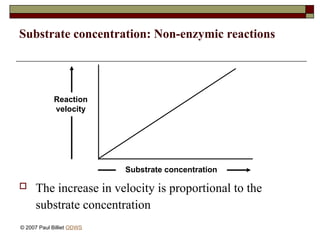
Substrate concentration: Non-enzymic reactions
 The increase in velocity is proportional to the
substrate concentration
Reaction
velocity
Substrate concentration
Š 2007 Paul Billiet ODWS
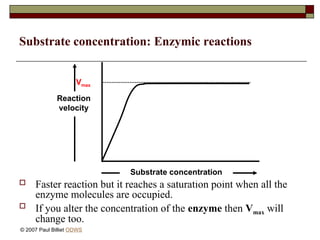
Substrate concentration: Enzymic reactions
 Faster reaction but it reaches a saturation point when all the
enzyme molecules are occupied.
 If you alter the concentration of the enzyme then Vmax will
change too.
Reaction
velocity
Substrate concentration
Vmax
Š 2007 Paul Billiet ODWS
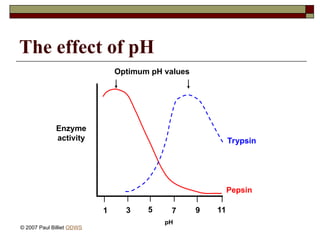
The effect of pH
Optimum pH values
Enzyme
activity Trypsin
Pepsin
pH
1 3 5 7 9 11
Š 2007 Paul Billiet ODWS
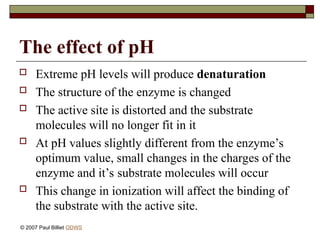
The effect of pH
 Extreme pH levels will produce denaturation
 The structure of the enzyme is changed
 The active site is distorted and the substrate
molecules will no longer fit in it
 At pH values slightly different from the enzyme’s
optimum value, small changes in the charges of the
enzyme and it’s substrate molecules will occur
 This change in ionization will affect the binding of
the substrate with the active site.
Š 2007 Paul Billiet ODWS
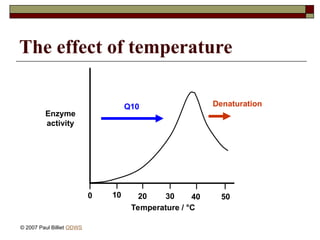
The effect of temperature
 Q10 (the temperature coefficient) = the increase in
reaction rate with a 10°C rise in temperature.
 For chemical reactions the Q10 = 2 to 3
(the rate of the reaction doubles or triples with every
10°C rise in temperature)
 Enzyme-controlled reactions follow this rule as they
are chemical reactions
 But at high temperatures proteins denature
 The optimum temperature for an enzyme controlled
reaction will be a balance between the Q10 and
denaturation.
Š 2007 Paul Billiet ODWS
The effect of temperature
Temperature / °C
Enzyme
activity
0 10 20 30 40 50
Q10 Denaturation
Š 2007 Paul Billiet ODWS
The effect of temperature
 For most enzymes the optimum temperature is about
30°C
 Many are a lot lower,
cold water fish will die at 30°C because their
enzymes denature
 A few bacteria have enzymes that can withstand very
high temperatures up to 100°C
 Most enzymes however are fully denatured at 70°C
Š 2007 Paul Billiet ODWS
Inhibitors
 Inhibitors are chemicals that reduce the rate
of enzymic reactions.
 The are usually specific and they work at low
concentrations.
 They block the enzyme but they do not
usually destroy it.
 Many drugs and poisons are inhibitors of
enzymes in the nervous system.
Š 2007 Paul Billiet ODWS
The effect of enzyme inhibition
 Irreversible inhibitors: Combine with the
functional groups of the amino acids in the
active site, irreversibly.
Examples: nerve gases and pesticides,
containing organophosphorus, combine with
serine residues in the enzyme acetylcholine
esterase.
Š 2007 Paul Billiet ODWS
The effect of enzyme inhibition
 Reversible inhibitors: These can be washed
out of the solution of enzyme by dialysis.
There are two categories.
Š 2007 Paul Billiet ODWS
The effect of enzyme inhibition
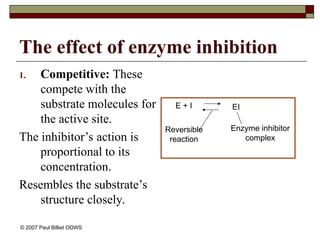
1. Competitive: These
compete with the
substrate molecules for
the active site.
The inhibitor’s action is
proportional to its
concentration.
Resembles the substrate’s
structure closely.
Enzyme inhibitor
complex
Reversible
reaction
E + I EI
Š 2007 Paul Billiet ODWS
The effect of enzyme inhibition
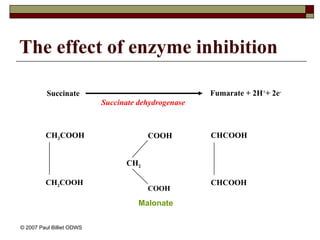
Succinate Fumarate + 2H+
+ 2e-
Succinate dehydrogenase
CH2COOH
CH2COOH CHCOOH
CHCOOH
COOH
COOH
CH2
Malonate
Š 2007 Paul Billiet ODWS
The effect of enzyme inhibition
2. Non-competitive: These are not influenced by the
concentration of the substrate. It inhibits by binding
irreversibly to the enzyme but not at the active site.
Examples
 Cyanide combines with the Iron in the enzymes
cytochrome oxidase.
 Heavy metals, Ag or Hg, combine with –SH groups.
These can be removed by using a chelating agent such
as EDTA.
Š 2007 Paul Billiet ODWS
Allosteric Regulation
 Allosteric regulation is a form of non-
competitive inhibition. It involves an
oligomeric enzyme (more than one
polypeptide protein) which contains sites at
which substrate molecules can bind (active
site) & sites at which inhibitor molecules can
bind (allosteric site). There is an interaction
between the substrate and the inhibitor such
that when an inhibitor occupies an allosteric
Allosteric Regulation
 site the active site changes conformation. If
the change effects an increase in the rate of
the reaction, the inhibitor also called
allosteric effector is properly referred to as
positive effector or allosteric activator.
 It is called negative effector or allosteric
inhibitor if reaction rate is decreased.
Applications of inhibitors
 Negative feedback: end point or end product
inhibition
 Poisons snake bite, plant alkaloids and nerve
gases.
 Medicine antibiotics, sulphonamides,
sedatives and stimulants
Š 2007 Paul Billiet ODWS
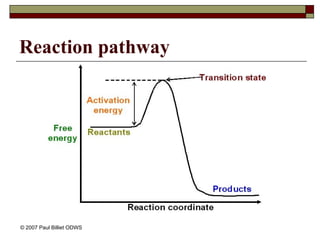
Chemical reactions
 Chemical reactions need an initial input of energy =
THE ACTIVATION ENERGY
 During this part of the reaction the molecules are
said to be in a transition state.
Š 2007 Paul Billiet ODWS
Reaction pathway
Š 2007 Paul Billiet ODWS
Making reactions go faster
 Increasing the temperature makes molecules move
faster
 Biological systems are very sensitive to temperature
changes.
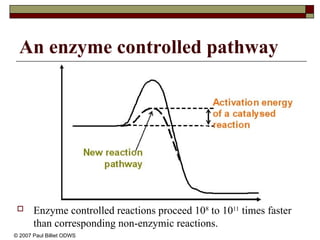
 Enzymes can increase the rate of reactions without
increasing the temperature.
 They do this by lowering the activation energy.
 They create a new reaction pathway “a short cut”
Š 2007 Paul Billiet ODWS
An enzyme controlled pathway
 Enzyme controlled reactions proceed 108
to 1011
times faster
than corresponding non-enzymic reactions.
Š 2007 Paul Billiet ODWS

Enzymes-Module-Coabaxxnbxzbpy-sent (2).ppt

  • 1.
    ENZYMES Enzymes are inseparablefrom living organisms. They are the largest group of proteins and they catalyze almost every reaction that occurs in living organisms. They exhibit extraordinary catalytic powers. Š 2007 Paul Billiet ODWS
  • 2.
     much greaterthan that of synthetic catalysts. They exhibit a high degree of specificity & they function in dilute aqueous solutions under very mild conditions of temperature and pressure.
  • 3.
    ENZYME  An enzymeis an organic compound that acts as a catalyst for a biochemical reaction.  They are the largest and the most highly specialized class of proteins.
  • 4.
    Enzyme structure  Enzymesare proteins  They have a globular shape  A complex 3-D structure Human pancreatic amylase Š Dr. Anjuman Begum Š 2007 Paul Billiet ODWS
  • 5.
    Structure of Enzyme Ithas two general structural classes Simple enzymes Conjugated enzymes Š 2007 Paul Billiet ODWS
  • 6.
    Structure of Enzyme Simple enzymes are enzymes composed only of protein (amino acid chains)  Conjugated enzymes are enzyme that has a non-protein part in addition to its protein part Š 2007 Paul Billiet ODWS
  • 7.
    Structure of Enzyme Coenzyme is a small organic molecule that serves as a cofactor in a conjugated enzyme Š 2007 Paul Billiet ODWS
  • 8.
    Cofactors  An additionalnon- protein molecule that is needed by some enzymes to help the reaction  Tightly bound cofactors are called prosthetic groups  Cofactors that are bound and released easily are called coenzymes  Many vitamins are coenzymes Nitrogenase enzyme with Fe, Mo and ADP cofactors Jmol from a RCSB PDB file Š 2007 Steve Cook H.SCHINDELIN, C.KISKER, J.L.SCHLESSMAN, J.B.HOWARD, D.C.REES STRUCTURE OF ADP X ALF4(-)-STABILIZED NITROGENASE COMPLEX AND ITS IMPLICATIONS FOR SIGNAL TRANSDUCTION; NATURE 387:370 (1997) Š 2007 Paul Billiet ODWS
  • 9.
    Nomenclature and Classification ofEnzymes  Enzymes are most commonly named by using a system that attempts to provide information about the function rather than the structure of the enzyme  Substrate is the reactant in an enzyme-catalyzed reaction Š 2007 Paul Billiet ODWS
  • 10.
    Important aspects ofenzyme- naming process  The suffix –ase identifies a substance as an enzyme (urease, sucrase & lipase)  The suffix –in is still found in the names of some of the first enzymes studied, many of which are digestive enzymes (trypsin,chymotrypsin & pepsin)  The type of reaction catalyzed by an enzyme is often noted with a prefix (oxidase &hydrolase) © 2007 Paul Billiet ODWS
  • 11.
    Important aspects ofenzyme- naming process  The identity of the substrate is often noted in addition to the type of reaction (glucose oxidase, pyruvate carboxylase and succinate dehydrogenase)  Sometimes, the substrate but not the reaction type is given ( urease & lactase), in such names, the reaction involved is hyrdolysis Š 2007 Paul Billiet ODWS
  • 12.
    Predict the functionof the following enzyme  Cellulase  cellulase catalyzes hydrolysis of cellulose  Sucrase  sucrase catalyzes hydrolysis of the disaccharide sucrose  L-amino acid oxidase  catlayzes the oxidation of L-amino acids Š 2007 Paul Billiet ODWS
  • 13.
    Predict the functionof the following enzyme  Aspartate aminotransferase  aspartate aminotransferase catalyzes the transfer of an amino group from aspartate to a different molecule of L-amino acids Š 2007 Paul Billiet ODWS
  • 14.
    Six major classesof enzymes on the basis of the types of reactions they catalyze  An oxidoreductase an enzyme that catalyzes an oxidation-reduction reaction Š 2007 Paul Billiet ODWS
  • 15.
    Six major classesof enzymes on the basis of the types of reactions they catalyze  A transferase an enzyme that catalyzes the transfer of a functional group from one molecule to another  It has two major subtypes 1. transaminases 2. kinases Š 2007 Paul Billiet ODWS
  • 16.
    Six major classesof enzymes on the basis of the types of reactions they catalyze  Transaminases transferase that catalyzes the transfer of an amino group from one molecule to another  Kinases transferase that play a major role in metabolic energy- production reaction, catalyze the transfer of a phosphate group from ATP to ADP and a phosphorylated product Š 2007 Paul Billiet ODWS
  • 17.
    Six major classesof enzymes on the basis of the types of reactions they catalyze  Kinases transferase that plays a major role in metabolic energy- production. The reaction catalyzes the transfer of a phosphate group from ATP to ADP and a phosphorylated product Š 2007 Paul Billiet ODWS
  • 18.
    Six major classesof enzymes on the basis of the types of reactions they catalyze  Lyase is an enzyme that catalyzes the addition of a group to a double bond or the removal of a group to form a double bond in a manner that does not involve hyrdrolysis or oxidation (ex. dehydratase & hydratase) Š 2007 Paul Billiet ODWS
  • 19.
    Six major classesof enzymes on the basis of the types of reactions they catalyze  hydrolase is an enzyme that catalyzes a hydrolysis reaction in which the addition of water molecule to a bond causes the bond to break Š 2007 Paul Billiet ODWS Maltase
  • 20.
    Six major classesof enzymes on the basis of the types of reactions they catalyze  Isomerase is an enzyme that catalyzes the isomerization (rearrangement of atoms) of a substrate in a reaction, into a molecule isomeric with itself there is only one reactant and product in reactions where isomerases are operative Š 2007 Paul Billiet ODWS
  • 21.
    Six major classesof enzymes on the basis of the types of reactions they catalyze  Isomerase Š 2007 Paul Billiet ODWS
  • 22.
    Six major classesof enzymes on the basis of the types of reactions they catalyze  Ligase is an enzyme that catalyzes the bonding together of two molecules into one with the participation of ATP  ATP is required because such reactions are generally energetically unfavorable and they require the simultaneous input of energy obtained by hydrolysis reaction in which ATP is converted to ADP Š 2007 Paul Billiet ODWS
  • 23.
    Six major classesof enzymes on the basis of the types of reactions they catalyze  Ligase Š 2007 Paul Billiet ODWS
  • 24.
    MODEL OF ENZYMEACTION The active site  One part of an enzyme, the active site, is particularly important  The shape and the chemical environment inside the active site permit a chemical reaction to proceed more easily Š H.PELLETIER, M.R.SAWAYA ProNuC Database Š 2007 Paul Billiet ODWS
  • 25.
    MODEL OF ENZYMEACTION The active site  A small portion of an enzyme molecule that pariticipates in the interaction with a substrate/s during the reaction  It is actually the part of the enzyme that is involved in the catalysis Š H.PELLETIER, M.R.SAWAYA ProNuC Database Š 2007 Paul Billiet ODWS
  • 26.
    The substrate  Thesubstrate of an enzyme is the reactant that is activated by the enzyme  Enzymes are specific to their substrates  The specificity is determined by the active site Š 2007 Paul Billiet ODWS
  • 27.
    The Lock andKey Hypothesis  Fit between the substrate and the active site of the enzyme is exact  Like a key fits into a lock very precisely  The key is analogous to the enzyme and the substrate analogous to the lock.  Temporary structure called the enzyme-substrate complex formed  Products have a different shape from the substrate  Once formed, they are released from the active site  Leaving it free to become attached to another substrate Š 2007 Paul Billiet ODWS
  • 28.
    The Lock andKey Hypothesis Enzyme may be used again Enzyme- substrate complex E S P E E P Reaction coordinate Š 2007 Paul Billiet ODWS
  • 29.
    The Lock andKey Hypothesis  This explains enzyme specificity  This explains the loss of activity when enzymes denature Š 2007 Paul Billiet ODWS
  • 30.
    The Induced FitHypothesis  Some proteins can change their shape (conformation)  When a substrate combines with an enzyme, it induces a change in the enzyme’s conformation  The active site is then moulded into a precise conformation  Making the chemical environment suitable for the reaction  The bonds of the substrate are stretched to make the reaction easier (lowers activation energy) © 2007 Paul Billiet ODWS
  • 31.
    The Induced FitHypothesis  This explains the enzymes that can react with a range of substrates of similar types Hexokinase (a) without (b) with glucose substrate http://www.biochem.arizona.edu/classes/bioc462/462a/NOTES/ENZYMES/enzyme_mechanism.html Š 2007 Paul Billiet ODWS
  • 32.
    Factors affecting Enzymes substrate concentration  pH  temperature  inhibitors Š 2007 Paul Billiet ODWS
  • 33.
    Substrate concentration: Non-enzymicreactions  The increase in velocity is proportional to the substrate concentration Reaction velocity Substrate concentration Š 2007 Paul Billiet ODWS
  • 34.
    Substrate concentration: Enzymicreactions  Faster reaction but it reaches a saturation point when all the enzyme molecules are occupied.  If you alter the concentration of the enzyme then Vmax will change too. Reaction velocity Substrate concentration Vmax Š 2007 Paul Billiet ODWS
  • 35.
    The effect ofpH Optimum pH values Enzyme activity Trypsin Pepsin pH 1 3 5 7 9 11 Š 2007 Paul Billiet ODWS
  • 36.
    The effect ofpH  Extreme pH levels will produce denaturation  The structure of the enzyme is changed  The active site is distorted and the substrate molecules will no longer fit in it  At pH values slightly different from the enzyme’s optimum value, small changes in the charges of the enzyme and it’s substrate molecules will occur  This change in ionization will affect the binding of the substrate with the active site. © 2007 Paul Billiet ODWS
  • 37.
    The effect oftemperature  Q10 (the temperature coefficient) = the increase in reaction rate with a 10°C rise in temperature.  For chemical reactions the Q10 = 2 to 3 (the rate of the reaction doubles or triples with every 10°C rise in temperature)  Enzyme-controlled reactions follow this rule as they are chemical reactions  But at high temperatures proteins denature  The optimum temperature for an enzyme controlled reaction will be a balance between the Q10 and denaturation. Š 2007 Paul Billiet ODWS
  • 38.
    The effect oftemperature Temperature / °C Enzyme activity 0 10 20 30 40 50 Q10 Denaturation Š 2007 Paul Billiet ODWS
  • 39.
    The effect oftemperature  For most enzymes the optimum temperature is about 30°C  Many are a lot lower, cold water fish will die at 30°C because their enzymes denature  A few bacteria have enzymes that can withstand very high temperatures up to 100°C  Most enzymes however are fully denatured at 70°C Š 2007 Paul Billiet ODWS
  • 40.
    Inhibitors  Inhibitors arechemicals that reduce the rate of enzymic reactions.  The are usually specific and they work at low concentrations.  They block the enzyme but they do not usually destroy it.  Many drugs and poisons are inhibitors of enzymes in the nervous system. Š 2007 Paul Billiet ODWS
  • 41.
    The effect ofenzyme inhibition  Irreversible inhibitors: Combine with the functional groups of the amino acids in the active site, irreversibly. Examples: nerve gases and pesticides, containing organophosphorus, combine with serine residues in the enzyme acetylcholine esterase. Š 2007 Paul Billiet ODWS
  • 42.
    The effect ofenzyme inhibition  Reversible inhibitors: These can be washed out of the solution of enzyme by dialysis. There are two categories. Š 2007 Paul Billiet ODWS
  • 43.
    The effect ofenzyme inhibition 1. Competitive: These compete with the substrate molecules for the active site. The inhibitor’s action is proportional to its concentration. Resembles the substrate’s structure closely. Enzyme inhibitor complex Reversible reaction E + I EI © 2007 Paul Billiet ODWS
  • 44.
    The effect ofenzyme inhibition Succinate Fumarate + 2H+ + 2e- Succinate dehydrogenase CH2COOH CH2COOH CHCOOH CHCOOH COOH COOH CH2 Malonate Š 2007 Paul Billiet ODWS
  • 45.
    The effect ofenzyme inhibition 2. Non-competitive: These are not influenced by the concentration of the substrate. It inhibits by binding irreversibly to the enzyme but not at the active site. Examples  Cyanide combines with the Iron in the enzymes cytochrome oxidase.  Heavy metals, Ag or Hg, combine with –SH groups. These can be removed by using a chelating agent such as EDTA. © 2007 Paul Billiet ODWS
  • 46.
    Allosteric Regulation  Allostericregulation is a form of non- competitive inhibition. It involves an oligomeric enzyme (more than one polypeptide protein) which contains sites at which substrate molecules can bind (active site) & sites at which inhibitor molecules can bind (allosteric site). There is an interaction between the substrate and the inhibitor such that when an inhibitor occupies an allosteric
  • 47.
    Allosteric Regulation  sitethe active site changes conformation. If the change effects an increase in the rate of the reaction, the inhibitor also called allosteric effector is properly referred to as positive effector or allosteric activator.  It is called negative effector or allosteric inhibitor if reaction rate is decreased.
  • 48.
    Applications of inhibitors Negative feedback: end point or end product inhibition  Poisons snake bite, plant alkaloids and nerve gases.  Medicine antibiotics, sulphonamides, sedatives and stimulants Š 2007 Paul Billiet ODWS
  • 49.
    Chemical reactions  Chemicalreactions need an initial input of energy = THE ACTIVATION ENERGY  During this part of the reaction the molecules are said to be in a transition state. Š 2007 Paul Billiet ODWS
  • 50.
    Reaction pathway Š 2007Paul Billiet ODWS
  • 51.
    Making reactions gofaster  Increasing the temperature makes molecules move faster  Biological systems are very sensitive to temperature changes.  Enzymes can increase the rate of reactions without increasing the temperature.  They do this by lowering the activation energy.  They create a new reaction pathway “a short cut” © 2007 Paul Billiet ODWS
  • 52.
    An enzyme controlledpathway  Enzyme controlled reactions proceed 108 to 1011 times faster than corresponding non-enzymic reactions. Š 2007 Paul Billiet ODWS