5/1/2015 Environmental Factor - May 2015: Spring Neuroscience Meeting is a resounding success
http://www.niehs.nih.gov/news/newsletter/2015/5/science-neuroscience/index.htm 1/4
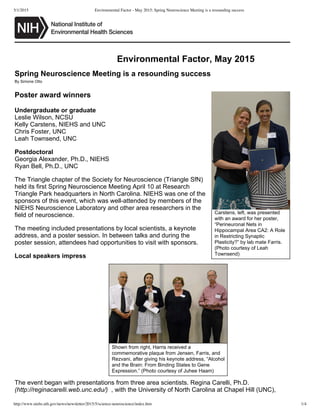
Carstens,  left,  was  presented
with  an  award  for  her  poster,
“Perineuronal  Nets  in
Hippocampal  Area  CA2:  A  Role
in  Restricting  Synaptic
Plasticity?”  by  lab  mate  Farris.
(Photo  courtesy  of  Leah
Townsend)
Environmental  Factor,  May  2015
Spring  Neuroscience  Meeting  is  a  resounding  success
By  Simone  Otto
Poster  award  winners
Undergraduate  or  graduate
Leslie  Wilson,  NCSU
Kelly  Carstens,  NIEHS  and  UNC
Chris  Foster,  UNC
Leah  Townsend,  UNC
Postdoctoral
Georgia  Alexander,  Ph.D.,  NIEHS
Ryan  Bell,  Ph.D.,  UNC
The  Triangle  chapter  of  the  Society  for  Neuroscience  (Triangle  SfN)
held  its  first  Spring  Neuroscience  Meeting  April  10  at  Research
Triangle  Park  headquarters  in  North  Carolina.  NIEHS  was  one  of  the
sponsors  of  this  event,  which  was  well-­attended  by  members  of  the
NIEHS  Neuroscience  Laboratory  and  other  area  researchers  in  the
field  of  neuroscience.
The  meeting  included  presentations  by  local  scientists,  a  keynote
address,  and  a  poster  session.  In  between  talks  and  during  the
poster  session,  attendees  had  opportunities  to  visit  with  sponsors.
Local  speakers  impress
The  event  began  with  presentations  from  three  area  scientists.  Regina  Carelli,  Ph.D.
(http://reginacarelli.web.unc.edu/)    ,  with  the  University  of  North  Carolina  at  Chapel  Hill  (UNC),
Shown  from  right,  Harris  received  a
commemorative  plaque  from  Jensen,  Farris,  and
Rezvani,  after  giving  his  keynote  address,  “Alcohol
and  the  Brain:  From  Binding  States  to  Gene
Expression.”  (Photo  courtesy  of  Juhee  Haam)
5/1/2015 Environmental Factor - May 2015: Spring Neuroscience Meeting is a resounding success
http://www.niehs.nih.gov/news/newsletter/2015/5/science-neuroscience/index.htm 2/4
focused  on  the  “Dynamics  of  Rapid  Dopamine  Signaling  During  Decision  Making.”  Her  lab  studies
how  dopamine  release  balances  the  cost  of  getting  a  reward  with  the  size  of  the  reward.
Stephen  Lisberger,  Ph.D.  (http://www.neuro.duke.edu/training-­faculty/phd-­training-­faculty/stephen-­
lisberger)    ,  with  the  Duke  University  School  of  Medicine,  focused  on  discovering  “Mechanisms  of
Motor  Learning  by  Just  Listening  to  the  Cerebellum  While  It  Works.”  According  to  Lisberger,  he
meant  his  title  to  be  both  a  philosophical  statement  and  a  scientific  statement.  “The  art  of  listening
carefully  to  the  brain  seems  to  be  dying,”  he  said.  “[We  can]  discover  mechanisms  by  just
The  packed  audience  took  full  advantage  of  the
question  and  answer  time  following  Harris’s  talk.
(Photo  courtesy  of  Juhee  Haam)
Alexander,  left,  shown  with  her  lead  researcher
Dudek,  won  an  award  for  her  poster,  “Firing
Properties  and  Immediate  Early  Gene  Mapping  in
Hippocampal  Area  CA2.”  (Photo  courtesy  of  Leah
Townsend)
Rezvani,  right,  and  Farris,  left,  presented  awards
to  featured  speakers,  from  left,  Carelli,  Salinas,
and  Lisberger  (Photo  courtesy  of  Juhee  Haam)
5/1/2015 Environmental Factor - May 2015: Spring Neuroscience Meeting is a resounding success
http://www.niehs.nih.gov/news/newsletter/2015/5/science-neuroscience/index.htm 3/4
listening.”
Emilio  Salinas,  Ph.D.  (http://www.wakehealth.edu/Research/Neurobiology-­and-­Anatomy/Emilio-­
Salinas,-­PhD.htm)    ,  of  the  Wake  Forest  School  of  Medicine,  spoke  on  “Cognitive  Manipulation  of
Oculomotor  Activity  in  the  Frontal  Cortex  of  Monkeys  Performing  a  Simple  Reaction-­time  Task
With  Reward  Bias.”  Salinas  studies  the  relationship  between  variability  in  behavior  and  variability  in
neural  activity.
Internationally  known  scientist  gives  keynote  address
Adron  Harris,  Ph.D.  (http://www.utexas.edu/research/wcaar/harris/?page_id=19)    ,  director  of  the
Waggoner  Center  for  Alcohol  and  Addiction  at  the  University  of  Texas  at  Austin,  presented  the
keynote  address.  “Adron  received  his  Ph.D.  from  UNC  Chapel  Hill,  and  from  there  he’s  gone  on  to
a  most  distinguished  career  as  evidenced  by  his  numerous  publications,”  said  Patricia  Jensen,
Ph.D.,  head  of  the  NIEHS  Developmental  Neurobiology  Group,  in  her  introduction.
Harris  fascinated  the  audience  by  discussing  what  reviewers  of  one  of  his  scientific  papers  termed
more  of  a  hallucination  than  a  moment  —  namely,  his  discovery  of  the  ability  of  alcohol  to  enter
into  a  small  pocket  between  alpha  helices  and  stabilize  an  otherwise  fluid  channel,  which  leads  to
either  enhancement  or  inhibition,  depending  on  the  channel  involved.
Poster  session  buzzed  with  activity
Poster  awards  were  given  to  both  undergraduate  and  postdoctoral  fellows.  Two  winners,
predoctoral  fellow  Kelly  Carstens  and  research  fellow  Georgia  Alexander,  Ph.D.,  work  in  the
NIEHS  Synaptic  and  Developmental  Plasticity  Group,  led  by  Serena  Dudek,  Ph.D.
The  session  buzzed  with  the  energy  of  the  attendees  as  they  discussed  posters  and  networked
with  scientists  from  Duke  University,  East  Carolina  State  University,  NIEHS,  North  Carolina  Central
University,  North  Carolina  State  University  (NCSU),  and  UNC.
The  Triangle  SfN  was  reinstated  less  than  one  year  ago  with  the  help  of  members  of  NIEHS,
particularly  Shannon  Farris,  Ph.D.  (see  related  story).  “The  Triangle  is  home  to  some  of  the  top
universities  and  research  institutes  in  the  country,  and  it  is  my  hope  that  through  Triangle  SfN
individuals  from  each  of  these  institutions  will  be  able  to  form  a  tight  and  collaborative  network,”
wrote  Amir  Rezvani,  Ph.D.  (http://www.dibs.duke.edu/research/profiles/56-­amir-­rezvani)    ,
president  of  Triangle  SfN  and  professor  at  the  Duke  Institute  for  Brain  Sciences,  in  his  welcome
letter.  Judging  by  the  success  of  the  spring  meeting,  the  network  is  well  underway,  and  organizers
Palmyra  Romeo,  a  baccalaureate  fellow  in
Dudek’s  lab,  discussed  her  poster,  “Neuronal
Activity  Induces  Transcription  of  Two  Sub-­Classes
of  Immediate  Early  Genes”  with  attendees.  (Photo
courtesy  of  Leah  Townsend)
5/1/2015 Environmental Factor - May 2015: Spring Neuroscience Meeting is a resounding success
http://www.niehs.nih.gov/news/newsletter/2015/5/science-neuroscience/index.htm 4/4
Some  of  the  organizers  of  the  SfN  event  included  from  left,  Jensen;;  Chintan  Oza,  Ph.D.,  a  postdoctoral
student  at  Duke;;  Alex  Marshall,  Ph.D.,  a  postdoctoral  fellow  at  UNC;;  Farris;;  NIEHS  toxicologist  Mamta
Behl,  Ph.D.,  with  the  National  Toxicology  Program;;  Rezvani;;  John  Meitzen,  Ph.D.,  assistant  professor
at  NCSU;;  and  Charlotte  Boettiger,  Ph.D.,  assistant  professor  at  UNC.  (Photo  courtesy  of  Mahsa
Samadi)
are  already  looking  toward  next  year’s  event.
(Simone  Otto,  Ph.D.,  is  an  Intramural  Research  and  Training  Award  Fellow  in  the  Ion  Channel
Physiology  Group.)
The  Environmental  Factor  is  produced  monthly  by  the  National  Institute  of  Environmental  Health  Sciences  (NIEHS)
(http://www.niehs.nih.gov/),  Office  of  Communications  and  Public  Liaison.  The  text  is  not  copyrighted,  and  it  can  be
reprinted  without  permission.  If  you  use  parts  of  Environmental  Factor  in  your  publication,  we  ask  that  you  provide  us  with  a
copy  for  our  records.  We  welcome  your  comments  and  suggestions.  (bruskec@niehs.nih.gov)
This  page  URL:  http://www.niehs.nih.gov/news/newsletter/2015/5/science-­neuroscience  
//Sites/NIEHS_eFactor/
NIEHS  website:  http://www.niehs.nih.gov/
Email  the  Web  Manager  at  webmanager@niehs.nih.gov

Spring Meeting Summary

  • 1.
    5/1/2015 Environmental Factor- May 2015: Spring Neuroscience Meeting is a resounding success http://www.niehs.nih.gov/news/newsletter/2015/5/science-neuroscience/index.htm 1/4 Carstens,  left,  was  presented with  an  award  for  her  poster, “Perineuronal  Nets  in Hippocampal  Area  CA2:  A  Role in  Restricting  Synaptic Plasticity?”  by  lab  mate  Farris. (Photo  courtesy  of  Leah Townsend) Environmental  Factor,  May  2015 Spring  Neuroscience  Meeting  is  a  resounding  success By  Simone  Otto Poster  award  winners Undergraduate  or  graduate Leslie  Wilson,  NCSU Kelly  Carstens,  NIEHS  and  UNC Chris  Foster,  UNC Leah  Townsend,  UNC Postdoctoral Georgia  Alexander,  Ph.D.,  NIEHS Ryan  Bell,  Ph.D.,  UNC The  Triangle  chapter  of  the  Society  for  Neuroscience  (Triangle  SfN) held  its  first  Spring  Neuroscience  Meeting  April  10  at  Research Triangle  Park  headquarters  in  North  Carolina.  NIEHS  was  one  of  the sponsors  of  this  event,  which  was  well-­attended  by  members  of  the NIEHS  Neuroscience  Laboratory  and  other  area  researchers  in  the field  of  neuroscience. The  meeting  included  presentations  by  local  scientists,  a  keynote address,  and  a  poster  session.  In  between  talks  and  during  the poster  session,  attendees  had  opportunities  to  visit  with  sponsors. Local  speakers  impress The  event  began  with  presentations  from  three  area  scientists.  Regina  Carelli,  Ph.D. (http://reginacarelli.web.unc.edu/)    ,  with  the  University  of  North  Carolina  at  Chapel  Hill  (UNC), Shown  from  right,  Harris  received  a commemorative  plaque  from  Jensen,  Farris,  and Rezvani,  after  giving  his  keynote  address,  “Alcohol and  the  Brain:  From  Binding  States  to  Gene Expression.”  (Photo  courtesy  of  Juhee  Haam)
  • 2.
    5/1/2015 Environmental Factor- May 2015: Spring Neuroscience Meeting is a resounding success http://www.niehs.nih.gov/news/newsletter/2015/5/science-neuroscience/index.htm 2/4 focused  on  the  “Dynamics  of  Rapid  Dopamine  Signaling  During  Decision  Making.”  Her  lab  studies how  dopamine  release  balances  the  cost  of  getting  a  reward  with  the  size  of  the  reward. Stephen  Lisberger,  Ph.D.  (http://www.neuro.duke.edu/training-­faculty/phd-­training-­faculty/stephen-­ lisberger)    ,  with  the  Duke  University  School  of  Medicine,  focused  on  discovering  “Mechanisms  of Motor  Learning  by  Just  Listening  to  the  Cerebellum  While  It  Works.”  According  to  Lisberger,  he meant  his  title  to  be  both  a  philosophical  statement  and  a  scientific  statement.  “The  art  of  listening carefully  to  the  brain  seems  to  be  dying,”  he  said.  “[We  can]  discover  mechanisms  by  just The  packed  audience  took  full  advantage  of  the question  and  answer  time  following  Harris’s  talk. (Photo  courtesy  of  Juhee  Haam) Alexander,  left,  shown  with  her  lead  researcher Dudek,  won  an  award  for  her  poster,  “Firing Properties  and  Immediate  Early  Gene  Mapping  in Hippocampal  Area  CA2.”  (Photo  courtesy  of  Leah Townsend) Rezvani,  right,  and  Farris,  left,  presented  awards to  featured  speakers,  from  left,  Carelli,  Salinas, and  Lisberger  (Photo  courtesy  of  Juhee  Haam)
  • 3.
    5/1/2015 Environmental Factor- May 2015: Spring Neuroscience Meeting is a resounding success http://www.niehs.nih.gov/news/newsletter/2015/5/science-neuroscience/index.htm 3/4 listening.” Emilio  Salinas,  Ph.D.  (http://www.wakehealth.edu/Research/Neurobiology-­and-­Anatomy/Emilio-­ Salinas,-­PhD.htm)    ,  of  the  Wake  Forest  School  of  Medicine,  spoke  on  “Cognitive  Manipulation  of Oculomotor  Activity  in  the  Frontal  Cortex  of  Monkeys  Performing  a  Simple  Reaction-­time  Task With  Reward  Bias.”  Salinas  studies  the  relationship  between  variability  in  behavior  and  variability  in neural  activity. Internationally  known  scientist  gives  keynote  address Adron  Harris,  Ph.D.  (http://www.utexas.edu/research/wcaar/harris/?page_id=19)    ,  director  of  the Waggoner  Center  for  Alcohol  and  Addiction  at  the  University  of  Texas  at  Austin,  presented  the keynote  address.  “Adron  received  his  Ph.D.  from  UNC  Chapel  Hill,  and  from  there  he’s  gone  on  to a  most  distinguished  career  as  evidenced  by  his  numerous  publications,”  said  Patricia  Jensen, Ph.D.,  head  of  the  NIEHS  Developmental  Neurobiology  Group,  in  her  introduction. Harris  fascinated  the  audience  by  discussing  what  reviewers  of  one  of  his  scientific  papers  termed more  of  a  hallucination  than  a  moment  —  namely,  his  discovery  of  the  ability  of  alcohol  to  enter into  a  small  pocket  between  alpha  helices  and  stabilize  an  otherwise  fluid  channel,  which  leads  to either  enhancement  or  inhibition,  depending  on  the  channel  involved. Poster  session  buzzed  with  activity Poster  awards  were  given  to  both  undergraduate  and  postdoctoral  fellows.  Two  winners, predoctoral  fellow  Kelly  Carstens  and  research  fellow  Georgia  Alexander,  Ph.D.,  work  in  the NIEHS  Synaptic  and  Developmental  Plasticity  Group,  led  by  Serena  Dudek,  Ph.D. The  session  buzzed  with  the  energy  of  the  attendees  as  they  discussed  posters  and  networked with  scientists  from  Duke  University,  East  Carolina  State  University,  NIEHS,  North  Carolina  Central University,  North  Carolina  State  University  (NCSU),  and  UNC. The  Triangle  SfN  was  reinstated  less  than  one  year  ago  with  the  help  of  members  of  NIEHS, particularly  Shannon  Farris,  Ph.D.  (see  related  story).  “The  Triangle  is  home  to  some  of  the  top universities  and  research  institutes  in  the  country,  and  it  is  my  hope  that  through  Triangle  SfN individuals  from  each  of  these  institutions  will  be  able  to  form  a  tight  and  collaborative  network,” wrote  Amir  Rezvani,  Ph.D.  (http://www.dibs.duke.edu/research/profiles/56-­amir-­rezvani)    , president  of  Triangle  SfN  and  professor  at  the  Duke  Institute  for  Brain  Sciences,  in  his  welcome letter.  Judging  by  the  success  of  the  spring  meeting,  the  network  is  well  underway,  and  organizers Palmyra  Romeo,  a  baccalaureate  fellow  in Dudek’s  lab,  discussed  her  poster,  “Neuronal Activity  Induces  Transcription  of  Two  Sub-­Classes of  Immediate  Early  Genes”  with  attendees.  (Photo courtesy  of  Leah  Townsend)
  • 4.
    5/1/2015 Environmental Factor- May 2015: Spring Neuroscience Meeting is a resounding success http://www.niehs.nih.gov/news/newsletter/2015/5/science-neuroscience/index.htm 4/4 Some  of  the  organizers  of  the  SfN  event  included  from  left,  Jensen;;  Chintan  Oza,  Ph.D.,  a  postdoctoral student  at  Duke;;  Alex  Marshall,  Ph.D.,  a  postdoctoral  fellow  at  UNC;;  Farris;;  NIEHS  toxicologist  Mamta Behl,  Ph.D.,  with  the  National  Toxicology  Program;;  Rezvani;;  John  Meitzen,  Ph.D.,  assistant  professor at  NCSU;;  and  Charlotte  Boettiger,  Ph.D.,  assistant  professor  at  UNC.  (Photo  courtesy  of  Mahsa Samadi) are  already  looking  toward  next  year’s  event. (Simone  Otto,  Ph.D.,  is  an  Intramural  Research  and  Training  Award  Fellow  in  the  Ion  Channel Physiology  Group.) The  Environmental  Factor  is  produced  monthly  by  the  National  Institute  of  Environmental  Health  Sciences  (NIEHS) (http://www.niehs.nih.gov/),  Office  of  Communications  and  Public  Liaison.  The  text  is  not  copyrighted,  and  it  can  be reprinted  without  permission.  If  you  use  parts  of  Environmental  Factor  in  your  publication,  we  ask  that  you  provide  us  with  a copy  for  our  records.  We  welcome  your  comments  and  suggestions.  (bruskec@niehs.nih.gov) This  page  URL:  http://www.niehs.nih.gov/news/newsletter/2015/5/science-­neuroscience   //Sites/NIEHS_eFactor/ NIEHS  website:  http://www.niehs.nih.gov/ Email  the  Web  Manager  at  webmanager@niehs.nih.gov