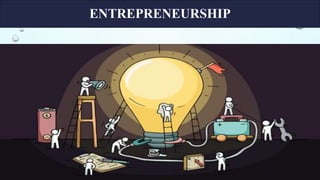
ENTREPRENEURSHIP
DEFINITION
• Entrepreneurship is the process of starting new businesses, generally in
response to opportunities.
• Entrepreneurial ventures: Organizations that pursue opportunities, are
characterized by innovative practices, and have growth and profitability as their
main goals
IMPORTANCE
• Create social change:
Through their unique offerings of new goods and services, entrepreneurs break
away from tradition and indirectly support freedom by reducing dependence on
obsolete systems and technologies. Overall, this results in an improved quality of
life.
• New employment opportunities are created
IMPORTANCE
• Means of Economic Development:
An entrepreneur plays an important role in accelerating the pace of economic
development of a country by discovering new uses of available resources and
maximizing their utilization.
• New and improved offerings, products or technologies from entrepreneurs enable
new markets to be developed and new wealth created.
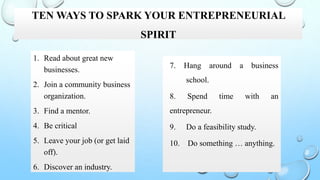
TEN WAYS TO SPARK YOUR ENTREPRENEURIAL
SPIRIT
1. Read about great new
businesses.
2. Join a community business
organization.
3. Find a mentor.
4. Be critical
5. Leave your job (or get laid
off).
6. Discover an industry.
7. Hang around a business
school.
8. Spend time with an
entrepreneur.
9. Do a feasibility study.
10. Do something … anything.
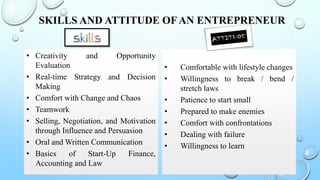
SKILLS AND ATTITUDE OF AN ENTREPRENEUR
• Creativity and Opportunity
Evaluation
• Real-time Strategy and Decision
Making
• Comfort with Change and Chaos
• Teamwork
• Selling, Negotiation, and Motivation
through Influence and Persuasion
• Oral and Written Communication
• Basics of Start-Up Finance,
Accounting and Law
• Comfortable with lifestyle changes
• Willingness to break / bend /
stretch laws
• Patience to start small
• Prepared to make enemies
• Comfort with confrontations
• Dealing with failure
• Willingness to learn
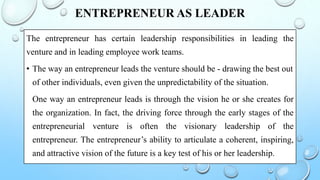
ENTREPRENEUR AS LEADER
The entrepreneur has certain leadership responsibilities in leading the
venture and in leading employee work teams.
• The way an entrepreneur leads the venture should be - drawing the best out
of other individuals, even given the unpredictability of the situation.
One way an entrepreneur leads is through the vision he or she creates for
the organization. In fact, the driving force through the early stages of the
entrepreneurial venture is often the visionary leadership of the
entrepreneur. The entrepreneur’s ability to articulate a coherent, inspiring,
and attractive vision of the future is a key test of his or her leadership.
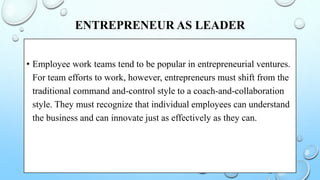
ENTREPRENEUR AS LEADER
• Employee work teams tend to be popular in entrepreneurial ventures.
For team efforts to work, however, entrepreneurs must shift from the
traditional command and-control style to a coach-and-collaboration
style. They must recognize that individual employees can understand
the business and can innovate just as effectively as they can.

Entrepreneurship

  • 1.
  • 2.
    DEFINITION • Entrepreneurship isthe process of starting new businesses, generally in response to opportunities. • Entrepreneurial ventures: Organizations that pursue opportunities, are characterized by innovative practices, and have growth and profitability as their main goals
  • 3.
    IMPORTANCE • Create socialchange: Through their unique offerings of new goods and services, entrepreneurs break away from tradition and indirectly support freedom by reducing dependence on obsolete systems and technologies. Overall, this results in an improved quality of life. • New employment opportunities are created
  • 4.
    IMPORTANCE • Means ofEconomic Development: An entrepreneur plays an important role in accelerating the pace of economic development of a country by discovering new uses of available resources and maximizing their utilization. • New and improved offerings, products or technologies from entrepreneurs enable new markets to be developed and new wealth created.
  • 5.
    TEN WAYS TOSPARK YOUR ENTREPRENEURIAL SPIRIT 1. Read about great new businesses. 2. Join a community business organization. 3. Find a mentor. 4. Be critical 5. Leave your job (or get laid off). 6. Discover an industry. 7. Hang around a business school. 8. Spend time with an entrepreneur. 9. Do a feasibility study. 10. Do something … anything.
  • 6.
    SKILLS AND ATTITUDEOF AN ENTREPRENEUR • Creativity and Opportunity Evaluation • Real-time Strategy and Decision Making • Comfort with Change and Chaos • Teamwork • Selling, Negotiation, and Motivation through Influence and Persuasion • Oral and Written Communication • Basics of Start-Up Finance, Accounting and Law • Comfortable with lifestyle changes • Willingness to break / bend / stretch laws • Patience to start small • Prepared to make enemies • Comfort with confrontations • Dealing with failure • Willingness to learn
  • 7.
    ENTREPRENEUR AS LEADER Theentrepreneur has certain leadership responsibilities in leading the venture and in leading employee work teams. • The way an entrepreneur leads the venture should be - drawing the best out of other individuals, even given the unpredictability of the situation. One way an entrepreneur leads is through the vision he or she creates for the organization. In fact, the driving force through the early stages of the entrepreneurial venture is often the visionary leadership of the entrepreneur. The entrepreneur’s ability to articulate a coherent, inspiring, and attractive vision of the future is a key test of his or her leadership.
  • 8.
    ENTREPRENEUR AS LEADER •Employee work teams tend to be popular in entrepreneurial ventures. For team efforts to work, however, entrepreneurs must shift from the traditional command and-control style to a coach-and-collaboration style. They must recognize that individual employees can understand the business and can innovate just as effectively as they can.