America’s New Immigrant Entrepreneurs
          Student Research Team:      Vivek Wadhwa, Executive in Residence
 Ramakrishnan Balasubramanian,        Pratt School of Engineering, Master of Engineering Management Program
       Pradeep Kamsali, Nishanth      Duke University
     Lingamneni, Chris Morecroft,
Niyanthi Reddy, George Robinson,
                                      AnnaLee Saxenian, Dean and Professor
  Batul Tambawalla, Mark Weaver,
                                      School of Information
                    Zhenyu Yang
                                      University of California, Berkeley
                    Special Thanks:
       Neopatents, Gloria Gyamfi,     Ben Rissing, Research Scholar and Project Manager
   Laura Higbie, Amanda McCain,       Pratt School of Engineering, Master of Engineering Management Program
    Marine Raoux, Anand Sankar,       Duke University
     Chuntat Tan, Payman Tayebi,
       Rachel Wu, Tarun Wadhwa,       Gary Gereffi, Director and Professor
  John P. Harvey, Duke University     Center on Globalization, Governance & Competitiveness, Sociology Department
      Statistical Consulting Center   Duke University


    January 4, 2007
                        Electronic copy available at: http://ssrn.com/abstract=990152
Table of Contents
Introduction and Overview .............................................................................................................. 3
Background on U.S. Immigration..................................................................................................... 6
Methodology – Immigrant Key Founder Data ................................................................................. 8
  Data Acquisition ......................................................................................................................... 8
  Definition of Key Founder.......................................................................................................... 9
  Definition of an Immigrant and Immigrant-Founded Company................................................. 9
  Data Collection ........................................................................................................................... 9
  Quality Assurance and Data Analysis......................................................................................... 9
Methodology – WIPO Patent Records........................................................................................... 10
  Data Acquisition ....................................................................................................................... 10
  Limitations/Definition of Immigrant Non-citizen .................................................................... 10
Data Analysis – Immigrant Key Founder Data............................................................................... 11
  Revenue and Employment Data................................................................................................ 11
  Immigrant-Founder Origin Data ............................................................................................... 11
  State Wise Distribution of Immigrant Founder Data................................................................ 12
  Industry Specific Immigrant Founder Data .............................................................................. 19
Data Analysis – WIPO Patent Records .......................................................................................... 25
  WIPO PCT Applications by U.S. Immigrant Nationality......................................................... 25
  WIPO PCT Application Trend Analysis of Immigrant Non-Citizen Filings ........................... 26
  WIPO PCT Application Analysis by International Patent Classification Codes...................... 27
Special Analysis – Silicon Valley, CA .............................................................................................. 31
Special Analysis – Research Triangle Park, NC............................................................................... 33
Summary of Results and Conclusion .............................................................................................. 35
Author Biographies ........................................................................................................................ 36
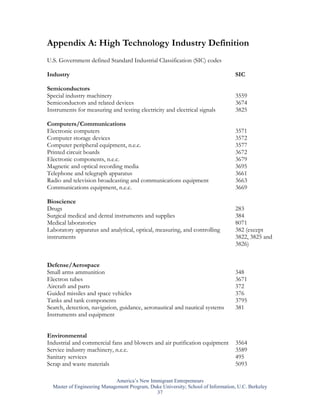
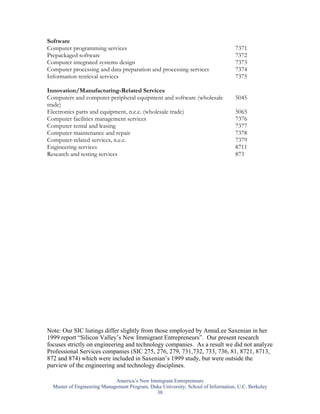
Appendix A: High Technology Industry Definition ....................................................................... 37
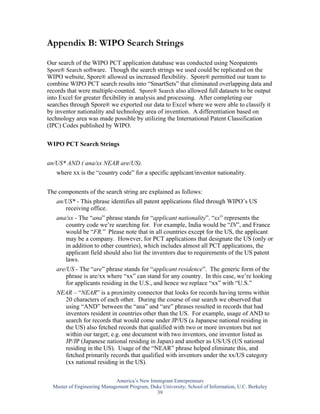
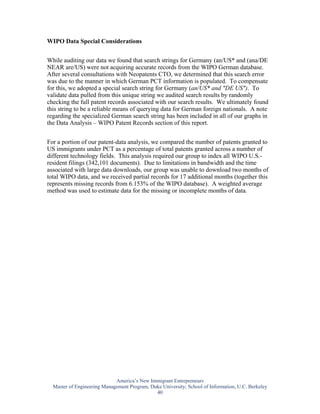
Appendix B: WIPO Search Strings................................................................................................. 39
Bibliography................................................................................................................................... 41


                                    America’s New Immigrant Entrepreneurs
         Master of Engineering Management Program, Duke University; School of Information, U.C. Berkeley
                                                      2

                              Electronic copy available at: http://ssrn.com/abstract=990152
Introduction and Overview
Two of the most important questions now being debated in the U.S. are the effects of
globalization and immigration on the nation’s economy. Globalization is accelerating and
it is still not clear whether trends like outsourcing will erode U.S. competitiveness or
provide long-term benefits. The focus of the immigration debate is on the plight of
millions of unskilled immigrants who have entered the U.S. illegally. Overlooked in the
debate are the hundreds of thousands of skilled immigrants who annually enter the
country legally.

In 1999 AnnaLee Saxenian published a groundbreaking report on the economic
contributions of skilled immigrants to California’s economy. This study, entitled
“Silicon Valley’s New Immigrant Entrepreneurs”, focused on the development of Silicon
Valley’s regional economy and the roles of immigrant capital and labor in this process.
Saxenian’s study also went beyond a quantitative analysis to focus on the social, ethnic
and economic networks of new U.S. immigrants. One of her most interesting findings
was that Chinese and Indian engineers ran a growing share of Silicon Valley companies
started during the 1980s and 1990s and they were at the helm of 24% of the technology
businesses started from 1980 to 1998. Saxenian concluded that foreign-born scientists
and engineers were generating new jobs and wealth for the California economy. Even
those who returned to their home countries to take advantage of opportunities there were
building links to the U.S. and spurring technological innovation and economic expansion
for California.

A team of student researchers in the Master of Engineering Management program of the
Pratt School of Engineering at Duke University has been researching the impact of
globalization on the U.S. economy and the engineering profession. The team is led by
Executive in Residence Vivek Wadhwa, Research Scholar Ben Rissing, and Sociology
Professor Gary Gereffi. Earlier research focused on the education and graduation rates of
engineers in the U.S., China and India, and an analysis of the experiences of U.S. firms
engaged in outsourcing their engineering operations.

The Duke researchers were concerned about the growing momentum in outsourcing and
its impact on U.S. competitiveness—and sought to understand the sources of the U.S.
global advantage as well as what the U.S. can do to keep its edge. To better understand
the contributions of skilled immigrants to the competitiveness of the U.S. economy, they
decided to expand and update Saxenian’s study.

The goal of this research was to document the economic and intellectual contributions of
immigrant technologists and engineers at the national level. To understand the economic
impact, the study looked at a large sample of all engineering and technology companies
founded in the last ten years, to determine whether a key founder was an immigrant. To
understand the intellectual contribution, they analyzed the World Intellectual Property
Organization Patent Cooperation Treaty database for international patent applications
filed in the United States.


                             America’s New Immigrant Entrepreneurs
  Master of Engineering Management Program, Duke University; School of Information, U.C. Berkeley
                                               3

                  Electronic copy available at: http://ssrn.com/abstract=990152
The results show that the trend Saxenian documented for Silicon Valley, a pattern of
skilled immigrants leading innovation and creating jobs and wealth, has become a
nationwide phenomenon. Here are some characteristics of the engineering and
technology companies started in the U.S. from 1995 to 2005.

   •   In 25.3% of these companies, at least one key founder was foreign-born. States
       with an above-average rate of immigrant-founded companies include California
       (39%), New Jersey (38%), Georgia (30%), and Massachusetts (29%). Below-
       average states include Washington (11%), Ohio (14%), North Carolina (14%),
       and Texas (18%).
   •   Nationwide, these immigrant-founded companies produced $52 billion in sales
       and employed 450,000 workers in 2005.
   •   Indians have founded more engineering and technology companies in the US in
       the past decade than immigrants from the U.K., China, Taiwan and Japan
       combined. Of all immigrant-founded companies, 26% have Indian founders.
   •   Chinese (Mainland- and Taiwan-born) entrepreneurs are heavily concentrated in
       California, with 49% of Mainland Chinese and 81% of Taiwanese companies
       located there. Indian and U.K. entrepreneurs tend to be dispersed around the
       country, with Indians having sizable concentrations in California and New Jersey
       and the British in California and Georgia.
   •   The mix of immigrants varies by state. Hispanics constitute the dominant group in
       Florida, with immigrants from Cuba, Columbia, Brazil, Venezuela, and
       Guatemala founding 35% of the immigrant-founded companies. Israelis constitute
       the largest founding group in Massachusetts, with 17%. Indians dominate New
       Jersey, with 47% of all immigrant-founded startups.
   •   Almost 80% of immigrant-founded companies in the US were within just two
       industry fields: software and innovation/manufacturing-related services.
   •   Immigrants were least likely to start companies in the defense/aerospace and
       environmental industries. They were most highly represented as founders in the
       semiconductor, computer, communications, and software fields.

We estimate, based on an analysis of the World Intellectual Property Organization
(WIPO) patent databases, that foreign nationals residing in the U.S. were named as
inventors or co-inventors in 24.2% of international patent applications filed from the U.S.
in 2006. Unlike the company founder survey, this count does not include such
immigrants who became citizens before filing a patent. We therefore classified the
foreign nationals as “immigrant non-citizens”. WIPO PCT applications represent a subset
of those filed with the U.S. Patent and Trademark Office but are likely to have a high
global utility and contribute to U.S. competitiveness.

   •   The trend has been dramatic; according to our estimates the contribution of non-
       citizen immigrants to these international patent applications increased from 7.3%
       in 1998 to 24.2% in 2006.
   •   The largest group of immigrant non-citizen inventors were Chinese (Mainland-
       and Taiwan-born). Indians were second, followed by the Canadians and British.

                             America’s New Immigrant Entrepreneurs
  Master of Engineering Management Program, Duke University; School of Information, U.C. Berkeley
                                               4
•   Immigrant non-citizens filed more theoretical, computational and practical patents
       than mechanical, structural or traditional engineering patents.

To understand the role of regional technology centers in fueling the growth of
engineering and technology companies, we did a special analysis of Silicon Valley, CA
and Research Triangle Park, NC. Here are the findings of our analysis of engineering and
technology companies founded from 1995 to 2005 in these regions:

   •   Over half (52.4%) of Silicon Valley startups had one or more immigrants as a key
       founder, compared with the California average of 38.8%.
   •   A comparison with Saxenian’s 1999 findings shows that the percentage of firms
       with Indian or Chinese founders had increased from 24% to 28%. Indian
       immigrants outpaced their Chinese counterparts as founders of engineering and
       technology companies in Silicon Valley. Saxenian reported that 17% of Silicon
       Valley startups from 1980-1998 had a Chinese founder and 7% had an Indian
       founder. We found that from 1995 to 2005, Indians were key founders of 15.5%
       of all Silicon Valley startups, and immigrants from China and Taiwan were key
       founders in 12.8%.
   •   In Research Triangle Park, 18.7% of startups had an immigrant as a key founder,
       compared with the North Carolina average of 13.9%. Indians constitute the largest
       immigrant founding group, with 25% of startups, followed by immigrants from
       Germany and the U.K., each with 15%.

What is clear is that immigrants have become a significant driving force in the creation of
new businesses and intellectual property in the U.S. — and that their contributions have
increased over the past decade.


                             America’s New Immigrant Entrepreneurs
  Master of Engineering Management Program, Duke University; School of Information, U.C. Berkeley
                                               5
Background on U.S. Immigration
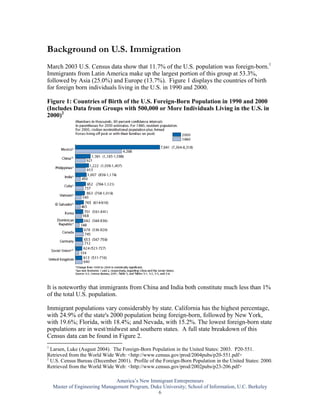
March 2003 U.S. Census data show that 11.7% of the U.S. population was foreign-born.1
Immigrants from Latin America make up the largest portion of this group at 53.3%,
followed by Asia (25.0%) and Europe (13.7%). Figure 1 displays the countries of birth
for foreign born individuals living in the U.S. in 1990 and 2000.

Figure 1: Countries of Birth of the U.S. Foreign-Born Population in 1990 and 2000
(Includes Data from Groups with 500,000 or More Individuals Living in the U.S. in
2000)2


It is noteworthy that immigrants from China and India both constitute much less than 1%
of the total U.S. population.

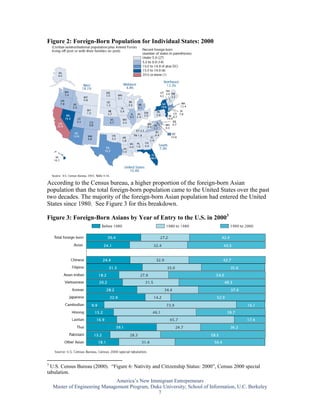
Immigrant populations vary considerably by state. California has the highest percentage,
with 24.9% of the state's 2000 population being foreign-born, followed by New York,
with 19.6%; Florida, with 18.4%; and Nevada, with 15.2%. The lowest foreign-born state
populations are in west/midwest and southern states. A full state breakdown of this
Census data can be found in Figure 2.
1
  Larsen, Luke (August 2004). The Foreign-Born Population in the United States: 2003. P20-551.
Retrieved from the World Wide Web: <http://www.census.gov/prod/2004pubs/p20-551.pdf>
2
  U.S. Census Bureau (December 2001). Profile of the Foreign-Born Population in the United States: 2000.
Retrieved from the World Wide Web: <http://www.census.gov/prod/2002pubs/p23-206.pdf>

                               America’s New Immigrant Entrepreneurs
    Master of Engineering Management Program, Duke University; School of Information, U.C. Berkeley
                                                 6
Figure 2: Foreign-Born Population for Individual States: 2000


According to the Census bureau, a higher proportion of the foreign-born Asian
population than the total foreign-born population came to the United States over the past
two decades. The majority of the foreign-born Asian population had entered the United
States since 1980. See Figure 3 for this breakdown.

Figure 3: Foreign-Born Asians by Year of Entry to the U.S. in 20003


3
  U.S. Census Bureau (2000). “Figure 6: Nativity and Citizenship Status: 2000”, Census 2000 special
tabulation.
                               America’s New Immigrant Entrepreneurs
    Master of Engineering Management Program, Duke University; School of Information, U.C. Berkeley
                                                 7
Methodology – Immigrant Key Founder Data
Data Acquisition

To quantify the economic contributions of immigrant entrepreneurs to the U.S. economy
we sought to identify the direct involvement of immigrants in the founding of
engineering and technology companies. We obtained a list of all such companies
founded in the U.S. in the last ten years (1995-2005) from Dun & Bradstreet’s (D&B)
Million Dollar Database. This contains U.S. companies with more than $1 million in
sales, and 20 or more employees, and company branches with 50 or more employees.
This database is commonly used by researchers and is considered a source of reliable
data.

This D&B database search produced a listing of 28,766 companies. A very small portion
of these were older companies with recent changes in control or corporate
restructurings/mergers, so these were omitted from our dataset. Included below is a list
of key data that D&B provides:

   •   Company name                                      •    Total number of employees
   •   Type of company                                   •    Select executive officer
   •   City, state, zip code                                  information
   •   Phone number                                      •    Primary standard industrial
   •   Company website                                        classification
   •   Sales

For the purposes of our study, the words technology and engineering indicate that the
main work of the company is to use technology or engineering to design or manufacture
products or services. Our definition of engineering and technology firms thus includes
the following industry groups, defined with 3- and 4-digit U.S. Government Standard
Industrial Classification (SIC) codes: semiconductors, computers/communications,
biosciences, defense/aerospace, environmental, software, and innovation/manufacturing-
related services. A full listing of the SIC codes associated with each industry group is
present in appendix A. These are the same engineering and technology SIC codes used in
Saxenian’s original research. We excluded some professional services SIC codes which
were included in Saxenian’s 1999 study, but were outside the purview of the engineering
and technology disciplines.

Company entries within each SIC code were randomized using a Microsoft Excel random
number assignment. Researchers were then assigned random listings of 500 companies,
with representative entries from each of the main engineering and technology industry
groups.

Our research team then made thousands of unsolicited phone calls to these companies.
We asked whether one or more immigrant key founders had established the company and
if so, what their nationality was. This became the source of the data presented in this
report.
                             America’s New Immigrant Entrepreneurs
  Master of Engineering Management Program, Duke University; School of Information, U.C. Berkeley
                                               8
Definition of Key Founder

In most engineering or technology companies, the key founders are the President/Chief
Executive Officer or the head of development/Chief Technology Officer. An individual
can simultaneously perform both of these roles. Other roles such as finance, marketing,
HR, and legal can be very important in startups. For the purposes of our research,
however, we chose to use a narrow definition of key founder and exclude the latter roles.

Definition of an Immigrant and Immigrant-Founded Company

An immigrant is a person who was born as a citizen of another country and subsequently
moved to the United States at some point in his or her lifetime. Immigrant-founded
companies are those having one or more immigrants as key founders.


Data Collection

A team of fifteen graduate students and research assistants telephoned CEOs, HR
managers and other knowledgeable company employees. After a two-sentence
introduction of the student researcher, Duke University and the research project, they
were asked:
       (1) Were any of your company’s key founders immigrants to the United States?
           If “Yes” they were asked:
       (2) In what country was he or she born?
They followed the first question with the definition of “key founder” and “immigrant
founded company”.


Quality Assurance and Data Analysis

After all of the data had been collected, we performed quality assurance on our records.
Two criteria in particular were chosen ensure the veracity of the collected data. First,
companies listed in the D&B database with zero employees at their US headquarters were
omitted from consideration. Second, companies with 2005 sales greater than 100 million
dollars were double checked to make certain that they had been founded after 1995.


                             America’s New Immigrant Entrepreneurs
  Master of Engineering Management Program, Duke University; School of Information, U.C. Berkeley
                                               9
Methodology – WIPO Patent Records
Data Acquisition
To gauge the intellectual property contributions of immigrants, we first attempted to
analyze the United States Patent and Trademark Office (USPTO) database. Unfortunately
the USPTO does not record citizenship data an application for a patent.


With the assistance of Neopatents — a Raleigh, North Carolina based patent research and
analytics firm — we determined that we could obtain information on inventor nationality
by examining a different database: Patent Cooperation Treaty (PCT) applications
published by the World Intellectual Property Organization (WIPO). WIPO is based in
Geneva, Switzerland, and coordinates the filing of international patents. These are the
patents that likely have high global utility. Neopatents provided our research team access
to its proprietary Spore® Search software package to query the WIPO patent database.

Limitations/Definition of Immigrant Non-citizen


The WIPO database records information on inventors' nationalities and the countries in
which they resided at the time of filing a PCT application. The drawback of this
comparison is that it imposes a conservative definition of “immigrant” on our patent
analysis. The only patent data available are for foreign nationals who currently reside in
the United States. We classified these as “immigrant non-citizens” to differentiate from
the criteria we used for immigrant company founders.
To put this in perspective, according to the 2000 U.S. Census, from 1990 to 2000, 12.5
million foreign-born citizens were granted U.S. citizenship.i Any U.S. naturalized
citizens who have filed a PCT application after becoming a citizen are not counted. As a
result, our findings represent a conservative estimate of the contributions of immigrants.
Additionally, we limited our search to patents awarded from 1998 to 2006. Although the
PCT databases include records since 1978, we found that prior to 1998 the database
contains far fewer records.
For our research, we examined all PCT application records that had been filed through
the U.S. PCT Receiving Office. We extracted all records for published patents that
contain one or more applicants of non-U.S. nationality who were residing in the U.S. at
the time of filing the application. Patents meeting these criteria and published between
1998 and 2006 (inclusive) were identified. During this period, WIPO published
approximately 340,000 PCT applications filed by U.S.-resident applicants through the
U.S. receiving office.
An explanation of our WIPO search strings using Spore® Search can be found in
Appendix B of this report.


                             America’s New Immigrant Entrepreneurs
  Master of Engineering Management Program, Duke University; School of Information, U.C. Berkeley
                                              10
Data Analysis – Immigrant Key Founder Data
We obtained responses from 2,054 engineering and technology companies founded in the
U.S. from 1995 to 2005. Of these companies, 25.3% reported that at least one of their key
founders was an immigrant. Extrapolating from this sample, we estimate that all
companies founded by immigrants from 1995 to 2005 produced $52 billion dollars in
sales and employed 450,000 workers in 2005. A breakdown of our survey statistics and
response rates can be found in Table 1 below:

Table 1: Founder Survey Statistics and Response Rates

                                                                                  Count Variable
Total "Yes" Responses:                                                             520     a
Total "No" Responses:                                                             1534     b
"Decline to Comment/Participate" Responses: Too Busy, Unwilling to Provide         407     c
Information, No Data/Knowledge
"Missing Data": Bad Phone Numbers, Disconnected Calls, Hang Ups, Requests          2128       d
for Call Backs and Answering Machines
Total Companies Approached:                                                        4589       e

Response Rate R1 (The proportion of survey responses obtained out of total             44.8%
survey delivery attempts) [(a+b)/e]
Response Rate R2 (The proportion of survey responses obtained out of total             83.5%
surveys actually delivered) [(a+b)/(a+b+c)]


Revenue and Employment Data

To infer information on all of the 28,776 companies founded in the last ten years, we
employed a sampling distribution of a proportion, and performed a finite population
correction. Using this method, we can say with 95% confidence that 25.3% ± 1.8% of
the 28,776 engineering and technology companies founded from 1995 to 2005 had an
immigrant key founder. This equates to 7,283 ± 518 companies. These 7,283 companies
produced more than $52 billion dollars in 2005 sales and in 2005 had just under 450,000
employees.

Immigrant-Founder Origin Data

The immigrant founders of U.S. engineering and technology companies come from all
over the world. Our data identified immigrant founders from more than 60 different
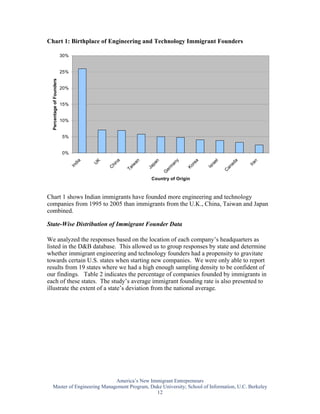
countries. The top 10 are listed in Chart 1.


                             America’s New Immigrant Entrepreneurs
  Master of Engineering Management Program, Duke University; School of Information, U.C. Berkeley
                                              11
Chart 1: Birthplace of Engineering and Technology Immigrant Founders

                           30%


                           25%
  Percentage of Founders


                           20%


                           15%


                           10%


                           5%


                           0%


                                                                                y
                                                  na


                                                          an


                                                                                                          a
                                                                                        a
                                      a


                                                                    n
                                          K


                                                                                                 l


                                                                                                               n
                                                                                               e
                                                                            an


                                                                                                         ad
                                  di


                                                                pa


                                                                                     re


                                                                                                              Ira
                                          U


                                                                                            ra
                                                         w
                                              hi
                                 In


                                                                                    Ko
                                                                            m


                                                                                                     an
                                                               Ja


                                                                                            Is
                                                          i
                                              C


                                                       Ta


                                                                        er


                                                                                                     C
                                                                        G


                                                                Country of Origin


Chart 1 shows Indian immigrants have founded more engineering and technology
companies from 1995 to 2005 than immigrants from the U.K., China, Taiwan and Japan
combined.

State-Wise Distribution of Immigrant Founder Data

We analyzed the responses based on the location of each company’s headquarters as
listed in the D&B database. This allowed us to group responses by state and determine
whether immigrant engineering and technology founders had a propensity to gravitate
towards certain U.S. states when starting new companies. We were only able to report
results from 19 states where we had a high enough sampling density to be confident of
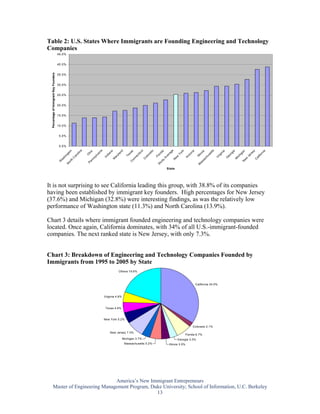
our findings. Table 2 indicates the percentage of companies founded by immigrants in
each of these states. The study’s average immigrant founding rate is also presented to
illustrate the extent of a state’s deviation from the national average.


                             America’s New Immigrant Entrepreneurs
  Master of Engineering Management Program, Duke University; School of Information, U.C. Berkeley
                                              12
Table 2: U.S. States Where Immigrants are Founding Engineering and Technology
Companies
                                         45.0%


                                         40.0%
  Percentage of Immigrant Key Founders


                                         35.0%


                                         30.0%


                                         25.0%


                                         20.0%


                                         15.0%


                                         10.0%


                                          5.0%


                                          0.0%
                                                              a


                                                                                                                                                         e
                                                                               a


                                                                                                                                                                                                   ts
                                                                                                                         ut


                                                                                                                                                                                                                                             ey
                                                    n


                                                                                                                                       o
                                                                                                       d


                                                                                                                                                                                                                                                         ia
                                                                                                                                                                  rk


                                                                                                                                                                             a


                                                                                                                                                                                                                       ia


                                                                                                                                                                                                                                    n
                                                                                          a


                                                                                                                                                a


                                                                                                                                                                                                             ia
                                                                                                                                                                                         s
                                                                                                                s
                                                                      o
                                                            in


                                                                                                                                                      ag
                                                                               ni
                                                  to


                                                                                                  an


                                                                                                                                  ad


                                                                                                                                                                                    oi
                                                                                                                                                                         on


                                                                                                                                                                                                                                 ga
                                                                                                             xa
                                                                                         an


                                                                                                                                            id
                                                                  hi


                                                                                                                                                                                               et


                                                                                                                                                                                                                                                       rn
                                                                                                                         ic


                                                                                                                                                                                                                      rg
                                                                                                                                                                                                         in
                                                                                                                                                               Yo


                                                                                                                                                                                                                                         rs
                                                            ol


                                                                          va


                                                                                                                                                                                    in
                                               ng


                                                                                                                                           or
                                                                  O


                                                                                                                     ct


                                                                                                                                                                                              us
                                                                                                                                                    er


                                                                                                                                                                                                        rg
                                                                                                  yl


                                                                                                           Te


                                                                                                                                  or


                                                                                                                                                                                                                                                  if o
                                                                                                                                                                                                                               hi
                                                                                                                                                                        iz


                                                                                                                                                                                                                  eo
                                                                                     di


                                                                                                                                                                                                                                        Je
                                                         ar


                                                                                                                                                                                 Ill
                                                                                                                                           Fl
                                                                          yl


                                                                                                                    ne


                                                                                                                                                             ew
                                                                                              ar


                                                                                                                                                                       Ar
                                                                                                                                                 Av


                                                                                                                                                                                                                            ic
                                             hi


                                                                                                                                                                                                        Vi
                                                                                    In


                                                                                                                              ol


                                                                                                                                                                                          ch


                                                                                                                                                                                                                                                  al
                                                                                                                                                                                                                  G
                                                        C


                                                                      ns


                                                                                                                                                                                                                                    ew
                                                                                                                                                                                                                           M
                                          as


                                                                                              M


                                                                                                                              C
                                                                                                                on


                                                                                                                                                                                                                                              C
                                                                                                                                                           N


                                                                                                                                                                                         sa
                                                    th


                                                                                                                                                y
                                                                  en
                                         W


                                                                                                                                            ud


                                                                                                                                                                                                                                  N
                                                                                                                C


                                                                                                                                                                                   as
                                                  or


                                                                  P


                                                                                                                                           St
                                               N


                                                                                                                                                                                  M
                                                                                                                                                    State


It is not surprising to see California leading this group, with 38.8% of its companies
having been established by immigrant key founders. High percentages for New Jersey
(37.6%) and Michigan (32.8%) were interesting findings, as was the relatively low
performance of Washington state (11.3%) and North Carolina (13.9%).

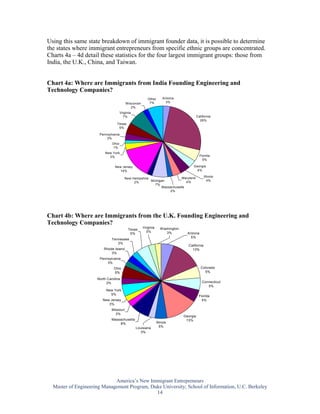
Chart 3 details where immigrant founded engineering and technology companies were
located. Once again, California dominates, with 34% of all U.S.-immigrant-founded
companies. The next ranked state is New Jersey, with only 7.3%.


Chart 3: Breakdown of Engineering and Technology Companies Founded by
Immigrants from 1995 to 2005 by State
                                                                                                   Others 19.6%


                                                                                                                                                                                 California 34.0%


                                                                                    Virginia 4.8%


                                                                                     Texas 4.6%


                                                                                    New York 5.2%

                                                                                                                                                                              Colorado 2.1%

                                                                                          New Jersey 7.3%
                                                                                                                                                                       Florida 6.7%
                                                                                                       Michigan 3.7%                                           Georgia 3.3%
                                                                                                           Massachusetts 5.2%                         Illinois 3.5%


                                    America’s New Immigrant Entrepreneurs
         Master of Engineering Management Program, Duke University; School of Information, U.C. Berkeley
                                                     13
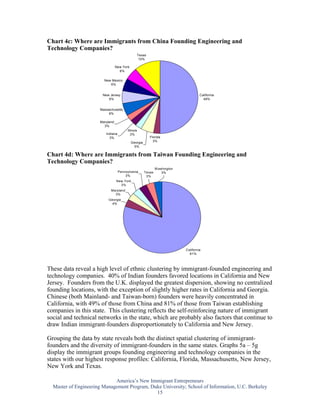
Using this same state breakdown of immigrant founder data, it is possible to determine
the states where immigrant entrepreneurs from specific ethnic groups are concentrated.
Charts 4a – 4d detail these statistics for the four largest immigrant groups: those from
India, the U.K., China, and Taiwan.


Chart 4a: Where are Immigrants from India Founding Engineering and
Technology Companies?
                                                         Other        Arizona
                                         W isconsin       7%            3%
                                             2%
                                     Virginia
                                       7%                                                  California
                                                                                             26%
                                 Texas
                                  5%

                      Pennsylvania
                          3%
                              Ohio
                              1%
                         New York
                           3%                                                                Florida
                                                                                               5%

                               New Jersey                                             Georgia
                                 14%                                                   4%

                                                                       Maryland                 Illinois
                                        New Hampshire
                                                      Michigan            4%                       4%
                                             2%
                                                        7%
                                                            Massachusetts
                                                                2%


Chart 4b: Where are Immigrants from the U.K. Founding Engineering and
Technology Companies?
                                                      Virginia      Washington
                                           Texas
                                                        3%             3%          Arizona
                                            5%
                                                                                     5%
                             Tennessee
                                3%
                                                                                   California
                         Rhode Island                                                13%
                             3%
                      Pennsylvania
                          3%
                               Ohio                                                           Colorado
                               5%                                                               5%

                     North Carolina
                          3%                                                                   Connecticut
                                                                                                  5%
                          New York
                            5%
                                                                                            Florida
                        New Jersey                                                            5%
                           3%
                             Missouri
                               3%
                                                                                 Georgia
                             Massachusetts                                        13%
                                 8%                              Illinois
                                                Louisiana           5%
                                                   3%


                             America’s New Immigrant Entrepreneurs
  Master of Engineering Management Program, Duke University; School of Information, U.C. Berkeley
                                              14
Chart 4c: Where are Immigrants from China Founding Engineering and
Technology Companies?
                                               Texas
                                                10%

                                 New York
                                   6%

                        New Mexico
                           6%


                        New Jersey                                                   California
                           6%                                                          49%


                      Massachusetts
                          6%

                      Maryland
                        3%
                                        Illinois
                         Indiana           3%
                           3%                            Florida
                                            Georgia        3%
                                              5%

Chart 4d: Where are Immigrants from Taiwan Founding Engineering and
Technology Companies?
                                                              W ashington
                                   Pennsylvania       Texas       3%
                                       3%              3%
                                 New York
                                   3%
                            Maryland
                              3%
                           Georgia
                            4%


                                                                            California
                                                                              81%


These data reveal a high level of ethnic clustering by immigrant-founded engineering and
technology companies. 40% of Indian founders favored locations in California and New
Jersey. Founders from the U.K. displayed the greatest dispersion, showing no centralized
founding locations, with the exception of slightly higher rates in California and Georgia.
Chinese (both Mainland- and Taiwan-born) founders were heavily concentrated in
California, with 49% of those from China and 81% of those from Taiwan establishing
companies in this state. This clustering reflects the self-reinforcing nature of immigrant
social and technical networks in the state, which are probably also factors that continue to
draw Indian immigrant-founders disproportionately to California and New Jersey.

Grouping the data by state reveals both the distinct spatial clustering of immigrant-
founders and the diversity of immigrant-founders in the same states. Graphs 5a – 5g
display the immigrant groups founding engineering and technology companies in the
states with our highest response profiles: California, Florida, Massachusetts, New Jersey,
New York and Texas.

                             America’s New Immigrant Entrepreneurs
  Master of Engineering Management Program, Duke University; School of Information, U.C. Berkeley
                                              15
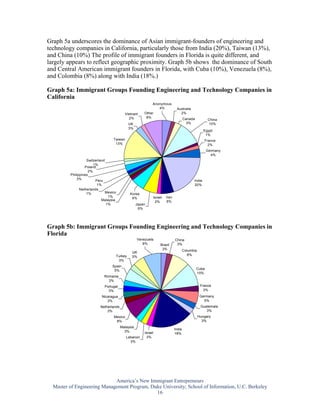
Graph 5a underscores the dominance of Asian immigrant-founders of engineering and
technology companies in California, particularly those from India (20%), Taiwan (13%),
and China (10%) The profile of immigrant founders in Florida is quite different, and
largely appears to reflect geographic proximity. Graph 5b shows the dominance of South
and Central American immigrant founders in Florida, with Cuba (10%), Venezuela (8%),
and Colombia (8%) along with India (18%.)

Graph 5a: Immigrant Groups Founding Engineering and Technology Companies in
California
                                                            Anonymous
                                                               4%             Australia
                                           Vietnam      Other                   2%
                                             2%          8%                          Canada          China
                                              UK                                       3%            10%
                                              3%
                                                                                                   Egypt
                                                                                                    1%
                                  Taiwan                                                           France
                                   13%                                                               2%
                                                                                                     Germany
                                                                                                       4%
                   Switzerland
                       1%
                  Poland
                    2%
         Philippines
             3%         Peru                                                               India
                        1%                                                                 20%
              Netherlands
                  1%       Mexico             Korea
                             1%                6%            Israel   Iran
                          Malaysia                            2%      6%
                            1%                      Japan
                                                     6%


Graph 5b: Immigrant Groups Founding Engineering and Technology Companies in
Florida
                                                    Venezuela                China
                                                       8%         Brazil      3%
                                                                   3%                Columbia
                                                UK
                                     Turkey                                             8%
                                                5%
                                      3%
                                 Spain
                                  5%                                                          Cuba
                                                                                              10%
                             Romania
                               3%
                             Portugal                                                            France
                               3%                                                                  3%
                            Nicaragua                                                            Germany
                               3%                                                                  5%
                           Netherlands                                                           Guatemala
                               3%                                                                   3%
                                  Mexico                                                        Hungary
                                   8%                                                             3%
                                         Malaysia
                                                                             India
                                           3%           Israel               18%
                                            Lebanon      3%
                                              3%


                             America’s New Immigrant Entrepreneurs
  Master of Engineering Management Program, Duke University; School of Information, U.C. Berkeley
                                              16
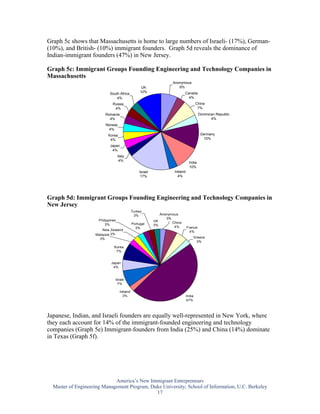
Graph 5c shows that Massachusetts is home to large numbers of Israeli- (17%), German-
(10%), and British- (10%) immigrant founders. Graph 5d reveals the dominance of
Indian-immigrant founders (47%) in New Jersey.

Graph 5c: Immigrant Groups Founding Engineering and Technology Companies in
Massachusetts
                                                                       Anonymous
                                                     UK                   6%
                                                    10%                        Canada
                             South Africa
                                 4%                                              4%
                               Russia                                                     China
                                4%                                                         7%
                          Romania                                                           Dominican Republic
                            4%                                                                     4%
                          Norway
                           4%
                            Korea                                                            Germany
                             4%                                                                10%

                             Japan
                              4%
                                    Italy
                                     4%
                                                                                    India
                                                                                    10%
                                                   Israel               Ireland
                                                    17%                   4%


Graph 5d: Immigrant Groups Founding Engineering and Technology Companies in
New Jersey
                                               Turkey
                                                3%               Anonymous
                                                                    3%
                      Philippines                           UK
                                               Portugal                China
                          3%                                3%
                                                 3%                     4%        France
                        New Zealand
                                                                                    4%
                    Malaysia 3%
                      3%                                                              Greece
                                                                                       3%
                                Korea
                                 7%


                              Japan
                               4%


                                Israel
                                 7%

                                     Ireland
                                       3%                                         India
                                                                                  47%


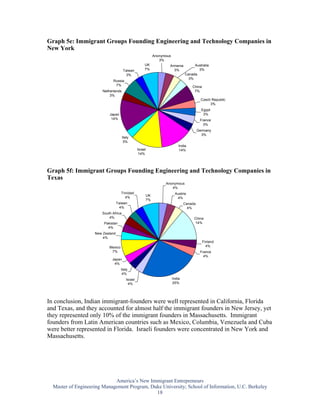
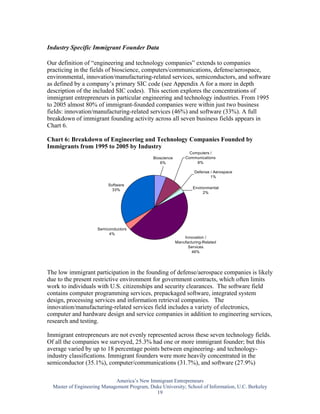
Japanese, Indian, and Israeli founders are equally well-represented in New York, where
they each account for 14% of the immigrant-founded engineering and technology
companies (Graph 5e) Immigrant-founders from India (25%) and China (14%) dominate
in Texas (Graph 5f).


                             America’s New Immigrant Entrepreneurs
  Master of Engineering Management Program, Duke University; School of Information, U.C. Berkeley
                                              17
Graph 5e: Immigrant Groups Founding Engineering and Technology Companies in
New York
                                                            Anonymous
                                                               3%
                                                       UK           Armenia          Australia
                                      Taiwan           7%             3%               3%
                                       3%                                       Canada
                                                                                  3%
                              Russia
                               7%                                                   China
                        Netherlands                                                  7%
                            3%
                                                                                          Czech Republic
                                                                                               3%
                                                                                           Egypt
                            Japan                                                           3%
                             14%                                                          France
                                                                                            3%
                                                                                         Germany
                                                                                           3%
                                      Italy
                                       3%
                                                                            India
                                                  Israel                    14%
                                                   14%


Graph 5f: Immigrant Groups Founding Engineering and Technology Companies in
Texas
                                                                  Anonymous
                                                                     4%
                                    Trinidad                             Austria
                                                       UK
                                       4%                                 4%
                                                       7%
                                  Taiwan                                        Canada
                                   4%                                             4%
                       South Africa
                           4%                                                        China
                        Pakistan                                                     14%
                          4%
                    New Zealand
                        4%
                                                                                            Finland
                           Mexico                                                             4%
                            7%                                                            France
                                                                                            4%
                             Japan
                              4%
                                    Italy
                                     4%
                                         Israel                         India
                                          4%                            25%


In conclusion, Indian immigrant-founders were well represented in California, Florida
and Texas, and they accounted for almost half the immigrant founders in New Jersey, yet
they represented only 10% of the immigrant founders in Massachusetts. Immigrant
founders from Latin American countries such as Mexico, Columbia, Venezuela and Cuba
were better represented in Florida. Israeli founders were concentrated in New York and
Massachusetts.


                             America’s New Immigrant Entrepreneurs
  Master of Engineering Management Program, Duke University; School of Information, U.C. Berkeley
                                              18
Industry Specific Immigrant Founder Data

Our definition of “engineering and technology companies” extends to companies
practicing in the fields of bioscience, computers/communications, defense/aerospace,
environmental, innovation/manufacturing-related services, semiconductors, and software
as defined by a company’s primary SIC code (see Appendix A for a more in depth
description of the included SIC codes). This section explores the concentrations of
immigrant entrepreneurs in particular engineering and technology industries. From 1995
to 2005 almost 80% of immigrant-founded companies were within just two business
fields: innovation/manufacturing-related services (46%) and software (33%). A full
breakdown of immigrant founding activity across all seven business fields appears in
Chart 6.

Chart 6: Breakdown of Engineering and Technology Companies Founded by
Immigrants from 1995 to 2005 by Industry
                                                                  Computers /
                                              Bioscience        Communications
                                                 6%                  8%

                                                                    Defense / Aerospace
                                                                            1%

                          Software
                                                                    Environmental
                            33%
                                                                         2%


                     Semiconductors
                          4%
                                                               Innovation /
                                                           Manufacturing-Related
                                                                 Services
                                                                   46%


The low immigrant participation in the founding of defense/aerospace companies is likely
due to the present restrictive environment for government contracts, which often limits
work to individuals with U.S. citizenships and security clearances. The software field
contains computer programming services, prepackaged software, integrated system
design, processing services and information retrieval companies. The
innovation/manufacturing-related services field includes a variety of electronics,
computer and hardware design and service companies in addition to engineering services,
research and testing.

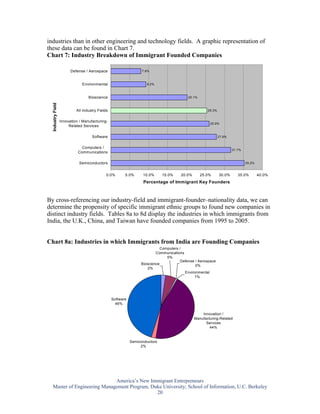
Immigrant entrepreneurs are not evenly represented across these seven technology fields.
Of all the companies we surveyed, 25.3% had one or more immigrant founder; but this
average varied by up to 18 percentage points between engineering- and technology-
industry classifications. Immigrant founders were more heavily concentrated in the
semiconductor (35.1%), computer/communications (31.7%), and software (27.9%)

                             America’s New Immigrant Entrepreneurs
  Master of Engineering Management Program, Duke University; School of Information, U.C. Berkeley
                                              19
industries than in other engineering and technology fields. A graphic representation of
these data can be found in Chart 7.
Chart 7: Industry Breakdown of Immigrant Founded Companies

                         Defense / Aerospace                       7.9%


                               Environmental                         9.2%


                                   Bioscience                                              20.1%
  Industry Field


                            All Industry Fields                                                       25.3%


                   Innovation / Manufacturing-
                                                                                                       25.9%
                        Related Services

                                     Software                                                                 27.9%


                               Computers /
                                                                                                                      31.7%
                             Communications

                              Semiconductors                                                                                  35.2%


                                              0.0%       5.0%      10.0%      15.0%    20.0%       25.0%      30.0%      35.0%        40.0%
                                                                   Percentage of Immigrant Key Founders


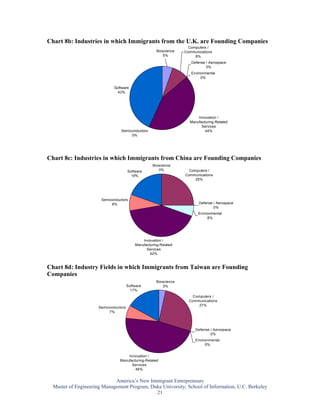
By cross-referencing our industry-field and immigrant-founder–nationality data, we can
determine the propensity of specific immigrant ethnic groups to found new companies in
distinct industry fields. Tables 8a to 8d display the industries in which immigrants from
India, the U.K., China, and Taiwan have founded companies from 1995 to 2005.


Chart 8a: Industries in which Immigrants from India are Founding Companies
                                                                             Computers /
                                                                          Communications
                                                                                5%
                                                                                        Defense / Aerospace
                                                                  Bioscience                    0%
                                                                      2%
                                                                                          Environmental
                                                                                               1%


                                                  Software
                                                    46%

                                                                                                   Innovation /
                                                                                               Manufacturing-Related
                                                                                                     Services
                                                                                                       44%


                                                             Semiconductors
                                                                  2%


                             America’s New Immigrant Entrepreneurs
  Master of Engineering Management Program, Duke University; School of Information, U.C. Berkeley
                                              20
Chart 8b: Industries in which Immigrants from the U.K. are Founding Companies
                                                                      Computers /
                                                       Bioscience   Communications
                                                          5%             8%
                                                                       Defense / Aerospace
                                                                               0%
                                                                       Environmental
                                                                            0%

                              Software
                                43%


                                                                          Innovation /
                                                                      Manufacturing-Related
                                                                            Services
                                 Semiconductors                               44%
                                      0%


Chart 8c: Industries in which Immigrants from China are Founding Companies
                                                    Bioscience
                                       Software         0%            Computers /
                                         19%                        Communications
                                                                         25%


                       Semiconductors
                            8%                                             Defense / Aerospace
                                                                                   0%
                                                                           Environmental
                                                                                6%


                                               Innovation /
                                           Manufacturing-Related
                                                 Services
                                                   42%


Chart 8d: Industry Fields in which Immigrants from Taiwan are Founding
Companies
                                                       Bioscience
                                       Software            3%
                                         17%
                                                                        Computers /
                                                                      Communications
                                                                           27%
                      Semiconductors
                           7%


                                                                         Defense / Aerospace
                                                                                 0%
                                                                         Environmental
                                                                              0%


                                     Innovation /
                                 Manufacturing-Related
                                       Services
                                         46%


                             America’s New Immigrant Entrepreneurs
  Master of Engineering Management Program, Duke University; School of Information, U.C. Berkeley
                                              21
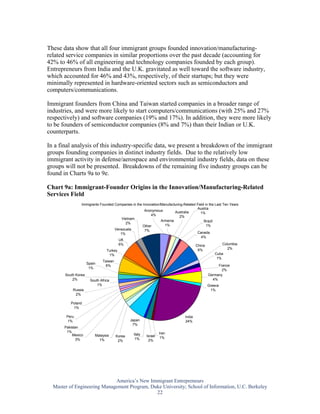
These data show that all four immigrant groups founded innovation/manufacturing-
related service companies in similar proportions over the past decade (accounting for
42% to 46% of all engineering and technology companies founded by each group).
Entrepreneurs from India and the U.K. gravitated as well toward the software industry,
which accounted for 46% and 43%, respectively, of their startups; but they were
minimally represented in hardware-oriented sectors such as semiconductors and
computers/communications.

Immigrant founders from China and Taiwan started companies in a broader range of
industries, and were more likely to start computers/communications (with 25% and 27%
respectively) and software companies (19% and 17%). In addition, they were more likely
to be founders of semiconductor companies (8% and 7%) than their Indian or U.K.
counterparts.

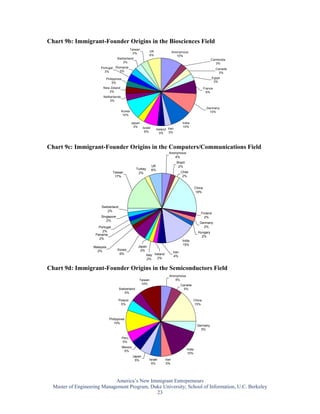
In a final analysis of this industry-specific data, we present a breakdown of the immigrant
groups founding companies in distinct industry fields. Due to the relatively low
immigrant activity in defense/aerospace and environmental industry fields, data on these
groups will not be presented. Breakdowns of the remaining five industry groups can be
found in Charts 9a to 9e.

Chart 9a: Immigrant-Founder Origins in the Innovation/Manufacturing-Related
Services Field
                Immigrants Founded Companies in the Innovation/Manufacturing-Related Field in the Last Ten Years
                                                                                     Austria
                                                     Anonymous         Australia        1%
                                                         4%               2%
                                         Vietnam
                                                               Armenia                    Brazil
                                           2%
                                                    Other        1%                         1%
                                     Venezuela       7%
                                        1%                                           Canada
                                                                                        4%
                                       UK
                                       6%                                           China              Columbia
                                                                                      6%                  2%
                                Turkey
                                  1%                                                              Cuba
                                                                                                   1%
                            Taiwan
                   Spain
                               6%                                                                   France
                    1%
                                                                                                      2%
       South Korea                                                                           Germany
           2%        South Africa                                                                4%
                          1%                                                                 Greece
           Russia                                                                             1%
            2%

          Poland
           1%

        Peru                                                                   India
         1%                                   Japan                            24%
                                               7%
       Pakistan
        1%                                                       Iran
           Mexico        Malaysia    Korea      Italy   Israel
                                                 1%               1%
              3%           1%         2%                 2%


                             America’s New Immigrant Entrepreneurs
  Master of Engineering Management Program, Duke University; School of Information, U.C. Berkeley
                                              22
Chart 9b: Immigrant-Founder Origins in the Biosciences Field
                                                Taiwan
                                                               UK                 Anonymous
                                                 3%
                                                               6%                    10%
                                    Switzerland                                                                  Cambodia
                                        3%                                                                         3%
                        Portugal Romania                                                                              Canada
                          3%       3%
                                                                                                                        3%

                           Philippines                                                                            Egypt
                               3%                                                                                  3%

                          New Zeland                                                                         France
                             3%                                                                                6%
                          Netherlands
                              3%

                                                                                                               Germany
                                        Korea                                                                    10%
                                         10%

                                                Japan                                     India
                                                 3%   Israel                              10%
                                                                    Ireland Iran
                                                       6%             3%     3%


Chart 9c: Immigrant-Founder Origins in the Computers/Communications Field
                                                                             Anonymous
                                                                                4%
                                                                                    Brazil
                                                               UK                    2%
                                                     Turkey    6%
                                  Taiwan              2%                                 Chile
                                   17%                                                    2%


                                                                                                     China
                                                                                                     19%


                         Switzerland
                             2%
                                                                                                        Finland
                        Singapore                                                                         2%
                           2%
                                                                                                        Germany
                       Portugal                                                                           2%
                         2%                                                                            Hungary
                     Panama
                                                                                                         2%
                       2%
                                                                                         India
                                                                                         15%
                    Malaysia                          Japan
                      2%             Korea             2%
                                      6%                                          Iran
                                                           Italy Ireland          4%
                                                            2%     2%


Chart 9d: Immigrant-Founder Origins in the Semiconductors Field
                                                                             Anonymous
                                                      Taiwan                    5%
                                                       10%                               Canada
                                       Switzerland                                         5%
                                           5%

                                       Poland                                                     China
                                        5%                                                        15%


                               Philippines
                                  10%
                                                                                                      Germany
                                                                                                        5%

                                         Peru
                                          5%
                                         Mexico
                                                                                             India
                                          5%
                                                                                             15%
                                                  Japan
                                                   5%         Israel       Iran
                                                               5%          5%


                             America’s New Immigrant Entrepreneurs
  Master of Engineering Management Program, Duke University; School of Information, U.C. Berkeley
                                              23
Chart 9e: Immigrant-Founder Origins in the Software Field
                                                                   Anonymous         Canada
                                                                      2%               3%
                                                             Other       Australia
                                                                           3%            China
                                                              9%
                                                                                          4%
                              Taiwan
                               3%              UK                                      France
                                               9%                                        2%
                             Russia
                              1%                                                             Germany
                           Romania                                                             5%
                             1%
                             Poland
                              1%
                         Philippines
                             2%
                        Netherlands
                            3%
                               Korea
                                2%                                                   India
                                 Japan                                               34%
                                  3%
                                                             Iran
                                       Italy                  4%
                                        2%
                                                    Israel
                                                     6%


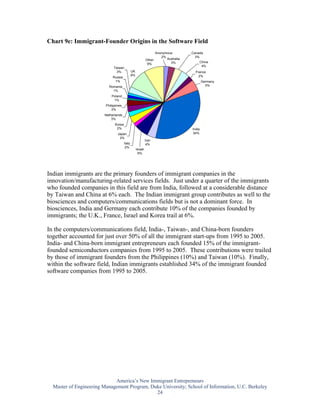
Indian immigrants are the primary founders of immigrant companies in the
innovation/manufacturing-related services fields. Just under a quarter of the immigrants
who founded companies in this field are from India, followed at a considerable distance
by Taiwan and China at 6% each. The Indian immigrant group contributes as well to the
biosciences and computers/communications fields but is not a dominant force. In
biosciences, India and Germany each contribute 10% of the companies founded by
immigrants; the U.K., France, Israel and Korea trail at 6%.

In the computers/communications field, India-, Taiwan-, and China-born founders
together accounted for just over 50% of all the immigrant start-ups from 1995 to 2005.
India- and China-born immigrant entrepreneurs each founded 15% of the immigrant-
founded semiconductors companies from 1995 to 2005. These contributions were trailed
by those of immigrant founders from the Philippines (10%) and Taiwan (10%). Finally,
within the software field, Indian immigrants established 34% of the immigrant founded
software companies from 1995 to 2005.


                             America’s New Immigrant Entrepreneurs
  Master of Engineering Management Program, Duke University; School of Information, U.C. Berkeley
                                              24
Data Analysis – WIPO Patent Records
In this study we also examined the intellectual-property contributions of immigrant non-
citizens. These are foreign nationals who currently reside in the U.S. but have not
received citizenship. We analyzed the World Intellectual Property Organization (WIPO)
Patent Cooperation Treaty (PCT) records for the U.S. based international patent filings of
U.S. resident inventors. A PCT application is a type of international patent application
that allows for an applicant to seek patent protection simultaneously in many countries.

We found that U.S. immigrant non-citizen inventors and co-inventors appeared on 14.8%
of these patent filings from 1998 to 2006 (a small proportion of these records include pre-
1998 filings). We estimate that in 2006, 24.2% of PCT applications had immigrant non-
citizen inventors or co-inventors. This is a dramatic increase from an estimated 7.3% in
1998.

WIPO PCT Applications by U.S. Immigrant Nationality

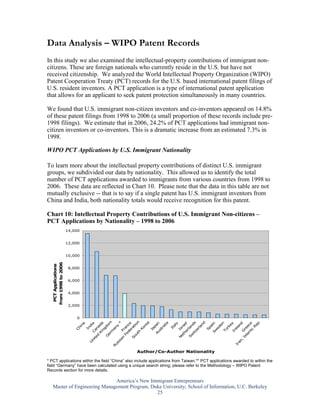
To learn more about the intellectual property contributions of distinct U.S. immigrant
groups, we subdivided our data by nationality. This allowed us to identify the total
number of PCT applications awarded to immigrants from various countries from 1998 to
2006. These data are reflected in Chart 10. Please note that the data in this table are not
mutually exclusive -- that is to say if a single patent has U.S. immigrant inventors from
China and India, both nationality totals would receive recognition for this patent.

Chart 10: Intellectual Property Contributions of U.S. Immigrant Non-citizens –
PCT Applications by Nationality – 1998 to 2006
                       14,000


                       12,000


                       10,000
  from 1998 to 2006
    PCT Applications


                        8,000


                        6,000


                        4,000


                        2,000


                           0
                                                        n


                                                                                           .
                                                     om


                                                      ea


                                                                                       nd
                                                                              itz ds
                                                       *


                                                               ia


                                                                                       en
                                               in a


                                                                                         d


                                                                                       ep
                                              de ce


                                                                               m ce
                                                                                       ey
                                                         us n
                             na


                                                                                        in
                                                                                         y
                                                       a


                                                                                  rl l
                                                    tio


                                                                              he e
                                                   ad


                                                                                     an
                                                            pa
                                                    di


                                                                                      al
                                                             al
                                                     y


                                                                                     ra


                                                                                    pa
                                                                                    an
                                                   or


                                                                                     la


                                                                            la ee
                                           Fe n


                                                                                    rk
                                                                                   ed


                                                                                     R
                                                  gd
                           hi


                                                 an


                                                  ra


                                                                                   It
                                                 In


                                                           tr
                                                 ra
                                        te Can


                                                                                  el
                                                          Ja


                                                                                  Is


                                                                                 er
                                                 K


                                                                                  S
                          C


                                                                                Tu


                                                                                 ic
                                                                          Is Gr
                                                                                 w
                                              m


                                                                                Ir
                                       an F


                                             th


                                                                               S
                                             K


                                                        A
                                            er


                                          ou


                                                                            et

                                                                            w
                                           d

                                          G


                                                                          S
                                                                          N
                                         S
                                      ni


                                                                        ,
                                     si


                                                                      an
                                    U


                                   us


                                                                    Ir
                                  R


                                                    Author/Co-Author Nationality

* PCT applications within the field “China” also include applications from Taiwan.** PCT applications awarded to within the
field “Germany” have been calculated using a unique search string; please refer to the Methodology – WIPO Patent
Records section for more details.

                              America’s New Immigrant Entrepreneurs
   Master of Engineering Management Program, Duke University; School of Information, U.C. Berkeley
                                               25
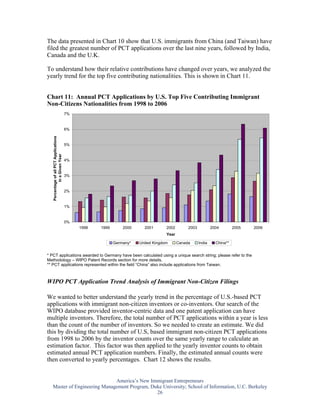
The data presented in Chart 10 show that U.S. immigrants from China (and Taiwan) have
filed the greatest number of PCT applications over the last nine years, followed by India,
Canada and the U.K.

To understand how their relative contributions have changed over years, we analyzed the
yearly trend for the top five contributing nationalities. This is shown in Chart 11.


Chart 11: Annual PCT Applications by U.S. Top Five Contributing Immigrant
Non-Citizens Nationalities from 1998 to 2006
                                        7%


                                        6%
   Percentage of all PCT Applications


                                        5%
            in a Given Year


                                        4%


                                        3%


                                        2%


                                        1%


                                        0%
                                             1998   1999       2000     2001       2002        2003           2004        2005   2006
                                                                                   Year

                                                           Germany*   United Kingdom      Canada      India     China**


* PCT applications awarded to Germany have been calculated using a unique search string; please refer to the
Methodology – WIPO Patent Records section for more details.
** PCT applications represented within the field “China” also include applications from Taiwan.


WIPO PCT Application Trend Analysis of Immigrant Non-Citizen Filings

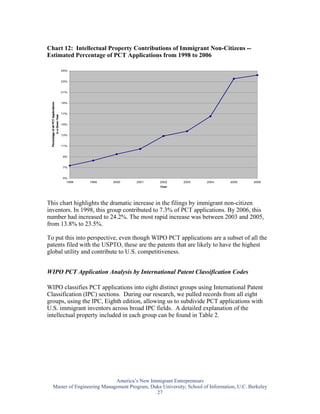
We wanted to better understand the yearly trend in the percentage of U.S.-based PCT
applications with immigrant non-citizen inventors or co-inventors. Our search of the
WIPO database provided inventor-centric data and one patent application can have
multiple inventors. Therefore, the total number of PCT applications within a year is less
than the count of the number of inventors. So we needed to create an estimate. We did
this by dividing the total number of U.S, based immigrant non-citizen PCT applications
from 1998 to 2006 by the inventor counts over the same yearly range to calculate an
estimation factor. This factor was then applied to the yearly inventor counts to obtain
estimated annual PCT application numbers. Finally, the estimated annual counts were
then converted to yearly percentages. Chart 12 shows the results.


                              America’s New Immigrant Entrepreneurs
   Master of Engineering Management Program, Duke University; School of Information, U.C. Berkeley
                                               26
Chart 12: Intellectual Property Contributions of Immigrant Non-Citizens --
Estimated Percentage of PCT Applications from 1998 to 2006

                                                         25%


                                                         23%


                                                         21%
  Percentage of all PCT Applications


                                                         19%


                                                         17%
                                       in a Given Year


                                                         15%


                                                         13%


                                                         11%


                                                         9%


                                                         7%


                                                         5%
                                                           1998   1999   2000   2001   2002   2003   2004   2005   2006
                                                                                       Year


This chart highlights the dramatic increase in the filings by immigrant non-citizen
inventors. In 1998, this group contributed to 7.3% of PCT applications. By 2006, this
number had increased to 24.2%. The most rapid increase was between 2003 and 2005,
from 13.8% to 23.5%.

To put this into perspective, even though WIPO PCT applications are a subset of all the
patents filed with the USPTO, these are the patents that are likely to have the highest
global utility and contribute to U.S. competitiveness.


WIPO PCT Application Analysis by International Patent Classification Codes

WIPO classifies PCT applications into eight distinct groups using International Patent
Classification (IPC) sections. During our research, we pulled records from all eight
groups, using the IPC, Eighth edition, allowing us to subdivide PCT applications with
U.S. immigrant inventors across broad IPC fields. A detailed explanation of the
intellectual property included in each group can be found in Table 2.


                                      America’s New Immigrant Entrepreneurs
           Master of Engineering Management Program, Duke University; School of Information, U.C. Berkeley
                                                       27
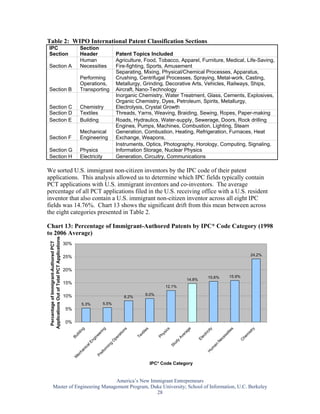
Table 2: WIPO International Patent Classification Sections
IPC                                                      Section
Section                                                  Header                       Patent Topics Included
                                                         Human                        Agriculture, Food, Tobacco, Apparel, Furniture, Medical, Life-Saving,
Section A                                                Necessities                  Fire-fighting, Sports, Amusement
                                                                                      Separating, Mixing, Physical/Chemical Processes, Apparatus,
                                                         Performing                   Crushing, Centrifugal Processes, Spraying, Metal-work, Casting,
                                                         Operations,                  Metallurgy, Grinding, Decorative Arts, Vehicles, Railways, Ships,
Section B                                                Transporting                 Aircraft, Nano-Technology
                                                                                      Inorganic Chemistry, Water Treatment, Glass, Cements, Explosives,
                                                                                      Organic Chemistry, Dyes, Petroleum, Spirits, Metallurgy,
Section C                                                Chemistry                    Electrolysis, Crystal Growth
Section D                                                Textiles                     Threads, Yarns, Weaving, Braiding, Sewing, Ropes, Paper-making
Section E                                                Building                     Roads, Hydraulics, Water-supply, Sewerage, Doors, Rock drilling
                                                                                      Engines, Pumps, Machines, Combustion, Lighting, Steam
                                                         Mechanical                   Generation, Combustion, Heating, Refrigeration, Furnaces, Heat
Section F                                                Engineering                  Exchange, Weapons,
                                                                                      Instruments, Optics, Photography, Horology, Computing, Signaling,
Section G                                                Physics                      Information Storage, Nuclear Physics
Section H                                                Electricity                  Generation, Circuitry, Communications

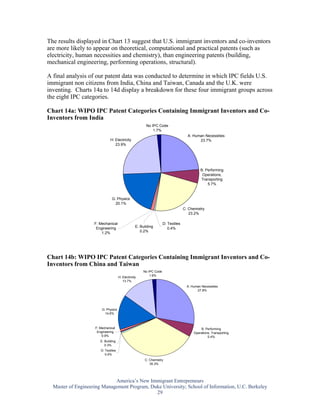
We sorted U.S. immigrant non-citizen inventors by the IPC code of their patent
applications. This analysis allowed us to determine which IPC fields typically contain
PCT applications with U.S. immigrant inventors and co-inventors. The average
percentage of all PCT applications filed in the U.S. receiving office with a U.S. resident
inventor that also contain a U.S. immigrant non-citizen inventor across all eight IPC
fields was 14.76%. Chart 13 shows the significant drift from this mean between across
the eight categories presented in Table 2.

Chart 13: Percentage of Immigrant-Authored Patents by IPC* Code Category (1998
to 2006 Average)
 Applications Out of Total PCT Applications
  Percentage of Immigrant-Authored PCT


                                              30%

                                                                                                                                                                            24.2%
                                              25%

                                              20%
                                                                                                                                                 15.6%         15.9%
                                                                                                                                    14.8%
                                              15%
                                                                                                                      12.1%

                                              10%                                                           9.0%
                                                                                              8.2%
                                                           5.3%            5.5%
                                              5%

                                              0%
                                                                          g


                                                                                                                                                   ty
                                                                                                                      s


                                                                                                                                     e
                                                            g


                                                                                          ns


                                                                                                                                                                 s


                                                                                                                                                                            ry
                                                                                                          es


                                                                                                                     ic


                                                                                                                                                              tie
                                                                        rin


                                                                                                                                   ag
                                                          in


                                                                                                                                                ci


                                                                                                                                                                           t
                                                                                        io


                                                                                                           il


                                                                                                                                                                        is
                                                                                                                     ys
                                                      i ld


                                                                                                                                            tri
                                                                                                        xt


                                                                                                                                                            si
                                                                     ee


                                                                                                                                 er


                                                                                                                                                                        m
                                                                                          t
                                                                                       ra


                                                                                                                   Ph


                                                                                                                                                          es
                                                                                                     Te


                                                                                                                                           ec
                                                    Bu


                                                                                                                               Av


                                                                                                                                                                      he
                                                                   in


                                                                                    pe


                                                                                                                                                         ec
                                                                                                                                         El
                                                                  ng


                                                                                                                                                                     C
                                                                                                                                y
                                                                                   O


                                                                                                                                                        N
                                                                                                                             ud
                                                                lE


                                                                                 g


                                                                                                                                                   an
                                                                                                                          St
                                                                              in
                                                            ca


                                                                                                                                                 um
                                                                             m
                                                          ni


                                                                           or
                                                        ha


                                                                                                                                                H
                                                                         ef
                                                     ec


                                                                       Pr
                                                    M


                                                                                                                IPC* Code Category


                                     America’s New Immigrant Entrepreneurs
          Master of Engineering Management Program, Duke University; School of Information, U.C. Berkeley
                                                      28
The results displayed in Chart 13 suggest that U.S. immigrant inventors and co-inventors
are more likely to appear on theoretical, computational and practical patents (such as
electricity, human necessities and chemistry), than engineering patents (building,
mechanical engineering, performing operations, structural).

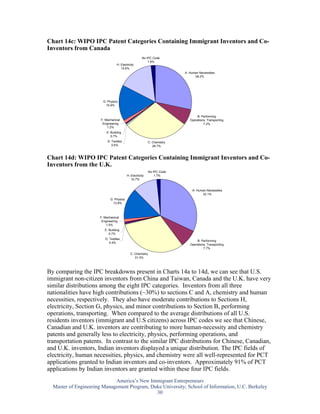
A final analysis of our patent data was conducted to determine in which IPC fields U.S.
immigrant non citizens from India, China and Taiwan, Canada and the U.K. were
inventing. Charts 14a to 14d display a breakdown for these four immigrant groups across
the eight IPC categories.

Chart 14a: WIPO IPC Patent Categories Containing Immigrant Inventors and Co-
Inventors from India
                                                        No IPC Code
                                                            1.7%
                                                                                     A: Human Necessities
                              H: Electricity                                               23.7%
                                 23.9%


                                                                                             B: Performing
                                                                                              Operations,
                                                                                             Transporting
                                                                                                 5.7%


                               G: Physics
                                 20.1%
                                                                                   C: Chemistry
                                                                                      23.2%

                    F: Mechanical                                    D: Textiles
                     Engineering                  E: Building           0.4%
                        1.2%                         0.2%


Chart 14b: WIPO IPC Patent Categories Containing Immigrant Inventors and Co-
Inventors from China and Taiwan
                                                       No IPC Code
                                                           1.6%
                                     H: Electricity
                                        13.7%
                                                                                     A: Human Necessities
                                                                                           27.8%


                        G: Physics
                          14.6%


                    F: Mechanical                                                            B: Performing
                     Engineering                                                         Operations, Transporting
                        0.9%                                                                      5.4%
                       E: Building
                          0.3%
                       D: Textiles
                          0.4%
                                                       C: Chemistry
                                                          35.3%


                             America’s New Immigrant Entrepreneurs
  Master of Engineering Management Program, Duke University; School of Information, U.C. Berkeley
                                              29
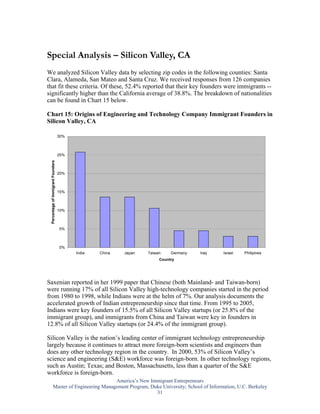
Chart 14c: WIPO IPC Patent Categories Containing Immigrant Inventors and Co-
Inventors from Canada
                                                      No IPC Code
                                                          1.9%
                                  H: Electricity
                                     15.6%
                                                                          A: Human Necessities
                                                                                28.2%


                        G: Physics
                          15.9%


                                                                                 B: Performing
                       F: Mechanical                                         Operations, Transporting
                        Engineering                                                   7.2%
                           1.2%
                          E: Building
                             0.7%
                           D: Textiles                     C: Chemistry
                              0.5%                            28.7%


Chart 14d: WIPO IPC Patent Categories Containing Immigrant Inventors and Co-
Inventors from the U.K.
                                                            No IPC Code
                                          H: Electricity        1.7%
                                             10.7%


                                                                               A: Human Necessities
                                                                                     32.1%
                             G: Physics
                               13.9%


                      F: Mechanical
                       Engineering
                          1.5%
                         E: Building
                            0.7%
                         D: Textiles
                                                                                 B: Performing
                            0.4%
                                                                             Operations, Transporting
                                                                                      7.7%
                                             C: Chemistry
                                                31.3%


By comparing the IPC breakdowns present in Charts 14a to 14d, we can see that U.S.
immigrant non-citizen inventors from China and Taiwan, Canada and the U.K. have very
similar distributions among the eight IPC categories. Inventors from all three
nationalities have high contributions (~30%) to sections C and A, chemistry and human
necessities, respectively. They also have moderate contributions to Sections H,
electricity, Section G, physics, and minor contributions to Section B, performing
operations, transporting. When compared to the average distributions of all U.S.
residents inventors (immigrant and U.S citizens) across IPC codes we see that Chinese,
Canadian and U.K. inventors are contributing to more human-necessity and chemistry
patents and generally less to electricity, physics, performing operations, and
transportation patents. In contrast to the similar IPC distributions for Chinese, Canadian,
and U.K. inventors, Indian inventors displayed a unique distribution. The IPC fields of
electricity, human necessities, physics, and chemistry were all well-represented for PCT
applications granted to Indian inventors and co-inventors. Approximately 91% of PCT
applications by Indian inventors are granted within these four IPC fields.
                             America’s New Immigrant Entrepreneurs
  Master of Engineering Management Program, Duke University; School of Information, U.C. Berkeley
                                              30
Special Analysis – Silicon Valley, CA
We analyzed Silicon Valley data by selecting zip codes in the following counties: Santa
Clara, Alameda, San Mateo and Santa Cruz. We received responses from 126 companies
that fit these criteria. Of these, 52.4% reported that their key founders were immigrants --
significantly higher than the California average of 38.8%. The breakdown of nationalities
can be found in Chart 15 below.

Chart 15: Origins of Engineering and Technology Company Immigrant Founders in
Silicon Valley, CA

                                    30%


                                    25%
 Percentage of Immigrant Founders


                                    20%


                                    15%


                                    10%


                                    5%


                                    0%
                                          India   China   Japan   Taiwan    Germany   Iraq   Israel   Philipines
                                                                       Country


Saxenian reported in her 1999 paper that Chinese (both Mainland- and Taiwan-born)
were running 17% of all Silicon Valley high-technology companies started in the period
from 1980 to 1998, while Indians were at the helm of 7%. Our analysis documents the
accelerated growth of Indian entrepreneurship since that time. From 1995 to 2005,
Indians were key founders of 15.5% of all Silicon Valley startups (or 25.8% of the
immigrant group), and immigrants from China and Taiwan were key in founders in
12.8% of all Silicon Valley startups (or 24.4% of the immigrant group).

Silicon Valley is the nation’s leading center of immigrant technology entrepreneurship
largely because it continues to attract more foreign-born scientists and engineers than
does any other technology region in the country. In 2000, 53% of Silicon Valley’s
science and engineering (S&E) workforce was foreign-born. In other technology regions,
such as Austin; Texas; and Boston, Massachusetts, less than a quarter of the S&E
workforce is foreign-born.
                                        America’s New Immigrant Entrepreneurs
             Master of Engineering Management Program, Duke University; School of Information, U.C. Berkeley
                                                         31
Between 1990 and 2000, the population of Indian scientists and engineers (S&E) in
Silicon Valley grew by 646% (while the total foreign-born S&E workforce grew by
246% and the region’s total population of S&E, both native and foreign-born, grew by
only 103%).ii In short, the growth of Indian entrepreneurship reflected the influx of
Indian scientists and engineers to the region.

Silicon Valley’s immigrant entrepreneurs led the nation in the 1990s by starting dynamic
technology businesses that generate substantial wealth and employment in the U.S.
Today they are contributing to the creation of new centers of technology and skill in their
home countries. As these entrepreneurs collaborate with former classmates and
colleagues in once peripheral economies like India and China, they are providing access
to the markets and know-how that are critical to success in today’s global economy.iii


                             America’s New Immigrant Entrepreneurs
  Master of Engineering Management Program, Duke University; School of Information, U.C. Berkeley
                                              32
Special Analysis – Research Triangle Park, NC
As our data showed, North Carolina has one the lowest percentages of immigrant-
founded engineering and technology companies (13.9% vs. a national average of 25.3%).
We believe this is for several reasons: its economic strengths for much of the past
century were in traditional manufacturing and agricultural products (textiles and apparel,
furniture, and tobacco); it has had very small venture capital markets; and until recently,
it had relatively low numbers of immigrants.

Research Triangle Park (RTP) has been a flourishing hub of high-technology activity in
the last few decades however, especially in the information technology (I.T.) and
biotechnology areas. While the initial companies that were associated with these two
sectors were large-scale enterprises (such as IBM and SAS in I.T., and big
pharmaceuticals in the biotechnology sector), in recent years there has been a spate of
new decentralized technologies connected with IT and biotechnology that have led to the
proliferation of entrepreneurial opportunities in RTP.

We wanted to determine if RTP had a higher concentration of immigrant entrepreneurs
than the rest of the state. Our random sample from the primary survey did not provide
enough data for this analysis. So we created an additional dataset from the D&B database
and conducted a new survey of this area.

We received responses from 107 companies, and 18.7% of these reported that they had an
immigrant as a key founder. This compares to the state average of 13.9%.

A breakdown of our survey statistics and response rates can be found in Table 3 below.

Table 3: Founder Survey Statistics and Response Rates for RTP, NC

                                                                       Count           Variable
Total "Yes" Responses:                                                  20                a
Total "No" Responses:                                                   87                b
"Decline to Comment/Participate" Responses: Too Busy,
Unwilling to Provide Information, No Data/Knowledge                      5                c
"Missing Random Data": Bad Phone Numbers, Disconnected
Calls, Hang Ups, Requests for Call Backs and Answering
Machines                                                                 66               d

Total Companies Approached:                                             178               e


Response Rate R1 (The number of survey responses
obtained out of total survey delivery attempts) [(a+b)/e]                      60.1%
Response Rate R2 (The number of survey responses
obtained out of total surveys actually delivered)
[(a+b)/(a+b+c)]                                                                95.5%


                             America’s New Immigrant Entrepreneurs
  Master of Engineering Management Program, Duke University; School of Information, U.C. Berkeley
                                              33
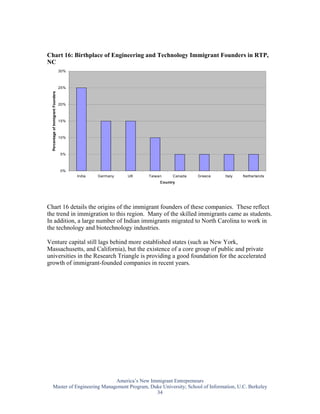
Chart 16: Birthplace of Engineering and Technology Immigrant Founders in RTP,
NC
                                     30%


                                     25%
  Percentage of Immigrant Founders


                                     20%


                                     15%


                                     10%


                                     5%


                                     0%
                                           India   Germany   UK   Taiwan     Canada   Greece   Italy   Netherlands
                                                                       Country


Chart 16 details the origins of the immigrant founders of these companies. These reflect
the trend in immigration to this region. Many of the skilled immigrants came as students.
In addition, a large number of Indian immigrants migrated to North Carolina to work in
the technology and biotechnology industries.

Venture capital still lags behind more established states (such as New York,
Massachusetts, and California), but the existence of a core group of public and private
universities in the Research Triangle is providing a good foundation for the accelerated
growth of immigrant-founded companies in recent years.


                               America’s New Immigrant Entrepreneurs
    Master of Engineering Management Program, Duke University; School of Information, U.C. Berkeley
                                                34
Summary of Results and Conclusion
This purpose of this research was to assess the contribution of skilled immigrants in the
creation of engineering and technology businesses and intellectual property in the United
States.

We found there was at least one immigrant key founder in 25.3% of all engineering and
technology companies established in the U.S. between 1995 and 2005 inclusive. We
estimate that together, this pool of immigrant-founded companies was responsible for
generating more than $52 billion in 2005 sales and creating just under 450,000 jobs as of
2005. These immigrants come to the U.S. from all over the world to take advantage of the
business, technology and economic opportunities in the country. Almost 26% of all
immigrant-founded companies in the last ten years were founded by Indian immigrants.
Immigrants from the U.K., China, and Taiwan contributed to 7.1%, 6.9% and 5.8% of all
immigrant-founded businesses, respectively.

These immigrant-founded businesses are unevenly located across the country. California
and New Jersey represented hot spots for immigrant-founded engineering and technology
business; Washington and Ohio possessed relatively low percentages of immigrant-
founded businesses. Some immigrant groups displayed tendencies to start businesses in a
particular state. For example, 81% of businesses founded by Taiwanese immigrants were
located in California. These immigrant-founders were most likely to start companies in
innovation/manufacturing related services, computers/communications, and
semiconductors, and less in the defense/aerospace and environmental industries.

We also gathered extensive data from the World Intellectual Property Organization’s
PCT database on the international patent filings of U.S. residents who are also foreign
nationals. This analysis allowed us to gauge the contributions of immigrants to
intellectual property that likely has high global utility.

In the period 1998 to 2006, immigrant non-citizen inventors and co-inventors appeared
on 14.76% of U.S. PCT applications. The trend has been dramatic; according to our
estimates the contribution of non-citizen immigrants to these international patent
applications increased from 7.3% in 1998 to 24.2% in 2006.

U.S. immigrants who were named as inventors or co-inventors on PCT applications often
were so named in the IPC fields of chemistry, human necessities and electricity, and are
less likely to invent in the fields of building, mechanical engineering, performing
operations and textiles.

This research shows that immigrants have become a significant driving force in the
creation of new businesses and intellectual property in the U.S. — and that their
contributions have increased over the past decade.

The key to maintaining U.S. competitiveness in a global economy is to understand our
strengths and to effectively leverage these. Skilled immigrants are one of our greatest
advantages.

                             America’s New Immigrant Entrepreneurs
  Master of Engineering Management Program, Duke University; School of Information, U.C. Berkeley
                                              35
Author Biographies
Dr. Gary Gereffi
Dr. Gary Gereffi is Professor of Sociology and Director of the Center on Globalization,
Governance & Competitiveness at Duke University. He holds a B.A. from the University
of Notre Dame and a Ph.D. from Yale University. He has published several books and
articles on business-government relations in various parts of the world. His recent books
include: The Value of Value Chains: Spreading the Gains from Globalization (special
issue of the IDS Bulletin, vol. 32, no. 3, July 2001), Free Trade and Uneven
Development: The North American Apparel Industry after NAFTA, (Temple University
Press, 2002); and The New Offshoring of Jobs and Global Development (International
Labor Organization, 2006).

Ben Rissing
Ben Rissing is a Research Scholar with Duke University’s Pratt School of Engineering
and the Project Manager of Duke’s engineering outsourcing and immigration research
teams. He has a Bachelor’s in Mechanical Engineering from the University of Virginia
and a Masters in Engineering Management from Duke. He has been involved in a variety
of initiatives ranging from engineering design/technology commercialization to
cardiovascular laboratory research and public-policy development in Washington DC.
Mr. Rissing has traveled extensively, enjoys multiculturalism, and is a nationally ranked
competitive fencer.

Dr. AnnaLee Saxenian
AnnaLee Saxenian has made a career of studying regional economies and the conditions
under which people, ideas, and geographies combine and connect to hubs of economic
activity. Her latest book, The New Argonauts: Regional Advantage in a Global Economy
(Harvard University Press, 2006), explores how and why immigrant engineers from
Silicon Valley are transferring their technology entrepreneurship to emerging regions in
their home countries—China and India in particular—and launching companies far from
established centers of skill and technology. The "brain drain" she argues, has now
become "brain circulation"—a powerful economic force for the development of formerly
peripheral regions that is sparking profound transformations in the global economy.
Saxenian is also the author of Regional Advantage: Culture and Competition in Silicon
Valley and Route 128 (Harvard University Press, 1994.) She is currently Dean and
Professor at the U.C. Berkeley School of Information, and she has a PhD from MIT and a
BA from Willams College.

Vivek Wadhwa
Vivek Wadhwa is a technology entrepreneur and an Executive in Residence/Adjunct
Professor for the Pratt School of Engineering at Duke University. He is an active mentor
and advisor to various startups and is also a columnist for BusinessWeek.com. Wadhwa
was named a "Leader of Tomorrow" by Forbes.com, and his company Relativity
Technologies was named as one of the 25 "coolest" companies in the world by Fortune
Magazine. Mr. Wadhwa holds a B.A. in Computing Studies from Canberra University in
Australia and an MBA from New York University.


                             America’s New Immigrant Entrepreneurs
  Master of Engineering Management Program, Duke University; School of Information, U.C. Berkeley
                                              36
Appendix A: High Technology Industry Definition
U.S. Government defined Standard Industrial Classification (SIC) codes

Industry                                                                          SIC

Semiconductors
Special industry machinery                                                        3559
Semiconductors and related devices                                                3674
Instruments for measuring and testing electricity and electrical signals          3825

Computers/Communications
Electronic computers                                                              3571
Computer storage devices                                                          3572
Computer peripheral equipment, n.e.c.                                             3577
Printed circuit boards                                                            3672
Electronic components, n.e.c.                                                     3679
Magnetic and optical recording media                                              3695
Telephone and telegraph apparatus                                                 3661
Radio and television broadcasting and communications equipment                    3663
Communications equipment, n.e.c.                                                  3669

Bioscience
Drugs                                                                             283
Surgical medical and dental instruments and supplies                              384
Medical laboratories                                                              8071
Laboratory apparatus and analytical, optical, measuring, and controlling          382 (except
instruments                                                                       3822, 3825 and
                                                                                  3826)


Defense/Aerospace
Small arms ammunition                                                             348
Electron tubes                                                                    3671
Aircraft and parts                                                                372
Guided missiles and space vehicles                                                376
Tanks and tank components                                                         3795
Search, detection, navigation, guidance, aeronautical and nautical systems        381
Instruments and equipment


Environmental
Industrial and commercial fans and blowers and air purification equipment         3564
Service industry machinery, n.e.c.                                                3589
Sanitary services                                                                 495
Scrap and waste materials                                                         5093

                             America’s New Immigrant Entrepreneurs
  Master of Engineering Management Program, Duke University; School of Information, U.C. Berkeley
                                              37
Software
Computer programming services                                                     7371
Prepackaged software                                                              7372
Computer integrated systems design                                                7373
Computer processing and data preparation and processing services                  7374
Information retrieval services                                                    7375

Innovation/Manufacturing-Related Services
Computers and computer peripheral equipment and software (wholesale               5045
trade)
Electronics parts and equipment, n.e.c. (wholesale trade)                         5065
Computer facilities management services                                           7376
Computer rental and leasing                                                       7377
Computer maintenance and repair                                                   7378
Computer-related services, n.e.c.                                                 7379
Engineering services                                                              8711
Research and testing services                                                     873


Note: Our SIC listings differ slightly from those employed by AnnaLee Saxenian in her
1999 report “Silicon Valley’s New Immigrant Entrepreneurs”. Our present research
focuses strictly on engineering and technology companies. As a result we did not analyze
Professional Services companies (SIC 275, 276, 279, 731,732, 733, 736, 81, 8721, 8713,
872 and 874) which were included in Saxenian’s 1999 study, but were outside the
purview of the engineering and technology disciplines.

                             America’s New Immigrant Entrepreneurs
  Master of Engineering Management Program, Duke University; School of Information, U.C. Berkeley
                                              38
Appendix B: WIPO Search Strings

Our search of the WIPO PCT application database was conducted using Neopatents
Spore® Search software. Though the search strings we used could be replicated on the
WIPO website, Spore® allowed us increased flexibility. Spore® permitted our team to
combine WIPO PCT search results into “SmartSets” that eliminated overlapping data and
records that were multiple-counted. Spore® Search also allowed full datasets to be output
into Excel for greater flexibility in analysis and processing. After completing our
searches through Spore® we exported our data to Excel where we were able to classify it
by inventor nationality and technology area of invention. A differentiation based on
technology area was made possible by utilizing the International Patent Classification
(IPC) Codes published by WIPO.

WIPO PCT Search Strings


an/US* AND ( ana/xx NEAR are/US).
   where xx is the “country code” for a specific applicant/inventor nationality.


The components of the search string are explained as follows:
   an/US* - This phrase identifies all patent applications filed through WIPO’s US
      receiving office.
   ana/xx - The “ana” phrase stands for “applicant nationality”. “xx” represents the
      country code we’re searching for. For example, India would be “IN”, and France
      would be “FR.” Please note that in all countries except for the US, the applicant
      may be a company. However, for PCT applications that designate the US (only or
      in addition to other countries), which includes almost all PCT applications, the
      applicant field should also list the inventors due to requirements of the US patent
      laws.
   are/US - The “are” phrase stands for “applicant residence”. The generic form of the
       phrase is are/xx where “xx” can stand for any country. In this case, we’re looking
       for applicants residing in the U.S., and hence we replace “xx” with “U.S.”
   NEAR – “NEAR” is a proximity connector that looks for records having terms within
     20 characters of each other. During the course of our search we observed that
     using “AND” between the “ana” and “are” phrases resulted in records that had
     inventors resident in countries other than the US. For example, usage of AND to
     search for records that would come under JP/US (a Japanese national residing in
     the US) also fetched records that qualified with two or more inventors but not
     within our target; e.g. one document with two inventors, one inventor listed as
     JP/JP (Japanese national residing in Japan) and another as US/US (US national
     residing in the US). Usage of the “NEAR” phrase helped eliminate this, and
     fetched primarily records that qualified with inventors under the xx/US category
     (xx national residing in the US).

                             America’s New Immigrant Entrepreneurs
  Master of Engineering Management Program, Duke University; School of Information, U.C. Berkeley
                                              39
WIPO Data Special Considerations


While auditing our data we found that search strings for Germany (an/US* and (ana/DE
NEAR are/US) were not acquiring accurate records from the WIPO German database.
After several consultations with Neopatents CTO, we determined that this search error
was due to the manner in which German PCT information is populated. To compensate
for this, we adopted a special search string for Germany (an/US* and "DE US"). To
validate data pulled from this unique string we audited search results by randomly
checking the full patent records associated with our search results. We ultimately found
this string to be a reliable means of querying data for German foreign nationals. A note
regarding the specialized German search string has been included in all of our graphs in
the Data Analysis – WIPO Patent Records section of this report.


For a portion of our patent-data analysis, we compared the number of patents granted to
US immigrants under PCT as a percentage of total patents granted across a number of
different technology fields. This analysis required our group to index all WIPO U.S.-
resident filings (342,101 documents). Due to limitations in bandwidth and the time
associated with large data downloads, our group was unable to download two months of
total WIPO data, and we received partial records for 17 additional months (together this
represents missing records from 6.153% of the WIPO database). A weighted average
method was used to estimate data for the missing or incomplete months of data.


                             America’s New Immigrant Entrepreneurs
  Master of Engineering Management Program, Duke University; School of Information, U.C. Berkeley
                                              40
Bibliography

i
 Malone, N., Baluja; K., Costanzo, J.; Davis, C. (December 2003). The Foreign-Born Population: 2000.
Census 2000 Brief. Retrieved from the World Wide Web: <http://www.census.gov/prod/2003pubs/c2kbr-
34.pdf>.
ii
 Saxenian, A.; K.M. Shin (2006). “Immigration and the Transformation of the Silicon Valley Economy:
1970-2000” Unpublished paper, University of California at Berkeley.
iii
 Saxenian, A. (2006). The New Argonauts: Regional Advantage in a Global Economy Cambridge, MA:
Harvard University Press.


                                 America’s New Immigrant Entrepreneurs
      Master of Engineering Management Program, Duke University; School of Information, U.C. Berkeley
                                                  41

Entrepreneurs immigrants in US

  • 1.
    America’s New ImmigrantEntrepreneurs Student Research Team: Vivek Wadhwa, Executive in Residence Ramakrishnan Balasubramanian, Pratt School of Engineering, Master of Engineering Management Program Pradeep Kamsali, Nishanth Duke University Lingamneni, Chris Morecroft, Niyanthi Reddy, George Robinson, AnnaLee Saxenian, Dean and Professor Batul Tambawalla, Mark Weaver, School of Information Zhenyu Yang University of California, Berkeley Special Thanks: Neopatents, Gloria Gyamfi, Ben Rissing, Research Scholar and Project Manager Laura Higbie, Amanda McCain, Pratt School of Engineering, Master of Engineering Management Program Marine Raoux, Anand Sankar, Duke University Chuntat Tan, Payman Tayebi, Rachel Wu, Tarun Wadhwa, Gary Gereffi, Director and Professor John P. Harvey, Duke University Center on Globalization, Governance & Competitiveness, Sociology Department Statistical Consulting Center Duke University January 4, 2007 Electronic copy available at: http://ssrn.com/abstract=990152
  • 2.
    Table of Contents Introductionand Overview .............................................................................................................. 3 Background on U.S. Immigration..................................................................................................... 6 Methodology – Immigrant Key Founder Data ................................................................................. 8 Data Acquisition ......................................................................................................................... 8 Definition of Key Founder.......................................................................................................... 9 Definition of an Immigrant and Immigrant-Founded Company................................................. 9 Data Collection ........................................................................................................................... 9 Quality Assurance and Data Analysis......................................................................................... 9 Methodology – WIPO Patent Records........................................................................................... 10 Data Acquisition ....................................................................................................................... 10 Limitations/Definition of Immigrant Non-citizen .................................................................... 10 Data Analysis – Immigrant Key Founder Data............................................................................... 11 Revenue and Employment Data................................................................................................ 11 Immigrant-Founder Origin Data ............................................................................................... 11 State Wise Distribution of Immigrant Founder Data................................................................ 12 Industry Specific Immigrant Founder Data .............................................................................. 19 Data Analysis – WIPO Patent Records .......................................................................................... 25 WIPO PCT Applications by U.S. Immigrant Nationality......................................................... 25 WIPO PCT Application Trend Analysis of Immigrant Non-Citizen Filings ........................... 26 WIPO PCT Application Analysis by International Patent Classification Codes...................... 27 Special Analysis – Silicon Valley, CA .............................................................................................. 31 Special Analysis – Research Triangle Park, NC............................................................................... 33 Summary of Results and Conclusion .............................................................................................. 35 Author Biographies ........................................................................................................................ 36 Appendix A: High Technology Industry Definition ....................................................................... 37 Appendix B: WIPO Search Strings................................................................................................. 39 Bibliography................................................................................................................................... 41 America’s New Immigrant Entrepreneurs Master of Engineering Management Program, Duke University; School of Information, U.C. Berkeley 2 Electronic copy available at: http://ssrn.com/abstract=990152
  • 3.
    Introduction and Overview Twoof the most important questions now being debated in the U.S. are the effects of globalization and immigration on the nation’s economy. Globalization is accelerating and it is still not clear whether trends like outsourcing will erode U.S. competitiveness or provide long-term benefits. The focus of the immigration debate is on the plight of millions of unskilled immigrants who have entered the U.S. illegally. Overlooked in the debate are the hundreds of thousands of skilled immigrants who annually enter the country legally. In 1999 AnnaLee Saxenian published a groundbreaking report on the economic contributions of skilled immigrants to California’s economy. This study, entitled “Silicon Valley’s New Immigrant Entrepreneurs”, focused on the development of Silicon Valley’s regional economy and the roles of immigrant capital and labor in this process. Saxenian’s study also went beyond a quantitative analysis to focus on the social, ethnic and economic networks of new U.S. immigrants. One of her most interesting findings was that Chinese and Indian engineers ran a growing share of Silicon Valley companies started during the 1980s and 1990s and they were at the helm of 24% of the technology businesses started from 1980 to 1998. Saxenian concluded that foreign-born scientists and engineers were generating new jobs and wealth for the California economy. Even those who returned to their home countries to take advantage of opportunities there were building links to the U.S. and spurring technological innovation and economic expansion for California. A team of student researchers in the Master of Engineering Management program of the Pratt School of Engineering at Duke University has been researching the impact of globalization on the U.S. economy and the engineering profession. The team is led by Executive in Residence Vivek Wadhwa, Research Scholar Ben Rissing, and Sociology Professor Gary Gereffi. Earlier research focused on the education and graduation rates of engineers in the U.S., China and India, and an analysis of the experiences of U.S. firms engaged in outsourcing their engineering operations. The Duke researchers were concerned about the growing momentum in outsourcing and its impact on U.S. competitiveness—and sought to understand the sources of the U.S. global advantage as well as what the U.S. can do to keep its edge. To better understand the contributions of skilled immigrants to the competitiveness of the U.S. economy, they decided to expand and update Saxenian’s study. The goal of this research was to document the economic and intellectual contributions of immigrant technologists and engineers at the national level. To understand the economic impact, the study looked at a large sample of all engineering and technology companies founded in the last ten years, to determine whether a key founder was an immigrant. To understand the intellectual contribution, they analyzed the World Intellectual Property Organization Patent Cooperation Treaty database for international patent applications filed in the United States. America’s New Immigrant Entrepreneurs Master of Engineering Management Program, Duke University; School of Information, U.C. Berkeley 3 Electronic copy available at: http://ssrn.com/abstract=990152
  • 4.
    The results showthat the trend Saxenian documented for Silicon Valley, a pattern of skilled immigrants leading innovation and creating jobs and wealth, has become a nationwide phenomenon. Here are some characteristics of the engineering and technology companies started in the U.S. from 1995 to 2005. • In 25.3% of these companies, at least one key founder was foreign-born. States with an above-average rate of immigrant-founded companies include California (39%), New Jersey (38%), Georgia (30%), and Massachusetts (29%). Below- average states include Washington (11%), Ohio (14%), North Carolina (14%), and Texas (18%). • Nationwide, these immigrant-founded companies produced $52 billion in sales and employed 450,000 workers in 2005. • Indians have founded more engineering and technology companies in the US in the past decade than immigrants from the U.K., China, Taiwan and Japan combined. Of all immigrant-founded companies, 26% have Indian founders. • Chinese (Mainland- and Taiwan-born) entrepreneurs are heavily concentrated in California, with 49% of Mainland Chinese and 81% of Taiwanese companies located there. Indian and U.K. entrepreneurs tend to be dispersed around the country, with Indians having sizable concentrations in California and New Jersey and the British in California and Georgia. • The mix of immigrants varies by state. Hispanics constitute the dominant group in Florida, with immigrants from Cuba, Columbia, Brazil, Venezuela, and Guatemala founding 35% of the immigrant-founded companies. Israelis constitute the largest founding group in Massachusetts, with 17%. Indians dominate New Jersey, with 47% of all immigrant-founded startups. • Almost 80% of immigrant-founded companies in the US were within just two industry fields: software and innovation/manufacturing-related services. • Immigrants were least likely to start companies in the defense/aerospace and environmental industries. They were most highly represented as founders in the semiconductor, computer, communications, and software fields. We estimate, based on an analysis of the World Intellectual Property Organization (WIPO) patent databases, that foreign nationals residing in the U.S. were named as inventors or co-inventors in 24.2% of international patent applications filed from the U.S. in 2006. Unlike the company founder survey, this count does not include such immigrants who became citizens before filing a patent. We therefore classified the foreign nationals as “immigrant non-citizens”. WIPO PCT applications represent a subset of those filed with the U.S. Patent and Trademark Office but are likely to have a high global utility and contribute to U.S. competitiveness. • The trend has been dramatic; according to our estimates the contribution of non- citizen immigrants to these international patent applications increased from 7.3% in 1998 to 24.2% in 2006. • The largest group of immigrant non-citizen inventors were Chinese (Mainland- and Taiwan-born). Indians were second, followed by the Canadians and British. America’s New Immigrant Entrepreneurs Master of Engineering Management Program, Duke University; School of Information, U.C. Berkeley 4
  • 5.
    Immigrant non-citizens filed more theoretical, computational and practical patents than mechanical, structural or traditional engineering patents. To understand the role of regional technology centers in fueling the growth of engineering and technology companies, we did a special analysis of Silicon Valley, CA and Research Triangle Park, NC. Here are the findings of our analysis of engineering and technology companies founded from 1995 to 2005 in these regions: • Over half (52.4%) of Silicon Valley startups had one or more immigrants as a key founder, compared with the California average of 38.8%. • A comparison with Saxenian’s 1999 findings shows that the percentage of firms with Indian or Chinese founders had increased from 24% to 28%. Indian immigrants outpaced their Chinese counterparts as founders of engineering and technology companies in Silicon Valley. Saxenian reported that 17% of Silicon Valley startups from 1980-1998 had a Chinese founder and 7% had an Indian founder. We found that from 1995 to 2005, Indians were key founders of 15.5% of all Silicon Valley startups, and immigrants from China and Taiwan were key founders in 12.8%. • In Research Triangle Park, 18.7% of startups had an immigrant as a key founder, compared with the North Carolina average of 13.9%. Indians constitute the largest immigrant founding group, with 25% of startups, followed by immigrants from Germany and the U.K., each with 15%. What is clear is that immigrants have become a significant driving force in the creation of new businesses and intellectual property in the U.S. — and that their contributions have increased over the past decade. America’s New Immigrant Entrepreneurs Master of Engineering Management Program, Duke University; School of Information, U.C. Berkeley 5
  • 6.
    Background on U.S.Immigration March 2003 U.S. Census data show that 11.7% of the U.S. population was foreign-born.1 Immigrants from Latin America make up the largest portion of this group at 53.3%, followed by Asia (25.0%) and Europe (13.7%). Figure 1 displays the countries of birth for foreign born individuals living in the U.S. in 1990 and 2000. Figure 1: Countries of Birth of the U.S. Foreign-Born Population in 1990 and 2000 (Includes Data from Groups with 500,000 or More Individuals Living in the U.S. in 2000)2 It is noteworthy that immigrants from China and India both constitute much less than 1% of the total U.S. population. Immigrant populations vary considerably by state. California has the highest percentage, with 24.9% of the state's 2000 population being foreign-born, followed by New York, with 19.6%; Florida, with 18.4%; and Nevada, with 15.2%. The lowest foreign-born state populations are in west/midwest and southern states. A full state breakdown of this Census data can be found in Figure 2. 1 Larsen, Luke (August 2004). The Foreign-Born Population in the United States: 2003. P20-551. Retrieved from the World Wide Web: <http://www.census.gov/prod/2004pubs/p20-551.pdf> 2 U.S. Census Bureau (December 2001). Profile of the Foreign-Born Population in the United States: 2000. Retrieved from the World Wide Web: <http://www.census.gov/prod/2002pubs/p23-206.pdf> America’s New Immigrant Entrepreneurs Master of Engineering Management Program, Duke University; School of Information, U.C. Berkeley 6
  • 7.
    Figure 2: Foreign-BornPopulation for Individual States: 2000 According to the Census bureau, a higher proportion of the foreign-born Asian population than the total foreign-born population came to the United States over the past two decades. The majority of the foreign-born Asian population had entered the United States since 1980. See Figure 3 for this breakdown. Figure 3: Foreign-Born Asians by Year of Entry to the U.S. in 20003 3 U.S. Census Bureau (2000). “Figure 6: Nativity and Citizenship Status: 2000”, Census 2000 special tabulation. America’s New Immigrant Entrepreneurs Master of Engineering Management Program, Duke University; School of Information, U.C. Berkeley 7
  • 8.
    Methodology – ImmigrantKey Founder Data Data Acquisition To quantify the economic contributions of immigrant entrepreneurs to the U.S. economy we sought to identify the direct involvement of immigrants in the founding of engineering and technology companies. We obtained a list of all such companies founded in the U.S. in the last ten years (1995-2005) from Dun & Bradstreet’s (D&B) Million Dollar Database. This contains U.S. companies with more than $1 million in sales, and 20 or more employees, and company branches with 50 or more employees. This database is commonly used by researchers and is considered a source of reliable data. This D&B database search produced a listing of 28,766 companies. A very small portion of these were older companies with recent changes in control or corporate restructurings/mergers, so these were omitted from our dataset. Included below is a list of key data that D&B provides: • Company name • Total number of employees • Type of company • Select executive officer • City, state, zip code information • Phone number • Primary standard industrial • Company website classification • Sales For the purposes of our study, the words technology and engineering indicate that the main work of the company is to use technology or engineering to design or manufacture products or services. Our definition of engineering and technology firms thus includes the following industry groups, defined with 3- and 4-digit U.S. Government Standard Industrial Classification (SIC) codes: semiconductors, computers/communications, biosciences, defense/aerospace, environmental, software, and innovation/manufacturing- related services. A full listing of the SIC codes associated with each industry group is present in appendix A. These are the same engineering and technology SIC codes used in Saxenian’s original research. We excluded some professional services SIC codes which were included in Saxenian’s 1999 study, but were outside the purview of the engineering and technology disciplines. Company entries within each SIC code were randomized using a Microsoft Excel random number assignment. Researchers were then assigned random listings of 500 companies, with representative entries from each of the main engineering and technology industry groups. Our research team then made thousands of unsolicited phone calls to these companies. We asked whether one or more immigrant key founders had established the company and if so, what their nationality was. This became the source of the data presented in this report. America’s New Immigrant Entrepreneurs Master of Engineering Management Program, Duke University; School of Information, U.C. Berkeley 8
  • 9.
    Definition of KeyFounder In most engineering or technology companies, the key founders are the President/Chief Executive Officer or the head of development/Chief Technology Officer. An individual can simultaneously perform both of these roles. Other roles such as finance, marketing, HR, and legal can be very important in startups. For the purposes of our research, however, we chose to use a narrow definition of key founder and exclude the latter roles. Definition of an Immigrant and Immigrant-Founded Company An immigrant is a person who was born as a citizen of another country and subsequently moved to the United States at some point in his or her lifetime. Immigrant-founded companies are those having one or more immigrants as key founders. Data Collection A team of fifteen graduate students and research assistants telephoned CEOs, HR managers and other knowledgeable company employees. After a two-sentence introduction of the student researcher, Duke University and the research project, they were asked: (1) Were any of your company’s key founders immigrants to the United States? If “Yes” they were asked: (2) In what country was he or she born? They followed the first question with the definition of “key founder” and “immigrant founded company”. Quality Assurance and Data Analysis After all of the data had been collected, we performed quality assurance on our records. Two criteria in particular were chosen ensure the veracity of the collected data. First, companies listed in the D&B database with zero employees at their US headquarters were omitted from consideration. Second, companies with 2005 sales greater than 100 million dollars were double checked to make certain that they had been founded after 1995. America’s New Immigrant Entrepreneurs Master of Engineering Management Program, Duke University; School of Information, U.C. Berkeley 9
  • 10.
    Methodology – WIPOPatent Records Data Acquisition To gauge the intellectual property contributions of immigrants, we first attempted to analyze the United States Patent and Trademark Office (USPTO) database. Unfortunately the USPTO does not record citizenship data an application for a patent. With the assistance of Neopatents — a Raleigh, North Carolina based patent research and analytics firm — we determined that we could obtain information on inventor nationality by examining a different database: Patent Cooperation Treaty (PCT) applications published by the World Intellectual Property Organization (WIPO). WIPO is based in Geneva, Switzerland, and coordinates the filing of international patents. These are the patents that likely have high global utility. Neopatents provided our research team access to its proprietary Spore® Search software package to query the WIPO patent database. Limitations/Definition of Immigrant Non-citizen The WIPO database records information on inventors' nationalities and the countries in which they resided at the time of filing a PCT application. The drawback of this comparison is that it imposes a conservative definition of “immigrant” on our patent analysis. The only patent data available are for foreign nationals who currently reside in the United States. We classified these as “immigrant non-citizens” to differentiate from the criteria we used for immigrant company founders. To put this in perspective, according to the 2000 U.S. Census, from 1990 to 2000, 12.5 million foreign-born citizens were granted U.S. citizenship.i Any U.S. naturalized citizens who have filed a PCT application after becoming a citizen are not counted. As a result, our findings represent a conservative estimate of the contributions of immigrants. Additionally, we limited our search to patents awarded from 1998 to 2006. Although the PCT databases include records since 1978, we found that prior to 1998 the database contains far fewer records. For our research, we examined all PCT application records that had been filed through the U.S. PCT Receiving Office. We extracted all records for published patents that contain one or more applicants of non-U.S. nationality who were residing in the U.S. at the time of filing the application. Patents meeting these criteria and published between 1998 and 2006 (inclusive) were identified. During this period, WIPO published approximately 340,000 PCT applications filed by U.S.-resident applicants through the U.S. receiving office. An explanation of our WIPO search strings using Spore® Search can be found in Appendix B of this report. America’s New Immigrant Entrepreneurs Master of Engineering Management Program, Duke University; School of Information, U.C. Berkeley 10
  • 11.
    Data Analysis –Immigrant Key Founder Data We obtained responses from 2,054 engineering and technology companies founded in the U.S. from 1995 to 2005. Of these companies, 25.3% reported that at least one of their key founders was an immigrant. Extrapolating from this sample, we estimate that all companies founded by immigrants from 1995 to 2005 produced $52 billion dollars in sales and employed 450,000 workers in 2005. A breakdown of our survey statistics and response rates can be found in Table 1 below: Table 1: Founder Survey Statistics and Response Rates Count Variable Total "Yes" Responses: 520 a Total "No" Responses: 1534 b "Decline to Comment/Participate" Responses: Too Busy, Unwilling to Provide 407 c Information, No Data/Knowledge "Missing Data": Bad Phone Numbers, Disconnected Calls, Hang Ups, Requests 2128 d for Call Backs and Answering Machines Total Companies Approached: 4589 e Response Rate R1 (The proportion of survey responses obtained out of total 44.8% survey delivery attempts) [(a+b)/e] Response Rate R2 (The proportion of survey responses obtained out of total 83.5% surveys actually delivered) [(a+b)/(a+b+c)] Revenue and Employment Data To infer information on all of the 28,776 companies founded in the last ten years, we employed a sampling distribution of a proportion, and performed a finite population correction. Using this method, we can say with 95% confidence that 25.3% ± 1.8% of the 28,776 engineering and technology companies founded from 1995 to 2005 had an immigrant key founder. This equates to 7,283 ± 518 companies. These 7,283 companies produced more than $52 billion dollars in 2005 sales and in 2005 had just under 450,000 employees. Immigrant-Founder Origin Data The immigrant founders of U.S. engineering and technology companies come from all over the world. Our data identified immigrant founders from more than 60 different countries. The top 10 are listed in Chart 1. America’s New Immigrant Entrepreneurs Master of Engineering Management Program, Duke University; School of Information, U.C. Berkeley 11
  • 12.
    Chart 1: Birthplaceof Engineering and Technology Immigrant Founders 30% 25% Percentage of Founders 20% 15% 10% 5% 0% y na an a a a n K l n e an ad di pa re Ira U ra w hi In Ko m an Ja Is i C Ta er C G Country of Origin Chart 1 shows Indian immigrants have founded more engineering and technology companies from 1995 to 2005 than immigrants from the U.K., China, Taiwan and Japan combined. State-Wise Distribution of Immigrant Founder Data We analyzed the responses based on the location of each company’s headquarters as listed in the D&B database. This allowed us to group responses by state and determine whether immigrant engineering and technology founders had a propensity to gravitate towards certain U.S. states when starting new companies. We were only able to report results from 19 states where we had a high enough sampling density to be confident of our findings. Table 2 indicates the percentage of companies founded by immigrants in each of these states. The study’s average immigrant founding rate is also presented to illustrate the extent of a state’s deviation from the national average. America’s New Immigrant Entrepreneurs Master of Engineering Management Program, Duke University; School of Information, U.C. Berkeley 12
  • 13.
    Table 2: U.S.States Where Immigrants are Founding Engineering and Technology Companies 45.0% 40.0% Percentage of Immigrant Key Founders 35.0% 30.0% 25.0% 20.0% 15.0% 10.0% 5.0% 0.0% a e a ts ut ey n o d ia rk a ia n a a ia s s o in ag ni to an ad oi on ga xa an id hi et rn ic rg in Yo rs ol va in ng or O ct us er rg yl Te or if o hi iz eo di Je ar Ill Fl yl ne ew ar Ar Av ic hi Vi In ol ch al G C ns ew M as M C on C N sa th y en W ud N C as or P St N M State It is not surprising to see California leading this group, with 38.8% of its companies having been established by immigrant key founders. High percentages for New Jersey (37.6%) and Michigan (32.8%) were interesting findings, as was the relatively low performance of Washington state (11.3%) and North Carolina (13.9%). Chart 3 details where immigrant founded engineering and technology companies were located. Once again, California dominates, with 34% of all U.S.-immigrant-founded companies. The next ranked state is New Jersey, with only 7.3%. Chart 3: Breakdown of Engineering and Technology Companies Founded by Immigrants from 1995 to 2005 by State Others 19.6% California 34.0% Virginia 4.8% Texas 4.6% New York 5.2% Colorado 2.1% New Jersey 7.3% Florida 6.7% Michigan 3.7% Georgia 3.3% Massachusetts 5.2% Illinois 3.5% America’s New Immigrant Entrepreneurs Master of Engineering Management Program, Duke University; School of Information, U.C. Berkeley 13
  • 14.
    Using this samestate breakdown of immigrant founder data, it is possible to determine the states where immigrant entrepreneurs from specific ethnic groups are concentrated. Charts 4a – 4d detail these statistics for the four largest immigrant groups: those from India, the U.K., China, and Taiwan. Chart 4a: Where are Immigrants from India Founding Engineering and Technology Companies? Other Arizona W isconsin 7% 3% 2% Virginia 7% California 26% Texas 5% Pennsylvania 3% Ohio 1% New York 3% Florida 5% New Jersey Georgia 14% 4% Maryland Illinois New Hampshire Michigan 4% 4% 2% 7% Massachusetts 2% Chart 4b: Where are Immigrants from the U.K. Founding Engineering and Technology Companies? Virginia Washington Texas 3% 3% Arizona 5% 5% Tennessee 3% California Rhode Island 13% 3% Pennsylvania 3% Ohio Colorado 5% 5% North Carolina 3% Connecticut 5% New York 5% Florida New Jersey 5% 3% Missouri 3% Georgia Massachusetts 13% 8% Illinois Louisiana 5% 3% America’s New Immigrant Entrepreneurs Master of Engineering Management Program, Duke University; School of Information, U.C. Berkeley 14
  • 15.
    Chart 4c: Whereare Immigrants from China Founding Engineering and Technology Companies? Texas 10% New York 6% New Mexico 6% New Jersey California 6% 49% Massachusetts 6% Maryland 3% Illinois Indiana 3% 3% Florida Georgia 3% 5% Chart 4d: Where are Immigrants from Taiwan Founding Engineering and Technology Companies? W ashington Pennsylvania Texas 3% 3% 3% New York 3% Maryland 3% Georgia 4% California 81% These data reveal a high level of ethnic clustering by immigrant-founded engineering and technology companies. 40% of Indian founders favored locations in California and New Jersey. Founders from the U.K. displayed the greatest dispersion, showing no centralized founding locations, with the exception of slightly higher rates in California and Georgia. Chinese (both Mainland- and Taiwan-born) founders were heavily concentrated in California, with 49% of those from China and 81% of those from Taiwan establishing companies in this state. This clustering reflects the self-reinforcing nature of immigrant social and technical networks in the state, which are probably also factors that continue to draw Indian immigrant-founders disproportionately to California and New Jersey. Grouping the data by state reveals both the distinct spatial clustering of immigrant- founders and the diversity of immigrant-founders in the same states. Graphs 5a – 5g display the immigrant groups founding engineering and technology companies in the states with our highest response profiles: California, Florida, Massachusetts, New Jersey, New York and Texas. America’s New Immigrant Entrepreneurs Master of Engineering Management Program, Duke University; School of Information, U.C. Berkeley 15
  • 16.
    Graph 5a underscoresthe dominance of Asian immigrant-founders of engineering and technology companies in California, particularly those from India (20%), Taiwan (13%), and China (10%) The profile of immigrant founders in Florida is quite different, and largely appears to reflect geographic proximity. Graph 5b shows the dominance of South and Central American immigrant founders in Florida, with Cuba (10%), Venezuela (8%), and Colombia (8%) along with India (18%.) Graph 5a: Immigrant Groups Founding Engineering and Technology Companies in California Anonymous 4% Australia Vietnam Other 2% 2% 8% Canada China UK 3% 10% 3% Egypt 1% Taiwan France 13% 2% Germany 4% Switzerland 1% Poland 2% Philippines 3% Peru India 1% 20% Netherlands 1% Mexico Korea 1% 6% Israel Iran Malaysia 2% 6% 1% Japan 6% Graph 5b: Immigrant Groups Founding Engineering and Technology Companies in Florida Venezuela China 8% Brazil 3% 3% Columbia UK Turkey 8% 5% 3% Spain 5% Cuba 10% Romania 3% Portugal France 3% 3% Nicaragua Germany 3% 5% Netherlands Guatemala 3% 3% Mexico Hungary 8% 3% Malaysia India 3% Israel 18% Lebanon 3% 3% America’s New Immigrant Entrepreneurs Master of Engineering Management Program, Duke University; School of Information, U.C. Berkeley 16
  • 17.
    Graph 5c showsthat Massachusetts is home to large numbers of Israeli- (17%), German- (10%), and British- (10%) immigrant founders. Graph 5d reveals the dominance of Indian-immigrant founders (47%) in New Jersey. Graph 5c: Immigrant Groups Founding Engineering and Technology Companies in Massachusetts Anonymous UK 6% 10% Canada South Africa 4% 4% Russia China 4% 7% Romania Dominican Republic 4% 4% Norway 4% Korea Germany 4% 10% Japan 4% Italy 4% India 10% Israel Ireland 17% 4% Graph 5d: Immigrant Groups Founding Engineering and Technology Companies in New Jersey Turkey 3% Anonymous 3% Philippines UK Portugal China 3% 3% 3% 4% France New Zealand 4% Malaysia 3% 3% Greece 3% Korea 7% Japan 4% Israel 7% Ireland 3% India 47% Japanese, Indian, and Israeli founders are equally well-represented in New York, where they each account for 14% of the immigrant-founded engineering and technology companies (Graph 5e) Immigrant-founders from India (25%) and China (14%) dominate in Texas (Graph 5f). America’s New Immigrant Entrepreneurs Master of Engineering Management Program, Duke University; School of Information, U.C. Berkeley 17
  • 18.
    Graph 5e: ImmigrantGroups Founding Engineering and Technology Companies in New York Anonymous 3% UK Armenia Australia Taiwan 7% 3% 3% 3% Canada 3% Russia 7% China Netherlands 7% 3% Czech Republic 3% Egypt Japan 3% 14% France 3% Germany 3% Italy 3% India Israel 14% 14% Graph 5f: Immigrant Groups Founding Engineering and Technology Companies in Texas Anonymous 4% Trinidad Austria UK 4% 4% 7% Taiwan Canada 4% 4% South Africa 4% China Pakistan 14% 4% New Zealand 4% Finland Mexico 4% 7% France 4% Japan 4% Italy 4% Israel India 4% 25% In conclusion, Indian immigrant-founders were well represented in California, Florida and Texas, and they accounted for almost half the immigrant founders in New Jersey, yet they represented only 10% of the immigrant founders in Massachusetts. Immigrant founders from Latin American countries such as Mexico, Columbia, Venezuela and Cuba were better represented in Florida. Israeli founders were concentrated in New York and Massachusetts. America’s New Immigrant Entrepreneurs Master of Engineering Management Program, Duke University; School of Information, U.C. Berkeley 18
  • 19.
    Industry Specific ImmigrantFounder Data Our definition of “engineering and technology companies” extends to companies practicing in the fields of bioscience, computers/communications, defense/aerospace, environmental, innovation/manufacturing-related services, semiconductors, and software as defined by a company’s primary SIC code (see Appendix A for a more in depth description of the included SIC codes). This section explores the concentrations of immigrant entrepreneurs in particular engineering and technology industries. From 1995 to 2005 almost 80% of immigrant-founded companies were within just two business fields: innovation/manufacturing-related services (46%) and software (33%). A full breakdown of immigrant founding activity across all seven business fields appears in Chart 6. Chart 6: Breakdown of Engineering and Technology Companies Founded by Immigrants from 1995 to 2005 by Industry Computers / Bioscience Communications 6% 8% Defense / Aerospace 1% Software Environmental 33% 2% Semiconductors 4% Innovation / Manufacturing-Related Services 46% The low immigrant participation in the founding of defense/aerospace companies is likely due to the present restrictive environment for government contracts, which often limits work to individuals with U.S. citizenships and security clearances. The software field contains computer programming services, prepackaged software, integrated system design, processing services and information retrieval companies. The innovation/manufacturing-related services field includes a variety of electronics, computer and hardware design and service companies in addition to engineering services, research and testing. Immigrant entrepreneurs are not evenly represented across these seven technology fields. Of all the companies we surveyed, 25.3% had one or more immigrant founder; but this average varied by up to 18 percentage points between engineering- and technology- industry classifications. Immigrant founders were more heavily concentrated in the semiconductor (35.1%), computer/communications (31.7%), and software (27.9%) America’s New Immigrant Entrepreneurs Master of Engineering Management Program, Duke University; School of Information, U.C. Berkeley 19
  • 20.
    industries than inother engineering and technology fields. A graphic representation of these data can be found in Chart 7. Chart 7: Industry Breakdown of Immigrant Founded Companies Defense / Aerospace 7.9% Environmental 9.2% Bioscience 20.1% Industry Field All Industry Fields 25.3% Innovation / Manufacturing- 25.9% Related Services Software 27.9% Computers / 31.7% Communications Semiconductors 35.2% 0.0% 5.0% 10.0% 15.0% 20.0% 25.0% 30.0% 35.0% 40.0% Percentage of Immigrant Key Founders By cross-referencing our industry-field and immigrant-founder–nationality data, we can determine the propensity of specific immigrant ethnic groups to found new companies in distinct industry fields. Tables 8a to 8d display the industries in which immigrants from India, the U.K., China, and Taiwan have founded companies from 1995 to 2005. Chart 8a: Industries in which Immigrants from India are Founding Companies Computers / Communications 5% Defense / Aerospace Bioscience 0% 2% Environmental 1% Software 46% Innovation / Manufacturing-Related Services 44% Semiconductors 2% America’s New Immigrant Entrepreneurs Master of Engineering Management Program, Duke University; School of Information, U.C. Berkeley 20
  • 21.
    Chart 8b: Industriesin which Immigrants from the U.K. are Founding Companies Computers / Bioscience Communications 5% 8% Defense / Aerospace 0% Environmental 0% Software 43% Innovation / Manufacturing-Related Services Semiconductors 44% 0% Chart 8c: Industries in which Immigrants from China are Founding Companies Bioscience Software 0% Computers / 19% Communications 25% Semiconductors 8% Defense / Aerospace 0% Environmental 6% Innovation / Manufacturing-Related Services 42% Chart 8d: Industry Fields in which Immigrants from Taiwan are Founding Companies Bioscience Software 3% 17% Computers / Communications 27% Semiconductors 7% Defense / Aerospace 0% Environmental 0% Innovation / Manufacturing-Related Services 46% America’s New Immigrant Entrepreneurs Master of Engineering Management Program, Duke University; School of Information, U.C. Berkeley 21
  • 22.
    These data showthat all four immigrant groups founded innovation/manufacturing- related service companies in similar proportions over the past decade (accounting for 42% to 46% of all engineering and technology companies founded by each group). Entrepreneurs from India and the U.K. gravitated as well toward the software industry, which accounted for 46% and 43%, respectively, of their startups; but they were minimally represented in hardware-oriented sectors such as semiconductors and computers/communications. Immigrant founders from China and Taiwan started companies in a broader range of industries, and were more likely to start computers/communications (with 25% and 27% respectively) and software companies (19% and 17%). In addition, they were more likely to be founders of semiconductor companies (8% and 7%) than their Indian or U.K. counterparts. In a final analysis of this industry-specific data, we present a breakdown of the immigrant groups founding companies in distinct industry fields. Due to the relatively low immigrant activity in defense/aerospace and environmental industry fields, data on these groups will not be presented. Breakdowns of the remaining five industry groups can be found in Charts 9a to 9e. Chart 9a: Immigrant-Founder Origins in the Innovation/Manufacturing-Related Services Field Immigrants Founded Companies in the Innovation/Manufacturing-Related Field in the Last Ten Years Austria Anonymous Australia 1% 4% 2% Vietnam Armenia Brazil 2% Other 1% 1% Venezuela 7% 1% Canada 4% UK 6% China Columbia 6% 2% Turkey 1% Cuba 1% Taiwan Spain 6% France 1% 2% South Korea Germany 2% South Africa 4% 1% Greece Russia 1% 2% Poland 1% Peru India 1% Japan 24% 7% Pakistan 1% Iran Mexico Malaysia Korea Italy Israel 1% 1% 3% 1% 2% 2% America’s New Immigrant Entrepreneurs Master of Engineering Management Program, Duke University; School of Information, U.C. Berkeley 22
  • 23.
    Chart 9b: Immigrant-FounderOrigins in the Biosciences Field Taiwan UK Anonymous 3% 6% 10% Switzerland Cambodia 3% 3% Portugal Romania Canada 3% 3% 3% Philippines Egypt 3% 3% New Zeland France 3% 6% Netherlands 3% Germany Korea 10% 10% Japan India 3% Israel 10% Ireland Iran 6% 3% 3% Chart 9c: Immigrant-Founder Origins in the Computers/Communications Field Anonymous 4% Brazil UK 2% Turkey 6% Taiwan 2% Chile 17% 2% China 19% Switzerland 2% Finland Singapore 2% 2% Germany Portugal 2% 2% Hungary Panama 2% 2% India 15% Malaysia Japan 2% Korea 2% 6% Iran Italy Ireland 4% 2% 2% Chart 9d: Immigrant-Founder Origins in the Semiconductors Field Anonymous Taiwan 5% 10% Canada Switzerland 5% 5% Poland China 5% 15% Philippines 10% Germany 5% Peru 5% Mexico India 5% 15% Japan 5% Israel Iran 5% 5% America’s New Immigrant Entrepreneurs Master of Engineering Management Program, Duke University; School of Information, U.C. Berkeley 23
  • 24.
    Chart 9e: Immigrant-FounderOrigins in the Software Field Anonymous Canada 2% 3% Other Australia 3% China 9% 4% Taiwan 3% UK France 9% 2% Russia 1% Germany Romania 5% 1% Poland 1% Philippines 2% Netherlands 3% Korea 2% India Japan 34% 3% Iran Italy 4% 2% Israel 6% Indian immigrants are the primary founders of immigrant companies in the innovation/manufacturing-related services fields. Just under a quarter of the immigrants who founded companies in this field are from India, followed at a considerable distance by Taiwan and China at 6% each. The Indian immigrant group contributes as well to the biosciences and computers/communications fields but is not a dominant force. In biosciences, India and Germany each contribute 10% of the companies founded by immigrants; the U.K., France, Israel and Korea trail at 6%. In the computers/communications field, India-, Taiwan-, and China-born founders together accounted for just over 50% of all the immigrant start-ups from 1995 to 2005. India- and China-born immigrant entrepreneurs each founded 15% of the immigrant- founded semiconductors companies from 1995 to 2005. These contributions were trailed by those of immigrant founders from the Philippines (10%) and Taiwan (10%). Finally, within the software field, Indian immigrants established 34% of the immigrant founded software companies from 1995 to 2005. America’s New Immigrant Entrepreneurs Master of Engineering Management Program, Duke University; School of Information, U.C. Berkeley 24
  • 25.
    Data Analysis –WIPO Patent Records In this study we also examined the intellectual-property contributions of immigrant non- citizens. These are foreign nationals who currently reside in the U.S. but have not received citizenship. We analyzed the World Intellectual Property Organization (WIPO) Patent Cooperation Treaty (PCT) records for the U.S. based international patent filings of U.S. resident inventors. A PCT application is a type of international patent application that allows for an applicant to seek patent protection simultaneously in many countries. We found that U.S. immigrant non-citizen inventors and co-inventors appeared on 14.8% of these patent filings from 1998 to 2006 (a small proportion of these records include pre- 1998 filings). We estimate that in 2006, 24.2% of PCT applications had immigrant non- citizen inventors or co-inventors. This is a dramatic increase from an estimated 7.3% in 1998. WIPO PCT Applications by U.S. Immigrant Nationality To learn more about the intellectual property contributions of distinct U.S. immigrant groups, we subdivided our data by nationality. This allowed us to identify the total number of PCT applications awarded to immigrants from various countries from 1998 to 2006. These data are reflected in Chart 10. Please note that the data in this table are not mutually exclusive -- that is to say if a single patent has U.S. immigrant inventors from China and India, both nationality totals would receive recognition for this patent. Chart 10: Intellectual Property Contributions of U.S. Immigrant Non-citizens – PCT Applications by Nationality – 1998 to 2006 14,000 12,000 10,000 from 1998 to 2006 PCT Applications 8,000 6,000 4,000 2,000 0 n . om ea nd itz ds * ia en in a d ep de ce m ce ey us n na in y a rl l tio he e ad an pa di al al y ra pa an or la la ee Fe n rk ed R gd hi an ra It In tr ra te Can el Ja Is er K S C Tu ic Is Gr w m Ir an F th S K A er ou et w d G S N S ni , si an U us Ir R Author/Co-Author Nationality * PCT applications within the field “China” also include applications from Taiwan.** PCT applications awarded to within the field “Germany” have been calculated using a unique search string; please refer to the Methodology – WIPO Patent Records section for more details. America’s New Immigrant Entrepreneurs Master of Engineering Management Program, Duke University; School of Information, U.C. Berkeley 25
  • 26.
    The data presentedin Chart 10 show that U.S. immigrants from China (and Taiwan) have filed the greatest number of PCT applications over the last nine years, followed by India, Canada and the U.K. To understand how their relative contributions have changed over years, we analyzed the yearly trend for the top five contributing nationalities. This is shown in Chart 11. Chart 11: Annual PCT Applications by U.S. Top Five Contributing Immigrant Non-Citizens Nationalities from 1998 to 2006 7% 6% Percentage of all PCT Applications 5% in a Given Year 4% 3% 2% 1% 0% 1998 1999 2000 2001 2002 2003 2004 2005 2006 Year Germany* United Kingdom Canada India China** * PCT applications awarded to Germany have been calculated using a unique search string; please refer to the Methodology – WIPO Patent Records section for more details. ** PCT applications represented within the field “China” also include applications from Taiwan. WIPO PCT Application Trend Analysis of Immigrant Non-Citizen Filings We wanted to better understand the yearly trend in the percentage of U.S.-based PCT applications with immigrant non-citizen inventors or co-inventors. Our search of the WIPO database provided inventor-centric data and one patent application can have multiple inventors. Therefore, the total number of PCT applications within a year is less than the count of the number of inventors. So we needed to create an estimate. We did this by dividing the total number of U.S, based immigrant non-citizen PCT applications from 1998 to 2006 by the inventor counts over the same yearly range to calculate an estimation factor. This factor was then applied to the yearly inventor counts to obtain estimated annual PCT application numbers. Finally, the estimated annual counts were then converted to yearly percentages. Chart 12 shows the results. America’s New Immigrant Entrepreneurs Master of Engineering Management Program, Duke University; School of Information, U.C. Berkeley 26
  • 27.
    Chart 12: IntellectualProperty Contributions of Immigrant Non-Citizens -- Estimated Percentage of PCT Applications from 1998 to 2006 25% 23% 21% Percentage of all PCT Applications 19% 17% in a Given Year 15% 13% 11% 9% 7% 5% 1998 1999 2000 2001 2002 2003 2004 2005 2006 Year This chart highlights the dramatic increase in the filings by immigrant non-citizen inventors. In 1998, this group contributed to 7.3% of PCT applications. By 2006, this number had increased to 24.2%. The most rapid increase was between 2003 and 2005, from 13.8% to 23.5%. To put this into perspective, even though WIPO PCT applications are a subset of all the patents filed with the USPTO, these are the patents that are likely to have the highest global utility and contribute to U.S. competitiveness. WIPO PCT Application Analysis by International Patent Classification Codes WIPO classifies PCT applications into eight distinct groups using International Patent Classification (IPC) sections. During our research, we pulled records from all eight groups, using the IPC, Eighth edition, allowing us to subdivide PCT applications with U.S. immigrant inventors across broad IPC fields. A detailed explanation of the intellectual property included in each group can be found in Table 2. America’s New Immigrant Entrepreneurs Master of Engineering Management Program, Duke University; School of Information, U.C. Berkeley 27
  • 28.
    Table 2: WIPOInternational Patent Classification Sections IPC Section Section Header Patent Topics Included Human Agriculture, Food, Tobacco, Apparel, Furniture, Medical, Life-Saving, Section A Necessities Fire-fighting, Sports, Amusement Separating, Mixing, Physical/Chemical Processes, Apparatus, Performing Crushing, Centrifugal Processes, Spraying, Metal-work, Casting, Operations, Metallurgy, Grinding, Decorative Arts, Vehicles, Railways, Ships, Section B Transporting Aircraft, Nano-Technology Inorganic Chemistry, Water Treatment, Glass, Cements, Explosives, Organic Chemistry, Dyes, Petroleum, Spirits, Metallurgy, Section C Chemistry Electrolysis, Crystal Growth Section D Textiles Threads, Yarns, Weaving, Braiding, Sewing, Ropes, Paper-making Section E Building Roads, Hydraulics, Water-supply, Sewerage, Doors, Rock drilling Engines, Pumps, Machines, Combustion, Lighting, Steam Mechanical Generation, Combustion, Heating, Refrigeration, Furnaces, Heat Section F Engineering Exchange, Weapons, Instruments, Optics, Photography, Horology, Computing, Signaling, Section G Physics Information Storage, Nuclear Physics Section H Electricity Generation, Circuitry, Communications We sorted U.S. immigrant non-citizen inventors by the IPC code of their patent applications. This analysis allowed us to determine which IPC fields typically contain PCT applications with U.S. immigrant inventors and co-inventors. The average percentage of all PCT applications filed in the U.S. receiving office with a U.S. resident inventor that also contain a U.S. immigrant non-citizen inventor across all eight IPC fields was 14.76%. Chart 13 shows the significant drift from this mean between across the eight categories presented in Table 2. Chart 13: Percentage of Immigrant-Authored Patents by IPC* Code Category (1998 to 2006 Average) Applications Out of Total PCT Applications Percentage of Immigrant-Authored PCT 30% 24.2% 25% 20% 15.6% 15.9% 14.8% 15% 12.1% 10% 9.0% 8.2% 5.3% 5.5% 5% 0% g ty s e g ns s ry es ic tie rin ag in ci t io il is ys i ld tri xt si ee er m t ra Ph es Te ec Bu Av he in pe ec El ng C y O N ud lE g an St in ca um m ni or ha H ef ec Pr M IPC* Code Category America’s New Immigrant Entrepreneurs Master of Engineering Management Program, Duke University; School of Information, U.C. Berkeley 28
  • 29.
    The results displayedin Chart 13 suggest that U.S. immigrant inventors and co-inventors are more likely to appear on theoretical, computational and practical patents (such as electricity, human necessities and chemistry), than engineering patents (building, mechanical engineering, performing operations, structural). A final analysis of our patent data was conducted to determine in which IPC fields U.S. immigrant non citizens from India, China and Taiwan, Canada and the U.K. were inventing. Charts 14a to 14d display a breakdown for these four immigrant groups across the eight IPC categories. Chart 14a: WIPO IPC Patent Categories Containing Immigrant Inventors and Co- Inventors from India No IPC Code 1.7% A: Human Necessities H: Electricity 23.7% 23.9% B: Performing Operations, Transporting 5.7% G: Physics 20.1% C: Chemistry 23.2% F: Mechanical D: Textiles Engineering E: Building 0.4% 1.2% 0.2% Chart 14b: WIPO IPC Patent Categories Containing Immigrant Inventors and Co- Inventors from China and Taiwan No IPC Code 1.6% H: Electricity 13.7% A: Human Necessities 27.8% G: Physics 14.6% F: Mechanical B: Performing Engineering Operations, Transporting 0.9% 5.4% E: Building 0.3% D: Textiles 0.4% C: Chemistry 35.3% America’s New Immigrant Entrepreneurs Master of Engineering Management Program, Duke University; School of Information, U.C. Berkeley 29
  • 30.
    Chart 14c: WIPOIPC Patent Categories Containing Immigrant Inventors and Co- Inventors from Canada No IPC Code 1.9% H: Electricity 15.6% A: Human Necessities 28.2% G: Physics 15.9% B: Performing F: Mechanical Operations, Transporting Engineering 7.2% 1.2% E: Building 0.7% D: Textiles C: Chemistry 0.5% 28.7% Chart 14d: WIPO IPC Patent Categories Containing Immigrant Inventors and Co- Inventors from the U.K. No IPC Code H: Electricity 1.7% 10.7% A: Human Necessities 32.1% G: Physics 13.9% F: Mechanical Engineering 1.5% E: Building 0.7% D: Textiles B: Performing 0.4% Operations, Transporting 7.7% C: Chemistry 31.3% By comparing the IPC breakdowns present in Charts 14a to 14d, we can see that U.S. immigrant non-citizen inventors from China and Taiwan, Canada and the U.K. have very similar distributions among the eight IPC categories. Inventors from all three nationalities have high contributions (~30%) to sections C and A, chemistry and human necessities, respectively. They also have moderate contributions to Sections H, electricity, Section G, physics, and minor contributions to Section B, performing operations, transporting. When compared to the average distributions of all U.S. residents inventors (immigrant and U.S citizens) across IPC codes we see that Chinese, Canadian and U.K. inventors are contributing to more human-necessity and chemistry patents and generally less to electricity, physics, performing operations, and transportation patents. In contrast to the similar IPC distributions for Chinese, Canadian, and U.K. inventors, Indian inventors displayed a unique distribution. The IPC fields of electricity, human necessities, physics, and chemistry were all well-represented for PCT applications granted to Indian inventors and co-inventors. Approximately 91% of PCT applications by Indian inventors are granted within these four IPC fields. America’s New Immigrant Entrepreneurs Master of Engineering Management Program, Duke University; School of Information, U.C. Berkeley 30
  • 31.
    Special Analysis –Silicon Valley, CA We analyzed Silicon Valley data by selecting zip codes in the following counties: Santa Clara, Alameda, San Mateo and Santa Cruz. We received responses from 126 companies that fit these criteria. Of these, 52.4% reported that their key founders were immigrants -- significantly higher than the California average of 38.8%. The breakdown of nationalities can be found in Chart 15 below. Chart 15: Origins of Engineering and Technology Company Immigrant Founders in Silicon Valley, CA 30% 25% Percentage of Immigrant Founders 20% 15% 10% 5% 0% India China Japan Taiwan Germany Iraq Israel Philipines Country Saxenian reported in her 1999 paper that Chinese (both Mainland- and Taiwan-born) were running 17% of all Silicon Valley high-technology companies started in the period from 1980 to 1998, while Indians were at the helm of 7%. Our analysis documents the accelerated growth of Indian entrepreneurship since that time. From 1995 to 2005, Indians were key founders of 15.5% of all Silicon Valley startups (or 25.8% of the immigrant group), and immigrants from China and Taiwan were key in founders in 12.8% of all Silicon Valley startups (or 24.4% of the immigrant group). Silicon Valley is the nation’s leading center of immigrant technology entrepreneurship largely because it continues to attract more foreign-born scientists and engineers than does any other technology region in the country. In 2000, 53% of Silicon Valley’s science and engineering (S&E) workforce was foreign-born. In other technology regions, such as Austin; Texas; and Boston, Massachusetts, less than a quarter of the S&E workforce is foreign-born. America’s New Immigrant Entrepreneurs Master of Engineering Management Program, Duke University; School of Information, U.C. Berkeley 31
  • 32.
    Between 1990 and2000, the population of Indian scientists and engineers (S&E) in Silicon Valley grew by 646% (while the total foreign-born S&E workforce grew by 246% and the region’s total population of S&E, both native and foreign-born, grew by only 103%).ii In short, the growth of Indian entrepreneurship reflected the influx of Indian scientists and engineers to the region. Silicon Valley’s immigrant entrepreneurs led the nation in the 1990s by starting dynamic technology businesses that generate substantial wealth and employment in the U.S. Today they are contributing to the creation of new centers of technology and skill in their home countries. As these entrepreneurs collaborate with former classmates and colleagues in once peripheral economies like India and China, they are providing access to the markets and know-how that are critical to success in today’s global economy.iii America’s New Immigrant Entrepreneurs Master of Engineering Management Program, Duke University; School of Information, U.C. Berkeley 32
  • 33.
    Special Analysis –Research Triangle Park, NC As our data showed, North Carolina has one the lowest percentages of immigrant- founded engineering and technology companies (13.9% vs. a national average of 25.3%). We believe this is for several reasons: its economic strengths for much of the past century were in traditional manufacturing and agricultural products (textiles and apparel, furniture, and tobacco); it has had very small venture capital markets; and until recently, it had relatively low numbers of immigrants. Research Triangle Park (RTP) has been a flourishing hub of high-technology activity in the last few decades however, especially in the information technology (I.T.) and biotechnology areas. While the initial companies that were associated with these two sectors were large-scale enterprises (such as IBM and SAS in I.T., and big pharmaceuticals in the biotechnology sector), in recent years there has been a spate of new decentralized technologies connected with IT and biotechnology that have led to the proliferation of entrepreneurial opportunities in RTP. We wanted to determine if RTP had a higher concentration of immigrant entrepreneurs than the rest of the state. Our random sample from the primary survey did not provide enough data for this analysis. So we created an additional dataset from the D&B database and conducted a new survey of this area. We received responses from 107 companies, and 18.7% of these reported that they had an immigrant as a key founder. This compares to the state average of 13.9%. A breakdown of our survey statistics and response rates can be found in Table 3 below. Table 3: Founder Survey Statistics and Response Rates for RTP, NC Count Variable Total "Yes" Responses: 20 a Total "No" Responses: 87 b "Decline to Comment/Participate" Responses: Too Busy, Unwilling to Provide Information, No Data/Knowledge 5 c "Missing Random Data": Bad Phone Numbers, Disconnected Calls, Hang Ups, Requests for Call Backs and Answering Machines 66 d Total Companies Approached: 178 e Response Rate R1 (The number of survey responses obtained out of total survey delivery attempts) [(a+b)/e] 60.1% Response Rate R2 (The number of survey responses obtained out of total surveys actually delivered) [(a+b)/(a+b+c)] 95.5% America’s New Immigrant Entrepreneurs Master of Engineering Management Program, Duke University; School of Information, U.C. Berkeley 33
  • 34.
    Chart 16: Birthplaceof Engineering and Technology Immigrant Founders in RTP, NC 30% 25% Percentage of Immigrant Founders 20% 15% 10% 5% 0% India Germany UK Taiwan Canada Greece Italy Netherlands Country Chart 16 details the origins of the immigrant founders of these companies. These reflect the trend in immigration to this region. Many of the skilled immigrants came as students. In addition, a large number of Indian immigrants migrated to North Carolina to work in the technology and biotechnology industries. Venture capital still lags behind more established states (such as New York, Massachusetts, and California), but the existence of a core group of public and private universities in the Research Triangle is providing a good foundation for the accelerated growth of immigrant-founded companies in recent years. America’s New Immigrant Entrepreneurs Master of Engineering Management Program, Duke University; School of Information, U.C. Berkeley 34
  • 35.
    Summary of Resultsand Conclusion This purpose of this research was to assess the contribution of skilled immigrants in the creation of engineering and technology businesses and intellectual property in the United States. We found there was at least one immigrant key founder in 25.3% of all engineering and technology companies established in the U.S. between 1995 and 2005 inclusive. We estimate that together, this pool of immigrant-founded companies was responsible for generating more than $52 billion in 2005 sales and creating just under 450,000 jobs as of 2005. These immigrants come to the U.S. from all over the world to take advantage of the business, technology and economic opportunities in the country. Almost 26% of all immigrant-founded companies in the last ten years were founded by Indian immigrants. Immigrants from the U.K., China, and Taiwan contributed to 7.1%, 6.9% and 5.8% of all immigrant-founded businesses, respectively. These immigrant-founded businesses are unevenly located across the country. California and New Jersey represented hot spots for immigrant-founded engineering and technology business; Washington and Ohio possessed relatively low percentages of immigrant- founded businesses. Some immigrant groups displayed tendencies to start businesses in a particular state. For example, 81% of businesses founded by Taiwanese immigrants were located in California. These immigrant-founders were most likely to start companies in innovation/manufacturing related services, computers/communications, and semiconductors, and less in the defense/aerospace and environmental industries. We also gathered extensive data from the World Intellectual Property Organization’s PCT database on the international patent filings of U.S. residents who are also foreign nationals. This analysis allowed us to gauge the contributions of immigrants to intellectual property that likely has high global utility. In the period 1998 to 2006, immigrant non-citizen inventors and co-inventors appeared on 14.76% of U.S. PCT applications. The trend has been dramatic; according to our estimates the contribution of non-citizen immigrants to these international patent applications increased from 7.3% in 1998 to 24.2% in 2006. U.S. immigrants who were named as inventors or co-inventors on PCT applications often were so named in the IPC fields of chemistry, human necessities and electricity, and are less likely to invent in the fields of building, mechanical engineering, performing operations and textiles. This research shows that immigrants have become a significant driving force in the creation of new businesses and intellectual property in the U.S. — and that their contributions have increased over the past decade. The key to maintaining U.S. competitiveness in a global economy is to understand our strengths and to effectively leverage these. Skilled immigrants are one of our greatest advantages. America’s New Immigrant Entrepreneurs Master of Engineering Management Program, Duke University; School of Information, U.C. Berkeley 35
  • 36.
    Author Biographies Dr. GaryGereffi Dr. Gary Gereffi is Professor of Sociology and Director of the Center on Globalization, Governance & Competitiveness at Duke University. He holds a B.A. from the University of Notre Dame and a Ph.D. from Yale University. He has published several books and articles on business-government relations in various parts of the world. His recent books include: The Value of Value Chains: Spreading the Gains from Globalization (special issue of the IDS Bulletin, vol. 32, no. 3, July 2001), Free Trade and Uneven Development: The North American Apparel Industry after NAFTA, (Temple University Press, 2002); and The New Offshoring of Jobs and Global Development (International Labor Organization, 2006). Ben Rissing Ben Rissing is a Research Scholar with Duke University’s Pratt School of Engineering and the Project Manager of Duke’s engineering outsourcing and immigration research teams. He has a Bachelor’s in Mechanical Engineering from the University of Virginia and a Masters in Engineering Management from Duke. He has been involved in a variety of initiatives ranging from engineering design/technology commercialization to cardiovascular laboratory research and public-policy development in Washington DC. Mr. Rissing has traveled extensively, enjoys multiculturalism, and is a nationally ranked competitive fencer. Dr. AnnaLee Saxenian AnnaLee Saxenian has made a career of studying regional economies and the conditions under which people, ideas, and geographies combine and connect to hubs of economic activity. Her latest book, The New Argonauts: Regional Advantage in a Global Economy (Harvard University Press, 2006), explores how and why immigrant engineers from Silicon Valley are transferring their technology entrepreneurship to emerging regions in their home countries—China and India in particular—and launching companies far from established centers of skill and technology. The "brain drain" she argues, has now become "brain circulation"—a powerful economic force for the development of formerly peripheral regions that is sparking profound transformations in the global economy. Saxenian is also the author of Regional Advantage: Culture and Competition in Silicon Valley and Route 128 (Harvard University Press, 1994.) She is currently Dean and Professor at the U.C. Berkeley School of Information, and she has a PhD from MIT and a BA from Willams College. Vivek Wadhwa Vivek Wadhwa is a technology entrepreneur and an Executive in Residence/Adjunct Professor for the Pratt School of Engineering at Duke University. He is an active mentor and advisor to various startups and is also a columnist for BusinessWeek.com. Wadhwa was named a "Leader of Tomorrow" by Forbes.com, and his company Relativity Technologies was named as one of the 25 "coolest" companies in the world by Fortune Magazine. Mr. Wadhwa holds a B.A. in Computing Studies from Canberra University in Australia and an MBA from New York University. America’s New Immigrant Entrepreneurs Master of Engineering Management Program, Duke University; School of Information, U.C. Berkeley 36
  • 37.
    Appendix A: HighTechnology Industry Definition U.S. Government defined Standard Industrial Classification (SIC) codes Industry SIC Semiconductors Special industry machinery 3559 Semiconductors and related devices 3674 Instruments for measuring and testing electricity and electrical signals 3825 Computers/Communications Electronic computers 3571 Computer storage devices 3572 Computer peripheral equipment, n.e.c. 3577 Printed circuit boards 3672 Electronic components, n.e.c. 3679 Magnetic and optical recording media 3695 Telephone and telegraph apparatus 3661 Radio and television broadcasting and communications equipment 3663 Communications equipment, n.e.c. 3669 Bioscience Drugs 283 Surgical medical and dental instruments and supplies 384 Medical laboratories 8071 Laboratory apparatus and analytical, optical, measuring, and controlling 382 (except instruments 3822, 3825 and 3826) Defense/Aerospace Small arms ammunition 348 Electron tubes 3671 Aircraft and parts 372 Guided missiles and space vehicles 376 Tanks and tank components 3795 Search, detection, navigation, guidance, aeronautical and nautical systems 381 Instruments and equipment Environmental Industrial and commercial fans and blowers and air purification equipment 3564 Service industry machinery, n.e.c. 3589 Sanitary services 495 Scrap and waste materials 5093 America’s New Immigrant Entrepreneurs Master of Engineering Management Program, Duke University; School of Information, U.C. Berkeley 37
  • 38.
    Software Computer programming services 7371 Prepackaged software 7372 Computer integrated systems design 7373 Computer processing and data preparation and processing services 7374 Information retrieval services 7375 Innovation/Manufacturing-Related Services Computers and computer peripheral equipment and software (wholesale 5045 trade) Electronics parts and equipment, n.e.c. (wholesale trade) 5065 Computer facilities management services 7376 Computer rental and leasing 7377 Computer maintenance and repair 7378 Computer-related services, n.e.c. 7379 Engineering services 8711 Research and testing services 873 Note: Our SIC listings differ slightly from those employed by AnnaLee Saxenian in her 1999 report “Silicon Valley’s New Immigrant Entrepreneurs”. Our present research focuses strictly on engineering and technology companies. As a result we did not analyze Professional Services companies (SIC 275, 276, 279, 731,732, 733, 736, 81, 8721, 8713, 872 and 874) which were included in Saxenian’s 1999 study, but were outside the purview of the engineering and technology disciplines. America’s New Immigrant Entrepreneurs Master of Engineering Management Program, Duke University; School of Information, U.C. Berkeley 38
  • 39.
    Appendix B: WIPOSearch Strings Our search of the WIPO PCT application database was conducted using Neopatents Spore® Search software. Though the search strings we used could be replicated on the WIPO website, Spore® allowed us increased flexibility. Spore® permitted our team to combine WIPO PCT search results into “SmartSets” that eliminated overlapping data and records that were multiple-counted. Spore® Search also allowed full datasets to be output into Excel for greater flexibility in analysis and processing. After completing our searches through Spore® we exported our data to Excel where we were able to classify it by inventor nationality and technology area of invention. A differentiation based on technology area was made possible by utilizing the International Patent Classification (IPC) Codes published by WIPO. WIPO PCT Search Strings an/US* AND ( ana/xx NEAR are/US). where xx is the “country code” for a specific applicant/inventor nationality. The components of the search string are explained as follows: an/US* - This phrase identifies all patent applications filed through WIPO’s US receiving office. ana/xx - The “ana” phrase stands for “applicant nationality”. “xx” represents the country code we’re searching for. For example, India would be “IN”, and France would be “FR.” Please note that in all countries except for the US, the applicant may be a company. However, for PCT applications that designate the US (only or in addition to other countries), which includes almost all PCT applications, the applicant field should also list the inventors due to requirements of the US patent laws. are/US - The “are” phrase stands for “applicant residence”. The generic form of the phrase is are/xx where “xx” can stand for any country. In this case, we’re looking for applicants residing in the U.S., and hence we replace “xx” with “U.S.” NEAR – “NEAR” is a proximity connector that looks for records having terms within 20 characters of each other. During the course of our search we observed that using “AND” between the “ana” and “are” phrases resulted in records that had inventors resident in countries other than the US. For example, usage of AND to search for records that would come under JP/US (a Japanese national residing in the US) also fetched records that qualified with two or more inventors but not within our target; e.g. one document with two inventors, one inventor listed as JP/JP (Japanese national residing in Japan) and another as US/US (US national residing in the US). Usage of the “NEAR” phrase helped eliminate this, and fetched primarily records that qualified with inventors under the xx/US category (xx national residing in the US). America’s New Immigrant Entrepreneurs Master of Engineering Management Program, Duke University; School of Information, U.C. Berkeley 39
  • 40.
    WIPO Data SpecialConsiderations While auditing our data we found that search strings for Germany (an/US* and (ana/DE NEAR are/US) were not acquiring accurate records from the WIPO German database. After several consultations with Neopatents CTO, we determined that this search error was due to the manner in which German PCT information is populated. To compensate for this, we adopted a special search string for Germany (an/US* and "DE US"). To validate data pulled from this unique string we audited search results by randomly checking the full patent records associated with our search results. We ultimately found this string to be a reliable means of querying data for German foreign nationals. A note regarding the specialized German search string has been included in all of our graphs in the Data Analysis – WIPO Patent Records section of this report. For a portion of our patent-data analysis, we compared the number of patents granted to US immigrants under PCT as a percentage of total patents granted across a number of different technology fields. This analysis required our group to index all WIPO U.S.- resident filings (342,101 documents). Due to limitations in bandwidth and the time associated with large data downloads, our group was unable to download two months of total WIPO data, and we received partial records for 17 additional months (together this represents missing records from 6.153% of the WIPO database). A weighted average method was used to estimate data for the missing or incomplete months of data. America’s New Immigrant Entrepreneurs Master of Engineering Management Program, Duke University; School of Information, U.C. Berkeley 40
  • 41.
    Bibliography i Malone, N.,Baluja; K., Costanzo, J.; Davis, C. (December 2003). The Foreign-Born Population: 2000. Census 2000 Brief. Retrieved from the World Wide Web: <http://www.census.gov/prod/2003pubs/c2kbr- 34.pdf>. ii Saxenian, A.; K.M. Shin (2006). “Immigration and the Transformation of the Silicon Valley Economy: 1970-2000” Unpublished paper, University of California at Berkeley. iii Saxenian, A. (2006). The New Argonauts: Regional Advantage in a Global Economy Cambridge, MA: Harvard University Press. America’s New Immigrant Entrepreneurs Master of Engineering Management Program, Duke University; School of Information, U.C. Berkeley 41