ENGLISH TEXT
FOR STANDARD – 8
UNIT – 1
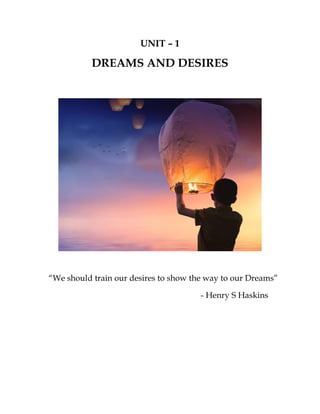
DREAMS AND DESIRES
“We should train our desires to show the way to our Dreams”
- Henry S Haskins
KNOW YOURSELF
Are you a winner or a loser?
Read the following poem and ascertain.
The winner is always the part of the answer
The loser is always part of the problem
The winner always has a plan
The loser always has an excuse
The winner says, “Let me do it for you”
The loser says, “That’s not my job”
The winner sees an answer in every problem
The loser sees a problem in every answer
The winner says, “It may be difficult but it is possible”
The loser says, “It may be possible but is too difficult”
DREAMS AHOY!
Think awhile and answer the following questions.
What is the dream for your life?
What preparations are you making to fulfill it? What qualities do you need to develop
to achieve your dream?
What is your dream for India?
In what little can you contribute to making this dream for India come true?
CLASS DISCUSSION
1. Who are the greatest dreamers of modern India? What was their dream and how far has it been fulfilled?
2. What does this quote by Vincent van gogh(the world famous painter)- “I dream my paintings and then I paint my
dreams” mean?
“Don’t read success stories, you will only get a message. Read failure stories,
you will get some ideas to get success”– Dr. APJ Abdul Kalam
1. MY ORIENTATIONS
Now let’s read the story of APJ Abdul Kalam, former president. How he chased his dreams?
I was unwilling to face reality. I had put my heart and soul into Nandi.
That it would not be used was something beyond my comprehension. I
was disappointed and disillusioned. In this period of confusion and
uncertainty, memories from my childhood came back to me and I
discovered new meanings in them. Pakshi Sastry used to say, “Seek the
truth, and the truth shall set you free.” As the Bible says, “Ask and you
shall receive.” It did not happen immediately, but it happened
nevertheless. One day, Dr. Mediratta called me. He inquired about the
state of our hovercraft. When told that it was in perfect condition to be
flown, he asked me to organize a demonstration for an important visitor
the next day. No VIP was scheduled to visit the laboratory during the
next week as far as I knew. However, I communicated Dr. Mediratta’s
instructions to my colleagues and we felt a new surge of hope. The next
day Dr. Mediratta brought a visitor to our hovercraft—a tall, handsome,
bearded man. He asked me several questions about the machine. I was
struck by the objectivity and clarity of his thinking. “Can you give me a
ride in the machine?” he enquired. His request filled me with joy.
Finally, here was someone who was interested in my work. We took a
ten-minute ride in the hovercraft, a few centimetres above the ground.
We were not flying, but were definitely floating in the air. The visitor
asked me a few questions about myself, thanked me for the ride and
departed. But not before introducing himself—he was Prof. MGK
Menon, Director of the Tata Institute of Fundamental Research (TIFR).
After a week, I received a call from the Indian Committee for Space
Research (INCOSPAR), to attend an interview for the post of Rocket
Engineer. All I knew about INCOSPAR at that time was that it was
formed out of the TIFR talent pool at Bombay (now Mumbai) to
organize space research in India. I went to Bombay to attend the
interview. I was unsure about the type of questions I would have to face
at the interview. There was hardly any time to read up or talk to any
SHORT QUESTIONS
1. What was the words of
Pakshi Sastry?
2. State of our Hover craft?
What does it mean?
experienced person. Lakshmana Sastry’s voice quoting from the
Bhagawad Gita echoed in my ears: All beings are born to delusion . . .
overcome by the dualities which arise from wish and hate . . . . But
those men of virtuous deeds in whom sin has come to an end, freed
from the delusion of dualities, worship Me steadfast in their vows. I
reminded myself that the best way to win was to not need to win. The
best performances are accomplished when you are relaxed and free of
doubt. I decided to take things as they came. Since neither Prof. MGK
Menon’s visit nor the call for an interview had been of my making, I
decided this was the best attitude to take. I was interviewed by Dr.
Vikram Sarabhai along with Prof. MGK Menon and Mr. Saraf, then the
Deputy Secretary of the Atomic Energy Commission. As I entered the
room, I sensed their warmth and friendliness. I was almost immediately
struck by Dr. Sarabhai’s warmth. There was none of the arrogance or
the patronising attitudes which interviewers usually display when
talking to a young and vulnerable candidate. Dr. Sarabhai’s questions
did not probe my existing knowledge or skills; rather they were an
exploration of the possibilities I was filled with. He was looking at me as
if in reference to a larger whole. The entire encounter seemed to me a
total moment of truth, in which my dream was enveloped by the larger
dream of a bigger person. I was advised to stay back for a couple of
days. However, the next evening I was told about my selection. I was to
be absorbed as a rocket engineer at INCOSPAR. This was a breakthrough
a young man like myself dreamed of. My work at INCOSPAR
commenced with a familiarization course at the TIFR Computer Centre.
The atmosphere here was remarkably different from that at DTD&P
(AIR). Labels mattered very little. There was no need for anyone to
justify his position or to be at the receiving end of the others’ hostility.
Sometime in the latter half of 1962, INCOSPAR took the decision to set
up the Equatorial Rocket Launching Station at Thumba, a sleepy fishing
village near Trivandrum (now Thiruvananthapuram) in Kerala. Dr.
Chitnis of the Physical Research Laboratory, Ahmedabad had spotted it
as a suitable location as it was very close to the earth’s magnetic
equator. This was the quiet beginning of modern rocket-based research
in India. The site selected at Thumba lay between the railway line and
the sea coast, covering a distance of about two and a half km and
measuring about 600 acres. Within this area, stood a large church,
whose site had to be acquired. Land acquisition from private parties is
3. “Can you give me a ride in
the machine” comment the
words?
4. Name the places were
Kalam worked?
always a difficult and time- consuming process, especially in densely
populated place like Kerala. In addition, there was the delicate matter
of acquiring a site of religious significance. The Collector of Trivandrum
then, K Madhavan Nair, executed this task in a most tactful, peaceful
and expeditious manner, with the blessings and cooperation of Right
Rev. Dr. Dereira, who was the Bishop of Trivandrum in 1962. Soon RD
John, the executive engineer of the Central Public Works Department
(CPWD), had transformed the entire area. The St. Mary Magdalene
church housed the first office of the Thumba Space Centre. The prayer
room was my first laboratory, the Bishop’s room was my design and
drawing office. To this day, the church is maintained in its full glory and,
at present, houses the Indian Space Museum. Very soon after this, Iwas
asked to proceed to America for a six month training programme on
sounding rocket launching techniques, at the National Aeronautics and
Space Administration (NASA) work centres. I took some time off before
going abroad and went to Rameswaram. My father was very pleased to
learn about the opportunity that had come my way. He took me to the
mosque and organized a special namaz in thanksgiving. I could feel the
power of God flowing in a circuit through my father to me and back to
God; we were all under the spell of the prayer. One of the important
functions of prayer, I believe, is to act as a stimulus to creative ideas.
Within the mind are all the resources required for successful living.
Ideas are present in the consciousness, which when released and given
scope to grow and take shape, can lead to successful events. God, our
Creator, has stored within our minds and personalities, great potential
strength and ability. Prayer helps us to tap and develop these powers.
Ahmed Jallaluddin and Samsuddin came to see me off at Bombay
airport. It was their first exposure to a big city like Bombay, just as I
myself was about to have my first exposure to a mega city like New
York. Jallaluddin and Samsuddin were self-reliant, positive, optimistic
men who undertook their work with the assurance of success. It is from
these two persons that I drew the core creative power of my mind. My
sentiments could not be contained, and I could feel the mist of tears in
my eyes. Then, Jallaluddin said, “Azad, we have always loved you, and
we believe in you. We shall always be proud of you”. The intensity and
purity of their faith in my capabilities broke my last defences, and tears
welled up in my eyes.
5. “Prayer helps usto tap
and develop these powers”
what does it mean?
About the Author
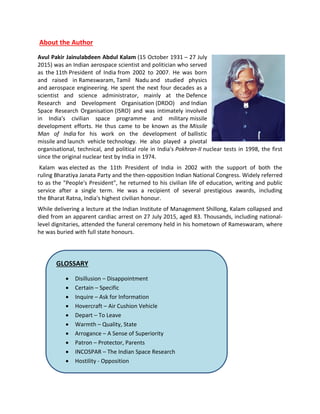
Avul Pakir Jainulabdeen Abdul Kalam (15 October 1931 – 27 July
2015) was an Indian aerospace scientist and politician who served
as the 11th President of India from 2002 to 2007. He was born
and raised in Rameswaram, Tamil Nadu and studied physics
and aerospace engineering. He spent the next four decades as a
scientist and science administrator, mainly at the Defence
Research and Development Organisation (DRDO) and Indian
Space Research Organisation (ISRO) and was intimately involved
in India's civilian space programme and military missile
development efforts. He thus came to be known as the Missile
Man of India for his work on the development of ballistic
missile and launch vehicle technology. He also played a pivotal
organisational, technical, and political role in India's Pokhran-II nuclear tests in 1998, the first
since the original nuclear test by India in 1974.
Kalam was elected as the 11th President of India in 2002 with the support of both the
ruling Bharatiya Janata Party and the then-opposition Indian National Congress. Widely referred
to as the "People's President", he returned to his civilian life of education, writing and public
service after a single term. He was a recipient of several prestigious awards, including
the Bharat Ratna, India's highest civilian honour.
While delivering a lecture at the Indian Institute of Management Shillong, Kalam collapsed and
died from an apparent cardiac arrest on 27 July 2015, aged 83. Thousands, including national-
level dignitaries, attended the funeral ceremony held in his hometown of Rameswaram, where
he was buried with full state honours.
GLOSSARY
 Disillusion – Disappointment
 Certain – Specific
 Inquire – Ask for Information
 Hovercraft – Air Cushion Vehicle
 Depart – To Leave
 Warmth – Quality, State
 Arrogance – A Sense of Superiority
 Patron – Protector, Parents
 INCOSPAR – The Indian Space Research
 Hostility - Opposition
Let’s revisit and reflect
Activity – 1
Was the story inspiring for you?
……………………………………………………………………………………………………………………………………………………
……………………………………………………………………………………………………………………………………………………
……………………………………………………………………………………………………………………………………………………
……………………………………………………………………………………………………………………………………………………
……………………………………………………………………………………………………………………………………………………
……………………………………………………………………………………………………………………………………………………
Activity – 2
How can we inspire others?
……………………………………………………………………………………………………………………………………………………
……………………………………………………………………………………………………………………………………………………
……………………………………………………………………………………………………………………………………………………
……………………………………………………………………………………………………………………………………………………
……………………………………………………………………………………………………………………………………………………
……………………………………………………………………………………………………………………………………………………
Activity – 3
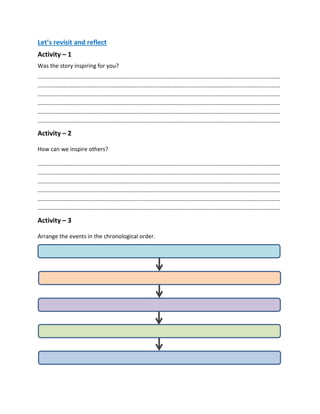
Arrange the events in the chronological order.
Activity – 4
Write the Diary entry of Kalam after his first ride?
Date: ……………….. DIARY
……………………………………………………………………………………………………………………………
……………………………………………………………………………………………………………………………
……………………………………………………………………………………………………………………………
……………………………………………………………………………………………………………………………
……………………………………………………………………………………………………………………………
…………………………………………………………………………………………………………………………….
.……………………………………………………………………………………………………………………………
……………………………………………………………………………………………………………………………
……………………………………………………………………………………………………………………………
……………………………………………………………………………………………………………………………
……………………………………………………………………………………………………………………………
……………………………………………………………………………………………………………………………
……………………………………………………………………………………………………………………………
……………………………………………………………………………………………………………………………
……………………………………………………………………………………………………………………………
……………………………………………………………………………………………………………………………
………………………………….
SIGNATURE
“A person is the product of their dreams. So make sure to dream great dreams.
And then try to live your dream”- Maya Angelou
2. STILL I RISE
You may write me down in history
With your bitter, twisted lies,
You may trod me in the very dirt
But still, like dust, I’ll rise.
Does my sassiness upset you?
Why are you beset with gloom?
Cause I walk like I’ve got oil wells
Pumping in my living room.
Just like moons and like suns,
With the certainty of tides,
Just like hopes springing high,
Still I’ll rise.
Did you want to see me broken?
Bowed head and lowered eyes?
Shoulders falling down like teardrops,
Weakened by my soulful cries?
Does my haughtiness offend you?
Don’t you take it awful hard
Cause I laugh like I’ve got goldmines
Diggin’ in my own backyard.
You may shoot me with your words,
You may cut me with your eyes,
You may kill me with your hatefulness,
But still like air, I’ll rise.
Does my sexiness upset you?
Does it come as a surprise
That I dance like I’ve got diamonds
At the meeting of my thighs?
SHORT QUESTIONS
1. But still, like dust, I’ll rise,
Comment the line.
2. Sassiness:……………………...
…………………………………………..
Gloom:……………………………….
…………………………………………..
3. What doyou mean by
certainty of tides?
Out of the huts of history’s shame
I rise
Up from a past that’s rooted in pain
I rise
I’m a black ocean, leaping and wide,
Welling and swelling I bear in the tide.
Leaving behind nights of terror and fear
I rise
Into a daybreak that’s wondrously clear
I rise
Bringing the gifts that my ancestors gave,
I am the dream and the hope of the slave.
I rise
I rise
I rise.
About the Poet
Maya Angelou Marguerite Annie Johnson (April 4, 1928 – May
28, 2014) was an American poet, memoirist, and civil rights
activist. She published seven autobiographies, three books of
essays, several books of poetry, and is credited with a list of plays,
movies, and television shows spanning over 50 years. She
received dozens of awards and more than 50 honorary degrees.
Angelou is best known for her series of seven autobiographies,
which focus on her childhood and early adult experiences. The
first, I Know Why the Caged Bird Sings (1969), tells of her life up
to the age of 17 and brought her international recognition and
acclaim.
She became a poet and writer after a string of odd jobs during her young adulthood. These
included fry cook, sex worker, nightclub performer, Porgy and Bess cast member, Southern
Christian Leadership Conference coordinator, and correspondent in Egypt and Ghana during
the decolonization of Africa. She was also an actress, writer, director, and producer of plays,
movies, and public television programs. In 1982, she was named the first Reynolds Professor of
American Studies at Wake Forest University in Winston-Salem, North Carolina. She was active
4. What do you mean by
black ocean?
5. What is the theme of
the song?
6. What is the ost trying to
say?
in the Civil Rights Movement and worked with Martin Luther King Jr. and Malcolm X. Beginning
in the 1990s, she made approximately 80 appearances a year on the lecture circuit, something
she continued into her eighties. In 1993, Angelou recited her poem "On the Pulse of Morning"
(1993) at the first inauguration of Bill Clinton, making her the first poet to make an inaugural
recitation since Robert Frost at the inauguration of John F. Kennedy in 1961.
With the publication of I Know Why the Caged Bird Sings, Angelou publicly discussed aspects of
her personal life. She was respected as a spokesperson for black people and women, and her
works have been considered a defense of black culture. Her works are widely used in schools
and universities worldwide, although attempts have been made to ban her books from some
US libraries. Angelou's most celebrated works have been labeled as autobiographical fiction,
but many critics consider them to be autobiographies. She made a deliberate attempt to
challenge the common structure of the autobiography by critiquing, changing and expanding
the genre. Her books center on themes including racism, identity, family and travel.
Activity – 1
Find the poetic devices used?
……………………………………………………………………………………………………………………………………………………
……………………………………………………………………………………………………………………………………………………
……………………………………………………………………………………………………………………………………………………
……………………………………………………………………………………………………………………………………………………
……………………………………………………………………………………………………………………………………………………
……………………………………………………………………………………………………………………………………………………
GLOSSARY
 Dirt - Unclean
 Sassiness – Smart, Stylish
 Gloom – Total Darkness
 Wonder – Feel of Amazement
 Slave - Work excessively hard
Activity – 2
Give an appreciation of the poem?
……………………………………………………………………………………………………………………………………………………
……………………………………………………………………………………………………………………………………………………
……………………………………………………………………………………………………………………………………………………
……………………………………………………………………………………………………………………………………………………
……………………………………………………………………………………………………………………………………………………
……………………………………………………………………………………………………………………………………………………
Activity - 3
Write a poem about your dream?
……………………………………………………………………………………………………………………………………………………
……………………………………………………………………………………………………………………………………………………
……………………………………………………………………………………………………………………………………………………
……………………………………………………………………………………………………………………………………………………
……………………………………………………………………………………………………………………………………………………
……………………………………………………………………………………………………………………………………………………
……………………………………………………………………………………………………………………………………………………
……………………………………………………………………………………………………………………………………………………
LANGUAGE ACTIVITIES
A. Now, arrange the sentences under these headings.
Sentence stating a fact Sentence indicating ability
I speak Spanish and German
Can here functions as a helping verb or modal auxiliary which usually
comes before a main verb and indicates the ability to do something.
B. Now, read the conversation between Ram and his teacher and find out helping verbs.
Teacher : Ram, can you write these words on the board?
Ram : I can write, but my handwriting is not so good.
Teacher : No problem, Ram. You may read the words aloud to class.
Ram : Sure, I will.
Helping verb Main verb
1 Can Write
2
3
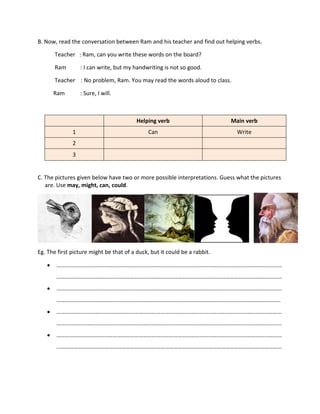
C. The pictures given below have two or more possible interpretations. Guess what the pictures
are. Use may, might, can, could.
Eg. The first picture might be that of a duck, but it could be a rabbit.
 …………………………………………………………………………………………………………………………………………
…………………………………………………………………………………………………………………………………………
 …………………………………………………………………………………………………………………………………………
………………………………………………………………………………………………………………………………………..
 …………………………………………………………………………………………………………………………………………
…………………………………………………………………………………………………………………………………………
 …………………………………………………………………………………………………………………………………………
…………………………………………………………………………………………………………………………………………
D. Now, study the sentences given below and note the changes.
I would rather have apple juice.
I would prefer to have cold coffee.
 After would rather, ‘to’ is not used.
 Would prefer is followed by ‘to’.
E. Some options are given in the box. Which of them would you prefer to do?
Express your ideas using would rather… / would prefer…
(eat at home, hire at taxi, go alone, wait a few minutes, watch a film, go for a swim, stand,
wait till later)
eg. Do you want to eat now?
I would prefer to eat at home.
I would rather wait till later.
1. Would you like to watch TV?
……………………………………………………………………………………………………………………………………………
…………………………………………………………………………………………………………………………………………...
2. Shall we play football?
…………………………………………………………………………………………………………………………………………...
……………………………………………………………………………………………………………………………………………
3. Would you like to sit for a while?
……………………………………………………………………………………………………………………………………………
……………………………………………………………………………………………………………………………………………
4. ………………………………………………………………………………………………………………………………..?
…………………………………………………………………………………………………………………………………………..
…………………………………………………………………………………………………………………………………………..
F. Write a few things that you would like to do during a weekend. Use ‘would rather’/ ‘prefer’.
 ……………………………………………………………………………………………………………………………………….
 ……………………………………………………………………………………………………………………………………….
 ……………………………………………………………………………………………………………………………………….
 ……………………………………………………………………………………………………………………………………….
 ……………………………………………………………………………………………………………………………………….
G. Read the following passage:
I was travelling by train. As the weather was too hot, I was dressed white. The person sat
next to me was reading a book. I asked him where he lived. He replied that he was an actor and
returning a stage performance.
Now, let’s analyse the first sentence “I was travelling by train.”
The preposition ‘by’ in the sentence comes before the noun ‘train.’
List the prepositions and write down the word classes that follow them.
Prepositions Followed by Word Class
by Train Noun
Let’s sum up
F. Shankar is from Kannur. Last week, he went to Thiruvananthapuram. It was his first visit. Fill
in the words with suitable words given in the bracket.
(along, across, from, onto, to, round, on)
Shankar travelled Kannur to Thiruvananthapuram Janashatabhdi train. On
the first day, he travelled Thiruvananthapuram on a double decker bus. Then
he went the Puthen Street looking at the shops. After that, he walked the
bridge to see the Padmanabha Swamy Temple. In the evening, he got a speed boat at
Veli. He returned Kannur the next day.
A preposition can come before a noun(train), a pronoun(me), an adjective used as a
noun(white), or a noun phrase(a stage performance).
G. Read the description below and draw a picture.
Reema’s family consists of her father, mother, two sisters and a brother. Today is Reema’s
birthday. The members of the family are sitting at the dining table. There are a variety of
dishes on the table and the room is decorated with balloons and festoons. Reema’s mother is
sitting next to her husband. Reema is sitting opposite her other. Her brother Arun is standing
behind his mother with a cake in his hand. It has a big candle on it. There are a few presents
beside the table. Radhika, Reema’s sister is standing near to the door to switch off the lights.
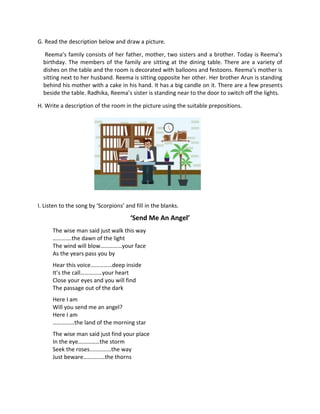
H. Write a description of the room in the picture using the suitable prepositions.
I. Listen to the song by ‘Scorpions’ and fill in the blanks.
‘Send Me An Angel’
The wise man said just walk this way
………….the dawn of the light
The wind will blow……………your face
As the years pass you by
Hear this voice……………deep inside
It’s the call……………your heart
Close your eyes and you will find
The passage out of the dark
Here I am
Will you send me an angel?
Here I am
……………the land of the morning star
The wise man said just find your place
In the eye……………the storm
Seek the roses……………the way
Just beware……………the thorns
Here I am
Will you send me an angel?
Here I am
In the land of the morning star
The wise man said just raise your hand
And reach out……………the spell
Find the door……………the promised land
Just believe……………yourself
Hear this voice from deep inside
It’s the call of your heart
Close your eyes and you will find
The way out of the dark
Here I am
Will you send me an angel?
Here I am
In the land of the morning star
J. Who am I?
I work in museum My job is to write
dictionaries.
I examine and cut
precious stones
I deal with flowers I spend my time with
books
I work for a circus
I earn a living by
mending shoes
I work with maps
Unscramble the words to identify the names of the profession.
1. Radha is in charge of a museum. She is a c_ _a_ _r(ratorcu)
2. Mohan is interested in words and their meanings. He is now employed as a
l_ _ _ _ _g_ _ _ _ _r(xicograpleher)
3. Sreenath makes a living by making and repairing shoes. He is a c_ _ _ _ _r(blercob)
4. Map-making is Sheela’s job. She is a c_ _ _ _g_ _ _ _ _r(togracarpher)
5. Cutting precious stones is Thomas’s profession. He is a l_ _p_d_ _y(apliryda)
6. Rohan sells flowers. He is a f_ _ _ _ _t(istrolf).
7. Radhika likes to spent time with books. She got a job as a l_ _ _ _ _ _ _n(riabnarli).
8. John captures his audience’s attention by doing difficult and skillful things. He is an
a_ _o_ _t(batacro)
“The only thing worse than being blind is having sight but no vision”
– Helen Keller
3. THE STORY OF MY LIFE
Let’s see how Helen Keller inspired others…
It is with a kind of fear that I begin to write the history of my life. I have, as it
were, a superstitious hesitation in lifting the veil that clings about my
childhood like a golden mist. The task of writing an autobiography is a
difficult one. When I try to classify my earliest impressions, I find that fact
and fancy look alike across the years that link the past with the present. The
woman paints the child's experiences in her own fantasy. A few impressions
stand out vividly from the first years of my life; but "the shadows of the
prison-house are on the rest." Besides, many of the joys and sorrows of
childhood have lost their poignancy; and many incidents of vital importance
in my early education have been forgotten in the excitement of great
discoveries. In order, therefore, not to be tedious I shall try to present in a
series of sketches only the episodes that seem to me to be the most
interesting and important. I was born on June 27, 1880, in Tuscumbia, a little
town of northern Alabama. The family on my father's side is descended from
Caspar Keller, a native of Switzerland, who settled in Maryland. One of my
Swiss ancestors was the first teacher of the deaf in Zurich and wrote a book
on the subject of their education—rather a singular coincidence; though it is
true that there is no king who has not had a slave among his ancestors, and
no slave who has not had a king among his. My grandfather, Caspar Keller's
son, "entered" large tracts of land in Alabama and finally settled there. I
have been told that once a year he went from Tuscumbia to Philadelphia on
horseback to purchase supplies for the plantation, and my aunt has in her
possession many of the letters to his family, which give charming and vivid
accounts of these trips. My Grandmother Keller was a daughter of one of
Lafayette's aides, Alexander Moore, and granddaughter of Alexander
Spotswood, an early Colonial Governor of Virginia. She was also second
cousin to Robert E. Lee. My father, Arthur H. Keller, was a captain in the
Confederate Army, and my mother, Kate Adams, was his second wife and
many years younger. Her grandfather, Benjamin Adams, married Susanna E.
Goodhue, and lived in Newbury, Massachusetts, for many years. Their son,
1. What was the disability of
Helen Keller?
2. How was Helen towards
others?
SHORT QUESTIONS
Charles Adams, was born in Newburyport, Massachusetts, and moved to
Helena, Arkansas. When the Civil War broke out, he fought on the side of
the South and became a brigadier-general. He married Lucy Helen Everett,
who belonged to the same family of Everetts as Edward Everett and Dr.
Edward Everett Hale. After the war was over the family moved to Memphis,
Tennessee. I lived, up to the time of the illness that deprived me of my sight
and hearing, in a tiny house consisting of a large square room and a small
one, in which the servant slept. It is a custom in the South to build a small
house near the homestead as an annex to be used on occasion. Such a
house my father built after the Civil War, and when he married my mother
they went to live in it. It was completely covered with vines, climbing roses
and honeysuckles. From the garden it looked like an arbour. The little porch
was hidden from view by a screen of yellow roses and Southern smilax. It
was the favourite haunt of humming-birds and bees. The Keller homestead,
where the family lived, was a few steps from our little rose-bower. It was
called "Ivy Green" because the house and the surrounding trees and fences
were covered with beautiful English ivy. Its old-fashioned garden was the
paradise of my childhood. Even in the days before my teacher came, I used
to feel along the square stiff boxwood hedges, and, guided by the sense of
smell would find the first violets and lilies. There, too, after a fit of temper, I
went to find comfort and to hide my hot face in the cool leaves and grass.
What joy it was to lose myself in that garden of flowers, to wander happily
from spot to spot, until, coming suddenly upon a beautiful vine, I recognized
it by its leaves and blossoms, and knew it was the vine which covered the
tumble-down summer-house at the farther end of the garden! Here, also,
were trailing clematis, drooping jessamine, and some rare sweet flowers
called butterfly lilies, because their fragile petals resemble butterflies' wings.
But the roses—they were loveliest of all. Never have I found in the
greenhouses of the North such heart-satisfying roses as the climbing roses
of my southern home. They used to hang in long festoons from our porch,
filling the whole air with their fragrance, untainted by any earthy smell; and
in the early morning, washed in the dew, they felt so soft, so pure, I could
not help wondering if they did not resemble the asphodels of God's garden.
The beginning of my life was simple and much like every other little life. I
came, I saw, I conquered, as the first baby in the family always does. There
was the usual amount of discussion as to a name for me. The first baby in
the family was not to be lightly named, every one was emphatic about that.
My father suggested the name of Mildred Campbell, an ancestor whom he
5. “Deary month of
February”?
4. Who was Helen Evertt?
3. What was the custom in
the south to build a small
house?
highly esteemed, and he declined to take any further part in the discussion.
My mother solved the problem by giving it as her wish that I should be
called after her mother, whose maiden name was Helen Everett. But in the
excitement of carrying me to church my father lost the name on the way,
very naturally, since it was one in which he had declined to have a part.
When the minister asked him for it, he just remembered that it had been
decided to call me after my grandmother, and he gave her name as Helen
Adams. I am told that while I was still in long dresses I showed many signs of
an eager, self-asserting disposition. Everything that I saw other people do I
insisted upon imitating. At six months I could pipe out "How d'ye," and one
day I attracted every one's attention by saying "Tea, tea, tea" quite plainly.
Even after my illness I remembered one of the words I had learned in these
early months. It was the word "water," and I continued to make some sound
for that word after all other speech was lost. I ceased making the sound
"wah-wah" only when I learned to spell the word. They tell me I walked the
day I was a year old. My mother had just taken me out of the bath-tub and
was holding me in her lap, when I was suddenly attracted by the flickering
shadows of leaves that danced in the sunlight on the smooth floor. I slipped
from my mother's lap and almost ran toward them. The impulse gone, I fell
down and cried for her to take me up in her arms. These happy days did not
last long. One briefspring, musical with the song of robin and mockingbird,
one summer rich in fruit and roses, one autumn of gold and crimson sped by
and left their gifts at the feet of an eager, delighted child. Then, in the
dreary month of February, came the illness which closed my eyes and ears
and plunged me into the unconsciousness of a new-born baby. They called it
acute congestion of the stomach and brain. The doctor thought I could not
live. Early one morning, however, the fever left me as suddenly and
mysteriously as it had come. There was great rejoicing in the family that
morning, but no one, not even the doctor, knew that I should never see or
hear again. I fancy I still have confused recollections of that illness. I
especially remember the tenderness with which my mother tried to soothe
me in my waling hours of fret and pain, and the agony and bewilderment
with which I awoke after a tossing half sleep, and turned my eyes, so dry and
hot, to the wall away from the once-loved light, which came to me dim and
yet more dim each day. But, except for these fleeting memories, if, indeed,
they be memories, it all seems very unreal, like a nightmare. Gradually I got
used to the silence and darkness that surrounded me and forgot that it had
ever been different, until she came—my teacher—who was to set my spirit
6. Does Helen started
Learning?
7. How was her parents, Did
they support her?
free. But during the first nineteen months of my life I had caught glimpses of
broad, green fields, a luminous sky, trees and flowers which the darkness
that followed could not wholly blot out. If we have once seen, "the day is
ours, and what the day has shown."
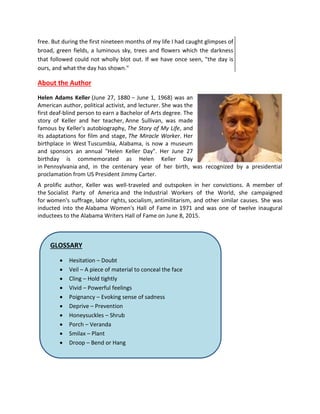
About the Author
Helen Adams Keller (June 27, 1880 – June 1, 1968) was an
American author, political activist, and lecturer. She was the
first deaf-blind person to earn a Bachelor of Arts degree. The
story of Keller and her teacher, Anne Sullivan, was made
famous by Keller's autobiography, The Story of My Life, and
its adaptations for film and stage, The Miracle Worker. Her
birthplace in West Tuscumbia, Alabama, is now a museum
and sponsors an annual "Helen Keller Day". Her June 27
birthday is commemorated as Helen Keller Day
in Pennsylvania and, in the centenary year of her birth, was recognized by a presidential
proclamation from US President Jimmy Carter.
A prolific author, Keller was well-traveled and outspoken in her convictions. A member of
the Socialist Party of America and the Industrial Workers of the World, she campaigned
for women's suffrage, labor rights, socialism, antimilitarism, and other similar causes. She was
inducted into the Alabama Women's Hall of Fame in 1971 and was one of twelve inaugural
inductees to the Alabama Writers Hall of Fame on June 8, 2015.
GLOSSARY
 Hesitation – Doubt
 Veil – A piece of material to conceal the face
 Cling – Hold tightly
 Vivid – Powerful feelings
 Poignancy – Evoking sense of sadness
 Deprive – Prevention
 Honeysuckles – Shrub
 Porch – Veranda
 Smilax – Plant
 Droop – Bend or Hang
Activity – 1
Find the Qualities of Helen Keller and her Teacher?
Qualities of Helen Keller Qualities of Teacher
Activity – 2
Give a write up about Helens Family.
……………………………………………………………………………………………………………………………………………………
……………………………………………………………………………………………………………………………………………………
……………………………………………………………………………………………………………………………………………………
……………………………………………………………………………………………………………………………………………………
……………………………………………………………………………………………………………………………………………………
……………………………………………………………………………………………………………………………………………………
…………………………………………………………………………………………………………………………………………………..
“The way to real growth is not to become more powerful or more famous, but
to become more human and more tolerant”- Helen Steiner Rice
4. ANOTHER CHANCE
How often we wish for another chance
To make a fresh beginning.
A chance to blot out our mistakes
And change failure into winning.
It does not take a new day
To make a brand new start,
It only takes a deep desire
To try with all our heart.
To live a little better
And to always be forgiving
And to add a little sunshine
To the world in which we’re living.
So never give up in despair
And think that you are through,
For there’s always a tomorrow
And the hope of starting new.
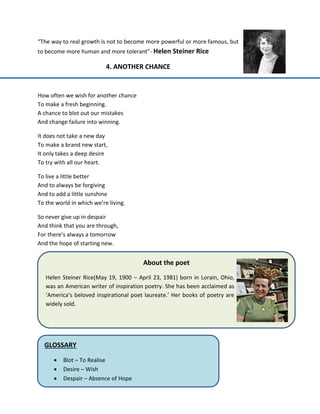
About the poet
Helen Steiner Rice(May 19, 1900 – April 23, 1981) born in Lorain, Ohio,
was an American writer of inspiration poetry. She has been acclaimed as
‘America’s beloved inspirational poet laureate.’ Her books of poetry are
widely sold.
GLOSSARY
 Blot – To Realise
 Desire – Wish
 Despair – Absence of Hope
Let’s revisit and enjoy the poem
1. Why do we wish for another chance in life?
……………………………………………………………………………………………………………………………
……………………………………………………………………………………………………………………………
2. What is essential for a fresh start?
……………………………………………………………………………………………………………………………
……………………………………………………………………………………………………………………………
3. How can we transform failure into success?
……………………………………………………………………………………………………………………………
……………………………………………………………………………………………………………………………
4. What does the poet mean when she says “add a little sunshine”?
……………………………………………………………………………………………………………………………
……………………………………………………………………………………………………………………………
5. Do you think forgiving will make our life better? Why?
……………………………………………………………………………………………………………………………
……………………………………………………………………………………………………………………………
6. What is the tone of the poem?
……………………………………………………………………………………………………………………………
……………………………………………………………………………………………………………………………
7. Pick out the words that rhyme in the poem.
……………………………………………………………………………………………………………………………
……………………………………………………………………………………………………………………………
Activity – 1
We should forget and forgive. Can you present an instance in your life when you
apologized for something, or forgave somebody?
……………………………………………………………………………………………………………………………………………
…………………………………………………………………………………………………………………………………………..
……………………………………………………………………………………………………………………………………………
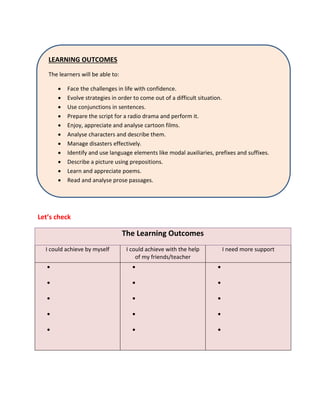
Let’s check
The Learning Outcomes
I could achieve by myself I could achieve with the help
of my friends/teacher
I need more support















LEARNING OUTCOMES
The learners will be able to:
 Face the challenges in life with confidence.
 Evolve strategies in order to come out of a difficult situation.
 Use conjunctions in sentences.
 Prepare the script for a radio drama and perform it.
 Enjoy, appreciate and analyse cartoon films.
 Analyse characters and describe them.
 Manage disasters effectively.
 Identify and use language elements like modal auxiliaries, prefixes and suffixes.
 Describe a picture using prepositions.
 Learn and appreciate poems.
 Read and analyse prose passages.

English text

  • 1.
  • 2.
    UNIT – 1 DREAMSAND DESIRES “We should train our desires to show the way to our Dreams” - Henry S Haskins
  • 3.
    KNOW YOURSELF Are youa winner or a loser? Read the following poem and ascertain. The winner is always the part of the answer The loser is always part of the problem The winner always has a plan The loser always has an excuse The winner says, “Let me do it for you” The loser says, “That’s not my job” The winner sees an answer in every problem The loser sees a problem in every answer The winner says, “It may be difficult but it is possible” The loser says, “It may be possible but is too difficult” DREAMS AHOY! Think awhile and answer the following questions. What is the dream for your life?
  • 4.
    What preparations areyou making to fulfill it? What qualities do you need to develop to achieve your dream? What is your dream for India? In what little can you contribute to making this dream for India come true? CLASS DISCUSSION 1. Who are the greatest dreamers of modern India? What was their dream and how far has it been fulfilled? 2. What does this quote by Vincent van gogh(the world famous painter)- “I dream my paintings and then I paint my dreams” mean?
  • 5.
    “Don’t read successstories, you will only get a message. Read failure stories, you will get some ideas to get success”– Dr. APJ Abdul Kalam 1. MY ORIENTATIONS Now let’s read the story of APJ Abdul Kalam, former president. How he chased his dreams? I was unwilling to face reality. I had put my heart and soul into Nandi. That it would not be used was something beyond my comprehension. I was disappointed and disillusioned. In this period of confusion and uncertainty, memories from my childhood came back to me and I discovered new meanings in them. Pakshi Sastry used to say, “Seek the truth, and the truth shall set you free.” As the Bible says, “Ask and you shall receive.” It did not happen immediately, but it happened nevertheless. One day, Dr. Mediratta called me. He inquired about the state of our hovercraft. When told that it was in perfect condition to be flown, he asked me to organize a demonstration for an important visitor the next day. No VIP was scheduled to visit the laboratory during the next week as far as I knew. However, I communicated Dr. Mediratta’s instructions to my colleagues and we felt a new surge of hope. The next day Dr. Mediratta brought a visitor to our hovercraft—a tall, handsome, bearded man. He asked me several questions about the machine. I was struck by the objectivity and clarity of his thinking. “Can you give me a ride in the machine?” he enquired. His request filled me with joy. Finally, here was someone who was interested in my work. We took a ten-minute ride in the hovercraft, a few centimetres above the ground. We were not flying, but were definitely floating in the air. The visitor asked me a few questions about myself, thanked me for the ride and departed. But not before introducing himself—he was Prof. MGK Menon, Director of the Tata Institute of Fundamental Research (TIFR). After a week, I received a call from the Indian Committee for Space Research (INCOSPAR), to attend an interview for the post of Rocket Engineer. All I knew about INCOSPAR at that time was that it was formed out of the TIFR talent pool at Bombay (now Mumbai) to organize space research in India. I went to Bombay to attend the interview. I was unsure about the type of questions I would have to face at the interview. There was hardly any time to read up or talk to any SHORT QUESTIONS 1. What was the words of Pakshi Sastry? 2. State of our Hover craft? What does it mean?
  • 6.
    experienced person. LakshmanaSastry’s voice quoting from the Bhagawad Gita echoed in my ears: All beings are born to delusion . . . overcome by the dualities which arise from wish and hate . . . . But those men of virtuous deeds in whom sin has come to an end, freed from the delusion of dualities, worship Me steadfast in their vows. I reminded myself that the best way to win was to not need to win. The best performances are accomplished when you are relaxed and free of doubt. I decided to take things as they came. Since neither Prof. MGK Menon’s visit nor the call for an interview had been of my making, I decided this was the best attitude to take. I was interviewed by Dr. Vikram Sarabhai along with Prof. MGK Menon and Mr. Saraf, then the Deputy Secretary of the Atomic Energy Commission. As I entered the room, I sensed their warmth and friendliness. I was almost immediately struck by Dr. Sarabhai’s warmth. There was none of the arrogance or the patronising attitudes which interviewers usually display when talking to a young and vulnerable candidate. Dr. Sarabhai’s questions did not probe my existing knowledge or skills; rather they were an exploration of the possibilities I was filled with. He was looking at me as if in reference to a larger whole. The entire encounter seemed to me a total moment of truth, in which my dream was enveloped by the larger dream of a bigger person. I was advised to stay back for a couple of days. However, the next evening I was told about my selection. I was to be absorbed as a rocket engineer at INCOSPAR. This was a breakthrough a young man like myself dreamed of. My work at INCOSPAR commenced with a familiarization course at the TIFR Computer Centre. The atmosphere here was remarkably different from that at DTD&P (AIR). Labels mattered very little. There was no need for anyone to justify his position or to be at the receiving end of the others’ hostility. Sometime in the latter half of 1962, INCOSPAR took the decision to set up the Equatorial Rocket Launching Station at Thumba, a sleepy fishing village near Trivandrum (now Thiruvananthapuram) in Kerala. Dr. Chitnis of the Physical Research Laboratory, Ahmedabad had spotted it as a suitable location as it was very close to the earth’s magnetic equator. This was the quiet beginning of modern rocket-based research in India. The site selected at Thumba lay between the railway line and the sea coast, covering a distance of about two and a half km and measuring about 600 acres. Within this area, stood a large church, whose site had to be acquired. Land acquisition from private parties is 3. “Can you give me a ride in the machine” comment the words? 4. Name the places were Kalam worked?
  • 7.
    always a difficultand time- consuming process, especially in densely populated place like Kerala. In addition, there was the delicate matter of acquiring a site of religious significance. The Collector of Trivandrum then, K Madhavan Nair, executed this task in a most tactful, peaceful and expeditious manner, with the blessings and cooperation of Right Rev. Dr. Dereira, who was the Bishop of Trivandrum in 1962. Soon RD John, the executive engineer of the Central Public Works Department (CPWD), had transformed the entire area. The St. Mary Magdalene church housed the first office of the Thumba Space Centre. The prayer room was my first laboratory, the Bishop’s room was my design and drawing office. To this day, the church is maintained in its full glory and, at present, houses the Indian Space Museum. Very soon after this, Iwas asked to proceed to America for a six month training programme on sounding rocket launching techniques, at the National Aeronautics and Space Administration (NASA) work centres. I took some time off before going abroad and went to Rameswaram. My father was very pleased to learn about the opportunity that had come my way. He took me to the mosque and organized a special namaz in thanksgiving. I could feel the power of God flowing in a circuit through my father to me and back to God; we were all under the spell of the prayer. One of the important functions of prayer, I believe, is to act as a stimulus to creative ideas. Within the mind are all the resources required for successful living. Ideas are present in the consciousness, which when released and given scope to grow and take shape, can lead to successful events. God, our Creator, has stored within our minds and personalities, great potential strength and ability. Prayer helps us to tap and develop these powers. Ahmed Jallaluddin and Samsuddin came to see me off at Bombay airport. It was their first exposure to a big city like Bombay, just as I myself was about to have my first exposure to a mega city like New York. Jallaluddin and Samsuddin were self-reliant, positive, optimistic men who undertook their work with the assurance of success. It is from these two persons that I drew the core creative power of my mind. My sentiments could not be contained, and I could feel the mist of tears in my eyes. Then, Jallaluddin said, “Azad, we have always loved you, and we believe in you. We shall always be proud of you”. The intensity and purity of their faith in my capabilities broke my last defences, and tears welled up in my eyes. 5. “Prayer helps usto tap and develop these powers” what does it mean?
  • 8.
    About the Author AvulPakir Jainulabdeen Abdul Kalam (15 October 1931 – 27 July 2015) was an Indian aerospace scientist and politician who served as the 11th President of India from 2002 to 2007. He was born and raised in Rameswaram, Tamil Nadu and studied physics and aerospace engineering. He spent the next four decades as a scientist and science administrator, mainly at the Defence Research and Development Organisation (DRDO) and Indian Space Research Organisation (ISRO) and was intimately involved in India's civilian space programme and military missile development efforts. He thus came to be known as the Missile Man of India for his work on the development of ballistic missile and launch vehicle technology. He also played a pivotal organisational, technical, and political role in India's Pokhran-II nuclear tests in 1998, the first since the original nuclear test by India in 1974. Kalam was elected as the 11th President of India in 2002 with the support of both the ruling Bharatiya Janata Party and the then-opposition Indian National Congress. Widely referred to as the "People's President", he returned to his civilian life of education, writing and public service after a single term. He was a recipient of several prestigious awards, including the Bharat Ratna, India's highest civilian honour. While delivering a lecture at the Indian Institute of Management Shillong, Kalam collapsed and died from an apparent cardiac arrest on 27 July 2015, aged 83. Thousands, including national- level dignitaries, attended the funeral ceremony held in his hometown of Rameswaram, where he was buried with full state honours. GLOSSARY  Disillusion – Disappointment  Certain – Specific  Inquire – Ask for Information  Hovercraft – Air Cushion Vehicle  Depart – To Leave  Warmth – Quality, State  Arrogance – A Sense of Superiority  Patron – Protector, Parents  INCOSPAR – The Indian Space Research  Hostility - Opposition
  • 9.
    Let’s revisit andreflect Activity – 1 Was the story inspiring for you? …………………………………………………………………………………………………………………………………………………… …………………………………………………………………………………………………………………………………………………… …………………………………………………………………………………………………………………………………………………… …………………………………………………………………………………………………………………………………………………… …………………………………………………………………………………………………………………………………………………… …………………………………………………………………………………………………………………………………………………… Activity – 2 How can we inspire others? …………………………………………………………………………………………………………………………………………………… …………………………………………………………………………………………………………………………………………………… …………………………………………………………………………………………………………………………………………………… …………………………………………………………………………………………………………………………………………………… …………………………………………………………………………………………………………………………………………………… …………………………………………………………………………………………………………………………………………………… Activity – 3 Arrange the events in the chronological order.
  • 10.
    Activity – 4 Writethe Diary entry of Kalam after his first ride? Date: ……………….. DIARY …………………………………………………………………………………………………………………………… …………………………………………………………………………………………………………………………… …………………………………………………………………………………………………………………………… …………………………………………………………………………………………………………………………… …………………………………………………………………………………………………………………………… ……………………………………………………………………………………………………………………………. .…………………………………………………………………………………………………………………………… …………………………………………………………………………………………………………………………… …………………………………………………………………………………………………………………………… …………………………………………………………………………………………………………………………… …………………………………………………………………………………………………………………………… …………………………………………………………………………………………………………………………… …………………………………………………………………………………………………………………………… …………………………………………………………………………………………………………………………… …………………………………………………………………………………………………………………………… …………………………………………………………………………………………………………………………… …………………………………. SIGNATURE
  • 11.
    “A person isthe product of their dreams. So make sure to dream great dreams. And then try to live your dream”- Maya Angelou 2. STILL I RISE You may write me down in history With your bitter, twisted lies, You may trod me in the very dirt But still, like dust, I’ll rise. Does my sassiness upset you? Why are you beset with gloom? Cause I walk like I’ve got oil wells Pumping in my living room. Just like moons and like suns, With the certainty of tides, Just like hopes springing high, Still I’ll rise. Did you want to see me broken? Bowed head and lowered eyes? Shoulders falling down like teardrops, Weakened by my soulful cries? Does my haughtiness offend you? Don’t you take it awful hard Cause I laugh like I’ve got goldmines Diggin’ in my own backyard. You may shoot me with your words, You may cut me with your eyes, You may kill me with your hatefulness, But still like air, I’ll rise. Does my sexiness upset you? Does it come as a surprise That I dance like I’ve got diamonds At the meeting of my thighs? SHORT QUESTIONS 1. But still, like dust, I’ll rise, Comment the line. 2. Sassiness:……………………... ………………………………………….. Gloom:………………………………. ………………………………………….. 3. What doyou mean by certainty of tides?
  • 12.
    Out of thehuts of history’s shame I rise Up from a past that’s rooted in pain I rise I’m a black ocean, leaping and wide, Welling and swelling I bear in the tide. Leaving behind nights of terror and fear I rise Into a daybreak that’s wondrously clear I rise Bringing the gifts that my ancestors gave, I am the dream and the hope of the slave. I rise I rise I rise. About the Poet Maya Angelou Marguerite Annie Johnson (April 4, 1928 – May 28, 2014) was an American poet, memoirist, and civil rights activist. She published seven autobiographies, three books of essays, several books of poetry, and is credited with a list of plays, movies, and television shows spanning over 50 years. She received dozens of awards and more than 50 honorary degrees. Angelou is best known for her series of seven autobiographies, which focus on her childhood and early adult experiences. The first, I Know Why the Caged Bird Sings (1969), tells of her life up to the age of 17 and brought her international recognition and acclaim. She became a poet and writer after a string of odd jobs during her young adulthood. These included fry cook, sex worker, nightclub performer, Porgy and Bess cast member, Southern Christian Leadership Conference coordinator, and correspondent in Egypt and Ghana during the decolonization of Africa. She was also an actress, writer, director, and producer of plays, movies, and public television programs. In 1982, she was named the first Reynolds Professor of American Studies at Wake Forest University in Winston-Salem, North Carolina. She was active 4. What do you mean by black ocean? 5. What is the theme of the song? 6. What is the ost trying to say?
  • 13.
    in the CivilRights Movement and worked with Martin Luther King Jr. and Malcolm X. Beginning in the 1990s, she made approximately 80 appearances a year on the lecture circuit, something she continued into her eighties. In 1993, Angelou recited her poem "On the Pulse of Morning" (1993) at the first inauguration of Bill Clinton, making her the first poet to make an inaugural recitation since Robert Frost at the inauguration of John F. Kennedy in 1961. With the publication of I Know Why the Caged Bird Sings, Angelou publicly discussed aspects of her personal life. She was respected as a spokesperson for black people and women, and her works have been considered a defense of black culture. Her works are widely used in schools and universities worldwide, although attempts have been made to ban her books from some US libraries. Angelou's most celebrated works have been labeled as autobiographical fiction, but many critics consider them to be autobiographies. She made a deliberate attempt to challenge the common structure of the autobiography by critiquing, changing and expanding the genre. Her books center on themes including racism, identity, family and travel. Activity – 1 Find the poetic devices used? …………………………………………………………………………………………………………………………………………………… …………………………………………………………………………………………………………………………………………………… …………………………………………………………………………………………………………………………………………………… …………………………………………………………………………………………………………………………………………………… …………………………………………………………………………………………………………………………………………………… …………………………………………………………………………………………………………………………………………………… GLOSSARY  Dirt - Unclean  Sassiness – Smart, Stylish  Gloom – Total Darkness  Wonder – Feel of Amazement  Slave - Work excessively hard
  • 14.
    Activity – 2 Givean appreciation of the poem? …………………………………………………………………………………………………………………………………………………… …………………………………………………………………………………………………………………………………………………… …………………………………………………………………………………………………………………………………………………… …………………………………………………………………………………………………………………………………………………… …………………………………………………………………………………………………………………………………………………… …………………………………………………………………………………………………………………………………………………… Activity - 3 Write a poem about your dream? …………………………………………………………………………………………………………………………………………………… …………………………………………………………………………………………………………………………………………………… …………………………………………………………………………………………………………………………………………………… …………………………………………………………………………………………………………………………………………………… …………………………………………………………………………………………………………………………………………………… …………………………………………………………………………………………………………………………………………………… …………………………………………………………………………………………………………………………………………………… …………………………………………………………………………………………………………………………………………………… LANGUAGE ACTIVITIES A. Now, arrange the sentences under these headings. Sentence stating a fact Sentence indicating ability I speak Spanish and German Can here functions as a helping verb or modal auxiliary which usually comes before a main verb and indicates the ability to do something.
  • 15.
    B. Now, readthe conversation between Ram and his teacher and find out helping verbs. Teacher : Ram, can you write these words on the board? Ram : I can write, but my handwriting is not so good. Teacher : No problem, Ram. You may read the words aloud to class. Ram : Sure, I will. Helping verb Main verb 1 Can Write 2 3 C. The pictures given below have two or more possible interpretations. Guess what the pictures are. Use may, might, can, could. Eg. The first picture might be that of a duck, but it could be a rabbit.  ………………………………………………………………………………………………………………………………………… …………………………………………………………………………………………………………………………………………  ………………………………………………………………………………………………………………………………………… ………………………………………………………………………………………………………………………………………..  ………………………………………………………………………………………………………………………………………… …………………………………………………………………………………………………………………………………………  ………………………………………………………………………………………………………………………………………… …………………………………………………………………………………………………………………………………………
  • 16.
    D. Now, studythe sentences given below and note the changes. I would rather have apple juice. I would prefer to have cold coffee.  After would rather, ‘to’ is not used.  Would prefer is followed by ‘to’. E. Some options are given in the box. Which of them would you prefer to do? Express your ideas using would rather… / would prefer… (eat at home, hire at taxi, go alone, wait a few minutes, watch a film, go for a swim, stand, wait till later) eg. Do you want to eat now? I would prefer to eat at home. I would rather wait till later. 1. Would you like to watch TV? …………………………………………………………………………………………………………………………………………… …………………………………………………………………………………………………………………………………………... 2. Shall we play football? …………………………………………………………………………………………………………………………………………... …………………………………………………………………………………………………………………………………………… 3. Would you like to sit for a while? …………………………………………………………………………………………………………………………………………… …………………………………………………………………………………………………………………………………………… 4. ………………………………………………………………………………………………………………………………..? ………………………………………………………………………………………………………………………………………….. ………………………………………………………………………………………………………………………………………….. F. Write a few things that you would like to do during a weekend. Use ‘would rather’/ ‘prefer’.  ……………………………………………………………………………………………………………………………………….  ……………………………………………………………………………………………………………………………………….
  • 17.
     ……………………………………………………………………………………………………………………………………….  ………………………………………………………………………………………………………………………………………. ………………………………………………………………………………………………………………………………………. G. Read the following passage: I was travelling by train. As the weather was too hot, I was dressed white. The person sat next to me was reading a book. I asked him where he lived. He replied that he was an actor and returning a stage performance. Now, let’s analyse the first sentence “I was travelling by train.” The preposition ‘by’ in the sentence comes before the noun ‘train.’ List the prepositions and write down the word classes that follow them. Prepositions Followed by Word Class by Train Noun Let’s sum up F. Shankar is from Kannur. Last week, he went to Thiruvananthapuram. It was his first visit. Fill in the words with suitable words given in the bracket. (along, across, from, onto, to, round, on) Shankar travelled Kannur to Thiruvananthapuram Janashatabhdi train. On the first day, he travelled Thiruvananthapuram on a double decker bus. Then he went the Puthen Street looking at the shops. After that, he walked the bridge to see the Padmanabha Swamy Temple. In the evening, he got a speed boat at Veli. He returned Kannur the next day. A preposition can come before a noun(train), a pronoun(me), an adjective used as a noun(white), or a noun phrase(a stage performance).
  • 18.
    G. Read thedescription below and draw a picture. Reema’s family consists of her father, mother, two sisters and a brother. Today is Reema’s birthday. The members of the family are sitting at the dining table. There are a variety of dishes on the table and the room is decorated with balloons and festoons. Reema’s mother is sitting next to her husband. Reema is sitting opposite her other. Her brother Arun is standing behind his mother with a cake in his hand. It has a big candle on it. There are a few presents beside the table. Radhika, Reema’s sister is standing near to the door to switch off the lights. H. Write a description of the room in the picture using the suitable prepositions. I. Listen to the song by ‘Scorpions’ and fill in the blanks. ‘Send Me An Angel’ The wise man said just walk this way ………….the dawn of the light The wind will blow……………your face As the years pass you by Hear this voice……………deep inside It’s the call……………your heart Close your eyes and you will find The passage out of the dark Here I am Will you send me an angel? Here I am ……………the land of the morning star The wise man said just find your place In the eye……………the storm Seek the roses……………the way Just beware……………the thorns
  • 19.
    Here I am Willyou send me an angel? Here I am In the land of the morning star The wise man said just raise your hand And reach out……………the spell Find the door……………the promised land Just believe……………yourself Hear this voice from deep inside It’s the call of your heart Close your eyes and you will find The way out of the dark Here I am Will you send me an angel? Here I am In the land of the morning star J. Who am I? I work in museum My job is to write dictionaries. I examine and cut precious stones I deal with flowers I spend my time with books I work for a circus I earn a living by mending shoes I work with maps
  • 20.
    Unscramble the wordsto identify the names of the profession. 1. Radha is in charge of a museum. She is a c_ _a_ _r(ratorcu) 2. Mohan is interested in words and their meanings. He is now employed as a l_ _ _ _ _g_ _ _ _ _r(xicograpleher) 3. Sreenath makes a living by making and repairing shoes. He is a c_ _ _ _ _r(blercob) 4. Map-making is Sheela’s job. She is a c_ _ _ _g_ _ _ _ _r(togracarpher) 5. Cutting precious stones is Thomas’s profession. He is a l_ _p_d_ _y(apliryda) 6. Rohan sells flowers. He is a f_ _ _ _ _t(istrolf). 7. Radhika likes to spent time with books. She got a job as a l_ _ _ _ _ _ _n(riabnarli). 8. John captures his audience’s attention by doing difficult and skillful things. He is an a_ _o_ _t(batacro)
  • 21.
    “The only thingworse than being blind is having sight but no vision” – Helen Keller 3. THE STORY OF MY LIFE Let’s see how Helen Keller inspired others… It is with a kind of fear that I begin to write the history of my life. I have, as it were, a superstitious hesitation in lifting the veil that clings about my childhood like a golden mist. The task of writing an autobiography is a difficult one. When I try to classify my earliest impressions, I find that fact and fancy look alike across the years that link the past with the present. The woman paints the child's experiences in her own fantasy. A few impressions stand out vividly from the first years of my life; but "the shadows of the prison-house are on the rest." Besides, many of the joys and sorrows of childhood have lost their poignancy; and many incidents of vital importance in my early education have been forgotten in the excitement of great discoveries. In order, therefore, not to be tedious I shall try to present in a series of sketches only the episodes that seem to me to be the most interesting and important. I was born on June 27, 1880, in Tuscumbia, a little town of northern Alabama. The family on my father's side is descended from Caspar Keller, a native of Switzerland, who settled in Maryland. One of my Swiss ancestors was the first teacher of the deaf in Zurich and wrote a book on the subject of their education—rather a singular coincidence; though it is true that there is no king who has not had a slave among his ancestors, and no slave who has not had a king among his. My grandfather, Caspar Keller's son, "entered" large tracts of land in Alabama and finally settled there. I have been told that once a year he went from Tuscumbia to Philadelphia on horseback to purchase supplies for the plantation, and my aunt has in her possession many of the letters to his family, which give charming and vivid accounts of these trips. My Grandmother Keller was a daughter of one of Lafayette's aides, Alexander Moore, and granddaughter of Alexander Spotswood, an early Colonial Governor of Virginia. She was also second cousin to Robert E. Lee. My father, Arthur H. Keller, was a captain in the Confederate Army, and my mother, Kate Adams, was his second wife and many years younger. Her grandfather, Benjamin Adams, married Susanna E. Goodhue, and lived in Newbury, Massachusetts, for many years. Their son, 1. What was the disability of Helen Keller? 2. How was Helen towards others? SHORT QUESTIONS
  • 22.
    Charles Adams, wasborn in Newburyport, Massachusetts, and moved to Helena, Arkansas. When the Civil War broke out, he fought on the side of the South and became a brigadier-general. He married Lucy Helen Everett, who belonged to the same family of Everetts as Edward Everett and Dr. Edward Everett Hale. After the war was over the family moved to Memphis, Tennessee. I lived, up to the time of the illness that deprived me of my sight and hearing, in a tiny house consisting of a large square room and a small one, in which the servant slept. It is a custom in the South to build a small house near the homestead as an annex to be used on occasion. Such a house my father built after the Civil War, and when he married my mother they went to live in it. It was completely covered with vines, climbing roses and honeysuckles. From the garden it looked like an arbour. The little porch was hidden from view by a screen of yellow roses and Southern smilax. It was the favourite haunt of humming-birds and bees. The Keller homestead, where the family lived, was a few steps from our little rose-bower. It was called "Ivy Green" because the house and the surrounding trees and fences were covered with beautiful English ivy. Its old-fashioned garden was the paradise of my childhood. Even in the days before my teacher came, I used to feel along the square stiff boxwood hedges, and, guided by the sense of smell would find the first violets and lilies. There, too, after a fit of temper, I went to find comfort and to hide my hot face in the cool leaves and grass. What joy it was to lose myself in that garden of flowers, to wander happily from spot to spot, until, coming suddenly upon a beautiful vine, I recognized it by its leaves and blossoms, and knew it was the vine which covered the tumble-down summer-house at the farther end of the garden! Here, also, were trailing clematis, drooping jessamine, and some rare sweet flowers called butterfly lilies, because their fragile petals resemble butterflies' wings. But the roses—they were loveliest of all. Never have I found in the greenhouses of the North such heart-satisfying roses as the climbing roses of my southern home. They used to hang in long festoons from our porch, filling the whole air with their fragrance, untainted by any earthy smell; and in the early morning, washed in the dew, they felt so soft, so pure, I could not help wondering if they did not resemble the asphodels of God's garden. The beginning of my life was simple and much like every other little life. I came, I saw, I conquered, as the first baby in the family always does. There was the usual amount of discussion as to a name for me. The first baby in the family was not to be lightly named, every one was emphatic about that. My father suggested the name of Mildred Campbell, an ancestor whom he 5. “Deary month of February”? 4. Who was Helen Evertt? 3. What was the custom in the south to build a small house?
  • 23.
    highly esteemed, andhe declined to take any further part in the discussion. My mother solved the problem by giving it as her wish that I should be called after her mother, whose maiden name was Helen Everett. But in the excitement of carrying me to church my father lost the name on the way, very naturally, since it was one in which he had declined to have a part. When the minister asked him for it, he just remembered that it had been decided to call me after my grandmother, and he gave her name as Helen Adams. I am told that while I was still in long dresses I showed many signs of an eager, self-asserting disposition. Everything that I saw other people do I insisted upon imitating. At six months I could pipe out "How d'ye," and one day I attracted every one's attention by saying "Tea, tea, tea" quite plainly. Even after my illness I remembered one of the words I had learned in these early months. It was the word "water," and I continued to make some sound for that word after all other speech was lost. I ceased making the sound "wah-wah" only when I learned to spell the word. They tell me I walked the day I was a year old. My mother had just taken me out of the bath-tub and was holding me in her lap, when I was suddenly attracted by the flickering shadows of leaves that danced in the sunlight on the smooth floor. I slipped from my mother's lap and almost ran toward them. The impulse gone, I fell down and cried for her to take me up in her arms. These happy days did not last long. One briefspring, musical with the song of robin and mockingbird, one summer rich in fruit and roses, one autumn of gold and crimson sped by and left their gifts at the feet of an eager, delighted child. Then, in the dreary month of February, came the illness which closed my eyes and ears and plunged me into the unconsciousness of a new-born baby. They called it acute congestion of the stomach and brain. The doctor thought I could not live. Early one morning, however, the fever left me as suddenly and mysteriously as it had come. There was great rejoicing in the family that morning, but no one, not even the doctor, knew that I should never see or hear again. I fancy I still have confused recollections of that illness. I especially remember the tenderness with which my mother tried to soothe me in my waling hours of fret and pain, and the agony and bewilderment with which I awoke after a tossing half sleep, and turned my eyes, so dry and hot, to the wall away from the once-loved light, which came to me dim and yet more dim each day. But, except for these fleeting memories, if, indeed, they be memories, it all seems very unreal, like a nightmare. Gradually I got used to the silence and darkness that surrounded me and forgot that it had ever been different, until she came—my teacher—who was to set my spirit 6. Does Helen started Learning? 7. How was her parents, Did they support her?
  • 24.
    free. But duringthe first nineteen months of my life I had caught glimpses of broad, green fields, a luminous sky, trees and flowers which the darkness that followed could not wholly blot out. If we have once seen, "the day is ours, and what the day has shown." About the Author Helen Adams Keller (June 27, 1880 – June 1, 1968) was an American author, political activist, and lecturer. She was the first deaf-blind person to earn a Bachelor of Arts degree. The story of Keller and her teacher, Anne Sullivan, was made famous by Keller's autobiography, The Story of My Life, and its adaptations for film and stage, The Miracle Worker. Her birthplace in West Tuscumbia, Alabama, is now a museum and sponsors an annual "Helen Keller Day". Her June 27 birthday is commemorated as Helen Keller Day in Pennsylvania and, in the centenary year of her birth, was recognized by a presidential proclamation from US President Jimmy Carter. A prolific author, Keller was well-traveled and outspoken in her convictions. A member of the Socialist Party of America and the Industrial Workers of the World, she campaigned for women's suffrage, labor rights, socialism, antimilitarism, and other similar causes. She was inducted into the Alabama Women's Hall of Fame in 1971 and was one of twelve inaugural inductees to the Alabama Writers Hall of Fame on June 8, 2015. GLOSSARY  Hesitation – Doubt  Veil – A piece of material to conceal the face  Cling – Hold tightly  Vivid – Powerful feelings  Poignancy – Evoking sense of sadness  Deprive – Prevention  Honeysuckles – Shrub  Porch – Veranda  Smilax – Plant  Droop – Bend or Hang
  • 25.
    Activity – 1 Findthe Qualities of Helen Keller and her Teacher? Qualities of Helen Keller Qualities of Teacher Activity – 2 Give a write up about Helens Family. …………………………………………………………………………………………………………………………………………………… …………………………………………………………………………………………………………………………………………………… …………………………………………………………………………………………………………………………………………………… …………………………………………………………………………………………………………………………………………………… …………………………………………………………………………………………………………………………………………………… …………………………………………………………………………………………………………………………………………………… …………………………………………………………………………………………………………………………………………………..
  • 26.
    “The way toreal growth is not to become more powerful or more famous, but to become more human and more tolerant”- Helen Steiner Rice 4. ANOTHER CHANCE How often we wish for another chance To make a fresh beginning. A chance to blot out our mistakes And change failure into winning. It does not take a new day To make a brand new start, It only takes a deep desire To try with all our heart. To live a little better And to always be forgiving And to add a little sunshine To the world in which we’re living. So never give up in despair And think that you are through, For there’s always a tomorrow And the hope of starting new. About the poet Helen Steiner Rice(May 19, 1900 – April 23, 1981) born in Lorain, Ohio, was an American writer of inspiration poetry. She has been acclaimed as ‘America’s beloved inspirational poet laureate.’ Her books of poetry are widely sold. GLOSSARY  Blot – To Realise  Desire – Wish  Despair – Absence of Hope
  • 27.
    Let’s revisit andenjoy the poem 1. Why do we wish for another chance in life? …………………………………………………………………………………………………………………………… …………………………………………………………………………………………………………………………… 2. What is essential for a fresh start? …………………………………………………………………………………………………………………………… …………………………………………………………………………………………………………………………… 3. How can we transform failure into success? …………………………………………………………………………………………………………………………… …………………………………………………………………………………………………………………………… 4. What does the poet mean when she says “add a little sunshine”? …………………………………………………………………………………………………………………………… …………………………………………………………………………………………………………………………… 5. Do you think forgiving will make our life better? Why? …………………………………………………………………………………………………………………………… …………………………………………………………………………………………………………………………… 6. What is the tone of the poem? …………………………………………………………………………………………………………………………… …………………………………………………………………………………………………………………………… 7. Pick out the words that rhyme in the poem. …………………………………………………………………………………………………………………………… …………………………………………………………………………………………………………………………… Activity – 1 We should forget and forgive. Can you present an instance in your life when you apologized for something, or forgave somebody? …………………………………………………………………………………………………………………………………………… ………………………………………………………………………………………………………………………………………….. ……………………………………………………………………………………………………………………………………………
  • 28.
    Let’s check The LearningOutcomes I could achieve by myself I could achieve with the help of my friends/teacher I need more support                LEARNING OUTCOMES The learners will be able to:  Face the challenges in life with confidence.  Evolve strategies in order to come out of a difficult situation.  Use conjunctions in sentences.  Prepare the script for a radio drama and perform it.  Enjoy, appreciate and analyse cartoon films.  Analyse characters and describe them.  Manage disasters effectively.  Identify and use language elements like modal auxiliaries, prefixes and suffixes.  Describe a picture using prepositions.  Learn and appreciate poems.  Read and analyse prose passages.