









English Class
Be quiet and pay attention!
May 2016 - Wizard
My name is Talita
and I will be your
teacher for some
minutes!
Grammar
Causative form: Have and Get
We use a causative verb when we want
to talk about something that someone
else did for us or for another person.
It means that the subject caused the
action to happen, but didn't do it
themselves. Maybe they paid, or asked,
or persuaded the other person to do it.
Explanation
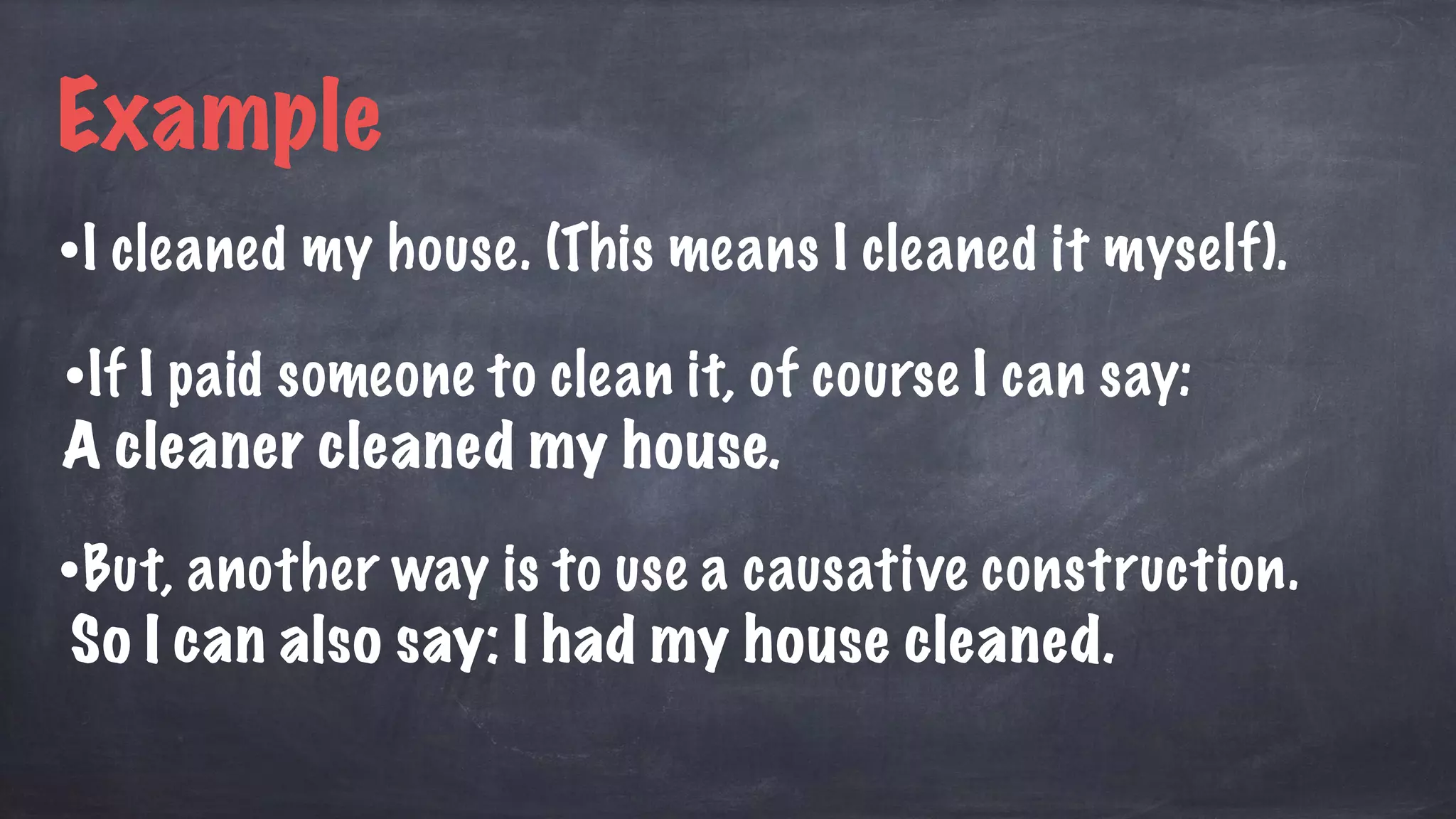
•I cleaned my house. (This means I cleaned it myself).
Example
•If I paid someone to clean it, of course I can say:
A cleaner cleaned my house.
•But, another way is to use a causative construction.
So I can also say: I had my house cleaned.
Tip:
In a sense, using a causative verb is similar to using
a passive. The important thing is that the house is
now clean. We don't focus on who did the cleaning.
Have + object + past participle
(have something done)
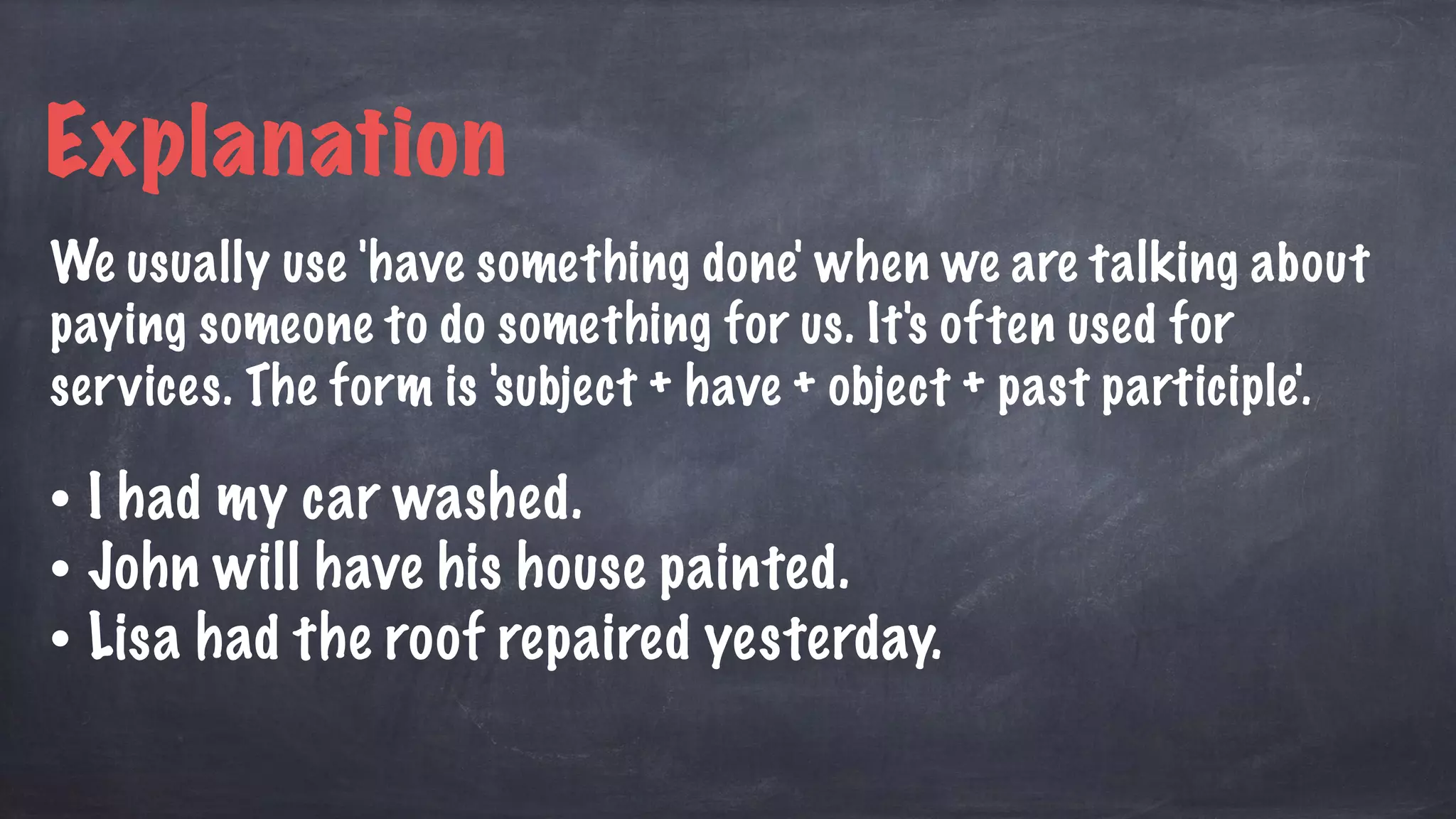
We usually use 'have something done' when we are talking about
paying someone to do something for us. It's often used for
services. The form is 'subject + have + object + past participle'.
Explanation
• I had my car washed.
• John will have his house painted.
• Lisa had the roof repaired yesterday.
•I cleaned my house. (This means I cleaned it myself).
Example
•If I paid someone to clean it, of course I can say:
A cleaner cleaned my house.
•But, another way is to use a causative construction.
So I can also say: I had my house cleaned.
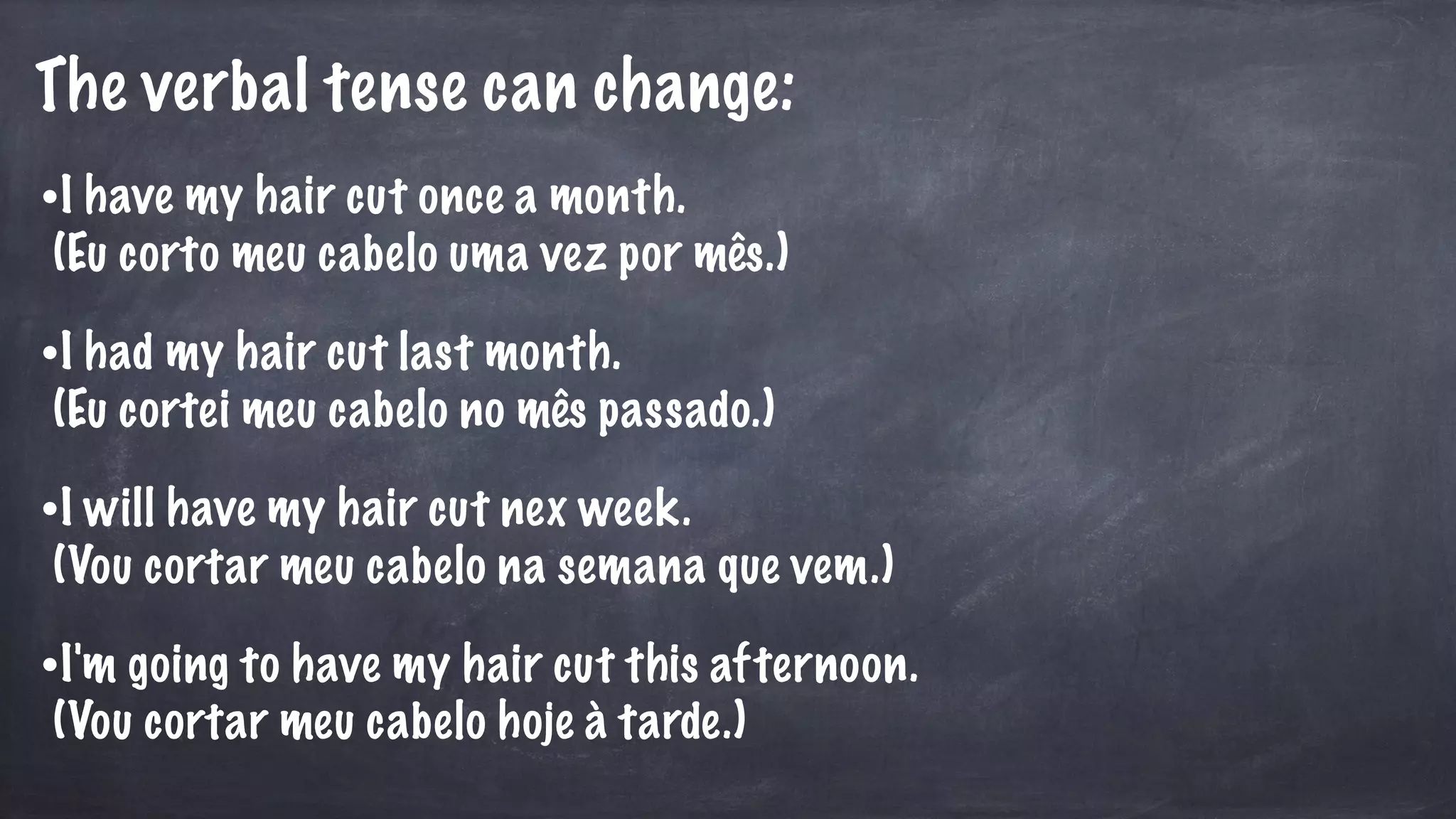
The verbal tense can change:
•I have my hair cut once a month.
(Eu corto meu cabelo uma vez por mês.)
•I had my hair cut last month.
(Eu cortei meu cabelo no mês passado.)
•I will have my hair cut nex week.
(Vou cortar meu cabelo na semana que vem.)
•I'm going to have my hair cut this afternoon.
(Vou cortar meu cabelo hoje à tarde.)
Get + object + past participle
(get something done)
We can also use 'subject + get + object + past participle'.
This has the same meaning as 'have', but is less formal.
Explanation
• The students get their essays checked.
• I'll get my hair cut next week.
• He got his washing machine fixed.
Have someone do something
(have + person + infinitive)
We can also use the construction 'subject + have + person + infinitive'.
This has a very similar meaning to 'have something done', which we've
already talked about, but this time we say who did the thing - we talk
about the person who we asked to do the thing for us.
Explanation
•I had the electrician look at my broken light.
•The doctor will have the nurse call the patients.
•The teacher had the students write the answers on the
whiteboard.
•I had the electrician look at my broken light.
•The doctor will have the nurse call the patients.
•The teacher had the students write the answers on the
whiteboard.
Get someone to do something 

(get + person + to + infinitive)
Finally, we can also use the construction 'get + someone + to +
infinitive'. Again, this means that you cause the other person to
do the action, maybe by paying them to do it, or by asking them
to do it, or by persuading them to do it.
Explanation
• She gets her son to do his homework by promising him
ice cream when he's finished.
• I got the cleaner to clean under the cupboards.
Tip:
Sometimes, this construction has the feeling
that we needed to convince someone to do
something, while the other constructions on
this page are neutral.
Let’s practice!
The best hour
You have to create one sentence with:
1. Have + object + past participle
(have something done)
2. Get + object + past participle
(get something done)
Doubts?
Ask for Andrea!
To fix the idea
Let’s review…
For the last…
my secret of success!
make a plan and
try to achieve then
Write your goals,
Keep trying…
even if you haven’t hit at first
One day you will find the right way :)
English Class_2016
English Class_2016

English Class_2016

  • 1.
    English Class Be quietand pay attention! May 2016 - Wizard
  • 2.
    My name isTalita and I will be your teacher for some minutes!
  • 3.
  • 4.
    We use acausative verb when we want to talk about something that someone else did for us or for another person. It means that the subject caused the action to happen, but didn't do it themselves. Maybe they paid, or asked, or persuaded the other person to do it. Explanation
  • 5.
    •I cleaned myhouse. (This means I cleaned it myself). Example •If I paid someone to clean it, of course I can say: A cleaner cleaned my house. •But, another way is to use a causative construction. So I can also say: I had my house cleaned.
  • 6.
    Tip: In a sense,using a causative verb is similar to using a passive. The important thing is that the house is now clean. We don't focus on who did the cleaning.
  • 7.
    Have + object+ past participle (have something done)
  • 8.
    We usually use'have something done' when we are talking about paying someone to do something for us. It's often used for services. The form is 'subject + have + object + past participle'. Explanation • I had my car washed. • John will have his house painted. • Lisa had the roof repaired yesterday.
  • 9.
    •I cleaned myhouse. (This means I cleaned it myself). Example •If I paid someone to clean it, of course I can say: A cleaner cleaned my house. •But, another way is to use a causative construction. So I can also say: I had my house cleaned.
  • 10.
    The verbal tensecan change: •I have my hair cut once a month. (Eu corto meu cabelo uma vez por mês.) •I had my hair cut last month. (Eu cortei meu cabelo no mês passado.) •I will have my hair cut nex week. (Vou cortar meu cabelo na semana que vem.) •I'm going to have my hair cut this afternoon. (Vou cortar meu cabelo hoje à tarde.)
  • 11.
    Get + object+ past participle (get something done)
  • 12.
    We can alsouse 'subject + get + object + past participle'. This has the same meaning as 'have', but is less formal. Explanation • The students get their essays checked. • I'll get my hair cut next week. • He got his washing machine fixed.
  • 13.
    Have someone dosomething (have + person + infinitive)
  • 14.
    We can alsouse the construction 'subject + have + person + infinitive'. This has a very similar meaning to 'have something done', which we've already talked about, but this time we say who did the thing - we talk about the person who we asked to do the thing for us. Explanation •I had the electrician look at my broken light. •The doctor will have the nurse call the patients. •The teacher had the students write the answers on the whiteboard. •I had the electrician look at my broken light. •The doctor will have the nurse call the patients. •The teacher had the students write the answers on the whiteboard.
  • 15.
    Get someone todo something 
 (get + person + to + infinitive)
  • 16.
    Finally, we canalso use the construction 'get + someone + to + infinitive'. Again, this means that you cause the other person to do the action, maybe by paying them to do it, or by asking them to do it, or by persuading them to do it. Explanation • She gets her son to do his homework by promising him ice cream when he's finished. • I got the cleaner to clean under the cupboards.
  • 17.
    Tip: Sometimes, this constructionhas the feeling that we needed to convince someone to do something, while the other constructions on this page are neutral.
  • 18.
  • 19.
    You have tocreate one sentence with: 1. Have + object + past participle (have something done) 2. Get + object + past participle (get something done)
  • 20.
  • 21.
    To fix theidea Let’s review…
  • 23.
    For the last… mysecret of success!
  • 24.
    make a planand try to achieve then Write your goals,
  • 25.
    Keep trying… even ifyou haven’t hit at first
  • 26.
    One day youwill find the right way :)