Engineering Thermodynamics
Module 1 - Basic Concepts and First law
Lecture 1 of 3 - Basic Concepts 1
Prepared by
Mr.M.Mani Vannan
Assistant Professor
Department of Mechanical Engineering
1
Unit I - Basic Concepts and First Law
Basic concepts - concept of continuum, comparison of
microscopic and macroscopic approach. Path and point functions.
Intensive and extensive, total and specific quantities. System and
their types. Thermodynamic Equilibrium State, path and process.
Quasi-static, reversible and irreversible processes. Heat and work
transfer, definition and comparison, sign convention.
Displacement work and other modes of work .P-V diagram.
Zeroth law of thermodynamics – concept of temperature and
thermal equilibrium– relationship between temperature scales –
new temperature scales. First law of thermodynamics –
application to closed and open systems – steady and unsteady
flow processes
Basic Concepts 1 2
Engineering
Engineering is the creative application of science,
mathematical methods, and empirical evidence to the innovation,
design, construction, operation and maintenance of structures,
machines, materials, devices, systems, processes, and
organizations.
The discipline of engineering encompasses a broad range
of more specialized fields of engineering, each with a more
specific emphasis on particular areas of applied mathematics,
applied science, and types of application.
Basic Concepts 1 3
Thermodynamics
Thermodynamics is a branch of physics concerned with
heat and temperature and their relation to other forms of energy
and work.
Thermodynamics applies to a wide variety of topics in
science and engineering, especially physical chemistry, chemical
engineering and mechanical engineering.
Basic Concepts 1 4
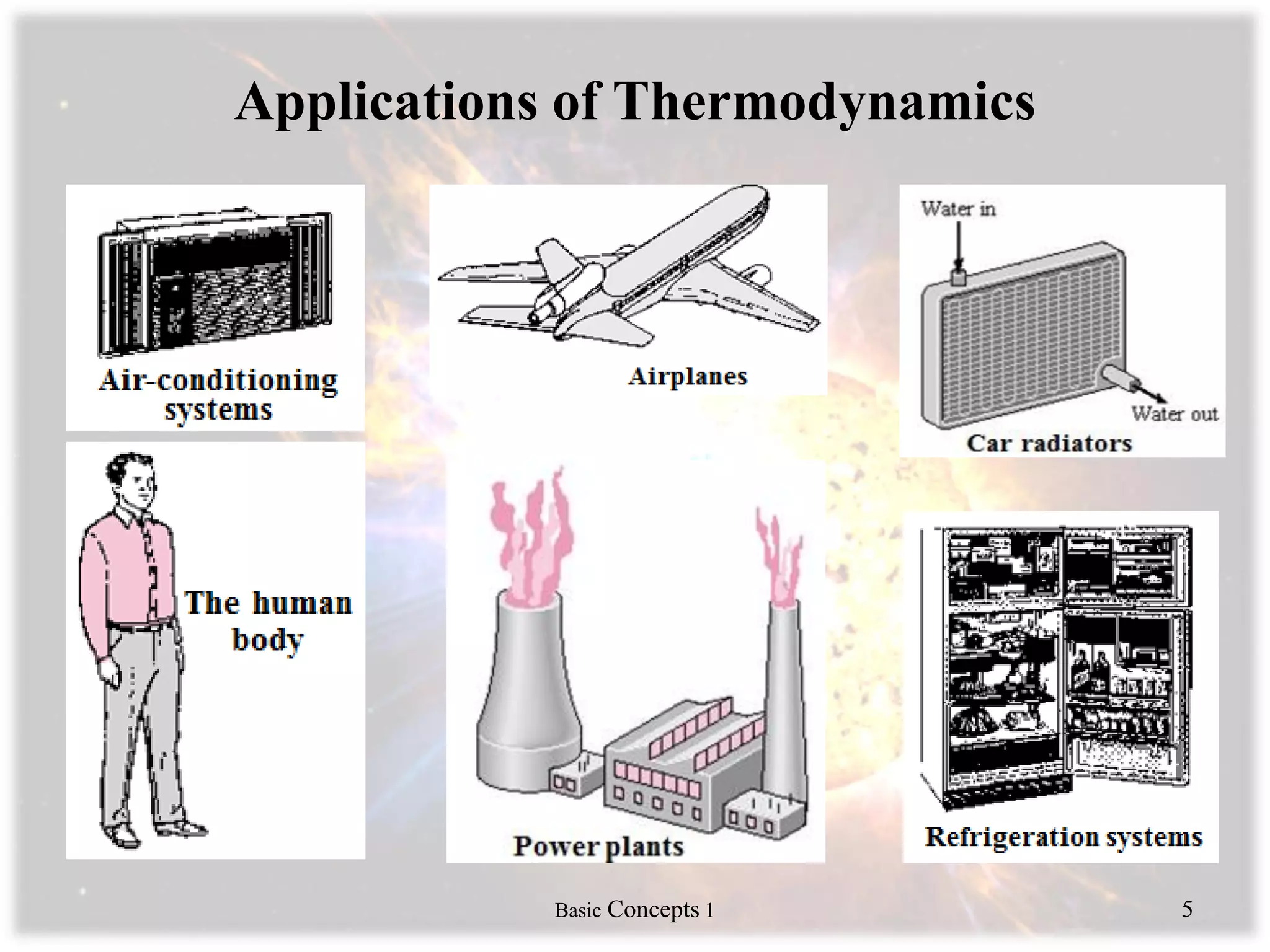
Applications of Thermodynamics
Basic Concepts 1 5
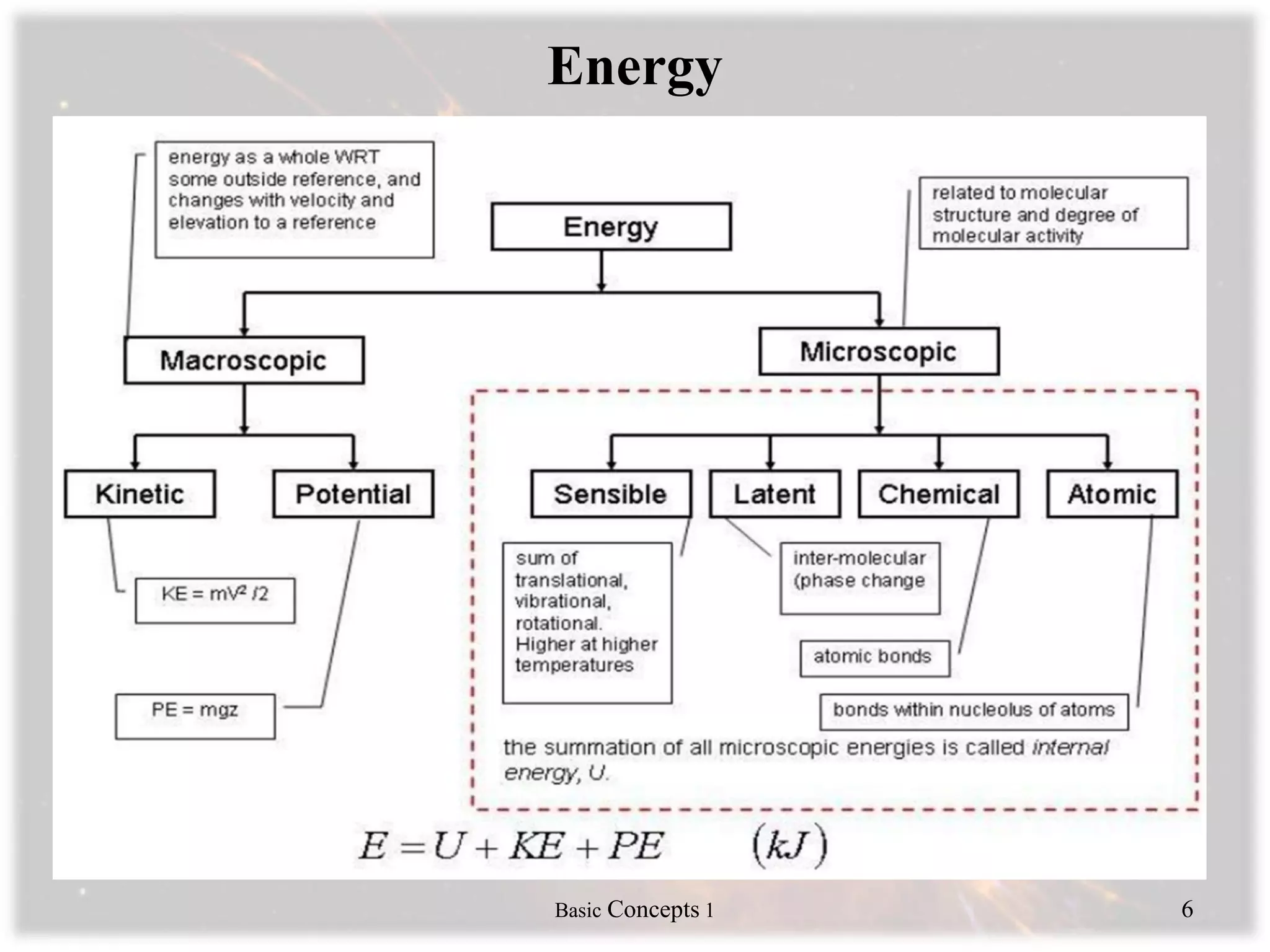
Energy
Basic Concepts 1 6
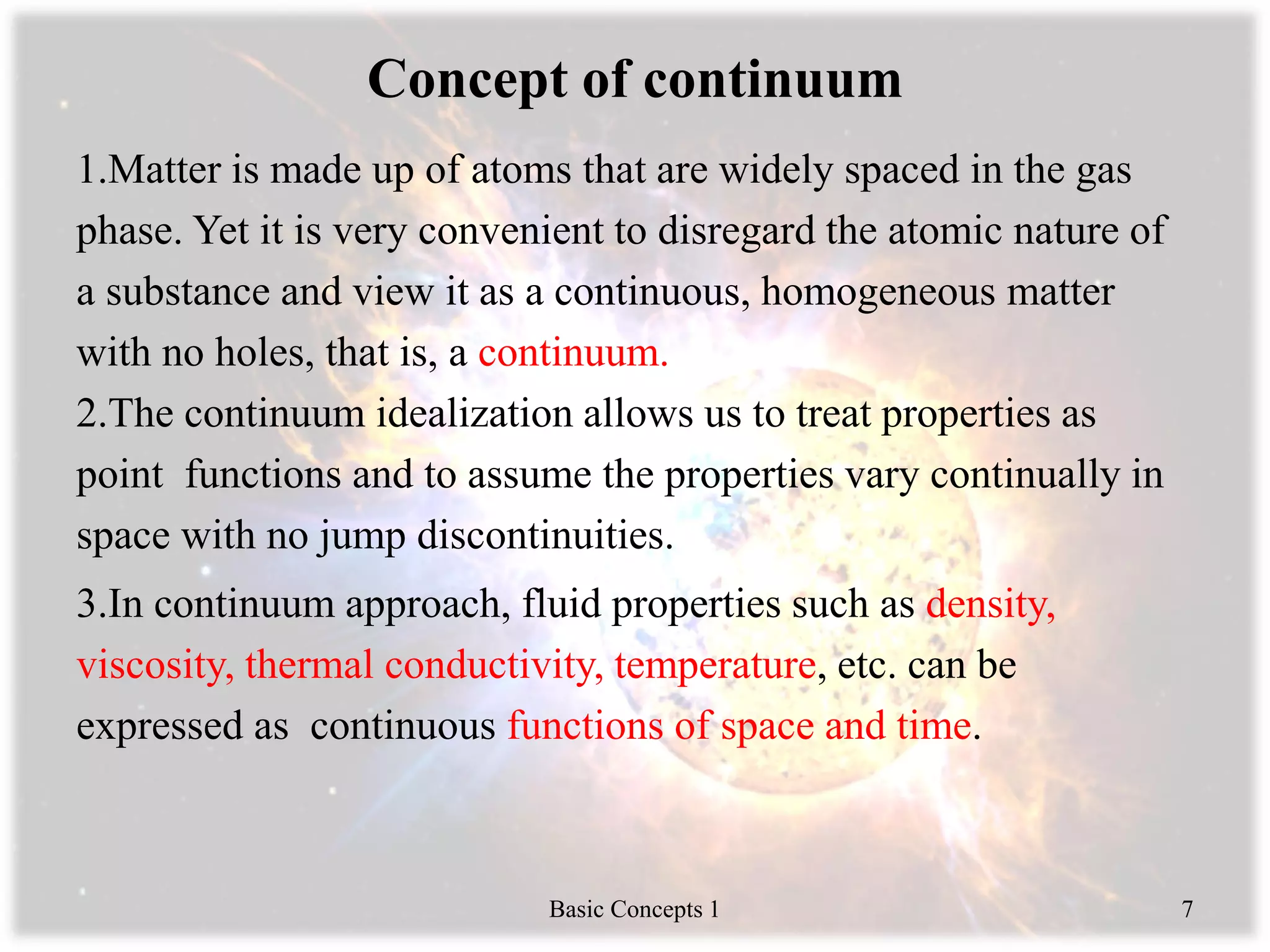
Concept of continuum
1.Matter is made up of atoms that are widely spaced in the gas
phase. Yet it is very convenient to disregard the atomic nature of
a substance and view it as a continuous, homogeneous matter
with no holes, that is, a continuum.
2.The continuum idealization allows us to treat properties as
point functions and to assume the properties vary continually in
space with no jump discontinuities.
3.In continuum approach, fluid properties such as density,
viscosity, thermal conductivity, temperature, etc. can be
expressed as continuous functions of space and time.
Basic Concepts 1 7
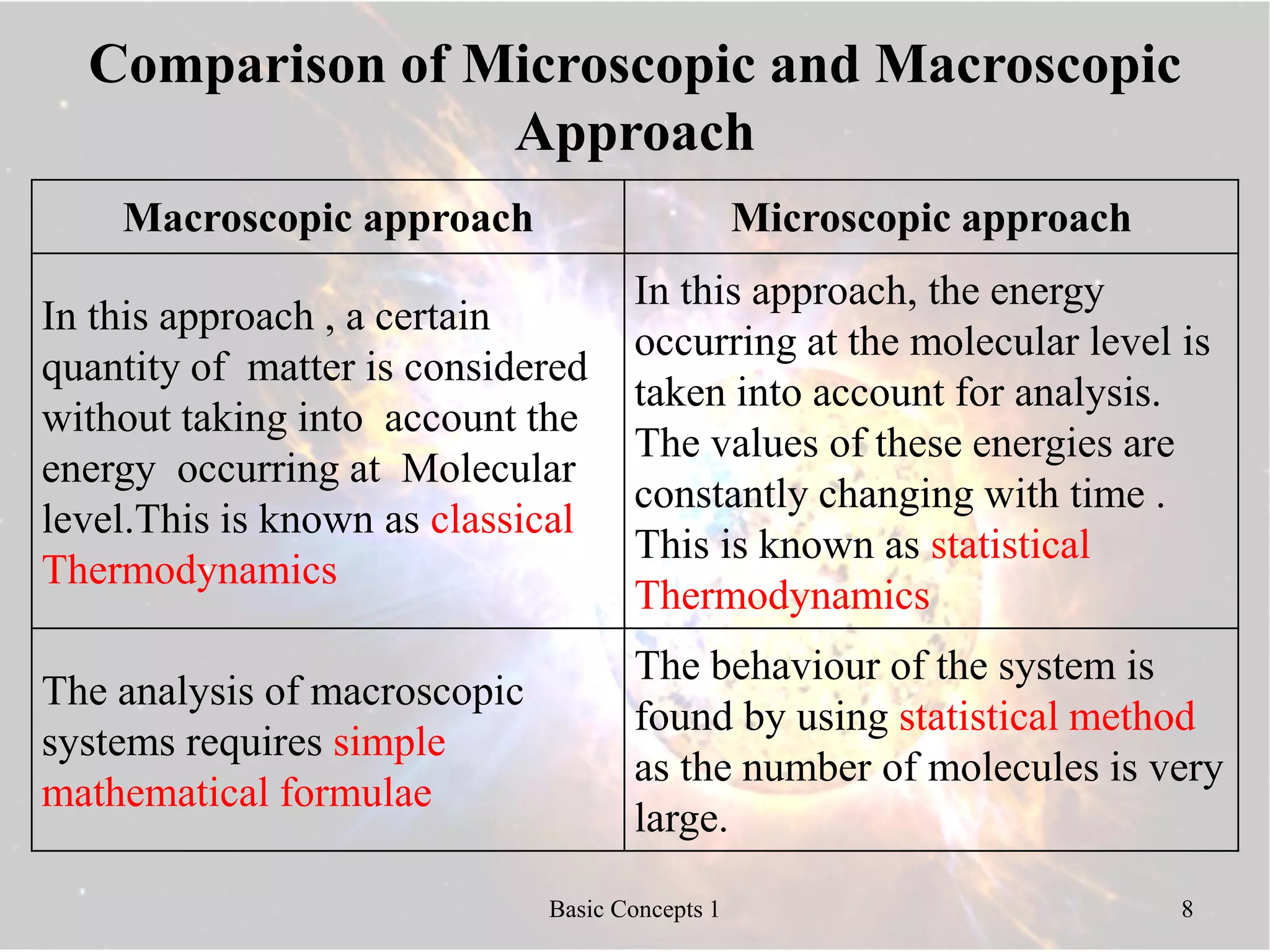
Comparison of Microscopic and Macroscopic
Approach
Macroscopic approach Microscopic approach
In this approach , a certain
quantity of matter is considered
without taking into account the
energy occurring at Molecular
level.This is known as classical
Thermodynamics
In this approach, the energy
occurring at the molecular level is
taken into account for analysis.
The values of these energies are
constantly changing with time .
This is known as statistical
Thermodynamics
The analysis of macroscopic
systems requires simple
mathematical formulae
The behaviour of the system is
found by using statistical method
as the number of molecules is very
large.
Basic Concepts 1 8
Cont…
Macroscopic approach Microscopic approach
The values of the properties of
system are their average values.
Example: consider a sample of a
gas in a closed container . The
pressure of the gas is the average
value of the pressure exerted by
millions of individual molecules .
The properties like velocity ,
momentum , impulse , kinetic
energy , force of impact etc ,
which describe the molecule
cannot be easily measured by
instruments . Our senses cannot
feel them .
In order to describe such a system
only a few variables are needed .
Large number of variables are
needed to describe such a system
.So the approach is complicated .
Basic Concepts 1 9
Point and Path Functions
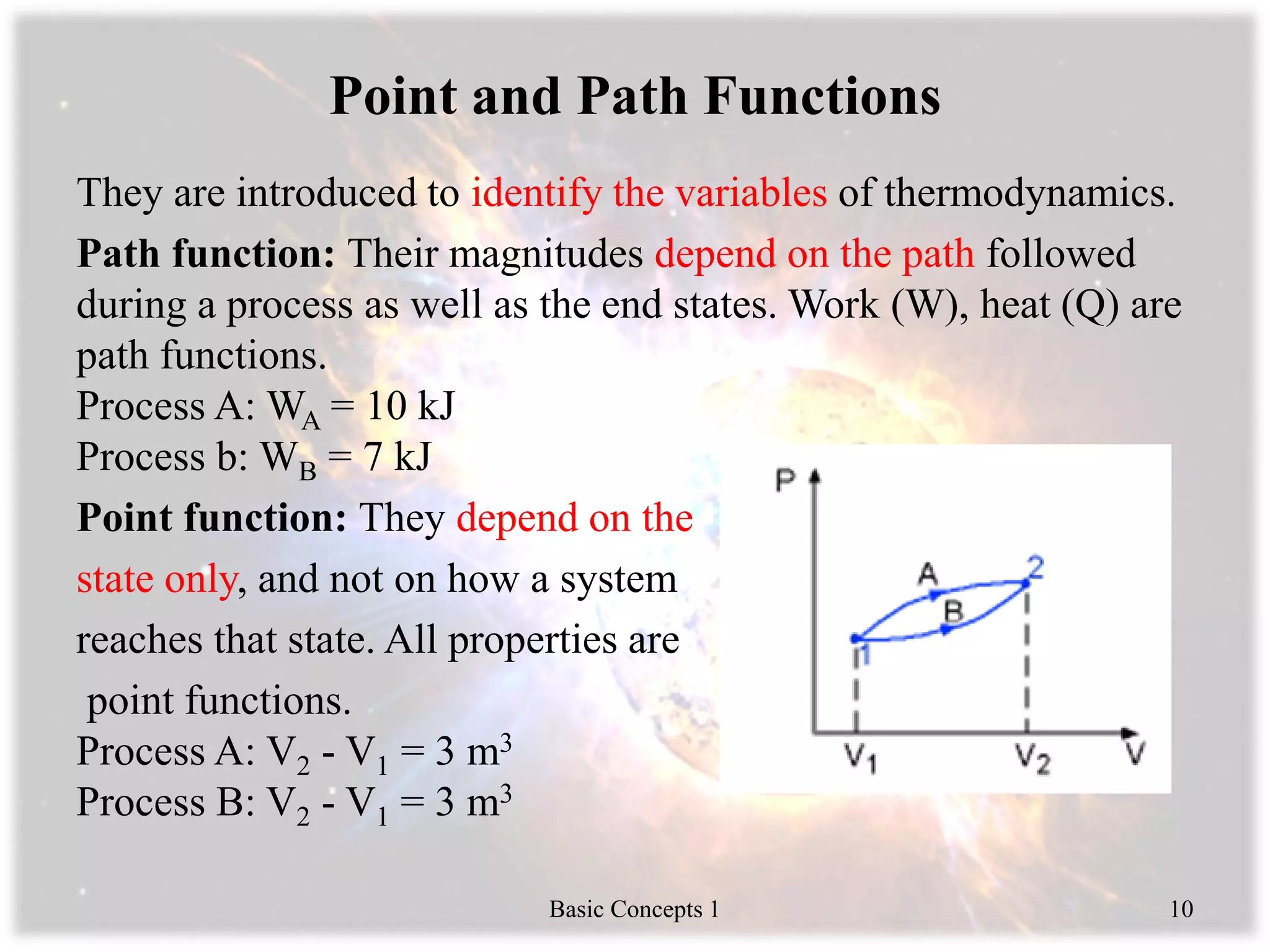
They are introduced to identify the variables of thermodynamics.
Path function: Their magnitudes depend on the path followed
during a process as well as the end states. Work (W), heat (Q) are
path functions.
Process A: WA = 10 kJ
Process b: WB = 7 kJ
Point function: They depend on the
state only, and not on how a system
reaches that state. All properties are
point functions.
Process A: V2 - V1 = 3 m3
Process B: V2 - V1 = 3 m3
Basic Concepts 1 10
Properties
Property: Any characteristic of a system.
Intensive properties: These are independent of the mass of a
system,
Examples: Temperature, Pressure and Density, etc.,
Extensive properties: These are depend on the size of the system.
Examples: Volume, Mass, Heat (Q),Work(W)etc.,
Specific properties: Extensive properties per unit mass.
Basic Concepts 1 11
Pressure
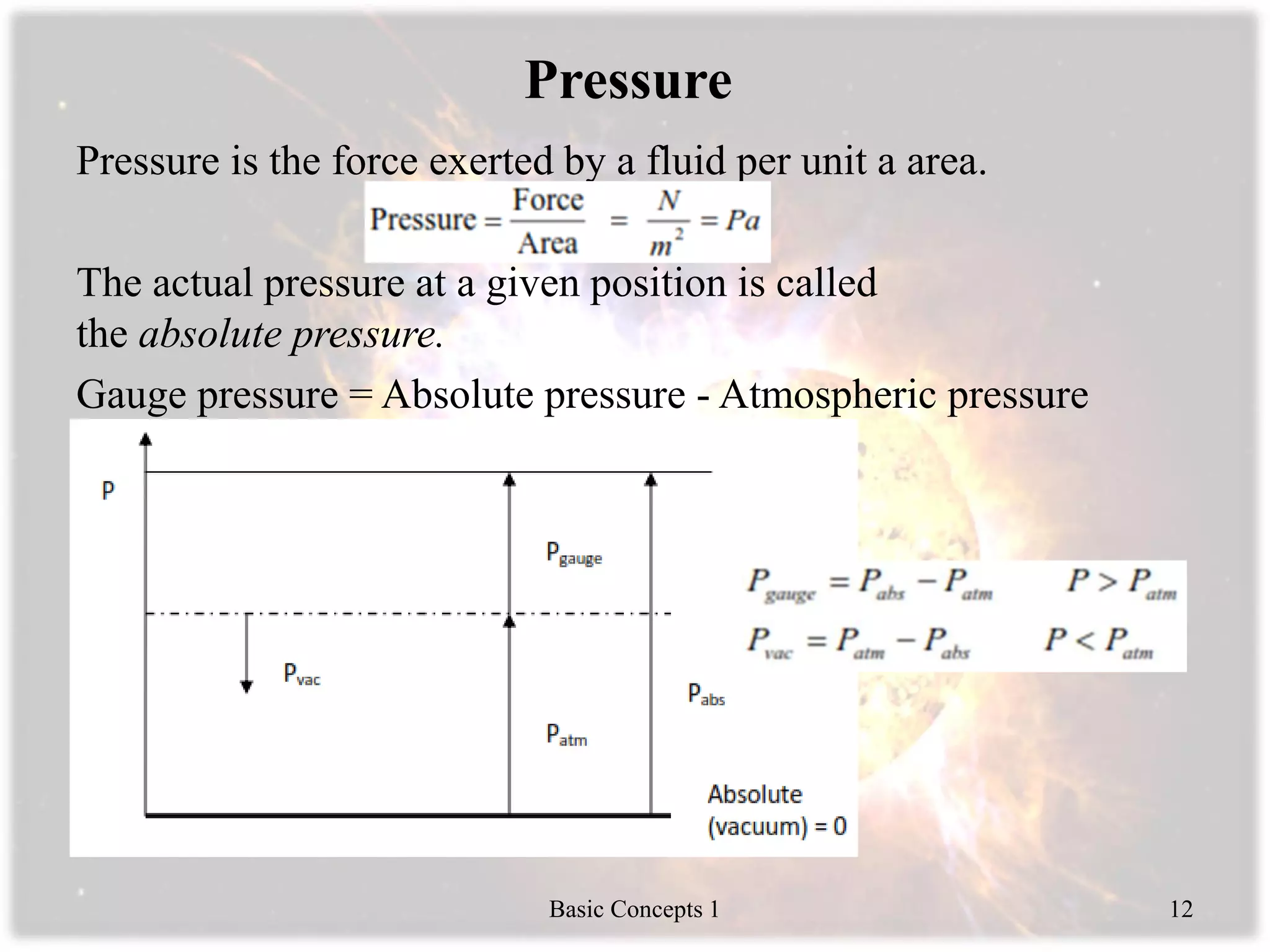
Pressure is the force exerted by a fluid per unit a area.
The actual pressure at a given position is called
the absolute pressure.
Gauge pressure = Absolute pressure - Atmospheric pressure
Basic Concepts 1 12
Cont…
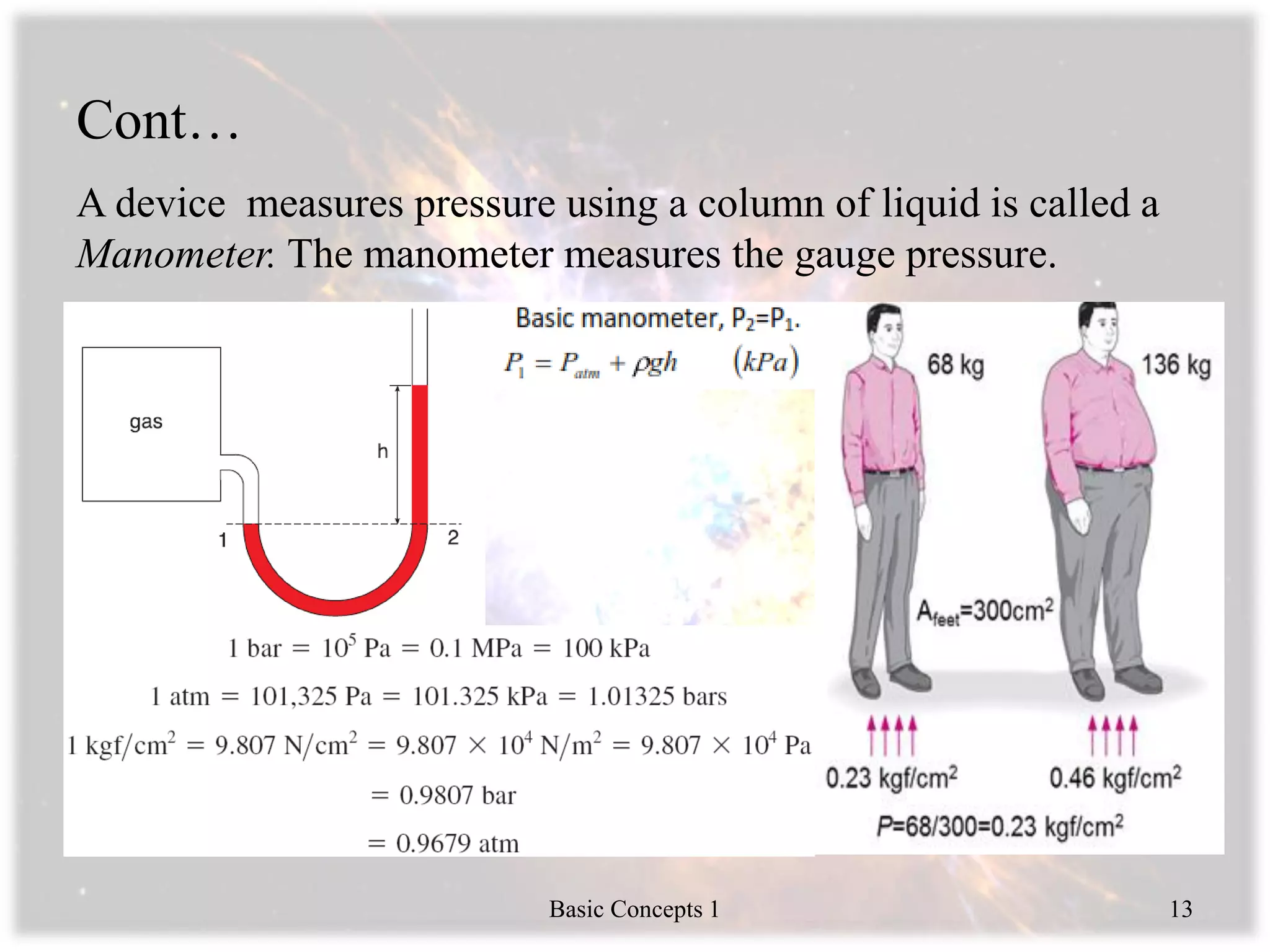
A device measures pressure using a column of liquid is called a
Manometer. The manometer measures the gauge pressure.
Basic Concepts 1 13
Mass (m) and Weight (W)
Mass is a measure of the amount of material an object is made of.
It is measured in kilograms(kg).It is denoted by ‘m’.
Weight is the force of gravity on an object.It is measured in
Newtons (N).It is denoted by ‘W’.
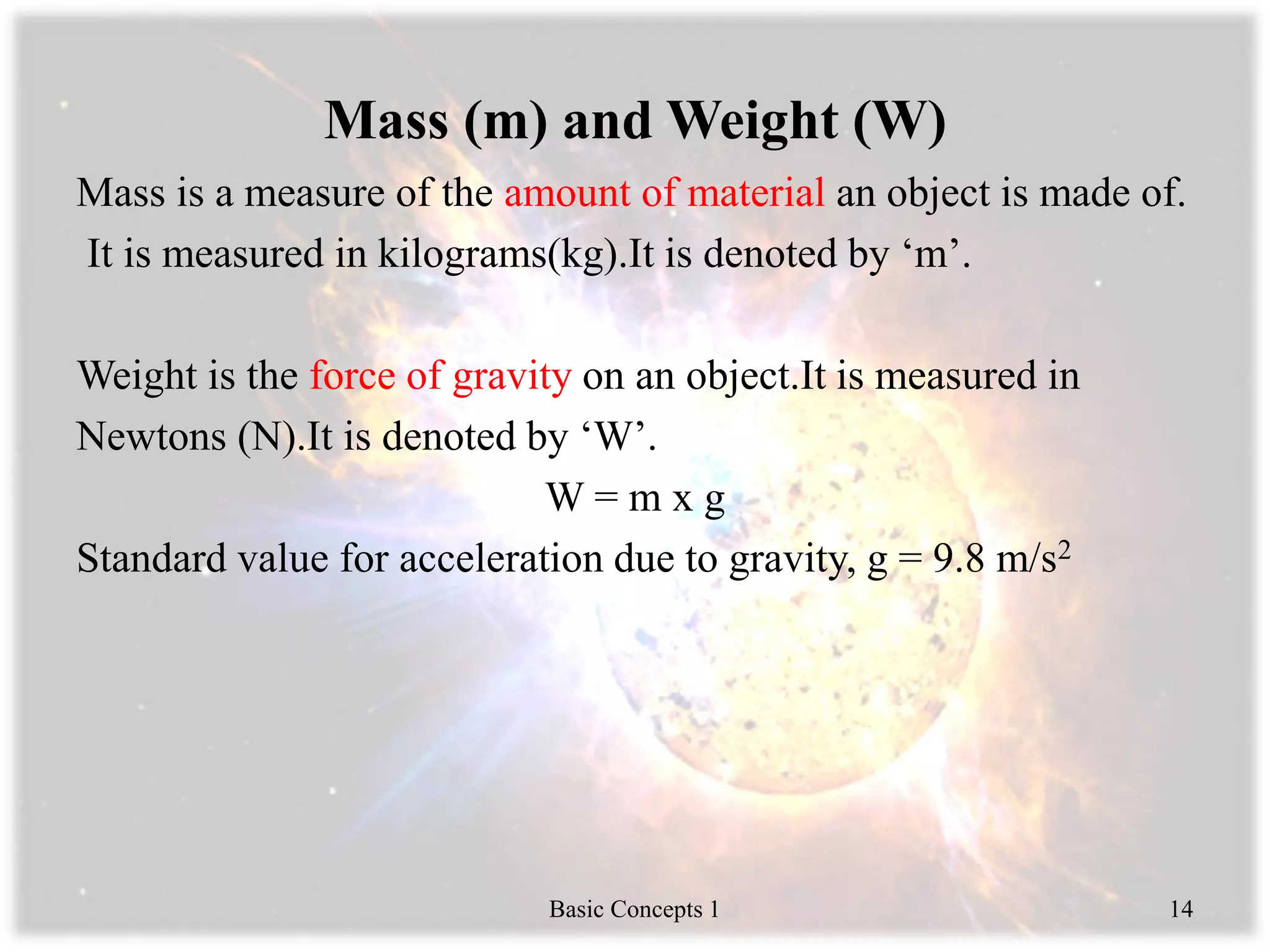
W = m x g
Standard value for acceleration due to gravity, g = 9.8 m/s2
Basic Concepts 1 14
Density(ρ),Specific gravity(s) and specific
volume (v)
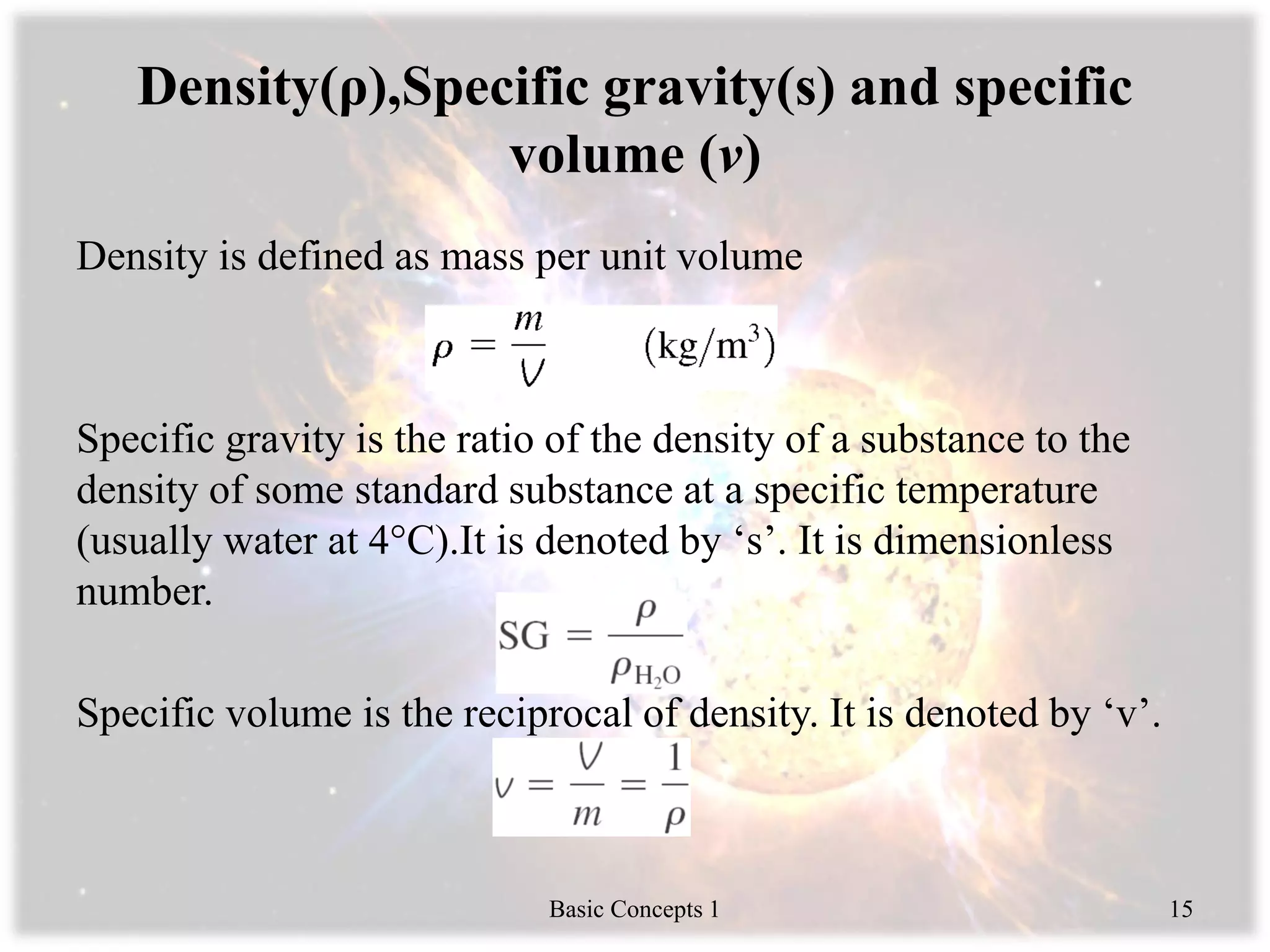
Density is defined as mass per unit volume
Specific gravity is the ratio of the density of a substance to the
density of some standard substance at a specific temperature
(usually water at 4°C).It is denoted by ‘s’. It is dimensionless
number.
Specific volume is the reciprocal of density. It is denoted by ‘v’.
Basic Concepts 1 15
Temperature
It is the measure of hotness and coldness in terms of any
arbitrary scales and indicating the direction which energy
spontaneously flows (from a hotter body to a colder one)
A thermometer is any of class of instrument that measures
the temperature. Temperature is the physical magnitude that is
measured by thermometers.
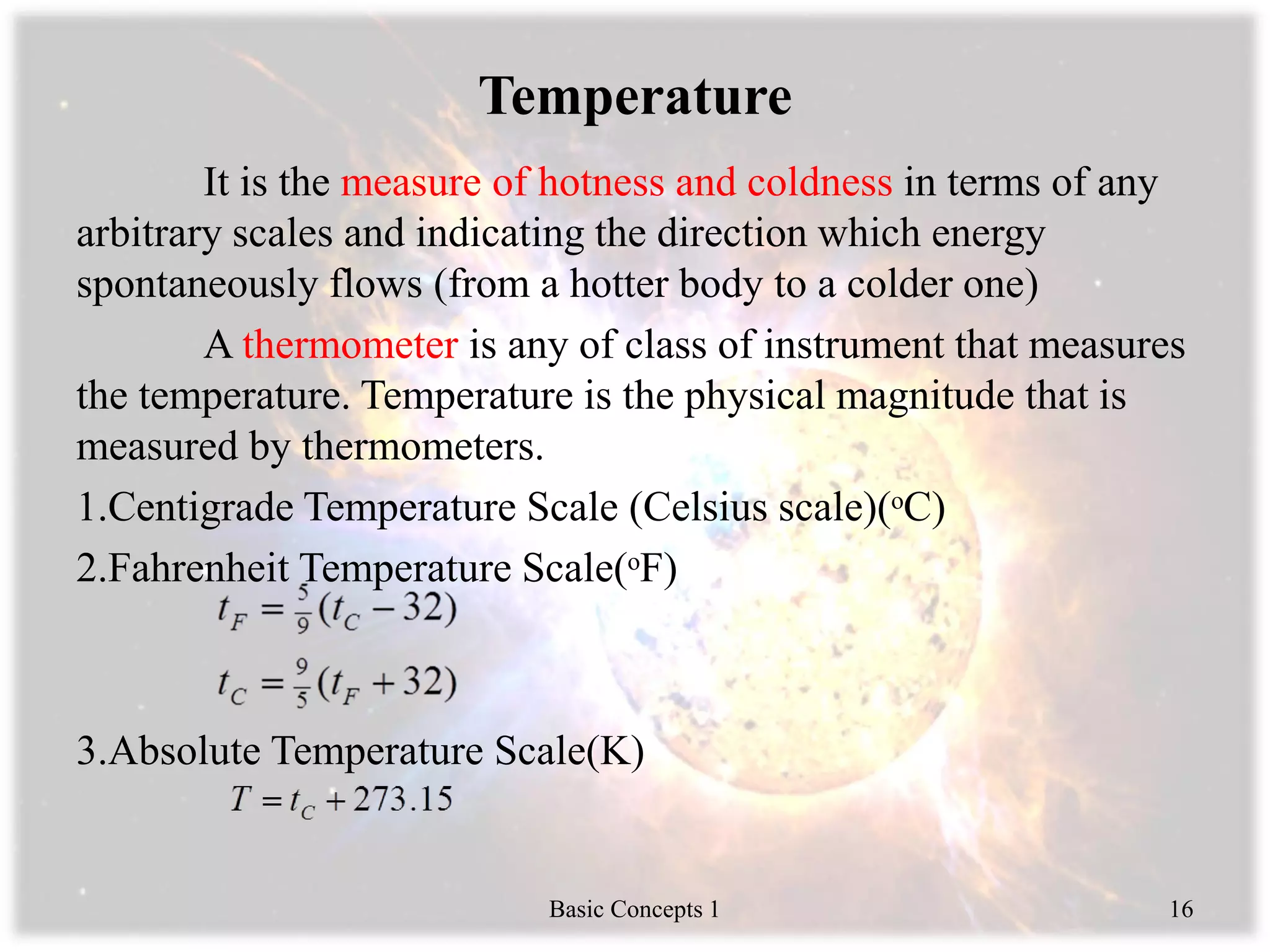
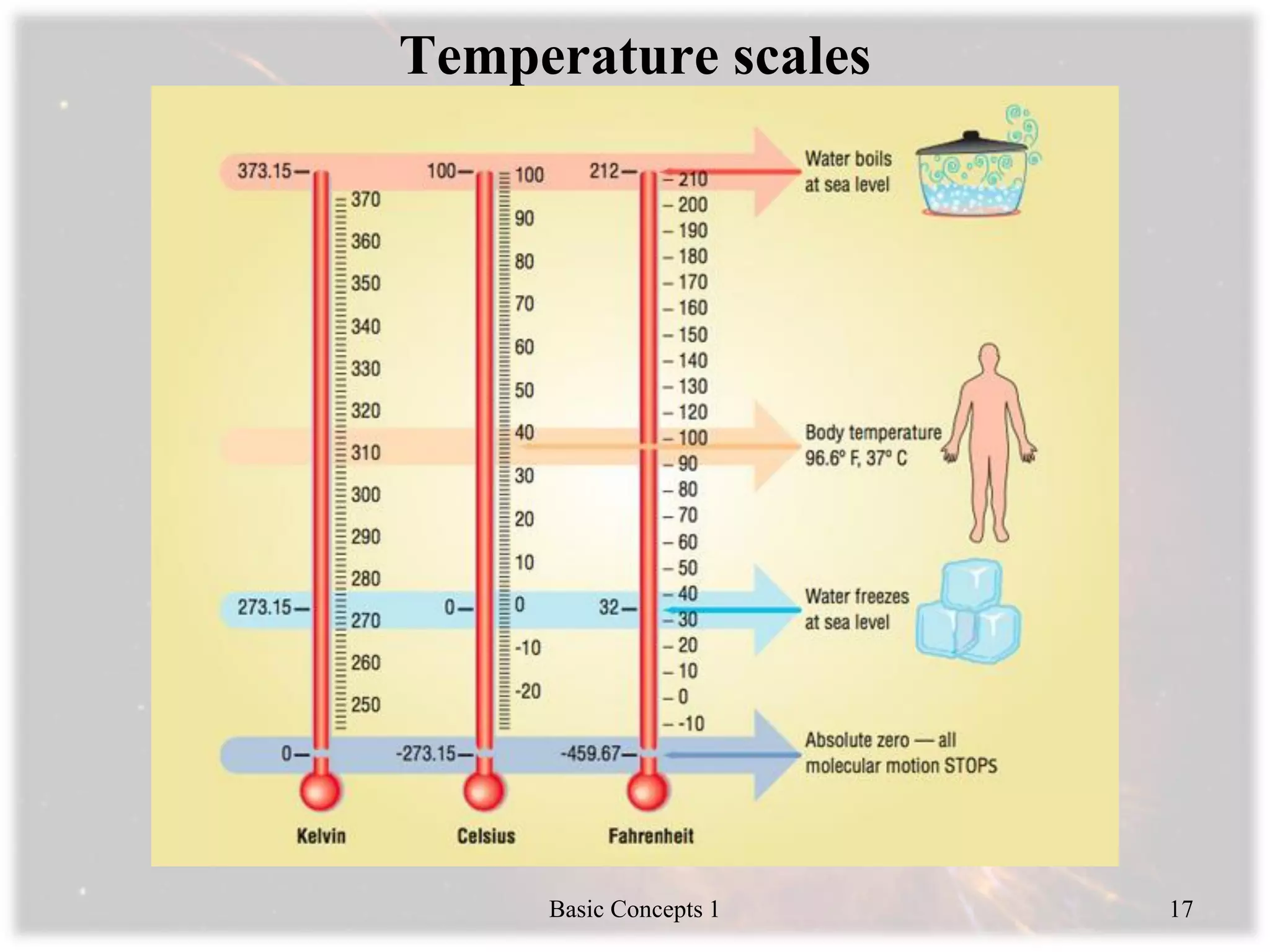
1.Centigrade Temperature Scale (Celsius scale)(ᵒC)
2.Fahrenheit Temperature Scale(ᵒF)
3.Absolute Temperature Scale(K)
Basic Concepts 1 16
Temperature scales
Basic Concepts 1 17
Thank you
Basic Concepts 1 18

Engineering Thermodynamics-Basic concepts 1

  • 1.
    Engineering Thermodynamics Module 1- Basic Concepts and First law Lecture 1 of 3 - Basic Concepts 1 Prepared by Mr.M.Mani Vannan Assistant Professor Department of Mechanical Engineering 1
  • 2.
    Unit I -Basic Concepts and First Law Basic concepts - concept of continuum, comparison of microscopic and macroscopic approach. Path and point functions. Intensive and extensive, total and specific quantities. System and their types. Thermodynamic Equilibrium State, path and process. Quasi-static, reversible and irreversible processes. Heat and work transfer, definition and comparison, sign convention. Displacement work and other modes of work .P-V diagram. Zeroth law of thermodynamics – concept of temperature and thermal equilibrium– relationship between temperature scales – new temperature scales. First law of thermodynamics – application to closed and open systems – steady and unsteady flow processes Basic Concepts 1 2
  • 3.
    Engineering Engineering is thecreative application of science, mathematical methods, and empirical evidence to the innovation, design, construction, operation and maintenance of structures, machines, materials, devices, systems, processes, and organizations. The discipline of engineering encompasses a broad range of more specialized fields of engineering, each with a more specific emphasis on particular areas of applied mathematics, applied science, and types of application. Basic Concepts 1 3
  • 4.
    Thermodynamics Thermodynamics is abranch of physics concerned with heat and temperature and their relation to other forms of energy and work. Thermodynamics applies to a wide variety of topics in science and engineering, especially physical chemistry, chemical engineering and mechanical engineering. Basic Concepts 1 4
  • 5.
  • 6.
  • 7.
    Concept of continuum 1.Matteris made up of atoms that are widely spaced in the gas phase. Yet it is very convenient to disregard the atomic nature of a substance and view it as a continuous, homogeneous matter with no holes, that is, a continuum. 2.The continuum idealization allows us to treat properties as point functions and to assume the properties vary continually in space with no jump discontinuities. 3.In continuum approach, fluid properties such as density, viscosity, thermal conductivity, temperature, etc. can be expressed as continuous functions of space and time. Basic Concepts 1 7
  • 8.
    Comparison of Microscopicand Macroscopic Approach Macroscopic approach Microscopic approach In this approach , a certain quantity of matter is considered without taking into account the energy occurring at Molecular level.This is known as classical Thermodynamics In this approach, the energy occurring at the molecular level is taken into account for analysis. The values of these energies are constantly changing with time . This is known as statistical Thermodynamics The analysis of macroscopic systems requires simple mathematical formulae The behaviour of the system is found by using statistical method as the number of molecules is very large. Basic Concepts 1 8
  • 9.
    Cont… Macroscopic approach Microscopicapproach The values of the properties of system are their average values. Example: consider a sample of a gas in a closed container . The pressure of the gas is the average value of the pressure exerted by millions of individual molecules . The properties like velocity , momentum , impulse , kinetic energy , force of impact etc , which describe the molecule cannot be easily measured by instruments . Our senses cannot feel them . In order to describe such a system only a few variables are needed . Large number of variables are needed to describe such a system .So the approach is complicated . Basic Concepts 1 9
  • 10.
    Point and PathFunctions They are introduced to identify the variables of thermodynamics. Path function: Their magnitudes depend on the path followed during a process as well as the end states. Work (W), heat (Q) are path functions. Process A: WA = 10 kJ Process b: WB = 7 kJ Point function: They depend on the state only, and not on how a system reaches that state. All properties are point functions. Process A: V2 - V1 = 3 m3 Process B: V2 - V1 = 3 m3 Basic Concepts 1 10
  • 11.
    Properties Property: Any characteristicof a system. Intensive properties: These are independent of the mass of a system, Examples: Temperature, Pressure and Density, etc., Extensive properties: These are depend on the size of the system. Examples: Volume, Mass, Heat (Q),Work(W)etc., Specific properties: Extensive properties per unit mass. Basic Concepts 1 11
  • 12.
    Pressure Pressure is theforce exerted by a fluid per unit a area. The actual pressure at a given position is called the absolute pressure. Gauge pressure = Absolute pressure - Atmospheric pressure Basic Concepts 1 12
  • 13.
    Cont… A device measurespressure using a column of liquid is called a Manometer. The manometer measures the gauge pressure. Basic Concepts 1 13
  • 14.
    Mass (m) andWeight (W) Mass is a measure of the amount of material an object is made of. It is measured in kilograms(kg).It is denoted by ‘m’. Weight is the force of gravity on an object.It is measured in Newtons (N).It is denoted by ‘W’. W = m x g Standard value for acceleration due to gravity, g = 9.8 m/s2 Basic Concepts 1 14
  • 15.
    Density(ρ),Specific gravity(s) andspecific volume (v) Density is defined as mass per unit volume Specific gravity is the ratio of the density of a substance to the density of some standard substance at a specific temperature (usually water at 4°C).It is denoted by ‘s’. It is dimensionless number. Specific volume is the reciprocal of density. It is denoted by ‘v’. Basic Concepts 1 15
  • 16.
    Temperature It is themeasure of hotness and coldness in terms of any arbitrary scales and indicating the direction which energy spontaneously flows (from a hotter body to a colder one) A thermometer is any of class of instrument that measures the temperature. Temperature is the physical magnitude that is measured by thermometers. 1.Centigrade Temperature Scale (Celsius scale)(ᵒC) 2.Fahrenheit Temperature Scale(ᵒF) 3.Absolute Temperature Scale(K) Basic Concepts 1 16
  • 17.
  • 18.