ENVIRONMENTAL
ENGINEERING
441
Lecture 3:
Water Treatment
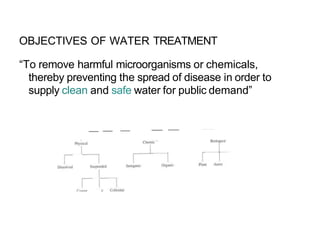
OBJECTIVES OF WATER TREATMENT
“To remove harmful microorganisms or chemicals,
thereby preventing the spread of disease in order to
supply clean and safe water for public demand”
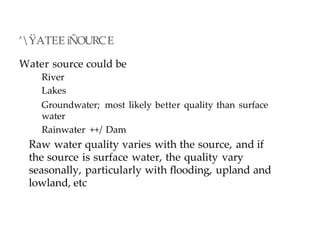
’ŸATEE iÑOURCE
Water source could be
River
Lakes
Groundwater; most likely better quality than surface
water
Rainwater ++/ Dam
Raw water quality varies with the source, and if
the source is surface water, the quality vary
seasonally, particularly with flooding, upland and
lowland, etc
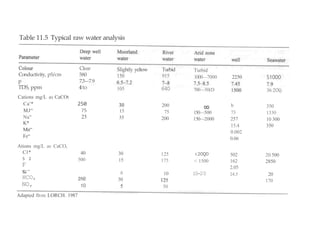
Table 11.5 Typical raw water analysis
Clear
580
7.3—7.9
4to
Conductivity, pS/cm
p
TDS, ppm
Cations mg/L as CaCOt
Ations mg/L as CaCO,
C1*
5 2
F
HCO,
NO,
40
500
2fi0
10
Adapted fit›m LORCH. 1987
Slightly yeltow
150
Turbid
915
105
Ca'* 250
MJ“ 75 15
Na" 25 35
K*
Mn“
Fe“
30
15
6
30
640
Turbid
1000—7000 2250 S1000
700—50(D 36 21X)
8
b 350
150—500 73 1330
I50—2000 257 10 300
15.4 350
0.002
0.06
200
75
200
125 <2OQO 502 20 500
175 < 1500 162 2850
2.05
10 10-20 24.5 20
50
170
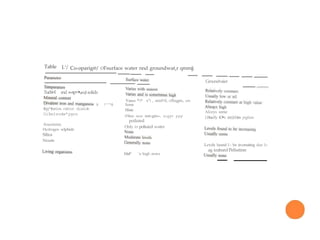
Table I.‘/ Co›oparig@/ OFsurface water nnd groundwater qmmjj
Tucbi+I end s«sp<•a<dsolids
#
g
g
'#
s
si
v
a cwbon dioxide
Oi$mlvodw*ygrn
Anurinnia
Hydrogen wlphidc
Silica
Nioa4e
Yancs *'i* x"i , rainf®ll, cffiugpts, cm
Some
Ifonc
t7flen near mtt«gtio«, urgpt ppp
poiluted
Only in poliuicd water
8 !^'°0
MaF' ’e high mms
Gmundvaier
Alozys some
1.18ualIy iO'•v. rct{£1irrs yrgtion
Lcvcls !uund l‹› be in-creating due Io
ag iculrurcl Peliutinn
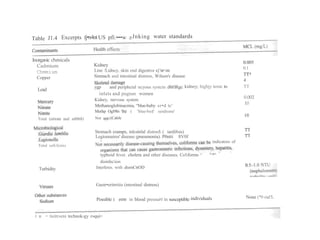
Table J1.4 Excerpts fj•n4ntUS pfi:•••w zJnking water standards
Health effects
Inorganic chmicals
Cadmium
Chmmium
Copper
Lead
Total (nitrate and ni08t8)
Total colifonns
Turbidity
Kidney
Line /Lidncy, skin end digestive s}'st<m
Sinmach and intestinal distress, Wilson's disease
ygp and periphcral ncyous systcm d8rHRge: kidney; highjy toxtc to
inlets axd pugnan women
Kidnry, nervous system
Methanoglobinacmia, “blue-baby sr•d tc'
Methp Ogl9bi 'B¢ i ’blue-bed' syndrome'
Not app{iCabJe
Stomach cramps, inlcstirlal distms$ ( iardi8sis)
Legionnaires' disease (pneumonia). P0ntii ftV0f
indicators of
0.1
TT
'^*°
typhoid fever. cholera and other diseases. Co!iforms ^
disinfecion
Interferes. with disrnCttOD
Gastr•eritrriiis (intestinal distress)
Possible i rem in blood pressure in susceptible individuals
t n = tieitr»eni technok›gy r»qui<
0.002
10
None (*0 md:'L
Tc+al zo1ifanra
0.04w+$/L GV
GV
cv
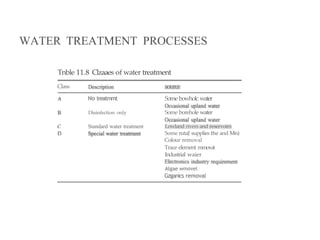
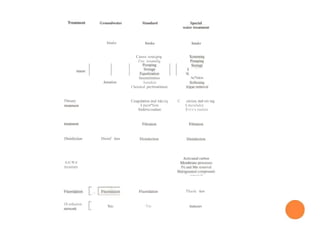
WATER TREATMENT PROCESSES
Tnble 11.8 Clzaaes of water treatment
Class
No treatmmt
Disinfection only
c Standard water treatment
source
Some bowholc water
Some borehole water
Lowland rivers and reservoirs
Some rutaJ supplies the and Mn)
Colour removal
Trace element mmovat
Industrial waier
Algae wmovel
Gzganics removal
Primary
lnia£e
Cause scn¢cging
Fire .wzœnifig
Disinfzciiun Disinf tiun
AdiWd
trcømm
Di srihuiion
Seuimìimtioo
Aeraikin
Chemical prc•irratirteni
Ae*etion
Coagulation and mizing
Łmcot*tion
Sedirru:rsaüun
C uleiiøa znd miviøg
Łmculakn
S t i r s røaiinn
Yes
Fluoù tion
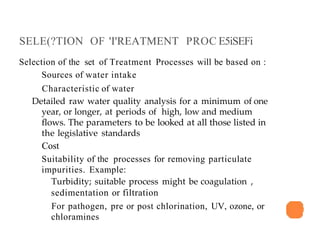
SELE(?TION OF 'I'REATMENT PROC E5iSEFi
Selection of the set of Treatment Processes will be based on :
Sources of water intake
Characteristic of water
Detailed raw water quality analysis for a minimum of one
year, or longer, at periods of high, low and medium
flows. The parameters to be looked at all those listed in
the legislative standards
Cost
Suitability of the processes for removing particulate
impurities. Example:
Turbidity; suitable process might be coagulation ,
sedimentation or filtration
For pathogen, pre or post chlorination, UV, ozone, or
chloramines
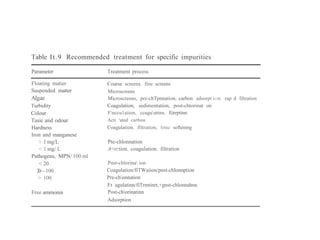
Table It.9 Recommended treatment for specific impurities
Parameter Treatment process
Floating matier
Suspended matter
Algae
Turbidity
Colour
Tasie and odour
Hardness
Iron and manganese
> I mg/L
< 1 mg/ L
Pathogens, MPN/ 100 m1
< 20
2
0
—100
> 100
Free ammonia
Coarse screens. fine screens
Microscreens
Microscreens, pre-chTpnnation, carbon adsorpt i‹›n. rap d filtration
Coagulation, sedimentation, post-chtorinat on
Fnccu1aiion, ccaguattnn. fi)rrptinn
Acti 'ated carbon
Coagulation. filtration, lime softening
Pte-chlonnation
A<rztion. coagulation. filtration
Pnst-chlorina ion
Coagulation/fiTWaiion/pnst-chIonnption
Pre-chonnation
Fr agulatinn/fiTrmtinrt,+gnst-chlonnahnn
Post-chorinatinn
Adsorption
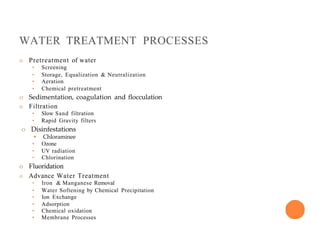
WATER TREATMENT PROCESSES
o Pretreatment of water
• Screening
• Storage, Equalization & Neutralization
• Aeration
• Chemical pretreatment
o Sedimentation, coagulation and flocculation
o Filtration
• Slow Sand filtration
• Rapid Gravity filters
o Disinfestations
• Chloraminee
• Ozone
• UV radiation
• Chlorination
o Fluoridation
o Advance Water Treatment
• Iron & Manganese Removal
• Water Softening by Chemical Precipitation
• Ion Exchange
• Adsorption
• Chemical oxidation
• Membrane Processes
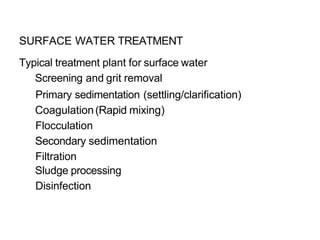
SURFACE WATER TREATMENT
Typical treatment plant for surface water
Screening and grit removal
Primary sedimentation (settling/clarification)
Coagulation(Rapid mixing)
Flocculation
Secondary sedimentation
Filtration
Sludge processing
Disinfection
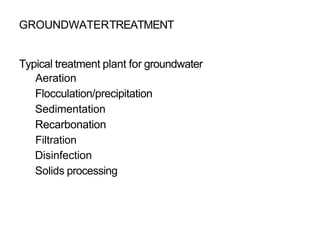
GROUNDWATERTREATMENT
Typical treatment plant for groundwater
Aeration
Flocculation/precipitation
Sedimentation
Recarbonation
Filtration
Disinfection
Solids processing

Engineering on environment presentation .pptx

  • 1.
  • 2.
    OBJECTIVES OF WATERTREATMENT “To remove harmful microorganisms or chemicals, thereby preventing the spread of disease in order to supply clean and safe water for public demand”
  • 3.
    ’ŸATEE iÑOURCE Water sourcecould be River Lakes Groundwater; most likely better quality than surface water Rainwater ++/ Dam Raw water quality varies with the source, and if the source is surface water, the quality vary seasonally, particularly with flooding, upland and lowland, etc
  • 4.
    Table 11.5 Typicalraw water analysis Clear 580 7.3—7.9 4to Conductivity, pS/cm p TDS, ppm Cations mg/L as CaCOt Ations mg/L as CaCO, C1* 5 2 F HCO, NO, 40 500 2fi0 10 Adapted fit›m LORCH. 1987 Slightly yeltow 150 Turbid 915 105 Ca'* 250 MJ“ 75 15 Na" 25 35 K* Mn“ Fe“ 30 15 6 30 640 Turbid 1000—7000 2250 S1000 700—50(D 36 21X) 8 b 350 150—500 73 1330 I50—2000 257 10 300 15.4 350 0.002 0.06 200 75 200 125 <2OQO 502 20 500 175 < 1500 162 2850 2.05 10 10-20 24.5 20 50 170
  • 5.
    Table I.‘/ Co›oparig@/OFsurface water nnd groundwater qmmjj Tucbi+I end s«sp<•a<dsolids # g g '# s si v a cwbon dioxide Oi$mlvodw*ygrn Anurinnia Hydrogen wlphidc Silica Nioa4e Yancs *'i* x"i , rainf®ll, cffiugpts, cm Some Ifonc t7flen near mtt«gtio«, urgpt ppp poiluted Only in poliuicd water 8 !^'°0 MaF' ’e high mms Gmundvaier Alozys some 1.18ualIy iO'•v. rct{£1irrs yrgtion Lcvcls !uund l‹› be in-creating due Io ag iculrurcl Peliutinn
  • 6.
    Table J1.4 Excerptsfj•n4ntUS pfi:•••w zJnking water standards Health effects Inorganic chmicals Cadmium Chmmium Copper Lead Total (nitrate and ni08t8) Total colifonns Turbidity Kidney Line /Lidncy, skin end digestive s}'st<m Sinmach and intestinal distress, Wilson's disease ygp and periphcral ncyous systcm d8rHRge: kidney; highjy toxtc to inlets axd pugnan women Kidnry, nervous system Methanoglobinacmia, “blue-baby sr•d tc' Methp Ogl9bi 'B¢ i ’blue-bed' syndrome' Not app{iCabJe Stomach cramps, inlcstirlal distms$ ( iardi8sis) Legionnaires' disease (pneumonia). P0ntii ftV0f indicators of 0.1 TT '^*° typhoid fever. cholera and other diseases. Co!iforms ^ disinfecion Interferes. with disrnCttOD Gastr•eritrriiis (intestinal distress) Possible i rem in blood pressure in susceptible individuals t n = tieitr»eni technok›gy r»qui< 0.002 10 None (*0 md:'L
  • 7.
  • 8.
    WATER TREATMENT PROCESSES Tnble11.8 Clzaaes of water treatment Class No treatmmt Disinfection only c Standard water treatment source Some bowholc water Some borehole water Lowland rivers and reservoirs Some rutaJ supplies the and Mn) Colour removal Trace element mmovat Industrial waier Algae wmovel Gzganics removal
  • 9.
    Primary lnia£e Cause scn¢cging Fire .wzœnifig DisinfzciiunDisinf tiun AdiWd trcømm Di srihuiion Seuimìimtioo Aeraikin Chemical prc•irratirteni Ae*etion Coagulation and mizing Łmcot*tion Sedirru:rsaüun C uleiiøa znd miviøg Łmculakn S t i r s røaiinn Yes Fluoù tion
  • 10.
    SELE(?TION OF 'I'REATMENTPROC E5iSEFi Selection of the set of Treatment Processes will be based on : Sources of water intake Characteristic of water Detailed raw water quality analysis for a minimum of one year, or longer, at periods of high, low and medium flows. The parameters to be looked at all those listed in the legislative standards Cost Suitability of the processes for removing particulate impurities. Example: Turbidity; suitable process might be coagulation , sedimentation or filtration For pathogen, pre or post chlorination, UV, ozone, or chloramines
  • 11.
    Table It.9 Recommendedtreatment for specific impurities Parameter Treatment process Floating matier Suspended matter Algae Turbidity Colour Tasie and odour Hardness Iron and manganese > I mg/L < 1 mg/ L Pathogens, MPN/ 100 m1 < 20 2 0 —100 > 100 Free ammonia Coarse screens. fine screens Microscreens Microscreens, pre-chTpnnation, carbon adsorpt i‹›n. rap d filtration Coagulation, sedimentation, post-chtorinat on Fnccu1aiion, ccaguattnn. fi)rrptinn Acti 'ated carbon Coagulation. filtration, lime softening Pte-chlonnation A<rztion. coagulation. filtration Pnst-chlorina ion Coagulation/fiTWaiion/pnst-chIonnption Pre-chonnation Fr agulatinn/fiTrmtinrt,+gnst-chlonnahnn Post-chorinatinn Adsorption
  • 12.
    WATER TREATMENT PROCESSES oPretreatment of water • Screening • Storage, Equalization & Neutralization • Aeration • Chemical pretreatment o Sedimentation, coagulation and flocculation o Filtration • Slow Sand filtration • Rapid Gravity filters o Disinfestations • Chloraminee • Ozone • UV radiation • Chlorination o Fluoridation o Advance Water Treatment • Iron & Manganese Removal • Water Softening by Chemical Precipitation • Ion Exchange • Adsorption • Chemical oxidation • Membrane Processes
  • 13.
    SURFACE WATER TREATMENT Typicaltreatment plant for surface water Screening and grit removal Primary sedimentation (settling/clarification) Coagulation(Rapid mixing) Flocculation Secondary sedimentation Filtration Sludge processing Disinfection
  • 14.
    GROUNDWATERTREATMENT Typical treatment plantfor groundwater Aeration Flocculation/precipitation Sedimentation Recarbonation Filtration Disinfection Solids processing