Engineering Geology
CE1U20D
(1+𝑖)𝑛
−1
Syllabus
 Relevance of geology in Civil Engineering
 Hydrogeology
 Minerals
 Rocks as aggregates of minerals
 Attitude of geological structures
 Introduction to natural hazards
References
 Duggal, SK,Rawal,N and Pandey, HK (2014) Engineering Geology, McGraw Hill
Education, New Delhi
 Garg, SK (2012) Introduction to Physical and Engineering Geology, Khanna
Publishers, New Delhi
 Gokhale, KVGK (2010) Principles of Engineering Geology, BS Pubications,
Hyderabad
 Kanithi V (2012) Engineering Geology, Universities Press (India) Ltd., Hyderabad
 Singh, P (2004) Engineering and General Geology, S. K. Kataria and Sons, New Delhi
 Bennison, GM, Olver, PA and Moseley, KA (2013) An introduction to geological
structures and maps, Routledge, London
 Gokhale, NW (1987) Manual of geological maps, CBS Publishers, New Delhi
Geology
 Origin, age and structure of Earth.
 Evolution, modification and extinction of various surface and sub-surface
physical features like mountains, plateaus, plains, valleys, basin, caves, etc.
 Materials making up the earth
 Nature and functioning of atmosphere
 The study of all water bodies existing on surface or underground
 Interaction of atmosphere, lithosphere and hydrosphere
 Physical, dynamic and physicochemical processes operating on and within the
earth
 Agents and forces involved and evolved in such processes
RELEVANCE OF GEOLOGY IN
CIVIL ENGINEERING
Scope of Engineering Geology

Engineering geology is the application of geology in design, construction and
performance of civil engineering works. The objectives of engineering geology are:
 It enables a civil engineer to understand engineering implications of certain
conditions related to the area of construction, which are geological in nature.
 It enables a geologist to understand the nature of geological information that is
essential for a safe design and construction of a civil engineering project.
 The principle objective of an engineering geologist is the protection of life and
property against damage caused by various geological conditions.
RELEVANCE OF GEOLOGY IN CIVIL
ENGINEERING (Contd…)
 The area covered by Engineering geology includes geological hazards, geotechnical
data, material properties, landslide and slope stability, erosion, flooding, dewatering,
seismic studies etc.
 The most important role of an engineering geologist is to interpret the landforms and
earth processes, to identify potential geologic and related man-made hazards that may
impact civil engineering structures and human development.
Importance of Engineering Geology
The importance of Engineering geology in development can
hardly be exaggerated. It helps to:
 Identify areas susceptible to failure due to geological hazards
 Establish design specifications
 Select the best site for engineering purposes
 Select best engineering materials for construction
 Recognize potential difficult ground conditions prior to detailed design and
construction
The scope of engineering geology is best studied with reference to
major activities of the profession of a civil engineer which are:
 Construction
 Water Resource Development
 Town and Regional Planning
Geology in Construction Jobs
 Full geological information about the site of construction or
excavation and about the natural materials of construction is of
great importance
 The aspect of geology has full relevance in all the three aspects of
each construction i.e. Planning, designing and execution.
Construction
Similarly for construction in geologically sensitive areas as those of coastal
area, seismic zones and permafrost regions, knowledge of geological
history of the area is of great importance.
 Coastal area: behaviour of rocks towards waves, current and marine environment
must fully be understood in planning and execution stage. Special type of
construction may become essential in this area.
 Seismic region: Construction should be well balanced and light weight. Hence
lightweight materials are used and architectural fancies are to be avoided.
 Permafrost region (soil remains permanently frost up to certain depth): Problems
can be solved only by proper understanding of the ground below.
 Construction of underground projects like tunnels cannot be undertaken
without a thorough knowledge of the geological characters and setting of the rocks
and their relevance to the loads imposed on or relieved from them.
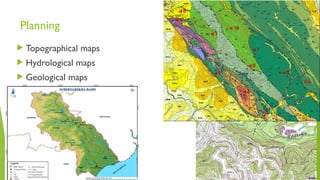
Planning
 Topographical maps
 Hydrological maps
 Geological maps
Design
Some of the geological characters that have a direct or indirect influence on
the design of a proposed project are:
 The existence of hard bed rocks and their depth from and inclination with the
surface.
 The mechanical properties like compressive strength, shear and transverse
strength, modulus of elasticity, porosity and permeability, resistance to decay
and disintegration along and across the site of the proposed project.
 Presence, nature and distribution pattern of planes of structural weakness like
joints, faults, folds etc.
 Presence nature and distribution pattern of zones of weak materials like shear
zones, clay bands etc.
 The position of ground water table including points of recharge and discharge and
variations during different periods of the year.
 Seismic character of the area as studied from the seismic history and prediction
about future seismicity.
Geology in Water Resource Development
 Exploration and development of water resources have become very
important areas of activities for scientists, technologists and engineers in all
parts of the world. The water resource engineers have to understand the
water cycle in all essential details.
 The study of water cycle is an essential prerequisite for effective planning
and execution of major water resource development programmers on
national and regional level.
 Geological information is of fundamental importance in exploration and
exploitation of water resources of a region from surface and sub-surface
reserves of water.
 The water bearing properties of rock bodies and factors that influence
storage, movement and yield of water from aquifers are geological problems
 A thorough geological knowledge about the rock strata is essential is
essential for designing a water supply project.
Geology in Town and Regional Planning
 A town planner is concerned essentially with utilization of land in a best and
aesthetic manner possible for developing cities and towns for meeting social
needs in different areas.
 The primary aim of a town planner is to derive maximum benefit from natural
environment with minimum disturbance.
 The roles played by the materials making the land like rocks, soils, vegetation,
water bodies etc. in the evolution of natural landscape must be understood.
 The regional Town Planner is responsible for adopting an integrated approach
in all such cases of allocation of land for developmental projects. Thus a
change induced in the natural setup of an area due to a proposed new project is
going to lead a series of changes in the adjoining and even in distant places.
 As such all sound planning must be in tune with the natural features and
processes of a region.
Subdivisions of GeologyGeology
Physical Geology
Geomorphology
Mineralogy
Petrology
Historical Geology
Economic Geology
Minor branches of Geology
 Geo-chemistry
 Geo-physics
 Geo-hydrology
 Mining geology
 Rock mechanics
 Geo-mechanics
 Meteorology
 Oceanography
 Engineering Geology
 Physical geology: deals with study of Erosion, Transportation and Deposition
(ETD)
 Geomorphology: deals with the study of surface features of the earth
 Mineralology: deals with formation, occurrence, aggregation, properties and
use of minerals
 Historical geology: deals with the past history of the earth
 Paleontology: deals with the study of fossils
 Economic geology: deals with the study of minerals and rocks and other
materials occurring in or on the earth and that can be exploited for the benefit
of man
 Engg geology- deals with the geological study of the site and location for
major engg projects
 Mining geology- deals with the exploring and exploitation of minerals by
mining and quarrying practice
 Petrology: study of rocks
Weathering
 Weathering is the disintegration or structural breakdown or chemical
alteration of rock and soil minerals
 Weathering is the process of decay and disintegration of rocks under
the influence of certain physical and chemical agencies of the
atmosphere.
 The most important aspect of weathering is that the weathered
product remains lying over and above or near to the parent rock
unless it is removed from there by some other agency of the nature.
Examples:
 Rocks exposed to frost action at higher altitude in cold climates
disintegrate into small fragments. These fragments remain strewn
over the slopes itself.
 Rocks exposed to high temperatures in deserts gradually disintegrate
into smaller pieces that remain close to the parent rock.
Factors affecting weathering
 Susceptibility to weathering
Structure
Joints, faults and bedding.; their
frequency
Stratification
Mineralogy (Bowen’s Reaction Series)
 Environmental factors
 Temperature
 Warm climate yields faster process
 Rainfall
 Heavy rainfall means faster weathering
 Freezing and thawing may occur
 Biological activity
 Presence of roots, breaking of rocks,
mining
 Topography
 Amount of rocks exposed to agents of
weathering
 Time
Bowen’s Reaction Series
Mechanical Weathering
 Breaking down to smaller size
 Through physical processes without change in their composition
 Driven by
1.Uplift/exfoliation
2.Erosion
3.Temperature (expansion and contraction)
4.Crystal growth
Salt wedging - saltwater seeps into rocks and then evaporates on a hot sunny
day, resulting in the formation of salt crystals.
5. Colloid plucking – The wet soil particles or colloids that form on the rocks, dry
up eventually and exert pressure on the minerals present in the rocks.
6.Biological activity (root wedging, burrowing)
Exfoliation
 This type of weathering is found in deserts and other areas of temperature extremes.
 In a thick rock body or where the rock is layered, upper layers are mostly affected due
to temperature variations.
 As a result, the upper layers peel off from the underlying rock mass.
 In many cases, such a change is accompanied by chemical weathering, developing
curved surfaces.
 The process of peeling off of curved shells from rocks under the influence of thermal
effects in association with chemical weathering is called exfoliation.
Exfoliation: Castle rock track
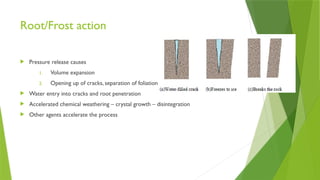
Root/Frost action
 Pressure release causes
1. Volume expansion
2. Opening up of cracks, separation of foliation
 Water entry into cracks and root penetration
 Accelerated chemical weathering – crystal growth – disintegration
 Other agents accelerate the process
Erosion
 Action of water, wind and ice
Water (streams and waves)
 Abrasion, lifting and deposition
Wind
 Deflation and abrasion
Ice (glacier)
 Plucking and abrasion
Chemical Weathering
 Alters the chemistry of parent material
 Main processes include
1. Dissolution and precipitation
2. Hydrolysis
3. Carbonation
4. Oxidation and reduction
5. Ion exchange
6. Chelation
7. Leaching
Dissolution and precipitation
 Some rocks contain one or minerals that are soluble in water to some
extent. Rock salt, gypsum and calcite are some of the minerals soluble
in water.
 Some minerals are not soluble in water.
 The solvent action of water for many common minerals is enhanced
when carbonated.
 For example limestone which is not soluble in water is soluble in
carbonated water.
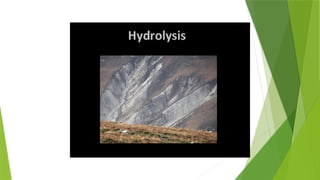
Hydration and hydrolysis
 These two processes indicate the direct attack of atmospheric moisture on individual minerals of a
rock that affect its structural make up. When the surfaces of many crystals (having partially
unsatisfied valences) come in contact with polarized water molecules, any one of the following
reactions can occur:
(1)The ions tend to hold the polarized side of water molecule and form a hydrate. This process of
addition of the water molecule is called hydration. For example:
 CaSO4 + 2H2O CaSO4.2H2O
 Anhydrite gets slowly converted to gypsum by hydration as shown above.
(2) The process in which exchange of ions occur whereby water enters into the crystal lattice of
mineral, is called hydrolysis.
 K + AlSi3O8 + H+
H Al Si3 O8 + K+
 Weathering of Orthoclase (K + AlSi3O8) occurs as shown above.
Carbonation
 It is the process of weathering of rocks under the combined action of atmospheric CO2
and moisture. The carbonic acid formed corrodes silicate bearing rocks. For example:
 2KAlSi3O8 + 2H2O+ CO2 Al2Si2O5(OH)4 + K2CO3+ 4SiO2
 Felspar orthoclase decomposes to form a clay mineral, a soluble bicarbonate and silica.
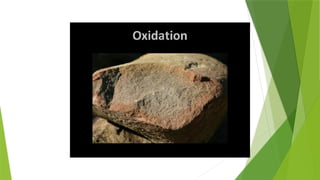
Oxidation and reduction
 Iron bearing minerals and hence rocks are prone to oxidation and reduction.
The effects are observed from colour changes produced in iron bearing rocks.
For example:
 4Fe + 3O2 2Fe2O3 (brown colour)
 Fe2O3+H2O Fe2O3.H2O
 Ferrous iron (Fe++) is oxidized to ferric iron (Fe +++) when exposed to air
rich in moisture. Ferric iron is oxidized to stable ferric hydroxide.
 Iron oxide in rocks and minerals reduces to elemental iron in presence of
decaying vegetation, which supplies carbonaceous content causing reduction.
Ion Exchange
 The processes of hydration, hydrolysis, oxidation and reduction on rocks and minerals
often result in splitting of particles into smaller particles called colloids.These colloids
are characterized by atoms with only partially satisfied electrical charges.
 Weathering of clay minerals, silica and iron oxides often results in colloid formation.
These colloids are easily precipitated as their charges are satisfied and form stable
products.
Chelation
 The chemical removal of metallic ions from a mineral or rock by weathering can provide
their combination with organic compounds.
 The decomposition of dead plants in soil may form organic acids which, when dissolved in
water, cause chemical weathering.
Leaching
 Leaching is loss of soluble substances and colloids from the top layer of soil by
percolating precipitation.
 The materials lost are carried downward (eluviated) and are generally redeposited
(illuviated) in a lower layer.
 This transport results in a porous and open top layer and a dense, compact lower layer.
 The rate of leaching increases with the amount of rainfall, high temperatures, and the
removal of protective vegetation.
Environment for Chemical Weathering
 Low pressure (typically < 100 MPa)
 Low temperature (typically < 500
C)
 Abundance of free oxygen
 Abundance of free water (typically low pH)
 Formation of minerals that are stable under these conditions
Mineral Stability Near Surface
 Minerals formed at high pressure and temperature environment are least stable
 Mineral stability from highest to lowest
 Iron/aluminium oxides – quartz – clay minerals – muscovite – K/Na spar – biotite –
amphiboles – pyroxenes – Ca plagioclase - olivine
SPHEROIDAL WEATHERING
 The breaking of original rock mass into
spheroidal blocks is called spheroidal
weathering.
 It is caused by the combined action of
mechanical and chemical weathering.
 The original rock mass is split into small blocks
by development of parallel joints due to
thermal effects.
 Simultaneously, chemical weathering corrodes
the border and surfaces of blocks causing their
shapes roughly into spheroidal contours.
ROLE OF PLANTS AND ORGANISMS –
Organic weathering
 Hydrogen ions (H+
) are released at the roots of plants during their growth and
metabolism.
 These ions replace K+, Ca2+
, Mg2+
ions etc. from the rocks surrounding the root system.
 Thus these rocks and minerals undergo decomposition.
 Root systems of big plants and trees creep into the pre-existing cracks in the nearby
rocks. Thus the cracks widen and the rocks break into fragments.
 Action of rodents on rocks will also cause the disintegration of rocks. Man has been
breaking the rocks since very beginning for many purposes.
 The decay and disintegration of rocks by living things is called organic weathering.
PRODUCTS OF WEATHERING
The product of weathering include (a)
Regolith (b) Mineral and rock
formation
(a)Regolith: It includes all the weathered
material, which covers the parent rock or
is lying close to it. These materials deposit
on the surface of the parent rock in huge
thickness. In many cases, the weathering
of rocks becomes slow after the formation
of weathered layers at the top.
It is because the overlying cover acts as a
barrier for the atmospheric agencies to
further act on the parent rock. The upper
part of regolith is termed a soil.
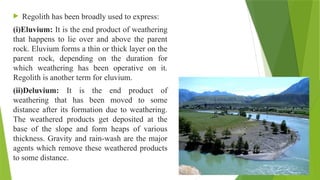
 Regolith has been broadly used to express:
(i)Eluvium: It is the end product of weathering
that happens to lie over and above the parent
rock. Eluvium forms a thin or thick layer on the
parent rock, depending on the duration for
which weathering has been operative on it.
Regolith is another term for eluvium.
(ii)Deluvium: It is the end product of
weathering that has been moved to some
distance after its formation due to weathering.
The weathered products get deposited at the
base of the slope and form heaps of various
thickness. Gravity and rain-wash are the major
agents which remove these weathered products
to some distance.
Mineral and Rock Formation
Weathering results in the formation of a few minerals and
rocks.These include:
 Clay minerals: Weathering of silicate rocks under humid
climatic conditions, results in the formation of
Montmorillonite, Kaolinite and Illite.
Montmorillonite is formed by the hydration of volcanic dust
in semi dry climates.
Hydration and carbonation of igneous rocks under humid
climates form Kaolinite.
 Ores of Aluminium: The weathering of clay rocks
produces ores of aluminium like bauxite (Al2O3.nH2O) and
laterite.
ENGINEERING SIGNIFICANCE OF
WEATHERING
 Soil is the ultimate product of weathering. A clear knowledge of the genetic background of soils is
required for the better understanding of engineering properties of soil. It helps in proper planning
and design of Engineering projects built on soil or rocks.
 When foundations are carried down to the bed rock, knowledge of degree of weathering, depth of
weathered cover and the trend of weathering in that area is of utmost importance for the
ultimate safety of the project.
 For a construction engineer it is necessary to find out:
a. The extent to which the area for the proposed project has deteriorated due to
weathering. It is necessary to remove loose weathered materials and carry foundation to
solid rock.
b. b. The effect of weathering on construction materials to be used in the project. This
helps to select construction materials that are more durable to weathering.
ENGINEERING SIGNIFICANCE OF
WEATHERING
 Chemical weathering breaks the bonds between the rocks that make the slope, causing
the instability of slope. The slope rocks lose shearing strength and will finally fail.
Therefore, slope stability must also ensure protection of slope rocks from weathering.
 The response of stones (like marbles, limestone and granite) to chemical environment
must carefully be studied by the civil engineers prior to recommending them for major
constructions. Disfiguring, pitting, honeycombing and loss of surface appearance
are common effects of chemical weathering on stones.
Dearman Classification of weathering
 Descriptive terms for weathering of rock material were established on the
basis that weathering involves a combination of mechanical disintegration,
chemical decomposition and solution.
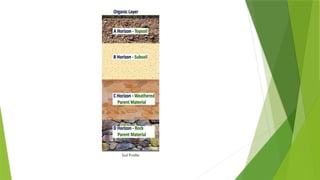
Soil Profile
 Soil is formed as a result of weathering of parent rock.
 Soil is a mixture of organic matter, various minerals and water which can support plant
life on the surface of earth.
 A vertical section from the surface down to the bed rock reveals various layers of soil,
which is termed as soil profile.
 Pedologists have identified these layers of soils and have designated them as different
horizons.
 During the development of soil from a parent material, the actual transformation
proceeds through certain well defined stages.
 In mature soils, these stages appear as a series of horizons. Such horizons, when
arranged in descending order, are collectively said to form a Soil Profile for that
particular area.
Click icon to add picture
Soil Profile
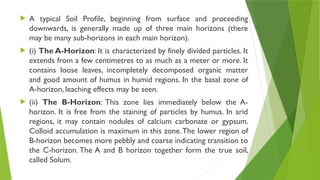
 A typical Soil Profile, beginning from surface and proceeding
downwards, is generally made up of three main horizons (there
may be many sub-horizons in each main horizon).
 (i) The A-Horizon: It is characterized by finely divided particles. It
extends from a few centimetres to as much as a meter or more. It
contains loose leaves, incompletely decomposed organic matter
and good amount of humus in humid regions. In the basal zone of
A-horizon, leaching effects may be seen.
 (ii) The B-Horizon: This zone lies immediately below the A-
horizon. It is free from the staining of particles by humus. In arid
regions, it may contain nodules of calcium carbonate or gypsum.
Colloid accumulation is maximum in this zone.The lower region of
B-horizon becomes more pebbly and coarse indicating transition to
the C-horizon. The A and B horizon together form the true soil,
called Solum.
 (iii) The C-Horizon: It is more a zone of weathered rock. In
texture, it is often coarse grained and pebbly; in composition, it
retains all the evidence of its parent rock.
 (iv)The D-Horizon: In a true soil profile, a sample from this
horizon is the parent rock itself, unaltered as yet. In some cases, it
may the solid rock mass on which the other zones are resting.
 O (humus or organic) Horizon: Mostly organic matter such as
decomposing leaves. The O horizon is thin in some soils, thick in
others, and not present at all in others.
 E (eluviated) Horizon: Leached of clay, minerals, and organic
matter, leaving a concentration of sand and silt particles of quartz
or other resistant materials – missing in some soils but often found
in older soils and forest soils.
Geological Classification of Soil
Residual Soil Transported Soil
Alluvial
Glacial
Aeolian
Lacustrine
Colluvial
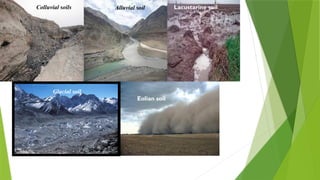
Colluvial soils: soil moved down largely under the influence of
gravity for small distance
Alluvial soil: soils that are spread out by streams along their banks
Glacial soil: when ice melted, all the debris it carried was deposited
in the form of soil
Aeolian soil: wind is an active agent for transporting dust, silt and
sand grade particles
Lacustrine soil: accumulation of debris in lakes and other bodies of
stagnant water
Colluvial soils Alluvial soil
Glacial soil
Eolian soil
Lacustarine soil
Soil Erosion
 Loss or removal of superficial layer of soil by the action of wind,
water or human action
 Causes
1. Removing plant cover by burning pasture or felling trees
2. Grazing too many animals on the land
3. Bad cultivation practices
4. Wind
5. Frost
6. Rain and water runoff
7. Extreme climatic effects
Loss of top soil
 Whenever topsoil is exposed, water or wind can quickly erode it
 Plant cover can protect soil from erosion
 Plants breach the force of falling rain and plant roots hold the
soil together
 Wind is another cause of soil loss
 Wind erosion is most likely to happen in areas where farming
methods are not suitable to dry condition
Effects of soil erosion
 Loss of valuable top soil
 Burying valuable topsoil
 Damage to fields
 Plant productivity decline
 Desertification
Types of soil erosion
 Sheet erosion – Removal of thin layer of topsoil by raindrop
splash or water run-off
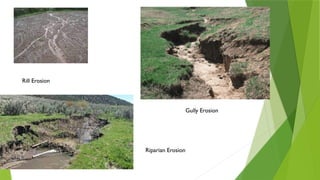
 Rill erosion – If sheet erosion occurs with full force, the run off
water moves rapidly over the soil surface. It cuts well-defined
finger shaped groove like structures. It appears as thin channels
or streams.
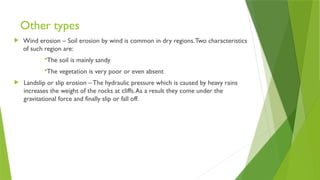
 Gully erosion – Here surface run-off is very high. Gullies
resemble large ditches or small valleys and are metres to 10
metres in depth and width
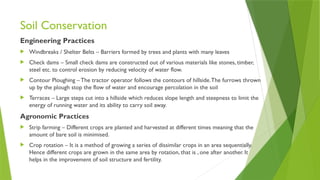
 Stream bank erosion - The rivers during floods splash their
water against the banks. In this way the water cuts through them.
Particularly at curves, water strikes with great speed and the
bank caves in alongside.This type of erosion is also known as
Rill Erosion
Gully Erosion
Riparian Erosion
Other types
 Wind erosion – Soil erosion by wind is common in dry regions.Two characteristics
of such region are:
The soil is mainly sandy
The vegetation is very poor or even absent
 Landslip or slip erosion – The hydraulic pressure which is caused by heavy rains
increases the weight of the rocks at cliffs.As a result they come under the
gravitational force and finally slip or fall off.
Soil Conservation
Engineering Practices
 Windbreaks / Shelter Belts – Barriers formed by trees and plants with many leaves
 Check dams – Small check dams are constructed out of various materials like stones, timber,
steel etc. to control erosion by reducing velocity of water flow.
 Contour Ploughing –The tractor operator follows the contours of hillside.The furrows thrown
up by the plough stop the flow of water and encourage percolation in the soil
 Terraces – Large steps cut into a hillside which reduces slope length and steepness to limit the
energy of running water and its ability to carry soil away.
Agronomic Practices
 Strip farming – Different crops are planted and harvested at different times meaning that the
amount of bare soil is minimised.
 Crop rotation – It is a method of growing a series of dissimilar crops in an area sequentially.
Hence different crops are grown in the same area by rotation, that is , one after another. It
helps in the improvement of soil structure and fertility.
Check Dams
Windbreaks / Shelter Belts
Contour Ploughing
Strip Farming
Water erosion
 Water is the main agent of erosion; its power increases greatly with velocity.
 Rivers erode by downcutting and sides degrade to fromV-profile valleys. On low
gradients downcutting reduces so lateral erosion dominates notably on the outside of
river bends
 Sediment is transported as rolled bedload and in suspension; particle size increases
with velocity. Deposition is due to velocity loss, on gradient loss and inside bends so
sediment is sorted by size
Geological Work of Rivers
 Being an exogeneous geological agent, a river carries out its
work in a methodical way. Generally it is a slow process, but a
steady one. Geological work of a river can be subdivided into
three stages:
 River Erosion
 RiverTransport
 River Deposition
River Erosion
 Erosion means mechanical disintegration or chemical decomposition of rocks and their
subsequent displacement.
 A river is a very powerful eroding agent and carries out its work in different ways such
as hydraulic action, abrasion, attrition and solution (corrosion)
Hydraulic action
 The inherent kinetic energy of running river water only takes part in causing the physical
breakdown of rocs. Naturally, greater the momentum, greater will the erosion be.
 In the initial and youth stages, rivers which move faster along steep slopes acquire
considerable kinetic energy.
 When such river water dashes against the rocks forcefully, it will break them down
mechanically.This will be more effective if
(a) the rocks have already weathered considerably
(b) they are porous or not well cemented
(c) they have easily soluble cementing material
(d) they possess fractures, cracks or any other weak planes
 The hydraulic action of rivers is due to inherent kinetic energy of river water
 The velocity of the river is the source of kinetic energy
 The river velocity or momentum is controlled by different factors like:
(i) surface gradient
(ii) form of the river
(iii) rate of discharge
 The river gradient influences the velocity; if gradient is more, the velocity will
also be more.When velocity is doubled, the erosive power of the river water
increases four times
 The form of a river also influences the velocity; a river flows faster in a deep,
narrow valley than in a shallow broad valley.This is so because the flow
encounters greater friction from the ground.Therefore, erosion will be more
pronounced in a deep and narrow river.
 The influence of volume of a river water on velocity is also considerable.The
velocity increases with the volume.When a river has eight times larger volume, it
will flow with a velocity doubly quicker.This is the reason why rivers become
destructive during floods. Further, rivers which undergo considerable variations
in velocity and volume cause more erosion than those which are uniform
Abrasion
 Physical breakdown of rock masses which are exposed along the sides and
bottom of the river valley by the force of colliding sediments which are being
transported by the river.
 The river along the course transports a a large quantity of sediments of
various sizes and types
 By virtue of their movement, they possess energy and hence momentum
 During transport they hit the exposed rocks relentlessly leading to their
breakdown
 The preceding process is mainly influenced by
1. The nature of transported sediments
2. The nature of exposed rocks
3. The nature of river water
4. The attitude of rocks exposed
5. Presence of joints in rocks
6. Time factor
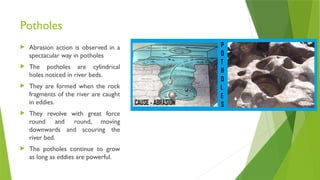
Potholes
 Abrasion action is observed in a
spectacular way in potholes
 The potholes are cylindrical
holes noticed in river beds.
 They are formed when the rock
fragments of the river are caught
in eddies.
 They revolve with great force
round and round, moving
downwards and scouring the
river bed.
 The potholes continue to grow
as long as eddies are powerful.
Attrition
 Erosion is with reference to transported sediments themselves
 When rock fragments hit the exposed rocks, not only the country rocks are
affected but also an equal effect is borne by fragments
 Thus rock fragments during abrasion undergo wear and tear which is called
attrition
 Attrition also occurs during the transportation of sediments
 When heterogeneous sediments are under transport, heavier and larger materials
move slowly while finer and lighter materials move fast.
 The differential movement results in mutual collisions which occur again and again
and causes attrition
 Large pebbles and small rocks generally roll down the valley floor, smoothening
their edges.
 When attrition takes place first the angular edges disappear and the spherical,
spheroidal and ellipsoidal stones are formed after a long journey.
Solution
 This process involves only chemical decay of rocks and no mechanical wear
and tear .
 Among liquids, water is the most powerful solvent and dissolves many kind of
materials
 When river water passes through different areas over different rocks its
chemical potential increases with time.
 Depending upon their nature, some minerals are immediately affected while
others are slowly affected
 Virtually there are no minerals which are completely unaffected
 Humid and temperate climates promote attack by corrosion process
 Eg., Carbonate rocks (Limestone), marls, calcareous shales, dolomitic rocks
 Solution process will be more effective when
1.River water has chemically more potential
2.Time of contact between solutions and rocks is more
3.The country rocks are calcareous
River Transport
 The load transported by a river can be grouped into three:
1. Bed load – heavier particles of sand, pebbles, gravels etc..
Transported mainly by rolling, skipping, bouncing or gliding along the
bottom of the stream
2. Suspended load - fine silt, clay, fine sands etc carried by the river
in its body of water in suspension
3. Dissolved load – Comprises all soluble matter and is transported
in solution condition
Influencing factors of river transport
 Velocity of the river is its primary source of energy which enables it not
only to carry out erosion but also to do transport work.
 The transporting ability of the river abnormally increases when the velocity increases. In the
case of coarser sediments, when the velocity is doubled its transporting power increases 64
times
 The sediments with a higher density have a higher tendency to settle down,
whereas the lighter sediments have a tendency to keep floating and are
therefore transported over longer distances.
River Deposition
 Aggradation occurs
 The phenomenon of river deposition links up to the factors contributing to
the loss of energy either temporary or otherwise
 Different kinds of river deposits:
(i) alluvial cones and fans
(ii) placer deposits
(iii) delta deposits
(iv) natural levees
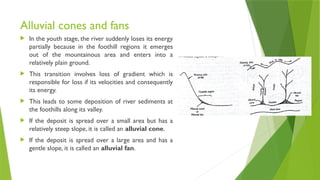
Alluvial cones and fans
 In the youth stage, the river suddenly loses its energy
partially because in the foothill regions it emerges
out of the mountainous area and enters into a
relatively plain ground.
 This transition involves loss of gradient which is
responsible for loss if its velocities and consequently
its energy.
 This leads to some deposition of river sediments at
the foothills along its valley.
 If the deposit is spread over a small area but has a
relatively steep slope, it is called an alluvial cone.
 If the deposit is spread over a large area and has a
gentle slope, it is called an alluvial fan.
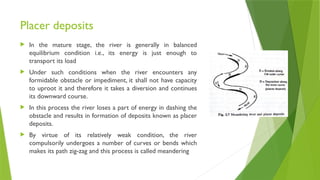
Placer deposits
 In the mature stage, the river is generally in balanced
equilibrium condition i.e., its energy is just enough to
transport its load
 Under such conditions when the river encounters any
formidable obstacle or impediment, it shall not have capacity
to uproot it and therefore it takes a diversion and continues
its downward course.
 In this process the river loses a part of energy in dashing the
obstacle and results in formation of deposits known as placer
deposits.
 By virtue of its relatively weak condition, the river
compulsorily undergoes a number of curves or bends which
makes its path zig-zag and this process is called meandering
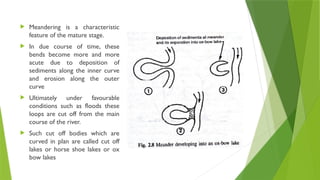
 Meandering is a characteristic
feature of the mature stage.
 In due course of time, these
bends become more and more
acute due to deposition of
sediments along the inner curve
and erosion along the outer
curve
 Ultimately under favourable
conditions such as floods these
loops are cut off from the main
course of the river.
 Such cut off bodies which are
curved in plan are called cut off
lakes or horse shoe lakes or ox
bow lakes
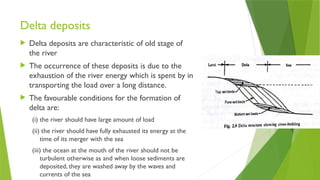
Delta deposits
 Delta deposits are characteristic of old stage of
the river
 The occurrence of these deposits is due to the
exhaustion of the river energy which is spent by in
transporting the load over a long distance.
 The favourable conditions for the formation of
delta are:
(i) the river should have large amount of load
(ii) the river should have fully exhausted its energy at the
time of its merger with the sea
(iii) the ocean at the mouth of the river should not be
turbulent otherwise as and when loose sediments are
deposited, they are washed away by the waves and
currents of the sea
Natural levees
 These are essentially
riverbank deposits made by
a river along its bank during
floods.
 The natural levees are
sometimes helpful in
preventing further flooding
in a river provided the
volume of water a new
prospective flood is not
much higher than that of a
previous floods.
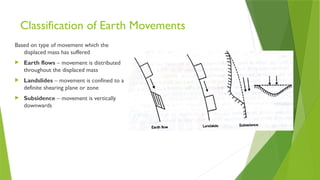
Classification of Earth Movements
Based on type of movement which the
displaced mass has suffered
 Earth flows – movement is distributed
throughout the displaced mass
 Landslides – movement is confined to a
definite shearing plane or zone
 Subsidence – movement is vertically
downwards
Earth flows
 Solifluction refers to the downward movement of wet soil along the slopes under
the influence of gravity
 Creep refers to the extremely slow downward movement of dry surficial matter and
is always limited to the surface or the area just below it.The rate of movement is so
slow that it may not be detected until its effects on engineering structures can call
attention to it.
 Rapid flows are similar to creep but differ with respect to the speed and depth of the
materials involved. These are rapid earth flows and involve considerable depth. These
are generally accompanied by heavy rains.
Landslides
 Downward sliding of huge quantities of landmasses
 Sliding occurs along steep slopes of hills or mountains
 May be sudden or slow in occurrence
 Loose and unconsolidated surficial material undergoes sliding
Importance of landslides
 If they occur in places of importance such as highways, railway lines, valleys, reservoirs,
inhabited areas and agricultural lands, they lead to blocking of traffic, collapse of buildings,
harm to fertile lands and heavy loss of life and property
Landslides
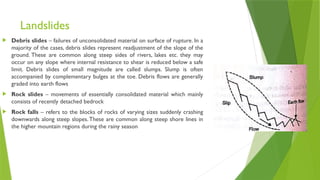
 Debris slides – failures of unconsolidated material on surface of rupture. In a
majority of the cases, debris slides represent readjustment of the slope of the
ground. These are common along steep sides of rivers, lakes etc. they may
occur on any slope where internal resistance to shear is reduced below a safe
limit. Debris slides of small magnitude are called slumps. Slump is often
accompanied by complementary bulges at the toe. Debris flows are generally
graded into earth flows
 Rock slides – movements of essentially consolidated material which mainly
consists of recently detached bedrock
 Rock falls – refers to the blocks of rocks of varying sizes suddenly crashing
downwards along steep slopes.These are common along steep shore lines in
the higher mountain regions during the rainy season
Subsidence
 Subsidence due to plastic outflow – Beneath heavy loads, plastic layers which
become plastic due to disturbance may be squeezed outwards, allowing surface
settlement or subsidence. E.g. Clay may be extruded from beneath a structure
 Subsidence due to compaction – sediments often become compact because of
load. Excessive pumping out of water and the withdrawal of oil from ground also cause
subsidence locally
 Subsidence due to collapse – in regions where extensive underground mining has
removed a large volume of material, the weight of the overlying rock may cause
collapse and subsidence. It may also happen when underground formations are leached
by subsurface water
Causes of landslides
Immediate causes
 Factors such as frictional resistance will cause the overlying mass to
remain in a critical condition. When there is a sudden jolt or jerk or
vibration occurs, the frictional resistance will be overcome and leads to
destruction.
 Sudden jolting due to avalanche, violent volcanic eruption, fall of a
meteorite, occurrence of an earthquake, tsunamis or blasting of
explosives in quarrying, tunnelling, road cutting or mining.
Internal causes
 Effect of slope – steeper slopes are prone to landslips of loose overburdens due to greater
gravity influence whereas gentle slopes are not prone to such land slips because in such cases
loose overburden encounters greater frictional resistance and any possible slip is stalled
 Effect of water –Presence of water reduces the intergranular cohesion of particles of loose
ground.This weakens the ground inherently and therefore makes it prone to landslide occurrence
 Effect of lithology – Rocks which are highly fractured, porous and permeable are prone to
landslide occurrence.The clay content contributes to the slippery effect.Thinner strata are more
susceptible to sliding.
 Effect of associated structures – Inclined bedding planes, joints, faults or shear zones increase
the chances of landslide. When their dip coincides with that of the surface slope they create
conditions of instability. Joints and faults provide scope for easy percolation of rain water and
increases instability.
 Effect of human factors – Sometimes human beings interfere with nature by virtue of their
activities and causes landslides.This may happen when undercutting are made along the hill slopes
for laying roads or railway tracks. Such an activity eliminates lateral support which means gravity
will become more effective leading to landslide occurrence
Effects of Landslides
 Disruption of transport or blocking of communications by damaging roads and railways
and telegraph poles
 Obstruction to the river flow in valleys leading to their overflow and floods
 Damage to sewer and other pipelines
 Burial or destruction of buildings and other constructions
 Causes earthquakes
Preventive measures for landslides
 To counter the effect of slope: Retaining walls may be constructed against the slopes so that the
material which rolls down is not only prevented from further fall but also reduces the slope.Terracing of
the slope is another effective measure.
 To counter the effect of water: A proper drainage system is the suitable measure.This involves the
quick removal of percolated moisture by means of surface drainage and subsurface drainage.
Construction of suitable ditches and waterways along slopes and provision of trenches at the bottom,
and drainage tunnels help in draining off the water from the loose overburden.
 To counter the structural effects: the different structural defects such as weak planes and zones may
be either covered or grouted suitably so that they are effectively sealed off. These measures not only
prevent the avenues of percolation of water but also increase the compaction or cohesion of the
material concerned.
 Not to resort to reduce the stability of existing slopes: This is done by not undertaking any
undercutting on the surface slope and by not undertaking any construction at the top of the hills
 To counter the loose nature of overburden: Growing vegetation, plants and shrubs on loose ground
helps in keeping the loose soil together
 Avoiding heavy traffic and blasting operations near the vulnerable places naturally helps in
preventing the occurrence of landslides
Sea Waves and Currents
Waves
 Undulatory disturbances on the surface of the seawater due to strong rushing winds,
earthquakes, attraction of sea water by sun and moon and similar reasons
 During the propagation of a wave, each water drop is distributed from its original place
of rest and forced to follow a motion in a circular, ellipsoidal, elongated or irregular
orbit before coming to rest again
Types of sea waves
1. Oscillatory Waves
 Each particle moves in a circular orbit
 The waves start from the deep portions of sea, when it reaches the shallow depth
portions (i.e. near shore), these particles cannot follow a perfect circular motion.
Consequently an oscillatory wave rushing towards the shore breaks at the crest
region.
 A zone may be identified along the seashore where these waves regularly break is
called a breaker zone.
2. Translatory Waves
 Typically occurs at shallower depths (near shore) in the sea and thus move along the
seashore
 They are commonly produced after the oscillatory waves break and rush forward
 In these waves, the water particles are actually moved or translated forward, rising and
falling again and again in the process
Currents
 These are layers or strips of seawater that are actually pushed forward in any particular
direction
 In most cases, sea currents are the results of dissipation of extra volume of water thrust on the
shore by the advancing waves.
Types
1. Littoral currents
 These are bodies of seawater of considerable volume moving along and parallel to the shore
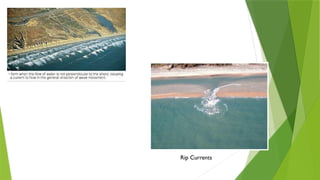
2. Rip Currents
 These are bodies of seawater moving backwards to sea after having reached and struck the
seashore
 They often move below the surface of the sea and reach varying distances up to the middle of
the sea
 These are believed to represent that part of sea wave, which has been unable to form a part of
littoral current but rip current’s development is independent of littoral currents
Rip Currents
Marine Erosion
Marine water erodes the rocks at the shore by 3 ways:
 Hydraulic action:That is, by its very high wave velocity
 Abrasion: Sea water carries lot of sediment particle during its motion. These
sediment particles have erosive power to erode the shore
 Corrosion: Sea water is Salish so due to its chemical properties it adversely
affect the shore materials.
FEATURES OF MARINE EROSION
 Continued marine erosion results in considerable or even
total modification of the original shoreline.
 Some very common features of marine erosion are
 headlands
 bays
 sea cliffs
 wave-cut terraces.
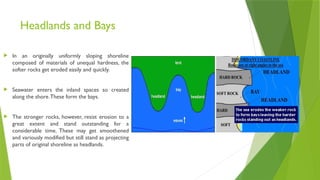
Headlands and Bays
 In an originally uniformly sloping shoreline
composed of materials of unequal hardness, the
softer rocks get eroded easily and quickly.
 Seawater enters the inland spaces so created
along the shore.These form the bays.
 The stronger rocks, however, resist erosion to a
great extent and stand outstanding for a
considerable time. These may get smoothened
and variously modified but still stand as projecting
parts of original shoreline as headlands.
Headlands
Bays
Sea Cliffs
 Sea cliff is a seaward facing steep front of a
moderately high shoreline and indicates
the first stage of the work of waves on the
shore rocks. There may be a number of
sea cliffs seen on a shoreline.
 They are outstanding rock projections
having been smoothened here and
plucked there, pitted at one place and
polished at another spot by a combined
action of waves and currents.
 These cliffs may ultimately be worn
due to continued undercutting by the
action of waves.
 Thus shoreline is reduced to a smooth,
free from irregularities, seaward sloping
surface ie cliff.
Wave-Cut Terraces
 Wave cut terrace is a shallow shelf type structure, caned
out from the shore rocks by the advancing sea waves
 The waves first of all cut a notch where they strike
against the cliff rock again and again. The notch is
gradually extended backwards to such a depth below the
overlying rock that the latter becomes unsupported from
below.
 The cliff eventually falls down along the notch.
 A platform or bench is thus created over which the
seawater may rush temporarily and periodically. The
resulting structure is often called a wave-cut terrace, a
platform or simply a bench.
LANDFORMS ON COAST
MARINE DEPOSITION
 Seas are regarded as the most important and extensive sedimentation
basins. This becomes evident from the fact that marine deposits of practically
all the geological ages are known to occur in different parts of the world.
 These deposits are exposed at many places in almost all the
continents. All the marine deposits or landforms are conveniently classified
into two groups:
 Shallow water deposits
 Deep water deposits
(A)SHALLOW WATER DEPOSITS (Neritic deposits)
 These include marine deposits laid down in Neritic zone of the sea which
extends from the lowest tide limit to the place of the continental shelf
where the slope becomes abruptly steeper.
 The material that goes into the making of the shallow water deposits is
derived from the land and shore rock, mostly through the action of waves.
 Besides these sediments, a group of marine organisms collectively
known as Benthos also contributes greatly as a source material for
making the shallow water marine deposits.
 Common examples of Neritic deposits are: beaches, spits, bars and tombolos.
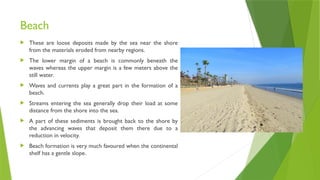
Beach
 These are loose deposits made by the sea near the shore
from the materials eroded from nearby regions.
 The lower margin of a beach is commonly beneath the
waves whereas the upper margin is a few meters above the
still water.
 Waves and currents play a great part in the formation of a
beach.
 Streams entering the sea generally drop their load at some
distance from the shore into the sea.
 A part of these sediments is brought back to the shore by
the advancing waves that deposit them there due to a
reduction in velocity.
 Beach formation is very much favoured when the continental
shelf has a gentle slope.
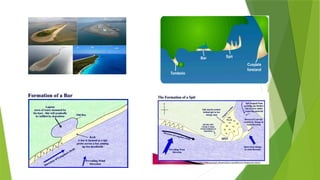
SPITS AND BARS
 These are ridge shaped deposits of sand and shingle that often extend
across the embayment.
 A spit is formed when a sediment laden shore current comes near an
embayment on the coast, there is strong tendency for it to keep its normal
course rather than to follow the shore line of the embayment; hence it moves
through deeper and quieter waters where it lays down much of its sediments.
 This process may result in an incomplete ridge in continuity with the
shore but terminating in open waters.This is the spit.
 When the ridge (spit) so formed in the above manner closes the
mouth of the embayment completely, it is known as bar.
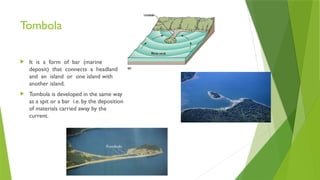
Tombola
 It is a form of bar (marine
deposit) that connects a headland
and an island or one island with
another island.
 Tombola is developed in the same way
as a spit or a bar i.e. by the deposition
of materials carried away by the
current.
(B) DEEP WATER DEPOSITS
 These deposits consist mostly of mud and oozes (a sea organism)
 The oozes that form bulk of some of such deposits consist of small organisms
known collectively as planktons.
 Death and decay of these organisms and plants followed by their
accumulation in regular and irregular shapes eventually results in huge
deposits.
 Sometimes these deposits take the shape of extensive ridge like formations
that are partly or totally submerged under seawater thereby creating a
great risk for ships and boats navigating on the sea.
 These deposits are commonly called reefs.
CORAL REEFS
Definition
 These are peculiar type of ridge-like marine deposits that have been
formed due to accumulation of dead parts of certain types of sea-organisms.
 Corals - a type of calcium secreting organisms - predominate among
the source organisms for such reefs; hence they are commonly designated as
coral reefs.
 These reefs may or may not be visible above the seawater depending upon
the tide.
Types
1. Fringing reefs
2. Barrier reefs
3. Atolls
The Fringing Reefs
 These are thin, tabular sheets of coral accumulations that are developed
along the border (fringe) of a mainland coast or along the rim of an island.
 When they accumulate on border region of islands, they appear like
a ring shaped deposit around the island during the low-tide.
 A simple fringing reef has a steeply sloping sea front and a flat
pavement surface covered with veneer of growth.
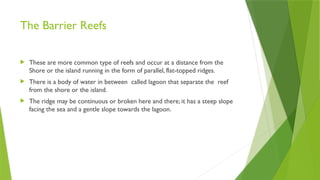
The Barrier Reefs
 These are more common type of reefs and occur at a distance from the
Shore or the island running in the form of parallel, flat-topped ridges.
 There is a body of water in between called lagoon that separate the reef
from the shore or the island.
 The ridge may be continuous or broken here and there; it has a steep slope
facing the sea and a gentle slope towards the lagoon.
Atoll
 An atoll is essentially an annular, circular or semi-circular coral reef
surrounding a central body of water that is as usual called a lagoon.
 In a typical atoll, the ring made of coral deposits may be continuous or
discontinuous, more often broken at places.
 The top of an atoll is generally flat and pavement like in appearance.
Origin of Reefs
 They are known to grow only in relatively warm waters (68-78°F), and at
depths ranging between 20-60 m.
 The seawater should be clear and saltish.
 The direction of wind is also known to exert considerable influence on the growth of
the corals.
 Darwin suggests that the coral reefs are formed on a subsiding or sinking
platform which is formed due to the occurrence of earthquakes on the sea floor
 According to Darwin, the three types of reefs -the fringing reef, the barrier reef and
the atoll, actually represent three stages in the development of a single reef deposit.
 Origin of reefs is based on Glacial ControlTheory.
 According to him, the submergence of an old reef framework is due to rise in the
level because of melting of ice.
COASTAL PROTECTION STRATEGIES
 HARD Engineering Strategies : Building or creating something which will
interfere with coastal processes – usually to reduce the power of breaking waves
against cliffs.
 SOFT Engineering Strategies :With the natural processes of sea and sand.
HARD Engineering Strategies
(a) Groynes
 A barrier extending from the beach or offshore into the sea in the transverse
direction to the sea shore.
 Groynes are used to reduce the loss of beach grade sediment through long shore
drift.
 With proper groyne field design, beach erosion can be reduced due to
trapped sediment on the up-drift side of the groyne.
 Groynes can be constructed out of wood, stone or concrete depending on the size
of native beach material.
 Although acting to reduce the erosion on site, groynes typically cause sediment
starvation down-drift, shifting the erosion further down the coastline.
HARD Engineering Strategies
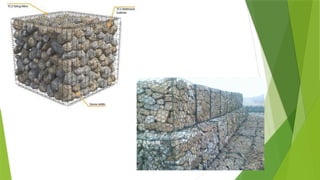
(b) Gabions
 Wire cages filled with stones/rocks stacked along the cliff base protect the shore.
Advantages
 Easily installed
 Cheaper than sea wall
Disadvantages
 Not very attractive
 Needs frequent checking & repair
 Not easy for people to get over to get to beach
 May contain rats nests
HARD Engineering Strategies
(c) Rock Armour/ Rip-Rap
 Huge blocks of rocks is placed along the shore
Advantages
 Popular option in recent years – seen to be effective
 Cheaper than sea wall
Disadvantages
 Not very attractive
 Not easy for people to get over to get to the beach (broken
ankles)
 Rats may live in spaces
HARD Engineering Strategies
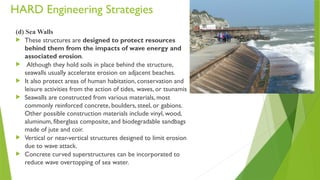
(d) Sea Walls
 These structures are designed to protect resources
behind them from the impacts of wave energy and
associated erosion.
 Although they hold soils in place behind the structure,
seawalls usually accelerate erosion on adjacent beaches.
 It also protect areas of human habitation, conservation and
leisure activities from the action of tides, waves, or tsunamis
 Seawalls are constructed from various materials, most
commonly reinforced concrete, boulders, steel, or gabions.
Other possible construction materials include vinyl, wood,
aluminum, fiberglass composite, and biodegradable sandbags
made of jute and coir.
 Vertical or near-vertical structures designed to limit erosion
due to wave attack.
 Concrete curved superstructures can be incorporated to
reduce wave overtopping of sea water.
HARD Engineering Strategies
Advantages
 Deflects Waves
 Strong
 Effective
 Lasts a long time
Disadvantages
 Expensive
 Likely to need repair fairly regularly
 Deflected waves can scour sea bed and
undermine the sea wall foundations
HARD Engineering Strategies
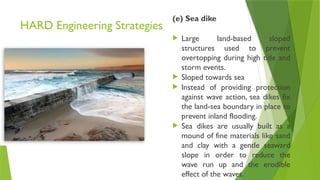
(e) Sea dike
 Large land-based sloped
structures used to prevent
overtopping during high tide and
storm events.
 Sloped towards sea
 Instead of providing protection
against wave action, sea dikes fix
the land-sea boundary in place to
prevent inland flooding.
 Sea dikes are usually built as a
mound of fine materials like sand
and clay with a gentle seaward
slope in order to reduce the
wave run up and the erodible
effect of the waves.
HARD Engineering Strategies
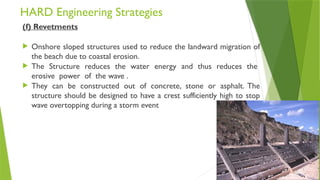
(f) Revetments
 Onshore sloped structures used to reduce the landward migration of
the beach due to coastal erosion.
 The Structure reduces the water energy and thus reduces the
erosive power of the wave .
 They can be constructed out of concrete, stone or asphalt. The
structure should be designed to have a crest sufficiently high to stop
wave overtopping during a storm event
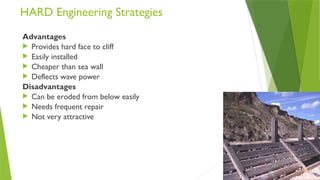
HARD Engineering Strategies
Advantages
 Provides hard face to cliff
 Easily installed
 Cheaper than sea wall
 Deflects wave power
Disadvantages
 Can be eroded from below easily
 Needs frequent repair
 Not very attractive
HARD Engineering Strategies
(g) Breakwater
 These are offshore sloped or
vertical structures reducing
incoming wave energy arriving at
the coastline.
 As well as reducing erosion, this
also creates calmer waters for
harbours and shipping.
 They can be constructed out of
concrete or stone and rock.
SOFT engineering strategies
(a) Beach
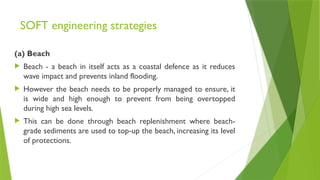
 Beach - a beach in itself acts as a coastal defence as it reduces
wave impact and prevents inland flooding.
 However the beach needs to be properly managed to ensure, it
is wide and high enough to prevent from being overtopped
during high sea levels.
 This can be done through beach replenishment where beach-
grade sediments are used to top-up the beach, increasing its level
of protections.
SOFT engineering strategies
(b) Offshore Reef
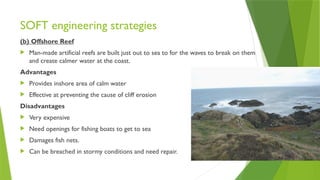
 Man-made artificial reefs are built just out to sea to for the waves to break on them
and create calmer water at the coast.
Advantages
 Provides inshore area of calm water
 Effective at preventing the cause of cliff erosion
Disadvantages
 Very expensive
 Need openings for fishing boats to get to sea
 Damages fish nets.
 Can be breached in stormy conditions and need repair.
SOFT engineering strategies
(c) Reprofiling
 The sediment is redistributed from the lower part of the beach to the
upper part of the beach
Advantages
 Cheap and simple
 Reduces energy of waves
Disadvantages
 Only works when wave energy is low
 Needs to be repeated continuously
Engineering Geology MBCET__Module 1.pptx

  • 1.
  • 2.
    Syllabus  Relevance ofgeology in Civil Engineering  Hydrogeology  Minerals  Rocks as aggregates of minerals  Attitude of geological structures  Introduction to natural hazards
  • 3.
    References  Duggal, SK,Rawal,Nand Pandey, HK (2014) Engineering Geology, McGraw Hill Education, New Delhi  Garg, SK (2012) Introduction to Physical and Engineering Geology, Khanna Publishers, New Delhi  Gokhale, KVGK (2010) Principles of Engineering Geology, BS Pubications, Hyderabad  Kanithi V (2012) Engineering Geology, Universities Press (India) Ltd., Hyderabad  Singh, P (2004) Engineering and General Geology, S. K. Kataria and Sons, New Delhi  Bennison, GM, Olver, PA and Moseley, KA (2013) An introduction to geological structures and maps, Routledge, London  Gokhale, NW (1987) Manual of geological maps, CBS Publishers, New Delhi
  • 4.
    Geology  Origin, ageand structure of Earth.  Evolution, modification and extinction of various surface and sub-surface physical features like mountains, plateaus, plains, valleys, basin, caves, etc.  Materials making up the earth  Nature and functioning of atmosphere  The study of all water bodies existing on surface or underground  Interaction of atmosphere, lithosphere and hydrosphere  Physical, dynamic and physicochemical processes operating on and within the earth  Agents and forces involved and evolved in such processes
  • 5.
    RELEVANCE OF GEOLOGYIN CIVIL ENGINEERING Scope of Engineering Geology  Engineering geology is the application of geology in design, construction and performance of civil engineering works. The objectives of engineering geology are:  It enables a civil engineer to understand engineering implications of certain conditions related to the area of construction, which are geological in nature.  It enables a geologist to understand the nature of geological information that is essential for a safe design and construction of a civil engineering project.  The principle objective of an engineering geologist is the protection of life and property against damage caused by various geological conditions.
  • 6.
    RELEVANCE OF GEOLOGYIN CIVIL ENGINEERING (Contd…)  The area covered by Engineering geology includes geological hazards, geotechnical data, material properties, landslide and slope stability, erosion, flooding, dewatering, seismic studies etc.  The most important role of an engineering geologist is to interpret the landforms and earth processes, to identify potential geologic and related man-made hazards that may impact civil engineering structures and human development.
  • 7.
    Importance of EngineeringGeology The importance of Engineering geology in development can hardly be exaggerated. It helps to:  Identify areas susceptible to failure due to geological hazards  Establish design specifications  Select the best site for engineering purposes  Select best engineering materials for construction  Recognize potential difficult ground conditions prior to detailed design and construction
  • 8.
    The scope ofengineering geology is best studied with reference to major activities of the profession of a civil engineer which are:  Construction  Water Resource Development  Town and Regional Planning
  • 9.
    Geology in ConstructionJobs  Full geological information about the site of construction or excavation and about the natural materials of construction is of great importance  The aspect of geology has full relevance in all the three aspects of each construction i.e. Planning, designing and execution.
  • 10.
    Construction Similarly for constructionin geologically sensitive areas as those of coastal area, seismic zones and permafrost regions, knowledge of geological history of the area is of great importance.  Coastal area: behaviour of rocks towards waves, current and marine environment must fully be understood in planning and execution stage. Special type of construction may become essential in this area.  Seismic region: Construction should be well balanced and light weight. Hence lightweight materials are used and architectural fancies are to be avoided.  Permafrost region (soil remains permanently frost up to certain depth): Problems can be solved only by proper understanding of the ground below.  Construction of underground projects like tunnels cannot be undertaken without a thorough knowledge of the geological characters and setting of the rocks and their relevance to the loads imposed on or relieved from them.
  • 11.
    Planning  Topographical maps Hydrological maps  Geological maps
  • 12.
    Design Some of thegeological characters that have a direct or indirect influence on the design of a proposed project are:  The existence of hard bed rocks and their depth from and inclination with the surface.  The mechanical properties like compressive strength, shear and transverse strength, modulus of elasticity, porosity and permeability, resistance to decay and disintegration along and across the site of the proposed project.  Presence, nature and distribution pattern of planes of structural weakness like joints, faults, folds etc.  Presence nature and distribution pattern of zones of weak materials like shear zones, clay bands etc.  The position of ground water table including points of recharge and discharge and variations during different periods of the year.  Seismic character of the area as studied from the seismic history and prediction about future seismicity.
  • 13.
    Geology in WaterResource Development  Exploration and development of water resources have become very important areas of activities for scientists, technologists and engineers in all parts of the world. The water resource engineers have to understand the water cycle in all essential details.  The study of water cycle is an essential prerequisite for effective planning and execution of major water resource development programmers on national and regional level.  Geological information is of fundamental importance in exploration and exploitation of water resources of a region from surface and sub-surface reserves of water.  The water bearing properties of rock bodies and factors that influence storage, movement and yield of water from aquifers are geological problems  A thorough geological knowledge about the rock strata is essential is essential for designing a water supply project.
  • 14.
    Geology in Townand Regional Planning  A town planner is concerned essentially with utilization of land in a best and aesthetic manner possible for developing cities and towns for meeting social needs in different areas.  The primary aim of a town planner is to derive maximum benefit from natural environment with minimum disturbance.  The roles played by the materials making the land like rocks, soils, vegetation, water bodies etc. in the evolution of natural landscape must be understood.  The regional Town Planner is responsible for adopting an integrated approach in all such cases of allocation of land for developmental projects. Thus a change induced in the natural setup of an area due to a proposed new project is going to lead a series of changes in the adjoining and even in distant places.  As such all sound planning must be in tune with the natural features and processes of a region.
  • 15.
    Subdivisions of GeologyGeology PhysicalGeology Geomorphology Mineralogy Petrology Historical Geology Economic Geology
  • 16.
    Minor branches ofGeology  Geo-chemistry  Geo-physics  Geo-hydrology  Mining geology  Rock mechanics  Geo-mechanics  Meteorology  Oceanography  Engineering Geology
  • 17.
     Physical geology:deals with study of Erosion, Transportation and Deposition (ETD)  Geomorphology: deals with the study of surface features of the earth  Mineralology: deals with formation, occurrence, aggregation, properties and use of minerals  Historical geology: deals with the past history of the earth  Paleontology: deals with the study of fossils  Economic geology: deals with the study of minerals and rocks and other materials occurring in or on the earth and that can be exploited for the benefit of man  Engg geology- deals with the geological study of the site and location for major engg projects  Mining geology- deals with the exploring and exploitation of minerals by mining and quarrying practice  Petrology: study of rocks
  • 18.
    Weathering  Weathering isthe disintegration or structural breakdown or chemical alteration of rock and soil minerals  Weathering is the process of decay and disintegration of rocks under the influence of certain physical and chemical agencies of the atmosphere.  The most important aspect of weathering is that the weathered product remains lying over and above or near to the parent rock unless it is removed from there by some other agency of the nature. Examples:  Rocks exposed to frost action at higher altitude in cold climates disintegrate into small fragments. These fragments remain strewn over the slopes itself.  Rocks exposed to high temperatures in deserts gradually disintegrate into smaller pieces that remain close to the parent rock.
  • 19.
    Factors affecting weathering Susceptibility to weathering Structure Joints, faults and bedding.; their frequency Stratification Mineralogy (Bowen’s Reaction Series)  Environmental factors  Temperature  Warm climate yields faster process  Rainfall  Heavy rainfall means faster weathering  Freezing and thawing may occur  Biological activity  Presence of roots, breaking of rocks, mining  Topography  Amount of rocks exposed to agents of weathering  Time
  • 20.
  • 21.
    Mechanical Weathering  Breakingdown to smaller size  Through physical processes without change in their composition  Driven by 1.Uplift/exfoliation 2.Erosion 3.Temperature (expansion and contraction) 4.Crystal growth Salt wedging - saltwater seeps into rocks and then evaporates on a hot sunny day, resulting in the formation of salt crystals. 5. Colloid plucking – The wet soil particles or colloids that form on the rocks, dry up eventually and exert pressure on the minerals present in the rocks. 6.Biological activity (root wedging, burrowing)
  • 22.
    Exfoliation  This typeof weathering is found in deserts and other areas of temperature extremes.  In a thick rock body or where the rock is layered, upper layers are mostly affected due to temperature variations.  As a result, the upper layers peel off from the underlying rock mass.  In many cases, such a change is accompanied by chemical weathering, developing curved surfaces.  The process of peeling off of curved shells from rocks under the influence of thermal effects in association with chemical weathering is called exfoliation.
  • 23.
  • 24.
    Root/Frost action  Pressurerelease causes 1. Volume expansion 2. Opening up of cracks, separation of foliation  Water entry into cracks and root penetration  Accelerated chemical weathering – crystal growth – disintegration  Other agents accelerate the process
  • 25.
    Erosion  Action ofwater, wind and ice Water (streams and waves)  Abrasion, lifting and deposition Wind  Deflation and abrasion Ice (glacier)  Plucking and abrasion
  • 26.
    Chemical Weathering  Altersthe chemistry of parent material  Main processes include 1. Dissolution and precipitation 2. Hydrolysis 3. Carbonation 4. Oxidation and reduction 5. Ion exchange 6. Chelation 7. Leaching
  • 27.
    Dissolution and precipitation Some rocks contain one or minerals that are soluble in water to some extent. Rock salt, gypsum and calcite are some of the minerals soluble in water.  Some minerals are not soluble in water.  The solvent action of water for many common minerals is enhanced when carbonated.  For example limestone which is not soluble in water is soluble in carbonated water.
  • 28.
    Hydration and hydrolysis These two processes indicate the direct attack of atmospheric moisture on individual minerals of a rock that affect its structural make up. When the surfaces of many crystals (having partially unsatisfied valences) come in contact with polarized water molecules, any one of the following reactions can occur: (1)The ions tend to hold the polarized side of water molecule and form a hydrate. This process of addition of the water molecule is called hydration. For example:  CaSO4 + 2H2O CaSO4.2H2O  Anhydrite gets slowly converted to gypsum by hydration as shown above. (2) The process in which exchange of ions occur whereby water enters into the crystal lattice of mineral, is called hydrolysis.  K + AlSi3O8 + H+ H Al Si3 O8 + K+  Weathering of Orthoclase (K + AlSi3O8) occurs as shown above.
  • 30.
    Carbonation  It isthe process of weathering of rocks under the combined action of atmospheric CO2 and moisture. The carbonic acid formed corrodes silicate bearing rocks. For example:  2KAlSi3O8 + 2H2O+ CO2 Al2Si2O5(OH)4 + K2CO3+ 4SiO2  Felspar orthoclase decomposes to form a clay mineral, a soluble bicarbonate and silica.
  • 32.
    Oxidation and reduction Iron bearing minerals and hence rocks are prone to oxidation and reduction. The effects are observed from colour changes produced in iron bearing rocks. For example:  4Fe + 3O2 2Fe2O3 (brown colour)  Fe2O3+H2O Fe2O3.H2O  Ferrous iron (Fe++) is oxidized to ferric iron (Fe +++) when exposed to air rich in moisture. Ferric iron is oxidized to stable ferric hydroxide.  Iron oxide in rocks and minerals reduces to elemental iron in presence of decaying vegetation, which supplies carbonaceous content causing reduction.
  • 34.
    Ion Exchange  Theprocesses of hydration, hydrolysis, oxidation and reduction on rocks and minerals often result in splitting of particles into smaller particles called colloids.These colloids are characterized by atoms with only partially satisfied electrical charges.  Weathering of clay minerals, silica and iron oxides often results in colloid formation. These colloids are easily precipitated as their charges are satisfied and form stable products.
  • 35.
    Chelation  The chemicalremoval of metallic ions from a mineral or rock by weathering can provide their combination with organic compounds.  The decomposition of dead plants in soil may form organic acids which, when dissolved in water, cause chemical weathering.
  • 36.
    Leaching  Leaching isloss of soluble substances and colloids from the top layer of soil by percolating precipitation.  The materials lost are carried downward (eluviated) and are generally redeposited (illuviated) in a lower layer.  This transport results in a porous and open top layer and a dense, compact lower layer.  The rate of leaching increases with the amount of rainfall, high temperatures, and the removal of protective vegetation.
  • 37.
    Environment for ChemicalWeathering  Low pressure (typically < 100 MPa)  Low temperature (typically < 500 C)  Abundance of free oxygen  Abundance of free water (typically low pH)  Formation of minerals that are stable under these conditions
  • 38.
    Mineral Stability NearSurface  Minerals formed at high pressure and temperature environment are least stable  Mineral stability from highest to lowest  Iron/aluminium oxides – quartz – clay minerals – muscovite – K/Na spar – biotite – amphiboles – pyroxenes – Ca plagioclase - olivine
  • 39.
    SPHEROIDAL WEATHERING  Thebreaking of original rock mass into spheroidal blocks is called spheroidal weathering.  It is caused by the combined action of mechanical and chemical weathering.  The original rock mass is split into small blocks by development of parallel joints due to thermal effects.  Simultaneously, chemical weathering corrodes the border and surfaces of blocks causing their shapes roughly into spheroidal contours.
  • 40.
    ROLE OF PLANTSAND ORGANISMS – Organic weathering  Hydrogen ions (H+ ) are released at the roots of plants during their growth and metabolism.  These ions replace K+, Ca2+ , Mg2+ ions etc. from the rocks surrounding the root system.  Thus these rocks and minerals undergo decomposition.  Root systems of big plants and trees creep into the pre-existing cracks in the nearby rocks. Thus the cracks widen and the rocks break into fragments.  Action of rodents on rocks will also cause the disintegration of rocks. Man has been breaking the rocks since very beginning for many purposes.  The decay and disintegration of rocks by living things is called organic weathering.
  • 41.
    PRODUCTS OF WEATHERING Theproduct of weathering include (a) Regolith (b) Mineral and rock formation (a)Regolith: It includes all the weathered material, which covers the parent rock or is lying close to it. These materials deposit on the surface of the parent rock in huge thickness. In many cases, the weathering of rocks becomes slow after the formation of weathered layers at the top. It is because the overlying cover acts as a barrier for the atmospheric agencies to further act on the parent rock. The upper part of regolith is termed a soil.
  • 42.
     Regolith hasbeen broadly used to express: (i)Eluvium: It is the end product of weathering that happens to lie over and above the parent rock. Eluvium forms a thin or thick layer on the parent rock, depending on the duration for which weathering has been operative on it. Regolith is another term for eluvium. (ii)Deluvium: It is the end product of weathering that has been moved to some distance after its formation due to weathering. The weathered products get deposited at the base of the slope and form heaps of various thickness. Gravity and rain-wash are the major agents which remove these weathered products to some distance.
  • 43.
    Mineral and RockFormation Weathering results in the formation of a few minerals and rocks.These include:  Clay minerals: Weathering of silicate rocks under humid climatic conditions, results in the formation of Montmorillonite, Kaolinite and Illite. Montmorillonite is formed by the hydration of volcanic dust in semi dry climates. Hydration and carbonation of igneous rocks under humid climates form Kaolinite.  Ores of Aluminium: The weathering of clay rocks produces ores of aluminium like bauxite (Al2O3.nH2O) and laterite.
  • 44.
    ENGINEERING SIGNIFICANCE OF WEATHERING Soil is the ultimate product of weathering. A clear knowledge of the genetic background of soils is required for the better understanding of engineering properties of soil. It helps in proper planning and design of Engineering projects built on soil or rocks.  When foundations are carried down to the bed rock, knowledge of degree of weathering, depth of weathered cover and the trend of weathering in that area is of utmost importance for the ultimate safety of the project.  For a construction engineer it is necessary to find out: a. The extent to which the area for the proposed project has deteriorated due to weathering. It is necessary to remove loose weathered materials and carry foundation to solid rock. b. b. The effect of weathering on construction materials to be used in the project. This helps to select construction materials that are more durable to weathering.
  • 45.
    ENGINEERING SIGNIFICANCE OF WEATHERING Chemical weathering breaks the bonds between the rocks that make the slope, causing the instability of slope. The slope rocks lose shearing strength and will finally fail. Therefore, slope stability must also ensure protection of slope rocks from weathering.  The response of stones (like marbles, limestone and granite) to chemical environment must carefully be studied by the civil engineers prior to recommending them for major constructions. Disfiguring, pitting, honeycombing and loss of surface appearance are common effects of chemical weathering on stones.
  • 46.
    Dearman Classification ofweathering  Descriptive terms for weathering of rock material were established on the basis that weathering involves a combination of mechanical disintegration, chemical decomposition and solution.
  • 47.
    Soil Profile  Soilis formed as a result of weathering of parent rock.  Soil is a mixture of organic matter, various minerals and water which can support plant life on the surface of earth.  A vertical section from the surface down to the bed rock reveals various layers of soil, which is termed as soil profile.  Pedologists have identified these layers of soils and have designated them as different horizons.  During the development of soil from a parent material, the actual transformation proceeds through certain well defined stages.  In mature soils, these stages appear as a series of horizons. Such horizons, when arranged in descending order, are collectively said to form a Soil Profile for that particular area.
  • 48.
    Click icon toadd picture Soil Profile
  • 49.
     A typicalSoil Profile, beginning from surface and proceeding downwards, is generally made up of three main horizons (there may be many sub-horizons in each main horizon).  (i) The A-Horizon: It is characterized by finely divided particles. It extends from a few centimetres to as much as a meter or more. It contains loose leaves, incompletely decomposed organic matter and good amount of humus in humid regions. In the basal zone of A-horizon, leaching effects may be seen.  (ii) The B-Horizon: This zone lies immediately below the A- horizon. It is free from the staining of particles by humus. In arid regions, it may contain nodules of calcium carbonate or gypsum. Colloid accumulation is maximum in this zone.The lower region of B-horizon becomes more pebbly and coarse indicating transition to the C-horizon. The A and B horizon together form the true soil, called Solum.
  • 50.
     (iii) TheC-Horizon: It is more a zone of weathered rock. In texture, it is often coarse grained and pebbly; in composition, it retains all the evidence of its parent rock.  (iv)The D-Horizon: In a true soil profile, a sample from this horizon is the parent rock itself, unaltered as yet. In some cases, it may the solid rock mass on which the other zones are resting.  O (humus or organic) Horizon: Mostly organic matter such as decomposing leaves. The O horizon is thin in some soils, thick in others, and not present at all in others.  E (eluviated) Horizon: Leached of clay, minerals, and organic matter, leaving a concentration of sand and silt particles of quartz or other resistant materials – missing in some soils but often found in older soils and forest soils.
  • 51.
    Geological Classification ofSoil Residual Soil Transported Soil Alluvial Glacial Aeolian Lacustrine Colluvial
  • 52.
    Colluvial soils: soilmoved down largely under the influence of gravity for small distance Alluvial soil: soils that are spread out by streams along their banks Glacial soil: when ice melted, all the debris it carried was deposited in the form of soil Aeolian soil: wind is an active agent for transporting dust, silt and sand grade particles Lacustrine soil: accumulation of debris in lakes and other bodies of stagnant water
  • 53.
    Colluvial soils Alluvialsoil Glacial soil Eolian soil Lacustarine soil
  • 54.
    Soil Erosion  Lossor removal of superficial layer of soil by the action of wind, water or human action  Causes 1. Removing plant cover by burning pasture or felling trees 2. Grazing too many animals on the land 3. Bad cultivation practices 4. Wind 5. Frost 6. Rain and water runoff 7. Extreme climatic effects
  • 55.
    Loss of topsoil  Whenever topsoil is exposed, water or wind can quickly erode it  Plant cover can protect soil from erosion  Plants breach the force of falling rain and plant roots hold the soil together  Wind is another cause of soil loss  Wind erosion is most likely to happen in areas where farming methods are not suitable to dry condition
  • 56.
    Effects of soilerosion  Loss of valuable top soil  Burying valuable topsoil  Damage to fields  Plant productivity decline  Desertification
  • 57.
    Types of soilerosion  Sheet erosion – Removal of thin layer of topsoil by raindrop splash or water run-off  Rill erosion – If sheet erosion occurs with full force, the run off water moves rapidly over the soil surface. It cuts well-defined finger shaped groove like structures. It appears as thin channels or streams.  Gully erosion – Here surface run-off is very high. Gullies resemble large ditches or small valleys and are metres to 10 metres in depth and width  Stream bank erosion - The rivers during floods splash their water against the banks. In this way the water cuts through them. Particularly at curves, water strikes with great speed and the bank caves in alongside.This type of erosion is also known as
  • 58.
  • 59.
    Other types  Winderosion – Soil erosion by wind is common in dry regions.Two characteristics of such region are: The soil is mainly sandy The vegetation is very poor or even absent  Landslip or slip erosion – The hydraulic pressure which is caused by heavy rains increases the weight of the rocks at cliffs.As a result they come under the gravitational force and finally slip or fall off.
  • 60.
    Soil Conservation Engineering Practices Windbreaks / Shelter Belts – Barriers formed by trees and plants with many leaves  Check dams – Small check dams are constructed out of various materials like stones, timber, steel etc. to control erosion by reducing velocity of water flow.  Contour Ploughing –The tractor operator follows the contours of hillside.The furrows thrown up by the plough stop the flow of water and encourage percolation in the soil  Terraces – Large steps cut into a hillside which reduces slope length and steepness to limit the energy of running water and its ability to carry soil away. Agronomic Practices  Strip farming – Different crops are planted and harvested at different times meaning that the amount of bare soil is minimised.  Crop rotation – It is a method of growing a series of dissimilar crops in an area sequentially. Hence different crops are grown in the same area by rotation, that is , one after another. It helps in the improvement of soil structure and fertility.
  • 61.
    Check Dams Windbreaks /Shelter Belts Contour Ploughing Strip Farming
  • 62.
    Water erosion  Wateris the main agent of erosion; its power increases greatly with velocity.  Rivers erode by downcutting and sides degrade to fromV-profile valleys. On low gradients downcutting reduces so lateral erosion dominates notably on the outside of river bends  Sediment is transported as rolled bedload and in suspension; particle size increases with velocity. Deposition is due to velocity loss, on gradient loss and inside bends so sediment is sorted by size
  • 63.
    Geological Work ofRivers  Being an exogeneous geological agent, a river carries out its work in a methodical way. Generally it is a slow process, but a steady one. Geological work of a river can be subdivided into three stages:  River Erosion  RiverTransport  River Deposition
  • 64.
    River Erosion  Erosionmeans mechanical disintegration or chemical decomposition of rocks and their subsequent displacement.  A river is a very powerful eroding agent and carries out its work in different ways such as hydraulic action, abrasion, attrition and solution (corrosion) Hydraulic action  The inherent kinetic energy of running river water only takes part in causing the physical breakdown of rocs. Naturally, greater the momentum, greater will the erosion be.  In the initial and youth stages, rivers which move faster along steep slopes acquire considerable kinetic energy.  When such river water dashes against the rocks forcefully, it will break them down mechanically.This will be more effective if (a) the rocks have already weathered considerably (b) they are porous or not well cemented (c) they have easily soluble cementing material (d) they possess fractures, cracks or any other weak planes
  • 65.
     The hydraulicaction of rivers is due to inherent kinetic energy of river water  The velocity of the river is the source of kinetic energy  The river velocity or momentum is controlled by different factors like: (i) surface gradient (ii) form of the river (iii) rate of discharge  The river gradient influences the velocity; if gradient is more, the velocity will also be more.When velocity is doubled, the erosive power of the river water increases four times  The form of a river also influences the velocity; a river flows faster in a deep, narrow valley than in a shallow broad valley.This is so because the flow encounters greater friction from the ground.Therefore, erosion will be more pronounced in a deep and narrow river.  The influence of volume of a river water on velocity is also considerable.The velocity increases with the volume.When a river has eight times larger volume, it will flow with a velocity doubly quicker.This is the reason why rivers become destructive during floods. Further, rivers which undergo considerable variations in velocity and volume cause more erosion than those which are uniform
  • 66.
    Abrasion  Physical breakdownof rock masses which are exposed along the sides and bottom of the river valley by the force of colliding sediments which are being transported by the river.  The river along the course transports a a large quantity of sediments of various sizes and types  By virtue of their movement, they possess energy and hence momentum  During transport they hit the exposed rocks relentlessly leading to their breakdown
  • 67.
     The precedingprocess is mainly influenced by 1. The nature of transported sediments 2. The nature of exposed rocks 3. The nature of river water 4. The attitude of rocks exposed 5. Presence of joints in rocks 6. Time factor
  • 68.
    Potholes  Abrasion actionis observed in a spectacular way in potholes  The potholes are cylindrical holes noticed in river beds.  They are formed when the rock fragments of the river are caught in eddies.  They revolve with great force round and round, moving downwards and scouring the river bed.  The potholes continue to grow as long as eddies are powerful.
  • 69.
    Attrition  Erosion iswith reference to transported sediments themselves  When rock fragments hit the exposed rocks, not only the country rocks are affected but also an equal effect is borne by fragments  Thus rock fragments during abrasion undergo wear and tear which is called attrition  Attrition also occurs during the transportation of sediments  When heterogeneous sediments are under transport, heavier and larger materials move slowly while finer and lighter materials move fast.  The differential movement results in mutual collisions which occur again and again and causes attrition  Large pebbles and small rocks generally roll down the valley floor, smoothening their edges.  When attrition takes place first the angular edges disappear and the spherical, spheroidal and ellipsoidal stones are formed after a long journey.
  • 70.
    Solution  This processinvolves only chemical decay of rocks and no mechanical wear and tear .  Among liquids, water is the most powerful solvent and dissolves many kind of materials  When river water passes through different areas over different rocks its chemical potential increases with time.  Depending upon their nature, some minerals are immediately affected while others are slowly affected  Virtually there are no minerals which are completely unaffected  Humid and temperate climates promote attack by corrosion process  Eg., Carbonate rocks (Limestone), marls, calcareous shales, dolomitic rocks  Solution process will be more effective when 1.River water has chemically more potential 2.Time of contact between solutions and rocks is more 3.The country rocks are calcareous
  • 71.
    River Transport  Theload transported by a river can be grouped into three: 1. Bed load – heavier particles of sand, pebbles, gravels etc.. Transported mainly by rolling, skipping, bouncing or gliding along the bottom of the stream 2. Suspended load - fine silt, clay, fine sands etc carried by the river in its body of water in suspension 3. Dissolved load – Comprises all soluble matter and is transported in solution condition
  • 72.
    Influencing factors ofriver transport  Velocity of the river is its primary source of energy which enables it not only to carry out erosion but also to do transport work.  The transporting ability of the river abnormally increases when the velocity increases. In the case of coarser sediments, when the velocity is doubled its transporting power increases 64 times  The sediments with a higher density have a higher tendency to settle down, whereas the lighter sediments have a tendency to keep floating and are therefore transported over longer distances.
  • 73.
    River Deposition  Aggradationoccurs  The phenomenon of river deposition links up to the factors contributing to the loss of energy either temporary or otherwise  Different kinds of river deposits: (i) alluvial cones and fans (ii) placer deposits (iii) delta deposits (iv) natural levees
  • 74.
    Alluvial cones andfans  In the youth stage, the river suddenly loses its energy partially because in the foothill regions it emerges out of the mountainous area and enters into a relatively plain ground.  This transition involves loss of gradient which is responsible for loss if its velocities and consequently its energy.  This leads to some deposition of river sediments at the foothills along its valley.  If the deposit is spread over a small area but has a relatively steep slope, it is called an alluvial cone.  If the deposit is spread over a large area and has a gentle slope, it is called an alluvial fan.
  • 75.
    Placer deposits  Inthe mature stage, the river is generally in balanced equilibrium condition i.e., its energy is just enough to transport its load  Under such conditions when the river encounters any formidable obstacle or impediment, it shall not have capacity to uproot it and therefore it takes a diversion and continues its downward course.  In this process the river loses a part of energy in dashing the obstacle and results in formation of deposits known as placer deposits.  By virtue of its relatively weak condition, the river compulsorily undergoes a number of curves or bends which makes its path zig-zag and this process is called meandering
  • 76.
     Meandering isa characteristic feature of the mature stage.  In due course of time, these bends become more and more acute due to deposition of sediments along the inner curve and erosion along the outer curve  Ultimately under favourable conditions such as floods these loops are cut off from the main course of the river.  Such cut off bodies which are curved in plan are called cut off lakes or horse shoe lakes or ox bow lakes
  • 78.
    Delta deposits  Deltadeposits are characteristic of old stage of the river  The occurrence of these deposits is due to the exhaustion of the river energy which is spent by in transporting the load over a long distance.  The favourable conditions for the formation of delta are: (i) the river should have large amount of load (ii) the river should have fully exhausted its energy at the time of its merger with the sea (iii) the ocean at the mouth of the river should not be turbulent otherwise as and when loose sediments are deposited, they are washed away by the waves and currents of the sea
  • 79.
    Natural levees  Theseare essentially riverbank deposits made by a river along its bank during floods.  The natural levees are sometimes helpful in preventing further flooding in a river provided the volume of water a new prospective flood is not much higher than that of a previous floods.
  • 80.
    Classification of EarthMovements Based on type of movement which the displaced mass has suffered  Earth flows – movement is distributed throughout the displaced mass  Landslides – movement is confined to a definite shearing plane or zone  Subsidence – movement is vertically downwards
  • 82.
    Earth flows  Solifluctionrefers to the downward movement of wet soil along the slopes under the influence of gravity  Creep refers to the extremely slow downward movement of dry surficial matter and is always limited to the surface or the area just below it.The rate of movement is so slow that it may not be detected until its effects on engineering structures can call attention to it.  Rapid flows are similar to creep but differ with respect to the speed and depth of the materials involved. These are rapid earth flows and involve considerable depth. These are generally accompanied by heavy rains.
  • 83.
    Landslides  Downward slidingof huge quantities of landmasses  Sliding occurs along steep slopes of hills or mountains  May be sudden or slow in occurrence  Loose and unconsolidated surficial material undergoes sliding Importance of landslides  If they occur in places of importance such as highways, railway lines, valleys, reservoirs, inhabited areas and agricultural lands, they lead to blocking of traffic, collapse of buildings, harm to fertile lands and heavy loss of life and property
  • 84.
    Landslides  Debris slides– failures of unconsolidated material on surface of rupture. In a majority of the cases, debris slides represent readjustment of the slope of the ground. These are common along steep sides of rivers, lakes etc. they may occur on any slope where internal resistance to shear is reduced below a safe limit. Debris slides of small magnitude are called slumps. Slump is often accompanied by complementary bulges at the toe. Debris flows are generally graded into earth flows  Rock slides – movements of essentially consolidated material which mainly consists of recently detached bedrock  Rock falls – refers to the blocks of rocks of varying sizes suddenly crashing downwards along steep slopes.These are common along steep shore lines in the higher mountain regions during the rainy season
  • 85.
    Subsidence  Subsidence dueto plastic outflow – Beneath heavy loads, plastic layers which become plastic due to disturbance may be squeezed outwards, allowing surface settlement or subsidence. E.g. Clay may be extruded from beneath a structure  Subsidence due to compaction – sediments often become compact because of load. Excessive pumping out of water and the withdrawal of oil from ground also cause subsidence locally  Subsidence due to collapse – in regions where extensive underground mining has removed a large volume of material, the weight of the overlying rock may cause collapse and subsidence. It may also happen when underground formations are leached by subsurface water
  • 86.
    Causes of landslides Immediatecauses  Factors such as frictional resistance will cause the overlying mass to remain in a critical condition. When there is a sudden jolt or jerk or vibration occurs, the frictional resistance will be overcome and leads to destruction.  Sudden jolting due to avalanche, violent volcanic eruption, fall of a meteorite, occurrence of an earthquake, tsunamis or blasting of explosives in quarrying, tunnelling, road cutting or mining.
  • 87.
    Internal causes  Effectof slope – steeper slopes are prone to landslips of loose overburdens due to greater gravity influence whereas gentle slopes are not prone to such land slips because in such cases loose overburden encounters greater frictional resistance and any possible slip is stalled  Effect of water –Presence of water reduces the intergranular cohesion of particles of loose ground.This weakens the ground inherently and therefore makes it prone to landslide occurrence  Effect of lithology – Rocks which are highly fractured, porous and permeable are prone to landslide occurrence.The clay content contributes to the slippery effect.Thinner strata are more susceptible to sliding.  Effect of associated structures – Inclined bedding planes, joints, faults or shear zones increase the chances of landslide. When their dip coincides with that of the surface slope they create conditions of instability. Joints and faults provide scope for easy percolation of rain water and increases instability.  Effect of human factors – Sometimes human beings interfere with nature by virtue of their activities and causes landslides.This may happen when undercutting are made along the hill slopes for laying roads or railway tracks. Such an activity eliminates lateral support which means gravity will become more effective leading to landslide occurrence
  • 88.
    Effects of Landslides Disruption of transport or blocking of communications by damaging roads and railways and telegraph poles  Obstruction to the river flow in valleys leading to their overflow and floods  Damage to sewer and other pipelines  Burial or destruction of buildings and other constructions  Causes earthquakes
  • 89.
    Preventive measures forlandslides  To counter the effect of slope: Retaining walls may be constructed against the slopes so that the material which rolls down is not only prevented from further fall but also reduces the slope.Terracing of the slope is another effective measure.  To counter the effect of water: A proper drainage system is the suitable measure.This involves the quick removal of percolated moisture by means of surface drainage and subsurface drainage. Construction of suitable ditches and waterways along slopes and provision of trenches at the bottom, and drainage tunnels help in draining off the water from the loose overburden.  To counter the structural effects: the different structural defects such as weak planes and zones may be either covered or grouted suitably so that they are effectively sealed off. These measures not only prevent the avenues of percolation of water but also increase the compaction or cohesion of the material concerned.  Not to resort to reduce the stability of existing slopes: This is done by not undertaking any undercutting on the surface slope and by not undertaking any construction at the top of the hills  To counter the loose nature of overburden: Growing vegetation, plants and shrubs on loose ground helps in keeping the loose soil together  Avoiding heavy traffic and blasting operations near the vulnerable places naturally helps in preventing the occurrence of landslides
  • 90.
    Sea Waves andCurrents Waves  Undulatory disturbances on the surface of the seawater due to strong rushing winds, earthquakes, attraction of sea water by sun and moon and similar reasons  During the propagation of a wave, each water drop is distributed from its original place of rest and forced to follow a motion in a circular, ellipsoidal, elongated or irregular orbit before coming to rest again
  • 91.
    Types of seawaves 1. Oscillatory Waves  Each particle moves in a circular orbit  The waves start from the deep portions of sea, when it reaches the shallow depth portions (i.e. near shore), these particles cannot follow a perfect circular motion. Consequently an oscillatory wave rushing towards the shore breaks at the crest region.  A zone may be identified along the seashore where these waves regularly break is called a breaker zone.
  • 92.
    2. Translatory Waves Typically occurs at shallower depths (near shore) in the sea and thus move along the seashore  They are commonly produced after the oscillatory waves break and rush forward  In these waves, the water particles are actually moved or translated forward, rising and falling again and again in the process
  • 93.
    Currents  These arelayers or strips of seawater that are actually pushed forward in any particular direction  In most cases, sea currents are the results of dissipation of extra volume of water thrust on the shore by the advancing waves. Types 1. Littoral currents  These are bodies of seawater of considerable volume moving along and parallel to the shore 2. Rip Currents  These are bodies of seawater moving backwards to sea after having reached and struck the seashore  They often move below the surface of the sea and reach varying distances up to the middle of the sea  These are believed to represent that part of sea wave, which has been unable to form a part of littoral current but rip current’s development is independent of littoral currents
  • 94.
  • 95.
    Marine Erosion Marine watererodes the rocks at the shore by 3 ways:  Hydraulic action:That is, by its very high wave velocity  Abrasion: Sea water carries lot of sediment particle during its motion. These sediment particles have erosive power to erode the shore  Corrosion: Sea water is Salish so due to its chemical properties it adversely affect the shore materials.
  • 96.
    FEATURES OF MARINEEROSION  Continued marine erosion results in considerable or even total modification of the original shoreline.  Some very common features of marine erosion are  headlands  bays  sea cliffs  wave-cut terraces.
  • 97.
    Headlands and Bays In an originally uniformly sloping shoreline composed of materials of unequal hardness, the softer rocks get eroded easily and quickly.  Seawater enters the inland spaces so created along the shore.These form the bays.  The stronger rocks, however, resist erosion to a great extent and stand outstanding for a considerable time. These may get smoothened and variously modified but still stand as projecting parts of original shoreline as headlands.
  • 98.
  • 99.
    Sea Cliffs  Seacliff is a seaward facing steep front of a moderately high shoreline and indicates the first stage of the work of waves on the shore rocks. There may be a number of sea cliffs seen on a shoreline.  They are outstanding rock projections having been smoothened here and plucked there, pitted at one place and polished at another spot by a combined action of waves and currents.  These cliffs may ultimately be worn due to continued undercutting by the action of waves.  Thus shoreline is reduced to a smooth, free from irregularities, seaward sloping surface ie cliff.
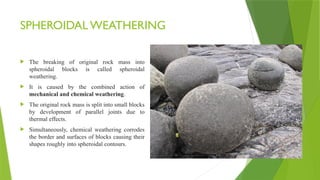
  • 100.
    Wave-Cut Terraces  Wavecut terrace is a shallow shelf type structure, caned out from the shore rocks by the advancing sea waves  The waves first of all cut a notch where they strike against the cliff rock again and again. The notch is gradually extended backwards to such a depth below the overlying rock that the latter becomes unsupported from below.  The cliff eventually falls down along the notch.  A platform or bench is thus created over which the seawater may rush temporarily and periodically. The resulting structure is often called a wave-cut terrace, a platform or simply a bench.
  • 102.
    LANDFORMS ON COAST MARINEDEPOSITION  Seas are regarded as the most important and extensive sedimentation basins. This becomes evident from the fact that marine deposits of practically all the geological ages are known to occur in different parts of the world.  These deposits are exposed at many places in almost all the continents. All the marine deposits or landforms are conveniently classified into two groups:  Shallow water deposits  Deep water deposits
  • 103.
    (A)SHALLOW WATER DEPOSITS(Neritic deposits)  These include marine deposits laid down in Neritic zone of the sea which extends from the lowest tide limit to the place of the continental shelf where the slope becomes abruptly steeper.  The material that goes into the making of the shallow water deposits is derived from the land and shore rock, mostly through the action of waves.  Besides these sediments, a group of marine organisms collectively known as Benthos also contributes greatly as a source material for making the shallow water marine deposits.  Common examples of Neritic deposits are: beaches, spits, bars and tombolos.
  • 104.
    Beach  These areloose deposits made by the sea near the shore from the materials eroded from nearby regions.  The lower margin of a beach is commonly beneath the waves whereas the upper margin is a few meters above the still water.  Waves and currents play a great part in the formation of a beach.  Streams entering the sea generally drop their load at some distance from the shore into the sea.  A part of these sediments is brought back to the shore by the advancing waves that deposit them there due to a reduction in velocity.  Beach formation is very much favoured when the continental shelf has a gentle slope.
  • 105.
    SPITS AND BARS These are ridge shaped deposits of sand and shingle that often extend across the embayment.  A spit is formed when a sediment laden shore current comes near an embayment on the coast, there is strong tendency for it to keep its normal course rather than to follow the shore line of the embayment; hence it moves through deeper and quieter waters where it lays down much of its sediments.  This process may result in an incomplete ridge in continuity with the shore but terminating in open waters.This is the spit.  When the ridge (spit) so formed in the above manner closes the mouth of the embayment completely, it is known as bar.
  • 107.
    Tombola  It isa form of bar (marine deposit) that connects a headland and an island or one island with another island.  Tombola is developed in the same way as a spit or a bar i.e. by the deposition of materials carried away by the current.
  • 108.
    (B) DEEP WATERDEPOSITS  These deposits consist mostly of mud and oozes (a sea organism)  The oozes that form bulk of some of such deposits consist of small organisms known collectively as planktons.  Death and decay of these organisms and plants followed by their accumulation in regular and irregular shapes eventually results in huge deposits.  Sometimes these deposits take the shape of extensive ridge like formations that are partly or totally submerged under seawater thereby creating a great risk for ships and boats navigating on the sea.  These deposits are commonly called reefs.
  • 109.
    CORAL REEFS Definition  Theseare peculiar type of ridge-like marine deposits that have been formed due to accumulation of dead parts of certain types of sea-organisms.  Corals - a type of calcium secreting organisms - predominate among the source organisms for such reefs; hence they are commonly designated as coral reefs.  These reefs may or may not be visible above the seawater depending upon the tide. Types 1. Fringing reefs 2. Barrier reefs 3. Atolls
  • 110.
    The Fringing Reefs These are thin, tabular sheets of coral accumulations that are developed along the border (fringe) of a mainland coast or along the rim of an island.  When they accumulate on border region of islands, they appear like a ring shaped deposit around the island during the low-tide.  A simple fringing reef has a steeply sloping sea front and a flat pavement surface covered with veneer of growth.
  • 111.
    The Barrier Reefs These are more common type of reefs and occur at a distance from the Shore or the island running in the form of parallel, flat-topped ridges.  There is a body of water in between called lagoon that separate the reef from the shore or the island.  The ridge may be continuous or broken here and there; it has a steep slope facing the sea and a gentle slope towards the lagoon.
  • 112.
    Atoll  An atollis essentially an annular, circular or semi-circular coral reef surrounding a central body of water that is as usual called a lagoon.  In a typical atoll, the ring made of coral deposits may be continuous or discontinuous, more often broken at places.  The top of an atoll is generally flat and pavement like in appearance.
  • 115.
    Origin of Reefs They are known to grow only in relatively warm waters (68-78°F), and at depths ranging between 20-60 m.  The seawater should be clear and saltish.  The direction of wind is also known to exert considerable influence on the growth of the corals.  Darwin suggests that the coral reefs are formed on a subsiding or sinking platform which is formed due to the occurrence of earthquakes on the sea floor  According to Darwin, the three types of reefs -the fringing reef, the barrier reef and the atoll, actually represent three stages in the development of a single reef deposit.  Origin of reefs is based on Glacial ControlTheory.  According to him, the submergence of an old reef framework is due to rise in the level because of melting of ice.
  • 116.
    COASTAL PROTECTION STRATEGIES HARD Engineering Strategies : Building or creating something which will interfere with coastal processes – usually to reduce the power of breaking waves against cliffs.  SOFT Engineering Strategies :With the natural processes of sea and sand.
  • 117.
    HARD Engineering Strategies (a)Groynes  A barrier extending from the beach or offshore into the sea in the transverse direction to the sea shore.  Groynes are used to reduce the loss of beach grade sediment through long shore drift.  With proper groyne field design, beach erosion can be reduced due to trapped sediment on the up-drift side of the groyne.  Groynes can be constructed out of wood, stone or concrete depending on the size of native beach material.  Although acting to reduce the erosion on site, groynes typically cause sediment starvation down-drift, shifting the erosion further down the coastline.
  • 119.
    HARD Engineering Strategies (b)Gabions  Wire cages filled with stones/rocks stacked along the cliff base protect the shore. Advantages  Easily installed  Cheaper than sea wall Disadvantages  Not very attractive  Needs frequent checking & repair  Not easy for people to get over to get to beach  May contain rats nests
  • 121.
    HARD Engineering Strategies (c)Rock Armour/ Rip-Rap  Huge blocks of rocks is placed along the shore Advantages  Popular option in recent years – seen to be effective  Cheaper than sea wall Disadvantages  Not very attractive  Not easy for people to get over to get to the beach (broken ankles)  Rats may live in spaces
  • 122.
    HARD Engineering Strategies (d)Sea Walls  These structures are designed to protect resources behind them from the impacts of wave energy and associated erosion.  Although they hold soils in place behind the structure, seawalls usually accelerate erosion on adjacent beaches.  It also protect areas of human habitation, conservation and leisure activities from the action of tides, waves, or tsunamis  Seawalls are constructed from various materials, most commonly reinforced concrete, boulders, steel, or gabions. Other possible construction materials include vinyl, wood, aluminum, fiberglass composite, and biodegradable sandbags made of jute and coir.  Vertical or near-vertical structures designed to limit erosion due to wave attack.  Concrete curved superstructures can be incorporated to reduce wave overtopping of sea water.
  • 123.
    HARD Engineering Strategies Advantages Deflects Waves  Strong  Effective  Lasts a long time Disadvantages  Expensive  Likely to need repair fairly regularly  Deflected waves can scour sea bed and undermine the sea wall foundations
  • 124.
    HARD Engineering Strategies (e)Sea dike  Large land-based sloped structures used to prevent overtopping during high tide and storm events.  Sloped towards sea  Instead of providing protection against wave action, sea dikes fix the land-sea boundary in place to prevent inland flooding.  Sea dikes are usually built as a mound of fine materials like sand and clay with a gentle seaward slope in order to reduce the wave run up and the erodible effect of the waves.
  • 125.
    HARD Engineering Strategies (f)Revetments  Onshore sloped structures used to reduce the landward migration of the beach due to coastal erosion.  The Structure reduces the water energy and thus reduces the erosive power of the wave .  They can be constructed out of concrete, stone or asphalt. The structure should be designed to have a crest sufficiently high to stop wave overtopping during a storm event
  • 126.
    HARD Engineering Strategies Advantages Provides hard face to cliff  Easily installed  Cheaper than sea wall  Deflects wave power Disadvantages  Can be eroded from below easily  Needs frequent repair  Not very attractive
  • 127.
    HARD Engineering Strategies (g)Breakwater  These are offshore sloped or vertical structures reducing incoming wave energy arriving at the coastline.  As well as reducing erosion, this also creates calmer waters for harbours and shipping.  They can be constructed out of concrete or stone and rock.
  • 128.
    SOFT engineering strategies (a)Beach  Beach - a beach in itself acts as a coastal defence as it reduces wave impact and prevents inland flooding.  However the beach needs to be properly managed to ensure, it is wide and high enough to prevent from being overtopped during high sea levels.  This can be done through beach replenishment where beach- grade sediments are used to top-up the beach, increasing its level of protections.
  • 129.
    SOFT engineering strategies (b)Offshore Reef  Man-made artificial reefs are built just out to sea to for the waves to break on them and create calmer water at the coast. Advantages  Provides inshore area of calm water  Effective at preventing the cause of cliff erosion Disadvantages  Very expensive  Need openings for fishing boats to get to sea  Damages fish nets.  Can be breached in stormy conditions and need repair.
  • 130.
    SOFT engineering strategies (c)Reprofiling  The sediment is redistributed from the lower part of the beach to the upper part of the beach Advantages  Cheap and simple  Reduces energy of waves Disadvantages  Only works when wave energy is low  Needs to be repeated continuously