Engine Ingestion Standards and Certifications
By
 Behzad Mhp 27621760
 Nirmal Raju 26734227
 Nishant Jogadia 27272588
 Siddharth Salkar 27169787
 ENGR 6421- Standards Regulations and
Certifications
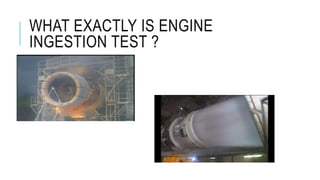
WHAT EXACTLY IS ENGINE
INGESTION TEST ?
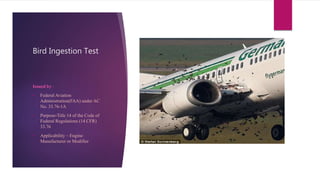
Bird Ingestion Test
Issued by :
 Federal Aviation
Administration(FAA) under AC
No. 33.76-1A
 Purpose-Title 14 of the Code of
Federal Regulations (14 CFR)
33.76
 Applicability – Engine
Manufacturer or Modifier
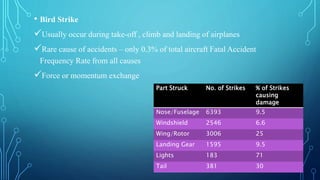
• Bird Strike
Usually occur during take-off , climb and landing of airplanes
Rare cause of accidents – only 0.3% of total aircraft Fatal Accident
Frequency Rate from all causes
Force or momentum exchange
Part Struck No. of Strikes % of Strikes
causing
damage
Nose/Fuselage 6393 9.5
Windshield 2546 6.6
Wing/Rotor 3006 25
Landing Gear 1595 9.5
Lights 183 71
Tail 381 30
No. of birds
struck
No. of strikers % of Strikes
causing
damage
1 7704 11.9
2-10 2726 18.9
>10 320 23.8
Total 10750
• Classification of Bird Strike
Single bird
Between 2 and 10 birds
More than 10 birds
• Engine must be structurally and operationally tolerant to:
Large Single Bird Ingestion
Small and Medium Flocking Bird Ingestion
Large Flocking Bird Ingestion
BASIC DEFINITIONS
• Front of the Engine:
• Minimum Engine
• Critical Impact Parameter (CIP):stress , strain , deflection , twist etc
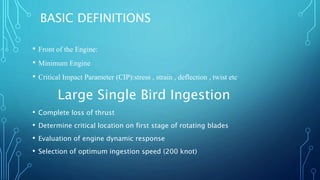
Large Single Bird Ingestion
• Complete loss of thrust
• Determine critical location on first stage of rotating blades
• Evaluation of engine dynamic response
• Selection of optimum ingestion speed (200 knot)
SMALL AND MEDIUM
FLOCKING BIRD INGESTION
• Method
First Bird is targeted for the core primary flow path
Second bird – most critical exposed location
Remaining birds- fan face area
• Engine must produce at least 75% of takeoff power or thrust after ingestion.
• Momentary power drop should not exceed 3 seconds.
• Rig Tests.
• Sustained high vibration after 2 minutes - vary power
• Exceeding Engine Operating Limits
• Total run-on test time – 20 minutes
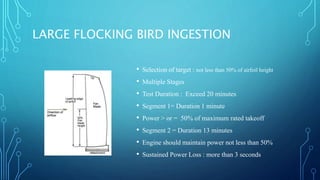
LARGE FLOCKING BIRD INGESTION
• Selection of target : not less than 50% of airfoil height
• Multiple Stages
• Test Duration : Exceed 20 minutes
• Segment 1= Duration 1 minute
• Power > or = 50% of maximum rated takeoff
• Segment 2 = Duration 13 minutes
• Engine should maintain power not less than 50%
• Sustained Power Loss : more than 3 seconds
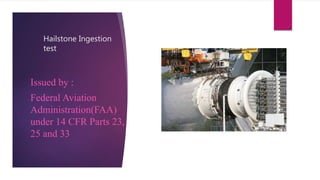
Hailstone Ingestion
test
Issued by :
Federal Aviation
Administration(FAA)
under 14 CFR Parts 23,
25 and 33
BACKGROUND
• There have been a number of multiple turbine engine power-loss and instability events, forced
landings, and accidents attributed to operating airplanes in extreme rain or hail.
• If an airplane encounters severe rain or hail with installed engines that are susceptible to
flameout, the airplane will be susceptible to an all engine out, forced landing.
• Rain or hail related in-flight engine shutdowns are rare occurrences. This is due, in large part,
to the high quality of meteorological data available to ground controllers and pilots, and to well
established weather avoidance procedures.
• However, while such events are infrequent, they pose a serious hazard because they typically
occur during a critical phase of flight where recovery is difficult or impossible.
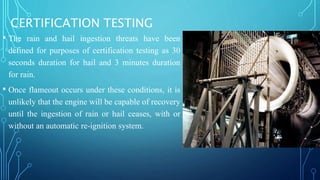
CERTIFICATION TESTING
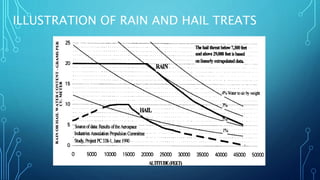
• The rain and hail ingestion threats have been
defined for purposes of certification testing as 30
seconds duration for hail and 3 minutes duration
for rain.
• Once flameout occurs under these conditions, it is
unlikely that the engine will be capable of recovery
until the ingestion of rain or hail ceases, with or
without an automatic re-ignition system.
ILLUSTRATION OF RAIN AND HAIL TREATS
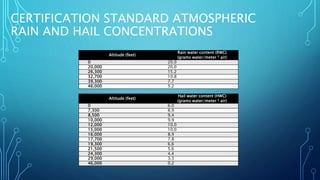
CERTIFICATION STANDARD ATMOSPHERIC
RAIN AND HAIL CONCENTRATIONS
Altitude (feet)
Rain water content (RWC)
(grams water/meter 3 air)
0 20.0
20,000 20.0
26,300 15.2
32,700 10.8
39,300 7.7
46,000 5.2
Altitude (feet)
Hail water content (HWC)
(grams water/meter 3 air)
0 6.0
7,300 8.9
8,500 9.4
10,000 9.9
12,000 10.0
15,000 10.0
16,000 8.9
17,700 7.8
19,300 6.6
21,500 5.6
24,300 4.4
29,000 3.3
46,000 0.2
Volcanic Ash
Ingestion
 Background
 Effects
 Important Factors
 Safety measures and
Recommendations
 Certification standards
 Challenges
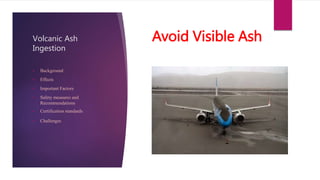
Avoid Visible Ash
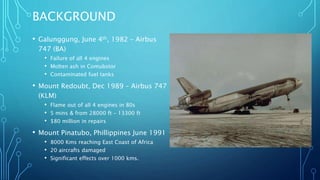
BACKGROUND
• Galunggung, June 4th, 1982 – Airbus
747 (BA)
• Failure of all 4 engines
• Molten ash in Comubstor
• Contaminated fuel tanks
• Mount Redoubt, Dec 1989 – Airbus 747
(KLM)
• Flame out of all 4 engines in 80s
• 5 mins & from 28000 ft – 13300 ft
• $80 million in repairs
• Mount Pinatubo, Phillippines June 1991
• 8000 Kms reaching East Coast of Africa
• 20 aircrafts damaged
• Significant effects over 1000 kms.
EYJAFJALLAJÖKULL, ICELAND, APRIL 2010
• Contamination of European Airspace
• Loss of aircraft separation due to ash avoidance
• Air traffic flows reduced; disrupted flight operations; economic
impact
• Ash avoidance principle compromised (SRAs, Threshold limits)
• ICAO set-up International Volcanic Ash Task Force (IVATF) in
response, to understand aviation hazards and impact of flight
operations in ash environment.
• A-NPA by EASA embracing the IVATF approach
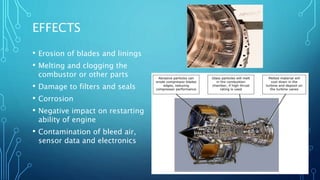
EFFECTS
• Erosion of blades and linings
• Melting and clogging the
combustor or other parts
• Damage to filters and seals
• Corrosion
• Negative impact on restarting
ability of engine
• Contamination of bleed air,
sensor data and electronics
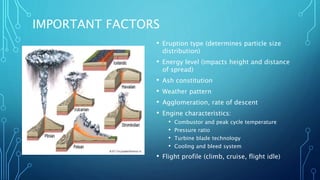
IMPORTANT FACTORS
• Eruption type (determines particle size
distribution)
• Energy level (impacts height and distance
of spread)
• Ash constitution
• Weather pattern
• Agglomeration, rate of descent
• Engine characteristics:
• Combustor and peak cycle temperature
• Pressure ratio
• Turbine blade technology
• Cooling and bleed system
• Flight profile (climb, cruise, flight idle)
SAFETY MEASURES AND
RECOMMENDATIONS
• Avoidance of Visible Ash
• Volcanic Ash Advisory Centres (VAAC) and Meteorological
Watch Offices (MWO) to forecast location and concentration
• Safety Risk Assessment (SRA) by the operator
• Establish Upper and Lower limits to differentiate immediate
safety hazards and long term effects
• Flight crew awareness
CERTIFICATION STANDARDS
Objectives:
• Establish upper limit possessing immediate safety hazard
• Ensure built-in safety margin from TC holders
• Establish guidelines for future operations
Challenges:
• The probability of ash encounter is very low.
• Reduce efficiency and performance, environmental and economic
impacts
• Limited accuracy of forecast models or direct measurement devices
• Delay in implementation
• Inadequate testing methods (sand testing)

Engine Ingestion Test

  • 1.
    Engine Ingestion Standardsand Certifications By  Behzad Mhp 27621760  Nirmal Raju 26734227  Nishant Jogadia 27272588  Siddharth Salkar 27169787  ENGR 6421- Standards Regulations and Certifications
  • 2.
    WHAT EXACTLY ISENGINE INGESTION TEST ?
  • 3.
    Bird Ingestion Test Issuedby :  Federal Aviation Administration(FAA) under AC No. 33.76-1A  Purpose-Title 14 of the Code of Federal Regulations (14 CFR) 33.76  Applicability – Engine Manufacturer or Modifier
  • 4.
    • Bird Strike Usuallyoccur during take-off , climb and landing of airplanes Rare cause of accidents – only 0.3% of total aircraft Fatal Accident Frequency Rate from all causes Force or momentum exchange Part Struck No. of Strikes % of Strikes causing damage Nose/Fuselage 6393 9.5 Windshield 2546 6.6 Wing/Rotor 3006 25 Landing Gear 1595 9.5 Lights 183 71 Tail 381 30
  • 5.
    No. of birds struck No.of strikers % of Strikes causing damage 1 7704 11.9 2-10 2726 18.9 >10 320 23.8 Total 10750 • Classification of Bird Strike Single bird Between 2 and 10 birds More than 10 birds
  • 6.
    • Engine mustbe structurally and operationally tolerant to: Large Single Bird Ingestion Small and Medium Flocking Bird Ingestion Large Flocking Bird Ingestion
  • 7.
    BASIC DEFINITIONS • Frontof the Engine: • Minimum Engine • Critical Impact Parameter (CIP):stress , strain , deflection , twist etc Large Single Bird Ingestion • Complete loss of thrust • Determine critical location on first stage of rotating blades • Evaluation of engine dynamic response • Selection of optimum ingestion speed (200 knot)
  • 8.
    SMALL AND MEDIUM FLOCKINGBIRD INGESTION • Method First Bird is targeted for the core primary flow path Second bird – most critical exposed location Remaining birds- fan face area • Engine must produce at least 75% of takeoff power or thrust after ingestion. • Momentary power drop should not exceed 3 seconds. • Rig Tests. • Sustained high vibration after 2 minutes - vary power • Exceeding Engine Operating Limits • Total run-on test time – 20 minutes
  • 9.
    LARGE FLOCKING BIRDINGESTION • Selection of target : not less than 50% of airfoil height • Multiple Stages • Test Duration : Exceed 20 minutes • Segment 1= Duration 1 minute • Power > or = 50% of maximum rated takeoff • Segment 2 = Duration 13 minutes • Engine should maintain power not less than 50% • Sustained Power Loss : more than 3 seconds
  • 10.
    Hailstone Ingestion test Issued by: Federal Aviation Administration(FAA) under 14 CFR Parts 23, 25 and 33
  • 11.
    BACKGROUND • There havebeen a number of multiple turbine engine power-loss and instability events, forced landings, and accidents attributed to operating airplanes in extreme rain or hail. • If an airplane encounters severe rain or hail with installed engines that are susceptible to flameout, the airplane will be susceptible to an all engine out, forced landing. • Rain or hail related in-flight engine shutdowns are rare occurrences. This is due, in large part, to the high quality of meteorological data available to ground controllers and pilots, and to well established weather avoidance procedures. • However, while such events are infrequent, they pose a serious hazard because they typically occur during a critical phase of flight where recovery is difficult or impossible.
  • 12.
    CERTIFICATION TESTING • Therain and hail ingestion threats have been defined for purposes of certification testing as 30 seconds duration for hail and 3 minutes duration for rain. • Once flameout occurs under these conditions, it is unlikely that the engine will be capable of recovery until the ingestion of rain or hail ceases, with or without an automatic re-ignition system.
  • 13.
    ILLUSTRATION OF RAINAND HAIL TREATS
  • 14.
    CERTIFICATION STANDARD ATMOSPHERIC RAINAND HAIL CONCENTRATIONS Altitude (feet) Rain water content (RWC) (grams water/meter 3 air) 0 20.0 20,000 20.0 26,300 15.2 32,700 10.8 39,300 7.7 46,000 5.2 Altitude (feet) Hail water content (HWC) (grams water/meter 3 air) 0 6.0 7,300 8.9 8,500 9.4 10,000 9.9 12,000 10.0 15,000 10.0 16,000 8.9 17,700 7.8 19,300 6.6 21,500 5.6 24,300 4.4 29,000 3.3 46,000 0.2
  • 15.
    Volcanic Ash Ingestion  Background Effects  Important Factors  Safety measures and Recommendations  Certification standards  Challenges Avoid Visible Ash
  • 16.
    BACKGROUND • Galunggung, June4th, 1982 – Airbus 747 (BA) • Failure of all 4 engines • Molten ash in Comubstor • Contaminated fuel tanks • Mount Redoubt, Dec 1989 – Airbus 747 (KLM) • Flame out of all 4 engines in 80s • 5 mins & from 28000 ft – 13300 ft • $80 million in repairs • Mount Pinatubo, Phillippines June 1991 • 8000 Kms reaching East Coast of Africa • 20 aircrafts damaged • Significant effects over 1000 kms.
  • 17.
    EYJAFJALLAJÖKULL, ICELAND, APRIL2010 • Contamination of European Airspace • Loss of aircraft separation due to ash avoidance • Air traffic flows reduced; disrupted flight operations; economic impact • Ash avoidance principle compromised (SRAs, Threshold limits) • ICAO set-up International Volcanic Ash Task Force (IVATF) in response, to understand aviation hazards and impact of flight operations in ash environment. • A-NPA by EASA embracing the IVATF approach
  • 18.
    EFFECTS • Erosion ofblades and linings • Melting and clogging the combustor or other parts • Damage to filters and seals • Corrosion • Negative impact on restarting ability of engine • Contamination of bleed air, sensor data and electronics
  • 19.
    IMPORTANT FACTORS • Eruptiontype (determines particle size distribution) • Energy level (impacts height and distance of spread) • Ash constitution • Weather pattern • Agglomeration, rate of descent • Engine characteristics: • Combustor and peak cycle temperature • Pressure ratio • Turbine blade technology • Cooling and bleed system • Flight profile (climb, cruise, flight idle)
  • 20.
    SAFETY MEASURES AND RECOMMENDATIONS •Avoidance of Visible Ash • Volcanic Ash Advisory Centres (VAAC) and Meteorological Watch Offices (MWO) to forecast location and concentration • Safety Risk Assessment (SRA) by the operator • Establish Upper and Lower limits to differentiate immediate safety hazards and long term effects • Flight crew awareness
  • 21.
    CERTIFICATION STANDARDS Objectives: • Establishupper limit possessing immediate safety hazard • Ensure built-in safety margin from TC holders • Establish guidelines for future operations Challenges: • The probability of ash encounter is very low. • Reduce efficiency and performance, environmental and economic impacts • Limited accuracy of forecast models or direct measurement devices • Delay in implementation • Inadequate testing methods (sand testing)