Contribute Us | Ask Question | login
JavaTpoint
Subscribe Us
91-9990449935
0120-4256464
 Home
 Core Java
 Servlet
 JSP
 EJB
 Struts2
 Mail
 Hibernate
 Spring
 Android
 Design P
 Quiz
 Projects
 Interview Q
 Comment
 Forum
 Training
Basics of Java
Java OOPs Concepts
Advantage of OOPsNaming ConventionObject and ClassMethod OverloadingConstructorstatic
keywordthis keywordInheritance(IS-A)Aggregation(HAS-A)Method OverridingCovariant
Return Typesuper keywordInstance Initializer blockfinal keywordRuntime
PolymorphismDynamic Bindinginstanceof operatorAbstract classInterfaceAbstract vs
InterfacePackageAccess ModifiersEncapsulationObject classObject CloningJava ArrayCall
By Valuestrictfp keywordAPI DocumentCommand Line ArgArray Quiz-1Array Quiz-2OOPs
Quiz-1OOPs Quiz-2OOPs Quiz-3OOPs Quiz-4
Java StringJava RegexException HandlingJava Inner
classesMultithreadingSynchronizationI/OSerializationNetworkingAWTEvent
HandlingSwingLayoutManagerAppletReflection APICollectionJDBCJava New
FeaturesRMIInternationalization
next »« prev
Encapsulation in Java
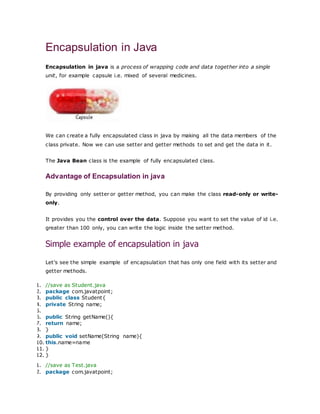
Encapsulation in java is a process of wrapping code and data together into a single
unit, for example capsule i.e. mixed of several medicines.
We can create a fully encapsulated class in java by making all the data members of the
class private. Now we can use setter and getter methods to set and get the data in it.
The Java Bean class is the example of fully encapsulated class.
Advantage of Encapsulation in java
By providing only setter or getter method, you can make the class read-only or write-
only.
It provides you the control over the data. Suppose you want to set the value of id i.e.
greater than 100 only, you can write the logic inside the setter method.
Simple example of encapsulation in java
Let's see the simple example of encapsulation that has only one field with its setter and
getter methods.
1. //save as Student.java
2. package com.javatpoint;
3. public class Student{
4. private String name;
5.
6. public String getName(){
7. return name;
8. }
9. public void setName(String name){
10. this.name=name
11. }
12. }
1. //save as Test.java
2. package com.javatpoint;
3. class Test{
4. public static void main(String[] args){
5. Student s=new Student();
6. s.setname("vijay");
7. System.out.println(s.getName());
8. }
9. }
Compile By: javac -d . Test.java
Run By: java com.javatpoint.Test
Output: vijay
Next TopicObject class in java
« prevnext »
Like/Subscribe us for latest updates or new sletter ↑Top
Tutorials
 » Core Java Tutorial
 » Servlet Tutorial
 » JSP Tutorial
 » Mail API Tutorial
 » Design Pattern Tutorial
 » Struts Tutorial
 » Spring Tutorial
 » Hibernate Tutorial
 » Android Tutorial
 » JavaScript Tutorial
 » SQL Tutorial
 » C Tutorial
 » AJAX Tutorial
 » JUnit Tutorial
 » JAXB Tutorial
 » Maven Tutorial
Interview Questions
 » Java Interview
 » Servlet Interview
 » JSP Interview
 » Hibernate Interview
 » Spring Interview
 » Android Interview
 » SQL Interview
 » PL/SQL Interview
 » Oracle Interview
 » MySQL Interview
 » SQL Server Interview
 » MongoDB Interview
 » Cloud Interview
Quizzes
 » Core Java quiz
 » Servlet quiz
 » JSP quiz
 » Struts2 quiz
 » Android quiz
 » OCJP quiz
 » OCWCD quiz
 » Hibernate quiz
 » Spring quiz
 » C quiz
 » Cloud Computing quiz
 » JavaScript quiz
 » SQL quiz
Forum
 » Core Java Ques.
 » Servlet Ques.
 » JSP Ques.
 » Struts Ques.
 » Spring Ques.
 » Hibernate Ques.
 » Android Ques.
Projects
SSS IT PVT LTD
 » Development
 » Training
 » SEO
 » Consultancy
CONTACT US
Tel. : 0120-4256464
Mob. : +91 9990449935
Email : enquiry@sssit.org
Address: Plot - 6, GT Road,
Near MMX Mall,
Mohan Nagar, Ghaziabad,
201007, UP, India
» Contact Us
» Privacy Policy
© 2011-2014 Javatpoint.
All Rights Reserved.

Encapsulation

  • 1.
    Contribute Us |Ask Question | login JavaTpoint Subscribe Us 91-9990449935 0120-4256464  Home  Core Java  Servlet  JSP  EJB  Struts2  Mail  Hibernate  Spring  Android  Design P  Quiz  Projects  Interview Q  Comment  Forum  Training Basics of Java Java OOPs Concepts Advantage of OOPsNaming ConventionObject and ClassMethod OverloadingConstructorstatic keywordthis keywordInheritance(IS-A)Aggregation(HAS-A)Method OverridingCovariant Return Typesuper keywordInstance Initializer blockfinal keywordRuntime PolymorphismDynamic Bindinginstanceof operatorAbstract classInterfaceAbstract vs InterfacePackageAccess ModifiersEncapsulationObject classObject CloningJava ArrayCall By Valuestrictfp keywordAPI DocumentCommand Line ArgArray Quiz-1Array Quiz-2OOPs Quiz-1OOPs Quiz-2OOPs Quiz-3OOPs Quiz-4 Java StringJava RegexException HandlingJava Inner classesMultithreadingSynchronizationI/OSerializationNetworkingAWTEvent HandlingSwingLayoutManagerAppletReflection APICollectionJDBCJava New FeaturesRMIInternationalization next »« prev
  • 2.
    Encapsulation in Java Encapsulationin java is a process of wrapping code and data together into a single unit, for example capsule i.e. mixed of several medicines. We can create a fully encapsulated class in java by making all the data members of the class private. Now we can use setter and getter methods to set and get the data in it. The Java Bean class is the example of fully encapsulated class. Advantage of Encapsulation in java By providing only setter or getter method, you can make the class read-only or write- only. It provides you the control over the data. Suppose you want to set the value of id i.e. greater than 100 only, you can write the logic inside the setter method. Simple example of encapsulation in java Let's see the simple example of encapsulation that has only one field with its setter and getter methods. 1. //save as Student.java 2. package com.javatpoint; 3. public class Student{ 4. private String name; 5. 6. public String getName(){ 7. return name; 8. } 9. public void setName(String name){ 10. this.name=name 11. } 12. } 1. //save as Test.java 2. package com.javatpoint;
  • 3.
    3. class Test{ 4.public static void main(String[] args){ 5. Student s=new Student(); 6. s.setname("vijay"); 7. System.out.println(s.getName()); 8. } 9. } Compile By: javac -d . Test.java Run By: java com.javatpoint.Test Output: vijay Next TopicObject class in java « prevnext » Like/Subscribe us for latest updates or new sletter ↑Top Tutorials  » Core Java Tutorial  » Servlet Tutorial  » JSP Tutorial  » Mail API Tutorial  » Design Pattern Tutorial  » Struts Tutorial  » Spring Tutorial  » Hibernate Tutorial  » Android Tutorial  » JavaScript Tutorial  » SQL Tutorial
  • 4.
     » CTutorial  » AJAX Tutorial  » JUnit Tutorial  » JAXB Tutorial  » Maven Tutorial Interview Questions  » Java Interview  » Servlet Interview  » JSP Interview  » Hibernate Interview  » Spring Interview  » Android Interview  » SQL Interview  » PL/SQL Interview  » Oracle Interview  » MySQL Interview  » SQL Server Interview  » MongoDB Interview  » Cloud Interview Quizzes  » Core Java quiz  » Servlet quiz  » JSP quiz  » Struts2 quiz  » Android quiz  » OCJP quiz  » OCWCD quiz  » Hibernate quiz  » Spring quiz  » C quiz  » Cloud Computing quiz  » JavaScript quiz  » SQL quiz Forum
  • 5.
     » CoreJava Ques.  » Servlet Ques.  » JSP Ques.  » Struts Ques.  » Spring Ques.  » Hibernate Ques.  » Android Ques. Projects SSS IT PVT LTD  » Development  » Training  » SEO  » Consultancy CONTACT US Tel. : 0120-4256464 Mob. : +91 9990449935 Email : enquiry@sssit.org Address: Plot - 6, GT Road, Near MMX Mall, Mohan Nagar, Ghaziabad, 201007, UP, India » Contact Us » Privacy Policy © 2011-2014 Javatpoint. All Rights Reserved.