This presentation is intended to provide an overview of GDPR how EMS technologies can support you and is not a definitive statement of the law.
Supporting your journey
to EU GDPR compliance with
Microsoft Enterprise Mobility + Security
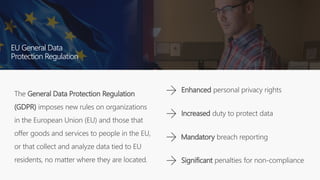
The General Data Protection Regulation
(GDPR) imposes new rules on organizations
in the European Union (EU) and those that
offer goods and services to people in the EU,
or that collect and analyze data tied to EU
residents, no matter where they are located.
EU General Data
Protection Regulation
Enhanced personal privacy rights
Increased duty to protect data
Mandatory breach reporting
Significant penalties for non-compliance
When must we be compliant?
What if we are not compliant?
Who needs to be compliant?
Organizations inside or outside of the EU
that process personal data of EU residents.
Companies can be fined up to €20m or 4% of
annual global turnover, whichever is greater,
for failure to meet GDPR requirements.
The European Parliament approved and adopted
the GDPR in April 2016 and enforcement begins
on May 25, 2018.
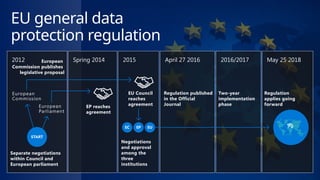
2012 May 25 2018
Spring 2014 April 27 2016 2016/2017
2015
EU Council
reaches
agreement
Separate negotiations
within Council and
European parliament
European
Commission publishes
legislative proposal
EP reaches
agreement
Negotiations
and approval
among the
three
institutions
Regulation published
in the Official
Journal
Two-year
implementation
phase
EU general data
protection regulation
START
European
Commission
European
Parliament
EC EP EU
Regulation
applies going
forward
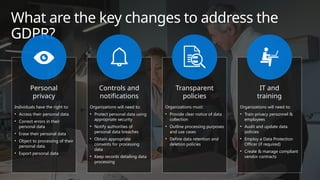
What are the key changes to address the
GDPR?
Personal
privacy
Controls and
notifications
Transparent
policies
IT and
training
Organizations will need to:
• Train privacy personnel &
employees
• Audit and update data
policies
• Employ a Data Protection
Officer (if required)
• Create & manage compliant
vendor contracts
Organizations will need to:
• Protect personal data using
appropriate security
• Notify authorities of
personal data breaches
• Obtain appropriate
consents for processing
data
• Keep records detailing data
processing
Individuals have the right to:
• Access their personal data
• Correct errors in their
personal data
• Erase their personal data
• Object to processing of their
personal data
• Export personal data
Organizations must:
• Provide clear notice of data
collection
• Outline processing purposes
and use cases
• Define data retention and
deletion policies
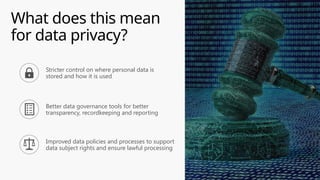
Improved data policies and processes to support
data subject rights and ensure lawful processing
Stricter control on where personal data is
stored and how it is used
Better data governance tools for better
transparency, recordkeeping and reporting
What does this mean
for data privacy?
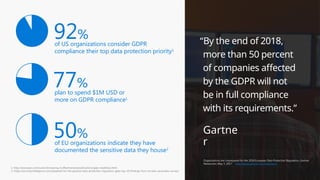
of US organizations consider GDPR
compliance their top data protection priority1
92% “By the end of 2018,
more than 50 percent
of companies affected
by the GDPR will not
be in full compliance
with its requirements.”
Organizations Are Unprepared for the 2018 European Data Protection Regulation, Gartner
Newsroom; May 3, 2017 http://www.gartner.com/newsroom
plan to spend $1M USD or
more on GDPR compliance1
77%
of EU organizations indicate they have
documented the sensitive data they house2
50%
1. http://www.pwc.com/us/en/increasing-it-effectiveness/publications/gdpr-readiness.html
2. https://securityintelligence.com/prepared-for-the-general-data-protection-regulation-gdpr-top-10-findings-from-hurwitz-associates-survey/
Gartne
r
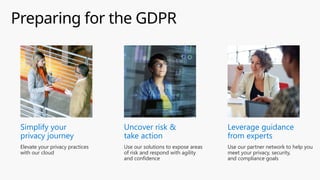
Preparing for the GDPR
Leverage guidance
from experts
Use our partner network to help you
meet your privacy, security,
and compliance goals
Simplify your
privacy journey
Elevate your privacy practices
with our cloud
Uncover risk &
take action
Use our solutions to expose areas
of risk and respond with agility
and confidence
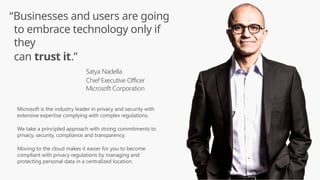
“Businesses and users are going
to embrace technology only if
they
can trust it.”
Satya Nadella
Chief Executive Officer
Microsoft Corporation
Microsoft is the industry leader in privacy and security with
extensive expertise complying with complex regulations.
We take a principled approach with strong commitments to
privacy, security, compliance and transparency.
Moving to the cloud makes it easier for you to become
compliant with privacy regulations by managing and
protecting personal data in a centralized location.
Microsoft is the industry leader in privacy and security with
extensive expertise complying with complex regulations.
We take a principled approach with strong commitments to
privacy, security, compliance and transparency.
Moving to the cloud makes it easier for you to become
compliant with privacy regulations by managing and
protecting personal data in a centralized location.
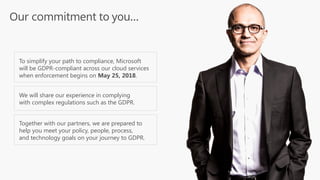
To simplify your path to compliance, Microsoft
will be GDPR-compliant across our cloud services
when enforcement begins on May 25, 2018.
We will share our experience in complying
with complex regulations such as the GDPR.
Together with our partners, we are prepared to
help you meet your policy, people, process,
and technology goals on your journey to GDPR.
Our commitment to you…
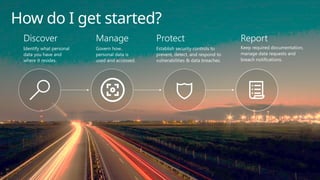
How do I get started?
Discover
Identify what personal
data you have and
where it resides.
Manage
Govern how
personal data is
used and accessed.
Protect
Establish security controls to
prevent, detect, and respond to
vulnerabilities & data breaches.
Report
Keep required documentation,
manage data requests and
breach notifications.
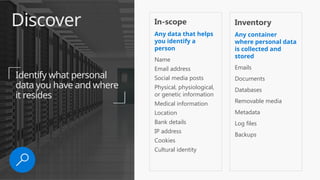
Discover In-scope
Any data that helps
you identify a
person
Name
Email address
Social media posts
Physical, physiological,
or genetic information
Medical information
Location
Bank details
IP address
Cookies
Cultural identity
Inventory
Any container
where personal data
is collected and
stored
Emails
Documents
Databases
Removable media
Metadata
Log files
Backups
Identify what personal
data you have and where
it resides
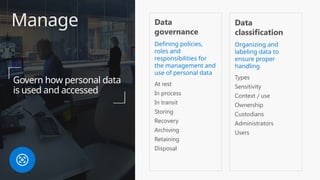
Manage
Govern how personal data
is used and accessed
Data
governance
Defining policies,
roles and
responsibilities for
the management and
use of personal data
At rest
In process
In transit
Storing
Recovery
Archiving
Retaining
Disposal
Data
classification
Organizing and
labeling data to
ensure proper
handling
Types
Sensitivity
Context / use
Ownership
Custodians
Administrators
Users
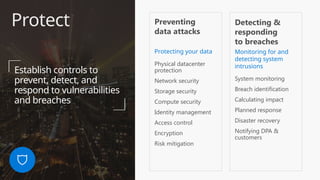
Protect
Establish controls to
prevent, detect, and
respond to vulnerabilities
and breaches
Preventing
data attacks
Protecting your data
Physical datacenter
protection
Network security
Storage security
Compute security
Identity management
Access control
Encryption
Risk mitigation
Detecting &
responding
to breaches
Monitoring for and
detecting system
intrusions
System monitoring
Breach identification
Calculating impact
Planned response
Disaster recovery
Notifying DPA &
customers
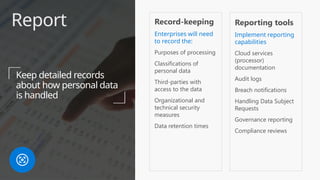
Report
Keep detailed records
about how personal data
is handled
Record-keeping
Enterprises will need
to record the:
Purposes of processing
Classifications of
personal data
Third-parties with
access to the data
Organizational and
technical security
measures
Data retention times
Reporting tools
Implement reporting
capabilities
Cloud services
(processor)
documentation
Audit logs
Breach notifications
Handling Data Subject
Requests
Governance reporting
Compliance reviews
Supporting your
GDPR compliance
journey with Microsoft
Enterprise Mobility +
Security
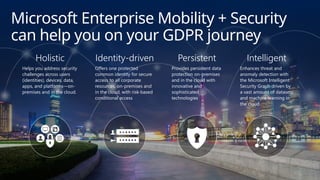
Microsoft Enterprise Mobility + Security
can help you on your GDPR journey
Holistic
Helps you address security
challenges across users
(identities), devices, data,
apps, and platforms―on-
premises and in the cloud.
Identity-driven
Offers one protected
common identity for secure
access to all corporate
resources, on-premises and
in the cloud, with risk-based
conditional access
Persistent
Provides persistent data
protection on-premises
and in the cloud with
innovative and
sophisticated
technologies
Intelligent
Enhances threat and
anomaly detection with
the Microsoft Intelligent
Security Graph driven by
a vast amount of datasets
and machine learning in
the cloud
Access
granted
to data
Supporting your GDPR compliance
journey with Microsoft Enterprise Mobility
+ Security
Apps
Risk
MICROSOFT INTUNE
AZURE ACTIVE
DIRECTORY
MICROSOFT CLOUD
APP SECURITY
AZURE INFORMATION
PROTECTION
MICROSOFT ADVANCED
THREAT ANALYTICS
!
Device
!
CONDITIONAL
ACCESS
Location
Classify
Audit
Protect
Label
!
!
Corporate
Public
Private
cloud
Vendors SaaS
Ex-employees
Online
backup
Graphic
designer
Offshore
teams
Legal review
Agency
teams
Project
Lead
Sales teams
Project
Manager
Project
Lead
Remote
team
Personal
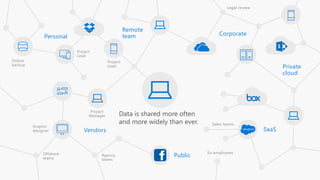
Data is shared more often
and more widely than ever.
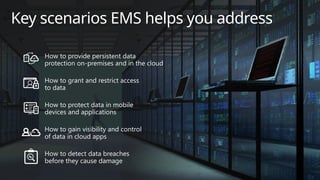
Key scenarios EMS helps you address
How to provide persistent data
protection on-premises and in the cloud
How to grant and restrict access
to data
How to protect data in mobile
devices and applications
How to gain visibility and control
of data in cloud apps
How to detect data breaches
before they cause damage
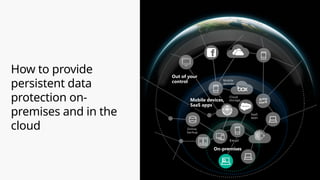
How to provide
persistent data
protection on-
premises and in the
cloud Online
backup
Email
Out of your
control
Mobile devices,
SaaS apps
SaaS
apps
Cloud
storage
Mobile
devices
On-premises
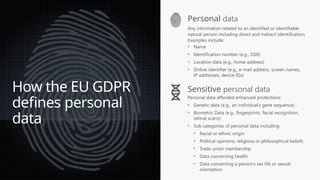
Personal data
Any information related to an identified or identifiable
natural person including direct and indirect identification.
Examples include:
• Name
• Identification number (e.g., SSN)
• Location data (e.g., home address)
• Online identifier (e.g., e-mail address, screen names,
IP addresses, device IDs)
Sensitive personal data
Personal data afforded enhanced protections:
• Genetic data (e.g., an individual’s gene sequence)
• Biometric Data (e.g., fingerprints, facial recognition,
retinal scans)
• Sub categories of personal data including:
• Racial or ethnic origin
• Political opinions, religious or philosophical beliefs
• Trade union membership
• Data concerning health
• Data concerning a person’s sex life or sexual
orientation
How the EU GDPR
defines personal
data
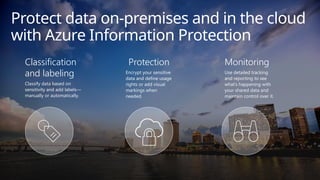
Protect data on-premises and in the cloud
with Azure Information Protection
Classification
and labeling
Classify data based on
sensitivity and add labels—
manually or automatically.
Protection
Encrypt your sensitive
data and define usage
rights or add visual
markings when
needed.
Monitoring
Use detailed tracking
and reporting to see
what’s happening with
your shared data and
maintain control over it.
Classification and labeling
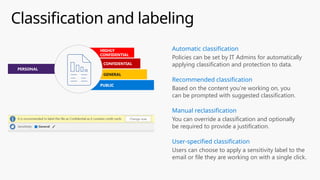
PERSONAL
HIGHLY
CONFIDENTIAL
CONFIDENTIAL
GENERAL
PUBLIC
You can override a classification and optionally
be required to provide a justification.
Manual reclassification
Policies can be set by IT Admins for automatically
applying classification and protection to data.
Automatic classification
Based on the content you’re working on, you
can be prompted with suggested classification.
Recommended classification
Users can choose to apply a sensitivity label to the
email or file they are working on with a single click.
User-specified classification
Classification and labeling
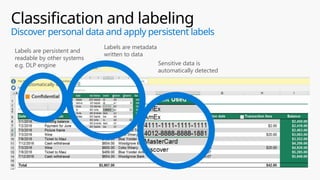
Discover personal data and apply persistent labels
Labels are persistent and
readable by other systems
e.g. DLP engine
Labels are metadata
written to data
Sensitive data is
automatically detected
Protection
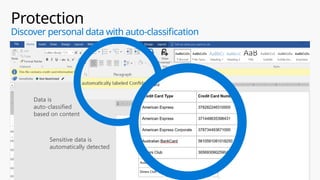
Discover personal data with auto-classification
Data is
auto-classified
based on content
Sensitive data is
automatically detected
Protection
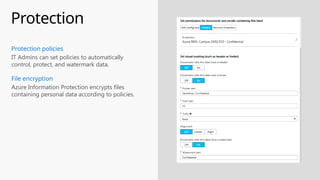
IT Admins can set policies to automatically
control, protect, and watermark data.
Protection policies
Azure Information Protection encrypts files
containing personal data according to policies.
File encryption
Protection
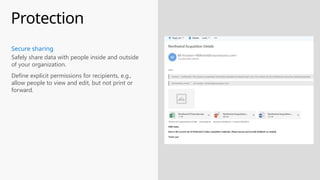
Safely share data with people inside and outside
of your organization.
Define explicit permissions for recipients, e.g.,
allow people to view and edit, but not print or
forward.
Secure sharing
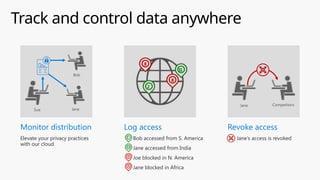
Monitor distribution
Elevate your privacy practices
with our cloud
Track and control data anywhere
Log access
Bob accessed from S. America
Jane accessed from India
Joe blocked in N. America
Jane blocked in Africa
11
2
8
8
8
8
2
1
1
Jane Competitors
Revoke access
Jane’s access is revoked
Bob
Jane
Sue
Monitoring
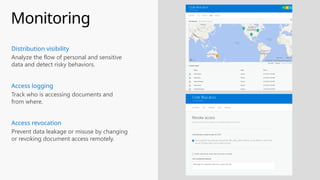
Analyze the flow of personal and sensitive
data and detect risky behaviors.
Distribution visibility
Track who is accessing documents and
from where.
Access logging
Prevent data leakage or misuse by changing
or revoking document access remotely.
Access revocation
How to grant and
restrict access to
data
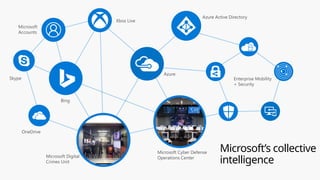
Bing
Xbox Live
OneDrive
Microsoft Digital
Crimes Unit
Microsoft Cyber Defense
Operations Center
Azure
Microsoft
Accounts
Skype Enterprise Mobility
+ Security
Azure Active Directory
Microsoft’s collective
intelligence
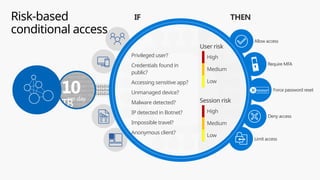
IF
Privileged user?
Credentials found in
public?
Accessing sensitive app?
Unmanaged device?
Malware detected?
IP detected in Botnet?
Impossible travel?
Anonymous client?
High
Medium
Low
User risk
10
TB
per day
THEN
Require MFA
Allow access
Deny access
Force password reset
******
Limit access
High
Medium
Low
Session risk
Azure
Bing
OneDrive
Microsoft
Cyber Defense
Operations Center
Microsoft
Cybercrime Center
Xbox Live
Microsoft
Accounts
Skype
Risk-based
conditional access
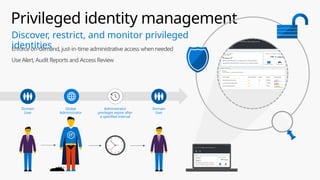
Privileged identity management
Enforce on-demand, just-in-time administrative access when needed
Use Alert, Audit Reports and Access Review
Domain
User
Global
Administrator
Discover, restrict, and monitor privileged
identities
Domain
User
Administrator
privileges expire after
a specified interval
How to protect data
in mobile devices and
mobile apps
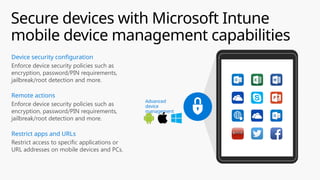
Secure devices with Microsoft Intune
mobile device management capabilities
Managed apps
Personal apps
Advanced
device
management
Enforce device security policies such as
encryption, password/PIN requirements,
jailbreak/root detection and more.
Remote actions
Enforce device security policies such as
encryption, password/PIN requirements,
jailbreak/root detection and more.
Device security configuration
Restrict access to specific applications or
URL addresses on mobile devices and PCs.
Restrict apps and URLs
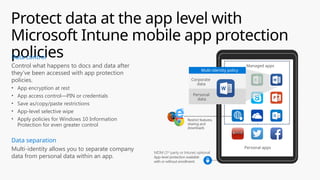
Protect data at the app level with
Microsoft Intune mobile app protection
policies
Managed apps
Personal apps
Personal apps
MDM (3rd
party or Intune) optional
App-level protection available
with or without enrollment.
Managed apps
Restrict features,
sharing and
downloads
Corporate
data
Personal
data
Multi-identity policy
Multi-identity allows you to separate company
data from personal data within an app.
Data separation
Control what happens to docs and data after
they’ve been accessed with app protection
policies.
• App encryption at rest
• App access control—PIN or credentials
• Save as/copy/paste restrictions
• App-level selective wipe
• Apply policies for Windows 10 Information
Protection for even greater control
Data control
How to gain visibility
and control of data
in cloud apps
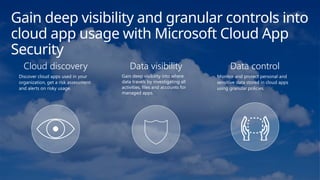
Gain deep visibility and granular controls into
cloud app usage with Microsoft Cloud App
Security
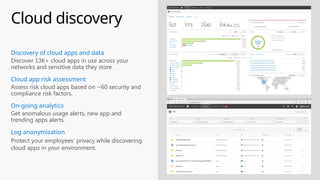
Cloud discovery
Discover cloud apps used in your
organization, get a risk assessment
and alerts on risky usage.
Data visibility
Gain deep visibility into where
data travels by investigating all
activities, files and accounts for
managed apps.
Data control
Monitor and protect personal and
sensitive data stored in cloud apps
using granular policies.
Cloud discovery
Get anomalous usage alerts, new app and
trending apps alerts.
On-going analytics
Discover 13K+ cloud apps in use across your
networks and sensitive data they store.
Discovery of cloud apps and data
Assess risk cloud apps based on ~60 security and
compliance risk factors.
Cloud app risk assessment
Protect your employees’ privacy while discovering
cloud apps in your environment.
Log anonymization
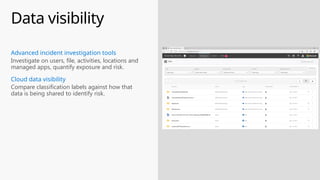
Data visibility
Compare classification labels against how that
data is being shared to identify risk.
Cloud data visibility
Investigate on users, file, activities, locations and
managed apps, quantify exposure and risk.
Advanced incident investigation tools
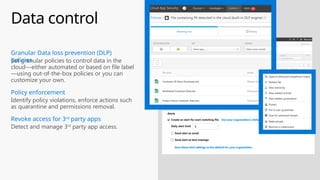
Data control
Set granular policies to control data in the
cloud—either automated or based on file label
—using out-of-the-box policies or you can
customize your own.
Granular Data loss prevention (DLP)
policies
Detect and manage 3rd
party app access.
Revoke access for 3rd
party apps
Identify policy violations, enforce actions such
as quarantine and permissions removal.
Policy enforcement
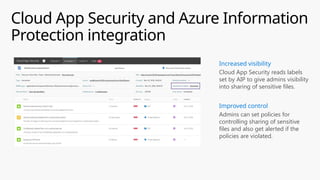
Cloud App Security reads labels
set by AIP to give admins visibility
into sharing of sensitive files.
Increased visibility
Admins can set policies for
controlling sharing of sensitive
files and also get alerted if the
policies are violated.
Improved control
Cloud App Security and Azure Information
Protection integration
How to detect data
breaches before they
cause damage
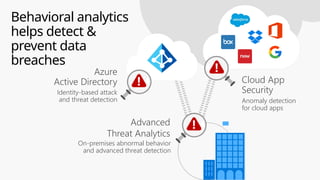
On-premises abnormal behavior
and advanced threat detection
Advanced
Threat Analytics
Identity-based attack
and threat detection
Azure
Active Directory
Behavioral analytics
helps detect &
prevent data
breaches
Anomaly detection
for cloud apps
Cloud App
Security
!
!
!
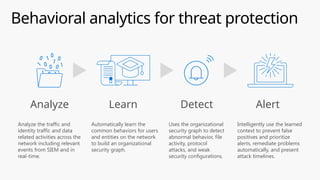
Behavioral analytics for threat protection
Analyze Learn Detect
Analyze the traffic and
identity traffic and data
related activities across the
network including relevant
events from SIEM and in
real-time.
Uses the organizational
security graph to detect
abnormal behavior, file
activity, protocol
attacks, and weak
security configurations.
Automatically learn the
common behaviors for users
and entities on the network
to build an organizational
security graph.
Alert
Intelligently use the learned
context to prevent false
positives and prioritize
alerts, remediate problems
automatically, and present
attack timelines.
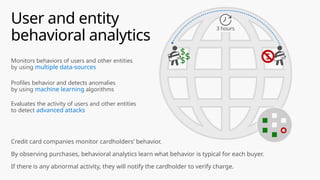
Monitors behaviors of users and other entities
by using multiple data-sources
Profiles behavior and detects anomalies
by using machine learning algorithms
Evaluates the activity of users and other entities
to detect advanced attacks
Credit card companies monitor cardholders’ behavior.
By observing purchases, behavioral analytics learn what behavior is typical for each buyer.
If there is any abnormal activity, they will notify the cardholder to verify charge.
User and entity
behavioral analytics
$
$
$
$
3 hours
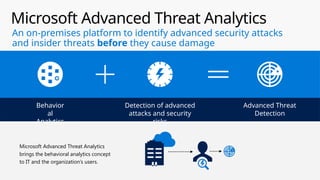
Microsoft Advanced Threat Analytics
brings the behavioral analytics concept
to IT and the organization’s users.
Behavior
al
Analytics
Detection of advanced
attacks and security
risks
Advanced Threat
Detection
An on-premises platform to identify advanced security attacks
and insider threats before they cause damage
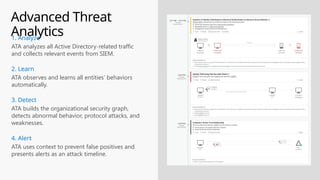
Advanced Threat
Analytics
ATA builds the organizational security graph,
detects abnormal behavior, protocol attacks, and
weaknesses.
3. Detect
ATA observes and learns all entities’ behaviors
automatically.
2. Learn
ATA uses context to prevent false positives and
presents alerts as an attack timeline.
4. Alert
ATA analyzes all Active Directory-related traffic
and collects relevant events from SIEM.
1. Analyze
Advanced Threat
Analytics
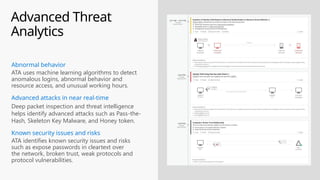
Deep packet inspection and threat intelligence
helps identify advanced attacks such as Pass-the-
Hash, Skeleton Key Malware, and Honey token.
Advanced attacks in near real-time
ATA uses machine learning algorithms to detect
anomalous logins, abnormal behavior and
resource access, and unusual working hours.
Abnormal behavior
ATA identifies known security issues and risks
such as expose passwords in cleartext over
the network, broken trust, weak protocols and
protocol vulnerabilities.
Known security issues and risks
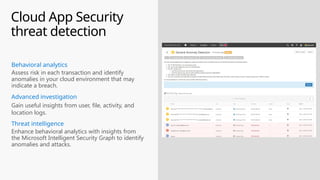
Cloud App Security
threat detection
Gain useful insights from user, file, activity, and
location logs.
Advanced investigation
Assess risk in each transaction and identify
anomalies in your cloud environment that may
indicate a breach.
Behavioral analytics
Enhance behavioral analytics with insights from
the Microsoft Intelligent Security Graph to identify
anomalies and attacks.
Threat intelligence
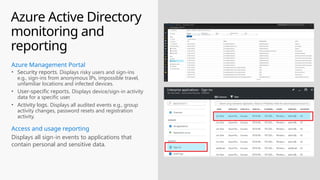
Azure Active Directory
monitoring and
reporting
Displays all sign-in events to applications that
contain personal and sensitive data.
Access and usage reporting
• Security reports. Displays risky users and sign-ins
e.g., sign-ins from anonymous IPs, impossible travel,
unfamiliar locations and infected devices.
• User-specific reports. Displays device/sign-in activity
data for a specific user.
• Activity logs. Displays all audited events e.g., group
activity changes, password resets and registration
activity.

Azure Management Portal
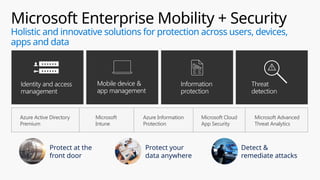
Mobile device &
app management
Information
protection
Microsoft Enterprise Mobility + Security
Holistic and innovative solutions for protection across users, devices,
apps and data
Protect at the
front door
Detect &
remediate attacks
Protect your
data anywhere
Azure Active Directory
Premium
Microsoft
Intune
Azure Information
Protection
Microsoft Cloud
App Security
Microsoft Advanced
Threat Analytics
Identity and access
management
Threat
detection
Next steps
Read our EMS for GDPR
whitepaper to learn more
Get a free 90-day trial, evaluate
Enterprise Mobility + Security
Deploy with FastTrack for
Enterprise Mobility + Security
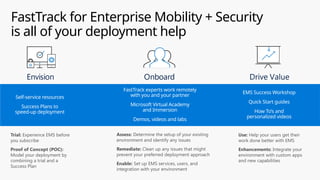
FastTrack experts work remotely
with you and your partner
Microsoft Virtual Academy
and Immersion
Demos, videos and labs
Self-service resources
Success Plans to
speed-up deployment
EMS Success Workshop
Quick Start guides
How To’s and
personalized videos
Trial: Experience EMS before
you subscribe
Proof of Concept (POC):
Model your deployment by
combining a trial and a
Success Plan
Assess: Determine the setup of your existing
environment and identify any issues
Remediate: Clean up any issues that might
prevent your preferred deployment approach
Enable: Set up EMS services, users, and
integration with your environment
Use: Help your users get their
work done better with EMS
Enhancements: Integrate your
environment with custom apps
and new capabilities
FastTrack for Enterprise Mobility + Security
is all of your deployment help
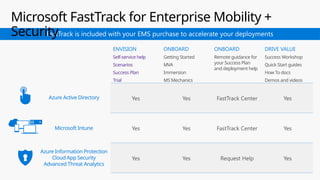
FastTrack is included with your EMS purchase to accelerate your deployments
Azure Information Protection
Cloud App Security
Advanced Threat Analytics
Azure Active Directory
Microsoft Intune
ENVISION
Self-service help
Scenarios
Success Plan
Trial
ONBOARD
Getting Started
MVA
Immersion
MS Mechanics
ONBOARD
Remote guidance for
your Success Plan
and deployment help
DRIVE VALUE
Success Workshop
Quick Start guides
How To docs
Demos and videos
Yes Yes FastTrack Center Yes
Yes Yes Request Help Yes
Microsoft FastTrack for Enterprise Mobility +
Security
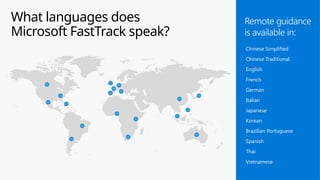
What languages does
Microsoft FastTrack speak?
Chinese Simplified
Chinese Traditional
English
French
German
Italian
Japanese
Korean
Brazilian Portuguese
Spanish
Thai
Vietnamese
Remote guidance
is available in:
Microsoft Enterprise Mobility + Security
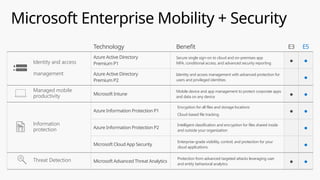
Technology Benefit E3 E5
Azure Active Directory
Premium P1
Secure single sign-on to cloud and on-premises app
MFA, conditional access, and advanced security reporting ● ●
Azure Active Directory
Premium P2
Identity and access management with advanced protection for
users and privileged identities ●
Microsoft Intune
Mobile device and app management to protect corporate apps
and data on any device ● ●
Azure Information Protection P1
Encryption for all files and storage locations
Cloud-based file tracking
● ●
Azure Information Protection P2
Intelligent classification and encryption for files shared inside
and outside your organization ●
Microsoft Cloud App Security
Enterprise-grade visibility, control, and protection for your
cloud applications ●
Microsoft Advanced Threat Analytics
Protection from advanced targeted attacks leveraging user
and entity behavioral analytics ● ●
Identity and access
management
Managed mobile
productivity
Information
protection
Threat Detection
Resources
Microsoft.com/GDPR
Microsoft Online
Services and GDPR
• Microsoft Azure
• Office and Office 365
• Microsoft Dynamics 365
• Enterprise Mobility Suite
• Windows and Windows Server
• SQL Server
© 2017 Microsoft Corporation. All rights reserved.
Appendix
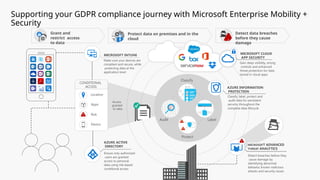
Supporting your GDPR compliance journey with Microsoft Enterprise Mobility +
Security
Grant and
restrict access
to data
Protect data on premises and in the
cloud
Detect data breaches
before they cause
damage
!
Apps
Risk
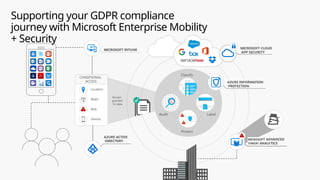
MICROSOFT INTUNE
Make sure your devices are
compliant and secure, while
protecting data at the
application level
AZURE ACTIVE
DIRECTORY
Ensure only authorized
users are granted
access to personal
data using risk-based
conditional access
MICROSOFT CLOUD
APP SECURITY
Gain deep visibility, strong
controls and enhanced
threat protection for data
stored in cloud apps
AZURE INFORMATION
PROTECTION
Classify, label, protect and
audit data for persistent
security throughout the
complete data lifecycle
MICROSOFT ADVANCED
THREAT ANALYTICS
Detect breaches before they
cause damage by
identifying abnormal
behavior, known malicious
attacks and security issues
!
Device
!
Access
granted
to data
CONDITIONAL
ACCESS
Location
Classify
Label
Audit
Protect
!
!
Corporate
Public
Private
cloud
Vendors SaaS
Ex-employees
Online
backup
Graphic
designer
Offshore
teams
Legal review
Agency
teams
Project
Lead
Sales teams
Project
Manager
Project
Lead
Remote
team
Personal
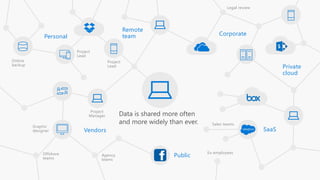
Data is shared more often
and more widely than ever.

EMS GDPR Generic_Overview Deck_June 2017.pptx

  • 1.
    This presentation isintended to provide an overview of GDPR how EMS technologies can support you and is not a definitive statement of the law. Supporting your journey to EU GDPR compliance with Microsoft Enterprise Mobility + Security
  • 2.
    The General DataProtection Regulation (GDPR) imposes new rules on organizations in the European Union (EU) and those that offer goods and services to people in the EU, or that collect and analyze data tied to EU residents, no matter where they are located. EU General Data Protection Regulation Enhanced personal privacy rights Increased duty to protect data Mandatory breach reporting Significant penalties for non-compliance
  • 3.
    When must webe compliant? What if we are not compliant? Who needs to be compliant? Organizations inside or outside of the EU that process personal data of EU residents. Companies can be fined up to €20m or 4% of annual global turnover, whichever is greater, for failure to meet GDPR requirements. The European Parliament approved and adopted the GDPR in April 2016 and enforcement begins on May 25, 2018.
  • 4.
    2012 May 252018 Spring 2014 April 27 2016 2016/2017 2015 EU Council reaches agreement Separate negotiations within Council and European parliament European Commission publishes legislative proposal EP reaches agreement Negotiations and approval among the three institutions Regulation published in the Official Journal Two-year implementation phase EU general data protection regulation START European Commission European Parliament EC EP EU Regulation applies going forward
  • 5.
    What are thekey changes to address the GDPR? Personal privacy Controls and notifications Transparent policies IT and training Organizations will need to: • Train privacy personnel & employees • Audit and update data policies • Employ a Data Protection Officer (if required) • Create & manage compliant vendor contracts Organizations will need to: • Protect personal data using appropriate security • Notify authorities of personal data breaches • Obtain appropriate consents for processing data • Keep records detailing data processing Individuals have the right to: • Access their personal data • Correct errors in their personal data • Erase their personal data • Object to processing of their personal data • Export personal data Organizations must: • Provide clear notice of data collection • Outline processing purposes and use cases • Define data retention and deletion policies
  • 6.
    Improved data policiesand processes to support data subject rights and ensure lawful processing Stricter control on where personal data is stored and how it is used Better data governance tools for better transparency, recordkeeping and reporting What does this mean for data privacy?
  • 7.
    of US organizationsconsider GDPR compliance their top data protection priority1 92% “By the end of 2018, more than 50 percent of companies affected by the GDPR will not be in full compliance with its requirements.” Organizations Are Unprepared for the 2018 European Data Protection Regulation, Gartner Newsroom; May 3, 2017 http://www.gartner.com/newsroom plan to spend $1M USD or more on GDPR compliance1 77% of EU organizations indicate they have documented the sensitive data they house2 50% 1. http://www.pwc.com/us/en/increasing-it-effectiveness/publications/gdpr-readiness.html 2. https://securityintelligence.com/prepared-for-the-general-data-protection-regulation-gdpr-top-10-findings-from-hurwitz-associates-survey/ Gartne r
  • 8.
    Preparing for theGDPR Leverage guidance from experts Use our partner network to help you meet your privacy, security, and compliance goals Simplify your privacy journey Elevate your privacy practices with our cloud Uncover risk & take action Use our solutions to expose areas of risk and respond with agility and confidence
  • 9.
    “Businesses and usersare going to embrace technology only if they can trust it.” Satya Nadella Chief Executive Officer Microsoft Corporation Microsoft is the industry leader in privacy and security with extensive expertise complying with complex regulations. We take a principled approach with strong commitments to privacy, security, compliance and transparency. Moving to the cloud makes it easier for you to become compliant with privacy regulations by managing and protecting personal data in a centralized location.
  • 10.
    Microsoft is theindustry leader in privacy and security with extensive expertise complying with complex regulations. We take a principled approach with strong commitments to privacy, security, compliance and transparency. Moving to the cloud makes it easier for you to become compliant with privacy regulations by managing and protecting personal data in a centralized location. To simplify your path to compliance, Microsoft will be GDPR-compliant across our cloud services when enforcement begins on May 25, 2018. We will share our experience in complying with complex regulations such as the GDPR. Together with our partners, we are prepared to help you meet your policy, people, process, and technology goals on your journey to GDPR. Our commitment to you…
  • 11.
    How do Iget started? Discover Identify what personal data you have and where it resides. Manage Govern how personal data is used and accessed. Protect Establish security controls to prevent, detect, and respond to vulnerabilities & data breaches. Report Keep required documentation, manage data requests and breach notifications.
  • 12.
    Discover In-scope Any datathat helps you identify a person Name Email address Social media posts Physical, physiological, or genetic information Medical information Location Bank details IP address Cookies Cultural identity Inventory Any container where personal data is collected and stored Emails Documents Databases Removable media Metadata Log files Backups Identify what personal data you have and where it resides
  • 13.
    Manage Govern how personaldata is used and accessed Data governance Defining policies, roles and responsibilities for the management and use of personal data At rest In process In transit Storing Recovery Archiving Retaining Disposal Data classification Organizing and labeling data to ensure proper handling Types Sensitivity Context / use Ownership Custodians Administrators Users
  • 14.
    Protect Establish controls to prevent,detect, and respond to vulnerabilities and breaches Preventing data attacks Protecting your data Physical datacenter protection Network security Storage security Compute security Identity management Access control Encryption Risk mitigation Detecting & responding to breaches Monitoring for and detecting system intrusions System monitoring Breach identification Calculating impact Planned response Disaster recovery Notifying DPA & customers
  • 15.
    Report Keep detailed records abouthow personal data is handled Record-keeping Enterprises will need to record the: Purposes of processing Classifications of personal data Third-parties with access to the data Organizational and technical security measures Data retention times Reporting tools Implement reporting capabilities Cloud services (processor) documentation Audit logs Breach notifications Handling Data Subject Requests Governance reporting Compliance reviews
  • 16.
    Supporting your GDPR compliance journeywith Microsoft Enterprise Mobility + Security
  • 17.
    Microsoft Enterprise Mobility+ Security can help you on your GDPR journey Holistic Helps you address security challenges across users (identities), devices, data, apps, and platforms―on- premises and in the cloud. Identity-driven Offers one protected common identity for secure access to all corporate resources, on-premises and in the cloud, with risk-based conditional access Persistent Provides persistent data protection on-premises and in the cloud with innovative and sophisticated technologies Intelligent Enhances threat and anomaly detection with the Microsoft Intelligent Security Graph driven by a vast amount of datasets and machine learning in the cloud
  • 18.
    Access granted to data Supporting yourGDPR compliance journey with Microsoft Enterprise Mobility + Security Apps Risk MICROSOFT INTUNE AZURE ACTIVE DIRECTORY MICROSOFT CLOUD APP SECURITY AZURE INFORMATION PROTECTION MICROSOFT ADVANCED THREAT ANALYTICS ! Device ! CONDITIONAL ACCESS Location Classify Audit Protect Label ! !
  • 19.
    Corporate Public Private cloud Vendors SaaS Ex-employees Online backup Graphic designer Offshore teams Legal review Agency teams Project Lead Salesteams Project Manager Project Lead Remote team Personal Data is shared more often and more widely than ever.
  • 20.
    Key scenarios EMShelps you address How to provide persistent data protection on-premises and in the cloud How to grant and restrict access to data How to protect data in mobile devices and applications How to gain visibility and control of data in cloud apps How to detect data breaches before they cause damage
  • 21.
    How to provide persistentdata protection on- premises and in the cloud Online backup Email Out of your control Mobile devices, SaaS apps SaaS apps Cloud storage Mobile devices On-premises
  • 22.
    Personal data Any informationrelated to an identified or identifiable natural person including direct and indirect identification. Examples include: • Name • Identification number (e.g., SSN) • Location data (e.g., home address) • Online identifier (e.g., e-mail address, screen names, IP addresses, device IDs) Sensitive personal data Personal data afforded enhanced protections: • Genetic data (e.g., an individual’s gene sequence) • Biometric Data (e.g., fingerprints, facial recognition, retinal scans) • Sub categories of personal data including: • Racial or ethnic origin • Political opinions, religious or philosophical beliefs • Trade union membership • Data concerning health • Data concerning a person’s sex life or sexual orientation How the EU GDPR defines personal data
  • 23.
    Protect data on-premisesand in the cloud with Azure Information Protection Classification and labeling Classify data based on sensitivity and add labels— manually or automatically. Protection Encrypt your sensitive data and define usage rights or add visual markings when needed. Monitoring Use detailed tracking and reporting to see what’s happening with your shared data and maintain control over it.
  • 24.
    Classification and labeling PERSONAL HIGHLY CONFIDENTIAL CONFIDENTIAL GENERAL PUBLIC Youcan override a classification and optionally be required to provide a justification. Manual reclassification Policies can be set by IT Admins for automatically applying classification and protection to data. Automatic classification Based on the content you’re working on, you can be prompted with suggested classification. Recommended classification Users can choose to apply a sensitivity label to the email or file they are working on with a single click. User-specified classification
  • 25.
    Classification and labeling Discoverpersonal data and apply persistent labels Labels are persistent and readable by other systems e.g. DLP engine Labels are metadata written to data Sensitive data is automatically detected
  • 26.
    Protection Discover personal datawith auto-classification Data is auto-classified based on content Sensitive data is automatically detected
  • 27.
    Protection IT Admins canset policies to automatically control, protect, and watermark data. Protection policies Azure Information Protection encrypts files containing personal data according to policies. File encryption
  • 28.
    Protection Safely share datawith people inside and outside of your organization. Define explicit permissions for recipients, e.g., allow people to view and edit, but not print or forward. Secure sharing
  • 29.
    Monitor distribution Elevate yourprivacy practices with our cloud Track and control data anywhere Log access Bob accessed from S. America Jane accessed from India Joe blocked in N. America Jane blocked in Africa 11 2 8 8 8 8 2 1 1 Jane Competitors Revoke access Jane’s access is revoked Bob Jane Sue
  • 30.
    Monitoring Analyze the flowof personal and sensitive data and detect risky behaviors. Distribution visibility Track who is accessing documents and from where. Access logging Prevent data leakage or misuse by changing or revoking document access remotely. Access revocation
  • 31.
    How to grantand restrict access to data
  • 32.
    Bing Xbox Live OneDrive Microsoft Digital CrimesUnit Microsoft Cyber Defense Operations Center Azure Microsoft Accounts Skype Enterprise Mobility + Security Azure Active Directory Microsoft’s collective intelligence
  • 33.
    IF Privileged user? Credentials foundin public? Accessing sensitive app? Unmanaged device? Malware detected? IP detected in Botnet? Impossible travel? Anonymous client? High Medium Low User risk 10 TB per day THEN Require MFA Allow access Deny access Force password reset ****** Limit access High Medium Low Session risk Azure Bing OneDrive Microsoft Cyber Defense Operations Center Microsoft Cybercrime Center Xbox Live Microsoft Accounts Skype Risk-based conditional access
  • 34.
    Privileged identity management Enforceon-demand, just-in-time administrative access when needed Use Alert, Audit Reports and Access Review Domain User Global Administrator Discover, restrict, and monitor privileged identities Domain User Administrator privileges expire after a specified interval
  • 35.
    How to protectdata in mobile devices and mobile apps
  • 36.
    Secure devices withMicrosoft Intune mobile device management capabilities Managed apps Personal apps Advanced device management Enforce device security policies such as encryption, password/PIN requirements, jailbreak/root detection and more. Remote actions Enforce device security policies such as encryption, password/PIN requirements, jailbreak/root detection and more. Device security configuration Restrict access to specific applications or URL addresses on mobile devices and PCs. Restrict apps and URLs
  • 37.
    Protect data atthe app level with Microsoft Intune mobile app protection policies Managed apps Personal apps Personal apps MDM (3rd party or Intune) optional App-level protection available with or without enrollment. Managed apps Restrict features, sharing and downloads Corporate data Personal data Multi-identity policy Multi-identity allows you to separate company data from personal data within an app. Data separation Control what happens to docs and data after they’ve been accessed with app protection policies. • App encryption at rest • App access control—PIN or credentials • Save as/copy/paste restrictions • App-level selective wipe • Apply policies for Windows 10 Information Protection for even greater control Data control
  • 38.
    How to gainvisibility and control of data in cloud apps
  • 39.
    Gain deep visibilityand granular controls into cloud app usage with Microsoft Cloud App Security Cloud discovery Discover cloud apps used in your organization, get a risk assessment and alerts on risky usage. Data visibility Gain deep visibility into where data travels by investigating all activities, files and accounts for managed apps. Data control Monitor and protect personal and sensitive data stored in cloud apps using granular policies.
  • 40.
    Cloud discovery Get anomaloususage alerts, new app and trending apps alerts. On-going analytics Discover 13K+ cloud apps in use across your networks and sensitive data they store. Discovery of cloud apps and data Assess risk cloud apps based on ~60 security and compliance risk factors. Cloud app risk assessment Protect your employees’ privacy while discovering cloud apps in your environment. Log anonymization
  • 41.
    Data visibility Compare classificationlabels against how that data is being shared to identify risk. Cloud data visibility Investigate on users, file, activities, locations and managed apps, quantify exposure and risk. Advanced incident investigation tools
  • 42.
    Data control Set granularpolicies to control data in the cloud—either automated or based on file label —using out-of-the-box policies or you can customize your own. Granular Data loss prevention (DLP) policies Detect and manage 3rd party app access. Revoke access for 3rd party apps Identify policy violations, enforce actions such as quarantine and permissions removal. Policy enforcement
  • 43.
    Cloud App Securityreads labels set by AIP to give admins visibility into sharing of sensitive files. Increased visibility Admins can set policies for controlling sharing of sensitive files and also get alerted if the policies are violated. Improved control Cloud App Security and Azure Information Protection integration
  • 44.
    How to detectdata breaches before they cause damage
  • 45.
    On-premises abnormal behavior andadvanced threat detection Advanced Threat Analytics Identity-based attack and threat detection Azure Active Directory Behavioral analytics helps detect & prevent data breaches Anomaly detection for cloud apps Cloud App Security ! ! !
  • 46.
    Behavioral analytics forthreat protection Analyze Learn Detect Analyze the traffic and identity traffic and data related activities across the network including relevant events from SIEM and in real-time. Uses the organizational security graph to detect abnormal behavior, file activity, protocol attacks, and weak security configurations. Automatically learn the common behaviors for users and entities on the network to build an organizational security graph. Alert Intelligently use the learned context to prevent false positives and prioritize alerts, remediate problems automatically, and present attack timelines.
  • 47.
    Monitors behaviors ofusers and other entities by using multiple data-sources Profiles behavior and detects anomalies by using machine learning algorithms Evaluates the activity of users and other entities to detect advanced attacks Credit card companies monitor cardholders’ behavior. By observing purchases, behavioral analytics learn what behavior is typical for each buyer. If there is any abnormal activity, they will notify the cardholder to verify charge. User and entity behavioral analytics $ $ $ $ 3 hours
  • 48.
    Microsoft Advanced ThreatAnalytics Microsoft Advanced Threat Analytics brings the behavioral analytics concept to IT and the organization’s users. Behavior al Analytics Detection of advanced attacks and security risks Advanced Threat Detection An on-premises platform to identify advanced security attacks and insider threats before they cause damage
  • 49.
    Advanced Threat Analytics ATA buildsthe organizational security graph, detects abnormal behavior, protocol attacks, and weaknesses. 3. Detect ATA observes and learns all entities’ behaviors automatically. 2. Learn ATA uses context to prevent false positives and presents alerts as an attack timeline. 4. Alert ATA analyzes all Active Directory-related traffic and collects relevant events from SIEM. 1. Analyze
  • 50.
    Advanced Threat Analytics Deep packetinspection and threat intelligence helps identify advanced attacks such as Pass-the- Hash, Skeleton Key Malware, and Honey token. Advanced attacks in near real-time ATA uses machine learning algorithms to detect anomalous logins, abnormal behavior and resource access, and unusual working hours. Abnormal behavior ATA identifies known security issues and risks such as expose passwords in cleartext over the network, broken trust, weak protocols and protocol vulnerabilities. Known security issues and risks
  • 51.
    Cloud App Security threatdetection Gain useful insights from user, file, activity, and location logs. Advanced investigation Assess risk in each transaction and identify anomalies in your cloud environment that may indicate a breach. Behavioral analytics Enhance behavioral analytics with insights from the Microsoft Intelligent Security Graph to identify anomalies and attacks. Threat intelligence
  • 52.
    Azure Active Directory monitoringand reporting Displays all sign-in events to applications that contain personal and sensitive data. Access and usage reporting • Security reports. Displays risky users and sign-ins e.g., sign-ins from anonymous IPs, impossible travel, unfamiliar locations and infected devices. • User-specific reports. Displays device/sign-in activity data for a specific user. • Activity logs. Displays all audited events e.g., group activity changes, password resets and registration activity. Azure Management Portal
  • 53.
    Mobile device & appmanagement Information protection Microsoft Enterprise Mobility + Security Holistic and innovative solutions for protection across users, devices, apps and data Protect at the front door Detect & remediate attacks Protect your data anywhere Azure Active Directory Premium Microsoft Intune Azure Information Protection Microsoft Cloud App Security Microsoft Advanced Threat Analytics Identity and access management Threat detection
  • 54.
    Next steps Read ourEMS for GDPR whitepaper to learn more Get a free 90-day trial, evaluate Enterprise Mobility + Security Deploy with FastTrack for Enterprise Mobility + Security
  • 55.
    FastTrack experts workremotely with you and your partner Microsoft Virtual Academy and Immersion Demos, videos and labs Self-service resources Success Plans to speed-up deployment EMS Success Workshop Quick Start guides How To’s and personalized videos Trial: Experience EMS before you subscribe Proof of Concept (POC): Model your deployment by combining a trial and a Success Plan Assess: Determine the setup of your existing environment and identify any issues Remediate: Clean up any issues that might prevent your preferred deployment approach Enable: Set up EMS services, users, and integration with your environment Use: Help your users get their work done better with EMS Enhancements: Integrate your environment with custom apps and new capabilities FastTrack for Enterprise Mobility + Security is all of your deployment help
  • 56.
    FastTrack is includedwith your EMS purchase to accelerate your deployments Azure Information Protection Cloud App Security Advanced Threat Analytics Azure Active Directory Microsoft Intune ENVISION Self-service help Scenarios Success Plan Trial ONBOARD Getting Started MVA Immersion MS Mechanics ONBOARD Remote guidance for your Success Plan and deployment help DRIVE VALUE Success Workshop Quick Start guides How To docs Demos and videos Yes Yes FastTrack Center Yes Yes Yes FastTrack Center Yes Yes Yes Request Help Yes Microsoft FastTrack for Enterprise Mobility + Security
  • 57.
    What languages does MicrosoftFastTrack speak? Chinese Simplified Chinese Traditional English French German Italian Japanese Korean Brazilian Portuguese Spanish Thai Vietnamese Remote guidance is available in:
  • 58.
    Microsoft Enterprise Mobility+ Security Technology Benefit E3 E5 Azure Active Directory Premium P1 Secure single sign-on to cloud and on-premises app MFA, conditional access, and advanced security reporting ● ● Azure Active Directory Premium P2 Identity and access management with advanced protection for users and privileged identities ● Microsoft Intune Mobile device and app management to protect corporate apps and data on any device ● ● Azure Information Protection P1 Encryption for all files and storage locations Cloud-based file tracking ● ● Azure Information Protection P2 Intelligent classification and encryption for files shared inside and outside your organization ● Microsoft Cloud App Security Enterprise-grade visibility, control, and protection for your cloud applications ● Microsoft Advanced Threat Analytics Protection from advanced targeted attacks leveraging user and entity behavioral analytics ● ● Identity and access management Managed mobile productivity Information protection Threat Detection
  • 59.
    Resources Microsoft.com/GDPR Microsoft Online Services andGDPR • Microsoft Azure • Office and Office 365 • Microsoft Dynamics 365 • Enterprise Mobility Suite • Windows and Windows Server • SQL Server
  • 60.
    © 2017 MicrosoftCorporation. All rights reserved.
  • 61.
  • 62.
    Supporting your GDPRcompliance journey with Microsoft Enterprise Mobility + Security Grant and restrict access to data Protect data on premises and in the cloud Detect data breaches before they cause damage ! Apps Risk MICROSOFT INTUNE Make sure your devices are compliant and secure, while protecting data at the application level AZURE ACTIVE DIRECTORY Ensure only authorized users are granted access to personal data using risk-based conditional access MICROSOFT CLOUD APP SECURITY Gain deep visibility, strong controls and enhanced threat protection for data stored in cloud apps AZURE INFORMATION PROTECTION Classify, label, protect and audit data for persistent security throughout the complete data lifecycle MICROSOFT ADVANCED THREAT ANALYTICS Detect breaches before they cause damage by identifying abnormal behavior, known malicious attacks and security issues ! Device ! Access granted to data CONDITIONAL ACCESS Location Classify Label Audit Protect ! !
  • 63.
    Corporate Public Private cloud Vendors SaaS Ex-employees Online backup Graphic designer Offshore teams Legal review Agency teams Project Lead Salesteams Project Manager Project Lead Remote team Personal Data is shared more often and more widely than ever.