INFORMATION
AND
COMMUNICATION
TECHNOLOGY
10
refers to the ideas or concepts obtained
from reading, investigation, study or
research which are transmitted through
media such as telephone, television and
radio. Information is necessary to make
decisions and to predict the future.
10
is a means of transmitting
messages or sending and
receiving information between
individuals using symbols, signs or
verbal interactions. Before, people
transmit messages through signs
or symbols and performing drama
and poetry.
10
the use of scientific knowledge,
experience and resources to
create processes and products
that fulfill human needs.
10
eals with the use of different
communication tools such as
telephone , mobile phones,
Internet, etc. to locate, save,
send, and edit information. For
instance when we make a video
call, we use the internet.
10
Philippines is considered as the
ICT Hub of Asia because of the
tremendous growth of ICT related
jobs like Business Process
Outsourcing, or call centers. It
started with Accenture in 1992
with Frank Holz who was
responsible for developing and
marketing the first Global
Resource Center in Manila.
10
The World Wide Web, commonly
referred to as WWW, W3, or web
is an interconnected system of
public web pages accessible
through the internet, invented by
Tim Berners-Lee in 1989.
10
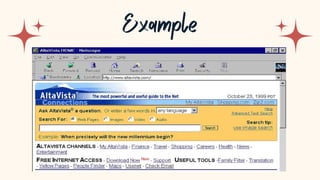
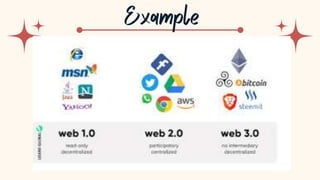
Web 1.0 refers to the first
generation of the Internet when
most websites were read-only or
static. Webpages are usually just
single files in Hypertext Markup
Language (html or htm) format
that are displayed in a web
browser when the URL is entered.
Users are merely audiences or
readers who absorb information
from websites.
10
10
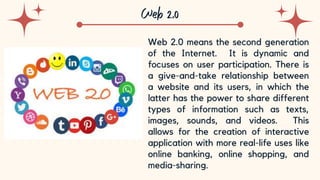
Web 2.0 means the second generation
of the Internet. It is dynamic and
focuses on user participation. There is
a give-and-take relationship between
a website and its users, in which the
latter has the power to share different
types of information such as texts,
images, sounds, and videos. This
allows for the creation of interactive
application with more real-life uses like
online banking, online shopping, and
media-sharing.
10
1. Folksonomy- It enables users to find information in an organized way,
like tagging photos, websites, or links.
2. Rich user experience - It has a dynamic and interactive content. For
instance a user can click on an image of a flower to get more
information about that flower like its growth conditions, nutrient
requirements, and more.
3. User participation - It helps with the flow of information between the
user and the owner of a certain website.
10
4. Mass participation - Allows universal web access from a traditional
internet user to a wider variety of users of various cultures that leads to
differentiation of concerns.
5. Long Tail - Services that are offered on demand rather than on a
one-time purchase. This means user can either subscribe to a data plan
that charges users for
6. Software as a Service (Saas)
Allows the user to subscribe to a software rather than purchasing them
subscribing and using Google Docs, a free web-based application, to
create or edit word documents online.
10
The third version of the internet which is an upgrade of Web 2.0. It’s
main characteristics include but are not limited to:
1. Real-time
Events and information are made available to users as they take place.
2. Everywhere
Internet can be accessed by users in all places.
3. Machine learning
Computers and mobile devices can create data and make decisions
based on the user’s previous actions.
10
10
1. Technological Convergence is an evolution of technological
developments that integrate different types of applications and
media to form a new system.
2. Social Media is a collection of internet-based communication tools
and computer-assisted channels dedicated to allow users to
collaborate, communicate, and share information or content in a
virtual community and network.
10
1. There are six types of social media:
a. Social Networks - enables people to connect with other people with
the same interests or background,
b. Bookmarking Sites - allow user to store, manage links or create a
tag to various websites and resources that allows you and others
to easily search or share them.
c. Social News - sites that allow users to post their own news articles
or links to other news sources and comment to the post or vote on the
news articles of the website.
10
1. There are six types of social media:
d. Media Sharing - sites that allow users to upload and share media
content like music, images and video.
e. Microblogging - sites that focus on short updates from the user
wherein subscribers of this user will be able to receive these updates.
f. Blogs and Forums - websites that allow users to post their content
where users are able to comment to the said topic.
10
3. Mobile Technologies refer to devices ranging from basic mobile
phones to tablet PCs, PDAs, MP3 players, memory sticks, e-
readers, and smartphones.
Mobile devices use different operating systems:
a. iOS - used in Apple devices like iPhone or iPad
b. Android - open source operating system developed by Google.
c. Blackberry OS- used in Blackberry devices
e. Symbian – an original smartphone OS used by Nokia devices.
f. WebOS - used for smartphones but now used for smart TVs
g. Windows Mobile - developed by Microsoft for smartphones and
pocket PCs.
10
4. Assistive Media
A technology that includes assistive, adaptive, and rehabilitative
devices for people with disabilities and also includes the process used
in selecting, locating, and using them.
10
• Mobility impairments
Wheelchairs, transfer devices, walkers, prosthesis
• Visual impairments
Screen readers, braille and braille embossers, desktop
video magnifier, screen magnification software, large-print
and tactile keyboards
• Hearing impairments
Hearing aids, assistive listening devices, amplified
telephone equipment
Activity: 1 whole ( 20 points).
Create a table and list down ten
static websites and ten dynamic
websites. Indicate the URL of each
website.

Empowerment technology communication technology

  • 1.
  • 2.
    10 refers to theideas or concepts obtained from reading, investigation, study or research which are transmitted through media such as telephone, television and radio. Information is necessary to make decisions and to predict the future.
  • 3.
    10 is a meansof transmitting messages or sending and receiving information between individuals using symbols, signs or verbal interactions. Before, people transmit messages through signs or symbols and performing drama and poetry.
  • 4.
    10 the use ofscientific knowledge, experience and resources to create processes and products that fulfill human needs.
  • 5.
    10 eals with theuse of different communication tools such as telephone , mobile phones, Internet, etc. to locate, save, send, and edit information. For instance when we make a video call, we use the internet.
  • 6.
    10 Philippines is consideredas the ICT Hub of Asia because of the tremendous growth of ICT related jobs like Business Process Outsourcing, or call centers. It started with Accenture in 1992 with Frank Holz who was responsible for developing and marketing the first Global Resource Center in Manila.
  • 7.
    10 The World WideWeb, commonly referred to as WWW, W3, or web is an interconnected system of public web pages accessible through the internet, invented by Tim Berners-Lee in 1989.
  • 8.
    10 Web 1.0 refersto the first generation of the Internet when most websites were read-only or static. Webpages are usually just single files in Hypertext Markup Language (html or htm) format that are displayed in a web browser when the URL is entered. Users are merely audiences or readers who absorb information from websites.
  • 9.
  • 10.
    10 Web 2.0 meansthe second generation of the Internet. It is dynamic and focuses on user participation. There is a give-and-take relationship between a website and its users, in which the latter has the power to share different types of information such as texts, images, sounds, and videos. This allows for the creation of interactive application with more real-life uses like online banking, online shopping, and media-sharing.
  • 11.
    10 1. Folksonomy- Itenables users to find information in an organized way, like tagging photos, websites, or links. 2. Rich user experience - It has a dynamic and interactive content. For instance a user can click on an image of a flower to get more information about that flower like its growth conditions, nutrient requirements, and more. 3. User participation - It helps with the flow of information between the user and the owner of a certain website.
  • 12.
    10 4. Mass participation- Allows universal web access from a traditional internet user to a wider variety of users of various cultures that leads to differentiation of concerns. 5. Long Tail - Services that are offered on demand rather than on a one-time purchase. This means user can either subscribe to a data plan that charges users for 6. Software as a Service (Saas) Allows the user to subscribe to a software rather than purchasing them subscribing and using Google Docs, a free web-based application, to create or edit word documents online.
  • 13.
    10 The third versionof the internet which is an upgrade of Web 2.0. It’s main characteristics include but are not limited to: 1. Real-time Events and information are made available to users as they take place. 2. Everywhere Internet can be accessed by users in all places. 3. Machine learning Computers and mobile devices can create data and make decisions based on the user’s previous actions.
  • 14.
  • 15.
    10 1. Technological Convergenceis an evolution of technological developments that integrate different types of applications and media to form a new system. 2. Social Media is a collection of internet-based communication tools and computer-assisted channels dedicated to allow users to collaborate, communicate, and share information or content in a virtual community and network.
  • 16.
    10 1. There aresix types of social media: a. Social Networks - enables people to connect with other people with the same interests or background, b. Bookmarking Sites - allow user to store, manage links or create a tag to various websites and resources that allows you and others to easily search or share them. c. Social News - sites that allow users to post their own news articles or links to other news sources and comment to the post or vote on the news articles of the website.
  • 17.
    10 1. There aresix types of social media: d. Media Sharing - sites that allow users to upload and share media content like music, images and video. e. Microblogging - sites that focus on short updates from the user wherein subscribers of this user will be able to receive these updates. f. Blogs and Forums - websites that allow users to post their content where users are able to comment to the said topic.
  • 18.
    10 3. Mobile Technologiesrefer to devices ranging from basic mobile phones to tablet PCs, PDAs, MP3 players, memory sticks, e- readers, and smartphones. Mobile devices use different operating systems: a. iOS - used in Apple devices like iPhone or iPad b. Android - open source operating system developed by Google. c. Blackberry OS- used in Blackberry devices e. Symbian – an original smartphone OS used by Nokia devices. f. WebOS - used for smartphones but now used for smart TVs g. Windows Mobile - developed by Microsoft for smartphones and pocket PCs.
  • 19.
    10 4. Assistive Media Atechnology that includes assistive, adaptive, and rehabilitative devices for people with disabilities and also includes the process used in selecting, locating, and using them.
  • 20.
    10 • Mobility impairments Wheelchairs,transfer devices, walkers, prosthesis • Visual impairments Screen readers, braille and braille embossers, desktop video magnifier, screen magnification software, large-print and tactile keyboards • Hearing impairments Hearing aids, assistive listening devices, amplified telephone equipment
  • 22.
    Activity: 1 whole( 20 points). Create a table and list down ten static websites and ten dynamic websites. Indicate the URL of each website.

Editor's Notes

  • #2 Do you have a social media account? What is it? How many times have you posted in Facebook today? Did you use the internet yesterday? How many hours? Do you follow a celebrity or read news in social media? If you answered yes in most of these questions, then you are a digital native. You are born or brought up during the age of technology and exposed or surrounded by ICT. The term digital native describes a person who has grown up in the information age.
  • #3 For example, scientists can detect the formation of a typhoon using the latest technology and warn the public to avoid disasters in the affected areas.
  • #4 However, these ‘older’ forms of communication are less utilized due to the advent of technology like the use of the Internet, e-mail or video conferencing.
  • #9 there was limited interactivity on the web pages What word best describes Web 1.0 websites and web pages? Web 1.0 are known as Static Webpages. These times on the internet starts on late 80s to early 90s wherein, internet is new to the world. When we say static webpages, websites and pages are presented to the user in their simplest form. Lack of Social Media: Wala pang malawakang paggamit ng social media noong panahon ng Web 1.0. Ang interaksyon sa pagitan ng mga tao sa online ay limitado.
  • #12 Some social networking sites use tags that start with a pound sign (#) which is termed as hashtag. Ang Web 2.0 ay nagbigay daan sa pag-unlad ng mga teknolohiya at konsepto na nagdulot ng mas malawakang interaktividad, personalisasyon, at dynamic content kaysa sa naunang yugto ng World Wide Web. For instance, a user can interact by liking, commenting, or sending reviews to a certain post or site.
  • #13 4. Pwde na sa instag, youtube . Kahit saan 5. may kinalaman sa pang-ekonomiyang aspeto ng online na negosyo. the amount of time spent in the Internet or a data plan that charges for the amount only of bandwidth used. 6. Mga Microsoft words. Windows , can
  • #14 AI app latest technology , robots, machine
  • #16 1. For example, a system can be used for calling and texting, browsing the internet or creating a word document using the smartphone. Latest gadgets watch
  • #17 a. (e.g. ,Facebook and Twitter). b. (e.g. ,StumbleUpon and Pinterest). c. (e.g. ,Reddit, Digg)
  • #18 d. (e.g. ,Flicker, Youtube and Instagram) e. (e.g. ,Twitter and Plurk) f. Some of the free blogging platforms are Blogger, Wordpress, and Tumblr.
  • #19 3. It is a combination of hardware, operating systems, networking, and software, including content, learning platforms, and applications..
  • #20 It enables people to perform tasks that they can’t accomplish or great difficulty of accomplishing it by changing methods of interacting with the technology needed to accomplish such tasks.