Emerging Technologies inEngineering Mahesh P.
K. pdf download
https://ebookmass.com/product/emerging-technologies-in-
engineering-mahesh-p-k/
Explore and download more ebooks at ebookmass.com
2.
We have selectedsome products that you may be interested in
Click the link to download now or visit ebookmass.com
for more options!.
Emerging Technologies in Environmental Bioremediation 1st
Edition Maulin P. Shah
https://ebookmass.com/product/emerging-technologies-in-environmental-
bioremediation-1st-edition-maulin-p-shah/
Engineering Thermodynamics and Fluid Mechanics Fifth
Edition WBUT–2016 P. K. Nag
https://ebookmass.com/product/engineering-thermodynamics-and-fluid-
mechanics-fifth-edition-wbut-2016-p-k-nag/
Fermentation Processes: Emerging and Conventional
Technologies Mohamed Koubaa
https://ebookmass.com/product/fermentation-processes-emerging-and-
conventional-technologies-mohamed-koubaa/
Chiral Analysis: Advances in Spectroscopy, Chromatography
and Emerging Methods P L Polavarapu
https://ebookmass.com/product/chiral-analysis-advances-in-
spectroscopy-chromatography-and-emerging-methods-p-l-polavarapu/
3.
The AI Revolutionin Networking, Cybersecurity, and
Emerging Technologies Omar Santos
https://ebookmass.com/product/the-ai-revolution-in-networking-
cybersecurity-and-emerging-technologies-omar-santos/
Engineering Physics Hitendra K Malik
https://ebookmass.com/product/engineering-physics-hitendra-k-malik/
Emerging technologies for sustainable desalination
handbook Veera Gnaneswar Gude (Editor)
https://ebookmass.com/product/emerging-technologies-for-sustainable-
desalination-handbook-veera-gnaneswar-gude-editor/
Emerging Carbon Capture Technologies: Towards a
Sustainable Future Mohammad Khalid
https://ebookmass.com/product/emerging-carbon-capture-technologies-
towards-a-sustainable-future-mohammad-khalid/
Power Plant Engineering R. K. Hegde
https://ebookmass.com/product/power-plant-engineering-r-k-hegde/
McGraw Hill Education(India) Private Limited
CHENNAI
McGraw Hill Education Offices
Chennai New York St Louis San Francisco Auckland Bogotá Caracas
Kuala Lumpur Lisbon London Madrid Mexico City Milan Montreal
San Juan Santiago Singapore Sydney Tokyo Toronto
Editors-in-Chief
Mahesh P K
Don Bosco Institute of Technology, India
Su-Qun Cao
Huaiyin Institute of Technology, China
Ghanshyam Singh
Malaviya National Institute of Technology, India
Emerging Technologies in
Engineering
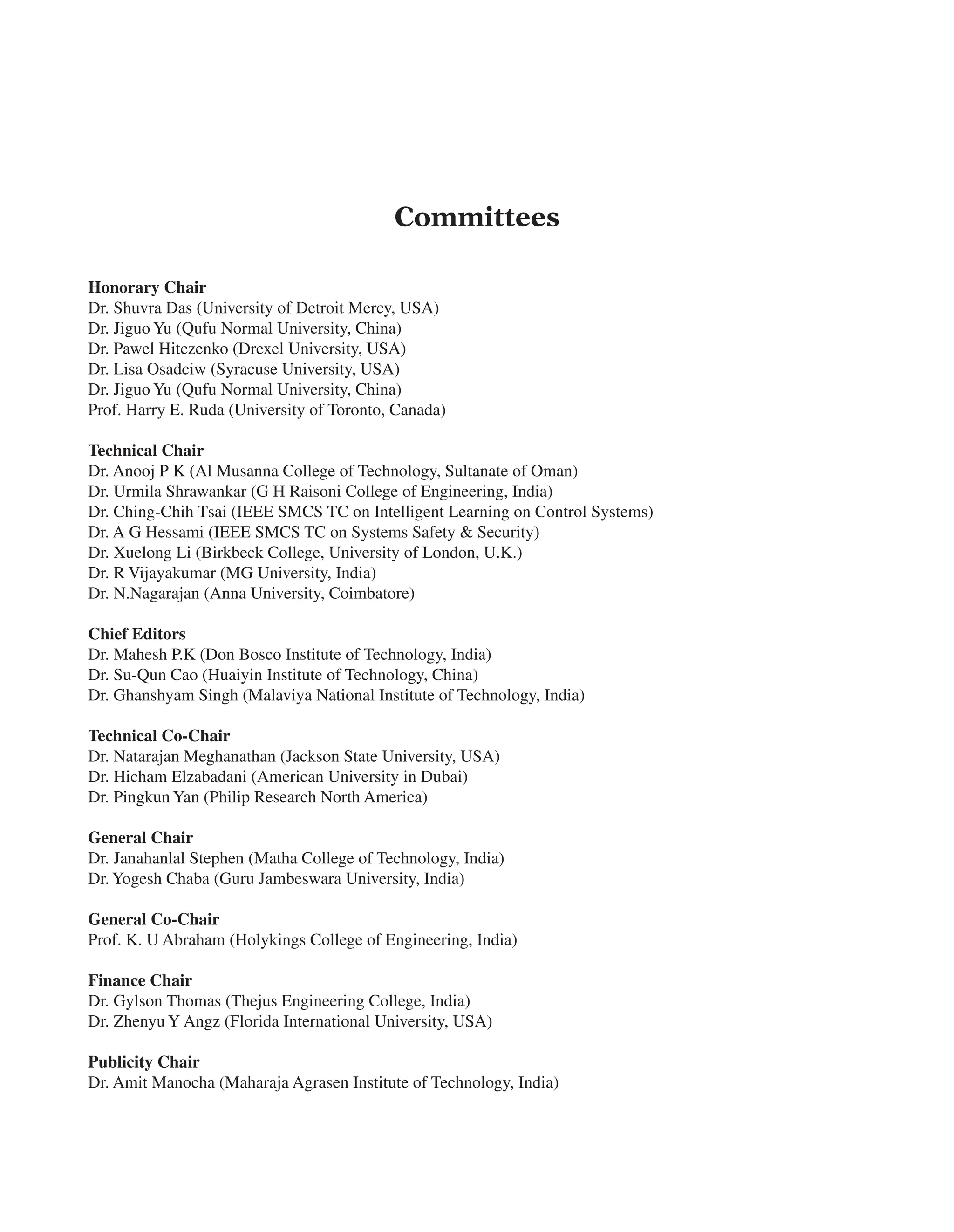
Committees
Honorary Chair
Dr. ShuvraDas (University of Detroit Mercy, USA)
Dr. Jiguo Yu (Qufu Normal University, China)
Dr. Pawel Hitczenko (Drexel University, USA)
Dr. Lisa Osadciw (Syracuse University, USA)
Dr. Jiguo Yu (Qufu Normal University, China)
Prof. Harry E. Ruda (University of Toronto, Canada)
Technical Chair
Dr. Anooj P K (Al Musanna College of Technology, Sultanate of Oman)
Dr. Urmila Shrawankar (G H Raisoni College of Engineering, India)
Dr. Ching-Chih Tsai (IEEE SMCS TC on Intelligent Learning on Control Systems)
Dr. A G Hessami (IEEE SMCS TC on Systems Safety & Security)
Dr. Xuelong Li (Birkbeck College, University of London, U.K.)
Dr. R Vijayakumar (MG University, India)
Dr. N.Nagarajan (Anna University, Coimbatore)
Chief Editors
Dr. Mahesh P.K (Don Bosco Institute of Technology, India)
Dr. Su-Qun Cao (Huaiyin Institute of Technology, China)
Dr. Ghanshyam Singh (Malaviya National Institute of Technology, India)
Technical Co-Chair
Dr. Natarajan Meghanathan (Jackson State University, USA)
Dr. Hicham Elzabadani (American University in Dubai)
Dr. Pingkun Yan (Philip Research North America)
General Chair
Dr. Janahanlal Stephen (Matha College of Technology, India)
Dr. Yogesh Chaba (Guru Jambeswara University, India)
General Co-Chair
Prof. K. U Abraham (Holykings College of Engineering, India)
Finance Chair
Dr. Gylson Thomas (Thejus Engineering College, India)
Dr. Zhenyu Y Angz (Florida International University, USA)
Publicity Chair
Dr. Amit Manocha (Maharaja Agrasen Institute of Technology, India)
10.
vi Committees
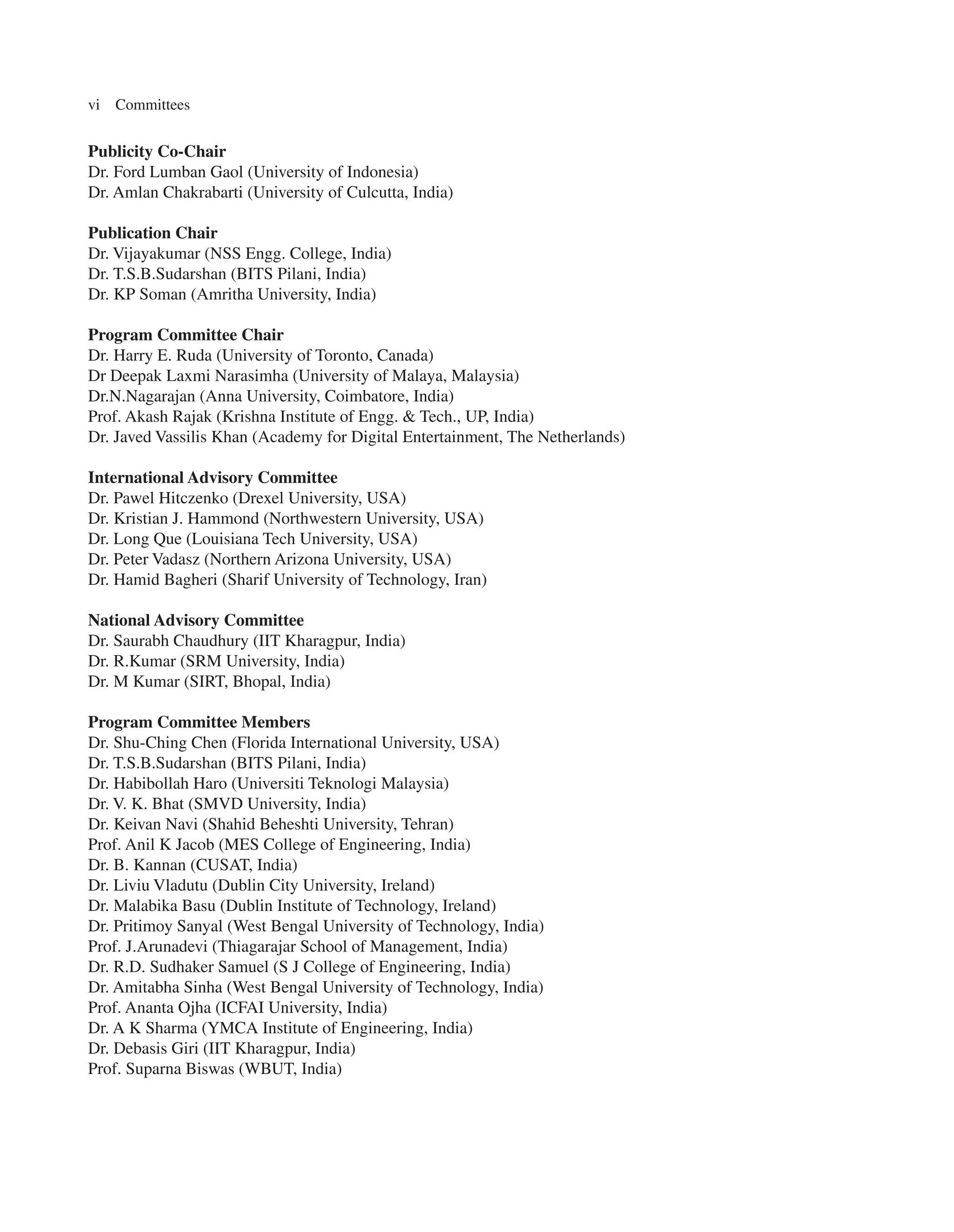
Publicity Co-Chair
Dr.Ford Lumban Gaol (University of Indonesia)
Dr. Amlan Chakrabarti (University of Culcutta, India)
Publication Chair
Dr. Vijayakumar (NSS Engg. College, India)
Dr. T.S.B.Sudarshan (BITS Pilani, India)
Dr. KP Soman (Amritha University, India)
Program Committee Chair
Dr. Harry E. Ruda (University of Toronto, Canada)
Dr Deepak Laxmi Narasimha (University of Malaya, Malaysia)
Dr.N.Nagarajan (Anna University, Coimbatore, India)
Prof. Akash Rajak (Krishna Institute of Engg. & Tech., UP, India)
Dr. Javed Vassilis Khan (Academy for Digital Entertainment, The Netherlands)
International Advisory Committee
Dr. Pawel Hitczenko (Drexel University, USA)
Dr. Kristian J. Hammond (Northwestern University, USA)
Dr. Long Que (Louisiana Tech University, USA)
Dr. Peter Vadasz (Northern Arizona University, USA)
Dr. Hamid Bagheri (Sharif University of Technology, Iran)
National Advisory Committee
Dr. Saurabh Chaudhury (IIT Kharagpur, India)
Dr. R.Kumar (SRM University, India)
Dr. M Kumar (SIRT, Bhopal, India)
Program Committee Members
Dr. Shu-Ching Chen (Florida International University, USA)
Dr. T.S.B.Sudarshan (BITS Pilani, India)
Dr. Habibollah Haro (Universiti Teknologi Malaysia)
Dr. V. K. Bhat (SMVD University, India)
Dr. Keivan Navi (Shahid Beheshti University, Tehran)
Prof. Anil K Jacob (MES College of Engineering, India)
Dr. B. Kannan (CUSAT, India)
Dr. Liviu Vladutu (Dublin City University, Ireland)
Dr. Malabika Basu (Dublin Institute of Technology, Ireland)
Dr. Pritimoy Sanyal (West Bengal University of Technology, India)
Prof. J.Arunadevi (Thiagarajar School of Management, India)
Dr. R.D. Sudhaker Samuel (S J College of Engineering, India)
Dr. Amitabha Sinha (West Bengal University of Technology, India)
Prof. Ananta Ojha (ICFAI University, India)
Dr. A K Sharma (YMCA Institute of Engineering, India)
Dr. Debasis Giri (IIT Kharagpur, India)
Prof. Suparna Biswas (WBUT, India)
11.
Foreword
It’s a greatprivilege and pleasure for me to serve as the Editor-in-chief for the
IDES Joint International Conferences. Innovative ideas and research in two streams
are extremely important for the current Electronics industry to be in support to
“Digital India” and “Make in India” an initiative by Government of India. This Joint
International Conference provides a rostrum to the researchers from the academia
and industries all around the world to share their research results, novel ideas as well
as the improvements over the existing methodology.
This conference covers a wide variety of topics in Control Systems and Power
Electronics, to name a few—Mobile Communication Technology, Natural
Language Processing, Algorithm/Protocol Design and Analysis, VLSI Systems,
Intelligent Systems and Approach, Data Communication, Embedded System, Digital
Security, Data Compression, Data Mining, Databases, Digital Signal Processing,
Telecommunication Technologies, Control Theory and Application, Computational
Intelligence, Robotics, HVDC, MEMS-Related Technology. The response from the researchers for the research
papers is staggering.
I would like to convey my heartfelt gratitude and appreciation to the members of the following committees—
Honorary Chair, Technical Chair, Technical Co-Chair, General Chair, General Co-Chair, Publicity Chair, Publicity
Co-Chair, Publication Chair, Finance Chair, NationalAdvisory Committees, Program Committee Chair, International
Advisory Committee, Review Committee, Program Committee Members for contributing either their precious time
in reviewing the papers or their effort in monitoring and making the conference a grand success. I would also like
to acknowledge the support of IDES, Matha College of Technology, Association of Computer Electrical Electronics
and Communication Engineers (ACEECom), ACEE and AMAE for organising such a platform to welcome the
future technology. I also wish to convey my gratitude to McGraw-Hill Education for publishing the registered
papers.
Mahesh P K
Don Bosco Institute of Technology, India
13.
Preface
The IDES JointInternational Conference “Emerging Technologies in Engineering”
attracted several hundreds of submissions. After rigorous reviews, 63 high-quality
papers are included in the proceedings.
The goal of the joint conference is to promote research, developmental activities and
scientific information interchange between researchers, developers, engineers, students,
and practitioners working in India and around the world in the fields of Computer
Science, Information Technology, Computational Engineering, Communication,
Electrical Measurements, Instrumentation Engineering, Electronic Devices, Digital
Electronics, Circuits, Control and Instrumentation, Communication system, Robotics,
Power Electronics, Civil Engineering and Power Engineering.
The conference is jointly organised by the ECE Department of Matha College of Technology, the IDES,
ACEECom,ACEE andAMAE. I thank the members of the Organizing Committee and the Programming Committee
for their hard working in the past several months. I wish to express my heartfelt appreciation to the keynote
speakers, session chairs, reviewers and student helpers. Finally, I thank all the authors and participants for their
great contributions and exchanging the experiences.
Su-Qun Cao
Huaiyin Institute of Technology, China
15.
Visit https://ebookmass.com todayto explore
a vast collection of ebooks across various
genres, available in popular formats like
PDF, EPUB, and MOBI, fully compatible with
all devices. Enjoy a seamless reading
experience and effortlessly download high-
quality materials in just a few simple steps.
Plus, don’t miss out on exciting offers that
let you access a wealth of knowledge at the
best prices!
16.
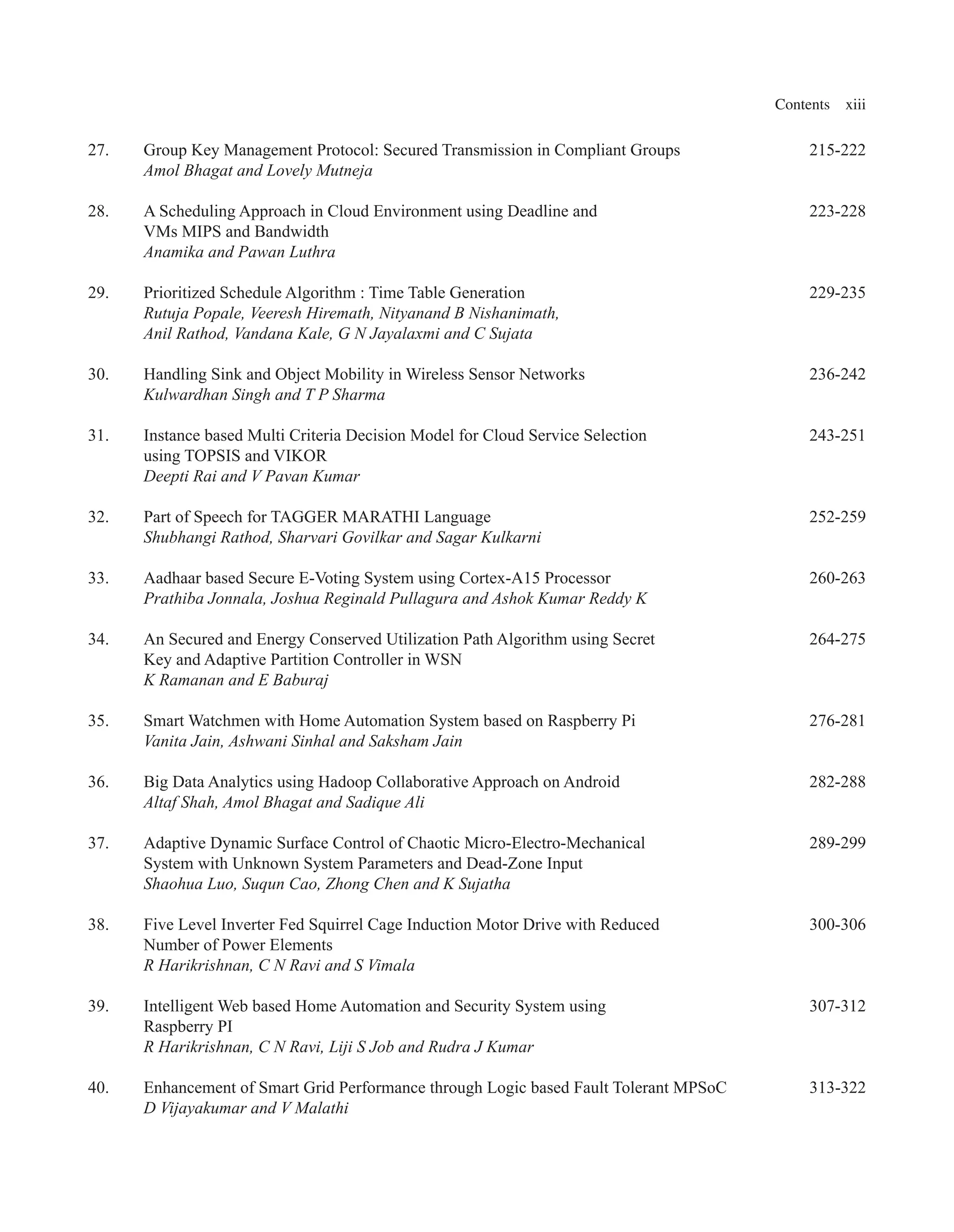
Contents
Committees v
Foreword vii
Prefaceix
1. Non-Word Error Detection for Luganda 1-17
Robert Ssali Balagadde and Parvataneni Premchand
2. Modern Approaches Towards Superior Dynamic Allocation 18-27
Snehal C Ratnaparkhi, Mithra Venkatesan and A V Kulkarni
3. Performance Analysis of AODV+ Routing Protocol for Wireless Ad-hoc Networks 28-35
Sanjeev Kumar Srivastava, Ranjana D Raut and P T Karule
4. Comparative Study of Various File Systems for Data Storage in Virtualized 36-44
Cloud Environment
Rashmi Jogdand, Mohan A Gholap and D R Gangodkar
5. Study and Analysis of Modified Aggressive Packet Combining with 45-48
Consideration of the Physical Signal
Achyuth Sarkar, Swarnendu K Chakraborty and C T Bhunia
6. Thyroid Malignancy Detection Using K-Nearest Neighbor (KNN) and 49-56
Probabilistic Neural Network (PNN)
Wrushali Mendre, Ranjana Raut and Pradeep T Karule
7. Signature Imprintment on VLSI Core Designs 57-61
Saurabh Radheshyam Chiraniya, Pradeep Patil and A B Patki
8. Comparison of Network Codes in Distributed Storage Area Network based 62-68
on Performance using NS3 Simulator
Priyanka Ramesh Nanaware and S K Srivastava
9. Optimal PI Tuning with GA and PSO for Shunt Active Power Filter 69-75
N Gowtham and Shobha Shankar
10. Optimal Control of DC Motor using Linear Quadratic Regulator 76-83
Meetty Tomy and A G Thosar
11. A Review on Implementation of UART with Optimum Noise Immunity 84-93
Pallavi R Upase and P S Choudhari
17.
xii Contents
12. Introductionto Energy Efficient Motors 94-98
Himanshu Shekhar and C R Bharath
13. Computation of Steady State Temperature Distribution in the Stator of a 99-108
75 kW Slip-Ring Induction Motor by Finite Element Method
Pradyumna Ranjan Ghosh, Nirmal Kr Bhattacharya and Debasis Sarkar
14. Parametric Study of Drag on Orientation of High Rise Building 109-114
Amol S Pote and Smrutirekha Mishra
15. An Overview of Developments in Adsorption Refrigeration Systems: 115-121
Principle and Optimization Techniques
Jaimin K Patel, N S Mehta and J B Dabhi
16. Pedestrian and Vehicle Detection for Advanced Driver Assistance Systems 122-126
P Lavanya, G Harshith, Chiraag and S S Shylaja
17. Artificial Neural Network for Detection and Location of Faults in Mixed 127-136
Underground Cable and Overhead Transmission Line
Ankita Nag and Anamika Yadav
18. Delineating Data Security and Privacy Boundary in Bioinformatics 137-141
Mukti Routray
19. Sentiment Analysis of Transliterated Hindi and Marathi Script 142-149
Mohammed Arshad Ansari and Sharvari Govilkar
20. An EOQ Model Dealing with Weibull Deterioration with Shortages, 150-163
Ramp Type Demand Rate and Unit Production Cost Incorporating the Effect of Inflation
Jayshree and Shalini Jain
21. Parameter Centric XML Parsing Techniques for Embedded Systems 164-171
Rashmi Sonar, Sadique Ali and Amol Bhagat
22. Emotion Extraction using Rule-based and SVM-KNN Algorithm 172-181
Mohini Chaudhari and Sharvari Govilkar
23. Sentiment Classification in Hindi by using a HindiSentiWordNet (HSWN) 182-189
Pooja Pandey, Sharvari Govilkar and Sagar Kulkarni
24. Regression Analysis for Stock Market Prediction using Weka Tool Without 190-199
Sentiment Analysis
Sudip Padhye and Karuna Gull
25. Component based Face Recognition using Hybrid Approach 200-208
R Srinivasa Perumal and Chandra Mouli P V S S R
26. Framework for Surplus Food Management using Data Analytics 209-214
M Sridevi and B R Arunkumar
18.
Contents xiii
27. GroupKey Management Protocol: Secured Transmission in Compliant Groups 215-222
Amol Bhagat and Lovely Mutneja
28. A Scheduling Approach in Cloud Environment using Deadline and 223-228
VMs MIPS and Bandwidth
Anamika and Pawan Luthra
29. Prioritized Schedule Algorithm : Time Table Generation 229-235
Rutuja Popale, Veeresh Hiremath, Nityanand B Nishanimath,
Anil Rathod, Vandana Kale, G N Jayalaxmi and C Sujata
30. Handling Sink and Object Mobility in Wireless Sensor Networks 236-242
Kulwardhan Singh and T P Sharma
31. Instance based Multi Criteria Decision Model for Cloud Service Selection 243-251
using TOPSIS and VIKOR
Deepti Rai and V Pavan Kumar
32. Part of Speech for TAGGER MARATHI Language 252-259
Shubhangi Rathod, Sharvari Govilkar and Sagar Kulkarni
33. Aadhaar based Secure E-Voting System using Cortex-A15 Processor 260-263
Prathiba Jonnala, Joshua Reginald Pullagura and Ashok Kumar Reddy K
34. An Secured and Energy Conserved Utilization Path Algorithm using Secret 264-275
Key and Adaptive Partition Controller in WSN
K Ramanan and E Baburaj
35. Smart Watchmen with Home Automation System based on Raspberry Pi 276-281
Vanita Jain, Ashwani Sinhal and Saksham Jain
36. Big Data Analytics using Hadoop Collaborative Approach on Android 282-288
Altaf Shah, Amol Bhagat and Sadique Ali
37. Adaptive Dynamic Surface Control of Chaotic Micro-Electro-Mechanical 289-299
System with Unknown System Parameters and Dead-Zone Input
Shaohua Luo, Suqun Cao, Zhong Chen and K Sujatha
38. Five Level Inverter Fed Squirrel Cage Induction Motor Drive with Reduced 300-306
Number of Power Elements
R Harikrishnan, C N Ravi and S Vimala
39. Intelligent Web based Home Automation and Security System using 307-312
Raspberry PI
R Harikrishnan, C N Ravi, Liji S Job and Rudra J Kumar
40. Enhancement of Smart Grid Performance through Logic based Fault Tolerant MPSoC 313-322
D Vijayakumar and V Malathi
19.
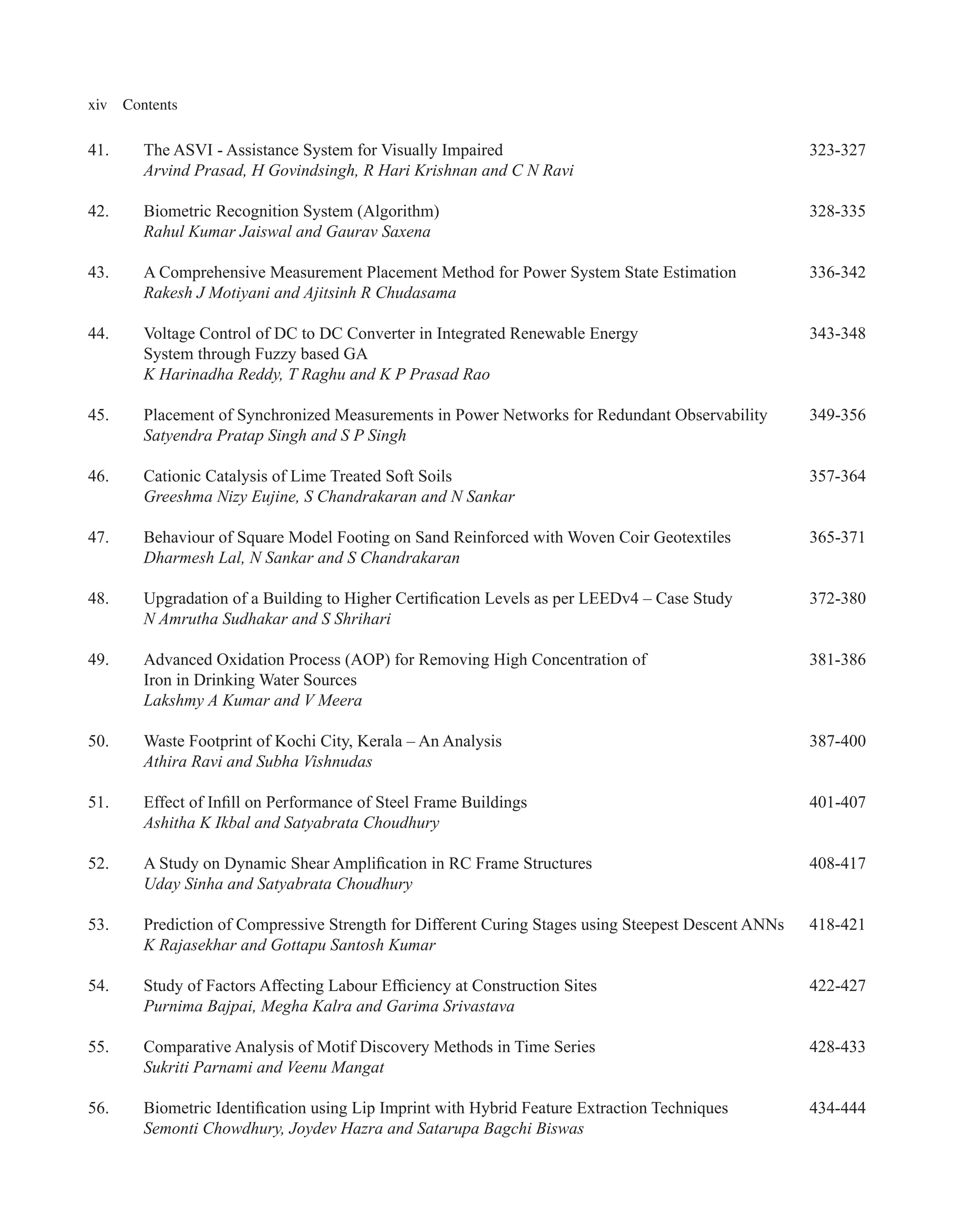
xiv Contents
41. TheASVI - Assistance System for Visually Impaired 323-327
Arvind Prasad, H Govindsingh, R Hari Krishnan and C N Ravi
42. Biometric Recognition System (Algorithm) 328-335
Rahul Kumar Jaiswal and Gaurav Saxena
43. A Comprehensive Measurement Placement Method for Power System State Estimation 336-342
Rakesh J Motiyani and Ajitsinh R Chudasama
44. Voltage Control of DC to DC Converter in Integrated Renewable Energy 343-348
System through Fuzzy based GA
K Harinadha Reddy, T Raghu and K P Prasad Rao
45. Placement of Synchronized Measurements in Power Networks for Redundant Observability 349-356
Satyendra Pratap Singh and S P Singh
46. Cationic Catalysis of Lime Treated Soft Soils 357-364
Greeshma Nizy Eujine, S Chandrakaran and N Sankar
47. Behaviour of Square Model Footing on Sand Reinforced with Woven Coir Geotextiles 365-371
Dharmesh Lal, N Sankar and S Chandrakaran
48. Upgradation of a Building to Higher Certification Levels as per LEEDv4 – Case Study 372-380
N Amrutha Sudhakar and S Shrihari
49. Advanced Oxidation Process (AOP) for Removing High Concentration of 381-386
Iron in Drinking Water Sources
Lakshmy A Kumar and V Meera
50. Waste Footprint of Kochi City, Kerala – An Analysis 387-400
Athira Ravi and Subha Vishnudas
51. Effect of Infill on Performance of Steel Frame Buildings 401-407
Ashitha K Ikbal and Satyabrata Choudhury
52. A Study on Dynamic Shear Amplification in RC Frame Structures 408-417
Uday Sinha and Satyabrata Choudhury
53. Prediction of Compressive Strength for Different Curing Stages using Steepest Descent ANNs 418-421
K Rajasekhar and Gottapu Santosh Kumar
54. Study of Factors Affecting Labour Efficiency at Construction Sites 422-427
Purnima Bajpai, Megha Kalra and Garima Srivastava
55. Comparative Analysis of Motif Discovery Methods in Time Series 428-433
Sukriti Parnami and Veenu Mangat
56. Biometric Identification using Lip Imprint with Hybrid Feature Extraction Techniques 434-444
Semonti Chowdhury, Joydev Hazra and Satarupa Bagchi Biswas
20.
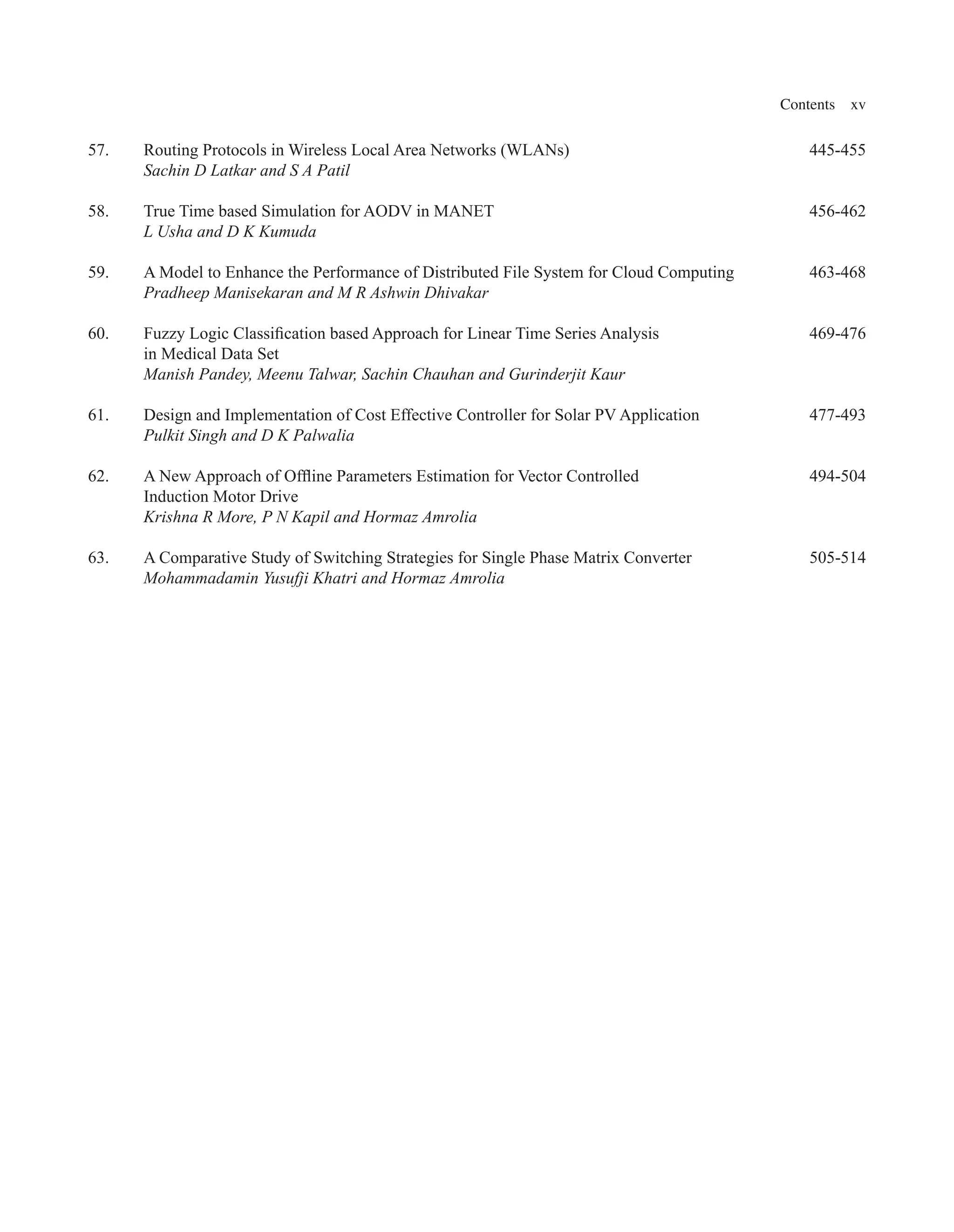
Contents xv
57. RoutingProtocols in Wireless Local Area Networks (WLANs) 445-455
Sachin D Latkar and S A Patil
58. True Time based Simulation for AODV in MANET 456-462
L Usha and D K Kumuda
59. A Model to Enhance the Performance of Distributed File System for Cloud Computing 463-468
Pradheep Manisekaran and M R Ashwin Dhivakar
60. Fuzzy Logic Classification based Approach for Linear Time Series Analysis 469-476
in Medical Data Set
Manish Pandey, Meenu Talwar, Sachin Chauhan and Gurinderjit Kaur
61. Design and Implementation of Cost Effective Controller for Solar PV Application 477-493
Pulkit Singh and D K Palwalia
62. A New Approach of Offline Parameters Estimation for Vector Controlled 494-504
Induction Motor Drive
Krishna R More, P N Kapil and Hormaz Amrolia
63. A Comparative Study of Switching Strategies for Single Phase Matrix Converter 505-514
Mohammadamin Yusufji Khatri and Hormaz Amrolia
22.
Non-Word Error Detectionfor Luganda
Robert Ssali Balagadde * and Parvataneni Premchand **
* ** Department of Computer Science & Engineering, University College of Engineering, Osmania University
Hyderabad, 500007, TS, India
baross.kla@gmail.com, Profpremchand.p@gmail.com
Abstract: Editing or word processing Luganda text has been an uphill task mainly because of lack of a system in this
environment which could detect spelling errors in Luganda. In this context, this research paper presents a model for non-word
error detection for Luganda (LugDetect) which comes in handy to address this gap and consequently provide a more user
friendly environment for editing Luganda text. To the best of our knowledge LugDetect is the first of this kind of system
developed for Luganda. Experimentation results show that LugDetect detects non-word errors with an accuracy (AP) of 100%
for all the five categories of Luganda words at an average speed of 1471 Hz (number of words per second) so long as the
erroneous word is not a real word. Experimentation on the Luganda corpus which was used in this research work shows that
19% of Luganda text is composed of Clitics Host Word Combination (CHWC), while the other part (81%)- Real Luganda
Words (RLW).
Keywords: non-word error detection, Luganda error detector, dictionary look-up technique, clitic-host word combination
(CHWC), spelling detector.
Introduction
Editing or word processing Luganda text has been an uphill task mainly because of lack of a environmental system which
could detect spelling errors in Luganda. In this context, this research work presents a model for Non-Word Error Detection
For Luganda (NWEDL- LugDetect) which comes in handy to address this gap, and consequently, provide a more user
friendly environment for editing Luganda text. To the best of our knowledge, LugDetect is the first of this kind of system
developed for Luganda.
One challenge encountered while developing a model for Luganda spell checking is dealing with the infinite number of
clitic-host word combinations (CHWCs) which makes Luganda distinct from other foreign languages especially non-Bantu
languages. In this research work, three types of CHWC are identified in respect to the use of inter-word apostrophe (IWA)
defined in subsection on ”The Error Detection Mechanism"
Type one - CHWC_1, bolded in Example 1 - are created as a result of compounding a modified monosyllabic word
(MMW) or modified disyllabic word with an initial vowel (MDWIV) with another succeeding word which begins with a
vowel. Compounding in Luganda may involve two to three words. MMW or MDWIV- referred to as clitic - is formed by
dropping the ending vowel of the mono-syllabic word (MW) or disyllabic word with an initial vowel (DWIV) and replacing
it with an apostrophe resulting into a long sound that is not represented by a double vowel.
Example 1
� omwenge n'ennyama (alcohol and meat) [conjunctive form]
� n'otema omuti (and you cut the tree) [narrative form]
� ew'omuyizzi (at the hunter's place) [locative form]
� Minisita omubeezi ow'ebyobusuubuzi ne tekinologiya (Minister of State for Trade and Technology)
� n'obw'embwa sibwagala (even that for the dog, I don't like)
� n'olw'ensonga eyo, sijja kujja (and for that reason, I will not come)
Example 2 shows some MWs and DWIVs (bolded) used in compounding to form CHWC_Is. Not all MWs and DWIVs are
used in compounding, and Example 3 shows some of these.
Example 2
� ne, na, nga [conjunction]
� ne, nga [narratives]
� be, ze, ge. gwe , bwe, bye, lwe, lye, kye, bye [object relatives]
� kya, ya, za. lya ba, bya, ga, gwa, ka, lwa, wa [possessives]
� ekya, eya, eza. erya, owa, aba [possessives with initial vowel]
� kye, ye, be, ze, twe [copulatives]
� e [locatives]
23.
2 Sixth InternationalConference on Advances in Information Technology and Mobile Communication – AIM 2016
Example 3
� era, ate, nti, so [conjunction]
� atya, oti [adverbs]
� ggwe, nze, ye, yo. bo, zo, bwo [emphatic pronouns]
� bba [nonn]
� si [negation]
Type II - CHWC_II, shown in Example 4 - are formed as a result of using clitic ng' and nng' to represent "�����������������
double "���������������������������������������������������������������������
Example 4
� ng'ang'ala (to whimper like a dog)
� bbiring'anya (egg plant)
� agakung'anyizzaamu (to collect in it something)
� enng'anda (relatives)
� nng'oma (dram)
Type III - CHWC_III, shown in Example 5 - are formed as a result of using clitic ng' and nng' to represent "�����������������
double "��������������������ctively in words which are initially CHWC_1.
Example 5
� n'agakung'anyizzaamu (and to collect in it something)
� ng'eng'anda (like relatives)
� ng'enng'oma (like a dram)
In view of this, the first task is disambiguating the three types of CHWCs. The approach adopted to disambiguate these words
in LugDetect is discussed in subsection on "Disambiguating the CHWCs"
The second task is how to detect errors in each type of CHWCs. The approach adopted to provide this functionality in
LugDetect is discussed in subsection on "Spell Checking Luganda Clitic Host Word Combination Type I (CHWC_I)".
CHWC_IIs, which can be easy converted into real Luganda words (RLW) by substitution, are dealt with in subsection on
"Spell Checking RLW".
It is worthwhile noting that the CHWC_1 akin to Luganda are also found in other Bantu languages like Runyankore-
Rukiga, Kinyarwanda, among others. Example 6 and Example 7 shows samples of CHWC_I extracted from Runyankore-
Rukiga and Kinyarwanda text respectively.
Example 6
� ky’okutunga
� nk’eihanga
� n’ekya
� g’ebyemikono
Example 7
� n’uw’Umukuru ( and His Excellence)
� Nk’uko (like that)
� y’Umukuru (His Excellence)
� w’Igihugu (of a country)
The third challenge is deciding when to invoke LugDetect or the Error Detection Mechanism (EDM) during interactive
processing and during batch processing. For interactive processing, should LugDetect be invoked when the space bar (SB) is
struck or at every key-stroke? The former approach has a shortfall in that a modified word can miss out on spell checking
through the use of insertion bar (IB) movement keys - a list of which is shown in Table 1 - which move the position of IB
from the modified word to some other word without striking the SB. The latter approach would eliminate this problem but its
main problem is that it is strenuous on the system due to the numerous EDM invocations. A solution to this is the
development of an Algorithm for Interactive Invocation of EDM (IIEDM) discussed in subsection on "Interactive invocation
of EDM"
For batch processing, how should EDM be invoked? A solution to this is discussed in form of an algorithm. A summary
of the modules making up LugDetect is presented in subsection on "The Error Detection Mechanism"
LugDetect can detect numerical errors and word level punctuation errors, however, in this paper, we only mention them.
Details of the modules dealing with these errors can be obtained from "unpublished" [2].
24.
Non-Word Error Detectionfor Luganda 3
The scope of LugDetect is limited to Luganda non-word detection. Named entities, abbreviations, e-mail addresses, uniform
resource locator (URL) strings are not handled in LugDetect, and neither are the real word errors.
Literature Survey
Errors
According to Peterson [15], spelling errors are basically of two types. Firstly, cognitive errors which are errors due to lack of
knowledge of the language and are errors often ignored on the assertion that they are infrequent. In this context, their
frequency is evaluated to be between 10% and 15% [17]. Secondly, typographical errors are 80% of "typos" (also called
single character errors) and are one of the following four types: one exceeding character, one missing character, a mistaken
character, or the transposition of two consecutive characters [4]. This means that 80% of errors are within edit distance of one
and almost all errors - within edit distance of two.
Error Detection
There are two techniques used in detecting non-word errors. First, the Dictionary Lookup Technique (DLT), in which each
word in the input text is lookup in the dictionary. In case a word is not found in the lexicon that word is a non-word or
incorrect, and therefore, flagged or entered into the list of erroneous words. The larger the lexicon the better is the results.
Shinghal and Toussaint [18] noted that DLT has low error rates, but is disadvantaged by large storage demands and high
computational complexity. Most current spelling correction techniques rely on DLT for non-word error detection.
Second, a technique that uses a non-positional bi-gram 26 by 26 matrix which captures information on the existence of
the bi-grams. A bi-gram is assigned a value of one if it exists in the corpus of the language in consideration, otherwise it is
assigned zero. All the bi-grams making up the input text are checked for their existence in the matrix. if any of the bi-grams
is non-existence than the word is flagged or a non-word. This technique is appropriate for Optical Character Recognition
(OCR) errors and it has proven to be less accurate for detecting human-generated errors.
Lexicon
User-lexicon can be interactively enriched with new entries enabling the checker to recognize all the possible inflexions
derived from them. A lexicon for a spelling correction or text recognition application must be carefully tuned to its intended
domain of discourse. Too small a lexicon can burden the user with too many false rejections of valid terms; too large a
lexicon can result in an unacceptably high number of false acceptances. The relationship between misspellings and word
frequencies is not straightforward.
Peterson [16]. recommend that lexicon for spelling correction be kept relatively small based on the fact that
approximately half a percent of all single error transformations of each of the words on a 350,000-item word list result in
other valid words on the list However, Damerau and Mays [5] challenge this recommendation by using a corpus of over 22
million words of text from various genres and they found that by increasing the size of their frequency rank-ordered word list
from 50,000 to 60,000 words; they were able to eliminate 1,348 false rejections while incurring only 23 additional false
acceptances. Since this 50-to-l differential error rate represents a significant improvement in correction accuracy; therefore,
they recommend the use of larger lexicons.
Dictionaries alone are often insufficient sources for lexicon construction. Walker and Amsle [19] observed that nearly
two-thirds (61%) of the words in the Merriam-Webster Seventh Collegiate Dictionary did not appear in an eight million word
corpus of New York Times news wire text, and conversely, almost two-thirds (64.9%) of the words in the text were not in the
dictionary.
On the topic of construction of the lexicon for the spell program, McIlroy [13] provides some helpful insights into
appropriate sources that may be drawn upon for general lexicon construction.
An article by Damerau [6] provides some insights into and guidelines for the automatic construction and customization of
domain oriented vocabularies for specialized NLP (Natural Language Processing) applications.
LugDetect
LugDetect, developed using Python programming language, identifies the type of Luganda word or token which need be
spell checked, and consequently, invokes the appropriate module for detecting the error. LugDetect works in tandem with
LugCorrect to provide detection and correction for Luganda words. In other words, LugDetect is required to detect the error
before LugCorrect can be invoked for correction purposes. The mechanism for LugCorrect, which provides correction
candidate list (CCL) or an explanation or hint on the type of error committed, is shown in Algorithm 1 and more details are
provided in [3].
25.
4 Sixth InternationalConference on Advances in Information Technology and Mobile Communication – AIM 2016
The two models form LugSpell, a model for an interactive spell checker providing spelling feedback while the end user is
word processing their document in the editor. However, in this article, more emphasis is directed towards LugDetect.
The Luganda corpus which was experimented upon in the development of LugDetect was developed from Luganda text
obtained from an online local news paper, Bukedde.
Disambiguating the CHWCs
Analysis of the task of disambiguating the three types of CHWC zeros down on disambiguating between the use of inter-
word apostrophe (IWA) - which is defined in subsection on "The Error Detection Mechanism" - in Luganda compounding
resulting into creation of CHWC_1 and the use of IWA in representing the character "��� �������� ��� ����le or double
character which results into formation of CHWC_II and CHWC_III. At the bottom line of the analysis, we finally arrive at
disambiguating between clitic ng' used in the representation of character '��������������- shown in Example 4 - and in
Get Erroneous Word
IF{punctuation Error}
Give feedback on punctuation error
ELSE IF{Numeric Error }
Give feedback on numeric error
ELSE IF (Word Error)
Generate correction candidate list (GCCL)
ENDIF
GCCL
SubDic=Get all words beginning with 1st character of erroneous word from
lexicon
L=Number of words in SubDic
IF {L>10}
Get 1st 10 words from SubDic load in Dictionary with their corresponding
Jaccard coefficient(JC)
ELSE
Get all words in SubDic load in Dictionary with their corresponding JC
ENDIF
REPEAT
swap if JC of word in SubDic is greater than minimum JC of word in
dictionary
UNTILL all words in SubDic have been checked
Sort words in Dictionary in descending order of JC
Present the word to the user for selection
IF{user selects Dictionary word and gives consent}
Change word in text
ELSE
Ignore
ENDIF
Algorithm 1 : Error Correction Module
26.
Visit https://ebookmass.com todayto explore
a vast collection of ebooks across various
genres, available in popular formats like
PDF, EPUB, and MOBI, fully compatible with
all devices. Enjoy a seamless reading
experience and effortlessly download high-
quality materials in just a few simple steps.
Plus, don’t miss out on exciting offers that
let you access a wealth of knowledge at the
best prices!
Pag. 5
9
29
55
73
97
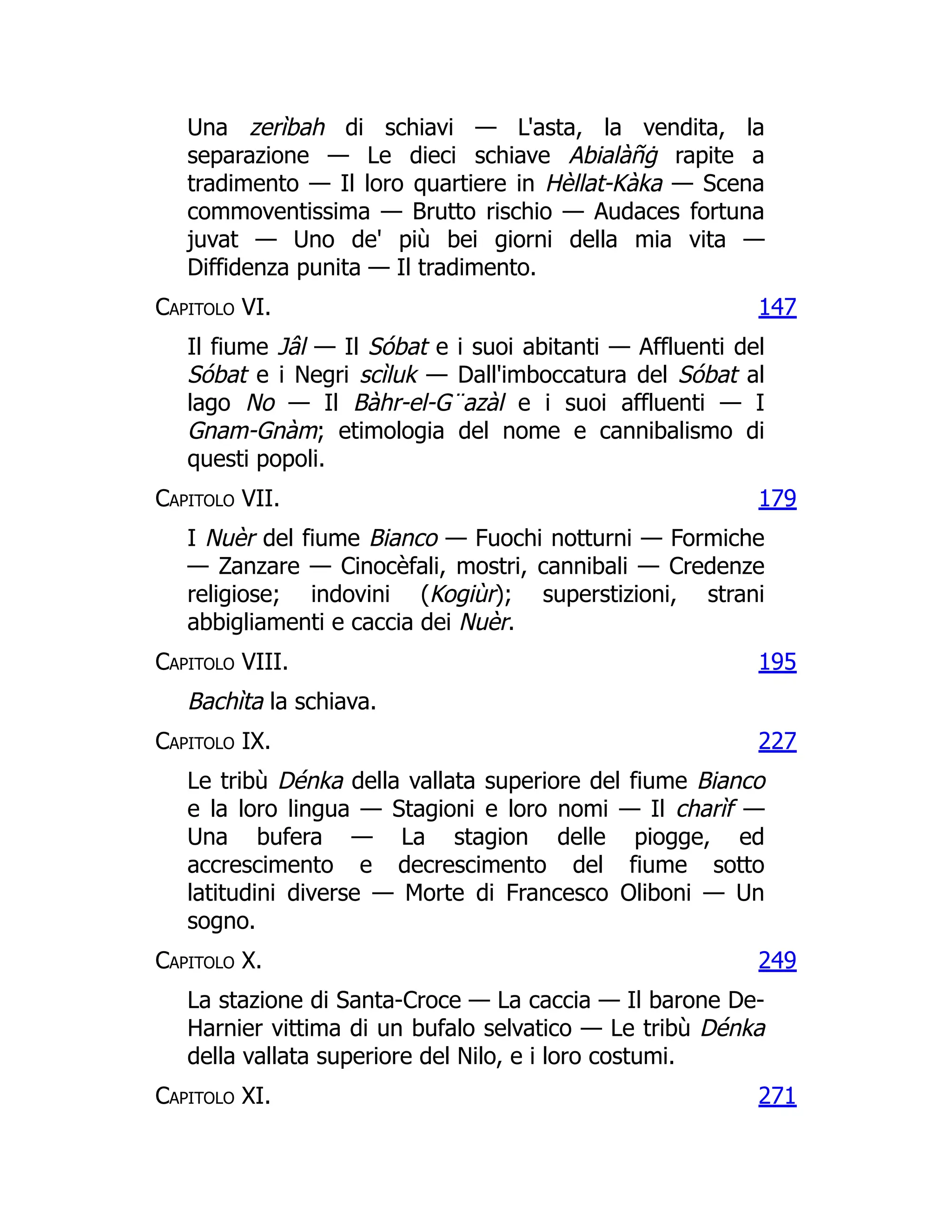
INDICE-SOMMARIO
Prefazione
Capitolo I.
IlProvicario Apostolico dell'Africa Centrale Ignazio
Knoblecher — Ultime sue parole in Koròsko ai
Missionari veronesi — Le rive del fiume Bianco da
Chartùm ai Scìluk — Le meraviglie di una foresta — Gli
Arabi d'Abù-Zèt — I Baggàra-Selèm — Linguaggio
mimico degli Arabi.
Capitolo II.
Vendette — Guerre — Armi — Coraggio passivo e
fierezza — Ostinazione degli Arabi — Il suicidio — Le
montagne dei Dénka — Il Tarciàm.
Capitolo III.
Caratteristiche della razza negra — Il paese dei Scìluk
— I cani — Odio contro i Turchi — Raffronti della lingua
dei Dénka con quella dei Scìluk.
Capitolo IV.
Il regno dei Scìluk e il loro Governo — Mezzi
d'incivilimento — Punizioni — Diritto di elezione al trono
— Residenza reale — Quanto si possa fare
assegnamento della parola di un re Negro — Il
latrocinio — Divisione, carattere e costumi vari dei
Scìluk — La schiavitù presso i Scìluk e gli Arabi in
Hèllat-Kàka — I mercanti d'avorio divenuti rapitori e
mercanti di schiavi.
Capitolo V.
29.
147
179
195
227
249
271
Una zerìbah dischiavi — L'asta, la vendita, la
separazione — Le dieci schiave Abialàñġ rapite a
tradimento — Il loro quartiere in Hèllat-Kàka — Scena
commoventissima — Brutto rischio — Audaces fortuna
juvat — Uno de' più bei giorni della mia vita —
Diffidenza punita — Il tradimento.
Capitolo VI.
Il fiume Jâl — Il Sóbat e i suoi abitanti — Affluenti del
Sóbat e i Negri scìluk — Dall'imboccatura del Sóbat al
lago No — Il Bàhr-el-G¨azàl e i suoi affluenti — I
Gnam-Gnàm; etimologia del nome e cannibalismo di
questi popoli.
Capitolo VII.
I Nuèr del fiume Bianco — Fuochi notturni — Formiche
— Zanzare — Cinocèfali, mostri, cannibali — Credenze
religiose; indovini (Kogiùr); superstizioni, strani
abbigliamenti e caccia dei Nuèr.
Capitolo VIII.
Bachìta la schiava.
Capitolo IX.
Le tribù Dénka della vallata superiore del fiume Bianco
e la loro lingua — Stagioni e loro nomi — Il charìf —
Una bufera — La stagion delle piogge, ed
accrescimento e decrescimento del fiume sotto
latitudini diverse — Morte di Francesco Oliboni — Un
sogno.
Capitolo X.
La stazione di Santa-Croce — La caccia — Il barone De-
Harnier vittima di un bufalo selvatico — Le tribù Dénka
della vallata superiore del Nilo, e i loro costumi.
Capitolo XI.
30.
297
Forme di salutopresso i Dénka — Matrimoni —
Religione — Buffoni — Dialogo sulla schiavitù e sul
diritto di punizione — Partenza da Santa-Croce verso
Chartùm; stato della Missione; morte del missionario
Angelo Melotto; ritorno a Santa-Croce.
Capitolo XII.
Da Santa-Croce a Kondókoro — Costumi dei Bàri —
Tremuoti, venti, temperatura — I Bàri e la Missione —
L'islamismo e la schiavitù — Conclusione.
31.
ALTRE PUBBLICAZIONI DELLASTESSA DITTA EDITRICE
ALEARDI A. — Epistolario con un'introduzione del
prof. G. Trezza. 1 vol. in-12, 1879 L. 5 —
BELTRAME prof. G. — Il Sènnaar e lo Sciangàllah; 2
vol. con ritratto dell'Autore ed una carta geog. 8 —
BERTINI P. — Tutto pel meglio. Racc. 1 vol. in-12 3 —
CALIARI prof. P. — La donna cristiana. Conferenze. 1
vol. in-12, 1879 1 50
CHAVASSE P. H. — Sull'educazione fisica dei
bambini. Consigli di un medico alle madri. Trad.
dalla XII ediz. inglese di C. Ruata-Pronati. 1 vol. 4 —
FRIZZO prof. G. — La Geometria per le Scuole
Tecniche secondo i nuovi programmi 2 60
GIULIARI M.r G. C. — Monumenti grafici affidati al
marmo, al bronzo, al papiro, alla pergamena e
alla carta, relativi alla storia di Verona, 1 op. 2 —
GUERZONI prof. G. — Il terzo rinascimento. Corso di
letteratura italiana dato nella Regia Università di
Palermo, II ediz. 1 vol. in-12 di pag. 560 4 50
— Il primo rinascimento, 1 vol. in-12 di pag. 220 3 —
LEBRECHT dott. G. — Il Risparmio e la educazione
del popolo. Studio sulle Casse di Risparmio
italiane ed estere. 1 vol. in-12 di pag. 455 5 —
MANGANOTTI prof. A. — Manuale di storia naturale
applicata al commercio, 1 vol. in-8 4 —
MATTEAZZI E. — Doveri morali della giovinetta
italiana. 1 vol. in-12 1 —
PATUZZI G. L. — A proposito dei Pensieri sull'Arte e
Ricordi Autobiografici di Giov. Duprè. 1 op. 1 —
32.
PEREZ. — Isette cerchi del Purgatorio di Dante. 1
vol. in-12 3 —
SALA A. — I Musicisti veronesi. Saggio storico critico.
1 opusc. in-12 1 —
SCOPOLI-BIASI I. — La tavola rotonda. Racconti
educativi, 1 vol. in-12, 1877 di pag. 182 2 —
DI PROSSIMA PUBBLICAZIONE:
BELVIGLIERI C. — Scritti storici. — 1 volume in-12.
VERONA 1881 — STAB. G. CIVELLI.
33.
NOTE:
1. Vedi miememorie: Il Sènnaar e lo Sciangàllah, vol. II, pag. 51.
2. Vedi mie memorie: Il Sènnaar e lo Sciangàllah, vol. I, pag. 87, e vol. II,
pag. 251.
3. Vedi mie memorie: Il Sènnaar e lo Sciangàllah, vol. I, pag. 201, 212,
244.
4. Questo illustre naturalista e ardito viaggiatore italiano fu spedito nel
1825 nel Sènnaar dal vicerè dell'Egitto Mahàmmed-Aly per istudiarvi il
terreno; ma troppo presto e con grave danno della scienza cadde vittima
dell'insalubrità del clima a Chartùm nel settembre 1826. Venne seppellito
nel deserto a mezzodì delle poche capanne, di cui allora si componeva
Chartùm; ed ora quella parte di deserto è occupata dagli abitati della
città ingrandita. Io feci di tutto per rinvenirne le ossa, assistito dal
dottore Peney ispettore sanitario del Sudàn, e da un vecchio greco, per
nome Dimitri, che aveva conosciuto il Brocchi ed era stato presente alla
sepoltura; ma indarno. Io dovetti contentarmi di far porre nel cimitero
cristiano una pietra con iscrizione, la quale almeno indicasse il nome
dell'illustre bassanese.
5. Vedi mie memorie: Il Sènnaar e lo Sciangàllah, vol. II, pag. 102.
6. Pianta, del cui fusto che è leggerissimo si servono le donne per passare
dall'una all'altra riva del fiume.
7. Vedi mie memorie: Il Sènnaar e lo Sciangàllah, vol. I, pag. 19.
8. Viaggio sul fiume Bianco, Verona, Tipografia Vicentini e Franchini, 1861.
9. Expedition zur Entdeckung der Quellen des weissen Nils. Werne, Berlin,
1848.
10. Vedi mie memorie: Il Sènnaar e lo Sciangàllah, vol. I, pag. 266-270.
34.
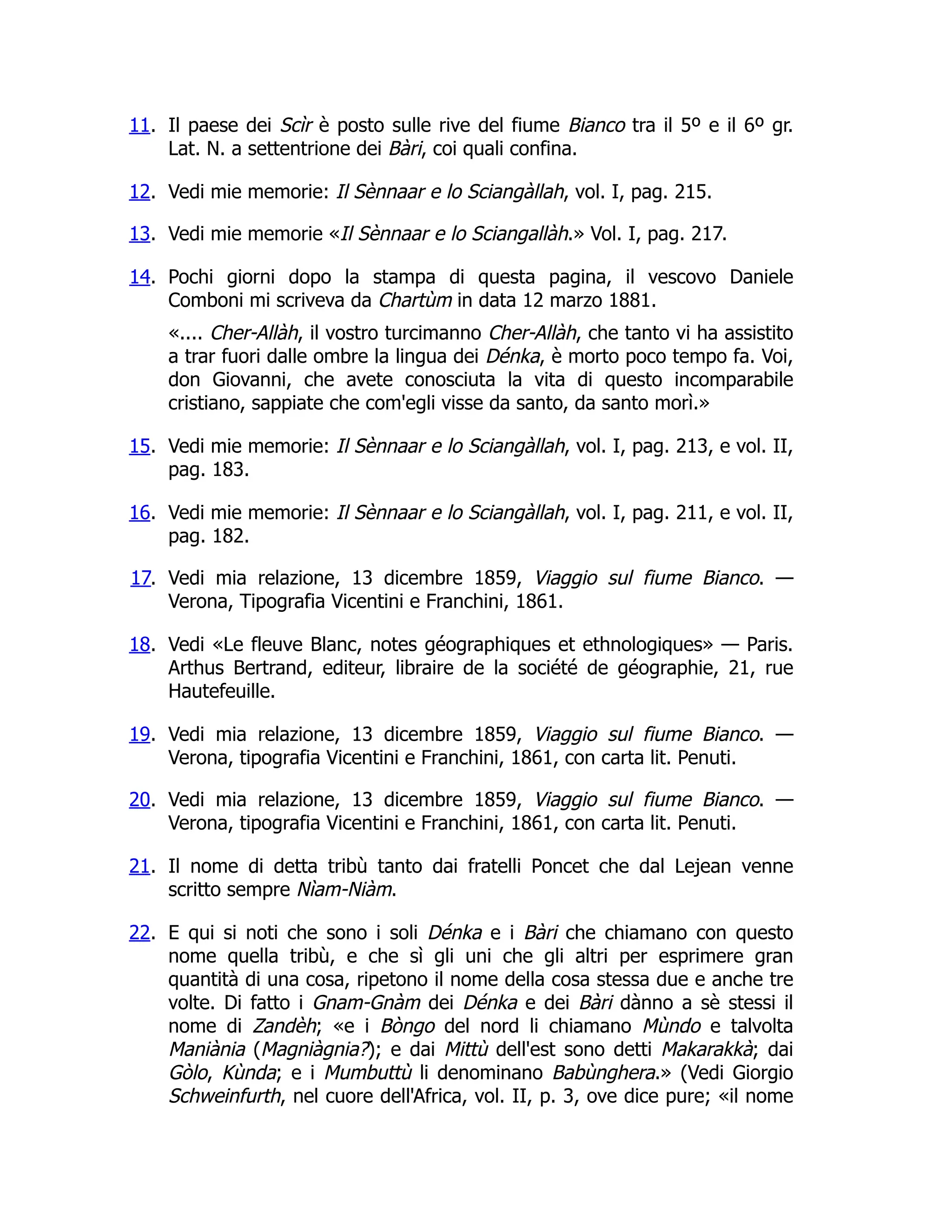
11. Il paesedei Scìr è posto sulle rive del fiume Bianco tra il 5º e il 6º gr.
Lat. N. a settentrione dei Bàri, coi quali confina.
12. Vedi mie memorie: Il Sènnaar e lo Sciangàllah, vol. I, pag. 215.
13. Vedi mie memorie «Il Sènnaar e lo Sciangallàh.» Vol. I, pag. 217.
14. Pochi giorni dopo la stampa di questa pagina, il vescovo Daniele
Comboni mi scriveva da Chartùm in data 12 marzo 1881.
«.... Cher-Allàh, il vostro turcimanno Cher-Allàh, che tanto vi ha assistito
a trar fuori dalle ombre la lingua dei Dénka, è morto poco tempo fa. Voi,
don Giovanni, che avete conosciuta la vita di questo incomparabile
cristiano, sappiate che com'egli visse da santo, da santo morì.»
15. Vedi mie memorie: Il Sènnaar e lo Sciangàllah, vol. I, pag. 213, e vol. II,
pag. 183.
16. Vedi mie memorie: Il Sènnaar e lo Sciangàllah, vol. I, pag. 211, e vol. II,
pag. 182.
17. Vedi mia relazione, 13 dicembre 1859, Viaggio sul fiume Bianco. —
Verona, Tipografia Vicentini e Franchini, 1861.
18. Vedi «Le fleuve Blanc, notes géographiques et ethnologiques» — Paris.
Arthus Bertrand, editeur, libraire de la société de géographie, 21, rue
Hautefeuille.
19. Vedi mia relazione, 13 dicembre 1859, Viaggio sul fiume Bianco. —
Verona, tipografia Vicentini e Franchini, 1861, con carta lit. Penuti.
20. Vedi mia relazione, 13 dicembre 1859, Viaggio sul fiume Bianco. —
Verona, tipografia Vicentini e Franchini, 1861, con carta lit. Penuti.
21. Il nome di detta tribù tanto dai fratelli Poncet che dal Lejean venne
scritto sempre Nìam-Niàm.
22. E qui si noti che sono i soli Dénka e i Bàri che chiamano con questo
nome quella tribù, e che sì gli uni che gli altri per esprimere gran
quantità di una cosa, ripetono il nome della cosa stessa due e anche tre
volte. Di fatto i Gnam-Gnàm dei Dénka e dei Bàri dànno a sè stessi il
nome di Zandèh; «e i Bòngo del nord li chiamano Mùndo e talvolta
Maniània (Magniàgnia?); e dai Mittù dell'est sono detti Makarakkà; dai
Gòlo, Kùnda; e i Mumbuttù li denominano Babùnghera.» (Vedi Giorgio
Schweinfurth, nel cuore dell'Africa, vol. II, p. 3, ove dice pure; «il nome
35.
sotto il qualeli conosciamo, e che vuol essere pronunziato Gnam-Gnàm
(così), è preso dalla lingua dénka (così), e significa mangiatore, o meglio
gran mangiatore, e allude evidentemente (egli dice) al cannibalismo
della gente cui è imposto;» — significato ed allusione, a cui io non posso
sottoscrivere.)
23. Vedi mie memorie: Il Sènnaar e lo Sciangàllah, vol. II, pag. 164.
24. Vedi mie memorie: Il Sènnaar e lo Sciangàllah, vol. II, pag. 193.
25. Vedi mie memorie: Il Sènnaar e lo Sciangàllah, vol. I, pag. 266, 268.
26. Isaia, cap. XLII, salmo LXXII.
27. Il nome di questa tribù, ch'io trovo scritto quasi sempre sulle carte
geografiche a destra del fiume, deve essere posto a sinistra. Le stabili
abitazioni dei Kìc, ch'io visitai nel 1858 col missionario Comboni, ora
Vescovo di Claudiopoli e Vicario Apostolico dell'Africa centrale, sono tutte
a sinistra del fiume ad una giornata circa di cammino, e non è che
durante la stagione secca, che per la comodità dei pascoli i Kìc
s'appressano al fiume provvisoriamente lungo la riva sinistra, passando
alcuni anche sulla riva destra.
28. Vedi mie memorie: Il Sènnaar e lo Sciangàllah, vol. I, p. 243.
29. Vedi mie memorie: Il Sènnaar e lo Sciangàllah, vol. I, pag. 35.
30. Vedi mie memorie: Il Sènnaar e lo Sciangàllah, vol. I, pag. 120.
31. Le fleuve Blanc. — Notes géographiques et ethnologiques et les chasses
à l'élephant dans le pays des Dénka et des Djour. — Paris, Arthus
Bertrand éditeur.
32. Vedi mia Gram. dénka, cap. IV, § 37.
33. In tutto il tempo che la Missione si sostenne con enormi spese e con
grandissime difficoltà, cioè dall'anno 1852 al 1860, i battezzati furono
47; n. 34 dal Provicario Apostolico Ignazio Knoblecher: n. 12 dal
Presidente Antonio Überbacher, dieci dei quali per ordine del medesimo
Provicario; e n. 1 dal missionario Antonio Kaufman.
34. Quest'ultimo giovinetto dopo due anni mi comparve, quasi per incanto,
nel Cairo mentre tornavo in Europa, essendo stata la Missione Cattolica
dell'Africa Centrale affidata ai Padri Francescani. Egli fece meco il viaggio
a Terra Santa, a Costantinopoli, a Vienna; e giunti a Verona, egli venne
36.
battezzato col nomedi Michele nella chiesa di S. Paolo di Campo Marzo,
e gli fu padrino l'illustre comm. conte Antonio Pompei. Dopo cinque
anni, affetto d'infiammazione polmonare, ritornò in Cairo, a spese
dell'amato suo padrino, nella speranza che si potesse rimettere in
salute; qui fu accolto amorosamente nel convento dei Padri Francescani,
ove dopo un anno morì.
Un'indole così dolce, così facile, così semplice, così buona come nel mio
caro Michele, non la riscontrai che nel mio turcimanno Cher-Allàh, tutti e
due veri tipi di bontà, profondamente cristiani. — E quali vissero, così
morirono nella pace, tranquilli e contenti.
La morte non è nulla, o cari, per coloro che v'assomigliano! per essi non
vi sono nè tenebre, nè ombre, che si dileguano come la stella del
mattino sotto i raggi dorati dell'aurora....
Voi otteneste la vittoria senza combattimento, e la corona senza lotta!...
Or pregate in cielo per chi ha fatto qualche cosa per voi!...
35. Giorgio Schweinfurth. Nel cuore dell'Africa, vol. II, cap. XIV, pag. 179.
37.
Nota del Trascrittore
Ortografiae punteggiatura originali sono state
mantenute, correggendo senza annotazione minimi errori
tipografici.
Nel testo originale sono presenti segni diacritici (accenti,
legature, punti sovrascritti) per rappresentare
foneticamente le parole della lingua dénka. In
particolare, la legatura è usata per segnalare il suono
della lettera n unita ad altre lettere: è stata qui resa
tramite la tilde (ñ).
38.
*** END OFTHE PROJECT GUTENBERG EBOOK IL FIUME BIANCO E
I DÉNKA: MEMORIE ***
Updated editions will replace the previous one—the old editions
will be renamed.
Creating the works from print editions not protected by U.S.
copyright law means that no one owns a United States
copyright in these works, so the Foundation (and you!) can copy
and distribute it in the United States without permission and
without paying copyright royalties. Special rules, set forth in the
General Terms of Use part of this license, apply to copying and
distributing Project Gutenberg™ electronic works to protect the
PROJECT GUTENBERG™ concept and trademark. Project
Gutenberg is a registered trademark, and may not be used if
you charge for an eBook, except by following the terms of the
trademark license, including paying royalties for use of the
Project Gutenberg trademark. If you do not charge anything for
copies of this eBook, complying with the trademark license is
very easy. You may use this eBook for nearly any purpose such
as creation of derivative works, reports, performances and
research. Project Gutenberg eBooks may be modified and
printed and given away—you may do practically ANYTHING in
the United States with eBooks not protected by U.S. copyright
law. Redistribution is subject to the trademark license, especially
commercial redistribution.
START: FULL LICENSE
PLEASE READ THISBEFORE YOU DISTRIBUTE OR USE THIS WORK
To protect the Project Gutenberg™ mission of promoting the
free distribution of electronic works, by using or distributing this
work (or any other work associated in any way with the phrase
“Project Gutenberg”), you agree to comply with all the terms of
the Full Project Gutenberg™ License available with this file or
online at www.gutenberg.org/license.
Section 1. General Terms of Use and
Redistributing Project Gutenberg™
electronic works
1.A. By reading or using any part of this Project Gutenberg™
electronic work, you indicate that you have read, understand,
agree to and accept all the terms of this license and intellectual
property (trademark/copyright) agreement. If you do not agree
to abide by all the terms of this agreement, you must cease
using and return or destroy all copies of Project Gutenberg™
electronic works in your possession. If you paid a fee for
obtaining a copy of or access to a Project Gutenberg™
electronic work and you do not agree to be bound by the terms
of this agreement, you may obtain a refund from the person or
entity to whom you paid the fee as set forth in paragraph 1.E.8.
1.B. “Project Gutenberg” is a registered trademark. It may only
be used on or associated in any way with an electronic work by
people who agree to be bound by the terms of this agreement.
There are a few things that you can do with most Project
Gutenberg™ electronic works even without complying with the
full terms of this agreement. See paragraph 1.C below. There
are a lot of things you can do with Project Gutenberg™
electronic works if you follow the terms of this agreement and
help preserve free future access to Project Gutenberg™
electronic works. See paragraph 1.E below.
41.
1.C. The ProjectGutenberg Literary Archive Foundation (“the
Foundation” or PGLAF), owns a compilation copyright in the
collection of Project Gutenberg™ electronic works. Nearly all the
individual works in the collection are in the public domain in the
United States. If an individual work is unprotected by copyright
law in the United States and you are located in the United
States, we do not claim a right to prevent you from copying,
distributing, performing, displaying or creating derivative works
based on the work as long as all references to Project
Gutenberg are removed. Of course, we hope that you will
support the Project Gutenberg™ mission of promoting free
access to electronic works by freely sharing Project Gutenberg™
works in compliance with the terms of this agreement for
keeping the Project Gutenberg™ name associated with the
work. You can easily comply with the terms of this agreement
by keeping this work in the same format with its attached full
Project Gutenberg™ License when you share it without charge
with others.
1.D. The copyright laws of the place where you are located also
govern what you can do with this work. Copyright laws in most
countries are in a constant state of change. If you are outside
the United States, check the laws of your country in addition to
the terms of this agreement before downloading, copying,
displaying, performing, distributing or creating derivative works
based on this work or any other Project Gutenberg™ work. The
Foundation makes no representations concerning the copyright
status of any work in any country other than the United States.
1.E. Unless you have removed all references to Project
Gutenberg:
1.E.1. The following sentence, with active links to, or other
immediate access to, the full Project Gutenberg™ License must
appear prominently whenever any copy of a Project
Gutenberg™ work (any work on which the phrase “Project
42.
Gutenberg” appears, orwith which the phrase “Project
Gutenberg” is associated) is accessed, displayed, performed,
viewed, copied or distributed:
This eBook is for the use of anyone anywhere in the United
States and most other parts of the world at no cost and
with almost no restrictions whatsoever. You may copy it,
give it away or re-use it under the terms of the Project
Gutenberg License included with this eBook or online at
www.gutenberg.org. If you are not located in the United
States, you will have to check the laws of the country
where you are located before using this eBook.
1.E.2. If an individual Project Gutenberg™ electronic work is
derived from texts not protected by U.S. copyright law (does not
contain a notice indicating that it is posted with permission of
the copyright holder), the work can be copied and distributed to
anyone in the United States without paying any fees or charges.
If you are redistributing or providing access to a work with the
phrase “Project Gutenberg” associated with or appearing on the
work, you must comply either with the requirements of
paragraphs 1.E.1 through 1.E.7 or obtain permission for the use
of the work and the Project Gutenberg™ trademark as set forth
in paragraphs 1.E.8 or 1.E.9.
1.E.3. If an individual Project Gutenberg™ electronic work is
posted with the permission of the copyright holder, your use and
distribution must comply with both paragraphs 1.E.1 through
1.E.7 and any additional terms imposed by the copyright holder.
Additional terms will be linked to the Project Gutenberg™
License for all works posted with the permission of the copyright
holder found at the beginning of this work.
1.E.4. Do not unlink or detach or remove the full Project
Gutenberg™ License terms from this work, or any files
43.
containing a partof this work or any other work associated with
Project Gutenberg™.
1.E.5. Do not copy, display, perform, distribute or redistribute
this electronic work, or any part of this electronic work, without
prominently displaying the sentence set forth in paragraph 1.E.1
with active links or immediate access to the full terms of the
Project Gutenberg™ License.
1.E.6. You may convert to and distribute this work in any binary,
compressed, marked up, nonproprietary or proprietary form,
including any word processing or hypertext form. However, if
you provide access to or distribute copies of a Project
Gutenberg™ work in a format other than “Plain Vanilla ASCII” or
other format used in the official version posted on the official
Project Gutenberg™ website (www.gutenberg.org), you must,
at no additional cost, fee or expense to the user, provide a copy,
a means of exporting a copy, or a means of obtaining a copy
upon request, of the work in its original “Plain Vanilla ASCII” or
other form. Any alternate format must include the full Project
Gutenberg™ License as specified in paragraph 1.E.1.
1.E.7. Do not charge a fee for access to, viewing, displaying,
performing, copying or distributing any Project Gutenberg™
works unless you comply with paragraph 1.E.8 or 1.E.9.
1.E.8. You may charge a reasonable fee for copies of or
providing access to or distributing Project Gutenberg™
electronic works provided that:
• You pay a royalty fee of 20% of the gross profits you derive
from the use of Project Gutenberg™ works calculated using the
method you already use to calculate your applicable taxes. The
fee is owed to the owner of the Project Gutenberg™ trademark,
but he has agreed to donate royalties under this paragraph to
the Project Gutenberg Literary Archive Foundation. Royalty
44.
payments must bepaid within 60 days following each date on
which you prepare (or are legally required to prepare) your
periodic tax returns. Royalty payments should be clearly marked
as such and sent to the Project Gutenberg Literary Archive
Foundation at the address specified in Section 4, “Information
about donations to the Project Gutenberg Literary Archive
Foundation.”
• You provide a full refund of any money paid by a user who
notifies you in writing (or by e-mail) within 30 days of receipt
that s/he does not agree to the terms of the full Project
Gutenberg™ License. You must require such a user to return or
destroy all copies of the works possessed in a physical medium
and discontinue all use of and all access to other copies of
Project Gutenberg™ works.
• You provide, in accordance with paragraph 1.F.3, a full refund of
any money paid for a work or a replacement copy, if a defect in
the electronic work is discovered and reported to you within 90
days of receipt of the work.
• You comply with all other terms of this agreement for free
distribution of Project Gutenberg™ works.
1.E.9. If you wish to charge a fee or distribute a Project
Gutenberg™ electronic work or group of works on different
terms than are set forth in this agreement, you must obtain
permission in writing from the Project Gutenberg Literary
Archive Foundation, the manager of the Project Gutenberg™
trademark. Contact the Foundation as set forth in Section 3
below.
1.F.
1.F.1. Project Gutenberg volunteers and employees expend
considerable effort to identify, do copyright research on,
transcribe and proofread works not protected by U.S. copyright
45.
law in creatingthe Project Gutenberg™ collection. Despite these
efforts, Project Gutenberg™ electronic works, and the medium
on which they may be stored, may contain “Defects,” such as,
but not limited to, incomplete, inaccurate or corrupt data,
transcription errors, a copyright or other intellectual property
infringement, a defective or damaged disk or other medium, a
computer virus, or computer codes that damage or cannot be
read by your equipment.
1.F.2. LIMITED WARRANTY, DISCLAIMER OF DAMAGES - Except
for the “Right of Replacement or Refund” described in
paragraph 1.F.3, the Project Gutenberg Literary Archive
Foundation, the owner of the Project Gutenberg™ trademark,
and any other party distributing a Project Gutenberg™ electronic
work under this agreement, disclaim all liability to you for
damages, costs and expenses, including legal fees. YOU AGREE
THAT YOU HAVE NO REMEDIES FOR NEGLIGENCE, STRICT
LIABILITY, BREACH OF WARRANTY OR BREACH OF CONTRACT
EXCEPT THOSE PROVIDED IN PARAGRAPH 1.F.3. YOU AGREE
THAT THE FOUNDATION, THE TRADEMARK OWNER, AND ANY
DISTRIBUTOR UNDER THIS AGREEMENT WILL NOT BE LIABLE
TO YOU FOR ACTUAL, DIRECT, INDIRECT, CONSEQUENTIAL,
PUNITIVE OR INCIDENTAL DAMAGES EVEN IF YOU GIVE
NOTICE OF THE POSSIBILITY OF SUCH DAMAGE.
1.F.3. LIMITED RIGHT OF REPLACEMENT OR REFUND - If you
discover a defect in this electronic work within 90 days of
receiving it, you can receive a refund of the money (if any) you
paid for it by sending a written explanation to the person you
received the work from. If you received the work on a physical
medium, you must return the medium with your written
explanation. The person or entity that provided you with the
defective work may elect to provide a replacement copy in lieu
of a refund. If you received the work electronically, the person
or entity providing it to you may choose to give you a second
opportunity to receive the work electronically in lieu of a refund.
46.
If the secondcopy is also defective, you may demand a refund
in writing without further opportunities to fix the problem.
1.F.4. Except for the limited right of replacement or refund set
forth in paragraph 1.F.3, this work is provided to you ‘AS-IS’,
WITH NO OTHER WARRANTIES OF ANY KIND, EXPRESS OR
IMPLIED, INCLUDING BUT NOT LIMITED TO WARRANTIES OF
MERCHANTABILITY OR FITNESS FOR ANY PURPOSE.
1.F.5. Some states do not allow disclaimers of certain implied
warranties or the exclusion or limitation of certain types of
damages. If any disclaimer or limitation set forth in this
agreement violates the law of the state applicable to this
agreement, the agreement shall be interpreted to make the
maximum disclaimer or limitation permitted by the applicable
state law. The invalidity or unenforceability of any provision of
this agreement shall not void the remaining provisions.
1.F.6. INDEMNITY - You agree to indemnify and hold the
Foundation, the trademark owner, any agent or employee of the
Foundation, anyone providing copies of Project Gutenberg™
electronic works in accordance with this agreement, and any
volunteers associated with the production, promotion and
distribution of Project Gutenberg™ electronic works, harmless
from all liability, costs and expenses, including legal fees, that
arise directly or indirectly from any of the following which you
do or cause to occur: (a) distribution of this or any Project
Gutenberg™ work, (b) alteration, modification, or additions or
deletions to any Project Gutenberg™ work, and (c) any Defect
you cause.
Section 2. Information about the Mission
of Project Gutenberg™
47.
Project Gutenberg™ issynonymous with the free distribution of
electronic works in formats readable by the widest variety of
computers including obsolete, old, middle-aged and new
computers. It exists because of the efforts of hundreds of
volunteers and donations from people in all walks of life.
Volunteers and financial support to provide volunteers with the
assistance they need are critical to reaching Project
Gutenberg™’s goals and ensuring that the Project Gutenberg™
collection will remain freely available for generations to come. In
2001, the Project Gutenberg Literary Archive Foundation was
created to provide a secure and permanent future for Project
Gutenberg™ and future generations. To learn more about the
Project Gutenberg Literary Archive Foundation and how your
efforts and donations can help, see Sections 3 and 4 and the
Foundation information page at www.gutenberg.org.
Section 3. Information about the Project
Gutenberg Literary Archive Foundation
The Project Gutenberg Literary Archive Foundation is a non-
profit 501(c)(3) educational corporation organized under the
laws of the state of Mississippi and granted tax exempt status
by the Internal Revenue Service. The Foundation’s EIN or
federal tax identification number is 64-6221541. Contributions
to the Project Gutenberg Literary Archive Foundation are tax
deductible to the full extent permitted by U.S. federal laws and
your state’s laws.
The Foundation’s business office is located at 809 North 1500
West, Salt Lake City, UT 84116, (801) 596-1887. Email contact
links and up to date contact information can be found at the
Foundation’s website and official page at
www.gutenberg.org/contact
48.
Section 4. Informationabout Donations to
the Project Gutenberg Literary Archive
Foundation
Project Gutenberg™ depends upon and cannot survive without
widespread public support and donations to carry out its mission
of increasing the number of public domain and licensed works
that can be freely distributed in machine-readable form
accessible by the widest array of equipment including outdated
equipment. Many small donations ($1 to $5,000) are particularly
important to maintaining tax exempt status with the IRS.
The Foundation is committed to complying with the laws
regulating charities and charitable donations in all 50 states of
the United States. Compliance requirements are not uniform
and it takes a considerable effort, much paperwork and many
fees to meet and keep up with these requirements. We do not
solicit donations in locations where we have not received written
confirmation of compliance. To SEND DONATIONS or determine
the status of compliance for any particular state visit
www.gutenberg.org/donate.
While we cannot and do not solicit contributions from states
where we have not met the solicitation requirements, we know
of no prohibition against accepting unsolicited donations from
donors in such states who approach us with offers to donate.
International donations are gratefully accepted, but we cannot
make any statements concerning tax treatment of donations
received from outside the United States. U.S. laws alone swamp
our small staff.
Please check the Project Gutenberg web pages for current
donation methods and addresses. Donations are accepted in a
number of other ways including checks, online payments and
49.
credit card donations.To donate, please visit:
www.gutenberg.org/donate.
Section 5. General Information About
Project Gutenberg™ electronic works
Professor Michael S. Hart was the originator of the Project
Gutenberg™ concept of a library of electronic works that could
be freely shared with anyone. For forty years, he produced and
distributed Project Gutenberg™ eBooks with only a loose
network of volunteer support.
Project Gutenberg™ eBooks are often created from several
printed editions, all of which are confirmed as not protected by
copyright in the U.S. unless a copyright notice is included. Thus,
we do not necessarily keep eBooks in compliance with any
particular paper edition.
Most people start at our website which has the main PG search
facility: www.gutenberg.org.
This website includes information about Project Gutenberg™,
including how to make donations to the Project Gutenberg
Literary Archive Foundation, how to help produce our new
eBooks, and how to subscribe to our email newsletter to hear
about new eBooks.
50.
Welcome to ourwebsite – the perfect destination for book lovers and
knowledge seekers. We believe that every book holds a new world,
offering opportunities for learning, discovery, and personal growth.
That’s why we are dedicated to bringing you a diverse collection of
books, ranging from classic literature and specialized publications to
self-development guides and children's books.
More than just a book-buying platform, we strive to be a bridge
connecting you with timeless cultural and intellectual values. With an
elegant, user-friendly interface and a smart search system, you can
quickly find the books that best suit your interests. Additionally,
our special promotions and home delivery services help you save time
and fully enjoy the joy of reading.
Join us on a journey of knowledge exploration, passion nurturing, and
personal growth every day!
ebookmasss.com







![Non-Word Error Detection for Luganda
Robert Ssali Balagadde * and Parvataneni Premchand **
* ** Department of Computer Science & Engineering, University College of Engineering, Osmania University
Hyderabad, 500007, TS, India
baross.kla@gmail.com, Profpremchand.p@gmail.com
Abstract: Editing or word processing Luganda text has been an uphill task mainly because of lack of a system in this
environment which could detect spelling errors in Luganda. In this context, this research paper presents a model for non-word
error detection for Luganda (LugDetect) which comes in handy to address this gap and consequently provide a more user
friendly environment for editing Luganda text. To the best of our knowledge LugDetect is the first of this kind of system
developed for Luganda. Experimentation results show that LugDetect detects non-word errors with an accuracy (AP) of 100%
for all the five categories of Luganda words at an average speed of 1471 Hz (number of words per second) so long as the
erroneous word is not a real word. Experimentation on the Luganda corpus which was used in this research work shows that
19% of Luganda text is composed of Clitics Host Word Combination (CHWC), while the other part (81%)- Real Luganda
Words (RLW).
Keywords: non-word error detection, Luganda error detector, dictionary look-up technique, clitic-host word combination
(CHWC), spelling detector.
Introduction
Editing or word processing Luganda text has been an uphill task mainly because of lack of a environmental system which
could detect spelling errors in Luganda. In this context, this research work presents a model for Non-Word Error Detection
For Luganda (NWEDL- LugDetect) which comes in handy to address this gap, and consequently, provide a more user
friendly environment for editing Luganda text. To the best of our knowledge, LugDetect is the first of this kind of system
developed for Luganda.
One challenge encountered while developing a model for Luganda spell checking is dealing with the infinite number of
clitic-host word combinations (CHWCs) which makes Luganda distinct from other foreign languages especially non-Bantu
languages. In this research work, three types of CHWC are identified in respect to the use of inter-word apostrophe (IWA)
defined in subsection on ”The Error Detection Mechanism"
Type one - CHWC_1, bolded in Example 1 - are created as a result of compounding a modified monosyllabic word
(MMW) or modified disyllabic word with an initial vowel (MDWIV) with another succeeding word which begins with a
vowel. Compounding in Luganda may involve two to three words. MMW or MDWIV- referred to as clitic - is formed by
dropping the ending vowel of the mono-syllabic word (MW) or disyllabic word with an initial vowel (DWIV) and replacing
it with an apostrophe resulting into a long sound that is not represented by a double vowel.
Example 1
� omwenge n'ennyama (alcohol and meat) [conjunctive form]
� n'otema omuti (and you cut the tree) [narrative form]
� ew'omuyizzi (at the hunter's place) [locative form]
� Minisita omubeezi ow'ebyobusuubuzi ne tekinologiya (Minister of State for Trade and Technology)
� n'obw'embwa sibwagala (even that for the dog, I don't like)
� n'olw'ensonga eyo, sijja kujja (and for that reason, I will not come)
Example 2 shows some MWs and DWIVs (bolded) used in compounding to form CHWC_Is. Not all MWs and DWIVs are
used in compounding, and Example 3 shows some of these.
Example 2
� ne, na, nga [conjunction]
� ne, nga [narratives]
� be, ze, ge. gwe , bwe, bye, lwe, lye, kye, bye [object relatives]
� kya, ya, za. lya ba, bya, ga, gwa, ka, lwa, wa [possessives]
� ekya, eya, eza. erya, owa, aba [possessives with initial vowel]
� kye, ye, be, ze, twe [copulatives]
� e [locatives]](https://image.slidesharecdn.com/52770-250413060045-e7157975/75/Emerging-Technologies-in-Engineering-Mahesh-P-K-22-2048.jpg)
![2 Sixth International Conference on Advances in Information Technology and Mobile Communication – AIM 2016
Example 3
� era, ate, nti, so [conjunction]
� atya, oti [adverbs]
� ggwe, nze, ye, yo. bo, zo, bwo [emphatic pronouns]
� bba [nonn]
� si [negation]
Type II - CHWC_II, shown in Example 4 - are formed as a result of using clitic ng' and nng' to represent "�����������������
double "���������������������������������������������������������������������
Example 4
� ng'ang'ala (to whimper like a dog)
� bbiring'anya (egg plant)
� agakung'anyizzaamu (to collect in it something)
� enng'anda (relatives)
� nng'oma (dram)
Type III - CHWC_III, shown in Example 5 - are formed as a result of using clitic ng' and nng' to represent "�����������������
double "��������������������ctively in words which are initially CHWC_1.
Example 5
� n'agakung'anyizzaamu (and to collect in it something)
� ng'eng'anda (like relatives)
� ng'enng'oma (like a dram)
In view of this, the first task is disambiguating the three types of CHWCs. The approach adopted to disambiguate these words
in LugDetect is discussed in subsection on "Disambiguating the CHWCs"
The second task is how to detect errors in each type of CHWCs. The approach adopted to provide this functionality in
LugDetect is discussed in subsection on "Spell Checking Luganda Clitic Host Word Combination Type I (CHWC_I)".
CHWC_IIs, which can be easy converted into real Luganda words (RLW) by substitution, are dealt with in subsection on
"Spell Checking RLW".
It is worthwhile noting that the CHWC_1 akin to Luganda are also found in other Bantu languages like Runyankore-
Rukiga, Kinyarwanda, among others. Example 6 and Example 7 shows samples of CHWC_I extracted from Runyankore-
Rukiga and Kinyarwanda text respectively.
Example 6
� ky’okutunga
� nk’eihanga
� n’ekya
� g’ebyemikono
Example 7
� n’uw’Umukuru ( and His Excellence)
� Nk’uko (like that)
� y’Umukuru (His Excellence)
� w’Igihugu (of a country)
The third challenge is deciding when to invoke LugDetect or the Error Detection Mechanism (EDM) during interactive
processing and during batch processing. For interactive processing, should LugDetect be invoked when the space bar (SB) is
struck or at every key-stroke? The former approach has a shortfall in that a modified word can miss out on spell checking
through the use of insertion bar (IB) movement keys - a list of which is shown in Table 1 - which move the position of IB
from the modified word to some other word without striking the SB. The latter approach would eliminate this problem but its
main problem is that it is strenuous on the system due to the numerous EDM invocations. A solution to this is the
development of an Algorithm for Interactive Invocation of EDM (IIEDM) discussed in subsection on "Interactive invocation
of EDM"
For batch processing, how should EDM be invoked? A solution to this is discussed in form of an algorithm. A summary
of the modules making up LugDetect is presented in subsection on "The Error Detection Mechanism"
LugDetect can detect numerical errors and word level punctuation errors, however, in this paper, we only mention them.
Details of the modules dealing with these errors can be obtained from "unpublished" [2].](https://image.slidesharecdn.com/52770-250413060045-e7157975/75/Emerging-Technologies-in-Engineering-Mahesh-P-K-23-2048.jpg)
![Non-Word Error Detection for Luganda 3
The scope of LugDetect is limited to Luganda non-word detection. Named entities, abbreviations, e-mail addresses, uniform
resource locator (URL) strings are not handled in LugDetect, and neither are the real word errors.
Literature Survey
Errors
According to Peterson [15], spelling errors are basically of two types. Firstly, cognitive errors which are errors due to lack of
knowledge of the language and are errors often ignored on the assertion that they are infrequent. In this context, their
frequency is evaluated to be between 10% and 15% [17]. Secondly, typographical errors are 80% of "typos" (also called
single character errors) and are one of the following four types: one exceeding character, one missing character, a mistaken
character, or the transposition of two consecutive characters [4]. This means that 80% of errors are within edit distance of one
and almost all errors - within edit distance of two.
Error Detection
There are two techniques used in detecting non-word errors. First, the Dictionary Lookup Technique (DLT), in which each
word in the input text is lookup in the dictionary. In case a word is not found in the lexicon that word is a non-word or
incorrect, and therefore, flagged or entered into the list of erroneous words. The larger the lexicon the better is the results.
Shinghal and Toussaint [18] noted that DLT has low error rates, but is disadvantaged by large storage demands and high
computational complexity. Most current spelling correction techniques rely on DLT for non-word error detection.
Second, a technique that uses a non-positional bi-gram 26 by 26 matrix which captures information on the existence of
the bi-grams. A bi-gram is assigned a value of one if it exists in the corpus of the language in consideration, otherwise it is
assigned zero. All the bi-grams making up the input text are checked for their existence in the matrix. if any of the bi-grams
is non-existence than the word is flagged or a non-word. This technique is appropriate for Optical Character Recognition
(OCR) errors and it has proven to be less accurate for detecting human-generated errors.
Lexicon
User-lexicon can be interactively enriched with new entries enabling the checker to recognize all the possible inflexions
derived from them. A lexicon for a spelling correction or text recognition application must be carefully tuned to its intended
domain of discourse. Too small a lexicon can burden the user with too many false rejections of valid terms; too large a
lexicon can result in an unacceptably high number of false acceptances. The relationship between misspellings and word
frequencies is not straightforward.
Peterson [16]. recommend that lexicon for spelling correction be kept relatively small based on the fact that
approximately half a percent of all single error transformations of each of the words on a 350,000-item word list result in
other valid words on the list However, Damerau and Mays [5] challenge this recommendation by using a corpus of over 22
million words of text from various genres and they found that by increasing the size of their frequency rank-ordered word list
from 50,000 to 60,000 words; they were able to eliminate 1,348 false rejections while incurring only 23 additional false
acceptances. Since this 50-to-l differential error rate represents a significant improvement in correction accuracy; therefore,
they recommend the use of larger lexicons.
Dictionaries alone are often insufficient sources for lexicon construction. Walker and Amsle [19] observed that nearly
two-thirds (61%) of the words in the Merriam-Webster Seventh Collegiate Dictionary did not appear in an eight million word
corpus of New York Times news wire text, and conversely, almost two-thirds (64.9%) of the words in the text were not in the
dictionary.
On the topic of construction of the lexicon for the spell program, McIlroy [13] provides some helpful insights into
appropriate sources that may be drawn upon for general lexicon construction.
An article by Damerau [6] provides some insights into and guidelines for the automatic construction and customization of
domain oriented vocabularies for specialized NLP (Natural Language Processing) applications.
LugDetect
LugDetect, developed using Python programming language, identifies the type of Luganda word or token which need be
spell checked, and consequently, invokes the appropriate module for detecting the error. LugDetect works in tandem with
LugCorrect to provide detection and correction for Luganda words. In other words, LugDetect is required to detect the error
before LugCorrect can be invoked for correction purposes. The mechanism for LugCorrect, which provides correction
candidate list (CCL) or an explanation or hint on the type of error committed, is shown in Algorithm 1 and more details are
provided in [3].](https://image.slidesharecdn.com/52770-250413060045-e7157975/75/Emerging-Technologies-in-Engineering-Mahesh-P-K-24-2048.jpg)