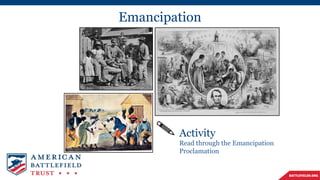
Emancipation:
the fact orprocess of being set free from legal, social,
or political restrictions; liberation
4.
The War SoFar
Activity
Watch 1862 In4
Video until 3 min 34 secon
ds.
5.
The First Discussion
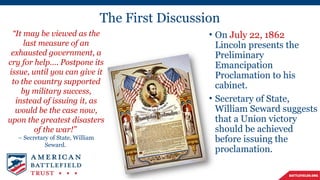
•On July 22, 1862
Lincoln presents the
Preliminary
Emancipation
Proclamation to his
cabinet.
• Secretary of State,
William Seward suggests
that a Union victory
should be achieved
before issuing the
proclamation.
“It may be viewed as the
last measure of an
exhausted government, a
cry for help…. Postpone its
issue, until you can give it
to the country supported
by military success,
instead of issuing it, as
would be the case now,
upon the greatest disasters
of the war!”
– Secretary of State, William
Seward.
6.
Pressure Builds
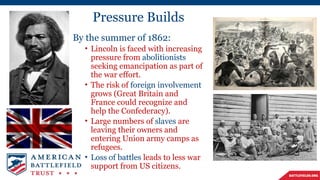
By thesummer of 1862:
• Lincoln is faced with increasing
pressure from abolitionists
seeking emancipation as part of
the war effort.
• The risk of foreign involvement
grows (Great Britain and
France could recognize and
help the Confederacy).
• Large numbers of slaves are
leaving their owners and
entering Union army camps as
refugees.
• Loss of battles leads to less war
support from US citizens.
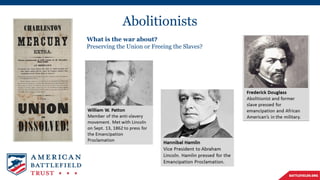
Abolitionists
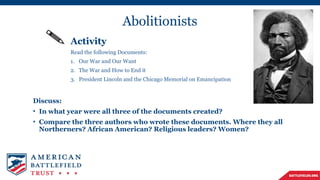
Activity
Read the followingDocuments:
1. Our War and Our Want
2. The War and How to End it
3. President Lincoln and the Chicago Memorial on Emancipation
Discuss:
• In what year were all three of the documents created?
• Compare the three authors who wrote these documents. Where they all
Northerners? African American? Religious leaders? Women?
9.
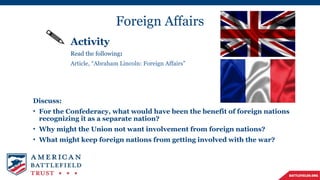
Foreign Affairs
Activity
Read thefollowing:
Article, “Abraham Lincoln: Foreign Affairs”
Discuss:
• For the Confederacy, what would have been the benefit of foreign nations
recognizing it as a separate nation?
• Why might the Union not want involvement from foreign nations?
• What might keep foreign nations from getting involved with the war?
10.
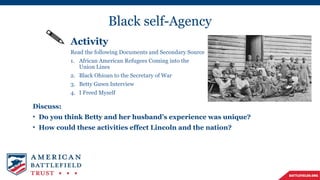
Black self-Agency
Activity
Read thefollowing Documents and Secondary Source
1. African American Refugees Coming into the
Union Lines
2. Black Ohioan to the Secretary of War
3. Betty Guwn Interview
4. I Freed Myself
Discuss:
• Do you think Betty and her husband’s experience was unique?
• How could these activities effect Lincoln and the nation?
11.
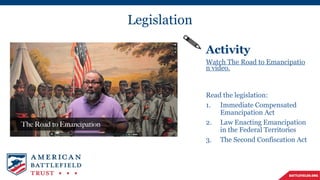
Legislation
Activity
Watch The Roadto Emancipatio
n video.
Read the legislation:
1. Immediate Compensated
Emancipation Act
2. Law Enacting Emancipation
in the Federal Territories
3. The Second Confiscation Act
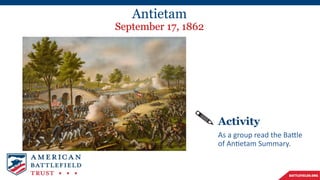
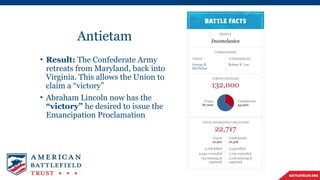
Antietam
• Result: TheConfederate Army
retreats from Maryland, back into
Virginia. This allows the Union to
claim a “victory”
• Abraham Lincoln now has the
“victory” he desired to issue the
Emancipation Proclamation
Emancipation Proclamation
“That onthe first day of January, in the year of our Lord one
thousand eight hundred and sixty-three, all persons held as
slaves within any State or designated part of a State,
the people whereof shall then be in rebellion against
the United States, shall be then, thenceforward, and
forever free; and the Executive Government of the United
States, including the military and naval authority thereof, will
recognize and maintain the freedom of such persons, and will do
no act or acts to repress such persons, or any of them, in any
efforts they may make for their actual freedom.”
- January 1, 1863; National Archives; Emancipation Proclamation
#2 Ask students to create a hypothesis of the answer to this question. Have students either discuss in groups their ideas or as a class. Ask students how they produced those hypothesis.
#4 Discussion Questions:
How did the Union feel as the summer of 1862 came to an end?
Robert E. Lee decided to do what exactly as a result of his victories in Virginia?
Why might public approval of a war be so important?
#5 Direct students to look at their timeline and see where the war is militarily in mid-July. Discuss with students why Seward would have this opinion
Sewards quote comes from Six Months in the White House by Francis Bicknell Carpenter, Hurd and Houghton, 1872. The “greatest disasters of the war” is in reference to McClellan’s failed Peninsula campaign.
#7 Discuss why do you think abolitionists were pushing for Emancipation during the Civil War?
#10 Here it is important to discuss the self-agency of the slaves, former slaves, and black population.
#14 Segment of the Emancipation Proclamation can be found on the next page
#17 Discuss with the students on whether their hypothesis were correct or not. Discuss what the students learned from their primary and secondary sources.