ELECTRO MAGNETIC
WAVES
Mrs.UMA KARPOORAM
P.G.T.Physics
Unit V: Electromagnetic waves 04 Periods
Chapter–8: Electromagnetic Waves
Basic idea of displacement current, Electromagnetic
waves, their characteristics, their transverse nature
(qualitative idea only).
Electromagnetic spectrum (radio waves, microwaves,
infrared, visible, ultraviolet, X-rays, gamma rays)
including elementary facts about their uses.
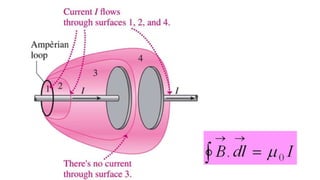
Ampere’s Circuital Law states the relationship
between the current and the magnetic field created
by it.
This law states that the integral of magnetic field
density (B) along an imaginary closed path is
equal to the product of current enclosed by the
path and permeability of the medium.
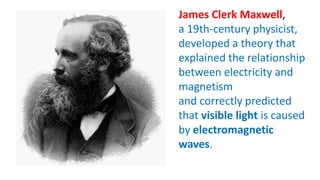
James Clerk Maxwell,
a 19th-century physicist,
developed a theory that
explained the relationship
between electricity and
magnetism
and correctly predicted
that visible light is caused
by electromagnetic
waves.
Inconsistency of Ampere’s
Circuital Law
Ampere’ Law is valid for steady currents only.
As the capacitor charges or discharges the current is
changing continuously.
According to Maxwell this inconsistency has arisen
because of our limited viewpoint about the current as
flow of electrons.
If we define current as that which produces magnetic
field , then we may say that the same current flows
every part of the circuit.
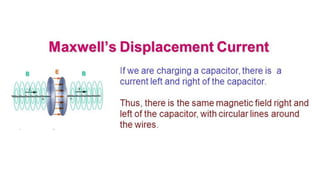
Maxwell corrected the Ampere's circuital law by
including displacement current. ...
Displacement current exists due to the change in
the electric field between the plates of the capacitor.
Conclusion:-Magnetic fields are produced both
by conduction currents and by time
varying fields.
DISPLACEMENT CURRENT
is that current which appears in
the region in which the electric
field ( and hence electric flux )
changing with time.
EM Waves -Part-1.pptx

EM Waves -Part-1.pptx

  • 1.
  • 3.
    Unit V: Electromagneticwaves 04 Periods Chapter–8: Electromagnetic Waves Basic idea of displacement current, Electromagnetic waves, their characteristics, their transverse nature (qualitative idea only). Electromagnetic spectrum (radio waves, microwaves, infrared, visible, ultraviolet, X-rays, gamma rays) including elementary facts about their uses.
  • 4.
    Ampere’s Circuital Lawstates the relationship between the current and the magnetic field created by it. This law states that the integral of magnetic field density (B) along an imaginary closed path is equal to the product of current enclosed by the path and permeability of the medium.
  • 7.
    James Clerk Maxwell, a19th-century physicist, developed a theory that explained the relationship between electricity and magnetism and correctly predicted that visible light is caused by electromagnetic waves.
  • 12.
    Inconsistency of Ampere’s CircuitalLaw Ampere’ Law is valid for steady currents only. As the capacitor charges or discharges the current is changing continuously. According to Maxwell this inconsistency has arisen because of our limited viewpoint about the current as flow of electrons. If we define current as that which produces magnetic field , then we may say that the same current flows every part of the circuit.
  • 14.
    Maxwell corrected theAmpere's circuital law by including displacement current. ... Displacement current exists due to the change in the electric field between the plates of the capacitor. Conclusion:-Magnetic fields are produced both by conduction currents and by time varying fields.
  • 17.
    DISPLACEMENT CURRENT is thatcurrent which appears in the region in which the electric field ( and hence electric flux ) changing with time.