ELM
|> Front end
|> Development
Digisensei
Helder Pinto
GH: @helderjnpinto / LI: linkedin.com/in/helderjnpinto || GH: @Digisensei
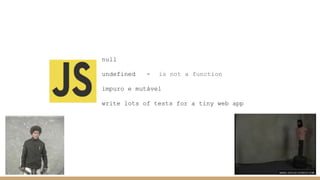
null
undefined - is not a function
impuro e mutável
write lots of tests for a tiny web app
elm
Elm
Elm is better ….
No null.
No runtime errors in practice.
No undefined is not a function.
The Compiler and Debugger is great!
http://debug.elm-lang.org/
elm
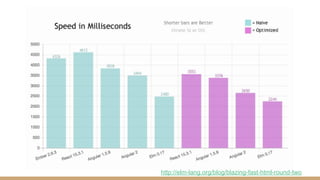
http://elm-lang.org/blog/blazing-fast-html-round-two
Elm
● Functional Language
● Haskell based
● Strongly typed
● Front end oriented
● Compiles to Js
● Very fast, Elm uses "Virtual-dom" combining Pure Functions and
Immutable data.
Elm
Main properties of the language:
● Strongly typed
● Pure Functions
● Immutable data
Elm
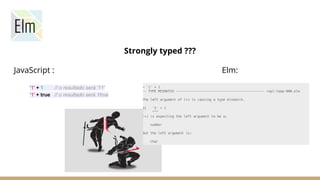
Strongly typed ???
JavaScript : Elm:
'1' + 1 // o resultado será '11'
'1' + true // o resultado será 1true
Elm
Principles
FP (Functional Programming)
Style of programming where you use PURE FUNCTIONS
Elm
Stateless / Pure functions
Return Value
based on Input parameters
and don’t cause side effects
Elm
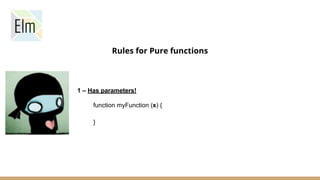
Rules for Pure functions
1 – Has parameters!
function myFunction (x) {
}
Elm
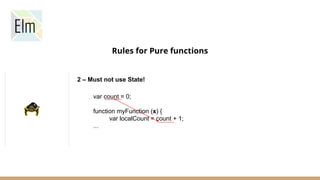
Rules for Pure functions
2 – Must not use State!
var count = 0;
function myFunction (x) {
var localCount = count + 1;
...
Elm
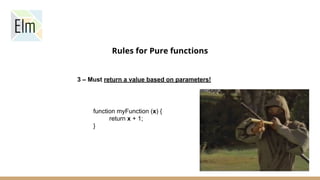
Rules for Pure functions
3 – Must return a value based on parameters!
function myFunction (x) {
return x + 1;
}
Elm
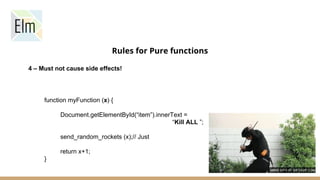
Rules for Pure functions
4 – Must not cause side effects!
function myFunction (x) {
Document.getElementById(“item”).innerText =
“Kill ALL ”;
send_random_rockets (x);// Just
return x+1;
}
Elm
Functional Programming Style
=/=
Functional Programming Language
Elm
Functional Programming Style
In JS Require
Self Discipline
JavaScript Doesn’t Care about FP
Elm
Functional Programming Language
Provides Functional Guarantees
it Forces you to:
write pure functions
use immutable data
Elm
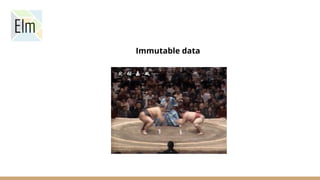
Immutable data
Elm
Immutable data
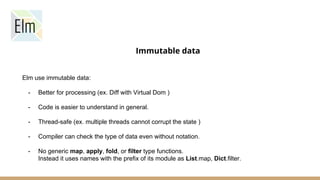
Elm use immutable data:
- Better for processing (ex. Diff with Virtual Dom )
- Code is easier to understand in general.
- Thread-safe (ex. multiple threads cannot corrupt the state )
- Compiler can check the type of data even without notation.
- No generic map, apply, fold, or filter type functions.
Instead it uses names with the prefix of its module as List.map, Dict.filter.
Elm
Type of data
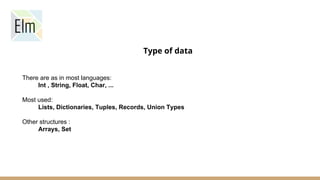
There are as in most languages:
Int , String, Float, Char, ...
Most used:
Lists, Dictionaries, Tuples, Records, Union Types
Other structures :
Arrays, Set
Elm
Functions
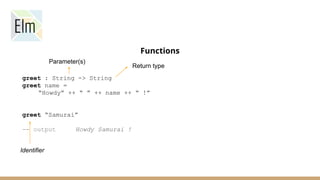
greet : String -> String
greet name =
“Howdy” ++ “ ” ++ name ++ “ !”
greet “Samurai”
-- output Howdy Samurai !
Identifier
Parameter(s)
Return type
Elm
Declarative
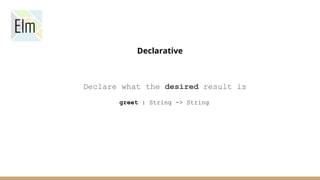
Declare what the desired result is
greet : String -> String
Elm
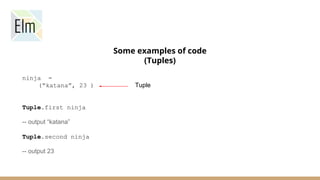
Some examples of code
(Tuples)
ninja =
(“katana”, 23 )
Tuple.first ninja
-- output “katana”
Tuple.second ninja
-- output 23
Tuple
Elm
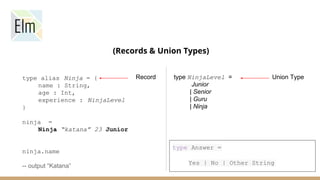
(Records & Union Types)
type alias Ninja = {
name : String,
age : Int,
experience : NinjaLevel
}
ninja =
Ninja “katana” 23 Junior
ninja.name
-- output “Katana”
Record type NinjaLevel =
Junior
| Senior
| Guru
| Ninja
Union Type
type Answer =
Yes | No | Other String
Elm
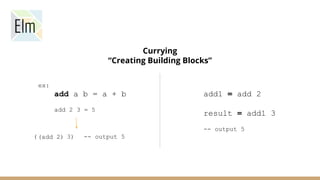
Currying
“Creating Building Blocks”
ex:
add a b = a + b
add 2 3 = 5
add1 = add 2
result = add1 3
-- output 5
( 3) -- output 5(add 2)
Elm
Pipe operator |> SUPER COMBO <| Currying
add a b =
a + b
isEven a =
a % 2 == 0
increment1 = add 1
[1,2,3,4,5]
|> List.map increment1
|> List.filter isEven
|> toString
-- output [2,4,6]
toString
<| List.filter isEven
<| List.map increment1
<| [1,2,3,4,5]
Elm
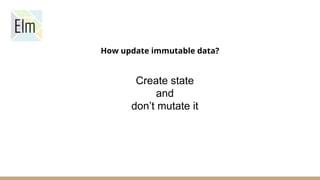
How update immutable data?
Create state
and
don’t mutate it
Elm
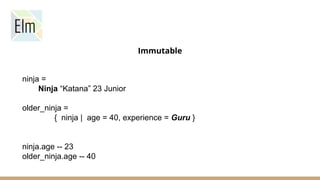
Immutable
ninja =
Ninja “Katana” 23 Junior
older_ninja =
{ ninja | age = 40, experience = Guru }
ninja.age -- 23
older_ninja.age -- 40
Elm
Null ~= Maybe a
type Maybe a
= Just a
Nothing
[ 1, 2, 3, 4 ]
|> List.head
|> toString
Elm
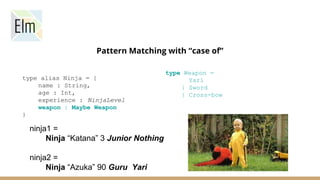
Pattern Matching with “case of”
type alias Ninja = {
name : String,
age : Int,
experience : NinjaLevel
weapon : Maybe Weapon
}
type Weapon =
Yari
| Sword
| Cross-bow
ninja1 =
Ninja “Katana” 3 Junior Nothing
ninja2 =
Ninja “Azuka” 90 Guru Yari
Elm
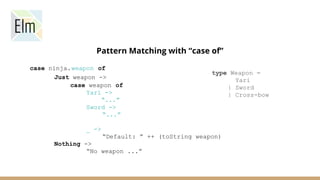
Pattern Matching with “case of”
case ninja.weapon of
Just weapon ->
case weapon of
Yari ->
“...”
Sword ->
“...”
_ ->
“Default: ” ++ (toString weapon)
Nothing ->
“No weapon ...”
type Weapon =
Yari
| Sword
| Cross-bow
Elm
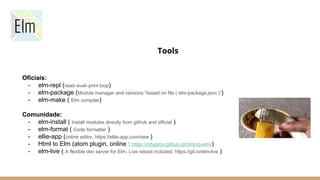
Tools
Oficiais:
- elm-repl (read–eval–print loop)
- elm-package (Module manager and versions “based on file ( elm-package.json )”)
- elm-make ( Elm compiler)
Comunidade:
- elm-install ( Install modules directly from github and official )
- elm-format ( Code formatter )
- ellie-app (online editor, https://ellie-app.com/new )
- Html to Elm (atom plugin, online : https://mbylstra.github.io/html-to-elm/)
- elm-live ( A flexible dev server for Elm. Live reload included. https://git.io/elm-live )
Elm
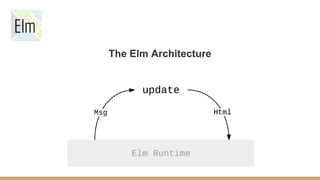
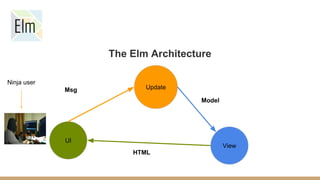
The Elm Architecture
Elm
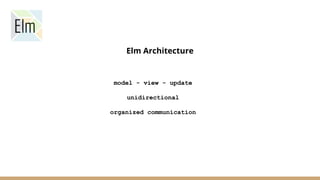
Elm Architecture
model - view - update
unidirectional
organized communication
Elm
Elm Architecture
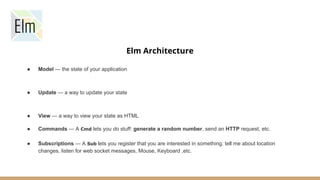
● Model — the state of your application
● Update — a way to update your state
● View — a way to view your state as HTML
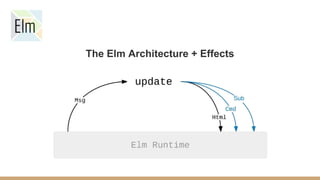
● Commands — A Cmd lets you do stuff: generate a random number, send an HTTP request, etc.
●
● Subscriptions — A Sub lets you register that you are interested in something: tell me about location
changes, listen for web socket messages, Mouse, Keyboard ,etc.
Elm
The Elm Architecture + Effects
Elm
The Elm Architecture
View
Update
UI
Model
Msg
HTML
Ninja user
Elm
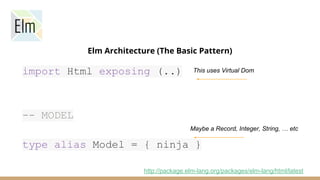
Elm Architecture (The Basic Pattern)
import Html exposing (..)
-- MODEL
type alias Model = { ninja }
http://package.elm-lang.org/packages/elm-lang/html/latest
This uses Virtual Dom
Maybe a Record, Integer, String, … etc
Elm
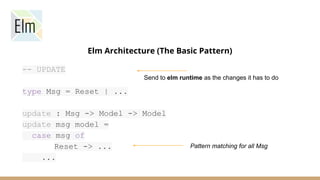
Elm Architecture (The Basic Pattern)
-- UPDATE
type Msg = Reset | ...
update : Msg -> Model -> Model
update msg model =
case msg of
Reset -> ...
...
Pattern matching for all Msg
Send to elm runtime as the changes it has to do
Elm
Elm Architecture (The Basic Pattern)
-- VIEW
view : Model -> Html Msg
view model =
div [ id “divNinja”, class “ninja-name”, onClick Reset ]
[
text (model.ninja).name
]
...
List of Html.Attributes
List of child elements
Elm
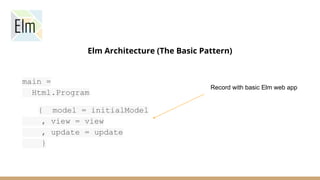
Elm Architecture (The Basic Pattern)
main =
Html.Program
{ model = initialModel
, view = view
, update = update
}
Record with basic Elm web app
Elm
JavaScript Interop
Elm can talk to JS, using PORTS.
Works like a client and server “websockets”.
Elm listen to changes in JavaScript subscription port and
vice versa.
Elm
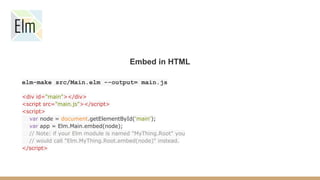
Embed in HTML
elm-make src/Main.elm --output= main.js
<div id="main"></div>
<script src="main.js"></script>
<script>
var node = document.getElementById('main');
var app = Elm.Main.embed(node);
// Note: if your Elm module is named "MyThing.Root" you
// would call "Elm.MyThing.Root.embed(node)" instead.
</script>
Elm
Demo
Web chat with phoenix framework.

Elm dev front-end

  • 1.
    ELM |> Front end |>Development Digisensei Helder Pinto GH: @helderjnpinto / LI: linkedin.com/in/helderjnpinto || GH: @Digisensei
  • 4.
    null undefined - isnot a function impuro e mutável write lots of tests for a tiny web app
  • 5.
  • 6.
    Elm Elm is better…. No null. No runtime errors in practice. No undefined is not a function. The Compiler and Debugger is great! http://debug.elm-lang.org/
  • 7.
  • 8.
    Elm ● Functional Language ●Haskell based ● Strongly typed ● Front end oriented ● Compiles to Js ● Very fast, Elm uses "Virtual-dom" combining Pure Functions and Immutable data.
  • 9.
    Elm Main properties ofthe language: ● Strongly typed ● Pure Functions ● Immutable data
  • 10.
    Elm Strongly typed ??? JavaScript: Elm: '1' + 1 // o resultado será '11' '1' + true // o resultado será 1true
  • 11.
    Elm Principles FP (Functional Programming) Styleof programming where you use PURE FUNCTIONS
  • 12.
    Elm Stateless / Purefunctions Return Value based on Input parameters and don’t cause side effects
  • 13.
    Elm Rules for Purefunctions 1 – Has parameters! function myFunction (x) { }
  • 14.
    Elm Rules for Purefunctions 2 – Must not use State! var count = 0; function myFunction (x) { var localCount = count + 1; ...
  • 15.
    Elm Rules for Purefunctions 3 – Must return a value based on parameters! function myFunction (x) { return x + 1; }
  • 16.
    Elm Rules for Purefunctions 4 – Must not cause side effects! function myFunction (x) { Document.getElementById(“item”).innerText = “Kill ALL ”; send_random_rockets (x);// Just return x+1; }
  • 17.
  • 18.
    Elm Functional Programming Style InJS Require Self Discipline JavaScript Doesn’t Care about FP
  • 19.
    Elm Functional Programming Language ProvidesFunctional Guarantees it Forces you to: write pure functions use immutable data
  • 20.
  • 21.
    Elm Immutable data Elm useimmutable data: - Better for processing (ex. Diff with Virtual Dom ) - Code is easier to understand in general. - Thread-safe (ex. multiple threads cannot corrupt the state ) - Compiler can check the type of data even without notation. - No generic map, apply, fold, or filter type functions. Instead it uses names with the prefix of its module as List.map, Dict.filter.
  • 22.
    Elm Type of data Thereare as in most languages: Int , String, Float, Char, ... Most used: Lists, Dictionaries, Tuples, Records, Union Types Other structures : Arrays, Set
  • 23.
    Elm Functions greet : String-> String greet name = “Howdy” ++ “ ” ++ name ++ “ !” greet “Samurai” -- output Howdy Samurai ! Identifier Parameter(s) Return type
  • 24.
    Elm Declarative Declare what thedesired result is greet : String -> String
  • 25.
    Elm Some examples ofcode (Tuples) ninja = (“katana”, 23 ) Tuple.first ninja -- output “katana” Tuple.second ninja -- output 23 Tuple
  • 26.
    Elm (Records & UnionTypes) type alias Ninja = { name : String, age : Int, experience : NinjaLevel } ninja = Ninja “katana” 23 Junior ninja.name -- output “Katana” Record type NinjaLevel = Junior | Senior | Guru | Ninja Union Type type Answer = Yes | No | Other String
  • 27.
    Elm Currying “Creating Building Blocks” ex: adda b = a + b add 2 3 = 5 add1 = add 2 result = add1 3 -- output 5 ( 3) -- output 5(add 2)
  • 28.
    Elm Pipe operator |>SUPER COMBO <| Currying add a b = a + b isEven a = a % 2 == 0 increment1 = add 1 [1,2,3,4,5] |> List.map increment1 |> List.filter isEven |> toString -- output [2,4,6] toString <| List.filter isEven <| List.map increment1 <| [1,2,3,4,5]
  • 29.
    Elm How update immutabledata? Create state and don’t mutate it
  • 30.
    Elm Immutable ninja = Ninja “Katana”23 Junior older_ninja = { ninja | age = 40, experience = Guru } ninja.age -- 23 older_ninja.age -- 40
  • 31.
    Elm Null ~= Maybea type Maybe a = Just a Nothing [ 1, 2, 3, 4 ] |> List.head |> toString
  • 32.
    Elm Pattern Matching with“case of” type alias Ninja = { name : String, age : Int, experience : NinjaLevel weapon : Maybe Weapon } type Weapon = Yari | Sword | Cross-bow ninja1 = Ninja “Katana” 3 Junior Nothing ninja2 = Ninja “Azuka” 90 Guru Yari
  • 33.
    Elm Pattern Matching with“case of” case ninja.weapon of Just weapon -> case weapon of Yari -> “...” Sword -> “...” _ -> “Default: ” ++ (toString weapon) Nothing -> “No weapon ...” type Weapon = Yari | Sword | Cross-bow
  • 34.
    Elm Tools Oficiais: - elm-repl (read–eval–printloop) - elm-package (Module manager and versions “based on file ( elm-package.json )”) - elm-make ( Elm compiler) Comunidade: - elm-install ( Install modules directly from github and official ) - elm-format ( Code formatter ) - ellie-app (online editor, https://ellie-app.com/new ) - Html to Elm (atom plugin, online : https://mbylstra.github.io/html-to-elm/) - elm-live ( A flexible dev server for Elm. Live reload included. https://git.io/elm-live )
  • 35.
  • 36.
    Elm Elm Architecture model -view - update unidirectional organized communication
  • 37.
    Elm Elm Architecture ● Model— the state of your application ● Update — a way to update your state ● View — a way to view your state as HTML ● Commands — A Cmd lets you do stuff: generate a random number, send an HTTP request, etc. ● ● Subscriptions — A Sub lets you register that you are interested in something: tell me about location changes, listen for web socket messages, Mouse, Keyboard ,etc.
  • 38.
  • 39.
  • 40.
    Elm Elm Architecture (TheBasic Pattern) import Html exposing (..) -- MODEL type alias Model = { ninja } http://package.elm-lang.org/packages/elm-lang/html/latest This uses Virtual Dom Maybe a Record, Integer, String, … etc
  • 41.
    Elm Elm Architecture (TheBasic Pattern) -- UPDATE type Msg = Reset | ... update : Msg -> Model -> Model update msg model = case msg of Reset -> ... ... Pattern matching for all Msg Send to elm runtime as the changes it has to do
  • 42.
    Elm Elm Architecture (TheBasic Pattern) -- VIEW view : Model -> Html Msg view model = div [ id “divNinja”, class “ninja-name”, onClick Reset ] [ text (model.ninja).name ] ... List of Html.Attributes List of child elements
  • 43.
    Elm Elm Architecture (TheBasic Pattern) main = Html.Program { model = initialModel , view = view , update = update } Record with basic Elm web app
  • 44.
    Elm JavaScript Interop Elm cantalk to JS, using PORTS. Works like a client and server “websockets”. Elm listen to changes in JavaScript subscription port and vice versa.
  • 45.
    Elm Embed in HTML elm-makesrc/Main.elm --output= main.js <div id="main"></div> <script src="main.js"></script> <script> var node = document.getElementById('main'); var app = Elm.Main.embed(node); // Note: if your Elm module is named "MyThing.Root" you // would call "Elm.MyThing.Root.embed(node)" instead. </script>
  • 46.
    Elm Demo Web chat withphoenix framework.