What is anelevator pitch?
An elevator pitch, also known as an elevator speech, is an opportunity to share
a quick summary of yourself and your product offerings. But a pitch can also
be your chance at making a real connection that you can use later down the
road. It’s not always an immediate benefit, but you should be prepared for any
scenario in which you could be giving an elevator pitch.
In reality, most people have given an elevator pitch whether they realize it or
not. That’s because there are many different types of pitches—from interviews
to new business opportunities. That makes preparing for your next pitch an
important step in marketing both yourself and your company.
When it comes to figuring out who to deliver your pitch to, you should aim for
the best point of contact, not just the highest point of contact. Choosing
connections that are related to or interested in what you’re offering will give
you a better chance at making your sale.
2.
How long shouldan elevator pitch be?
One of the biggest unknowns about creating sample elevator
pitches is how long they should be. In most cases, it will depend
on what it’s about and who you’re pitching. A good rule
of business etiquette is to make it as short as possible by
carefully selecting the most important points.
A study conducted by Microsoft found that the average person
has an attention span of around eight seconds, meaning you’ll
have to fight for that undivided attention. That’s no small task.
So when it comes to a great elevator pitch, aim to keep it
around 30 seconds—though the exact length can vary
depending on your industry and what you’re pitching.
4.
Use our elevatorpitch template to start constructing your speech by
adding statistics and personalized greetings where needed. This
template incorporates the four parts explained above to hit all of the
important details of a good elevator pitch.
•Introduction: “Hi I’m [name], a [position title] at [company name]. It’s
great to meet you!”
•Problem: “Since you work with [company name or industry] I figured
you’d be interested to know that [problem + interesting statistic].”
•Solution: “The great part about working at [your company’s name] is
that we’ve been able to fix just that problem by [solution].”
•Value proposition: “In fact, we’re the only company that offers [value
proposition].”
•CTA: “I think our solution could really help you. Are you available this
week to speak further on this?”
8.
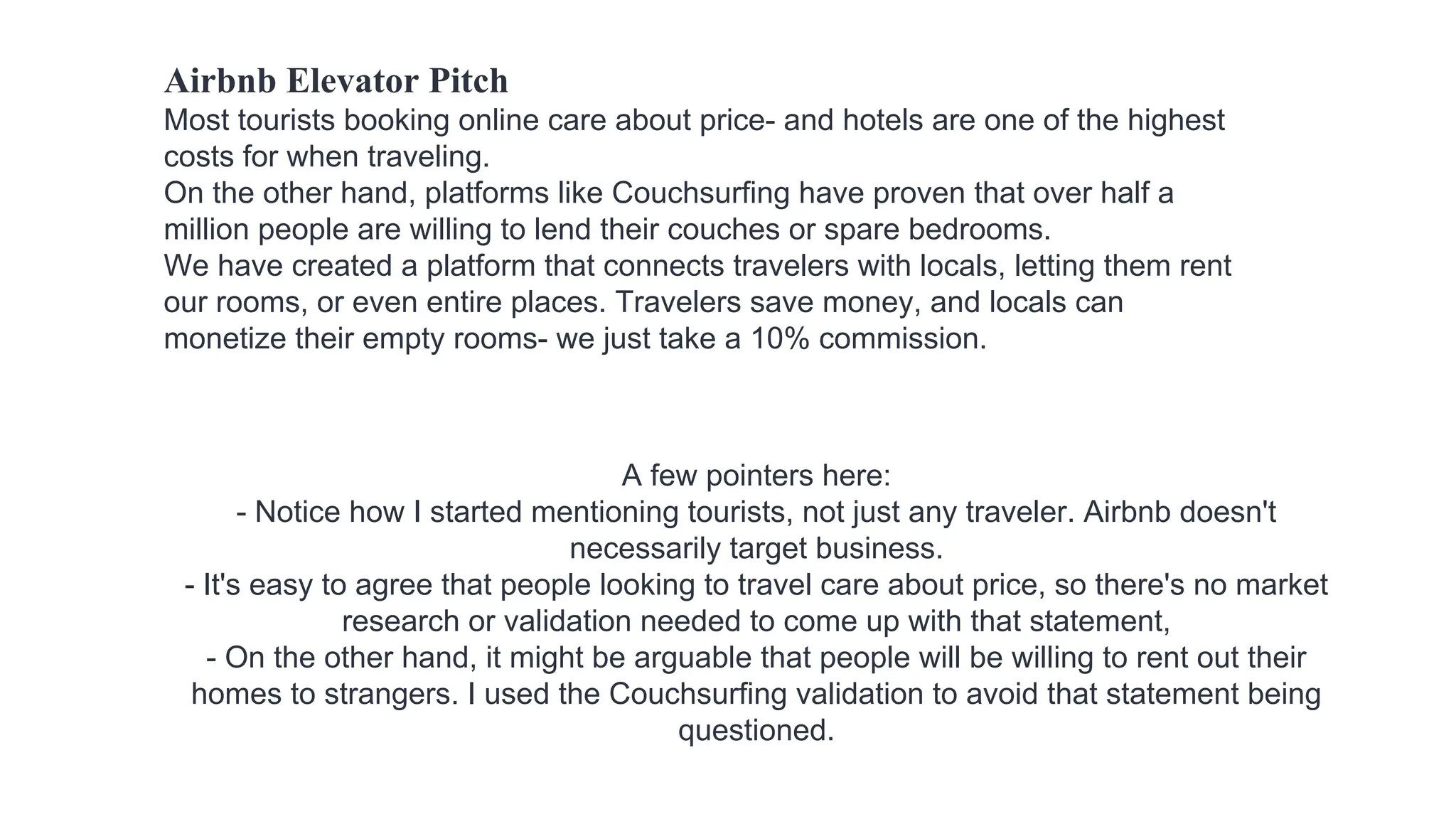
Airbnb Elevator Pitch
Mosttourists booking online care about price- and hotels are one of the highest
costs for when traveling.
On the other hand, platforms like Couchsurfing have proven that over half a
million people are willing to lend their couches or spare bedrooms.
We have created a platform that connects travelers with locals, letting them rent
our rooms, or even entire places. Travelers save money, and locals can
monetize their empty rooms- we just take a 10% commission.
A few pointers here:
- Notice how I started mentioning tourists, not just any traveler. Airbnb doesn't
necessarily target business.
- It's easy to agree that people looking to travel care about price, so there's no market
research or validation needed to come up with that statement,
- On the other hand, it might be arguable that people will be willing to rent out their
homes to strangers. I used the Couchsurfing validation to avoid that statement being
questioned.
9.
Here's a brilliantpitch for Tesla by Elon Musk, which is a good reference for how an
elevator pitch should be drafted. This is slightly longer than the usual pitch, but still a
great example:
10.
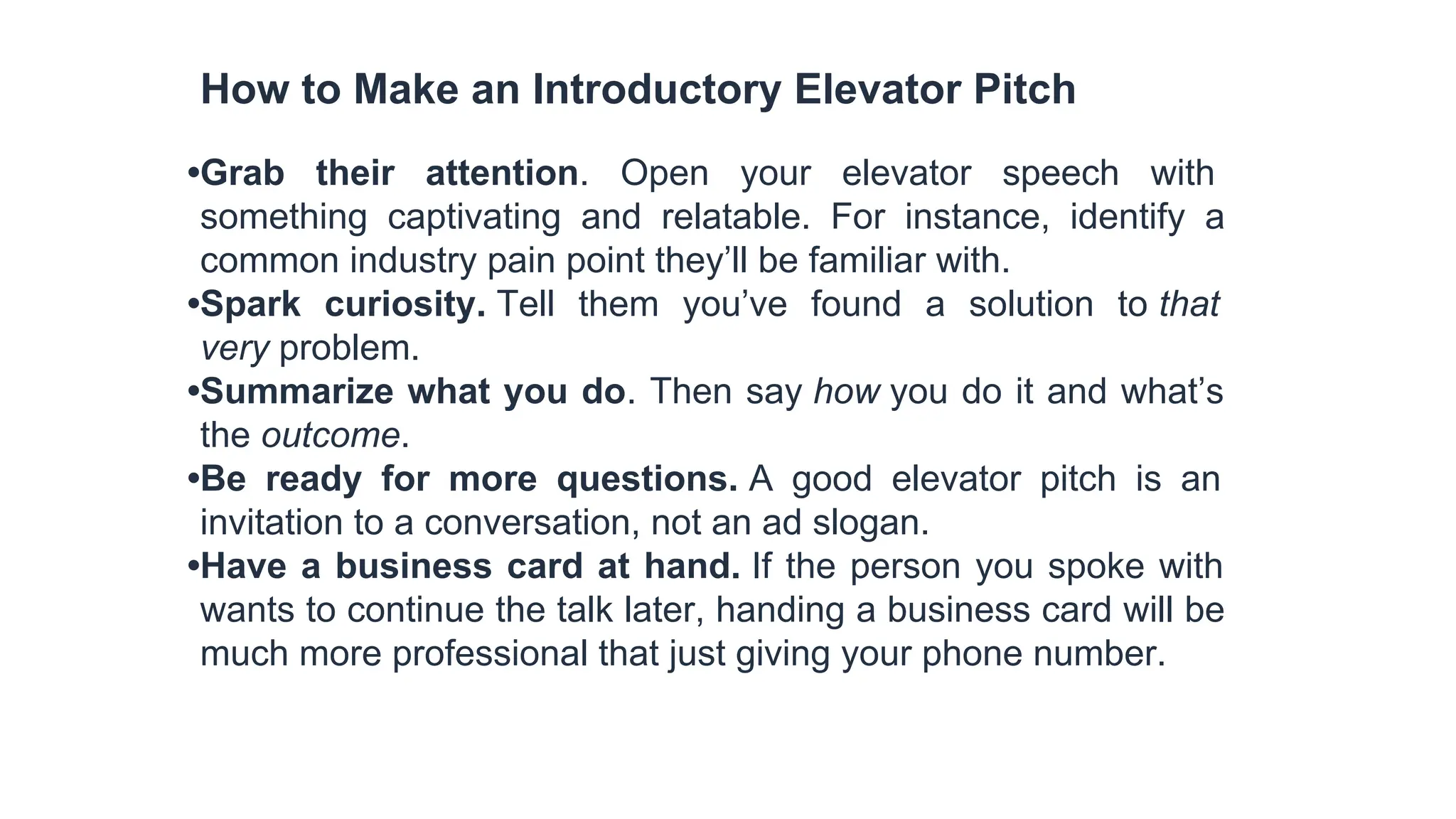
How to Makean Introductory Elevator Pitch
•Grab their attention. Open your elevator speech with
something captivating and relatable. For instance, identify a
common industry pain point they’ll be familiar with.
•Spark curiosity. Tell them you’ve found a solution to that
very problem.
•Summarize what you do. Then say how you do it and what’s
the outcome.
•Be ready for more questions. A good elevator pitch is an
invitation to a conversation, not an ad slogan.
•Have a business card at hand. If the person you spoke with
wants to continue the talk later, handing a business card will be
much more professional that just giving your phone number.
12.
5 Tips fora Killer Elevator Pitch
•Grab attention. What can you say that will instantly grab the attention of venture capitalists or potential clients?
•Keep it simple. A good elevator pitch should cover only the most important points.
•Think in terms of problems and solutions. What issues is your target market dealing with? How does your
business idea solve these problems?
•Engage. Try to connect with the audience and its issues.
•Talk to your exact target audience. Who are your potential customers or investors? Different audiences have
different needs.
5 Mistakes to Avoid When Writing a Short Pitch
•Don’t ramble or provide too much information. Remember, an effective elevator pitch is short.
•Avoid jargon and technical language. A good pitch is simple enough for anyone to understand.
•Don’t give too much away. Provide key information, but only say enough to get your audience wanting more.
•Don’t sound stiff or overly practiced. A good pitch requires good communication skills.
•Don’t be too pushy. No one likes to feel pressured or as if they’re dealing with an aggressive sales rep.


![Use our elevator pitch template to start constructing your speech by
adding statistics and personalized greetings where needed. This
template incorporates the four parts explained above to hit all of the
important details of a good elevator pitch.
•Introduction: “Hi I’m [name], a [position title] at [company name]. It’s
great to meet you!”
•Problem: “Since you work with [company name or industry] I figured
you’d be interested to know that [problem + interesting statistic].”
•Solution: “The great part about working at [your company’s name] is
that we’ve been able to fix just that problem by [solution].”
•Value proposition: “In fact, we’re the only company that offers [value
proposition].”
•CTA: “I think our solution could really help you. Are you available this
week to speak further on this?”](https://image.slidesharecdn.com/2elevatorpitch-251108192819-ba13d580/75/elevator-pitch-is-there-to-pitch-investors-4-2048.jpg)