Strategies for Strengthening Housing Markets in Ypsilanti + Ypsilanti Township
Urban Planning + Regional Planning Program
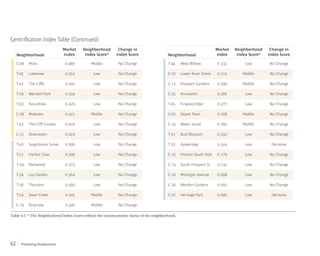
Taubman College of Architecture + Urban Planning
University of Michigan
April 2015
AUTHORS
Danielle Jacobs
Carolyn Lusch
Gregg May
Katie Moss
Douglas Plowman
Charles Tso
David VanDeusen
Brad Vogelsmeier
Nan Yu
Advisors:
Eric Dueweke
Dr. Richard Norton
University of Michigan Engaging Community
through the Classroom (MECC)
TheprojectElevateispartoftheUniversityofMichigan’s
multi-unit initiative, Michigan Engaging Community
through the Classroom (MECC). The goal of MECC is
to leverage ongoing community-oriented professional
undergraduate and graduate courses that are offered
routinely at UM by coordinating a selection of those
courses on a given locality and set of related problems.
The initiative also seeks to simultaneously improve the
learningopportunitiesforthestudentsinvolvedandthe
outreachserviceprovidedtothecommunitiesinvolved.
Acknowledgments
The students and faculty at Taubman College of
Architecture and Urban Planning would like to thank our
client and stakeholders who made this project possible.
Client
Washtenaw County Office of Community and Economic
Development (OCED)
Mary Jo Callan
Teresa Gillotti
Brett Lenart
Stephen Wade
Participating MECC University of Michigan Units
College of Engineering
School of Public Health
Urban and Regional Planning Program, Taubman College
of Architecture + Urban Planning
All photos were taken by the contributors unless otherwise sourced
09
17
27
57
67
97
122
06
125
Chapter 1
Chapter 2
Chapter 3
Chapter 4
Chapter 5
Chapter 6
Foundation
Neighborhood Market Types
Housing Market Strength
Preventing Displacement
Push / Pull Factors
Recommendations
Conclusion
Executive Summary
Appendices
Executive Summary6
EXECUTIVE SUMMARY
ELEVATE: Strategies for Strengthening Housing
Markets in Ypsilanti and Ypsilanti Township is a
capstone project created by Master of Urban Planning
students at the University of Michigan. Elevate builds
off a recent report, the Housing Affordability and
Economic Equity Analysis created by the consulting
firm czb, which confirms that Washtenaw County has
a divergent housing market with stark contrasts in
affordability and equity.
Our report has one overarching goal: to promote and
maintain thriving, mixed-income neighborhoods in
the city of Ypsilanti and Ypsilanti Township. To reach
that goal, the report provides recommendations
to attract middle-income residents to the city of
Ypsilanti and Ypsilanti Township while minimizing
displacement of residents.
Neighborhood Market Strength
This report classifies all neighborhoods into three
market strength types: hot, warm, and cool. We use
neighborhood boundaries as our unit of analysis
to closely reflect the realities of housing market
variation throughout the jurisdictions.
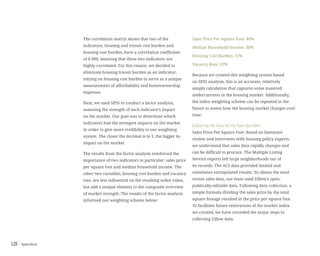
We calculated market strengths using four indicators:
(1) Sales Price per Square Foot, (2) Median Household
Income, (3) Housing Cost Burden, and (4) Vacancy
rate. These indicators were combined into an index,
which was then broken into hot, warm, and cool
market types.
Rentals
Ypsilanti and Ypsilanti Township have a high
percentage of renters due to the student population
and significant economic changes following the Great
Recession. We reviewed the rental market through a
separate analysis from the market strength. We found
a small correlation between high renter concentration
and cool market neighborhoods.
Neighborhood Profiles
To show the variation within a single market type,
we created six individual neighborhood portraits.
These portraits review a city and township
neighborhood for each market type. Portraits show
the neighborhood’s performance on each of the four
indicators and demonstrate the variability between
neighborhoods in the same market type.
Gentrification and Displacement
We also address strategies for mitigating
displacement, an implicit challenge when
encouraging neighborhood investment. Because
gentrification is often a precursor to displacement,
we measured gentrification levels in the city of
Ypsilanti and Ypsilanti Township using a previous
study of gentrification in Chicago. The measure uses
the change in demographic variables over time to
evaluate neighborhood investment. Results of this
index showed that no neighborhoods in the city or
township are gentrifying in 2015, but that one in
the city and one in the township are vulnerable to
gentrification.
7
Regional Benchmarks
In an effort to recognize the regional nature of
the economy, we compare the city and township
to nearby cities that house the greatest number of
Ypsilanti and Ypsilanti Township employees, and
nearby cities that employ the greatest number of
Ypsilanti and Ypsilanti Township residents. The
comparison shows that Ypsilanti Township in
particular is regionally competitive for attracting
middle-income residents. The city of Ypsilanti is in a
good position to compete with other jurisdictions with
small improvements in market strength.
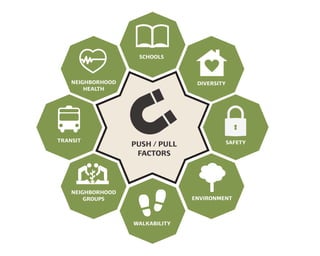
Push/Pull Factors
Based on stakeholder feedback regarding factors
that may attract middle-income residents, we
reviewed how schools, diversity, safety, environment,
walkability, neighborhood groups, and transit vary
across hot, warm, and cool market types. These
factors influenced our final recommendations.
Recommendations
We find that the city of Ypsilanti and Ypsilanti
Township are in a position to compete for middle-
income families. Based on the analysis of market
strengths, push/pull factors, stakeholder interviews,
and case studies, this report recommends a variety
of short, medium, and long-term strategies to attract
middle-income residents to the city of Ypsilanti and
Ypsilanti Township while preventing displacement.
We make recommendations for each of the pull/push
factors, as well as for displacement and local and state
policy. Many of these recommendations pertain to
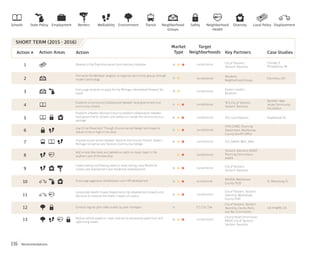
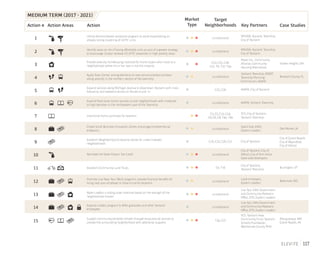
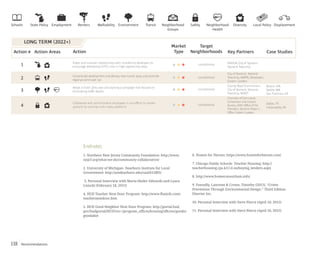
specific neighborhoods. Included is a sample of short,
medium, and long-term recommendations. A full
table of these recommendations can be found on page
116.
Short Term (2015-2016)
_Create a Realtor Advisory Group to establish
collaboration between local governments, schools,
and realtors to market the community as a package
_Reduce vehicle speed on major arterials by
decreasing speed limits and right-sizing streets
Medium Term (2017-2021)
_Business Innovation Zones, encourage
entrepreneurial endeavors in the city
_Establish Community Land Trust organizations
Long Term (2022+)
_Foster and maintain relationships with multifamily
developers to encourage developing LIHTC units in
high-opportunity areas
These recommendations are a starting point for
future collaboration between various stakeholders in
Washtenaw County. We hope this report will be used
to help balance the housing market, and promote
health and equity for all residents.
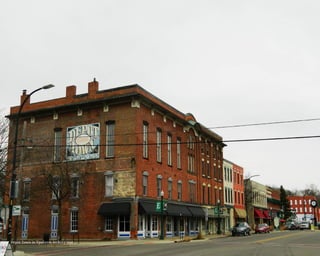
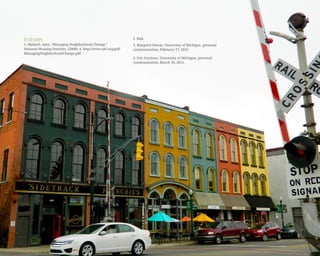
Depot Town in Ypsilanti, looking east.
1CHAPTER
FOUNDATION
Goals
Report Overview
City of Ypsilanti and Ypsilanti
Township History
Foundation10
Washtenaw County is growing, but the benefits
of growth are not finding their way to the city
of Ypsilanti and Ypsilanti Township. Desirable
neighborhoods in Ann Arbor are becoming more
expensive, but residents are not looking to Ypsilanti
for housing options. This report provides a rich
analysis of the various forces impacting the housing
market, as well as strategies to strengthen the markets
and elevate Ypsilanti as a desirable option for middle-
income families.
In 2014, Washtenaw County, Michigan commissioned
the consulting firm czb to conduct a study of
housing affordability throughout the county. A key
finding from this study, published in the Housing
Affordability and Economic Equity - Analysis report,
was that Washtenaw County has a divergent housing
market with stark contrasts in affordability and
equity. Despite a relatively healthy housing market
overall, the study identified two distinct submarkets:
a fundamentally weak housing market in the city
of Ypsilanti and Ypsilanti Township, and a stronger
housing market in Ann Arbor. The report found that
the city of Ypsilanti and Ypsilanti Township can no
longer function as the “de facto affordable housing
policy” for the county without risking further decline.1
Furthermore, disproportionate numbers of subsidized
housing units, low rents, and lower housing values
FOUNDATION
The goal of this report is to
provide Washtenaw County
with recommendations to
promote and maintain thriving,
mixed-income neighborhoods
in the city of Ypsilanti and
Ypsilanti Township.
must be addressed before the economic stability
of the entire county becomes compromised. In
response, the Housing Affordability report urged Ann
Arbor to increase its supply of affordable housing
and encouraged the city of Ypsilanti and Ypsilanti
Township to focus on creating demand for working,
college-educated, middle-income households.
Implementing these strategies requires identifying
housing submarkets within the city of Ypsilanti and
Ypsilanti Township and directing recommendations to
each market type.
The following report was prepared by a team of
urban planning students as part of a capstone course
at the University of Michigan Taubman College of
Architecture and Urban Planning. Planning students
worked in conjunction with the Washtenaw County
Office of Economic Development (OCED) for guidance.
Goals
Given the potential of a continually weakening
housing market in the city of Ypsilanti and
Ypsilanti Township, the goal of this report is to
equip Washtenaw County with recommendations
to promote and maintain thriving, mixed-income
neighborhoods in the city of Ypsilanti and Ypsilanti
Township.
11
Accordingly, this report provides:
_Recommendations for attracting middle-income
residents to the city of Ypsilanti and Ypsilanti
Township
_Strategies for minimizing displacement of existing
residents
Report Overview
The following chapters elaborate on our methodology,
analysis, and final recommendations.
Chapter 2 discusses the methodology used to create
our three market types, including neighborhood
boundaries, market type indicators, and the
calculation of the market strength scores for each
neighborhood. Chapter 3 displays the analysis of
our market indicators in each of the neighborhoods.
This chapter also highlights several selected
neighborhoods from each market type, makes
comparisons to benchmark cities from the region, and
explains our analysis of the rental market. Chapter
4 describes our methods of measuring gentrification
and analyzes current levels of gentrification on
a neighborhood and city level. Chapter 5 details
push and pull factors, such as transit and safety,
which influence neighborhoods. Chapter 6 provides
recommendations for our neighborhood market types
organized by the push and pull factors.
City of Ypsilanti and Ypsilanti Township
The remainder of Chapter 1 introduces our study
area. Historical context is important to understand
how housing markets formed and the current
influences that shape the existing market today.
Our study area includes both the city of Ypsilanti
an Ypsilanti Township. Appropriate strategies
and recommendations account for the differences
between these jurisdictions.
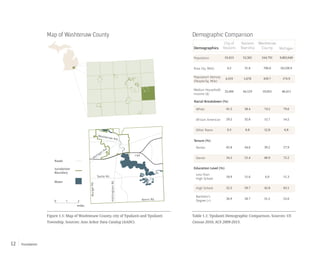
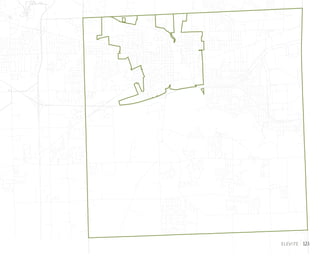
The city of Ypsilanti and Ypsilanti Township, shown
in Figure 1.1, are located in the southeastern portion
of Washtenaw County. These areas, while close in
proximity, differ demographically, economically,
and spatially. Table 1.1 shows key demographic
information about the city of Ypsilanti and Ypsilanti
Township.
Foundation12
Map of Washtenaw County Demographic Comparison
Figure 1.1: Map of Washtenaw County, city of Ypsilanti and Ypsilanti
Township. Sources: Ann Arbor Data Catalog (AADC).
Table 1.1: Ypsilanti Demographic Comparison. Sources: US
Census 2010, ACS 2009-2013.
Demographics
City of
Ypsilanti
Ypsilanti
Township
Washtenaw
County Michigan
19,453 53,362 344,791 9,883,640Population
Area (Sq. Mile) 4.5 31.8 706.0 56,538.9
Population Density
(People/Sq. Mile)
4,319 1,678 439.7 174.9
Median Household
Income ($)
33,406 44,129 59,055 48,411
Racial Breakdown (%)
White
African American
Other Races
Tenure (%)
Renter
Owner
Education Level (%)
Less than
High School
High School
Bachelor’s
Degree (+)
61.5 58.4 74.5 79.0
29.2 32.8 12.7 14.2
9.3 8.8 12.8 6.8
65.8 44.6 39.2 27.9
34.2 55.4 60.9 72.2
10.9 11.6 6.0 11.3
52.2 59.7 42.8 63.1
36.9 28.7 51.2 25.6
HitchinghamRd.
I-94
Washtenaw Ave.
Michigan Ave.
MungerRd.
Water
miles
Jurisdiction
Boundary
Roads
Textile Rd.
Bemis Rd.
0 1 2
13
The city of Ypsilanti has had several major
institutions, including Eastern Michigan University
(EMU), Ford Motor Company, and formerly the
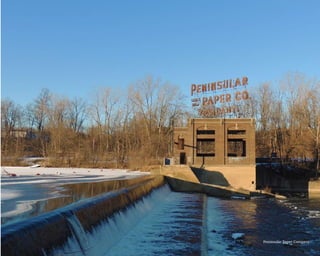
Peninsular Paper Company, which helped shape the
growth of the city’s neighborhoods. EMU opened in
1849 as the Michigan State Normal School, and is a
public university with nearly 20,000 students. EMU is
both a major employer and an important destination
for many residents.
In its formative years, the city was famous for
its mineral water, a valuable resource for paper
production. The Peninsular Paper Company operated
a plant on North Huron Drive from 1856 to 2001,
using this mineral water for its paper production.
Another key employment institution was Ford Motor
Company, which opened a major industrial plant in
1932 on Factory Street. These institutions contributed
to in-migration to Ypsilanti and shaped the growth of
Ypsilanti’s neighborhoods.2
In 1941, the Ford Motor Company acquired land in
Ypsilanti Township that later became the Willow
Run Bomber Plant, designed for mass production of
military aircraft. This industrial complex employed
over 42,000 people and spurred economic growth.3
This economic boom led to the construction of
Willow Run Village, a large residential complex and
commercial facility designed to house workers and
their families.4
The inflow and outflow of employers
and their employees has had significant impacts on
the health and vitality of neighborhoods in the city
and township.
Ypsilanti is home to numerous historically African-
American communities. The origins of several
African-American neighborhoods can be traced to
Ypsilanti’s key involvement in the Underground
Railroad. Some examples of these neighborhoods
can be seen around Emmet and Ballard, Depot Town,
Oakwood and Washtenaw, and the corner of Buffalo
and South Adams.5
Although the city once functioned as a center for
automotive production and manufacturing, Ypsilanti
has not maintained the same level of economic
vitality since the post-war era. Since 2001, Ypsilanti
has lost nearly 1,600 manufacturing jobs.6
This
economic shift caused both a reduction in real and
personal property tax revenue and an increase in
vacant or under-utilized industrial space.
Foundation14
Endnotes
1. Czb, Housing Affordability and Economic Equity – Analysis.
Prepared for the Office of Community and Economic Develop-
ment (2015): 4.
2. Baker, Mary Wallace. The Second Fifty Years, Fairfield, Barba-
ra A. The Last Fifty Years, and Thomas N. Tobias. The History of
Ypsilanti: 150 Years. Ypsilanti, MI: Sesquicentennial Committee,
1973. Print.
3. Ibid
4. Ibid
5. Siegfried, Matthew. “South Adams Street @ 1900.” South Ad-
ams Street 1900. Eastern Michigan University’s Historic Preserva-
tion Program, n.d. March 17, 2015.
6. City of Ypsilanti (2013). Shape Ypsilanti, Draft Plan:2. Re-
trieved from http://shapeypsi.com/assets/ShapeYpsiDraftMaster-
Plan-Aug-1.pdf
7. City of Ypsilanti (2010). Non-motorized Transportation Plan:7.
Retrieved from http://cityofypsilanti.com/Portals/0/docs/Plan-
ning/NonMotorizedPlan/FINAL_ADOPTED.pdf
“Young singles or couples are
moving to the area, typically
working for a local major
employer or in the “Maker” or
“Craft” worlds.”
Tyler Weston
Local Realtor
Spatially, the city of Ypsilanti and Ypsilanti Township
differ in several ways. The city of Ypsilanti’s land
use was shaped before the creation of automobiles,
resulting in a dense grid-style network of roadways
that are pedestrian friendly.7
The urban landscape
and small size clustered the city’s housing around
its major institutions. In contrast, Ypsilanti
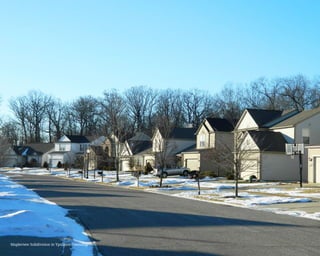
Township is predominately rural and suburban.
Township residents require an automobile to reach
most destinations. Individual subdivisions create
neighborhoods with little connection to one another
besides jurisdictional boundaries. These subdivisions
provide owners with larger lot sizes and access to
newer housing stock.
The historical and spatial differences between the city
and township make designing recommendations and
strategies challenging. The city maintains a strong
urban environment with many desirable amenities
including greater access to transit, proximity to public
parks, and walkable neighborhoods with dense
housing. The township has larger homes and lots,
and is close to amenities in Ypsilanti and Ann Arbor.
To develop recommendations that fit the city and
township we must understand the housing markets
in each environment through the analysis outlined in
Chapter 2.
Peninsular Paper Company
Foundation16Mapleview Subdivision in Ypsilanti Township
2CHAPTER
NEIGHBORHOOD
MARKET TYPES
Neighborhood Boundary
Identification
Market Type Indicator Selection
Market Strength Score Calculation
Neighborhood Market Types18
The Housing Affordability report categorized the
majority of housing markets in the city of Ypsilanti
and Ypsilanti Township as ‘very weak’ or ‘weak’
with few exceptions. To accomplish the goals stated
in Chapter 1, further research was required to
comprehend the nuances across housing markets
within the city and the township. Recommendations
that promote and maintain thriving, mixed-income
neighborhoods require a strong understanding of
the housing market.1
As the Housing Affordability
report indicates, housing markets vary significantly
across a city and over time. Neighborhood housing
markets tend to fall along a continuum, with stronger
neighborhood markets associated with higher
demand and prices.
To address the variety of opportunities and challenges
across the city and township, it is important
to analyze the housing markets in particular
neighborhoods. Ypsilanti has diverse housing market
types that require distinct recommendations. Creating
simple market type categories for city and township
neighborhoods, allows us to make recommendations
for each neighborhood market type that apply to most
or all neighborhoods within that category. Through
familiarity with neighborhood housing markets,
residents and public officials can work to lead change,
rather than react to it.
NEIGHBORHOOD MARKET TYPES
“It is difficult to develop an
effective strategy either to
move the housing market or
mitigate its effects unless one
understands the neighborhood’s
market conditions and
dynamics.”
Alan Mallach
National Housing Institute
To provide strategies and recommendations that
correspond with current market conditions of the city
of Ypsilanti and Ypsilanti Township, we characterized
three distinct market types: hot, warm, and cool.
This delineation of market types represents a key
component of our methodology because it provided
the framework for developing appropriate, targeted
recommendations. In order to classify the city of
Ypsilanti and Ypsilanti Township into three distinct
market types, we completed the following four steps:
_Identified neighborhood boundaries
_Chose four market-type indicators
_Calculated a market strength score for each
neighborhood
_Classified all neighborhoods into one of three
market types: hot, warm, or cool
Neighborhood Boundary Identification
Quality neighborhoods are an important component
of successful urban areas. Local residents understand
their community better than anyone, which is
why changes should be tailored and respectful to
existing boundaries. Information gathered at the
neighborhood level offers a current snapshot of the
dynamics of each community.
19
We defined the neighborhood boundaries so that
we could later assign each neighborhood into a hot,
warm, or cool market type. These boundaries were
based on neighborhood associations, neighborhood
watches, certain demographic characteristics, and
feedback from local stakeholders. The boundaries
may not reflect all residents’ experiences with their
neighborhoods, but they provide a starting point
for analysis. For more details on the division of
neighborhood boundaries, see Appendix A.
Using a neighborhood as our unit of analysis is
important for several reasons:
_Creates a manageable scale for our
recommendations
_Provides a current snapshot of the area’s strengths
and weaknesses
_Enables recommendations to be implemented at a
small scale
Alan Mallach, a housing, economic development,
and urban revitalization expert notes, “It is difficult
to develop an effective strategy either to move the
housing market or mitigate its effects unless one
understands the neighborhood’s market conditions
and dynamics. Without that information, many
neighborhood strategies are little more than
guesswork. In contrast, an understanding of the
area’s market features can help practitioners and
policymakers to craft informed decisions about goals
and strategies for guiding neighborhood change.”2
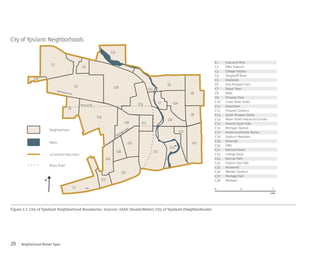
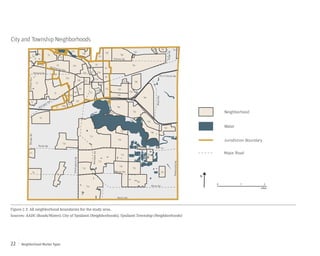
See Figures 2.1-2.3 for the map of neighborhood
boundaries. These neighborhood boundaries can be
used for future analysis of the city of Ypsilanti and
Ypsilanti Township.
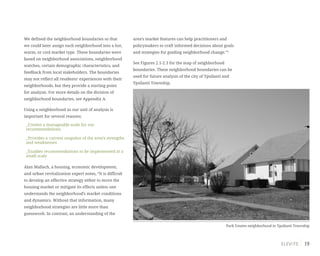
Park Estates neighborhood in Ypsilanti Township
Neighborhood Market Types20
City of Ypsilanti Neighborhoods
0 .5 1
mile
Neighborhood
Water
Jurisdiction Boundary
Major Road
C1
C2
C3
C4
C5
C6
C7
C8
C9
C10
C11
C12
C13
C14
C15
C16
C17
C18
C19
C20
C21
C22
C23
C24
C25
C26
C27
C28
Industrial Park
EMU Stadium
College Heights
Gerganoff Road
Estabrook
East Prospect Park
Depot Town
Miles
Prospect Park
Lower River Street
Downtown
Prospect Gardens
South Prospect Street
Water Street Industrial Corridor
Historic South Side
Michigan Avenue
Forest Knoll/Arbor Manor
Stadium Meadows
Riverside
EMU
Railroad Street
Leforge Road
Normal Park
Historic East Side
Ainsworth
Worden Gardens
Heritage Park
MidtownN
I-94
Washtenaw Ave.
Holmes Rd.
Packard Rd.
Michigan Ave.
Packard Rd.
Michigan Ave.
C3
C2
C20
C23
C1
C6
C9
C15
C14
C19
C27
C22
C5
C12
C8
C24C7
C25
C28
C10
C4
C16
C26
C11
C21
C13
C17
C18
Figure 2.1: City of Ypsilanti Neighborhood Boundaries. Sources: AADC (Roads/Water), City of Ypsilanti (Neighborhoods)
21
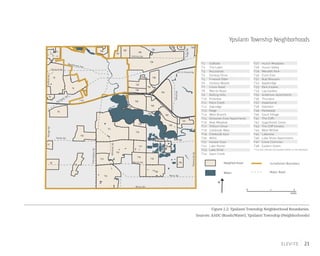
Ypsilanti Township Neighborhoods
Merritt Rd.
Martz Rd.
Bemis Rd.
WhittakerRd.
HitchinghamRd.
RawsonvilleRd.
Textile Rd.
I-94
Washtenaw Ave.
Holmes Rd.
US-12 Ecorse Rd.
RidgeRd.
Packard Rd.
Michigan Ave.
WiardRd.
MungerRd.GolfsideRd.
0 1 2
miles
Neighborhood
Water
Jurisdiction Boundary
Major Road
T1 Golfside
T2 The Lawn
T3 Roundtree
T4 Fairway Drive
T5 Firwood Elder
T6 Hickory Woods
T7 Crane Road
T8 Merritt Road
T9 Rolling Hills
T10 Pineview
T11 Paint Creek
T12 Oakridge
T13 Paige
T14 West Branch
T15 Schooner Cove Apartments
T16 New Meadow
T17 Trillium Drive
T18 Creekside West
T19 Creekside East
T20 Willis
T21 Harbor Cove
T22 Lake Pointe
T23 Lake Drive
T24 Swan Creek
T27 Huron Meadows
T28 Huron Valley
T29 Wendell Park
T30 Clark East
T31 Bud Blossom
T32 Appleridge
T33 Park Estates
T34 Lay Garden
T35 Anderson Apartments
T36 Thurston
T37 Hawthorne
T38 Oaklawn
T39 Parkwood
T40 Gault Village
T41 The Cliffs
T42 Sugarbrook Grove
T43 The Cliff Condos
T44 West Willow
T45 Lakeview
T46 Lake Shore Apartments
T47 Grove Common
T48 Eastern Green
N
T2
T11
T34
T12
T4
T14
T6
T44
T16
T8
T1
T9
T40
T18
T29
T10
T20
T42
T13
T46
T17
T45
T19
T37
T36
T28
T7
T47
T38
T23
T3
T39
T48
T27
T24
T15
T5
T41
T32 T33
T35
T31
T21
T43
T30
T22
* T25 and T26 are non-market districts in the Township
Figure 2.2: Ypsilanti Township Neighborhood Boundaries.
Sources: AADC (Roads/Water), Ypsilanti Township (Neighborhoods)
Neighborhood Market Types22
City and Township Neighborhoods
Figure 2.3: All neighborhood boundaries for the study area.
Sources: AADC (Roads/Water), City of Ypsilanti (Neighborhoods), Ypsilanti Township (Neighborhoods)
Merritt Rd.
Martz Rd.
Bemis Rd.
WhittakerRd.
HitchinghamRd.
RawsonvilleRd.
Textile Rd.
I-94
Washtenaw Ave.
Holmes Rd.
US-12 Ecorse Rd.
RidgeRd.
Packard Rd.
Michigan Ave.
WiardRd.
MungerRd.GolfsideRd.
0 1 2
miles
Neighborhood
Water
Jurisdiction Boundary
Major Road
N
C3
C2
C20
C23
C1
C6
C9
C15
C14
C19
C27
C22
C5
C12
C8
C24C7
C25
C28 C10
C4
C16
C26
C11
C21
C13
C17
C18
T2
T11
T34
T12
T4
T14
T6
T44
T16
T8
T1
T9
T40
T18
T29
T10
T20
T42
T13
T46
T17
T45
T19
T37
T36
T28
T7
T47
T38
T23
T3
T39
T48
T27
T24
T15
T5
T41
T32 T33
T35
T31
T21
T43
T30
T22
23
Market-Type Indicator Selection
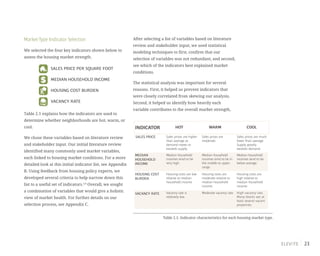
We selected the four key indicators shown below to
assess the housing market strength.
Table 2.1 explains how the indicators are used to
determine whether neighborhoods are hot, warm, or
cool.
We chose these variables based on literature review
and stakeholder input. Our initial literature review
identified many commonly used market variables,
each linked to housing market conditions. For a more
detailed look at this initial indicator list, see Appendix
B. Using feedback from housing policy experts, we
developed several criteria to help narrow down this
list to a useful set of indicators.3,4
Overall, we sought
a combination of variables that would give a holistic
view of market health. For further details on our
selection process, see Appendix C.
SALES PRICE PER SQUARE FOOT
INDICATORS INDEX WEIGHT
HOUSING COST BURDEN
MEDIAN HOUSEHOLD INCOME
VACANCY RATE
40%
30%
15%
15%
After selecting a list of variables based on literature
review and stakeholder input, we used statistical
modeling techniques to first, confirm that our
selection of variables was not redundant, and second,
see which of the indicators best explained market
conditions.
The statistical analysis was important for several
reasons. First, it helped us prevent indicators that
were closely correlated from skewing our analysis.
Second, it helped us identify how heavily each
variable contributes to the overall market strength,
INDICATOR HOT WARM COOL
SALES PRICE
MEDIAN
HOUSEHOLD
INCOME
HOUSING COST
BURDEN
VACANCY RATE
Sales prices are higher
than average as
demand meets or
exceeds supply.
Sales prices are
moderate.
Sales prices are much
lower than average.
Supply greatly
exceeds demand.
Median household
incomes tend to be
very high.
Median household
incomes tend to be in
the middle to upper
range.
Median household
incomes tend to be
below average.
Housing costs are
high relative to
median household
income.
Housing costs are
moderate relative to
median household
income.
Housing costs are low
relative to median
household income.
Vacancy rate is
relatively low.
Moderate vacancy rate. High vacancy rate.
Many blocks see at
least several vacant
properties.
Table 2.1: Indicator characteristics for each housing market type.
Neighborhood Market Types24
informing our index weighting system described
below. For a more thorough description of how
statistical analysis informed our indicator selection,
see Appendix C.
Market Strength Score Calculation
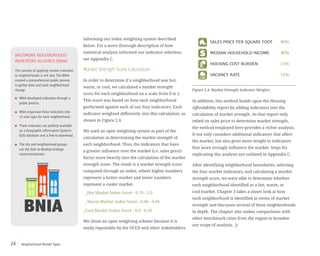
In order to determine if a neighborhood was hot,
warm, or cool, we calculated a market strength
score for each neighborhood on a scale from 0 to 1.
This score was based on how each neighborhood
performed against each of our four indicators. Each
indicator weighted differently into this calculation, as
shown in Figure 2.4.
We used an open weighting system as part of the
calculation in determining the market strength of
each neighborhood. Thus, the indicators that have
a greater influence over the market (i.e. sales price)
factor more heavily into the calculation of the market
strength score. The result is a market strength score
computed through an index, where higher numbers
represent a hotter market and lower numbers
represent a cooler market.
_Hot Market Index Score - 0.70 - 1.0
_Warm Market Index Score - 0.40 - 0.69
_Cool Market Index Score - 0.0 - 0.39
We chose an open weighting scheme because it is
easily repeatable by the OCED and other stakeholders.
In addition, this method builds upon the Housing
Affordability report by adding indicators into the
calculation of market strength. As that report only
relied on sales price to determine market strength,
the method employed here provides a richer analysis.
It not only considers additional indicators that affect
the market, but also gives more weight to indicators
that more strongly influence the market. Steps for
replicating this analysis are outlined in Appendix C.
After identifying neighborhood boundaries, selecting
the four market indicators, and calculating a market
strength score, we were able to determine whether
each neighborhood identified as a hot, warm, or
cool market. Chapter 3 takes a closer look at how
each neighborhood is identified in terms of market
strength and discusses several of these neighborhoods
in depth. The chapter also makes comparisons with
other benchmark cities from the region to broaden
our scope of analysis.
SALES PRICE PER SQUARE FOOT
INDICATORS INDEX WEIGHT
HOUSING COST BURDEN
MEDIAN HOUSEHOLD INCOME
VACANCY RATE
40%
30%
15%
15%
SALES PRICE PER SQUARE FOOT
INDICATORS INDEX WEIGHT
HOUSING COST BURDEN
MEDIAN HOUSEHOLD INCOME
VACANCY RATE
40%
30%
15%
15%
BALTIMORE NEIGHBORHOOD
INDICATORS ALLIANCE (BNIA)
The concept of applying market indicators
to neighborhoods is not new.The BNIA
created a comprehensive public process
to gather data and track neighborhood
change.
BNIA developed indicators through a
public process.
BNIA organized these indicators into
12 vital signs for each neighborhood.
These indicators are publicly available
on a Geographic Information Systems
(GIS) database and is free to download.
The city and neighborhood groups
use the data to develop strategic
recommendations.
Figure 2.4: Market Strength Indicator Weights
25
Endnotes
1. Mallach, Alan. “Managing Neighborhood Change.”
National Housing Institute, (2008): 4. http://www.nhi.org/pdf/
ManagingNeighborhoodChange.pdf
2. Ibid.
3. Margaret Dewar, University of Michigan. personal
communication, February 17, 2015.
4. Eric Seymour, University of Michigan. personal
communication, March 16, 2015.
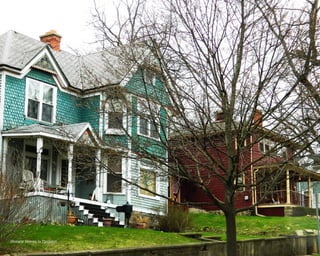
Historic Homes in Ypsilanti
3CHAPTER
HOUSING MARKET
STRENGTH
Overall Trends
Sales Price Per Square Foot
Median Household Income
Housing Cost Burden
Vacancy Rate
Rental Market
Neighborhood Portraits
Regional Comparison
The overall market strength score of each city and township
neighborhood reflects the combined strengths of the four
indicators – (1) Sales Price per Square Foot, (2) Median
Household Income, (3) Housing Cost Burden, and (4)
Vacancy Rate. Based on their total score, each neighborhood
was categorized into one of three market types: hot, warm,
or cool. These market types allow us to compare market
strengths in city and township neighborhoods, but are not
intended to determine the “livability” of a place or if one
neighborhood is better than another. This chapter will
review our findings of overall market strength and analyze
the variation among the four distinct indicators.
Housing Market Strength28
Market Trends
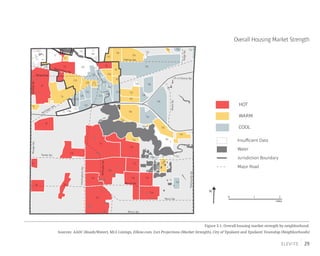
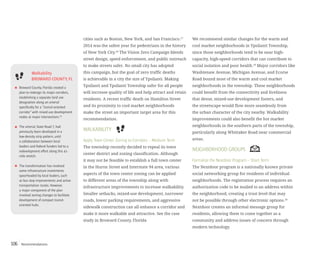
Figure 3.1 shows that the overall housing market is
generally stronger in the township than in the city.
Specifically, 15 out of 48 township neighborhoods
(31%) are in hot market neighborhoods whereas three
out of 28 city neighborhoods (11%) are in hot market
neighborhoods.
Most of the township’s hot market neighborhoods are
concentrated in the southern part of the township.
Most warm market neighborhoods are in the
northeastern part of the township and adjacent to
Ford Lake. Hot township neighborhoods generally
border major roads and have good access to the
highways and other auto-oriented destinations.
There are only three hot market neighborhoods in the
city: Estabrook (C5), Prospect Park (C9), and College
Heights (C3). Estabrook and College Heights are
both located near the city’s western border between
Washtenaw Avenue and Michigan Avenue. These two
city neighborhoods are smaller than the hot market
neighborhoods in the township and have different
housing and design characteristics. These differences
shows that hot markets do not necessarily correlate
with suburban neighborhoods and large lot sizes.
Urban and historic neighborhoods in the city can do
well in the housing market as demonstrated by the
Prospect Park neighborhood.
HOUSING MARKET STRENGTH
“Ypsilanti has a lot of interesting
neighborhoods and beautiful
housing stock. Right now
people can get a good house for
affordable prices, it’s got a lot of
exciting things.”
Wendy Carty-Saxon
Avalon Housing
Warm market neighborhoods are scattered
throughout the study area. In the city, warm market
neighborhoods are located north of Michigan Avenue
on the western and eastern borders. In the township,
most warm market neighborhoods are located on the
north side of Ford Lake. The warm markets are mostly
urban environments with single-family homes and
neighborhood amenities such as parks.
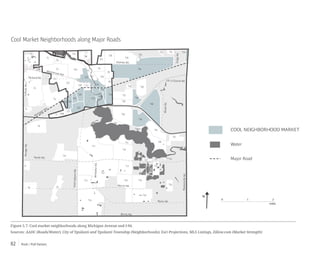
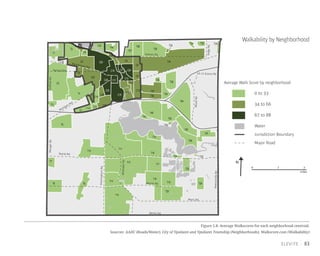
The cool market neighborhoods are concentrated in
the city south of Michigan Avenue and in the western
part of the township. At first glance, the city appears
to have more cool market neighborhoods than the
township, though in actual numbers, the city has
11 cool market neighborhoods and the township
has 10. This demonstrates that the level of market
strength is more polarized in the township with many
hot market neighborhoods and many cool market
neighborhoods. Cool market neighborhoods generally
border the highways and tend to be located between
Michigan Avenue and I-94. These high-speed and
auto-centric roads isolate neighborhoods and hinder
movement and access to opportunities for those
who do not own a car. The correlation between cool
market neighborhoods and major roads implies that
transportation policy and infrastructure may have a
significant impact on the local housing market.
29
Overall Housing Market Strength
Figure 3.1: Overall housing market strength by neighborhood.
Sources: AADC (Roads/Water), MLS Listings, Zillow.com, Esri Projections (Market Strength), City of Ypsilanti and Ypsilanti Township (Neighborhoods)
Merritt Rd.
Martz Rd.
Bemis Rd.
WhittakerRd.
HitchinghamRd.
RawsonvilleRd.
Textile Rd.
I-94
Washtenaw Ave.
Holmes Rd.
US-12 Ecorse Rd.
RidgeRd.
Packard Rd.
Michigan Ave.
WiardRd.
MungerRd.GolfsideRd.
0 1 2
miles
Water
Jurisdiction Boundary
Major Road
Insufficient Data
HOT
COOL
WARM
N
C3
C2
C20
C23
C1
C6
C9
C15
C14
C19
C27
C22
C5
C12
C8
C24C7
C25
C28 C10
C4
C16
C26
C11
C21
C13
C17
C18
T2
T11
T34
T12
T4
T14
T6
T44
T16
T8
T1
T9
T40
T18
T29
T10
T20
T42
T13
T46
T17
T45
T19
T37
T36
T28
T7
T47
T38
T23
T3
T39
T48
T27
T24
T15
T5
T41
T32 T33
T35
T31
T21
T43
T30
T22
Housing Market Strength30
Proximity to major roads does not explain all of
the cool market neighborhoods. Other cool market
neighborhoods in the township include Harbor Cove
(T21), Swan Creek (T24), Appleridge (T32), and Park
Estates (T33), which mainly consist of manufactured
homes, separated from other neighborhoods. On
the other hand, the city has a pocket of cool market
neighborhoods both in and around Depot Town.
Despite Depot Town’s positive image, its for-sale
housing market is fairly weak. There are not many
owner-occupied units in the neighborhood and
sales price per square foot is lower than other
neighborhoods in the study area.
Although each neighborhood is classified as hot,
warm, or cool overall, the strength of the indicators
often vary within each market type. In other words,
two hot neighborhoods may be hot for different
reasons, based on the strength of each of the four
indicators. So, while each neighborhood is given
an overall classification of hot, warm, or cool, each
indicator that makes up this classification is also
hot, warm, or cool, depending on the neighborhood.
In the following sections, we describe each of these
indicators and how they vary across market types.
Sales Price per Square Foot (40%)
The indicator sales price per square foot is the
absolute home price. This metric was identified
during our stakeholder outreach as the most
important market indicator and as such received the
greatest value (40%) in our weighting scheme. Sales
price per square foot has a positive relationship with
the neighborhood market types, meaning hot market
neighborhoods have higher sales prices. We obtained
sales price and square footage data from Zillow.com
and Multiple Listing Services.
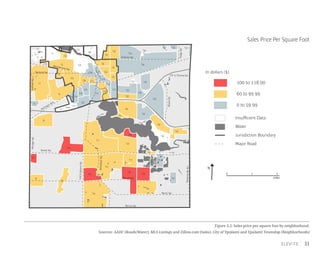
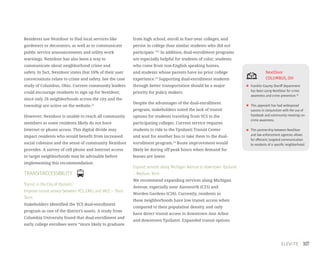
Figure 3.2 shows higher sales prices in the township
than in the city. A neighborhood with a sales price
between $100 and $118 per square foot is classified as
high. In general, there are more high and moderate
priced neighborhoods in the township and more
low priced neighborhoods in the city. Using price
per square foot accounts for variation in house size.
Therefore, while homes are larger in hot market
neighborhoods in the township, these homes are
also selling at higher prices than other neighborhood
markets. There are no neighborhoods in the city with
high sales price per square foot.
31
Figure 3.2: Sales price per square foot by neighborhood.
Sources: AADC (Roads/Water), MLS Listings and Zillow.com (Sales), City of Ypsilanti and Ypsilanti Township (Neighborhoods)
Sales Price Per Square Foot
Merritt Rd.
Martz Rd.
Bemis Rd.
WhittakerRd.
HitchinghamRd.
RawsonvilleRd.
Textile Rd.
I-94
Washtenaw Ave.
Holmes Rd.
US-12 Ecorse Rd.
RidgeRd.
Packard Rd.
Michigan Ave.
WiardRd.
MungerRd.GolfsideRd.
0 1 2
miles
In dollars ($)
Water
Jurisdiction Boundary
Major Road
Insufficient Data
100 to 118.00
0 to 59.99
60 to 99.99
N
C3
C2
C20
C23
C1
C6
C9
C15
C14
C19
C27
C22
C5
C12
C8
C24C7
C25
C28 C10
C4
C16
C26
C11
C21
C13
C17
C18
T2
T11
T34
T12
T4
T14
T6
T44
T16
T8
T1
T9
T40
T18
T29
T10
T20
T42
T13
T46
T17
T45
T19
T37
T36
T28
T7
T47
T38
T23
T3
T39
T48
T27
T24
T15
T5
T41
T32 T33
T35
T31
T21
T43
T30
T22
Housing Market Strength32
Neighborhoods with high sales prices are the most
frequent across the study area, present in both the
city and township. Moderately priced neighborhoods
average between $60 and $99 per square foot.
In general these neighborhoods are widespread
throughout the southern and western parts of the
township and north of Michigan Avenue in the city.
Neighborhoods with a low sales price per square
foot are located primarily in the city and the east
side of the township. These neighborhoods have
sales prices between $0 and $59.99, and are located
mostly south of Michigan Avenue and east of the city
in the township. Several of these neighborhoods are
predominantly manufactured housing developments,
such as Lake Drive (T23), Swan Creek (T24), and Park
Estates (T33).
Median Household Income (30%)
Median household income impacts a household’s
ability to acquire a mortgage or make home repairs,
making it a strong indicator of market strength. This
quantitative indicator can be calculated through
American Community Survey (ACS) data. Based on
stakeholder feedback, median household income is
the second-best predictor of overall market strength
and is, therefore, 30% of our weighting scheme.
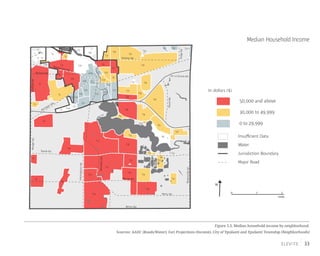
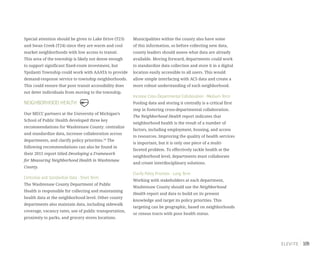
Figure 3.3 shows the distribution of median
household income. There are many neighborhoods
with high median household income in our
study area. The majority of the higher income
neighborhoods are in the southern areas of the
township and western part of the city. We defined
a median household income of at least $50,000 as
high. The maps show that neighborhoods with higher
median household income also have high sales price
per square foot. Twenty one neighborhoods classify as
high median income neighborhoods.
Neighborhoods with moderate median household
income are concentrated in the eastern parts of the
township. These are neighborhoods where median
household income is between $30,000 and $49,999,
totaling 25 neighborhoods.
Neighborhoods with low median household income
are almost exclusively in the city, south of Michigan
Avenue and in the majority student markets close
to EMU. These are neighborhoods where median
household income is below $30,000. Only 13
neighborhoods fall into this category.
33
Median Household Income
Figure 3.3: Median household income by neighborhood.
Sources: AADC (Roads/Water), Esri Projections (Income), City of Ypsilanti and Ypsilanti Township (Neighborhoods)
Merritt Rd.
Martz Rd.
Bemis Rd.
WhittakerRd.
HitchinghamRd.
RawsonvilleRd.
Textile Rd.
I-94
Washtenaw Ave.
Holmes Rd.
US-12 Ecorse Rd.
RidgeRd.
Packard Rd.
Michigan Ave.
WiardRd.
MungerRd.GolfsideRd.
0 1 2
miles
N
C3
C2
C20
C23
C1
C6
C9
C15
C14
C19
C27
C22
C5
C12
C8
C24C7
C25
C28 C10
C4
C16
C26
C11
C21
C13
C17
C18
T2
T11
T34
T12
T4
T14
T6
T44
T16
T8
T1
T9
T40
T18
T29
T10
T20
T42
T13
T46
T17
T45
T19
T37
T36
T28
T7
T47
T38
T23
T3
T39
T48
T27
T24
T15
T5
T41
T32 T33
T35
T31
T21
T43
T30
T22
In dollars ($)
Water
Jurisdiction Boundary
Major Road
Insufficient Data
50,000 and above
0 to 29,999
30,000 to 49,999
Housing Market Strength34
Housing Cost Burden (15%)
Housing cost burden measures the cost of housing
relative to household income. Higher housing cost
burdens are associated with weaker markets under
the assumption that residents will be less able to
afford, food, clothing, transportation, and other
necessities. Housing cost burden is calculated using
a combination of data from ACS and Esri Business
Analyst. Some cities include transportation costs into
housing cost burden to calculate a complete picture
of living costs in a given location. However, after
calculating housing cost burden using transportation
costs, we found little difference and opted to remove
transportation costs. Housing cost burden is a factor
in our study area, but is not the top indicator of
market strength. We assigned housing cost burden a
lower weight in our index of 15%.
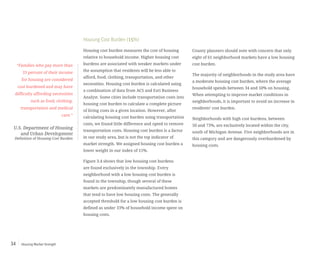
Figure 3.4 shows that low housing cost burdens
are found exclusively in the township. Every
neighborhood with a low housing cost burden is
found in the township, though several of these
markets are predominately manufactured homes
that tend to have low housing costs. The generally
accepted threshold for a low housing cost burden is
defined as under 33% of household income spent on
housing costs.
County planners should note with concern that only
eight of 61 neighborhood markets have a low housing
cost burden.
The majority of neighborhoods in the study area have
a moderate housing cost burden, where the average
household spends between 34 and 50% on housing.
When attempting to improve market conditions in
neighborhoods, it is important to avoid an increase in
residents’ cost burden.
Neighborhoods with high cost burdens, between
50 and 73%, are exclusively located within the city,
south of Michigan Avenue. Five neighborhoods are in
this category and are dangerously overburdened by
housing costs.
“Families who pay more than
33 percent of their income
for housing are considered
cost burdened and may have
difficulty affording necessities
such as food, clothing,
transportation and medical
care.”
U.S. Department of Housing
and Urban Development
Definition of Housing Cost Burden
35
Housing Cost Burden
Figure 3.4: Housing cost burden by neighborhood.
Sources: AADC (Roads/Water), Esri Projections (Cost burden), City of Ypsilanti and Ypsilanti Township (Neighborhoods)
Merritt Rd.
Martz Rd.
Bemis Rd.
WhittakerRd.
HitchinghamRd.
RawsonvilleRd.
Textile Rd.
I-94
Washtenaw Ave.
Holmes Rd.
US-12 Ecorse Rd.
RidgeRd.
Packard Rd.
Michigan Ave.
WiardRd.
MungerRd.GolfsideRd.
0 1 2
miles
Percentage of income spent on housing, by household
Water
Jurisdiction Boundary
Major Road
Insufficient Data
0 to 33.99
51 to 73
34 to 50.99
N
C3
C2
C20
C23
C1
C6
C9
C15
C14
C19
C27
C22
C5
C12
C8
C24C7
C25
C28 C10
C4
C16
C26
C11
C21
C13
C17
C18
T2
T11
T34
T12
T4
T14
T6
T44
T16
T8
T1
T9
T40
T18
T29
T10
T20
T42
T13
T46
T17
T45
T19
T37
T36
T28
T7
T47
T38
T23
T3
T39
T48
T27
T24
T15
T5
T41
T32 T33
T35
T31
T21
T43
T30
T22
Housing Market Strength36
Vacancy Rate (15%)
Vacancy rate is the ratio of empty units to the total
number of housing units. A higher vacancy rate is
associated with a weaker housing market because
high vacancy is a signal of low demand. Vacancy rate
is calculated using ACS data and accounts for 15%
of our index. While vacancy rates are important,
additional statistical analysis indicates that the
vacancy rate is not as strong of a predictor of market
strength as sales price per square foot and median
household income.
Figure 3.5 displays the distribution of vacancy rates
throughout the study area. In general, vacancy
rates in our study area are relatively low. We define
low vacancy rate as neighborhoods between 0-10%
vacancy. The majority (38) of neighborhoods have low
vacancy rates.
A neighborhood with rates between 10.1-20% is
classified as having moderate vacancy. Nearly all of
the neighborhoods with moderate vacancy rates (16)
are located north of I-94 in the city and township.
Vacancy rates above 20.1% place a neighborhood in
the high vacancy category. Only seven neighborhoods
in the study area have high vacancy rates, with four
of these located in the city south of Michigan Avenue.
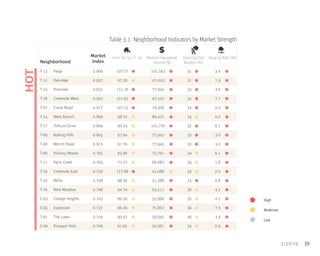
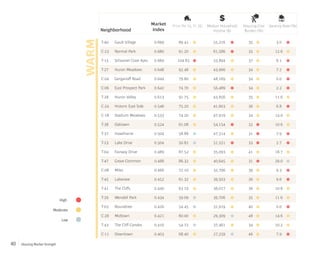
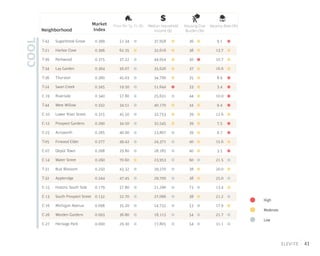
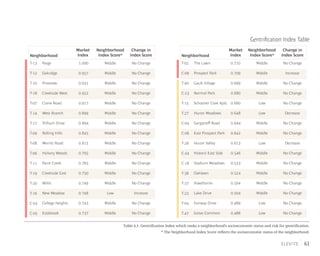
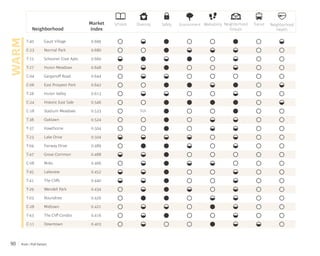
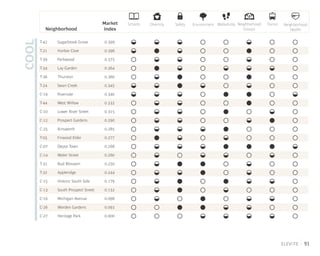
Table 3.1 on page 39 categorizes all city and township
neighborhoods by their market type- hot, warm, or
cool- and also displays each neighborhood’s ratings
for the four indicators- (1) Sales Price per Square
Foot, (2) Median Household Income, (3) Housing Cost
Burden, and (4) Vacancy Rate. The neighborhoods
are listed in order from highest to lowest market
index score. This table allows a deeper look into the
variation within each market type, as not all hot,
warm, and cool market types are identical.
These four indicators do not take into account the
rental market, which is a significant percentage of
the market in parts of the city and township. The
following section includes a separate analysis of
rental properties in our study area.
NEIGHBORHOODS IN BLOOM
RICHMOND,VA
This project aimed to strengthen
neighborhoods by removing blight,
restoring historic buildings and increasing
homeownership.City planning staff
funded the project directing both
CDBG and HOME grants towards
these neighborhoods,and has since
won numerous national awards.They
completed the following:
Planners assessed the condition and
potential for revitalization by collecting
neighborhood level data.
Richmond included data on vacancy,
crime,poverty,homeownership,and
housing quality.
The data was distributed to three
separate groups: civic leaders,housing
providers,and city staff.The groups
determined areas where concentrated
investment could have positive
impact and encourage private sector
investment.
37
Vacancy Rate
Figure 3.5: Vacancy rate by neighborhood.
Sources: AADC (Roads/Water), Esri Projections (Vacant Units by Tenure), City of Ypsilanti and Ypsilanti Township (Neighborhoods)
Merritt Rd.
Martz Rd.
Bemis Rd.
WhittakerRd.
HitchinghamRd.
RawsonvilleRd.
Textile Rd.
I-94
Washtenaw Ave.
Holmes Rd.
US-12 Ecorse Rd.
RidgeRd.
Packard Rd.
Michigan Ave.
WiardRd.
MungerRd.GolfsideRd.
0 1 2
miles
By percentage of vacant non-rental units
Water
Jurisdiction Boundary
Major Road
Insufficient Data
0 to 10
20.1 to 30
10.1 to 20
N
C3
C2
C20
C23
C1
C6
C9
C15
C14
C19
C27
C22
C5
C12
C8
C24C7
C25
C28 C10
C4
C16
C26
C11
C21
C13
C17
C18
T2
T11
T34
T12
T4
T14
T6
T44
T16
T8
T1
T9
T40
T18
T29
T10
T20
T42
T13
T46
T17
T45
T19
T37
T36
T28
T7
T47
T38
T23
T3
T39
T48
T27
T24
T15
T5
T41
T32 T33
T35
T31
T21
T43
T30
T22
Housing Market Strength38
Harris Street in Ypsilanti Township
39
Table 3.1: Neighborhood Indicators by Market Strength
Neighborhood
Market
Index
Price Per Sq.Ft.($) Median Household
Income ($)
Housing Cost
Burden (%)
Vacancy Rate (%)
HOT
T-18 Creekside West
PaigeT-13
T-12 Oakridge
T-10 Pineview
Crane RoadT-07
T-14 West Branch
T-09 Rolling Hills
T-17 Trillium Drive
Merritt RoadT-08
T-06 Hickory Woods
Paint CreekT-11
T-19 Creekside East
WillisT-20
C-03 College Heights
EstabrookC-05
T-16 New Meadow
T-02 The Lawn
Prospect ParkC-09
0.922
1.000
0.957
0.931
0.917
0.899
0.845
0.894
0.815
0.795
0.783
0.750
0.749
0.743
0.737
0.748
0.710
0.709
101.62
107.77
97.29
115.16
107.52
98.72
97.64
90.24
91.76
93.96
77.27
117.98
98.36
99.50
86.00
94.74
90.47
91.60
Median Household
Income ($)
97,315
101,583
101,651
77,943
79,306
86,472
77,943
101,770
77,943
75,761
86,683
41,089
51,388
55,999
75,863
63,511
58,647
50,981
Housing Cost
Burden (%)
32
31
31
33
33
34
33
32
33
34
34
43
33
35
36
36
36
34
Vacancy Rate (%)
7.7
3.4
1.9
3.0
0.0
0.0
3.0
6.1
3.0
6.1
1.8
0.0
0.8
4.7
7.9
4.5
3.9
0.9
RMHOT
High
Moderate
Low
Housing Market Strength40
T-40 Gault Village
Normal ParkC-23
T-15 Schooner Cove Apts.
Huron MeadowsT-27
C-04 Gerganoff Road
East Prospect ParkC-06
Huron ValleyT-28
C-24 Historic East Side
Stadium MeadowsC-18
OaklawnT-38
HawthorneT-37
T-23 Lake Drive
Fairway DriveT-04
Grove CommonT-47
MilesC-08
T-45 Lakeview
The CliffsT-41
Wendell ParkT-29
T-03 Roundtree
MidtownC-28
The Cliff CondosT-43
C-11 Downtown
0.699
0.680
0.660
0.648
0.644
0.642
0.613
0.546
0.533
0.524
0.504
0.504
0.489
0.488
0.466
0.452
0.440
0.434
0.426
0.421
0.416
0.403
89.41
91.20
104.83
92.48
79.80
74.70
91.75
75.20
74.20
61.08
58.88
50.82
87.52
86.32
72.10
61.32
63.19
59.09
54.45
80.00
54.72
68.40
55,216
61,586
33,894
43,966
48,169
56,489
43,856
41,603
47,919
54,154
47,314
51,551
35,093
40,645
32,796
39,503
36,017
39,706
31,919
29,309
37,461
27,259
35
35
37
34
34
34
35
36
34
32
31
33
41
31
39
36
36
35
40
48
34
46
3.0
12.6
6.1
7.2
0.0
2.2
11.6
6.8
14.0
10.6
7.9
2.7
18.7
29.0
9.3
9.6
10.6
11.6
0.0
14.6
10.2
7.9
WARMOL
Neighborhood
Market
Index
Price Per Sq.Ft.($) Median Household
Income ($)
Housing Cost
Burden (%)
Vacancy Rate (%)
HOT
High
Moderate
Low
41
T-42 Sugarbrook Grove
Harbor CoveT-21
T-39 Parkwood
Lay GardenT-34
T-36 Thurston
Swan CreekT-24
C-19 Riverside
West WillowT-44
C-10 Lower River Street
Prospect GardensC-12
C-25 Ainsworth
Firwood ElderT-05
C-07 Depot Town
Water StreetC-14
T-31 Bud Blossom
AppleridgeT-32
C-15 Historic South Side
South Prospect StreetC-13
C-16 Michigan Avenue
Worden GardensC-26
C-27 Heritage Park
0.399
0.396
0.375
0.364
0.360
0.345
0.340
0.332
0.315
0.290
0.285
0.277
0.268
0.260
0.250
0.244
0.179
0.132
0.098
0.093
0.000
51.34
62.35
37.22
56.07
45.03
19.50
57.80
34.51
45.50
34.50
40.00
49.42
29.80
70.60
43.32
47.45
57.80
22.70
35.20
36.80
29.30
37,958
32,616
44,954
35,626
34,700
51,644
25,631
40,170
32,753
32,545
23,807
24,371
28,185
23,953
29,270
29,700
21,296
27,066
14,732
18,115
17,805
36
38
30
37
35
33
44
34
39
39
39
40
40
60
38
38
73
38
53
54
54
9.1
13.7
10.7
16.6
8.9
3.4
10.0
9.4
12.6
7.5
6.7
15.6
3.5
21.5
20.0
25.0
13.4
21.2
17.9
21.7
31.1
COOL Neighborhood
Market
Index
Price Per Sq.Ft.($) Median Household
Income ($)
Housing Cost
Burden (%)
Vacancy Rate (%)
HOT
High
Moderate
Low
Housing Market Strength42
Background
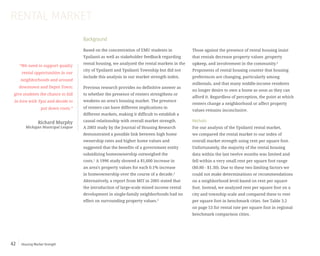
Based on the concentration of EMU students in
Ypsilanti as well as stakeholder feedback regarding
rental housing, we analyzed the rental markets in the
city of Ypsilanti and Ypsilanti Township but did not
include this analysis in our market strength index.
Previous research provides no definitive answer as
to whether the presence of renters strengthens or
weakens an area’s housing market. The presence
of renters can have different implications in
different markets, making it difficult to establish a
causal relationship with overall market strength.
A 2003 study by the Journal of Housing Research
demonstrated a possible link between high home
ownership rates and higher home values and
suggested that the benefits of a government entity
subsidizing homeownership outweighed the
costs.1
A 1996 study showed a $1,600 increase in
an area’s property values for each 0.1% increase
in homeownership over the course of a decade.2
Alternatively, a report from MIT in 2005 stated that
the introduction of large-scale mixed income rental
development in single-family neighborhoods had no
effect on surrounding property values.3
“We need to support quality
rental opportunities in our
neighborhoods and around
downtown and Depot Town;
give students the chance to fall
in love with Ypsi and decide to
put down roots.”
Richard Murphy
Michigan Municipal League
Those against the presence of rental housing insist
that rentals decrease property values ,property
upkeep, and involvement in the community.4
Proponents of rental housing counter that housing
preferences are changing, particularly among
millenials, and that many middle-income residents
no longer desire to own a home as soon as they can
afford it. Regardless of perception, the point at which
renters change a neighborhood or affect property
values remains inconclusive.
Methods
For our analysis of the Ypsilanti rental market,
we compared the rental market to our index of
overall market strength using rent per square foot.
Unfortunately, the majority of the rental housing
data within the last twelve months was limited and
fell within a very small rent per square foot range
($0.80 - $1.30). Due to these two limiting factors we
could not make determinations or recommendations
on a neighborhood level based on rent per square
foot. Instead, we analyzed rent per square foot on a
city and township scale and compared these to rent
per square foot in benchmark cities. See Table 3.2
on page 53 for rental rate per square foot in regional
benchmark comparison cities.
RENTAL MARKET
43
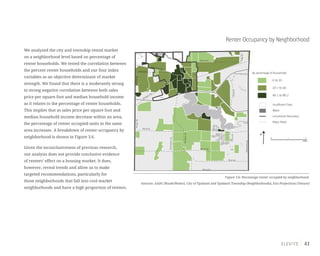
We analyzed the city and township rental market
on a neighborhood level based on percentage of
renter households. We tested the correlation between
the percent renter households and our four index
variables as an objective determinant of market
strength. We found that there is a moderately strong
to strong negative correlation between both sales
price per square foot and median household income
as it relates to the percentage of renter households.
This implies that as sales price per square foot and
median household income decrease within an area,
the percentage of renter occupied units in the same
area increases. A breakdown of renter occupancy by
neighborhood is shown in Figure 3.6.
Given the inconclusiveness of previous research,
our analysis does not provide conclusive evidence
of renters’ effect on a housing market. It does,
however, reveal trends and allow us to make
targeted recommendations, particularly for
those neighborhoods that fall into cool market
neighborhoods and have a high proportion of renters.
Renter Occupancy by Neighborhood
Figure 3.6: Percentage renter occupied by neighborhood.
Sources: AADC (Roads/Water), City of Ypsilanti and Ypsilanti Township (Neighborhoods), Esri Projections (Tenure)
0 1 2
miles
By percentage of households
Water
Jurisdiction Boundary
Major Road
Insufficient Data
0 to 20
40.1 to 86.2
20.1 to 40
N
Merritt Rd.
Martz Rd.
Bemis Rd.
WhittakerRd.
HitchinghamRd.
RawsonvilleRd.
Textile Rd.
I-94
Washtenaw Ave.
Holmes Rd.
US-12 Ecorse Rd.
RidgeRd.
Packard Rd.
Michigan Ave.
WiardRd.
MungerRd.GolfsideRd.
Housing Market Strength44
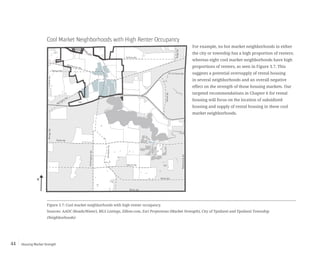
For example, no hot market neighborhoods in either
the city or township has a high proportion of renters;
whereas eight cool market neighborhoods have high
proportions of renters, as seen in Figure 3.7. This
suggests a potential oversupply of rental housing
in several neighborhoods and an overall negative
effect on the strength of those housing markets. Our
targeted recommendations in Chapter 6 for rental
housing will focus on the location of subsidized
housing and supply of rental housing in these cool
market neighborhoods.
Cool Market Neighborhoods with High Renter Occupancy
Figure 3.7: Cool market neighborhoods with high renter occupancy.
Sources: AADC (Roads/Water), MLS Listings, Zillow.com, Esri Projections (Market Strength), City of Ypsilanti and Ypsilanti Township
(Neighborhoods)
0 1 2
miles
N
Merritt Rd.
Martz Rd.
Bemis Rd.
WhittakerRd.
HitchinghamRd.
RawsonvilleRd.
Textile Rd.
I-94
Washtenaw Ave.
Holmes Rd.
US-12 Ecorse Rd.
RidgeRd.
Packard Rd.
Michigan Ave.
WiardRd.
MungerRd.GolfsideRd.
45Apartments on Ford Lake
Housing Market Strength46
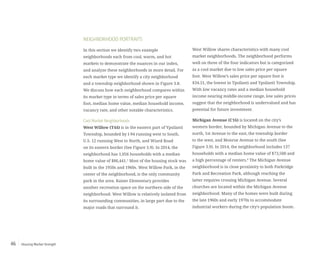
NEIGHBORHOOD PORTRAITS
In this section we identify two example
neighborhoods each from cool, warm, and hot
markets to demonstrate the nuances in our index,
and analyze these neighborhoods in more detail. For
each market type we identify a city neighborhood
and a township neighborhood shown in Figure 3.8.
We discuss how each neighborhood compares within
its market type in terms of sales price per square
foot, median home value, median household income,
vacancy rate, and other notable characteristics.
Cool Market Neighborhoods
West Willow (T44) is in the eastern part of Ypsilanti
Township, bounded by I-94 running west to South,
U.S. 12 running West to North, and Wiard Road
on its eastern border (See Figure 3.9). In 2014, the
neighborhood has 1,056 households with a median
home value of $86,441.5
Most of the housing stock was
built in the 1950s and 1960s. West Willow Park, in the
center of the neighborhood, is the only community
park in the area. Kaiser Elementary provides
another recreation space on the northern side of the
neighborhood. West Willow is relatively isolated from
its surrounding communities, in large part due to the
major roads that surround it.
West Willow shares characteristics with many cool
market neighborhoods. The neighborhood performs
well on three of the four indicators but is categorized
as a cool market due to low sales price per square
foot. West Willow’s sales price per square foot is
$34.51, the lowest in Ypsilanti and Ypsilanti Township.
With low vacancy rates and a median household
income nearing middle-income range, low sales prices
suggest that the neighborhood is undervalued and has
potential for future investment.
Michigan Avenue (C16) is located on the city’s
western border, bounded by Michigan Avenue to the
north, 1st Avenue to the east, the township border
to the west, and Monroe Avenue to the south (See
Figure 3.9). In 2014, the neighborhood includes 137
households with a median home value of $73,500 and
a high percentage of renters.6
The Michigan Avenue
neighborhood is in close proximity to both Parkridge
Park and Recreation Park, although reaching the
latter requires crossing Michigan Avenue. Several
churches are located within the Michigan Avenue
neighborhood. Many of the homes were built during
the late 1960s and early 1970s to accommodate
industrial workers during the city’s population boom.
47
The Michigan Avenue neighborhood performed
poorly on each of the four indicators. The area’s
price per square foot, $36.80, and median household
income, $18,115, are both well below average.
Additionally, the area’s housing cost burden is
extremely high, which shows that residents are
paying a very high proportion of their income on
housing. This neighborhood, given its proximity to
Ypsilanti’s downtown amenities and Growing Hope,
could improve considerably with the right support.
Warm Market Neighborhoods:
Gault Village (T40) is in the eastern part of Ypsilanti
Township, bounded by South Grove Street to the
south and west, South Harris Road to the east and
Frontage Road to the north (See Figure 3.10). In 2014,
Gault Village has 950 households, many of which are
families, with a median home value of $106,858.7
Erickson Elementary School and Nancy Park are
located in the center of the neighborhood. The Gault
Village Shopping Center provides some commercial
amenities for residents, but the neighborhood abuts
the back of the Center making it difficult for residents
to access these amenities. The neighborhood also
enjoys slower speeds and bicycle paths on South
Grove Street.
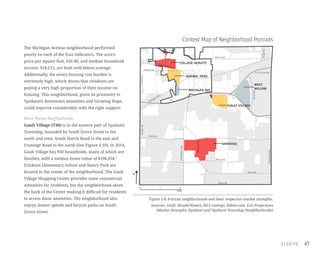
Context Map of Neighborhood Portraits
Figure 3.8: Portrait neighborhoods and their respective market strengths.
Sources: AADC (Roads/Water), MLS Listings, Zillow.com, Esri Projections
(Market Strength), Ypsilanti and Ypsilanti Township (Neighborhoods)
Merritt Rd.
Martz Rd.
Bemis Rd.
WhittakerRd.
HitchinghamRd.
RawsonvilleRd.
Textile Rd.
I-94
Washtenaw Ave.
Holmes Rd.
US-12 Ecorse Rd.
RidgeRd.
Packard Rd.
Michigan Ave.
WiardRd.
MungerRd.GolfsideRd.
0 1 2
miles
N
COLLEGE HEIGHTS
NORMAL PARK
MICHIGAN AVE.
WEST
WILLOW
GAULT VILLAGE
OAKRIDGE
Housing Market Strength48
Gault Village has a strong median household income,
low vacancy rate, and a higher average sales price per
square foot at $89.41. These indicators position Gault
Village to become a hot neighborhood market with
minimum intervention.
Normal Park (C23) is located on the eastern border
of the city of Ypsilanti, bounded by Washtenaw
Avenue to the north, Michigan Avenue to the south,
North Mansfield Street to the west, and North Summit
Street to the east (See Figure 3.10). Recreation
Park is in the center of the neighborhood, home to
Ypsilanti’s Senior Citizen Center and Rutherford
Pool. The neighborhood is adjacent to EMU and the
commercial corridor along Cross Street, but access
to these amenities requires crossing several major
thoroughfares. Normal Park has 816 households,
mostly families, with a median home value of
$160,381.8
Many of these homes were built in the late
1930s through the 1940s.
Normal Park is one of the city’s stronger
neighborhoods, despite ranking in the top category
on only one of the four indicators. The neighborhood
ranks moderately for sales price per square foot
and housing cost burden. The area’s major strength
is its high median household income. Normal Park
is a warm market neighborhood, shows promising
signs of growth, and may positively influence the
surrounding neighborhoods.
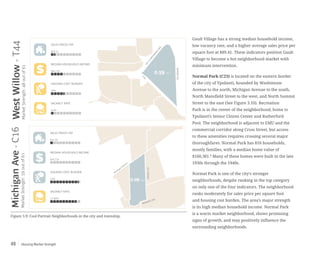
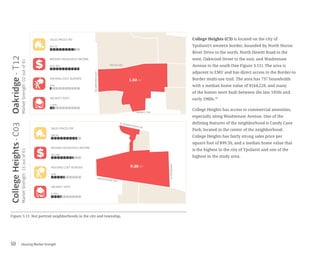
Figure 3.9: Cool Portrait Neighborhoods in the city and township.
MichiganAve-C16
MarketStrength:59outof61
1STAVENUE
MONROE AVE.
M
ichigan
Avenue
0.09 mi2
SALES PRICES PSF
$35.20
HOUSING COST BURDEN
53%
VACANCY RATE
17.90%
MEDIAN HOUSEHOLD INCOME
$14,732
MarketStrength:48outof61
WestWillow-T44
I-94
WIARDRD.
US-12
M
ICHIGAN
AVE.
0.59 mi2
SALES PRICES PSF
$34.51
HOUSING COST BURDEN
34%
VACANCY RATE
9.4%
MEDIAN HOUSEHOLD INCOME
$40,170
49
Hot Market Neighborhoods:
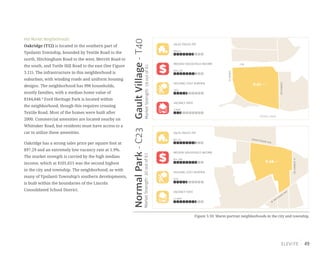
Oakridge (T12) is located in the southern part of
Ypsilanti Township, bounded by Textile Road to the
north, Hitchingham Road to the west, Merritt Road to
the south, and Tuttle Hill Road to the east (See Figure
3.11). The infrastructure in this neighborhood is
suburban, with winding roads and uniform housing
designs. The neighborhood has 998 households,
mostly families, with a median home value of
$184,846.9
Ford Heritage Park is located within
the neighborhood, though this requires crossing
Textile Road. Most of the homes were built after
2000. Commercial amenities are located nearby on
Whittaker Road, but residents must have access to a
car to utilize these amenities.
Oakridge has a strong sales price per square foot at
$97.29 and an extremely low vacancy rate at 1.9%.
The market strength is carried by the high median
income, which at $101,651 was the second highest
in the city and township. The neighborhood, as with
many of Ypsilanti Township’s southern developments,
is built within the boundaries of the Lincoln
Consolidated School District.
Figure 3.10: Warm portrait neighborhoods in the city and township.
GaultVillage-T40
MarketStrength:19outof61
1-94
FORD LAKE
GROVEST.
HARRISRD.
0.41 mi2
SALES PRICES PSF
$89.41
HOUSING COST BURDEN
35%
VACANCY RATE
3.00%
MEDIAN HOUSEHOLD INCOME
$55,216
NormalPark-C23
MarketStrength:20outof61
SALES PRICES PSF
$91.20
VACANCY RATE
12.60%
MEDIAN HOUSEHOLD INCOME
$61,586
N.SUMMITRD.
0.34 mi2
WASHTENAW AVE.
W.MICHIGAN
AVE.
HOUSING COST BURDEN
35%
Housing Market Strength50
College Heights (C3) is located on the city of
Ypsilanti’s western border, bounded by North Huron
River Drive to the north, North Hewitt Road to the
west, Oakwood Street to the east, and Washtenaw
Avenue to the south (See Figure 3.11). The area is
adjacent to EMU and has direct access to the Border-to
Border multi-use trail. The area has 737 households
with a median home value of $164,228, and many
of the homes were built between the late 1950s and
early 1960s.10
College Heights has access to commercial amenities,
especially along Washtenaw Avenue. One of the
defining features of the neighborhood is Candy Cane
Park, located in the center of the neighborhood.
College Heights has fairly strong sales price per
square foot of $99.50, and a median home value that
is the highest in the city of Ypsilanti and one of the
highest in the study area.
Figure 3.11: Hot portrait neighborhoods in the city and township.
Oakridge-T12
MarketStrength:02outof61
HITCHINGHAMRD.
TEXTILE RD.
MERRITT RD.
1.02 mi2
SALES PRICES PSF
$97.29
HOUSING COST BURDEN
31%
VACANCY RATE
1.90%
MEDIAN HOUSEHOLD INCOME
$101,651
CollegeHeights-C03
MarketStrength:15outof61
WASHTENAW AVE.
N. HURON RIVER DR.
OAKWOODST.
0.39 mi2
HOUSING COST BURDEN
35%
VACANCY RATE
4.70%
MEDIAN HOUSEHOLD INCOME
$55,999
SALES PRICES PSF
$99.50
The Oakridge neighborhood in Ypsilanti Township
Housing Market Strength52
Regional Market Comparison
Neighboring cities compete with the city of Ypsilanti
and Ypsilanti Township for middle-income residents,
so it is instructive to gauge the city’s and township’s
positions in the regional housing market. We used
the Longitudinal Employer-Household Dynamics On
the Map Tool to identify several cities that Ypsilanti
and Ypsilanti Township’s middle-income residents
are commuting to for work (listed in Figure 3.12).11
Conversely, we identified the top cities where current
middle-income employees working in Ypsilanti and
Ypsilanti Township live (listed in Figure 3.13). We
applied our housing market strength index to the
city and township as a whole, as well as to the six
“benchmark” cities.
In Table 3.2, the market index value shows how each
city on average compares to the best performing
neighborhood in Ypsilanti (a market index score
of 1.0). A score of 1.0 would indicate that the city’s
market strength is equal to the best performing
neighborhood in Ypsilanti. These city market index
values are compared to average values for Ypsilanti
city and township. The table also offers comparisons
of other factors to give an idea of the variation among
communities.
TOTAL MIDDLE-INCOME EMPLOYEES
WHERE
YPSI WORKERS
AnnArbor
City of Ypsilanti
+
Township
Taylor
Westland
Detroit
LIVE
18,956
TOTAL MIDDLE-INCOME RESIDENTS
WHERE
YPSI RESIDENTS
City of
Ypsilanti
Detroit
Livonia
Dearborn
WORK
31,331
AnnArbor
Figure 3.12: 60%+ Area Median
Income Residents (making at least
$3,333 per month) living in the
study area currently WORK in these
places.
(Colors correspond to market strength)
Figure 3.13: 60%+ Area Median
Income Employees (making at least
$3,333 per month) working in the
study area currently LIVE in these
places.
(Colors correspond to market strength)
REGIONAL BENCHMARKS
53
46.3587
39.3556
44.9450
47.3762
60.9209
66.0004
52.0933
68.7896
Ann Arbor
Livonia
Lincoln Consolidated*
Wayne-Westland
Dearborn
Ypsilanti
Taylor
Detroit
24
10
12
1
12
0
10
0
99
99
48
43
99
8
46
98
$1.25
$1.00
$1.01
$0.88
$0.85
$1.02
$0.85
$0.76
21.15
15.54
N|A
43.97
82.84
56.12
207.23
Ann Arbor
Livonia
Ypsilanti Township
Westland
Taylor
Dearborn
City of Ypsilanti
Detroit
N|A
Market
Index
City or
Township
Property
Tax Rate
Primary School
District
School Ranking
Range (Low End)
School Ranking
Range (High End)
Rent Per
Square Foot
Violent Crime
Rate**
0.94
0.84
0.61
0.55
0.47
0.45
0.39
0.08
WARMHOTCOOL
Results:
When our market index is applied to the benchmark
cities, the city of Ypsilanti and Ypsilanti Township
seem well positioned to attract middle-income
residents from regional competitors. Ypsilanti, while
one of the weaker markets, is highly competitive with
Dearborn and Taylor. The housing market average in
Ypsilanti Township is stronger than Dearborn, Taylor,
and Westland. The market strengths of Ann Arbor and
Livonia are higher than the average for the city and
the township.
Middle-Income Retention: ANN ARBOR, DETROIT,
LIVONIA, DEARBORN: Already, a high number of
residents in our study area work in Ann Arbor, Detroit,
Dearborn and Livonia. Out of these four, the city
of Ypsilanti and Ypsilanti Township have stronger
housing markets on average than Detroit, and the
township is also stronger than Dearborn. Ann Arbor
and Livonia each have stronger housing markets than
Ypsilanti and Ypsilanti Township, meaning current
middle-income residents of Ypsilanti and Ypsilanti
Township might choose to relocate to these places in
the future.
Table 3.2: *Lincoln Consolidated Schools (LCS) serves as a comparison for the hot markets in the township. For the purpose of this chart, LCS is the
primary school district in Ypsilanti Township due to having the greatest number of households in hot markets. Ypsilanti Township also has a large
number of households in Ypsilanti Community Schools and some households in Van Buren School District.
**Violent Crime Rate is measured with crimes per 10,000 people. No crime rates were available from the FBI for Ypsilanti Township and Dearborn.
Sources: (School Rankings) mischooldata.org, (Rent per square foot) zillow.com, (Property Tax Rates) michigan.gov (Violent Crime Rate) fbi.gov
Housing Market Strength54
Middle-Income Attraction: DEARBORN, DETROIT,
WESTLAND, TAYLOR: The township’s average
market strength ranks higher than each of these
places. The city’s average is higher than Detroit and
competitive with Dearborn and Taylor. Each of these
may serve as strategic cities for targeted attraction
efforts. Since moving to the city or township would
reduce transportation costs for these commuters,
the city or township should target them as potential
residents.
Comparison of Other Factors
Property Taxes
Table 3.2 also includes a comparison of property
tax rates. Though each jurisdiction likely varies in
assessment practices, the property tax rates provide
insights into which residents are likely to pay higher
taxes for a middle-income home. Detroit, the city of
Ypsilanti, and Dearborn have the highest tax rates,
while Livonia and Ypsilanti Township have the
lowest. The city may look into strategies for lowering
its property tax rate to attract and retain residents.
School Rankings
The school rankings in Table 3.2 represent the
percentile range of public school ratings for the
major school district in each benchmark city. Each
district has wide ranges of high performing and low
performing schools with the exception of Ypsilanti
Community Schools. In Chapter 6, we provide
recommendations for strengthening Ypsilanti schools.
Rent Per Square Foot
Table 3.2 also compares rent per square foot. This is
based on a city average calculation from Zillow.com.
Both the city of Ypsilanti and Ypsilanti Township are
performing well in terms of rental market strength.
The city and township have the second highest rent
per square foot behind Ann Arbor. The presence of
college-aged renters has a significant impact on the
rental market in both of these areas. College-aged
renters should be welcomed into the community
and encouraged to stay after graduation in order to
capitalize on this strength.
Violent Crime Rate
The crime rate in Table 3.2 represents the number
of violent crimes per 10,000 people as detailed in the
FBI’s 2013 crime log. Ypsilanti has the second highest
violent crime rate per capita ahead of only Detroit.
A detailed look at crime on the neighborhood level,
along with recommendations for crime reduction, can
be found in Chapter 5 and 6, respectively.
This analysis comparing our study to regional
benchmark cities may provide insight into potential
ways to retain or attract middle-income residents.
Other factors will be explored in the Chapter 5, which
analyzes factors that push or pull middle-income
residents to specific neighborhoods.
“Good services and pleasing
appearances attract good
people, and good people attract
good investments.”
Larry Krieg
The Ride
55
Endnotes
1. Coulson, N. E., Hwang, S. J., and Imai, S. 2003. The value
of owner occupation in neighborhoods. Journal of Housing
Research, 13, no.2: 153-174. http://content.knowledgeplex.org/
kp2/kp/text_document _summary/ scholarly_article/relfiles/
jhr_1302_coulson.pdf
2. Rohe, W. and Stewart, L. S. 1996. “Homeownership and
neighborhood stability.” Housing Policy Debate, 7, no.1: 37-81.
http://content.knowledgeplex.org/kp2/img/cache/sem/39708.pdf
3. Pollakowski, H. O., Ritchay, D., and Weinrobe, Z. 2005. “Effects
of mixed-income multi-family rental housing development on
single-family housing values.” MIT Center for Real Estate: 1-55.
4. Coulson, N. E., Hwang, S. J., and Imai, S. 2003. The value
of owner occupation in neighborhoods. Journal of Housing
Research, 13, no.2: 153-174. http://content.knowledgeplex.org/
kp2/kp/text_document _summary/ scholarly_article/relfiles/
jhr_1302_coulson.pdf
5. House and Home Expenditures. Rep. Esri Business Analyst,
2014. Web. Feb. 2015
6. Ibid.
7. Ibid.
8. Ibid.
9. Ibid.
10. Ibid.
11. OnTheMap. “Longitudinal Employer-Household Dynamics.”
United States Census. http://onthemap.ces.census.gov/
12. Hertitage Media. 2011. Downtown Ypsilanti. Flickr Creative
Commons.
Gault Village, Ypsilanti TownshipDowntown, Ypsilanti12
Huron Meadows, Ypsilanti Township
4CHAPTER
PREVENTING
DISPLACEMENT
Health Impacts of Gentrification
and Displacement
Measuring Gentrification
Methods
Analysis
Limitations
Preventing Displacement58
While strategies for strengthening weak housing
markets help create stronger communities, they
can also cause expensive developments, higher
rents, and rapid neighborhood change. This change
may be appealing in areas suffering from severe
disinvestment, but it could also initiate displacement
of those most burdened by current housing prices.1
As stated in Chapter 1, the goal of this report is to
attract middle-income residents while minimizing
displacement. Ypsilanti city and township will
grow both through the influx of new residents and
by improving quality of life for current residents.
Displacement is not inevitable, and it can be mitigated
if the threat is addressed early.
Displacement is often confused with gentrification,
a term first used by urban geographer Ruth Glass
to describe neighborhood change in London in the
1960s.2
Gentrification has no agreed-upon definition,
but for our purpose it is the process by which decline
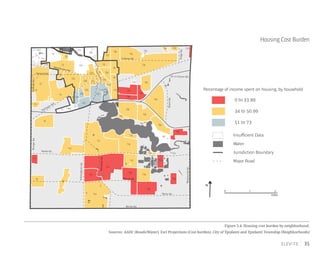
and disinvestment is reversed.3
The more threatening
phenomenon in Ypsilanti and Ypsilanti Township is
displacement.
Displacement occurs when current residents are
forced to move because they can no longer afford to
live in a gentrifying area.4
A thriving, mixed-income
neighborhood includes residents from all income
PREVENTING DISPLACEMENT
The city and township are not
threatened by gentrification in
2015, but investment may bring
new residents in a process that
could push some neighborhoods
towards the early stages of
gentrification.
levels, and the threat of displacement places lower
income individuals at an economic and locational
disadvantage.5
Displacement prevention strategies
take into account many factors, including the level of
disinvestment, demographic characteristics, and the
stage of gentrification.
Health Impacts of Gentrification and Displacement
In addition to constraints on where residents can
live, gentrification and displacement have numerous
health impacts at the individual, family, and
community level. For those who are able to stay in
their neighborhood, gentrification can improve health
through better amenities, infrastructure, and services.
However, increased rents lead to a greater financial
burden on low-income individuals, restricting
their access to basic needs such as healthcare,
transportation, and healthy foods.6
Displacement can destroy social networks and
decrease mental and psychological well-being. For
example, residents forced to relocate may miss
interactions with long-time neighbors, lose informal
childcare or transportation arrangements, and
lack supportive services like food pantries, youth
programs, and job training.7
Displacement can
also contribute to high relocation costs and longer
commutes.
59
Displacement is harmful at a societal level for
all these reasons, contributing to increases in
preventable social and health inequalities. Although
gentrification may bring much-needed improvements
to an area, the displaced residents often do not benefit
from them. Displacement can result in increased
health disparities, as displaced residents lose access
to factors that contribute to longer life expectancies
and better quality of life: quality schools, safe and
affordable housing, quality jobs, and safe places to
play and work.8
Measuring Gentrification
To understand which strategies to recommend, we
must understand the current levels of gentrification—
the precursor to displacement—present in the city of
Ypsilanti and Ypsilanti Township. While gentrification
does not always lead to displacement, displacement is
more likely to occur in places where gentrification is
happening most rapidly.9
As mentioned, gentrification
is associated with the level of new investment
in previously disinvested neighborhoods. The
effectiveness of strategies to prevent displacement
vary by the stage of gentrification of a community.10
Our findings show that the city and township are not
threatened by gentrification in 2015, but investment
may attract new residents in a process that could
trigger the early stages of gentrification in some
neighborhoods. Timing is important to minimize
displacement.
Methods
There is no single formula for measuring
gentrification, but many studies have found ways to
capture its effects. The method we chose uses reliable
data that are easy to obtain, track, and replicate. This
is a useful approach for public officials to monitor
neighborhood changes and identify neighborhoods
for preventative strategies.
We modeled our approach on the method used by
the Nathalie Voorhees Center for Neighborhood and
Community Improvement at the University of Illinois
at Chicago.11
This study, done in 2004, was originally
conducted because of the growing inequality and
disappearance of the middle class among Chicago’s
neighborhoods. The concept of growing inequality
directly applies to Washtenaw County, given the
findings of the recent Housing Affordability report.12
CHICAGO,IL
The Nathalie P.Voorhees Center
for Neighborhood and Community
Improvement created a gentrification
index to measure neighborhood change
in Chicago.
Four decades of demographic change,
from 1970 to 2010,were measured for
77 neighborhoods in Chicago using
comprehensive,available data.
The results determined the degree
of neighborhood gentrification and
decline in Chicago communities.
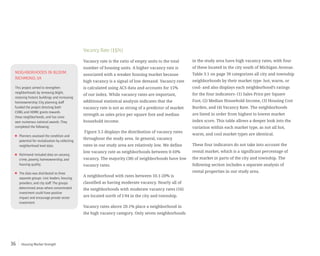
The study resulted in a toolkit
for other communities to prevent
displacement at early,mid,and late
stages of gentrification.
Preventing Displacement60
Neighborhood level:
We used 13 variables related to demographics and
housing to measure socioeconomic conditions
over time at the neighborhood level. Similar to the
Voorhees method, we determined a neighborhood
index score and a change in index score.
Neighborhood Index Score
This score compares 13 different variables on a
neighborhood level to the city and township average.
Based on a comparison of these variables to the city
and township average, each neighborhood receives
a +1 or -1 for each variable. The +1s and -1s are then
summed to reach the final index score, which can
range from -13 to +13. This represents the current
socioeconomic status of the neighborhood. The score
classifies a neighborhood into a high, middle, low,
or very low socioeconomic status. See Table 4.1 for
neighborhood index scores.
Change in Index Score
This score represents neighborhood change over time.
We used data from the 2010 ACS and Esri projections
for 2019 to determine this change. We determined
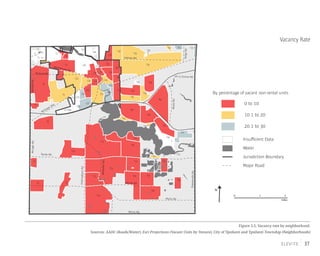
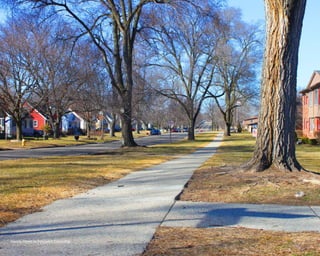
this number by subtracting the 2010 neighborhood
index score from the 2019 projected index score.
This resulted in a number that represents either no
change, an increase, or a decrease in investment. No
change means the neighborhood did not undergo
significant change, increase means the neighborhood
experienced significant investment, and decrease
means the neighborhood experienced disinvestment.
The Voorhees method suggests that even if a
neighborhood’s score has increased significantly,
it does not necessarily mean it has gentrified; this
will depend on its ranking on socioeconomic status
based on the neighborhood index score. In addition,
the Voorhees method determined that any growth in
score exceeding +4 would constitute an “increase” and
any decline in score exceeding -4 would constitute a
“decrease,” but we lowered the threshold to +3 and
-3 because we did not find anything significant with
the higher threshold. See Table 4.1 for the change in
index scores.
City/Township level:
Since we only had access to current and projected
data at the neighborhood level, we modified the
Voorhees method to compare the city and the
township to the county as a whole with historic
data. We collected the same 13 variables from the
ACS for the 2005-2009 period and the 2009-2013
period in both the city and township and compared
those to Washtenaw County averages in the same
time periods. Again, a municipality that had greater
changes than the county average was awarded a point
for each variable, ranked in an index, and scored.
HIGH
NEIGHBORHOOD INDEX SCORE
MIDDLE
LOW
VERY LOW
Index score above 7
Index score between 1 and 7
Index score between -1 and -7
Index score below -7
NO CHANGE
CHANGE IN INDEX SCORE
INCREASE
DECREASE
Change in score between -3 and 3
Growth in score exceeds 3
Decline in score below -3
61
Table 4.1: Gentrification Index which ranks a neighborhood’s socioeconomic status and risk for gentrification.
* The Neighborhood Index Score reflects the socioeconomic status of the neighborhood.
Gentrification Index Table
Market
IndexNeighborhood
T-18 Creekside West 0.922
1.000PaigeT-13
T-12 Oakridge 0.957
T-10 Pineview 0.931
Crane RoadT-07 0.917

West Branch 0.899
Rolling Hills 0.845
Trillium Drive 0.894
0.815Merritt RoadT-08
T-06 Hickory Woods 0.795
0.783Paint CreekT-11
T-19 Creekside East 0.750
0.749WillisT-20
0.737EstabrookC-05
T-16 New Meadow 0.748
Gault Village 0.699
0.680Normal ParkC-23
Schooner Cove Apts. 0.660
0.648Huron MeadowsT-27
Gerganoff Road 0.644
0.642East Prospect ParkC-06
0.613Huron Valley
Historic East Side 0.546
0.533Stadium Meadows
0.524Oaklawn
0.504Hawthorne
Lake Drive 0.504
0.489Fairway Drive
0.488Grove Common
C-03 College Heights 0.743
T-02 The Lawn 0.710
0.709Prospect ParkC-09
T-14
T-09
T-17
T-40
T-15
C-04
T-28
C-24
C-18
T-38
T-37
T-23
T-04
T-47
Neighborhood
Index Score*
Change in
Index Score
Market
IndexNeighborhood
Neighborhood
Index Score*
Change in
Index Score
Middle Middle
Middle
Middle
Middle
Middle
Middle
Middle
Middle
Middle
Middle
Middle
Middle
Middle
Middle
Middle
Middle
Middle
Middle
No Change No Change
Increase
No Change
No Change
Middle No Change
Middle No Change
Middle No Change
Middle No Change
Middle No Change
Middle No Change
Middle No Change
No Change
No Change
No Change
No Change
No Change
No Change
No Change
No Change
No Change
No Change
Decrease
No Change
No Change
No Change
Increase
No Change
No Change
Low
Low
No ChangeLow
No ChangeLow
Low
DecreaseLow
Preventing Displacement62
Table 4.1: * The Neighborhood Index Score reflects the socioeconomic status of the neighborhood.
Gentrification Index Table (Continued)
0.466Miles
Lakeview 0.452
0.440The Cliffs
0.434Wendell Park
Roundtree 0.426
0.421Midtown
0.416The Cliff Condos
Downtown 0.403
Sugarbrook Grove 0.399
0.396Harbor Cove
Parkwood 0.375
0.364Lay Garden
Thurston 0.360
0.345Swan Creek
Riverside 0.340
0.332West Willow
Lower River Street 0.315
0.290Prospect Gardens
Ainsworth 0.285
0.277Firwood Elder
Depot Town 0.268
0.260Water Street
Bud Blossom 0.250
0.244Appleridge
Historic South Side 0.179
0.132South Prospect St.
Michigan Avenue 0.098
0.093Worden Gardens
Heritage Park 0.000
C-08
T-45
T-41
T-29
T-03
C-28
T-43
C-11
T-42
T-21
T-39
T-34
T-36
T-24
C-19
T-44
C-10
C-12
C-25
T-05
C-07
C-14
T-31
T-32
C-15
C-13
C-16
C-26
C-27
Market
IndexNeighborhood
Neighborhood
Index Score*
Change in
Index Score
Market
IndexNeighborhood
Neighborhood
Index Score*
Change in
Index Score
Middle No Change
Middle No Change
Middle No Change
Middle No Change
Middle No Change
Middle No Change
Middle No Change
Middle No Change
No ChangeLow
No ChangeLow
No ChangeLow
No ChangeLow
No ChangeLow
No ChangeLow
No ChangeLow
No ChangeLow
No ChangeLow
No ChangeLow
No ChangeLow
No ChangeLow
No ChangeLow
No ChangeLow
No ChangeLow
No ChangeLow
No ChangeLow
No ChangeLow
No ChangeLow
DecreaseLow
DecreaseLow
63
Analysis
Neighborhood level:
Using these methods, we found that two
neighborhoods appeared as nearly gentrifying.
Although their change in index score exceeded
+3, these neighborhoods can only be considered
vulnerable to gentrification because we lowered the
threshold and because their socioeconomic status was
not high enough. These neighborhoods are Prospect
Park (C9) in the city of Ypsilanti and New Meadow
(T16) in Ypsilanti Township and are shown in Figure
4.1.
City/Township level:
On a city and township level, our results did not show
any gentrification. The city showed a 3-point decrease
in investment, which does not qualify as a significant
margin. The township remained the same over these
two time periods.
Limitations
Since we performed our analysis on a neighborhood
level instead of a census tract level, we could only
analyze data as far back as 2010. Although the
Voorhees study measures change across several
decades, we could only perform the analysis
across one decade. Additionally, Esri Business
Analyst created the 2019 projections through an
algorithm partially based on current data, so the
change between 2014 and 2019 may be more or less
pronounced than current trends would suggest.
We performed the city and township level analysis
to identify broader gentrification trends, but since
the ACS responses are averaged over a five-year
period and have relatively large margins of error, this
analysis should only be treated as a starting point for
a more in-depth and accurate study of gentrification
on the municipality level.
Although the city and township as a whole do not
show gentrification, if our recommendations to
increase the middle-income population are successful,
greater investment will follow, which could trigger
displacement in neighborhoods vulnerable to
gentrification. Since this process has not yet begun,
now is the perfect time to implement strategies
against future displacement. Possible strategies are
listed in Chapter 6.
Preventing Displacement64
C9
T16
Holmes Rd.
N.ProspectRd.
TuttleHillRd.
Textile Rd.
Ford
Heritage
Park
Ford Lake
T16
N.ProspectRd.
TuttleHillRd.
Textile Rd.
Ford
Heritage
Park
Ford Lake
Endnotes
1. Lawrence, D. (2001). “Can Communities Effectively Fight
Displacement Caused by Gentrification?” Journal of Affordable
Housing & Community Development, 11, p. 357-373
2.Levy, Diane K., Jennifer Comey, and Sandra Padilla (2006).
“In the Face of Gentrification: Case Studies of Local Efforts
to Mitigate Displacement.” The Urban Institute Metropolitan
Housing and Communities Policy Center.
3. Freeman L. (2005). “Displacement or Succession? Residential
Mobility in Gentrifying Neighborhoods.” Urban Affairs Review,
40 p. 463-491.
4. Ibid.
5. Levy, D., Jennifer C., and Padilla, S. (2006). “In the Face
of Gentrification: Case Studies of Local Efforts to Mitigate
Displacement.” The Urban Institute Metropolitan Housing and
Communities Policy Center.
6. Egerter, S., Sadegh-Nobari, T., Dekker, M. & Braveman, P.
(2008). “Where we live matters for our health: the links between
housing and health.” No.2.
7. Curley, A. (2010). Relocating the Poor: Social Capital and
Neighborhood Resources. Journal of Urban Affairs 32, no. 1:
79–103.
8. Causa Justa: Just Cause (2014). Development without
Displacement: Resisting Gentrification in the Bay Area. Retrieved
from http://www.acphd.org/media/343952/cjjc2014.pdf
9. Lawrence, Deliah D. (2001). Can Communities Effectively Fight
Displacement Caused by Gentrification? Journal of Affordable
Housing & Community Development, 11, p. 357-373
10. Levy, Diane K., Jennifer Comey, and Sandra Padilla (2006).
“In the Face of Gentrification: Case Studies of Local Efforts
to Mitigate Displacement.” The Urban Institute Metropolitan
Housing and Communities Policy Center.
11. Nathalie Voorhees Center for Neighborhood and Community
Improvement at the University of Illinois at Chicago. The
Socioeconomic Change of Chicago’s Community Areas (1970-
2010): Gentrification Index, October 2014.
12. Czb, Housing Affordability and Economic Equity – Analysis.
Prepared for the Office of Community and Economic
Development (2015).
Neighborhoods Vulnerable to Gentrification
Figure 4.1: Prospect Park (C9) and New Meadow (T16).
65Huron River overlooking the Water Street Development
SAFETY
DIVERSITY
PUSH / PULL
FACTORS
SCHOOLS
ENVIRONMENT
WALKABILITY
TRANSIT
NEIGHBORHOOD
GROUPS
NEIGHBORHOOD
HEALTH
5CHAPTER
PUSH / PULL FACTORS
Schools
Diversity
Safety
Environment
Walkability
Neighborhood Groups
Transit
Neighborhood Health
Push / Pull Summary Table
State Policies and Other Factors
Within each single housing market type, variation exists among
neighborhoods in Ypsilanti and Ypsilanti Township. Many different
factors push and pull on residents and impact these neighborhoods.
In this chapter we look at factors, identified by stakeholder input
and literature review, that influence decisions of middle-income
households. The variation among neighborhoods in our housing
market index could be attributed to these push/pull factors.
To develop unique recommendations for each neighborhood, we
examined eight different factors that attract middle-income residents
to neighborhoods. Stakeholders revealed that schools and public
safety are the most significant influences on the housing market in
the Ypsilanti area. Diversity, environmental features, walkability,
neighborhood groups, transit, and neighborhood health are other
factors impacting the housing market. For each factor we identified
its connection to market strength, provided a neighborhood-based
analysis in the city and township, and suggested recommendations to
strengthen the overall housing market.
Push / Pull Factors68
The Housing Affordability analysis noted that the
difference in school quality between Ypsilanti
Community Schools (YCS) and Ann Arbor Public
Schools (AAPS) will continue to serve as a barrier to
a balanced housing market in Washtenaw County.
Stakeholder interviews confirmed that improvements
to YCS are essential to attract new residents, especially
younger families, to the city of Ypsilanti and Ypsilanti
Township.
Impact on Home Values
The quality of schools and school districts are a top
factor for homebuyers, realtors, and developers when
determining the value of a home. In general, areas
with higher measures of school quality have higher
home values.1
In 2013, 74% of Americans categorized
high quality public schools as a top priority in
deciding where to live.2
High quality public schools
are especially important to people under 40 as they
choose housing locations.3
A variety of real estate
websites including Zillow, Trulia, Neighborhood Scout,
and the Public School Review all have pages dedicated
to deciphering school data.
Overview of Ypsilanti Community Schools
YCS is the public school district in the city and
northern areas of the township. Lincoln Consolidated
Schools and Van Buren Public Schools serve parts
of the township, primarily in the southern and far
eastern portions. Figure 5.1 shows a correlation
SCHOOLS
“Not enough people are aware
of the opportunities we have
for their children; it is going to
take a little bit of time to change
the course, but people will
eventually realize they moved
into a gem of a neighborhood.”
Laura Lisicki
Superintendent of Ypsilanti
Community Schools
between neighborhood market strength and school
district boundaries. In 2013 YCS merged with
Willow Run Schools and reversed a trend of falling
enrollment. Since 2013, YCS has seen over a 15%
increase in enrollment solely due to the consolidation
with Willow Run Schools.4
YCS has seven pre-elementary or elementary schools,
two middle schools, and two high schools. It served
4,542 students in 2014.5
Since 2009-10, the district has
seen a 62% increase in students choosing neighboring
districts through the Schools of Choice program,
totaling 766 students in 2014.6
This voluntary program
allows school districts to accommodate students from
other school districts, and both YCS and AAPS are
Schools of Choice. Districts can determine if there
are limited or unlimited positions in their districts
and choose to limit positions by individual school or
by grade. Funding is tied to each individual student,
so YCS must compete for students and funding as
students enroll in neighboring districts.
Measuring School Success
As table 5.1 shows below, YCS rank in the bottom 10th
percentile for all schools in Michigan in the 2013-14
school year. By contrast, the lowest rated school in
AAPS is Scarlett Middle School in the 24th percentile.
In Lincoln Consolidated Schools, Bishop Elementary is
the only school in the bottom 15th percentile.
69
Table 5.1: State Percentile Rankings for Schools, 2013-2014
Sources: mischoolsdata.org9
School District School
State Percenantage
Rankings
Ypsilanti Community Schools
Ann Arbor Public Schools
0
1
1
5
7
8
12Ypsilanti Community Schools
24
Holmes Elementary
Ypsilanti New Technical HS
Ypsilanti Community MS
Adams STEM Academy
Eastbrook Elementary
Erickson Elementary
Scarlett Middle School
Bishop Elementary
Analysis of School Trends
State rankings indicate that YCS suffers from poor
perception and academic disparity compared to
neighboring school districts. If YCS is unable to
increase its performance metrics, middle-income
families will continue to have better school
opportunities in nearby districts. Improving schools
is challenging because districts are impacted not only
by changes inside the school walls, but also in the
neighborhoods where students live.
Strong housing markets are typically in places
with high quality school districts. In the highest
performing districts, home sales tend to be higher
than home values as families seek to place their
children in those schools. However, school quality
is closely associated with the socioeconomic status
of residents in surrounding neighborhoods.7
As
noted in our index, income is a major factor in
market strength. Therefore, socioeconomic status
has an impact on both market strength and school
quality. The challenge is to determine if resources
should be allocated to make changes inside the
schools or on quality of life amenities that impact the
socioeconomic status of residents.
School funding is often a contentious topic that leads
to debates over more equitable funding to low-income
districts such as YCS. Proposal A in 1994 sought to
equalize school funding and has led to less disparity
across districts. The ‘hold harmless’ clause enables
AAPS to raise additional per pupil dollars, but greater
funding does not always equate to higher school
quality. Table 5.2 shows per pupil funding for AAPS
and YCS since fiscal year 2005-06.
Per pupil dollars do not address quality of life issues
that influence students who attend the schools.8
Simply equalizing funding between AAPS and YCS
would not address the socioeconomic issues that YCS
students face.
Push / Pull Factors70
“Schools are a natural
meeting place for families
and community partners who
provide services to families.”
Maria Sheler-Edwards
YCS School Board
District Name FY 05-06 FY 06-07 FY 07-08 FY 09-10 FY 10-11 FY 11-12 FY 12-13 FY 13-14 FY 14-15
$9,409 9,619 9,667 9,490 9,490 9,020 9,020 9,050 9,100
$7,599 7,809 7,890 7,829 7,813 7,513 7,513 7,563 7,613
AAPS
YCS
Table 5.2: Per Pupil Funding in AAPS
and YCS, FY 2005-06 - FY 2014-15.
Sources: mischoolsdata.org
Even within AAPS, lowest-performing Scarlett Middle
School receives the same funding as other top-rated
AAPS schools. While additional funding is helpful, it is
not the ultimate solution.
While it is true that the quality of YCS influences
housing decisions, the schools are still a major
asset to the city and township. Each school building
serves as a community center, provides meeting
places, enriches educational opportunities, and
offers connections with local higher educational
institutions such as Eastern Michigan University
and Washtenaw Community College through Career
Technical Education courses. The schools serve as
anchors in their neighborhoods and for people in
the community.10
By considering the potential of YCS
rather than the obstacles, schools can be viewed as a
major asset to Ypsilanti.
The state rankings indicate that YCS needs help.
However, the state rankings measure variables that
do not react immediately to program improvements.
The measurement variables take time, energy,
and collaboration from schools and community
organizations to improve. After the merger with
Willow Run Schools, YCS reshaped its curriculum
and expanded programs that will likely have a
positive impact on school rankings. YCS expanded
early childhood programs, increased dual enrollment
opportunities, established restorative justice practices,
and created programs to establish cultural proficiency
in teaching and learning.11,12
YCS will also expand
their International Baccalaureate programs to K – 12
schools. However, public perceptions and rankings of
schools require time to change.
The Housing Affordability report and several former
elected officials have suggested that consolidation
between AAPS and YCS is the best solution to aid YCS.
While consolidation is an attractive idea to equalize
funding and encourage new residents to move to
Ypsilanti, the process of consolidation would require
extensive time, political acumen, and resources.
71
School Districts in Ypsilanti City and Township
Figure 5.1: School district boundaries and hot market neighborhoods.
Sources: AADC (Roads), OCED (School Districts), MLS Listings, Zillow.com, Esri
Projections (Market Strength)
Putting political challenges aside, YCS serves a
different student population than AAPS. Stakeholder
interviews with members of YCS suggest that
consolidation would cause a loss of identity in
Ypsilanti, and that resources still might not be
used to adequately serve students in Ypsilanti.
Furthermore, consolidation alone would not change
the quality of life in neighborhoods surrounding the
schools. Consolidating districts would not reduce the
concentration of low-income individuals, and it would
not alleviate the housing cost burden that many
families face in Ypsilanti.
School district and community leaders should
collaborate to increase the likelihood that new
residents will choose YCS. The district recently
restructured its curriculum using best practices
and an aggressive plan to better support students.
Community leaders must now respond with concerted
efforts to improve opportunities for individuals in
the city and township, such as job training, adult
education courses, family support services, safer
environments, and a variety of transit options. These
efforts should be multi-pronged and address specific
needs of individuals while promoting the benefits of
Ypsilanti as a community. Specific recommendations
can be found in Chapter 6.
YPSILANTI
COMMUNITY
SCHOOLS
VAN BUREN
PUBLIC
SCHOOLS
LINCOLN
CONSOLIDATED
SCHOOLS
Merritt Rd.
Martz Rd.
Bemis Rd.
WhittakerRd.
HitchinghamRd.
RawsonvilleRd.
Textile Rd.
I-94
Washtenaw Ave.
Holmes Rd.
US-12 Ecorse Rd.
RidgeRd.
Packard Rd.
Michigan Ave.
WiardRd.
MungerRd.GolfsideRd.
0 1 2
miles
N
Push / Pull Factors72
Neighborhood Diversity
History has often focused on the negative effects of
neighborhood segregation rather than the benefits
of neighborhood diversity. Diverse neighborhoods
matter to the well-being of families and have proven
positive effects for both whites and minorities.
Diverse neighborhoods help broaden residents’
social networks, and while research on this subject
is sparse, studies have shown that residents in
these neighborhoods express less racial and ethnic
prejudice.13
Impact on Property Values
Because there is no optimal racial and ethnic
mix, the effect of neighborhood diversity on the
housing market is difficult to isolate. However,
the outcome of residential segregation on housing
markets is well-documented. Segregation depresses
residential property values, and therefore wealth-
accumulation, for minority homeowners.14
Case
studies of communities that have developed robust
pro-integrative neighborhood programs result in
appreciating home values along with other social
benefits, though the effect is not universal.15
“Some of Ypsilanti’s best assets
are its history, cultural diversity,
and entrepreneurial spirit”
Bonnie Wessler
City of Ypsilanti
How to Measure Diversity
We used Esri’s 2014 and 2019 Diversity Index to
measure diversity at a neighborhood level. Esri’s
index measures the diversity of a place from 0 to 100,
defined as the probability that two people chosen at
random from the same area will be from different
racial groups.16
Esri’s calculations account for seven
racial groups, each divided into the ethnic origins
Hispanic and non-Hispanic.17
A score of zero indicates
no diversity, meaning an area’s entire population
all belongs to one ethnic group, and a score of 100
indicates complete diversity, meaning an area’s
entire population is evenly divided into two or more
racial/ethnic groups. A limitation of this segregation
measurement is that it does not differentiate between
predominately minority and predominately white
neighborhoods.18
To expand upon this, we have
included a racial and ethnic dot density map to
further clarify which racial or ethnic group occupies a
given space (See Figure 5.3 on p. 74).
DIVERSITY
73
Analysis of Diversity Trends
Based on Esri’s Diversity Index, 15 neighborhoods
have high diversity with scores ranging from 60.00
to 70.30. Of these 15 neighborhoods, four are located
in the city immediately surrounding EMU, which
most likely indicates a diverse group of student
renters within these neighborhoods. Figure 5.4 on
p. 75 illustrates this trend. The other high diversity
neighborhoods are the hot market neighborhoods
in the southern part of the township. Fairway Drive
(T4), a hot market neighborhood, and Firwood Elder
(T5), a warm market neighborhood, have the highest
diversity scores. East Prospect Park (C6), a warm
market neighborhood and Prospect Park (C9), a hot
market neighborhood, have the lowest diversity
scores. Of the hot market neighborhoods, all township
neighborhoods west of Hitchingham Road have low
diversity scores.
Neighborhoods of special concern are those in the
cool and warm market neighborhoods that also have
low diversity scores. Worden Gardens (C26) in the city
is one such market. West Willow (T44) is a cool market
neighborhood with a moderate diversity score, but it
is close to a low diversity score. Ainsworth (C25) is a
cool market neighborhood with a moderate diversity
score that is projected to decrease from 2014 to 2019.
See Chapter 6 for recommendations regarding low
diversity neighborhoods and those with projected
decreases in diversity.
One of the greatest strengths of the Ypsilanti area is its
diverse population. Although not all neighborhoods
are diverse, hot markets tend to correlate with
high diversity. Supporting diverse neighborhoods
will strengthen housing markets and attract new
residents, especially young professionals with
expendable incomes.
NEIGHBORHOOD DIVERSITY
MODERATE - 22 Neighborhoods
LOW - 8 Neighborhoods
HIGH - 13 Neighborhoods
YPSILANTI
TOWNSHIP
NEIGHBORHOOD DIVERSITY
MODERATE - 19 Neighborhoods
LOW - 5 Neighborhoods
CITY OF
YPSILANTI
HIGH - 2 Neighborhoods
Figure 5.2: The number of
neighborhoods in the city and
township with high, moderate, and
low diversity.
Push / Pull Factors74
Figure 5.3: Self-reported race and ethnicity by census block, 2010.
Sources: AADC (Roads/Water), City of Ypsilanti and Ypsilanti Township (Neighborhoods), NHGIS.com (blocks), ACS 2010 (Race)
Race & Ethnicity
White
Black
Asian
Hispanic
Other; Two or More Races
1 Dot = 1 Person
Jurisdiction Boundary
Neighborhood
By census block, 2010
0 1 2
miles
N
75
Figure 5.4: Likelihood of two random residents being of a different race by neighborhood, 2014
Sources: AADC (Roads/Water), City of Ypsilanti and Ypsilanti Township (Neighborhoods), Esri (Race)
Diversity Index
0 1 2
miles
By Index Score
Water
Jurisdiction Boundary
Major Road
Insufficient Data
LOW- 32 to 45
HIGH- 60 to 70
MODERATE- 45.1 to 59
N
Merritt Rd.
Martz Rd.
Bemis Rd.
WhittakerRd.
HitchinghamRd.
RawsonvilleRd.
Textile Rd.
I-94
Washtenaw Ave.
Holmes Rd.
US-12 Ecorse Rd.
RidgeRd.
Packard Rd.
Michigan Ave.
WiardRd.
MungerRd.GolfsideRd.
T29
C3
C2
C20
C23
C1
C6
C9
C15
C14
C19
C27
C22
C5
C12
C8
C24C7
C25
C28 C10
C4
C16
C26
C11
C21
C13
C17
C18
T2
T11
T34
T12
T4
T14
T6
T44
T16
T8
T1
T9
T40
T18
T29
T10
T20
T42
T13
T46
T17
T45
T19
T37
T36
T28
T7
T47
T38
T23
T3
T39
T48
T27
T24
T15
T5
T41
T32 T33
T35
T31
T21
T43
T30
T22
Push / Pull Factors76
Safety and Perception of Crime
Public safety and the perception thereof are essential
in creating a positive image for a city. Perceptions
of high crime tend to keep private investments, as
well as families, away from certain neighborhoods,
even if actual crime rates are low. A growing body
of research helps pinpoint the effects of crime and
safety perceptions, which will help direct strategies
and recommendations for the city of Ypsilanti and
Ypsilanti Township.
Impact on Property Values
It is difficult to isolate crime as a predictor of property
values because many factors are at play. One recent
study conducted over a nine-year period shows
that robbery and aggravated assault, measured by
crimes per acre, have a significant negative impact on
housing values, but more research is needed.19
Perception of crime and its effect on property values
are not well researched. Some economists believe
that crime and perceptions of crime can discourage
private investment because business owners do not
want to locate in places with low levels of public
safety.20,21
Negative perception can lead to a cycle of
disinvestment. As more people associate an area with
high crime, greater levels of disinvestment result.
Property values typically reflect the demand to live
“We don’t have the marketing
budget or news outlets to
change the perception of
crime. As far as outsiders are
concerned, things haven’t
changed.”
Tyler Weston
Local Realtor
in an area, so a negative perception of crime can
lower demand for housing, resulting in a decrease in
property values.
Impact on Well-Being
Victims of violent crime face higher rates of
unemployment, poor mental health outcomes, and
broken social ties.22
Fear of crime can also lead to
withdrawal from social interactions, causing a lower
quality of life and overall well-being.23
People who
perceive their neighborhood as safe, on the other
hand, are more likely to engage in physical activity
such as walking, which can improve mental health
and well-being.24
Women, children, and the elderly
may feel more vulnerable to crime.25
Violent and Property Crime (2009-2013) in the City
Our regional benchmark crime comparison in
Chapter 3 relies on the FBI’s Uniform Crime Reports to
assess violent crime and property crime in Ypsilanti.
Violent crime includes murder, rape, robbery,
and aggravated assault.26
Property crime includes
burglary, larceny, theft, motor vehicle theft, and
arson.27
These statistics are only available for the city
of Ypsilanti, not the township. Since 2009, violent
crimes and property crimes in the city appear to be
decreasing overall, with a slight jump in property
crimes in 2012.28
SAFETY
77
Violent Crime in Hot,Warm,and Cool Market Neighborhoods
The analysis in this chapter uses Crime Mapping
to assess crime on a neighborhood level. Although
CrimeMapping.com only captures the last six months
of data and may not be a thorough representation of
neighborhood level crime, we wanted to obtain recent
data that highlights which neighborhoods experience
more crime year-round.
When looking at violent crimes per capita, we found
that the highest rates of crime tend to occur in cool
and warm market neighborhoods. See Figure 5.5 for
violent crime rates in Ypsilanti. The highest crime
rates, which range from 30 to 52 crimes per 1,000
people are in three cool market neighborhoods
and one warm market neighborhood in the city.
Moderate levels of crime, which range from 10 to
29 crimes per 1,000 people, occur in cool market
neighborhoods and warm market neighborhoods
in the city and township. Low crime rates, which
range from 0 to 9.9 crimes per 1,000 people, occur
in warm and hot market neighborhoods in the city
and township. Figure 5.5 shows that some cool
market neighborhoods have low crime rates. These
neighborhoods including Worden Gardens (C26),
Historic South Side (C15), South Prospect Street (C13),
Thurston (T36), and Swan Creek (T24) could be worth
investigating further. Figure 5.6 displays incidence of
violent crime.
Perception of Crime and Race
Stakeholders suggest that non-residents perceive
Ypsilanti as a high crime area. Although certain
areas see more crime than others, the perception
often applies to Ypsilanti as a whole, and is
sometimes intertwined with perceptions based
on race. One stakeholder suggested that potential
residents sometimes fear predominately minority
neighborhoods, even when the housing stock and
market are strong. These perceptions are barriers to
attracting new residents.
We find that crime and race perceptions are
sometimes misguided, because some warm and
hot market neighborhoods have a higher than
average proportion of minority populations and low
crime rates. Grove Common (T47), a warm market
neighborhood in the township has a higher than
average minority population (33%) and a low crime
rate. This warm market neighborhood is a potential
area to attract new middle-income residents. In
addition, several hot market neighborhoods located
between Hitchingham Road and Tuttle Hill Road in
the township have higher than average minority
populations (between 26-31%) and low crime
rates. (See map in Figure 5.3) These hot market
neighborhoods are evidence that areas with higher
than average minority residents are safe and in good
market health, debunking perceptions.
Push / Pull Factors78
Figure 5.5: Violent crimes rates from 10/12/2014 to 4/12/2015
Sources: AADC (Roads/Water), City of Ypsilanti and Ypsilanti Township (Neighborhoods), Crime Mapping (Violent Crimes)
Violent Crimes Per Capita
0 1 2
miles
Number of violent crimes per 1,000 people
Water
Jurisdiction Boundary
Major Road
Insufficient Data
0 to 9.9
30 to 52.0
10 to 29.9
N
Merritt Rd.
Martz Rd.
Bemis Rd.
WhittakerRd.
HitchinghamRd.
RawsonvilleRd.
Textile Rd.
I-94
Washtenaw Ave.
Holmes Rd.
US-12 Ecorse Rd.
RidgeRd.
Packard Rd.
Michigan Ave.
WiardRd.
MungerRd.GolfsideRd.
T29
C3
C2
C20
C23
C1
C6
C9
C15
C14
C19
C27
C22
C5
C12
C8
C24C7
C25
C28 C10
C4
C16
C26
C11
C21
C13
C17
C18
T2
T11
T34
T12
T4
T14
T6
T44
T16
T8
T1
T9
T40
T18
T29
T10
T20
T42
T13
T46
T17
T45
T19
T37
T36
T28
T7
T47
T38
T23
T3
T39
T48
T27
T24
T15
T5
T41
T32 T33
T35
T31
T21
T43
T30
T22
79
Figure 5.6: Violent Crimes from 10/12/2014 to 4/12/2015
Sources: AADC (Roads/Water), Ypsilanti and Ypsilanti Township (Neighborhoods), Crime Mapping (Violent Crimes)
Incidence of Violent Crime
Merritt Rd.
Martz Rd.
Bemis Rd.
WhittakerRd.
HitchinghamRd.
RawsonvilleRd.
Textile Rd.
I-94
Washtenaw Ave.
Holmes Rd.
US-12 Ecorse Rd.
RidgeRd.
Packard Rd.
Michigan Ave.
WiardRd.
MungerRd.GolfsideRd.
0 1 2
miles
Jurisdiction Boundary
Major Road
Insufficient Data
HOT
COOL
WARM
N
= 1 Violent Crime
= 5 Violent Crimes
= 10 Violent Crimes
C3
C2
C20
C23
C1
C6
C9
C15
C14
C19
C27
C22
C5
C12
C8
C24C7
C25
C28 C10
C4
C16
C26
C11
C21
C13
C17
C18
T2
T11
T34
T12
T4
T14
T6
T44
T16
T8
T1
T9
T40
T18
T29
T10
T20
T42
T13
T46
T17
T45
T19
T37
T36
T28
T7
T47
T38
T23
T3
T39
T48
T27
T24
T15
T5
T41
T32 T33
T35
T31
T21
T43
T30
T22
•
•
•
•
•
•
•
•
•
•
•
•
•
•
•
•
•
•
•
••
•
••
•
•
• •
•
•
•
•
•
•
•
•
•
•
•
•
•
••
•
•
•
• •
•
•
•
•
•
•
•
•
•
•
••
•
•
•
•
•
•
•
•
•
•
•
•
•
•
•
•
•
•
•
•
•
•
•
••
•
•
•
•
•
•
•
•
•
••
•
••
•
•
•
•
••
•
•
•
•
•
•
•
•
• •
• •••
•
•
••
•
•
•
• •
•
•
•
•
•
•
•
•
•
•
•
••
•
•
•
•
•
•
•
•
•
•
•
••
•
••
•
••
•
•
•
•
•
•
•
•
•
•
••
•
•
•
•
•
••
•
•
•
••
•
•
•
•
•
•
•
•
•
••
•
•
•
•
•
•
••
•••
•
•
•
••
•
•
•
•
•
••
•
•
•
•
•
•
•
••
•
•
•
•
•
•
•
••
•
•
•
•
•
•
•
•
•
•
•
•
•
•
•
•
•
•
•
•
•
•
•
•
•
•
•
•
•
•
•
••
•
•
•
•
•
•
•
•
•
•
•
•
•
•
•
•••
•
• •
•
•
•
•
•
•
•
•
•
•
•
•
•
•
•
•
•
•
•
•
•
••
•
•••
•••••
•
•
••
•
• •
•
•
•
•
•
•
•
•
•
•
•
•
• ••
•
••
•
•
•
•
•
•
•
•
•
•
•
•
•
•
•
•
•
•
•
•
•
•
•
•
•
•
•
•
•
•
•
•
•
•
•
•
•
•
•
•
•
•
• •
•
•
•
•
•
•
•
•
•
•
•
•
•
•
•
•
•
•
•
•
•
•
•
•
•
•
•
•
•
•
•
•
•
•
•
•• •
•
•
•
•
•
•
•
• •
• •
•
•
•
•
•
•
••
•
•
•
•
•
•
•
•
•
•
••
•
• •
•
•
•
•
•
•
•
•
•
••
•
••
•
•
•
•
•
•• •
•
•
•
•
••
•
•
•
•
•
•
•
•
•
•
•
•
•
•
•
•
•
•
•
•
••
•
•
•
•
•
•
•
•
•
•
•
•
•
•
•
•
•
•
•
•
••
• •
•
•
•
••
•
•
•
•
••
•
•
•
•
•
•
•
•
•
•
• •
• •
•
•
•
•
•
•
•
•
••
•
•
•
••
•
•
•
•
•
•
•
•
•
••
•
•
•
•
•
••
•
•
•
•
•
•
••
••
•
•
•
•
•
•
•
•••
••
•
•
•
•
•
•
• •
•
•
•
•
•
•
•
••
•
•
•
•
•
•
•
••
•
•
•
• •
•
••
•
• •
•
••
•
•
•
•
•
•
•
•
•
•
•
•
•
•
••
••
•
•
•
•
•
•
•
•
•
•
•
•
• •
•
•
•
•
•
•
•
•
•
•
•
•
•
•
•
•
•
•
•
••••
•
•
•
•
•
•
•
•
•
•
•
•
•
•
•
•
•
Push / Pull Factors80
ENVIRONMENT
The Built and Natural Environment
Wide consensus exists on the positive impact of parks
and open spaces on surrounding property values. This
is an advantage for Ypsilanti and Ypsilanti Township,
due to their network of high-quality parks, paths,
and water features. Homes within 1,000 feet of a
community park can see an increased home value by
up to 9%.29
Large parks are considered more valuable
than small parks, and nearby homes located on small
lots experience greater home value appreciation than
those on large lots.30
Such a finding speaks especially
to the city of Ypsilanti, which has many homes on
smaller lots close to large historic parks such as
Riverside or Frog Island.
A separate study found a similar effect for proximity
to greenbelts, areas of preserved, undeveloped
open space, measuring a 20% value increase for
adjacent properties.31
Yet another study enumerated
the different benefits parkland and open space can
have on a community, including tourism, health,
“community cohesion,” storm water management,
and the mitigation of air pollution.32
Despite these positive findings, some troubling
correlations exist among parks, safety, and property
values. A study in Baltimore found that parks with
low levels of violent crime correlated with higher
nearby home values, and that parks with high
occurrence of violent crime actually depressed
surrounding home values.33
Another notable environmental factor is that
properties within floodplains, such as those near the
Huron River, have values 7.3% lower than similar
properties outside the floodplain.34,35
Fortunately, very
few properties in the Ypsilanti area are within the
floodplain.
Proximity to major thoroughfares also has a negative
correlation with property values. Residents within
1,000 feet of a major thoroughfare experience higher
levels of injury, air pollution, and lower levels
of childhood physical activity.36
According to the
International Journal of Environmental and Public
Health, a “5 to 10 mph reduction in traffic speeds is
associated with an increase in nearby residential
property values by approximately 2%.”37
Analysis of Environmental Trends
Figure 5.7 shows that many cool market
neighborhoods are located near major thoroughfares,
particularly Michigan Avenue and Interstate
94. Michigan Avenue borders 10 cool market
neighborhoods, and I-94 borders eight.
“We have some great parks and
open space across the city; I see
them as attractions to residents
old and new.”
Bonnie Wessler
City of Ypsilanti
81
WALKABILITY
Overall, environmental factors can be assets or
barriers to neighborhood attractiveness, depending in
particular on their proximity and level of safety. This
is important to consider in areas such as Ypsilanti and
Ypsilanti Township that have many parks, but struggle
with high crime and fast-moving thoroughfares.
Neighborhood Walkability
Walkability is a metric that assesses how comfortable
it is to walk in a neighborhood. This variable
measures how conducive a neighborhood is to
walking using street design, proximity to amenities,
the number of public spaces, and accessibility to
people of all incomes. Walkability is associated
with higher value for apartment properties. For
example, a place with good walkability, on average,
can be rented for $301.76 per month more and sold
for $81.54 per square foot more than a place with
modest walkability, holding household income levels
constant.38
How to Measure Walkability
The most common measure of walkability is Walk
Score, an online program that generates a score using
distances to destinations such as grocery stores,
schools, or parks. If the closest destination is within
one-quarter mile, Walk Score assigns the maximum
number of points for that destination.
The number of points assigned declines as the
distance approaches one mile, and no points are
awarded for destinations beyond one mile. Each
type of destination is weighted equally and the
points assigned to each category are summed and
normalized to yield a score from 0 to 100.39
Properties
with a Walk Score of 80 are worth anywhere from
6% to 54% more than properties with a Walk Score of
20.40
Analysis of Walkability Trends
The city of Ypsilanti averages a Walk Score of 56
compared to a score of 49 in Ann Arbor and 52 in
Detroit. The township does not have a municipality-
wide walk score. We used Walk Score to measure each
neighborhood’s walkability by finding the address
of each neighborhood’s centroid and identifying
its Walk Score. There is great variability between
neighborhoods with high Walk Scores in Downtown
(C11), Depot Town (C7), and neighborhoods
surrounding EMU, while almost all township
neighborhoods have scores below 33 (see Figure 5.8).
Push / Pull Factors82
Figure 5.7: Cool market neighborhoods along Michigan Avenue and I-94.
Sources: AADC (Roads/Water), City of Ypsilanti and Ypsilanti Township (Neighborhoods), Esri Projections, MLS Listings, Zillow.com (Market Strength)
Cool Market Neighborhoods along Major Roads
Merritt Rd.
Martz Rd.
Bemis Rd.
WhittakerRd.
HitchinghamRd.
RawsonvilleRd.
Textile Rd.
I-94
Washtenaw Ave.
Holmes Rd.
US-12 Ecorse Rd.
RidgeRd.
Packard Rd.
Michigan Ave.
WiardRd.
MungerRd.GolfsideRd.
0 1 2
miles
Water
Major Road
COOL NEIGHBORHOOD MARKET
N
C3
C2
C20
C23
C1
C6
C9
C15
C14
C19
C27
C22
C5
C12
C8
C24C7
C25
C28 C10
C4
C16
C26
C11
C21
C13
C17
C18
T2
T11
T34
T12
T4
T14
T6
T44
T16
T8
T1
T9
T40
T18
T29
T10
T20
T42
T13
T46
T17
T45
T19
T37
T36
T28
T7
T47
T38
T23
T3
T39
T48
T27
T24
T15
T5
T41
T32 T33
T35
T31
T21
T43
T30
T22
83
Figure 5.8: Average Walkscores for each neighborhood centroid.
Sources: AADC (Roads/Water), City of Ypsilanti and Ypsilanti Township (Neighborhoods), Walkscore.com (Walkability)
Walkability by Neighborhood
0 1 2
miles
Average Walk Score by neighborhood
Water
Jurisdiction Boundary
Major Road
0 to 33
67 to 88
34 to 66
N
Merritt Rd.
Martz Rd.
Bemis Rd.
WhittakerRd.
HitchinghamRd.
RawsonvilleRd.
Textile Rd.
I-94
Washtenaw Ave.
Holmes Rd.
US-12 Ecorse Rd.
RidgeRd.
Packard Rd.
Michigan Ave.
WiardRd.
MungerRd.GolfsideRd.
C3
C2
C20
C23
C1
C6
C9
C15
C14
C19
C27
C22
C5
C12
C8
C24C7
C25
C28 C10
C4
C16
C26
C11
C21
C13
C17
C18
T2
T11
T34
T12
T4
T14
T6
T44
T16
T8
T1
T9
T40
T18
T29
T10
T20
T42
T13
T46
T17
T45
T19
T37
T36
T28
T7
T47
T38
T23
T3
T39
T48
T27
T24
T15
T5
T41
T32 T33
T35
T31
T21
T43
T30
T22
Push / Pull Factors84
Neighborhood Groups
The presence or absence of neighborhood groups
allows us to evaluate the social cohesion of an area.
Such groups empower residents by giving them the
opportunity to make a difference and to have their
voices heard by government leaders. Neighborhood
groups range in size and focus but typically include
neighborhood watch organizations, non-profit
neighborhood associations, community development
corporations, or even online community networks.
Neighborhood groups can enhance social cohesion
and sense of community, which encourages mutual
respect, generosity, and service to others.41
Other
types of neighborhood groups include church
communities, barbershops, and beauty salons.
Recently, social media networks have created outlets
for people to connect with others in their geographic
community.
Neighborhood watches are important groups as
identified by the Bureau of Justice Assistance at the
U.S. Department of Justice. Benefits include:42
_Reduction in crime
_Better quality of life
_Sense of security, responsibility, and personal control
_Community pride and unity
_Reduction of law enforcement burden through “extra
eyes and ears”
There is mixed evidence for the success of
neighborhood watches. While some research shows
that a relationship exists between neighborhood
watch groups and reduced crime levels, other
research points to their ineffectiveness.43
The
challenge is to identify and support programs that
will work best under local conditions. Implementing
a successful neighborhood watch program requires a
thorough and nuanced understanding of the area.
Analysis of Neighborhood Groups
There are 17 neighborhood associations in the city
and 26 active neighborhood watch groups in the
township, as shown in Table 5.3. Meetings typically
occur every two to four weeks. Some of these
groups cover distinct neighborhoods (such as West
Willow, T44, or College Heights, C3) while some serve
apartment complexes (Schooner Cove, T15). Their
stated aim is to “improve the safety and quality of life
in the community.”44
Township representatives and
the Washtenaw County Sheriff’s Office support groups
in the township.
Although we know the quantity of neighborhood
groups, analyzing the quality of each group is
beyond the scope of this project. We do not know if
neighborhood groups were created in response to
specific problems, or if they grew out of a desire to
prevent future issues.
NEIGHBORHOOD GROUPS
85
We do know that neighborhood groups have the
potential to strengthen social cohesion within a
community.
Cool and warm market neighborhoods tend to
have neighborhood watches and neighborhood
associations. Cool market neighborhoods in the
township with neighborhood watches include Harbor
Cove (T21), Swan Creek (T24), Bud Blossom (T31),
and West Willow (T44). Cool market neighborhoods
in the city with neighborhood associations include
Michigan Avenue (C16), Riverside (C19), Ainsworth
(C25), and Heritage Park (C27). As part of a strategy
for strengthening these neighborhoods, we list
recommendations to support neighborhood groups in
Chapter 6.
Table 5.3: City and Township Neighborhood Groups (Note: It is possible that not
all neighborhood associations and watch groups were accounted for in our study.)
The Ypsilanti COPAC and Ytown.org were used to gather data for this section.
College Heights
Neighborhood Association
Historic East Side
Neighborhood Association
Prospect Park
Neighborhood Association
Depot Town Association
Historic South Side
Neighborhood Association
Riverside Neighborhood
Association
Downtown Association of
Ypsilanti
Midtown Neighborhood
Association
Stadium Meadows Condo
Association
East Prospect Park
Neighborhood Association
Miles Neighborhood
Association
Woods Road Neighborhood
Association
Gerganoff Neighborhood
Association
Normal Park Neighborhood
Association
Worden Gardens
Neighborhood Association
Heritage Park Neighborhood
Association
Prospect Gardens
Neighborhood Association
Appleridge Huron Heights/Ridge Schooner Cove
Hewitt Road Ranches of Rosebrook Wingate
Holmes Road Roundtree
Gault Village Oaklawn/Hawthorne Westlawn
Fairway Trails Manufactured Homes West Willow
Aspen Chase Huron Meadows Stevens Park
Bud/Blossom Lakeview Sugarbrook
Cliffs on the Bay Lay Gardens Thurston
Creekside South Lincoln Village Grove
City of Ypsilanti Neighborhood Associations
Ypsilanti Township Neighborhood Watch/Associations
Push / Pull Factors86
Public Transportation
Access to public transportation is often a factor that
draws people to a region, especially those who cannot
afford a car or prefer a car-free lifestyle. Public
transportation access can raise property values and
improve well-being.
Impact on Property Values
Proximity to public transportation can provide
benefits to residents and increase property values of
an area. Generally, public transit raises the value of
homes located near stops or stations, with an increase
in value somewhere between 3 and 45%, but likely
no more than 10%.45
Increased values are more likely
to exist when the benefits of transit match residents’
values and needs, such as having access to a high-
quality transit system in an area with high congestion
and steep parking costs.46
This concept applies to the
Ann Arbor-Ypsilanti region, since the Ann Arbor Area
Transit Authority (AAATA) system is considered one of
the best of its size, and both congestion and parking
can be hard to navigate at job centers during peak
hours.47
Property value increases are more pronounced in
areas served by heavy and light rail systems than
those served by buses. However, bus lines that have
run for a long period of time and are perceived
as permanent may still see such an effect on
surrounding property.48
Impact on Well-being
Easy access to transportation can reduce the housing
cost burden on individuals in a neighborhood through
reduced transportation costs and frees up income
for rent, mortgage, or housing maintenance.49
It
also provides an essential transportation option
for residents who do not own cars, increasing
accessibility to essential services.50
With high
numbers of residents burdened by high housing costs
in the study area, more dependable transit could
assist residents in lowering living costs, particularly in
the city of Ypsilanti.
Analysis of Transit Access
Although a half-mile radius surrounding a transit stop
is frequently used as an access metric, a quarter-mile
radius has been proposed as a better approximation
of the distance riders are willing to walk.51
For this
reason, we define “proximity to transit” as having a
transit stop or station within a quarter-mile for our
analysis of transit accessibility.
Figure 5.9 shows the Transit Service Level map. To
determine transit access in the city and township,
we mapped neighborhoods based on the percentage
of area within one-quarter mile of a transit stop,
normalized by population density. This means
that even if two neighborhoods are 50% covered
by a transit stop, the neighborhood with a higher
population will receive a lower transit access score
because of higher latent demand.
TRANSIT
“If a community doesn’t invest
in itself, why would anyone else
invest in it?”
Larry Krieg
The Ride
87
Figure 5.9: Percentage of neighborhood within .25 mi. of a bus stop normalized by population density.
Sources: AADC (Roads/Water), GTFS Data Exchange (Transit Accessibility), Esri (Population 2014)
Transit Service Level
Merritt Rd.
Martz Rd.
Bemis Rd.
WhittakerRd.
HitchinghamRd.
RawsonvilleRd.
Textile Rd.
I-94
Washtenaw Ave.
Holmes Rd.
US-12 Ecorse Rd.
RidgeRd.
Packard Rd.
Michigan Ave.
WiardRd.
MungerRd.GolfsideRd.
0
N
Transit service level b
Wat
Juri
Maj
Insu
LO
HIG
MO
C3
C2
C20
C23
C1
C6
C9
C15
C14
C19
C27
C22
C5
C12
C8
C24C7
C25
C28 C10
C4
C16
C26
C11
C21
C13
C17
C18
T2
T11
T34
T12
T4
T14
T6
T44
T16
T8
T1
T9
T40
T18
T29
T10
T20
T42
T13
T46
T17
T45
T19
T37
T36
T28
T7
T47
T38
T23
T3
T39
T48
T27
T24
T15
T5
T41
T32 T33
T35
T31
T21
T43
T30
T22
Martz Rd.
RawsonvilleRd.
US-12 Ecorse Rd.
RidgeRd.
WiardRd.
0 1 2
miles
N
Transit service level by population density
Water
Jurisdiction Boundary
Major Road
Insufficient Data
LOW
HIGH
MODERATE
T34
T44
0
T42
T46
T45
19
T36
T47
T23
T24
T32 T33T31
T21
T30
T22
Martz Rd.
RawsonvilleRd.
US-12 Ecorse Rd.
RidgeRd.
WiardRd.
0 1 2
miles
N
Transit service level by population density
Water
Jurisdiction Boundary
Major Road
Insufficient Data
LOW
HIGH
MODERATE
4
T46
T45
T47
T23
T24
T32 T33T31
T22
The results of this analysis show relatively low transit
scores throughout the study area. Exceptions include
Downtown (C11), Lower River Street (C10) and the
neighborhoods below these, and Paint Creek (T11)
and Lay Garden (T34) in the township. All of these
have moderate transit scores. The only neighborhoods
with high transit scores, all located in the city, are
Estabrook (C5), Depot Town (C7), and Prospect
Gardens (C12). Estabrook (C5), Downtown (C11), and
Paint Creek (T11) are the three neighborhoods with
both high or medium transit access and a hot or warm
market. Recommendations to improve transit can be
found in Chapter 6.
Push / Pull Factors88
Neighborhood Health
Where we live matters to our health. Neighborhood
level factors such as safety, transit, pollution,
neighborhood groups, and walkability can have
impacts on residents’ health and well-being. Many of
these factors have been linked to disabilities, birth
outcomes, chronic diseases, mental health conditions,
injury, violence, mortality rates, and general health
status.52
While neighborhood conditions have a large
influence on health outcomes, the data necessary
to make that connection is often not available at
the neighborhood level. Accurate data is critical to
understanding and monitoring health disparities
across neighborhoods linked by key social and
physical characteristics.
Analysis of Neighborhood Health Trends
As part of the Michigan Engaging Community
through the Classroom experience, our team worked
alongside public health graduate students on their
2015 project, which identified neighborhood health
indicators for the Washtenaw County Public Health
Department. Through literature and case study
review, the public health team created a dashboard of
neighborhood health indicators that county staff can
use to assess neighborhood health across Washtenaw
County. County neighborhoods were divided into
three categories: high, middle, and low. Figure 5.10
demonstrates that Ann Arbor has higher health scores
than Ypsilanti and that differences exist between
Ypsilanti and Ann Arbor’s neighborhood level factors
such as safety, transit, and walkability.
Push/Pull Factors Summary
The presence, absence, and quality of the eight push/
pull factors can sway middle-income residents’
housing decisions. Table 5.4 shows each of the eight
push/pull factors on the neighborhood level. This
table highlights the assets and challenges of each
neighborhood in our study area. A full circle indicates
the high performance on a particular metric, while an
empty circle indicates a below adequate performance.
Chapter 6 offers recommendations that pertain to
each of these push/pull factors.
NEIGHBORHOOD HEALTH
Figure 5.10: The number of
neighborhoods in the city and
township with high, middle, and
low health.
TOWNSHIP
NEIGHBORHOOD HEALTH
MIDDLE - 4
TOWNSHIP
CITY
MIDDLE - 6
LOW - 28
LOW - 18
HIGH - 5
89
Market
IndexNeighborhood
T-18 Creekside West 0.922
1.000PaigeT-13
T-12 Oakridge 0.957
T-10 Pineview 0.931
Crane RoadT-07 0.917
West Branch 0.899
Rolling Hills 0.845
Trillium Drive 0.894
0.815Merritt RoadT-08
T-06 Hickory Woods 0.795
0.783Paint CreekT-11
T-19 Creekside East 0.750
0.749WillisT-20
0.737EstabrookC-05
T-16 New Meadow 0.748
C-03 College Heights 0.743
T-02 The Lawn 0.710
0.709Prospect ParkC-09
RMHOT
Neighborhood
Health
Schools
T-14
T-09
T-17
Diversity Environment Neighborhood
Groups
Safety Walkability Transit
Table 5.4: Push / Pull SummaryGood Average Poor
Push / Pull Factors90
Market
IndexNeighborhood
Neighborhood
Health
Schools Diversity Environment Neighborhood
Groups
Safety Walkability Transit
Gault Village 0.699
0.680Normal ParkC-23
Schooner Cove Apts. 0.660
0.648Huron MeadowsT-27
Gerganoff Road 0.644
0.642East Prospect ParkC-06
0.613Huron Valley
Historic East Side 0.546
0.533Stadium Meadows
0.524Oaklawn
0.504Hawthorne
Lake Drive 0.504
0.489Fairway Drive
0.488Grove Common
0.466Miles
Lakeview 0.452
0.440The Cliffs
0.434Wendell Park
Roundtree 0.426
0.421Midtown
0.416The Cliff Condos
Downtown 0.403
WARM
T-40
T-15
C-04
T-28
C-24
C-18
T-38
T-37
T-23
T-04
T-47
C-08
T-45
T-41
T-29
T-03
C-28
T-43
C-11
N|A
91
Market
IndexNeighborhood
Neighborhood
Health
Schools Diversity Environment Neighborhood
Groups
Safety Walkability Transit
Sugarbrook Grove 0.399
0.396Harbor Cove
Parkwood 0.375
0.364Lay Garden
Thurston 0.360
0.345Swan Creek
Riverside 0.340
0.332West Willow
Lower River Street 0.315
0.290Prospect Gardens
Ainsworth 0.285
0.277Firwood Elder
Depot Town 0.268
0.260Water Street
Bud Blossom 0.250
0.244Appleridge
Historic South Side 0.179
0.132South Prospect Street
Michigan Avenue 0.098
0.093Worden Gardens
Heritage Park 0.000
COOL
T-42
T-21
T-39
T-34
T-36
T-24
C-19
T-44
C-10
C-12
C-25
T-05
C-07
C-14
T-31
T-32
C-15
C-13
C-16
C-26
C-27
Push / Pull Factors92
Other Policies and Factors
In addition to the eight push/pull factors, variables
such as property taxes, subsidized housing policies,
and employment opportunities impact neighborhood
market strength.53
Local property taxes are the main
revenue source for local governments to fund services
and projects.54
Tax rates also have significant impacts
on housing decisions, since taxes are a substantial cost
for homeowners.55
State and federal policies cluster subsidized housing
locations in areas such as Ypsilanti. Clustering Low-
income Housing Tax Credit locations in low-income
communities complicates LIHTC’s goals to increase
choice for low-income residents and expose low-
income children and families to high-performing
schools, access to employment, and increased social
capital.56
Proximity to employment is one of many important
factors that consumers consider when determining
where to live. Consumers are willing to pay more for
housing that has better access to nearby jobs.57
Several
studies have found that proximity to employment
significantly increases single-family home values.58,59
A study by the University of California-Berkeley
Center for Future Urban Transport found that
single-family homes were assessed an additional
$1,000 for every 1,000 additional jobs within a 30
minute peak travel time, all else being equal.60
Our
recommendations in Chapter 6 relate to these factors
as well as the other push/pull factors.
STATE POLICIES AND OTHER FACTORS
93
Endnotes
1. Machin, S. 2011. “Valuation of School Quality Through the
Housing Market.” Labor Economics 18, no.6.
2. National Community Preference Survey 2013. National
Association of Realtors.
3. National Community Preference Survey 2013. National
Association of Realtors.
4. Data obtained from mischooldata.org
5. Ypsilanti Community Schools (2015) “Our Schools” Retrieved
from http://www.ycschools.us
6. Data obtained from mischooldata.org
7. Data obtained from mischooldata.org; state percentiles are
based on a school data index
8. Cunningham, W., Sanzo, T. “Is High-Stakes Testing Harming
Lower Socioeconomic Status Schools?” National Association of
Secondary School Principals Bulletin 86, June 2002.
9. Carlson, D. and Cowen, J. (2015) “Student Neighborhoods,
Schools, and Test Score Growth: Evidence from Milwaukee,
Wisconsin.” American Sociology Association; Sociology and
Education, 88: 38-55.
10. Chung, C. (2002) “Using Public Schools as Community
Development Tools: Strategies for Community-Based
Developers.” Joint Center for Housing Studies of Harvard
University Neighborhood Reinvestment Corporation.
Neighborhood Works Program White Paper.
11. Teasley, M. (2014) “Shifting from Zero Tolerance to
Restorative Justice in Schools.” Children & Schools, 36,no.3: 131-
133.
12. Lindsey, D. and Lindsey R. (2014) “Cultural Proficiency: Why
ask, why? Leadership.” 44, no.2: 24-30.
13. Turner and Rawlings. Promoting Neighborhood Diversity:
Benefits, Barriers, and Strategies. 12.
14. Keating, W. (1994). The Suburban Racial Dilemma: Housing
and Neighborhoods. Temple University Press, 96-104.
15. Ibid.
16. Reese­Cassal, 2014/2019 Esri Diversity Index, 3.
17. Ibid.
18. Turner and Rawlings. Promoting Neighborhood Diversity:
Benefits, Barriers, and Strategies. 12.
19. Ihlanfeldt, K. & Mayock, T. (2010). Panel Data Estimates of the
Effects of Different Types of Crime on Housing Prices. Regional
Science and Urban Economics 40 (2), p 161- 172
20. Detotto, C. & Otranto, E. (2010). Does crime affect economic
growth? Kyklos, 63 (3), p. 330-345
21. U.S. Department of Justice (2010). Community-Oriented
Policing: Reducing Fear of Crime: Strategies for Police.
Retrieved from http://www.popcenter.org/library/reading/pdfs/
ReducingFearGuide.pdf
22. Hanson et al. 2010
23. Skogan, W. (1986). Fear of Crime and Neighborhood Change.
University of Chicago.
24. Loukaitou-Sideris, Anastasia. (2006). Is it Safe to Walk?1
Neighborhood Safety and Security Considerations and Their
Effects on Walking. Journal of Planning Literature 20 (3):
219–232.
25. Loukaitou-Sideris, A. (2006). Addressing Women’s Fear of
Victimization in Transportation Settings. Urban Affairs Review
26. Fedreal Bureau of Investigation (2013). Uniform Crime
Reports: Violent Crime. Retrieved from http://www.fbi.gov/about-
us/cjis/ucr/crime-in-the-u.s/2013/crime-in-the-u.s.-2013/violent-
crime/violent-crime-topic-page/violentcrimemain_final
27. Federal Bureau of Investigation (2013). Uniform Crime
Reports: Property Crime. Retrieved from http://www.fbi.gov/
about-us/cjis/ucr/crime-in-the-u.s/2013/crime-in-the-u.s.-2013/
property-crime/property-crime-topic-page/propertycrimemain_
final
Push / Pull Factors94
28. Federal Bureau of Investigation (2009-2013). Uniform Crime
Reports: Crime in the US. Retrieved from http://www.fbi.gov/
about-us/cjis/ucr/crime-in-the-u.s
29. Economics Research Associates (2005). “Real Estate Impact
Review of Parks and Recreation.” Illinois Association of Park
Districts. http://c.ymcdn.com/sites/www.ilparks.org/resource/
resmgr/research_documents/research_era_real_estate.pdf
30. Ibid.
31. National Parks Service (1995). “Real Property Values.”
Economic Impacts of Protecting Rivers, Trails, and Greenway
Corridors. http://www.nps.gov/pwro/rtca/econ1.pdf
32. Harnik, Peter and Ben Welle (2009). “Measuring the Economic
Value of a City Park System.” The Trust for Public Land. http://
cloud.tpl.org/pubs/ccpe-econvalueparks-rpt.pdf
33. Troy, Austin and J. Morgan Grove ( 2008). “Property values,
parks, and crime: A hedonic analysis in Baltimore, MD.”
Landscape and Urban Planning. http://www.sciencedirect.com/
science/article/pii/S0169204608001072
34. Bin, Okmyung and Stephen Polasky (2003). “Effects of
Flood Hazards on Property Values: Evidence Before and After
Hurricane Floyd.” http://www.ecu.edu/cs-educ/econ/upload/
ecu0306.pdf
35. Wiley-Blackwell. (2008). “Proximity To A Flood Zone Lowers
Property Values.” ScienceDaily. http://www.sciencedaily.com/
releases/2008/04/080403152742.htm
36. James, Peter, Kate Ito, Rachel F. Banay, Jonathan J. Buonocore,
Benjamin Wood, and Mariana C. Arcaya. “A Health Impact
Assessment of a Proposed Bill to Decrease Speed Limits on
Local Roads in Massachusetts (U.S.A.).” International Journal of
Environmental Research and Public Health. MDPI, Oct 2, 2014.
Web. <http://www.ncbi.nlm.nih.gov/pmc/articles/PMC4210978/>.
37. Ibid.
38. Leinberger, Christopher B., and Mariela Alfonso. 2012.
“Walk This Way: The Economic Promise of Walkable Places in
Metropolitan Washington, DC.” Washington, DC: Brookings.http://
www.brookings.edu/~/media/Research/Files/Papers/2012/5/25-
walkable-places-leinberger/25-walkable-places-leinberger.pdf
39. Pivo, Gary, and Jeffrey Fisher. 2010. “The Walkability
Premium in Commercial Real Estate Investments.” Journal of
Real Estate Economics 39, no.2:185–219. http://onlinelibrary.
wiley.com.proxy.lib.umich.edu/doi/10.1111/j.1540-
6229.2010.00296.x/epdf
40. Ibid.
41. Wardrip, Keith (2011). “Public Transit’s Impact on Housing
Costs: A Review of the Literature.” Insights from Housing Policy
Research. Center for Housing Policy. http://www.nhc.org/media/
documents/TransitImpactonHsgCostsfinal_-_Aug_10_20111.pdf
42. Ibid
43. http://www.annarbor.com/news/new-report-shows-aata-
compares-favorably-with-peer-agencies-in-providing-transit-
services/
44. Wardrip, Keith (2011). “Public Transit’s Impact on Housing
Costs: A Review of the Literature.” Insights from Housing Policy
Research. Center for Housing Policy. http://www.nhc.org/media/
documents/TransitImpactonHsgCostsfinal_-_Aug_10_20111.pdf
45. California Housing Partnership Corporation (2013). “Building
and Preserving Affordable Homes Near Transit: Affordable TOD
as a Greenhouse Gas Reduction and Equity Strategy.” http://www.
chpc.net/dnld/FullReport_CHPCAffordableTOD013113.pdf
46. Ibid
47. Guerra, Erick et al (2011). “The Half-Mile Circle: Does
It Best Represent Transit Station Catchments?” Institute of
Transportation Studies, University of California Berkeley. http://
www.its.berkeley.edu/publications/UCB/2011/VWP/UCB-ITS-
VWP-2011-5.pdf
48. Goodman, R., Speers, M., McLeroy, K., Fawcett, S., Kegler,
M., Parker, E., Rathgeb Smith, S., Sterling, D. & Wallerstein, N.
(1998). Identifying and Defining the Dimensions of Community
Capacity to Provide a Basis for Measurement. Health Education &
Behavior, 25(3), 258-278.
49. U.S. Department of Justice (2015). Neighborhood Watch
Manual. Retrieved from https://www.bja.gov/Publications/NSA_
NW_Manual.pdf
95
50. Holloway, K., Bennett, T. & Farrington, D. (2008) Does
Neighborhood Watch Reduce Crime? Crime Prevention Research
Review No. 3: U.S. Department of Justice Office of Community
Oriented Policing Services.
51. Ypsilanti Township (2015). Neighborhood Watch. Retrieved
from http://ytown.org/index.php/neighbor-watch
52. Robert Wood Johnson Foundation. (2008). Where we live
matters for our health: Neighborhoods and Health. Commission
to Build a Healthier America. Retrieved from: http://www.
commissiononhealth.org/PDF/888f4a18-eb90-45be-a2f8-
159e84a55a4c/Issue%20Brief%203%20Sept%2008%20-%20
Neighborhoods%20and%20Health.pdf
53. Dawkins, C. J. (2011). Exploring the Spatial Distribution
of Low Income Housing Tax Credit Properties. University of
Maryland. PD & R. Retrieved 2015
54. Davis, C. (2008, Sep 03). “Make Michigan’s Property Tax
System Simpler. Detroit News Retrieved from http://www.
detroitnews.com, 2015.
55. Harris, B., Steuerie, C. E., Eng., A. (2013) New Perspectives on
Homeownership Tax Incentives. Tax Policy Center
56. Khadduri, J. (2013). Creating Balance in the Locations of
LIHTC Development: The Role of Qualified Allocation Plans.
Poverty & Race Research Action Council. Abt Associates.
Retrieved 2015
57. American Public Transportation Association and National
Association of Realtors (2013).The new real estate mantra:
Location near transportation. Chicago, IL:
58. Cervero, R. (1996). Jobs housing balance and regional
mobility. Berkeley, CA: University of California Transportation
Center.
69. Franklin, J., Waddell, P. (2003). A hedonic regression of
home prices in King County, Washington, using activity-specific
accessibility measures. Seattle, WA: University of Washington.
60. Cervero, R. (2005a). Accessible cities and regions: A
framework for sustainable transport and urbanism in the 21st
century. Berkeley, CA: UC Berkeley Center for Urban Transport.
Artistic bike racks at the Ypsilanti District Library
6CHAPTER
RECOMMENDATIONS
Schools
Diversity
Safety
Environment
Walkability
Neighborhood Groups
Transit
Neighborhood Health
Displacement
Additional Recommendations
Recommendation Table
Recommendations98
The following recommendations are based on
the push/pull factors identified in Chapter 5.
Each recommendation can also be found in the
Recommendations Table at the end of this chapter.
Recommendations are classified as short, medium,
and long-term actions. Case studies accompany many
recommendations that highlight locations where the
recommendation succeeded.
SCHOOLS
Establish Community Collaborative – Short Term
Local governments and school districts often have
limited relationships with each other that separate
local government strategies from school strategies.
Even when good relationships between local officials
in government and school districts exist, without
institutional frameworks for collaboration there is
only hope that initiatives will align. A community
collaborative coordinates action between local
governments to develop relationships and align goals.
One example that demonstrates coordinated
action is the Community Collaborative at the
Northern New Jersey Community Foundation.1
The Collaborative consolidated resources and
managed goals between local governments, school
districts, and special authorities. The Community
Collaborative formed in 2011 and has supported
projects including renewable energy programs at
schools and government buildings, joint purchasing
of municipal improvements such as sidewalks, road
projects, or streetscapes, and Information Technology
improvements in schools and governments.
Collaboration between entities can ensure goals
align between schools and governments. Washtenaw
County Intermediate School District, Washtenaw
County departments, YCS, AAPS, and others can
develop strong connections that promote community-
wide improvements. The Institute for Local
Government at the University of Michigan-Dearborn
has a Municipal-School Collaborative Initiative that
could facilitate a process to develop a community
collaborative.2
Aligned goals could support YCS
initiatives and enhance projects that are currently out
of reach of YCS due to financial constraints.
Create Realtor Advisory Group – Short Term
Local government and the school board could
develop a Realtor Advisory Group that supports
and markets YCS. After the merger with Willow
Run, YCS incorporated many positive curriculum
changes that are not well known to prospective
homebuyers. YCS has a strong coalition of educators,
parents, and students who support and believe
RECOMMENDATIONS
99
in the ability of the schools to educate Ypsilanti’s
youth. However, many of these new curriculum
changes are not widely advertised. Dual enrollment,
career technical education, and international
baccalaureate programs are quality programs that
provide additional opportunities for students. A
Realtor Advisory Group could enhance relationships
between local government, realtors, YCS, and
members of the community. Enhanced relationships
can influence prospective buyers who may be unsure
if Ypsilanti is the right place to live. Ideally, stronger
dialogues between local officials, realtors, and
community members can identify areas of concern
for prospective buyers, and dispel perceptions that
are exaggerated or untrue. See the Maplewood, New
Jersey case study box for more information.
Washtenaw County OCED could develop stronger
relationships with realtors through a similar program.
The program should involve members of Washtenaw
County, city and township governments, YCS, and
local realtors. By providing realtors with tools and
information to better support the diversity and
affordability of Ypsilanti and Ypsilanti Township, all
entities can help attract new residents. Additionally,
realtors can learn from YCS officials about the positive
changes in school curriculum, and the opportunities
available to students. Enhanced relationships
between realtors, local officials, and school
districts could dispel false perceptions and focus
on areas for further improvement.
Incentivize Home Purchase for Teachers - Medium Term
Quality teachers go a long way in improving
school quality and performance. Unfortunately,
low performing school districts like YCS have
difficulty retaining teachers because of relatively
low pay and undesirable working conditions.3
The consolidation with Willow Run schools
allowed YCS to increase starting teacher pay
to comparable rates with AAPS and other
neighboring districts. However, many teachers
do not live in Ypsilanti and may choose to leave
YCS when closer opportunities arise. Teacher
housing incentives are intended to assist teachers
purchase a home and offset lower income. The
program requires teachers to live in their home
for a specific amount of time to embed teachers
in a neighborhood and promote stabilization
efforts.
The U.S. Department of Housing and Urban
Development (HUD) offers teacher incentive
programs through the ‘Teacher Next Door’ and
‘Good Neighbor Next Door’ programs.4,5
Each
program incentivizes teachers to live in HUD’s
The Realtor Advisory Group
MAPLEWOOD,NJ
The South Orange/Maplewood (SOMA)
Community Coalition on Race created
the Realtor Advisory Group to connect
realtors with diversity initiatives in these
two cities.49,50
Realtors have worked with enthusiastic
parents from hard-to-sell schools and
neighborhoods to develop community
tours that better highlight the aspects
of the neighborhood.
The realtors also work with local
governments to ensure that areas of
concern for home buyers are more
adequately addressed by realtors
selling an area.
Recommendations100
Revitalization Neighborhoods with home buying
assistance of up to 50% off home prices. Each program
requires that homebuyers remain in their home for at
least three years.
Unfortunately, Ypsilanti contains no Revitalization
Neighborhoods. Additionally, homes purchased need
to be HUD-owned homes. However, the program
provides a model that Washtenaw County OCED could
use to provide teacher incentive programs that ease
the purchasing of a home in Ypsilanti.
Other programs such as Homes for Heroes or Chicago
Public Schools’ Teacher Housing Program are
alternatives to the large incentives offered by HUD.6,7
In these programs, authorities work closely with local
realtors, banks, and housing authorities to articulate
details of the incentives and encourage residents to
use these incentives. Stipulations on the incentives
could encourage teachers to settle in warm or hot
market neighborhoods. Possible incentives could
include proximity to transit stops or targeting specific
houses for revitalization. Such a program should
work closely with YCS to determine the incentive
amount that ensures a sustainable living situation
for teachers. The program would ideally attract
more teachers to Ypsilanti who would invest further
in the schools and revitalization of neighborhoods.
By retaining teachers at YCS, school quality could
improve as staff stabilizes and teachers fully invest
in their community. Neighborhoods like College
Heights (C3), Estabrook (C5), East Prospect Park (C6),
Miles (C8), Prospect Park (C9), Normal Park (C23), the
Historic East Side (C24), Wendell Park (T29), and Gault
Village (T40) could be considered for this program.
Support Community-Centered Schools - Medium Term
The Coalition for Community Schools is a national
organization promoting the use of public,
neighborhood schools as community centers.
Each neighborhood school could provide ‘wrap-
around’ services such as after school programs,
adult education programs, health care clinics, social
services, or job training courses for residents. There
is no simple way to create a community school and
the services and functions should be tailored to meet
the community’s needs. By partnering with different
community organizations like the health department,
a multi-functional building can host social services,
adult education programs, and other community
institutions.
Some schools have created shared spaces where
health care facilities rent parts of a school to host
formal clinics. Other school centers could train
students in hands-on technical fields and form
“There are a lot of good
organizations in the area who
can help with meeting needs
so kids can be at their best and
excel in the classroom.”
Maria Sheler-Edwards
YCS School Board
101
chances for students to interact with professionals.
These schools can promote community-driven
programs and structures that enable school
administrators to better respond to neighborhood
needs. Ideally, community schools strengthen the
school environment with more familial connections
and, in turn, improve school quality as the
neighborhood surrounding the school is strengthened.
Community schools are funded in a variety of ways,
but typically through community partnerships with
local foundations or grant-making organizations. See
the case study at Kent School Services Network.
The model is most suited for cool market
neighborhoods, where services may be lacking.
Ideally, community schools should locate where the
most people would benefit and in areas that are well
serviced by transit.
Ypsilanti has several ideal locations for a community
school model. Perry Early Learning Center (ELC) is
a logical choice for a community school because of
its location in a cool market neighborhood. Current
efforts are underway to establish wrap-around
services at Perry ELC.
Another potential location is Holmes Elementary
School on the border of Wendell Park (T29) and Lay
Garden (T34), a warm and cool market neighborhood
respectively. This is the lowest performing school in
YCS. With low home ownership rates, the surrounding
neighborhoods could benefit from increased
community connections to the school. Ideally,
this would encourage more people to live in the
neighborhood.
The Erickson School in Gault Village (T40) is another
potential community school. Gault Village is a
warm market neighborhood that could benefit from
enhanced community features such as a community
school center. However, poor transit access is a major
challenge for both Holmes Elementary School and
Erickson School.
Adams STEM Academy near Prospect Park is another
candidate for a community school. Situated near
several warm market neighborhoods and close to
Prospect Park, Adams STEM Academy is already
integrated closely with the neighborhood. Bus route
10 travels by Adams STEM Academy, which is close to
several other cool market neighborhoods including
Lay Gardens (T34), Depot Town (C7), and Downtown
(C11).
Kent School Services Network
GRAND RAPIDS,MI
Kent School Services Network
(KSSN) embraces the school anchor
model with on-site clinics and social
services.51
KSSN is a collaboration with multiple
school districts,county and city
governments,and various government
departments.
KSSN received funding through several
foundations and government entities
including the state Department of
Human Services,the W.K.Kellogg
Foundation,and the Douglas and
Maria DeVos Foundation.
Recommendations102
DIVERSITY
Promoting neighborhood diversity in neighborhoods
is important for all market types with a low or near-
low diversity score. Diversity programs not only help
to strengthen cool and warm market neighborhoods,
but by focusing efforts on hot market neighborhoods
with low diversity, a diversity program can help
eliminate what might otherwise be a barrier for
those wishing to move into those neighborhoods.
Suggested neighborhoods include the hot and cool
market neighborhoods markets of Prospect Park (C9),
Ainsworth (C25), Worden Gardens (C26), Heritage
Park (C27), Hickory Woods (T6), Hawthorne (T37), and
West Willow (T44). Many recommendations in this
chapter further the goal of neighborhood diversity
and are in the Recommendations Table.
Provide Diversity Homebuying Incentive – Medium Term
This strategy involves enhanced down payment
assistance or a low-interest loan for a homebuyer
who moves to a neighborhood where his or her race
is not the majority. This pro-integration incentive
is currently used across the country. Initial funding
would most likely come from foundation grants,
private donations, and the Washtenaw Urban County
and HOME Consortium. The HOME Consortium is a
partnership between Washtenaw County, Ypsilanti,
and Ypsilanti Township that is eligible to receive
annual HOME funds from HUD.8
Key players for
the success of this program include the Washtenaw
County OCED and local homebuyer assistance
organizations such as Power, Inc., Community
Alliance, Gateway Community and Economic
Development Corporation, and Community Housing
Alternatives. Any individual choosing to purchase a
home in a designated neighborhood can qualify for
this assistance.
See the case study in Shaker Heights, Ohio.
Keys to establishing the program include the
following:
_Incentives must be race-neutral
_Quotas cannot be employed, and no one can
be prevented from purchasing a home in any
neighborhood if they choose not to participate
_Incentives must not conflict with non-
discrimination goals and must be available to all
people
_Funding must end if a neighborhood reaches racial
balance as defined by the governing body
Fund for the Future
of Shaker Heights
SHAKER HEIGHTS,OH
Fund for the Future of Shaker Heights
(FFSH) is a 501c(3) corporation that
provides home loans to purchasers
who enhance the racial diversity of the
neighborhood.FFSH ran from 1986
through 2012,providing over 425
loans totaling more than $2.7 million.
Loans were initially provided to seven
majority black and three majority white
neighborhoods.
FFSH leveraged more than $1.3 million
in neighborhood improvements after
receiving $565,318 in grants.52
FFSH gave secondary mortgage
financing as large as 10% of home
purchase price or $18,000,whichever
was higher.
In the Lomond neighborhood the
probability of white homebuyers
purchasing in a largely black
neighborhood increased by 20% and
housing prices appreciated by 5.8%
annually.53
103
SAFETY
Use Crime Prevention Through Environmental Design
techniques to reduce crime in high-crime areas – Short Term
Crime Prevention Through Environmental Design
(CPTED) is a multi-disciplinary, proactive approach
to preventing crime and influencing perceptions of
crime through changes to the built environment.9
CPTED should be considered during site planning and
development in all market types, but extra attention
should be given to planning and development in cool
market neighborhoods due to higher crime rates in
these areas.
CPTED relies on three overlapping concepts:
_Natural Access Control - Reduces the opportunity for
crime by limiting access to a potential crime victim
_Natural Surveillance - Includes Better lighting, more
windows, and “eyes on the street”
_Territorial Reinforcement - Creates a sense of
ownership over certain spaces so that potential
offenders stay away
Sample Interventions Include:
_Segment parking areas to reduce the number of
cars and create a single-entry and exit points to deter
crime
_Provide spaces for people to engage in outside
activity through porches, gardens, and benches
_Reduce light pollution on bedroom windows to
encourage residents to keep their curtains open to
better see the street
_Design buildings with many windows to increase
actual surveillance
CPTED techniques will vary on a neighborhood level
and should be flexible given local context and needs.
Neighborhood watches, neighborhood associations,
residents, the Ypsilanti Community Policing Action
Council (YCPAC), police departments, planners, and
developers are all potential partners in creating safer
communities. These techniques could be particularly
useful in the neighborhoods with the highest crime
like Downtown (C11), the Water Street Industrial
Corridor (C14), and Michigan Avenue (C16), the three
neighborhoods with the highest crime. Priorities
should be given to the latter two neighborhoods as
they are cool market neighborhoods. Since Water
Street should see major redevelopment in the coming
years, officials should seize the opportunity to
promote CPTED strategies in new construction.
Managers in new downtown businesses could also
be briefed on these practices. In Michigan Avenue
(C16), a strong network of churches and non-profits
like Growing Hope could partner to institute CPTED
changes.
Recommendations104
Changing Safety Perceptions:
We must change safety perceptions in order to
attract middle-income families to Ypsilanti. Many
recommendations that improve safety perceptions
overlap with other factors in this chapter. Improving
the schools, for instance, could help change negative
perceptions of Ypsilanti.10
Collaborate with administrative employees in any efforts to
market Ypsilanti – Long Term and Ongoing
Ypsilanti could rely on institutional knowledge
of administrative staff to positively influence
perceptions outside of the community. This
institutional knowledge would come from “key
persuaders” who work in Ypsilanti.11
According to
Steve Pierce, a key persuader is someone within
the community who has the ability to influence
what outsiders think of Ypsilanti. Persuaders can be
realtors, elected officials, and business owners. One
group of overlooked persuaders is administrative
employees within EMU and other workplaces who
often have the first interaction with a visitor or new
employee. Administrative employees help decide
what hotels visitors stay in, where new residents
eat, which realtor they contact, where they live, and
where they send their child to school. If this person
is seen as a trustworthy and reliable source, he or
she has the potential to persuade visitors or new
employees to live in Ypsilanti.
With the right resources, administrative employees
can give visitors or new employees insider
information about Ypsilanti, such as special lectures,
upcoming concerts, or first offers to special dinners
at local restaurants. Persuaders continually provide
people with information about fun things to do and
people to meet. Possible partners for this initiative
include the Chamber of Commerce, the Convention
and Visitors Bureau, EMU Office of the President,
Ypsilanti Mayor’s Office, and the Eastern Leaders
Group.
This recommendation pairs well with social media
initiatives to promote and market cities. For an
example of how local administrators could use social
media, refer to the placemaking case study in Dallas,
Texas and Indianapolis, Indiana.
ENVIRONMENT
Parks
As noted in Chapter 5, properties located within 1,000
feet of a park should reflect increased home values.
However, our analysis of city and township parkland
shows no noticeable change in property values close
to parks, indicating that Ypsilanti and Ypsilanti
Township can capitalize more on natural features.
Our research indicates that high crime in a park is
correlated with lower home values. The National
Recreation and Park Association (NRPA) suggest that
Safety Perception
DALLAS,TX and
INDIANAPOLIS,IN
Dallas BIG: Established by the Dallas
Convention and Visitors Bureau to
show that “Big Things Happen Here,”
Dallas BIG is a life size B & G where
visitors stand in the middle forming
an I.Once posted to social media,
participants are eligible to win prizes
from local establishments across the
City.54
Love Indy: Visit Indy established the
#LOVEINDY campaign to ask people
why they love Indianapolis.The letters
NDY are spelled out with people
becoming the I.There are currently
two signs located in downtown with
plans to move them around the City.55
Placemaking using social media can be
an effective way to market a location.This
can be done through large-scale signs and
displays with which visitors can interact.
Locations with high foot traffic and iconic
backgrounds work best.Social media
encourages campagin hashtags and
pictures for enhanced effect.
105
perception may be a more relevant measure than true
statistics, since residents may avoid parks perceived
as unsafe.12
Such a perception and any reality of
high crime levels that may exist must be addressed
in order to fully realize the benefits of parkland for
increased market strength.
Conduct Regular Park Safety Audits – Short Term
In order to address safety in parks, the NRPA
recommends a regular safety audit performed
by park managers. The Metro Action Committee
on Public Violence Against Women and Children
provides free webinars and low-cost training on
conducting safety audits, the results of which can
lead to interventions tailored to community needs.13
Specific recommendations from the NRPA focus on
scheduling programmed activities at various times of
the day, improved signage in larger parks, improved
lighting, and maintenance.14
See the case study of Los
Angeles Summer Nights Program.
Safety audits are especially relevant for cool market
neighborhoods near parks, where the park may
be a factor in reducing the neighborhood’s market
strength. We recommend establishing safety audits
and extended park programming in Riverside
and Frog Island Park in the city, and Community
Center Park in the township. Residents already use
Riverside and Frog Island extensively during the
day, and the parks host frequent summer events
like the Beer Festival and Elvis Fest. However, the
sunken topography of the parks reduces visibility,
especially at night and decreases the perception of
safety. Since both parks are located near cool market
neighborhoods, regular programming during summer
months could improve park quality and strengthen
neighborhood markets.
Reduce Vehicle Speed on Arterial Roads – Short Term
High-speed arterial roads border many
neighborhoods in Ypsilanti and Ypsilanti Township.
Research and stakeholders indicate that high-speed
roads reduce market value and are less desirable to
middle-income households.
Small interventions can have big impacts. Decreasing
road speed by as little as five to ten miles per hour can
lead to a 2% increase in property values.15
We strongly
support the road diets proposed for Huron Street,
Hamilton Street, and Washtenaw Avenue in the city
and recommend applying this strategy to future roads
in both the city and township.16
Adopt a Vision Zero Campaign – Long Term
The city and township could benefit from a speed-
reduction campaign that aims to eliminate traffic
deaths. The Vision Zero Campaign’s motto is “no loss
of life is acceptable” and has been implemented in
Summer Night Lights
LOS ANGELES,CA
In order to address crime in city parks,the
City of Los Angeles started the Summer
Night Lights Program,where select parks
kept their lights on until midnight during
the summer.
Events were held including baseball
and basketball games with police and
gang intervention members at hand.56
Residents expressed feelings of greater
safety and comfort during these nights,
and serious crimes fell by 40% in some
locations.57
Recommendations106
cities such as Boston, New York, and San Francisco.17
2014 was the safest year for pedestrians in the history
of New York City.18
The Vision Zero Campaign blends
street design, speed enforcement, and public outreach
to make streets safer. No small city has adopted
this campaign, but the goal of zero traffic deaths
is achievable in a city the size of Ypsilanti. Making
Ypsilanti and Ypsilanti Township safer for all people
will increase quality of life and help attract and retain
residents. A recent traffic death on Hamilton Street
and its proximity to cool market neighborhoods
make the street an important target area for this
recommendation.
WALKABILITY
Apply Town Center Zoning to Corridors – Medium Term
The township recently decided to repeal its town
center district and zoning classification. Although
it may not be feasible to establish a full town center
in the Huron Street and Interstate 94 area, various
aspects of the town center zoning can be applied
to different areas of the township along with
infrastructure improvements to increase walkability.
Smaller setbacks, mixed-use development, narrower
roads, lower parking requirements, and aggressive
sidewalk construction can all enhance a corridor and
make it more walkable and attractive. See the case
study in Broward County, Florida
We recommend similar changes for the warm and
cool market neighborhoods in Ypsilanti Township,
since those neighborhoods tend to be near high-
capacity, high-speed corridors that can contribute to
social isolation and poor health.19
Major corridors like
Washtenaw Avenue, Michigan Avenue, and Ecorse
Road bound most of the warm and cool market
neighborhoods in the township. These neighborhoods
could benefit from the connectivity and liveliness
that dense, mixed-use development fosters, and
the streetscape would flow more seamlessly from
the urban character of the city nearby. Walkability
improvements could also benefit the hot market
neighborhoods in the southern parts of the township,
particularly along Whittaker Road near commercial
areas.
NEIGHBORHOOD GROUPS
Formalize the Nextdoor Program – Short Term
The Nextdoor program is a nationally known private
social networking group for residents of individual
neighborhoods. The registration process requires an
authorization code to be mailed to an address within
the neighborhood, creating a trust level that may
not be possible through other electronic options.20
Nextdoor creates an informal message group for
residents, allowing them to come together as a
community and address issues of concern through
modern technology.
Walkability
BROWARD COUNTY,FL
Broward County,Florida created a
plan to redesign its major corridors,
establishing a separate land use
designation along an arterial
specifically for a “transit-oriented
corridor”with mixed-use development
nodes at major intersections.58
The arterial,State Road 7,had
previously been developed in a
low-density strip pattern,until
a collaboration between local
leaders and federal funders led to a
redevelopment effort along this 41-
mile stretch.
The transformation has involved
some infrastructure investments
spearheaded by local leaders,such
as bus stop improvements and active
transportation routes.However,
a major component of the plan
involved zoning changes to facilitate
development of compact transit-
oriented hubs.
107
Residents use Nextdoor to find local services like
gardeners or decorators, as well as to communicate
public service announcements and utility work
warnings. Nextdoor has also been a way to
communicate about neighborhood crime and
safety. In fact, Nextdoor states that 16% of their user
conversations relate to crime and safety. See the case
study of Columbus, Ohio. Current community leaders
could encourage residents to sign up for Nextdoor,
since only 26 neighborhoods across the city and the
township are active on the website.21
However, Nextdoor is unable to reach all community
members as some residents likely do not have
Internet or phone access. This digital divide may
impact residents who would benefit from increased
social cohesion and the sense of community Nextdoor
provides. A survey of cell phone and Internet access
in target neighborhoods may be advisable before
implementing this recommendation.
TRANSIT/ACCESSIBILITY
Transit in the City of Ypsilanti:
Improve transit service between YCS,EMU,and WCC – Short
Term
Stakeholders identified the YCS dual-enrollment
program as one of the district’s assets. A study from
Columbia University found that dual-enrollment and
early college enrollees were “more likely to graduate
from high school, enroll in four-year colleges, and
persist in college than similar students who did not
participate.”22
In addition, dual-enrollment programs
are especially helpful for students of color, students
who come from non-English speaking homes,
and students whose parents have no prior college
experience.23
Supporting dual-enrollment students
through better transportation should be a major
priority for policy makers.
Despite the advantages of the dual-enrollment
program, stakeholders noted the lack of transit
options for students traveling from YCS to the
participating colleges. Current service requires
students to ride to the Ypsilanti Transit Center
and wait for another bus to take them to the dual-
enrollment program.24
Route improvement would
likely be during off-peak hours when demand for
busses are lower.
Expand services along Michigan Avenue to downtown Ypsilanti
– Medium Term
We recommend expanding services along Michigan
Avenue, especially near Ainsworth (C25) and
Worden Gardens (C26). Currently, residents in
these neighborhoods have low transit access when
compared to their population density, and only
have direct transit access to downtown Ann Arbor
and downtown Ypsilanti. Expanded transit options
NextDoor
COLUMBUS,OH
Franklin County Sheriff Department
has been using NextDoor for crime
awareness and crime prevention.59
This approach has had widespread
success in conjunction with the use of
Facebook and community meetings on
crime awareness.
This partnership between NextDoor
and law enforcement agencies allows
for effecient,targeted communication
to residents of a specific neighborhood.
Recommendations108
will improve access along Michigan Avenue and
encourage more pedestrian activity. By increasing
frequency on the current routes serving these
neighborhoods, resources such as the Whittaker
Road library and St. Joseph Hospital will be more
accessible. As the AAATA plans for the Ypsilanti
Transit Center expansion, it should work with the City
to determine areas where additional transit services
are needed.
Concentrate development and density near transit stops and
promote regional commuter rail- Long Term	
In addition, policy makers and civic leaders should
consider concentrating development near transit
stops to revitalize cool market neighborhoods.
Concentrating development near transit stops would
also allow more people to live and work near public
transit. High transit neighborhoods like Estabrook
(C5), Depot Town (C7), and Downtown (C11) should
increase development density and concentrate
development near transit stops so more people can
live near transportation options.
Ypsilanti should continue to invest in the area bus
system and leverage political influence to bring the
proposed Ann Arbor-to-Detroit commuter rail to the
Depot Town station. Higher income residents who
move near transit projects are more likely to own cars
and may actually decrease ridership.25
To encourage transit dependent riders to live
near transit options, researchers recommend
implementing inclusionary zoning, using tax-
increment financing, and leveraging public land.26
Transit in Ypsilanti Township
Expand Fixed-Route Transit Services – Medium Term
In the dense northern neighborhoods of Ypsilanti
Township, increased public transit connections
can improve access, particularly in cool market
neighborhoods. By extending and increasing
frequency on fixed-route lines or connectors, existing
lines would address transit access issues in more
dense and urban neighborhoods. These include Park
Estates (T33), Thurston (T36), Sugarbrook Cove (T42),
and West Willow (T44).
Increased frequency and hours of service can benefit
those on the routes serving Washtenaw Avenue,
Michigan Avenue, and Ecorse Road. Currently routes
10, 11, and 20 have no Sunday service, and all routes
end service by mid-evening on the weekends.27
Routes 10, 11, 20, and 46 operate at one bus per
hour, and routes 5 and 6 operate at one bus per
half-hour in the Ypsilanti areas.28
Increasing these
hours and frequencies could reduce isolation for
non-car owners, especially among the cool market
neighborhoods in the eastern section of the township.
“More AAATA bus routes from
YCS high schools to WCC and
EMU would help open up even
more opportunities for students
who want to dual enroll in
college classes.”
Maria Sheler-Edwards
YCS School Board
109
Special attention should be given to Lake Drive (T23)
and Swan Creek (T24) since they are warm and cool
market neighborhoods with low access to transit.
This area of the township is likely not dense enough
to support significant fixed-route investment, but
Ypsilanti Township could work with AAATA to provide
demand-response service to township neighborhoods.
This could ensure that poor transit accessibility does
not deter individuals from moving to the township.
NEIGHBORHOOD HEALTH
Our MECC partners at the University of Michigan’s
School of Public Health developed three key
recommendations for Washtenaw County: centralize
and standardize data, increase collaboration across
departments, and clarify policy priorities.29
The
following recommendations can also be found in
their 2015 report titled Developing a Framework
for Measuring Neighborhood Health in Washtenaw
County.
Centralize and Standardize Data - Short Term
The Washtenaw County Department of Public
Health is responsible for collecting and maintaining
health data at the neighborhood level. Other county
departments also maintain data, including sidewalk
coverage, vacancy rates, use of public transportation,
proximity to parks, and grocery stores locations.
Municipalities within the county also have some
of this information, so before collecting new data,
county leaders should assess what data are already
available. Moving forward, departments could work
to standardize data collection and store it in a digital
location easily accessible to all users. This would
allow simple interfacing with ACS data and create a
more robust understanding of each neighborhood.
Increase Cross-Departmental Collaboration - Medium Term
Pooling data and storing it centrally is a critical first
step in fostering cross-departmental collaboration.
The Neighborhood Health report indicates that
neighborhood health is the result of a number of
factors, including employment, housing, and access
to resources. Improving the quality of health services
is important, but it is only one piece of a multi-
faceted problem. To effectively tackle health at the
neighborhood level, departments must collaborate
and create interdisciplinary solutions.
Clarify Policy Priorities - Long Term
Working with stakeholders at each department,
Washtenaw County should use the Neighborhood
Health report and data to build on its present
knowledge and target its policy priorities. This
targeting can be geographic, based on neighborhoods
or census tracts with poor health status.
Recommendations110
The county could also focus on a few specific health
outcomes, like obesity or infant mortality. This would
allow for more tailored data collection based on the
factors that most strongly affect public health.
The Neighborhood Health report confirms that
major health disparities exist within Washtenaw
County. However, it also establishes a number of
opportunities for local leadership. Using national
models, the county can move forward with a
thoughtful, effective data collection strategy and
develop policies to support the health of all residents.
DISPLACEMENT
Community Land Trusts (CLTs), home rehabilitation
efforts, infill construction, and Health Impact
Assessments are all strategies to prevent future
displacement. Proactive action is needed to protect
the futures of current residents.30
Encourage Rehabilitation and Infill Development – Short Term
Aggressive actions to rehabilitate existing housing
stock and encourage infill development are a
complementary approach to maintaining affordable
housing. Housing rehabilitation helps current
residents stay in their homes throughout their life
cycle.31
The Michigan State Housing Development
Authority (MSHDA) offers financial assistance for
rehabilitation of both owner-occupied and rental
properties. Washtenaw County also uses federal
funding to provide rehabilitation funding to
homeowners.
Infill development can provide affordable units in
a jurisdiction that has built out most of its land, and
encourage renters to purchase homes.32
Washtenaw
County has developed strategies to encourage
infill development that hinge on increased density
requirements in municipal zoning codes. See the case
study in St Petersburg, Florida.
Incorporate Health Impact Assessments into Development
Projects and Decisions – Short Term
Health Impact Assessments (HIA) for large
development projects are one way to ensure that
discussions around displacement are brought into
economic development decisions.33
An HIA measures
the health impacts of a policy, program, or plan
using quantitative, qualitative, and participatory
techniques.34
HIAs help decision makers evaluate
various alternatives to understand how their project
will affect the public’s health in the short and long
term. Also, HIAs recognize that an individual’s health
is influenced by factors beyond individual behavior
and access to medical care like transportation,
housing, and land use. These are social determinants
of health, or “the conditions and circumstances in
which people grow, live, work, and age.”35
Displacement
ST.PETERSBURG,FL
Bartlett Park is a primarily low-income,
African-American neighborhood in the
early stages of gentrification60
Funding was secured through the St.
Petersburg Working to Improve our
Neighborhoods program,Community
Development Block Grants,and the
HOME program
Non-profit organizations like
Neighborhood Housing Services and
Mt.Zion have been performing the
rehabilitation work since 1997
The neighborhood has seen a 50%
decrease in vacant houses between
1998 and 2001.
The City of St.Petersburg partnered with
neighborhood housing organizations
in the Bartlett Park neighborhood to
rehabilitate homes and reduce vacancy
rates.
111
By addressing the social determinants of health, HIAs
can ensure that a policy, program, or plan maximizes
health benefits and mitigates negative health impacts
of development. An HIA can strengthen relationships
between public health and urban planning
professionals, while promoting equity and community
health.
An HIA in Washtenaw County would quantify health
impacts, maximize benefits, and mitigate negative
impacts before implementing a project. This process
may use the gentrification index from Chapter 4
to assess the neighborhoods that are at risk for
displacement. The County would need to clarify
which health impacts to focus on in the HIA like social
cohesion, stress, or physical activity. Any HIA should
employ various forms of community outreach like
surveys or focus groups.
Support Development of Community Land Trusts – Medium
Term
Community land trusts (CLTs) are non-profit
organizations that provide permanently affordable
housing opportunities and build assets for low-income
families. CLTs protect public investment to keep
housing affordable for future residents. CLTs can also
secure land for community gardens, playgrounds,
local businesses, or parks.36
Community residents and public representatives
govern CLTs.37
A city, county, or regional agency may
wish to implement a CLT during the early stages of
gentrification.38
It is common for local governments to
work in cooperation with CLTs because they recognize
that CLTs can help current and future residents.
A major strength of the CLT model is the affordability
it guarantees current and future homeowners. A
CLT controls housing costs by securing subsidies so
they benefit future homeowners.39
A permanently
affordable model is created if a CLT is implemented
before housing prices start to rise. Homes can
be bought at a lower cost than if the CLT were
implemented at a later gentrification stage.
Another strength of a CLT is its ability to provide
community control over local development.40
This
ownership allows residents to have greater input in
how the land is used or what type of development
occurs. See the case study in Burlington, Vermont.
Burlington CLT
BURLINGTON,VT
The Burlington Community Land Trust
(BCLT) has worked for over 30 years to
purchase 4% of residential properties
and maintain affordable options for
residents.61
Burlington,Vermont is a university
town of about 40,000 people
Although at first,the BCLT focused on
maintaining permanently affordable
housing,they expanded their reach to
include revitalization efforts such as
creating parks,providing facilities for
community organizations (i.e.legal aid,
food pantry,and technology center),
and rehabilitating a brownfield site.
Funding was secured through seed
grants,Community Development
Block Grants,a housing trust fund,and
donations
Housing has remained affordable for
low-income residents over the past
thirty years
Recommendations112
ADDITIONAL RECOMMENDATIONS
The following recommendations involve local or state
government policies. Some recommendations fit into
our push/pull factor categories, but require policy
changes by local or state officials.
Develop a City/Township Owned Land Inventory Database –
Short Term
A land inventory database is a tool that provides
information to interested parties regarding tax
incentives, zoning information, square footage
of existing buildings, and any special district
designations such as historic districts. Several cities
have created city-owned land inventories, including
Chicago, Philadelphia, and Seattle. The database
promotes clarity between developers, residents, and
municipalities, aiding potential buyers with title
information. Such a database could also identify
vacant or undeveloped parcels. The city of Ypsilanti
currently has 70 acres of vacant or undeveloped
land.41
This tool encourages developers to invest in
the area and could attract development desired by
middle-income residents.
Encourage Residents to Apply for the Michigan Homestead
Property Tax Credit – Short Term
Many residents in the city of Ypsilanti and Ypsilanti
Township qualify for the Michigan Homestead
Property Tax Credit. This state credit helps those with
taxable property values below $135,000 and total
household income under $50,000 to subsidize their
taxes. The Homestead Property Tax Credit applies
to both homeowners and renters and is designed to
lessen the housing cost burden for residents.
The tax credit could be used for homeowners in
heavily burdened areas south of Michigan Avenue
(See Figure 3.4). This may alleviate cost burdens in
several markets throughout the city and eastern parts
of the township, where housing cost burden is high
and incomes are low.
Neighborhood groups and religious institutions could
assist city leaders by dispersing information about the
tax credit to the community. This could be a way to
unite neighborhood groups and various institutions,
while easing the burden of housing costs for
residents. By stabilizing cool market neighborhoods,
the overall housing market will improve, which could
attract new residents to the area.
Encourage Demand-Based Assistance Program – Medium
Term
Demand-based assistance programs, such as housing
vouchers, should be encouraged wherever possible
to avoid exacerbating the already strong clustering
of government-subsidized units in Ypsilanti.42
By
113
providing demand-based assistance to residents, the
county can discourage low-income housing in areas
that currently exhibit depressed property values.
Demand-based assistance programs can also aid
efforts to mitigate displacement.
Create Small Business Innovation Zones – Medium Term
In an effort to attract and retain talent from area
universities, Ypsilanti could consider a small Business
Innovation Zone (BIZ). A BIZ is usually in an area of
the city with high access to diverse living options,
collaborative spaces, and access to resources such
as meeting spaces or other talent organizations. By
providing lower start-up costs through lower taxes,
easier permitting, and identified spaces, Ypsilanti
could create a BIZ to attract new small business start-
ups. Depot Town (C7) and Downtown (C11) are ideal
locations with affordable spaces, historic buildings,
and access to buses. The future commuter rail line
between Ann Arbor and Detroit will provide access
to talent and resource in Ann Arbor and midtown
Detroit. SPARK East incubator would be an ideal
partner for this project.
Depot Town (C7) is a good fit for a BIZ, due to the
urban environment and buildings that could host
a collaborative workspace, retail, and residential
options. Depot Town is close to restaurants, good
housing options, local parks, and future rail transit.
The new growth in this area would support new
employment opportunities, new residential options,
and strengthen neighborhoods surrounding the
Depot Town district. Des Moines, Iowa established a
BIZ in 2007, offering resources and guidance to local
entrepreneurs.43
Establish Neighborhood Enterprise Zones – Medium Term
The Neighborhood Enterprise Zone (NEZ) program
was established in 1992 by the State of Michigan
and operates today under the Michigan Economic
Development Corporation. NEZs allow local
governments to designate areas of the city for
redevelopment or rehabilitation. The program is
designed to encourage homeownership and new
investment in cities.
Proponents, including the City of Grand Rapids, argue
that the NEZs are fundamental in neighborhood
redevelopment.44
Stakeholders identified Michigan
Avenue (C16), Ainsworth (C25), Worden Gardens
(C26), and Heritage Park (C27) as potential NEZs, since
these neighborhoods are in need of investment and
would benefit from tax incentives.
Reinstate the State Historic Tax Credit – Medium Term
In 2011 the State of Michigan ended the State Historic
Tax Credit. According to Crain’s Detroit, the loss of
the tax credit has hindered redevelopment in older
communities.45
A similar type of historic tax credit
Recommendations114
could be beneficial to the city of Ypsilanti because
of the number of historic buildings, particularly in
Depot Town (C7), Downtown (C11), and the Historic
East Side (C24). The current Community Revitalization
Program does not offer relief to homeowners who are
rehabilitating residential properties.46
The city, township, and county could all advocate for
reinstatement of the State Historic Tax Credit. The
tax credit makes it easier for developers, businesses,
and homeowners to rehabilitate historic properties.
Middle-income residents may be interested in
lowering costs to rehabilitate historic buildings.
Promote Live Near Your Work Programs – Medium Term
The Live Near Your Work program in Baltimore,
Maryland offers a matching grant from employers
and the City of Baltimore to go towards a first-time
house purchase. The grant varies between $2,000
and $36,000, depending on the purchase prices of the
home. Like the Live Ypsi program, the payment is a
forgivable loan over 5 years. The program focuses on
workers living near their employer or a transit line.47
Areas of the city and township close to EMU or Ann
Arbor are good neighborhoods to consider. This
program favors areas immediately surrounding
EMU and warm and hot market neighborhoods like
College Heights (C3) or Normal Park (C23). However,
several areas on the east side of Ypsilanti such as East
Prospect Park (C6), Miles (C8), and the Historic East
Side (C24), or the western part of Holmes (T34) would
be good neighborhoods for the program.
Expand the Live Ypsi Program – Medium Term
Several stakeholders stressed the importance of trying
to retain EMU students and faculty to live in Ypsilanti.
Steve Pierce, the President of YCPAC said that
retaining EMU students after graduation would be a
positive step for Ypsilanti. He noted that as students
stay and enjoy their time in Ypsilanti, they are more
likely to recruit others to live in Ypsilanti as well.
Pierce also emphasized that perceptions of a place are
formed by word-of-mouth. If people in Ypsilanti tell
others about their positive experience, Ypsilanti will
improve its image.
The Live Ypsi program could be expanded to include
EMU alumni and other Ypsilanti employees. The
Live Ypsi Program provides EMU employees with a
forgivable $7,500 loan to purchase a home in the city
of Ypsilanti or in certain neighborhoods in Ypsilanti
Township. LiveYpsi incentivizes EMU employees
to live in the city, stabilizes property values, and
encourages community involvement. Although
funding challenges exist, EMU students and other
Ypsilanti employees could also benefit from this
program. If used to its fullest potential, Live Ypsi could
“LiveYpsi has been a winning
program for EMU, the city, and
local residents and businesses.
We are proud of this dynamic
partnership with Washtenaw
County and hope to continue it
in future years.”
Leigh Greden
Eastern Michigan University
115
change perceptions of safety for those within and
outside the boundaries of Ypsilanti. Administrators of
the program could consider using our market analysis
to target funds to specific neighborhoods in the city.
The county could allot greater funding to specific
neighborhoods through a sliding scale.
Encourage LIHTC Properties in High Opportunity Areas – Long
Term
MSHDA annually reviews the distribution of
properties financed through Low-Income Household
Tax Credits (LIHTC) and county leaders should pay
attention to potential changes. LIHTC properties are
discussed further in Chapter 5. To effectively use
LIHTC to meet the needs of low-income households,
local governments should foster and maintain
strong relationships with multifamily developers
to encourage the use of LIHTC incentives in higher-
opportunity areas. The concentration of LIHTC
properties in areas of high poverty exacerbates
the problems and perceptions of poverty. The City
and the Township should encourage developers to
meet demand in high-opportunity areas with strong
schools and amenities.48
This strategy can be part of
an overall effort to discourage the renewal or creation
of LIHTC properties in low-income areas. Through
relationships with developers and realtors, county
officials can better distribute LIHTC properties and
provide greater access to amenities.
RECOMMENDATION TABLE
The following pages show each of our
recommendations, broken up by time period. The
table identifies recommendations that impact specific
push/pull factors and the market types. The table also
highlights targeted neighborhoods if applicable, key
partners to be included, as well as successful case
studies.
If these recommendations are implemented, the city
of Ypsilanti and Ypsilanti Township will become an
ideal housing market for middle income residents.
Recommendations116
Schools TransitWalkability Neighborhood
Health
Environment SafetyEmployment Local PolicyRentersState Policy DisplacementDiversityNeighborhood
Groups
ActionAction AreasAction # Case Studies
1
2
3
5
7
8
9
10
11
12
13
Develop a City/Township-owned land inventory database
Formalize the Nextdoor program to organize community groups through
modern technology
Encourage residents to apply for the Michigan Homestead Property Tax
Credit
Establish a Realtor Advisory Group to establish collaboration between
local governments, schools,and realtors to market the community as a
package
Improve transit service between Ypsilanti Community Schools,Eastern
Michigan University and Ypsilanti Community College
Add simple bike lanes and pedestrian paths to major roads in the
southern part of the township
Create overlay and floating zones to make zoning more flexible for
mixed-used development and residential redevelopment
Encourage aggressive rehabilitation and infill development
Incorporate Health Impact Assessments into development projects and
decisions to measure the health impacts of a policy
Conduct regular park safety audits by park managers
Reduce vehicle speed on major arterials by decreasing speed limit and
right-sizing streets
Chicago,IL
Philadelphia,PA
Maplewood,NJ
St.Petersburg,FL
Los Angeles,CA
4
Establish a Community Collaborative between local government and
community schools
Northern New
Jersey Community
Foundation
SHORT TERM (2015 - 2016)
6
Use Crime Prevention Through Environmental Design techniques to
reduce crime in high-crime areas
Key Partners
City of Ypsilanti,
Ypsilanti Township
Residents
Neighborhood Groups
Eastern Leaders,
Residents
YCS,Local Realtors
YCS,AAATA, WCC,EMU
Ypsilanti Township,MDOT,
Planning Commission,
AAATA
City of Ypsilanti,
Ypsilanti Township
MSHDA,Washtenaw
County,HUD
City of Ypsilanti,Ypsilanti
Township,Washtenaw
County PHD
City of Ypsilanti,Ypsilanti
Township,County Parks
and Rec Commission
County Road Commission,
MDOT,City of Ypsilanti,
Ypsilanti Township
YCS,City of Ypsilanti,
Ypsilanti Township
YPD, COPAC,Planning
Department,Washtenaw
County Sheriff’s Office
Target
Neighborhoods
Jurisdictional
Jurisdictional
Jurisdictional
Jurisdictional
Jurisdictional
Jurisdictional
Jurisdictional
Jurisdictional
Jurisdictional
Jurisdictional
C7,C19, T34
Jurisdictional
Jurisdictional
Market
Type
Columbus,OH
117
MEDIUM TERM (2017 - 2021)
ActionAction AreasAction #
10 Reinstate the State Historic Tax Credit
1
Utilize demand-based assistance program to avoid exacerbating an
already strong clustering of LIHTC units
2 Identify areas at risk of losing affordable units as part of a greater strategy
to discourage 15-year renewal of LIHTC properties in high poverty areas
6
Expand fixed route transit services to cool neighborhoods with moderate
to high densities in the northeastern part of the Township
5
Expand services along Michigan Avenue to Downtown Ypsilanti with more
frequency and weekend service on Routes 6 and 11
13 Make LiveYpsi a sliding scale incentive based on the strength of the
neighborhood chosen
12
Promote Live Near Your Work programs,provide financial benefits for
living near your employer or close to transit locations
8
Create Small Business Innovation Zones,encourage entrepreneurial
endeavors
9
Establish Neighborhood Enterprise Zones for under-invested
neighborhoods
15
Support community-centered schools through wrap-around services to
provide the surrounding neighborhood with additional supports
4
Apply Town Center zoning elements to new transit-oriented corridors
along arterials in the northern section of the township
11 Establish Community Land Trusts
14
Expand LiveYpsi program to EMU graduates and other Ypsilanti
employees
7 Incentivize home purchases for teachers
3
Provide diversity homebuying incentive for home buyers who move to a
neighborhood where his or her race is not the majority
Key Partners
City of Ypsilanti,City of
Detroit,City of Ann Arbor,
State-wide developers
MSHDA,Ypsilanti Township,
City of Ypsilanti
MSHDA,Ypsilanti Township,
City of Ypsilanti
AAATA, Ypsilanti Township
AAATA, City of Ypsilanti
Live Ypsi,EMU Government
and Community Relations
Office,DTE,Eastern Leaders
Local employers,
Eastern Leaders
Spark East, EMU,
Eastern Leaders
City of Ypsilanti
YCS,Ypsilanti Area
Community Fund,Ypsilanti
Schools Foundation,
Washtenaw County PHD
Ypsilanti Township,MDOT,
Township Planning
Commission, AAATA
City of Ypsilanti,
Ypsilanti Township
Live Ypsi,EMU Government
and Community Relations
Office,DTE,Eastern Leaders
YCS,City of Ypsilanti,
Ypsilanti Township
Power Inc.,Community
Alliance,Community
Housing Alternatives
Target
Neighborhoods
Jurisdictional
Jurisdictional
Jurisdictional
Jurisdictional
C25,C26
Jurisdictional
Jurisdictional
Jurisdictional
C16,C25, C26,C27
T34,C27
Jurisdictional
C9,T16
Jurisdictional
C3,C5, C23,C24,
C9,C6, C8,T40,T49
C23,C25, C26,
C27,T6, T37,T44
Market
Type Case Studies
Baltimore,MD
Des Moines,IA
City of Grand Rapids
City of Wyandotte
City of Detroit
Albuquerque,NM;
Grand Rapids,MI
Broward County, FL
Burlington,VT
Shaker Heights,OH
Recommendations118
ActionAction AreasAction # Key Partners
Target
Neighborhoods Case Studies
4
Collaborate with administrative employees in any efforts to market
ypsilanti by utilizing multi-media platforms
Chamber of Commerce,
Convention and Visitors
Bureau,EMU Office of the
President,Ypsilanti Mayor's
Office,Eastern Leaders
Jurisdictional
1
Foster and maintain relationships with multifamily developers to
encourage developing LIHTC units in high opportunity areas
MSHDA,City of Ypsilanti
Ypsilanti Township
Jurisdictional
Jurisdictional
3
Adopt a Vision Zero plan and starting a campaign that focuses on
eliminating traffic deaths
County Road Commission,
City of Ypsilanti,Ypsilanti
Township,MDOT
Jurisdictional
Boston,MA
Seattle,WA
San Francisco,CA
Dallas,TX
Indianapolis, IN
2
Concentrate development and density near transit stops and promote
regional commuter rail.
Market
Type
City of Ypsilanti,Ypsilanti
Township,AAATA, Developers,
Eastern Leaders
LONG TERM (2022+)
Endnotes
1. Northern New Jersey Community Foundation: http://www.
nnjcf.org/what-we-do/community-collaborative/
2. University of Michigan- Dearborn Institute for Local
Government: http://umdearborn.edu/casl/612801/
3. Personal Interview with Maria-Sheler Edwards and Laura
Lisiscki (February 18, 2015)
4. HUD Teacher Next Door Program: http://www.fhainfo.com/
teachernextdoor.htm
5. HUD Good Neighbor Next Door Program: http://portal.hud.
gov/hudportal/HUD?src=/program_offices/housing/sfh/reo/goodn/
gnndabot
6. Homes for Heroes: https://www.homesforheroes.com/
7. Chicago Public Schools- Teacher Housing: http://
teacherhousing.cps.k12.il.us/buying_lenders.aspx
8. http://www.homeconsortium.info/
9. Fennelly, Lawrene & Crowe, Timothy (2013). “Crime
Prevention Through Environmental Design.” Third Edition.
Elsevier Inc.
10. Personal Interview with Steve Pierce (April 10, 2015)
11. Personal Interview with Steve Pierce (April 10, 2015)
Schools TransitWalkability Neighborhood
Health
Environment SafetyEmployment Local PolicyRentersState Policy DisplacementDiversityNeighborhood
Groups
119
23. Ibid
24. http://annarborchronicle.com/2014/03/18/county-board-
briefed-on-transit-tax/
25. California Housing Partnership Corporation (2013). “Building
and Preserving Affordable Homes Near Transit: Affordable TOD
as a Greenhouse Gas Reduction and Equity Strategy.” http://www.
chpc.net/dnld/FullReport_CHPCAffordableTOD013113.pdf
26. Wardrip, Keith (2011). “Public Transit’s Impact on Housing
Costs: A Review of the Literature.” Insights from Housing Policy
Research. Center for Housing Policy. http://www.nhc.org/media/
documents/TransitImpactonHsgCostsfinal_-_Aug_10_20111.pdf
27. http://www.theride.org/SchedulesMapsTools/MapRoutePDFs
28. Ibid
29. “Developing a Framework for Measuring Neighborhood
Health in Washtenaw County.” University of Michigan, School of
Public Health. April 23, 2015.
30. Levy, D., Comey, J., Padilla, S. (2006). “In the Face of
Gentrification: Case Studies of Local Efforts to Mitigate
Displacement.” The Urban Institute: Metropolitan and
Communities Policy Center.
31. Ibid
32. Ibid
33. Causa Justa: Just Cause (2014). “Development without
Displacement: Resisting Gentrification in the Bay Area.”
Retrieved from http://www.acphd.org/media/343952/cjjc2014.pdf
34. World Health Organization (2012). Health Impact Assessment
(HIA). Retrieved from www.who.int/hia/en/
35. World Health Organization (2015). Social determinants of
health. Retrieved from http://www.who.int/social_determinants/
en/
12. “Creating Safe Park Environments to Enhance Community
Wellness.” National Recreation and Park Association Issue
Brief. https://www.nrpa.org/uploadedFiles/nrpaorg/Grants_and_
Partners/Recreation_and_Health/Resources/Issue_Briefs/Park-
Safety.pdf
13. “METRAC: Action on Violence.” https://www.metrac.org/what-
we-do/safety/neighbourhood/.
14. “Creating Safe Park Environments to Enhance Community
Wellness.” National Recreation and Park Association Issue
Brief. https://www.nrpa.org/uploadedFiles/nrpaorg/Grants_and_
Partners/Recreation_and_Health/Resources/Issue_Briefs/Park-
Safety.pdf
15. Litman, Todd (1999). “Traffic Calming Benefits, Costs and
Equity Impacts.” Victoria Transport Policy Institute. http://www.
vtpi.org/calming.pdf
16. Durr, Matt (2015). “Road diets approved for 3 Ypsilanti
streets.” Mlive.com, March 9, 2015.
17. http://www.visionzeroinitiative.com/en/concept
18. “Vision Zero: Year One Report.” New York City Mayor’s Office
of Operations. 2015:13.
19. ChangeLab Solutions (2013). “Move This Way: Making
Neighborhoods More Walkable and Bikeable.” http://
changelabsolutions.org/sites/default/files/MoveThisWay_
FINAL-20130905.pdf
20. Isaac, M. (March 3, 2015). “Nextdoor Social Network Digs
Deep Into Neighborhoods.” New York Times. Retrieved from:
http://www.nytimes.com/2015/03/04/technology/nextdoor-a-start-
up-social-network-digs-deep-into-neighborhoods.html
21. Nextdoor. About Us. Retrieved from: https://nextdoor.com/
about_us/
22. http://67.205.94.182/press-releases/dual-enrollment-not-
just-for-high-achievers-early-college-improves-outcomes-for-
disadvantaged-students-study-finds.htm
Recommendations120
36. PolicyLink (2001). Equitable development toolkit:
Community Land Trusts. Retrieved from http://www.policylink.
org/sites/default/files/community-land-trusts.pdf
37. National Community Land Trust Network (2015). “FAQ: What
is a Community Land Trust?” Retrieved from http://cltnetwork.
org/faq/
38. Causa Justa: Just Cause (2014). “Development without
Displacement: Resisting Gentrification in the Bay Area.”
Retrieved from http://www.acphd.org/media/343952/cjjc2014.pdf
39. PolicyLink (2001). Equitable development toolkit:
Community Land Trusts. Retrieved from http://www.policylink.
org/sites/default/files/community-land-trusts.pdf
40. Ibid
41. Personal Interview with Tyler Weston. (March 12, 2015)
42. Khadduri, J. (2013). “Creating Balance in the Locations of
LIHTC.” Poverty and Race Research Action Council. Retrieved
from: http://www.prrac.org/pdf/Balance_in_the_Locations_of_
LIHTC_Developments.pdf
43. Business Innovation Zone. Des Moines BIZ. Retrieved from:
http://bizci.org/
44. City of Grand Rapids, “City of Grand Rapids,” 2011. http://
www.wyandotte.net/departments/communitydevelopment/
neighborhoodenterprisezone.asp, http://grcity.us/city-manager/
Pages/Neighborhood-Enterprise-Zones.aspx
45. Amanda Lewan, “Crain’s Business Detroit,” Crain’s Business
Detroit, August 17, 2013, http://www.crainsdetroit.com/
article/20130811/NEWS/308119966/loss-of-state-tax-credit-hurts-
redevelopment
46. Ibid
47. Live Baltimore. Live Near Your Work. Retrieved from: http://
livebaltimore.com/financial-incentives/details/live-near-your-
work/#.VSrnEBPF_pA
48. Khadduri, J. (2013). “Creating Balance in the Locations of
LIHTC.” Poverty and Race Research Action Council. Retrieved
from: http://www.prrac.org/pdf/Balance_in_the_Locations_of_
LIHTC_Developments.pdf
49 http://www.twotowns.org/programs/committees/realtor-
advisory/
50. http://www.citylab.com/politics/2014/10/the-diverse-suburbs-
movement-has-never-been-more-relevant/381061/
51. http://www.communityschools.org/
52. Baker, H. “FFHS Ceases Operations.” Transfers Assets to City
Nonprofit. 2012
53. Keating, D. “The Suburban Racial Dilemma: Housing and
Neighborhood.” 105
54. http://www.visitdallas.com/big/
55. http://www.love-indy.com/
56. Cathcart, R. (2009). “Lighting Up Tough Parks’ Darkness.” The
New York Times, July 11, 2009.
57. Gold, S. (2010). “Crime falls 40% in neighborhoods with
Summer Night Lights program.” The Los Angeles Times, October
31, 2010.
58. Urban Land Institute (2012). “Shifting Suburbs: Reinventing
Infrastructure for Compact Development.” Washington, DC.
http://uli.org/wp-content/uploads/ULI-Documents/Shifting-
Suburbs.pdf
59. Decker, T. (April 11, 2015). “Linked up neighborhoods helping
to fight crime.” The Columbus Dispatch. Retrieved from: http://
www.dispatch.com/content/stories/local/2015/04/11/linked-up-
neighbors-helping-to-fight-crime.html
60. Levy, D., Comey, J., Padilla, S. (2006). “In the Face of
Gentrification: Case Studies of Local Efforts to Mitigate
Displacement.” The Urban Institute: Metropolitan and
Communities Policy Center.
61. Ibid
121Huron River
Conclusion122
CONCLUSION
The Housing Affordability report in Washtenaw
County provided a useful foundation for analyzing the
area housing market, demonstrating that in general
the market remains strong in the western part of the
county and weaker to the east. The neighborhood-
level analysis in this report, Elevate, allows for a
more fine-grained look at housing in Ypsilanti and
Ypsilanti Township, revealing a wide variation in
housing market strength and characteristics within
the city and township. Many neighborhoods already
experience high demand and excellent quality of life,
while others struggle with low housing values and
issues with safety and lack of walkability. The county
can help each neighborhood by taking distinct steps to
provide the resources and conditions that will attract
middle-income households. We believe that many of
the recommendations listed in the previous chapter
can be put into action within the next year.
Most of the analyses in this report use data that are
readily available from public sources such as the ACS.
Care has been taken to explain analytical methods
in detail so that Washtenaw County leaders can
replicate these analyses with future data, especially
as recommendations take effect and neighborhoods
begin to evolve. Neighborhoods change quickly and
can be categorized into market types and compared
against regional benchmarks to monitor progress.
The gentrification index should be updated regularly
to monitor risk of displacement.
This report did not review housing types or
demographic data in particular neighborhoods.
A separate analysis should be conducted to assist
realtors and developers in understanding the types of
housing that middle-income households are seeking.
Are hot neighborhoods characterized by particular
housing types and particular households? Are cool
neighborhoods suffering from shortages of a specific
type of housing units? These are questions that
could be answered with a housing market analysis
or additional investigation into the neighborhood
analysis provided.
The authors hope that this report will be used to
initiate actions that balance the housing market in
Washtenaw County, and promote equity and health
for all residents. The report’s analysis provides
rich detail of each neighborhood’s housing market
and other neighborhood factors that can serve as a
foundation for implementation. Neighborhood change
is challenging yet possible. We believe this report
can serve as a starting point for positive change in
Ypsilanti and Ypsilanti Township.
123
Downtown Ypsilanti
APPENDICES
Appendix A
Appendix B
Appendix C
Appendices126
APPENDICES
Appendix A: Neighborhood Boundary Identification
To categorize the neighborhoods into market types,
we first determined neighborhood boundaries
for both the city and township. We defined the
neighborhood boundaries based on current
neighborhood associations, certain demographic
characteristics, and feedback from local stakeholders.
City of Ypsilanti Neighborhoods:
To determine neighborhood boundaries for the
city of Ypsilanti, we first obtained shapefiles of
neighborhood association boundaries from the City
of Ypsilanti and identified neighborhoods based on
these boundaries. However, these boundaries did not
encompass all of the city of Ypsilanti, so we examined
the areas without neighborhood associations and
established boundaries based on major roads, natural
features, and block group boundaries. During this
process, we aimed to keep key demographic variables,
such as median household income, uniform across
neighborhoods as much as possible. For example, if
an undefined area covered multiple block groups of
different income levels, we defined these block groups
as separate neighborhoods. In addition, we named
new neighborhoods based on landmarks, major roads,
and existing association names. Next, we presented
our preliminary neighborhood boundaries to local
stakeholders for feedback and suggestions. Based on
these suggestions, we made edits to the neighborhood
boundaries so they more accurately reflected local
stakeholders’ perception of neighborhoods. We only
modified the original neighborhoods association
boundaries based on feedback from the stakeholders,
with the county having the final say.
Ypsilanti Township Neighborhoods:
We completed a similar process to determine
neighborhood boundaries for Ypsilanti Township.
First, we obtained a map of Ypsilanti Township
Neighborhood Watch and established neighborhood
boundaries in GIS based on this. Next, we examined
gaps and undefined areas, and created additional
neighborhoods based on housing subdivisions and
key demographic characteristics, such as median
household income. We grouped all remaining open
and undefined spaces by block group boundaries,
paying attention to demographic characteristics. Also,
we labelled our neighborhoods by the name of the
subdivision, landmark, or natural features.
Furthermore, we presented our preliminary map to
local stakeholders for feedback and suggestions on
the neighborhood boundaries. Using the feedback
from stakeholders, we consolidated and divided
127
neighborhoods to reflect the stakeholders’ perception
of their neighborhood. We used this process to
clearly establish defined neighborhoods for Ypsilanti
Township.
Appendix B: Literature Review
The following lists are composed of indicators from
key literature sources. We started with this list and
then narrowed it down to indicators that best fit the
context of Ypsilanti and Ypsilanti Township.
Indicators List #1 :
•	 Owner: Renter ratio
•	 Condition of home
•	 Affordability (cost burden)
•	Stability
•	 Loss of home value over time
•	 Assessed home prices
•	 Time on the market
•	 Vacancy rate
•	Reinvestment/Replacement
•	 Infill development
Indicator List #2 :
•	 Sales price (rental rates)
•	 Homes in foreclosure
•	 Receiving mortgage foreclosure filing
•	 Homes receiving no mail
Indicator List #3 :
•	 Median household income/high poverty
•	 Percentage Vacant
•	 Growth Ratio
•	 Change in % renter occupied
•	 Subprime loans
Indicator List #4 :
•	 The number of vacant properties
•	 Crime statistics
•	 Poverty levels
•	 Home ownership rates
•	 Housing quality
Indicator List #5 :
•	 Mortgage Foreclosures
•	 Code Violations
•	 Criminal Activity
•	 Home Purchases
•	 Market Value Increases
•	 Increased Spending on Home Improvement
Appendix C: Market-Type Indicator Creation and
Selection Process
After we narrowed down our list of indicators,
we relied on SPSS to ensure that our selection of
indicators was not duplicative. In order to avoid
duplication, we had to assess the correlation between
each of our variables. SPSS produces a correlation
coefficient, measured between -1 and +1, with
-1 showing a perfect negative correlation and +1
showing a perfect positive correlation. The more
correlated two variables are with each other, the less
need to use each one as an indicator.
Appendices128
The correlation matrix shows that two of the
indicators, housing and transit cost burden and
housing cost burden, have a correlation coefficient
of 0.988, meaning that these two indicators are
highly correlated. For this reason, we decided to
eliminate housing transit burden as an indicator,
relying on housing cost burden to serve as a unique
measurement of affordability and homeownership
expenses
Next, we used SPSS to conduct a factor analysis,
assessing the strength of each indicator’s impact
on the market. Our goal was to determine which
indicators had the strongest impacts on the market
in order to give more credibility to our weighting
system. The closer the decimal is to 1, the bigger its
impact on the market.
The results from the factor analysis reinforced the
importance of two indicators in particular: sales price
per square foot and median household income. The
other two variables, housing cost burden and vacancy
rate, are less influential on the resulting index value,
but add a unique element to the composite overview
of market strength. The results of the factor analysis
informed our weighting scheme below:
Sales Price Per Square Foot: 40%
Median Household Income: 30%
Housing Cost Burden: 15%
Vacancy Rate: 15%
Because we created this weighting system based
on SPSS analysis, this is an accurate, relatively
simple calculation that captures some nuanced
undercurrents in the housing market. Additionally,
the index weighting scheme can be repeated in the
future to assess how the housing market changes over
time.
Gathering the Data for the Four Variables:
Sales Price Per Square Foot: Based on literature
review and interviews with housing policy experts,
we understand that sales data rapidly changes and
can be difficult to procure. The Multiple Listing
Service reports left large neighborhoods out of
its records. The ACS data provided limited and
sometimes extrapolated results. To obtain the most
recent sales data, our team used Zillow’s open,
publically-editable data. Following data collection, a
simple formula dividing the sales price by the total
square footage resulted in the price per square foot.
To facilitate future reiterations of the market index
we created, we have recorded the major steps to
collecting Zillow data.
129
1. On Zillow’s map interface, search for only
“recently sold properties”.
2. Under “more”, choose “home type”. Uncheck “lots/
land” and select the setting “sold within the last 12
months”.
3. Zoom into targeted area.
4. Collect the following fields, at minimum:
_Address
_City
_Zip Code
_Property Type
_Square Footage
_Sales Price
To keep our data consistent, if a property was missing
square footage, we excluded it from the analysis. Best
estimation of address from Google Maps was used
when the exact address was missing.
Median Household Income and Vacancy Rate: The
data for these variables was collected through
Esri’s Business Analyst tool. This tool allows for
data collection within a user-defined boundary. We
first imported our neighborhood boundaries for
both the city and township and then pulled median
household income and vacancy rate from their
“House and Home Expenditures Report.” The Esri
values are estimates of the current day, based on ACS
data, historical census data and Esri’s well-known
forecasting methods detailed in the 2010 Vendor
Accuracy Study. Not only does this approach provide
us with up-to-date values, but it also adheres to our
neighborhood boundaries.
Housing Cost Burden: The data for housing cost
burden was also collected through Esri’s Business
Analyst Tool. We pulled data from Esri’s “Household
Budget Expenditures Report”, which gave us the
average amount spent on housing per household
within our user-defined neighborhood boundary. The
average amount spent on housing includes shelter,
utilities, fuel, and public services. This yearly average
is then divided by the median household income,
pulled from the “House and Home Expenditures
Report,” and gives us the percentage of income spent
on housing.
Appendices130
Steps to creating the index:
After all data was collected, we performed the
following steps in Excel to create the weighted index
results:
1.All data was combined into a single spreadsheet,
with a row for each neighborhood and columns
containing each variable.
2. Each column was then normalized using a simple
formula. Normalizing the data allows for comparison
between variables despite their different units of
measurement. The formula we used assigned each
cell a value between 0 and 1, with 1 representing
the strongest value within each variable and 0
representing the weakest.
3. After each column had been normalized, all
columns were added together by multiplying them
by their index weight. The resulting column has a
maximum of 10 and a minimum of 0, with a value
of 10 representing a neighborhood that scores a 1
in all four variables, and a value of 0 representing a
neighborhood that scores a 0 in all four. This column
is the index in raw form.
4. Next, we applied the same formula for normalizing
data in step 2 to the weighted sum column. This
allowed us to normalize the raw form of the index to
place all neighborhoods on a scale between 0 and 1,
where a value of 1 would represent a neighborhood
that scores a 1 in each of the variables, and a value of
0 would represent a neighborhood that scores a 0.
5. Each neighborhood was then assigned a value
between 0 and 1. To convert these values into market
type, we used ArcGIS to determine natural breaks,
which divides a range of numbers based on natural
clustering of the data. The mathematical process
begins by taking the sum of the square deviations
for the data set’s mean. Next, the small class mean
is identified out of all possible range combinations.
Finally, goodness of fit is tested for the final break.
Manually determining natural breaks can be time
consuming, inaccurate, and subjective. Nonetheless,
natural breaks are regarded as a highly precise, useful
tool when implemented correctly and determining
natural breaks using ArcGIS is a simple process. If
this index is repeated using updated data, this step
does not need to be rerun. Rather, each market type
should correspond to the same range of index values,
reducing the amount of work and ensuring the
comparability of future indices to this one.
COOL: .00 to .39
WARM: .40 to .69
HOT: .70 to 1.00
131

Elevate+-+Final+Report.compressed

  • 1.
    Strategies for StrengtheningHousing Markets in Ypsilanti + Ypsilanti Township Urban Planning + Regional Planning Program Taubman College of Architecture + Urban Planning University of Michigan April 2015
  • 2.
    AUTHORS Danielle Jacobs Carolyn Lusch GreggMay Katie Moss Douglas Plowman Charles Tso David VanDeusen Brad Vogelsmeier Nan Yu Advisors: Eric Dueweke Dr. Richard Norton
  • 3.
    University of MichiganEngaging Community through the Classroom (MECC) TheprojectElevateispartoftheUniversityofMichigan’s multi-unit initiative, Michigan Engaging Community through the Classroom (MECC). The goal of MECC is to leverage ongoing community-oriented professional undergraduate and graduate courses that are offered routinely at UM by coordinating a selection of those courses on a given locality and set of related problems. The initiative also seeks to simultaneously improve the learningopportunitiesforthestudentsinvolvedandthe outreachserviceprovidedtothecommunitiesinvolved.
  • 4.
    Acknowledgments The students andfaculty at Taubman College of Architecture and Urban Planning would like to thank our client and stakeholders who made this project possible. Client Washtenaw County Office of Community and Economic Development (OCED) Mary Jo Callan Teresa Gillotti Brett Lenart Stephen Wade Participating MECC University of Michigan Units College of Engineering School of Public Health Urban and Regional Planning Program, Taubman College of Architecture + Urban Planning All photos were taken by the contributors unless otherwise sourced
  • 5.
    09 17 27 57 67 97 122 06 125 Chapter 1 Chapter 2 Chapter3 Chapter 4 Chapter 5 Chapter 6 Foundation Neighborhood Market Types Housing Market Strength Preventing Displacement Push / Pull Factors Recommendations Conclusion Executive Summary Appendices
  • 6.
    Executive Summary6 EXECUTIVE SUMMARY ELEVATE:Strategies for Strengthening Housing Markets in Ypsilanti and Ypsilanti Township is a capstone project created by Master of Urban Planning students at the University of Michigan. Elevate builds off a recent report, the Housing Affordability and Economic Equity Analysis created by the consulting firm czb, which confirms that Washtenaw County has a divergent housing market with stark contrasts in affordability and equity. Our report has one overarching goal: to promote and maintain thriving, mixed-income neighborhoods in the city of Ypsilanti and Ypsilanti Township. To reach that goal, the report provides recommendations to attract middle-income residents to the city of Ypsilanti and Ypsilanti Township while minimizing displacement of residents. Neighborhood Market Strength This report classifies all neighborhoods into three market strength types: hot, warm, and cool. We use neighborhood boundaries as our unit of analysis to closely reflect the realities of housing market variation throughout the jurisdictions. We calculated market strengths using four indicators: (1) Sales Price per Square Foot, (2) Median Household Income, (3) Housing Cost Burden, and (4) Vacancy rate. These indicators were combined into an index, which was then broken into hot, warm, and cool market types. Rentals Ypsilanti and Ypsilanti Township have a high percentage of renters due to the student population and significant economic changes following the Great Recession. We reviewed the rental market through a separate analysis from the market strength. We found a small correlation between high renter concentration and cool market neighborhoods. Neighborhood Profiles To show the variation within a single market type, we created six individual neighborhood portraits. These portraits review a city and township neighborhood for each market type. Portraits show the neighborhood’s performance on each of the four indicators and demonstrate the variability between neighborhoods in the same market type. Gentrification and Displacement We also address strategies for mitigating displacement, an implicit challenge when encouraging neighborhood investment. Because gentrification is often a precursor to displacement, we measured gentrification levels in the city of Ypsilanti and Ypsilanti Township using a previous study of gentrification in Chicago. The measure uses the change in demographic variables over time to evaluate neighborhood investment. Results of this index showed that no neighborhoods in the city or township are gentrifying in 2015, but that one in the city and one in the township are vulnerable to gentrification.
  • 7.
    7 Regional Benchmarks In aneffort to recognize the regional nature of the economy, we compare the city and township to nearby cities that house the greatest number of Ypsilanti and Ypsilanti Township employees, and nearby cities that employ the greatest number of Ypsilanti and Ypsilanti Township residents. The comparison shows that Ypsilanti Township in particular is regionally competitive for attracting middle-income residents. The city of Ypsilanti is in a good position to compete with other jurisdictions with small improvements in market strength. Push/Pull Factors Based on stakeholder feedback regarding factors that may attract middle-income residents, we reviewed how schools, diversity, safety, environment, walkability, neighborhood groups, and transit vary across hot, warm, and cool market types. These factors influenced our final recommendations. Recommendations We find that the city of Ypsilanti and Ypsilanti Township are in a position to compete for middle- income families. Based on the analysis of market strengths, push/pull factors, stakeholder interviews, and case studies, this report recommends a variety of short, medium, and long-term strategies to attract middle-income residents to the city of Ypsilanti and Ypsilanti Township while preventing displacement. We make recommendations for each of the pull/push factors, as well as for displacement and local and state policy. Many of these recommendations pertain to specific neighborhoods. Included is a sample of short, medium, and long-term recommendations. A full table of these recommendations can be found on page 116. Short Term (2015-2016) _Create a Realtor Advisory Group to establish collaboration between local governments, schools, and realtors to market the community as a package _Reduce vehicle speed on major arterials by decreasing speed limits and right-sizing streets Medium Term (2017-2021) _Business Innovation Zones, encourage entrepreneurial endeavors in the city _Establish Community Land Trust organizations Long Term (2022+) _Foster and maintain relationships with multifamily developers to encourage developing LIHTC units in high-opportunity areas These recommendations are a starting point for future collaboration between various stakeholders in Washtenaw County. We hope this report will be used to help balance the housing market, and promote health and equity for all residents.
  • 8.
    Depot Town inYpsilanti, looking east.
  • 9.
    1CHAPTER FOUNDATION Goals Report Overview City ofYpsilanti and Ypsilanti Township History
  • 10.
    Foundation10 Washtenaw County isgrowing, but the benefits of growth are not finding their way to the city of Ypsilanti and Ypsilanti Township. Desirable neighborhoods in Ann Arbor are becoming more expensive, but residents are not looking to Ypsilanti for housing options. This report provides a rich analysis of the various forces impacting the housing market, as well as strategies to strengthen the markets and elevate Ypsilanti as a desirable option for middle- income families. In 2014, Washtenaw County, Michigan commissioned the consulting firm czb to conduct a study of housing affordability throughout the county. A key finding from this study, published in the Housing Affordability and Economic Equity - Analysis report, was that Washtenaw County has a divergent housing market with stark contrasts in affordability and equity. Despite a relatively healthy housing market overall, the study identified two distinct submarkets: a fundamentally weak housing market in the city of Ypsilanti and Ypsilanti Township, and a stronger housing market in Ann Arbor. The report found that the city of Ypsilanti and Ypsilanti Township can no longer function as the “de facto affordable housing policy” for the county without risking further decline.1 Furthermore, disproportionate numbers of subsidized housing units, low rents, and lower housing values FOUNDATION The goal of this report is to provide Washtenaw County with recommendations to promote and maintain thriving, mixed-income neighborhoods in the city of Ypsilanti and Ypsilanti Township. must be addressed before the economic stability of the entire county becomes compromised. In response, the Housing Affordability report urged Ann Arbor to increase its supply of affordable housing and encouraged the city of Ypsilanti and Ypsilanti Township to focus on creating demand for working, college-educated, middle-income households. Implementing these strategies requires identifying housing submarkets within the city of Ypsilanti and Ypsilanti Township and directing recommendations to each market type. The following report was prepared by a team of urban planning students as part of a capstone course at the University of Michigan Taubman College of Architecture and Urban Planning. Planning students worked in conjunction with the Washtenaw County Office of Economic Development (OCED) for guidance. Goals Given the potential of a continually weakening housing market in the city of Ypsilanti and Ypsilanti Township, the goal of this report is to equip Washtenaw County with recommendations to promote and maintain thriving, mixed-income neighborhoods in the city of Ypsilanti and Ypsilanti Township.
  • 11.
    11 Accordingly, this reportprovides: _Recommendations for attracting middle-income residents to the city of Ypsilanti and Ypsilanti Township _Strategies for minimizing displacement of existing residents Report Overview The following chapters elaborate on our methodology, analysis, and final recommendations. Chapter 2 discusses the methodology used to create our three market types, including neighborhood boundaries, market type indicators, and the calculation of the market strength scores for each neighborhood. Chapter 3 displays the analysis of our market indicators in each of the neighborhoods. This chapter also highlights several selected neighborhoods from each market type, makes comparisons to benchmark cities from the region, and explains our analysis of the rental market. Chapter 4 describes our methods of measuring gentrification and analyzes current levels of gentrification on a neighborhood and city level. Chapter 5 details push and pull factors, such as transit and safety, which influence neighborhoods. Chapter 6 provides recommendations for our neighborhood market types organized by the push and pull factors. City of Ypsilanti and Ypsilanti Township The remainder of Chapter 1 introduces our study area. Historical context is important to understand how housing markets formed and the current influences that shape the existing market today. Our study area includes both the city of Ypsilanti an Ypsilanti Township. Appropriate strategies and recommendations account for the differences between these jurisdictions. The city of Ypsilanti and Ypsilanti Township, shown in Figure 1.1, are located in the southeastern portion of Washtenaw County. These areas, while close in proximity, differ demographically, economically, and spatially. Table 1.1 shows key demographic information about the city of Ypsilanti and Ypsilanti Township.
  • 12.
    Foundation12 Map of WashtenawCounty Demographic Comparison Figure 1.1: Map of Washtenaw County, city of Ypsilanti and Ypsilanti Township. Sources: Ann Arbor Data Catalog (AADC). Table 1.1: Ypsilanti Demographic Comparison. Sources: US Census 2010, ACS 2009-2013. Demographics City of Ypsilanti Ypsilanti Township Washtenaw County Michigan 19,453 53,362 344,791 9,883,640Population Area (Sq. Mile) 4.5 31.8 706.0 56,538.9 Population Density (People/Sq. Mile) 4,319 1,678 439.7 174.9 Median Household Income ($) 33,406 44,129 59,055 48,411 Racial Breakdown (%) White African American Other Races Tenure (%) Renter Owner Education Level (%) Less than High School High School Bachelor’s Degree (+) 61.5 58.4 74.5 79.0 29.2 32.8 12.7 14.2 9.3 8.8 12.8 6.8 65.8 44.6 39.2 27.9 34.2 55.4 60.9 72.2 10.9 11.6 6.0 11.3 52.2 59.7 42.8 63.1 36.9 28.7 51.2 25.6 HitchinghamRd. I-94 Washtenaw Ave. Michigan Ave. MungerRd. Water miles Jurisdiction Boundary Roads Textile Rd. Bemis Rd. 0 1 2
  • 13.
    13 The city ofYpsilanti has had several major institutions, including Eastern Michigan University (EMU), Ford Motor Company, and formerly the Peninsular Paper Company, which helped shape the growth of the city’s neighborhoods. EMU opened in 1849 as the Michigan State Normal School, and is a public university with nearly 20,000 students. EMU is both a major employer and an important destination for many residents. In its formative years, the city was famous for its mineral water, a valuable resource for paper production. The Peninsular Paper Company operated a plant on North Huron Drive from 1856 to 2001, using this mineral water for its paper production. Another key employment institution was Ford Motor Company, which opened a major industrial plant in 1932 on Factory Street. These institutions contributed to in-migration to Ypsilanti and shaped the growth of Ypsilanti’s neighborhoods.2 In 1941, the Ford Motor Company acquired land in Ypsilanti Township that later became the Willow Run Bomber Plant, designed for mass production of military aircraft. This industrial complex employed over 42,000 people and spurred economic growth.3 This economic boom led to the construction of Willow Run Village, a large residential complex and commercial facility designed to house workers and their families.4 The inflow and outflow of employers and their employees has had significant impacts on the health and vitality of neighborhoods in the city and township. Ypsilanti is home to numerous historically African- American communities. The origins of several African-American neighborhoods can be traced to Ypsilanti’s key involvement in the Underground Railroad. Some examples of these neighborhoods can be seen around Emmet and Ballard, Depot Town, Oakwood and Washtenaw, and the corner of Buffalo and South Adams.5 Although the city once functioned as a center for automotive production and manufacturing, Ypsilanti has not maintained the same level of economic vitality since the post-war era. Since 2001, Ypsilanti has lost nearly 1,600 manufacturing jobs.6 This economic shift caused both a reduction in real and personal property tax revenue and an increase in vacant or under-utilized industrial space.
  • 14.
    Foundation14 Endnotes 1. Czb, HousingAffordability and Economic Equity – Analysis. Prepared for the Office of Community and Economic Develop- ment (2015): 4. 2. Baker, Mary Wallace. The Second Fifty Years, Fairfield, Barba- ra A. The Last Fifty Years, and Thomas N. Tobias. The History of Ypsilanti: 150 Years. Ypsilanti, MI: Sesquicentennial Committee, 1973. Print. 3. Ibid 4. Ibid 5. Siegfried, Matthew. “South Adams Street @ 1900.” South Ad- ams Street 1900. Eastern Michigan University’s Historic Preserva- tion Program, n.d. March 17, 2015. 6. City of Ypsilanti (2013). Shape Ypsilanti, Draft Plan:2. Re- trieved from http://shapeypsi.com/assets/ShapeYpsiDraftMaster- Plan-Aug-1.pdf 7. City of Ypsilanti (2010). Non-motorized Transportation Plan:7. Retrieved from http://cityofypsilanti.com/Portals/0/docs/Plan- ning/NonMotorizedPlan/FINAL_ADOPTED.pdf “Young singles or couples are moving to the area, typically working for a local major employer or in the “Maker” or “Craft” worlds.” Tyler Weston Local Realtor Spatially, the city of Ypsilanti and Ypsilanti Township differ in several ways. The city of Ypsilanti’s land use was shaped before the creation of automobiles, resulting in a dense grid-style network of roadways that are pedestrian friendly.7 The urban landscape and small size clustered the city’s housing around its major institutions. In contrast, Ypsilanti Township is predominately rural and suburban. Township residents require an automobile to reach most destinations. Individual subdivisions create neighborhoods with little connection to one another besides jurisdictional boundaries. These subdivisions provide owners with larger lot sizes and access to newer housing stock. The historical and spatial differences between the city and township make designing recommendations and strategies challenging. The city maintains a strong urban environment with many desirable amenities including greater access to transit, proximity to public parks, and walkable neighborhoods with dense housing. The township has larger homes and lots, and is close to amenities in Ypsilanti and Ann Arbor. To develop recommendations that fit the city and township we must understand the housing markets in each environment through the analysis outlined in Chapter 2.
  • 15.
  • 16.
  • 17.
    2CHAPTER NEIGHBORHOOD MARKET TYPES Neighborhood Boundary Identification MarketType Indicator Selection Market Strength Score Calculation
  • 18.
    Neighborhood Market Types18 TheHousing Affordability report categorized the majority of housing markets in the city of Ypsilanti and Ypsilanti Township as ‘very weak’ or ‘weak’ with few exceptions. To accomplish the goals stated in Chapter 1, further research was required to comprehend the nuances across housing markets within the city and the township. Recommendations that promote and maintain thriving, mixed-income neighborhoods require a strong understanding of the housing market.1 As the Housing Affordability report indicates, housing markets vary significantly across a city and over time. Neighborhood housing markets tend to fall along a continuum, with stronger neighborhood markets associated with higher demand and prices. To address the variety of opportunities and challenges across the city and township, it is important to analyze the housing markets in particular neighborhoods. Ypsilanti has diverse housing market types that require distinct recommendations. Creating simple market type categories for city and township neighborhoods, allows us to make recommendations for each neighborhood market type that apply to most or all neighborhoods within that category. Through familiarity with neighborhood housing markets, residents and public officials can work to lead change, rather than react to it. NEIGHBORHOOD MARKET TYPES “It is difficult to develop an effective strategy either to move the housing market or mitigate its effects unless one understands the neighborhood’s market conditions and dynamics.” Alan Mallach National Housing Institute To provide strategies and recommendations that correspond with current market conditions of the city of Ypsilanti and Ypsilanti Township, we characterized three distinct market types: hot, warm, and cool. This delineation of market types represents a key component of our methodology because it provided the framework for developing appropriate, targeted recommendations. In order to classify the city of Ypsilanti and Ypsilanti Township into three distinct market types, we completed the following four steps: _Identified neighborhood boundaries _Chose four market-type indicators _Calculated a market strength score for each neighborhood _Classified all neighborhoods into one of three market types: hot, warm, or cool Neighborhood Boundary Identification Quality neighborhoods are an important component of successful urban areas. Local residents understand their community better than anyone, which is why changes should be tailored and respectful to existing boundaries. Information gathered at the neighborhood level offers a current snapshot of the dynamics of each community.
  • 19.
    19 We defined theneighborhood boundaries so that we could later assign each neighborhood into a hot, warm, or cool market type. These boundaries were based on neighborhood associations, neighborhood watches, certain demographic characteristics, and feedback from local stakeholders. The boundaries may not reflect all residents’ experiences with their neighborhoods, but they provide a starting point for analysis. For more details on the division of neighborhood boundaries, see Appendix A. Using a neighborhood as our unit of analysis is important for several reasons: _Creates a manageable scale for our recommendations _Provides a current snapshot of the area’s strengths and weaknesses _Enables recommendations to be implemented at a small scale Alan Mallach, a housing, economic development, and urban revitalization expert notes, “It is difficult to develop an effective strategy either to move the housing market or mitigate its effects unless one understands the neighborhood’s market conditions and dynamics. Without that information, many neighborhood strategies are little more than guesswork. In contrast, an understanding of the area’s market features can help practitioners and policymakers to craft informed decisions about goals and strategies for guiding neighborhood change.”2 See Figures 2.1-2.3 for the map of neighborhood boundaries. These neighborhood boundaries can be used for future analysis of the city of Ypsilanti and Ypsilanti Township. Park Estates neighborhood in Ypsilanti Township
  • 20.
    Neighborhood Market Types20 Cityof Ypsilanti Neighborhoods 0 .5 1 mile Neighborhood Water Jurisdiction Boundary Major Road C1 C2 C3 C4 C5 C6 C7 C8 C9 C10 C11 C12 C13 C14 C15 C16 C17 C18 C19 C20 C21 C22 C23 C24 C25 C26 C27 C28 Industrial Park EMU Stadium College Heights Gerganoff Road Estabrook East Prospect Park Depot Town Miles Prospect Park Lower River Street Downtown Prospect Gardens South Prospect Street Water Street Industrial Corridor Historic South Side Michigan Avenue Forest Knoll/Arbor Manor Stadium Meadows Riverside EMU Railroad Street Leforge Road Normal Park Historic East Side Ainsworth Worden Gardens Heritage Park MidtownN I-94 Washtenaw Ave. Holmes Rd. Packard Rd. Michigan Ave. Packard Rd. Michigan Ave. C3 C2 C20 C23 C1 C6 C9 C15 C14 C19 C27 C22 C5 C12 C8 C24C7 C25 C28 C10 C4 C16 C26 C11 C21 C13 C17 C18 Figure 2.1: City of Ypsilanti Neighborhood Boundaries. Sources: AADC (Roads/Water), City of Ypsilanti (Neighborhoods)
  • 21.
    21 Ypsilanti Township Neighborhoods MerrittRd. Martz Rd. Bemis Rd. WhittakerRd. HitchinghamRd. RawsonvilleRd. Textile Rd. I-94 Washtenaw Ave. Holmes Rd. US-12 Ecorse Rd. RidgeRd. Packard Rd. Michigan Ave. WiardRd. MungerRd.GolfsideRd. 0 1 2 miles Neighborhood Water Jurisdiction Boundary Major Road T1 Golfside T2 The Lawn T3 Roundtree T4 Fairway Drive T5 Firwood Elder T6 Hickory Woods T7 Crane Road T8 Merritt Road T9 Rolling Hills T10 Pineview T11 Paint Creek T12 Oakridge T13 Paige T14 West Branch T15 Schooner Cove Apartments T16 New Meadow T17 Trillium Drive T18 Creekside West T19 Creekside East T20 Willis T21 Harbor Cove T22 Lake Pointe T23 Lake Drive T24 Swan Creek T27 Huron Meadows T28 Huron Valley T29 Wendell Park T30 Clark East T31 Bud Blossom T32 Appleridge T33 Park Estates T34 Lay Garden T35 Anderson Apartments T36 Thurston T37 Hawthorne T38 Oaklawn T39 Parkwood T40 Gault Village T41 The Cliffs T42 Sugarbrook Grove T43 The Cliff Condos T44 West Willow T45 Lakeview T46 Lake Shore Apartments T47 Grove Common T48 Eastern Green N T2 T11 T34 T12 T4 T14 T6 T44 T16 T8 T1 T9 T40 T18 T29 T10 T20 T42 T13 T46 T17 T45 T19 T37 T36 T28 T7 T47 T38 T23 T3 T39 T48 T27 T24 T15 T5 T41 T32 T33 T35 T31 T21 T43 T30 T22 * T25 and T26 are non-market districts in the Township Figure 2.2: Ypsilanti Township Neighborhood Boundaries. Sources: AADC (Roads/Water), Ypsilanti Township (Neighborhoods)
  • 22.
    Neighborhood Market Types22 Cityand Township Neighborhoods Figure 2.3: All neighborhood boundaries for the study area. Sources: AADC (Roads/Water), City of Ypsilanti (Neighborhoods), Ypsilanti Township (Neighborhoods) Merritt Rd. Martz Rd. Bemis Rd. WhittakerRd. HitchinghamRd. RawsonvilleRd. Textile Rd. I-94 Washtenaw Ave. Holmes Rd. US-12 Ecorse Rd. RidgeRd. Packard Rd. Michigan Ave. WiardRd. MungerRd.GolfsideRd. 0 1 2 miles Neighborhood Water Jurisdiction Boundary Major Road N C3 C2 C20 C23 C1 C6 C9 C15 C14 C19 C27 C22 C5 C12 C8 C24C7 C25 C28 C10 C4 C16 C26 C11 C21 C13 C17 C18 T2 T11 T34 T12 T4 T14 T6 T44 T16 T8 T1 T9 T40 T18 T29 T10 T20 T42 T13 T46 T17 T45 T19 T37 T36 T28 T7 T47 T38 T23 T3 T39 T48 T27 T24 T15 T5 T41 T32 T33 T35 T31 T21 T43 T30 T22
  • 23.
    23 Market-Type Indicator Selection Weselected the four key indicators shown below to assess the housing market strength. Table 2.1 explains how the indicators are used to determine whether neighborhoods are hot, warm, or cool. We chose these variables based on literature review and stakeholder input. Our initial literature review identified many commonly used market variables, each linked to housing market conditions. For a more detailed look at this initial indicator list, see Appendix B. Using feedback from housing policy experts, we developed several criteria to help narrow down this list to a useful set of indicators.3,4 Overall, we sought a combination of variables that would give a holistic view of market health. For further details on our selection process, see Appendix C. SALES PRICE PER SQUARE FOOT INDICATORS INDEX WEIGHT HOUSING COST BURDEN MEDIAN HOUSEHOLD INCOME VACANCY RATE 40% 30% 15% 15% After selecting a list of variables based on literature review and stakeholder input, we used statistical modeling techniques to first, confirm that our selection of variables was not redundant, and second, see which of the indicators best explained market conditions. The statistical analysis was important for several reasons. First, it helped us prevent indicators that were closely correlated from skewing our analysis. Second, it helped us identify how heavily each variable contributes to the overall market strength, INDICATOR HOT WARM COOL SALES PRICE MEDIAN HOUSEHOLD INCOME HOUSING COST BURDEN VACANCY RATE Sales prices are higher than average as demand meets or exceeds supply. Sales prices are moderate. Sales prices are much lower than average. Supply greatly exceeds demand. Median household incomes tend to be very high. Median household incomes tend to be in the middle to upper range. Median household incomes tend to be below average. Housing costs are high relative to median household income. Housing costs are moderate relative to median household income. Housing costs are low relative to median household income. Vacancy rate is relatively low. Moderate vacancy rate. High vacancy rate. Many blocks see at least several vacant properties. Table 2.1: Indicator characteristics for each housing market type.
  • 24.
    Neighborhood Market Types24 informingour index weighting system described below. For a more thorough description of how statistical analysis informed our indicator selection, see Appendix C. Market Strength Score Calculation In order to determine if a neighborhood was hot, warm, or cool, we calculated a market strength score for each neighborhood on a scale from 0 to 1. This score was based on how each neighborhood performed against each of our four indicators. Each indicator weighted differently into this calculation, as shown in Figure 2.4. We used an open weighting system as part of the calculation in determining the market strength of each neighborhood. Thus, the indicators that have a greater influence over the market (i.e. sales price) factor more heavily into the calculation of the market strength score. The result is a market strength score computed through an index, where higher numbers represent a hotter market and lower numbers represent a cooler market. _Hot Market Index Score - 0.70 - 1.0 _Warm Market Index Score - 0.40 - 0.69 _Cool Market Index Score - 0.0 - 0.39 We chose an open weighting scheme because it is easily repeatable by the OCED and other stakeholders. In addition, this method builds upon the Housing Affordability report by adding indicators into the calculation of market strength. As that report only relied on sales price to determine market strength, the method employed here provides a richer analysis. It not only considers additional indicators that affect the market, but also gives more weight to indicators that more strongly influence the market. Steps for replicating this analysis are outlined in Appendix C. After identifying neighborhood boundaries, selecting the four market indicators, and calculating a market strength score, we were able to determine whether each neighborhood identified as a hot, warm, or cool market. Chapter 3 takes a closer look at how each neighborhood is identified in terms of market strength and discusses several of these neighborhoods in depth. The chapter also makes comparisons with other benchmark cities from the region to broaden our scope of analysis. SALES PRICE PER SQUARE FOOT INDICATORS INDEX WEIGHT HOUSING COST BURDEN MEDIAN HOUSEHOLD INCOME VACANCY RATE 40% 30% 15% 15% SALES PRICE PER SQUARE FOOT INDICATORS INDEX WEIGHT HOUSING COST BURDEN MEDIAN HOUSEHOLD INCOME VACANCY RATE 40% 30% 15% 15% BALTIMORE NEIGHBORHOOD INDICATORS ALLIANCE (BNIA) The concept of applying market indicators to neighborhoods is not new.The BNIA created a comprehensive public process to gather data and track neighborhood change. BNIA developed indicators through a public process. BNIA organized these indicators into 12 vital signs for each neighborhood. These indicators are publicly available on a Geographic Information Systems (GIS) database and is free to download. The city and neighborhood groups use the data to develop strategic recommendations. Figure 2.4: Market Strength Indicator Weights
  • 25.
    25 Endnotes 1. Mallach, Alan.“Managing Neighborhood Change.” National Housing Institute, (2008): 4. http://www.nhi.org/pdf/ ManagingNeighborhoodChange.pdf 2. Ibid. 3. Margaret Dewar, University of Michigan. personal communication, February 17, 2015. 4. Eric Seymour, University of Michigan. personal communication, March 16, 2015.
  • 26.
  • 27.
    3CHAPTER HOUSING MARKET STRENGTH Overall Trends SalesPrice Per Square Foot Median Household Income Housing Cost Burden Vacancy Rate Rental Market Neighborhood Portraits Regional Comparison The overall market strength score of each city and township neighborhood reflects the combined strengths of the four indicators – (1) Sales Price per Square Foot, (2) Median Household Income, (3) Housing Cost Burden, and (4) Vacancy Rate. Based on their total score, each neighborhood was categorized into one of three market types: hot, warm, or cool. These market types allow us to compare market strengths in city and township neighborhoods, but are not intended to determine the “livability” of a place or if one neighborhood is better than another. This chapter will review our findings of overall market strength and analyze the variation among the four distinct indicators.
  • 28.
    Housing Market Strength28 MarketTrends Figure 3.1 shows that the overall housing market is generally stronger in the township than in the city. Specifically, 15 out of 48 township neighborhoods (31%) are in hot market neighborhoods whereas three out of 28 city neighborhoods (11%) are in hot market neighborhoods. Most of the township’s hot market neighborhoods are concentrated in the southern part of the township. Most warm market neighborhoods are in the northeastern part of the township and adjacent to Ford Lake. Hot township neighborhoods generally border major roads and have good access to the highways and other auto-oriented destinations. There are only three hot market neighborhoods in the city: Estabrook (C5), Prospect Park (C9), and College Heights (C3). Estabrook and College Heights are both located near the city’s western border between Washtenaw Avenue and Michigan Avenue. These two city neighborhoods are smaller than the hot market neighborhoods in the township and have different housing and design characteristics. These differences shows that hot markets do not necessarily correlate with suburban neighborhoods and large lot sizes. Urban and historic neighborhoods in the city can do well in the housing market as demonstrated by the Prospect Park neighborhood. HOUSING MARKET STRENGTH “Ypsilanti has a lot of interesting neighborhoods and beautiful housing stock. Right now people can get a good house for affordable prices, it’s got a lot of exciting things.” Wendy Carty-Saxon Avalon Housing Warm market neighborhoods are scattered throughout the study area. In the city, warm market neighborhoods are located north of Michigan Avenue on the western and eastern borders. In the township, most warm market neighborhoods are located on the north side of Ford Lake. The warm markets are mostly urban environments with single-family homes and neighborhood amenities such as parks. The cool market neighborhoods are concentrated in the city south of Michigan Avenue and in the western part of the township. At first glance, the city appears to have more cool market neighborhoods than the township, though in actual numbers, the city has 11 cool market neighborhoods and the township has 10. This demonstrates that the level of market strength is more polarized in the township with many hot market neighborhoods and many cool market neighborhoods. Cool market neighborhoods generally border the highways and tend to be located between Michigan Avenue and I-94. These high-speed and auto-centric roads isolate neighborhoods and hinder movement and access to opportunities for those who do not own a car. The correlation between cool market neighborhoods and major roads implies that transportation policy and infrastructure may have a significant impact on the local housing market.
  • 29.
    29 Overall Housing MarketStrength Figure 3.1: Overall housing market strength by neighborhood. Sources: AADC (Roads/Water), MLS Listings, Zillow.com, Esri Projections (Market Strength), City of Ypsilanti and Ypsilanti Township (Neighborhoods) Merritt Rd. Martz Rd. Bemis Rd. WhittakerRd. HitchinghamRd. RawsonvilleRd. Textile Rd. I-94 Washtenaw Ave. Holmes Rd. US-12 Ecorse Rd. RidgeRd. Packard Rd. Michigan Ave. WiardRd. MungerRd.GolfsideRd. 0 1 2 miles Water Jurisdiction Boundary Major Road Insufficient Data HOT COOL WARM N C3 C2 C20 C23 C1 C6 C9 C15 C14 C19 C27 C22 C5 C12 C8 C24C7 C25 C28 C10 C4 C16 C26 C11 C21 C13 C17 C18 T2 T11 T34 T12 T4 T14 T6 T44 T16 T8 T1 T9 T40 T18 T29 T10 T20 T42 T13 T46 T17 T45 T19 T37 T36 T28 T7 T47 T38 T23 T3 T39 T48 T27 T24 T15 T5 T41 T32 T33 T35 T31 T21 T43 T30 T22
  • 30.
    Housing Market Strength30 Proximityto major roads does not explain all of the cool market neighborhoods. Other cool market neighborhoods in the township include Harbor Cove (T21), Swan Creek (T24), Appleridge (T32), and Park Estates (T33), which mainly consist of manufactured homes, separated from other neighborhoods. On the other hand, the city has a pocket of cool market neighborhoods both in and around Depot Town. Despite Depot Town’s positive image, its for-sale housing market is fairly weak. There are not many owner-occupied units in the neighborhood and sales price per square foot is lower than other neighborhoods in the study area. Although each neighborhood is classified as hot, warm, or cool overall, the strength of the indicators often vary within each market type. In other words, two hot neighborhoods may be hot for different reasons, based on the strength of each of the four indicators. So, while each neighborhood is given an overall classification of hot, warm, or cool, each indicator that makes up this classification is also hot, warm, or cool, depending on the neighborhood. In the following sections, we describe each of these indicators and how they vary across market types. Sales Price per Square Foot (40%) The indicator sales price per square foot is the absolute home price. This metric was identified during our stakeholder outreach as the most important market indicator and as such received the greatest value (40%) in our weighting scheme. Sales price per square foot has a positive relationship with the neighborhood market types, meaning hot market neighborhoods have higher sales prices. We obtained sales price and square footage data from Zillow.com and Multiple Listing Services. Figure 3.2 shows higher sales prices in the township than in the city. A neighborhood with a sales price between $100 and $118 per square foot is classified as high. In general, there are more high and moderate priced neighborhoods in the township and more low priced neighborhoods in the city. Using price per square foot accounts for variation in house size. Therefore, while homes are larger in hot market neighborhoods in the township, these homes are also selling at higher prices than other neighborhood markets. There are no neighborhoods in the city with high sales price per square foot.
  • 31.
    31 Figure 3.2: Salesprice per square foot by neighborhood. Sources: AADC (Roads/Water), MLS Listings and Zillow.com (Sales), City of Ypsilanti and Ypsilanti Township (Neighborhoods) Sales Price Per Square Foot Merritt Rd. Martz Rd. Bemis Rd. WhittakerRd. HitchinghamRd. RawsonvilleRd. Textile Rd. I-94 Washtenaw Ave. Holmes Rd. US-12 Ecorse Rd. RidgeRd. Packard Rd. Michigan Ave. WiardRd. MungerRd.GolfsideRd. 0 1 2 miles In dollars ($) Water Jurisdiction Boundary Major Road Insufficient Data 100 to 118.00 0 to 59.99 60 to 99.99 N C3 C2 C20 C23 C1 C6 C9 C15 C14 C19 C27 C22 C5 C12 C8 C24C7 C25 C28 C10 C4 C16 C26 C11 C21 C13 C17 C18 T2 T11 T34 T12 T4 T14 T6 T44 T16 T8 T1 T9 T40 T18 T29 T10 T20 T42 T13 T46 T17 T45 T19 T37 T36 T28 T7 T47 T38 T23 T3 T39 T48 T27 T24 T15 T5 T41 T32 T33 T35 T31 T21 T43 T30 T22
  • 32.
    Housing Market Strength32 Neighborhoodswith high sales prices are the most frequent across the study area, present in both the city and township. Moderately priced neighborhoods average between $60 and $99 per square foot. In general these neighborhoods are widespread throughout the southern and western parts of the township and north of Michigan Avenue in the city. Neighborhoods with a low sales price per square foot are located primarily in the city and the east side of the township. These neighborhoods have sales prices between $0 and $59.99, and are located mostly south of Michigan Avenue and east of the city in the township. Several of these neighborhoods are predominantly manufactured housing developments, such as Lake Drive (T23), Swan Creek (T24), and Park Estates (T33). Median Household Income (30%) Median household income impacts a household’s ability to acquire a mortgage or make home repairs, making it a strong indicator of market strength. This quantitative indicator can be calculated through American Community Survey (ACS) data. Based on stakeholder feedback, median household income is the second-best predictor of overall market strength and is, therefore, 30% of our weighting scheme. Figure 3.3 shows the distribution of median household income. There are many neighborhoods with high median household income in our study area. The majority of the higher income neighborhoods are in the southern areas of the township and western part of the city. We defined a median household income of at least $50,000 as high. The maps show that neighborhoods with higher median household income also have high sales price per square foot. Twenty one neighborhoods classify as high median income neighborhoods. Neighborhoods with moderate median household income are concentrated in the eastern parts of the township. These are neighborhoods where median household income is between $30,000 and $49,999, totaling 25 neighborhoods. Neighborhoods with low median household income are almost exclusively in the city, south of Michigan Avenue and in the majority student markets close to EMU. These are neighborhoods where median household income is below $30,000. Only 13 neighborhoods fall into this category.
  • 33.
    33 Median Household Income Figure3.3: Median household income by neighborhood. Sources: AADC (Roads/Water), Esri Projections (Income), City of Ypsilanti and Ypsilanti Township (Neighborhoods) Merritt Rd. Martz Rd. Bemis Rd. WhittakerRd. HitchinghamRd. RawsonvilleRd. Textile Rd. I-94 Washtenaw Ave. Holmes Rd. US-12 Ecorse Rd. RidgeRd. Packard Rd. Michigan Ave. WiardRd. MungerRd.GolfsideRd. 0 1 2 miles N C3 C2 C20 C23 C1 C6 C9 C15 C14 C19 C27 C22 C5 C12 C8 C24C7 C25 C28 C10 C4 C16 C26 C11 C21 C13 C17 C18 T2 T11 T34 T12 T4 T14 T6 T44 T16 T8 T1 T9 T40 T18 T29 T10 T20 T42 T13 T46 T17 T45 T19 T37 T36 T28 T7 T47 T38 T23 T3 T39 T48 T27 T24 T15 T5 T41 T32 T33 T35 T31 T21 T43 T30 T22 In dollars ($) Water Jurisdiction Boundary Major Road Insufficient Data 50,000 and above 0 to 29,999 30,000 to 49,999
  • 34.
    Housing Market Strength34 HousingCost Burden (15%) Housing cost burden measures the cost of housing relative to household income. Higher housing cost burdens are associated with weaker markets under the assumption that residents will be less able to afford, food, clothing, transportation, and other necessities. Housing cost burden is calculated using a combination of data from ACS and Esri Business Analyst. Some cities include transportation costs into housing cost burden to calculate a complete picture of living costs in a given location. However, after calculating housing cost burden using transportation costs, we found little difference and opted to remove transportation costs. Housing cost burden is a factor in our study area, but is not the top indicator of market strength. We assigned housing cost burden a lower weight in our index of 15%. Figure 3.4 shows that low housing cost burdens are found exclusively in the township. Every neighborhood with a low housing cost burden is found in the township, though several of these markets are predominately manufactured homes that tend to have low housing costs. The generally accepted threshold for a low housing cost burden is defined as under 33% of household income spent on housing costs. County planners should note with concern that only eight of 61 neighborhood markets have a low housing cost burden. The majority of neighborhoods in the study area have a moderate housing cost burden, where the average household spends between 34 and 50% on housing. When attempting to improve market conditions in neighborhoods, it is important to avoid an increase in residents’ cost burden. Neighborhoods with high cost burdens, between 50 and 73%, are exclusively located within the city, south of Michigan Avenue. Five neighborhoods are in this category and are dangerously overburdened by housing costs. “Families who pay more than 33 percent of their income for housing are considered cost burdened and may have difficulty affording necessities such as food, clothing, transportation and medical care.” U.S. Department of Housing and Urban Development Definition of Housing Cost Burden
  • 35.
    35 Housing Cost Burden Figure3.4: Housing cost burden by neighborhood. Sources: AADC (Roads/Water), Esri Projections (Cost burden), City of Ypsilanti and Ypsilanti Township (Neighborhoods) Merritt Rd. Martz Rd. Bemis Rd. WhittakerRd. HitchinghamRd. RawsonvilleRd. Textile Rd. I-94 Washtenaw Ave. Holmes Rd. US-12 Ecorse Rd. RidgeRd. Packard Rd. Michigan Ave. WiardRd. MungerRd.GolfsideRd. 0 1 2 miles Percentage of income spent on housing, by household Water Jurisdiction Boundary Major Road Insufficient Data 0 to 33.99 51 to 73 34 to 50.99 N C3 C2 C20 C23 C1 C6 C9 C15 C14 C19 C27 C22 C5 C12 C8 C24C7 C25 C28 C10 C4 C16 C26 C11 C21 C13 C17 C18 T2 T11 T34 T12 T4 T14 T6 T44 T16 T8 T1 T9 T40 T18 T29 T10 T20 T42 T13 T46 T17 T45 T19 T37 T36 T28 T7 T47 T38 T23 T3 T39 T48 T27 T24 T15 T5 T41 T32 T33 T35 T31 T21 T43 T30 T22
  • 36.
    Housing Market Strength36 VacancyRate (15%) Vacancy rate is the ratio of empty units to the total number of housing units. A higher vacancy rate is associated with a weaker housing market because high vacancy is a signal of low demand. Vacancy rate is calculated using ACS data and accounts for 15% of our index. While vacancy rates are important, additional statistical analysis indicates that the vacancy rate is not as strong of a predictor of market strength as sales price per square foot and median household income. Figure 3.5 displays the distribution of vacancy rates throughout the study area. In general, vacancy rates in our study area are relatively low. We define low vacancy rate as neighborhoods between 0-10% vacancy. The majority (38) of neighborhoods have low vacancy rates. A neighborhood with rates between 10.1-20% is classified as having moderate vacancy. Nearly all of the neighborhoods with moderate vacancy rates (16) are located north of I-94 in the city and township. Vacancy rates above 20.1% place a neighborhood in the high vacancy category. Only seven neighborhoods in the study area have high vacancy rates, with four of these located in the city south of Michigan Avenue. Table 3.1 on page 39 categorizes all city and township neighborhoods by their market type- hot, warm, or cool- and also displays each neighborhood’s ratings for the four indicators- (1) Sales Price per Square Foot, (2) Median Household Income, (3) Housing Cost Burden, and (4) Vacancy Rate. The neighborhoods are listed in order from highest to lowest market index score. This table allows a deeper look into the variation within each market type, as not all hot, warm, and cool market types are identical. These four indicators do not take into account the rental market, which is a significant percentage of the market in parts of the city and township. The following section includes a separate analysis of rental properties in our study area. NEIGHBORHOODS IN BLOOM RICHMOND,VA This project aimed to strengthen neighborhoods by removing blight, restoring historic buildings and increasing homeownership.City planning staff funded the project directing both CDBG and HOME grants towards these neighborhoods,and has since won numerous national awards.They completed the following: Planners assessed the condition and potential for revitalization by collecting neighborhood level data. Richmond included data on vacancy, crime,poverty,homeownership,and housing quality. The data was distributed to three separate groups: civic leaders,housing providers,and city staff.The groups determined areas where concentrated investment could have positive impact and encourage private sector investment.
  • 37.
    37 Vacancy Rate Figure 3.5:Vacancy rate by neighborhood. Sources: AADC (Roads/Water), Esri Projections (Vacant Units by Tenure), City of Ypsilanti and Ypsilanti Township (Neighborhoods) Merritt Rd. Martz Rd. Bemis Rd. WhittakerRd. HitchinghamRd. RawsonvilleRd. Textile Rd. I-94 Washtenaw Ave. Holmes Rd. US-12 Ecorse Rd. RidgeRd. Packard Rd. Michigan Ave. WiardRd. MungerRd.GolfsideRd. 0 1 2 miles By percentage of vacant non-rental units Water Jurisdiction Boundary Major Road Insufficient Data 0 to 10 20.1 to 30 10.1 to 20 N C3 C2 C20 C23 C1 C6 C9 C15 C14 C19 C27 C22 C5 C12 C8 C24C7 C25 C28 C10 C4 C16 C26 C11 C21 C13 C17 C18 T2 T11 T34 T12 T4 T14 T6 T44 T16 T8 T1 T9 T40 T18 T29 T10 T20 T42 T13 T46 T17 T45 T19 T37 T36 T28 T7 T47 T38 T23 T3 T39 T48 T27 T24 T15 T5 T41 T32 T33 T35 T31 T21 T43 T30 T22
  • 38.
    Housing Market Strength38 HarrisStreet in Ypsilanti Township
  • 39.
    39 Table 3.1: NeighborhoodIndicators by Market Strength Neighborhood Market Index Price Per Sq.Ft.($) Median Household Income ($) Housing Cost Burden (%) Vacancy Rate (%) HOT T-18 Creekside West PaigeT-13 T-12 Oakridge T-10 Pineview Crane RoadT-07 T-14 West Branch T-09 Rolling Hills T-17 Trillium Drive Merritt RoadT-08 T-06 Hickory Woods Paint CreekT-11 T-19 Creekside East WillisT-20 C-03 College Heights EstabrookC-05 T-16 New Meadow T-02 The Lawn Prospect ParkC-09 0.922 1.000 0.957 0.931 0.917 0.899 0.845 0.894 0.815 0.795 0.783 0.750 0.749 0.743 0.737 0.748 0.710 0.709 101.62 107.77 97.29 115.16 107.52 98.72 97.64 90.24 91.76 93.96 77.27 117.98 98.36 99.50 86.00 94.74 90.47 91.60 Median Household Income ($) 97,315 101,583 101,651 77,943 79,306 86,472 77,943 101,770 77,943 75,761 86,683 41,089 51,388 55,999 75,863 63,511 58,647 50,981 Housing Cost Burden (%) 32 31 31 33 33 34 33 32 33 34 34 43 33 35 36 36 36 34 Vacancy Rate (%) 7.7 3.4 1.9 3.0 0.0 0.0 3.0 6.1 3.0 6.1 1.8 0.0 0.8 4.7 7.9 4.5 3.9 0.9 RMHOT High Moderate Low
  • 40.
    Housing Market Strength40 T-40Gault Village Normal ParkC-23 T-15 Schooner Cove Apts. Huron MeadowsT-27 C-04 Gerganoff Road East Prospect ParkC-06 Huron ValleyT-28 C-24 Historic East Side Stadium MeadowsC-18 OaklawnT-38 HawthorneT-37 T-23 Lake Drive Fairway DriveT-04 Grove CommonT-47 MilesC-08 T-45 Lakeview The CliffsT-41 Wendell ParkT-29 T-03 Roundtree MidtownC-28 The Cliff CondosT-43 C-11 Downtown 0.699 0.680 0.660 0.648 0.644 0.642 0.613 0.546 0.533 0.524 0.504 0.504 0.489 0.488 0.466 0.452 0.440 0.434 0.426 0.421 0.416 0.403 89.41 91.20 104.83 92.48 79.80 74.70 91.75 75.20 74.20 61.08 58.88 50.82 87.52 86.32 72.10 61.32 63.19 59.09 54.45 80.00 54.72 68.40 55,216 61,586 33,894 43,966 48,169 56,489 43,856 41,603 47,919 54,154 47,314 51,551 35,093 40,645 32,796 39,503 36,017 39,706 31,919 29,309 37,461 27,259 35 35 37 34 34 34 35 36 34 32 31 33 41 31 39 36 36 35 40 48 34 46 3.0 12.6 6.1 7.2 0.0 2.2 11.6 6.8 14.0 10.6 7.9 2.7 18.7 29.0 9.3 9.6 10.6 11.6 0.0 14.6 10.2 7.9 WARMOL Neighborhood Market Index Price Per Sq.Ft.($) Median Household Income ($) Housing Cost Burden (%) Vacancy Rate (%) HOT High Moderate Low
  • 41.
    41 T-42 Sugarbrook Grove HarborCoveT-21 T-39 Parkwood Lay GardenT-34 T-36 Thurston Swan CreekT-24 C-19 Riverside West WillowT-44 C-10 Lower River Street Prospect GardensC-12 C-25 Ainsworth Firwood ElderT-05 C-07 Depot Town Water StreetC-14 T-31 Bud Blossom AppleridgeT-32 C-15 Historic South Side South Prospect StreetC-13 C-16 Michigan Avenue Worden GardensC-26 C-27 Heritage Park 0.399 0.396 0.375 0.364 0.360 0.345 0.340 0.332 0.315 0.290 0.285 0.277 0.268 0.260 0.250 0.244 0.179 0.132 0.098 0.093 0.000 51.34 62.35 37.22 56.07 45.03 19.50 57.80 34.51 45.50 34.50 40.00 49.42 29.80 70.60 43.32 47.45 57.80 22.70 35.20 36.80 29.30 37,958 32,616 44,954 35,626 34,700 51,644 25,631 40,170 32,753 32,545 23,807 24,371 28,185 23,953 29,270 29,700 21,296 27,066 14,732 18,115 17,805 36 38 30 37 35 33 44 34 39 39 39 40 40 60 38 38 73 38 53 54 54 9.1 13.7 10.7 16.6 8.9 3.4 10.0 9.4 12.6 7.5 6.7 15.6 3.5 21.5 20.0 25.0 13.4 21.2 17.9 21.7 31.1 COOL Neighborhood Market Index Price Per Sq.Ft.($) Median Household Income ($) Housing Cost Burden (%) Vacancy Rate (%) HOT High Moderate Low
  • 42.
    Housing Market Strength42 Background Basedon the concentration of EMU students in Ypsilanti as well as stakeholder feedback regarding rental housing, we analyzed the rental markets in the city of Ypsilanti and Ypsilanti Township but did not include this analysis in our market strength index. Previous research provides no definitive answer as to whether the presence of renters strengthens or weakens an area’s housing market. The presence of renters can have different implications in different markets, making it difficult to establish a causal relationship with overall market strength. A 2003 study by the Journal of Housing Research demonstrated a possible link between high home ownership rates and higher home values and suggested that the benefits of a government entity subsidizing homeownership outweighed the costs.1 A 1996 study showed a $1,600 increase in an area’s property values for each 0.1% increase in homeownership over the course of a decade.2 Alternatively, a report from MIT in 2005 stated that the introduction of large-scale mixed income rental development in single-family neighborhoods had no effect on surrounding property values.3 “We need to support quality rental opportunities in our neighborhoods and around downtown and Depot Town; give students the chance to fall in love with Ypsi and decide to put down roots.” Richard Murphy Michigan Municipal League Those against the presence of rental housing insist that rentals decrease property values ,property upkeep, and involvement in the community.4 Proponents of rental housing counter that housing preferences are changing, particularly among millenials, and that many middle-income residents no longer desire to own a home as soon as they can afford it. Regardless of perception, the point at which renters change a neighborhood or affect property values remains inconclusive. Methods For our analysis of the Ypsilanti rental market, we compared the rental market to our index of overall market strength using rent per square foot. Unfortunately, the majority of the rental housing data within the last twelve months was limited and fell within a very small rent per square foot range ($0.80 - $1.30). Due to these two limiting factors we could not make determinations or recommendations on a neighborhood level based on rent per square foot. Instead, we analyzed rent per square foot on a city and township scale and compared these to rent per square foot in benchmark cities. See Table 3.2 on page 53 for rental rate per square foot in regional benchmark comparison cities. RENTAL MARKET
  • 43.
    43 We analyzed thecity and township rental market on a neighborhood level based on percentage of renter households. We tested the correlation between the percent renter households and our four index variables as an objective determinant of market strength. We found that there is a moderately strong to strong negative correlation between both sales price per square foot and median household income as it relates to the percentage of renter households. This implies that as sales price per square foot and median household income decrease within an area, the percentage of renter occupied units in the same area increases. A breakdown of renter occupancy by neighborhood is shown in Figure 3.6. Given the inconclusiveness of previous research, our analysis does not provide conclusive evidence of renters’ effect on a housing market. It does, however, reveal trends and allow us to make targeted recommendations, particularly for those neighborhoods that fall into cool market neighborhoods and have a high proportion of renters. Renter Occupancy by Neighborhood Figure 3.6: Percentage renter occupied by neighborhood. Sources: AADC (Roads/Water), City of Ypsilanti and Ypsilanti Township (Neighborhoods), Esri Projections (Tenure) 0 1 2 miles By percentage of households Water Jurisdiction Boundary Major Road Insufficient Data 0 to 20 40.1 to 86.2 20.1 to 40 N Merritt Rd. Martz Rd. Bemis Rd. WhittakerRd. HitchinghamRd. RawsonvilleRd. Textile Rd. I-94 Washtenaw Ave. Holmes Rd. US-12 Ecorse Rd. RidgeRd. Packard Rd. Michigan Ave. WiardRd. MungerRd.GolfsideRd.
  • 44.
    Housing Market Strength44 Forexample, no hot market neighborhoods in either the city or township has a high proportion of renters; whereas eight cool market neighborhoods have high proportions of renters, as seen in Figure 3.7. This suggests a potential oversupply of rental housing in several neighborhoods and an overall negative effect on the strength of those housing markets. Our targeted recommendations in Chapter 6 for rental housing will focus on the location of subsidized housing and supply of rental housing in these cool market neighborhoods. Cool Market Neighborhoods with High Renter Occupancy Figure 3.7: Cool market neighborhoods with high renter occupancy. Sources: AADC (Roads/Water), MLS Listings, Zillow.com, Esri Projections (Market Strength), City of Ypsilanti and Ypsilanti Township (Neighborhoods) 0 1 2 miles N Merritt Rd. Martz Rd. Bemis Rd. WhittakerRd. HitchinghamRd. RawsonvilleRd. Textile Rd. I-94 Washtenaw Ave. Holmes Rd. US-12 Ecorse Rd. RidgeRd. Packard Rd. Michigan Ave. WiardRd. MungerRd.GolfsideRd.
  • 45.
  • 46.
    Housing Market Strength46 NEIGHBORHOODPORTRAITS In this section we identify two example neighborhoods each from cool, warm, and hot markets to demonstrate the nuances in our index, and analyze these neighborhoods in more detail. For each market type we identify a city neighborhood and a township neighborhood shown in Figure 3.8. We discuss how each neighborhood compares within its market type in terms of sales price per square foot, median home value, median household income, vacancy rate, and other notable characteristics. Cool Market Neighborhoods West Willow (T44) is in the eastern part of Ypsilanti Township, bounded by I-94 running west to South, U.S. 12 running West to North, and Wiard Road on its eastern border (See Figure 3.9). In 2014, the neighborhood has 1,056 households with a median home value of $86,441.5 Most of the housing stock was built in the 1950s and 1960s. West Willow Park, in the center of the neighborhood, is the only community park in the area. Kaiser Elementary provides another recreation space on the northern side of the neighborhood. West Willow is relatively isolated from its surrounding communities, in large part due to the major roads that surround it. West Willow shares characteristics with many cool market neighborhoods. The neighborhood performs well on three of the four indicators but is categorized as a cool market due to low sales price per square foot. West Willow’s sales price per square foot is $34.51, the lowest in Ypsilanti and Ypsilanti Township. With low vacancy rates and a median household income nearing middle-income range, low sales prices suggest that the neighborhood is undervalued and has potential for future investment. Michigan Avenue (C16) is located on the city’s western border, bounded by Michigan Avenue to the north, 1st Avenue to the east, the township border to the west, and Monroe Avenue to the south (See Figure 3.9). In 2014, the neighborhood includes 137 households with a median home value of $73,500 and a high percentage of renters.6 The Michigan Avenue neighborhood is in close proximity to both Parkridge Park and Recreation Park, although reaching the latter requires crossing Michigan Avenue. Several churches are located within the Michigan Avenue neighborhood. Many of the homes were built during the late 1960s and early 1970s to accommodate industrial workers during the city’s population boom.
  • 47.
    47 The Michigan Avenueneighborhood performed poorly on each of the four indicators. The area’s price per square foot, $36.80, and median household income, $18,115, are both well below average. Additionally, the area’s housing cost burden is extremely high, which shows that residents are paying a very high proportion of their income on housing. This neighborhood, given its proximity to Ypsilanti’s downtown amenities and Growing Hope, could improve considerably with the right support. Warm Market Neighborhoods: Gault Village (T40) is in the eastern part of Ypsilanti Township, bounded by South Grove Street to the south and west, South Harris Road to the east and Frontage Road to the north (See Figure 3.10). In 2014, Gault Village has 950 households, many of which are families, with a median home value of $106,858.7 Erickson Elementary School and Nancy Park are located in the center of the neighborhood. The Gault Village Shopping Center provides some commercial amenities for residents, but the neighborhood abuts the back of the Center making it difficult for residents to access these amenities. The neighborhood also enjoys slower speeds and bicycle paths on South Grove Street. Context Map of Neighborhood Portraits Figure 3.8: Portrait neighborhoods and their respective market strengths. Sources: AADC (Roads/Water), MLS Listings, Zillow.com, Esri Projections (Market Strength), Ypsilanti and Ypsilanti Township (Neighborhoods) Merritt Rd. Martz Rd. Bemis Rd. WhittakerRd. HitchinghamRd. RawsonvilleRd. Textile Rd. I-94 Washtenaw Ave. Holmes Rd. US-12 Ecorse Rd. RidgeRd. Packard Rd. Michigan Ave. WiardRd. MungerRd.GolfsideRd. 0 1 2 miles N COLLEGE HEIGHTS NORMAL PARK MICHIGAN AVE. WEST WILLOW GAULT VILLAGE OAKRIDGE
  • 48.
    Housing Market Strength48 GaultVillage has a strong median household income, low vacancy rate, and a higher average sales price per square foot at $89.41. These indicators position Gault Village to become a hot neighborhood market with minimum intervention. Normal Park (C23) is located on the eastern border of the city of Ypsilanti, bounded by Washtenaw Avenue to the north, Michigan Avenue to the south, North Mansfield Street to the west, and North Summit Street to the east (See Figure 3.10). Recreation Park is in the center of the neighborhood, home to Ypsilanti’s Senior Citizen Center and Rutherford Pool. The neighborhood is adjacent to EMU and the commercial corridor along Cross Street, but access to these amenities requires crossing several major thoroughfares. Normal Park has 816 households, mostly families, with a median home value of $160,381.8 Many of these homes were built in the late 1930s through the 1940s. Normal Park is one of the city’s stronger neighborhoods, despite ranking in the top category on only one of the four indicators. The neighborhood ranks moderately for sales price per square foot and housing cost burden. The area’s major strength is its high median household income. Normal Park is a warm market neighborhood, shows promising signs of growth, and may positively influence the surrounding neighborhoods. Figure 3.9: Cool Portrait Neighborhoods in the city and township. MichiganAve-C16 MarketStrength:59outof61 1STAVENUE MONROE AVE. M ichigan Avenue 0.09 mi2 SALES PRICES PSF $35.20 HOUSING COST BURDEN 53% VACANCY RATE 17.90% MEDIAN HOUSEHOLD INCOME $14,732 MarketStrength:48outof61 WestWillow-T44 I-94 WIARDRD. US-12 M ICHIGAN AVE. 0.59 mi2 SALES PRICES PSF $34.51 HOUSING COST BURDEN 34% VACANCY RATE 9.4% MEDIAN HOUSEHOLD INCOME $40,170
  • 49.
    49 Hot Market Neighborhoods: Oakridge(T12) is located in the southern part of Ypsilanti Township, bounded by Textile Road to the north, Hitchingham Road to the west, Merritt Road to the south, and Tuttle Hill Road to the east (See Figure 3.11). The infrastructure in this neighborhood is suburban, with winding roads and uniform housing designs. The neighborhood has 998 households, mostly families, with a median home value of $184,846.9 Ford Heritage Park is located within the neighborhood, though this requires crossing Textile Road. Most of the homes were built after 2000. Commercial amenities are located nearby on Whittaker Road, but residents must have access to a car to utilize these amenities. Oakridge has a strong sales price per square foot at $97.29 and an extremely low vacancy rate at 1.9%. The market strength is carried by the high median income, which at $101,651 was the second highest in the city and township. The neighborhood, as with many of Ypsilanti Township’s southern developments, is built within the boundaries of the Lincoln Consolidated School District. Figure 3.10: Warm portrait neighborhoods in the city and township. GaultVillage-T40 MarketStrength:19outof61 1-94 FORD LAKE GROVEST. HARRISRD. 0.41 mi2 SALES PRICES PSF $89.41 HOUSING COST BURDEN 35% VACANCY RATE 3.00% MEDIAN HOUSEHOLD INCOME $55,216 NormalPark-C23 MarketStrength:20outof61 SALES PRICES PSF $91.20 VACANCY RATE 12.60% MEDIAN HOUSEHOLD INCOME $61,586 N.SUMMITRD. 0.34 mi2 WASHTENAW AVE. W.MICHIGAN AVE. HOUSING COST BURDEN 35%
  • 50.
    Housing Market Strength50 CollegeHeights (C3) is located on the city of Ypsilanti’s western border, bounded by North Huron River Drive to the north, North Hewitt Road to the west, Oakwood Street to the east, and Washtenaw Avenue to the south (See Figure 3.11). The area is adjacent to EMU and has direct access to the Border-to Border multi-use trail. The area has 737 households with a median home value of $164,228, and many of the homes were built between the late 1950s and early 1960s.10 College Heights has access to commercial amenities, especially along Washtenaw Avenue. One of the defining features of the neighborhood is Candy Cane Park, located in the center of the neighborhood. College Heights has fairly strong sales price per square foot of $99.50, and a median home value that is the highest in the city of Ypsilanti and one of the highest in the study area. Figure 3.11: Hot portrait neighborhoods in the city and township. Oakridge-T12 MarketStrength:02outof61 HITCHINGHAMRD. TEXTILE RD. MERRITT RD. 1.02 mi2 SALES PRICES PSF $97.29 HOUSING COST BURDEN 31% VACANCY RATE 1.90% MEDIAN HOUSEHOLD INCOME $101,651 CollegeHeights-C03 MarketStrength:15outof61 WASHTENAW AVE. N. HURON RIVER DR. OAKWOODST. 0.39 mi2 HOUSING COST BURDEN 35% VACANCY RATE 4.70% MEDIAN HOUSEHOLD INCOME $55,999 SALES PRICES PSF $99.50
  • 51.
    The Oakridge neighborhoodin Ypsilanti Township
  • 52.
    Housing Market Strength52 RegionalMarket Comparison Neighboring cities compete with the city of Ypsilanti and Ypsilanti Township for middle-income residents, so it is instructive to gauge the city’s and township’s positions in the regional housing market. We used the Longitudinal Employer-Household Dynamics On the Map Tool to identify several cities that Ypsilanti and Ypsilanti Township’s middle-income residents are commuting to for work (listed in Figure 3.12).11 Conversely, we identified the top cities where current middle-income employees working in Ypsilanti and Ypsilanti Township live (listed in Figure 3.13). We applied our housing market strength index to the city and township as a whole, as well as to the six “benchmark” cities. In Table 3.2, the market index value shows how each city on average compares to the best performing neighborhood in Ypsilanti (a market index score of 1.0). A score of 1.0 would indicate that the city’s market strength is equal to the best performing neighborhood in Ypsilanti. These city market index values are compared to average values for Ypsilanti city and township. The table also offers comparisons of other factors to give an idea of the variation among communities. TOTAL MIDDLE-INCOME EMPLOYEES WHERE YPSI WORKERS AnnArbor City of Ypsilanti + Township Taylor Westland Detroit LIVE 18,956 TOTAL MIDDLE-INCOME RESIDENTS WHERE YPSI RESIDENTS City of Ypsilanti Detroit Livonia Dearborn WORK 31,331 AnnArbor Figure 3.12: 60%+ Area Median Income Residents (making at least $3,333 per month) living in the study area currently WORK in these places. (Colors correspond to market strength) Figure 3.13: 60%+ Area Median Income Employees (making at least $3,333 per month) working in the study area currently LIVE in these places. (Colors correspond to market strength) REGIONAL BENCHMARKS
  • 53.
    53 46.3587 39.3556 44.9450 47.3762 60.9209 66.0004 52.0933 68.7896 Ann Arbor Livonia Lincoln Consolidated* Wayne-Westland Dearborn Ypsilanti Taylor Detroit 24 10 12 1 12 0 10 0 99 99 48 43 99 8 46 98 $1.25 $1.00 $1.01 $0.88 $0.85 $1.02 $0.85 $0.76 21.15 15.54 N|A 43.97 82.84 56.12 207.23 AnnArbor Livonia Ypsilanti Township Westland Taylor Dearborn City of Ypsilanti Detroit N|A Market Index City or Township Property Tax Rate Primary School District School Ranking Range (Low End) School Ranking Range (High End) Rent Per Square Foot Violent Crime Rate** 0.94 0.84 0.61 0.55 0.47 0.45 0.39 0.08 WARMHOTCOOL Results: When our market index is applied to the benchmark cities, the city of Ypsilanti and Ypsilanti Township seem well positioned to attract middle-income residents from regional competitors. Ypsilanti, while one of the weaker markets, is highly competitive with Dearborn and Taylor. The housing market average in Ypsilanti Township is stronger than Dearborn, Taylor, and Westland. The market strengths of Ann Arbor and Livonia are higher than the average for the city and the township. Middle-Income Retention: ANN ARBOR, DETROIT, LIVONIA, DEARBORN: Already, a high number of residents in our study area work in Ann Arbor, Detroit, Dearborn and Livonia. Out of these four, the city of Ypsilanti and Ypsilanti Township have stronger housing markets on average than Detroit, and the township is also stronger than Dearborn. Ann Arbor and Livonia each have stronger housing markets than Ypsilanti and Ypsilanti Township, meaning current middle-income residents of Ypsilanti and Ypsilanti Township might choose to relocate to these places in the future. Table 3.2: *Lincoln Consolidated Schools (LCS) serves as a comparison for the hot markets in the township. For the purpose of this chart, LCS is the primary school district in Ypsilanti Township due to having the greatest number of households in hot markets. Ypsilanti Township also has a large number of households in Ypsilanti Community Schools and some households in Van Buren School District. **Violent Crime Rate is measured with crimes per 10,000 people. No crime rates were available from the FBI for Ypsilanti Township and Dearborn. Sources: (School Rankings) mischooldata.org, (Rent per square foot) zillow.com, (Property Tax Rates) michigan.gov (Violent Crime Rate) fbi.gov
  • 54.
    Housing Market Strength54 Middle-IncomeAttraction: DEARBORN, DETROIT, WESTLAND, TAYLOR: The township’s average market strength ranks higher than each of these places. The city’s average is higher than Detroit and competitive with Dearborn and Taylor. Each of these may serve as strategic cities for targeted attraction efforts. Since moving to the city or township would reduce transportation costs for these commuters, the city or township should target them as potential residents. Comparison of Other Factors Property Taxes Table 3.2 also includes a comparison of property tax rates. Though each jurisdiction likely varies in assessment practices, the property tax rates provide insights into which residents are likely to pay higher taxes for a middle-income home. Detroit, the city of Ypsilanti, and Dearborn have the highest tax rates, while Livonia and Ypsilanti Township have the lowest. The city may look into strategies for lowering its property tax rate to attract and retain residents. School Rankings The school rankings in Table 3.2 represent the percentile range of public school ratings for the major school district in each benchmark city. Each district has wide ranges of high performing and low performing schools with the exception of Ypsilanti Community Schools. In Chapter 6, we provide recommendations for strengthening Ypsilanti schools. Rent Per Square Foot Table 3.2 also compares rent per square foot. This is based on a city average calculation from Zillow.com. Both the city of Ypsilanti and Ypsilanti Township are performing well in terms of rental market strength. The city and township have the second highest rent per square foot behind Ann Arbor. The presence of college-aged renters has a significant impact on the rental market in both of these areas. College-aged renters should be welcomed into the community and encouraged to stay after graduation in order to capitalize on this strength. Violent Crime Rate The crime rate in Table 3.2 represents the number of violent crimes per 10,000 people as detailed in the FBI’s 2013 crime log. Ypsilanti has the second highest violent crime rate per capita ahead of only Detroit. A detailed look at crime on the neighborhood level, along with recommendations for crime reduction, can be found in Chapter 5 and 6, respectively. This analysis comparing our study to regional benchmark cities may provide insight into potential ways to retain or attract middle-income residents. Other factors will be explored in the Chapter 5, which analyzes factors that push or pull middle-income residents to specific neighborhoods. “Good services and pleasing appearances attract good people, and good people attract good investments.” Larry Krieg The Ride
  • 55.
    55 Endnotes 1. Coulson, N.E., Hwang, S. J., and Imai, S. 2003. The value of owner occupation in neighborhoods. Journal of Housing Research, 13, no.2: 153-174. http://content.knowledgeplex.org/ kp2/kp/text_document _summary/ scholarly_article/relfiles/ jhr_1302_coulson.pdf 2. Rohe, W. and Stewart, L. S. 1996. “Homeownership and neighborhood stability.” Housing Policy Debate, 7, no.1: 37-81. http://content.knowledgeplex.org/kp2/img/cache/sem/39708.pdf 3. Pollakowski, H. O., Ritchay, D., and Weinrobe, Z. 2005. “Effects of mixed-income multi-family rental housing development on single-family housing values.” MIT Center for Real Estate: 1-55. 4. Coulson, N. E., Hwang, S. J., and Imai, S. 2003. The value of owner occupation in neighborhoods. Journal of Housing Research, 13, no.2: 153-174. http://content.knowledgeplex.org/ kp2/kp/text_document _summary/ scholarly_article/relfiles/ jhr_1302_coulson.pdf 5. House and Home Expenditures. Rep. Esri Business Analyst, 2014. Web. Feb. 2015 6. Ibid. 7. Ibid. 8. Ibid. 9. Ibid. 10. Ibid. 11. OnTheMap. “Longitudinal Employer-Household Dynamics.” United States Census. http://onthemap.ces.census.gov/ 12. Hertitage Media. 2011. Downtown Ypsilanti. Flickr Creative Commons. Gault Village, Ypsilanti TownshipDowntown, Ypsilanti12
  • 56.
  • 57.
    4CHAPTER PREVENTING DISPLACEMENT Health Impacts ofGentrification and Displacement Measuring Gentrification Methods Analysis Limitations
  • 58.
    Preventing Displacement58 While strategiesfor strengthening weak housing markets help create stronger communities, they can also cause expensive developments, higher rents, and rapid neighborhood change. This change may be appealing in areas suffering from severe disinvestment, but it could also initiate displacement of those most burdened by current housing prices.1 As stated in Chapter 1, the goal of this report is to attract middle-income residents while minimizing displacement. Ypsilanti city and township will grow both through the influx of new residents and by improving quality of life for current residents. Displacement is not inevitable, and it can be mitigated if the threat is addressed early. Displacement is often confused with gentrification, a term first used by urban geographer Ruth Glass to describe neighborhood change in London in the 1960s.2 Gentrification has no agreed-upon definition, but for our purpose it is the process by which decline and disinvestment is reversed.3 The more threatening phenomenon in Ypsilanti and Ypsilanti Township is displacement. Displacement occurs when current residents are forced to move because they can no longer afford to live in a gentrifying area.4 A thriving, mixed-income neighborhood includes residents from all income PREVENTING DISPLACEMENT The city and township are not threatened by gentrification in 2015, but investment may bring new residents in a process that could push some neighborhoods towards the early stages of gentrification. levels, and the threat of displacement places lower income individuals at an economic and locational disadvantage.5 Displacement prevention strategies take into account many factors, including the level of disinvestment, demographic characteristics, and the stage of gentrification. Health Impacts of Gentrification and Displacement In addition to constraints on where residents can live, gentrification and displacement have numerous health impacts at the individual, family, and community level. For those who are able to stay in their neighborhood, gentrification can improve health through better amenities, infrastructure, and services. However, increased rents lead to a greater financial burden on low-income individuals, restricting their access to basic needs such as healthcare, transportation, and healthy foods.6 Displacement can destroy social networks and decrease mental and psychological well-being. For example, residents forced to relocate may miss interactions with long-time neighbors, lose informal childcare or transportation arrangements, and lack supportive services like food pantries, youth programs, and job training.7 Displacement can also contribute to high relocation costs and longer commutes.
  • 59.
    59 Displacement is harmfulat a societal level for all these reasons, contributing to increases in preventable social and health inequalities. Although gentrification may bring much-needed improvements to an area, the displaced residents often do not benefit from them. Displacement can result in increased health disparities, as displaced residents lose access to factors that contribute to longer life expectancies and better quality of life: quality schools, safe and affordable housing, quality jobs, and safe places to play and work.8 Measuring Gentrification To understand which strategies to recommend, we must understand the current levels of gentrification— the precursor to displacement—present in the city of Ypsilanti and Ypsilanti Township. While gentrification does not always lead to displacement, displacement is more likely to occur in places where gentrification is happening most rapidly.9 As mentioned, gentrification is associated with the level of new investment in previously disinvested neighborhoods. The effectiveness of strategies to prevent displacement vary by the stage of gentrification of a community.10 Our findings show that the city and township are not threatened by gentrification in 2015, but investment may attract new residents in a process that could trigger the early stages of gentrification in some neighborhoods. Timing is important to minimize displacement. Methods There is no single formula for measuring gentrification, but many studies have found ways to capture its effects. The method we chose uses reliable data that are easy to obtain, track, and replicate. This is a useful approach for public officials to monitor neighborhood changes and identify neighborhoods for preventative strategies. We modeled our approach on the method used by the Nathalie Voorhees Center for Neighborhood and Community Improvement at the University of Illinois at Chicago.11 This study, done in 2004, was originally conducted because of the growing inequality and disappearance of the middle class among Chicago’s neighborhoods. The concept of growing inequality directly applies to Washtenaw County, given the findings of the recent Housing Affordability report.12 CHICAGO,IL The Nathalie P.Voorhees Center for Neighborhood and Community Improvement created a gentrification index to measure neighborhood change in Chicago. Four decades of demographic change, from 1970 to 2010,were measured for 77 neighborhoods in Chicago using comprehensive,available data. The results determined the degree of neighborhood gentrification and decline in Chicago communities. The study resulted in a toolkit for other communities to prevent displacement at early,mid,and late stages of gentrification.
  • 60.
    Preventing Displacement60 Neighborhood level: Weused 13 variables related to demographics and housing to measure socioeconomic conditions over time at the neighborhood level. Similar to the Voorhees method, we determined a neighborhood index score and a change in index score. Neighborhood Index Score This score compares 13 different variables on a neighborhood level to the city and township average. Based on a comparison of these variables to the city and township average, each neighborhood receives a +1 or -1 for each variable. The +1s and -1s are then summed to reach the final index score, which can range from -13 to +13. This represents the current socioeconomic status of the neighborhood. The score classifies a neighborhood into a high, middle, low, or very low socioeconomic status. See Table 4.1 for neighborhood index scores. Change in Index Score This score represents neighborhood change over time. We used data from the 2010 ACS and Esri projections for 2019 to determine this change. We determined this number by subtracting the 2010 neighborhood index score from the 2019 projected index score. This resulted in a number that represents either no change, an increase, or a decrease in investment. No change means the neighborhood did not undergo significant change, increase means the neighborhood experienced significant investment, and decrease means the neighborhood experienced disinvestment. The Voorhees method suggests that even if a neighborhood’s score has increased significantly, it does not necessarily mean it has gentrified; this will depend on its ranking on socioeconomic status based on the neighborhood index score. In addition, the Voorhees method determined that any growth in score exceeding +4 would constitute an “increase” and any decline in score exceeding -4 would constitute a “decrease,” but we lowered the threshold to +3 and -3 because we did not find anything significant with the higher threshold. See Table 4.1 for the change in index scores. City/Township level: Since we only had access to current and projected data at the neighborhood level, we modified the Voorhees method to compare the city and the township to the county as a whole with historic data. We collected the same 13 variables from the ACS for the 2005-2009 period and the 2009-2013 period in both the city and township and compared those to Washtenaw County averages in the same time periods. Again, a municipality that had greater changes than the county average was awarded a point for each variable, ranked in an index, and scored. HIGH NEIGHBORHOOD INDEX SCORE MIDDLE LOW VERY LOW Index score above 7 Index score between 1 and 7 Index score between -1 and -7 Index score below -7 NO CHANGE CHANGE IN INDEX SCORE INCREASE DECREASE Change in score between -3 and 3 Growth in score exceeds 3 Decline in score below -3
  • 61.
    61 Table 4.1: GentrificationIndex which ranks a neighborhood’s socioeconomic status and risk for gentrification. * The Neighborhood Index Score reflects the socioeconomic status of the neighborhood. Gentrification Index Table Market IndexNeighborhood T-18 Creekside West 0.922 1.000PaigeT-13 T-12 Oakridge 0.957 T-10 Pineview 0.931 Crane RoadT-07 0.917 West Branch 0.899 Rolling Hills 0.845 Trillium Drive 0.894 0.815Merritt RoadT-08 T-06 Hickory Woods 0.795 0.783Paint CreekT-11 T-19 Creekside East 0.750 0.749WillisT-20 0.737EstabrookC-05 T-16 New Meadow 0.748 Gault Village 0.699 0.680Normal ParkC-23 Schooner Cove Apts. 0.660 0.648Huron MeadowsT-27 Gerganoff Road 0.644 0.642East Prospect ParkC-06 0.613Huron Valley Historic East Side 0.546 0.533Stadium Meadows 0.524Oaklawn 0.504Hawthorne Lake Drive 0.504 0.489Fairway Drive 0.488Grove Common C-03 College Heights 0.743 T-02 The Lawn 0.710 0.709Prospect ParkC-09 T-14 T-09 T-17 T-40 T-15 C-04 T-28 C-24 C-18 T-38 T-37 T-23 T-04 T-47 Neighborhood Index Score* Change in Index Score Market IndexNeighborhood Neighborhood Index Score* Change in Index Score Middle Middle Middle Middle Middle Middle Middle Middle Middle Middle Middle Middle Middle Middle Middle Middle Middle Middle Middle No Change No Change Increase No Change No Change Middle No Change Middle No Change Middle No Change Middle No Change Middle No Change Middle No Change Middle No Change No Change No Change No Change No Change No Change No Change No Change No Change No Change No Change Decrease No Change No Change No Change Increase No Change No Change Low Low No ChangeLow No ChangeLow Low DecreaseLow
  • 62.
    Preventing Displacement62 Table 4.1:* The Neighborhood Index Score reflects the socioeconomic status of the neighborhood. Gentrification Index Table (Continued) 0.466Miles Lakeview 0.452 0.440The Cliffs 0.434Wendell Park Roundtree 0.426 0.421Midtown 0.416The Cliff Condos Downtown 0.403 Sugarbrook Grove 0.399 0.396Harbor Cove Parkwood 0.375 0.364Lay Garden Thurston 0.360 0.345Swan Creek Riverside 0.340 0.332West Willow Lower River Street 0.315 0.290Prospect Gardens Ainsworth 0.285 0.277Firwood Elder Depot Town 0.268 0.260Water Street Bud Blossom 0.250 0.244Appleridge Historic South Side 0.179 0.132South Prospect St. Michigan Avenue 0.098 0.093Worden Gardens Heritage Park 0.000 C-08 T-45 T-41 T-29 T-03 C-28 T-43 C-11 T-42 T-21 T-39 T-34 T-36 T-24 C-19 T-44 C-10 C-12 C-25 T-05 C-07 C-14 T-31 T-32 C-15 C-13 C-16 C-26 C-27 Market IndexNeighborhood Neighborhood Index Score* Change in Index Score Market IndexNeighborhood Neighborhood Index Score* Change in Index Score Middle No Change Middle No Change Middle No Change Middle No Change Middle No Change Middle No Change Middle No Change Middle No Change No ChangeLow No ChangeLow No ChangeLow No ChangeLow No ChangeLow No ChangeLow No ChangeLow No ChangeLow No ChangeLow No ChangeLow No ChangeLow No ChangeLow No ChangeLow No ChangeLow No ChangeLow No ChangeLow No ChangeLow No ChangeLow No ChangeLow DecreaseLow DecreaseLow
  • 63.
    63 Analysis Neighborhood level: Using thesemethods, we found that two neighborhoods appeared as nearly gentrifying. Although their change in index score exceeded +3, these neighborhoods can only be considered vulnerable to gentrification because we lowered the threshold and because their socioeconomic status was not high enough. These neighborhoods are Prospect Park (C9) in the city of Ypsilanti and New Meadow (T16) in Ypsilanti Township and are shown in Figure 4.1. City/Township level: On a city and township level, our results did not show any gentrification. The city showed a 3-point decrease in investment, which does not qualify as a significant margin. The township remained the same over these two time periods. Limitations Since we performed our analysis on a neighborhood level instead of a census tract level, we could only analyze data as far back as 2010. Although the Voorhees study measures change across several decades, we could only perform the analysis across one decade. Additionally, Esri Business Analyst created the 2019 projections through an algorithm partially based on current data, so the change between 2014 and 2019 may be more or less pronounced than current trends would suggest. We performed the city and township level analysis to identify broader gentrification trends, but since the ACS responses are averaged over a five-year period and have relatively large margins of error, this analysis should only be treated as a starting point for a more in-depth and accurate study of gentrification on the municipality level. Although the city and township as a whole do not show gentrification, if our recommendations to increase the middle-income population are successful, greater investment will follow, which could trigger displacement in neighborhoods vulnerable to gentrification. Since this process has not yet begun, now is the perfect time to implement strategies against future displacement. Possible strategies are listed in Chapter 6.
  • 64.
    Preventing Displacement64 C9 T16 Holmes Rd. N.ProspectRd. TuttleHillRd. TextileRd. Ford Heritage Park Ford Lake T16 N.ProspectRd. TuttleHillRd. Textile Rd. Ford Heritage Park Ford Lake Endnotes 1. Lawrence, D. (2001). “Can Communities Effectively Fight Displacement Caused by Gentrification?” Journal of Affordable Housing & Community Development, 11, p. 357-373 2.Levy, Diane K., Jennifer Comey, and Sandra Padilla (2006). “In the Face of Gentrification: Case Studies of Local Efforts to Mitigate Displacement.” The Urban Institute Metropolitan Housing and Communities Policy Center. 3. Freeman L. (2005). “Displacement or Succession? Residential Mobility in Gentrifying Neighborhoods.” Urban Affairs Review, 40 p. 463-491. 4. Ibid. 5. Levy, D., Jennifer C., and Padilla, S. (2006). “In the Face of Gentrification: Case Studies of Local Efforts to Mitigate Displacement.” The Urban Institute Metropolitan Housing and Communities Policy Center. 6. Egerter, S., Sadegh-Nobari, T., Dekker, M. & Braveman, P. (2008). “Where we live matters for our health: the links between housing and health.” No.2. 7. Curley, A. (2010). Relocating the Poor: Social Capital and Neighborhood Resources. Journal of Urban Affairs 32, no. 1: 79–103. 8. Causa Justa: Just Cause (2014). Development without Displacement: Resisting Gentrification in the Bay Area. Retrieved from http://www.acphd.org/media/343952/cjjc2014.pdf 9. Lawrence, Deliah D. (2001). Can Communities Effectively Fight Displacement Caused by Gentrification? Journal of Affordable Housing & Community Development, 11, p. 357-373 10. Levy, Diane K., Jennifer Comey, and Sandra Padilla (2006). “In the Face of Gentrification: Case Studies of Local Efforts to Mitigate Displacement.” The Urban Institute Metropolitan Housing and Communities Policy Center. 11. Nathalie Voorhees Center for Neighborhood and Community Improvement at the University of Illinois at Chicago. The Socioeconomic Change of Chicago’s Community Areas (1970- 2010): Gentrification Index, October 2014. 12. Czb, Housing Affordability and Economic Equity – Analysis. Prepared for the Office of Community and Economic Development (2015). Neighborhoods Vulnerable to Gentrification Figure 4.1: Prospect Park (C9) and New Meadow (T16).
  • 65.
    65Huron River overlookingthe Water Street Development
  • 66.
  • 67.
    5CHAPTER PUSH / PULLFACTORS Schools Diversity Safety Environment Walkability Neighborhood Groups Transit Neighborhood Health Push / Pull Summary Table State Policies and Other Factors Within each single housing market type, variation exists among neighborhoods in Ypsilanti and Ypsilanti Township. Many different factors push and pull on residents and impact these neighborhoods. In this chapter we look at factors, identified by stakeholder input and literature review, that influence decisions of middle-income households. The variation among neighborhoods in our housing market index could be attributed to these push/pull factors. To develop unique recommendations for each neighborhood, we examined eight different factors that attract middle-income residents to neighborhoods. Stakeholders revealed that schools and public safety are the most significant influences on the housing market in the Ypsilanti area. Diversity, environmental features, walkability, neighborhood groups, transit, and neighborhood health are other factors impacting the housing market. For each factor we identified its connection to market strength, provided a neighborhood-based analysis in the city and township, and suggested recommendations to strengthen the overall housing market.
  • 68.
    Push / PullFactors68 The Housing Affordability analysis noted that the difference in school quality between Ypsilanti Community Schools (YCS) and Ann Arbor Public Schools (AAPS) will continue to serve as a barrier to a balanced housing market in Washtenaw County. Stakeholder interviews confirmed that improvements to YCS are essential to attract new residents, especially younger families, to the city of Ypsilanti and Ypsilanti Township. Impact on Home Values The quality of schools and school districts are a top factor for homebuyers, realtors, and developers when determining the value of a home. In general, areas with higher measures of school quality have higher home values.1 In 2013, 74% of Americans categorized high quality public schools as a top priority in deciding where to live.2 High quality public schools are especially important to people under 40 as they choose housing locations.3 A variety of real estate websites including Zillow, Trulia, Neighborhood Scout, and the Public School Review all have pages dedicated to deciphering school data. Overview of Ypsilanti Community Schools YCS is the public school district in the city and northern areas of the township. Lincoln Consolidated Schools and Van Buren Public Schools serve parts of the township, primarily in the southern and far eastern portions. Figure 5.1 shows a correlation SCHOOLS “Not enough people are aware of the opportunities we have for their children; it is going to take a little bit of time to change the course, but people will eventually realize they moved into a gem of a neighborhood.” Laura Lisicki Superintendent of Ypsilanti Community Schools between neighborhood market strength and school district boundaries. In 2013 YCS merged with Willow Run Schools and reversed a trend of falling enrollment. Since 2013, YCS has seen over a 15% increase in enrollment solely due to the consolidation with Willow Run Schools.4 YCS has seven pre-elementary or elementary schools, two middle schools, and two high schools. It served 4,542 students in 2014.5 Since 2009-10, the district has seen a 62% increase in students choosing neighboring districts through the Schools of Choice program, totaling 766 students in 2014.6 This voluntary program allows school districts to accommodate students from other school districts, and both YCS and AAPS are Schools of Choice. Districts can determine if there are limited or unlimited positions in their districts and choose to limit positions by individual school or by grade. Funding is tied to each individual student, so YCS must compete for students and funding as students enroll in neighboring districts. Measuring School Success As table 5.1 shows below, YCS rank in the bottom 10th percentile for all schools in Michigan in the 2013-14 school year. By contrast, the lowest rated school in AAPS is Scarlett Middle School in the 24th percentile. In Lincoln Consolidated Schools, Bishop Elementary is the only school in the bottom 15th percentile.
  • 69.
    69 Table 5.1: StatePercentile Rankings for Schools, 2013-2014 Sources: mischoolsdata.org9 School District School State Percenantage Rankings Ypsilanti Community Schools Ypsilanti Community Schools Ypsilanti Community Schools Ypsilanti Community Schools Ypsilanti Community Schools Ypsilanti Community Schools Ann Arbor Public Schools 0 1 1 5 7 8 12Ypsilanti Community Schools 24 Holmes Elementary Ypsilanti New Technical HS Ypsilanti Community MS Adams STEM Academy Eastbrook Elementary Erickson Elementary Scarlett Middle School Bishop Elementary Analysis of School Trends State rankings indicate that YCS suffers from poor perception and academic disparity compared to neighboring school districts. If YCS is unable to increase its performance metrics, middle-income families will continue to have better school opportunities in nearby districts. Improving schools is challenging because districts are impacted not only by changes inside the school walls, but also in the neighborhoods where students live. Strong housing markets are typically in places with high quality school districts. In the highest performing districts, home sales tend to be higher than home values as families seek to place their children in those schools. However, school quality is closely associated with the socioeconomic status of residents in surrounding neighborhoods.7 As noted in our index, income is a major factor in market strength. Therefore, socioeconomic status has an impact on both market strength and school quality. The challenge is to determine if resources should be allocated to make changes inside the schools or on quality of life amenities that impact the socioeconomic status of residents. School funding is often a contentious topic that leads to debates over more equitable funding to low-income districts such as YCS. Proposal A in 1994 sought to equalize school funding and has led to less disparity across districts. The ‘hold harmless’ clause enables AAPS to raise additional per pupil dollars, but greater funding does not always equate to higher school quality. Table 5.2 shows per pupil funding for AAPS and YCS since fiscal year 2005-06. Per pupil dollars do not address quality of life issues that influence students who attend the schools.8 Simply equalizing funding between AAPS and YCS would not address the socioeconomic issues that YCS students face.
  • 70.
    Push / PullFactors70 “Schools are a natural meeting place for families and community partners who provide services to families.” Maria Sheler-Edwards YCS School Board District Name FY 05-06 FY 06-07 FY 07-08 FY 09-10 FY 10-11 FY 11-12 FY 12-13 FY 13-14 FY 14-15 $9,409 9,619 9,667 9,490 9,490 9,020 9,020 9,050 9,100 $7,599 7,809 7,890 7,829 7,813 7,513 7,513 7,563 7,613 AAPS YCS Table 5.2: Per Pupil Funding in AAPS and YCS, FY 2005-06 - FY 2014-15. Sources: mischoolsdata.org Even within AAPS, lowest-performing Scarlett Middle School receives the same funding as other top-rated AAPS schools. While additional funding is helpful, it is not the ultimate solution. While it is true that the quality of YCS influences housing decisions, the schools are still a major asset to the city and township. Each school building serves as a community center, provides meeting places, enriches educational opportunities, and offers connections with local higher educational institutions such as Eastern Michigan University and Washtenaw Community College through Career Technical Education courses. The schools serve as anchors in their neighborhoods and for people in the community.10 By considering the potential of YCS rather than the obstacles, schools can be viewed as a major asset to Ypsilanti. The state rankings indicate that YCS needs help. However, the state rankings measure variables that do not react immediately to program improvements. The measurement variables take time, energy, and collaboration from schools and community organizations to improve. After the merger with Willow Run Schools, YCS reshaped its curriculum and expanded programs that will likely have a positive impact on school rankings. YCS expanded early childhood programs, increased dual enrollment opportunities, established restorative justice practices, and created programs to establish cultural proficiency in teaching and learning.11,12 YCS will also expand their International Baccalaureate programs to K – 12 schools. However, public perceptions and rankings of schools require time to change. The Housing Affordability report and several former elected officials have suggested that consolidation between AAPS and YCS is the best solution to aid YCS. While consolidation is an attractive idea to equalize funding and encourage new residents to move to Ypsilanti, the process of consolidation would require extensive time, political acumen, and resources.
  • 71.
    71 School Districts inYpsilanti City and Township Figure 5.1: School district boundaries and hot market neighborhoods. Sources: AADC (Roads), OCED (School Districts), MLS Listings, Zillow.com, Esri Projections (Market Strength) Putting political challenges aside, YCS serves a different student population than AAPS. Stakeholder interviews with members of YCS suggest that consolidation would cause a loss of identity in Ypsilanti, and that resources still might not be used to adequately serve students in Ypsilanti. Furthermore, consolidation alone would not change the quality of life in neighborhoods surrounding the schools. Consolidating districts would not reduce the concentration of low-income individuals, and it would not alleviate the housing cost burden that many families face in Ypsilanti. School district and community leaders should collaborate to increase the likelihood that new residents will choose YCS. The district recently restructured its curriculum using best practices and an aggressive plan to better support students. Community leaders must now respond with concerted efforts to improve opportunities for individuals in the city and township, such as job training, adult education courses, family support services, safer environments, and a variety of transit options. These efforts should be multi-pronged and address specific needs of individuals while promoting the benefits of Ypsilanti as a community. Specific recommendations can be found in Chapter 6. YPSILANTI COMMUNITY SCHOOLS VAN BUREN PUBLIC SCHOOLS LINCOLN CONSOLIDATED SCHOOLS Merritt Rd. Martz Rd. Bemis Rd. WhittakerRd. HitchinghamRd. RawsonvilleRd. Textile Rd. I-94 Washtenaw Ave. Holmes Rd. US-12 Ecorse Rd. RidgeRd. Packard Rd. Michigan Ave. WiardRd. MungerRd.GolfsideRd. 0 1 2 miles N
  • 72.
    Push / PullFactors72 Neighborhood Diversity History has often focused on the negative effects of neighborhood segregation rather than the benefits of neighborhood diversity. Diverse neighborhoods matter to the well-being of families and have proven positive effects for both whites and minorities. Diverse neighborhoods help broaden residents’ social networks, and while research on this subject is sparse, studies have shown that residents in these neighborhoods express less racial and ethnic prejudice.13 Impact on Property Values Because there is no optimal racial and ethnic mix, the effect of neighborhood diversity on the housing market is difficult to isolate. However, the outcome of residential segregation on housing markets is well-documented. Segregation depresses residential property values, and therefore wealth- accumulation, for minority homeowners.14 Case studies of communities that have developed robust pro-integrative neighborhood programs result in appreciating home values along with other social benefits, though the effect is not universal.15 “Some of Ypsilanti’s best assets are its history, cultural diversity, and entrepreneurial spirit” Bonnie Wessler City of Ypsilanti How to Measure Diversity We used Esri’s 2014 and 2019 Diversity Index to measure diversity at a neighborhood level. Esri’s index measures the diversity of a place from 0 to 100, defined as the probability that two people chosen at random from the same area will be from different racial groups.16 Esri’s calculations account for seven racial groups, each divided into the ethnic origins Hispanic and non-Hispanic.17 A score of zero indicates no diversity, meaning an area’s entire population all belongs to one ethnic group, and a score of 100 indicates complete diversity, meaning an area’s entire population is evenly divided into two or more racial/ethnic groups. A limitation of this segregation measurement is that it does not differentiate between predominately minority and predominately white neighborhoods.18 To expand upon this, we have included a racial and ethnic dot density map to further clarify which racial or ethnic group occupies a given space (See Figure 5.3 on p. 74). DIVERSITY
  • 73.
    73 Analysis of DiversityTrends Based on Esri’s Diversity Index, 15 neighborhoods have high diversity with scores ranging from 60.00 to 70.30. Of these 15 neighborhoods, four are located in the city immediately surrounding EMU, which most likely indicates a diverse group of student renters within these neighborhoods. Figure 5.4 on p. 75 illustrates this trend. The other high diversity neighborhoods are the hot market neighborhoods in the southern part of the township. Fairway Drive (T4), a hot market neighborhood, and Firwood Elder (T5), a warm market neighborhood, have the highest diversity scores. East Prospect Park (C6), a warm market neighborhood and Prospect Park (C9), a hot market neighborhood, have the lowest diversity scores. Of the hot market neighborhoods, all township neighborhoods west of Hitchingham Road have low diversity scores. Neighborhoods of special concern are those in the cool and warm market neighborhoods that also have low diversity scores. Worden Gardens (C26) in the city is one such market. West Willow (T44) is a cool market neighborhood with a moderate diversity score, but it is close to a low diversity score. Ainsworth (C25) is a cool market neighborhood with a moderate diversity score that is projected to decrease from 2014 to 2019. See Chapter 6 for recommendations regarding low diversity neighborhoods and those with projected decreases in diversity. One of the greatest strengths of the Ypsilanti area is its diverse population. Although not all neighborhoods are diverse, hot markets tend to correlate with high diversity. Supporting diverse neighborhoods will strengthen housing markets and attract new residents, especially young professionals with expendable incomes. NEIGHBORHOOD DIVERSITY MODERATE - 22 Neighborhoods LOW - 8 Neighborhoods HIGH - 13 Neighborhoods YPSILANTI TOWNSHIP NEIGHBORHOOD DIVERSITY MODERATE - 19 Neighborhoods LOW - 5 Neighborhoods CITY OF YPSILANTI HIGH - 2 Neighborhoods Figure 5.2: The number of neighborhoods in the city and township with high, moderate, and low diversity.
  • 74.
    Push / PullFactors74 Figure 5.3: Self-reported race and ethnicity by census block, 2010. Sources: AADC (Roads/Water), City of Ypsilanti and Ypsilanti Township (Neighborhoods), NHGIS.com (blocks), ACS 2010 (Race) Race & Ethnicity White Black Asian Hispanic Other; Two or More Races 1 Dot = 1 Person Jurisdiction Boundary Neighborhood By census block, 2010 0 1 2 miles N
  • 75.
    75 Figure 5.4: Likelihoodof two random residents being of a different race by neighborhood, 2014 Sources: AADC (Roads/Water), City of Ypsilanti and Ypsilanti Township (Neighborhoods), Esri (Race) Diversity Index 0 1 2 miles By Index Score Water Jurisdiction Boundary Major Road Insufficient Data LOW- 32 to 45 HIGH- 60 to 70 MODERATE- 45.1 to 59 N Merritt Rd. Martz Rd. Bemis Rd. WhittakerRd. HitchinghamRd. RawsonvilleRd. Textile Rd. I-94 Washtenaw Ave. Holmes Rd. US-12 Ecorse Rd. RidgeRd. Packard Rd. Michigan Ave. WiardRd. MungerRd.GolfsideRd. T29 C3 C2 C20 C23 C1 C6 C9 C15 C14 C19 C27 C22 C5 C12 C8 C24C7 C25 C28 C10 C4 C16 C26 C11 C21 C13 C17 C18 T2 T11 T34 T12 T4 T14 T6 T44 T16 T8 T1 T9 T40 T18 T29 T10 T20 T42 T13 T46 T17 T45 T19 T37 T36 T28 T7 T47 T38 T23 T3 T39 T48 T27 T24 T15 T5 T41 T32 T33 T35 T31 T21 T43 T30 T22
  • 76.
    Push / PullFactors76 Safety and Perception of Crime Public safety and the perception thereof are essential in creating a positive image for a city. Perceptions of high crime tend to keep private investments, as well as families, away from certain neighborhoods, even if actual crime rates are low. A growing body of research helps pinpoint the effects of crime and safety perceptions, which will help direct strategies and recommendations for the city of Ypsilanti and Ypsilanti Township. Impact on Property Values It is difficult to isolate crime as a predictor of property values because many factors are at play. One recent study conducted over a nine-year period shows that robbery and aggravated assault, measured by crimes per acre, have a significant negative impact on housing values, but more research is needed.19 Perception of crime and its effect on property values are not well researched. Some economists believe that crime and perceptions of crime can discourage private investment because business owners do not want to locate in places with low levels of public safety.20,21 Negative perception can lead to a cycle of disinvestment. As more people associate an area with high crime, greater levels of disinvestment result. Property values typically reflect the demand to live “We don’t have the marketing budget or news outlets to change the perception of crime. As far as outsiders are concerned, things haven’t changed.” Tyler Weston Local Realtor in an area, so a negative perception of crime can lower demand for housing, resulting in a decrease in property values. Impact on Well-Being Victims of violent crime face higher rates of unemployment, poor mental health outcomes, and broken social ties.22 Fear of crime can also lead to withdrawal from social interactions, causing a lower quality of life and overall well-being.23 People who perceive their neighborhood as safe, on the other hand, are more likely to engage in physical activity such as walking, which can improve mental health and well-being.24 Women, children, and the elderly may feel more vulnerable to crime.25 Violent and Property Crime (2009-2013) in the City Our regional benchmark crime comparison in Chapter 3 relies on the FBI’s Uniform Crime Reports to assess violent crime and property crime in Ypsilanti. Violent crime includes murder, rape, robbery, and aggravated assault.26 Property crime includes burglary, larceny, theft, motor vehicle theft, and arson.27 These statistics are only available for the city of Ypsilanti, not the township. Since 2009, violent crimes and property crimes in the city appear to be decreasing overall, with a slight jump in property crimes in 2012.28 SAFETY
  • 77.
    77 Violent Crime inHot,Warm,and Cool Market Neighborhoods The analysis in this chapter uses Crime Mapping to assess crime on a neighborhood level. Although CrimeMapping.com only captures the last six months of data and may not be a thorough representation of neighborhood level crime, we wanted to obtain recent data that highlights which neighborhoods experience more crime year-round. When looking at violent crimes per capita, we found that the highest rates of crime tend to occur in cool and warm market neighborhoods. See Figure 5.5 for violent crime rates in Ypsilanti. The highest crime rates, which range from 30 to 52 crimes per 1,000 people are in three cool market neighborhoods and one warm market neighborhood in the city. Moderate levels of crime, which range from 10 to 29 crimes per 1,000 people, occur in cool market neighborhoods and warm market neighborhoods in the city and township. Low crime rates, which range from 0 to 9.9 crimes per 1,000 people, occur in warm and hot market neighborhoods in the city and township. Figure 5.5 shows that some cool market neighborhoods have low crime rates. These neighborhoods including Worden Gardens (C26), Historic South Side (C15), South Prospect Street (C13), Thurston (T36), and Swan Creek (T24) could be worth investigating further. Figure 5.6 displays incidence of violent crime. Perception of Crime and Race Stakeholders suggest that non-residents perceive Ypsilanti as a high crime area. Although certain areas see more crime than others, the perception often applies to Ypsilanti as a whole, and is sometimes intertwined with perceptions based on race. One stakeholder suggested that potential residents sometimes fear predominately minority neighborhoods, even when the housing stock and market are strong. These perceptions are barriers to attracting new residents. We find that crime and race perceptions are sometimes misguided, because some warm and hot market neighborhoods have a higher than average proportion of minority populations and low crime rates. Grove Common (T47), a warm market neighborhood in the township has a higher than average minority population (33%) and a low crime rate. This warm market neighborhood is a potential area to attract new middle-income residents. In addition, several hot market neighborhoods located between Hitchingham Road and Tuttle Hill Road in the township have higher than average minority populations (between 26-31%) and low crime rates. (See map in Figure 5.3) These hot market neighborhoods are evidence that areas with higher than average minority residents are safe and in good market health, debunking perceptions.
  • 78.
    Push / PullFactors78 Figure 5.5: Violent crimes rates from 10/12/2014 to 4/12/2015 Sources: AADC (Roads/Water), City of Ypsilanti and Ypsilanti Township (Neighborhoods), Crime Mapping (Violent Crimes) Violent Crimes Per Capita 0 1 2 miles Number of violent crimes per 1,000 people Water Jurisdiction Boundary Major Road Insufficient Data 0 to 9.9 30 to 52.0 10 to 29.9 N Merritt Rd. Martz Rd. Bemis Rd. WhittakerRd. HitchinghamRd. RawsonvilleRd. Textile Rd. I-94 Washtenaw Ave. Holmes Rd. US-12 Ecorse Rd. RidgeRd. Packard Rd. Michigan Ave. WiardRd. MungerRd.GolfsideRd. T29 C3 C2 C20 C23 C1 C6 C9 C15 C14 C19 C27 C22 C5 C12 C8 C24C7 C25 C28 C10 C4 C16 C26 C11 C21 C13 C17 C18 T2 T11 T34 T12 T4 T14 T6 T44 T16 T8 T1 T9 T40 T18 T29 T10 T20 T42 T13 T46 T17 T45 T19 T37 T36 T28 T7 T47 T38 T23 T3 T39 T48 T27 T24 T15 T5 T41 T32 T33 T35 T31 T21 T43 T30 T22
  • 79.
    79 Figure 5.6: ViolentCrimes from 10/12/2014 to 4/12/2015 Sources: AADC (Roads/Water), Ypsilanti and Ypsilanti Township (Neighborhoods), Crime Mapping (Violent Crimes) Incidence of Violent Crime Merritt Rd. Martz Rd. Bemis Rd. WhittakerRd. HitchinghamRd. RawsonvilleRd. Textile Rd. I-94 Washtenaw Ave. Holmes Rd. US-12 Ecorse Rd. RidgeRd. Packard Rd. Michigan Ave. WiardRd. MungerRd.GolfsideRd. 0 1 2 miles Jurisdiction Boundary Major Road Insufficient Data HOT COOL WARM N = 1 Violent Crime = 5 Violent Crimes = 10 Violent Crimes C3 C2 C20 C23 C1 C6 C9 C15 C14 C19 C27 C22 C5 C12 C8 C24C7 C25 C28 C10 C4 C16 C26 C11 C21 C13 C17 C18 T2 T11 T34 T12 T4 T14 T6 T44 T16 T8 T1 T9 T40 T18 T29 T10 T20 T42 T13 T46 T17 T45 T19 T37 T36 T28 T7 T47 T38 T23 T3 T39 T48 T27 T24 T15 T5 T41 T32 T33 T35 T31 T21 T43 T30 T22 • • • • • • • • • • • • • • • • • • • •• • •• • • • • • • • • • • • • • • • • • •• • • • • • • • • • • • • • • • •• • • • • • • • • • • • • • • • • • • • • • • • •• • • • • • • • • • •• • •• • • • • •• • • • • • • • • • • • ••• • • •• • • • • • • • • • • • • • • • • •• • • • • • • • • • • • •• • •• • •• • • • • • • • • • • •• • • • • • •• • • • •• • • • • • • • • • •• • • • • • • •• ••• • • • •• • • • • • •• • • • • • • • •• • • • • • • • •• • • • • • • • • • • • • • • • • • • • • • • • • • • • • • • • •• • • • • • • • • • • • • • • • ••• • • • • • • • • • • • • • • • • • • • • • • • • •• • ••• ••••• • • •• • • • • • • • • • • • • • • • • •• • •• • • • • • • • • • • • • • • • • • • • • • • • • • • • • • • • • • • • • • • • • • • • • • • • • • • • • • • • • • • • • • • • • • • • • • • • • • • • • • • • •• • • • • • • • • • • • • • • • • • • •• • • • • • • • • • • •• • • • • • • • • • • • • •• • •• • • • • • •• • • • • • •• • • • • • • • • • • • • • • • • • • • • •• • • • • • • • • • • • • • • • • • • • • •• • • • • • •• • • • • •• • • • • • • • • • • • • • • • • • • • • • • •• • • • •• • • • • • • • • • •• • • • • • •• • • • • • • •• •• • • • • • • • ••• •• • • • • • • • • • • • • • • • •• • • • • • • • •• • • • • • • •• • • • • •• • • • • • • • • • • • • • • •• •• • • • • • • • • • • • • • • • • • • • • • • • • • • • • • • • • • •••• • • • • • • • • • • • • • • • • •
  • 80.
    Push / PullFactors80 ENVIRONMENT The Built and Natural Environment Wide consensus exists on the positive impact of parks and open spaces on surrounding property values. This is an advantage for Ypsilanti and Ypsilanti Township, due to their network of high-quality parks, paths, and water features. Homes within 1,000 feet of a community park can see an increased home value by up to 9%.29 Large parks are considered more valuable than small parks, and nearby homes located on small lots experience greater home value appreciation than those on large lots.30 Such a finding speaks especially to the city of Ypsilanti, which has many homes on smaller lots close to large historic parks such as Riverside or Frog Island. A separate study found a similar effect for proximity to greenbelts, areas of preserved, undeveloped open space, measuring a 20% value increase for adjacent properties.31 Yet another study enumerated the different benefits parkland and open space can have on a community, including tourism, health, “community cohesion,” storm water management, and the mitigation of air pollution.32 Despite these positive findings, some troubling correlations exist among parks, safety, and property values. A study in Baltimore found that parks with low levels of violent crime correlated with higher nearby home values, and that parks with high occurrence of violent crime actually depressed surrounding home values.33 Another notable environmental factor is that properties within floodplains, such as those near the Huron River, have values 7.3% lower than similar properties outside the floodplain.34,35 Fortunately, very few properties in the Ypsilanti area are within the floodplain. Proximity to major thoroughfares also has a negative correlation with property values. Residents within 1,000 feet of a major thoroughfare experience higher levels of injury, air pollution, and lower levels of childhood physical activity.36 According to the International Journal of Environmental and Public Health, a “5 to 10 mph reduction in traffic speeds is associated with an increase in nearby residential property values by approximately 2%.”37 Analysis of Environmental Trends Figure 5.7 shows that many cool market neighborhoods are located near major thoroughfares, particularly Michigan Avenue and Interstate 94. Michigan Avenue borders 10 cool market neighborhoods, and I-94 borders eight. “We have some great parks and open space across the city; I see them as attractions to residents old and new.” Bonnie Wessler City of Ypsilanti
  • 81.
    81 WALKABILITY Overall, environmental factorscan be assets or barriers to neighborhood attractiveness, depending in particular on their proximity and level of safety. This is important to consider in areas such as Ypsilanti and Ypsilanti Township that have many parks, but struggle with high crime and fast-moving thoroughfares. Neighborhood Walkability Walkability is a metric that assesses how comfortable it is to walk in a neighborhood. This variable measures how conducive a neighborhood is to walking using street design, proximity to amenities, the number of public spaces, and accessibility to people of all incomes. Walkability is associated with higher value for apartment properties. For example, a place with good walkability, on average, can be rented for $301.76 per month more and sold for $81.54 per square foot more than a place with modest walkability, holding household income levels constant.38 How to Measure Walkability The most common measure of walkability is Walk Score, an online program that generates a score using distances to destinations such as grocery stores, schools, or parks. If the closest destination is within one-quarter mile, Walk Score assigns the maximum number of points for that destination. The number of points assigned declines as the distance approaches one mile, and no points are awarded for destinations beyond one mile. Each type of destination is weighted equally and the points assigned to each category are summed and normalized to yield a score from 0 to 100.39 Properties with a Walk Score of 80 are worth anywhere from 6% to 54% more than properties with a Walk Score of 20.40 Analysis of Walkability Trends The city of Ypsilanti averages a Walk Score of 56 compared to a score of 49 in Ann Arbor and 52 in Detroit. The township does not have a municipality- wide walk score. We used Walk Score to measure each neighborhood’s walkability by finding the address of each neighborhood’s centroid and identifying its Walk Score. There is great variability between neighborhoods with high Walk Scores in Downtown (C11), Depot Town (C7), and neighborhoods surrounding EMU, while almost all township neighborhoods have scores below 33 (see Figure 5.8).
  • 82.
    Push / PullFactors82 Figure 5.7: Cool market neighborhoods along Michigan Avenue and I-94. Sources: AADC (Roads/Water), City of Ypsilanti and Ypsilanti Township (Neighborhoods), Esri Projections, MLS Listings, Zillow.com (Market Strength) Cool Market Neighborhoods along Major Roads Merritt Rd. Martz Rd. Bemis Rd. WhittakerRd. HitchinghamRd. RawsonvilleRd. Textile Rd. I-94 Washtenaw Ave. Holmes Rd. US-12 Ecorse Rd. RidgeRd. Packard Rd. Michigan Ave. WiardRd. MungerRd.GolfsideRd. 0 1 2 miles Water Major Road COOL NEIGHBORHOOD MARKET N C3 C2 C20 C23 C1 C6 C9 C15 C14 C19 C27 C22 C5 C12 C8 C24C7 C25 C28 C10 C4 C16 C26 C11 C21 C13 C17 C18 T2 T11 T34 T12 T4 T14 T6 T44 T16 T8 T1 T9 T40 T18 T29 T10 T20 T42 T13 T46 T17 T45 T19 T37 T36 T28 T7 T47 T38 T23 T3 T39 T48 T27 T24 T15 T5 T41 T32 T33 T35 T31 T21 T43 T30 T22
  • 83.
    83 Figure 5.8: AverageWalkscores for each neighborhood centroid. Sources: AADC (Roads/Water), City of Ypsilanti and Ypsilanti Township (Neighborhoods), Walkscore.com (Walkability) Walkability by Neighborhood 0 1 2 miles Average Walk Score by neighborhood Water Jurisdiction Boundary Major Road 0 to 33 67 to 88 34 to 66 N Merritt Rd. Martz Rd. Bemis Rd. WhittakerRd. HitchinghamRd. RawsonvilleRd. Textile Rd. I-94 Washtenaw Ave. Holmes Rd. US-12 Ecorse Rd. RidgeRd. Packard Rd. Michigan Ave. WiardRd. MungerRd.GolfsideRd. C3 C2 C20 C23 C1 C6 C9 C15 C14 C19 C27 C22 C5 C12 C8 C24C7 C25 C28 C10 C4 C16 C26 C11 C21 C13 C17 C18 T2 T11 T34 T12 T4 T14 T6 T44 T16 T8 T1 T9 T40 T18 T29 T10 T20 T42 T13 T46 T17 T45 T19 T37 T36 T28 T7 T47 T38 T23 T3 T39 T48 T27 T24 T15 T5 T41 T32 T33 T35 T31 T21 T43 T30 T22
  • 84.
    Push / PullFactors84 Neighborhood Groups The presence or absence of neighborhood groups allows us to evaluate the social cohesion of an area. Such groups empower residents by giving them the opportunity to make a difference and to have their voices heard by government leaders. Neighborhood groups range in size and focus but typically include neighborhood watch organizations, non-profit neighborhood associations, community development corporations, or even online community networks. Neighborhood groups can enhance social cohesion and sense of community, which encourages mutual respect, generosity, and service to others.41 Other types of neighborhood groups include church communities, barbershops, and beauty salons. Recently, social media networks have created outlets for people to connect with others in their geographic community. Neighborhood watches are important groups as identified by the Bureau of Justice Assistance at the U.S. Department of Justice. Benefits include:42 _Reduction in crime _Better quality of life _Sense of security, responsibility, and personal control _Community pride and unity _Reduction of law enforcement burden through “extra eyes and ears” There is mixed evidence for the success of neighborhood watches. While some research shows that a relationship exists between neighborhood watch groups and reduced crime levels, other research points to their ineffectiveness.43 The challenge is to identify and support programs that will work best under local conditions. Implementing a successful neighborhood watch program requires a thorough and nuanced understanding of the area. Analysis of Neighborhood Groups There are 17 neighborhood associations in the city and 26 active neighborhood watch groups in the township, as shown in Table 5.3. Meetings typically occur every two to four weeks. Some of these groups cover distinct neighborhoods (such as West Willow, T44, or College Heights, C3) while some serve apartment complexes (Schooner Cove, T15). Their stated aim is to “improve the safety and quality of life in the community.”44 Township representatives and the Washtenaw County Sheriff’s Office support groups in the township. Although we know the quantity of neighborhood groups, analyzing the quality of each group is beyond the scope of this project. We do not know if neighborhood groups were created in response to specific problems, or if they grew out of a desire to prevent future issues. NEIGHBORHOOD GROUPS
  • 85.
    85 We do knowthat neighborhood groups have the potential to strengthen social cohesion within a community. Cool and warm market neighborhoods tend to have neighborhood watches and neighborhood associations. Cool market neighborhoods in the township with neighborhood watches include Harbor Cove (T21), Swan Creek (T24), Bud Blossom (T31), and West Willow (T44). Cool market neighborhoods in the city with neighborhood associations include Michigan Avenue (C16), Riverside (C19), Ainsworth (C25), and Heritage Park (C27). As part of a strategy for strengthening these neighborhoods, we list recommendations to support neighborhood groups in Chapter 6. Table 5.3: City and Township Neighborhood Groups (Note: It is possible that not all neighborhood associations and watch groups were accounted for in our study.) The Ypsilanti COPAC and Ytown.org were used to gather data for this section. College Heights Neighborhood Association Historic East Side Neighborhood Association Prospect Park Neighborhood Association Depot Town Association Historic South Side Neighborhood Association Riverside Neighborhood Association Downtown Association of Ypsilanti Midtown Neighborhood Association Stadium Meadows Condo Association East Prospect Park Neighborhood Association Miles Neighborhood Association Woods Road Neighborhood Association Gerganoff Neighborhood Association Normal Park Neighborhood Association Worden Gardens Neighborhood Association Heritage Park Neighborhood Association Prospect Gardens Neighborhood Association Appleridge Huron Heights/Ridge Schooner Cove Hewitt Road Ranches of Rosebrook Wingate Holmes Road Roundtree Gault Village Oaklawn/Hawthorne Westlawn Fairway Trails Manufactured Homes West Willow Aspen Chase Huron Meadows Stevens Park Bud/Blossom Lakeview Sugarbrook Cliffs on the Bay Lay Gardens Thurston Creekside South Lincoln Village Grove City of Ypsilanti Neighborhood Associations Ypsilanti Township Neighborhood Watch/Associations
  • 86.
    Push / PullFactors86 Public Transportation Access to public transportation is often a factor that draws people to a region, especially those who cannot afford a car or prefer a car-free lifestyle. Public transportation access can raise property values and improve well-being. Impact on Property Values Proximity to public transportation can provide benefits to residents and increase property values of an area. Generally, public transit raises the value of homes located near stops or stations, with an increase in value somewhere between 3 and 45%, but likely no more than 10%.45 Increased values are more likely to exist when the benefits of transit match residents’ values and needs, such as having access to a high- quality transit system in an area with high congestion and steep parking costs.46 This concept applies to the Ann Arbor-Ypsilanti region, since the Ann Arbor Area Transit Authority (AAATA) system is considered one of the best of its size, and both congestion and parking can be hard to navigate at job centers during peak hours.47 Property value increases are more pronounced in areas served by heavy and light rail systems than those served by buses. However, bus lines that have run for a long period of time and are perceived as permanent may still see such an effect on surrounding property.48 Impact on Well-being Easy access to transportation can reduce the housing cost burden on individuals in a neighborhood through reduced transportation costs and frees up income for rent, mortgage, or housing maintenance.49 It also provides an essential transportation option for residents who do not own cars, increasing accessibility to essential services.50 With high numbers of residents burdened by high housing costs in the study area, more dependable transit could assist residents in lowering living costs, particularly in the city of Ypsilanti. Analysis of Transit Access Although a half-mile radius surrounding a transit stop is frequently used as an access metric, a quarter-mile radius has been proposed as a better approximation of the distance riders are willing to walk.51 For this reason, we define “proximity to transit” as having a transit stop or station within a quarter-mile for our analysis of transit accessibility. Figure 5.9 shows the Transit Service Level map. To determine transit access in the city and township, we mapped neighborhoods based on the percentage of area within one-quarter mile of a transit stop, normalized by population density. This means that even if two neighborhoods are 50% covered by a transit stop, the neighborhood with a higher population will receive a lower transit access score because of higher latent demand. TRANSIT “If a community doesn’t invest in itself, why would anyone else invest in it?” Larry Krieg The Ride
  • 87.
    87 Figure 5.9: Percentageof neighborhood within .25 mi. of a bus stop normalized by population density. Sources: AADC (Roads/Water), GTFS Data Exchange (Transit Accessibility), Esri (Population 2014) Transit Service Level Merritt Rd. Martz Rd. Bemis Rd. WhittakerRd. HitchinghamRd. RawsonvilleRd. Textile Rd. I-94 Washtenaw Ave. Holmes Rd. US-12 Ecorse Rd. RidgeRd. Packard Rd. Michigan Ave. WiardRd. MungerRd.GolfsideRd. 0 N Transit service level b Wat Juri Maj Insu LO HIG MO C3 C2 C20 C23 C1 C6 C9 C15 C14 C19 C27 C22 C5 C12 C8 C24C7 C25 C28 C10 C4 C16 C26 C11 C21 C13 C17 C18 T2 T11 T34 T12 T4 T14 T6 T44 T16 T8 T1 T9 T40 T18 T29 T10 T20 T42 T13 T46 T17 T45 T19 T37 T36 T28 T7 T47 T38 T23 T3 T39 T48 T27 T24 T15 T5 T41 T32 T33 T35 T31 T21 T43 T30 T22 Martz Rd. RawsonvilleRd. US-12 Ecorse Rd. RidgeRd. WiardRd. 0 1 2 miles N Transit service level by population density Water Jurisdiction Boundary Major Road Insufficient Data LOW HIGH MODERATE T34 T44 0 T42 T46 T45 19 T36 T47 T23 T24 T32 T33T31 T21 T30 T22 Martz Rd. RawsonvilleRd. US-12 Ecorse Rd. RidgeRd. WiardRd. 0 1 2 miles N Transit service level by population density Water Jurisdiction Boundary Major Road Insufficient Data LOW HIGH MODERATE 4 T46 T45 T47 T23 T24 T32 T33T31 T22 The results of this analysis show relatively low transit scores throughout the study area. Exceptions include Downtown (C11), Lower River Street (C10) and the neighborhoods below these, and Paint Creek (T11) and Lay Garden (T34) in the township. All of these have moderate transit scores. The only neighborhoods with high transit scores, all located in the city, are Estabrook (C5), Depot Town (C7), and Prospect Gardens (C12). Estabrook (C5), Downtown (C11), and Paint Creek (T11) are the three neighborhoods with both high or medium transit access and a hot or warm market. Recommendations to improve transit can be found in Chapter 6.
  • 88.
    Push / PullFactors88 Neighborhood Health Where we live matters to our health. Neighborhood level factors such as safety, transit, pollution, neighborhood groups, and walkability can have impacts on residents’ health and well-being. Many of these factors have been linked to disabilities, birth outcomes, chronic diseases, mental health conditions, injury, violence, mortality rates, and general health status.52 While neighborhood conditions have a large influence on health outcomes, the data necessary to make that connection is often not available at the neighborhood level. Accurate data is critical to understanding and monitoring health disparities across neighborhoods linked by key social and physical characteristics. Analysis of Neighborhood Health Trends As part of the Michigan Engaging Community through the Classroom experience, our team worked alongside public health graduate students on their 2015 project, which identified neighborhood health indicators for the Washtenaw County Public Health Department. Through literature and case study review, the public health team created a dashboard of neighborhood health indicators that county staff can use to assess neighborhood health across Washtenaw County. County neighborhoods were divided into three categories: high, middle, and low. Figure 5.10 demonstrates that Ann Arbor has higher health scores than Ypsilanti and that differences exist between Ypsilanti and Ann Arbor’s neighborhood level factors such as safety, transit, and walkability. Push/Pull Factors Summary The presence, absence, and quality of the eight push/ pull factors can sway middle-income residents’ housing decisions. Table 5.4 shows each of the eight push/pull factors on the neighborhood level. This table highlights the assets and challenges of each neighborhood in our study area. A full circle indicates the high performance on a particular metric, while an empty circle indicates a below adequate performance. Chapter 6 offers recommendations that pertain to each of these push/pull factors. NEIGHBORHOOD HEALTH Figure 5.10: The number of neighborhoods in the city and township with high, middle, and low health. TOWNSHIP NEIGHBORHOOD HEALTH MIDDLE - 4 TOWNSHIP CITY MIDDLE - 6 LOW - 28 LOW - 18 HIGH - 5
  • 89.
    89 Market IndexNeighborhood T-18 Creekside West0.922 1.000PaigeT-13 T-12 Oakridge 0.957 T-10 Pineview 0.931 Crane RoadT-07 0.917 West Branch 0.899 Rolling Hills 0.845 Trillium Drive 0.894 0.815Merritt RoadT-08 T-06 Hickory Woods 0.795 0.783Paint CreekT-11 T-19 Creekside East 0.750 0.749WillisT-20 0.737EstabrookC-05 T-16 New Meadow 0.748 C-03 College Heights 0.743 T-02 The Lawn 0.710 0.709Prospect ParkC-09 RMHOT Neighborhood Health Schools T-14 T-09 T-17 Diversity Environment Neighborhood Groups Safety Walkability Transit Table 5.4: Push / Pull SummaryGood Average Poor
  • 90.
    Push / PullFactors90 Market IndexNeighborhood Neighborhood Health Schools Diversity Environment Neighborhood Groups Safety Walkability Transit Gault Village 0.699 0.680Normal ParkC-23 Schooner Cove Apts. 0.660 0.648Huron MeadowsT-27 Gerganoff Road 0.644 0.642East Prospect ParkC-06 0.613Huron Valley Historic East Side 0.546 0.533Stadium Meadows 0.524Oaklawn 0.504Hawthorne Lake Drive 0.504 0.489Fairway Drive 0.488Grove Common 0.466Miles Lakeview 0.452 0.440The Cliffs 0.434Wendell Park Roundtree 0.426 0.421Midtown 0.416The Cliff Condos Downtown 0.403 WARM T-40 T-15 C-04 T-28 C-24 C-18 T-38 T-37 T-23 T-04 T-47 C-08 T-45 T-41 T-29 T-03 C-28 T-43 C-11 N|A
  • 91.
    91 Market IndexNeighborhood Neighborhood Health Schools Diversity EnvironmentNeighborhood Groups Safety Walkability Transit Sugarbrook Grove 0.399 0.396Harbor Cove Parkwood 0.375 0.364Lay Garden Thurston 0.360 0.345Swan Creek Riverside 0.340 0.332West Willow Lower River Street 0.315 0.290Prospect Gardens Ainsworth 0.285 0.277Firwood Elder Depot Town 0.268 0.260Water Street Bud Blossom 0.250 0.244Appleridge Historic South Side 0.179 0.132South Prospect Street Michigan Avenue 0.098 0.093Worden Gardens Heritage Park 0.000 COOL T-42 T-21 T-39 T-34 T-36 T-24 C-19 T-44 C-10 C-12 C-25 T-05 C-07 C-14 T-31 T-32 C-15 C-13 C-16 C-26 C-27
  • 92.
    Push / PullFactors92 Other Policies and Factors In addition to the eight push/pull factors, variables such as property taxes, subsidized housing policies, and employment opportunities impact neighborhood market strength.53 Local property taxes are the main revenue source for local governments to fund services and projects.54 Tax rates also have significant impacts on housing decisions, since taxes are a substantial cost for homeowners.55 State and federal policies cluster subsidized housing locations in areas such as Ypsilanti. Clustering Low- income Housing Tax Credit locations in low-income communities complicates LIHTC’s goals to increase choice for low-income residents and expose low- income children and families to high-performing schools, access to employment, and increased social capital.56 Proximity to employment is one of many important factors that consumers consider when determining where to live. Consumers are willing to pay more for housing that has better access to nearby jobs.57 Several studies have found that proximity to employment significantly increases single-family home values.58,59 A study by the University of California-Berkeley Center for Future Urban Transport found that single-family homes were assessed an additional $1,000 for every 1,000 additional jobs within a 30 minute peak travel time, all else being equal.60 Our recommendations in Chapter 6 relate to these factors as well as the other push/pull factors. STATE POLICIES AND OTHER FACTORS
  • 93.
    93 Endnotes 1. Machin, S.2011. “Valuation of School Quality Through the Housing Market.” Labor Economics 18, no.6. 2. National Community Preference Survey 2013. National Association of Realtors. 3. National Community Preference Survey 2013. National Association of Realtors. 4. Data obtained from mischooldata.org 5. Ypsilanti Community Schools (2015) “Our Schools” Retrieved from http://www.ycschools.us 6. Data obtained from mischooldata.org 7. Data obtained from mischooldata.org; state percentiles are based on a school data index 8. Cunningham, W., Sanzo, T. “Is High-Stakes Testing Harming Lower Socioeconomic Status Schools?” National Association of Secondary School Principals Bulletin 86, June 2002. 9. Carlson, D. and Cowen, J. (2015) “Student Neighborhoods, Schools, and Test Score Growth: Evidence from Milwaukee, Wisconsin.” American Sociology Association; Sociology and Education, 88: 38-55. 10. Chung, C. (2002) “Using Public Schools as Community Development Tools: Strategies for Community-Based Developers.” Joint Center for Housing Studies of Harvard University Neighborhood Reinvestment Corporation. Neighborhood Works Program White Paper. 11. Teasley, M. (2014) “Shifting from Zero Tolerance to Restorative Justice in Schools.” Children & Schools, 36,no.3: 131- 133. 12. Lindsey, D. and Lindsey R. (2014) “Cultural Proficiency: Why ask, why? Leadership.” 44, no.2: 24-30. 13. Turner and Rawlings. Promoting Neighborhood Diversity: Benefits, Barriers, and Strategies. 12. 14. Keating, W. (1994). The Suburban Racial Dilemma: Housing and Neighborhoods. Temple University Press, 96-104. 15. Ibid. 16. Reese­Cassal, 2014/2019 Esri Diversity Index, 3. 17. Ibid. 18. Turner and Rawlings. Promoting Neighborhood Diversity: Benefits, Barriers, and Strategies. 12. 19. Ihlanfeldt, K. & Mayock, T. (2010). Panel Data Estimates of the Effects of Different Types of Crime on Housing Prices. Regional Science and Urban Economics 40 (2), p 161- 172 20. Detotto, C. & Otranto, E. (2010). Does crime affect economic growth? Kyklos, 63 (3), p. 330-345 21. U.S. Department of Justice (2010). Community-Oriented Policing: Reducing Fear of Crime: Strategies for Police. Retrieved from http://www.popcenter.org/library/reading/pdfs/ ReducingFearGuide.pdf 22. Hanson et al. 2010 23. Skogan, W. (1986). Fear of Crime and Neighborhood Change. University of Chicago. 24. Loukaitou-Sideris, Anastasia. (2006). Is it Safe to Walk?1 Neighborhood Safety and Security Considerations and Their Effects on Walking. Journal of Planning Literature 20 (3): 219–232. 25. Loukaitou-Sideris, A. (2006). Addressing Women’s Fear of Victimization in Transportation Settings. Urban Affairs Review 26. Fedreal Bureau of Investigation (2013). Uniform Crime Reports: Violent Crime. Retrieved from http://www.fbi.gov/about- us/cjis/ucr/crime-in-the-u.s/2013/crime-in-the-u.s.-2013/violent- crime/violent-crime-topic-page/violentcrimemain_final 27. Federal Bureau of Investigation (2013). Uniform Crime Reports: Property Crime. Retrieved from http://www.fbi.gov/ about-us/cjis/ucr/crime-in-the-u.s/2013/crime-in-the-u.s.-2013/ property-crime/property-crime-topic-page/propertycrimemain_ final
  • 94.
    Push / PullFactors94 28. Federal Bureau of Investigation (2009-2013). Uniform Crime Reports: Crime in the US. Retrieved from http://www.fbi.gov/ about-us/cjis/ucr/crime-in-the-u.s 29. Economics Research Associates (2005). “Real Estate Impact Review of Parks and Recreation.” Illinois Association of Park Districts. http://c.ymcdn.com/sites/www.ilparks.org/resource/ resmgr/research_documents/research_era_real_estate.pdf 30. Ibid. 31. National Parks Service (1995). “Real Property Values.” Economic Impacts of Protecting Rivers, Trails, and Greenway Corridors. http://www.nps.gov/pwro/rtca/econ1.pdf 32. Harnik, Peter and Ben Welle (2009). “Measuring the Economic Value of a City Park System.” The Trust for Public Land. http:// cloud.tpl.org/pubs/ccpe-econvalueparks-rpt.pdf 33. Troy, Austin and J. Morgan Grove ( 2008). “Property values, parks, and crime: A hedonic analysis in Baltimore, MD.” Landscape and Urban Planning. http://www.sciencedirect.com/ science/article/pii/S0169204608001072 34. Bin, Okmyung and Stephen Polasky (2003). “Effects of Flood Hazards on Property Values: Evidence Before and After Hurricane Floyd.” http://www.ecu.edu/cs-educ/econ/upload/ ecu0306.pdf 35. Wiley-Blackwell. (2008). “Proximity To A Flood Zone Lowers Property Values.” ScienceDaily. http://www.sciencedaily.com/ releases/2008/04/080403152742.htm 36. James, Peter, Kate Ito, Rachel F. Banay, Jonathan J. Buonocore, Benjamin Wood, and Mariana C. Arcaya. “A Health Impact Assessment of a Proposed Bill to Decrease Speed Limits on Local Roads in Massachusetts (U.S.A.).” International Journal of Environmental Research and Public Health. MDPI, Oct 2, 2014. Web. <http://www.ncbi.nlm.nih.gov/pmc/articles/PMC4210978/>. 37. Ibid. 38. Leinberger, Christopher B., and Mariela Alfonso. 2012. “Walk This Way: The Economic Promise of Walkable Places in Metropolitan Washington, DC.” Washington, DC: Brookings.http:// www.brookings.edu/~/media/Research/Files/Papers/2012/5/25- walkable-places-leinberger/25-walkable-places-leinberger.pdf 39. Pivo, Gary, and Jeffrey Fisher. 2010. “The Walkability Premium in Commercial Real Estate Investments.” Journal of Real Estate Economics 39, no.2:185–219. http://onlinelibrary. wiley.com.proxy.lib.umich.edu/doi/10.1111/j.1540- 6229.2010.00296.x/epdf 40. Ibid. 41. Wardrip, Keith (2011). “Public Transit’s Impact on Housing Costs: A Review of the Literature.” Insights from Housing Policy Research. Center for Housing Policy. http://www.nhc.org/media/ documents/TransitImpactonHsgCostsfinal_-_Aug_10_20111.pdf 42. Ibid 43. http://www.annarbor.com/news/new-report-shows-aata- compares-favorably-with-peer-agencies-in-providing-transit- services/ 44. Wardrip, Keith (2011). “Public Transit’s Impact on Housing Costs: A Review of the Literature.” Insights from Housing Policy Research. Center for Housing Policy. http://www.nhc.org/media/ documents/TransitImpactonHsgCostsfinal_-_Aug_10_20111.pdf 45. California Housing Partnership Corporation (2013). “Building and Preserving Affordable Homes Near Transit: Affordable TOD as a Greenhouse Gas Reduction and Equity Strategy.” http://www. chpc.net/dnld/FullReport_CHPCAffordableTOD013113.pdf 46. Ibid 47. Guerra, Erick et al (2011). “The Half-Mile Circle: Does It Best Represent Transit Station Catchments?” Institute of Transportation Studies, University of California Berkeley. http:// www.its.berkeley.edu/publications/UCB/2011/VWP/UCB-ITS- VWP-2011-5.pdf 48. Goodman, R., Speers, M., McLeroy, K., Fawcett, S., Kegler, M., Parker, E., Rathgeb Smith, S., Sterling, D. & Wallerstein, N. (1998). Identifying and Defining the Dimensions of Community Capacity to Provide a Basis for Measurement. Health Education & Behavior, 25(3), 258-278. 49. U.S. Department of Justice (2015). Neighborhood Watch Manual. Retrieved from https://www.bja.gov/Publications/NSA_ NW_Manual.pdf
  • 95.
    95 50. Holloway, K.,Bennett, T. & Farrington, D. (2008) Does Neighborhood Watch Reduce Crime? Crime Prevention Research Review No. 3: U.S. Department of Justice Office of Community Oriented Policing Services. 51. Ypsilanti Township (2015). Neighborhood Watch. Retrieved from http://ytown.org/index.php/neighbor-watch 52. Robert Wood Johnson Foundation. (2008). Where we live matters for our health: Neighborhoods and Health. Commission to Build a Healthier America. Retrieved from: http://www. commissiononhealth.org/PDF/888f4a18-eb90-45be-a2f8- 159e84a55a4c/Issue%20Brief%203%20Sept%2008%20-%20 Neighborhoods%20and%20Health.pdf 53. Dawkins, C. J. (2011). Exploring the Spatial Distribution of Low Income Housing Tax Credit Properties. University of Maryland. PD & R. Retrieved 2015 54. Davis, C. (2008, Sep 03). “Make Michigan’s Property Tax System Simpler. Detroit News Retrieved from http://www. detroitnews.com, 2015. 55. Harris, B., Steuerie, C. E., Eng., A. (2013) New Perspectives on Homeownership Tax Incentives. Tax Policy Center 56. Khadduri, J. (2013). Creating Balance in the Locations of LIHTC Development: The Role of Qualified Allocation Plans. Poverty & Race Research Action Council. Abt Associates. Retrieved 2015 57. American Public Transportation Association and National Association of Realtors (2013).The new real estate mantra: Location near transportation. Chicago, IL: 58. Cervero, R. (1996). Jobs housing balance and regional mobility. Berkeley, CA: University of California Transportation Center. 69. Franklin, J., Waddell, P. (2003). A hedonic regression of home prices in King County, Washington, using activity-specific accessibility measures. Seattle, WA: University of Washington. 60. Cervero, R. (2005a). Accessible cities and regions: A framework for sustainable transport and urbanism in the 21st century. Berkeley, CA: UC Berkeley Center for Urban Transport.
  • 96.
    Artistic bike racksat the Ypsilanti District Library
  • 97.
  • 98.
    Recommendations98 The following recommendationsare based on the push/pull factors identified in Chapter 5. Each recommendation can also be found in the Recommendations Table at the end of this chapter. Recommendations are classified as short, medium, and long-term actions. Case studies accompany many recommendations that highlight locations where the recommendation succeeded. SCHOOLS Establish Community Collaborative – Short Term Local governments and school districts often have limited relationships with each other that separate local government strategies from school strategies. Even when good relationships between local officials in government and school districts exist, without institutional frameworks for collaboration there is only hope that initiatives will align. A community collaborative coordinates action between local governments to develop relationships and align goals. One example that demonstrates coordinated action is the Community Collaborative at the Northern New Jersey Community Foundation.1 The Collaborative consolidated resources and managed goals between local governments, school districts, and special authorities. The Community Collaborative formed in 2011 and has supported projects including renewable energy programs at schools and government buildings, joint purchasing of municipal improvements such as sidewalks, road projects, or streetscapes, and Information Technology improvements in schools and governments. Collaboration between entities can ensure goals align between schools and governments. Washtenaw County Intermediate School District, Washtenaw County departments, YCS, AAPS, and others can develop strong connections that promote community- wide improvements. The Institute for Local Government at the University of Michigan-Dearborn has a Municipal-School Collaborative Initiative that could facilitate a process to develop a community collaborative.2 Aligned goals could support YCS initiatives and enhance projects that are currently out of reach of YCS due to financial constraints. Create Realtor Advisory Group – Short Term Local government and the school board could develop a Realtor Advisory Group that supports and markets YCS. After the merger with Willow Run, YCS incorporated many positive curriculum changes that are not well known to prospective homebuyers. YCS has a strong coalition of educators, parents, and students who support and believe RECOMMENDATIONS
  • 99.
    99 in the abilityof the schools to educate Ypsilanti’s youth. However, many of these new curriculum changes are not widely advertised. Dual enrollment, career technical education, and international baccalaureate programs are quality programs that provide additional opportunities for students. A Realtor Advisory Group could enhance relationships between local government, realtors, YCS, and members of the community. Enhanced relationships can influence prospective buyers who may be unsure if Ypsilanti is the right place to live. Ideally, stronger dialogues between local officials, realtors, and community members can identify areas of concern for prospective buyers, and dispel perceptions that are exaggerated or untrue. See the Maplewood, New Jersey case study box for more information. Washtenaw County OCED could develop stronger relationships with realtors through a similar program. The program should involve members of Washtenaw County, city and township governments, YCS, and local realtors. By providing realtors with tools and information to better support the diversity and affordability of Ypsilanti and Ypsilanti Township, all entities can help attract new residents. Additionally, realtors can learn from YCS officials about the positive changes in school curriculum, and the opportunities available to students. Enhanced relationships between realtors, local officials, and school districts could dispel false perceptions and focus on areas for further improvement. Incentivize Home Purchase for Teachers - Medium Term Quality teachers go a long way in improving school quality and performance. Unfortunately, low performing school districts like YCS have difficulty retaining teachers because of relatively low pay and undesirable working conditions.3 The consolidation with Willow Run schools allowed YCS to increase starting teacher pay to comparable rates with AAPS and other neighboring districts. However, many teachers do not live in Ypsilanti and may choose to leave YCS when closer opportunities arise. Teacher housing incentives are intended to assist teachers purchase a home and offset lower income. The program requires teachers to live in their home for a specific amount of time to embed teachers in a neighborhood and promote stabilization efforts. The U.S. Department of Housing and Urban Development (HUD) offers teacher incentive programs through the ‘Teacher Next Door’ and ‘Good Neighbor Next Door’ programs.4,5 Each program incentivizes teachers to live in HUD’s The Realtor Advisory Group MAPLEWOOD,NJ The South Orange/Maplewood (SOMA) Community Coalition on Race created the Realtor Advisory Group to connect realtors with diversity initiatives in these two cities.49,50 Realtors have worked with enthusiastic parents from hard-to-sell schools and neighborhoods to develop community tours that better highlight the aspects of the neighborhood. The realtors also work with local governments to ensure that areas of concern for home buyers are more adequately addressed by realtors selling an area.
  • 100.
    Recommendations100 Revitalization Neighborhoods withhome buying assistance of up to 50% off home prices. Each program requires that homebuyers remain in their home for at least three years. Unfortunately, Ypsilanti contains no Revitalization Neighborhoods. Additionally, homes purchased need to be HUD-owned homes. However, the program provides a model that Washtenaw County OCED could use to provide teacher incentive programs that ease the purchasing of a home in Ypsilanti. Other programs such as Homes for Heroes or Chicago Public Schools’ Teacher Housing Program are alternatives to the large incentives offered by HUD.6,7 In these programs, authorities work closely with local realtors, banks, and housing authorities to articulate details of the incentives and encourage residents to use these incentives. Stipulations on the incentives could encourage teachers to settle in warm or hot market neighborhoods. Possible incentives could include proximity to transit stops or targeting specific houses for revitalization. Such a program should work closely with YCS to determine the incentive amount that ensures a sustainable living situation for teachers. The program would ideally attract more teachers to Ypsilanti who would invest further in the schools and revitalization of neighborhoods. By retaining teachers at YCS, school quality could improve as staff stabilizes and teachers fully invest in their community. Neighborhoods like College Heights (C3), Estabrook (C5), East Prospect Park (C6), Miles (C8), Prospect Park (C9), Normal Park (C23), the Historic East Side (C24), Wendell Park (T29), and Gault Village (T40) could be considered for this program. Support Community-Centered Schools - Medium Term The Coalition for Community Schools is a national organization promoting the use of public, neighborhood schools as community centers. Each neighborhood school could provide ‘wrap- around’ services such as after school programs, adult education programs, health care clinics, social services, or job training courses for residents. There is no simple way to create a community school and the services and functions should be tailored to meet the community’s needs. By partnering with different community organizations like the health department, a multi-functional building can host social services, adult education programs, and other community institutions. Some schools have created shared spaces where health care facilities rent parts of a school to host formal clinics. Other school centers could train students in hands-on technical fields and form “There are a lot of good organizations in the area who can help with meeting needs so kids can be at their best and excel in the classroom.” Maria Sheler-Edwards YCS School Board
  • 101.
    101 chances for studentsto interact with professionals. These schools can promote community-driven programs and structures that enable school administrators to better respond to neighborhood needs. Ideally, community schools strengthen the school environment with more familial connections and, in turn, improve school quality as the neighborhood surrounding the school is strengthened. Community schools are funded in a variety of ways, but typically through community partnerships with local foundations or grant-making organizations. See the case study at Kent School Services Network. The model is most suited for cool market neighborhoods, where services may be lacking. Ideally, community schools should locate where the most people would benefit and in areas that are well serviced by transit. Ypsilanti has several ideal locations for a community school model. Perry Early Learning Center (ELC) is a logical choice for a community school because of its location in a cool market neighborhood. Current efforts are underway to establish wrap-around services at Perry ELC. Another potential location is Holmes Elementary School on the border of Wendell Park (T29) and Lay Garden (T34), a warm and cool market neighborhood respectively. This is the lowest performing school in YCS. With low home ownership rates, the surrounding neighborhoods could benefit from increased community connections to the school. Ideally, this would encourage more people to live in the neighborhood. The Erickson School in Gault Village (T40) is another potential community school. Gault Village is a warm market neighborhood that could benefit from enhanced community features such as a community school center. However, poor transit access is a major challenge for both Holmes Elementary School and Erickson School. Adams STEM Academy near Prospect Park is another candidate for a community school. Situated near several warm market neighborhoods and close to Prospect Park, Adams STEM Academy is already integrated closely with the neighborhood. Bus route 10 travels by Adams STEM Academy, which is close to several other cool market neighborhoods including Lay Gardens (T34), Depot Town (C7), and Downtown (C11). Kent School Services Network GRAND RAPIDS,MI Kent School Services Network (KSSN) embraces the school anchor model with on-site clinics and social services.51 KSSN is a collaboration with multiple school districts,county and city governments,and various government departments. KSSN received funding through several foundations and government entities including the state Department of Human Services,the W.K.Kellogg Foundation,and the Douglas and Maria DeVos Foundation.
  • 102.
    Recommendations102 DIVERSITY Promoting neighborhood diversityin neighborhoods is important for all market types with a low or near- low diversity score. Diversity programs not only help to strengthen cool and warm market neighborhoods, but by focusing efforts on hot market neighborhoods with low diversity, a diversity program can help eliminate what might otherwise be a barrier for those wishing to move into those neighborhoods. Suggested neighborhoods include the hot and cool market neighborhoods markets of Prospect Park (C9), Ainsworth (C25), Worden Gardens (C26), Heritage Park (C27), Hickory Woods (T6), Hawthorne (T37), and West Willow (T44). Many recommendations in this chapter further the goal of neighborhood diversity and are in the Recommendations Table. Provide Diversity Homebuying Incentive – Medium Term This strategy involves enhanced down payment assistance or a low-interest loan for a homebuyer who moves to a neighborhood where his or her race is not the majority. This pro-integration incentive is currently used across the country. Initial funding would most likely come from foundation grants, private donations, and the Washtenaw Urban County and HOME Consortium. The HOME Consortium is a partnership between Washtenaw County, Ypsilanti, and Ypsilanti Township that is eligible to receive annual HOME funds from HUD.8 Key players for the success of this program include the Washtenaw County OCED and local homebuyer assistance organizations such as Power, Inc., Community Alliance, Gateway Community and Economic Development Corporation, and Community Housing Alternatives. Any individual choosing to purchase a home in a designated neighborhood can qualify for this assistance. See the case study in Shaker Heights, Ohio. Keys to establishing the program include the following: _Incentives must be race-neutral _Quotas cannot be employed, and no one can be prevented from purchasing a home in any neighborhood if they choose not to participate _Incentives must not conflict with non- discrimination goals and must be available to all people _Funding must end if a neighborhood reaches racial balance as defined by the governing body Fund for the Future of Shaker Heights SHAKER HEIGHTS,OH Fund for the Future of Shaker Heights (FFSH) is a 501c(3) corporation that provides home loans to purchasers who enhance the racial diversity of the neighborhood.FFSH ran from 1986 through 2012,providing over 425 loans totaling more than $2.7 million. Loans were initially provided to seven majority black and three majority white neighborhoods. FFSH leveraged more than $1.3 million in neighborhood improvements after receiving $565,318 in grants.52 FFSH gave secondary mortgage financing as large as 10% of home purchase price or $18,000,whichever was higher. In the Lomond neighborhood the probability of white homebuyers purchasing in a largely black neighborhood increased by 20% and housing prices appreciated by 5.8% annually.53
  • 103.
    103 SAFETY Use Crime PreventionThrough Environmental Design techniques to reduce crime in high-crime areas – Short Term Crime Prevention Through Environmental Design (CPTED) is a multi-disciplinary, proactive approach to preventing crime and influencing perceptions of crime through changes to the built environment.9 CPTED should be considered during site planning and development in all market types, but extra attention should be given to planning and development in cool market neighborhoods due to higher crime rates in these areas. CPTED relies on three overlapping concepts: _Natural Access Control - Reduces the opportunity for crime by limiting access to a potential crime victim _Natural Surveillance - Includes Better lighting, more windows, and “eyes on the street” _Territorial Reinforcement - Creates a sense of ownership over certain spaces so that potential offenders stay away Sample Interventions Include: _Segment parking areas to reduce the number of cars and create a single-entry and exit points to deter crime _Provide spaces for people to engage in outside activity through porches, gardens, and benches _Reduce light pollution on bedroom windows to encourage residents to keep their curtains open to better see the street _Design buildings with many windows to increase actual surveillance CPTED techniques will vary on a neighborhood level and should be flexible given local context and needs. Neighborhood watches, neighborhood associations, residents, the Ypsilanti Community Policing Action Council (YCPAC), police departments, planners, and developers are all potential partners in creating safer communities. These techniques could be particularly useful in the neighborhoods with the highest crime like Downtown (C11), the Water Street Industrial Corridor (C14), and Michigan Avenue (C16), the three neighborhoods with the highest crime. Priorities should be given to the latter two neighborhoods as they are cool market neighborhoods. Since Water Street should see major redevelopment in the coming years, officials should seize the opportunity to promote CPTED strategies in new construction. Managers in new downtown businesses could also be briefed on these practices. In Michigan Avenue (C16), a strong network of churches and non-profits like Growing Hope could partner to institute CPTED changes.
  • 104.
    Recommendations104 Changing Safety Perceptions: Wemust change safety perceptions in order to attract middle-income families to Ypsilanti. Many recommendations that improve safety perceptions overlap with other factors in this chapter. Improving the schools, for instance, could help change negative perceptions of Ypsilanti.10 Collaborate with administrative employees in any efforts to market Ypsilanti – Long Term and Ongoing Ypsilanti could rely on institutional knowledge of administrative staff to positively influence perceptions outside of the community. This institutional knowledge would come from “key persuaders” who work in Ypsilanti.11 According to Steve Pierce, a key persuader is someone within the community who has the ability to influence what outsiders think of Ypsilanti. Persuaders can be realtors, elected officials, and business owners. One group of overlooked persuaders is administrative employees within EMU and other workplaces who often have the first interaction with a visitor or new employee. Administrative employees help decide what hotels visitors stay in, where new residents eat, which realtor they contact, where they live, and where they send their child to school. If this person is seen as a trustworthy and reliable source, he or she has the potential to persuade visitors or new employees to live in Ypsilanti. With the right resources, administrative employees can give visitors or new employees insider information about Ypsilanti, such as special lectures, upcoming concerts, or first offers to special dinners at local restaurants. Persuaders continually provide people with information about fun things to do and people to meet. Possible partners for this initiative include the Chamber of Commerce, the Convention and Visitors Bureau, EMU Office of the President, Ypsilanti Mayor’s Office, and the Eastern Leaders Group. This recommendation pairs well with social media initiatives to promote and market cities. For an example of how local administrators could use social media, refer to the placemaking case study in Dallas, Texas and Indianapolis, Indiana. ENVIRONMENT Parks As noted in Chapter 5, properties located within 1,000 feet of a park should reflect increased home values. However, our analysis of city and township parkland shows no noticeable change in property values close to parks, indicating that Ypsilanti and Ypsilanti Township can capitalize more on natural features. Our research indicates that high crime in a park is correlated with lower home values. The National Recreation and Park Association (NRPA) suggest that Safety Perception DALLAS,TX and INDIANAPOLIS,IN Dallas BIG: Established by the Dallas Convention and Visitors Bureau to show that “Big Things Happen Here,” Dallas BIG is a life size B & G where visitors stand in the middle forming an I.Once posted to social media, participants are eligible to win prizes from local establishments across the City.54 Love Indy: Visit Indy established the #LOVEINDY campaign to ask people why they love Indianapolis.The letters NDY are spelled out with people becoming the I.There are currently two signs located in downtown with plans to move them around the City.55 Placemaking using social media can be an effective way to market a location.This can be done through large-scale signs and displays with which visitors can interact. Locations with high foot traffic and iconic backgrounds work best.Social media encourages campagin hashtags and pictures for enhanced effect.
  • 105.
    105 perception may bea more relevant measure than true statistics, since residents may avoid parks perceived as unsafe.12 Such a perception and any reality of high crime levels that may exist must be addressed in order to fully realize the benefits of parkland for increased market strength. Conduct Regular Park Safety Audits – Short Term In order to address safety in parks, the NRPA recommends a regular safety audit performed by park managers. The Metro Action Committee on Public Violence Against Women and Children provides free webinars and low-cost training on conducting safety audits, the results of which can lead to interventions tailored to community needs.13 Specific recommendations from the NRPA focus on scheduling programmed activities at various times of the day, improved signage in larger parks, improved lighting, and maintenance.14 See the case study of Los Angeles Summer Nights Program. Safety audits are especially relevant for cool market neighborhoods near parks, where the park may be a factor in reducing the neighborhood’s market strength. We recommend establishing safety audits and extended park programming in Riverside and Frog Island Park in the city, and Community Center Park in the township. Residents already use Riverside and Frog Island extensively during the day, and the parks host frequent summer events like the Beer Festival and Elvis Fest. However, the sunken topography of the parks reduces visibility, especially at night and decreases the perception of safety. Since both parks are located near cool market neighborhoods, regular programming during summer months could improve park quality and strengthen neighborhood markets. Reduce Vehicle Speed on Arterial Roads – Short Term High-speed arterial roads border many neighborhoods in Ypsilanti and Ypsilanti Township. Research and stakeholders indicate that high-speed roads reduce market value and are less desirable to middle-income households. Small interventions can have big impacts. Decreasing road speed by as little as five to ten miles per hour can lead to a 2% increase in property values.15 We strongly support the road diets proposed for Huron Street, Hamilton Street, and Washtenaw Avenue in the city and recommend applying this strategy to future roads in both the city and township.16 Adopt a Vision Zero Campaign – Long Term The city and township could benefit from a speed- reduction campaign that aims to eliminate traffic deaths. The Vision Zero Campaign’s motto is “no loss of life is acceptable” and has been implemented in Summer Night Lights LOS ANGELES,CA In order to address crime in city parks,the City of Los Angeles started the Summer Night Lights Program,where select parks kept their lights on until midnight during the summer. Events were held including baseball and basketball games with police and gang intervention members at hand.56 Residents expressed feelings of greater safety and comfort during these nights, and serious crimes fell by 40% in some locations.57
  • 106.
    Recommendations106 cities such asBoston, New York, and San Francisco.17 2014 was the safest year for pedestrians in the history of New York City.18 The Vision Zero Campaign blends street design, speed enforcement, and public outreach to make streets safer. No small city has adopted this campaign, but the goal of zero traffic deaths is achievable in a city the size of Ypsilanti. Making Ypsilanti and Ypsilanti Township safer for all people will increase quality of life and help attract and retain residents. A recent traffic death on Hamilton Street and its proximity to cool market neighborhoods make the street an important target area for this recommendation. WALKABILITY Apply Town Center Zoning to Corridors – Medium Term The township recently decided to repeal its town center district and zoning classification. Although it may not be feasible to establish a full town center in the Huron Street and Interstate 94 area, various aspects of the town center zoning can be applied to different areas of the township along with infrastructure improvements to increase walkability. Smaller setbacks, mixed-use development, narrower roads, lower parking requirements, and aggressive sidewalk construction can all enhance a corridor and make it more walkable and attractive. See the case study in Broward County, Florida We recommend similar changes for the warm and cool market neighborhoods in Ypsilanti Township, since those neighborhoods tend to be near high- capacity, high-speed corridors that can contribute to social isolation and poor health.19 Major corridors like Washtenaw Avenue, Michigan Avenue, and Ecorse Road bound most of the warm and cool market neighborhoods in the township. These neighborhoods could benefit from the connectivity and liveliness that dense, mixed-use development fosters, and the streetscape would flow more seamlessly from the urban character of the city nearby. Walkability improvements could also benefit the hot market neighborhoods in the southern parts of the township, particularly along Whittaker Road near commercial areas. NEIGHBORHOOD GROUPS Formalize the Nextdoor Program – Short Term The Nextdoor program is a nationally known private social networking group for residents of individual neighborhoods. The registration process requires an authorization code to be mailed to an address within the neighborhood, creating a trust level that may not be possible through other electronic options.20 Nextdoor creates an informal message group for residents, allowing them to come together as a community and address issues of concern through modern technology. Walkability BROWARD COUNTY,FL Broward County,Florida created a plan to redesign its major corridors, establishing a separate land use designation along an arterial specifically for a “transit-oriented corridor”with mixed-use development nodes at major intersections.58 The arterial,State Road 7,had previously been developed in a low-density strip pattern,until a collaboration between local leaders and federal funders led to a redevelopment effort along this 41- mile stretch. The transformation has involved some infrastructure investments spearheaded by local leaders,such as bus stop improvements and active transportation routes.However, a major component of the plan involved zoning changes to facilitate development of compact transit- oriented hubs.
  • 107.
    107 Residents use Nextdoorto find local services like gardeners or decorators, as well as to communicate public service announcements and utility work warnings. Nextdoor has also been a way to communicate about neighborhood crime and safety. In fact, Nextdoor states that 16% of their user conversations relate to crime and safety. See the case study of Columbus, Ohio. Current community leaders could encourage residents to sign up for Nextdoor, since only 26 neighborhoods across the city and the township are active on the website.21 However, Nextdoor is unable to reach all community members as some residents likely do not have Internet or phone access. This digital divide may impact residents who would benefit from increased social cohesion and the sense of community Nextdoor provides. A survey of cell phone and Internet access in target neighborhoods may be advisable before implementing this recommendation. TRANSIT/ACCESSIBILITY Transit in the City of Ypsilanti: Improve transit service between YCS,EMU,and WCC – Short Term Stakeholders identified the YCS dual-enrollment program as one of the district’s assets. A study from Columbia University found that dual-enrollment and early college enrollees were “more likely to graduate from high school, enroll in four-year colleges, and persist in college than similar students who did not participate.”22 In addition, dual-enrollment programs are especially helpful for students of color, students who come from non-English speaking homes, and students whose parents have no prior college experience.23 Supporting dual-enrollment students through better transportation should be a major priority for policy makers. Despite the advantages of the dual-enrollment program, stakeholders noted the lack of transit options for students traveling from YCS to the participating colleges. Current service requires students to ride to the Ypsilanti Transit Center and wait for another bus to take them to the dual- enrollment program.24 Route improvement would likely be during off-peak hours when demand for busses are lower. Expand services along Michigan Avenue to downtown Ypsilanti – Medium Term We recommend expanding services along Michigan Avenue, especially near Ainsworth (C25) and Worden Gardens (C26). Currently, residents in these neighborhoods have low transit access when compared to their population density, and only have direct transit access to downtown Ann Arbor and downtown Ypsilanti. Expanded transit options NextDoor COLUMBUS,OH Franklin County Sheriff Department has been using NextDoor for crime awareness and crime prevention.59 This approach has had widespread success in conjunction with the use of Facebook and community meetings on crime awareness. This partnership between NextDoor and law enforcement agencies allows for effecient,targeted communication to residents of a specific neighborhood.
  • 108.
    Recommendations108 will improve accessalong Michigan Avenue and encourage more pedestrian activity. By increasing frequency on the current routes serving these neighborhoods, resources such as the Whittaker Road library and St. Joseph Hospital will be more accessible. As the AAATA plans for the Ypsilanti Transit Center expansion, it should work with the City to determine areas where additional transit services are needed. Concentrate development and density near transit stops and promote regional commuter rail- Long Term In addition, policy makers and civic leaders should consider concentrating development near transit stops to revitalize cool market neighborhoods. Concentrating development near transit stops would also allow more people to live and work near public transit. High transit neighborhoods like Estabrook (C5), Depot Town (C7), and Downtown (C11) should increase development density and concentrate development near transit stops so more people can live near transportation options. Ypsilanti should continue to invest in the area bus system and leverage political influence to bring the proposed Ann Arbor-to-Detroit commuter rail to the Depot Town station. Higher income residents who move near transit projects are more likely to own cars and may actually decrease ridership.25 To encourage transit dependent riders to live near transit options, researchers recommend implementing inclusionary zoning, using tax- increment financing, and leveraging public land.26 Transit in Ypsilanti Township Expand Fixed-Route Transit Services – Medium Term In the dense northern neighborhoods of Ypsilanti Township, increased public transit connections can improve access, particularly in cool market neighborhoods. By extending and increasing frequency on fixed-route lines or connectors, existing lines would address transit access issues in more dense and urban neighborhoods. These include Park Estates (T33), Thurston (T36), Sugarbrook Cove (T42), and West Willow (T44). Increased frequency and hours of service can benefit those on the routes serving Washtenaw Avenue, Michigan Avenue, and Ecorse Road. Currently routes 10, 11, and 20 have no Sunday service, and all routes end service by mid-evening on the weekends.27 Routes 10, 11, 20, and 46 operate at one bus per hour, and routes 5 and 6 operate at one bus per half-hour in the Ypsilanti areas.28 Increasing these hours and frequencies could reduce isolation for non-car owners, especially among the cool market neighborhoods in the eastern section of the township. “More AAATA bus routes from YCS high schools to WCC and EMU would help open up even more opportunities for students who want to dual enroll in college classes.” Maria Sheler-Edwards YCS School Board
  • 109.
    109 Special attention shouldbe given to Lake Drive (T23) and Swan Creek (T24) since they are warm and cool market neighborhoods with low access to transit. This area of the township is likely not dense enough to support significant fixed-route investment, but Ypsilanti Township could work with AAATA to provide demand-response service to township neighborhoods. This could ensure that poor transit accessibility does not deter individuals from moving to the township. NEIGHBORHOOD HEALTH Our MECC partners at the University of Michigan’s School of Public Health developed three key recommendations for Washtenaw County: centralize and standardize data, increase collaboration across departments, and clarify policy priorities.29 The following recommendations can also be found in their 2015 report titled Developing a Framework for Measuring Neighborhood Health in Washtenaw County. Centralize and Standardize Data - Short Term The Washtenaw County Department of Public Health is responsible for collecting and maintaining health data at the neighborhood level. Other county departments also maintain data, including sidewalk coverage, vacancy rates, use of public transportation, proximity to parks, and grocery stores locations. Municipalities within the county also have some of this information, so before collecting new data, county leaders should assess what data are already available. Moving forward, departments could work to standardize data collection and store it in a digital location easily accessible to all users. This would allow simple interfacing with ACS data and create a more robust understanding of each neighborhood. Increase Cross-Departmental Collaboration - Medium Term Pooling data and storing it centrally is a critical first step in fostering cross-departmental collaboration. The Neighborhood Health report indicates that neighborhood health is the result of a number of factors, including employment, housing, and access to resources. Improving the quality of health services is important, but it is only one piece of a multi- faceted problem. To effectively tackle health at the neighborhood level, departments must collaborate and create interdisciplinary solutions. Clarify Policy Priorities - Long Term Working with stakeholders at each department, Washtenaw County should use the Neighborhood Health report and data to build on its present knowledge and target its policy priorities. This targeting can be geographic, based on neighborhoods or census tracts with poor health status.
  • 110.
    Recommendations110 The county couldalso focus on a few specific health outcomes, like obesity or infant mortality. This would allow for more tailored data collection based on the factors that most strongly affect public health. The Neighborhood Health report confirms that major health disparities exist within Washtenaw County. However, it also establishes a number of opportunities for local leadership. Using national models, the county can move forward with a thoughtful, effective data collection strategy and develop policies to support the health of all residents. DISPLACEMENT Community Land Trusts (CLTs), home rehabilitation efforts, infill construction, and Health Impact Assessments are all strategies to prevent future displacement. Proactive action is needed to protect the futures of current residents.30 Encourage Rehabilitation and Infill Development – Short Term Aggressive actions to rehabilitate existing housing stock and encourage infill development are a complementary approach to maintaining affordable housing. Housing rehabilitation helps current residents stay in their homes throughout their life cycle.31 The Michigan State Housing Development Authority (MSHDA) offers financial assistance for rehabilitation of both owner-occupied and rental properties. Washtenaw County also uses federal funding to provide rehabilitation funding to homeowners. Infill development can provide affordable units in a jurisdiction that has built out most of its land, and encourage renters to purchase homes.32 Washtenaw County has developed strategies to encourage infill development that hinge on increased density requirements in municipal zoning codes. See the case study in St Petersburg, Florida. Incorporate Health Impact Assessments into Development Projects and Decisions – Short Term Health Impact Assessments (HIA) for large development projects are one way to ensure that discussions around displacement are brought into economic development decisions.33 An HIA measures the health impacts of a policy, program, or plan using quantitative, qualitative, and participatory techniques.34 HIAs help decision makers evaluate various alternatives to understand how their project will affect the public’s health in the short and long term. Also, HIAs recognize that an individual’s health is influenced by factors beyond individual behavior and access to medical care like transportation, housing, and land use. These are social determinants of health, or “the conditions and circumstances in which people grow, live, work, and age.”35 Displacement ST.PETERSBURG,FL Bartlett Park is a primarily low-income, African-American neighborhood in the early stages of gentrification60 Funding was secured through the St. Petersburg Working to Improve our Neighborhoods program,Community Development Block Grants,and the HOME program Non-profit organizations like Neighborhood Housing Services and Mt.Zion have been performing the rehabilitation work since 1997 The neighborhood has seen a 50% decrease in vacant houses between 1998 and 2001. The City of St.Petersburg partnered with neighborhood housing organizations in the Bartlett Park neighborhood to rehabilitate homes and reduce vacancy rates.
  • 111.
    111 By addressing thesocial determinants of health, HIAs can ensure that a policy, program, or plan maximizes health benefits and mitigates negative health impacts of development. An HIA can strengthen relationships between public health and urban planning professionals, while promoting equity and community health. An HIA in Washtenaw County would quantify health impacts, maximize benefits, and mitigate negative impacts before implementing a project. This process may use the gentrification index from Chapter 4 to assess the neighborhoods that are at risk for displacement. The County would need to clarify which health impacts to focus on in the HIA like social cohesion, stress, or physical activity. Any HIA should employ various forms of community outreach like surveys or focus groups. Support Development of Community Land Trusts – Medium Term Community land trusts (CLTs) are non-profit organizations that provide permanently affordable housing opportunities and build assets for low-income families. CLTs protect public investment to keep housing affordable for future residents. CLTs can also secure land for community gardens, playgrounds, local businesses, or parks.36 Community residents and public representatives govern CLTs.37 A city, county, or regional agency may wish to implement a CLT during the early stages of gentrification.38 It is common for local governments to work in cooperation with CLTs because they recognize that CLTs can help current and future residents. A major strength of the CLT model is the affordability it guarantees current and future homeowners. A CLT controls housing costs by securing subsidies so they benefit future homeowners.39 A permanently affordable model is created if a CLT is implemented before housing prices start to rise. Homes can be bought at a lower cost than if the CLT were implemented at a later gentrification stage. Another strength of a CLT is its ability to provide community control over local development.40 This ownership allows residents to have greater input in how the land is used or what type of development occurs. See the case study in Burlington, Vermont. Burlington CLT BURLINGTON,VT The Burlington Community Land Trust (BCLT) has worked for over 30 years to purchase 4% of residential properties and maintain affordable options for residents.61 Burlington,Vermont is a university town of about 40,000 people Although at first,the BCLT focused on maintaining permanently affordable housing,they expanded their reach to include revitalization efforts such as creating parks,providing facilities for community organizations (i.e.legal aid, food pantry,and technology center), and rehabilitating a brownfield site. Funding was secured through seed grants,Community Development Block Grants,a housing trust fund,and donations Housing has remained affordable for low-income residents over the past thirty years
  • 112.
    Recommendations112 ADDITIONAL RECOMMENDATIONS The followingrecommendations involve local or state government policies. Some recommendations fit into our push/pull factor categories, but require policy changes by local or state officials. Develop a City/Township Owned Land Inventory Database – Short Term A land inventory database is a tool that provides information to interested parties regarding tax incentives, zoning information, square footage of existing buildings, and any special district designations such as historic districts. Several cities have created city-owned land inventories, including Chicago, Philadelphia, and Seattle. The database promotes clarity between developers, residents, and municipalities, aiding potential buyers with title information. Such a database could also identify vacant or undeveloped parcels. The city of Ypsilanti currently has 70 acres of vacant or undeveloped land.41 This tool encourages developers to invest in the area and could attract development desired by middle-income residents. Encourage Residents to Apply for the Michigan Homestead Property Tax Credit – Short Term Many residents in the city of Ypsilanti and Ypsilanti Township qualify for the Michigan Homestead Property Tax Credit. This state credit helps those with taxable property values below $135,000 and total household income under $50,000 to subsidize their taxes. The Homestead Property Tax Credit applies to both homeowners and renters and is designed to lessen the housing cost burden for residents. The tax credit could be used for homeowners in heavily burdened areas south of Michigan Avenue (See Figure 3.4). This may alleviate cost burdens in several markets throughout the city and eastern parts of the township, where housing cost burden is high and incomes are low. Neighborhood groups and religious institutions could assist city leaders by dispersing information about the tax credit to the community. This could be a way to unite neighborhood groups and various institutions, while easing the burden of housing costs for residents. By stabilizing cool market neighborhoods, the overall housing market will improve, which could attract new residents to the area. Encourage Demand-Based Assistance Program – Medium Term Demand-based assistance programs, such as housing vouchers, should be encouraged wherever possible to avoid exacerbating the already strong clustering of government-subsidized units in Ypsilanti.42 By
  • 113.
    113 providing demand-based assistanceto residents, the county can discourage low-income housing in areas that currently exhibit depressed property values. Demand-based assistance programs can also aid efforts to mitigate displacement. Create Small Business Innovation Zones – Medium Term In an effort to attract and retain talent from area universities, Ypsilanti could consider a small Business Innovation Zone (BIZ). A BIZ is usually in an area of the city with high access to diverse living options, collaborative spaces, and access to resources such as meeting spaces or other talent organizations. By providing lower start-up costs through lower taxes, easier permitting, and identified spaces, Ypsilanti could create a BIZ to attract new small business start- ups. Depot Town (C7) and Downtown (C11) are ideal locations with affordable spaces, historic buildings, and access to buses. The future commuter rail line between Ann Arbor and Detroit will provide access to talent and resource in Ann Arbor and midtown Detroit. SPARK East incubator would be an ideal partner for this project. Depot Town (C7) is a good fit for a BIZ, due to the urban environment and buildings that could host a collaborative workspace, retail, and residential options. Depot Town is close to restaurants, good housing options, local parks, and future rail transit. The new growth in this area would support new employment opportunities, new residential options, and strengthen neighborhoods surrounding the Depot Town district. Des Moines, Iowa established a BIZ in 2007, offering resources and guidance to local entrepreneurs.43 Establish Neighborhood Enterprise Zones – Medium Term The Neighborhood Enterprise Zone (NEZ) program was established in 1992 by the State of Michigan and operates today under the Michigan Economic Development Corporation. NEZs allow local governments to designate areas of the city for redevelopment or rehabilitation. The program is designed to encourage homeownership and new investment in cities. Proponents, including the City of Grand Rapids, argue that the NEZs are fundamental in neighborhood redevelopment.44 Stakeholders identified Michigan Avenue (C16), Ainsworth (C25), Worden Gardens (C26), and Heritage Park (C27) as potential NEZs, since these neighborhoods are in need of investment and would benefit from tax incentives. Reinstate the State Historic Tax Credit – Medium Term In 2011 the State of Michigan ended the State Historic Tax Credit. According to Crain’s Detroit, the loss of the tax credit has hindered redevelopment in older communities.45 A similar type of historic tax credit
  • 114.
    Recommendations114 could be beneficialto the city of Ypsilanti because of the number of historic buildings, particularly in Depot Town (C7), Downtown (C11), and the Historic East Side (C24). The current Community Revitalization Program does not offer relief to homeowners who are rehabilitating residential properties.46 The city, township, and county could all advocate for reinstatement of the State Historic Tax Credit. The tax credit makes it easier for developers, businesses, and homeowners to rehabilitate historic properties. Middle-income residents may be interested in lowering costs to rehabilitate historic buildings. Promote Live Near Your Work Programs – Medium Term The Live Near Your Work program in Baltimore, Maryland offers a matching grant from employers and the City of Baltimore to go towards a first-time house purchase. The grant varies between $2,000 and $36,000, depending on the purchase prices of the home. Like the Live Ypsi program, the payment is a forgivable loan over 5 years. The program focuses on workers living near their employer or a transit line.47 Areas of the city and township close to EMU or Ann Arbor are good neighborhoods to consider. This program favors areas immediately surrounding EMU and warm and hot market neighborhoods like College Heights (C3) or Normal Park (C23). However, several areas on the east side of Ypsilanti such as East Prospect Park (C6), Miles (C8), and the Historic East Side (C24), or the western part of Holmes (T34) would be good neighborhoods for the program. Expand the Live Ypsi Program – Medium Term Several stakeholders stressed the importance of trying to retain EMU students and faculty to live in Ypsilanti. Steve Pierce, the President of YCPAC said that retaining EMU students after graduation would be a positive step for Ypsilanti. He noted that as students stay and enjoy their time in Ypsilanti, they are more likely to recruit others to live in Ypsilanti as well. Pierce also emphasized that perceptions of a place are formed by word-of-mouth. If people in Ypsilanti tell others about their positive experience, Ypsilanti will improve its image. The Live Ypsi program could be expanded to include EMU alumni and other Ypsilanti employees. The Live Ypsi Program provides EMU employees with a forgivable $7,500 loan to purchase a home in the city of Ypsilanti or in certain neighborhoods in Ypsilanti Township. LiveYpsi incentivizes EMU employees to live in the city, stabilizes property values, and encourages community involvement. Although funding challenges exist, EMU students and other Ypsilanti employees could also benefit from this program. If used to its fullest potential, Live Ypsi could “LiveYpsi has been a winning program for EMU, the city, and local residents and businesses. We are proud of this dynamic partnership with Washtenaw County and hope to continue it in future years.” Leigh Greden Eastern Michigan University
  • 115.
    115 change perceptions ofsafety for those within and outside the boundaries of Ypsilanti. Administrators of the program could consider using our market analysis to target funds to specific neighborhoods in the city. The county could allot greater funding to specific neighborhoods through a sliding scale. Encourage LIHTC Properties in High Opportunity Areas – Long Term MSHDA annually reviews the distribution of properties financed through Low-Income Household Tax Credits (LIHTC) and county leaders should pay attention to potential changes. LIHTC properties are discussed further in Chapter 5. To effectively use LIHTC to meet the needs of low-income households, local governments should foster and maintain strong relationships with multifamily developers to encourage the use of LIHTC incentives in higher- opportunity areas. The concentration of LIHTC properties in areas of high poverty exacerbates the problems and perceptions of poverty. The City and the Township should encourage developers to meet demand in high-opportunity areas with strong schools and amenities.48 This strategy can be part of an overall effort to discourage the renewal or creation of LIHTC properties in low-income areas. Through relationships with developers and realtors, county officials can better distribute LIHTC properties and provide greater access to amenities. RECOMMENDATION TABLE The following pages show each of our recommendations, broken up by time period. The table identifies recommendations that impact specific push/pull factors and the market types. The table also highlights targeted neighborhoods if applicable, key partners to be included, as well as successful case studies. If these recommendations are implemented, the city of Ypsilanti and Ypsilanti Township will become an ideal housing market for middle income residents.
  • 116.
    Recommendations116 Schools TransitWalkability Neighborhood Health EnvironmentSafetyEmployment Local PolicyRentersState Policy DisplacementDiversityNeighborhood Groups ActionAction AreasAction # Case Studies 1 2 3 5 7 8 9 10 11 12 13 Develop a City/Township-owned land inventory database Formalize the Nextdoor program to organize community groups through modern technology Encourage residents to apply for the Michigan Homestead Property Tax Credit Establish a Realtor Advisory Group to establish collaboration between local governments, schools,and realtors to market the community as a package Improve transit service between Ypsilanti Community Schools,Eastern Michigan University and Ypsilanti Community College Add simple bike lanes and pedestrian paths to major roads in the southern part of the township Create overlay and floating zones to make zoning more flexible for mixed-used development and residential redevelopment Encourage aggressive rehabilitation and infill development Incorporate Health Impact Assessments into development projects and decisions to measure the health impacts of a policy Conduct regular park safety audits by park managers Reduce vehicle speed on major arterials by decreasing speed limit and right-sizing streets Chicago,IL Philadelphia,PA Maplewood,NJ St.Petersburg,FL Los Angeles,CA 4 Establish a Community Collaborative between local government and community schools Northern New Jersey Community Foundation SHORT TERM (2015 - 2016) 6 Use Crime Prevention Through Environmental Design techniques to reduce crime in high-crime areas Key Partners City of Ypsilanti, Ypsilanti Township Residents Neighborhood Groups Eastern Leaders, Residents YCS,Local Realtors YCS,AAATA, WCC,EMU Ypsilanti Township,MDOT, Planning Commission, AAATA City of Ypsilanti, Ypsilanti Township MSHDA,Washtenaw County,HUD City of Ypsilanti,Ypsilanti Township,Washtenaw County PHD City of Ypsilanti,Ypsilanti Township,County Parks and Rec Commission County Road Commission, MDOT,City of Ypsilanti, Ypsilanti Township YCS,City of Ypsilanti, Ypsilanti Township YPD, COPAC,Planning Department,Washtenaw County Sheriff’s Office Target Neighborhoods Jurisdictional Jurisdictional Jurisdictional Jurisdictional Jurisdictional Jurisdictional Jurisdictional Jurisdictional Jurisdictional Jurisdictional C7,C19, T34 Jurisdictional Jurisdictional Market Type Columbus,OH
  • 117.
    117 MEDIUM TERM (2017- 2021) ActionAction AreasAction # 10 Reinstate the State Historic Tax Credit 1 Utilize demand-based assistance program to avoid exacerbating an already strong clustering of LIHTC units 2 Identify areas at risk of losing affordable units as part of a greater strategy to discourage 15-year renewal of LIHTC properties in high poverty areas 6 Expand fixed route transit services to cool neighborhoods with moderate to high densities in the northeastern part of the Township 5 Expand services along Michigan Avenue to Downtown Ypsilanti with more frequency and weekend service on Routes 6 and 11 13 Make LiveYpsi a sliding scale incentive based on the strength of the neighborhood chosen 12 Promote Live Near Your Work programs,provide financial benefits for living near your employer or close to transit locations 8 Create Small Business Innovation Zones,encourage entrepreneurial endeavors 9 Establish Neighborhood Enterprise Zones for under-invested neighborhoods 15 Support community-centered schools through wrap-around services to provide the surrounding neighborhood with additional supports 4 Apply Town Center zoning elements to new transit-oriented corridors along arterials in the northern section of the township 11 Establish Community Land Trusts 14 Expand LiveYpsi program to EMU graduates and other Ypsilanti employees 7 Incentivize home purchases for teachers 3 Provide diversity homebuying incentive for home buyers who move to a neighborhood where his or her race is not the majority Key Partners City of Ypsilanti,City of Detroit,City of Ann Arbor, State-wide developers MSHDA,Ypsilanti Township, City of Ypsilanti MSHDA,Ypsilanti Township, City of Ypsilanti AAATA, Ypsilanti Township AAATA, City of Ypsilanti Live Ypsi,EMU Government and Community Relations Office,DTE,Eastern Leaders Local employers, Eastern Leaders Spark East, EMU, Eastern Leaders City of Ypsilanti YCS,Ypsilanti Area Community Fund,Ypsilanti Schools Foundation, Washtenaw County PHD Ypsilanti Township,MDOT, Township Planning Commission, AAATA City of Ypsilanti, Ypsilanti Township Live Ypsi,EMU Government and Community Relations Office,DTE,Eastern Leaders YCS,City of Ypsilanti, Ypsilanti Township Power Inc.,Community Alliance,Community Housing Alternatives Target Neighborhoods Jurisdictional Jurisdictional Jurisdictional Jurisdictional C25,C26 Jurisdictional Jurisdictional Jurisdictional C16,C25, C26,C27 T34,C27 Jurisdictional C9,T16 Jurisdictional C3,C5, C23,C24, C9,C6, C8,T40,T49 C23,C25, C26, C27,T6, T37,T44 Market Type Case Studies Baltimore,MD Des Moines,IA City of Grand Rapids City of Wyandotte City of Detroit Albuquerque,NM; Grand Rapids,MI Broward County, FL Burlington,VT Shaker Heights,OH
  • 118.
    Recommendations118 ActionAction AreasAction #Key Partners Target Neighborhoods Case Studies 4 Collaborate with administrative employees in any efforts to market ypsilanti by utilizing multi-media platforms Chamber of Commerce, Convention and Visitors Bureau,EMU Office of the President,Ypsilanti Mayor's Office,Eastern Leaders Jurisdictional 1 Foster and maintain relationships with multifamily developers to encourage developing LIHTC units in high opportunity areas MSHDA,City of Ypsilanti Ypsilanti Township Jurisdictional Jurisdictional 3 Adopt a Vision Zero plan and starting a campaign that focuses on eliminating traffic deaths County Road Commission, City of Ypsilanti,Ypsilanti Township,MDOT Jurisdictional Boston,MA Seattle,WA San Francisco,CA Dallas,TX Indianapolis, IN 2 Concentrate development and density near transit stops and promote regional commuter rail. Market Type City of Ypsilanti,Ypsilanti Township,AAATA, Developers, Eastern Leaders LONG TERM (2022+) Endnotes 1. Northern New Jersey Community Foundation: http://www. nnjcf.org/what-we-do/community-collaborative/ 2. University of Michigan- Dearborn Institute for Local Government: http://umdearborn.edu/casl/612801/ 3. Personal Interview with Maria-Sheler Edwards and Laura Lisiscki (February 18, 2015) 4. HUD Teacher Next Door Program: http://www.fhainfo.com/ teachernextdoor.htm 5. HUD Good Neighbor Next Door Program: http://portal.hud. gov/hudportal/HUD?src=/program_offices/housing/sfh/reo/goodn/ gnndabot 6. Homes for Heroes: https://www.homesforheroes.com/ 7. Chicago Public Schools- Teacher Housing: http:// teacherhousing.cps.k12.il.us/buying_lenders.aspx 8. http://www.homeconsortium.info/ 9. Fennelly, Lawrene & Crowe, Timothy (2013). “Crime Prevention Through Environmental Design.” Third Edition. Elsevier Inc. 10. Personal Interview with Steve Pierce (April 10, 2015) 11. Personal Interview with Steve Pierce (April 10, 2015) Schools TransitWalkability Neighborhood Health Environment SafetyEmployment Local PolicyRentersState Policy DisplacementDiversityNeighborhood Groups
  • 119.
    119 23. Ibid 24. http://annarborchronicle.com/2014/03/18/county-board- briefed-on-transit-tax/ 25.California Housing Partnership Corporation (2013). “Building and Preserving Affordable Homes Near Transit: Affordable TOD as a Greenhouse Gas Reduction and Equity Strategy.” http://www. chpc.net/dnld/FullReport_CHPCAffordableTOD013113.pdf 26. Wardrip, Keith (2011). “Public Transit’s Impact on Housing Costs: A Review of the Literature.” Insights from Housing Policy Research. Center for Housing Policy. http://www.nhc.org/media/ documents/TransitImpactonHsgCostsfinal_-_Aug_10_20111.pdf 27. http://www.theride.org/SchedulesMapsTools/MapRoutePDFs 28. Ibid 29. “Developing a Framework for Measuring Neighborhood Health in Washtenaw County.” University of Michigan, School of Public Health. April 23, 2015. 30. Levy, D., Comey, J., Padilla, S. (2006). “In the Face of Gentrification: Case Studies of Local Efforts to Mitigate Displacement.” The Urban Institute: Metropolitan and Communities Policy Center. 31. Ibid 32. Ibid 33. Causa Justa: Just Cause (2014). “Development without Displacement: Resisting Gentrification in the Bay Area.” Retrieved from http://www.acphd.org/media/343952/cjjc2014.pdf 34. World Health Organization (2012). Health Impact Assessment (HIA). Retrieved from www.who.int/hia/en/ 35. World Health Organization (2015). Social determinants of health. Retrieved from http://www.who.int/social_determinants/ en/ 12. “Creating Safe Park Environments to Enhance Community Wellness.” National Recreation and Park Association Issue Brief. https://www.nrpa.org/uploadedFiles/nrpaorg/Grants_and_ Partners/Recreation_and_Health/Resources/Issue_Briefs/Park- Safety.pdf 13. “METRAC: Action on Violence.” https://www.metrac.org/what- we-do/safety/neighbourhood/. 14. “Creating Safe Park Environments to Enhance Community Wellness.” National Recreation and Park Association Issue Brief. https://www.nrpa.org/uploadedFiles/nrpaorg/Grants_and_ Partners/Recreation_and_Health/Resources/Issue_Briefs/Park- Safety.pdf 15. Litman, Todd (1999). “Traffic Calming Benefits, Costs and Equity Impacts.” Victoria Transport Policy Institute. http://www. vtpi.org/calming.pdf 16. Durr, Matt (2015). “Road diets approved for 3 Ypsilanti streets.” Mlive.com, March 9, 2015. 17. http://www.visionzeroinitiative.com/en/concept 18. “Vision Zero: Year One Report.” New York City Mayor’s Office of Operations. 2015:13. 19. ChangeLab Solutions (2013). “Move This Way: Making Neighborhoods More Walkable and Bikeable.” http:// changelabsolutions.org/sites/default/files/MoveThisWay_ FINAL-20130905.pdf 20. Isaac, M. (March 3, 2015). “Nextdoor Social Network Digs Deep Into Neighborhoods.” New York Times. Retrieved from: http://www.nytimes.com/2015/03/04/technology/nextdoor-a-start- up-social-network-digs-deep-into-neighborhoods.html 21. Nextdoor. About Us. Retrieved from: https://nextdoor.com/ about_us/ 22. http://67.205.94.182/press-releases/dual-enrollment-not- just-for-high-achievers-early-college-improves-outcomes-for- disadvantaged-students-study-finds.htm
  • 120.
    Recommendations120 36. PolicyLink (2001).Equitable development toolkit: Community Land Trusts. Retrieved from http://www.policylink. org/sites/default/files/community-land-trusts.pdf 37. National Community Land Trust Network (2015). “FAQ: What is a Community Land Trust?” Retrieved from http://cltnetwork. org/faq/ 38. Causa Justa: Just Cause (2014). “Development without Displacement: Resisting Gentrification in the Bay Area.” Retrieved from http://www.acphd.org/media/343952/cjjc2014.pdf 39. PolicyLink (2001). Equitable development toolkit: Community Land Trusts. Retrieved from http://www.policylink. org/sites/default/files/community-land-trusts.pdf 40. Ibid 41. Personal Interview with Tyler Weston. (March 12, 2015) 42. Khadduri, J. (2013). “Creating Balance in the Locations of LIHTC.” Poverty and Race Research Action Council. Retrieved from: http://www.prrac.org/pdf/Balance_in_the_Locations_of_ LIHTC_Developments.pdf 43. Business Innovation Zone. Des Moines BIZ. Retrieved from: http://bizci.org/ 44. City of Grand Rapids, “City of Grand Rapids,” 2011. http:// www.wyandotte.net/departments/communitydevelopment/ neighborhoodenterprisezone.asp, http://grcity.us/city-manager/ Pages/Neighborhood-Enterprise-Zones.aspx 45. Amanda Lewan, “Crain’s Business Detroit,” Crain’s Business Detroit, August 17, 2013, http://www.crainsdetroit.com/ article/20130811/NEWS/308119966/loss-of-state-tax-credit-hurts- redevelopment 46. Ibid 47. Live Baltimore. Live Near Your Work. Retrieved from: http:// livebaltimore.com/financial-incentives/details/live-near-your- work/#.VSrnEBPF_pA 48. Khadduri, J. (2013). “Creating Balance in the Locations of LIHTC.” Poverty and Race Research Action Council. Retrieved from: http://www.prrac.org/pdf/Balance_in_the_Locations_of_ LIHTC_Developments.pdf 49 http://www.twotowns.org/programs/committees/realtor- advisory/ 50. http://www.citylab.com/politics/2014/10/the-diverse-suburbs- movement-has-never-been-more-relevant/381061/ 51. http://www.communityschools.org/ 52. Baker, H. “FFHS Ceases Operations.” Transfers Assets to City Nonprofit. 2012 53. Keating, D. “The Suburban Racial Dilemma: Housing and Neighborhood.” 105 54. http://www.visitdallas.com/big/ 55. http://www.love-indy.com/ 56. Cathcart, R. (2009). “Lighting Up Tough Parks’ Darkness.” The New York Times, July 11, 2009. 57. Gold, S. (2010). “Crime falls 40% in neighborhoods with Summer Night Lights program.” The Los Angeles Times, October 31, 2010. 58. Urban Land Institute (2012). “Shifting Suburbs: Reinventing Infrastructure for Compact Development.” Washington, DC. http://uli.org/wp-content/uploads/ULI-Documents/Shifting- Suburbs.pdf 59. Decker, T. (April 11, 2015). “Linked up neighborhoods helping to fight crime.” The Columbus Dispatch. Retrieved from: http:// www.dispatch.com/content/stories/local/2015/04/11/linked-up- neighbors-helping-to-fight-crime.html 60. Levy, D., Comey, J., Padilla, S. (2006). “In the Face of Gentrification: Case Studies of Local Efforts to Mitigate Displacement.” The Urban Institute: Metropolitan and Communities Policy Center. 61. Ibid
  • 121.
  • 122.
    Conclusion122 CONCLUSION The Housing Affordabilityreport in Washtenaw County provided a useful foundation for analyzing the area housing market, demonstrating that in general the market remains strong in the western part of the county and weaker to the east. The neighborhood- level analysis in this report, Elevate, allows for a more fine-grained look at housing in Ypsilanti and Ypsilanti Township, revealing a wide variation in housing market strength and characteristics within the city and township. Many neighborhoods already experience high demand and excellent quality of life, while others struggle with low housing values and issues with safety and lack of walkability. The county can help each neighborhood by taking distinct steps to provide the resources and conditions that will attract middle-income households. We believe that many of the recommendations listed in the previous chapter can be put into action within the next year. Most of the analyses in this report use data that are readily available from public sources such as the ACS. Care has been taken to explain analytical methods in detail so that Washtenaw County leaders can replicate these analyses with future data, especially as recommendations take effect and neighborhoods begin to evolve. Neighborhoods change quickly and can be categorized into market types and compared against regional benchmarks to monitor progress. The gentrification index should be updated regularly to monitor risk of displacement. This report did not review housing types or demographic data in particular neighborhoods. A separate analysis should be conducted to assist realtors and developers in understanding the types of housing that middle-income households are seeking. Are hot neighborhoods characterized by particular housing types and particular households? Are cool neighborhoods suffering from shortages of a specific type of housing units? These are questions that could be answered with a housing market analysis or additional investigation into the neighborhood analysis provided. The authors hope that this report will be used to initiate actions that balance the housing market in Washtenaw County, and promote equity and health for all residents. The report’s analysis provides rich detail of each neighborhood’s housing market and other neighborhood factors that can serve as a foundation for implementation. Neighborhood change is challenging yet possible. We believe this report can serve as a starting point for positive change in Ypsilanti and Ypsilanti Township.
  • 123.
  • 124.
  • 125.
  • 126.
    Appendices126 APPENDICES Appendix A: NeighborhoodBoundary Identification To categorize the neighborhoods into market types, we first determined neighborhood boundaries for both the city and township. We defined the neighborhood boundaries based on current neighborhood associations, certain demographic characteristics, and feedback from local stakeholders. City of Ypsilanti Neighborhoods: To determine neighborhood boundaries for the city of Ypsilanti, we first obtained shapefiles of neighborhood association boundaries from the City of Ypsilanti and identified neighborhoods based on these boundaries. However, these boundaries did not encompass all of the city of Ypsilanti, so we examined the areas without neighborhood associations and established boundaries based on major roads, natural features, and block group boundaries. During this process, we aimed to keep key demographic variables, such as median household income, uniform across neighborhoods as much as possible. For example, if an undefined area covered multiple block groups of different income levels, we defined these block groups as separate neighborhoods. In addition, we named new neighborhoods based on landmarks, major roads, and existing association names. Next, we presented our preliminary neighborhood boundaries to local stakeholders for feedback and suggestions. Based on these suggestions, we made edits to the neighborhood boundaries so they more accurately reflected local stakeholders’ perception of neighborhoods. We only modified the original neighborhoods association boundaries based on feedback from the stakeholders, with the county having the final say. Ypsilanti Township Neighborhoods: We completed a similar process to determine neighborhood boundaries for Ypsilanti Township. First, we obtained a map of Ypsilanti Township Neighborhood Watch and established neighborhood boundaries in GIS based on this. Next, we examined gaps and undefined areas, and created additional neighborhoods based on housing subdivisions and key demographic characteristics, such as median household income. We grouped all remaining open and undefined spaces by block group boundaries, paying attention to demographic characteristics. Also, we labelled our neighborhoods by the name of the subdivision, landmark, or natural features. Furthermore, we presented our preliminary map to local stakeholders for feedback and suggestions on the neighborhood boundaries. Using the feedback from stakeholders, we consolidated and divided
  • 127.
    127 neighborhoods to reflectthe stakeholders’ perception of their neighborhood. We used this process to clearly establish defined neighborhoods for Ypsilanti Township. Appendix B: Literature Review The following lists are composed of indicators from key literature sources. We started with this list and then narrowed it down to indicators that best fit the context of Ypsilanti and Ypsilanti Township. Indicators List #1 : • Owner: Renter ratio • Condition of home • Affordability (cost burden) • Stability • Loss of home value over time • Assessed home prices • Time on the market • Vacancy rate • Reinvestment/Replacement • Infill development Indicator List #2 : • Sales price (rental rates) • Homes in foreclosure • Receiving mortgage foreclosure filing • Homes receiving no mail Indicator List #3 : • Median household income/high poverty • Percentage Vacant • Growth Ratio • Change in % renter occupied • Subprime loans Indicator List #4 : • The number of vacant properties • Crime statistics • Poverty levels • Home ownership rates • Housing quality Indicator List #5 : • Mortgage Foreclosures • Code Violations • Criminal Activity • Home Purchases • Market Value Increases • Increased Spending on Home Improvement Appendix C: Market-Type Indicator Creation and Selection Process After we narrowed down our list of indicators, we relied on SPSS to ensure that our selection of indicators was not duplicative. In order to avoid duplication, we had to assess the correlation between each of our variables. SPSS produces a correlation coefficient, measured between -1 and +1, with -1 showing a perfect negative correlation and +1 showing a perfect positive correlation. The more correlated two variables are with each other, the less need to use each one as an indicator.
  • 128.
    Appendices128 The correlation matrixshows that two of the indicators, housing and transit cost burden and housing cost burden, have a correlation coefficient of 0.988, meaning that these two indicators are highly correlated. For this reason, we decided to eliminate housing transit burden as an indicator, relying on housing cost burden to serve as a unique measurement of affordability and homeownership expenses Next, we used SPSS to conduct a factor analysis, assessing the strength of each indicator’s impact on the market. Our goal was to determine which indicators had the strongest impacts on the market in order to give more credibility to our weighting system. The closer the decimal is to 1, the bigger its impact on the market. The results from the factor analysis reinforced the importance of two indicators in particular: sales price per square foot and median household income. The other two variables, housing cost burden and vacancy rate, are less influential on the resulting index value, but add a unique element to the composite overview of market strength. The results of the factor analysis informed our weighting scheme below: Sales Price Per Square Foot: 40% Median Household Income: 30% Housing Cost Burden: 15% Vacancy Rate: 15% Because we created this weighting system based on SPSS analysis, this is an accurate, relatively simple calculation that captures some nuanced undercurrents in the housing market. Additionally, the index weighting scheme can be repeated in the future to assess how the housing market changes over time. Gathering the Data for the Four Variables: Sales Price Per Square Foot: Based on literature review and interviews with housing policy experts, we understand that sales data rapidly changes and can be difficult to procure. The Multiple Listing Service reports left large neighborhoods out of its records. The ACS data provided limited and sometimes extrapolated results. To obtain the most recent sales data, our team used Zillow’s open, publically-editable data. Following data collection, a simple formula dividing the sales price by the total square footage resulted in the price per square foot. To facilitate future reiterations of the market index we created, we have recorded the major steps to collecting Zillow data.
  • 129.
    129 1. On Zillow’smap interface, search for only “recently sold properties”. 2. Under “more”, choose “home type”. Uncheck “lots/ land” and select the setting “sold within the last 12 months”. 3. Zoom into targeted area. 4. Collect the following fields, at minimum: _Address _City _Zip Code _Property Type _Square Footage _Sales Price To keep our data consistent, if a property was missing square footage, we excluded it from the analysis. Best estimation of address from Google Maps was used when the exact address was missing. Median Household Income and Vacancy Rate: The data for these variables was collected through Esri’s Business Analyst tool. This tool allows for data collection within a user-defined boundary. We first imported our neighborhood boundaries for both the city and township and then pulled median household income and vacancy rate from their “House and Home Expenditures Report.” The Esri values are estimates of the current day, based on ACS data, historical census data and Esri’s well-known forecasting methods detailed in the 2010 Vendor Accuracy Study. Not only does this approach provide us with up-to-date values, but it also adheres to our neighborhood boundaries. Housing Cost Burden: The data for housing cost burden was also collected through Esri’s Business Analyst Tool. We pulled data from Esri’s “Household Budget Expenditures Report”, which gave us the average amount spent on housing per household within our user-defined neighborhood boundary. The average amount spent on housing includes shelter, utilities, fuel, and public services. This yearly average is then divided by the median household income, pulled from the “House and Home Expenditures Report,” and gives us the percentage of income spent on housing.
  • 130.
    Appendices130 Steps to creatingthe index: After all data was collected, we performed the following steps in Excel to create the weighted index results: 1.All data was combined into a single spreadsheet, with a row for each neighborhood and columns containing each variable. 2. Each column was then normalized using a simple formula. Normalizing the data allows for comparison between variables despite their different units of measurement. The formula we used assigned each cell a value between 0 and 1, with 1 representing the strongest value within each variable and 0 representing the weakest. 3. After each column had been normalized, all columns were added together by multiplying them by their index weight. The resulting column has a maximum of 10 and a minimum of 0, with a value of 10 representing a neighborhood that scores a 1 in all four variables, and a value of 0 representing a neighborhood that scores a 0 in all four. This column is the index in raw form. 4. Next, we applied the same formula for normalizing data in step 2 to the weighted sum column. This allowed us to normalize the raw form of the index to place all neighborhoods on a scale between 0 and 1, where a value of 1 would represent a neighborhood that scores a 1 in each of the variables, and a value of 0 would represent a neighborhood that scores a 0. 5. Each neighborhood was then assigned a value between 0 and 1. To convert these values into market type, we used ArcGIS to determine natural breaks, which divides a range of numbers based on natural clustering of the data. The mathematical process begins by taking the sum of the square deviations for the data set’s mean. Next, the small class mean is identified out of all possible range combinations. Finally, goodness of fit is tested for the final break. Manually determining natural breaks can be time consuming, inaccurate, and subjective. Nonetheless, natural breaks are regarded as a highly precise, useful tool when implemented correctly and determining natural breaks using ArcGIS is a simple process. If this index is repeated using updated data, this step does not need to be rerun. Rather, each market type should correspond to the same range of index values, reducing the amount of work and ensuring the comparability of future indices to this one. COOL: .00 to .39 WARM: .40 to .69 HOT: .70 to 1.00
  • 131.