ELECTRONIC PAYMENT
SYSTEM
Meaning
An e-payment system is a way of making transactions or paying for goods
and services through an electronic medium, without the use of cheques or
cash. It’s also called an electronic payment system or online payment
system.
INTERNET BANKING
Internet banking, also known as online banking, e-banking or virtual
banking, is an electronic payment system that enables customers of a bank
or other financial institution to conduct a range of financial transactions
through the website or an application of bank or financial institution.
INTERNET BANKING
National Electronic Fund Transfer (NEFT)
National Electronic Funds Transfer (NEFT) is a nation-wide payment system facilitating
one-to-one funds transfer. Under this Scheme, individuals, firms and corporates can
electronically transfer funds from any bank branch to any individual, firm or corporate
having an account with any other bank branch in the country participating in the
Scheme. Individuals, firms or corporates maintaining accounts with a bank branch can
transfer funds using NEFT. Even such individuals who do not have a bank account (walk-
in customers) can also deposit cash at the NEFT-enabled branches with instructions to
transfer funds using NEFT. However, such cash remittances will be restricted to a
maximum of Rs.50,000/- per transaction.
INTERNET BANKING
National Electronic Fund Transfer (NEFT)
NEFT, thus, facilitates originators or remitters to initiate funds transfer
transactions even without having a bank account. Presently, NEFT operates in
hourly batches - there are twelve settlements from 8 am to 7 pm on week days
(Monday through Friday) and six settlements from 8 am to 1 pm on Saturdays.
INTERNET BANKING
Real Time Gross Settlement (RTGS)
RTGS is defined as the continuous (real-time) settlement of funds transfers
individually on an order by order basis (without netting). 'Real Time' means the
processing of instructions at the time they are received rather than at some later
time; 'Gross Settlement' means the settlement of funds transfer instructions
occurs individually (on an instruction by instruction basis). Considering that the
funds settlement takes place in the books of the Reserve Bank of India, the
payments are final and irrevocable.
INTERNET BANKING
Real Time Gross Settlement (RTGS)
The RTGS system is primarily meant for large value transactions. The minimum
amount to be remitted through RTGS is 2 lakh. There is no upper ceiling for
RTGS transactions. The RTGS service for customer's transactions is available to
banks from 9.00 hours to 16.30 hours on week days and from 9.00 hours to 14:00
hours on Saturdays for settlement at the RBI end. However, the timings that the
banks follow may vary depending on the customer timings of the bank
branches.
INTERNET BANKING
Electronic Clearing System (ECS)
ECS is an alternative method for effecting payment transactions in respect of the
utility-bill-payments such as telephone bills, electricity bills, insurance premium,
card payments and loan repayments, etc., which would obviate the need for
issuing and handling paper instruments and thereby facilitate improved
customer service by banks / companies / corporations / government
departments, etc., collecting / receiving the payments.
INTERNET BANKING
Immediate Payment Service (IMPS)
IMPS offers an instant, 24X7, interbank electronic fund transfer service through
mobile phones. IMPS is an emphatic tool to transfer money instantly within
banks across India through mobile, internet and ATM which is not only safe but
also economical both in financial and non-financial perspectives.
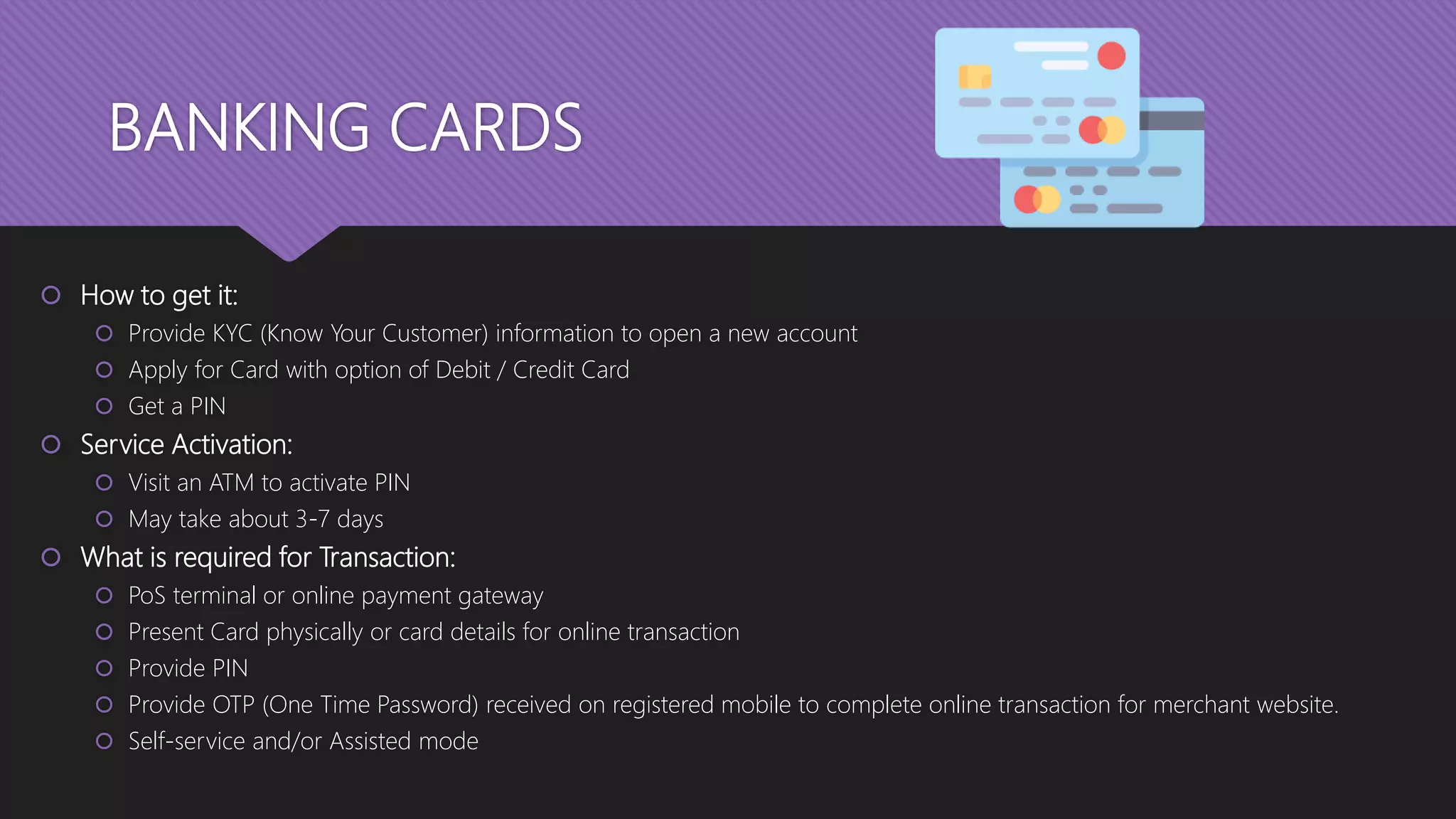
BANKING CARDS
 Banking cards offer consumers more security, convenience, and control than any other
payment method. The wide variety of cards available – including credit, debit and
prepaid – offers enormous flexibility, as well. These cards provide 2 factor authentication
for secure payments e.g secure PIN and OTP. RuPay, Visa, MasterCard are some of the
example of card payment systems. Payment cards give people the power to purchase
items in stores, on the Internet, through mail-order catalogues and over the telephone.
They save both customers and merchants’ time and money, and thus enable them for
ease of transaction.
 DEBIT / CREDIT / CASH / TRAVEL / OTHERS are some examples
BANKING CARDS
 How to get it:
 Provide KYC (Know Your Customer) information to open a new account
 Apply for Card with option of Debit / Credit Card
 Get a PIN
 Service Activation:
 Visit an ATM to activate PIN
 May take about 3-7 days
 What is required for Transaction:
 PoS terminal or online payment gateway
 Present Card physically or card details for online transaction
 Provide PIN
 Provide OTP (One Time Password) received on registered mobile to complete online transaction for merchant website.
 Self-service and/or Assisted mode
BANKING CARDS
 Transaction Cost:
 NIL to customer for merchant transactions.
 Annual fee and limits on ATM transaction by banks discretion.
 0.50% to 2.25% paid by merchant
 Cash-out charged to customer in case of credit cards @ 1% to 3.5% of transaction value.
 Services Offered:
 These cards can be used at PoS (Point of Sale) machines, ATMs, micro ATMs, Shops, wallets, online
transactions, and for e-commerce websites.
 International cards can be used across globe for multiple currencies
 Funds Transfer limit:
 User can set up transaction limit based on card.
 Based on credit ratings
UNSTRUCTURED SUPPLEMENTARY SERVICE DATA (USSD)
The innovative payment service *99# works on Unstructured Supplementary
Service Data (USSD) channel. This service allows mobile banking transactions
using basic feature mobile phone, there is no need to have mobile internet data
facility for using USSD based mobile banking. It is envisioned to provide financial
deepening and inclusion of underbanked society in the mainstream banking
services.
UNSTRUCTURED SUPPLEMENTARY SERVICE DATA (USSD)
*99# service has been launched to take the banking services to every common
man across the country. Banking customers can avail this service by dialling *99#, a
“Common number across all Telecom Service Providers (TSPs)” on their mobile
phone and transact through an interactive menu displayed on the mobile screen.
Key services offered under *99# service include, interbank account to account fund
transfer, balance enquiry, mini statement besides host of other services.
UNSTRUCTURED SUPPLEMENTARY SERVICE DATA (USSD)
*99# service is currently offered by 51 leading banks & all GSM service providers
and can be accessed in 12 different languages including Hindi & English as on
30.11.2016 (Source: NPCI). *99# service is a unique interoperable direct to consumer
service that brings together the diverse ecosystem partners such as Banks & TSPs
(Telecom Service Providers).
UNSTRUCTURED SUPPLEMENTARY SERVICE DATA (USSD)
How to get it:
 Provide KYC (Know Your Customer)
information to open a new account
 Mobile no. should be linked with bank
a/c
 Register for USSD/Mobile Banking
 Get MMID (Mobile Money Identifier)
 Get MPIN (Mobile PIN)
Service Activation:
 None
 1-2 minutes
What is required for Transaction:
 Remember MMID
 Remember MPIN
 Dial *99#
 Registered mobile number with any
phone (feature or smart)
 Self Service mode
UNSTRUCTURED SUPPLEMENTARY SERVICE DATA (USSD)
Transaction Cost:
 NIL by system
 Rs. 0.50 charged to customer
Services Offered:
 Balance enquiry
 Mini Statement
 Funds transfer
 MMID
 A/c no.
 Aadhaar
 Know MMID
 Change M-PIN
 Generate OTP
Funds Transfer limit:
 Rs 5,000/day
 Rs 50,000/annum
AADHAAR ENABLED PAYMENT SYSTEM
(AEPS)
AEPS is a bank led model which allows online interoperable financial
transaction at PoS (Point of Sale / Micro ATM) through the Business
Correspondent (BC)/Bank Mitra of any bank using the Aadhaar
authentication.
AADHAAR ENABLED PAYMENT SYSTEM
(AEPS)
How to get it:
 Provide KYC (Know Your Customer) information to open a new account
 Aadhaar Number should be linked with bank a/c
Service Activation:
 None
 1-2 minutes post Aadhaar seeding
What is required for Transaction:
 MicroATM
 Remember Aadhaar
 Give Bank name
 Present self (Aadhaar holder) with Bio-metrics (Finger and/or IRIS)
 Assisted mode
AADHAAR ENABLED PAYMENT SYSTEM
(AEPS)
Transaction Cost:
 NIL to customer
 Merchant or BC may get charged or paid based on bank‘s discretion
Services Offered:
 Balance Enquiry
 Cash Withdrawal
 Cash Deposit
 Aadhaar to Aadhaar funds transfer
 Payment Transactions (C2B, C2G Transactions)
Funds Transfer limit:
 Banks defined limit. No limit for RBI.
UNIFIED PAYMENTS INTERFACE
(UPI)
Unified Payments Interface (UPI) is a system that powers multiple bank accounts into a
single mobile application (of any participating bank), merging several banking features,
seamless fund routing & merchant payments into one hood. It also caters to the “Peer to
Peer” collect request which can be scheduled and paid as per requirement and
convenience. Each Bank provides its own UPI App for Android, Windows and iOS mobile
platform(s).
UNIFIED PAYMENTS INTERFACE
(UPI)
How to get it:
 Bank a/c
 Mobile number should be linked with
bank a/c
 Smart Phone with internet facility
 Debit Card for re-setting MPIN.
Service Activation:
 Download the App for UPI
 Do registration online on the App with
a/c details
 Create a virtual ID
 Set MPIN
 5-7 minutes
What is required for Transaction:
 Smartphone with internet facility
 Registered device only
 Use registered MPIN
 Self Service Mode
UNIFIED PAYMENTS INTERFACE
(UPI)
Transaction Cost:
 NIL to customer by most Banks
 Customer pays for data charges
Services Offered:
 Balance Enquiry
 Transaction History
 Send / Pay Money
 Virtual Address
 A/c no. & IFSC code
 Mobile no. and MMID
 Aadhaar (to be made functional)
 Collect Money
 Virtual Address
 Add bank account
 Change / Set MPIN
 Notifications
 A/c Management
Funds Transfer limit:
 1 lakh / transaction
MOBILE WALLETS
A mobile wallet is a way to carry cash in digital format. You can link your credit card or
debit card information in mobile device to mobile wallet application or you can transfer
money online to mobile wallet. Instead of using your physical plastic card to make
purchases, you can pay with your smartphone, tablet, or smart watch. An individual's
account is required to be linked to the digital wallet to load money in it. Most banks have
their e-wallets and some private companies. e.g. Paytm, Freecharge, Mobikwik, Oxigen,
mRuppee, Airtel Money, Jio Money, SBI Buddy, itz Cash, Citrus Pay, Vodafone M-Pesa, Axis
Bank Lime, ICICI Pockets, SpeedPay etc.
MOBILE WALLETS
How to get it:
 Option to open Zero KYC or Full KYC
wallet
 Option of Consumer vs. Merchant wallet
 Mobile Number
 An App to be downloaded in smart
phone
Service Activation:
 Load money (subject to regulatory limits)
using internet banking or merchant
locations
Bank A/c
All Cards
Cash-In
What is required for Transaction:
 Smartphone or internet
 Use MPIN
 Self-service and/or Assisted mode
MOBILE WALLETS
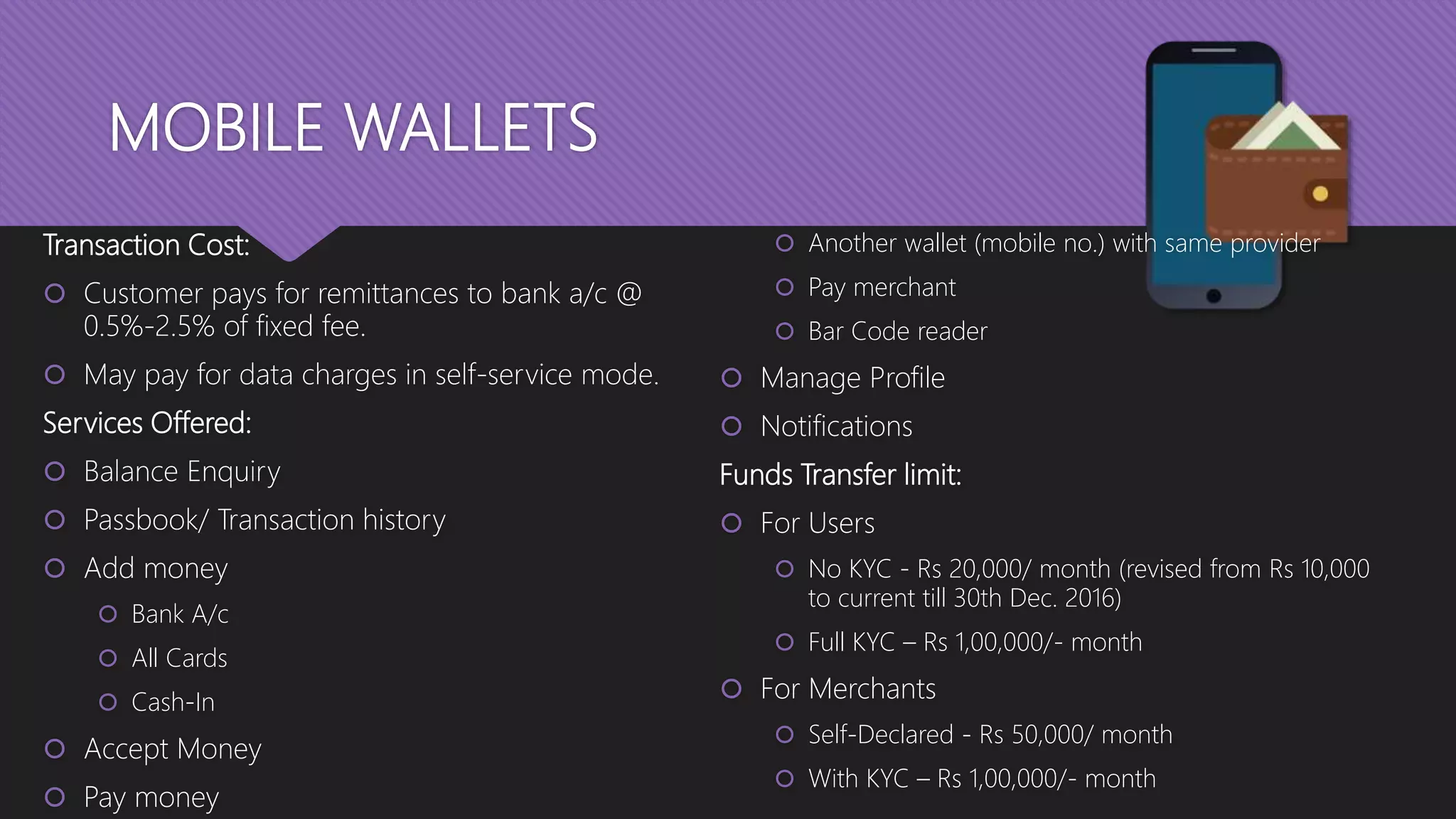
Transaction Cost:
 Customer pays for remittances to bank a/c @
0.5%-2.5% of fixed fee.
 May pay for data charges in self-service mode.
Services Offered:
 Balance Enquiry
 Passbook/ Transaction history
 Add money
 Bank A/c
 All Cards
 Cash-In
 Accept Money
 Pay money
 Another wallet (mobile no.) with same provider
 Pay merchant
 Bar Code reader
 Manage Profile
 Notifications
Funds Transfer limit:
 For Users
 No KYC - Rs 20,000/ month (revised from Rs 10,000
to current till 30th Dec. 2016)
 Full KYC – Rs 1,00,000/- month
 For Merchants
 Self-Declared - Rs 50,000/ month
 With KYC – Rs 1,00,000/- month
BANKS PRE-PAID CARDS
How to get it:
 Provide full KYC (Know Your Customer)
information to open new account
 Apply for Wallet/ Pre-paid Card
 Get a MPIN / PIN
Service Activation:
 Load money (subject to regulatory limits)
using branch, or internet banking
 Bank A/c
 All Cards
 1-2 days for card
 5-7 minutes for wallet
What is required for Transaction:
 Smartphone or internet
 Use MPIN
 Self-service and/or Assisted mode
BANKS PRE-PAID CARDS
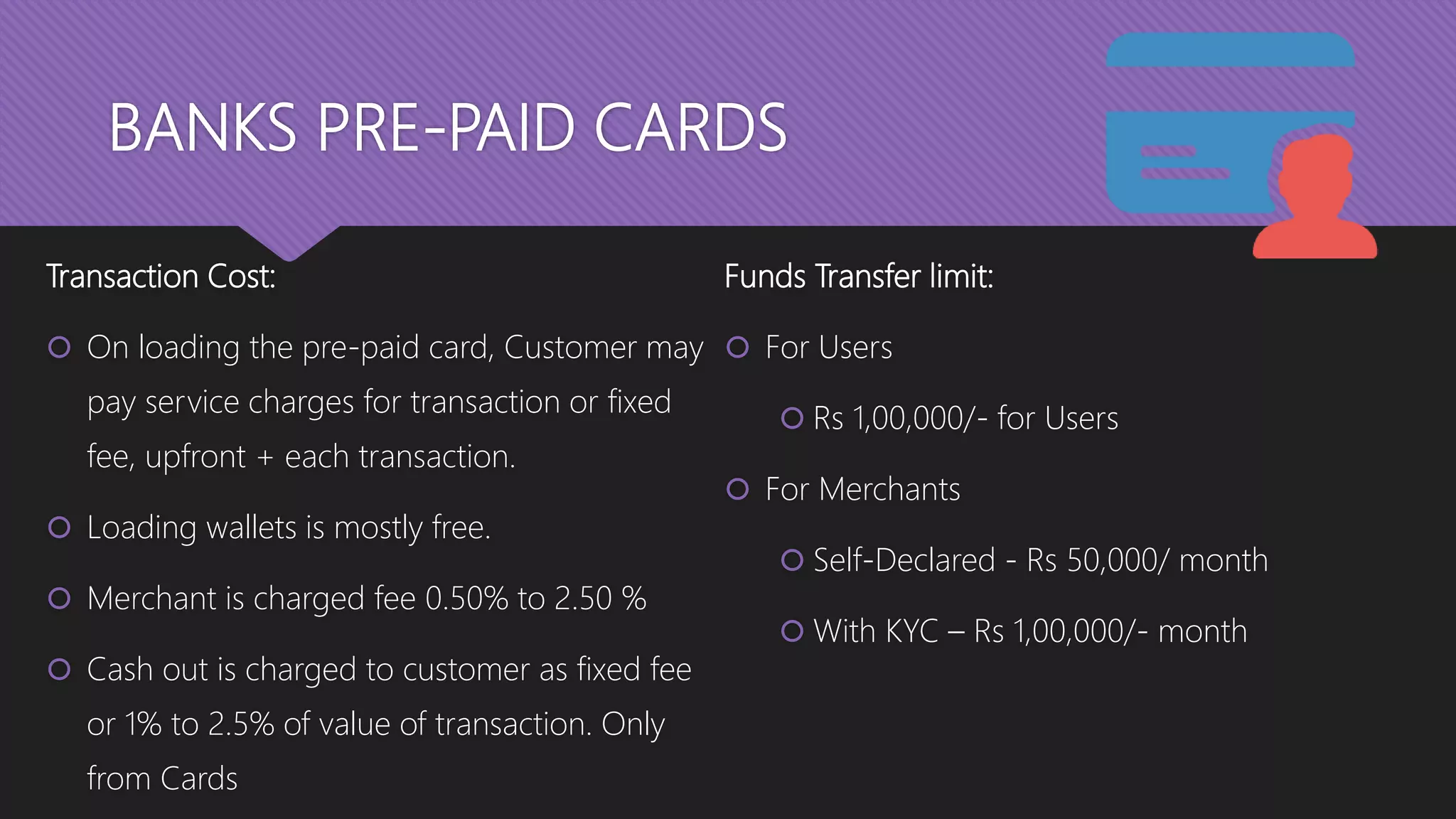
Transaction Cost:
 On loading the pre-paid card, Customer may
pay service charges for transaction or fixed
fee, upfront + each transaction.
 Loading wallets is mostly free.
 Merchant is charged fee 0.50% to 2.50 %
 Cash out is charged to customer as fixed fee
or 1% to 2.5% of value of transaction. Only
from Cards
Funds Transfer limit:
 For Users
 Rs 1,00,000/- for Users
 For Merchants
 Self-Declared - Rs 50,000/ month
 With KYC – Rs 1,00,000/- month
BANKS PRE-PAID CARDS
Services Offered:
 Balance Enquiry
 Passbook/ Transaction history
 Add money
 Bank A/c
 All Cards
 Accept Money
 Pay money
 Another wallet (mobile no.) with same
provider
 Pay merchant
 Bar Code reader
 Cash-Out (Cash withdrawal)
 Touch and Pay
 Manage Profile
 Notifications
POINT OF SALE
A point of sale (PoS) is the place where sales are made. On a macro level, a PoS may
be a mall, a market or a city. On a micro level, retailers consider a PoS to be the area
where a customer completes a transaction, such as a checkout counter. It is also
known as a point of purchase.
POINT OF SALE
Necessary conditions for service initiation:
 Handheld Device with card and /or bio-
metric reader
 Merchant Bank a/c
 Internet connectivity GPRS/ Landline
Service Activation:
 Paper work with Bank for merchant bank
a/c
 Deposit certain amount
 Collect device
 Configuration and training to operator
What is required for Transaction:
 Any Card
 Resident for bio-metric authentication
(AEPS)
 Assisted Mode
Funds Transfer limit:
 No limit for regulator
 Merchant’s Bank and payee Bank may set
limit based on its own discretion
MOBILE BANKING
Mobile banking is a service provided by a bank or other financial institution that allows its
customers to conduct different types of financial transactions remotely using a mobile
device such as a mobile phone or tablet. It uses software, usually called an app, provided
by the banks or financial institution for the purpose. Each Bank provides its own mobile
banking App for Android, Windows and iOS mobile platform(s).
MICRO ATMS
Micro ATM meant to be a device that is used by a million Business Correspondents
(BC) to deliver basic banking services. The platform will enable Business
Correspondents (who could be a local kirana shop owner and will act as ‘micro
ATM’) to conduct instant transactions.
MICRO ATMS
The micro platform will enable function through low cost devices (micro ATMs) that will be
connected to banks across the country. This would enable a person to instantly deposit or
withdraw funds regardless of the bank associated with a particular BC. This device will be
based on a mobile phone connection and would be made available at every BC.
MICRO ATMS
Customers would just have to get their identity authenticated and withdraw or put money
into their bank accounts. This money will come from the cash drawer of the BC. Essentially,
BCs will act as bank for the customers and all they need to do is verify the authenticity of
customer using customers’ UID. The basic transaction types, to be supported by micro ATM,
are Deposit, Withdrawal, Fund transfer and Balance enquiry.
Electronic payment system

Electronic payment system

  • 1.
  • 2.
    Meaning An e-payment systemis a way of making transactions or paying for goods and services through an electronic medium, without the use of cheques or cash. It’s also called an electronic payment system or online payment system.
  • 3.
    INTERNET BANKING Internet banking,also known as online banking, e-banking or virtual banking, is an electronic payment system that enables customers of a bank or other financial institution to conduct a range of financial transactions through the website or an application of bank or financial institution.
  • 4.
    INTERNET BANKING National ElectronicFund Transfer (NEFT) National Electronic Funds Transfer (NEFT) is a nation-wide payment system facilitating one-to-one funds transfer. Under this Scheme, individuals, firms and corporates can electronically transfer funds from any bank branch to any individual, firm or corporate having an account with any other bank branch in the country participating in the Scheme. Individuals, firms or corporates maintaining accounts with a bank branch can transfer funds using NEFT. Even such individuals who do not have a bank account (walk- in customers) can also deposit cash at the NEFT-enabled branches with instructions to transfer funds using NEFT. However, such cash remittances will be restricted to a maximum of Rs.50,000/- per transaction.
  • 5.
    INTERNET BANKING National ElectronicFund Transfer (NEFT) NEFT, thus, facilitates originators or remitters to initiate funds transfer transactions even without having a bank account. Presently, NEFT operates in hourly batches - there are twelve settlements from 8 am to 7 pm on week days (Monday through Friday) and six settlements from 8 am to 1 pm on Saturdays.
  • 6.
    INTERNET BANKING Real TimeGross Settlement (RTGS) RTGS is defined as the continuous (real-time) settlement of funds transfers individually on an order by order basis (without netting). 'Real Time' means the processing of instructions at the time they are received rather than at some later time; 'Gross Settlement' means the settlement of funds transfer instructions occurs individually (on an instruction by instruction basis). Considering that the funds settlement takes place in the books of the Reserve Bank of India, the payments are final and irrevocable.
  • 7.
    INTERNET BANKING Real TimeGross Settlement (RTGS) The RTGS system is primarily meant for large value transactions. The minimum amount to be remitted through RTGS is 2 lakh. There is no upper ceiling for RTGS transactions. The RTGS service for customer's transactions is available to banks from 9.00 hours to 16.30 hours on week days and from 9.00 hours to 14:00 hours on Saturdays for settlement at the RBI end. However, the timings that the banks follow may vary depending on the customer timings of the bank branches.
  • 8.
    INTERNET BANKING Electronic ClearingSystem (ECS) ECS is an alternative method for effecting payment transactions in respect of the utility-bill-payments such as telephone bills, electricity bills, insurance premium, card payments and loan repayments, etc., which would obviate the need for issuing and handling paper instruments and thereby facilitate improved customer service by banks / companies / corporations / government departments, etc., collecting / receiving the payments.
  • 9.
    INTERNET BANKING Immediate PaymentService (IMPS) IMPS offers an instant, 24X7, interbank electronic fund transfer service through mobile phones. IMPS is an emphatic tool to transfer money instantly within banks across India through mobile, internet and ATM which is not only safe but also economical both in financial and non-financial perspectives.
  • 10.
    BANKING CARDS  Bankingcards offer consumers more security, convenience, and control than any other payment method. The wide variety of cards available – including credit, debit and prepaid – offers enormous flexibility, as well. These cards provide 2 factor authentication for secure payments e.g secure PIN and OTP. RuPay, Visa, MasterCard are some of the example of card payment systems. Payment cards give people the power to purchase items in stores, on the Internet, through mail-order catalogues and over the telephone. They save both customers and merchants’ time and money, and thus enable them for ease of transaction.  DEBIT / CREDIT / CASH / TRAVEL / OTHERS are some examples
  • 11.
    BANKING CARDS  Howto get it:  Provide KYC (Know Your Customer) information to open a new account  Apply for Card with option of Debit / Credit Card  Get a PIN  Service Activation:  Visit an ATM to activate PIN  May take about 3-7 days  What is required for Transaction:  PoS terminal or online payment gateway  Present Card physically or card details for online transaction  Provide PIN  Provide OTP (One Time Password) received on registered mobile to complete online transaction for merchant website.  Self-service and/or Assisted mode
  • 12.
    BANKING CARDS  TransactionCost:  NIL to customer for merchant transactions.  Annual fee and limits on ATM transaction by banks discretion.  0.50% to 2.25% paid by merchant  Cash-out charged to customer in case of credit cards @ 1% to 3.5% of transaction value.  Services Offered:  These cards can be used at PoS (Point of Sale) machines, ATMs, micro ATMs, Shops, wallets, online transactions, and for e-commerce websites.  International cards can be used across globe for multiple currencies  Funds Transfer limit:  User can set up transaction limit based on card.  Based on credit ratings
  • 13.
    UNSTRUCTURED SUPPLEMENTARY SERVICEDATA (USSD) The innovative payment service *99# works on Unstructured Supplementary Service Data (USSD) channel. This service allows mobile banking transactions using basic feature mobile phone, there is no need to have mobile internet data facility for using USSD based mobile banking. It is envisioned to provide financial deepening and inclusion of underbanked society in the mainstream banking services.
  • 14.
    UNSTRUCTURED SUPPLEMENTARY SERVICEDATA (USSD) *99# service has been launched to take the banking services to every common man across the country. Banking customers can avail this service by dialling *99#, a “Common number across all Telecom Service Providers (TSPs)” on their mobile phone and transact through an interactive menu displayed on the mobile screen. Key services offered under *99# service include, interbank account to account fund transfer, balance enquiry, mini statement besides host of other services.
  • 15.
    UNSTRUCTURED SUPPLEMENTARY SERVICEDATA (USSD) *99# service is currently offered by 51 leading banks & all GSM service providers and can be accessed in 12 different languages including Hindi & English as on 30.11.2016 (Source: NPCI). *99# service is a unique interoperable direct to consumer service that brings together the diverse ecosystem partners such as Banks & TSPs (Telecom Service Providers).
  • 16.
    UNSTRUCTURED SUPPLEMENTARY SERVICEDATA (USSD) How to get it:  Provide KYC (Know Your Customer) information to open a new account  Mobile no. should be linked with bank a/c  Register for USSD/Mobile Banking  Get MMID (Mobile Money Identifier)  Get MPIN (Mobile PIN) Service Activation:  None  1-2 minutes What is required for Transaction:  Remember MMID  Remember MPIN  Dial *99#  Registered mobile number with any phone (feature or smart)  Self Service mode
  • 17.
    UNSTRUCTURED SUPPLEMENTARY SERVICEDATA (USSD) Transaction Cost:  NIL by system  Rs. 0.50 charged to customer Services Offered:  Balance enquiry  Mini Statement  Funds transfer  MMID  A/c no.  Aadhaar  Know MMID  Change M-PIN  Generate OTP Funds Transfer limit:  Rs 5,000/day  Rs 50,000/annum
  • 18.
    AADHAAR ENABLED PAYMENTSYSTEM (AEPS) AEPS is a bank led model which allows online interoperable financial transaction at PoS (Point of Sale / Micro ATM) through the Business Correspondent (BC)/Bank Mitra of any bank using the Aadhaar authentication.
  • 19.
    AADHAAR ENABLED PAYMENTSYSTEM (AEPS) How to get it:  Provide KYC (Know Your Customer) information to open a new account  Aadhaar Number should be linked with bank a/c Service Activation:  None  1-2 minutes post Aadhaar seeding What is required for Transaction:  MicroATM  Remember Aadhaar  Give Bank name  Present self (Aadhaar holder) with Bio-metrics (Finger and/or IRIS)  Assisted mode
  • 20.
    AADHAAR ENABLED PAYMENTSYSTEM (AEPS) Transaction Cost:  NIL to customer  Merchant or BC may get charged or paid based on bank‘s discretion Services Offered:  Balance Enquiry  Cash Withdrawal  Cash Deposit  Aadhaar to Aadhaar funds transfer  Payment Transactions (C2B, C2G Transactions) Funds Transfer limit:  Banks defined limit. No limit for RBI.
  • 21.
    UNIFIED PAYMENTS INTERFACE (UPI) UnifiedPayments Interface (UPI) is a system that powers multiple bank accounts into a single mobile application (of any participating bank), merging several banking features, seamless fund routing & merchant payments into one hood. It also caters to the “Peer to Peer” collect request which can be scheduled and paid as per requirement and convenience. Each Bank provides its own UPI App for Android, Windows and iOS mobile platform(s).
  • 22.
    UNIFIED PAYMENTS INTERFACE (UPI) Howto get it:  Bank a/c  Mobile number should be linked with bank a/c  Smart Phone with internet facility  Debit Card for re-setting MPIN. Service Activation:  Download the App for UPI  Do registration online on the App with a/c details  Create a virtual ID  Set MPIN  5-7 minutes What is required for Transaction:  Smartphone with internet facility  Registered device only  Use registered MPIN  Self Service Mode
  • 23.
    UNIFIED PAYMENTS INTERFACE (UPI) TransactionCost:  NIL to customer by most Banks  Customer pays for data charges Services Offered:  Balance Enquiry  Transaction History  Send / Pay Money  Virtual Address  A/c no. & IFSC code  Mobile no. and MMID  Aadhaar (to be made functional)  Collect Money  Virtual Address  Add bank account  Change / Set MPIN  Notifications  A/c Management Funds Transfer limit:  1 lakh / transaction
  • 24.
    MOBILE WALLETS A mobilewallet is a way to carry cash in digital format. You can link your credit card or debit card information in mobile device to mobile wallet application or you can transfer money online to mobile wallet. Instead of using your physical plastic card to make purchases, you can pay with your smartphone, tablet, or smart watch. An individual's account is required to be linked to the digital wallet to load money in it. Most banks have their e-wallets and some private companies. e.g. Paytm, Freecharge, Mobikwik, Oxigen, mRuppee, Airtel Money, Jio Money, SBI Buddy, itz Cash, Citrus Pay, Vodafone M-Pesa, Axis Bank Lime, ICICI Pockets, SpeedPay etc.
  • 25.
    MOBILE WALLETS How toget it:  Option to open Zero KYC or Full KYC wallet  Option of Consumer vs. Merchant wallet  Mobile Number  An App to be downloaded in smart phone Service Activation:  Load money (subject to regulatory limits) using internet banking or merchant locations Bank A/c All Cards Cash-In What is required for Transaction:  Smartphone or internet  Use MPIN  Self-service and/or Assisted mode
  • 26.
    MOBILE WALLETS Transaction Cost: Customer pays for remittances to bank a/c @ 0.5%-2.5% of fixed fee.  May pay for data charges in self-service mode. Services Offered:  Balance Enquiry  Passbook/ Transaction history  Add money  Bank A/c  All Cards  Cash-In  Accept Money  Pay money  Another wallet (mobile no.) with same provider  Pay merchant  Bar Code reader  Manage Profile  Notifications Funds Transfer limit:  For Users  No KYC - Rs 20,000/ month (revised from Rs 10,000 to current till 30th Dec. 2016)  Full KYC – Rs 1,00,000/- month  For Merchants  Self-Declared - Rs 50,000/ month  With KYC – Rs 1,00,000/- month
  • 27.
    BANKS PRE-PAID CARDS Howto get it:  Provide full KYC (Know Your Customer) information to open new account  Apply for Wallet/ Pre-paid Card  Get a MPIN / PIN Service Activation:  Load money (subject to regulatory limits) using branch, or internet banking  Bank A/c  All Cards  1-2 days for card  5-7 minutes for wallet What is required for Transaction:  Smartphone or internet  Use MPIN  Self-service and/or Assisted mode
  • 28.
    BANKS PRE-PAID CARDS TransactionCost:  On loading the pre-paid card, Customer may pay service charges for transaction or fixed fee, upfront + each transaction.  Loading wallets is mostly free.  Merchant is charged fee 0.50% to 2.50 %  Cash out is charged to customer as fixed fee or 1% to 2.5% of value of transaction. Only from Cards Funds Transfer limit:  For Users  Rs 1,00,000/- for Users  For Merchants  Self-Declared - Rs 50,000/ month  With KYC – Rs 1,00,000/- month
  • 29.
    BANKS PRE-PAID CARDS ServicesOffered:  Balance Enquiry  Passbook/ Transaction history  Add money  Bank A/c  All Cards  Accept Money  Pay money  Another wallet (mobile no.) with same provider  Pay merchant  Bar Code reader  Cash-Out (Cash withdrawal)  Touch and Pay  Manage Profile  Notifications
  • 30.
    POINT OF SALE Apoint of sale (PoS) is the place where sales are made. On a macro level, a PoS may be a mall, a market or a city. On a micro level, retailers consider a PoS to be the area where a customer completes a transaction, such as a checkout counter. It is also known as a point of purchase.
  • 31.
    POINT OF SALE Necessaryconditions for service initiation:  Handheld Device with card and /or bio- metric reader  Merchant Bank a/c  Internet connectivity GPRS/ Landline Service Activation:  Paper work with Bank for merchant bank a/c  Deposit certain amount  Collect device  Configuration and training to operator What is required for Transaction:  Any Card  Resident for bio-metric authentication (AEPS)  Assisted Mode Funds Transfer limit:  No limit for regulator  Merchant’s Bank and payee Bank may set limit based on its own discretion
  • 32.
    MOBILE BANKING Mobile bankingis a service provided by a bank or other financial institution that allows its customers to conduct different types of financial transactions remotely using a mobile device such as a mobile phone or tablet. It uses software, usually called an app, provided by the banks or financial institution for the purpose. Each Bank provides its own mobile banking App for Android, Windows and iOS mobile platform(s).
  • 33.
    MICRO ATMS Micro ATMmeant to be a device that is used by a million Business Correspondents (BC) to deliver basic banking services. The platform will enable Business Correspondents (who could be a local kirana shop owner and will act as ‘micro ATM’) to conduct instant transactions.
  • 34.
    MICRO ATMS The microplatform will enable function through low cost devices (micro ATMs) that will be connected to banks across the country. This would enable a person to instantly deposit or withdraw funds regardless of the bank associated with a particular BC. This device will be based on a mobile phone connection and would be made available at every BC.
  • 35.
    MICRO ATMS Customers wouldjust have to get their identity authenticated and withdraw or put money into their bank accounts. This money will come from the cash drawer of the BC. Essentially, BCs will act as bank for the customers and all they need to do is verify the authenticity of customer using customers’ UID. The basic transaction types, to be supported by micro ATM, are Deposit, Withdrawal, Fund transfer and Balance enquiry.