K to 12 BASIC EDUCATION CURRICULUM
JUNIOR HIGH SCHOOL TECHNOLOGY AND LIVELIHOOD EDUCATION AND SENIOR HIGH SCHOOL TECHNICAL-VOCATIONAL-LIVELIHOOD TRACK
INDUSTRIAL ARTS –ELECTRICAL INSTALLATION AND MAINTENANCE (NC II)
(640 hours)
K to 12 Industrial Arts – Electrical Installation and Maintenance Curriculum Guide May 2016 *LO – Learning Outcome Page 1 of 23
Learning Materials are uploaded at http://lrmds.deped.gov.ph/.
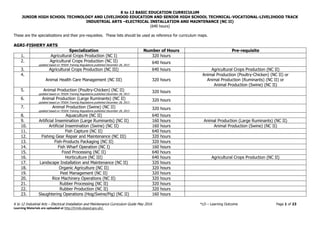
These are the specializations and their pre-requisites. These lists should be used as reference for curriculum maps.
AGRI-FISHERY ARTS
Specialization Number of Hours Pre-requisite
1. Agricultural Crops Production (NC I) 320 hours
2. Agricultural Crops Production (NC II)
updated based on TESDA Training Regulations published December 28, 2013
640 hours
3. Agricultural Crops Production (NC III) 640 hours Agricultural Crops Production (NC II)
4.
Animal Health Care Management (NC III) 320 hours
Animal Production (Poultry-Chicken) (NC II) or
Animal Production (Ruminants) (NC II) or
Animal Production (Swine) (NC II)
5. Animal Production (Poultry-Chicken) (NC II)
updated based on TESDA Training Regulations published December 28, 2013
320 hours
6. Animal Production (Large Ruminants) (NC II)
updated based on TESDA Training Regulations published December 28, 2013
320 hours
7. Animal Production (Swine) (NC II)
updated based on TESDA Training Regulations published December 28, 2013
320 hours
8. Aquaculture (NC II) 640 hours
9. Artificial Insemination (Large Ruminants) (NC II) 160 hours Animal Production (Large Ruminants) (NC II)
10. Artificial Insemination (Swine) (NC II) 160 hours Animal Production (Swine) (NC II)
11. Fish Capture (NC II) 640 hours
12. Fishing Gear Repair and Maintenance (NC III) 320 hours
13. Fish-Products Packaging (NC II) 320 hours
14. Fish Wharf Operation (NC I) 160 hours
15. Food Processing (NC II) 640 hours
16. Horticulture (NC III) 640 hours Agricultural Crops Production (NC II)
17. Landscape Installation and Maintenance (NC II) 320 hours
18. Organic Agriculture (NC II) 320 hours
19. Pest Management (NC II) 320 hours
20. Rice Machinery Operations (NC II) 320 hours
21. Rubber Processing (NC II) 320 hours
22. Rubber Production (NC II) 320 hours
23. Slaughtering Operations (Hog/Swine/Pig) (NC II) 160 hours
K to 12 BASIC EDUCATION CURRICULUM
JUNIOR HIGH SCHOOL TECHNOLOGY AND LIVELIHOOD EDUCATION AND SENIOR HIGH SCHOOL TECHNICAL-VOCATIONAL-LIVELIHOOD TRACK
INDUSTRIAL ARTS –ELECTRICAL INSTALLATION AND MAINTENANCE (NC II)
(640 hours)
K to 12 Industrial Arts – Electrical Installation and Maintenance Curriculum Guide May 2016 *LO – Learning Outcome Page 2 of 23
Learning Materials are uploaded at http://lrmds.deped.gov.ph/.
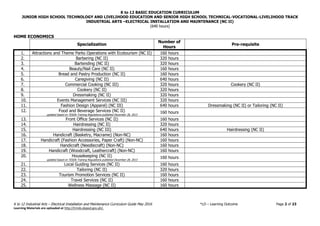
HOME ECONOMICS
Specialization
Number of
Hours
Pre-requisite
1. Attractions and Theme Parks Operations with Ecotourism (NC II) 160 hours
2. Barbering (NC II) 320 hours
3. Bartending (NC II) 320 hours
4. Beauty/Nail Care (NC II) 160 hours
5. Bread and Pastry Production (NC II) 160 hours
6. Caregiving (NC II) 640 hours
7. Commercial Cooking (NC III) 320 hours Cookery (NC II)
8. Cookery (NC II) 320 hours
9. Dressmaking (NC II) 320 hours
10. Events Management Services (NC III) 320 hours
11. Fashion Design (Apparel) (NC III) 640 hours Dressmaking (NC II) or Tailoring (NC II)
12. Food and Beverage Services (NC II)
updated based on TESDA Training Regulations published December 28, 2013
160 hours
13. Front Office Services (NC II) 160 hours
14. Hairdressing (NC II) 320 hours
15. Hairdressing (NC III) 640 hours Hairdressing (NC II)
16. Handicraft (Basketry, Macrame) (Non-NC) 160 hours
17. Handicraft (Fashion Accessories, Paper Craft) (Non-NC) 160 hours
18. Handicraft (Needlecraft) (Non-NC) 160 hours
19. Handicraft (Woodcraft, Leathercraft) (Non-NC) 160 hours
20. Housekeeping (NC II)
updated based on TESDA Training Regulations published December 28, 2013
160 hours
21. Local Guiding Services (NC II) 160 hours
22. Tailoring (NC II) 320 hours
23. Tourism Promotion Services (NC II) 160 hours
24. Travel Services (NC II) 160 hours
25. Wellness Massage (NC II) 160 hours
K to 12 BASIC EDUCATION CURRICULUM
JUNIOR HIGH SCHOOL TECHNOLOGY AND LIVELIHOOD EDUCATION AND SENIOR HIGH SCHOOL TECHNICAL-VOCATIONAL-LIVELIHOOD TRACK
INDUSTRIAL ARTS –ELECTRICAL INSTALLATION AND MAINTENANCE (NC II)
(640 hours)
K to 12 Industrial Arts – Electrical Installation and Maintenance Curriculum Guide May 2016 *LO – Learning Outcome Page 3 of 23
Learning Materials are uploaded at http://lrmds.deped.gov.ph/.
INDUSTRIAL ARTS
Specialization
Number of
Hours
Pre-requisite
1. Automotive Servicing (NC I)
updated based on TESDA Training Regulations published December 28, 2013
640 hours
2. Automotive Servicing (NC II) 640 hours Automotive Servicing (NC I)
3. Carpentry (NC II) 640 hours
4. Carpentry (NC III) 320 hours Carpentry (NC II)
5. Construction Painting (NC II) 160 hours
6. Domestic Refrigeration and Air-conditioning (DOMRAC) Servicing (NC
II)
640 hours
7. Driving (NC II) 160 hours
8. Electrical Installation and Maintenance (NC II) 640 hours
9. Electric Power Distribution Line Construction (NC II) 320 hours Electrical Installation and Maintenance (NC II)
10. Electronic Products Assembly and Servicing (NC II)
updated based on TESDA Training Regulations published December 28, 2013
640 hours
11. Furniture Making (Finishing) (NC II) 640 hours
12. Instrumentation and Control Servicing (NC II) 320 hours Electronic Products Assembly and Servicing (EPAS) (NC II)
13. Gas Metal Arc Welding (GMAW) (NC II) 320 hours Shielded Metal Arc Welding (SMAW) (NC II)
14. Gas Tungsten Arc Welding (GTAW) (NC II) 320 hours Shielded Metal Arc Welding (GMAW) (NC II)
15. Machining (NC I) 640 hours
16. Machining (NC II) 640 hours Machining (NC I)
17. Masonry (NC II) 320 hours
18. Mechatronics Servicing (NC II) 320 hours Electronic Products Assembly and Servicing (EPAS) (NC II)
19. Motorcycle/Small Engine Servicing (NC II) 320 hours
20. Plumbing (NC I) 320 hours
21. Plumbing (NC II) 320 hours Plumbing (NC I)
22. Refrigeration and Air-Conditioning (Packaged Air-Conditioning Unit
[PACU]/Commercial Refrigeration Equipment [CRE]) Servicing (NC III)
640 hours
Domestic Refrigeration and Air-conditioning (DOMRAC)
Servicing (NC II)
23. Shielded Metal Arc Welding (NC I) 320 hours
24. Shielded Metal Arc Welding (NC II) 320 hours Shielded Metal Arc Welding (NC I)
25. Tile Setting (NC II) 320 hours
26. Transmission Line Installation and Maintenance (NC II) 640 hours Electrical Installation and Maintenance (NC II)
K to 12 BASIC EDUCATION CURRICULUM
JUNIOR HIGH SCHOOL TECHNOLOGY AND LIVELIHOOD EDUCATION AND SENIOR HIGH SCHOOL TECHNICAL-VOCATIONAL-LIVELIHOOD TRACK
INDUSTRIAL ARTS –ELECTRICAL INSTALLATION AND MAINTENANCE (NC II)
(640 hours)
K to 12 Industrial Arts – Electrical Installation and Maintenance Curriculum Guide May 2016 *LO – Learning Outcome Page 4 of 23
Learning Materials are uploaded at http://lrmds.deped.gov.ph/.
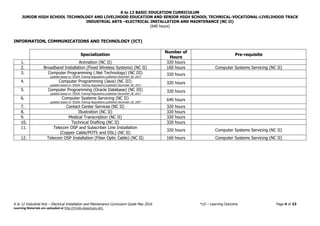
INFORMATION, COMMUNICATIONS AND TECHNOLOGY (ICT)
Specialization
Number of
Hours
Pre-requisite
1. Animation (NC II) 320 hours
2. Broadband Installation (Fixed Wireless Systems) (NC II) 160 hours Computer Systems Servicing (NC II)
3. Computer Programming (.Net Technology) (NC III)
updated based on TESDA Training Regulations published December 28, 2013
320 hours
4. Computer Programming (Java) (NC III)
updated based on TESDA Training Regulations published December 28, 2013
320 hours
5. Computer Programming (Oracle Database) (NC III)
updated based on TESDA Training Regulations published December 28, 2013
320 hours
6. Computer Systems Servicing (NC II)
updated based on TESDA Training Regulations published December 28, 2007
640 hours
7. Contact Center Services (NC II) 320 hours
8. Illustration (NC II) 320 hours
9. Medical Transcription (NC II) 320 hours
10. Technical Drafting (NC II) 320 hours
11. Telecom OSP and Subscriber Line Installation
(Copper Cable/POTS and DSL) (NC II)
320 hours Computer Systems Servicing (NC II)
12. Telecom OSP Installation (Fiber Optic Cable) (NC II) 160 hours Computer Systems Servicing (NC II)
K to 12 BASIC EDUCATION CURRICULUM
JUNIOR HIGH SCHOOL TECHNOLOGY AND LIVELIHOOD EDUCATION AND SENIOR HIGH SCHOOL TECHNICAL-VOCATIONAL-LIVELIHOOD TRACK
INDUSTRIAL ARTS –ELECTRICAL INSTALLATION AND MAINTENANCE (NC II)
(640 hours)
K to 12 Industrial Arts – Electrical Installation and Maintenance Curriculum Guide May 2016 *LO – Learning Outcome Page 5 of 23
Learning Materials are uploaded at http://lrmds.deped.gov.ph/.
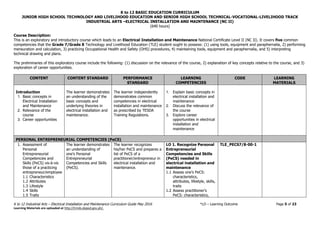
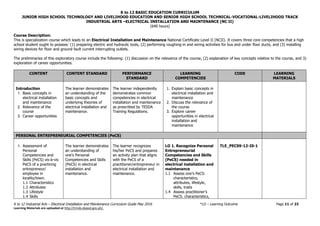
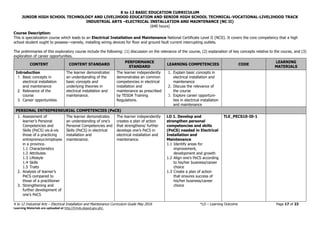
Course Description:
This is an exploratory and introductory course which leads to an Electrical Installation and Maintenance National Certificate Level II (NC II). It covers five common
competencies that the Grade 7/Grade 8 Technology and Livelihood Education (TLE) student ought to possess: (1) using tools, equipment and paraphernalia, 2) performing
mensuration and calculation, 3) practicing Occupational Health and Safety (OHS) procedures, 4) maintaining tools, equipment and paraphernalia, and 5) interpreting
technical drawing and plans.
The preliminaries of this exploratory course include the following: (1) discussion on the relevance of the course, 2) explanation of key concepts relative to the course, and 3)
exploration of career opportunities.
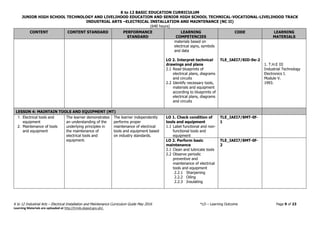
CONTENT CONTENT STANDARD PERFORMANCE
STANDARD
LEARNING
COMPETENCIES
CODE LEARNING
MATERIALS
Introduction
1. Basic concepts in
Electrical Installation
and Maintenance
2. Relevance of the
course
3. Career opportunities
The learner demonstrates
an understanding of the
basic concepts and
underlying theories in
electrical installation and
maintenance.
The learner independently
demonstrates common
competencies in electrical
installation and maintenance
as prescribed by TESDA
Training Regulations.
1. Explain basic concepts in
electrical installation and
maintenance
2. Discuss the relevance of
the course
3. Explore career
opportunities in electrical
installation and
maintenance
PERSONAL ENTREPRENEURIAL COMPETENCIES (PeCS)
1. Assessment of
Personal
Entrepreneurial
Competencies and
Skills (PeCS) vis-à-vis
those of a practicing
entrepreneur/employee
1.1 Characteristics
1.2 Attributes
1.3 Lifestyle
1.4 Skills
1.5 Traits
The learner demonstrates
an understanding of
one’s Personal
Entrepreneurial
Competencies and Skills
(PeCS).
The learner recognizes
his/her PeCS and prepares a
list of PeCS of a
practitioner/entrepreneur in
electrical installation and
maintenance.
LO 1. Recognize Personal
Entrepreneurial
Competencies and Skills
(PeCS) needed in
electrical installation and
maintenance
1.1 Assess one’s PeCS:
characteristics,
attributes, lifestyle, skills,
traits
1.2 Assess practitioner’s
PeCS: characteristics,
TLE_PECS7/8-00-1
K to 12 BASIC EDUCATION CURRICULUM
JUNIOR HIGH SCHOOL TECHNOLOGY AND LIVELIHOOD EDUCATION AND SENIOR HIGH SCHOOL TECHNICAL-VOCATIONAL-LIVELIHOOD TRACK
INDUSTRIAL ARTS –ELECTRICAL INSTALLATION AND MAINTENANCE (NC II)
(640 hours)
K to 12 Industrial Arts – Electrical Installation and Maintenance Curriculum Guide May 2016 *LO – Learning Outcome Page 6 of 23
Learning Materials are uploaded at http://lrmds.deped.gov.ph/.
CONTENT CONTENT STANDARD PERFORMANCE
STANDARD
LEARNING
COMPETENCIES
CODE LEARNING
MATERIALS
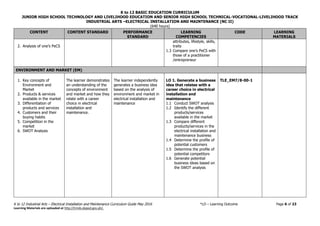
2. Analysis of one’s PeCS
attributes, lifestyle, skills,
traits
1.3 Compare one’s PeCS with
those of a practitioner
/entrepreneur
ENVIRONMENT AND MARKET (EM)
1. Key concepts of
Environment and
Market
2. Products & services
available in the market
3. Differentiation of
products and services
4. Customers and their
buying habits
5. Competition in the
market
6. SWOT Analysis
The learner demonstrates
an understanding of the
concepts of environment
and market and how they
relate with a career
choice in electrical
installation and
maintenance.
The learner independently
generates a business idea
based on the analysis of
environment and market in
electrical installation and
maintenance
LO 1. Generate a business
idea that relates with a
career choice in electrical
installation and
maintenance
1.1 Conduct SWOT analysis
1.2 Identify the different
products/services
available in the market
1.3 Compare different
products/services in the
electrical installation and
maintenance business
1.4 Determine the profile of
potential customers
1.5 Determine the profile of
potential competitors
1.6 Generate potential
business ideas based on
the SWOT analysis
TLE_EM7/8-00-1
K to 12 BASIC EDUCATION CURRICULUM
JUNIOR HIGH SCHOOL TECHNOLOGY AND LIVELIHOOD EDUCATION AND SENIOR HIGH SCHOOL TECHNICAL-VOCATIONAL-LIVELIHOOD TRACK
INDUSTRIAL ARTS –ELECTRICAL INSTALLATION AND MAINTENANCE (NC II)
(640 hours)
K to 12 Industrial Arts – Electrical Installation and Maintenance Curriculum Guide May 2016 *LO – Learning Outcome Page 7 of 23
Learning Materials are uploaded at http://lrmds.deped.gov.ph/.
CONTENT CONTENT STANDARD PERFORMANCE
STANDARD
LEARNING
COMPETENCIES
CODE LEARNING
MATERIALS
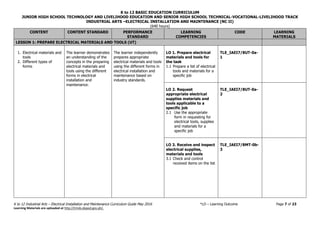
LESSON 1: PREPARE ELECTRICAL MATERIALS AND TOOLS (UT)
1. Electrical materials and
tools
2. Different types of
forms
The learner demonstrates
an understanding of the
concepts in the preparing
electrical materials and
tools using the different
forms in electrical
installation and
maintenance.
The learner independently
prepares appropriate
electrical materials and tools
using the different forms in
electrical installation and
maintenance based on
industry standards.
LO 1. Prepare electrical
materials and tools for
the task
1.1 Prepare a list of electrical
tools and materials for a
specific job
TLE_IAEI7/8UT-0a-
1
LO 2. Request
appropriate electrical
supplies materials and
tools applicable to a
specific job
2.1 Use the appropriate
form in requesting for
electrical tools, supplies
and materials for a
specific job
TLE_IAEI7/8UT-0a-
2
LO 3. Receive and inspect
electrical supplies,
materials and tools
3.1 Check and control
received items on the list
TLE_IAEI7/8MT-0b-
3
K to 12 BASIC EDUCATION CURRICULUM
JUNIOR HIGH SCHOOL TECHNOLOGY AND LIVELIHOOD EDUCATION AND SENIOR HIGH SCHOOL TECHNICAL-VOCATIONAL-LIVELIHOOD TRACK
INDUSTRIAL ARTS –ELECTRICAL INSTALLATION AND MAINTENANCE (NC II)
(640 hours)
K to 12 Industrial Arts – Electrical Installation and Maintenance Curriculum Guide May 2016 *LO – Learning Outcome Page 8 of 23
Learning Materials are uploaded at http://lrmds.deped.gov.ph/.
CONTENT CONTENT STANDARD PERFORMANCE
STANDARD
LEARNING
COMPETENCIES
CODE LEARNING
MATERIALS
LESSON 2: PERFORM MENSURATION AND CALCULATIONS (MC)
1. Measurement
2. Ohm’s Law
3. Multitester
The learner demonstrates
an understanding of the
concepts and underlying
principles in performing
measurements and
calculations.
The learner independently
performs accurate
measurements and
calculation based on given
tasks.
LO 1. Select electrical
measuring tools and
instruments
1.1 Identify object or
component to be
measured
1.2 Choose test instruments
to be used for specific
tasks
1.3 Identify alternative
measuring tools without
sacrificing cost and
quality of work
TLE_IAEI7/8MC-0c-
1
LO 2. Carry out
measurements and
calculations
2.1 Use appropriate
measuring devices for
specific tasks
2.2 Compute for required
data
2.3 Convert data to its
equivalent unit of
measurement
TLE_IAEI7/8MC-0d-
2
LESSON 3: INTERPRET TECHNICAL DRAWINGS AND PLANS (ID)
1. Basic technical drawing
2. Technical Plans and
Schematic Diagram
3. Signs, Symbols and
Abbreviations
The learner demonstrates
an understanding of the
concepts and underlying
principles in interpreting
simple technical drawings
and plans in electrical
installation and
maintenance.
The learner independently
reads and interprets
specifications of simple
technical drawings and
plans.
LO 1. Analyze signs,
electrical symbols and
data
1.1 Read and interpret
electrical signs, symbols
and data
1.2 Analyze electrical
components and
TLE_IAEI7/8ID-0e-1 1. CBLM I
Electricity.
2008. pp. 35-36.
2. CBLM II
Electronics.
Module IV.
2008. pp. 5-7, 12-14.
K to 12 BASIC EDUCATION CURRICULUM
JUNIOR HIGH SCHOOL TECHNOLOGY AND LIVELIHOOD EDUCATION AND SENIOR HIGH SCHOOL TECHNICAL-VOCATIONAL-LIVELIHOOD TRACK
INDUSTRIAL ARTS –ELECTRICAL INSTALLATION AND MAINTENANCE (NC II)
(640 hours)
K to 12 Industrial Arts – Electrical Installation and Maintenance Curriculum Guide May 2016 *LO – Learning Outcome Page 9 of 23
Learning Materials are uploaded at http://lrmds.deped.gov.ph/.
CONTENT CONTENT STANDARD PERFORMANCE
STANDARD
LEARNING
COMPETENCIES
CODE LEARNING
MATERIALS
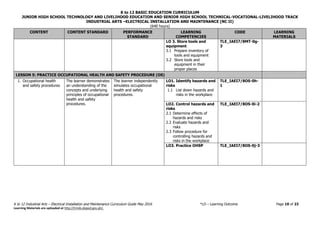
materials based on
electrical signs, symbols
and data
LO 2. Interpret technical
drawings and plans
2.1 Read blueprints of
electrical plans, diagrams
and circuits
2.2 Identify necessary tools,
materials and equipment
according to blueprints of
electrical plans, diagrams
and circuits
TLE_IAEI7/8ID-0e-2
1. T.H.E III
Industrial Technology
Electronics I.
Module V.
1993.
LESSON 4: MAINTAIN TOOLS AND EQUIPMENT (MT)
1. Electrical tools and
equipment
2. Maintenance of tools
and equipment
The learner demonstrates
an understanding of the
underlying principles in
the maintenance of
electrical tools and
equipment.
The learner independently
performs proper
maintenance of electrical
tools and equipment based
on industry standards.
LO 1. Check condition of
tools and equipment
1.1 Label functional and non-
functional tools and
equipment
TLE_IAEI7/8MT-0f-
1
LO 2. Perform basic
maintenance
2.1 Clean and lubricate tools
2.2 Observe periodic
preventive and
maintenance of electrical
tools and equipment
2.2.1 Sharpening
2.2.2 Oiling
2.2.3 Insulating
TLE_IAEI7/8MT-0f-
2
K to 12 BASIC EDUCATION CURRICULUM
JUNIOR HIGH SCHOOL TECHNOLOGY AND LIVELIHOOD EDUCATION AND SENIOR HIGH SCHOOL TECHNICAL-VOCATIONAL-LIVELIHOOD TRACK
INDUSTRIAL ARTS –ELECTRICAL INSTALLATION AND MAINTENANCE (NC II)
(640 hours)
K to 12 Industrial Arts – Electrical Installation and Maintenance Curriculum Guide May 2016 *LO – Learning Outcome Page 10 of 23
Learning Materials are uploaded at http://lrmds.deped.gov.ph/.
CONTENT CONTENT STANDARD PERFORMANCE
STANDARD
LEARNING
COMPETENCIES
CODE LEARNING
MATERIALS
LO 3. Store tools and
equipment
3.1 Prepare inventory of
tools and equipment
3.2 Store tools and
equipment in their
proper places
TLE_IAEI7/8MT-0g-
3
LESSON 5: PRACTICE OCCUPATIONAL HEALTH AND SAFETY PROCEDURE (OS)
1. Occupational health
and safety procedures
The learner demonstrates
an understanding of the
concepts and underlying
principles of occupational
health and safety
procedures.
The learner independently
simulates occupational
health and safety
procedures.
LO1. Identify hazards and
risks
1.1 List down hazards and
risks in the workplace
TLE_IAEI7/8OS-0h-
1
LO2. Control hazards and
risks
2.1 Determine effects of
hazards and risks
2.2 Evaluate hazards and
risks
2.3 Follow procedure for
controlling hazards and
risks in the workplace
TLE_IAEI7/8OS-0i-2
LO3. Practice OHSP TLE_IAEI7/8OS-0j-3
K to 12 BASIC EDUCATION CURRICULUM
JUNIOR HIGH SCHOOL TECHNOLOGY AND LIVELIHOOD EDUCATION AND SENIOR HIGH SCHOOL TECHNICAL-VOCATIONAL-LIVELIHOOD TRACK
INDUSTRIAL ARTS –ELECTRICAL INSTALLATION AND MAINTENANCE (NC II)
(640 hours)
K to 12 Industrial Arts – Electrical Installation and Maintenance Curriculum Guide May 2016 *LO – Learning Outcome Page 11 of 23
Learning Materials are uploaded at http://lrmds.deped.gov.ph/.
Course Description:
This is specialization course which leads to an Electrical Installation and Maintenance National Certificate Level II (NCII). It covers three core competencies that a high
school student ought to possess: (1) preparing electric and hydraulic tools, (2) performing roughing-in and wiring activities for bus and under floor ducts, and (3) installing
wiring devices for floor and ground fault current interrupting outlets.
The preliminaries of this exploratory course include the following: (1) discussion on the relevance of the course, (2) explanation of key concepts relative to the course, and 3)
exploration of career opportunities.
CONTENT CONTENT STANDARD PERFORMANCE
STANDARD
LEARNING
COMPETENCIES
CODE LEARNING
MATERIALS
Introduction
1. Basic concepts in
electrical installation
and maintenance
2. Relevance of the
course
3. Career opportunities
The learner demonstrates
an understanding of the
basic concepts and
underlying theories of
electrical installation and
maintenance.
The learner independently
demonstrates common
competencies in electrical
installation and maintenance
as prescribed by TESDA
Training Regulations.
1. Explain basic concepts in
electrical installation and
maintenance
2. Discuss the relevance of
the course
3. Explore career
opportunities in electrical
installation and
maintenance
PERSONAL ENTREPRENEURIAL COMPETENCIES (PeCS)
1. Assessment of
Personal
Competencies and
Skills (PeCS) vis-à-vis
PeCS of a practicing
entrepreneur/
employee in
locality/town.
1.1 Characteristics
1.2 Attributes
1.3 Lifestyle
1.4 Skills
The learner demonstrates
an understanding of
one’s Personal
Competencies and Skills
(PeCS) in electrical
installation and
maintenance.
The learner recognizes
his/her PeCS and prepares
an activity plan that aligns
with the PeCS of a
practitioner/entrepreneur in
electrical installation and
maintenance.
LO 1. Recognize Personal
Entrepreneurial
Competencies and Skills
(PeCS) needed in
electrical installation and
maintenance
1.1 Assess one’s PeCS:
characteristics,
attributes, lifestyle,
skills, traits
1.4 Assess practitioner’s
PeCS: characteristics,
TLE_PECS9-12-I0-1
K to 12 BASIC EDUCATION CURRICULUM
JUNIOR HIGH SCHOOL TECHNOLOGY AND LIVELIHOOD EDUCATION AND SENIOR HIGH SCHOOL TECHNICAL-VOCATIONAL-LIVELIHOOD TRACK
INDUSTRIAL ARTS –ELECTRICAL INSTALLATION AND MAINTENANCE (NC II)
(640 hours)
K to 12 Industrial Arts – Electrical Installation and Maintenance Curriculum Guide May 2016 *LO – Learning Outcome Page 12 of 23
Learning Materials are uploaded at http://lrmds.deped.gov.ph/.
CONTENT CONTENT STANDARD PERFORMANCE
STANDARD
LEARNING
COMPETENCIES
CODE LEARNING
MATERIALS
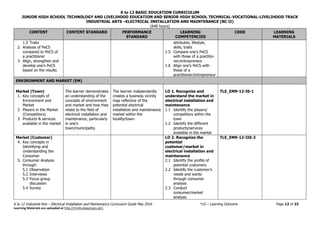
1.5 Traits
2. Analysis of PeCS
compared to PeCS of
a practitioner
3. Align, strengthen and
develop one’s PeCS
based on the results
attributes, lifestyle,
skills, traits
1.5 Compare one’s PeCS
with those of a practitio-
ner/entrepreneur
1.6 Align one’s PeCS with
those of a
practitioner/entrepreneur
ENVIRONMENT AND MARKET (EM)
Market (Town)
1. Key concepts of
Environment and
Market
2. Players in the Market
(Competitors)
3. Products & services
available in the market
The learner demonstrates
an understanding of the
concepts of environment
and market and how they
relate to the field of
electrical installation and
maintenance, particularly
in one’s
town/municipality.
The learner independently
creates a business vicinity
map reflective of the
potential electrical
installation and maintenance
market within the
locality/town.
LO 1. Recognize and
understand the market in
electrical installation and
maintenance
1.1 Identify the players/
competitors within the
town
1.2 Identify the different
products/services
available in the market
TLE_EM9-12-I0-1
Market (Customer)
4. Key concepts in
Identifying and
Understanding the
Consumer
5. Consumer Analysis
through:
5.1 Observation
5.2 Interviews
5.3 Focus group
discussion
5.4 Survey
LO 2. Recognize the
potential
customer/market in
electrical installation and
maintenance
2.1 Identify the profile of
potential customers
2.2 Identify the customer’s
needs and wants
through consumer
analysis
2.3 Conduct
consumer/market
analysis
TLE_EM9-12-II0-2
K to 12 BASIC EDUCATION CURRICULUM
JUNIOR HIGH SCHOOL TECHNOLOGY AND LIVELIHOOD EDUCATION AND SENIOR HIGH SCHOOL TECHNICAL-VOCATIONAL-LIVELIHOOD TRACK
INDUSTRIAL ARTS –ELECTRICAL INSTALLATION AND MAINTENANCE (NC II)
(640 hours)
K to 12 Industrial Arts – Electrical Installation and Maintenance Curriculum Guide May 2016 *LO – Learning Outcome Page 13 of 23
Learning Materials are uploaded at http://lrmds.deped.gov.ph/.
CONTENT CONTENT STANDARD PERFORMANCE
STANDARD
LEARNING
COMPETENCIES
CODE LEARNING
MATERIALS
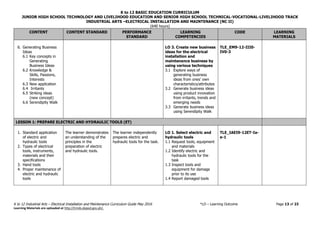
6. Generating Business
Ideas
6.1 Key concepts in
Generating
Business Ideas
6.2 Knowledge &
Skills, Passions,
Interests
6.3 New application
6.4 Irritants
6.5 Striking ideas
(new concept)
6.6 Serendipity Walk
LO 3. Create new business
ideas for the electrical
installation and
maintenance business by
using various techniques
3.1 Explore ways of
generating business
ideas from ones’ own
characteristics/attributes
3.2 Generate business ideas
using product innovation
from irritants, trends and
emerging needs
3.3 Generate business ideas
using Serendipity Walk
TLE_EM9-12-III0-
IV0-3
LESSON 1: PREPARE ELECTRIC AND HYDRAULIC TOOLS (ET)
1. Standard application
of electric and
hydraulic tools
2. Types of electrical
tools, instruments,
materials and their
specifications
3. Hand tools
4. Proper maintenance of
electric and hydraulic
tools
The learner demonstrates
an understanding of the
principles in the
preparation of electric
and hydraulic tools.
The learner independently
prepares electric and
hydraulic tools for the task.
LO 1. Select electric and
hydraulic tools
1.1 Request tools, equipment
and materials
1.2 Identify electric and
hydraulic tools for the
task
1.3 Inspect tools and
equipment for damage
prior to its use
1.4 Report damaged tools
TLE_IAEI9-12ET-Ia-
e-1
K to 12 BASIC EDUCATION CURRICULUM
JUNIOR HIGH SCHOOL TECHNOLOGY AND LIVELIHOOD EDUCATION AND SENIOR HIGH SCHOOL TECHNICAL-VOCATIONAL-LIVELIHOOD TRACK
INDUSTRIAL ARTS –ELECTRICAL INSTALLATION AND MAINTENANCE (NC II)
(640 hours)
K to 12 Industrial Arts – Electrical Installation and Maintenance Curriculum Guide May 2016 *LO – Learning Outcome Page 14 of 23
Learning Materials are uploaded at http://lrmds.deped.gov.ph/.
CONTENT CONTENT STANDARD PERFORMANCE
STANDARD
LEARNING
COMPETENCIES
CODE LEARNING
MATERIALS
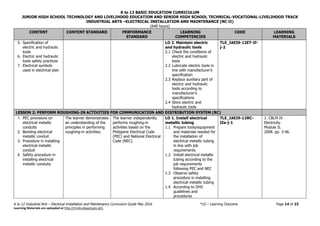
5. Specification of
electric and hydraulic
tools
6. Electric and hydraulic
tools safety practices
7. Electrical symbols
used in electrical plan
LO 2. Maintain electric
and hydraulic tools
2.1 Check the conditions of
electric and hydraulic
tools
2.2 Lubricate electric tools in
line with manufacturer’s
specification
2.3 Replace auxiliary part of
electric and hydraulic
tools according to
manufacturer’s
specifications
2.4 Store electric and
hydraulic tools
TLE_IAEI9-12ET-If-
j-2
LESSON 2: PERFORM ROUGHING-IN ACTIVITIES FOR COMMUNICATION AND DISTRIBUTION SYSTEM (RC)
1. PEC provisions on
electrical metallic
conduits
2. Bending electrical
metallic conduit
3. Procedure in installing
electrical metallic
conduit
4. Safety procedure in
installing electrical
metallic conduits
The learner demonstrates
an understanding of the
principles in performing
roughing-in activities.
The learner independently
performs roughing-in
activities based on the
Philippine Electrical Code
(PEC) and National Electrical
Code (NEC).
LO 1. Install electrical
metallic tubing
1.1 Prepare tools/equipment
and materials needed for
the installation of
electrical metallic tubing
in line with job
requirements
1.2 Install electrical metallic
tubing according to the
job requirements
following PEC and NEC
1.3 Observe safety
procedure in installing
electrical metallic tubing
1.4 According to OHS
guidelines and
procedures
TLE_IAEI9-12RC-
IIa-j-1
1. CBLM IV
Electricity.
Module II.
2008. pp. 3-46.
K to 12 BASIC EDUCATION CURRICULUM
JUNIOR HIGH SCHOOL TECHNOLOGY AND LIVELIHOOD EDUCATION AND SENIOR HIGH SCHOOL TECHNICAL-VOCATIONAL-LIVELIHOOD TRACK
INDUSTRIAL ARTS –ELECTRICAL INSTALLATION AND MAINTENANCE (NC II)
(640 hours)
K to 12 Industrial Arts – Electrical Installation and Maintenance Curriculum Guide May 2016 *LO – Learning Outcome Page 15 of 23
Learning Materials are uploaded at http://lrmds.deped.gov.ph/.
CONTENT CONTENT STANDARD PERFORMANCE
STANDARD
LEARNING
COMPETENCIES
CODE LEARNING
MATERIALS
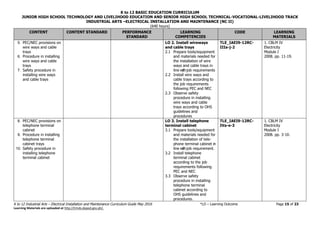
5. PEC/NEC provisions on
wire ways and cable
trays
6. Procedure in installing
wire ways and cable
trays
7. Safety procedure in
installing wire ways
and cable trays
LO 2. Install wireways
and cable trays
2.1 Prepare tools/equipment
and materials needed for
the installation of wire
ways and cable trays in
line withjob requirements
2.2 Install wire ways and
cable trays according to
the job requirements
following PEC and NEC
2.3 Observe safety
procedure in installing
wire ways and cable
trays according to OHS
guidelines and
procedures
TLE_IAEI9-12RC-
IIIa-j-2
1. CBLM IV
Electricity
Module I
2008. pp. 11-19.
8. PEC/NEC provisions on
telephone terminal
cabinet
9. Procedure in installing
telephone terminal
cabinet trays
10. Safety procedure in
installing telephone
terminal cabinet
LO 3. Install telephone
terminal cabinet
3.1 Prepare tools/equipment
and materials needed for
the installation of tele-
phone terminal cabinet in
line withjob requirement.
3.2 Install telephone
terminal cabinet
according to the job
requirements following
PEC and NEC
3.3 Observe safety
procedure in installing
telephone terminal
cabinet according to
OHS guidelines and
procedures.
TLE_IAEI9-12RC-
IVa-e-3
1. CBLM IV
Electricity
Module I
2008. pp. 3-10.
K to 12 BASIC EDUCATION CURRICULUM
JUNIOR HIGH SCHOOL TECHNOLOGY AND LIVELIHOOD EDUCATION AND SENIOR HIGH SCHOOL TECHNICAL-VOCATIONAL-LIVELIHOOD TRACK
INDUSTRIAL ARTS –ELECTRICAL INSTALLATION AND MAINTENANCE (NC II)
(640 hours)
K to 12 Industrial Arts – Electrical Installation and Maintenance Curriculum Guide May 2016 *LO – Learning Outcome Page 16 of 23
Learning Materials are uploaded at http://lrmds.deped.gov.ph/.
CONTENT CONTENT STANDARD PERFORMANCE
STANDARD
LEARNING
COMPETENCIES
CODE LEARNING
MATERIALS
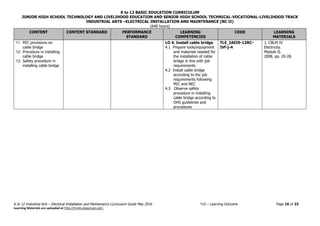
11. PEC provisions on
cable bridge
12. Procedure in installing
cable bridge
13. Safety procedure in
installing cable bridge
LO 4. Install cable bridge
4.1 Prepare tools/equipment
and materials needed for
the installation of cable
bridge in line with job
requirements
4.2 Install cable bridge
according to the job
requirements following
PEC and NEC
4.3 Observe safety
procedure in installing
cable bridge according to
OHS guidelines and
procedures
TLE_IAEI9-12RC-
IVf-j-4
1. CBLM IV
Electricity.
Module II.
2008. pp. 20-28.
K to 12 BASIC EDUCATION CURRICULUM
JUNIOR HIGH SCHOOL TECHNOLOGY AND LIVELIHOOD EDUCATION AND SENIOR HIGH SCHOOL TECHNICAL-VOCATIONAL-LIVELIHOOD TRACK
INDUSTRIAL ARTS –ELECTRICAL INSTALLATION AND MAINTENANCE (NC II)
(640 hours)
K to 12 Industrial Arts – Electrical Installation and Maintenance Curriculum Guide May 2016 *LO – Learning Outcome Page 17 of 23
Learning Materials are uploaded at http://lrmds.deped.gov.ph/.
Course Description:
This is specialization course which leads to an Electrical Installation and Maintenance National Certificate Level II (NCII). It covers the core competency that a high
school student ought to possess—namely, installing wiring devices for floor and ground fault current interrupting outlets.
The preliminaries of this exploratory course include the following: (1) discussion on the relevance of the course, (2) explanation of key concepts relative to the course, and (3)
exploration of career opportunities.
CONTENT CONTENT STANDARD
PERFORMANCE
STANDARD
LEARNING COMPETENCIES CODE
LEARNING
MATERIALS
Introduction
1. Basic concepts in
electrical installation
and maintenance
2. Relevance of the
course
3. Career opportunities
The learner demonstrates
an understanding of the
basic concepts and
underlying theories in
electrical installation and
maintenance.
The learner independently
demonstrates an common
competencies in electrical
installation and
maintenance as prescribed
by TESDA Training
Regulations.
1. Explain basic concepts in
electrical installation and
maintenance
2. Discuss the relevance of
the course
3. Explore career opportuni-
ties in electrical installation
and maintenance
PERSONAL ENTREPRENEURIAL COMPETENCIES (PeCS)
1. Assessment of
learner’s Personal
Competencies and
Skills (PeCS) vis-à-vis
those of a practicing
entrepreneur/employee
in a province.
1.1 Characteristics
1.2 Attributes
1.3 Lifestyle
1.4 Skills
1.5 Traits
2. Analysis of learner’s
PeCS compared to
those of a practitioner
3. Strengthening and
further development of
one’s PeCS
The learner demonstrates
an understanding of one’s
Personal Competencies and
Skills (PeCS) in electrical
installation and
maintenance.
The learner independently
creates a plan of action
that strengthens/ further
develops one’s PeCS in
electrical installation and
maintenance.
LO 1. Develop and
strengthen personal
competencies and skills
(PeCS) needed in Electrical
Installation and
Maintenance
1.1 Identify areas for
improvement,
development and growth
1.2 Align one’s PeCS according
to his/her business/career
choice
1.3 Create a plan of action
that ensures success of
his/her business/career
choice
TLE_PECS10-I0-1
K to 12 BASIC EDUCATION CURRICULUM
JUNIOR HIGH SCHOOL TECHNOLOGY AND LIVELIHOOD EDUCATION AND SENIOR HIGH SCHOOL TECHNICAL-VOCATIONAL-LIVELIHOOD TRACK
INDUSTRIAL ARTS –ELECTRICAL INSTALLATION AND MAINTENANCE (NC II)
(640 hours)
K to 12 Industrial Arts – Electrical Installation and Maintenance Curriculum Guide May 2016 *LO – Learning Outcome Page 18 of 23
Learning Materials are uploaded at http://lrmds.deped.gov.ph/.
CONTENT CONTENT STANDARD
PERFORMANCE
STANDARD
LEARNING COMPETENCIES CODE
LEARNING
MATERIALS
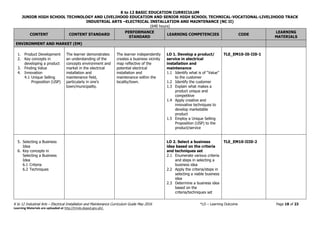
ENVIRONMENT AND MARKET (EM)
1. Product Development
2. Key concepts in
developing a product
3. Finding Value
4. Innovation
4.1 Unique Selling
Proposition (USP)
The learner demonstrates
an understanding of the
concepts environment and
market in the electrical
installation and
maintenance field,
particularly in one’s
town/municipality.
The learner independently
creates a business vicinity
map reflective of the
potential electrical
installation and
maintenance within the
locality/town.
LO 1. Develop a product/
service in electrical
installation and
maintenance
1.1 Identify what is of “Value”
to the customer
1.2 Identify the customer
1.3 Explain what makes a
product unique and
competitive
1.4 Apply creative and
innovative techniques to
develop marketable
product
1.5 Employ a Unique Selling
Proposition (USP) to the
product/service
TLE_EM10-I0-II0-1
5. Selecting a Business
Idea
6. Key concepts in
Selecting a Business
Idea
6.1 Criteria
6.2 Techniques
LO 2. Select a business
idea based on the criteria
and techniques set
2.1 Enumerate various criteria
and steps in selecting a
business idea
2.2 Apply the criteria/steps in
selecting a viable business
idea
2.3 Determine a business idea
based on the
criteria/techniques set
TLE_EM10-III0-2
K to 12 BASIC EDUCATION CURRICULUM
JUNIOR HIGH SCHOOL TECHNOLOGY AND LIVELIHOOD EDUCATION AND SENIOR HIGH SCHOOL TECHNICAL-VOCATIONAL-LIVELIHOOD TRACK
INDUSTRIAL ARTS –ELECTRICAL INSTALLATION AND MAINTENANCE (NC II)
(640 hours)
K to 12 Industrial Arts – Electrical Installation and Maintenance Curriculum Guide May 2016 *LO – Learning Outcome Page 19 of 23
Learning Materials are uploaded at http://lrmds.deped.gov.ph/.
CONTENT CONTENT STANDARD
PERFORMANCE
STANDARD
LEARNING COMPETENCIES CODE
LEARNING
MATERIALS
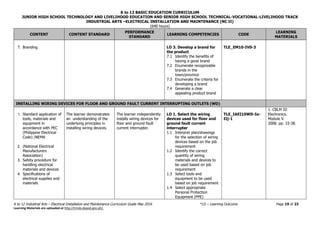
7. Branding LO 3. Develop a brand for
the product
7.1 Identify the benefits of
having a good brand
7.2 Enumerate recognizable
brands in the
town/province
7.3 Enumerate the criteria for
developing a brand
7.4 Generate a clear
appealing product brand
TLE_EM10-IV0-3
INSTALLING WIRING DEVICES FOR FLOOR AND GROUND FAULT CURRENT INTERRUPTING OUTLETS (WD)
1. Standard application of
tools, materials and
equipment in
accordance with PEC
(Philippine Electrical
Code) /NEMA
2. (National Electrical
Manufacturers
Association)
3. Safety procedure for
handling electrical
materials and devices
4. Specifications of
electrical supplies and
materials
The learner demonstrates
an understanding of the
underlying principles in
installing wiring devices.
The learner independently
installs wiring devices for
floor and ground fault
current interrupter.
LO 1. Select the wiring
devices used for floor and
ground fault current
interrupter
1.1 Interpret plan/drawings
for the selection of wiring
devices based on the job
requirement
1.2 Identify the correct
quantity of wiring
materials and devices to
be used based on job
requirement
1.3 Select tools and
equipment to be used
based on job requirement
1.4 Select appropriate
Personal Protection
Equipment (PPE)
TLE_IAEI10WD-Ia-
IIj-1
1. CBLM III
Electronics.
Module V.
2008. pp. 33-38.
K to 12 BASIC EDUCATION CURRICULUM
JUNIOR HIGH SCHOOL TECHNOLOGY AND LIVELIHOOD EDUCATION AND SENIOR HIGH SCHOOL TECHNICAL-VOCATIONAL-LIVELIHOOD TRACK
INDUSTRIAL ARTS –ELECTRICAL INSTALLATION AND MAINTENANCE (NC II)
(640 hours)
K to 12 Industrial Arts – Electrical Installation and Maintenance Curriculum Guide May 2016 *LO – Learning Outcome Page 20 of 23
Learning Materials are uploaded at http://lrmds.deped.gov.ph/.
CONTENT CONTENT STANDARD
PERFORMANCE
STANDARD
LEARNING COMPETENCIES CODE
LEARNING
MATERIALS
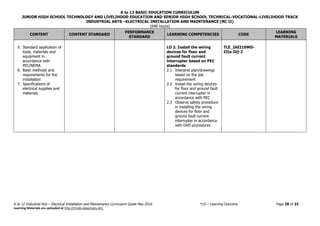
5. Standard application of
tools, materials and
equipment in
accordance with
PEC/NEMA
6. Basic methods and
requirements for the
installation
7. Specifications of
electrical supplies and
materials
LO 2. Install the wiring
devices for floor and
ground fault current
interrupter based on PEC
standards
2.1 Interpret plan/drawings
based on the job
requirement
2.2 Install the wiring devices
for floor and ground fault
current interrupter in
accordance with PEC
2.3 Observe safety procedure
in installing the wiring
devices for floor and
ground fault current
interrupter in accordance
with OHS procedures
TLE_IAEI10WD-
IIIa-IVj-2
K to 12 BASIC EDUCATION CURRICULUM
JUNIOR HIGH SCHOOL TECHNOLOGY AND LIVELIHOOD EDUCATION AND SENIOR HIGH SCHOOL TECHNICAL-VOCATIONAL-LIVELIHOOD TRACK
INDUSTRIAL ARTS –ELECTRICAL INSTALLATION AND MAINTENANCE (NC II)
(640 hours)
K to 12 Industrial Arts – Electrical Installation and Maintenance Curriculum Guide May 2016 *LO – Learning Outcome Page 21 of 23
Learning Materials are uploaded at http://lrmds.deped.gov.ph/.
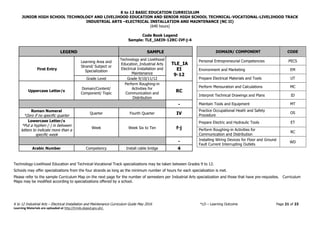
Code Book Legend
Sample: TLE_IAEI9-12RC-IVf-j-4
Technology-Livelihood Education and Technical-Vocational Track specializations may be taken between Grades 9 to 12.
Schools may offer specializations from the four strands as long as the minimum number of hours for each specialization is met.
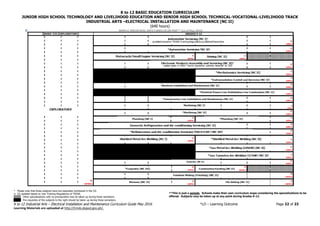
Please refer to the sample Curriculum Map on the next page for the number of semesters per Industrial Arts specialization and those that have pre-requisites. Curriculum
Maps may be modified according to specializations offered by a school.
LEGEND SAMPLE
First Entry
Learning Area and
Strand/ Subject or
Specialization
Technology and Livelihood
Education_Industrial Arts
Electrical Installation and
Maintenance
TLE_IA
EI
9-12
Grade Level Grade 9/10/11/12
Uppercase Letter/s
Domain/Content/
Component/ Topic
Perform Roughing-in
Activities for
Communication and
Distribution
RC
-
Roman Numeral
*Zero if no specific quarter
Quarter Fourth Quarter IV
Lowercase Letter/s
*Put a hyphen (-) in between
letters to indicate more than a
specific week
Week Week Six to Ten f-j
-
Arabic Number Competency Install cable bridge 4
DOMAIN/ COMPONENT CODE
Personal Entrepreneurial Competencies PECS
Environment and Marketing EM
Prepare Electrical Materials and Tools UT
Perform Mensuration and Calculations MC
Interpret Technical Drawings and Plans ID
Maintain Tools and Equipment MT
Practice Occupational Heath and Safety
Procedure
OS
Prepare Electric and Hydraulic Tools ET
Perform Roughing-in Activities for
Communication and Distribution
RC
Installing Wiring Devices for Floor and Ground
Fault Current Interrupting Outlets
WD
K to 12 BASIC EDUCATION CURRICULUM
JUNIOR HIGH SCHOOL TECHNOLOGY AND LIVELIHOOD EDUCATION AND SENIOR HIGH SCHOOL TECHNICAL-VOCATIONAL-LIVELIHOOD TRACK
INDUSTRIAL ARTS –ELECTRICAL INSTALLATION AND MAINTENANCE (NC II)
(640 hours)
K to 12 Industrial Arts – Electrical Installation and Maintenance Curriculum Guide May 2016 *LO – Learning Outcome Page 22 of 23
Learning Materials are uploaded at http://lrmds.deped.gov.ph/.
* Please note that these subjects have pre-requisites mentioned in the CG.
+ CG updated based on new Training Regulations of TESDA.
Other specializations with no prerequisites may be taken up during these semesters.
Pre-requisites of the subjects to the right should be taken up during these semesters.
**This is just a sample. Schools make their own curriculum maps considering the specializations to be
offered. Subjects may be taken up at any point during Grades 9-12.
K to 12 BASIC EDUCATION CURRICULUM
JUNIOR HIGH SCHOOL TECHNOLOGY AND LIVELIHOOD EDUCATION AND SENIOR HIGH SCHOOL TECHNICAL-VOCATIONAL-LIVELIHOOD TRACK
INDUSTRIAL ARTS –ELECTRICAL INSTALLATION AND MAINTENANCE (NC II)
(640 hours)
K to 12 Industrial Arts – Electrical Installation and Maintenance Curriculum Guide May 2016 *LO – Learning Outcome Page 23 of 23
Learning Materials are uploaded at http://lrmds.deped.gov.ph/.
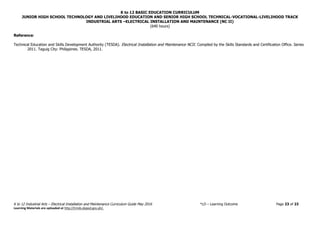
Reference:
Technical Education and Skills Development Authority (TESDA). Electrical Installation and Maintenance NCII. Compiled by the Skills Standards and Certification Office. Series
2011. Taguig City: Philippines. TESDA, 2011.

Electrical-Installation-and-Maintenance-NC-II-CG.pdf

  • 1.
    K to 12BASIC EDUCATION CURRICULUM JUNIOR HIGH SCHOOL TECHNOLOGY AND LIVELIHOOD EDUCATION AND SENIOR HIGH SCHOOL TECHNICAL-VOCATIONAL-LIVELIHOOD TRACK INDUSTRIAL ARTS –ELECTRICAL INSTALLATION AND MAINTENANCE (NC II) (640 hours) K to 12 Industrial Arts – Electrical Installation and Maintenance Curriculum Guide May 2016 *LO – Learning Outcome Page 1 of 23 Learning Materials are uploaded at http://lrmds.deped.gov.ph/. These are the specializations and their pre-requisites. These lists should be used as reference for curriculum maps. AGRI-FISHERY ARTS Specialization Number of Hours Pre-requisite 1. Agricultural Crops Production (NC I) 320 hours 2. Agricultural Crops Production (NC II) updated based on TESDA Training Regulations published December 28, 2013 640 hours 3. Agricultural Crops Production (NC III) 640 hours Agricultural Crops Production (NC II) 4. Animal Health Care Management (NC III) 320 hours Animal Production (Poultry-Chicken) (NC II) or Animal Production (Ruminants) (NC II) or Animal Production (Swine) (NC II) 5. Animal Production (Poultry-Chicken) (NC II) updated based on TESDA Training Regulations published December 28, 2013 320 hours 6. Animal Production (Large Ruminants) (NC II) updated based on TESDA Training Regulations published December 28, 2013 320 hours 7. Animal Production (Swine) (NC II) updated based on TESDA Training Regulations published December 28, 2013 320 hours 8. Aquaculture (NC II) 640 hours 9. Artificial Insemination (Large Ruminants) (NC II) 160 hours Animal Production (Large Ruminants) (NC II) 10. Artificial Insemination (Swine) (NC II) 160 hours Animal Production (Swine) (NC II) 11. Fish Capture (NC II) 640 hours 12. Fishing Gear Repair and Maintenance (NC III) 320 hours 13. Fish-Products Packaging (NC II) 320 hours 14. Fish Wharf Operation (NC I) 160 hours 15. Food Processing (NC II) 640 hours 16. Horticulture (NC III) 640 hours Agricultural Crops Production (NC II) 17. Landscape Installation and Maintenance (NC II) 320 hours 18. Organic Agriculture (NC II) 320 hours 19. Pest Management (NC II) 320 hours 20. Rice Machinery Operations (NC II) 320 hours 21. Rubber Processing (NC II) 320 hours 22. Rubber Production (NC II) 320 hours 23. Slaughtering Operations (Hog/Swine/Pig) (NC II) 160 hours
  • 2.
    K to 12BASIC EDUCATION CURRICULUM JUNIOR HIGH SCHOOL TECHNOLOGY AND LIVELIHOOD EDUCATION AND SENIOR HIGH SCHOOL TECHNICAL-VOCATIONAL-LIVELIHOOD TRACK INDUSTRIAL ARTS –ELECTRICAL INSTALLATION AND MAINTENANCE (NC II) (640 hours) K to 12 Industrial Arts – Electrical Installation and Maintenance Curriculum Guide May 2016 *LO – Learning Outcome Page 2 of 23 Learning Materials are uploaded at http://lrmds.deped.gov.ph/. HOME ECONOMICS Specialization Number of Hours Pre-requisite 1. Attractions and Theme Parks Operations with Ecotourism (NC II) 160 hours 2. Barbering (NC II) 320 hours 3. Bartending (NC II) 320 hours 4. Beauty/Nail Care (NC II) 160 hours 5. Bread and Pastry Production (NC II) 160 hours 6. Caregiving (NC II) 640 hours 7. Commercial Cooking (NC III) 320 hours Cookery (NC II) 8. Cookery (NC II) 320 hours 9. Dressmaking (NC II) 320 hours 10. Events Management Services (NC III) 320 hours 11. Fashion Design (Apparel) (NC III) 640 hours Dressmaking (NC II) or Tailoring (NC II) 12. Food and Beverage Services (NC II) updated based on TESDA Training Regulations published December 28, 2013 160 hours 13. Front Office Services (NC II) 160 hours 14. Hairdressing (NC II) 320 hours 15. Hairdressing (NC III) 640 hours Hairdressing (NC II) 16. Handicraft (Basketry, Macrame) (Non-NC) 160 hours 17. Handicraft (Fashion Accessories, Paper Craft) (Non-NC) 160 hours 18. Handicraft (Needlecraft) (Non-NC) 160 hours 19. Handicraft (Woodcraft, Leathercraft) (Non-NC) 160 hours 20. Housekeeping (NC II) updated based on TESDA Training Regulations published December 28, 2013 160 hours 21. Local Guiding Services (NC II) 160 hours 22. Tailoring (NC II) 320 hours 23. Tourism Promotion Services (NC II) 160 hours 24. Travel Services (NC II) 160 hours 25. Wellness Massage (NC II) 160 hours
  • 3.
    K to 12BASIC EDUCATION CURRICULUM JUNIOR HIGH SCHOOL TECHNOLOGY AND LIVELIHOOD EDUCATION AND SENIOR HIGH SCHOOL TECHNICAL-VOCATIONAL-LIVELIHOOD TRACK INDUSTRIAL ARTS –ELECTRICAL INSTALLATION AND MAINTENANCE (NC II) (640 hours) K to 12 Industrial Arts – Electrical Installation and Maintenance Curriculum Guide May 2016 *LO – Learning Outcome Page 3 of 23 Learning Materials are uploaded at http://lrmds.deped.gov.ph/. INDUSTRIAL ARTS Specialization Number of Hours Pre-requisite 1. Automotive Servicing (NC I) updated based on TESDA Training Regulations published December 28, 2013 640 hours 2. Automotive Servicing (NC II) 640 hours Automotive Servicing (NC I) 3. Carpentry (NC II) 640 hours 4. Carpentry (NC III) 320 hours Carpentry (NC II) 5. Construction Painting (NC II) 160 hours 6. Domestic Refrigeration and Air-conditioning (DOMRAC) Servicing (NC II) 640 hours 7. Driving (NC II) 160 hours 8. Electrical Installation and Maintenance (NC II) 640 hours 9. Electric Power Distribution Line Construction (NC II) 320 hours Electrical Installation and Maintenance (NC II) 10. Electronic Products Assembly and Servicing (NC II) updated based on TESDA Training Regulations published December 28, 2013 640 hours 11. Furniture Making (Finishing) (NC II) 640 hours 12. Instrumentation and Control Servicing (NC II) 320 hours Electronic Products Assembly and Servicing (EPAS) (NC II) 13. Gas Metal Arc Welding (GMAW) (NC II) 320 hours Shielded Metal Arc Welding (SMAW) (NC II) 14. Gas Tungsten Arc Welding (GTAW) (NC II) 320 hours Shielded Metal Arc Welding (GMAW) (NC II) 15. Machining (NC I) 640 hours 16. Machining (NC II) 640 hours Machining (NC I) 17. Masonry (NC II) 320 hours 18. Mechatronics Servicing (NC II) 320 hours Electronic Products Assembly and Servicing (EPAS) (NC II) 19. Motorcycle/Small Engine Servicing (NC II) 320 hours 20. Plumbing (NC I) 320 hours 21. Plumbing (NC II) 320 hours Plumbing (NC I) 22. Refrigeration and Air-Conditioning (Packaged Air-Conditioning Unit [PACU]/Commercial Refrigeration Equipment [CRE]) Servicing (NC III) 640 hours Domestic Refrigeration and Air-conditioning (DOMRAC) Servicing (NC II) 23. Shielded Metal Arc Welding (NC I) 320 hours 24. Shielded Metal Arc Welding (NC II) 320 hours Shielded Metal Arc Welding (NC I) 25. Tile Setting (NC II) 320 hours 26. Transmission Line Installation and Maintenance (NC II) 640 hours Electrical Installation and Maintenance (NC II)
  • 4.
    K to 12BASIC EDUCATION CURRICULUM JUNIOR HIGH SCHOOL TECHNOLOGY AND LIVELIHOOD EDUCATION AND SENIOR HIGH SCHOOL TECHNICAL-VOCATIONAL-LIVELIHOOD TRACK INDUSTRIAL ARTS –ELECTRICAL INSTALLATION AND MAINTENANCE (NC II) (640 hours) K to 12 Industrial Arts – Electrical Installation and Maintenance Curriculum Guide May 2016 *LO – Learning Outcome Page 4 of 23 Learning Materials are uploaded at http://lrmds.deped.gov.ph/. INFORMATION, COMMUNICATIONS AND TECHNOLOGY (ICT) Specialization Number of Hours Pre-requisite 1. Animation (NC II) 320 hours 2. Broadband Installation (Fixed Wireless Systems) (NC II) 160 hours Computer Systems Servicing (NC II) 3. Computer Programming (.Net Technology) (NC III) updated based on TESDA Training Regulations published December 28, 2013 320 hours 4. Computer Programming (Java) (NC III) updated based on TESDA Training Regulations published December 28, 2013 320 hours 5. Computer Programming (Oracle Database) (NC III) updated based on TESDA Training Regulations published December 28, 2013 320 hours 6. Computer Systems Servicing (NC II) updated based on TESDA Training Regulations published December 28, 2007 640 hours 7. Contact Center Services (NC II) 320 hours 8. Illustration (NC II) 320 hours 9. Medical Transcription (NC II) 320 hours 10. Technical Drafting (NC II) 320 hours 11. Telecom OSP and Subscriber Line Installation (Copper Cable/POTS and DSL) (NC II) 320 hours Computer Systems Servicing (NC II) 12. Telecom OSP Installation (Fiber Optic Cable) (NC II) 160 hours Computer Systems Servicing (NC II)
  • 5.
    K to 12BASIC EDUCATION CURRICULUM JUNIOR HIGH SCHOOL TECHNOLOGY AND LIVELIHOOD EDUCATION AND SENIOR HIGH SCHOOL TECHNICAL-VOCATIONAL-LIVELIHOOD TRACK INDUSTRIAL ARTS –ELECTRICAL INSTALLATION AND MAINTENANCE (NC II) (640 hours) K to 12 Industrial Arts – Electrical Installation and Maintenance Curriculum Guide May 2016 *LO – Learning Outcome Page 5 of 23 Learning Materials are uploaded at http://lrmds.deped.gov.ph/. Course Description: This is an exploratory and introductory course which leads to an Electrical Installation and Maintenance National Certificate Level II (NC II). It covers five common competencies that the Grade 7/Grade 8 Technology and Livelihood Education (TLE) student ought to possess: (1) using tools, equipment and paraphernalia, 2) performing mensuration and calculation, 3) practicing Occupational Health and Safety (OHS) procedures, 4) maintaining tools, equipment and paraphernalia, and 5) interpreting technical drawing and plans. The preliminaries of this exploratory course include the following: (1) discussion on the relevance of the course, 2) explanation of key concepts relative to the course, and 3) exploration of career opportunities. CONTENT CONTENT STANDARD PERFORMANCE STANDARD LEARNING COMPETENCIES CODE LEARNING MATERIALS Introduction 1. Basic concepts in Electrical Installation and Maintenance 2. Relevance of the course 3. Career opportunities The learner demonstrates an understanding of the basic concepts and underlying theories in electrical installation and maintenance. The learner independently demonstrates common competencies in electrical installation and maintenance as prescribed by TESDA Training Regulations. 1. Explain basic concepts in electrical installation and maintenance 2. Discuss the relevance of the course 3. Explore career opportunities in electrical installation and maintenance PERSONAL ENTREPRENEURIAL COMPETENCIES (PeCS) 1. Assessment of Personal Entrepreneurial Competencies and Skills (PeCS) vis-à-vis those of a practicing entrepreneur/employee 1.1 Characteristics 1.2 Attributes 1.3 Lifestyle 1.4 Skills 1.5 Traits The learner demonstrates an understanding of one’s Personal Entrepreneurial Competencies and Skills (PeCS). The learner recognizes his/her PeCS and prepares a list of PeCS of a practitioner/entrepreneur in electrical installation and maintenance. LO 1. Recognize Personal Entrepreneurial Competencies and Skills (PeCS) needed in electrical installation and maintenance 1.1 Assess one’s PeCS: characteristics, attributes, lifestyle, skills, traits 1.2 Assess practitioner’s PeCS: characteristics, TLE_PECS7/8-00-1
  • 6.
    K to 12BASIC EDUCATION CURRICULUM JUNIOR HIGH SCHOOL TECHNOLOGY AND LIVELIHOOD EDUCATION AND SENIOR HIGH SCHOOL TECHNICAL-VOCATIONAL-LIVELIHOOD TRACK INDUSTRIAL ARTS –ELECTRICAL INSTALLATION AND MAINTENANCE (NC II) (640 hours) K to 12 Industrial Arts – Electrical Installation and Maintenance Curriculum Guide May 2016 *LO – Learning Outcome Page 6 of 23 Learning Materials are uploaded at http://lrmds.deped.gov.ph/. CONTENT CONTENT STANDARD PERFORMANCE STANDARD LEARNING COMPETENCIES CODE LEARNING MATERIALS 2. Analysis of one’s PeCS attributes, lifestyle, skills, traits 1.3 Compare one’s PeCS with those of a practitioner /entrepreneur ENVIRONMENT AND MARKET (EM) 1. Key concepts of Environment and Market 2. Products & services available in the market 3. Differentiation of products and services 4. Customers and their buying habits 5. Competition in the market 6. SWOT Analysis The learner demonstrates an understanding of the concepts of environment and market and how they relate with a career choice in electrical installation and maintenance. The learner independently generates a business idea based on the analysis of environment and market in electrical installation and maintenance LO 1. Generate a business idea that relates with a career choice in electrical installation and maintenance 1.1 Conduct SWOT analysis 1.2 Identify the different products/services available in the market 1.3 Compare different products/services in the electrical installation and maintenance business 1.4 Determine the profile of potential customers 1.5 Determine the profile of potential competitors 1.6 Generate potential business ideas based on the SWOT analysis TLE_EM7/8-00-1
  • 7.
    K to 12BASIC EDUCATION CURRICULUM JUNIOR HIGH SCHOOL TECHNOLOGY AND LIVELIHOOD EDUCATION AND SENIOR HIGH SCHOOL TECHNICAL-VOCATIONAL-LIVELIHOOD TRACK INDUSTRIAL ARTS –ELECTRICAL INSTALLATION AND MAINTENANCE (NC II) (640 hours) K to 12 Industrial Arts – Electrical Installation and Maintenance Curriculum Guide May 2016 *LO – Learning Outcome Page 7 of 23 Learning Materials are uploaded at http://lrmds.deped.gov.ph/. CONTENT CONTENT STANDARD PERFORMANCE STANDARD LEARNING COMPETENCIES CODE LEARNING MATERIALS LESSON 1: PREPARE ELECTRICAL MATERIALS AND TOOLS (UT) 1. Electrical materials and tools 2. Different types of forms The learner demonstrates an understanding of the concepts in the preparing electrical materials and tools using the different forms in electrical installation and maintenance. The learner independently prepares appropriate electrical materials and tools using the different forms in electrical installation and maintenance based on industry standards. LO 1. Prepare electrical materials and tools for the task 1.1 Prepare a list of electrical tools and materials for a specific job TLE_IAEI7/8UT-0a- 1 LO 2. Request appropriate electrical supplies materials and tools applicable to a specific job 2.1 Use the appropriate form in requesting for electrical tools, supplies and materials for a specific job TLE_IAEI7/8UT-0a- 2 LO 3. Receive and inspect electrical supplies, materials and tools 3.1 Check and control received items on the list TLE_IAEI7/8MT-0b- 3
  • 8.
    K to 12BASIC EDUCATION CURRICULUM JUNIOR HIGH SCHOOL TECHNOLOGY AND LIVELIHOOD EDUCATION AND SENIOR HIGH SCHOOL TECHNICAL-VOCATIONAL-LIVELIHOOD TRACK INDUSTRIAL ARTS –ELECTRICAL INSTALLATION AND MAINTENANCE (NC II) (640 hours) K to 12 Industrial Arts – Electrical Installation and Maintenance Curriculum Guide May 2016 *LO – Learning Outcome Page 8 of 23 Learning Materials are uploaded at http://lrmds.deped.gov.ph/. CONTENT CONTENT STANDARD PERFORMANCE STANDARD LEARNING COMPETENCIES CODE LEARNING MATERIALS LESSON 2: PERFORM MENSURATION AND CALCULATIONS (MC) 1. Measurement 2. Ohm’s Law 3. Multitester The learner demonstrates an understanding of the concepts and underlying principles in performing measurements and calculations. The learner independently performs accurate measurements and calculation based on given tasks. LO 1. Select electrical measuring tools and instruments 1.1 Identify object or component to be measured 1.2 Choose test instruments to be used for specific tasks 1.3 Identify alternative measuring tools without sacrificing cost and quality of work TLE_IAEI7/8MC-0c- 1 LO 2. Carry out measurements and calculations 2.1 Use appropriate measuring devices for specific tasks 2.2 Compute for required data 2.3 Convert data to its equivalent unit of measurement TLE_IAEI7/8MC-0d- 2 LESSON 3: INTERPRET TECHNICAL DRAWINGS AND PLANS (ID) 1. Basic technical drawing 2. Technical Plans and Schematic Diagram 3. Signs, Symbols and Abbreviations The learner demonstrates an understanding of the concepts and underlying principles in interpreting simple technical drawings and plans in electrical installation and maintenance. The learner independently reads and interprets specifications of simple technical drawings and plans. LO 1. Analyze signs, electrical symbols and data 1.1 Read and interpret electrical signs, symbols and data 1.2 Analyze electrical components and TLE_IAEI7/8ID-0e-1 1. CBLM I Electricity. 2008. pp. 35-36. 2. CBLM II Electronics. Module IV. 2008. pp. 5-7, 12-14.
  • 9.
    K to 12BASIC EDUCATION CURRICULUM JUNIOR HIGH SCHOOL TECHNOLOGY AND LIVELIHOOD EDUCATION AND SENIOR HIGH SCHOOL TECHNICAL-VOCATIONAL-LIVELIHOOD TRACK INDUSTRIAL ARTS –ELECTRICAL INSTALLATION AND MAINTENANCE (NC II) (640 hours) K to 12 Industrial Arts – Electrical Installation and Maintenance Curriculum Guide May 2016 *LO – Learning Outcome Page 9 of 23 Learning Materials are uploaded at http://lrmds.deped.gov.ph/. CONTENT CONTENT STANDARD PERFORMANCE STANDARD LEARNING COMPETENCIES CODE LEARNING MATERIALS materials based on electrical signs, symbols and data LO 2. Interpret technical drawings and plans 2.1 Read blueprints of electrical plans, diagrams and circuits 2.2 Identify necessary tools, materials and equipment according to blueprints of electrical plans, diagrams and circuits TLE_IAEI7/8ID-0e-2 1. T.H.E III Industrial Technology Electronics I. Module V. 1993. LESSON 4: MAINTAIN TOOLS AND EQUIPMENT (MT) 1. Electrical tools and equipment 2. Maintenance of tools and equipment The learner demonstrates an understanding of the underlying principles in the maintenance of electrical tools and equipment. The learner independently performs proper maintenance of electrical tools and equipment based on industry standards. LO 1. Check condition of tools and equipment 1.1 Label functional and non- functional tools and equipment TLE_IAEI7/8MT-0f- 1 LO 2. Perform basic maintenance 2.1 Clean and lubricate tools 2.2 Observe periodic preventive and maintenance of electrical tools and equipment 2.2.1 Sharpening 2.2.2 Oiling 2.2.3 Insulating TLE_IAEI7/8MT-0f- 2
  • 10.
    K to 12BASIC EDUCATION CURRICULUM JUNIOR HIGH SCHOOL TECHNOLOGY AND LIVELIHOOD EDUCATION AND SENIOR HIGH SCHOOL TECHNICAL-VOCATIONAL-LIVELIHOOD TRACK INDUSTRIAL ARTS –ELECTRICAL INSTALLATION AND MAINTENANCE (NC II) (640 hours) K to 12 Industrial Arts – Electrical Installation and Maintenance Curriculum Guide May 2016 *LO – Learning Outcome Page 10 of 23 Learning Materials are uploaded at http://lrmds.deped.gov.ph/. CONTENT CONTENT STANDARD PERFORMANCE STANDARD LEARNING COMPETENCIES CODE LEARNING MATERIALS LO 3. Store tools and equipment 3.1 Prepare inventory of tools and equipment 3.2 Store tools and equipment in their proper places TLE_IAEI7/8MT-0g- 3 LESSON 5: PRACTICE OCCUPATIONAL HEALTH AND SAFETY PROCEDURE (OS) 1. Occupational health and safety procedures The learner demonstrates an understanding of the concepts and underlying principles of occupational health and safety procedures. The learner independently simulates occupational health and safety procedures. LO1. Identify hazards and risks 1.1 List down hazards and risks in the workplace TLE_IAEI7/8OS-0h- 1 LO2. Control hazards and risks 2.1 Determine effects of hazards and risks 2.2 Evaluate hazards and risks 2.3 Follow procedure for controlling hazards and risks in the workplace TLE_IAEI7/8OS-0i-2 LO3. Practice OHSP TLE_IAEI7/8OS-0j-3
  • 11.
    K to 12BASIC EDUCATION CURRICULUM JUNIOR HIGH SCHOOL TECHNOLOGY AND LIVELIHOOD EDUCATION AND SENIOR HIGH SCHOOL TECHNICAL-VOCATIONAL-LIVELIHOOD TRACK INDUSTRIAL ARTS –ELECTRICAL INSTALLATION AND MAINTENANCE (NC II) (640 hours) K to 12 Industrial Arts – Electrical Installation and Maintenance Curriculum Guide May 2016 *LO – Learning Outcome Page 11 of 23 Learning Materials are uploaded at http://lrmds.deped.gov.ph/. Course Description: This is specialization course which leads to an Electrical Installation and Maintenance National Certificate Level II (NCII). It covers three core competencies that a high school student ought to possess: (1) preparing electric and hydraulic tools, (2) performing roughing-in and wiring activities for bus and under floor ducts, and (3) installing wiring devices for floor and ground fault current interrupting outlets. The preliminaries of this exploratory course include the following: (1) discussion on the relevance of the course, (2) explanation of key concepts relative to the course, and 3) exploration of career opportunities. CONTENT CONTENT STANDARD PERFORMANCE STANDARD LEARNING COMPETENCIES CODE LEARNING MATERIALS Introduction 1. Basic concepts in electrical installation and maintenance 2. Relevance of the course 3. Career opportunities The learner demonstrates an understanding of the basic concepts and underlying theories of electrical installation and maintenance. The learner independently demonstrates common competencies in electrical installation and maintenance as prescribed by TESDA Training Regulations. 1. Explain basic concepts in electrical installation and maintenance 2. Discuss the relevance of the course 3. Explore career opportunities in electrical installation and maintenance PERSONAL ENTREPRENEURIAL COMPETENCIES (PeCS) 1. Assessment of Personal Competencies and Skills (PeCS) vis-à-vis PeCS of a practicing entrepreneur/ employee in locality/town. 1.1 Characteristics 1.2 Attributes 1.3 Lifestyle 1.4 Skills The learner demonstrates an understanding of one’s Personal Competencies and Skills (PeCS) in electrical installation and maintenance. The learner recognizes his/her PeCS and prepares an activity plan that aligns with the PeCS of a practitioner/entrepreneur in electrical installation and maintenance. LO 1. Recognize Personal Entrepreneurial Competencies and Skills (PeCS) needed in electrical installation and maintenance 1.1 Assess one’s PeCS: characteristics, attributes, lifestyle, skills, traits 1.4 Assess practitioner’s PeCS: characteristics, TLE_PECS9-12-I0-1
  • 12.
    K to 12BASIC EDUCATION CURRICULUM JUNIOR HIGH SCHOOL TECHNOLOGY AND LIVELIHOOD EDUCATION AND SENIOR HIGH SCHOOL TECHNICAL-VOCATIONAL-LIVELIHOOD TRACK INDUSTRIAL ARTS –ELECTRICAL INSTALLATION AND MAINTENANCE (NC II) (640 hours) K to 12 Industrial Arts – Electrical Installation and Maintenance Curriculum Guide May 2016 *LO – Learning Outcome Page 12 of 23 Learning Materials are uploaded at http://lrmds.deped.gov.ph/. CONTENT CONTENT STANDARD PERFORMANCE STANDARD LEARNING COMPETENCIES CODE LEARNING MATERIALS 1.5 Traits 2. Analysis of PeCS compared to PeCS of a practitioner 3. Align, strengthen and develop one’s PeCS based on the results attributes, lifestyle, skills, traits 1.5 Compare one’s PeCS with those of a practitio- ner/entrepreneur 1.6 Align one’s PeCS with those of a practitioner/entrepreneur ENVIRONMENT AND MARKET (EM) Market (Town) 1. Key concepts of Environment and Market 2. Players in the Market (Competitors) 3. Products & services available in the market The learner demonstrates an understanding of the concepts of environment and market and how they relate to the field of electrical installation and maintenance, particularly in one’s town/municipality. The learner independently creates a business vicinity map reflective of the potential electrical installation and maintenance market within the locality/town. LO 1. Recognize and understand the market in electrical installation and maintenance 1.1 Identify the players/ competitors within the town 1.2 Identify the different products/services available in the market TLE_EM9-12-I0-1 Market (Customer) 4. Key concepts in Identifying and Understanding the Consumer 5. Consumer Analysis through: 5.1 Observation 5.2 Interviews 5.3 Focus group discussion 5.4 Survey LO 2. Recognize the potential customer/market in electrical installation and maintenance 2.1 Identify the profile of potential customers 2.2 Identify the customer’s needs and wants through consumer analysis 2.3 Conduct consumer/market analysis TLE_EM9-12-II0-2
  • 13.
    K to 12BASIC EDUCATION CURRICULUM JUNIOR HIGH SCHOOL TECHNOLOGY AND LIVELIHOOD EDUCATION AND SENIOR HIGH SCHOOL TECHNICAL-VOCATIONAL-LIVELIHOOD TRACK INDUSTRIAL ARTS –ELECTRICAL INSTALLATION AND MAINTENANCE (NC II) (640 hours) K to 12 Industrial Arts – Electrical Installation and Maintenance Curriculum Guide May 2016 *LO – Learning Outcome Page 13 of 23 Learning Materials are uploaded at http://lrmds.deped.gov.ph/. CONTENT CONTENT STANDARD PERFORMANCE STANDARD LEARNING COMPETENCIES CODE LEARNING MATERIALS 6. Generating Business Ideas 6.1 Key concepts in Generating Business Ideas 6.2 Knowledge & Skills, Passions, Interests 6.3 New application 6.4 Irritants 6.5 Striking ideas (new concept) 6.6 Serendipity Walk LO 3. Create new business ideas for the electrical installation and maintenance business by using various techniques 3.1 Explore ways of generating business ideas from ones’ own characteristics/attributes 3.2 Generate business ideas using product innovation from irritants, trends and emerging needs 3.3 Generate business ideas using Serendipity Walk TLE_EM9-12-III0- IV0-3 LESSON 1: PREPARE ELECTRIC AND HYDRAULIC TOOLS (ET) 1. Standard application of electric and hydraulic tools 2. Types of electrical tools, instruments, materials and their specifications 3. Hand tools 4. Proper maintenance of electric and hydraulic tools The learner demonstrates an understanding of the principles in the preparation of electric and hydraulic tools. The learner independently prepares electric and hydraulic tools for the task. LO 1. Select electric and hydraulic tools 1.1 Request tools, equipment and materials 1.2 Identify electric and hydraulic tools for the task 1.3 Inspect tools and equipment for damage prior to its use 1.4 Report damaged tools TLE_IAEI9-12ET-Ia- e-1
  • 14.
    K to 12BASIC EDUCATION CURRICULUM JUNIOR HIGH SCHOOL TECHNOLOGY AND LIVELIHOOD EDUCATION AND SENIOR HIGH SCHOOL TECHNICAL-VOCATIONAL-LIVELIHOOD TRACK INDUSTRIAL ARTS –ELECTRICAL INSTALLATION AND MAINTENANCE (NC II) (640 hours) K to 12 Industrial Arts – Electrical Installation and Maintenance Curriculum Guide May 2016 *LO – Learning Outcome Page 14 of 23 Learning Materials are uploaded at http://lrmds.deped.gov.ph/. CONTENT CONTENT STANDARD PERFORMANCE STANDARD LEARNING COMPETENCIES CODE LEARNING MATERIALS 5. Specification of electric and hydraulic tools 6. Electric and hydraulic tools safety practices 7. Electrical symbols used in electrical plan LO 2. Maintain electric and hydraulic tools 2.1 Check the conditions of electric and hydraulic tools 2.2 Lubricate electric tools in line with manufacturer’s specification 2.3 Replace auxiliary part of electric and hydraulic tools according to manufacturer’s specifications 2.4 Store electric and hydraulic tools TLE_IAEI9-12ET-If- j-2 LESSON 2: PERFORM ROUGHING-IN ACTIVITIES FOR COMMUNICATION AND DISTRIBUTION SYSTEM (RC) 1. PEC provisions on electrical metallic conduits 2. Bending electrical metallic conduit 3. Procedure in installing electrical metallic conduit 4. Safety procedure in installing electrical metallic conduits The learner demonstrates an understanding of the principles in performing roughing-in activities. The learner independently performs roughing-in activities based on the Philippine Electrical Code (PEC) and National Electrical Code (NEC). LO 1. Install electrical metallic tubing 1.1 Prepare tools/equipment and materials needed for the installation of electrical metallic tubing in line with job requirements 1.2 Install electrical metallic tubing according to the job requirements following PEC and NEC 1.3 Observe safety procedure in installing electrical metallic tubing 1.4 According to OHS guidelines and procedures TLE_IAEI9-12RC- IIa-j-1 1. CBLM IV Electricity. Module II. 2008. pp. 3-46.
  • 15.
    K to 12BASIC EDUCATION CURRICULUM JUNIOR HIGH SCHOOL TECHNOLOGY AND LIVELIHOOD EDUCATION AND SENIOR HIGH SCHOOL TECHNICAL-VOCATIONAL-LIVELIHOOD TRACK INDUSTRIAL ARTS –ELECTRICAL INSTALLATION AND MAINTENANCE (NC II) (640 hours) K to 12 Industrial Arts – Electrical Installation and Maintenance Curriculum Guide May 2016 *LO – Learning Outcome Page 15 of 23 Learning Materials are uploaded at http://lrmds.deped.gov.ph/. CONTENT CONTENT STANDARD PERFORMANCE STANDARD LEARNING COMPETENCIES CODE LEARNING MATERIALS 5. PEC/NEC provisions on wire ways and cable trays 6. Procedure in installing wire ways and cable trays 7. Safety procedure in installing wire ways and cable trays LO 2. Install wireways and cable trays 2.1 Prepare tools/equipment and materials needed for the installation of wire ways and cable trays in line withjob requirements 2.2 Install wire ways and cable trays according to the job requirements following PEC and NEC 2.3 Observe safety procedure in installing wire ways and cable trays according to OHS guidelines and procedures TLE_IAEI9-12RC- IIIa-j-2 1. CBLM IV Electricity Module I 2008. pp. 11-19. 8. PEC/NEC provisions on telephone terminal cabinet 9. Procedure in installing telephone terminal cabinet trays 10. Safety procedure in installing telephone terminal cabinet LO 3. Install telephone terminal cabinet 3.1 Prepare tools/equipment and materials needed for the installation of tele- phone terminal cabinet in line withjob requirement. 3.2 Install telephone terminal cabinet according to the job requirements following PEC and NEC 3.3 Observe safety procedure in installing telephone terminal cabinet according to OHS guidelines and procedures. TLE_IAEI9-12RC- IVa-e-3 1. CBLM IV Electricity Module I 2008. pp. 3-10.
  • 16.
    K to 12BASIC EDUCATION CURRICULUM JUNIOR HIGH SCHOOL TECHNOLOGY AND LIVELIHOOD EDUCATION AND SENIOR HIGH SCHOOL TECHNICAL-VOCATIONAL-LIVELIHOOD TRACK INDUSTRIAL ARTS –ELECTRICAL INSTALLATION AND MAINTENANCE (NC II) (640 hours) K to 12 Industrial Arts – Electrical Installation and Maintenance Curriculum Guide May 2016 *LO – Learning Outcome Page 16 of 23 Learning Materials are uploaded at http://lrmds.deped.gov.ph/. CONTENT CONTENT STANDARD PERFORMANCE STANDARD LEARNING COMPETENCIES CODE LEARNING MATERIALS 11. PEC provisions on cable bridge 12. Procedure in installing cable bridge 13. Safety procedure in installing cable bridge LO 4. Install cable bridge 4.1 Prepare tools/equipment and materials needed for the installation of cable bridge in line with job requirements 4.2 Install cable bridge according to the job requirements following PEC and NEC 4.3 Observe safety procedure in installing cable bridge according to OHS guidelines and procedures TLE_IAEI9-12RC- IVf-j-4 1. CBLM IV Electricity. Module II. 2008. pp. 20-28.
  • 17.
    K to 12BASIC EDUCATION CURRICULUM JUNIOR HIGH SCHOOL TECHNOLOGY AND LIVELIHOOD EDUCATION AND SENIOR HIGH SCHOOL TECHNICAL-VOCATIONAL-LIVELIHOOD TRACK INDUSTRIAL ARTS –ELECTRICAL INSTALLATION AND MAINTENANCE (NC II) (640 hours) K to 12 Industrial Arts – Electrical Installation and Maintenance Curriculum Guide May 2016 *LO – Learning Outcome Page 17 of 23 Learning Materials are uploaded at http://lrmds.deped.gov.ph/. Course Description: This is specialization course which leads to an Electrical Installation and Maintenance National Certificate Level II (NCII). It covers the core competency that a high school student ought to possess—namely, installing wiring devices for floor and ground fault current interrupting outlets. The preliminaries of this exploratory course include the following: (1) discussion on the relevance of the course, (2) explanation of key concepts relative to the course, and (3) exploration of career opportunities. CONTENT CONTENT STANDARD PERFORMANCE STANDARD LEARNING COMPETENCIES CODE LEARNING MATERIALS Introduction 1. Basic concepts in electrical installation and maintenance 2. Relevance of the course 3. Career opportunities The learner demonstrates an understanding of the basic concepts and underlying theories in electrical installation and maintenance. The learner independently demonstrates an common competencies in electrical installation and maintenance as prescribed by TESDA Training Regulations. 1. Explain basic concepts in electrical installation and maintenance 2. Discuss the relevance of the course 3. Explore career opportuni- ties in electrical installation and maintenance PERSONAL ENTREPRENEURIAL COMPETENCIES (PeCS) 1. Assessment of learner’s Personal Competencies and Skills (PeCS) vis-à-vis those of a practicing entrepreneur/employee in a province. 1.1 Characteristics 1.2 Attributes 1.3 Lifestyle 1.4 Skills 1.5 Traits 2. Analysis of learner’s PeCS compared to those of a practitioner 3. Strengthening and further development of one’s PeCS The learner demonstrates an understanding of one’s Personal Competencies and Skills (PeCS) in electrical installation and maintenance. The learner independently creates a plan of action that strengthens/ further develops one’s PeCS in electrical installation and maintenance. LO 1. Develop and strengthen personal competencies and skills (PeCS) needed in Electrical Installation and Maintenance 1.1 Identify areas for improvement, development and growth 1.2 Align one’s PeCS according to his/her business/career choice 1.3 Create a plan of action that ensures success of his/her business/career choice TLE_PECS10-I0-1
  • 18.
    K to 12BASIC EDUCATION CURRICULUM JUNIOR HIGH SCHOOL TECHNOLOGY AND LIVELIHOOD EDUCATION AND SENIOR HIGH SCHOOL TECHNICAL-VOCATIONAL-LIVELIHOOD TRACK INDUSTRIAL ARTS –ELECTRICAL INSTALLATION AND MAINTENANCE (NC II) (640 hours) K to 12 Industrial Arts – Electrical Installation and Maintenance Curriculum Guide May 2016 *LO – Learning Outcome Page 18 of 23 Learning Materials are uploaded at http://lrmds.deped.gov.ph/. CONTENT CONTENT STANDARD PERFORMANCE STANDARD LEARNING COMPETENCIES CODE LEARNING MATERIALS ENVIRONMENT AND MARKET (EM) 1. Product Development 2. Key concepts in developing a product 3. Finding Value 4. Innovation 4.1 Unique Selling Proposition (USP) The learner demonstrates an understanding of the concepts environment and market in the electrical installation and maintenance field, particularly in one’s town/municipality. The learner independently creates a business vicinity map reflective of the potential electrical installation and maintenance within the locality/town. LO 1. Develop a product/ service in electrical installation and maintenance 1.1 Identify what is of “Value” to the customer 1.2 Identify the customer 1.3 Explain what makes a product unique and competitive 1.4 Apply creative and innovative techniques to develop marketable product 1.5 Employ a Unique Selling Proposition (USP) to the product/service TLE_EM10-I0-II0-1 5. Selecting a Business Idea 6. Key concepts in Selecting a Business Idea 6.1 Criteria 6.2 Techniques LO 2. Select a business idea based on the criteria and techniques set 2.1 Enumerate various criteria and steps in selecting a business idea 2.2 Apply the criteria/steps in selecting a viable business idea 2.3 Determine a business idea based on the criteria/techniques set TLE_EM10-III0-2
  • 19.
    K to 12BASIC EDUCATION CURRICULUM JUNIOR HIGH SCHOOL TECHNOLOGY AND LIVELIHOOD EDUCATION AND SENIOR HIGH SCHOOL TECHNICAL-VOCATIONAL-LIVELIHOOD TRACK INDUSTRIAL ARTS –ELECTRICAL INSTALLATION AND MAINTENANCE (NC II) (640 hours) K to 12 Industrial Arts – Electrical Installation and Maintenance Curriculum Guide May 2016 *LO – Learning Outcome Page 19 of 23 Learning Materials are uploaded at http://lrmds.deped.gov.ph/. CONTENT CONTENT STANDARD PERFORMANCE STANDARD LEARNING COMPETENCIES CODE LEARNING MATERIALS 7. Branding LO 3. Develop a brand for the product 7.1 Identify the benefits of having a good brand 7.2 Enumerate recognizable brands in the town/province 7.3 Enumerate the criteria for developing a brand 7.4 Generate a clear appealing product brand TLE_EM10-IV0-3 INSTALLING WIRING DEVICES FOR FLOOR AND GROUND FAULT CURRENT INTERRUPTING OUTLETS (WD) 1. Standard application of tools, materials and equipment in accordance with PEC (Philippine Electrical Code) /NEMA 2. (National Electrical Manufacturers Association) 3. Safety procedure for handling electrical materials and devices 4. Specifications of electrical supplies and materials The learner demonstrates an understanding of the underlying principles in installing wiring devices. The learner independently installs wiring devices for floor and ground fault current interrupter. LO 1. Select the wiring devices used for floor and ground fault current interrupter 1.1 Interpret plan/drawings for the selection of wiring devices based on the job requirement 1.2 Identify the correct quantity of wiring materials and devices to be used based on job requirement 1.3 Select tools and equipment to be used based on job requirement 1.4 Select appropriate Personal Protection Equipment (PPE) TLE_IAEI10WD-Ia- IIj-1 1. CBLM III Electronics. Module V. 2008. pp. 33-38.
  • 20.
    K to 12BASIC EDUCATION CURRICULUM JUNIOR HIGH SCHOOL TECHNOLOGY AND LIVELIHOOD EDUCATION AND SENIOR HIGH SCHOOL TECHNICAL-VOCATIONAL-LIVELIHOOD TRACK INDUSTRIAL ARTS –ELECTRICAL INSTALLATION AND MAINTENANCE (NC II) (640 hours) K to 12 Industrial Arts – Electrical Installation and Maintenance Curriculum Guide May 2016 *LO – Learning Outcome Page 20 of 23 Learning Materials are uploaded at http://lrmds.deped.gov.ph/. CONTENT CONTENT STANDARD PERFORMANCE STANDARD LEARNING COMPETENCIES CODE LEARNING MATERIALS 5. Standard application of tools, materials and equipment in accordance with PEC/NEMA 6. Basic methods and requirements for the installation 7. Specifications of electrical supplies and materials LO 2. Install the wiring devices for floor and ground fault current interrupter based on PEC standards 2.1 Interpret plan/drawings based on the job requirement 2.2 Install the wiring devices for floor and ground fault current interrupter in accordance with PEC 2.3 Observe safety procedure in installing the wiring devices for floor and ground fault current interrupter in accordance with OHS procedures TLE_IAEI10WD- IIIa-IVj-2
  • 21.
    K to 12BASIC EDUCATION CURRICULUM JUNIOR HIGH SCHOOL TECHNOLOGY AND LIVELIHOOD EDUCATION AND SENIOR HIGH SCHOOL TECHNICAL-VOCATIONAL-LIVELIHOOD TRACK INDUSTRIAL ARTS –ELECTRICAL INSTALLATION AND MAINTENANCE (NC II) (640 hours) K to 12 Industrial Arts – Electrical Installation and Maintenance Curriculum Guide May 2016 *LO – Learning Outcome Page 21 of 23 Learning Materials are uploaded at http://lrmds.deped.gov.ph/. Code Book Legend Sample: TLE_IAEI9-12RC-IVf-j-4 Technology-Livelihood Education and Technical-Vocational Track specializations may be taken between Grades 9 to 12. Schools may offer specializations from the four strands as long as the minimum number of hours for each specialization is met. Please refer to the sample Curriculum Map on the next page for the number of semesters per Industrial Arts specialization and those that have pre-requisites. Curriculum Maps may be modified according to specializations offered by a school. LEGEND SAMPLE First Entry Learning Area and Strand/ Subject or Specialization Technology and Livelihood Education_Industrial Arts Electrical Installation and Maintenance TLE_IA EI 9-12 Grade Level Grade 9/10/11/12 Uppercase Letter/s Domain/Content/ Component/ Topic Perform Roughing-in Activities for Communication and Distribution RC - Roman Numeral *Zero if no specific quarter Quarter Fourth Quarter IV Lowercase Letter/s *Put a hyphen (-) in between letters to indicate more than a specific week Week Week Six to Ten f-j - Arabic Number Competency Install cable bridge 4 DOMAIN/ COMPONENT CODE Personal Entrepreneurial Competencies PECS Environment and Marketing EM Prepare Electrical Materials and Tools UT Perform Mensuration and Calculations MC Interpret Technical Drawings and Plans ID Maintain Tools and Equipment MT Practice Occupational Heath and Safety Procedure OS Prepare Electric and Hydraulic Tools ET Perform Roughing-in Activities for Communication and Distribution RC Installing Wiring Devices for Floor and Ground Fault Current Interrupting Outlets WD
  • 22.
    K to 12BASIC EDUCATION CURRICULUM JUNIOR HIGH SCHOOL TECHNOLOGY AND LIVELIHOOD EDUCATION AND SENIOR HIGH SCHOOL TECHNICAL-VOCATIONAL-LIVELIHOOD TRACK INDUSTRIAL ARTS –ELECTRICAL INSTALLATION AND MAINTENANCE (NC II) (640 hours) K to 12 Industrial Arts – Electrical Installation and Maintenance Curriculum Guide May 2016 *LO – Learning Outcome Page 22 of 23 Learning Materials are uploaded at http://lrmds.deped.gov.ph/. * Please note that these subjects have pre-requisites mentioned in the CG. + CG updated based on new Training Regulations of TESDA. Other specializations with no prerequisites may be taken up during these semesters. Pre-requisites of the subjects to the right should be taken up during these semesters. **This is just a sample. Schools make their own curriculum maps considering the specializations to be offered. Subjects may be taken up at any point during Grades 9-12.
  • 23.
    K to 12BASIC EDUCATION CURRICULUM JUNIOR HIGH SCHOOL TECHNOLOGY AND LIVELIHOOD EDUCATION AND SENIOR HIGH SCHOOL TECHNICAL-VOCATIONAL-LIVELIHOOD TRACK INDUSTRIAL ARTS –ELECTRICAL INSTALLATION AND MAINTENANCE (NC II) (640 hours) K to 12 Industrial Arts – Electrical Installation and Maintenance Curriculum Guide May 2016 *LO – Learning Outcome Page 23 of 23 Learning Materials are uploaded at http://lrmds.deped.gov.ph/. Reference: Technical Education and Skills Development Authority (TESDA). Electrical Installation and Maintenance NCII. Compiled by the Skills Standards and Certification Office. Series 2011. Taguig City: Philippines. TESDA, 2011.