ELECTRICAL
MACHINE
Mohammed Waris Senan
Content
Transformer
Introduction
Laws governing working
Understanding Lenz’s Law
Ideal Transformer
EMF Equation of Transformer
Phasor diagram of ideal transformer
Practical Transformer
Equivalent Circuit diagram
Phasor diagram
Concept of referred Values
31-May-19 Mohammed Waris Senan 2
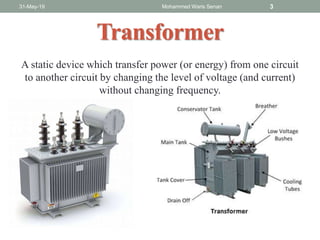
Transformer
A static device which transfer power (or energy) from one circuit
to another circuit by changing the level of voltage (and current)
without changing frequency.
31-May-19 Mohammed Waris Senan 3
31-May-19 Mohammed Waris Senan 4
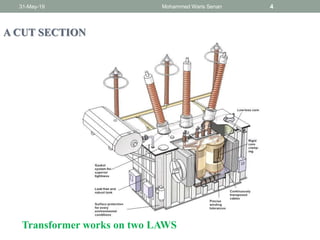
A CUT SECTION
Transformer works on two LAWS
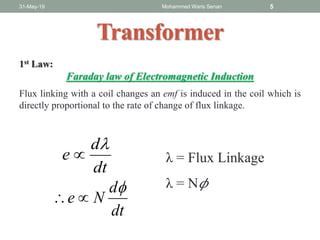
Transformer
1st Law:
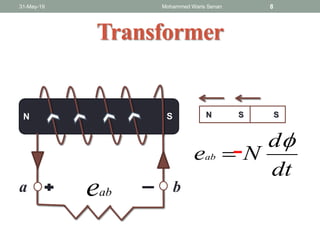
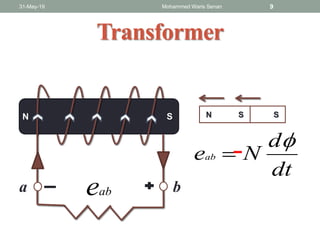
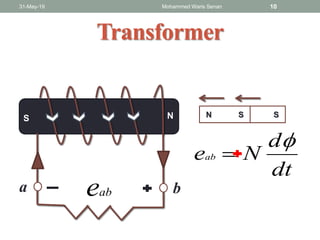
Faraday law of Electromagnetic Induction
Flux linking with a coil changes an emf is induced in the coil which is
directly proportional to the rate of change of flux linkage.
31-May-19 Mohammed Waris Senan 5
dt
d
e

 λ = Flux Linkage
λ = N 𝜙
dt
d
Ne


31-May-19 Mohammed Waris Senan 6
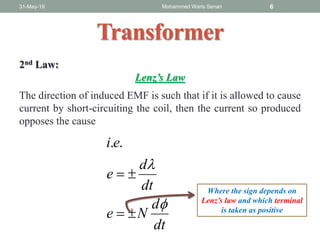
Transformer
2nd Law:
Lenz’s Law
The direction of induced EMF is such that if it is allowed to cause
current by short-circuiting the coil, then the current so produced
opposes the cause
dt
d
Ne
dt
d
e
ei




..
Where the sign depends on
Lenz’s law and which terminal
is taken as positive
31-May-19 Mohammed Waris Senan 7
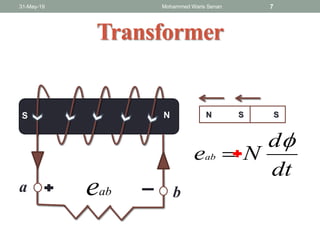
Transformer
N SN S
dt
d
Neab


abe
NS
a b
31-May-19 Mohammed Waris Senan 8
Transformer
N SN S
dt
d
Neab


abe
N S
a b
31-May-19 Mohammed Waris Senan 9
Transformer
N SN S
dt
d
Neab


abe
N S
a b
31-May-19 Mohammed Waris Senan 10
Transformer
dt
d
Neab


abe
NS N SN S
a b
31-May-19 Mohammed Waris Senan 11
Transformer
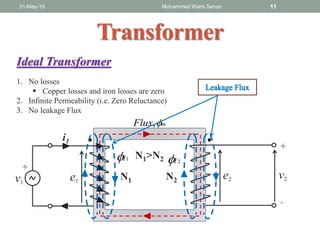
Ideal Transformer
1. No losses
 Copper losses and iron losses are zero
2. Infinite Permeability (i.e. Zero Reluctance)
3. No leakage Flux
mFlux ,
v1
e1
e2 v2
+
+
-
N1 N2
N1>N2
i1
2l1l
31-May-19 Mohammed Waris Senan 12
Transformer
)90sin(
cos
)sin(
,
sin,





tNe
tNe
dt
td
Ne
So
tLet
dt
d
Ne
m
m
m
m





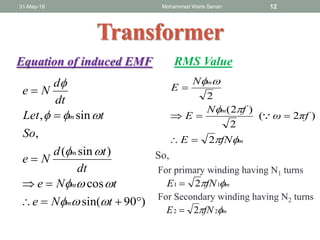
Equation of induced EMF
mfNE  11 2
mfNE  22 2
For primary winding having N1 turns
For Secondary winding having N2 turns
RMS Value
m
m
m
fNE
πfω
fN
E
N
E



2
)2(
2
)2(
2




So,
31-May-19 Mohammed Waris Senan 13
Transformer
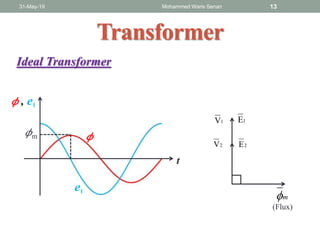
Ideal Transformer
e1
𝜙𝜙m
𝜙 , e1
t
1V
2E2V
1E
m
(Flux)
31-May-19 Mohammed Waris Senan 14
Transformer
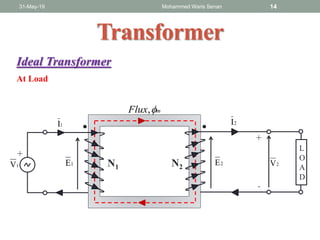
Ideal Transformer
mFlux ,
+
+
-
N1 N2
L
O
A
D
1V 1E 2V2E
1I 2I
At Load
31-May-19 Mohammed Waris Senan 15
Transformer
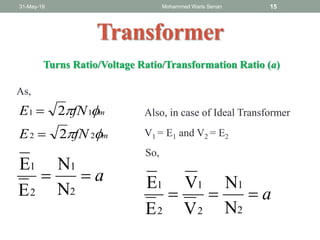
Turns Ratio/Voltage Ratio/Transformation Ratio (a)
a
2
1
2
1
2
1
N
N
V
V
E
E
m
m
fNE
fNE


22
11
2
2


As,
Also, in case of Ideal Transformer
V1 = E1 and V2 = E2
a
2
1
2
1
N
N
E
E
So,
31-May-19 Mohammed Waris Senan 16
Transformer
Turns Ratio/Voltage Ratio/Transformation Ratio (a)
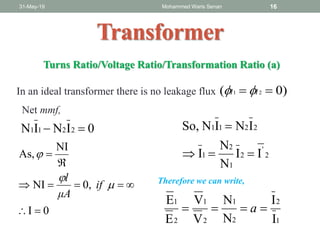
In an ideal transformer there is no leakage flux
Net mmf,
0ININ 2211 
0I
0,NI
NI
As,







if
μA
l
2
'
2
1
2
1
2211
II
N
N
I
ININSo,


1
2
2
1
2
1
2
1
I
I
N
N
V
V
E
E
 a
Therefore we can write,
)0( 21  ll 
31-May-19 Mohammed Waris Senan 17
Transformer
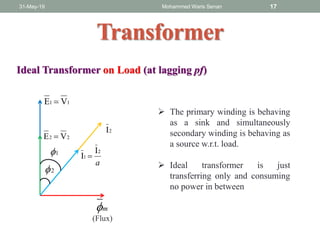
Ideal Transformer on Load (at lagging pf)
22 VE 
11 VE 
m
(Flux)
2I
a
2
1
I
I 1
2
 The primary winding is behaving
as a sink and simultaneously
secondary winding is behaving as
a source w.r.t. load.
 Ideal transformer is just
transferring only and consuming
no power in between
31-May-19 Mohammed Waris Senan 18
Transformer
Practical Transformer
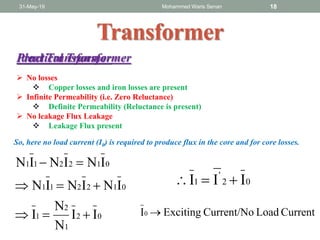
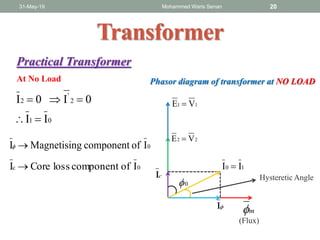
So, here no load current (I0) is required to produce flux in the core and for core losses.
 No losses
 Copper losses and iron losses are present
 Infinite Permeability (i.e. Zero Reluctance)
 Definite Permeability (Reluctance is present)
 No leakage Flux Leakage
 Leakage Flux present
02
1
2
1
012211
012211
II
N
N
I
INININ
INININ



02
'
1 III 
CurrentLoadCurrent/NoExcitingI0 
Ideal Transformer
31-May-19 Mohammed Waris Senan 19
Transformer
Practical Transformer
R1jX1 jX2R2
RcjX 𝜙1V 1E 2E 2V
cII
0I
1I 0I 2
'

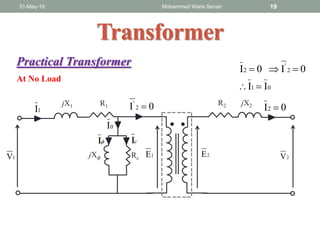
At No Load
01
2
'
2
II
0I0I


0I2 
31-May-19 Mohammed Waris Senan 20
Transformer
Practical Transformer
22 VE 
11 VE 
m
(Flux)
10 II 
0
I
cI Hysteretic Angle
At No Load
01
2
'
2
II
0I0I


0IofcomponentgMagnetisinI 
0c IofcomponentlossCoreI 
Phasor diagram of transformer at NO LOAD
31-May-19 Mohammed Waris Senan 21
Transformer
Practical Transformer
1V
R1jX1 jX2R2
RcjX 𝜙 1E 2E 2V
cII
0I
1I 2
'
I 2I
L
O
A
D
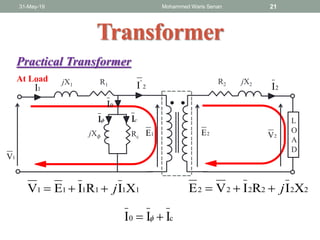
222222 XIRIVE j111111 XIRIEV j
c0 III  
At Load
31-May-19 Mohammed Waris Senan 22
Transformer
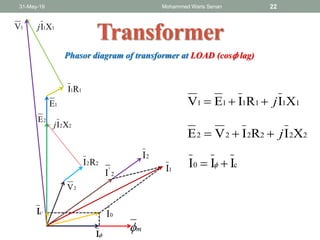
222222 XIRIVE j
111111 XIRIEV j
c0 III  
1I
m
2E
1E
0I
I
cI
2I
2
'
I
2V
22RI
22XIj
11RI
11XIj1V
Phasor diagram of transformer at LOAD (cos 𝜙 lag)
31-May-19 Mohammed Waris Senan 23
Transformer
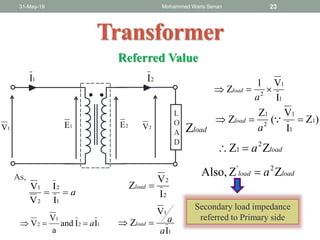
Referred Value
1V 1E 2E 2V
1I 2I
L
O
A
D
loadZ
a
1
2
2
1
I
I
V
V
As,
12
1
2 IIand
a
V
V a
2
2
I
V
Z load
1
1
I
V
Z
a
aload 
1
1
2
I
V1
Z 
a
load
)Z
I
V
(
Z
Z 1
1
1
2
1
 
a
load
ZZ 2
1 loada
ZZAlso, 2'
loadload a
Secondary load impedance
referred to Primary side
31-May-19 Mohammed Waris Senan 24
Transformer
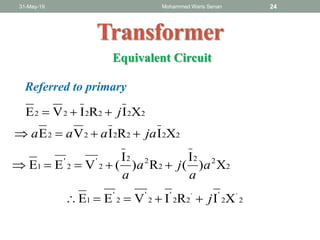
222222 XIRIVE j
222222 XIRIVE jaaaa 
2
22
2
22
2
'
2
'
1 X)
I
(R)
I
(VEE a
a
ja
a

22
'
22
'
2
'
2
'
1
''
XIRIVEE j
Equivalent Circuit
Referred to primary
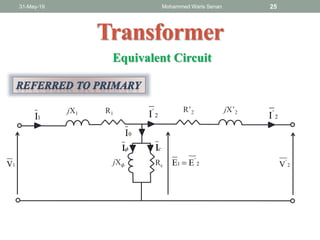
31-May-19 Mohammed Waris Senan 25
Transformer
jX’2R’2
2
'
1 EE  2
'
V
R1jX1
RcjX 𝜙1V
cII
0I
1I 2
'
I
Equivalent Circuit
2
'
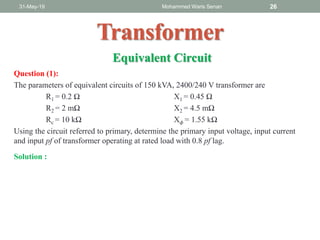
I
Question (1):
The parameters of equivalent circuits of 150 kVA, 2400/240 V transformer are
R1 = 0.2 Ω X1 = 0.45 Ω
R2 = 2 mΩ X2 = 4.5 mΩ
Rc = 10 kΩ X 𝜙 = 1.55 kΩ
Using the circuit referred to primary, determine the primary input voltage, input current
and input pf of transformer operating at rated load with 0.8 pf lag.
31-May-19 Mohammed Waris Senan 26
Transformer
Solution :
Equivalent Circuit
31-May-19 Mohammed Waris Senan 27
Transformer
Solution :
Equivalent Circuit
31-May-19 Mohammed Waris Senan 28
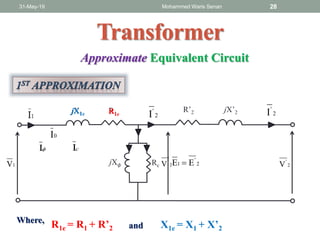
Transformer
jX’2R’2
2
'
1 EE  2
'
V
R1jX1
RcjX 𝜙1V
cII
2
'
I
Approximate Equivalent Circuit
2
'
I
0I
R1ejX1e
2
'
V
X1e = X1 + X’2R1e = R1 + R’2
Where,
and
31-May-19 Mohammed Waris Senan 29
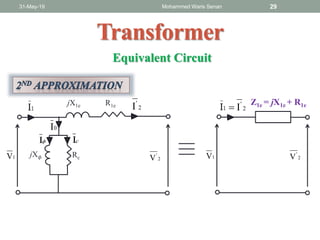
Transformer
2
'
V
R1ejX1e
RcjX 𝜙1V
cII
2
'
I
Equivalent Circuit
0I
2
'
V
Z1e = jX1e + R1e
1V
2
'
I
31-May-19 Mohammed Waris Senan 30
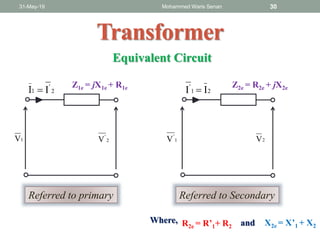
Transformer
Equivalent Circuit
2
'
V
Z1e = jX1e + R1e
1V
2
'
I
Referred to primary
2V
Z2e = R2e + jX2e
1
'
V
21
'
II 
Referred to Secondary
X2e = X’1 + X2R2e = R’1+ R2
Where, and
31-May-19 Mohammed Waris Senan 31
Transformer
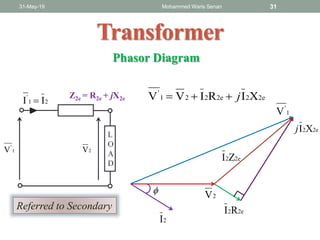
Phasor Diagram
2V
Z2e = R2e + jX2e
1
'
V
21
'
II 
Referred to Secondary
2e22e221
'
XIRIVV j
1
'
V
2V
2I

2e2RI
2e2XIj
2e2ZI
L
O
A
D
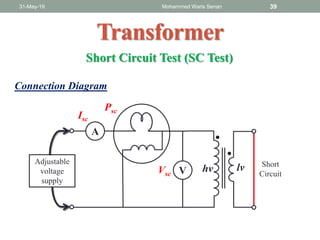
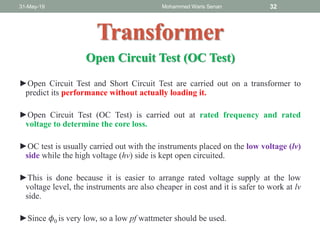
►Open Circuit Test and Short Circuit Test are carried out on a transformer to
predict its performance without actually loading it.
►Open Circuit Test (OC Test) is carried out at rated frequency and rated
voltage to determine the core loss.
►OC test is usually carried out with the instruments placed on the low voltage (lv)
side while the high voltage (hv) side is kept open circuited.
►This is done because it is easier to arrange rated voltage supply at the low
voltage level, the instruments are also cheaper in cost and it is safer to work at lv
side.
►Since 𝜙0 is very low, so a low pf wattmeter should be used.
31-May-19 Mohammed Waris Senan 32
Transformer
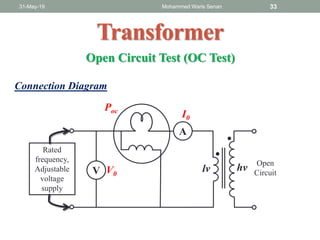
Open Circuit Test (OC Test)
31-May-19 Mohammed Waris Senan 33
Transformer
A
V
Open Circuit Test (OC Test)
Rated
frequency,
Adjustable
voltage
supply
Open
Circuitlv hv
I0
V0
Poc
Connection Diagram
31-May-19 Mohammed Waris Senan 34
Transformer
R1jX1
RcjX 𝜙
ocV
cII
0I
ocII0 
Open
Circuit
Open Circuit Test (OC Test)
Equivalent Circuit
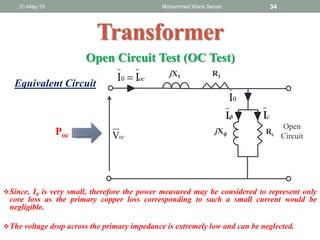
Since, I0 is very small, therefore the power measured may be considered to represent only
core loss as the primary copper loss corresponding to such a small current would be
negligible.
The voltage drop across the primary impedance is extremely low and can be neglected.
Poc
31-May-19 Mohammed Waris Senan 35
Transformer
RcjX 𝜙
ocV
cII
0I
ocII0 
Open
Circuit
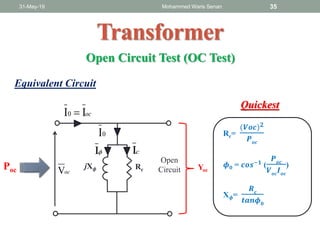
Open Circuit Test (OC Test)
Equivalent Circuit
Yoc
Rc=
(𝑽𝒐𝒄) 𝟐
𝑷 𝒐𝒄
𝝓 𝟎 = 𝒄𝒐𝒔−𝟏 (
𝑷 𝒐𝒄
𝑽 𝒐𝒄
𝑰 𝒐𝒄
)
X 𝝓=
𝑹 𝒄
𝒕𝒂𝒏𝝓 𝟎
Quickest
Poc
31-May-19 Mohammed Waris Senan 36
Transformer
RcjX 𝜙
ocV
cII
0I
ocII0 
Open
Circuit
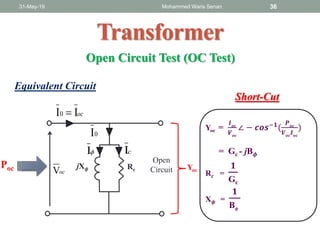
Open Circuit Test (OC Test)
Equivalent Circuit
Yoc
Yoc =
𝑰 𝒐𝒄
𝑽 𝒐𝒄
∠ − 𝒄𝒐𝒔−𝟏(
𝑷 𝒐𝒄
𝑽 𝒐𝒄
𝑰 𝒐𝒄
)
= Gc - jB 𝝓
R 𝒄 =
𝟏
Gc
X 𝝓 =
𝟏
B 𝝓
Short-Cut
Poc
31-May-19 Mohammed Waris Senan 37
Transformer
Open Circuit Test (OC Test)
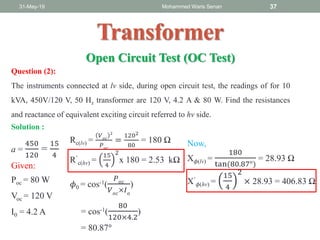
Question (2):
The instruments connected at lv side, during open circuit test, the readings of for 10
kVA, 450V/120 V, 50 Hz transformer are 120 V, 4.2 A & 80 W. Find the resistances
and reactance of equivalent exciting circuit referred to hv side.
a =
450
120
=
15
4
Given:
Poc = 80 W
Voc = 120 V
I0 = 4.2 A
Solution :
Rc(lv) =
𝑉 𝑜𝑐
2
𝑃 𝑜𝑐
=
1202
80
= 180 Ω
R’
c(hv) =
15
4
2
x 180 = 2.53 kΩ
𝜙0 = cos-1(
𝑃 𝑜𝑐
𝑉 𝑜𝑐
×𝐼 𝑜
)
= cos-1(
80
120×4.2
)
= 80.87°
Now,
X 𝜙(lv) =
180
tan(80.87°)
= 28.93 Ω
X’
𝜙(hv) =
15
4
2
× 28.93 = 406.83 Ω
►Short Circuit Test (SC Test) is carried out at rated current to determine the
full load copper loss. Since, resistance is not affected too much by the frequency at
lower frequencies, the test may be carried out at a frequency even slightly different from
rated frequency.
►SC test is usually carried out with the instruments placed on the high voltage
(hv) side while the low voltage (lv) side is short circuited by thick wire (low
resistance wire).
►This is done because rated current on hv side is lower and therefore cost saving
would be obtained on the instruments.
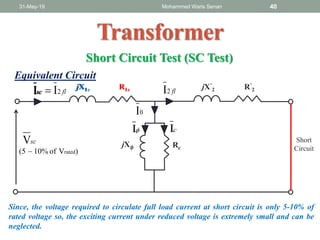
►Since, the voltage required to circulate full load current at short circuit is only 5-
10% of rated voltage, the core loss under short circuit test is ignored.
31-May-19 Mohammed Waris Senan 38
Transformer
Short Circuit Test (SC Test)
31-May-19 Mohammed Waris Senan 39
Transformer
V
Short Circuit Test (SC Test)
Adjustable
voltage
supply
Short
Circuit
hv lv
Isc
Vsc
Psc
Connection Diagram
A
31-May-19 Mohammed Waris Senan 40
Transformer
R1jX1
RcjX 𝜙
scV
cII
0I
scI
Short
Circuit
Short Circuit Test (SC Test)
Equivalent Circuit
jX’
2 R’
2
Since, the voltage required to circulate full load current at short circuit is only 5-10% of
rated voltage so, the exciting current under reduced voltage is extremely small and can be
neglected.
fl2I
)Vof10%(5 rated
jX1e R1eflsc 2II 
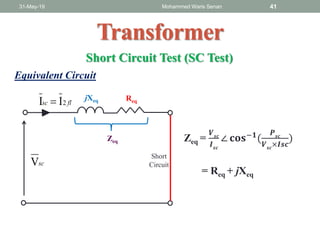
31-May-19 Mohammed Waris Senan 41
Transformer
scV
Short
Circuit
Short Circuit Test (SC Test)
Equivalent Circuit
jXeq Reqflsc 2II 
Zeq Zeq =
𝑽 𝒔𝒄
𝑰 𝒔𝒄
∠ 𝐜𝐨𝐬−𝟏(
𝑷 𝒔𝒄
𝑽 𝒔𝒄
×𝑰𝒔𝒄
)
= Req + jXeq
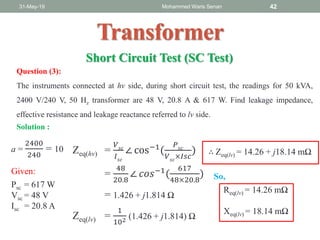
31-May-19 Mohammed Waris Senan 42
Transformer
Short Circuit Test (SC Test)
Question (3):
The instruments connected at hv side, during short circuit test, the readings for 50 kVA,
2400 V/240 V, 50 Hz transformer are 48 V, 20.8 A & 617 W. Find leakage impedance,
effective resistance and leakage reactance referred to lv side.
a =
2400
240
= 10
Given:
Psc = 617 W
Vsc = 48 V
Isc = 20.8 A
Solution :
Zeq(hv) =
𝑉 𝑠𝑐
𝐼 𝑠𝑐
∠ cos−1
(
𝑃 𝑠𝑐
𝑉 𝑠𝑐
×𝐼𝑠𝑐
)
=
48
20.8
∠ 𝑐𝑜𝑠−1(
617
48×20.8
)
= 1.426 + j1.814 Ω
Zeq(lv) =
1
102 (1.426 + j1.814) Ω
∴ Zeq(lv) = 14.26 + j18.14 mΩ
Req(lv) = 14.26 mΩ
Xeq(lv) = 18.14 mΩ
So,
31-May-19 Mohammed Waris Senan 43
Transformer
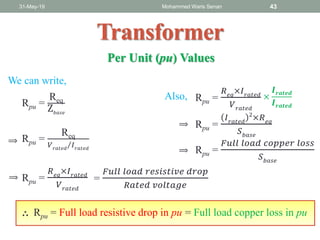
Per Unit (pu) Values
Rpu =
Req
Z𝑏𝑎𝑠𝑒
Rpu =
Req
𝑉 𝑟𝑎𝑡𝑒𝑑
𝐼 𝑟𝑎𝑡𝑒𝑑
Rpu =
𝑅 𝑒𝑞
×𝐼 𝑟𝑎𝑡𝑒𝑑
𝑉 𝑟𝑎𝑡𝑒𝑑
=
𝐹𝑢𝑙𝑙 𝑙𝑜𝑎𝑑 𝑟𝑒𝑠𝑖𝑠𝑡𝑖𝑣𝑒 𝑑𝑟𝑜𝑝
𝑅𝑎𝑡𝑒𝑑 𝑣𝑜𝑙𝑡𝑎𝑔𝑒
Rpu = Full load resistive drop in pu
Rpu =
𝑅 𝑒𝑞
×𝐼 𝑟𝑎𝑡𝑒𝑑
𝑉 𝑟𝑎𝑡𝑒𝑑
×
𝑰 𝒓𝒂𝒕𝒆𝒅
𝑰 𝒓𝒂𝒕𝒆𝒅
Rpu =
𝐹𝑢𝑙𝑙 𝑙𝑜𝑎𝑑 𝑐𝑜𝑝𝑝𝑒𝑟 𝑙𝑜𝑠𝑠
𝑆 𝑏𝑎𝑠𝑒
= Full load copper loss in pu
Rpu =
𝐼 𝑟𝑎𝑡𝑒𝑑
2
×𝑅 𝑒𝑞
𝑆 𝑏𝑎𝑠𝑒
∴
⟹
⟹
⟹
⟹
We can write,
Also,
31-May-19 Mohammed Waris Senan 44
Transformer
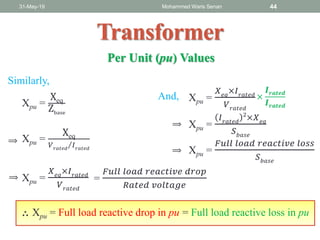
Xpu =
Xeq
Zbase
Xpu =
Xeq
𝑉 𝑟𝑎𝑡𝑒𝑑
𝐼 𝑟𝑎𝑡𝑒𝑑
Xpu =
𝑋 𝑒𝑞
×𝐼 𝑟𝑎𝑡𝑒𝑑
𝑉 𝑟𝑎𝑡𝑒𝑑
=
𝐹𝑢𝑙𝑙 𝑙𝑜𝑎𝑑 𝑟𝑒𝑎𝑐𝑡𝑖𝑣𝑒 𝑑𝑟𝑜𝑝
𝑅𝑎𝑡𝑒𝑑 𝑣𝑜𝑙𝑡𝑎𝑔𝑒
Xpu = Full load reactive drop in pu
Xpu =
𝑋 𝑒𝑞
×𝐼 𝑟𝑎𝑡𝑒𝑑
𝑉 𝑟𝑎𝑡𝑒𝑑
×
𝑰 𝒓𝒂𝒕𝒆𝒅
𝑰 𝒓𝒂𝒕𝒆𝒅
Xpu =
𝐹𝑢𝑙𝑙 𝑙𝑜𝑎𝑑 𝑟𝑒𝑎𝑐𝑡𝑖𝑣𝑒 𝑙𝑜𝑠𝑠
𝑆 𝑏𝑎𝑠𝑒
= Full load reactive loss in pu
Xpu =
𝐼 𝑟𝑎𝑡𝑒𝑑
2
×𝑋 𝑒𝑞
𝑆 𝑏𝑎𝑠𝑒
∴
⟹
⟹
⟹
⟹
Similarly,
And,
Per Unit (pu) Values
31-May-19 Mohammed Waris Senan 45
Transformer
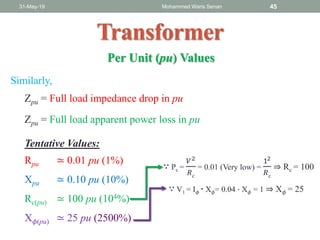
Zpu = Full load impedance drop in pu
Zpu = Full load apparent power loss in pu
Similarly,
Tentative Values:
Rpu ≃ 0.01 pu (1%)
Xpu ≃ 0.10 pu (10%)
Rc(pu) ≃ 100 pu (104%)
X 𝜙(pu) ≃ 25 pu (2500%)
∵ Pc =
𝑉2
𝑅 𝑐
= 0.01 (Very low) =
12
𝑅 𝑐
⇒ Rc = 100
∵ V1 = I 𝜙 ∙ X 𝜙= 0.04 ∙ X 𝜙 = 1 ⇒ X 𝜙 = 25
Per Unit (pu) Values
31-May-19 Mohammed Waris Senan 46
Transformer
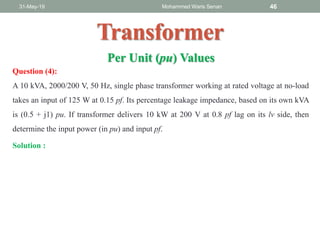
Question (4):
A 10 kVA, 2000/200 V, 50 Hz, single phase transformer working at rated voltage at no-load
takes an input of 125 W at 0.15 pf. Its percentage leakage impedance, based on its own kVA
is (0.5 + j1) pu. If transformer delivers 10 kW at 200 V at 0.8 pf lag on its lv side, then
determine the input power (in pu) and input pf.
Per Unit (pu) Values
Solution :
31-May-19 Mohammed Waris Senan 47
Transformer
Per Unit (pu) Values
Solution :
31-May-19 Mohammed Waris Senan 48
Transformer
Per Unit (pu) Values
Solution :
31-May-19 Mohammed Waris Senan 49
Transformer
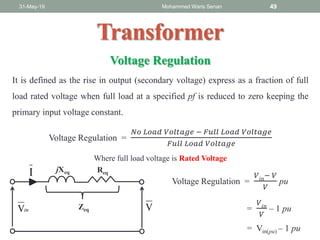
Voltage Regulation
It is defined as the rise in output (secondary voltage) express as a fraction of full
load rated voltage when full load at a specified pf is reduced to zero keeping the
primary input voltage constant.
Voltage Regulation =
𝑁𝑜 𝐿𝑜𝑎𝑑 𝑉𝑜𝑙𝑡𝑎𝑔𝑒 − 𝐹𝑢𝑙𝑙 𝐿𝑜𝑎𝑑 𝑉𝑜𝑙𝑡𝑎𝑔𝑒
𝐹𝑢𝑙𝑙 𝐿𝑜𝑎𝑑 𝑉𝑜𝑙𝑡𝑎𝑔𝑒
Where full load voltage is Rated Voltage
inV V
I jXeq Req
Zeq
Voltage Regulation =
𝑉𝑖𝑛
− 𝑉
𝑉
pu
=
𝑉𝑖𝑛
𝑉
– 1 pu
= Vin(pu) – 1 pu
31-May-19 Mohammed Waris Senan 50
Transformer
Question (5):
A transformer ha pu impedance of 0.10 and pu resistance of 0.01. Calculate the phase
difference between output voltage and input voltage on full load. And also determine the
voltage at
(a) 0.8 pf lag (b) UPF (c) 0.8 pf lead
Voltage Regulation
Solution :
31-May-19 Mohammed Waris Senan 51
Transformer
Voltage Regulation
Solution :
31-May-19 Mohammed Waris Senan 52
Transformer
Voltage Regulation
Solution :
31-May-19 Mohammed Waris Senan 53
Transformer
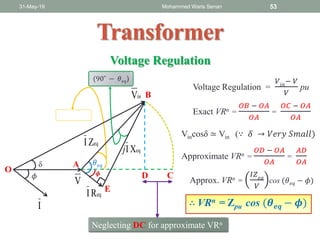
Voltage Regulation
inV
V
I
eqRI
eqXIj
eqZI
A
D C
O
B
𝜙 𝝓
𝜃 𝑒𝑞
(90˚ − 𝜃 𝑒𝑞)
Exact VRn =
𝑂𝐵 − 𝑂𝐴
𝑂𝐴
=
𝑂𝐶 − 𝑂𝐴
𝑂𝐴
δ
Vincosδ ≃ Vin (∵ 𝛿 → 𝑉𝑒𝑟𝑦 𝑆𝑚𝑎𝑙𝑙)
Voltage Regulation =
𝑉𝑖𝑛
− 𝑉
𝑉
pu
Approximate VRn =
𝑂𝐷 − 𝑂𝐴
𝑂𝐴
=
𝐴𝐷
𝑂𝐴
Neglecting DC for approximate VRn
Approx. VRn =
𝐼𝑍 𝑒𝑞
𝑉
cos (𝜃 𝑒𝑞 − 𝜙)
∴ VRn = Zpu cos (𝜽 𝒆𝒒 − 𝝓)
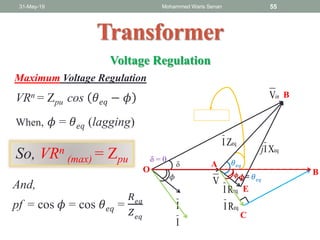
E
31-May-19 Mohammed Waris Senan 54
Transformer
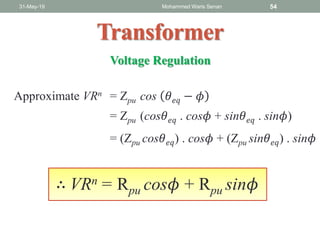
Voltage Regulation
= Zpu (cos𝜃 𝑒𝑞 . cos𝜙 + sin𝜃 𝑒𝑞 . sin𝜙)
= (Zpu cos𝜃 𝑒𝑞) . cos𝜙 + (Zpu sin𝜃 𝑒𝑞) . sin𝜙
∴ VRn = Rpu cos𝜙 + Rpu sin𝜙
Approximate VRn = Zpu cos 𝜃 𝑒𝑞 − 𝜙
31-May-19 Mohammed Waris Senan 55
Transformer
Voltage Regulation
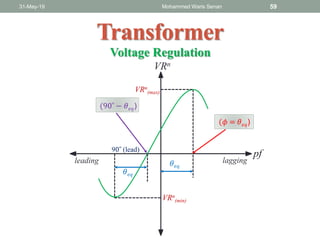
Maximum Voltage Regulation
VRn = Zpu cos 𝜃 𝑒𝑞 − 𝜙
When, 𝜙 = 𝜃 𝑒𝑞 (lagging)
And,
pf = cos 𝜙 = cos 𝜃 𝑒𝑞 =
𝑅 𝑒𝑞
𝑍 𝑒𝑞
So, VRn
(max) = Zpu
inV
V
I
eqRI
eqXIj
eqZI
A
BO
B
𝜙 𝝓
δ
E
𝜃 𝑒𝑞
δ = 0
C
I
eqRI
𝝓= 𝜃 𝑒𝑞
31-May-19 Mohammed Waris Senan 56
Transformer
Voltage Regulation
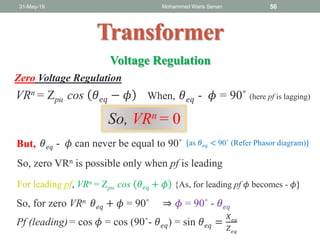
Zero Voltage Regulation
VRn = Zpu cos 𝜃 𝑒𝑞 − 𝜙 When, 𝜃 𝑒𝑞 - 𝜙 = 90˚ (here pf is lagging)
So, VRn = 0
But, {as 𝜃 𝑒𝑞 < 90˚ (Refer Phasor diagram)}
So, zero VRn is possible only when pf is leading
For leading pf, VRn = Zpu cos 𝜃 𝑒𝑞 + 𝜙 {As, for leading pf 𝜙 becomes - 𝜙}
𝜃 𝑒𝑞 - 𝜙 can never be equal to 90˚
So, for zero VRn 𝜃 𝑒𝑞 + 𝜙 = 90˚ ⇒ 𝜙 = 90˚ - 𝜃 𝑒𝑞
Pf (leading) = cos 𝜙 = cos (90˚- 𝜃 𝑒𝑞) = sin 𝜃 𝑒𝑞 =
𝑋 𝑒𝑞
𝑍 𝑒𝑞
31-May-19 Mohammed Waris Senan 57
Transformer
Voltage Regulation
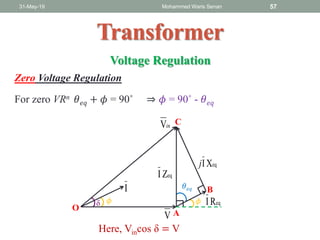
Zero Voltage Regulation
For zero VRn 𝜃 𝑒𝑞 + 𝜙 = 90˚ ⇒ 𝜙 = 90˚ - 𝜃 𝑒𝑞
inV
V
I
eqRI
eqXIj
eqZI
A
O
C
B
𝜙
𝜃 𝑒𝑞
δ 𝜙
Here, Vincos δ = V
31-May-19 Mohammed Waris Senan 58
Transformer
Voltage Regulation
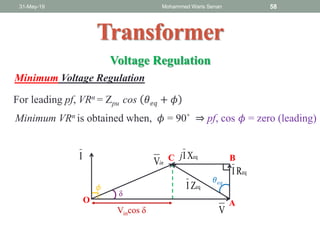
Minimum Voltage Regulation
Minimum VRn is obtained when, 𝜙 = 90˚ ⇒ pf, cos 𝜙 = zero (leading)
For leading pf, VRn = Zpu cos 𝜃 𝑒𝑞 + 𝜙
inV
V
I
eqRI
eqXIj
eqZI
AO
C B
𝜙
𝜃 𝑒𝑞
δ
Vincos δ
31-May-19 Mohammed Waris Senan 59
Transformer
Voltage Regulation
𝜃 𝑒𝑞
𝜃 𝑒𝑞
VRn
(max)
VRn
(min)
VRn
pf
laggingleading
(90˚ − 𝜃 𝑒𝑞)
(𝜙 = 𝜃 𝑒𝑞)
90˚ (lead)
Transformer
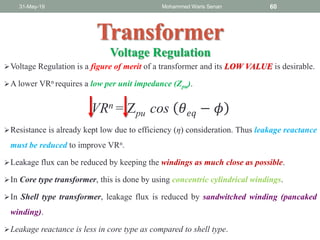
Voltage Regulation is a figure of merit of a transformer and its LOW VALUE is desirable.
A lower VRn requires a low per unit impedance (Zpu).
VRn = Zpu cos 𝜃 𝑒𝑞 − 𝜙
Resistance is already kept low due to efficiency (η) consideration. Thus leakage reactance
must be reduced to improve VRn.
Leakage flux can be reduced by keeping the windings as much close as possible.
In Core type transformer, this is done by using concentric cylindrical windings.
In Shell type transformer, leakage flux is reduced by sandwitched winding (pancaked
winding).
Leakage reactance is less in core type as compared to shell type.
31-May-19 Mohammed Waris Senan 60
Voltage Regulation
Transformer
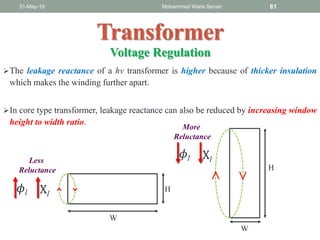
The leakage reactance of a hv transformer is higher because of thicker insulation
which makes the winding further apart.
In core type transformer, leakage reactance can also be reduced by increasing window
height to width ratio.
31-May-19 Mohammed Waris Senan 61
Voltage Regulation
H
W
Less
Reluctance
𝜙l Xl
H
W
More
Reluctance
𝜙l Xl
Transformer
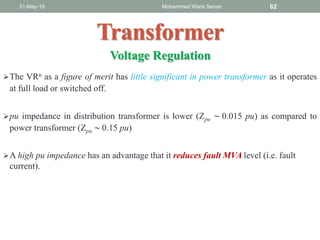
The VRn as a figure of merit has little significant in power transformer as it operates
at full load or switched off.
pu impedance in distribution transformer is lower (Zpu ~ 0.015 pu) as compared to
power transformer (Zpu ~ 0.15 pu)
A high pu impedance has an advantage that it reduces fault MVA level (i.e. fault
current).
31-May-19 Mohammed Waris Senan 62
Voltage Regulation
Transformer
31-May-19 Mohammed Waris Senan 63
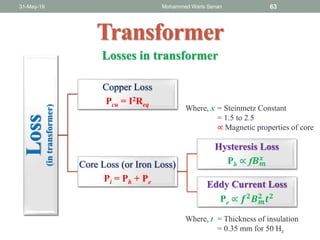
Losses in transformer
Loss
(intransformer)
Copper Loss
Pcu = I2Req
Core Loss (or Iron Loss)
Pi = Ph + Pe
Hysteresis Loss
Ph ∝ f𝑩 𝒎
𝒙
Eddy Current Loss
Pe ∝ 𝒇 𝟐
𝑩 𝒎
𝟐
𝒕 𝟐
Where, x = Steinmetz Constant
= 1.5 to 2.5
∝ Magnetic properties of core
Where, t = Thickness of insulation
= 0.35 mm for 50 Hz
Transformer
31-May-19 Mohammed Waris Senan 64
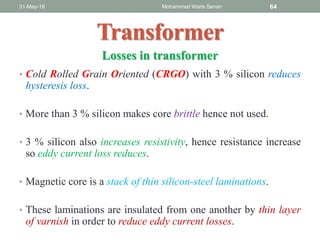
Losses in transformer
• Cold Rolled Grain Oriented (CRGO) with 3 % silicon reduces
hysteresis loss.
• More than 3 % silicon makes core brittle hence not used.
• 3 % silicon also increases resistivity, hence resistance increase
so eddy current loss reduces.
• Magnetic core is a stack of thin silicon-steel laminations.
• These laminations are insulated from one another by thin layer
of varnish in order to reduce eddy current losses.
Transformer
31-May-19 Mohammed Waris Senan 65
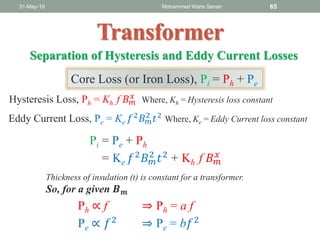
Separation of Hysteresis and Eddy Current Losses
Hysteresis Loss, Ph = Kh f 𝐵 𝑚
𝑥 Where, Kh = Hysteresis loss constant
Eddy Current Loss, Pe = Ke 𝑓2
𝐵 𝑚
2
𝑡2
Where, Ke = Eddy Current loss constant
Core Loss (or Iron Loss), Pi = Ph + Pe
Pi = Pe + Ph
= Ke 𝑓2 𝐵 𝑚
2 𝑡2 + Kh f 𝐵 𝑚
𝑥
Thickness of insulation (t) is constant for a transformer.
So, for a given 𝑩 𝒎
Ph ∝ f ⇒ Ph = a f
Pe ∝ 𝑓2 ⇒ Pe = b𝑓2
Transformer
31-May-19 Mohammed Waris Senan 66
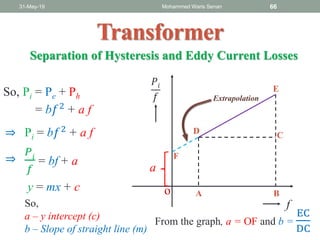
Separation of Hysteresis and Eddy Current Losses
𝑃𝑖
𝑓
= bf + a
So, Pi = Pe + Ph
= b𝑓2
+ a f
⇒
Pi = b𝑓2
+ a f⇒
y = mx + c
𝑃𝑖
𝑓
f
a
Extrapolation
o
So,
a – y intercept (c)
b – Slope of straight line (m)
A B
CD
E
F
From the graph, a = OF and b =
EC
DC
31-May-19 Mohammed Waris Senan 67
Transformer
Question (6):
A single phase 400 V, 50 Hz transformer has an iron loss of 5000 W at the rated condition.
When operated at 200 V, 25 Hz, the iron loss is 2000 W. Calculate hysteresis and eddy
current loss when the transformer is operated at 416 V, 52 Hz.
Separation of Hysteresis and Eddy Current Losses
Solution :
31-May-19 Mohammed Waris Senan 68
Transformer
Separation of Hysteresis and Eddy Current Losses
Solution :

Electrical machine slide share

  • 1.
  • 2.
    Content Transformer Introduction Laws governing working UnderstandingLenz’s Law Ideal Transformer EMF Equation of Transformer Phasor diagram of ideal transformer Practical Transformer Equivalent Circuit diagram Phasor diagram Concept of referred Values 31-May-19 Mohammed Waris Senan 2
  • 3.
    Transformer A static devicewhich transfer power (or energy) from one circuit to another circuit by changing the level of voltage (and current) without changing frequency. 31-May-19 Mohammed Waris Senan 3
  • 4.
    31-May-19 Mohammed WarisSenan 4 A CUT SECTION Transformer works on two LAWS
  • 5.
    Transformer 1st Law: Faraday lawof Electromagnetic Induction Flux linking with a coil changes an emf is induced in the coil which is directly proportional to the rate of change of flux linkage. 31-May-19 Mohammed Waris Senan 5 dt d e   λ = Flux Linkage λ = N 𝜙 dt d Ne  
  • 6.
    31-May-19 Mohammed WarisSenan 6 Transformer 2nd Law: Lenz’s Law The direction of induced EMF is such that if it is allowed to cause current by short-circuiting the coil, then the current so produced opposes the cause dt d Ne dt d e ei     .. Where the sign depends on Lenz’s law and which terminal is taken as positive
  • 7.
    31-May-19 Mohammed WarisSenan 7 Transformer N SN S dt d Neab   abe NS a b
  • 8.
    31-May-19 Mohammed WarisSenan 8 Transformer N SN S dt d Neab   abe N S a b
  • 9.
    31-May-19 Mohammed WarisSenan 9 Transformer N SN S dt d Neab   abe N S a b
  • 10.
    31-May-19 Mohammed WarisSenan 10 Transformer dt d Neab   abe NS N SN S a b
  • 11.
    31-May-19 Mohammed WarisSenan 11 Transformer Ideal Transformer 1. No losses  Copper losses and iron losses are zero 2. Infinite Permeability (i.e. Zero Reluctance) 3. No leakage Flux mFlux , v1 e1 e2 v2 + + - N1 N2 N1>N2 i1 2l1l
  • 12.
    31-May-19 Mohammed WarisSenan 12 Transformer )90sin( cos )sin( , sin,      tNe tNe dt td Ne So tLet dt d Ne m m m m      Equation of induced EMF mfNE  11 2 mfNE  22 2 For primary winding having N1 turns For Secondary winding having N2 turns RMS Value m m m fNE πfω fN E N E    2 )2( 2 )2( 2     So,
  • 13.
    31-May-19 Mohammed WarisSenan 13 Transformer Ideal Transformer e1 𝜙𝜙m 𝜙 , e1 t 1V 2E2V 1E m (Flux)
  • 14.
    31-May-19 Mohammed WarisSenan 14 Transformer Ideal Transformer mFlux , + + - N1 N2 L O A D 1V 1E 2V2E 1I 2I At Load
  • 15.
    31-May-19 Mohammed WarisSenan 15 Transformer Turns Ratio/Voltage Ratio/Transformation Ratio (a) a 2 1 2 1 2 1 N N V V E E m m fNE fNE   22 11 2 2   As, Also, in case of Ideal Transformer V1 = E1 and V2 = E2 a 2 1 2 1 N N E E So,
  • 16.
    31-May-19 Mohammed WarisSenan 16 Transformer Turns Ratio/Voltage Ratio/Transformation Ratio (a) In an ideal transformer there is no leakage flux Net mmf, 0ININ 2211  0I 0,NI NI As,        if μA l 2 ' 2 1 2 1 2211 II N N I ININSo,   1 2 2 1 2 1 2 1 I I N N V V E E  a Therefore we can write, )0( 21  ll 
  • 17.
    31-May-19 Mohammed WarisSenan 17 Transformer Ideal Transformer on Load (at lagging pf) 22 VE  11 VE  m (Flux) 2I a 2 1 I I 1 2  The primary winding is behaving as a sink and simultaneously secondary winding is behaving as a source w.r.t. load.  Ideal transformer is just transferring only and consuming no power in between
  • 18.
    31-May-19 Mohammed WarisSenan 18 Transformer Practical Transformer So, here no load current (I0) is required to produce flux in the core and for core losses.  No losses  Copper losses and iron losses are present  Infinite Permeability (i.e. Zero Reluctance)  Definite Permeability (Reluctance is present)  No leakage Flux Leakage  Leakage Flux present 02 1 2 1 012211 012211 II N N I INININ INININ    02 ' 1 III  CurrentLoadCurrent/NoExcitingI0  Ideal Transformer
  • 19.
    31-May-19 Mohammed WarisSenan 19 Transformer Practical Transformer R1jX1 jX2R2 RcjX 𝜙1V 1E 2E 2V cII 0I 1I 0I 2 '  At No Load 01 2 ' 2 II 0I0I   0I2 
  • 20.
    31-May-19 Mohammed WarisSenan 20 Transformer Practical Transformer 22 VE  11 VE  m (Flux) 10 II  0 I cI Hysteretic Angle At No Load 01 2 ' 2 II 0I0I   0IofcomponentgMagnetisinI  0c IofcomponentlossCoreI  Phasor diagram of transformer at NO LOAD
  • 21.
    31-May-19 Mohammed WarisSenan 21 Transformer Practical Transformer 1V R1jX1 jX2R2 RcjX 𝜙 1E 2E 2V cII 0I 1I 2 ' I 2I L O A D 222222 XIRIVE j111111 XIRIEV j c0 III   At Load
  • 22.
    31-May-19 Mohammed WarisSenan 22 Transformer 222222 XIRIVE j 111111 XIRIEV j c0 III   1I m 2E 1E 0I I cI 2I 2 ' I 2V 22RI 22XIj 11RI 11XIj1V Phasor diagram of transformer at LOAD (cos 𝜙 lag)
  • 23.
    31-May-19 Mohammed WarisSenan 23 Transformer Referred Value 1V 1E 2E 2V 1I 2I L O A D loadZ a 1 2 2 1 I I V V As, 12 1 2 IIand a V V a 2 2 I V Z load 1 1 I V Z a aload  1 1 2 I V1 Z  a load )Z I V ( Z Z 1 1 1 2 1   a load ZZ 2 1 loada ZZAlso, 2' loadload a Secondary load impedance referred to Primary side
  • 24.
    31-May-19 Mohammed WarisSenan 24 Transformer 222222 XIRIVE j 222222 XIRIVE jaaaa  2 22 2 22 2 ' 2 ' 1 X) I (R) I (VEE a a ja a  22 ' 22 ' 2 ' 2 ' 1 '' XIRIVEE j Equivalent Circuit Referred to primary
  • 25.
    31-May-19 Mohammed WarisSenan 25 Transformer jX’2R’2 2 ' 1 EE  2 ' V R1jX1 RcjX 𝜙1V cII 0I 1I 2 ' I Equivalent Circuit 2 ' I
  • 26.
    Question (1): The parametersof equivalent circuits of 150 kVA, 2400/240 V transformer are R1 = 0.2 Ω X1 = 0.45 Ω R2 = 2 mΩ X2 = 4.5 mΩ Rc = 10 kΩ X 𝜙 = 1.55 kΩ Using the circuit referred to primary, determine the primary input voltage, input current and input pf of transformer operating at rated load with 0.8 pf lag. 31-May-19 Mohammed Waris Senan 26 Transformer Solution : Equivalent Circuit
  • 27.
    31-May-19 Mohammed WarisSenan 27 Transformer Solution : Equivalent Circuit
  • 28.
    31-May-19 Mohammed WarisSenan 28 Transformer jX’2R’2 2 ' 1 EE  2 ' V R1jX1 RcjX 𝜙1V cII 2 ' I Approximate Equivalent Circuit 2 ' I 0I R1ejX1e 2 ' V X1e = X1 + X’2R1e = R1 + R’2 Where, and
  • 29.
    31-May-19 Mohammed WarisSenan 29 Transformer 2 ' V R1ejX1e RcjX 𝜙1V cII 2 ' I Equivalent Circuit 0I 2 ' V Z1e = jX1e + R1e 1V 2 ' I
  • 30.
    31-May-19 Mohammed WarisSenan 30 Transformer Equivalent Circuit 2 ' V Z1e = jX1e + R1e 1V 2 ' I Referred to primary 2V Z2e = R2e + jX2e 1 ' V 21 ' II  Referred to Secondary X2e = X’1 + X2R2e = R’1+ R2 Where, and
  • 31.
    31-May-19 Mohammed WarisSenan 31 Transformer Phasor Diagram 2V Z2e = R2e + jX2e 1 ' V 21 ' II  Referred to Secondary 2e22e221 ' XIRIVV j 1 ' V 2V 2I  2e2RI 2e2XIj 2e2ZI L O A D
  • 32.
    ►Open Circuit Testand Short Circuit Test are carried out on a transformer to predict its performance without actually loading it. ►Open Circuit Test (OC Test) is carried out at rated frequency and rated voltage to determine the core loss. ►OC test is usually carried out with the instruments placed on the low voltage (lv) side while the high voltage (hv) side is kept open circuited. ►This is done because it is easier to arrange rated voltage supply at the low voltage level, the instruments are also cheaper in cost and it is safer to work at lv side. ►Since 𝜙0 is very low, so a low pf wattmeter should be used. 31-May-19 Mohammed Waris Senan 32 Transformer Open Circuit Test (OC Test)
  • 33.
    31-May-19 Mohammed WarisSenan 33 Transformer A V Open Circuit Test (OC Test) Rated frequency, Adjustable voltage supply Open Circuitlv hv I0 V0 Poc Connection Diagram
  • 34.
    31-May-19 Mohammed WarisSenan 34 Transformer R1jX1 RcjX 𝜙 ocV cII 0I ocII0  Open Circuit Open Circuit Test (OC Test) Equivalent Circuit Since, I0 is very small, therefore the power measured may be considered to represent only core loss as the primary copper loss corresponding to such a small current would be negligible. The voltage drop across the primary impedance is extremely low and can be neglected. Poc
  • 35.
    31-May-19 Mohammed WarisSenan 35 Transformer RcjX 𝜙 ocV cII 0I ocII0  Open Circuit Open Circuit Test (OC Test) Equivalent Circuit Yoc Rc= (𝑽𝒐𝒄) 𝟐 𝑷 𝒐𝒄 𝝓 𝟎 = 𝒄𝒐𝒔−𝟏 ( 𝑷 𝒐𝒄 𝑽 𝒐𝒄 𝑰 𝒐𝒄 ) X 𝝓= 𝑹 𝒄 𝒕𝒂𝒏𝝓 𝟎 Quickest Poc
  • 36.
    31-May-19 Mohammed WarisSenan 36 Transformer RcjX 𝜙 ocV cII 0I ocII0  Open Circuit Open Circuit Test (OC Test) Equivalent Circuit Yoc Yoc = 𝑰 𝒐𝒄 𝑽 𝒐𝒄 ∠ − 𝒄𝒐𝒔−𝟏( 𝑷 𝒐𝒄 𝑽 𝒐𝒄 𝑰 𝒐𝒄 ) = Gc - jB 𝝓 R 𝒄 = 𝟏 Gc X 𝝓 = 𝟏 B 𝝓 Short-Cut Poc
  • 37.
    31-May-19 Mohammed WarisSenan 37 Transformer Open Circuit Test (OC Test) Question (2): The instruments connected at lv side, during open circuit test, the readings of for 10 kVA, 450V/120 V, 50 Hz transformer are 120 V, 4.2 A & 80 W. Find the resistances and reactance of equivalent exciting circuit referred to hv side. a = 450 120 = 15 4 Given: Poc = 80 W Voc = 120 V I0 = 4.2 A Solution : Rc(lv) = 𝑉 𝑜𝑐 2 𝑃 𝑜𝑐 = 1202 80 = 180 Ω R’ c(hv) = 15 4 2 x 180 = 2.53 kΩ 𝜙0 = cos-1( 𝑃 𝑜𝑐 𝑉 𝑜𝑐 ×𝐼 𝑜 ) = cos-1( 80 120×4.2 ) = 80.87° Now, X 𝜙(lv) = 180 tan(80.87°) = 28.93 Ω X’ 𝜙(hv) = 15 4 2 × 28.93 = 406.83 Ω
  • 38.
    ►Short Circuit Test(SC Test) is carried out at rated current to determine the full load copper loss. Since, resistance is not affected too much by the frequency at lower frequencies, the test may be carried out at a frequency even slightly different from rated frequency. ►SC test is usually carried out with the instruments placed on the high voltage (hv) side while the low voltage (lv) side is short circuited by thick wire (low resistance wire). ►This is done because rated current on hv side is lower and therefore cost saving would be obtained on the instruments. ►Since, the voltage required to circulate full load current at short circuit is only 5- 10% of rated voltage, the core loss under short circuit test is ignored. 31-May-19 Mohammed Waris Senan 38 Transformer Short Circuit Test (SC Test)
  • 39.
    31-May-19 Mohammed WarisSenan 39 Transformer V Short Circuit Test (SC Test) Adjustable voltage supply Short Circuit hv lv Isc Vsc Psc Connection Diagram A
  • 40.
    31-May-19 Mohammed WarisSenan 40 Transformer R1jX1 RcjX 𝜙 scV cII 0I scI Short Circuit Short Circuit Test (SC Test) Equivalent Circuit jX’ 2 R’ 2 Since, the voltage required to circulate full load current at short circuit is only 5-10% of rated voltage so, the exciting current under reduced voltage is extremely small and can be neglected. fl2I )Vof10%(5 rated jX1e R1eflsc 2II 
  • 41.
    31-May-19 Mohammed WarisSenan 41 Transformer scV Short Circuit Short Circuit Test (SC Test) Equivalent Circuit jXeq Reqflsc 2II  Zeq Zeq = 𝑽 𝒔𝒄 𝑰 𝒔𝒄 ∠ 𝐜𝐨𝐬−𝟏( 𝑷 𝒔𝒄 𝑽 𝒔𝒄 ×𝑰𝒔𝒄 ) = Req + jXeq
  • 42.
    31-May-19 Mohammed WarisSenan 42 Transformer Short Circuit Test (SC Test) Question (3): The instruments connected at hv side, during short circuit test, the readings for 50 kVA, 2400 V/240 V, 50 Hz transformer are 48 V, 20.8 A & 617 W. Find leakage impedance, effective resistance and leakage reactance referred to lv side. a = 2400 240 = 10 Given: Psc = 617 W Vsc = 48 V Isc = 20.8 A Solution : Zeq(hv) = 𝑉 𝑠𝑐 𝐼 𝑠𝑐 ∠ cos−1 ( 𝑃 𝑠𝑐 𝑉 𝑠𝑐 ×𝐼𝑠𝑐 ) = 48 20.8 ∠ 𝑐𝑜𝑠−1( 617 48×20.8 ) = 1.426 + j1.814 Ω Zeq(lv) = 1 102 (1.426 + j1.814) Ω ∴ Zeq(lv) = 14.26 + j18.14 mΩ Req(lv) = 14.26 mΩ Xeq(lv) = 18.14 mΩ So,
  • 43.
    31-May-19 Mohammed WarisSenan 43 Transformer Per Unit (pu) Values Rpu = Req Z𝑏𝑎𝑠𝑒 Rpu = Req 𝑉 𝑟𝑎𝑡𝑒𝑑 𝐼 𝑟𝑎𝑡𝑒𝑑 Rpu = 𝑅 𝑒𝑞 ×𝐼 𝑟𝑎𝑡𝑒𝑑 𝑉 𝑟𝑎𝑡𝑒𝑑 = 𝐹𝑢𝑙𝑙 𝑙𝑜𝑎𝑑 𝑟𝑒𝑠𝑖𝑠𝑡𝑖𝑣𝑒 𝑑𝑟𝑜𝑝 𝑅𝑎𝑡𝑒𝑑 𝑣𝑜𝑙𝑡𝑎𝑔𝑒 Rpu = Full load resistive drop in pu Rpu = 𝑅 𝑒𝑞 ×𝐼 𝑟𝑎𝑡𝑒𝑑 𝑉 𝑟𝑎𝑡𝑒𝑑 × 𝑰 𝒓𝒂𝒕𝒆𝒅 𝑰 𝒓𝒂𝒕𝒆𝒅 Rpu = 𝐹𝑢𝑙𝑙 𝑙𝑜𝑎𝑑 𝑐𝑜𝑝𝑝𝑒𝑟 𝑙𝑜𝑠𝑠 𝑆 𝑏𝑎𝑠𝑒 = Full load copper loss in pu Rpu = 𝐼 𝑟𝑎𝑡𝑒𝑑 2 ×𝑅 𝑒𝑞 𝑆 𝑏𝑎𝑠𝑒 ∴ ⟹ ⟹ ⟹ ⟹ We can write, Also,
  • 44.
    31-May-19 Mohammed WarisSenan 44 Transformer Xpu = Xeq Zbase Xpu = Xeq 𝑉 𝑟𝑎𝑡𝑒𝑑 𝐼 𝑟𝑎𝑡𝑒𝑑 Xpu = 𝑋 𝑒𝑞 ×𝐼 𝑟𝑎𝑡𝑒𝑑 𝑉 𝑟𝑎𝑡𝑒𝑑 = 𝐹𝑢𝑙𝑙 𝑙𝑜𝑎𝑑 𝑟𝑒𝑎𝑐𝑡𝑖𝑣𝑒 𝑑𝑟𝑜𝑝 𝑅𝑎𝑡𝑒𝑑 𝑣𝑜𝑙𝑡𝑎𝑔𝑒 Xpu = Full load reactive drop in pu Xpu = 𝑋 𝑒𝑞 ×𝐼 𝑟𝑎𝑡𝑒𝑑 𝑉 𝑟𝑎𝑡𝑒𝑑 × 𝑰 𝒓𝒂𝒕𝒆𝒅 𝑰 𝒓𝒂𝒕𝒆𝒅 Xpu = 𝐹𝑢𝑙𝑙 𝑙𝑜𝑎𝑑 𝑟𝑒𝑎𝑐𝑡𝑖𝑣𝑒 𝑙𝑜𝑠𝑠 𝑆 𝑏𝑎𝑠𝑒 = Full load reactive loss in pu Xpu = 𝐼 𝑟𝑎𝑡𝑒𝑑 2 ×𝑋 𝑒𝑞 𝑆 𝑏𝑎𝑠𝑒 ∴ ⟹ ⟹ ⟹ ⟹ Similarly, And, Per Unit (pu) Values
  • 45.
    31-May-19 Mohammed WarisSenan 45 Transformer Zpu = Full load impedance drop in pu Zpu = Full load apparent power loss in pu Similarly, Tentative Values: Rpu ≃ 0.01 pu (1%) Xpu ≃ 0.10 pu (10%) Rc(pu) ≃ 100 pu (104%) X 𝜙(pu) ≃ 25 pu (2500%) ∵ Pc = 𝑉2 𝑅 𝑐 = 0.01 (Very low) = 12 𝑅 𝑐 ⇒ Rc = 100 ∵ V1 = I 𝜙 ∙ X 𝜙= 0.04 ∙ X 𝜙 = 1 ⇒ X 𝜙 = 25 Per Unit (pu) Values
  • 46.
    31-May-19 Mohammed WarisSenan 46 Transformer Question (4): A 10 kVA, 2000/200 V, 50 Hz, single phase transformer working at rated voltage at no-load takes an input of 125 W at 0.15 pf. Its percentage leakage impedance, based on its own kVA is (0.5 + j1) pu. If transformer delivers 10 kW at 200 V at 0.8 pf lag on its lv side, then determine the input power (in pu) and input pf. Per Unit (pu) Values Solution :
  • 47.
    31-May-19 Mohammed WarisSenan 47 Transformer Per Unit (pu) Values Solution :
  • 48.
    31-May-19 Mohammed WarisSenan 48 Transformer Per Unit (pu) Values Solution :
  • 49.
    31-May-19 Mohammed WarisSenan 49 Transformer Voltage Regulation It is defined as the rise in output (secondary voltage) express as a fraction of full load rated voltage when full load at a specified pf is reduced to zero keeping the primary input voltage constant. Voltage Regulation = 𝑁𝑜 𝐿𝑜𝑎𝑑 𝑉𝑜𝑙𝑡𝑎𝑔𝑒 − 𝐹𝑢𝑙𝑙 𝐿𝑜𝑎𝑑 𝑉𝑜𝑙𝑡𝑎𝑔𝑒 𝐹𝑢𝑙𝑙 𝐿𝑜𝑎𝑑 𝑉𝑜𝑙𝑡𝑎𝑔𝑒 Where full load voltage is Rated Voltage inV V I jXeq Req Zeq Voltage Regulation = 𝑉𝑖𝑛 − 𝑉 𝑉 pu = 𝑉𝑖𝑛 𝑉 – 1 pu = Vin(pu) – 1 pu
  • 50.
    31-May-19 Mohammed WarisSenan 50 Transformer Question (5): A transformer ha pu impedance of 0.10 and pu resistance of 0.01. Calculate the phase difference between output voltage and input voltage on full load. And also determine the voltage at (a) 0.8 pf lag (b) UPF (c) 0.8 pf lead Voltage Regulation Solution :
  • 51.
    31-May-19 Mohammed WarisSenan 51 Transformer Voltage Regulation Solution :
  • 52.
    31-May-19 Mohammed WarisSenan 52 Transformer Voltage Regulation Solution :
  • 53.
    31-May-19 Mohammed WarisSenan 53 Transformer Voltage Regulation inV V I eqRI eqXIj eqZI A D C O B 𝜙 𝝓 𝜃 𝑒𝑞 (90˚ − 𝜃 𝑒𝑞) Exact VRn = 𝑂𝐵 − 𝑂𝐴 𝑂𝐴 = 𝑂𝐶 − 𝑂𝐴 𝑂𝐴 δ Vincosδ ≃ Vin (∵ 𝛿 → 𝑉𝑒𝑟𝑦 𝑆𝑚𝑎𝑙𝑙) Voltage Regulation = 𝑉𝑖𝑛 − 𝑉 𝑉 pu Approximate VRn = 𝑂𝐷 − 𝑂𝐴 𝑂𝐴 = 𝐴𝐷 𝑂𝐴 Neglecting DC for approximate VRn Approx. VRn = 𝐼𝑍 𝑒𝑞 𝑉 cos (𝜃 𝑒𝑞 − 𝜙) ∴ VRn = Zpu cos (𝜽 𝒆𝒒 − 𝝓) E
  • 54.
    31-May-19 Mohammed WarisSenan 54 Transformer Voltage Regulation = Zpu (cos𝜃 𝑒𝑞 . cos𝜙 + sin𝜃 𝑒𝑞 . sin𝜙) = (Zpu cos𝜃 𝑒𝑞) . cos𝜙 + (Zpu sin𝜃 𝑒𝑞) . sin𝜙 ∴ VRn = Rpu cos𝜙 + Rpu sin𝜙 Approximate VRn = Zpu cos 𝜃 𝑒𝑞 − 𝜙
  • 55.
    31-May-19 Mohammed WarisSenan 55 Transformer Voltage Regulation Maximum Voltage Regulation VRn = Zpu cos 𝜃 𝑒𝑞 − 𝜙 When, 𝜙 = 𝜃 𝑒𝑞 (lagging) And, pf = cos 𝜙 = cos 𝜃 𝑒𝑞 = 𝑅 𝑒𝑞 𝑍 𝑒𝑞 So, VRn (max) = Zpu inV V I eqRI eqXIj eqZI A BO B 𝜙 𝝓 δ E 𝜃 𝑒𝑞 δ = 0 C I eqRI 𝝓= 𝜃 𝑒𝑞
  • 56.
    31-May-19 Mohammed WarisSenan 56 Transformer Voltage Regulation Zero Voltage Regulation VRn = Zpu cos 𝜃 𝑒𝑞 − 𝜙 When, 𝜃 𝑒𝑞 - 𝜙 = 90˚ (here pf is lagging) So, VRn = 0 But, {as 𝜃 𝑒𝑞 < 90˚ (Refer Phasor diagram)} So, zero VRn is possible only when pf is leading For leading pf, VRn = Zpu cos 𝜃 𝑒𝑞 + 𝜙 {As, for leading pf 𝜙 becomes - 𝜙} 𝜃 𝑒𝑞 - 𝜙 can never be equal to 90˚ So, for zero VRn 𝜃 𝑒𝑞 + 𝜙 = 90˚ ⇒ 𝜙 = 90˚ - 𝜃 𝑒𝑞 Pf (leading) = cos 𝜙 = cos (90˚- 𝜃 𝑒𝑞) = sin 𝜃 𝑒𝑞 = 𝑋 𝑒𝑞 𝑍 𝑒𝑞
  • 57.
    31-May-19 Mohammed WarisSenan 57 Transformer Voltage Regulation Zero Voltage Regulation For zero VRn 𝜃 𝑒𝑞 + 𝜙 = 90˚ ⇒ 𝜙 = 90˚ - 𝜃 𝑒𝑞 inV V I eqRI eqXIj eqZI A O C B 𝜙 𝜃 𝑒𝑞 δ 𝜙 Here, Vincos δ = V
  • 58.
    31-May-19 Mohammed WarisSenan 58 Transformer Voltage Regulation Minimum Voltage Regulation Minimum VRn is obtained when, 𝜙 = 90˚ ⇒ pf, cos 𝜙 = zero (leading) For leading pf, VRn = Zpu cos 𝜃 𝑒𝑞 + 𝜙 inV V I eqRI eqXIj eqZI AO C B 𝜙 𝜃 𝑒𝑞 δ Vincos δ
  • 59.
    31-May-19 Mohammed WarisSenan 59 Transformer Voltage Regulation 𝜃 𝑒𝑞 𝜃 𝑒𝑞 VRn (max) VRn (min) VRn pf laggingleading (90˚ − 𝜃 𝑒𝑞) (𝜙 = 𝜃 𝑒𝑞) 90˚ (lead)
  • 60.
    Transformer Voltage Regulation isa figure of merit of a transformer and its LOW VALUE is desirable. A lower VRn requires a low per unit impedance (Zpu). VRn = Zpu cos 𝜃 𝑒𝑞 − 𝜙 Resistance is already kept low due to efficiency (η) consideration. Thus leakage reactance must be reduced to improve VRn. Leakage flux can be reduced by keeping the windings as much close as possible. In Core type transformer, this is done by using concentric cylindrical windings. In Shell type transformer, leakage flux is reduced by sandwitched winding (pancaked winding). Leakage reactance is less in core type as compared to shell type. 31-May-19 Mohammed Waris Senan 60 Voltage Regulation
  • 61.
    Transformer The leakage reactanceof a hv transformer is higher because of thicker insulation which makes the winding further apart. In core type transformer, leakage reactance can also be reduced by increasing window height to width ratio. 31-May-19 Mohammed Waris Senan 61 Voltage Regulation H W Less Reluctance 𝜙l Xl H W More Reluctance 𝜙l Xl
  • 62.
    Transformer The VRn asa figure of merit has little significant in power transformer as it operates at full load or switched off. pu impedance in distribution transformer is lower (Zpu ~ 0.015 pu) as compared to power transformer (Zpu ~ 0.15 pu) A high pu impedance has an advantage that it reduces fault MVA level (i.e. fault current). 31-May-19 Mohammed Waris Senan 62 Voltage Regulation
  • 63.
    Transformer 31-May-19 Mohammed WarisSenan 63 Losses in transformer Loss (intransformer) Copper Loss Pcu = I2Req Core Loss (or Iron Loss) Pi = Ph + Pe Hysteresis Loss Ph ∝ f𝑩 𝒎 𝒙 Eddy Current Loss Pe ∝ 𝒇 𝟐 𝑩 𝒎 𝟐 𝒕 𝟐 Where, x = Steinmetz Constant = 1.5 to 2.5 ∝ Magnetic properties of core Where, t = Thickness of insulation = 0.35 mm for 50 Hz
  • 64.
    Transformer 31-May-19 Mohammed WarisSenan 64 Losses in transformer • Cold Rolled Grain Oriented (CRGO) with 3 % silicon reduces hysteresis loss. • More than 3 % silicon makes core brittle hence not used. • 3 % silicon also increases resistivity, hence resistance increase so eddy current loss reduces. • Magnetic core is a stack of thin silicon-steel laminations. • These laminations are insulated from one another by thin layer of varnish in order to reduce eddy current losses.
  • 65.
    Transformer 31-May-19 Mohammed WarisSenan 65 Separation of Hysteresis and Eddy Current Losses Hysteresis Loss, Ph = Kh f 𝐵 𝑚 𝑥 Where, Kh = Hysteresis loss constant Eddy Current Loss, Pe = Ke 𝑓2 𝐵 𝑚 2 𝑡2 Where, Ke = Eddy Current loss constant Core Loss (or Iron Loss), Pi = Ph + Pe Pi = Pe + Ph = Ke 𝑓2 𝐵 𝑚 2 𝑡2 + Kh f 𝐵 𝑚 𝑥 Thickness of insulation (t) is constant for a transformer. So, for a given 𝑩 𝒎 Ph ∝ f ⇒ Ph = a f Pe ∝ 𝑓2 ⇒ Pe = b𝑓2
  • 66.
    Transformer 31-May-19 Mohammed WarisSenan 66 Separation of Hysteresis and Eddy Current Losses 𝑃𝑖 𝑓 = bf + a So, Pi = Pe + Ph = b𝑓2 + a f ⇒ Pi = b𝑓2 + a f⇒ y = mx + c 𝑃𝑖 𝑓 f a Extrapolation o So, a – y intercept (c) b – Slope of straight line (m) A B CD E F From the graph, a = OF and b = EC DC
  • 67.
    31-May-19 Mohammed WarisSenan 67 Transformer Question (6): A single phase 400 V, 50 Hz transformer has an iron loss of 5000 W at the rated condition. When operated at 200 V, 25 Hz, the iron loss is 2000 W. Calculate hysteresis and eddy current loss when the transformer is operated at 416 V, 52 Hz. Separation of Hysteresis and Eddy Current Losses Solution :
  • 68.
    31-May-19 Mohammed WarisSenan 68 Transformer Separation of Hysteresis and Eddy Current Losses Solution :