BASIC ELECTRICAL ENGINEERING
REE – 101/201
MOHAMMED WARIS SENAN
ASSISTANT PROFESSOR
DEPARTMENT OF ELECTRICAL ENGG.
JAHANGIRABAD INSTITUTE OF TECHNOLOGY
Jahangirabad Institute of Technology
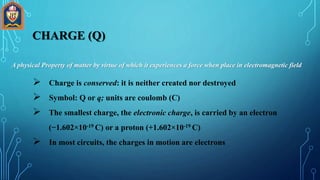
CHARGE (Q)
 Charge is conserved: it is neither created nor destroyed
 Symbol: Q or q; units are coulomb (C)
 The smallest charge, the electronic charge, is carried by an electron
(−1.602×10⁻¹⁹ C) or a proton (+1.602×10⁻¹⁹ C)
 In most circuits, the charges in motion are electrons
A physical Property of matter by virtue of which it experiences a force when place in electromagnetic field
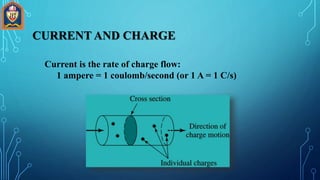
CURRENT AND CHARGE
Current is the rate of charge flow:
1 ampere = 1 coulomb/second (or 1 A = 1 C/s)
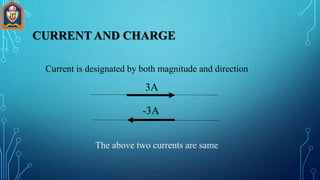
CURRENT AND CHARGE
Current is designated by both magnitude and direction
The above two currents are same
3A
-3A
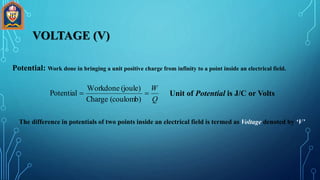
VOLTAGE (V)
Potential: Work done in bringing a unit positive charge from infinity to a point inside an electrical field.
Q
W

(coulomb)Charge
(joule)Workdone
Potential Unit of Potential is J/C or Volts
The difference in potentials of two points inside an electrical field is termed as Voltage denoted by ‘V’
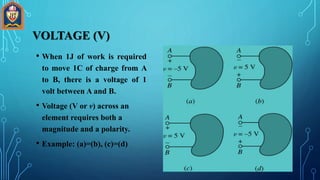
• When 1J of work is required
to move 1C of charge from A
to B, there is a voltage of 1
volt between A and B.
• Voltage (V or v) across an
element requires both a
magnitude and a polarity.
• Example: (a)=(b), (c)=(d)
VOLTAGE (V)
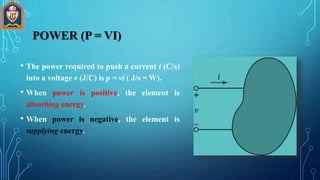
• The power required to push a current i (C/s)
into a voltage v (J/C) is p = vi ( J/s = W).
• When power is positive, the element is
absorbing energy.
• When power is negative, the element is
supplying energy.
POWER (P = VI)
• Electrical Circuit – Any closed path containing electrical elements.
• Electrical Network – Combination of different electrical elements which may
or may not have closed path.
ELECTRICAL CIRCUIT & NETWORK
• Active : Need Activation and Deliver Energy
e.g. – Voltage Source, Current Source etc.
• Passive : Consumes Energy
e.g. – Resistor, Inductor etc.
ACTIVE AND PASSIVE ELEMENTS
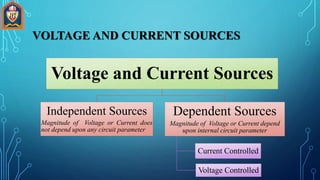
Voltage and Current Sources
Independent Sources
Magnitude of Voltage or Current does
not depend upon any circuit parameter
Dependent Sources
Magnitude of Voltage or Current depend
upon internal circuit parameter
Voltage Controlled
Current Controlled
VOLTAGE AND CURRENT SOURCES
DEPENDENT SOURCES
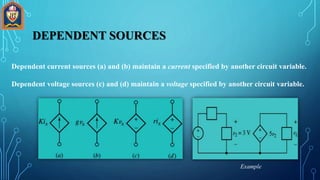
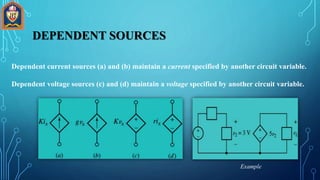
Dependent current sources (a) and (b) maintain a current specified by another circuit variable.
Dependent voltage sources (c) and (d) maintain a voltage specified by another circuit variable.
Example
DEPENDENT SOURCES
Dependent current sources (a) and (b) maintain a current specified by another circuit variable.
Dependent voltage sources (c) and (d) maintain a voltage specified by another circuit variable.
Example
SUPERPOSITION THEOREM
• Voltage across (or current through) an element
• Determined by summing voltage (or current) due to each independent source
• All sources (except dependent sources) other than the one being
considered are eliminated
SUPERPOSITION THEOREM
• Replace current sources with opens
• Replace voltage sources with shorts
SUPERPOSITION THEOREM
• Circuit may operate at more than one frequency at a time
• Superposition is the only analysis method that can be used in this case
• Reactances must be recalculated for each different frequency
SUPERPOSITION THEOREM
• Superposition theorem can be applied only to voltage and current
• It cannot be used to solve for total power dissipated by an element
• Power is not a linear quantity
• Follows a square-law relationship
SUPERPOSITION FOR DEPENDENT SOURCES
• If controlling element is external to the circuit under consideration
• Method is the same as for independent sources
SUPERPOSITION FOR DEPENDENT SOURCES
• Simply remove sources one at a time and solve for desired voltage or current
• Combine the results
SUPERPOSITION FOR DEPENDENT SOURCES
• If the dependent source is controlled by an element located in the circuit
• Analysis is different
• Dependent source cannot be eliminated
THEVENIN’S THEOREM
• Converts an ac circuit into a single ac voltage source in series with an equivalent
impedance
• First, identify and remove the element or elements across which the equivalent
circuit is to be found
THEVENIN’S THEOREM
• Label two open terminals
• Set all sources to zero
• Replace voltage sources with shorts
• Current sources with opens
THEVENIN’S THEOREM
• Calculate the Thévenin equivalent impedance
• Replace the sources and determine open-circuit voltage
THEVENIN’S THEOREM
• If more than one source is involved
• Superposition may be used
• Draw resulting Thévenin equivalent circuit
• Including the portion removed
NORTON’S THEOREM
• Converts an ac network into an equivalent circuit
• Consists of a single current source and a parallel impedance
• First, identify and remove the element or elements across which the Norton circuit
is to be found
NORTON’S THEOREM
• Label the open terminals
• Set all sources to zero
NORTON’S THEOREM
• Determine Norton equivalent impedance
• Replace sources and calculate short-circuit current
NORTON’S THEOREM
• Superposition may be used for multiple sources
• Draw resulting Norton circuit
• Including portion removed
THEVENIN AND NORTON CIRCUITS
• Possible to find Norton equivalent circuit from Thévenin equivalent circuit
• Use source transformation method
• ZN = ZTh
• IN = ETh/ZTh
THEVENIN’S AND NORTON’S THEOREMS
• If a circuit contains a dependent source controlled by an element outside the area of
interest
• Previous methods can be used to find the Thévenin or Norton circuit
THEVENIN’S AND NORTON’S THEOREMS
• If a circuit contains a dependent source controlled by an element in the circuit
• Other methods must be used
THEVENIN’S AND NORTON’S THEOREMS
• If a circuit has a dependent source controlled by an element in the circuit
• Use following steps to determine equivalent circuit
THEVENIN’S AND NORTON’S THEOREMS
• First
• Identify and remove branch across equivalent circuit is to be determined
• Label the open terminals
THEVENIN’S AND NORTON’S THEOREMS
• Calculate open-circuit voltage
• Dependent source cannot be set to zero
• Its effects must be considered
• Determine the short-circuit current
THEVENIN’S AND NORTON’S THEOREMS
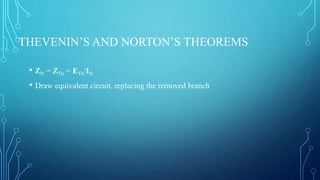
• ZN = ZTh = ETh/IN
• Draw equivalent circuit, replacing the removed branch
THEVENIN’S AND NORTON’S THEOREMS
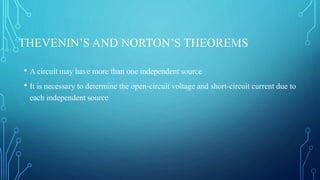
• A circuit may have more than one independent source
• It is necessary to determine the open-circuit voltage and short-circuit current due to
each independent source
MAXIMUM POWER TRANSFER THEOREM
• Maximum power
• Delivered to a load when the load impedance is the complex conjugate of the Thévenin or
Norton impedance
MAXIMUM POWER TRANSFER
THEOREM
• ZTh = 3 + j4 ZL = ZTh* = 3 - j4
• ZTh = 10 30° ZL = ZTh* = 10 -30°
MAXIMUM POWER TRANSFER THEOREM
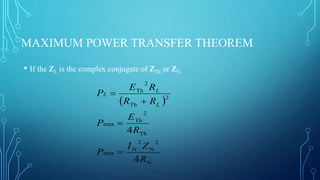
• If the ZL is the complex conjugate of ZTh or ZN
 
N
2
N
2
N
max
Th
2
Th
max
2
Th
2
Th
4
4
R
ZI
P
R
E
P
RR
RE
P
L
L
L




RELATIVE MAXIMUM POWER
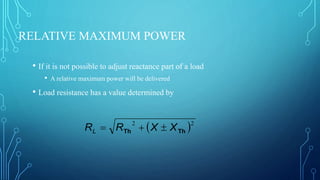
• If it is not possible to adjust reactance part of a load
• A relative maximum power will be delivered
• Load resistance has a value determined by
 22
ThTh XXRRL 

Basic

  • 1.
    BASIC ELECTRICAL ENGINEERING REE– 101/201 MOHAMMED WARIS SENAN ASSISTANT PROFESSOR DEPARTMENT OF ELECTRICAL ENGG. JAHANGIRABAD INSTITUTE OF TECHNOLOGY Jahangirabad Institute of Technology
  • 2.
    CHARGE (Q)  Chargeis conserved: it is neither created nor destroyed  Symbol: Q or q; units are coulomb (C)  The smallest charge, the electronic charge, is carried by an electron (−1.602×10⁻¹⁹ C) or a proton (+1.602×10⁻¹⁹ C)  In most circuits, the charges in motion are electrons A physical Property of matter by virtue of which it experiences a force when place in electromagnetic field
  • 3.
    CURRENT AND CHARGE Currentis the rate of charge flow: 1 ampere = 1 coulomb/second (or 1 A = 1 C/s)
  • 4.
    CURRENT AND CHARGE Currentis designated by both magnitude and direction The above two currents are same 3A -3A
  • 5.
    VOLTAGE (V) Potential: Workdone in bringing a unit positive charge from infinity to a point inside an electrical field. Q W  (coulomb)Charge (joule)Workdone Potential Unit of Potential is J/C or Volts The difference in potentials of two points inside an electrical field is termed as Voltage denoted by ‘V’
  • 6.
    • When 1Jof work is required to move 1C of charge from A to B, there is a voltage of 1 volt between A and B. • Voltage (V or v) across an element requires both a magnitude and a polarity. • Example: (a)=(b), (c)=(d) VOLTAGE (V)
  • 7.
    • The powerrequired to push a current i (C/s) into a voltage v (J/C) is p = vi ( J/s = W). • When power is positive, the element is absorbing energy. • When power is negative, the element is supplying energy. POWER (P = VI)
  • 8.
    • Electrical Circuit– Any closed path containing electrical elements. • Electrical Network – Combination of different electrical elements which may or may not have closed path. ELECTRICAL CIRCUIT & NETWORK
  • 9.
    • Active :Need Activation and Deliver Energy e.g. – Voltage Source, Current Source etc. • Passive : Consumes Energy e.g. – Resistor, Inductor etc. ACTIVE AND PASSIVE ELEMENTS
  • 10.
    Voltage and CurrentSources Independent Sources Magnitude of Voltage or Current does not depend upon any circuit parameter Dependent Sources Magnitude of Voltage or Current depend upon internal circuit parameter Voltage Controlled Current Controlled VOLTAGE AND CURRENT SOURCES
  • 11.
    DEPENDENT SOURCES Dependent currentsources (a) and (b) maintain a current specified by another circuit variable. Dependent voltage sources (c) and (d) maintain a voltage specified by another circuit variable. Example
  • 12.
    DEPENDENT SOURCES Dependent currentsources (a) and (b) maintain a current specified by another circuit variable. Dependent voltage sources (c) and (d) maintain a voltage specified by another circuit variable. Example
  • 14.
    SUPERPOSITION THEOREM • Voltageacross (or current through) an element • Determined by summing voltage (or current) due to each independent source • All sources (except dependent sources) other than the one being considered are eliminated
  • 15.
    SUPERPOSITION THEOREM • Replacecurrent sources with opens • Replace voltage sources with shorts
  • 16.
    SUPERPOSITION THEOREM • Circuitmay operate at more than one frequency at a time • Superposition is the only analysis method that can be used in this case • Reactances must be recalculated for each different frequency
  • 17.
    SUPERPOSITION THEOREM • Superpositiontheorem can be applied only to voltage and current • It cannot be used to solve for total power dissipated by an element • Power is not a linear quantity • Follows a square-law relationship
  • 18.
    SUPERPOSITION FOR DEPENDENTSOURCES • If controlling element is external to the circuit under consideration • Method is the same as for independent sources
  • 19.
    SUPERPOSITION FOR DEPENDENTSOURCES • Simply remove sources one at a time and solve for desired voltage or current • Combine the results
  • 20.
    SUPERPOSITION FOR DEPENDENTSOURCES • If the dependent source is controlled by an element located in the circuit • Analysis is different • Dependent source cannot be eliminated
  • 21.
    THEVENIN’S THEOREM • Convertsan ac circuit into a single ac voltage source in series with an equivalent impedance • First, identify and remove the element or elements across which the equivalent circuit is to be found
  • 22.
    THEVENIN’S THEOREM • Labeltwo open terminals • Set all sources to zero • Replace voltage sources with shorts • Current sources with opens
  • 23.
    THEVENIN’S THEOREM • Calculatethe Thévenin equivalent impedance • Replace the sources and determine open-circuit voltage
  • 24.
    THEVENIN’S THEOREM • Ifmore than one source is involved • Superposition may be used • Draw resulting Thévenin equivalent circuit • Including the portion removed
  • 25.
    NORTON’S THEOREM • Convertsan ac network into an equivalent circuit • Consists of a single current source and a parallel impedance • First, identify and remove the element or elements across which the Norton circuit is to be found
  • 26.
    NORTON’S THEOREM • Labelthe open terminals • Set all sources to zero
  • 27.
    NORTON’S THEOREM • DetermineNorton equivalent impedance • Replace sources and calculate short-circuit current
  • 28.
    NORTON’S THEOREM • Superpositionmay be used for multiple sources • Draw resulting Norton circuit • Including portion removed
  • 29.
    THEVENIN AND NORTONCIRCUITS • Possible to find Norton equivalent circuit from Thévenin equivalent circuit • Use source transformation method • ZN = ZTh • IN = ETh/ZTh
  • 30.
    THEVENIN’S AND NORTON’STHEOREMS • If a circuit contains a dependent source controlled by an element outside the area of interest • Previous methods can be used to find the Thévenin or Norton circuit
  • 31.
    THEVENIN’S AND NORTON’STHEOREMS • If a circuit contains a dependent source controlled by an element in the circuit • Other methods must be used
  • 32.
    THEVENIN’S AND NORTON’STHEOREMS • If a circuit has a dependent source controlled by an element in the circuit • Use following steps to determine equivalent circuit
  • 33.
    THEVENIN’S AND NORTON’STHEOREMS • First • Identify and remove branch across equivalent circuit is to be determined • Label the open terminals
  • 34.
    THEVENIN’S AND NORTON’STHEOREMS • Calculate open-circuit voltage • Dependent source cannot be set to zero • Its effects must be considered • Determine the short-circuit current
  • 35.
    THEVENIN’S AND NORTON’STHEOREMS • ZN = ZTh = ETh/IN • Draw equivalent circuit, replacing the removed branch
  • 36.
    THEVENIN’S AND NORTON’STHEOREMS • A circuit may have more than one independent source • It is necessary to determine the open-circuit voltage and short-circuit current due to each independent source
  • 37.
    MAXIMUM POWER TRANSFERTHEOREM • Maximum power • Delivered to a load when the load impedance is the complex conjugate of the Thévenin or Norton impedance

  • 38.
    MAXIMUM POWER TRANSFER THEOREM •ZTh = 3 + j4 ZL = ZTh* = 3 - j4 • ZTh = 10 30° ZL = ZTh* = 10 -30°
  • 39.
    MAXIMUM POWER TRANSFERTHEOREM • If the ZL is the complex conjugate of ZTh or ZN   N 2 N 2 N max Th 2 Th max 2 Th 2 Th 4 4 R ZI P R E P RR RE P L L L    
  • 40.
    RELATIVE MAXIMUM POWER •If it is not possible to adjust reactance part of a load • A relative maximum power will be delivered • Load resistance has a value determined by  22 ThTh XXRRL 