Connecting  the  Street  Tree  to  the  Forest  
Strengthening  Nature  for  Urban  Living  
  
18th
  European  Forum  on  Urban  Forestry  
Brussels/Waterloo  (Belgium)     10     12  June  2015  


ABSTRACT  BOOK  
@EFUrbanForestry  


Copyrights  
Copyrights  are  with  the  respective  authors  
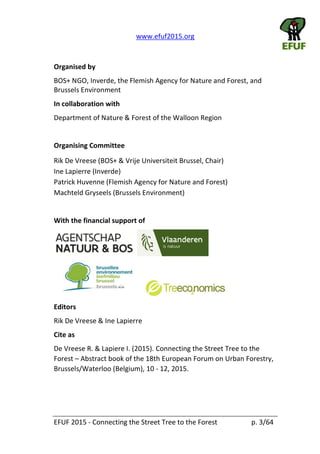
Image  frontcover:  Witteveen+Bos  &  Cluser,  commissioned  by  LIFE+  
OZON  
Image  backcover:  Sabine  Destrooper
  www.efuf2015.org       
EFUF  2015  -­‐  Connecting  the  Street  Tree  to  the  Forest     p.  3/64  
  
Organised  by  
BOS+  NGO,  Inverde,  the  Flemish  Agency  for  Nature  and  Forest,  and  
Brussels  Environment  
In  collaboration  with  
Department  of  Nature  &  Forest  of  the  Walloon  Region  
  
Organising  Committee  
Rik  De  Vreese  (BOS+  &  Vrije  Universiteit  Brussel,  Chair)  
Ine  Lapierre  (Inverde)  
Patrick  Huvenne  (Flemish  Agency  for  Nature  and  Forest)  
Machteld  Gryseels  (Brussels  Environment)  
  
With  the  financial  support  of    
  
Editors  
Rik  De  Vreese  &  Ine  Lapierre  
Cite  as  
De  Vreese  R.  &  Lapiere  I.  (2015).  Connecting  the  Street  Tree  to  the  
Forest     Abstract  book  of  the  18th  European  Forum  on  Urban  Forestry,  
Brussels/Waterloo  (Belgium),  10  -­‐  12,  2015.    
  
www.efuf2015.org    
EFUF  2015  -­‐  Connecting  the  Street  Tree  to  the  Forest     p.  4/64  
  www.efuf2015.org       
EFUF  2015  -­‐  Connecting  the  Street  Tree  to  the  Forest     p.  5/64  
Programme  
  
Wednesday  10  June  2015     Connecting  Urban  and  Nature     from  the  
Street  Tree  to  the  Urban  Forest  
Venue:  AM:  BEL  (Tour  &  Taxis  site,  Brussels  Environment  Agency,  
http://bel.brussels,  Avenue  du  Port  86c/3000,  1000  Brussels)  
08:30     Bus  is  leaving  from  the  hotel  IBIS  to  BEL  
09:00     Registration  at  the  BEL  &  coffee  
09:45     Welcome    
o Rik  De  Vreese  (BOS+,  local  organiser)  
o Machteld  Gryseels  (Brussels  Environment)  
10:00     Key  Note  speeches  (Chair:  Machteld  Gryseels)  
o Dr.  Peter  Löffler  (European  Commission,  DG  ENV)     
Urban  Forestry  and  Green  Infrastructure     a  European  
perspective  
o Marie-­‐Céline  Godin  (Brussels  Environment)     
Connecting  Citizens     Participative  Approaches  to  
Developing  Nature  in  the  Brussels  Capital  Region  
o Prof.  Dr.  Cecil  Konijnendijk  van  den  Bosch  (SLU  
Sweden  &  University  of  Copenhagen,  Denmark)     
Societal  Importance  of  Urban  Forestry  and  Urban  
Greening  for  Urban  Living  
o Patrick  Huvenne  (Flemish  Agency  for  Nature  and  
Forest)     A  Structural  Vision  for  the  Sonian  Forest     
cooperating  for  the  largest  urban  forest  in  Belgium  
o Machteld  Gryseels  &  Serge  Kempeneers  (Brussels  
Environment)     Introduction  to  the   Connectivity  
Experience   
www.efuf2015.org    
EFUF  2015  -­‐  Connecting  the  Street  Tree  to  the  Forest     p.  6/64  
o 12:00     Visit  to  the  Tour  &  Taxis  site  (urban  
regeneration)  and  the  ParckFarm  (winner  of  Public  
Space  Price  2015)  with  packed  lunch  
13:30     Start  of  the   Connectivity  Experience (moving  from  
the  city  centre  to  the  peri-­‐urban  forest  featuring  multi-­‐scale,  
connectivity  and  Green  Infrastructure  principles,  bus  transfer)  
14:45      Connectivity  Experience   theme  
Reconnecting  the  urban  (dweller)  with  Natura2000  
o Group  1.  Cultural-­‐historic  and  recreational  aspects  
(Red  Cloister)  
o Group  2.  Nature  reserve  at  the  urban  fringe,  grazing,  
restoring  ponds  (Red  Cloister)  
o Group  3.  Veteran  trees,  bats  and  green  bridges  
(Tournay-­‐Solvay  Parc)  
17:45     Groups  present  their  work  (Red  Cloister)  
(20  minutes  walking  from  Hermann-­‐Debroux  Metro  station,  
metro  to  Brussels  city  centre  and  Brussels-­‐Central  station)  
18:30     Bus  transfer  to  IBIS  Waterloo  (arrival  19:00)  and  
Brussels-­‐North  station  &  Tours&Taxis  (arrival  19:15)  
19:30     Belgian  Dinner  in  Tennis  Waterloo    
22:00     dinner  ends    
train  to  Brussels  leaves  from  Waterloo  station  at  20:12,  21:12,  22:12,  
23:12  (last  train);  busses  from  Waterloo  Petit  Paris  bus  stop  at  20:27,  
21:27,  22:27  (last  bus)  
  
  
  www.efuf2015.org       
EFUF  2015  -­‐  Connecting  the  Street  Tree  to  the  Forest     p.  7/64  
Thursday  11  June  2015  -­‐  Reconnecting  the  urban  (dweller)  with  
Nature  
Venue:  Groenendaal  site  (Plenaries  in  Bosmuseum,  Duboislaan  2,  1560  
Hoeilaart;  Parallels  in  Chateau;  Duboislaan  1b,  Hoeilaart)  
08:30     Bus  leaves  from  hotel  IBIS  Waterloo  to  Groenendaal  
09:00     Presentation  (in  Bosmuseum)    
Steven  Vanonckelen  (Flemish  Agency  for  Nature  and  Forest)     The  
LIFE+  OZON  project  defragmentates  the  Sonian  Forest    
09:30     Pitches  by  EFUF  participants    
(Pecha  Kucha  style     
participant)    
Moderator:  Prof.  Dr.  Cecil  Konijnendijk  van  den  Bosch  (SLU  Sweden  
&  University  of  Copenhagen,  Denmark)  
11:00     Coffee  break  (in  Chateau  Groenendaal)  
11:30     Parallel  sessions  (in  Chateau  Groenendaal)  
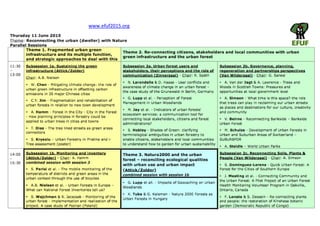
Theme  1.  Fragmented  urban  green  
infrastructure  and  its  multiple  function,  and  
strategic  approaches  to  deal  with  this     
Subsession  1a.  Sustaining  the  green  
infrastructure  (Room:  Attick/Zolder)  
Theme  2.  Re-­‐connecting  citizens,  
stakeholders  and  local  communities  with  
urban  green  infrastructure  and  the  urban  
forest    
Session  2a.  Urban  forest  users  and  stakeholders,  their  
perceptions  and  the  role  of  communication  (Room:  
Zinnerzaal)  
Session  2b.  Governance,  planning,  regeneration  and  
partnership  perspectives  (Room:  Van  Wilderzaal)  
13:00     Lunch  
www.efuf2015.org    
EFUF  2015  -­‐  Connecting  the  Street  Tree  to  the  Forest     p.  8/64  
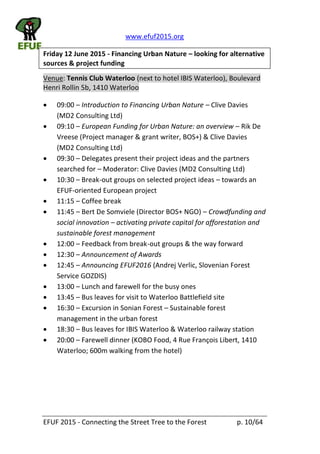
14:00     Parallel  sessions  continue  (in  Chateau  Groenendaal)  
o Combined  session  
Theme  1.  Fragmented  urban  green  infrastructure  and  
its  multiple  function,  and  strategic  approaches  to  deal  
with  this     Subsession  1b.  Monitoring  and  inventory  
(Room:  Attick/Zolder)  
Theme  3.  Natura  2000  and  the  urban  forest     
reconciling  ecological  qualities  with  urban  use  and  
urban  impact  (Room:  Attick/Zolder)  
o Theme  2.  Re-­‐connecting  citizens,  stakeholders  and  local  
communities  with  urban  green  infrastructure  and  the  
urban  forest  (Room:  Van  Wilderzaal)  
Session  2c.  Reconnecting  Soils,  Plants  &  People  (Van  
Wilderzaal)  
15:30     Coffee  break  (train  to  Brussels  leaves  from  Groenendaal  at  
16:37)  
16:00     Walk  through  the  Sonian  Forest    
Themes:  defragmentation  through  reconnecting,  Sonian  Forest  as  
UNESCO  heritage,  no-­‐management  forest  reserves  in  the  urban  
forest,  the  LIFE+-­‐project  OZON  
(train  to  Brussels  leaves  from  Groenendaal  at  18:37,  19:37)  
19:00     Dinner  in  Sonian  Forest  (Groenendaal     Hippo-­‐Droom)  
21:30     Shuttle  to  Hotel  IBIS  and  Groenendaal  railway  station    
(train  to  Brussels  leaves  from  Groenendaal  at  20:37,  21:37)  
  
  www.efuf2015.org       
EFUF  2015  -­‐  Connecting  the  Street  Tree  to  the  Forest     p.  9/64  
www.efuf2015.org    
EFUF  2015  -­‐  Connecting  the  Street  Tree  to  the  Forest     p.  10/64  
Friday  12  June  2015  -­‐  Financing  Urban  Nature     looking  for  alternative  
sources  &  project  funding  
Venue:  Tennis  Club  Waterloo  (next  to  hotel  IBIS  Waterloo),  Boulevard  
Henri  Rollin  5b,  1410  Waterloo  
09:00     Introduction  to  Financing  Urban  Nature     Clive  Davies  
(MD2  Consulting  Ltd)  
09:10     European  Funding  for  Urban  Nature:  an  overview     Rik  De  
Vreese  (Project  manager  &  grant  writer,  BOS+)  &  Clive  Davies  
(MD2  Consulting  Ltd)  
09:30     Delegates  present  their  project  ideas  and  the  partners  
searched  for     Moderator:  Clive  Davies  (MD2  Consulting  Ltd)  
10:30     Break-­‐out  groups  on  selected  project  ideas     towards  an  
EFUF-­‐oriented  European  project  
11:15     Coffee  break  
11:45     Bert  De  Somviele  (Director  BOS+  NGO)     Crowdfunding  and  
social  innovation     activating  private  capital  for  afforestation  and  
sustainable  forest  management  
12:00     Feedback  from  break-­‐out  groups  &  the  way  forward  
12:30     Announcement  of  Awards  
12:45     Announcing  EFUF2016  (Andrej  Verlic,  Slovenian  Forest  
Service  GOZDIS)  
13:00     Lunch  and  farewell  for  the  busy  ones  
13:45     Bus  leaves  for  visit  to  Waterloo  Battlefield  site  
16:30     Excursion  in  Sonian  Forest     Sustainable  forest  
management  in  the  urban  forest  
18:30     Bus  leaves  for  IBIS  Waterloo  &  Waterloo  railway  station  
20:00     Farewell  dinner  (KOBO  Food,  4  Rue  François  Libert,  1410  
Waterloo;  600m  walking  from  the  hotel)    
  
  www.efuf2015.org       
EFUF  2015  -­‐  Connecting  the  Street  Tree  to  the  Forest     p.  11/64  
  
Key  Note  speeches  
  
Urban Forestry and Green Infrastructure a European
perspective
Peter  Löffler,  PhD,  European  Commission,  Directorate-­‐General  for  
Environment,  peter.loeffler@ec.europa.eu  
Keywords:  Planetary  boundaries,  EU  policy,  EU  Forest  Strategy  
Abstract  
The  history  of  urban  forests  in  Europe  is  long  and  rich.  Three  out  of  four  
Europeans  live  in  or  around  cities,  and  the  quality  of  the  built  and  
natural  environment  in  which  they  live     including  street  trees  and  
urban  forests  -­‐  is  an  important  factor  for  their  quality  of  life.  But  urban  
forestry  and  green  infrastructure  also  play  a  role  for  the  achievement  
of  wider  environmental  policy  objectives  of  the  EU  under  the  motto  
'living  well  within  the  limits  of  our  planet'.  This  talk  will  position  and  
discuss  urban  forestry  in  the  wider  EU  policy  context;  outline  the  green  
infrastructure  concept  and  its  implications  for  street  trees  and  urban  
forestry;  examine  the  links  with  the  EU  Forest  Strategy;  and  highlight  
gaps  to  fill  and  opportunities  to  seize  in  the  coming  years.  
www.efuf2015.org    
EFUF  2015  -­‐  Connecting  the  Street  Tree  to  the  Forest     p.  12/64  
Connecting  Citizens     Participative  Approaches  to  Developing  Nature  
in  the  Brussels  Capital  Region  
Marie-­‐Céline  Godin,  Project  Manager,  Brussels  Environment,  
mcgodin@environnement.irisnet.be,  www.environnement.brussels  
Keywords:  Plan  development,  Citizen  Involvement,  urban  biodiversity  
Abstract  
How  could  the  Brussels-­‐Capital  Region  increase  the  support  base  of  the  
future  biodiversity  strategy  and,  in  the  meantime,  ensure  the  quality  of  
the  document?  It  soon  became  apparent  that  the  organization  of  a  
broad  participation  process  was  the  appropriate  way  to  win  the  
  
Environment  Minister,  Evelyne  Huytebroeck,  charged  Brussels  
Environment  to  organize  a  broad  participation  process.  The  process  
happened  in  three  phases,  beginning  with  the  implication  of  the  Nature  
Council,  continuing  with  two  open  plenary  sessions  and  four  
workshops,  and  ending  with  a  public  consultation.  
  
All  in  all,  it  took  more  than  two  years  hard  work  but  we  can  already  
affirm  that  it  has  helped  participants  to  better  know  each  other  and  to  
reinforce  the  links  between  local  and  regional  representatives  as  well  
as  across  departments.  Thanks  to  this  process,  Brussels  LBSAP  gained  
much  support.  We  now  feel  in  a  better  position  to  transform  this  
enthusiasm  into  actions  in  the  field.  
  
  
  www.efuf2015.org       
EFUF  2015  -­‐  Connecting  the  Street  Tree  to  the  Forest     p.  13/64  
Implication  of  the  nature  council  
The  purpose  of  the  work  with  the  Nature  Council  was  three-­‐fold:  
To  identify  the  more  important  challenges  for  nature  and  
biodiversity  in  Brussels  
To  elaborate  an  ambitious  but  specific  vision  to  2050  
To  propose  strategic  goals  to  2020  
This  Council  is  composed  of  regional  administrations  representatives,  
influential  NGOs  and  academics.  It  seemed  important  to  us  to  first  give  
the  floor  to  specialists  and  develop  the  entire  process  with  their  views.  
We  first  began  with  the  examination  of  Brussels  Biodiversity  report  
prepared  by  Brussels  Environment,  the  draft  of  which  could  be  
improved  thanks  to  the  valuable  comments  given  by  the  Council
Members.  
This  report  gives  a  synthesis  of  monitoring  data,  evaluates  the  main  
threats  to  biodiversity  in  Brussels,  recalls  and  critically  examines  the  
already  existing  regulations  and  initiatives,  formulates  
recommendations  in  response  to  the  identified  challenges.  
The  Council  then  worked  over  two  days  to  formulate  its  vision  and  
goals  for  nature  and  biodiversity  in  the  Brussels-­‐Capital  Region  that  
were  presented  to  a  broader  panel  of  stakeholders  during  the  kick-­‐off  
meeting  of  the  second  phase  of  the  process.  
Open  workshops  and  ateliers  
The  participative  process  then  continued  with  a  more  diverse  public  
among  which  environment  and  mobility  specialists,  city  planners,  CEPA  
and  patrimony  specialists.  About  a  hundred  representatives  from  large  
but  also  smal
research  institutions,  regional,  federal  and  local  administrations  
participated  at  minimum  one  of  the  six  meetings  that  were  organized.  
Even  some  people  from  the  economic  sector  participated.  They  were  
all  invited  to  express  their  views  on:  
The  relevance  of  tentative  goals  with  regard  to  the  challenges  
identified  by  Brussels  Environment  and  the  Nature  Council;  
www.efuf2015.org    
EFUF  2015  -­‐  Connecting  the  Street  Tree  to  the  Forest     p.  14/64  
The  relevance  of  a  list  of  proposed  measures  to  attain  the  goals;  
The  feasibility  of  the  proposed  measures;  
The  need  of  support  to  implement  them  out  on  the  field.  
We  were  really  enthusiastic  of  the  result  of  the  workshops,  compiled  in  
a  66-­‐page  report.  Another  source  of  satisfaction  was  the  great  
implication  of  the  representatives  from  local  administrations  (about  
25%  of  the  participants).  Together  with  the  NGOs  and  the  Nature  
Council,  they  form  the  beginning  of  a  strong  support  platform  for  the  
implementation  of  Brussels  LBSAP.  
Public  consultation  
Nine  months  after  the  closure  of  the  second  phase  of  the  participation  
Government  of  the  Brussels-­‐Capital  Region  adopted  a  project  strategy  
to  be  submitted  to  a  broad  public  consultation  along  with  a  strategic  
environment  assessment.  
The  consultation  took  place  from  15th  February  to  15th  April  2014.  
During  this  period  of  time,  the  LBSAP  and  the  ad  hoc  strategic  
environmental  assessment  were  made  available  for  consultation  in  the  
19  communities  of  the  Brussels-­‐Capital  Region  and  in  Brussels  
Environment.  Four  information  sessions  were  also  organized  by  
consortium  of  communities,  in  partnership  with  the  Region.  
More  than  800  citizens,  12  NGOs  and  14  Institutions  participated  and  
gave  their  views.  
Brussels  Environment  is  now  synthetizing  all  the  remarks  and  
suggestions  received  and  formulating  propositions  of  adaptation.  Those  
propositions  will  be  submitted  to  the  Brussels  Government  in  the  
coming  month.  As  a  result  of  the  participation  process,  everyone  is  
impatient  to  begin  with  the  implementation  out  in  the  field  and  
reinforce  Brussels  nature  and  biodiversity  now  and  for  the  future.    
  www.efuf2015.org       
EFUF  2015  -­‐  Connecting  the  Street  Tree  to  the  Forest     p.  15/64  
Societal Importance of Urban Forestry and Urban
Greening for Urban Living
Prof.  Dr.  Cecil  Konijnendijk  van  den  Bosch,  Head,  Department  of  
Landscape  Architecture,  Planning  and  Management,  SLU,  Sweden  &  
professor,  Department  of  Geosciences  and  Natural  Resource  
Management,  University  of  Copenhagen,  Denmark,  
cecil.konijnendijk@slu.se    
Keywords:  cultural  ecosystem  services,  social  cohesion,  place  identity,  
research  strategy  
Abstract  
An  important  global  discourse  in  urban  forestry  and  urban  greening  is  
that  of  the  provision  of  ecosystem  services.  Moreover,  there  is  greater  
interest  from  both  research  and  practice  in  assessing,  quantifying  and  
valuing   these   urban   ecosystem   services.   Here   work   on   regulatory  
services  such  as  climate  change  mitigation,  air  pollution  reduction  and  
stormwater  management  is  dominant.  Decision-­‐support  tools  such  as  i-­‐
Tree  also  tend  to  focus  on  these  services.  
been   strong   within   the   social   sciences   and   humanities.   However,  
research   on   cultural   ecosystem   services   of   urban   forests   and   other  
green  components  does  not  have  the  same  presence  in  the  literature,  
especially   where   service   quantification   and   valuation   are   concerned.  
Most  cultural  ecosystem  services  are  difficult  to  assess  and  especially  
quantify.  Valuation  will  often  have  to  be  done  in  non-­‐monetary  terms.  
  
This   presentation   reiterates   the   societal   importance   of   urban   forests  
and   urban   green   spaces.   Focus   is   on   the   state-­‐of-­‐art   of   research   on  
cultural   ecosystem   services,   with   particular   attention   for   so-­‐far   less-­‐
studied  topics  such  as  social  cohesion  and  place  identity.  A  case  will  be  
made  for  more  research,  as  well  as  for  better  integration  of  knowledge  
on   cultural   ecosystem   services   in   decision-­‐making.   Examples   of   how  
this  can  be  achieved  will  be  presented.  
www.efuf2015.org    
EFUF  2015  -­‐  Connecting  the  Street  Tree  to  the  Forest     p.  16/64  
A  Structural  Vision  for  the  Sonian  Forest     cooperating  for  the  largest  
urban  forest  in  Belgium  
Patrick  Huvenne,  Regional  Manager,  Flemish  Agency  for  Nature  and  
Forests,  Belgium,  patrick.huvenne@lne.vlaanderen.be,  
www.natuurenbos.be,  www.zonienwoud.be  
Steven  Vanonckelen,  Projectcoordinator  LIFE+  OZON,  Flemish  Agency  
for  Nature  and  Forests,  Belgium,  
steven.vanonckelen@lne.vlaanderen.be  
Anouschka  Kuijsters,  Project  Supporter  LIFE+  OZON,  Flemish  Agency  for  
Nature  and  Forests,  Belgium,  anouschka.kuijsters@lne.vlaanderen.be    
Gregory  Reinbold,  Green  Area  Division,  Brussels  Environment,  Belgium,  
gregory.reinbold@environnement.irisnet.be    
Jean-­‐François  Plumier,  Head  Forester,  Department  of  Nature  &  Forest,  
Walloon  Region,  Belgium,  jeanfrancois.plumier@spw.wallonie.be    
Keywords:  interregional  cooperation,  intersectoral  cooperation,  
stakeholders,  public  participation    
Abstract  
The  Sonian  Forest  consists  of  4.400  hectares  top  European  nature  and  
is  connected  to  Brussels.  The  total  forest  complex  is  more  than  5.000  
ha.   It   is   the   destination   of   several   million   visitors   each   year   and   the  
habitat  of  Natura  2000  species.  In  1980,  the  management  of  the  forest  
was   transferred   to   the   three   Belgian   regions:   56%   to   the   Flemish  
Region,   38%   to   the   Brussels-­‐Capital   Region   and   6%   to   the   Walloon  
Region.   However,   in   2008,   the   Flemish,   Walloon   and   Brussels-­‐Capital  
Regions   decided   to   cooperate   and   better   coordinate   the   various  
functions  of  the  forest  and  its  uses.  
more  intensively  in  order  to  strengthen  the  Sonian  Forest.  The  cross-­‐
regional  cooperation  triggered  the  process  to  establish  a  recreational  
network  and  five  gates  where  visitors  will  be  welcomed  in  the  forest  
and  informed  on  Natura  2000,  forest  management  and  future  projects.  
In   order   to   enhance   the   mutual   ecological,   economic,   and   social  
  www.efuf2015.org       
EFUF  2015  -­‐  Connecting  the  Street  Tree  to  the  Forest     p.  17/64  
benefits,   more   cooperative   projects   will   start   between   the   three  
regions,  different  users  and  municipalities  involved  in  the  forest.  
The   real   innovation   of   the   project   are   the   collaborations   with   many  
stakeholder
roads,  universities,  municipal  and  provincial  
-­‐term  
goal,  we  reach  beyond  our  individual  goals.  
  
Result  of  the  common  efforts  
Between   2005   and   2008,   a   common   structural   vision   for   the   Sonian  
forest  was  prepared,  which  was  sealed  by  a  Memorandum  of  the  three  
ministers   in   2009.   This   structural   vision   delineated   an   ecological  
structure  based  on  research  and  analysis.  Five  themes  were  developed  
in   the   structural   vision,   which   were   in   turn   translated   into   concrete  
actions:  
(1)  Strengthening  the  core  zone  and  ecological  biodiversity  of  the  
forest;  
(2)  Steering  recreation  towards  well-­‐developed  recreational  gates  
in  the  interest  of  visitors  and  nature;  
(3)  Ecological  networks  linking  the  forest  with  the  surrounding  
environment;  
(4)  Limiting  the  distortions  and  spatial  fragmentation  by  
infrastructure;  
(5)  Working  towards  one  recognizable  identity  of  the  forest  by  
harmonizing  the  different  regional  approaches.  
The   first   theme   ensured   a   stronger   protection   of   the   most   sensitive  
ecological   areas,   including   the   expansion   of   nature   reserves.   More  
specifically,  the  adapted  management  of  rare  habitats  was  anchored  in  
the  management  plans.  
Secondly,  the  cross-­‐regional  collaboration  was  the  start  of  a  process  to  
achieve   a   recreational   network   in   the   Sonian   Forest.   Therefore,   the  
reception   of   visitors   is   concentrated   in   five   entrances   to   the   forest,  
which   are   maximally   accessible   by   public   transport.   The   recreational  
www.efuf2015.org    
EFUF  2015  -­‐  Connecting  the  Street  Tree  to  the  Forest     p.  18/64  
gates  are  pleasant  places  to  stay,  with  leisure  and  eating  facilities,  so  
that  the  local  economy  can  profit  from  it.  The  recreational  gates  Red  
Monastery  in  Oudergem  and  Spanish  House  in  Tervuren  were  realized  
between  2010-­‐2013.  Moreover,  studies  on  future  recreational  gates  in  
Groenendaal  and  Watermael-­‐Boitsfort  have  started  in  2014.  
Thirdly,  the  connection  between  the  Sonian  Forest  and  the  surrounding  
ecological   network   was   improved   between   2010-­‐2014.   For   example,  
the  HORIZON  project  of  different  partners  started  in  2014  to  enhance  
the   connectivity   between   the   Sonian   Forest   and   the   surrounding  
municipalities.  
Fourthly,  the  ecological  fragmentation  of  the  forest  was  tackled.  Since  
2010,   the   fragmentation   was   improved   by   the   construction   of  
infrastructures  such  as  a  wildlife  crossing  or  ecoduct,  tunnels  and  bat  
caves   in   2011-­‐2012,   a   tree   bridge   in   2013   and   amphibian   tunnels   in  
2014-­‐2015.   Moreover,   the   LIFE+   OZON   project   will   build   an   extra  
wildlife  crossing  and  3  tunnels  in  2015-­‐2016.  
Finally,   the   evolution   of   different   regional   approaches   towards   a  
common   vision   was   realized   by   the   development   of   a   unified   and  
recognizable   identity   of   the   forest.   In   the   period   2010-­‐2011,   a  
corporate   identity   was   designed   which   has   been   in   use   by   the   three  
regions   for   several   years   now.   This   style   is   part   of   a   joint  
communication   strategy   that   is   translated   into   four   languages   and   a  
unified  communication  that  includes:  
An  inter-­‐regional  walking  brochure  of  2012,  the  first  joint  
information  folder  of  the  Sonian  Forest  since  1993.  Every  year,  an  
update  of  this  folder  is  developed  and  printed;  
The  official  website  of  the  forest  in  four  languages  
(http://www.sonianforest.be/);  
A  magazine  (twice  a  year)  
A  participatory  approach  to  promote  an  environmentally  friendly  
attitude  to  visitors:  a  shared  folder  'XII  works  of  the  Sonian  Forest'  
with  behavior  rules  (2014);  
A  new  and  consistent  design  for  forest  furniture  and  information  
panels.  
  
  www.efuf2015.org       
EFUF  2015  -­‐  Connecting  the  Street  Tree  to  the  Forest     p.  19/64  
Commitment  of  other  policy  domains  
The   preparation   of   a   common   vision   for   the   Sonian   Forest   involved  
intense   collaboration   between   the   three   administrative   regions.   This  
federal  state:  each  region  and  administration  has  its  own  habits,  rules  
and   regulations.   The   intensified   cooperation   started   in   2005   by  
organizing   a   steering   committee   every   two   months.   Moreover,   a  
consultation   group   which   consisted   of   local   governments   and   other  
responsible  administrations  started  to  meet  annually.  This  resulted  in  
improved   collaboration   in   many   projects.   For   example,   foresters  
cooperated  to  collect  data  for  the  yearly  deer  inventories.  
,   the   most   exceptional   result   of  
our   collaboration   was   the   involvement   and   commitment   of   other  
policy  domains.  Several  domains  outside  the  nature  sector  were  willing  
to  cooperate  in  many  projects.  In  2015,  the  Flemish  Heritage  Institute  
started   a   new   project   to   support   the   UNESCO   recognition   by   the  
employment   of   a   research   team.   Moreover,   six   ministers   of   the  
respective   governments   of   Belgium   have   signed   an   interregional  
agreement  in  2014  to  nominate  the  Sonian  Forest  as   UNESCO  World  
Heritage.  Since  February  2015,  Sonian  is  on  the  tentative  UNESCO  list.  
Furthermore,   several   domains   even   independently   started   with   new  
projects  on  the  Sonian  Forest.  In  the  context  of  defragmentation,  the  
Agency   for   Roads   and   Traffic   conducted   a   study   on   defragmentation  
measures   in   the   forest   (2009).   Afterwards,   the   Agency   was   eager   to  
participate  in  new  projects  such  as  LIFE+  OZON.  This  would  not  have  
been  possible  without  the  collaboration  mentioned  above.  
On   top   of   that,   the   collaboration   has   extended   to   all   regional   and  
(inter)national  levels.  This  is  even  exceptional  in  a  European  context.  
This  is  the  real  innovation  of  the  project:  the  start  of  consultations  of  
The   collaboration   with   stakeholders   was   anchored   in   an   official  
participatory   platform   in   2012   which   allows   public   participation   and  
concrete  actions.  For  example,  a  working  group  was  established  which  
stimulated   structural   collaboration   between   associations   working  
around  Sonian.  These  associations  would  normally  not  interact  due  to  
the   language   barrier.   It   is   the   intention   of   the   forest   managers   to  
www.efuf2015.org    
EFUF  2015  -­‐  Connecting  the  Street  Tree  to  the  Forest     p.  20/64  
anchor  this  unique  and  versatile  form  of  collaboration  structurally  in  an  
innovative   open   structure:   the   Sonian   Forest   Foundation.   This  
structure   will   support   the   further   process   of   consultation   and  
collaboration.  Political   consultations  were  conducted  in   2014  to   start  
the  Foundation  in  2015  or  2016.  
  
Conclusions  
The   spatial   and   ecological   well-­‐founded   common   vision   has   led   to   a  
sustainable  nature  enhancement  
and  involvement  in  the  forest:  
1.  important  investments  that  strengthen  the  forest  internally;  
2.   an   improved   protection   of   the   different   sections   of   the   Sonian  
Forest;  
3.  external  forest  expansion;  
4.  a  wider  support  and  creation  of  the  'Sonian  Forest-­‐community';  
5.  a  broader  network  of  organisations  and  administrations  that  invest  
in  the  forest.    
  
Finally,  the  success  story  in  the  Sonian  Forest  sends  an  important  signal  
to   the   society:   inter-­‐regional   cooperation,   or   in   a   broader   sence:  
cooperation  between  administrative  and  political  entities  and  levels  is  
possible  and  improves  nature  conservation  
  
  www.efuf2015.org       
EFUF  2015  -­‐  Connecting  the  Street  Tree  to  the  Forest     p.  21/64  
  
LIFE+ OZON project defragmentates the Sonian Forest  
Steven  Vanonckelen,  Projectcoordinator  LIFE+  OZON,  Flemish  Agency  
for  Nature  and  Forests,  Belgium,  
steven.vanonckelen@lne.vlaanderen.be  
Anouschka  Kuijsters,  Project  Supporter  LIFE+  OZON,  Flemish  Agency  for  
Nature  and  Forests,  Belgium,  anouschka.kuijsters@lne.vlaanderen.be    
Keywords:  Natura  2000,  LIFE+,  ecotunnel,  fragementation,  biodiversity  
hotspot,  ecoduct  
Abstract  
Despite   its   great   natural   structure   and   high   level   of   (protected*)  
biodiversity,   the   Sonian   forest   is   divided   in   several   smaller   entities  
which  are  separated  by  harsh  barriers  such  as  roads  and  railways.   In  
the  last  decade,  the  Brussels  part  of  the  Sonian  Forest  worked  hard  to  
counter   the   fragmentation   by   the   railway   Brussels-­‐Luxembourg.   A  
wildlife   crossing,   ecotunnel   and   tunnels   for   mixed   use   (animals   and  
pedestrians)  now  help  to  reduce  the  fragmentation  of  the  forest.  The  
LIFE  +  OZON  (Ontsnippering  ZONiënwoud)  project,  which  was  officially  
launched  in  October  2013,  gives  a  new  boost  to  the  defragmentation  of  
the  entire  Sonian  forest.  
  
During  the  next  3  years,  the  OZON  project  will  reconnect  the  natural  
habitats   of   the   Sonian   Forest   by   constructing   several   environmental  
infrastructures  such  as  a  wildlife  crossing.  By  connecting  the  habitats  of  
the  animals  in  the  forest  again,  animals  will  be  able  to  migrate  without  
having   to   cross   the   existing   roads   which   will   greatly   improve   road  
safety.   OZON   realizes   several   green   infrastructures   (e.g.   a   wildlife  
crossing   and   ecotunnels),   increases   the   nature-­‐friendliness   of   local  
forest  management  (e.g.  by  restoring  forest  edges  along  the  Brussels  
Ringroad)  and  redirects  recreation  to  less  sensitive  areas.  
www.efuf2015.org    
EFUF  2015  -­‐  Connecting  the  Street  Tree  to  the  Forest     p.  22/64  
  
A  budget  of  6.7  million  euro  is  available  to  finance  the  defragmentation  
of  the  Sonian  Forest,  of  which  the  EU  will  contribute  half.  In  addition  to  
the  Agency  for  Nature  and  Forest,  the  Agency  for  Roads  and  Traffic  and  
Brussels  Environment,  also  the  municipalities  Hoeilaart,  Tervuren  and  
Overijse  and  the  Department  of  Environment,  Nature  and  Energy  of  the  
Flemish   government   will   finance   parts   of   the   project.   Recently,   the  
OZON  project  also  received  symbolic  support  of  UNEP.  
For   further   information   you   can   visit   the   website  
http://www.zonienwoud.be/lifeozon/            
  
*Natura   2000   species   living   in   the   area   are   e.g.:   Daubenton's   Bat  
(Myotis   daubentonii),   Leisler's   Bat   (Nyctalus   leisleri),   European   pine  
marten  (Martes  martes),  Ground  beetle  (Carabus  coriaceus),  Palmate  
Newt  (Lissotriton  helveticus)  and  Eurasian  beaver  (Castor  fiber).  
  
  www.efuf2015.org       
EFUF  2015  -­‐  Connecting  the  Street  Tree  to  the  Forest     p.  23/64  
European Funding for Urban Nature: an Overview
Rik  De  Vreese,  BOS+  Vlaanderen  ngo,  rik.devreese@bosplus.be,  
www.bosplus.be  
Clive  Davies,  MD  Consulting  Ltd,  clive.davies@md2.org.uk  
Keywords:  project  funding,  grant  writing  
Abstract  
The   presentation   will   give   a   concise   overview   of   European   funding  
schemes   with   anchor   points   towards   urban   forestry,   green  
infrastructure   and   urban   greening.   Europe   offers   a   whole   range   of  
funding   schemes,   some   very   strict   and   topic-­‐oriented,   others   rather  
broad   and   open   to   innovative   ideas.   The   presentation   will   include   a  
discussion   of   environment-­‐oriented   funds   such   as   LIFE+,   but   also  
openings  within  e.g.  InterReg  of  ERASMUS+  will  be  discussed.  
  
We   will   also   very   briefly   touch   upon   challenges   and   threats   to   grant  
writing  for  European  projects,  not  in  the  least  finding  co-­‐financing.  
www.efuf2015.org    
EFUF  2015  -­‐  Connecting  the  Street  Tree  to  the  Forest     p.  24/64  
Crowdfunding and social innovation activating
private capital for afforestation and sustainable forest
management
Bert  De  Somviele,  BOS+  Vlaanderen  ngo,  bert.desomviele@bosplus.be,  
www.bosplus.be  
Keywords:  private  capital,  venture  philantrophy,  fundraising,  social  
media  
Abstract  
This   presentation   will   tell   the   story   of   BOS+,   a   rather   small   but  
ambitious  environmental  NGO  focussing  on  forest  and  trees  in  Flanders  
(Northern   Belgium)   and   Latin-­‐America.   We   strive   for   forest  
conservation,  afforestation  and  sustainable  and  multiple  forest  use.  
In  a  climate  of  increasing  threats  to  forests,  and  within  the  emerging  
need   to   protect   woods   for   climate   regulation,   BOS+   was   confronted  
with  a  rather  high  dependency  of  public  funds  for  achieving  its  goals.  In  
a  timeframe  of  less  than  10  year  however,  we  achieved  to  broaden  the  
funding  base  and  saw  public  funding  decreasing  from  65%  to  35%  of  
our  annual  income.    
The  reason  for  this  shift  in  funding  sources  was  only  to  a  limited  extent  
related  to  the  global  economic  crisis.  The  shift  is  also  related  to  a  more  
intense   and   dynamic   communication   model,   in   which   we   apply  
cooperate  communication  methods  and  make  use  of  the  potential  of  
social  media.  This  move  resulted  in  a  broader  network  of  sympathizers  
within   civil   society   organisations   and   private   companies,   people   who  
feel  a  sympathy  for  the  trees  and  forests  around  us,  e.g.  within  the  10  
million  tree  campaign  we  are  running  in  Flanders.  
It   is   only   recent   that   Belgium   and   Flanders   arrived   into   the   era   of  
austerity.  BOS+  is  rather  well  prepared  to  the  serious  decline  in  public  
funds   for   NGOs   and   nature-­‐related   projects   and   activities.  
Nevertheless,  it  is  still  a  challenge  to  activate  our  sympathizers  and  to  
raise  the  funds  we  need  for  fulfilling  our  mission.  
  www.efuf2015.org       
EFUF  2015  -­‐  Connecting  the  Street  Tree  to  the  Forest     p.  25/64  
Subsession  1a.  Sustaining  the  green  infrastructure  
Parallel  Sessions  
Theme  1.  Fragmented  urban  green  infrastructure  and  its  multiple  
function,  and  strategic  approaches  to  deal  with  this  
Subsession  1a.  Sustaining  the  green  infrastructure  (Attick/Zolder)  
Mitigating climate change: the role of urban green
infrastructure in offsetting carbon emissions in 35
major Chinese cities
Wendy  Chen,  The  University  of  Hong  Kong,  wychen@hku.hk    
Keywords:  urban  green  infrastructure,  climate  change  mitigation,  
carbon  sequestration  
Abstract  
The   carbon   balance   in   urban   areas   has   become   a   major   research  
challenge   and   a   principal   policy   concern   in   efforts   to   address  
anthropogenic  climate  change.  Rapid  urbanization  and  industrialization  
in  China  urge  the  search  for  integrated  strategies  to  mitigate  and  adapt  
to   climate   change,   which   not   only   limit   to   traditional   infrastructure  
sectors,  but  also  cover  urban  green  infrastructure,  because  plants  and  
soils  function  as  carbon  sinks  through  biotic  sequestration.  This  study  
presents   a   nationwide   study   about   how   urban   green   infrastructure  
could  contribute  to  the  carbon  balance  in  35  major  Chinese  cities.  By  
the  end  of  2010,  the  total  area  of  urban  green  spaces  (the  dominant  
components  of  urban  green  infrastructure)  accounts  for  6.38%  of  the  
total  land  area  of  these  cities  and  represented  51.7%  of  the  total  urban  
green  spaces  of  all  657  cities  in  China.  Based  on  empirical  data  from  the  
literature,  the  total  amount  of  carbon  stored  in  the  vegetation  of  the  
urban   green   infrastructure   of   35   cities   was   estimated   at   18.7   million  
tons,   with   an   average   carbon   density   of   21.34   t/ha.   In   2010,   the  
amount   of   carbon   sequestration   totaled   1.90   million   tons   with   an  
average  carbon  sequestration  rate  of  2.16  t/ha/year.  Collectively,  only  
0.33%   of   the   carbon   emissions   from   fossil   fuel   combustion   can   be  
offset,   ranging   from   0.01%   in   Hohhot   to   22.45%   in   Haikou.  
Nevertheless,   the   dominance   of   young   vegetation   stands   in   Chinese  
urban   green   infrastructure   suggests   this   small   carbon   sequestration  
www.efuf2015.org    
EFUF  2015  -­‐  Connecting  the  Street  Tree  to  the  Forest     p.  26/64  
Subsession  1a.  Sustaining  the  green  infrastructure  
efficiency   could   become   substantial   in   the   near   future,   given   that  
appropriate   policies   and   management   practices   are   adopted   to  
promote  urban  green  infrastructure  for  climate  change  mitigation.  
  
  www.efuf2015.org       
EFUF  2015  -­‐  Connecting  the  Street  Tree  to  the  Forest     p.  27/64  
Subsession  1a.  Sustaining  the  green  infrastructure  
Fragmentation and rehabilitation of urban forests in
relation to new town development
C.Y.  Jim,  University  of  Hong  Kong,  Hong  Kong,  hragjcy@hku.hk,  
http://geog.hku.hk/staff_FT_jim.html  
Keywords:  Urban  forest,  Peri-­‐urban  forest,  Forest  fragmentation,  
Forest  restoration,  Forest  patch  coalescence,  Plantation  forest  
Abstract  
Hong  Kong  has  experienced  fast  population  growth  in  recent  decades  
that  demands  corresponding  intensification  of  land  use  in  existing  city  
areas  and  its  countryside  envelope.  New  towns  have  been  built  since  
the   1970s   on   previous   rural   lands   occupied   by   villages,   farms   and  
adjacent  hillslopes,  in  tandem  with  new  lands  created  by  reclamation  
from  the  sea  using  earth  fills.  Due  to  the  rugged  hilly  topography,  new  
town  development  involves  sprawling  up  the  slopes  which  may  contain  
valuable   forests.   The   massive   urban   growth   of   nine   new   towns  
accommodating  2  million  people  has  brought  extensive  intrusion  into  
farmlands  and  natural  hill  slopes,  and  imposed  widespread  influence  on  
pre-­‐urbanization   natural   and   cultural   vegetation.   The   conservation  
policy   emphasizes   protecting   areas   of   high   ecological   value,   which  
include   woodlands   dominated   by   native   and   mature   trees.   Recently,  
the  urban  planning  mindset  and  practice  have  shifted  to  a  sympathetic  
and  synergistic  attitude  towards  the  natural  landscape,  especially  at  the  
city-­‐countryside  interface.  The  study  aimed  at  tracking  the  changes  in  
the  distribution  and  pattern  of  forest  canopy  cover  before  and  after  the  
inception   of   Tai   Po   new   town   development   in   1979   using   sequential  
aerial  photographs,  maps  and  documents.  The  following  aspects  of  the  
urban  tree  cover  were  explored:  nature  and  magnitude  of  the  positive  
and  negative  vegetation  changes,  geometric  pattern  and  distribution  of  
forest   cover   dynamics,   fragmentation   and   coalescence   of   forest  
patches,   present   forest   condition   and   performance,   and   factors   and  
processes   leading   to   vegetation   modification   and   restoration.   The  
spatial  variations  in  forest  cover  were  characterized  by  patch  geometry  
and  size,  and  evaluated  in  relation  to  the  different  stages  and  forms  of  
new  town  development.  Both  the  core  urban  areas  (urban  forest)  and  
the   countryside   hinterland   (peri-­‐urban   forest)   were   studied.   The  
concepts  of  precision  land  use  zoning,  green  infilling  and  assisted  relay  
www.efuf2015.org    
EFUF  2015  -­‐  Connecting  the  Street  Tree  to  the  Forest     p.  28/64  
Subsession  1a.  Sustaining  the  green  infrastructure  
floristic  in  urban  forestry  work  were  proposed.  The  implications  of  the  
findings   to   the   preservation   and   creation   of   high   quality   nature   in  
compact   urban   development   were   discussed.   The   forest   restoration  
could   contribute   to   carbon   sequestration   and   climate-­‐change  
adaptation  in  the  quest  for  sustainable  development.  The  findings  and  
implications  of  the  case  study  could  throw  light  on  nature  conservation  
and   restoration   associated   with   new   towns   developments   in   the  
developing  world.  
  www.efuf2015.org       
EFUF  2015  -­‐  Connecting  the  Street  Tree  to  the  Forest     p.  29/64  
Subsession  1a.  Sustaining  the  green  infrastructure  
Forest in the City - City in the Forest - How planning
principles in forestry could be applied to urban trees in
cities and towns
Astrid  Hamm,  Citybranchings,  Germany,  a.hamm@citybranchings.com,  
http://www.citybranchings.com  
Keywords:  urban  tree  protection,  forestry  strategies,  sustainable  urban  
tree  development,  urban  human  wellbeing  
Abstract  
In  forestry,  a  change  of  attitude  over  the  past  decades  has  successfully  
lead  to  positive  developments  of  recreational  and  commercially  used  
forests.   A   tendency   towards   a   higher   complexity   in   forests   including  
species,  structural,  and  age  diversity  has  shown  effective  development  
of   stable   and   sustainable   forests   capable   to   face   current   and   future  
challenges   of   climate   change.  
However,  the  situation  is  quite  different  for  urban  trees  not  part  of  a  
forest,   such   as   street   and   avenue   trees,   or   individual   trees   in   urban  
parks   and   gardens.   Increasing   coverage   of   soils   with   impervious  
materials  and  land  consumption  by  housing  and  commercial/  industrial  
development,   and   the   infrastructure   along   with   it,   are   adding  
cumulative   pressures   on   urban   tree   survival.   Along   with   various  
negative   effects   of   climate   change,   urban   tree   living   and   survival  
conditions  are  decreasing  rapidly.  More  and  more  old  trees  in  urban  
areas  are  removed  for  urban  development,  or  because  they  have  been  
damaged   and,   therefore,   are   -­‐   or   are   perceived   to   be   -­‐   dangerous.  
Although  many  trees  have  been  planted  during  the  past  30  years,  more  
than   50%   of   these   will   not   reach   their   mature   age,   due   to   extensive  
damages   they   already   experience   at   a   young   age.   To   sustain   an  
adequate   urban   forest   in   highly   urbanised   areas,   administrators   and  
planers  may  have  to  consider  new  strategies  in  order  to  deal  with  these  
issues,   using   various   principles   forestry   has   successfully   applied   over  
the  past  decades.  This  presentation  will  outline  current  problems,  and  
how  a  change  of  strategy  towards  a  more  sustainable  urban  forest  in  
the   urban   landscape   could   meet   future   challenges   and   ensure   urban  
human  wellbeing.  
  
www.efuf2015.org    
EFUF  2015  -­‐  Connecting  the  Street  Tree  to  the  Forest     p.  30/64  
Subsession  1a.  Sustaining  the  green  infrastructure  
Key  references  
Arens,  D.  (2010).  Der  Deutsche  Wald,  Fackelträger-­‐Verlag  Köln,  
Germany  2010  Balder  H.,  Ehlebracht  K.,  Mahler  E.  (1997).  
Strassenbäume.  Patzer  Verlag,  Berlin,  Germany.  
1.  Auflage  September  1997  
Baron,  U.,  Lenk,  E.,  Hercher,  W.  (2005):  Plenterwald,  ein  Spross  aus  
Bauernwald  und  Weißtanne.  Forstliche  Versuchs-­‐  und  
Forschungsanstalt  Baden-­‐Württemberg  (FVA)  Germany  2005  
Bruce  R.  F.  New  Concepts  for  Street  Tree  Planting.  The  F.A.  Bartlett  
Tree  Expert  Co.  Bartlett  Tree  Research  Laboratories  Corporate  
Headquarters  
Hartje,  V.  (2013).  Grüne  Infrastruktur  -­‐  Modethema  oder  ein  relevanter  
Bereich  der  Infrastrukturdiskussion  ?  Technische  Universität  Berlin  
Germany  2013  
Stiftung  DIE  GRÜNE  STADT  (2014).  Bäume  in  der  Stadt.  Stiftung  DIE  
GRÜNE  STADT  Düsseldorf  Germany  2014  
Wolf  K.  (1998).  Urban  Forest  Values:  Economic  Benefits  of  Trees  in  
Cities.  Center  for  Urban  Horticulture,  University  of  Washington,  USA  
1998  
Zingg,  A.  (2003):  Dauerwald  -­‐  ein  neues  altes  Thema  der  
Waldwachstumsforschung.  -­‐  Inf.bl.  Forsch.bereich  Wald  15:  1-­‐3.  Eidg.  
Forschungsanstalt  WSL  Bestandesdynamik  und  Waldbau  Switzerland  
2003  
  www.efuf2015.org       
EFUF  2015  -­‐  Connecting  the  Street  Tree  to  the  Forest     p.  31/64  
Subsession  1a.  Sustaining  the  green  infrastructure  
The tree lined streets as green areas connectors
Txomin  Diaz,  Spain,  Provincial  Council  of  Biscay,  Forest  Service,  
txomin.diaz@gmail.com,  http://www.bizkaia.net  
Keywords:  tree  lined  streets,  fragmentations,  green  corridors  
Abstract  
When  my  daughter  was  a  baby  and  I  was  going  for  a  walk  with  her,  I  
used  to  listen  a  song  composed  by  Ron  Sexsmith,  a  Canadian  musician.  
beauty  all  year  around...  Later  on,  we  moved  to  one  of  those  streets  
with  big  and  old  trees,  the  kind  of  street  that  looks  like  a  forest.  That  
made   me   I   understand   lyrics   much   better   and   I   share   more   deeply  
feelings  of  the  songwriter.    
In   the   process   of   city   planning   green   areas   appear   in   pieces,   in  
fragments,   in   form   of   gardens,   parks,   squares,   groves,   roundabouts,  
etc.   and   in   most   of   the   cases,   the   green   infrastructure   we   find   is  
scattered,  inaccessible,  disconnected  and  unequally  divided.  
In  order  to  enhance  the  situation  in  cities  from  the  environmental  point  
of  view  and  to  deal  with  the  lack  of  green  areas´  connectivity,  I  think  
that   it   is   more   important   to   provide   the   streets   with   trees   than   to  
increase  the  number  and  size  of  the  green  areas  that  already  exist.  
Streets   are   communication   channels   of   our   cities.   They   are   places  
where   we   move   and   walk   and   the   nearest   places   from   the   houses  
where   we  live.  Properly  designed  and  wooded  streets  could  play  the  
role   of   green   corridors,   giving   a   bigger   coherence   and   solving   the  
problem  of  fragmentation.  
In   that   way,   if   streets   become   a   relevant   part   of   the   urban   green  
infrastructure,  the  spatial  distribution  of  the  green  areas  would  change  
remarkably  and  it  would  become  more  compact,  accessible,  organized,  
equitable.  It  would  be  like  setting  a  green  net  over  the  city  map  and  it  
means  that  citizens  interested  in  enjoying  the  nature  wouldn´t  have  to  
go  to  the  park  or  gardens  but  to  enjoy  simply  by  walking  in  the  street  
where  they  live.  
www.efuf2015.org    
EFUF  2015  -­‐  Connecting  the  Street  Tree  to  the  Forest     p.  32/64  
Subsession  1a.  Sustaining  the  green  infrastructure  
I   am   a   forest   engineer   and   I   work   in   management   of   the   public  
mountains.   At   my   work   I   usually   need   to   reforest   mountains   that  
previously  have  been  cut,  to  restore  the  vegetal  coverage  of  degraded  
areas  and  to  enhance  the  general  situation  of  mountains.  The  present  
communication   is   based   on   my   professional   experience   and   I   have  
proposed   some   forest   measures   to   be   applied   in   urban   areas   with   a  
goal  to  reforest  streets  of  our  cities  
  
  
Urban Forestry in Pristina and i-Tree assessment
Sami  Kryeziu,  Kosovo  
Keywords:  Urban  areas,  ownership,  type  of  trees,  fund  of  trees.  CO2,  
SO2  
Abstract  
With  the  growth  of  the  world  population  there  is  increased  demands  
for  green  space  and  trees  in  urban  areas.    At  the  same  time,  Kosovo  is  
faced  with  growing  urban  pressure  with  construction  of  new  and  larger  
buildings,  and  loss  of  green  space  as  a  result  of  a  growing  population,  
especially   in   the   cities.   The   main   goals   of   this   research   has   been   to  
investigate   the   current      value   of   trees   in   Pristina,   the   species  
composition,  the  number  of  trees,  the  distribution  in  term  of  public  and  
private  ownership,  and  among  other  things,  how  much  CO2,  and  SO2  is  
absorbed  by  trees.    The  investigation  was  done  using  the  city  of  Chicago  
as   a   model.      The   method   of   sampling   was   been   randomized,   Google  
Earth   applied   to   locate   sample   points,   and   the   US   Forest   Service  
software   program   used   for   data   processing.   The   investigation   was  
carried  out  during  the  year  2014.    
  
  www.efuf2015.org       
EFUF  2015  -­‐  Connecting  the  Street  Tree  to  the  Forest     p.  33/64  
Subsession  1b.  Monitoring  and  inventory  
Theme  1.  Fragmented  urban  green  infrastructure  and  its  multiple  
function,  and  strategic  approaches  to  deal  with  this    
Subsession  1b.  Monitoring  and  inventory  (Attick/Zolder)  
  
The mobile monitoring of the temperature of districts
and green areas in the urban context through the use
of bicycles
Simone  Parisi,  Accademia  Italiana  di  Scienze  Forestali  -­‐  University  of  
Milano,  Italy,  meteoclima@hotmail.it    
Giovanni  Sanesi,  University  of  Bari     DISAAT,  Italy,  
giovanni.sanesi@uniba.it,  www.greenspace.it    
Gabriela  Cola,  University  of  Milano,  Italy,  gab.cola@gmail.com  
Raffaele  Lafortezza,  University  of  Bari,  Italy,  
raffaele.lafortezza@uniba.it    
Giuseppe  Colangelo,  University  of  Bari     DISAAT,  Italy,  
giu.colangelo@gmail.com    
Luigi  Mariani,  Accademia  Italiana  di  Scienze  Forestali,  Italy,  
luigimariani957@gmail.com    
Keywords:  Heat  Island  Effect,  Urban  temperature  mapping,  Green  
spaces  cooling  effect  
Abstract  
The  use  of  multiple  bicycles  in  micrometeorological  monitoring  allows  
to  obtain  precise  and  synchronous  data  which  are  useful  for  describing  
the   urban   microclimate   where   various   structures   are   present:   urban  
parks,  urban  canyons  with  different  building-­‐road  height/width  ratios.  
In  this  context  we  provide  the  case  of  the  Metropolitan  area  of  Milan.  
The  monitoring  activities  presented  in  this  work  took  place  during  the  
summer  of  2014  in  Parco  Nord  Milano  and  the  neighboring  urban  areas  
of   Cinisello   Balsamo   and   the   district   of   Milan   Bicocca.   The   course  
transects  were  structured  to  allow  a  double  passage  at  each  point  of  
the  area,  yielding  more  robust  measures.  The  monitoring  covered  a  24-­‐
www.efuf2015.org    
EFUF  2015  -­‐  Connecting  the  Street  Tree  to  the  Forest     p.  34/64  
Subsession  1b.  Monitoring  and  inventory  
hour  period  characterized  by  high  pressure,  hence  low  breezes,  winds  
and  intense  solar  radiation.  The  measurements  were  conducted  from  6  
a.m.  to  11  p.m.  with  observation  every  2  hours.  The  transect  bike  route  
was  9  km  long,  a  journey  time  of  40  minutes  and  with  a  total  mileage  of  
over  70  km.  High-­‐precision  thermometers  with  very  low  response  time  
(c -­‐PT100  sensors)  were  used  for  the  micrometeorological  
survey,   The   thermometers   were   protected   by   a   solar   shield   and  
equipped   with   data   loggers   (10-­‐second   sampling   time).   These  
instruments   were   placed   on   the   bicycles   to   acquire   20-­‐meter-­‐step  
temperature  data.  The  data  collected  during  the  experimental  survey  
demonstrated  the  significant  cooling  action  of  the  park  in  the  wooded  
area  where  during  the  hottest  hours  of  the  day  the  temperature  falls  by  
about  3°C  compared  to  areas  exposed  to  direct  solar  radiation.  In  urban  
canyons,   soon   after   sunset,   the   transfer   of   sensible   heat   from   built  
surfaces   was   very   slow.   In   this   period   the   heat   island   registered  
maximum   values   in   numerical   terms,   exceeding   a   5°C   difference  
between   the   temperatures   measured   in   the   urban   park   and   those  
measured  in  the  central  area  of  Cinisello.  
  www.efuf2015.org       
EFUF  2015  -­‐  Connecting  the  Street  Tree  to  the  Forest     p.  35/64  
Subsession  1b.  Monitoring  and  inventory  
Urban Forests in Europe What can National Forest
Inventories tell us?
Anders  Busse  Nielsen,  University  of  Copenhagen,  Denmark,  
abn@ign.ku.dk,  http://www.ign.ku.dk  
Nathalie  Gulsrod,  University  of  Copenhagen,  Denmark,  nagu@ign.ku.dk  
Mariagrazia  Agrimi,  University  of  Tuscia,  Italy,  agrimi@unitus.it  
Robert  Hostnik,  Slovenian  Forest  Service,  Slovenia,  
Robert.hostnik@zgs.si  
Fabio  Salbitano,  University  of  Florence,  Italy,  fabio.salbitano@unifi.it    
Naomi  Zurcher,  International  Society  of  Arboriculture,  Switzerland,  
treerap@sprintmail.com    
Keywords:  Governance,  GreenInUrbs,  Policy,  National  Forest  inventory,  
Urban  woodlands  
Abstract  
Urban   areas   are   expanding   their   influence   on   an   increasingly   large  
proportion   of   forested   land   located   in   and   around   cities   and   towns.  
These   forested   lands   are   normally   referred   to   as   Urban   Forest.   It   is  
currently  thought  that  Urban  Forests  are  under-­‐represented  in  policy  
and  practice.  Data  to  quantify  and  characterize  the  resource  are  still,  by  
and   large,   lacking   or   fragmentary.   An   expansion   of   National   Forest  
Inventories  (NFI)  to  include  Urban  Forests  will  be  a  major  step  forward  
in   their   recognition,   preservation   and   protection.   Inclusion   of   Urban  
Forests  in  NFI  would  be  in  line  with  the  evolution  of  forest  inventories  
as   multipurpose   resource   surveys,   broadening   their   scope   to   include  
additional  variables  and  to  encompass  non-­‐traditional  components.    
The   COST   Action   FP1204   GreenInUrbs   (www.greeninurbs.com)   has  
therefore   initiated   a   pan-­‐European   survey   to   establish   a   baseline  
understanding  of  how  urban  forest  resources  are  either  considered  or  
presently  recorded  in  National  Forest  Inventories.  This  research  is  the  
first   attempt   to   create   such   a   comprehensive   overview.   Preliminary  
results   show   that   in   many   countries,   valid   national   overviews   of   the  
woodland  component  of  urban  forest  resources  can  be  established  by  
www.efuf2015.org    
EFUF  2015  -­‐  Connecting  the  Street  Tree  to  the  Forest     p.  36/64  
Subsession  1b.  Monitoring  and  inventory  
extracting  and  analyzing  existing  data  from  the  NFI.  The  presentation  
will  describe  and  assess:    
The  type  of  data  parameters  that  can  be  extracted  from  current  
NFI  data  sets  and  their  validity  compared  to  urban  planners,  -­‐
foresters  and  -­‐     
Recommend  cost-­‐effective  expansions  of  NFI  methodologies  
encompassment  of  urban  forests.  
Suggest  standards  /procedures  for  a  comprehensive  definition  of  
the  urban  forest  and  its  data  collection.  
The   results   can   inform   and   support   potential   future   expansion   of  
National  Forest  Inventories  to  include  urban  forests  and  to  recognize  
their  critical  contribution  to  the  quality  of  the  urban  environment  and  
the  well-­‐being  of  urban  dwellers.    
The   survey   is   supported   by   European   Environment   Agency   (EEA),  
European   Forest   Institute   (EFI),   Food   and   Agriculture   Organization   of  
the   United   Nations   (FAO),   and   Nordic-­‐Baltic   Centre   of   Advanced  
Research  on  Forestry  Serving  Urbanised  Societies  II  (CARe-­‐FOR-­‐US)  
  www.efuf2015.org       
EFUF  2015  -­‐  Connecting  the  Street  Tree  to  the  Forest     p.  37/64  
Subsession  1b.  Monitoring  and  inventory  
Monitoring of the urban forest - implementation and
realization of the project. A case study of Poznan
(Poland)
Sandra  Wajchman,  University  of  Life  Sciences,  Poland,  
Sandra_wajchman@tlen.pl  
Roman  Jaszczak,  University  of  Life  Sciences,  Poland,  
romanj@up.poznan.pl  
Keywords:  urban  forest,  multiple  function  of  urban  forest,  monitoring  
of  forest  environment  
Abstract  
protective  forests.  In  the  case  of  urban  forests  a  particular  problem  is  
the   lack   of   proper   legal   regulations   and   authorizations   the   Forest  
Service,   the   inability   of   obtaining   funds   from   the   forest   fund   for  
environmental   education   and   tourism   development.   The   other  
problems   that   occur   are   connected   with   the   main   function   of   these  
areas   which   is   recreation   (eg.   littering   and   devastation   of  
infrastructure).   A   relatively   new   problem   is   motocross   racing   in   the  
forests.  
The  project  of  urban  forests'  monitoring  is  the  new  tool  to  deal  with  
the  fragmented  urban  green  infrastructure  and  its  multiple  function.  It  
is  led  by  the  Department  of  Forestry  Management  of  University  of  Life  
Sciences  and  the  forest  administrator  -­‐     
The  specificity  of  urban  forests  and  stressful  factors  result  in  the  need  
to   monitoring   the   condition   of   the   forest   in   order   to   observe   the  
changes  taking  place  in  it.  
Main  goals  of  the  project:    
determination  of  the  spatial  differentiation  of  forest  stand  damage  
degree,  
www.efuf2015.org    
EFUF  2015  -­‐  Connecting  the  Street  Tree  to  the  Forest     p.  38/64  
Subsession  1b.  Monitoring  and  inventory  
identification   and   analysis   of   cause   and   effect   relationships  
between  a  health  condition  of  forest  stands  and  biotic  and  abiotic  
features  of  the  environment,  
assessment  of  silviculture  system,    
indication  short-­‐term  (for  the  next  few  years)  forecasts  of  changes  
in  forest  health.  
Due  to  the  fact  that  the  project  concerns  the  urban  forests,  there  have  
been  identified  also  other  fields  of  activities,  eg.:  
inventory   and   evaluation   of   tourism   and   recreational  
development,    
identification,  inventory  and  restoration  of  degraded  areas.  
  
  www.efuf2015.org       
EFUF  2015  -­‐  Connecting  the  Street  Tree  to  the  Forest     p.  39/64  
Subsession  2a.  Urban  forest  users  and  stakeholders,  their  perceptions  and  communication  
Theme  2.  Re-­‐connecting  citizens,  stakeholders  and  local  communities  
with  urban  green  infrastructure  and  the  urban  forest  
Subsession  2a.  Urban  forest  users  and  stakeholders,  their  perceptions  
and  the  role  of  communication  (Zinnerzaal)  
User conflicts and awareness of climate change in an
urban forest the case study of the Grunewald in
Berlin, Germany
Neele  Larondelle,  PIK  Postdam  and  HU  Berlin,  Germany,  
n.larondelle@gmail.com    
Dagmar  Haase,  HU  Berlin  and  UFZ  Leipzig,  Germany,  
dagmar.haase@ufz.de    
Keywords:  Urban  forest,  Berlin,  climate  change,  local  stakeholders,  
forest  visitors,  survey  
Abstract  
This  talk  presents  results  of  a  large  survey  conducted  in  Grunewald,  a  
3000  ha  forest  area  in  the  South-­‐West  of  Berlin,  Germany.  The  survey  
was   developed   in   close   cooperation   with   the   local   forestry  
administration  and  aimed  at  uncovering  user  specific  needs  and  climate  
change  related  conflicts.  The  results  were  analyzed  in  order  to  build  up  
an  improved  communication  strategy  between  the  administration  and  
users,  which  in  the  past  proved  to  be  difficult.  
The  survey,  conducted  in  summer  2014  in  the  field  and  during  entire  
2014  also  as  a  complementary  online  version,  sheds  light  on  questions  
around  the  urban  forest  stakeholder  
More  than  1300  valid  answers  have  been  analyzed,  making  it  possible  
to  
1. Identify  and  characterize  different  user  groups,  
2. Identify   knowledge   gaps   concerning   local   forestry  
measurements  for  users,  
3. Identify  reasons  for  a  urban  forest  visit  and,  
4. Detect  needs  for  infrastructure  and  information,  and  
www.efuf2015.org    
EFUF  2015  -­‐  Connecting  the  Street  Tree  to  the  Forest     p.  40/64  
Subsession  2a.  Urban  forest  users  and  stakeholders,  their  perceptions  and  communication  
5. Reflect  on  used  methods.  
Some  very  interesting  findings  include  (1)  reasons  for  a  visit  very  much  
coincide   with   especially   forest-­‐related   properties,   while   wishes   for  
infrastructure  reveal  the  wish  towards  a  managed  green  space;  (2)  the  
awareness  of  climate  change  and  respective  forestry  measurements  is  
critically   low   on   the   local   level   and   (3)   answers   taken   from   the   field  
differ   significantly   from   this   taken   online   in   various   respects   and  
suggest  a  mix  of  method  as  a  major  advantage  for  future  studies.  
  www.efuf2015.org       
EFUF  2015  -­‐  Connecting  the  Street  Tree  to  the  Forest     p.  41/64  
Subsession  2a.  Urban  forest  users  and  stakeholders,  their  perceptions  and  communication  
Perception of Forest Management in Urban Woodlands
Gerd  Lupp,  Chair  for  Strategic  Landscape  Planning  and  Management,  
TU  München,  Germany,  gerd.lupp@tum.de,  
http://www.landschaftsentwicklung.wzw.tum.de/  
Lea  Seidel,  Chair  for  Strategic  Landscape  Planning  and  Management,  TU  
München,  Germany,  lea.seidel@mytum.de    
Stefanie  Raab,  Chair  for  Strategic  Landscape  Planning  and  
Management,  TU  München,  Germany,  stefanie.raab@tum.de    
Claudia  Käufer,  Chair  for  Strategic  Landscape  Planning  and  
Management,  TU  München,  Germany,  claudia.kaeufer@tum.de    
Valerie  Kantelberg,  Bavarian  State  Institute  of  Forestry,  Germany,  
valerie.kantelberg@lwf.bayern.de,  http://www.lwf.bayern.de/     
Günter  Weber,  Chair  for  Strategic  Landscape  Planning  and  
Management,  TU  München,  guenter.weber@lrz.tu-­‐muenchen.de,  
http://www.landschaftsentwicklung.tum.de     
Stephan  Pauleit,  Chair  for  Strategic  Landscape  Planning  and  
Management,  TU  München,  Germany,  pauleit@wzw.tum.de,  
http://www.landschaftsentwicklung.tum.de  
Keywords:  Integrated  mutlifunctional  forest  management,  Timber  
harvesting,  Perception,  Lay  public  
Abstract  
Management  objectives  for  state  owned  urban  woodlands  in  Munich  
are   to   integrate   sustainable   timber   production,   nature   conservation  
and   recreation   for   almost   all   forest   stands.   In   qualitative   interviews  
with  foresters  in  charge  of  urban  woodlands,  a  number  of  challenges  
and  conflicts  for  this  integrated  management  including  recreation  were  
reported.   Conflicts   with   recreationists   mainly   arise   from   timber  
harvesting   activities.   We   studied   the   perception   of   such   logging  
activities   to   detect   the   perception   and   attitudes   of   lay   persons.   A  
planned  logging  in  the  north  of  Munich  (Hasenbergl)  was  selected  for  
the  study  in  November  2014.  The  logging  took  place  in  a  forest  situated  
in   between   a   residential   area   with   high-­‐rise   blocks   and   a   motorway.  
Interviews   with   recreationists   passing   by   were   conducted   during   the  
www.efuf2015.org    
EFUF  2015  -­‐  Connecting  the  Street  Tree  to  the  Forest     p.  42/64  
Subsession  2a.  Urban  forest  users  and  stakeholders,  their  perceptions  and  communication  
three  days  of  harvesting.  Almost  all  interviewees  were  regular  visitors  
to  this  place,  58%  claimed  being  in  this  forest  every  day.  31%  stated,  
that  they  did  not  made  an  observation,  28%  of  the  interviewees  noted  
recreation   activity  
Directly   asked,   49   %   were   neutral   to   the   logging   activities,   31   %  
perceived   it   negative   and   20%   considered   it   positive.   Forest  
management  activities  were  announced  in  the  local  newspapers  and  an  
information  leaflet  was  put  close  to  the  trail.  42  %  felt  informed,  42  %  
didn´t  and  16  %  gave  no  statements.  Most  of  the  interviewees  consider  
water   and   air   purification   to   be   the   most   important   feature   of   this  
forest,   recreation   ranked   second,   nature   conservation   third,   timber  
production  is  important  only  for  5%.  The  main  threat  for  this  forest  was  
seen  in  being  logged  for  new  infrastructure  and  housing  or  damaged  by  
communication   of   state   forest   authorities,   the   interviewees   only   had  
results  indicate  a  demand  for  better  and  improved  communication  with  
recreationists   as   well   as   more   involvement   of   local   people   in   the  
management   of   the   neighboring   forests.   Communication   strategies  
therefore   should   emphasize   on   necessary   management   activities   to  
preserve  the  goods  and  services  of  urban  woodlands.  
  
  www.efuf2015.org       
EFUF  2015  -­‐  Connecting  the  Street  Tree  to  the  Forest     p.  43/64  
Subsession  2a.  Urban  forest  users  and  stakeholders,  their  perceptions  and  communication  
Indicators of urban forests' ecosystem services: a
communication tool for connecting local stakeholders,
citizens and forest administrations?
Marion  Jay,  Professur  für  Forst-­‐  und  Umweltpolitik,  Albert-­‐Ludwigs-­‐
Universität  Freiburg,  Germany,  marion.jay@ifp.uni-­‐freiburg.de    
Andy  Selter,  Professur  für  Forst-­‐  und  Umweltpolitik,  Albert-­‐Ludwigs-­‐
Universität  Freiburg,  Germany,  andy.selter@ifp.uni-­‐freiburg.de  
Ulrich  Schraml,  Forstliche  Versuchs-­‐  und  Forschungsanstalt  Baden-­‐
Württemberg,  Germany,  ulrich.schraml@forst.bwl.de  
Keywords:   -­‐
Westphalia,  Participation,  Communication  instruments  
Abstract  
Urban   forest   ecosystems   provide   many   goods   and   services   that  
influence  the  well-­‐being  of  city  populations,  such  as  clean  air  or  water,  
open   spaces   for   recreation,   reduced   effects   of   urban   heat   islands,  
mitigation  of  the  impact  of  extreme   flood  events  on  settlements  and  
infrastructure,  carbon  sequestration  etc.  
  
Urban  forest  ecosystem  services  rely  on  complex  correlations  between  
various   ecosystem   components   and   the   interactions   and   trade-­‐offs  
with   other   urban   ecosystems.   The   project   presented   here   targets   at  
representing   these   highly   complex   ecosystem   services   in   an  
understandable  way  for  a  broader  public.  For  this  purpose,  indicators  
for  some  ecosystem  services  of  the  urban  forest  have  been  developed  
jointly  with  experts  from  various  institutions.  Adequate  indicators,  the  
involved  experts  believe,  should  enable  cities  and  their  administration  
to   better   communicate   about   the   outstanding   services   urban   forests  
can  provide  for  the  well-­‐being  of  citizens.  Such  indicators  could  be  used  
as  a  means  of  support  in  discussions  or  round  tables,  especially  during  
public   participation   processes   or   involvement   of   different   groups   of  
laypersons  or  experts.  
  
  
www.efuf2015.org    
EFUF  2015  -­‐  Connecting  the  Street  Tree  to  the  Forest     p.  44/64  
Subsession  2a.  Urban  forest  users  and  stakeholders,  their  perceptions  and  communication  
The   project   grounds   in   the   participative   TEEB-­‐methodology   (The  
Economics   of   Ecosystems   and   Biodiversity)   that   seeks   at   a   better  
integration  of  ecosystem  services  in  local  and  regional  decision  making.  
In  North  Rhine-­‐Westphalia,  four  pilot  cities  between  ca.   110.000  and  
one  million  inhabitants  take  part  in  the  present  project:  Bochum,  Essen,  
Remscheid   and   Cologne.   Experts   in   the   fields   of   forest   management,  
water,   climate,   health,   environmental   education   and   biodiversity  
worked   together   during   local   meetings   to   discuss   upon   and   rank  
suitable   indicators   for   various   ecosystem   services.   Afterwards   the  
results   were   analysed   and   discussed   during   a   regional   meeting  
involving   the   local   experts,   the   Ministry   of   environment,   climate,  
representatives  of  other  North  Rhine-­‐Westphalian  cities.  
  
Based   on   the   revised   indicators,   the   ecosystem   services   were  
exemplary  assessed  and  displayed  in  a  geographic  information  system.  
During  a  second  regional  meeting,  the  maps  and  results  were  critically  
reviewed.   Three   main   aspects   are   of   greater   importance:   Do   the  
indicators   strengthen   communication   with   and   consciousness   of   the  
city  population  and  stakeholders  for  the  various  services  provided  by  
urban   forests?   Do   they   strengthen   the   position   of   the   city   forest  
administrations   and   the   role   ecosystem   services   play   in   local   and  
regional  decision  making  processes?  Can  indicators  be  a  useful  planning  
tool  for  prioritising  measures  and  actions  at  city  level?  
  www.efuf2015.org       
EFUF  2015  -­‐  Connecting  the  Street  Tree  to  the  Forest     p.  45/64  
Subsession  2a.  Urban  forest  users  and  stakeholders,  their  perceptions  and  communication  
Shades of Green: clarifying terminological ambiguities
in urban forestry to enable citizens, stakeholders and
local communities to understand how to garden for
urban sustainability
Sue  Hobley,  University  of  Sydney,  Australia,  
susan.hobley@sydney.edu.au  
Keywords:  sustainability,  urban  forestry,  green,  gardening  practices  
Abstract  
It   is   well-­‐appreciated   that   the   urban   forest   plays   a   key   role   in   urban  
sustainability.   Nevertheless,   the   origins   of   many   environmental  
problems   lie   in   historical   landscaping   practices   that   remain   popular  
today.   Connecting   people   with   urban   green   infrastructure   and   the  
urban   forest   must   therefore   address   unsustainable   gardening  
traditions.  This  presentation  focuses  on  the  problematic  English  word  
green  which  is  commonly  used  to  mean  environmentally  beneficial  and  
frequently   applied   to   activities   and   concepts   involving   urban   forest  
resources.   Green   has   several   common   meanings   that   describe  
landscape  approaches  that  are  not  necessarily  sustainable  and  this  can  
leads  to  confusion  and  conflicts  about  what  sustainability  involves.  The  
presentation   discusses   the   origins   of   meanings   of   green   that   arose  
historically  in  relation  to  urban  forestry  practices  and  evaluates  those  
practices  against  the  principles  of  sustainability.  It  shows  that  different  
meanings  relate  to  particular  choices  about  plant  resources  that  have  
very   different   outcomes   in   terms   of   sustainability.   The   origins   of  
significant   environmental   problems   relate   to   historical   practices   in  
urban   forestry   that   are   still   popular   today   and   continue   to   cause  
environmental  degradation  in  cities  like  Sydney,  Australia.  This  calls  for  
a  clearly  defined  term  in  urban  forestry  that  establishes  the  criteria  that  
are  to  be  met  for  a  concept  or  action  to  be  classed  as  green  under  the  
paradigm  of  sustainability.    
www.efuf2015.org    
EFUF  2015  -­‐  Connecting  the  Street  Tree  to  the  Forest     p.  46/64  
Subsession  2b.  Governance,  planning,  regeneration  and  partnerships  perspectives  
Theme  2.  Re-­‐connecting  citizens,  stakeholders  and  local  communities  
with  urban  green  infrastructure  and  the  urban  forest    
Subsession  2b.  Governance,  planning,  regeneration  and  partnerships  
perspectives  (Van  Wilderzaal)  
Trees and Woods in Scottish Towns: Pressures and
opportunities at local government level
Alexander  van  der  Jagt,  Forest  Research,  UK,  
alexander.vanderjagt@forestry.gsi.gov.uk    
Anna  Lawrence,  Forest  Research,  UK,  anna@randomforest.ink    
Keywords:  urban  forestry,  community  participation,  local  government,  
proactive  management  
Abstract  
In   a   time   where   an   increasing   body   of   evidence   demonstrates   the  
economic,   environmental   and   health   benefits   of   urban   trees   and  
woodlands,   local   governments   in   Scotland   face   severe   budget  
pressures.   Local   authorities   are   the   major   landowners   in   many   cities  
and  a  key  actor  in  urban  forest  governance  (Lawrence,  De  Vreese  et  al.,  
2013).  Consequently,  there  are  likely  to  be  tensions  between  statutory  
requirements,   mainly   focused   on   managing   risk,   and   proactive  
management   of   the   urban   forest.   Direct   evidence   to   support   such   a  
claim   is,   however,   lacking.   In   partnership   with   stakeholders   from  
Forestry   Commission   Scotland,   Arboricultural   Association   and   several  
Scottish   local   authorities,   the   Trees   and   Woods   in   Scottish   Towns  
(TWIST)  study  aimed  to  provide  an  insight  into  the  state  of  urban  tree  
management  in  Scotland.    
  
We   identified   a   need   for   research   in   the   following   key   areas:   a)   the  
location  of  urban  trees  and  their  extent,  b)  the  ownership  of  trees,  and  
c)   the   condition   of   urban   trees.   Insights   were   also   needed   into   the  
current  staff  and  financial  resources  allocated  to  tree  management  by  
local  authorities.  We  employed  a  mixed-­‐methods  approach  to  address  
these   questions.   This   comprised   semi-­‐structured   interviews   with   tree  
officers  of  nine  local  authorities  regarding  tree  management  in  specific  
  www.efuf2015.org       
EFUF  2015  -­‐  Connecting  the  Street  Tree  to  the  Forest     p.  47/64  
Subsession  2b.  Governance,  planning,  regeneration  and  partnerships  perspectives  
towns,  varying  in  size  and  age  of  tree  stock,  and  a  document  analysis.  In  
addition,  we  also  carried  out  a  short  survey  that  was  distributed  to  all  
32  Scottish  local  authorities  (response  rate:  68.8%).  This  had  a  strong  
overlap   with   the   Trees   in   Towns   II   survey   capturing   the   situation   in  
England  (Britt  &  Johnston,  2008).  
  
A   number   of   key   findings   emerged   from   data   analysis,   together  
painting  a  sobering  picture  of  the  state  of  urban  tree  management  in  
Scotland:  (1)  trees  tend  to  be  perceived  as  a  liability,  not  as  an  asset,  
resulting   in   reactive   tree   management,   (2)   data   on   trees   is   limited,  
incomplete  and  difficult  to  access,  and  (3)  budgets,  already  experienced  
to   be   inadequate,   are   further   dwindling.   On   a   positive   note,   the  
majority   of   local   authorities   engage   in   multiple   activities   focused   on  
involving  communities  in  urban  trees  and  woodlands.  Opportunities  for  
improving   the   current   situation   through   knowledge   exchange,  
development  of  town-­‐specific  tree  and  woodland  management  plans,  
valuation  of  socio-­‐economic  tree  benefits  and  community-­‐led  tree  and  
woodland  management  are  identified.    
www.efuf2015.org    
EFUF  2015  -­‐  Connecting  the  Street  Tree  to  the  Forest     p.  48/64  
Subsession  2b.  Governance,  planning,  regeneration  and  partnerships  perspectives  
What time is this space?-the role that trees can play in
reclaiming our urban streets as places and destinations
for our culture, creativity and community
Alan  Simson,  Leeds  Beckett  University,  UK,  
a.simson@leedsbeckett.ac.uk,  www.leedsbeckett.ac.uk    
Keywords:  urban  streets,  urban  forestry,  green  streets,  community  
Abstract  
In  his  book  What  Time  is  this  Place?,  Kevin  Lynch  [1976]  suggested  that  
our  sense  of  place  is  inextricably  meshed  with  our  sense  of  time,  this  
being   a   biological   rhythm   that   may   follow   a   very   different   beat   than  
that  dictated  by  'official'  time  and  place.  This  biological  rhythm  affects  
the   way   we   human   beings   view   change,   especially   change   in   our  
physical  environment,  and  particularly  that  in  our  towns  and  cities.  
  
City  streets  are  the  most  fundamental  of  our  shared  public  spaces,  but  
they  are  also  amongst  the  most  contested  and  overlooked.  We  take  it  
for   granted   that   so   many   of   them   are   primarily   areas   for   motor  
vehicles,  parking  and  transport  -­‐  places  where  people  are  deemed  to  be  
of   secondary   importance.   This   used   not   to   be   the   case   -­‐   even   a  
relatively   few   years   ago,   streets   were   the   prime   constituent   of   the  
public  realm  in  cities,  where  social,  political,  cultural  and  commercial  
uses  were  to  the  fore,  and  which  very  much  shaped  and  influenced  our  
personal  and  mental  physical  landscapes.  You  only  have  to  look  at  the  
names  of  our  older  streets   -­‐  history,  places,  famous  local  people  and  
events  and  other  matters  of  local  significance  were  all  recorded  in  the  
names  of  our  streets.  
  
Cities  are  changing  rapidly  as  the  21st  century  progresses  however,  and  
along  with  these  changes  is  a  change  in  our  urban  streets,  the  role  they  
play  in  the  everyday  lives  of  people,  the  activities  that  take  place  there  
and  our  expectations  of  experiential  quality.  Streets  are  returning  to  be  
places  of  social  interaction,  but  unlike  the  streets  of  history,  these  new  
streets  function  best  if  they  include  elements  of  urban  forestry  as  part  
of  that  experiential  quality.  
  www.efuf2015.org       
EFUF  2015  -­‐  Connecting  the  Street  Tree  to  the  Forest     p.  49/64  
Subsession  2b.  Governance,  planning,  regeneration  and  partnerships  perspectives  
  
This  illustrated  paper  will  present  action  research  associated  with  the  
concept  of  'Green  Streets',  a  series  of  projects  currently  being  planned  
and  implemented  in  several  parts  of  the  UK,  sometimes  in  conjunction  
with   public   transport   routes,   where   street   trees,   other   tree   planting,  
rain  gardens,  green  roofs  and  wall,  urban  orchards,  natural  habitats  and  
green   ways   are   all   deployed   with   the   help   of   local   communities   to  
rejuvenate  their  public  realms,  and  return  their  streets  back  into  places  
-­‐   destinations   for   culture,   creativity   and   community.   Trees   are   now  
deemed  to  be  LVLO's  in  the  city  -­‐  'largest  visual  living  organisms',  and  
demand  the  appropriate  respect  for  carrying  out  this  role.  
www.efuf2015.org    
EFUF  2015  -­‐  Connecting  the  Street  Tree  to  the  Forest     p.  50/64  
Subsession  2b.  Governance,  planning,  regeneration  and  partnerships  perspectives  
Reconnecting Bankside Bankside Urban Forest
Valerie  Beirne,  Better  Banside,  UK,  vb@betterbankside.co.uk,  
www.betterbankside.co.uk/buf    
Keywords:  Green  Infrastructure,  Mixed  Communities,  Business  led,  
London,  Regeneration  
Abstract  
Roman  times.  Today  the  area  is  a  dense  inner  London  neighbourhood,  
which  supports  a  thriving  and  mixed  community  of  business,  residential  
and  cultural  uses.  Due  in  part  to  its  geographic  location,  and  its  history  
as  a  primarily  commercial  district,  the  area  is  deficient  in  large  green  
spaces,  and  in  access  to  nature.  
Since  2000,  the  area  has  undergone  massive  culture-­‐led  regeneration,  
the  banks  of  the  River   Thames.  Some   6,000  people  live   here,  60,000  
people  commute  to  work  in  Bankside  every  day,  and  annually  well  over  
10,000,000  people  visit  the  area.  This  recent  large  scale  regeneration  of  
Bankside,  has  meant  rapid  physical  change  in  the  neighbourhood  and  
increased  pressure  on  our  existing  network  of  streets  and  green  spaces.  
In   2007,   a   strategy,   Bankside   Urban   Forest,   was   developed   in  
partnership   between   the   public   authorities,   the   local   businesses   and  
local  residents,  to  plan  for  a  better  connected  public  realm  across  the  
area,  to  ensure  that  the  economic,  environmental  and  social  benefits  of  
regeneration   were   spread   deeper   into   the   surrounding   areas,  
connecting  to  other  areas  of  growth.  
8  years  on,  the  Bankside  Urban  Forest  strategy  continues  to  thrive  as  a  
long  term  programme  of  large  and  small  projects  that  deliver  multiple  
benefits      from   increased   urban   greening,   to   improved   pedestrian  
environments,   to   temporary   creative   interventions,   to   improved  
biodiversity.    
This   practice-­‐based   presentation   will   give   an   overview   of   how   this  
innovative  partnership  and  strategy  came  about,  how  the  local  business  
community   is   coordinating   the   partnership,   and   will   outline   the  
benefits  it  is  bringing  to  local  businesses,  residents  and  visitors  to  the  
area.  It  will  also  give  an  insight  to  its  future  priorities  and  projects.  
  www.efuf2015.org       
EFUF  2015  -­‐  Connecting  the  Street  Tree  to  the  Forest     p.  51/64  
Subsession  2b.  Governance,  planning,  regeneration  and  partnerships  perspectives  
Development of Urban Forests in Urban and Suburban
Areas of Switzerland SUBURBFOR
Michael  Schulze,  HSR  Hochschule  für  Technik  Rapperswil,  Switzerland,  
mschulze@hsr.ch,  www.gtla.hsr.ch    
Keywords:  Recreation  forest,  Suburban  development,  Good  practices  
in  Switzerland  
Abstract  
Settlement   development   in   Switzerland   over   the   past   few   decades  
caused  great  loss  of  landscape  and  intensified  use  of  natural  areas.  This  
applies   both   to   dense   urban   areas   inside   cities,   as   well   as   suburban  
growth  areas.  The  densification  of  urban  areas  leads  to  an  increase  of  
the   population's   need   for   attractive   open   and   green   areas   near  
settlements.  Urban  forest  in  the  vicinity  of  settlements  can  provide  an  
attractive  opportunity  for  local  recreation.    
The   leisure   and   recreational   use   of   forests   is   growing   and   the  
evaluations   of   the   importance   of   forests   use   have   already   been  
substantiated  in  many  studies  (BERNASCONI,  SCHROFF  2008).  
In   the   research   project   "S5-­‐City.   Agglomeration   in   the   center",  
significance   and   perception   of   natural   areas   are   examined   in   a  
densifying   settlement   region.   Recreation   areas   are   crucial   for   the  
and  should  be  the  starting  point  for  urban  and  suburban  development  
(RAUCH-­‐SCHWEGLER,  BLUMER  2010).  
The  goal  of  the  research  project  SUBURBFOR,  with  a  duration  of  two  
years  (2015  to  2016),  is  to  establish,  together  with  pilot  municipalities,  
innovative  blueprints  for  suburban  recreation  forests.  As  a  COST  (COST  
Action   FP   1204)   financed   project   under   the   leadership   of   Prof.   Dr  
Susanne  Karn,  the  different  preferences  of  use  of  recreation  areas  and  
recreation   forests,   as   well   as   possible   relationships   between   forest  
management,  design,  and  recreation,  will  be  ascertained  and  compiled.  
Through  a  collection  of  good  practices,  a  typology  of  recreation  forests  
in  Switzerland  will  be  developed,  and  the  conditions  under  which  the  
types  of  forest  in  urban  and  particularly  in  suburban  contexts  can  be  
applied   will   be   examined.   The   next   step   is   the   coordination   of   the  
www.efuf2015.org    
EFUF  2015  -­‐  Connecting  the  Street  Tree  to  the  Forest     p.  52/64  
Subsession  2b.  Governance,  planning,  regeneration  and  partnerships  perspectives  
different  types   of  forest  with  requirements  of  local  recreation.  It  will  
develop   quality   criteria   for   urban   forest   concepts   and   recreation  
forests,   and   guidelines   for   interviews   with   experts.   With   the   aid   of  
actual  experience  with  the  requirements  and  user  groups  of  recreation  
forests,  test  areas  in  Switzerland  will  be  developed.  Finally,  innovative  
blueprints   for   suburban   recreation   forests   will   be   established.   The  
blueprints  will  be  discussed  in  workshops  with  municipal  and  scientific  
partners.  The  goal  is  to  draw  conclusions  for  conception,  design,  and  
management   of   recreation   forests,   as   well   to   set   conditions   for  
innovative   urban   forests   and   recreation   forests   in   Switzerland.   The  
results   will   be   compiled   as   good   practices   and   recommendations   for  
the   regional   planning,   realization   and   development   of   urban   forests,  
and  published  as  guidelines.  
  
  www.efuf2015.org       
EFUF  2015  -­‐  Connecting  the  Street  Tree  to  the  Forest     p.  53/64  
Subsession  2b.  Governance,  planning,  regeneration  and  partnerships  perspectives  
World Urban Parks
Dr.  Anna  Steidle,  World  Urban  Parks,  steidle@posteo.de,  
www.worldurbanparks.org.    
Keywords:  umbrella  organisation,  think-­‐thank,  partnership  
Abstract  
World  Urban  Parks  is  the  new  international  representative  body  for  the  
urban   parks,   open   space   and   recreation   sector.   It   was   created   from  
IFPRA  and  Parks  for  Life.  
IFPRA  was  a  unique  international  organisation,  since  1957,  providing  a  
forum  for  people,  organisations  and  cities  managing  parks,  recreation,  
conservation,  ecology  and  allied  fields  and  fostering  international  and  
national  cooperation.  
Parks   for   Life   was   an   international   alliance   of   professional   and   peak  
park  and  recreation  associations  from  the  USA,  Canada,  UK,  Australia  
and   New   Zealand.   It   had   an   interest   in   advocacy   and   aligning   global  
activities,  such  as  World  Parks  Day.  
WORLD   URBAN   PARKS   is   the   organisation   for   the   urban   parks,   open  
space   and   recreation   community,   for:   national   associations,  
government   agencies,   city   departments,   non-­‐governmental  
organisations,   universities   &   research   institutions,   businesses,  
community  groups,  professionals  and  community  individuals,  and  allied  
sectors  (health,  tourism,  &  resource  management)  
WORLD  URBAN  PARKS  creates  the  World  Community:  
Advocating  for  access  to  urban  parks,  open  space  and  recreation;  
researching  and  demonstrating  the  health  and  social  benefits  of  
urban  parks;  and  promoting  conservation  and  effective  
management  of  natural  and  cultural  values  to  create  healthy,  
liveable  and  sustainable  communities  and  a  healthy  planet  
-­‐
individuals  to  credibly  advance  and  advocate  for  the  cause  of  
urban  parks  
Partnering  with  like-­‐minded  global  bodies  and  sectors  to  advance  
common  agendas.  
WORLD   URBAN   PARKS   is   recognized   as   the   global   unified   voice   for  
urban  parks,  open  space  and  recreation  
www.efuf2015.org    
EFUF  2015  -­‐  Connecting  the  Street  Tree  to  the  Forest     p.  54/64  
Subsession  2c.  Reconnecting  Soils,  Plants  &  People  
Theme  2.  Re-­‐connecting  citizens,  stakeholders  and  local  communities  
with  urban  green  infrastructure  and  the  urban  forest    
Subsession  2c.  Reconnecting  Soils,  Plants  &  People  (Van  Wilderzaal)  
Quick Urban Forest: A Forest for the Cities of Southern
Europe
Susana  Dominguez-­‐Lerena,  SDL  Investigacion  y  Divulgacion  del  Medio  
Ambiente  S.L.,  Spain,  susanad@sdlmedioambiente.com,  
http://www.sdlmedioambiente.com/    
Rodrigo  Gomez,  CESEFOR,  Spain,  rodrigo.gomez@cesefor.com,  
www.cesefor.com  
Carlota  Tarin,  ICLAVES,  Spain,  carlotatarin@iclaves.es,  www.iclaves.es  
Rafael  Rivera,  ICLAVES,  Spain,  rafaelrivera@iclaves.es  
Dori  Sanz,  CESEFOR,  Spain,  dori.sanz@cesefor.com    
Keywords:  forestation,  dissemination,  technology  
Abstract  
The  QUF  (Quick  Urban  Forest)  project  is  a  European  project,  funded  by  
the   Life   +   Programme   of   the   European   Commission,   which   aims   at  
contributing   to   the   improvement   of   the   life   and   environment   of  
European   urban   industrial   areas   by   testing   and   demonstrating   the  
feasibility   of   combining   forestation   related   techniques   in   degradated  
areas.   These   techniques,   include   the   use   of   mycorrhiza   and   water  
retainers,   with   the   objective   of   reducing   watering   requirements,  
increase  biomass  production  and  improve  soil  conditions.  30,000  plants  
of  6  mediterranean  native  species  have  been  planted,  between  2014  
and  2015,  using  three  kinds  of  treatments  (mycorrhizal,  retainers  and  
both  together)  in  demonstration  site  in  the  city  of  Valladolid.    
The   experimental   design   of   the   project   consist   in   control   plots   and  
transepts   in   which   survival   and   growth   dynamics   at   tree-­‐level   are  
measured   periodically.   Apart   from   field   data,   the   impact   of   the  
different   treatments   is   tracked   using   automatic   remote   sensing  
techniques.  Survival  rate  is  calculated  applying    i)  non-­‐  parametric  Cox  
model   and   Gompertz   parametric   model   controlling   the   results   by  
  www.efuf2015.org       
EFUF  2015  -­‐  Connecting  the  Street  Tree  to  the  Forest     p.  55/64  
Subsession  2c.  Reconnecting  Soils,  Plants  &  People  
control   plot   and   ii)   Kaplan   Meier   graphical   model   (adapted)   to   the  
gathered  field  data.  
The  results  are  being  calculated  at  control  plot  level  and  transept  level  
for   i)   each   specie,   ii)   each   treatment   and   iii)   specie-­‐treatment   to  
analyse   the   variability   and   interaction   among   hierarchical   levels.   At  
species  level,  our  previous  results  indicate  that  almond  tree  is  the  more  
robust  presenting,  as  expected,  high  survival  rate  for  the  existing  data  
period   (starting   in   June   2014).   However,   the   number   of   field  
observations  is  rather  low  comparing  to  the  sensor  data,  so  we  expect  
to  get  more  information  in  the  coming  months.  At  treatment  level,  the  
main   finding   is   that,   on   average,   Mycorrhiza   is   the   less   effective  
method  and  is  only  slightly  significant  comparing  to  Mixed  (mycorrhiza  
and  water  retainer  together)  and  Retainer  which  increase  the  survival  
rate  between  40%  and  50%.  
In  this  phase  of  3-­‐year  QUF  project,  we  sum  up  the  results  concluding  
that   the   applied   restoration   techniques   provide   significant  
enhancements  in  Juniperus  thurifera,  Quercus  faginea  and  Quercus  ilex  
trees  while  Mycorrhiza  is  only  effective  for  Quercus  faginea.  We  have  
observed   that   the   combination   of   both   treatments,   Mixed,   do   not  
improve   water   retainers   efficiency   even   though   the   presence   of  
mycorrhiza   led   us   to   expect   better   results   for   this   treatment   at   first.
www.efuf2015.org    
EFUF  2015  -­‐  Connecting  the  Street  Tree  to  the  Forest     p.  56/64  
Subsession  2c.  Reconnecting  Soils,  Plants  &  People  
Connecting Community and the Urban Forest: A Pilot
Project of an Urban Forest Health Monitoring Volunteer
Program in Oakville, Ontario, Canada
Joe  Meating,  BioForest  Technologies  Inc.,  Canada,  
jmeating@bioforest.ca,  www.bioforest.ca    
Vanessa  Chaimbrone,  BioForest  Technologies  Inc.,  Canada,  
vchaimbrone@bioforest.ca    
Allison  Winmill,  BioForest  Technologies  Inc.,  Canada,  
awinmill@bioforest.ca  
Allison  Craig,  BioForest  Technologies  Inc.,  Canada,  acraig@bioforest.ca    
Keywords:  urban  forestry,  community  engagement,  early  detection  
Abstract  
Urban  forestry  in  Canada  is  very  diverse  and  complex.  Canada  itself  is  
composed   of   several   forest   regions   ranging   from   montane   to  
deciduous,  spread  from  coast  to  coast  across  ten  provinces  and  three  
territories.   Within   this   large   expanse,   the   vast   majority   of   the  
population  dwells  in  urban  and  peri-­‐urban  settings.  As  a  result,  urban  
forestry  is  becoming  increasingly  important  to  maintain  the  connection  
between   people   and   nature,   and   the   numerous   ecosystem   services  
trees   provide.   The   urban   forest   is   considered   green   infrastructure  
which   requires   long   term   management   planning,   maintenance,   and  
monitoring   to   maximize   its   economic,   environmental,   and   social  
returns.   In   order   to   increase   awareness   of   urban   forestry   at   the  
community  level,  BioForest  Technologies  Inc.  has  developed  an  Urban  
Forest  Health  Monitoring  Volunteer  Program  (UFHMVP).  A  main  goal  of  
the   program   is   to   harness   the   enthusiasm   of   individuals   passionate  
about  the  health  of  their  local  environment  and  provide  a  meaningful  
way   to   be   involved.   The   UFHMVP   is   an   adaptable   model   for  
municipalities,   conservation   authorities,   neighbourhood   associations,  
and  woodlot  owners.  The  program  is  a  tool  designed  for  reconnecting  
citizens  and  local  communities  with  their  urban  forest.  Through  training  
and  educational  opportunities,  participants  are  taught  how  to  visually  
assess  tree  health.  A  hands-­‐on  active  learning  approach  is  used  to  teach  
basic   forestry   skills   such   as   tree   identification,   visual   assessment   of  
stem  and  crown  conditions,  identification  of  local  pests  and  diseases,  
  www.efuf2015.org       
EFUF  2015  -­‐  Connecting  the  Street  Tree  to  the  Forest     p.  57/64  
Subsession  2c.  Reconnecting  Soils,  Plants  &  People  
and   detection   of   major   disturbances.   Volunteers   are   assigned   trees  
near   their   property   or   in   their   neighbourhood,   allowing   them   to   be  
stewards  of  their  resident  trees.  As  a  result,  they  develop  the  ability  to  
discuss   urban   forestry   issues   with   other   community   members   and  
spread   the   word   about   the   importance   of   healthy   urban   trees.   In  
addition,  trained  volunteers  can  be  an  asset  in  the  early  detection  of  
invasive   pests.   A   primary   goal   of   the   program   is   for   volunteers   to  
develop   a   keen   eye   for   forest   health   and   become   confident   at  
identifying  tree  decline,  not  only  when  conducting  the  survey,  but  in  
everyday  life  activities.  In  2014,  a  pilot  of  this  program  was  launched  in  
Oakville,   Ontario,   Canada.   It   generated   a   positive   response   with   the  
community  with  100%  participant  satisfaction.  The  program  has  a  long  
term   vision   and   will   run   again   in   2015.   Through   participation   in   the  
UFHMVP,   community   members   are   able   to   make   a   positive  
contribution  to  the  management,  maintenance,  and  monitoring  of  their  
green  infrastructure.  
www.efuf2015.org    
EFUF  2015  -­‐  Connecting  the  Street  Tree  to  the  Forest     p.  58/64  
Subsession  2c.  Reconnecting  Soils,  Plants  &  People  
Re-connecting plants and people: the restoration of
Kinshasa botanic garden (Democratic Republic of
Congo)
Francesca  Lanata,  Botanic  Garden  Meise,  Belgium,  frlanata@yahoo.it,  
www.botanicgarden.be  
Steven  Dessein,  Botanic  Garden  Meise,  Belgium,  
dessein.steven@br.fgov.be    
Keywords:  botanic  gardens,  biodiversity,  environmental  education,  
landscaping,  cooperation,  capacity  building,  North  South  partnerships,  
DRC  
Abstract  
In  the  Democratic  Republic  of  Congo  about  40  million  people  depend  
on   wild   and   cultivated   plants   for   their   daily   needs.   Nevertheless   this  
natural   capital   is   threatened   by   growing   populations   and   by  
unsustainable  economic  activities.  At  the  same  time  much  traditional  
plant  knowledge  is  lost  due  to  urbanization.    
For  young  urban  African  people,  the  first   -­‐  but  quite  often  the  only   -­‐  
contact  with  nature  is  held  in  the  green  areas  in  the  city.    
The   importance   of   educational   and   recreational   functions   of  
arboretums,  botanical  gardens  and  urban  parks  is  becoming  more  and  
more   important   in   Central   Africa   to   raise   awareness   about   nature  
conservation   and   sustainable   management   of   biodiversity   in   central  
Africa  cities.  
During   the   past   ten   years,   Botanic   Garden   Meise   (MBG)   played   an  
important   role   in   fundraising   and   implementing   the   restoration   of  
major  Democratic  Republic  of  Congo  (DRC)  gardens.  
In  March  2010,  BGM  started  restoration  work  on  the  7  ha  garden  in  
Kinshasa.  This  botanical  garden,  placed  right  in  the  centre  of  the  town,  
used  to  plays  an  important  educational  role  especially  for  young  people  
but  it  was  completely  unmanaged.  The  activities  in  the   garden  could  
have   a   considerable   impact   on   the   perception   on   management   of  
nature  by  future  generations  
MBG  staff  and  an  environmental  NGO  with  the  help  of  young  people  
  www.efuf2015.org       
EFUF  2015  -­‐  Connecting  the  Street  Tree  to  the  Forest     p.  59/64  
Subsession  2c.  Reconnecting  Soils,  Plants  &  People  
living  in  the  slums  and  the  streets  adjacent  to  the  garden  implemented  
the  restoration  of  the  Garden.  This  work  has  shown  a  glimmer  of  hope  
that  activities  in  botanical  gardens  can  contribute  to  poverty  reduction  
by  creating  jobs.  
President  Kabila  reopened  the  Kinshasa  garden  in  June  2010,  as  part  of  
the  celebrations  to  mark  50  years  independence.  
Botanic  gardens  in  DRC  are  symbols  of  both  hope  and  resilience.  During  
the  past  thirty  years  Congolese  botanists  and  technicians  have  worked  
under  harsh  conditions:  infrastructure  was  all-­‐but  destroyed  by  its  lack  
of   maintenance   or   by   war;   living   collections   were   left   untended   and  
needed   urgent   care;   while   government   failed   to   allocate   financial  
resources.   Despite   this,   a   core   group   of   devoted   researchers   and  
technici
potential.  
Efforts  in  all  DRC  gardens  aim  to  reinforce  education  and  awareness  in  
a  country  hosting  the  second  largest  tropical  forest  in  the  world.  The  
challenge   for   the   coming   years   will   be   to   support   the   gardens   in   a  
technical,  scientific  and  financial  way  to  fulfil  their  mandates.  
www.efuf2015.org    
EFUF  2015  -­‐  Connecting  the  Street  Tree  to  the  Forest     p.  60/64  
Subsession  3.  Natura2000  and  the  urban  forest  
  
Theme  3.  Natura2000  and  the  urban  forest     reconciling  ecological  
qualities  with  urban  use  and  urban  impact  (Attick/Zolder)  
Impacts of Geocaching on Urban Woodlands
Gerd  Lupp,  Chair  for  Strategic  Landscape  Planning  and  Management,  
TU  München,  Germany,  gerd.lupp@tum.de,  
http://www.landschaftsentwicklung.wzw.tum.de/  
Martina  Brockard,  Chair  for  Strategic  Landscape  Planning  and  
Management,  TU  München,  Germany,  martina.brockard@gmail.com  
Markus  Melber,  Applied  Zoology  and  Nature  Conservation,  Ernst  Moritz  
Arndt  University,  Greifswald,  Germany,  markus.melber@uni-­‐
greifswald.de,  http://www.mnf.uni-­‐greifswald.de/institute/fr-­‐
biologie.html     
Valerie  Kantelberg,  Bavarian  State  Institute  of  Forestry,  Germany,  
valerie.kantelberg@lwf.bayern.de,  http://www.lwf.bayern.de/  
Günter  Weber,  Chair  for  Strategic  Landscape  Planning  and  
Management,  TU  München,  guenter.weber@lrz.tu-­‐muenchen.de,  
http://www.landschaftsentwicklung.tum.de     
Stephan  Pauleit,  Chair  for  Strategic  Landscape  Planning  and  
Management,  TU  München,  Germany,  pauleit@wzw.tum.de,  
http://www.landschaftsentwicklung.tum.de  
Keywords:  Geocaching,  urban  woodlands,  nature  conservation,  
impacts,  Natura  2000,  Munich,  Würzburg  
Abstract  
Starting  in  2000,  geocaching  is  now  widespread  all  over  the  world  with  
still  growing  numbers  of  players.  In  2014,  in  Germany  around  343.000  
active  geocachers  are  registered  on  the  geocaching.com  platform  and  
around  327.000  different  caches  are  available.  
In   our   study,   the   use   and   impact   of   this   recreation   activity   was  
assessed.   The   Forstenrieder   Park,   a   forest   and   landscape   protection  
area   situated   approximately   10   km   south   from   the   city   center   of  
Munich  was  selected  as  a  study  area.  It  is  3.700  ha  in  size  and  45  caches  
  www.efuf2015.org       
EFUF  2015  -­‐  Connecting  the  Street  Tree  to  the  Forest     p.  61/64  
Subsession  3.  Natura2000  and  the  urban  forest  
caches  were  selected  for  a  closer  assessment.  Each  of  these  analyzed  
caches  was  logged  between  0.12  and  0.55  times  per  day  on  average.  
Existing   and   possible   impacts   were   documented   and   weighted,  
considering  nature  conservation  issues  such  as  trampling  of  vegetation,  
soil  erosion,  interference  with  wildlife,  nesting  birds  and  bats  as  well  as  
interference  of  other  recreationists.  
Though   the   assessed   geocaches   in   Forstenrieder   Park   seem   to   have  
little   to   moderate   impacts   on   nature   conservation   issues,   many  
examples  of  severe  conflicts  can  be  found.  The  Guttenberger  Wald,  an  
urban   proximate   forest   4-­‐5   km   away   from   Würzburg´s   city   center,   is  
protected   as   a   Natura   2000   site.   Old   and   deadwood   trees   provide  
shelter   for   a   huge   variety   of   animal   and   plant   species,   e.g.   bats   and  
different  fungi.  In  late  2012,  a  series  of  nine  geocaches  were  detected  
on  the  geocaching.com  platform.  The  locations  of  all  those  caches  were  
on  tree  tops  of  a  documented  hom
(Myotis  bechsteinii).  To  access  and  log  the  caches,  Geocachers  had  to  
climb  these  habitat  trees  using  ropes  and  harnesses.  All  of  those  nine  
caches  had  been  logged  in  average  23.6  times  (±  3.9)  within  35  days  
after   being   published,   which   is   almost   twice   as   often   as   the   average  
frequentation  of  much  easier  to  access  geocaches  in  the  Forstenrieder  
Park.   This   case   also   demonstrated   the   challenges   for   urban   forest  
managers   to   get   in   contact   with   the   owner   of   such   caches   and   to  
remove   them.   Only   a   few   guidelines   exist   until   today   and   they   only  
contain   general   statements   and   no   spatial   explicit   information   about  
the   suitability   of   certain   sites.   Spatial   information   for   suitable   and  
unsuitable  sites  as   well  as  training  offers  for  reviewers  seem  to  be  a  
suitable   approach   to   minimize   conflicts   with   nature   conservation  
issues.  
  
  
www.efuf2015.org    
EFUF  2015  -­‐  Connecting  the  Street  Tree  to  the  Forest     p.  62/64  
Subsession  3.  Natura2000  and  the  urban  forest  
Natura 2000 Forests as Urban Forests in Hungary
Katalin  Tuba,  University  of  West-­‐Hungary,  Hungary,  
tuba.katalin@emk.nyme.hu  
Géza  Kelemen,  University  of  West-­‐Hungary,  Hungary,  
ge.kelemen@gmail.com    
Keywords:  ownership  categories,  recreation  facilities,  environmental  
education,  thematic  paths,  protection  of  natural  values  
Abstract  
Natura   2000   ecological   network   covers   1.99   million   hectares   in  
Natura  2000.  It  is  a  higher  rate  compared  to  the  average  of  European  
countries.  The  forests  cover  829,000  hectares  of  it  which  takes  up  40  
percent  of  the  country.  
In  our  work  the  advantages  and  the  disadvantages  of  direct  association  
of  Natura  2000  areas  and  the  inclusion  of  Natura  2000  areas  in  towns  /  
cities  were  investigated.  Fifteen  cities  were  examined  considering  the  
area   of   the   urban   forest   around   or   in   the   city,   the   ownership  
categories,   recreation   facilities,   free   time   activities,   their   social  
functions  and  role  in  the  environmental  education.    
The  size  of  the  urban  forest  of  the  chosen  cities  was  determined  based  
on  the  number  of  inhabitants,  frequency  of  tourist  and  thematic  paths,  
town  centre  was  also  taken  into  consideration.    
Both   Natura   2000   forests   and   Natura   2000   urban   forests   are  
predominantly  state-­‐owned.  The  chosen  cities  and  towns  are  situated  
near  riverbanks  or  in  hilly  regions,  which  are  particularly  rich  in  not  only  
health,   environmental   and   educational   services   but   also   provide  
amusement,  sports  and  recreation  facilities  for  adults  and  kids  alike.  In  
Natura  2000  urban   forests  the  ratio  of   environmental   education,  the  
number   of   hospitals   treating   chronic   diseases,   the   chapels   and  
sanctuaries  are  significant.    
The  difficulty  in  establishing  cultural  services  and  recreation  facilities  in  
Natura   2000   forests   is   that   it   requires   a   long   and   complex   official  
  www.efuf2015.org       
EFUF  2015  -­‐  Connecting  the  Street  Tree  to  the  Forest     p.  63/64  
Subsession  3.  Natura2000  and  the  urban  forest  
procedure  to  receive  the  permits.  The  large  number  of  visitors  set  back  
the  protection  of  natural  values.  
In  the  last  two  or  three  years  the  state  forest  companies  have  spent  
substantial   amounts   of   money   on   the   development   of   recreation  
Hungary  is  fortunate  since  several  its  Natura  2000  forests  are  located  
right  next  to  or  at  the  edge  of  towns  or  cities.    


EFUF2015 abstract book

  • 1.
                        Connecting  the  Street  Tree  to  the  Forest   Strengthening  Nature  for  Urban  Living     18th  European  Forum  on  Urban  Forestry   Brussels/Waterloo  (Belgium)    10    12  June  2015                           ABSTRACT  BOOK   @EFUrbanForestry  
  • 2.
                                  Copyrights   Copyrights  are  with  the  respective  authors   Image  frontcover:  Witteveen+Bos  &  Cluser,  commissioned  by  LIFE+   OZON   Image  backcover:  Sabine  Destrooper
  • 3.
      www.efuf2015.org      EFUF  2015  -­‐  Connecting  the  Street  Tree  to  the  Forest     p.  3/64     Organised  by   BOS+  NGO,  Inverde,  the  Flemish  Agency  for  Nature  and  Forest,  and   Brussels  Environment   In  collaboration  with   Department  of  Nature  &  Forest  of  the  Walloon  Region     Organising  Committee   Rik  De  Vreese  (BOS+  &  Vrije  Universiteit  Brussel,  Chair)   Ine  Lapierre  (Inverde)   Patrick  Huvenne  (Flemish  Agency  for  Nature  and  Forest)   Machteld  Gryseels  (Brussels  Environment)     With  the  financial  support  of       Editors   Rik  De  Vreese  &  Ine  Lapierre   Cite  as   De  Vreese  R.  &  Lapiere  I.  (2015).  Connecting  the  Street  Tree  to  the   Forest    Abstract  book  of  the  18th  European  Forum  on  Urban  Forestry,   Brussels/Waterloo  (Belgium),  10  -­‐  12,  2015.      
  • 4.
    www.efuf2015.org     EFUF 2015  -­‐  Connecting  the  Street  Tree  to  the  Forest     p.  4/64  
  • 5.
      www.efuf2015.org      EFUF  2015  -­‐  Connecting  the  Street  Tree  to  the  Forest     p.  5/64   Programme     Wednesday  10  June  2015    Connecting  Urban  and  Nature    from  the   Street  Tree  to  the  Urban  Forest   Venue:  AM:  BEL  (Tour  &  Taxis  site,  Brussels  Environment  Agency,   http://bel.brussels,  Avenue  du  Port  86c/3000,  1000  Brussels)   08:30    Bus  is  leaving  from  the  hotel  IBIS  to  BEL   09:00    Registration  at  the  BEL  &  coffee   09:45    Welcome     o Rik  De  Vreese  (BOS+,  local  organiser)   o Machteld  Gryseels  (Brussels  Environment)   10:00    Key  Note  speeches  (Chair:  Machteld  Gryseels)   o Dr.  Peter  Löffler  (European  Commission,  DG  ENV)     Urban  Forestry  and  Green  Infrastructure    a  European   perspective   o Marie-­‐Céline  Godin  (Brussels  Environment)     Connecting  Citizens    Participative  Approaches  to   Developing  Nature  in  the  Brussels  Capital  Region   o Prof.  Dr.  Cecil  Konijnendijk  van  den  Bosch  (SLU   Sweden  &  University  of  Copenhagen,  Denmark)     Societal  Importance  of  Urban  Forestry  and  Urban   Greening  for  Urban  Living   o Patrick  Huvenne  (Flemish  Agency  for  Nature  and   Forest)    A  Structural  Vision  for  the  Sonian  Forest     cooperating  for  the  largest  urban  forest  in  Belgium   o Machteld  Gryseels  &  Serge  Kempeneers  (Brussels   Environment)    Introduction  to  the   Connectivity   Experience  
  • 6.
    www.efuf2015.org     EFUF 2015  -­‐  Connecting  the  Street  Tree  to  the  Forest     p.  6/64   o 12:00    Visit  to  the  Tour  &  Taxis  site  (urban   regeneration)  and  the  ParckFarm  (winner  of  Public   Space  Price  2015)  with  packed  lunch   13:30    Start  of  the   Connectivity  Experience (moving  from   the  city  centre  to  the  peri-­‐urban  forest  featuring  multi-­‐scale,   connectivity  and  Green  Infrastructure  principles,  bus  transfer)   14:45     Connectivity  Experience  theme   Reconnecting  the  urban  (dweller)  with  Natura2000   o Group  1.  Cultural-­‐historic  and  recreational  aspects   (Red  Cloister)   o Group  2.  Nature  reserve  at  the  urban  fringe,  grazing,   restoring  ponds  (Red  Cloister)   o Group  3.  Veteran  trees,  bats  and  green  bridges   (Tournay-­‐Solvay  Parc)   17:45    Groups  present  their  work  (Red  Cloister)   (20  minutes  walking  from  Hermann-­‐Debroux  Metro  station,   metro  to  Brussels  city  centre  and  Brussels-­‐Central  station)   18:30    Bus  transfer  to  IBIS  Waterloo  (arrival  19:00)  and   Brussels-­‐North  station  &  Tours&Taxis  (arrival  19:15)   19:30    Belgian  Dinner  in  Tennis  Waterloo     22:00    dinner  ends     train  to  Brussels  leaves  from  Waterloo  station  at  20:12,  21:12,  22:12,   23:12  (last  train);  busses  from  Waterloo  Petit  Paris  bus  stop  at  20:27,   21:27,  22:27  (last  bus)      
  • 7.
      www.efuf2015.org      EFUF  2015  -­‐  Connecting  the  Street  Tree  to  the  Forest     p.  7/64   Thursday  11  June  2015  -­‐  Reconnecting  the  urban  (dweller)  with   Nature   Venue:  Groenendaal  site  (Plenaries  in  Bosmuseum,  Duboislaan  2,  1560   Hoeilaart;  Parallels  in  Chateau;  Duboislaan  1b,  Hoeilaart)   08:30    Bus  leaves  from  hotel  IBIS  Waterloo  to  Groenendaal   09:00    Presentation  (in  Bosmuseum)     Steven  Vanonckelen  (Flemish  Agency  for  Nature  and  Forest)    The   LIFE+  OZON  project  defragmentates  the  Sonian  Forest     09:30    Pitches  by  EFUF  participants     (Pecha  Kucha  style     participant)     Moderator:  Prof.  Dr.  Cecil  Konijnendijk  van  den  Bosch  (SLU  Sweden   &  University  of  Copenhagen,  Denmark)   11:00    Coffee  break  (in  Chateau  Groenendaal)   11:30    Parallel  sessions  (in  Chateau  Groenendaal)   Theme  1.  Fragmented  urban  green   infrastructure  and  its  multiple  function,  and   strategic  approaches  to  deal  with  this     Subsession  1a.  Sustaining  the  green   infrastructure  (Room:  Attick/Zolder)   Theme  2.  Re-­‐connecting  citizens,   stakeholders  and  local  communities  with   urban  green  infrastructure  and  the  urban   forest     Session  2a.  Urban  forest  users  and  stakeholders,  their   perceptions  and  the  role  of  communication  (Room:   Zinnerzaal)   Session  2b.  Governance,  planning,  regeneration  and   partnership  perspectives  (Room:  Van  Wilderzaal)   13:00    Lunch  
  • 8.
    www.efuf2015.org     EFUF 2015  -­‐  Connecting  the  Street  Tree  to  the  Forest     p.  8/64   14:00    Parallel  sessions  continue  (in  Chateau  Groenendaal)   o Combined  session   Theme  1.  Fragmented  urban  green  infrastructure  and   its  multiple  function,  and  strategic  approaches  to  deal   with  this    Subsession  1b.  Monitoring  and  inventory   (Room:  Attick/Zolder)   Theme  3.  Natura  2000  and  the  urban  forest     reconciling  ecological  qualities  with  urban  use  and   urban  impact  (Room:  Attick/Zolder)   o Theme  2.  Re-­‐connecting  citizens,  stakeholders  and  local   communities  with  urban  green  infrastructure  and  the   urban  forest  (Room:  Van  Wilderzaal)   Session  2c.  Reconnecting  Soils,  Plants  &  People  (Van   Wilderzaal)   15:30    Coffee  break  (train  to  Brussels  leaves  from  Groenendaal  at   16:37)   16:00    Walk  through  the  Sonian  Forest     Themes:  defragmentation  through  reconnecting,  Sonian  Forest  as   UNESCO  heritage,  no-­‐management  forest  reserves  in  the  urban   forest,  the  LIFE+-­‐project  OZON   (train  to  Brussels  leaves  from  Groenendaal  at  18:37,  19:37)   19:00    Dinner  in  Sonian  Forest  (Groenendaal    Hippo-­‐Droom)   21:30    Shuttle  to  Hotel  IBIS  and  Groenendaal  railway  station     (train  to  Brussels  leaves  from  Groenendaal  at  20:37,  21:37)    
  • 9.
      www.efuf2015.org      EFUF  2015  -­‐  Connecting  the  Street  Tree  to  the  Forest     p.  9/64  
  • 10.
    www.efuf2015.org     EFUF 2015  -­‐  Connecting  the  Street  Tree  to  the  Forest     p.  10/64   Friday  12  June  2015  -­‐  Financing  Urban  Nature    looking  for  alternative   sources  &  project  funding   Venue:  Tennis  Club  Waterloo  (next  to  hotel  IBIS  Waterloo),  Boulevard   Henri  Rollin  5b,  1410  Waterloo   09:00    Introduction  to  Financing  Urban  Nature    Clive  Davies   (MD2  Consulting  Ltd)   09:10    European  Funding  for  Urban  Nature:  an  overview    Rik  De   Vreese  (Project  manager  &  grant  writer,  BOS+)  &  Clive  Davies   (MD2  Consulting  Ltd)   09:30    Delegates  present  their  project  ideas  and  the  partners   searched  for    Moderator:  Clive  Davies  (MD2  Consulting  Ltd)   10:30    Break-­‐out  groups  on  selected  project  ideas    towards  an   EFUF-­‐oriented  European  project   11:15    Coffee  break   11:45    Bert  De  Somviele  (Director  BOS+  NGO)    Crowdfunding  and   social  innovation    activating  private  capital  for  afforestation  and   sustainable  forest  management   12:00    Feedback  from  break-­‐out  groups  &  the  way  forward   12:30    Announcement  of  Awards   12:45    Announcing  EFUF2016  (Andrej  Verlic,  Slovenian  Forest   Service  GOZDIS)   13:00    Lunch  and  farewell  for  the  busy  ones   13:45    Bus  leaves  for  visit  to  Waterloo  Battlefield  site   16:30    Excursion  in  Sonian  Forest    Sustainable  forest   management  in  the  urban  forest   18:30    Bus  leaves  for  IBIS  Waterloo  &  Waterloo  railway  station   20:00    Farewell  dinner  (KOBO  Food,  4  Rue  François  Libert,  1410   Waterloo;  600m  walking  from  the  hotel)      
  • 11.
      www.efuf2015.org      EFUF  2015  -­‐  Connecting  the  Street  Tree  to  the  Forest     p.  11/64     Key  Note  speeches     Urban Forestry and Green Infrastructure a European perspective Peter  Löffler,  PhD,  European  Commission,  Directorate-­‐General  for   Environment,  peter.loeffler@ec.europa.eu   Keywords:  Planetary  boundaries,  EU  policy,  EU  Forest  Strategy   Abstract   The  history  of  urban  forests  in  Europe  is  long  and  rich.  Three  out  of  four   Europeans  live  in  or  around  cities,  and  the  quality  of  the  built  and   natural  environment  in  which  they  live    including  street  trees  and   urban  forests  -­‐  is  an  important  factor  for  their  quality  of  life.  But  urban   forestry  and  green  infrastructure  also  play  a  role  for  the  achievement   of  wider  environmental  policy  objectives  of  the  EU  under  the  motto   'living  well  within  the  limits  of  our  planet'.  This  talk  will  position  and   discuss  urban  forestry  in  the  wider  EU  policy  context;  outline  the  green   infrastructure  concept  and  its  implications  for  street  trees  and  urban   forestry;  examine  the  links  with  the  EU  Forest  Strategy;  and  highlight   gaps  to  fill  and  opportunities  to  seize  in  the  coming  years.  
  • 12.
    www.efuf2015.org     EFUF 2015  -­‐  Connecting  the  Street  Tree  to  the  Forest     p.  12/64   Connecting  Citizens    Participative  Approaches  to  Developing  Nature   in  the  Brussels  Capital  Region   Marie-­‐Céline  Godin,  Project  Manager,  Brussels  Environment,   mcgodin@environnement.irisnet.be,  www.environnement.brussels   Keywords:  Plan  development,  Citizen  Involvement,  urban  biodiversity   Abstract   How  could  the  Brussels-­‐Capital  Region  increase  the  support  base  of  the   future  biodiversity  strategy  and,  in  the  meantime,  ensure  the  quality  of   the  document?  It  soon  became  apparent  that  the  organization  of  a   broad  participation  process  was  the  appropriate  way  to  win  the     Environment  Minister,  Evelyne  Huytebroeck,  charged  Brussels   Environment  to  organize  a  broad  participation  process.  The  process   happened  in  three  phases,  beginning  with  the  implication  of  the  Nature   Council,  continuing  with  two  open  plenary  sessions  and  four   workshops,  and  ending  with  a  public  consultation.     All  in  all,  it  took  more  than  two  years  hard  work  but  we  can  already   affirm  that  it  has  helped  participants  to  better  know  each  other  and  to   reinforce  the  links  between  local  and  regional  representatives  as  well   as  across  departments.  Thanks  to  this  process,  Brussels  LBSAP  gained   much  support.  We  now  feel  in  a  better  position  to  transform  this   enthusiasm  into  actions  in  the  field.      
  • 13.
      www.efuf2015.org      EFUF  2015  -­‐  Connecting  the  Street  Tree  to  the  Forest     p.  13/64   Implication  of  the  nature  council   The  purpose  of  the  work  with  the  Nature  Council  was  three-­‐fold:   To  identify  the  more  important  challenges  for  nature  and   biodiversity  in  Brussels   To  elaborate  an  ambitious  but  specific  vision  to  2050   To  propose  strategic  goals  to  2020   This  Council  is  composed  of  regional  administrations  representatives,   influential  NGOs  and  academics.  It  seemed  important  to  us  to  first  give   the  floor  to  specialists  and  develop  the  entire  process  with  their  views.   We  first  began  with  the  examination  of  Brussels  Biodiversity  report   prepared  by  Brussels  Environment,  the  draft  of  which  could  be   improved  thanks  to  the  valuable  comments  given  by  the  Council Members.   This  report  gives  a  synthesis  of  monitoring  data,  evaluates  the  main   threats  to  biodiversity  in  Brussels,  recalls  and  critically  examines  the   already  existing  regulations  and  initiatives,  formulates   recommendations  in  response  to  the  identified  challenges.   The  Council  then  worked  over  two  days  to  formulate  its  vision  and   goals  for  nature  and  biodiversity  in  the  Brussels-­‐Capital  Region  that   were  presented  to  a  broader  panel  of  stakeholders  during  the  kick-­‐off   meeting  of  the  second  phase  of  the  process.   Open  workshops  and  ateliers   The  participative  process  then  continued  with  a  more  diverse  public   among  which  environment  and  mobility  specialists,  city  planners,  CEPA   and  patrimony  specialists.  About  a  hundred  representatives  from  large   but  also  smal research  institutions,  regional,  federal  and  local  administrations   participated  at  minimum  one  of  the  six  meetings  that  were  organized.   Even  some  people  from  the  economic  sector  participated.  They  were   all  invited  to  express  their  views  on:   The  relevance  of  tentative  goals  with  regard  to  the  challenges   identified  by  Brussels  Environment  and  the  Nature  Council;  
  • 14.
    www.efuf2015.org     EFUF 2015  -­‐  Connecting  the  Street  Tree  to  the  Forest     p.  14/64   The  relevance  of  a  list  of  proposed  measures  to  attain  the  goals;   The  feasibility  of  the  proposed  measures;   The  need  of  support  to  implement  them  out  on  the  field.   We  were  really  enthusiastic  of  the  result  of  the  workshops,  compiled  in   a  66-­‐page  report.  Another  source  of  satisfaction  was  the  great   implication  of  the  representatives  from  local  administrations  (about   25%  of  the  participants).  Together  with  the  NGOs  and  the  Nature   Council,  they  form  the  beginning  of  a  strong  support  platform  for  the   implementation  of  Brussels  LBSAP.   Public  consultation   Nine  months  after  the  closure  of  the  second  phase  of  the  participation   Government  of  the  Brussels-­‐Capital  Region  adopted  a  project  strategy   to  be  submitted  to  a  broad  public  consultation  along  with  a  strategic   environment  assessment.   The  consultation  took  place  from  15th  February  to  15th  April  2014.   During  this  period  of  time,  the  LBSAP  and  the  ad  hoc  strategic   environmental  assessment  were  made  available  for  consultation  in  the   19  communities  of  the  Brussels-­‐Capital  Region  and  in  Brussels   Environment.  Four  information  sessions  were  also  organized  by   consortium  of  communities,  in  partnership  with  the  Region.   More  than  800  citizens,  12  NGOs  and  14  Institutions  participated  and   gave  their  views.   Brussels  Environment  is  now  synthetizing  all  the  remarks  and   suggestions  received  and  formulating  propositions  of  adaptation.  Those   propositions  will  be  submitted  to  the  Brussels  Government  in  the   coming  month.  As  a  result  of  the  participation  process,  everyone  is   impatient  to  begin  with  the  implementation  out  in  the  field  and   reinforce  Brussels  nature  and  biodiversity  now  and  for  the  future.    
  • 15.
      www.efuf2015.org      EFUF  2015  -­‐  Connecting  the  Street  Tree  to  the  Forest     p.  15/64   Societal Importance of Urban Forestry and Urban Greening for Urban Living Prof.  Dr.  Cecil  Konijnendijk  van  den  Bosch,  Head,  Department  of   Landscape  Architecture,  Planning  and  Management,  SLU,  Sweden  &   professor,  Department  of  Geosciences  and  Natural  Resource   Management,  University  of  Copenhagen,  Denmark,   cecil.konijnendijk@slu.se     Keywords:  cultural  ecosystem  services,  social  cohesion,  place  identity,   research  strategy   Abstract   An  important  global  discourse  in  urban  forestry  and  urban  greening  is   that  of  the  provision  of  ecosystem  services.  Moreover,  there  is  greater   interest  from  both  research  and  practice  in  assessing,  quantifying  and   valuing   these   urban   ecosystem   services.   Here   work   on   regulatory   services  such  as  climate  change  mitigation,  air  pollution  reduction  and   stormwater  management  is  dominant.  Decision-­‐support  tools  such  as  i-­‐ Tree  also  tend  to  focus  on  these  services.   been   strong   within   the   social   sciences   and   humanities.   However,   research   on   cultural   ecosystem   services   of   urban   forests   and   other   green  components  does  not  have  the  same  presence  in  the  literature,   especially   where   service   quantification   and   valuation   are   concerned.   Most  cultural  ecosystem  services  are  difficult  to  assess  and  especially   quantify.  Valuation  will  often  have  to  be  done  in  non-­‐monetary  terms.     This   presentation   reiterates   the   societal   importance   of   urban   forests   and   urban   green   spaces.   Focus   is   on   the   state-­‐of-­‐art   of   research   on   cultural   ecosystem   services,   with   particular   attention   for   so-­‐far   less-­‐ studied  topics  such  as  social  cohesion  and  place  identity.  A  case  will  be   made  for  more  research,  as  well  as  for  better  integration  of  knowledge   on   cultural   ecosystem   services   in   decision-­‐making.   Examples   of   how   this  can  be  achieved  will  be  presented.  
  • 16.
    www.efuf2015.org     EFUF 2015  -­‐  Connecting  the  Street  Tree  to  the  Forest     p.  16/64   A  Structural  Vision  for  the  Sonian  Forest    cooperating  for  the  largest   urban  forest  in  Belgium   Patrick  Huvenne,  Regional  Manager,  Flemish  Agency  for  Nature  and   Forests,  Belgium,  patrick.huvenne@lne.vlaanderen.be,   www.natuurenbos.be,  www.zonienwoud.be   Steven  Vanonckelen,  Projectcoordinator  LIFE+  OZON,  Flemish  Agency   for  Nature  and  Forests,  Belgium,   steven.vanonckelen@lne.vlaanderen.be   Anouschka  Kuijsters,  Project  Supporter  LIFE+  OZON,  Flemish  Agency  for   Nature  and  Forests,  Belgium,  anouschka.kuijsters@lne.vlaanderen.be     Gregory  Reinbold,  Green  Area  Division,  Brussels  Environment,  Belgium,   gregory.reinbold@environnement.irisnet.be     Jean-­‐François  Plumier,  Head  Forester,  Department  of  Nature  &  Forest,   Walloon  Region,  Belgium,  jeanfrancois.plumier@spw.wallonie.be     Keywords:  interregional  cooperation,  intersectoral  cooperation,   stakeholders,  public  participation     Abstract   The  Sonian  Forest  consists  of  4.400  hectares  top  European  nature  and   is  connected  to  Brussels.  The  total  forest  complex  is  more  than  5.000   ha.   It   is   the   destination   of   several   million   visitors   each   year   and   the   habitat  of  Natura  2000  species.  In  1980,  the  management  of  the  forest   was   transferred   to   the   three   Belgian   regions:   56%   to   the   Flemish   Region,   38%   to   the   Brussels-­‐Capital   Region   and   6%   to   the   Walloon   Region.   However,   in   2008,   the   Flemish,   Walloon   and   Brussels-­‐Capital   Regions   decided   to   cooperate   and   better   coordinate   the   various   functions  of  the  forest  and  its  uses.   more  intensively  in  order  to  strengthen  the  Sonian  Forest.  The  cross-­‐ regional  cooperation  triggered  the  process  to  establish  a  recreational   network  and  five  gates  where  visitors  will  be  welcomed  in  the  forest   and  informed  on  Natura  2000,  forest  management  and  future  projects.   In   order   to   enhance   the   mutual   ecological,   economic,   and   social  
  • 17.
      www.efuf2015.org      EFUF  2015  -­‐  Connecting  the  Street  Tree  to  the  Forest     p.  17/64   benefits,   more   cooperative   projects   will   start   between   the   three   regions,  different  users  and  municipalities  involved  in  the  forest.   The   real   innovation   of   the   project   are   the   collaborations   with   many   stakeholder roads,  universities,  municipal  and  provincial   -­‐term   goal,  we  reach  beyond  our  individual  goals.     Result  of  the  common  efforts   Between   2005   and   2008,   a   common   structural   vision   for   the   Sonian   forest  was  prepared,  which  was  sealed  by  a  Memorandum  of  the  three   ministers   in   2009.   This   structural   vision   delineated   an   ecological   structure  based  on  research  and  analysis.  Five  themes  were  developed   in   the   structural   vision,   which   were   in   turn   translated   into   concrete   actions:   (1)  Strengthening  the  core  zone  and  ecological  biodiversity  of  the   forest;   (2)  Steering  recreation  towards  well-­‐developed  recreational  gates   in  the  interest  of  visitors  and  nature;   (3)  Ecological  networks  linking  the  forest  with  the  surrounding   environment;   (4)  Limiting  the  distortions  and  spatial  fragmentation  by   infrastructure;   (5)  Working  towards  one  recognizable  identity  of  the  forest  by   harmonizing  the  different  regional  approaches.   The   first   theme   ensured   a   stronger   protection   of   the   most   sensitive   ecological   areas,   including   the   expansion   of   nature   reserves.   More   specifically,  the  adapted  management  of  rare  habitats  was  anchored  in   the  management  plans.   Secondly,  the  cross-­‐regional  collaboration  was  the  start  of  a  process  to   achieve   a   recreational   network   in   the   Sonian   Forest.   Therefore,   the   reception   of   visitors   is   concentrated   in   five   entrances   to   the   forest,   which   are   maximally   accessible   by   public   transport.   The   recreational  
  • 18.
    www.efuf2015.org     EFUF 2015  -­‐  Connecting  the  Street  Tree  to  the  Forest     p.  18/64   gates  are  pleasant  places  to  stay,  with  leisure  and  eating  facilities,  so   that  the  local  economy  can  profit  from  it.  The  recreational  gates  Red   Monastery  in  Oudergem  and  Spanish  House  in  Tervuren  were  realized   between  2010-­‐2013.  Moreover,  studies  on  future  recreational  gates  in   Groenendaal  and  Watermael-­‐Boitsfort  have  started  in  2014.   Thirdly,  the  connection  between  the  Sonian  Forest  and  the  surrounding   ecological   network   was   improved   between   2010-­‐2014.   For   example,   the  HORIZON  project  of  different  partners  started  in  2014  to  enhance   the   connectivity   between   the   Sonian   Forest   and   the   surrounding   municipalities.   Fourthly,  the  ecological  fragmentation  of  the  forest  was  tackled.  Since   2010,   the   fragmentation   was   improved   by   the   construction   of   infrastructures  such  as  a  wildlife  crossing  or  ecoduct,  tunnels  and  bat   caves   in   2011-­‐2012,   a   tree   bridge   in   2013   and   amphibian   tunnels   in   2014-­‐2015.   Moreover,   the   LIFE+   OZON   project   will   build   an   extra   wildlife  crossing  and  3  tunnels  in  2015-­‐2016.   Finally,   the   evolution   of   different   regional   approaches   towards   a   common   vision   was   realized   by   the   development   of   a   unified   and   recognizable   identity   of   the   forest.   In   the   period   2010-­‐2011,   a   corporate   identity   was   designed   which   has   been   in   use   by   the   three   regions   for   several   years   now.   This   style   is   part   of   a   joint   communication   strategy   that   is   translated   into   four   languages   and   a   unified  communication  that  includes:   An  inter-­‐regional  walking  brochure  of  2012,  the  first  joint   information  folder  of  the  Sonian  Forest  since  1993.  Every  year,  an   update  of  this  folder  is  developed  and  printed;   The  official  website  of  the  forest  in  four  languages   (http://www.sonianforest.be/);   A  magazine  (twice  a  year)   A  participatory  approach  to  promote  an  environmentally  friendly   attitude  to  visitors:  a  shared  folder  'XII  works  of  the  Sonian  Forest'   with  behavior  rules  (2014);   A  new  and  consistent  design  for  forest  furniture  and  information   panels.    
  • 19.
      www.efuf2015.org      EFUF  2015  -­‐  Connecting  the  Street  Tree  to  the  Forest     p.  19/64   Commitment  of  other  policy  domains   The   preparation   of   a   common   vision   for   the   Sonian   Forest   involved   intense   collaboration   between   the   three   administrative   regions.   This   federal  state:  each  region  and  administration  has  its  own  habits,  rules   and   regulations.   The   intensified   cooperation   started   in   2005   by   organizing   a   steering   committee   every   two   months.   Moreover,   a   consultation   group   which   consisted   of   local   governments   and   other   responsible  administrations  started  to  meet  annually.  This  resulted  in   improved   collaboration   in   many   projects.   For   example,   foresters   cooperated  to  collect  data  for  the  yearly  deer  inventories.   ,   the   most   exceptional   result   of   our   collaboration   was   the   involvement   and   commitment   of   other   policy  domains.  Several  domains  outside  the  nature  sector  were  willing   to  cooperate  in  many  projects.  In  2015,  the  Flemish  Heritage  Institute   started   a   new   project   to   support   the   UNESCO   recognition   by   the   employment   of   a   research   team.   Moreover,   six   ministers   of   the   respective   governments   of   Belgium   have   signed   an   interregional   agreement  in  2014  to  nominate  the  Sonian  Forest  as   UNESCO  World   Heritage.  Since  February  2015,  Sonian  is  on  the  tentative  UNESCO  list.   Furthermore,   several   domains   even   independently   started   with   new   projects  on  the  Sonian  Forest.  In  the  context  of  defragmentation,  the   Agency   for   Roads   and   Traffic   conducted   a   study   on   defragmentation   measures   in   the   forest   (2009).   Afterwards,   the   Agency   was   eager   to   participate  in  new  projects  such  as  LIFE+  OZON.  This  would  not  have   been  possible  without  the  collaboration  mentioned  above.   On   top   of   that,   the   collaboration   has   extended   to   all   regional   and   (inter)national  levels.  This  is  even  exceptional  in  a  European  context.   This  is  the  real  innovation  of  the  project:  the  start  of  consultations  of   The   collaboration   with   stakeholders   was   anchored   in   an   official   participatory   platform   in   2012   which   allows   public   participation   and   concrete  actions.  For  example,  a  working  group  was  established  which   stimulated   structural   collaboration   between   associations   working   around  Sonian.  These  associations  would  normally  not  interact  due  to   the   language   barrier.   It   is   the   intention   of   the   forest   managers   to  
  • 20.
    www.efuf2015.org     EFUF 2015  -­‐  Connecting  the  Street  Tree  to  the  Forest     p.  20/64   anchor  this  unique  and  versatile  form  of  collaboration  structurally  in  an   innovative   open   structure:   the   Sonian   Forest   Foundation.   This   structure   will   support   the   further   process   of   consultation   and   collaboration.  Political   consultations  were  conducted  in   2014  to   start   the  Foundation  in  2015  or  2016.     Conclusions   The   spatial   and   ecological   well-­‐founded   common   vision   has   led   to   a   sustainable  nature  enhancement   and  involvement  in  the  forest:   1.  important  investments  that  strengthen  the  forest  internally;   2.   an   improved   protection   of   the   different   sections   of   the   Sonian   Forest;   3.  external  forest  expansion;   4.  a  wider  support  and  creation  of  the  'Sonian  Forest-­‐community';   5.  a  broader  network  of  organisations  and  administrations  that  invest   in  the  forest.       Finally,  the  success  story  in  the  Sonian  Forest  sends  an  important  signal   to   the   society:   inter-­‐regional   cooperation,   or   in   a   broader   sence:   cooperation  between  administrative  and  political  entities  and  levels  is   possible  and  improves  nature  conservation    
  • 21.
      www.efuf2015.org      EFUF  2015  -­‐  Connecting  the  Street  Tree  to  the  Forest     p.  21/64     LIFE+ OZON project defragmentates the Sonian Forest   Steven  Vanonckelen,  Projectcoordinator  LIFE+  OZON,  Flemish  Agency   for  Nature  and  Forests,  Belgium,   steven.vanonckelen@lne.vlaanderen.be   Anouschka  Kuijsters,  Project  Supporter  LIFE+  OZON,  Flemish  Agency  for   Nature  and  Forests,  Belgium,  anouschka.kuijsters@lne.vlaanderen.be     Keywords:  Natura  2000,  LIFE+,  ecotunnel,  fragementation,  biodiversity   hotspot,  ecoduct   Abstract   Despite   its   great   natural   structure   and   high   level   of   (protected*)   biodiversity,   the   Sonian   forest   is   divided   in   several   smaller   entities   which  are  separated  by  harsh  barriers  such  as  roads  and  railways.   In   the  last  decade,  the  Brussels  part  of  the  Sonian  Forest  worked  hard  to   counter   the   fragmentation   by   the   railway   Brussels-­‐Luxembourg.   A   wildlife   crossing,   ecotunnel   and   tunnels   for   mixed   use   (animals   and   pedestrians)  now  help  to  reduce  the  fragmentation  of  the  forest.  The   LIFE  +  OZON  (Ontsnippering  ZONiënwoud)  project,  which  was  officially   launched  in  October  2013,  gives  a  new  boost  to  the  defragmentation  of   the  entire  Sonian  forest.     During  the  next  3  years,  the  OZON  project  will  reconnect  the  natural   habitats   of   the   Sonian   Forest   by   constructing   several   environmental   infrastructures  such  as  a  wildlife  crossing.  By  connecting  the  habitats  of   the  animals  in  the  forest  again,  animals  will  be  able  to  migrate  without   having   to   cross   the   existing   roads   which   will   greatly   improve   road   safety.   OZON   realizes   several   green   infrastructures   (e.g.   a   wildlife   crossing   and   ecotunnels),   increases   the   nature-­‐friendliness   of   local   forest  management  (e.g.  by  restoring  forest  edges  along  the  Brussels   Ringroad)  and  redirects  recreation  to  less  sensitive  areas.  
  • 22.
    www.efuf2015.org     EFUF 2015  -­‐  Connecting  the  Street  Tree  to  the  Forest     p.  22/64     A  budget  of  6.7  million  euro  is  available  to  finance  the  defragmentation   of  the  Sonian  Forest,  of  which  the  EU  will  contribute  half.  In  addition  to   the  Agency  for  Nature  and  Forest,  the  Agency  for  Roads  and  Traffic  and   Brussels  Environment,  also  the  municipalities  Hoeilaart,  Tervuren  and   Overijse  and  the  Department  of  Environment,  Nature  and  Energy  of  the   Flemish   government   will   finance   parts   of   the   project.   Recently,   the   OZON  project  also  received  symbolic  support  of  UNEP.   For   further   information   you   can   visit   the   website   http://www.zonienwoud.be/lifeozon/               *Natura   2000   species   living   in   the   area   are   e.g.:   Daubenton's   Bat   (Myotis   daubentonii),   Leisler's   Bat   (Nyctalus   leisleri),   European   pine   marten  (Martes  martes),  Ground  beetle  (Carabus  coriaceus),  Palmate   Newt  (Lissotriton  helveticus)  and  Eurasian  beaver  (Castor  fiber).    
  • 23.
      www.efuf2015.org      EFUF  2015  -­‐  Connecting  the  Street  Tree  to  the  Forest     p.  23/64   European Funding for Urban Nature: an Overview Rik  De  Vreese,  BOS+  Vlaanderen  ngo,  rik.devreese@bosplus.be,   www.bosplus.be   Clive  Davies,  MD  Consulting  Ltd,  clive.davies@md2.org.uk   Keywords:  project  funding,  grant  writing   Abstract   The   presentation   will   give   a   concise   overview   of   European   funding   schemes   with   anchor   points   towards   urban   forestry,   green   infrastructure   and   urban   greening.   Europe   offers   a   whole   range   of   funding   schemes,   some   very   strict   and   topic-­‐oriented,   others   rather   broad   and   open   to   innovative   ideas.   The   presentation   will   include   a   discussion   of   environment-­‐oriented   funds   such   as   LIFE+,   but   also   openings  within  e.g.  InterReg  of  ERASMUS+  will  be  discussed.     We   will   also   very   briefly   touch   upon   challenges   and   threats   to   grant   writing  for  European  projects,  not  in  the  least  finding  co-­‐financing.  
  • 24.
    www.efuf2015.org     EFUF 2015  -­‐  Connecting  the  Street  Tree  to  the  Forest     p.  24/64   Crowdfunding and social innovation activating private capital for afforestation and sustainable forest management Bert  De  Somviele,  BOS+  Vlaanderen  ngo,  bert.desomviele@bosplus.be,   www.bosplus.be   Keywords:  private  capital,  venture  philantrophy,  fundraising,  social   media   Abstract   This   presentation   will   tell   the   story   of   BOS+,   a   rather   small   but   ambitious  environmental  NGO  focussing  on  forest  and  trees  in  Flanders   (Northern   Belgium)   and   Latin-­‐America.   We   strive   for   forest   conservation,  afforestation  and  sustainable  and  multiple  forest  use.   In  a  climate  of  increasing  threats  to  forests,  and  within  the  emerging   need   to   protect   woods   for   climate   regulation,   BOS+   was   confronted   with  a  rather  high  dependency  of  public  funds  for  achieving  its  goals.  In   a  timeframe  of  less  than  10  year  however,  we  achieved  to  broaden  the   funding  base  and  saw  public  funding  decreasing  from  65%  to  35%  of   our  annual  income.     The  reason  for  this  shift  in  funding  sources  was  only  to  a  limited  extent   related  to  the  global  economic  crisis.  The  shift  is  also  related  to  a  more   intense   and   dynamic   communication   model,   in   which   we   apply   cooperate  communication  methods  and  make  use  of  the  potential  of   social  media.  This  move  resulted  in  a  broader  network  of  sympathizers   within   civil   society   organisations   and   private   companies,   people   who   feel  a  sympathy  for  the  trees  and  forests  around  us,  e.g.  within  the  10   million  tree  campaign  we  are  running  in  Flanders.   It   is   only   recent   that   Belgium   and   Flanders   arrived   into   the   era   of   austerity.  BOS+  is  rather  well  prepared  to  the  serious  decline  in  public   funds   for   NGOs   and   nature-­‐related   projects   and   activities.   Nevertheless,  it  is  still  a  challenge  to  activate  our  sympathizers  and  to   raise  the  funds  we  need  for  fulfilling  our  mission.  
  • 25.
      www.efuf2015.org      EFUF  2015  -­‐  Connecting  the  Street  Tree  to  the  Forest     p.  25/64   Subsession  1a.  Sustaining  the  green  infrastructure   Parallel  Sessions   Theme  1.  Fragmented  urban  green  infrastructure  and  its  multiple   function,  and  strategic  approaches  to  deal  with  this   Subsession  1a.  Sustaining  the  green  infrastructure  (Attick/Zolder)   Mitigating climate change: the role of urban green infrastructure in offsetting carbon emissions in 35 major Chinese cities Wendy  Chen,  The  University  of  Hong  Kong,  wychen@hku.hk     Keywords:  urban  green  infrastructure,  climate  change  mitigation,   carbon  sequestration   Abstract   The   carbon   balance   in   urban   areas   has   become   a   major   research   challenge   and   a   principal   policy   concern   in   efforts   to   address   anthropogenic  climate  change.  Rapid  urbanization  and  industrialization   in  China  urge  the  search  for  integrated  strategies  to  mitigate  and  adapt   to   climate   change,   which   not   only   limit   to   traditional   infrastructure   sectors,  but  also  cover  urban  green  infrastructure,  because  plants  and   soils  function  as  carbon  sinks  through  biotic  sequestration.  This  study   presents   a   nationwide   study   about   how   urban   green   infrastructure   could  contribute  to  the  carbon  balance  in  35  major  Chinese  cities.  By   the  end  of  2010,  the  total  area  of  urban  green  spaces  (the  dominant   components  of  urban  green  infrastructure)  accounts  for  6.38%  of  the   total  land  area  of  these  cities  and  represented  51.7%  of  the  total  urban   green  spaces  of  all  657  cities  in  China.  Based  on  empirical  data  from  the   literature,  the  total  amount  of  carbon  stored  in  the  vegetation  of  the   urban   green   infrastructure   of   35   cities   was   estimated   at   18.7   million   tons,   with   an   average   carbon   density   of   21.34   t/ha.   In   2010,   the   amount   of   carbon   sequestration   totaled   1.90   million   tons   with   an   average  carbon  sequestration  rate  of  2.16  t/ha/year.  Collectively,  only   0.33%   of   the   carbon   emissions   from   fossil   fuel   combustion   can   be   offset,   ranging   from   0.01%   in   Hohhot   to   22.45%   in   Haikou.   Nevertheless,   the   dominance   of   young   vegetation   stands   in   Chinese   urban   green   infrastructure   suggests   this   small   carbon   sequestration  
  • 26.
    www.efuf2015.org     EFUF 2015  -­‐  Connecting  the  Street  Tree  to  the  Forest     p.  26/64   Subsession  1a.  Sustaining  the  green  infrastructure   efficiency   could   become   substantial   in   the   near   future,   given   that   appropriate   policies   and   management   practices   are   adopted   to   promote  urban  green  infrastructure  for  climate  change  mitigation.    
  • 27.
      www.efuf2015.org      EFUF  2015  -­‐  Connecting  the  Street  Tree  to  the  Forest     p.  27/64   Subsession  1a.  Sustaining  the  green  infrastructure   Fragmentation and rehabilitation of urban forests in relation to new town development C.Y.  Jim,  University  of  Hong  Kong,  Hong  Kong,  hragjcy@hku.hk,   http://geog.hku.hk/staff_FT_jim.html   Keywords:  Urban  forest,  Peri-­‐urban  forest,  Forest  fragmentation,   Forest  restoration,  Forest  patch  coalescence,  Plantation  forest   Abstract   Hong  Kong  has  experienced  fast  population  growth  in  recent  decades   that  demands  corresponding  intensification  of  land  use  in  existing  city   areas  and  its  countryside  envelope.  New  towns  have  been  built  since   the   1970s   on   previous   rural   lands   occupied   by   villages,   farms   and   adjacent  hillslopes,  in  tandem  with  new  lands  created  by  reclamation   from  the  sea  using  earth  fills.  Due  to  the  rugged  hilly  topography,  new   town  development  involves  sprawling  up  the  slopes  which  may  contain   valuable   forests.   The   massive   urban   growth   of   nine   new   towns   accommodating  2  million  people  has  brought  extensive  intrusion  into   farmlands  and  natural  hill  slopes,  and  imposed  widespread  influence  on   pre-­‐urbanization   natural   and   cultural   vegetation.   The   conservation   policy   emphasizes   protecting   areas   of   high   ecological   value,   which   include   woodlands   dominated   by   native   and   mature   trees.   Recently,   the  urban  planning  mindset  and  practice  have  shifted  to  a  sympathetic   and  synergistic  attitude  towards  the  natural  landscape,  especially  at  the   city-­‐countryside  interface.  The  study  aimed  at  tracking  the  changes  in   the  distribution  and  pattern  of  forest  canopy  cover  before  and  after  the   inception   of   Tai   Po   new   town   development   in   1979   using   sequential   aerial  photographs,  maps  and  documents.  The  following  aspects  of  the   urban  tree  cover  were  explored:  nature  and  magnitude  of  the  positive   and  negative  vegetation  changes,  geometric  pattern  and  distribution  of   forest   cover   dynamics,   fragmentation   and   coalescence   of   forest   patches,   present   forest   condition   and   performance,   and   factors   and   processes   leading   to   vegetation   modification   and   restoration.   The   spatial  variations  in  forest  cover  were  characterized  by  patch  geometry   and  size,  and  evaluated  in  relation  to  the  different  stages  and  forms  of   new  town  development.  Both  the  core  urban  areas  (urban  forest)  and   the   countryside   hinterland   (peri-­‐urban   forest)   were   studied.   The   concepts  of  precision  land  use  zoning,  green  infilling  and  assisted  relay  
  • 28.
    www.efuf2015.org     EFUF 2015  -­‐  Connecting  the  Street  Tree  to  the  Forest     p.  28/64   Subsession  1a.  Sustaining  the  green  infrastructure   floristic  in  urban  forestry  work  were  proposed.  The  implications  of  the   findings   to   the   preservation   and   creation   of   high   quality   nature   in   compact   urban   development   were   discussed.   The   forest   restoration   could   contribute   to   carbon   sequestration   and   climate-­‐change   adaptation  in  the  quest  for  sustainable  development.  The  findings  and   implications  of  the  case  study  could  throw  light  on  nature  conservation   and   restoration   associated   with   new   towns   developments   in   the   developing  world.  
  • 29.
      www.efuf2015.org      EFUF  2015  -­‐  Connecting  the  Street  Tree  to  the  Forest     p.  29/64   Subsession  1a.  Sustaining  the  green  infrastructure   Forest in the City - City in the Forest - How planning principles in forestry could be applied to urban trees in cities and towns Astrid  Hamm,  Citybranchings,  Germany,  a.hamm@citybranchings.com,   http://www.citybranchings.com   Keywords:  urban  tree  protection,  forestry  strategies,  sustainable  urban   tree  development,  urban  human  wellbeing   Abstract   In  forestry,  a  change  of  attitude  over  the  past  decades  has  successfully   lead  to  positive  developments  of  recreational  and  commercially  used   forests.   A   tendency   towards   a   higher   complexity   in   forests   including   species,  structural,  and  age  diversity  has  shown  effective  development   of   stable   and   sustainable   forests   capable   to   face   current   and   future   challenges   of   climate   change.   However,  the  situation  is  quite  different  for  urban  trees  not  part  of  a   forest,   such   as   street   and   avenue   trees,   or   individual   trees   in   urban   parks   and   gardens.   Increasing   coverage   of   soils   with   impervious   materials  and  land  consumption  by  housing  and  commercial/  industrial   development,   and   the   infrastructure   along   with   it,   are   adding   cumulative   pressures   on   urban   tree   survival.   Along   with   various   negative   effects   of   climate   change,   urban   tree   living   and   survival   conditions  are  decreasing  rapidly.  More  and  more  old  trees  in  urban   areas  are  removed  for  urban  development,  or  because  they  have  been   damaged   and,   therefore,   are   -­‐   or   are   perceived   to   be   -­‐   dangerous.   Although  many  trees  have  been  planted  during  the  past  30  years,  more   than   50%   of   these   will   not   reach   their   mature   age,   due   to   extensive   damages   they   already   experience   at   a   young   age.   To   sustain   an   adequate   urban   forest   in   highly   urbanised   areas,   administrators   and   planers  may  have  to  consider  new  strategies  in  order  to  deal  with  these   issues,   using   various   principles   forestry   has   successfully   applied   over   the  past  decades.  This  presentation  will  outline  current  problems,  and   how  a  change  of  strategy  towards  a  more  sustainable  urban  forest  in   the   urban   landscape   could   meet   future   challenges   and   ensure   urban   human  wellbeing.    
  • 30.
    www.efuf2015.org     EFUF 2015  -­‐  Connecting  the  Street  Tree  to  the  Forest     p.  30/64   Subsession  1a.  Sustaining  the  green  infrastructure   Key  references   Arens,  D.  (2010).  Der  Deutsche  Wald,  Fackelträger-­‐Verlag  Köln,   Germany  2010  Balder  H.,  Ehlebracht  K.,  Mahler  E.  (1997).   Strassenbäume.  Patzer  Verlag,  Berlin,  Germany.   1.  Auflage  September  1997   Baron,  U.,  Lenk,  E.,  Hercher,  W.  (2005):  Plenterwald,  ein  Spross  aus   Bauernwald  und  Weißtanne.  Forstliche  Versuchs-­‐  und   Forschungsanstalt  Baden-­‐Württemberg  (FVA)  Germany  2005   Bruce  R.  F.  New  Concepts  for  Street  Tree  Planting.  The  F.A.  Bartlett   Tree  Expert  Co.  Bartlett  Tree  Research  Laboratories  Corporate   Headquarters   Hartje,  V.  (2013).  Grüne  Infrastruktur  -­‐  Modethema  oder  ein  relevanter   Bereich  der  Infrastrukturdiskussion  ?  Technische  Universität  Berlin   Germany  2013   Stiftung  DIE  GRÜNE  STADT  (2014).  Bäume  in  der  Stadt.  Stiftung  DIE   GRÜNE  STADT  Düsseldorf  Germany  2014   Wolf  K.  (1998).  Urban  Forest  Values:  Economic  Benefits  of  Trees  in   Cities.  Center  for  Urban  Horticulture,  University  of  Washington,  USA   1998   Zingg,  A.  (2003):  Dauerwald  -­‐  ein  neues  altes  Thema  der   Waldwachstumsforschung.  -­‐  Inf.bl.  Forsch.bereich  Wald  15:  1-­‐3.  Eidg.   Forschungsanstalt  WSL  Bestandesdynamik  und  Waldbau  Switzerland   2003  
  • 31.
      www.efuf2015.org      EFUF  2015  -­‐  Connecting  the  Street  Tree  to  the  Forest     p.  31/64   Subsession  1a.  Sustaining  the  green  infrastructure   The tree lined streets as green areas connectors Txomin  Diaz,  Spain,  Provincial  Council  of  Biscay,  Forest  Service,   txomin.diaz@gmail.com,  http://www.bizkaia.net   Keywords:  tree  lined  streets,  fragmentations,  green  corridors   Abstract   When  my  daughter  was  a  baby  and  I  was  going  for  a  walk  with  her,  I   used  to  listen  a  song  composed  by  Ron  Sexsmith,  a  Canadian  musician.   beauty  all  year  around...  Later  on,  we  moved  to  one  of  those  streets   with  big  and  old  trees,  the  kind  of  street  that  looks  like  a  forest.  That   made   me   I   understand   lyrics   much   better   and   I   share   more   deeply   feelings  of  the  songwriter.     In   the   process   of   city   planning   green   areas   appear   in   pieces,   in   fragments,   in   form   of   gardens,   parks,   squares,   groves,   roundabouts,   etc.   and   in   most   of   the   cases,   the   green   infrastructure   we   find   is   scattered,  inaccessible,  disconnected  and  unequally  divided.   In  order  to  enhance  the  situation  in  cities  from  the  environmental  point   of  view  and  to  deal  with  the  lack  of  green  areas´  connectivity,  I  think   that   it   is   more   important   to   provide   the   streets   with   trees   than   to   increase  the  number  and  size  of  the  green  areas  that  already  exist.   Streets   are   communication   channels   of   our   cities.   They   are   places   where   we   move   and   walk   and   the   nearest   places   from   the   houses   where   we  live.  Properly  designed  and  wooded  streets  could  play  the   role   of   green   corridors,   giving   a   bigger   coherence   and   solving   the   problem  of  fragmentation.   In   that   way,   if   streets   become   a   relevant   part   of   the   urban   green   infrastructure,  the  spatial  distribution  of  the  green  areas  would  change   remarkably  and  it  would  become  more  compact,  accessible,  organized,   equitable.  It  would  be  like  setting  a  green  net  over  the  city  map  and  it   means  that  citizens  interested  in  enjoying  the  nature  wouldn´t  have  to   go  to  the  park  or  gardens  but  to  enjoy  simply  by  walking  in  the  street   where  they  live.  
  • 32.
    www.efuf2015.org     EFUF 2015  -­‐  Connecting  the  Street  Tree  to  the  Forest     p.  32/64   Subsession  1a.  Sustaining  the  green  infrastructure   I   am   a   forest   engineer   and   I   work   in   management   of   the   public   mountains.   At   my   work   I   usually   need   to   reforest   mountains   that   previously  have  been  cut,  to  restore  the  vegetal  coverage  of  degraded   areas  and  to  enhance  the  general  situation  of  mountains.  The  present   communication   is   based   on   my   professional   experience   and   I   have   proposed   some   forest   measures   to   be   applied   in   urban   areas   with   a   goal  to  reforest  streets  of  our  cities       Urban Forestry in Pristina and i-Tree assessment Sami  Kryeziu,  Kosovo   Keywords:  Urban  areas,  ownership,  type  of  trees,  fund  of  trees.  CO2,   SO2   Abstract   With  the  growth  of  the  world  population  there  is  increased  demands   for  green  space  and  trees  in  urban  areas.    At  the  same  time,  Kosovo  is   faced  with  growing  urban  pressure  with  construction  of  new  and  larger   buildings,  and  loss  of  green  space  as  a  result  of  a  growing  population,   especially   in   the   cities.   The   main   goals   of   this   research   has   been   to   investigate   the   current     value   of   trees   in   Pristina,   the   species   composition,  the  number  of  trees,  the  distribution  in  term  of  public  and   private  ownership,  and  among  other  things,  how  much  CO2,  and  SO2  is   absorbed  by  trees.    The  investigation  was  done  using  the  city  of  Chicago   as   a   model.     The   method   of   sampling   was   been   randomized,   Google   Earth   applied   to   locate   sample   points,   and   the   US   Forest   Service   software   program   used   for   data   processing.   The   investigation   was   carried  out  during  the  year  2014.      
  • 33.
      www.efuf2015.org      EFUF  2015  -­‐  Connecting  the  Street  Tree  to  the  Forest     p.  33/64   Subsession  1b.  Monitoring  and  inventory   Theme  1.  Fragmented  urban  green  infrastructure  and  its  multiple   function,  and  strategic  approaches  to  deal  with  this     Subsession  1b.  Monitoring  and  inventory  (Attick/Zolder)     The mobile monitoring of the temperature of districts and green areas in the urban context through the use of bicycles Simone  Parisi,  Accademia  Italiana  di  Scienze  Forestali  -­‐  University  of   Milano,  Italy,  meteoclima@hotmail.it     Giovanni  Sanesi,  University  of  Bari    DISAAT,  Italy,   giovanni.sanesi@uniba.it,  www.greenspace.it     Gabriela  Cola,  University  of  Milano,  Italy,  gab.cola@gmail.com   Raffaele  Lafortezza,  University  of  Bari,  Italy,   raffaele.lafortezza@uniba.it     Giuseppe  Colangelo,  University  of  Bari    DISAAT,  Italy,   giu.colangelo@gmail.com     Luigi  Mariani,  Accademia  Italiana  di  Scienze  Forestali,  Italy,   luigimariani957@gmail.com     Keywords:  Heat  Island  Effect,  Urban  temperature  mapping,  Green   spaces  cooling  effect   Abstract   The  use  of  multiple  bicycles  in  micrometeorological  monitoring  allows   to  obtain  precise  and  synchronous  data  which  are  useful  for  describing   the   urban   microclimate   where   various   structures   are   present:   urban   parks,  urban  canyons  with  different  building-­‐road  height/width  ratios.   In  this  context  we  provide  the  case  of  the  Metropolitan  area  of  Milan.   The  monitoring  activities  presented  in  this  work  took  place  during  the   summer  of  2014  in  Parco  Nord  Milano  and  the  neighboring  urban  areas   of   Cinisello   Balsamo   and   the   district   of   Milan   Bicocca.   The   course   transects  were  structured  to  allow  a  double  passage  at  each  point  of   the  area,  yielding  more  robust  measures.  The  monitoring  covered  a  24-­‐
  • 34.
    www.efuf2015.org     EFUF 2015  -­‐  Connecting  the  Street  Tree  to  the  Forest     p.  34/64   Subsession  1b.  Monitoring  and  inventory   hour  period  characterized  by  high  pressure,  hence  low  breezes,  winds   and  intense  solar  radiation.  The  measurements  were  conducted  from  6   a.m.  to  11  p.m.  with  observation  every  2  hours.  The  transect  bike  route   was  9  km  long,  a  journey  time  of  40  minutes  and  with  a  total  mileage  of   over  70  km.  High-­‐precision  thermometers  with  very  low  response  time   (c -­‐PT100  sensors)  were  used  for  the  micrometeorological   survey,   The   thermometers   were   protected   by   a   solar   shield   and   equipped   with   data   loggers   (10-­‐second   sampling   time).   These   instruments   were   placed   on   the   bicycles   to   acquire   20-­‐meter-­‐step   temperature  data.  The  data  collected  during  the  experimental  survey   demonstrated  the  significant  cooling  action  of  the  park  in  the  wooded   area  where  during  the  hottest  hours  of  the  day  the  temperature  falls  by   about  3°C  compared  to  areas  exposed  to  direct  solar  radiation.  In  urban   canyons,   soon   after   sunset,   the   transfer   of   sensible   heat   from   built   surfaces   was   very   slow.   In   this   period   the   heat   island   registered   maximum   values   in   numerical   terms,   exceeding   a   5°C   difference   between   the   temperatures   measured   in   the   urban   park   and   those   measured  in  the  central  area  of  Cinisello.  
  • 35.
      www.efuf2015.org      EFUF  2015  -­‐  Connecting  the  Street  Tree  to  the  Forest     p.  35/64   Subsession  1b.  Monitoring  and  inventory   Urban Forests in Europe What can National Forest Inventories tell us? Anders  Busse  Nielsen,  University  of  Copenhagen,  Denmark,   abn@ign.ku.dk,  http://www.ign.ku.dk   Nathalie  Gulsrod,  University  of  Copenhagen,  Denmark,  nagu@ign.ku.dk   Mariagrazia  Agrimi,  University  of  Tuscia,  Italy,  agrimi@unitus.it   Robert  Hostnik,  Slovenian  Forest  Service,  Slovenia,   Robert.hostnik@zgs.si   Fabio  Salbitano,  University  of  Florence,  Italy,  fabio.salbitano@unifi.it     Naomi  Zurcher,  International  Society  of  Arboriculture,  Switzerland,   treerap@sprintmail.com     Keywords:  Governance,  GreenInUrbs,  Policy,  National  Forest  inventory,   Urban  woodlands   Abstract   Urban   areas   are   expanding   their   influence   on   an   increasingly   large   proportion   of   forested   land   located   in   and   around   cities   and   towns.   These   forested   lands   are   normally   referred   to   as   Urban   Forest.   It   is   currently  thought  that  Urban  Forests  are  under-­‐represented  in  policy   and  practice.  Data  to  quantify  and  characterize  the  resource  are  still,  by   and   large,   lacking   or   fragmentary.   An   expansion   of   National   Forest   Inventories  (NFI)  to  include  Urban  Forests  will  be  a  major  step  forward   in   their   recognition,   preservation   and   protection.   Inclusion   of   Urban   Forests  in  NFI  would  be  in  line  with  the  evolution  of  forest  inventories   as   multipurpose   resource   surveys,   broadening   their   scope   to   include   additional  variables  and  to  encompass  non-­‐traditional  components.     The   COST   Action   FP1204   GreenInUrbs   (www.greeninurbs.com)   has   therefore   initiated   a   pan-­‐European   survey   to   establish   a   baseline   understanding  of  how  urban  forest  resources  are  either  considered  or   presently  recorded  in  National  Forest  Inventories.  This  research  is  the   first   attempt   to   create   such   a   comprehensive   overview.   Preliminary   results   show   that   in   many   countries,   valid   national   overviews   of   the   woodland  component  of  urban  forest  resources  can  be  established  by  
  • 36.
    www.efuf2015.org     EFUF 2015  -­‐  Connecting  the  Street  Tree  to  the  Forest     p.  36/64   Subsession  1b.  Monitoring  and  inventory   extracting  and  analyzing  existing  data  from  the  NFI.  The  presentation   will  describe  and  assess:     The  type  of  data  parameters  that  can  be  extracted  from  current   NFI  data  sets  and  their  validity  compared  to  urban  planners,  -­‐ foresters  and  -­‐     Recommend  cost-­‐effective  expansions  of  NFI  methodologies   encompassment  of  urban  forests.   Suggest  standards  /procedures  for  a  comprehensive  definition  of   the  urban  forest  and  its  data  collection.   The   results   can   inform   and   support   potential   future   expansion   of   National  Forest  Inventories  to  include  urban  forests  and  to  recognize   their  critical  contribution  to  the  quality  of  the  urban  environment  and   the  well-­‐being  of  urban  dwellers.     The   survey   is   supported   by   European   Environment   Agency   (EEA),   European   Forest   Institute   (EFI),   Food   and   Agriculture   Organization   of   the   United   Nations   (FAO),   and   Nordic-­‐Baltic   Centre   of   Advanced   Research  on  Forestry  Serving  Urbanised  Societies  II  (CARe-­‐FOR-­‐US)  
  • 37.
      www.efuf2015.org      EFUF  2015  -­‐  Connecting  the  Street  Tree  to  the  Forest     p.  37/64   Subsession  1b.  Monitoring  and  inventory   Monitoring of the urban forest - implementation and realization of the project. A case study of Poznan (Poland) Sandra  Wajchman,  University  of  Life  Sciences,  Poland,   Sandra_wajchman@tlen.pl   Roman  Jaszczak,  University  of  Life  Sciences,  Poland,   romanj@up.poznan.pl   Keywords:  urban  forest,  multiple  function  of  urban  forest,  monitoring   of  forest  environment   Abstract   protective  forests.  In  the  case  of  urban  forests  a  particular  problem  is   the   lack   of   proper   legal   regulations   and   authorizations   the   Forest   Service,   the   inability   of   obtaining   funds   from   the   forest   fund   for   environmental   education   and   tourism   development.   The   other   problems   that   occur   are   connected   with   the   main   function   of   these   areas   which   is   recreation   (eg.   littering   and   devastation   of   infrastructure).   A   relatively   new   problem   is   motocross   racing   in   the   forests.   The  project  of  urban  forests'  monitoring  is  the  new  tool  to  deal  with   the  fragmented  urban  green  infrastructure  and  its  multiple  function.  It   is  led  by  the  Department  of  Forestry  Management  of  University  of  Life   Sciences  and  the  forest  administrator  -­‐     The  specificity  of  urban  forests  and  stressful  factors  result  in  the  need   to   monitoring   the   condition   of   the   forest   in   order   to   observe   the   changes  taking  place  in  it.   Main  goals  of  the  project:     determination  of  the  spatial  differentiation  of  forest  stand  damage   degree,  
  • 38.
    www.efuf2015.org     EFUF 2015  -­‐  Connecting  the  Street  Tree  to  the  Forest     p.  38/64   Subsession  1b.  Monitoring  and  inventory   identification   and   analysis   of   cause   and   effect   relationships   between  a  health  condition  of  forest  stands  and  biotic  and  abiotic   features  of  the  environment,   assessment  of  silviculture  system,     indication  short-­‐term  (for  the  next  few  years)  forecasts  of  changes   in  forest  health.   Due  to  the  fact  that  the  project  concerns  the  urban  forests,  there  have   been  identified  also  other  fields  of  activities,  eg.:   inventory   and   evaluation   of   tourism   and   recreational   development,     identification,  inventory  and  restoration  of  degraded  areas.    
  • 39.
      www.efuf2015.org      EFUF  2015  -­‐  Connecting  the  Street  Tree  to  the  Forest     p.  39/64   Subsession  2a.  Urban  forest  users  and  stakeholders,  their  perceptions  and  communication   Theme  2.  Re-­‐connecting  citizens,  stakeholders  and  local  communities   with  urban  green  infrastructure  and  the  urban  forest   Subsession  2a.  Urban  forest  users  and  stakeholders,  their  perceptions   and  the  role  of  communication  (Zinnerzaal)   User conflicts and awareness of climate change in an urban forest the case study of the Grunewald in Berlin, Germany Neele  Larondelle,  PIK  Postdam  and  HU  Berlin,  Germany,   n.larondelle@gmail.com     Dagmar  Haase,  HU  Berlin  and  UFZ  Leipzig,  Germany,   dagmar.haase@ufz.de     Keywords:  Urban  forest,  Berlin,  climate  change,  local  stakeholders,   forest  visitors,  survey   Abstract   This  talk  presents  results  of  a  large  survey  conducted  in  Grunewald,  a   3000  ha  forest  area  in  the  South-­‐West  of  Berlin,  Germany.  The  survey   was   developed   in   close   cooperation   with   the   local   forestry   administration  and  aimed  at  uncovering  user  specific  needs  and  climate   change  related  conflicts.  The  results  were  analyzed  in  order  to  build  up   an  improved  communication  strategy  between  the  administration  and   users,  which  in  the  past  proved  to  be  difficult.   The  survey,  conducted  in  summer  2014  in  the  field  and  during  entire   2014  also  as  a  complementary  online  version,  sheds  light  on  questions   around  the  urban  forest  stakeholder   More  than  1300  valid  answers  have  been  analyzed,  making  it  possible   to   1. Identify  and  characterize  different  user  groups,   2. Identify   knowledge   gaps   concerning   local   forestry   measurements  for  users,   3. Identify  reasons  for  a  urban  forest  visit  and,   4. Detect  needs  for  infrastructure  and  information,  and  
  • 40.
    www.efuf2015.org     EFUF 2015  -­‐  Connecting  the  Street  Tree  to  the  Forest     p.  40/64   Subsession  2a.  Urban  forest  users  and  stakeholders,  their  perceptions  and  communication   5. Reflect  on  used  methods.   Some  very  interesting  findings  include  (1)  reasons  for  a  visit  very  much   coincide   with   especially   forest-­‐related   properties,   while   wishes   for   infrastructure  reveal  the  wish  towards  a  managed  green  space;  (2)  the   awareness  of  climate  change  and  respective  forestry  measurements  is   critically   low   on   the   local   level   and   (3)   answers   taken   from   the   field   differ   significantly   from   this   taken   online   in   various   respects   and   suggest  a  mix  of  method  as  a  major  advantage  for  future  studies.  
  • 41.
      www.efuf2015.org      EFUF  2015  -­‐  Connecting  the  Street  Tree  to  the  Forest     p.  41/64   Subsession  2a.  Urban  forest  users  and  stakeholders,  their  perceptions  and  communication   Perception of Forest Management in Urban Woodlands Gerd  Lupp,  Chair  for  Strategic  Landscape  Planning  and  Management,   TU  München,  Germany,  gerd.lupp@tum.de,   http://www.landschaftsentwicklung.wzw.tum.de/   Lea  Seidel,  Chair  for  Strategic  Landscape  Planning  and  Management,  TU   München,  Germany,  lea.seidel@mytum.de     Stefanie  Raab,  Chair  for  Strategic  Landscape  Planning  and   Management,  TU  München,  Germany,  stefanie.raab@tum.de     Claudia  Käufer,  Chair  for  Strategic  Landscape  Planning  and   Management,  TU  München,  Germany,  claudia.kaeufer@tum.de     Valerie  Kantelberg,  Bavarian  State  Institute  of  Forestry,  Germany,   valerie.kantelberg@lwf.bayern.de,  http://www.lwf.bayern.de/     Günter  Weber,  Chair  for  Strategic  Landscape  Planning  and   Management,  TU  München,  guenter.weber@lrz.tu-­‐muenchen.de,   http://www.landschaftsentwicklung.tum.de     Stephan  Pauleit,  Chair  for  Strategic  Landscape  Planning  and   Management,  TU  München,  Germany,  pauleit@wzw.tum.de,   http://www.landschaftsentwicklung.tum.de   Keywords:  Integrated  mutlifunctional  forest  management,  Timber   harvesting,  Perception,  Lay  public   Abstract   Management  objectives  for  state  owned  urban  woodlands  in  Munich   are   to   integrate   sustainable   timber   production,   nature   conservation   and   recreation   for   almost   all   forest   stands.   In   qualitative   interviews   with  foresters  in  charge  of  urban  woodlands,  a  number  of  challenges   and  conflicts  for  this  integrated  management  including  recreation  were   reported.   Conflicts   with   recreationists   mainly   arise   from   timber   harvesting   activities.   We   studied   the   perception   of   such   logging   activities   to   detect   the   perception   and   attitudes   of   lay   persons.   A   planned  logging  in  the  north  of  Munich  (Hasenbergl)  was  selected  for   the  study  in  November  2014.  The  logging  took  place  in  a  forest  situated   in   between   a   residential   area   with   high-­‐rise   blocks   and   a   motorway.   Interviews   with   recreationists   passing   by   were   conducted   during   the  
  • 42.
    www.efuf2015.org     EFUF 2015  -­‐  Connecting  the  Street  Tree  to  the  Forest     p.  42/64   Subsession  2a.  Urban  forest  users  and  stakeholders,  their  perceptions  and  communication   three  days  of  harvesting.  Almost  all  interviewees  were  regular  visitors   to  this  place,  58%  claimed  being  in  this  forest  every  day.  31%  stated,   that  they  did  not  made  an  observation,  28%  of  the  interviewees  noted   recreation   activity   Directly   asked,   49   %   were   neutral   to   the   logging   activities,   31   %   perceived   it   negative   and   20%   considered   it   positive.   Forest   management  activities  were  announced  in  the  local  newspapers  and  an   information  leaflet  was  put  close  to  the  trail.  42  %  felt  informed,  42  %   didn´t  and  16  %  gave  no  statements.  Most  of  the  interviewees  consider   water   and   air   purification   to   be   the   most   important   feature   of   this   forest,   recreation   ranked   second,   nature   conservation   third,   timber   production  is  important  only  for  5%.  The  main  threat  for  this  forest  was   seen  in  being  logged  for  new  infrastructure  and  housing  or  damaged  by   communication   of   state   forest   authorities,   the   interviewees   only   had   results  indicate  a  demand  for  better  and  improved  communication  with   recreationists   as   well   as   more   involvement   of   local   people   in   the   management   of   the   neighboring   forests.   Communication   strategies   therefore   should   emphasize   on   necessary   management   activities   to   preserve  the  goods  and  services  of  urban  woodlands.    
  • 43.
      www.efuf2015.org      EFUF  2015  -­‐  Connecting  the  Street  Tree  to  the  Forest     p.  43/64   Subsession  2a.  Urban  forest  users  and  stakeholders,  their  perceptions  and  communication   Indicators of urban forests' ecosystem services: a communication tool for connecting local stakeholders, citizens and forest administrations? Marion  Jay,  Professur  für  Forst-­‐  und  Umweltpolitik,  Albert-­‐Ludwigs-­‐ Universität  Freiburg,  Germany,  marion.jay@ifp.uni-­‐freiburg.de     Andy  Selter,  Professur  für  Forst-­‐  und  Umweltpolitik,  Albert-­‐Ludwigs-­‐ Universität  Freiburg,  Germany,  andy.selter@ifp.uni-­‐freiburg.de   Ulrich  Schraml,  Forstliche  Versuchs-­‐  und  Forschungsanstalt  Baden-­‐ Württemberg,  Germany,  ulrich.schraml@forst.bwl.de   Keywords:   -­‐ Westphalia,  Participation,  Communication  instruments   Abstract   Urban   forest   ecosystems   provide   many   goods   and   services   that   influence  the  well-­‐being  of  city  populations,  such  as  clean  air  or  water,   open   spaces   for   recreation,   reduced   effects   of   urban   heat   islands,   mitigation  of  the  impact  of  extreme   flood  events  on  settlements  and   infrastructure,  carbon  sequestration  etc.     Urban  forest  ecosystem  services  rely  on  complex  correlations  between   various   ecosystem   components   and   the   interactions   and   trade-­‐offs   with   other   urban   ecosystems.   The   project   presented   here   targets   at   representing   these   highly   complex   ecosystem   services   in   an   understandable  way  for  a  broader  public.  For  this  purpose,  indicators   for  some  ecosystem  services  of  the  urban  forest  have  been  developed   jointly  with  experts  from  various  institutions.  Adequate  indicators,  the   involved  experts  believe,  should  enable  cities  and  their  administration   to   better   communicate   about   the   outstanding   services   urban   forests   can  provide  for  the  well-­‐being  of  citizens.  Such  indicators  could  be  used   as  a  means  of  support  in  discussions  or  round  tables,  especially  during   public   participation   processes   or   involvement   of   different   groups   of   laypersons  or  experts.      
  • 44.
    www.efuf2015.org     EFUF 2015  -­‐  Connecting  the  Street  Tree  to  the  Forest     p.  44/64   Subsession  2a.  Urban  forest  users  and  stakeholders,  their  perceptions  and  communication   The   project   grounds   in   the   participative   TEEB-­‐methodology   (The   Economics   of   Ecosystems   and   Biodiversity)   that   seeks   at   a   better   integration  of  ecosystem  services  in  local  and  regional  decision  making.   In  North  Rhine-­‐Westphalia,  four  pilot  cities  between  ca.   110.000  and   one  million  inhabitants  take  part  in  the  present  project:  Bochum,  Essen,   Remscheid   and   Cologne.   Experts   in   the   fields   of   forest   management,   water,   climate,   health,   environmental   education   and   biodiversity   worked   together   during   local   meetings   to   discuss   upon   and   rank   suitable   indicators   for   various   ecosystem   services.   Afterwards   the   results   were   analysed   and   discussed   during   a   regional   meeting   involving   the   local   experts,   the   Ministry   of   environment,   climate,   representatives  of  other  North  Rhine-­‐Westphalian  cities.     Based   on   the   revised   indicators,   the   ecosystem   services   were   exemplary  assessed  and  displayed  in  a  geographic  information  system.   During  a  second  regional  meeting,  the  maps  and  results  were  critically   reviewed.   Three   main   aspects   are   of   greater   importance:   Do   the   indicators   strengthen   communication   with   and   consciousness   of   the   city  population  and  stakeholders  for  the  various  services  provided  by   urban   forests?   Do   they   strengthen   the   position   of   the   city   forest   administrations   and   the   role   ecosystem   services   play   in   local   and   regional  decision  making  processes?  Can  indicators  be  a  useful  planning   tool  for  prioritising  measures  and  actions  at  city  level?  
  • 45.
      www.efuf2015.org      EFUF  2015  -­‐  Connecting  the  Street  Tree  to  the  Forest     p.  45/64   Subsession  2a.  Urban  forest  users  and  stakeholders,  their  perceptions  and  communication   Shades of Green: clarifying terminological ambiguities in urban forestry to enable citizens, stakeholders and local communities to understand how to garden for urban sustainability Sue  Hobley,  University  of  Sydney,  Australia,   susan.hobley@sydney.edu.au   Keywords:  sustainability,  urban  forestry,  green,  gardening  practices   Abstract   It   is   well-­‐appreciated   that   the   urban   forest   plays   a   key   role   in   urban   sustainability.   Nevertheless,   the   origins   of   many   environmental   problems   lie   in   historical   landscaping   practices   that   remain   popular   today.   Connecting   people   with   urban   green   infrastructure   and   the   urban   forest   must   therefore   address   unsustainable   gardening   traditions.  This  presentation  focuses  on  the  problematic  English  word   green  which  is  commonly  used  to  mean  environmentally  beneficial  and   frequently   applied   to   activities   and   concepts   involving   urban   forest   resources.   Green   has   several   common   meanings   that   describe   landscape  approaches  that  are  not  necessarily  sustainable  and  this  can   leads  to  confusion  and  conflicts  about  what  sustainability  involves.  The   presentation   discusses   the   origins   of   meanings   of   green   that   arose   historically  in  relation  to  urban  forestry  practices  and  evaluates  those   practices  against  the  principles  of  sustainability.  It  shows  that  different   meanings  relate  to  particular  choices  about  plant  resources  that  have   very   different   outcomes   in   terms   of   sustainability.   The   origins   of   significant   environmental   problems   relate   to   historical   practices   in   urban   forestry   that   are   still   popular   today   and   continue   to   cause   environmental  degradation  in  cities  like  Sydney,  Australia.  This  calls  for   a  clearly  defined  term  in  urban  forestry  that  establishes  the  criteria  that   are  to  be  met  for  a  concept  or  action  to  be  classed  as  green  under  the   paradigm  of  sustainability.    
  • 46.
    www.efuf2015.org     EFUF 2015  -­‐  Connecting  the  Street  Tree  to  the  Forest     p.  46/64   Subsession  2b.  Governance,  planning,  regeneration  and  partnerships  perspectives   Theme  2.  Re-­‐connecting  citizens,  stakeholders  and  local  communities   with  urban  green  infrastructure  and  the  urban  forest     Subsession  2b.  Governance,  planning,  regeneration  and  partnerships   perspectives  (Van  Wilderzaal)   Trees and Woods in Scottish Towns: Pressures and opportunities at local government level Alexander  van  der  Jagt,  Forest  Research,  UK,   alexander.vanderjagt@forestry.gsi.gov.uk     Anna  Lawrence,  Forest  Research,  UK,  anna@randomforest.ink     Keywords:  urban  forestry,  community  participation,  local  government,   proactive  management   Abstract   In   a   time   where   an   increasing   body   of   evidence   demonstrates   the   economic,   environmental   and   health   benefits   of   urban   trees   and   woodlands,   local   governments   in   Scotland   face   severe   budget   pressures.   Local   authorities   are   the   major   landowners   in   many   cities   and  a  key  actor  in  urban  forest  governance  (Lawrence,  De  Vreese  et  al.,   2013).  Consequently,  there  are  likely  to  be  tensions  between  statutory   requirements,   mainly   focused   on   managing   risk,   and   proactive   management   of   the   urban   forest.   Direct   evidence   to   support   such   a   claim   is,   however,   lacking.   In   partnership   with   stakeholders   from   Forestry   Commission   Scotland,   Arboricultural   Association   and   several   Scottish   local   authorities,   the   Trees   and   Woods   in   Scottish   Towns   (TWIST)  study  aimed  to  provide  an  insight  into  the  state  of  urban  tree   management  in  Scotland.       We   identified   a   need   for   research   in   the   following   key   areas:   a)   the   location  of  urban  trees  and  their  extent,  b)  the  ownership  of  trees,  and   c)   the   condition   of   urban   trees.   Insights   were   also   needed   into   the   current  staff  and  financial  resources  allocated  to  tree  management  by   local  authorities.  We  employed  a  mixed-­‐methods  approach  to  address   these   questions.   This   comprised   semi-­‐structured   interviews   with   tree   officers  of  nine  local  authorities  regarding  tree  management  in  specific  
  • 47.
      www.efuf2015.org      EFUF  2015  -­‐  Connecting  the  Street  Tree  to  the  Forest     p.  47/64   Subsession  2b.  Governance,  planning,  regeneration  and  partnerships  perspectives   towns,  varying  in  size  and  age  of  tree  stock,  and  a  document  analysis.  In   addition,  we  also  carried  out  a  short  survey  that  was  distributed  to  all   32  Scottish  local  authorities  (response  rate:  68.8%).  This  had  a  strong   overlap   with   the   Trees   in   Towns   II   survey   capturing   the   situation   in   England  (Britt  &  Johnston,  2008).     A   number   of   key   findings   emerged   from   data   analysis,   together   painting  a  sobering  picture  of  the  state  of  urban  tree  management  in   Scotland:  (1)  trees  tend  to  be  perceived  as  a  liability,  not  as  an  asset,   resulting   in   reactive   tree   management,   (2)   data   on   trees   is   limited,   incomplete  and  difficult  to  access,  and  (3)  budgets,  already  experienced   to   be   inadequate,   are   further   dwindling.   On   a   positive   note,   the   majority   of   local   authorities   engage   in   multiple   activities   focused   on   involving  communities  in  urban  trees  and  woodlands.  Opportunities  for   improving   the   current   situation   through   knowledge   exchange,   development  of  town-­‐specific  tree  and  woodland  management  plans,   valuation  of  socio-­‐economic  tree  benefits  and  community-­‐led  tree  and   woodland  management  are  identified.    
  • 48.
    www.efuf2015.org     EFUF 2015  -­‐  Connecting  the  Street  Tree  to  the  Forest     p.  48/64   Subsession  2b.  Governance,  planning,  regeneration  and  partnerships  perspectives   What time is this space?-the role that trees can play in reclaiming our urban streets as places and destinations for our culture, creativity and community Alan  Simson,  Leeds  Beckett  University,  UK,   a.simson@leedsbeckett.ac.uk,  www.leedsbeckett.ac.uk     Keywords:  urban  streets,  urban  forestry,  green  streets,  community   Abstract   In  his  book  What  Time  is  this  Place?,  Kevin  Lynch  [1976]  suggested  that   our  sense  of  place  is  inextricably  meshed  with  our  sense  of  time,  this   being   a   biological   rhythm   that   may   follow   a   very   different   beat   than   that  dictated  by  'official'  time  and  place.  This  biological  rhythm  affects   the   way   we   human   beings   view   change,   especially   change   in   our   physical  environment,  and  particularly  that  in  our  towns  and  cities.     City  streets  are  the  most  fundamental  of  our  shared  public  spaces,  but   they  are  also  amongst  the  most  contested  and  overlooked.  We  take  it   for   granted   that   so   many   of   them   are   primarily   areas   for   motor   vehicles,  parking  and  transport  -­‐  places  where  people  are  deemed  to  be   of   secondary   importance.   This   used   not   to   be   the   case   -­‐   even   a   relatively   few   years   ago,   streets   were   the   prime   constituent   of   the   public  realm  in  cities,  where  social,  political,  cultural  and  commercial   uses  were  to  the  fore,  and  which  very  much  shaped  and  influenced  our   personal  and  mental  physical  landscapes.  You  only  have  to  look  at  the   names  of  our  older  streets   -­‐  history,  places,  famous  local  people  and   events  and  other  matters  of  local  significance  were  all  recorded  in  the   names  of  our  streets.     Cities  are  changing  rapidly  as  the  21st  century  progresses  however,  and   along  with  these  changes  is  a  change  in  our  urban  streets,  the  role  they   play  in  the  everyday  lives  of  people,  the  activities  that  take  place  there   and  our  expectations  of  experiential  quality.  Streets  are  returning  to  be   places  of  social  interaction,  but  unlike  the  streets  of  history,  these  new   streets  function  best  if  they  include  elements  of  urban  forestry  as  part   of  that  experiential  quality.  
  • 49.
      www.efuf2015.org      EFUF  2015  -­‐  Connecting  the  Street  Tree  to  the  Forest     p.  49/64   Subsession  2b.  Governance,  planning,  regeneration  and  partnerships  perspectives     This  illustrated  paper  will  present  action  research  associated  with  the   concept  of  'Green  Streets',  a  series  of  projects  currently  being  planned   and  implemented  in  several  parts  of  the  UK,  sometimes  in  conjunction   with   public   transport   routes,   where   street   trees,   other   tree   planting,   rain  gardens,  green  roofs  and  wall,  urban  orchards,  natural  habitats  and   green   ways   are   all   deployed   with   the   help   of   local   communities   to   rejuvenate  their  public  realms,  and  return  their  streets  back  into  places   -­‐   destinations   for   culture,   creativity   and   community.   Trees   are   now   deemed  to  be  LVLO's  in  the  city  -­‐  'largest  visual  living  organisms',  and   demand  the  appropriate  respect  for  carrying  out  this  role.  
  • 50.
    www.efuf2015.org     EFUF 2015  -­‐  Connecting  the  Street  Tree  to  the  Forest     p.  50/64   Subsession  2b.  Governance,  planning,  regeneration  and  partnerships  perspectives   Reconnecting Bankside Bankside Urban Forest Valerie  Beirne,  Better  Banside,  UK,  vb@betterbankside.co.uk,   www.betterbankside.co.uk/buf     Keywords:  Green  Infrastructure,  Mixed  Communities,  Business  led,   London,  Regeneration   Abstract   Roman  times.  Today  the  area  is  a  dense  inner  London  neighbourhood,   which  supports  a  thriving  and  mixed  community  of  business,  residential   and  cultural  uses.  Due  in  part  to  its  geographic  location,  and  its  history   as  a  primarily  commercial  district,  the  area  is  deficient  in  large  green   spaces,  and  in  access  to  nature.   Since  2000,  the  area  has  undergone  massive  culture-­‐led  regeneration,   the  banks  of  the  River   Thames.  Some   6,000  people  live   here,  60,000   people  commute  to  work  in  Bankside  every  day,  and  annually  well  over   10,000,000  people  visit  the  area.  This  recent  large  scale  regeneration  of   Bankside,  has  meant  rapid  physical  change  in  the  neighbourhood  and   increased  pressure  on  our  existing  network  of  streets  and  green  spaces.   In   2007,   a   strategy,   Bankside   Urban   Forest,   was   developed   in   partnership   between   the   public   authorities,   the   local   businesses   and   local  residents,  to  plan  for  a  better  connected  public  realm  across  the   area,  to  ensure  that  the  economic,  environmental  and  social  benefits  of   regeneration   were   spread   deeper   into   the   surrounding   areas,   connecting  to  other  areas  of  growth.   8  years  on,  the  Bankside  Urban  Forest  strategy  continues  to  thrive  as  a   long  term  programme  of  large  and  small  projects  that  deliver  multiple   benefits     from   increased   urban   greening,   to   improved   pedestrian   environments,   to   temporary   creative   interventions,   to   improved   biodiversity.     This   practice-­‐based   presentation   will   give   an   overview   of   how   this   innovative  partnership  and  strategy  came  about,  how  the  local  business   community   is   coordinating   the   partnership,   and   will   outline   the   benefits  it  is  bringing  to  local  businesses,  residents  and  visitors  to  the   area.  It  will  also  give  an  insight  to  its  future  priorities  and  projects.  
  • 51.
      www.efuf2015.org      EFUF  2015  -­‐  Connecting  the  Street  Tree  to  the  Forest     p.  51/64   Subsession  2b.  Governance,  planning,  regeneration  and  partnerships  perspectives   Development of Urban Forests in Urban and Suburban Areas of Switzerland SUBURBFOR Michael  Schulze,  HSR  Hochschule  für  Technik  Rapperswil,  Switzerland,   mschulze@hsr.ch,  www.gtla.hsr.ch     Keywords:  Recreation  forest,  Suburban  development,  Good  practices   in  Switzerland   Abstract   Settlement   development   in   Switzerland   over   the   past   few   decades   caused  great  loss  of  landscape  and  intensified  use  of  natural  areas.  This   applies   both   to   dense   urban   areas   inside   cities,   as   well   as   suburban   growth  areas.  The  densification  of  urban  areas  leads  to  an  increase  of   the   population's   need   for   attractive   open   and   green   areas   near   settlements.  Urban  forest  in  the  vicinity  of  settlements  can  provide  an   attractive  opportunity  for  local  recreation.     The   leisure   and   recreational   use   of   forests   is   growing   and   the   evaluations   of   the   importance   of   forests   use   have   already   been   substantiated  in  many  studies  (BERNASCONI,  SCHROFF  2008).   In   the   research   project   "S5-­‐City.   Agglomeration   in   the   center",   significance   and   perception   of   natural   areas   are   examined   in   a   densifying   settlement   region.   Recreation   areas   are   crucial   for   the   and  should  be  the  starting  point  for  urban  and  suburban  development   (RAUCH-­‐SCHWEGLER,  BLUMER  2010).   The  goal  of  the  research  project  SUBURBFOR,  with  a  duration  of  two   years  (2015  to  2016),  is  to  establish,  together  with  pilot  municipalities,   innovative  blueprints  for  suburban  recreation  forests.  As  a  COST  (COST   Action   FP   1204)   financed   project   under   the   leadership   of   Prof.   Dr   Susanne  Karn,  the  different  preferences  of  use  of  recreation  areas  and   recreation   forests,   as   well   as   possible   relationships   between   forest   management,  design,  and  recreation,  will  be  ascertained  and  compiled.   Through  a  collection  of  good  practices,  a  typology  of  recreation  forests   in  Switzerland  will  be  developed,  and  the  conditions  under  which  the   types  of  forest  in  urban  and  particularly  in  suburban  contexts  can  be   applied   will   be   examined.   The   next   step   is   the   coordination   of   the  
  • 52.
    www.efuf2015.org     EFUF 2015  -­‐  Connecting  the  Street  Tree  to  the  Forest     p.  52/64   Subsession  2b.  Governance,  planning,  regeneration  and  partnerships  perspectives   different  types   of  forest  with  requirements  of  local  recreation.  It  will   develop   quality   criteria   for   urban   forest   concepts   and   recreation   forests,   and   guidelines   for   interviews   with   experts.   With   the   aid   of   actual  experience  with  the  requirements  and  user  groups  of  recreation   forests,  test  areas  in  Switzerland  will  be  developed.  Finally,  innovative   blueprints   for   suburban   recreation   forests   will   be   established.   The   blueprints  will  be  discussed  in  workshops  with  municipal  and  scientific   partners.  The  goal  is  to  draw  conclusions  for  conception,  design,  and   management   of   recreation   forests,   as   well   to   set   conditions   for   innovative   urban   forests   and   recreation   forests   in   Switzerland.   The   results   will   be   compiled   as   good   practices   and   recommendations   for   the   regional   planning,   realization   and   development   of   urban   forests,   and  published  as  guidelines.    
  • 53.
      www.efuf2015.org      EFUF  2015  -­‐  Connecting  the  Street  Tree  to  the  Forest     p.  53/64   Subsession  2b.  Governance,  planning,  regeneration  and  partnerships  perspectives   World Urban Parks Dr.  Anna  Steidle,  World  Urban  Parks,  steidle@posteo.de,   www.worldurbanparks.org.     Keywords:  umbrella  organisation,  think-­‐thank,  partnership   Abstract   World  Urban  Parks  is  the  new  international  representative  body  for  the   urban   parks,   open   space   and   recreation   sector.   It   was   created   from   IFPRA  and  Parks  for  Life.   IFPRA  was  a  unique  international  organisation,  since  1957,  providing  a   forum  for  people,  organisations  and  cities  managing  parks,  recreation,   conservation,  ecology  and  allied  fields  and  fostering  international  and   national  cooperation.   Parks   for   Life   was   an   international   alliance   of   professional   and   peak   park  and  recreation  associations  from  the  USA,  Canada,  UK,  Australia   and   New   Zealand.   It   had   an   interest   in   advocacy   and   aligning   global   activities,  such  as  World  Parks  Day.   WORLD   URBAN   PARKS   is   the   organisation   for   the   urban   parks,   open   space   and   recreation   community,   for:   national   associations,   government   agencies,   city   departments,   non-­‐governmental   organisations,   universities   &   research   institutions,   businesses,   community  groups,  professionals  and  community  individuals,  and  allied   sectors  (health,  tourism,  &  resource  management)   WORLD  URBAN  PARKS  creates  the  World  Community:   Advocating  for  access  to  urban  parks,  open  space  and  recreation;   researching  and  demonstrating  the  health  and  social  benefits  of   urban  parks;  and  promoting  conservation  and  effective   management  of  natural  and  cultural  values  to  create  healthy,   liveable  and  sustainable  communities  and  a  healthy  planet   -­‐ individuals  to  credibly  advance  and  advocate  for  the  cause  of   urban  parks   Partnering  with  like-­‐minded  global  bodies  and  sectors  to  advance   common  agendas.   WORLD   URBAN   PARKS   is   recognized   as   the   global   unified   voice   for   urban  parks,  open  space  and  recreation  
  • 54.
    www.efuf2015.org     EFUF 2015  -­‐  Connecting  the  Street  Tree  to  the  Forest     p.  54/64   Subsession  2c.  Reconnecting  Soils,  Plants  &  People   Theme  2.  Re-­‐connecting  citizens,  stakeholders  and  local  communities   with  urban  green  infrastructure  and  the  urban  forest     Subsession  2c.  Reconnecting  Soils,  Plants  &  People  (Van  Wilderzaal)   Quick Urban Forest: A Forest for the Cities of Southern Europe Susana  Dominguez-­‐Lerena,  SDL  Investigacion  y  Divulgacion  del  Medio   Ambiente  S.L.,  Spain,  susanad@sdlmedioambiente.com,   http://www.sdlmedioambiente.com/     Rodrigo  Gomez,  CESEFOR,  Spain,  rodrigo.gomez@cesefor.com,   www.cesefor.com   Carlota  Tarin,  ICLAVES,  Spain,  carlotatarin@iclaves.es,  www.iclaves.es   Rafael  Rivera,  ICLAVES,  Spain,  rafaelrivera@iclaves.es   Dori  Sanz,  CESEFOR,  Spain,  dori.sanz@cesefor.com     Keywords:  forestation,  dissemination,  technology   Abstract   The  QUF  (Quick  Urban  Forest)  project  is  a  European  project,  funded  by   the   Life   +   Programme   of   the   European   Commission,   which   aims   at   contributing   to   the   improvement   of   the   life   and   environment   of   European   urban   industrial   areas   by   testing   and   demonstrating   the   feasibility   of   combining   forestation   related   techniques   in   degradated   areas.   These   techniques,   include   the   use   of   mycorrhiza   and   water   retainers,   with   the   objective   of   reducing   watering   requirements,   increase  biomass  production  and  improve  soil  conditions.  30,000  plants   of  6  mediterranean  native  species  have  been  planted,  between  2014   and  2015,  using  three  kinds  of  treatments  (mycorrhizal,  retainers  and   both  together)  in  demonstration  site  in  the  city  of  Valladolid.     The   experimental   design   of   the   project   consist   in   control   plots   and   transepts   in   which   survival   and   growth   dynamics   at   tree-­‐level   are   measured   periodically.   Apart   from   field   data,   the   impact   of   the   different   treatments   is   tracked   using   automatic   remote   sensing   techniques.  Survival  rate  is  calculated  applying    i)  non-­‐  parametric  Cox   model   and   Gompertz   parametric   model   controlling   the   results   by  
  • 55.
      www.efuf2015.org      EFUF  2015  -­‐  Connecting  the  Street  Tree  to  the  Forest     p.  55/64   Subsession  2c.  Reconnecting  Soils,  Plants  &  People   control   plot   and   ii)   Kaplan   Meier   graphical   model   (adapted)   to   the   gathered  field  data.   The  results  are  being  calculated  at  control  plot  level  and  transept  level   for   i)   each   specie,   ii)   each   treatment   and   iii)   specie-­‐treatment   to   analyse   the   variability   and   interaction   among   hierarchical   levels.   At   species  level,  our  previous  results  indicate  that  almond  tree  is  the  more   robust  presenting,  as  expected,  high  survival  rate  for  the  existing  data   period   (starting   in   June   2014).   However,   the   number   of   field   observations  is  rather  low  comparing  to  the  sensor  data,  so  we  expect   to  get  more  information  in  the  coming  months.  At  treatment  level,  the   main   finding   is   that,   on   average,   Mycorrhiza   is   the   less   effective   method  and  is  only  slightly  significant  comparing  to  Mixed  (mycorrhiza   and  water  retainer  together)  and  Retainer  which  increase  the  survival   rate  between  40%  and  50%.   In  this  phase  of  3-­‐year  QUF  project,  we  sum  up  the  results  concluding   that   the   applied   restoration   techniques   provide   significant   enhancements  in  Juniperus  thurifera,  Quercus  faginea  and  Quercus  ilex   trees  while  Mycorrhiza  is  only  effective  for  Quercus  faginea.  We  have   observed   that   the   combination   of   both   treatments,   Mixed,   do   not   improve   water   retainers   efficiency   even   though   the   presence   of   mycorrhiza   led   us   to   expect   better   results   for   this   treatment   at   first.
  • 56.
    www.efuf2015.org     EFUF 2015  -­‐  Connecting  the  Street  Tree  to  the  Forest     p.  56/64   Subsession  2c.  Reconnecting  Soils,  Plants  &  People   Connecting Community and the Urban Forest: A Pilot Project of an Urban Forest Health Monitoring Volunteer Program in Oakville, Ontario, Canada Joe  Meating,  BioForest  Technologies  Inc.,  Canada,   jmeating@bioforest.ca,  www.bioforest.ca     Vanessa  Chaimbrone,  BioForest  Technologies  Inc.,  Canada,   vchaimbrone@bioforest.ca     Allison  Winmill,  BioForest  Technologies  Inc.,  Canada,   awinmill@bioforest.ca   Allison  Craig,  BioForest  Technologies  Inc.,  Canada,  acraig@bioforest.ca     Keywords:  urban  forestry,  community  engagement,  early  detection   Abstract   Urban  forestry  in  Canada  is  very  diverse  and  complex.  Canada  itself  is   composed   of   several   forest   regions   ranging   from   montane   to   deciduous,  spread  from  coast  to  coast  across  ten  provinces  and  three   territories.   Within   this   large   expanse,   the   vast   majority   of   the   population  dwells  in  urban  and  peri-­‐urban  settings.  As  a  result,  urban   forestry  is  becoming  increasingly  important  to  maintain  the  connection   between   people   and   nature,   and   the   numerous   ecosystem   services   trees   provide.   The   urban   forest   is   considered   green   infrastructure   which   requires   long   term   management   planning,   maintenance,   and   monitoring   to   maximize   its   economic,   environmental,   and   social   returns.   In   order   to   increase   awareness   of   urban   forestry   at   the   community  level,  BioForest  Technologies  Inc.  has  developed  an  Urban   Forest  Health  Monitoring  Volunteer  Program  (UFHMVP).  A  main  goal  of   the   program   is   to   harness   the   enthusiasm   of   individuals   passionate   about  the  health  of  their  local  environment  and  provide  a  meaningful   way   to   be   involved.   The   UFHMVP   is   an   adaptable   model   for   municipalities,   conservation   authorities,   neighbourhood   associations,   and  woodlot  owners.  The  program  is  a  tool  designed  for  reconnecting   citizens  and  local  communities  with  their  urban  forest.  Through  training   and  educational  opportunities,  participants  are  taught  how  to  visually   assess  tree  health.  A  hands-­‐on  active  learning  approach  is  used  to  teach   basic   forestry   skills   such   as   tree   identification,   visual   assessment   of   stem  and  crown  conditions,  identification  of  local  pests  and  diseases,  
  • 57.
      www.efuf2015.org      EFUF  2015  -­‐  Connecting  the  Street  Tree  to  the  Forest     p.  57/64   Subsession  2c.  Reconnecting  Soils,  Plants  &  People   and   detection   of   major   disturbances.   Volunteers   are   assigned   trees   near   their   property   or   in   their   neighbourhood,   allowing   them   to   be   stewards  of  their  resident  trees.  As  a  result,  they  develop  the  ability  to   discuss   urban   forestry   issues   with   other   community   members   and   spread   the   word   about   the   importance   of   healthy   urban   trees.   In   addition,  trained  volunteers  can  be  an  asset  in  the  early  detection  of   invasive   pests.   A   primary   goal   of   the   program   is   for   volunteers   to   develop   a   keen   eye   for   forest   health   and   become   confident   at   identifying  tree  decline,  not  only  when  conducting  the  survey,  but  in   everyday  life  activities.  In  2014,  a  pilot  of  this  program  was  launched  in   Oakville,   Ontario,   Canada.   It   generated   a   positive   response   with   the   community  with  100%  participant  satisfaction.  The  program  has  a  long   term   vision   and   will   run   again   in   2015.   Through   participation   in   the   UFHMVP,   community   members   are   able   to   make   a   positive   contribution  to  the  management,  maintenance,  and  monitoring  of  their   green  infrastructure.  
  • 58.
    www.efuf2015.org     EFUF 2015  -­‐  Connecting  the  Street  Tree  to  the  Forest     p.  58/64   Subsession  2c.  Reconnecting  Soils,  Plants  &  People   Re-connecting plants and people: the restoration of Kinshasa botanic garden (Democratic Republic of Congo) Francesca  Lanata,  Botanic  Garden  Meise,  Belgium,  frlanata@yahoo.it,   www.botanicgarden.be   Steven  Dessein,  Botanic  Garden  Meise,  Belgium,   dessein.steven@br.fgov.be     Keywords:  botanic  gardens,  biodiversity,  environmental  education,   landscaping,  cooperation,  capacity  building,  North  South  partnerships,   DRC   Abstract   In  the  Democratic  Republic  of  Congo  about  40  million  people  depend   on   wild   and   cultivated   plants   for   their   daily   needs.   Nevertheless   this   natural   capital   is   threatened   by   growing   populations   and   by   unsustainable  economic  activities.  At  the  same  time  much  traditional   plant  knowledge  is  lost  due  to  urbanization.     For  young  urban  African  people,  the  first   -­‐  but  quite  often  the  only   -­‐   contact  with  nature  is  held  in  the  green  areas  in  the  city.     The   importance   of   educational   and   recreational   functions   of   arboretums,  botanical  gardens  and  urban  parks  is  becoming  more  and   more   important   in   Central   Africa   to   raise   awareness   about   nature   conservation   and   sustainable   management   of   biodiversity   in   central   Africa  cities.   During   the   past   ten   years,   Botanic   Garden   Meise   (MBG)   played   an   important   role   in   fundraising   and   implementing   the   restoration   of   major  Democratic  Republic  of  Congo  (DRC)  gardens.   In  March  2010,  BGM  started  restoration  work  on  the  7  ha  garden  in   Kinshasa.  This  botanical  garden,  placed  right  in  the  centre  of  the  town,   used  to  plays  an  important  educational  role  especially  for  young  people   but  it  was  completely  unmanaged.  The  activities  in  the   garden  could   have   a   considerable   impact   on   the   perception   on   management   of   nature  by  future  generations   MBG  staff  and  an  environmental  NGO  with  the  help  of  young  people  
  • 59.
      www.efuf2015.org      EFUF  2015  -­‐  Connecting  the  Street  Tree  to  the  Forest     p.  59/64   Subsession  2c.  Reconnecting  Soils,  Plants  &  People   living  in  the  slums  and  the  streets  adjacent  to  the  garden  implemented   the  restoration  of  the  Garden.  This  work  has  shown  a  glimmer  of  hope   that  activities  in  botanical  gardens  can  contribute  to  poverty  reduction   by  creating  jobs.   President  Kabila  reopened  the  Kinshasa  garden  in  June  2010,  as  part  of   the  celebrations  to  mark  50  years  independence.   Botanic  gardens  in  DRC  are  symbols  of  both  hope  and  resilience.  During   the  past  thirty  years  Congolese  botanists  and  technicians  have  worked   under  harsh  conditions:  infrastructure  was  all-­‐but  destroyed  by  its  lack   of   maintenance   or   by   war;   living   collections   were   left   untended   and   needed   urgent   care;   while   government   failed   to   allocate   financial   resources.   Despite   this,   a   core   group   of   devoted   researchers   and   technici potential.   Efforts  in  all  DRC  gardens  aim  to  reinforce  education  and  awareness  in   a  country  hosting  the  second  largest  tropical  forest  in  the  world.  The   challenge   for   the   coming   years   will   be   to   support   the   gardens   in   a   technical,  scientific  and  financial  way  to  fulfil  their  mandates.  
  • 60.
    www.efuf2015.org     EFUF 2015  -­‐  Connecting  the  Street  Tree  to  the  Forest     p.  60/64   Subsession  3.  Natura2000  and  the  urban  forest     Theme  3.  Natura2000  and  the  urban  forest    reconciling  ecological   qualities  with  urban  use  and  urban  impact  (Attick/Zolder)   Impacts of Geocaching on Urban Woodlands Gerd  Lupp,  Chair  for  Strategic  Landscape  Planning  and  Management,   TU  München,  Germany,  gerd.lupp@tum.de,   http://www.landschaftsentwicklung.wzw.tum.de/   Martina  Brockard,  Chair  for  Strategic  Landscape  Planning  and   Management,  TU  München,  Germany,  martina.brockard@gmail.com   Markus  Melber,  Applied  Zoology  and  Nature  Conservation,  Ernst  Moritz   Arndt  University,  Greifswald,  Germany,  markus.melber@uni-­‐ greifswald.de,  http://www.mnf.uni-­‐greifswald.de/institute/fr-­‐ biologie.html     Valerie  Kantelberg,  Bavarian  State  Institute  of  Forestry,  Germany,   valerie.kantelberg@lwf.bayern.de,  http://www.lwf.bayern.de/   Günter  Weber,  Chair  for  Strategic  Landscape  Planning  and   Management,  TU  München,  guenter.weber@lrz.tu-­‐muenchen.de,   http://www.landschaftsentwicklung.tum.de     Stephan  Pauleit,  Chair  for  Strategic  Landscape  Planning  and   Management,  TU  München,  Germany,  pauleit@wzw.tum.de,   http://www.landschaftsentwicklung.tum.de   Keywords:  Geocaching,  urban  woodlands,  nature  conservation,   impacts,  Natura  2000,  Munich,  Würzburg   Abstract   Starting  in  2000,  geocaching  is  now  widespread  all  over  the  world  with   still  growing  numbers  of  players.  In  2014,  in  Germany  around  343.000   active  geocachers  are  registered  on  the  geocaching.com  platform  and   around  327.000  different  caches  are  available.   In   our   study,   the   use   and   impact   of   this   recreation   activity   was   assessed.   The   Forstenrieder   Park,   a   forest   and   landscape   protection   area   situated   approximately   10   km   south   from   the   city   center   of   Munich  was  selected  as  a  study  area.  It  is  3.700  ha  in  size  and  45  caches  
  • 61.
      www.efuf2015.org      EFUF  2015  -­‐  Connecting  the  Street  Tree  to  the  Forest     p.  61/64   Subsession  3.  Natura2000  and  the  urban  forest   caches  were  selected  for  a  closer  assessment.  Each  of  these  analyzed   caches  was  logged  between  0.12  and  0.55  times  per  day  on  average.   Existing   and   possible   impacts   were   documented   and   weighted,   considering  nature  conservation  issues  such  as  trampling  of  vegetation,   soil  erosion,  interference  with  wildlife,  nesting  birds  and  bats  as  well  as   interference  of  other  recreationists.   Though   the   assessed   geocaches   in   Forstenrieder   Park   seem   to   have   little   to   moderate   impacts   on   nature   conservation   issues,   many   examples  of  severe  conflicts  can  be  found.  The  Guttenberger  Wald,  an   urban   proximate   forest   4-­‐5   km   away   from   Würzburg´s   city   center,   is   protected   as   a   Natura   2000   site.   Old   and   deadwood   trees   provide   shelter   for   a   huge   variety   of   animal   and   plant   species,   e.g.   bats   and   different  fungi.  In  late  2012,  a  series  of  nine  geocaches  were  detected   on  the  geocaching.com  platform.  The  locations  of  all  those  caches  were   on  tree  tops  of  a  documented  hom (Myotis  bechsteinii).  To  access  and  log  the  caches,  Geocachers  had  to   climb  these  habitat  trees  using  ropes  and  harnesses.  All  of  those  nine   caches  had  been  logged  in  average  23.6  times  (±  3.9)  within  35  days   after   being   published,   which   is   almost   twice   as   often   as   the   average   frequentation  of  much  easier  to  access  geocaches  in  the  Forstenrieder   Park.   This   case   also   demonstrated   the   challenges   for   urban   forest   managers   to   get   in   contact   with   the   owner   of   such   caches   and   to   remove   them.   Only   a   few   guidelines   exist   until   today   and   they   only   contain   general   statements   and   no   spatial   explicit   information   about   the   suitability   of   certain   sites.   Spatial   information   for   suitable   and   unsuitable  sites  as   well  as  training  offers  for  reviewers  seem  to  be  a   suitable   approach   to   minimize   conflicts   with   nature   conservation   issues.      
  • 62.
    www.efuf2015.org     EFUF 2015  -­‐  Connecting  the  Street  Tree  to  the  Forest     p.  62/64   Subsession  3.  Natura2000  and  the  urban  forest   Natura 2000 Forests as Urban Forests in Hungary Katalin  Tuba,  University  of  West-­‐Hungary,  Hungary,   tuba.katalin@emk.nyme.hu   Géza  Kelemen,  University  of  West-­‐Hungary,  Hungary,   ge.kelemen@gmail.com     Keywords:  ownership  categories,  recreation  facilities,  environmental   education,  thematic  paths,  protection  of  natural  values   Abstract   Natura   2000   ecological   network   covers   1.99   million   hectares   in   Natura  2000.  It  is  a  higher  rate  compared  to  the  average  of  European   countries.  The  forests  cover  829,000  hectares  of  it  which  takes  up  40   percent  of  the  country.   In  our  work  the  advantages  and  the  disadvantages  of  direct  association   of  Natura  2000  areas  and  the  inclusion  of  Natura  2000  areas  in  towns  /   cities  were  investigated.  Fifteen  cities  were  examined  considering  the   area   of   the   urban   forest   around   or   in   the   city,   the   ownership   categories,   recreation   facilities,   free   time   activities,   their   social   functions  and  role  in  the  environmental  education.     The  size  of  the  urban  forest  of  the  chosen  cities  was  determined  based   on  the  number  of  inhabitants,  frequency  of  tourist  and  thematic  paths,   town  centre  was  also  taken  into  consideration.     Both   Natura   2000   forests   and   Natura   2000   urban   forests   are   predominantly  state-­‐owned.  The  chosen  cities  and  towns  are  situated   near  riverbanks  or  in  hilly  regions,  which  are  particularly  rich  in  not  only   health,   environmental   and   educational   services   but   also   provide   amusement,  sports  and  recreation  facilities  for  adults  and  kids  alike.  In   Natura  2000  urban   forests  the  ratio  of   environmental   education,  the   number   of   hospitals   treating   chronic   diseases,   the   chapels   and   sanctuaries  are  significant.     The  difficulty  in  establishing  cultural  services  and  recreation  facilities  in   Natura   2000   forests   is   that   it   requires   a   long   and   complex   official  
  • 63.
      www.efuf2015.org      EFUF  2015  -­‐  Connecting  the  Street  Tree  to  the  Forest     p.  63/64   Subsession  3.  Natura2000  and  the  urban  forest   procedure  to  receive  the  permits.  The  large  number  of  visitors  set  back   the  protection  of  natural  values.   In  the  last  two  or  three  years  the  state  forest  companies  have  spent   substantial   amounts   of   money   on   the   development   of   recreation   Hungary  is  fortunate  since  several  its  Natura  2000  forests  are  located   right  next  to  or  at  the  edge  of  towns  or  cities.    
  • 64.