Greetings! Thank you for choosing to explore this guide on
marketing strategies.
In this presentation, you will find actionable insights to stay
competitive in the ever-evolving marketing landscape.
Whether you're a seasoned marketer or just starting out, these
strategies will help you navigate 2025 with confidence.
EFFECTIVE
MARKETING
STRATEGIES
for 2025
TABLE OF
CONTENT
Introduction to the evolving marketing landscape.
Importance of adapting to emerging trends.
Objectives of the presentation:
01
INTRODUCTION
Analyze demographic and psychographic data.
Use tools like Google Analytics and social media insights.
Build customer personas for targeted messaging. Visual: Example of a
customer persona template.
02
UNDERSTANDING YOUR AUDIENCE
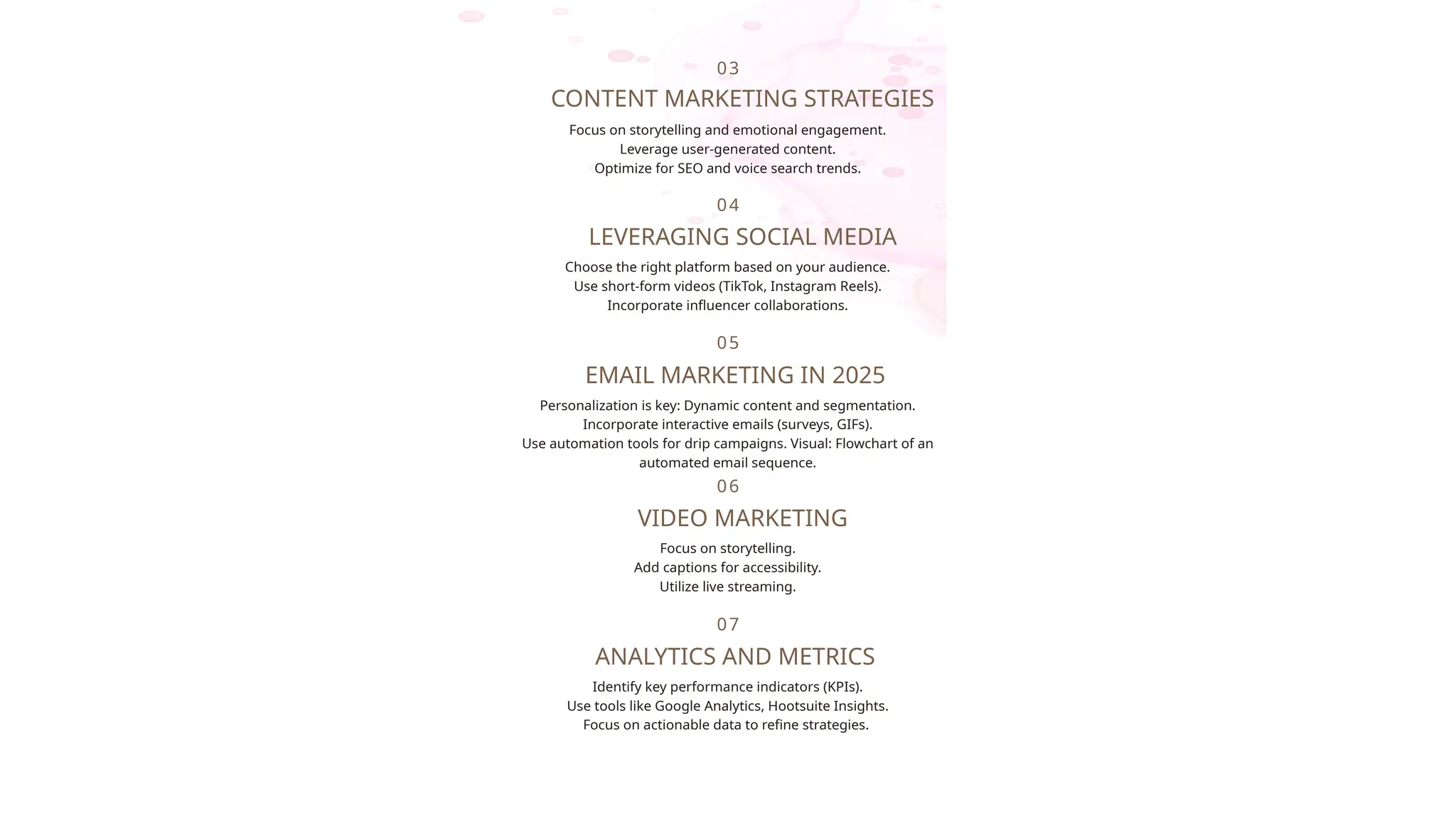
Focus on storytelling and emotional engagement.
Leverage user-generated content.
Optimize for SEO and voice search trends.
03
CONTENT MARKETING STRATEGIES
Choose the right platform based on your audience.
Use short-form videos (TikTok, Instagram Reels).
Incorporate influencer collaborations.
04
LEVERAGING SOCIAL MEDIA
Personalization is key: Dynamic content and segmentation.
Incorporate interactive emails (surveys, GIFs).
Use automation tools for drip campaigns. Visual: Flowchart of an
automated email sequence.
05
EMAIL MARKETING IN 2025
Focus on storytelling.
Add captions for accessibility.
Utilize live streaming.
06
VIDEO MARKETING
Identify key performance indicators (KPIs).
Use tools like Google Analytics, Hootsuite Insights.
Focus on actionable data to refine strategies.
07
ANALYTICS AND METRICS
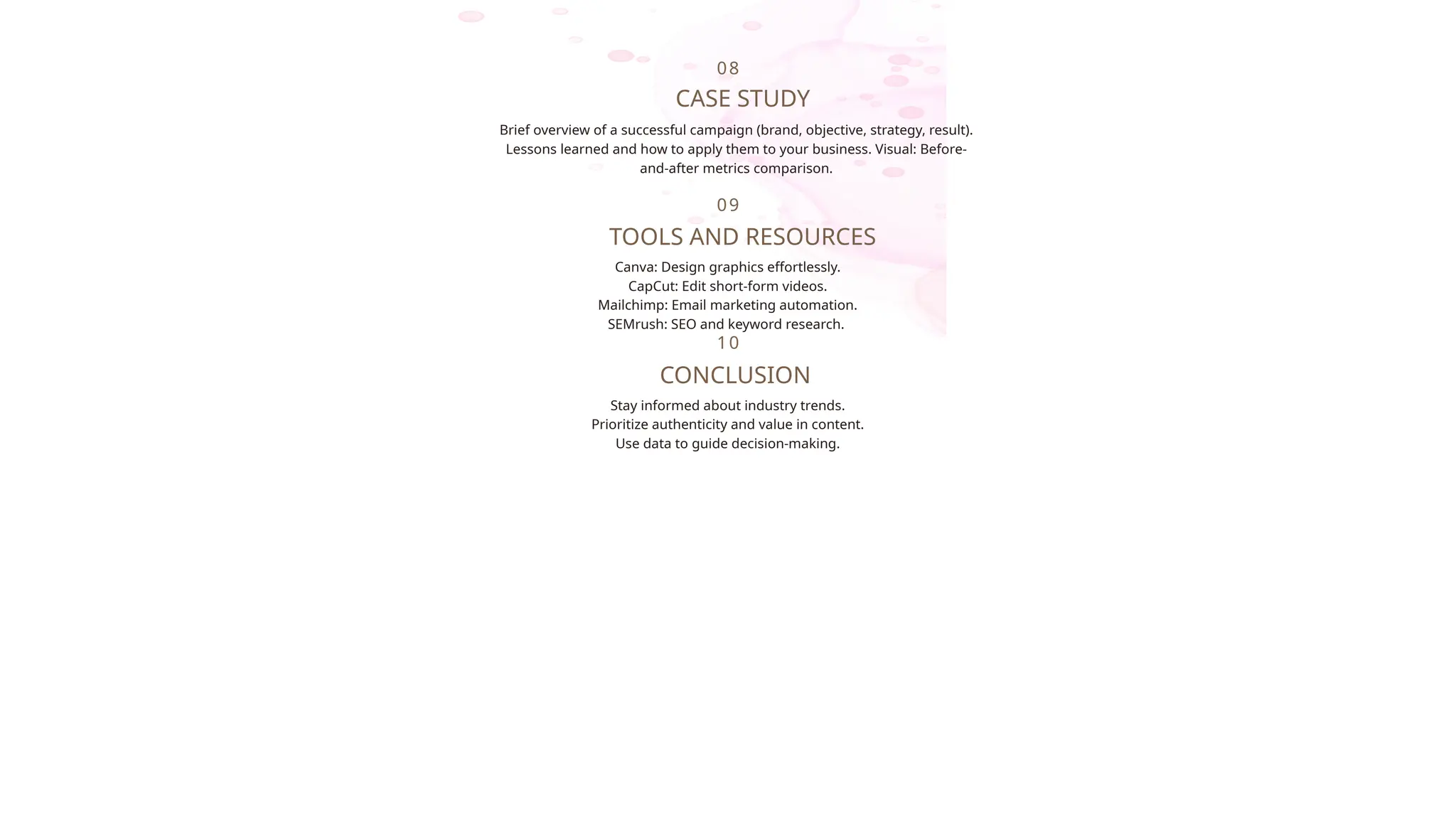
Brief overview of a successful campaign (brand, objective, strategy, result).
Lessons learned and how to apply them to your business. Visual: Before-
and-after metrics comparison.
08
CASE STUDY
Canva: Design graphics effortlessly.
CapCut: Edit short-form videos.
Mailchimp: Email marketing automation.
SEMrush: SEO and keyword research.
09
TOOLS AND RESOURCES
Stay informed about industry trends.
Prioritize authenticity and value in content.
Use data to guide decision-making.
10
CONCLUSION
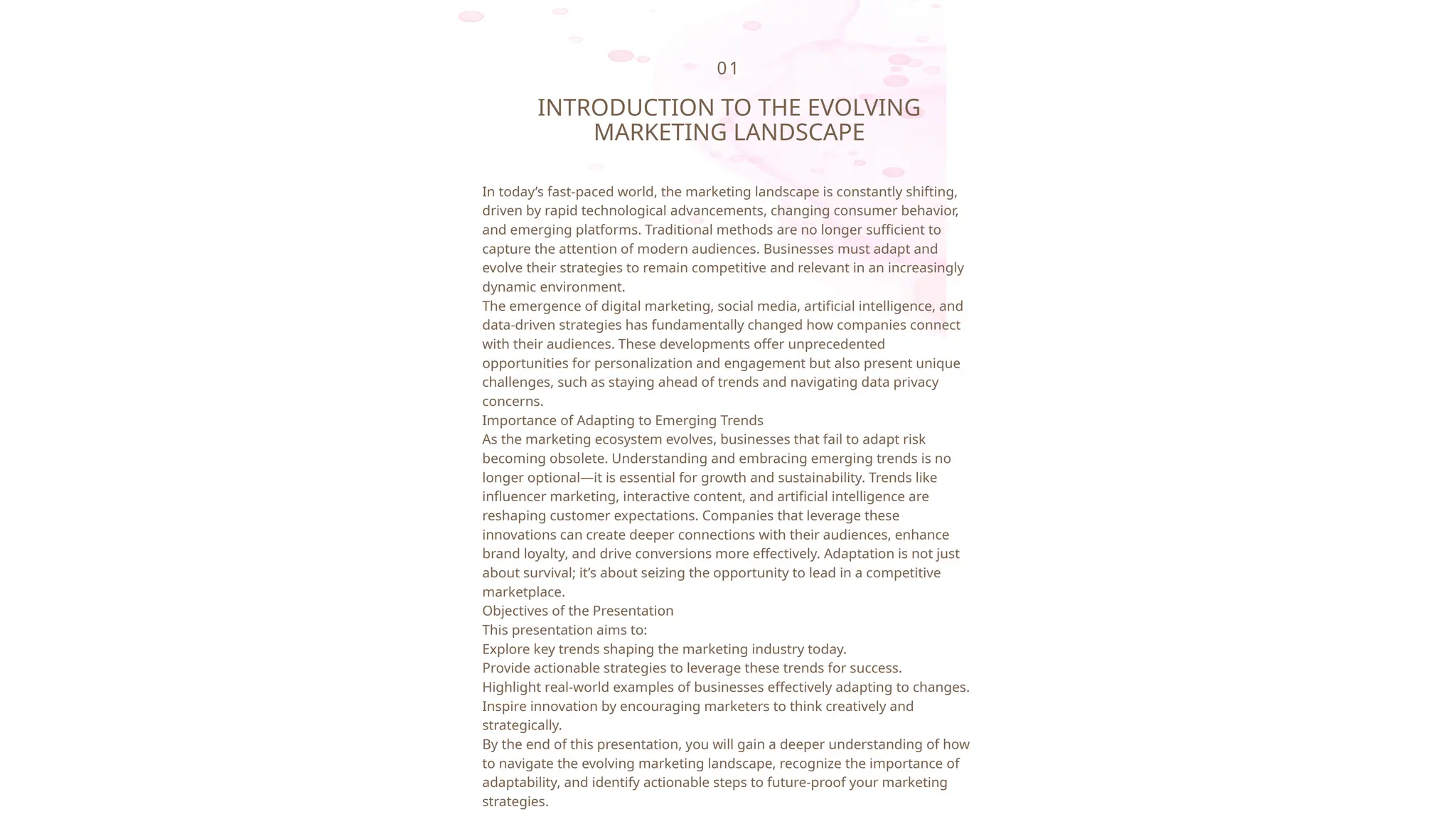
01
INTRODUCTION TO THE EVOLVING
MARKETING LANDSCAPE
In today’s fast-paced world, the marketing landscape is constantly shifting,
driven by rapid technological advancements, changing consumer behavior,
and emerging platforms. Traditional methods are no longer sufficient to
capture the attention of modern audiences. Businesses must adapt and
evolve their strategies to remain competitive and relevant in an increasingly
dynamic environment.
The emergence of digital marketing, social media, artificial intelligence, and
data-driven strategies has fundamentally changed how companies connect
with their audiences. These developments offer unprecedented
opportunities for personalization and engagement but also present unique
challenges, such as staying ahead of trends and navigating data privacy
concerns.
Importance of Adapting to Emerging Trends
As the marketing ecosystem evolves, businesses that fail to adapt risk
becoming obsolete. Understanding and embracing emerging trends is no
longer optional—it is essential for growth and sustainability. Trends like
influencer marketing, interactive content, and artificial intelligence are
reshaping customer expectations. Companies that leverage these
innovations can create deeper connections with their audiences, enhance
brand loyalty, and drive conversions more effectively. Adaptation is not just
about survival; it’s about seizing the opportunity to lead in a competitive
marketplace.
Objectives of the Presentation
This presentation aims to:
Explore key trends shaping the marketing industry today.
Provide actionable strategies to leverage these trends for success.
Highlight real-world examples of businesses effectively adapting to changes.
Inspire innovation by encouraging marketers to think creatively and
strategically.
By the end of this presentation, you will gain a deeper understanding of how
to navigate the evolving marketing landscape, recognize the importance of
adaptability, and identify actionable steps to future-proof your marketing
strategies.
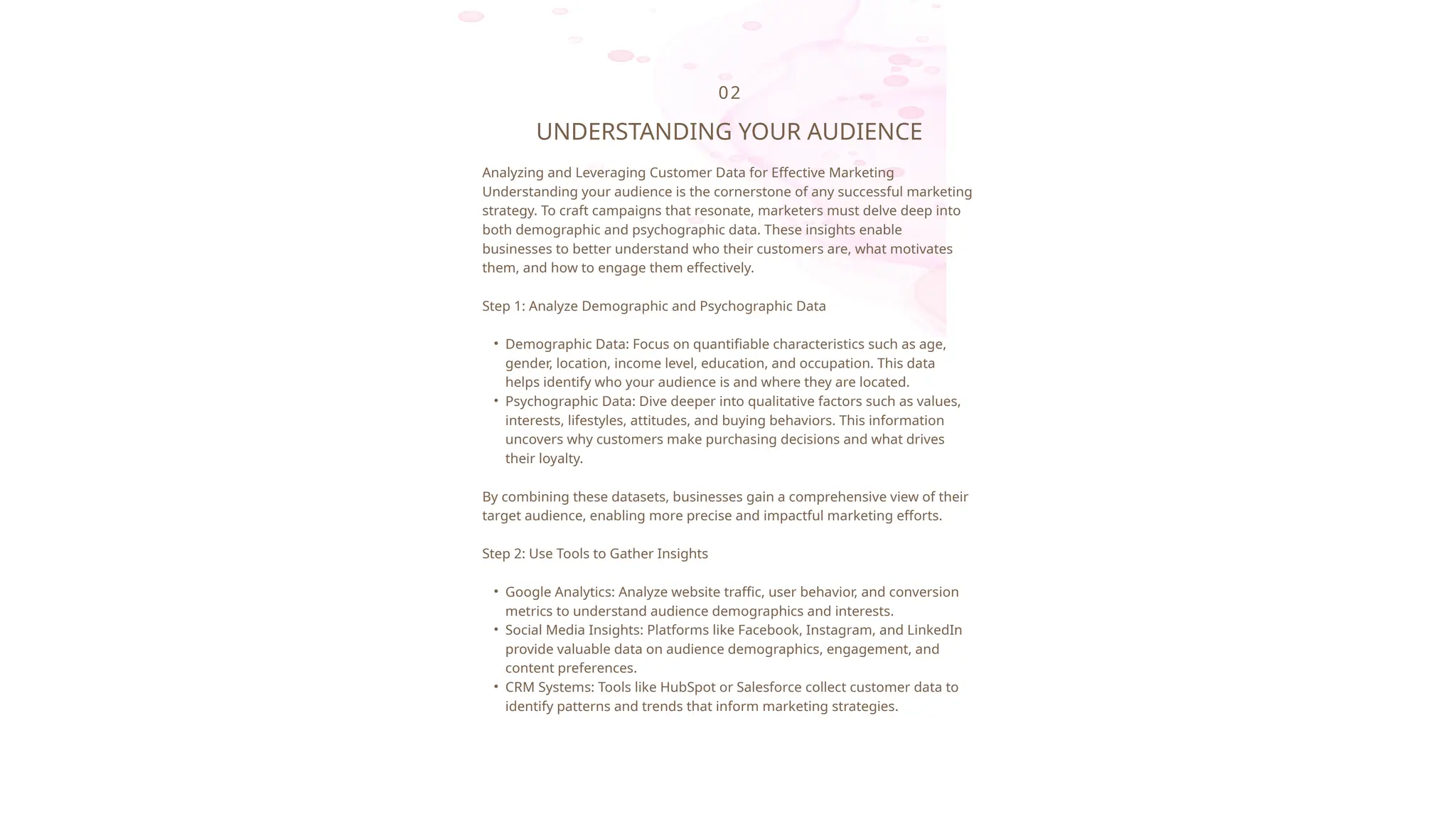
02
UNDERSTANDING YOUR AUDIENCE
Analyzing and Leveraging Customer Data for Effective Marketing
Understanding your audience is the cornerstone of any successful marketing
strategy. To craft campaigns that resonate, marketers must delve deep into
both demographic and psychographic data. These insights enable
businesses to better understand who their customers are, what motivates
them, and how to engage them effectively.
Step 1: Analyze Demographic and Psychographic Data
• Demographic Data: Focus on quantifiable characteristics such as age,
gender, location, income level, education, and occupation. This data
helps identify who your audience is and where they are located.
• Psychographic Data: Dive deeper into qualitative factors such as values,
interests, lifestyles, attitudes, and buying behaviors. This information
uncovers why customers make purchasing decisions and what drives
their loyalty.
By combining these datasets, businesses gain a comprehensive view of their
target audience, enabling more precise and impactful marketing efforts.
Step 2: Use Tools to Gather Insights
• Google Analytics: Analyze website traffic, user behavior, and conversion
metrics to understand audience demographics and interests.
• Social Media Insights: Platforms like Facebook, Instagram, and LinkedIn
provide valuable data on audience demographics, engagement, and
content preferences.
• CRM Systems: Tools like HubSpot or Salesforce collect customer data to
identify patterns and trends that inform marketing strategies.
03
CONTENT MARKETING STRATEGIES
Analyzing and Leveraging Customer Data for Effective Marketing
Understanding your audience is the cornerstone of any successful marketing
strategy. To craft campaigns that resonate, marketers must delve deep into
both demographic and psychographic data. These insights enable
businesses to better understand who their customers are, what motivates
them, and how to engage them effectively.
Step 1: Analyze Demographic and Psychographic Data
• Demographic Data: Focus on quantifiable characteristics such as age,
gender, location, income level, education, and occupation. This data
helps identify who your audience is and where they are located.
• Psychographic Data: Dive deeper into qualitative factors such as values,
interests, lifestyles, attitudes, and buying behaviors. This information
uncovers why customers make purchasing decisions and what drives
their loyalty.
By combining these datasets, businesses gain a comprehensive view of their
target audience, enabling more precise and impactful marketing efforts.
Step 2: Use Tools to Gather Insights
• Google Analytics: Analyze website traffic, user behavior, and conversion
metrics to understand audience demographics and interests.
• Social Media Insights: Platforms like Facebook, Instagram, and LinkedIn
provide valuable data on audience demographics, engagement, and
content preferences.
• CRM Systems: Tools like HubSpot or Salesforce collect customer data to
identify patterns and trends that inform marketing strategies.
03
Step 3: Build Customer Personas for Targeted Messaging
A customer persona is a semi-fictional representation of your ideal customer,
based on real data and market research. Personas help businesses:
• Identify customer pain points and needs.
• Tailor messaging and tone for specific segments.
• Create personalized marketing campaigns that resonate with each
audience group.
Visual: Example of a Customer Persona Template
• Name: Emily, The Eco-Conscious Shopper
• Demographics:
⚬ Age: 28
⚬ Location: Urban areas, prefers local businesses
⚬ Occupation: Marketing professional, mid-level
• Psychographics:
⚬ Values: Sustainability, ethical brands
⚬ Interests: Zero-waste living, outdoor adventures
⚬ Buying Behavior: Researches products online, reads reviews, prefers
eco-friendly packaging
• Pain Points: Limited availability of sustainable products, higher costs of
ethical brands
• Preferred Channels: Instagram, Pinterest, email newsletters
By using personas like this, businesses can refine their marketing approach,
ensuring every message feels personal and relevant to their audience.
04
LEVERAGING SOCIAL MEDIA
Creating Impactful Marketing Strategies: Storytelling, Engagement, and
Optimization
To captivate modern audiences and stand out in a crowded digital space,
marketers must focus on strategies that evoke emotions, encourage
participation, and stay ahead of technological trends. Here are three key
pillars to consider:
1. Focus on Storytelling and Emotional Engagement
Storytelling is a powerful tool that allows brands to connect with their
audience on a deeper level. By weaving narratives that reflect shared values,
aspirations, or challenges, companies can evoke emotions that foster loyalty
and trust.
• Why it Works: Stories are memorable and help humanize your brand.
Customers are more likely to engage with and remember a story than a
generic advertisement.
• How to Use It:
⚬ Share customer success stories or testimonials that highlight real-
world applications of your product.
⚬ Use video formats to create compelling narratives that capture
attention across platforms.
⚬ Align your brand story with causes or values that resonate with your
target audience.
2. Leverage User-Generated Content (UGC)
User-generated content is authentic, relatable, and highly engaging. It turns
customers into brand ambassadors and builds a sense of community around
your product or service.
• Why it Works: UGC is more trusted than branded content, as it comes
directly from other consumers. It also encourages audience participation
and word-of-mouth marketing.
04
LEVERAGING SOCIAL MEDIA
• How to Use It:
⚬ Run campaigns that encourage users to share their experiences with
your product using branded hashtags.
⚬ Showcase UGC on your website, social media, and marketing
materials to highlight real customer interactions.
⚬ Incentivize content creation through contests, giveaways, or
discounts.
3. Optimize for SEO and Voice Search Trends
Search engine optimization remains a cornerstone of digital marketing, but
the rise of voice search is reshaping how users find content online.
Optimizing for both traditional and voice search can significantly enhance
your visibility and reach.
• Why it Matters: Voice search queries are typically conversational and
question-based, making it essential for businesses to adapt their content
to this format.
• How to Optimize:
⚬ Incorporate long-tail keywords and natural language phrases into
your content.
⚬ Answer frequently asked questions (FAQs) directly on your website to
capture voice search traffic.
⚬ Ensure your site is mobile-friendly and fast-loading to improve overall
search rankings.
⚬ Create high-quality, informative content that aligns with user intent
and search trends.
By combining storytelling, leveraging user-generated content, and
optimizing for emerging search behaviors, businesses can create a
marketing strategy that not only captures attention but also fosters long-
term engagement and growth.
CASE STUDY
A magazine is a periodical publication, which can either be printed or
published electronically. It is issued regularly, usually every week or
every month, and it contains a variety of content. This can include
articles, stories, photographs, and advertisements.
Here's what we did
PROJECT TIME
2 Weeks
CLIENT NAME
Rosa Maria Aguado
PROJECT DATE
19/10/2022
PROBLEM MAPPING
HIRED A TEAM
DEVELOPED STRATEGY
SUPERVISED PROJECT
The Result
+ 56%
ENGAGEMENT
+45%
CONVESIONS
+80%
REVENUE
CHECK LIST
YES NO
CHECK LIST
When you've decided on your cover story, come up with a list of topics
for your feature articles. This can range from interviews, product
reviews, human interest pieces, and even lists.
Quick Wins Major Project
Fill Ins Thanksless Taks
High
Low
High Low
Impact
Effort
MATRIX
The action priority matrix is a great way to visualise what tasks take
priority over others, and how to best allocate your time towards them.
Various
Worksheet
QUESTIONNAIRE
Use this section to reflect on your current marketing strategies
and identify areas for improvement. This questionnaire is
designed to help you personalize the strategies discussed in
this presentation to suit your unique needs and goals.
MINI TRANING
It is issued regularly, usually every week
or every month, and it contains a variety
of content.
When you've decided on your cover story, come up with a list of topics
for your feature articles. This can range from interviews, product
reviews, human interest pieces, and even lists.
My Personal Value
My Value Rank
1st Action
2nd Action
3nd Action
By When
By When
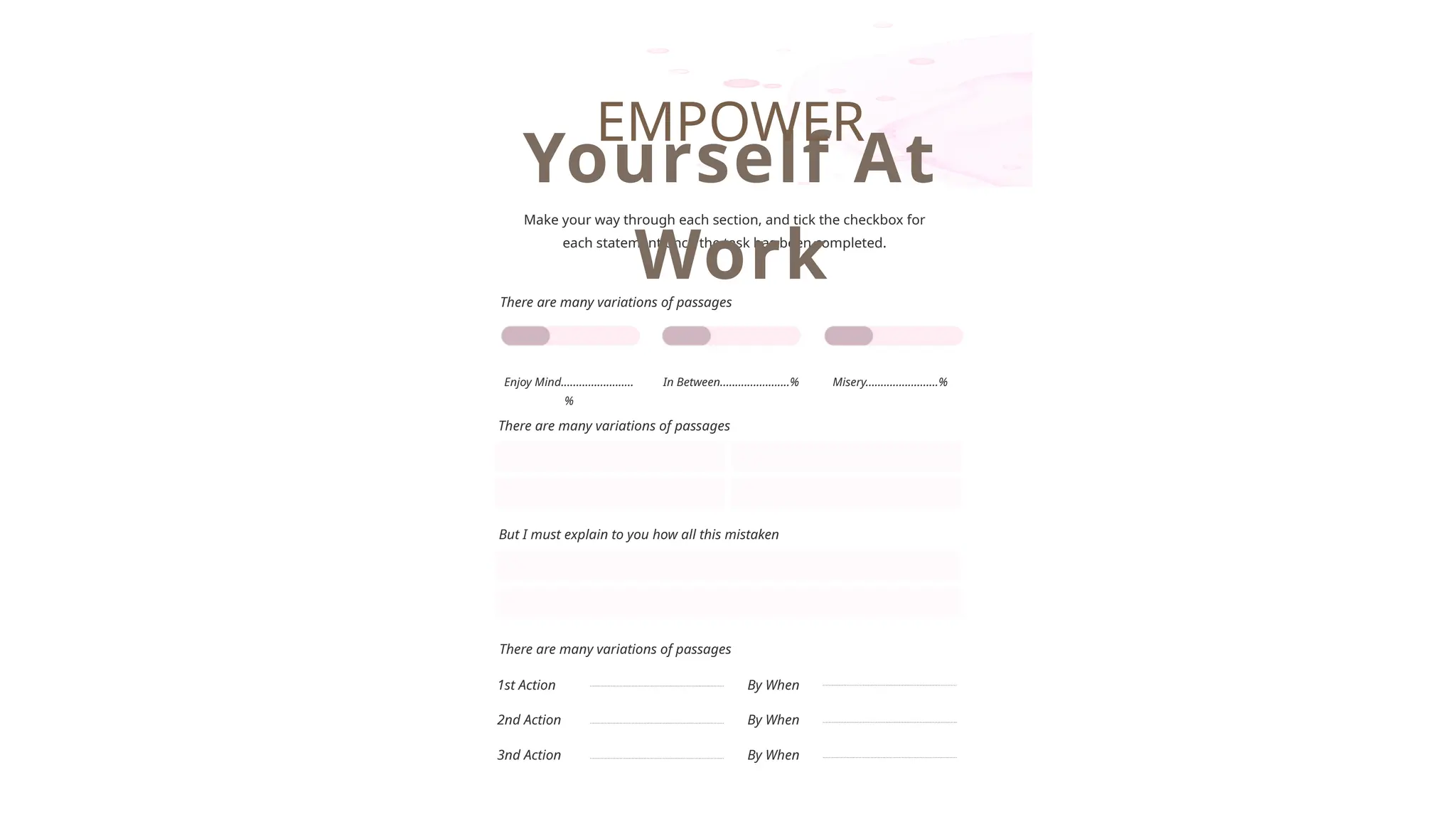
There are many variations of passages
Enjoy Mind........................
%
In Between.......................% Misery........................%
There are many variations of passages
But I must explain to you how all this mistaken
There are many variations of passages
By When
Make your way through each section, and tick the checkbox for
each statement once the task has been completed.
Yourself At
Work
EMPOWER
BAR CHARTS
Infographic
Bar charts are a powerful way to visualize data and highlight trends or
comparisons in an easily digestible format. They can help you identify
key performance indicators and track progress over time.
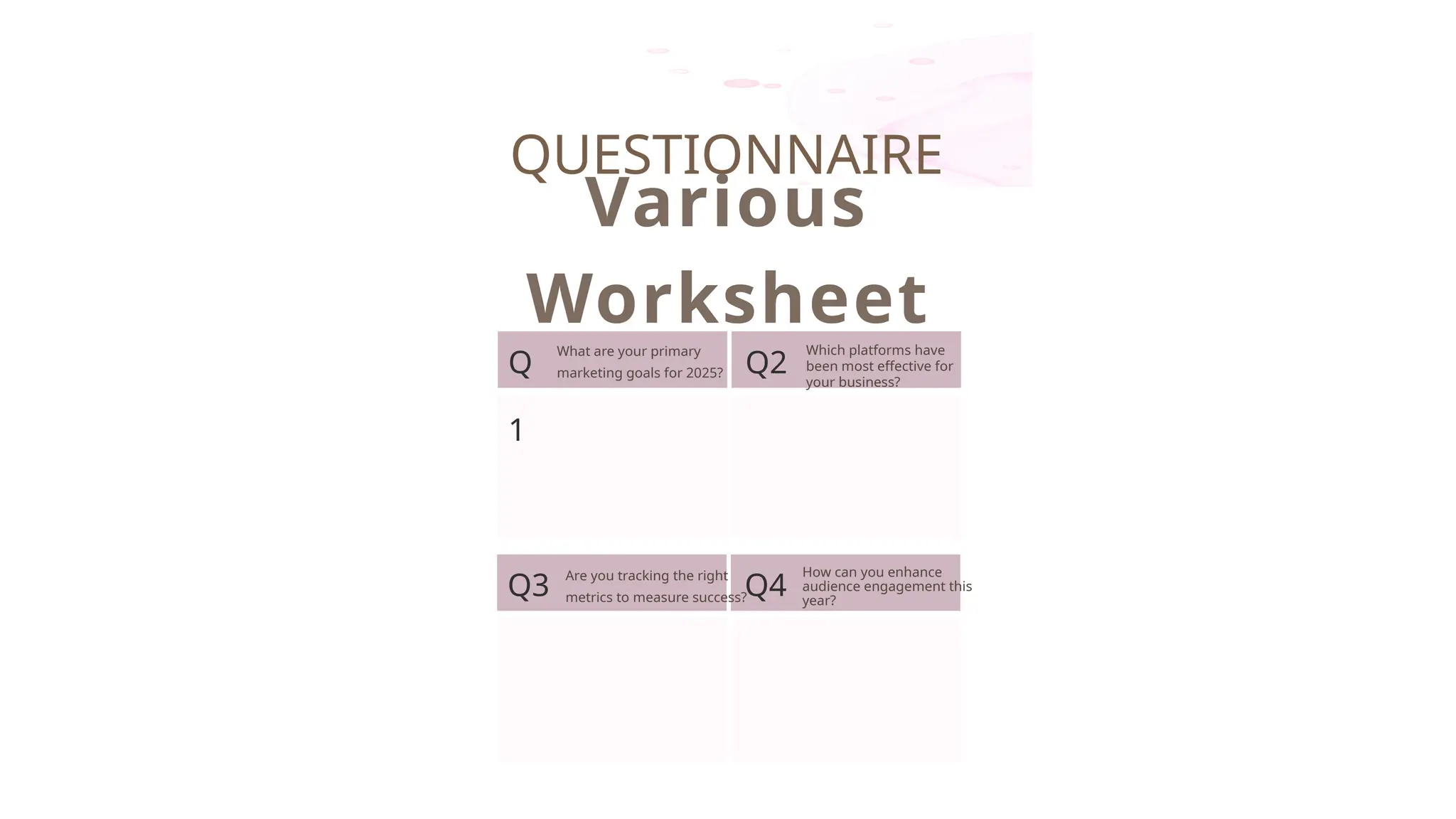
QUESTIONNAIRE
Various
Worksheet
Q
1
What are your primary
marketing goals for 2025? Q2
Which platforms have
been most effective for
your business?
Q3
Are you tracking the right
metrics to measure success?Q4
How can you enhance
audience engagement this
year?

Effective Marketing Strategies (Presentation)

  • 1.
    Greetings! Thank youfor choosing to explore this guide on marketing strategies. In this presentation, you will find actionable insights to stay competitive in the ever-evolving marketing landscape. Whether you're a seasoned marketer or just starting out, these strategies will help you navigate 2025 with confidence. EFFECTIVE MARKETING STRATEGIES for 2025
  • 2.
    TABLE OF CONTENT Introduction tothe evolving marketing landscape. Importance of adapting to emerging trends. Objectives of the presentation: 01 INTRODUCTION Analyze demographic and psychographic data. Use tools like Google Analytics and social media insights. Build customer personas for targeted messaging. Visual: Example of a customer persona template. 02 UNDERSTANDING YOUR AUDIENCE
  • 3.
    Focus on storytellingand emotional engagement. Leverage user-generated content. Optimize for SEO and voice search trends. 03 CONTENT MARKETING STRATEGIES Choose the right platform based on your audience. Use short-form videos (TikTok, Instagram Reels). Incorporate influencer collaborations. 04 LEVERAGING SOCIAL MEDIA Personalization is key: Dynamic content and segmentation. Incorporate interactive emails (surveys, GIFs). Use automation tools for drip campaigns. Visual: Flowchart of an automated email sequence. 05 EMAIL MARKETING IN 2025 Focus on storytelling. Add captions for accessibility. Utilize live streaming. 06 VIDEO MARKETING Identify key performance indicators (KPIs). Use tools like Google Analytics, Hootsuite Insights. Focus on actionable data to refine strategies. 07 ANALYTICS AND METRICS
  • 4.
    Brief overview ofa successful campaign (brand, objective, strategy, result). Lessons learned and how to apply them to your business. Visual: Before- and-after metrics comparison. 08 CASE STUDY Canva: Design graphics effortlessly. CapCut: Edit short-form videos. Mailchimp: Email marketing automation. SEMrush: SEO and keyword research. 09 TOOLS AND RESOURCES Stay informed about industry trends. Prioritize authenticity and value in content. Use data to guide decision-making. 10 CONCLUSION
  • 5.
    01 INTRODUCTION TO THEEVOLVING MARKETING LANDSCAPE In today’s fast-paced world, the marketing landscape is constantly shifting, driven by rapid technological advancements, changing consumer behavior, and emerging platforms. Traditional methods are no longer sufficient to capture the attention of modern audiences. Businesses must adapt and evolve their strategies to remain competitive and relevant in an increasingly dynamic environment. The emergence of digital marketing, social media, artificial intelligence, and data-driven strategies has fundamentally changed how companies connect with their audiences. These developments offer unprecedented opportunities for personalization and engagement but also present unique challenges, such as staying ahead of trends and navigating data privacy concerns. Importance of Adapting to Emerging Trends As the marketing ecosystem evolves, businesses that fail to adapt risk becoming obsolete. Understanding and embracing emerging trends is no longer optional—it is essential for growth and sustainability. Trends like influencer marketing, interactive content, and artificial intelligence are reshaping customer expectations. Companies that leverage these innovations can create deeper connections with their audiences, enhance brand loyalty, and drive conversions more effectively. Adaptation is not just about survival; it’s about seizing the opportunity to lead in a competitive marketplace. Objectives of the Presentation This presentation aims to: Explore key trends shaping the marketing industry today. Provide actionable strategies to leverage these trends for success. Highlight real-world examples of businesses effectively adapting to changes. Inspire innovation by encouraging marketers to think creatively and strategically. By the end of this presentation, you will gain a deeper understanding of how to navigate the evolving marketing landscape, recognize the importance of adaptability, and identify actionable steps to future-proof your marketing strategies.
  • 6.
    02 UNDERSTANDING YOUR AUDIENCE Analyzingand Leveraging Customer Data for Effective Marketing Understanding your audience is the cornerstone of any successful marketing strategy. To craft campaigns that resonate, marketers must delve deep into both demographic and psychographic data. These insights enable businesses to better understand who their customers are, what motivates them, and how to engage them effectively. Step 1: Analyze Demographic and Psychographic Data • Demographic Data: Focus on quantifiable characteristics such as age, gender, location, income level, education, and occupation. This data helps identify who your audience is and where they are located. • Psychographic Data: Dive deeper into qualitative factors such as values, interests, lifestyles, attitudes, and buying behaviors. This information uncovers why customers make purchasing decisions and what drives their loyalty. By combining these datasets, businesses gain a comprehensive view of their target audience, enabling more precise and impactful marketing efforts. Step 2: Use Tools to Gather Insights • Google Analytics: Analyze website traffic, user behavior, and conversion metrics to understand audience demographics and interests. • Social Media Insights: Platforms like Facebook, Instagram, and LinkedIn provide valuable data on audience demographics, engagement, and content preferences. • CRM Systems: Tools like HubSpot or Salesforce collect customer data to identify patterns and trends that inform marketing strategies.
  • 7.
    03 CONTENT MARKETING STRATEGIES Analyzingand Leveraging Customer Data for Effective Marketing Understanding your audience is the cornerstone of any successful marketing strategy. To craft campaigns that resonate, marketers must delve deep into both demographic and psychographic data. These insights enable businesses to better understand who their customers are, what motivates them, and how to engage them effectively. Step 1: Analyze Demographic and Psychographic Data • Demographic Data: Focus on quantifiable characteristics such as age, gender, location, income level, education, and occupation. This data helps identify who your audience is and where they are located. • Psychographic Data: Dive deeper into qualitative factors such as values, interests, lifestyles, attitudes, and buying behaviors. This information uncovers why customers make purchasing decisions and what drives their loyalty. By combining these datasets, businesses gain a comprehensive view of their target audience, enabling more precise and impactful marketing efforts. Step 2: Use Tools to Gather Insights • Google Analytics: Analyze website traffic, user behavior, and conversion metrics to understand audience demographics and interests. • Social Media Insights: Platforms like Facebook, Instagram, and LinkedIn provide valuable data on audience demographics, engagement, and content preferences. • CRM Systems: Tools like HubSpot or Salesforce collect customer data to identify patterns and trends that inform marketing strategies.
  • 8.
    03 Step 3: BuildCustomer Personas for Targeted Messaging A customer persona is a semi-fictional representation of your ideal customer, based on real data and market research. Personas help businesses: • Identify customer pain points and needs. • Tailor messaging and tone for specific segments. • Create personalized marketing campaigns that resonate with each audience group. Visual: Example of a Customer Persona Template • Name: Emily, The Eco-Conscious Shopper • Demographics: ⚬ Age: 28 ⚬ Location: Urban areas, prefers local businesses ⚬ Occupation: Marketing professional, mid-level • Psychographics: ⚬ Values: Sustainability, ethical brands ⚬ Interests: Zero-waste living, outdoor adventures ⚬ Buying Behavior: Researches products online, reads reviews, prefers eco-friendly packaging • Pain Points: Limited availability of sustainable products, higher costs of ethical brands • Preferred Channels: Instagram, Pinterest, email newsletters By using personas like this, businesses can refine their marketing approach, ensuring every message feels personal and relevant to their audience.
  • 9.
    04 LEVERAGING SOCIAL MEDIA CreatingImpactful Marketing Strategies: Storytelling, Engagement, and Optimization To captivate modern audiences and stand out in a crowded digital space, marketers must focus on strategies that evoke emotions, encourage participation, and stay ahead of technological trends. Here are three key pillars to consider: 1. Focus on Storytelling and Emotional Engagement Storytelling is a powerful tool that allows brands to connect with their audience on a deeper level. By weaving narratives that reflect shared values, aspirations, or challenges, companies can evoke emotions that foster loyalty and trust. • Why it Works: Stories are memorable and help humanize your brand. Customers are more likely to engage with and remember a story than a generic advertisement. • How to Use It: ⚬ Share customer success stories or testimonials that highlight real- world applications of your product. ⚬ Use video formats to create compelling narratives that capture attention across platforms. ⚬ Align your brand story with causes or values that resonate with your target audience. 2. Leverage User-Generated Content (UGC) User-generated content is authentic, relatable, and highly engaging. It turns customers into brand ambassadors and builds a sense of community around your product or service. • Why it Works: UGC is more trusted than branded content, as it comes directly from other consumers. It also encourages audience participation and word-of-mouth marketing.
  • 10.
    04 LEVERAGING SOCIAL MEDIA •How to Use It: ⚬ Run campaigns that encourage users to share their experiences with your product using branded hashtags. ⚬ Showcase UGC on your website, social media, and marketing materials to highlight real customer interactions. ⚬ Incentivize content creation through contests, giveaways, or discounts. 3. Optimize for SEO and Voice Search Trends Search engine optimization remains a cornerstone of digital marketing, but the rise of voice search is reshaping how users find content online. Optimizing for both traditional and voice search can significantly enhance your visibility and reach. • Why it Matters: Voice search queries are typically conversational and question-based, making it essential for businesses to adapt their content to this format. • How to Optimize: ⚬ Incorporate long-tail keywords and natural language phrases into your content. ⚬ Answer frequently asked questions (FAQs) directly on your website to capture voice search traffic. ⚬ Ensure your site is mobile-friendly and fast-loading to improve overall search rankings. ⚬ Create high-quality, informative content that aligns with user intent and search trends. By combining storytelling, leveraging user-generated content, and optimizing for emerging search behaviors, businesses can create a marketing strategy that not only captures attention but also fosters long- term engagement and growth.
  • 11.
    CASE STUDY A magazineis a periodical publication, which can either be printed or published electronically. It is issued regularly, usually every week or every month, and it contains a variety of content. This can include articles, stories, photographs, and advertisements. Here's what we did PROJECT TIME 2 Weeks CLIENT NAME Rosa Maria Aguado PROJECT DATE 19/10/2022 PROBLEM MAPPING HIRED A TEAM DEVELOPED STRATEGY SUPERVISED PROJECT The Result + 56% ENGAGEMENT +45% CONVESIONS +80% REVENUE
  • 12.
    CHECK LIST YES NO CHECKLIST When you've decided on your cover story, come up with a list of topics for your feature articles. This can range from interviews, product reviews, human interest pieces, and even lists.
  • 13.
    Quick Wins MajorProject Fill Ins Thanksless Taks High Low High Low Impact Effort MATRIX The action priority matrix is a great way to visualise what tasks take priority over others, and how to best allocate your time towards them.
  • 14.
    Various Worksheet QUESTIONNAIRE Use this sectionto reflect on your current marketing strategies and identify areas for improvement. This questionnaire is designed to help you personalize the strategies discussed in this presentation to suit your unique needs and goals.
  • 15.
    MINI TRANING It isissued regularly, usually every week or every month, and it contains a variety of content. When you've decided on your cover story, come up with a list of topics for your feature articles. This can range from interviews, product reviews, human interest pieces, and even lists. My Personal Value My Value Rank
  • 16.
    1st Action 2nd Action 3ndAction By When By When There are many variations of passages Enjoy Mind........................ % In Between.......................% Misery........................% There are many variations of passages But I must explain to you how all this mistaken There are many variations of passages By When Make your way through each section, and tick the checkbox for each statement once the task has been completed. Yourself At Work EMPOWER
  • 17.
    BAR CHARTS Infographic Bar chartsare a powerful way to visualize data and highlight trends or comparisons in an easily digestible format. They can help you identify key performance indicators and track progress over time.
  • 18.
    QUESTIONNAIRE Various Worksheet Q 1 What are yourprimary marketing goals for 2025? Q2 Which platforms have been most effective for your business? Q3 Are you tracking the right metrics to measure success?Q4 How can you enhance audience engagement this year?